

Finn Ashford's Arc
12 Chapters
Finn Ashford's dream is recovering the enchanted relic he lost on the expedition that left him scarred..

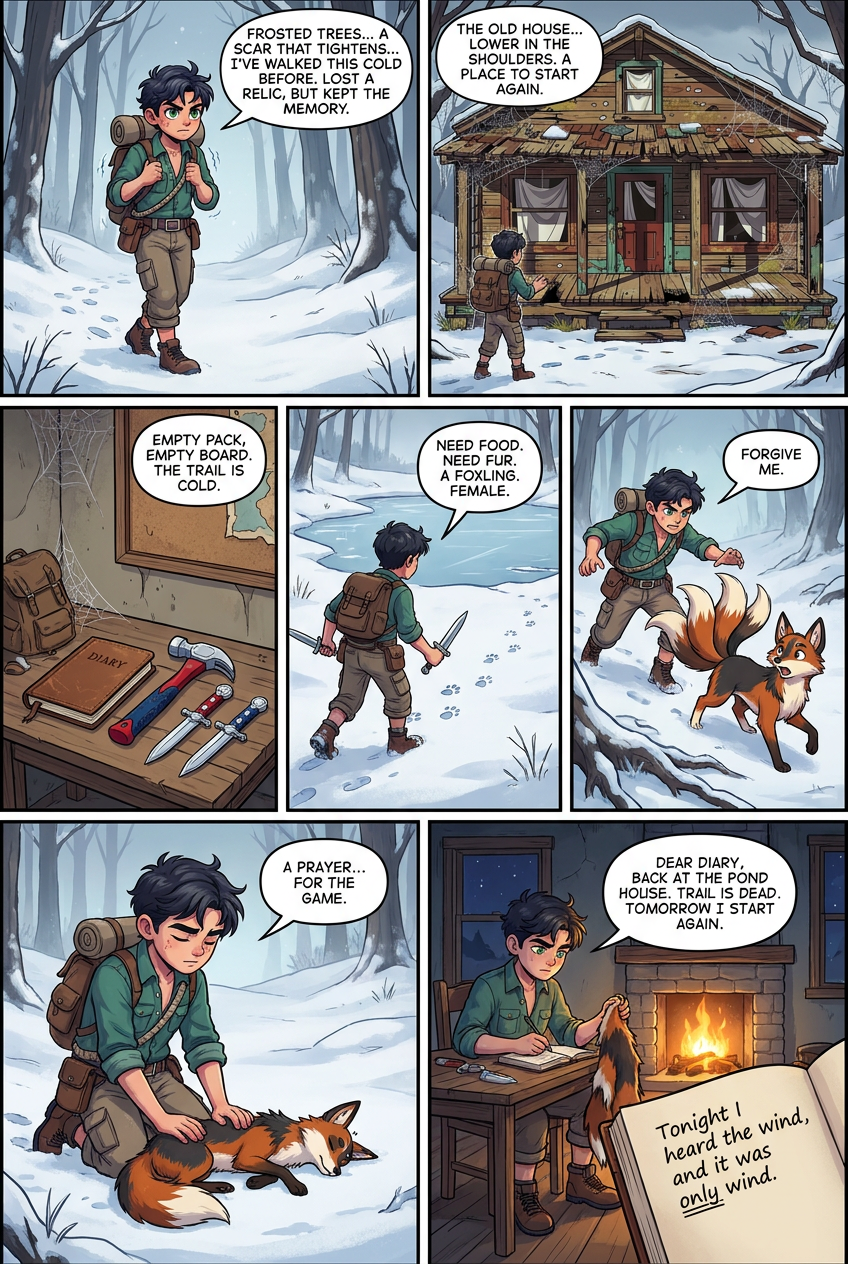
Finn Ashford stepped between the frosted trees and felt the scar above his left eyebrow tighten in the cold. He had walked this forest once before. He had left it with a split brow, an empty pack, and a memory of two days spent carrying a relic that hummed sounds he could not call wind. He had not been afraid then. That still bothered him more than the losing. He meant to find the relic again. The trail had gone cold weeks ago, and every day in this forest made it colder. The old house stood where he remembered, lower in the shoulders than before. Sheets sagged in the windows. Webs hung from the porch beams like grey laundry. He had used it as a base on the last expedition and pinned every dead lead to the cork board inside: a torn map edge, a feather, a buyer's name crossed out twice. Winter had pushed the roof another inch toward the floor. He set his pack on the table, unrolled his gear, and laid out his diary, his hammer, and the two silver daggers with diamond-set handles. He had work to do before dark. He needed food and he needed fur. He circled the house once and found prints in the snow near the pond, small paws, three drag marks behind each track. A foxling. Female, by the spread. The light was already thin between the trunks. He followed the prints with both daggers loose at his belt. He found her nosing at a frozen root, calico coat bright against the snow, three tails fanned for balance. Finn crouched low and drew one blade. He waited until her head dipped. "Forgive me," he whispered, and lunged. One swing. The foxling dropped without a sound. He knelt and said a short prayer over the body, the kind his mother had used for game. Then he lifted her by the hind legs and carried her back through the blue dusk to the house. He built a fire in the cracked hearth until the room glowed orange. He skinned the foxling on the table, set the meat to roast, and stretched the pelt by the flames. Then he opened his diary and uncapped the pen. Dear diary, he wrote. I am back at the pond house. The trail is dead. I have nothing pinned to the board that points anywhere new. Tomorrow I start again from the last place I held it. He stopped, looked up at the empty cork above the table, and added one more line. Tonight I heard the wind, and it was only wind. He underlined only twice, closed the diary, and watched the fire until the meat was done.
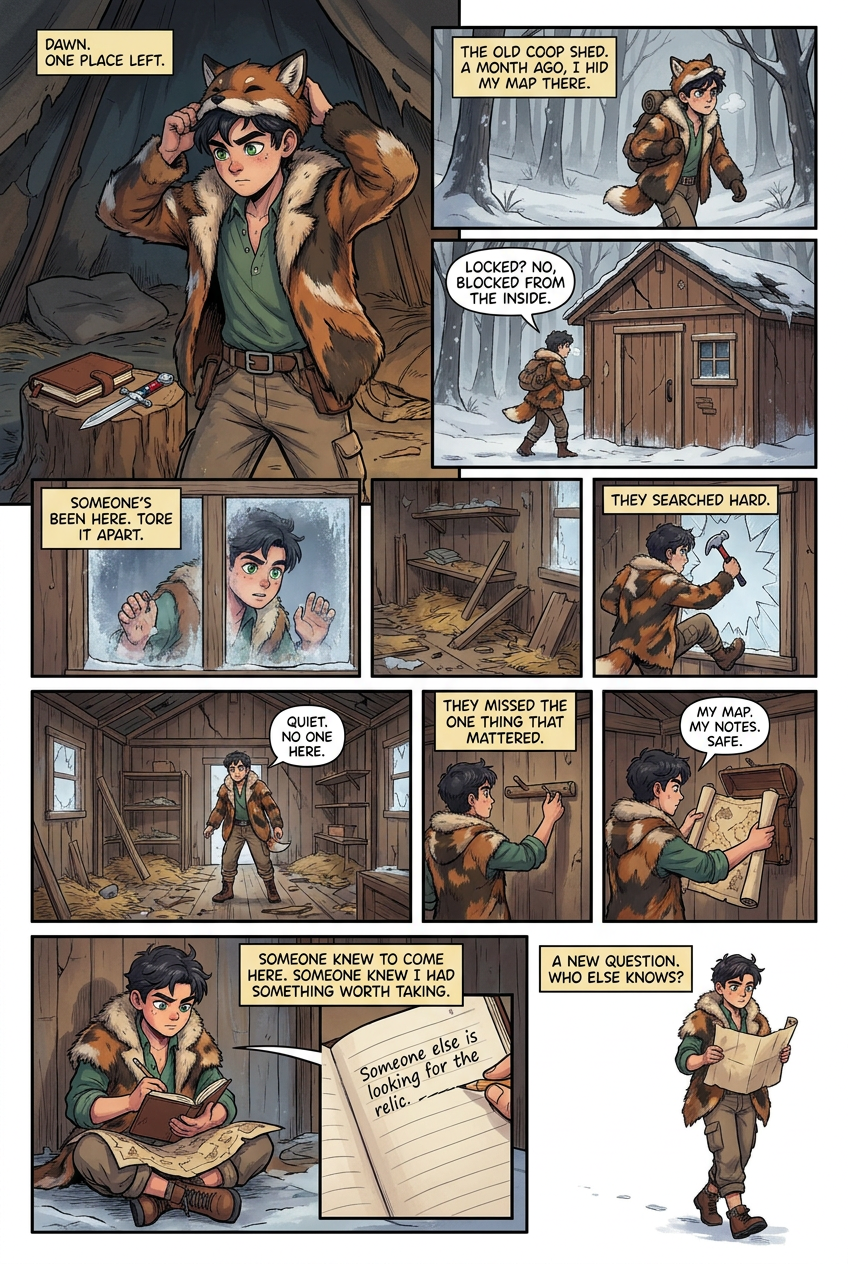
Finn woke before dawn and pulled the foxling pelt across his shoulders. He had stitched it into a rough jacket overnight, with a smaller piece shaped into a cap. The fur still smelled of smoke and pond water. He ate the last of the roast meat, packed his diary and both daggers, and stepped out into the gray morning. He had one place left worth checking. Months ago he had hidden a copy of his search map and a few notes inside an old coop shed at the far edge of the woods. It was not a clever hiding spot. It was only a place no one would think to look. The walk took most of the morning. He found the shed standing where he remembered, square and brown against the snow, one door, one window, the roof cracked along the ridge. He tried the handle. The door did not move. He set his shoulder to it and pushed. Still nothing. Something heavy was wedged against it from the inside. He stepped to the window and wiped frost from the glass. The room inside was wrecked. Shelves lay snapped on the floor. Straw was kicked into corners. A barrel had been tipped against the door. Someone had been here before him, and they had searched hard. He drew the hammer from his belt and broke the window in two short strikes. He cleared the frame, climbed through, and dropped onto the boards. He stood still and listened. No breath but his own. He started with the shelves and worked outward, lifting each broken board, checking under straw, tapping the floor for hollow spots. Whoever had come through had torn the place open but missed the one thing that mattered. Finn had not hidden the map under a board. He had hidden it inside a piece of the wall itself. He crossed to the back corner where a short length of branch was nailed across two studs as a coat peg. He pulled the branch free, weighed it in his palm, and twisted the end. The wood turned. The carved case opened and a tight roll of paper slid into his hand. His map. His notes. The marked grids of every place he had already searched and crossed off. He sat on the cold floor and spread the paper across his knee. With the map he could plan the short winter days. He would not waste them retracing dead ground. He rolled the scroll, slid it inside his jacket, and looked again at the wrecked room. Someone had known to come here. Someone had known he had something worth taking. He opened his diary against his thigh and wrote one line. Someone else is looking for the relic. He closed the cover, climbed back through the broken window, and started the walk home with the map against his chest and a new question turning in his mind.
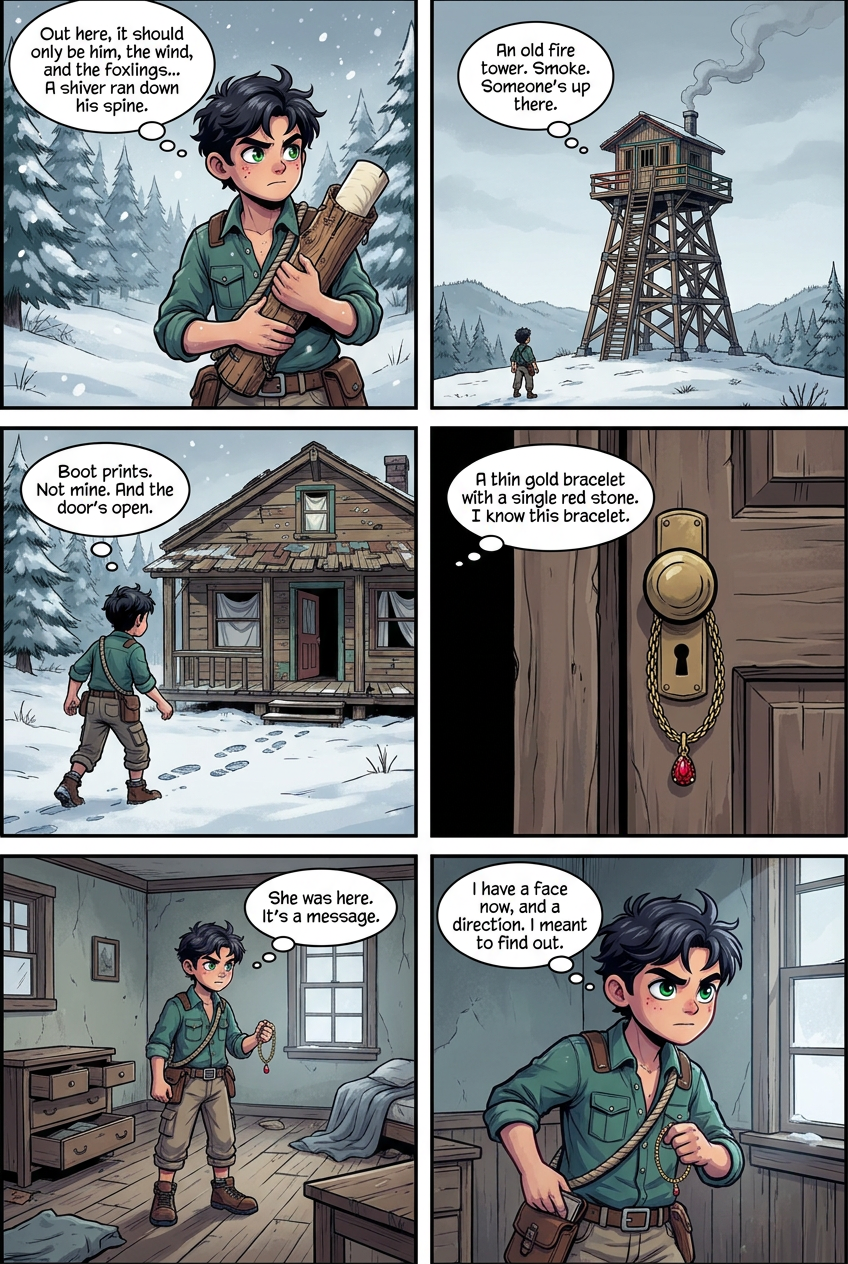
Finn walked back through the woods with the scroll case tucked under his jacket. The map pressed against his ribs with every step. He kept to the edge of the tree line where the snow was thinner. Halfway home, a shiver ran down his spine. He stopped and looked behind him. Nothing moved. Out here it should only be him, the wind, and the foxlings. He listened harder and heard neither wind nor paws. He heard only his own breath. He cut left off the trail and circled wide through the pines. On a ridge above the pond he saw it: an old fire tower standing crooked against the gray sky. He had passed it a dozen times and never thought of it. Now a thin gray smoke curled from a pipe near the lookout. Someone had made a perch up there. Someone with a clear view of the pond and the house below it. Finn dropped low and moved fast. He kept the trees between himself and the tower until the slope took him down toward home. His chest burned. He told himself the tracker might still be up in the tower, watching the wrong window. He told himself he had time. He broke from the trees and stopped hard in the snow. Boot prints crossed the yard in a straight line to the porch. The treads were deep and clean, not his own. The front door of the weathered house stood open. A strip of curtain shifted in the draft. He drew the hammer from his belt and crossed the yard with the prints under his feet. On the doorknob, swinging in the cold air, hung a thin gold bracelet with a single red stone. He knew the bracelet. He had seen it on a wrist months ago, in a town two valleys over, on a woman who had asked too many questions about what he carried. He had not given her his name. She had given him hers and he had forgotten it. He had not forgotten the stone. He lifted the bracelet off the knob and closed his fist around it. The chain was warm. She had been here within the hour. Finn stepped into the house. The rooms were empty. Drawers hung open. His spare blanket lay kicked into the corner. She had searched and she had left the bracelet on the knob so he would know she had searched. It was not a gift. It was a message. She wanted him to understand that she could find him, and that she wanted him to follow. He slid the bracelet into his pocket beside the map. He had a face now, and a direction. He hoped she was alive when he caught up to her. He meant to find out either way.
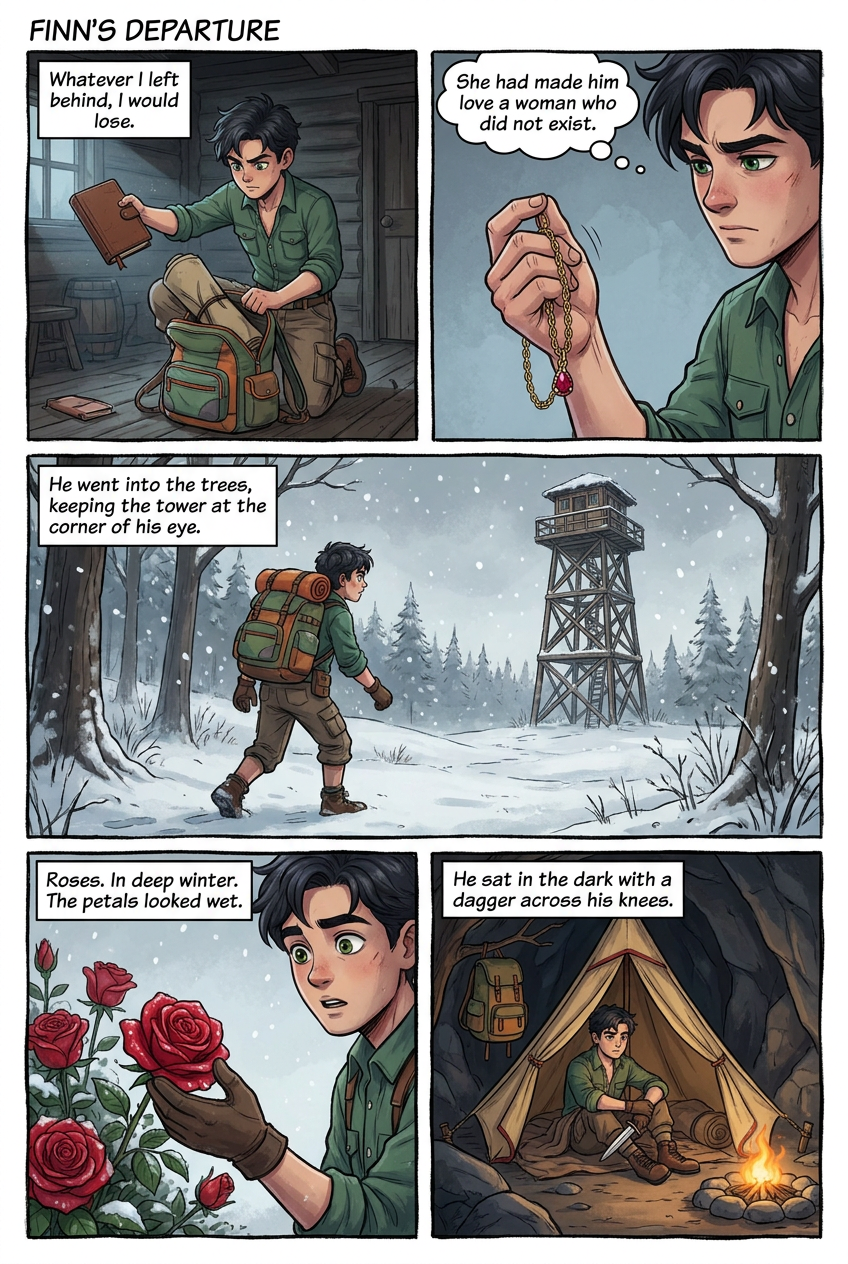
Finn shut the broken door behind him and worked fast. He pulled a sturdy backpack from under the bed and dropped his diary and both daggers inside. He cleared a closet shelf and found the rolled tent he had stored there last fall. He stuffed the tent under the pack's top flap and cinched the straps. The map and scroll case went deep against his spine. He took flint, a coil of rope, and the strip of foxling fur from the rack by the stove. Whatever he left behind, he would lose. Another visit from her would clean the house to the boards. He stopped at the door with his hand on the frame. The bracelet sat in his pocket like a coin he could not spend. He pulled it out and squeezed it until the chain bit his palm. She had smelled like roses the night she sat across from him in that tavern. She had laughed at his bad jokes. They had talked until the lamps burned low and slept in the same room, and in the morning his pack was light and she was gone. She had made him love a woman who did not exist. He shoved the bracelet back into his pocket and stepped out into the snow. He went into the trees and kept the crooked fire tower at the corner of his eye. As long as he could see it, whoever sat in its lookout could not flank him without crossing open ground. He moved in short pushes from trunk to trunk. He aimed for the falls. The relic had left his hand near that water. If any thread of the trail still held, it held there. He decided he would only light fires in daylight, when smoke blended with the gray sky, and sleep cold at night. A mile in, he stopped. A bush stood beside a frozen creek with red blooms open on its stems. Roses. In deep winter. The petals looked wet. He touched one with a gloved finger and the petal held its shape. He stepped back and scanned the snow around it. No tracks. No broken branches. He moved on faster. He found another cluster at the base of a pine. Then a third on a stump where no roots could reach. The sun dropped behind the ridge and the woods turned blue. He rubbed his eyes hard. The bushes stayed. He could not tell anymore if she was leaving them for him or if his own head was placing them in the snow. Both answers frightened him in the same way. Neither answer made him turn back. Finn climbed a shelf of rock above the falls and pitched the tent in a hollow screened by deadfall. He hung the pack from a branch inside, knotted twice. The house was finished. This patch of ground was his shelter now. He sat in the dark with a dagger across his knees and watched the trees for petals he did not want to see again.
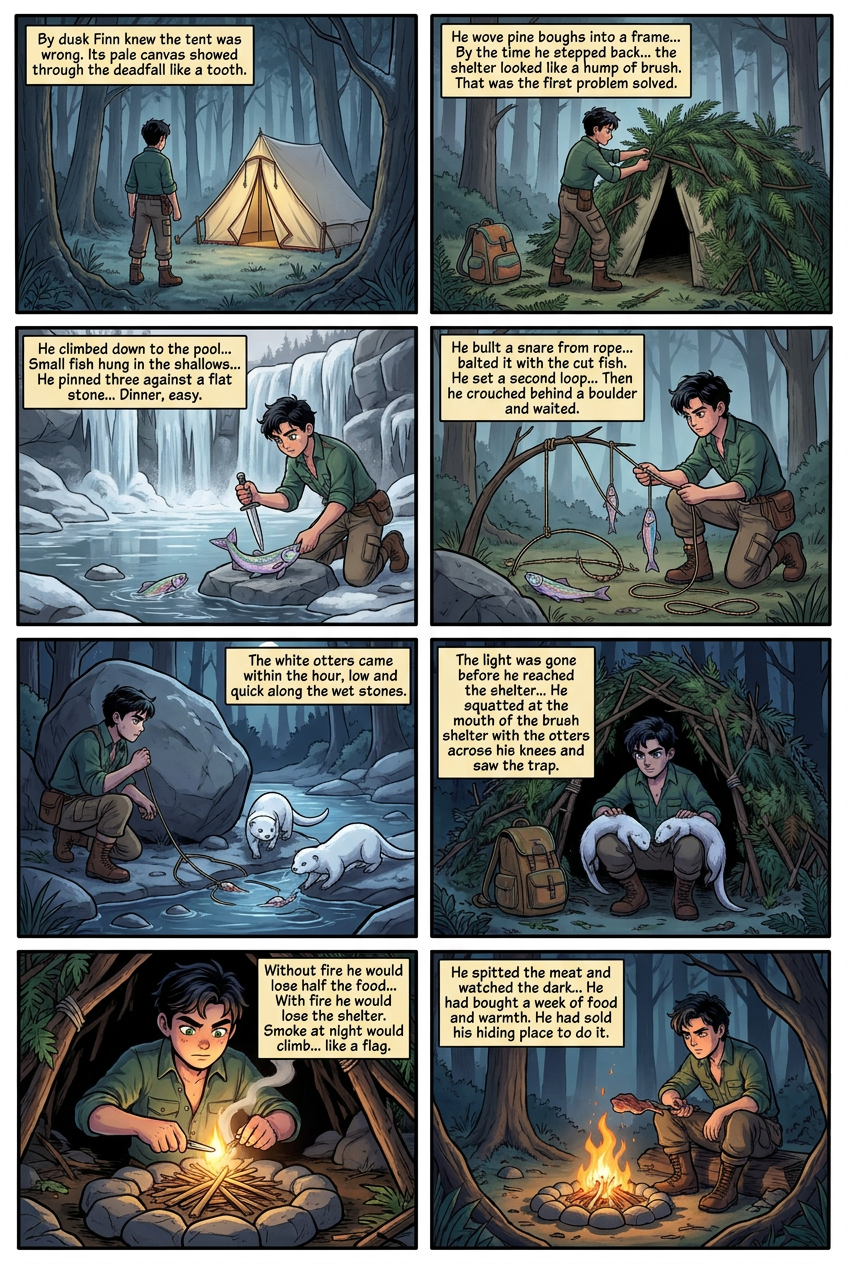
By dusk Finn knew the tent was wrong. Its pale canvas showed through the deadfall like a tooth. He crawled out with his dagger and started cutting. He wove pine boughs into a frame around the tent, then layered ferns and brown leaves over the weave. By the time he stepped back to check it, the shelter looked like a hump of brush stuck to the rock. He could walk past it at ten paces and miss it. That was the first problem solved. The second one was louder. His pack held two days of jerky and a heel of bread. Cold burned through his coat already. He needed food and he needed fur, and he needed both before the next hard freeze. He climbed down to the pool at the base of the falls while gray light still held. Small fish hung in the shallows where the spray broke the ice. Their scales caught what light was left and threw back streaks of red and green. He pinned three against a flat stone with his blade and strung them through the gills on a length of cord. Dinner, easy. He kept two whole and gutted the third on the bank. He knew what came to fish guts at dusk. He built a snare from rope and a bent sapling and baited it with the cut fish. He set a second loop ten feet on. Then he crouched behind a boulder and waited. The white otters came within the hour, low and quick along the wet stones. The first snare took one clean. The second took another when it doubled back for the bait. He killed them with the dagger and worked fast. Two thick pelts, enough meat for a week. He bundled the carcasses in the cord and started the climb back to camp. The light was gone before he reached the shelter. Real dark, not dusk. He squatted at the mouth of the brush shelter with the otters across his knees and saw the trap. Raw meat in this cold would keep one night, maybe two, then turn. He had no salt. He had no smoker. Without fire he would lose half the food he had just killed himself to get. With fire he would lose the shelter. Smoke at night would climb above the falls like a flag. The tower watcher would see it. The woman would see it. Anything hunting these woods would see it. Finn cleared a ring of stones inside the deadfall hollow, low and tight against the rock wall. He shaved kindling thin. He struck flint and fed the flame slow, building it small enough to cook over and no larger. The light bounced off the wet stone behind him. He spitted the meat and watched the dark beyond the ring. He had bought a week of food and warmth. He had sold his hiding place to do it. Whoever found him first would decide what that trade was worth.
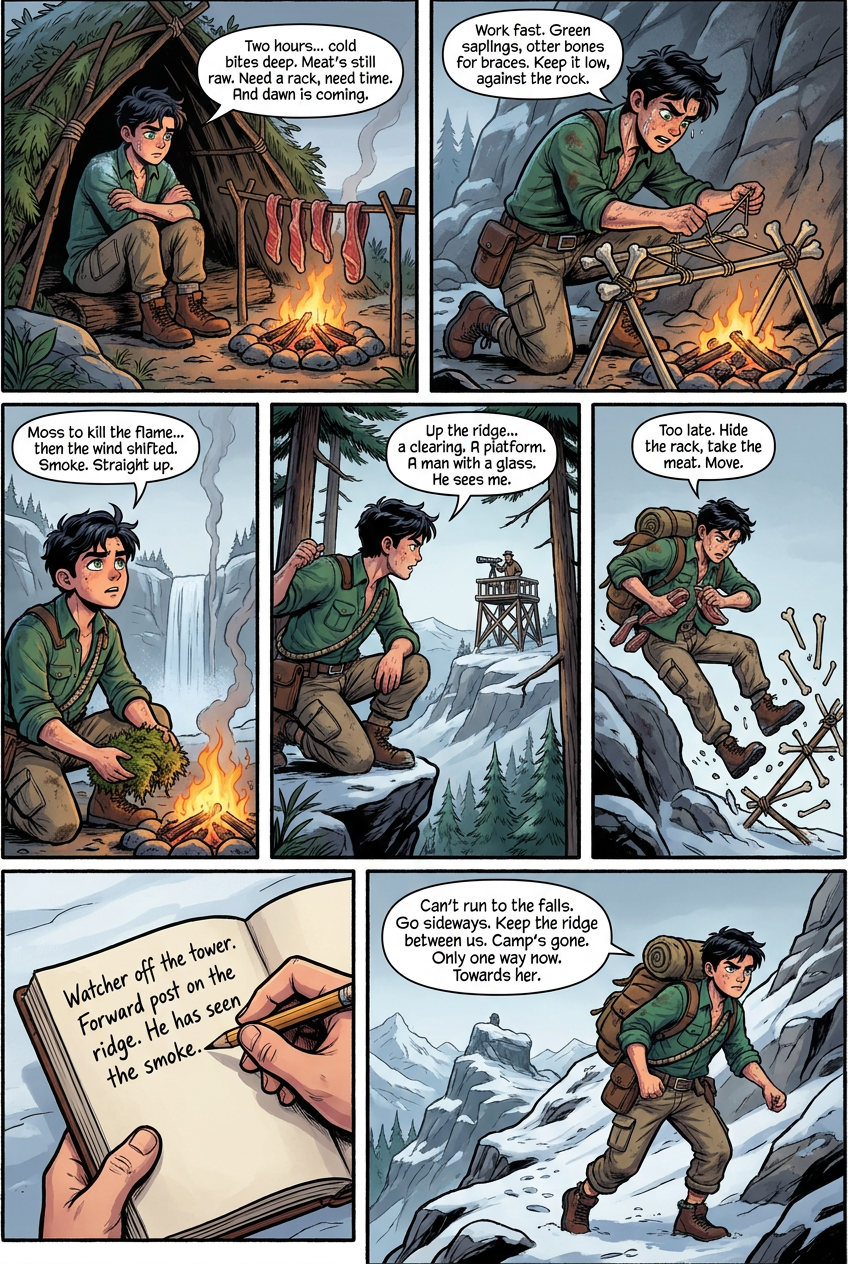
Finn slept two hours by the small fire and woke with the cold biting through his coat. The flame had burned down to coals, but the meat above it was still raw. One night of slow heat would not cure it. He needed a rack and he needed time, and he had neither if smoke kept climbing past the falls at dawn. He crawled out of the brush shelter and looked east. Gray light bled over the ridge. Up there, somewhere above the trees, the watcher in the tower could already see whatever rose off his fire. He worked fast. He cut four green saplings and lashed them into a peaked frame with cord from his pack. He stripped the otter leg bones clean and used them to brace the joints. He set the frame low over the coals, close enough to catch heat but tucked against the rock wall so the stone took the worst of the light. Above it he built a second frame from green wood, flat and wide, and laid strips of otter and fish across the rails. He banked the fire with damp moss to kill flame and force smoke down through the meat instead of up through the trees. It worked for an hour. Then the wind shifted. He smelled it before he saw it. The smoke turned and rolled out of the hollow in a thin gray rope that climbed straight above the falls. Finn killed the fire with snow and dirt in three handfuls. Too late. He climbed the rock behind his shelter and lay flat and looked east through the pines. Halfway down the ridge, in a clearing he had not noticed before, stood a low platform of fresh-cut timber lashed between two trunks. A man stood on it with a glass to his eye. The glass was pointed at the falls. At him. Finn slid down the rock. He pulled the strips off the rack and stuffed them into his coat, half-cured and greasy. He cut the lashings on the bone frame and kicked the poles into the brush. He shouldered his pack. He took the diary from the inner pocket and wrote three lines with a stub of pencil. Watcher off the tower. Forward post on the ridge. He has seen the smoke. He closed the book and pushed it back against his ribs. He did not run downhill toward the falls. The watcher would expect that. Finn went sideways along the rock, keeping the ridge between them, half-cured meat heavy in his coat and the cold pressing his wet sleeves to his arms. The camp above the falls was finished. He had bought a week of food and lost the only ground he knew. Somewhere ahead, past trees he had not yet walked, the woman who wanted him to follow her was still waiting. Now he had no choice but to move toward her.
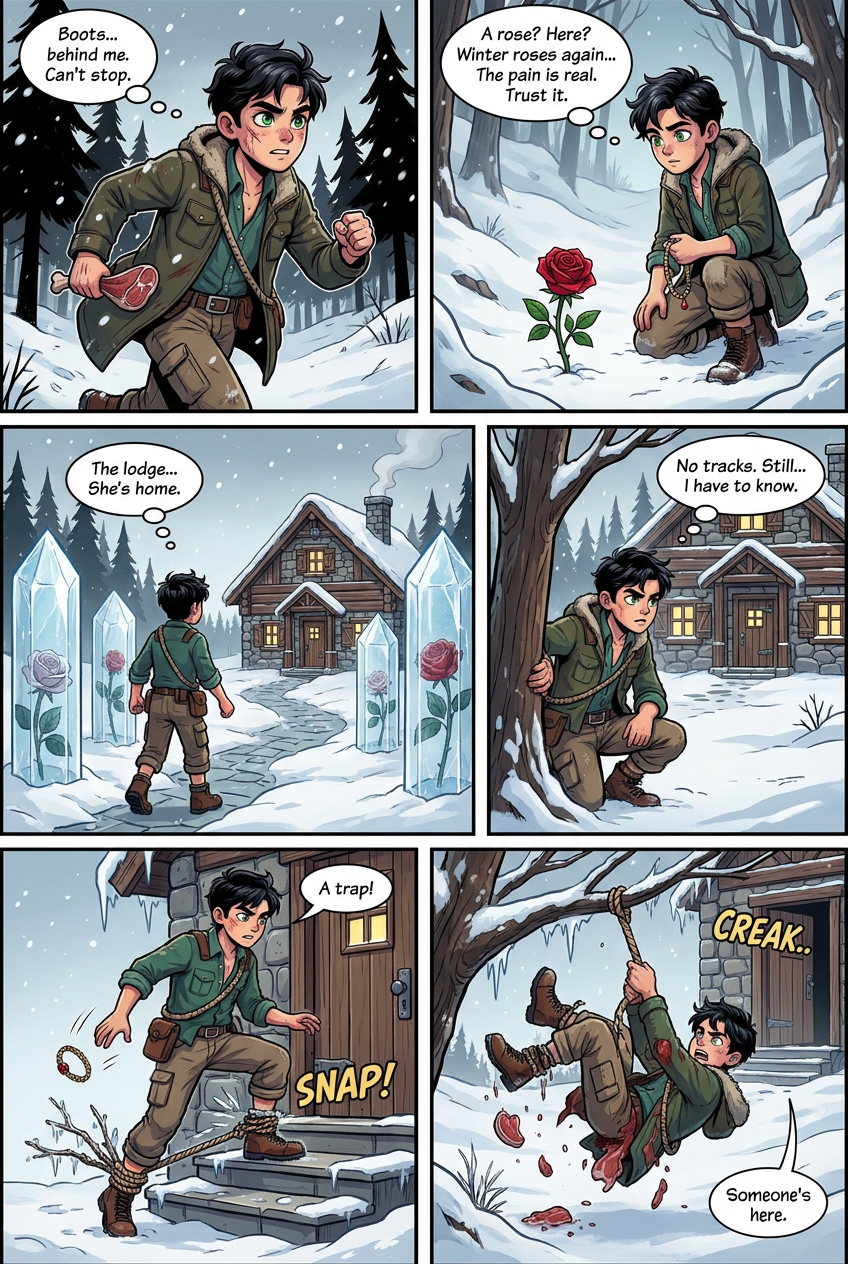
Finn moved sideways along the rock for an hour before he heard boots on the slope below. The watcher had come down from the platform. Finn cut uphill into a stand of black pine and ran with his hand pressed to the half-cured meat in his coat. Branches raked his face. The scar above his eyebrow stung where a needle caught it. He did not look back. He ran until the boots fell behind and the only sound was his own breath. He stopped in a hollow to listen and saw the first rose at his knee. Red. Open. Stem green as summer. Snow sat on the leaves and did not melt. He stared at it until his hands shook. Winter roses again. He could not tell if the woman had planted them to mark the way, or if his own head was putting them there to pull him forward. He pulled the gold bracelet from his pocket and squeezed the ruby until the chain bit his palm. The pain was real. He chose to trust the pain. He followed the roses. They came in twos and threes between the trunks, then in a line. The line bent around a low ridge and opened onto a path he had not walked before. Flat stones. Clear ice columns rose along both sides, taller than him, and inside each column a rose hung suspended. Pink. Red. Petals perfect. He counted nine columns before he stopped counting. The air smelled of roses and woodsmoke. He looked past the last column and saw a stone lodge tucked behind a thick bush, low roof under snow, one chimney pushing gray smoke into the sky. She was home. Finn crouched behind a tree and watched the door for a long time. No movement at the windows. No tracks in the fresh snow around the steps. He thought about turning back. He thought about the relic, and the months of cold trail, and the bracelet in his fist. He stepped onto the path. The smell of roses thickened with each step. He kept his eyes on the door and his hand near his knife. He passed the last ice column. He passed the bush. He set his boot on the bottom step of the lodge and reached for the latch. The snow gave under his other foot. A loop of braided rope snapped tight around his ankle and tore him off the step. The sky swung. His shoulder hit packed earth. The bracelet flew from his hand and skidded across the stone. He was hanging upside down from a frosted branch, the snare biting through his boot, the meat spilling from his coat into the snow. The lodge door opened above him. He heard one slow set of footsteps cross the porch and stop.
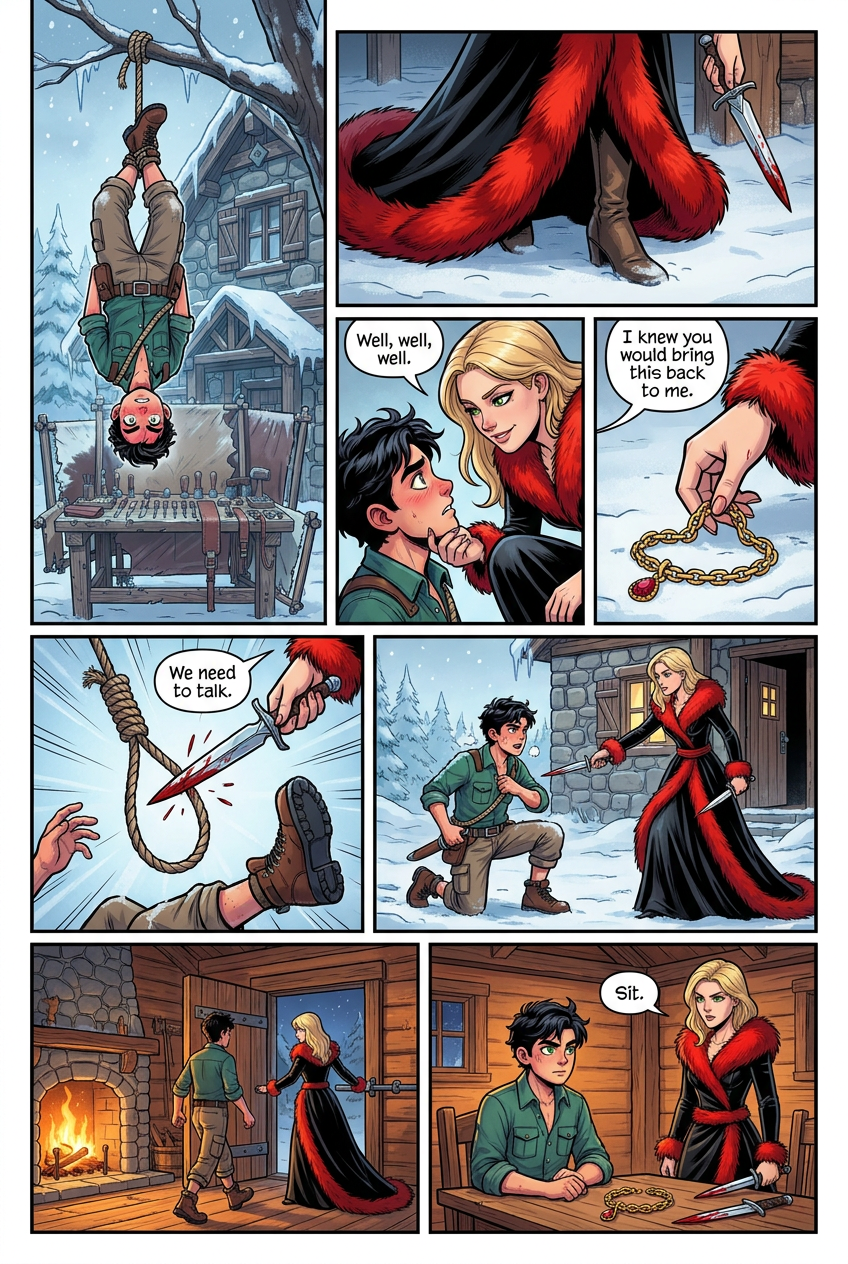
Finn swung from the branch and tried to keep his hands free. Blood pounded in his ears. His knife sat in his belt, but reaching for it would mark him as a threat before he could speak. Beside him on the porch he saw a low workbench piled with tanning tools and stretched hides, frost on the leather. Someone had been working here this morning. Someone who knew how to skin a thing fast. The footsteps crossed the boards and stopped at the edge of the porch. A pair of boots came down the steps. A black gown swept after them, banded with red fox fur that hid the wearer's hands and waist. Finn could not see what she held until she lifted it. A slim silver dagger, the blade marked with old stains. He counted a second sheath at her hip. Matched pair. "Well, well, well," she said. Her voice was soft and warm. She crouched so her face met his upside-down face. Long blonde hair, crimped in waves. Green eyes. He had seen those eyes once before, across a table, asking him what he carried in his coat. She stepped past him and bent in the snow. The gold bracelet lay where it had skidded. She picked it up by the chain and let the red stone swing. "I knew you would bring this back to me," she said. Finn opened his mouth and shut it. He did not know if she meant to thank him or to gut him. The fur on her gown hid the second blade. He chose the only move that left him alive in the next minute. He stayed quiet and let her decide. She walked back and set the edge of the dagger against the rope above his ankle. "We need to talk," she said. The blade parted the braid in one stroke. Finn dropped. His shoulder hit the step. The snare loop slid loose around his boot. He rolled to his knees in the snow, his own knife still sheathed, her dagger now pointed loosely at his chest. She did not raise it further. She tilted her head toward the open door. Finn stood. His legs shook from the hang and from her face this close. He picked the spilled meat out of the snow and pushed it back into his coat. He left his knife where it was. He walked up the steps past the tanning bench and into the lodge. Warm air hit his face. A fire cracked in a stone hearth. She shut the door behind him and slid a bar across it. The bracelet lay on a table between them. She set one dagger beside it and kept the other in her hand. "Sit," she said. He sat. The guess was made. He was inside, and he was alive.
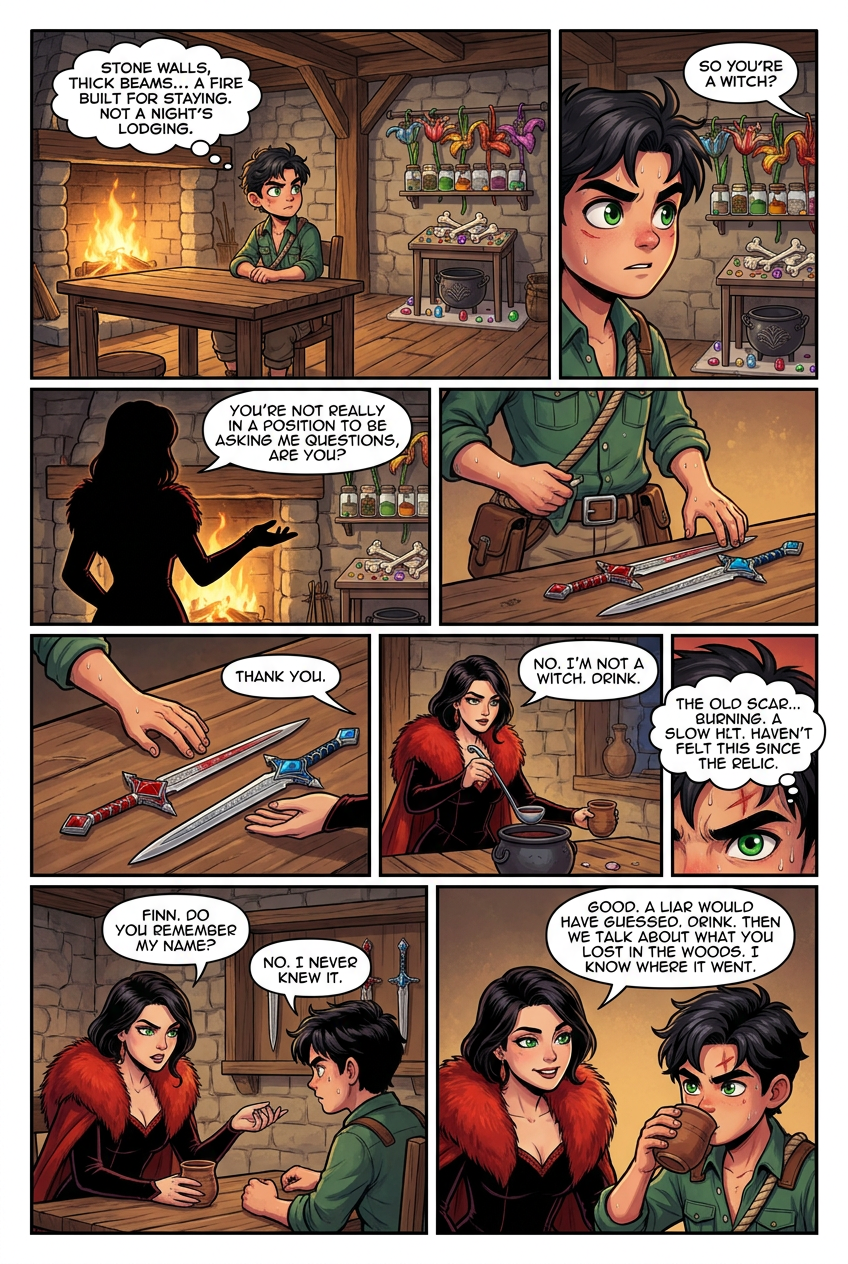
Finn sat at the table and tried to read the room. The lodge was solid. Stone walls, thick beams, a barred door, a fire built for staying. She had not come here for a night. She had come to work, and she had brought her tools with her. His eyes moved past the hearth to a small table set against the wall. Jars of spices stood in a neat row. Dried flowers hung above them on a rack. Animal bones lay across the top, picked clean. A black cauldron sat beneath, and loose gems caught the firelight on the floor around it. "So you're a witch?" Finn said. She looked at him with curiosity in her eyes. "You're not really in a position to be asking me questions, are you?" She held out her hand. He knew what she wanted. The blade at his belt still made him a threat. He drew his knife slowly and laid it on the table. Then the second one from his sash. Both daggers. Matched handles, one red stone, one blue. He pushed them across to her. The last weapons he had carried inside. "Thank you," she said. She gathered them and set them on a shelf behind her, out of reach. She turned to the cauldron and ladled hot liquid into a small clay cup. "No," she said. "I'm not a witch." She crossed back and set the cup in front of him. "Drink." She sat across from him and crossed her legs. The fox fur on her gown shifted at her shoulders. Finn felt his eyes move down her before he caught them. He looked up and met her stare. Sweat rose at his hairline. The old scar above his brow began to burn, a slow heat under the skin he had not felt since the relic. She leaned closer across the table. "Finn," she said, quiet. "Do you remember my name?" He did not. He had met her once, months ago, across a different table. She had asked him what he carried in his coat and he had lied. He had never asked what she was called. He could feel the wrong answer waiting in his mouth. He looked at the cup. He looked at the daggers on her shelf. He looked at her green eyes and told the truth. "No," he said. "I never knew it." She held his gaze for a long beat. Then she smiled, small and pleased, as if he had passed a test he did not know he was taking. "Good," she said. "A liar would have guessed." She tapped the cup. "Drink. Then we talk about what you lost in the woods. I know where it went. You're going to help me get it back." Finn lifted the cup. The heat of his scar had not faded. He drank.
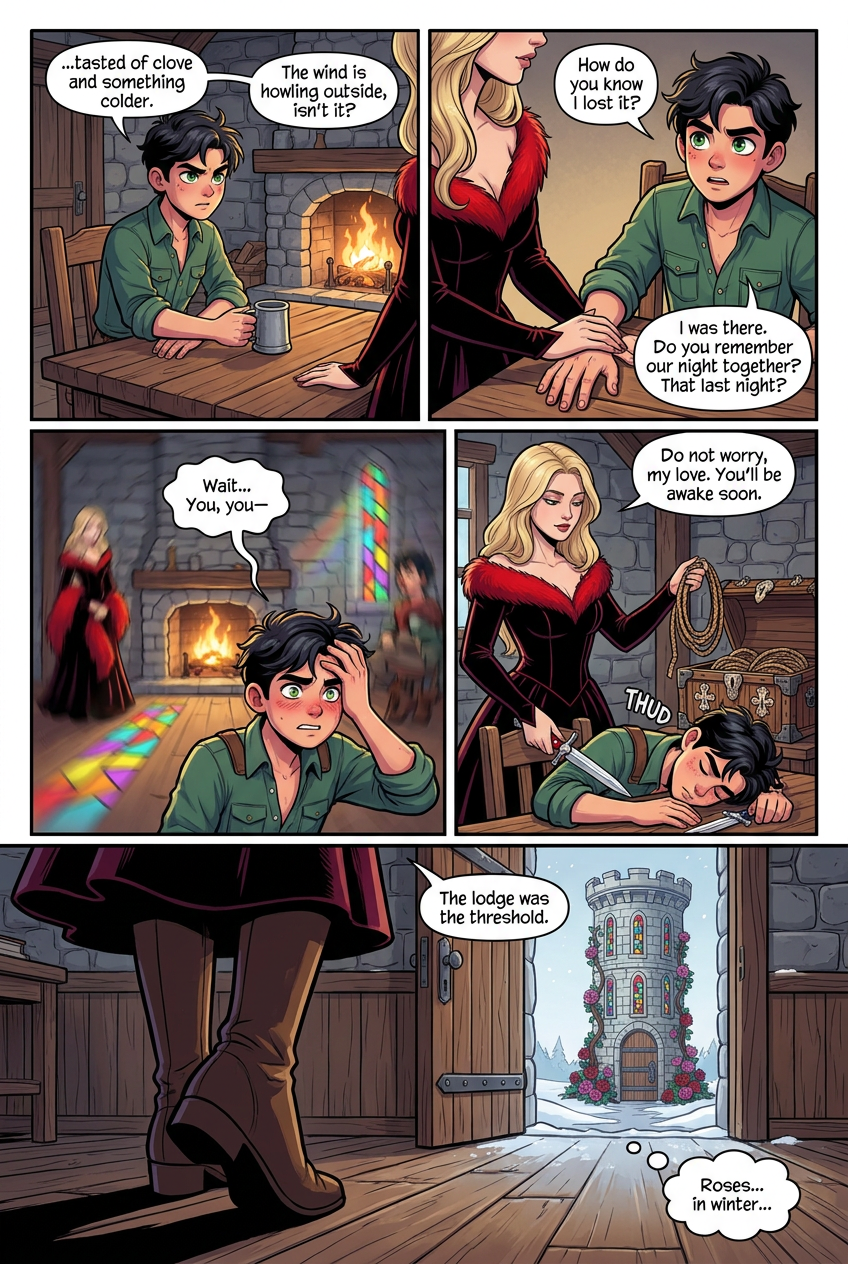
Finn set the cup down half-empty. The drink tasted of clove and something colder underneath. The fire popped. The woman watched him from across the table, her black gown shifting at the shoulders where red fox fur curled against her throat. Outside, wind pressed against the lodge wall. He could smell roses through the stone. That alone told him something was wrong. Roses did not bloom in winter, and no flower reached a nose through walls. "How do you know I lost it?" Finn said. She tilted her head. Blonde hair slid across one shoulder. "I was there," she said. Her green eyes stayed on him. "Do you remember our night together? That last night?" Her hand slid across the table and covered his. Her fingers worked between his knuckles. Finn's mouth went dry. He had no memory of any night with her. He had met her once, at a table in a different town, and he had walked away. "What are you talking about?" he said. The scar above his brow burned hotter. He pulled at his hand. She held it. Through the slit window above the hearth, colored light bent across the floor in long shapes. He had not noticed the glass was stained until now. The stone walls felt taller. The beams felt closer. He thought of the arch he had walked under at the door, iron twisted through pale roses he had told himself were frost. They had not been frost. She leaned in. Her breath touched his ear. "You don't remember how much fun we had?" Finn tried to stand. His knees would not lock. The room slid sideways. Two of her sat across from him. Two cups. Two fires. The trail of roses he had followed for days, the bracelet on his door, the watcher on the ridge, all of it had pointed him here, and he had walked in and sat down and drunk what she poured. He had trusted the wrong instinct. He had trusted any instinct at all, with those flowers around the walls. "Wait," Finn said. His tongue was thick. "You, you—" He reached for the table edge and missed. "Do not worry, my love," she said. "You'll be awake soon." She stood. Her gown brushed the floor. She crossed to the shelf and took down his two daggers, the red-stone handle and the blue, and slid them into her belt. Then she opened a fur-lined trunk near the wall and lifted out a coil of rope. Finn's cheek hit the table. He saw her boots cross the boards. He saw the door swing open onto the pale tower beyond the lodge, stone climbing into the trees, roses crawling up its sides to narrow windows of colored glass. She had not been hiding in the lodge. The lodge was the threshold. Then the floor took him.
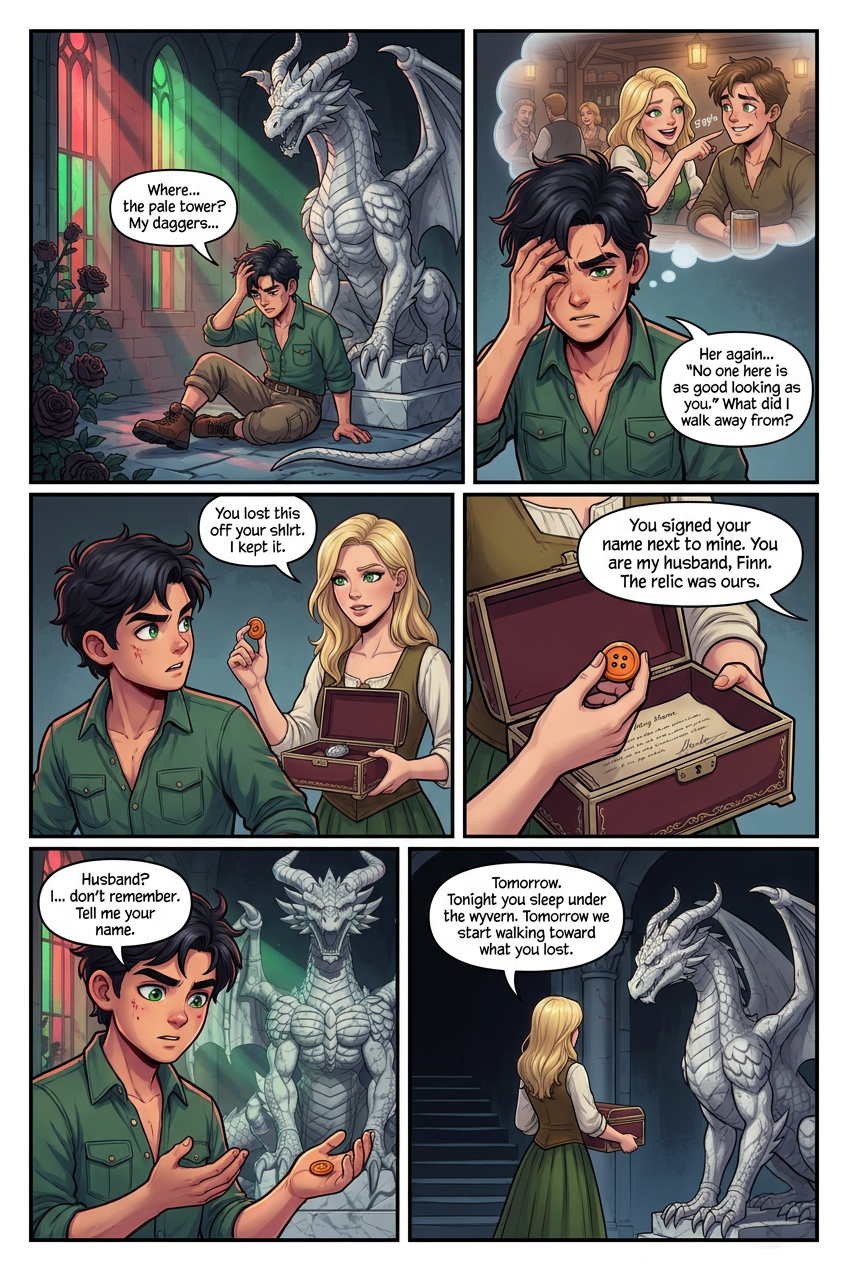
Finn woke on a cold floor. Above him loomed a marble wyvern, wings spread, claws hooked over a stone base. It filled half the round room. The light came through narrow colored windows, red and green across the floor. He sat up slow. His head hurt. His daggers were gone. Roses pressed against the glass from outside, dark against the panes. He was inside the pale tower now. The lodge door was somewhere below. He could not think past the woman. He kept seeing her face. Blonde hair, green eyes, the strapped corset at the tavern table the night before he was supposed to find the relic. He had told her to find someone else to bother. She had giggled and leaned in. No one here is as good looking as you. She had poked him where the map sat folded in his coat. What are you going after this time? None of your concern. What if it is? He had walked away. He was sure he had walked away. He pressed his palm to the scar above his eye and tried to push further, into a night after that night, and found nothing. A blank wall. Whatever she said they had shared, his head did not hold it. A small sound moved behind him. He turned. She stood at a low table he had not seen, a dark red box open in her hands. The silver locket set into its lid caught the colored light. Two initials wound together on the metal. She lifted out a single orange button, polished, four neat holes, and set it on her palm where he could see it. "You lost this off your shirt," she said. "I kept it." She tilted the box. Inside lay a folded square of paper, a dried sprig, a thin ring. She turned the locket so he could read the letters. One was an H. The other curled into it like a vine. "You don't know what these stand for, do you," she said. It was not a question. Finn shook his head once. Her mouth moved, not quite a smile. "Then I will keep telling you," she said, "until you do. You signed your name next to mine. You are my husband, Finn. The relic was ours." The word landed wrong in him. Husband. He waited for it to ring true and it did not ring at all. He looked at the button on her palm and knew only that he could not call her a liar. He had two days he could not account for from the expedition. He had a night before it he had walked away from too easily. He had no memory to set against hers. "Tell me your name," he said. She closed her hand around the button. "Tomorrow," she said. "Tonight you sleep under the wyvern. Tomorrow we start walking toward what you lost." She shut the box. The lock clicked. She carried it with her to the stair and did not look back.
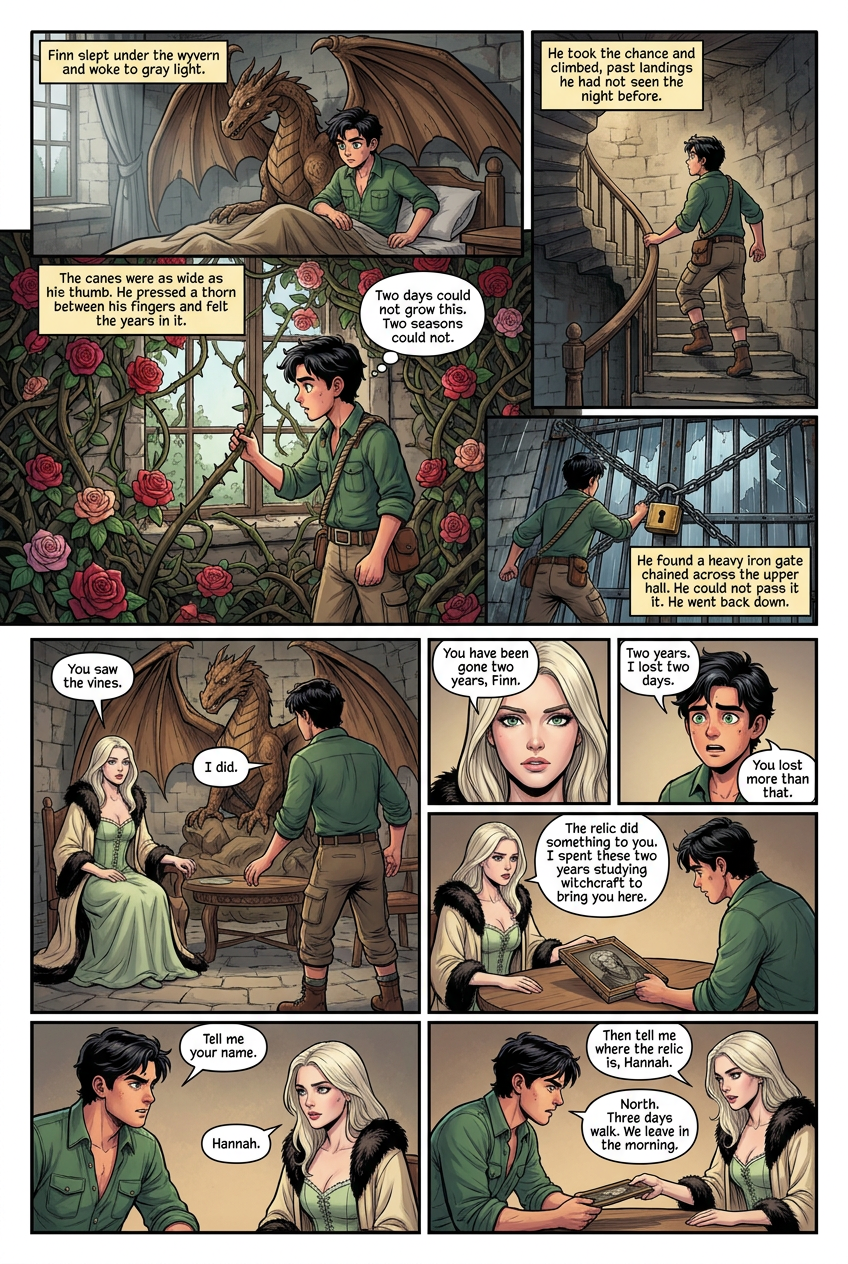
Finn slept under the wyvern and woke to gray light. The woman had not come back yet. He took the chance and climbed. The stair wound up past landings he had not seen the night before. On one landing a thick mat of vines and roses had grown into the wall itself, swallowing a window frame, the canes as wide as his thumb. The blooms were fresh. The wood under them was soft with rot. He pressed a thorn between his fingers and felt the years in it. Two days could not grow this. Two seasons could not. He climbed higher and found a heavy iron gate chained across the upper hall, the brass lock dulled by rain that had blown through some broken pane above. He could not pass it. He went back down. She was waiting at the low table when he reached the wyvern room. Her hair was loose now, long and pale down her back. She wore a light green corset dress under a cream robe trimmed with dark fur. Her eyes met his and did not move. "You saw the vines," she said. He nodded. "How long." "Two years," she said. "You have been gone two years, Finn." He started to speak. She lifted a hand and set a folded paper on the table between them. She opened it carefully at the creases. A drawing. Soft edges, worn thin. A woman with green eyes leaned against a man with a scar above his left eyebrow. They were both smiling. He knew the scar. He did not know the smile. He sat down because his legs would not hold him. "Two years," he said. "I lost two days." "You lost more than that." She kept her hands flat on the table. "The relic did something to you. You carried it longer than you remember. When you put it down you walked out of our life and did not come back. I looked for you. I could not find you the ordinary way." She paused. "So I learned another way. I spent these two years studying witchcraft. The roses. The watcher. The drink. All of it I learned to bring you here." Her voice thinned. "I am sorry. I did not know how else to reach you. I am sorry I drugged you. I am sorry for the snare. I did not know if you would come if I asked." Finn looked at the drawing. He looked at her hands. He believed her, not because he remembered, but because the vines upstairs were older than any lie she could tell. "Tell me your name," he said. "Hannah," she said. "Then tell me where the relic is, Hannah." She breathed out once, long. "North," she said. "Three days walk. I will take you. We leave in the morning." She folded the drawing and slid it across to him. He kept it.
Play your story to life
Storycraft is a mobile game where you create AI characters, craft items and locations to build their world, then discover what direction your story takes. Download the iOS game for free today!
Download for free