

Lilith Blackwood's Arc
21 Chapters
Lilith Blackwood's dream is founding a hidden sanctuary in Gorethroat where every wounded stray and forsaken creature is nurtured back to health, and is given all the happiness in the world.

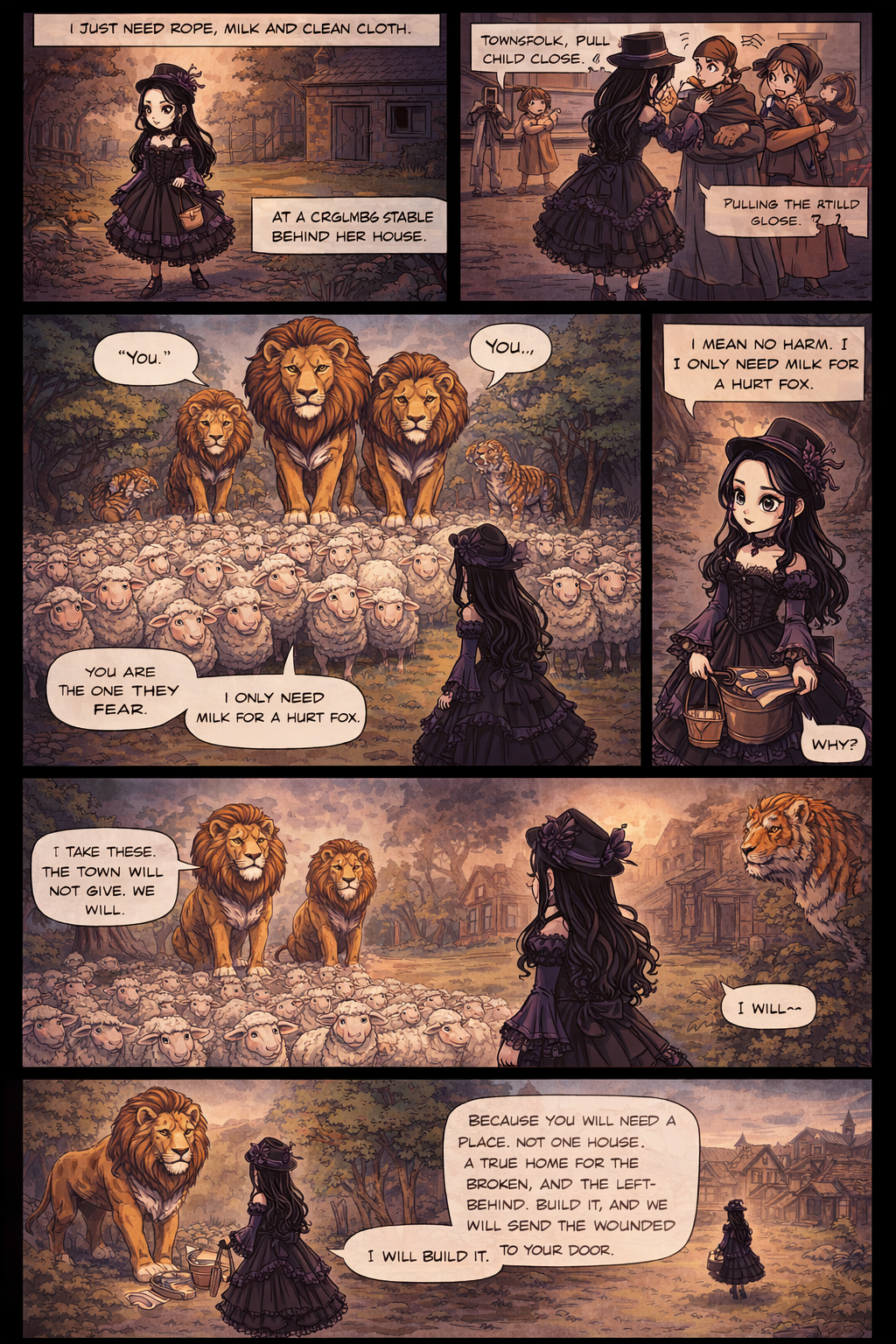
Lilith Blackwood needed rope, milk, and clean cloth before nightfall. A wounded fox lay in the crumbling stable behind her house. She meant to save it, as she saved every stray thing in Gorethroat. She wore black lace and a black bonnet, and her pale face never smiled the way the townsfolk wanted. So they turned away when she came. The general store owner slid the shutters closed as she reached the door. "Nothing for you today," a woman muttered, pulling her child close. Lilith held up three coins. No one took them. She lowered her hand and did not argue. She only pressed her lips together and walked on. The fox needed milk, and the shops were shutting one by one. She followed the road past the last house, hoping the dairy farmer might be kinder. Instead she stopped cold. The field ahead was not a field. The ground rose into woolly sheep, packed shoulder to shoulder. The trees behind them curled into the shapes of tigers. Three great lions grew where the fence should stand, their manes stiff like carved wood. Every creature turned to look at her. "You," said the largest lion. Its voice was low and human. "You are the one they fear." Lilith did not run. She had faced hissing cats and cornered dogs. She stepped forward and curtsied, because it seemed polite. "I mean no harm," she said. "I only need milk for a hurt fox." The sheep bleated among themselves, a soft chorus of words she half understood. The lion studied her black dress and still face. "The townsfolk see a shadow," it said. "We see how you knelt in the mud for a dying thing. We watched from the trees." A tiger unwound from its bush and padded close. It dropped a full milk pail at her feet, then a coil of rope, then a folded square of cloth. "Take these," the tiger said. "The town will not give. We will." Lilith's hands shook as she gathered the supplies. For the first time all day, someone had answered her kindness with kindness. "Why?" she asked. "Because you will need a place," the lion answered. "Not one house. A true home for the broken and the left-behind. Build it, and we will send the wounded to your door." Lilith looked back toward the shuttered town. She could not buy what she needed there. But here, at the edge, help had found her. She thought of the fox waiting in the cold stable. Then she thought of all the others still to come. "I will build it," she said. She carried the pail home before dark and saved the fox. But now she knew the truth. Her house was too small, and the town would never sell her the land. To make her sanctuary real, she would have to face the people who feared her.
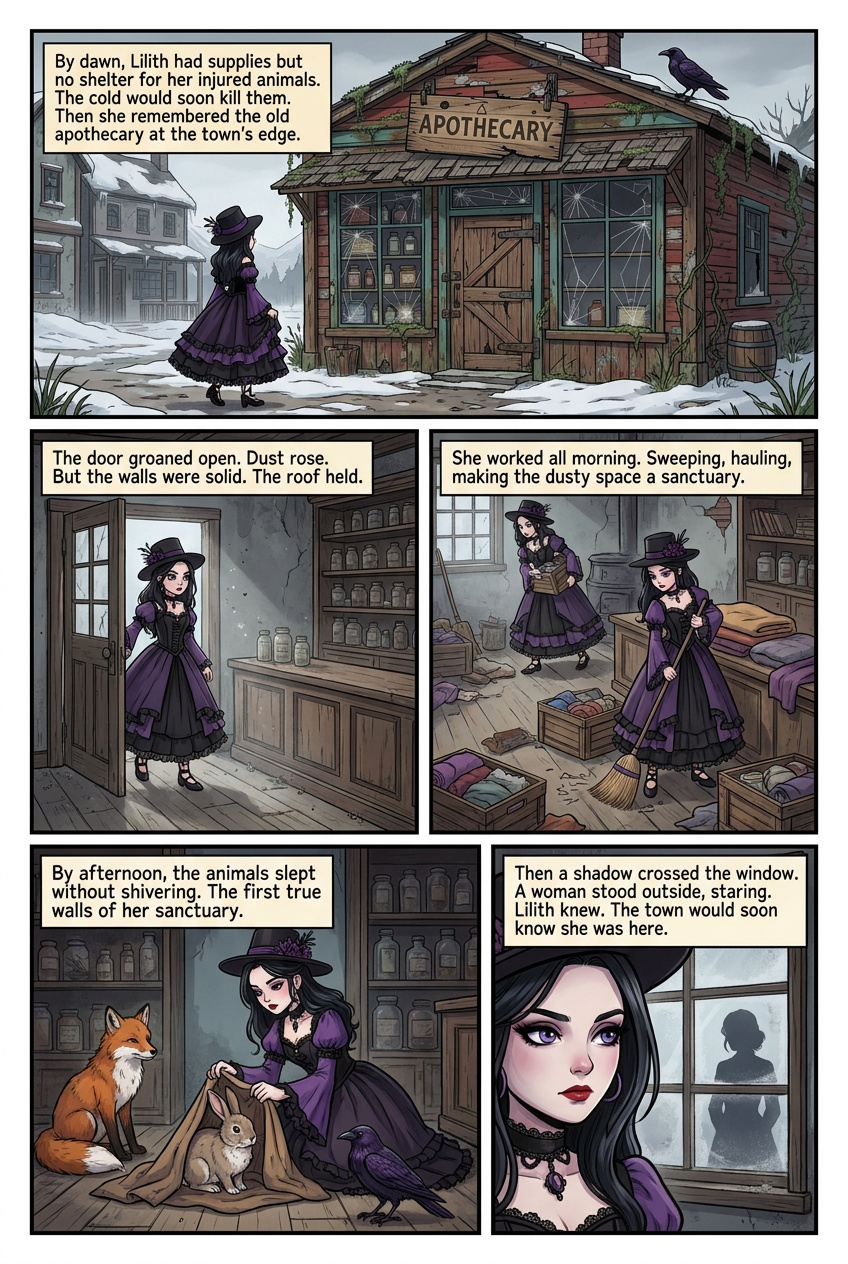
By dawn the crates had grown into a small mountain in Lilith's yard. The magical creatures had kept their word. Rope, milk, salve, bandages, and blankets waited under the frost. But the fox was not alone now. A rabbit with a broken leg lay shivering beside it. A bird with a bent wing huddled in the straw. Her stable held two animals at most. The cold was already killing what she was trying to save. Lilith knelt and pressed a blanket around the rabbit. Its breath came in weak puffs. She had the supplies but no walls, no roof, no room. She could not build a sanctuary from nothing before nightfall. She needed a building, and the town would sell her none. Then she remembered the empty shop at the edge of Gorethroat. No one had used it in years. She pulled her cloak tight and walked to see it. The old apothecary leaned under a sagging roof. Vines crept through cracked windows. Faded jars still lined the dusty shelves inside. The faded sign hung crooked above the door. No one guarded it. No one wanted it. Lilith tried the handle. The door groaned open. Inside, dust rose in the grey light. But the walls were solid. The roof held. A wide counter ran along one side, long enough to lay a dozen animals. She pressed her palm to the wood and felt no draft. This place would keep the cold out. She worked all morning. She swept the floor and cleared the broken jars. She hauled her crates through the door, one after another. She spread blankets across the counter and along the floor. She carried the fox first, then the rabbit, then the trembling bird. She laid each one in the warm dim room and covered them. By afternoon the animals slept without shivering. The rabbit's breath came even now. The fox lifted its head and watched her move. Lilith stood in the middle of the room and looked at what she had made. Not a house. A shelter. The first true walls of her sanctuary. Then a shadow crossed the dusty window. A woman stood outside on the road, staring in. Her mouth pressed thin. She turned and walked fast toward the town. Lilith watched her go and understood. The apothecary belonged to no one, but the town would not let her keep it. They would come to see why the feared woman had claimed a building of their own. She latched the door and returned to her animals. She had shelter now. But by morning, the town would know exactly where to find her.
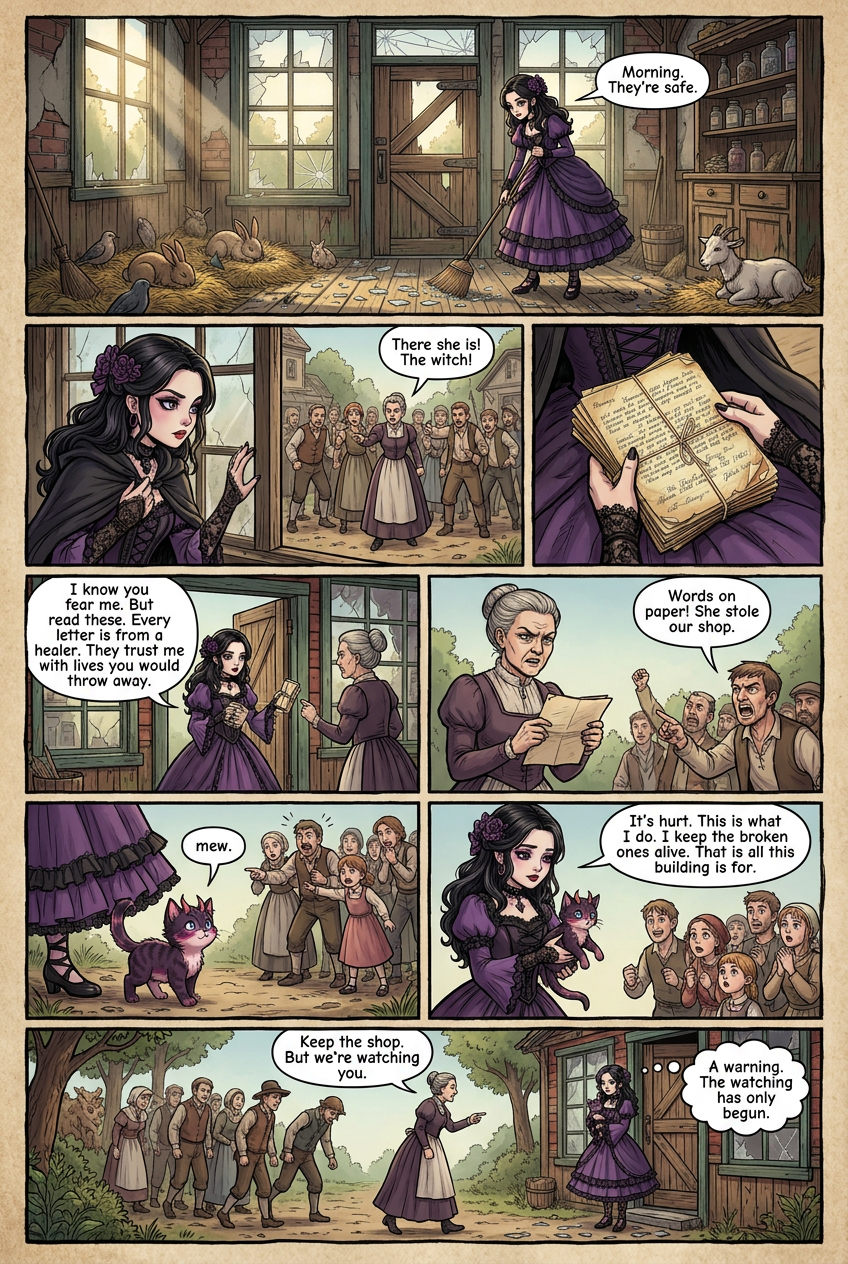
By morning the animals slept warm inside the old shop. Lilith swept the last of the broken glass into a corner. Then she heard voices on the road. Many feet. She looked through the dusty window and saw a crowd forming. The woman from yesterday stood at the front, pointing at the door. Lilith counted a dozen faces, maybe more. They had come to take back the building. She did not run. She smoothed her skirt and thought. If she barred the door, they would break it. If she begged, they would sneer. She had one thing they could not argue with. She reached into her cloak and drew out a small bundle of letters, tied with string. Years of them. Vets from three towns had written to her, thanking her for the animals she saved when no one else would. She had carried the letters everywhere. Now she needed them. Lilith opened the door before they could knock. The crowd went quiet. She held up the bundle. "I know you fear me," she said. "But read these. Every letter is from a healer. They trust me with lives you would throw away." The woman snatched the top letter. She read it fast, then slower. Her hard face did not soften, but her hand did. "Words on paper," a man called. "She stole our shop." The crowd stirred again. Lilith felt the moment slipping. Then something small pushed past her boots and walked into the light. It was a kitten. Black and rose-colored, with two tiny horns and eyes that glowed faint purple. It had come in the night with the wounded strays, too odd to be ordinary. The kitten sat in the doorway and looked up at the crowd. It gave one small, sweet mew. The change was instant. A little girl at the back gasped and pointed. A woman's stern mouth fell open. Even the angry man leaned forward. No one could look at the creature and stay hard. Its cuteness was a kind of spell, and it worked on every heart at once. "It's hurt," Lilith said softly. She lifted the kitten and showed its thin, shaking body. "This is what I do. I keep the broken ones alive. That is all this building is for." The woman who had rallied them lowered the letter. She looked at the kitten, then at Lilith. "Keep the shop," she said at last. "But we're watching you." The crowd broke apart, muttering, uncertain. They walked back toward town. Lilith stood in the doorway and let out a long breath. She had kept her sanctuary. But she had done it by showing the town exactly where it was, and exactly what she guarded. They knew now. They would not forget. And the woman's last words were not a blessing. They were a warning that the watching had only begun.
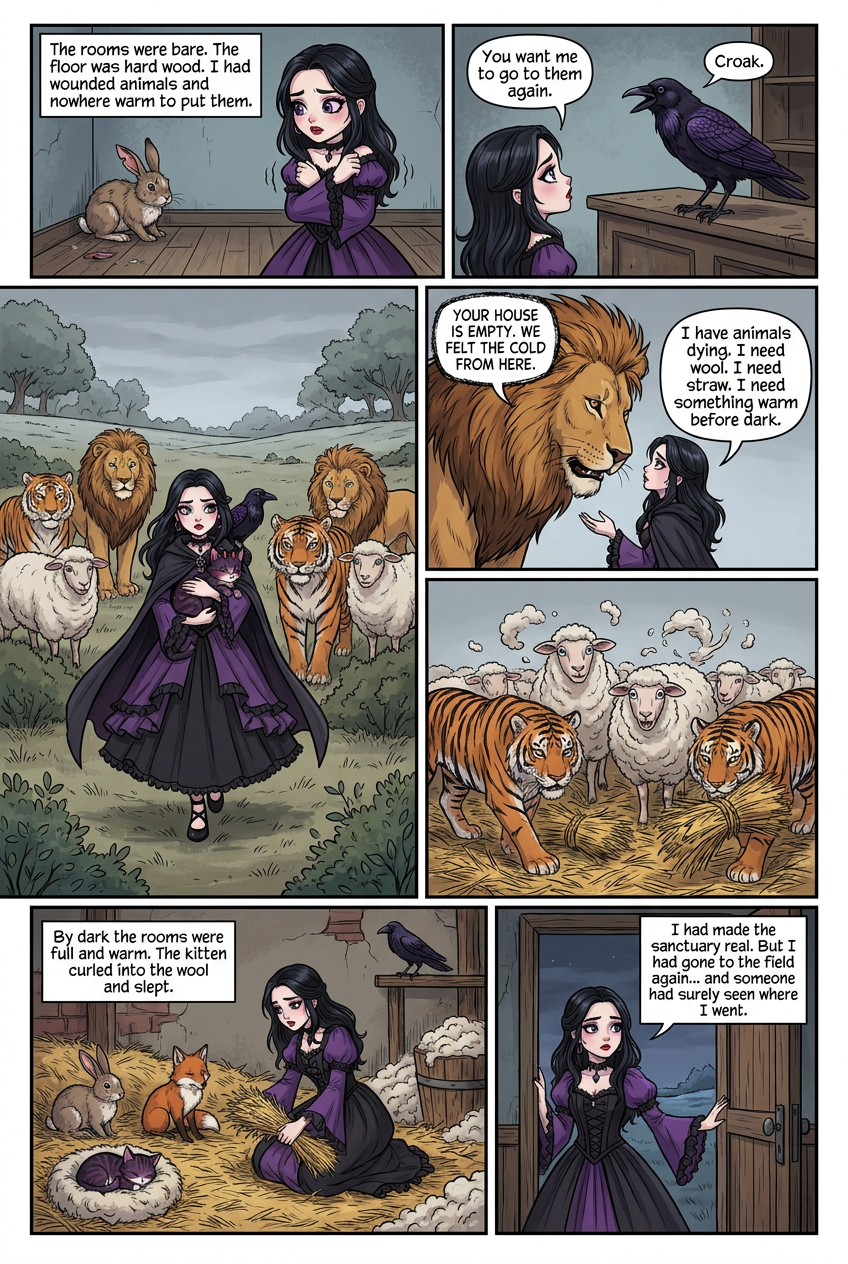
The crowd was gone, but the cold stayed. Lilith walked through the old apothecary and counted her problems. The rooms were bare. The floor was hard wood. She had wounded animals and nowhere warm to put them. A rabbit with a torn ear shivered in the corner. The fox lay near the wall, too weak to move. Night would come, and night here killed the weak. She had no straw, no blankets, no proper pens. The town would sell her nothing. Her crow watched from the counter. He was a big bird, black feathers washed with purple, one wing clipped so he could not fly far. He had been with her longer than any creature here. She rescued him years ago and never let him go. Now he tipped his head toward the door and gave a rough croak. "You want me to go to them again," Lilith said. She knew who he meant. The lions at the field's edge. They had helped her before. She wrapped the shivering kitten in her cloak and carried it with her. The demon kitten, small and dark, with two horns and eyes that glowed faint purple. It had won the town's heart yesterday. Maybe it would soften the beasts too. The crow rode on her shoulder as she walked. At the field's edge she stopped and stared. The land itself had woken. The ground rose into sheep, packed close and bleating. Bushes had become tigers, their stripes bright in the gray light. The trees stood as lions, huge and still, watching her with human eyes. The largest lion lowered his great head. "Your house is empty," he said. His voice rumbled like stone. "We felt the cold from here." "The town gives me nothing," Lilith said. "I have animals dying on a bare floor. I need wool. I need straw. I need something warm before dark." The lion turned to the flock behind him. The sheep pressed forward. One by one they shook loose great clumps of wool, thick and clean, until a soft white heap grew at Lilith's feet. The tigers dragged bundled straw from the brush. The lions pushed it all toward her in a pile taller than the kitten. "Carry what you can," the lion said. "We will bring the rest by morning." Lilith worked until her arms shook. She hauled load after load back to the shop. She spread straw across the hard floor. She lined the corners with wool and built low walls between them, one warm pen for each animal. She laid the fox in the softest bed. She tucked the rabbit in beside it. By dark the rooms were full and warm. The kitten curled into the wool and slept. The crow settled on a beam above them. Lilith stood in the doorway and felt the heat behind her. She had made the sanctuary real. But she had gone to the field again in full daylight, and the town had promised to watch. Someone had surely seen where she went.
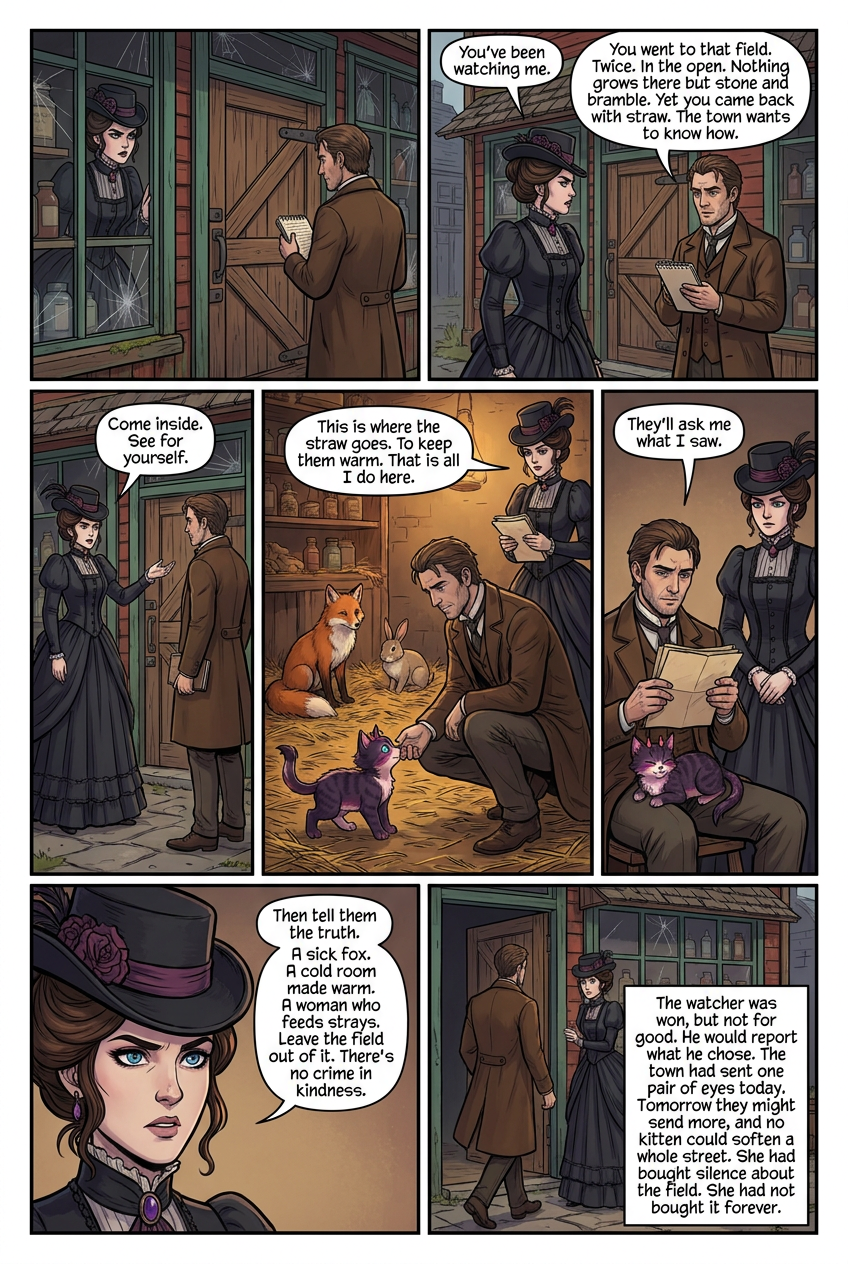
Morning came, and with it the man. Lilith saw him from the shop window. He stood across the way, watching her door. He wore a plain brown coat and held a small notebook. She had seen him yesterday too, at the field's edge, hiding in the tall grass while the lions gave her wool. Now he had followed her home. He was the town's eyes. If he learned where her supplies came from, the town would call it witchcraft, and they would take everything. She could not hide the truth forever. So she chose to face him. She tucked the bundle of veterinary letters into her pocket and stepped outside. "You've been watching me," she said. The man did not flinch. "You went to that field. Twice. In the open." He tapped his notebook. "Nothing grows there but stone and bramble. Yet you came back with straw. The town wants to know how." Lilith's heart beat hard. If she told him about the lions, he would run to the woman who led the mob. But if she said nothing, he would invent his own answer, and it would be worse. "Come inside," she said. "See for yourself." He hesitated, then followed. The warm air met him at the door. The fox lifted its head from the wool. The rabbit twitched its torn ear. And from the straw rose the little demon kitten, horns catching the light, glowing eyes fixed on the stranger. It padded to his boots and looked up, small and sweet. The man stopped. His hard face broke. He crouched without thinking and let the kitten sniff his fingers. "This is where the straw goes," Lilith said. "To keep them warm. That is all I do here." She pulled the letters from her pocket and held them out. "Read these. Healers wrote them. They know my work. I mend broken things. I don't ask where a stray comes from, and I won't ask what you tell the town." The man took the bundle. He read one page, then another. The kitten climbed into his lap and purred. When he looked up, something had changed in him. "They'll ask me what I saw," he said. "Then tell them the truth. A sick fox. A cold room made warm. A woman who feeds strays." She met his eyes. "Leave the field out of it. There's no crime in kindness." He set the kitten down and stood. He tucked his notebook away, unopened. "I saw an animal shelter," he said slowly. "Nothing more." He returned the letters and left. Lilith watched him cross back toward town, no longer watching her. She leaned against the doorframe. The watcher was won, but not for good. He would report what he chose. The town had sent one pair of eyes today. Tomorrow they might send more, and no kitten could soften a whole street. She had bought silence about the field. She had not bought it forever.
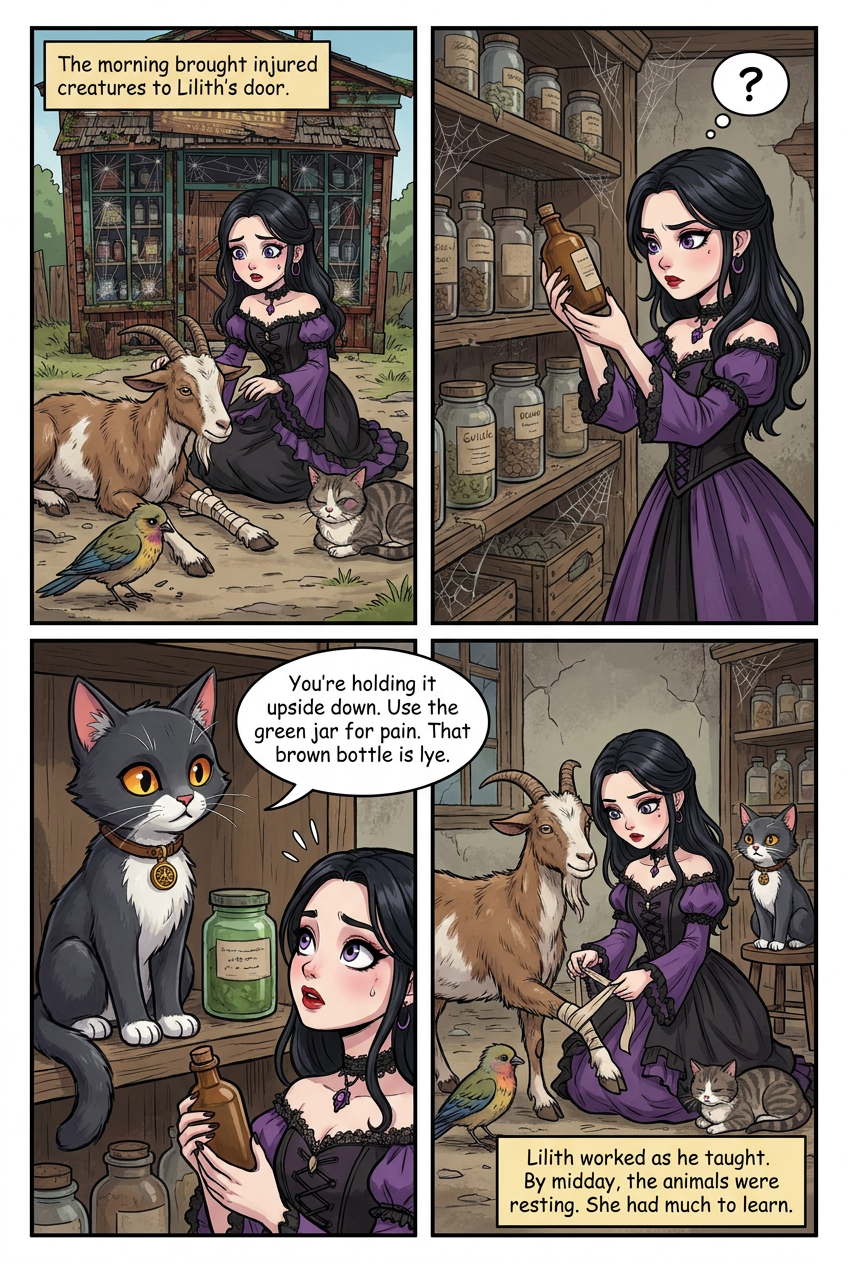
The next morning, the creatures kept their promise. A goat lay in Lilith's yard, one leg twisted wrong beneath it. Blood matted its side. Behind it huddled a bird with a fever it could not fight, and a cat whose eye had swollen shut. Lilith knelt beside the goat. It cried at her touch. She pressed a cloth to the wound and did not know if that was right or wrong. She had letters that praised her kindness. She had no letters that taught her to set bone or draw poison from a cut. Inside the old apothecary, dusty jars still lined the shelves. Faded labels named tinctures and salves. Any one of them might heal the goat. Any one might kill it. Lilith held a bottle to the light. The liquid inside had gone brown. She could not read the smeared writing. Guessing would cost a life. A voice spoke from the doorway. "You're holding it upside down." Lilith turned. A gray-and-white cat sat on the sill, tail curled neat, a small medallion swinging at his throat. His amber eyes fixed on her the way they had since she was a child. Liko. He had known her before she could walk. He had never once been wrong. "Liko," she said. "The goat is dying. I don't know what to do." "Then ask." He leaped down and crossed to the shelves. "That is what I am for." He nosed a squat green jar. "This one. Boiled willow bark. It dulls pain and slows the swelling. The brown bottle you fancy is lye. It would burn her throat out." Lilith set the brown bottle down fast. She took the green jar. "And the leg?" "Splint it straight. Use two flat sticks and strips of cloth. Bind firm, not tight." Liko paced as he spoke, naming each step. "The bird needs warmth and water with honey. The cat's eye wants a warm compress, three times a day. None of this is magic. It is only knowing." Lilith worked as he taught. She cleaned the wound and packed it with the willow paste. She bound the leg between two flat sticks. Her hands shook, then steadied. By midday the goat breathed slow and calm. It slept. The bird drank. The cat's swollen eye began to open. Lilith sat back against the shelf. "I could have killed her." "But you didn't." Liko settled in her lap. "You know one healer now who cannot lie to you. Ask me before you guess. Always." She stroked his fur. The sanctuary held three living animals it might have held as three dead ones. She had learned she could mend a body, not just warm a room. But Liko was one cat, and he could not sit at every bedside. More would come, and worse. She would need to learn the jars herself, before the day came that she had to work alone.
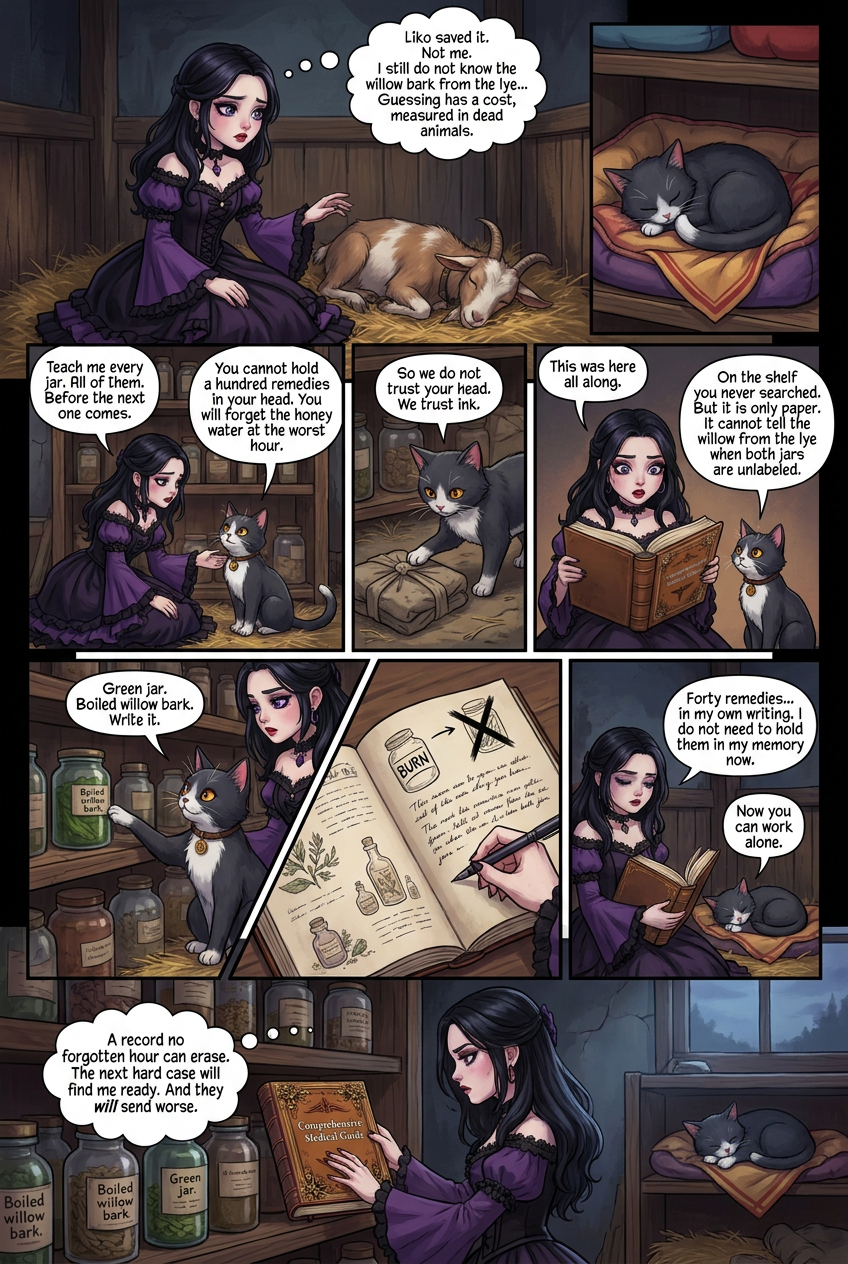
The healed goat slept in a warm pen the next morning. Lilith watched it breathe and felt no comfort. Liko had saved that goat, not her. She still did not know the willow bark from the lye on her own. If a harder case came while Liko slept or roamed, she would guess. Guessing had a cost, and it was measured in dead animals. She found Liko on the warm shelves near the door. He lay curled on a folded blanket among the animal beds, tail over his nose. Lilith knelt beside him. "Teach me every jar," she said. "All of them. Before the next one comes." Liko opened one amber eye. "You cannot hold a hundred remedies in your head. No one can." He stretched and stood. "I have known you since you were small, and I know your memory. You will forget the honey water at the worst hour." "Then what do I do?" Her voice cracked. "You cannot sit at every bed." "No. I cannot." He hopped down and crossed the floor. He stopped at a low shelf below the dusty jars and pawed at a heavy shape wrapped in cloth. "So we do not trust your head. We trust ink." Lilith pulled the bundle free and unwrapped it. A thick book lay in her hands. Brass corners bound its brown cover. Gold letters named it a medical guide. She opened it. Inside were drawings of leaves, bones, and bottles, each one labeled in a careful hand. Doses. Warnings. A page on which cures could poison. "This was here all along," she said. "On the shelf you never searched." Liko sat. "It holds more than I care to speak aloud. But it is only paper. It cannot tell the willow from the lye when both jars are unlabeled." Lilith understood. The book named remedies. It did not name what filled her brown and green jars. She carried it to the shelves of tinctures. Liko walked the row beside her. "Green jar," he said. "Boiled willow bark. Write it." Lilith took a pen. On a blank page at the back she wrote the jar's color, its place, its use. Liko named the next. She wrote again. Bottle by bottle they went, his knowledge and her ink, until every jar on the shelf had a line. She marked the lye with a black cross and the word BURN. By dusk she closed the book. Her hand ached. The page held forty remedies in her own writing. She did not need to hold them in her memory now. She did not need Liko awake at every hour. "Now you can work alone," Liko said. He climbed back onto the blanket and settled. Lilith set the book beside the jars where she could reach it fast. A record existed that no forgotten hour could erase. The next hard case would find her ready. But readiness meant the creatures could send worse than a broken leg, and now they would.
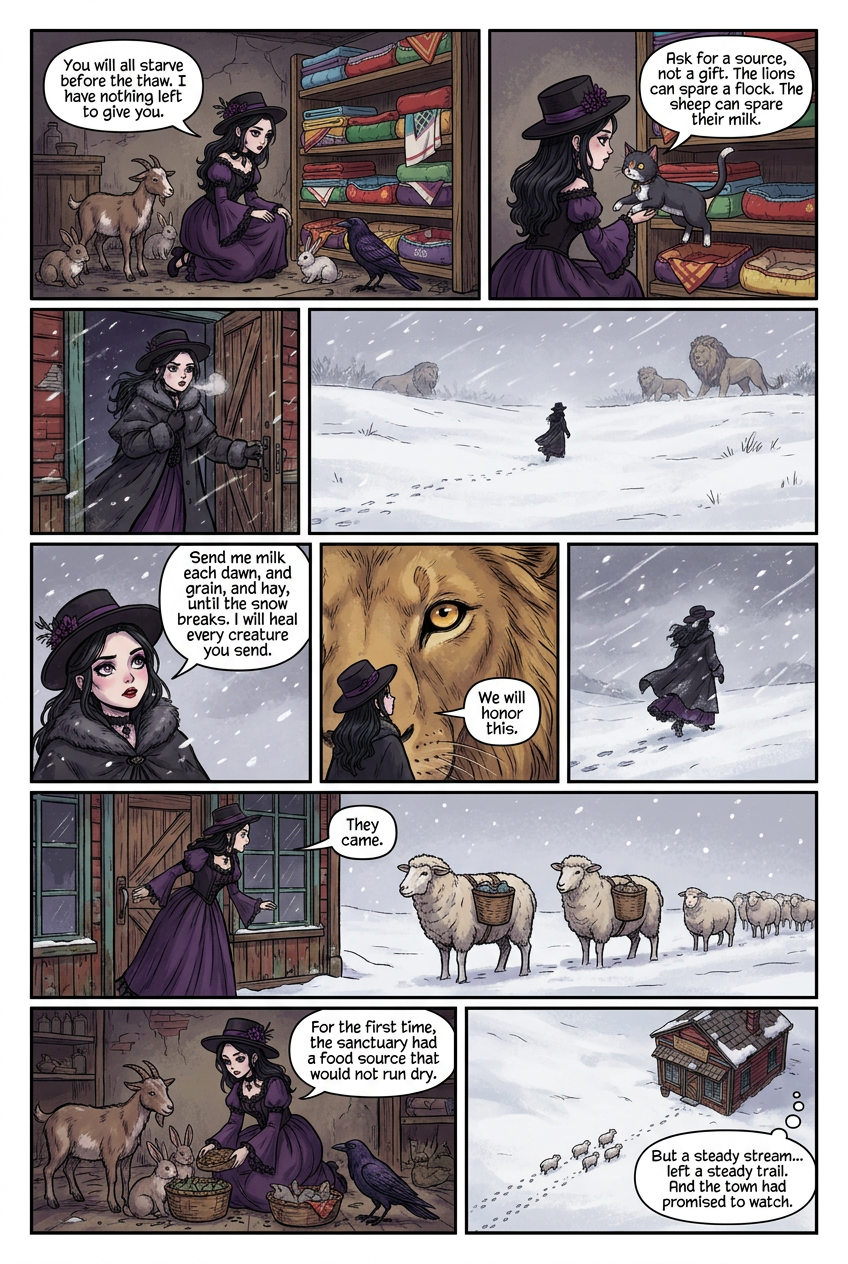
The book of remedies had made Lilith ready to heal. It had not filled a single feed bin. She counted the animals that morning and stopped at twenty. A fox, three rabbits, the goat, a crow with a bound wing, and a crowd of smaller strays curled on the shelves. The straw dwindled. The milk jug held one cup. Outside, snow blew flat against the dusty windows. Winter had settled in for good, and no shopkeeper in Gorethroat would sell her a crust. Lilith knelt by the warm shelves and stroked the goat's neck. "You will all starve before the thaw," she said. "I have nothing left to give you." Liko padded across the floor and jumped onto the shelf beside her. He had known her since she was small, and he read her voice the way she read the book. "The field fed you before," he said. "You crossed the snow for wool and straw. Cross it for grain." "They gave supplies once," Lilith said. "I cannot beg them each week. It is too far, and the town watches my every step." Liko sat and curled his tail over his paws. "Then do not beg. Ask for a source, not a gift. The lions can spare a flock. The sheep can spare their milk each morning. Ask them to send it, and it will come to you." Lilith stared at him. She had thought of the field as a well she could not keep dipping. Liko had turned it into a spring. She wrapped herself in her heavy coat and stepped into the storm. The walk took an hour. The lions rose from the white field like hills learning to stand. The largest one lowered its great head to her level. Lilith did not reach for it. She waited, still, until it chose to speak. "My animals starve," she said. "I do not want a single gift today. I want a promise. Send me milk each dawn, and grain, and hay, until the snow breaks. I will heal every creature you send. But I cannot heal the hungry." The lion studied her a long moment. Then the sheep behind it stirred, and their wool shimmered. "You honored the wounded we sent," the lion said. "We will honor this. Each morning, our creatures will carry food to your door. You will not walk this field again in the cold." Lilith bowed her head. She walked home before her tracks could freeze. At first light the next day, a knock rattled the apothecary door. Lilith opened it. Three sheep stood in the snow, baskets slung on their backs. Milk, oats, and pressed hay. Behind them, more waited in a patient line. She carried the food inside and filled every bin. The goat ate. The rabbits ate. The crow pecked at oats. For the first time, the sanctuary had a food source that would not run dry. But a steady stream to her door left a steady trail in the snow. And the town had promised to watch.
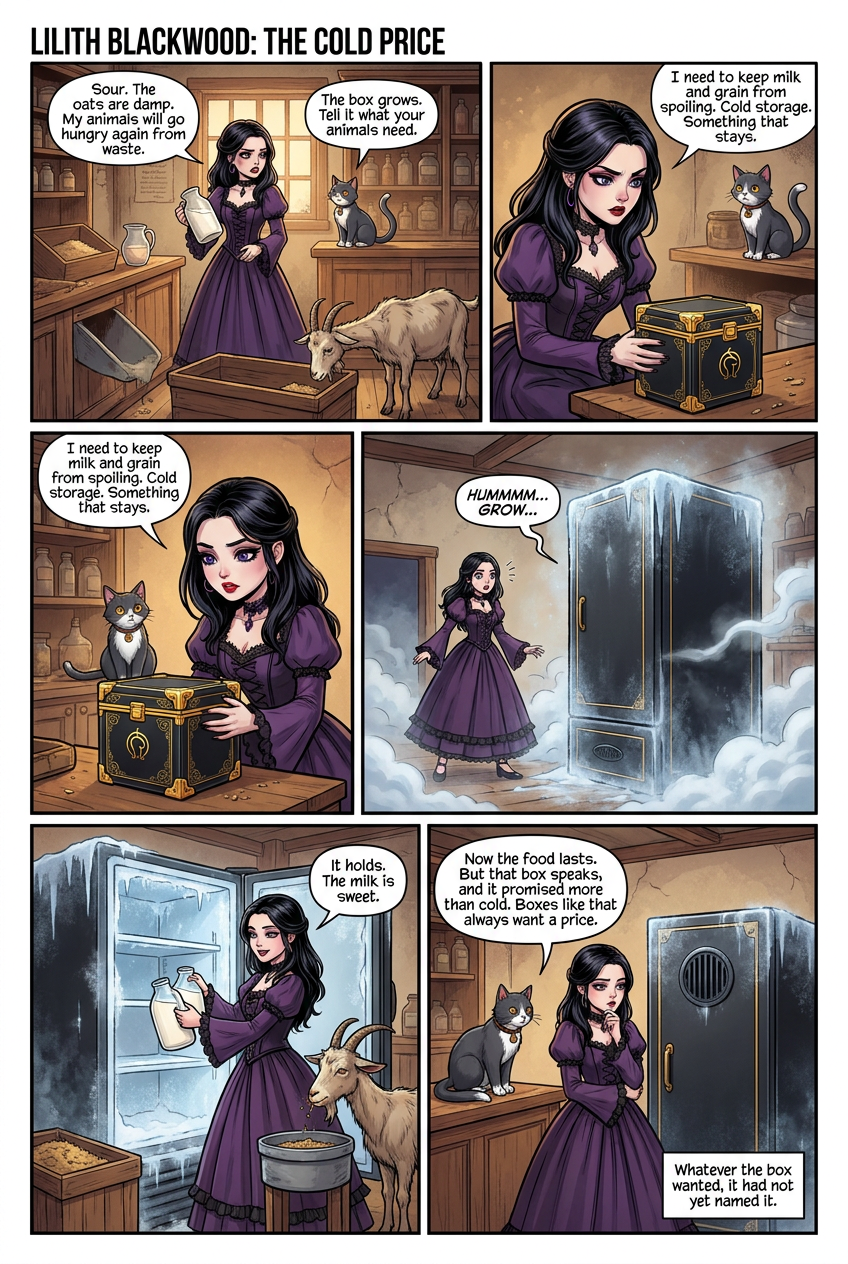
The food came every dawn now, but by noon it turned. Lilith lifted the milk jug and smelled it. Sour. The oats had gone slick with damp. She dumped the ruined milk in the snow and watched the goat sniff the empty bin. Her larder had no cold room, and the apothecary stayed warm from the animal pens. Fresh food arrived each morning and spoiled before dusk. Her animals would go hungry again, not from lack, but from waste. Liko jumped onto the counter and studied the curdled jug. He had known her since she was a child, and he weighed problems the way she weighed remedies. "You solved the hunger," he said. "Now you must keep what you're given. Milk needs cold. Snow is cold, but snow melts near your stove." "Then I dig," Lilith said. "A pit outside, packed with snow." "A pit floods when the thaw comes," Liko said. "You need something that holds cold and hides in plain sight. The town watches your door." Lilith frowned. A cellar would take weeks she did not have. Liko flicked his tail toward the back shelf. There sat a small black box edged in gold, left behind by the old apothecary. She had shelved it and forgotten it. "That box grows," Liko said. "I have watched it before. Ask it plainly. Tell it what your animals need." Lilith lifted the box. It was cold to the touch, colder than the room. A small grille sat on its front, like a mouth. She felt foolish, but she bent close. "I need to keep milk and grain from spoiling," she said. "Cold storage. Something that stays." The box hummed. Its lid unfolded, then its sides, growing past her hands until it stood taller than the goat. Frost crept across the black surface. When she opened the wide door, cold air rolled out and fogged the floor. Inside, shelves waited, dry and freezing. Lilith carried the morning's baskets to it. She set the fresh milk on the top shelf, the oats below, the hay against the back wall. She shut the door. When she opened it an hour later, the milk was still sweet. She tasted it to be sure. "It holds," she said. Her voice shook. She filled the goat's bin from the cold shelf, then the rabbits' trays. Every animal ate. Liko watched her from the counter. "Now the food lasts. But that box speaks, and it promised more than cold. Boxes like that always want a price." Lilith looked at the grille on the box's front. It had gone quiet, but it had answered her once. She latched the door and stepped back. Her animals were fed and would stay fed. That was enough for tonight. Whatever the box wanted, it had not yet named it.
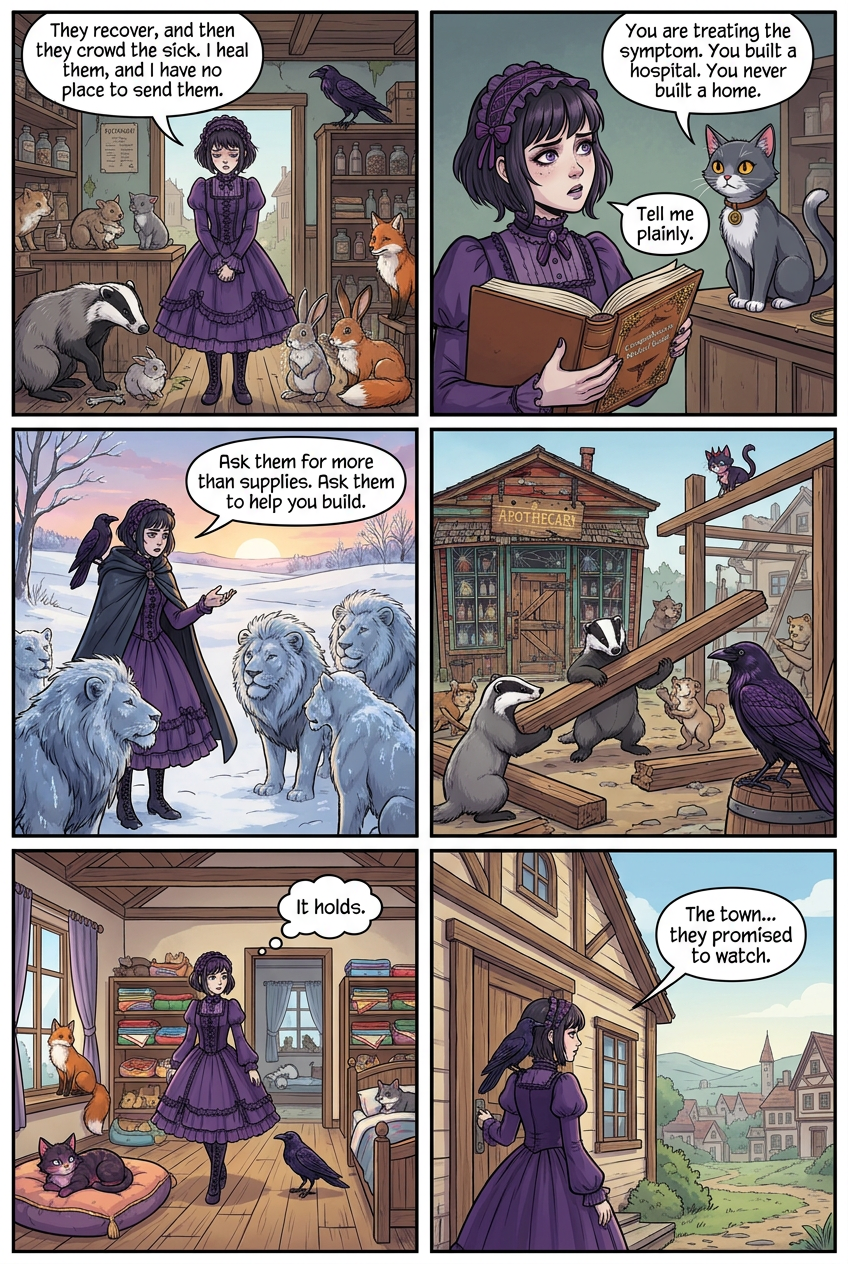
The cold box kept the food, but the animals kept coming. Three more arrived at dawn: a limping badger, two shivering hares. Lilith healed their wounds by noon. Then she stood in the crowded apothecary and saw the problem she could not fix. Pens filled every corner. The healed fox pressed against the wall to make room. New arrivals huddled by the door, in the draft, because there was nowhere warmer to put them. Her single room could mend an animal, but it could not house one for long. "They recover, and then they crowd the sick," Lilith said. "I heal them, and I have no place to send them." Liko leapt onto the counter. The gray cat had watched her since childhood, and he studied her the way she studied a wound. "You are treating the symptom," he said. "You built a hospital. You never built a home." Lilith opened the medical guide for the tenth time that morning, as if a page might hold an answer. It held remedies, not rooms. She shut it. "Tell me plainly." "The field gives you wool and straw for healing," Liko said. "Ask them for more than supplies. Ask them to help you build." Lilith wrapped her cloak and crossed the snow to the field's edge. The lions rose from the frost and listened. She told them the truth: her animals healed, then had nowhere to live. The largest lion bowed its head. That night the creatures worked beside her. They hauled timber and lifted beams. The clipped-wing crow rode her shoulder, watching, unable to fly but unwilling to stay behind. By the third dawn a house stood near the apothecary. Two floors. Twenty-three rooms. The creatures had filled each one with soft beds, blankets, bowls, and toys. The floors gave off their own warmth. Fresh water ran clean in every room. Lilith walked through it with the crow on her shoulder and could not speak. She carried the healed animals over one by one. The fox found a bed by a window. The badger climbed the stairs and claimed a corner. Along the hall she set long wooden shelves, draped them with blankets, and lined them with beds so the smaller creatures could nest at any height. The demon kitten trotted ahead of her, horns bright, choosing the softest cushion for itself. The apothecary emptied. Now the sick could rest without the well pressing in on them. Lilith stood in the doorway of her new home for the forsaken. "It holds," she whispered. Then she saw the trouble already coming. The house was large. It rose two stories where days ago there had been nothing. From the town, anyone could see it. The crow shifted on her shoulder. She had made a shelter no one could miss, and the town had promised to watch.
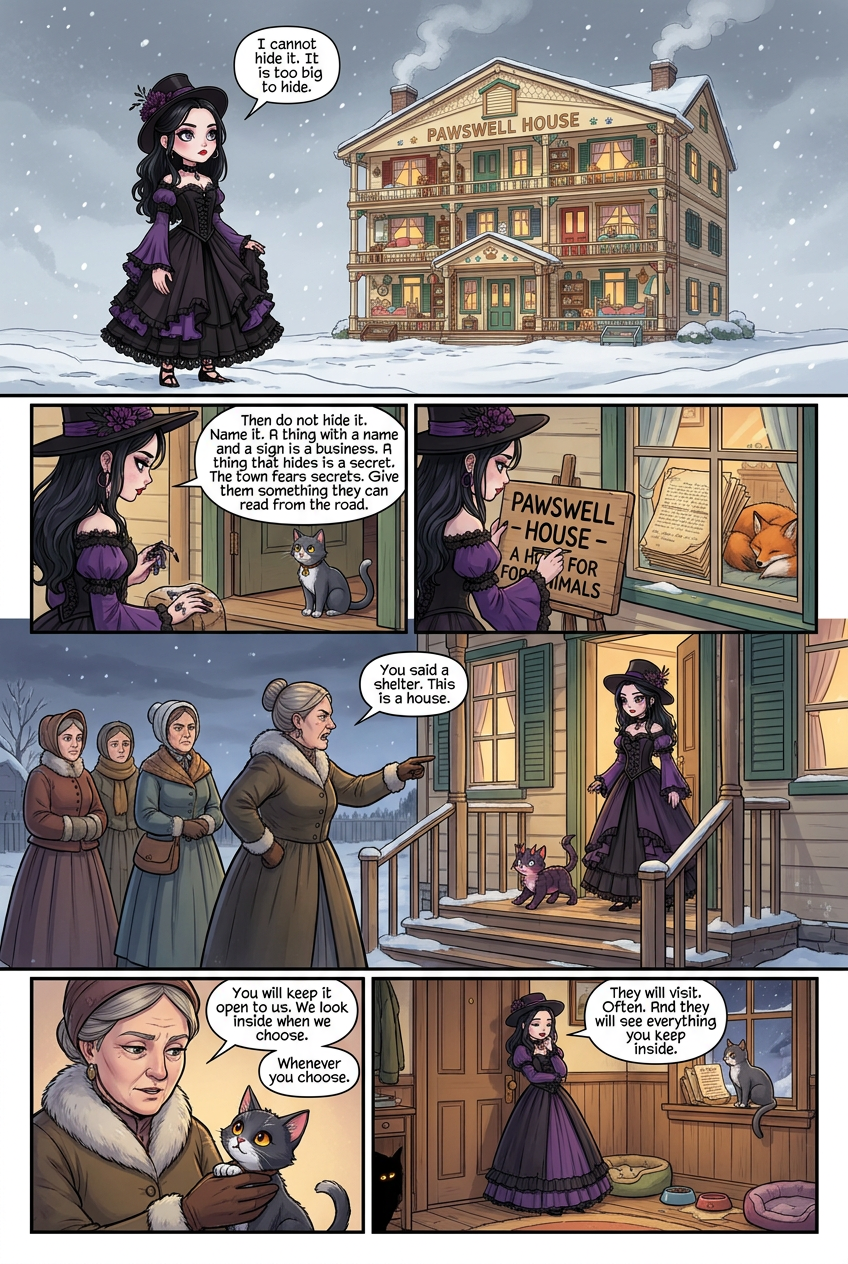
Lilith stood in the snow and watched the town watch her. The house rose two stories, bright and plain against the gray sky. Anyone in Gorethroat could count its windows. She had promised the leading townswoman only a shelter, and now she had built a mansion. Smoke would rise from those chimneys by dusk. Someone would come with questions. Someone always did. "I cannot hide it," Lilith said. "It is too big to hide." Liko sat in the doorway, tail curled over his paws. The gray cat had known her since she was small, and he never wasted a word. "Then do not hide it," he said. "Name it." She looked down at him. "Name it?" "A thing with a name and a sign is a business," Liko said. "A thing that hides is a secret. The town fears secrets. Give them something they can read from the road." Lilith understood. She had won the apothecary the same way, standing before the mob with her letters from healers, trading secrecy for a shelter they would tolerate. She could not shrink the house. She could change what it meant. She worked through the afternoon. The field creatures brought her a long plank and pots of paint. She lettered a sign across the front and hung it above the door: a home for animals, in plain reach of any eye. She set the healed fox in a front window where the town could see it sleeping. She propped her bundle of veterinary letters on the sill beside the glass, their pages facing out, proof anyone could stop and read. By dusk they came. The leading townswoman climbed the rise with three others behind her. She stopped at the foot of the steps and read the sign twice. Her mouth was hard. "You said a shelter," the woman said. "This is a house." "It is a shelter," Lilith said. "A larger one. The sick were crowding the well. Now they have room to heal." She held the door open. Inside, the fox stirred in its warm bed. The demon kitten trotted to the threshold, horns bright, and pressed against the woman's boot. The woman looked at the kitten. She looked at the letters in the window. Something in her face gave way. "You will keep it open to us," she said. "We look inside when we choose." "Whenever you choose," Lilith said. The woman turned and went back down the rise. The others followed. No torches. No mob. The house stood in the open, named and allowed. Lilith closed the door and leaned against it. Liko jumped to the windowsill beside the letters. "They will visit," he said. "Often. And they will see everything you keep inside." Lilith's relief cooled. The town had a standing invitation now. Every horned kitten, every glowing eye, every strange creature from the field would be one open door away from their gaze.
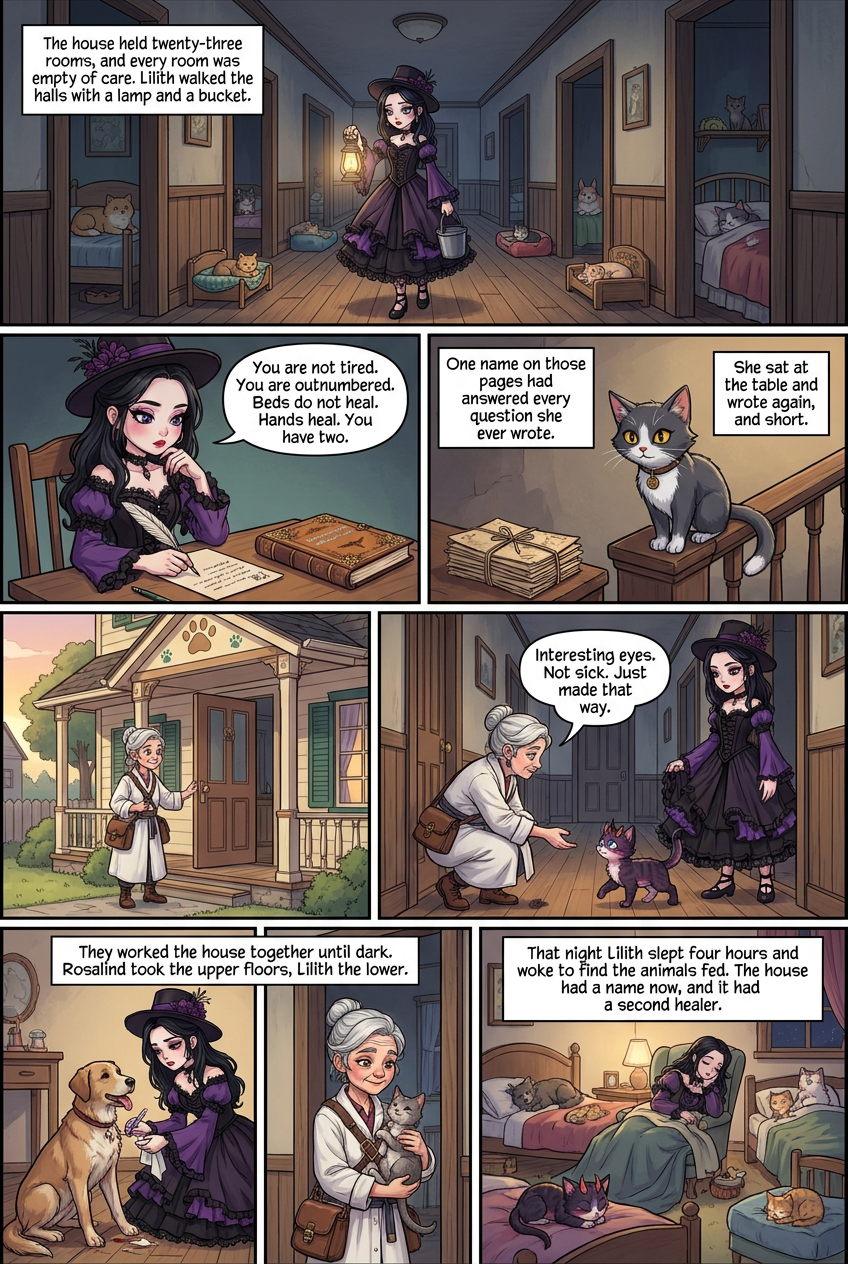
The house held twenty-three rooms, and every room was empty of care. Lilith walked the halls with a lamp and a bucket. A rabbit needed fresh water on the top floor. A limping dog needed his wound checked below. A cat cried in a corner room she had not reached in hours. She could not be in three rooms at once. By morning some animal would suffer for her absence, and no amount of soft beds or clean bowls would fix it. The house was too big for one woman. Liko sat on the stair rail and watched her climb past for the sixth time. "You are not tired," he said. "You are outnumbered. Beds do not heal. Hands heal. You have two." "Then tell me where to find more hands," Lilith said. "The town will not send them. They come only to inspect and leave." "You know a healer who does not fear strange animals," Liko said. "Send for her." Lilith set down the bucket. She thought of the letters in her window, the ones that had vouched for her before the mob. One name on those pages had answered every question she ever wrote. She sat at the table and wrote again, plain and short. She asked the field creatures to carry it at dawn, folded inside their delivery. Two days later a knock came. Lilith opened the door to a short, gray-haired woman in white robes stained with ink. A worn leather satchel hung across her chest, fat with rolled charts. This was Rosalind Mercer, who ran her own animal hospital by methods other healers called reckless. She had traded letters with Lilith for a year but never crossed her threshold. Rosalind stepped inside without waiting. A horned kitten with glowing eyes trotted to her boot. Any other stranger would have flinched. Rosalind crouched, held out her palm, and let the kitten come to her. "Interesting eyes," she said. "Not sick. Just made that way." She stood and looked down the crowded hall. "You built a hospital and tried to staff it alone. That was the mistake." "I could not turn them away," Lilith said. "No. You could not." Rosalind opened her satchel and pulled out a chart. "Show me your patients. I sleep four hours and no more. You will learn to sleep the same. We split the rooms." They worked the house together until dark. Rosalind took the upper floors, Lilith the lower. The crying cat quieted under Rosalind's hands. The limping dog let her clean his wound. For the first time, every room had someone in it who knew what to do. That night Lilith slept four hours and woke to find the animals fed. The house had a name now, and it had a second healer. But Rosalind had walked freely past every horned kitten and glowing eye in Pawswell House. She had seen it all in a single day. And soon the town would send its own inspectors through the same open door.
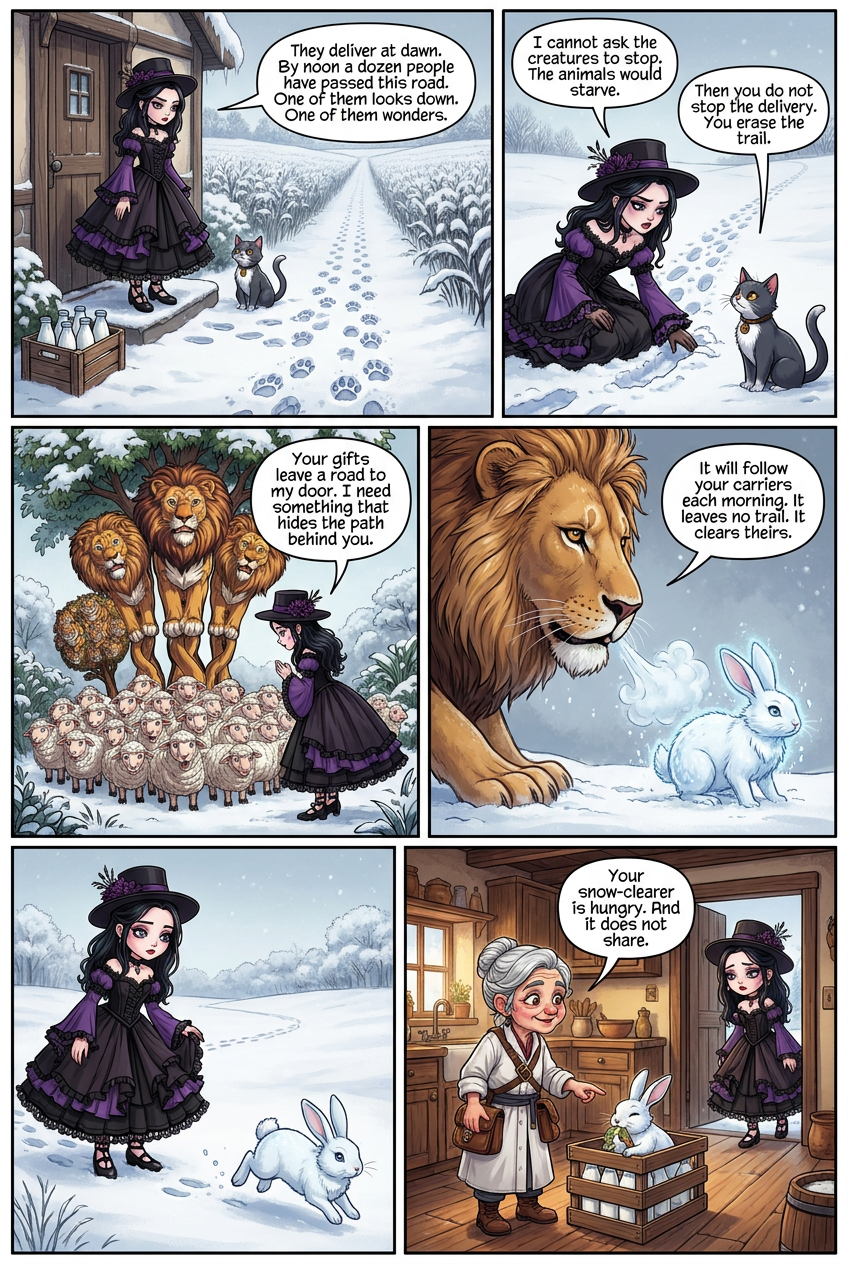
The snow fell all night, and by dawn a clear trail cut across it. Lilith stood at her door and followed the marks with her eyes. The field creatures had come again, carrying milk and grain. Their tracks pressed deep and straight, pointing from the field to her step like an arrow. Any neighbor could walk that line and find the secret at its end. Liko sat on the step beside a wet crate of milk. His yellow eyes followed the same trail. "They deliver at dawn," he said. "By noon a dozen people have passed this road. One of them looks down. One of them wonders." "I cannot ask the creatures to stop," Lilith said. "The animals would starve." "Then you do not stop the delivery," Liko said. "You erase the trail." Lilith knelt and pushed her glove through the snow. The marks were too many to smooth by hand. She would freeze before she cleared half of it. She looked toward the field, where the creatures had settled back into shapes of tree and bush and hill. She had traded healing for supplies. Now she needed one thing more. She walked out to the field's edge. The ground rose into wool. The trees thickened into manes. Lions lifted their heavy heads, tigers turned in the bushes, and the sheep pressed close at her feet. Lilith bowed to them. "Your gifts leave a road to my door," she said. "The town will follow it. I need something that hides the path behind you." The largest lion studied her. Then he lowered his muzzle to the snow and breathed. A shape formed from the frost. It sat up, shook itself, and became a white rabbit with pale blue eyes. The rabbit sniffed the air, fussy and quick, and hopped once across the fresh snow. Where it landed, the tracks vanished. The ground behind it lay smooth and untouched. "It will follow your carriers each morning," the lion said. "It leaves no trail. It clears theirs." Lilith carried the rabbit home against her chest. It squirmed, but it did not flee. She set it down where the creatures' tracks began. The rabbit hopped the length of the road, nose twitching, and smoothed every mark to blank white. When it finished, no line pointed to her door. The snow looked as if no one had crossed it at all. That night Lilith slept without listening for footsteps. At dawn the delivery came, and the little rabbit worked behind it, clearing the path before the town woke. The trail was gone. Her secret held. But the rabbit ate too. Rosalind found it in the kitchen at first light, deep in the milk crate meant for the sick. "Your snow-clearer is hungry," she called down the stair. "And it does not share." Lilith looked at the emptied crate. She had hidden the road. Now she had one more mouth, and less to feed the rest.
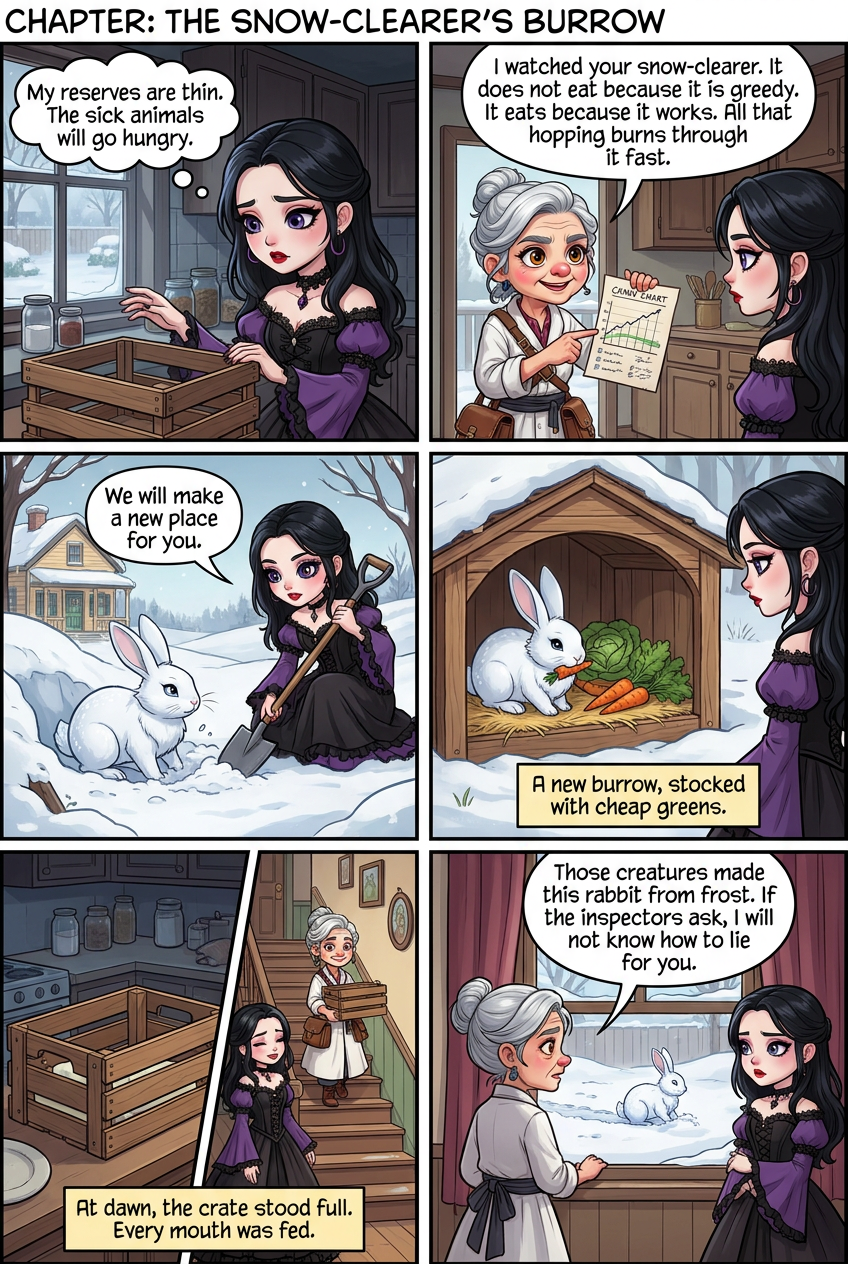
By the third morning, the milk crate stood empty again. Lilith counted her stores and found them thin. The white rabbit had cleared the snow trail every dawn, but it fed itself from her reserves. Each day it took a little more. Soon the sick animals upstairs would go hungry, and she would have nothing left to give them. Rosalind came down the stairs with her satchel already open. Ink stained her white sleeves. She dropped a hand-drawn chart on the table and tapped it with one finger. "I watched your snow-clearer all night," she said. "It does not eat because it is greedy. It eats because it works. All that hopping burns through it fast." She had been at Pawswell House only a short while, but she treated its strangest animals as plain problems to solve. She did not flinch at the rabbit's pale blue eyes. She measured them. Lilith knelt by the rabbit. It fussed at her boot, nose twitching, quick and restless. "I cannot make it stop working," she said. "The town will find the trail." "Then feed it apart from the others," Rosalind said. "Give it its own store. Fill it with cheap greens, not the milk your patients need." The answer was simple, and Lilith felt foolish for not seeing it. She fetched a spade. Behind the house, where no road passed, she dug into the frozen bank. The rabbit watched, then dug beside her, throwing dirt with its small paws. Together they hollowed out a burrow into the hillside. By midday they had a hutch dug deep and dry. Lilith lined it with straw. She set out crisp lettuce, carrots pulled from her own cellar, a bowl of water, and one small jar of milk. These cost little. The sick animals lost nothing. A short path led down from the surface to the rabbit's private door. The rabbit hopped inside and sniffed each dish. It settled among the carrots and ate. It did not race back to the kitchen crate. Lilith waited, still and patient, letting it choose. When it finished, it curled in the straw and closed its eyes. At dawn the next day, the delivery came. The rabbit worked behind the carriers, smoothing every track to blank white. Then it returned to its burrow and ate its own greens. The kitchen crate stood full. Rosalind carried it up the stairs to the waiting animals, and every mouth was fed. Lilith stood at her door and looked over the smooth snow. The trail was hidden. Her reserves held. She had solved the hunger and kept the secret both. But Rosalind lingered at the window, watching the field. "Those creatures made this rabbit from frost," she said. "If the town's inspectors ever ask where it came from, I will not know how to lie for you." Lilith had no answer. The woman who kept her house running was the one who could not keep its greatest secret.
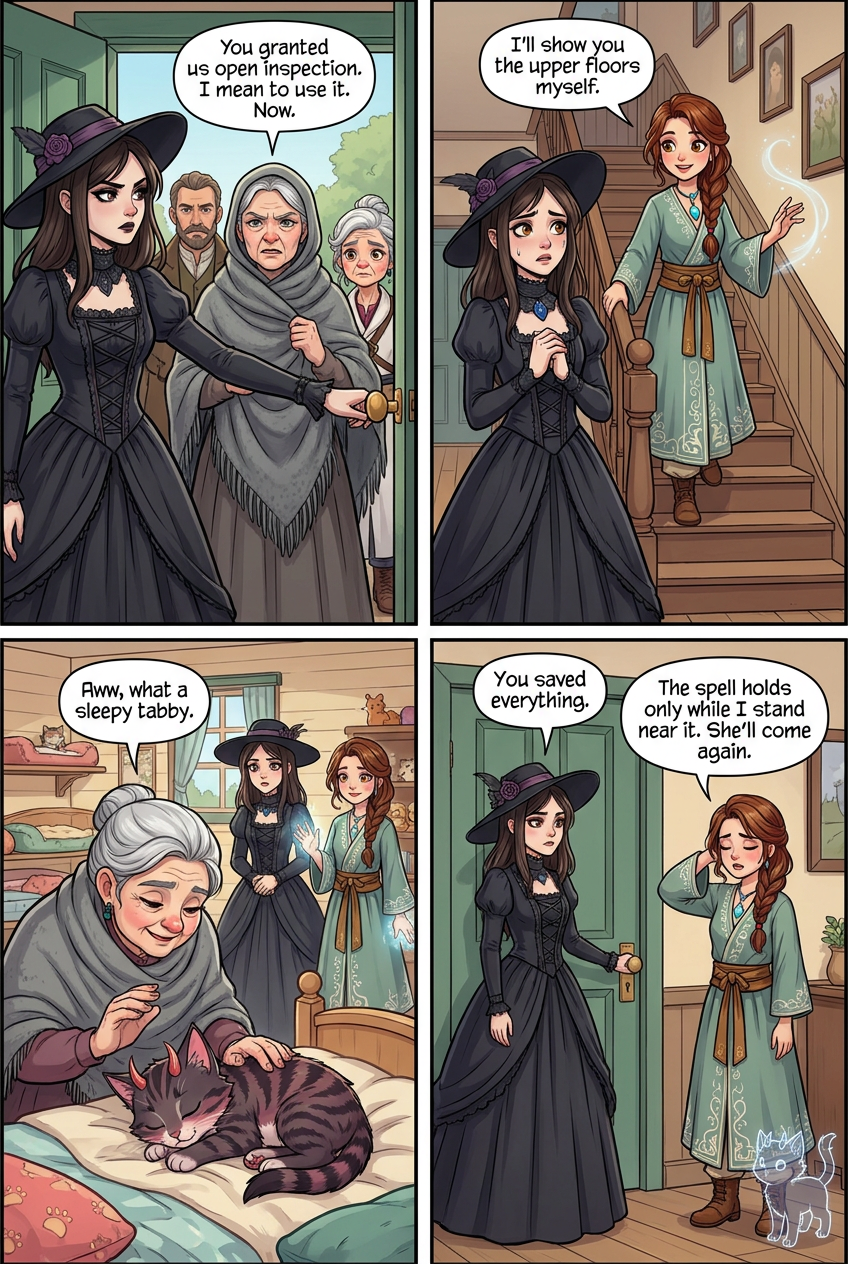
Rosalind's warning still hung over the house when the knock came. Not the polite tap of a neighbor. Three hard raps on the front door. Lilith opened it and found the town's leading townswoman on the step, wrapped in gray wool, her chin high. Two men waited behind her. "You granted us open inspection," the woman said. "I mean to use it. Now." No warning, no plan. Upstairs, a horned kitten dozed on a bed, and pale-eyed creatures filled every room. Lilith stepped back to let them in. Her hands stayed still, but her mind raced. If the woman climbed the stairs, she would see eyes that did not belong to any barn cat, wounds that healed too fast. Rosalind would not lie for her. There was no time to hide anything. Then a small voice spoke behind her. "Let me go first." Shelly Thornveil came down the stairs, her braid swinging, a blue stone glinting at her throat. She was Lilith's oldest friend, a healer who could mend the dying and cast illusions that hid what no human eye should see. Lilith had not sent for her. Shelly only smiled, as if she had felt the trouble from across town. "I'll show you the upper floors myself," Shelly told the townswoman. She raised one hand, low and quiet, and traced a shape in the air. Lilith felt the room shift, a soft press behind her eyes, like heat off a stove. The woman climbed the stairs. Lilith followed, her heart loud. In the first room, a tiger-striped creature lay healing, its wound too clean for any ordinary animal. But the townswoman looked at it and saw only a plain gray cat curled on a blanket. In the next room, the horned kitten yawned. The woman leaned close and cooed at what her eyes told her was a sleepy tabby. Rosalind stood in the hall, watching. When the townswoman asked her plainly what breed the striped one was, Rosalind said, "A rescue. Half-starved when she came." True words, every one. She did not have to lie. Shelly's illusion had already answered the harder question. The townswoman walked all twenty-three rooms. She found beds, bowls, fresh water, animals mending under warm light. She found nothing she could not explain. At the door she paused. "It runs cleaner than I expected," she said, almost sour about it. Then she left, her men behind her, boots fading down the path. Lilith shut the door and leaned on it. "You saved everything," she told Shelly. Shelly's smile thinned. "I hid it this once. But the spell holds only while I stand near it." She rubbed her fingers, tired already. "She'll come again. And I cannot live in your walls forever." The secret had survived one visit. It now depended on one woman's presence.
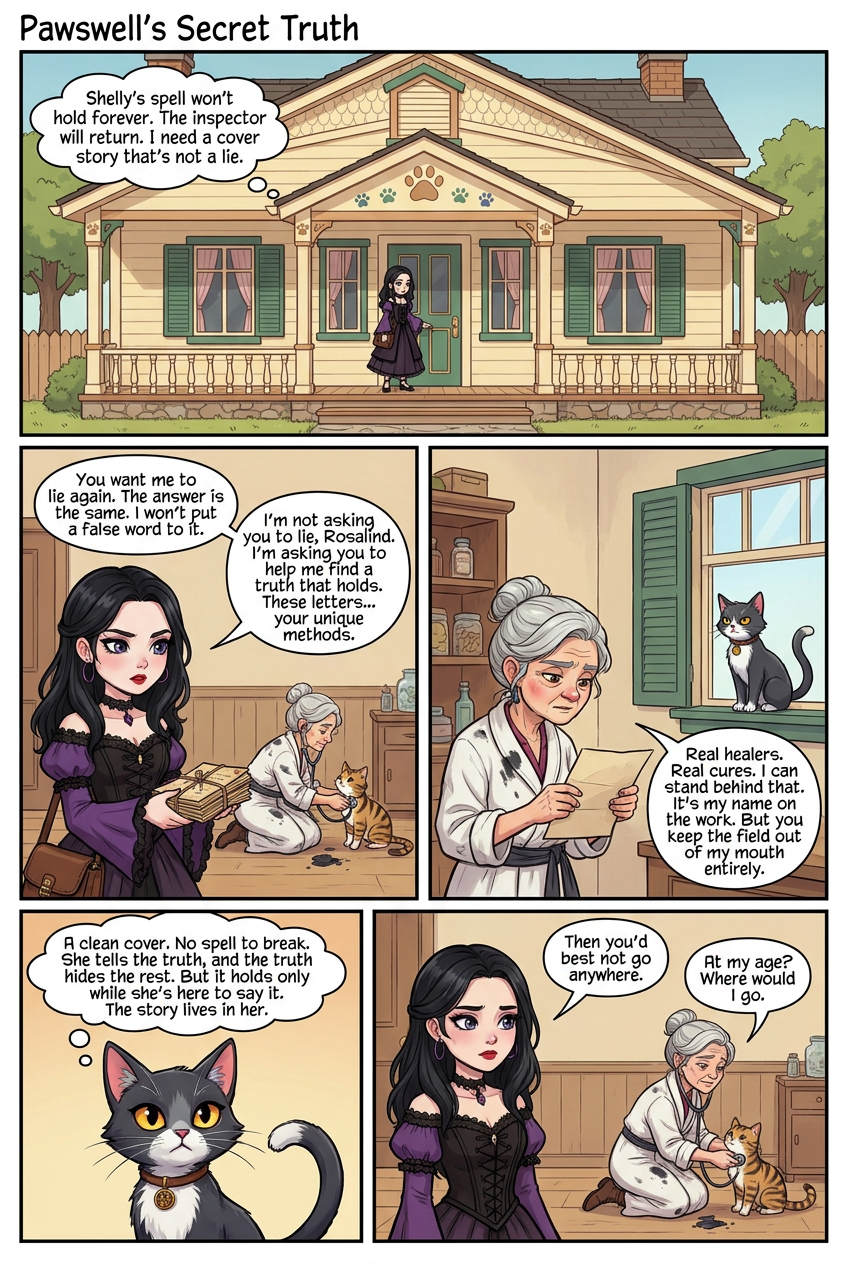
Shelly's spell had held once. It would not hold forever. Lilith knew the townswoman would return, and next time no braid-swinging friend might stand near enough to trace an illusion in the air. She needed a cover story that did not depend on magic, and she needed it before the next knock. But her cover story rested on Rosalind, and Rosalind would not lie. She found the older healer on the upper floor, kneeling beside a striped creature, pressing a chart against its ribs to mark its breathing. Rosalind's white robe was smudged with ink at both cuffs. She did not look up. "You want to ask me to lie again," she said. "The answer is the same. I'll tend anything you bring me. I won't put a false word to it." "I'm not asking you to lie," Lilith said. "I'm asking you to help me find a truth that holds." That turned Rosalind's head. She set down her charts and studied Lilith with sharp, tired eyes. "Go on." "The letters," Lilith said. She drew the bundle from her satchel, the handwritten notes from healers who had vouched for her before. "You've treated animals no one else would touch. Methods no one else has tried. If an inspector asks why these creatures heal strange, you tell them what you actually do. You call it your method. Not a lie. Your work." Rosalind untied the bundle and read the top page slowly. Her mouth moved over the crabbed handwriting. "These are real," she said. "Real healers. Real cures." "Every word," Lilith said. "When they ask about the fast healing, you don't mention lions. You mention your charts. You show them your satchel. You let them believe a skilled hand did it, because a skilled hand did." Rosalind was quiet a long moment. Then she nodded, once, the way she nodded over a wound she knew how to close. "I can stand behind that. It's my name on the work." She tapped the letters. "But you keep the field out of my mouth entirely. I won't deny it. I'll only speak what's mine to speak." "That's all I need," Lilith said. Liko had watched from the windowsill, his tail curled over his paws. "A clean cover," the gray cat said. "No spell to break. She tells the truth, and the truth hides the rest." His yellow eyes narrowed. "But it holds only while she's here to say it. The story lives in her, not in the walls." Lilith felt the weight of that settle. The secret no longer leaned on Shelly's tired fingers. It leaned on Rosalind staying. If the older woman ever left Pawswell House, the cover left with her, and no letters would speak in her absence. "Then you'd best not go anywhere," Lilith said. Rosalind snorted and picked her charts back up. "At my age? Where would I go." She bent to the striped creature again, and the house was safe for now.
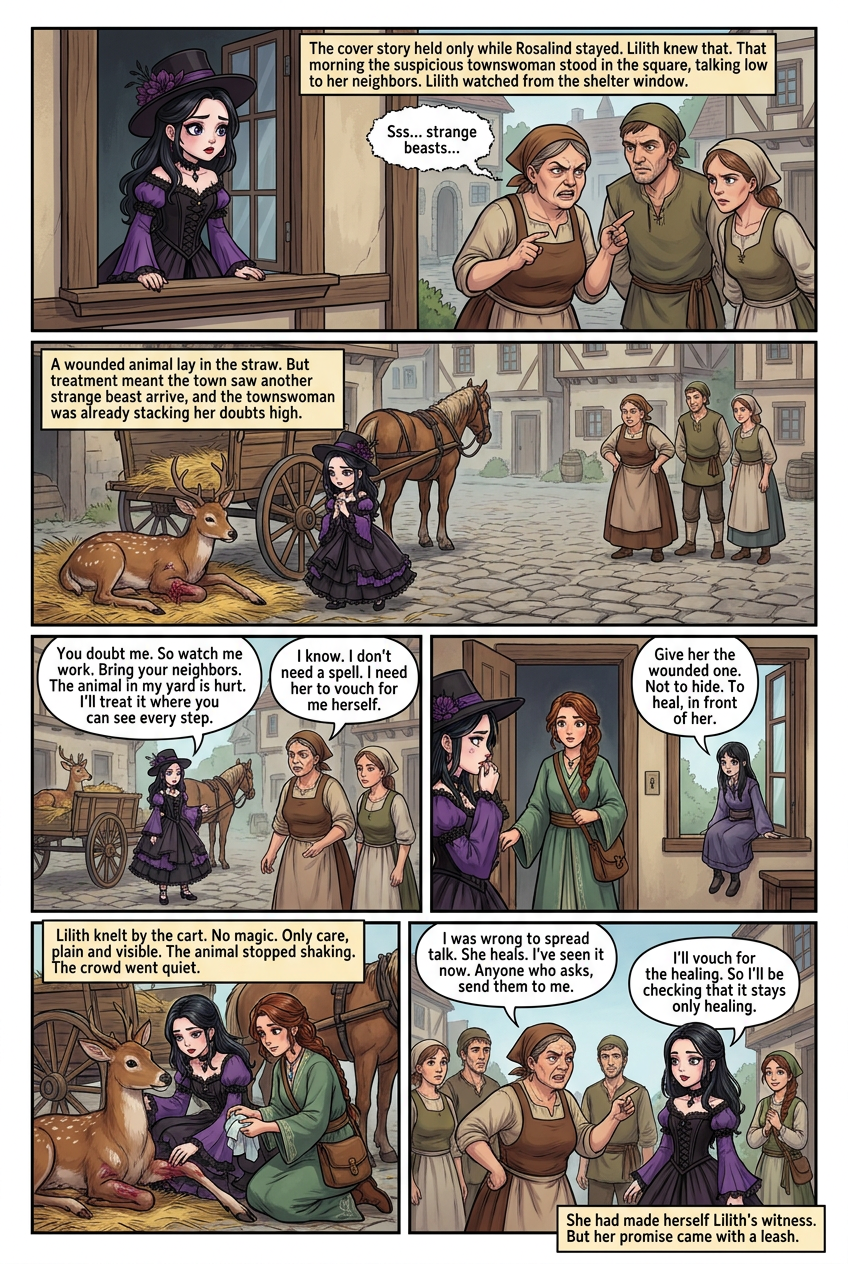
The cover story held only while Rosalind stayed. Lilith knew that. But a new danger came faster than any inspector. That morning the suspicious townswoman stood in the square, talking low to her neighbors. Lilith watched from the shelter window. Heads turned toward Pawswell House. Mouths tightened. The woman pointed, and the doubt spread like frost across glass. Then a cart creaked into the yard below. A wounded animal lay in the straw, sent by the field creatures. Its foreleg was torn and swelling. It needed treatment now. But treatment meant the town saw another strange beast arrive, and the townswoman was already stacking her doubts high. Lilith had no neighbor to speak for her, no name the town would trust. "You're chewing your lip again," said a voice at the door. Shelly Thornveil stood there, braid over one shoulder, satchel loose at her hip. She was Lilith's oldest friend and a healer of sick creatures herself. Once she had hidden the animals with an illusion. Now she looked past Lilith to the crowd in the square. "That woman won't stop. I can't hide you forever. My spells run out." "I know," Lilith said. "I don't need a spell. I need her to vouch for me herself." Shelly frowned. "How?" Liko sat on the sill, tail curled. The gray cat had known Lilith since birth and missed nothing. "Give her the wounded one," he said. "Not to hide. To heal, in front of her." Lilith understood. She crossed the square, past the whispers, and stopped before the townswoman. "You doubt me," Lilith said. "So watch me work. Bring your neighbors. The animal in my yard is hurt. I'll treat it where you can see every step." The woman's eyes narrowed, but curiosity pulled her forward. The neighbors followed. Lilith knelt by the cart and stayed still, letting the frightened creature settle before she touched it. Shelly passed her clean cloth and a jar from the guide book. Lilith cleaned the torn leg, packed the wound, and bound it with steady hands. No magic. Only care, plain and visible. The animal stopped shaking. It pressed its head into Lilith's palm. The crowd went quiet. The townswoman stepped closer and saw the swelling already easing under the wrap. On Lilith's finger sat a silver ring set with purple facets, catching the light as she worked. The woman stared at the calm hands, not the beast. "I was wrong to spread talk," the townswoman said at last. She turned to her neighbors. "She heals. I've seen it now. Anyone who asks, send them to me." She had made herself Lilith's witness. The crowd drifted off satisfied. Shelly squeezed Lilith's shoulder and slipped away before her spells were ever needed. But as the townswoman left, she paused. "I'll vouch for the healing," she said. "So I'll be checking that it stays only healing." Her promise came with a leash.
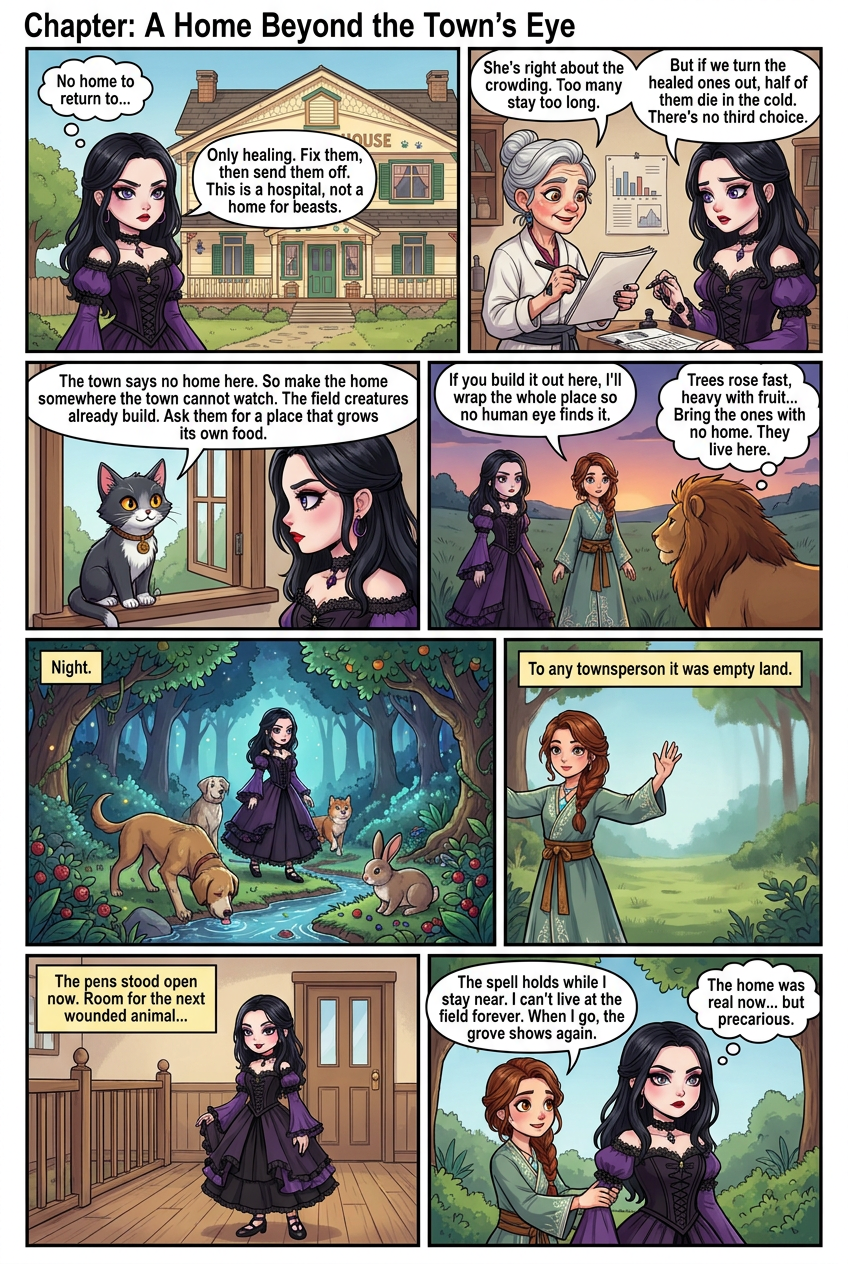
The healed animals filled every pen at Pawswell House. Lilith wanted to keep the ones with no home to return to. But the townswoman who had vouched for her now stood in the yard each morning, watching. "Only healing," the woman said again that day. "Fix them, then send them off. This is a hospital, not a home for beasts." Lilith said nothing. She had healed a limping dog three days ago. It had nowhere to go, and the woman's rule left it none. Inside, Rosalind bent over her charts, ink on her fingers. The older healer ran the upper floors and trusted Lilith without question. "She's right about the crowding," Rosalind said. "Too many stay too long. We can't treat the new ones." She tapped a full page. "But if we turn the healed ones out, half of them die in the cold. There's no third choice I can see." Liko sat on the windowsill, tail wrapped tight. The gray cat had known Lilith since birth and always saw the real problem. "The town says no home here," he said. "So make the home somewhere the town cannot watch. The field creatures already build. Ask them for a place that grows its own food." Lilith walked to the field's edge at dusk. Shelly came with her, braid swinging, satchel loose. Her oldest friend had hidden the animals with illusions before, and she could hide this too. "If you build it out here," Shelly said, "I'll wrap the whole place so no human eye finds it. That spell I can hold. Land doesn't move like frightened cats do." The largest lion listened. He pressed a paw to the bare ground. Trees rose fast, heavy with fruit. A stream cut through the grass and ran clear. Moss spread soft over the roots. Berries hung low where small animals could reach. A grove grew where nothing had stood, full of food and water and shade. "Bring the ones with no home," the lion said. "They live here. They want for nothing." Lilith led the limping dog and six others out that night. They stepped into the grove and did not shake. The dog drank from the stream. A rabbit nosed the berries. Shelly raised her hands, and the grove blurred at its edge, gone from sight. To any townsperson it was empty land. Lilith returned to Pawswell House before dawn. The pens stood open now. Room for the next wounded animal, and every next one after. The townswoman could inspect all she liked. She would find only a hospital, exactly as she demanded. But Shelly caught Lilith's arm before she left. "The spell holds while I stay near," she said. "I can't live at the field forever. When I go, the grove shows again." The home was real now. Keeping it hidden still rested on one friend who could not stay.
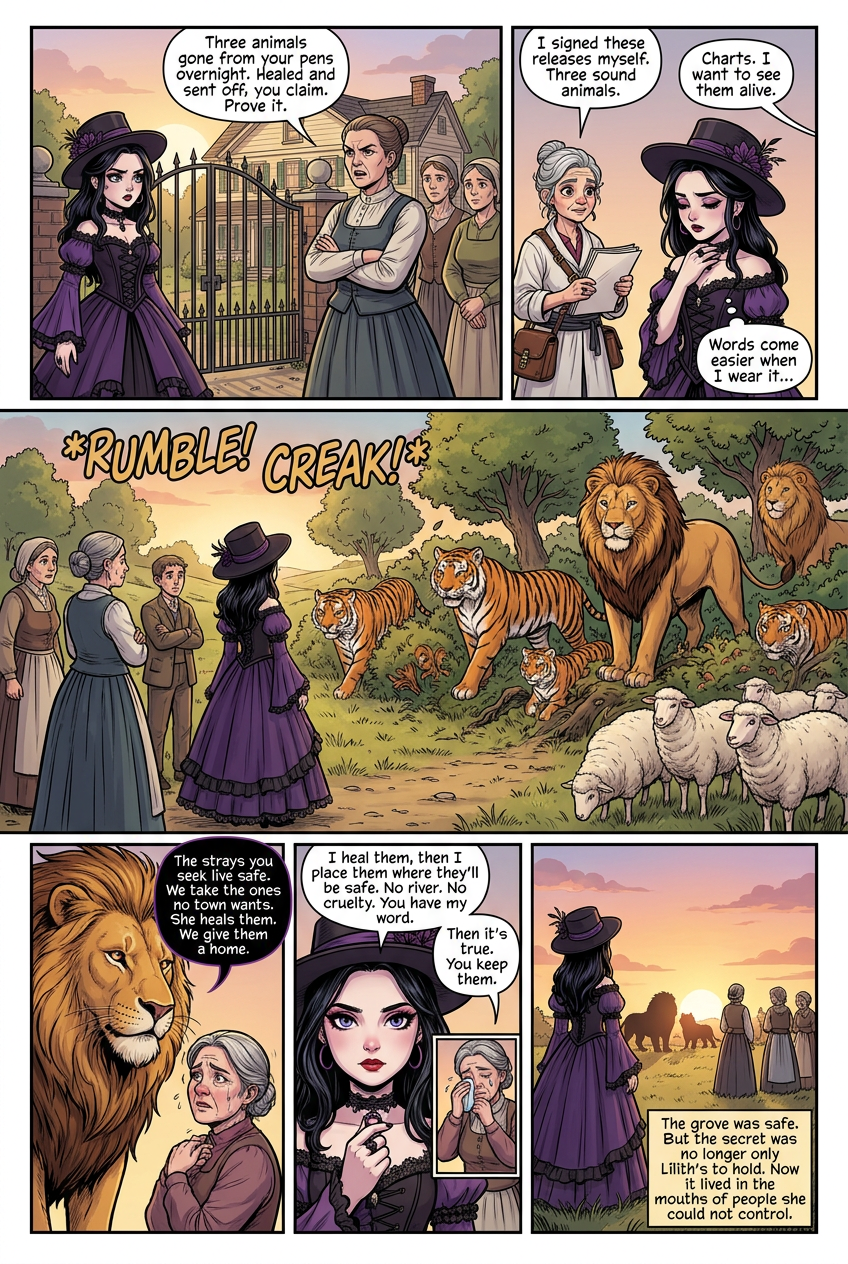
The grove hid seven animals now, safe behind Shelly's spell. But at dawn a knock came at Pawswell House. The watching townswoman stood in the yard, arms crossed. Behind her waited two neighbors. "Three animals gone from your pens overnight," she said. "Healed and sent off, you claim. Prove it." Lilith opened her mouth. She had no papers for the vanished animals. No trusted vet had signed for them. Her supplies had run dry, and she could not even offer the woman tea to slow her down. The empty pens spoke louder than any word. "Show me where they went," the woman said. "Or I tell the town you're drowning strays in the river." Rosalind stepped out behind Lilith, ink on her fingers, a chart pressed to her chest. "I signed these releases myself," the older healer said. She would not lie about magic, but rehoming was no lie. "Three sound animals. Walked out on their own legs." The woman did not soften. "Charts. I want to see them alive." Lilith knew she could not lead them to the grove. If they walked the field, the empty land would betray her the moment Shelly stepped away. She turned the dark ring on her finger. It had sat there since her mother's death, heavy, always cold. Words came easier when she wore it. "Come to the field's edge," she said. "See for yourself." The walk was short. At the field, the townswoman stopped and stared. The ground itself rose into wool. Sheep lifted their heads from the grass where they had seemed only grass. Two bushes uncurled into tigers. Three trees straightened into lions, manes shaking loose. The largest lion looked down at the shaking woman. "The strays you seek live safe," the lion said. His voice rolled like a low bell. "We take the ones no town wants. She heals them. We give them a home." The neighbors dropped to their knees. The townswoman's crossed arms fell to her sides. Lilith touched the ring and spoke plain. "I heal them, then I place them where they'll be safe. Sometimes that place is here. No river. No cruelty. You have my word." The certainty in her voice left no crack to argue. The woman looked from the lions to Lilith for a long moment. "Then it's true," she whispered. "You keep them." She wiped her face. "I'll tell the town the animals are cared for. Not drowned." She turned and walked back, quieter than she came. The grove was safe. Lilith had bought her word, and her freedom to keep placing strays. But the lions had shown their true shape to three townspeople. The secret Shelly's spells guarded was no longer only Lilith's to hold. Now it lived in the mouths of people she could not control.
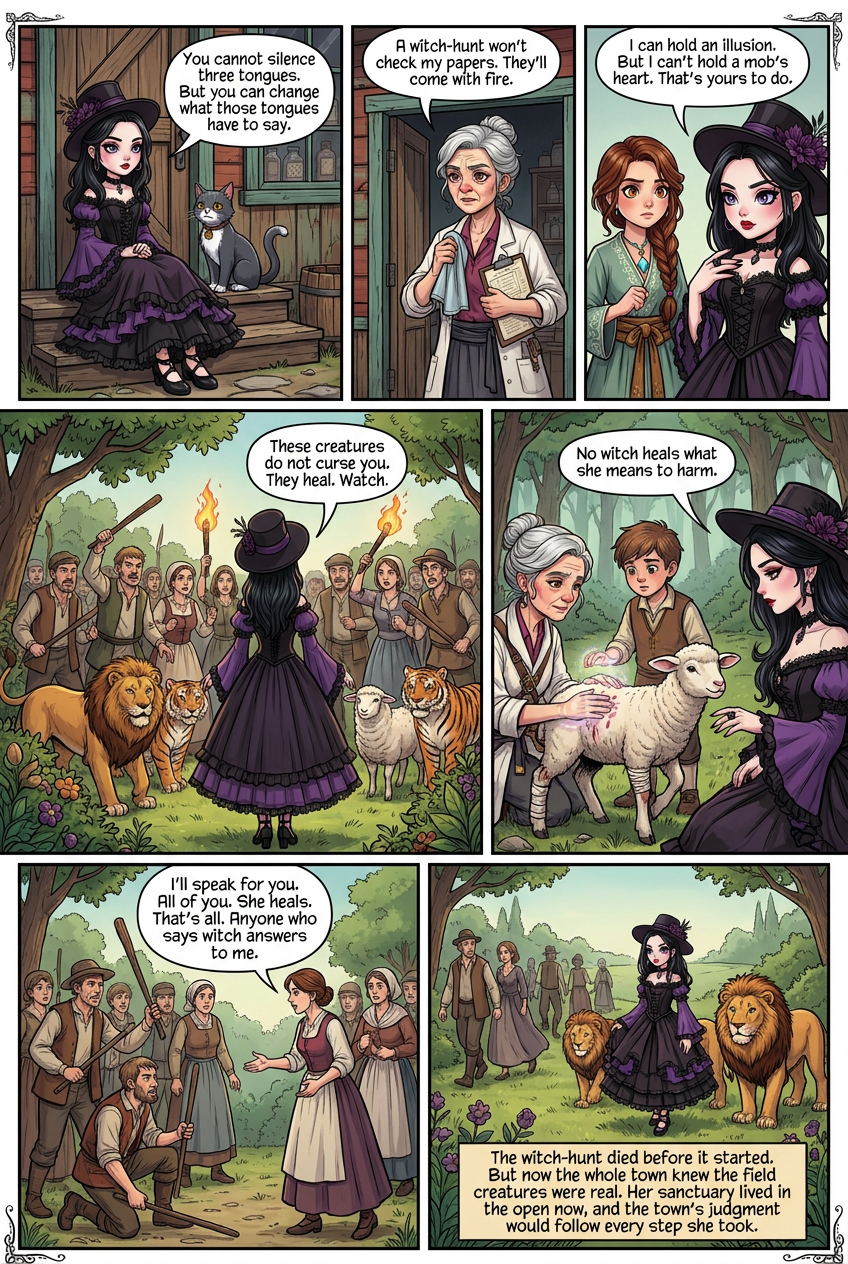
The townswoman kept her word. The town heard the animals were safe. But three people had seen the lions rise from the field. Now word spread in whispers. By evening, a boy told Lilith what he'd overheard at the well. Two of the neighbors had called the field creatures witchcraft. A crowd was already talking of torches and a hunt for the woman who kept demons. Lilith found Liko on the apothecary step. The gray cat watched the road with his amber eyes, tail curled tight. "You cannot silence three tongues," he said. "But you can change what those tongues have to say." He knew everything, and he never wasted a word. "Give them a truth kinder than the one they fear." Rosalind came out drying her hands, a chart tucked under one arm. The old healer had signed false releases before to protect this place. "A witch-hunt won't check my papers," she said flatly. "They'll come with fire." Lilith touched the dark ring on her finger. It had been her mother's. When she wore it, her words carried a weight no one argued against. She made her plan. She would not hide the field creatures. She would show them again, but this time to the whole town, as healers. Shelly arrived at dusk, braid over her shoulder, her calm steady as always. Lilith's oldest friend cast spells that pulled the dying back from death. "I can hold an illusion," Shelly said. "But I can't hold a mob's heart. That's yours to do." At dawn Lilith walked to the field's edge and asked the largest lion for help. The crowd gathered behind her, faces hard, a few carrying sticks. The ground rose into sheep. Bushes uncurled into tigers. Trees straightened into lions. The crowd stopped cold. Lilith turned the ring and spoke plain. "These creatures do not curse you. They heal. Watch." A neighbor had brought a lamb with a broken leg, meaning it as proof against her. Lilith took it. Rosalind splinted the leg from her satchel while Shelly's hands glowed soft over the wound. The lamb stood. It walked to the boy from the well and pressed its head to his knee. "No witch heals what she means to harm," Lilith said. The two neighbors who had cried witchcraft looked at the mended lamb and lowered their sticks. One dropped to his knees, as he had once before. The crowd's anger drained. They saw a healer, and beasts that healed beside her. The townswoman stepped forward. "I'll speak for you," she said. "All of you." She faced the crowd. "She heals. That's all. Anyone who says witch answers to me." The mob broke apart into ordinary people walking home. The witch-hunt died before it started. But now the whole town knew the field creatures were real. The secret Lilith had guarded was gone. Her sanctuary lived in the open now, and the town's judgment would follow every step she took.
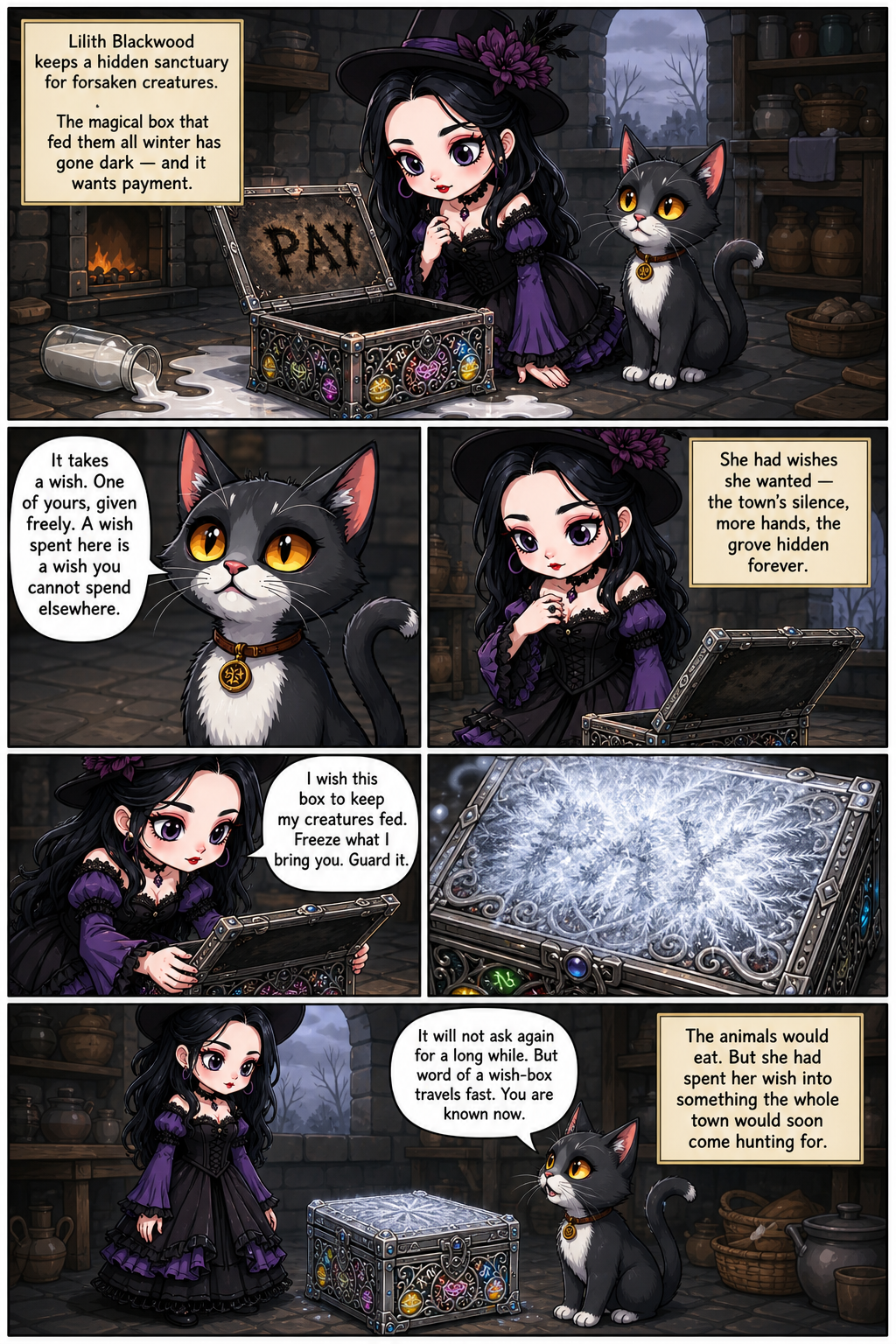
The witch-hunt was over, but the black box would not wait. Lilith came down at dawn to store the fresh milk and found the box gone still. No cold rose from it. No frost climbed its sides. When she pressed the milk inside, the box shuddered and spat it back onto the floor. On the lid, a single word had burned itself into the metal: PAY. Lilith called for Liko. The gray cat padded across the cold floor and sat before the box, his amber eyes fixed on the burned word. He had warned her of this day when she first woke the box. "It kept your food frozen all winter," he said. "Now it wants what it is owed. Boxes like this do not take coin." "Then what does it take?" Lilith knelt beside him. Her animals upstairs needed that milk by noon. Without cold, it would spoil before the sick ones could drink. Liko studied the runes crawling along the seam of the lid. "It takes a wish," he said. "The apothecary who left it fed it wishes. One of yours, given freely. Speak it into the box, and it will freeze again." His tail curled tight. "But a wish spent here is a wish you cannot spend elsewhere. Choose one you can lose." Lilith touched the dark ring on her finger, her mother's ring, the one that made her words carry weight no one argued against. She had wishes she wanted. She wanted the town to forget her secrets. She wanted more hands to help the animals. She wanted the grove hidden forever without Shelly standing guard. She thought of the milk. She thought of the lamb that had walked to the boy at the well. Every wish she held close was a want for herself, for her fear. The box only asked for one, and the animals needed it now. "I wish this box to keep my creatures fed," Lilith said. She leaned close and spoke it plain into the burned metal, the way she spoke through the ring, with no doubt in it. "Freeze what I bring you. Guard it. That is my wish." The box drank the words. Frost bloomed across the lid and swallowed the burned letters. Cold poured out in a white breath. When Lilith set the milk inside, it held firm and cold, the way it had all winter. Liko watched the frost settle. "It is fed," he said. "It will not ask again for a long while." Then his ears turned back. "But it took your wish, and it took its measure of you. A box that grants wishes will draw others who want them. You are known to the whole town now. Word of a wish-box travels faster than word of lions." Lilith looked at the frozen milk, safe again. Her animals would eat. But she had spent a wish into a thing the town would soon come hunting for.
Play your story to life
Storycraft is a mobile game where you create AI characters, craft items and locations to build their world, then discover what direction your story takes. Download the iOS game for free today!
Download for free