

Lyra Fernbrook's Arc
21 Chapters
Lyra Fernbrook's dream is restoring the ancient bond between elves, magical creatures, and the Whispering Grove..

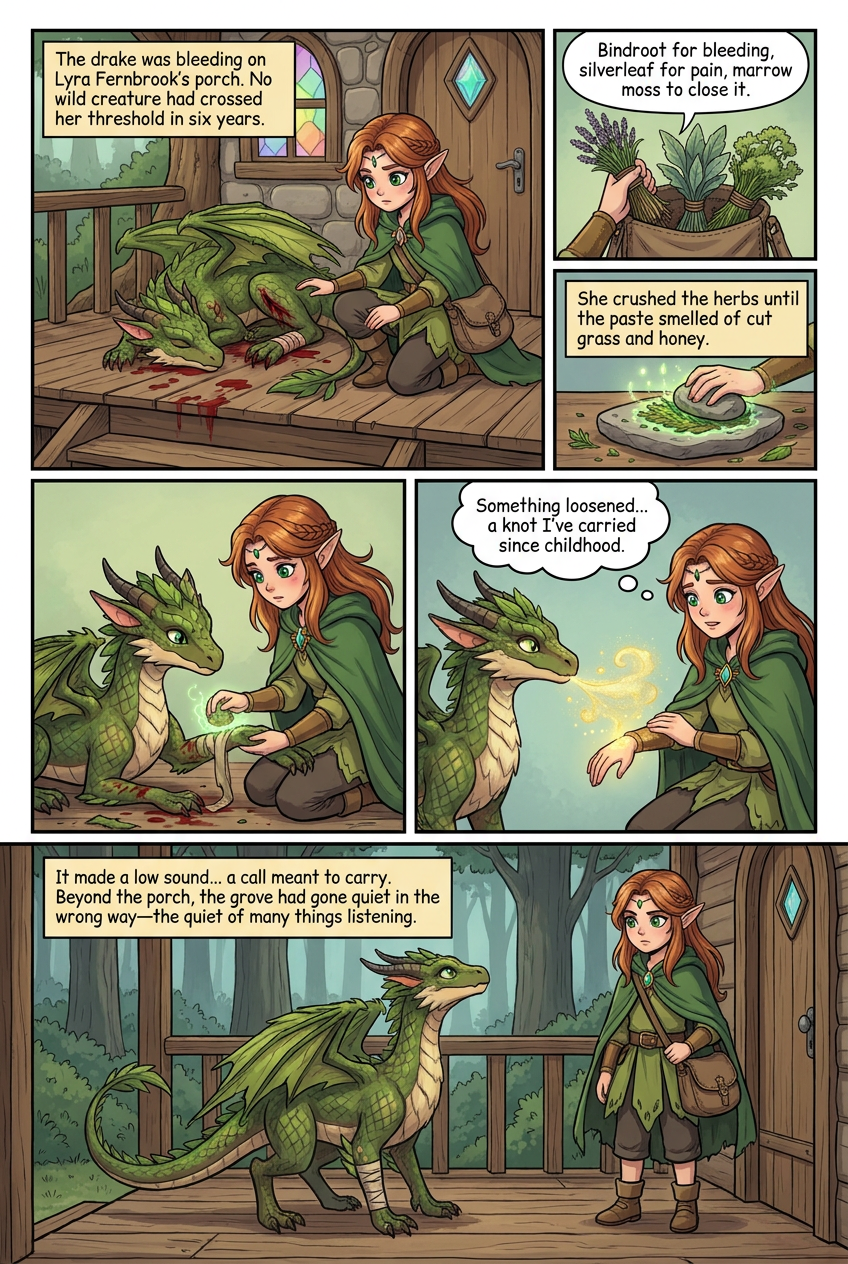
The drake was bleeding on Lyra Fernbrook's porch, and it should not have come to her at all. No wild creature had crossed her threshold in six years. That was the length of the silence between the elves and the Whispering Grove, ever since the old pact frayed and the animals stopped answering elven voices. Lyra had spent those years alone in her root-sheltered house, brewing salves no one asked for, waiting for a sign that the bond could be mended. She knelt on the wooden boards. The drake was small, no larger than a hound, its scales dusted with pale pollen and its leafy wings crumpled against its ribs. A gash ran the length of its hind leg. It watched her with green, unblinking eyes and did not flee. Lyra pulled her satchel forward and untied three bundles of herbs: bindroot for the bleeding, silverleaf for the pain, marrow moss to hold the wound closed. Her hands remembered the work her voice had forgotten. She crushed the herbs against a flat stone until the paste smelled of cut grass and honey. The drake flinched when she touched the wound, then stilled. She pressed the paste into the gash and wrapped the leg in soft moss, tying it with a strip of linen from her sleeve. When she finished, the drake exhaled a thin cloud of shimmering pollen against her wrist. The skin there warmed. Lyra sat back on her heels and felt something loosen in her chest that had been knotted since childhood. Then the drake stood. It tested the leg, folded its wings, and looked past her toward the trees. It made a low sound in its throat, not a call to her but a call meant to carry. Lyra turned. Beyond the porch, the grove had gone quiet in the wrong way — the quiet of many things listening. Something had sent the drake to her door, and something had followed it. She reached for her satchel and stood.
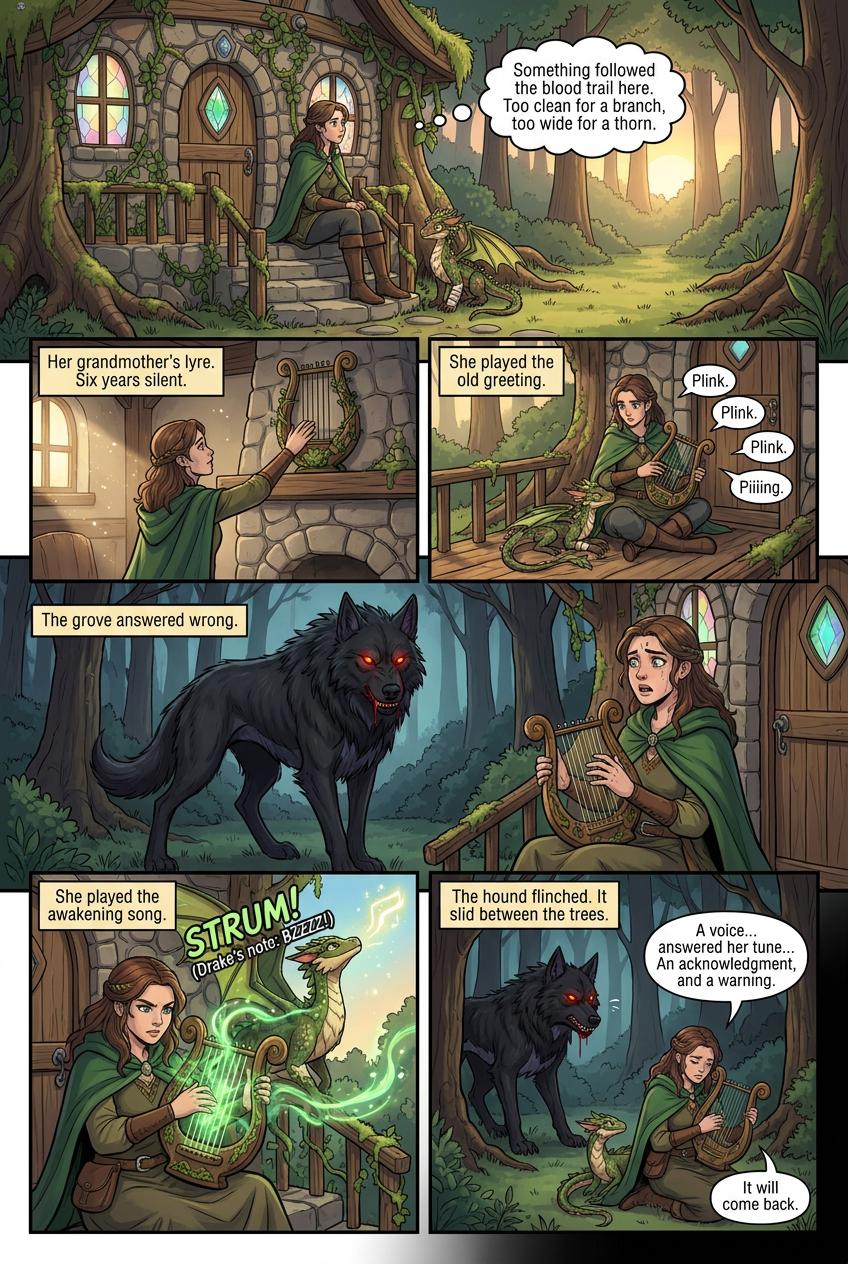
Lyra stepped off the porch with her satchel against her hip. The drake hopped down beside her, favoring the wrapped leg but steady. The grove held its wrong quiet. She looked at the gash she had just closed and thought of the shape of it — too clean for a branch, too wide for a thorn. Something had cut the drake before it reached her door. Whatever did the cutting had followed the blood trail here. She went back inside and took the lyre down from its peg above the hearth. Vines wrapped its frame and small flowers opened along the wood when her fingers touched the strings. Her grandmother had used it to speak to the grove before the silence. Lyra had not played it in six years. She carried it out to the porch and sat on the top step. The drake pressed against her knee. She tuned two strings by ear, drew a breath, and played the old greeting — three low notes, one high, repeat. The grove answered wrong. Birds did not lift. Leaves did not turn. Instead a shape separated from the trunks at the tree line. It walked on four legs and stood taller at the shoulder than she did. Its coat was black and its eyes burned red. It stopped where her garden ended and lowered its head. A thin line of drake blood still marked its jaw. Lyra's hands shook on the strings. The hound took one step forward. She thought of running for the door, and knew the door would not hold it. So she played instead. She played louder, faster, the notes her grandmother had taught her for calling the grove awake. Flowers along the lyre's frame burst open. Green light ran down the strings into the porch boards, into the ivy on the stone walls, into the roots under the house. The drake lifted its head and sang a thin, bright note against her music. The hound flinched. It took a step back. Its lip curled. Then it turned and slid between the trees and was gone. The pressure in the grove eased. Somewhere deep in the trees, a voice she could not place answered her tune with two notes of its own — an acknowledgment, and a warning. Lyra lowered the lyre. Her arms ached. The drake nudged her wrist and exhaled a small breath of pollen against her skin. She had driven the hunter off her porch, and something in the grove had heard her play and chosen to reply. The bond was not mended. But it had spoken. She looked at the tree line where the black hound had stood and understood that it would come back, and that it had not been hunting the drake alone. It had been sent, the way the drake had been sent, and by something that wanted her to know the difference.
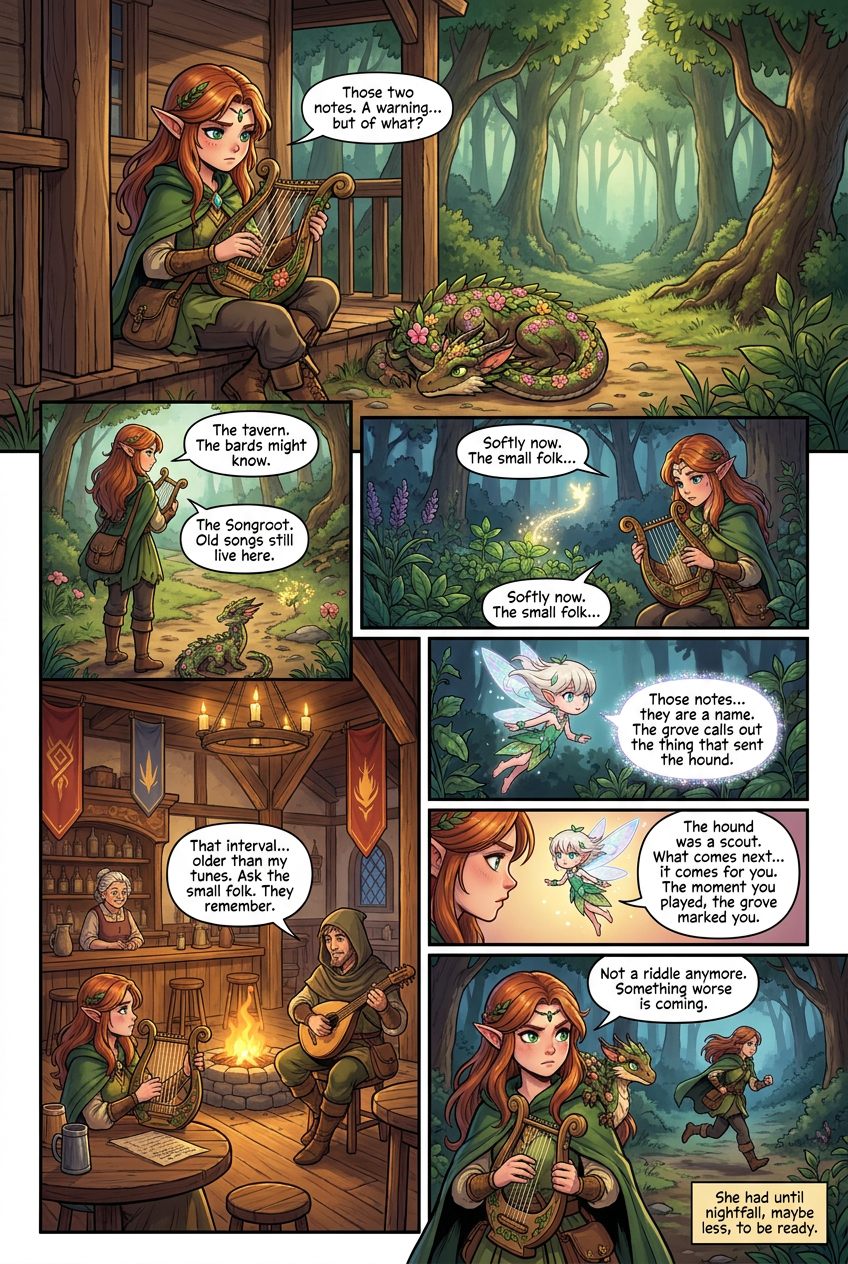
By morning the two notes from the grove still hung in Lyra's head. She could hum them, but she could not read them. One rose, one fell. A warning, she was sure, but a warning of what — another hound, a bigger hunter, or her own playing — she could not tell. She sat on the porch with the lyre across her knees and the drake curled at her feet. She played the two notes back into the trees and waited. Nothing answered. Guessing wrong could bring worse than a hound to her door. She needed someone who remembered the old speech of the grove. Her grandmother was six years gone. The nearest place old songs still lived was the tavern at the edge of the village, where the bards kept the long ballads. Lyra wrapped the lyre in cloth, shouldered her herb satchel, and set out along the path. The drake padded after her, wings folded tight, flowers along its spine shedding pollen with each step. The tavern sat under carved eaves and hanging lanterns, banners drooping in the still air. Inside smelled of bread and pine smoke. Lyra took a corner bench and unwrapped the lyre on the table. She plucked the two notes for the old woman who tended the bar, then for a traveling harper by the fire. Both shook their heads. The harper said the interval was elven but older than any tune he knew. He told her to ask the small folk. They kept what the singers forgot. Lyra carried the lyre outside to the herb garden behind the tavern and played the two notes again, softly. A speck of light lifted from the mint. It came closer and became a sprite no taller than her hand, wings like wet glass, a green leaf at her waist. The sprite listened with her head tilted. Then her face went tight. She spoke fast, in a voice like a struck bell. The notes were a name, she said. The grove had named the thing that sent the hound. It was calling the thing out, and warning Lyra to stand clear when it answered. The hound had been a scout. What came next would come for the caller — and the grove had marked Lyra as the caller the moment she played her grandmother's tune. Lyra set the lyre on the bench. Her hands were steady now. She had wanted the grove to speak to her, and it had. The warning was not a riddle anymore. Something worse than the hound was on its way to her house, and it was coming because the grove had pointed at her. She thanked the sprite, lifted the drake to her shoulder, and started back down the path at a run. She had until nightfall, maybe less, to be ready.
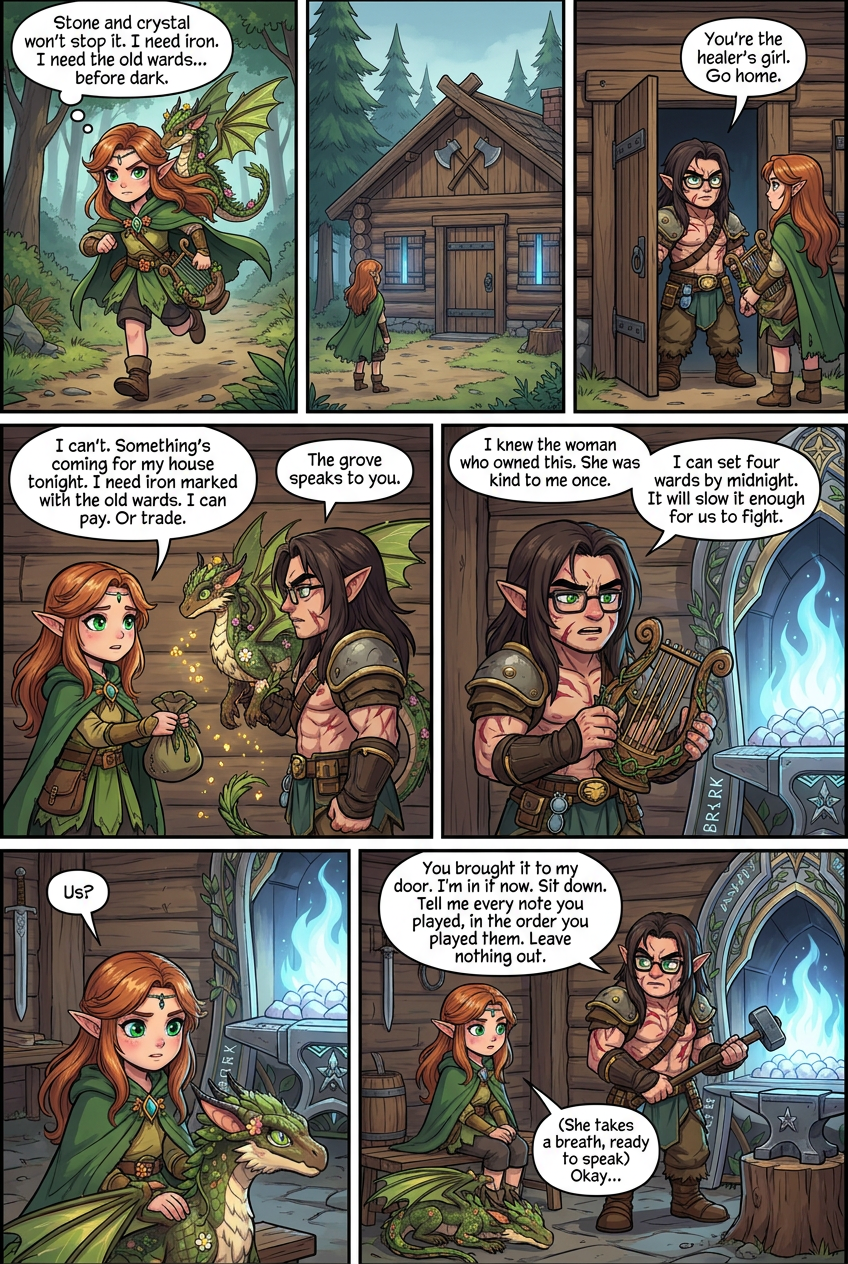
Lyra ran the path home with the drake on her shoulder and the lyre thumping against her hip. Halfway there she stopped. Her cottage would not hold. Stone walls and crystal windows had not stopped the hound, and the next thing would be worse. She needed iron. She needed someone who could work it into wards before dark. There was only one forge close enough, and only one smith who still knew the old marks. She turned off the path and took the fork that climbed toward the ridge. The smithy stood alone under tall pines, a log building with carved eaves and axe-heads hung above the door. Blue light leaked from the shutters. Lyra had passed it many times and never gone in. The smith kept to himself. Villagers said he had lost someone in the silent years and had not spoken kindly to anyone since. She knocked. The door opened on a short, broad man with dark hair and green eyes behind wire spectacles. Old scars crossed his chest and arms. He looked at the drake on her shoulder, then at the wrapped lyre. "You're the healer's girl," he said. "Go home." "I can't," Lyra said. "Something is coming for my house tonight. The grove named it, and it named me back. I need iron marked with the old wards. I can pay." She held out her herb satchel. "Or I can trade. Whatever you need." He did not move from the doorway. He studied the drake. The flowers on its spine were shedding pollen onto his floor. "The grove speaks to you," he said. It was not a question. Lyra nodded. He looked past her at the darkening trees. Then he stepped aside. "Come in. Don't touch anything." Inside, a tall forge burned with pale blue flame over white coals. The smith took the lyre from her hands, unwrapped it, and set it on a bench. He ran a thumb along the vines carved into the wood. His jaw tightened. "I knew the woman who owned this," he said. "She was kind to me once." He turned to the fire and began pulling iron rods from a rack. "I can set four wards by midnight. Door, hearth, window, threshold. It will not kill what's coming. It will slow it enough for us to fight." "Us?" Lyra said. The smith did not look up. He laid the first rod in the blue flame and reached for his hammer. "You brought it to my door when you knocked," he said. "I'm in it now. Sit down. Tell me every note you played, in the order you played them. Leave nothing out." Lyra sat. The drake settled at her feet. Outside, the light was already going gray. She began to speak.
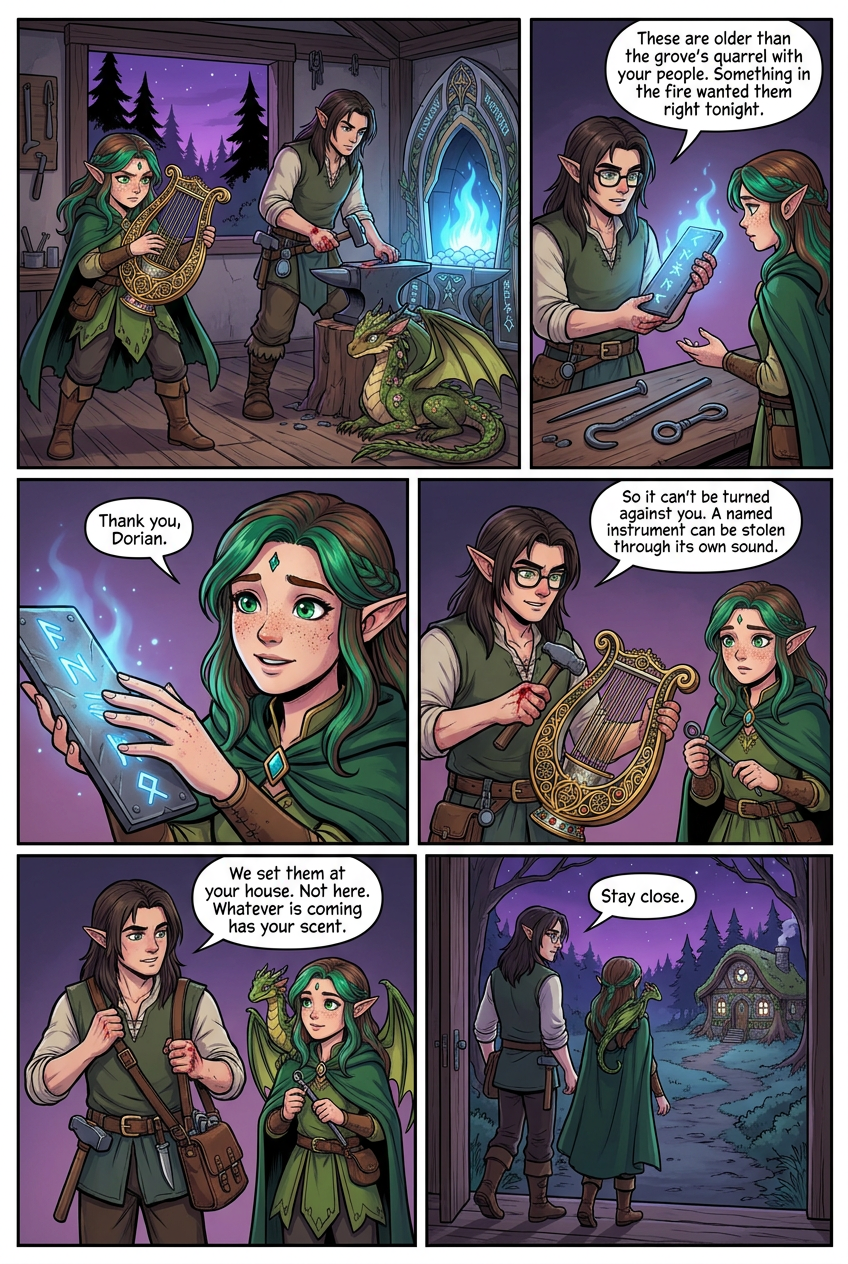
Lyra spoke every note until her throat went dry. The smith listened without interrupting. He worked while she talked. His hammer fell in a steady rhythm against the anvil, and the blue flame of the forge hissed each time he plunged a rod into the quench. The drake watched from the floor, wings folded, pollen drifting from its scales onto the boards. Outside, the pines went black against a purple sky. Near midnight the smith set down his hammer. Four iron pieces lay cooling on the bench. He had cut runes into each one. A long nail for the threshold. A flat plate for the hearth. A hooked bar for the window. A ringed bolt for the door. He held one up to the lamp so she could see the marks. "These are older than the grove's quarrel with your people," he said. "I have not cut them this clean in twenty years. Something in the fire wanted them right tonight." Lyra stood and touched the flat plate. It was still warm. The runes hummed under her fingers, faint as a bee inside a wall. She looked up at him. He had taken off his spectacles to wipe them and his green eyes were tired. There was blood on his knuckles where a spark had bitten him. "Thank you, Dorian," she said. It was the first time she had used his name. He did not answer at once. He put the spectacles back on and looked at her for a long moment. "Bring me the lyre," he said. She brought it. He laid the ringed bolt against the frame near the strings and tapped it with a small punch. A thin ward bit into the gilding, no bigger than a fingernail. "So it can't be turned against you," he said. "Whoever taught you to play did not teach you that a named instrument can be stolen through its own sound." He handed the lyre back. Their fingers touched on the wood. Neither of them moved for a breath. Then he stepped back and reached for his belt. He strapped on a short hammer and a knife. He gave her the door bolt to carry and slung the other three wards in a leather roll across his shoulder. "We set them at your house," he said. "Not here. Whatever is coming has your scent, and I will not fight it on ground I need to sleep on." Lyra nodded. She lifted the drake to her shoulder. The small creature pressed its head against her jaw. She felt steadier than she had in days, and it was not only the iron. Dorian opened the door. Cold air came in, clean and sharp. The path down the ridge was dark, but she could see the soft glow of her crystal windows through the trees below. He looked at her once, quickly, then away. "Stay close," he said. They stepped out together into the night.
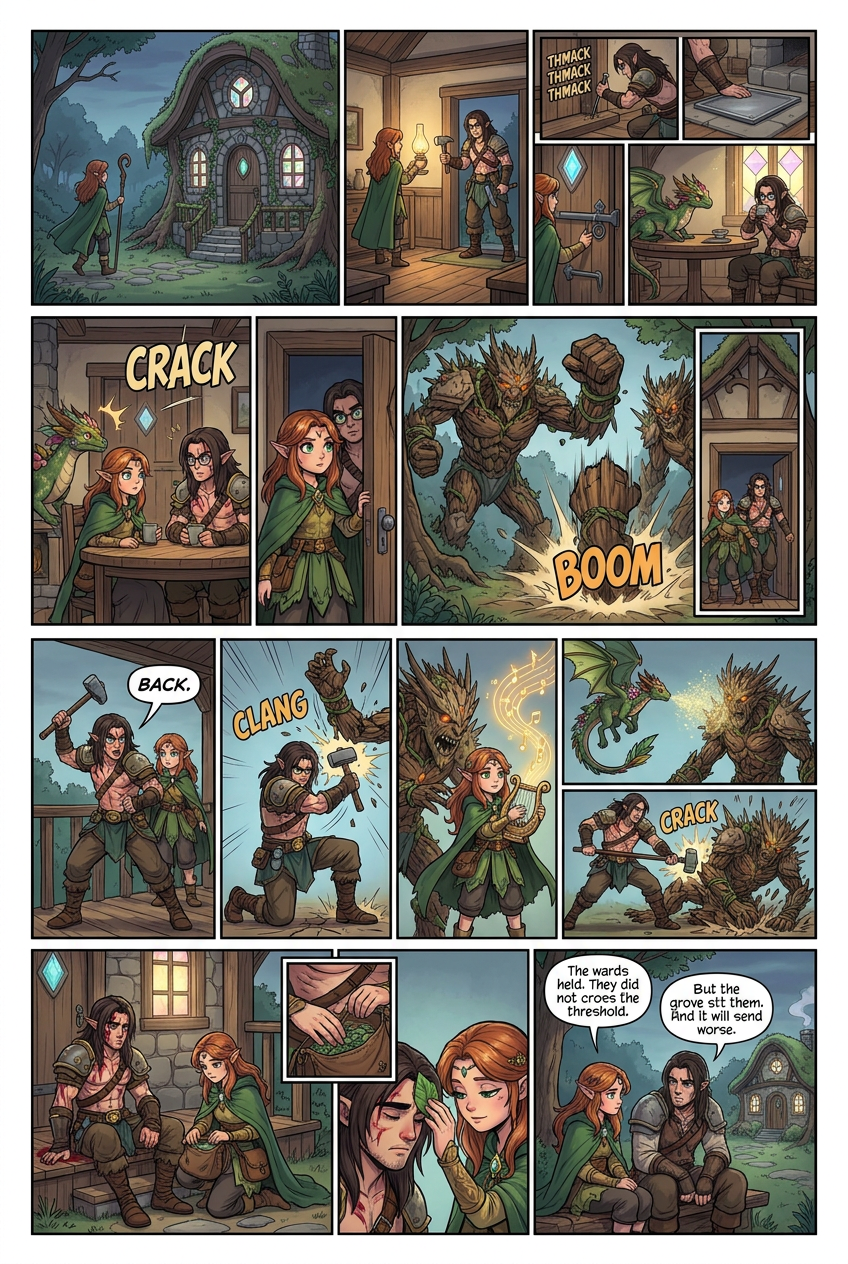
They came down the ridge together and reached her cottage without speaking. Lyra unlocked the door and lit two lamps. Dorian went to work at once. He drove the long nail into the threshold with three clean strikes. He set the flat plate under the hearthstone. He wedged the hooked bar across the window frame. Last, he fitted the ringed bolt into the door and turned it until the runes bit. The drake watched from the table, wings half open. When the last ward seated, the crystal windows brightened a shade, as if the house had drawn a breath. Lyra laid the lyre on the bench and set her satchel beside it. She poured water for Dorian. He drank half the cup and set it down. Then the drake hissed. Its head snapped toward the door. Outside, something heavy cracked a branch. Then a second crack answered it, farther left. Lyra opened the door a hand's width. Two shapes broke from the tree line. They were taller than the roof. Bark plated their shoulders. Vines wrapped their arms. Their eyes burned orange in sockets carved from wood. Small red flowers grew along their spines. One raised a fist the size of a barrel and drove it into the earth. The ground shook under her feet. "Back," Dorian said. He shoved her behind him and stepped onto the porch with the hammer up. The first spirit swung. Dorian took the blow on his shoulder and went down on one knee. He came up under its guard and struck the joint of its arm. The iron rang. A crack ran along the bark. The second spirit reached past him for Lyra. She grabbed the lyre and played the two warded strings her grandmother had taught her for calm. The notes rolled out flat and clean and did not turn against her. The reaching hand slowed. The drake shot from the doorway and blew pollen into its eyes. It staggered back, blind, and Dorian buried the hammer in its knee. The wood split. The spirit fell against its brother. Both of them broke apart in a slow collapse of moss and splinter, until only two heaps of steaming wood lay on her path. Dorian sat down hard on the step. Blood ran from a gash above his ear and another along his ribs where a splinter had gone through his shirt. His breath came in short pulls. Lyra knelt in front of him and opened the satchel. She packed yarrow into the rib wound and tied it with linen. She pressed a bruised leaf against his temple and held it there. She hummed low over his skin until the bleeding slowed and his shoulders eased. He watched her the whole time and did not speak. "The wards held," she said. "They did not cross the threshold." Dorian nodded once. "But the grove sent them," he said. "And it will send worse."
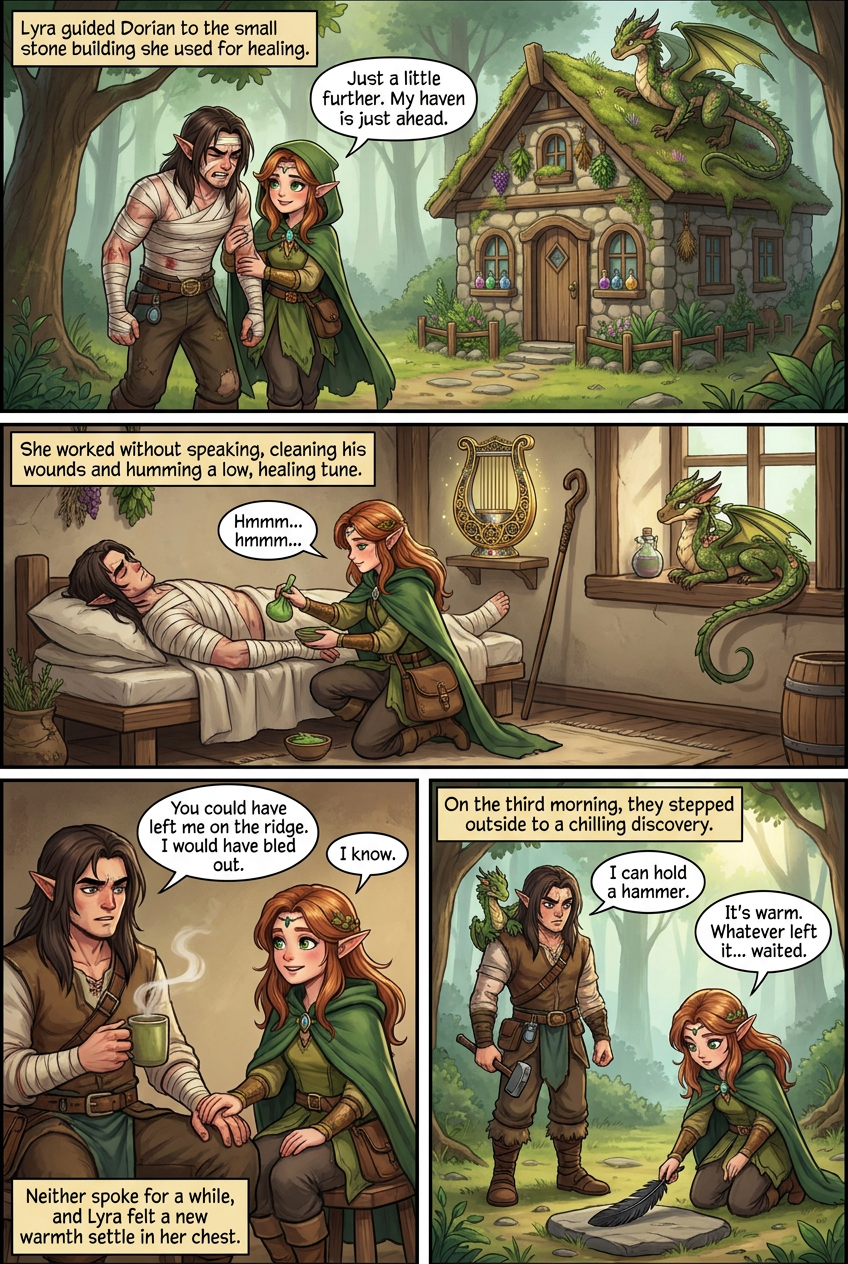
Dorian could not walk back to the ridge. His ribs bled through the linen before they reached the porch step, and his weight came heavier on Lyra's shoulder with each try. She made a choice. She would not keep him in the cottage where the wards had just been tested. She took him instead to the small stone building she used for sick animals and hurt travelers, a short walk through the ferns behind her home. She called it her haven. The drake flew ahead and landed on the mossy roof to watch the trees. Inside, she cleared the long bench and laid him down. She lit the hearth and hung fresh linen to warm. She opened her satchel and set the bundles in a row: yarrow for the deep cut, comfrey for the bruised ribs, willow for the pain. She worked without speaking. She cleaned the gash above his ear, stitched it with three neat pulls, and packed the rib wound again. She hummed the same low note she had used on the porch. The bleeding stopped. His breathing evened out. He slept. She stayed at his side for three days. She changed the dressings each morning. She fed him broth when he woke and made him drink the willow tea even when he grumbled. The drake slept on the windowsill with one eye open. Lyra kept the lyre within reach at all times, its warded frame catching the firelight. She did not play it. She listened to the woods instead. Twice she heard branches shift in a pattern that was not wind. Both times the drake lifted its head, and both times the sound moved off. On the second night Dorian was strong enough to sit up. She brought him bread and sat on the stool beside the bench. He watched her hands work a fresh knot in the linen. "You could have left me on the ridge," he said. "I would have bled out." "I know," she said. He reached and put his hand over hers. She let it stay. Neither of them spoke for a while. When she looked up his eyes were on her hair, on the green threads in it, and she felt something settle in her chest that she had not felt before. She did not pull her hand back. On the third morning he stood without help. He tested his ribs, winced, and nodded. "I can hold a hammer," he said. She walked him to the door. The drake landed on his shoulder and huffed pollen at his ear, and he almost smiled. They stepped outside together. On the flat stone by the doorway lay a single black feather, longer than her forearm, its shaft wet as if it had just been pulled from something living. The drake hissed. Dorian's hand went to his belt. Lyra picked up the feather. It was warm. Whatever had left it had waited three days for them to come out.
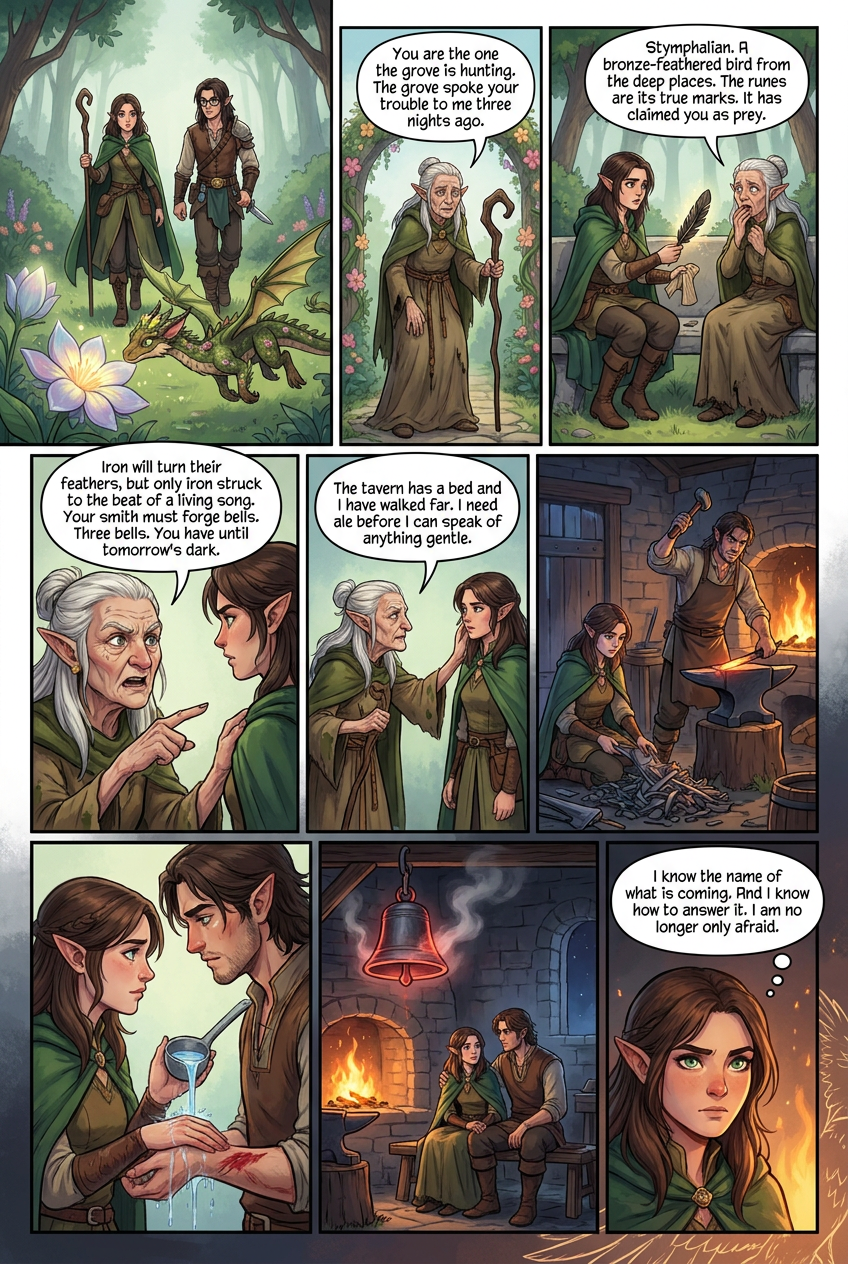
They walked to the sprite garden with the black feather wrapped in linen at Lyra's hip. Dorian kept one hand near his knife. The drake flew low between the arches of blooming vine, sniffing each blossom. Lyra needed answers, and the sprites had helped her once before. The garden was quiet. The small folk hid in the petals and would not come out, and that told Lyra more than any warning could. An old wood elf woman stepped through the flowered arch. Her hair was gray and braided with twigs. She leaned on a crooked staff, and her breath came fast, as if she had run the last mile. She looked at Lyra and did not bow or greet. "You are the one the grove is hunting," she said. "I am Ithilwen Rootwhisper. The grove spoke your trouble to me three nights ago. I have walked since." Lyra brought her to a stone bench. Dorian stood close. Ithilwen drank from Lyra's flask and steadied herself. "The grove is not angry at you," she said. "It is afraid. Long ago the elves broke the bond by locking a name in music, a name that should never be sung. When you played those two notes, you opened the old wound. The grove is not hunting you to punish you. It is trying to close the wound before what you called can finish the tearing." Lyra unwrapped the feather. The gilded runes caught the light. Ithilwen drew back and pressed her hand to her mouth. "Stymphalian," she said. "A bronze-feathered bird from the deep places. The runes are its true marks. It has claimed you as prey and left this so you would know. There will be a flock, not one. Iron will turn their feathers, but only iron struck to the beat of a living song. Your smith must forge bells. You must play them from a high place at dusk. The birds cannot bear the sound." She looked at Dorian. "Three bells. No more. You have until tomorrow's dark." She rose. She would not stay. She said the tavern had a bed and she had walked far and needed ale before she could speak of anything gentle. She touched Lyra's cheek once and left through the arch, small and bent. Dorian and Lyra returned to the ridge together. He lit the forge. She sat on the anvil block and sorted iron scrap while he worked, and their hands passed the tools back and forth without a word needed. When he burned his wrist she took it under cool water and held it longer than the burn required. He did not pull away. She looked up and found him watching her, and neither of them looked down. By midnight the first bell hung cooling on its hook. Lyra knew the name of what was coming. She knew how to answer it. She also knew, sitting in the forge light with Dorian's shoulder against hers, that she was no longer only afraid.
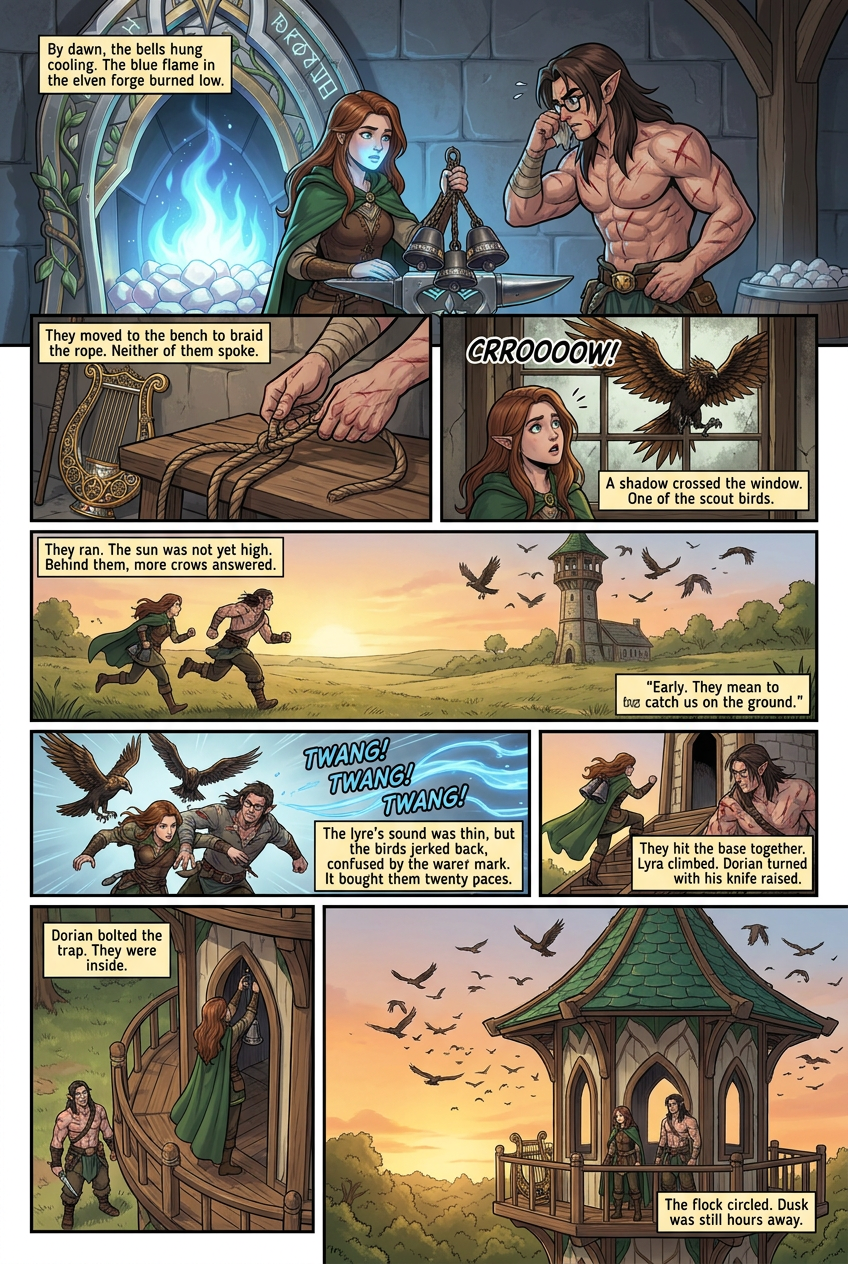
By dawn the third bell hung cooling beside the other two. Lyra lifted them one at a time from the hooks and set them on the anvil. The blue flame in the elven forge burned low over pale coals. Dorian wiped soot from his glasses and looked at her over the rims. His chest and arms were scored with old cuts from the tree spirits, and new burns from the night's work. He nodded once. The bells were true. They moved to the bench by the window to braid the rope. Lyra held the three cords tight while Dorian crossed them over her fingers. Her staff leaned against the wall. The lyre rested beside it in its wrapped cloth, the ward mark on its frame catching the first gray light. Neither of them spoke. The braid grew under their hands, slow and even, the way rope must be made if it is to hold weight. A shadow crossed the window. Lyra looked up. One of the scout birds she had glimpsed two nights before hung outside the glass, wings beating, bronze feathers rattling. It opened its beak and let out a low, deep crow that shook the pane. Then it dropped away toward the trees. "Early," Dorian said. He pulled the last cross of the braid tight and knotted it with his teeth. "They mean to catch us on the ground." Lyra tied the bells to the finished rope with quick knots. She slung the bundle across her back. Dorian took her hand. They ran. The path from the ridge to the archer tower cut down through open meadow, and the sun was not yet high. Behind them, more crows answered the first. Lyra did not look back. She counted her breaths and the beats of her feet and squeezed Dorian's hand each time she thought he might slow. The first bird came in low from her right. She heard the wings before she saw it. Dorian yanked her sideways and the bird's claws raked empty grass. A second dove at Dorian's shoulder and tore his sleeve. He kept running. Lyra pulled the lyre free of its cloth as they ran and struck three fast notes across the strings. The sound was thin in the open air, but the birds jerked back at it, confused by the ward mark on the frame. It bought them twenty paces. The tower rose ahead, tall and pale between the trees. They hit the base together. Dorian shoved her onto the first step and turned with his knife raised. Lyra climbed. The bells knocked against her spine at every stride. She heard Dorian's boots behind her and the wings above, and she did not stop until the top platform opened around her under the green roof. She pulled the bells from her back and hung the rope on the highest hook. Dorian came up behind her, bleeding from the shoulder, and bolted the trap. They were inside. The flock circled. Dusk was still hours away.
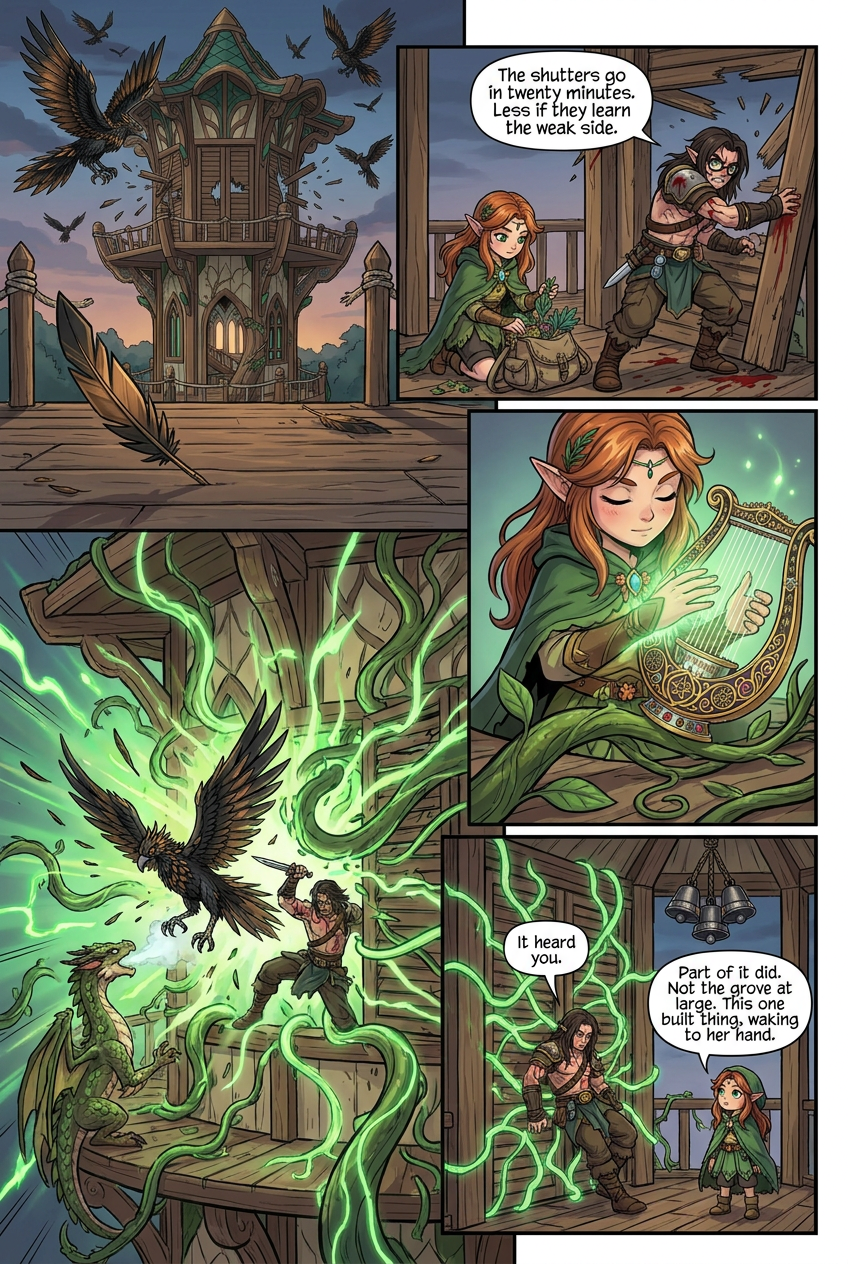
The flock hit the tower before Lyra had caught her breath. Beaks struck the shutters like hammers. The old wood cracked along the seams. Dorian dropped the bar across the trap and threw his shoulder against the west shutter as it bowed inward. A bronze feather punched through a gap and stuck quivering in the floor. Dusk was hours off. The barricade would not last. Lyra set the lyre down and pulled her satchel open. She had yarrow, thread, and a coil of braided cord left from the bells. None of it would hold planks. She looked around the platform. The green roof arched above them on carved beams. Vines had grown up through the floor and wrapped the inner posts. The tower was old elf work, built when the grove and the elves still spoke to each other. "The shutters go in twenty minutes," Dorian said. Blood ran from his shoulder down his arm. "Less if they learn the weak side." Lyra put her hand flat on the nearest vine. It was warm. She thought of the drake on her porch, the hound driven off, the tree spirits at her door. Every time she had asked the grove for anything, it had answered by hurting her. But the tower itself had been shaped by elves and grown by the grove together. It was a thing from before the break. She unwrapped the lyre and set her fingers on the strings. Not the two forbidden notes. Something older. A tune her grandmother had hummed while mending. She played it slow. She hummed under the notes the way she hummed over wounds. The vine under her palm tightened. Green shoots pushed out of the wood along the shutters. They crossed the cracks and pulled the boards back into place. A second vine wrapped the trap bolt and thickened around it. The drake climbed up through the stair from below, flowers shaking on its scales, and settled against the west shutter with its back braced to the wood. The tower was answering. Not the grove at large. This one built thing, waking to her hand. Outside, the birds shrieked and struck harder. A beak split a plank near the roof and a black head forced through. Dorian drove his knife up into its throat. The bird fell back. The vines closed the gap behind it. Lyra kept playing. Her arms shook. She did not stop until the shutters were laced shut with living wood and the drake's breath fogged the seams with pollen that hardened like resin. Dorian slid down the wall beside her, knife across his knees. "It heard you," he said. "Part of it did," Lyra said. She looked at the vines holding the tower shut, and at the bells above them waiting for dusk. The grove had not forgiven her. But something inside it, older than the wound, still remembered how to be asked.
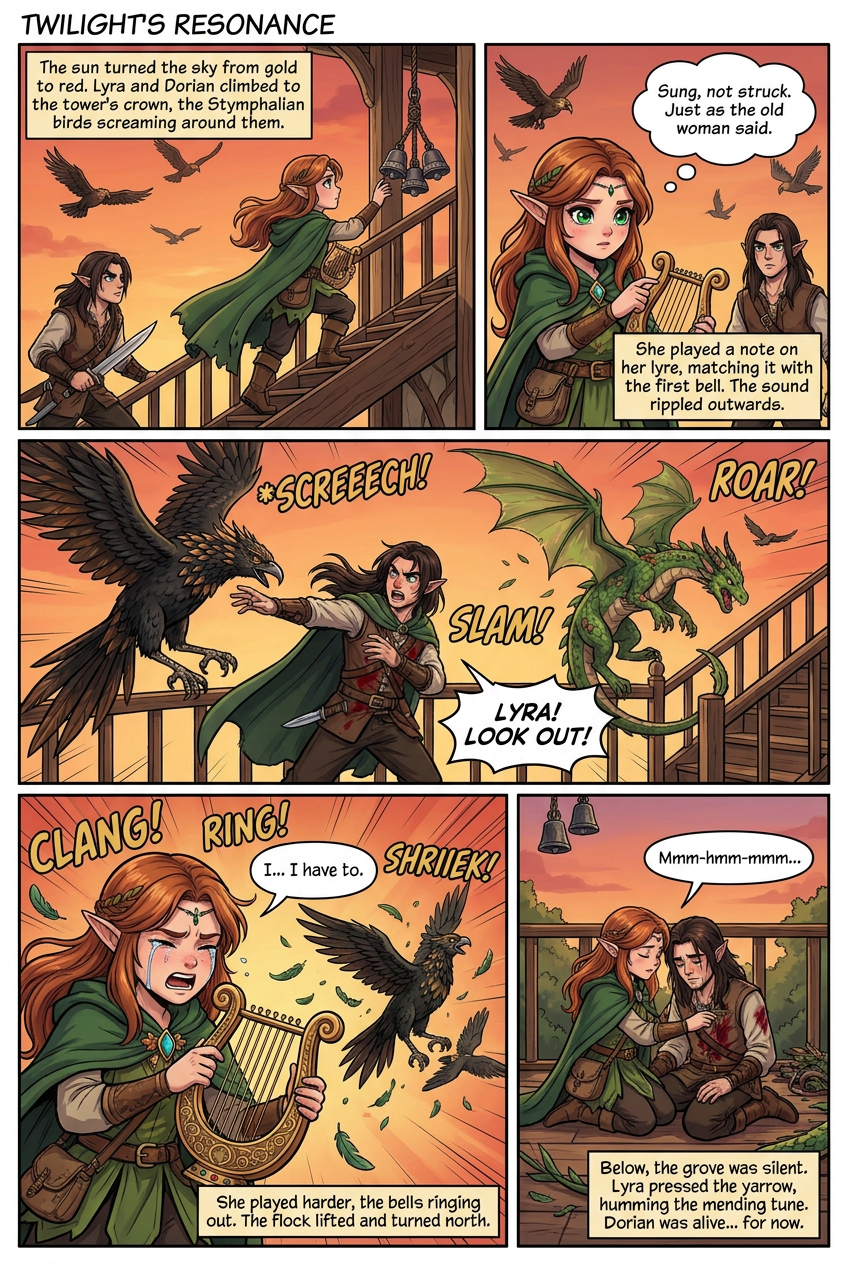
The vines held the shutters, but the birds did not stop. They circled the tower and screamed at the seams. Lyra kept her fingers on the strings and watched the light through the arrow slits turn from gold to orange to red. Dusk was coming. She counted the bells above them on their braided cord. Three iron shapes swinging on the highest hook, waiting for her hand. When the sun touched the treetops she climbed the last stair to the crown of the tower. Dorian came behind her with his knife out. The old woman had said the bells must be played in song at dusk, not struck like alarms. Lyra set the lyre against her hip and reached for the cord. She rang the first bell soft, then the second, and matched the third to a note from the strings. The iron answered clean. The sound spread out over the trees like a slow tide. The flock broke formation. Some birds tumbled in the air as if the note had cut their wings. Others turned and dove at the open platform. A bronze-black shape came straight for Lyra's face. Dorian shoved her sideways and took the beak in his chest. He went down hard against the rail. Blood poured through his shirt in three lines where the beak had gone in and dragged. The drake shrieked and launched from the stair. It met the next bird in the air and locked its jaws on the throat. Two more birds fell on the drake at once. Wings hammered. Pollen and green scales scattered across the boards. Lyra reached for the drake with one hand and the bells with the other, and she could not have both. She chose the bells. She hit the notes again, harder, and sang the line her grandmother had hummed over wounds. The drake screamed once more and went quiet under the birds. They tore it apart on the platform in front of her. Feathers and vine and flower scales. Lyra kept playing. Tears ran down her face and she kept playing. On the fourth pass of the song the flock lifted as one body and turned north, away from the tower, away from the grove. The sky above the trees emptied. The bells rang on alone in her hand until she stopped them with her palm. She dropped beside Dorian. His shirt was black with blood and his eyes were open but slow. She tore the cloth back. Three deep punctures under the collarbone, one still pumping. She pulled yarrow from her satchel with shaking hands and packed the worst wound tight. She set her mouth close to his ear and hummed the mending tune, low and steady, the way she had hummed it once before in her stone haven. His breath caught. It held. It came again. Lyra pressed both hands over the yarrow and did not lift them. Below the tower the grove was silent for the first time in days. The drake was gone. Dorian was alive under her palms, for now, if she did not stop.
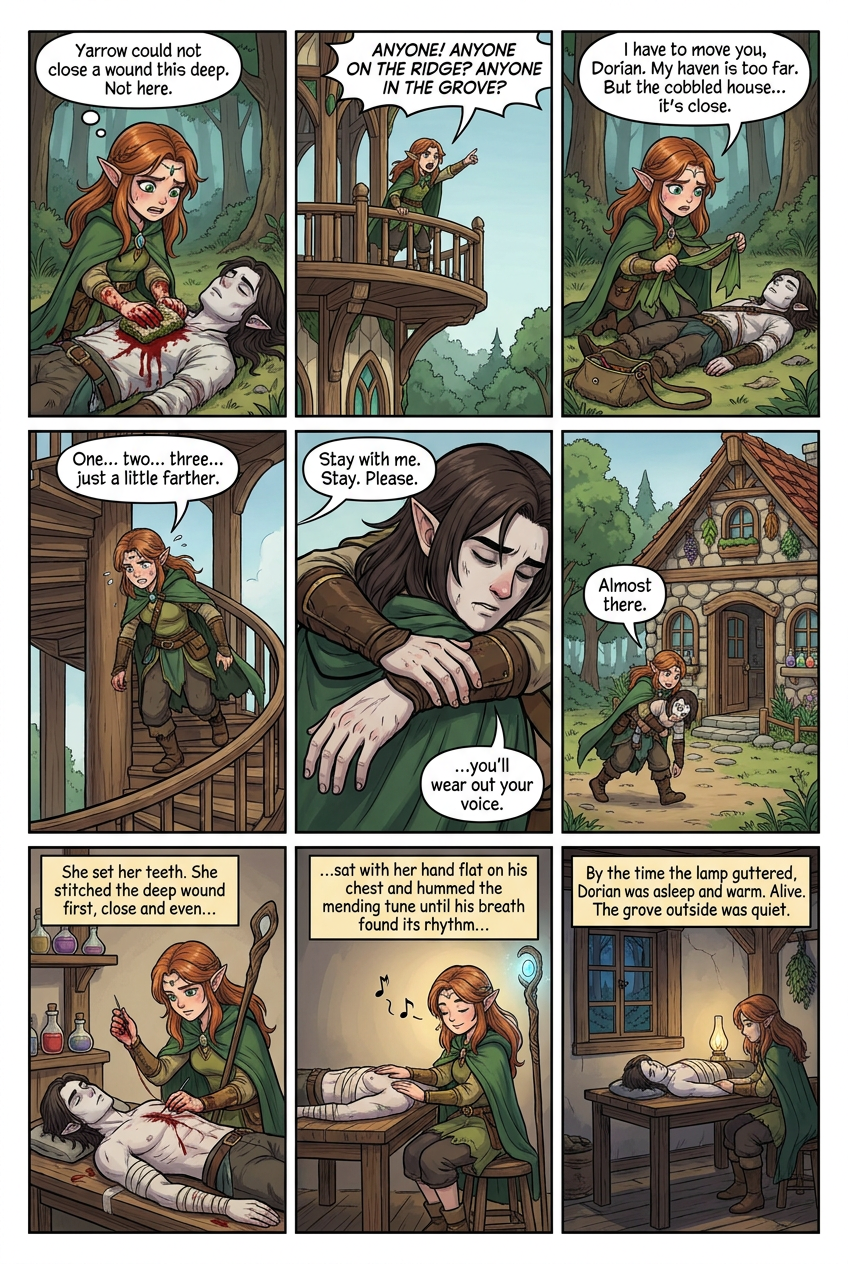
Lyra kept her palms on the yarrow until her fingers cramped. Dorian's breath came, then skipped, then came again. She lifted one hand to check the pack. Blood soaked through the moss in a fresh dark bloom. The yarrow was losing. She pressed harder and felt the pulse under her thumb stutter. She knew this kind of bleeding. She had seen it in deer the wolves left alive. Yarrow could not close a wound this deep. Not here. Not with what she had left in her satchel. She climbed to the crown rail and shouted down into the trees. She called for anyone on the ridge, anyone in the grove, anyone at all. Her voice cracked and came back to her off the empty boards. No answer moved in the branches. The birds were gone and the grove had shut its mouth. She hit the rail once with her fist and turned back to him. "Dorian, listen." She knelt and tore a long strip from the hem of her skirt. She emptied the satchel into her lap. Every sprig she had. She packed the deepest puncture until the moss stood proud of his skin, then bound the strip around his chest and pulled it tight under his arm. He made a small sound. His hand found her wrist. "I have to move you," she said. "I can't stitch you here. My haven is too far. The stone one. But the cobbled house at the edge of the grove is close. I can work there." She hooked her arms under his shoulders and dragged. His boots scraped the stair. She counted each step aloud so she would not stop. He went heavier with every landing. On the last flight his head lolled against her collarbone and his hand slid off her arm. "Stay with me," she said. "Stay. Please." His lips moved against her neck. She caught the words on the third try. Not so loud. You'll wear out your voice. She laughed once, a wet sound, and kept pulling. She crossed the open ground under the tower with him half in her arms and half on the grass. The door of the herbal house opened under her shoulder. She got him onto the long table by the window and cut the shirt away. The bleeding had slowed under the pack but not stopped. She threaded a curved needle by the lamp and set her teeth. She stitched the deep wound first, close and even, the way her grandmother had shown her on split hide. She stitched the second. She stitched the third. She washed the seams with a tincture from a small bottle on the shelf and packed fresh yarrow over the line. Then she sat with her hand flat on his chest and hummed the mending tune until his breath found its rhythm and stayed there. By the time the lamp guttered, Dorian was asleep and warm. Alive. The grove outside was quiet.
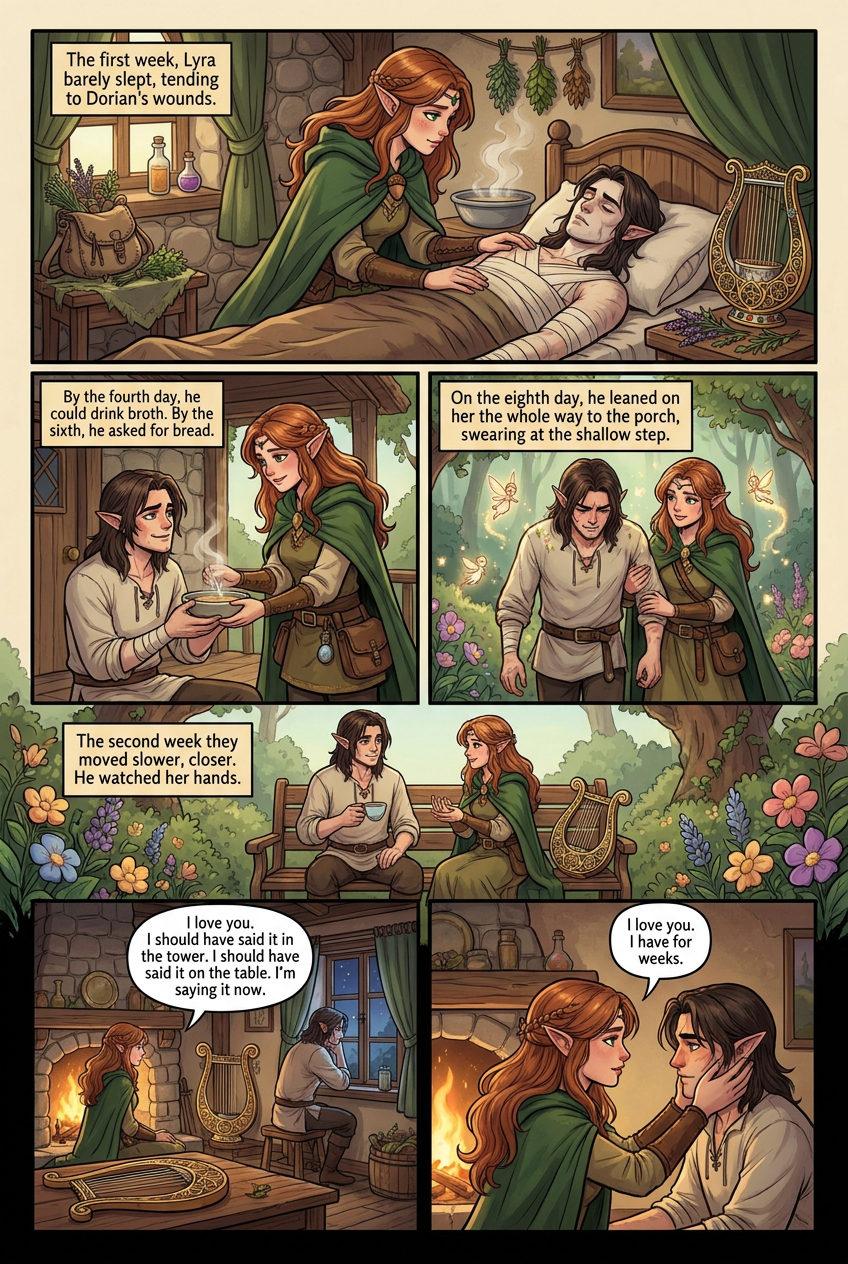
Dorian slept through the night on the long table by the window. Lyra sat by the lamp and watched his chest rise. When dawn came, she moved him to the cot in the back room and started the work of keeping him alive. She boiled water. She changed the packing on each wound. She refilled the satchel from the jars on the shelves, tying fresh sprigs with twine when her hands stopped shaking. The first week she barely slept. She checked the stitches every few hours and hummed the mending tune under her breath while she worked. The wounds held. By the fourth day he could sit up and drink broth. By the sixth he asked for bread. She gave him small pieces and watched him chew like it cost him something. She kept the lyre on the bench by the door, within reach, its ward mark facing the window. The grove outside stayed quiet. No feathers. No black shapes in the trees. On the eighth day she helped him walk to the porch. He leaned on her the whole way and swore at the shallow step. She laughed and he laughed and then he had to sit down because laughing pulled the stitches. She brought him tea. He watched her hands on the cup and did not look away when she caught him. The second week they moved slower and closer. She walked him to the flower arches behind the herbal house each morning. Sprites drifted through the blooms and did not flee from him, which she took as a good sign. He asked about her grandmother. She told him things she had not told anyone. He told her about the forge fire the year he came to the ridge, and about the lyre the first time he had seen it, in another pair of hands. She took the last stitches out on a Tuesday. The skin under them was pink and whole. They went back to her cottage at the end of the second week. The iron wards still held on the door and windows. She lit the hearth. He sat at her table like he had been sitting there for years. Neither of them said the thing. She caught herself looking at him and looking away. He caught himself doing the same. It went on like that for six more days. On the last night of the third week she was banking the fire when he said her name. She turned. He was standing by the window with one hand flat on the sill, the way he stood when he was about to say something he had rehearsed. "I love you," he said. "I should have said it in the tower. I should have said it on the table. I'm saying it now." She crossed the room and put her hands on his face. "I love you," she said. "I have for weeks."
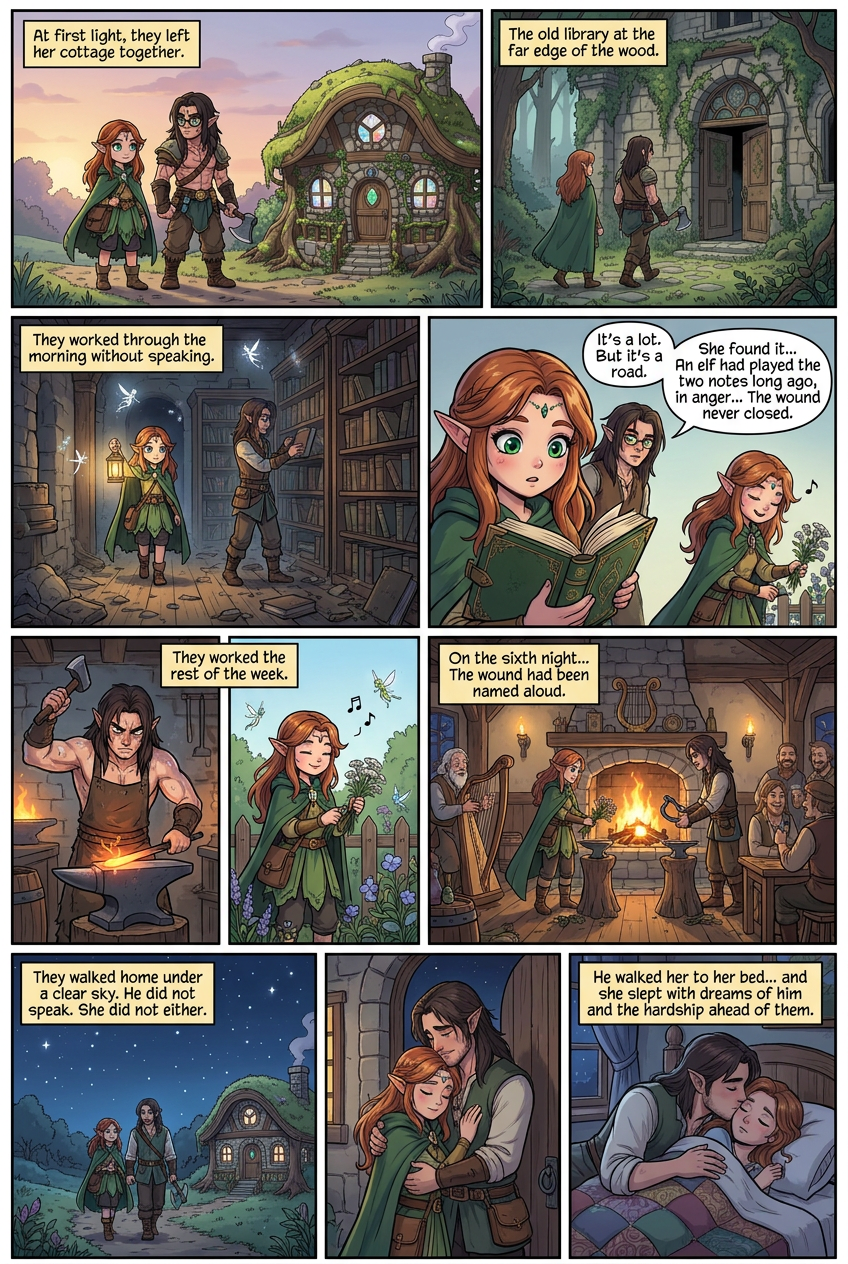
In the morning Lyra packed bread and cheese while Dorian tied his boots by the door. They had talked at the table until the fire went low. If the grove was wounded, they needed to know how it had been wounded, and by whom. The old library at the far edge of the wood still held elven books nobody had read in a hundred years. She wrapped the lyre in cloth and put it in her satchel. He took the axe from the hook. They left her cottage together at first light. The library leaned into the trees, half-swallowed by ivy. The door hung on one hinge. Inside, the shelves were tall and dim, and the floor crunched under their boots. Lyra lit a lamp. Dorian pulled down the first stack that hadn't rotted. They worked through the morning without speaking, sliding books across the long stone table, turning pages that flaked at the edges. Sprites drifted in through the broken windows and settled on the rafters to watch. She found it in a thin book bound in green leather. An elf had played the two notes long ago, in anger, and the grove had answered. The bond between elves and the grove had cracked that day. The wound never closed. The book named the mending: iron shaped in a grieving heart, a garden song of yarrow and moonflower, and both offered together at a public hearth, witnessed, so the grove could hear the sorrow through many mouths at once. Dorian read it twice. He set his hand flat on the page. "It's a lot," he said. "But it's a road." They worked the rest of the week. At his smithy on the ridge he heated iron and folded it and hammered until the shape held. He cut his thumb once and did not stop. She spent her mornings in her garden behind the cottage, cutting yarrow and moonflower, tying them in small bundles, humming the mending tune over each one until the leaves settled. Sprites came and sat on the fence and did not leave. On the sixth night they carried the iron piece and the bundles down to the tavern at the edge of the village. The hearth was lit. She spoke first, and then he did, and the room went quiet. She laid the yarrow on the hearth. He set the iron beside it. An old harper began to play. The room joined in. The grove did not answer that night, but the wound had been named aloud, and that was the first step the book had asked for. They walked home under a clear sky. He did not speak. She did not either. At her door he pulled her against his chest and held her there until her breathing slowed. He walked her to her bed and pulled the quilt to her shoulders and tucked it tight. They shared a kiss and he embraced her cheek, reassuring her they would be okay. He turned out the light and he took the path up the ridge to his house, and she slept with dreams of him and the hardship ahead of them.
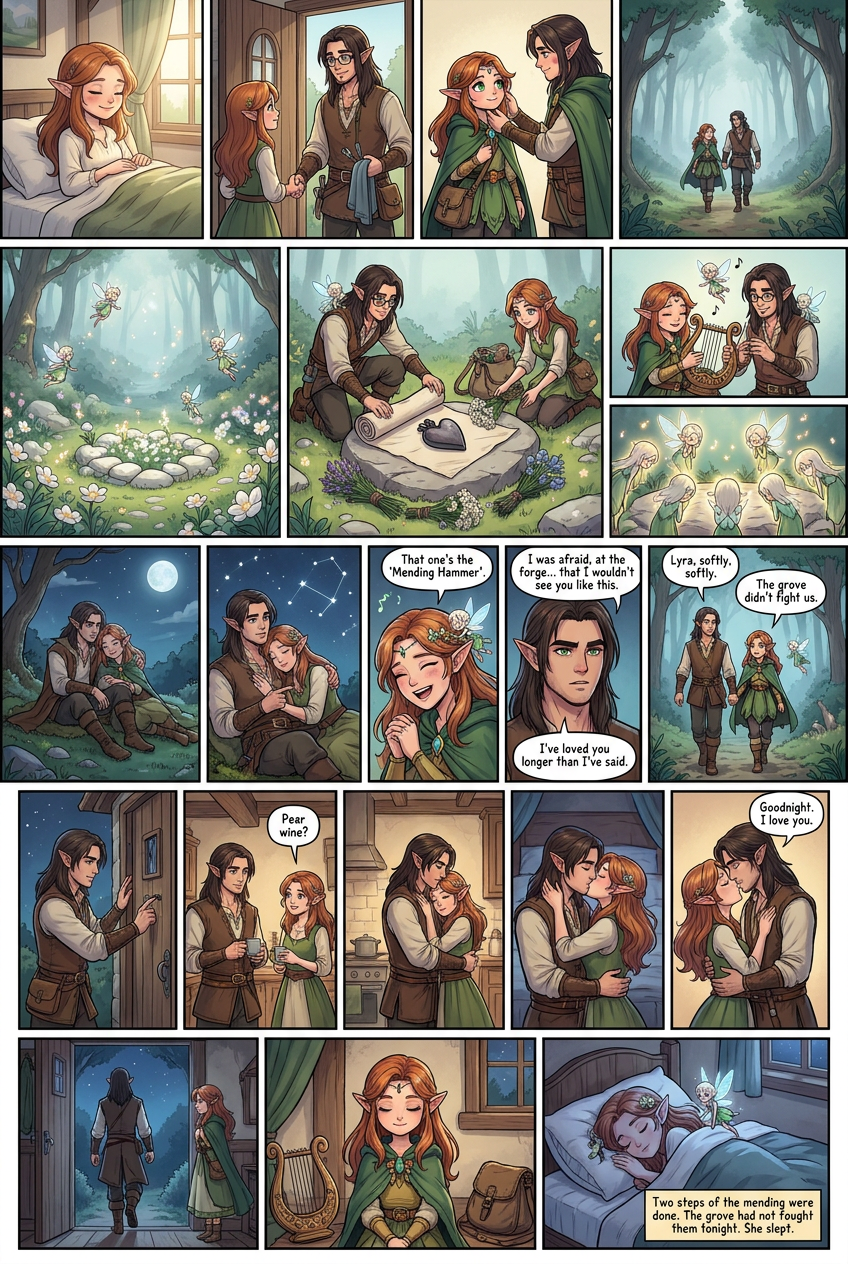
Lyra woke before the sun and found Dorian already at her door. He had walked down from the ridge with his tools and a folded cloth under his arm. The book had named three steps and only one was done. The second was the garden song, offered where sprites gathered thickest. She pulled on her cloak and swung her herb satchel over her shoulder. He touched her cheek before they set out. They walked into the grove together while the mist still hung low. The sprite garden sat in a bowl of moss ringed by white stones. Small folk drifted between the blossoms and settled on Dorian's shoulder as if they had been waiting. He unrolled the cloth and set the iron heart on a flat rock. Lyra knelt and laid out yarrow and moonflower in a ring around it. She took out her lyre and began the mending tune. Dorian hummed under it, low and steady, and a tiny sprite hovered near her ear and matched the melody in a bright, thin voice. The blossoms turned toward the sound. The grove did not push them away. When she played the last note, the yarrow bundles softened flat against the stone, and every sprite in the bowl bowed its head at once. They stayed until the moon rose. Dorian spread his coat on the moss and pulled her down beside him. She fit against his chest and listened to his heart under her ear. He pointed out stars he knew and made up names for the ones he didn't. She laughed into his shirt. He said he had been afraid, at the forge, that he would not live to see her like this. She told him she had loved him longer than she'd said. A sprite settled in her hair and did not leave. They stayed until the grass grew cold. He walked her home along the path he had learned by heart. At her door he checked the iron wards one by one, the nail, the plate, the bar, the bolt. He looked in every window before he let her step inside. She poured two small cups of pear wine and they drank standing in her kitchen. He set his cup down and pulled her against him and held her a long time without speaking. She led him to her bed and they kissed there until her breath went uneven and his hands stilled at her waist. He drew back and pressed his forehead to hers. He said goodnight. He said he loved her. He tucked the quilt to her shoulders the way he had before and turned out the lamp. She heard the door latch behind him and his boots on the path to the ridge. Two steps of the mending were done. The grove had not fought them tonight. She slept.
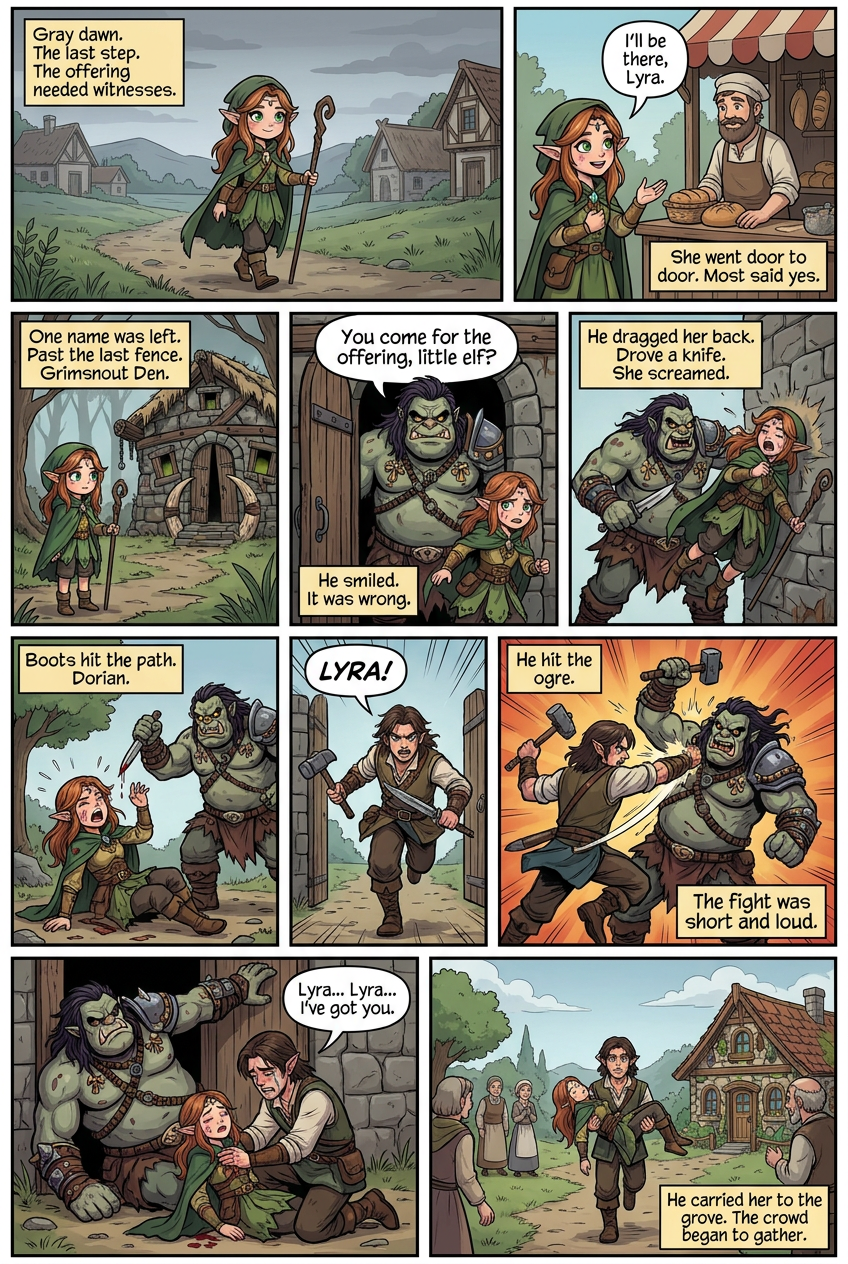
Lyra woke to a gray dawn and the last step waiting. The book had said the offering needed witnesses, more than the tavern hearth had held. She pulled on her cloak and set out alone. Dorian had gone up to the ridge before sunrise to finish the small iron token they would carry to the grove at dusk. Her job was the crowd. She had a list of homes in her satchel and the whole day to walk it. She went door to door along the paths that fed the tavern road. She asked the weaver, the baker, the old fletcher with the bent hand. She asked the families with children and the widow who kept bees. Most said yes. A few said they would come if their neighbors did. By midday her list was almost full. One name was left at the bottom, past the last fence, where the path narrowed into scrub. She had never met the man there. She almost skipped him. She did not. The house sat low in a hollow, stone piled thick, thatch black with mold. Tusks hung nailed on either side of the door. Chains hung from the eaves and moved without wind. She knocked once. The door swung open and she took a step back. The man inside filled the frame. He was an ogre in leather and iron, hair matted to his shoulders, eyes gold and flat. She said her name and the reason she had come. He stared. Then he smiled, and it was wrong. She turned to run. His hand caught her cloak and pulled her off her feet. He dragged her back and threw her against the stones. She got her staff up. He knocked it aside and drove a knife across her arm, then her side. She felt the second cut go deep. She screamed. It tore out of her before she could shape it, high and long, and it carried up the hollow and over the scrub toward the ridge. He raised the knife again. Boots hit the path at a run. Dorian came through the gate with his hammer in one hand and a forge blade in the other. He did not slow. He hit the ogre at the shoulder and drove him off her. The fight was short and loud. Dorian took a blow across the ribs and gave back three. The last one went through the throat. The ogre fell against his own doorframe and did not get up. Dorian dropped the blade and crossed to her on his knees. He pressed his hand to her side and his palm filled red at once. He said her name over and over. He tore his shirt and bound the wound and lifted her against his chest. He was crying. He carried her down the path at a run, toward the herbal house at the grove's edge, and the crowd she had gathered began to come out of their doors to watch them pass.
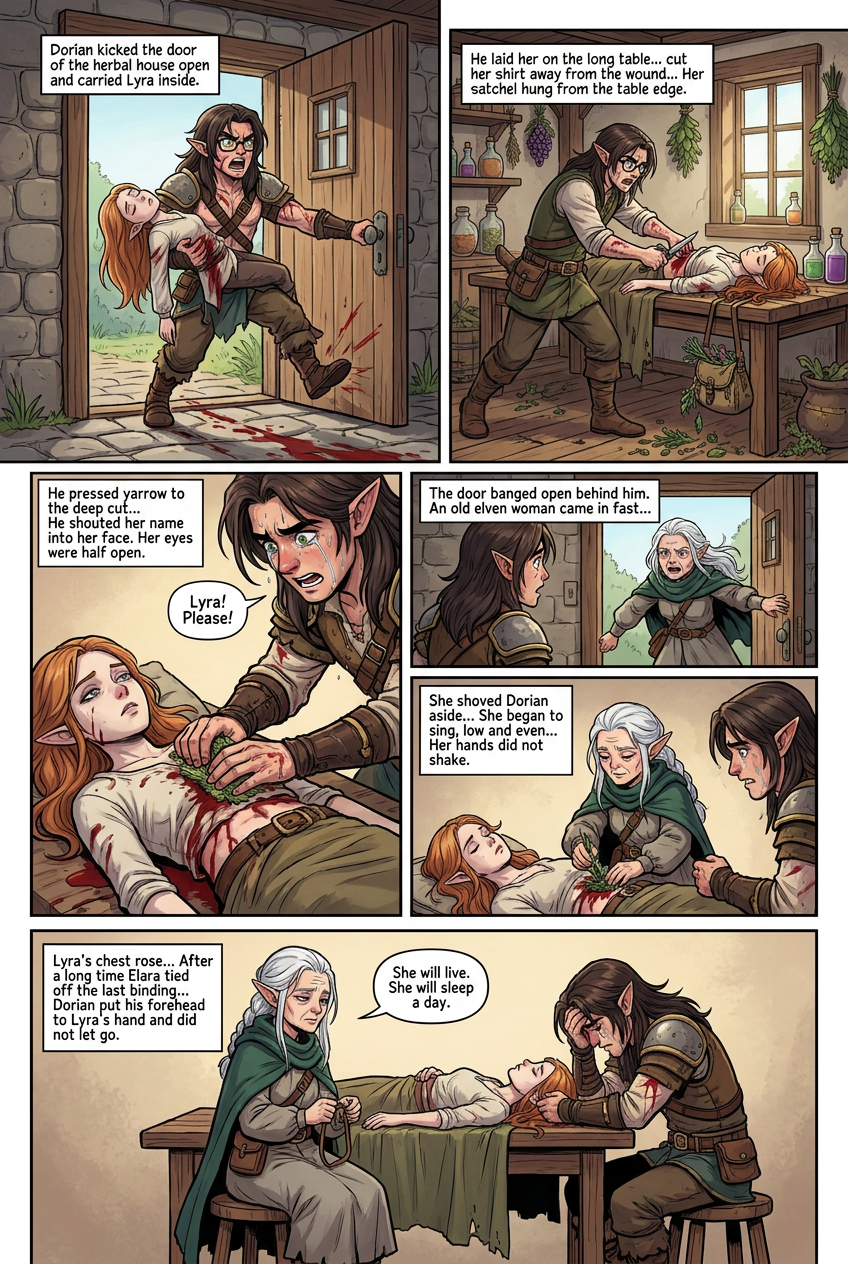
Dorian kicked the door of the herbal house open and carried Lyra inside. Blood ran down his arm and dripped from her heel to the floor. He laid her on the long table by the window and cut her shirt away from the wound in her side. The cut in her arm still bled. The cut below her ribs bled worse. Her satchel hung from the table edge, herbs spilling out in a soft pile. He tore at the ties and dumped it out. Yarrow. Moss. A folded cloth. He knew the names because he had watched her use them on him. He did not know the order. He pressed yarrow to the deep cut and held it there with both hands. The blood soaked through in a breath. He packed on more. He tried to hum the tune she had hummed over him and could not hold the notes. His throat closed. He shouted her name into her face. Her eyes were half open and did not track him. Her lips were gray. He pressed harder on the wound and felt her ribs move under his palms. She drew a small breath. Then a smaller one. He begged her to take another. She did not. Her hand slid off the table and hung. He caught it and held it against his cheek and screamed at the ceiling. He cursed the grove. He cursed the ogre already dead. He cursed himself for leaving her to walk that path alone. Her chest stopped. He set his ear to it and heard one slow beat, then a long pause, then nothing he could name. The door banged open behind him. An old elven woman came in fast, white hair loose, a green scarf at her throat. She had followed from the crowd on the road. She shoved Dorian aside without a word and put two fingers to Lyra's neck. She said her name was Elara Moonwhisper and told him to hold the arm closed. She pulled fresh yarrow from her own pouch and packed the side wound deeper than he had dared. She began to sing, low and even. The tune was the one Lyra used. Elara's hands did not shake. She said she had been a healer once, before she lost her husband to a wound like this, and had not sung over anyone since. Lyra's chest rose. It rose again. Color came back into her mouth in a thin line. Elara kept singing and did not look up. Dorian held the arm shut and wept without sound. After a long time Elara tied off the last binding and sat back on the stool. She told him Lyra would live, and would sleep a day, and would need care he did not know how to give. She said she would stay. Dorian put his forehead to Lyra's hand and did not let go.
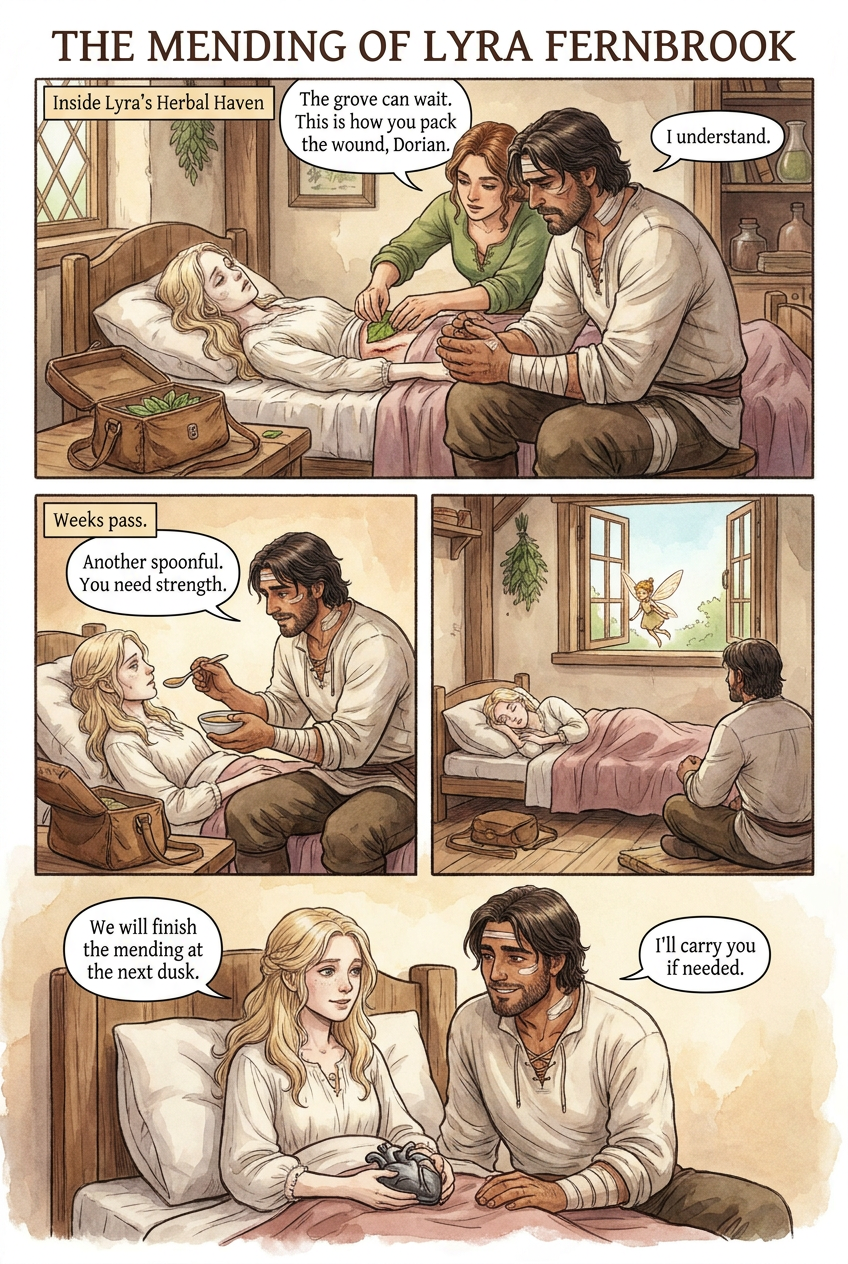
Dorian did not leave the herbal house. Elara told him the third step of the mending could wait, that the grove had held its wound for years and would hold it a little longer. He nodded without lifting his head from Lyra's hand. The iron heart still sat in his pack by the door, wrapped in cloth. He did not touch it. He watched Lyra breathe, and counted each breath, and thought of nothing past the next one. Elara showed him how to change the packing on the side wound. She showed him which leaf went under the binding and which went on top. His hands were thick and slow, but he learned. He boiled water. He wrung out cloths. He held Lyra up while Elara spooned broth past her lips. When Lyra could not keep the broth down, he wiped her chin and started again. The satchel on the table emptied and filled and emptied again as Elara sent him out for fresh yarrow at the grove's edge. At night he sat by the cot and spoke to her. He had no songs, so he made words instead. He told her the shape of her hand from the inside. He told her the green in her hair looked like the moss on the north stones of his forge. He said he had been afraid on the road with her bleeding on his shirt, and that the fear had not left him, and that if she went he would not know how to stay. He said it plainly, the way he said prices at the smithy. He said it again the next night, and the next. A small winged thing came in through the window on the fourth day and sat on the sill. Elara did not chase it. It watched Lyra sleep and left a single bright leaf on the blanket. It came back each morning after that. Dorian began to leave the shutter cracked for it. When Lyra first opened her eyes and held them open, the sprite was there, and Dorian was there, and Elara was at the hearth stirring a pot. Lyra healed slowly. The arm knit first. The side took longer. Three weeks passed before she could stand without holding the table, and another before she could walk to the door and back. Dorian walked beside her each time. He did not go to the ridge. He did not go to the smithy. He slept on a pallet by her cot and woke when she moved. On the last evening of the fourth week, Lyra sat up on her own and asked for the iron heart. Dorian brought it from his pack and set it in her lap. She turned it in her hands and looked at him a long time. She said they would finish the third step at the next dusk. He said he would carry her there if she asked. She said she would walk.
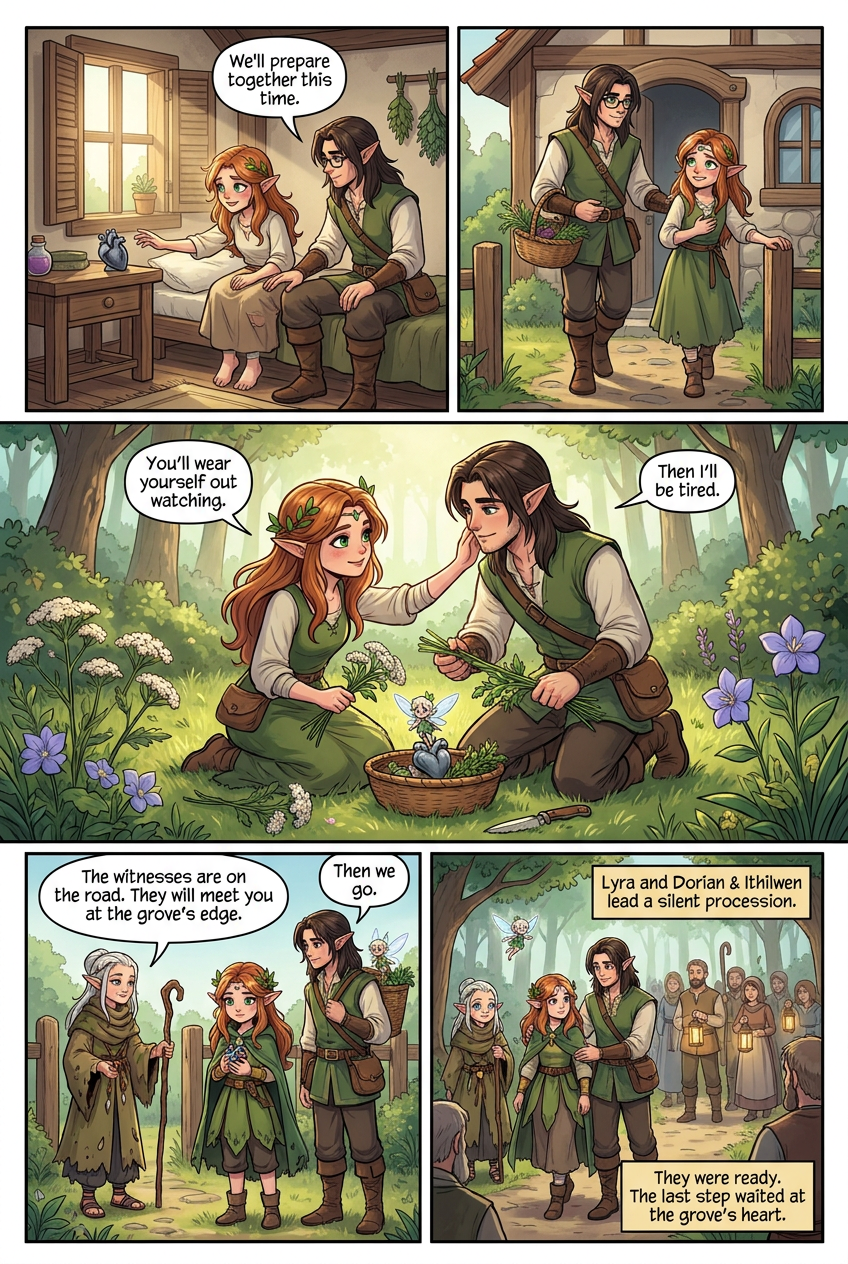
Morning came pale through the herbal house shutters. Lyra sat up on her own and reached for the iron heart on the table. Dorian was already awake beside the cot, his hand on her knee. He watched her fingers close around the iron. He said they would prepare together this time. She did not argue. They walked out to the small herb garden behind the house. Elara had left a basket by the door with yarrow, moonflower, and clean cloth. Dorian carried it. He walked half a step behind Lyra, close enough to catch her if her knees gave. When she stopped to steady herself on the fence, his hand was already at her back. She looked up at him and smiled, tired. They knelt in the grass. Lyra sorted the yarrow and moonflower into small bundles for the offering. Dorian cut the stems with his belt knife. His eyes kept moving to her side, to the bandage under her tunic, to the treeline. Every time a bird moved in the hedge, his hand went to his hip. "You'll wear yourself out watching," Lyra said. "Then I'll be tired," Dorian said. She set the bundles down and touched his face. He closed his eyes. She pulled him toward her and kissed him, slow. He held her carefully, as if she were still bleeding. She took his hand and moved it to her waist, above the healed wound, and pressed it flat so he would feel her breathing. They sank into the grass among the crushed yarrow. He kept his weight off her side. She laughed once against his mouth when a moonflower petal stuck to his cheek. They stayed like that a long while, tangled, until the sun cleared the roof. A small winged shape drifted down and landed on the iron heart in the basket. The sprite watched them, patient. Lyra sat up and pulled leaves from her hair. Dorian gathered the bundles she had made. Ithilwen was waiting at the garden gate. The old elf leaned on her stick and said nothing about the grass in their clothes. "The witnesses are on the road," she said. "They started at first light. They will meet you at the grove's edge." Lyra took the iron heart from the sprite and held it against her chest. "Then we go." Dorian shouldered the basket. Ithilwen walked ahead. Behind them, along the path from the village, a line of people moved through the trees, quiet, carrying lanterns unlit for the dusk to come. The sprite rode on the rim of the basket. Lyra walked on her own feet, slow but steady, Dorian's hand at the small of her back. They were ready. The last step waited at the grove's heart, and the crowd came with them to see it named.
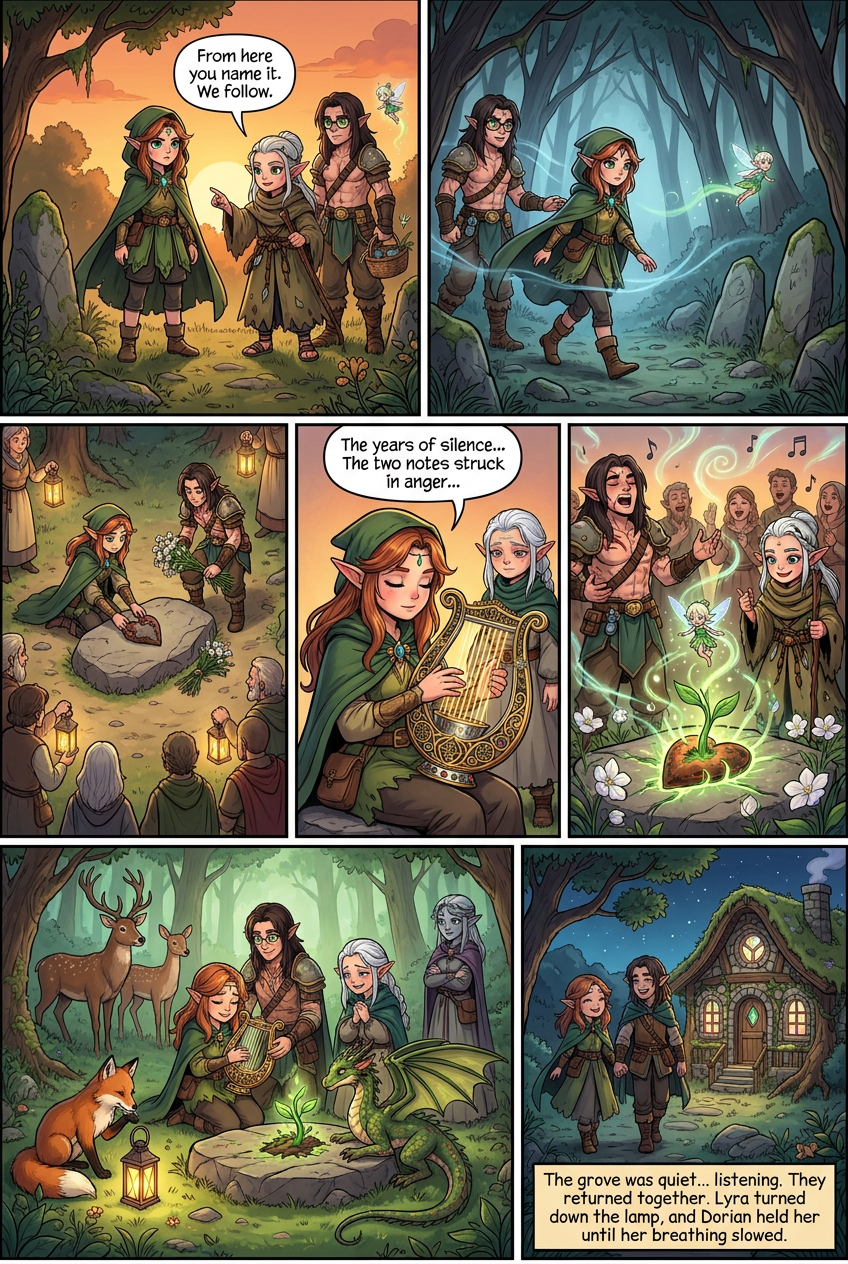
The line of villagers reached the grove's edge as the sun bent low. Ithilwen stopped at the mossed stones that marked the old boundary. She turned and looked at Lyra. "From here you name it," the old elf said. "We follow." Lyra stepped past the stones. The air changed at once. Cool. Still. The trees leaned in without wind. Dorian walked at her shoulder, basket at his hip, his other hand near her back. The sprite lifted from the basket rim and drifted ahead, a small green light between the trunks, marking the path. They came to a clearing at the grove's heart. A flat stone lay in the center, older than the trees around it. Lyra knelt and set the iron heart on the stone. Dorian laid the yarrow and moonflower bundles beside it. The villagers fanned out at the clearing's edge and lit their lanterns as dusk closed in. Lyra took the lyre from Dorian's shoulder. She rested it against her knee. The gilded frame caught the lantern light. She looked at Ithilwen once. The old elf gave a small nod. Lyra spoke the wound aloud. She named the notes played in anger. She named the years of silence. She named her own part in it, the two notes she had struck without knowing. Then she set her fingers to the strings and played the mending tune the text had given them. Dorian sang the low line beside her. The villagers picked it up, rough and honest. Ithilwen tapped her stick to the beat. The sprite hovered above the iron heart and its light spread down into the metal. The iron softened. It sank into the stone like wax and did not come back up. In its place a small green shoot pushed through. Then another. The moonflower bundles opened without hands. Yarrow rose along the roots of the old trees. The still air moved. A warm breath ran through the clearing and out into the grove. Something shifted deep in the woods. A stag stepped from the far trees and stood watching. Birds returned to the branches and did not startle. A doe followed the stag. A fox sat at the edge of the lanterns and cleaned its paw. The drake came down through the canopy and landed on the flat stone beside the shoot, folding its wings. Lyra lowered the lyre. Dorian's hand found hers. Ithilwen was already smiling, tears on her face. Elara stood at the back of the crowd with her arms crossed tight, watching the animals come. The grove was quiet in a new way. Not empty. Listening. They walked back to the village together. The tavern filled and stayed full past midnight. Lyra and Dorian slipped out late, laughing, and made their way to her cottage. She turned the lamp down. He held her against him in her bed until her breathing slowed. He listened to her heart and then he slept too.
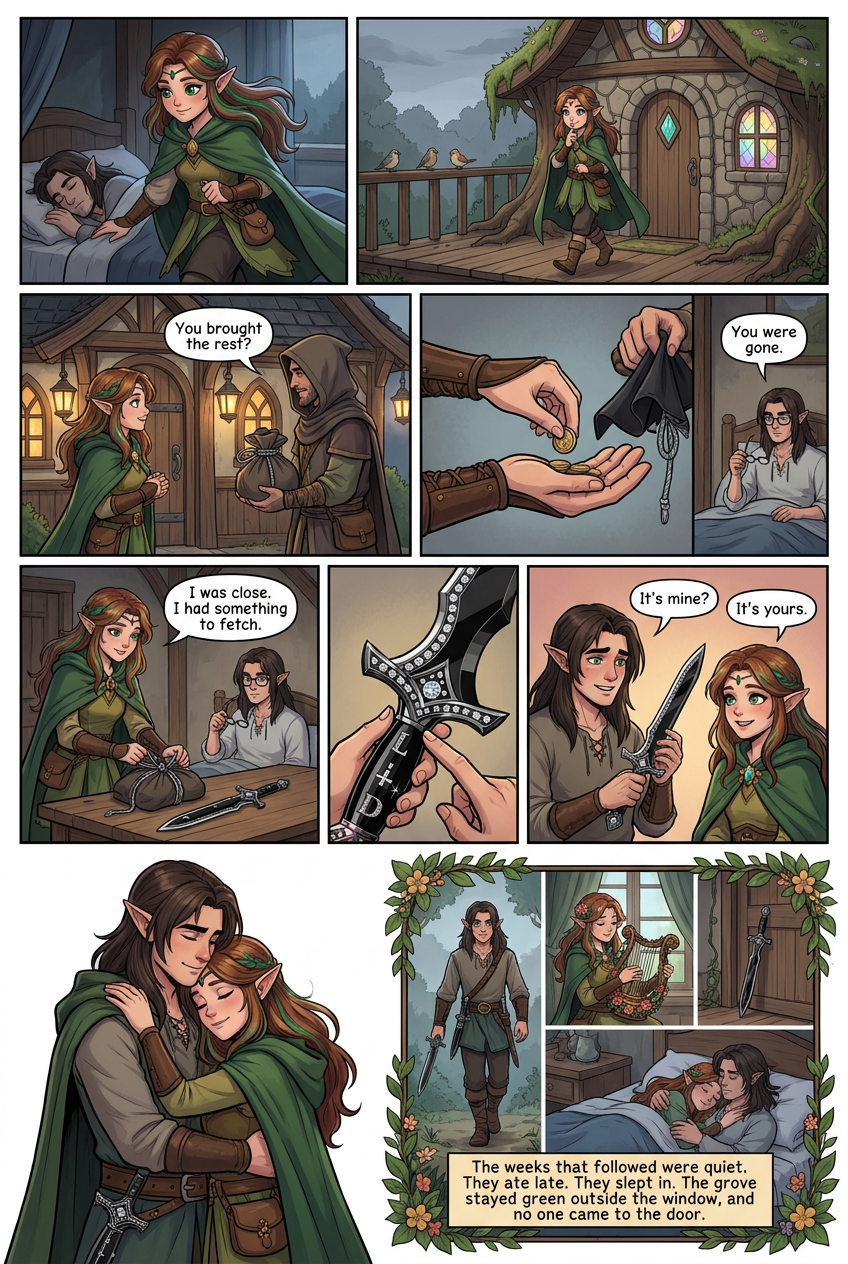
Lyra woke before the sun. Dorian slept beside her, one arm across her waist. She slid out from under it without waking him. She dressed in the dark, took her coin pouch from the shelf, and stepped out onto the porch. Birds were already at the rail. She pressed a finger to her lips and walked past them down the path. The tavern sat quiet at that hour. Its lanterns still burned low under the eaves. The merchant waited at the side door as promised, a long bundle across his arms wrapped in dark cloth and tied with silver cord. He nodded when he saw her. "You brought the rest?" he asked. Lyra untied the pouch and counted the coins into his palm. He weighed them once, then held out the bundle. She lifted a corner of the cloth. Black glass caught the lantern light. Diamonds ran along the edge in a thin bright line. On the grip she saw the two letters she had asked for, an L and a D, set in silver. "Tell the smith who cut it he did clean work," she said. "I will." The merchant tipped his head and stepped back inside. She carried the bundle home against her chest. The path was still gray. When she pushed the door open, Dorian was sitting up on the edge of the bed. His hair hung loose. His spectacles were in his hand. He looked at her the way he looked at a shut door in a strange house. "You were gone," he said. "I was close." She set the bundle on the table. "I had something to fetch." He stood and came over. She untied the cord and folded the cloth back. The blade lay on the wood between them, black and bright. Dorian did not touch it at first. He looked at the grip. He read the letters. He touched the D with one finger, then the L, then the small mark between them. "I commissioned it months ago," she said. "Before the tower. Before any of it. I wanted you to have something as fine as the lyre you gilded for me." He picked it up. He turned it once in his hand and tested the balance. His shoulders eased. When he looked at her, his face had opened in the small way she had learned to watch for. "It's mine?" he said. "It's yours." He set the blade back on the cloth and pulled her against him. He held her a long time without speaking. The weeks that followed were quiet. They ate late. They slept in. He carried the blade at his belt when he went to the ridge and left it by the door when he came back. She played the lyre in the evenings. They laughed at small things. They kissed in doorways. They fell asleep tangled and woke tangled. The grove stayed green outside the window, and no one came to the door.
Play your story to life
Storycraft is a mobile game where you create AI characters, craft items and locations to build their world, then discover what direction your story takes. Download the iOS game for free today!
Download for free