

Scarlett Rose's Arc
57 Chapters
Scarlett Rose's dream is winning the heart of the rancher who owns the neighboring land she's loved since childhood..

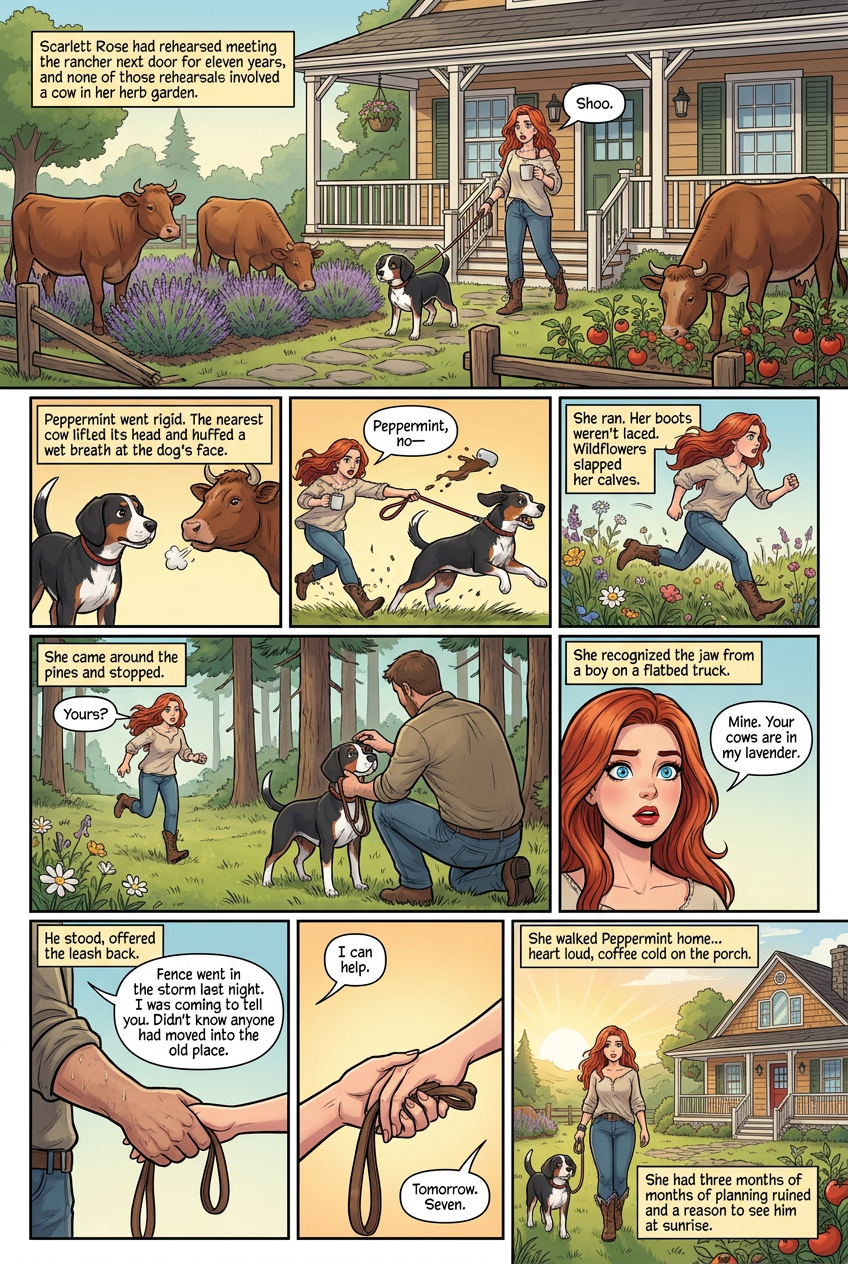
Scarlett Rose had rehearsed meeting the rancher next door for eleven years, and none of those rehearsals involved a cow in her herb garden. She stood on the wraparound porch of the cedar cottage she'd finally bought back in spring, coffee in one hand, the leash of her beagle mix in the other. The dog she'd named Peppermint went rigid against her leg. Three brown cows stood knee-deep in her lavender. A fourth chewed the tops off her tomato stakes. Beyond them, a long section of split-rail fence lay flat in the grass like a dropped ladder. She set the coffee down. She had loved that ranch since she was nine years old, riding past it in the back of her father's truck, watching a boy her age throw hay bales from a flatbed. She had bought this cottage to be near it. She had planned to introduce herself at the feed store, in clean jeans, with a pie. Not in slippers, with her hair in a loose braid, smelling like sleep. "Shoo," she tried. The cows ignored her. She walked down the steps. Peppermint followed, low and stiff. The nearest cow lifted its head and huffed a wet breath at the dog's face. Peppermint yelped, bolted sideways, and tore the leash out of Scarlett's hand. He shot under the downed fence and into the pasture beyond, dragging the leather line behind him. "Peppermint, no—" She ran. Her boots weren't laced. Wildflowers slapped her calves. She could hear the dog barking somewhere past a stand of pines, and then a man's voice, sharp and calm at the same time, telling something to hold still. She came around the pines and stopped. A tall man in a sweat-dark shirt knelt in the grass with Peppermint's leash wrapped once around his wrist. He had the dog by the collar and was rubbing behind its ears like they'd known each other for years. Peppermint's tail thumped the dirt. The man looked up. He had a jaw she recognized from a boy on a flatbed truck. "Yours?" he said. "Mine." Her voice came out steadier than she expected. "Your cows are in my lavender." "I know. Fence went in the storm last night. I was coming to tell you." He stood, offered the leash back. His eyes moved over her once, quick, and then stayed on her face. "Didn't know anyone had moved into the old place." "Three months ago." She took the leash. Their fingers touched. She did not pull away fast. "I'll get the cows out," he said. "Fence'll take me two days. Maybe three." "I can help." He studied her. "You know fence work?" "I can learn." He almost smiled. "Tomorrow. Seven." She walked Peppermint home through the broken rail, heart loud, coffee cold on the porch. She had three months of planning ruined and a reason to see him at sunrise.
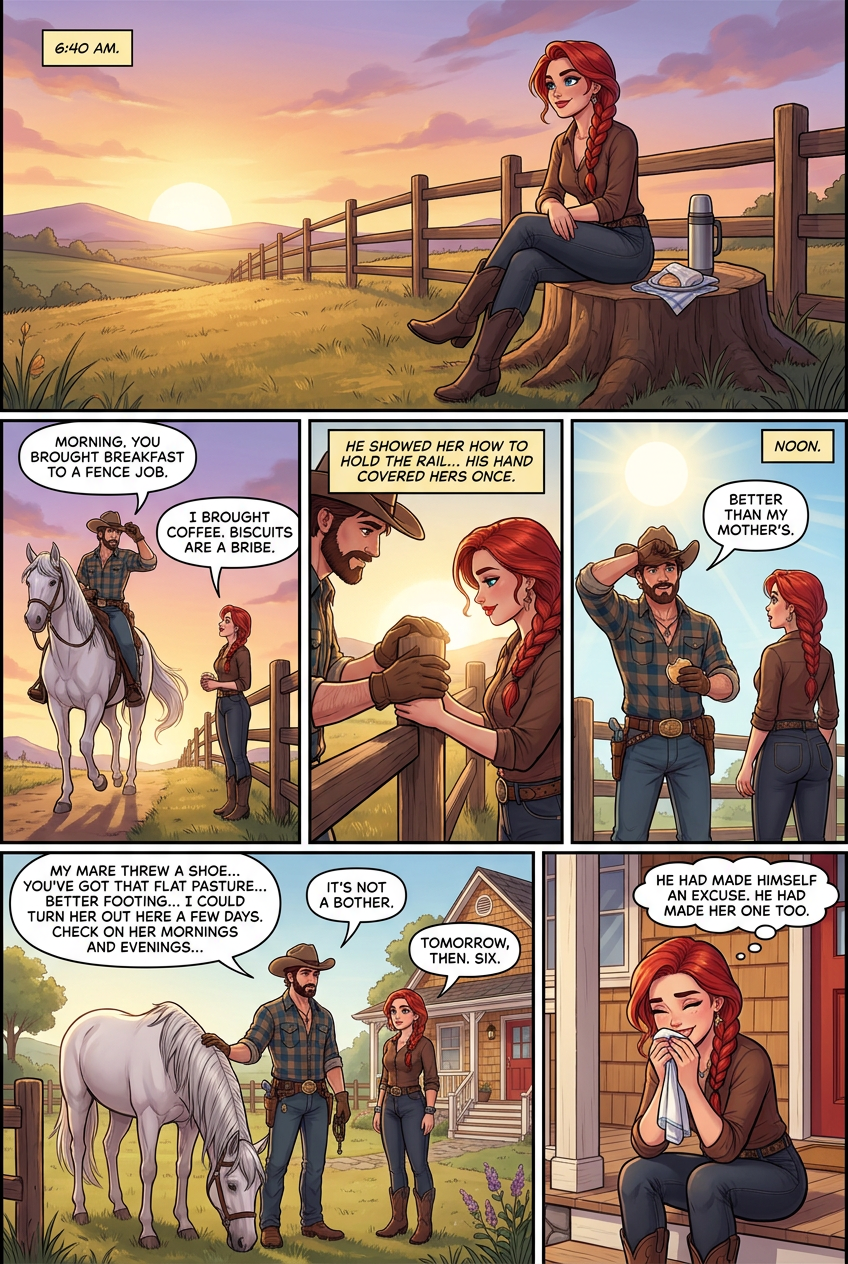
Scarlett Rose was on the fence line at six-forty, fifteen minutes before he'd said. She had laced her boots this time. She had braided her red hair tight. She had a thermos of coffee and a plate of biscuits wrapped in a clean towel, and she set both on a flat stump where he'd see them first. The rancher came up the ridge on a white mare with a silver mane. He rode like the horse was an extension of his leg. He tipped his hat when he saw the biscuits. He didn't say her name. She noticed. She didn't correct him for not trying. "Morning," he said. He swung down. He was taller than she remembered from yesterday, and yesterday she'd remembered him tall. "You brought breakfast to a fence job." "I brought coffee. Biscuits are a bribe." He almost laughed. He handed her a pair of leather gloves from his saddlebag. "Put these on. Post hole digger's heavier than it looks." They worked. He set the posts. She tamped the dirt. He showed her how to hold the rail while he drove the spike, and his hand covered hers once to steady the wood. He didn't move it fast. Neither did she. The mare grazed loose beside the cottage's white picket line, tail switching at flies. By ten the sun was hard on her neck. By noon they'd set six posts. He ate two biscuits standing up and said they were better than his mother's, and then looked like he wished he hadn't said it. At one o'clock he stepped back and wiped his forehead with his sleeve. "That's the worst of it. I can finish the rest myself tomorrow." Her stomach dropped. She had counted on three days. She had counted on him needing her. "Oh," she said. "Right." He looked at her. He looked at the cedar porch of her cottage, at the hanging baskets, at the biscuits. He rubbed the back of his neck. "Unless," he said. "Unless." "My mare threw a shoe last week. Farrier's out till Thursday. I've been walking her." He didn't quite meet her eye. "You've got that flat pasture behind your place. Better footing than mine. I could turn her out here a few days. Check on her mornings and evenings, if that's not a bother." She kept her face still. Her hands were shaking inside the gloves. "It's not a bother," she said. "Tomorrow, then. Six." "Six." He mounted up. He rode off slower than a man in a hurry. She stood by the finished posts until she couldn't hear the hoofbeats anymore. Then she walked back to the porch, sat on the top step, and pressed the empty towel to her mouth so she wouldn't laugh out loud. He had made himself an excuse. He had made her one too. She had two mornings, and then five, and now a horse to feed.
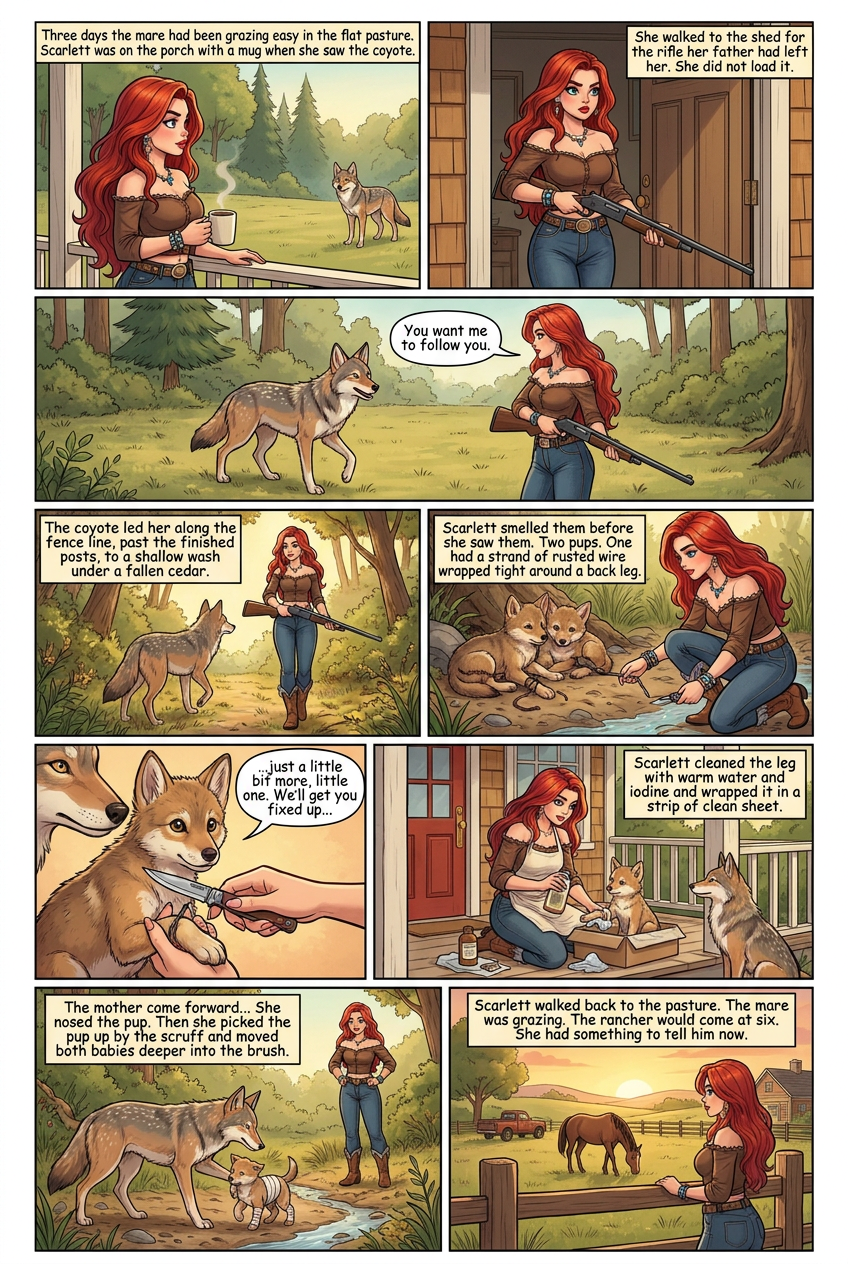
The rancher brought the lame mare over the next morning, and by the third dusk she was grazing easy in the flat pasture behind Scarlett's cottage. Scarlett was on the porch with a mug when she saw the coyote for the first time. It stood at the tree line where her yard met the ridge. Lean, gray and tan, ears up. It looked at her. It did not run. The mare lifted her head. She shifted her weight off the sore hoof and snorted. The coyote sat down. Scarlett set the mug on the rail. If the mare bolted and hurt herself worse, the rancher would haul her home tomorrow. Five mornings gone. She walked to the shed for the rifle her father had left her. She did not load it. She carried it down the porch steps with the barrel low. The coyote stood when she came into the yard. It did not bare its teeth. It took three steps toward her, stopped, and looked back at the brush. Then it looked at her again. It whined once, high and thin, like a dog at a door. Scarlett stopped walking. The coyote trotted a few paces toward the brush and looked over its shoulder. Waited. Trotted again. Waited. "You want me to follow you," Scarlett said out loud. She felt foolish. She followed anyway, the rifle broken open over her arm the way her father had shown her. The coyote led her along the fence line, past the finished posts, to a shallow wash under a fallen cedar. Scarlett smelled them before she saw them. Two pups, maybe six weeks, curled together in the dirt. One had a strand of rusted wire wrapped tight around a back leg. The leg was swollen. The other pup licked at the wound and whimpered. The mother sat down five feet away and watched Scarlett. Scarlett laid the rifle in the grass. She took her pocketknife out slow. She talked the whole time, soft nonsense about biscuits and coffee, while she cut the wire free. The pup yelped once. The mother did not move. She carried the hurt pup back to the porch in her apron. The mother followed at a distance and waited at the tree line. Scarlett cleaned the leg with warm water and iodine and wrapped it in a strip of clean sheet. She set the pup in a shallow box with a rag and carried it back to the wash. The mother came forward when Scarlett stepped away. She nosed the pup. She looked at Scarlett once more. Then she picked the pup up by the scruff and moved both babies deeper into the brush. Scarlett walked back to the pasture. The mare was grazing. The rancher would come at six. She had something to tell him now, and a reason he would want to stay for the telling.
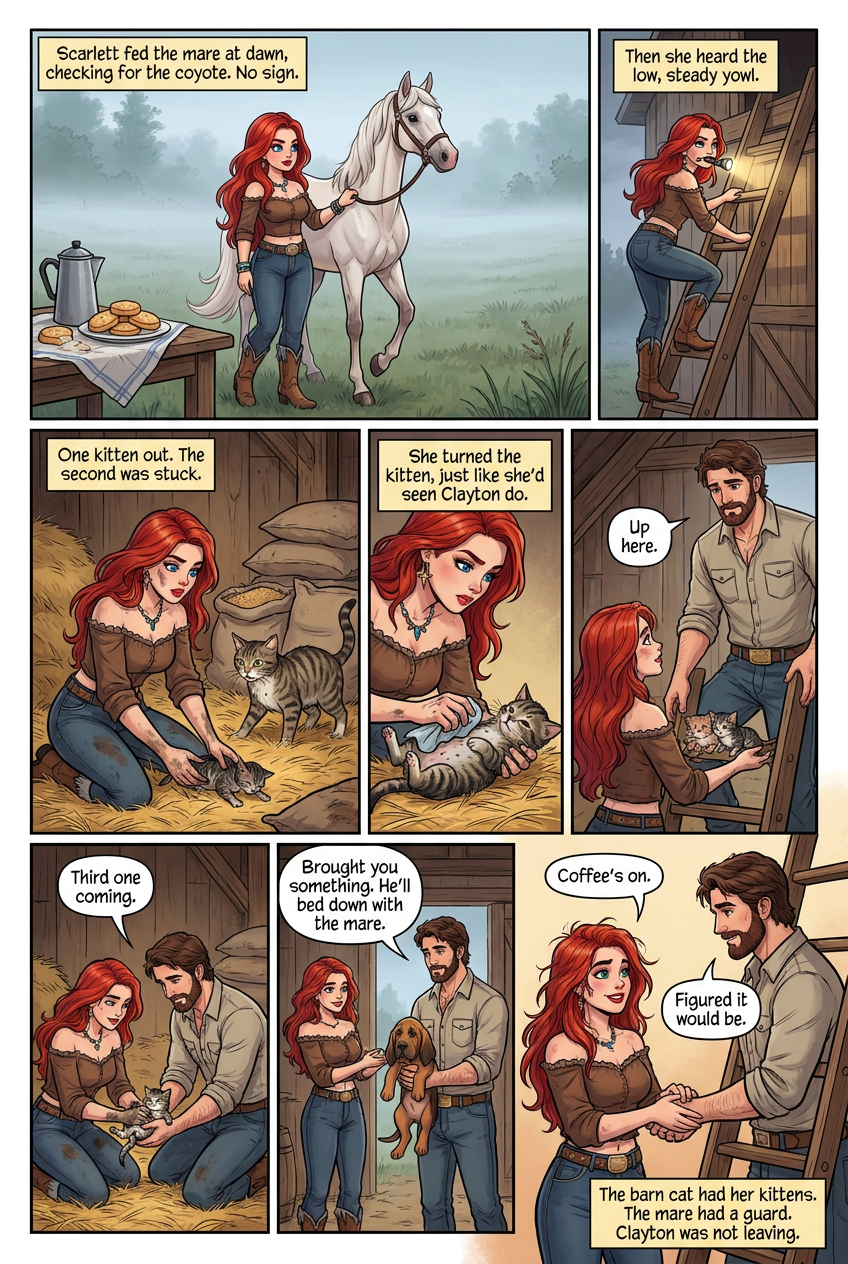
Scarlett fed the mare at dawn and checked the tree line for the coyote. No sign. The white horse stood easy on the sore hoof now, mane pale in the gray light. Scarlett had the coffee on and a plate of biscuits under a cloth. Clayton was due at six with fence wire and, she hoped, another reason to stay. Then she heard the sound from the hayloft. It was low and steady, the kind of yowl a barn cat only made once in her life. Scarlett climbed the ladder with a flashlight in her teeth. The tabby was curled in the straw behind the old grain sacks. One kitten was already out, wet and moving. The tabby was straining and could not push out the second. Her sides heaved. Her eyes were wide. Scarlett checked her watch. Twenty minutes till six. She went back down for warm water, clean rags, and the bottle of iodine. She left the biscuits on the counter and did not look at the mirror by the door. Her hands smelled like barn. Her jeans had straw on the knees. It did not matter now. Back in the loft she knelt in the straw and talked soft, the way she had talked to the coyote pup. She wet a rag and wiped the tabby's face. She felt along the belly with two fingers. The second kitten was crooked. She worked her finger in and turned it, slow, the way she had watched Clayton turn a calf when she was nine years old and hidden behind the fence. The tabby pushed. The kitten came free in Scarlett's palm. She cleared its mouth with the rag until it mewed. A truck door shut in the yard. "Up here," Scarlett called down through the loft hatch. Boots on the ladder. Clayton's hat came up first, then his face. He took in the straw, the cat, the two wet kittens, Scarlett's rolled sleeves and streaked hands. He did not say anything about how she looked. He climbed the rest of the way up. "Third one coming," he said. He crouched across from her. His knee touched hers in the straw and stayed there. They worked the last kitten out together. The tabby licked all three and settled. Downstairs a dog barked once, deep and long. Scarlett looked at Clayton. "Brought you something," he said. "Bloodhound pup out of my brother's line. He'll bed down with the mare at night. Coyote won't come near a hound." Scarlett wiped her hands on a rag. Her hair was falling out of its tie. She did not fix it. "Coffee's on," she said. "Figured it would be." He climbed down the ladder first and waited at the bottom with a hand up for her. She took it. The barn cat had her kittens. The mare had a guard. Clayton was not leaving at six.
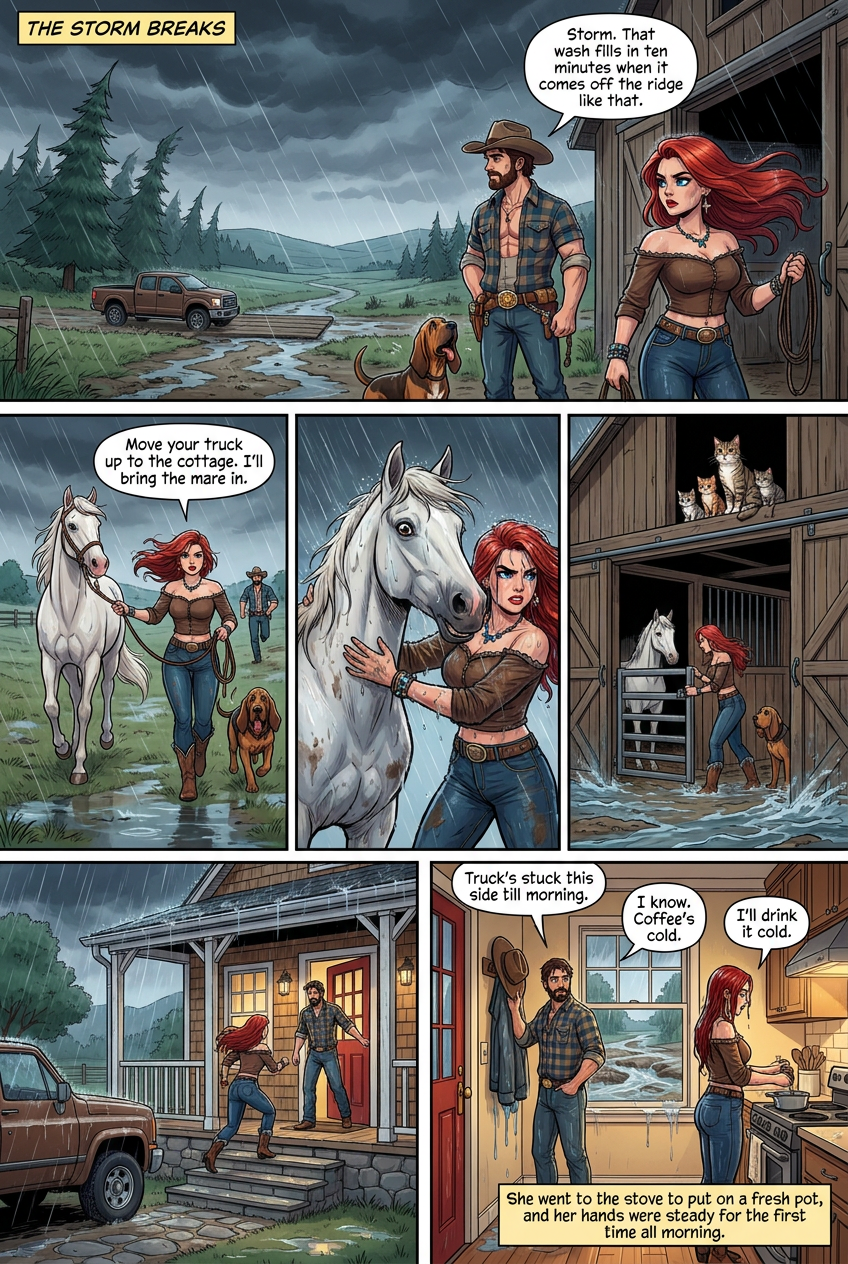
Scarlett came down the ladder behind Clayton and stepped out into a wind that had not been there an hour ago. The sky over the ridge had gone the color of wet slate. The pines on the high line were bent one way. She smelled rain and cold iron. The bloodhound pup lifted his nose from the barn floor and whined. "Storm," Clayton said. He looked past the barn to the low crossing where the county road dipped between their two properties. "That wash fills in ten minutes when it comes off the ridge like that." His truck sat on her side of the crossing. If the water rose, he was here until it dropped, and the mare and pup were still out in the open pasture. Scarlett did the math in her head. Truck first, then animals, then house. She grabbed a lead rope off the nail by the door. "Move your truck up to the cottage," she said. "High ground by the porch. I'll bring the mare in." He did not argue. He tossed her the keys to the pasture gate and went for his truck at a run. The first fat drops hit the tin roof behind her. Scarlett cut across the pasture with the rope over her shoulder. The white mare was already walking toward her, ears pinned at the sky. Scarlett clipped the lead to the halter and turned her toward the barn. The pup came behind at her heel, belly low. Wind pushed her hair across her face. She did not stop to fix it. Halfway back the rain hit for real. It came sideways and cold. The mare balked once. Scarlett laid a hand flat on the wet shoulder and kept walking. The mare came. She got them into the barn as the yard turned to running water. She latched the mare in the stall, dropped hay, and shut the pup in with her. The tabby watched from the loft edge with her kittens under her chin. Scarlett ran for the cottage. Clayton had the truck parked tight against the stone at the porch steps. He was on the porch already, hat dripping, holding the red door open for her. She went up the steps two at a time and inside. The kitchen was warm. The biscuits were still under the cloth on the counter. Down at the crossing, brown water was already sliding over the road. Clayton hung his hat on the peg by the door like he had done it before. "Truck's stuck this side till morning," he said. "Maybe longer." "I know." He looked at her, wet through, hair down her back in dark ropes. He did not look away. "Coffee's cold by now," she said. "I'll drink it cold." She went to the stove to put on a fresh pot, and her hands were steady for the first time all morning.
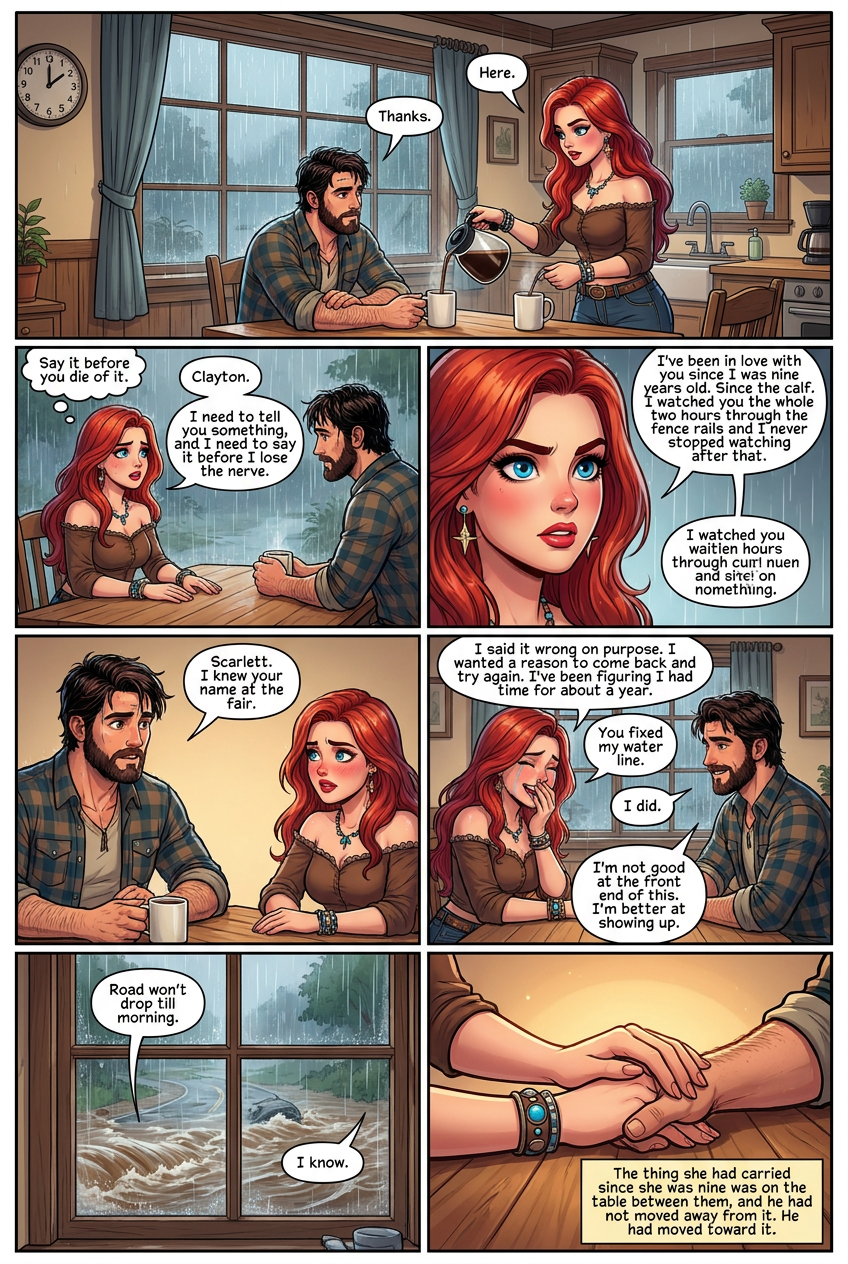
The coffee finished dripping. Scarlett poured two mugs and carried them to the table by the window. Rain sheeted down the glass. Clayton sat with his forearms on the wood, hat off, hair still dark from the rain. He took the mug she set in front of him and said thanks. She sat across from him. The clock over the stove read a quarter past four. She had watched him across a fence for eleven years. She had dropped a basket of eggs in her own yard because he said good morning. She had let him say her name wrong at the fair and smiled about it for a week. He was three feet away and the road was closed and there would not be another night like this one handed to her. Her sister's voice was in her head. Say it before you die of it. "Clayton." He looked up. "I need to tell you something, and I need to say it before I lose the nerve." Her hands stayed flat on the table. "I've been in love with you since I was nine years old. Since the calf. I watched you the whole two hours through the fence rails and I never stopped watching after that." He did not move. The rain kept on. She made herself hold his eyes. "I'm not asking you for anything," she said. "I just wasn't going to sit here another hour and not say it." Clayton set the mug down. He looked at his hands, then at her. "Scarlett." He said it right. "I knew your name at the fair." She felt the blood come up her neck. "I said it wrong on purpose," he said. "I wanted a reason to come back and try again. You didn't correct me, so I figured I had time." He almost smiled. "I've been figuring I had time for about a year." "You fixed my water line." "I did." "You stayed two hours." "I'd have stayed four. You didn't ask." She put a hand over her mouth and laughed once, wet. He reached across the table. He did not grab. He turned his palm up on the wood between them and waited. She put her hand in his. His fingers closed slow. "I'm not good at the front end of this," he said. "I'm better at showing up." "I noticed." Outside, the low crossing ran brown and full. The bloodhound pup was safe in the barn with the white mare and the cat. Inside, Clayton held her hand across the table and did not let go. "Road won't drop till morning," he said. "I know." "Then we've got time to figure out what comes after saying it." She nodded. Her hand stayed in his. The thing she had carried since she was nine was on the table between them, and he had not moved away from it. He had moved toward it.
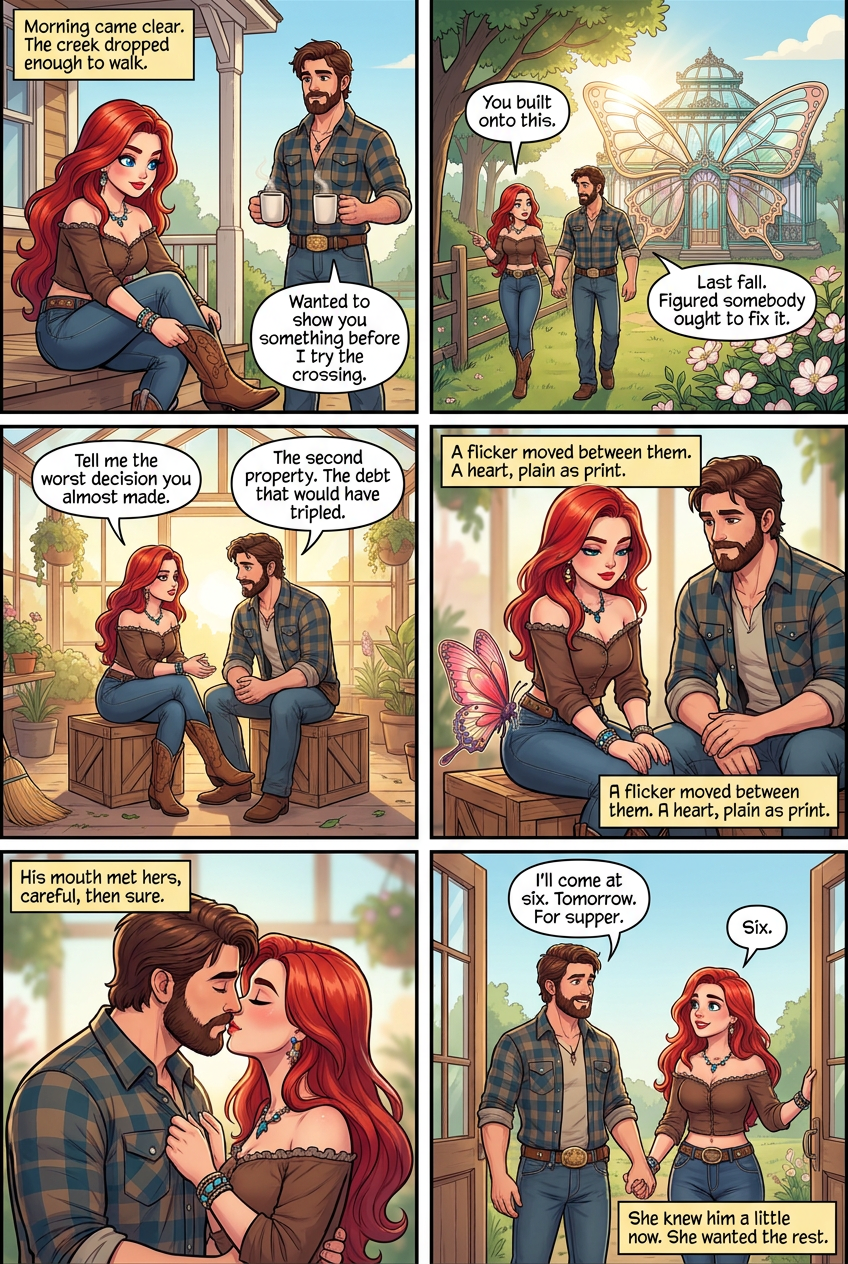
Morning came clear. The creek had dropped enough to walk, not drive. Clayton stood on her porch with coffee in his hand and said he wanted to show her something before he tried the crossing. Scarlett pulled on her boots. She still felt the shape of last night in her chest, his hand across the table, her own words hanging out in the open air. She knew the boy who delivered that calf. She did not know the man beside her now. If they only talked about fences and weather, this new thing between them would starve. He led her along the fence line toward a stand of dogwoods at the back of her pasture. She had walked past it a hundred times. Behind the trees stood a small glass house she had never really looked at, its panels shaped like wings, the paint faded to soft green and pink. Her grandmother's, half forgotten. "You built onto this," she said. The hinges were new. The broken pane above the door was new. "Last fall," Clayton said. "I saw it from my side. Figured somebody ought to fix it before it caved." "You never told me." "I was going to. Then I kept not telling you." He opened the door. Warm air moved out. Inside, someone had swept the floor and set two crates upright like stools. He sat on one. She sat on the other. Their knees almost touched. "Ask me something," he said. "Anything. I've been three feet away for a year and you don't know me yet." She took a breath. "Tell me the worst decision you almost made." He told her about the second property. The debt that would have tripled. Duke off his feed for a week. How he talked it out loud in the barn until he heard himself and stopped. She asked about his mother. He asked about her father. They traded small hard things across the crates for an hour. He laughed once, dry, at something she said about her sister. She learned he counted listening as his best skill. She believed him. A flicker moved between them. A butterfly settled on the crate by her hand. Its wings opened slow. Each wing carried a shape the color of a bruised rose, curved at the top, pointed at the bottom. A heart, plain as print. Neither of them spoke. Clayton looked at the butterfly, then at her. "That's ridiculous," she said. "It is." He leaned across the small space between the crates. He gave her time to move. She did not move. His mouth met hers, careful, then sure. His hand came up under her jaw. She held the front of his shirt and kept him there. The butterfly lifted and drifted toward the glass roof. When he sat back, he kept hold of her hand. "I'll come at six," he said. "Tomorrow. Not for a fence. For supper." "Six," she said. She knew him a little now. She wanted the rest.
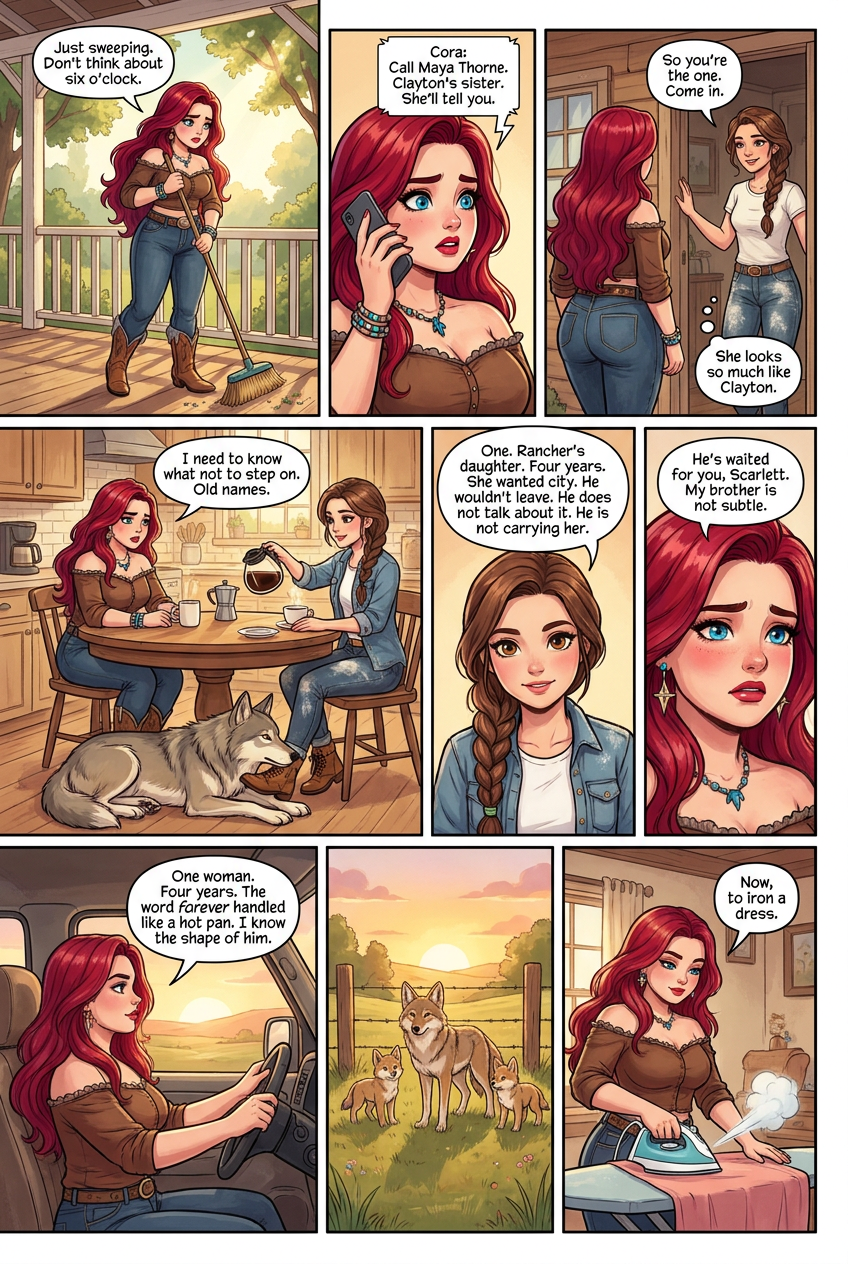
Scarlett spent the morning trying not to think about six o'clock. She fed the mare. She swept the porch of her cottage twice. By ten she admitted the truth: she was going to supper with a man whose past she did not know. Clayton had told her about his mother and the second property. He had not told her about women. If she walked in blind, she could say the wrong name over the potatoes and undo a year of his careful work. She called her sister. Cora laughed at her, then said the name Scarlett needed. Maya Thorne. Clayton's sister. Married to a man over the ridge. "Call her," Cora said. "She'll tell you what you need. She's been waiting eleven years for you to ask." Maya answered on the second ring. Scarlett explained herself badly. Maya cut in. "Come over. I've got coffee and an hour." Maya met her at the door with a long brown braid over one shoulder and flour on her jeans. She looked so much like Clayton it stopped Scarlett on the step. Same hazel eyes. Same steady mouth. "So you're the one," Maya said. "Sit down before I hug you and scare you off." They sat at the kitchen table. A grey dog with a cream chest and calm amber eyes lay under it, chin on Maya's boot. Half wolf, Maya said, and don't ask. "I need to know what not to step on tonight," Scarlett said. "Old names. Old hurts. I don't want to bleed him by accident." Maya poured coffee. "There was one. Rancher's daughter, two counties over. Four years. She wanted city. He wouldn't leave the land. She left instead. That was six years ago. He does not talk about it. He is not carrying her. He's careful about the word forever because she used it wrong." "That's it?" "That's it. One girl in high school who moved. Nobody since. He waited." Maya set the cup down. "He waited for you, Scarlett. My brother is not subtle. I've heard your name at every holiday for a year." Scarlett's throat closed. "I didn't know." "Now you do. Don't promise him forever tonight. Feed him. Let him talk. He'll do the rest." Scarlett drove home with her hands steady on the wheel. She knew the shape of him now. One woman. Four years. The word forever handled like a hot pan. She could sit across from him at six and not flinch. At her fence line she stopped the truck. A coyote stood in the pasture with two pups at her heels, the ones from spring, grown lean and quick. The mother watched Scarlett a long moment, then turned the pups toward the trees. Scarlett let out a breath she had been holding since morning. She went inside to iron a dress.
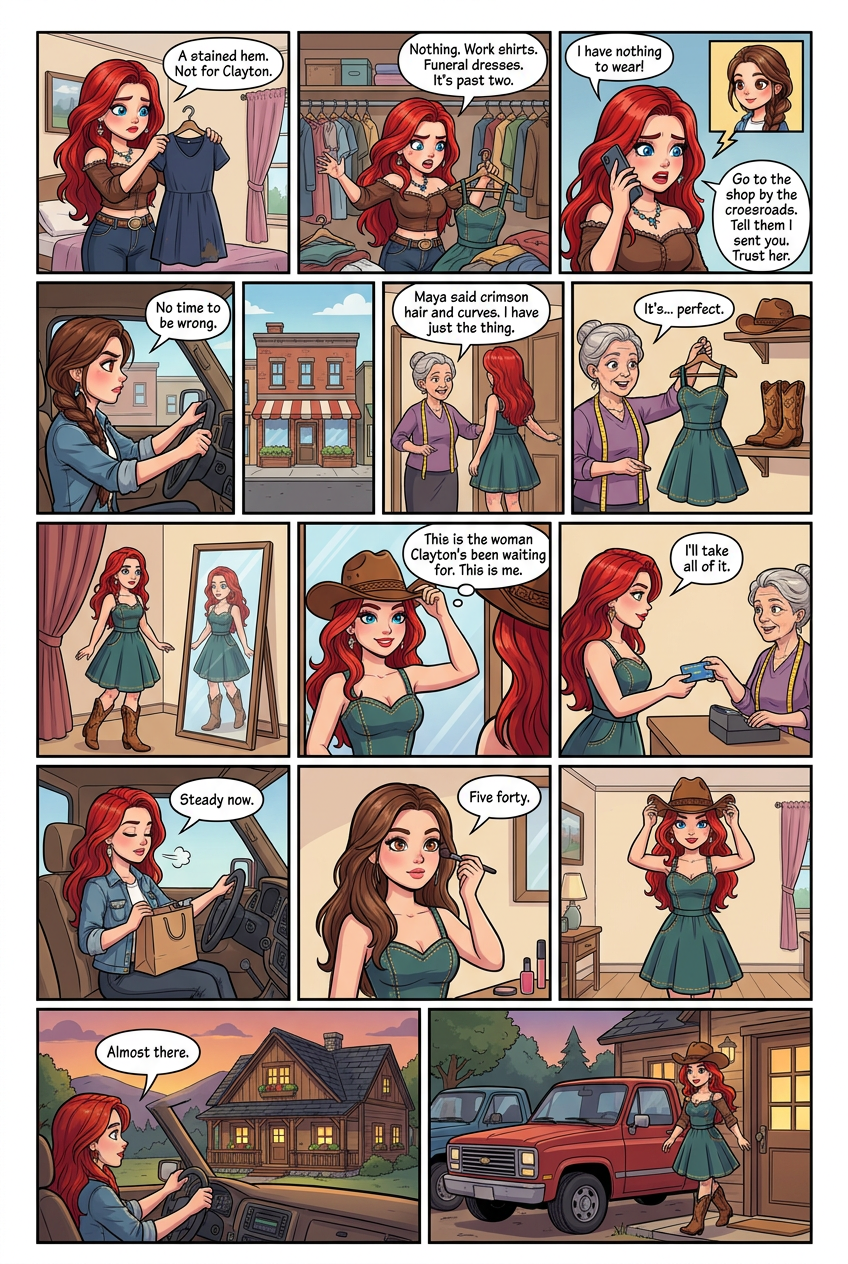
Scarlett set the iron down and looked at the dress on the bed. Navy cotton, three years old, a small stain on the hem from a church potluck. She had planned to wear it. Now she couldn't. Clayton had waited a year to sit across a table from her. She would not meet him in a stained hem. She opened her closet and pushed through every hanger. Work shirts. Two funeral dresses. A sweater her sister had knit wrong. Nothing said the woman he'd been picturing. Nothing said her. Supper was at six. It was already past two. She called Cora. Cora didn't pick up. She called Maya before she could talk herself out of it. "I have nothing to wear," Scarlett said. "I know how that sounds." "It sounds like every woman I know." Maya's voice was calm. "The shop by the crossroads. Tell the owner I sent you. She keeps a rack in the back she doesn't put on the floor." "I don't have time to try things on and be wrong." "Then don't be wrong. Trust her. I'll call ahead." Scarlett drove with both hands tight on the wheel. The shop sat between a feed store and a shuttered bakery. The owner met her at the door with a measuring tape around her neck and pulled her straight to the back. "Maya said crimson hair and curves and a man who's been waiting." The woman didn't ask questions. She held up a dress and Scarlett stopped breathing. Deep teal. Fitted bodice with a sweetheart neckline. A full skirt that would move when she walked. Gold stitching along every seam like a hand-drawn line. A cowboy hat and boots waited on the shelf beside it, the leather warm brown, tooled in a pattern that matched the stitching. "Try it," the woman said. Scarlett went behind the curtain. The dress fit like it had been cut for her body. The bodice held her without pinching. The skirt fell right at the knee. She stepped into the boots and they took her like she'd worn them a year. She looked in the mirror and saw the woman Clayton had been talking about at every holiday. Not a costume. Her, sharpened. "I'll take all of it," she said. She paid without checking the total. In the parking lot she sat in the truck a long moment with the bag on the seat beside her. Her hands were steady. Her jaw was set. At home she washed her face, did her makeup slow, and pinned her hair loose down her back. She stepped into the dress and the boots and set the hat on the dresser to grab last. She checked the clock. Five forty. She drove to the cottage bar with wildflowers along the shoulder blurring past. Warm windows glowed through the dusk. Clayton's truck was already there. She parked, set the hat on her head, and got out.
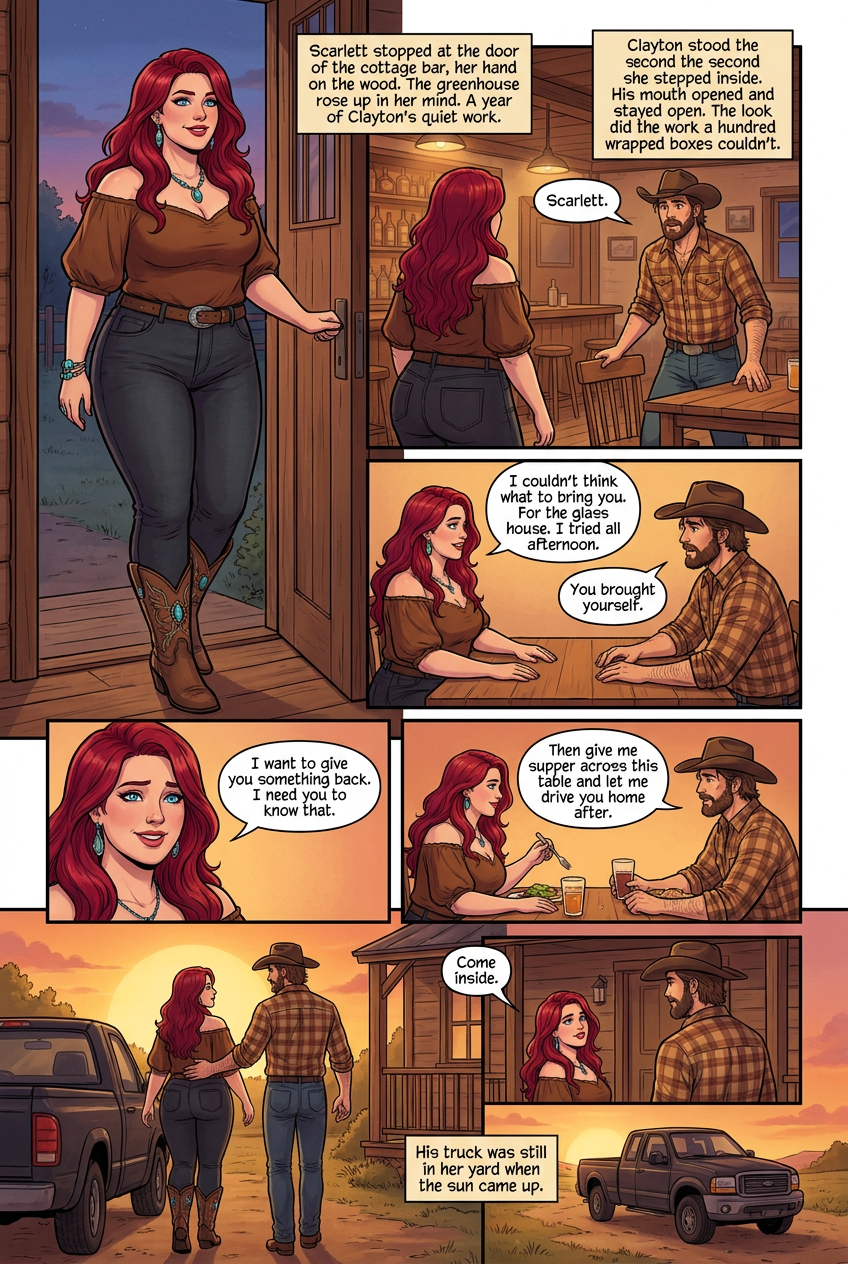
Scarlett stopped at the door of the cottage bar with her hand on the wood. The greenhouse rose up in her mind. A year of Clayton's quiet work. Glass panes he'd carried in one at a time. She had nothing in her hands. No gift. No gesture to set beside what he'd built for her. She almost turned back to the truck to think of something. Then she pushed the door open instead. Clayton stood the second she stepped inside. He was in a clean plaid shirt, hat off, hair still damp at the edges. His mouth opened and stayed open. He didn't speak. He just looked at her, and the look did the work a hundred wrapped boxes couldn't. "Scarlett," he said. Right this time. Careful with it. She crossed to the table. He pulled her chair. She sat and set her hands flat on the wood so he could see them steady. "I couldn't think what to bring you," she said. "For the glass house. I tried all afternoon." "You brought yourself." "That felt thin." "It isn't." He sat across from her. "I fixed a building. You walked in here looking like that and I forgot my own name. We're not even." She laughed before she meant to. The knot under her ribs loosened. "I want to give you something back," she said. "I need you to know that." "Then give me supper across this table and let me drive you home after." She nodded. That was a thing she could do. They ate slow. He asked about the mare. She asked about his sister. He reached once and touched her fingers where they rested by her glass and left his hand there. The fear of arriving empty-handed went quiet. She wasn't behind him. She was sitting with him. He paid. He walked her out with his hand at the small of her back. He followed her truck down the dark road to her cottage and parked beside it. On the porch she turned and looked up at him under the hat. "Come inside," she said. He came inside. She took off the hat and set it on the table. He took off his and set it beside hers. He kissed her slow, then not slow. He lifted her like she weighed nothing and she laughed against his mouth. In the bedroom he set her down careful. He unhooked the dress with steady hands and folded it over the chair like it mattered. He kissed the freckles across her shoulder. He said her name right, once, into her hair. After, she lay against his chest and listened to him breathe. She had come with empty hands and given him the only thing he'd been waiting for. The greenhouse and this night belonged to the same story now. His truck was still in her yard when the sun came up.
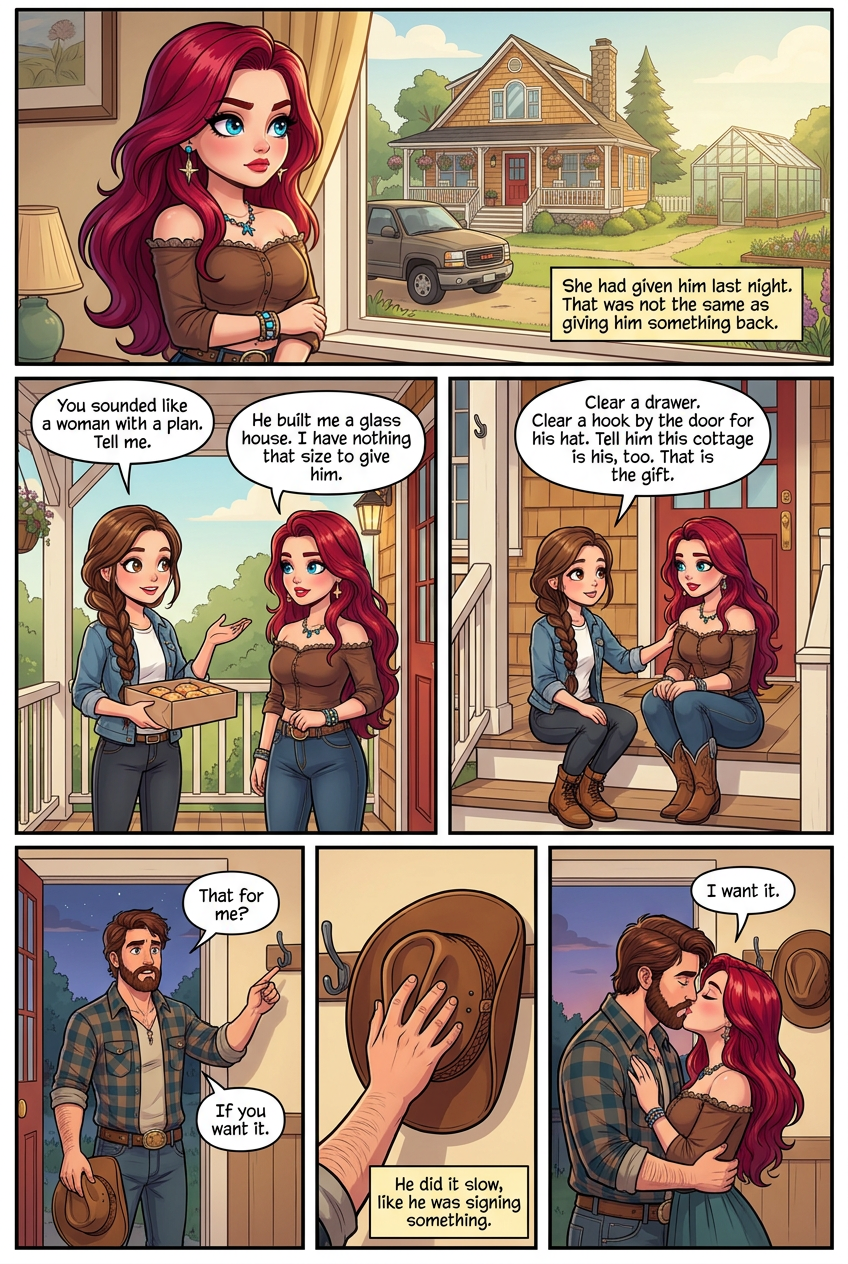
Scarlett woke with Clayton's arm heavy across her waist and the sun already high. He was still asleep. She slid out from under him and stood at the window in his shirt. His truck sat in her yard. The greenhouse waited past the ridge, glass catching light. She had given him last night. That was not the same as giving him something back. The thought sat down in her chest and stayed. She made coffee. When he came into the kitchen he kissed the top of her head and took the mug she handed him. He drove home to feed his stock. She watched the truck cross the low water and thought about what a person builds for another person over a year. A building. A place. Something you could stand inside. She called Cora. Cora called Maya. An hour later Maya's small car pulled up to the porch. She got out with her long braid over one shoulder and a bakery box in her hands. Clayton's sister. The same brown eyes as him, quicker on the draw. "You sounded like a woman with a plan," Maya said. She set the box on the porch rail. "Tell me." "He built me a glass house," Scarlett said. "I have nothing that size to give him." "Then don't match him. Match what he needs." "Which is what." Maya sat on the top step. "He has been talking about you for a year. Name at every holiday. He told me last night he doesn't want to sleep at his place anymore. He didn't say it like a joke." Scarlett sat down beside her. "He said that." "He said that. He is scared to ask for more. The last one left him for a city." "I know." "So ask him first," Maya said. "Clear a drawer. Clear a hook by the door for his hat. Tell him this cottage is his, too, when he wants it. That is the gift. You give him a place to land." Scarlett looked at the porch. At the two rocking chairs. At the hook by the red door where only her jacket hung. "That's not a thing wrapped in paper," she said. "No," Maya said. "It's better." After Maya left, Scarlett worked through the afternoon. She emptied a dresser drawer. She cleared half the closet. She drove a second hook into the wood by the door at the right height for a tall man. She set a spare mug beside hers on the shelf. He came back at dusk. He stopped inside the door and saw the hook. He looked at her. "That for me." "If you want it." He took off his hat and hung it there. He did it slow, like he was signing something. "I want it," he said. He kissed her at the door. His hat stayed on the hook all night.
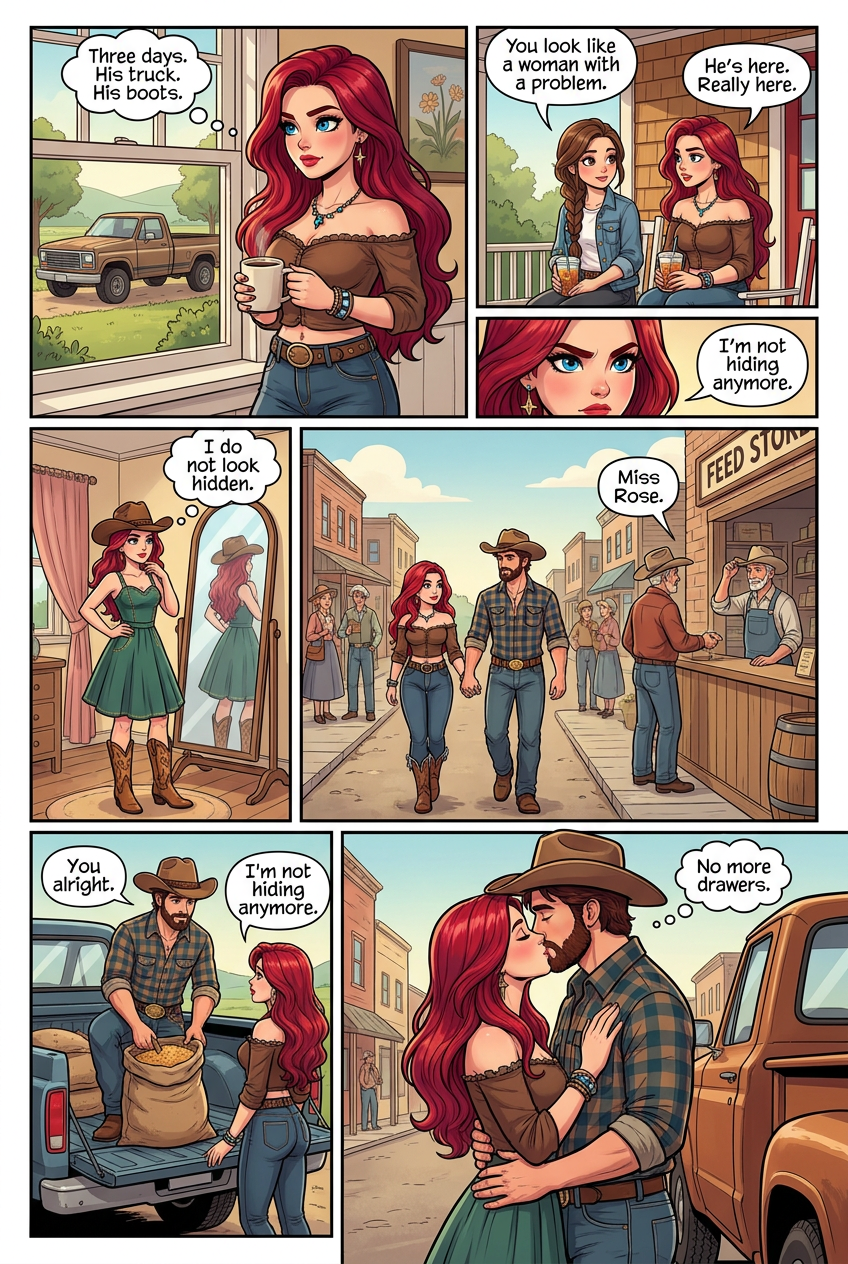
Three days after Clayton hung his hat by her door, Scarlett woke before him and stood at the window with her coffee. His truck was in the yard again. His boots were by the mat. She had spent eleven years believing this kind of love was something she kept folded in a drawer, private, unspoken. Now it was drinking coffee behind her in her kitchen. She did not know how to carry it in daylight yet. She called Maya at noon. Maya came over with two iced teas and sat on the porch rail in her denim jacket, braid over one shoulder. Clayton's sister always looked at Scarlett like she already knew the answer and was waiting to hear it said out loud. "You look like a woman with a problem," Maya said. "He's here. He's really here. And I keep waiting for the part where I hide it again." "Hide what." "Him. Us. All of it. I spent so long keeping it quiet, I don't know how to just have it." Maya sipped her tea. "Then stop keeping it quiet. Go into town. Walk down the street with him. Let people see." "That easy." "That easy." Scarlett showered and put on the green dress she had bought weeks ago and never worn a second time. She pulled on her boots. She set the brown hat on her head and looked at herself in the mirror. She did not look hidden. Clayton came in from the barn and stopped in the hallway. "Where are we going." "Town. Feed store. Coffee. Wherever." He looked at the dress. "That for the feed store." "It's for anywhere I want." He took his hat off the hook. "Then let's go." They drove in together. He parked on the main street and came around and opened her door. She stepped down and took his hand on the sidewalk. She did not let go. They walked past the hardware store and the diner. A woman she had known since school looked up from a bench and smiled, slow and surprised. An older rancher at the feed store counter tipped his hat to Clayton and then, after a beat, to her. "Miss Rose," he said. He got her name right. She felt the old habit rise, the urge to duck her head and shorten herself. She did not do it. She said good afternoon and meant it. Outside, Clayton loaded a sack of grain into the truck bed and paused with one hand on the tailgate. "You alright." "I'm not hiding anymore," she said. "That's all." "Took you long enough." "I know." He kissed her in front of the truck, in the middle of the afternoon, in the middle of the street. She kissed him back. When they drove home, her hand stayed on his knee the whole way, and she did not think once about the drawer she used to keep him in.
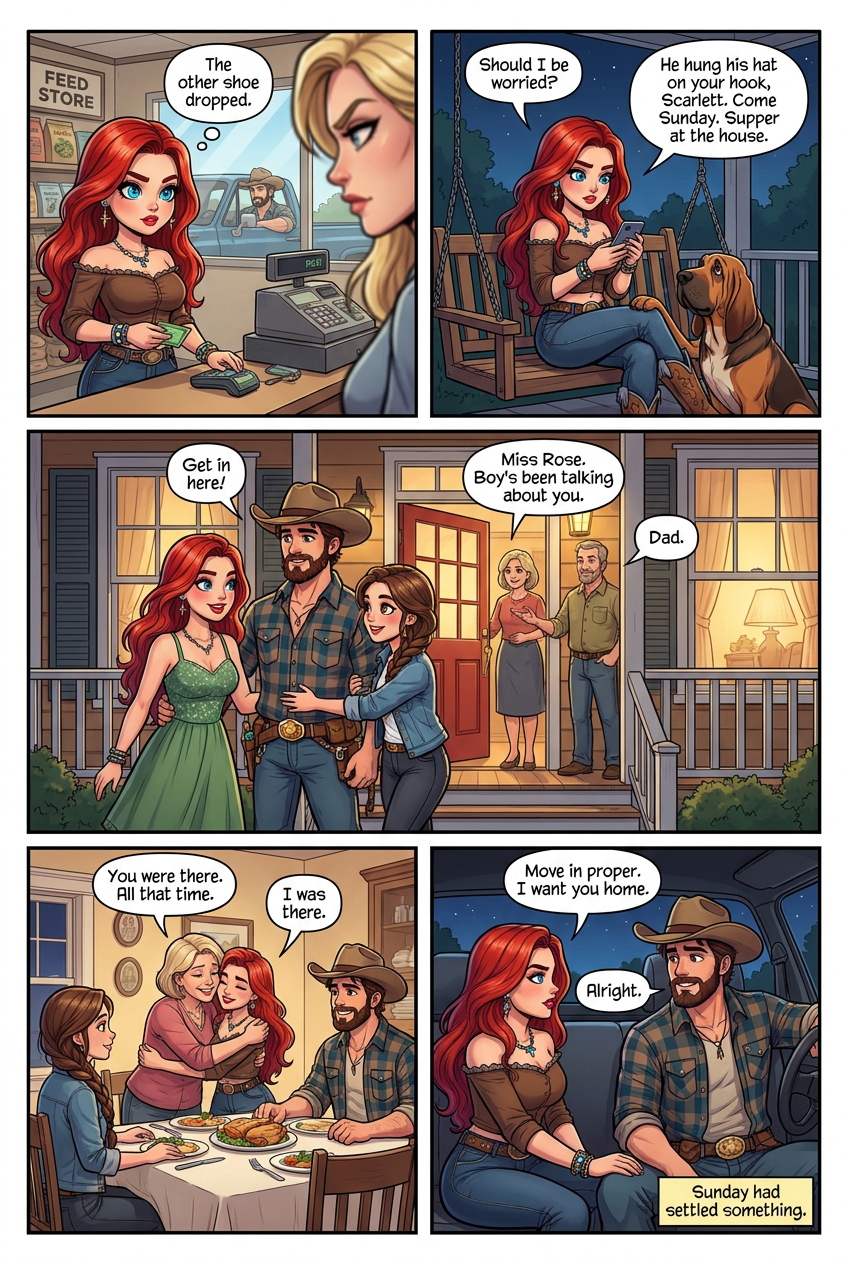
The week after town, Scarlett kept waiting for the other shoe. It came on a Tuesday at the feed store. A woman at the counter, blonde and sharp-boned, turned when she heard Clayton's name and looked at Scarlett the way a buyer looks at a horse. Scarlett paid for her grain and left. In the truck she asked Clayton who that was. He kept both hands on the wheel. "She used to live here," he said. "Four years ago. She's back for her father's estate." "The one from the ranch." "That one." Scarlett looked out the window. She thought of everything Maya had told her about the woman who left him for the city. She thought of the drawer she used to keep him in and how she was not going back to it. She called Maya that night from the porch. Maya answered on the second ring. "I know," Maya said before Scarlett spoke. "She's been at the diner twice already." "Should I be worried." "He hung his hat on your hook, Scarlett. He's not moving it." "I've never met your parents." The line went quiet a second. "Then come Sunday. Supper at the house. Mama's been asking." Scarlett sat with the phone in her lap after they hung up. The bloodhound leaned against her knee. She had spent eleven years across a fence from this family. She had never sat at their table. Sunday she wore the green dress again. Clayton drove her over. Maya opened the door with her braid over one shoulder and a dish towel in her hand and pulled Scarlett inside before Clayton was up the steps. His mother was at the stove. His father was already standing. "Miss Rose," his father said. He got it right. "Boy's been talking about you since he was twenty-two." "Dad," Clayton said. "It's true." His mother wiped her hands and hugged Scarlett like she had been waiting to. Scarlett held on a second longer than she meant to. Over supper, his father asked about her herb garden. His mother asked about her grandmother. Maya kicked Clayton under the table when he went quiet and made him tell the story about the calf he delivered when he was fourteen, the one Scarlett had watched from her side of the ridge. His mother's eyes filled. "You were there," she said. "All that time." "I was there," Scarlett said. On the drive home Clayton was quiet a long time. Then he said, "You're in now. That's it." "I know." She put her hand on his knee. She thought about the cottage waiting for them, the hook by the door, the drawer she had cleared. She thought about the woman at the feed store and felt nothing move in her chest. Sunday had settled something the woman could not shake. "Move in proper," Scarlett said. "Not just the hat. Build onto the cottage if you need the room. I want you home." Clayton looked over. "Alright."
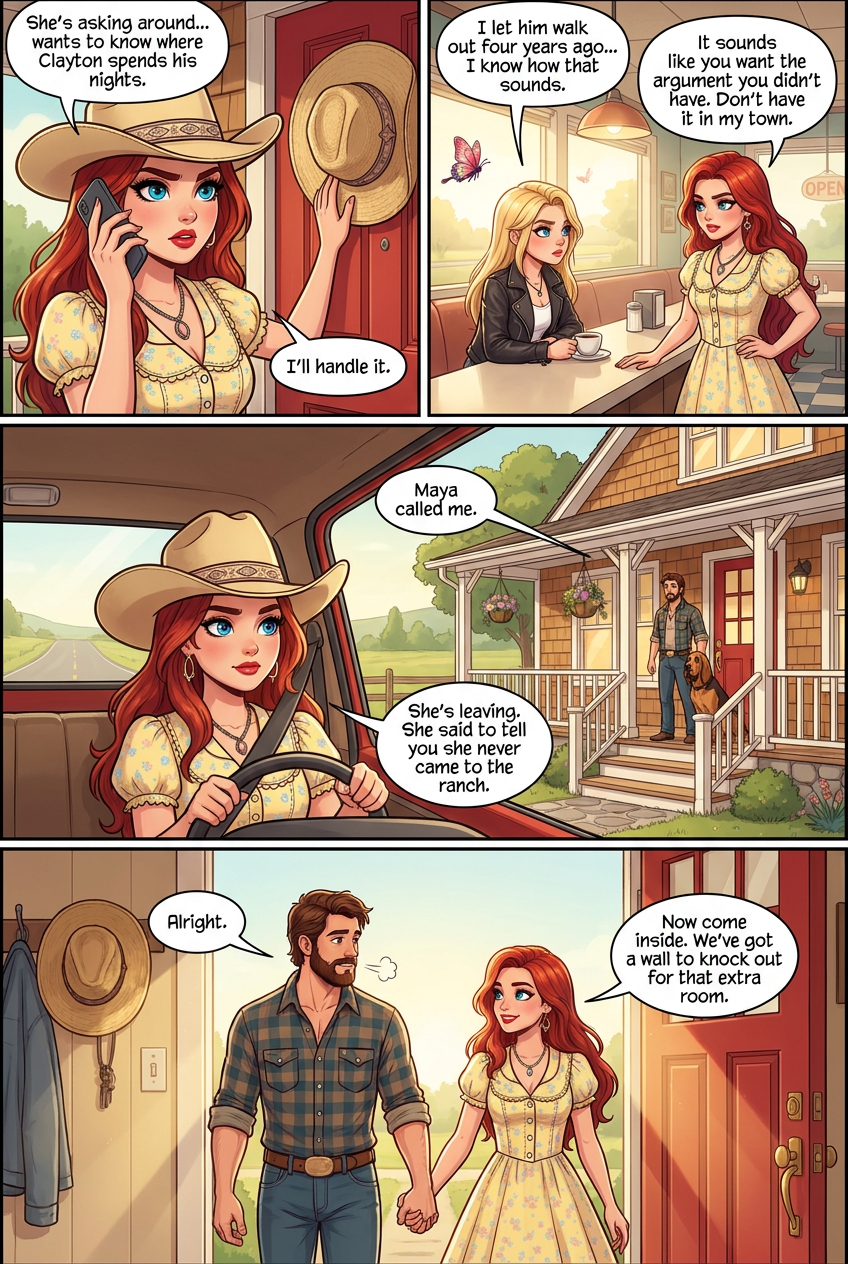
Two days after Sunday supper, Maya called before Scarlett had finished her coffee. "She's asking around," Maya said. "Diner. Gas station. The old woman who runs the post office. She wants to know where Clayton spends his nights." Scarlett set the cup down. "What did they tell her?" "Nothing worth hearing. But she's not leaving. And Clayton hasn't said a word to her." Scarlett looked at the hat on the hook by the door. "I'll handle it." She put on the yellow dress with the small flowers, the one with puffed sleeves and a fitted waist. She pulled on the tan boots and set the straw hat on her head. She wanted to be seen clearly. She drove into town alone and parked where the diner windows caught the light. Madison Rivers was at the counter, blonde hair over one shoulder, coffee cup in both hands. She looked up when the bell rang and her face went still. Scarlett walked to the stool beside her and sat down. The waitress didn't come over. Two ranch hands at the far booth stopped talking. "You've been asking about Clayton," Scarlett said. Madison set the cup down. "I have." "Ask me instead." Madison studied her a long moment. "He hung his hat at your place." "He did." "I let him walk out four years ago and didn't say a word. I came back to say it." "He isn't yours to say it to anymore." Madison's mouth pulled tight. "I know how that sounds." "It sounds like you want the argument you didn't have. Have it with the mirror. Don't have it in my town." A pink butterfly bumped the window between them and drifted off. Madison watched it go. When she looked back her eyes were wet, but her voice stayed flat. "He was quiet when he left me. I thought if I saw him I'd finally get loud." "You saw me at the feed store," Scarlett said. "You already know how it ends." Madison nodded once. She put a bill on the counter and stood. At the door she paused. "Tell him I didn't come to his ranch. That was the one thing I promised myself." "I'll tell him." The bell rang. Madison was gone. Scarlett drove home with the windows down. Clayton's truck was in the drive. He was on the porch of the cedar-sided cottage with the bloodhound at his boot, and he stood when he saw the dress and the hat. "Maya called me," he said. "I know." "You went alone." "It was mine to go." She climbed the steps. "She's leaving. She said to tell you she never came to the ranch." Clayton let out a breath he'd been holding for a week. "Alright." She took his hand. "Now come inside. We've got a wall to knock out for that extra room." He followed her through the red door. The hat on the hook didn't move.
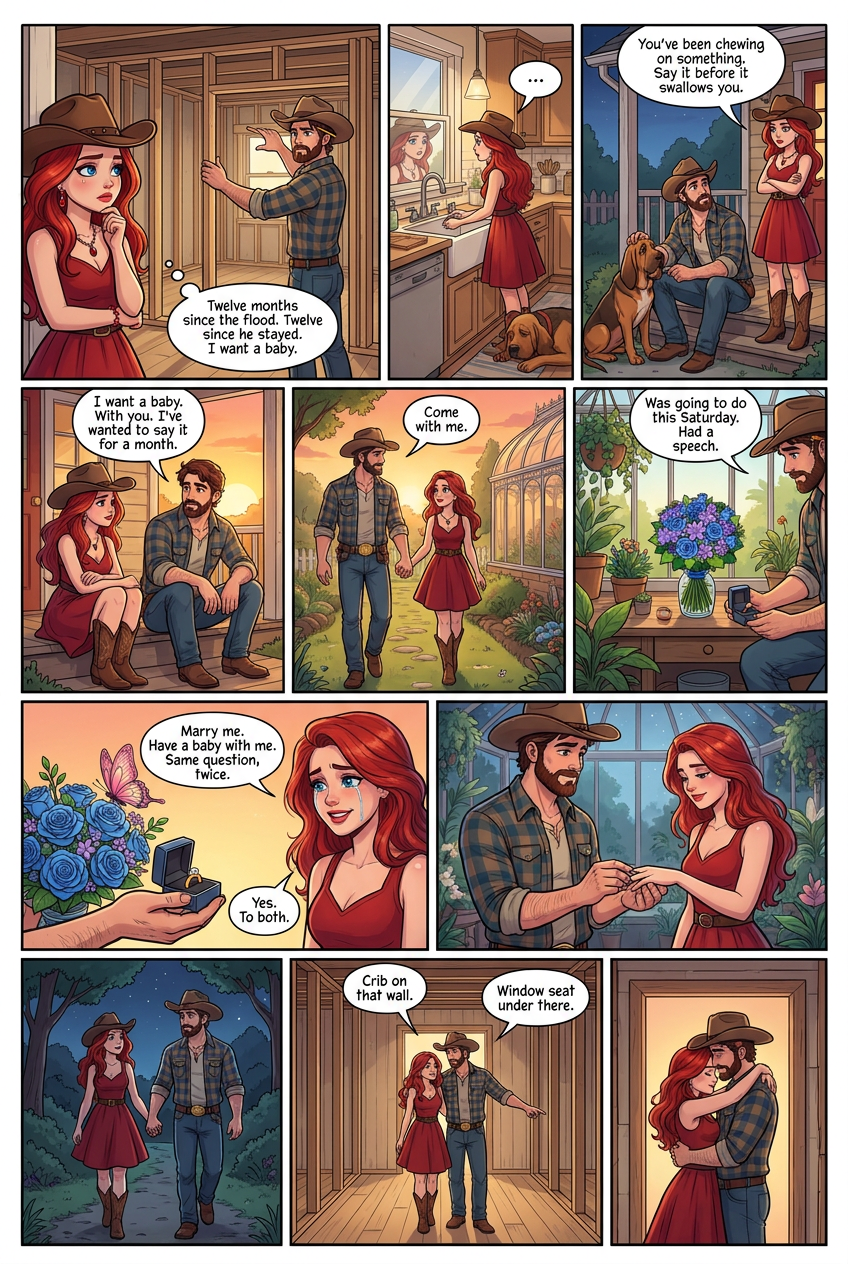
The wall came down over three days. Clayton framed the new room himself, and Scarlett watched him mark studs with a carpenter's pencil tucked behind his ear. On the fourth morning, she stood at the sink and counted months in her head. Twelve since the flood. Twelve since he'd hung his hat by the door. She wanted a baby. She had wanted one since Sunday supper, maybe before. She hadn't said it out loud, and every day she didn't say it, the words got heavier. She rehearsed at the sink. She rehearsed while feeding the chickens. She opened her mouth twice at breakfast and closed it. Clayton noticed. He always noticed. "You've been chewing on something," he said that evening. He was on the porch step, scratching the bloodhound's ear. "Say it before it swallows you." She sat down beside him. The sun was low over the ridge. She pulled her knees up. "I want a baby," she said. "With you. I've wanted to say it for a month." Clayton went still. He set his hand flat on his knee. He looked at the pasture, then at her. "Come with me," he said. He stood and held out a hand. She took it. He walked her past the barn, past the garden, toward her grandmother's glass house. The panes caught the last light. He opened the door for her. Inside, on the potting bench, sat a bouquet of blue roses and purple lilies, tied with twine. Beside it, a small ring box. "Was going to do this Saturday," he said. "Had a speech." "Clayton." "I already told my mother." He rubbed the back of his neck. "I already told Duke." A pink butterfly drifted from the ferns and landed on the bouquet. Scarlett laughed once, wet. He opened the box. A plain gold band with one small stone. "I want the room for a nursery," he said. "I was going to ask you after. Figured I'd get one yes at a time." "Ask me now." "Marry me. Have a baby with me. Same question, twice." "Yes," she said. "To both." He slid the ring on. His hands weren't steady. That surprised her more than anything. They walked back to the cottage in the dark. The hat was on the hook. The framed wall smelled of new pine. Clayton stopped in the doorway of the empty room and looked at it a long time. "Crib on that wall," he said. "Window seat under there." "Alright." She leaned into his shoulder. The silence she'd carried for a month was gone. In its place was a room that needed painting and a date that needed setting, and a hundred small things she suddenly had permission to say out loud.
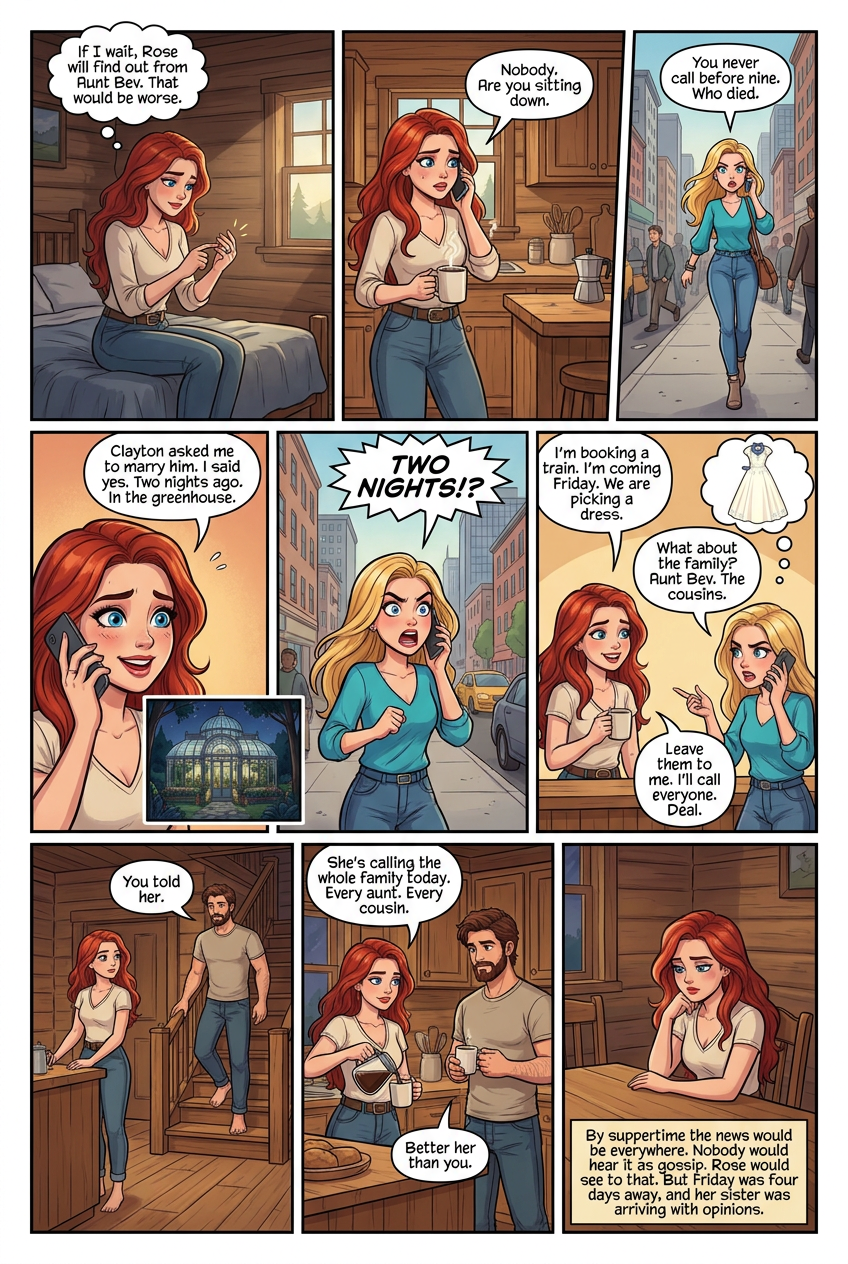
Scarlett woke before Clayton. The ring caught the gray light from the window. She turned it once on her finger and thought about her sister. Rose lived three hours away in the city and heard every piece of family news through their aunts. If Scarlett waited, Rose would find out from someone else. That would cut worse than any fight they'd ever had. She made coffee and picked up the phone before she could talk herself out of it. Rose answered on the second ring, already loud, already moving through some city street. "You never call before nine," Rose said. "Who died." "Nobody. Are you sitting down." "I'm walking. Same thing. Talk." Scarlett set the mug down. "Clayton asked me to marry him. I said yes. Two nights ago. In the greenhouse." The line went quiet. Scarlett heard a car horn on Rose's end. Then Rose made a sound that was half scream, half laugh, and Scarlett had to hold the phone away from her ear. "Two nights," Rose said. "You waited two nights to tell me." "I was trying to figure out how." "Scarlett. I have been waiting for this call since I was eleven years old. Do you know how many holidays I've sat through listening to you not talk about him." Rose was walking faster now, Scarlett could hear it. "I'm booking a train. I'm coming Friday. We are picking a dress." "Rose." "I already have a Pinterest board. I made it in March." Scarlett laughed and pressed her hand flat on the counter. She had braced for a lecture about being kept in the dark. She had braced for hurt feelings. She had not braced for a Pinterest board made in March. "What about the family," Scarlett said. "Aunt Bev. The cousins." "Leave them to me. I'll call everyone before supper. You will not hear one word of gossip because there won't be time for any. Deal." "Deal." "Now go tell your cowboy I'm bringing turquoise into that cottage whether he likes it or not." Rose hung up. Scarlett stood at the counter and let the silence settle. Clayton came down the stairs in bare feet and stopped when he saw her face. "You told her," he said. "She's coming Friday. She's already picked out a dress board." He poured himself coffee. "Good." "She's calling the whole family today. Every aunt. Every cousin." "Better her than you." Scarlett sat down at the table. The weight she'd carried since the greenhouse, the one she hadn't named, lifted enough that she noticed it leaving. By suppertime the news would be everywhere on her side of the family. Nobody would hear it as gossip. Rose would see to that. Then Scarlett remembered the dress. And the venue. And the date they still hadn't set. Friday was four days away, and her sister was arriving with opinions.
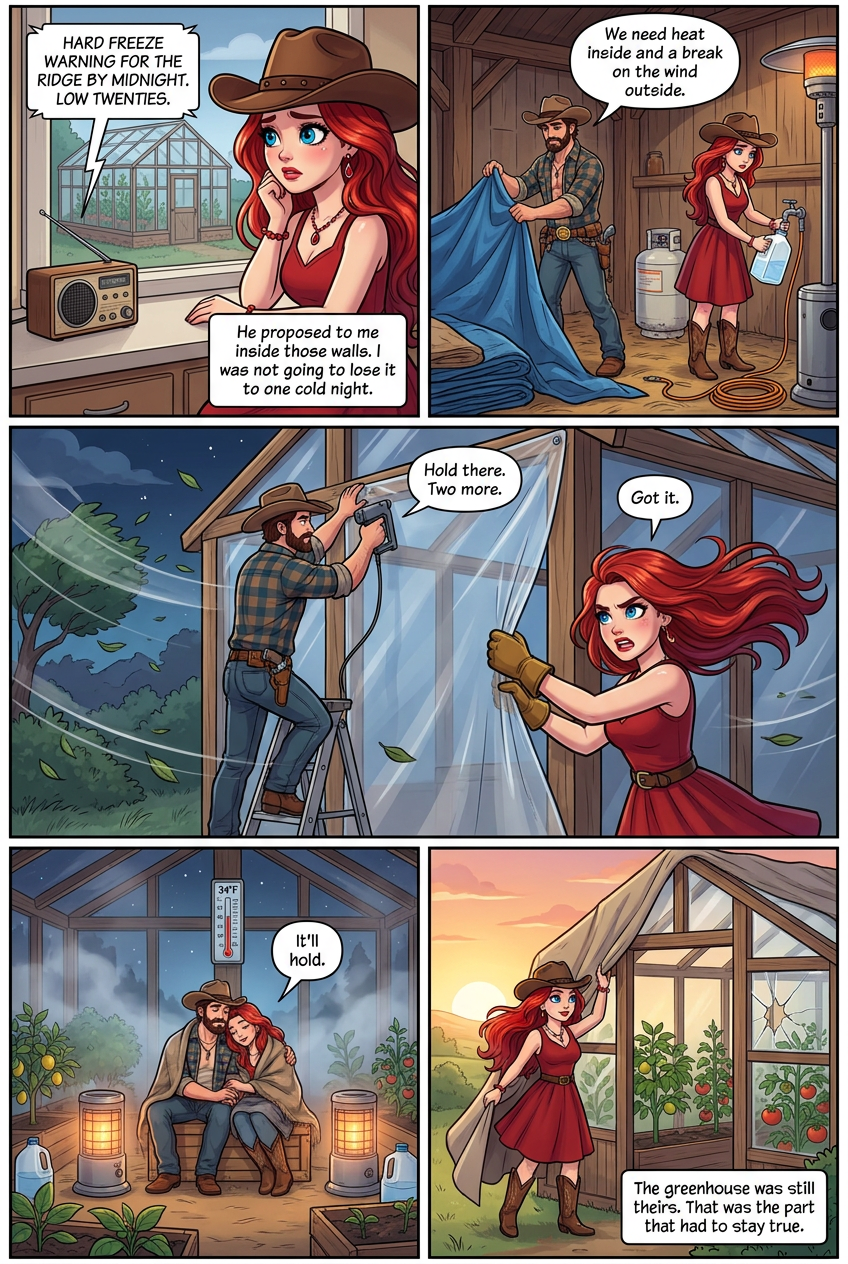
Scarlett was still at the counter thinking about dresses and dates when the weather radio clicked on by itself. The voice named a hard freeze warning for the ridge by midnight. Temperatures in the low twenties. She looked out the window at the greenhouse, at the panes Clayton had reset by hand over a year, at the tomato starts and the young citrus Rose would want to see on Friday. Two nights ago he had proposed to her inside those walls. She was not going to lose it to one cold night. " "Clayton set his mug down. "How bad." " ""Low twenties. Maybe colder up here." " ""Old glass. Old seals." He was already reaching for his boots. "We need heat inside and a break on the wind outside." " "They worked the list out loud. He drove the truck up from the ranch with every tarp and moving blanket he owned. Scarlett hauled two propane heaters from the barn and the long extension cord from under the sink. She filled milk jugs with hot water and set them between the seedling trays. Clayton lit the heaters and checked the regulators twice. " "The wind came up at dusk. It found the north wall first. Scarlett heard a pane rattle and grabbed the roll of plastic sheeting. Clayton climbed the stepladder outside with the staple gun. She held the sheet flat against the frame while he worked. Her hands went numb inside her gloves. " ""Hold there," he said. "Two more." " "The staples cracked into the wood. A gust pulled the corner loose. Scarlett caught it before it tore. " ""Got it," she said. " ""Good." " "They lashed blankets over the ridge line and roped them down with baling twine. Clayton walked the perimeter with a flashlight, tightening every knot. Scarlett stayed inside with the heaters, moving the water jugs closer to the citrus, watching the thermometer on the center post. Thirty-eight. Thirty-six. It held at thirty-four and stopped falling. " "At two in the morning Clayton came in and shut the door behind him. His goatee was stiff with frost. He looked at the thermometer, then at her. " ""It'll hold," he said. " "They sat on an overturned crate between the heaters. He put his arm around her shoulders. She leaned into his side and watched the needle on the gauge. " "By sunrise the wind had dropped. Scarlett went outside and pulled the corner of a blanket back. The citrus leaves were still green. The tomato starts stood upright. One pane on the north wall had cracked from corner to corner, but the glass held. " "She walked back to the cottage to call Rose. She had four days, a cracked pane to replace, and a sister arriving on Friday. The greenhouse was still theirs. That was the part that had to stay true.
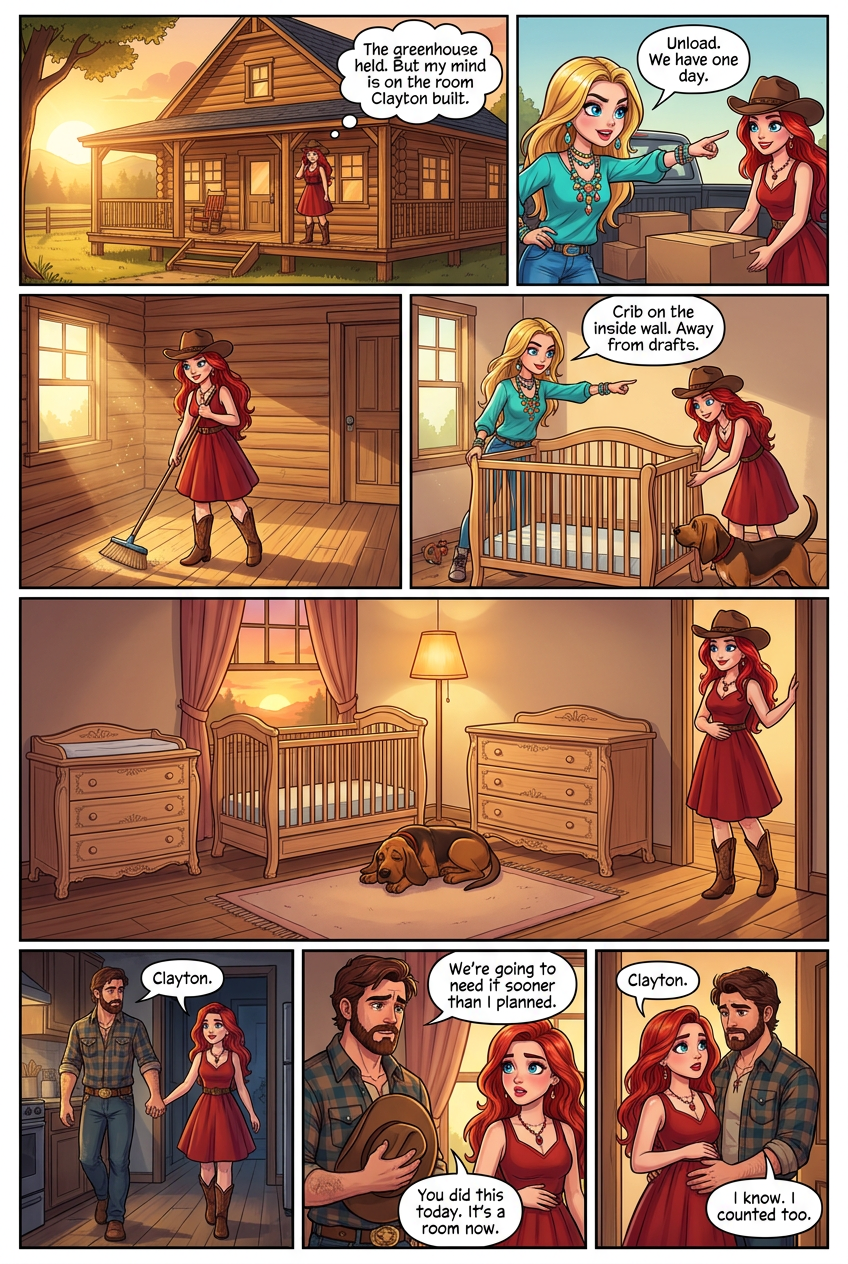
Scarlett called Rose from the cottage porch while the sun climbed over the ridge. The greenhouse had held. The citrus was green. But her mind was already on the room down the hall — the one Clayton had built and left bare, waiting. He had framed the walls, hung the door, and set the window. Then he had stopped, because the rest wasn't his to decide. She wanted him to walk in and see a real room for a child, not an empty box with good bones. She told Rose about it before she told her about the dress. Rose listened, then took over. She would come a day early. She would bring the crib set she'd been eyeing on that Pinterest board of hers, shipped ahead to the feed store. Scarlett laughed and let her. Rose arrived Thursday in a turquoise blouse and too much jewelry for the gravel drive. She hugged Scarlett hard, then pointed at the truck. "Unload. We have one day." They worked while Clayton was out moving cattle to the south pasture. Scarlett swept the sub-floor and wiped the window glass. Rose unboxed the nursery furniture piece by piece — a curved crib, a dresser with soft drawer pulls, a changing table with a low rail. The wood was pale and warm. Scarlett ran a hand along the crib rail and felt the shape of it settle into the room. "Put the crib on the inside wall," Rose said. "Away from the window. Cold drafts." They set it there. Scarlett folded a soft blanket over the rail. Rose hung a small framed print above the dresser and stepped back. The bloodhound pup Clayton had brought over months ago padded in, sniffed the crib leg, and lay down beside it like he'd been assigned the post. By five o'clock the room was done. Curtains up. Rug down. A lamp with a low, warm bulb on the dresser. Scarlett stood in the doorway and could not stop looking. Clayton came in at dusk with dust on his sleeves. She took his hand at the kitchen and walked him down the hall without speaking. She opened the door. He stopped in the frame. He looked at the crib. He looked at the dog on the floor. He took his hat off and held it against his chest. "You did this today," he said. "Rose helped." He crossed the room and put a hand on the crib rail where hers had been. "It's a room now." "It is." He turned to her. His eyes were wet and he didn't hide it. "We're going to need it sooner than I planned." Scarlett's hand went to her stomach before her mind caught up. She had been three days late and had not said a word. "Clayton." "I know," he said. "I counted too."
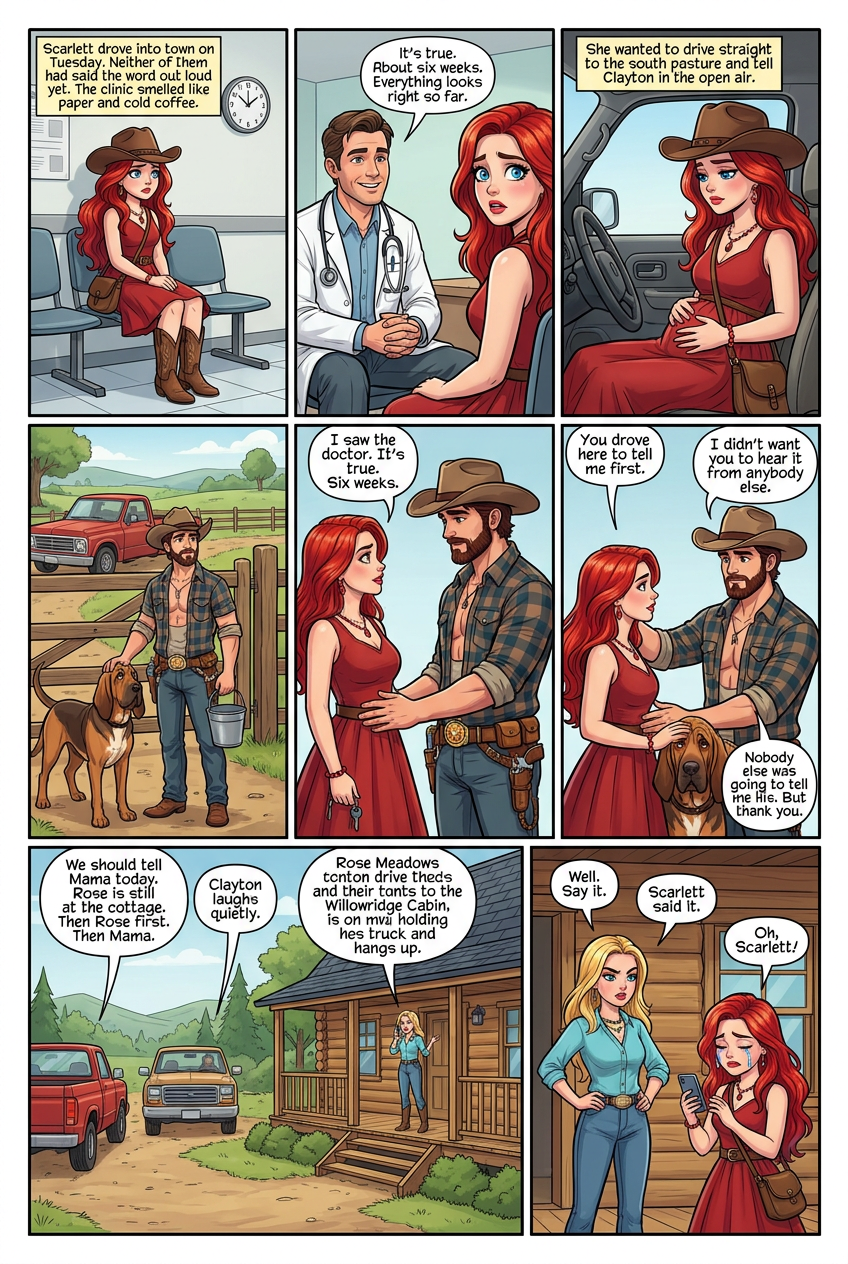
Scarlett drove into town on Tuesday morning with Clayton's words still in her ear. He had counted the days too. Neither of them had said the word out loud yet. She had made the appointment before breakfast and told him only that she had errands. She wanted a doctor's confirmation in her hand before she said it. The clinic smelled like paper and cold coffee. The nurse drew blood and asked her to wait. Scarlett sat in a plastic chair and watched the second hand on the wall clock. Twenty minutes later the doctor came in smiling and said yes. About six weeks. Everything looked right so far. Scarlett walked out to the parking lot and sat behind the wheel and pressed both hands flat to her stomach. She wanted to drive straight to the south pasture and find Clayton on his horse and tell him in the open air. Then she remembered the receptionist. A woman she'd gone to school with. A woman whose cousin worked at the feed store where Rose had shipped the crib. The clinic sat two blocks from the diner. News moved through this town like water down a slope. If she stopped for gas, if she called Rose, if she waited even an afternoon, someone else would say it first. She started the truck and drove past her own turnoff and up the ranch road to Clayton's gate. He was at the barn with the bloodhound at his heel. He set down a bucket when he saw her truck. She got out and walked to him with her keys still in her hand. "I saw the doctor," she said. "It's true. Six weeks." Clayton looked at her for a long second. Then he stepped forward and put one hand on her stomach, gentle, like he was setting down a plate. His other hand went to the back of her neck. "You drove here to tell me first." "I didn't want you to hear it from anybody else." "Nobody else was going to tell me this," he said. "But thank you." The bloodhound pushed his head between their knees. Clayton laughed once, low, and did not move his hand. "We should tell Mama today," he said. "Before supper. She'll know from my face anyway." "Rose is still at the cottage." "Then Rose first. Then Mama." Scarlett nodded. She felt the weight she'd been carrying since the nursery slide off her shoulders and settle into something else — a schedule, a list of people, a clock starting. They drove back to the cottage in his truck with hers following behind. Rose was on the porch in a turquoise blouse, phone in hand, already halfway through a call to someone. She took one look at Scarlett's face and hung up without saying goodbye. "Well," Rose said. "Say it." Scarlett said it. Rose started crying and reaching for her phone at the same time.
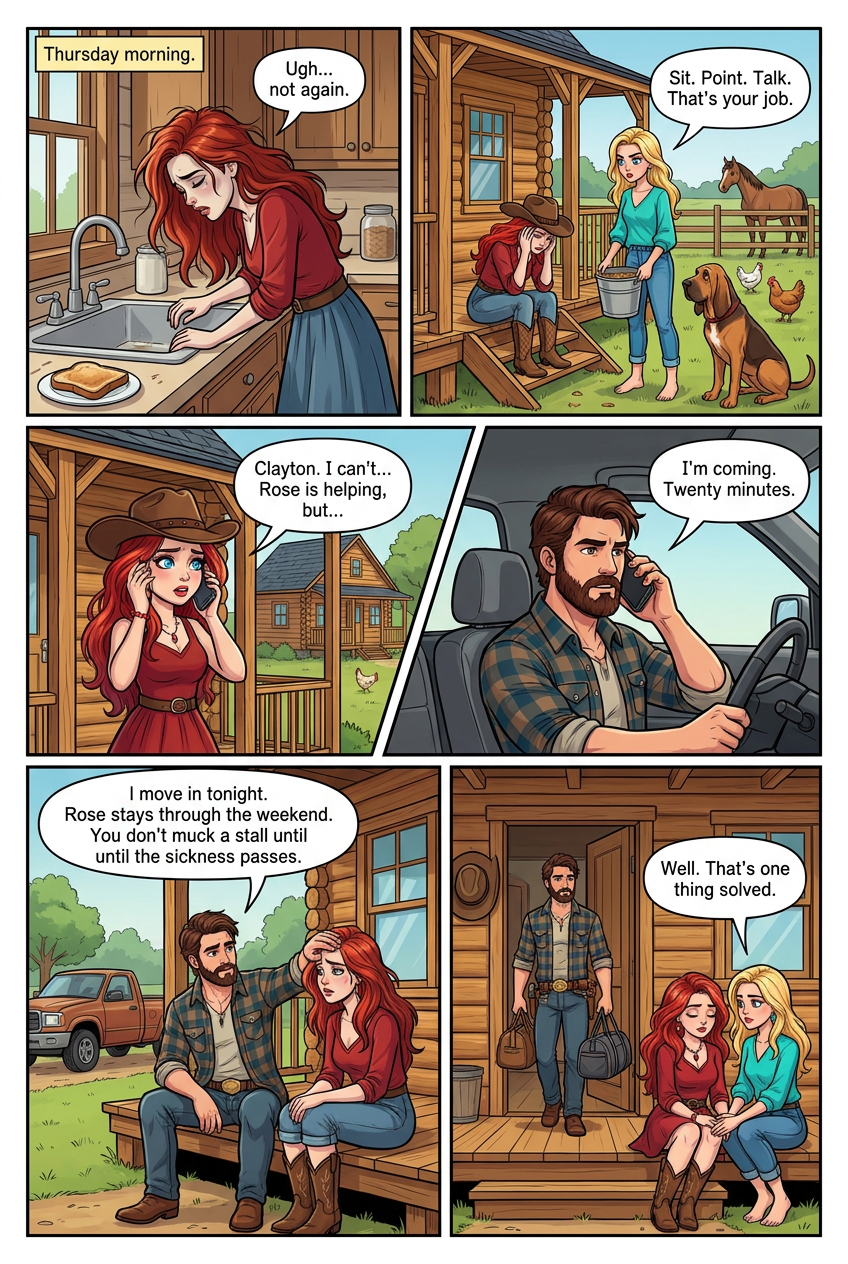
Rose stayed the week. By Thursday morning Scarlett couldn't stand up without the room tilting sideways. She made it to the kitchen sink before the toast came back up. She rinsed her mouth and tried again with a cracker. That went the same way. The barn was already waiting. The mare needed grain. The bloodhound needed water. The hens needed feed and the eggs pulled before the heat spoiled them. Scarlett pulled on her boots and made it as far as the porch step before she had to sit down with her head between her knees. Rose came out in a turquoise blouse and no shoes. She looked at Scarlett once and picked up the feed bucket. "Tell me what goes where," Rose said. "You've never fed a horse." "Then today I learn." Scarlett tried to argue. Rose held up one hand covered in bracelets and shook her head. "Sit. Point. Talk. That's your job." Scarlett sat on the step and pointed. Rose carried grain to the mare with her arms held out like the bucket was radioactive. She came back for the hens and dropped half the feed in the yard. The bloodhound followed her everywhere, delighted. By ten o'clock Rose had straw in her hair and a smear of something down her jeans, and every animal on the property had been fed. She came and sat beside Scarlett on the step. "Call him," Rose said. "He's branding today." "Call him anyway. You can't do this alone and I have a return ticket Sunday." Scarlett called. Clayton picked up on the second ring. She told him plain. She couldn't keep water down. She couldn't work the barn. Rose had done the morning feed and it wasn't going to hold. "I'm coming," he said. "Twenty minutes." "You're branding." "Duke and I are done branding for today." He was there in eighteen. He came up the porch steps and put a hand on her forehead like he was checking a calf. Then he sat down on the step below her so their eyes were level. "Here's what happens," he said. "I move in tonight, not next month. I take the barn morning and evening. Rose stays through the weekend and cooks what you can hold down. Monday I call Maya to come sit days while I'm out working." "Clayton." "You're carrying our kid. You don't muck a stall until the sickness passes." She wanted to argue and couldn't find the words. She nodded instead. He went back to his truck and came out with a duffel he'd already packed. He hung his hat on the hook by the door and carried the bag inside without looking back. Rose watched him go and squeezed Scarlett's knee. "Well," Rose said. "That's one thing solved." Scarlett closed her eyes against the sun. The land was covered. She was not.
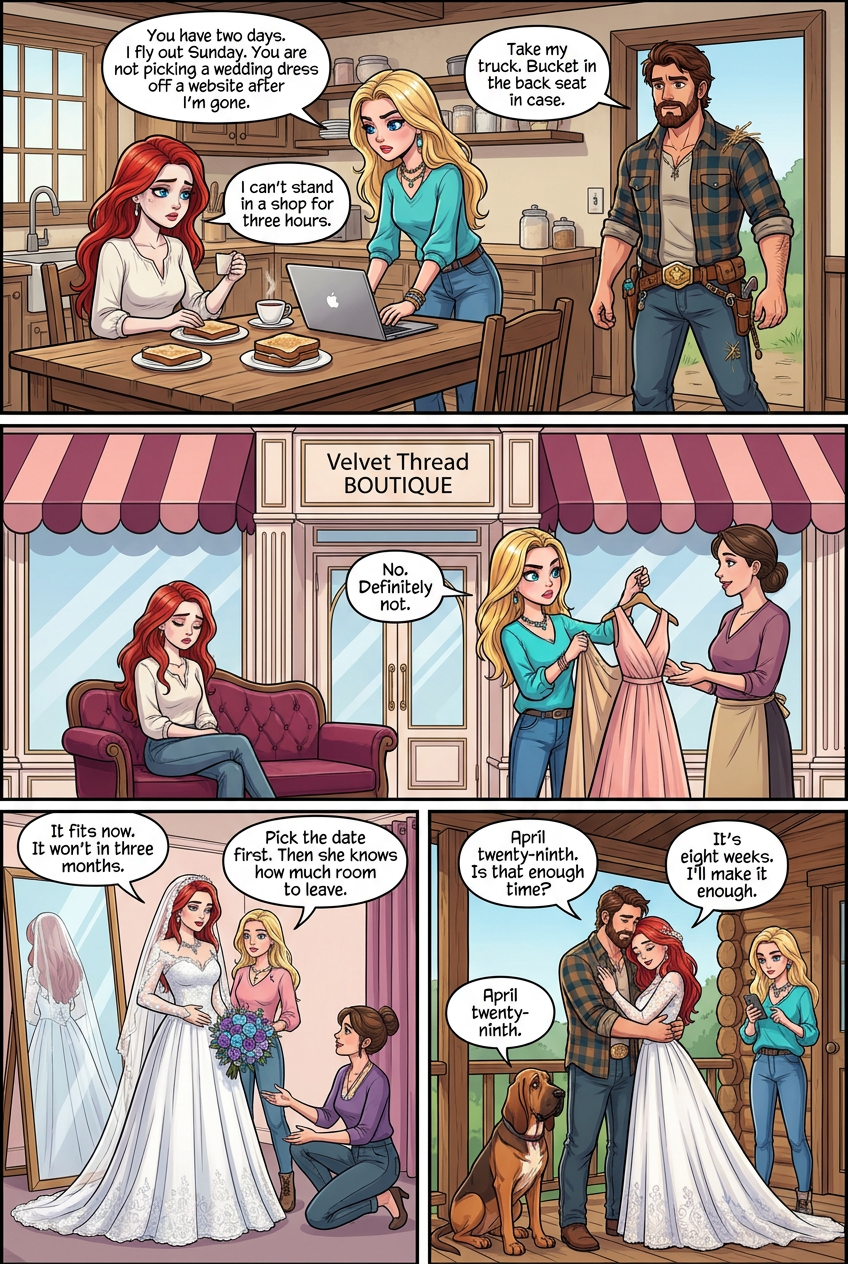
Friday morning the sickness eased enough for Scarlett to keep down dry toast and half a cup of weak tea. Rose watched her chew and then set a laptop on the kitchen table. "You have two days," Rose said. "I fly out Sunday. You are not picking a wedding dress off a website after I'm gone." "I can't stand in a shop for three hours." "Then we go for one hour. I called ahead. She's holding four for you." Clayton came in from the barn with straw on his sleeves. He kissed the top of Scarlett's head and looked at Rose. "Take my truck," he said. "Bucket in the back seat in case." The boutique sat on the corner with striped awnings and two dresses in the window. Scarlett sat on a velvet bench while Rose worked the racks. The shop owner brought water and did not comment on Scarlett's pale face. Rose held up three gowns and shook her head at each one. The fourth was lace, fitted through the bodice, with a long train and a veil that fell like water. A diamond necklace hung on the hanger beside it. Rose held it up and did not speak, which was how Scarlett knew. Scarlett stepped into it behind the curtain. The shop owner pinned the waist. Scarlett looked in the mirror and put a hand flat against her stomach, where nothing showed yet. "It fits now," she said. "It won't in three months." "She can let out the seam," Rose said. "She already told me. Pick the date first. Then she knows how much room to leave." Scarlett thought about the greenhouse. She thought about the citrus already in bloom and what the yard would look like when the wildflowers came up along the fence line. She thought about how big she'd be in June. "April twenty-ninth," she said. Rose wrote it on the shop owner's pad. The shop owner nodded and marked the dress with a tag. She brought out a bouquet sample, blue roses and purple lilies bound with ribbon, and held it against the lace. "That," Rose said. "Exactly that." Scarlett looked at herself in the mirror one more time. The room did not tilt. Her hand stayed on her stomach. "Put it on hold," she said. "I need to show Clayton the date before I sign." They drove home with the receipt folded in Rose's purse. Clayton was on the porch with the bloodhound at his boot. Scarlett handed him the paper. He read it once. "April twenty-ninth," he said. "Is that enough time?" "It's eight weeks. I'll make it enough." He pulled her against his chest. Rose stood on the step behind them, already thumbing through her phone, making a list only she could see.
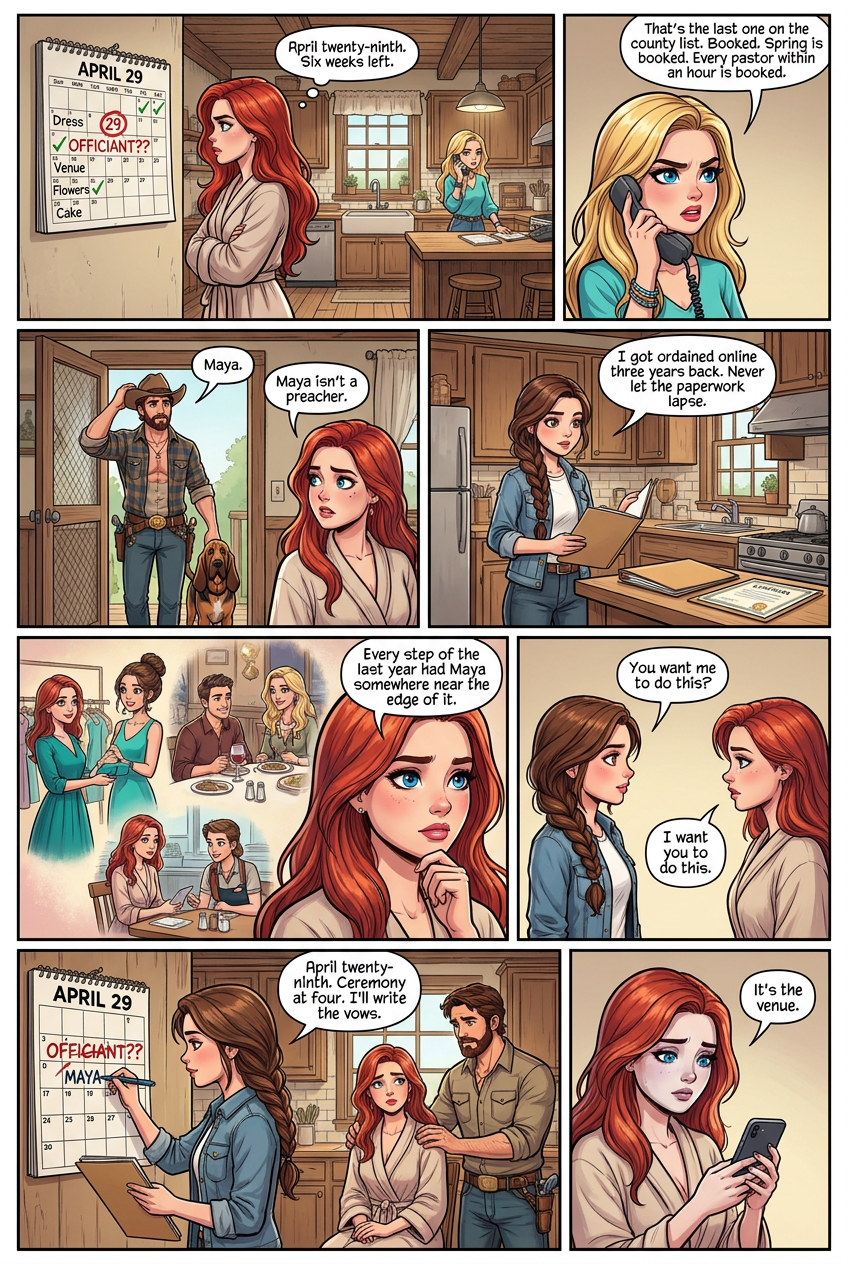
Six weeks after the boutique, Scarlett stood in her kitchen in a robe and stared at the calendar taped to the fridge. April twenty-ninth had a red circle around it. Under the circle, in Rose's handwriting, one line: OFFICIANT?? Every other slot on the list had a check mark. Dress. Venue. Flowers. Cake. The officiant line stayed blank. Rose came in with the phone against her ear and hung up hard. "That's the last one on the county list. Booked. Spring is booked. Every pastor within an hour is booked." "Then we push the date." "You cannot push the date. You will be seven months pregnant in July." Rose set the phone down. "There has to be someone. A judge. A justice of the peace. Anyone with a license." Clayton came in from the porch with the bloodhound behind him. He had heard through the screen. He pulled off his hat and hung it on the hook by the door. "Maya," he said. "Maya isn't a preacher," Scarlett said. "She got ordained online three years back for a friend's wedding. Never let the paperwork lapse. She renews it every January because she likes the certificate." Scarlett looked at him. "You are telling me your sister is a licensed officiant and this is the first I'm hearing about it." "You didn't ask." Rose was already dialing. Maya arrived within the hour with a folder under her arm. She set it on the table and opened it. A certificate. A copy of her state registration. A printed page with the vows she'd used before, marked up in pencil. "I brought the old script so you can see what to cut," Maya said. "I've done four. Two held." "Two held is enough," Clayton said. Maya looked at Scarlett. "You want me to do this?" Scarlett sat down. She thought about Maya at the shop the day of the teal dress, at Sunday supper, at the diner after Madison left town. Every step of the last year had Maya somewhere near the edge of it. "I want you to do this," Scarlett said. Maya nodded once. She pulled a pen from her braid and drew a line through the officiant slot on Rose's list. She wrote her own name above it. "April twenty-ninth," Maya said. "Ceremony at four. I'll write the vows this week and send them for you to change." Rose exhaled and sat down for the first time all morning. Clayton put his hand on the back of Scarlett's neck. "That's the last thing on the list," Rose said. She stared at the calendar. "That's actually the last thing." Scarlett looked at the red circle. Six weeks left. A dress that would need letting out. A greenhouse with citrus already in bloom. A sister to walk her down. And now a woman standing at the front who had helped her get there. Then Rose's phone rang. She looked at the screen and her face changed. "It's the venue," she said.
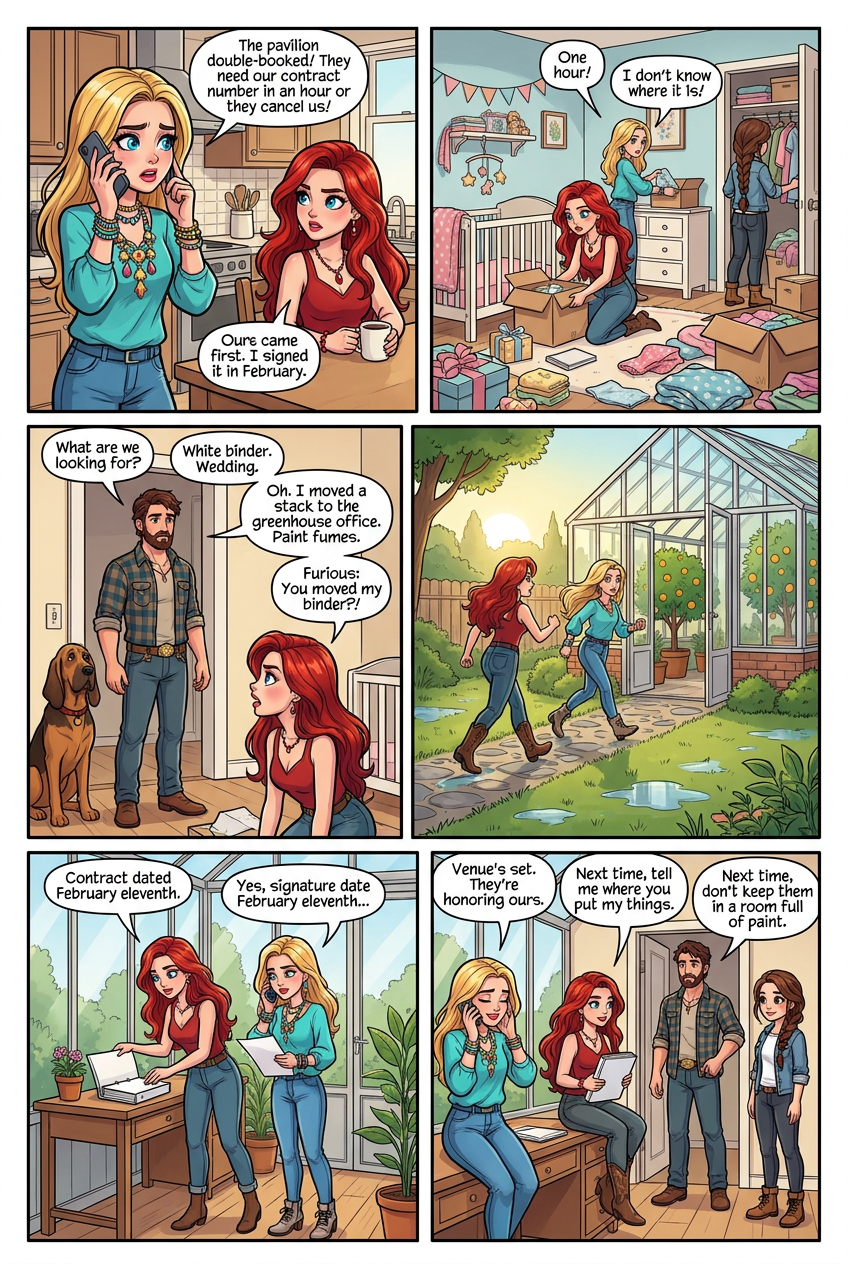
Rose came back into the kitchen with the phone still in her hand. Her face was tight. Scarlett set down her coffee. "The pavilion double-booked April twenty-ninth," Rose said. "A corporate deposit came in the same day as ours. They want to know which contract came first before they cancel the other one." "Ours came first," Scarlett said. "I signed it in February." "They need the contract number. And the deposit date. She wants it in an hour or she goes with whoever calls back first." Maya looked up from the vow pages. "Where's your copy?" Scarlett stood. "The binder. It's in the nursery." The nursery had been the staging room for six weeks. Baby gifts stacked on the crib. Wedding samples on the dresser. Fabric swatches in the rocker. Scarlett pushed the door open and stopped. Rose came in behind her. "Okay. Okay. Where did you have it last?" "I don't know. I've been sick. Clayton was moving boxes." Maya started on the closet. Rose took the dresser. Scarlett knelt at the crib and pulled out a diaper box full of thank-you cards, a shoebox of ribbon samples, a folder of cake sketches. No binder. "One hour," Rose said. Clayton came to the door with the bloodhound at his heel. "What are we looking for." "White binder. Wedding." He thought for a second. "I moved a stack off the rocker last week. Put it in the greenhouse office so the paint fumes wouldn't get on it." Scarlett looked at him. "You moved my binder." "I told you." "You did not." "I said I put the papers somewhere safe." Rose was already at the back door. Scarlett followed her out through the wet grass. The glass house sat at the end of the path, citrus in bloom against the fixed pane. Clayton had built a small desk against the north wall for seed orders. The binder was on it, closed, dry, exactly where he'd left it. Scarlett opened it on the desk. Contract on top. Signature line dated February eleventh. Deposit receipt clipped behind it. She read the numbers to Rose, who read them into the phone. A long pause. Then Rose exhaled. "They're honoring ours. The corporate booking is out. Four o'clock, April twenty-ninth, still ours." Scarlett sat down on the edge of Clayton's desk. Her hand shook once and stopped. Maya came in behind them with the vow folder under her arm. "Venue's set," Rose said. Maya nodded. "Then we're done stopping." Clayton stood in the doorway. He didn't say anything. Scarlett closed the binder and held it against her chest. "Next time," she said to him, "tell me where you put my things." "Next time," he said, "don't keep them in a room full of paint." Rose laughed once, short, and pulled the pen from Maya's braid to check the last line off the list.
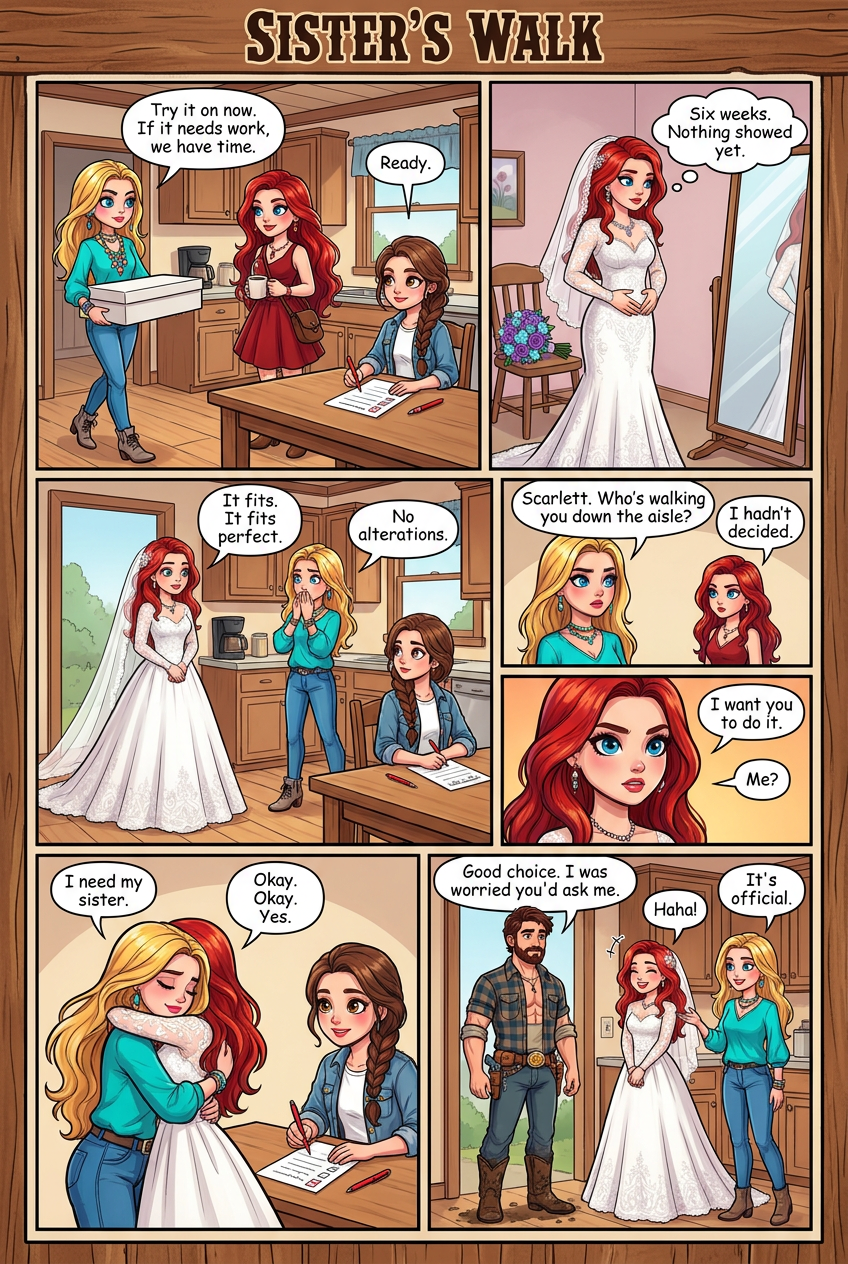
The dress arrived in a long white box on Tuesday morning. Rose carried it in from the porch and set it on the kitchen table like it might break. Scarlett was already up, past the worst of the sickness, coffee in hand. Maya sat across from her with the checklist and a red pen. "Try it on now," Rose said. "If it needs work, we have time. If it doesn't, we know." Scarlett went to the bedroom and closed the door. The lace slid over her shoulders. The bodice held. The train fell clean behind her. She turned once in the mirror and pressed her hand flat to her stomach. Six weeks. Nothing showed yet under the fitted lace. The seamstress had cut it with room. Scarlett stepped out into the kitchen. Rose put a hand over her mouth. Maya set the pen down. "It fits," Rose said. "It fits perfect." Scarlett let out a breath she had been holding since the boutique. "No alterations." "None," Rose said. She circled her once, tugged the veil straight, stepped back. Then her face changed. "Scarlett. Who's walking you down the aisle?" Scarlett looked at her. She had not written it on any list. Their father had been gone six years. There were uncles, but none she wanted. There was Clayton's father, but he would already be seated. The room got quiet in a way the dress did not fix. "I hadn't decided," Scarlett said. Maya picked her pen back up but did not write. Rose stood in front of her in her turquoise blouse, jewelry catching the window light, city boots on the pine floor. She had come out from the city on a train and stayed through the sickness and the freeze and the venue call. She had cooked. She had painted the nursery trim. She had answered the pavilion in one hour flat. "I want you to do it," Scarlett said. Rose's eyes went wide. "Me." "You've been the one standing next to me the whole time. Dad would want somebody who showed up. You showed up." Rose's mouth opened, closed. She looked down at her boots, then back up. "I'm not a man in a suit." "I don't need a man in a suit. I need my sister." Rose crossed the kitchen and hugged her hard, careful of the lace. "Okay," she said into Scarlett's shoulder. "Okay. Yes." Maya wrote a line on the checklist and drew a box beside it and checked the box. Clayton came in from the barn with mud on his boots. He stopped at the door when he saw the dress. He did not step inside. "Rose is walking me down," Scarlett said. He nodded once. "Good choice." Then, dry, "I was worried you'd ask me." Scarlett laughed, and the last knot in her chest let go.
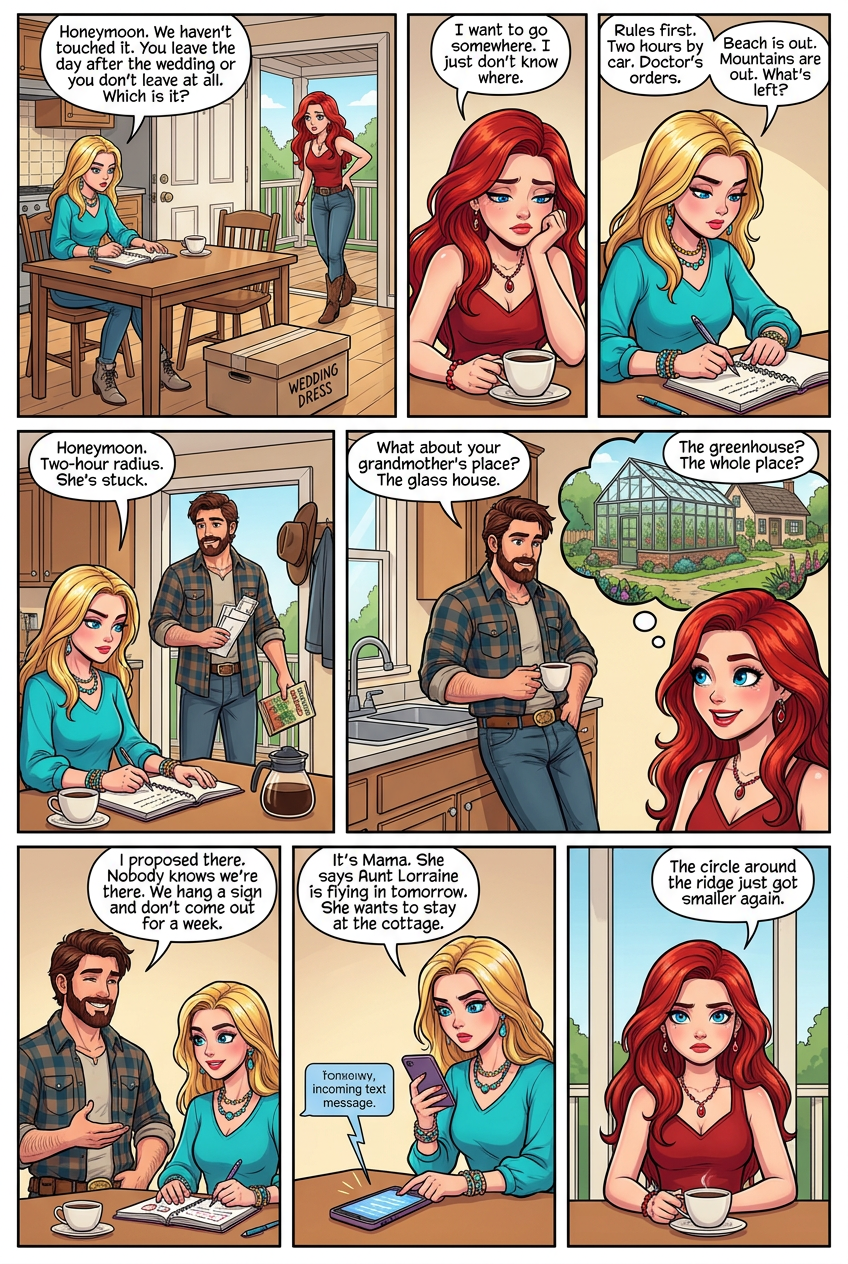
The dress was back in its box by Wednesday morning. Rose sat at the kitchen table with a fresh notebook and tapped her pen against the rim of her coffee cup. Scarlett came in from the porch with a hand pressed to her lower back. The nausea had eased, but the doctor had been clear. No long drives. No planes. Not at six weeks along, not with how sick she had been. "Honeymoon," Rose said. "We haven't touched it. You leave the day after the wedding or you don't leave at all. Which is it?" Scarlett sat down slow. "I want to go somewhere. I just don't know where." "Rules first," Rose said, pen ready. "How far?" "Two hours by car. That's what the doctor said. No more." Rose wrote it down and underlined it twice. "Beach is out. Mountains are out. What's left?" Scarlett stared at her coffee. She had pictured a real trip once, before the pregnancy. Somewhere with an ocean. Now the map shrank to a small circle around the ridge, and inside that circle she could not think of a single place that felt like theirs. A hotel in town felt wrong. A cabin she'd never seen felt worse. She wanted somewhere that meant something to both of them, and she did not know where that was. Clayton came through the door with the mail. He set a seed catalog on the counter and looked at the notebook. "Honeymoon," Rose said before Scarlett could speak. "Two-hour radius. She's stuck." Clayton took off his hat and hung it on the hook. He poured himself coffee and leaned against the sink. "What about your grandmother's place," he said. Scarlett looked up. "The greenhouse?" "The whole place. The glass house. The cottage. I proposed there. You said yes there. It's ten minutes down the ridge." He took a slow drink. "Nobody knows we're there. Nobody calls. I hang a sign on the gate and we don't come out for a week." Rose set her pen down. Scarlett felt it settle in her chest, clean and immediate. The place he had rebuilt for her, one pane at a time, over a whole year before she knew. The place he had asked her to marry him. Ten minutes from the doctor. Ten minutes from the barn if anything went wrong. "Yes," she said. "There." Clayton nodded once. "I'll hang the sign Friday before the wedding." Rose wrote it in the notebook and drew a box and checked it. Then her phone buzzed on the table. She looked at the screen and her face changed. "It's Mama," she said. "She says Aunt Lorraine is flying in tomorrow. She wants to stay at the cottage." Scarlett set her cup down. The circle around the ridge had just gotten smaller again.
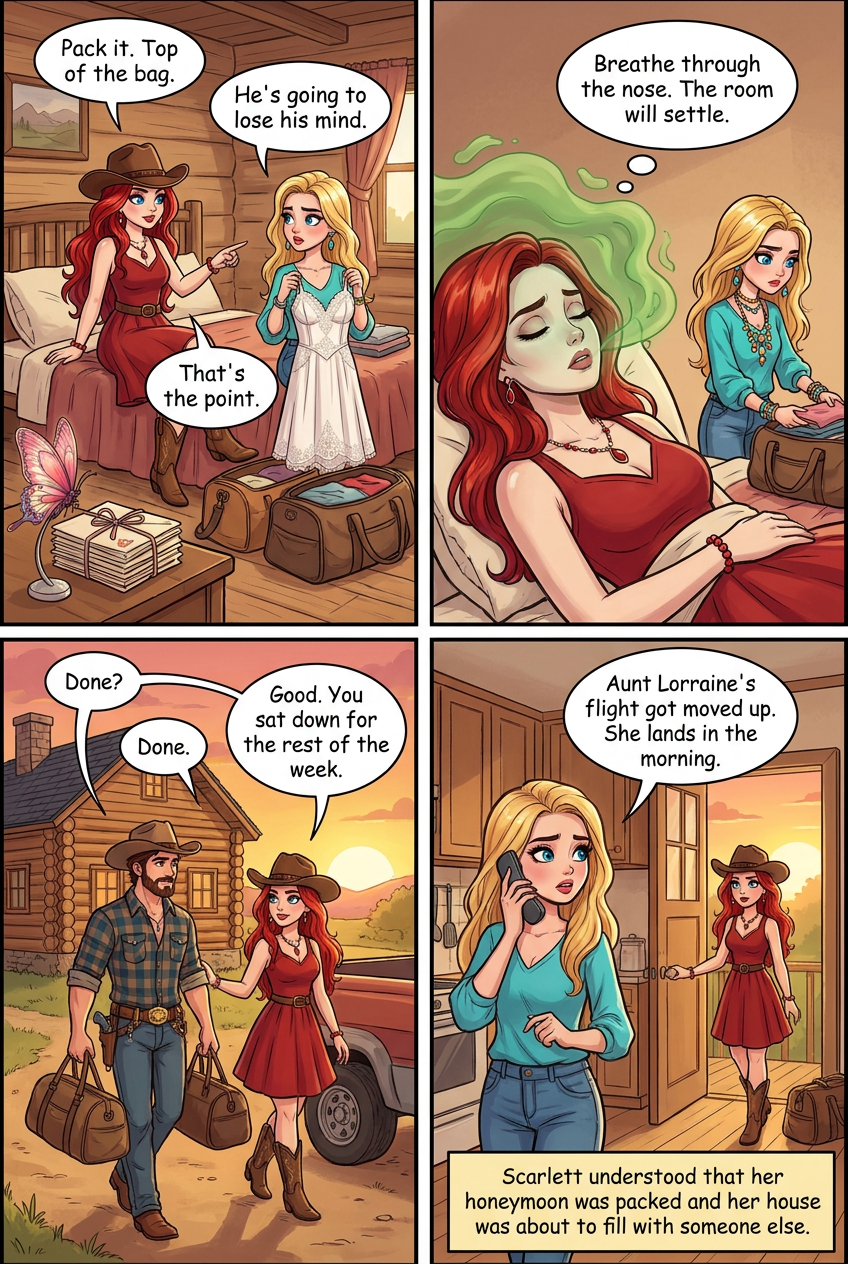
Aunt Lorraine's flight landed at noon Thursday, which gave Scarlett one day. One day to pack for a week away from her own house, and one day before her body stopped cooperating. The nausea had been quiet three mornings running. She did not trust it to last. Rose stood in the bedroom doorway with two empty duffel bags. "Sit on the bed. Point. I fold." Scarlett sat. Her back ached already. "Toothbrush. The blue sweater. Two pairs of the stretchy jeans, the ones that don't cut." Rose moved through the drawers. She held up a folded white bundle and stopped. "What about this." Scarlett had bought the nightgown the same afternoon as the dress and hidden it in the bottom drawer. Lace across the bodice. A long skirt that fell soft. She had not looked at it since. "Pack it," Scarlett said. "Top of the bag." Rose laid it in careful. "He's going to lose his mind." "That's the point." A wave hit her then, slow and green. She lay back against the pillow and breathed through her nose until the room settled. Rose kept folding without comment. That was the deal they'd made. No fussing. Just motion. When Scarlett could sit up again, she opened the drawer of her nightstand and took out a bundle tied with a ribbon. Letters. She had written one to Clayton every week for the past year and never sent a single one. Some were three lines. Some were three pages. She had meant to burn them after the wedding. "Bag," she said, and handed them to Rose. Rose looked at the ribbon. "What are these." "Something for him to read. One a night." Rose tucked them beside the nightgown. "You've been holding out on me." "I hold out on everybody." By three o'clock the two duffels sat zipped by the door. Prenatal vitamins. Doctor's number on a card in the front pocket. A book she had not opened in a month. Clayton's spare flannel because she slept better in it. Clayton came in from the barn and looked at the bags. He didn't ask. He picked them up and carried them to the truck and set them behind the seat. Then he came back and put his hand flat on her lower back. "Done?" he said. "Done." "Good. You sat down for the rest of the week." She let him steer her to the couch. Rose brought crackers without being asked. Outside, the sun dropped behind the ridge and the barn light clicked on by itself. The phone rang. Rose picked it up in the kitchen. Scarlett heard her sister's voice go careful, then quiet, then careful again. Rose came back holding the receiver against her shoulder. "Aunt Lorraine's flight got moved up. She lands in the morning. She wants me to pick her up at seven." Scarlett looked at the bags by the door and understood that her honeymoon was packed and her house was about to fill with someone else.
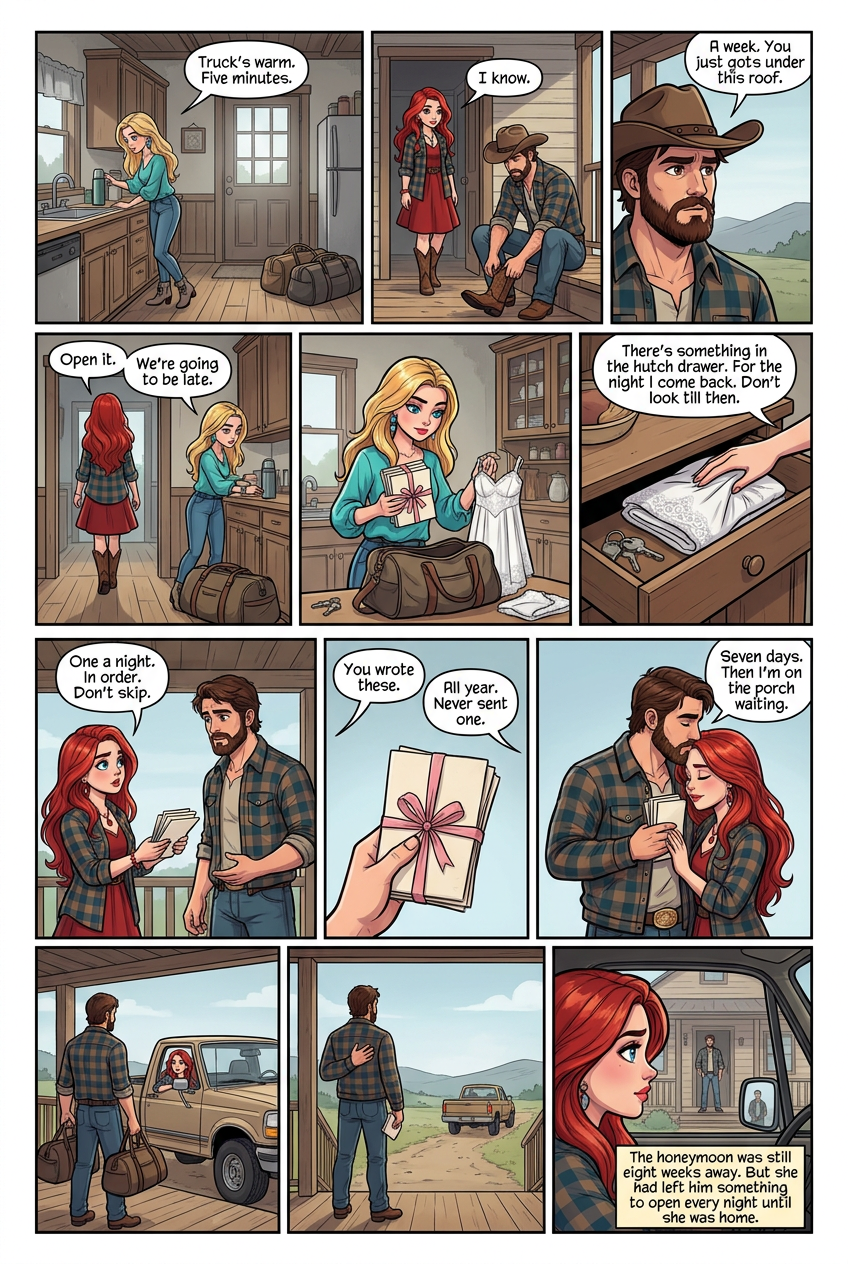
Morning came gray and cold. Rose was already in the kitchen with her keys, her turquoise earrings swinging as she hunted for the thermos. The duffels still sat by the door. Scarlett stood in the hallway in Clayton's flannel and watched him lace his boots on the porch step through the open door. He hadn't said ten words since the phone rang last night. She knew that quiet. He wore it when he was working something through and didn't want to spill it before he'd sorted it. But his shoulders were set wrong. He tied the same boot twice. Rose touched her elbow. "Truck's warm. Five minutes." Scarlett walked out to the porch. Clayton stood up and looked past her at the ridge. "A week," he said. "You just got me under this roof." "I know." "I'm not saying don't go." "I know that too." He finally looked at her. His mouth was doing the thing where he was trying not to make it her problem. It made it worse. She had rehearsed nothing. She had packed letters for the honeymoon and a nightgown for a night that was now a week further away, and she had not thought once about what to leave him with this morning. She felt the gap open under her. She went back inside. Rose was zipping the second duffel. "Open it," Scarlett said. "We're going to be late." "Open it." Rose unzipped the bag. Scarlett lifted out the bundle of letters and untied the ribbon. She counted seven off the top and set the rest back. Then she pulled the lace nightgown out of its tissue, folded it small, and pushed it into the bottom of the top drawer of the kitchen hutch where he kept his keys. She carried the seven letters out to the porch. "One a night," she said. "In order. Don't skip." He took them. He turned the top one over in his hand. His name was on it in her writing, dated eleven months ago. "You wrote these." "All year. Never sent one." He pressed his thumb along the ribbon. "Scarlett." "There's something in the hutch drawer," she said. "For the night I come back. Don't look till then." He nodded once. He put the letters inside his jacket, against his shirt. "Seven days," he said. "Then I'm on the porch waiting." "I'll see you from the road." He kissed her forehead and held it there a second longer than he needed to. Then he picked up both duffels and carried them to Rose's truck himself. Scarlett climbed in. Rose put it in gear. Clayton stood in the drive with one hand flat on his jacket over the letters, and he stayed there until the ridge cut him out of the mirror. The honeymoon was still eight weeks away. But she had left him something to open every night until she was home.
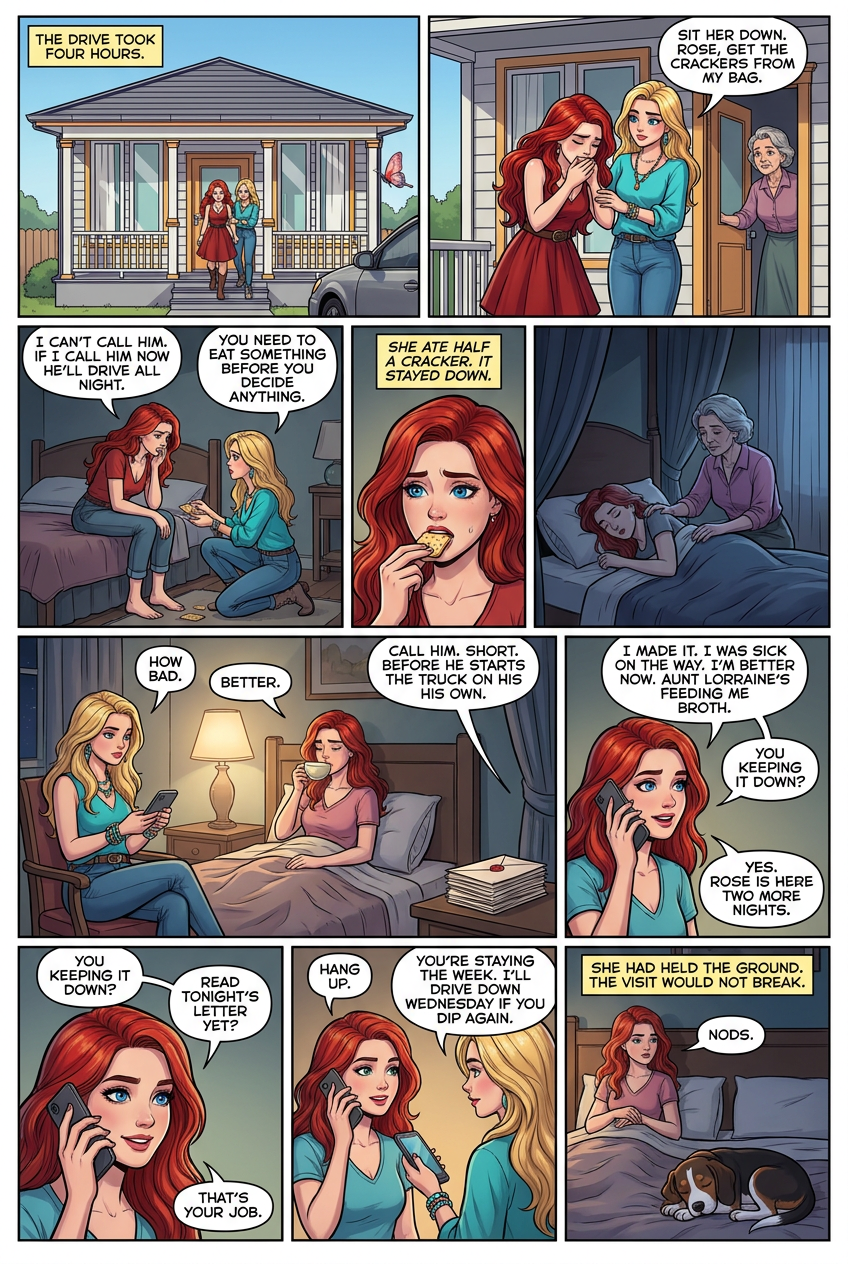
The drive took four hours. Aunt Lorraine's small city house sat behind a low porch railing, the front windows dressed with white curtains. Rose parked at the curb and helped Scarlett out. Scarlett made it up the three steps before her stomach turned. She got to the bathroom just in time. Aunt Lorraine met them in the hall with a glass of ginger water. She was thinner than Scarlett remembered, her hands quick and worried. "Sit her down. Rose, get the crackers from my bag." Scarlett sat on the edge of the guest bed. The room smelled like lemon polish and warm dust. She had thrown up twice on the road already. Her head ached behind her eyes. "I can't call him," she said. "If I call him now he'll drive all night." Rose knelt in front of her with the sleeve of crackers. "You need to eat something before you decide anything." "He'll hear it in my voice." "Then don't call yet." Scarlett ate half a cracker. It stayed down. She ate another. Aunt Lorraine sat on the bed beside her and put a cool hand on the back of her neck the way their mother used to. "Lie down," Aunt Lorraine said. "An hour. Then we try broth." Scarlett lay back. Rose pulled the curtain across the window. The light went gray and soft. Scarlett closed her eyes and listened to Rose and Aunt Lorraine talking low in the kitchen, the clink of a spoon in a pot. She woke to broth on the nightstand. She drank half the mug. It stayed down too. Rose sat in the chair by the bed, phone in her lap, her turquoise bracelet catching the lamp. "How bad," Rose said. "Better." "Truth." "Better. Really. The crackers worked." Rose watched her a long minute. "I told Aunt Lorraine you sleep with the window cracked and you can't smell coffee before ten." "You didn't have to stay." "I'm staying two nights. Then I go back and cook for your husband so he doesn't live on cereal." Rose held up her phone. "Call him. Short. Before he starts the truck on his own." Scarlett took the phone. Clayton answered on the first ring. "I made it," she said. "I was sick on the way. I'm better now. Aunt Lorraine's feeding me broth." A long breath on his end. "You keeping it down?" "Yes. Rose is here two more nights." "Good." His voice steadied. "Read tonight's letter yet?" "That's your job." He almost laughed. "Call me tomorrow morning." "I will." She hung up. Rose took the phone back and set it face down on the nightstand. "You're staying the week," Rose said. "I'll drive down Wednesday if you dip again." Scarlett nodded. She had held the ground. The visit would not break.
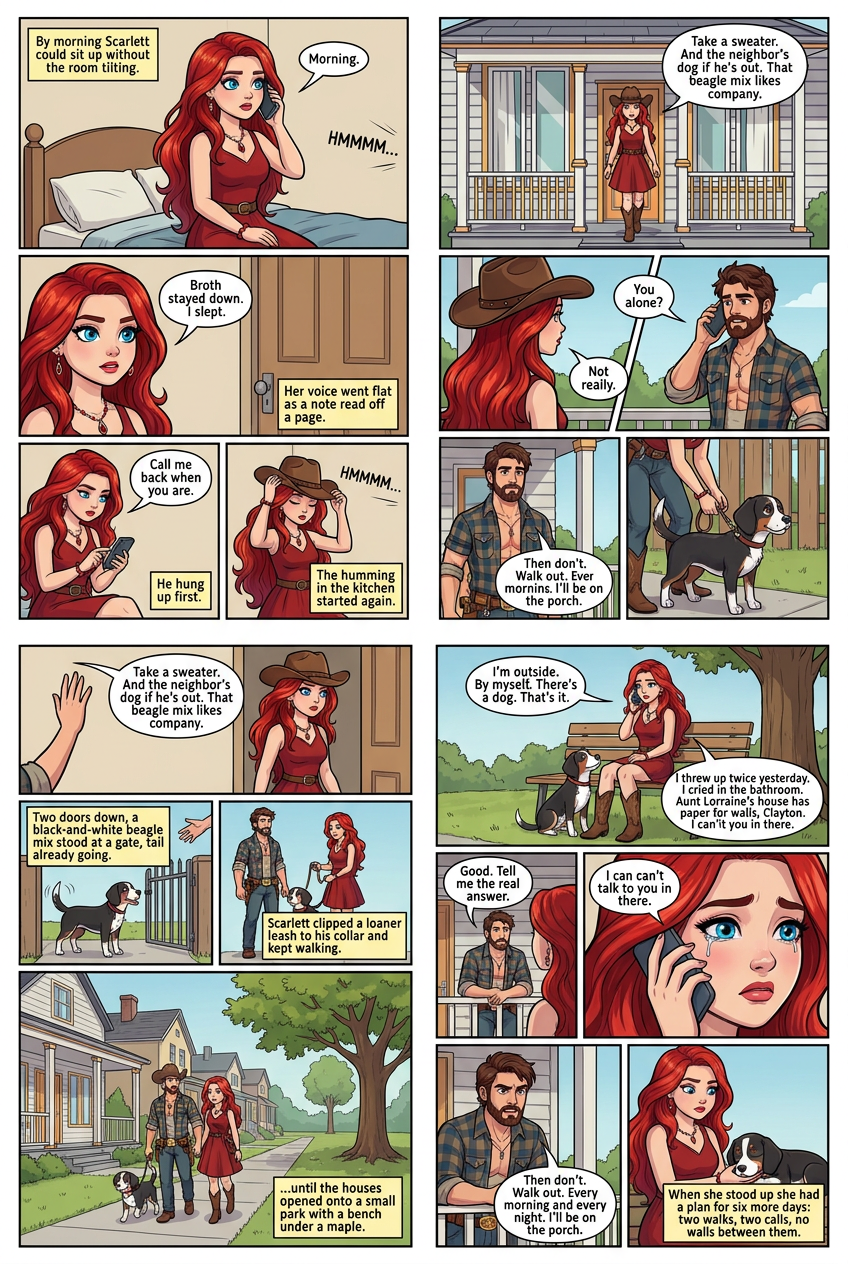
By morning Scarlett could sit up without the room tilting. Rose brought her toast and left for a walk to give her the phone. Scarlett dialed Clayton from the guest bed. Aunt Lorraine was in the kitchen two thin walls away, humming while she washed a pan. The bedroom door didn't latch clean. Scarlett heard the humming stop when she said his name. "Morning," Clayton said. "Morning." She wanted to tell him she'd read the letter he was on tonight before he did. She wanted to say the things she'd only ever written down. She looked at the door and said, "Broth stayed down. I slept." Her voice went flat as a note read off a page. A pause. "You alone?" "Not really." "Call me back when you are." He hung up first. Scarlett set the phone on her knee. The humming in the kitchen started again. She had six more days of this. Six more mornings of weather-report calls while Aunt Lorraine listened through the wall. Clayton would stop reaching. She knew him. He'd go quiet to protect her, and quiet was the thing she couldn't afford. She got dressed. She found Aunt Lorraine at the sink. "I need to walk," Scarlett said. "Just the block. I'll take my phone." Aunt Lorraine looked her over. "Take a sweater. And the neighbor's dog if he's out. That beagle mix likes company." The front of the house was a small one-story with a low porch and white curtains. Scarlett went down the three steps and turned along the sidewalk. Two doors down, a black-and-white beagle mix stood at a gate, tail already going. His owner nodded from the porch and waved her on. Scarlett clipped a loaner leash to his collar and kept walking until the houses opened onto a small park with a bench under a maple. She sat. The dog leaned against her boot. She called Clayton. "I'm outside," she said. "By myself. There's a dog. That's it." "Good." His breath came out. "Tell me the real answer." "I threw up twice yesterday on the road. I cried in the bathroom last night because I couldn't hear you right through the wall. Aunt Lorraine's house has paper for walls, Clayton. I can't talk to you in there." "Then don't. Walk out. Every morning and every night. I'll be on the porch." "Every call?" "Every call." She pressed her hand flat on the bench. "Last night's letter. Did you open it?" "Yeah." "Tell me which one." He told her. She closed her eyes and remembered writing it, a year ago, at her kitchen table, not sure he'd ever read a word of her. They talked forty minutes. The beagle mix slept on her foot. When she stood up she had a plan for six more days: two walks, two calls, no walls between them.
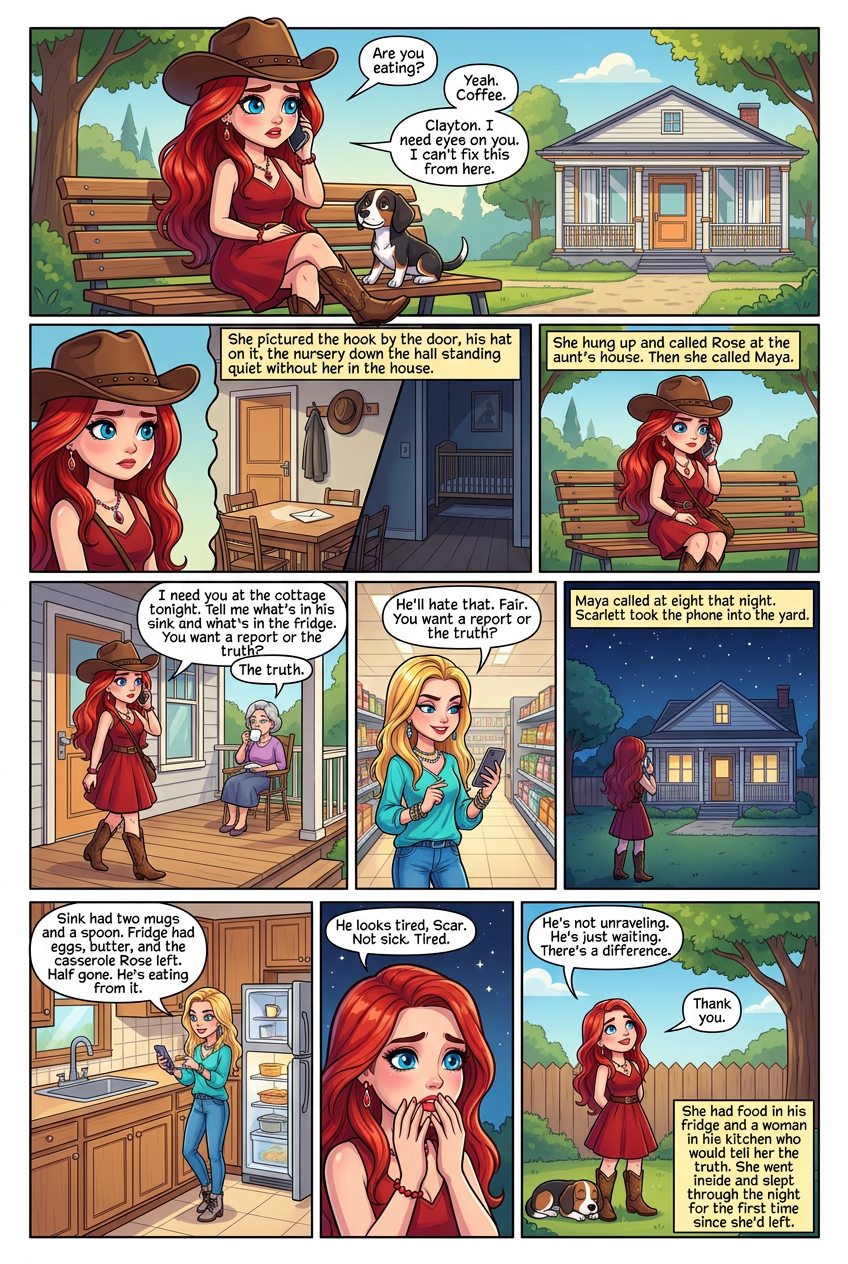
By the third day the calls had a shape, but the shape wasn't enough. Scarlett walked the beagle mix twice a day and heard Clayton's voice steady on the line. He said the barn was fine. He said the mare was fine. He said he was fine. Scarlett sat on the park bench with the dog on her boot and knew that word from him could mean anything. "Are you eating?" she asked that morning. "Yeah." "What." A pause. "Coffee." "Clayton." "I ate last night." "What time did you sleep?" He didn't answer. She pressed the phone against her ear and heard porch wind on his end. She pictured the hook by the door, his hat on it, the nursery down the hall standing quiet without her in the house. She pictured him opening a letter at the kitchen table with nothing on the stove. "I need eyes on you," she said. "I can't fix this from here." "I'm not asking you to." "I know. I'm asking me to." She hung up and called Rose at the aunt's house. Then she called Maya. Maya picked up on the second ring. Scarlett had leaned on her through every hard corner of the last year, and Maya had never once made her ask twice. "I need you at the cottage tonight," Scarlett said. "Bring groceries. Cook something. Tell me what's in his sink and what's in the fridge and whether he slept." "He'll hate that." "He'll eat it." "Fair." Maya's voice went dry. "You want a report or the truth?" "The truth." Scarlett walked back to the cedar street house. Aunt Lorraine was on the porch with a mug. Scarlett sat on the top step and waited. Maya called at eight that night. Scarlett took the phone into the yard. "Sink had two mugs and a spoon," Maya said. "Fridge had eggs, butter, and the casserole Rose left. Half gone. He's eating from it. He looks tired, Scar. Not sick. Tired. He's up before four working the barn so he can sit on the porch by dark to read your letter." Scarlett pressed her hand to her mouth. "I made him a pot of stew," Maya said. "Enough for four nights. I'll come back Friday. I told him I'd sit with him Saturday too. He argued for about a minute, then he asked what time." "Thank you." "He's not unraveling. He's just waiting. There's a difference." Scarlett stood in the yard and let that land. Three more days. He was tired, not breaking. She had eyes on him now. She had food in his fridge and a woman in his kitchen who would tell her the truth. She went inside and slept through the night for the first time since she'd left.
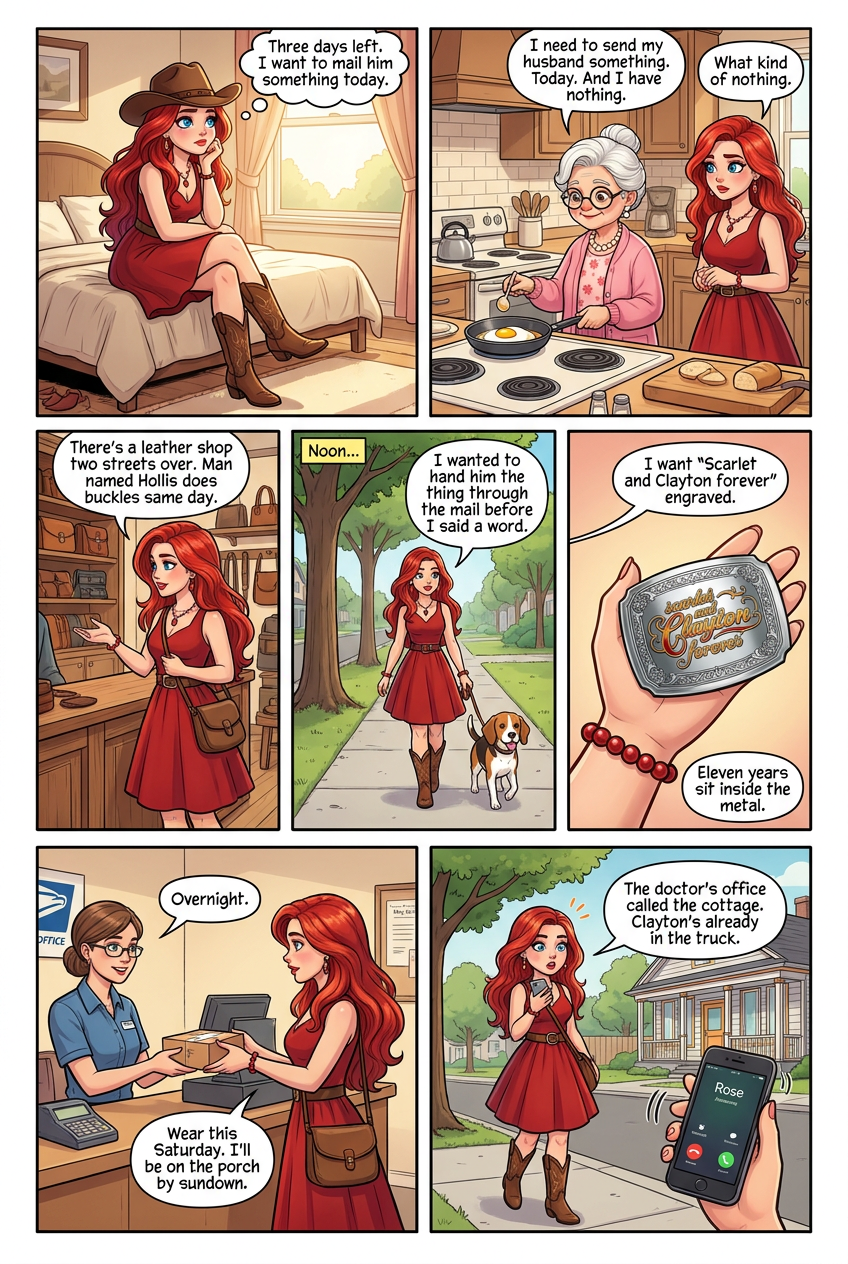
Scarlett woke on the fourth morning with the same thought she'd gone to sleep with. Maya's report had settled her nerves, but it hadn't given Clayton anything to hold. He had her letters at night. He had stew in the fridge. He had nothing from her hands this week, nothing from this town, nothing he could put in his pocket and carry into the barn before dawn. She sat up. Three days left. She wanted to mail him something today so it arrived before she did. She went through her suitcase first. A folded blouse. A hairbrush. The lace nightgown she was saving for the porch. None of it was for him. She opened the drawer Aunt Lorraine had cleared for her and found only her own things staring back. Aunt Lorraine was in the kitchen frying an egg. Her pink slippers scuffed the linoleum. She wore the pink cardigan she wore every morning and the pearl earrings she never took off. "I need to send my husband something," Scarlett said. "Today. And I have nothing." Aunt Lorraine slid the egg onto a plate. "What kind of nothing." "The kind where a card feels thin." Aunt Lorraine set the pan in the sink. She looked at Scarlett over her round glasses. "There's a leather shop two streets over. Man named Hollis works the counter. He does buckles same day if you ask nice and pay cash." "A buckle." "Your husband wears a belt, doesn't he." Scarlett was out the door in twenty minutes. The shop smelled like oil and cut hide. The owner listened while she stood at the counter with her purse against her stomach. She told him what she wanted engraved. She told him she needed it by three. He wrote it on a slip and quoted her a price that made her hand shake when she counted the bills. She paid it. She walked the beagle mix at noon and did not call Clayton. She wanted to hand him the thing through the mail before she said a word about it. At three she went back. The owner slid the buckle across the counter on a square of felt. Polished silver. Bold lettering across the face. Scarlet and Clayton forever, her name spelled the way Clayton had first said it wrong at the fair. She hadn't corrected the engraver either. She ran her thumb over the letters and felt the whole eleven years sit inside the metal. She boxed it at the post counter with a note that said only, Wear this Saturday. I'll be on the porch by sundown. She paid for overnight. Walking back to the cedar street house, she felt lighter than she had all week. Then her phone buzzed. Rose. Scarlett answered on the sidewalk. "The doctor's office called the cottage," Rose said. "They want you in tomorrow. Clayton's already in the truck."
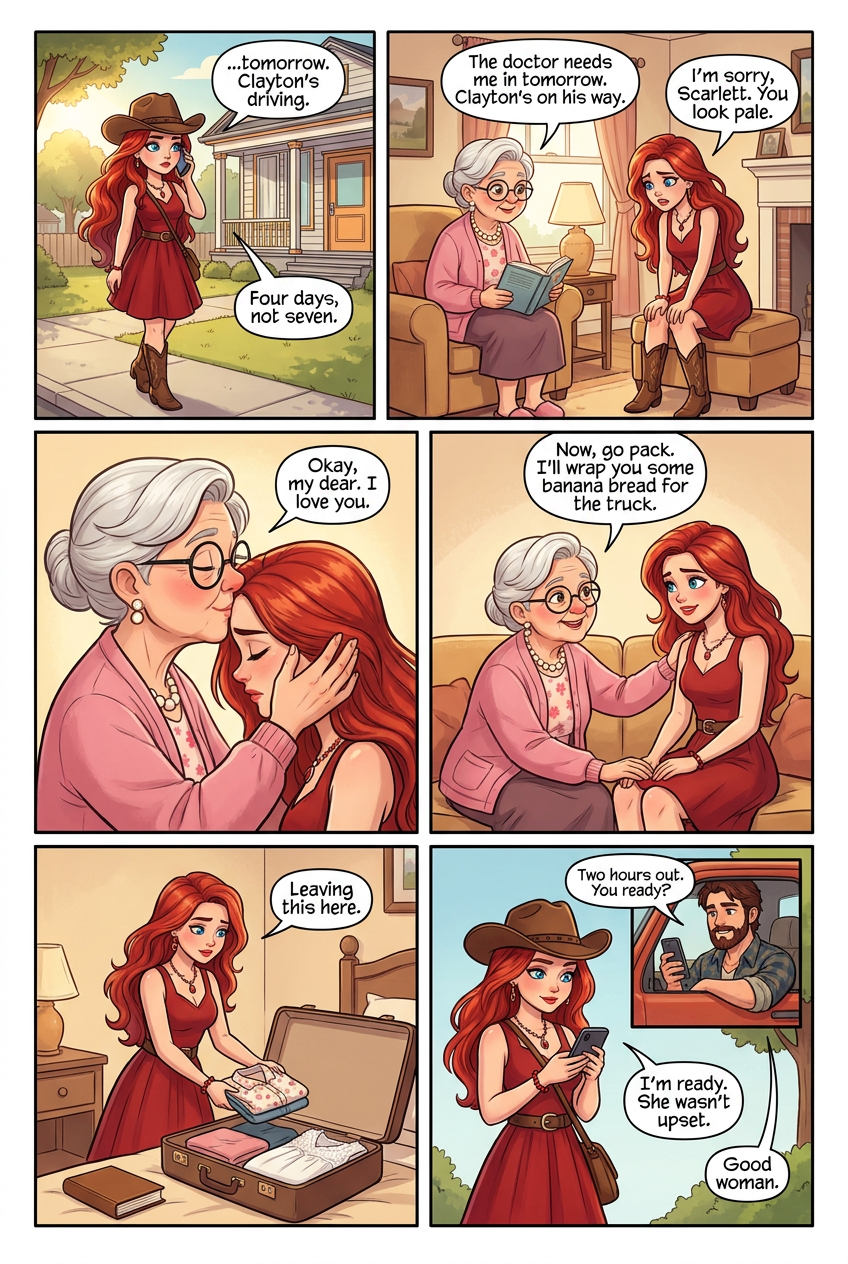
Scarlett hung up with Rose on the sidewalk outside the cedar street house. The doctor wanted her tomorrow. Clayton was already driving. That meant she had to tell Aunt Lorraine tonight that she wasn't staying the full week. She walked back slowly. She had come for seven days. It had been four. Aunt Lorraine had cleared a drawer for her, bought crackers in three flavors, and read aloud from a storybook the first night like Scarlett was still eight. Cutting the visit short felt like taking back a gift already opened. Inside, Aunt Lorraine was on the couch in her pink cardigan, a paperback open on her lap. She looked up over her round glasses. "You look pale again," she said. "Sit down." Scarlett sat on the ottoman. She put her hands flat on her knees. "The doctor's office called the cottage," Scarlett said. "They want me in tomorrow. Clayton's already on the road to come get me." Aunt Lorraine closed the paperback on her finger to hold the page. "I'm sorry," Scarlett said. "I know I said a week. I wanted a week. I just —" "Scarlett." Scarlett stopped. Aunt Lorraine set the book aside. She leaned forward and took Scarlett's face in both hands. Her palms smelled like the hand cream she kept on the kitchen sill. She pressed a kiss to Scarlett's forehead and held it a second longer than a kiss usually lasted. "Okay, my dear," she said. "I love you. You keep me posted on those babies. And you don't hesitate to call if you need anything. Day or night." Scarlett's eyes filled. "That's it?" "That's it." Aunt Lorraine sat back. "I had you four days I wasn't going to get. That's four more than I planned on Monday." Scarlett breathed out for what felt like the first time all afternoon. She had braced for a wounded silence, for the pink slippers scuffing off down the hall. Instead her aunt patted her knee and stood up. "Now," Aunt Lorraine said, "go pack. I'll wrap you some banana bread for the truck. That man of yours drove all day, he'll want something in his hand." Scarlett went to the guest room and opened the drawer. The lace nightgown was already back in the suitcase. She folded the blouse on top. She left the storybook Aunt Lorraine had read from on the nightstand, so there'd be a reason to come back. Her phone buzzed on the dresser. Clayton. "Two hours out," he said. "You ready?" "I'm ready." She looked at the open suitcase. "She wasn't upset. She kissed my forehead and told me to call." "Good woman." "Drive careful." "Always do." She hung up and zipped the bag. Tomorrow was the doctor. Tonight was the truck, the road home, and whatever the doctor had called about that couldn't wait three more days.
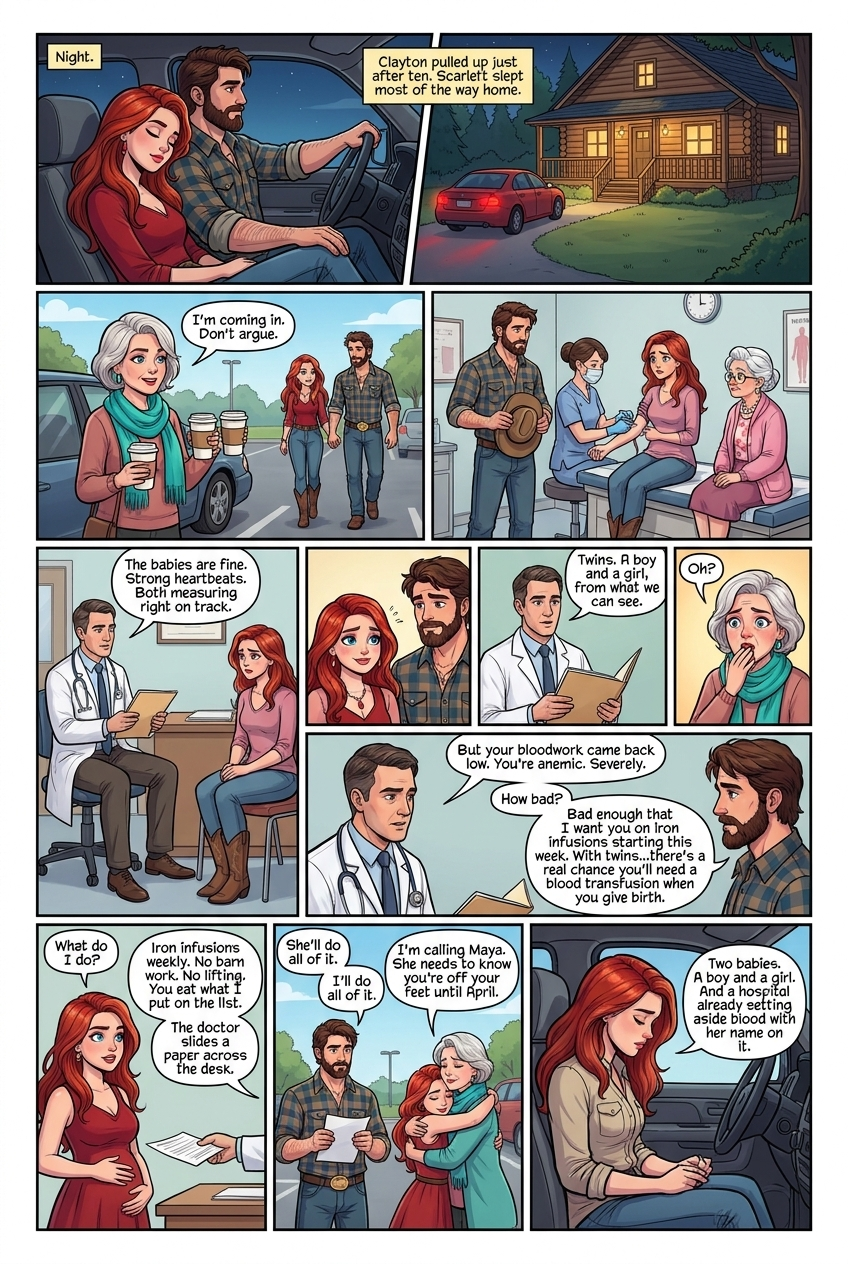
Clayton pulled up just after ten. Scarlett was on the porch with her bag and a foil-wrapped loaf. Aunt Lorraine stood in the doorway in her pink cardigan, waving until the taillights turned at the end of the drive. Scarlett slept most of the way home. Clayton drove with one hand and kept the other on her knee. The doctor's office opened at eight. Rose met them in the parking lot with two coffees and a decaf for Scarlett. She wore a turquoise scarf and no makeup, which meant she'd left the cottage before sunrise. "I'm coming in," Rose said. "Don't argue." Scarlett didn't argue. The nurse took blood before the doctor came in. Then she took more. Scarlett sat on the paper-lined table with Clayton on her left and Rose on her right. Clayton held his hat in both hands. Rose held Scarlett's hand. The doctor came in with a folder and sat down instead of standing. Scarlett's stomach dropped. "The babies are fine," the doctor said first. "Strong heartbeats. Both measuring right on track." Scarlett breathed out. Clayton's shoulders dropped an inch. "Twins," the doctor said. "A boy and a girl, from what we can see." Rose made a sound Scarlett had never heard her make. "But your bloodwork came back low," the doctor said. "You're anemic. Severely. That's why you've been so sick, and why the trip wore you out." "How bad," Clayton said. "Bad enough that I want you on iron infusions starting this week. And I need you to understand something before the delivery." The doctor looked at Scarlett, then at Clayton. "With twins and numbers like these, there's a real chance you'll need a blood transfusion when you give birth. We plan for it now, not in the room." Scarlett kept her hand flat on her stomach. Two of them. A boy and a girl. And her own blood too thin to carry them across the finish line without help. "What do I do," she said. "Iron infusions weekly. No barn work. No lifting. You eat what I put on the list. You sleep when your body asks." The doctor slid a page across. "And we type and cross-match you now so the hospital has units ready on your delivery date." Clayton took the page before Scarlett could reach it. He folded it into his shirt pocket. "She'll do all of it," he said. "I'll do all of it," Scarlett said. In the parking lot, Rose hugged her hard and didn't let go for a long time. Then Rose stepped back and wiped her face with the turquoise scarf. "I'm calling Maya," Rose said. "She needs to know you're off your feet until April. She'll set up a schedule." Clayton opened the truck door. Scarlett climbed in slowly. She looked at her hands in her lap. Two babies. A boy and a girl. And a hospital already setting aside blood with her name on it.
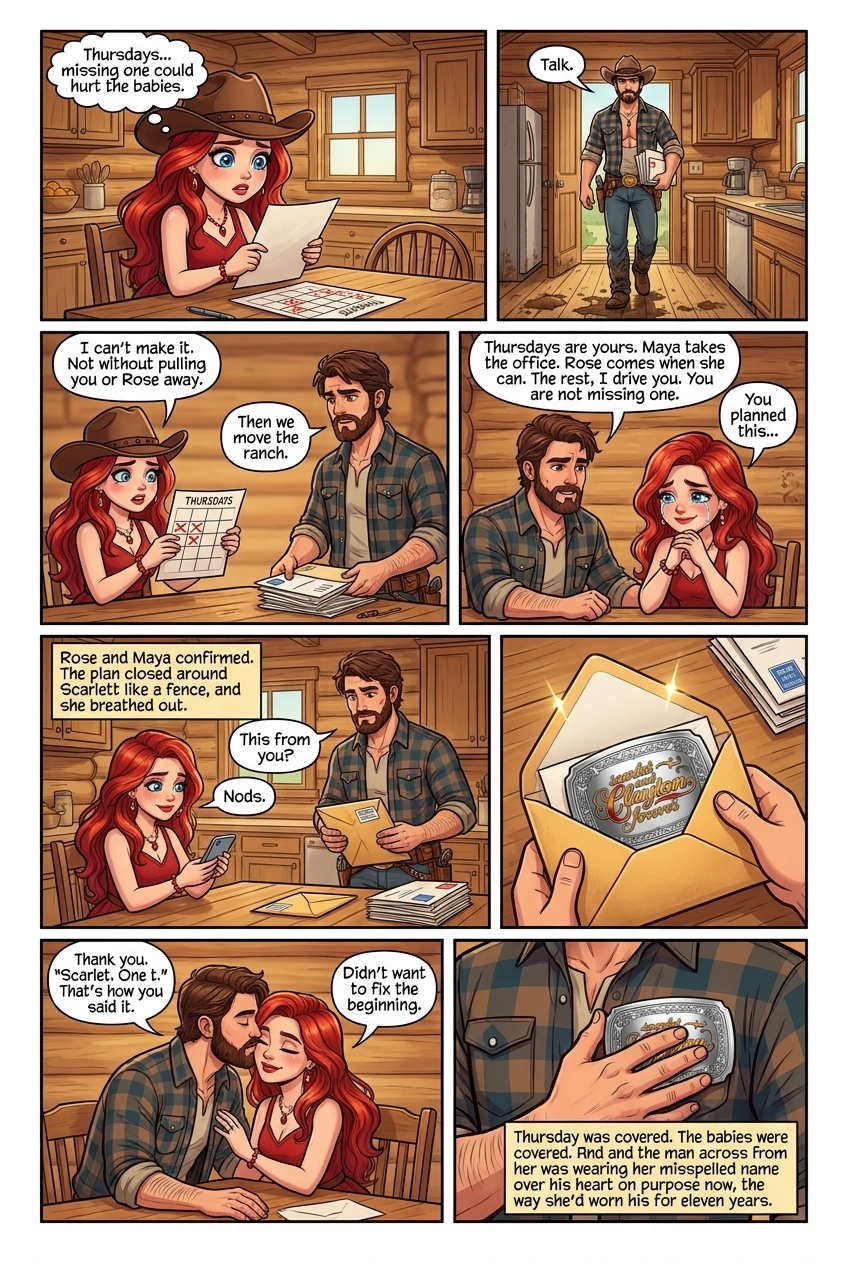
The morning after the doctor's visit, Scarlett sat at the kitchen table with the schedule Rose had printed. Weekly infusions. Two hours in a chair with a needle in her arm. A forty-minute drive each way. Clayton had cattle to move Thursday. Rose lived three hours out. Maya had the ranch office and her own week to run. Scarlett stared at the four Thursdays marked in red and felt the panic climb her throat. Missing one could drop her count low enough to hurt the babies. Clayton came in from the barn with mud on his boots and the mail tucked under his arm. He set the stack on the counter and looked at her face. "Talk," he said. "I can't get to all of them." She turned the paper toward him. "Not without pulling you off the ranch every week. Not without Rose driving six hours round trip." He read the page. He set it down. "Then we move the ranch," he said. "What?" "Not the cattle. Me. Thursdays are yours. I already told my foreman last night. He runs Thursdays through April. Maya takes the office those mornings. Rose comes the Thursdays she can. The rest I drive you myself." Scarlett's eyes filled. "You planned this before I even asked." "I planned it in the parking lot yesterday." He pulled out the chair beside her and sat. "You are not missing one. Not one." Rose called on speaker ten minutes later and confirmed she'd taken the first and third Thursdays. Maya texted that she'd already cleared her calendar and would sit with Scarlett through the infusions so Clayton could run errands in town. The plan closed around Scarlett like a fence going up. She breathed out for what felt like the first time in a day. Then Clayton remembered the mail. He walked to the counter and slid a padded envelope from the stack. His name on the front. Overnight sticker. He looked at Scarlett. "This from you?" She nodded. She had forgotten it was coming. He opened it at the table. The buckle caught the kitchen light, silver and gold, the letters curled across the front. He ran his thumb over the engraving once. Then again. He leaned across the table and kissed her, soft, careful of the coffee between them. "Thank you," he said. Then he tipped the buckle toward the window. "Scarlet. One t." "That's how you said it at the fair." He looked at her a long moment. "I know why I said it wrong." His voice dropped. "Why'd you keep it wrong?" "Because that's the day you started," she said. "I didn't want to fix the beginning." He closed his hand around the buckle and around hers. Thursday was covered. The babies were covered. And the man across from her was wearing her misspelled name over his heart on purpose now, the way she'd worn his for eleven years.
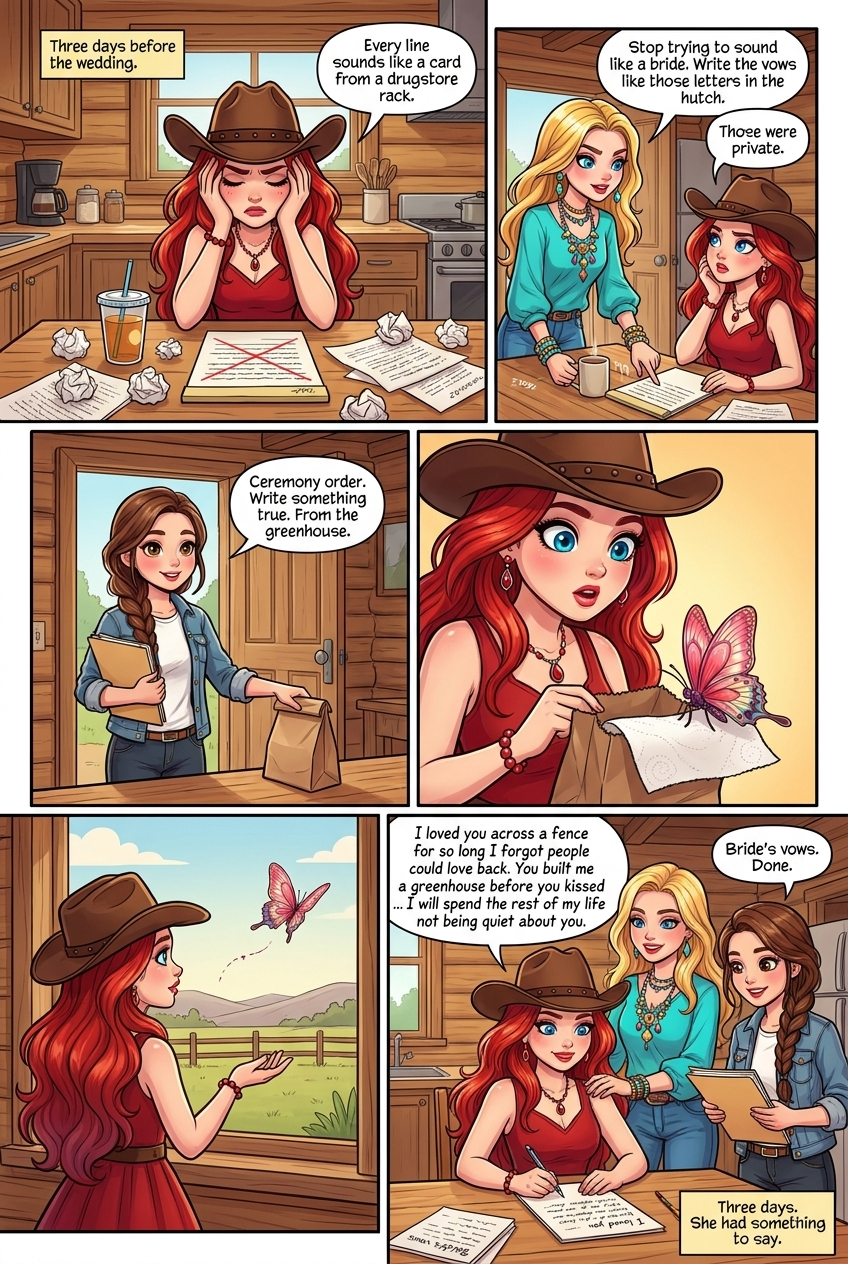
Three days before the wedding, Scarlett sat at the kitchen table with a legal pad and a cold cup of tea. She had filled six pages. She had crossed out six pages. Every line sounded like a card from a drugstore rack. Eleven years of loving Clayton in silence, and she couldn't fit any of it into a paragraph she'd say out loud in front of his mother. Rose came in from the porch with two mugs and set one down in front of her. Her sister wore turquoise at her ears and wrists, the way she always did when she was working a problem. She read the top page without asking. "This one sounds like a greeting card," Rose said. "This one sounds like a eulogy. Start over." "I've started over eleven times." "Then stop trying to sound like a bride." Rose tapped the pad. "You've been writing to him for a year. In the hutch. Seven letters. He read them out loud to himself on the porch while you were gone. Write the vows like that." Scarlett stared at her. "Those were private." "So is a vow." Maya knocked once and let herself in through the back, boots already off. She had the officiant folder under one arm and a small paper bag in the other hand. She set the bag by the pad. "Ceremony order," she said. "You read yours first. He reads his second. I don't care what you write. Write something true." She slid the bag closer. "From the greenhouse. Landed on my shoulder while I was locking up." Scarlett opened the bag. A pink butterfly rested inside on a folded paper towel, wings shaped like two soft hearts, still moving. She carried it to the window and opened her hand. It sat on her palm a moment, then lifted and went over the fence toward Clayton's ridge. She came back to the table. She turned to a clean page. She didn't write a vow. She wrote what she'd been afraid to say for eleven years. I was nine when I watched you deliver that calf alone. I was twenty when you said my name wrong on purpose. I loved you across a fence for so long I forgot people could love back. You built me a greenhouse before you kissed me. You moved into my house the day I got sick. You wear my misspelled name over your heart. I will spend the rest of my life not being quiet about you. She read it once. She didn't cross out a word. Rose put a hand on her shoulder. Maya slid the folder across the table and marked one line on the ceremony order in pen. "Bride's vows," Maya said. "Done." Scarlett folded the page in half and tucked it into the front of the binder. Three days. She had something to say.
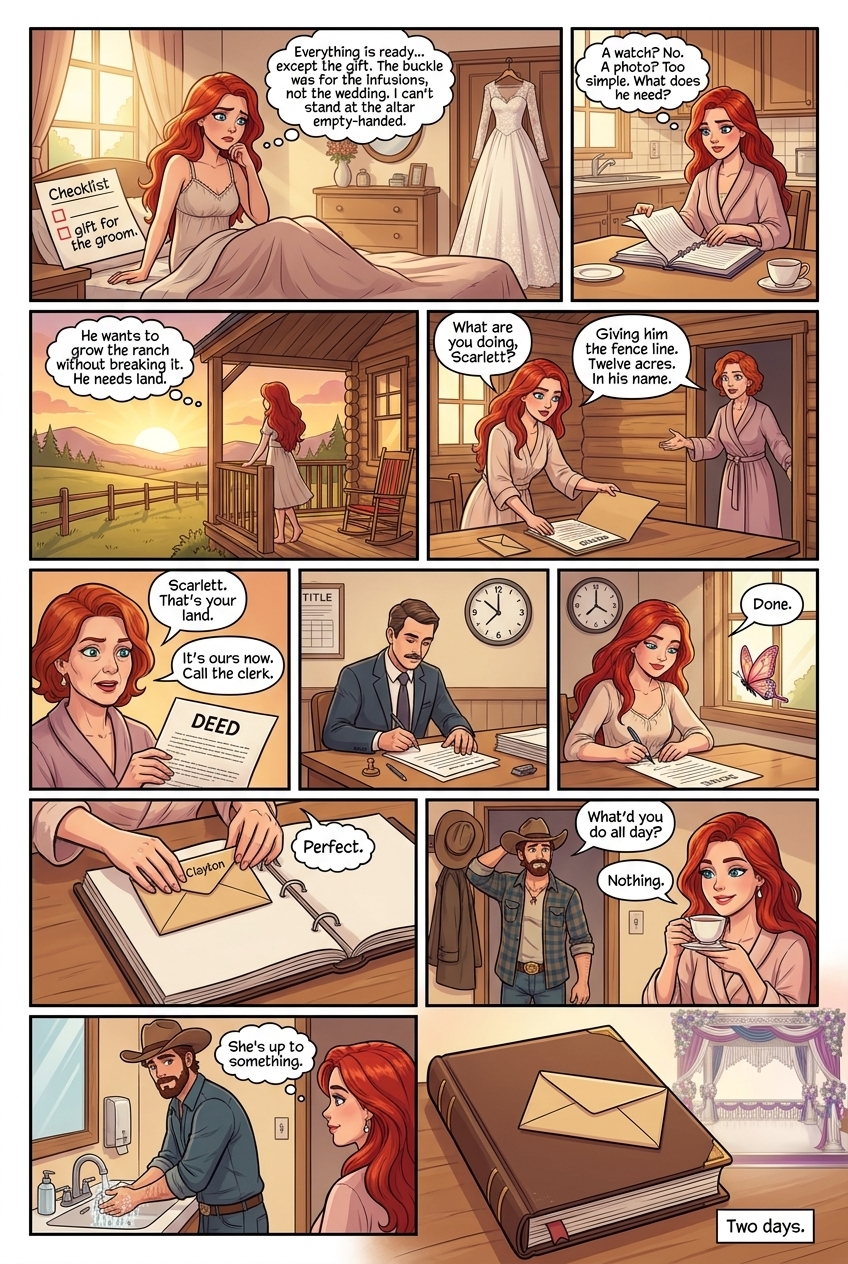
Two days out from the wedding, Scarlett woke before Clayton and couldn't get back to sleep. The vows were done. The dress hung on the closet door. The pavilion was booked. Every item on Rose's list had a check beside it except one line she'd added in pencil at the bottom: gift for the groom. Scarlett had given him the buckle already. That was for the infusions, for the week apart. It wasn't a wedding gift. She had nothing for the morning of the ceremony, and she couldn't stand in front of him at the altar with empty hands. She went to the kitchen and made tea and sat with the binder. She turned pages. Nothing on paper solved it. A watch felt wrong. Another buckle was a repeat. A framed photo was a card. She thought about what he'd told her over a year of coffee and late suppers. He talked his decisions out loud when he was alone. He'd almost bought a second property and pulled back because Duke went off his feed for a week. He said he wanted to grow what he had without breaking it. She walked out to the porch in her robe. The sun was coming up over his ridge. She thought about the fence between their two properties, and the years she'd waved across it, and the day the cattle came through. She thought about his grandmother's greenhouse ten minutes down the road, standing empty since the honeymoon plan. She went back inside and pulled the deed folder from the drawer. Her family's land ran from the creek to the ridge. The strip along the fence line was pasture she never used. Rose came down the stairs in her robe and stopped when she saw the deed spread on the table. "What are you doing?" "Giving him the fence line," Scarlett said. "Twelve acres along the border. In his name. So he can run cattle across it without asking anyone. So the ranch grows without him buying anything." Rose sat down slow. "Scarlett. That's your land." "It's ours now." She pushed the folder across. "Call whoever we need to call. I want the paper ready by Saturday morning." Rose read the deed twice. Then she got her phone. By noon a title clerk in town had the transfer drafted. By four, Scarlett had signed the pages and sealed them in an envelope with his name on the front. She tucked it inside the ceremony binder next to her vows. A pink butterfly bumped against the kitchen window and lifted away toward the ridge. Clayton came in from the barn at dusk and hung his hat on the hook. He asked what she'd done all day. "Nothing," she said. She smiled at her tea. He watched her a second longer than he needed to. Then he went to wash up. Two days. She had something to give him.
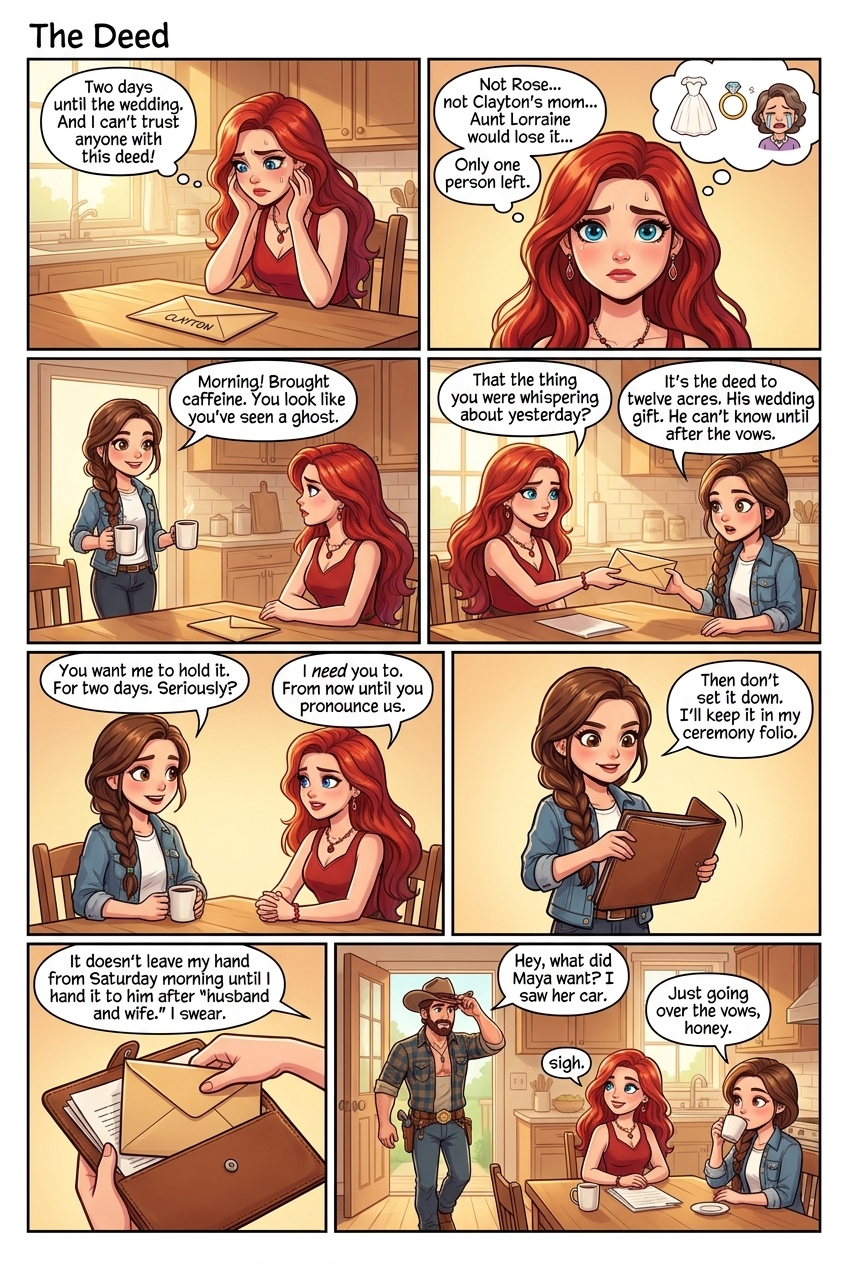
The morning after she signed the deed, Scarlett sat at the kitchen table with the sealed envelope in front of her. Clayton's name was written across the front in her steady hand. The ceremony was in two days. Rose had already driven into town for the flowers. Maya was coming by at ten to run through the order of service one last time. Scarlett stared at the envelope and understood the problem she hadn't let herself see yesterday. She couldn't carry it up the aisle herself. She couldn't leave it in the binder on a chair. If it slipped out, if Clayton saw it early, if a guest opened it thinking it was a program, the gift was ruined. She couldn't give it to Rose. Rose would be walking her down the aisle with both hands full of Scarlett. She couldn't give it to Clayton's mother without the news traveling to Clayton before sundown. Aunt Lorraine would cry and forget where she put it. That left one name. Maya came through the door at ten with her braid over one shoulder and a coffee in each hand. She set one down in front of Scarlett and looked at the envelope. "That the thing you were whispering about on the phone yesterday?" "That's it." Scarlett slid it across. "It's the deed to twelve acres along the fence line. In his name. It's his wedding gift and he can't know until after the vows." Maya didn't pick it up right away. She read the front. She looked at Scarlett. "You want me to hold it." "I need you to hold it. From now until you pronounce us. Then you hand it to him." Maya sat down. She put her coffee beside the envelope. "Scarlett. I'm the officiant. I'll have the book, the rings, the vows, and a microphone clipped to my collar. If I set this down on the pulpit and a breeze catches it, your brother-in-law is reading a legal document in the third row." "Then don't set it down." Maya looked at her a long second. Then she reached into her jacket and pulled out a flat leather folio she used for the ceremony order. She opened it. She slid the envelope inside the back flap, behind the last page, and snapped the folio closed. "It doesn't leave my hand from Saturday morning until I hand it to him," she said. "I sleep with it under my pillow Friday night. I walk in with it. I walk out with it if I have to." "Swear." "I swear." Maya tapped the folio. "He gets it after I say husband and wife. Not before." Scarlett let out the breath she'd been holding since dawn. Two days. The gift was safe. Clayton came in from the barn at noon and asked what Maya had wanted. Scarlett said they were going over the vows. Maya sipped her coffee and didn't look up.
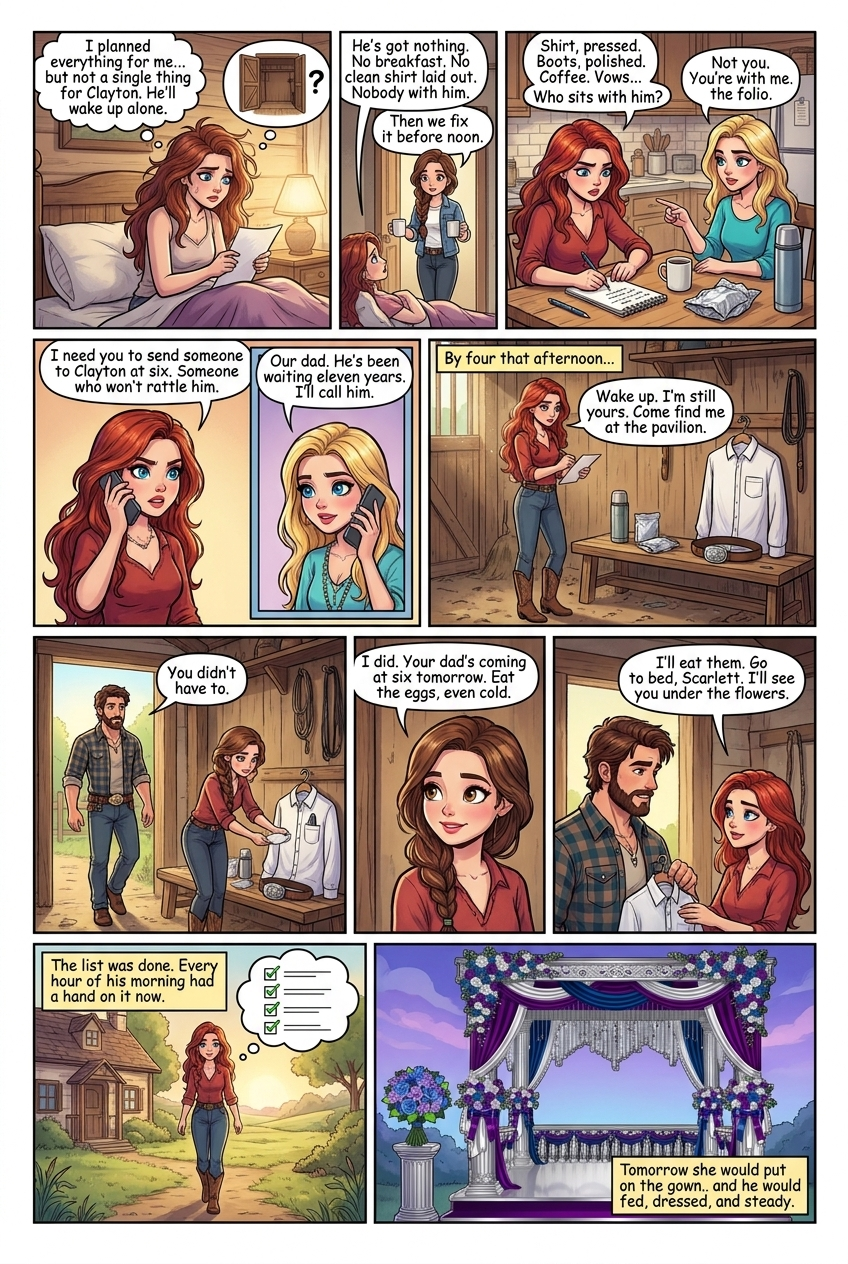
The morning after Maya took the envelope, Scarlett sat up in bed with a list in her lap and felt her stomach drop. She had planned every hour of her own wedding morning. Rose would do her hair. Maya would bring the folio. The dress and veil were already hung in the closet by the door. She had not planned a single thing for Clayton. He would wake up alone in the barn tack room, where he'd promised to sleep the night before so he wouldn't see her. No coffee. No shirt pressed. No one to steady his hands. She called Rose into the room. Rose came in with two mugs and turquoise earrings already in. "He's got nothing," Scarlett said. "No breakfast. No clean shirt laid out. Nobody with him." Rose sat on the edge of the bed. "Then we fix it before noon." They worked at the kitchen table. Scarlett wrote it down as they went. Clayton's good white shirt from the closet, pressed. His boots polished. The belt with the misspelled buckle set on top. A thermos of black coffee and two eggs on toast, wrapped in foil so it would stay warm in the barn. His vows, folded in the shirt pocket where he'd left them. A note from her, one line, so he'd hear her voice before he saw her face. "Who sits with him?" Rose asked. "Not you. You're with me." Scarlett tapped the pen. "Maya has the folio." She called Maya anyway. Maya picked up on the second ring. "I need you to send someone to Clayton at six. Someone who won't rattle him." "Our dad," Maya said. "He's been waiting eleven years to walk Clayton out that door. Let him." Scarlett closed her eyes. "Yes. Him." "I'll call now. He'll bring his own coffee and won't say much." By four that afternoon Rose had the shirt pressed and hung on a hanger by the barn door. Scarlett walked out with the thermos and the foil packet and set them on the tack room bench. She wrote the note at the workbench with a carpenter's pencil. Wake up. I'm still yours. Come find me at the pavilion. She folded it into the shirt pocket beside his vows. Clayton came in from the pasture as she was leaving. He stopped in the doorway and looked at the bench. "You didn't have to." "I did. Your dad's coming at six tomorrow." He nodded once. "Good." "Eat the eggs cold if you have to. Just eat them." "I'll eat them." He looked at the shirt on the hanger, then at her. "Go to bed, Scarlett. I'll see you under the flowers." She walked back to the cottage. The list was done. Every hour of his morning had a hand on it now. Tomorrow she would put on the lace gown and the veil and carry the blue and purple bouquet down the aisle, and he would be standing there fed, dressed, and steady.
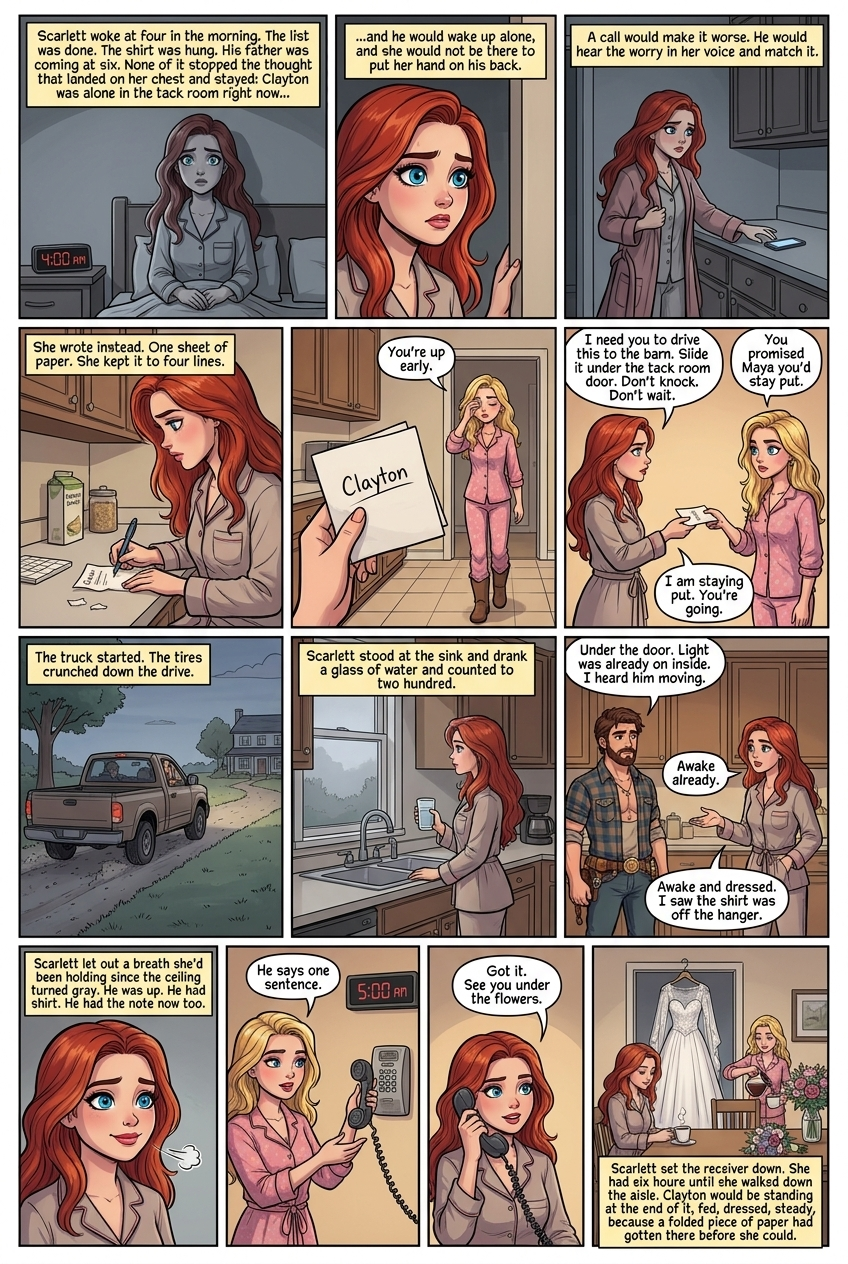
Scarlett woke at four in the morning with the ceiling gray above her. The list was done. The shirt was hung. His father was coming at six. None of it stopped the thought that landed on her chest and stayed: Clayton was alone in the tack room right now, and he would wake up alone, and she would not be there to put her hand on his back. She sat up. Rose was asleep on the pull-out in the front room. Tradition said the bride did not see the groom before the ceremony. Tradition did not know Clayton. He talked his decisions out loud when no one was there. He would talk himself in circles by sunrise if she let him. She pulled on a robe and went to the kitchen. The phone sat on the counter beside her medication. She picked it up, then set it down. A call would make it worse. He would hear the worry in her voice and match it. She wrote instead. One sheet of paper, torn from the grocery pad. She kept it to four lines. I am awake. I am not scared. Your dad will be there at six. Keep your hands busy until he knocks. She folded it small and wrote his name on the front. Rose came in rubbing her eyes. Her turquoise earrings were still on the coffee table. "You're up early." "I need you to drive this to the barn. Slide it under the tack room door. Don't knock. Don't wait." Rose took the paper. "You promised Maya you'd stay put." "I am staying put. You're going." Rose pulled boots over her pajama pants and left. The truck started. The tires crunched down the drive. Scarlett stood at the sink and drank a glass of water and counted to two hundred. Rose came back at four-forty. "Under the door. Light was already on inside. I heard him moving." "Awake already." "Awake and dressed. I saw the shirt was off the hanger." Scarlett let out a breath she'd been holding since the ceiling turned gray. He was up. He had the shirt. He had the note now too. His father would be there in eighty minutes. Her hands had reached him without her feet crossing the fence line. The phone rang at five. She let Rose answer. Rose held out the receiver. "He says one sentence." Scarlett took it. The line was quiet, then his voice, plain and close. "Got it. See you under the flowers." He hung up. Scarlett set the receiver down. Rose was already pouring coffee. The lace gown hung in the doorway with the veil folded over the hanger, and the bouquet of purple and blue waited in its jar of water on the table. She had six hours until she walked down the aisle. Clayton would be standing at the end of it, fed, dressed, and steady, because a folded piece of paper had gotten there before she could.
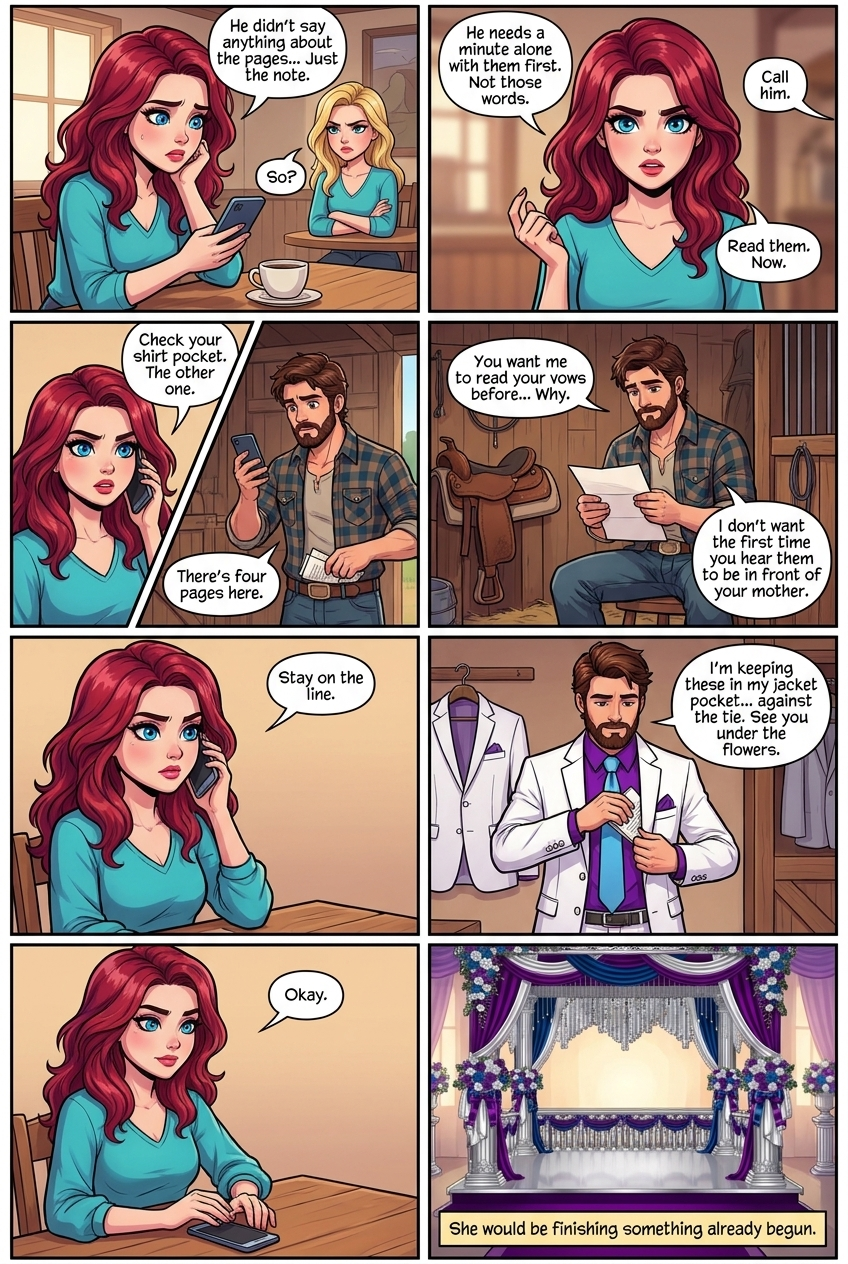
Rose set the coffee down. Scarlett stared at the phone. Clayton had the note, the shirt, the breakfast. He had the vows too. She had folded them into his shirt pocket last night, four pages of her lifelong love written plain, and she had never once asked him to read them before he stood in front of her. "He didn't say anything about the pages," Scarlett said. "Just the note." Rose frowned. "So?" "So he might not have found them. That shirt has two pockets. If he reached in for the note and stopped, the vows are still folded where I left them." She set her cup down. "He can't hear them for the first time at the altar. Not those words. He needs a minute alone with them first." "Call him." "He'll ask why. Then he'll open them standing in the tack room and I won't be there." She thought a second. "His dad's walking him out at six. That's twenty minutes." She picked up the phone and dialed the ranch line. It rang four times. Clayton answered on the fifth, breath short, like he'd come in from the yard. "You said one sentence," he said. "Check your shirt pocket. The other one." A pause. Fabric moved against the receiver. She heard paper unfold. "There's four pages here." "Those are my vows. I put them there last night. I need you to read them before you leave the barn. Not at the pavilion. Now." Silence. Then his voice, closer to the phone. "You want me to read your vows before you say them." "Yes." "Why." "Because I spent eleven years not saying them out loud. I don't want the first time you hear them to be in front of your mother." He made a sound that was almost a laugh. She heard him sit. She heard the chair take his weight. "Stay on the line," he said. "I don't need to—" "Stay on the line, Scarlett." She stayed. She listened to him breathe and turn a page. She listened to him turn another. Rose stepped out of the kitchen without a word. Four pages. Six minutes. She counted the seconds against the wall clock and did not speak. He cleared his throat. "Alright," he said. "Alright." "I'm keeping these in my jacket pocket. The inside one. Against the tie." The white jacket was hanging on the tack room door. She knew the shirt underneath was purple and the tie was pale blue. She had picked them herself. "Okay," she said. "See you under the flowers." He hung up. Scarlett set the receiver down. Her hands were steady. He had heard her before the aisle. He would stand under the pavilion in a white jacket with her words folded against his chest, and when she reached him she would not be starting from silence. She would be finishing something already begun.
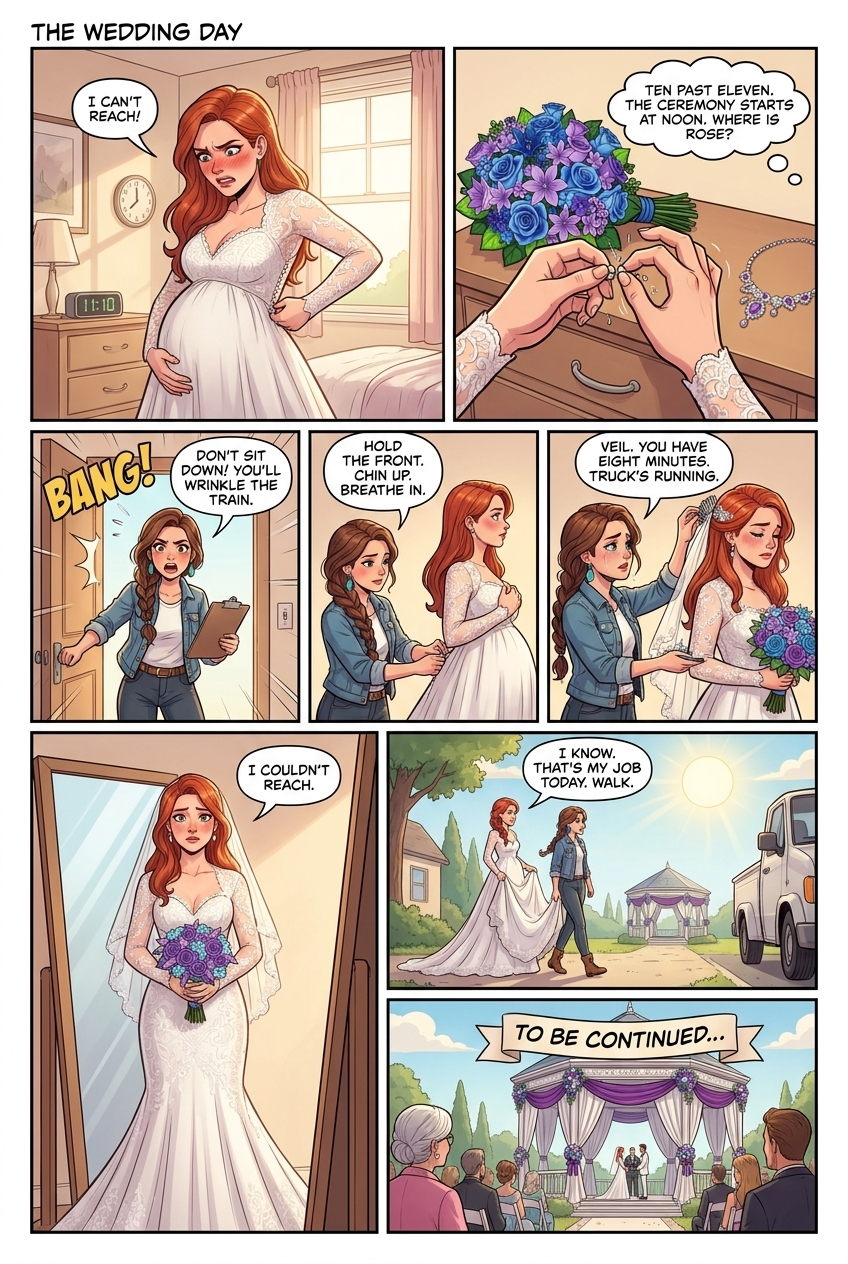
Scarlett stood in front of the mirror in the bedroom, holding the lace bodice against her chest. The gown was open down the back. Twenty small buttons and a hidden zip ran from her tailbone to her shoulder blades. She could reach the bottom three. She could not reach the rest. Her belly pushed the front of the dress out in a soft curve, and her arms would not bend the way they used to. She tried again. She got two more buttons. Her fingers cramped. The veil sat on the dresser next to the diamond earrings and the bouquet of blue roses and purple lilies Rose had cut that morning. The clock on the wall read ten past eleven. The ceremony started at noon. Rose had run to the pavilion an hour ago to check on the chairs and had not come back. "Rose." Scarlett said it to the empty room. She lowered her arms. She could not do this alone. She could call Maya, but Maya was at the pavilion with the folio and the sealed deed and could not leave the ceremony table. She could call Clayton, but Clayton could not see her before the aisle. She sat on the edge of the bed carefully, holding the front of the dress up with one hand. Sweat gathered at the small of her back. The babies shifted. She breathed slow and counted to ten. The front door banged open. Boots hit the floor. "Don't sit down, don't sit down, you'll wrinkle the train." Rose came through the doorway out of breath, turquoise earrings swinging, a clipboard under one arm. "The chairs are set. Aunt Lorraine is crying already. Stand up." Scarlett stood. Rose dropped the clipboard on the dresser and moved behind her. "Hold the front," Rose said. "Chin up. Breathe in." Scarlett breathed in. Rose worked the zip first, easing the fabric together above the curve of the belly, then started on the buttons from the bottom. Her fingers were fast. She had done Scarlett's prom dress. She had done their mother's funeral dress. She did not talk while she worked. At the top button she smoothed the lace across Scarlett's shoulders and stepped back. "Turn." Scarlett turned. Rose looked at her for a long second. Her eyes went wet and she blinked it off. "Veil," Rose said. She lifted it from the dresser and set the comb into Scarlett's hair. She handed her the bouquet. "You have eight minutes. Truck's running." Scarlett looked in the mirror. The dress fit. The train lay clean behind her. Her hands were shaking around the stems. "I couldn't reach," she said. "I know," Rose said. "That's my job today. Walk." Scarlett walked. Rose held the train off the floor behind her, and they went out to the truck together.
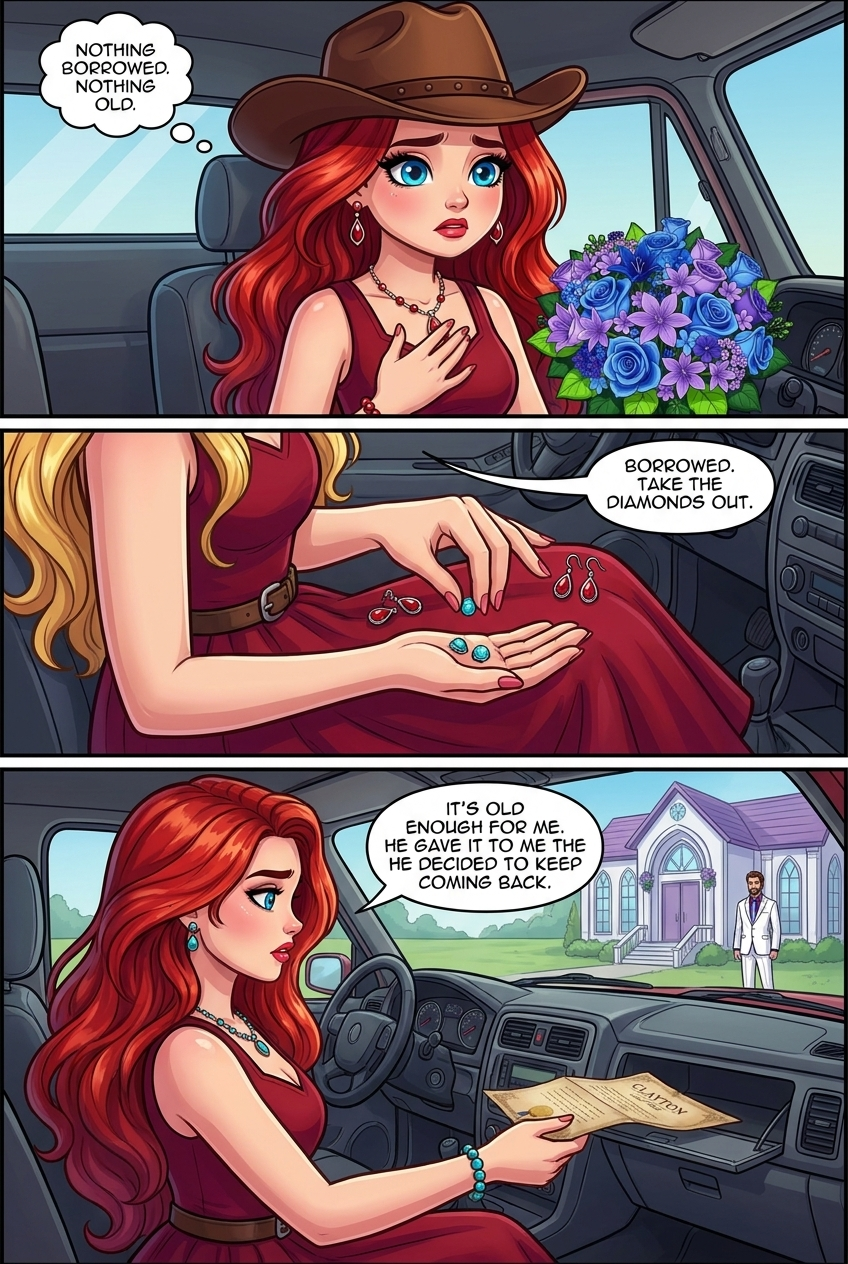
Rose drove with one hand on the wheel and one hand on the train, keeping the lace off the floorboard. Scarlett watched the fence line roll past. Then she felt it, cold and sharp under her ribs. Nothing borrowed. Nothing old. She had the dress, the veil, the diamond earrings, the blue roses in her lap. All of it was new. Eleven years of loving Clayton, and she was about to walk to him wearing only things bought last month. "Rose. Stop the truck." Rose braked at the shoulder. "We have six minutes." "I don't have borrowed. I don't have old." Scarlett pressed her hand flat against the bodice. "I can't walk to him without it. Not to him." Rose looked at her. She did not argue. She reached up and unclasped the turquoise studs from her own ears, the ones she wore to every family holiday, the ones their mother had given her at sixteen. "Borrowed," Rose said. She dropped them into Scarlett's palm. "Take the diamonds out." Scarlett took the diamonds out. Her hands were steady now. She slid the turquoise studs in. They were warm from Rose's skin. "That covers borrowed," Rose said. "Old is your problem." Scarlett thought. The bouquet was new. The dress was new. Then she remembered the small pocket sewn inside the bodice, the one the boutique woman had stitched for a handkerchief. She had put nothing in it. She had meant to. "Glove box," Scarlett said. "Open it." Rose opened it. Inside sat a folded square of paper Scarlett had shoved there last spring and forgotten. She pulled it out. It was the receipt from the county fair, the one from the booth where Clayton had said her name wrong. She had kept it because he had handed it to her. The ink was faded. The date was almost a year old. "That's not old enough for tradition," Rose said. "It's old enough for me," Scarlett said. She folded it smaller and slid it into the pocket against her ribs. "He gave it to me the day he decided to keep coming back." Rose put the truck in gear. "Then you've got both." They pulled up to the pavilion at two minutes to noon. Purple and blue ribbons moved in the wind. Scarlett saw Clayton standing under the flowers in a white jacket and blue tie, hat off, hands folded. Maya stood beside him with the folio pressed to her chest. Rose lifted the train. Scarlett stepped down from the truck. The turquoise was cold at her ears. The receipt was warm against her heart. "Ready," she said. "Ready," Rose said. They walked toward the aisle. Clayton lifted his head and saw her, and Scarlett felt the last shake leave her hands.
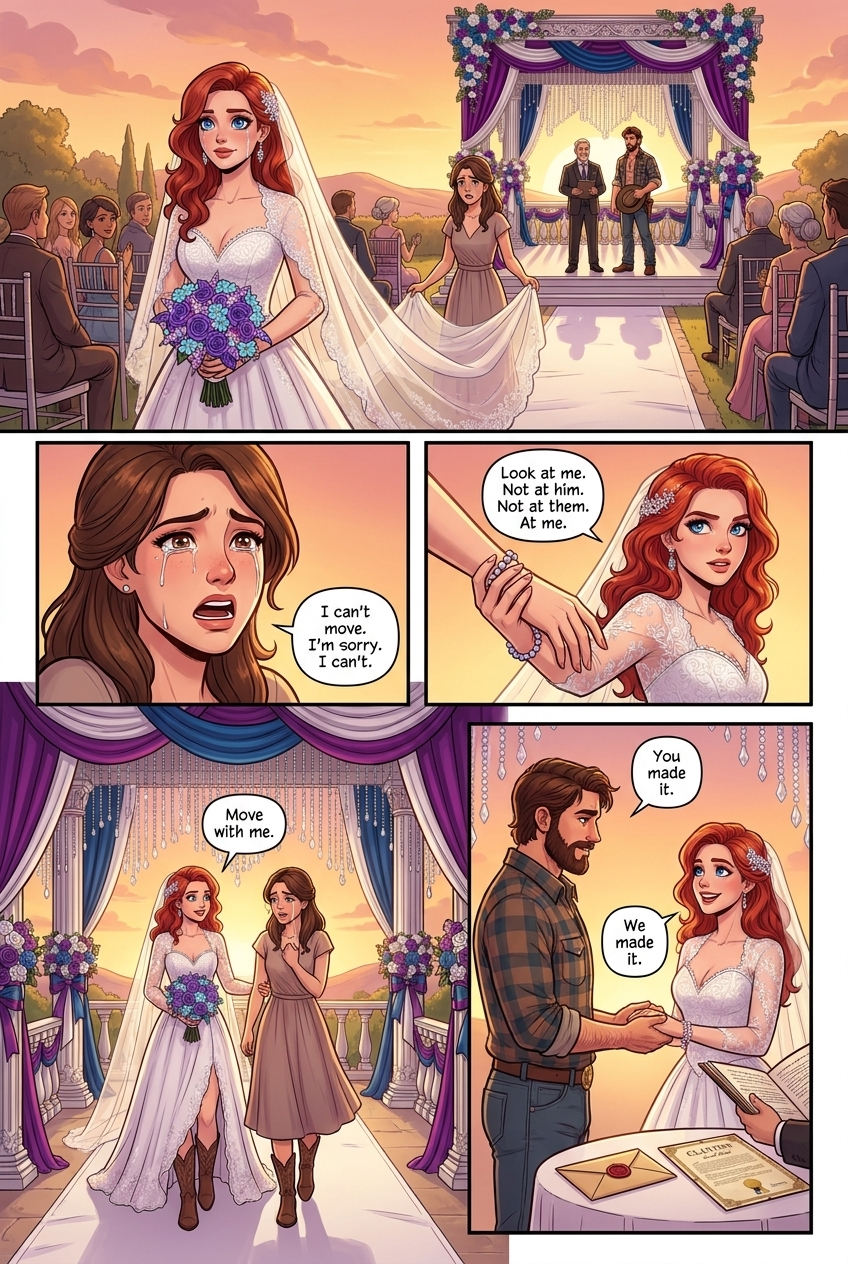
Scarlett stepped onto the runner and heard the music shift into its last verse. Rose held the train behind her. They took three steps and Rose stopped. Scarlett felt the hand on her train go tight. She turned her head. Rose was crying without sound, her mouth open, her feet planted on the white cloth. "Rose." "I can't move," Rose whispered. "I'm sorry. I can't." The song was thirty seconds from ending. Scarlett could see Clayton at the end of the aisle, hat in his hand, waiting. Guests were beginning to turn their heads. Maya glanced at the musician and lifted one finger, asking for time the song did not have. Scarlett looked at her sister. Rose had driven her here. Rose had zipped the dress. Rose had given up the turquoise studs still warm in Scarlett's ears. Rose was frozen because eleven years of watching Scarlett wait for this man had finally arrived at the aisle, and her body would not carry it forward. Scarlett shifted the bouquet to her left hand. She reached back and took Rose's wrist. "Look at me," Scarlett said. "Not at him. Not at them. At me." Rose looked. "You are not walking me to him," Scarlett said. "We are walking. You and me. Same as the truck. Same as the kitchen. One foot." Rose shook her head. "I'll ruin it." "You're the reason there is one," Scarlett said. "Move with me." Scarlett stepped. She pulled gently on Rose's wrist. Rose's foot came off the cloth and landed again. The train slid forward. The music held on its last long note as the musician stretched it, reading the room. They walked. Slow at first, then steady. Scarlett kept her hand on Rose's wrist the whole way. Rose kept her hand on the train. The purple and blue ribbons moved above them. The silver curtains caught the light. Scarlett did not look at Clayton until the last five steps, because she did not want to leave her sister early. At the platform, Rose lifted the train clear and set it down. She squeezed Scarlett's fingers once and stepped back into the front row. Her face was wet. She was smiling. Clayton took Scarlett's hand. His palm was warm. He looked at her ears, then at her face. "You made it," he said. "We made it," Scarlett said. Maya opened the folio. The sealed envelope with Clayton's name sat on top of her pages, waiting for after. Maya set it aside and began. Behind them, Rose sat down hard in her chair and pressed both hands to her mouth. Scarlett heard the small sound she made and did not turn. She had gotten her sister down the aisle. Now she had a man to marry, and a deed to hand him, and two names to say out loud in front of everyone she knew.
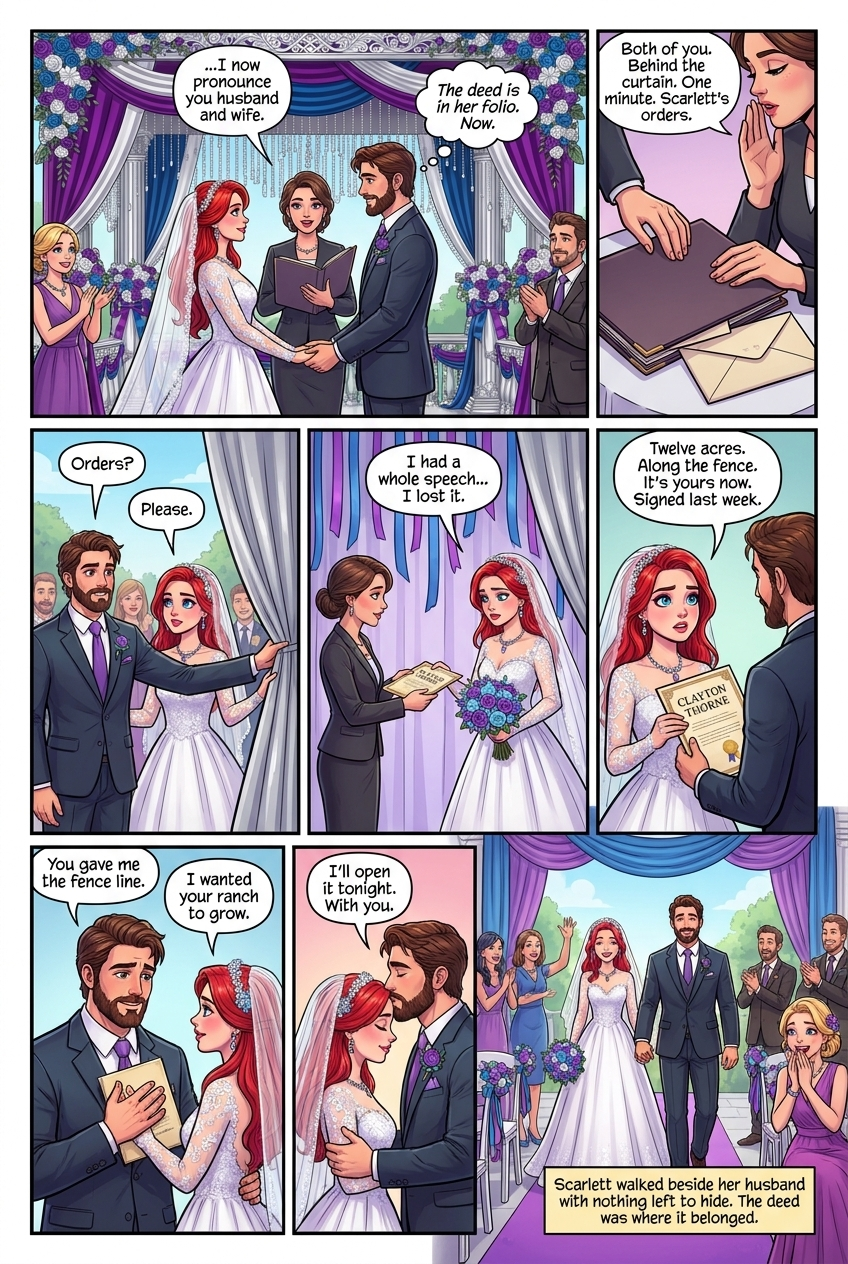
Maya read the vows with her folio open on her forearm. Scarlett kept her hand in Clayton's and watched the sealed envelope shift each time Maya turned a page. She had wanted a quiet moment to hand him the deed herself. She could feel the day starting to close over that plan. After the pronouncement there would be the walk back down the aisle, the line of guests, the photographs at the flowered rail, the toasts. She had one window, and it sat inside Maya's folio, and it was almost here. They said their names. Clayton read from the pages he had kept against his chest. Scarlett said hers without looking down. Maya pronounced them husband and wife. Clayton kissed her once, careful of the veil. Maya closed the folio around the envelope and stepped forward before the music started again. She spoke low, under the applause. "Both of you. Behind the curtain. One minute. Scarlett's orders." Clayton looked at Scarlett. "Orders." "Please," Scarlett said. He followed her behind the silver drape at the back of the platform. The purple and blue ribbons hung still on the other side. The guests were standing, clapping, turning to each other. No one could see them here for the length of a song. Maya slid the envelope out of the folio and put it in Scarlett's hand. She stepped back through the curtain and let it fall. Scarlett held the envelope against her bouquet. The paper was heavy. Clayton's name was written on the front in her handwriting. "I had a whole speech," she said. "I lost it somewhere between the aisle and now." "Say it plain." She handed him the envelope. "Twelve acres. Along the fence. From my side to yours. It's yours now. Signed last week." He did not open it. He looked at the front, then at her. "Scarlett." "I wanted your ranch to grow," she said. "I didn't want you to have to buy the ground to do it." Clayton pressed the envelope flat between his palm and his chest, on top of the pocket that held her vows. He was quiet for a count of three. "You gave me the fence line." "I gave you the fence line." He bent his head and kissed her forehead through the veil. "I'll open it tonight. With you." "Tonight," she said. He tucked the envelope inside his jacket, against the vows. The music shifted into the recessional. Maya's hand appeared at the edge of the curtain, waving them out. Clayton took Scarlett's hand. They stepped back into the light. The guests were still on their feet. Rose was in the front row with both hands pressed to her mouth again, smiling. Scarlett walked down the aisle beside her husband with nothing left to hide and nothing left to hand him. The deed was where it belonged. The next thing waiting for her was the receiving line, and after that, the drive home.
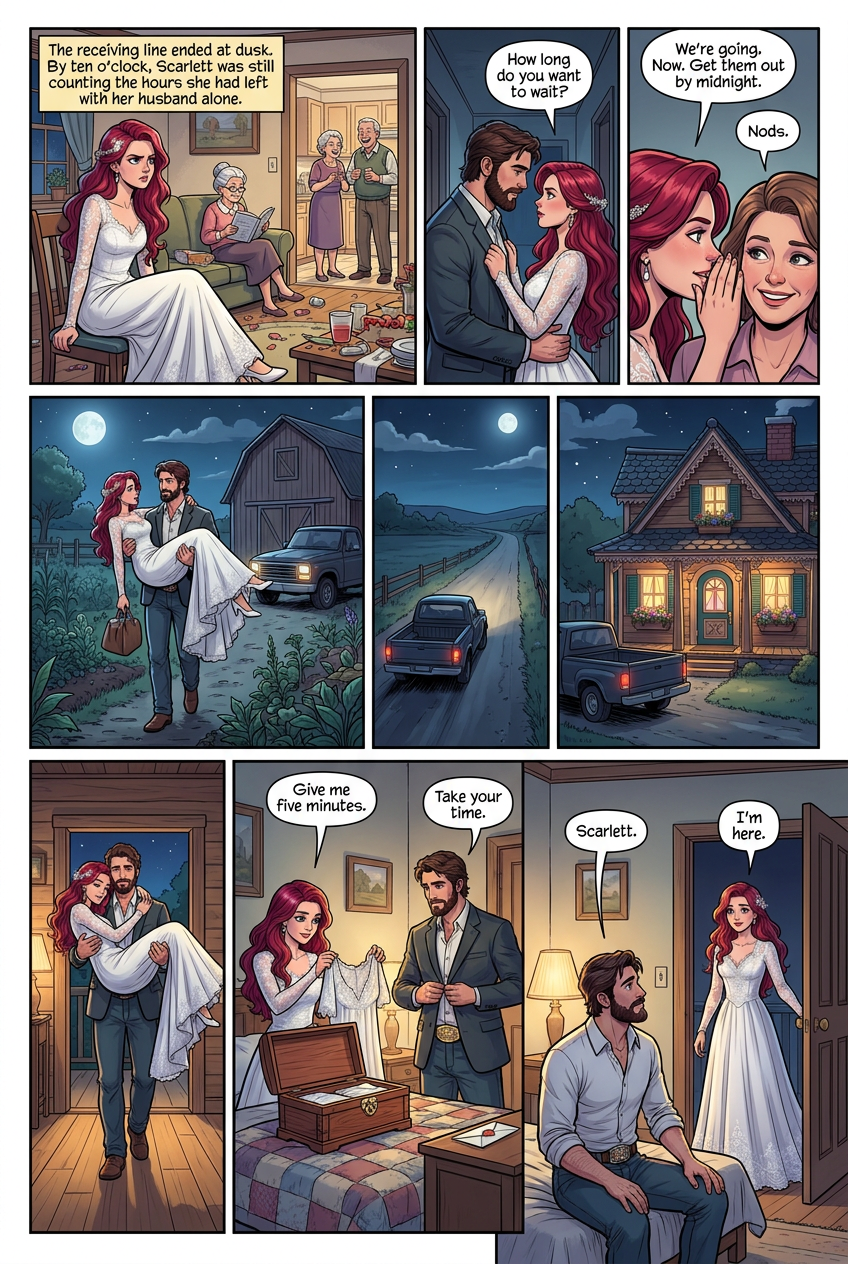
The receiving line ended at dusk. Scarlett expected the drive to the honeymoon cottage right after. Instead, half the guests followed them back to her place for cake and coffee, and by ten o'clock her aunt was still on the couch with a story book open on her lap, and Rose was refilling glasses, and Clayton's parents were laughing in the kitchen. Scarlett sat on the arm of a chair in her wedding dress and counted the hours she had left with her husband alone. Clayton found her in the hall. He kept his voice low. "How long do you want to wait?" "I don't want to wait." "Then we go." "They won't leave if we're still here." He thought about that. He glanced at the front room, then at the back door. "We leave first," he said. "They'll figure it out." Scarlett went to Rose at the sink. She spoke into her ear. "We're going. Now. The back way. Get them out by midnight." Rose looked at the clock, then at Scarlett's face. She nodded once. "Go. I'll handle the room." Scarlett kissed her cheek. She grabbed the cedar box from the hutch, the one holding the nightgown she had packed a month ago and never unpacked. She met Clayton at the back door. He carried her small bag in one hand and his hat in the other. They went out through the herb garden and around the barn. The truck was parked behind it, ready. Clayton lifted her into the seat, dress and all. He drove without headlights until they cleared the drive. Ten minutes later they pulled up to the honeymoon cottage. Flower boxes under every window. A lamp already lit inside. Clayton had the key ready. He carried her over the threshold because she asked him to. He set her down in the front room and closed the door behind them. The house went quiet in a way her cottage had not been quiet all day. Scarlett opened the cedar box on the bed. She lifted out the lace nightgown and held it against her. "Give me five minutes." Clayton was unbuttoning his jacket. The buckle at his waist caught the lamplight, her name and his in gold across the silver. He took the deed envelope out of his pocket and set it on the nightstand. He set her vows beside it. "Take your time." She changed in the small bathroom. When she came back, he was sitting on the edge of the bed in his shirt sleeves, the buckle still on. He looked up at her once and did not look away. "Scarlett." "I'm here." He pulled her down to him. The envelope on the nightstand could wait until morning. The night was theirs now, and no one knew where to find them.
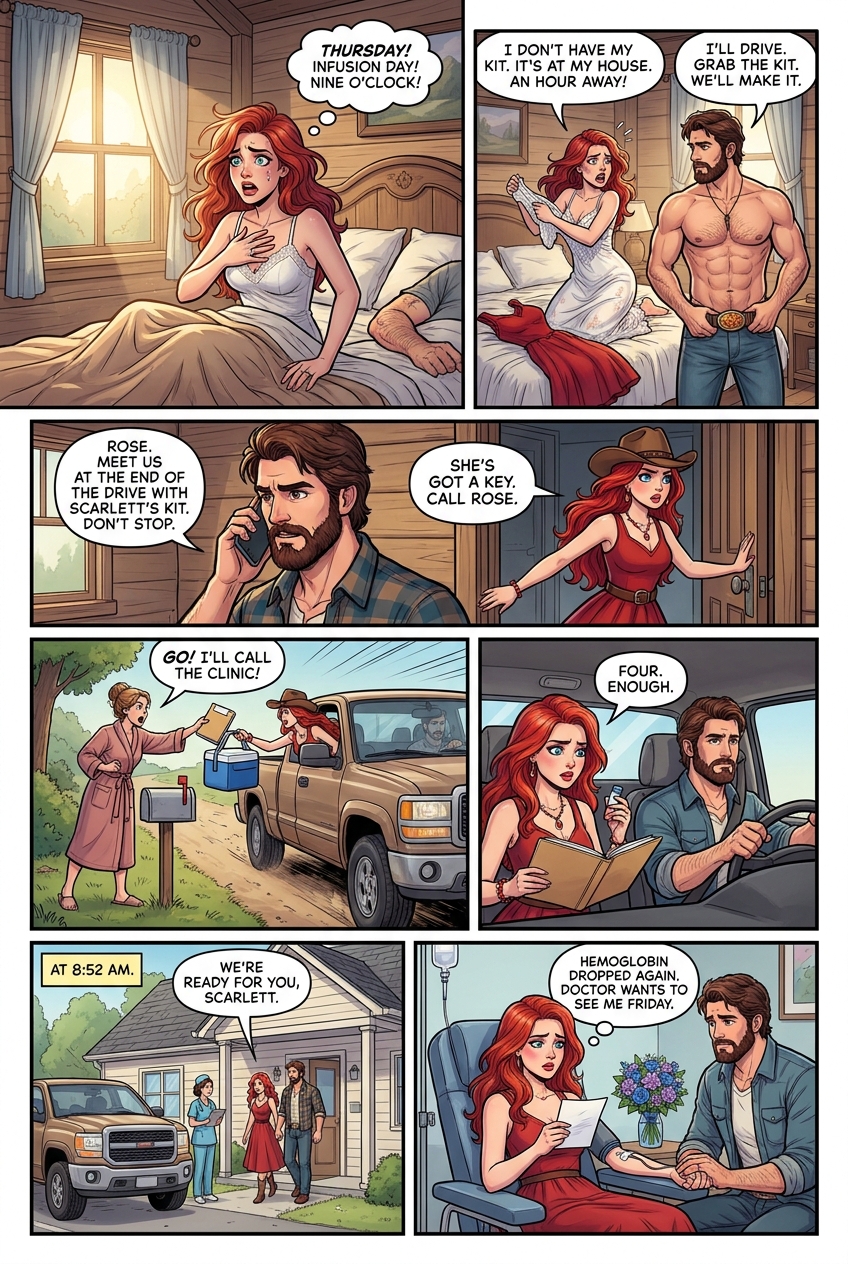
Scarlett woke before the sun. Clayton's arm lay across her waist. For a second she felt only the quiet of the cottage and the weight of the ring on her finger. Then she remembered the day. Thursday. Infusion day. Her chart said nine in the morning at the clinic in town. Her supplies, her paperwork, her port cleaning kit — all of it sat on the counter at home, ten minutes away by truck. She had not packed a single thing for a Thursday because she had planned to be home by Thursday. She sat up too fast. Clayton woke. "What is it?" "My infusion. I forgot the day. I don't have my kit." He was already reaching for his jeans. "What time?" "Nine. If I miss it the levels drop. The doctor said not one dose." He pulled the belt through the loops. The buckle caught the lamp again, her name and his. He did not waste a word. "I'll drive home. Get the kit. Meet you at the clinic." "It's an hour round trip from here to the cottage to town. You won't make nine." He stopped. He thought. "Then you come with me to the cottage. We grab it on the way. Clinic by nine." She did the math out loud. Ten minutes to her place. Five to load the kit. Twenty to town. "Tight. But yes." She pulled the lace nightgown off and reached for the dress she had worn out of the reception. It was the only clothing in the bag. She stepped into it while Clayton carried the small bag to the truck. He came back for her. "Rose has a key," she said. "Call her. Tell her to pull the kit and the folder from the kitchen counter and meet us at the end of the drive. We don't even stop." He was already dialing. Rose picked up on the second ring. He told her in six sentences. He hung up. "Done. She'll be at the mailbox." He drove fast but even. Scarlett held the door handle and counted the fence posts. At her drive Rose stood at the mailbox in a robe, the cooler bag and the folder in her arms. She passed them through the window. "Go," Rose said. "I'll call the clinic and tell them you're coming." Clayton drove. Scarlett opened the folder in her lap and checked the vial count. Four. Enough. She closed her eyes for the last miles. They pulled up to the clinic at eight fifty-two. The nurse was waiting at the door. Scarlett walked in on Clayton's arm, still in her reception dress, and sat down in the infusion chair. The needle went in at nine on the dot. Clayton sat beside her for the full hour. When it was done the nurse handed Scarlett a slip. Next Thursday. Same time. And a note: her hemoglobin had dropped again. The doctor wanted to see her Friday.
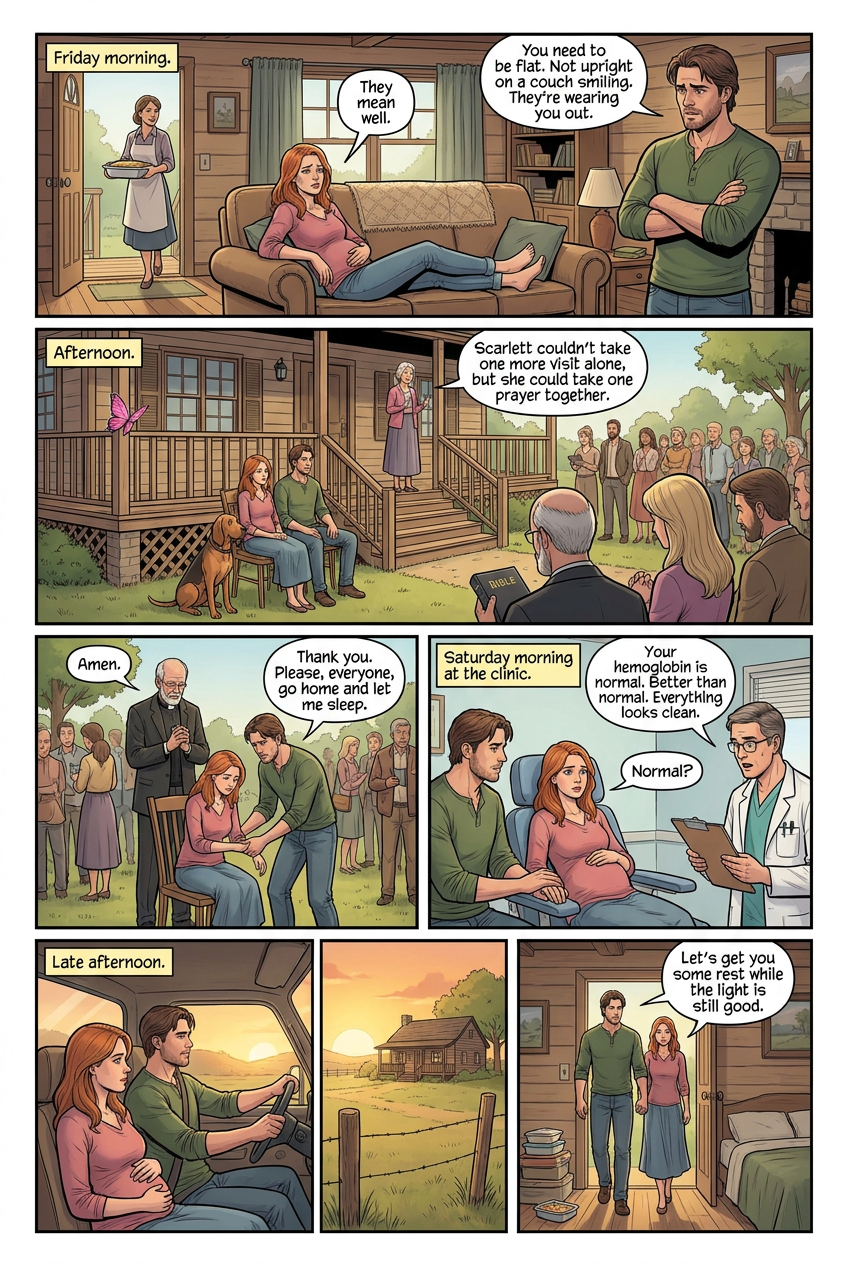
By Friday morning word had spread. Scarlett sat on the couch with her feet up when the first truck rolled in. A woman from the church left a casserole on the porch and asked to pray with her. Scarlett let her in. Twenty minutes later two more cars pulled up. By noon she had counted nine visitors and eaten none of the food they brought. Clayton came in from the barn between guests. He saw her gray face and closed the door behind the last one. "You need to be flat. Not upright on a couch smiling." "They mean well." "They're wearing you out." He was right. Her back ached. Her hands shook when she lifted the water glass. The doctor had said rest. She had done the opposite all morning. Another truck pulled up the drive. Clayton looked out the window and swore under his breath. "I'll handle it." "No. Let them in." He turned. "Scarlett." "One more time. Then we shut the door." She had an idea. She called Rose. She called Maya. She asked them to bring everyone who was coming to the porch at three, all at once, and to bring the pastor. By three the yard was full. Trucks lined the fence. Women held pies. Men held their hats. Rose stood on the top step and told them Scarlett couldn't take one more visit alone, but she could take one prayer together. The pastor stepped up. Scarlett came out on Clayton's arm. She sat in a chair he'd carried from the kitchen. The bloodhound settled at her boots. A pink butterfly landed on the porch rail and stayed. The pastor prayed for the babies. For her iron. For a safe delivery. Heads bowed across the yard. When he said amen, Scarlett thanked them and asked them to go home and let her sleep. They went. Every one of them. The casseroles stayed. The people did not. Clayton carried her inside and put her on the bed. She slept fourteen hours. Friday she went to the clinic. The nurse drew blood. Scarlett waited in the chair with Clayton's hand in hers. The doctor came in with the chart and read it twice before he spoke. "Your hemoglobin is normal." Scarlett stared. "Normal." "Better than normal. I'd like to run it again in a week, but I'm canceling Thursday's infusion. Both babies are measuring ahead. Everything looks clean." Clayton did not speak. He pressed her knuckles to his mouth. In the truck on the way home Scarlett watched the fence posts go by and did not count them. She rested her hand on her belly. The porch was quiet when they pulled in. The casseroles were still stacked by the door. She left them for tomorrow and went inside to lie down beside her husband while the light was still good.
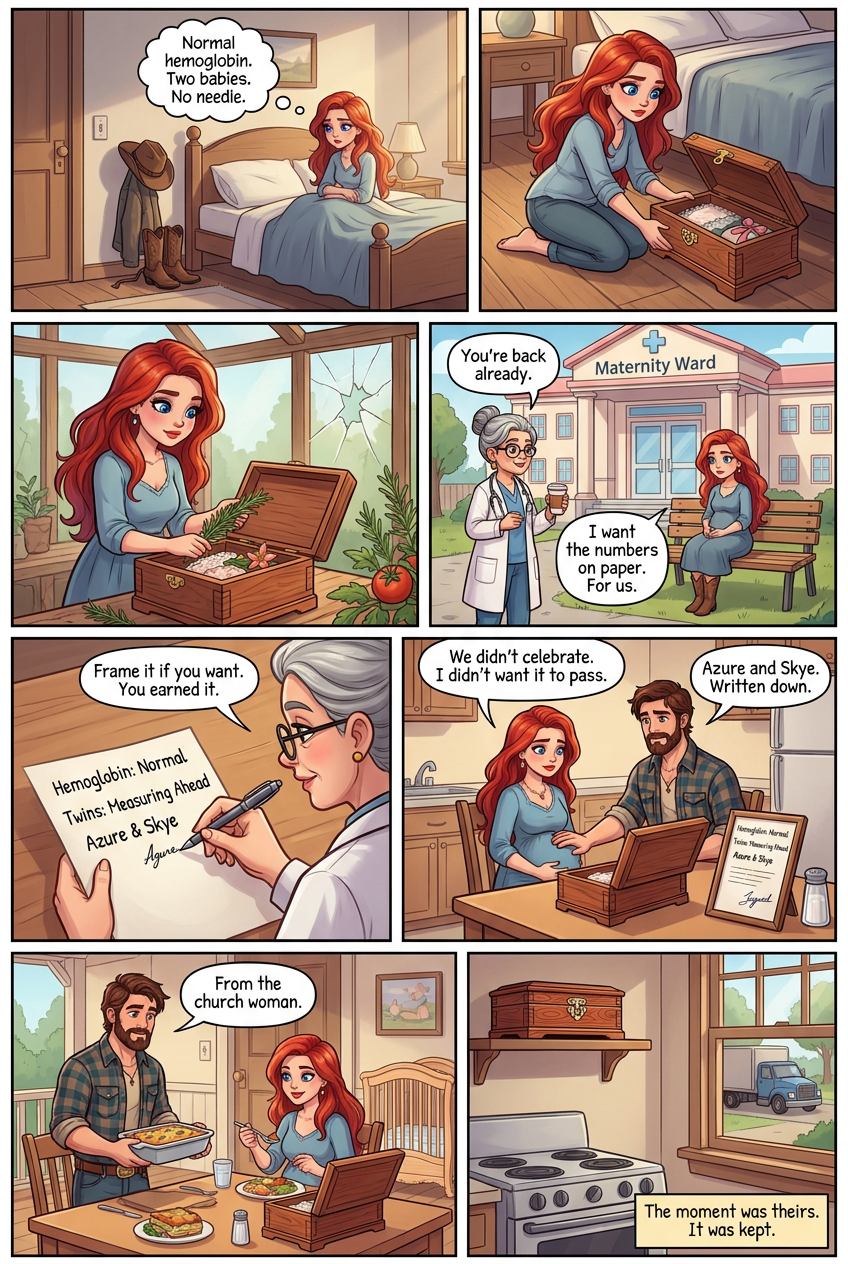
Saturday morning Scarlett woke before Clayton. The clinic news sat in her chest like a warm stone. Normal hemoglobin. Two babies measuring ahead. No needle on Thursday. She wanted to mark it somehow, just the two of them, before the phone started ringing and the yard filled again with trucks and casseroles. But the porch still held yesterday's stacked dishes. Rose was coming at noon. Maya after. The day would eat the news whole if she let it. She slid out of bed and stood at the window. Clayton's boots were by the door. His hat hung on the hook she'd put there a year ago. She had no plan and no time to build one. Then she remembered the cedar box under the bed, the one she'd carried to the honeymoon and back. She pulled it out. Inside were the lace nightgown, a folded ribbon, and space enough for something new. She dressed and walked to the greenhouse. The cracked pane on the north wall caught the early light. She cut two sprigs of rosemary and one late tomato blossom and laid them in the box. Then she drove to town before the shops opened, waited on the bench outside the clinic, and asked the front desk nurse for a copy of yesterday's chart. Dr. Wishborne came out herself, gray bun pinned high, glasses low on her nose, still holding a coffee. "You're back already." "I want the numbers on paper. For us. Not the file." The doctor studied her over the rims. "Frame it if you want. You earned it." She wrote the hemoglobin figure, the twins' measurements, and the two names Scarlett and Clayton had picked last week: Azure. Skye. She signed it and handed it over. "Now go home and lie down." Scarlett drove back with the paper on the seat beside her. Clayton was in the kitchen pouring coffee. She set the cedar box on the table and opened it. The rosemary. The blossom. The signed page with their children's names on a doctor's line. He read it twice, the way the doctor had read the chart. "We didn't celebrate," she said. "I didn't want it to pass." He set the page down. He pulled a chair beside hers instead of across. He put his hand flat on her belly. "Azure and Skye," he said. "Written down." "Written down." He went to the porch and carried in the top casserole, the one from the church woman. He heated two plates. They ate at the table with the box between them and the paper propped against the salt shaker. No visitors came for an hour. When Rose's truck finally turned up the drive, Scarlett closed the cedar box and slid it onto the shelf above the stove, where she could see it from the couch. The moment was theirs. It was kept.
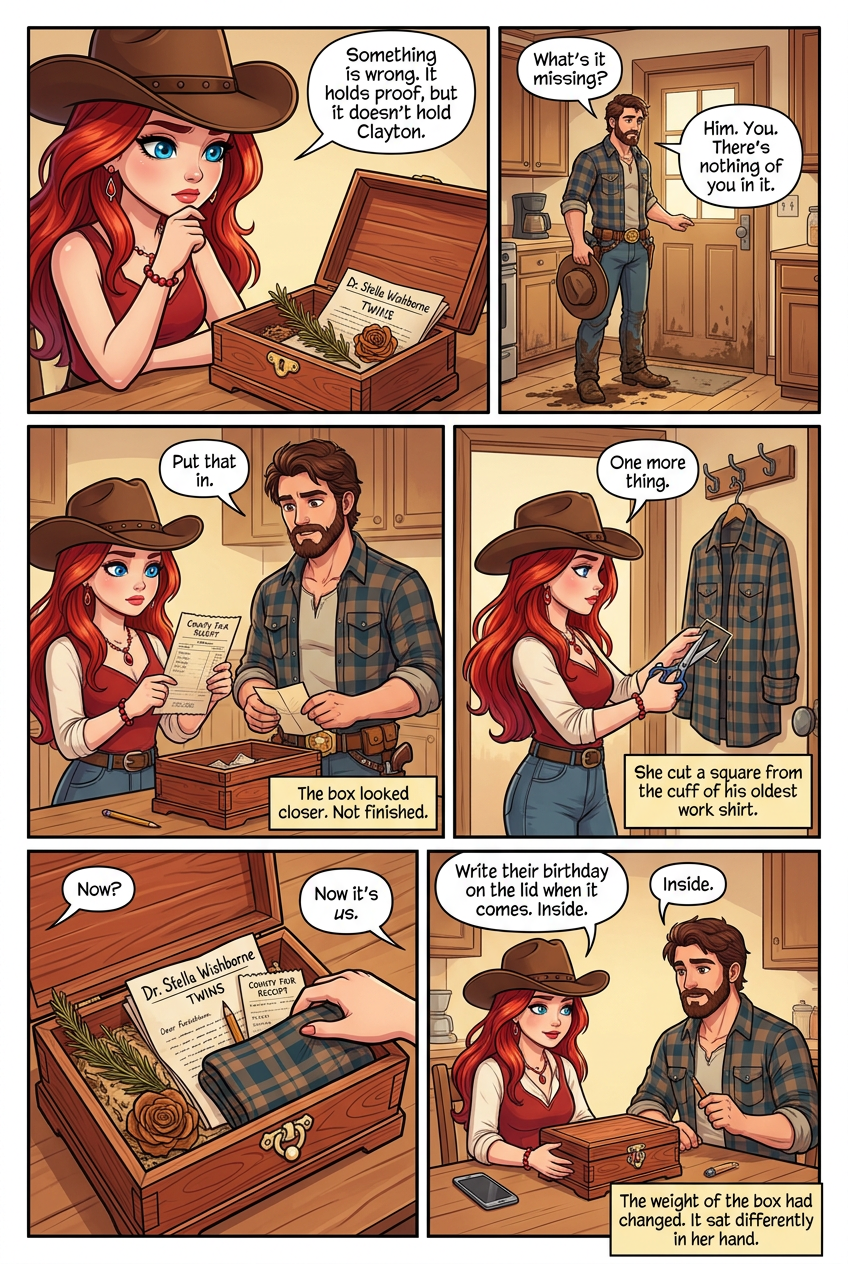
Sunday morning Scarlett took the cedar box down from the shelf above the stove. The rosemary had dried. The tomato blossom had curled brown. The signed page with the twins' names still leaned against the salt shaker where she'd left it. She sat at the table and opened the clasp. Something was wrong. The box held proof, but it didn't hold Clayton. She wanted a keepsake he could open in twenty years and know exactly what she'd felt this week. Right now it read like a doctor's file with a leaf on top. Clayton came in from the barn with mud on his boots. He saw her frown at the open box. "What's it missing?" "Him," she said. "You. I put in the babies and the greenhouse and the doctor. There's nothing of you in it." He looked at the box a long moment. Then he pulled out his wallet and set the county fair receipt on the table. The one she'd found in the truck the morning of the wedding. Faded ink. His name printed wrong on the top line, the same way he'd once said hers. "Put that in," he said. She laid it beside the doctor's page. The box looked closer. Not finished. She went to the bedroom and came back with the shirt pocket note she'd written him on their wedding morning. Rose had returned it folded in fours. She set it in the box. Then she added the small stub of pencil Clayton kept on the windowsill, the one he used to mark feed bags. He watched her without asking why. "One more thing," she said. She took her scissors from the drawer and cut a square from the cuff of his oldest work shirt, the plaid one hanging by the door. He didn't flinch. She folded the square and laid it under the receipt. "Now?" he said. "Now it's us." He pulled a chair beside her. He picked up the pencil stub and turned it in his fingers. "Write their birthday on the lid when it comes," he said. "Inside. Not outside." "Inside," she agreed. She closed the clasp. The bone latch clicked. The weight of the box had changed. It wasn't heavier. It sat differently in her hand, the way a full bucket sits different from an empty one. She carried it back to the shelf above the stove. Clayton put his boots by the door and his hat on the hook. The kitchen smelled like coffee and cedar. "Rose called," he said. "She wants to bring the crib frame Tuesday. Said the nursery's not done." Scarlett looked at the shelf. The keepsake was finished. The room the babies would sleep in was not. She reached for her phone to tell Rose yes, Tuesday, and to ask what still needed building.
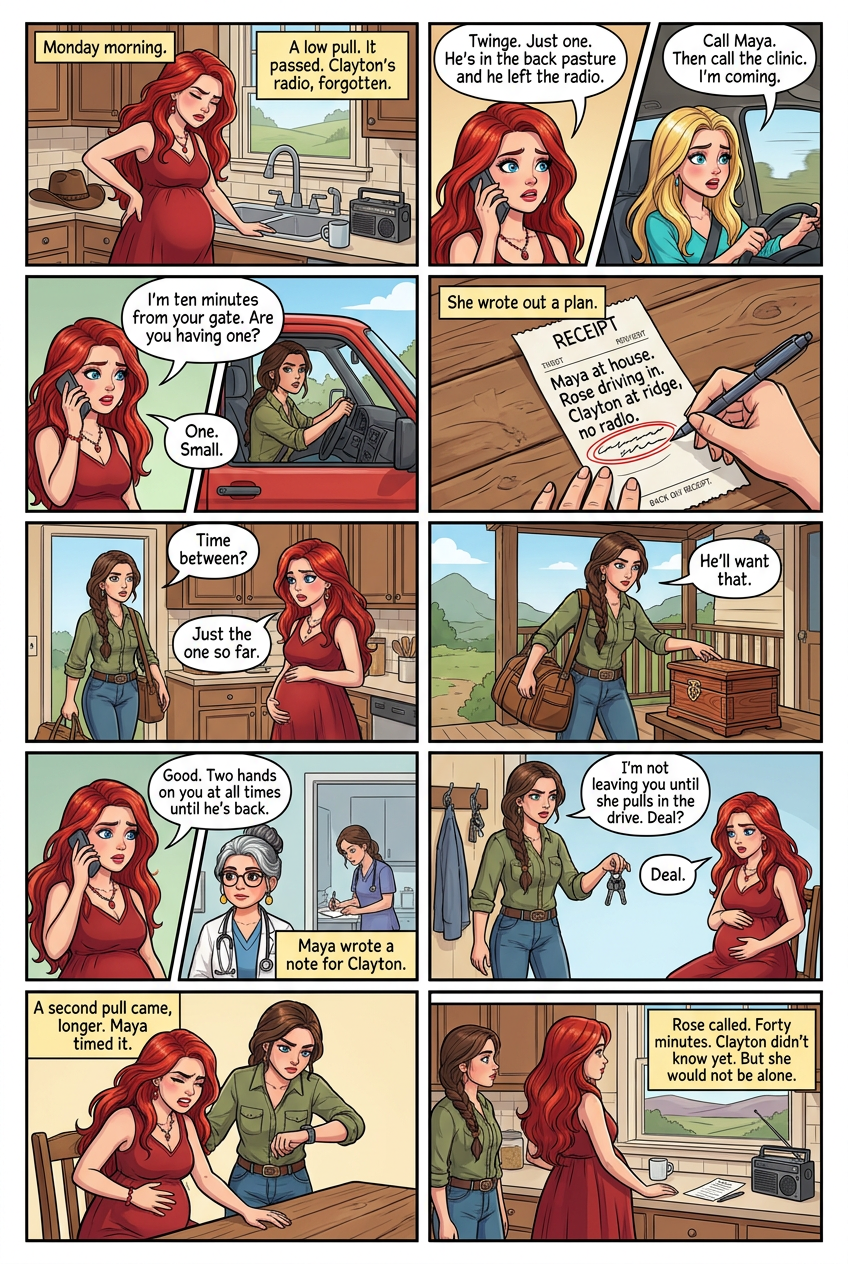
Monday morning Scarlett stood at the sink and felt a low pull across her back. It passed. She set down the mug and waited. Nothing came again. She was thirty-six weeks. The doctor had said any day. Clayton was out past the ridge moving cattle off the wet ground. His truck was gone. His radio was on the counter where he'd forgotten it. She called Rose first. Rose answered on the second ring, already in the car with the crib frame strapped down. "How far out are you?" "Ninety minutes. Why. Scarlett, why." "Twinge. Just one. He's in the back pasture and he left the radio." "Call Maya. Then call the clinic. I'm coming." Scarlett called Maya. Maya picked up in the truck, engine running. "I'm ten minutes from your gate. Cora asked me to swing by with the bassinet sheets. Are you having one?" "One. Small." "I'm coming. Sit down. Put the door on the latch." Scarlett sat at the table with the phone flat in front of her. She wrote out a plan on the back of a feed receipt. Maya at the house. Rose driving in. Clayton at the ridge with no radio. She circled that last line twice. Maya came through the door without knocking. Her braid was loose. She set a bag on the table and looked Scarlett over the way a vet looks at a mare. "Time between?" "Just the one so far." "Good. Where's your bag?" "Bedroom closet. Bottom shelf." Maya carried it to the porch. Then she went back for the cedar box on the shelf above the stove and set it beside the bag. "He'll want that," she said. Scarlett called the clinic. Dr. Wishborne came on the line herself. She asked three questions and told Scarlett to come in when the pains were seven minutes apart, sooner if her water broke. She said the maternity ward had a bed held under her name since Friday. "Who's driving you?" "Maya. My sister's ninety minutes out." "Good. Two hands on you at all times until he's back." Scarlett hung up. Maya was already writing a note for Clayton in block letters on the counter. Gone to clinic if you find this. Radio's here. Call Rose. Maya took the truck keys off the hook. "I'm not leaving you until she pulls in the drive. Then she doesn't leave you until he does. That's the deal." "Deal," Scarlett said. A second pull came, longer. She breathed through it with her hand on the table. Maya timed it on her watch and didn't say the number out loud. Rose called from the highway. Forty minutes. Scarlett looked at the radio on the counter and at the ridge through the window. Clayton didn't know yet. But someone was here, and someone else was coming, and the bed was held. She would not be alone when it started. She already wasn't.
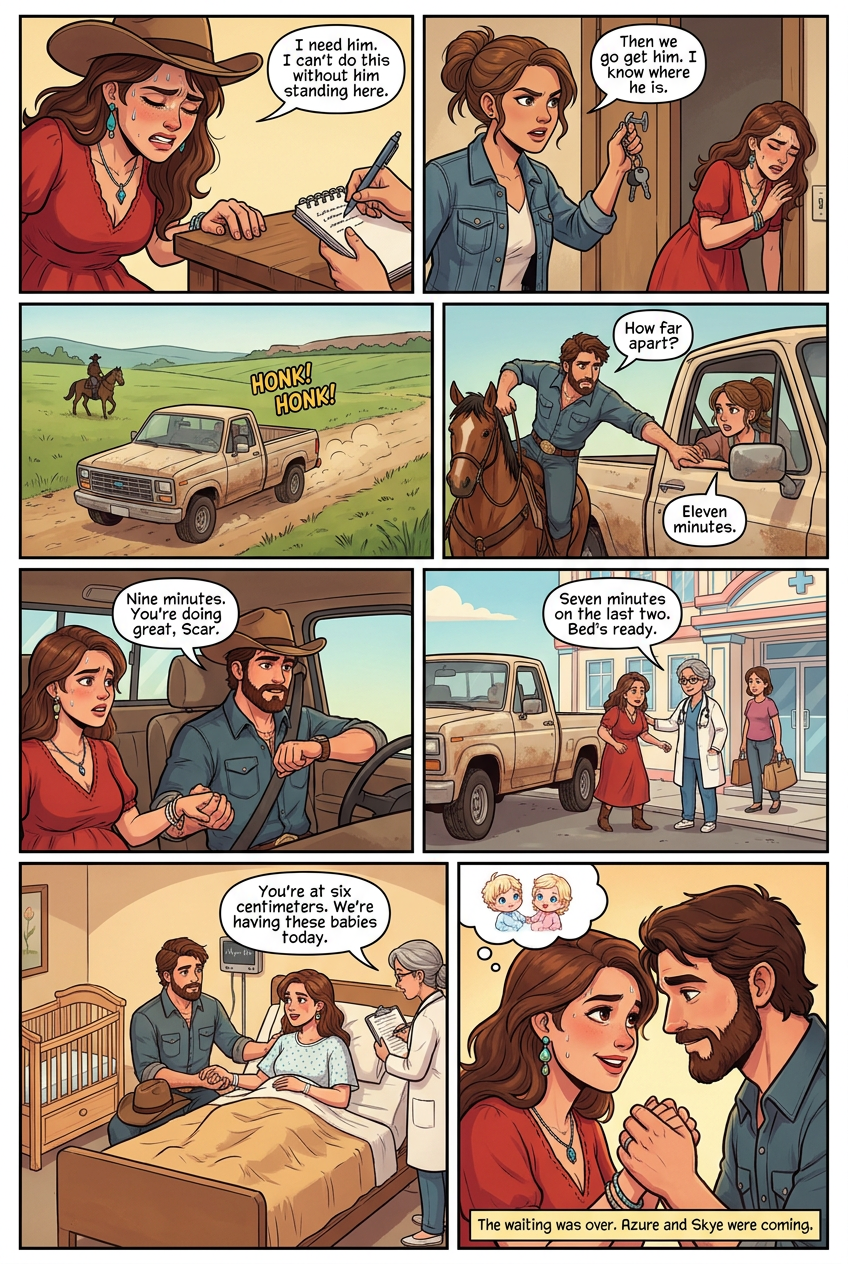
The third pull came harder. Scarlett gripped the table and breathed until it passed. Maya wrote the time on the feed receipt without a word. Rose was still forty minutes out. Clayton was still past the ridge with no way to know. "I need him," Scarlett said. "I can't do this without him standing here." Maya set the pen down. "Then we go get him." "He's an hour into the back pasture." "I know where he moves cattle on wet ground. I grew up on that land too." Maya pulled her keys back off the hook. "You come with me. Doctor said two hands on you. I'm not leaving you here and I'm not leaving him out there." Scarlett stood. Another pull started low and she waited it out against the door frame. Eleven minutes since the last. Still time. Maya drove the ranch road slow over the ruts. Scarlett watched the fence line pass. The twelve acres she had signed over sat green on the left. Cattle were bunched at the far corner near the cedar break. A single rider sat on the ridge above them. Maya laid on the horn. The rider's head came up. He turned the horse and came down the slope at a hard trot, then a canter. Clayton pulled up beside the truck and swung down before the horse had stopped. "How far apart." "Eleven minutes," Maya said. Clayton looked at Scarlett through the open window. His hand found hers on the door. "I left the radio." "I know." "I'm sorry." "You're here now." He tied the horse to the fence and climbed in beside her. Maya turned the truck for the highway. Clayton kept his hand on Scarlett's knee and timed the next one on his own watch. Nine minutes. Rose met them at the clinic doors with the cedar box and the overnight bag. Dr. Wishborne was already in the hall in her white coat, glasses pushed up, waiting. "Seven minutes on the last two," Dr. Wishborne said, one hand on Scarlett's back. "You timed it right. Bed's ready. Both babies still measuring strong." They moved her down the corridor into the maternity ward. Clayton did not let go of her hand. The room was quiet and warm, the bed turned down, a bassinet waiting at the wall. Dr. Wishborne checked her and nodded. "You're at six centimeters. Faster than I expected. We're having these babies today." Scarlett looked at Clayton. His hat was still on. Dust from the pasture sat on his sleeve. He was here. "Okay," she said. "Okay." A contraction rolled through her and she squeezed his hand until it passed. Rose stepped out to call the family. Maya stood at the door. Dr. Wishborne pulled on gloves. The waiting was over. Azure and Skye were coming, and Clayton was beside her for it.
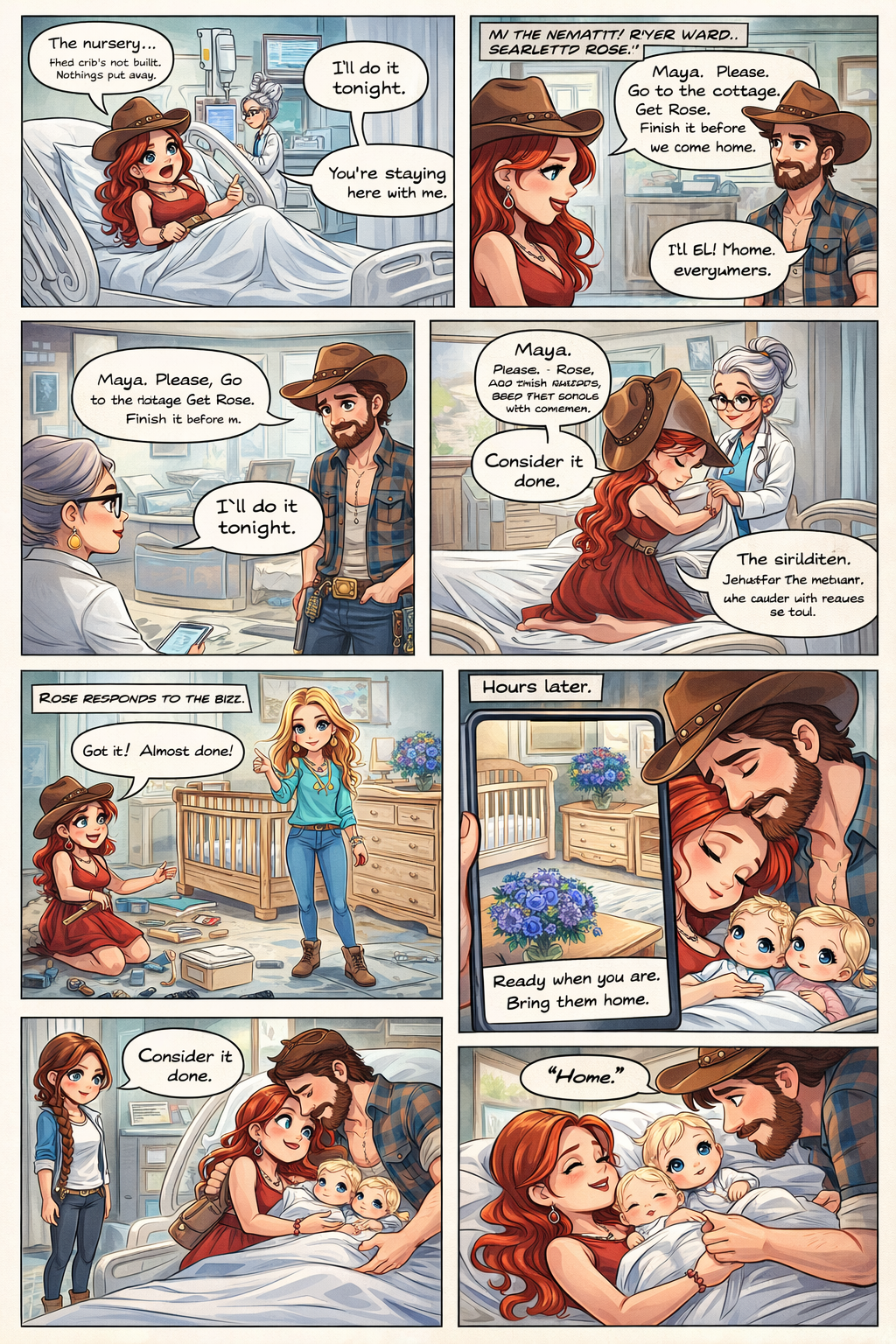
Between contractions, Scarlett looked at the bassinet against the wall and remembered the room at home. The crib frame still sat in pieces by the closet. The dresser had no drawers pulled. The wall Clayton painted three weeks ago still had blue tape along the trim. The babies would come today and there was nowhere to lay them down. "The nursery," she said. Clayton leaned in. "The crib's not built. Nothing's put away." "I'll do it tonight." "You're staying here with me." He did not argue. Dr. Wishborne checked the monitor and stepped out to speak with a nurse. Maya was still at the door, arms folded. Scarlett turned her head on the pillow. "Maya. Please. Go to the cottage. Get Rose. Finish it before we come home." Maya crossed to the bed. "Tools where they always are?" "Barn shelf. The instructions are in the box under the window." "Consider it done." Maya kissed her forehead and was gone. Rose came back in with her phone in her hand. Scarlett explained fast between pulls. Rose did not ask a single question. She wrote a list on the back of the intake form, then handed Clayton the cedar box and the overnight bag to keep at the bedside. "Maya and I will handle it," Rose said. "You do your job. I'll do mine." "Rose. The sheets are in the hall cupboard. The mobile's still in the sack." "I know where everything is. I helped you buy half of it." Rose squeezed her hand. "I'll send a picture when it's done." She left. Clayton pulled the chair close and put both hands over Scarlett's. Another contraction rolled through. Five minutes now. Hours passed the way labor passes. Scarlett stopped watching the clock. Dr. Wishborne coached her through the last stretch. Skye came first at 6:14, red and loud. Azure came four minutes behind him, quieter, blinking at the light. Clayton cut both cords with his hands shaking. Dr. Wishborne laid them on Scarlett's chest. "Both strong," Dr. Wishborne said. "Both yours." Scarlett was crying and could not stop. Clayton pressed his forehead to hers and stayed there. Her phone buzzed on the tray an hour later. She could not reach it. Clayton held it up for her. The picture was the nursery. Crib built and made up with the white sheets. Dresser against the wall, drawers filled. The blue tape gone from the trim. A bouquet of deep blue and purple flowers sat on top of the dresser in a mason jar. Rose stood in the doorway with her thumb up. Maya was on the floor behind her, screwdriver in her lap, grinning. Below the picture, Rose had written: Ready when you are. Bring them home. Scarlett showed Clayton. He looked at the screen a long time. "Home," he said. She nodded against the twins on her chest. The room at home was waiting. So was the rest.
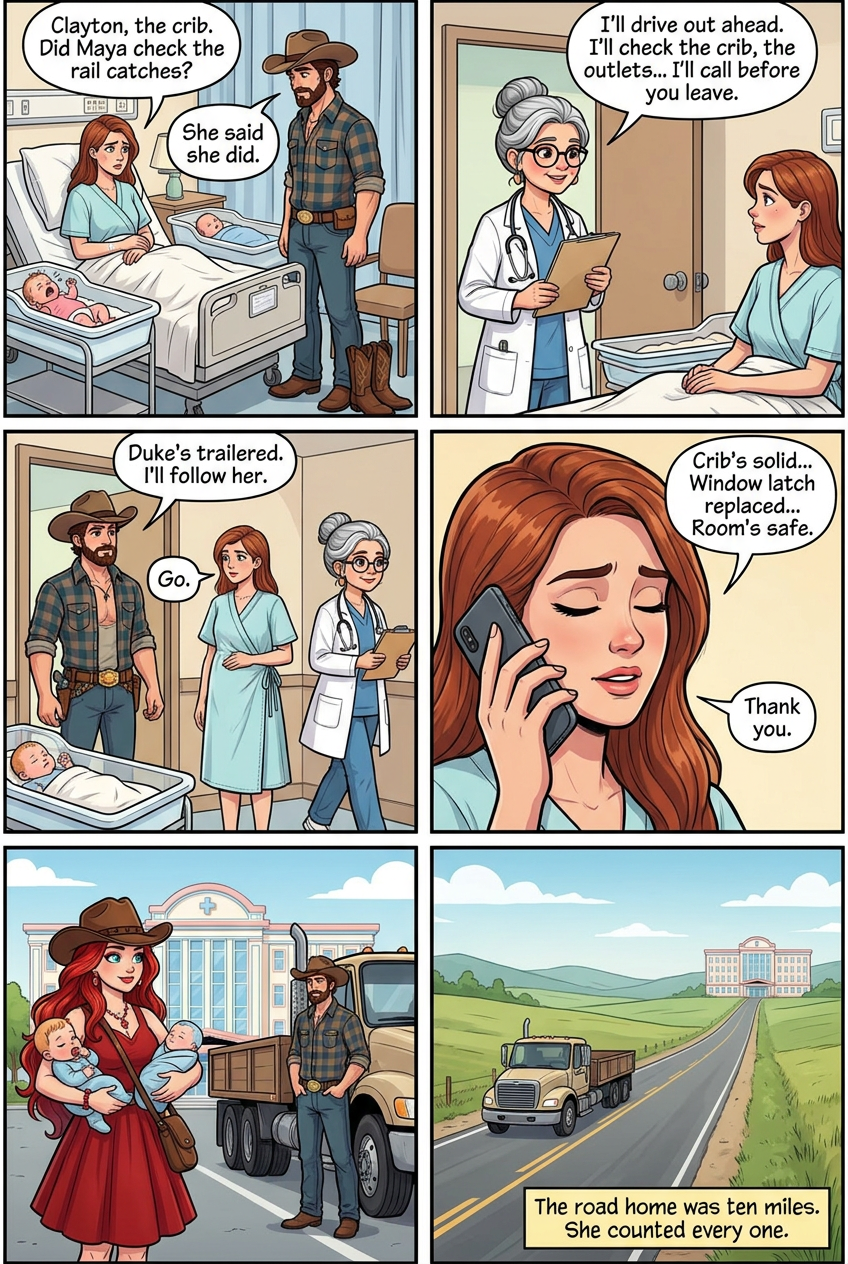
Morning came slow at the clinic. Scarlett woke with Skye already fussing in the bassinet and Azure asleep beside him. Clayton was up, boots on, hat on the chair. Discharge was set for ten. She should have felt ready. Instead she kept seeing Rose's photo of the finished nursery and finding the parts it did not show. "Clayton." She shifted against the pillow in the thin recovery gown, the tie loose at her hip. "The crib. Did Maya check the rail catches after she built it?" He looked up. "She said she did." "Said, or checked." "I'll ask her." "And the outlet by the changing table. The cover was off last week. And the window latch upstairs. It sticks. If it swings open in a storm—" "Scarlett." She stopped. Her hands were shaking on the blanket. Azure stirred and made a small sound. Scarlett pressed her palm flat to steady it. "I can't bring them home to a room I haven't walked myself," she said. "Rose finished it in four hours. In a rush. I need to know it's right before they sleep in it." Clayton nodded once. He pulled his phone out and stepped into the hall. Dr. Wishborne came in a few minutes later with the discharge folder under her arm. Her glasses had slid down her nose. She looked at Scarlett's face and set the folder on the tray. "Your husband says you need another hour." "I need someone to check the nursery before we leave. Not Rose. Not Maya. Someone who knows what a newborn needs." Dr. Wishborne sat on the edge of the bed. "I do house calls the day of discharge when a mother asks. I'll drive out ahead of you. I'll check the crib, the outlets, the smoke alarms, the window. I'll call before you leave the parking lot." Scarlett's shoulders dropped an inch. "You'd do that." "I've done it forty years. I know what to look for." She tapped the folder. "You feed them. I'll go now." Clayton stood in the doorway with his hat back on. "Duke's trailered. I can follow her out and meet her there." "Go," Scarlett said. He kissed her forehead and left with Dr. Wishborne. She fed Azure first, then Skye. The clock moved. At nine-forty her phone rang. "Crib's solid," Dr. Wishborne said. "Rail catches locked both sides. Outlets covered. Window latch replaced. Clayton put a new one in while I watched. Smoke alarm tested. Room's safe." Scarlett closed her eyes. "Thank you." "Bring them home." She hung up. A nurse wheeled in the chair. Scarlett dressed, tucked Skye against her chest and Azure in the carrier at her feet. Clayton was waiting at the curb with the truck running. She climbed in and did not look back at the ward. The road home was ten miles. She counted every one.
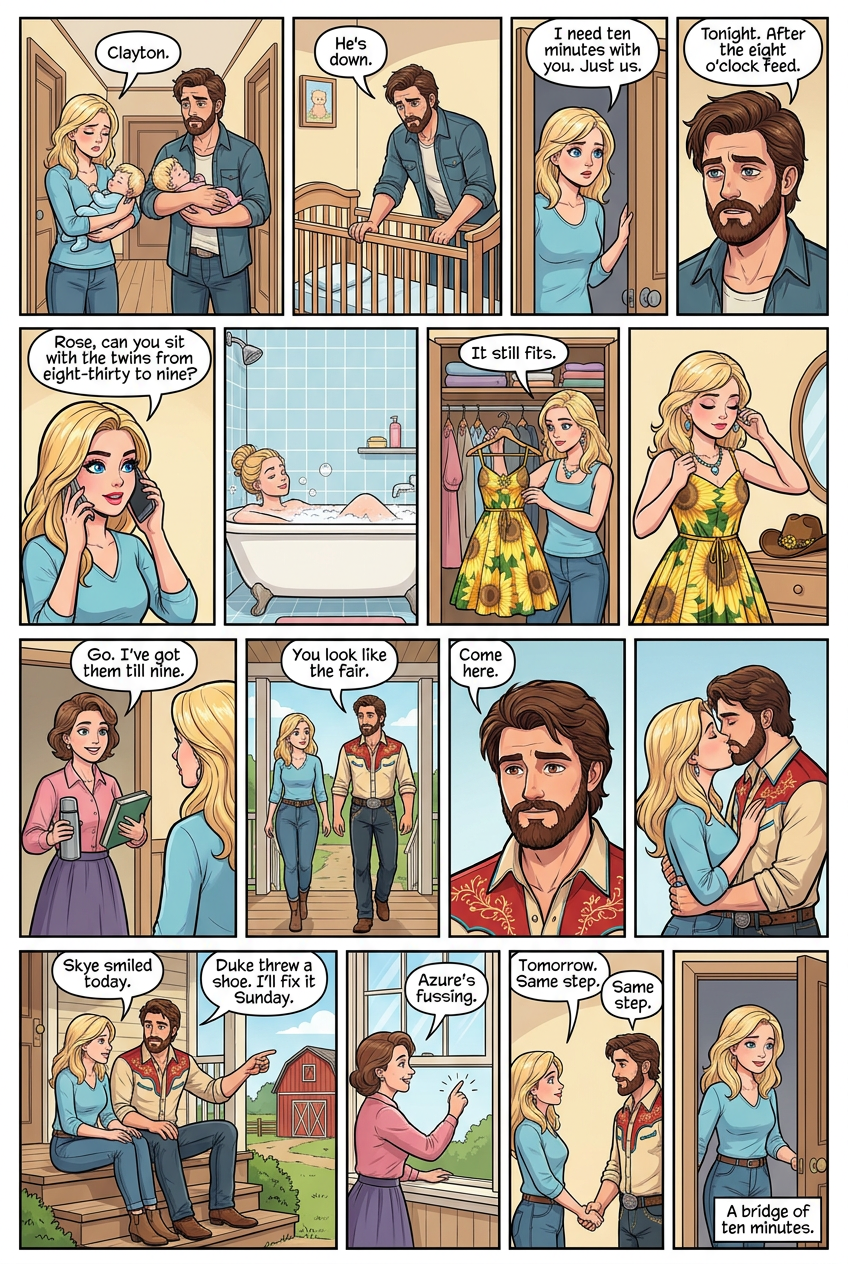
The twins had been home four days. Scarlett moved through the house on a rhythm of feedings, diapers, and half-sleep. Clayton did the barn before dawn and the barn after dark. They passed each other in the hall with a baby in each set of arms. He kissed her forehead every time. He had not kissed her mouth since the clinic. On the fifth morning she stood at the nursery door and watched him lay Skye in the crib. His shirt was the same one from yesterday. Hers was too. He did not look up when she came in. He was counting breaths, the way Dr. Wishborne showed them. "Clayton." "He's down." "I know. I need ten minutes with you. Just us." He looked at her then. His eyes were tired, but they held. "Tonight. After the eight o'clock feed." "Promise me." "I promise." She spent the afternoon planning ten minutes like a wedding. She called Rose and asked her to sit with the twins from eight-thirty to nine. Rose said yes before Scarlett finished the sentence. Scarlett bathed. She pulled the sunflower dress from the closet, the one she had not worn since the reception. It still fit across the chest. She left the boots off. She put the diamond earrings in and set the hat on the dresser. At eight-fifteen Rose came through the back door with a thermos and a book. She looked at Scarlett and her mouth softened. "Go," Rose said. "I've got them till nine." Scarlett found Clayton on the porch. He had washed up and put on the good shirt with the red yoke, the one she loved. His hat sat low. His boots were clean. He had planned too. He stood when he saw the dress. "You look like the fair." "I feel like a stranger." "Come here." She went. He put his hands on her waist, then her back, then her face. He kissed her mouth. She held onto his shirt because her knees were not steady. "I've missed you," she said. "In the same house." "I know. I've been counting the hours wrong. Doing chores instead of seeing you." "Ten minutes on the porch every night. After the eight o'clock feed. No phones. No barn." "Ten minutes." He nodded. "Starting now." They sat on the top step. He kept his hand on her knee through the sunflowers. She told him Skye had smiled that morning, a real one, not gas. He told her Duke had thrown a shoe and he'd fix it Sunday. Small things. Their things. At nine Rose tapped the window. Azure was fussing. Scarlett stood. Clayton caught her hand before she reached the door. "Tomorrow," he said. "Same step." "Same step." She went inside to her daughter. The distance was still there, but it had a bridge now, ten minutes wide, and both of them knew where it started.
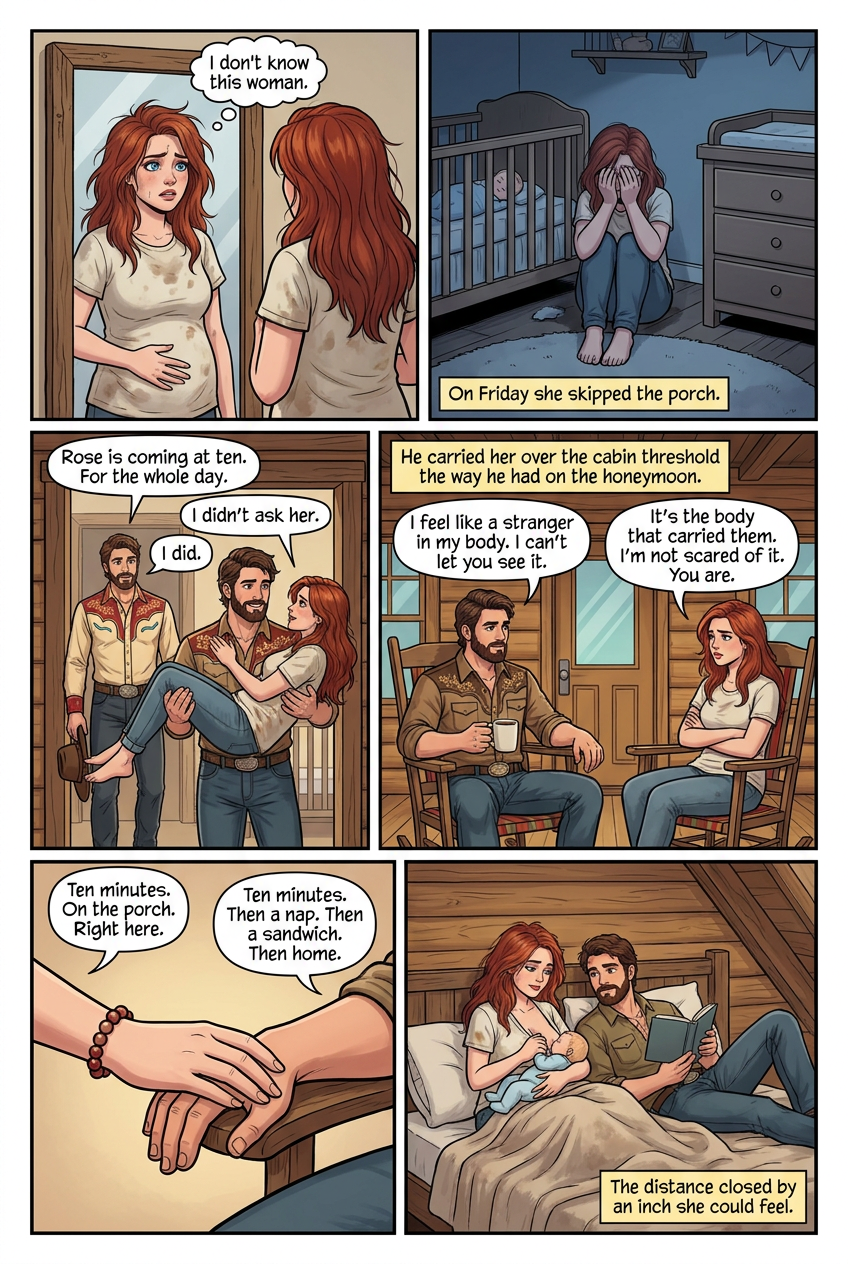
The ten minutes on the porch held for a week. Then the twins hit their second growth spurt and the nights ran together. Scarlett stopped putting the sunflower dress on. She stopped brushing her hair before bed. She caught her reflection in the hall mirror one morning and did not know the woman there. Her middle was soft. Her chest was sore. Her shirt had milk on the shoulder. Clayton kissed her forehead in the kitchen and she turned her cheek before his mouth found hers. He noticed. He did not say so. On Friday she skipped the porch. She told him Azure was fussy. He nodded and went to the barn. She sat on the nursery floor between the crib and the changing table and cried without sound. She did not want him to see her like this. She did not want him to touch her and find someone new under his hands. Saturday morning he came in from the barn early. He set his hat on the hook and stood in the nursery doorway in the good shirt with the red yoke. The one from the porch. "Rose is coming at ten," he said. "For the whole day." "I didn't ask her." "I did." She looked up from the rocker. Skye was asleep on her chest. "Where are we going?" "Ten minutes up the ridge. The old cabin on the twelve acres. I cleaned it Wednesday." "Clayton. I can't." "You can sit on the porch. You can sleep. You can eat what I bring. That's the whole plan." She put Skye in the crib. She washed her face. She did not change her shirt. He drove her up the ridge in the truck and carried her over the cabin threshold the way he had on the honeymoon. She laughed for the first time in a week and then she cried again. He sat her in a rocking chair on the wraparound porch and brought her coffee. He sat in the other chair. He did not reach for her. "I feel like a stranger in my body," she said. "I can't let you see it." "I've seen it. I was there." "It's different now." "It's the body that carried them. I'm not scared of it. You are." She looked at him. He was telling the truth the way he tells it, flat and without decoration. "Ten minutes," she said. "On the porch. Right here." "Ten minutes," he said. "Then a nap. Then a sandwich. Then home." She took his hand. She let him look at her in the morning light without turning her face. He kissed her mouth on the rocking chair and she did not flinch. The distance closed by an inch she could feel. At three she nursed Azure in the cabin loft while Clayton read on the bed beside her. He did not look away. She did not ask him to.
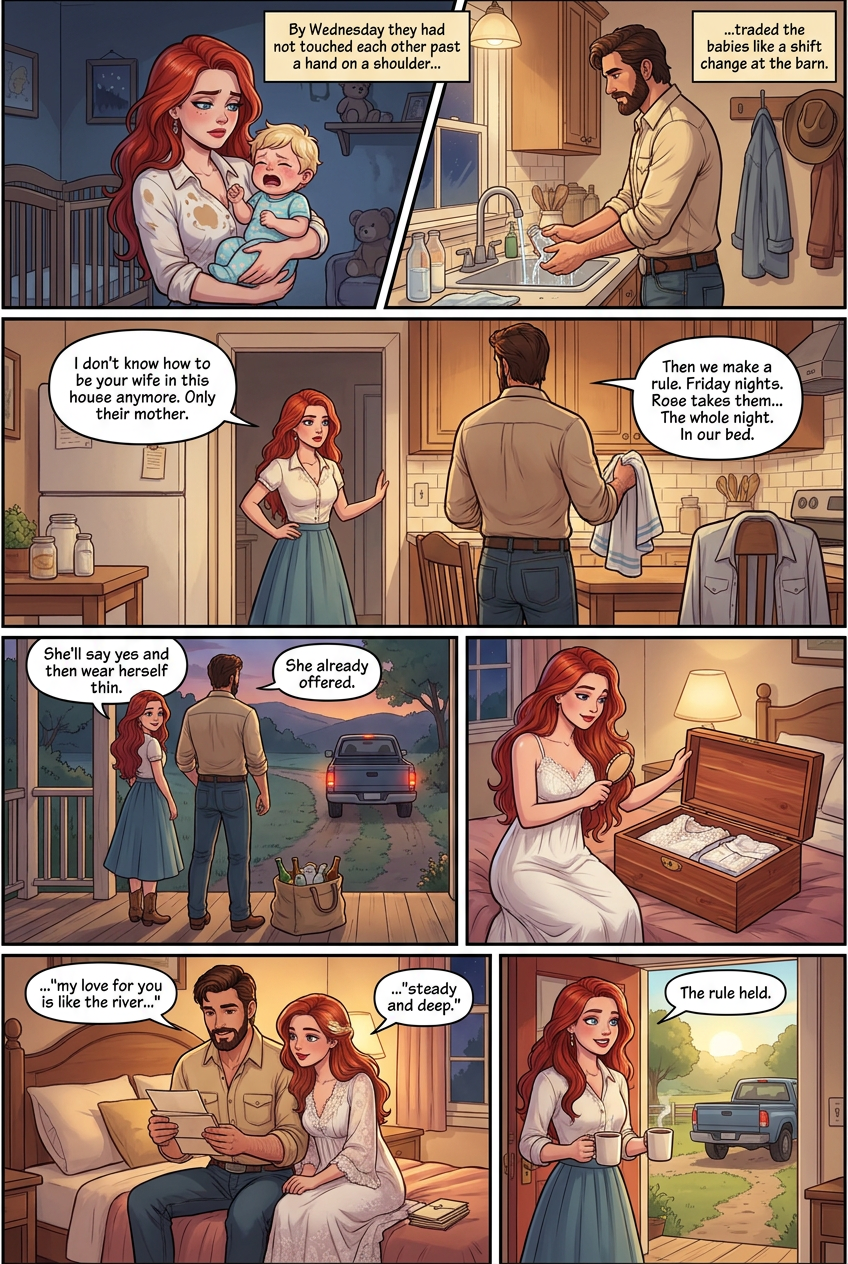
They came back down the ridge Sunday night and the cottage swallowed them whole. Azure had a diaper rash. Skye would not take the bottle. Rose left a note on the counter about the pediatrician moving Tuesday's visit to Monday. Scarlett stood in the kitchen with her coat still on and felt the cabin peel off her like a coat she couldn't keep. By Wednesday they had not touched each other past a hand on a shoulder in the hall. Clayton took the night feed at two so she could sleep. She took the four so he could sleep. They traded the babies at the changing table like a shift change at the barn. Thursday she found him at the kitchen sink at midnight, rinsing bottles. His good shirt hung on the chair. She stood in the doorway in the milk-stained shirt and watched his back. "The cabin didn't take," she said. "It took. The cottage is louder." "I don't know how to be your wife in this house anymore. Only their mother." He dried his hands on the towel. He turned around. "Then we make a rule," he said. "A rule." "Friday nights. Rose takes them from seven to seven. Every week. Not the porch. Not ten minutes. The whole night. In our bed." "She'll say yes and then wear herself thin." "She already offered. Tuesday. I didn't tell you because I wanted to ask you first." She leaned on the doorframe. The dishwasher ticked. "One night a week," she said. "One night. Locked door. No monitor." "No monitor." "You heard me." She laughed. It came out rough. She had not laughed in the kitchen in a month. Friday she put the twins in the car seats at six-thirty. Rose took them with a canvas bag of bottles and a look that said she had been waiting to be asked. Scarlett watched the taillights go down the drive and stood on the porch until she could not hear the truck anymore. She went upstairs. She opened the cedar box under the bed and took out the lace nightgown she had packed for the honeymoon and worn only once. She put it on. She brushed her hair. Clayton came in from the barn at seven. He set his hat on the hook. He looked up the stairs and saw her on the landing. "Lock the door," she said. He locked it. They did not talk about the babies. They did not check the phone. He read one of the old letters aloud from the stack on the nightstand, the one she wrote him two Aprils ago, and she finished the sentence he could not read through the ink. She was his wife again for twelve hours. At seven in the morning Rose's truck came up the drive. Scarlett met her at the door with coffee and clean arms. The rule held. Something in the house had shifted a foot to the left and stayed there.
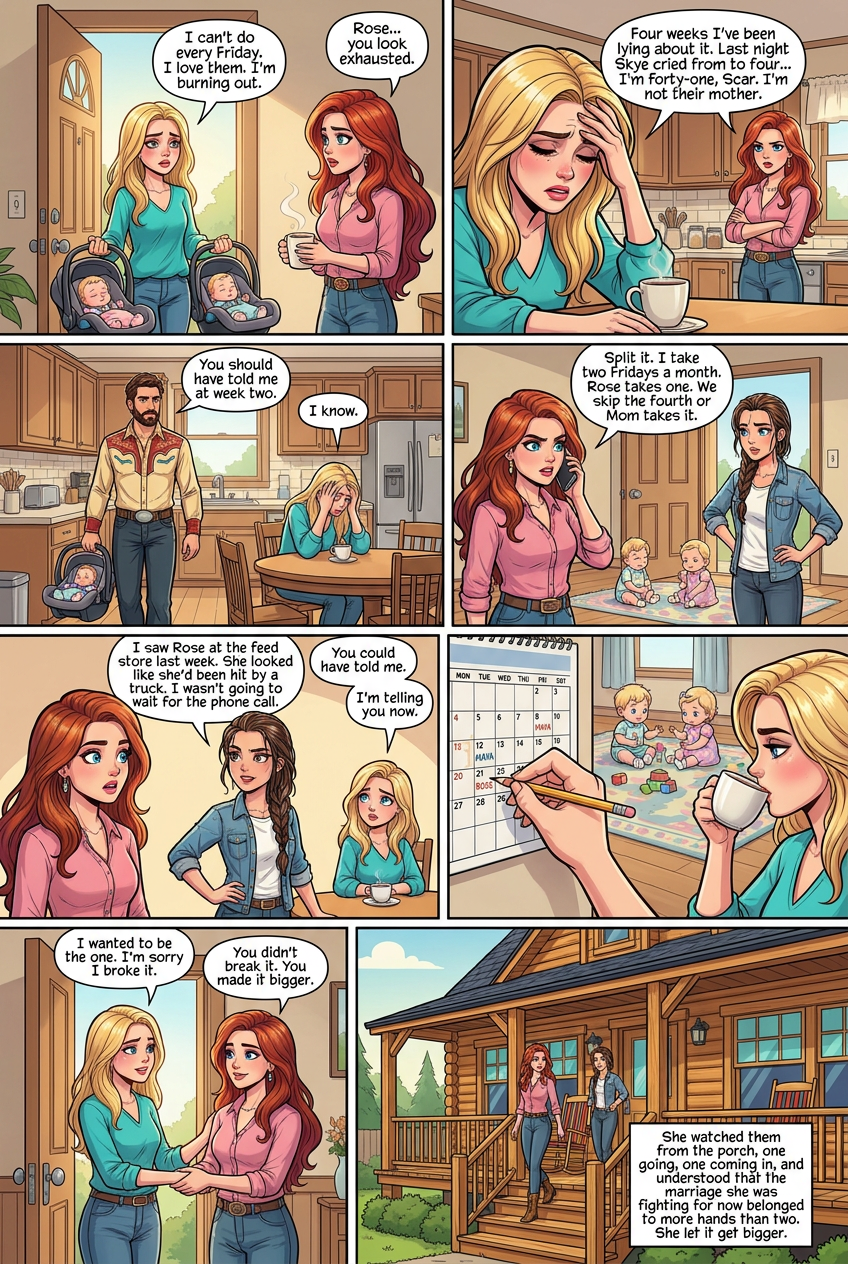
The rule held for six Fridays. On the seventh, Rose came up the drive at seven in the morning with the twins asleep in their seats and her eyes rimmed red. Scarlett met her at the door with coffee. Rose set the seats down in the hall and did not take the cup. "I can't do every Friday," Rose said. "I love them. I'm burning out." Scarlett set the coffee on the table. Azure stirred in her seat. Skye did not. "How long," Scarlett said. "Four weeks I've been lying about it. Last night Skye cried from two to four and I sat on the kitchen floor and cried with him. I'm forty-one, Scar. I'm not their mother. I shouldn't be the one deciding if you get a night with your husband." "You should have told me at week two." "I know." Clayton came in from the barn and read the room in one look. He picked up Skye's seat and carried it to the living room without a word. Rose sat down at the table and put her face in her hands. "Every other Friday," Scarlett said. "Starting now. And not you alone." "Every other still ends me." Scarlett picked up the phone and called Maya. Maya came in an hour with her braid still wet. She looked at Rose at the table, at the twins on the rug, at Scarlett standing in the kitchen with her arms crossed like she was holding herself up. "Split it," Maya said before Scarlett spoke. "I take two Fridays a month. Rose takes one. We skip the fourth or Mom takes it. I already asked her Tuesday. She said yes and told me to quit stalling." Scarlett stared at her. "You asked your mother." "I saw Rose at the feed store last week. She looked like she'd been hit by a truck. I wasn't going to wait for the phone call." Rose lifted her head. "You could have told me." "I'm telling you now." They wrote it on the calendar in pencil. Maya took the next Friday. Rose took the one after. Clayton's mother took the third. The fourth stayed blank until they needed it. Rose drank her coffee. Some color came back into her face. At the door Rose held Scarlett's arm. "I wanted to be the one," Rose said. "I wanted it to be me every week." "I know." "I'm sorry I broke it." "You didn't break it. You made it bigger." Rose went down the steps. Maya stayed to help with the morning feed. Scarlett watched them from the porch, one going, one coming in, and understood that the marriage she was fighting for now belonged to more hands than two. She had wanted it kept small. It would not stay small. She let it get bigger and went back inside to her children.
Play your story to life
Storycraft is a mobile game where you create AI characters, craft items and locations to build their world, then discover what direction your story takes. Download the iOS game for free today!
Download for free