

Ben Dover's Arc
151 Chapters
Ben Dover's dream is assembling a complete set of the legendary artifacts scattered across the kingdom of Butter.

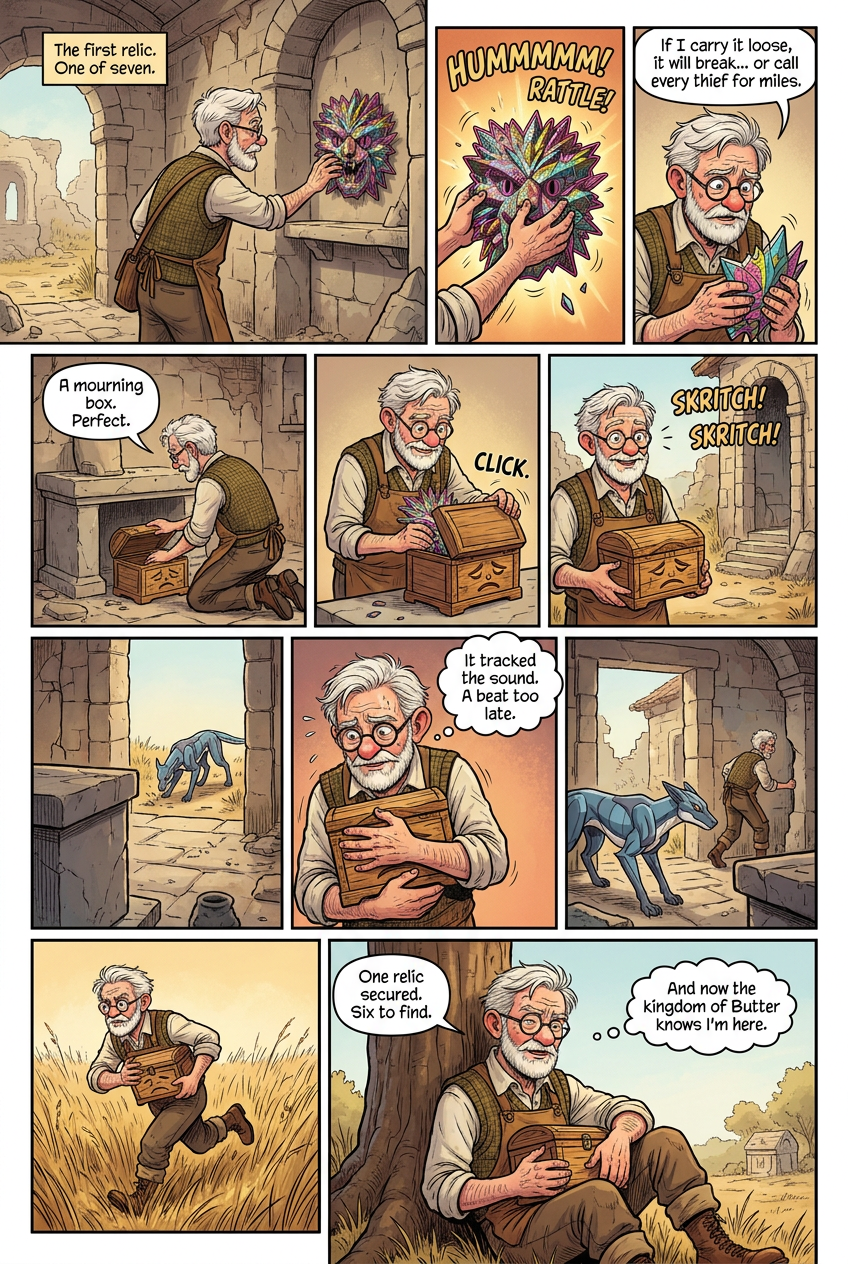
Ben Dover had one day to leave the kingdom of Butter with the first relic, and he had nothing to carry it in. The relic sat on a stone shelf in an abandoned dairy shrine: a small carved mask, bright with painted teeth and jagged points, humming faintly under his fingers. Old stories called it one of seven scattered pieces. Ben had spent two years mapping their rumored places. He had walked here from the coast with a satchel, a knife, and a plan that ended the moment he touched the mask. The hum grew louder when he lifted it. The painted teeth rattled against the wood. He shoved the mask into his satchel, and the cloth strap tore at the stitch. The mask hit the floor. A chip flew off one tooth. Ben picked up the chip. His hands shook. If he carried the relic loose, it would break before he reached the next village. If he carried it in the satchel, someone would hear it howling and take it from him on the road. He searched the shrine. Broken crocks. A dead lantern. Behind the altar he found a wooden box the size of a loaf of bread. The lid drooped at the corners. Someone had carved a sad face into the front, eyes half-closed, mouth turned down. It looked like it had been left here to mourn. Ben pried the lid open. The inside smelled of old cedar. He set the loud mask into the box and closed it. The humming stopped. The rattle stopped. He pressed his ear to the wood and heard nothing. He smiled for the first time in a week. Then he heard the claws. Outside, something moved fast across the stone yard. Ben crouched behind the altar and looked through the doorway. A lean creature stood in the grass, blue-scaled, long-tailed, head low. Its eyes tracked the shrine. It had followed the sound of the mask, and it had arrived a beat too late to hear where the sound stopped. Ben held the box against his chest. The creature turned its head. It could outrun him across open ground in three strides. He knew this because he had watched one take down a goat outside the last village. He waited. The creature paced. It sniffed the doorway, hissed, and slid into the shrine. Ben went out the back gap in the wall while it searched the altar. He ran low through the tall grass, box tight under one arm, until the shrine dropped behind a rise. He stopped only when his lungs gave out. The box sat quiet in his lap. One relic secured. Six to find. And now something in the kingdom of Butter knew his scent, knew what he carried, and knew how to run faster than he could.
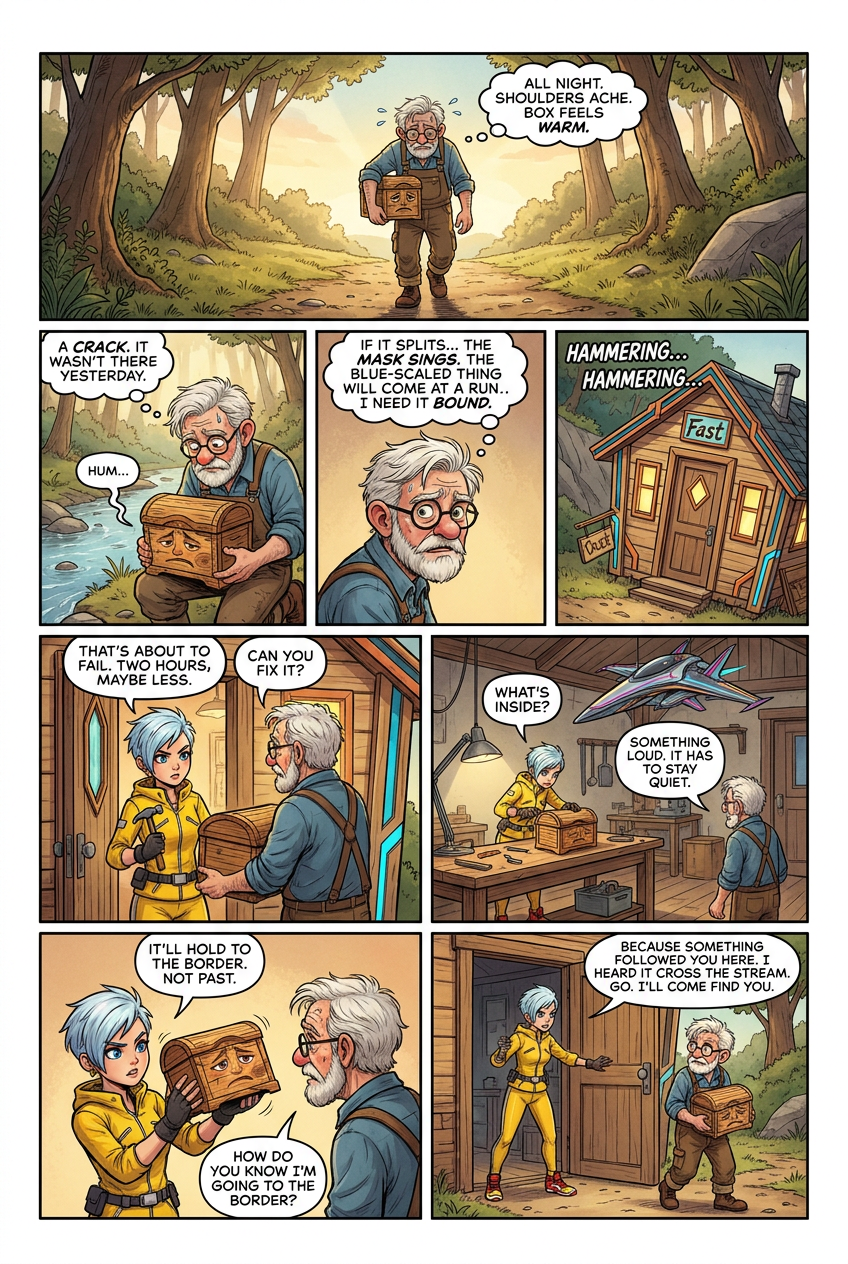
Ben walked all night with the sad-face box under his arm. By dawn his shoulder ached and the wood felt warm through his shirt. He stopped at a stream to drink and turned the box over in his lap. A hairline crack ran down the sad mouth, from lip to chin. He pressed his thumb against it. The mask inside gave one low hum, then went quiet again. The crack had not been there yesterday. He knew what a broken box meant. If the wood split on the road, the mask would sing, and the blue-scaled thing would come at a run. He needed the box bound, sealed, reinforced — and he needed it before the next hill. He followed the stream down to a narrow building tucked against the slope. It leaned forward like it wanted to run, all sharp angles and bright trim, two thin windows glowing at the front. A sign hung crooked by the door. Someone inside was hammering fast. He knocked. The hammering stopped. The door swung open on a woman his own height, blue hair cropped short, yellow jacket streaked with sawdust. She held a tack hammer in one gloved hand and a strip of copper in the other. She looked at his face, then at the box, then at the crack. "That's about to fail," she said. "Two hours, maybe less." "Can you fix it?" "I fix fast. That's the only way I fix." She stepped back to let him in. Her shop was one room. A workbench ran the length of the far wall. A model of a sleek, finned craft hung from the ceiling on wire, nose down, as if diving. She set his box on the bench under a lamp and ran a fingernail along the crack. "What's inside?" she asked. "Something loud. It has to stay quiet." She did not ask again. She cut two thin copper bands, notched them, and tapped them flat around the box with quick, even strikes. She worked glue into the crack with a knife tip. She wrapped the seams in waxed linen and pressed each corner with her thumb until the cloth held. "Name's Anita," she said, not looking up. "You're paying me later. I don't take coin from men who look like they've been running." Ben watched her hands. She finished in under twenty minutes. When she lifted the box and shook it hard by his ear, he heard nothing. "It'll hold to the border," she said. "Not past." "How do you know I'm going to the border?" She finally looked up. "Because something followed you here. I heard it cross the stream while I was working." Ben's hand tightened on the box. Anita was already at the back wall, pulling a second door open onto a path he had not seen from the road. "Go," she said. "I'll come find you. I want to know what's in the box."
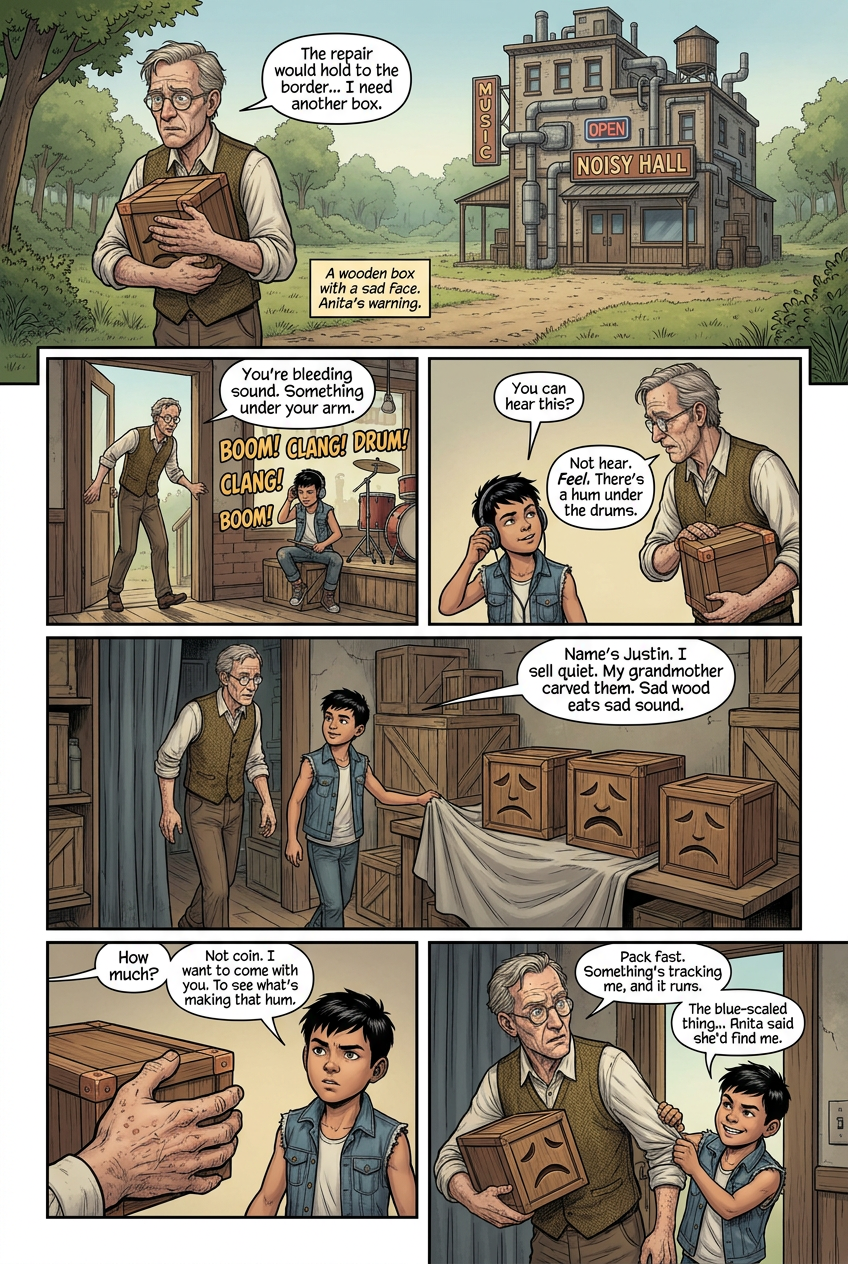
The back path from Anita's shop dropped through pine and let Ben out on a wagon road by noon. He walked with the sealed box against his ribs. The copper bands were cool. The mask was quiet. But Anita's warning stuck in his ear: the repair would hold to the border and no farther. If he wanted the next relic, he needed another box. A wooden box with a sad face carved into it. He had found the first one by luck in the dairy shrine. He had no idea who made them, or why a carved face could silence a hum that split leather. He needed someone who knew. By late afternoon the road bent toward a tall wooden building set alone in a clearing. Metal pipes stuck out of its roof. Signs hung off every window: MUSIC, OPEN, NOISY HALL. Even from the trees Ben could hear drums through the walls. He almost walked past. Then he thought: a place this loud might know something about sound. About silencing it. He pushed the front door open. The noise hit him like water. A boy sat on a crate by the stage, headphones clamped over his ears, one eye shut against the racket, tapping a drumstick on his knee in perfect time with a song only he could hear. He looked up when Ben's shadow crossed him. He pulled one ear free. "You're bleeding sound," the boy said. "Something under your arm. I can feel it in the floor." Ben's stomach dropped. He pressed the box tighter. "You can hear this?" "Not hear. Feel. There's a hum under the drums." The boy stood. He was small, all elbows and chain and black hair. "Name's Justin. I sell quiet." "You sell what?" "Boxes. Faces on the front. My grandmother carved them. I've got three left." He said it like he was selling apples. Ben kept his voice flat. "Show me." Justin led him behind a curtain into a back room stacked with crates. He pulled a cloth off a low shelf. Three wooden boxes sat there. Each had a mouth carved down-turned, eyes closed. Ben's hand went out before he could stop it. "Why do they work?" Ben asked. Justin shrugged. "Grandmother said sad wood eats sad sound. That's all she'd tell me." He watched Ben's face. "You've got one already. That's why you knew to ask." "How much?" "Not coin." Justin picked up the smallest box and turned it in his hands. "I want to come with you. Whatever you're carrying, I want to see the next one you find. I've never heard anything like what's under your arm." Ben thought of the blue-scaled thing crossing the stream behind him. Of Anita saying she would come find him. Now this boy, wanting in. He took the box. "Pack fast. Something's tracking me, and it runs." Justin grinned and reached for his jacket.
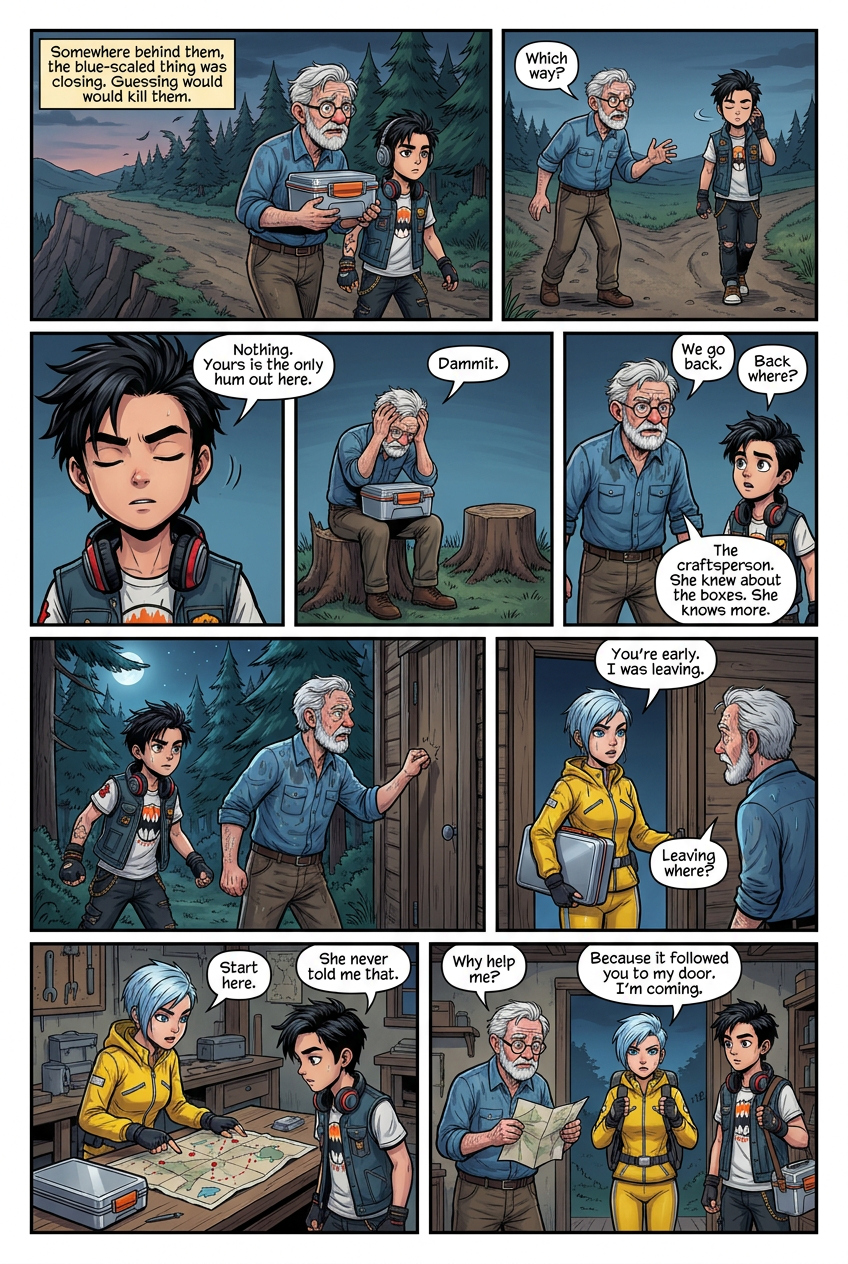
They walked the ridge road until dusk. Justin kept one headphone off, listening past the wind. Ben watched the trees behind them. The sealed box thumped against his ribs with every step. He had the box, and he had a boy who could feel relics through the floor. He had no map. He did not know where the next relic waited, or which direction to walk at the fork ahead. Somewhere behind them, the blue-scaled thing was closing. Guessing would kill them. At the fork Ben stopped. "Which way?" Justin closed his eyes. He turned a slow circle, drumstick loose in his hand. He shook his head. "Nothing. Yours is the only hum out here." Ben swore under his breath. He sat on a stump and pulled the box into his lap. He thought about the shrine. He thought about Anita, hands quick over copper bands, telling him something had followed him to her door. She had known things she did not say. "We go back," Ben said. "Back where?" "The craftsperson. She knew about the boxes before I told her. She knew the repair would hold to the border. She knows more." They cut down through the pines by moonlight. Justin never asked to rest. By the time they reached the hidden back path, Ben's shirt was soaked through. He knocked twice on the shop's rear door. Anita opened it in a yellow jacket, hair still damp, a sleek metal case tucked under one arm. She was already moving before she saw his face. "You're early," she said. "I was leaving." "Leaving where?" She held up the metal case. It was small, streamlined, the color of a knife. "North. Same as you should be." She looked past him at Justin, then back. "You don't know where you're going." "No." She stepped aside. "Inside. Fast." On her workbench she flipped open the metal case. Inside, packed in foam, sat a folded square of oiled cloth. She spread it flat. A map. Six marks in red ink. One was the dairy shrine, crossed out. One was her own shop. One was the music hall, crossed out. "My grandmother traded with his grandmother," Anita said, tipping her chin at Justin. "The boxes came from these six places. Wherever a box was carved, a relic was hidden nearby. That's the pattern." Justin stared. "She never told me that." "She told mine." Anita tapped the nearest unmarked point. Two days' walk, north-east. "Start here." Ben folded the cloth into his coat. His hands were shaking and he did not care. "Why help me?" "Because it followed you to my door," Anita said. "I don't sleep until it's dead or you are." She shouldered a pack. "And I'm faster than both of you. I'm coming." Ben did not argue. He had a direction now. He also had two people at his back, and a creature that would reach this shop by morning.
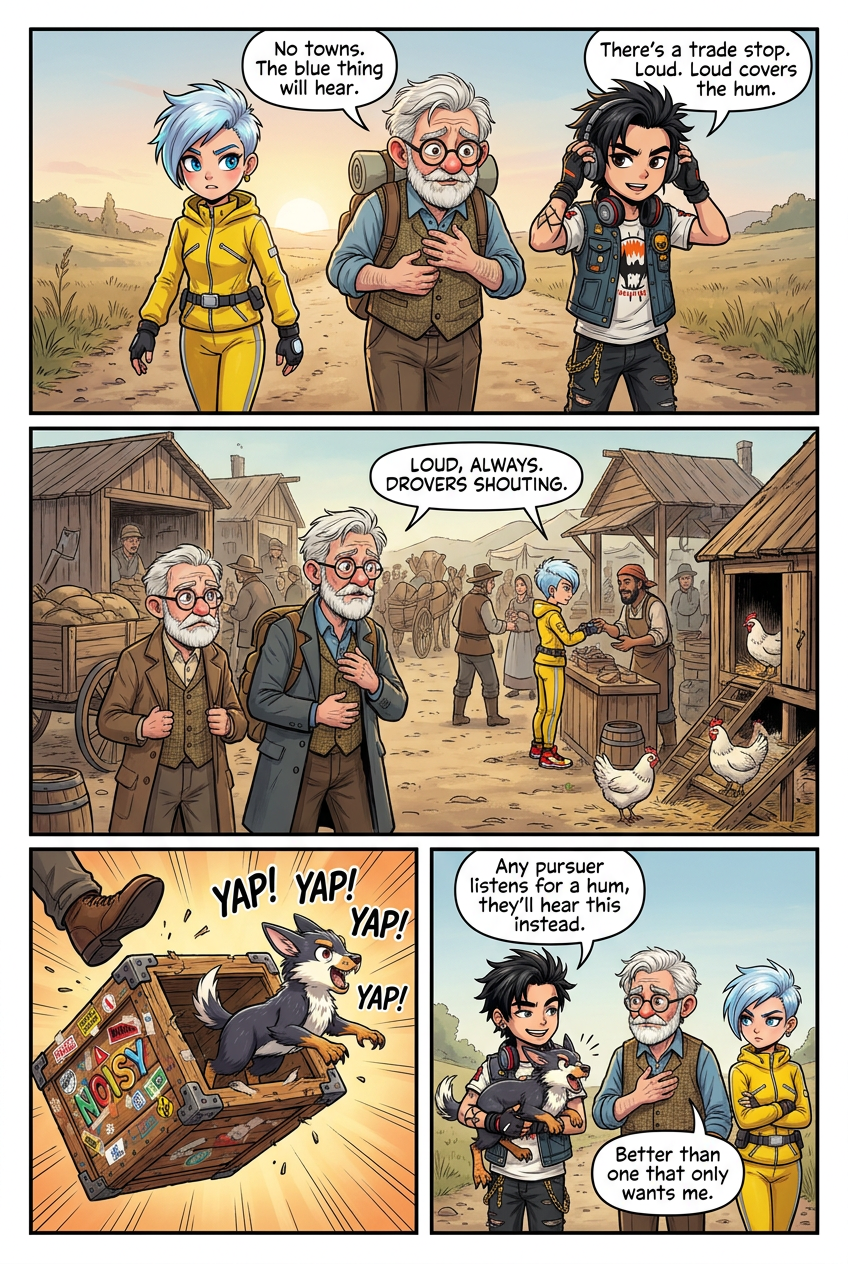
By dawn they were three hours north of Anita's shop, and the packs on their backs were nearly empty. Ben counted what they had. Half a loaf. A strip of dried meat. Two apples. Justin's water skin was already light. Anita walked point, faster than either of them, but even she slowed when Ben admitted the count out loud. "Two days to the next mark," she said. "Then more after that. We need grain, salt, rope. A town." "No towns," Ben said. He tapped the sealed box against his coat. It thumped back, steady as a second heart. "People will hear. The blue thing will hear." Justin pulled one headphone down. "There's a trade stop off the low road. Not a town. Wagons pull in, swap crates, move on. My grandmother used it." "How far?" "An hour. Maybe less." Anita frowned. "Open ground?" "Sheds. Some carts. Loud, always. Drovers shouting. Animals." Justin looked at Ben. "Loud is what we want. Loud covers the hum." Ben weighed it. The creature tracked scent, but the hum called it faster. Noise on top of noise might smear the trail. He nodded once. The trade stop was three sheds and a mud yard. A drover was arguing with a woman over the price of oats. Chickens screamed inside a stacked coop. Ben kept the box pressed hard against his ribs and let the yard's racket swallow the sound. Anita moved fast. She traded a copper coil for flour, salt pork, oil, and a bundle of hard biscuit. Justin bargained for a full skin of water and a coil of rope. Ben watched the road. Then a crate on the nearest cart began to shake. It was a battered thing, stickered and scrawled over, the word painted big across the front. Something inside slammed the boards. A drover swore and kicked it. The lid burst. A creature shot out — black fur, orange feet, ears back, mouth open in a bright yapping howl. It landed in the mud and started barking at everything at once. The whole yard turned to watch. Justin's face lit up. "That's — that's exactly what we need." "What?" Ben said. "Cover. All the way north." Justin was already moving. He caught the drover's sleeve and pointed at the animal, then at his own coin pouch. The drover, red-faced, took the deal in seconds. Justin came back with the creature squirming under one arm and its splintered crate under the other. It had not stopped yapping. "It never shuts up," Justin said. "Any pursuer listens for a hum, they'll hear this instead." Anita stared. "Or it draws every predator in the north to us." "Better than one that only wants Ben." Ben looked at the animal. It looked back and barked in his face. They left the trade stop fed, watered, and louder than they had arrived. Behind them, the road was quiet. That would not last.
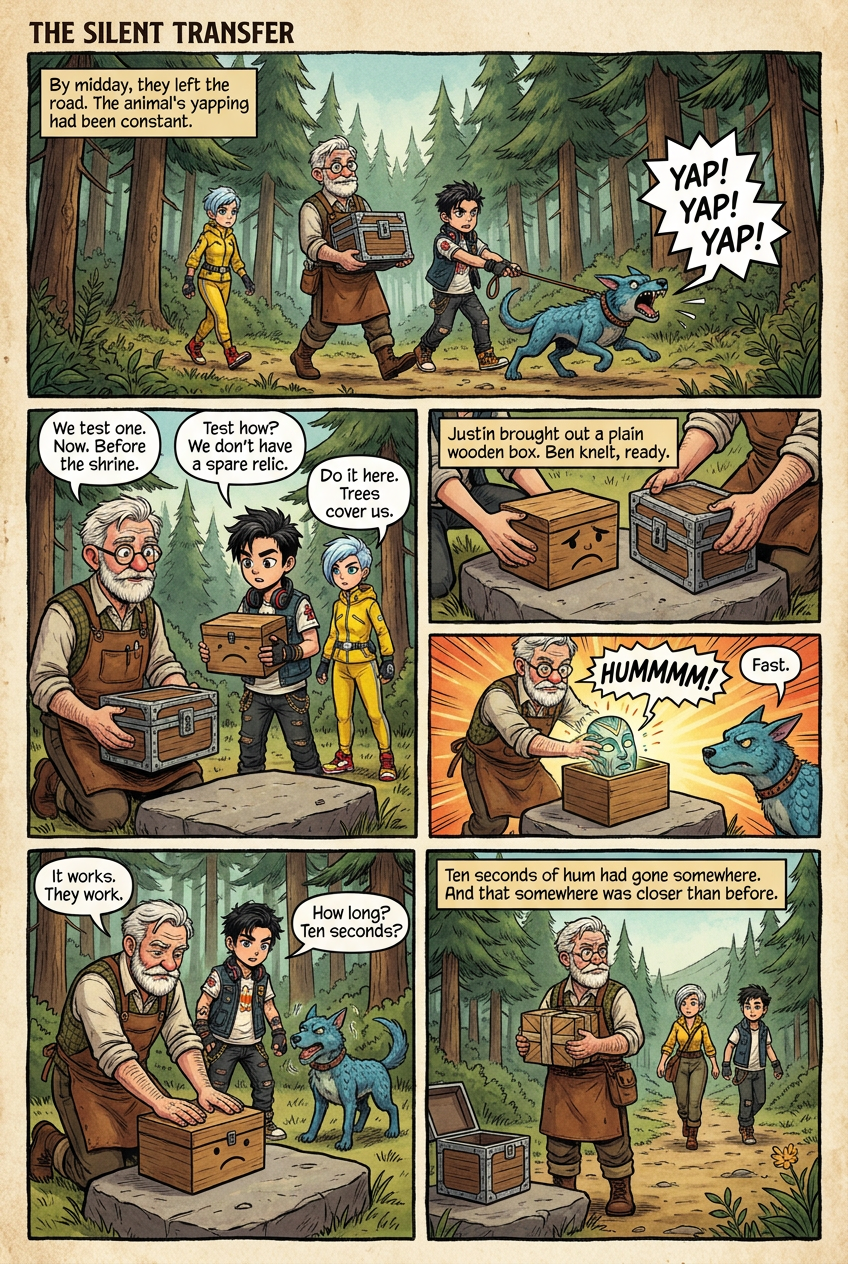
By midday they had left the trade road and cut into a stand of low pines. The yapping animal strained on Justin's rope, blue-scaled hide flashing between the trunks. It had not stopped barking since they bought it. Ben's sealed box thumped against his ribs, steady, quiet under the noise. But steady would not be enough at the next shrine. He would have to open the box, lift the mask out, and place it into a fresh one of Justin's. If that new box did not silence the hum, the creature would be on them inside an hour. Ben stopped walking. "We test one. Now. Before the shrine." Justin looked up from the leash. "Test how? We don't have a spare relic." "We have the one I'm carrying." Ben tapped the reinforced box. "We move the mask into one of your grandmother's boxes. If it goes quiet, we know. If it doesn't, we know that too, and I'm not walking into the next shrine blind." Anita set her pack down. "Do it here. Trees cover us. The animal covers the sound if it slips." Justin dug in his pack and brought out one of the two remaining boxes. It was smaller than the reinforced one, plain wood, the sad face cut shallow but clean. He set it on a flat stone. Ben knelt across from him. Anita stood between them and the road, watching. Ben unclasped the copper bands. The waxed linen peeled back. The moment he lifted the lid, the hum poured out — low, wrong, a sound that pressed on his teeth. The yapping animal stopped barking. Its ears flattened. It stared at the mask in Ben's hands. "Fast," Anita said. Ben dropped the mask into Justin's box and shoved the lid down. The hum cut off. For a second no one moved. Then the animal shook itself and started barking again, louder, at a squirrel. Justin let out a breath that shook. "It works," he said. "They work." Ben pressed his hand flat on the lid. The wood was warm. No thump, no tremor. Just a box. Anita was already looking north through the trees. "How long did the hum spill? Ten seconds?" "Less," Justin said. "Enough for something close." She picked up her pack. "We move." Ben rewrapped the smaller box in the waxed linen from the old one and tucked it against his ribs. The reinforced box, empty now, he left on the stone. It had done its work. Justin still had one box in reserve. Two shrines, maybe, before they ran out. He stood. The next shrine was a day's walk. He knew the boxes would hold. He also knew the ten seconds of hum had gone somewhere, into some ear, and that ear was closer than it had been this morning.
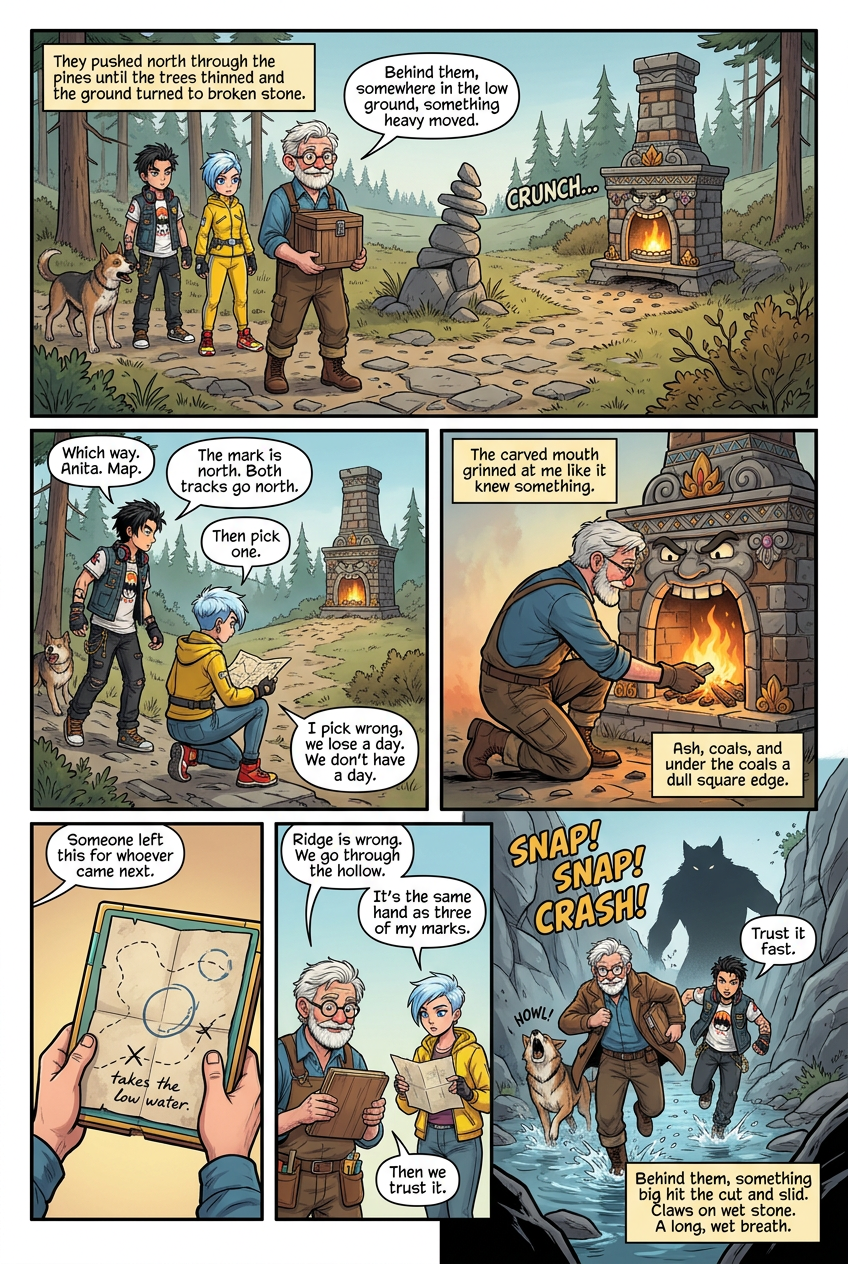
They pushed north through the pines until the trees thinned and the ground turned to broken stone. The barking animal had gone hoarse. Ben's new box sat quiet against his ribs. Behind them, somewhere in the low ground, something heavy moved through brush. Not close. Not far enough. The path split at a leaning cairn. One track climbed the ridge. The other dropped into a hollow where a stone chimney stood alone in a clearing. The chimney had a face carved into its mouth — wide grin, blunt teeth, eyes cut deep. A small fire still burned inside it. Someone had been here, and not long ago. "Which way," Justin said. He was already looking back down the slope. "Anita. Map." Anita pulled the map out and held it flat on her knee. Her finger moved over the paper. "The mark is north. Both tracks go north." "Then pick one," Justin said. "I pick wrong, we lose a day. We don't have a day." Ben walked down to the chimney. The heat pushed at his face. The carved mouth grinned at him like it knew something. He crouched and looked into the fire. Ash, coals, and under the coals a dull square edge. He pulled his sleeve over his hand and dug it out. A flat panel of pale stone, edges banded in bright enamel, a pattern cut across its face in fine lines. A small handle on one side. He wiped soot from it. The panel opened like a thin door. Inside, folded once, was a scrap of the same map Anita carried — but with the ridge track crossed out and the hollow track circled. A hand had written beside it: takes the low water. "Someone left this for whoever came next," Ben said. He held it up. "Ridge is wrong. We go through the hollow." Anita took the panel, looked at the writing, looked at her own map. "It's the same hand as three of my marks." "Then we trust it," Ben said. Justin was still watching the slope. "Trust it fast." The brush down the hill cracked. Not brush. A branch, snapped clean. Then another, closer. Ben shoved the stone panel into his coat and started for the hollow track. Anita was already moving. Justin dragged the animal after them. It found its voice again and howled. They ran. The hollow narrowed into a cut between two walls of rock. Water ran along the bottom, ankle-deep, cold. Ben splashed into it without stopping. Scent, he thought. Water kills scent. Whoever left that panel knew. Behind them, something big hit the cut and slid. Claws on wet stone. A long, wet breath. Ben did not look back. He knew which way to go now. He also knew the creature had closed the distance to a stone's throw, and the water would only buy them the next hour.
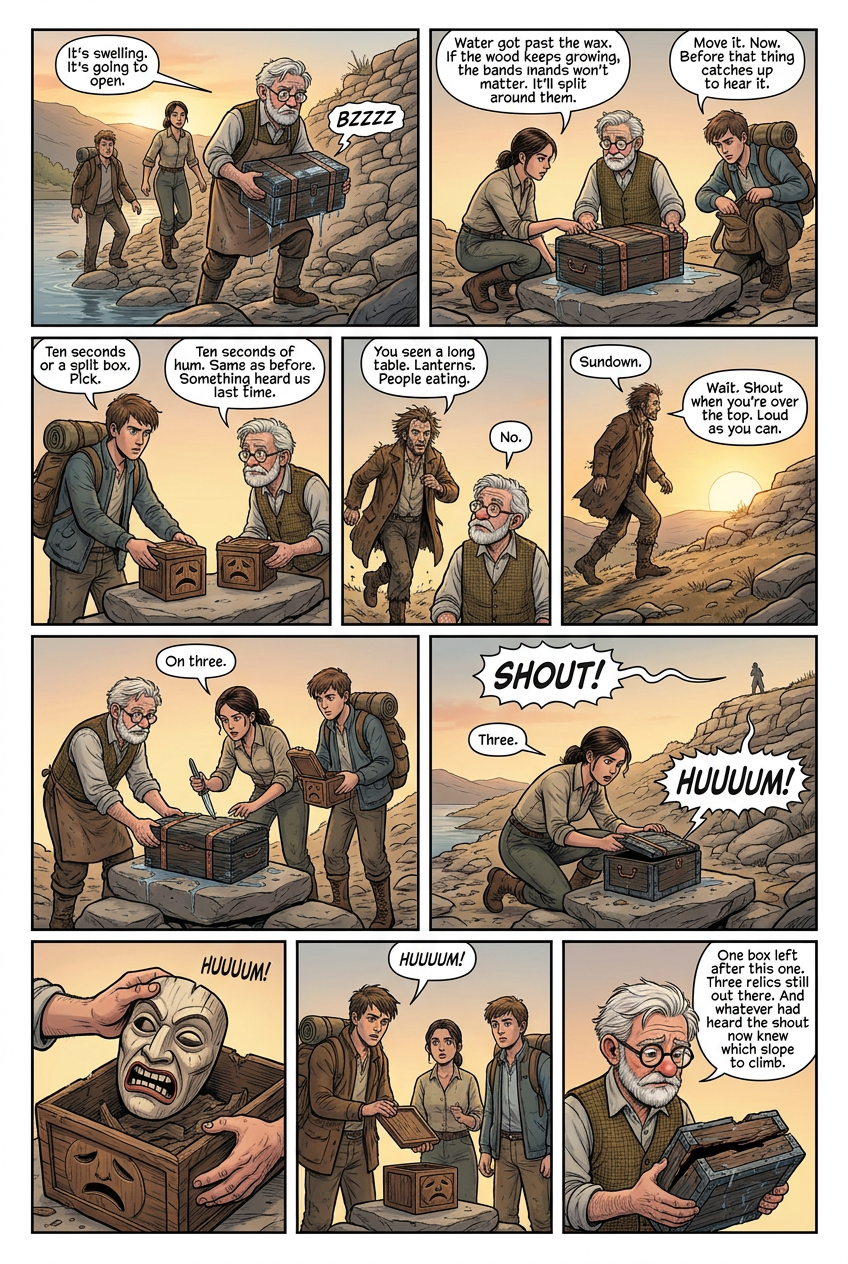
They came out of the water half a mile on, where the cut widened and the stone went dry. Ben climbed the bank first and pulled the reinforced box out from under his coat. The copper bands were dark with wet. He pressed a thumb to the lid seam. The wood gave under it like bread. A low buzz slid out through the crack and back in again. "It's swelling," Ben said. "It's going to open." Anita crouched beside him. She turned the box in her hands and stopped at the corner where the grain had lifted. "Water got past the wax. If the wood keeps growing, the bands won't matter. It'll split around them." Justin was already digging in his pack. He set out the last two boxes his grandmother had carved. Both had the sad face cut deep into the lid. "Move it. Now. Before that thing catches up to hear it." "Ten seconds of hum," Ben said. "Same as before. Something heard us last time." "Something's already behind us," Justin said. "Ten seconds or a split box. Pick." A man stepped out of the brush above them. Brown coat, wild hair, boots caked to the ankle. He had the look of someone who had walked through the night. He saw the three of them, the boxes on the stone, the wet box shivering in Ben's hand, and did not slow down. "You seen a long table," he said. "Lanterns. People eating." Ben stared at him. "No." "Which way's the ridge." "Behind us. Don't take it." The stranger looked at the sky. The sun was already low. "Sundown," he said, mostly to himself, and started up the slope without waiting. "Wait," Anita called. "Shout when you're over the top. Loud as you can." He did not answer. He kept climbing. Ben set the wet box on a flat stone. He put one of the carved boxes beside it, lid open. Justin held the second box ready. Anita drew her knife and slid it under the swollen lid of the reinforced box. She worked the copper band up first, then the wax. "On three," she said. Far up the ridge the stranger's voice broke open in a shout — a long, wordless call about a feast, about a table, about being late. It rolled down the rock. "Three," Anita said. She pried the lid. The hum poured out, thin and hot in the ear. Ben lifted the mask — pale wood, teeth bared, eyes wide — and set it in the carved box. Justin dropped the lid. The hum cut off. They held still. Down in the hollow, nothing moved toward them. Up the ridge, the shouting went on. Ben looked at the ruined box in his hands. The wood had split from corner to corner. One box left after this one. Three relics still out there. And whatever had heard the shout now knew which slope to climb.
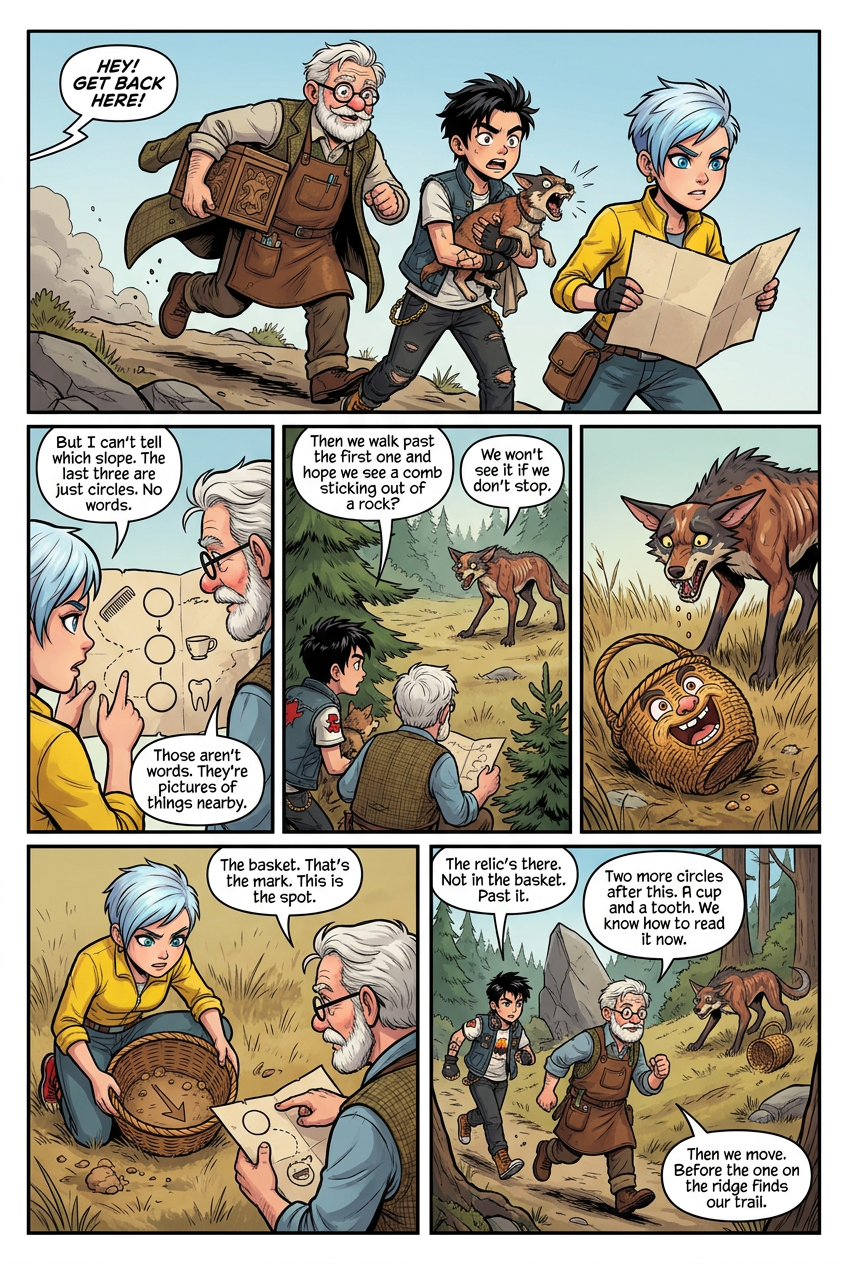
They moved off the ridge before the shouting stopped. Ben carried the carved box under his coat. Justin carried the barking animal under one arm, its jaws clamped around a rag. Anita walked with her map open in both hands. Three marks on it were clear. Three were not. "We're close to one," Anita said. "But I can't tell which slope. The last three are just circles. No words." Ben stopped on the path. He looked over her shoulder. The three unmarked circles sat in a rough line, each with a tiny scratch beside it. The scratches were not letters. They were shapes. A comb. A cup. A tooth. "Those aren't words," Ben said. "They're pictures of things nearby." "Pictures of what?" "Whatever the person who drew this saw at each spot." Justin looked up from the animal. "Then we walk past the first one and hope we see a comb sticking out of a rock?" "We won't see it if we don't stop," Ben said. They came down through low pine. The path bent around a stand of dead grass. A lean creature stood in the grass, ribs showing under a brown coat, ears up. It watched them without moving. Its jaw hung open. A tongue moved behind long teeth. Justin froze. The animal under his arm went still. "Don't run," Anita said. The lean creature did not charge. It sniffed the air, took two steps sideways, and stopped again. It was staring past them, at something on the ground. Ben followed its eyes. In the grass sat a woven basket, tipped on its side. The weave was split along the belly. A face was worked into the front, mouth open wide, eyes round. Someone had painted the mouth to look hungry. Old crumbs sat inside it. The creature wanted what was in the basket, or had been. Ben looked back at the map. He pointed at the first unmarked circle. The scratch beside it was a small open mouth. "The basket," he said. "That's the mark. This is the spot." Anita crouched by the basket. She turned it over. Under the crumbs, pressed into the base, was a shallow carving of an arrow. It pointed down the slope, toward a split rock at the tree line. "The relic's there," she said. "Not in the basket. Past it." The lean creature lowered its head and stepped toward the basket. Ben backed away slow. Justin followed. Anita rolled the map and tucked it in her coat. "Two more circles after this," Ben said. "A cup and a tooth. We know how to read it now." "Then we move," Anita said. "Before the one on the ridge finds our trail." They went down toward the split rock. Behind them, the lean creature pushed its nose into the empty basket and found nothing.
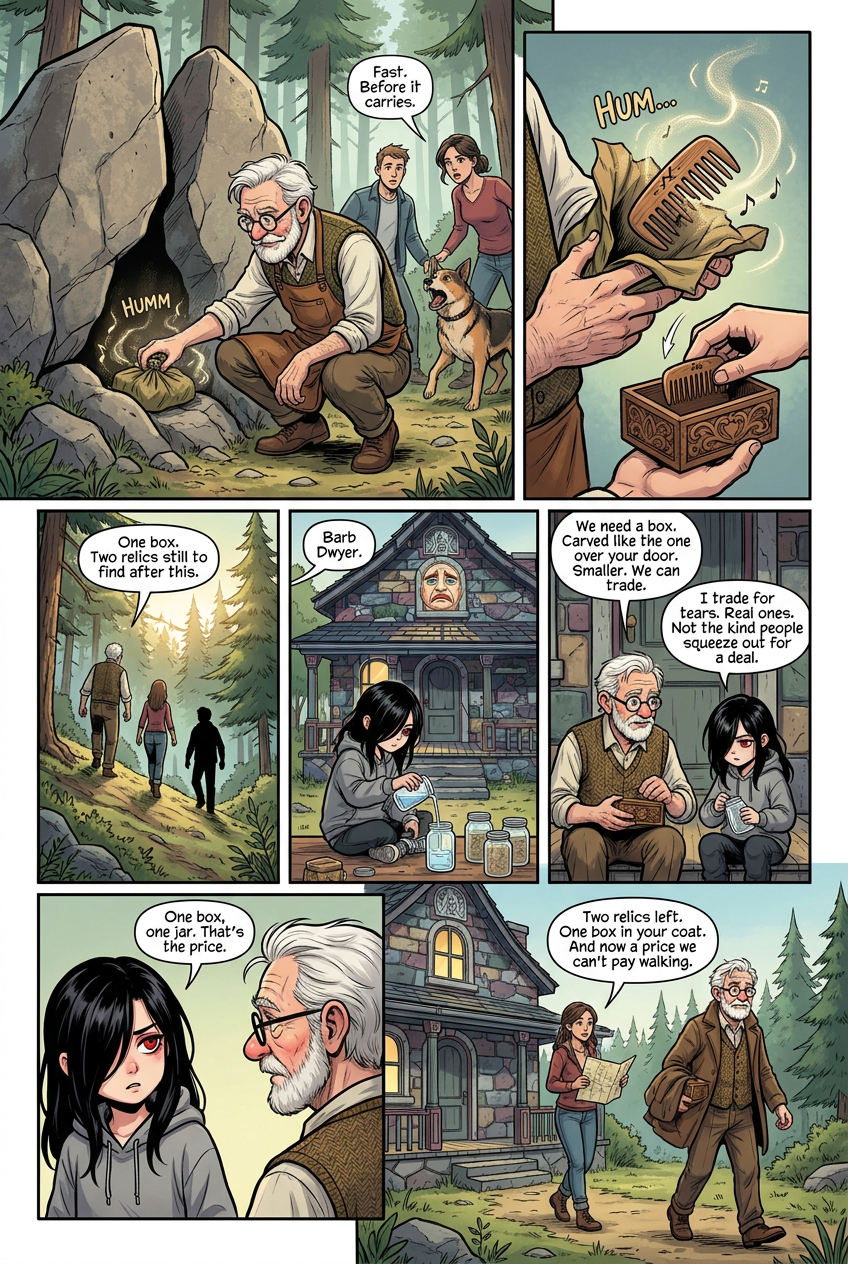
The split rock sat where the arrow said it would. Ben crouched at its base while Justin held the barking animal tight and Anita watched the slope behind them. A hollow ran under the rock. Ben reached in and pulled out a bundle wrapped in oiled cloth. It hummed the moment his fingers closed on it. "Fast," Anita said. "Before it carries." Ben had one carved box left in his coat. He took it out. He set the bundle on his knee and unwrapped it. A small wooden comb, teeth broken along one side, lay in the cloth. The hum climbed. Justin winced and pressed the animal's snout into his sleeve. Ben lifted the lid, dropped the comb inside, and shut the box. The hum stopped. He stayed crouched with the box against his chest. One box. Two relics still to find after this. He had known the count on the ridge. He knew it now with the wood cold under his hands. "We need another," Anita said. "Before the next mark." "Justin's grandmother carved four," Ben said. "We've used them all." "Then we find someone else who carves them." Justin lifted his head. "There's a girl who trades near here. Sits outside a stone house with the sad face over the door. My grandmother knew her mother." They went down through the pines and found the house at the edge of a gully. It was small and cracked along the foundation. A carved face hung above the door, mouth pulled down, eyes heavy. A girl sat on the porch step with a row of glass jars beside her. Black hair over one eye. Grey hoodie. She was pouring something clear from a small vial into a jar and did not look up when they stopped at the rail. "Barb Dwyer," Justin said. "I know who I am." She capped the jar. Her one visible eye moved to Ben, then to the shape under his coat. "That thing's loud even when it's quiet." "You can hear it?" "I can feel it. Sit down or leave." Ben sat on the step. "We need a box. Carved like the one over your door. Smaller. We can trade." Barb looked at the jars. "I trade for tears. Real ones. Not the kind people squeeze out for a deal." "I don't have any." "Then you don't have a box." "My sister used to carve them," she said. "She stopped." "Why?" "Closed subject." She stood. "Come back with a jar that counts. One box, one jar. That's the price." She went inside and shut the door. The carved face above it stared down at Ben with its heavy mouth. Anita spoke low. "Two relics left. One box in your coat. And now a price we can't pay walking." Ben stood. He looked at the empty porch, then at the map in Anita's hand. The tooth mark was next. He put the full box back under his coat and stepped off the porch.
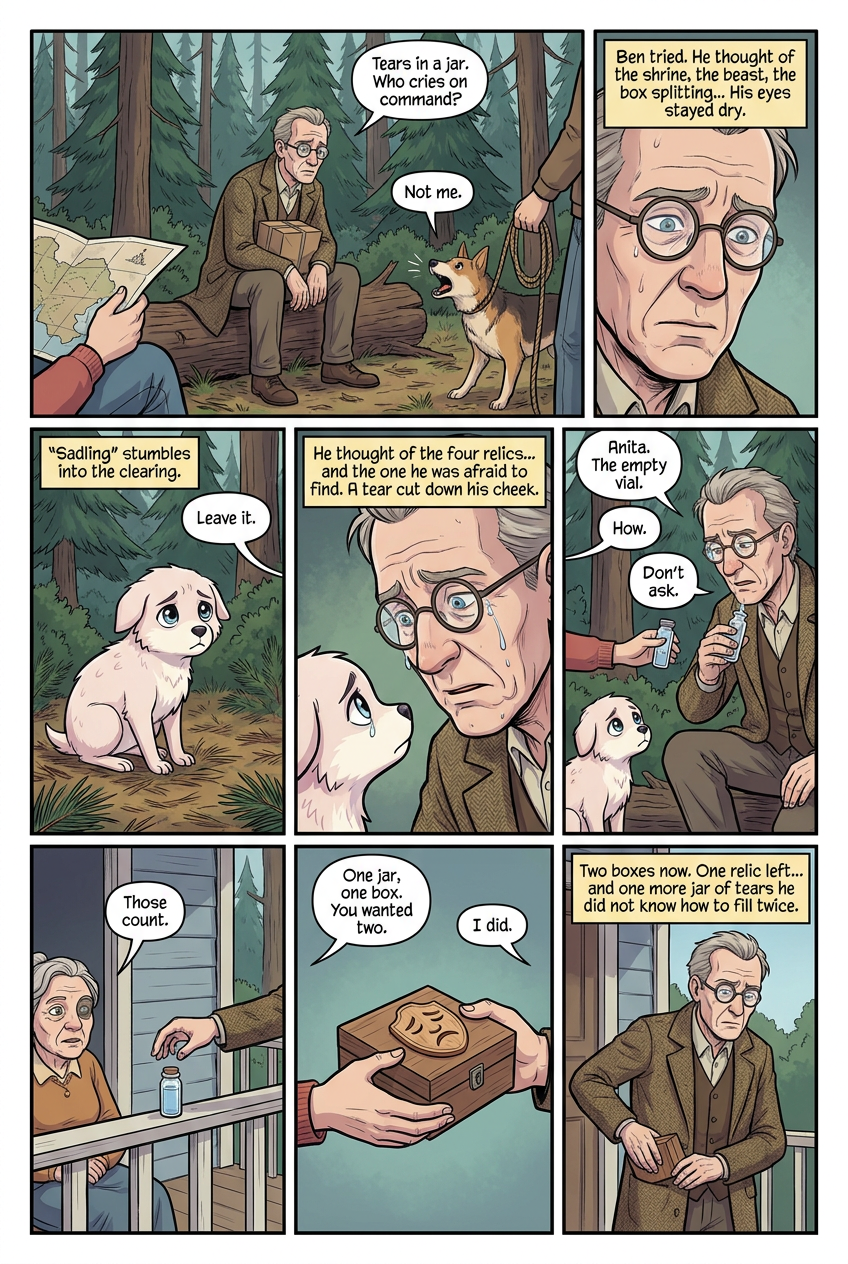
They walked back up the pines to think. Ben sat on a fallen log with the full box under his coat. Justin held the barking animal by a rope. Anita spread the map on her knee and stared at the tooth mark. "Tears in a jar," Justin said. "Who cries on command?" "Not me," Anita said. "Not for a stranger with a porch." Ben tried. He thought of the shrine, the beast on the ridge, the box splitting in the water. His eyes stayed dry. He had spent too long counting boxes to cry over any of it. "Onions," Justin said. "Smoke. A slap." "She said real ones," Ben said. "She'd know." The barking animal pulled the rope taut. It had caught something in the brush. Justin let out slack. A small shape stumbled into the clearing and sat down on the pine needles. It was a pup, or something shaped like one. Pale fur, one ear bent, ribs showing. It looked at Ben with eyes too big for its face and did not move. Its mouth pulled down at the corners the way the carved face over Barb's door pulled down. "Leave it," Anita said. Ben crouched. The creature watched him. It did not flinch, did not beg. It only sat and looked, and something in Ben's chest bent the wrong way. He thought of the four relics still out there. He thought of the one he was afraid to find. His eyes stung before he understood why. A tear cut down his cheek. Then another. "Anita," he said. "The empty vial in your kit." She dug it out and passed it over without a word. Ben held it under his jaw and let the tears run into the glass. He kept his eyes on the small creature. It sat through all of it. When he had a finger's worth in the vial, he capped it. Justin stared. "How." "Don't ask," Ben said. His voice came out rough. They went back down to the gully. Barb was on the porch again, pouring from another vial into another jar. Ben set the vial on the rail beside her. She picked it up. She held it to the light. She uncapped it and touched a drop to her tongue. Her one visible eye came back to Ben. "Those count," she said. She went inside and came out with a small wooden box. A sad face carved on the lid. She set it in his hand. "One jar, one box," she said. "You wanted two." "I did." "Then come back with another jar." She sat down on the step and picked up her work. "And don't bring that animal with you next time. It'll take the sad right out of the air." Ben put the new box in his coat beside the full one. Two boxes now. One relic left to find after the tooth. And one more jar of tears he did not know how to fill twice.
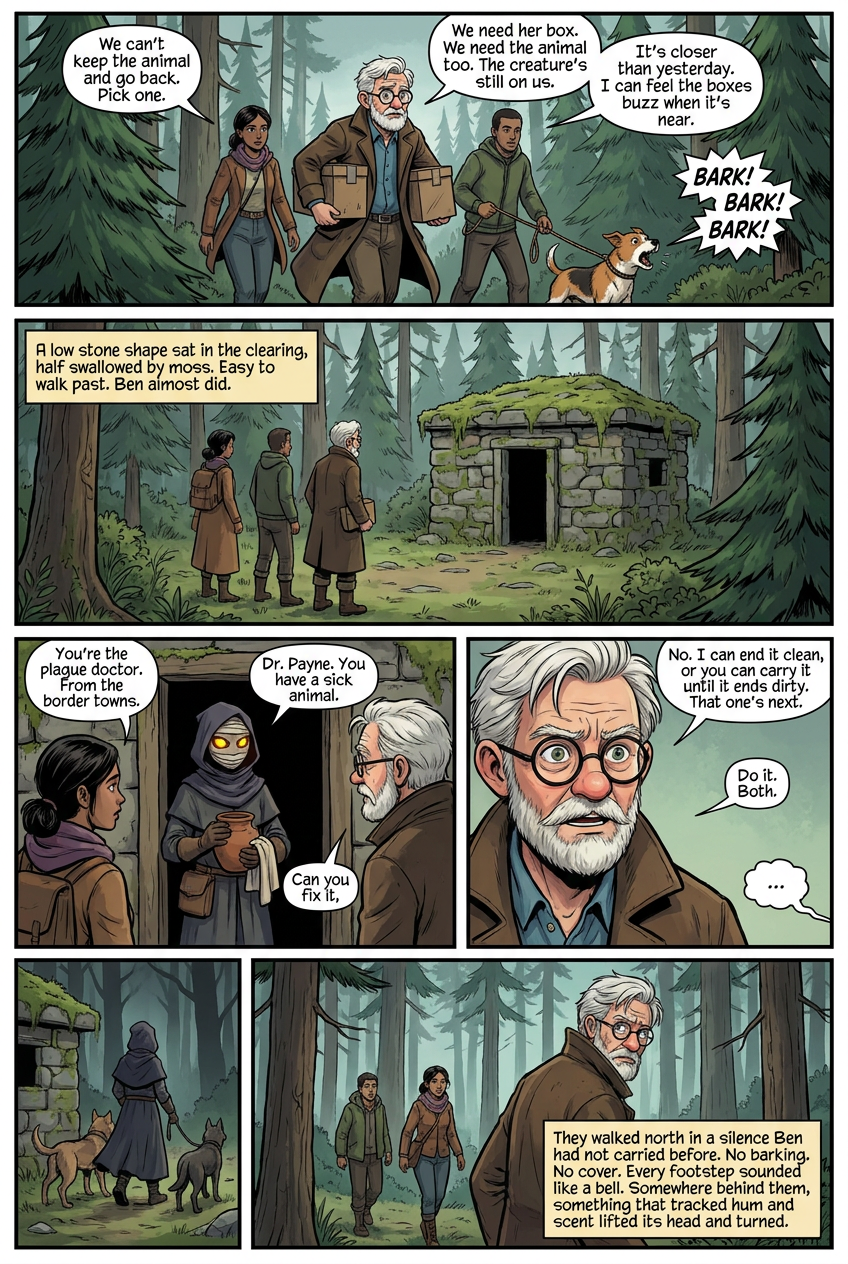
They left Barb's gully with two boxes in Ben's coat and one problem the tears hadn't fixed. The barking animal pulled at its rope, loud as ever. Barb had told Ben not to bring it back. That meant the next jar of tears had to come from somewhere else, and the sound that hid them on the road would have to end before then. Anita said it plain on the trail. "We can't keep the animal and go back to her. Pick one." "We need her box," Ben said. "We need the animal too. The creature's still on us." Justin looked at the pines behind them. "It's closer than yesterday. I can feel the boxes buzz when it's near." They argued down the slope until the trees thinned. A low stone shape sat in the clearing, half swallowed by moss. A squat door, cracked lintel, no path leading to it. Easy to walk past. Ben almost did. A figure stood in the doorway. Small, wrapped in gray cloth from jaw to wrist, hood pulled low. Two yellow points where eyes should be. She held a rag over the mouth of a clay pot and did not look up when they stopped. "Stay back six paces," she said. "The pot's still hot." Anita stopped. "You're the plague doctor. From the border towns." "Dr. Payne." She set the pot on the step. "You have a sick animal." Ben looked at the pup on Justin's rope, the one from yesterday's clearing. Its ribs pushed harder against the fur now. Its eyes had gone glassy. "It was fine an hour ago," Justin said. "It wasn't." Dr. Payne came down one step. "It has what the road has. I've called it beaten three times in one man. He's dead now." "Can you fix it," Ben said. "No. I can end it clean, or you can carry it until it ends dirty." She looked at the barking animal on the other rope. "That one's next. Close quarters, shared water. A day, maybe two." Ben felt the two boxes press against his ribs. The barking animal was their cover. Without it, every step north was a hum the creature could hear. "Do it," he said. "Both." Justin opened his mouth and shut it. Dr. Payne took the ropes. She led both animals behind the stone hut. Ben heard nothing for a long minute. Then she came back with the ropes coiled and empty. "Burn your gloves," she said. "Wash in running water before you touch the boxes again." They walked north in a silence Ben had not carried before. No barking. No cover. Every footstep on the pine mat sounded like a bell. Somewhere behind them, something that tracked hum and scent lifted its head and turned. Ben kept walking. Two boxes. One relic to find. And nothing left between them and the thing on their trail.
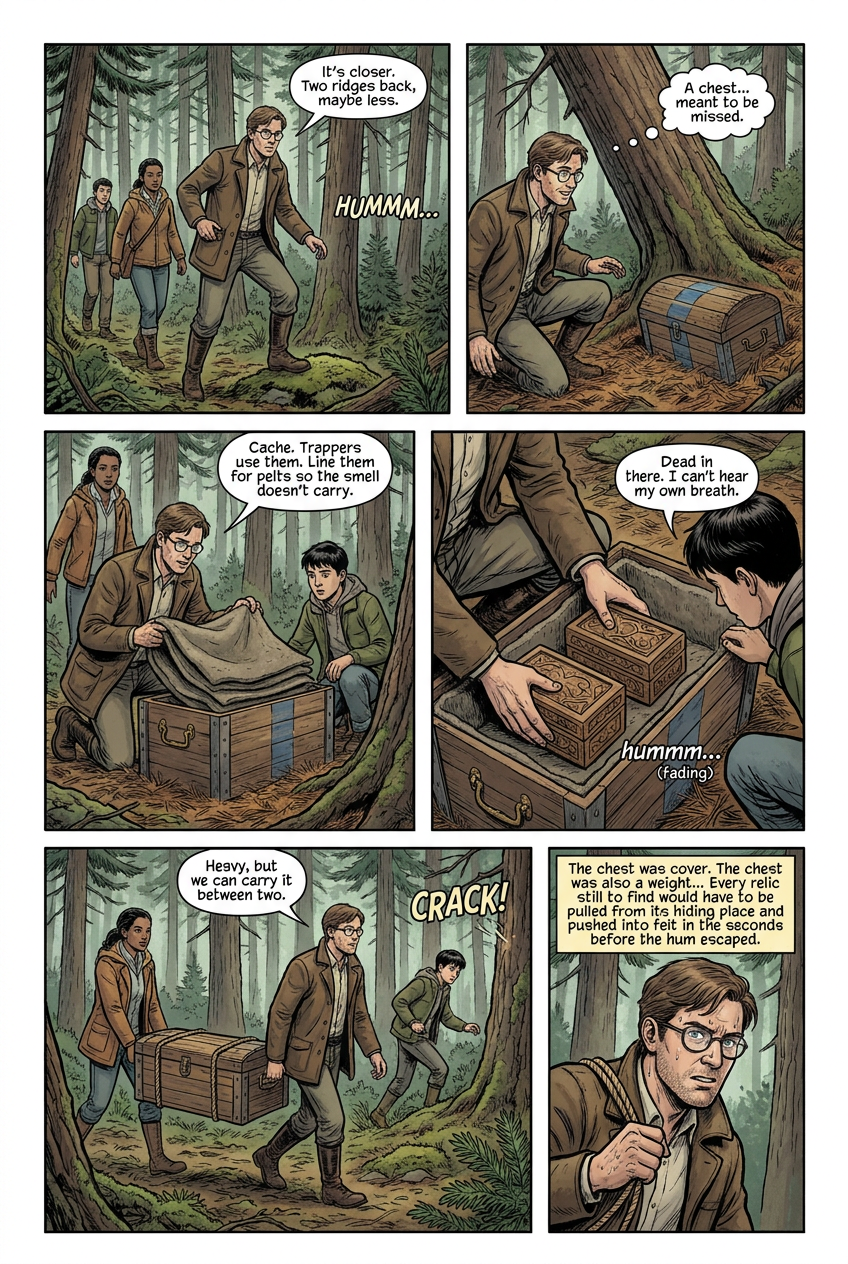
They walked north with two boxes and no noise. The pine mat crackled under every step. Ben tried to place his feet on moss, on damp needles, on anything that would swallow sound. The boxes still hummed, faint but steady, the way a wasp sounds through a wall. Without the barking animal, the hum was the loudest thing in the woods. Justin stopped first. "It's closer. Two ridges back, maybe less." Anita crouched and pressed her palm to the ground. "We won't reach the next relic like this. We need to smother the sound before it hears us again." Ben thought of running water. Water had saved them once. But the map put the next relic east of the ridges, away from any stream Anita knew. He turned in a slow circle, looking for anything. Rock. Moss. A hollow log. His eyes caught the shape at the base of a leaning pine. A wooden chest, half buried in needles, the lid stained to match the bark. He'd walked past it twice. Someone had meant for it to be missed. He brushed the needles off. The chest was solid, banded in brass, a blue stripe painted along the seam. The lid lifted without a lock. Inside sat sawdust and folded felt. Nothing else. "Cache," Anita said. "Trappers use them. Line them for pelts so the smell doesn't carry." Ben understood before she finished. He lifted the felt. It was thick, packed in layers, the kind that ate sound in a music hall. He looked at Justin. "Would it hold the hum?" Justin knelt and put his ear to the empty chest. "Dead in there. I can't hear my own breath." Ben took both carved boxes from his coat. He nested them in the felt, pressed more felt over the tops, and closed the lid. He held his breath and listened. The wasp sound was gone. Justin's face changed. "Nothing. I've got nothing." Anita tested the weight. "Heavy, but we can carry it between two." They lashed a rope through the brass handles. Ben took one end, Anita the other. Justin walked ahead to scout. They moved east through the trees, quieter now, the chest swinging low between them. A branch cracked behind them. Far, but not far enough. Ben stopped. Justin froze. They waited. Nothing followed. Whatever had turned its head back at the clearing had lost the thread. Ben let out a breath. The chest was cover. The chest was also a weight, and their hands were full of it. If the creature caught them now, they could not run with it. They could not open it fast. Every relic still to find would have to be pulled from its hiding place and pushed into felt in the seconds before the hum escaped. He shifted his grip on the rope and walked.
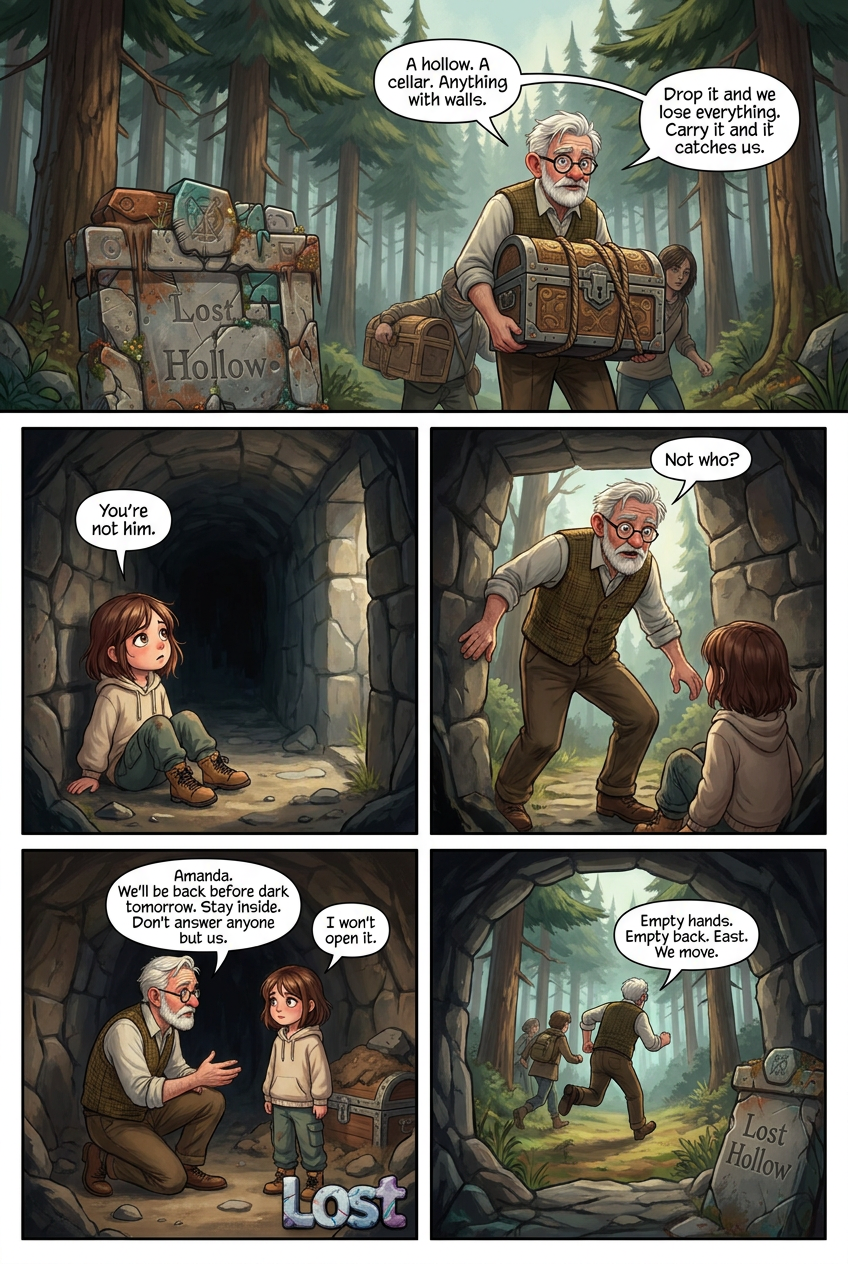
The chest bruised Ben's shin every third step. Anita's grip slipped on her end of the rope. They had walked an hour east and covered maybe half what they should have. Justin doubled back through the trees and shook his head. The creature was somewhere behind them, and the trees thinned ahead into open ground they could not cross at this pace. "Drop it and we lose everything," Anita said. "Carry it and it catches us." Ben scanned the slope. He needed a place to set the chest down, hide it, and come back. A hollow. A cellar. Anything with walls. Justin pointed. "Stone. Down the draw." They half-ran, half-dragged the chest between the pines until the ground opened into a clearing. A slab of weathered stone stood at the far end, taller than Ben, carved with letters he could still read through the moss. Lost Hollow. The doorway beneath it sagged open on a hinge that had rusted through years ago. No roof. No door left to close. Just a stone room sunk into the hill. Ben ducked inside. Dry. Empty. The far wall held a small alcove, deep enough for the chest. A girl was sitting on the floor. She was maybe ten. Cargo pants, a canvas bag across her chest, boots too big for her legs. She looked up at Ben without surprise, as if she had been expecting someone and he would do. "You're not him," she said. "Not who?" "I don't know." She stood. "I woke up here. Three days. Maybe four. The clock is gone but I can still hear it." Ben glanced at Anita. Anita shook her head. No time. "We need to leave this here," Ben said, tipping his chin at the chest. "And come back for it. Can you keep quiet?" "Yes." "There's a thing hunting us. It follows sound. If you open this, it comes." "I won't open it." He believed her. He did not know why. They pushed the chest into the alcove. Anita packed loose stone around it. Justin scraped dirt across the lid until the brass stopped catching the light. Ben crouched by the girl. "What's your name?" "Amanda Hugginkiss." "Amanda. We'll be back before dark tomorrow. Stay inside. Don't answer anyone but us." "Where are you going?" "To get the next piece. Fast, without this." He tapped the stone over the chest. She nodded once. "There's water in the back. I checked." They left her sitting against the wall, hands folded in her lap like she was waiting for a bus. Outside, Ben rolled his shoulders. Empty hands. Empty back. He could run now. "East," Anita said. "We move." They moved. The hum was buried behind them under stone and felt and a strange, quiet girl. Ben ran, and for the first time in days his legs did what he asked. He tried not to think about what he had just left in the dark, or who would find it first if they did not come back.
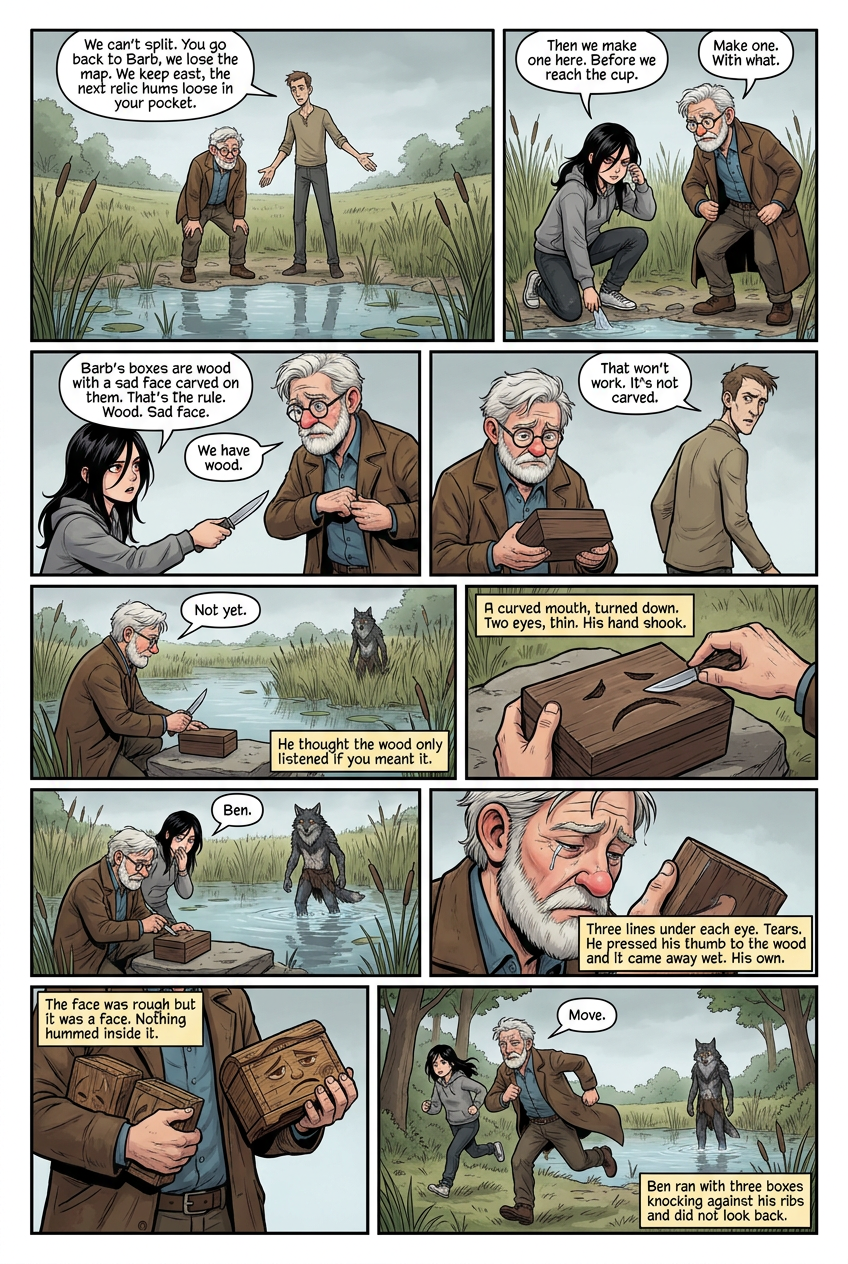
They ran east until the trees broke and the ground turned to reed. Ben stopped at the edge of a shallow pond and put his hands on his knees. Two carved boxes in his coat. Three relics still to find. Barb Dwyer had a third box waiting, but only for another jar of tears, and Barb was half a day south. He had no half a day. "We can't split," Justin said. "You go back to Barb, we lose the map. We keep east, the next relic hums loose in your pocket." Anita crouched by the water and wiped her face. "Then we make one here. Before we reach the cup." "Make one." Ben straightened. "With what." "Barb's boxes are wood with a sad face carved on them. That's the rule. Wood. Sad face." She looked at him. "We have wood." Ben felt the shape of it before he understood it. He pulled the small keepsake box from his inside pocket. It was old, dark, the lid smooth. His mother's. He had carried it since he was a boy. He had never opened it in front of anyone. "That won't work," Justin said. "It's not carved." "Not yet." Ben set it on a flat stone. Anita handed him her knife. He did not know if the trick was the carving or the sadness in the carver. Barb cried into the wood. Barb charged tears. He thought the wood only listened if you meant it. He cut. A curved mouth, turned down. Two eyes, thin. His hand shook and the second eye came out crooked. He kept cutting. He thought about the girl sitting against the wall of a stone room with her hands folded, waiting for them to come back. He thought about how they might not. Something moved in the reeds across the pond. A lean shape stepped out of the grass. Blue scales along its shoulders, orange marks on its legs, a wolf's build gone wrong. It lowered its head and stared at Ben across the water. It did not cross. Water masked scent. It knew he was here anyway. "Ben," Anita whispered. He kept cutting. Three lines under each eye. Tears. He pressed his thumb to the wood and it came away wet. His own. The creature took one step into the pond. Two. Ben closed the lid. The face was rough but it was a face. He held the box out flat on his palm and waited. Nothing hummed inside it. Nothing needed to. He tucked it against the other two in his coat. Three boxes. Three relics left. "Move," he said. They went back into the trees. The creature stood in the water behind them, watching, uncertain which way to follow. Ben ran with three boxes knocking against his ribs and did not look back.
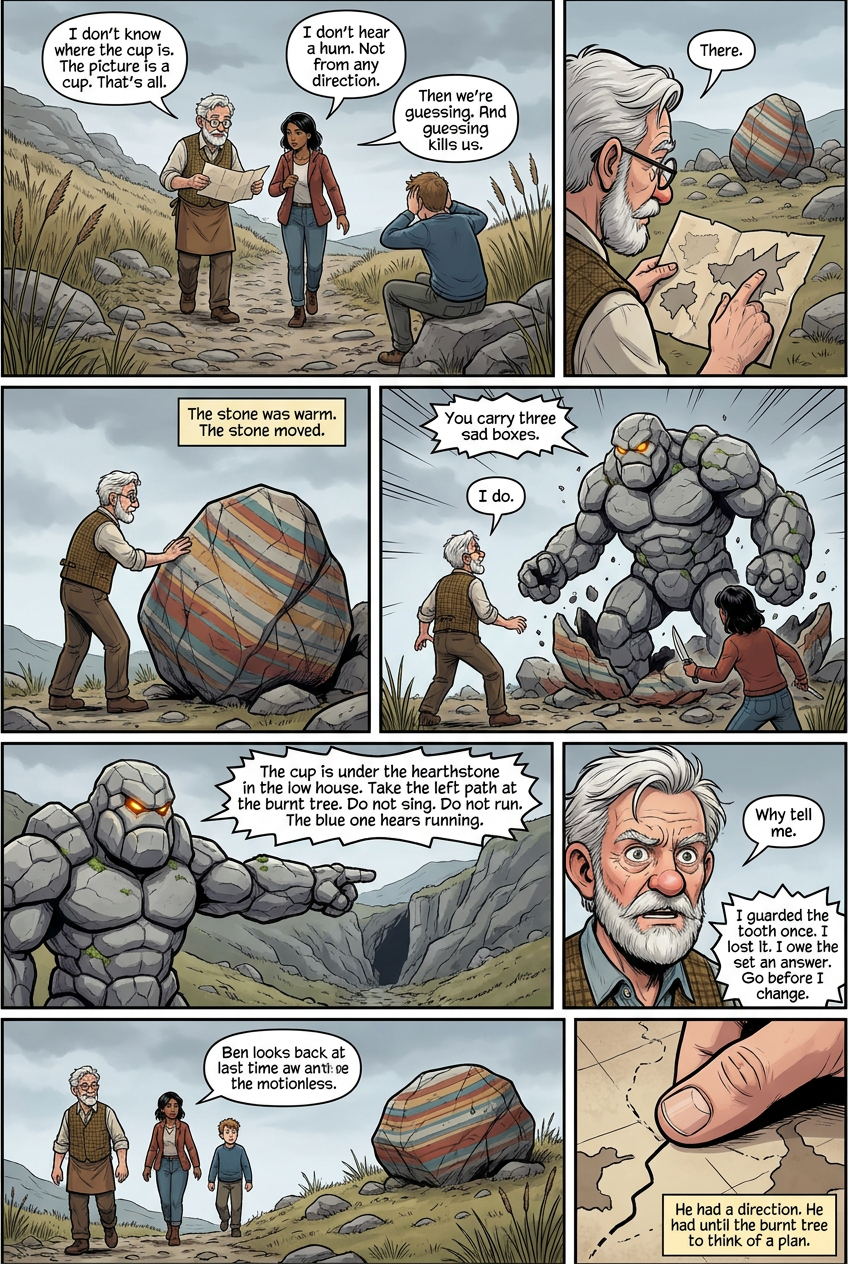
They pushed east until the reeds thinned and the ground rose into a slope of loose stone. Ben's coat knocked with three boxes. The map in Anita's hand showed a cup and a tooth, both drawn small, both without a road. Every hour they guessed was an hour the creature closed. Ben stopped on the ridge and admitted it out loud. "I don't know where the cup is," he said. "The picture is a cup. That's all." Justin sat on a flat rock and put his hands over his ears, listening past them. "I don't hear a hum. Not from any direction." "Then we're guessing," Anita said. "And guessing kills us." Ben studied the map. The cup mark sat near a jagged shape drawn heavier than the rest, inked twice, almost a scar on the paper. He turned in place. To the north the slope broke into a field of boulders. One boulder stood taller than the others, banded in red and blue-green stripes like an old pot fired wrong. He had walked past a hundred stones today. He had not seen one striped. "There," he said. They climbed. The striped boulder was bigger up close, twice Ben's height, split down one face. He set his hand on it. The stone was warm. The stone moved. Ben stepped back. A seam opened along the split. Two eyes came open above it, orange, low and steady. Arms unfolded from what he had thought were roots. A stone body pulled itself upright, moss in its joints, a head like a chipped skull. It was taller than any of them. It looked at Ben the way a dog looks at a stranger at its gate. Justin swore and did not move. Anita raised the knife and did not move either. The stone thing spoke. Its voice sounded like two rocks dragged together. "You carry three sad boxes." "I do," Ben said. "One is new. You cut it yourself." "I did." The thing considered him. Then it lifted one heavy arm and pointed down the far side of the slope, toward a dark cleft in the hills. "The cup is under the hearthstone in the low house. Take the left path at the burnt tree. Do not sing. Do not run. The blue one hears running." Ben's mouth was dry. "Why tell me." "I guarded the tooth once. I lost it. I owe the set an answer." The stone thing lowered its arm. "Go before I change." They went. Ben did not look back until the ridge hid the striped shape behind them. Then he looked at the map, at the cup mark, and drew a line with his thumbnail toward the cleft. He had a direction. He had until the burnt tree to think of a plan.
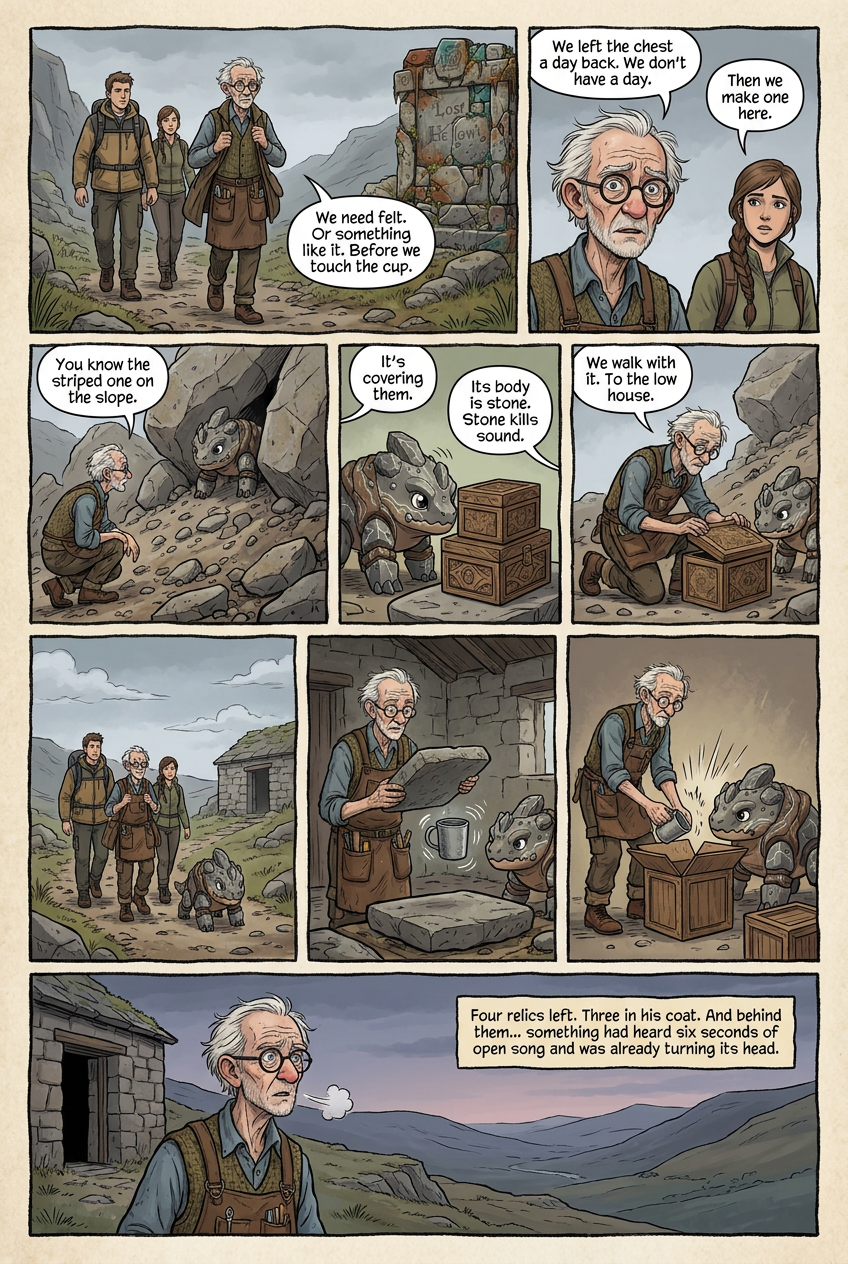
They walked toward the cleft without singing, without running. Ben kept one hand on the boxes inside his coat so they would not knock. The three carved boxes were quiet now only because the felt-lined chest muffled them, and the felt-lined chest was a full day behind them at Lost Hollow, guarded by a girl who had been told to stay silent. Once he lifted the cup into a fresh box, all three would hum together in the open air. The blue-scaled thing would hear them from a valley away. "We need felt," Ben said. "Or something like it. Before we touch the cup." Justin looked at his hands. "We left the chest a day back. We don't have a day." "Then we make one here," Anita said. They stopped where the slope broke into loose scree. Ben set the three boxes on a flat stone and thought. Felt was wool pressed flat. They had no wool. They had coats, moss, and rock. He looked at the rock. A shape shifted at the edge of the scree. Small, low, four heavy legs. A rock creature the size of a dog stepped out from between two boulders, seams glowing faint along its flanks. It watched Ben with one dark eye. Not the tall one from the ridge. A smaller cousin, or a child of that kind. Ben crouched slow. "You know the striped one on the slope." The creature did not answer. It walked to the flat stone and set its wide head against the boxes. The hum, which Ben could not hear through felt he did not have, seemed to reach it anyway. It made a low sound in its chest and did not move. "It's covering them," Anita whispered. "Its body is stone. Stone kills sound." Ben tested it. He lifted the newest box, the one carved from his mother's keepsake, and cracked the lid a finger's width. No hum escaped that he could hear. The rock creature pressed closer. "We walk with it," Ben said. "To the low house. It sits on the boxes while we take the cup." They moved down to the burnt tree and took the left path. The rock creature paced beside Ben's leg, quiet as a shadow of stone. At the low house Ben lifted the hearthstone, a slab of weather-worn crag streaked with pale veins. Underneath sat a cup of dull metal. It hummed the moment his fingers closed on it. He opened the new box. He dropped the cup in. He shut the lid. Ten seconds of hum spilled out. The rock creature threw its body over all three boxes and pressed down. The sound cut off early, maybe six seconds in. Ben breathed out. Four relics left in the world. Three in his coat. And behind them, somewhere across the ridge, something had heard six seconds of open song and was already turning its head.
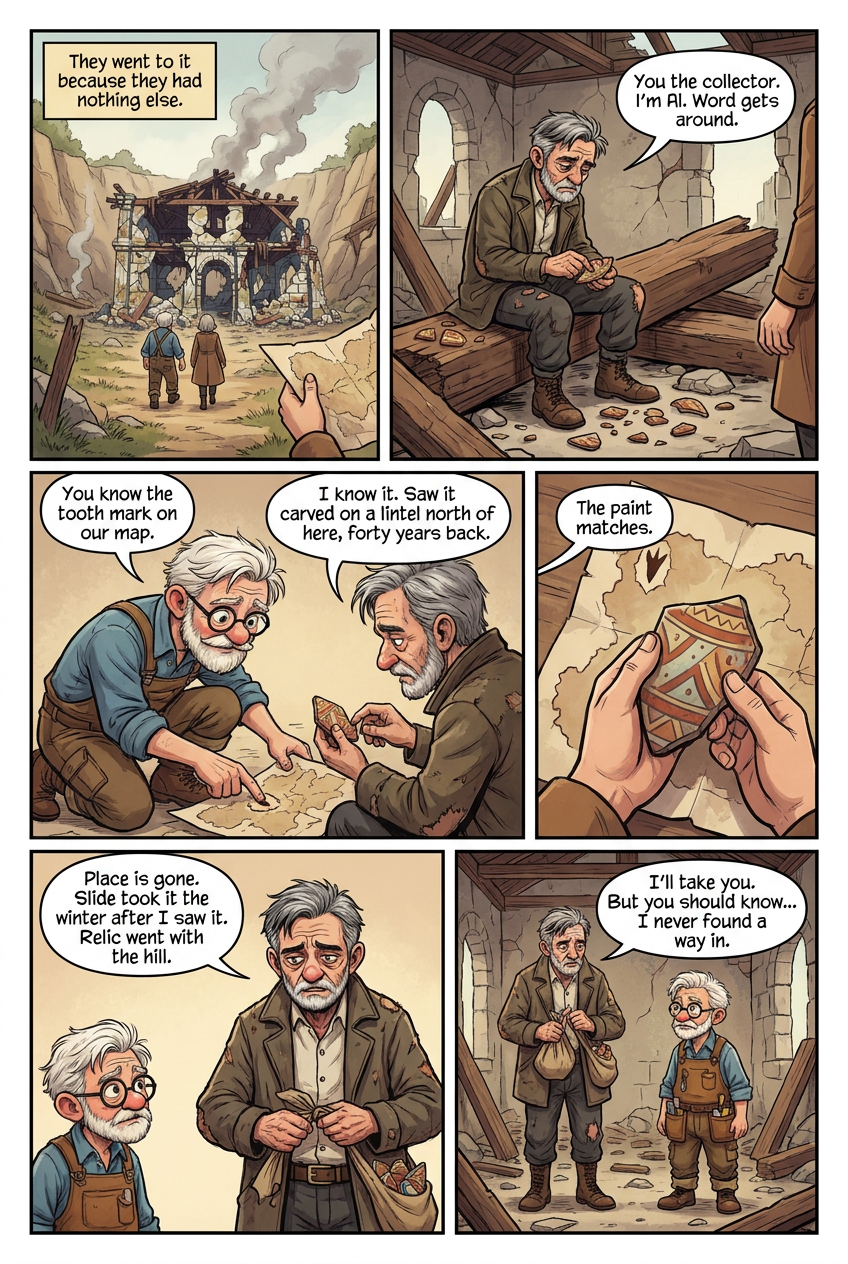
They came down off the low house slope with the cup in a new box and the rock creature still pressed against Ben's coat. Three boxes hummed under stone. One relic left on the map, marked by a tooth Ben could not read. He did not know if it meant a shape in the land, a carving on a door, or a real tooth pulled from a real mouth. Guess wrong and they walked days in the wrong direction while the blue-scaled thing closed on them. "We need someone who has seen the tooth mark before," Anita said. She spread the map on a flat rock. The tooth sat in the corner like a chip of bone. No arrow. No basket. Nothing under it. "The striped one on the slope said he guarded the tooth," Ben said. "He gave us the cup instead. He owed one answer, not two." Justin pointed down the draw. A thin thread of smoke rose from a shattered building at the bottom. Half a roof. Stone arches with their tops broken off. Timbers hanging like ribs. They went to it because they had nothing else. Inside the broken hall a man sat on a fallen beam, sorting painted pieces of pottery on his knee. Old jacket. Rust stains. Gray hair going every direction. He did not look up when they came in. "You the collector," the man said. Not a question. "Word gets around. I'm Al. Al Beback. I used to run this route before my knee went." Ben crouched by the beam. The painted pieces were curved, patterned, the edges jagged. Part of something round, once. "You know the tooth mark on our map." Al turned a shard in his fingers. "I know it. Saw it carved on a lintel north of here, forty years back. Meant the place where the tooth relic sat." He set the shard down. "Place is gone. Slide took it the winter after I saw it. Relic went with the hill." Ben's chest went tight. "Gone where." "Down." Al pointed at the pieces on his knee. "I dug for a season. Found this. Painted lid off the box it sat in. Never found the tooth." He looked up at last. His eyes were tired and honest. "I came back every spring for ten years. That's why they call me what they call me. I quit last year." Anita picked up a shard and turned it. The paint matched a curl on the map's tooth corner. Ben sat down on the beam beside Al. Four relics left in the world. Three in his coat. The fourth under a hill no one could dig. "Show me where the slide came down," Ben said. Al nodded once. He gathered the painted pieces into a cloth and tied it. "Two days walk. I'll take you. But you should know before we go. I never found a way in."
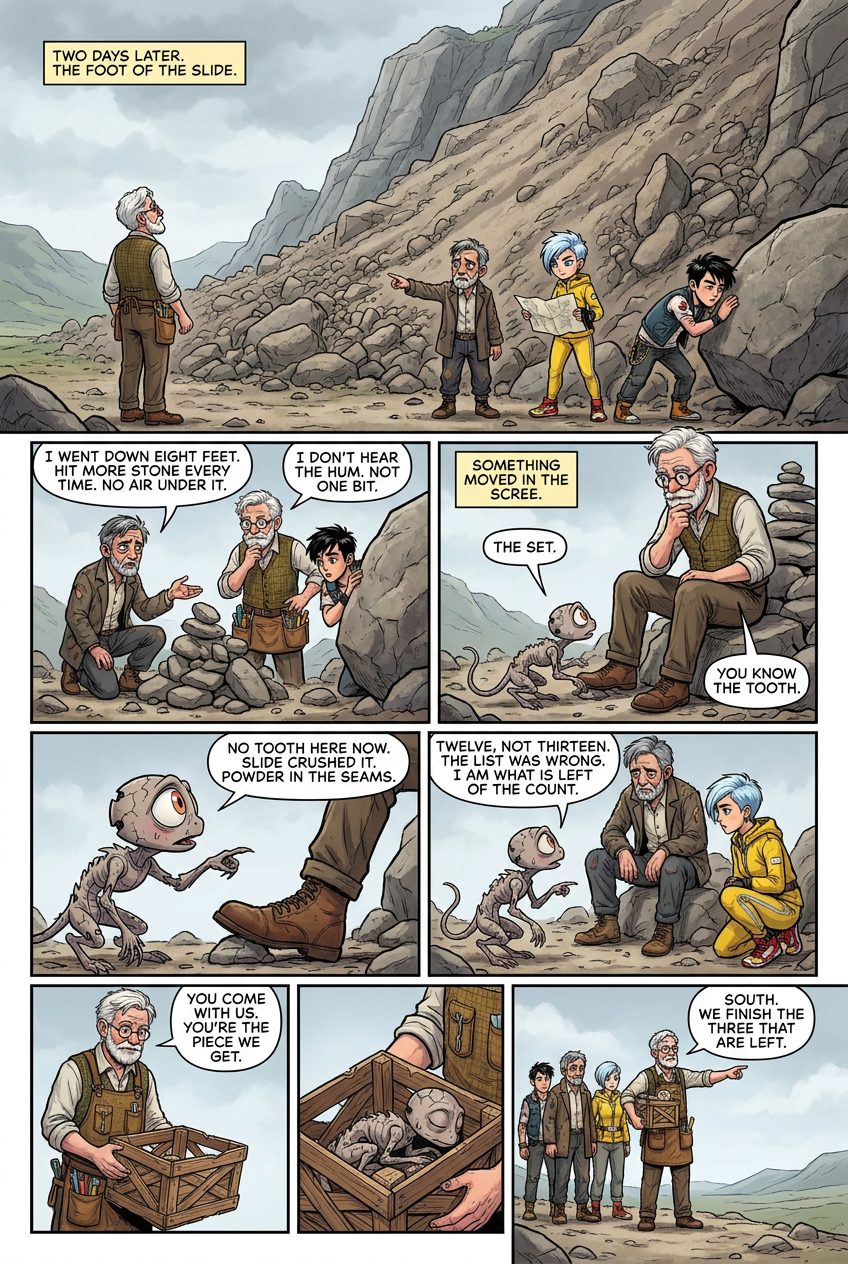
Two days later they stood at the foot of the slide. Al pointed up the slope. Broken rock ran from ridge to draw, wide as a village. Somewhere under it sat the tooth relic and the box it once lived in. Ben tried to picture digging through that much hill and could not. "I marked where I dug," Al said. He showed them cairns spaced across the lower face. "I went down eight feet in three places. Hit more stone every time. The slide is stone on stone on stone. No air under it." Justin walked the base and pressed his ear to the rubble. "I don't hear the hum. Not one bit." Anita opened the map on a flat rock and weighed the corners. She looked at the tooth mark, then up at the slope. "If the relic is buried whole, we can't reach it. If the box broke, the relic is loose in there and the creature already knows." Ben sat on a cairn. Three boxes at his hip. Three relics in. One relic gone under a hill. Something moved in the scree above him. A small shape crawled down between two slabs, one leg dragging. Cracked hide. One eye too big. A tail that ended in a stump. It was the same kind as the rock creature from the low house, but wrong. Half made. Pieces missing. It stopped at Ben's boot and looked up. "The set," it said. The voice was thin. "You know the tooth," Ben said. It nodded once. Something ground inside its chest. "I was in the box when the hill came. Box broke. I broke. Relic went deeper. I climbed out over years." It lifted a claw and pointed, not up the slope, but sideways along the base. "No tooth here now. Slide crushed it. Powder in the seams." Ben's throat closed. "Crushed." "Gone," it said. "Twelve, not thirteen. The list was wrong. I am what is left of the count." Al sat down hard on a slab. Ten years of digging landed on his face at once. Anita crouched by the small creature. "You're sure." "I felt it end." Ben looked at the slope. He looked at Al. He looked at the broken thing at his boot. Nine sources had said thirteen. All nine had counted this one. He reached into the pack and lifted out a split wooden crate Al had carried the pottery shards in. He tipped the shards onto the cloth. He set the small creature inside the crate and lifted it up. It fit. "You come with us," Ben said. "You're the piece we get." The creature settled against the broken boards. It closed its big eye. Ben stood. Three relics in his coat. A twelfth in a broken crate. The set was smaller than he had feared and finished sooner than he had planned. "South," he said. "We finish the three that are left."
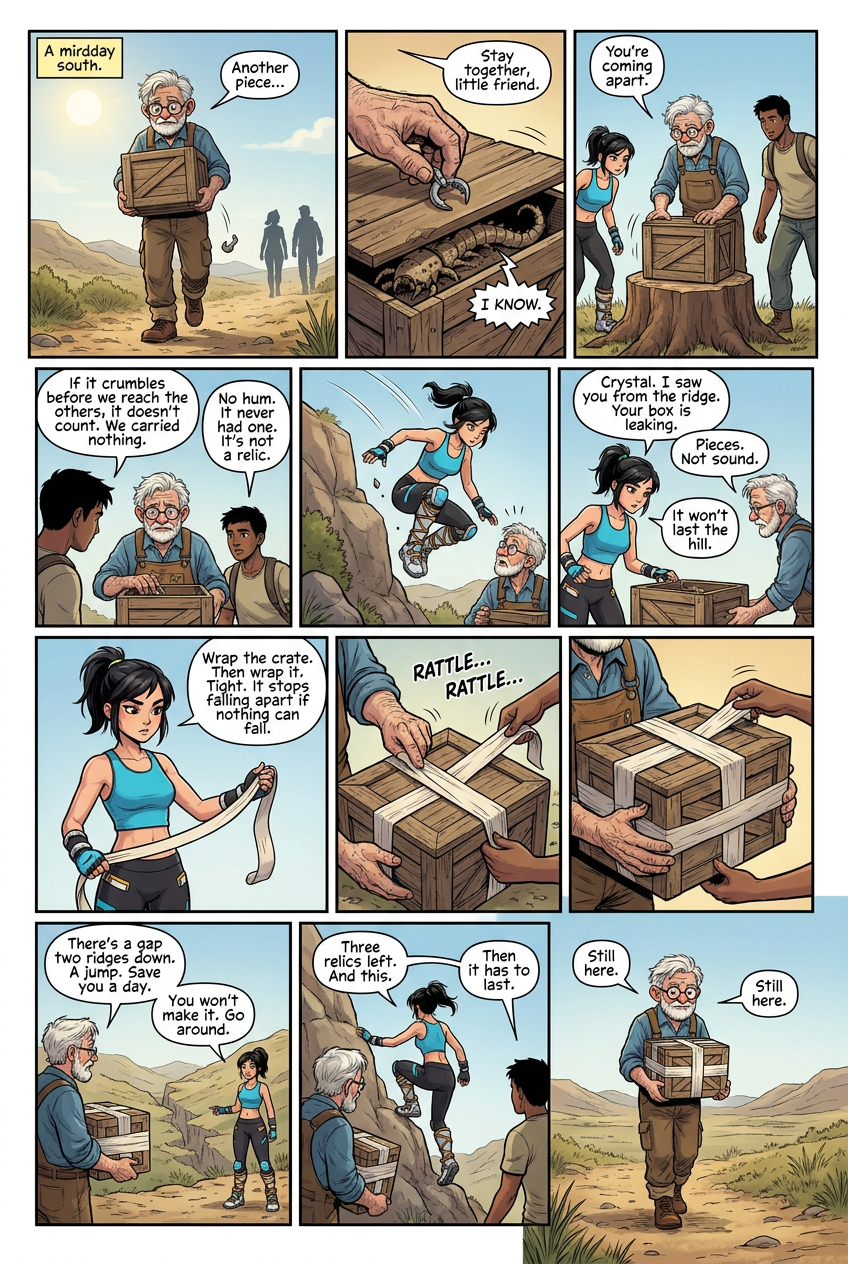
They walked south through low hills. Ben carried the split crate against his chest. The broken creature inside had stopped closing its eye. Small pieces of it kept working loose. A claw fell out at the first stream. A scale the size of a coin dropped near a fallen log. Each time, Ben stopped and put the piece back in the crate. Each time, the creature weighed a little less. By midday the crate rattled with loose parts. The creature's chest ground softer. Ben set the crate on a stump. "You're coming apart." "I know," it said. Its voice was a scrape now. Anita looked in. "If it crumbles before we reach the others, it doesn't count. We carried nothing." Justin pressed his ear to the crate. "No hum. It never had one. It's not a relic. It's just what's left of the guard." Ben's stomach dropped. He had been carrying it like a piece. He had told himself the count was safe. It was not. "I need to hold together for one more day," the creature said. "After that I am dust. Get me somewhere the set can hold me." They were still hours from any place with walls. Ben looked at the crate. The boards were split. Every step shook another chip loose. A figure dropped from a rock shelf above the path and landed in a crouch three feet from Justin. Tape ran up one leg from ankle to thigh. She stood without a sound and looked at the crate. Ben had never seen her before. "Crystal," she said. "I saw you from the ridge. Your box is leaking." "Pieces," Ben said. "Not sound." She looked in the crate. "It won't last the hill." "We know." She unwrapped a strip of tape from her calf. Then another. She held them out. "Wrap the crate. Then wrap it. Tight. It stops falling apart if nothing can fall." Anita took the tape. She and Ben bound the crate top to bottom, then across, then across again. The creature shifted inside and went still. Ben lifted it. The rattle was gone. "Which way are you going," Crystal said. Not a question. "South. Three more to find." "There's a gap two ridges down. A jump. Save you a day." She looked at his boots. "You won't make it. Go around." She turned and climbed back up the rock without waiting. Ben held the taped crate against his ribs. It felt solid. The creature's voice came through the boards, thin. "Still here." "Still here," Ben said. He looked at Anita. "Three relics left. And this." He tapped the crate. "It counts if it lasts." "Then it has to last," Anita said. They moved south again, slower now, Ben carrying the taped bundle like a child. The count held at twelve. For one more day.
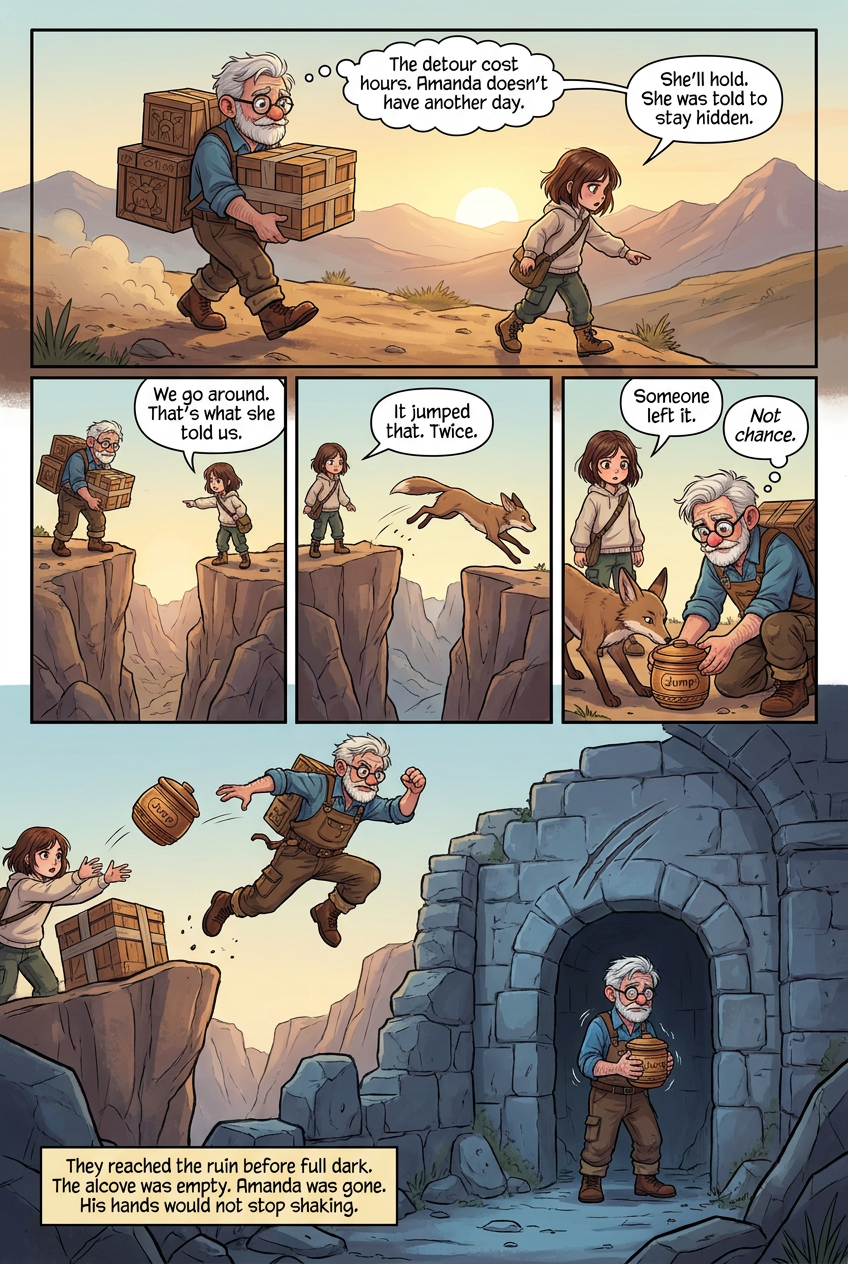
By late afternoon the detour had cost them hours. The ridge road curved wide around the gap Crystal had warned them off, adding miles for every step saved. Ben carried the taped crate against his ribs. The broken guard inside was quiet now, holding what shape it had left. Anita walked ahead. Justin walked behind. No one spoke about Amanda, alone at the abandoned stone ruin with the felt-lined chest, waiting past the day they had promised. "She'll hold," Justin said finally. "She was told to stay hidden." "She was told for one night," Ben said. "It's been two." Anita stopped at a rise and pointed. Below them the ridge dropped into the gap Crystal had named. It was narrower than Ben expected. Six feet, maybe seven. A running jump for a man with nothing in his arms. Ben had a taped crate and three carved boxes strapped to his back. "We go around," Anita said. "That's what she told us." "Around is another day," Ben said. "Amanda doesn't have another day." Something moved in the brush at the gap's edge. A brown shape landed on the far lip in one clean bound, then stopped and looked back at them. A lean animal, ears up, tail long. It crouched and sprang again, back across the gap, and landed at Ben's feet. It did not run off. "It jumped that," Justin said. "Twice." The animal nosed the taped crate. Then it nosed a small wooden pot at its own feet Ben had not seen before. The pot was round, plain, with the word JUMP burned into a plate on its side. Ben crouched. The pot was light. Empty. "Someone left it," Anita said. Ben thought of Crystal on the ridge. Tape on her leg. A pot at a gap. He did not think it was chance. He unstrapped the three carved boxes and set them in the pot. They fit. He closed the lid. He held the pot in one hand, the taped crate in the other. Lighter. Balanced. "You can't jump that carrying both," Anita said. "I can if you throw the pot after." Justin went first. He backed up, ran, and cleared the gap with a foot to spare. Anita followed. Ben handed the pot across, then the crate. Both made it. Then he ran and jumped. He landed hard on his knees but he landed. They were on the right side now. Lost Hollow lay two hours south, not a full day. They moved fast through the dusk and reached the stone ruin before full dark. Ben pushed through the low door. The alcove was empty. The felt-lined chest was gone. Amanda was gone. On the wall above the alcove someone had scratched a fresh mark in the stone: a single curved line, wet at the edges. Ben set the pot down. His hands would not stop shaking.
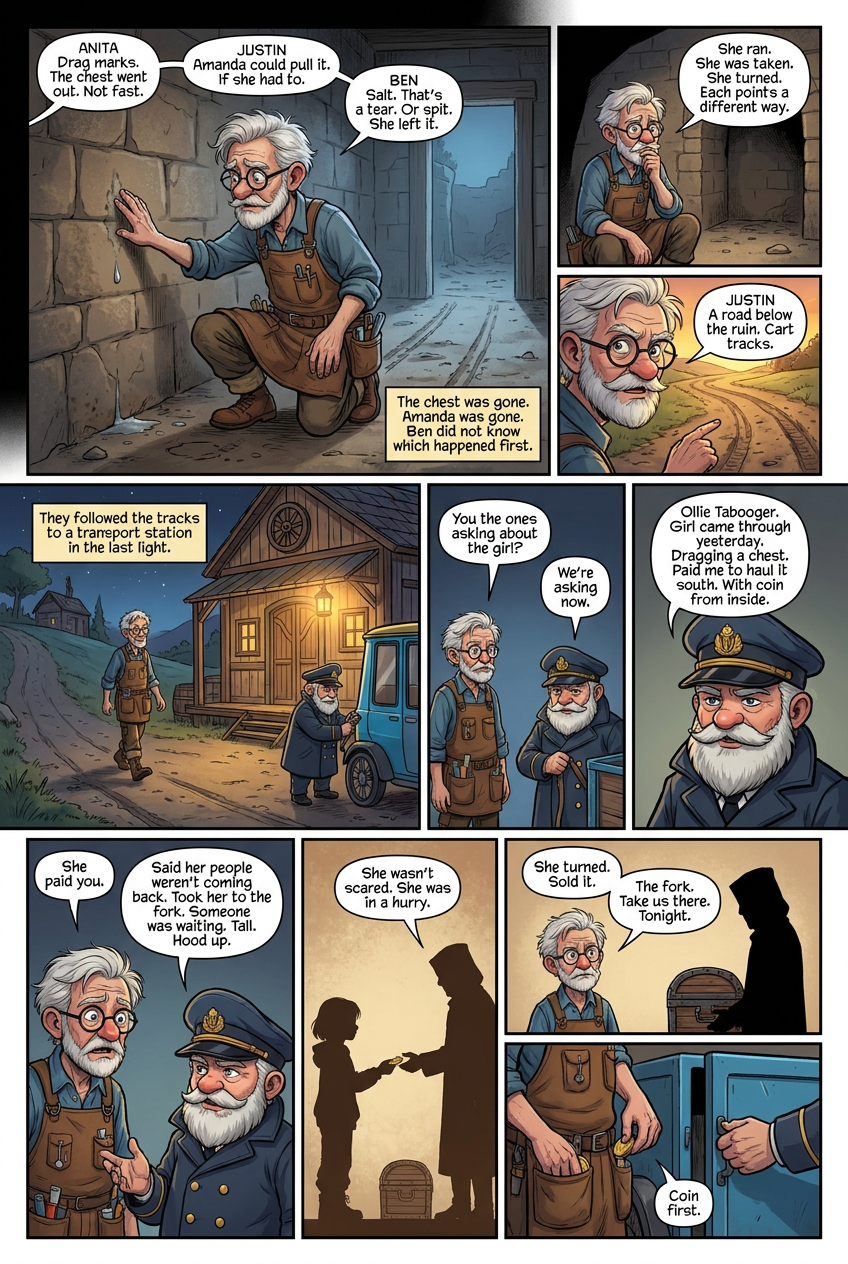
Ben stared at the wet mark on the wall. Anita crouched by the alcove and ran a finger along the stone floor. Justin stood in the doorway with the taped crate. No one spoke. The chest was gone. Amanda was gone. Ben did not know which had happened first. "Drag marks," Anita said. She pointed at two shallow grooves in the dust. "The chest went out through the door. Not fast. Somebody pulled it." "Amanda could pull it," Justin said. "If she had to." "Or somebody pulled her with it," Ben said. He knelt by the mark on the wall. The scratch was fresh. The edge was damp. He touched it. Salt. "That's a tear. Or spit. She left it." "Or someone else did," Anita said. Ben sat back on his heels. Three answers. She ran. She was taken. She turned. Each one pointed a different way. Guess wrong and the chest was gone for good. Two carved boxes inside. Three relics. Everything he had built for months. Justin set the crate down. "There's a road below the ruin. Cart tracks. I saw them coming in." They followed the tracks down the slope in the last light. The road widened and ran into a broad wooden building with iron braces and double doors. A lantern burned under the eave. A sign above the door showed a wheel. A transport station. Ben had not known one stood this close. A short man in a dark coat and a peaked cap stood by the doors, checking a strap on a small blue cart. He did not look up when they came into the light. "You the ones asking about the girl?" the man said. "We're asking now," Ben said. "Ollie Tabooger. I run freight." He tightened the strap. "Girl came through yesterday. Dragging a chest. Paid me to haul it south." Ben's chest went tight. "She paid you." "Coin from inside the chest. She opened it in front of me." Ollie looked at him now. Flat eyes. "Said her people weren't coming back." "Where south," Ben said. "Harbor road. Two days by cart." Ollie nodded at the blue transport behind him. "I took her to the fork. She got off there with the chest. Someone was waiting. Tall. Hood up. Didn't give a name." "You didn't ask," Anita said. "Not my job." Ollie fastened the last buckle. "She wasn't scared. She was in a hurry." Ben stood in the lantern light. The answer had cost him nothing and everything. Amanda had not fled. She had not been taken. She had turned on them and sold the chest to someone who had been waiting for it. "The fork," Ben said. "Take us there. Tonight." Ollie pulled open the cart door. "Coin first." Ben dug into his pocket.
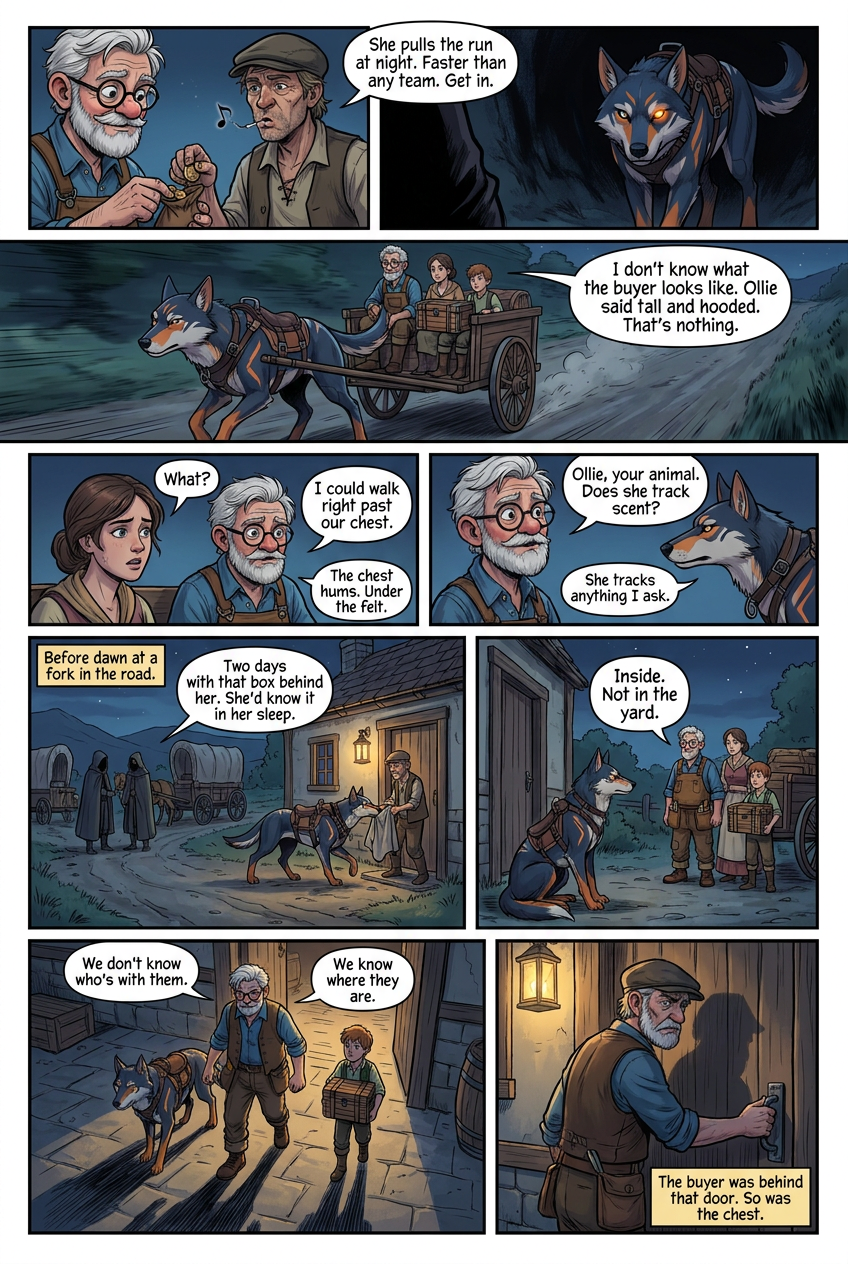
Ben paid Ollie in coin from his belt pouch. The freight operator counted it twice, then whistled low. A shape moved out from the shadow behind the station. Not a horse. A long-bodied creature, gray and rust, harness strapped across its chest, saddle bolted high on its shoulders. It padded to the cart and stood, alert, watching Ben with one orange eye. "She pulls the run at night," Ollie said. "Faster than any team. Get in." Ben climbed into the cart with Anita and Justin. Justin set the taped crate between his boots. The creature leaned into the harness and the cart rolled. The road blurred. Ben gripped the rail and tried to think. "I don't know what the buyer looks like," he said. Anita turned. "What?" "Ollie said tall and hooded. That's nothing. The fork will have travelers. Carters. Anyone in a cloak." He pressed his palm to the rail. "I could walk right past our chest." Justin looked at the crate. "The chest hums. Under the felt. Barely. I can hear it if I get close." "Close enough to touch," Anita said. "That doesn't help in a crowd." Ben watched the dark road slide by. Then he looked at the creature pulling them. Its ears pricked at every sound. Its nose worked the wind. "Ollie," Ben called forward. "Your animal. Does she track scent?" "She tracks anything I ask," Ollie said. "Freight, people, lost bags. Why?" "The chest she carried yesterday. Did she smell it long enough to remember?" Ollie was quiet a moment. "Two days in the traces with that box behind her. She'd know it in her sleep." Ben's chest went tight in a new way. "Then she can find it again. And whoever is with it." They reached the fork before dawn. Three roads met at a stone marker. A low inn sat at the joining, shutters closed, one lantern lit. Two carts stood outside. Four people moved in the yard, loading sacks. Two wore hoods against the cold. Ollie stepped down and unhooked the creature from the traces. He knelt by her head and murmured. Then he pulled a strip of cloth from his pocket, one that had ridden under the chest, and held it to her nose. The creature lifted her head. She turned once, slow, tasting the air. Then she walked straight past the two hooded figures at the carts and stopped at the inn door. She sat. She looked back at Ben. Inside, Ben thought. Not in the yard. Inside. He stepped down from the cart. Anita caught his sleeve. "We don't know who's with them," she said. "We know where they are," Ben said. "That's what I needed." He walked toward the inn door. The creature stood and fell in beside him. Justin followed with the crate. The lantern threw their shadows long across the stone. The buyer was behind that door. So was the chest.
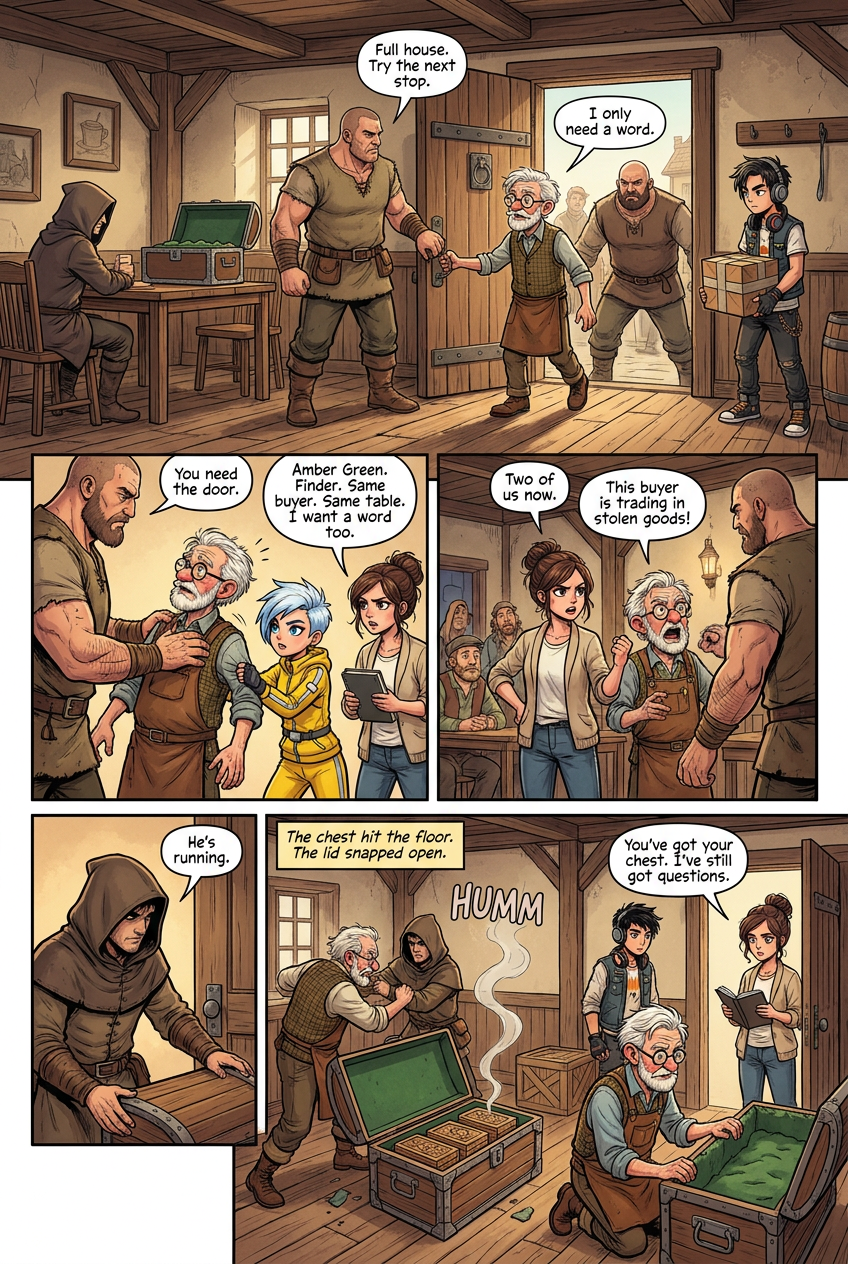
Ben pushed the inn door open. Warm air met him. A low room, six tables, a fire in the back. Two men stood between him and the far corner. Big shoulders. Hands loose at their sides. Local muscle, paid to watch the door. The taller one stepped in front of Ben. "Full house. Try the next stop." Ben looked past him. A hooded figure sat at the corner table. The felt-lined chest sat on the bench beside them. Justin, behind Ben with the taped crate, gave a small nod. He could hear the hum. "I only need a word," Ben said. "You need the door," the man said. He set a hand flat on Ben's chest and pushed. Ben went back a step. Anita caught his elbow before he tripped. A young woman rose from a table near the window. Small frame, hair pulled up, a worried pinch between her brows. She had been writing in a notebook. She closed it now and walked over. Ben had never seen her before. "Amber Green," she said to the muscle. "Finder. Three days here." She tipped her chin at the hooded buyer. "That one bought a chest last night. I've been watching." "Move along," the man said. "The herbalist I'm tracking came through this fork," Amber said. She spoke fast, clipped. "Same buyer. Same table. I want a word too." The second man stepped toward her. She did not move. "Two of us now," she said to Ben. Not asking. Telling. Ben understood. He raised his voice so the room could hear. "This buyer is trading in stolen goods. That chest was taken from us at a stone ruin two days ago." Heads turned. The innkeeper looked up from his cloth. "Ask him to open it," Amber said. "Ask him what's inside." The hooded figure stood. The hood turned toward the door at the back of the room. One hand went to the chest handle. "He's running," Amber said. The muscle turned to check. Ben moved. He went past the taller man's shoulder before the man's arm came up. Justin followed with the crate. Anita stayed with Amber at the door. The buyer got two steps toward the back exit. Ben got there first and put his hand on the chest. The buyer pulled. Ben pulled harder. The chest hit the floor between them. The lid snapped open. Three carved boxes sat inside the felt. The hum, thin and clean, lifted into the room. Every head heard it. The innkeeper stepped back from the bar. The muscle stopped where they stood. The hooded buyer let go of the chest and went out the back door alone. Ben closed the lid. He knelt on the boards with his hand flat on the felt. Anita reached him. Justin set the crate down beside the chest. Amber watched from the doorway, notebook open again. "You've got your chest," she said. "I've still got questions."
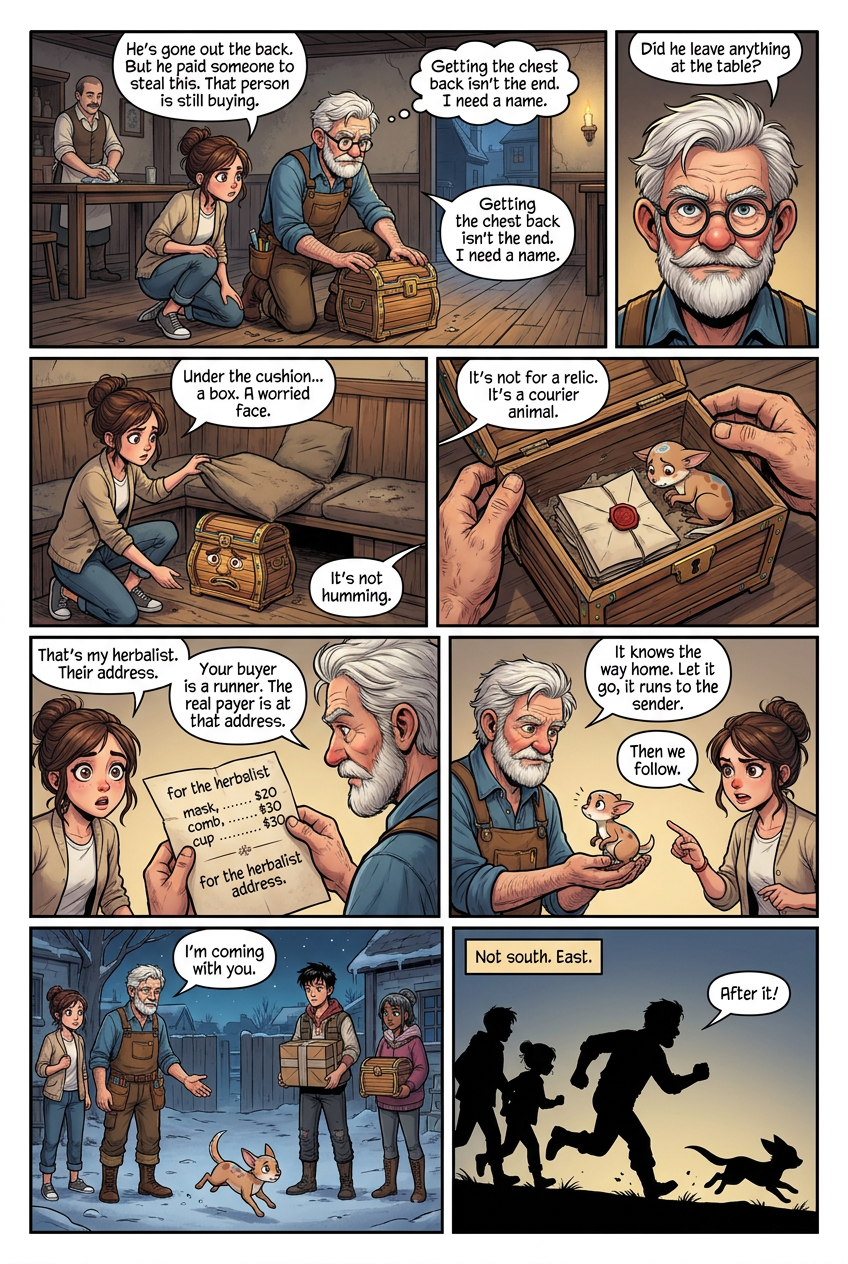
Ben stayed on the floor with his hand on the chest until the hum settled back under the felt. The innkeeper went back to his cloth. The muscle drifted toward the bar. Amber came over and crouched beside him. "He's gone out the back," she said. "But he paid someone to steal this. That person is still buying." Ben nodded. He knew it. Getting the chest back was not the end. Whoever paid for it could pay again, and next time he might not catch up. He needed a name, or a place, or anything. "Did he leave anything at the table?" Ben asked. Amber was already moving. She went to the corner bench and lifted the cushion. Under it sat a small wooden container, no bigger than a loaf. A face was carved into the front. Wide eyes. Pinched mouth. A worried face, not a sad one. It did not silence anything. It was just a box. Justin came over. "It's not humming." "It's not for a relic," Ben said. He worked the lid open. Inside: folded paper, a stub of red wax, and a small brown creature curled tight in the corner. Round ears. Nervous eyes. It looked up at Ben and pressed itself flat against the wood. Anita leaned in. "A courier animal." Ben lifted the paper first. A list. Three items in a careful hand: mask, comb, cup. Beside each, a price. At the bottom, an address he did not know, and above the address, two words: for the herbalist. Amber read it over his shoulder. Her breath caught. "That's my herbalist." "Your buyer works for them," Ben said. "He's not the one paying. He's the runner." "They're at that address," Amber said. "Or they were." Ben folded the paper into his coat. He looked at the small creature. It was shaking. He put a finger near it. It sniffed once and did not bite. He lifted it out and set it on his palm. It weighed almost nothing. "It knows the way home," Anita said. "That's what these are for. Let it go and it runs to whoever sent it." Ben closed his hand loose around it. "Then we follow." Amber stood. She tucked her notebook into her coat. "I've been at this fork three days waiting for a face. You've got more than a face. I'm coming with you." Ben looked at Justin. Justin nodded. Anita picked up the chest by the rope handle. Justin took the taped crate. Outside, the yard was cold and empty. The buyer's tracks went south into the trees. Ben opened his hand. The small creature sat still a moment, ears twitching, then dropped to the dirt and ran. Not south. East. Ben went after it.
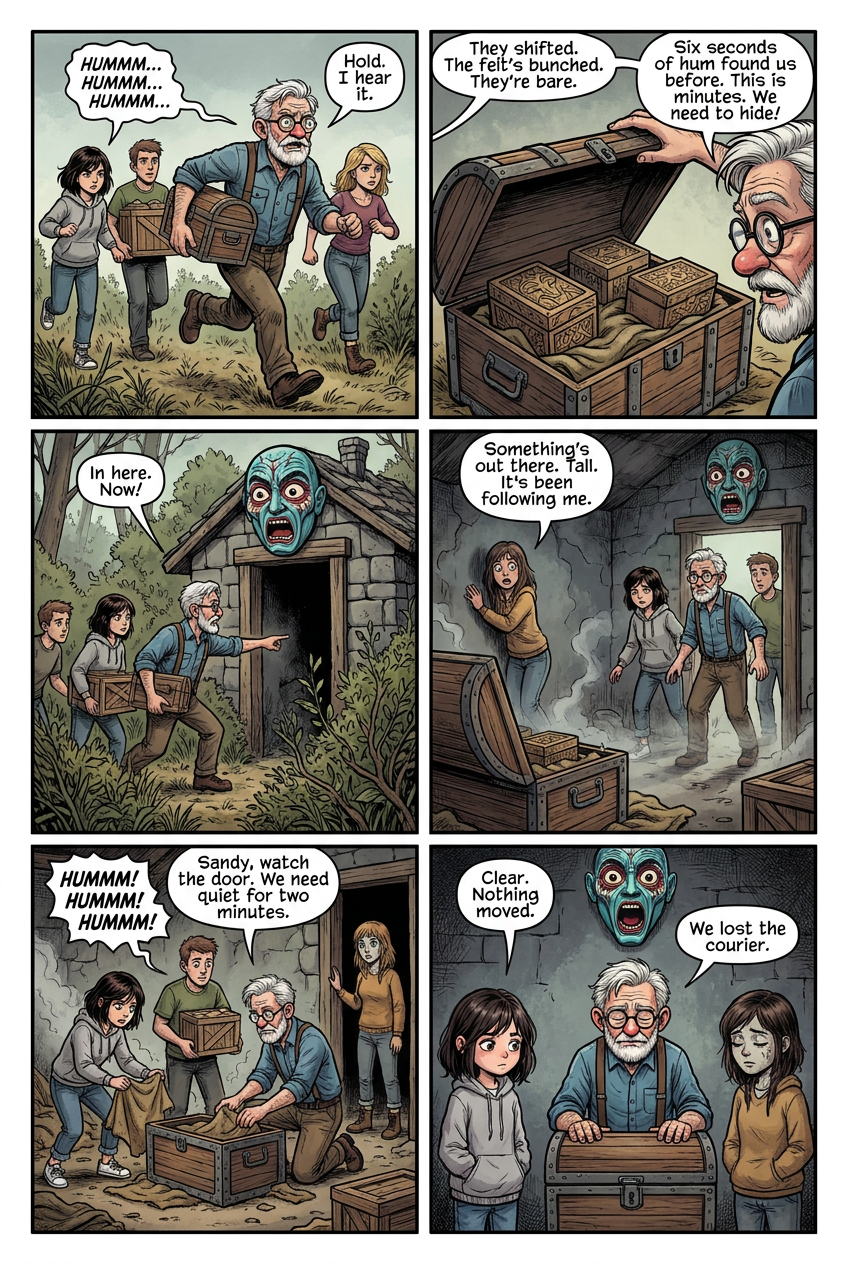
The courier animal ran east through low brush. Ben followed at a jog, one hand on the chest rope, the other on the taped crate Justin carried behind him. Anita kept pace on his left. Amber came last, watching the trees. They had gone maybe a quarter mile when Ben heard it. A hum. Three humms, layered, coming from the chest at his hip. The felt was still inside. It should have held. He stopped and put his ear to the wood. The sound was clear. "They shifted," Anita said. She lifted the lid a finger's width. The three carved boxes sat crooked. The rough handling at the inn had knocked them out of the felt lining. "The felt's bunched under them. They're bare on top." Ben's throat tightened. The blue-scaled creature tracked sound. It had found them before from six seconds of hum. This was minutes already, and growing. He looked back the way they came. Nothing yet. But nothing yet only meant not yet. "We reset the felt," Ben said. "Now. Off the trail." They pushed into the brush and found a low stone shelter set into the slope. Wood and stone patched together. A carved face over the door, wide-eyed, mouth pulled down. The inside was dim and close. It smelled of old smoke. A girl was already inside. Small, dark hair, gray hoodie, hands jammed in the pocket. She pressed against the back wall when they came through the door. Her eyes went to the humming chest, then to Ben's face. "Something's out there," she said. "Tall. In the fog. It's been behind me since morning." "Sandy?" Amber said. She knew her from somewhere. She did not explain. "How long in here?" "An hour. Maybe less. I heard you coming and thought it was the thing." Ben set the chest down. "We need quiet for two minutes. Can you watch the door?" Sandy nodded once. She stepped to the doorway and put her back to the frame, eyes on the trees. Ben opened the chest. Anita pulled the felt free and shook it flat. Justin lifted each carved box out. The hum rose in the small room, sharp enough to feel in the teeth. Ben laid the felt in thick, folded it up the sides, then set the boxes back in one at a time. He packed felt between each. He closed the lid. The hum cut off. He held his breath and listened. The wind. Sandy's shallow breathing. No blue scrape of scale on stone. "Clear," Sandy said. "Nothing moved." Ben exhaled. He looked at Sandy in the doorway, small and shaking, watching the fog for a shape that had followed her here. He thought of the courier animal still running east without them. "We lost the courier," Anita said. Ben closed his eyes. The chest was quiet. The trail east was gone.
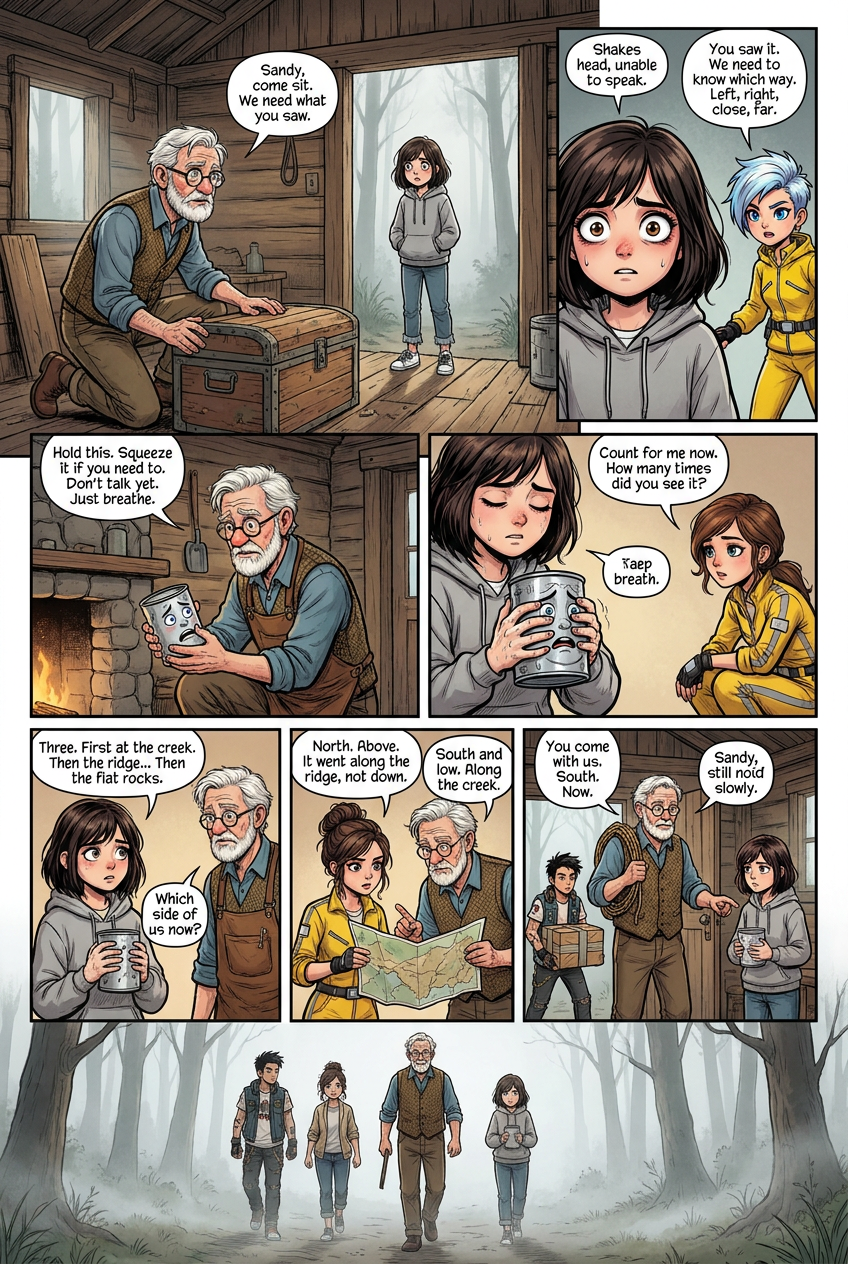
The chest sat quiet on the floor. Ben knelt beside it and looked at Sandy in the doorway. She was still watching the trees. Her hands shook inside the hoodie pocket. Whatever she had seen on her run, she had seen it up close. Ben needed to know where the creature had been and where it had gone. Without that, they could not choose a path out. "Sandy," Ben said. "Come sit. We need what you saw." She did not move. Her shoulders were pulled up near her ears. Her eyes were wide and fixed. She looked like a small animal frozen mid-step, waiting for the shape in the fog to decide. Anita crossed the room slow. She did not touch her. She sat on the floor near the door and waited until Sandy looked down. "You saw it," Anita said. "We need to know which way. Left of here, right of here, close, far. Just that." Sandy opened her mouth. A dry click came out. She shook her head hard. Ben felt the minutes going. He looked around the shelter for something, anything, to steady her. On a shelf by the hearth sat a dented metal canister, lid clamped, handle bent. Someone had scratched a face into the tin, wide eyes, small mouth. A joke, maybe, or a child's work. He pulled it down and set it in Sandy's hands. "Hold this," he said. "Squeeze it if you need to. Don't talk yet. Just breathe." She wrapped both hands around the canister. Her knuckles went white. She breathed in, out, in. The shaking dropped a notch. Amber crouched in front of her. "You and me walked the south market once," Amber said. "You remember. You counted the stalls for me. Count for me now. How many times did you see it?" "Three," Sandy said. Her voice cracked but held. "Three times. First at the creek. Then the ridge above. Then the flat rocks where the trees stop." "Which side of us now?" Ben said. Sandy closed her eyes. Her hands squeezed the tin. "North. Above. It went along the ridge, not down. It was casting for sound. It didn't cross the creek." Anita pulled her map out. Ben leaned in. The creek ran east to west below them. The ridge sat north. South was open slope down to a gully with water. "South and low," Anita said. "Along the creek. It stays above us and loses the scent in the water." "How long ago the flat rocks?" Ben said. "Twenty minutes. Maybe less." Ben stood. He shouldered the chest rope. Justin lifted the taped crate. Sandy still held the canister. Ben did not ask for it back. "You come with us," he said. "South. Now." She nodded. They stepped out into the fog with a route.
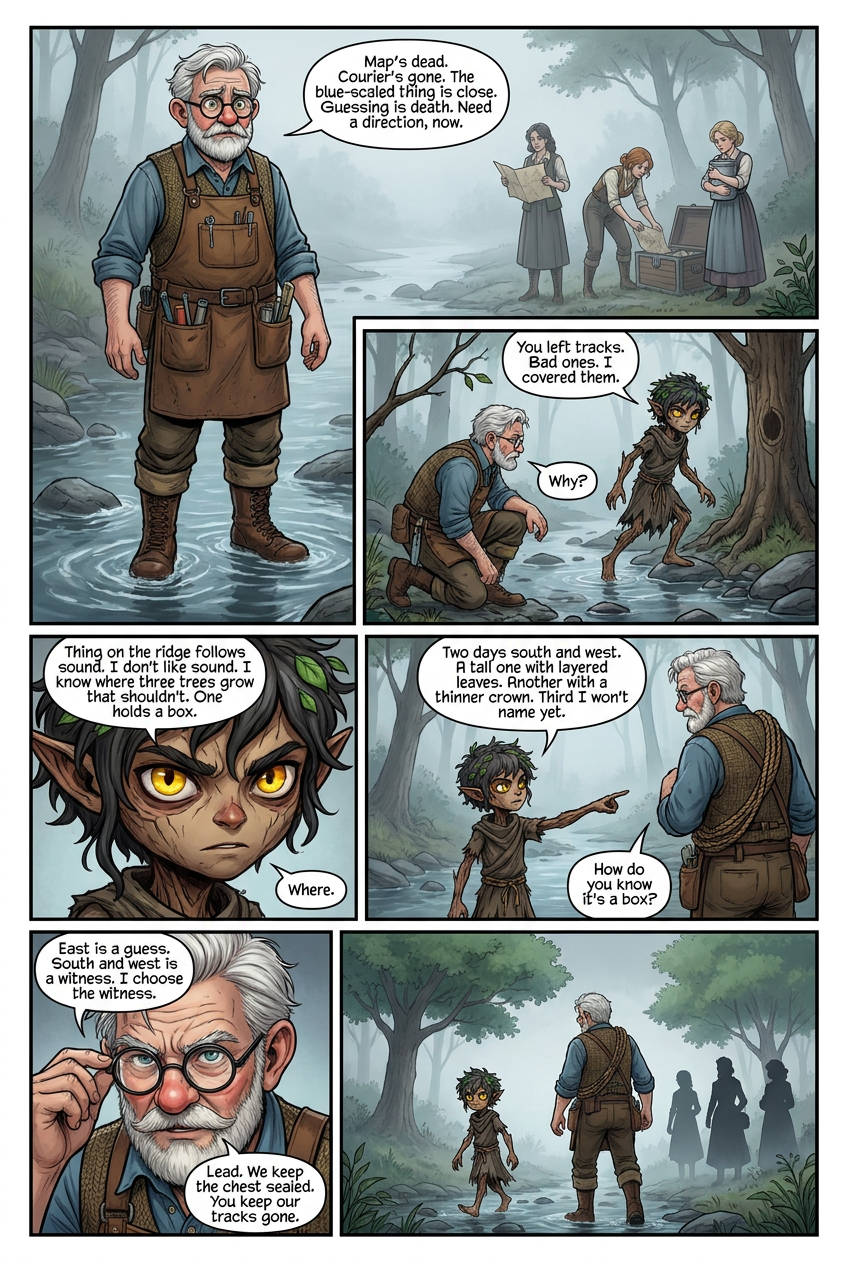
The fog thinned as they dropped toward the gully. Water ran cold over Ben's boots. Anita's map was useless now. The courier animal was gone. The east trail was gone. Three relics still sat somewhere in the kingdom, and every hour they wandered blind, the blue-scaled creature closed the gap along the ridge above. Ben stopped in the creek bed and made himself think. Guessing would kill them. He needed a direction, and he needed it before dark. Justin sat on a wet stone. Amber checked the felt in the chest. Sandy still held the tin canister against her chest. Anita spread the map on a flat rock and weighed the corners with pebbles. Three pictures. Comb crossed out. Cup crossed out. Tooth crossed out. Nothing left on the paper to point them anywhere. "We had the herbalist," Amber said. "The runner's list named three. Mask, comb, cup. Things she already knew we had. She knows where the rest are, or she knows who does." "East," Ben said. "But east is a week of open ground and no trail." A branch cracked upslope. Ben went low. A small figure stepped out from behind a trunk on the far bank, barefoot, skin the color of bark, leaves tangled in dark hair. He crossed the creek slow, testing each stone, like the ground might bite. Yellow eyes flicked to the chest, then to Ben. "You left tracks," the figure said. "Bad ones. I covered them a mile back." "Why," Ben said. "The thing on the ridge follows sound. I don't like sound." He stopped an arm's length from the chest. "My name is Joe. I know where three trees grow that shouldn't. One holds a box. I've watched it a long time." Ben did not move. "Where." Joe pointed south and west, back away from the herbalist, back toward country they had already left. "Two days. A tall one with layered leaves. Another with a thinner crown. Third I won't name yet. I need to see if you're worth it first." "How do you know it's a box," Anita said. "It hums when the wind stops." Joe's jaw tightened. "I was rooted near it once. Before something pulled me up. I don't think about that." He looked at his own feet, splayed on wet stone. "Legs are worse than roots. But legs go where roots can't." Ben weighed it. East was a guess. South and west was a witness. He chose the witness. "Lead," Ben said. "We keep the chest sealed. You keep our tracks gone." Joe nodded once and started back across the creek. Ben shouldered the rope. The direction problem was closed. A stranger with yellow eyes now held their route in his head, and Ben did not know yet what Joe would want in return, or what he was afraid to name in that third tree.
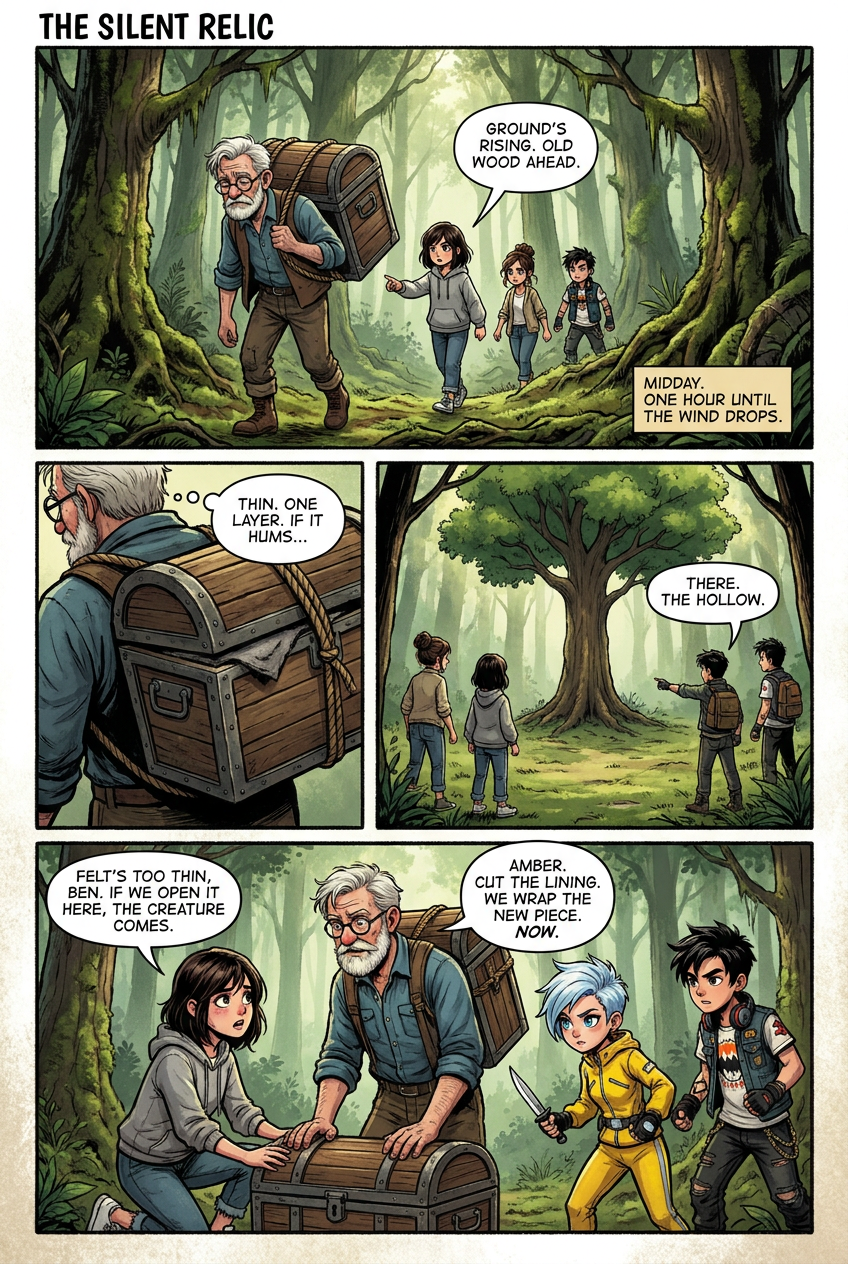
Joe led them out of the creek at a slant, keeping to moss and flat stone. By midday the ground rose into a stand of old wood. Ben walked with the rope of the chest cutting his shoulder. Inside the chest, the felt held. Three carved boxes sat quiet under the wool. But the felt was thinner than it had been a week ago. Ben had checked it at the last stop. One layer, worn soft, gray at the folds. If the boxes shifted hard, or if he had to open the chest to move a relic, the hum would leak into open air. The blue-scaled creature was still on the ridge behind them. Sandy had counted its sightings. It had not crossed the creek yet. It would. Joe stopped at the edge of a clearing. He pointed. A single tree stood in the middle. Tall trunk, layered bark, a full crown of leaves. Ben saw the knot low on the trunk before Joe spoke. A round dark hollow, cut clean, the size of a man's fist. "There," Joe said. "Wind drops in an hour. Then it hums." Anita knelt by the chest. She pulled back the lid a finger's width and felt the felt. "Thin," she said. "If we open a box out here, and the wind is down, that thing comes running." Ben looked at the tree. He looked at the felt. He had one problem and one hour. "Amber," he said. "Cut the felt lining out. All of it. Wrap it around the new relic the second I have it. We put the wrapped relic in the chest with the boxes. No transfer out here. We do the box work later, under water or under stone." Amber drew her knife. Justin held the chest open. She sawed the felt free in one long strip and folded it into a pad. Ben crossed to the tree. He reached into the hollow. His fingers closed on wood, smooth and shaped. He drew it out slow. A small carved thing, tree-shaped, hollow at the base, a round opening in the trunk. A relic sat inside the opening, wrapped in dry moss. Ben did not touch the relic. He wrapped the whole container in Amber's felt pad, tight, twice around, and lowered it into the chest beside the three boxes. Justin shut the lid. Anita tied the rope. No hum reached the clearing. Joe was already at the tree line, watching the slope behind them. "It moved," he said. "An hour ago. It's coming down off the ridge." Ben shouldered the rope. Ten relics now, by his count. Two still out there. The felt was gone from the lining and wrapped around the new piece. If they had to move a relic again, they would need water over their heads, or walls, or Barb Dwyer's hands, and none of those were close. "Move," Ben said.
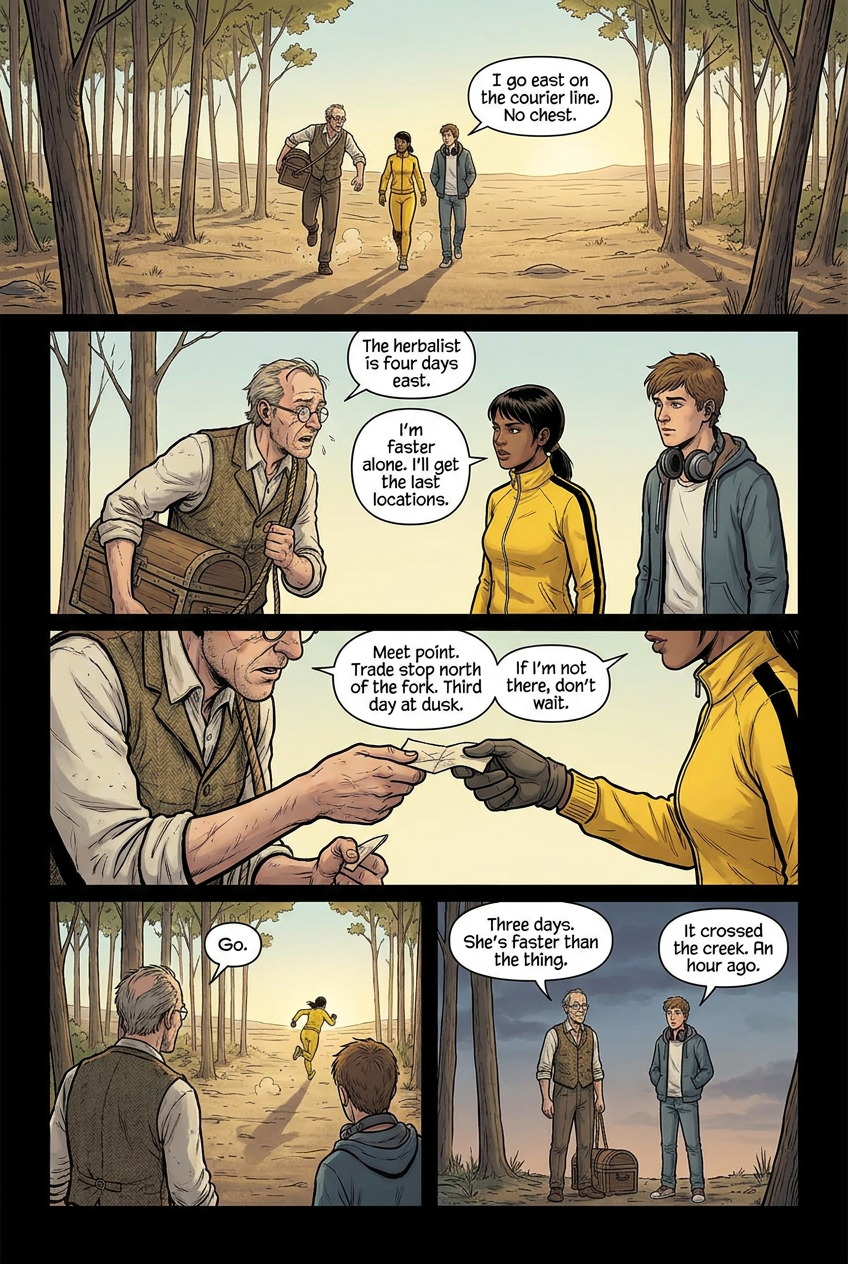
They ran south under thin trees until the ground flattened. The blue-scaled creature was somewhere behind them on the ridge. Ben carried the chest on the rope. Ten relics inside, two still to find, and no map to point at either one. The herbalist knew where they were. The herbalist was days east, past the trail they had already lost. Ben had nothing but a direction and a clock. Anita dropped back beside him. She was breathing through her nose, steady, the way she ran her river routes. "You're guessing," she said. "I know." "Guessing burns days. We don't have days." "I know." She let it sit. Then: "The courier animal came from the herbalist. It went east. We had the line and we dropped it. The herbalist still has the list." "The herbalist is four days east. The creature is one day behind." "Then we don't walk it. I run it." Ben stopped. Justin stopped a pace ahead and turned. Joe kept moving, watching the slope. "Alone," Anita said. "No chest. No hum. I carry nothing that sings. I go east on the courier line while it's still fresh in my head. I find the address. I come back with the last two locations." "You lose six minutes at every river," Ben said. "Not on foot alone. On foot alone I lose nothing." Justin said, "She's faster than the thing chasing us. Not stronger. Faster." Ben looked at her. Yellow jacket, gloves, the belt cinched tight. Three years running letters through the Outer Gates. She had lied her way into that job and kept it. "Four days there and back," Ben said. "Three." "If the herbalist won't talk." "Then I take the list off a shelf. I've been in worse rooms." Ben unslung the chest. He set it down between them. He took the small folded scrap of paper from his coat, the one from the bench cushion at the inn, the address in the runner's hand. He gave it to her. "Meet point," he said. "The trade stop north of the fork. Third day at dusk. If I'm not there by dark, don't wait." "We'll wait." "Don't." She took the paper. She checked the laces on her shoes. She pulled the hood of the yellow jacket up and dropped it again. "Keep the chest under stone at night," she said. "Don't open a box. Don't cross open ground at noon." "Go," Ben said. She went. Three strides and she was through the trees. Six and Ben could not see the yellow anymore. Justin picked up the chest rope with him. "Three days," he said. "Three days," Ben said. Joe was watching the ridge. "It crossed the creek," he said. "An hour ago." Ben turned north with the chest. The map was gone. The runner wasn't. He had traded time he did not have for time he might get back, and the creature was closer now than it had been at dawn.
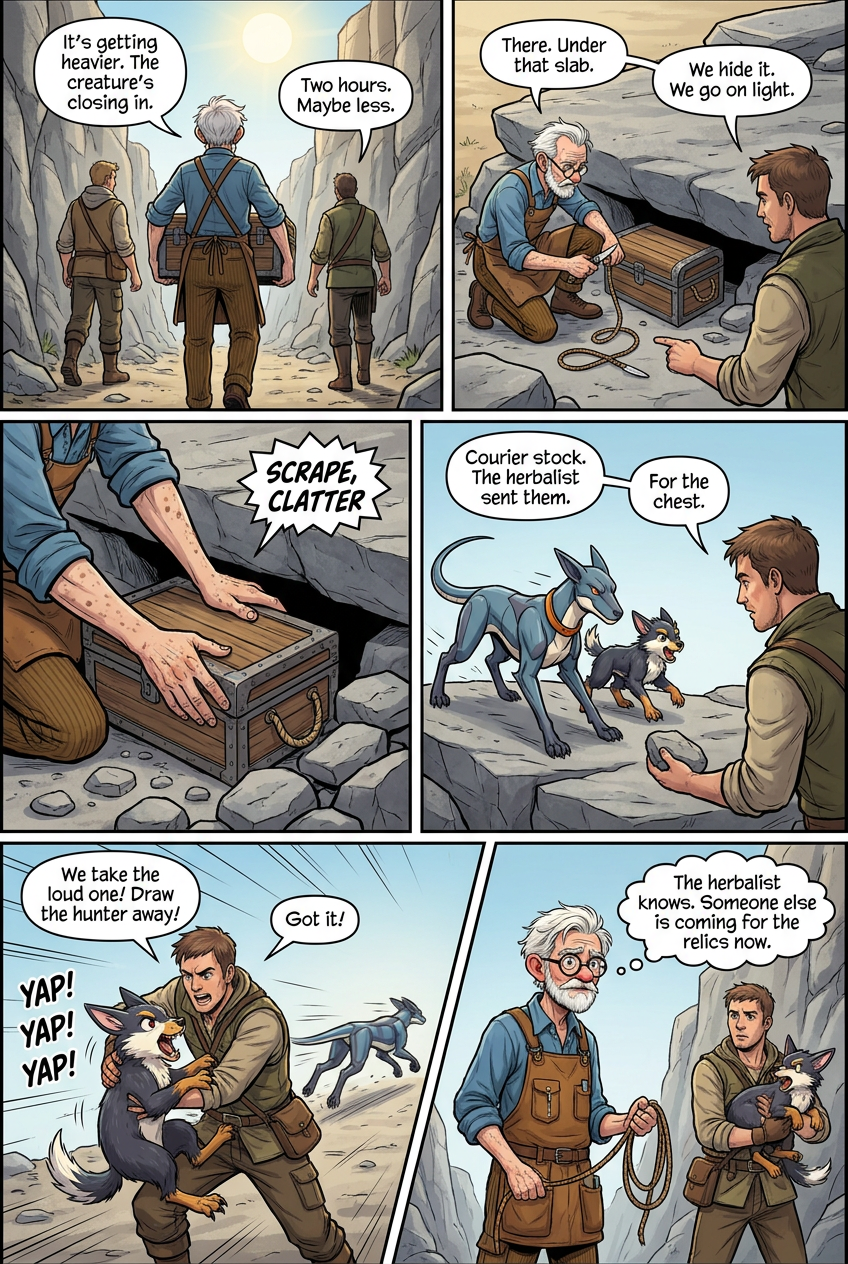
By midday Ben was moving north along a stony draw with Justin and Joe. The chest bumped his hip on the rope. Ten relics inside. Two days until the trade stop meeting. Behind them, somewhere past the last ridge, the blue-scaled thing was closing. Ben could feel the chest getting heavier with every step, and he knew why. He could not carry it to the trade stop. Carrying it there would drag the creature straight to Anita. Joe stopped at a bend where the draw opened onto a flat shelf of gray rock. "It's tasting the wind," he said. "Two hours. Maybe less." "We can't lead it to the meet," Ben said. Justin looked at the chest. "Then we don't." Ben crouched and cut the rope. He set the chest on the stone. "We hide it. We go on light. It hunts what sings, not us." "Where?" Justin said. "Under what?" Joe pointed with his chin. Below the shelf, a narrow crack ran under a slab the size of a cart. Dry inside. Deep. Stone above and stone around. Ben opened the chest. Three carved boxes. Seven relics wrapped in felt strips. He worked fast. He wedged the felt bundles between the boxes so nothing shifted. He closed the lid and pushed the whole chest into the crack until only its back edge showed. He piled loose rock over the opening until the seam was gone. He stood back. He listened. Nothing. No hum. Just wind on the shelf. "It'll hold," Joe said. "Stone eats sound." Then Ben heard the second problem. Claws on rock, coming down the draw fast. He turned. A lean blue-gray shape came around the bend at a dead run, low and long, ears back. Not the hunter. Smaller. Different. Justin already had a stone in his hand. "Wait," Joe said. The creature stopped ten paces off. Its sides worked hard. It watched Ben, not the cache. Behind it, a smaller animal skidded into view, dark-furred and yapping, tail up, teeth bright. "Courier stock," Joe said. "The fast one runs. The loud one covers." "Whose?" Ben said. Joe did not answer. He looked at the fast one's collar. A strip of orange cloth. The same orange as the runner's box at the inn. "The herbalist sent them," Ben said. "For the chest," Justin said. Ben looked at the pile of rocks. Then at the fast creature. It had tracked him here. It knew where the cache was now. So did whoever was behind it. He made the call. "We take the loud one. We run it north with us. It draws the hunter off the cache and away from Anita's line." Joe caught the yapping animal by the scruff. It thrashed and barked louder. The fast one turned and was gone up the draw before Ben could move. "It'll be back," Joe said. "With company." Ben picked up the empty rope. The chest was safe under stone. The creature would follow the noise, not the silence. But the herbalist knew where his relics slept now, and someone else was running for them.
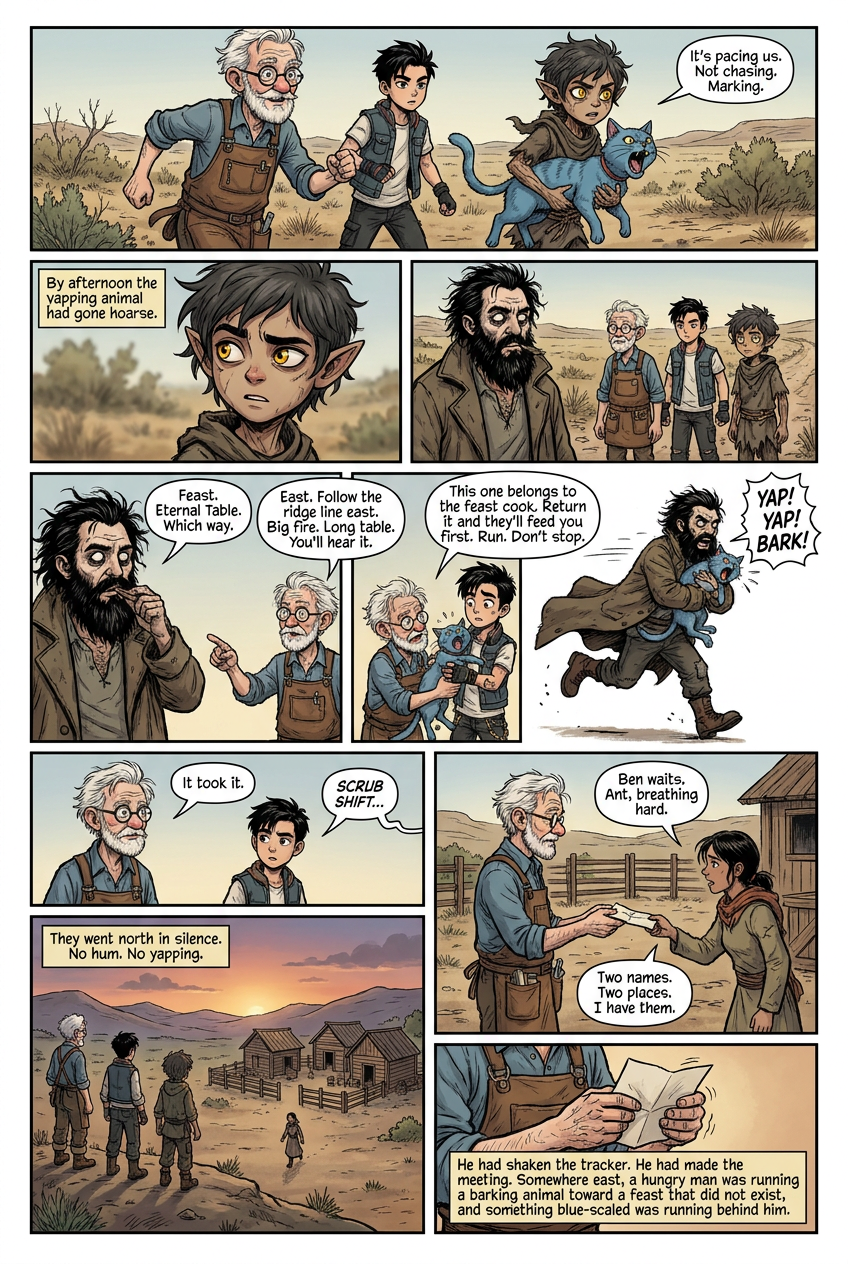
Ben ran north with the yapping animal under Joe's arm and Justin at his shoulder. The chest sat hidden in stone a half day behind them. The tracker animal was on their heels somewhere in the scrub, silent and fast. Two days left. If Ben missed Anita at the trade stop by dusk on the third day, he lost the last two relic locations. He could not arrive with a tracker glued to his back. By afternoon the yapping animal had gone hoarse. Its noise was thinning. The tracker had not shown itself, but Joe kept glancing at the ridge behind them. "It's pacing us," Joe said. "Not chasing. Marking." "Marking for who?" Justin said. "For whatever the herbalist sends next." Ben needed the tracker off his line before dark tomorrow. He needed a false trail, and he needed it loud. They came down a slope onto a wagon track. A man stood in the middle of it, coat too big, beard black and wild, eyes hollow. He was chewing a strip of bark. He looked at Ben like Ben might be edible. "Feast," the man said. "Eternal Table. Which way." "I don't know it," Ben said. "Sundown," the man said. "Miss it, no food a full cycle." He spat the bark. "Point." Ben looked at Justin. Justin looked at the yapping animal. Ben saw it then. "Chris," the man said, before Ben could ask. "Chris P. Bacon. Point." "East," Ben said. "Follow the ridge line east. Big fire. Long table. You'll hear it before you see it." "Hear it how." Ben crouched and took the yapping animal from Joe. It squirmed. He pressed it into Chris's arms. "This one belongs to the feast cook. Return it and they'll feed you first. Run. Don't stop. Don't set it down." Chris clamped the animal to his chest. It started barking again, fresh at a new grip. Chris turned east and ran, coat flapping, animal yowling under his arm. The noise moved off fast, straight along the ridge. Joe listened. Something in the scrub above shifted, then shifted again, following the barking east. "It took it," Joe said. "For now," Ben said. They went north in silence, boots only. No hum. No yapping. By dusk the next day they climbed the last rise and saw the trade stop below, three roofs and a stock pen. Ben watched the road east. A small figure came up it at a walk, alone, dusty. Anita. She reached the pen before he did. She was breathing hard. She had a folded scrap in her hand. "Two names," she said. "Two places. I have them." Ben took the paper. His hands shook. He had shaken the tracker. He had made the meeting. Somewhere east, a hungry man was running a barking animal toward a feast that did not exist, and something blue-scaled was running behind him.
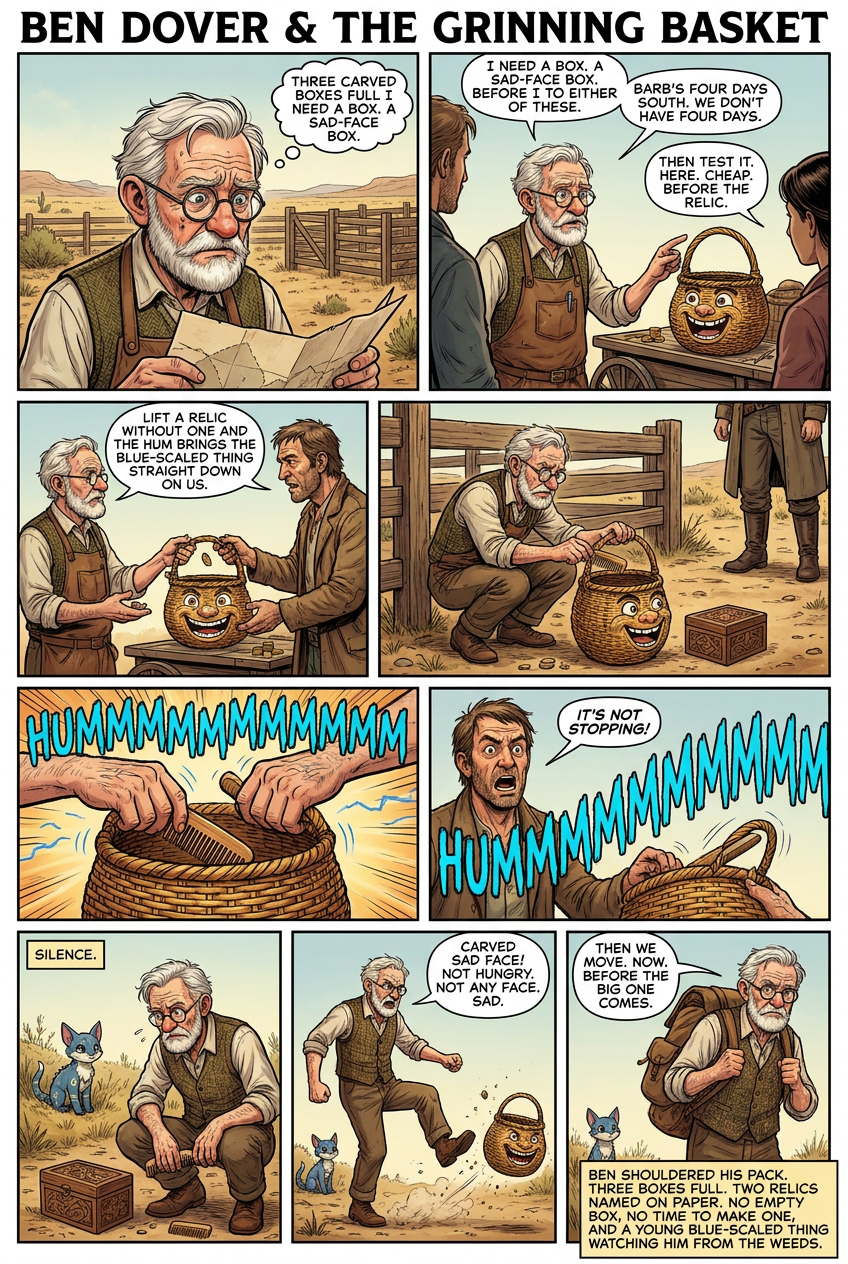
Ben unfolded Anita's paper by the stock pen. Two names. Two places. The nearer one sat a half day west, in a river bend. He read it twice and his gut dropped. He had three carved boxes back in the stone crack, and every one of them held a relic. He had nothing empty for the next. "I need a box," Ben said. "A sad-face box. Before I touch either of these." Justin rubbed his neck. "Barb's four days south. We don't have four days." "I know." Joe watched the road. "Lift a relic without one and the hum brings the blue-scaled thing straight down on us. No cover this time. No animal to throw." Anita sat on a feed sack. She had run two days east and two days back. "Carve one," she said. "You did it before. Your mother's box." "I don't have wood," Ben said. "Not seasoned. Not sad-face ready." A trader by the pen was unloading crates from a cart. On top sat a woven basket with a face pressed into the weave, wide mouth, big eyes, a hungry grin. It looked ridiculous. It also had a lid. "That's not wood," Justin said. "It has a face," Ben said. "The rule is a carved sad face. But every box I've used has been wood." "Then test it," Anita said. "Here. Cheap. Before the relic." Ben paid the trader in coin he could not spare. He carried the basket behind the pen, out of sight. Joe kept watch on the road. He pulled one carved box from his pack. The comb box. He set the basket beside it and lifted the lid. He held his breath and moved the comb across. The hum spilled out. Loud. Wasp-thick. It filled the yard. Ben shoved the comb into the basket and clamped the lid. The hum kept going. Joe's head snapped up. "It's not stopping." Ben grabbed the comb back and dropped it into its carved box. The hum cut. Silence. His hands were shaking. Ten seconds, maybe more, of open sound sent out across the ridges. A small shape came out of the scrub behind the pen. Blue scales along its back. Yellow markings. It was young, cat-sized, ears pricked. It looked at Ben. It did not run. It sat. "That's not the big one," Justin whispered. "No," Joe said. "But it heard. And it's the same blood. The big one heard too." Ben stared at the small creature. It stared back, calm, curious, wrong. He stood. He kicked the grinning basket into the dirt. "Carved sad face," he said. "Not hungry. Not any face. Sad." Anita had her jaw set. "Then we move. Now. Before the big one comes." Ben shouldered his pack. Three boxes full. Two relics named on paper. No empty box, no time to make one, and a young blue-scaled thing watching him from the weeds.
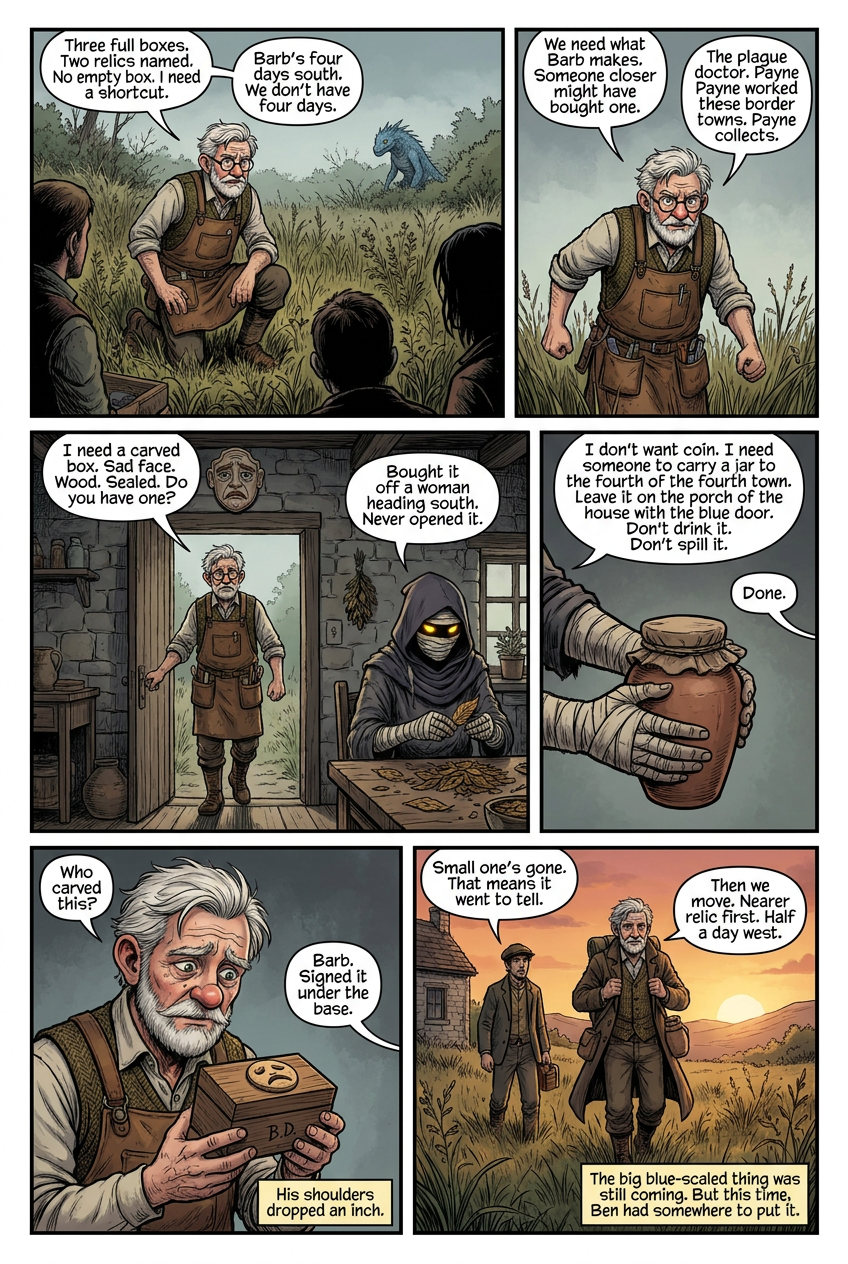
Ben cut west off the road with the young blue-scaled thing still watching from the weeds. Three full boxes on his back. Two relics named on paper. No empty box. He could not carve one in time, and he could not lift a relic without one. He needed a shortcut, and he could think of only one person who might sell him a finished box without asking why. "Barb's four days south," Justin said again. "We don't have four days." "We don't need Barb," Ben said. "We need what Barb makes. She trades. Someone closer might have bought one from her and never used it." Anita looked up. "The plague doctor. Payne worked these border towns. Payne knew the sickness before we did. Payne collects." They found the doctor two hours west, inside a small stone house with a cracked porch and a downturned face carved above the door. Payne stood at a table sorting dried leaves into paper twists, hood up, bandaged hands moving fast. Ben remembered those hands putting down the barking animal and the sick pup in one afternoon. His stomach turned. "You," Payne said. Not surprised. "I need a carved box," Ben said. "Sad face. Wood. Sealed. Do you have one?" Payne kept sorting. "One. Bought it off a woman heading south. Never opened it." "Sell it to me." "I don't want coin." "What then." Payne set down the leaves. "Three towns sick in a week. I need someone who can carry a jar to the fourth without opening it. You go north anyway. Take it. Leave it on the porch of the house with the blue door. Don't drink it. Don't spill it." "Done," Ben said. Payne went behind a curtain and came back with a small wooden box. Sad face on the lid. Downturned mouth, heavy lids, real work. Ben pressed his thumb to the carving. Clean. He opened it. Empty inside, felt-lined already. "Who carved this," Ben said. "Barb. Signed it under the base." Ben tilted it. B.D. scratched into the wood. His shoulders dropped an inch. He had not known he was holding them tight. Payne handed him a sealed clay jar the size of a fist. "Blue door. North side. Don't be seen setting it down." Ben tucked the jar into his pack and the empty box into his coat, close to his ribs. Outside, Joe was already watching the ridge. "Small one's gone," he said. "That means it went to tell." "Then we move," Ben said. "Nearer relic first. Half a day west." Anita fell in beside him. Justin took the rear. Ben had four boxes now. Three full, one empty, and a jar he could not open riding against his back. The big blue-scaled thing was still coming. But this time, when he reached the relic, he had somewhere to put it.
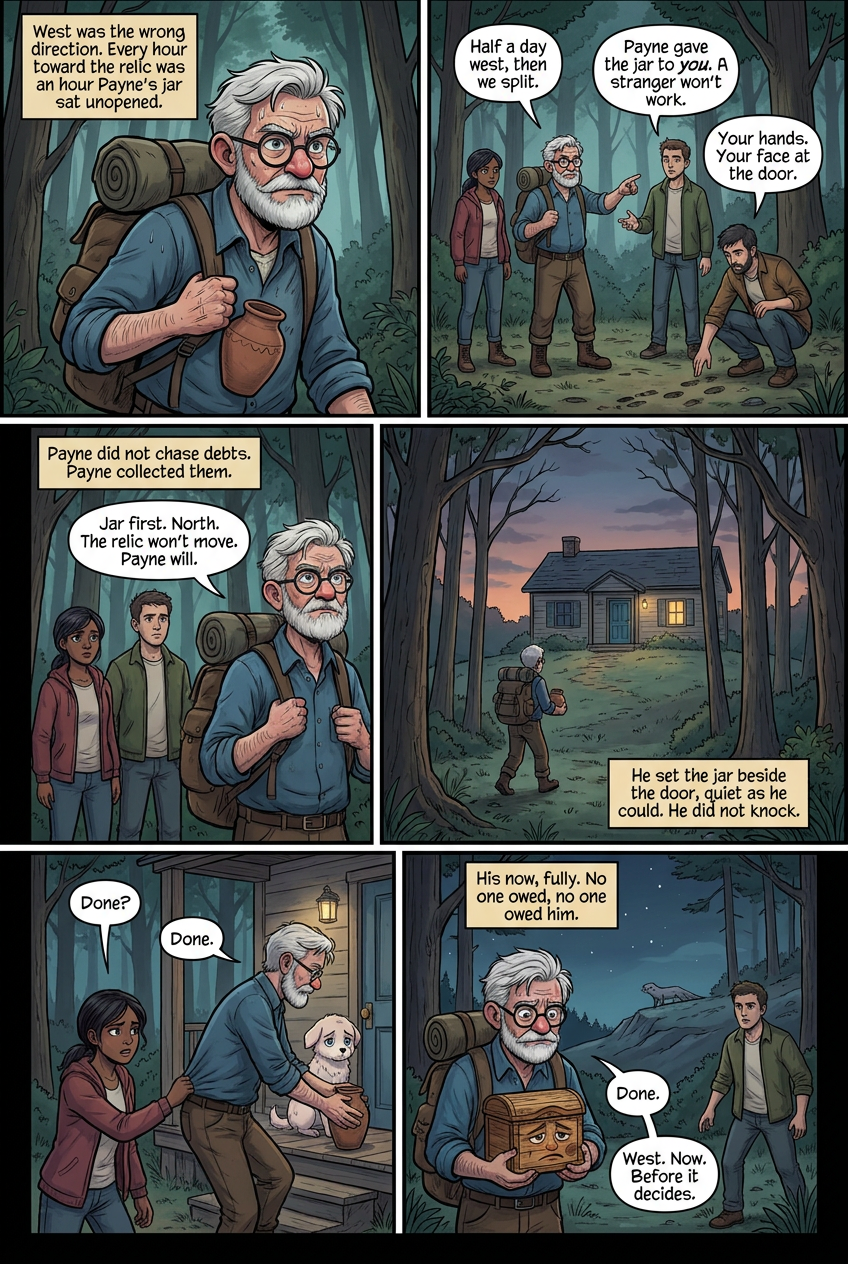
They moved west at a hard pace. Ben felt the clay jar knock against his spine with every step. The blue door was north. West was the wrong direction. Every hour toward the relic was an hour Payne's jar sat unopened in his pack, and Payne could change his mind. "Half a day west, then we split," Ben said. "Justin carries the jar north to the blue door. Anita and Joe come with me to the relic." Justin shook his head. "Payne gave the jar to you. If a stranger sets it on that porch, whoever lives there won't take it. Or Payne hears about it and comes looking." "He's right," Anita said. "Payne traded with you. Your hands. Your face at the door." Ben stopped walking. Three full boxes on his back. One empty box against his ribs. A jar he could not open and could not lose. The relic waited half a day one way. The blue door waited two days the other. Joe crouched and touched the dirt. "Small blue-scale came back through here. Not alone." Ben looked north through the trees. He thought of Payne's bandaged hands sorting leaves. He thought of the pup Payne put down in one clean motion. Payne did not chase debts. Payne collected them. "Jar first," Ben said. "North." Anita's mouth opened, then closed. Justin swore under his breath. "The relic won't move," Ben said. "Payne will. If he takes the box back, we've got a jar and no way to carry what we came for." They turned north. Ben set the pace fast enough to hurt. Joe covered their tracks behind them. By dusk the trees thinned. By full dark they saw a low house with a blue door on a rise, lamp burning in one window. Ben left the others in the pines. He walked the last stretch alone, jar in both hands. A small pale animal was curled on the porch step, thin ribs, drooping head. It watched him without moving. Ben set the clay jar beside the door, quiet as he could. He did not knock. He backed away. Halfway down the rise, the door opened behind him. He did not turn. He heard the jar lifted. He heard the door shut. At the pines, Anita grabbed his sleeve. "Done?" "Done." He pulled the empty carved box from his coat. The sad face stared up at him, heavy-lidded, mournful. Barb's initials scratched under the base. His now, fully. No one owed, no one owed him. Joe stood suddenly. A shape moved on the ridge behind them, low and gray, not the big blue-scale. Something narrower. Something that had been watching the house. "West," Ben said. "Now. Before it decides which of us it wants." They ran. Ben had his box. He had lost two days. And something new had seen his face at the blue door.
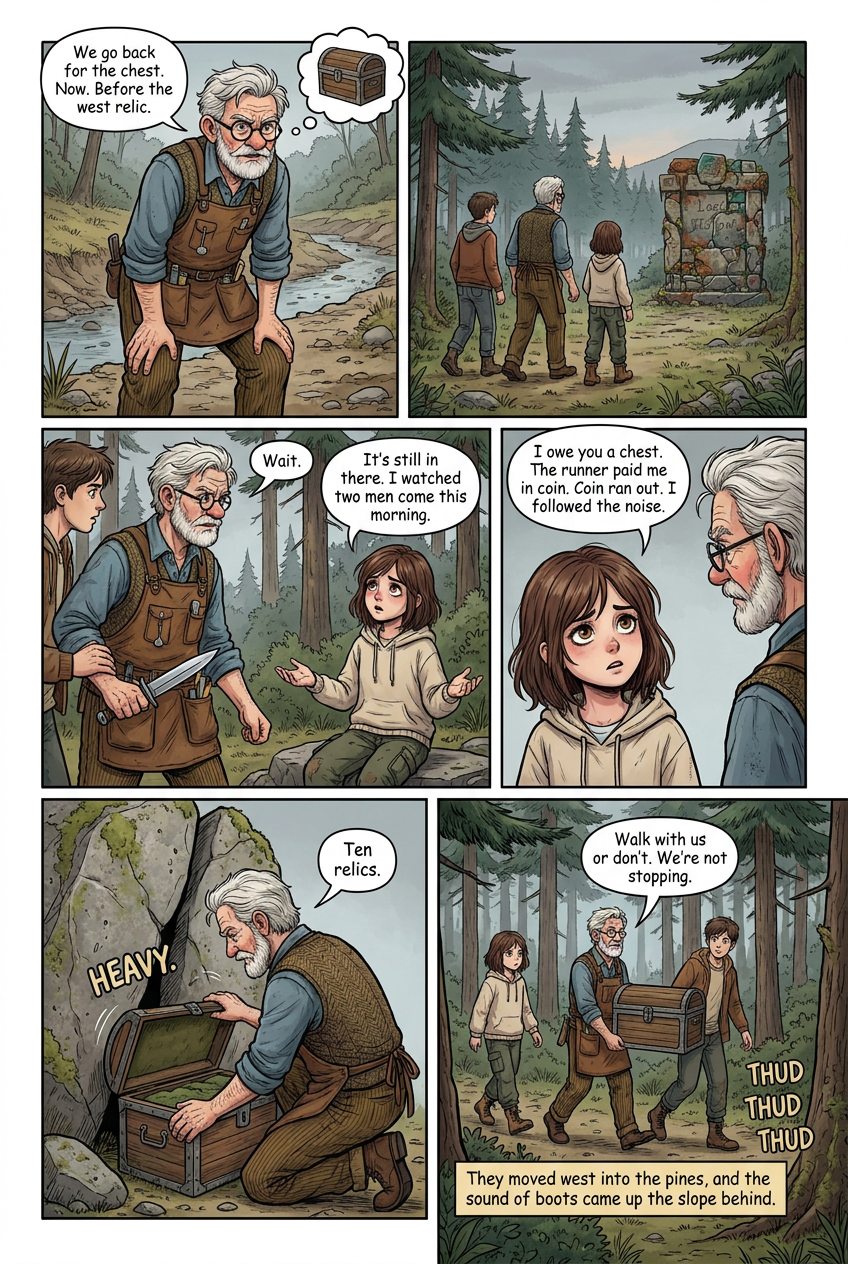
They ran west until the gray shape on the ridge dropped out of sight. Ben stopped at a dry creekbed and set his hands on his knees. The empty box knocked against his ribs. Three full boxes rode his back. Ten relics sat in a stone crack south of the trade stop, and the herbalist knew the crack. So did whoever else the runner had told. "We go back for the chest," Ben said. "Now. Before the west relic. If we lose the ten, the two ahead don't matter." Anita nodded once. Justin didn't argue. Joe crouched and touched the dirt west of them, then south. "Something small came through here yesterday. Not blue-scale. Two feet." A person. Ben pushed off the bank and set the pace south. They moved through the night and reached the ruin near the crack at first gray light. Ben knew the shape of the place from a distance. Lost Hollow sat off to the east through the trees, worn stone, the carved letters half-eaten by moss. He did not look at it long. The crack was closer, in a low shelf of rock past the pines. Someone was already there. A girl sat on the shelf with her boots against the stone, backpack in her lap. Brown hair, hollow eyes. Amanda Hugginkiss. The girl who had sold their chest at the fork. Ben drew his knife. Justin caught his wrist. "Wait," Justin said. Amanda saw them and did not move. She lifted one hand, palm open. Empty. "It's still in there," she said. "I watched two men come this morning. They couldn't reach in far enough. One left to get a hook." "Why are you here." Ben did not make it a question. "I owe you a chest." She looked at the crack, not at him. "The runner paid me in coin. Coin ran out. I followed the noise." "There's no noise. It's felt-lined." "Not the boxes." She tapped her ear. "People. Talking about a stone crack. I came to see if it was yours." Ben crouched by the shelf. He put his arm into the crack up to the shoulder. His fingers touched wood. He pulled. The chest slid out heavy and whole, felt still tucked at the seams. Ten relics. He set his hand flat on the lid and breathed once. He stood. Amanda had not moved. "A hook," Ben said. "How long ago." "An hour. Maybe less." Joe was already looking south through the trees. "Two coming back. Fast." Ben shouldered the chest with Anita under the other handle. He looked at Amanda on the shelf, small and still, waiting for him to decide. "Walk with us or don't," he said. "We're not stopping." She slid off the shelf and fell in behind Justin. They moved west into the pines with the chest between them, and the sound of boots came up the slope behind.
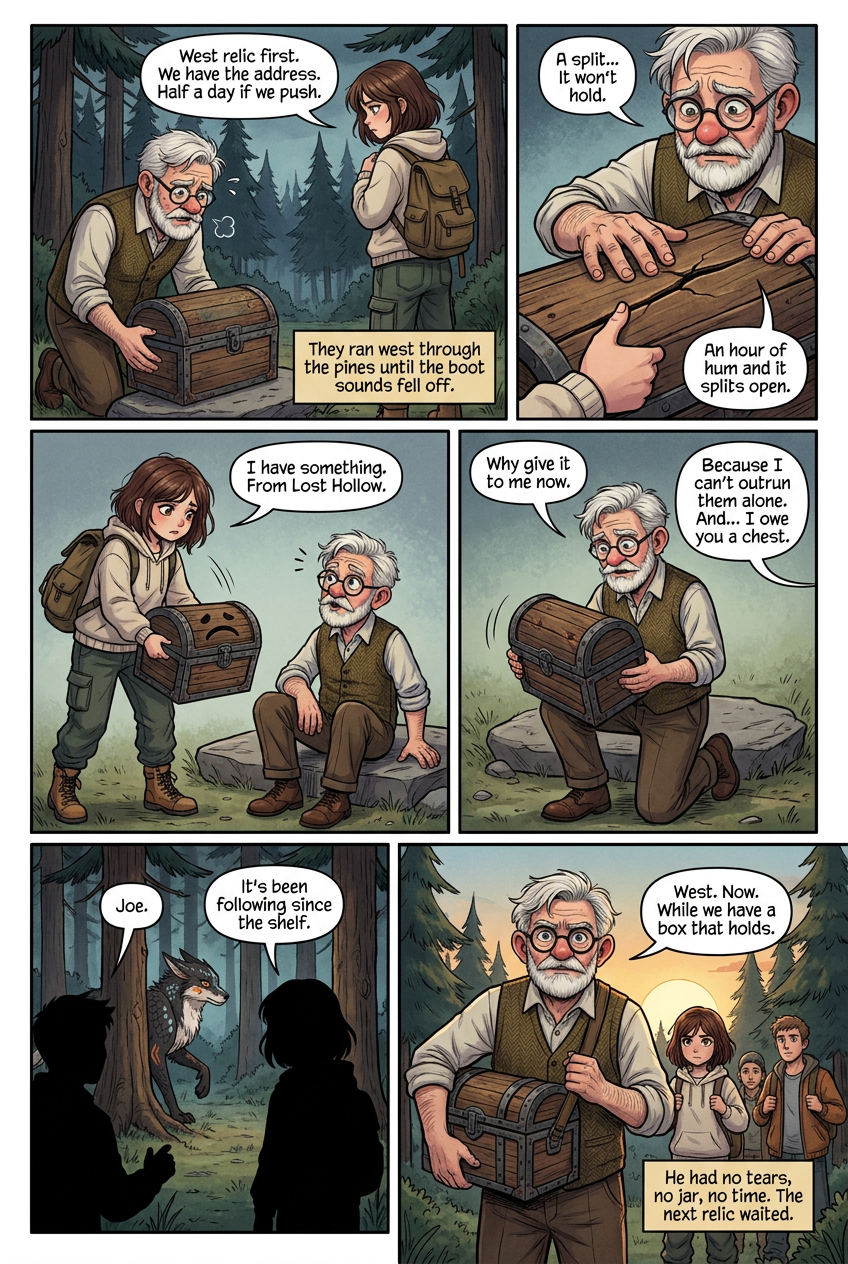
They ran west through the pines with the chest between them until the boot sounds behind fell off. Ben stopped at a rise and let Anita set her end down. Amanda stood apart, breathing hard, watching the trees. Justin checked the felt at the seams. Joe crouched and listened. "West relic first," Anita said. "We have the address from the paper. Half a day if we push." Ben touched the empty box at his hip. One box. One relic left after that. His hand felt the shape of the carved face through the cloth and stopped. He pulled the cloth back. A split ran the length of the lid, corner to corner. Hairline, but through. The chest had shifted on the run south. Something had knocked it. "It won't hold," Anita said. She pressed her thumb along the crack. Wood parted under her nail. "An hour of hum and it splits open." Ben sat down on a flat stone. Barb was four days back. Payne was gone. He had no tears, no jar, no time. The next relic waited half a day west and the creature would come to any hum that leaked. Amanda stepped closer. "I have something." She swung her pack down and worked the strap. She pulled out a small wooden chest, dark with age, iron bands eaten thin at the edges. A sad face was carved into the lid. Crude. Deep cuts. Old. "Where," Ben said. "Lost Hollow. Under the floor stone I sat on for three days." She would not meet his eyes. "I found it after you left me. I kept it when I took the other chest. I didn't know what it was for then." Justin leaned close and put his ear near the lid. He nodded once. "It's a real one." Ben turned the chest in his hands. The carving was older than Barb's work, older than Justin's grandmother's. The face looked tired, not sad. A wanderer's face. "Why give it to me now," Ben said. "Because two men are behind us and I can't outrun them alone." Amanda's voice went flat. "And because I owe you a chest." Ben set the cracked box on the stone. He opened the old chest. The inside was clean, dry, deep enough. He closed it and tied it to his hip with the strap from the broken one. A low shape moved in the trees to their north. Dark scales along the shoulders, gray at the belly, one orange stripe down the flank. It stopped between two trunks and watched them, ears forward, one paw lifted. Not blue-scale. Something else. It did not come closer. "It's been following since the shelf," Joe said. "Since her." Amanda looked at the animal and the animal looked back. "West," Ben said. He shouldered the chest of ten and stood. "Now. While we have a box that holds."
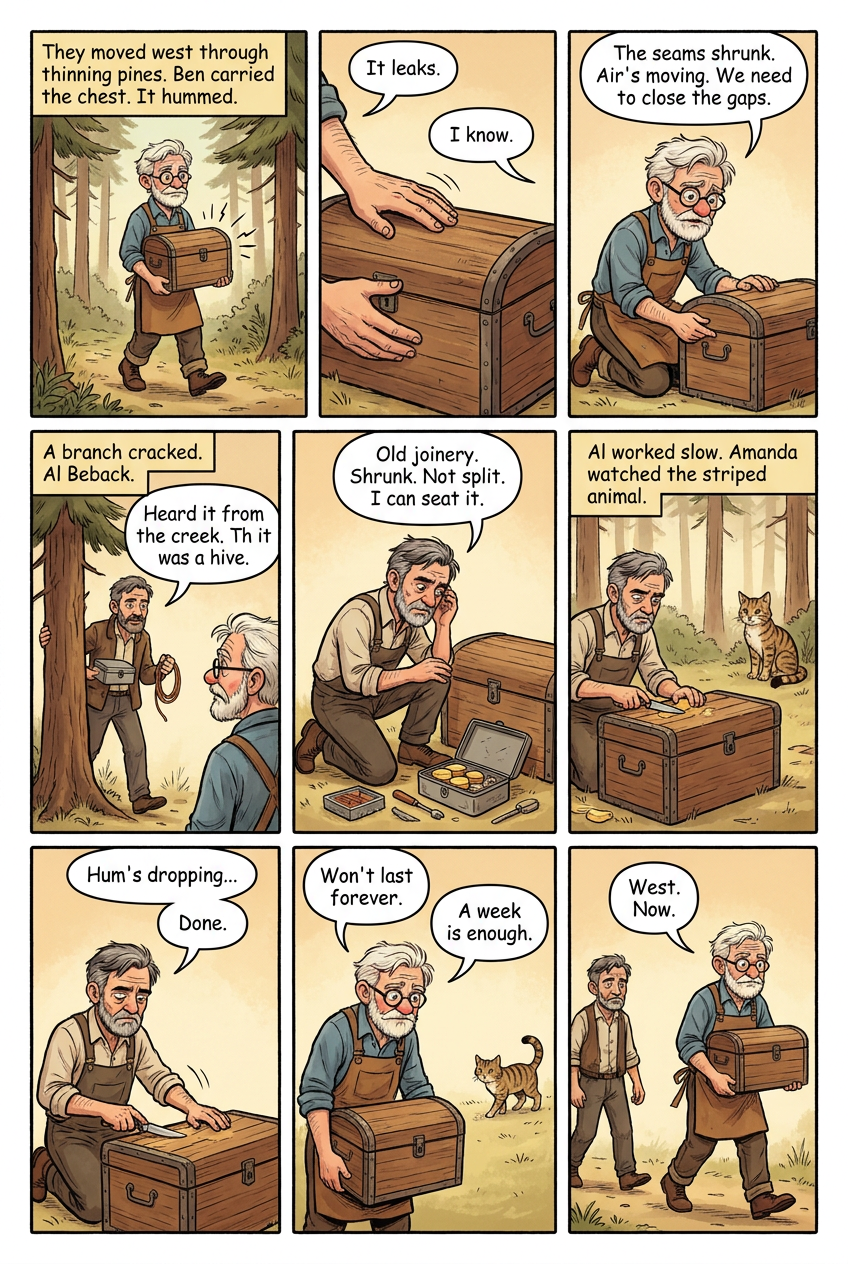
They moved west through thinning pines. Ben carried the older chest against his ribs. Amanda's find. The wood was warm from his body and it hummed through the seams. Not loud. A thread of sound at the edge of hearing, steady as a wasp inside a wall. Any pursuer close enough would hear it and walk straight to them. Joe stopped first. He pressed his palm to the lid and pulled back. "It leaks." "I know," Ben said. "The felt's gone," Anita said. "We used the last strip on the tree relic." Amanda watched the trees. The striped animal was still there, two ridges back, keeping pace. She said nothing. Ben set the chest down and knelt. The carving on the lid was deep but the seams were old. Wood had shrunk. He ran a thumb along the join and felt air move against his skin. That was the hum's road out. "We need to close the seams," Ben said. "Not the wood. The gaps." They had no wax. No pitch. No felt. A branch cracked west of them. Ben froze. A man stepped out from behind a leaning pine with his hands open. Gray beard, stained jacket, tired eyes. Al Beback. He carried a small tin box under one arm and a coil of copper wire in his other hand. "Heard it from the creek," Al said. "Thought it was a hive." Ben stood. Al had guided them to the landslide. Al fixed broken things. Ben had not expected to see him again. "It's a chest," Ben said. "Seams are shot." Al knelt beside it without asking. He put his ear to the lid, then his palm. He opened his tin. Inside: wax cakes, a folded cloth, a short knife, a spool of waxed thread. "Old joinery," he said. "Shrunk. Not split." He looked up. "I can seat it." "How long." "Twenty minutes. Don't move it." Ben nodded. Al softened a wax cake in his hands and pressed it into the seam with the flat of the knife. He worked slow. He did not speak. When one seam was full he wiped the blade on the cloth and started the next. Justin stood watch north. Anita watched south. Amanda watched the striped animal. The animal sat down on its haunches and waited. Halfway through, Al stopped and tilted his head. "Hum's dropping." Ben listened. The wasp thread had gone thin. By the last seam it was gone. Al pressed the lid with both hands and held it there for a count of ten. He lifted his palms. Silence. "Done," Al said. He closed his tin. "Won't last forever. It'll want felt in a week." "A week is enough," Ben said. He lifted the chest. No thread of sound. No trail for a listening pursuer to walk. He looked at the striped animal between the trunks. It stood, turned, and went back the way it came. "West," Ben said. "Now."
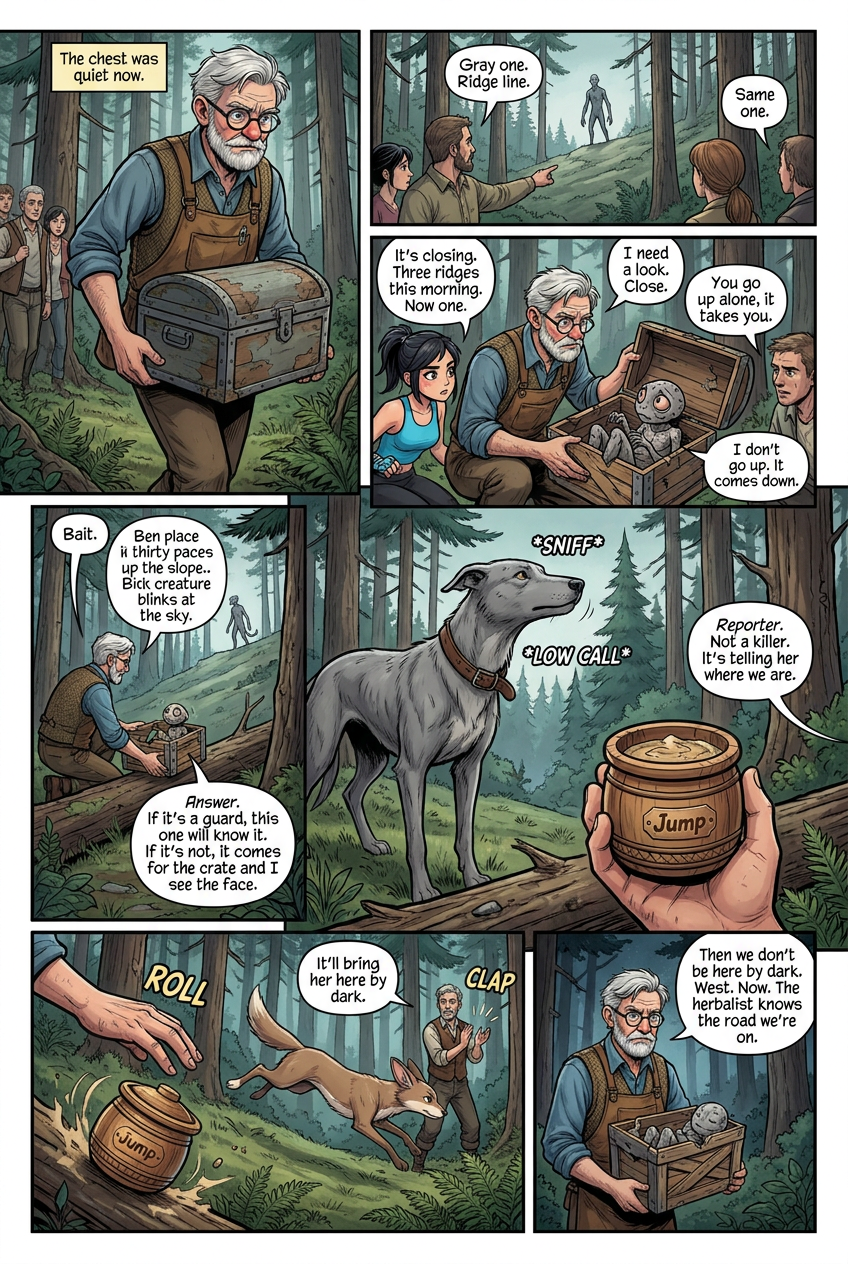
They kept west through the pines. The chest was quiet now. Ben carried it low against his hip. Al had gone back the way he came without asking where they went. That was Al. He fixed a thing and left. Joe stopped at a flat stone and pointed uphill. "Gray one. Ridge line." Ben looked. Something moved between two trunks and stopped. It stood upright. Thin. Pale gray. Too far to read the face. It had watched them at the blue door two days ago. It had followed since. "Same one," Amanda said. "Same one," Ben said. Anita crouched beside him. "It's closing. It was three ridges out this morning. Now one." Ben set the chest down. If the gray thing reached them before he knew what it was, someone in the group paid. He had to see it clearly, at once, without the chest in his hands. "I need a look," Ben said. "Close." "You go up alone, it takes you," Justin said. "I don't go up. It comes down." He unbuckled the older chest and lifted out the small crate they had carried since the landslide. The boards were split at the corners. Tape held two sides. Inside, the broken creature the stone guard's remains sat curled, one large eye open, sweat beading on its cracked skin. It shivered when the light hit it. "Bait," Anita said. "Answer," Ben said. "If it's a guard, this one will know it. If it's not, it comes for the crate anyway and I see the face." He carried the broken crate thirty paces up the slope and set it on a fallen log. He pulled the top board free. The broken creature blinked at the sky. Ben stepped back into the pines and waited. The gray shape moved down the ridge. Slow. Then faster. It came through the ferns on two legs and stopped ten paces from the log. Ben saw it plain now. Not scaled. Not a hunter. A courier animal, the tall kind, gray-furred, with the herbalist's leather collar buckled at its throat. The same breed as the one that had escaped the cache. It sniffed at the broken creature. It did not attack. It turned its head toward the pines and made a low sound, a call. "Reporter," Amanda whispered behind him. "Not a killer. It's telling her where we are." Ben already had the small pot from his pack, the wooden one Crystal had left at the gap, the one marked Jump. He filled it with a handful of scent from Ollie's old cloth and rolled it downhill east. The courier's head snapped after the smell. Ben stepped out and clapped once. The animal broke east in a long leap and was gone through the ferns. Anita exhaled. "It'll bring her here by dark." Ben picked up the broken crate. The eye inside had closed. "Then we don't be here by dark," he said. "West. Now. The herbalist knows the road we're on."
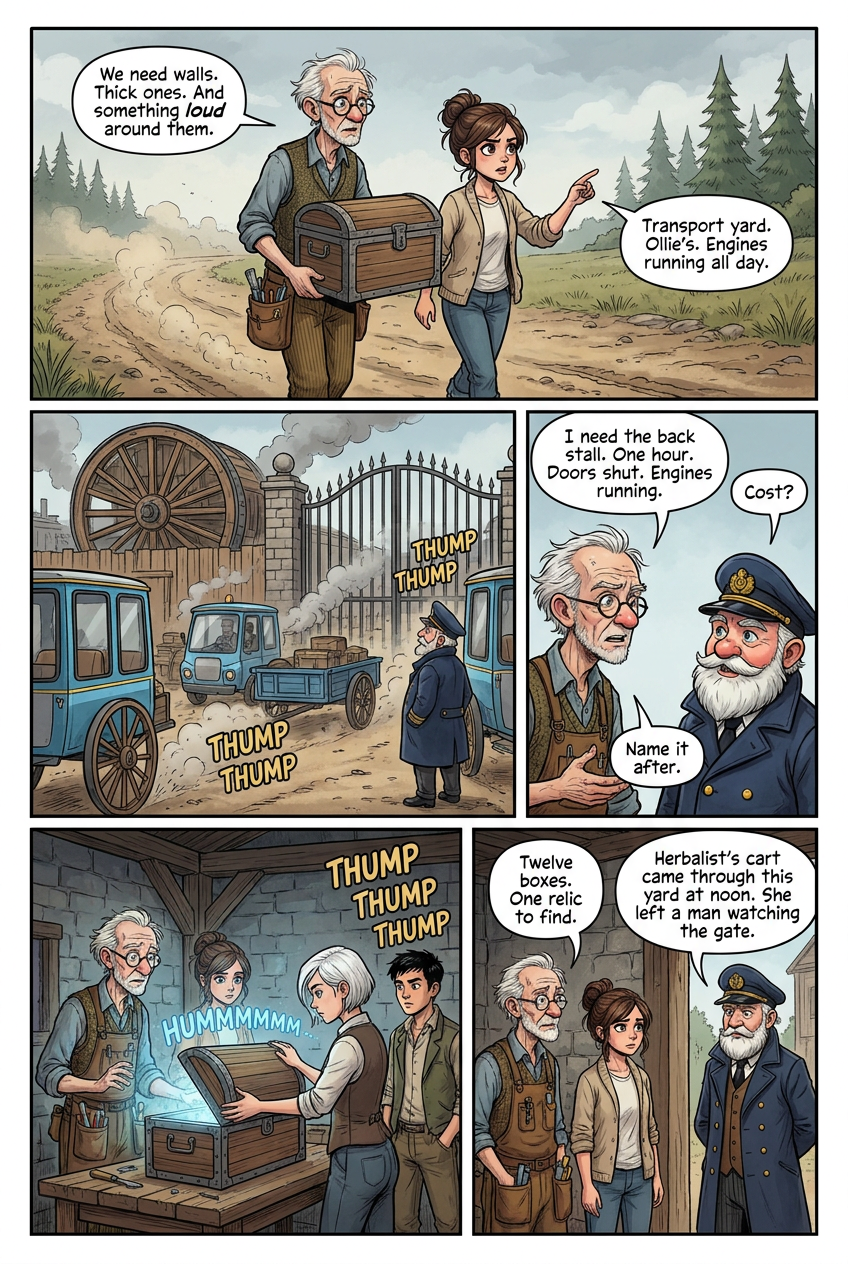
They came out of the pines onto a wagon track. Ben carried the older chest against his hip. Inside sat eleven relics in carved boxes, sealed with Al's wax. One relic to go. Anita had the paper with the last name and place. But the paper meant nothing until Ben could open the chest, unwax a seam, and slot the twelfth box in without the herbalist hearing the ten seconds of hum that would follow. Out here, on open ground, that hum would carry a mile. The herbalist was expected by dark. "We need walls," Ben said. "Thick ones. And something loud around them." Amber Green kept pace at his shoulder. She had joined them at the inn and stayed. Six years of finding missing people had left her quick with a plan and short with words. She pointed down the track. "Transport yard. Two ridges west. I passed it looking for the herbalist last spring. Stone walls. Engines running all day." "Whose yard?" "Ollie's." Ben looked at her. Ollie Tabooger had moved them once, at night, for coin. He had also moved the stolen chest for Amanda without asking what was in it. Ben did not trust him. He trusted the walls. They reached the yard at the hour before dusk. A broad wooden hub stood behind an iron gate, its lower doors banded in dark metal, an upper loft above a shed roof. A blue harbor cart idled inside the open bay, its motor knocking. Two more sat behind it, running rough. The whole yard shook with engine noise. Ollie stood by the cart in his navy coat, checking a strap. He looked up once. "Ben." "I need the back stall. One hour. Doors shut. Engines running." "Cost?" "Name it after." Ollie studied the chest. Then Amber. "Back stall. Keep the light low." He turned to a boy by the gate. "Run all three carts. Don't stop till I say." The back stall was stone on three sides, timber at the front. Ben set the chest on a workbench. Joe stood watch at the crack in the door. Amanda held the twelfth carved box ready, felt in her free hand. Justin pressed both palms to the wood wall and listened past the engines. Anita worked a thin blade along the wax seam. "Now," Ben said. Anita cracked the lid. The hum burst out, thin and sharp under the engine roar. Ben lifted the new box in, closed the lid, and pressed. Anita counted under her breath. At ten the hum cut. The engines kept knocking. Justin dropped his hands from the wall. "Nothing carried. I'd have felt it." Ben breathed out. Twelve boxes now sat in the chest. One relic still to find. Ollie stepped into the doorway. He did not look at the chest. He looked at Ben. "Herbalist's cart came through this yard at noon. She left a man watching the gate."
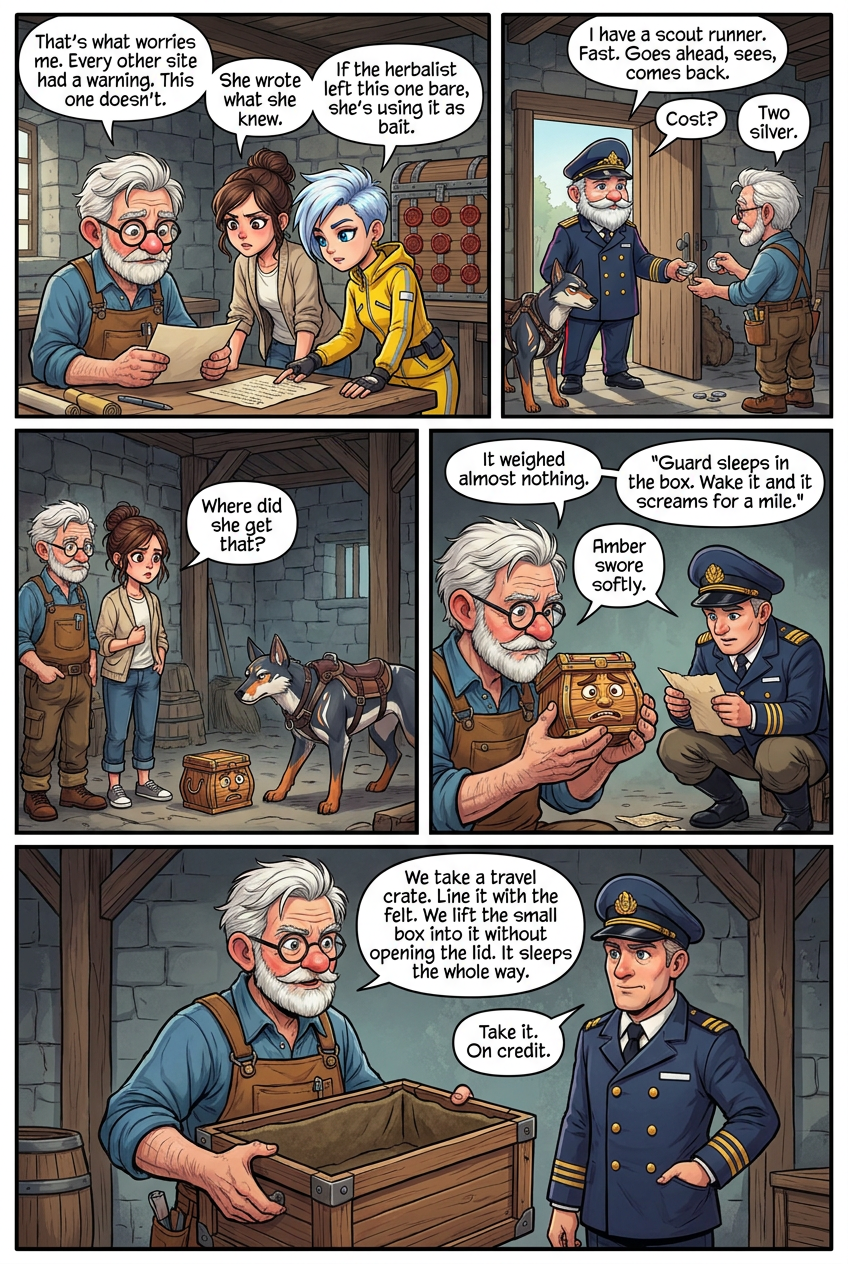
Ben spread Anita's paper on the workbench. Engine noise hammered the stone walls. The paper gave one line: a name he did not know, and a place. Root cellar under the old cider press, north end of the ridge road. No mark for a guard. No mark for a trap. "That's what worries me," Ben said. "Every other site had a warning. This one doesn't." Anita leaned over the paper. "She wrote what she knew." "Then she didn't know enough." Amber Green tapped the paper twice. "The herbalist keeps guards on anything she means to take. If she left this one bare, she's using it as bait." Ben looked at the chest. Eleven boxes sealed in wax. One relic to go. Walk in blind and he lost the piece that finished the set. Ollie stood in the doorway. "I have a scout runner. Fast on four legs. She goes ahead, sees the ground, comes back before you commit." "Cost?" "Two silver. And you don't ride her. She works alone." Ben paid. Ollie whistled once. The animal came in low along the wall, gray flank, orange forelegs, harness worn smooth at the buckles. She stopped at Ben's boot and waited. "Ridge road," Ollie said to her. "Cider press. Cellar door. Look, don't touch. Come back." She was gone before he finished the last word. They waited in the stall. Justin sat with his back to the timber. Amanda checked the wax seams on the chest with a fingernail. Joe watched the yard through the crack in the door. The engines kept knocking. The scout returned in under an hour. She dropped something at Ben's feet: a small wooden container the size of a fist, face carved into the front, mouth open, eyes wide. It looked like a smaller cousin of the sad-face boxes, but the expression was wrong. Nervous. Alert. "Where did she get that?" Anita said. Ollie crouched. There was a scrap of oiled paper wedged in the lid. He unfolded it. Two lines in the same hand as Anita's paper. "'Guard sleeps in the box. Wake it and it screams for a mile.'" Amber swore softly. Ben turned the small box in his hand. It weighed almost nothing. He set it on the bench and did not open it. "Cellar's clear otherwise," Ollie said. "She saw the press, the trap, the door. No men. The trap is this." Ben looked at the little face. A scream for a mile would bring the herbalist, the blue-scaled creature, and every competitor still in the woods. But he knew the shape of the problem now. The guard was a noise, and noise was the one thing he had spent forty chapters learning to handle. "We take a travel crate," Ben said. "Line it with the felt. We lift the small box into it without opening the lid. It sleeps the whole way to the cellar and back." Ollie nodded at a sturdy plank crate stacked by the wall. "Take it," he said. "On credit." Ben lifted the crate. The obstacle had a name now. He could walk in.
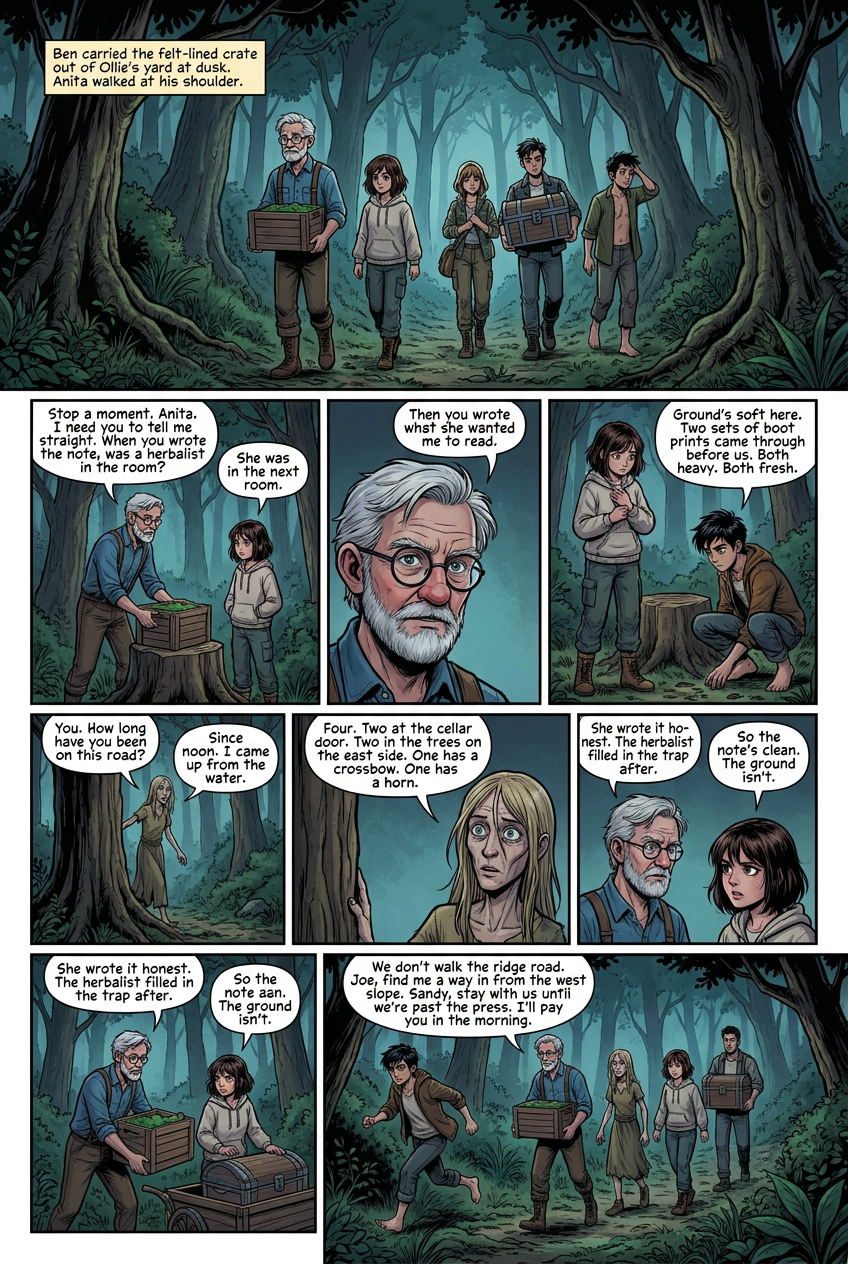
Ben carried the felt-lined crate out of Ollie's yard at dusk. Anita walked at his shoulder. Amanda and Justin followed with the sealed chest between them. Joe brought up the rear, barefoot, watching the trees. The small screaming box sat inside the crate, quiet for now. Ben had a route. He did not yet have a reason to trust it. "Stop a moment," Ben said at the first bend. He set the crate on a stump. "Anita. I need you to tell me straight. When you wrote the note, was the herbalist in the room?" Anita's mouth tightened. "She was in the next room." "Could she see the paper?" "No. But she gave me the names. I wrote what she said." "Then you wrote what she wanted me to read." Anita did not argue. She rubbed her thumb along a callus. "I thought I was faster than her. I ran east and I ran back. But she let me leave. I know that now." Joe crouched by the crate. "Ground's soft here. Two sets of boot prints came through before us. Both heavy. Both fresh." "Whose?" Ben said. "Not ours." Ben looked down the track. The cider press stood half a mile north. He needed a test before he committed the group. A thin figure stepped from behind a trunk. Gray hoodie, dark hair, small hands pushed into the pocket. Ben knew her from the stone shelter south of the creek weeks back. Sandy Beach. She had counted a creature three times without rounding once. "You," Ben said. "How long have you been on this road?" "Since noon," Sandy said. "I came up from the water." "Did you pass the old cider press?" "Yes." "How many men?" "Four. Two at the cellar door. Two in the trees on the east side. One has a crossbow. One has a horn." Ben felt the air go tight. Ollie's scout had seen no men. That had been three hours ago. Four men had moved in since. "You're sure it was four," Anita said. "Four," Sandy said. "I counted twice." Ben looked at Anita. She did not look away. "She wrote it honest," Ben said. "The herbalist filled in the trap after." Anita nodded once. "So the note's clean. The ground isn't." Ben lifted the felt crate off the stump and set it back on Amanda's cart. He did not open it. The screaming guard was still the herbalist's weapon, not his. "We don't walk the ridge road," Ben said. "Joe, find me a way in from the west slope. Sandy, stay with us until we're past the press. I'll pay you in the morning." Sandy nodded. Joe was already moving. Ben had his answer. Anita's hand was true. The cellar was a killing ground. Now he had to enter it from a side the herbalist had not staked.
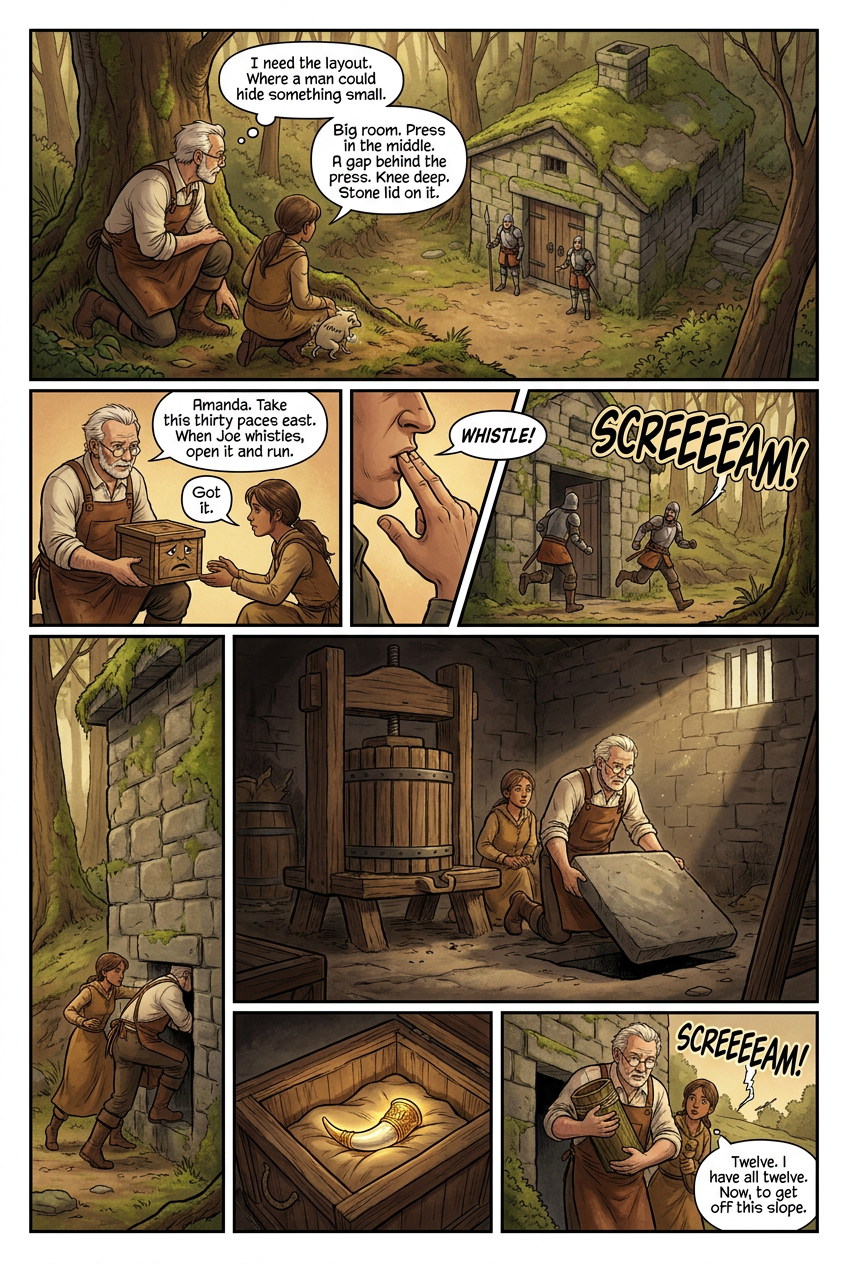
Ben crouched at the tree line on the west slope. The cider press cellar sat below, roof mossed, door half-buried in weeds. He could see the two guards at the door. He could not see the inside. If he walked in blind, he would pass the relic and step into the horn's range before he found it. "I need the layout," Ben whispered. "Where the press sits. Where a man could hide something small." Joe shook his head. "I've never been in. Sandy?" Sandy pressed against the trunk beside them. She had counted the guards without missing. She looked at the cellar door and her mouth pulled tight. "I passed it at noon," she said. "I looked in the vent slot on the north wall. Big room. Press in the middle. Shelves on the left. A gap behind the press where the floor drops." "How deep a gap?" "Knee deep. Stone lid on it." Ben turned that over. A lidded pit behind the press. That was where he would hide a relic. A small brown creature crept from the roots at Sandy's foot. It stood on its hind legs, ears twitching, eyes wide. It stared at the cellar and shivered. "Yours?" Ben said. Sandy nodded once. "He came up from the water with me. He's scared of the men." "Good," Ben said. "He'll hear them before we do." Ben set the felt crate down. He lifted out the small wooden box carved with a nervous face. The screaming guard was still inside, quiet. He weighed it in his palm. "Amanda. Take this thirty paces east. Wedge it under a root. When Joe whistles, open it and run." Amanda took the box without a word. "The horn man will move toward the scream," Ben said. "The crossbow will follow. Sandy and I go in the vent. Joe covers the door. Anita, Justin, hold the chest at the pines." Justin frowned. "What if the two at the door stay put?" "Then the scream keeps going and they still turn their heads." They moved. Amanda came back at a crouch. Joe put two fingers to his mouth and whistled once, low. The scream tore up through the trees a heartbeat later. Both guards at the door pivoted east. The two in the trees crashed toward the noise. The little creature at Sandy's ankle flinched and pressed against her boot. Ben ran. Sandy ran with him. She led him to the vent slot on the north wall and dropped through first. Ben followed, boots on packed dirt. The press stood where she had said. Ben went behind it. His hand found the stone lid. He lifted it. Inside, wrapped in oiled cloth, sat a small carved shape shaped like a tree, hollow at the base. The relic sat in the hollow. Ben lifted the tree-shaped container, closed the lid, and climbed back through the vent. The scream still tore the air. Twelve. He had all twelve. Now he had to get off this slope before the horn sounded and the men turned back.
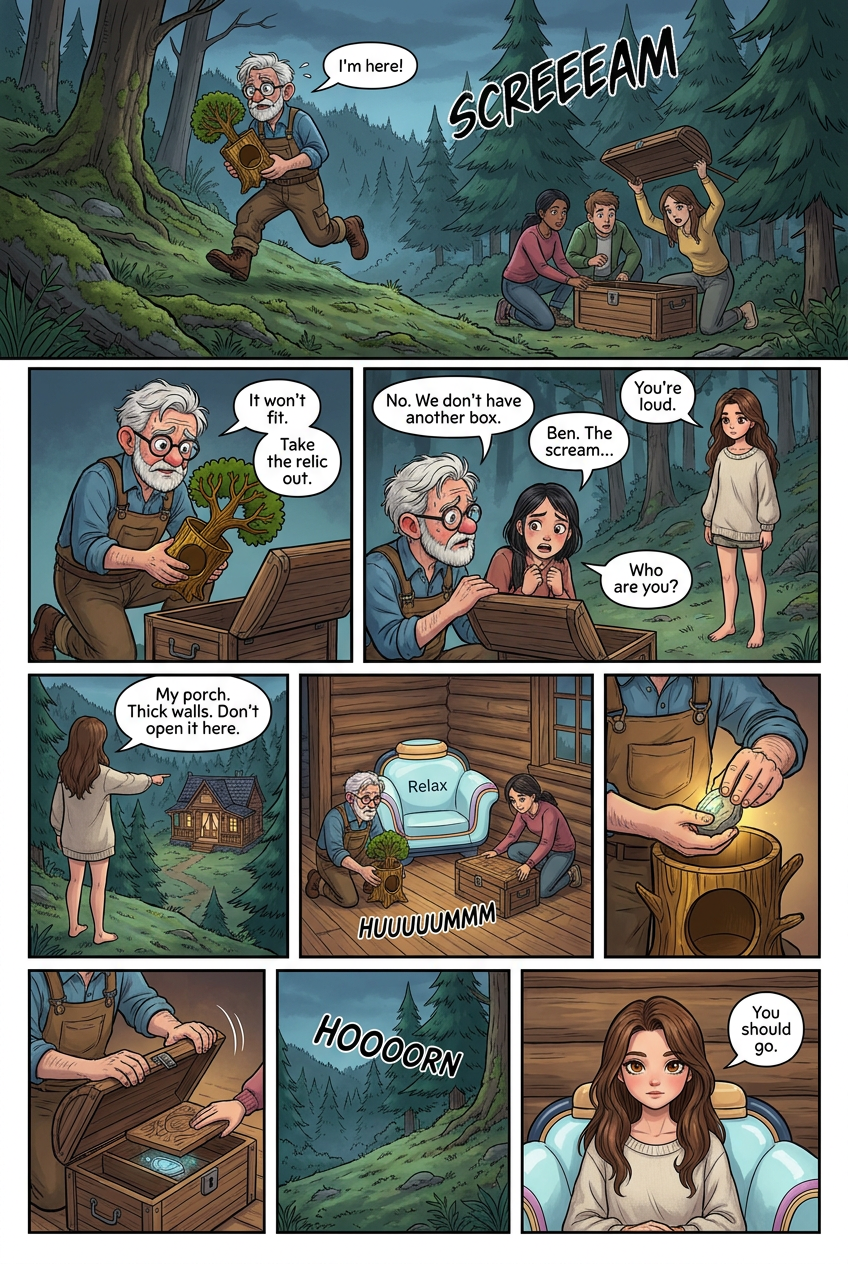
Ben came up the slope with the tree-shaped container under his arm. The scream still tore through the trees behind them. Joe was already at the pines. Anita and Justin had the chest open on the moss, wax seams broken along the lid where Al had sealed them. Amanda crouched beside it with a stick, holding the lid up. Eleven boxes sat inside, snug against the felt. There was no room for the twelfth. Ben knelt. He set the tree container next to the chest and measured with his eyes. The container was wider than the others by two fingers. If he forced the lid down, the wax would crack. If the wax cracked, the hum would leak, and the horn man would come back to a chest that sang. "It won't fit," Anita said. "Not without splitting the seam." "Take the relic out of the tree," Justin said. "Put it in a plain carved box. Small box, same size as the others." "We don't have another carved box," Ben said. "Then leave one behind." "No." Amanda's stick shook. "Ben. The scream will stop soon." Ben looked down the slope. Movement between two trunks. A woman walking up toward them, barefoot, unhurried, a linen sweater loose on her shoulders. She carried nothing. She stopped ten paces off and watched them the way a person watches weather. "You're loud," she said. "Who are you?" "Paige. I came up here to sit." She looked at the chest. "You're going to break that." "We need the last piece inside." She walked closer. Justin stepped between her and the chest. She didn't seem to notice. "The wooden shell is what's too big," she said. "Not the thing inside it." "Opening it lets the sound out," Ben said. "Ten seconds. The men will hear." "Then don't open it here." She pointed downhill, past the pines. Ben saw it then, tucked in a fold of the slope he had missed: a small wooden porch, a shingled roof, curtained doors standing open. A cottage no bigger than a shed. "My porch," Paige said. "Thick walls. I was going to nap." Ben looked at Anita. Anita nodded once. They ran the chest down. Paige held the doors. Inside, a soft chair sat in the middle of the room. The walls were log, chinked tight. Ben set the tree container on the floorboards. Anita worked the lid off the shell. The hum spilled out, low and even. Ben lifted the small stone relic from the hollow and laid it in the felt space where the tree container had been meant to go. Anita pressed a spare carved lid over it, one of Barb's, the last spare. The hum cut. He closed the chest. The wax seams held. Twelve pieces, sealed, quiet. Outside, the scream stopped. In its place, a horn sounded once, long, up the slope. Paige sat down in her chair. "You should go."
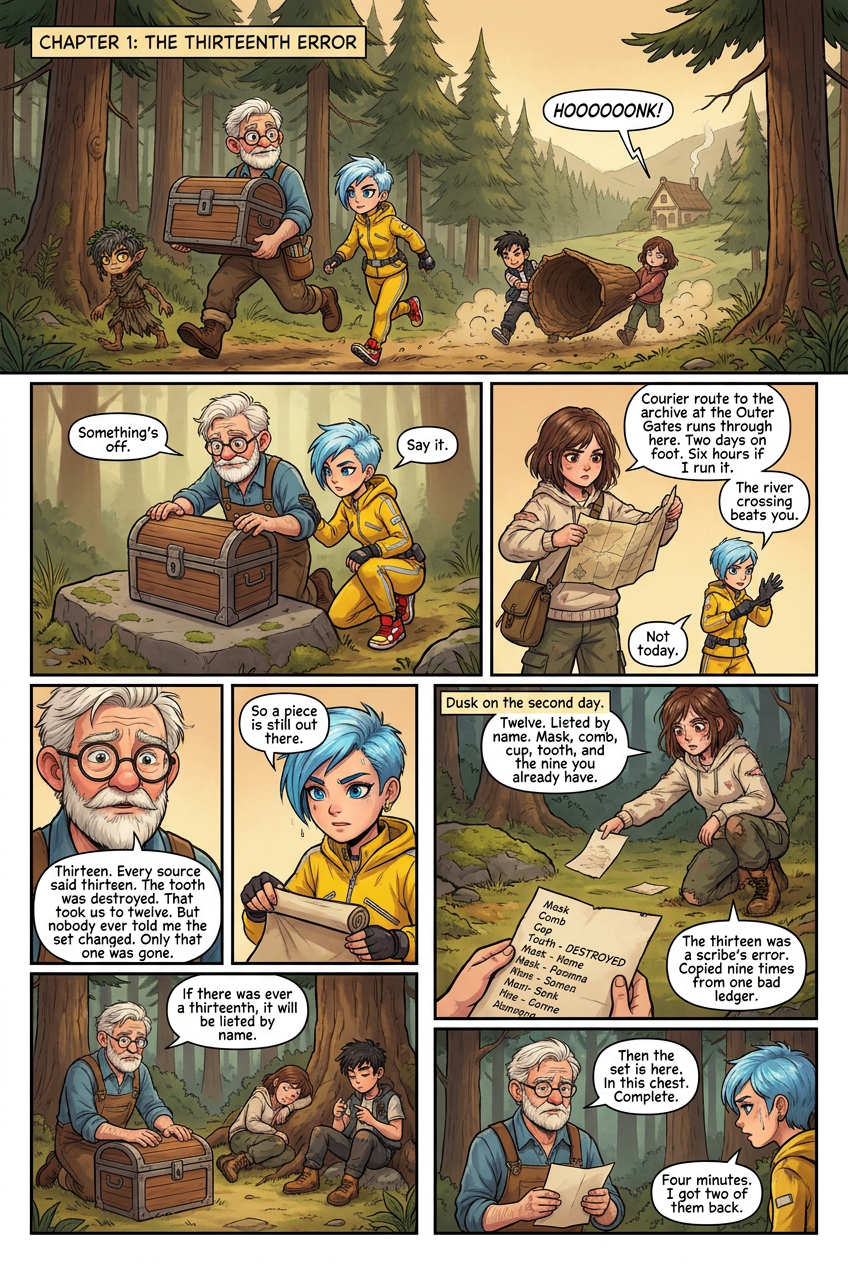
Ben carried the sealed chest out of Paige's cottage with the horn still ringing up the slope. The group moved fast through the pines, Anita at his shoulder, Justin and Amanda dragging the empty tree shell behind them to leave a false scent. Joe took the lead. They didn't stop until the cottage was two ridges behind and the horn had gone quiet. Ben set the chest down on a flat rock and put his hand on the lid. Twelve boxes. He had wanted this weight for two years. It felt wrong. "Something's off," he said. Anita crouched beside him. "Say it." "Thirteen. Every source said thirteen. The tooth was destroyed. That took us to twelve. But nobody ever told me the set changed. Only that one was gone." "So a piece is still out there." "Or there never was one. I need to know which." Anita didn't argue. She unshouldered her satchel and pulled out a folded strip of oilcloth. "Courier route to the archive at the Outer Gates runs through here. Two days on foot. Six hours if I run it." "The river crossing beats you." "Not today." He looked at her. Blue hair damp under her hood, yellow sleeves pushed to the elbows, gloves already tightened. She had lied her way into the courier post at fifteen and held it three years. She knew every archive clerk between the gates and the throne. "Ask them for the original relic ledger," Ben said. "Not the copies. The first count. If there was ever a thirteenth, it will be listed by name." "And if there wasn't?" "Then twelve is the set. And I'm done hunting." She nodded once and was gone through the trees before he finished the sentence. They waited in a hollow above a creek. Ben kept his hand on the chest. Joe watched the ridge. Amanda slept with her back to a root. Justin counted his fingers over and over, a habit Ben had stopped asking about. Anita came back at dusk of the second day. Her sweater was torn at the shoulder and her boots were caked to the ankle. She dropped a copied page onto the moss beside the chest. "Twelve," she said. "Listed by name. Mask, comb, cup, tooth, and the nine you already have. The thirteen was a scribe's error. Copied nine times from one bad ledger." Ben picked up the page. His name for each piece sat in a clean column. No thirteenth. No missing entry. The tooth was struck through with a single line and the word destroyed written beside it in fresh ink. "Then the set is here," he said. "In this chest. Complete." "Yes." He should have felt lighter. He didn't. Complete meant the herbalist knew exactly what he carried now, and exactly what it was worth. The horn had gone quiet two days ago. It would sound again. "How long did the crossing take you?" he asked. "Four minutes," Anita said. "I got two of them back."
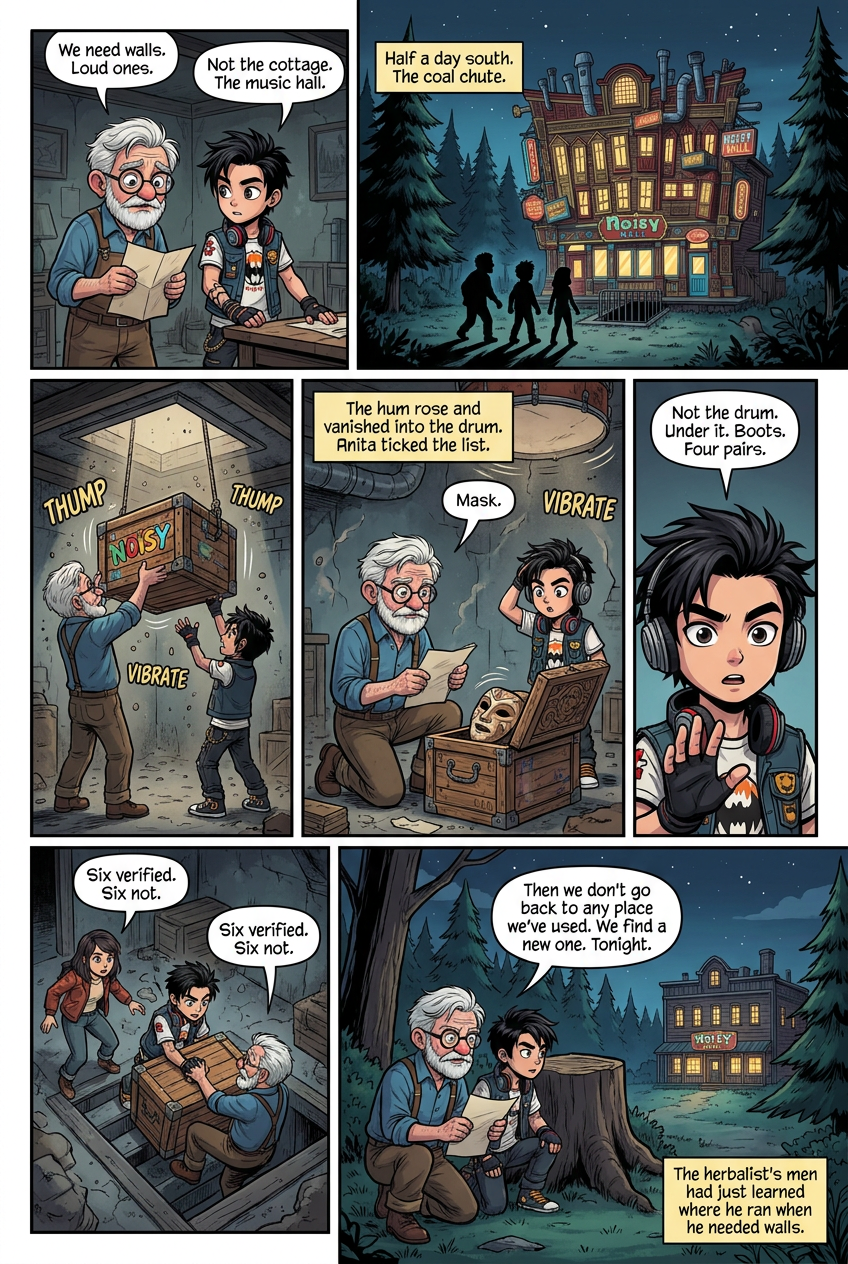
Ben folded Anita's page into his coat and picked up the chest. The set was complete, but complete meant valuable, and the herbalist's scouts were already moving. He couldn't carry the chest openly to verify each piece against Anita's ledger. He couldn't leave it in the hollow either. Two scouts had crossed the creek that morning. Joe had counted their prints on the way back. "We need walls," Ben said. "Loud ones. A day, maybe two, to open each box and match the list." Justin looked up from his fingers. "Not the cottage. Not the yard. The music hall." Ben knew the place. He had found Justin there months ago, in a hall built for layered sound, with vents on the roof and signs stacked over signs. The walls swallowed noise. Nothing hummed loud enough to leak through a band on stage. "How far?" Ben asked. "Half a day south. Not the front door. The coal chute." They moved before Amanda finished lacing her boots. The hall came up out of the pines with its windows lit. A drum was going inside. Justin led them around to a low iron grate at the back and pried it up with a bent nail. Ben lowered the chest through first. Joe went last and pulled the grate down behind him. The room beneath the stage smelled of rosin and old beer. The drum overhead shook dust from the joists. Ben set the chest on a crate stamped with warning labels and painted letters and cracked the wax with his knife. He opened the first carved box. The hum rose and vanished into the drum. Anita ticked the list. Mask. Ben closed the lid and moved to the next. Halfway through, Justin lifted his head. "Not the drum. Under it." Ben stopped. "Under it what." "Boots. Four pairs. Coming down the side stair." Amanda already had the grate open. Ben sealed the box in his hand and shoved it into the chest. Six verified. Six not. He pushed the lid down and dropped fresh wax across the seam from a candle Justin held to it. The stair door rattled. Ben lifted the chest. Joe went through the grate first, then Amanda, then the chest, then Ben. Justin came last and set the grate back in place from below with the bent nail through the ring. They crossed the alley into the pines before the door above them opened. Ben crouched behind a stump with the chest between his knees. "Six confirmed," Anita whispered. "Six to go." "They know the hall now," Joe said. Ben looked at the page in his hand. Half a list checked. Half a set unverified. And the herbalist's men had just learned where he ran when he needed walls. "Then we don't go back to any place we've used," Ben said. "We find a new one. Tonight."
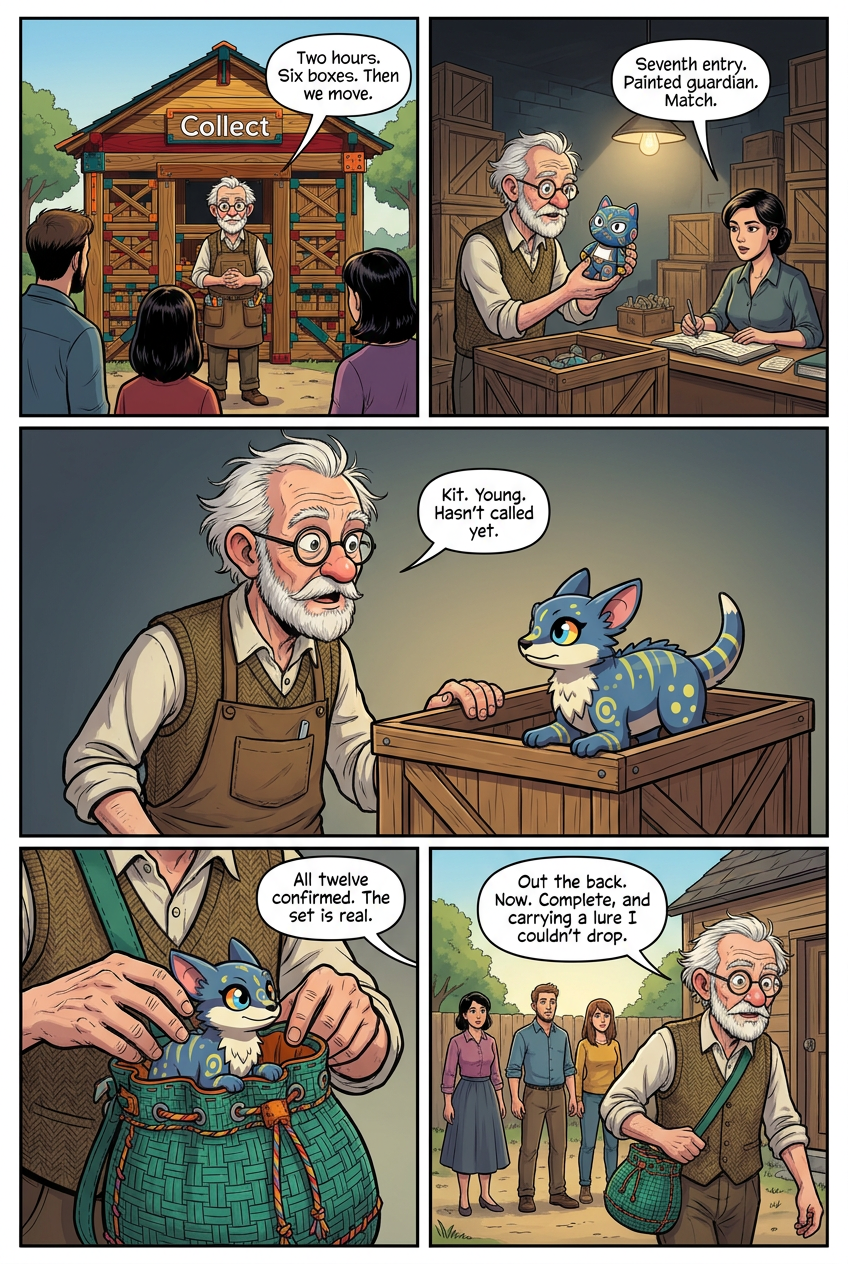
Ben led them off the pines road at first light. Six boxes still unverified. The herbalist's men knew the music hall now, and every place he had used before was burned. He needed a room no one tied to him. Joe pointed down a track Ben had never walked. "Small house. Boarded front. Nobody's been in a week." The building sat low and square, its walls stacked with slatted crates behind reinforced timber. A faded sign over the door read Collect. It looked like a trader's stow-house, the kind that took goods on consignment and never asked names. The lock was cheap. Amanda opened it with a wire. Inside smelled of straw and old wax. Crates lined every wall. A counter held a ledger left open to a blank page. Ben set the chest on the counter and slid the bolt behind them. "Two hours," he said. "Six boxes. Then we move." Anita spread the ledger page beside Anita's list. Ben cracked the wax on the seventh box. The hum lifted, thin and short, and died in the crates. He held the piece up to the lamp. A small carved figure, blue paint, gold lines, a heart cut into the brow. Anita ran her finger down the list. "Seventh entry. Painted guardian. Match." Ben sealed it and moved on. Comb. Cup. He worked fast. Justin stood at the shuttered window, listening. Joe watched the back. On the tenth box, something moved in the crates. Ben froze. A small striped creature climbed down from a shelf, blue-coated, yellow-spotted, with one bright eye and one dark. Not the hunter. Smaller. It sat on the counter and stared at the open box. "Kit," Amanda whispered. "Young. Hasn't called yet." Ben closed the lid slow. The kit sniffed at the wax. Then at the chest. Then at a woven satchel hanging on a peg by the door, its drawstring loose. Ben lifted the satchel down. Sturdy weave. Deep bag. He set the kit inside and pulled the string tight to the neck. The kit turned once and settled. Muffled. Quiet. "Finish," Anita said. He opened the eleventh. Small stone disc. Match. He opened the twelfth. Bone shard, wrapped in linen. Match. Anita drew a line under the last entry and closed the ledger. "All twelve confirmed," she said. "The set is real." Ben dropped the wax across the final seam and pressed it flat. Twelve pieces. Every one genuine. No fakes in the chest. The satchel shifted against his hip. The kit inside had gone still, but its mother would come looking. It always did. And the herbalist's men were half a day behind, closing on any place that smelled of him. "Out the back," Ben said. "Now." He lifted the chest. The satchel bumped his side as he crossed the threshold. Complete, verified, and carrying a lure he couldn't drop.
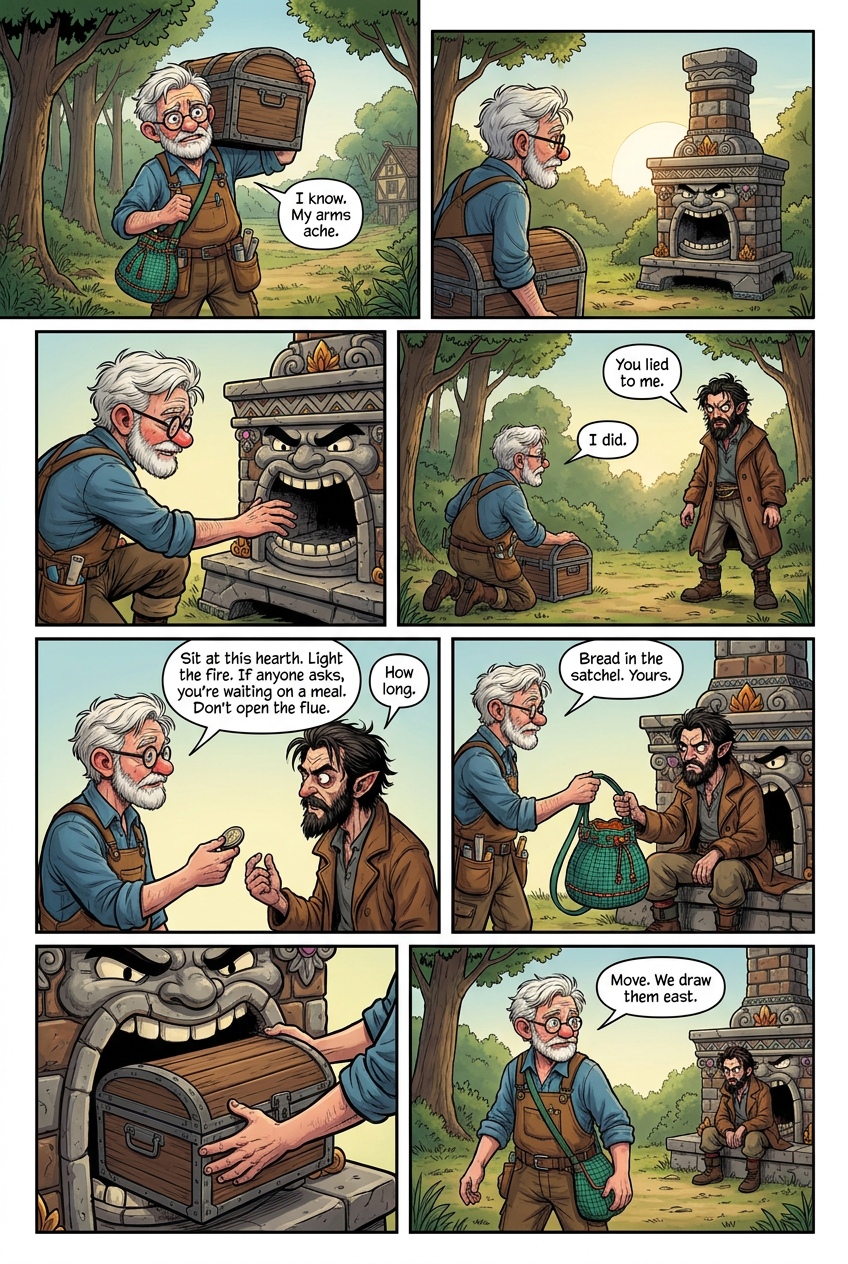
Ben came out the back of the stow-house with the chest on his shoulder and the satchel bumping his hip. The kit inside had not called yet. Its mother would. The herbalist's men were half a day off. He had twelve verified pieces and no place to put them. Every road he knew was watched. Joe crouched at the corner of a shed. "North track is thin. Two men at the bend already." "West?" "Same. They're closing a ring." Amanda tugged Ben's sleeve. "You can't walk this chest in the open. One look and every runner in the valley moves on you." "I know." Ben's arms ached. The chest was too big to hide under a coat and too heavy to run with. He needed a hole in the ground and no one watching him find it. Anita pointed down the slope. A squat stone chimney stood in a clearing, its firebox carved into a wide grinning mouth. Teeth set into the arch. Eyes cut above the lintel. A hearth with no house around it. The fire inside was cold. "Old traveler's hearth," Anita said. "Nobody tends it. Flue drops straight down to an ash pit." Ben crossed to it. The mouth was wide enough for the chest. He knelt and reached up the flue. His hand met a stone ledge two feet inside, dry, out of sight from any angle. A scrape of boots on gravel. Ben turned. A man stood at the edge of the clearing in a brown coat, hair wild, eyes hollow. Chris P. Bacon. The same starving traveler Ben had sent east with a barking animal weeks ago, chasing a feast that did not exist. Chris looked at the hearth. Then at Ben. "You lied to me." "I did." "East was empty." "I know." Chris stepped closer. His hands were empty. "Feast is somewhere. Not east." Ben weighed it. Chris had no love for him, but no love for the herbalist either. He pulled a coin from his belt and held it out. "Sit at this hearth. Light the fire. If anyone asks, you're waiting on a meal. Don't open the flue." Chris took the coin. "How long." "Two days. I'll come back for what's inside." "Food?" "Bread in the satchel on the peg. Yours." Chris nodded once and sat on the hearthstone like he'd been waiting all his life for a chair. Ben lifted the chest into the mouth and set it on the ledge inside the flue. He pushed it back until his fingertips lost it. He drew his arm out clean. From the clearing the hearth looked like a hearth. A hungry stone face with a cold fire and a hungry man in front of it. He cut the satchel off his belt and set the kit down at the tree line, drawstring loose. It would find its mother by dark. "Move," Ben said. "We draw them east." The chest was hidden. He was empty-handed. For the first time in a month, no one chasing him would find what they wanted on his back.
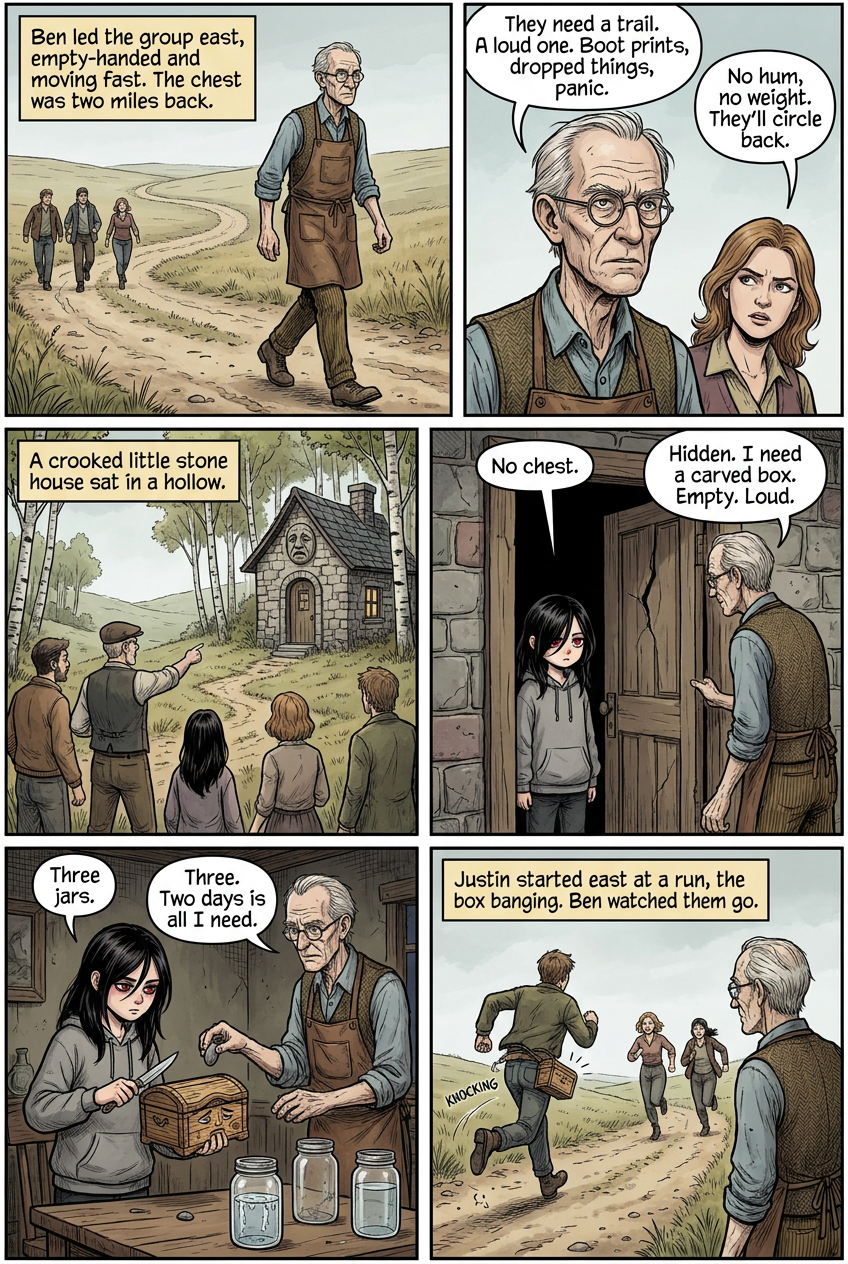
Ben led the group east along a cart track, empty-handed and moving fast. Joe kept pace on the shoulder. Anita and Amanda walked behind. Justin brought up the rear. The chest sat two miles back in a cold flue with a hungry man in front of it. The herbalist's scouts were still ringing that ground. Ben needed them looking somewhere else by morning, or Chris would sit alone when the men came knocking. "They need a trail," Ben said. "A loud one. Boot prints, dropped things, panic. Somewhere they'll believe I ran." "East to what?" Anita said. "The border road. If they think I'm running for the border with the chest, they'll strip every man off the west ring and chase." Amanda shook her head. "They'll smell a plant. No hum, no weight in the prints. They'll circle back inside a day." She was right. A false trail without the humming chest would read false. Ben stopped in the track. He needed something that sounded like the chest without being the chest. Joe pointed his chin down the slope. A crooked little stone house sat in a hollow of birches. Cracked walls. One yellow window. A carved face over the door with heavy eyes and a downturned mouth. Ben knew that face. He knew who lived behind it. Barb Dwyer opened the door before he knocked. Small, dark-haired, red eye flat as a coin. She looked at his empty hands. "No chest," she said. "Hidden." "Tears?" "None today. I need something else." She waited. "A carved box," Ben said. "Empty. Loud on the outside, hollow inside. I need it to sound wrong. Loose lid. Cracked seam. Something a tracker will hear from a ridge and follow." "That's not what I make." "I know. Make it anyway. I'll pay in tears next pass. Two jars." Her mouth tightened. "Three." "Three." She turned into the room and came back with a small keepsake box, drooping lid, a mournful face on the front. She pried the seams with a knife, loosened the pegs, and dropped a river pebble inside. She shook it. The pebble knocked with a hollow, wrong sound, close enough to a boxed hum for a scout at distance. "Two days," she said. "Then it falls apart." "Two days is all I need." Outside, Ben tied the box to Justin's belt with a loose cord so it swung and knocked as he walked. He handed Amanda a torn strip of his coat and a spent bootheel. "Drop these at the fork. Argue loud. Then split east on the border road and lose them past the gap. Meet at the west trade stop in three days." Justin grinned once and started east at a run, the box banging against his hip. Amanda and Anita followed. Ben watched them go. The knocking carried a long way in the still air. Behind him, west, the hearth stayed quiet.
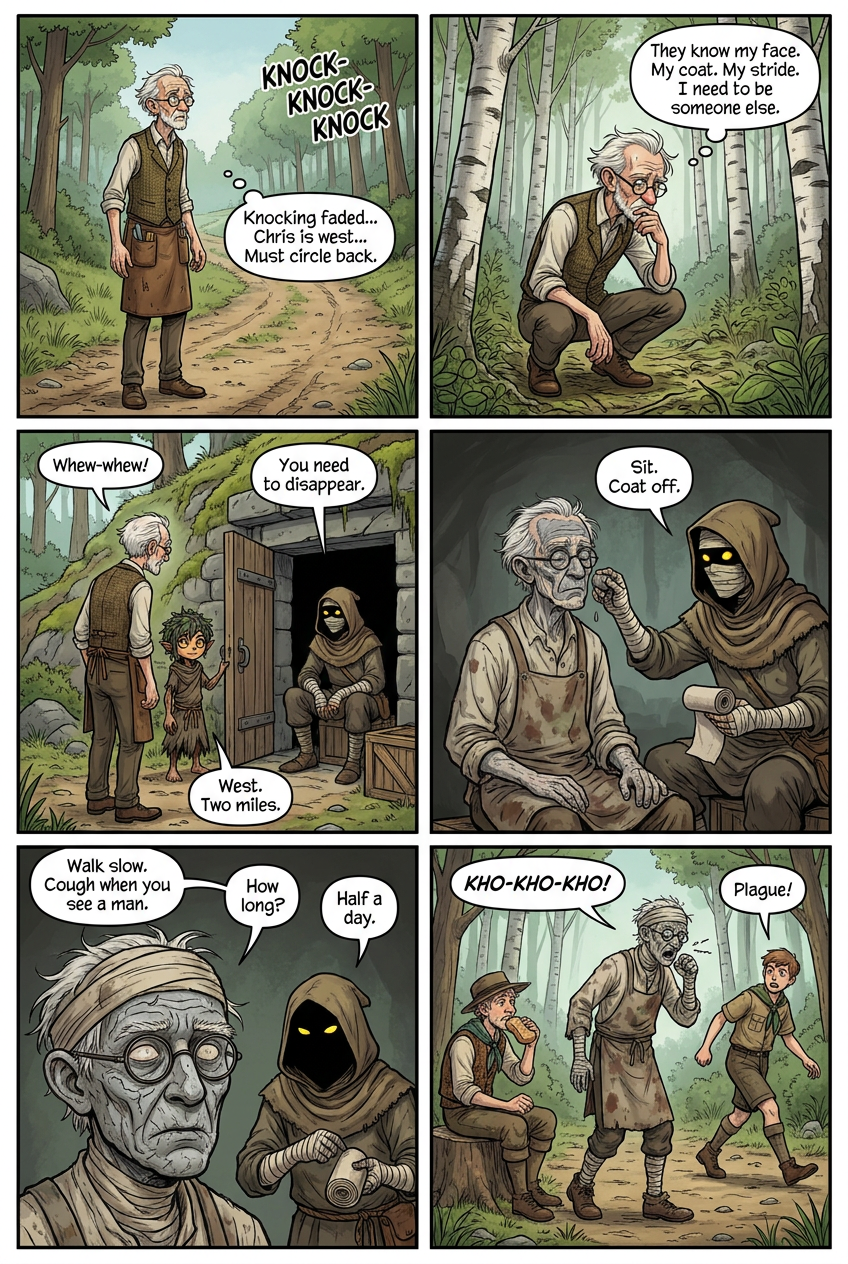
Ben stood alone on the cart track after the others ran east. The knocking of the decoy box faded into the trees. Somewhere behind him, west, Chris sat in front of a cold hearth with a chest in the flue. Ben needed to circle back without being seen. His face was known on every road inside a day's ride. A tall man walking west now would undo everything Justin's noise had bought. He stepped off the track into the birches and crouched. He counted what he had. A coat the herbalist's men had described. A height they knew. A stride Anita said a scout could name at fifty paces. He needed to be someone else before the road forked back. A low whistle came from the slope below. Joe stood at the edge of a hollow Ben had missed twice walking past it. Moss and cracked stone. A door set flush into the rock, almost part of the hill. Joe pushed it open with one bare foot. Inside, a figure sat waiting on an overturned crate. Bandaged hands. A hood pulled low. Two yellow eyes lit the dim room like lamp glass. Dr. Payne. The plague doctor Ben had once paid a debt to with a sealed jar. Ben had not asked Joe to fetch them. Joe had done it anyway. "You need to disappear," Payne said. "West. Two miles. Past the ring of scouts." "Sit." Ben sat. Payne opened a flat wooden case. Gray paste. A roll of linen. A tin of ash. "Coat off." Ben shrugged it off. Payne bundled it into a sack and handed him a stained smock from a hook on the wall. The smock stank of vinegar and smoke. Payne smeared paste along Ben's jaw, down his neck, across his hands. The paste dried gray and cracked like sick skin. Payne wound linen around Ben's head, low over the brow, high across the mouth. A plague rag. The kind travelers crossed the road to avoid. "Walk slow," Payne said. "Cough when you see a man. They'll clear a field for you." "How long does it hold?" "Half a day. Don't sweat." Ben stood. In the small polished tin on the wall he saw a hunched figure in filthy linen. Not Ben Dover. A dying man on a road. He flexed one hand and the paste cracked convincingly. Joe cracked the door and looked out. "Ring's thin on the north face. Two men. One dozing." Ben turned to Payne. "What do I owe you." "Later." Ben ducked out into the light and started west at the pace of a sick man. The first scout he passed sat on a stump chewing bread. The scout saw the linen, the gray hands, the shuffle. He stood up and walked twenty paces off the track without a word. Ben kept moving. The hearth was two miles ahead, and no one was watching him now.
Ben walked west at a sick man's pace. The linen scratched his mouth. The paste itched under his jaw. The first scout had cleared the road for him. He counted that as one, and kept moving. A half mile on, boots crunched behind him. Not close. Matched to his own stride, then slowing when he slowed. Ben coughed once, loud, and glanced back under the hood. Two men. The first was the scout from the stump, bread still in his hand. The second walked ahead of him, taller, no rag over his face. That one had come back. That one did not fear the smock. Ben kept his shuffle. His mind ran ahead. Payne's paste bought half a day from strangers. It did not buy anything from a man who had already seen him walk. The tall one had watched the first scout run, thought about it, and fetched someone who would not. Two miles to the hearth. Two miles to Chris and the chest in the flue. If he led them there, he lost everything. The track dipped into a stand of pine. Ben stepped off it as if to be sick, hand to the linen. He put a tree between himself and the road and crouched. The boots kept coming, then stopped. "He's in the pines," the tall one said. "Wait him out." Ben eased the paste off one hand with his thumb. He had nothing on him but the smock, the rag, and Payne's tin of ash. No knife. No box. A branch cracked to his left. Amanda crouched behind the next trunk. Dirt on her cheek. Pack over one shoulder. She had come back from the eastern trail. "Justin's fine," she whispered. "Two men peeled off the group. Followed you." "I see them." "Tall one's a tracker. Not a scout. Different pay." Ben looked at her. "Why are you here." "You're slow in that costume. I'm not." He thought. The tall man would not clear off for a plague rag. He would follow Ben to the hearth and put a horn to his mouth. "Take the smock," Ben said. Amanda blinked once. Then she nodded. They traded fast behind the tree. Ben smeared paste on her jaw and hands. He wound the linen low on her brow. She pulled the smock over her sweater. In the dim of the pines she was a smaller sick figure, but sick enough. "North fork," Ben said. "Cough at them. Lead them past the split oak, then lose them in the creek." "And you." "West. On my belly if I have to." Amanda stood and shuffled out of the pines, coughing. The tall man swore. Both sets of boots turned after her. Ben waited until the sound thinned. Then he crawled through the pine needles, off the track, and cut west through the brush. The road behind him was empty. The hearth was a mile and a half ahead. No one was following him now.
Ben stayed low through the brush. The paste was gone from his hands. The smock was gone from his back. He wore his own sweater now, dirt smeared on his face for cover, and every scout in these woods had a description that fit him. A mile and a half to Chris. No disguise left. He kept off the track. He moved tree to tree, listening for boots. The wind carried nothing but jays. Amanda's cough had drawn the two men north. That was one problem solved and a worse one waiting. At the edge of a clearing he stopped. Open ground between him and the next stand of pine. A scout on the ridge could pick him out in three seconds. He crouched behind a weathered rock the size of a cart and studied the far tree line. Movement. Not a man. A low shape came around the stone at his knee, plated in gray, eyes flat and dark. A rock creature, no taller than a dog. He knew the kind. One had helped him at the low house. This one only watched him. Ben stayed still. The creature stayed still. Then it turned its head toward the ridge, back at him, and walked a slow line along the base of the boulder. It stopped where the rock threw the longest shadow. He understood. He moved when it moved. He crossed the open ground behind the creature, matched to its pace, keeping the boulder's shadow between his body and the ridge. On the far side he pressed flat against pine bark and breathed. A horn sounded far to the north. Short, then short again. The tracker calling his partner. They had followed Amanda past the split oak. They had not turned back. Half a mile now. Ben moved faster. He kept off the ridgeline and off the road. Twice he heard voices and dropped. Once a scout passed within twenty feet, eating from a cloth, looking east where the horn had gone. He came over the last rise on his belly. Below him sat the abandoned traveler's hearth. A thin line of ordinary smoke rose from the chimney. Chris P. Bacon sat on a log by the door, feeding a small fire in a pit outside, chewing something slowly. No scouts in the yard. No horse. No prints on the path but Chris's own. Ben watched for a full minute. Then he came down the slope in the open, hands loose at his sides, and walked to the fire. Chris looked up. He did not stand. "You said two days. It's one." "Change of plan," Ben said. "Anyone come by?" "A woman looking for a goat. A boy with a stick. That's all." Ben looked at the chimney. The chest hummed nothing. The flue held. He had made the last mile, and no one had seen him do it.
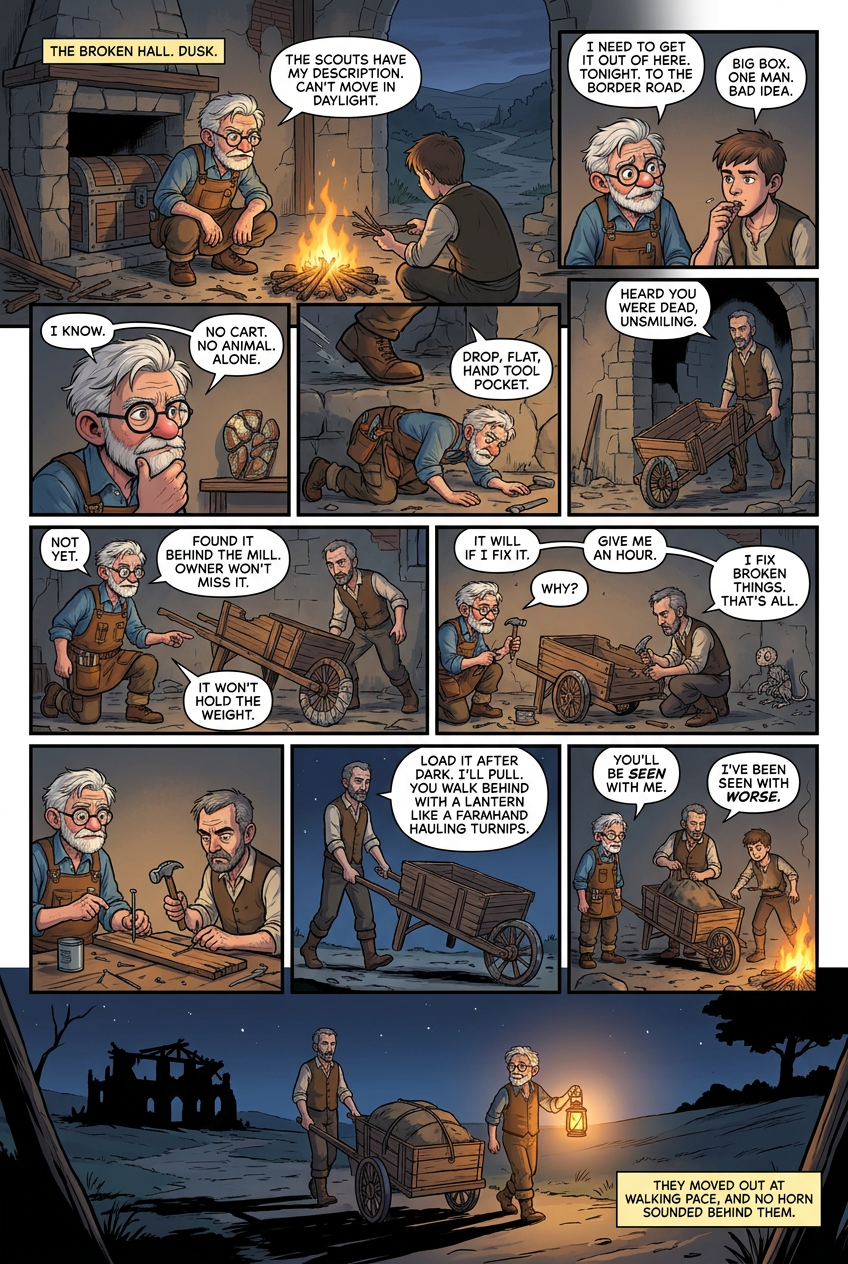
Ben crouched by the fire pit and watched the road. Chris kept feeding twigs to the flame. The chest waited in the flue, twelve pieces sealed inside, and Ben still had no way to move it. On his back, in daylight, he would be picked off in a mile. The scouts had a description that fit him exactly. "I need to get it out of here," Ben said. "Tonight. To the border road." Chris chewed. "Big box. One man. Bad idea." "I know." Ben thought through what he had. No cart. No animal. No partner within reach. Justin, Amanda, and Anita were pulling scouts east. Joe was gone. Amber was gone. If he walked out with the chest on his shoulder before dusk, the horn would sound before he cleared the trees. A boot scraped stone behind the hearth. Ben dropped flat. Chris kept feeding the fire like nothing had changed. A man came around the corner, gray hair, patched coat, orange stains on the sleeve. Al Beback. The man who had sealed the chest's seams with wax two weeks back. He carried a wooden handcart with a split side board and one wheel wrapped in rag. "Heard you were dead," Al said. He did not smile. "Not yet." Al set the cart down. The side board was cracked through. One slat hung by a nail. "Found it behind the mill. Owner won't miss it." Ben looked at the cart, then at Al. "It won't hold the weight." "It will if I fix it." Al pulled a hammer and a coil of wire from his coat. "Give me an hour." "Why?" Al squatted by the split board and ran a thumb along the crack. "I fix broken things." He did not look up. "That's all." Ben watched him work. Al drove the loose nail flat, wired the split board tight along its length, then packed the gap with pine pitch from a tin. He tested the wheel and re-wrapped the rag. He said nothing the whole time. When he finished he stood and pushed the cart forward two steps. It rolled straight. "Load it after dark," Al said. "I'll pull. You walk behind with a lantern like a farmhand hauling turnips." Ben looked at the cart, then at the chimney. The chest could ride under a tarp with a bag of grain on top. Two men, a cart, a lamp. Nothing that matched the description any scout carried. "You'll be seen with me," Ben said. "I've been seen with worse." At dusk they pulled the chest from the flue. It came down black with soot. Ben wiped it once and set it in the cart. Al laid a folded sack over the top and tied it down. Chris kicked dirt on the fire. They moved out onto the road at walking pace, the wheel turning quiet under the rag, and no horn sounded behind them.
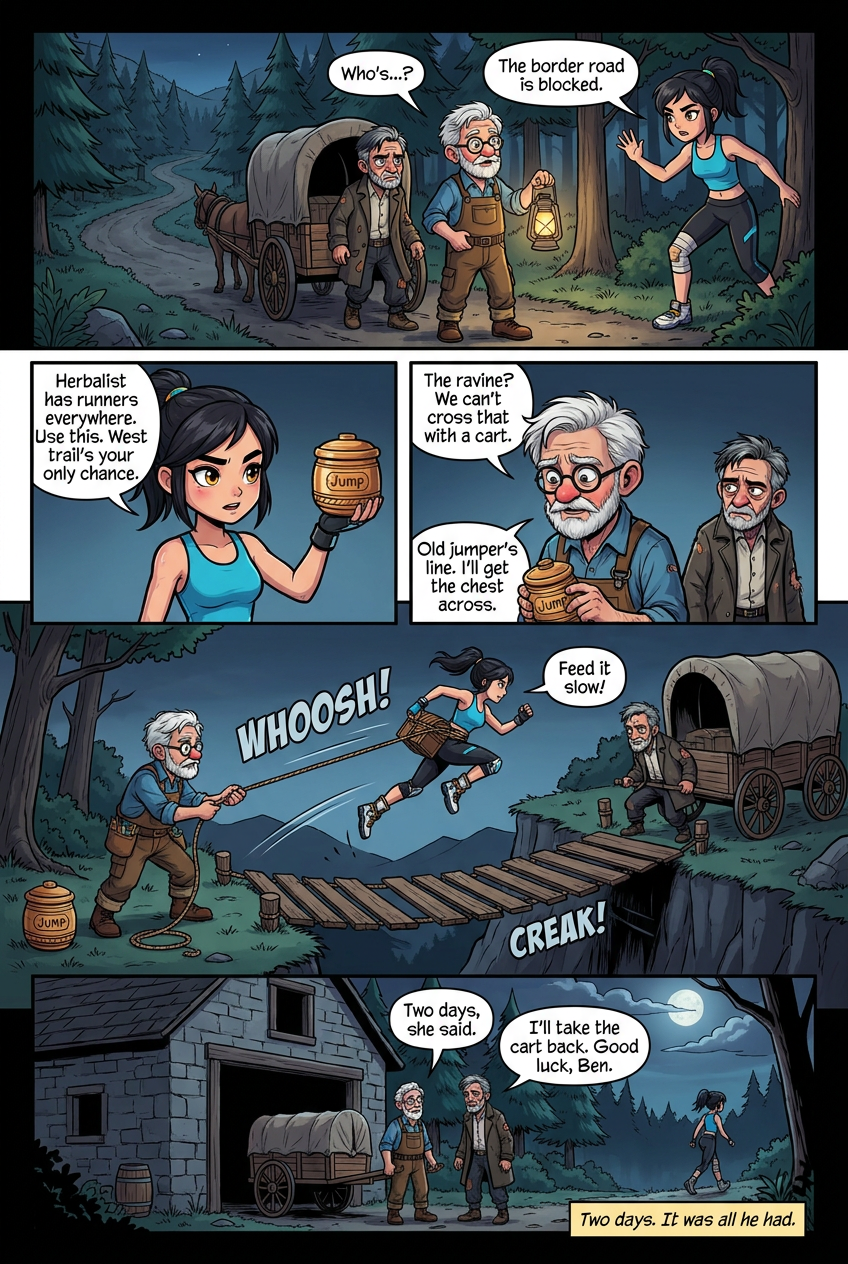
Ben and Al pulled the cart down the road at a steady pace. Al leaned into the shafts. Ben walked behind with the lantern low. The chest sat under grain sacks and a tarp. The border road was six miles out. But Ben still had no one waiting past the line. No buyer. No hiding place. The herbalist had sent word ahead through her runners, and any face at the crossing could be hers. Arriving with the chest was as bad as being caught with it. "I need a hole past the border," Ben said. "Somewhere the herbalist hasn't paid." Al kept pulling. "I fix things. I don't hide them." A figure stepped out from a stand of pines ahead. Ben's hand went to his knife. Then he saw the taped knee, the ponytail, the boots wrapped in cord. Crystal. She had left him the pot at the gap in the ridge weeks back. She had known his route before he did. Crystal held up a small wooden jar with the word JUMP burned into a plate on its side. She set it on the road. "Scent inside. Rub it on the tarp. Two hours' cover." Ben stopped the cart. "Why?" "You're carrying the whole set. Herbalist has a man at every gate on the border road. Not the west trail." "The west trail is a cliff." "Not all of it." She pointed with two fingers up the slope. "Old jumper's line. Plank bridge above the ravine. I use it." Al frowned. "A cart won't cross a plank." "Cart won't. Chest will. Two men, one rope." Ben looked at her taped knee. "You'll pull it across?" "I'll jump it across. You feed rope." Ben weighed it. The border road meant walking into the herbalist's net. The west trail meant one rope over a drop. He picked the drop. They pushed the cart up the slope in the dark. Crystal moved ahead on her strapped boots, quiet as a fox. At the ravine she tied one end of a coiled line to the chest and the other around her waist. She took three fast steps and jumped the gap. Her knee held. She landed, rolled, and pulled. Ben fed the rope. The chest slid onto the plank, dipped, then dragged across. Al braced the near end. When the chest hit the far side Crystal untied it and pointed down a dark path Ben could not see. "Stone barn. Half mile. Empty two years. No one's paid for it because no one knows it's there." Ben crossed the plank. Al stayed with the empty cart on the near side. "I'll take it back down the road," Al said. "Give them something to chase." Ben followed Crystal down the path. The chest rode her shoulder now. At the stone barn she set it inside a dry stall and stepped back. "Two days," she said. "Then it's your problem again." She walked out into the trees. Ben shut the barn door. The chest was across. He was hidden. But two days was all he had.
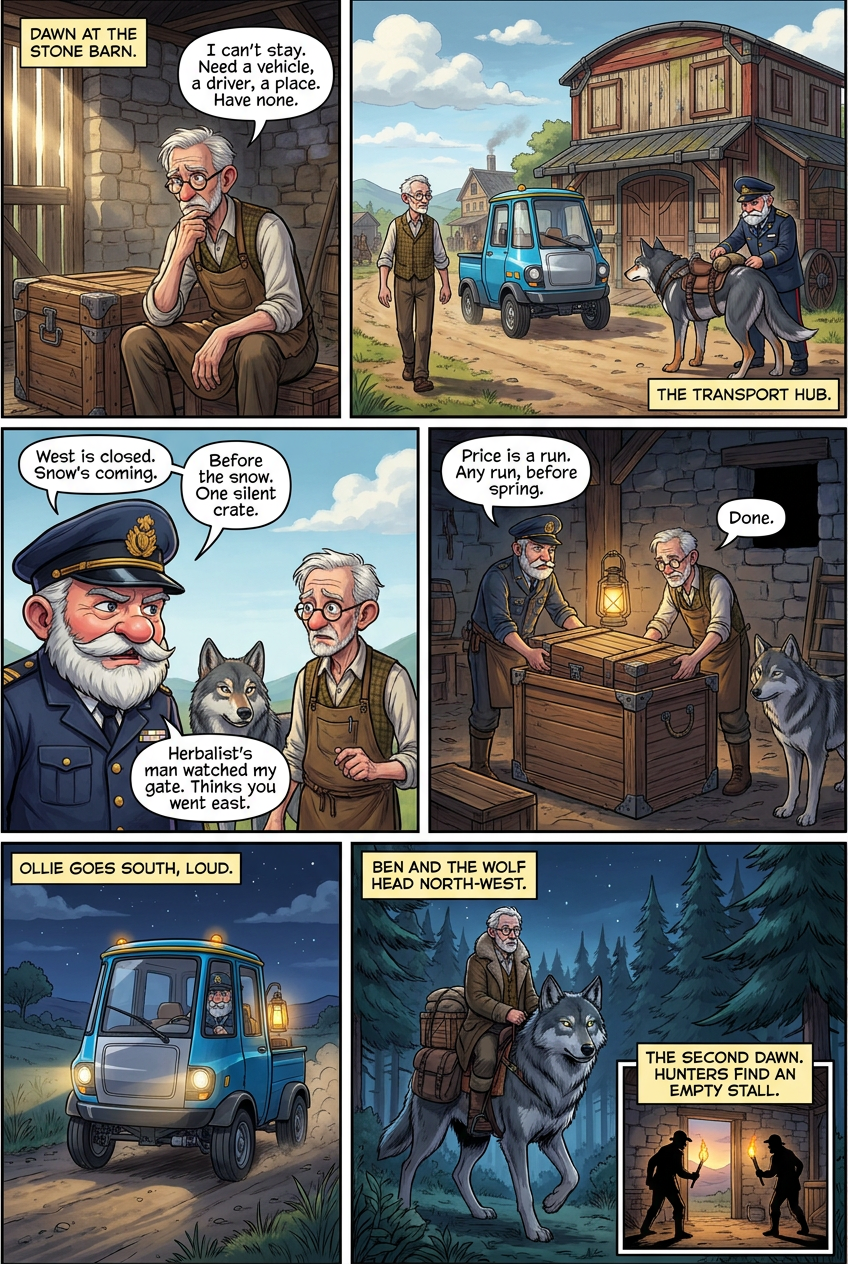
Ben spent the first night in the stone barn awake against the chest. By dawn he had counted his problem out plain. He could not stay. He could not walk twelve pieces across open country alone. He needed a vehicle, a driver, and a place at the other end. He had none of the three. He had two days. He left the chest wedged in the dry stall under loose straw and walked the half mile back to the plank bridge. Crystal was gone. Al was gone with the cart. Ben cut down the west slope on foot until he found a track wide enough for wheels. He followed it until he heard engines. The transport hub sat in a clearing, a tall timbered building with double doors thrown open. A blue three-wheeled runabout idled in the yard. Behind it, a gray wolf-shaped transport creature stood harnessed, head low, eyes tracking every movement. Ollie Tabooger was checking a strap on the creature's saddle. He wore the same navy coat and cap Ben remembered from the freight yard, and he did not look pleased to see Ben's face at his door again. "You," Ollie said. He did not stop his hands. "I need out. West. Tonight." "West is closed. Snow in the pass by week's end." "Before the snow." Ollie tightened a buckle. "Cargo?" "One crate. Heavy. Silent." "Silent how." "Sealed. Waxed. It won't sing on your road." Ollie looked at him then. He knew what Ben carried. He had watched Ben pack it in his own back stall while engines ran. "Herbalist's man watched my gate a week," he said. "He isn't there now. He's on the border road. He thinks you went east." "He'll learn." "He will." Ollie spat into the dirt. "Greywood route. Through the pines. My guild's waiting on a shipment past the far side. Your crate rides under theirs. You ride the wolf. Runabout goes empty as a decoy." "Price." Ollie named a figure. Ben did not have it. Ben said so. Ollie looked at the wolf. The wolf looked at Ben. "Then you owe me a run," Ollie said. "Any run. One I name. Before spring." "Done." They went for the chest at dark. Ollie drove the runabout up the track with the wayfarer crate strapped in the bed, empty. In the stone barn Ben slid the chest into the crate. Ollie nailed the lid, roped it, and stacked two sacks of guild oats on top. The wolf stood in the doorway, silent, waiting. Ben climbed into the saddle. Ollie took the runabout south, loud, lanterns bright. The wolf turned north-west into the pines with Ben and the crate on its back. Within a mile the track was gone and only the animal knew the way. By the second dawn Ben was thirty miles past the barn. The herbalist's hunters reached the stone barn that morning and found straw, rope ends, and an empty stall.
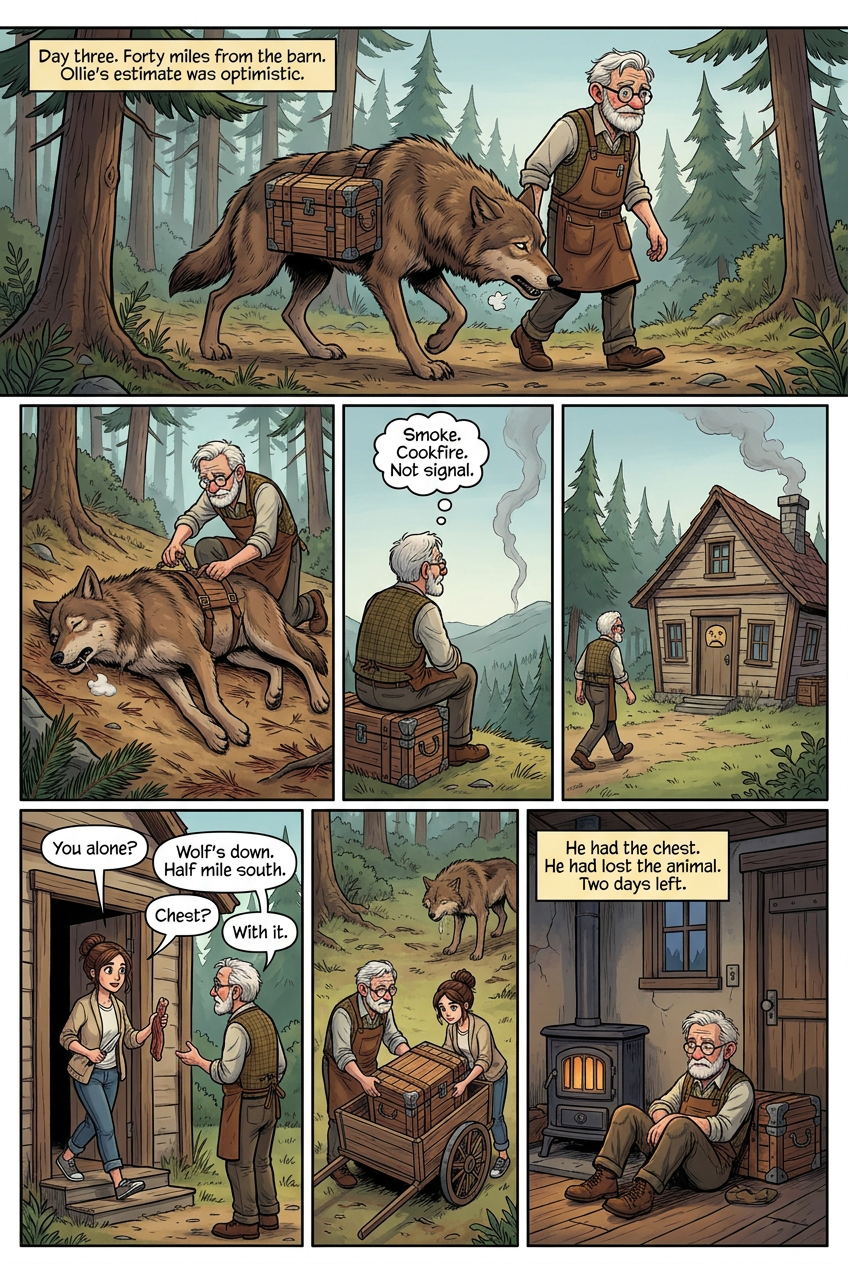
By the third dawn Ben was forty miles past the barn. The wolf's flanks pumped hard. Its head hung lower than the day before. Ollie had warned him the animal could carry the crate two days at pace, maybe three. They were on three. Ben watched foam collect at the corner of its mouth and knew Ollie's estimate was optimistic. He dismounted and walked beside the wolf through the pines. The crate rocked on its back. Ben counted his problem. If the wolf collapsed here, he could not lift the chest. He could not drag it. He could not leave it. Scouts were behind him somewhere. Winter was ahead. The wolf stumbled at midday on a shallow slope. It caught itself, then stopped. Its legs shook. Ben unbuckled the crate and lowered it to the ground before the animal could go down with it. The wolf folded onto its side and breathed in long, wet drags. Ben sat on the crate and looked at the trees. Smoke rose above a ridge to the north. A thin gray line. Cookfire, not signal. He left the wolf and the crate and walked toward the smoke. Half a mile on, a cottage stood in a clearing. Its roof slanted wrong. Its windows sat tight in their frames. A stovepipe leaned from the shingles. Someone had painted a small worried face on the door, brow furrowed, mouth open. Amber Green stepped out before he knocked. She had a knife in one hand and a strip of dried meat in the other. Her hair was pulled back tight. She looked thinner than at the inn. She looked at Ben's empty hands, then past him at the trees. "You alone?" "Wolf's down. Half mile south." "Chest?" "With it." She cut the meat in half and gave him a piece. "Herbalist?" "East. He thinks." Amber chewed. "I lost the trail two weeks back. Came here to think. Nothing here to think about." She looked at the cottage behind her. "Owner ran. Door was open." "I need to move a chest." "I know what you need." She went inside and came back with a handcart. One wheel was cracked but held. She wheeled it past him without waiting. They reached the wolf together. It was still breathing. Amber knelt and ran a hand along its neck. "Two days rest, it lives. You take it now, it dies on the road." "I can't wait two days." "Then leave it. Ollie will find it or he won't." They loaded the crate onto the cart. Amber took one handle. Ben took the other. The wolf watched them go. By dusk they had the chest inside the cottage, wedged behind the stove. Amber bolted the door. Ben sat on the floor with his back against the crate and did not sleep. He had the chest. He had lost the animal. He had two days before the scouts closed in, and now he was on foot.
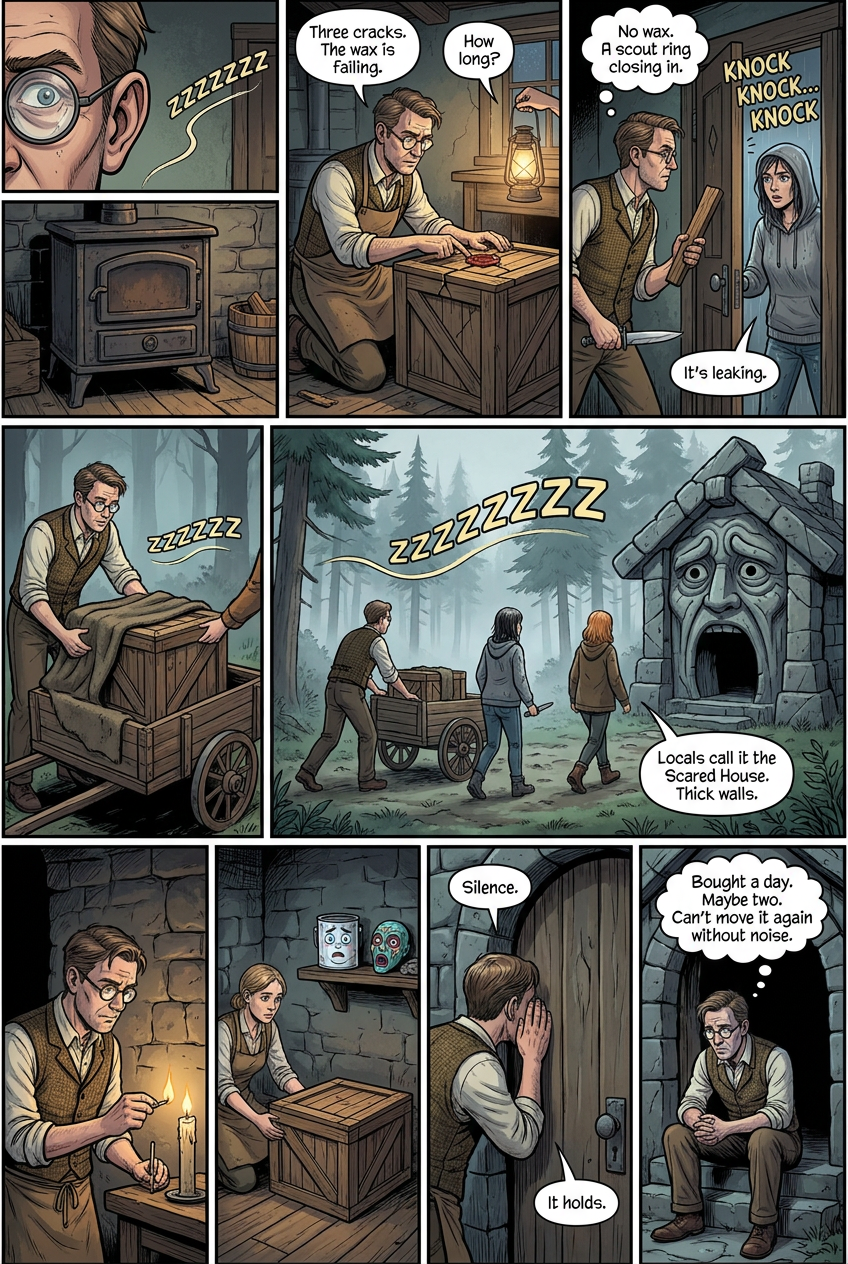
Ben woke before dawn to a sound he knew. A low hum, thin as a wire, coming from behind the stove. The wax seals on the chest were cracking. Three days of jostling on the wolf, then the cart, had done the work. If the hum leaked, the blue-scaled creature would find him inside a day. He pulled the crate out and set it on the floor. Amber knelt beside him with a lamp. The wax along the lid had split in two places. A third crack ran down the front seam. Ben pressed a finger to it and felt the vibration in the wood. "How long?" Amber said. "Hours. Maybe less if the wind shifts." He had no wax. He had no Al. He had a stove, a cottage, and a scout ring closing from the east. A knock hit the door. Two quick, one slow. Amber lifted the knife. Ben lifted the lid off the woodbox for a weapon. Amber cracked the door. Sandy Beach stood on the step. Her hood was wet. She had walked out of the Thornwood two weeks back and kept walking. Ben had last seen her past the cider press. She looked at Ben's face, then at the humming crate. "It's leaking," she said. "I know." "There's a stone shed a quarter mile west. Old shrine. Locals call it the scared house. Thick walls. No windows." "Sound still gets out." "Not through that stone. I slept inside it two nights ago. Couldn't hear the road." Ben looked at Amber. Amber shrugged. "Better than here." They wrapped the crate in the cottage's felt rug and loaded it back on the cart. Sandy took point. The path wound through pine and wet fern. The hum grew louder as they moved. Ben kept one hand on the lid to feel the cracks widen. The shrine sat low in a hollow. Its front was carved into a wide, worried face, mouth open like a doorway. Stone eyes stared down at them. Sandy pushed the door in. The inside was dry and black. The walls were two feet thick. They set the crate in the center. Ben struck a match and lit a stub of candle. On a shelf along the back wall sat a small metal canister, dented, its lid pressed down under a stone. Beside it lay a painted mask with a wide screaming mouth. Old offerings. Ben ignored them. He closed the door. The hum dropped to nothing. He put his ear to the outside wall. Silence. Amber came out last and shut the door behind her. "It holds." Ben sat on the step. He had the chest. He had a stone box around it that the creature could not hear through. But the seals were still failing inside, and the shrine could not travel. He had bought a day. Maybe two. He had no way to move the chest again without breaking the silence.
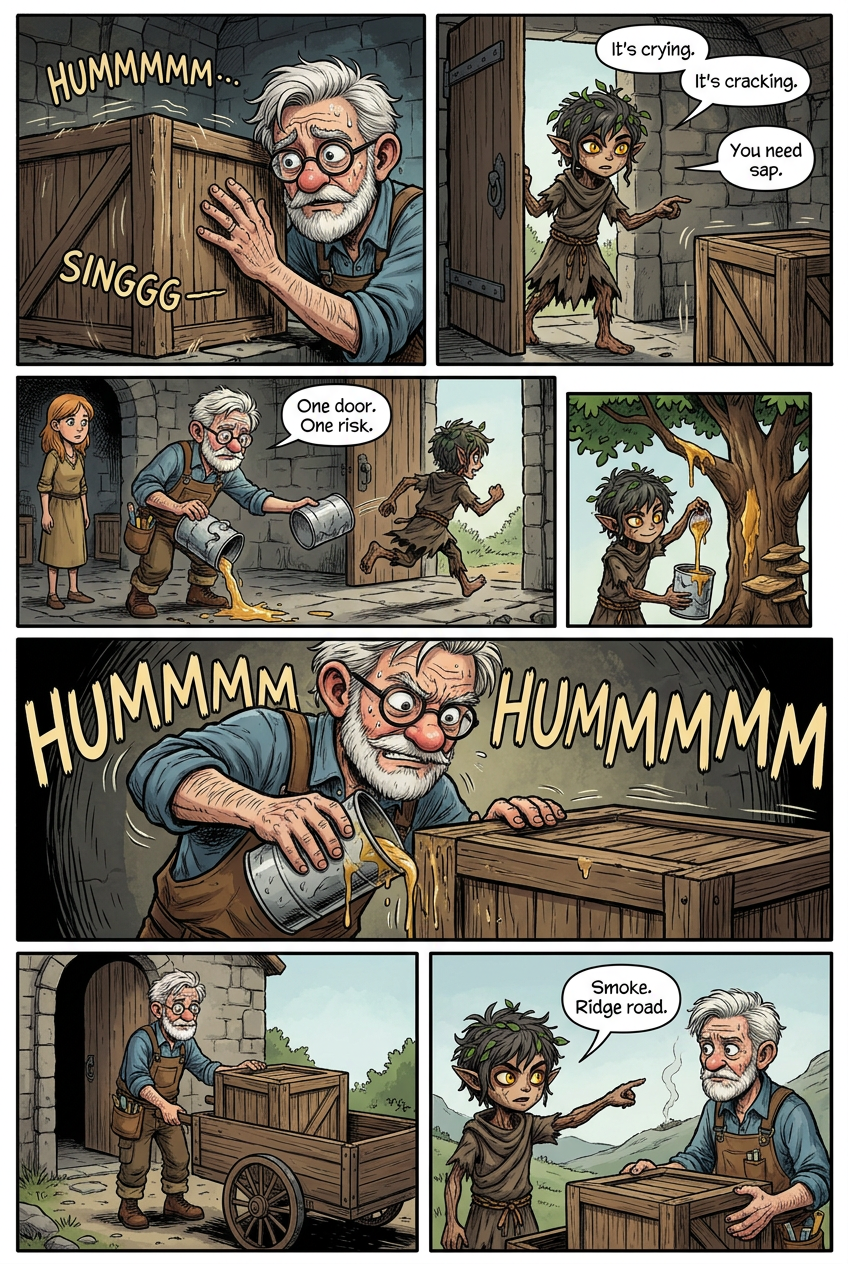
By first light the hum inside the shrine had thickened. Ben pressed his ear to the crate and heard the wax singing in three places now. The stone walls still held the sound in, but inside the shrine the air felt tight, like a bell about to ring. Amber slept sitting up by the door. Sandy was gone before dawn to watch the ridge. Ben needed wax, and he needed it without opening the crate. Any transfer meant ten seconds of open hum, and ten seconds through the doorway would carry a quarter mile in still air. Joe came through the door at midmorning. Ben had not called him. Joe walked in barefoot, leaves still caught in his hair, yellow eyes finding the crate first and Ben second. He had guided Ben to a relic in a hollow once and asked for nothing but covered tracks. He crouched by the crate and put a palm flat on the lid. "It's crying," Joe said. "It's cracking." "Same thing." Joe pulled his hand back. "You need sap." "I need wax." "Sap sets harder. Holds through cold." Joe stood. "There's a tree half a mile north. Big one. Old cut on the trunk still weeping. I passed it coming in." Ben looked at the door. "I can't open the shrine to fetch it and come back. The hum will roll out." "Then don't open it twice." Joe pointed at the shelf. The dented canister sat under its stone. "Empty that. I bring the sap in the tin. You seal from outside first, then we crack the door once for me to pass it in. One open. Not two." Amber woke and listened. She nodded. "One door. One risk." Ben pried the stone off the canister. Inside was dry ash. He tipped it out and handed the tin to Joe. Joe left at a run. He was back in twenty minutes. Ben opened the door a hand's width. Joe passed the canister through. The tin was warm and heavy with amber sap that smelled of pine and iron. Ben shut the door. The hum inside the shrine climbed. He worked fast. He pressed sap into the cracked wax along the lid, then down the front seam. The sap gripped the old wax and pulled it tight. The hum thinned. He laid the last of it along the back seam and held his palm on the wood until it stopped vibrating. Outside, Joe waited by a wide tree with layered branches, watching the ridge. Ben stepped out with the sealed crate on his shoulder. No hum. No leak. He set the crate on the cart. The seals would hold now, cold or warm, moving or still. But Joe was already looking north, and Ben followed his eyes. A thin line of smoke rose above the pines. Someone had lit a fire on the ridge road, close enough to see the shrine from the top.
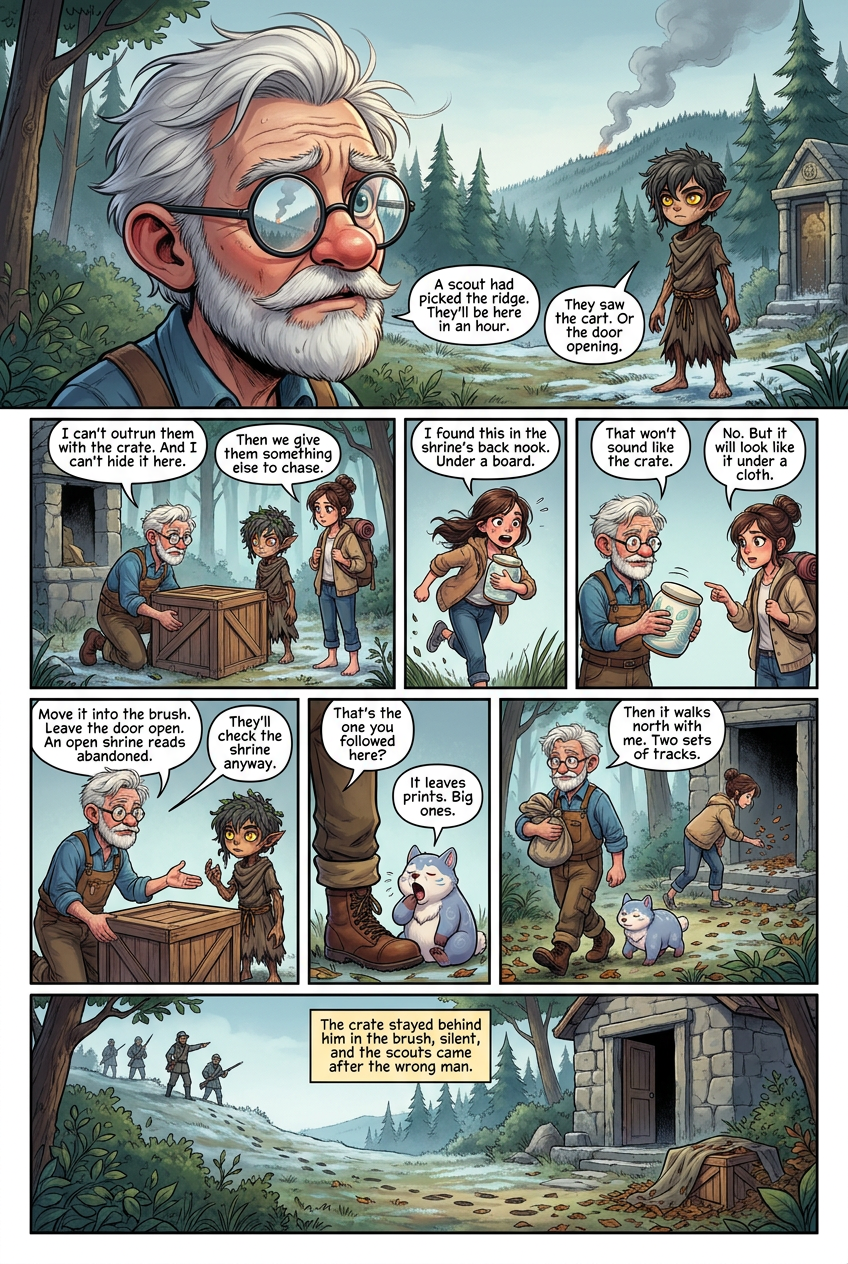
Ben watched the smoke thicken above the pines. It rose in a steady line, not a cook fire. A scout had picked the ridge on purpose. From that height, the shrine roof would show through the trees. Whoever lit the fire was signaling. Reinforcements were coming, and Ben had maybe an hour before boots reached the clearing. "They saw the cart," Joe said. He was still barefoot in the frost, yellow eyes fixed on the ridge. "Or the door opening. Doesn't matter which." "I can't outrun them with the crate." Ben set the crate back down beside the shrine wall. "And I can't hide it here. They'll search the shrine first." Amber came out with her pack on. "Then we give them something else to chase." "With what? We have no decoy left. Justin took the humming box east days ago." Sandy pushed through the brush at a run. Her breath came fast. She held a pale ceramic jar against her chest, leaves painted around the belly, waves along the base. "I found this in the shrine's back nook. Under a board." Ben took it. The lid was sealed with old cord. He shook it once. Dry leaves rattled inside. Tea, or what had been tea a long time ago. Useless for drinking. But the jar was thick clay, round, and it fit in two hands. "That won't sound like the crate," Amber said. "No. But it will look like it under a cloth." Ben's mind moved fast. "They saw the shrine door open. They didn't see what came out. If they see me leave north with a wrapped bundle, they follow me. The crate stays here with you." Joe shook his head. "They'll check the shrine anyway." "Not if the shrine looks empty when they get here." Ben pointed at the crate. "Move it into the brush behind the wall. Cover it with the tarp and leaves. Then leave the door open. An open shrine reads abandoned. A closed one reads hidden." A soft shape moved at the tree line. A round, gray-blue creature with half-closed eyes padded out and sat by Sandy's boot. She had brought it down from the ridge without saying so. It yawned and leaned against her leg. "That's the one you followed here?" Ben asked. Sandy nodded. "It walks slow. It leaves prints. Big ones." Ben understood. "Then it walks north with me. Two sets of tracks. Mine and something heavier." He wrapped the tea jar in his coat and shouldered it like weight he cared about. Joe and Amber dragged the crate into the brush and pulled the tarp over it. Sandy scattered leaves across the shrine floor and left the door wide. Ben started north with the calm creature padding beside him. Within a minute he heard voices from the ridge turn and follow. The crate stayed behind him in the brush, silent, and the scouts came after the wrong man.
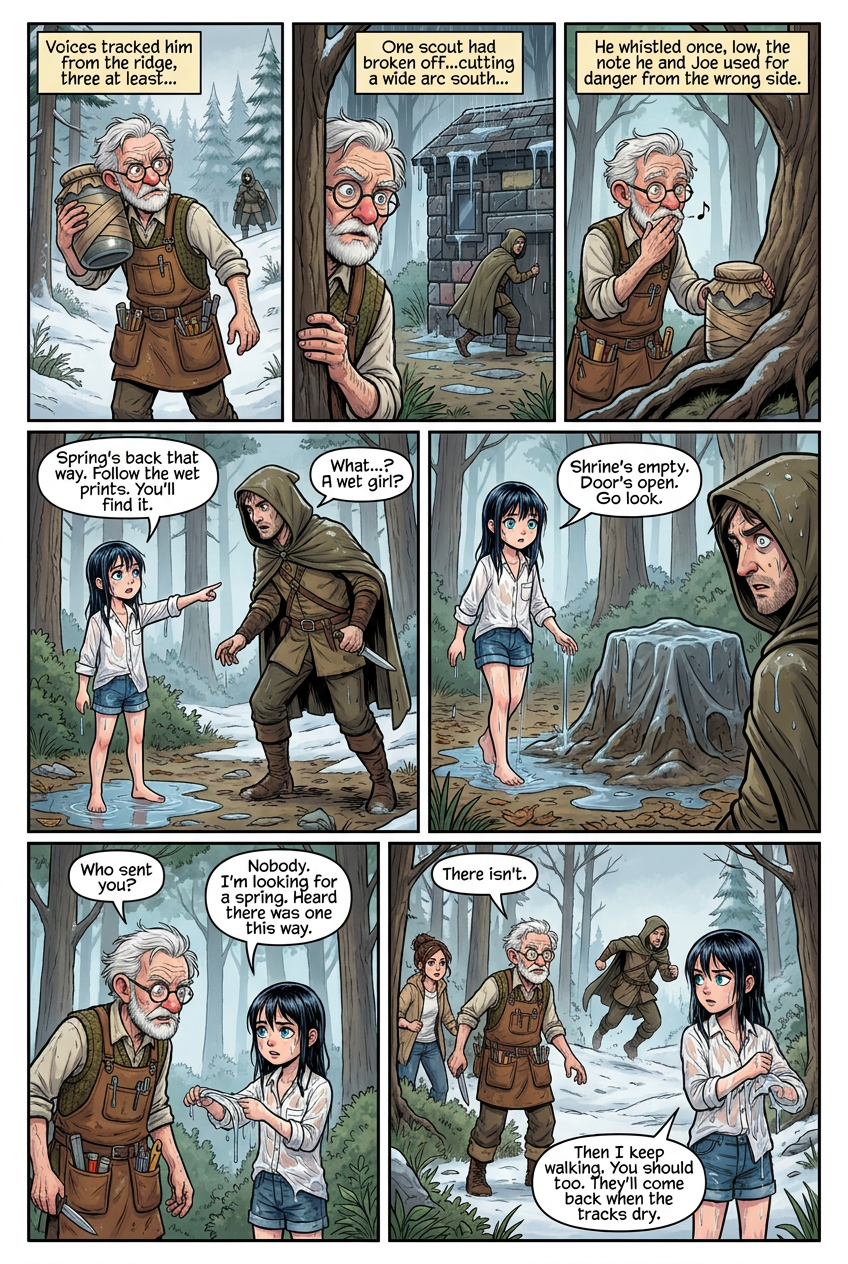
Ben walked north with the slow gray-blue creature at his heel. He kept the wrapped jar high on his shoulder, moving the way a man moves under real weight. Voices tracked him from the ridge, three at least, and the crunch of boots on frost. He listened for a fourth. He heard nothing behind him, and that worried him more than the three he could hear. He stopped at a bend and looked back through the pines. The shrine's dark wall showed between trunks, water beading down the stones from the melt on its roof. One scout had broken off from the ridge line. He was cutting a wide arc south, keeping low, circling toward the shrine's blind side. In another minute he would reach the brush behind the wall. He would see the tarp. He would see the crate. Ben set the jar in the crook of a root. He whistled once, low, the note he and Joe used for danger from the wrong side. Then he stepped off the trail and ran back through the trees, quiet as he could, cutting the scout's angle. He was still forty paces short when a small figure came around the shrine wall ahead of the scout. She was barefoot in the frost and soaking wet, her black hair plastered flat, water running from her sleeves in a steady drip. A puddle spread under her while she stood. Ben had never seen her before. Lolly Pop, he would learn later. Right now she was only a wet girl in the wrong place. The scout froze at the edge of the brush. His hand went to his knife. "Spring's back that way," Lolly said. She pointed east, away from the crate. Her voice was flat. "Follow the wet prints. You'll find it." The scout looked past her at the brush. Ben saw his eyes shift. He had caught the shape of the tarp. Lolly stepped sideways into his line. Water sheeted off her onto the leaves at the crate's edge. The tarp darkened. Every dry leaf Sandy had scattered went black and slick in seconds. The shape underneath vanished into a wet mound of muck that looked like nothing at all. "Shrine's empty," Lolly said. "Door's open. Go look." The scout went. Ben heard him cross the threshold, heard him curse the puddle Lolly had left on the floor, heard him come back out and jog north to rejoin the voices on the ridge. Ben stepped from the trees. Joe rose from the brush behind the crate, sap-black hands raised in a question. Amber lowered her knife. "Who sent you?" Ben asked. Lolly wrung her sleeve. Water ran. "Nobody. I'm looking for a spring. Heard there was one this way." "There isn't." "Then I keep walking." She looked at the crate. "You should too. They'll come back when the tracks dry."
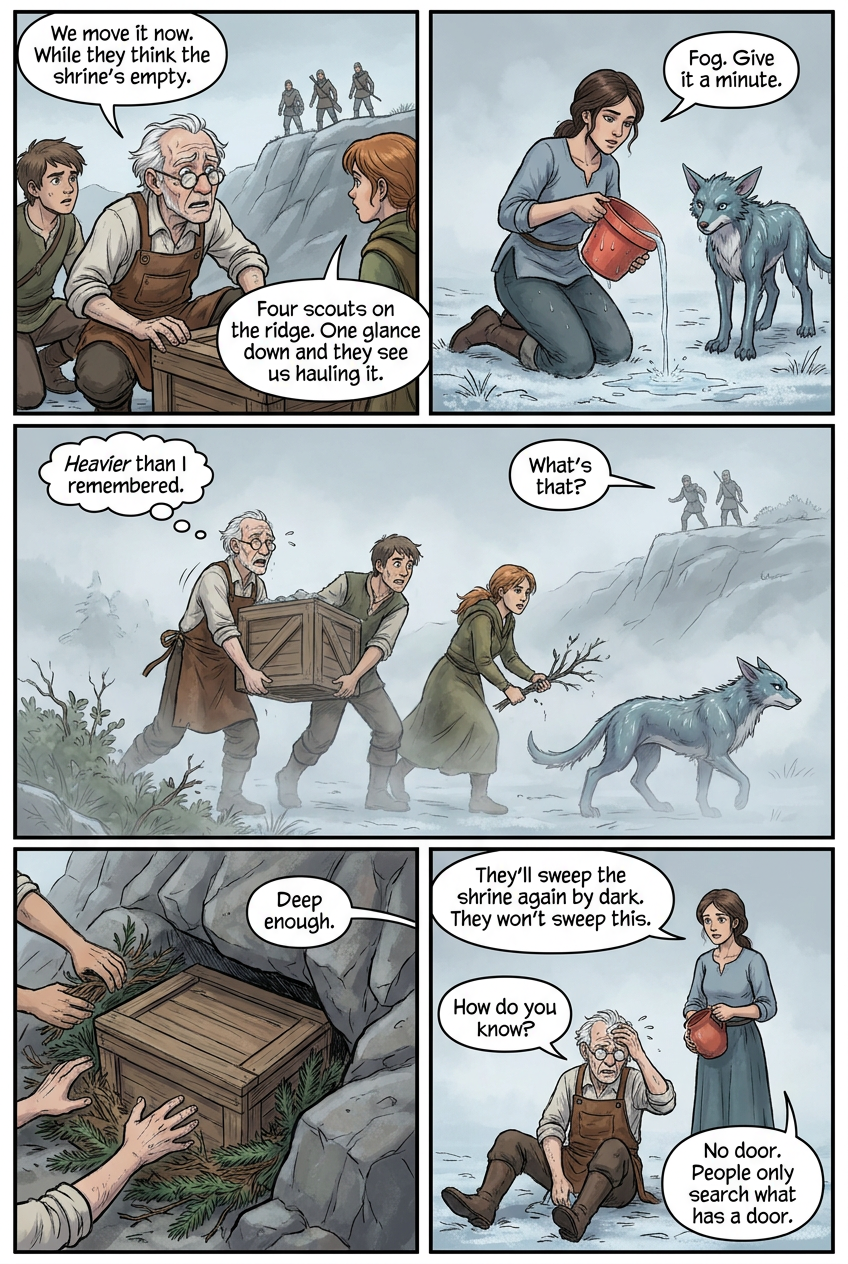
Ben crouched by the crate with Joe and Amber. The scout's boots had faded up the ridge, but the voices there hadn't. Three men, maybe four now. They would sweep back once the false trail dried. He could not stay. He could not carry the crate alone through open ground, and the shrine was already burned as a hiding place. Lolly wrung her sleeve over the tarp. Water pattered on the wet mound. "An hour," she said. "Then the leaves dry and the shape shows again." "I know." Ben looked south through the pines. The ground fell into a shallow draw choked with brush. Beyond it a stone fold in the hillside, low and dark. He had passed it on the way in. He had not looked twice at it then. "That cut in the rock," he said to Joe. "How deep?" Joe held up two fingers, then spread his hands wide. Deep enough for the crate. Narrow enough that no one would look. "We move it now," Ben said. "While they think the shrine's empty." Amber shook her head. "Four scouts on the ridge. One glance down and they see us hauling it." Lolly was already walking. She stopped where the brush thinned toward the ridge line and knelt. She put her hand flat in the frost, and the gray-blue creature came to her heel, shaking water from its coat in a fine spray. She pulled a red pot from under her wet coat. It was slick with condensation, beaded like a cold cup in summer. She tipped it. Water ran out in a thin steady line along the ground, then a wider one, cutting across the open slope between the crate and the ridge. "Fog," she said. "Give it a minute." The water hit the frost and lifted. A pale mist crawled up between the trunks, thickening as the creature paced through it and shook again. From the ridge, the slope would show white and moving. From below, Ben could still see his own feet. "Go," Lolly said. Joe took one end. Ben took the other. Amber walked ahead, breaking the brush aside. The crate was heavier than Ben remembered. His arms burned before they cleared the draw. He did not stop. He heard a shout from the ridge, high and uncertain, the sound of a man calling to another man about weather. They wedged the crate into the stone fold. Joe packed brush against the opening. Amber cut pine boughs and laid them over. When Ben stepped back, the hillside showed nothing but rock and scrub. Lolly came down through the thinning mist with the pot empty at her side. "They'll sweep the shrine again by dark," she said. "They won't sweep this." "How do you know?" "No door." She looked at him. "People only search what has a door." Ben sat down on the frost. His hands were shaking. The crate was hidden. He was still north, and the scouts were still coming, but the crate was hidden.
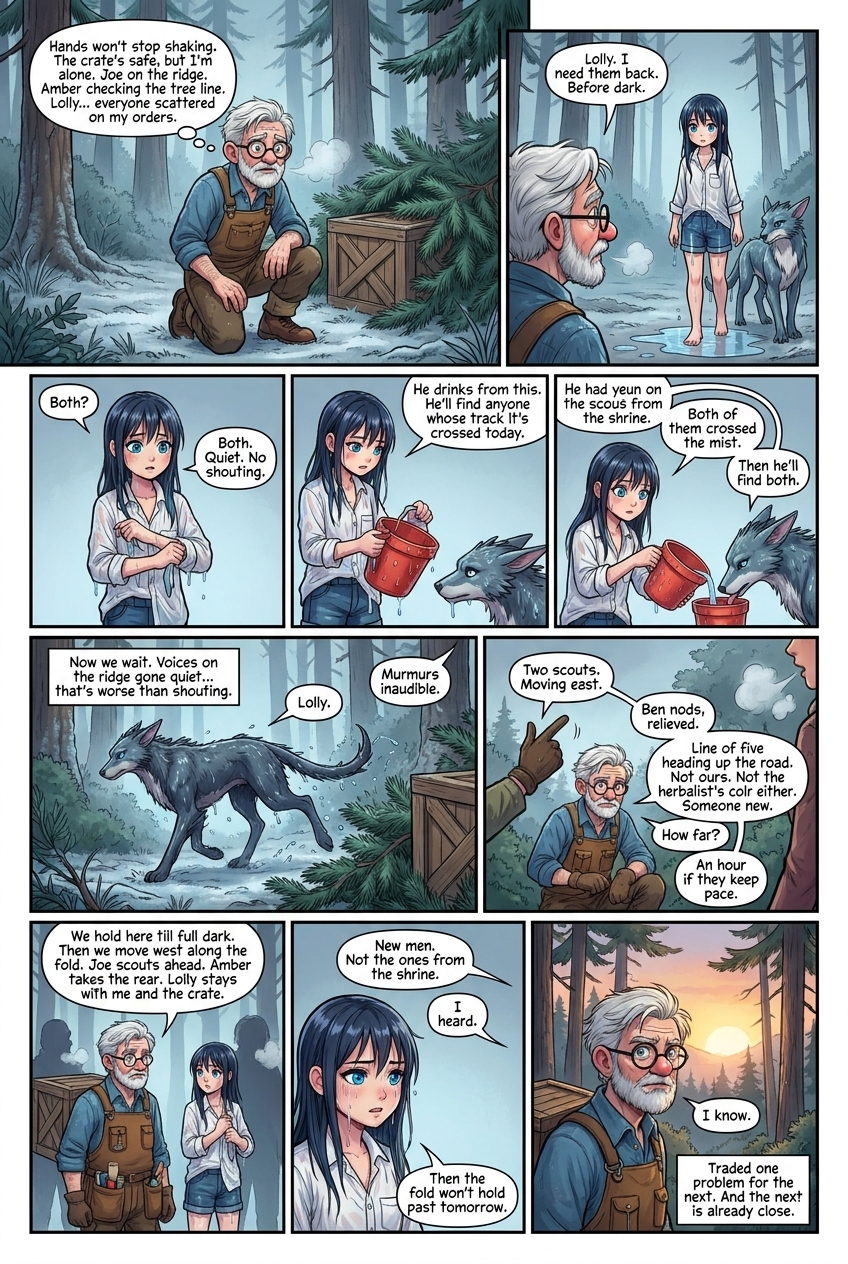
Ben stayed on the frost until his hands stopped shaking. The crate was safe in the fold. Joe was gone up the draw to watch the ridge. Amber had slipped south to check the tree line. Lolly stood a few paces off, water still running from her hair, the gray-blue creature at her heel. Everyone he needed was somewhere else, and he had no way to call them back. He counted what he could not do. He could not signal Joe without noise. He could not chase Amber without leaving the crate. If scouts came down the slope now, he would face them alone with a hidden box he could not move. The others had scattered on his orders. That was the problem he had made. "Lolly." He kept his voice low. "I need them back. Before dark." She wrung her sleeve. "Both?" "Both. Quiet. No shouting." She looked at the creature. The creature looked at her. She pulled the red pot from under her coat and turned it in her hands. Water beaded on the clay and ran down her wrist. "He drinks from this," she said. "He'll find anyone whose track it's crossed today." "Both of them crossed the mist." "Then he'll find both." She tipped the pot. The creature lapped once, twice. Its coat darkened further, if that was possible. She murmured something Ben did not catch. The creature slid into the brush without sound. Ben waited. He watched the ridge. The voices up there had gone quiet, which was worse than shouting. He put his hand on the pine boughs over the fold and felt the cold wood. Joe came first, down the draw at a crouch. He raised two fingers. Two scouts on the ridge, moving east. He knelt beside Ben and said nothing else. Amber came second, from the south, breath tight. "Line of five heading up the road," she said. "Not ours. Not the herbalist's colors either. Someone new." "How far?" "An hour if they keep pace." Ben looked at the three of them. Joe, Amber, Lolly. The crate at his back. He was not alone anymore. He had used the last hour of cover to pull his people in, and it had worked. "We hold here till full dark," he said. "Then we move west along the fold. Joe scouts ahead. Amber takes the rear. Lolly stays with me and the crate." Joe nodded. Amber nodded. Lolly wrung her sleeve again. Water pattered on the frost. "New men," she said. "Not the ones from the shrine." "I heard." "Then the fold won't hold past tomorrow." "I know." Ben looked west through the pines at the failing light. The crate was hidden. His people were together. A second faction was climbing the road. He had traded one problem for the next, and the next was already close.
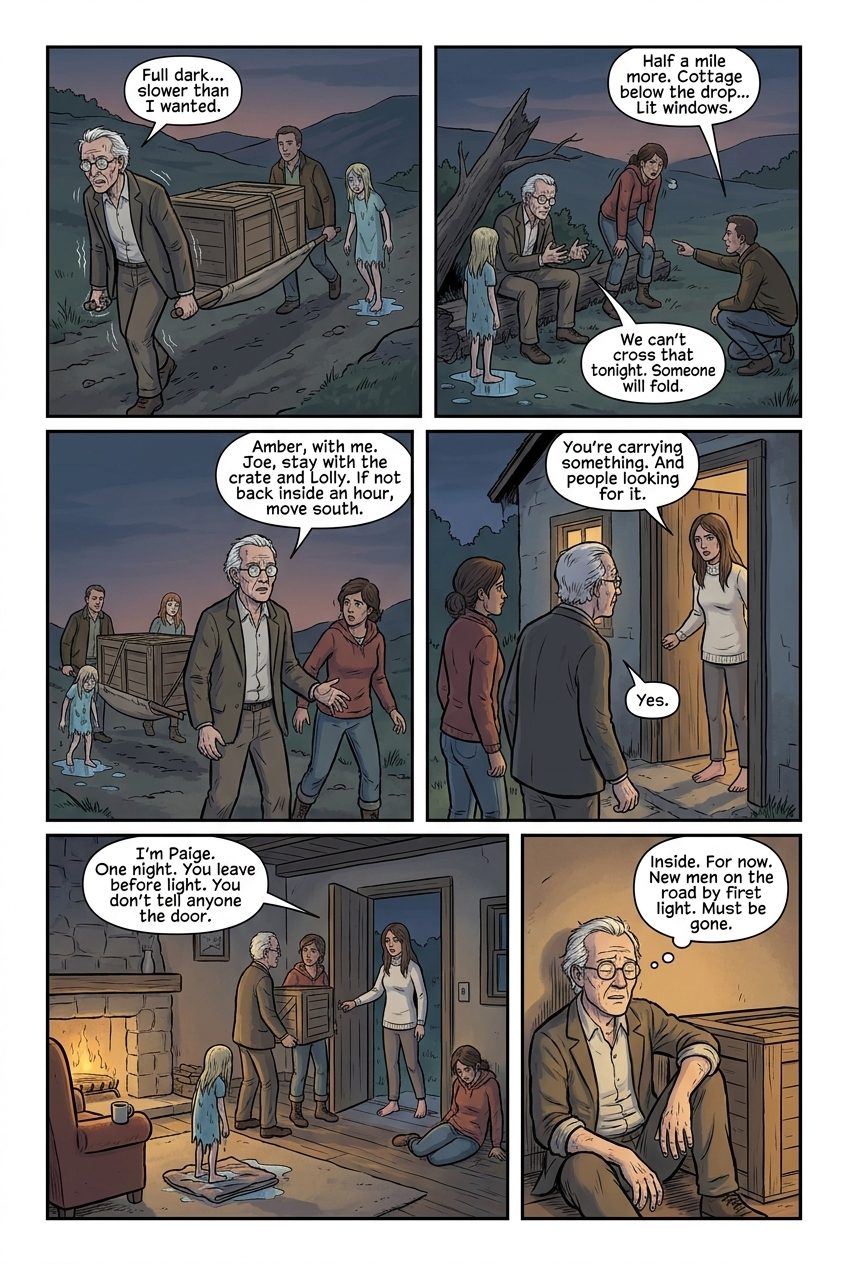
Full dark came slower than Ben wanted. He, Joe, Amber, and Lolly moved the crate out of the fold on a strip of canvas, four corners, four hands. The ground west of the fold went up before it went down. After the first rise, Joe took point. After the second, Amber fell back to watch their trail. After the third, Ben's arms were shaking. They rested behind a deadfall. Lolly set her end down last. Water ran off her wrists onto the canvas and beaded there. Joe came back at a crouch. "Half a mile more and the slope drops," Joe said. "After that it's open till the pines." "How open?" "Two hundred paces. No cover." Ben looked at the crate. He looked at his hands. Amber was breathing through her teeth. Lolly's shoulders were up around her ears. "We can't cross that tonight," Ben said. "Someone will fold." "We can't stay here," Amber said. "New men on the road by morning." Joe crouched by the canvas. "There's a cottage below the drop. Lit windows. One woman I saw." "Ours?" "No. But quiet. No dogs. No watchers." Ben thought of Paige's cottage weeks back, the woman who had let them open a container on her table and asked nothing after. He did not know this one. He knew he could not carry the crate another mile without dropping it. "Amber, with me. Joe, stay with the crate and Lolly. If we're not back inside an hour, move south." Ben and Amber went down the slope on their heels. The cottage was small, one window lit yellow. He knocked once. The woman who opened the door had brown hair loose over a pale sweater and bare feet on cold boards. She looked at Ben's face, then Amber's, then past them into the dark. "You're carrying something," she said. "Yes." "And people looking for it." "Yes." She was quiet a moment. Ben saw a low chair by the hearth, a cup on its arm, a shawl folded on the seat. A room set up for one person to sit and not be found. "I came here to stop running errands," she said. "I'm Paige. One night. You leave before light. You don't tell anyone the door." "Agreed." They brought the crate down in two trips on the canvas. Paige held the door and did not touch it. Joe slid it under a bench along the back wall. Lolly stood on a folded rag by the hearth so the boards would not warp. Amber sat on the floor and did not get up again. Ben leaned against the wall. His arms would not stop shaking. The crate was inside four walls. His people were inside with it. By first light he had to be gone, with new men already on the road and a host who had asked for one thing and would not ask twice.
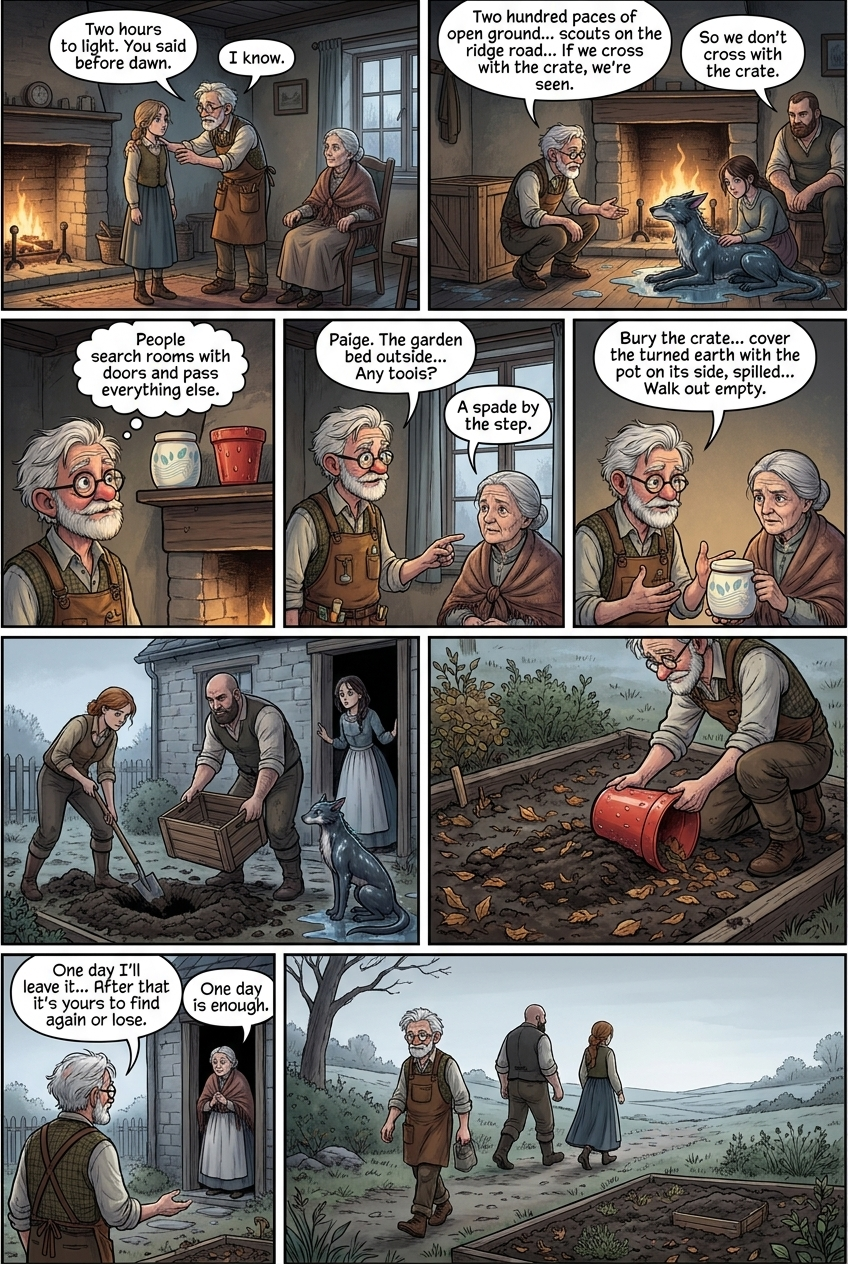
Ben woke Amber before the sky moved. The hearth was low. Paige sat in the low chair with the shawl over her knees and her eyes open. She had not slept. He understood without asking that she had counted the hours he owed her and was ready to collect. "Two hours to light," Paige said. "You said before dawn." "I know." "Then know it out loud." Ben crouched by the crate. Joe was already awake against the wall. Lolly slept curled by the hearth, one hand on a wet, dark-furred creature that breathed slow beside her. Water pooled under its chest and did not spread. The animal's ribs rose and fell in a rhythm that made Ben's own shoulders drop a finger's width. He made himself look away. "Two hundred paces of open ground between us and the pines," he said to Joe. "Scouts on the ridge road. New men by first light. If we cross that field with the crate, we're seen." "So we don't cross with the crate," Joe said. Ben looked at the room. A tea canister sat on the shelf above the hearth, pale with painted leaves. Beside it, a red clay pot, still slick from last night's rain off the sill. He thought about doors. He thought about what Lolly had said at the fold, that people searched rooms with doors and passed everything else. "Paige," he said. "The garden bed outside your window. How deep is the soil?" "To my knee. Then rock." "Any tools?" "A spade by the step." He explained it fast. Bury the crate in the garden bed under the herbs. Cover the turned earth with the pot on its side, spilled, like she'd knocked it over and left it. Walk out empty at first light in four directions. No crate to spot. No crate to carry. Paige's mouth tightened. "And when they come to my door?" "They won't search a garden. They'll search rooms." She looked at the tea canister a long moment. Then she nodded once. They worked without talking. Joe and Ben lifted the crate on the canvas. Amber dug. The soil came up black and cold. Lolly's creature watched from the doorway, damp and still, and the scouts on the ridge did not stir. They laid the crate in flat, packed earth over it, replanted three clumps of thyme on top by feel. Ben tipped the red pot on its side against the bed and scattered a handful of dry leaves. Gray light was in the east when he stood back. The garden looked like a garden a tired woman had left untidy. "One day," Paige said at the door. "I'll leave it one day. After that it's yours to find again or lose." "One day is enough." He went east across the field with empty hands. Behind him, Joe went north. Amber south. Lolly stayed with Paige as a daughter might, drying her hair by the fire, and the crate slept under the thyme.
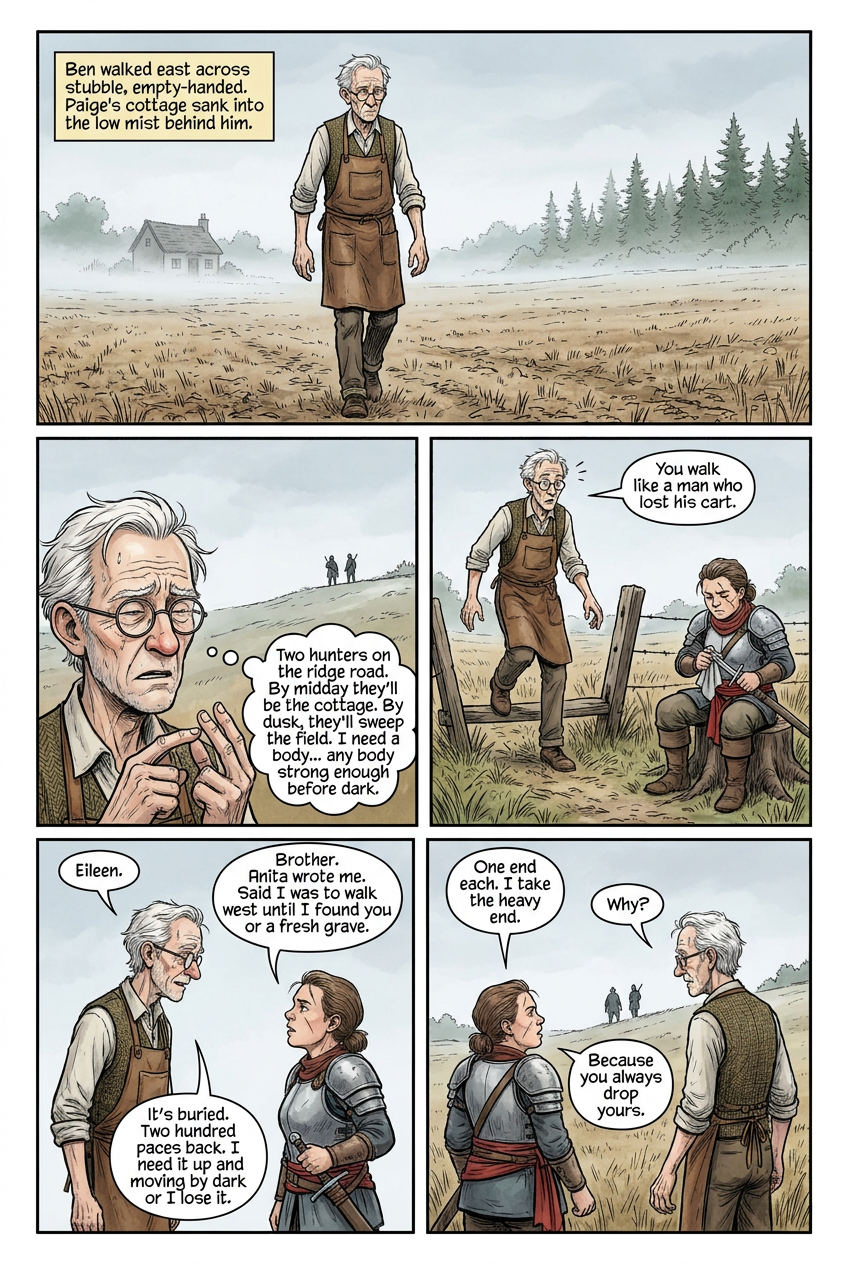
Ben walked east across stubble with empty hands. The sky was the color of skimmed milk. Behind him, Paige's cottage sank into the low mist. Ahead, the pines held the crate's future if he could reach them with help. He could not. Joe was north. Amber south. Lolly stayed at the hearth. He had scattered his people to make four small targets, and now he had none of them within a shout, and no place set for meeting again. He counted paces the way his father counted crates. Four hundred by the time the field ended at a broken stile. Two hunters on the ridge road, small as ticks. He knew their pattern. By midday they would come down to the cottage. By dusk they would sweep the field. If the crate stayed in Paige's thyme past sundown, someone with a spade and a sharp guess would find it. He needed a body. Any body strong enough to lift one end of the crate before dark. He had no rendezvous. He had a field, a stile, and a road he could not walk. He crossed the stile into a lane of trampled grass and stopped. A girl sat on a stump at the bend, cleaning a short sword across her knee with a rag. Armor plated her shoulders. A red scarf hung to her hip. Two thin scars crossed her cheek. She looked up without surprise, the way someone looks up who has been waiting. "You walk like a man who lost his cart," she said. Ben stopped three paces off. "Eileen." "Brother." He had not seen his sister in six years. The last word between them had been a door closing. He felt it close again in his chest and then, oddly, open. "How did you find me?" "A woman in a cottage told a boy on the road that a plague-looking man passed through last week. I followed the smell." She sheathed the sword. "Also, Anita wrote me. Two weeks ago. She said if the letter reached me I was to walk west until I found you or a fresh grave." "You came for that?" "I came because she said thirteen and then said twelve, and I wanted to know which one of you was lying." He almost laughed. "Neither. It's twelve." She stood. She was shorter than him by a head and built like a post driven deep. "Where is it?" "Buried. Two hundred paces back. Under thyme in a garden. I need it up and moving by dark or I lose it." Eileen looked past him at the ridge. She counted the two figures the way he had counted them. "One end each," she said. "I take the heavy end." "Why?" "Because you always drop yours." He turned back toward the field with his sister at his shoulder. His hands were still empty. They would not be by nightfall.
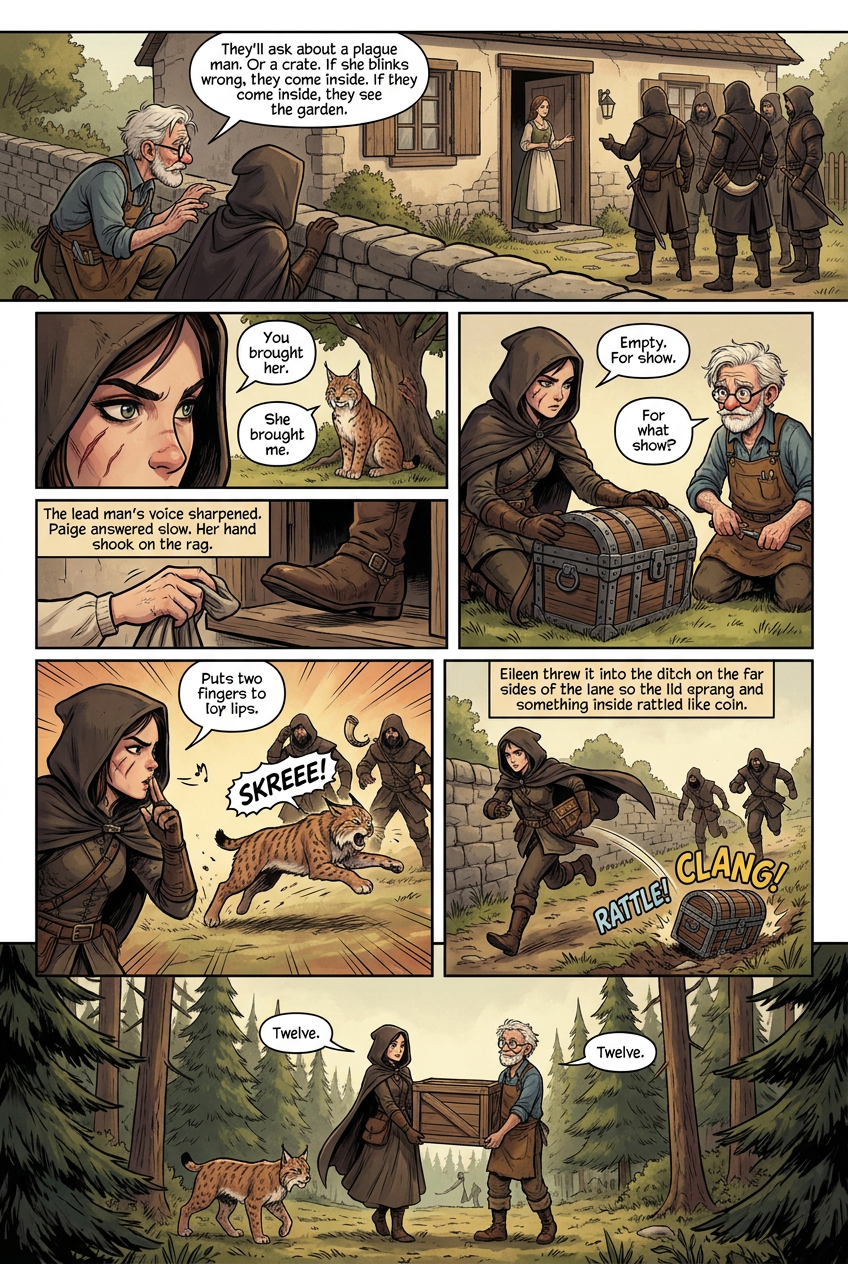
They were still fifty paces from Paige's gate when the hunters arrived. Ben pulled Eileen down behind the low wall and counted them. Four men on the lane, leather and long knives, one with a horn on his belt. The lead man knocked at the cottage door. Paige opened it with a rag in her hand as if she had been scrubbing a pot. "They'll ask about a plague man," Ben whispered. "Or a crate. If she blinks wrong, they come inside. If they come inside, they see the garden." Eileen didn't look at him. She was watching the lynx. It sat under the elder tree at the corner of Paige's fence, ears flat, tail low. Scars crossed its shoulder in old lines that matched the ones on Eileen's cheek. Ben had not seen the animal in six years either. It had been a kit the last time, sleeping across his sister's boots. "You brought her," Ben said. "She brought me." Eileen unclipped a strap on her pack and slid a small chest to the grass. It was banded iron, marked with crossed swords, the kind soldiers used to carry pay. "Empty," she said. "For show." "For what show?" "The one where the hunters chase a chest that isn't yours." At the door, the lead man's voice sharpened. Paige answered slow. Her hand shook on the rag. Ben saw the man step forward, one boot on her sill. Eileen whistled once, low. The lynx moved. It crossed the lane behind the men in three strides, hit the far hedge, and screamed. The sound was not a cat sound. It was a battle sound, drilled and ugly, and it carried. All four men turned. The horn man got the horn halfway to his mouth. Eileen was already up, running low along the wall with the iron chest under her arm. She let it clang once against a stone. Then she threw it into the ditch on the far side of the lane so the lid sprang and something inside rattled like coin. "There," one hunter shouted. The lead man swung off Paige's step. All four went for the ditch and the lynx and the noise. Paige shut her door. Ben was over the wall before it latched. He dug with his hands through thyme until his knuckles struck wood. He got the crate up on one end. Eileen dropped beside him, breathing hard, and took the heavy side without a word. The lynx broke from the hedge and paced them, watching the lane. They were in the pines before the horn sounded behind them, and by then the hunters were following an empty iron box south. Ben kept walking. His sister carried the other end. The crate hummed once under the sap and went quiet. "Twelve," Eileen said. "Twelve," Ben said.
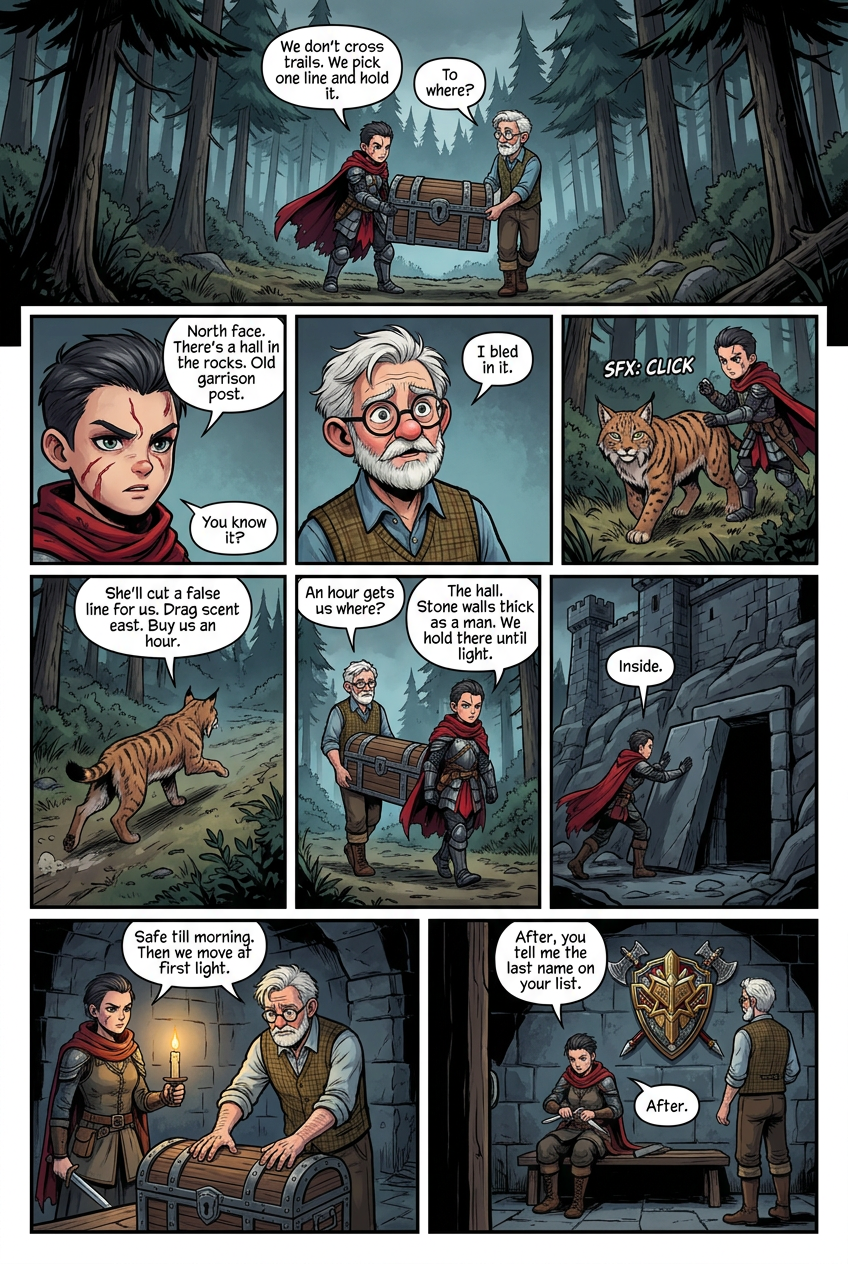
The pines thickened. Ben led with the front of the crate braced on his hip. Eileen walked backward at the heavy end, watching the way they had come. The horn had gone quiet a mile back. That was worse than hearing it. A silent hunter meant one who had stopped chasing the wrong thing. "We can't wander," Ben said. "By dawn they'll fan out. Every trail we cross, they cross too." "Then we don't cross trails." Eileen shifted her grip. Her knuckles were white on the wood. "We pick one line and hold it." "To where?" "North face. There's a hall in the rocks. Old garrison post. Empty since the last border war." Ben stopped. "You know it?" "I bled in it." She said it the way she said everything. Flat. No apology. Ben remembered the letter their mother had sent him six years ago, the one he'd burned unread. He looked at the scar on his sister's cheek and understood a little of what had been in it. The lynx padded out of the brush ahead of them, tail low. Eileen clicked her tongue once. The cat turned and moved off at an angle, sweeping the flank. "She'll cut a false line for us," Eileen said. "Drag scent east. Buy us an hour." "An hour gets us where?" "The hall. Stone walls thick as a man. No windows on the road side. One door. We hold there until light and I read the ground." "Hunters find doors." "They find doors they know about. This one they don't." Ben started walking again. The crate hummed once under the sap and stopped. He counted his breaths against his steps, the way he had counted since the shrine, since the mask, since the first day of all this. They climbed for an hour. The pines opened onto a shelf of broken rock. Eileen crouched at a slab that looked like all the others and pushed. The slab gave. Behind it a low doorway showed black. "Inside," she said. Ben went first, dragging the crate. Eileen followed and pulled the slab back. The dark smelled of cold iron and old smoke. She struck a flint. A short candle showed a stone room with a bench, a rusted rack, and a shield hung crooked on the far wall. Crossed axes, a fist at the center. A garrison mark. Ben set the crate down. His hands would not stop shaking. He pressed them flat against the wood until they did. "Safe till morning," Eileen said. She sat with her back to the door and drew her knife across her thigh, cleaning it. "Then we move at first light with the sun in their eyes." "And after?" "After, you tell me the last name on your list." Ben looked at the shield. Twelve pieces in the crate. One name he had not spoken aloud in nine years. He nodded. "After," he said.
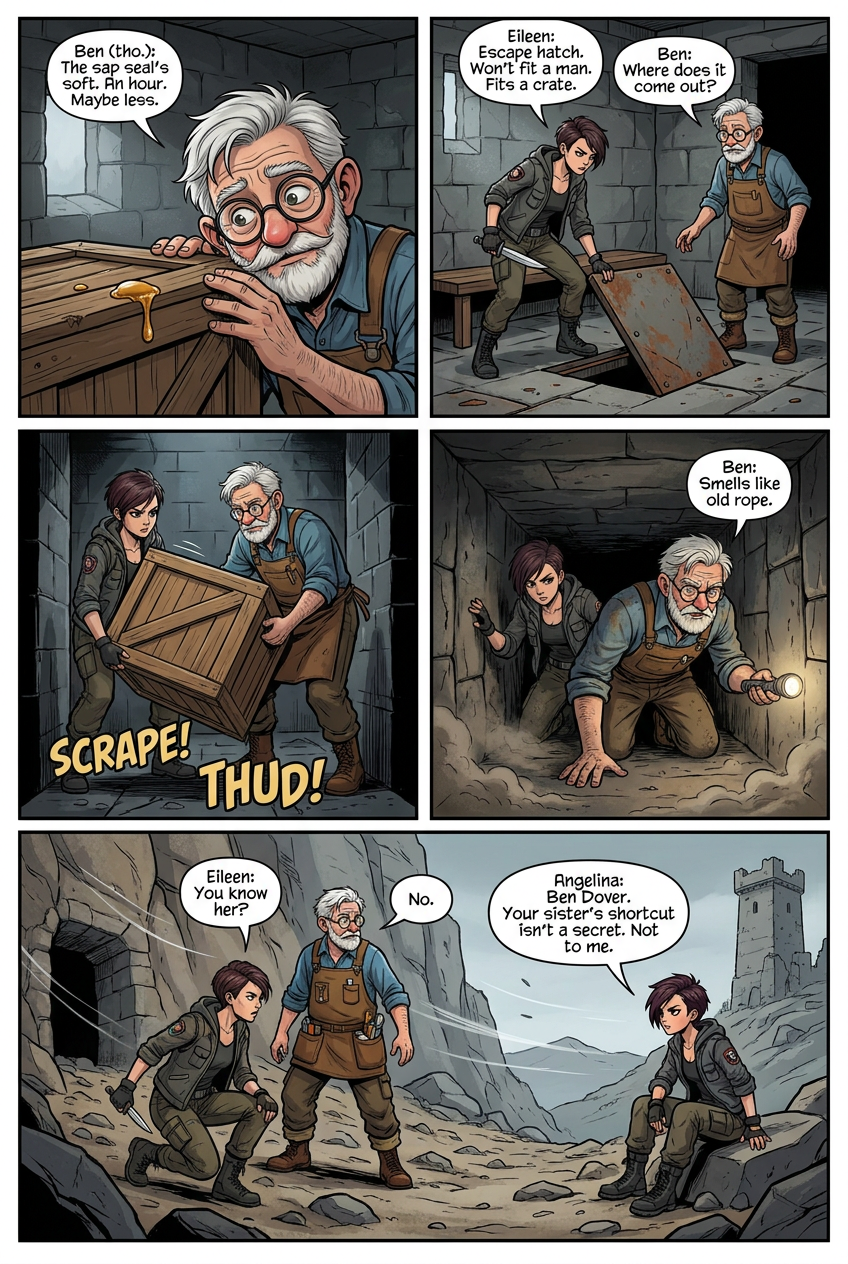
Ben woke to a smell like hot pine. The sap seal on the crate had gone soft. A bead of it sat on the lid, gold and slow. He touched it. His finger came away sticky. The garrison held heat like a kettle. Two bodies and a closed door had done what the ridge cold could not. Eileen was already up, knife across her knee. "How long?" "An hour. Maybe less." Ben pressed his ear to the wood. Under the sap he heard it start, a thin note climbing. "If it opens in here, the stone throws the sound. They'll walk right to the door." "Then we cool it." "With what." Eileen pointed her knife at the far wall. A narrow slot cut the stone above the bench, no wider than a hand. Gray light came through it. Cold air with it. "Garrison vent," she said. "Runs to the north face. Won't fit a man. Fits a crate." Ben measured the slot with his palm. The crate was longer than the opening was tall. "It won't pass through." "Not through. Under." She was already at the bench, dragging it aside. Beneath it a stone plate sat flush with the floor. She jammed her knife in the seam and pried. The plate lifted on a hinge of rust. Below, a shaft dropped into black. "Escape hatch," she said. "For when the door wasn't an option." Ben looked down. The shaft was tight. It smelled of old rope and mice. "Where does it come out?" "Behind the north face. In the scree." The hum climbed a step. The sap on the lid ran to the edge of the wood. Ben made the call. "You first. I'll lower it." Eileen went down the shaft on her elbows. When her boots hit stone she reached up. Ben tipped the crate onto its end and fed it into the hole. The wood scraped. The hum jumped, loud enough to fill the room for one breath. He shoved the crate the last inch. It dropped. Eileen caught it against her chest. Ben followed. He pulled the plate shut over his head. The rust groaned and set. The hum, sealed now under stone on all sides, went thin as a wire and then gone. They crawled. The shaft opened onto broken rock under a lip of hillside. Wind off the north face hit the crate and cooled the sap in seconds. Ben pressed his ear to the lid. Nothing. Eileen crouched, scanning the slope below. Her face changed. She lowered herself flat. Ben looked where she looked. On the scree fifty paces down, a woman sat on a stone with her elbows on her knees, waiting. Short dark hair. A gray jacket. She lifted her head and met Ben's eyes like she had counted the minutes it would take him to arrive. "You know her?" Eileen breathed. "No." The woman stood. "Ben Dover," she called up, easy. "Your sister's shortcut isn't a secret. Not to me."
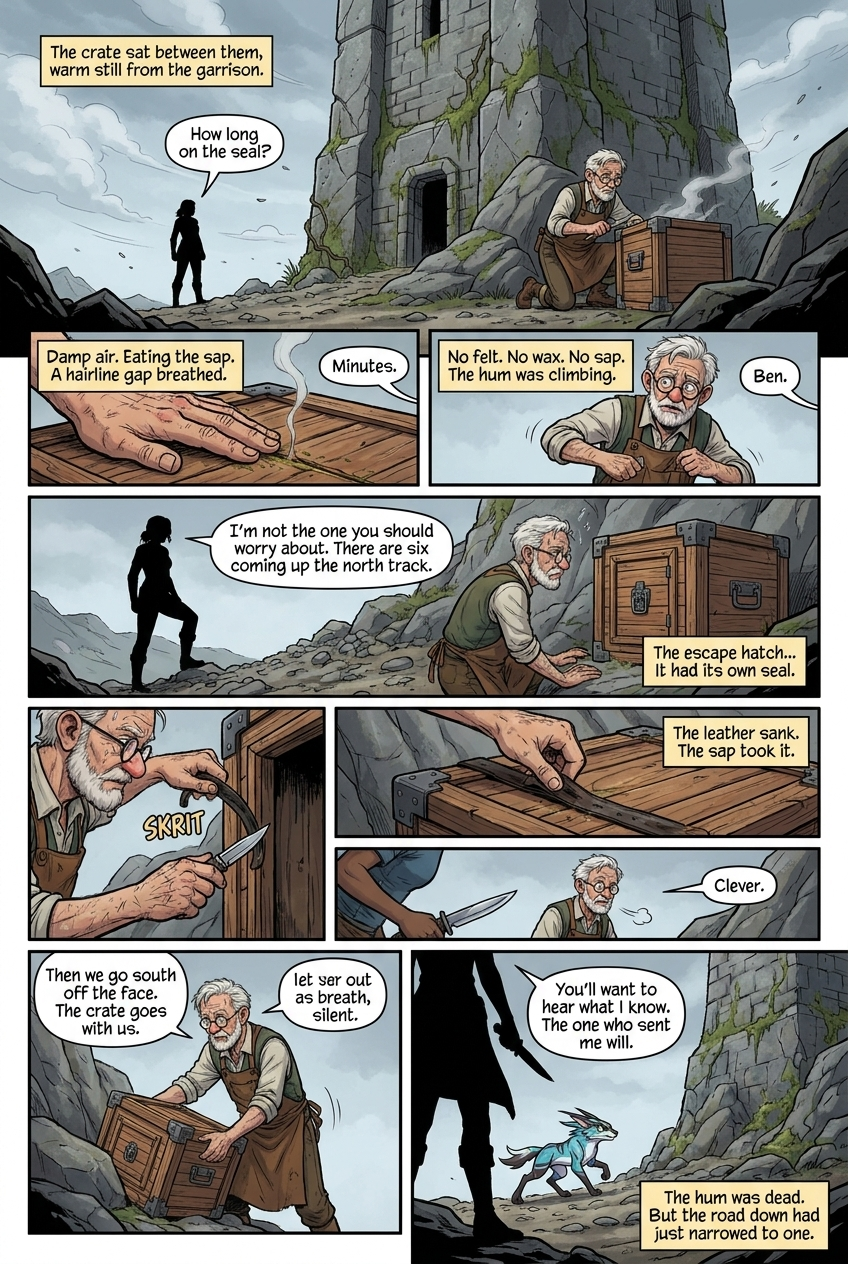
Ben stayed low against the lip of the shaft. The woman on the scree didn't climb. She waited, hands loose at her sides, like the slope was hers. Eileen's knife came up along her thigh, hidden by her leg. The crate sat between them, warm still from the garrison, the sap on the lid soft as honey. Ben pressed his palm to the wood. Under his hand, the hum ticked up half a note. The cold north wind wasn't enough. The sap was going. "How long on the seal?" Eileen breathed. "Minutes. The shaft air's damp. It's eating the sap." "Then we don't have this conversation." The woman below took one step up the scree. "I'm not the one you should worry about," she called. "There are six coming up the north track. I came ahead." Ben didn't answer. He worked the lid with his thumb. The bead of sap smeared and pulled a thread. Underneath, a hairline gap breathed. The hum leaked into the open air, thin, climbing. On a still day it would carry through the rock for a mile. Eileen heard it too. "Ben." He needed a fresh dampener and had none. No felt. No wax. No sap. He looked at the ground. Pine tar on the boughs above. Too slow to render. He looked at Eileen's coat. Wool, not enough. He looked at the crate itself. The hinge on the false panel caught his eye. The escape hatch built into the lid — a small square door meant to dump contents fast. It had its own seal, a strip of oiled leather pressed under the frame. Ben pried the panel with his knife. The leather came away in one long strip, dark with old grease. He pressed it flat over the failing seam on the main lid and thumbed it into the soft sap. The leather sank. The sap took it. The hum dropped to nothing in three breaths. Eileen watched him work without breathing. When it went quiet, she let the air out. Below, the woman tilted her head. She had heard the hum start and stop. She smiled, small. "Clever." Ben slid the crate behind the rock lip. He turned to Eileen. "Six on the north track." "Then we go south off the face." "The crate goes with us. Silent now." A shape moved on the scree behind the woman. Low, fast, blue-striped along the flank, built long for running. It came up beside her and stopped at her knee, ears forward, eyes on Ben. Not a hunting animal. A courier. Made for one burst and gone. The woman set her hand on its shoulder. "You'll want to hear what I know before they get here. My name won't mean anything to you. The one who sent me will." Ben looked at Eileen. Eileen looked at the creature. The seal held. The hum was dead. But the road down had just narrowed to one.
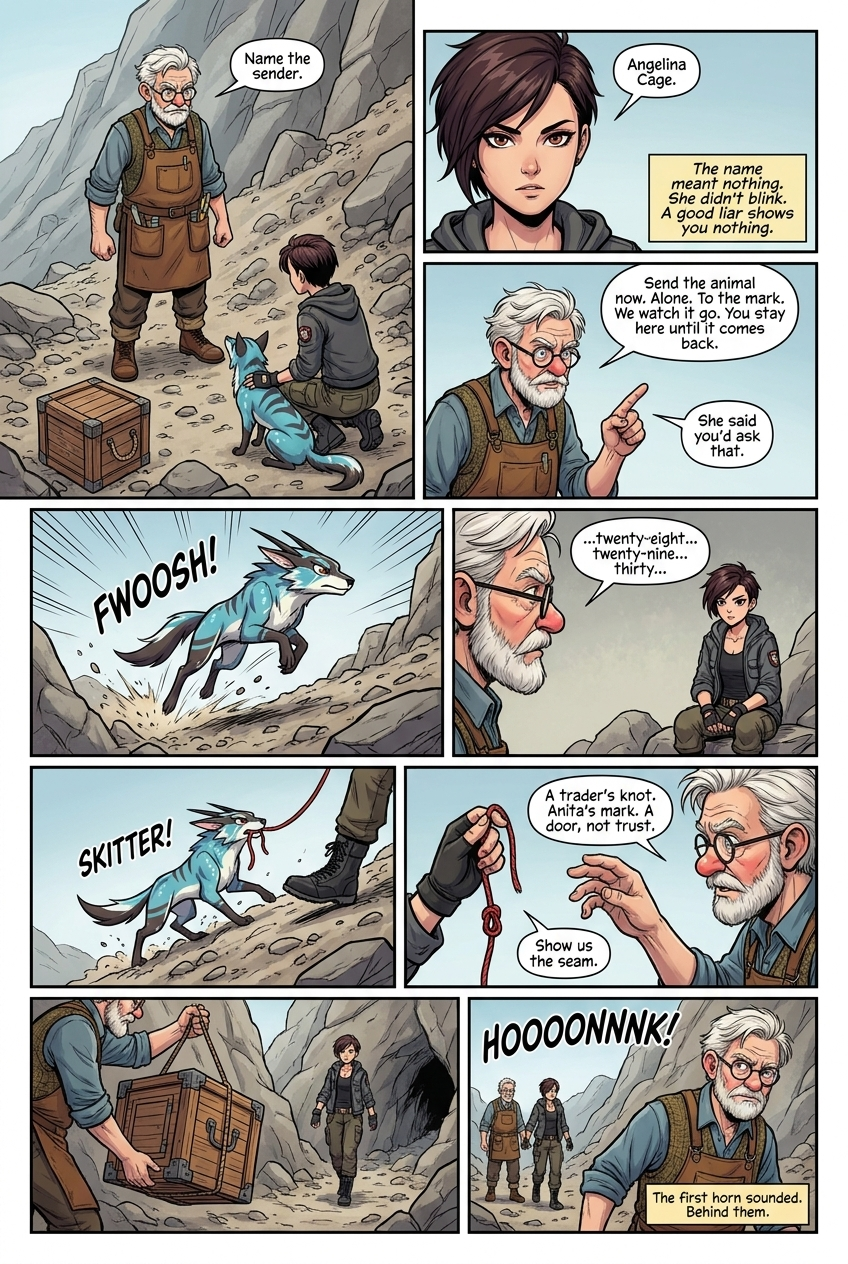
The woman waited on the scree with her courier animal at her knee. Ben stayed low above her. The crate was silent now, but the north track would give up six men soon. He had one choice to make and no clean way to make it. "Name the sender," Ben said. "Angelina Cage." The name meant nothing. Ben watched her face for the tell. She did not blink, did not shift her weight, did not sell it. That was the trouble. A person who lied badly showed you the lie. A person who lied well showed you nothing. He had no time to sort which she was. Eileen kept her knife along her thigh. "Six minutes," she said. "Maybe seven." The woman spoke again. "She says the north track ends at a rope bridge the herbalist owns. South off the face is where the six will drive you. There's a third path. She'll show my animal the mark." "Why send you?" Ben said. "Because she got out." The woman's voice stayed flat. "Three years in a tower. She learned who owns which road." Ben thought about it. A stranger with a courier could send them anywhere. Off a cliff. Into a second net. But the two roads he could see both led to the herbalist. He needed a test that cost the woman something before he paid. "Send the animal now," Ben said. "Alone. To the mark. We watch it go. You stay here with us until it comes back." The woman's mouth moved a fraction. Not a smile. A calculation. "She said you'd ask that." She knelt and put her palm flat on the courier's shoulder. She spoke two words Ben didn't catch. The animal launched off the scree in one burst, blue-striped flank low to the ground, and cut west along a seam in the rock Ben hadn't seen. It was gone before he counted three. Eileen kept her knife out. "If it doesn't come back?" "Then she dies here and we go south," Ben said, quiet, so the woman heard it. The woman heard it. She sat down on the scree and folded her hands in her lap. She did not argue. They waited. Ben counted his own breath. On thirty the courier came back up the seam with a scrap of red cord in its teeth. It dropped the cord at the woman's boot. She held it up so Ben could see. A trader's knot, the kind Anita used to mark safe cache lines. Ben felt the weight in his chest shift. Not trust. A door. "Show us the seam," he said. Eileen took the crate's rope. Ben took the other end. The woman rose and started down the scree without looking back. Above them, on the north track, the first horn sounded. It sounded behind them now, not ahead.
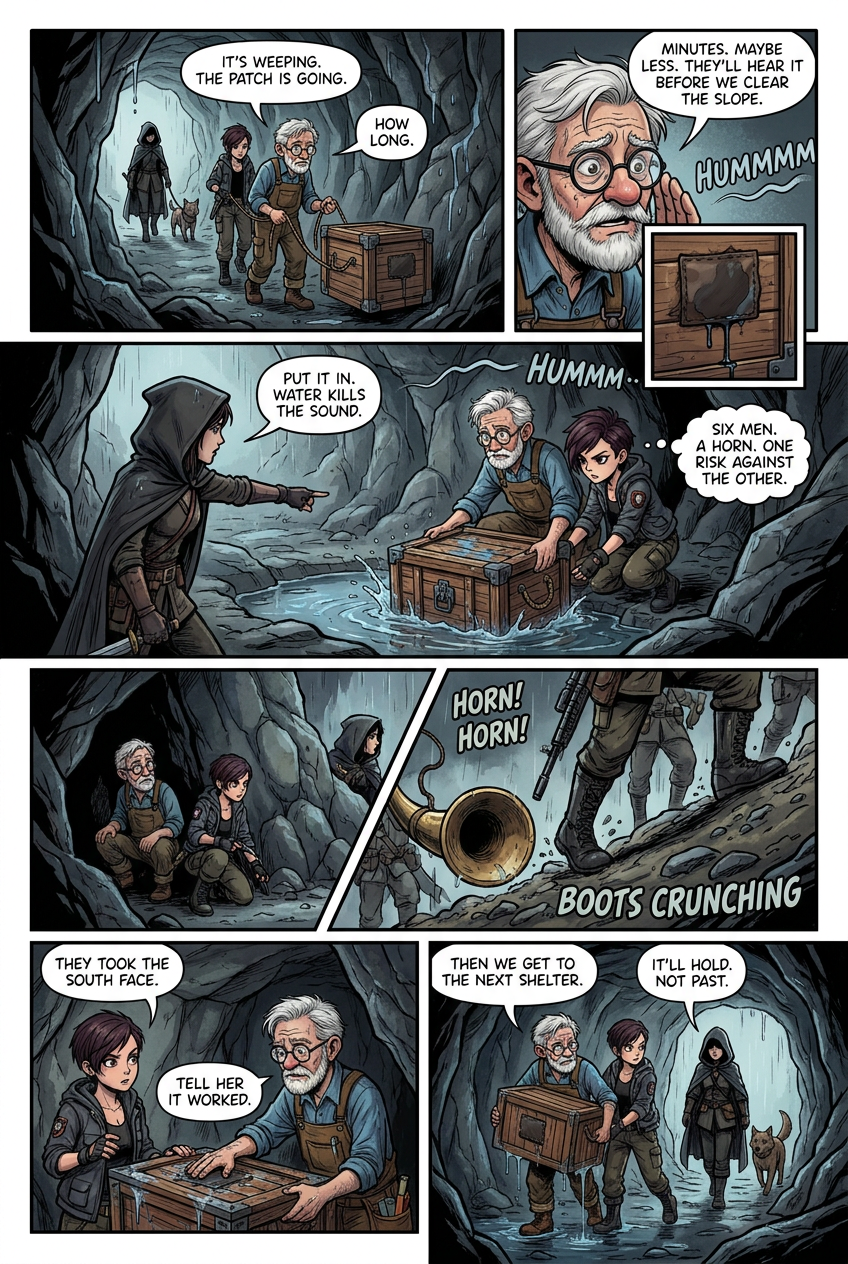
The seam cut west through the rock. Ben went first with the front rope. Eileen followed with the back rope. The woman moved ahead of them, quick and quiet, her courier animal padding at her heel. The horn on the north track sounded again, closer now. Ben glanced down at the crate and saw what he had been dreading. The oiled-leather patch he had cut from the escape hatch was darkening along one edge. A thin line of hum leaked from the seam under it, no louder than a wasp, but climbing. "It's weeping," Ben said. "The patch is going." Eileen did not slow. "How long." "Minutes. Maybe less. They'll hear it before we clear the slope." The woman stopped at a bend where the rock cupped inward. Water ran down the face in a thin sheet and pooled in a shallow basin at the base. She pointed at the basin. "Put it in." "In the water?" "Water kills the sound. It kills the scent too. Angelina said if the seal fails, you sink it and you wait." Ben thought about the wood swelling, the seams giving, the twelve pieces inside. He thought about six armed men coming down the track with a horn. One risk against the other. "How deep." "To the lid. No more." Eileen was already lowering her end. Ben lowered his. The crate settled into the basin with a dull knock against stone. Water climbed the sides and stopped a finger below the lid. The hum cut out like a hand had closed on it. They crouched behind the rock cup. The horn sounded above them, then again, farther east. Boots crossed the scree overhead. Ben counted six sets. He counted them past. He counted a long silence after. Eileen let her breath out. "They took the south face." Ben put his palm on the wet lid. The wood was cold. No hum. No crack he could hear. He looked at the woman. She had not moved, had not spoken, had not sold the moment. Her courier animal watched the seam behind them. "Tell her it worked," Ben said. "She'll know." They lifted the crate out of the basin. Water sheeted off the sides and ran back into the pool. The oiled-leather patch was soft now, blistered from the soak, but the seam beneath it had swelled tight. The hum stayed gone. Eileen tested the rope. "It'll hold to the next shelter. Not past." "Then we get to the next shelter," Ben said. The woman was already moving west along the seam. Ben took the front rope again. The crate was heavier wet, and the patch would not survive another failure. But the six men were gone the wrong way, and Angelina Cage's third path was still open under his feet. He followed the woman into the rock.
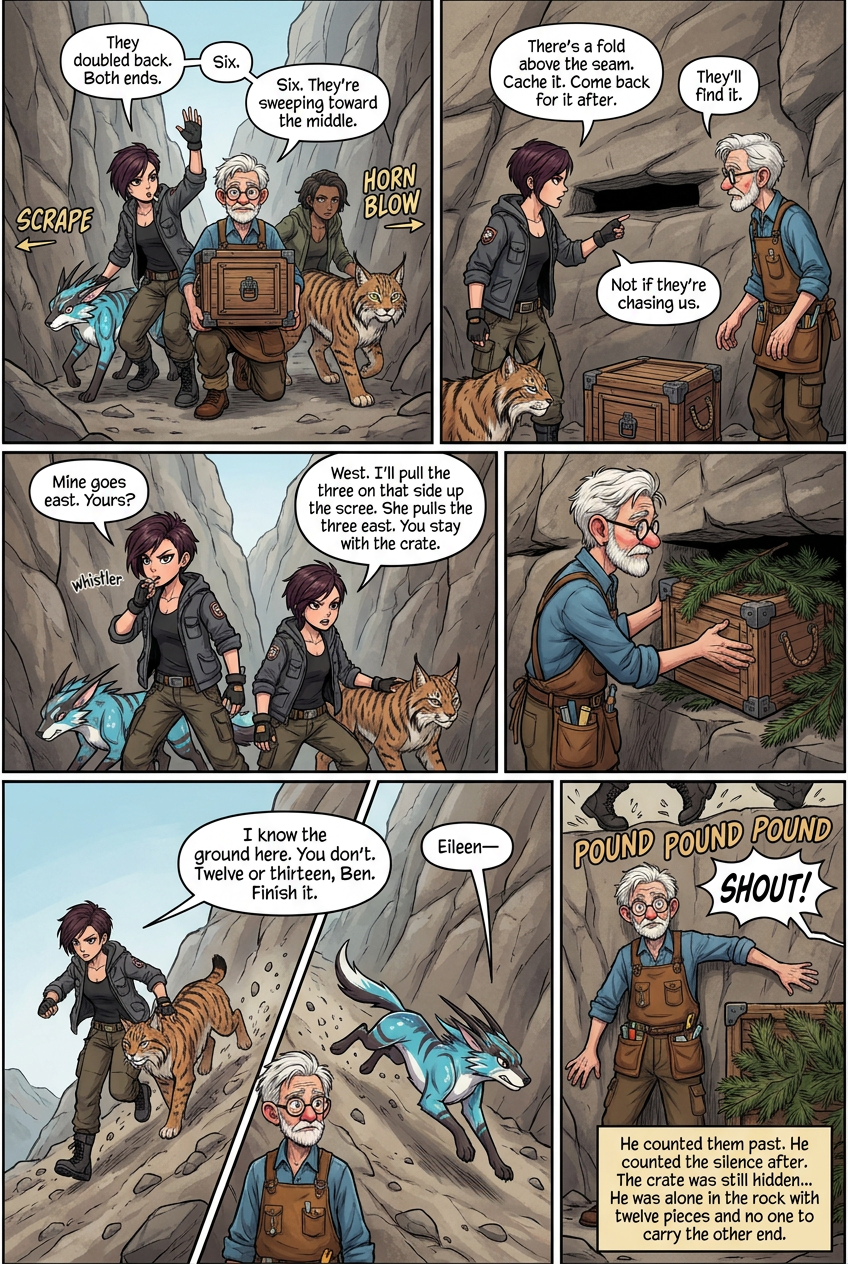
The seam narrowed. Ben felt the rock press in on both shoulders. The woman ahead stopped and raised one hand. Her courier animal froze at her heel. From the west, a boot scraped stone. From the east, a horn answered, low and close. "They doubled back," the woman said. "Both ends." Eileen set her end of the crate down without a sound. "Six." "Six," the woman agreed. "They're sweeping toward the middle." Ben looked at the crate between them. The oiled patch had dried tight, but the wood was still soft from the basin. If he ran, the seams would knock loose. If he stayed, the men closed on him in minutes. He set his hand on the lid and made himself think. "There's a fold above the seam," Eileen said. She pointed at a dark slot in the rock, chest high, wide enough for the crate and nothing else. "Cache it. Come back for it after." "They'll find it." "Not if they're chasing us." Ben looked at his sister. Six years of nothing, and now she was offering to be the bait. He did not have time to argue. He nodded once. They lifted the crate into the slot. Ben packed pine boughs against the front until the wood disappeared. He set a flat stone across the base to break the line. When he stepped back, the fold looked like every other shadow in the seam. The woman whistled low. From the brush behind her, a sleek blue-marked creature slid out and pressed against her leg, muscles wound tight, head forward. Her hand rested on its neck. "Mine goes east," she said. "Yours?" Eileen clicked her tongue. Her lynx came down off the rock above them, striped and heavy, ears flat. It brushed her hip and waited. "West," Eileen said. "I'll pull the three on that side up the scree. She pulls the three east. You stay with the crate." "Eileen—" "I know the ground here. You don't." She met his eyes. "Twelve or thirteen, Ben. Finish it." She went before he could answer. The lynx ran ahead of her, deliberate, loud on the loose stone. The woman went the other way with the blue creature at a dead sprint, kicking gravel to leave a trail a child could read. Ben pressed himself flat into the seam beside the hidden crate. The east horn blew again, then swung after the woman's noise. Boots pounded past above his head, three sets, going east. A shout came from the west slope. Three more sets crossed the top of the seam and climbed after the lynx. He counted them past. He counted the silence after. The crate was still hidden. His sister was gone up the west face with three armed men behind her. He was alone in the rock with twelve pieces and no one to carry the other end.
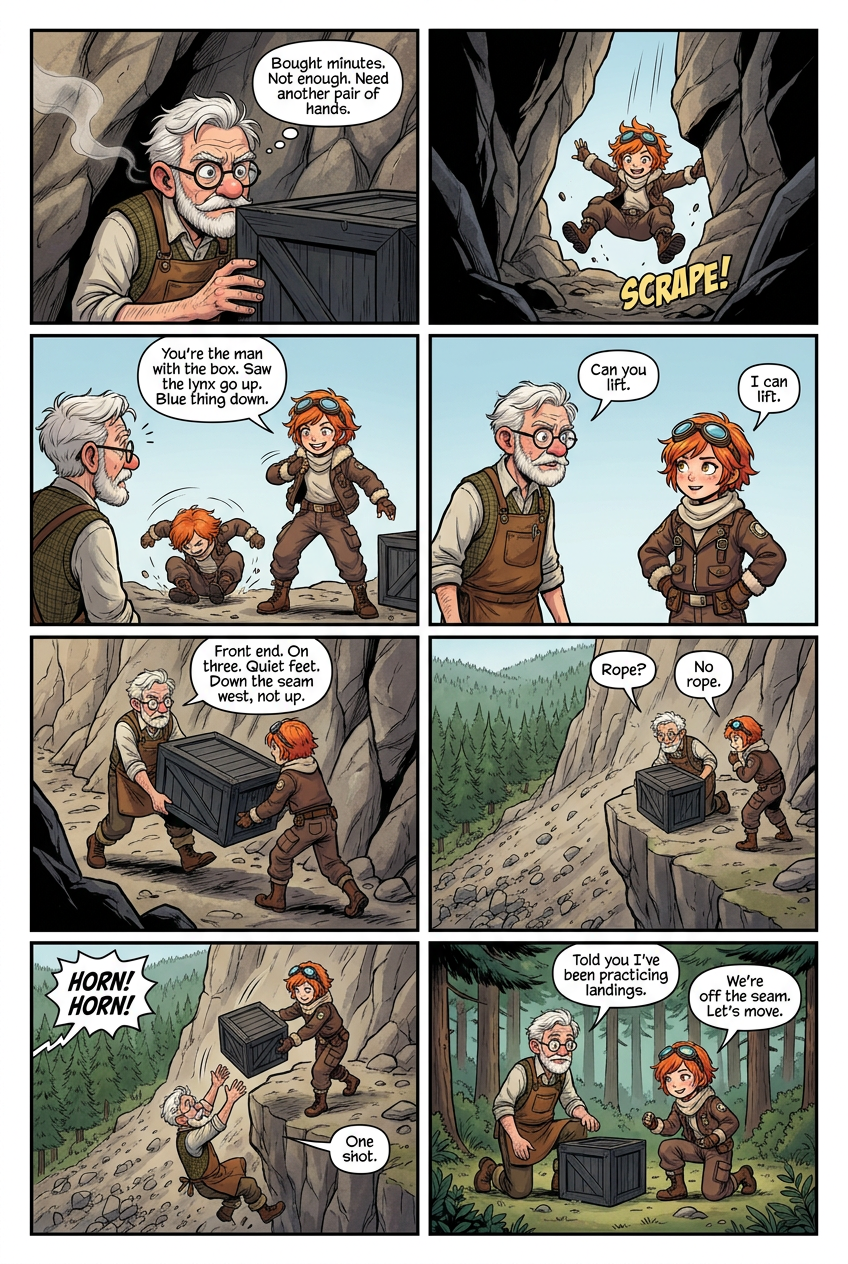
The seam went quiet. Ben stayed pressed against the rock beside the hidden crate. His sister was somewhere up the west scree with three men behind her. The woman with the courier animal was pulling the other three east. He had bought minutes, maybe a quarter hour. Then the men would climb back down and start sweeping the middle again. He could not carry the crate alone. He could not leave it. He needed a second pair of hands before the first horn sounded. A scrape came from above. Not a boot. Lighter. Ben flattened. A girl dropped down into the seam in a heap of elbows and leather. She landed hard, rolled once, and stood up grinning. Red hair under cracked goggles. A flight jacket two sizes too big. She saw him and did not startle. "You're the man with the box," she said. "I saw the lynx go up. Also the blue thing go down. I was on the ridge. I was trying to jump off it." Ben stared at her. "Trying to what." "Fly. I got three inches once. I'm working up." She flatly added, "Today I got zero. I'm Millie." He did not have time to sort her. He had time to use her. "Can you lift." "I can lift." He pulled the boughs away. The crate sat where he had wedged it, dark and silent under the flat stone. He tested the seams with his thumb. The oiled leather patch held. The sap seal held. For now. "Front end," Ben said. "On three. Quiet feet. Down the seam west, not up. Away from my sister." Millie set her hands under the lip without asking why. She was smaller than she looked in the jacket, but she braced her legs like someone who had lifted awkward things before. They pulled the crate free. It cleared the fold without knocking. They moved. Ben led. Millie followed at the front end, walking backward, watching his feet. The seam bent south and opened into a shelf of loose scree. Ben stopped at the lip. Below them, past a drop of twenty feet, the pines began. Cover. Real cover. "Rope?" Millie whispered. "No rope." She looked at the drop, then at him. "I can lower one end from up here while you climb down with the other. Then you catch. I jump after." "You'll break your leg." "I've been practicing landings for four years." She shrugged. "Sort of." A horn blew. East. Then a second, further east. The woman was still pulling them. He had one shot. Ben went over the lip. Millie fed the crate down, hand under hand, until he took its weight against his chest. He set it in the scree. She dropped after, hit rolling, came up limping but upright. They were off the seam. The crate was moving. He was not alone.
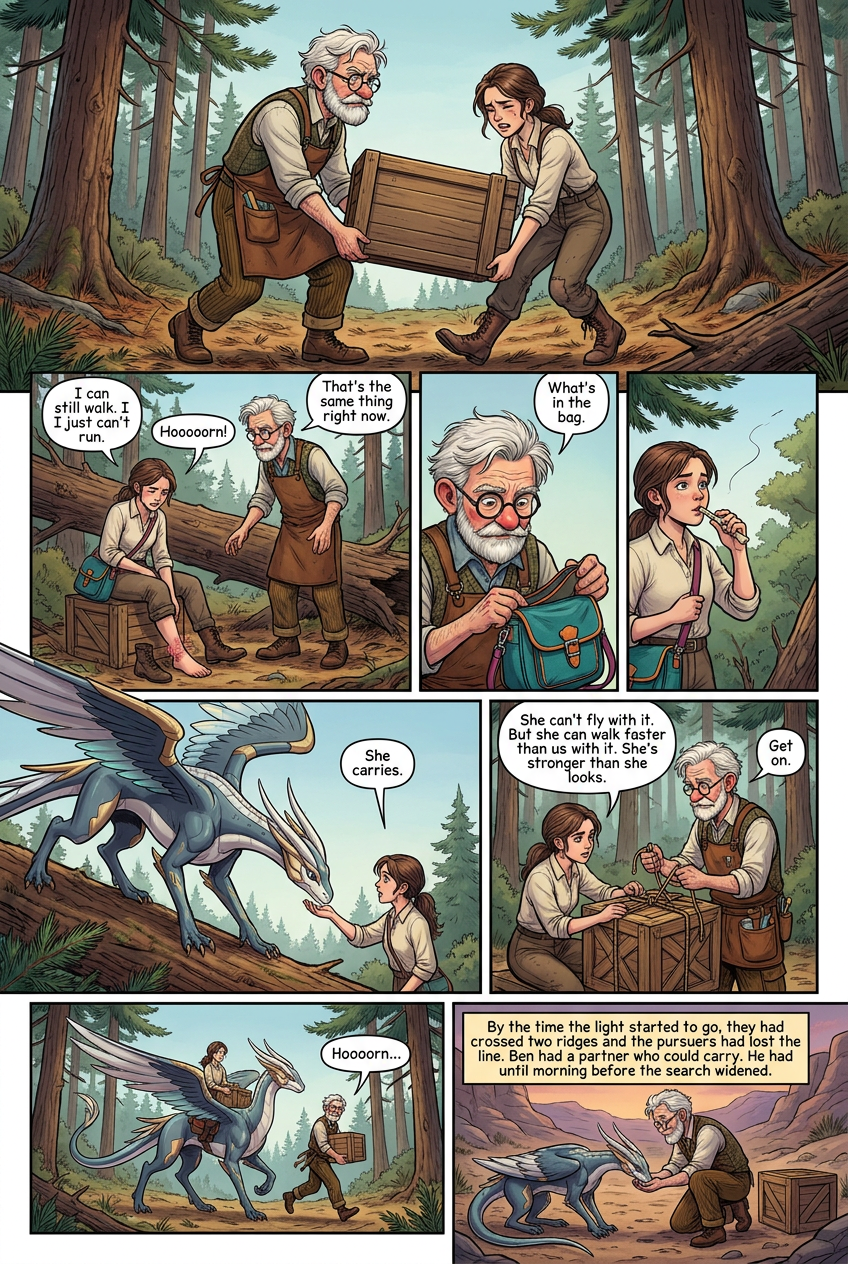
Ben and Millie hit the pine floor and kept moving. The crate rode between them, low and awkward. Millie's limp was worse than she let on. She hopped every third step to save her right ankle. Ben watched her jaw set each time it landed. They had cover now, but the ground climbed again in fifty paces, and he could already hear her breath going thin. He stopped behind a fallen trunk and set the crate down. Millie sat on it before he could tell her not to. She pulled her boot off. The ankle was swelling fast against the wool. "I can still walk," she said. "I just can't run." "That's the same thing right now." A horn sounded behind them. Closer than the last one. The men had turned. Whatever Eileen and the woman had done to lead them east, it was over. Ben counted in his head. If Millie moved at half speed and he dragged the crate alone the other half, they would be caught on the slope before dark. He had seen the math before. It always came out the same. He looked at the satchel slung across Millie's chest. Teal leather, orange trim, a buckle too fine for a girl who jumped off ridges. He had not noticed it in the seam. "What's in the bag." "Whistle." She was already pulling it out. A short bone whistle on a cord. "For her. She doesn't come for anyone else. I've been trying to teach her to catch me." "Teach who." Millie blew. No sound Ben could hear. She waited, watching the gap in the canopy. The creature came down through the pines without touching them. Long body, folded wings the color of wet slate, a tail that cut the air behind it. It landed light on the needles and lowered its head to Millie's hand. She scratched under its jaw like it was a barn cat. Ben did not move. "She carries." "She carries me. I don't know about the box. She's never tried." "Try." They worked fast. Millie fed her cord through the crate's rope handles and looped it under the creature's chest harness. Ben tested the knot with his weight. It held. The creature shifted, took the load, and did not stagger. "She can't fly with it," Millie said. "But she can walk faster than us with it. She's stronger than she looks." "Get on." Millie climbed up behind the wings. Ben led on foot, one hand on the crate, the creature pacing him at a trot he could just keep. The horn sounded again. Farther this time. They were pulling ahead. By the time the light started to go, they had crossed two ridges and the pursuers had lost the line. Ben stopped in a dry wash and let the creature drink from his palm. The crate sat behind her, still sealed, still silent. He had a partner who could carry. He had until morning before the search widened.
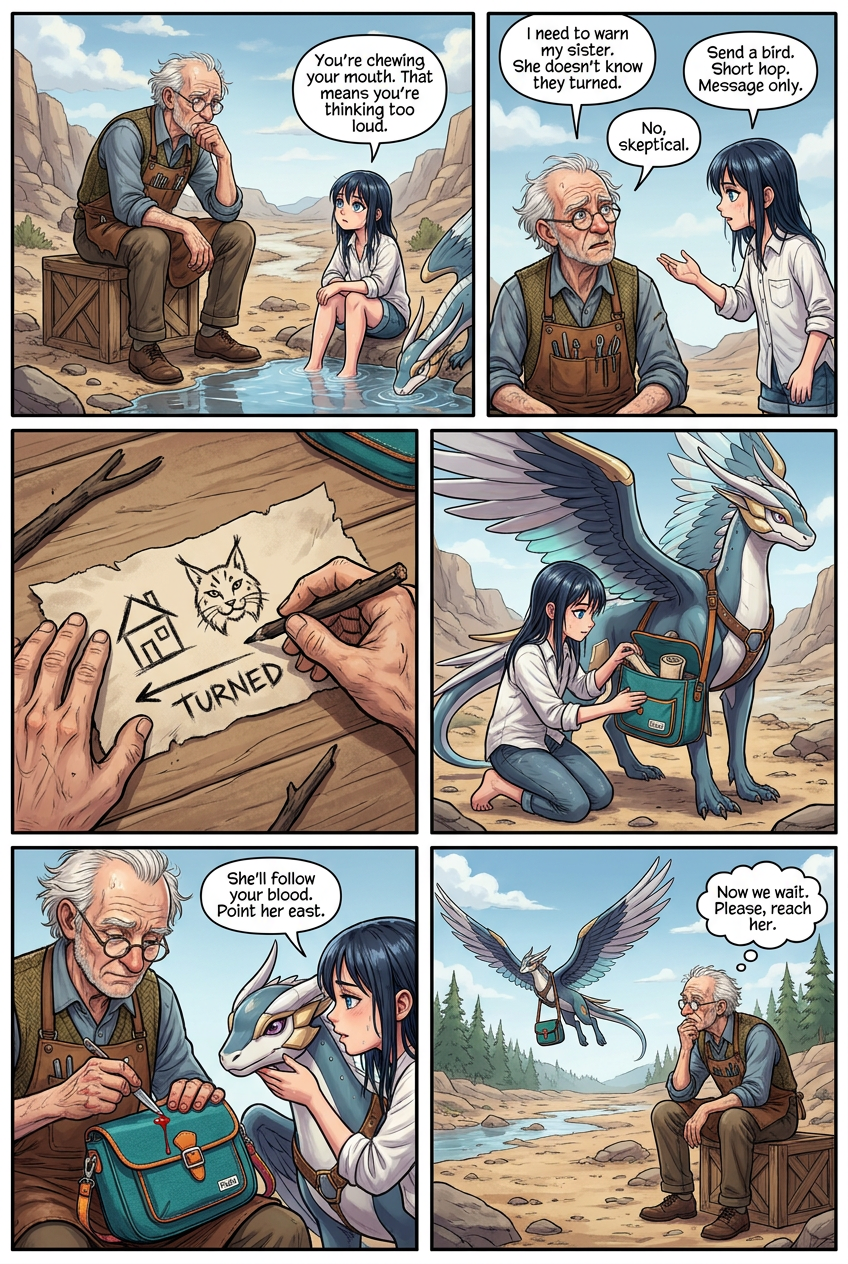
Ben let the winged creature rest in the dry wash while Millie cooled her ankle in a pool. He counted what he had. A crate. A hurt girl. A creature that could carry but not fly loaded. No map, no courier, no way to reach Eileen before she walked back into the search line. Anita and Justin were somewhere east with the decoy. Amber, Joe, and Lolly had scattered from Paige's cottage two days ago. He had cut every string himself, and now he needed one back. Millie watched him from the pool. "You're chewing your mouth. That means you're thinking too loud." "I need to warn my sister. She's coming back to a road with men on it. She doesn't know they turned." "Send a bird." "I don't have a bird." Millie looked at the creature drinking beside him. Then she looked at Ben like he was slow. "She won't fly with the crate," Millie said. "She'll fly without it. Short hop. Message only. I've done it twice." "Twice." "Both times she came back." Millie shrugged. "That's the part that matters." Ben tore a strip from the inside of his coat. He had no ink. He drew on the cloth with a burnt stick from the wash, pressing hard so the marks held. Three shapes Eileen would know from when they were children. A crooked house. A lynx. An arrow pointing away from the north track. Underneath he scratched one word. TURNED. Millie unbuckled the teal satchel from her shoulder. Orange trim, a bright buckle. She emptied it on a flat stone. Two apples, a folded knife, a comb, a coil of waxed cord. She rolled the cloth tight and slid it into the front pocket. Then she looped the satchel's strap under the creature's chest harness and cinched it. "She'll go where I point," Millie said. "But she needs a face to find. Someone she's seen." "She hasn't seen Eileen." "She's seen you. She'll follow your blood." Millie caught his look. "That's what my gran said. I don't know if it's true. But she found me in a hailstorm once." Ben pricked his thumb on the knife and pressed a red mark to the satchel's flap, beside the small label stitched there. Millie whispered to the creature, one hand under its jaw. She pointed east, back along the ridge line they had crossed. The creature took two running steps and lifted. The wings opened wide and beat once, twice, and it was gone through the pines. The satchel swung under its chest, bright as a signal. Ben sat down on the crate. He had no way to know if it would reach her. He had no way to call it back. He had spent his last messenger on a hope. Millie pulled her boot back on and winced. "Now we wait for something to come back. Or we don't." The wash was quiet. The horn did not sound.
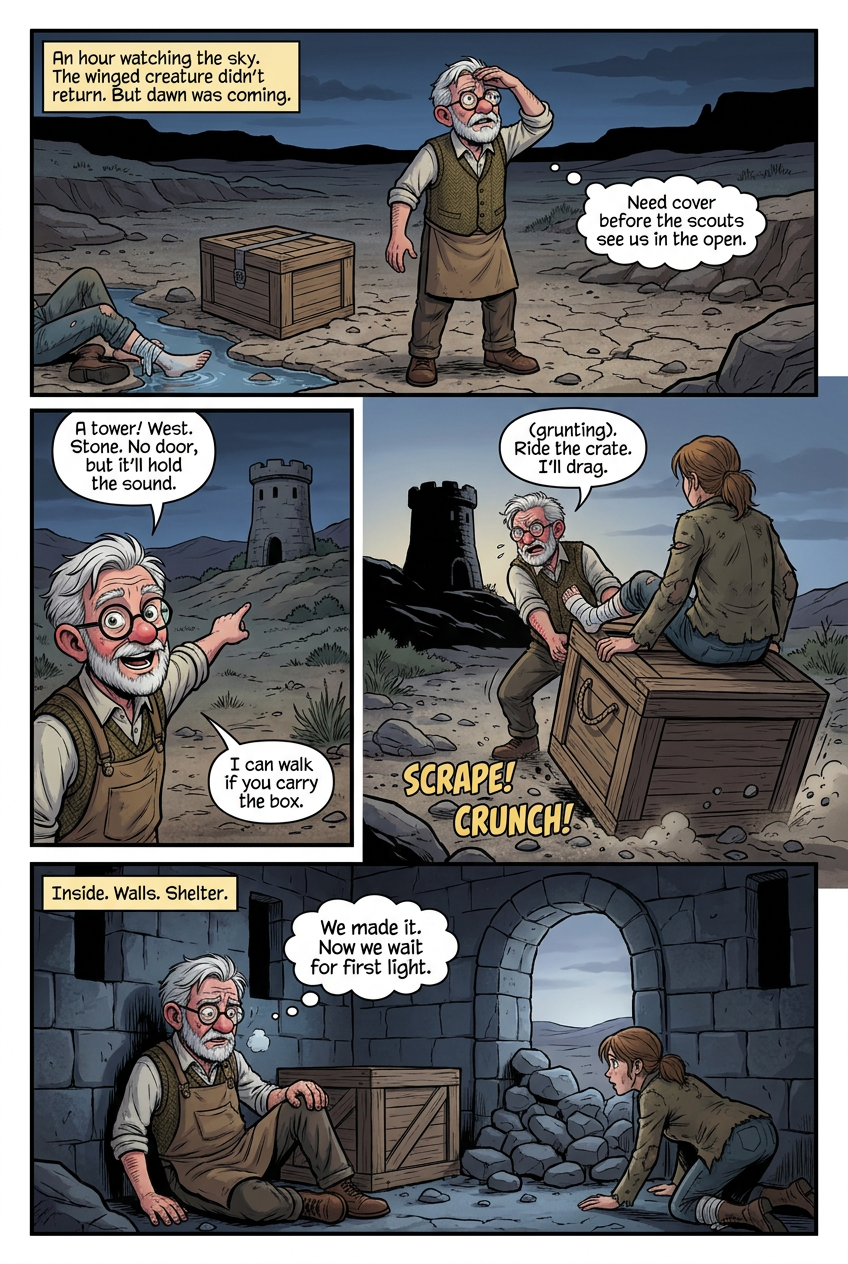
Ben watched the sky for an hour. The winged creature did not come back. Millie slept beside the pool with her boot off and her ankle wrapped in wet cloth. The crate sat between them in the dry wash, sealed and silent, but the wash had no walls. When the sun came up, anyone on the ridges above would see two figures and a box in the open stones. Ben needed cover before dawn, and dawn was maybe three hours off. He stood and turned in place. Pines to the north. Bare rock south. East was the way the creature had gone. West was where the wash bent and climbed and then flattened out into scrub. He walked that way, quiet, leaving Millie at the pool. The wash rose. The scrub thinned. Then he saw it, tucked against the hillside where the wash cut past — a squat stone tower, no taller than two men. It pinched in the middle like a spool. Three narrow slits high up. A low arched door with no door in it. Old work, older than the road maps he had used all his life. A watch post, maybe, from before the kingdom carved its border. Thick walls. Thick enough. Ben ducked inside. The air was cold and dead. No hum could carry through stone like this. He came back at a run. Millie was awake and had her knife out. She lowered it when she saw him. "There's a tower," Ben said. "Ten minutes up the wash. Stone. No door but the walls will hold the sound." "I can walk on it if you carry the box." "You'll ride the crate. I'll drag." He cut two lengths from the waxed cord she had emptied out earlier and lashed them under the crate to make handles. Millie sat on the lid with her bad leg out. Ben pulled. The crate scraped over gravel, jumped on stones, and he leaned into it until his shoulders burned. Millie kept watch behind them and whispered when he needed to stop. They reached the tower with the sky still black. Ben dragged the crate through the arch and pushed it against the back wall. He piled loose stones in the doorway to break the sightline from outside. Millie crawled in after him and lay flat on the dirt floor. Ben listened. No hum. No horn. Only Millie's breathing and his own. He sat with his back against the stone and let his hands shake. He had shelter. He had walls. He had a hurt girl and a sealed crate and no way to know if his message had reached Eileen. But the scouts would sweep the ridges at first light, and now they would sweep past a tower with no door and see nothing worth a second look. The first gray showed in the slits above his head. Ben did not move.
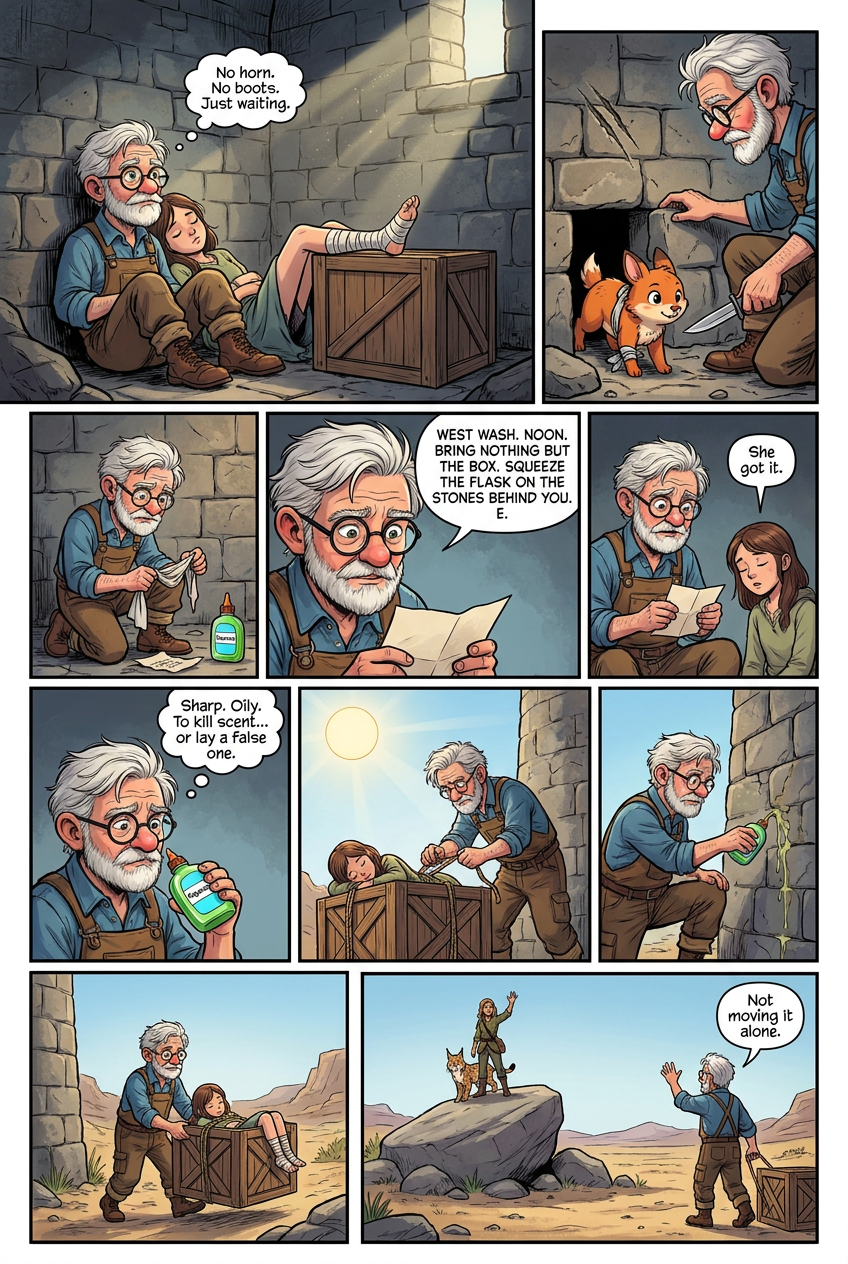
The gray in the slits went white. Ben stayed still against the back wall and watched the light move down the stone. Millie slept with her wrapped ankle propped on the crate. No horn sounded. No boots crossed the wash outside. But the tower held only two things Ben could not fix by waiting: a girl who could not walk, and a crate too heavy for one man to carry. He had sent his blood north on the winged creature two nights ago. He did not know if Eileen had read it. He did not know if she was alive. Without her, he could not move the crate to the pines before dark. With her, he could. Everything after this hour turned on a message he could not check. A scratch came at the stones in the doorway. Ben drew his knife and pressed flat. The scratch came again, lower, quick and light. Not a boot. He shifted one stone aside. A small orange animal squeezed through the gap. Rounded body, ears up, a scrap of cloth tied to its foreleg. It hopped once, sat, and looked at him. Ben knew the knot on the cloth. Eileen had tied knots like that in their mother's kitchen, thirty years ago. He untied the cloth with hands that would not stay steady. Inside was a scrap of paper and a small green bottle with a tapered nozzle. The paper said: WEST WASH. NOON. BRING NOTHING BUT THE BOX. SQUEEZE THE FLASK ON THE STONES BEHIND YOU. E. Ben woke Millie. He showed her the paper. She read it twice. "She got it," Millie said. "She got it." He uncapped the bottle and sniffed. Sharp, oily, wrong. Something to kill scent, or to lay a false one. He did not need to know which. Eileen had sent it, and Eileen had never in her life told him a plan she had not already walked through twice. They waited until the sun was straight overhead. Ben cleared the stones from the arch. He lashed the cord handles back to the crate and tipped it onto its runners. Millie climbed on top with her bad leg out. At the door Ben squeezed the flask along the base of the tower and out ten paces onto the stones behind them. The liquid darkened the rock and gave off a smell that made his eyes water. He took the handles and pulled. The crate came out into the light. The wash was empty. West, where the scrub thinned toward the pines, a figure stood on a flat rock with a lynx at her heel. She raised one hand. Ben raised his in return and leaned into the cord. The crate scraped forward over the stones. For the first time in four days, he was not moving it alone.
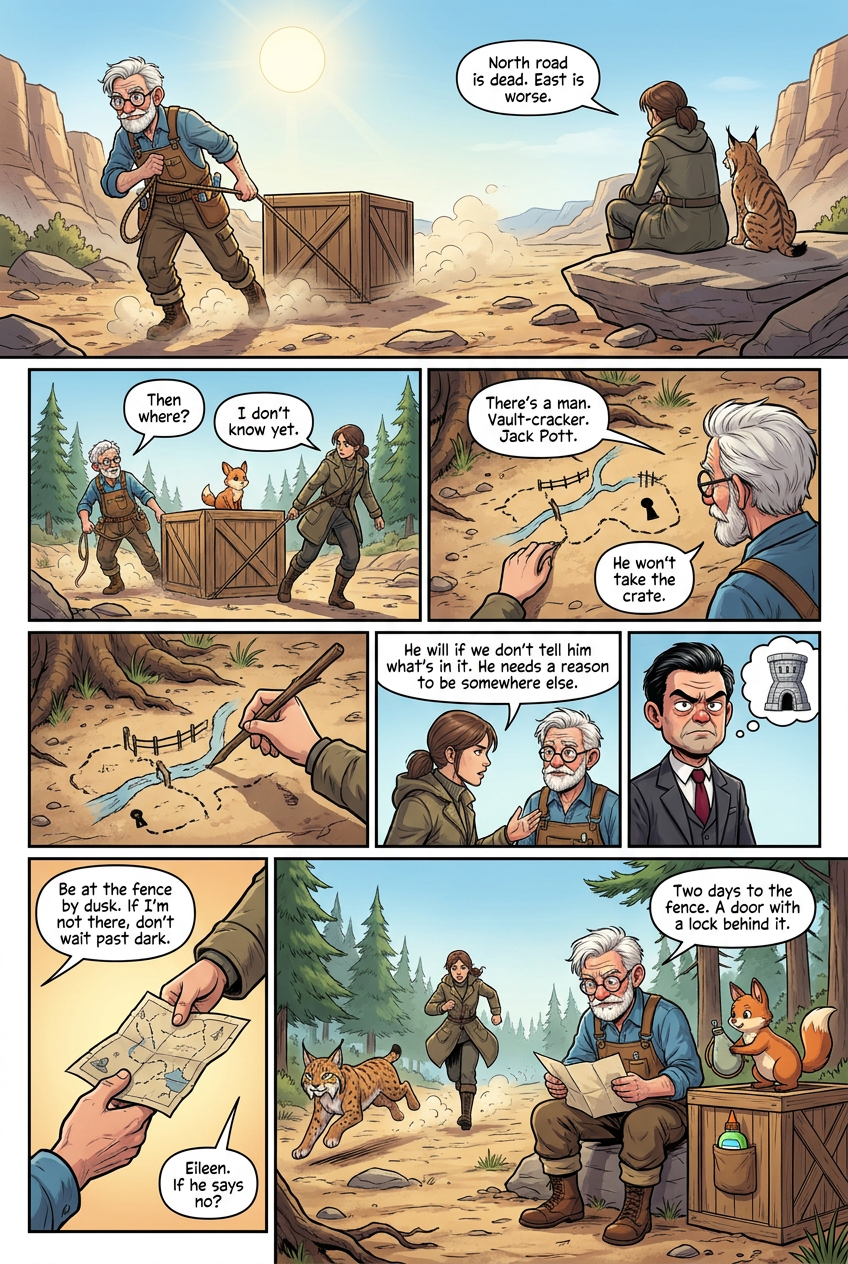
Ben pulled the crate across the wash. Eileen waited on the flat rock with her lynx at her heel. She did not smile. She did not wave twice. She just watched him come, the way she used to watch him climb down from the barn roof when they were children. He reached her. She took the second cord without a word and leaned into it. The crate moved faster with two. "North road is dead," Eileen said. "They have men at every ford. East is worse." "Then where?" "I don't know yet." Ben stopped. Millie sat up on the crate. The pines were four hundred paces off. Past them, nothing he could name. "You brought me out here without a hole to crawl into?" "I brought you out here alive," Eileen said. "That was the first job." She pulled again. He pulled with her. They dragged the crate into the shade of the first pines and set it down. Eileen crouched by the roots and drew a square in the dirt with a stick. "There's a man," she said. "Vault-cracker. Grandfather built a box a hundred years back that no one has opened. This one's spent three years on it. He owns the deed. He owes nobody." "Name." "Jack Pott." Ben had heard the name twice in ten years, both times spoken low. "He won't take the crate." "He will if we don't tell him what's in it. He needs a reason to be somewhere else while his cousins ask him questions about the vault. A locked crate in his cellar is a reason. He gets a story. We get walls no one has cracked in a hundred years." "How far?" "Two days. There's a carter who owes me. He'll take us at dusk if I ride ahead now and pay him before the herbalist's price finds his door." Ben looked at the crate. He looked at Millie. He looked at his sister for the first time in the light. "Go," he said. Eileen stood. She pulled a folded paper from her coat and pressed it into his hand. A crude map. A creek, a broken fence, a mark shaped like a keyhole. "Be at the fence by dusk," she said. "If I'm not there, don't wait past dark." "Eileen." She stopped. "If he says no?" "He won't say no to me." She whistled once. The lynx rose. "He said no to me once. He learned." She went east through the trees at a run. The lynx cut ahead of her and was gone. Ben sat down beside the crate. Millie handed him the water skin. For the first time since the shrine burned, he had a name on the map past the wash. Not a shelter. A door with a lock behind it, and someone who did nothing but open locks. He folded the paper and put it in his shirt. Two days to the fence. He picked up the cord.
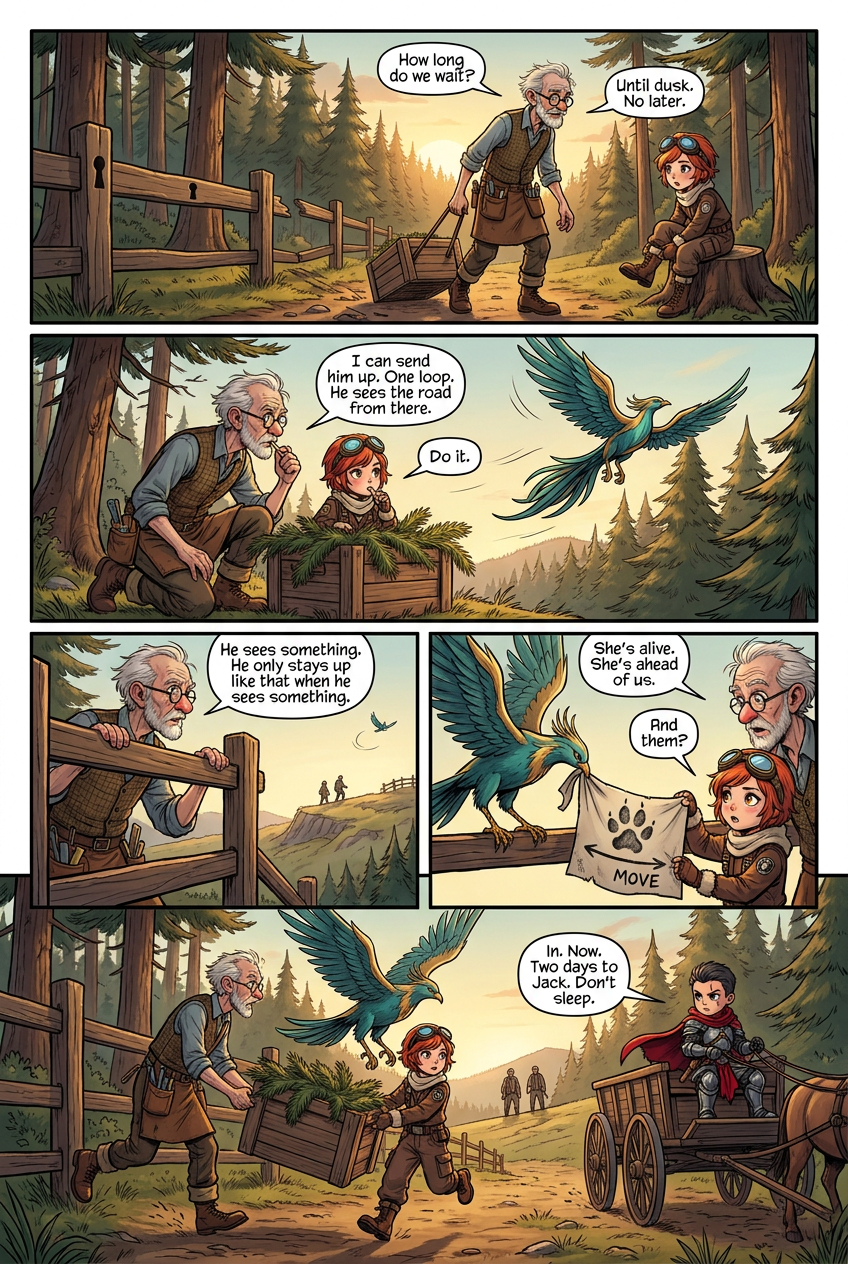
Ben pulled the crate along a game track until the pines thinned and a broken fence line came up out of the brush. A keyhole shape was cut into the top rail. This was the mark on Eileen's paper. He set the crate in the ditch behind the fence and covered it with dead pine boughs. Millie slid down and sat on a stump, favoring her ankle. "How long do we wait?" Millie said. "Until dusk. No later." The sun was already low. Ben crouched by the crate and listened. A faint hum came through the sap seal when the wind shifted. Not loud yet. Loud enough that a scout on the wrong side of the fence would stop walking and turn his head. Millie pulled the bone whistle from her collar. "I can send him up. One loop. He sees the road from there." "Do it." She blew a short note. The winged creature dropped out of a pine two ridges over and climbed. From the stump, Ben watched it circle once and bank east. Then it climbed higher and did not come back down. "He sees something," Millie said. She was watching the sky, not him. "He only stays up like that when he sees something." Ben looked east through the fence rails. Two figures on the ridge road, moving at a walk. Not scouts. Not yet running. But they were coming toward the fence, and Eileen was not. He checked the sun. Half an hour of light. He counted the paces to the pines behind him. Too far to drag the crate alone before the two men reached the fence line. He could leave it and run with Millie. He could sit on it and hope. The winged creature dropped fast out of the sky and landed on the top rail. It had a strip of cloth in its beak. Millie took it and held it up. A lynx track, drawn in charcoal. An arrow pointing west along the fence. One word: MOVE. "She's alive," Ben said. "She's ahead of us." "And them?" Millie pointed at the ridge. "Not her men." Ben uncovered the crate and pushed the cord handle into Millie's hand. He lifted the other. The winged creature caught the far strap in its claws and took the weight off the ground. They moved west along the fence at a run, the crate skimming, Millie limping behind. A hundred paces on, the fence bent into a hollow. A carter's wagon stood in the hollow with its tail down. Eileen sat on the seat with the reins. She did not smile. She jerked her chin at the bed. "In. Now." They slid the crate up the tail. Millie climbed after it. Ben got up beside Eileen. She snapped the reins and the wagon rolled west into the trees before the two men on the ridge cleared the next stand of pines. "Two days to Jack," Eileen said. "Don't sleep."
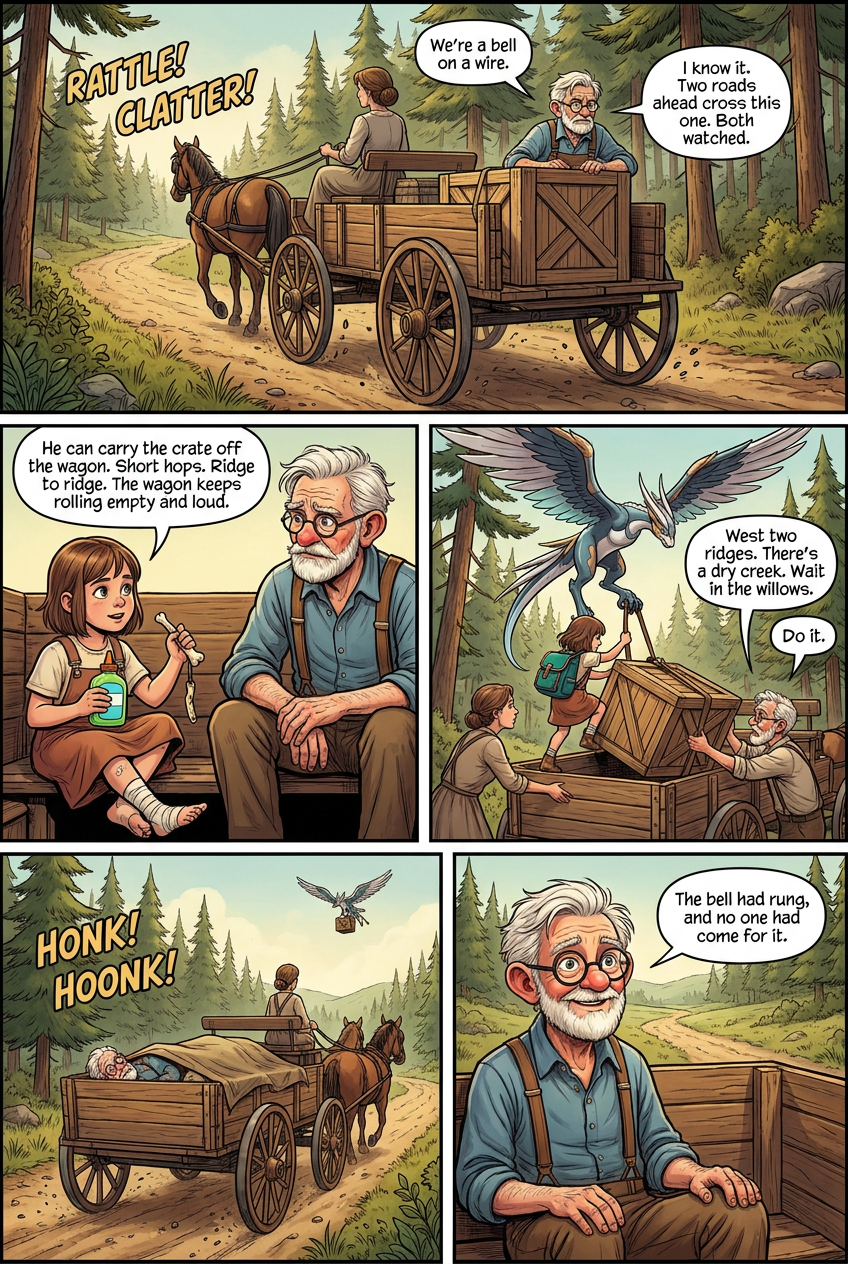
The wagon rolled west through the pines. Eileen kept the horse at a fast walk. The bed rattled hard over the ruts. Ben sat with one hand on the crate to feel for the hum. The rattle was loud enough to bury it. That was the good part. The bad part came a mile on. Ben looked back at the track behind them. The wheels cut a clean pair of lines in the soft dirt. Any scout who found the ruts could follow them straight to Jack. And the noise carried. He could hear their own wagon a long way off. Anyone waiting on the road ahead would hear it first. "We're a bell on a wire," Ben said. "I know it." Eileen didn't turn her head. "Two roads ahead cross this one. Both watched." Millie crawled up from the bed. Her ankle was wrapped tight. She pulled a green squeeze bottle from her satchel and shook it. "Scent oil. Eileen gave it to me before. One squirt on each wheel hub kills the track smell for an hour." "Smell isn't the problem. The noise is." Millie thought. Then she pulled her bone whistle. "He can carry the crate off the wagon. Short hops. Ridge to ridge. The wagon keeps rolling empty and loud. They chase the sound. We go quiet with the crate." Eileen looked at Ben. "Split the bait from the load. Same trick as before." "He can't carry it two days." "He doesn't need two days. He needs one crossing. Past the watched roads." Ben weighed it. If the winged creature dropped the crate, the seal would crack. If a scout heard the wagon and stopped it empty, they lost nothing but a horse. If the scout heard it full, they lost everything. "Do it." Millie blew the whistle. The winged creature came down through the pines and hooked its claws into the crate straps. Ben and Eileen slid the crate to the tail. Millie climbed on top of it. Her small satchel bumped against her hip. "West two ridges," Eileen said. "There's a dry creek. Wait in the willows." The creature lifted. The crate cleared the wagon bed and swung up over the trees. Millie held on with both hands. In a breath they were gone above the canopy. Eileen snapped the reins and the empty wagon rattled on louder than before. Ben lay flat in the bed and pulled the tarp over himself. A quarter mile on, a horn blew from the north crossroad. Another answered from the south. Boots on the road. Eileen kept the horse at a walk and did not look at either sound. The wagon passed between the two crossings without stopping. No one came out of the trees. The horns went quiet behind them. Ben let the tarp fall back. The crate was two ridges ahead in the willows. The bell had rung, and no one had come for it.
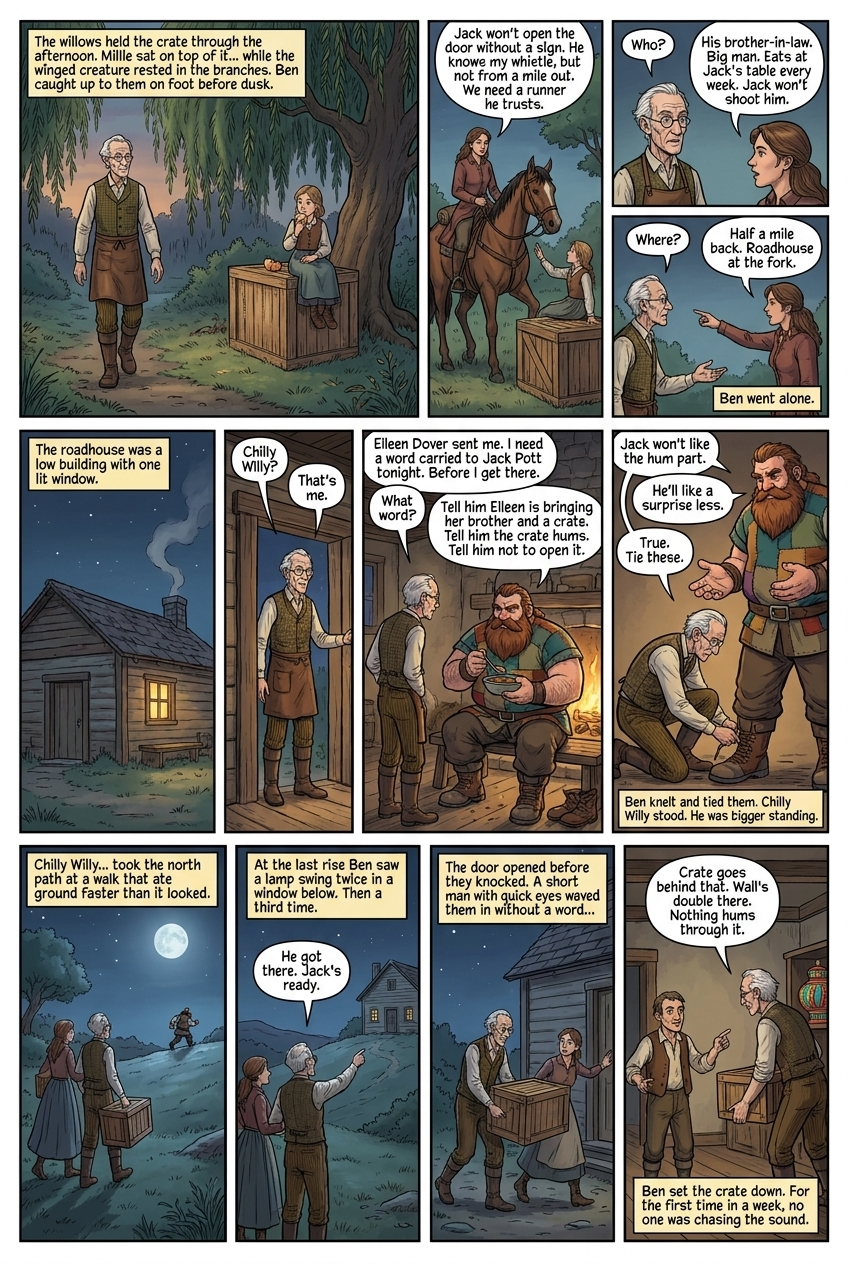
The willows held the crate through the afternoon. Millie sat on top of it, chewing dried apple, while the winged creature rested in the branches. Ben caught up to them on foot before dusk. The wagon had drawn the horns north. Eileen would meet them at the last ridge before Jack's place. But Ben still had no way to tell Jack Pott they were coming. Show up cold, with a humming crate and a stranger's face, and Jack's cousins would shoot first. Eileen had said as much. Jack owed no one, and he shot at surprises. Eileen found them in the willows an hour after dark. She swung down from the horse. "Jack won't open the door without a sign. He knows my whistle, but not from a mile out. We need a runner he trusts." "Who?" "His brother-in-law. Big man. Eats at Jack's table every week. Jack won't shoot him." "Where?" "Half a mile back. Roadhouse at the fork." Ben went alone. The roadhouse was a low building with one lit window. Inside, a man filled most of a bench by the fire. His beard covered his chest. His boots were unlaced because he could not reach them. He was working through a bowl of stew with both hands. "Chilly Willy?" Ben said. The big man looked up. "That's me." "Eileen Dover sent me. I need a word carried to Jack Pott tonight. Before I get there." "What word?" "Tell him Eileen is bringing her brother and a crate. Tell him the crate hums. Tell him not to open it." Chilly Willy set down the bowl. "Jack won't like the hum part." "He'll like a surprise less." "True." He pulled his boots closer with a stick. "Tie these." Ben knelt and tied them. Chilly Willy stood. He was bigger standing. "What do you want for the run?" Ben said. "Nothing tonight. You'll owe me a favor. I'll name it later." "Done." Chilly Willy went out the back and took the north path at a walk that ate ground faster than it looked. Ben watched him go, then returned to the willows. They moved the crate two more ridges before moonrise. At the last rise Ben saw a lamp swing twice in a window below. Then a third time. Eileen let out a breath. "He got there," she said. "Jack's ready." They came down the slope with the crate between them. The door opened before they knocked. A short man with quick eyes waved them in without a word and shut the door behind them. A painted urn stood on a shelf inside the entry, bright and oversized, out of place in the plain room. Jack pointed at it. "Crate goes behind that. Wall's double there. Nothing hums through it." Ben set the crate down. For the first time in a week, no one was chasing the sound.
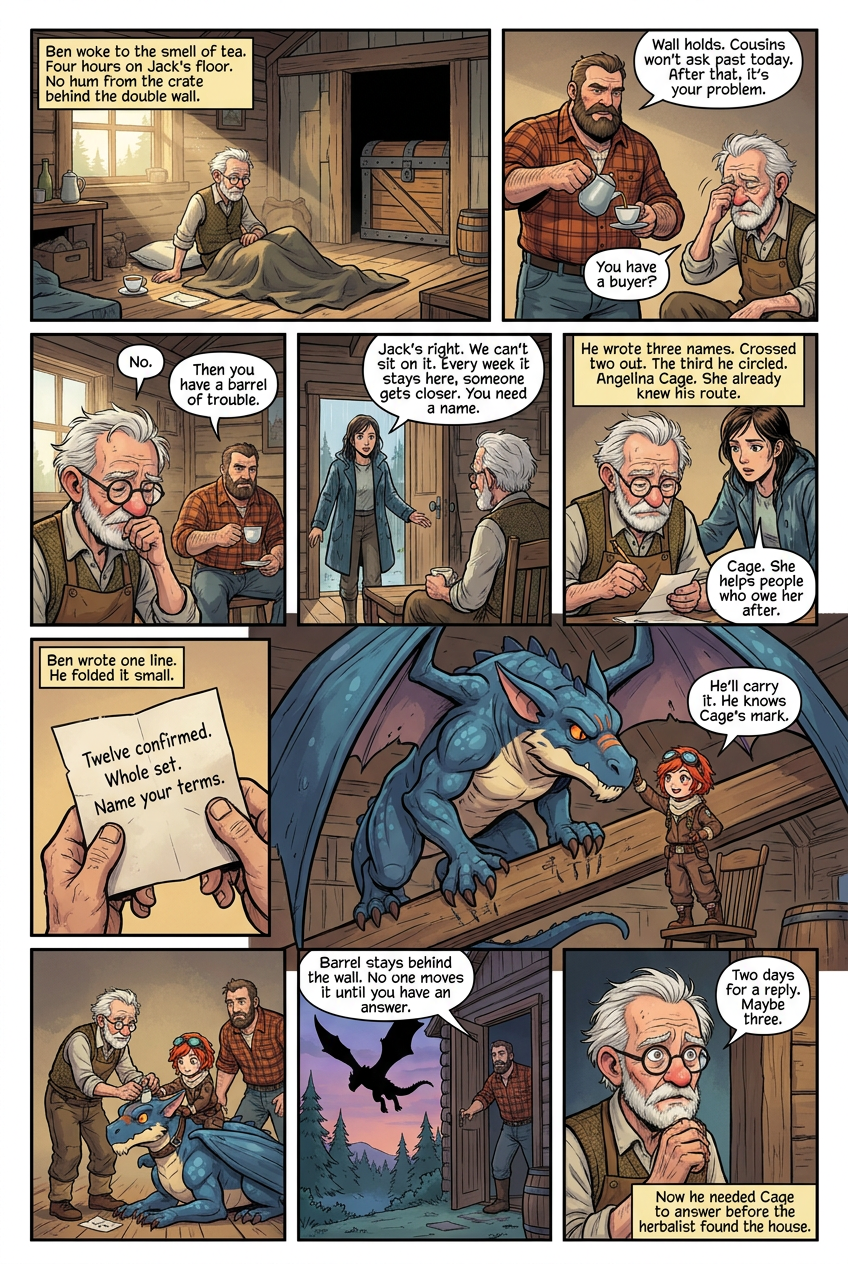
Ben slept four hours on Jack's floor and woke to the smell of tea. The crate sat behind the double wall. No hum leaked through. For the first time in weeks, no one was hunting the sound. That should have felt like winning. It didn't. A full set behind a wall was still a target. Twelve pieces meant nothing without a hand to pass them to. Jack poured tea and set a cup by Ben's elbow. "Wall holds. Cousins won't ask past today. After that, it's your problem." He tapped the shelf. "You have a buyer?" "No." "Then you have a barrel of trouble." Eileen came in from the yard with her coat wet at the shoulders. She sat across from Ben. "Jack's right. We can't sit on it. Every week it stays here, someone gets closer. You need a name." "I've been running so long I stopped writing the list." "Write it now." Ben took a scrap of paper. He wrote three names his father had traded with. He crossed two out — one dead, one bought by the herbalist last spring. The third he circled. Angelina Cage. She had already sent a runner to pull him off the ridge weeks back. She had known his route before he did. "Cage," Eileen said. She didn't like it. "She helps people who owe her after." "She's the only one left who can move twelve pieces without splitting them." "Splitting them was never the point." "No. Keeping them together was." Eileen looked at the wall a long time. "Then send her word. Not the crate. Just word." Ben wrote one line on the paper. Twelve confirmed. Whole set. Name your terms. He folded it small. Millie's winged creature had roosted in Jack's rafters overnight, blue-scaled and heavy on the beam. It watched Ben with one orange eye. Millie climbed a chair and coaxed it down. The thing dropped to the floor with a thud that shook the cups. Its claws left marks in the boards. Jack winced but said nothing. "He'll carry it," Millie said. "He knows Cage's mark. I flew her line last summer." Ben tied the paper to the creature's collar. It launched from the doorway and cleared the pines in three beats. Jack shut the door. "Barrel stays behind the wall. No one moves it until you have an answer. If she says no, you carry it out the same night. Understood." "Understood." Eileen refilled Ben's cup. "Two days for a reply. Maybe three." Ben looked at the shelf, at the painted urn, at the wall behind it holding everything he had bled for. The chase was paused. The work was not. He had a full set and a message in the air. Now he needed Cage to answer before the herbalist found the house.
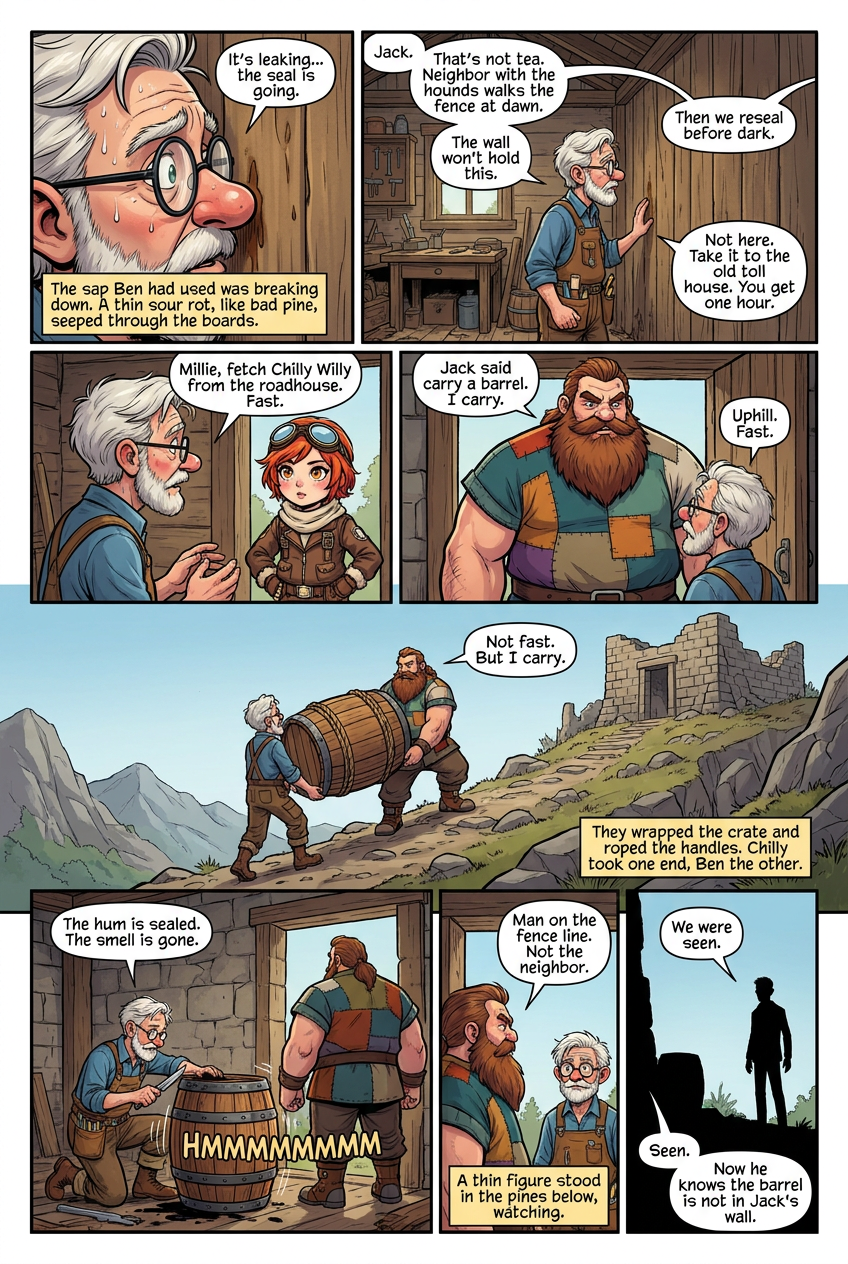
By late afternoon the wall was leaking. Not sound. Smell. The sap Ben had used to reseal the crate weeks back was breaking down in the warm dry air behind Jack's boards. It came through the seam by the shelf as a thin sour rot, like pine turned bad. Ben pressed his nose near the wood and knew a neighbor would smell it before morning. Jack came in from the yard with sawdust on his sleeves. He sniffed once at the shelf. His face did not change. "That's not tea." "The seal is going," Ben said. "The wall holds the hum. It won't hold this." "Neighbor on the north side keeps hounds," Jack said. "Hounds work by nose. He walks the fence at first light." Eileen set down the kettle. "Then we reseal before dark." "Not here," Jack said. "You open that crate in my house, the hum goes through the boards and the cousins come asking. Take it out. Fix it. Bring it back sealed." "Out where?" Ben said. Jack pointed his chin at the ridge behind the yard. A squared stone ruin stood above the treeline, older than the road. "Old toll house. Thick walls. No door left. Nobody goes near it. You get one hour of hum before the wind turns down our way." Ben needed sap and a second pair of hands that would not be missed on the road. He sent Millie to fetch Chilly Willy from the roadhouse. Chilly came at a slow walk, shirt open at the collar, breathing through his mouth. Jack's brother-in-law filled the doorway and did not step inside. He looked at Ben. "Jack said carry a barrel. I carry." "Uphill," Ben said. "Fast." "Not fast. But I carry." They wrapped the crate in oilcloth and roped the handles. Chilly took one iron ring. Ben took the other. The great barrel chest cleared the floor when Chilly lifted. Ben carried his end. Chilly carried the rest. They reached the stone ruin in twenty minutes. Ben set out the sap pot Joe had left with him, a knife, and a strip of clean linen. Chilly stood watch at the empty doorway, blocking it with his back. Ben cracked the lid a finger's width. The hum came out low and steady, one long note pressed against the stone. He scraped the failing sap free, laid the new sap thick along the seam, and pressed the linen down. He counted to sixty. He closed the lid. The hum cut off. The sour smell was gone under the fresh pine of the new sap. Chilly turned his head. "Man on the fence line. Not the neighbor." Ben looked past his shoulder. A thin figure stood in the pines below, watching the ruin. Not moving. Not leaving. "We were seen bringing it up," Ben said. "Seen," Chilly agreed. "By him. Now he knows the barrel is not in Jack's wall."
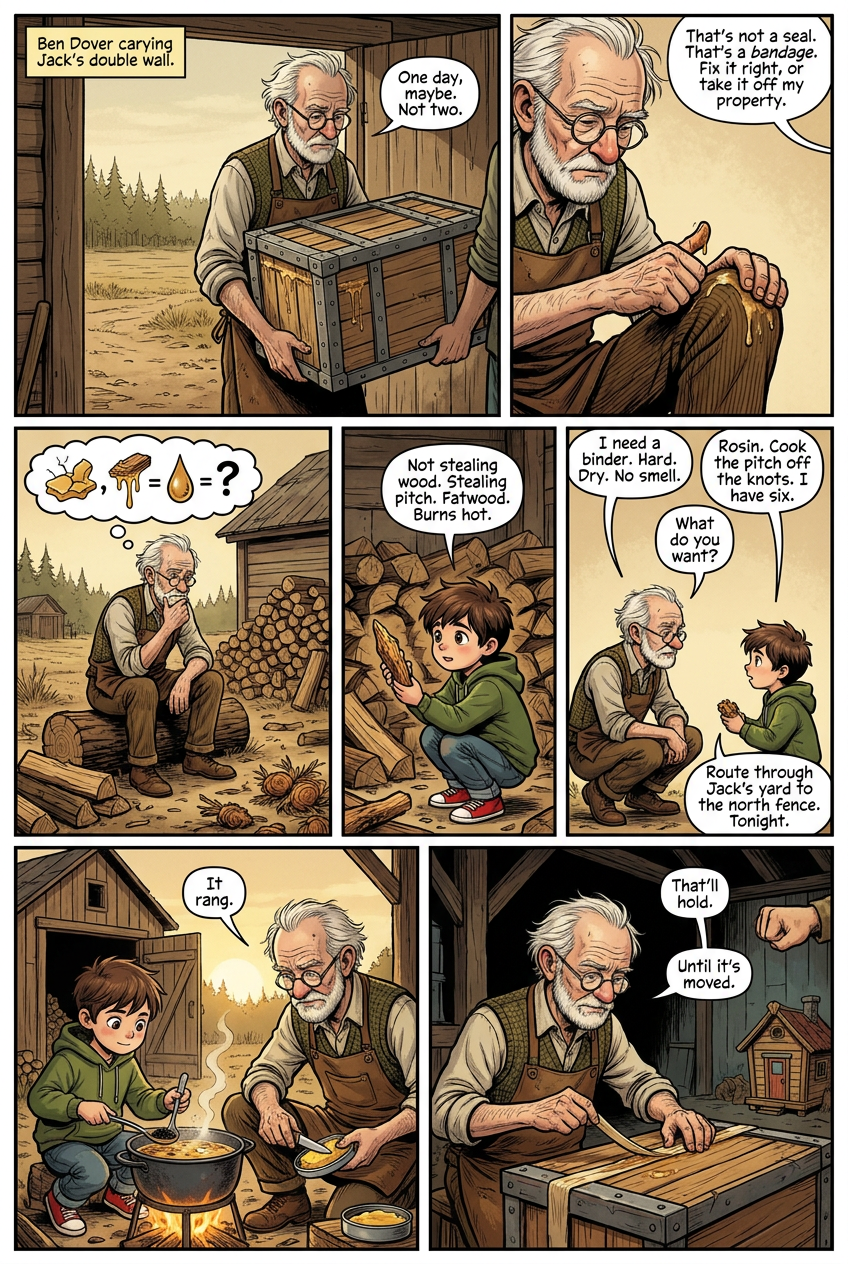
The new sap held for the walk down the ridge. Ben felt it soften against his palm before they cleared the treeline. The dry wind up at the toll house had pulled the moisture out of it faster than he'd counted on. By the time he and Chilly set the crate back inside Jack's double wall, the seam was tacky again. Ben pressed a thumb to it and came away sticky. One day, maybe. Not two. Jack watched him wipe his thumb on his trouser. "That's not a seal. That's a bandage." "I know." "Then fix it right, or take it off my property." Ben needed something stronger than pine sap. Wax cracked. Sap wept. He needed a binder that stayed hard in dry wind and did not stink. He had nothing on the shelf. He had no coin to send Chilly to a chandler, and no chandler he trusted. He went out to the woodpile to think. A boy was already there, crouched by the split logs, pocketing dry pine knots the size of walnuts. Not a boy. Small man. Green hoodie, red shoes, hands quick as a squirrel's. He looked up at Ben without startling. "Not stealing wood," he said. "Stealing pitch." He held up a knot slick with old resin. "Fatwood. Burns hot. Trades better than coin at the Tall Folk's gate." "You're Marty," Ben said. Chilly had named him at the roadhouse, a scavenger who worked the fence lines. "Marty Party. And you're the man with the barrel that smells like turned pine." He tapped his nose. "Half a field away. Fix it or lose it." Ben crouched. "I need a binder. Hard. Dry. No smell." "Rosin," Marty said. "Cook the pitch off the knots. Skim the clear. Cools to glass. Won't weep in wind." He shook the knot. "Two pounds of these makes a fist of rosin. I have six." "What do you want." "Route through Jack's yard to the north fence. Once. Tonight. I'm going over the Tall Folk's wall by the middle gap and I don't want the hounds on me before I clear the road." "Done." They cooked the knots in Jack's iron pot behind the shed. Marty worked the fire low, skimmed the black off with a spoon, poured the clear amber into a shallow tin. It set in twenty minutes to a hard yellow disk. Ben chipped a piece off with the knife. It rang. He warmed it, laid it thick along the crate's seam inside the wall, and pressed a linen strip down. It cooled fast. The hum cut off. No smell came through. He waited an hour. No weep. He waited two. Still dry. Jack knocked the wall with a knuckle. "That'll hold." "Until it's moved," Ben said. Marty was already at the north fence, waiting for his gap.
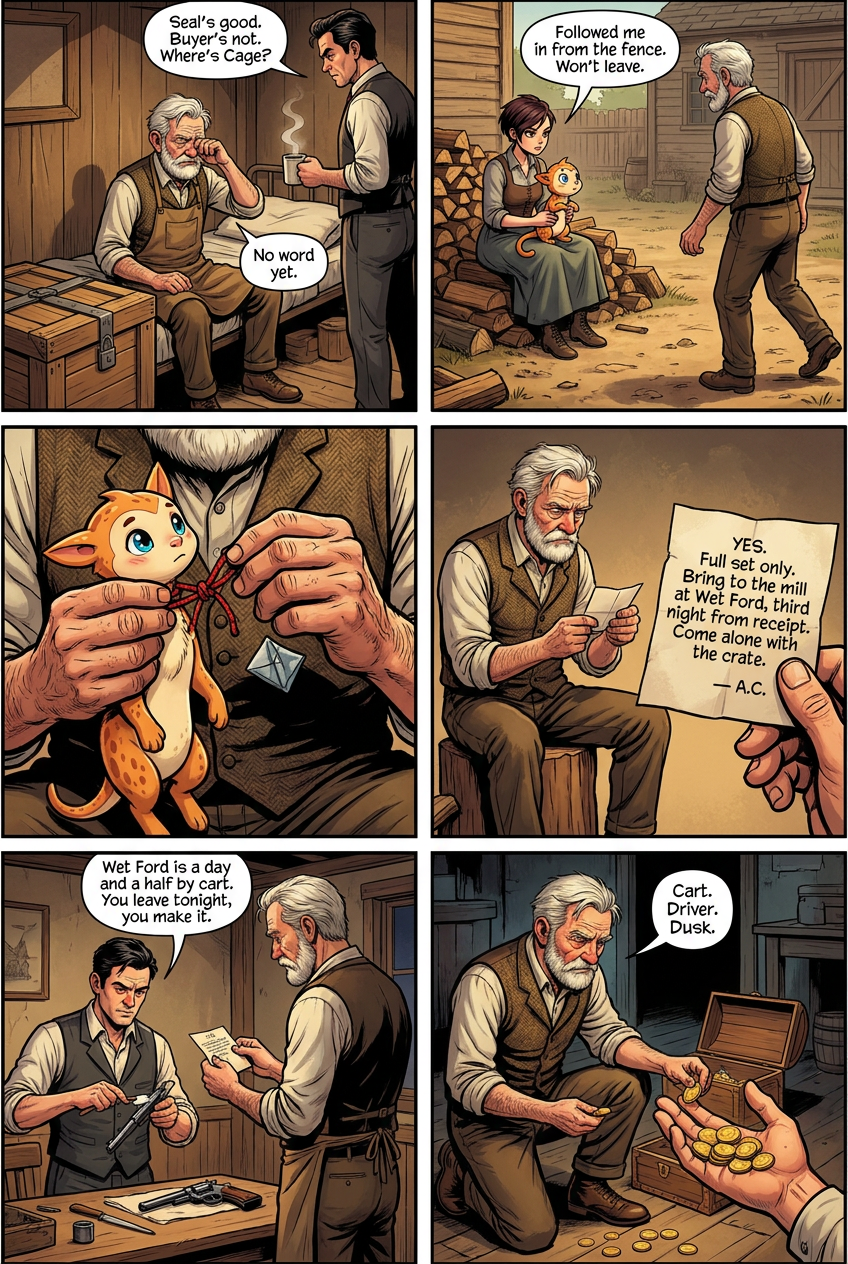
The rosin held overnight. Ben slept an hour and woke to Jack standing over him with a mug of black tea. "Seal's good," Jack said. "Buyer's not. You told me Cage. Where's Cage?" "No word yet." "Then the crate goes off my property tomorrow. I don't care where. My cousins asked twice yesterday why my back wall hums when the wind turns. Twice is a count. Three times is a warrant." Ben drank the tea. Jack was right. The rosin sealed the smell and most of the sound, but a sealed crate with no buyer was just a countdown. He needed Angelina Cage to answer, or he needed a name he did not have. Millie's winged creature had not returned. Four days out now. He had sent it with the offer: twelve pieces, complete set, price to be named, a place to meet. He had no fallback. Every other broker he knew worked for the herbalist or was dead. He went to the yard to wait. Millie sat on the woodpile with something small cupped in her hands. A kit, orange-furred, blue-eyed, no bigger than a pear. It watched Ben with a steady, unbothered look. "Followed me in from the fence," Millie said. "Won't leave." "Put it out. We don't need another thing to feed." "It has a knot on its collar." She held up the kit's neck. A red trader's knot, the same weave the courier animal had worn at the seam. Ben took the kit. Under the knot was a folded scrap of oilcloth no bigger than a coin. He worked it open with his thumbnail. Three lines, in a small square hand. YES. Full set only. Bring to the mill at Wet Ford, third night from receipt. Come alone with the crate. — A.C. Ben sat down on the chopping block. Third night from receipt. He did not know when she had written it. He looked at the kit. The kit blinked. "When did it come in?" he asked Millie. "Sunrise. Maybe just before." Two nights, then. Maybe less. He went inside. Jack was at the table cleaning a pistol. Ben laid the oilcloth in front of him. Jack read it. He set the pistol down. "Wet Ford is a day and a half by cart if the road holds," Jack said. "You leave tonight, you make it." "I'll need the crate off your wall by dark." "You'll have it off my wall by dark whether you have a cart or not." Jack almost smiled. "But you have a buyer now. That changes the price of my help." Ben went to the back room and pulled his mother's old chest from under the cot, the small one he had carried since he was a boy. He opened it. Nine coins inside. He counted them into Jack's palm. "Cart," he said. "Driver. Dusk." Jack closed his hand.
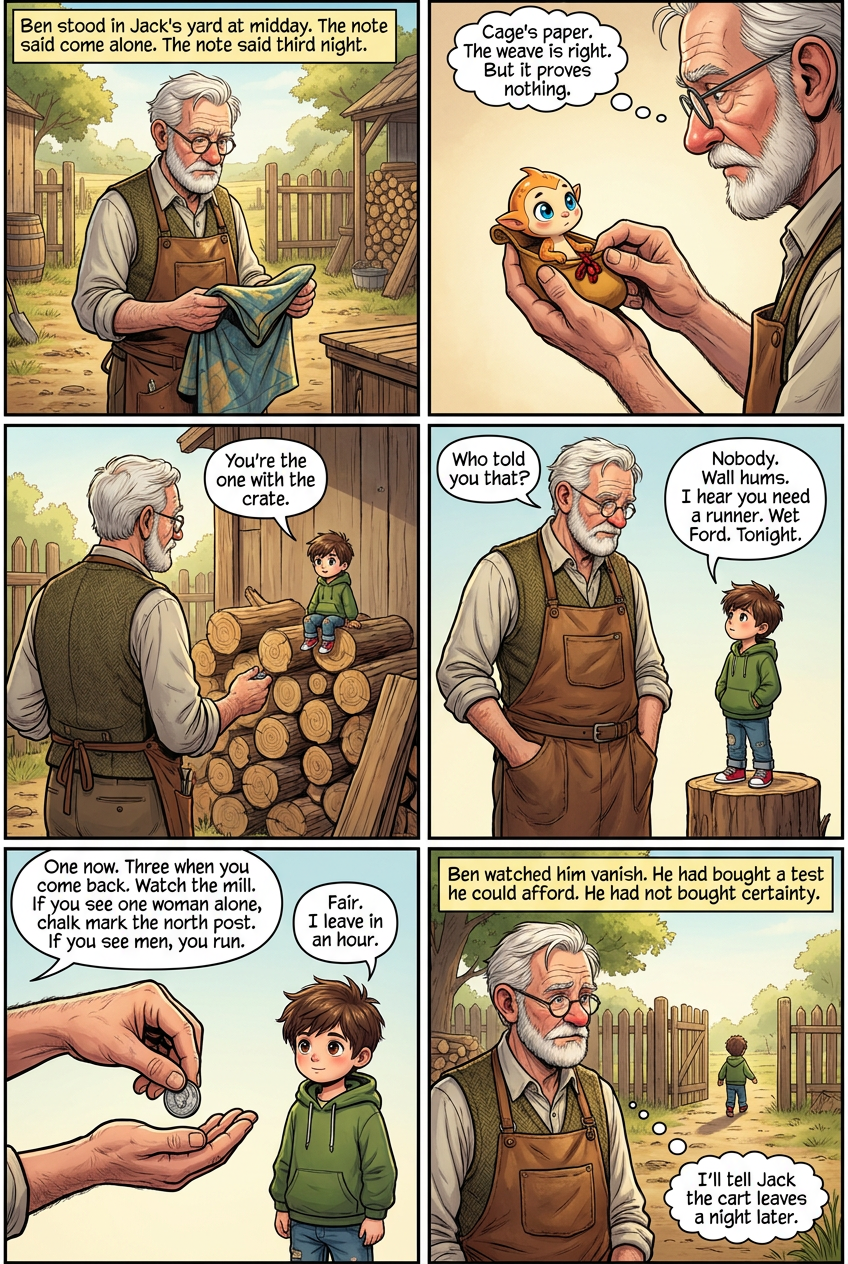
Ben stood in Jack's yard at midday with Cage's oilcloth folded in his pocket. The note said come alone. The note said third night. What the note did not say was whether Cage had written it, or whether one of the herbalist's men had pinned the messenger kit down in a field and copied her hand. He pulled the kit from his coat. It sat in his palm, orange, blue-eyed, no bigger than a pear. The red trader's knot was still on its collar. He turned the knot over. The weave was right. The oilcloth was Cage's paper. None of that proved the runner had not been taken. He needed to test the meeting before he walked into it. He could not send Eileen. Her face was known now. He could not send Millie. Her ankle still swelled by dusk. A voice came from the woodpile. "You're the one with the crate." Ben turned. A small figure sat on the top log with dirt on his knees and a green hood pushed back. Not a child. Small the way some people are small their whole lives. Marty. Chilly Willy had pointed him out yesterday, sleeping under the eaves. "Who told you that," Ben said. "Nobody. Wall hums when the wind turns. I count things." Marty jumped down. He came up to Ben's belt. "I hear you need a runner. Wet Ford. Tonight." "I need someone to walk into a mill and not come out dead." "That's the same job." Marty held out a hand. "Two coins now. Two if I come back." Ben had one coin left after Jack. He put it in Marty's palm. "One now. Three when you come back. You go tomorrow at dusk, one night ahead of me. You do not go in. You watch the mill from the ditch across the water. If you see one person waiting, a woman, alone, you leave a chalk mark on the north post. If you see men in the rafters or a second lamp lit inside, you leave nothing and you run." "North post. Chalk. One means safe." Marty pocketed the coin. "What if she's already got men with her because she brought them?" "Then no mark. I don't walk in on a buyer who lied." "Fair." Marty pulled a strip of dry meat from his hoodie and started chewing. "I leave in an hour. I sleep rough. I don't know you if anyone asks." "Good." Marty went out the gate without looking back. Ben watched him vanish down the track. He had bought a test he could afford. He had not bought certainty. If the mark was there tomorrow night, he walked in with the crate and finished this. If it was not, he ran with twelve pieces and no buyer left in the kingdom. He went inside to tell Jack the cart left one night later.
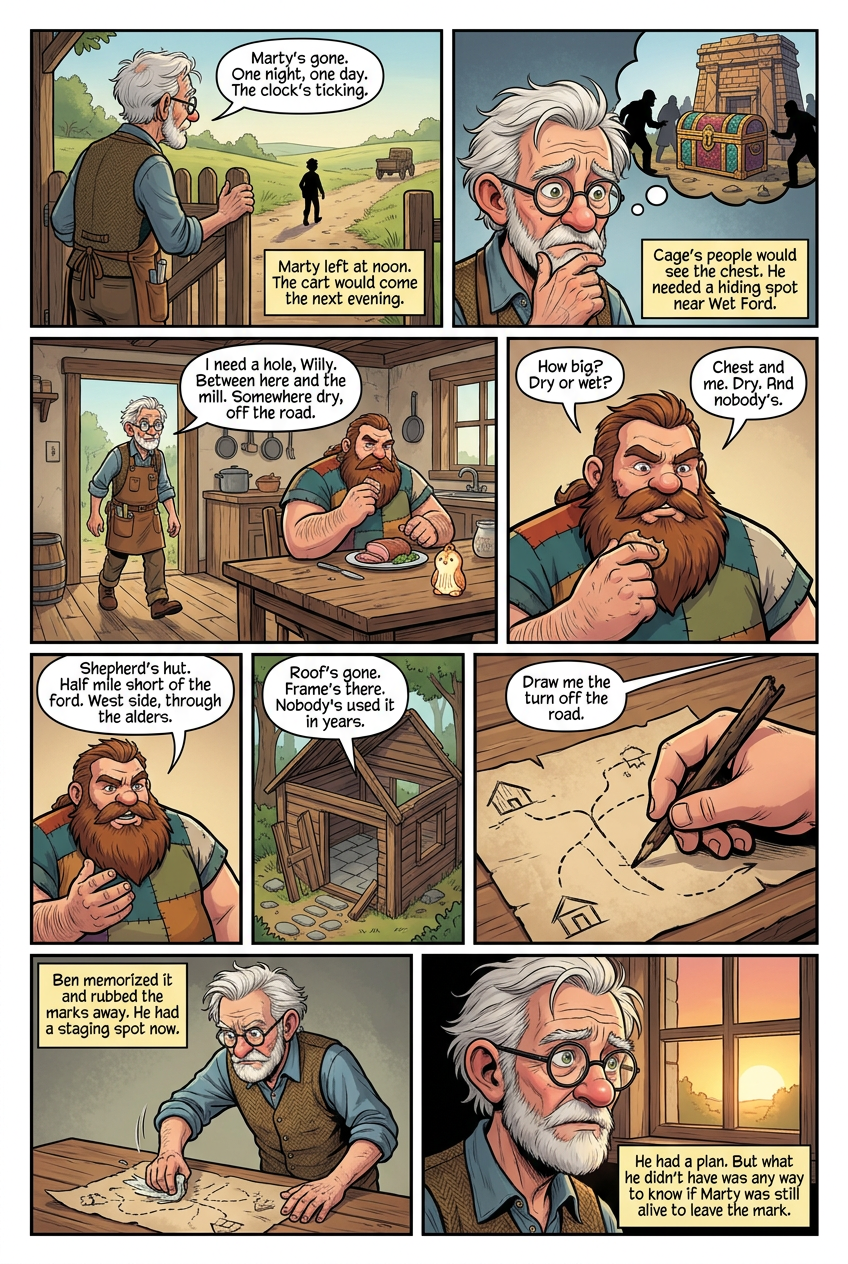
Marty left at noon. Ben watched the gate swing shut behind him and turned back to the yard. The cart would come the next evening. That gave him one night and one day to solve a problem he had been pushing off since Jack sealed the crate behind the double wall. He could not drive up to the mill with the chest on the cart. Cage's people would see it before any coin changed hands. If they wanted it more than they wanted to pay, they would take it at the water and leave him in the reeds. He needed a place near Wet Ford to drop the chest before he walked in. Somewhere he could reach in the dark and find again fast. He went to the kitchen. Chilly Willy sat at the table eating cold pork with both hands. Jack's brother-in-law knew the country between here and Wet Ford better than anyone Ben could ask without paying twice. "I need a hole," Ben said. "Between here and the mill. Off the cart road. Close enough I can walk in from it after dark." Chilly Willy chewed. "How big." "Chest and me." "Dry or wet." "Dry. And nobody's." Chilly Willy wiped his hands on his shirt. "Shepherd's hut. Half mile short of the ford. West side of the road, back through the alders. Roof's gone. Walls stand. Nobody's used it in six years." "Doors?" "One. Fell off. Frame's still there." Ben thought about that. A structure with a doorway would draw a search. But Lolly had told him once that people only searched buildings that still had doors on them. A roofless hut with a fallen frame read as ruin. "Anyone live near it." "Nobody within a mile. Ground's sour. Sheep won't take." "You been inside recent?" "Last spring. Floor's stone. There's a feed trough at the back wall, tipped over. Big enough to cover a chest if you lay it flat." Ben pictured it. Cart stops on the road. He and the driver carry the chest through the alders to the hut. Slide it under the trough. Cover it with brush. Walk the rest of the way to the mill empty-handed. If Marty's chalk mark is on the north post, he comes back with Cage's people and coin, and they carry it out together. If there is no mark, he comes back alone and moves the chest north before dawn. "Draw me the turn off the road," Ben said. Chilly Willy pulled a burnt stick from the hearth and scratched lines on the tabletop. A bend. A split alder. Ten paces west. The hut. Ben memorized it and rubbed the marks away with his sleeve. He had a staging spot now. He had a plan that let him walk into the mill light. What he did not have was any way to know if Marty was still alive to leave the mark.
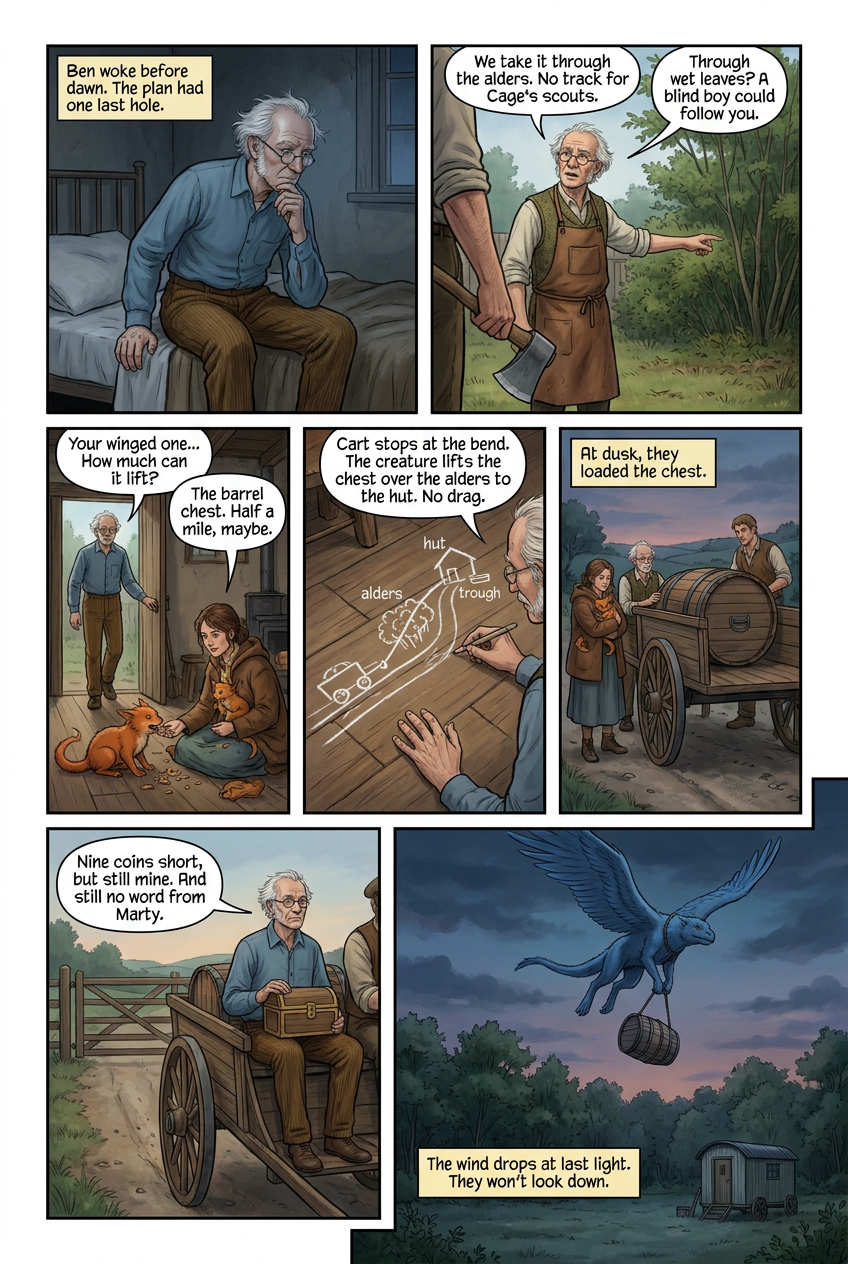
Ben slept two hours and woke before dawn. The cart came at dusk. He had the day to fix the last hole in his plan: how to move the chest from Jack's wall to the shepherd's hut without leaving a track Cage's scouts could read. He found Jack in the yard splitting kindling. Ben laid it out. Cart on the road at dusk. Off through the alders. Chest under the trough. Walk to the mill empty-handed. Jack set the axe down. "You'll cut sign through the alders. Two men and a barrel-shaped chest through wet leaves? A blind boy could follow you at noon." "Then I don't cut through the alders." "You have to. The hut's back a hundred paces off the road." Ben thought. The chest was too heavy to carry clean. Any drag mark would point straight at the hut. If a scout swept the road ahead of him, the trail would be there when Cage's people came looking. He went inside. Millie sat on the floor by the double wall, feeding scraps to her small orange creature. It watched him with wide blue eyes and chewed. "Your winged one," Ben said. "How much can it lift?" "The crate. Once. Short." Millie scratched the little creature behind its ear. "Half a mile, maybe. Not two." "Half a mile is enough." He drew it out for her on the floor with a piece of chalk. Cart stops at the bend. They unload behind the split alder. The winged creature lifts the barrel-shaped chest over the alders and sets it down at the hut. No drag. No boot prints in the leaves. He walks in on the road side, clean, and slides it under the trough himself. Millie studied the chalk. "It'll hum on the lift. Wind's up out there." "How long in the air." "Two minutes. Maybe three." Ben weighed it. Three minutes of hum over open ground. Any scout on the ridge above the ford would hear it. But the alternative was a drag trail that stayed there until rain. "We do it at last light," he said. "Wind drops then. And if anyone hears, they'll look up. Not down at the hut." Jack watched from the doorway. "You're betting the whole set on a lizard-sized thing carrying a barrel." "I'm betting it on no track." At dusk they loaded the chest onto the cart. Millie rode in back with her hand on the wood. The little creature curled inside her coat. Somewhere ahead, the big winged one waited where she had whistled it that afternoon. The cart rolled out through Jack's gate. Ben sat beside the driver with his mother's small keepsake chest in his lap, nine coins short but still his. He did not look back. He had a way to reach the hut unseen. What he did not have, still, was any word from Marty.
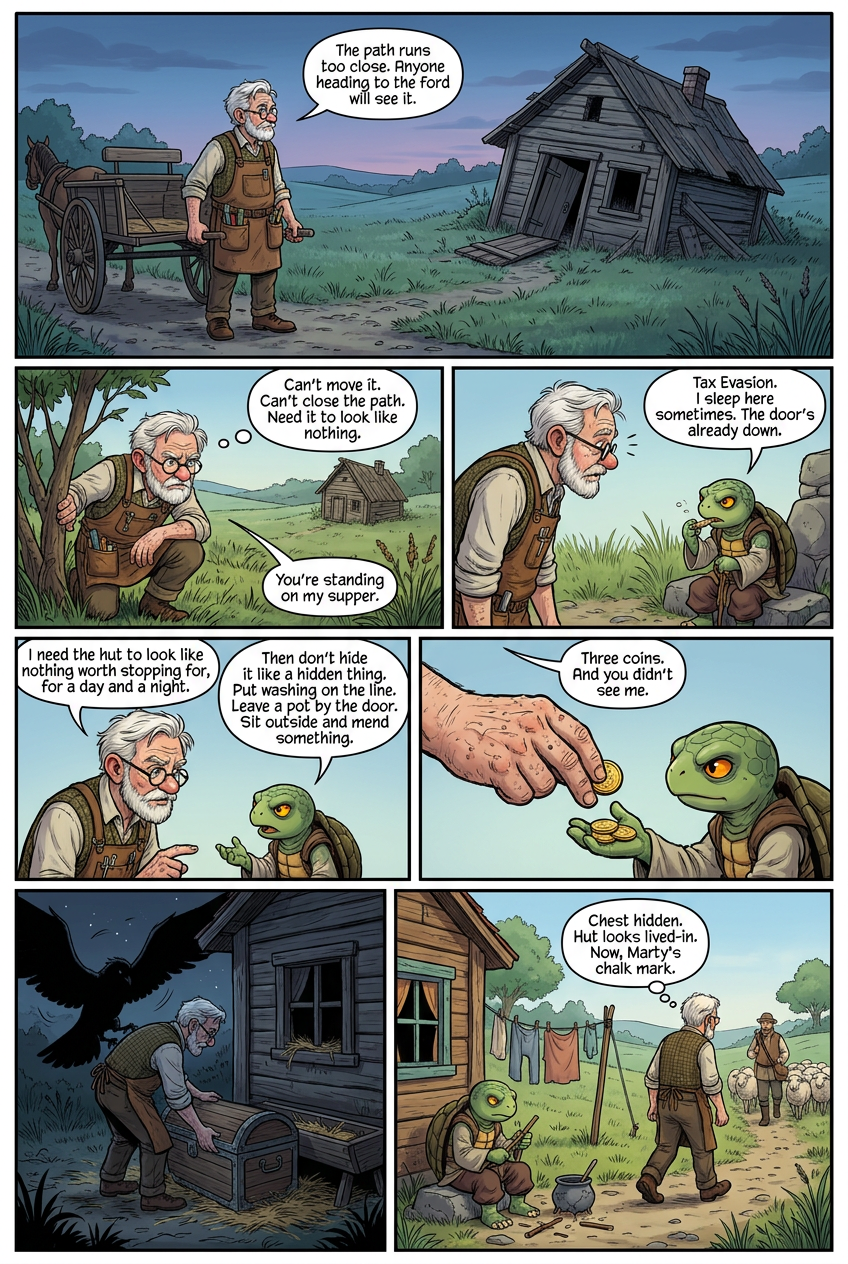
The cart rolled through half a mile of dark before Ben saw the problem clearly. The shepherd's hut sat where Chilly Willy had said it would, low and slumped in the meadow grass. But the footpath ran ten paces from its fallen door. A traveler heading to the ford would pass close enough to see a boot print, a scuff of fresh drag, or the outline of a barrel-shaped chest under a feed trough. He stopped the driver at the bend and walked the last stretch alone. The path was hard-packed. Wagons used it. Shepherds still cut through in daylight. Cage's meeting was still a day and a night away. Any passing eye between now and then could find the chest. He crouched behind the split alder and thought it through. He could not move the hut. He could not close the path. He needed the hut to look like nothing, so eyes slid off it. A voice came from the grass. "You're standing on my supper." Ben looked down. A small green figure sat with his back against a stone, a walking stick across his knees. A turtle-shelled man, no taller than Ben's hip. He chewed something slow. "Who are you." "Tax Evasion." The man did not move. "I sleep here sometimes. The door's already down." Ben studied him. Not a scout. Too still, too settled. A man who lived by not being noticed. "I need the hut for a day and a night," Ben said. "I need travelers to walk past and see nothing worth stopping for." Tax Evasion took a long time to answer. "Then don't hide it like a hidden thing. Hidden things look hidden." "What does that mean." "Put washing on the line. Leave a pot by the door. Sit outside and mend something. A hut with a man in it isn't worth a second look." Ben watched him. "You'd sit here a day and a night for what." "Three coins. And you don't tell the gate keeper you saw me." Ben counted three coins from his mother's chest. His hand was steady. He had two left. He went back for Millie and the winged creature. It lifted the chest low over the alders, wings slow in the dropped wind. Two minutes of hum, faint under the leaf noise. Ben met it at the hut and slid the chest under the trough himself, packing straw around the wood. He kicked dust across the floor to break his prints. When he stepped out, Tax Evasion was already at the door with a cracked pot beside him, whittling a stick that did not need whittling. He did not look up. Ben walked back to the road on the path side, in plain view, empty-handed. A shepherd nodded at him from the meadow and kept going. The chest was hidden. The hut looked lived-in. Now he needed Marty's chalk mark on the north post.
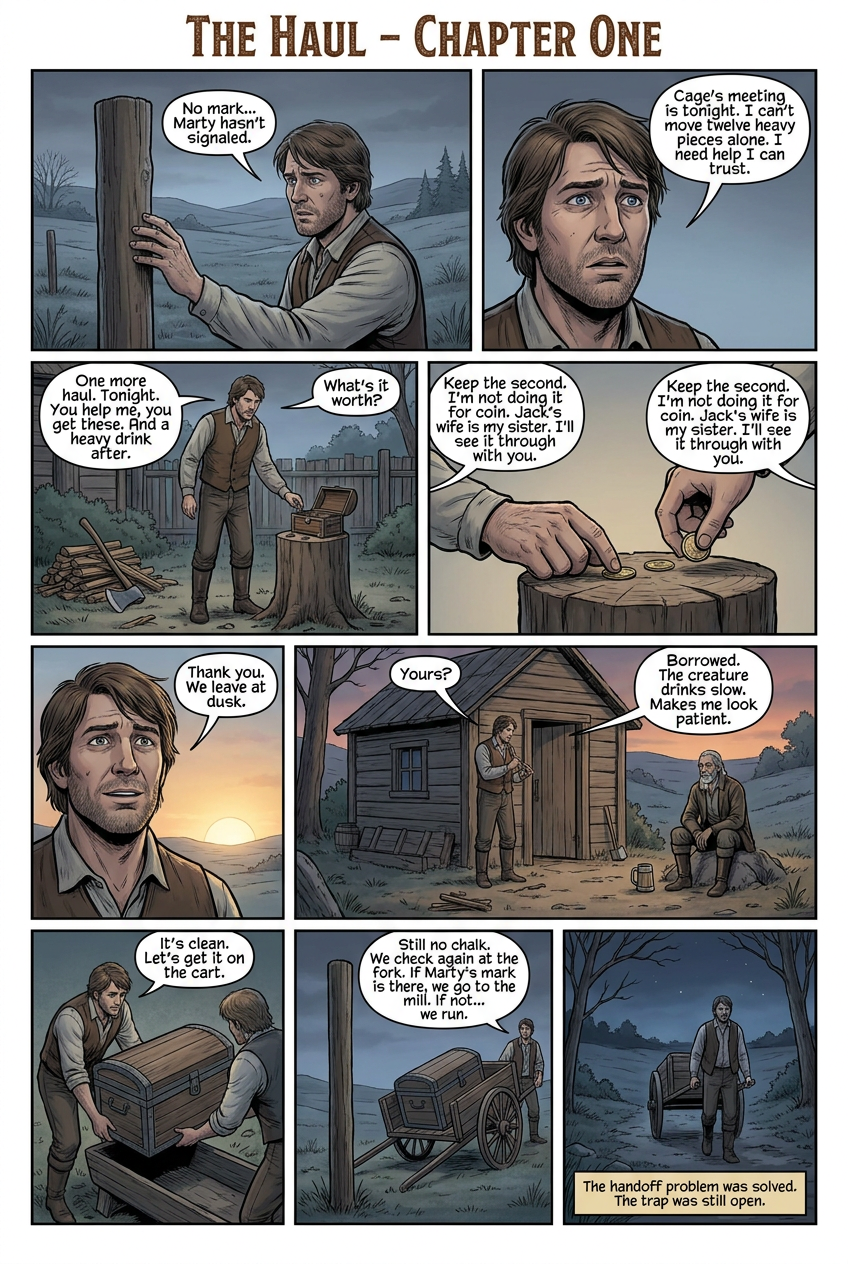
Ben walked the road toward the north post before dawn to check for Marty's chalk mark. The post was bare. He circled once, ran a thumb along the wood, and found nothing. Marty had not signaled yet. Cage's meeting was tonight. He had a chest hidden under a trough and no way to carry twelve heavy pieces to the mill alone. If he hired a stranger for the last leg, the stranger could bolt with the load the moment Ben's back turned at the handoff. He cut back toward Jack's yard through the alders. He needed a second pair of hands he could trust, and hands that would not talk after. Jack had made his position clear: the crate was off his property by dark, and his brother-in-law was already spent on the toll house run. Chilly Willy was in the yard splitting kindling when Ben came through the gate. He set the axe down without being asked. "One more haul," Ben said. "Tonight. Two miles to the mill. You carry one end, I carry the other. You leave before Cage's people see your face." Chilly Willy looked at the house, then at the road. "Jack said he was done." "Jack is. I'm asking you." "What's it worth." Ben opened his mother's chest on the stump. Two coins left. He set them both on the wood. "Everything I have. And a heavy drink after, on me, when this is over." Chilly Willy looked at the coins a long time. He picked up one and left the other. "Keep the second. You'll need it for the driver back." He spat into the dirt. "I'm not doing it for coin. Jack's wife is my sister. If Cage's people take the crate off you halfway and cut your throat, my sister answers questions for a year. Better I walk the road with you and see it through." Ben felt something ease in his chest that he had not known was tight. They went to the hut at dusk. Tax Evasion was still at the door, whittling the same stick. He tipped his chin at Ben and did not speak. Beside him sat a small blue-gray animal Ben had not seen before, calm-eyed, breathing slow, watching the road the way a dog watches a gate. On the ground by the pot stood a heavy wooden tankard, banded in iron, half full of something dark. "Yours?" Ben asked. "Borrowed," Tax Evasion said. "The creature drinks slow. Makes me look patient. Two shepherds passed at noon and neither slowed." Ben and Chilly Willy lifted the chest from under the trough. It came out clean. They set it on the handcart Chilly Willy had rolled up behind the alder. Ben looked north toward the post one more time. Still no chalk. He would check again at the fork. If Marty's mark was there, they went to the mill. If not, they turned north and ran. The handoff problem was solved. The trap was still open.
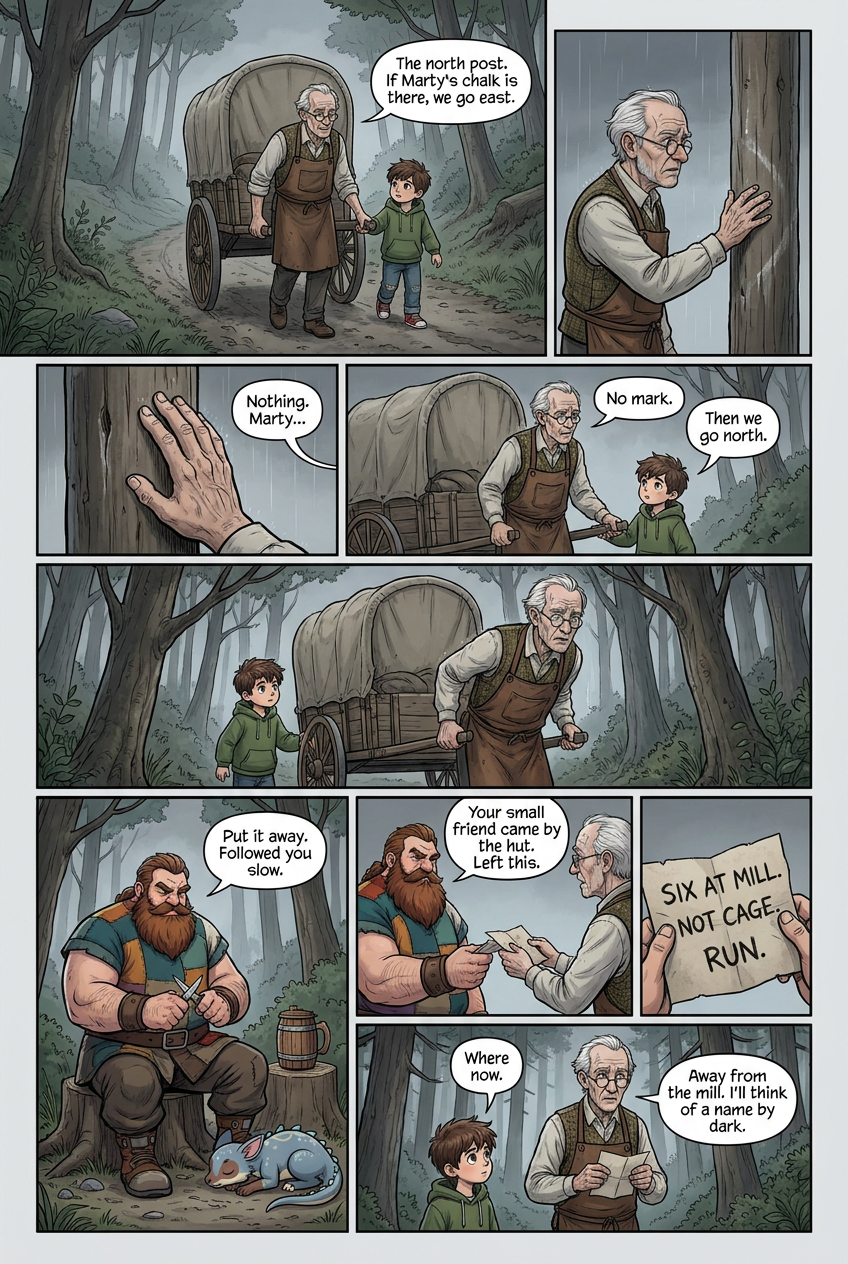
Ben and Chilly Willy pushed the handcart up the track toward the fork. The chest rode low under a canvas. Ben kept his eyes on the north post ahead. If Marty's chalk was there, they turned east to the mill. If not, they ran north with the load and no buyer. The fork came up in gray light. Ben stopped the cart behind a stand of alder and walked the last stretch alone. He circled the post. He ran his thumb along the wood at knee height, then shoulder height. He checked the back side. Bare. Nothing but weather and old grain. He stood there longer than he meant to. Marty was small and quiet and would not have missed a post he was paid to mark. If there was no mark, Marty had seen something at the mill he did not want Ben walking into. Or Marty was face down in the reeds. Ben went back to the cart. "No mark." Chilly Willy spat. "Then we go north." "We go north." They turned the cart off the mill road and pushed it into the thin trees. Ben's arms were shaking by the time they cleared the ridge, and not from the weight. He had cut Cage loose. Twelve pieces in a box and no one left who could buy them as a set. A figure sat on a stump twenty paces off the track, whittling. The small blue-gray creature from the hut lay at his feet. A heavy iron-banded tankard stood in the dirt beside his boot. Ben's hand went to his knife. "Put it away," Tax Evasion said, not looking up. "Followed you slow. Didn't want you walking past." "You were supposed to hold the hut." "Hut's held. Nobody came." He shaved a curl of wood. "Your small friend, though. He came through the hut before dawn. Left this." He reached into the tankard and pulled out a folded scrap. Ben opened it. Marty's hand, in charcoal: SIX AT MILL. NOT CAGE. RUN. Ben read it twice. His mouth went dry. The mill was six men and none of them the buyer. The chalk mark was never coming. "Why not put it on the post," Ben said. "Post is watched." Tax Evasion set the knife down. "He saw a man in the reeds by the north post at dusk. Left the paper with me instead. Said you'd come by the hut or you wouldn't come at all." Ben folded the scrap into his coat. Marty was alive. The trap was named. He still had the chest, and no buyer, and one more day at most before someone found the track they had cut through the alders. Chilly Willy took up the cart handles again. "Where now." Ben looked north into the pines. "Away from the mill. I'll think of a name by dark."
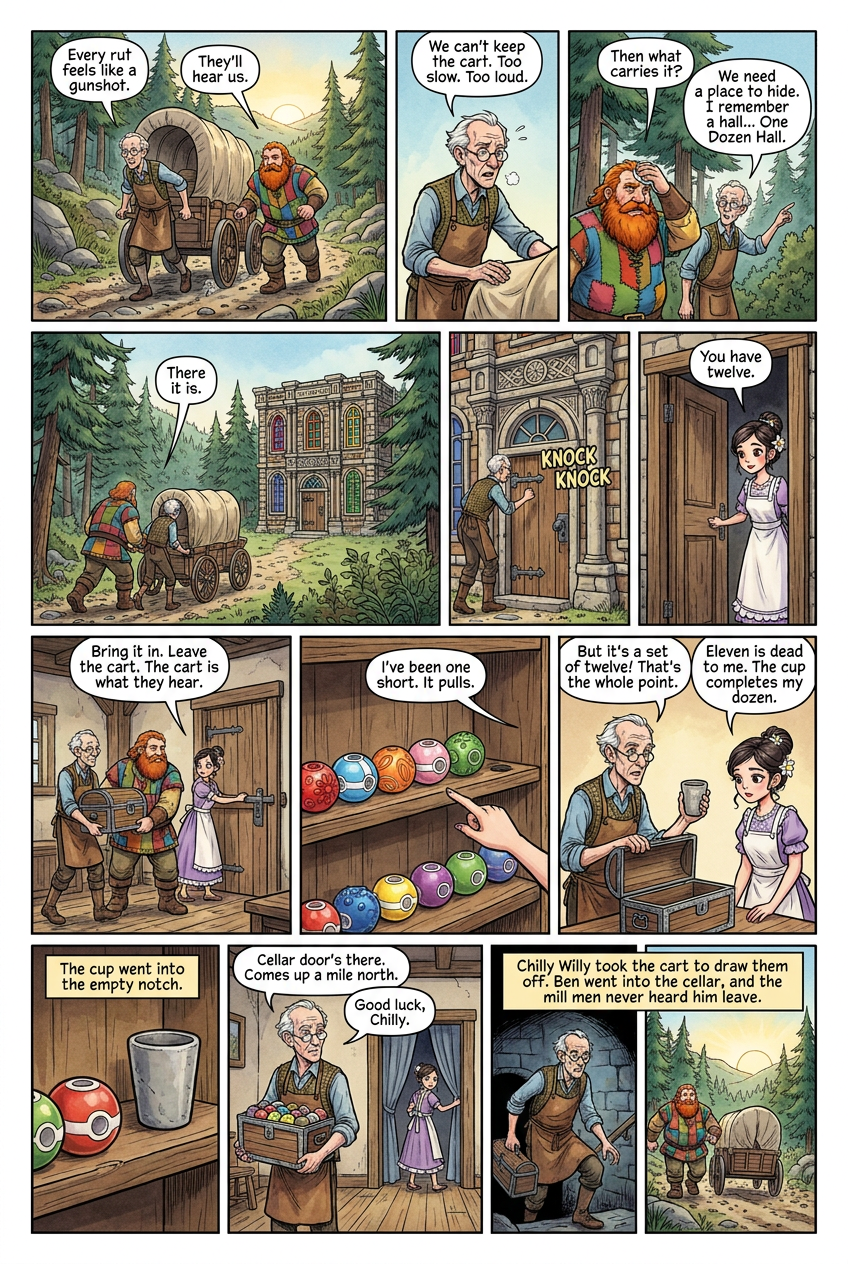
Ben and Chilly Willy pushed the cart into the pines above the fork. The wheels ground on stone. Every rut threw a bang up through the canvas that Ben felt in his teeth. Six men at the mill. No buyer. One handcart too loud and too slow for the ground ahead. If he kept pushing it up the trail, the mill men would run him down before the sun cleared the ridge. He stopped in a hollow and put his hand on the canvas. "We can't keep the cart." Chilly Willy wiped his face. "Then what carries it?" "Something that doesn't leave a track a child could read." Ben looked north. He needed a house, a barn, any door that opened. He remembered a low stone building Eileen had once named in passing. A hall marked by twelve. A woman who kept it. They cut east off the track and pushed the cart the last half mile through needles. The hall stood alone in a clearing. Small. Square. Six windows, each a different color of glass. A sign above the door read ONE DOZEN HALL. Ben left Chilly Willy with the cart and knocked. The door opened on a girl in a white apron. A flower sat behind her ear. She looked at Ben's boots, then at the canvas shape in the trees behind him. "You have twelve," she said. Not a question. Ben's stomach turned. "How do you know that." "I've been one short a long time. It pulls." She stepped back from the door. "Bring it in. Leave the cart. The cart is what they hear." He brought Chilly Willy up. They carried the chest between them across the sill. Anna Conda shut the door behind them and slid a bar across it. The room smelled of beeswax. On a shelf sat eleven small carved beads in a row, each a different color, each shaped a little different. A twelfth notch waited empty at the end. "That's not what I have," Ben said. "I know what you have." She did not look at the chest. "I don't want it. I want one piece of it. The stone cup. You keep the rest." Ben's throat worked. "It's a set. Twelve. That's the whole point." "Eleven is dead to me. Twelve is dead to you if the mill men catch you at dawn." She nodded at the back wall. "There's a door behind that curtain. Goes down to a cellar under the road. Comes up in the pines a mile north. No cart. No noise. You walk out with what you can carry." Ben looked at Chilly Willy. Chilly Willy said nothing. Ben set the chest on her table and worked the seal. The cup went into the empty notch on her shelf. Ben closed the chest with eleven pieces inside and shouldered it alone. Chilly Willy took the cart back down the track to draw them off. Ben went into the cellar door and the mill men never heard him leave.
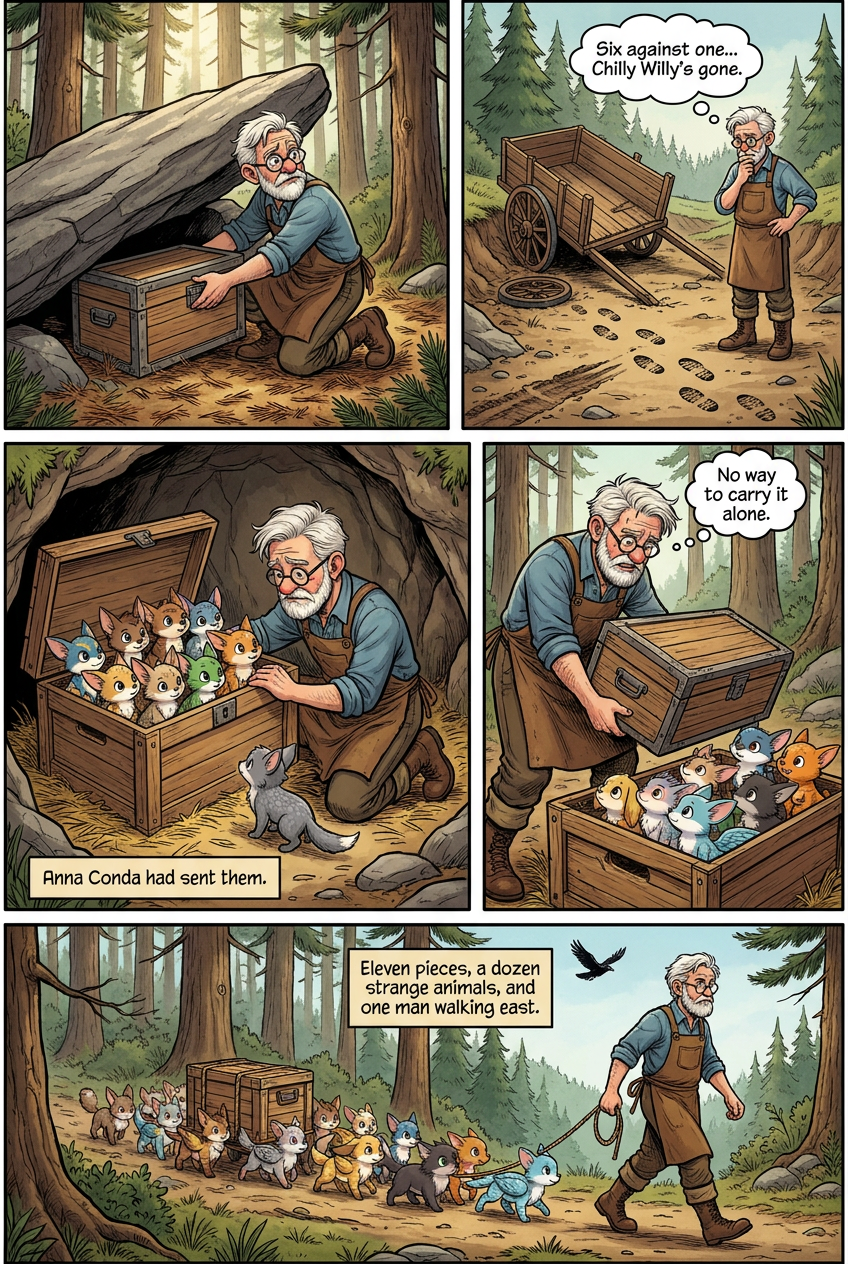
Ben came up out of the cellar into the pines a mile north of the hall. He set the chest down in the needles and listened. No horns. No dogs. Just wind. He had eleven pieces on his back, no cart, and no Chilly Willy. The big man had said he would draw the mill men down the trail with the empty cart. That was an hour ago. He should have circled back by now. Ben waited until the sun cleared the ridge. He watched the trail south. Nothing came up it. A crow crossed the clearing and settled on a stump. He counted to a hundred and started again. Chilly Willy had a wife's sister to go home to. He would not vanish for a coin and a drink. Ben slid the chest under a slab of rock and covered it with brush. He marked the spot with three stones and cut south along the ridge above the trail. He moved slow. Every step he expected to hear the horn. He found the cart a quarter mile down, on its side in a ditch. One wheel was gone. The canvas was slashed open and empty. No blood on the wood. No body in the ferns. Boot prints all around it, six sets, heading back toward the mill road. One larger set went east into the brush, dragged at the heel. Ben crouched by the drag mark. Chilly Willy had gone east on his own two feet, or been walked out that way. Either way the mill men had him. Six against one, and Ben with a chest a mile north and no way to carry it alone. He followed the drag a hundred paces and stopped. The trail opened into a hollow. In the hollow sat a wooden crate the size of a coffin, marked on the side with a neat bundle of twelve black lines. The lid was off. Inside, curled together on straw, were twelve small creatures. Each one different. A blue kit with white ears. A green one with a torn lip. A gray one already watching him. Ben understood without being told. Anna Conda had sent them after him. She kept twelve of everything. She had counted him short a partner and made it right. The gray one climbed out and put its nose on the drag mark. The others followed in a line. They moved east through the ferns without a sound. Ben went back for the chest. He hauled it down to the hollow alone, breath tearing, and set it in the crate on the straw. The creatures made room. Twelve small backs took the weight the way a cart would. He had lost Chilly Willy. He had a set of eleven, a buyer who might already be dead, and a dozen strange animals waiting on his word. He picked up the lead rope and walked east after the drag mark.
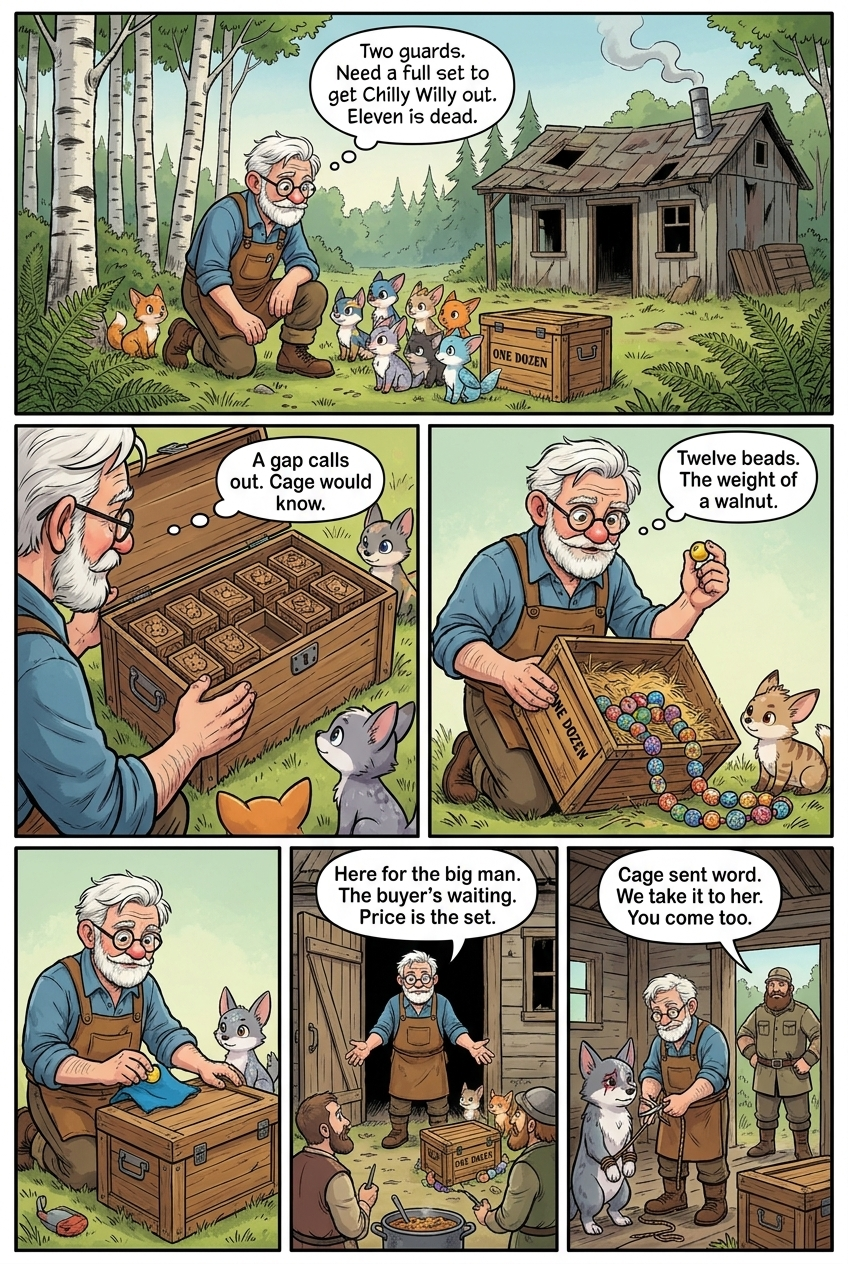
Ben followed the drag mark east with the twelve small creatures under the chest. The trail bent through a stand of birch and stopped at a shed with a sagging roof. Smoke came from a tin pipe. He heard a man cough inside. He knelt in the ferns and counted boots at the door. Two pairs. The other four had gone back to the mill road with Chilly Willy. He had one chance to reach Cage with a set, and the set was short by one. He opened the chest at the tree line and looked at the eleven boxes. Eleven was dead to Cage the way it was dead to the woman who had taken the cup. She had told him plain. A gap in a dozen calls out. Cage would feel it the moment she lifted the lid. He needed a twelfth piece that would pass a quick look, long enough to close the deal and get Chilly Willy out. He looked at the crate the small creatures had come in. Twelve black lines on the side. Straw inside. He tipped it and a string of matching beads spilled from under the straw. Twelve of them, polished, drilled through, each one different in color but sized the same. He turned one in his fingers. It was the weight of a walnut. It would ride in a carved box and hum of nothing at all. He wrapped the beads in a strip of felt from his coat and set the bundle in the empty slot in the chest. He closed the lid. The gray creature watched him do it and did not move. He did not know if the beads were meant for him or for something else, but they were twelve, and twelve was what he needed. He left the animals with the chest in the ferns and walked to the shed door with his hands open. The two guards looked up from a pot of stew. He said he had come to trade for the big man. He said the buyer was waiting and the price was the set. One of them stood and looked past him at the trees. Chilly Willy sat against the back wall with his hands tied and a cut over one eye. He saw Ben and did not speak. The guard who had stood walked out to check the tree line. He came back with the chest carried between two of the small creatures and the rest walking behind. He set it down and lifted the lid and looked at twelve boxes in a row. He closed it again. "Cage sent word," he said. "We take it to her. You come too." Ben cut the rope on Chilly Willy's wrists. The set was whole to the eye. It would hold until Cage opened a box. He had bought himself the walk to the mill, and nothing past it.
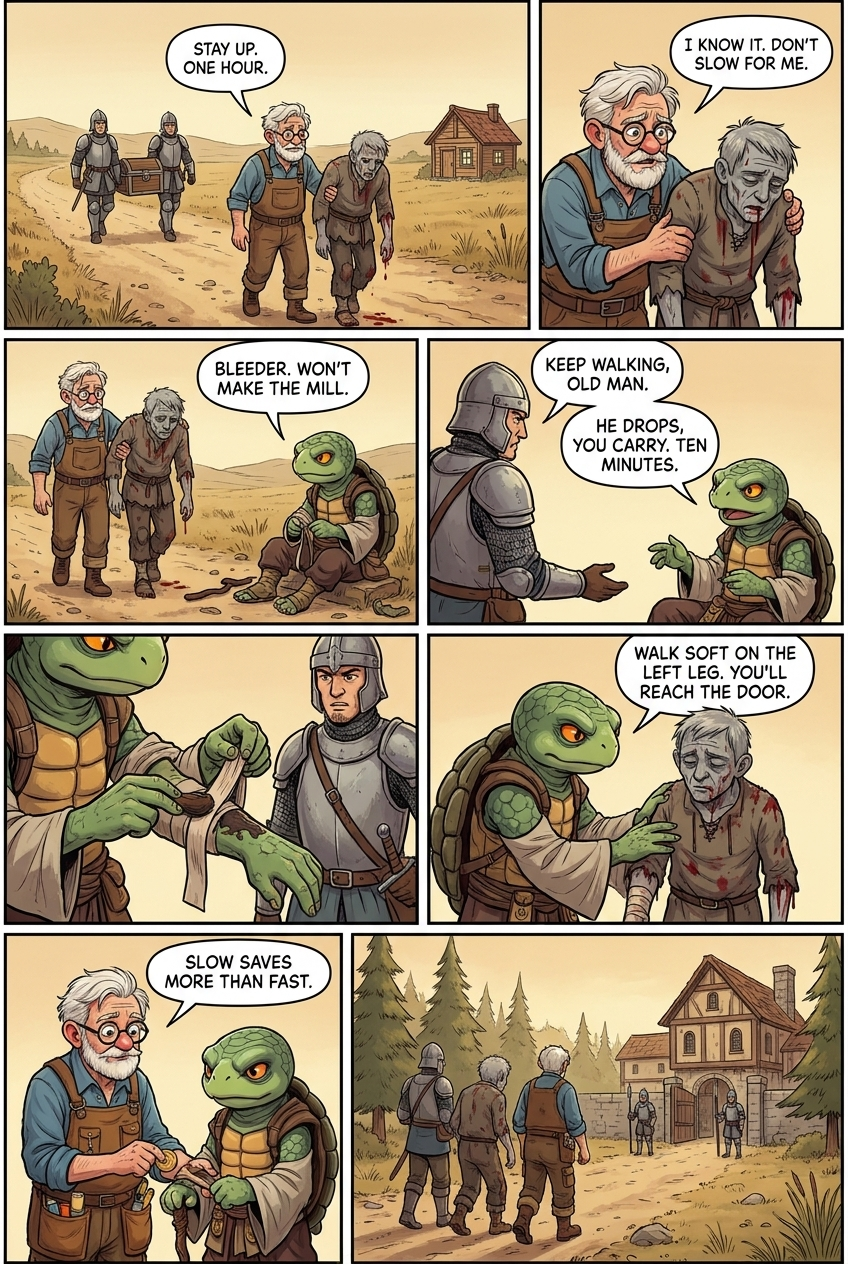
Ben walked the mill road behind the two guards with the chest carried between the small creatures. Chilly Willy walked beside him and dripped blood into the dust. The cut over his eye had opened again on the shed step, and a second cut on his forearm bled through his sleeve where the rope had cut deep. He kept his good arm across the bad one and set his teeth. Every ten paces he slowed. Every twenty he stumbled. Ben watched the road ahead and counted the drops. Cage's mill was still an hour off. If Chilly Willy went down before the door, Ben could not lift his end of the chest alone. The small creatures could carry it between them, but not up the mill stair, and not past a guard who wanted to see a man on each handle. A collapsed partner at the gate would tell Cage's people that Ben had come alone, and alone meant robbed. He caught Chilly Willy's good elbow at the next stumble. "Stay up. One hour." "I know it." His face was gray. "Don't slow for me." A low roof showed through the alders on the left. A pot sat by the door and a green figure sat behind the pot, mending a strap. Tax Evasion looked up as they came even with the path. He did not stand. He looked at Chilly Willy's sleeve, then at the guards, then at Ben. "Bleeder," he said. "Won't make the mill." The lead guard turned. "Keep walking, old man." Tax Evasion did not move. "He drops, you carry. You carry, you're slow. Slow on this road brings company." He nodded at the trees. "Bind him here. Ten minutes." The guard looked at the trees. He looked at the chest. He looked back at Ben. "Ten," he said. "Then we walk." Tax Evasion took a strip of clean linen from inside his shell and a small pot of dark paste. He worked at the pace of a man setting a snare. He pressed the paste into the arm cut first, then the brow. He wrapped the arm tight and knotted it under the thumb. He did not speak while he worked. When he finished he set his hand flat on Chilly Willy's chest for a breath, then took it away. "Walk soft on the left leg," he said. "You'll reach the door." Chilly Willy stood without help. The bleeding had stopped at the wrap. His color was still bad, but his feet were under him. Ben laid a coin on the mending strap. Tax Evasion did not look at it. "Slow saves more than fast," he said, and went back to his stitch. They walked. Chilly Willy held his end. The mill roof rose above the pines ahead, and Cage's men stood at the gate.
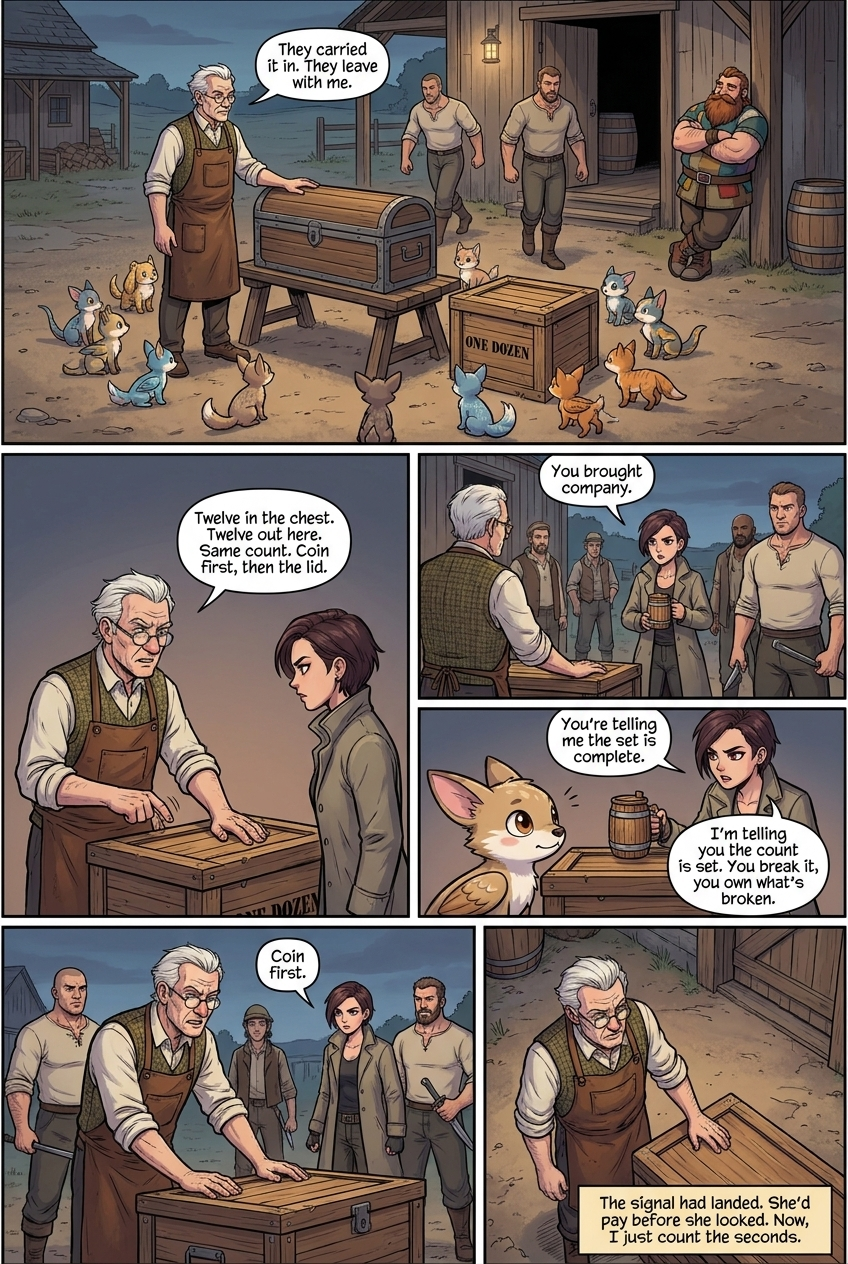
The mill gate opened for them. Two of Cage's men waved the guards off and took the handles of the chest from the small creatures. Ben let them lift it. He kept his hand on the lid as they set it on the trestle inside the yard. Chilly Willy leaned against the post and closed his eyes. The chest was here. The set was here. And Ben still had no way to tell Cage this was all of it before her people counted the boxes and decided they could take it without paying. Cage came down from the mill door. She wore a plain coat and carried a wooden tankard in one hand. She did not look at Ben first. She looked at the chest, and at the twelve small creatures sitting in a ring around it. One of them, calm and blue-gray with pale markings, sat closest to the lid. It did not move when her men stepped near. "You brought company," Cage said. "They carried it in," Ben said. "They leave with me." Her men waited on her word. Two had hands on knives. One stood behind the trestle with a pry bar. If she nodded, they would open the chest and count. If the count was twelve, she could pay him or kill him. If the count was short, she would kill him for wasting her time. Ben set the marked wooden crate on the trestle beside the chest. The stencil on its side read ONE DOZEN. He tapped it once with two fingers, the way a trader taps a sealed bond. "Twelve in the chest," he said. "Twelve out here. Same count. My mark. Open the chest and the deal is done. Open it before the coin is on the board and you get eleven and a fight." Cage looked at the crate. She looked at the ring of small creatures. The calm one blinked at her once and did not look away. "You're telling me the set is complete," she said. "I'm telling you the count is set. You break it, you own what's broken." She drank from the tankard. She set the tankard on the crate lid, deliberate, and left it there. Her man behind the trestle lowered the pry bar. "Coin first," she said to her steward. "Then the lid." The steward went inside. Cage did not move. Her men did not move. Ben kept his hand on the chest and felt his pulse in his palm. The signal had landed. Cage would pay before she looked. The bead-piece inside would sit under her eye only after the coin was on the board, and by then Ben would be reaching for it. He watched the mill door and counted the seconds until the steward came back with the purse.
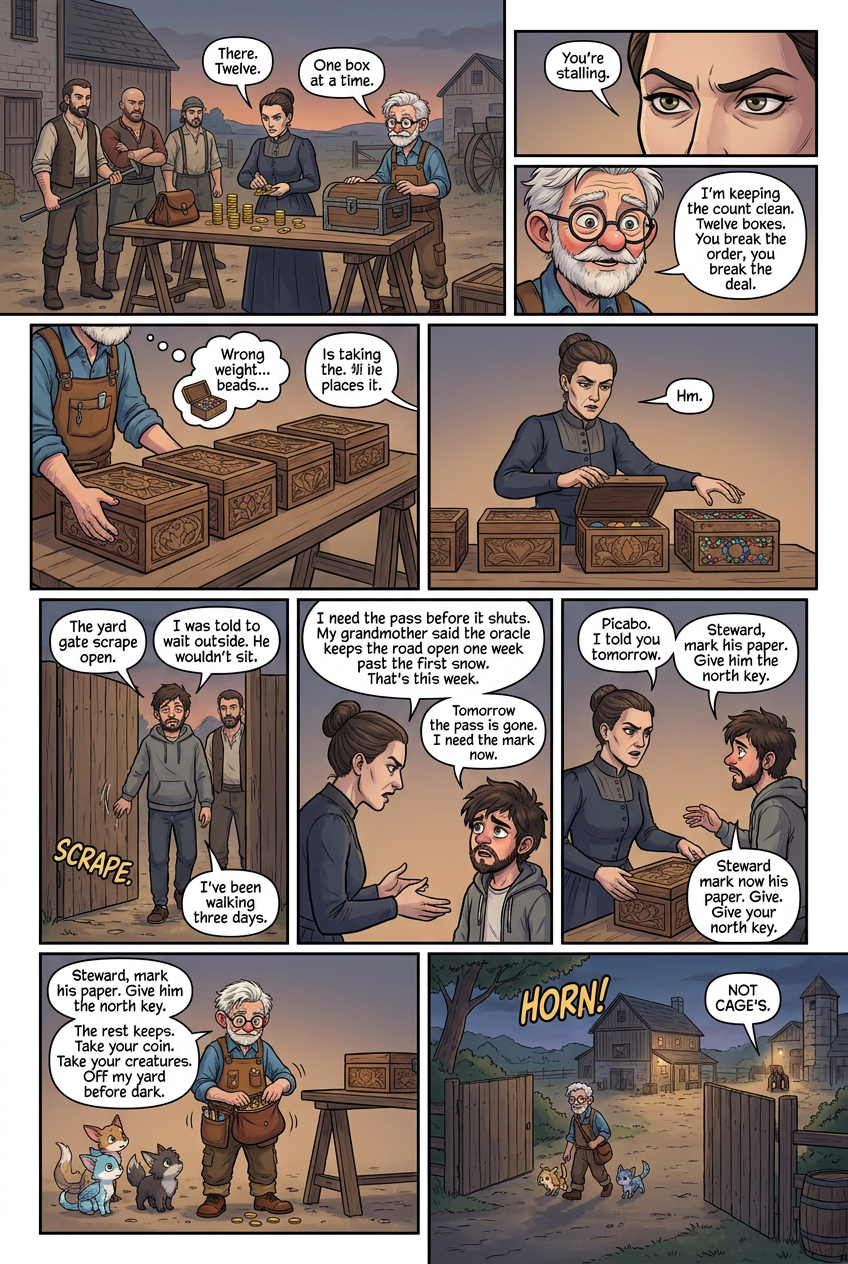
The steward came back with a leather purse and set it on the trestle. Cage untied the cord and poured coin onto the wood. She counted it in stacks of ten while her men watched Ben. When the last stack was set, she nodded at the man with the pry bar. He stepped up to the chest. Ben kept his hand on the lid. "One box at a time," he said. "I hand them to you. You set them in a row. Then you look." Cage tilted her head. "You're stalling." "I'm keeping the count clean. Twelve boxes. You break the order, you break the deal." She waved the pry bar down. Ben lifted the lid himself. He reached in and took out the first carved box. He set it on the trestle. Then the second. Then the third. His fingers found the fourth and he felt the wrong weight under the wood, the small hard rattle of beads instead of stone. He set it down anyway. Fifth. Sixth. He worked slow and even. The bead box sat third from the end when he was done. Cage stepped up. She lifted the first lid. She looked. She lifted the second. She did not touch the pieces. She only looked. The yard gate scraped. A man in a gray hood came through with a boy behind him. The boy was thin and worn out. His hair stuck up in a dark mop. He wore a hoodie and sandals and moved like his legs hurt. "I was told to wait outside," the man said. "He wouldn't sit." "I've been walking three days," the boy said. He looked at Cage, not Ben. "I need the pass before it shuts. My grandmother said the oracle keeps the road open one week past the first snow. That's this week." Cage's hand stopped over the fourth lid. "Picabo. I told you tomorrow." "Tomorrow the pass is gone," the boy said. Flat. No push in it. "I need the mark now." Cage looked at Ben. She looked at the boy. She looked at the fourth box under her hand. Ben watched her weigh it. A stalled buyer. A closing road. A ring of small creatures around a chest. The calm blue-gray one had not moved. She lifted her hand off the lid. "Steward," she said. "Mark his paper. Give him the north key." She turned back to Ben. "The rest keeps. Take your coin. Take your creatures. Off my yard before dark." Ben swept the coin into the purse. His hands shook once and then stopped. Chilly Willy pushed off the post. The small creatures rose together and moved for the gate. Ben walked out behind them with the purse against his ribs and the fourth box still shut on the trestle behind him. Behind the mill wall, a horn sounded once. Not Cage's. Someone else had found the yard.
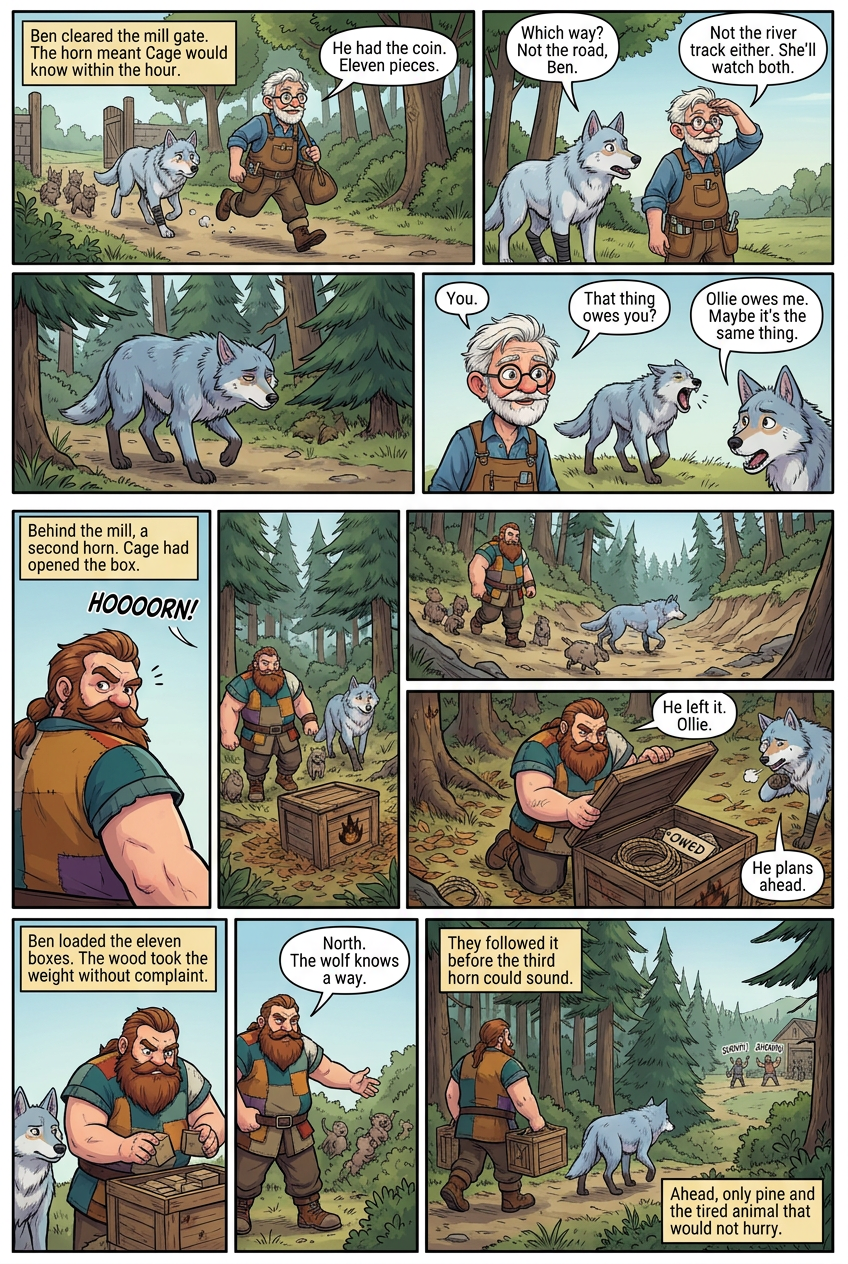
Ben cleared the mill gate with the purse against his ribs and the small creatures pressed close at his heels. The horn behind the wall meant Cage would open the fourth box within the hour. When she saw beads instead of stone, she would send men on every road out. Ben had the coin. He had eleven real pieces still with him. He had no safe road left. Chilly Willy limped beside him at the tree line. His wrap was dark again where the paste had given up. "Which way?" "Not the road," Ben said. "Not the river track. She'll watch both by dusk." "Then what?" Ben looked at the small blue-gray creatures ringing his boots. They had carried the chest for him once. They could not carry a grown man. He needed a road that did not look like a road. A thin shape stepped out from the pines ahead. Gray fur, drooped tail, one ear bent. It sat down in the path and watched him with tired eyes. Ben knew the look. It was Ollie's wolf, the one he had left in the pines to die three weeks back. Thinner now. Alive. "You," Ben said. The wolf yawned. It stood and walked ten paces north off the path, then stopped and looked back. Chilly Willy shifted his weight. "That thing owes you?" "Ollie owes me," Ben said. "Maybe it's the same thing." Behind the mill, the horn sounded a second time. Two short notes. A signal, not an alarm. Cage had opened the box. Ben moved. The small creatures moved with him. The wolf led them through pine to a dry wash and along the wash to a stand of alder where a soft-sided wooden crate sat half-sunk in leaves. Its top had a worn handhold. Its planks were cracked but nailed tight. A guild mark was burned on one side. Ollie's mark. "He left it," Ben said. He knelt and lifted the lid. Inside, folded oiled canvas. A coil of waxed rope. A ledger tag with one word in Ollie's hand: OWED. Chilly Willy laughed once, then coughed. "He plans ahead." Ben loaded the eleven boxes from the small creatures' backs into the crate. The wood took the weight without complaint. He wrapped the canvas over the top and tied it down. The crate looked like something a hauler had abandoned. Nobody would open it in daylight without a reason. He set the small creatures loose into the alder. They scattered without sound. "North," Ben said. "The wolf knows a way." Chilly Willy took one handle of the crate. Ben took the other. The wolf walked ahead at its own slow pace, and they followed it into the trees before the third horn could sound. Behind them, the mill yard filled with shouting. Ahead, only pine and the tired animal that would not hurry.
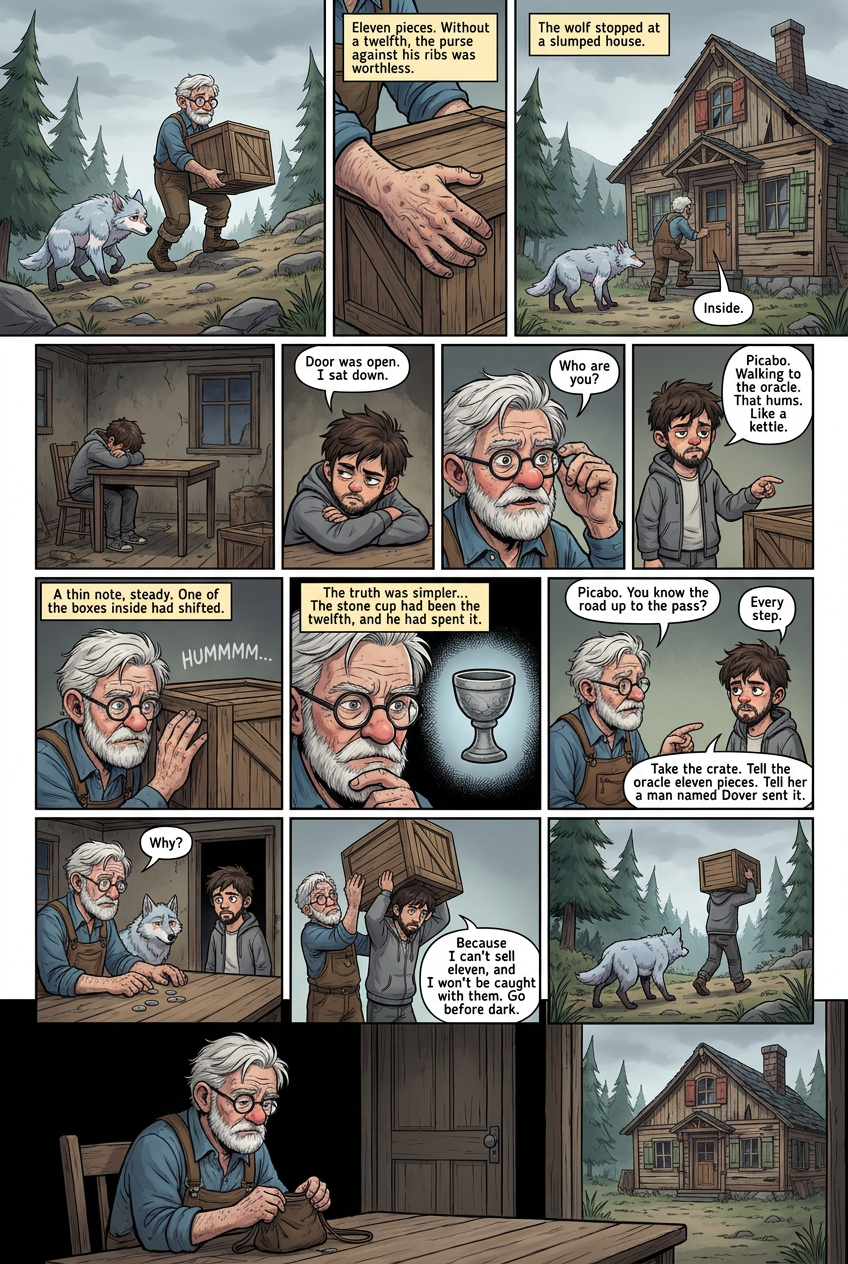
The wolf led them off the wash and up a shallow rise. Chilly Willy stumbled twice on the climb. Ben caught the crate handle each time to keep the boxes from grinding. Eleven pieces. That was the whole of it. The stone cup he had traded away was gone, and Cage's beads would not fool any buyer who counted honestly. Without a twelfth piece, the purse against his ribs was worthless. Any buyer he approached with eleven would take the coin back and cut his throat for the short count. The wolf stopped at a slumped wooden house at the edge of the pines. Shutters hung crooked. The chimney leaned. A pot sat by the door with cold ash in it. Ben knew the look of a place kept just enough to seem lived in. "Inside," Ben said. Chilly Willy dropped onto the step and stayed there. Ben pushed the door with his shoulder. A boy sat at the table with his head on his arms. Thick dark hair. Gray hood. Sandals wet through. He lifted his face and looked at Ben without surprise, the way a man too tired to be startled looks at anything. "Door was open," the boy said. "I sat down." "Who are you?" "Picabo. Walking to the oracle. Pass shuts in four days." He nodded at the crate. "That hums. I can hear it from here. Like a kettle before it whistles." Ben set the crate down slow. He had thought the sap seal was holding. He put his ear to the wood. A thin note, steady. One of the boxes inside had shifted. He had no wax, no sap, no time. He had a boy who could hear it and a wolf that had brought him to this door. Ben thought about the twelfth piece. He had been chasing one all his life. The truth was simpler than he had let himself say. There was no twelfth. The stone cup had been the twelfth, and he had spent it. He would not find another before Cage's men found him. He made his choice. "Picabo. You know the road up to the pass?" "Every step." "Take the crate over. Whoever the oracle is, she can have it. Eleven pieces. Tell her the twelfth was traded for a tunnel. Tell her a man named Dover sent it." Picabo looked at the crate. "Heavy?" "The wolf helps. He owes me a road." Ben took three coins from the purse and set them on the table. He kept the rest. Chilly Willy watched from the step and said nothing. "Why?" Picabo said. "Because I can't sell eleven, and I won't be caught with them." Ben lifted the crate onto the boy's shoulder and steadied it. "Go before dark." The wolf stood and walked out toward the rise. Picabo followed. Ben watched the crate go until the pines closed behind it. Then he shut the door and sat down across from Chilly Willy with the purse and no set at all.
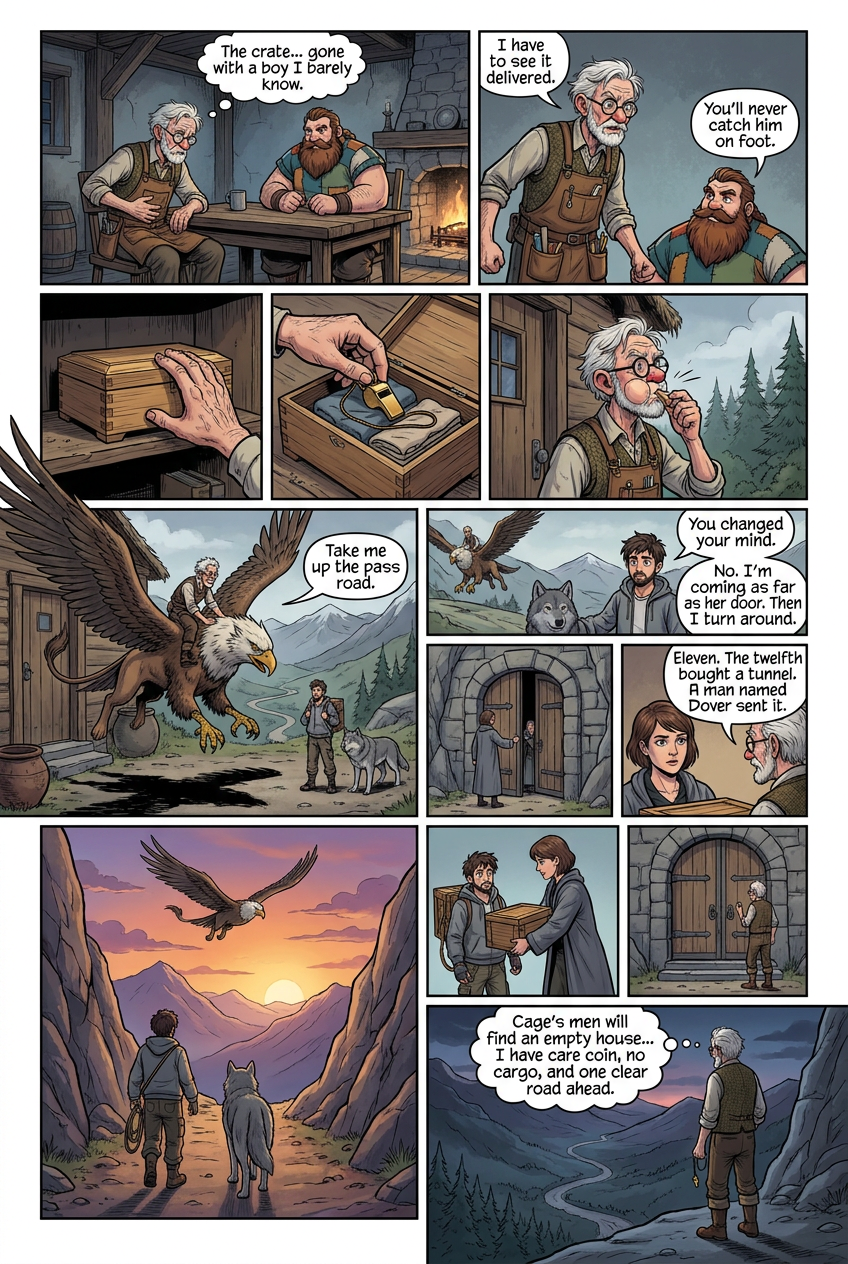
Ben sat with Chilly Willy at the table for a long minute after the door shut. The purse pressed against his ribs. The crate was gone with a boy he had known for six sentences. Ben stood up. He could not sit here and hope. He needed to see the crate reach the oracle's road with his own eyes. If Picabo dropped it, sold it, or ran, Ben would never know until Cage's men came for him. He went to the shutter and looked at the rise. The wolf and the boy were already a dark shape against the pines. The road to the pass climbed north through switchbacks. He could not run it. Picabo had four days of walking in him and Ben had a bleeding partner on the step. "I have to see it delivered," Ben said. Chilly Willy lifted his head. "You stay. Bar the door." "You'll never catch him on foot." "I know." Ben looked around the room. A cold hearth. A shelf. A plain wooden box on the shelf, the size of a loaf, sturdy and clean. He lifted the lid. Inside, folded rags and a small brass whistle on a cord. Millie had left it, or someone like her had. He did not ask which. He pocketed the whistle and stepped outside. He blew it once, hard. The note ran flat across the pines. He waited. Nothing came. He blew again. On the third try, the winged creature dropped through the branches and settled on the pot by the door. It knew him. It had carried the crate before. "Take me up the pass road," Ben said. He climbed on. The creature lifted. He found them at the second switchback. Picabo trudged with the crate roped to his back. The wolf paced beside him. Ben landed ahead on the road and Picabo stopped without surprise. "You changed your mind," the boy said. "No. I'm coming as far as her door. Then I turn around." Picabo shrugged and walked on. Ben walked behind him with the winged creature gliding low above the pines. Two ridges. Three. The pass narrowed. At dusk they reached a stone gate set into the mountain wall. A woman in a gray robe opened it before Picabo knocked. She looked at the crate. She looked at Ben. "Eleven," Ben said. "The twelfth bought a tunnel. A man named Dover sent it." She took the crate from Picabo's back. She carried it inside. The gate shut. Ben stood on the stone step with the whistle in his hand and the purse still against his ribs. The set was out of the world now. Cage's men would find an empty house and a wounded man and a cold trail. Ben turned and started down the pass. He had coin, no cargo, and one clear road ahead of him for the first time in a year.
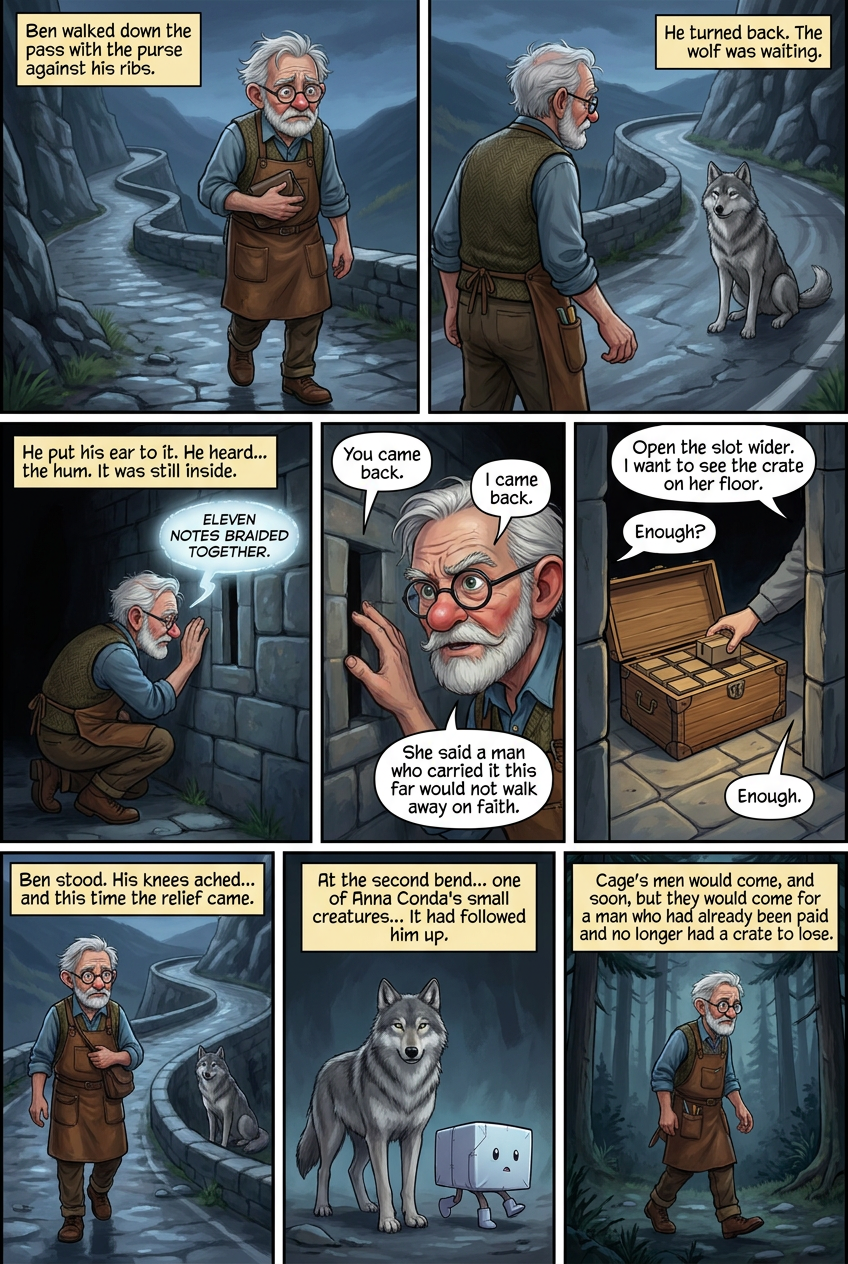
Ben walked down the pass with the purse against his ribs and the whistle in his pocket. The stones were slick from the day's melt. He kept his eyes on the road and tried to feel relief. He could not. He had handed the crate to a woman in a gray robe he had never seen before, on the word of a boy he had known for one afternoon. If she was not the oracle's, the set was gone and Cage's men would still come. He stopped at the third switchback. The gate was already lost behind the rock. He turned back. The wolf was waiting at the second bend. It had not gone down with Picabo. It sat on the road with its ears forward, watching him climb. Ben did not question it. He climbed. He reached the stone gate at full dark. He did not knock. He crouched by the wall where a narrow slot cut through for drainage and put his ear to it. He heard nothing at first. Then, faint, the hum. Eleven notes braided together, the sound he had carried for a year. It was inside. It was still inside. He let out a breath he had been holding since the pass road. A voice spoke on the other side of the wall. Low, patient. "You came back." "I came back," Ben said. "The oracle expected you would. She said a man who carried it this far would not walk away on faith." Ben pressed his hand against the stone. "Open the slot wider. I want to see the crate on her floor." A panel slid. A thin line of lamp light fell on his boot. Through the gap he saw the traveler's box on flagstones, lid up, the eleven carved boxes set in a row on a cloth. A gray sleeve reached in and lifted one, turned it, set it back. Then the panel closed. "Enough?" the voice asked. "Enough." "Then go. She will not open the gate twice." Ben stood. His knees ached. He started down the pass a second time and this time the relief came, small and cold, like water after a long thirst. At the second bend the wolf stood up. Something moved beside it in the dark, low to the ground, box-shaped, with short legs and a pale face. One of Anna Conda's small creatures. It had followed him up. It carried nothing now. It looked at him with black eyes and turned and trotted down the road. Ben followed. He had coin. He had a wolf. He had a witness that the set was where he said it was. Cage's men would come, and soon, but they would come for a man who had already been paid and no longer had a crate to lose. He walked down toward the pines and did not look back.
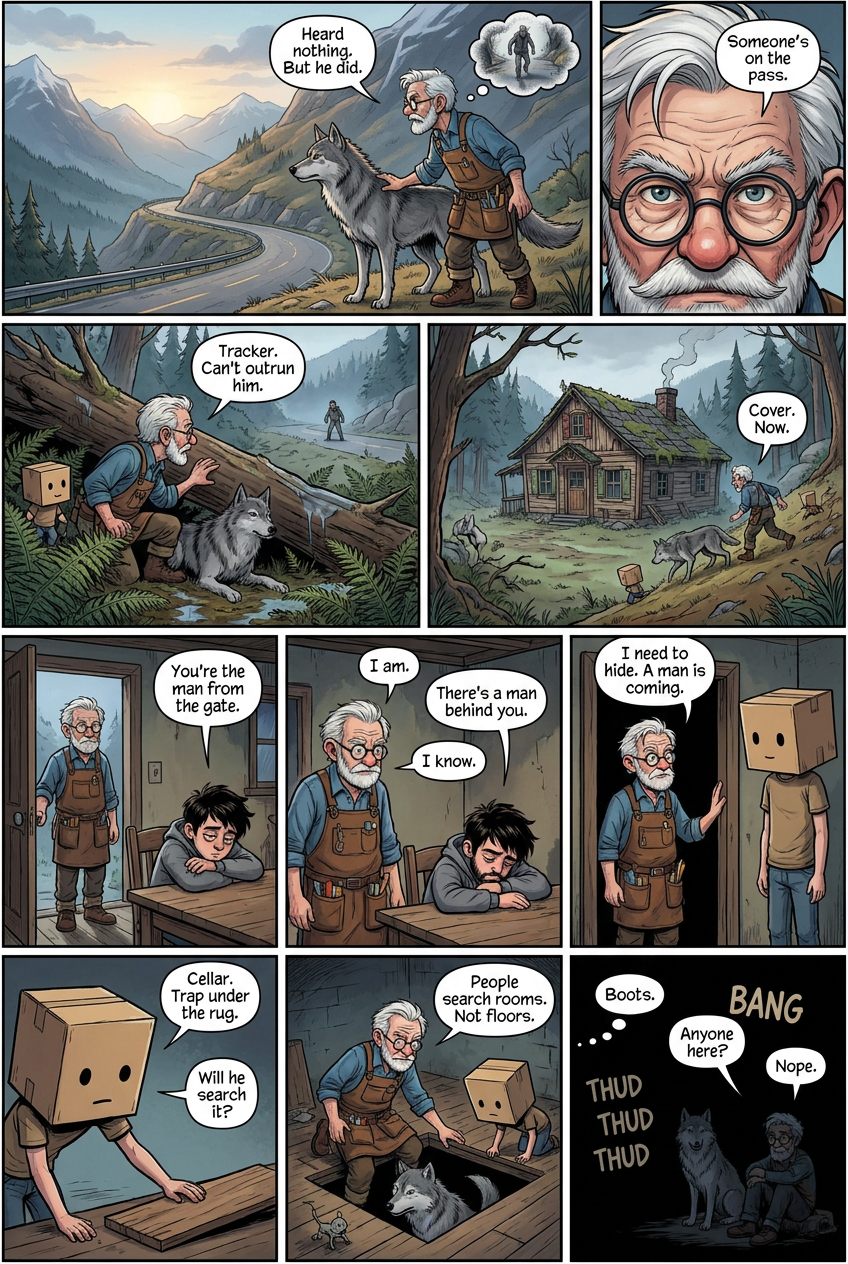
Ben came down out of the pines an hour after dawn. The wolf had run ahead. It came back stiff-legged, hackles up, and stopped in the middle of the road. Ben stopped with it. The wolf turned its head uphill, behind them. Ben heard nothing. He trusted the wolf. Someone was on the pass road, closing the gap he had opened during the night. He stepped off the road into wet fern. The small box-headed creature from Anna Conda's crate went with him, quiet on its short legs. Ben crouched behind a fallen trunk and listened. He heard boots after a minute. One set, moving fast. A tracker, not a scout party. Cage would send a fast man first to fix his position, then bring the others. He could not outrun a tracker down the pass. His legs were done. He needed cover before the man cleared the bend. A roof showed through the trees below the road. A sagging house, shutters hanging, moss on the shakes. Smoke thin from the chimney. Someone lived there. Ben went down the slope on his heels, the wolf ahead, the small creature behind. He knocked once and opened the door before an answer came. A boy sat at the table with his head on his arms. Dark hair, gray hoodie, sandals wet through. A pack by his foot. He lifted his face and looked at Ben without surprise. "You're the man from the gate," Picabo said. "You went back up." "I did." "There's a man on the road behind you." "I know." Picabo nodded once, the way someone points out that a pot is boiling. He put his head back down. Ben stepped past him into the back room. A shape stood in the corner where a stove should have been. Tall, square-shouldered, a cardboard box for a head with two black dots for eyes. It did not move when Ben entered. Ben had seen stranger things in a year of running. He kept his hand on the door. "I need to be somewhere else," Ben said. "A man is coming." "Cellar," the box-headed one said. It tipped its head toward a plank in the floor. "Trap under the rug. Not comfortable." "Will he search it?" "People search rooms." A pause. "Not floors." Ben pulled the rug back and lifted the plank. Cold air came up, and the smell of old potatoes. He whistled the wolf in and lowered himself down after it. The small creature dropped in on its own. The box-headed one slid the plank back and dragged the rug over. Ben heard the chair scrape as it sat down at the table with Picabo. Boots hit the porch a moment later. The door banged open. A voice asked a question. Picabo answered in one word. The boots went through the front room, the back room, and out again. Ben sat in the dark with the wolf's ribs against his knee and waited to be told he could come up.
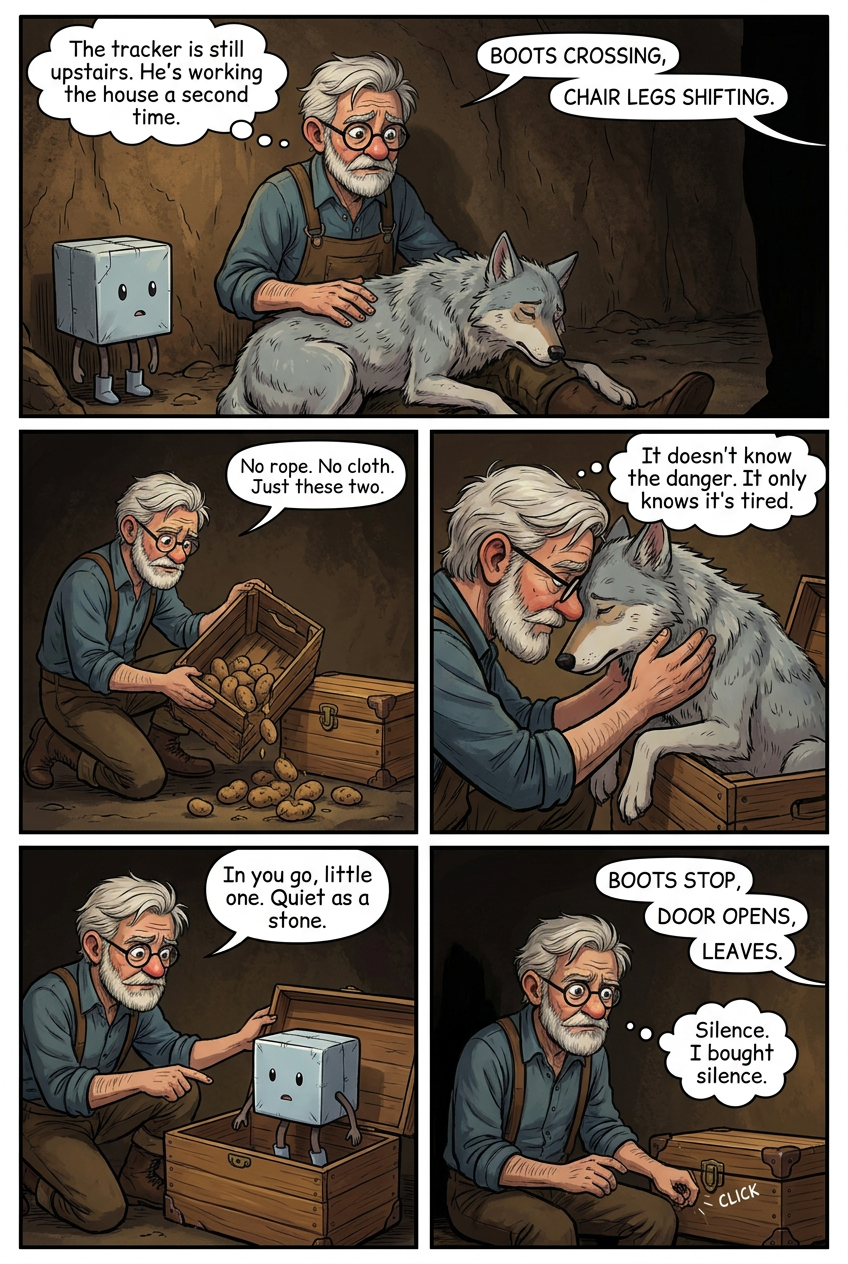
The cellar was cold and close. Ben sat with his back against the earth wall. The wolf lay against his knee. The small box-headed creature stood in the dark beside him, quiet as a stone. Above, chair legs shifted. Picabo answered another question. Boots crossed the plank floor again. The tracker had not left. He was working the house a second time. The wolf's flank rose and fell too fast. Ben set a hand on its ribs. The animal was spent. Three days ago it had come limping out of the pines to find him. Now its breath came shallow and its eyes half-closed. If it whined once, the tracker would hear. If the small creature made any sound, the tracker would tear up the rug. Ben had nothing to gag them with. He had no rope, no cloth, no way to signal them to hold still. The wolf did not know the danger. It only knew it was tired. Ben looked at what he had. A worn crate sat against the far wall, lid gone, one side split. Old potatoes inside, some sprouted. A traveler's box beside it, small and clean, brass latch shut. Someone had put it there and forgotten it. He reached for the traveler's box first and eased the latch. Wool inside. A folded shirt. Nothing that would help. He went to the worn crate. He tipped the potatoes out onto the dirt floor without a sound. The crate was big enough for the wolf if the wolf would fold. It smelled of dirt and cellar, not of Ben. That was the point. He knelt and put his forehead against the wolf's forehead. The wolf's eye rolled up to look at him. Ben lifted the animal under the chest and the hips. It did not fight him. He set it into the crate on its side. The wolf's ribs pressed the split wood. It let out a breath through its nose. Then it closed its eyes. Ben took the traveler's box and set it in front of the small creature. He opened the lid. He pointed inside. The creature looked at the box. It looked at Ben. It stepped in and sat down and pulled its own legs under itself. Ben lowered the lid until the latch caught with a small click. Upstairs the boots stopped over the rug. Ben did not breathe. He heard the tracker turn a slow circle. He heard the chair scrape as the box-headed one stood. He heard a low word he did not catch. Then the boots went to the door and out. Ben sat in the dark and listened to the wolf breathing inside the worn crate. Small and even. The small creature did not stir inside the traveler's box. He had bought silence. He had used up his last two containers to do it.
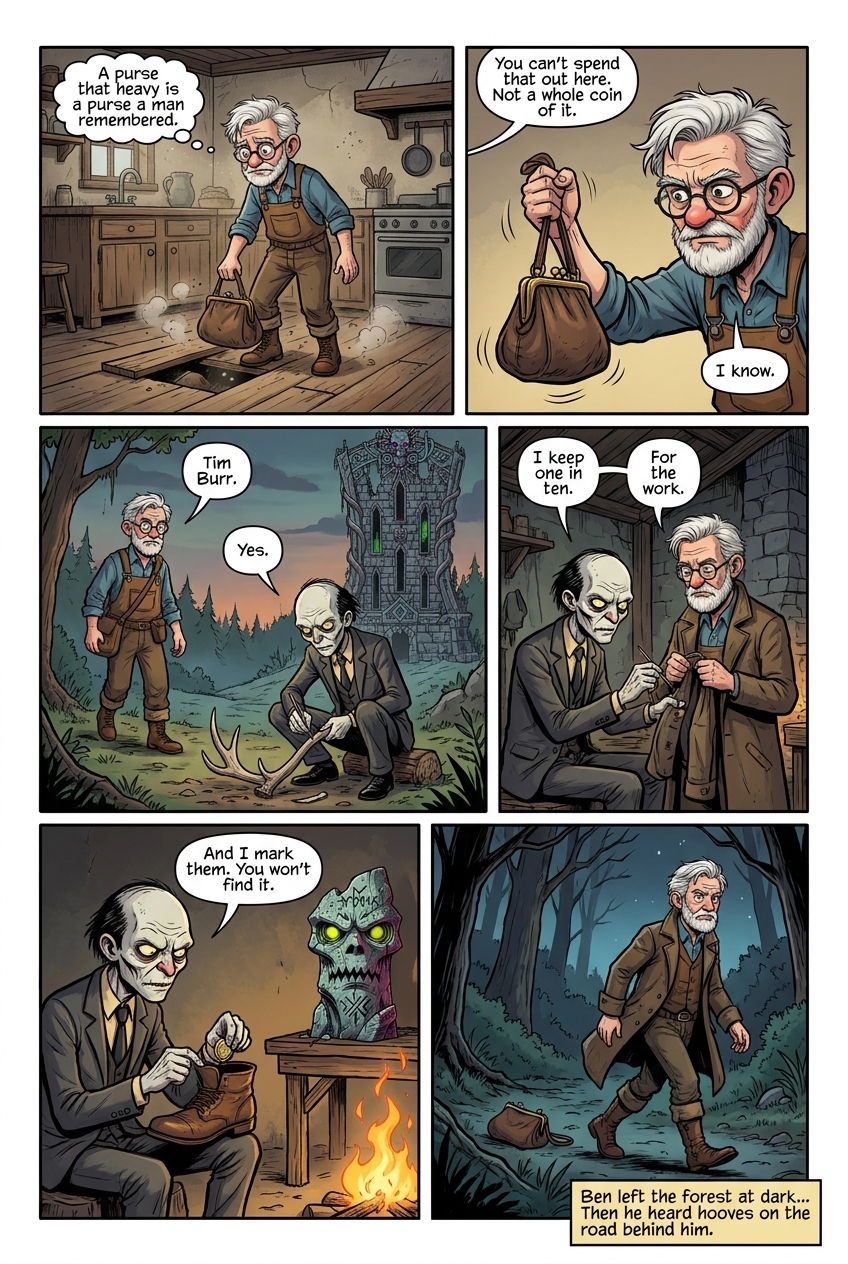
Ben waited in the cellar until the house went quiet above him. Picabo tapped twice on the trap door. Ben lifted the wolf out of the split crate and set it on the floor. It stood, wobbled, and stayed standing. He opened the traveler's box and the small box-headed creature climbed out on its own. Ben climbed up into the kitchen. The tracker was gone. The purse of coin from Cage sat where he had left it, under a loose board by the stove. He lifted it. It was heavy. It clinked. That was the trouble. A purse that heavy was a purse a man remembered. Any innkeeper who saw it would tell the next rider who asked. Any trader would price him by it. Cage's men were riding every road down from the pass. If one of them heard about a stranger paying in fat coin, they would have him inside a day. Picabo watched him weigh the purse in his hand. "You can't spend that out here," the boy said. "Not a whole coin of it." "I know." Ben needed the coin small, and he needed it hidden. He needed it split into something that looked like nothing. He asked Picabo who lived closest that could be trusted with a piece of work and no questions. Picabo thought. Then he said a name Ben did not know. A man who walked the old forest and picked up what was left behind. Ben found him at the edge of the trees before dusk. A thin man in a gray suit, hair black and lank, eyes pale. He was crouched over a shed antler, cutting a small notch on its underside with a knife. "Tim Burr," Ben said. "Yes." Tim did not look up. "I need a purse hidden. Broken down. Sewn into things a man wouldn't check." Tim finished the notch. He stood. "How much." Ben showed him. Tim's pale eyes moved once over the coin and back to Ben's face. "I keep one in ten," Tim said. "For the work. (And I mark them.)" "Mark them how." "You won't find it." Ben thought about that. One in ten was steep. But a man who notched what he owned was a man who kept track, and a man who kept track would not lose the rest. He agreed. They worked in Tim's lean-to under an old stone tower at the edge of the forest, a weathered thing with narrow slit windows and vine grown over the door. Tim slit the lining of Ben's coat and sewed coins flat between the seams. He hollowed the heel of Ben's boot and set three inside. He put the rest in a battered tin box under a carved stone face Tim kept by his fire, an ugly thing with yellow eyes and a jagged mouth. "No one touches that," Tim said. He did not explain. Ben left the forest at dark with an empty purse in his hand and coin he could carry without being seen. He dropped the empty purse in a ditch a mile on. Then he heard hooves on the road behind him, coming fast from the pass.
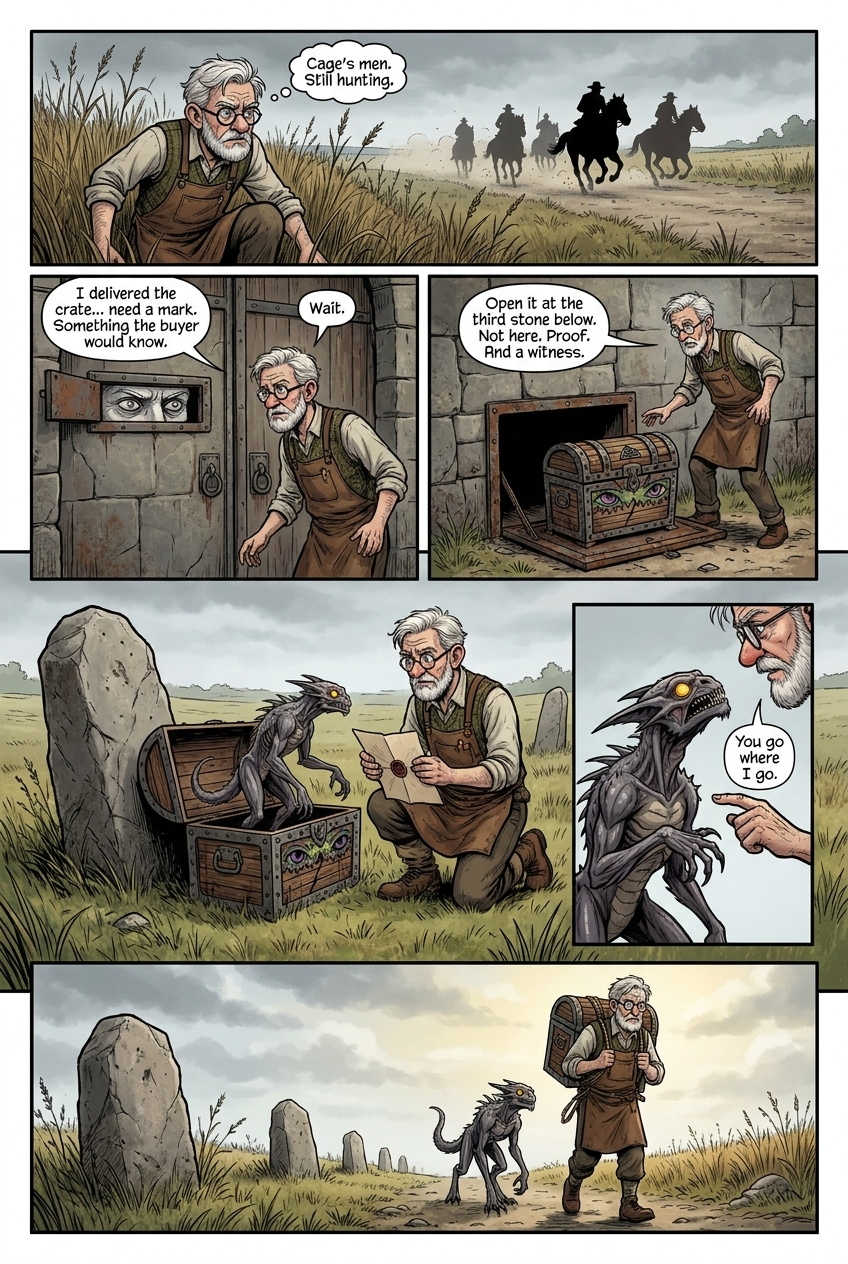
The riders passed Ben on the road without slowing. He stood in the ditch weeds until the hoofbeats faded north. His purse was gone, sewn into his coat and boot and hidden in Tim Burr's tin. His coin was safe. His neck was not. Cage's men would still hunt him. They had paid for twelve pieces and gotten eleven. Until they believed the set was out of reach, they would ride every road he touched. He needed proof the oracle had the crate. Not his word. Not Picabo's. A token Cage's people would accept and stop chasing. He turned back toward the pass. He reached the stone gate at first light. The slot was shut. He knocked once. A woman's voice, low, asked what he wanted. He said he had delivered the crate two days back and needed a mark to carry down. Something the buyer would know. The slot slid open a hand's width. A pair of pale eyes looked at him. "Wait," the voice said. He waited a long time. When the slot opened again, a chest slid out through a wider hatch at the base of the gate. It was small, waist-high, banded in rust and split down the middle. Two purple eyes were painted on its face above a jagged mouth. Green paint ran under the lids like sickness. The wood looked chewed. Ben stepped back before he could stop himself. "Open it at the third stone below," the voice said. "Not here." "What is it." "Proof. And a witness. Do not lose the witness." The hatch slid shut. He carried the chest down the pass on his shoulder. It was lighter than it looked. At the third boundary stone he set it in the grass and worked the split lid. It came up easy. Inside was a folded slip of stiff paper stamped with the oracle's seal, listing eleven pieces by name and one struck through with a line. Under the paper, something breathed. A thin creature uncurled and stood on the grass. Grey hide, a spined back, one yellow eye open, then the other. It had claws it kept close to its chest. It looked at Ben the way a dog looks at a man it has been told to follow. "You go where I go," Ben said. The creature blinked once and sat. He folded the seal inside his coat lining next to the coin. He closed the chest and tied it shut with cord. The seal alone might be forged. The chest and the thing that came with it could not. Any of Cage's men who saw the eyes and the seal together would know where the eleven pieces had gone, and that no rider would ever pry them back. Ben shouldered the chest and started down. The creature walked at his heel.
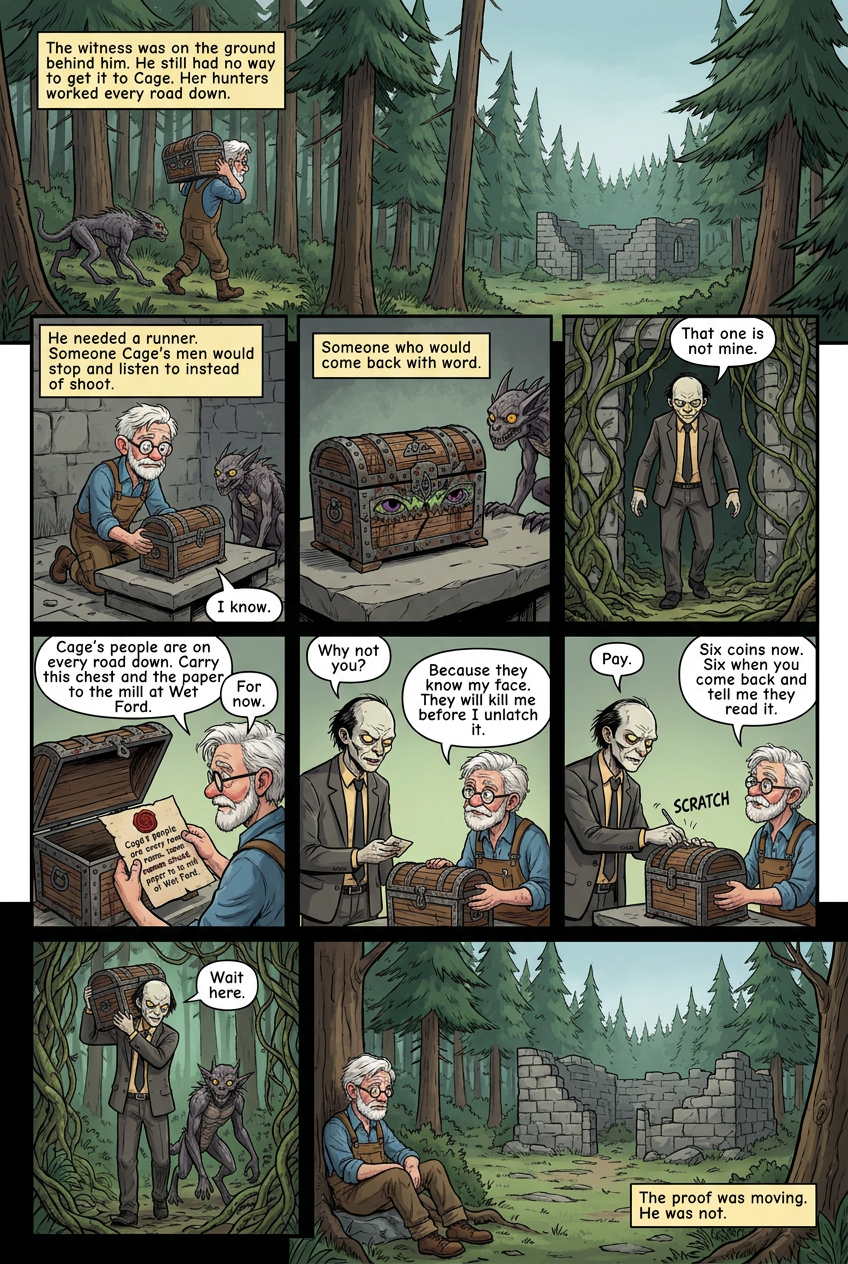
Ben came off the pass with the painted chest on his shoulder and the grey creature at his heel. The seal was in his coat. The witness was on the ground behind him. He had the proof. He still had no way to get it to Cage. Her hunters worked every road down from the mountains, and any rider who caught him on open ground would put a bolt in him before he could open the chest. He left the road at the first bend. The creature followed without a sound. He walked into the pines until he found what he wanted: a low stone ruin choked in vine, three narrow windows and a doorless mouth. Old. Watched-looking. No tracks in the dirt at the sill. He set the chest inside on a flat slab and sat on his heels. He needed a runner. Someone Cage's men would stop and listen to instead of shoot. Someone who would come back with word. He heard the boots before he saw the man. Tim Burr stepped through the vine at the door and stopped. His pale face was the same as in the trees where he had sewn Ben's coin into the lining. His yellow eyes went to the chest first. The painted eyes on the lid looked back at him. "That one is not mine," Tim said. He said it the way another man might name the weather. "I know." "Someone has been moving my marks in this wood. I came to see who." He looked at the grey creature. The creature looked at him. "That yours?" "For now." Ben opened the chest. He took out the folded seal and held it flat so Tim could see the stamp and the eleven names and the twelfth struck through. He closed the chest again and tapped the lid. "Cage's people are on every road down," Ben said. "I need a man they will not chase. Carry this chest and the paper to the mill at Wet Ford. Show the seal at the gate. Let them look at what came out with it. Then walk away. They will not follow you once they read the list." Tim watched the painted eyes. "Why not you." "Because they know my face. They will kill me before I unlatch it." "Pay." "Six coins now. Six when you come back and tell me they read it." Tim thought. He touched the underside of the chest with one finger, feeling for a notch that was not there. "I will mark it," he said. "So I know if it comes back through my wood." "Mark it." Tim scratched a small line under the iron band. He lifted the chest onto his shoulder as if it weighed nothing. The grey creature stood and walked to his heel without being called. "Wait here," Tim said, and went out through the vine. Ben sat down against the stone and listened to the boots fade. The proof was moving. He was not.
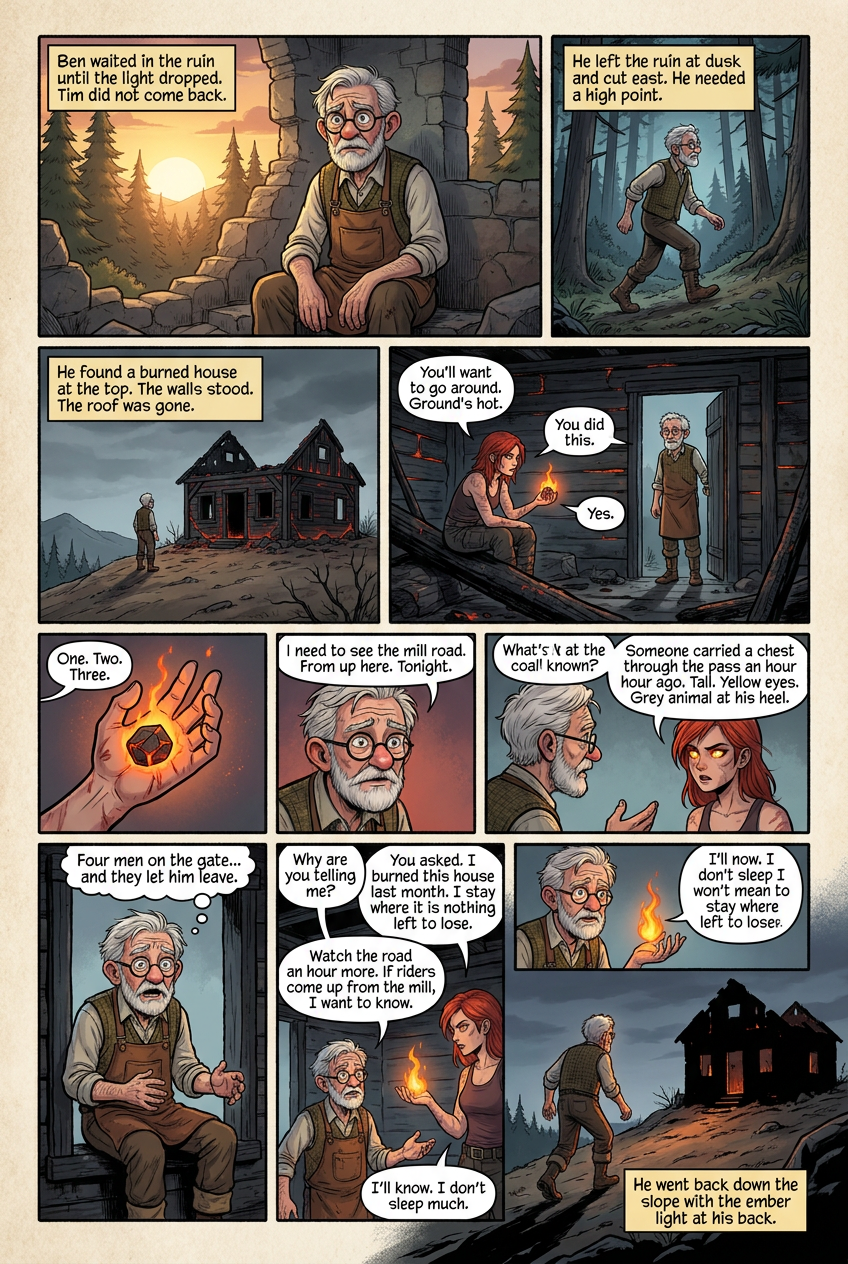
Ben waited in the ruin until the light dropped. Tim did not come back. He waited longer. He listened for boots and heard only wind in the vine. He could not sit here another night without knowing. If Tim never reached the mill, Cage's men would keep hunting him until they found him. He left the ruin at dusk and cut east along the pine cover. He kept off the roads. He needed a high point to see the mill road from without being seen on it. He climbed a bare slope and found a burned house at the top. The walls stood. The roof was gone. The wood was black and split, and a red glow still lived in the seams where the char had not gone cold. He circled it once and stopped at the door. A girl sat inside on a fallen beam. Small. Red hair. Bare arms marked with old burn scars. She was pulling a coal from the floor with her fingers. The coal glowed under her hand. She did not drop it. "You'll want to go around," she said. "Ground's hot." "You did this," Ben said. "Yes." She set the coal down and pressed her palm to her knee. She counted under her breath. One. Two. Three. The glow faded from her fingers. "I need to see the mill road," Ben said. "From up here. Tonight." She looked at him. Her eyes were the color of the coal. "Someone carried a chest through the pass an hour ago," she said. "Tall. Yellow eyes. Grey animal at his heel." Ben's breath caught. "Which way." "Down to the mill. He went in at the gate. He came out without the chest. He walked north." "Did they read the paper." "I couldn't see paper from here. I saw four men on the gate, and I saw them let him leave." Ben sat down on the black sill. His hands shook once and stopped. Four men would have shot a stranger with a chest. They had not. They had opened it and let Tim walk away. "Why are you telling me," he said. "You asked." She counted again under her breath. "And I saw you climb. I wanted to know who was coming." "You always up here?" "Until I learn to hold it," she said. She lifted her hand. A small flame woke in her palm and she watched it. "I burned this house last month. I stay where there is nothing left to lose." Ben stood. The proof was inside Cage's gate. Tim was walking north with his six coins to collect. The hunt on Ben's name would end when the list reached Cage's hand, and by the girl's account it already had. "Watch the road an hour more," he said. "If riders come up from the mill, I want to know." "I'll know," she said. "I don't sleep much." He went back down the slope with the ember light at his back.
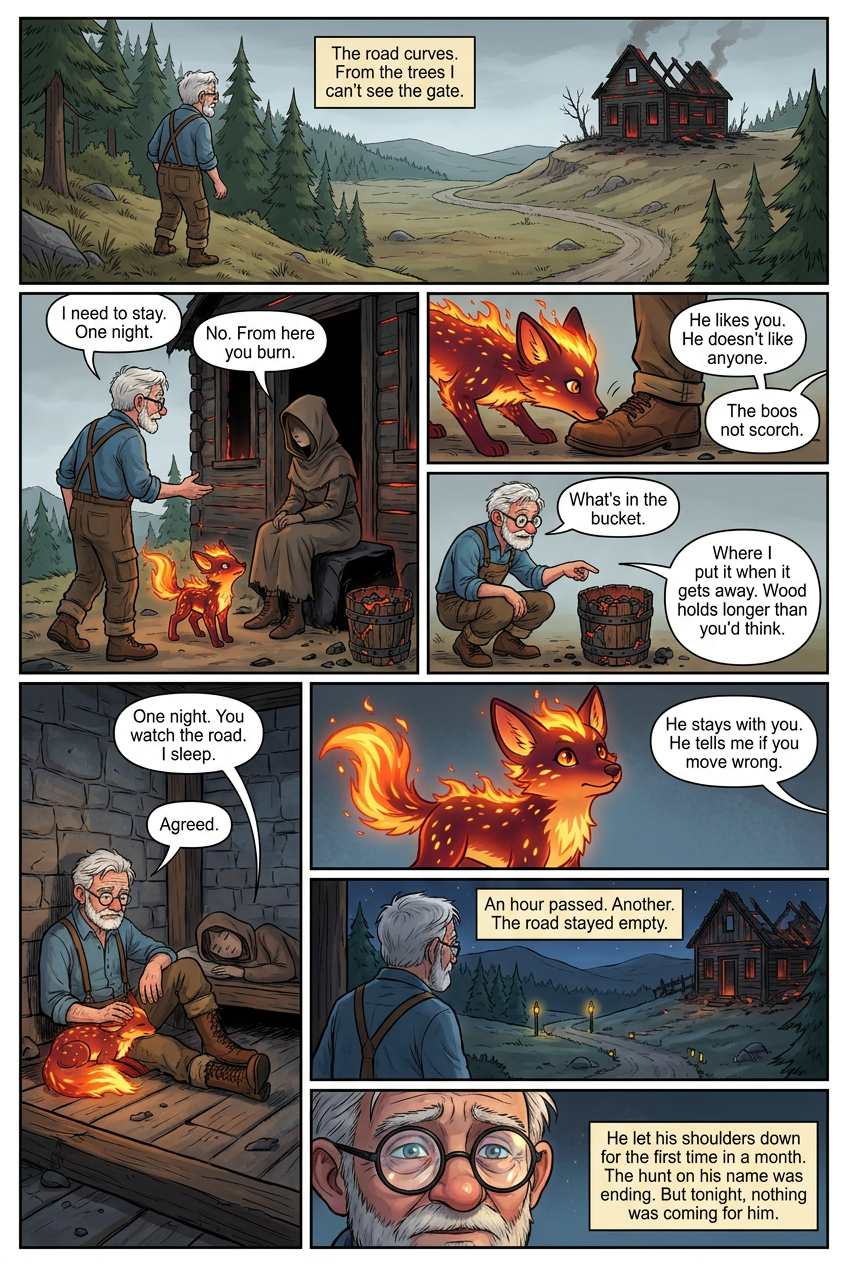
Ben went halfway down the slope and stopped. The pine cover ran out below him. Open ground began. He looked back at the burned house on the ridge. The red glow still lived in the seams of the wood. It was the only high point that watched the mill road. If riders came up from the gate, he would not see them from the trees. He would see them from that roof. He climbed back up. The girl was outside now, sitting on a black stone by the door. A small creature stood at her ankle. It looked like a fox cub made of ember. Its edges flickered. Its coat was dark with bright spots that pulsed when it breathed. It watched Ben with orange eyes. "I need to stay," Ben said. "One night. Maybe two. Until I know the riders don't come." "No," she said. "I told you what I saw. That was the deal." "The road curves. From the trees I can't see the gate. From here I can." "From here you burn," she said. She lifted her palm. A flame woke and sat there. "I don't hold it all night. The floor goes hot when I sleep. That's why the roof's gone." The cub stepped between them. It sniffed at Ben's boot and did not scorch it. "He likes you," she said. She sounded surprised. "He doesn't like anyone." Ben crouched. He kept his hands still. "What's in the bucket." A charred wooden pail sat by her feet. Iron bands. Cracks bright with heat. She had been pulling coals from the floor and dropping them in. "Where I put it when it gets away from me," she said. "Wood holds longer than you'd think, once it's already burned." Ben thought about that. "Put me in the pail's corner. The stone side. I'll sleep sitting. I'll leave at first light or when you say." She looked at him a long moment. She counted under her breath. One. Two. Three. The flame in her palm went out. "One night," she said. "You watch the road. I sleep. If the floor lights, you wake me and you run." "Agreed." She pointed at the cub. "He stays with you. He tells me if you move wrong." Ben sat down against the stone wall on the cold side. The cub curled at his boot. Its heat was steady, not sharp. The girl went inside and lay on the beam and closed her eyes. Ben watched the mill road below. The gate lamps were small yellow points. No riders came up. An hour passed. Another. The road stayed empty. He let his shoulders down for the first time in a month. The hunt on his name was ending. He still had eleven pieces to answer for, and a purse sewn into his coat, and a wolf waiting in the pines. But tonight, on this burned floor, nothing was coming for him.
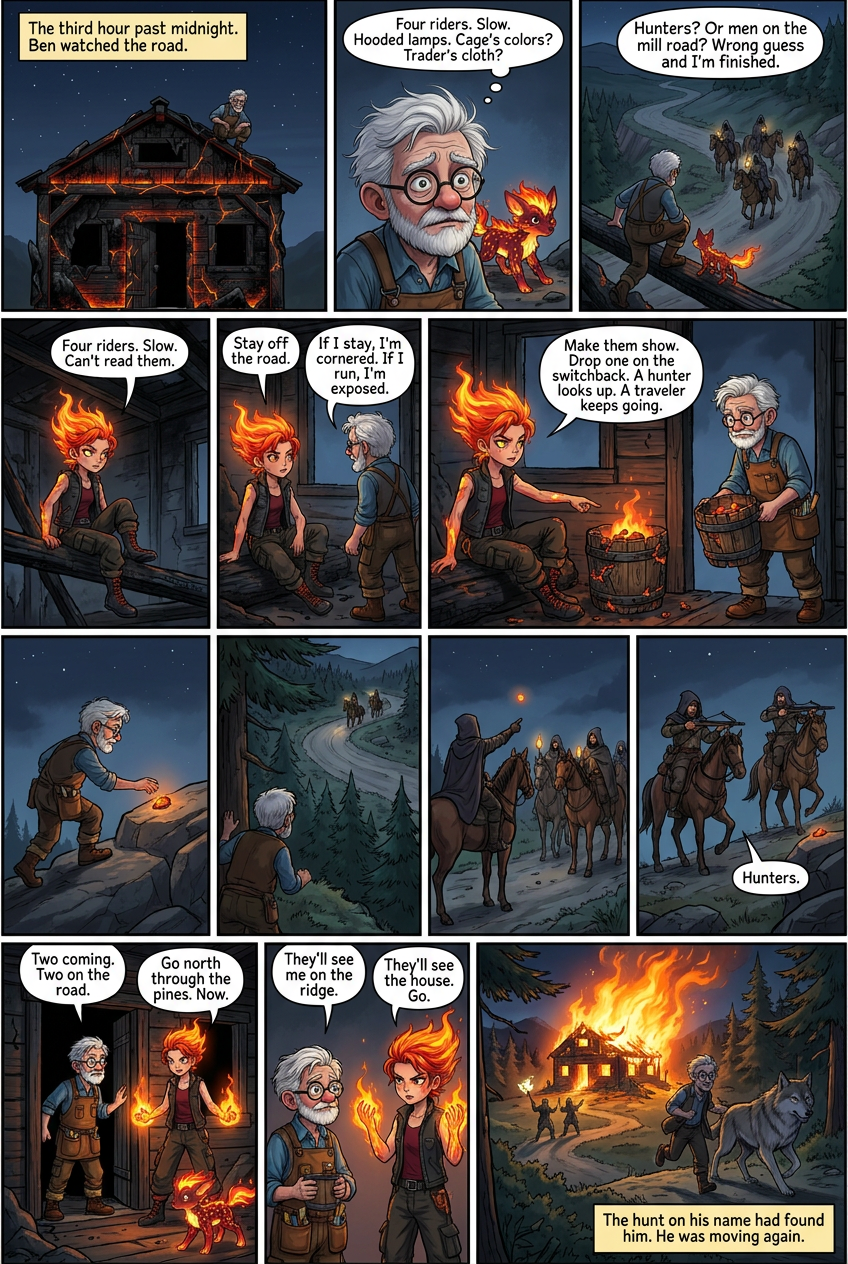
Ben watched the road until the third hour past midnight. Then he saw the riders. Four of them, coming up from the gate. They rode slow. Their lamps were hooded. He could not tell if they wore Cage's colors or trader's cloth. He could not tell if they were hunters or men on the mill road by chance. He crouched lower on the burned roof. The ember cub raised its head at his boot. Its spots pulsed faster. It felt the change in him. If they were hunters, he had to run now, north through the pines, before they climbed the slope. If they were travelers, running would show him against the ridge line and bring them straight up. Wrong guess either way and he was finished. He needed a closer look. He climbed down and went to the door. The girl was awake on the beam. Her eyes were open in the dark. "Four riders," Ben said. "Slow. Hooded lamps. I can't read them from here." "Stay off the road," she said. "If I stay and they turn up the slope, I'm cornered. If I run and they're nothing, I run into whatever comes behind them." She sat up. She counted under her breath. One. Two. Three. "Then make them show," she said. "How." She pointed at the charred pail by the door. Coals sat inside, still bright. "Drop one on the switchback. Not the road. The switchback above it. A hunter looks up. A traveler keeps going." Ben took the pail. He went down the slope, quiet, fast, and set a single coal on the bare rock above the road bend. He backed into the pines and lay flat. The riders came around the curve. The lead rider saw the glow. He raised a hand. All four stopped. He said something Ben could not hear. Two riders dismounted. They drew crossbows from their saddles. They started up the switchback toward the coal. Hunters. Ben went back up the slope on his hands and knees. He reached the burned house. The girl was already on her feet. "Two coming," he said. "Two waiting on the road." "Go north through the pines," she said. "Now." "They'll see me on the ridge." She walked to the doorway. She lifted both palms. Flame woke on them and did not go out. The cub stepped to her ankle, spots blazing. "They'll see the house," she said. "Go." Ben went. He heard the roof catch behind him, a low roar, and then the shouts of the two men on the road as the ridge lit up bright as a signal fire. He kept low through the pines. His wolf found him at the second draw. The hunt on his name had not ended. It had found him. He was moving again, north, with a purse in his coat and eleven pieces answered for and two hunters climbing a burning slope behind him.
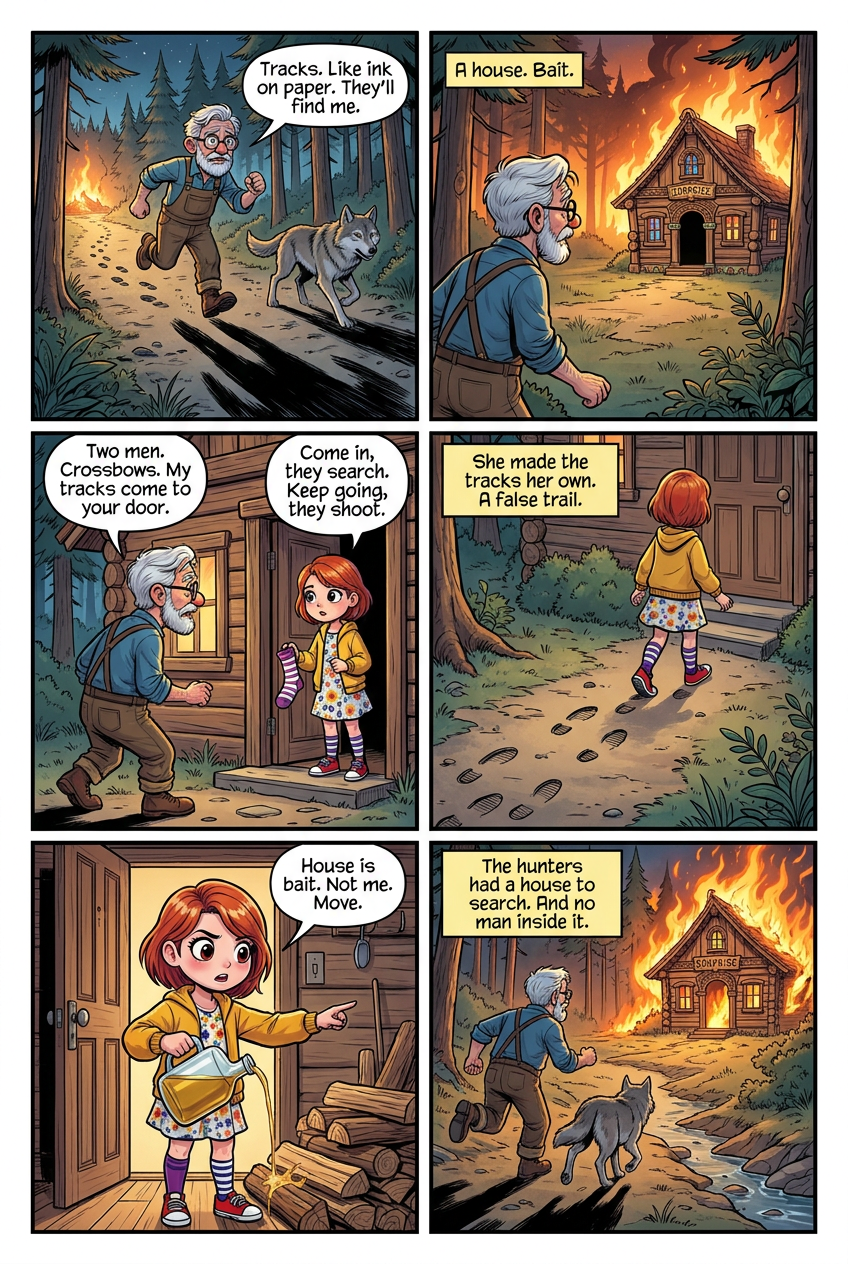
Ben ran north through the pines with the wolf beside him. Behind him the burned house roared on the ridge, bright enough to throw his shadow ten paces ahead. That was the problem. The two hunters climbing the switchback would top the crest in minutes, and his boots had left a straight line in the ash blown down the slope. He stopped at a wash of pale grit. His tracks showed like ink on paper. He could not sweep them all before the crossbowmen cleared the ridge. He needed the tracks to end at something that was not him. A low shape stood in the trees ahead. A small wooden house, roof steep, door open black. A carved sign above the lintel. He read it by the glow of the burning ridge. One word. It looked like a joke someone had built out here for no one. He went to the door. He did not go in. A girl stood in the doorway already, small, red hair, a yellow coat over a flowered dress. She held a striped sock in one hand like she had been pulling it on when the sky lit up. "Two men on the slope," Ben said. "Crossbows. My tracks come to your door." She looked past him at the ash line. She looked at the wolf. She looked at him. "Come in and they search the house," she said. "Keep going and they shoot you in the trees." "I know." "Third way." She stepped out barefoot onto the grit. She walked his line backward, heel to toe, pressing each print deeper. She reached the door and turned and walked in. She walked out again. She did it twice more. Now four sets of tracks led to her threshold and none led away. "They'll kick the door," Ben said. "Let them." She pointed at a stack of split pine inside the room and a jug beside it. Lamp oil. "House is bait. Not me." "Who are you." "Ima Hogg." She said it the way other people said the weather. "Go left around the woodpile. There's a dry creek. It runs down to the pines you want. Stay in the bed. No prints." He heard boots on scree above. Close. Ima poured the jug across the pine stack and the doorframe. She struck a striker on the sill. Flame caught the oil and ran up the wood. She stepped out and shut the door behind her. "Move," she said. Ben went left around the woodpile with the wolf at his heel. He dropped into the creek bed and ran on stone. Behind him the little house went up like a lamp. He heard a shout, then a second shout, both pulled toward the fire. No bolt came after him. When he crested the far bank he was in the pines. His tracks ended at a burning door two ridges back. The hunters had a house to search and no man inside it.
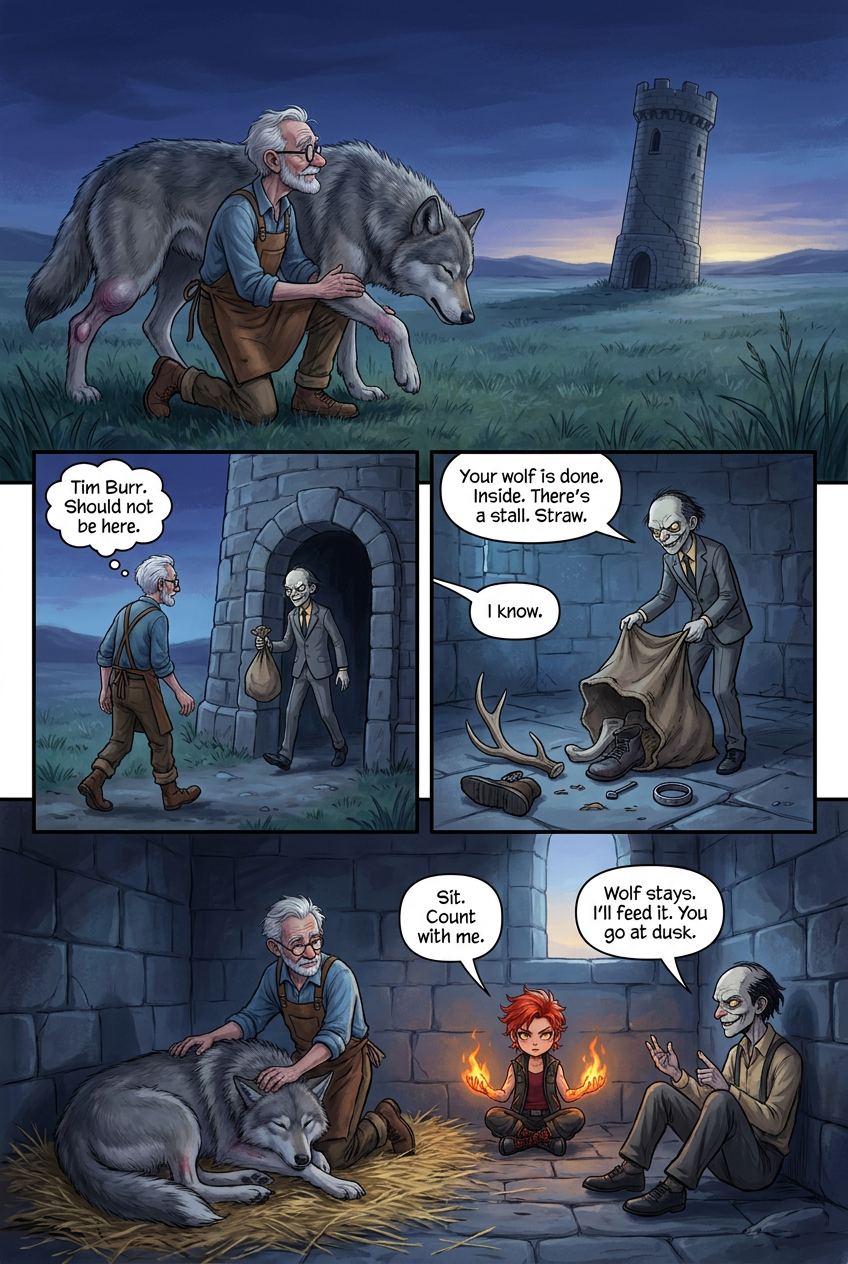
Ben came out of the pines onto open grass with the wolf on three legs. It had been favoring the back left since the switchback climb. Now it dragged the paw. He knelt and felt the joint. Hot. Swollen wrong. The animal did not growl. It leaned into his hand and closed its eyes. He looked east. The sky had gone from black to the color of old iron. Dawn was maybe an hour off. Once the light came up he would be a single figure in open country with the ridge behind him, and the two hunters would find the burned house empty and start walking outward in circles. He could not carry the wolf. He could not leave it in the grass to be found and followed. At the far edge of the field a stone tower stood alone. It leaned. Vines wrapped the base. The upper windows showed no light, but the shape of it was wrong for a farm building. It had the look of something built to watch a road that no longer ran. He went toward it because it was the only door in sight. A man stepped out of the tower's arch before Ben reached it. Thin. Gray suit gone at the cuffs. He carried a burlap sack. Ben knew him. Tim Burr had taken the painted chest and seal down to the mill for twelve coins and walked north with his pay. He should not be here. "Your wolf is done," Tim said. Flat. Same voice he had used about the coin. "I know." "Inside. There's a stall. Straw." He tipped the sack. A shed antler, a boot, a ring of iron. "I use the tower. No one comes." Ben carried the wolf through the arch. The floor smelled of cold ash and rot. In a corner stall the straw was clean and stacked. He laid the wolf down. It sighed once and did not lift its head. A girl sat cross-legged on the far stones, small, red hair, yellow eyes on him. Ella Vator. She held her palms open on her knees. A dull heat came off them without flame. She had walked ahead of him from the burned house. He had not seen her leave. "Sit," she said. "Count with me." "Hunters are working the ridge." "I saw. They're going the wrong way." She did not blink. "Stone walls. No door on this side that shows. You breathe. You wait." Tim set the sack down and pulled the arch shut with a plank. "Wolf stays. I'll feed it. You go at dusk." Ben looked at the wolf. Its ribs moved slow and even. "Why," he said to Tim. "You paid me twelve coins. This is the rest." Ben sat against the wall. Ella began to count. He counted with her. Outside, the field turned pale, and no boots came.
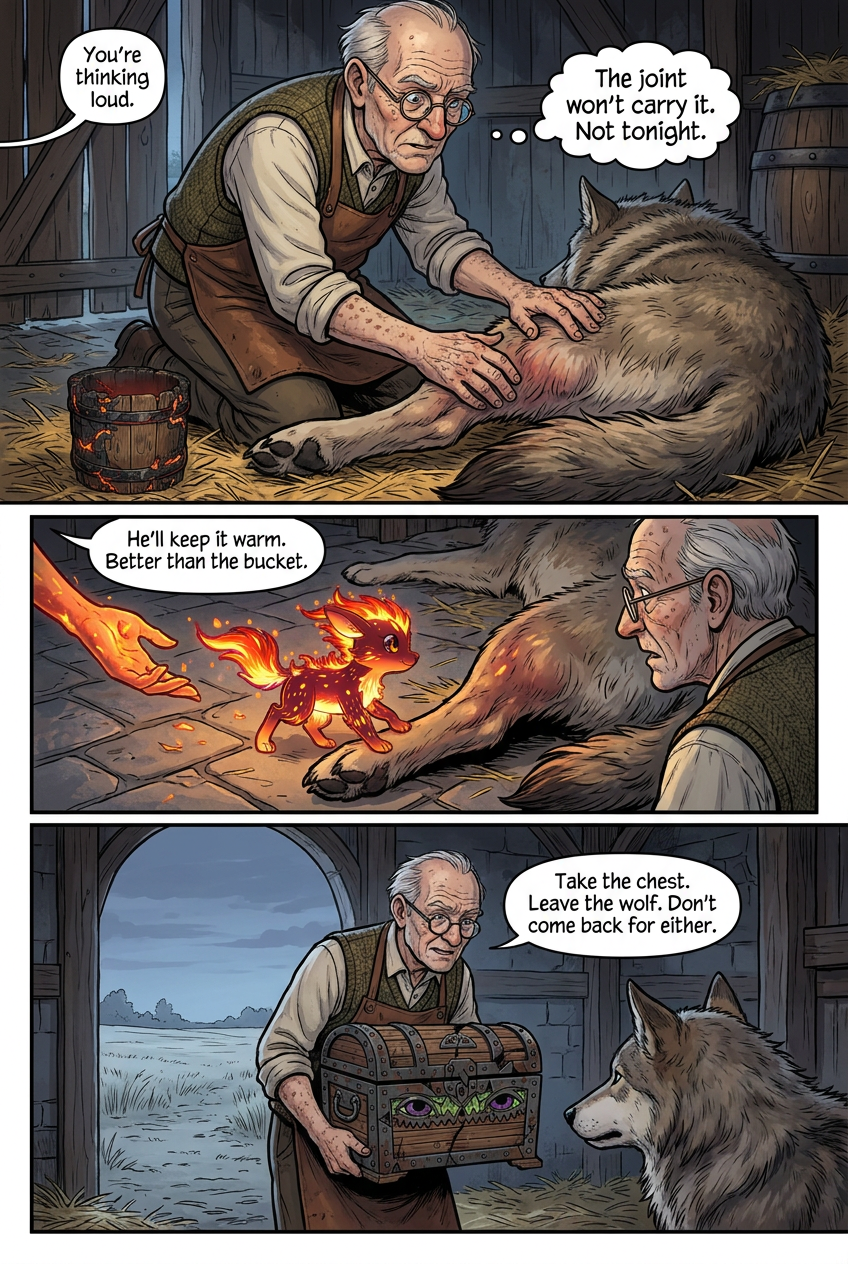
Ben watched the field brighten through a crack in the plank door. The wolf had not moved in an hour. Its ribs still worked, but the swollen joint had gone tight as a stone. He pressed a palm to it and the animal flinched without a sound. He knew the joint would fail on the next run. If he left at dusk with the wolf on three legs, they would both be found in the grass before the moon cleared the ridge. Ella stopped counting. "You're thinking loud." "The leg won't carry it. Not tonight." "Then leave it." "They'll follow a live wolf faster than a dead man." He looked at Tim by the arch. "Can you keep it? Past dusk. Past me." Tim set his sack down. He pulled out the iron ring, the boot, and last a small charred bucket, its staves blackened, its bands glowing along the cracks like a banked fire. He put the bucket beside the straw. Heat came off it in a slow breath. "Coals stay live in that," Tim said. "I keep the tower warm without smoke. Joint like that wants heat, not running. Give me a week, I give you back a wolf that walks." "A week I don't have." "Then give me the wolf and go." Ella uncurled her hand. A small bright creature stepped out onto the stone, ember-bodied, flame at the edges of its coat. It padded to the wolf and lay against the swollen joint. The wolf sighed. The heat sank in. "He'll keep it warm," Ella said. "Better than the bucket. Better than you." Ben sat with that. To leave the wolf was to leave the last thing that had run with him from the pass. It was also the only way either of them lived past tomorrow. "What do you want for it," he said to Tim. Tim toed a shape under a tarp in the corner. He pulled the cloth back. A chest sat under it, iron-banded, wood split down the middle, two painted eyes staring out from the front panel. A find, not a make. The kind of thing a scavenger drags home and cannot sell. "Take this off my hands when you go," Tim said. "I can't move it. Buyers see the eyes and walk. You've moved worse." "What's in it?" "Empty. I checked." He shrugged. "It's the box that's the trouble." Ben lifted the lid an inch. Nothing inside but dust and a dry smell. He shut it. An empty chest with a face was still a chest. He could sell it down the line, or fill it, or burn it. "Deal." He knelt by the wolf. The ember creature did not move. The wolf's eye opened, found him, closed again. Ben stood. "Dusk," Tim said. "Take the chest. Leave the wolf. Don't come back for either." Ben nodded. Outside, the field had gone full pale, and no boots had come.
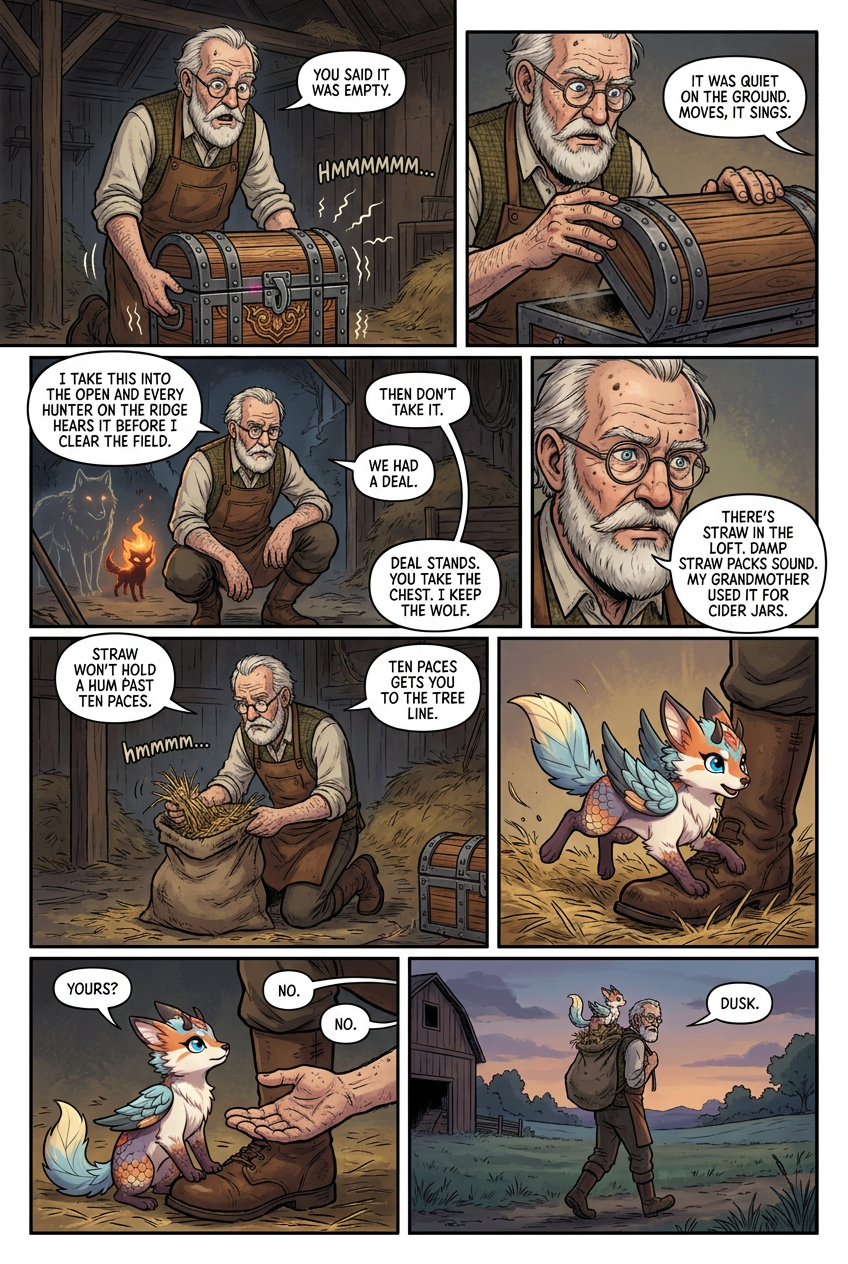
Ben lifted the painted chest by its iron handles. A low hum climbed out of the wood, thin as a wasp trapped behind glass. He set it down fast. The wolf twitched in its sleep. The ember creature pressed closer to the swollen joint and did not look up. "You said it was empty," Ben said. Tim came over and put his ear to the lid. His face changed. He lifted the chest himself and the hum climbed again, steady now, riding under the floorboards. "It was quiet on the ground," Tim said. "Moves, it sings." Ben opened the lid. Dust. Dry wood. No box, no bead, no relic he could see. He ran his hand along the seams and felt nothing loose. Whatever hummed was in the chest itself, or under a false floor he could not pry up without tools and time. "I take this into the open and every hunter on the ridge hears it before I clear the field," Ben said. "Then don't take it." "We had a deal." Tim looked at the wolf. The ember creature's flame ran a slow line along its back. "Deal stands. You take the chest. I keep the wolf." Ben sat on his heels. He had no felt. No sad-face box big enough to swallow a chest this size. He had a coat, a boot lining sewn with coin, and dusk coming down the field. Ella uncurled from the wall. "There's straw in the loft. Damp straw packs sound. My grandmother used it for cider jars." "Straw won't hold a hum past ten paces." "Ten paces gets you to the tree line." Ben weighed it. Ten paces was not nothing. Ten paces was the difference between a shape in the grass and a shape in the pines. He climbed the ladder and threw down two armloads of damp straw. He packed the chest in Tim's grain sack, straw between the wood and the burlap, straw stuffed into the sack's mouth until his fist would not fit. He lifted it. The hum dropped to a mosquito behind cloth. Not gone. Softer. Something moved in the straw at his feet. A small bright shape bolted out — scaled hindquarters, feathered wings folded tight, a fox's face with one horn cocked. It skidded under the wolf and stopped, watching him with a blue eye. Ben froze. "Yours?" Tim shook his head. Ella shook hers. The creature had come out of the chest's straw, or the loft, or the seam of the world. It did not hum. It did not run. Ben held out an empty hand. The creature stepped onto his boot and up his shin and sat on the sack, tail curled over the burlap mouth. The hum thinned again, thinner than the straw had done alone. Ben shouldered the sack. The creature rode it. "Dusk," Tim said. Ben walked out into the pale field with a muffled chest on his back and a small live thing keeping the sound in.
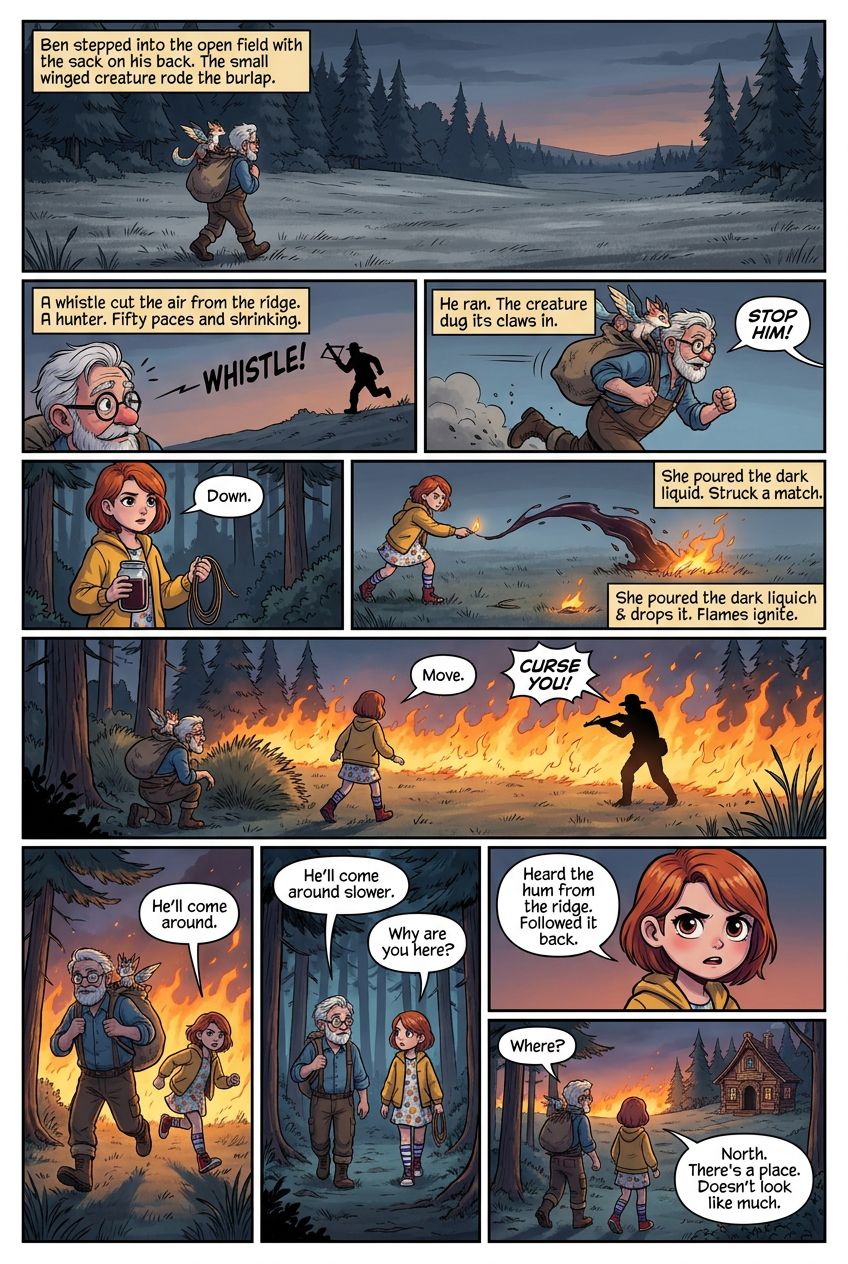
Ben stepped into the open field with the sack on his back. The small winged creature rode the burlap and pressed the hum down to a whisper. Dusk washed the grass gray. The tower door closed behind him. He walked toward the pines at a steady pace, not too fast, not too slow. A whistle cut the air from the ridge. Ben looked left. A hunter stood on the low rise, crossbow already up, closing the gap at a run. One man. Fifty paces and shrinking. Ben was still forty paces from the trees. He ran. The straw shifted. The hum climbed a notch. The creature on the sack dug its claws in and held the sound down. Ben's boots hit hard ground, then soft, then hard again. He heard the hunter shout for him to stop. A figure stepped out of the pines ahead. Red hair. Yellow jacket. Ima Hogg, the woman who had burned her own house down to buy him an hour two nights back. She held a coil of cord and a jar of something dark. "Down," she said. Ben dropped to one knee behind a low tussock. Ima walked past him into the field with the jar. She poured the dark liquid across the grass in a wide arc between Ben and the hunter, then struck a match and dropped it. The line caught. A wall of low flame ran across the field, waist high, feeding on whatever she'd poured. The hunter pulled up short. The crossbow tracked left, then right, looking for a way through. Smoke lifted between them. "Move," Ima said. She did not look at Ben. She was already walking backward toward the pines, watching the flame. Ben ran. The sack thumped his spine. The creature clung on. He reached the tree line and turned. Ima came in behind him. The fire held the field. The hunter was still on the far side, circling for the end of the line. "He'll come around," Ben said. "He'll come around slower." They moved into the pines. Ima led. She walked like someone who had already mapped this ground in her head. Ben kept the sack on his back and one hand under it to steady the creature. "Why are you here," Ben said. "Heard the hum from the ridge. Followed it back." "You could hear it." "Anyone downwind could hear it. Straw isn't enough." Ben felt the cold of that land in his gut. Ten paces to the trees had been the plan. He had made the trees. But the hunter had heard him from the ridge before the field, and the wind was still moving, and one man behind him meant more men were on the way. "Where," Ben said. "North. There's a place. Doesn't look like much." She walked. He followed. The chest hummed on under the straw, and the small winged thing rode the sack, and behind them the fire ate the field.
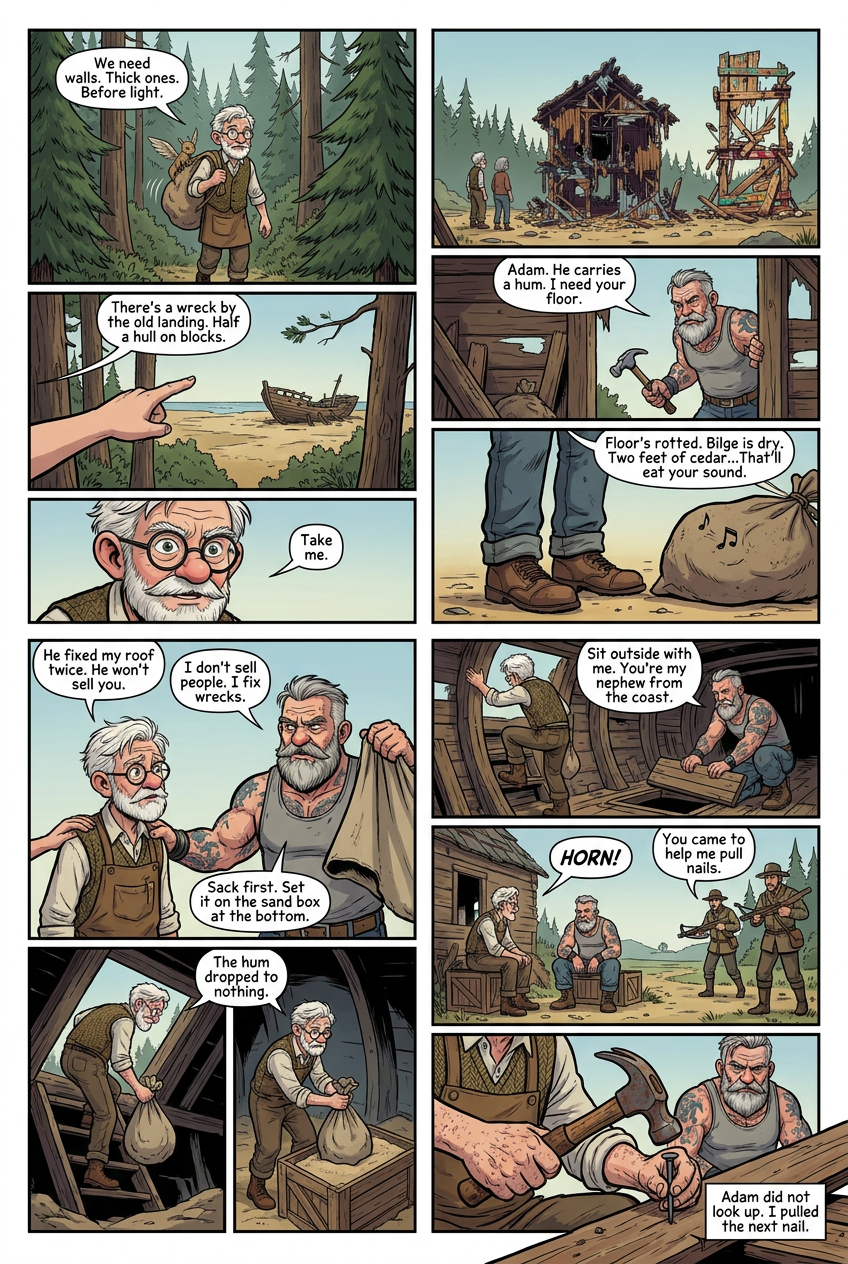
Ima led Ben north through the pines. The hum stayed low under the straw, but every gust pulled it wider. The winged creature on his sack shifted its claws and pressed down again. Ben knew one hunter behind them meant three more inside the hour. Daylight would come before they could reach any ridge road he trusted. "We need walls," Ben said. "Thick ones. Before light." "There's a wreck by the old landing," Ima said. "Half a hull on blocks. Nobody's used it in years." "Take me." She cut east through the trees. The ground dropped. The pines thinned and gave way to sedge, then to a flat of packed sand. A wooden shape sat on the flat. It had been a shed or a boathouse once. Now it was ribs and slats, planks sagging inward, paint flaked to gray and faded blue. A tower of broken boards leaned against one wall where a scaffold had collapsed. A man stepped out from behind the ribs. Short. Wide. Gray beard down his chest, arms marked with old ink. He held a claw hammer loose at his hip. Ben stopped walking. "Adam," Ima said. "He carries a hum. I need your floor." Adam Baum looked at the sack. He looked at Ben's boots. He did not look at Ben's face. "Floor's rotted through in the middle," he said. "Bilge below is dry. Two feet of cedar between you and the air. That'll eat your sound." "How long can I stay," Ben said. "Till I say go." Ben hesitated. Ima put a hand on his shoulder. "He fixed my roof twice. He won't sell you." Adam spat into the sand. "I don't sell people. I fix wrecks." Ben followed him inside. Adam kicked back a length of canvas. A hatch showed under it, iron ring set flush. He hauled it up. A ladder went down into black. Ben smelled tar and old fish. "Sack first," Adam said. "Set it on the sand box at the bottom. Cedar draws the sound down. It won't carry." Ben climbed down and set the sack on a low crate packed with dry sand. The hum dropped to nothing. He climbed back up. The winged creature stayed with the sack. Adam dropped the hatch and laid the canvas over it. He pushed a bench of broken tools across the seam. "Sit outside with me," he said. "You're my nephew from the coast. You came to help me pull nails." A horn sounded on the ridge. Then another, further west. Ima faded back into the pines without a word. Ben picked up a rusted claw and sat on an overturned bucket. Adam handed him a plank. Ben pulled the first nail as two hunters came down the sedge, crossbows loose, eyes on the wreck. Adam did not look up. Ben pulled the next nail.
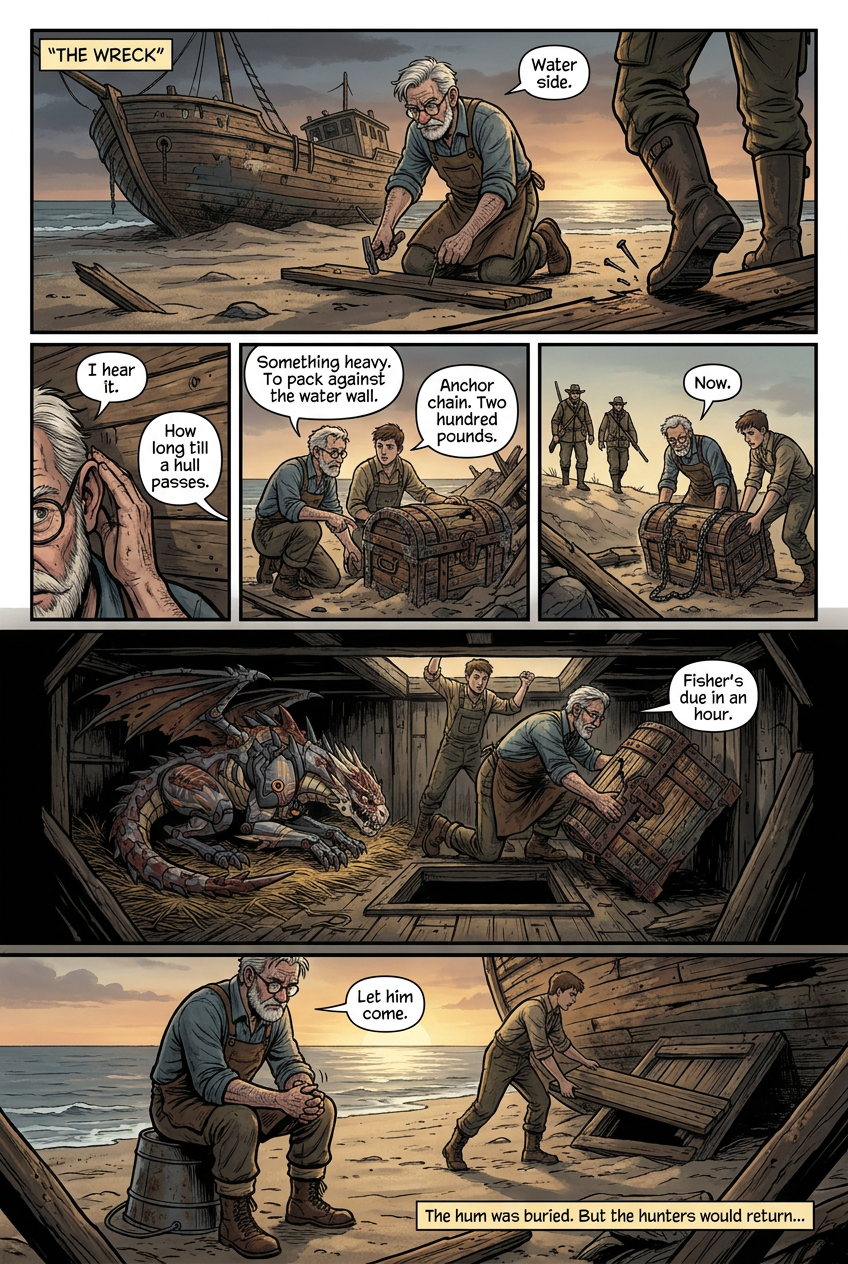
Ben pulled another nail. The two hunters walked the sedge line and stopped ten paces from the wreck. One tapped a bolt against his boot. The other watched Adam's hands. Then Ben heard it. A thin note leaking up through the sand under his bucket. The winged creature below had shifted. The hum was climbing the seam where the hull met the water side of the flat. Not loud yet. But a boat coming down the channel at dusk would catch it before it passed. "Water side," Ben said under his breath. Adam grunted. He kept pulling nails. "I hear it." "How long till a hull passes." "Fisher comes down before dark. Every day." Ben worked out the shape of it fast. Cedar killed the sound going up. It did nothing for the sound going sideways into wet planks and out into open water. He needed a second wall between the sack and the channel. He needed it before the hunters left, because he could not move while they watched. The hunters turned and walked the length of the wreck. One kicked a rotten board. It broke. He moved on. Ben leaned toward Adam. "You have another box. Something heavy. Something I can pack against the water wall." Adam's eyes went to the leaning tower of broken boards. Behind it, half sunk in the sand, sat a chest. Warped planks. Rusted bands. The lock had rotted through. It looked like it had washed up a decade ago and been left. "Full of chain," Adam said. "Anchor chain. Two hundred pounds of it." "Help me move it." "Not while they're looking." Ben pulled three more nails. The hunters reached the far end of the wreck, turned, and started back. One said something. The other laughed. They walked up the sedge and were gone over the rise. Ben dropped the plank. "Now." Adam hauled the canvas off the hatch. Ben went down the ladder. He dragged the sand box away from the water wall and shoved it against the inland wall instead. Then he climbed up. He and Adam took an end each of the sunken chest and walked it inside. The chain shifted and knocked. They lowered it through the hatch. Ben set it flush against the cedar on the channel side and packed the gaps with the winged creature's straw. He climbed up and listened. Nothing came through the floor. Nothing came through the wall. He walked out onto the sand and stood on the water side. He put his ear to the planks. Silence. Adam closed the hatch and slid the bench back over it. "Fisher's due in an hour." "Let him come," Ben said. He sat down on the bucket. His hands shook. The hum was buried. But the hunters had walked the wreck once, which meant they would walk it again by morning, and next time they would look at the boards, not the boy pulling nails.
The fisher boat passed at dusk and went by without slowing. Ben let out a breath he had been holding for an hour. Then the sack under the floor twitched. The winged creature had been quiet while the boat was near. Now it started to move again, and the straw around it made a dry scraping sound Ben could feel through his boots. He lifted the bench and opened the hatch. The creature was pushing at the straw with its fox head and one scaled foreleg. Its eyes were open. It was hungry, and it was trying to climb out of the packing that muffled its hum. "It's tearing the straw," Ben said. "By dawn there won't be enough left to kill the sound." Adam looked down through the hatch. "Then feed it." "I don't know what it eats." "Try what's here." Ben went through the boathouse. He found a strip of dried fish on a shelf and a heel of bread in Adam's coat pocket. He dropped the fish through the hatch. The creature sniffed it and turned away. It kept scratching. A thin note started to climb out of the sack. Adam watched from the ladder. "Not fish." "No." Ben thought back to the tower loft. The creature had come out of straw damp with something sweet. He remembered the smell. Not hay. Fruit gone soft. "You have anything sweet," Ben said. "Old apples. Honey. Anything." Adam went to a low crate near the door and pulled out a clay pot. "Pear mash. For the traps." Ben took the pot down the ladder. He scooped a handful of the mash and held it flat under the creature's nose. It stopped scratching. It leaned in and ate from his palm. Its throat worked. The hum dropped to nothing. Ben sat on the sand floor and let it eat. The scaled hindquarters settled. The feathered wings folded. When the pot was half empty the creature curled against his wrist and closed its eyes. He climbed up. "It sleeps on a full stomach." "Good," Adam said. "Then pack it and go." "Go where." "Anywhere but here. They walk the wreck at first light. I told you." Ben looked at the hatch. The creature was calm now, but the straw was thin and the pear mash would not last a day. He had bought one night, not more. He would need somewhere he could feed it out of sight, and he would need it before the hunters came back over the rise. He wrapped the creature in the last of the dry straw and set it in the empty half of the anchor chain chest. The lid closed on rust. Adam handed him the clay pot without a word. Ben carried the chest up the ladder and out onto the sand. The tide was low. He had four hours until light.
Ben carried the chest off the sand and up the bank. The tide was going out. His boot prints stayed in the wet flat behind him, plain as ink. He had three hours until light and no wall thick enough to hold the hum for a full day. He needed a roof and a door before the hunters walked the wreck. A red-haired girl stepped out of the reeds. Ima Hogg. She had burned her own house to buy him a lead two nights back. He had not expected to see her again. "You're slow," she said. "They're on the ridge road already." "How far." "An hour. Maybe less." Ben set the chest down. The creature shifted inside. A thin note leaked through the lid. He pressed his palm to the wood until it settled. "I need a place with walls," he said. "Somewhere no one looks." "There's a house up the slope." Ima pointed past the pines. "Painted. Bright. People walk around it." "Why." "They think it's a trick. It's the last thing on the road that looks cheerful. Nobody trusts that." Ben followed her up through the pines. The house sat in a clearing on low stone. Someone had painted the boards yellow and red. A carved sign over the door read SURPRISE. Ribbons had been nailed to the eaves and left to rot. The door hung open. "Who lives here," Ben said. "No one now. A man built it for his wife. She died before he finished. Hunters don't search it. They think it's bait." Ben carried the chest inside. The floor was dry. The walls were double-plank, tight. He set the chest in the back corner and opened the lid. The creature was awake. He scooped the last of the pear mash and held it out. It ate from his hand and the hum dropped away. Boots crunched on gravel outside. Ben froze. Ima moved to the window and looked through a crack. "One man," she whispered. "Old. Not a hunter." The door pushed wider. Adam Baum stood in the frame with a crowbar over his shoulder. He looked at Ben, then at the chest, then at the painted walls. "This house," Adam said. "I've been meaning to bring it down for a year." "Not tonight." "Not tonight," Adam said. He stepped inside and pulled the door shut behind him. "They passed the wreck an hour ago. Found nothing. They're working back along the water now. You have until they turn inland." "How long." "Two hours. Maybe three." Ben closed the lid on the sleeping creature. He had walls. He had a door. He had a house no one would enter because it looked like a joke. He had bought a morning, not more. Outside, a horn called once from the beach. The hunters were turning.
Ben watched the door for an hour. The horn did not sound again. Adam sat on an overturned crate by the window, crowbar across his knees. Ima crouched by the chest, feeding the creature crumbs from her pocket. The house held. The walls did their work. Ben started to believe he had bought the morning. Then Adam spoke without turning. "They'll pay for a location. Two of them were asking at the wreck. Coin up front for a pointed finger." "How much," Ben said. "More than you have on you. I watched them count it." Ben felt the cold of it settle in his chest. Adam had hidden the sack in the boathouse bilge. Adam had lied to hunters at the ridge. Adam knew the yellow house. Adam knew the chest inside it. One walk down the slope and Ben was finished. "You brought me here," Ben said to Ima. "He followed us," Ima said. She stood up. Her hand went to her pocket. "I walked here," Adam said. "On my own feet. I could have brought them with me. I didn't." "Not yet," Ben said. Adam looked at him. His face did not move. "Not yet." Ben put his back to the wall. He had no coin left worth naming. He had the creature. He had the battered chest he had carried off the wreck. He had a girl who set fires and an old man with a crowbar. He counted what he could offer and came up short. He opened the lid. The creature blinked up at him, fox ears, scaled flank, one folded wing. It climbed onto his forearm and stayed there. The hum was gone. It only breathed. "That," Adam said. His voice changed. "That is what they want?" "That is what they want." Adam set the crowbar on the floor. He did it slow, so Ben would see him do it. "I have a daughter down the coast. She is sick. The coin they offered would keep her a year." "I can't match that." "I know." Adam stood up. "So I'm walking out the door now. If I turn left at the pines, I go home. If I turn right, I go to the beach. You won't know which until they come or they don't." He walked out. The door swung shut behind him. Ben did not follow. Ima looked at Ben. "We have to move." "Where." "Anywhere he doesn't know." Ben closed the lid on the creature. He lifted the chest. His arms were tired and his legs were tired and the morning he had bought was gone before it started. He had walls and a door and none of it counted now. One man knew the room. He stepped outside. The pines were quiet. He could not see which way Adam had turned. He went north, away from both roads, and carried the chest into trees he did not know.
Ben walked north through pines he did not know. The chest rode on his hip. The creature slept inside it. His arms shook. Every step he pictured Adam turning right toward the beach and pointing a finger. If Adam sold him before dawn, the hunters would sweep this ground by noon. He had hours, not days. He stopped at a stream and drank. Ima crouched beside him. "He'll talk," she said. "His daughter is sick. He'll talk." "I know." "So we can't just run. He knows we went north." Ben set the chest down. She was right. Running only worked if the trail behind him was dead. Adam was alive and walking and knew which pines Ben had stepped into. The trail was not dead. It was a mouth about to open. He had to close the mouth before it did. Not kill Adam. He was not going to kill Adam. But he had to give Adam a different story to tell. A girl stood on the far bank. Brown hair, blue jacket, a notebook clipped under one arm. She was writing when Ben saw her. She looked up and did not run. "You came from the coast road," she said. It was not a question. "You passed the wreck at four. I saw two men count coin there at five. One had a horn." Ben stared. "Who are you." "Annette. I write down what I see. I was waiting for someone from the Greywood. He didn't come out." She flipped the notebook. "I have the hunters logged. Times. Faces. Directions. Nobody around here wants it." Ben took the offer she had not made yet. "I need a man to hear a story and believe it. An old man at a yellow house down by the pines. If he hears it from the right mouth, he tells it to hunters and it sends them the wrong way." "What story." "That I went east along the ridge. That I dumped the chest in the tidepool below the wreck. That I was bleeding." She wrote it as he spoke. "I can put a time on it. Six-forty. I saw you from the marker. You were limping east." She looked up. "That's a lie I can sign." "Why would you." "Because the people who won't help me are the same people paying him." She closed the notebook. "Tell me the old man's face." Ben told her. Gray beard, crowbar, limp on the left. She nodded once and went south along the bank at a steady walk, notebook under her arm. Ben sat with the chest between his knees. He had not stopped Adam. He had given Adam a different truth to sell, one written down by a witness with times on it. If it held, the trail north died at the tidepool by dawn. If it did not hold, he had bought an hour, maybe two. He stood up and went further into trees he still did not know.
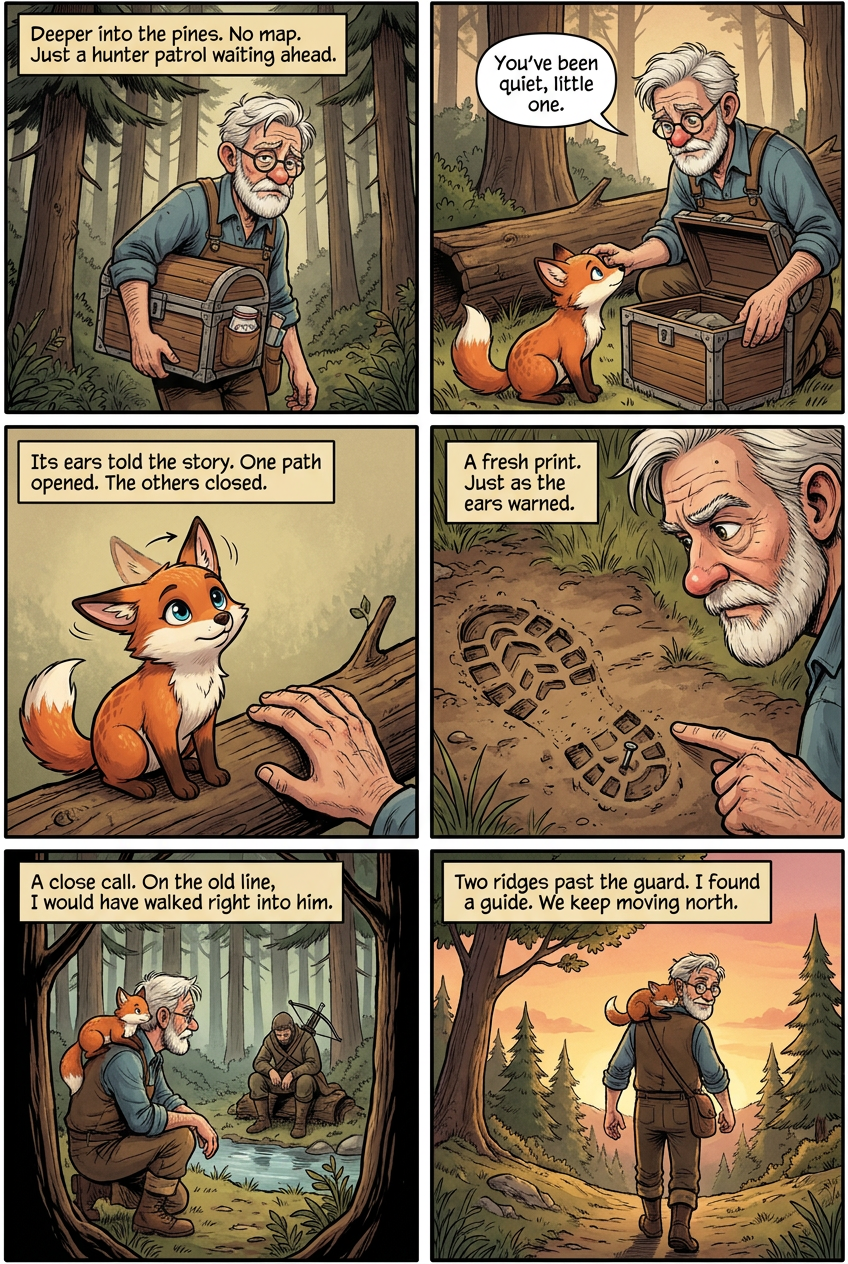
Ben walked deeper into the pines with the chest against his hip. The trees looked the same in every direction. He had no map and no track under his boots. One wrong turn would put him inside a hunter patrol before he saw them. He stopped at a fallen log and set the chest down. He listened. Wind in needles. No horn, no voices. But somewhere north there were men on this ground, and he did not know where. The latch on the chest ticked. Ben lifted the lid a finger's width. The small creature inside blinked up at him. Orange fur, white chest, blue eyes. It had ridden in the straw since the boathouse. It pushed its nose against his thumb and did not hum. He eased it out and set it on the log. It sat up on its hind legs and turned its head north, then east, then north again. Its ears twitched forward and stayed there. It did not move. Ben watched. When he shifted the chest a step east, the creature's ears flattened. When he lifted it north-northwest, the ears rose again. He tried west. Ears flat. He tried the first line north. Flat. He did not know what the creature heard. He knew what its body said. One path opened. The others closed. He stepped the way its ears pointed. Twenty paces on he found a print in soft dirt. A boot with a nailed heel. Fresh. The line he had been walking two minutes ago would have taken him across it. He backed off and crouched. The creature climbed his sleeve and settled on his shoulder. He carried the chest under one arm and walked the new line, slow, one foot at a time. Twice the creature's ears dropped and he stopped and waited. Twice they lifted and he moved. An hour on, the pines thinned into a shallow draw with a stream at the bottom. On the far bank a coat hung on a branch. A man sat under it with a crossbow across his knees, half asleep. Ben would have walked straight into him on the old line. He eased backward until the trees closed. The creature's ears turned him west along the draw, then north again where the water bent. He kept the stream between himself and the coat until the sound of it covered his boots. By the time the light dropped he was two ridges past the guard and the trees were different trees. He set the chest down in a hollow between roots and let his arms shake. The creature climbed off his shoulder and curled on the lid. He had not found a road. He had found a guide. The patrol was behind him now, not in front. He could keep moving north, if the little animal kept pointing. He scratched its ear once and picked the chest up again.
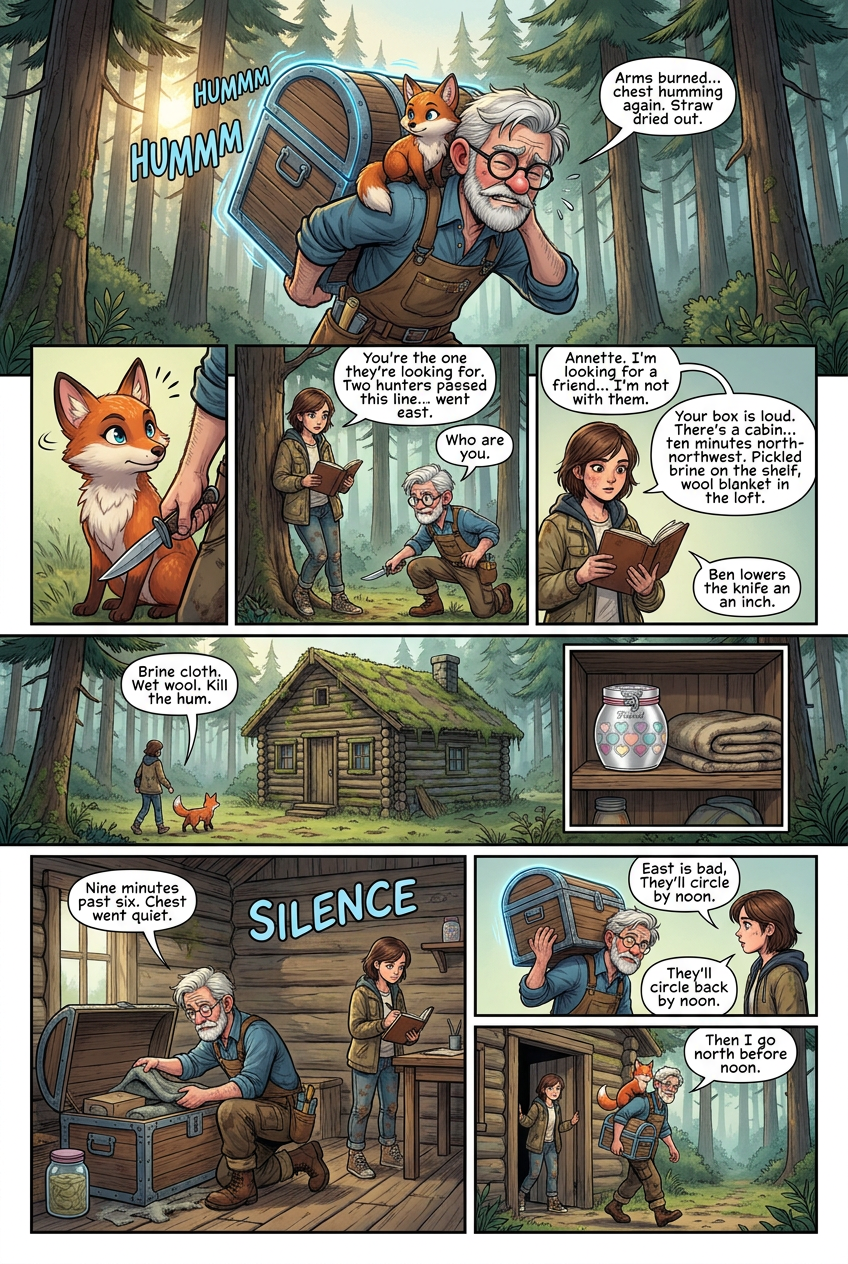
By dawn Ben's arms burned and the chest was humming again. The sound came through the wood in a low buzz that carried further than his footsteps. The straw packing had dried out. The little fox creature on his shoulder flicked its ears and pressed its paws to the lid, but the hum still leaked through. Any patrol within fifty paces would hear it. He needed a fresh dampener before he moved another mile. Damp cloth, moss, anything soft and wet. He set the chest down and scanned the trees. The ground was dry pine needle and root. No stream close. No cottage smoke. Nothing to work with. The creature stiffened. Its ears cut hard to the left. Ben crouched and drew his knife. A girl stepped out from behind a leaning pine. She had a canvas jacket, muddy sneakers, and a leather journal open in one hand. She saw the knife and stopped. She did not run. "You're the one they're looking for," she said. "Two hunters passed this line at first light. Forty minutes ago. They went east." Ben kept the knife up. "Who are you." "Annette. I'm looking for someone who went into these woods and didn't come out. I'm not with the hunters." She closed the journal. "Your box is loud." "I know." "It'll bring them back." She tilted her head. "There's a cabin. Ten minutes north-northwest. Empty three days. I checked yesterday at four in the afternoon. There's a jar of pickled brine on the shelf and a wool blanket in the loft." Ben lowered the knife an inch. Brine cloth. Wet wool. Both would kill the hum long enough to move. "Why tell me." "You went past the guard at the stream. My friend went in the same direction eight days ago. I want to know what's on the other side." She held up the journal. "I write down what I see. If you make it through, I'll know the route works." He watched her face. She did not blink much. She was not lying for the fun of it. "Walk in front," Ben said. She walked. The creature's ears stayed up the whole way. Ten minutes on, a small log cabin sat in a clearing, door ajar, roof mossed over. Ben went in fast. The jar was on the shelf. The blanket was in the loft. He soaked the blanket in the brine, wrung it, and packed it around the boxes inside the chest. He closed the lid and set his ear to it. Silence. Annette wrote something in her journal. "Nine minutes past six. Chest went quiet." Ben shouldered it. The weight was worse now, wet. But he could pass a patrol at ten paces and not be heard. "East is bad," she said. "They'll circle back by noon." "Then I go north before noon." He stepped out of the cabin with the fox on his shoulder and the wet chest against his hip.
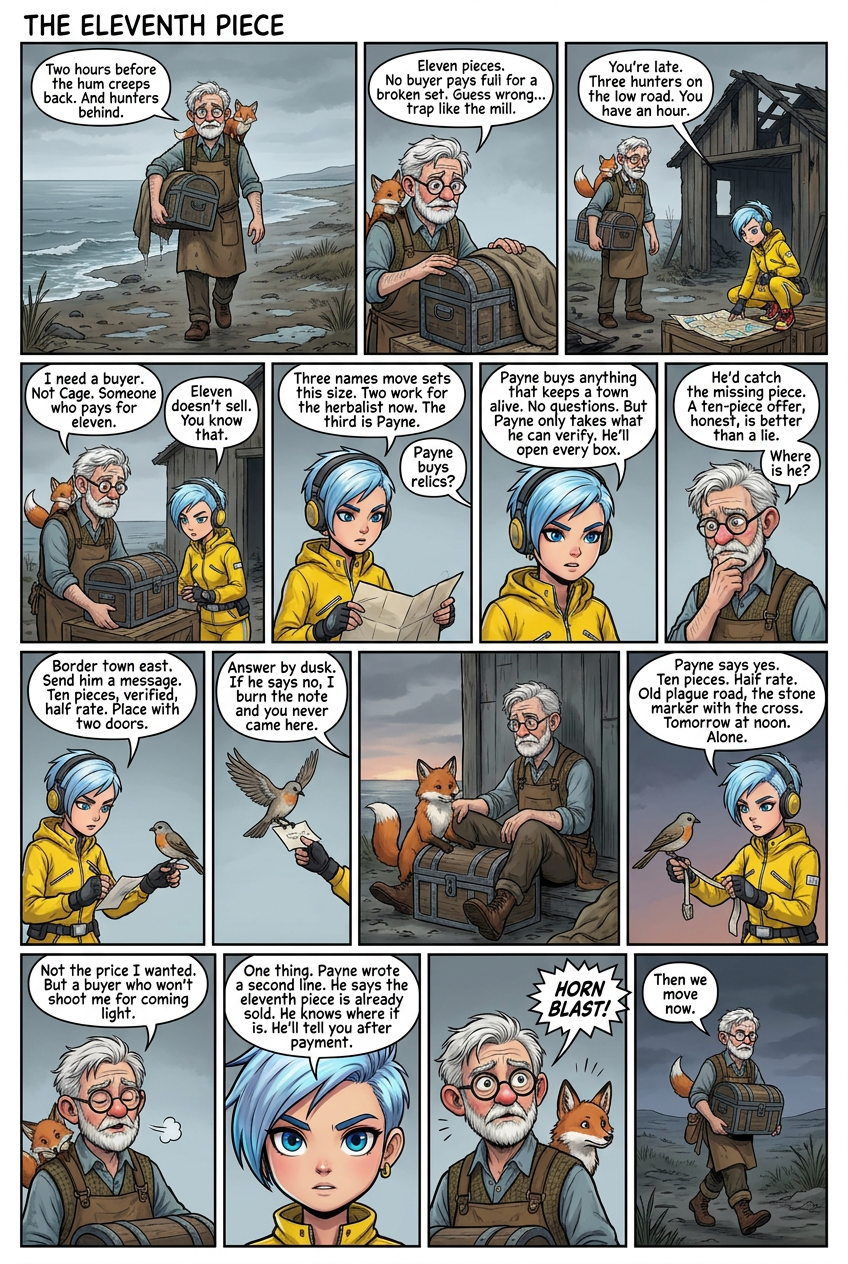
Ben walked north with the wet chest against his hip and the fox creature on his shoulder. The brine kept the hum down, but the blanket was already drying at the edges. He had maybe two hours before the sound crept back. He also had eleven pieces, not twelve, and no buyer who would pay full price for a broken set. Guess wrong and he walked into another trap like the mill. He needed a name he could trust. He knew only one person who moved messages faster than hunters moved feet. He found her at a burned-out shed two ridges on, crouched over a courier map. Anita Job, the runner who had carried his lists since the archive. Yellow jacket, blue hair, mud on her knees. She looked up and did not smile. "You're late," Anita said. "Three hunters on the low road. You have an hour." "I need a buyer. Not Cage. Someone who pays for eleven." "Eleven doesn't sell. You know that." "Name one who might." She folded the map. "Three names move sets this size. Two work for the herbalist now. The third is Payne." Ben set the chest down. "Payne buys relics?" "Payne buys anything that keeps a town alive one more week. Pays in coin or cure. No questions. No middlemen." She paused. "But Payne only takes what he can verify. He'll open every box at the table." "He'd catch the missing piece." "On the first count." Ben thought. A ten-piece offer, honest, was better than an eleven-piece lie. Payne did not punish shortfalls. Payne punished lies. "Where is he." "Border town east of the pass. Two days on foot. One if you run." "Send him a message. Ten pieces, verified, half his usual rate. I want the meeting in a place with two doors." Anita already had a scrap out. She wrote four lines and whistled. A small bird dropped from a pine and took the paper. "Answer by dusk," she said. "If he says no, I burn the note and you never came here." Ben sat against the shed wall. The fox climbed into his lap and pressed its paws to the chest lid. The hum stayed down. Dusk came gray. The bird came back with a strip of linen wrapped around its leg. Anita unwound it and read. "Payne says yes. Ten pieces. Half rate. Old plague road, the stone marker with the cross. Tomorrow at noon. He'll come alone or not at all." Ben let out a breath he had been holding for a week. Not the price he wanted. Not the buyer he had planned for. But a buyer who would not shoot him for coming light. "One thing," Anita said. "Payne wrote a second line. He says the eleventh piece is already sold. He knows where it is. He'll tell you after payment." Ben looked at her. The fox's ears cut east. Somewhere down the ridge, a horn. He shouldered the chest. "Then we move now."
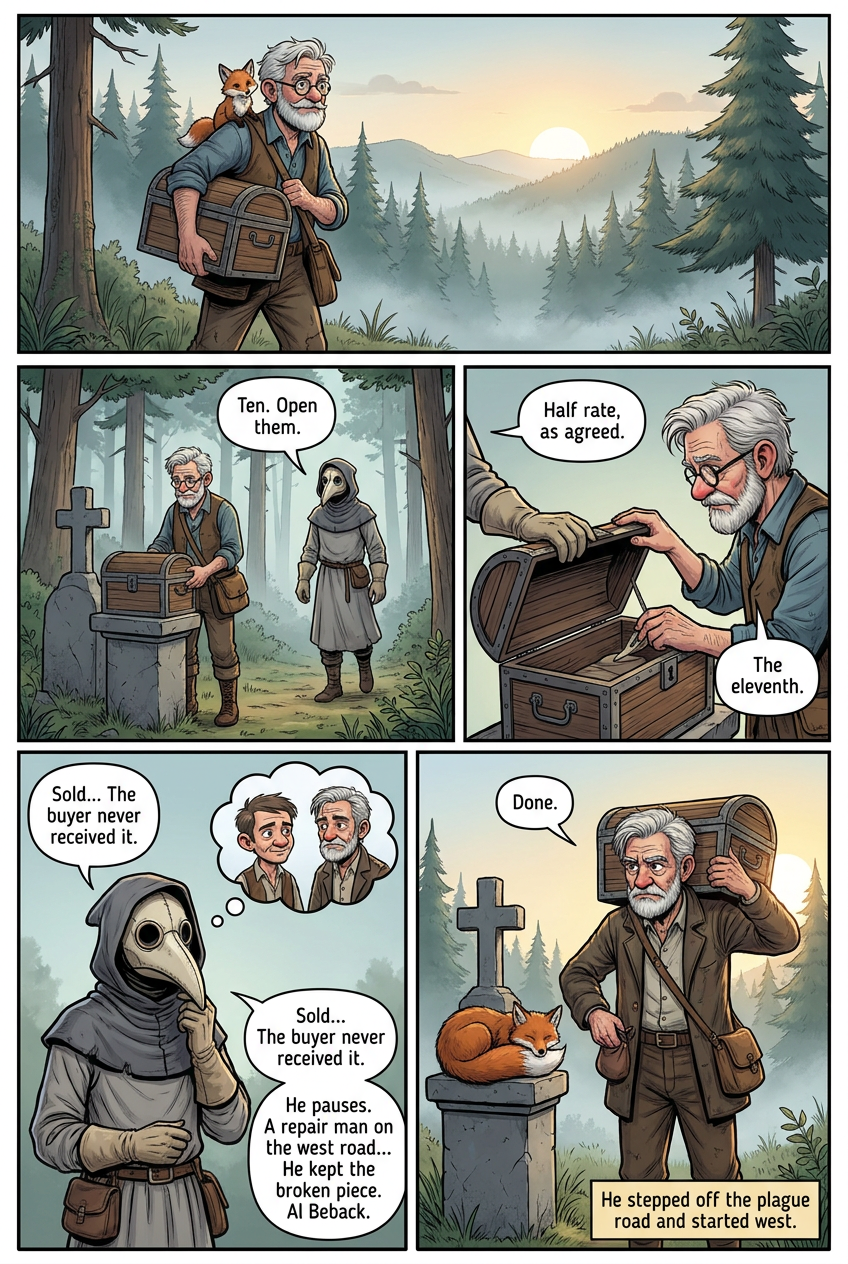
Ben moved through the pines before dawn with the chest against his hip and the fox creature on his shoulder. The blanket had dried through. The hum climbed back into the wood. He had one buyer waiting on the plague road at noon, and one line in the message that mattered more than the price: the eleventh piece was already sold, and the buyer knew where. The stone marker with the cross sat in a clearing between two low hills. Ben set the chest on the flat of it and waited. Payne came out of the trees alone, gray smock, linen gloves, the same plague mask Ben remembered. No cart. No guard. "Ten," Payne said. "Open them." Ben worked the boxes open one at a time. Payne bent to each piece and touched it with a bare finger. He did not speak. When the last box closed, he counted a purse from inside his smock and set it on the stone. Half rate, as agreed. Ben did not pick it up. "The eleventh." Payne tilted his mask. "Sold to a collector two months back. The piece went east with a carter. The carter is dead. The buyer never received it." "Where is it now." "In a ditch, in a crate, in a barn. I do not know which." Payne paused. "But I know who saw the carter last. A repair man on the west road. He fixed the carter's axle the morning of the killing. He kept the broken piece." "Name." "Al Beback." Ben looked up. Al had wrapped a chest for him once and asked nothing for it. Al lived where things broke and stayed near him. Ben could find him. "That is what I sell," Payne said. "Not the piece. The man who saw the piece last. You do the rest." Ben weighed it. A name, not a location. A trail, not a chest. But a trail he could walk. "Done." Payne turned and walked back into the trees. Ben pocketed the purse. The chest on the stone was empty now except for the fox, who climbed inside and curled against the wood. He closed the lid and shouldered the weight. Ten pieces gone. One name in his pocket. The set was down to one missing piece and one lead, and the lead was a man he knew. He stepped off the plague road and started west before the sun cleared the ridge.
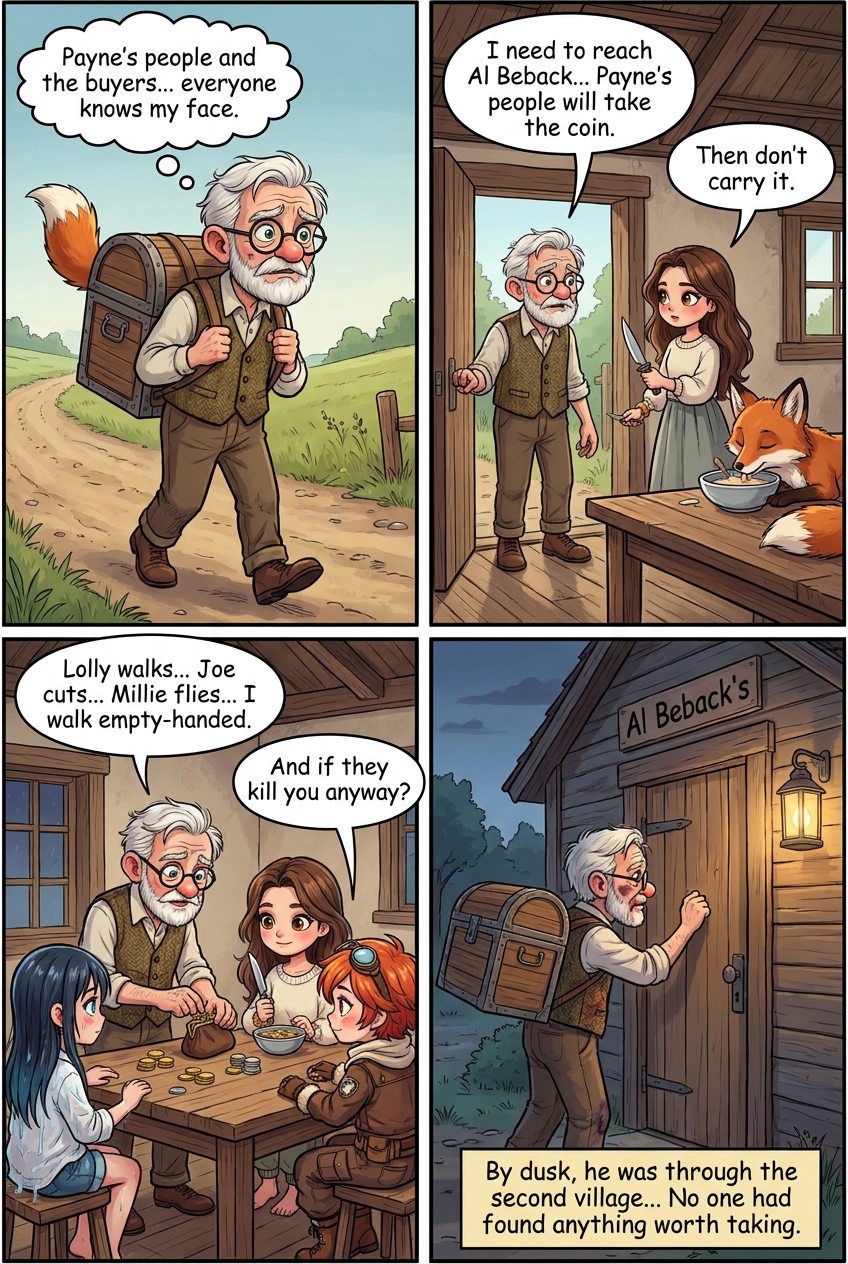
Ben walked west with the chest on his back and the fox curled inside it. The west road ran straight through three villages before the fork where Al kept his shed. Payne's people worked all three. So did the buyers who paid Payne. Ben's face had been drawn on a folded page and passed from hand to hand for weeks. Anyone on that road with a coin purse and eyes knew him. He turned off the road at the first stream and thought it through. He had a purse heavy enough to buy a wagon, and no way to spend it. The moment he showed the coin, the coin was gone. The moment he showed his face, the purse and the fox went with it. He cut north to a cottage he remembered. Paige opened the door with a knife in her hand, saw him, and lowered it. "You said not to come back," Ben said. "I did." She stepped aside. "Come in." He set the chest on her table. The fox climbed out and drank from a bowl she pushed across without asking why. "I need to reach Al Beback on the west road," Ben said. "Payne's people will take the coin off me before I get past the second village." Paige looked at the purse. "How much." "Enough to be worth killing for." She sat down. "Then don't carry it. Send it ahead with someone who isn't you." "Who." A knock. Paige did not move. Another knock, and then the door opened on its own. Lolly stood there, wet through, a puddle already forming under her boots. Behind her, Joe leaned in the frame with leaves in his hair. Millie sat on Joe's shoulders holding a folded map. "She said you'd be here," Lolly said, pointing at Millie. "I flew over," Millie said. "Only a little. Two feet, maybe. But I saw the roof." Ben looked at Paige. Paige shrugged. He split the purse on the table into four uneven piles. "Lolly walks the road wet. Nobody looks twice at a soaked girl. She carries a third of it." He pushed a pile toward her. "Joe cuts through the trees north of the road. He carries a third." He pushed the next. "Millie flies what she can carry over the villages entirely." He pushed a smaller pile. "I walk the road empty-handed with the chest and the fox. If they take me, they get nothing worth the trouble." "And if they kill you anyway," Joe said. "Then you three meet Al without me and give him the coin for the axle piece." Lolly picked up her share and pocketed it. Water ran down her wrist. "When." "Now." They split at Paige's gate in four directions. Ben walked the west road openly, chest on his back, fox at his collar, pockets empty. By dusk he was through the second village with a split lip and a bruised rib. No one had found anything worth taking. At the third village, Lolly waited by the well. Joe came out of the pines an hour later. Millie dropped from a barn roof with the smallest pile intact. Al's shed sat at the fork. The lamp was lit. Ben knocked.
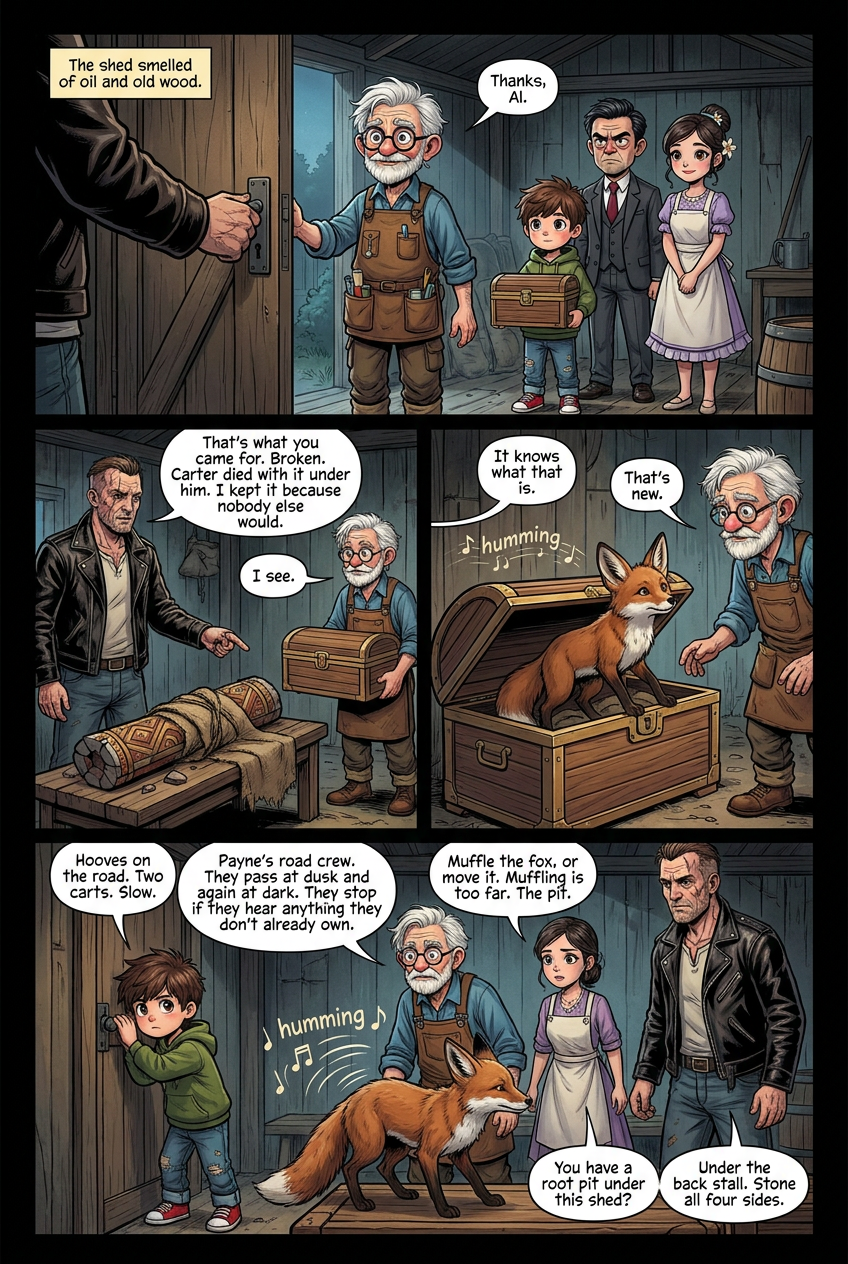
Al opened the door and waved Ben inside without a word. Lolly, Joe, and Millie slipped in behind him with the coin. Al latched the door and set a wedge under it. The shed smelled of oil and old wood. On the bench sat a broken axle piece, wrapped in sacking. Al pointed at it. "That's what you came for. Broken. Carter died with it under him. I kept it because nobody else would." Ben set the chest on the floor. The fox climbed out and stood on the lid, ears up. The fox began to hum. Not loud yet, but rising. It had been quiet on the road. Here, in the still shed, the sound built. The fox turned its head toward the west wall and pressed both ears flat. "That's new," Joe said. "It's the axle piece," Ben said. He watched the fox lean toward the bench. "It knows what that is." Lolly cracked the door and listened. "Hooves on the road. Two carts. Slow." Al said, "Payne's road crew. They pass at dusk and again at dark. They stop if they hear anything they don't already own." Millie climbed the bench and put her palm on the fox's back. The hum did not stop. It climbed. Ben felt it in his teeth. He had two choices. Muffle the fox, or move it. Muffling meant the chest, the straw, the brine cloth from the cabin. All of it was two villages behind him. He looked at Al. "You have a root pit under this shed?" "Under the back stall. Stone all four sides." "Open it." Al pulled a floorboard up. Cold air came out. Ben lifted the fox off the lid. It fought him, twisting toward the axle piece. He tucked it under his coat and held it hard. "Wrap the axle piece in the sacking," he told Joe. "Take it down first." Joe went down the ladder with the bundle. The fox went still against Ben's chest the moment the axle piece dropped out of sight. The hum cut off like a plucked string. Ben climbed down after Joe. The pit was smaller than the shed and colder. He set the fox on the axle piece. It curled up on the sacking and closed its eyes. Upstairs, the carts passed. Wheels on gravel, a voice calling something, and then nothing. Al waited a long minute before he pulled the board back. "They didn't stop," he said. Ben climbed up alone. "The fox stays down there with the piece. So does the chest. I'm not carrying either back out through Payne's people." Al nodded. "Then you need a buyer who comes to me." Ben counted the coin onto the bench and pushed Al's share across. "Send word to Anita. Tell her the eleventh piece is found. Tell her I'll be here when she brings someone worth selling it to."
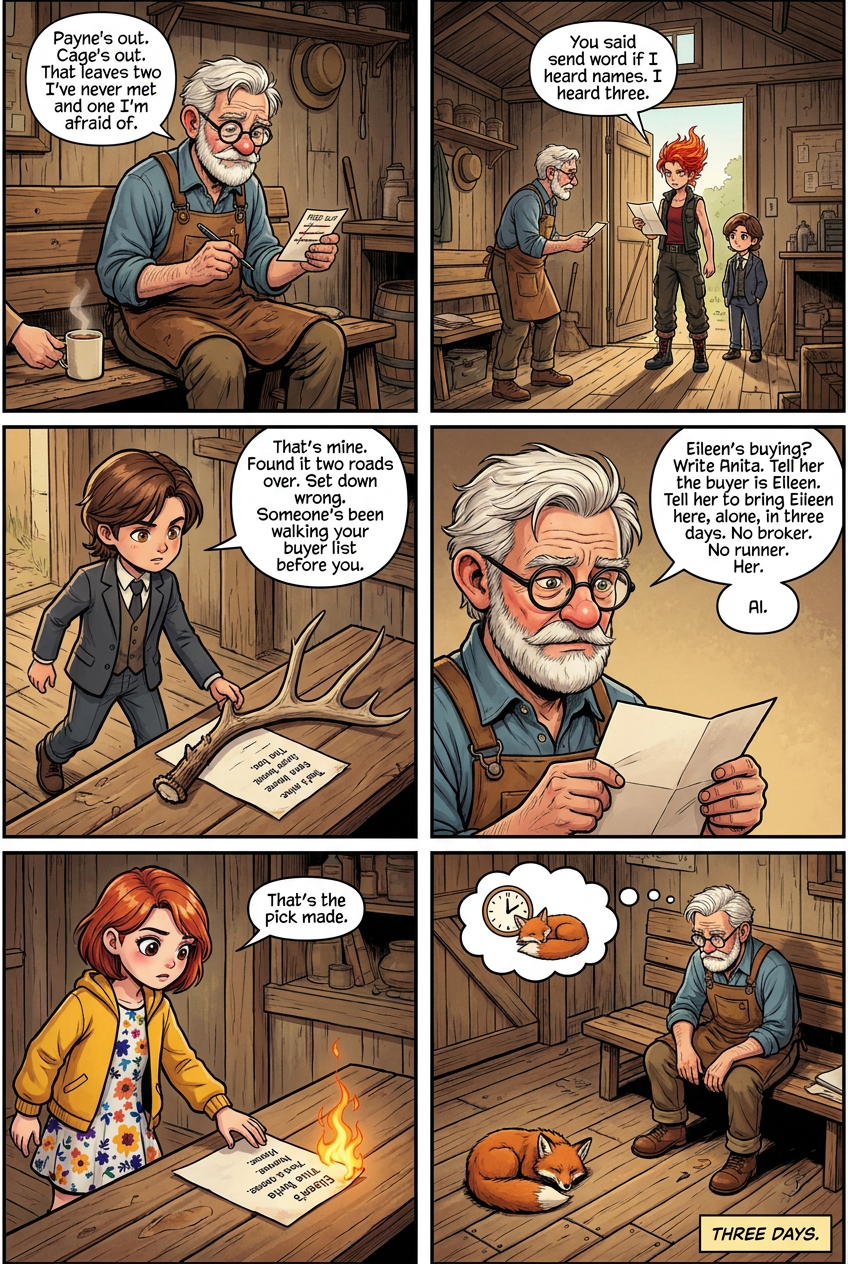
Ben sat on Al's bench and worked the list in his head. He had the eleventh piece under the floor with the fox curled on top of it. He had coin sewn into three coats out in the yard. What he did not have was a name to sell to. Anita's runner would come tomorrow or the day after. She would want a name from him before she brought anyone at all. He wrote four names on the back of a feed slip. He crossed out three before Al brought the tea. "Payne's out," Ben said. "He already took the ten. He knows the eleventh is loose. If I sell to him now he'll pay half of half." "Cage's out," Al said. "Her men are still walking every road east." "That leaves two I've never met and one I'm afraid of." The door rattled. Al put his hand on the wedge. Ima Hogg stepped in with Ella Vator behind her and a small figure in a suit behind Ella. Ben had last seen Ima setting her own house on fire to buy him a morning. He stood up. "You said send word if I heard names," Ima said. "I heard three." She put a folded paper on the bench. Ella stayed by the door with her hands open at her sides, counting under her breath. The man in the suit stepped forward and set a shed antler on the bench next to the paper. It had a small notch scratched under the base. "That's mine," Tim Burr said. "Found it two roads over. Set down wrong. Someone's been walking your buyer list before you." Ben unfolded the paper. Three names. Two he did not know. The third he knew. It was his sister's name. "Eileen's buying?" he said. "Eileen's asking," Ima said. "Quiet. Through a broker. She has coin from the last job and she has a hall with stone walls." Ben sat back down. He thought about the fox pressed to the axle piece under the floor. He thought about Payne's carts passing at dark. He thought about the two strangers on the list and how one wrong pick would put men in this shed by morning. "Write Anita," he said to Al. "Tell her the buyer is Eileen. Tell her to bring Eileen here, alone, in three days. No broker. No runner. Her." Al took the pen. "Burn the other two names," Ben said. Ella stepped to the bench. She held her palm over the paper. The corner caught. She let it go to ash on the tin and did not touch anything else. She counted to four and closed her hand. "That's the pick made," Ima said. Ben looked at the floorboard. The hum had not started again. The fox was still asleep on the piece. He had a buyer now, and he had three days before she walked through the door.
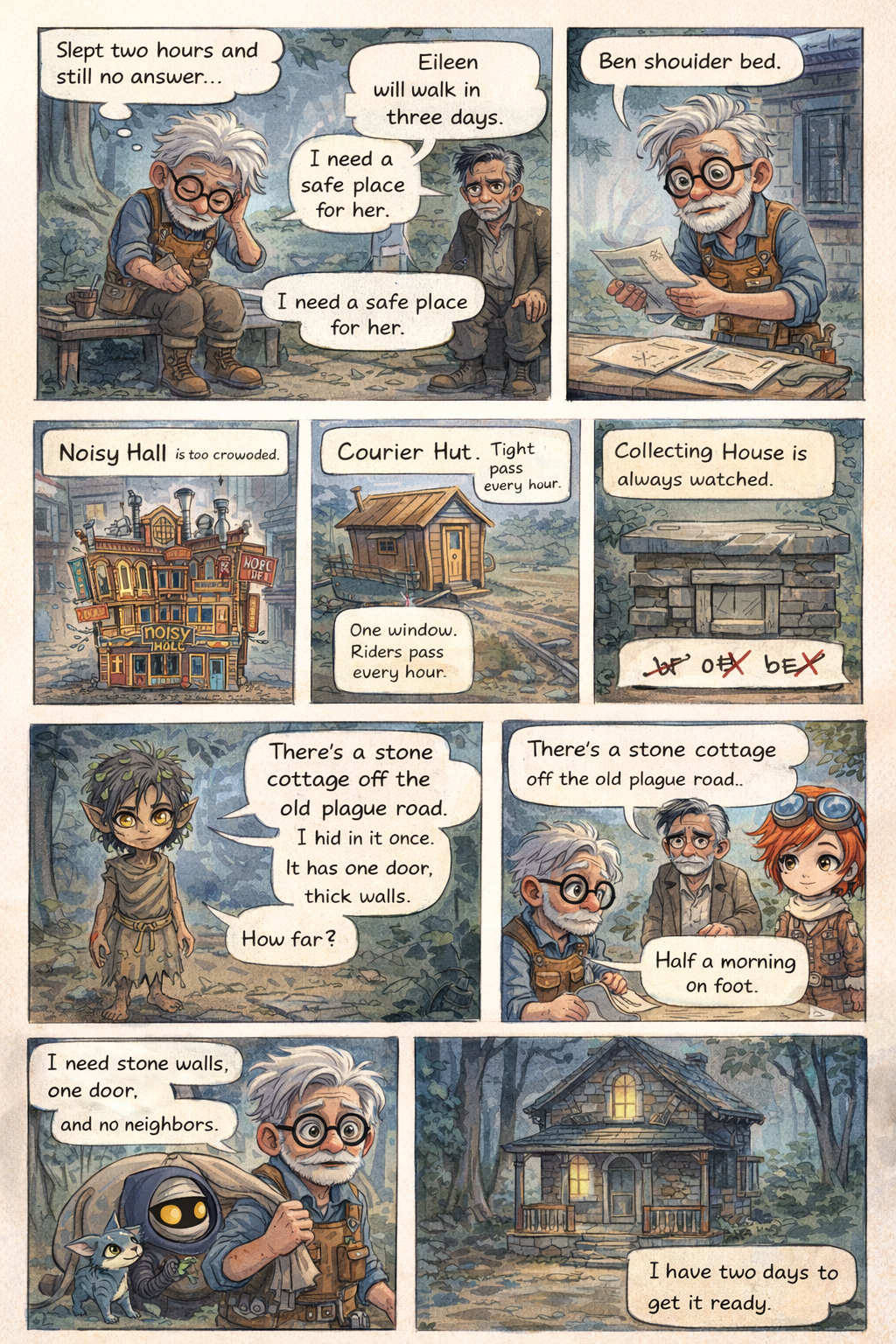
Ben slept two hours on Al's bench and woke with the problem still on his chest. Eileen would walk in three days. He had no place to put her when she did. Al's shed sat too close to the road. Payne's carts passed at dark. Two men had come by the fork yesterday asking after a repair that did not exist. He needed stone walls, one door, and no neighbors. He wrote three options on the back of the same feed slip. A music hall two valleys east, loud enough to bury any hum but crowded with strangers. A courier hut on the fast run north, tight and defensible but too small for four people and a chest. A collecting house at the trade stop, roomy but watched by every trader working the road. He crossed out the music hall first. Too many ears meant too many mouths. Joe came in with pine needles on his coat. He had walked the courier hut before dawn. "Door faces the track," Joe said. "One window. A rider passes every hour. If she comes in there, someone counts her going in and someone counts her coming out." Ben crossed out the courier hut. "Collecting house?" Al asked. "Watched," Ben said. "And the trader who runs it owes Payne." He crossed that out too. The slip was empty now. Lolly stepped in from the yard with her hands wet to the elbow. She had been washing at the trough. "There's a stone cottage," she said. "Off the old plague road. Nobody goes near it. Roof half gone but the front room is whole. One door. Thick walls." "How do you know it?" "I hid there in the fall. A woman lived in it once. She left." Ben thought about the plague road. Payne's men used the west end for their carts, but the east end ran into brush and stopped. No one traveled the dead half. The cottage sat on the dead half. "How far?" he said. "Half a morning on foot. Less if we cut the ridge." Millie whistled from the door. Her winged creature landed on the rail. She had sent it up at first light to look at the roof line. "No smoke for a mile," she said. "No tracks on the approach." Ben took the axle piece out from under the floor and wrapped it in the wool. The fox climbed into the sack on its own. He gave Al a folded note for Anita's runner. "Change of address," he said. "Stone cottage off the east plague road. Bring Eileen there at dusk on the third day. Alone." Al nodded and pocketed the note. Ben shouldered the sack. He had a room now with one door and stone on every side. He had two days to make it ready before his sister walked through it.
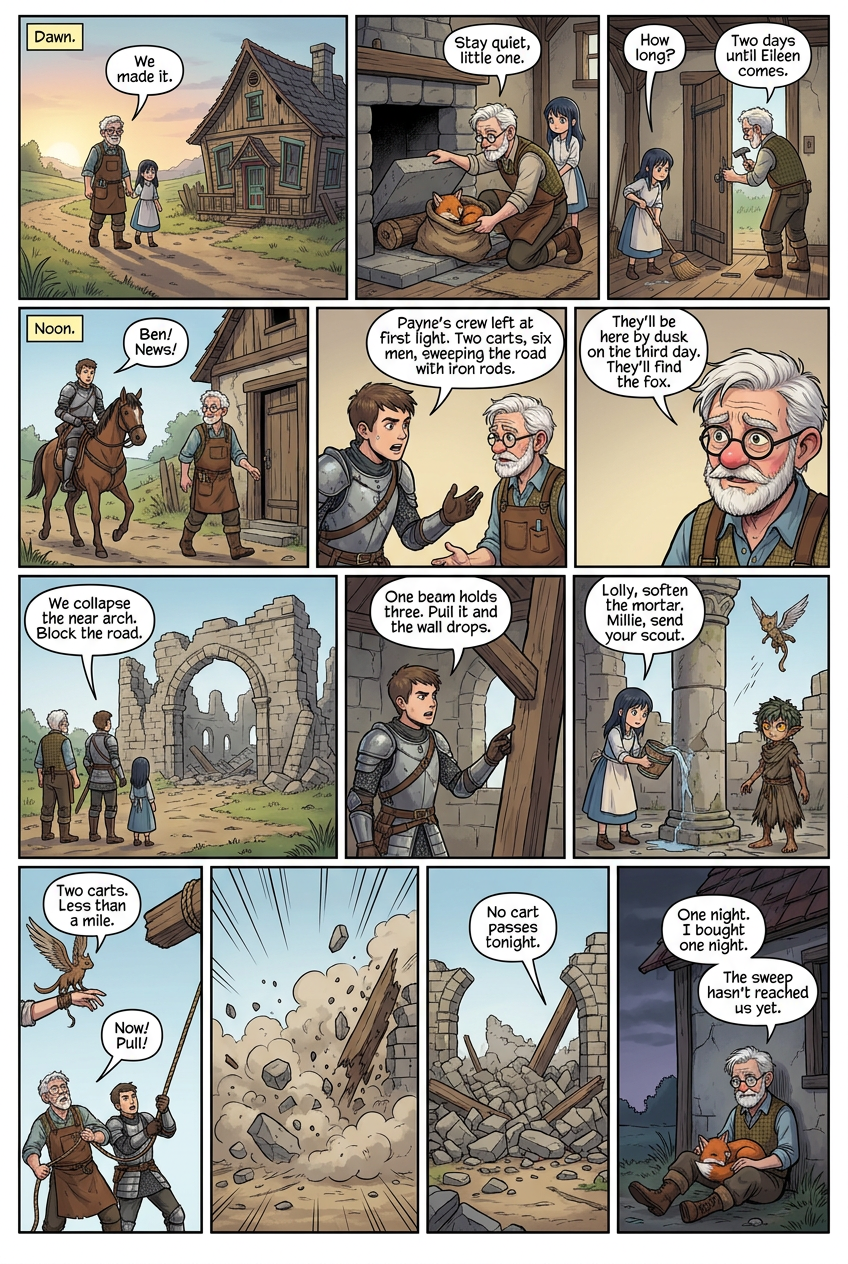
Ben and Lolly cut the ridge at dawn and reached the cottage by mid-morning. It sat on the dead end of the plague road, roof half open to the sky, front room whole. He set the sack with the fox and the axle piece under a loose flagstone by the hearth. The fox curled against the wrapped wood. The hum stayed low. Two days until Eileen came. He started work on the door. Joe arrived at noon with news that turned the day. Payne's road crew had left the west end at first light. They were sweeping the plague road for the missing piece. Two carts, six men, iron rods for testing brush and pits. They would reach the cottage before dusk on the third day. Ben counted the hours. Anita's runner would bring Eileen at that same dusk. If the crew arrived first, they would find the fox, the axle piece, and a stone room with one door. Ben could not move the cottage. He could not turn Eileen back in time. He had to stop the sweep before it reached him. He walked west along the road with Joe until the ruin came into view. A shattered hall stood a mile short of the cottage, roof beams down, arches broken open, stone piled to the waist. The road narrowed and passed through it. Any cart had to slow. Any cart could be stopped. "We collapse the near arch," Ben said. "Block the road. They turn back or dig for a day." Joe measured the beams with his eyes. "One beam holds three. Pull it and the wall drops." They worked through the afternoon. Lolly hauled water from a seep and softened the mortar around the base stones. Millie sent her winged creature up to watch the west road. Ben cut the rope from his sack and rigged a pull line to the low beam. Joe wedged the far end with a broken lintel to guide the fall. The scout landed on Millie's wrist at four. Two carts on the road, less than a mile out. Ben and Joe hauled the line together. The beam slid, caught, then dropped. The near wall folded into the road in a slow grinding fall. Dust climbed. When it cleared, stone sat waist-high across the track, and the far arch leaned but held. No cart would pass tonight. They ran the ridge back to the cottage and reached the door as the horns started west of the ruin. The crew had found the block. They would send a rider to Payne and camp until morning. Ben sat against the stone wall with the fox in his lap. He had bought one night. Eileen would walk in at dusk tomorrow, a day ahead of the crew's next push. The sweep had not reached him. It would.
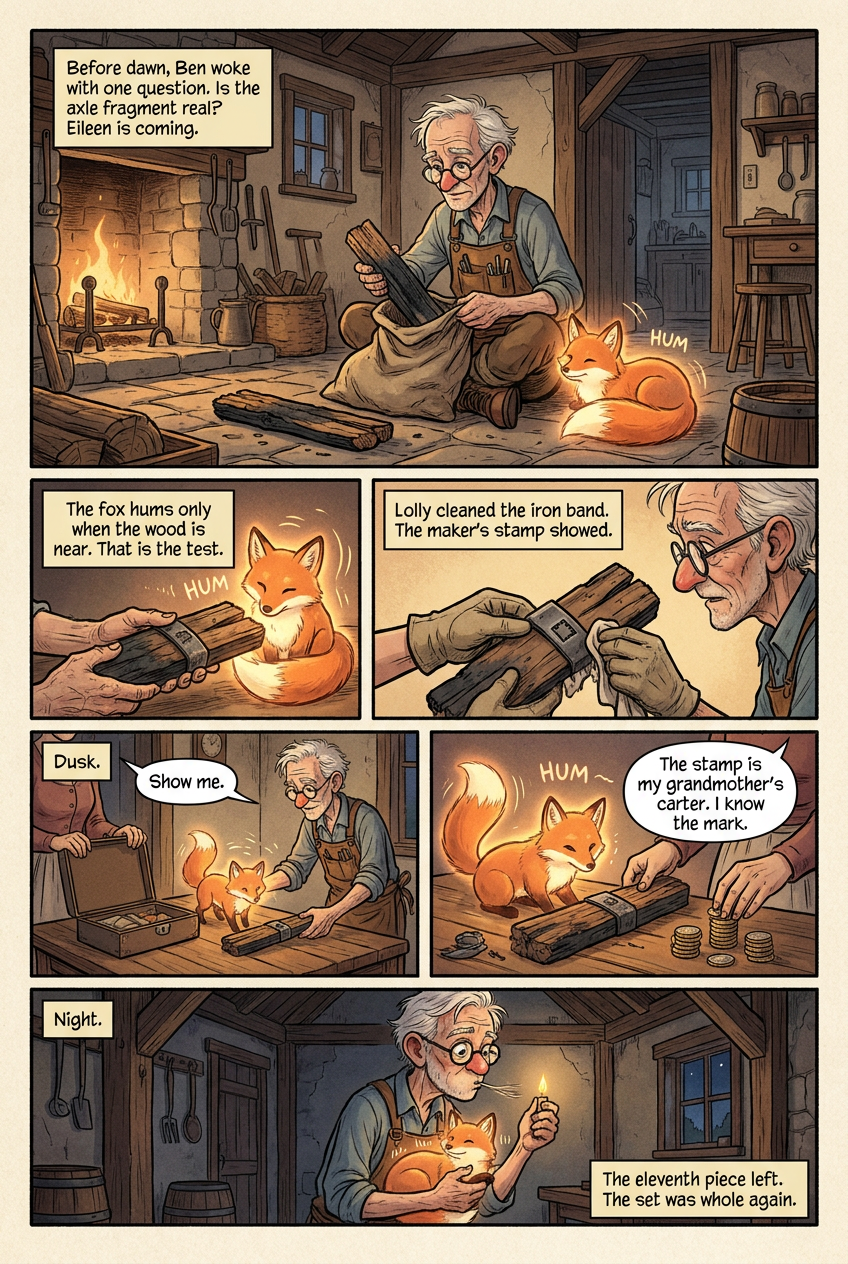
Ben woke before dawn with one question stuck in his chest. Eileen was coming to pay for the eleventh piece. He had the axle fragment under the flagstone and the fox curled beside it. He did not know if the fragment was real. If Eileen inspected it and found a scrap of broken cart wood, she would leave, or worse, take the coin back and mark him a cheat. He pulled the sack out and unwrapped the wood on the hearthstone. The fragment was blackened, split along the grain, iron banding at one end. It looked like any broken axle. He set the fox down beside it. The fox stiffened, ears flat, and hummed in its throat. The sound matched the low note the chest had carried for weeks. Ben watched the fox lean toward the wood and press its nose to the iron band. The hum climbed a step and held. He carried the fragment to the doorway and set it in daylight. The fox followed and hummed again. He carried it back and laid it on the hearth. Same note. He wrapped it, unwrapped it, moved it three paces off. The fox hummed only when the wood was near. That was the test he had. It was the test he would give Eileen. Joe came in at midmorning with a scrap of oilcloth and news from the ruin. The crew had not moved. A rider had gone west for tools. "They dig at dawn," Joe said. "You have tonight." Lolly brought water and a cloth and cleaned the iron band until the maker's stamp showed. A small square with three notches. Ben did not know the mark. He set it beside the fox again and the hum came on cue. Eileen arrived at dusk with Anita's runner and a lean man carrying a strapped case. She looked tired and did not sit. "Show me," she said. Ben laid the fragment on the table. He set the fox on the floor a room away, behind the closed inner door. The fox went quiet. He carried the wood through the doorway. The hum rose from behind the door, steady and true. He carried the wood back. The hum stopped. He did it twice more. Eileen watched the door, not the wood. When he set the fragment down the last time she opened her case and counted coin onto the table in stacks. "The stamp is my grandmother's carter," she said. "He hauled the set the first time it moved. I know the mark." She wrapped the fragment in her own cloth and closed the case. "Payne's crew digs at dawn," she said. "We go now." Ben took the fox under his arm and blew out the lamp. The eleventh piece left the cottage in his sister's hand. The set, wherever it sat, was whole again in the world.
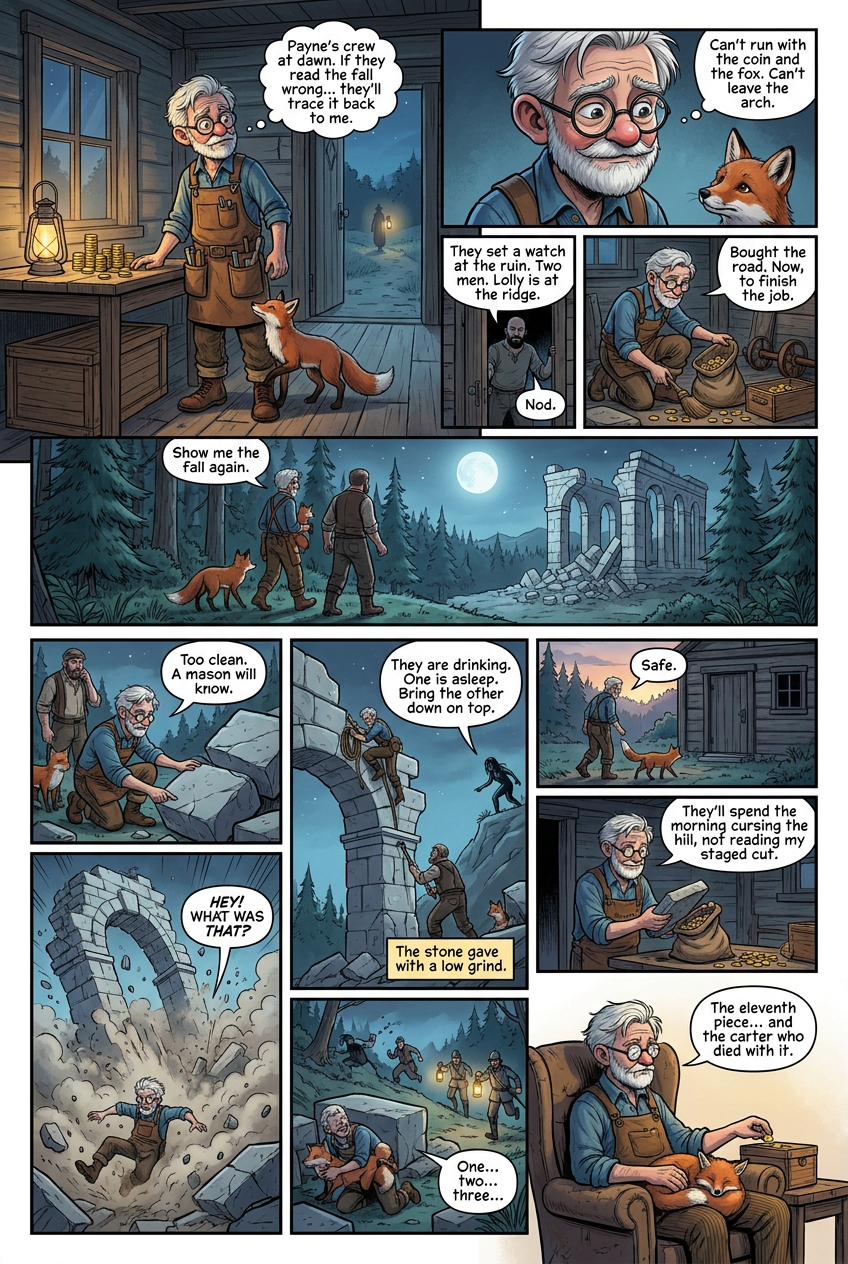
Ben stood in the empty cottage after Eileen's lantern faded down the road. The coin sat on the table in stacks. The fox pressed against his boot, quiet now that the wood was gone. He had until dawn. Payne's crew would clear the collapsed arch at first light and walk the road east. If they read the fall wrong, they would trace the cut stones back to him. He could not run with the coin and the fox both. He could not leave the arch as it stood. Joe came through the door with pitch on his hands. "They set a watch at the ruin. Two men. Lolly is at the ridge." Ben nodded. He swept the coin into a sack and set it under the flagstone where the axle had lain. He picked up the fox. "Show me the fall again." They went west through the pines. The ruined hall stood pale in the moon, one arch down, the other still holding. Ben crouched at the rubble. His cuts showed clean on two of the stones. A mason would read them by lamplight. He needed the fall to look old, or he needed a second fall to bury the first. Lolly slid down from the ridge, hair wet from the ditch. "They are drinking. One is asleep." She looked at the standing arch. "Bring the other down on top." Ben studied the keystone. The arch leaned already. Joe had brought a pry bar and a coil of rope. Ben set the fox in a hollow behind a fallen block, where the stone would muffle any hum. He climbed the rubble with the rope. Joe worked the pry bar into the seam above the keystone. Lolly went back up to watch the guards. The stone gave with a low grind. Ben dropped from the pile as the arch came down. Dust rolled over the road. The new fall crushed the cut stones under a ton of rough block. No mason would find the seam now. The noise brought a shout from the ruin. Boots came at a run. Ben grabbed the fox and went flat behind the fallen block. Joe crawled the other way with the pry bar. Lolly threw a rock down the far slope. The guards ran toward the sound, lamps swinging. Ben counted to twenty and moved. They reached the cottage before the sky turned. Ben lit no lamp. He lifted the flagstone and looked at the sack of coin. He had bought the road. Payne's crew would spend the morning hauling stone and cursing the hill. They would not read a staged cut in the mess he had left them. The fox climbed into his lap and went to sleep. Ben sat with the coin under his hand and thought about the buyer who had bought the eleventh piece two months back, and the carter who had died on the road with it.
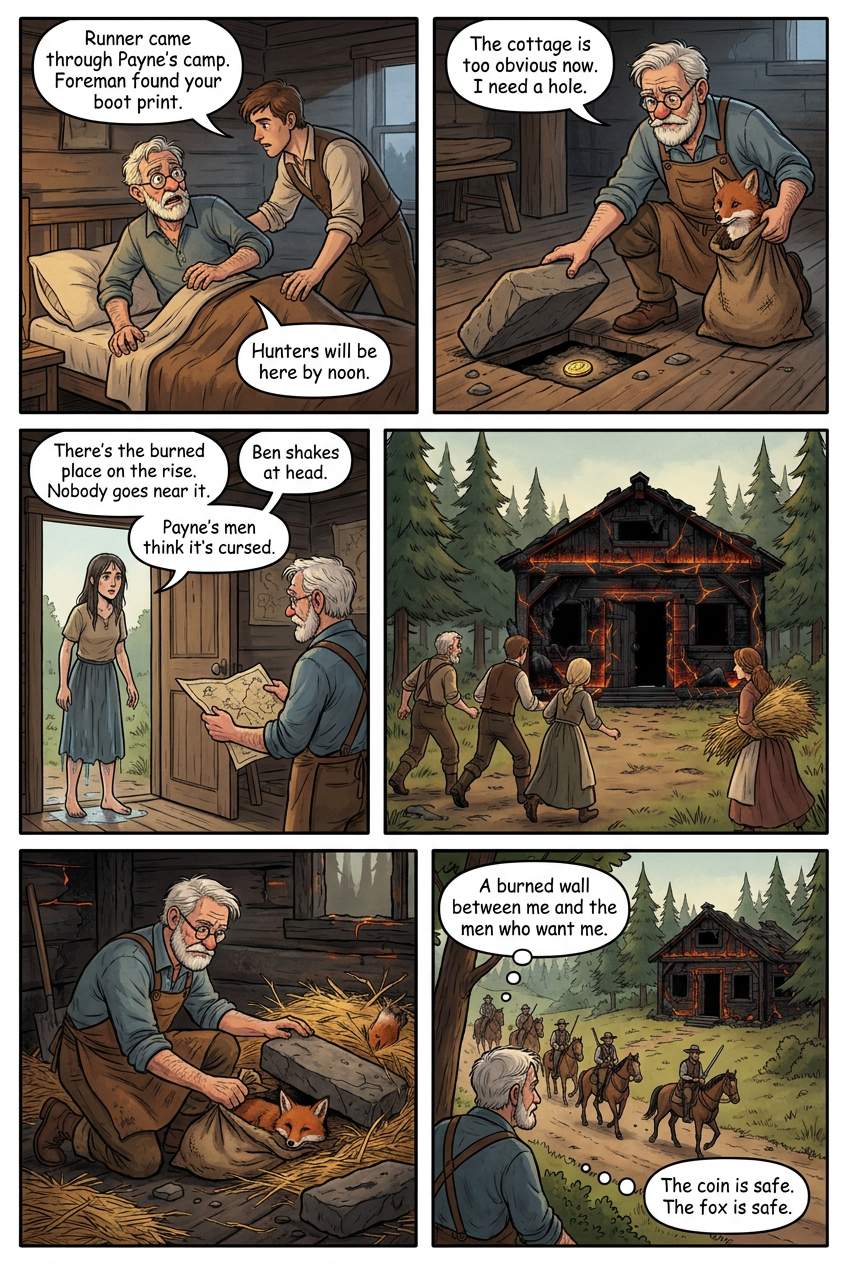
Ben woke to Joe shaking his shoulder. Gray light showed at the window. The fox was already up, ears flat. Joe's voice was low. "Runner came through Payne's camp an hour ago. Foreman found a boot print in the rubble and matched it to the tread you left at the shed last week. They sent word south. Hunters will be here by noon." Ben sat up. The cottage was too obvious now. A boot print he had not thought to smear. He lifted the flagstone and took out the coin. He put the fox in the sack under his coat. He had until noon to be gone and to leave nothing that named him. Lolly stood in the doorway, wet to the knees. "Which road?" Ben shook his head. Payne's people watched the north road. The plague road ran west into the crew's own camp. South was open ground. East went nowhere he knew. He needed a hole, not a road. "There's the burned place on the rise," Lolly said. "Nobody goes near it. Roof gone, walls black. Payne's men think it's cursed." Ben knew the shell she meant. A scorched frame at the edge of the pines, beams still standing, cracks glowing at dawn from a fire that had never quite died in the sill. He had passed it twice and looked away both times. That was the point. If he had looked away, so would a hunter. They moved fast. Joe wiped the flagstone and scattered ash on the floor. Lolly dragged a bench across the boot marks by the door. Ben carried the coin and the fox. Millie met them at the tree line with a bundle of straw for damping. They reached the burned house before the sun cleared the ridge. Inside, the floor was soft with char. Ben found a dry pocket under the fallen chimney stone where the heat still held. He wedged the coin sack there and set the fox in the straw beside it. The fox did not hum. The wood was miles away in Eileen's cart. It only watched him. Ben went back out and walked his own tracks backward to the road, then off into the creek. Joe followed with a branch to sweep the last prints. Lolly waded ahead to break the scent. At noon the hunters came up the road in a line of six. Ben watched from the trees above the burned house. Two rode to the cottage. Two went to the ruin. Two stood at the fork and looked at the scorched shell on the rise. One spat. They turned their horses and rode past it without slowing. Ben let out the breath he had been holding since dawn. The cottage was lost. The coin was safe. The fox was safe. He had a burned wall between him and the men who wanted him, and a day to decide where to run next.
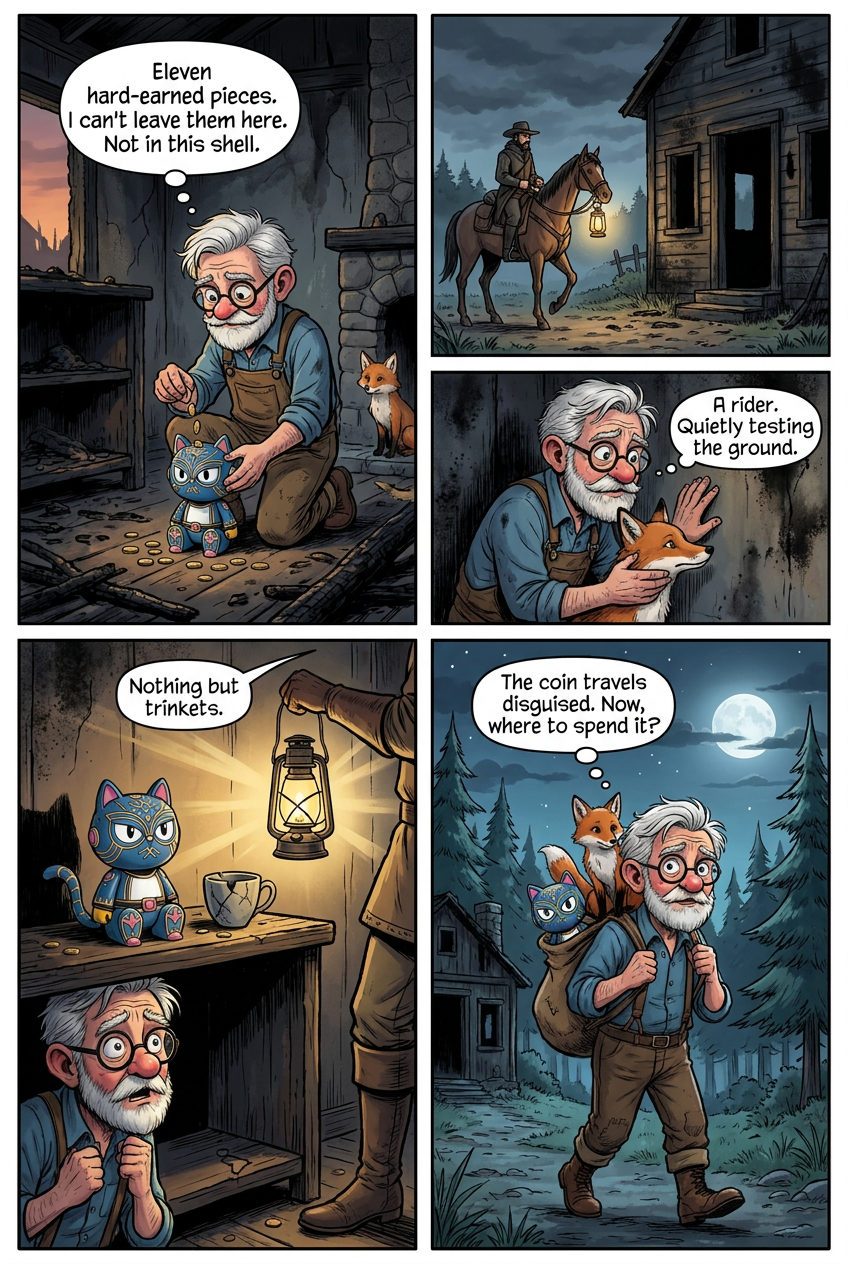
By dusk the hunters were gone, but Ben knew they would circle back. The burned house had fooled them once. It would not fool them twice. His coin and the fox sat under the chimney stone, safe for now. But the coin was his whole reward, eleven pieces earned across a hundred hard days. He would not leave it in a scorched shell that any bored rider might poke through. He waited until full dark. Then he crossed the char floor to the chimney stone. The fox watched him with flat ears. He lifted the sack of coin and weighed it in his hand. Too heavy to run with. Too loud if it clinked. He needed a way to carry it that no one would search. On a shelf near the sill sat things the fire had spared. A cracked cup. A tin plate. And a small painted figure, a blue cat with gold lines and a jeweled brow, the kind a family sets on a mantel. Ben picked it up. It was hollow. The base twisted off in his hand. He understood then. Locals thought this place cursed. They walked past its trinkets without a glance. A pretty charm on a burned shelf drew no eyes. He poured coin into the cat's hollow belly until it was full, then packed the rest in his coat lining. He twisted the base back on and set the figure among the other junk. Outside, gravel shifted. Ben froze. A rider had come up the rise, quiet, testing the ground the others had skipped. Ben pressed flat against the black wall. The horse stopped at the doorway. A lantern swung inside. Its light crossed the shelf, the cracked cup, the blue cat. The rider stepped in. Boots crunched char. Ben held the fox's mouth shut in the straw. The lantern rose. The man's eyes moved over the shelf, over the little grinning cat with its jeweled brow, and slid on. He kicked a fallen beam, cursed the ash on his boots, and turned back to his horse. Ben did not breathe until the hoofbeats faded down the rise. He came off the wall and lifted the painted cat again. The coin inside did not shift. The man had looked straight at his whole fortune and seen a child's toy. He wrapped the figure in straw and slid it into the sack beside the fox. The burned house was burned through now, a place hunters would return to at first light with better lanterns. He could not stay. But he could carry his coin in plain sight, hidden inside something no one wanted. He stepped out under the pines with the sack on his shoulder. The fox rode quiet. The eleven pieces were sold, the coin was his, and it now traveled disguised as a mantel charm. Where he would spend it, and who would still hunt him for it, he did not yet know.
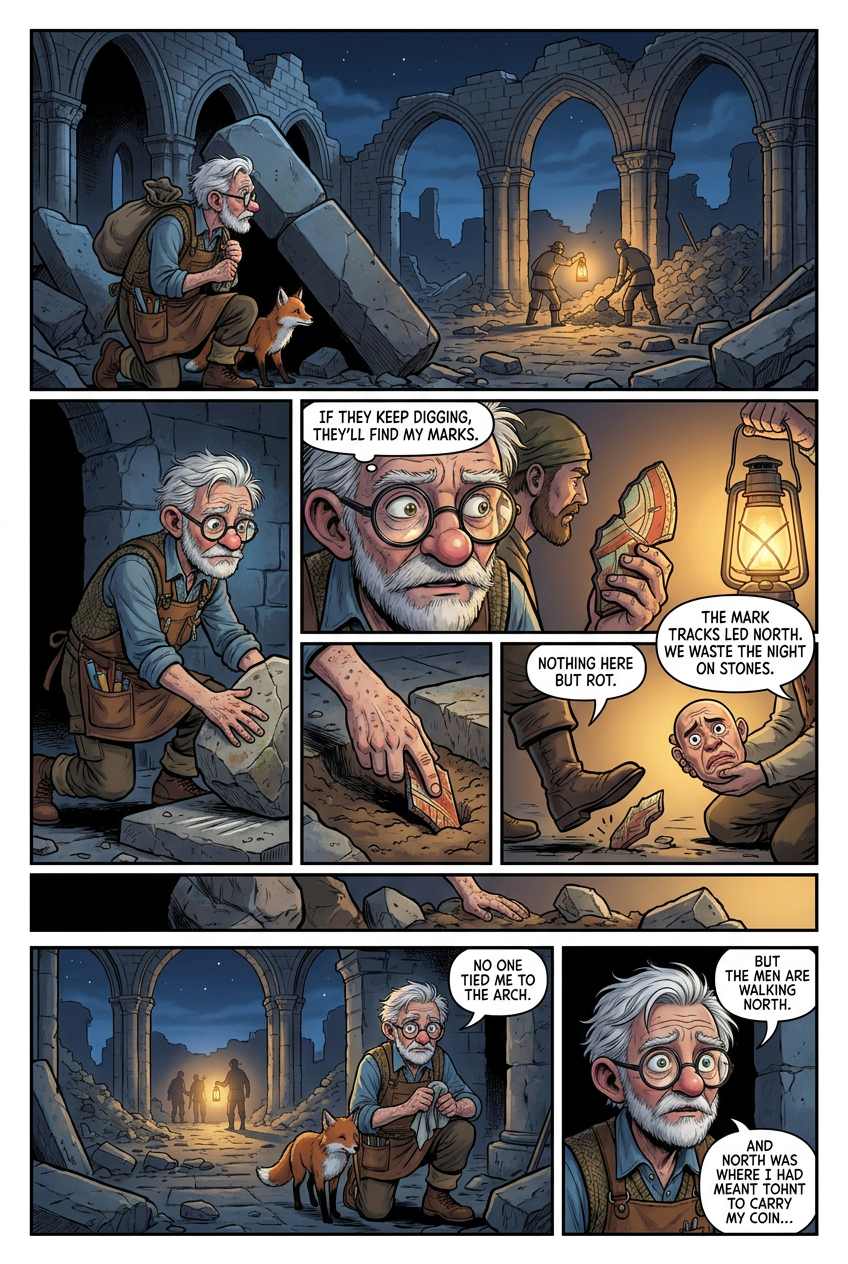
Ben left the burned house behind with the sack on his shoulder. The blue cat held his coin, and the fox rode quiet beside it. But the rider who had dismissed the cat was only one of Payne's crew. The rest still worked the plague road. If any of them tied him to the collapsed arch, the coin would mean nothing. He needed to be gone before dawn, and clean. He reached the ruined hall a mile west, where the two arches lay in rubble. His tool marks were buried there. But fresh boot prints ringed the stones, and a lantern glowed near the far heap. Payne's men had come back to dig. Ben crouched behind a fallen block and watched. Among the broken stones lay a fractured relic, jagged pieces spread in the dirt. The crew had turned it up while clearing the arch. One man held a chunk to the lantern, tracing the faded red and gold lines. Ben's chest tightened. If they kept digging, they would reach the pale marks his chisel left in the base stone. He saw a way to turn them. A weathered granite hearthstone sat half-buried at the pile's edge, the same gray as his cut marks. Ben crept along the shadow. He worked the hearthstone loose and rolled it over the tool marks, hiding them under plain rock. Then he pushed a broken relic shard into the open dirt beside it, so the fresh disturbance looked like the crew's own digging. A voice called out. Ben dropped flat. Two men walked the line of stones, holding a small carved face up to the lamp, a furrowed brow and open mouth, some trinket from the rubble. They argued whether the hall was worth more digging. One kicked the shard Ben had planted. He held it to the light, saw only old broken junk, and tossed it back. "Nothing here but rot," he said. "The mark tracks led north. We waste the night on stones." The crew gathered their tools. Ben pressed into the black gap between two blocks and did not move. The lantern swung past his boot and away. Boots crunched off toward the road. He counted their steps until the light shrank to a point and was gone. When the hall went silent, Ben came out. The tool marks lay hidden under the hearthstone. The crew believed the trail ran north, away from his true path. No one had tied him to the arch. He wiped the fox's damp nose in the dark and lifted the sack. But the men were walking north, and north was where he had meant to carry his coin. Their trail and his now pointed the same way. He could not follow behind a crew that hunted him. He would have to find another road, and quickly, before the light gave him up.
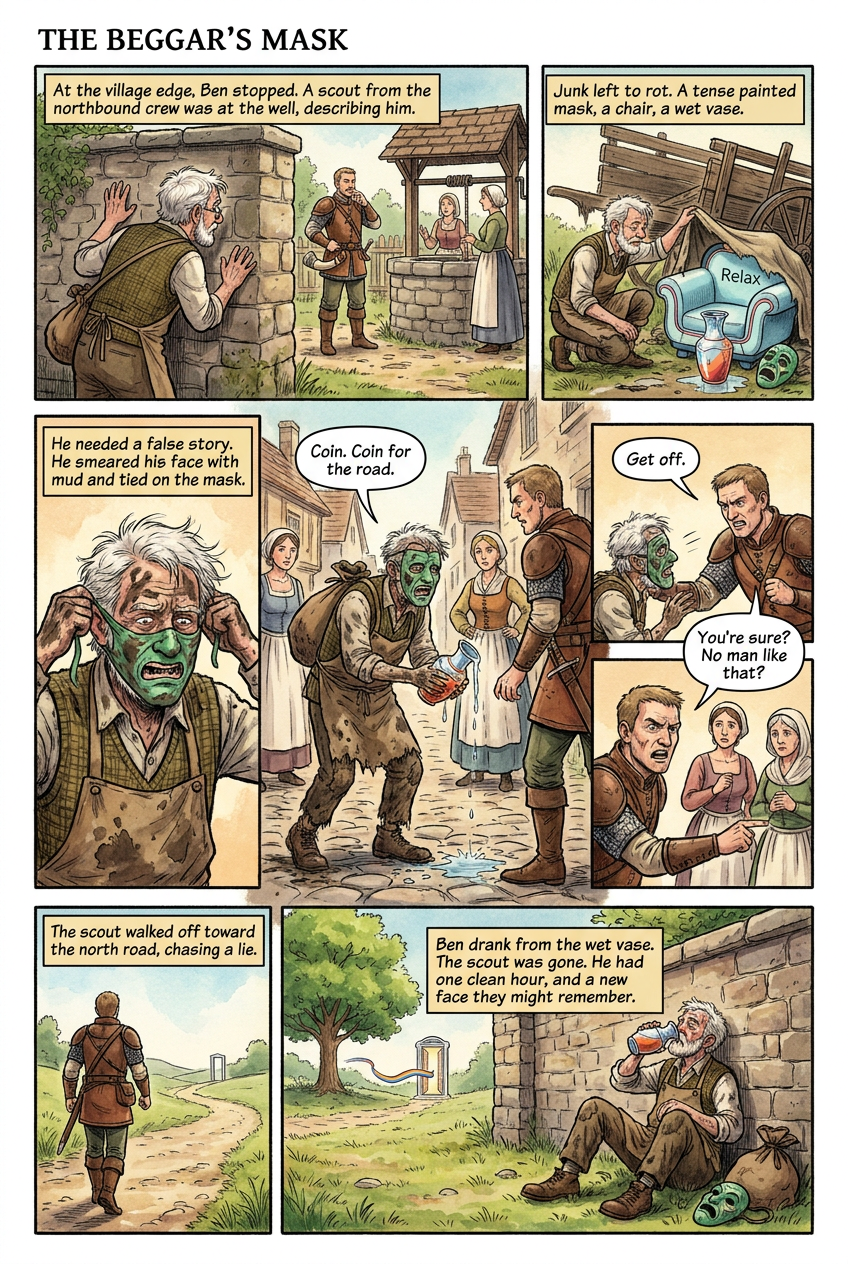
Ben carried the sack away from the ruined hall. He could not follow the crew north, so he cut east toward a small village he had never entered. He needed water, food, and a road the crew did not watch. He kept the fox close and the coin hidden inside the painted cat. Dawn was close. He walked fast. At the village edge, he stopped behind a garden wall. A scout stood by the well, talking to two women. Ben knew the man by his crossbow and the horn at his belt. He belonged to the northbound crew. But the crew had gone north. This one had doubled back. The scout held up his hand, level with his own chin, and drew a shape in the air. Tall. Lean. A man with a chest that hummed. He was describing Ben. Ben pressed flat to the wall. The women pointed down the lane, unsure. The scout wrote in a small book. If Ben walked in for water, someone would name him within the hour. Every door in the village was now a trap. He could not go in, and he could not stay near the well. He needed the scout to carry a false story back, not a true one. He set the sack down behind the wall and thought. In a cart abandoned by the garden sat a peddler's wares under a torn cloth. Ben lifted the cloth. A tense painted mask stared up, brows raised, mouth open in a frozen scream. Beside it sat a soft blue chair and a striped vase, still wet with dew. Junk left to rot. Ben took the mask. He smeared his face with garden mud, dark and unlike his own skin. Then he tied the mask over his head, hunched his shoulders, and dragged one foot. He crossed into the lane in the open, a broken beggar in a fright-mask, the kind children chase and adults avoid. The scout turned. Ben croaked and shook the cart's wet vase at him, spilling water on the stones. "Coin," he rasped. "Coin for the road." He shuffled close, foul and loud, and pressed the mask near the scout's face. The scout stepped back, disgusted. "Get off." He looked at the bent, mud-caked figure and saw nothing tall, nothing lean, nothing worth a horn. He shoved Ben aside and turned to the women. "You're sure? No man like that came through?" They shook their heads. The scout closed his book. "Then he went another way." He walked off toward the north road, following the crew's false trail. Ben dropped the mask in the cart and slipped back behind the wall. He drank from the wet vase, filled it, and lifted the sack. The scout was gone, chasing a lie. But the mask lay in plain view now, and someone had seen a beggar spill water by the well. He had one clean hour, and a new face they might remember.
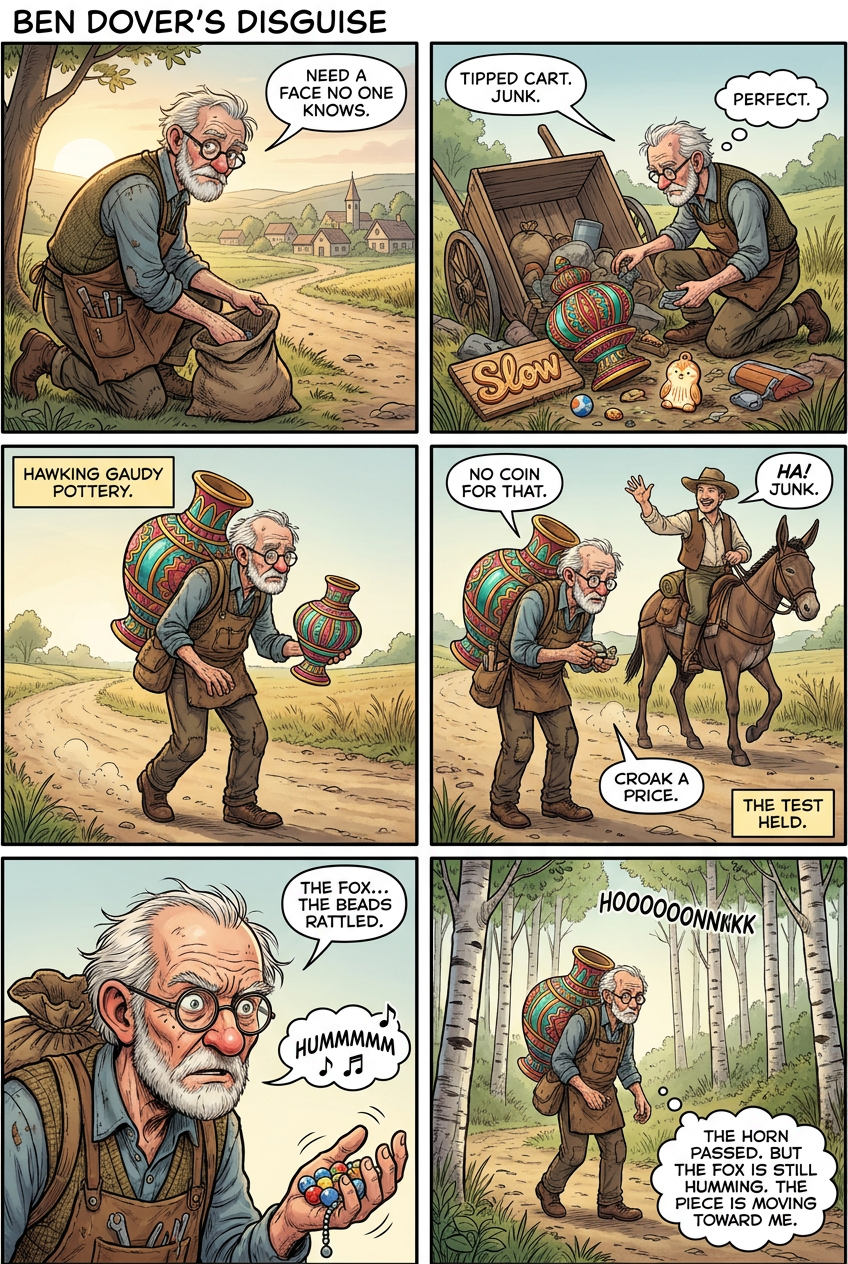
Ben moved off before the village woke. He had water and one clean hour, but the beggar with the spilled vase would soon be talk. The scout chased a lie north. Ben walked east, then cut into a stand of birch. He needed a face and a road no one had marked. His own face was known. The beggar's face was known now too. He had to become something no one would look at twice. He found a peddler's cart tipped in a ditch, its wares dumped in the weeds. He knelt and picked through them. A striped vase with swirled handles, cracked at the lip. A tiny carved cub on a ring, small enough to hide in a fist. A wooden word, painted in loops, that read "Slow." Junk. Nobody paid for junk. That was the point. Ben filled his sack with the cheap pieces. He set the striped vase on top, handles out. He tucked the small cub in his coat, next to the painted cat that held his coin. Then he lifted an oversized decorative piece from the pile, a bold tall thing painted in bright bands and flowers. It was too big to carry far, but it changed what he looked like. A tall, lean man hunting relics did not haul gaudy pottery on his back. He strapped the big piece across the sack. Now he was a poor peddler, bent under worthless stock, hawking cracked vases and a painted word. He rubbed dust into his sleeves and hunched his back. The fox stayed quiet in the sack, warm against the coin cat. A farmer came down the road with a mule. Ben held up the striped vase and croaked a price. The farmer looked at the bright pile, laughed, and waved him off. "No coin for that," the man said, and passed. Ben lowered his head and shuffled on. The test held. The farmer had seen a peddler, not a fugitive. Then the sack shifted. The fox pressed against the seam and hummed, low and thin. Under Ben's arm the string of twelve small beads he had kept for luck rattled against the wood. The hum meant a relic was near, or the fox smelled the scout. Ben froze. Down the road, a horn sounded, faint. The scout was circling back. Ben turned off the road into the birch. He did not run. A running peddler draws eyes. He walked slow, bent, dragging his foot, the big painted piece bright on his back for anyone to see and dismiss. The horn passed north again and faded. He had traded one disguise for another and slipped the noose a second time. But the fox kept humming. It had not stopped since the beads. Ben looked at the twelve beads in his palm and understood. Somewhere close, the piece he sold was still moving. And it was moving toward him.
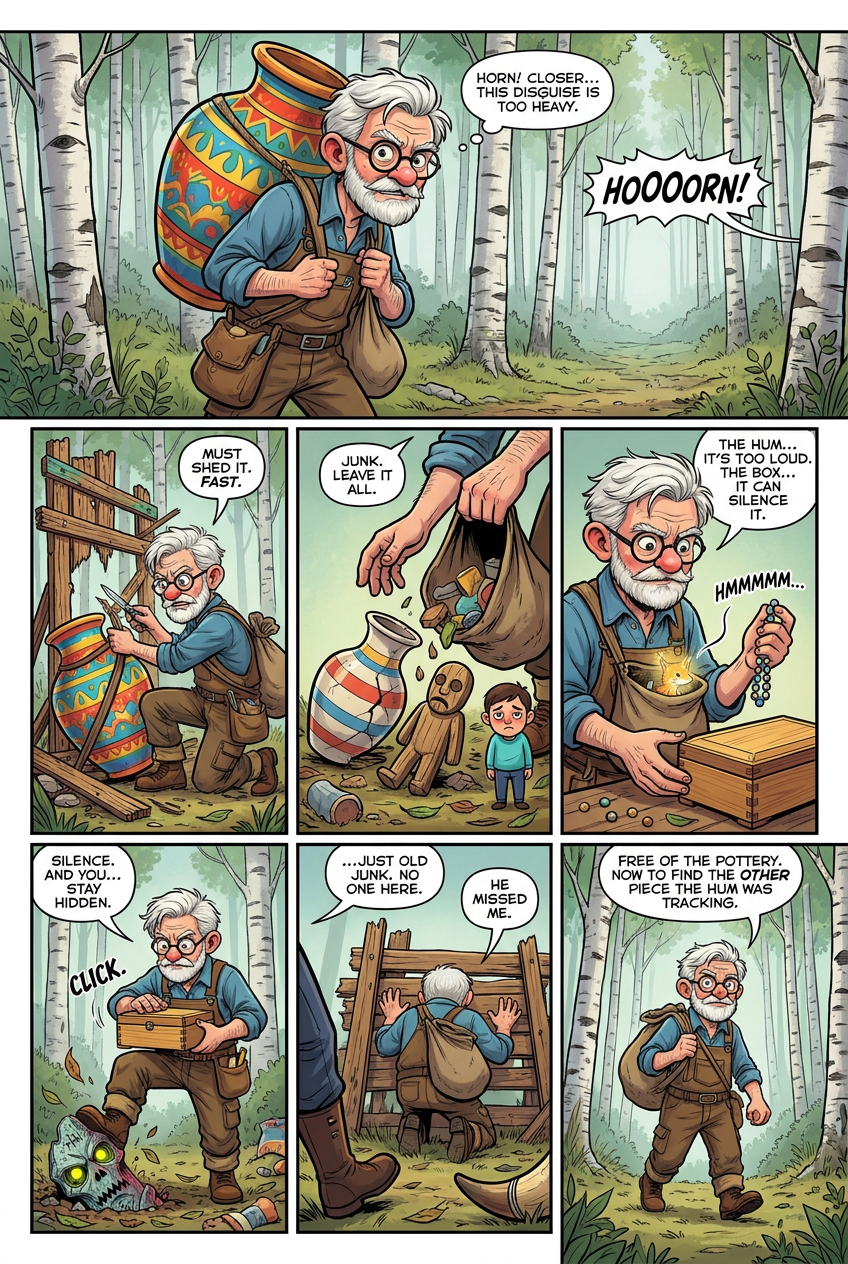
The horn sounded again, closer now. Ben stood in the birch with the fox humming in his sack and the big painted vase strapped to his back. The gaudy piece had fooled a farmer, but it slowed him. Bent under bright pottery, he could not run. If the scout came through these trees, Ben would have no room to bolt. He had to shed the disguise fast, before it cornered him. He dropped behind a fallen wall of rotted planks, the ruin of some old shed. He cut the strap and set the tall vase down. His hands worked fast. He pulled the cheap pieces from the sack one by one. A cracked striped vase. A carved wooden word, painted in loops, that read "Tired." A sad-faced figure with slumped shoulders and heavy eyes. Junk, all of it. He would leave it here and become a man with an empty sack. The fox hummed harder. Ben looked at the twelve beads in his palm. The piece he sold was near, and the hum would carry to the scout. He needed to silence it before the horn found him. His fingers closed on a plain wooden box at the bottom of the sack. A keepsake box, clean and simple, with tight-fitting corners. He had carried empty boxes before. He knew what they could do. He set the fox inside and pressed the lid down. The hum stopped. Ben breathed. He stuffed the box into the sack and shoved the bright pottery under the rotted planks. He kicked leaves over the striped vase and the tired figure. Then he saw the last piece near his knee. A tall stone relic, gray and cracked, carved with a jagged grin and two yellow eyes that seemed to watch him. Not his. Left here by someone. He shoved it under the planks with the rest and left it staring. Boots crossed the leaves. The scout stepped through the birch, horn in hand, eyes sweeping the ground. Ben crouched low behind the wall, empty sack over his shoulder, no bright vase, no hum. The scout looked at the ruin. He saw dumped junk and rotted wood. No peddler. No tall relic hunter. He turned and walked back toward the road. Ben waited until the horn faded north. Then he stood. He had shed the disguise and the sound with it. But the box could only hold the fox silent while it stayed shut. And the beads still pulled at the fox, which meant the sold piece kept moving toward him. Ben slung the sack and cut deeper into the trees. He was free of the pottery and the noose again. Now he had to find the piece the hum tracked, before it walked into the scout's hands instead of his.
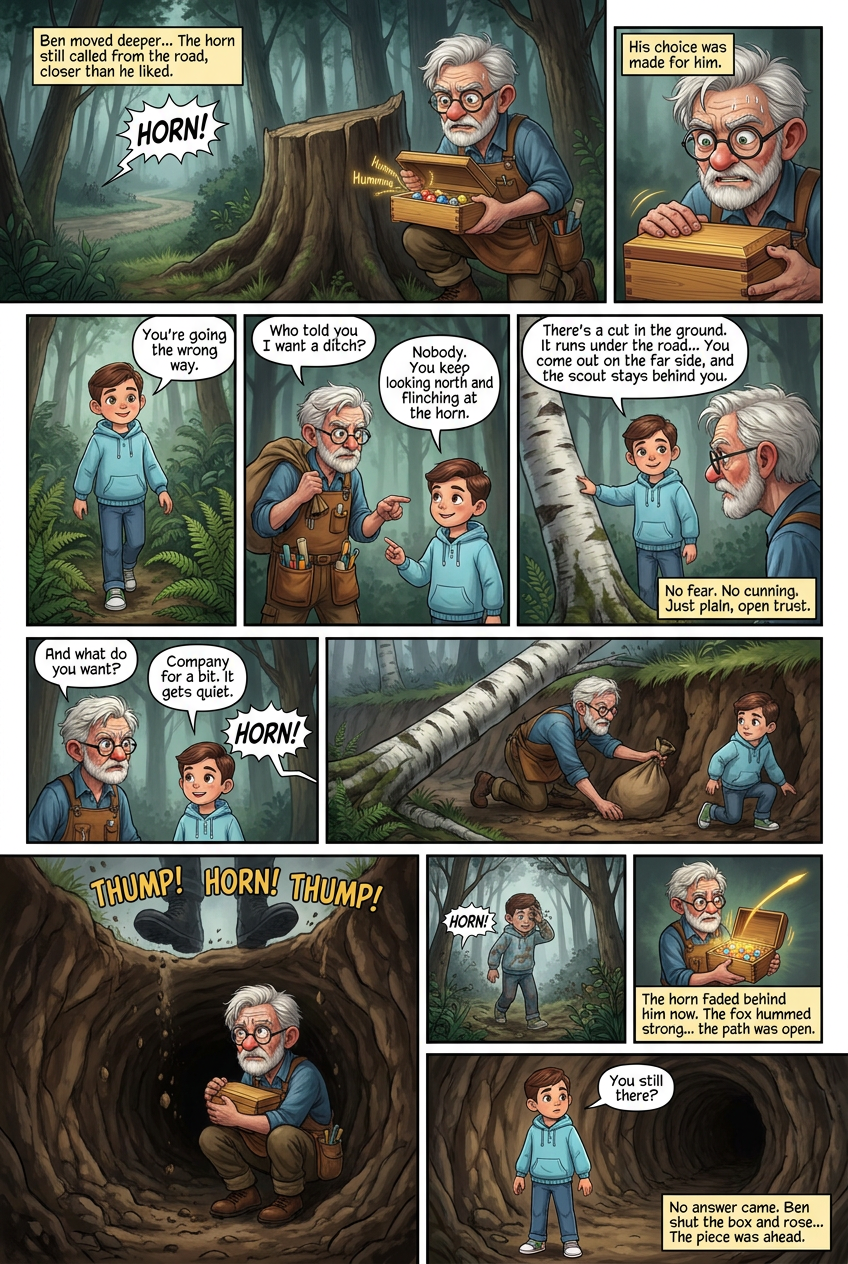
Ben moved deeper into the trees with the fox boxed and quiet. The horn still called from the road, closer than he liked. The beads pulled at the fox, and the fox pulled at the sold piece somewhere ahead. But Ben could not follow the trail and outrun the scout at once. If he stopped to read the pull, the horn would find him first. He had to choose. Reach the piece, or lose the scout. He crouched by a stump and cracked the box a finger's width. The fox hummed low. Ben felt the pull tug north, past the road, past the scout's path. To follow it he would cross open ground the scout still watched. He shut the lid. The hum died. His choice was made for him. Chase the piece now, and the horn would corner him against the road before he touched it. A boy stepped out from the ferns. He looked no older than ten, brown hair falling over warm eyes, a soft blue hoodie loose on his shoulders. He smiled like he had known Ben for years. "You're going the wrong way," the boy said. "The road bends around. The scout can't see the low ditch." Ben gripped his sack. "Who told you I want a ditch?" "Nobody. You keep looking north and flinching at the horn." The boy shrugged. "I watch. It's what I do out here." He pointed past a leaning birch. "There's a cut in the ground. It runs under the road. You come out on the far side, and the scout stays behind you." Ben studied the boy's face. No fear in it. No cunning either. Just a plain, open trust that unsettled him more than a threat would. "And what do you want?" "Company for a bit," the boy said. "It gets quiet." The horn blew again, almost on top of them. Ben had no time to weigh it. He followed the boy to the birch. Under a fold of roots lay the mouth of a dry cut, just wide enough to crawl. Ben pushed the sack ahead and dropped in. The boy slid behind him. They crawled in the dark under the road. Above, boots crossed the packed dirt. The horn sounded once, right overhead, then moved off. Ben held the box tight against his chest so it could not knock and hum. Dirt showered his neck. He kept crawling until gray light showed ahead. He came out on the far side of the road, in a stand of alder. The horn faded behind him now, back the way he'd come. The scout searched the wrong side. Ben opened the box a crack. The fox hummed strong, and the pull ran clear ahead, no road between him and the piece. Ben looked back for the boy. The cut was empty. "You still there?" No answer came. Ben shut the box and rose. The scout was behind him. The piece was ahead. For the first time in days, the path was open.
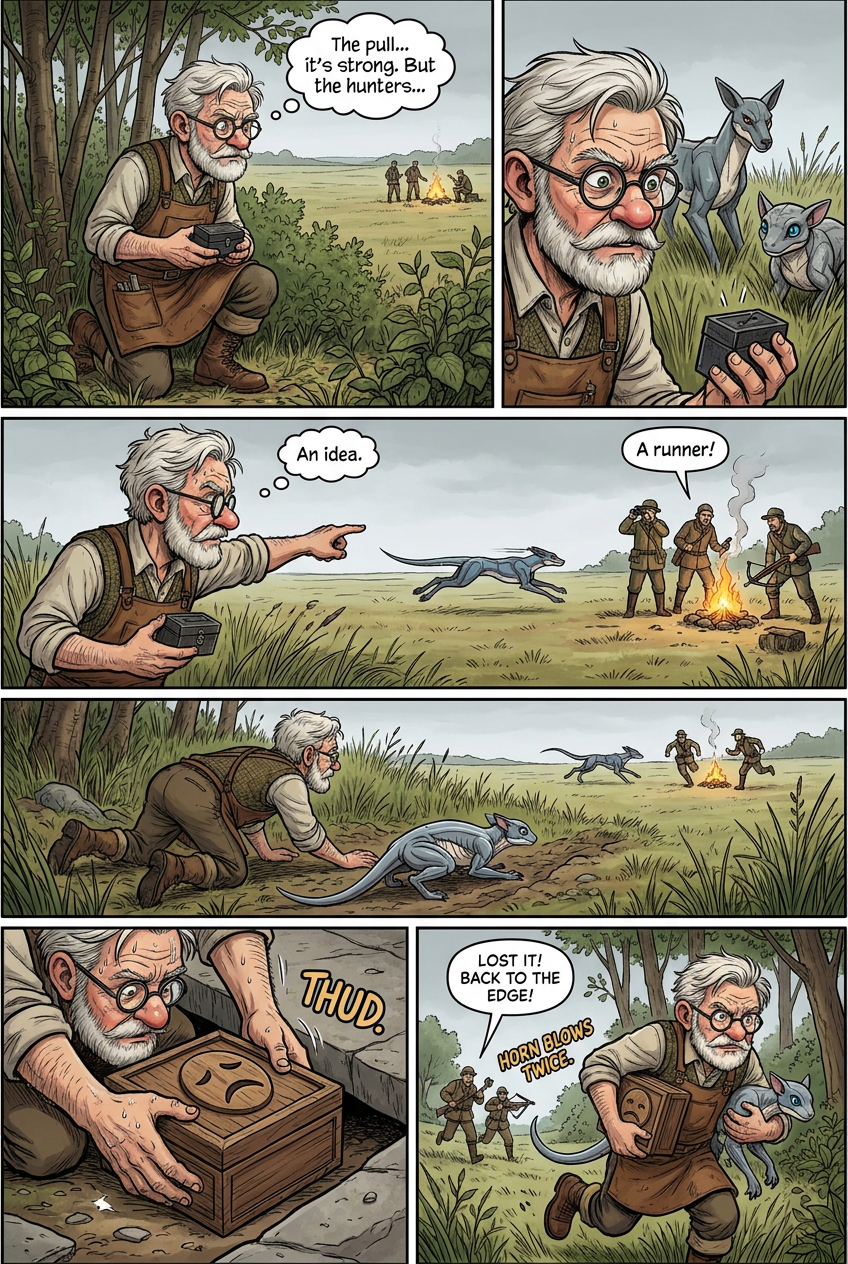
Ben stood in the alder stand with the scout behind him and the trail ahead. He cracked the box a finger's width. The fox hummed, and the pull ran north across a bare stretch of grass. No trees. No cover. Just open ground under a gray sky. The sold piece lay somewhere on the far side, close now. But anyone on the ridge would see him the moment he stepped out. He crouched and studied the field. A hunter's camp sat at the far edge, three men around a low fire. One held a spotter's glass. Ben could not cross in daylight without being seen. He could not wait for dark. The fox's pull grew sharper by the hour, and so did the risk that someone else would reach the piece first. A lean gray shape slipped from the grass beside him. It moved low, quick, built for speed, its long tail flat behind it. A wild runner, the kind that lived in the open scrub. It froze when it saw the box, ears turning toward the hum. Then a second creature crept up. This one crouched close to the earth, its scaled hide the color of stone, hard to see even at arm's length. It seemed to melt into the ground. Ben watched the two. The swift one wanted to run. The hidden one wanted to vanish. An idea took shape. He opened the box wider. The fox hummed loud now, and both creatures leaned toward the sound, drawn to it. He pointed the swift runner east, away from the piece, and let the hum spill toward it. The creature bolted across the open grass. At the fire, the man with the glass stood and shouted. All three hunters turned to watch the streak of gray tear across the field. They grabbed crossbows and ran after it. Ben shut the box halfway and moved. He kept low behind the hidden creature, matching its crawl. It hugged every dip in the ground, and Ben followed its path. The grass hid them both. The hunters' backs stayed turned, their eyes on the swift runner shrinking into the distance. Ben reached the far edge and dropped behind a low bank. He opened the box full. The fox's hum surged, and the pull dragged him three steps to a heap of stone. There, wedged under a flat slab, sat a carved wooden box with a sad face on the lid. The sold piece. He pried it loose. His hands shook. Behind him a horn blew twice. The hunters had lost the swift runner and turned back. Ben clutched the recovered box and the fox and ran into the trees. He had the piece. He also had three armed men who now knew he was somewhere on their side of the field, and no crossing left behind him.
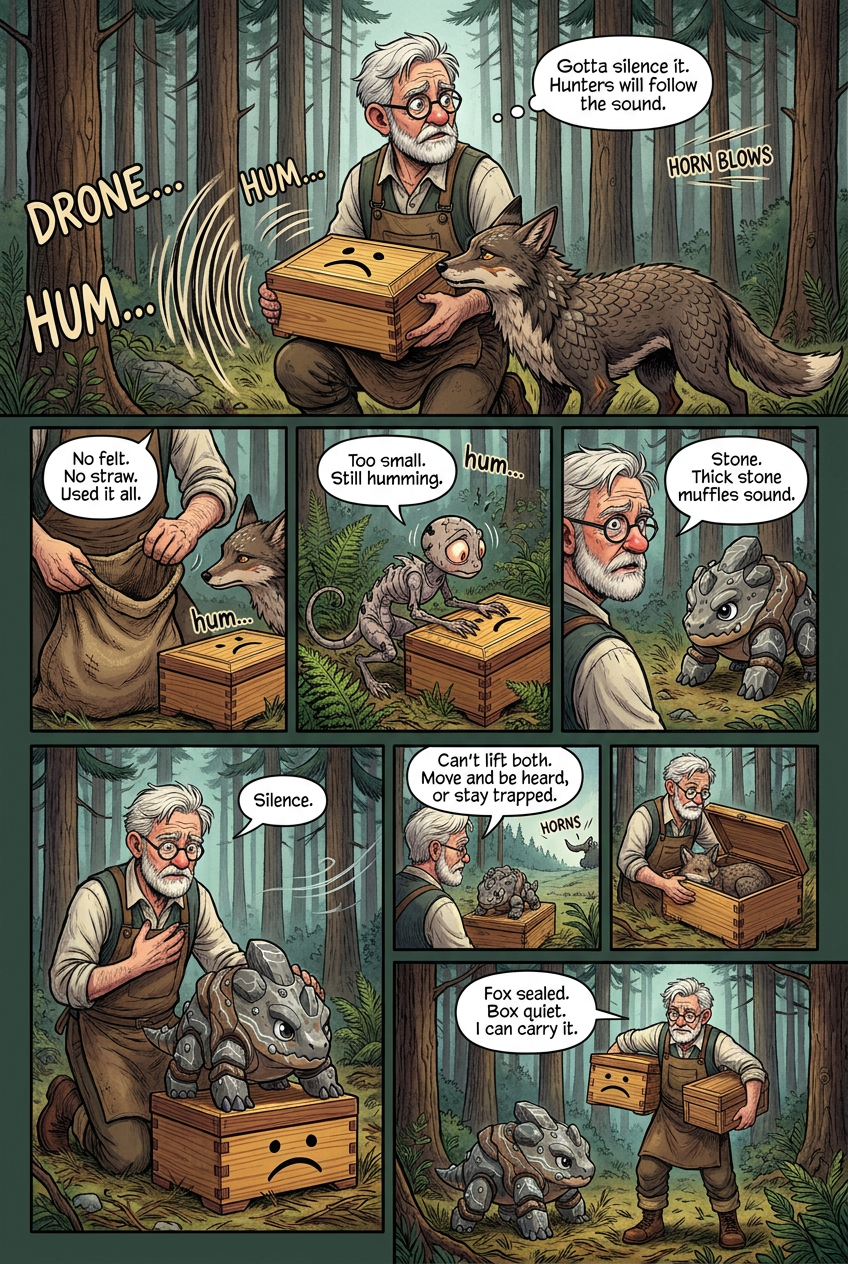
Ben ran until the horn faded behind him. Then he stopped in a stand of thin pines and knelt. In his hands sat the recovered box with the sad face on the lid. Beside him the fox pressed close, and the box hummed the moment the two came near. Not a soft buzz. A loud, carrying drone that would travel through the trees. The hunters were still on his side of the field. They would follow the sound straight to him. He had nothing on hand to silence it. He set the box down and pulled his sack open. No felt. No straw. No brine. He had used it all crossing the field. The hum grew louder as the fox leaned toward the box, drawn to it the way every creature was. Ben pushed the fox back with one arm. The hum dropped. He held it there, arm out, and the sound faded. But he could not run and hold the fox apart at the same time. A small shape crept from the ferns. It was a broken thing, cracked and dry, its skin split like old clay. One large eye rolled toward him. It shook as it moved, weak on thin legs. Ben had seen its kind before, near the tooth site—leftover guards, hollow inside. It crawled to the humming box and pressed its cracked body against the wood. The hum dulled. Not gone, but softer. It was not enough. The broken creature was too small and too damaged to cover the whole box. Ben looked past it and saw why it had come. A rugged rock creature followed, slow and heavy, its stone hide veined with pale lines. He had met such a creature once and knew what it could do. Stone muffled sound. Thick stone killed it. Ben made his choice. He lifted the broken creature aside and set the sad-face box on the ground. Then he guided the rock creature over it. The stone body settled onto the wood, pressing down, wide enough to cover the whole lid. The hum stopped. Ben held his breath and heard only wind. Silence. But the box was pinned under a creature too heavy to carry and too slow to keep pace. He could not lift both stone and box and run. A horn blew, closer now, two ridges off. Ben stared at the stone creature and understood the trade. He could stay silent and trapped, or move and be heard. He scooped the fox into his empty wooden fox box and shut the lid. The fox went quiet, sealed. With the fox silent, the sad-face box quieted too—the hum only rose when the two came near. Ben eased the rock creature off, lifted the recovered box, and stood. He had the piece. He had a way to carry it quiet, box against box, fox sealed apart. But the stone creature could not follow, and the hunters were near enough now that one wrong sound would end him.
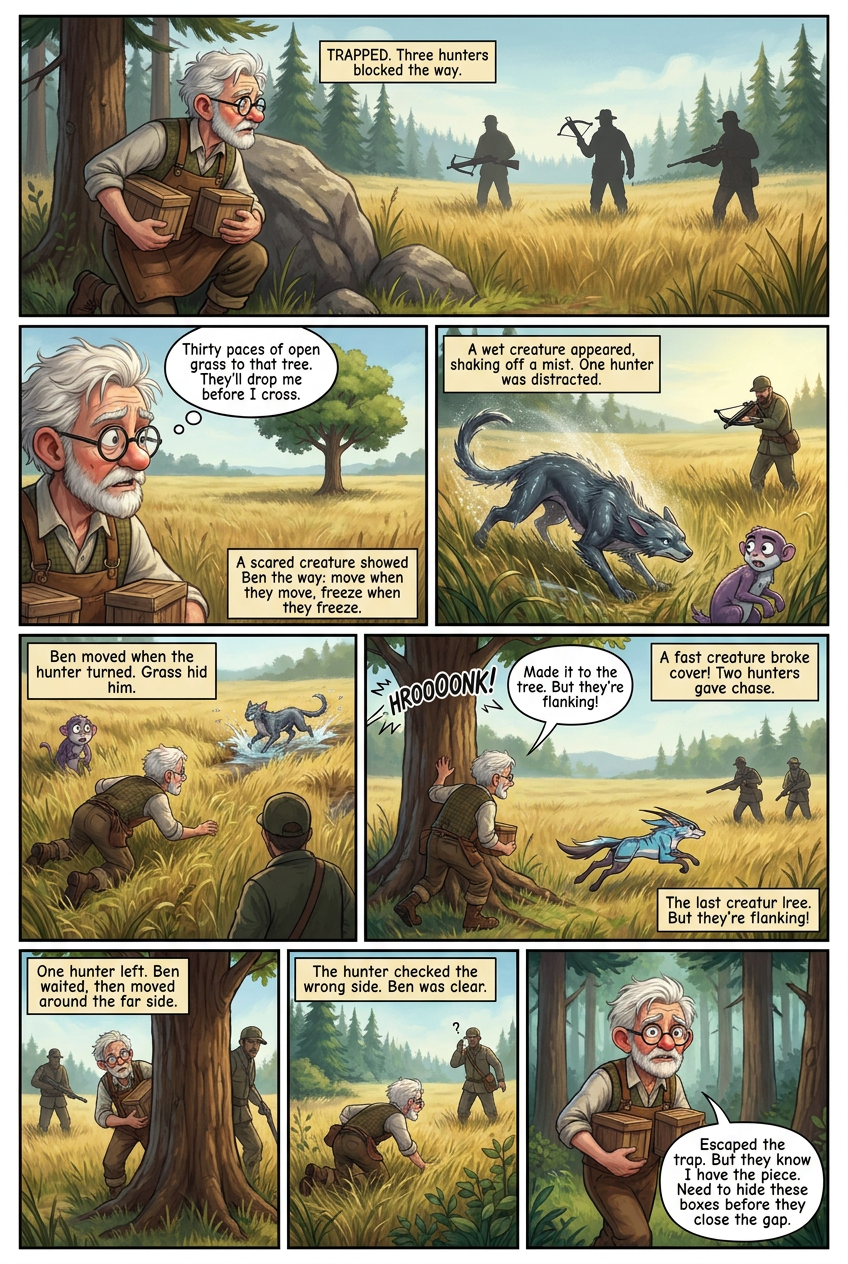
Ben carried the boxes toward the field's edge and stopped cold. Three hunters stood in the grass ahead. They had circled while he knelt in the pines. Now they blocked the way back to cover. Behind him lay open ground. There was no clear path across. One hunter raised a crossbow. Ben dropped low behind a rock and pressed both boxes to his chest. He checked his sides. The pines ended in a strip of tall grass. Beyond it, a lone tree stood in the middle of the field, wide and heavy with leaves. If he could reach it, he could break their sightline. But thirty paces of open grass lay between him and the trunk. They would drop him before he crossed. A damp shape slid from the grass beside him. It was a sleek creature, its coat dark and slick with water, drops falling from its fur. Ben had seen its kind before. Water masked scent and sound. The creature shook itself. A fine spray hung in the air, catching the light like mist. One hunter squinted and lowered his aim. Then a second creature crept close, small and hunched, eyes wide and darting. It trembled at every sound. But when the hunters shifted, it froze, and its stillness held Ben still too. He understood. Move when they moved. Freeze when they froze. Ben watched the wet creature circle wide into the grass. It splashed through a shallow rut and threw up spray. The nearest hunter turned toward the noise. Ben ran. He kept the frightened creature's rhythm in his mind and dropped flat when the second hunter turned. Grass hid him. He crawled the last paces to the tree and put the trunk between himself and the crossbows. A horn blew. The hunters spread out to flank the tree. Ben had the boxes but no way past three men on open ground. Then a lean creature broke from the far grass, blue-striped and fast, built for one hard sprint. It shot across the field. The hunters swung to follow it, sure it carried something. Two gave chase. The third held his ground. One man was not three. Ben set the sad-face box down, kept the fox box shut, and stayed low. He waited until the last hunter stepped past the trunk. Then Ben moved around the far side, tree between them, and slipped into the deep grass beyond. The hunter searched the wrong side. Ben crawled clear, boxes tight against his chest, and reached the treeline. He rose and ran into cover. The field was behind him now. He had crossed. Both boxes were still in his hands, the fox sealed quiet, the sad-face box silent against it. The horn faded. Ben had escaped the trap on the wrong side, but the hunters knew he still held the piece. They would keep coming. He needed a place to hide the boxes before they closed the gap again.
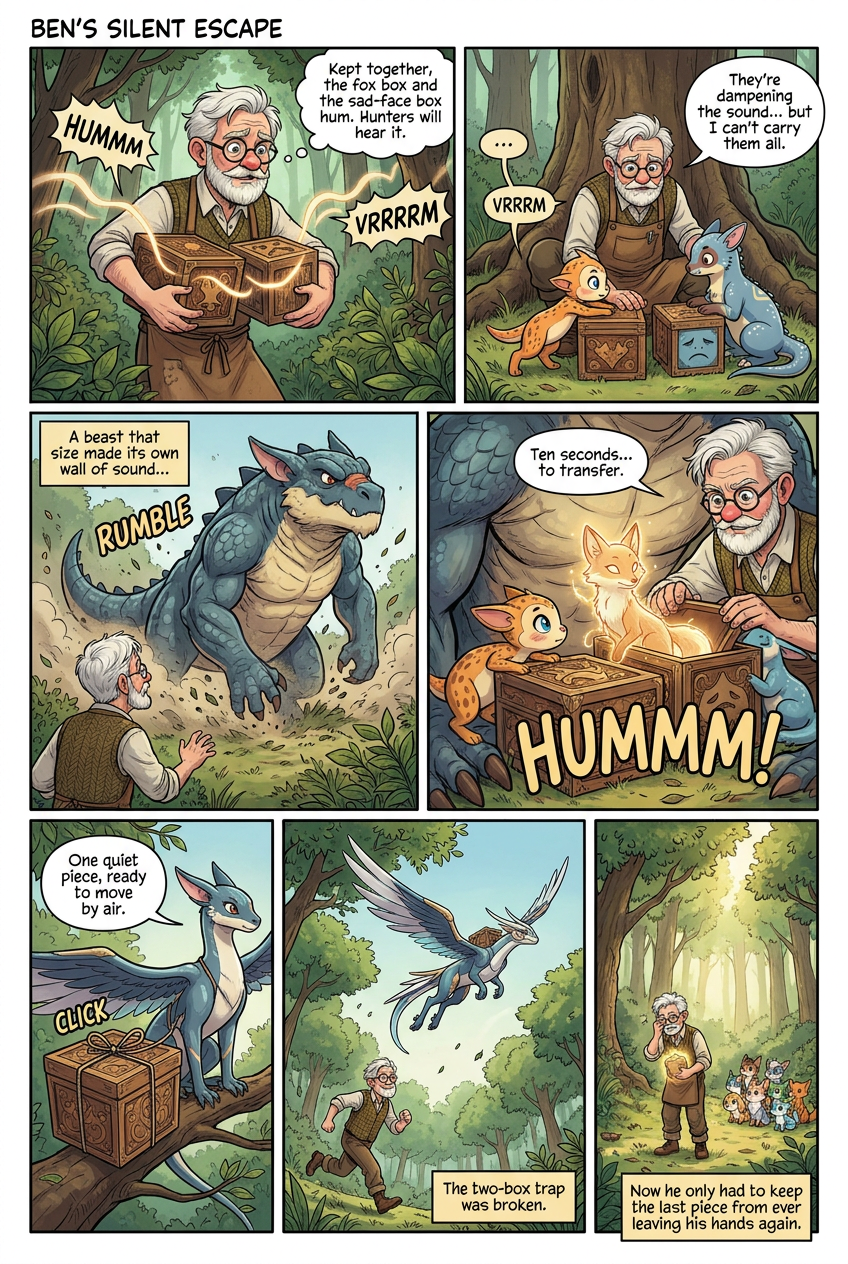
Ben pushed deeper into the trees with both boxes against his chest. The horn was gone, but he knew the hunters would circle. The two boxes were his whole problem now. Kept together, the fox box and the sad-face box hummed loud enough to draw a hunter across a field. Kept apart, one of them leaked sound the moment he set it down. He had no thick walls, no felt, no still place to open them and join the pieces. He needed one, fast. He crouched by a root and thought it through. He had to reunite the sold piece with the fox and seal both quiet in a single container. Do it in the open and the hum would broadcast his spot. He needed a big body of dead sound over the work, and only ten seconds of exposure while he transferred. The grass rustled. A small, spotted creature stepped out, no bigger than his hand, wide-eyed and blinking up at him. Behind it came a calm blue creature with a gentle face, moving slow, in no hurry at all. Ben had traveled with kinds like these. He held still and let them come. The small one climbed onto the sad-face box and pressed flat. The slow creature settled its weight against the fox box. Both hums dropped to nothing. The animals were dampening the sound with their bodies. But Ben could not carry them and the boxes and outrun three men. Then the ground shook. A huge scaled creature came through the brush, broad-shouldered, taller than Ben, its heavy tail dragging leaves. It stopped and lowered its head. Ben's breath caught. A beast that size made its own wall of sound just by breathing and shifting. He understood what to do. Ben backed the big creature against a fallen trunk. He set both boxes in the dirt between its front feet, under the mass of its chest. The small creature and the slow creature climbed close, ready. Ben opened the fox box. The fox stirred, humming. He lifted it out and moved it to the sad-face box in one motion. For ten seconds the hum poured into the air—but the great body over him swallowed it, and the little creatures pressed the sound flat. Ben shut the lid. The fox and the sold piece were together at last. The box went silent. A winged creature dropped from the branches, pale and swift, wings folding as it landed. It ducked its head toward him. Ben knew the offer. He lashed the single sealed box to its back with waxed cord. One box now, not two. One quiet piece, ready to move by air, above every road the hunters watched. The winged creature rose through the gap in the leaves. Ben ran beneath it into the trees. He had the fox and the sold piece joined and silent in one container. The two-box trap was broken. Now he only had to keep the last piece from ever leaving his hands again.
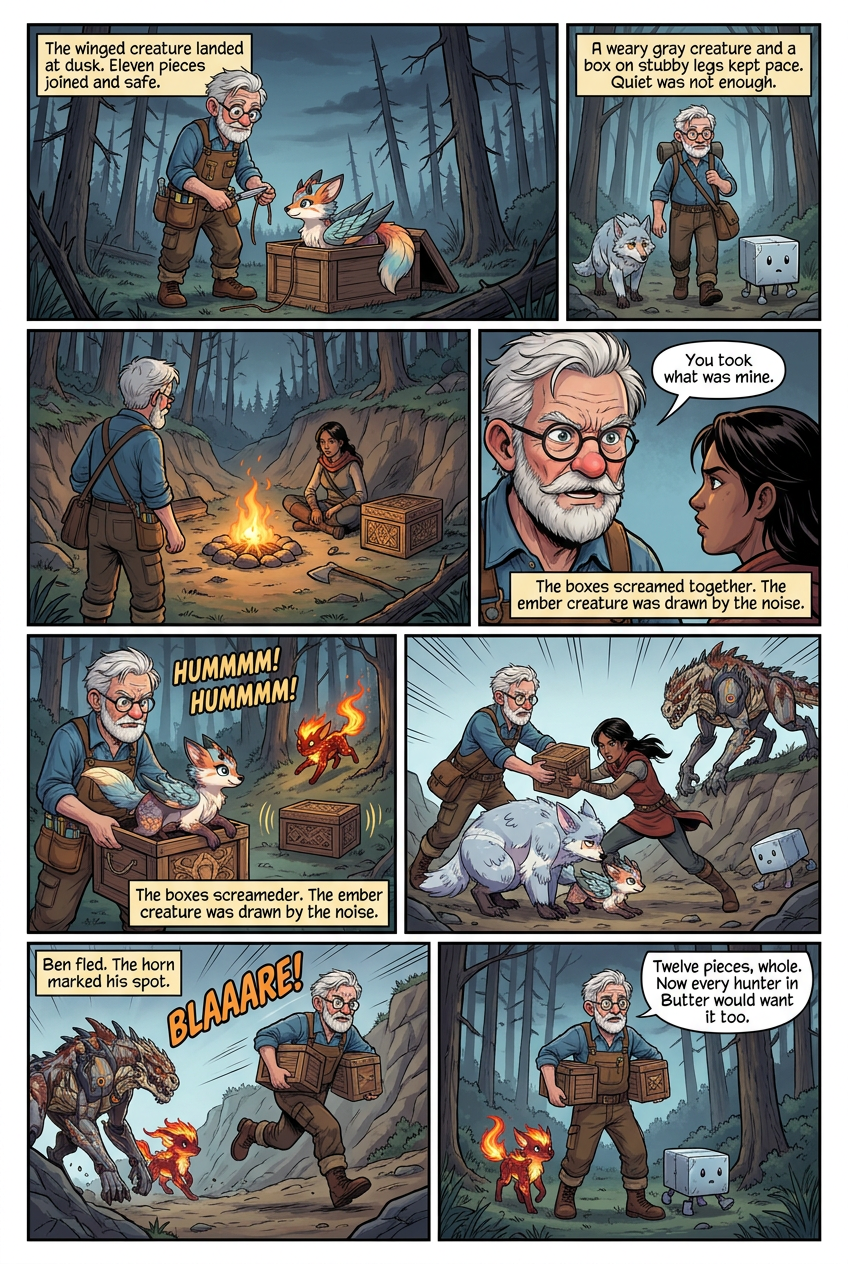
The winged creature landed at dusk in a stand of dead pines. Ben cut the waxed cord and lifted the single box down. It stayed silent. The fox and the sold piece rode together inside, quiet at last. But quiet was not enough. He had eleven pieces now, joined and safe. The buyer who bought the twelfth still held it two ridges east, and until Ben reached her, his set could never close. He shouldered the box and started walking. A weary gray creature slid from the brush and fell into step beside him. Its head hung low, its eyes half shut, but it kept pace without a sound. Ben let it come. Behind it clattered a small box-shaped creature on stubby legs, blinking up at him. Both had traveled with him before. Both dampened the hum by pressing close. He would need them if the sold piece stirred. He found the buyer's camp at the bottom of a gully. She sat by a low fire, a woman with a courier's satchel and a horn on her belt. Ben had seen her kind—one of the herbalist's runners. Beside her lay a carved box he knew on sight. The twelfth piece. His piece. "You took what was mine," Ben said. She reached for the horn. Ben moved first. He set his box in the dirt and opened it. The fox sprang free, humming loud, and the sound rolled through the gully like a struck bell. The runner's own carved box answered, humming back, until both notes screamed together. A small ember-bright creature bolted upright from the far grass, drawn by the noise, its flame-edged coat lighting the trees. The runner spun toward it, horn forgotten. That was Ben's moment. He grabbed her carved box from the dirt. The weary gray creature dropped its weight over the fox to smother the hum. The box-shaped creature pressed flat beside it. Ben sealed the fox back inside his own container, then tucked the runner's box under his arm. Twelve pieces. All twelve, in his hands. The runner turned back and lunged. Ben ran. He crashed up the gully wall with both boxes clutched to his chest. A blast of the horn split the dark behind him. From the ridge above came an answering shriek—something huge and clawed, a battered scaled beast picking its way down through the rocks, drawn by the fading hum. It cut between Ben and the runner. She backed away from it. Ben did not stop to watch. He reached the pines with the fire creature loping at his heels and the box-shaped one thumping behind. Both boxes held silent now. The set was complete. Twelve pieces, whole for the first time since he began. But the horn had marked his spot, and the runner would tell the herbalist he carried a finished set worth killing for. He had what he wanted. Now every hunter in Butter would want it too.
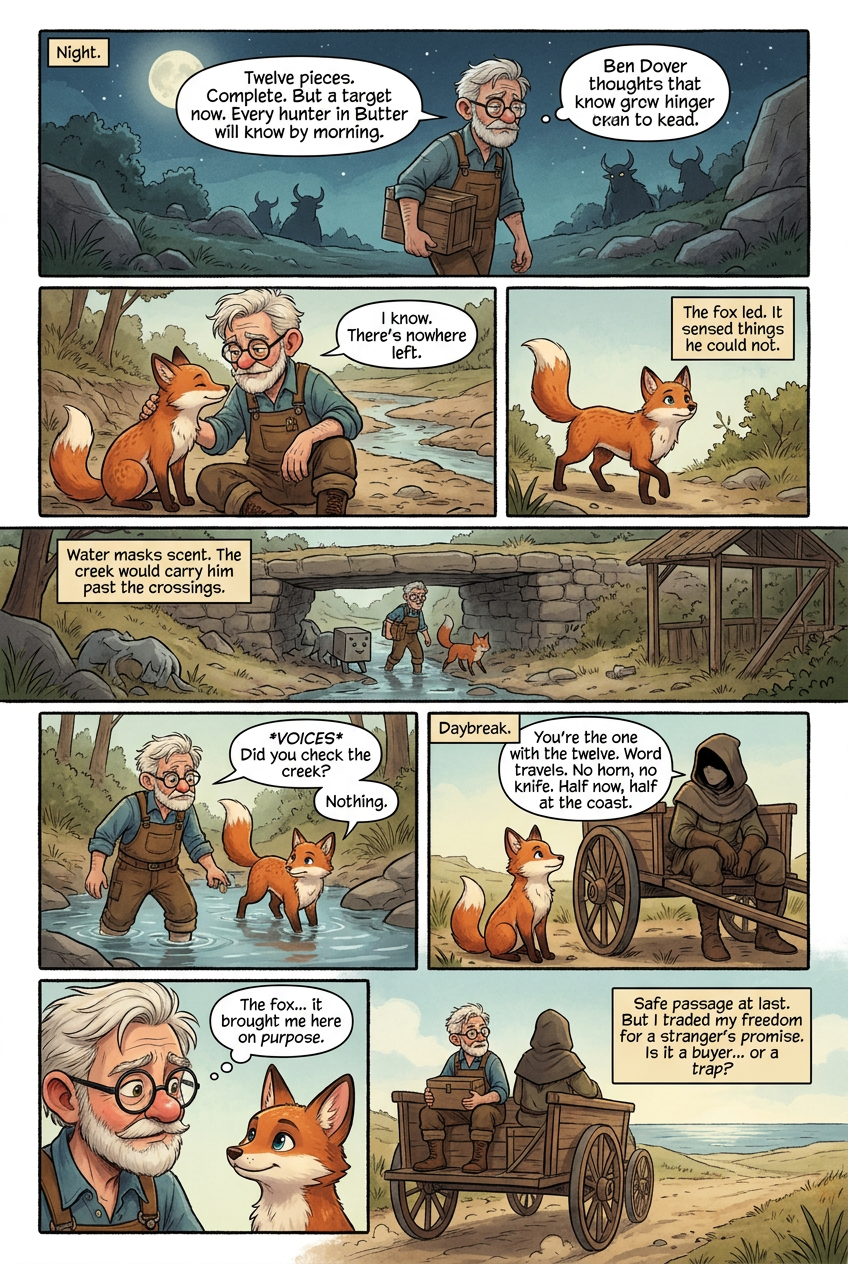
Ben walked all night with the box under his arm. The set was complete now. Twelve pieces, whole and silent. But a finished set was a target, not a prize. The runner had seen his face. By morning every hunter in Butter would know he carried something worth killing for. He needed a buyer who would pay and let him walk away. He could not think of one. Robbers waited on the roads. The herbalist's people watched the crossings. His twelve pieces were worth nothing until he found safe passage. He stopped at a dry creek bed to rest. The weary gray creature dropped beside him. The little box-shaped one folded its stubby legs and blinked. Then the lid of his container shifted. The fox climbed out, quiet now, and pressed against his knee. Its blue eyes watched him. Warm fur touched his hand. Ben scratched its ears. "I know," he said. "There's nowhere left." The fox lifted its head. It stared north, then trotted three steps that way and looked back. It had guided him past patrols before. It sensed things he could not. Ben followed. The fox led him along the creek bed, away from the roads, into a fold of rock where the water ran under a low stone ledge. Ben crouched and looked through. On the far side stood a shed with no door, only a fallen frame. A safe hole. But the fox did not stop there. It splashed into the water and turned to face him. Water masks scent. Ben understood. The creek would carry him past the crossings without a trail. He waded in. The cold pulled at his boots. He held the box high and kept the fox in sight. The gray creature came behind, then the little box-shaped one, riding on the ledge above. They moved down the water for a mile. Twice Ben heard voices on the bank. Twice the fox froze, and Ben froze with it, and the voices passed. The creek carried his scent away each time. At last the fox climbed out where the water met a wider road. A cart stood in the reeds. A stranger sat on it, hood up, waiting. Not a hunter. The fox trotted straight to the cart and sat. "You're the one with the twelve," the stranger said. Not a question. "Word travels. I move goods no one else will touch. No horn, no knife. Half now, half at the coast." Ben looked at the fox. The fox looked back, calm. It had brought him here on purpose. He climbed onto the cart with the box. The stranger snapped the reins. The wheels rolled north, away from the crossings, away from the runner's horn. Ben had his safe passage at last. But he had traded his last freedom for a stranger's promise. He did not know this driver's name, or whether the coast held a buyer or a trap.
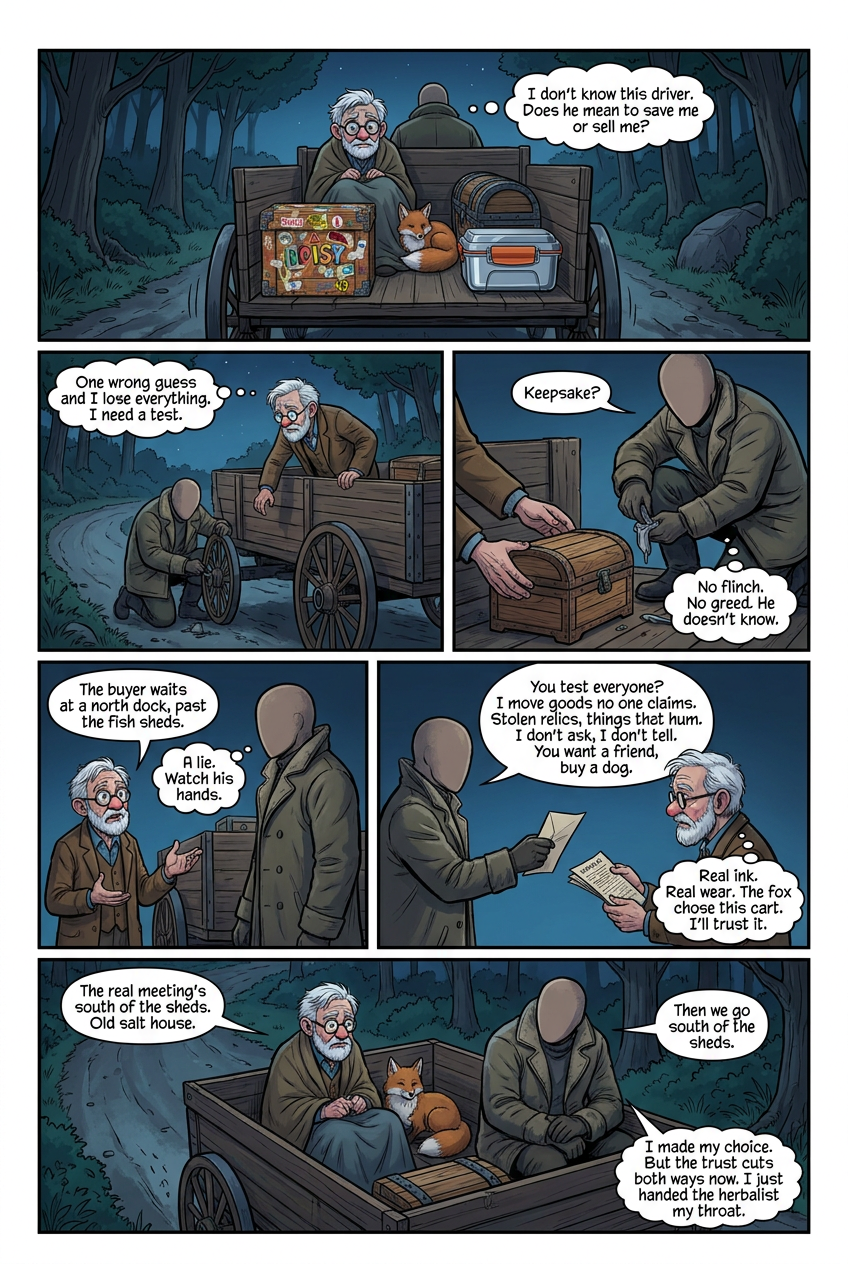
The cart rolled north through the dark. Ben kept the box on his knees and the fox curled beside it. He did not know the driver's name. He did not know if this stranger meant to sell him or save him. One wrong guess and he lost everything at the coast. He needed a test before they reached open ground. At a bend the driver stopped to water the wheels' axle. Ben climbed down and looked in the cart bed. He saw a loud crate plastered with warning labels and paint. It rattled with junk. Beside it sat a sleek metal case with an orange latch and a battered old chest bound in black iron. Cover for real cargo, or the driver's whole trade. Ben could not tell which. He made a plan. He would name a false meeting spot at the coast and watch what the driver did with it. A plant would carry the word ahead. A true carrier would not care. He also carried his own quiet test. From his sack he drew his mother's carved box, the one with the drooping, mournful face. He set it near the driver's feet. If this stranger worked for the herbalist, he might know its purpose and flinch. The driver glanced at the sad-faced box. "Keepsake?" he asked. He nudged it aside with his boot and kept greasing the axle. No flinch. No greed. He did not know what it was. Ben said the buyer waited at a north dock, past the fish sheds. A lie. He watched the driver's hands. The man did not reach for a whistle. He did not mark the road. He only grunted and climbed back up. "You test everyone?" the driver said. He pulled a folded paper from the metal case and handed it down. It was a cargo manifest, stamped, three seasons old. "I move goods no one claims. Stolen relics, dead men's chests, things that hum. I don't ask what's inside and I don't tell. That's the whole trade. You want a friend, buy a dog." Ben read the manifest. Real ink. Real wear. A man who feared the herbalist would have hidden it. This one used it as proof. The fox pressed against Ben's leg, calm, the way it went calm around safe ground. It had chosen this cart on purpose. Ben decided to trust it. He pocketed the false dock. "The real meeting's south of the sheds," he said. "Old salt house." The driver nodded. "Then we go south of the sheds." He snapped the reins. Ben sat back. He had made his choice. The stranger was a carrier, not a plant. But the trust cut both ways now. He had told this man the true meeting place. If he had read the driver wrong, he had just handed the herbalist his throat. There was no taking the words back. The wheels rolled on toward the coast.
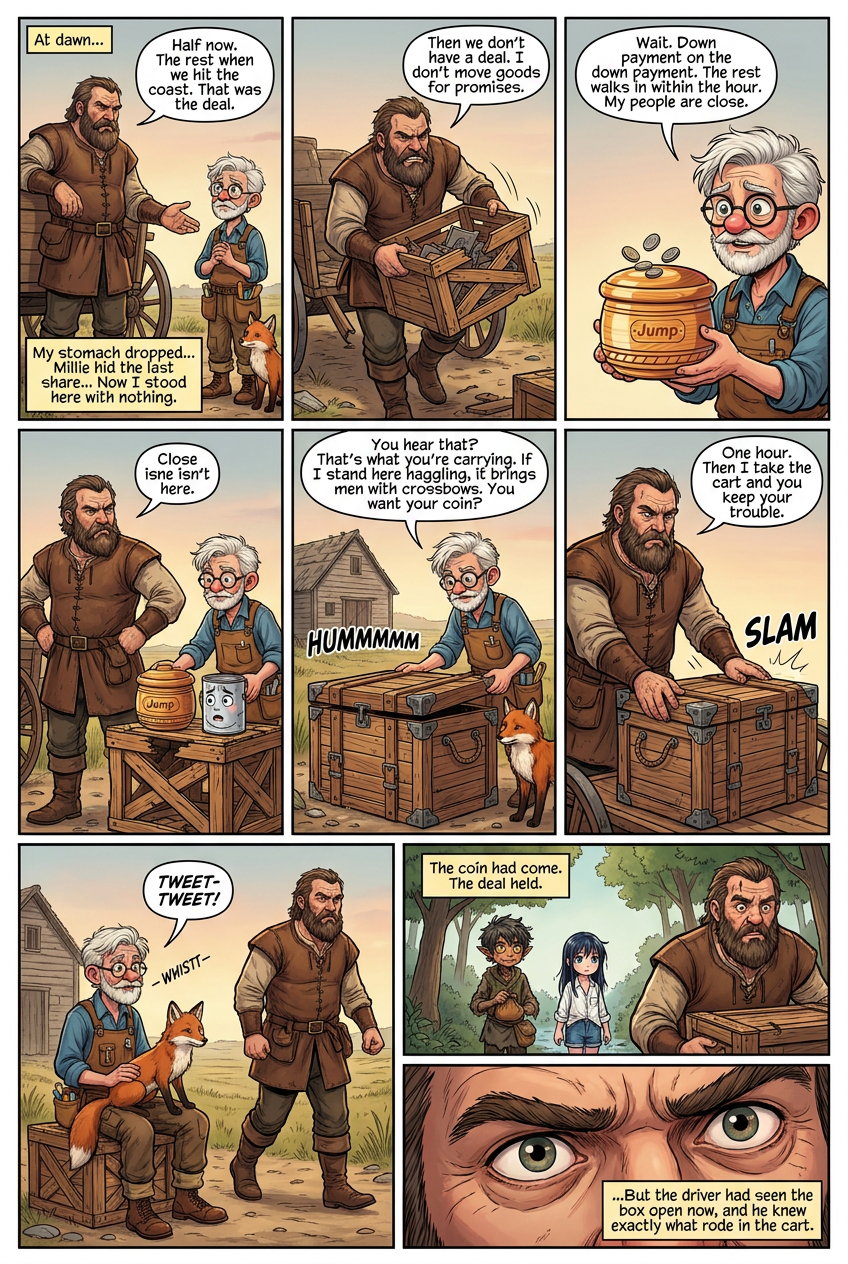
The cart reached the salt house at dawn. Ben climbed down with the box under one arm and the fox at his heels. The driver leaned back and held out his hand. "Half now," he said. "The rest when we hit the coast. That was the deal." Ben's stomach dropped. He had split his coin among his companions to smuggle it past the road crews. Lolly carried some. Joe held more. Millie hid the last share in her satchel. Now they were scattered across miles of forest, and Ben stood here with nothing but a few loose coins in his pocket. "I don't have it," Ben said. "Not all of it. My coin is with three others. They took separate roads." The driver's face went flat. He stepped down from the cart. "Then we don't have a deal. I don't move goods for promises." He pulled a battered old chest from the cart bed and set it hard on the ground. Inside, junk rattled like loose teeth. Ben looked at the salt house. He looked at the fox, calm against his leg. He needed the driver, and the driver needed proof of pay. Then he saw the small wooden container by the driver's boot, a cheerful thing with a clean finish and a word burned into a plate on its side. It had held the driver's own greasing rags. "Wait," Ben said. He dug the loose coins from his pocket. Four. He set them in the little container and held it out. "Down payment on the down payment. The rest walks in within the hour. My people are close." The driver snorted. He did not take the coins. "Close isn't here." Ben's hand shook. He set the container on the chest and unlatched his mother's box instead. He tipped the lid. The fox stiffened. A hum leaked into the morning air, low and hungry, the sound that drew hunters and worse. "You hear that?" Ben said. "That's what you're carrying. If I stand here haggling, it brings men with crossbows. You want your coin? Then trust me for one hour, or lose the whole load when they arrive." The driver's jaw tightened. He looked down the empty road. He looked at the humming box. Then he grabbed the lid and pressed it shut himself. The hum died. "One hour," the driver said. "Then I take the cart and you keep your trouble." B en whistled twice, high and sharp, the signal his companions knew. He did not know if any of them were near enough to hear. The sound faded into the pines. He sat on the old chest and waited, the fox in his lap, the driver counting under his breath. Then boots crunched on the road. Joe stepped from the trees first, a purse in his fist. Behind him came Lolly, wet to the knees. Ben let out his breath. The coin had come. The deal held. But the driver had seen the box open now, and he knew exactly what rode in the cart.
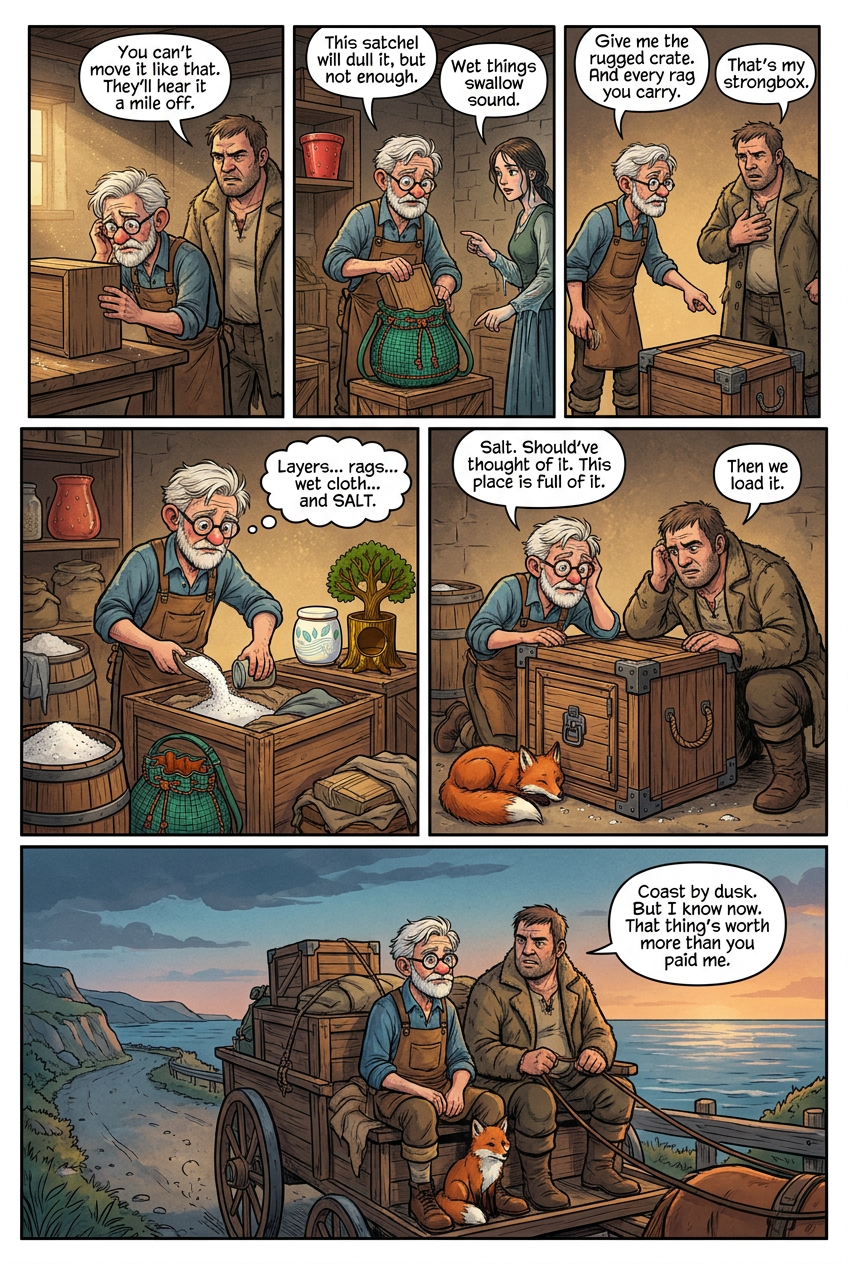
The driver counted the coin in the salt house dawn. Twelve pieces rode in Ben's box, the full set at last. But together they hummed louder than any single relic. Ben pressed his ear to the lid and heard it, a thick drone that filled the small room. The cart had no dampening. The coastal run stretched hours ahead, all open road. That sound would carry to every hunter along the water. Joe set down the purse and frowned. "You can't move it like that. They'll hear it a mile off." Ben searched the salt house. Old crates leaned in the corners. A moisture-slicked red vessel sat on a shelf, useless. A woven satchel hung on a nail, its mouth gathered tight. He grabbed it and pushed the box inside. The drone dulled, but not enough. Cloth alone would never hold twelve pieces. Lolly wrung water from her sleeve. She had waded here through the creek. "Wet things swallow sound," she said. "But not for a run this long." Ben looked at the driver's junk chest. He tipped the lid. Inside lay greasing rags, a cracked tea canister, and a small tree-shaped box with a hollow trunk. He remembered the shrine walls that had once killed the hum, and the sap that had sealed his crate. He needed thick, dead weight around the sound. "Give me the rugged crate," Ben said, pointing to a heavy container with iron corners and a hidden panel. "And every rag you carry." The driver hesitated. "That's my strongbox." "You want your coast pay," Ben said. "Then it carries this." Ben worked fast. He nested the satchel and box inside the iron-cornered crate. He packed the gaps with the driver's rags, then Lolly's wet cloth, then handfuls of coarse salt scooped from the floor barrels. The salt pressed cold and dense against every seam. He laid the tea canister and the little tree box on top as filler, jamming the last hollows shut. He closed the panel and set his ear to the wood. Silence. He shoved the crate hard across the floor. Still silence. The driver lowered his ear too. His face changed. "Salt," he said. "Should've thought of it. This place is full of it." "Then we load it," Ben said. They carried the crate to the cart and buried it under the driver's own cargo. Ben climbed up beside the box he could no longer hear. The fox curled at his feet, calm, its ears still. The driver took the reins. "Coast by dusk," he said. He glanced back at the crate. "But I know now. That thing's worth more than you paid me." The cart rolled toward the water. Ben had silenced the full set. He had also just told a smuggler exactly what it was worth.
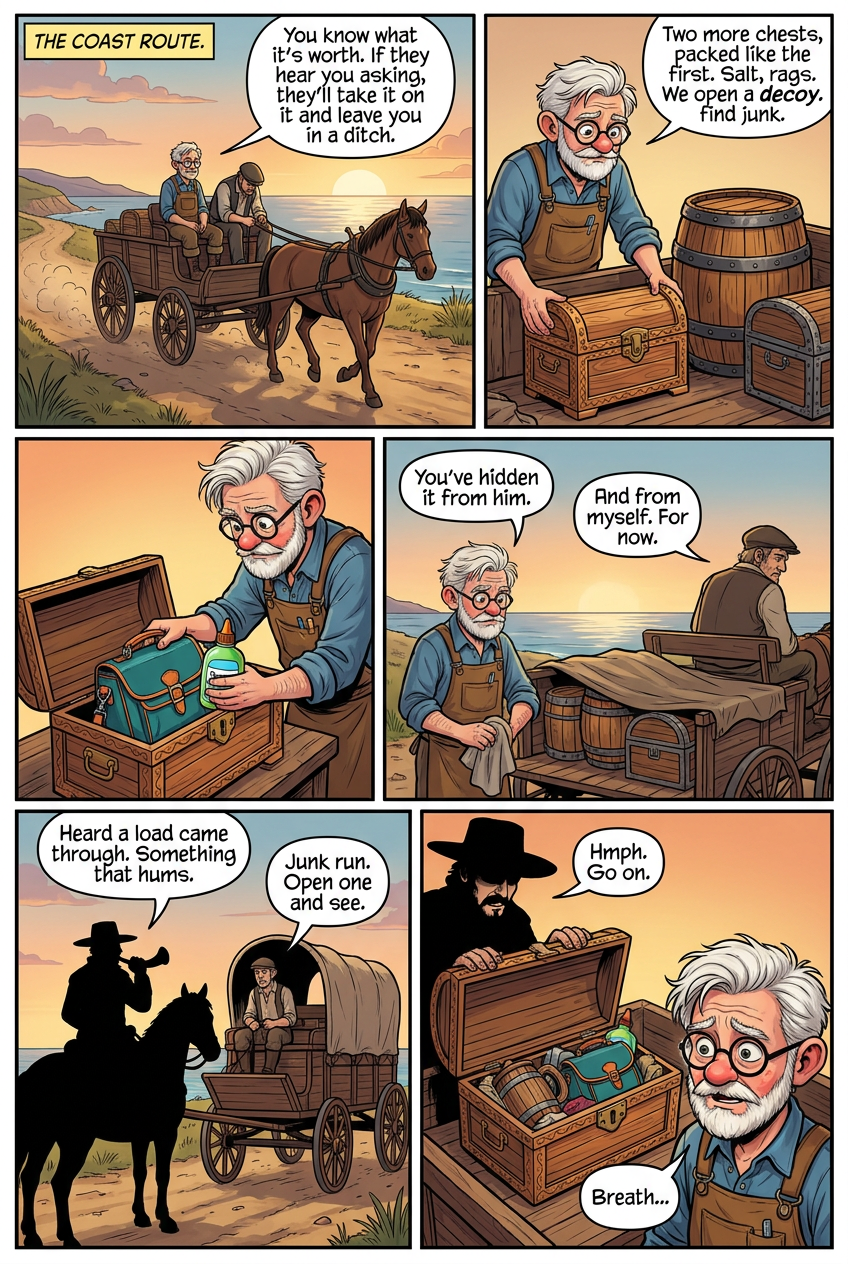
The cart rolled toward the water. Ben watched the driver's back. The man had said it plain: the crate was worth more than the pay. A hungry driver with that knowledge was a danger. One word sold ahead, and every hunter on the coast route would line the road by dusk. Ben had silenced the hum. He had not silenced the man. He leaned forward. "You know what it's worth," Ben said. "So do the people who want it. If they hear you asking, they'll take it and leave you in a ditch. You'd get nothing." The driver said nothing. His shoulders stayed stiff. Ben saw the greed working in him, silent and slow. Ben reached into the driver's junk chest. He pulled out a small charming chest with brass fittings, then a barrel-shaped chest with iron bands. He set them side by side on the boards. "You want more coin," Ben said. "Then earn it honestly. Two more chests, packed like the first. Salt, rags, wet cloth. If anyone stops us, we open a decoy. They find junk. They let us pass." The driver turned. "Decoys." "Three chests. Same weight. Same look." Ben tapped the barrel chest. "Nobody knows which one holds the set. Not the hunters. Not you." That last part landed. The driver's jaw shifted. If he did not know which chest held the pieces, he had nothing to sell ahead. His secret was worthless now. Ben worked fast. He packed the barrel chest with salt and rags. He filled the little chest with a squeeze flask, a heavy wooden tankard, and a sleek travel satchel from the driver's stores. He weighted each to match the real crate. Then he shuffled all three under the cargo where even he lost track. Joe climbed up beside him. "You've hidden it from him," Joe murmured. "And from myself," Ben said. "For now." The driver watched the three chests vanish under the tarp. His face changed. The greed drained out of it, because there was nothing left to sell. He could not point a buyer to a chest he could not name. "Coast by dusk," the driver said again. But the words came flat now. He took the reins and drove. Two miles on, a rider blocked the track. He wore no colors, but his hand rested near a horn. "Heard a load came through," the rider said. "Something that hums." Ben's chest tightened. The driver did not flinch. "Junk run," the driver said. "Open one and see." He kicked the barrel chest forward. The rider pried the domed lid. Salt spilled. Rags. A dented tankard. He grunted and waved them on. The cart rolled past. Ben breathed out. The driver's silence was safe now, because his silence was empty. The coast route lay open ahead. But Ben still did not know which chest carried the set, and he would have to find it again before the boat.
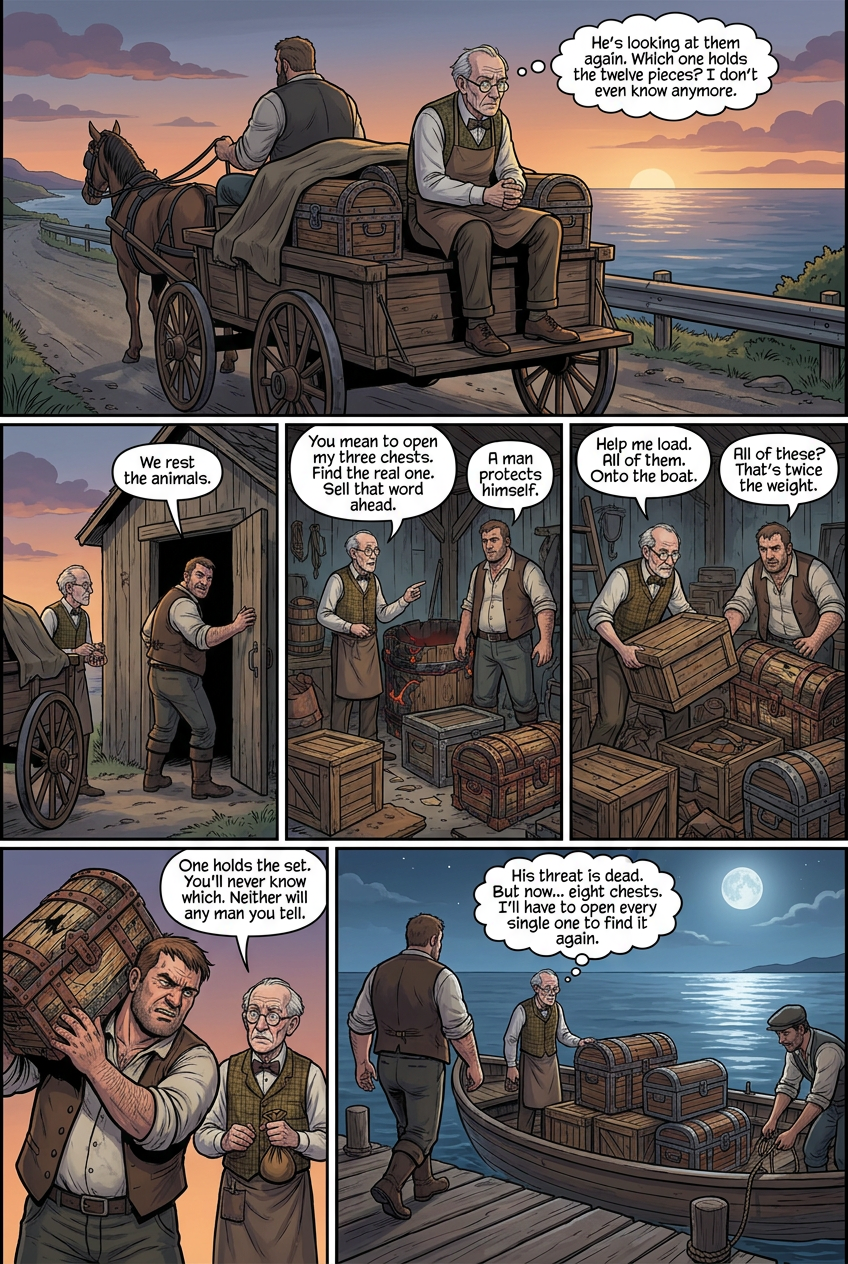
The cart rolled on toward the coast. The rider was gone. Ben should have felt safe. He did not. Three chests sat under the tarp. He no longer knew which held the twelve pieces. The driver knew that too. Ben watched the man's hands on the reins and saw the greed had not died. It had only changed shape. A driver who could not name the right chest could still name the road. At dusk the cart stopped at a shed near the water. The driver climbed down. "We rest the animals," he said. But he walked to the shed door and looked back twice. Ben followed. Inside sat old cargo, forgotten and stacked. A battered chest of warped planks leaned in the corner. A charred bucket. A worn crate with a slumped, tired look. And one chest with eyes painted on its front, purple and wide, staring out from a green scowl. "You mean to open my three chests," Ben said. "Find the real one. Sell that word ahead." The driver did not deny it. "A man protects himself." Ben looked at the shed's junk. He had one move left. If the driver could not tell the real chest from a shed full of chests, his knowledge died for good. Ben pulled the three chests from the cart. He set them among the old ones. The sunken chest. The tired crate. The eyed chest with its awful stare. Six containers now, then seven, then eight. All roughly the same size. All battered. "Help me load," Ben said. "All of them. Onto the boat." The driver stared. "All of these? That's twice the weight." "You want more coin. I'll pay for the extra hauling." Ben lifted the tired crate first. "Eight chests reach the coast. One holds the set. You'll never know which. Neither will any man you tell." The greed drained from the driver's face for the last time. He saw it plain. He could sell nothing now. A buyer paid for a name, and Ben had erased the name inside a pile of junk. The driver grabbed the eyed chest and swung it onto the cart without a word. They loaded all eight. Ben lost the real crate again on purpose, deep in the stack. At the water a low boat waited. The driver passed the chests down one by one to a boatman. Salt, rags, and stone all sounded the same. The driver took his coin. He did not ask about the crate. He could not. "Coast by dawn," he said, and this time the words held nothing behind them. Ben stepped onto the boat. The driver's threat was dead. But eight chests now sailed toward the coast, and only one carried his twelve pieces. Before he could sell the set, he would have to open every chest and find it again.
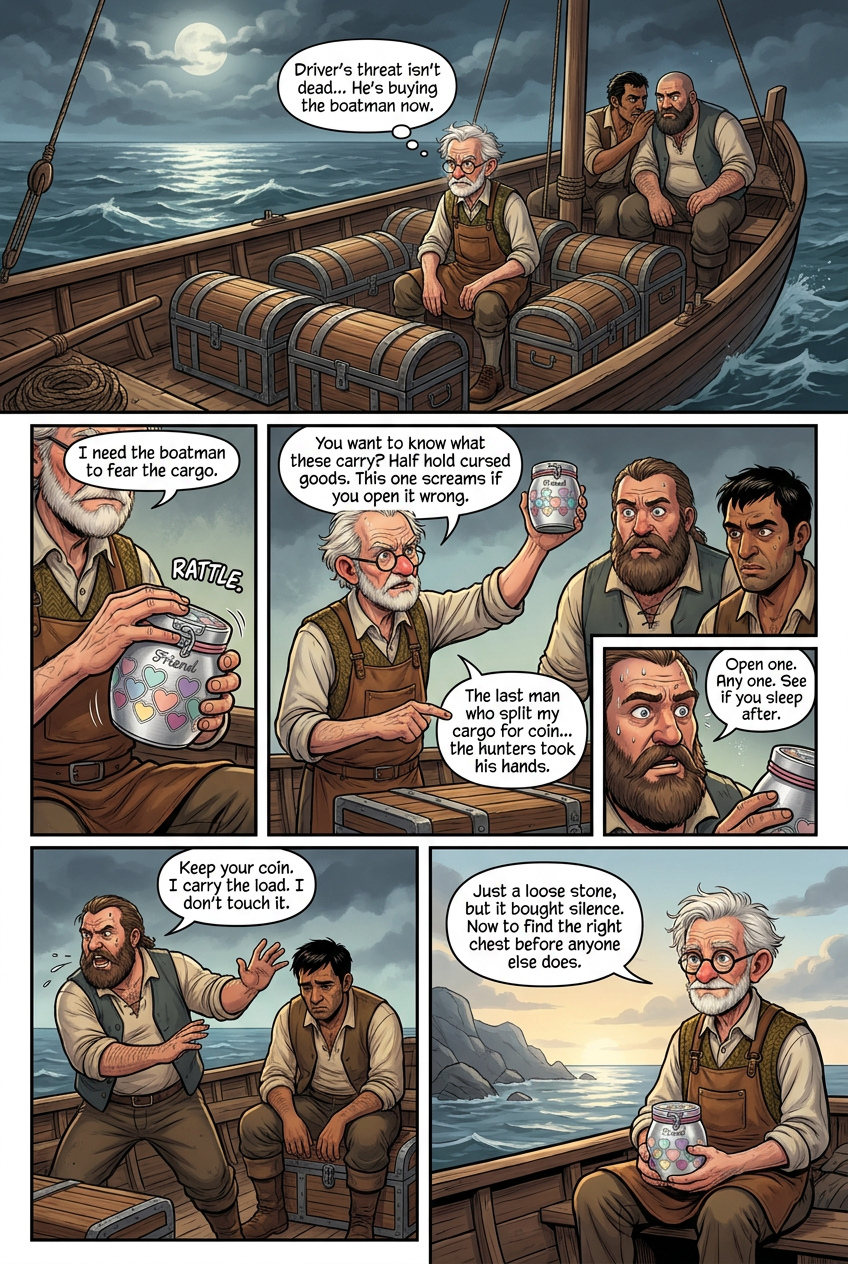
The boat pushed off from the shed with eight chests stacked in its belly. Ben sat among them and told himself the driver's threat was dead. Then he saw the boatman's face. The greedy driver had climbed aboard too, and now he leaned close to the boatman near the tiller. Ben knew that lean. A man buying a favor. If the driver cornered the boatman for a cut, word of Ben's cargo would spread up the coast before he could ever sell the set. Ben could not stop them talking. He could only make the talk useless. He needed the boatman to fear the cargo more than he wanted the driver's coin. Among the shed junk stacked near his knees sat a small silver jar. Hearts covered its sides, painted in soft colors, the word Friend curled across the front. A child's keepsake, useless. Ben lifted it and shook it once. Something inside rattled. He turned so the boatman could see. "You want to know what these chests carry," Ben said, loud enough for both men. "Half of them hold cursed goods. This one screams if you open it wrong." He set the friendly little jar on the lid of the nearest chest and stepped back. "The last man who split my cargo for coin drew the hunters straight to him. They took his hands." The driver's mouth tightened. He had helped load these chests. He knew salt and rags filled most of them. But he could not say so without admitting he had sold nothing to fear, and the boatman was already staring at the little heart-covered jar as if it might bite. "Open one," Ben said to the boatman. "Any one. See if you sleep after." The boatman did not move. He looked at the jar, then at the driver, then back at the tiller. His hands stayed where they were. Whatever the driver whispered next, the boatman gave a short shake of his head and turned his shoulder away. The driver tried once more. He reached for the boatman's arm. The boatman pulled free and spat over the side. "Keep your coin," he said. "I carry the load. I don't touch it." The driver sank onto a chest and said nothing after that. His hands hung empty in his lap. He had no name to sell and now no ear to sell it to. Ben picked up the little friend jar and held it in his lap the rest of the crossing. The rattle inside was only a loose stone, but it had bought him silence. By the gray of near-dawn the coast showed ahead. The threat on the water had died for good. But eight chests still waited on the boards, and only one held his twelve pieces. To sell the set, Ben would have to open every chest at the coast and find his cargo again before any buyer's men could reach the dock.
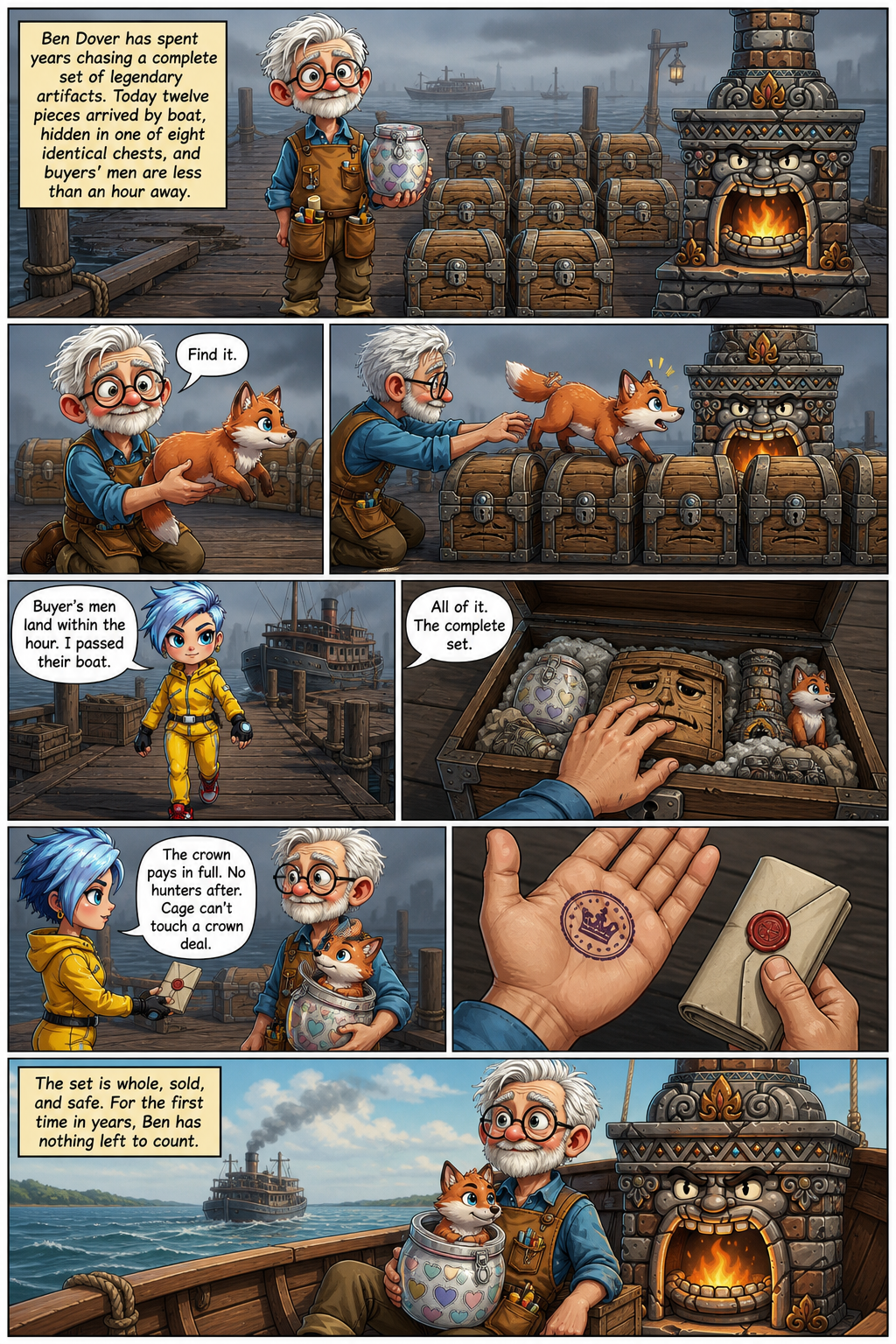
The boat scraped the coast at dawn. Ben stepped onto the boards with eight identical chests behind him. He had lost track of which one held his twelve pieces. To sell the set, he had to find it before any buyer's men reached the dock. He carried the little heart-covered jar in one hand and set it on the nearest lid. A low stone hearth stood at the end of the dock, near a shed for boiling tar. Its face gaped wide, teeth carved around a firebox, flames still licking inside from the night crew. Ben looked at the open mouth and understood. He could not open eight chests in the gray light with people already stirring. But he did not need his eyes. He needed his fox. He knelt and opened the jar. The small orange creature climbed out onto his knee, ears up, blue eyes bright. It had hummed for every piece of the set since the beginning. It hummed now, faint and steady, when he lifted it toward the chests. "Find it," Ben whispered. The fox turned its head along the row. At the first chest, nothing. The second, nothing. Ben moved it down the line while the flames in the stone mouth crackled beside him. At the sixth chest the fox stiffened. The hum climbed to a hard, ringing note that only Ben and the fox could feel. He set his hand on the lid. This was the one. A voice came from the shed. Fast, clipped. "That's the wrong pitch. Yours hums higher." Ben turned. A young woman in a yellow courier suit stood by the tar shed, blue hair catching the first light. Anita Job. He had sent word to her weeks ago, before all of this, when he still had eleven pieces and no buyer. She ran messages from the Outer Gates to the throne. She had never once been late, except at the river. He had trusted her with the truth of what he carried. "You came," Ben said. "You wrote. I run." She crossed the boards without slowing. "Buyer's men land within the hour. I passed their boat." She looked at the fox, then at the sixth chest. "You found it. Move." Ben did not waste breath. He pried the sixth chest open. Salt and rags filled the top. He dug through them. Beneath, wrapped in wet cloth, lay his mother's carved box and eleven others. Twelve pieces. The complete set. He pressed his hand flat on the lid and felt the hum drum up through the wood into his bones. "That's it," he said. "All of it." "Then it's not yours to carry anymore," Anita said. "The crown wants the set. Whole. I carry the message to say it's found." She pulled a sealed paper from her belt and held it out. "They pay in full. No hunters after. Cage can't touch a crown deal. Neither can the herbalist." Ben took the paper. He read the price. It cleared every debt and left him free. He had chased this set across the whole kingdom of Butter. He had counted the pieces against nine sources and lost sleep over a thirteenth that never existed. Now the true number sat in his hands, twelve, complete, and someone finally wanted them who could keep them safe. He looked at the other seven chests, full of salt and junk. He looked at the fox on his knee, quiet now that the set was open. He thought of the sister who had carried the heavy end, of the boxes carved from tears and grief, of every stranger who had hidden this cargo behind a wall or under a garden. "Take it," Ben said. He closed the chest and pushed it toward Anita. "Tell the crown the set is done." Anita whistled. Two dock men came from the shed, lifted the chest, and carried it up the boards away from the water. She marked the paper with her runner's stamp and pressed it into Ben's palm. "Payment waits at the gate. Bring the paper. Bring the fox as proof." She was already turning to go, fast as always. Ben sat on the empty boat rail as the light rose. The buyer's boat appeared far out, then slowed, then turned back. They had heard. The set was claimed. No one would hunt him now. He scooped the fox up and set it back in the little heart-covered jar, leaving the lid open so it could see out. The stone hearth burned warm beside him. Ben looked at the paper in his hand, twelve pieces sold, whole and safe, and for the first time in years he felt no need to count anything again.
Play your story to life
Storycraft is a mobile game where you create AI characters, craft items and locations to build their world, then discover what direction your story takes. Download the iOS game for free today!
Download for free