

Ellen's Arc
45 Chapters
Ellen's dream is founding a hidden haven in Ashplain where outcast women can live freely without fear of the raiders..

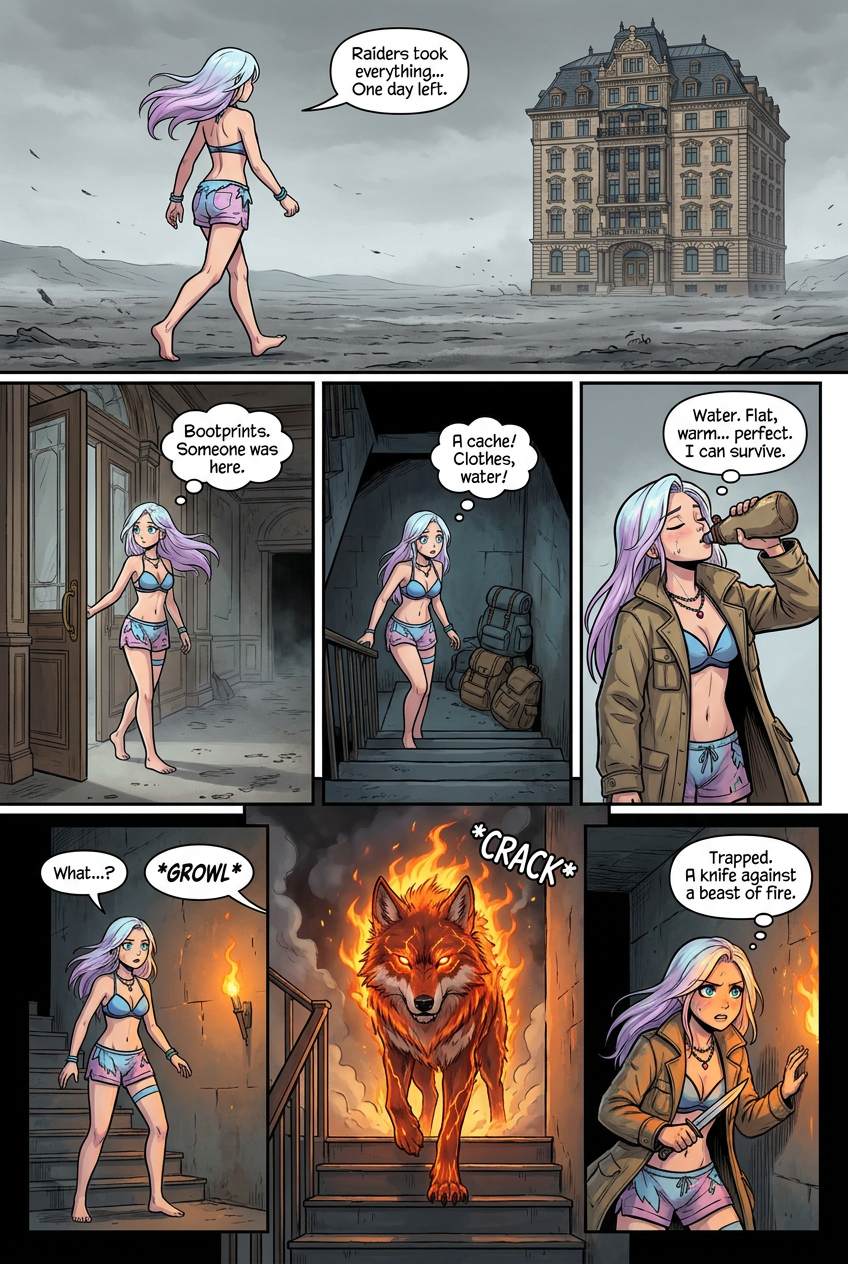
Ellen wanted to build a haven for cast-out women, but she would freeze before she found the ground for it. The raiders had taken her clothes, her pack, her water. They left her a torn slip and a laugh. Now she crossed the ashplain alone. Grit blew against her bare legs. The sun burned her shoulders raw. Wind stripped the sweat off her skin before it could cool her. She had a day, maybe less, before the heat dropped her. Ahead stood an old hotel, tall and out of place on the flat gray plain. Its stone front rose six floors. Half its windows were dark holes. Ash had drifted against the grand doors like snow. Travelers had sheltered here before her. Ellen had seen their bootprints in the dust for miles. If they had passed through, they had left things behind. She climbed the cracked steps and shoved a door open. Cool air met her. It smelled of dust and old wood. The lobby stretched wide, its ceiling still whole. She moved room to room, pulling drawers, checking corners. Empty. Empty. Her hope thinned with each dark doorway. A cold coming from a stairwell stopped her. She followed the draft down to a cellar. There, in the dark, sat a stack of packs. Someone had cached them and never come back. Ellen tore one open. A canvas coat. Boots. A water skin, still heavy. A knife. A bundle of flint. She dressed fast, her hands shaking with relief. The coat swallowed her. The boots pinched, but they held. She slung a full pack on her back and drank. The water was flat and warm. She had never tasted better. For the first time since the raiders, she could think past the next hour. The plain would not kill her today. She could search for haven ground. A sound came from above. A long, low growl, then the crack of claws on stone. Ellen froze. Orange light flickered down the stairwell wall. She climbed to the top and looked. Across the lobby stood a wolf the size of a horse. Fire ran along its back in bright veins. Its breath came in waves of heat she felt from thirty feet. Smoke curled off its fur. It had smelled her, or the water, and it stood between her and the doors. Ellen backed against the cellar wall. She had gear now. She had a knife and a coat. None of it would stop that thing. The one door out was behind the wolf. She gripped the knife and searched the walls for another way. There was none she could see. The cache had saved her from the plain and trapped her with a beast made of fire.
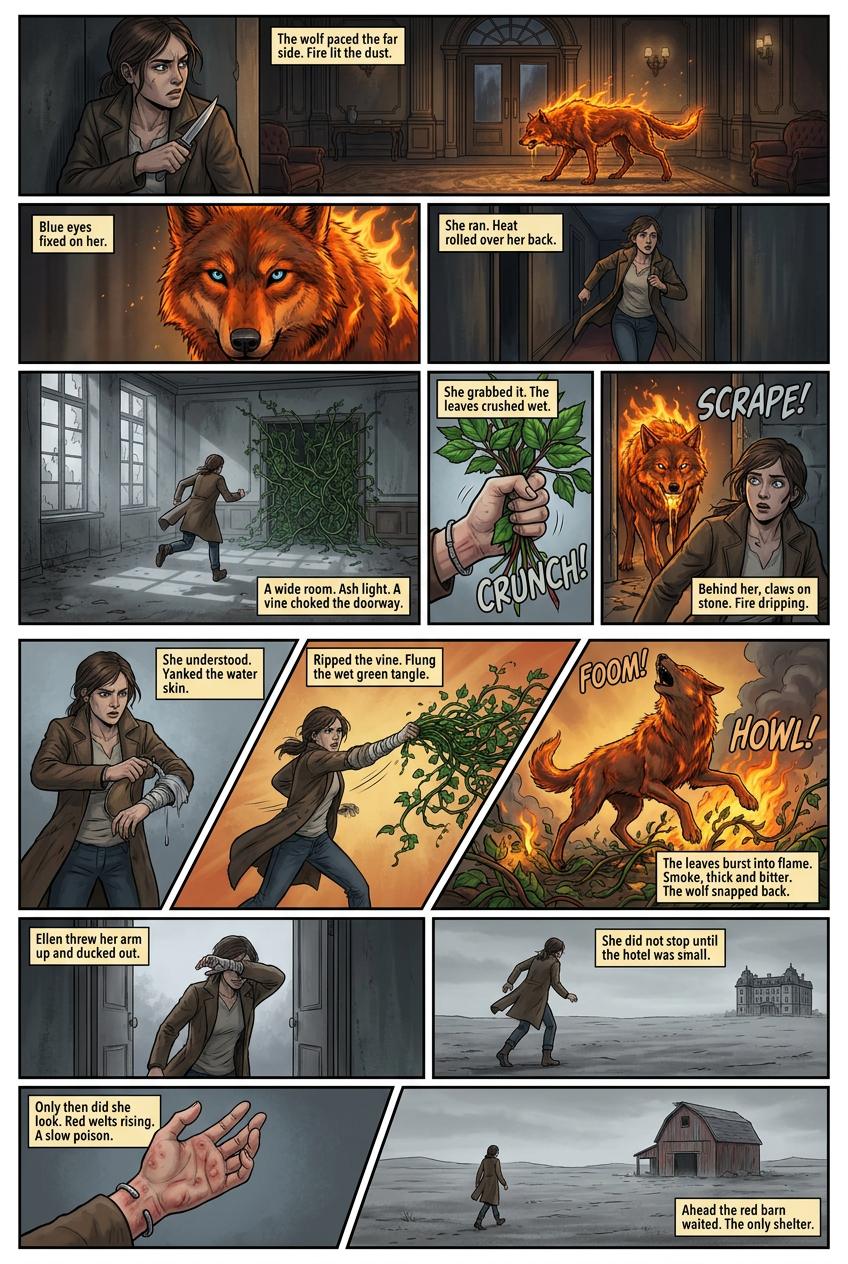
The wolf paced the far side of the lobby. Its fire lit the dust in the air. Ellen pressed her back to the wall and held the knife low. The front door stood behind the beast. She could not reach it. But the lobby had more than one mouth. A dark hall opened to her left, past the front desk. She edged toward it, slow, keeping her eyes on the wolf. The wolf turned its head. Blue eyes fixed on her. It lunged. Ellen ran. She hit the hall as heat rolled over her back. The corridor bent and dropped her into a wide room with high, broken windows. Ash light poured in. A rear door hung open on its hinges. Beyond it she saw open ground and, far off, a red barn standing alone on the flat. She could reach the door. She could reach the plain. But a thick vine choked the doorway. Green leaves grew in clusters of three, reddish stems tangled thick as rope. It blocked the gap wall to wall. She grabbed a fistful to tear it down. The leaves crushed wet in her hand. Behind her, claws scraped stone. The wolf filled the hall mouth. Fire dripped off its jaw. Ellen looked at the vine. She looked at the beast made of fire. Then she understood. She yanked the water skin free and soaked her coat sleeve. She wrapped her hand and ripped the vine loose in long ropes. She flung the wet green tangle across the floor between herself and the wolf. The wolf charged. Its paws hit the vine and the leaves burst into flame under it. Smoke rose thick and bitter, not clean woodsmoke but a choking oil that filled the room. The wolf snapped its head back and howled. Its eyes streamed. It clawed at its own snout and backed into the hall, blind and gagging. Ellen threw her wrapped arm over her face and ducked through the open door. Cold air hit her. She stumbled onto the plain and did not stop until the hotel was small behind her. Only then did she look at her hands. Red welts were already rising across her palm and wrist where the leaves had touched her skin. The burn itched, then stung, then bit deep. She had escaped the wolf. She had traded a quick death for a slow poison working under her skin. Her hand swelled as she watched. Ahead the red barn waited, its wood weathered and split, its dark loft window like an empty eye. She had no water left and a rash spreading up her arm. She started walking toward the barn. It was the only shelter on the whole gray plain.
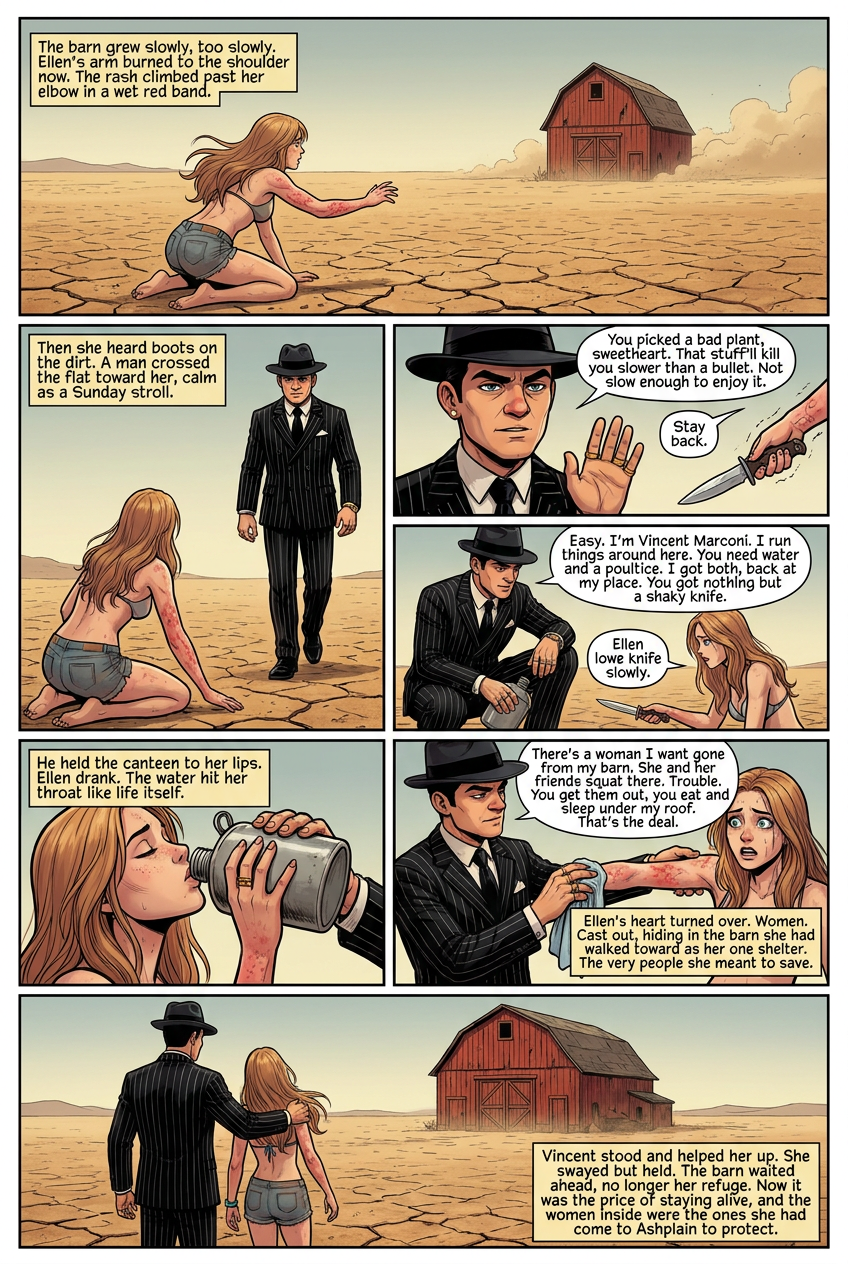
The barn grew slowly, too slowly. Ellen's arm burned to the shoulder now. The rash climbed past her elbow in a wet red band. Each step pulled the swollen skin tight. Her mouth was dry stone. She had no water and no salve, and the poison worked deeper with every yard. Her knees buckled. She caught herself on the cracked ground and stayed there, breathing hard. The barn still stood far off, its dark loft window watching her like an eye. She would not reach it. Then she heard boots on the dirt. A man crossed the flat toward her, calm as a Sunday stroll. He wore a black pinstripe suit and a low hat, both wrong for this dead place. A gold ring flashed on his hand. He stopped a few feet away and looked down at her swollen arm. "You picked a bad plant, sweetheart," he said. His voice was flat and sure. "That stuff'll kill you slower than a bullet. Not slow enough to enjoy it." Ellen dragged the knife from her coat and pointed it at him. Her hand shook. "Stay back." He raised both palms, unbothered. "Easy. I'm Vincent Marconi. I run things around here." He crouched to her level. "You need water and a poultice. I got both, back at my place. You got nothing but a shaky knife." She searched his face for the trap. She found no kindness there, only calculation. But the knife weighed a ton in her fist, and the plain swam gray at the edges. She lowered the blade. "Why help me," she said. "I don't do free." He pulled a canteen from his coat and unscrewed the cap. "You drink now. Then you owe me. Simple." He held the canteen to her lips. Ellen drank. The water hit her throat like life itself. She gulped until he pulled it back. Then he tore a strip from a cloth in his pocket, wet it, and pressed it against the raw skin of her arm. The sting eased. Her head cleared. "There's a woman I want gone from my barn," Vincent said. He nodded toward the red building. "She and her friends squat there. Trouble. You get them out, you eat and sleep under my roof. That's the deal." Ellen's heart turned over. Women. Cast out, hiding in the barn she had walked toward as her one shelter. The very people she meant to save. She looked at the wet cloth on her arm, at the man who owned the water and the barn both. She was not dying anymore. She was in his debt instead. "Fine," she said. "Take me there." Vincent stood and helped her up. She swayed but held. The barn waited ahead, no longer her refuge. Now it was the price of staying alive, and the women inside were the ones she had come to Ashplain to protect.
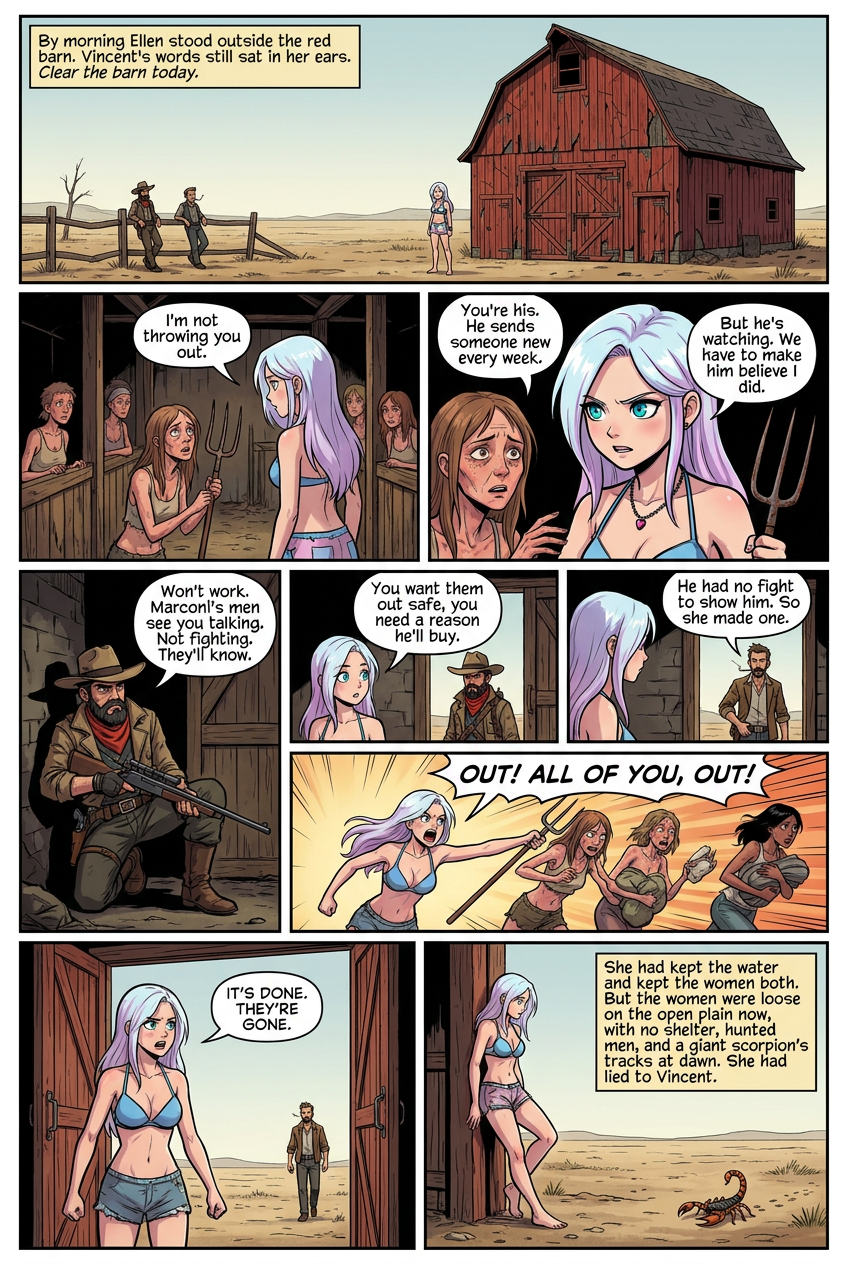
By morning Ellen stood outside the red barn with a full canteen and healed skin. Two of Vincent's men leaned against a dead fence a hundred yards off. They did not hide. One chewed a matchstick and watched her the whole time. Vincent's words still sat in her ears. Clear the barn today. Any help to the squatters, and the water stops. She pushed the door open and stepped inside. Six women sat in the loft and the stalls. Thin, sunburned, watching her hands. One held a rusted pitchfork. They had come to the same dead plain she had, cast out the same way. She had walked all this distance to save women like these. Now the men outside waited for her to throw them out. "You're his," the woman with the pitchfork said. "He sends someone new every week." "I'm not throwing you out," Ellen said. The words felt like stepping off a ledge. "But he's watching. We have to make him believe I did." A man's voice cut across the barn. "Won't work." A stranger sat in the shadowed corner, a rifle across his knees. A worn coat, a low hat. Two pistols on his hips and a sawed-off slung on his back. He had counted them all before Ellen ever saw him. "Marconi's men see you talking. Not fighting. They'll know." Ellen's chest went tight. "Who are you?" "Cade." He stood. "Hunting men who burned my town. Marconi's not one. But he trades in scared people. I've seen it." He looked at the door. "You want them out safe, you need a reason he'll buy." Ellen looked through a gap in the wall. The matchstick man was walking closer now, hand near his belt. She had no fight to show him. So she made one. She grabbed the pitchfork and shoved the nearest woman hard toward the rear door. "Out! All of you, out!" she screamed it loud enough for the plain to hear. The women caught it fast. They stumbled and cried and ran for the back, clutching bundles. Cade slipped out with them, quiet as smoke, into the dry brush behind the barn. Ellen stormed to the front door and threw it wide so the men could see the empty stalls. "It's done," she called. "They're gone." The matchstick man stopped. He studied the open barn, the fleeing shapes shrinking into the far scrub. Then he nodded, turned, and walked back toward Vincent's place to report. Ellen leaned on the doorframe, breathing hard. She had kept the water and kept the women both. But the women were loose on the open plain now, with no shelter, hunted men in the brush, and a giant scorpion's tracks she had seen crossing the dirt at dawn. She had lied to Vincent. When he found out, the debt would come due with teeth.
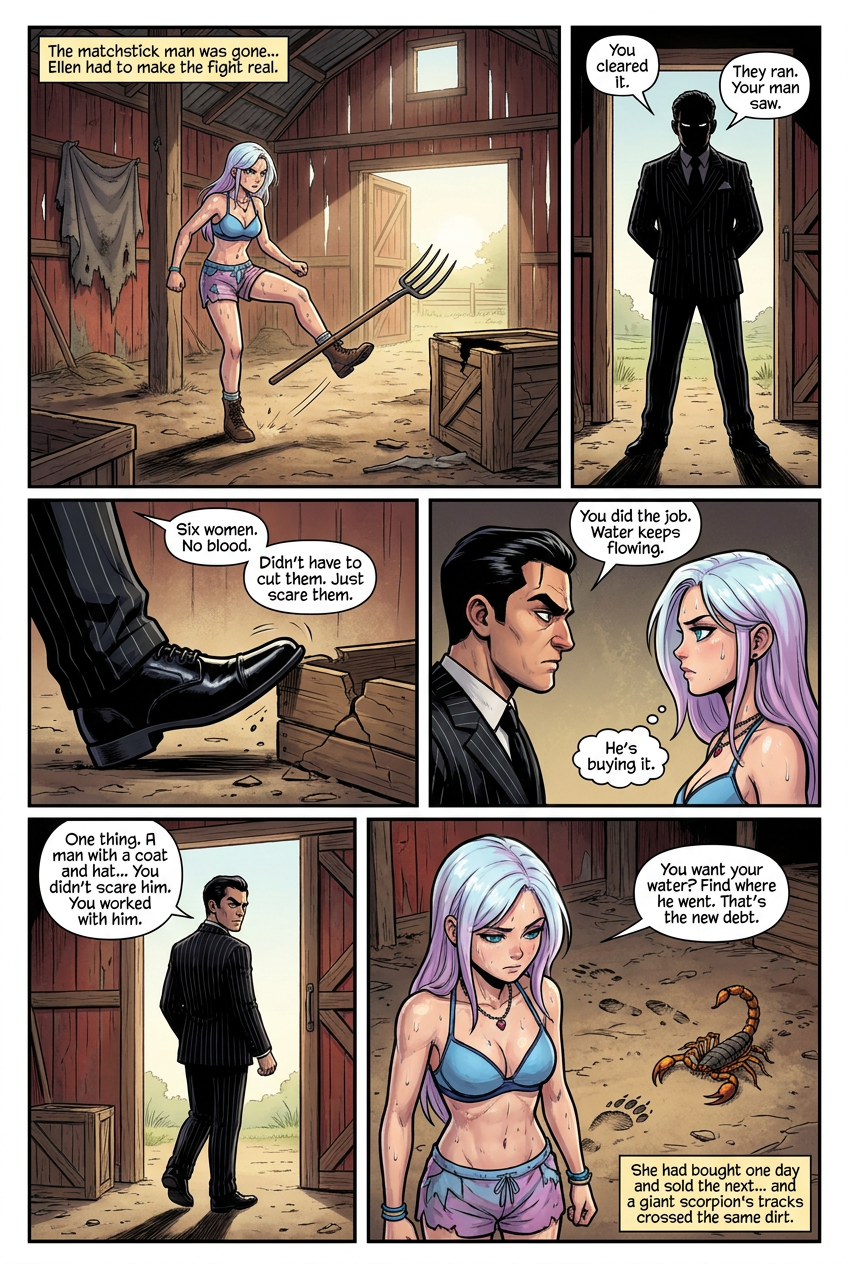
The matchstick man was gone, but Ellen knew he would come back. He had seen fleeing shapes and an empty barn. That was enough for now. But Vincent's men were careful. Sooner or later one of them would walk these stalls and find no sign of a real fight. No blood, no dropped bundles, no broken boards. Just clean straw and a story too smooth to trust. If they reported that, her water stopped and Vincent's protection ended. So Ellen made the fight real. She kicked the pitchfork across the floor and left it. She tore a strip from a woman's forgotten blanket and hung it on a nail, ripped. She dragged a crate over and cracked its side against a post. She smeared dirt where feet would have scuffed running. Her hands shook, but she worked fast. A shadow filled the doorway. Vincent Marconi stepped in, pinstripe suit dark against the morning glare. He did not look at the mess she had staged. He looked at her. "You cleared it," he said. "They ran," Ellen said. "Your man saw." Vincent walked one slow circle through the barn. He touched the ripped blanket. He nudged the cracked crate with a polished shoe. He had a gift for reading people, and Ellen felt him reading her now, five minutes stretching thin. "Six women," he said. "No blood." "I didn't have to cut them. Just scare them." He stopped in front of her. His eyes moved over her face, her hands, the sweat on her neck. She held still. She thought of the women loose in the brush and made herself believe her own lie. "You did the job," Vincent said at last. "Water keeps flowing." He turned for the door. "They come back, you tell me. Not fix it yourself." Ellen breathed. She had passed. Then Vincent stopped in the doorway. "One thing." He did not turn around. "A man was in here. Coat. Hat. My men counted his tracks going out the back with your six." Now he looked over his shoulder. "You didn't scare him. You worked with him." The barn went cold. Ellen said nothing. "I know that man," Vincent said. "He's hunting people I need alive. His work ends mine." He faced her fully. "You want your water? You find where he went. You tell me. That's the new debt." He walked out into the light. Ellen stood alone in the ruined barn. She had kept the water and kept the women. But Vincent had not been fooled about Cade. Now he owned her again, and this time the price was the one man who had helped her. Out in the brush the women were running, Cade among them, and a giant scorpion's tracks crossed the same dirt. She had bought one day and sold the next.
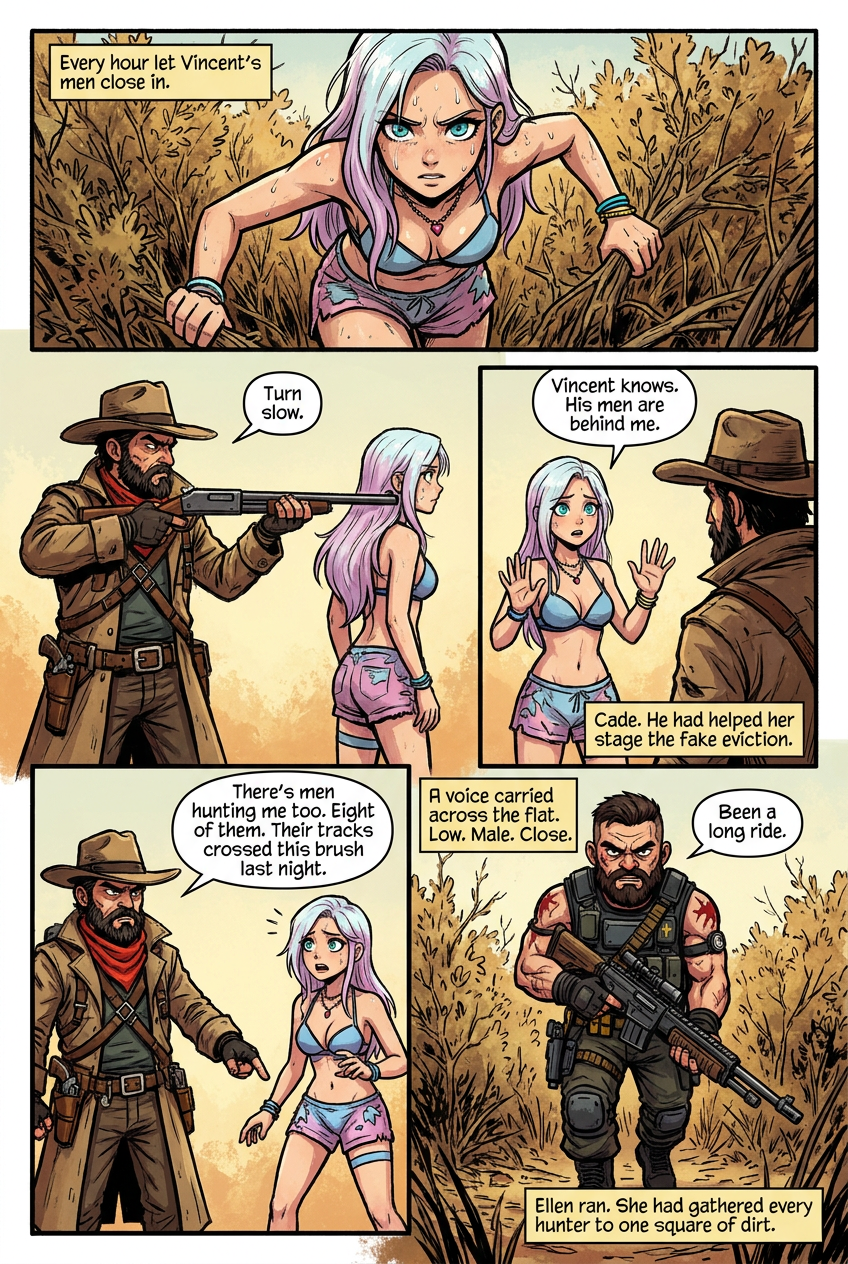
Ellen left the barn before Vincent's men could circle back. She had to reach Cade first. Vincent thought she was hunting Cade to betray him. She meant to find him to warn him. But the brush swallowed six women and one man, and she had no idea which way they ran. Every hour let Vincent's men close in. The tracks she followed were hers to read before they read them. She went low through the scrub, following broken stalks. The trail split. She chose the deepest prints and kept moving. The sun climbed. Her burned arm throbbed. She found a torn scrap of blanket on a thorn and knew she was close. Then a rifle barrel touched the back of her neck. "Turn slow," a man said. She turned. A man in a worn coat and low hat stood there. Cade. He had helped her stage the fake eviction, had walked the women out the back while she lied to Vincent's men. Now he counted the plain behind her before he looked at her face. "You alone?" Cade asked. "Yes." Ellen kept her hands open. "Vincent knows you helped me. He sent me to find where you went. His men are behind me." Cade lowered the rifle an inch. His jaw tightened. "How far?" "An hour. Maybe less. I came to warn you, not sell you." He studied her. She held still the way she had held still for Vincent. "The women?" she said. "Dug in." He tipped his head toward a low ridge of brush. "Waiting on me." Ellen's breath caught. They were safe. She had found them in time. Then Cade said something that stopped her cold. "There's men hunting me too. Eight of them. They burned my town." He said it flat, like a fact about weather. "Their tracks crossed this brush last night." Ellen looked where he pointed. Boot prints, more than one set, cutting through the scrub toward the ridge. Toward the women. "Vincent's men come from behind," Cade said. "These come from ahead." A voice carried across the flat. Low. Male. Close. "Cade." The word came again, from the ridge. A big man stepped from the brush, chest plated in gear, more guns on him than Cade carried. He did not raise them. He just looked, the way a hunter looks when the distance finally closes. "Been a long ride." Cade moved Ellen behind him with one hand. "Get to the women," he said. "Now." Ellen ran. She had done it. She had reached Cade and warned him before Vincent's men could. She had saved the day she came to save. But she ran toward six women hidden in the brush, with armed men closing from two sides and Cade alone between them. She had not bought their safety. She had gathered every hunter to one square of dirt.
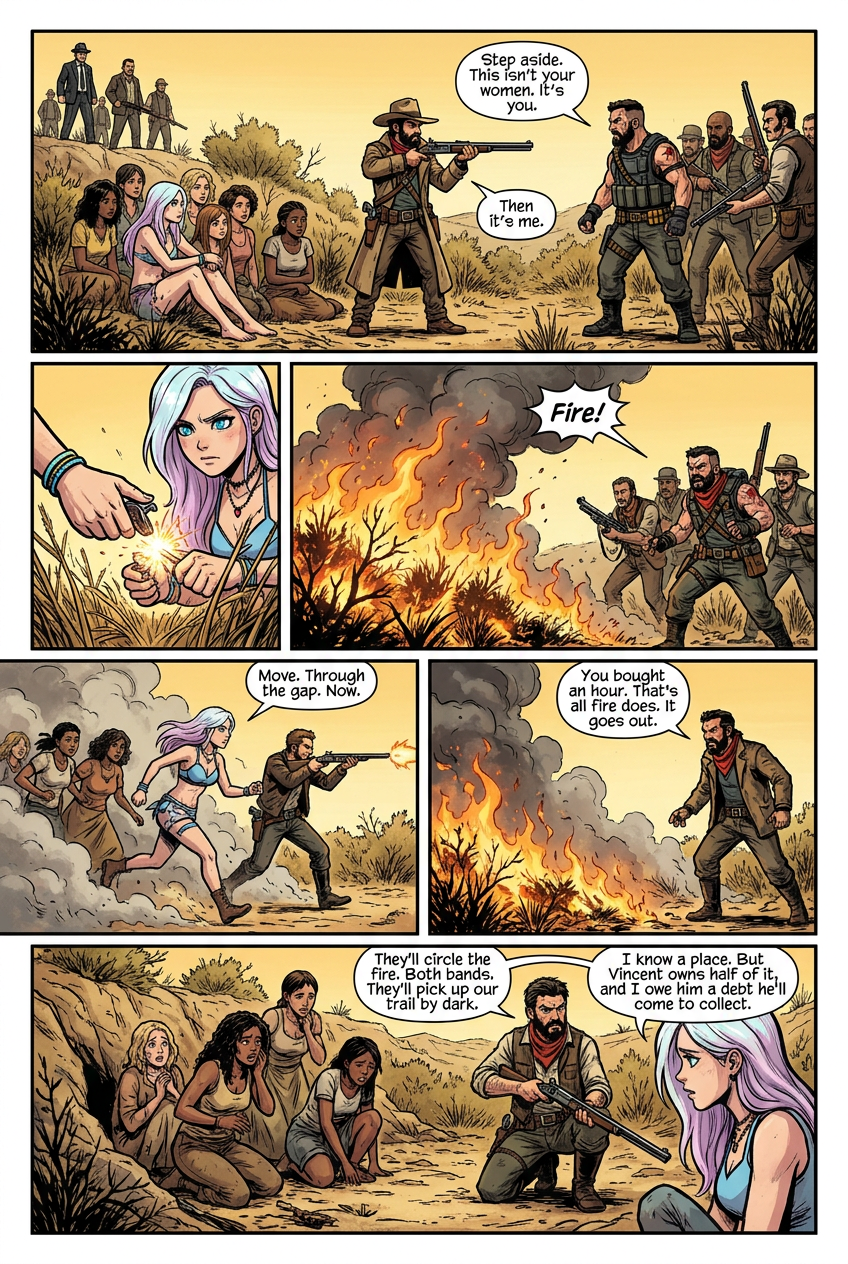
Ellen reached the six women crouched in the brush. No wall stood between them and the guns. The ridge gave no cover. Vincent's men pressed from behind. The eight who burned Cade's town closed from ahead. She had one man to hold them off, and the ground gave her nothing to work with. Behind her, the big man from the ridge spoke. This was the one hunting Cade, the leader of the eight. Marcus Brennan had ridden a long way to close this distance. He wanted Cade himself. "Step aside," Marcus said to Cade. "This isn't your women. It's you." Cade did not move. "Then it's me." Ellen watched the two forces stall. Neither wanted to fire first into open ground. Every gun waited on another gun. She saw it then. They were all bunched at one point, and none of them trusted the men beside them. She pulled the flint from her coat. Dry brush ringed the ridge on every side. She struck sparks into a clump at her feet. The stalks caught. Flame ran fast through the dry scrub, low and quick, spreading a line between the women and the men. "Fire," a hunter shouted. The wall of smoke rose. The eight fell back from the heat. Vincent's men behind them cursed and gave ground too. "Move," Ellen told the women. "Through the gap. Now." They ran along the one lane the fire had not sealed. Ellen shoved the last one ahead of her. Cade backed after them, rifle up, firing once to keep Marcus honest. The flames split the hunters from their target. Marcus stood at the edge of the smoke, watching the women vanish. He did not chase them into the burn. "You bought an hour," he called through the haze. "That's all fire does. It goes out." They did not stop until the ridge was far behind. The women dropped in a hollow, gasping. Six alive. All six. Ellen counted them twice. Cade knelt beside her, reloading. "They'll circle the fire," he said. "Both bands. They'll pick up our trail by dark." "I know." Ellen looked at the six faces, filthy and scared and breathing. She had shielded them. The ridge had offered nothing, and she had made the ground burn. But Marcus was right. Fire went out. And now two bands of hunters shared one purpose: find the woman who cheated them, and the man she ran with. Cade holstered a pistol. "You need a place they can't follow you into. Walls. One way in." Ellen thought of the plain, the distant red barn, the hotel with its cellar and its rear corridor. Somewhere she could hold. "I know a place," she said. "But Vincent owns half of it, and I owe him a debt he'll come to collect." The women watched her. She had saved them once. Now she had to give them a roof before nightfall.
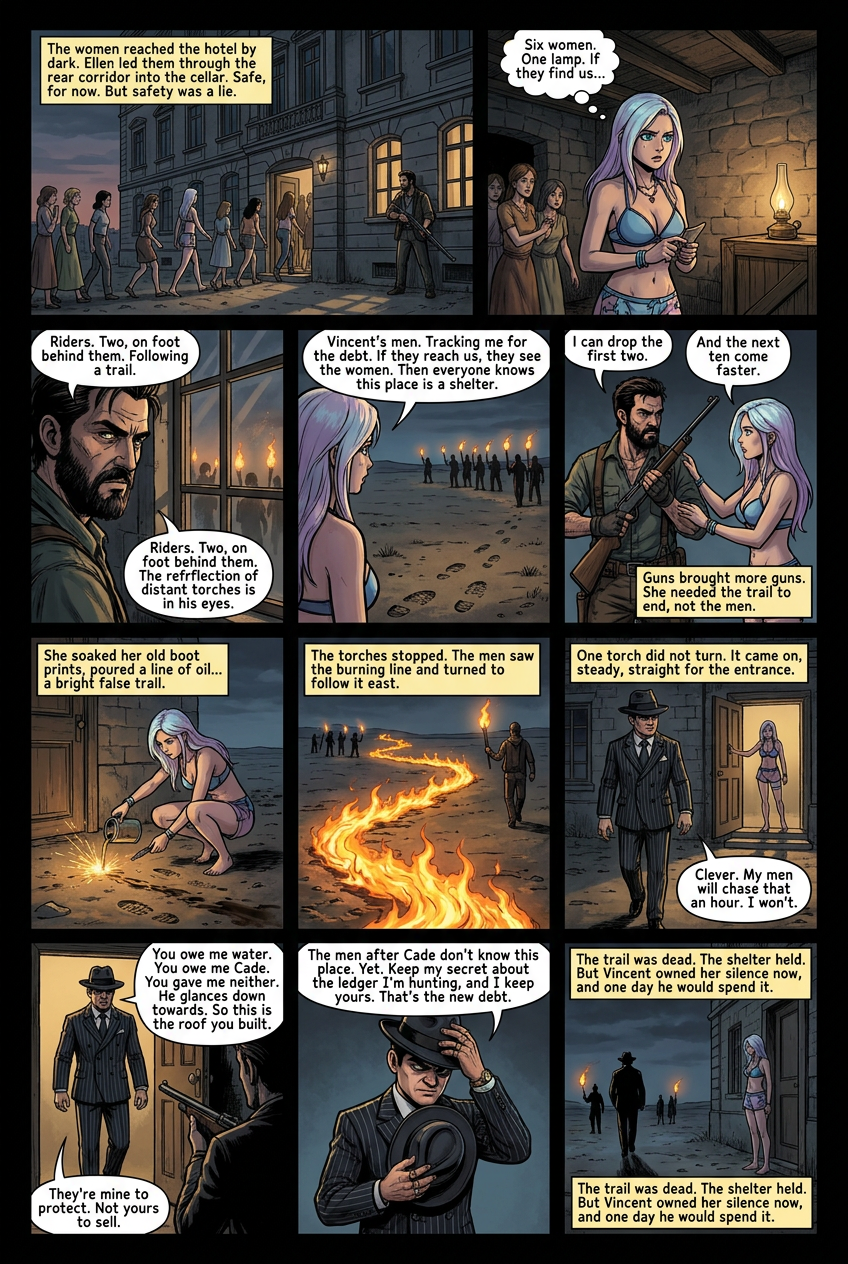
The women reached the hotel by dark. Ellen led them through the rear corridor into the cellar. Six women, one lamp, walls of stone. She sealed the rear door and counted heads again. Safe, for now. But safety was a lie, and she knew it. Cade crouched at the front window, rifle across his knees, watching the plain. "Riders," Cade said. His voice was flat. "Two, on foot behind them. Following a trail." Ellen looked out. Torches bobbed across the dark plain, moving toward the hotel. She saw the boot prints in the dust beside the entrance. Her own. She had led the women straight here, and left a road for anyone to follow. "Vincent's men," she said. "Tracking me for the debt. If they reach us, they see the women. Then everyone knows this place is a shelter." Cade racked the rifle. "I can drop the first two." "And the next ten come faster." Ellen shook her head. Guns brought more guns. She needed the trail to end, not the men. She found the flint in her coat and the lamp oil in the cache. Then she moved. She soaked her old boot prints, poured a line of oil out the front door and away from the hotel, curving it east toward the barren flats. She struck sparks. Fire ran along the oil, a bright false trail leading away from the walls. Then she scuffed the real prints near the door into dust. The torches stopped. The men saw the burning line and turned to follow it east. Ellen watched them chase the fire away from the door. One torch did not turn. It came on, steady, straight for the entrance. A man stepped into the lamplight in a dark pinstriped suit, hat low, rings on his fingers. Vincent Marconi. He did not hurry. He never did. "Clever," Vincent said. He looked at the burning line, then at her. "My men will chase that an hour. I won't." Ellen stood in the doorway. Cade's rifle stayed on Vincent from the shadow. Vincent noticed and did not care. "You owe me water," Vincent said. "You owe me Cade. You gave me neither." His eyes moved past her, to the cellar stairs, to the women below. He read the whole thing in a breath. "So this is the roof you built." "They're mine to protect," Ellen said. "Not yours to sell." Vincent was quiet. Then he stated it flat, like a street fact. "The men after Cade don't know this place. Yet." He turned his hat in his hands. "Keep my secret about the ledger I'm hunting, and I keep yours. That's the new debt." He walked back into the dark, following his own men's torches. The false fire burned itself out on the flats. Ellen shut the door. The trail was dead. The shelter held. But Vincent owned her silence now, and one day he would spend it.
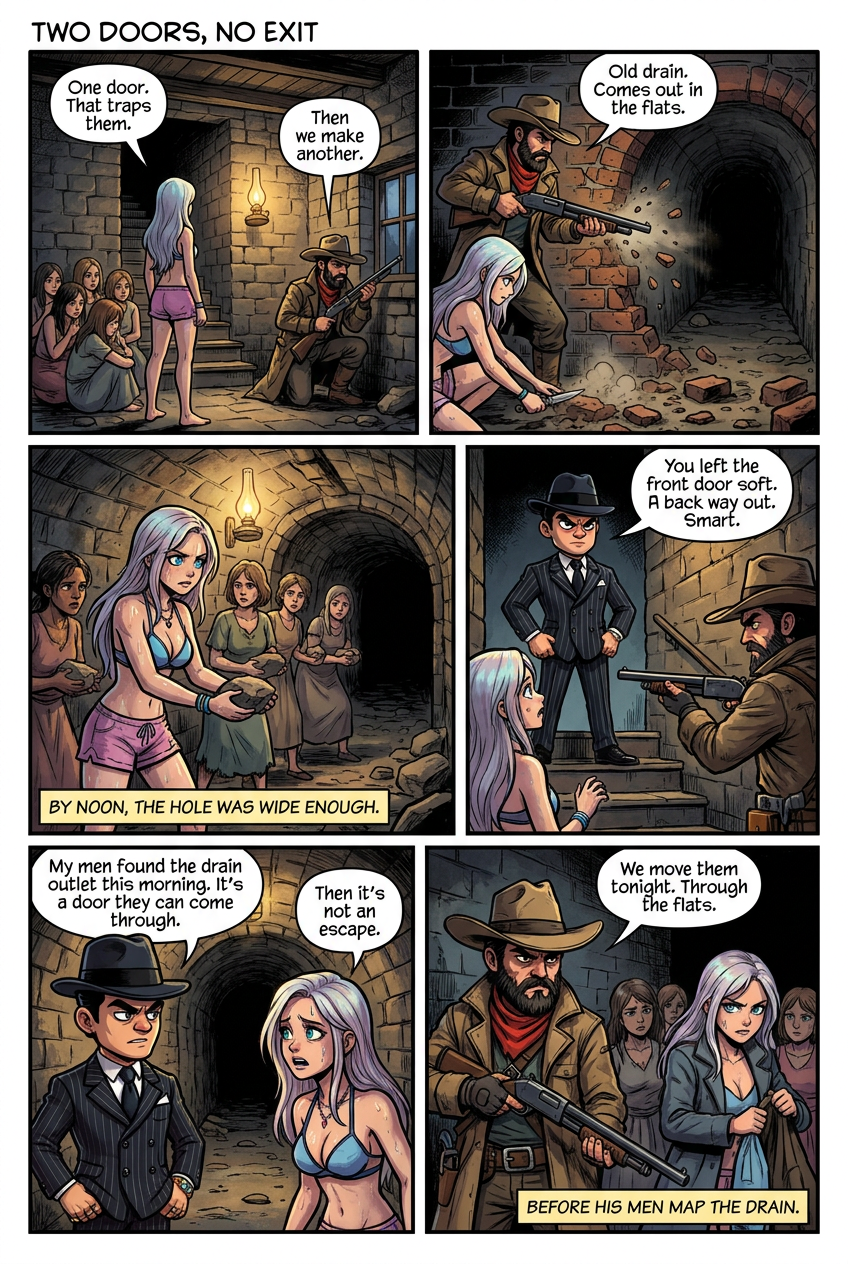
Morning light crept under the cellar door. Ellen stood at the base of the stairs and counted the women again. Six. One lamp. One way in. She looked up the narrow steps to the only door, and the truth settled cold in her chest. If a hunter found that door, the women had nowhere to run. She needed a second way out, and she needed it before the next torch came. Cade crouched at the front window, rifle across his knees. He never stopped counting exits. He turned when she climbed the stairs. "One door," Ellen said. "That traps them." "Then we make another," Cade said. He stood. They searched the cellar wall by lamplight. The stone was old and dry. Ellen pressed her palm along the seams until she felt cold air. A draft. Behind a stack of rotted crates, a low arch had been bricked shut. She scraped the mortar with her knife. It crumbled like chalk. "Old drain," Cade said. He kicked a brick loose. Beyond it lay a tunnel, tight and black, sloping up toward the plain. "Comes out somewhere in the flats." They worked fast. Ellen pulled bricks. Cade widened the gap with the shotgun butt. Sweat ran down her arms. The women held the lamp and passed the loose stone back. By noon the hole was wide enough to crawl through. Then boots scraped the floor above them. Ellen froze. A shape filled the cellar stairs. A dark pinstriped suit, hat low, rings on his fingers. Vincent Marconi came down slow, the way he always moved. "You left the front door soft," Vincent said. He looked at the broken wall, the tunnel mouth, the women pressed against the stone. He read it all in one breath. "A back way out. Smart." "You said you'd keep our secret," Ellen said. "I did." Vincent turned his hat in his hands. "But my men found the drain outlet this morning. Out on the flats. They don't know it leads here." He let that sit. "Yet." Ellen's stomach dropped. The second way out was already known to the wrong men. "Then it's not an escape," she said. "It's a door they can come through." "Now you understand," Vincent said. "Cover it, or use it first." He climbed the stairs and was gone. Ellen stared at the black tunnel. She had built the exit she needed. But Vincent's men stood at the far end of it. The women were no longer trapped by one door. They were caught between two. Cade racked the shotgun. "We move them tonight," he said. "Through the flats. Before his men map the drain." Ellen nodded. The shelter had held for a week. It would not hold another day. She knelt and began packing the water into the coat. The haven she wanted was still out there, somewhere past the men waiting in the dark.
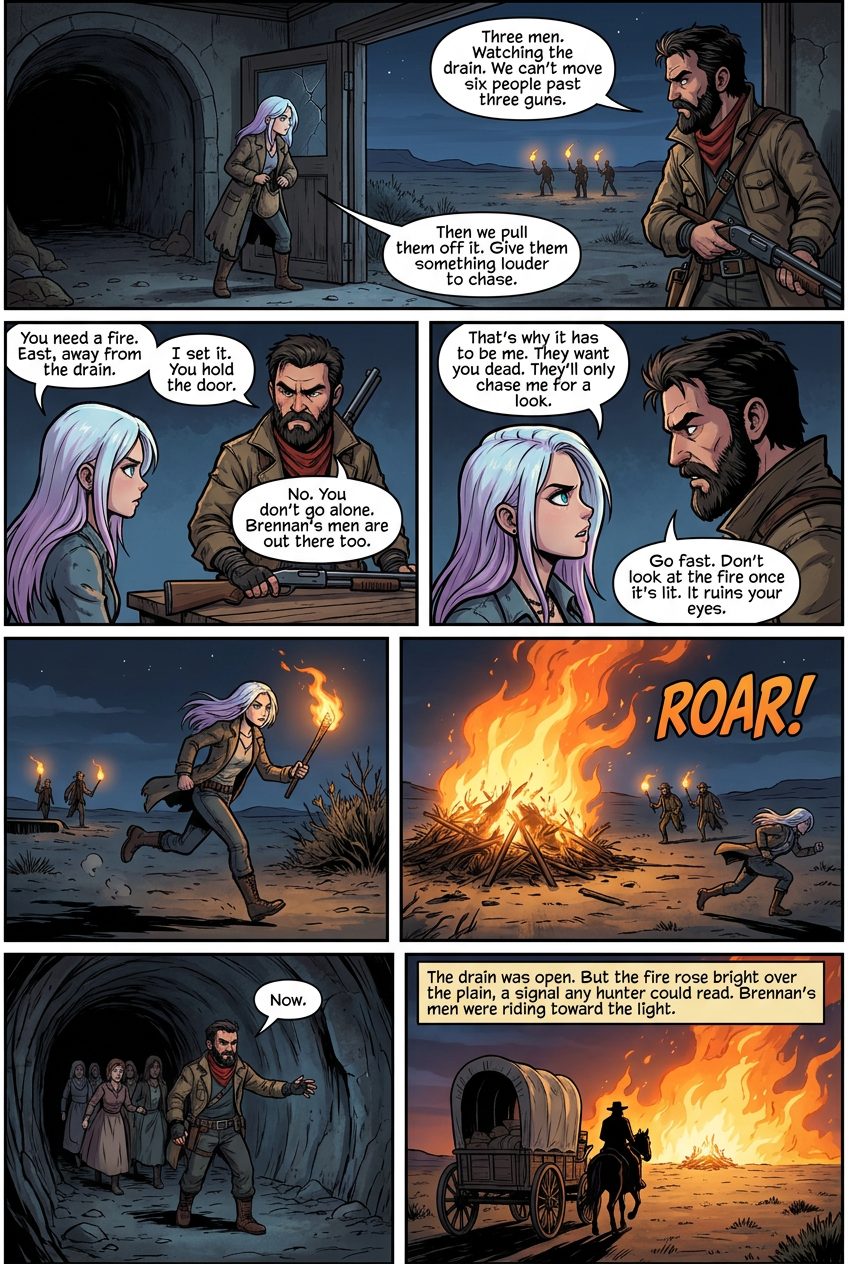
Ellen packed the last water skin into the coat and looked at the black tunnel mouth. Vincent's men waited at the far end, out on the flats. She could not lead six women into their guns. She needed them gone before dawn. She climbed the stairs and cracked the front door. The night was cold and empty. Somewhere past the drain outlet, torchlight moved. Two lights. Maybe three. They were watching the exit. Cade came up beside her, rifle in hand. He counted the lights the way he counted everything. "Three men," Cade said. "Watching the drain. We can't move six people past three guns." "Then we pull them off it," Ellen said. "Give them something louder to chase." Cade studied her. He knew this game. He had helped her stage a false fight in the barn, and a false fire trail on the plain. He did not smile, but he nodded once. "You need a fire," he said. "East, away from the drain. Big enough they leave their post." Ellen thought of the last time she used fire against hunters. It had worked, and it had also brought two bands together. But she had no better tool. She soaked a rag in the last lamp oil and tied it to a length of broken crate. "I set it," she said. "You hold the door. When they run east, you send the women through the tunnel." "No," Cade said. He racked the shotgun off his back and set it on the table. "You don't go alone. Brennan's men are out there too." The name landed hard. Marcus Brennan led eight guns and hunted Cade for burning his town. His men had joined Vincent's. If Ellen drew a crowd, she might draw them all. "That's why it has to be me," Ellen said. "They want you dead. They'll only chase me for a look." Cade held her eyes a long moment. Then he stepped back. "Go fast," he said. "Don't look at the fire once it's lit. It ruins your eyes." Ellen slipped out the rear and ran wide across the flats, east of the drain. She struck the flint. The oil rag caught. She jammed the burning crate into a stand of dry brush and it roared up orange. She did not look at it. She ran back low through the dark. The torches at the drain broke apart. Men shouted. The lights swung east, toward the fire, away from the tunnel. She counted them go. Three. All three. Inside, Cade had the women lined at the tunnel mouth. "Now," Ellen breathed. They crawled through one by one, into the flats the guns had just left. The last woman vanished into the dark. The drain was open. The women were out. But the fire had done more than pull three men. It rose bright over the plain, a signal any hunter could read. Somewhere behind it, Brennan's men would be riding toward the light.
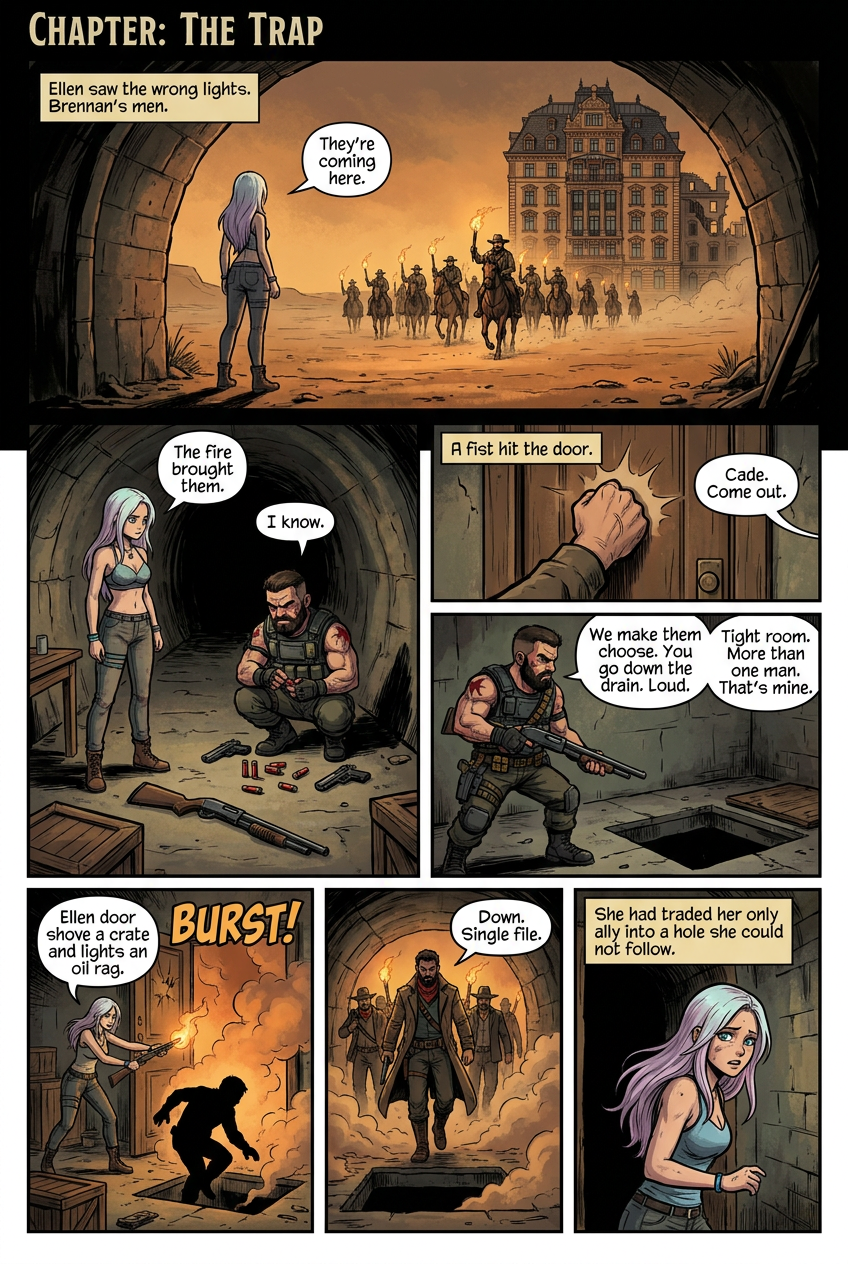
The last woman vanished into the flats. Ellen turned back toward the hotel and saw the wrong lights. Not the three guards chasing her fire. These came from the north, fast, a line of torches on horseback. Brennan's men. The blaze had called them, and they rode straight for the tunnel door. For Cade. Ellen ran. The women were safe on the plain now. But Cade held the door alone, and eight guns were closing. She reached the rear corridor and heard him inside, working the lever of his rifle. She pushed through. Cade crouched at the tunnel mouth, coat dark with sweat, both pistols laid out beside him on the floor. "They're coming here," Ellen said. "All of them. The fire brought them." "I know." Cade did not look up. He counted the shells in his hand. "Get out the drain. Follow the women." "Not without you." "I can't hold eight," Cade said. Flat. He had known it since he set the guns down. A fist hit the front door. Then a shoulder. Wood cracked. A voice came through, low and certain. "Cade. Come out." Ellen knew the name behind that voice. Marcus Brennan. The man who burned Cade's town and hunted him across the plain with seven others. He spoke like he was reading a fact off a page. "You've got one door and one hole," Brennan said. "We're on both." Cade met Ellen's eyes. "He's right. They've got the outlet too." Ellen's plan had opened the tunnel and pulled the guards. It had also lit a beacon for the worst men on Ashplain. The escape route was a trap now, sealed at both ends. She had six women out and one man cornered, and no move left that didn't cost. She grabbed Cade's shotgun off the table. "Then we don't run. We make them choose." She looked at the tunnel. "They want you in a box. So give them the box. You go down the drain. Loud. They'll chase into the dark, one at a time. A tunnel's a tight room. Your weapon." Cade stared at the black tunnel mouth. Then he took the shotgun from her hands. "Tight room. More than one man." A small nod. "That's mine." The front door burst. Ellen shoved the crate against the corridor and lit the last oil rag, filling the hall with smoke and orange light so Brennan's men could not see the drain. Cade dropped into the tunnel and was gone. Brennan came through the smoke first. He saw the empty room, the open drain, and understood. He did not shout. He got quieter. "Down," he told his men. "Single file." They went into the dark after Cade. Ellen slipped out the rear alone. The women were safe. Cade had drawn all eight guns underground, into the one place he could fight them. But she had traded her only ally into a hole she could not follow.
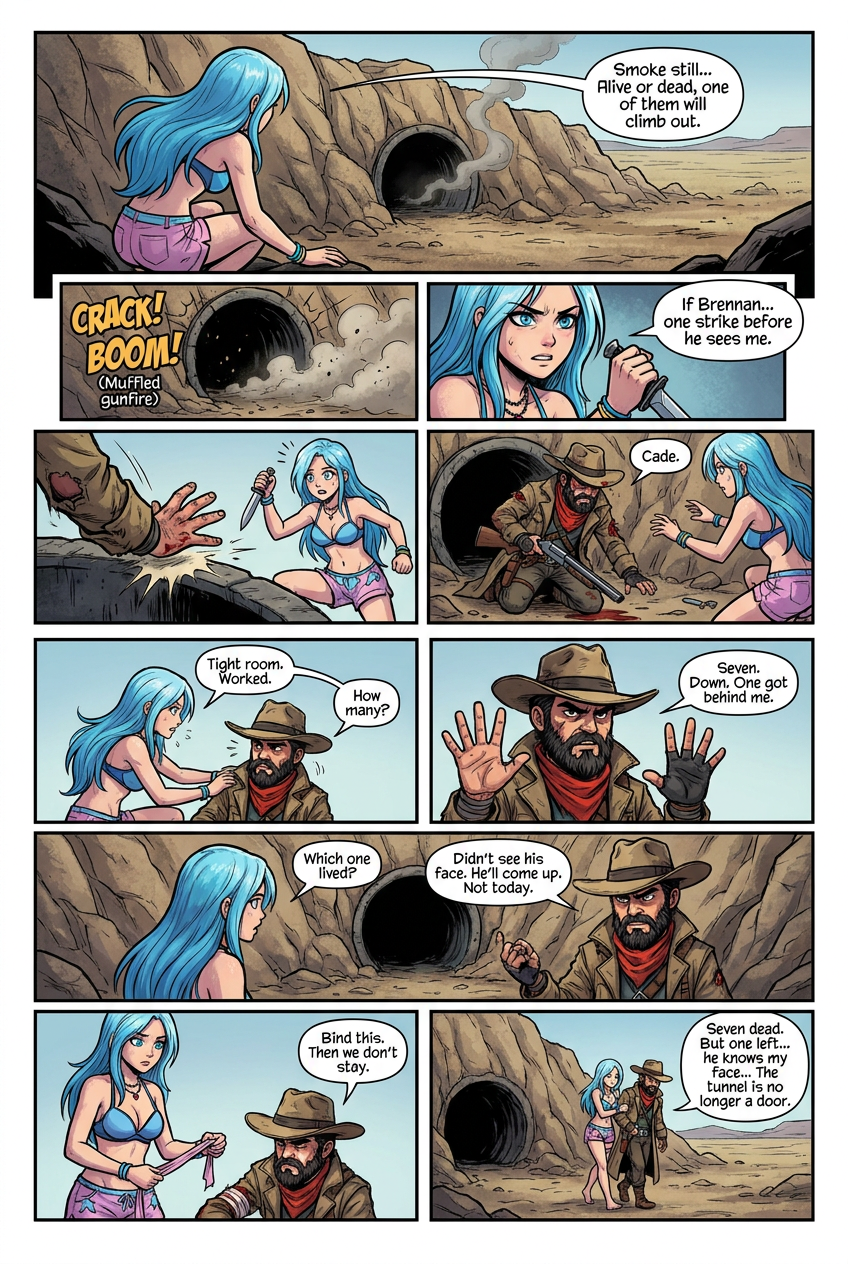
Ellen crouched behind a rock ridge and watched the hotel. Smoke still leaked from the tunnel mouth. She had traded Cade into a hole and could not follow. Below her, the six women waited in the flats, safe for now. But safe meant nothing if Brennan's men came up out of that drain and started hunting. She had to know. Alive or dead, one of them would climb out. She just did not know whose face it would be. Gunfire cracked underground. Muffled. Then a shotgun blast, deeper, that shook dust from the drain lip. Ellen counted the shots the way Cade counted exits. One shotgun. Two pistols. Then a long silence that felt worse than the noise. She crawled closer. The drain outlet sat low in the dirt, black and quiet. She gripped the knife from the cellar cache and waited. If Brennan came out first, she would have one strike before he saw her. It was a bad plan. It was the only one left. A hand slapped the drain edge. A coat sleeve, dark and torn. Ellen raised the knife. Then she saw the low hat, knocked crooked, and the worn coat she knew. Cade dragged himself out into the dirt. Blood ran down his side. He held the sawed-off shotgun in one fist, empty now. "Cade." She dropped the knife and caught his arm. He rolled onto his back and breathed hard. "Tight room," he said. "Worked." "How many?" He held up his other hand. Fingers spread, then two more. "Seven. Down." He swallowed. "One got behind me. He's still down there." Ellen looked at the drain. The dark stayed still. No boots. No breathing. But one meant Marcus Brennan. "Which one lived?" she asked. Cade's jaw tightened. "Didn't see his face." He pressed a hand to his side. "He'll come up. Not today." She pulled his arm over her shoulder and lifted. He was heavy, and his boots dragged, but he stood. Together they moved off the ridge toward the flats where the women waited. Ellen kept glancing back at the drain. It never moved. At the bottom of the ridge, Cade stopped. He looked at the black hole one more time. "Bind this," he said, touching his side. "Then we don't stay near here." Ellen tore her sleeve and wrapped the wound tight. He was alive. That was the answer she came for. Seven of Brennan's eight were dead in the tunnel. The hunt that chased Cade across Ashplain was nearly broken. But one man remained below. She had led the women out to safety, and now the worst of the eight knew their route, their fire, her face. He would come up hurt and alone and certain. Ellen took Cade's weight and walked into the flats, already knowing the tunnel was no longer a door she could use.
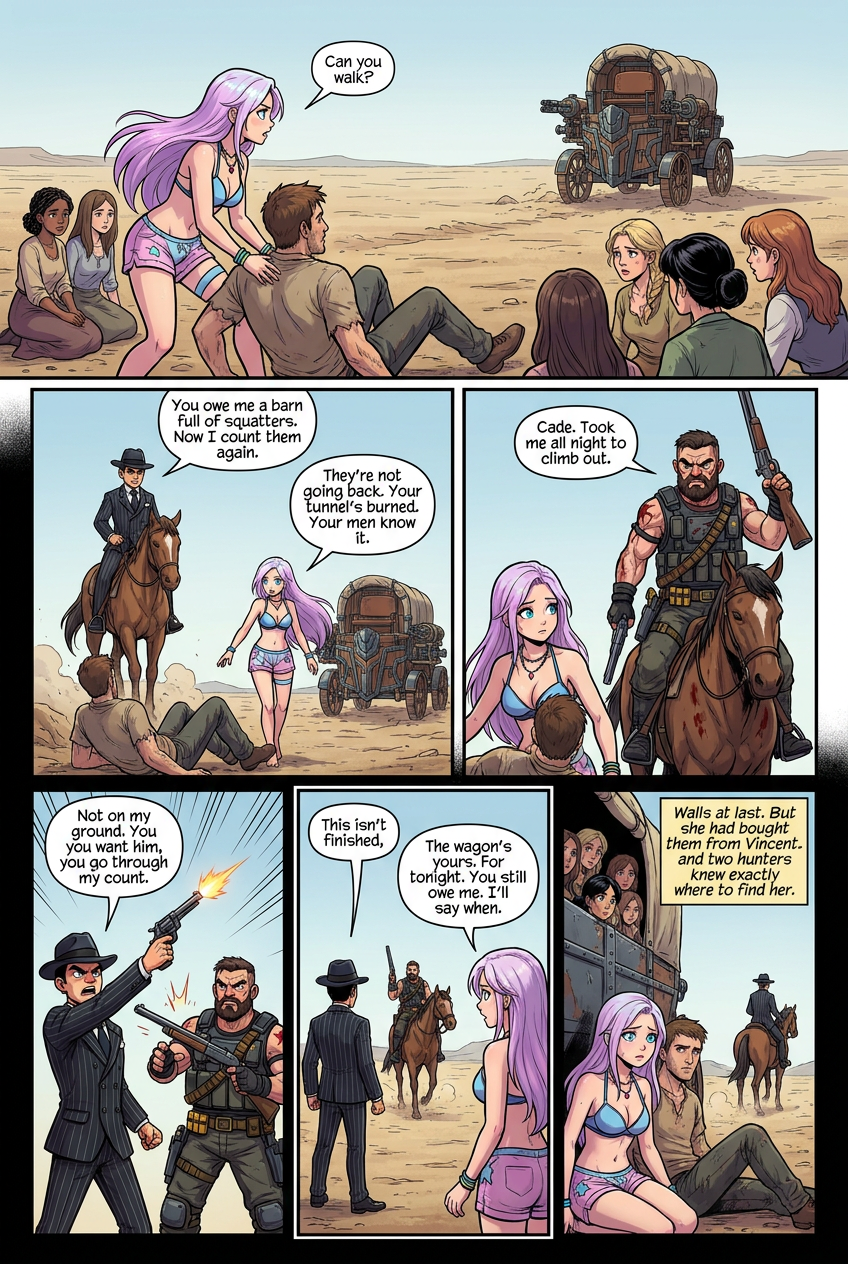
Ellen laid Cade down in the flats and looked at the women around her. Six of them, huddled on bare dirt. No walls. No cover. The plain ran flat in every direction. A single raider band would spot them from far off and finish them. She had pulled everyone out of the tunnel, but she had pulled them into the open. She scanned the ground. To the north sat a dark shape she had passed before. A wagon, half-buried in dust, tilted on broken wheels. She remembered it. Vincent Marconi kept it out here. It was armored, plated in iron, with mounted guns on both sides. Cover, if she could reach it. "Can you walk?" she asked Cade. "If I have to." He gripped her arm and rose. They moved toward the wagon. The women followed close. Halfway there, a rider crested a low rise ahead. Ellen froze. The man reined in and looked down at them. She knew the pinstripe suit and the flat hat. Vincent Marconi. "You owe me a barn full of squatters," Vincent said. He looked at the six women. "Now I count them again." "They're not going back," Ellen said. "Your tunnel's burned. Your men know it. So do I." Vincent studied her the way he studied everyone. She felt him weigh what she wanted and what she feared. "You want the wagon," he said. "I want walls. That's the only thing out here with any." He glanced past her. A second rider appeared to the east, then reined up hard. Not one of Vincent's men. A big man, bearded, blood dried on his vest. He carried more guns than any of them. Ellen's stomach dropped. She had counted seven dead in the tunnel. This was the eighth. "Cade," Marcus Brennan said. His voice came flat and quiet. "Took me all night to climb out." Cade lifted the empty shotgun. It clicked on nothing. Brennan raised his rifle. Vincent moved first. He drew and fired once. Brennan's rifle jerked from his hands. "Not on my ground," Vincent said. "You want him, you go through my count. And I'm not done counting." Brennan held still. He looked at Vincent, then at the iron wagon, then at Ellen. One man against a mounted gun and a gangster. He backed his horse a slow step. "This isn't finished," he said, and turned east. Vincent watched him ride off. Then he looked at Ellen. "The wagon's yours. For tonight." He holstered the pistol. "You still owe me. I'll say when." He wheeled his horse and left. Ellen got the women behind the iron plating and pulled Cade into its shadow. Walls at last. But she had bought them from Vincent, and the debt sat heavier now. Brennan was alive and gone east, wounded and certain. She had cover for one night, and two hunters who both knew exactly where to find her.
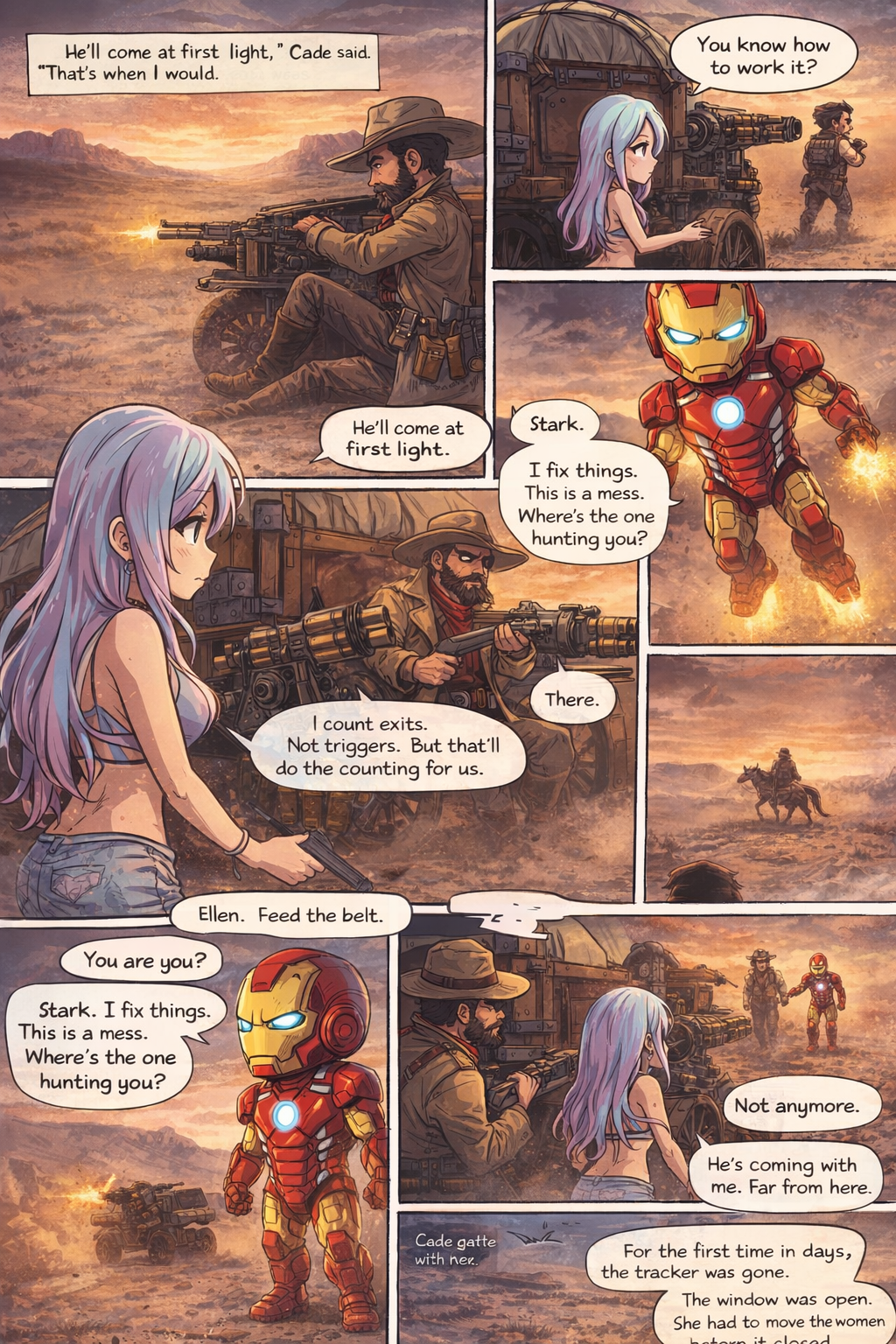
Dawn came gray over the flats. Ellen crouched behind the iron wagon and watched the plain. The women slept behind the plating. Cade sat against a wheel, feeding shells into his shotgun. His wound had crusted overnight. She had walls now, but only for one night, and the night was ending. Somewhere east, Brennan's last gunman still rode. That man knew her face. He knew this wagon. Until she lost him, she could not move the women anywhere. "He'll come at first light," Cade said. "That's when I would." Ellen studied the wagon's side. A row of Gatling barrels hung there, bolted to a swivel mount. Old, but greased. She turned the crank a half-turn. It held. "You know how to work it?" she asked. "I count exits. Not triggers." Cade nodded at the barrels. "But that'll do the counting for us." A sound cut across the flat. Not a horse. A low mechanical whine, climbing. Ellen turned. A figure walked toward them out of the dust, red and gold, plated in metal that caught the pale light. Each step pressed the dirt flat. She did not know him. She reached for her knife. "Save it," the man said. His faceplate glowed at the eyes. "You've got a shooter tracking you from that ridge. I've been watching him watch you." "Who are you?" Ellen said. "Stark." He did not slow. "I fix things. This is a mess. Where's the one hunting you?" A rifle cracked from the east. The round sparked off Stark's shoulder and spun away. He turned toward the shot without flinching. The gunman had broken cover on a rise, firing, giving up his hiding place at last. "There," Cade said. He swung onto the wagon and gripped the crank. "Ellen. Feed the belt." She grabbed the ammunition chain and lifted it clear of the dirt. Cade cranked. The Gatling barrels spun and roared. Brass rained past her boots. The rise vanished in a wall of kicked-up dust and splinters. The gunman fired twice more, wild, then broke and ran for his horse. "He's rabbiting," Stark said. A panel opened on his forearm. He lifted off the ground, low and fast, and cut across the flat. The gunman never reached the saddle. Stark dropped in front of him, one gauntlet raised, and the man froze with his hands up. Cade climbed down, shotgun ready. Ellen ran to them. The gunman looked at the armored figure, then at Cade, and dropped his rifle. "Last of Brennan's eight," Cade said. He did not raise the gun. "He knows where we sleep." "Not anymore," Stark said. He hauled the man up by the collar. "He's coming with me. Far from here. You've got a window now. Use it." Ellen watched the armored man march the gunman east, away from the wagon, away from the women. For the first time in days, no one on the plain knew where she would go next. The tracker was gone. But Brennan still lived, and Vincent still counted her debt. The window was open. She had to move the women before it closed.
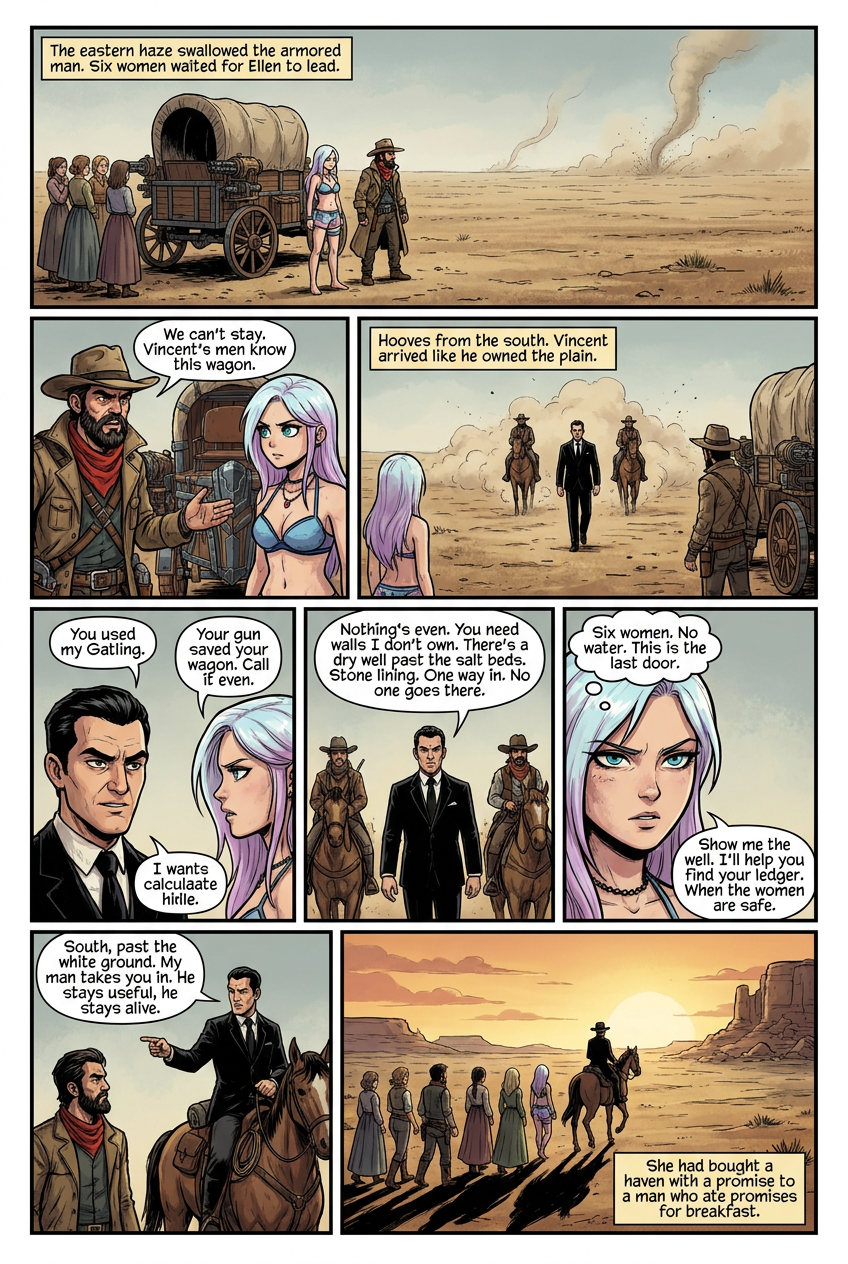
The armored man shrank to a dot in the eastern haze. Ellen turned back to the wagon. Six women watched her from the shadow of the plating, waiting to be told where to run. She had a window now, and no place to send them. The flats stretched flat and open in every direction. Out here, anyone with a horse would spot them by noon. "We can't stay," Cade said. "Vincent's men know this wagon." He was right. The wagon was Vincent's, and Vincent counted her debt like a coin in his pocket. Ellen knelt and scratched a line in the dust with her knife. She had no map. She only had the man who owned half this plain. Hooves came from the south. Two riders, then Vincent on foot between them, his black suit clean against the dirt. He walked to the wagon like he owned it, because he did. His eyes moved over the women, over Cade's crusted wound, over Ellen. Five seconds, and he knew all of it. "You used my Gatling," Vincent said. Not a question. "Your gun saved your wagon," Ellen said. "Call it even." "Nothing's even." He looked east, where Stark had vanished. "Your tracker's gone. That won't last. Brennan still breathes." He let it sit. "You need walls I don't own." Ellen stood. "You have a place." "I have many." Vincent studied her. He knew what she wanted before she said it, and he knew what it would cost her. "There's a dry well past the salt beds. Stone lining. One way in. No one goes there. Not even mine." He paused. "It's yours. For the ledger." "I already keep your ledger secret," Ellen said. "Now you help me find it." Flat. No softening. "That's the price of a roof." Cade's hand drifted toward his hip. Ellen stopped him with a look. Six women behind the plating. No water past nightfall. No walls. She had spent every trick she owned. This was the last door, and Vincent held the key. "Show me the well," she said. "I'll help you find your ledger. When the women are safe. Not before." Vincent nodded once. He mounted, and one rider swung down to lead them. "South, past the white ground. My man takes you in." He looked at Cade. "He stays useful, he stays alive. That's on you." The riders turned. Ellen waved the women out of the shadow and onto the plain. They walked south in a tight line, Cade at the rear, watching every rise. The dry well waited past the salt beds, stone-walled, hidden, with one way in and out. She had a haven now. She had bought it with a promise to hunt a ledger for a man who ate promises for breakfast. The women would sleep behind stone tonight. And Vincent Marconi owned another piece of her.
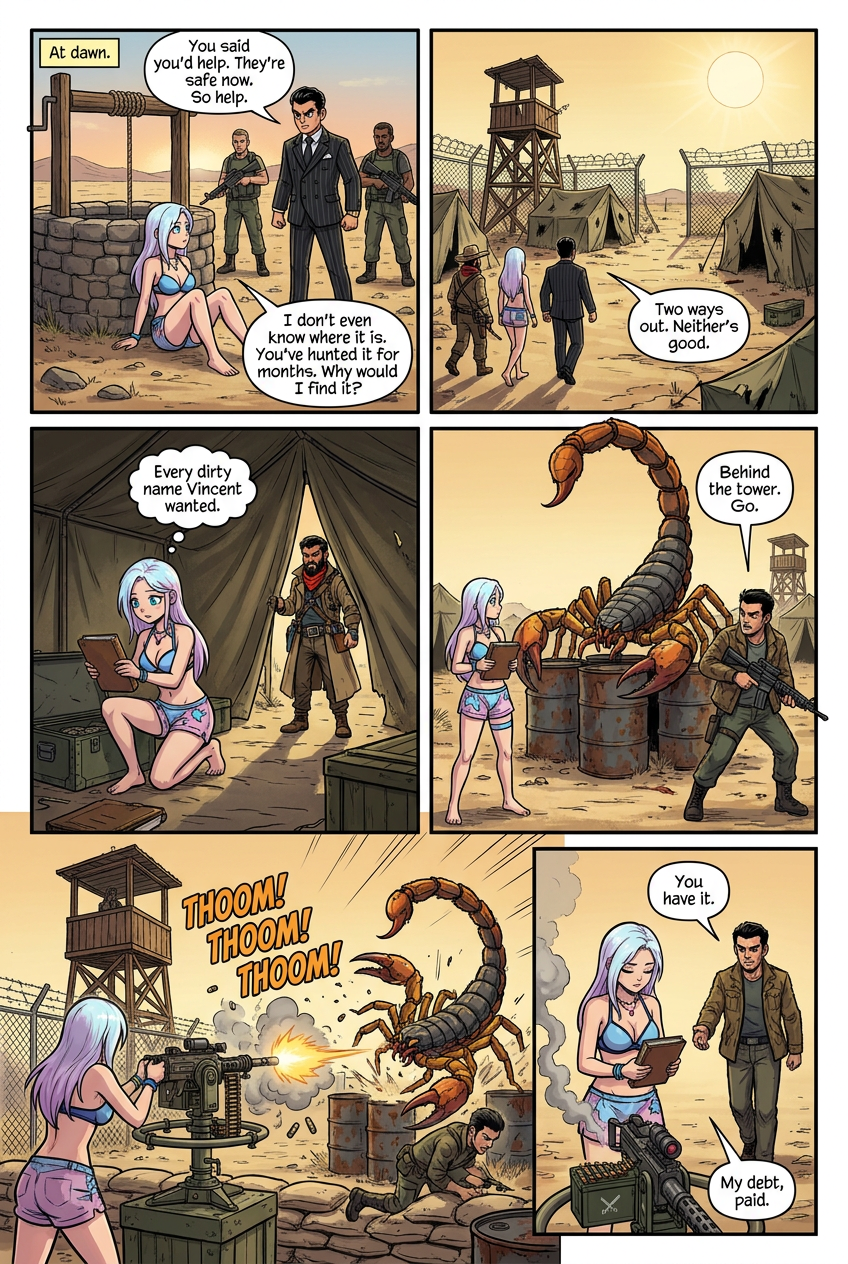
The women slept behind stone. Ellen sat at the mouth of the dry well and watched the salt beds turn gray at dawn. She had bought this roof with a promise, and Vincent Marconi did not forget promises. He would come for the ledger. Until she found it, he could open his hand and let the women fall. He came at first light, two riders behind him. He climbed down into the well without asking and stood among the sleeping women like a man counting cattle. "You said you'd help," he said. "They're safe now. So help." "I don't even know where it is," Ellen said. "You've hunted it for months. Why would I find it?" "Because I know where it isn't." Vincent crouched by her line in the dust. "A cop hid it. He kept a stash on the plain. Old army camp, north past the wash. My men won't go near it. They say the place is cursed." His mouth moved, almost a smile. "You've got a man who counts exits. Take him." Cade was already awake, back to the stone, rifle across his knees. He heard his own description and said nothing. They went north on foot. The camp sat behind a fence of sagging wire. Torn tents. Rusted drums. A watchtower leaning like a broken tooth. Dried blood blackened the sandbags. Cade stopped at the wire and counted the openings before he stepped through. "Two ways out," he said. "Neither's good." Ellen found the footlocker inside the largest tent. She pried the lid with her knife. Papers, oilcloth, a leather book stuffed with names and numbers. The ledger. She held it up so Cade could see. The sand moved. A scorpion rose from behind the drums, taller than a horse, its tail curled high over armored plates. Its claws clicked open. Ellen froze with the book against her chest. This was why Vincent's men stayed away. "Behind the tower," Cade said. "Go." He fired. The rifle rang off the shell and did nothing. The scorpion lunged. Ellen ran for the watchtower base, ledger clamped tight. Then she saw the weapon bolted there, half-buried in the sand, its long belt of stubby rounds still fed into the breech. A grenade gun on a swivel mount. She threw herself behind it and wrenched the barrel down. Cade saw and dove clear. Ellen found the trigger and held it. The gun coughed rounds in a hard rhythm. They burst against the scorpion's face and legs. It screamed, thrashed, curled in on itself, and went still. Smoke drifted off the drums. Her ears rang. She still held the ledger. Cade rose from the sand. "You have it." Ellen looked at the book. Every dirty name Vincent wanted. Her debt, paid. But whoever hid it would want it back, and now she carried the thing that could get her killed. She had a haven behind stone. In her hands she held the price of keeping it.
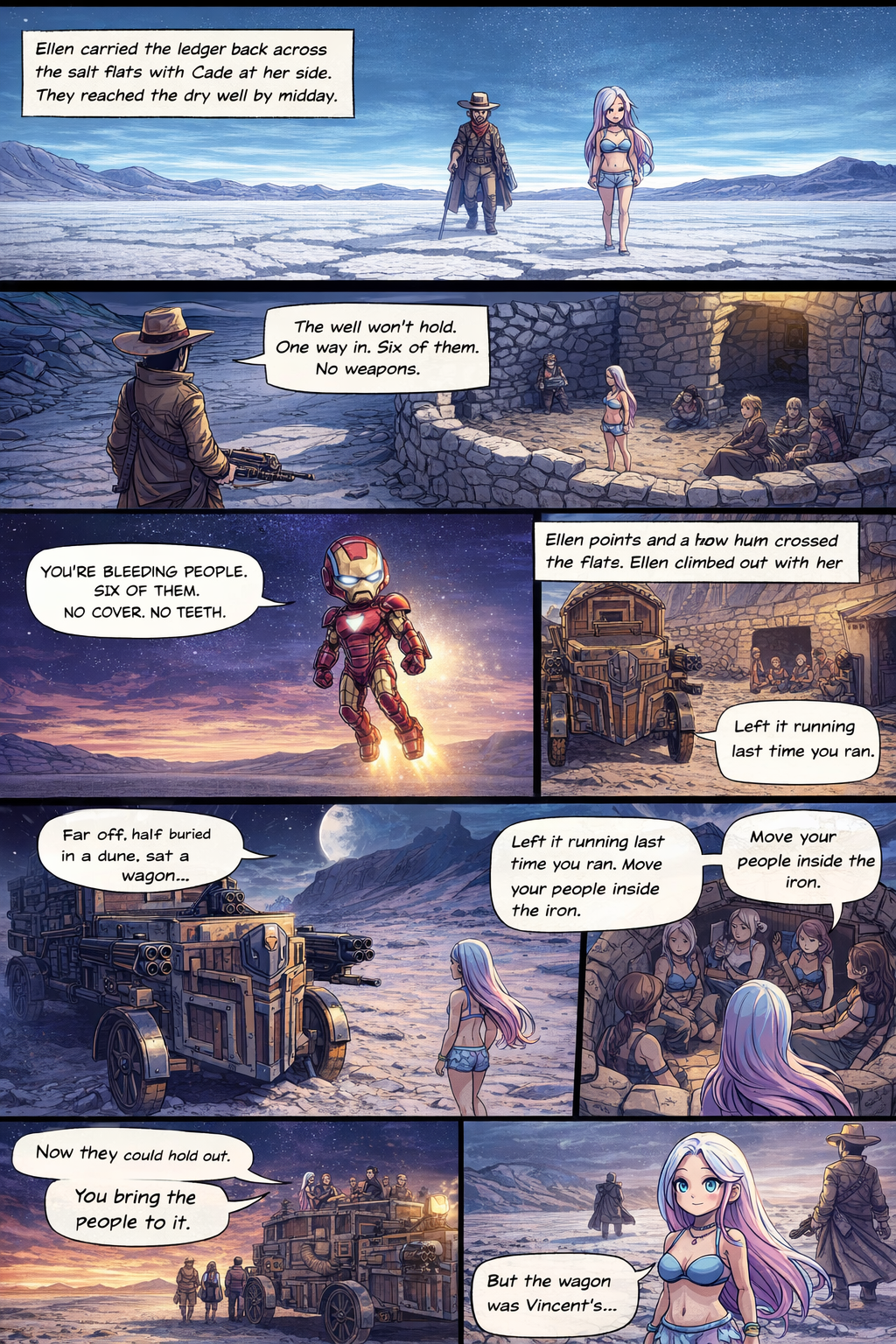
Ellen carried the ledger back across the salt beds with Cade at her side. They reached the dry well by midday. The six women waited below, hollow-eyed and thin. She counted them the way she counted everything now. No guns. No spears. Nothing but the knife on her belt. Vincent could keep his roof today. Tomorrow a raider band could stroll in and take everything. A wall of stone meant nothing if six tired women could not hold it. Cade climbed down and set his rifle across his knees. "Well won't hold," he said. "One way in. Six of them. No weapons." He did not soften it. Ellen already knew. She looked at the tired faces below and understood that shelter was not the same as safety. That evening a low hum crossed the flats. Ellen climbed out with her knife ready. A shape came down out of the dark sky, red and gold, engines throttling back. It landed hard and folded its arms. She knew the armored man. He had taken Brennan's last gunman off the plain and vanished. Now he stood over her again, faceplate glowing. "You're bleeding people," Stark said. He nodded at the well. "Six of them. No cover. No teeth." He stated it like a fact he was done examining. "I know what we don't have," Ellen said. "Tell me something I can use." Stark turned east. Far off, half-buried in a dune, sat a wagon. Ellen knew it. Vincent's armored wagon, the one they'd fled in. Its iron plates still stood. Two Gatling guns hung from its sides, and a boxy grenade launcher was bolted to its rear rail. "Left it running last time you ran," Stark said. "Barrels are hot. Belts are half full." He looked at her. "Move your people inside iron. Then the guns matter." Ellen looked at the wagon, then at the well. The well was a hole. The wagon was a fort that moved. "We can't drag it here." "You don't drag the fort," Stark said. "You bring the people to it." That was the whole answer. Ellen turned and called down into the well. She and Cade got the women up the rope one at a time. They walked them across the flats in the dark. Cade counted the ground. Stark walked overhead, engines low, watching the horizon for riders. By dawn all six women sat behind iron plate. Cade checked the belts and swung a Gatling barrel to test the mount. It turned free. The grenade gun still held rounds. For the first time, Ellen had walls that could shoot back. Stark lifted off without a word and shrank into the east. Ellen stood at the wagon's rail and looked at the women behind steel. They could hold this now. But the wagon was Vincent's, and Vincent did not lend iron for free. She had traded one landlord's roof for another man's guns, and both would come to collect.
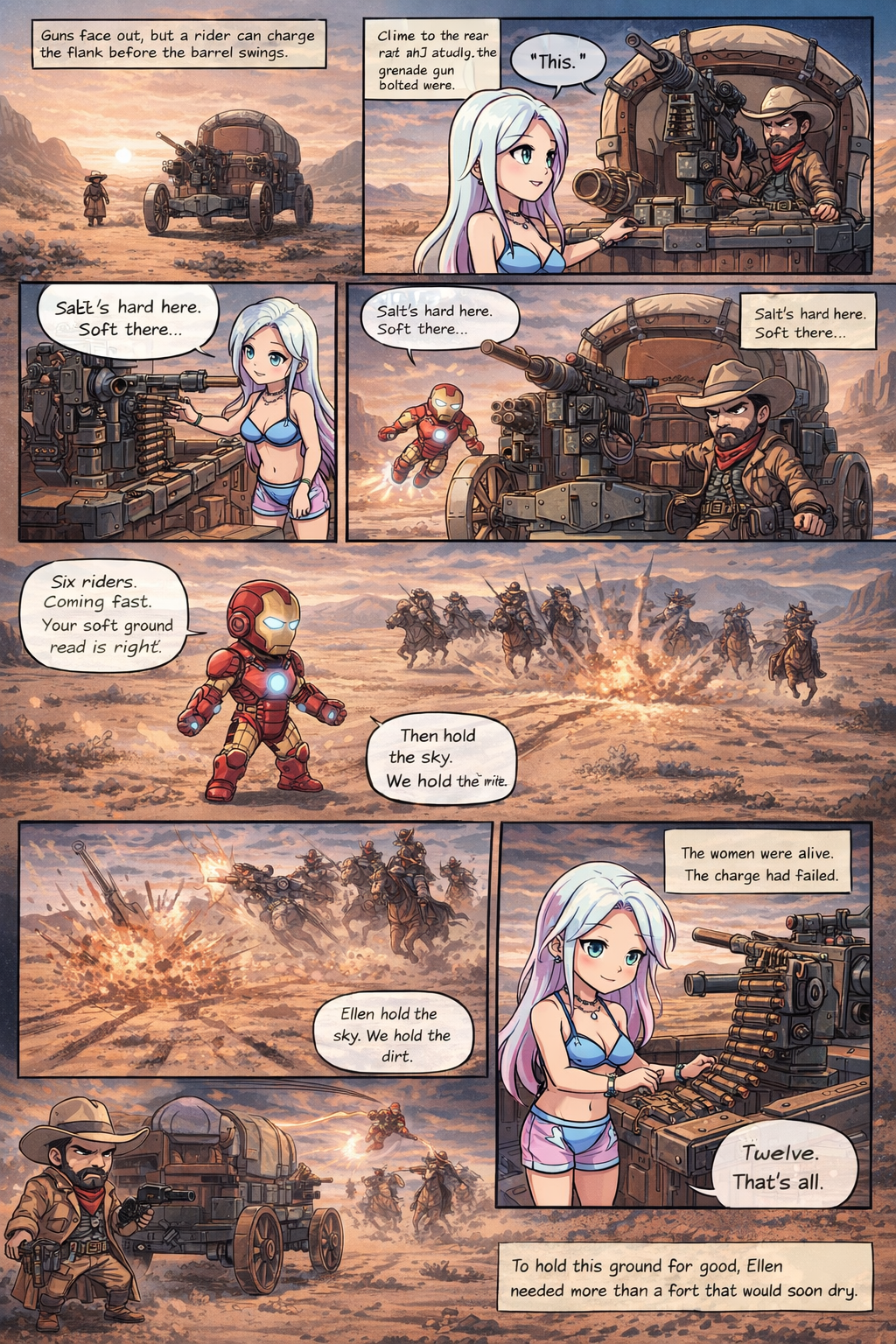
The wagon gave Ellen guns but no walls. Its iron plates covered the box and the seats, but the flats around it lay open in every direction. Cade walked a slow circle at dawn and came back grim. "Guns face out," he said. "But a rider can charge the flank before the barrel swings." One fast horse across open ground could reach them before the Gatling turned. Ellen looked at the tired women behind the plate and knew a single charge could end them. She climbed to the rear rail and studied the grenade gun bolted there. It was a squat military weapon, boxy and heavy, its belt of stubby rounds fed from a green ammo can. It did not need a clean hit. It threw fire in an arc and burst wide. "This," she said. "We aim it at the ground where a rider would cross. Not at the man. At the dirt." Cade understood at once. He paced the flat and marked the two lines a horse could use. "Salt's hard here. Soft there." He drove his heel in. "They'll come across the soft ground. Faster footing." Ellen swung the grenade gun and ranged it on the soft strip. She and Cade set the belt, checked the feed, and waited. The hum came near noon. A shape dropped from the sky, red and gold, and landed hard beside the wheel. It was the armored man who had guided them to this wagon and pulled Brennan's last gunman off the plain. Stark. His faceplate glowed as he pointed east. "Six riders. Coming fast. Your soft ground read is right." "Then hold the sky," Ellen said. "We hold the dirt." Stark lifted off without another word. The riders came low and hard across the flat, dust behind them, guns up. They took the soft strip, exactly as Cade said. Ellen let them close. Then she fired the grenade gun. The rounds walked across the soft ground in a line of bursts. Dirt and fire jumped up in a wall. The lead horse reared and threw its rider. The second slammed into the first. The charge broke apart, men and horses scattering wide of the wagon. Cade opened up with the Gatling, sweeping the flank while they were tangled. Stark dropped from above and pinned the two who tried to circle. In a minute the flat went quiet. The surviving riders wheeled and ran east. Ellen lowered the grenade gun. Her hands shook. The women were alive. The charge had failed. But the belt in the ammo can was near empty now. She had spent most of what the wagon carried to break one charge. Cade thumbed the last rounds and counted them out loud. "Twelve," he said. "That's all." The walls could shoot back, but not for long. To hold this ground for good, Ellen needed more than a fort that would soon run dry.
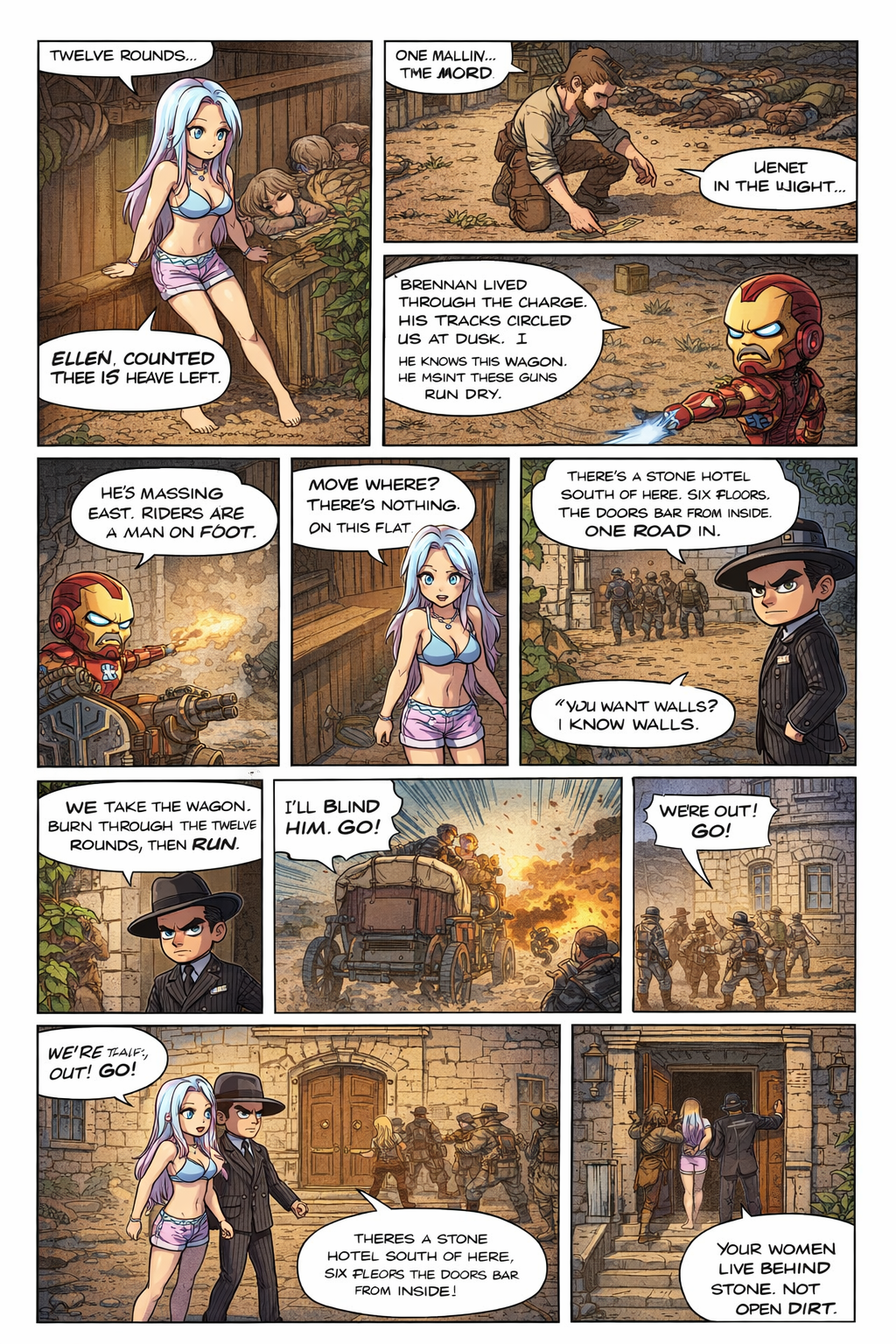
Twelve rounds. Ellen counted them in her head all night. At first light Cade came back from his walk with worse news. He knelt in the dirt and drew a line with his finger. "Brennan lived through the charge," he said. "His tracks circled us at dusk. He knows the wagon. He knows the guns run dry." Ellen looked at the six women asleep behind the plate. One more push and Brennan would take them all. A hum crossed the flats. Stark dropped beside the wheel, his faceplate glowing. He had pulled Brennan's last gunman off the plain days ago, but he did not deal in comfort. "He's massing east," Stark said. "Riders and a man on foot. You don't have the ammo to hold this ground. Move, or he pins you here." "Move where?" Ellen said. "There's nothing on this flat but us." Another voice answered from the dust. Vincent Marconi walked in from the west, hat low, suit gray with grit. He owned this wagon. He owned half her breaths. He stopped and looked at the sleeping women, then at Ellen, the way he read every stranger. "You want walls," he said. "I know walls." "You always know something," Ellen said. "What's it cost." "Later," Vincent said. He named it flatly, like a street fact. "There's a stone hotel south of here. Old. Six floors. The doors bar from inside. One road in. A man on the steps can hold it against ten." He met her eyes. "Your women live behind stone, not open dirt." Ellen weighed it. Brennan was massing east. The hotel lay south. If she ran now, she put stone between her people and his guns before the guns here ran empty. "We take the wagon," she said. "We use the twelve rounds to break clear, then run." Stark lifted off. "I'll blind him. Go." He shot east and hammered the ground where Brennan's riders gathered. Dust and fire climbed. The riders scattered to cover their eyes. Ellen drove the wagon south with Cade on the Gatling. Brennan's men wheeled after them through the haze. Cade spent the last twelve rounds in short bursts, cutting down two horses and holding the rest back. Vincent hung off the rail and pointed the road. The stone hotel rose ahead, tall and square, its high windows dark, its front doors thick as a table. The wagon slid to a stop at the steps. The women poured out and through the doors. Cade dropped the empty Gatling and drew his shotgun. Ellen and Vincent shouldered the doors shut and dropped the bar. Outside, Brennan's riders pulled up short at the one road in, out of range. Ellen leaned on the cold stone and breathed. Brennan knew where they were now. But he no longer faced open dirt. He faced six floors of walls and one road he had to climb.
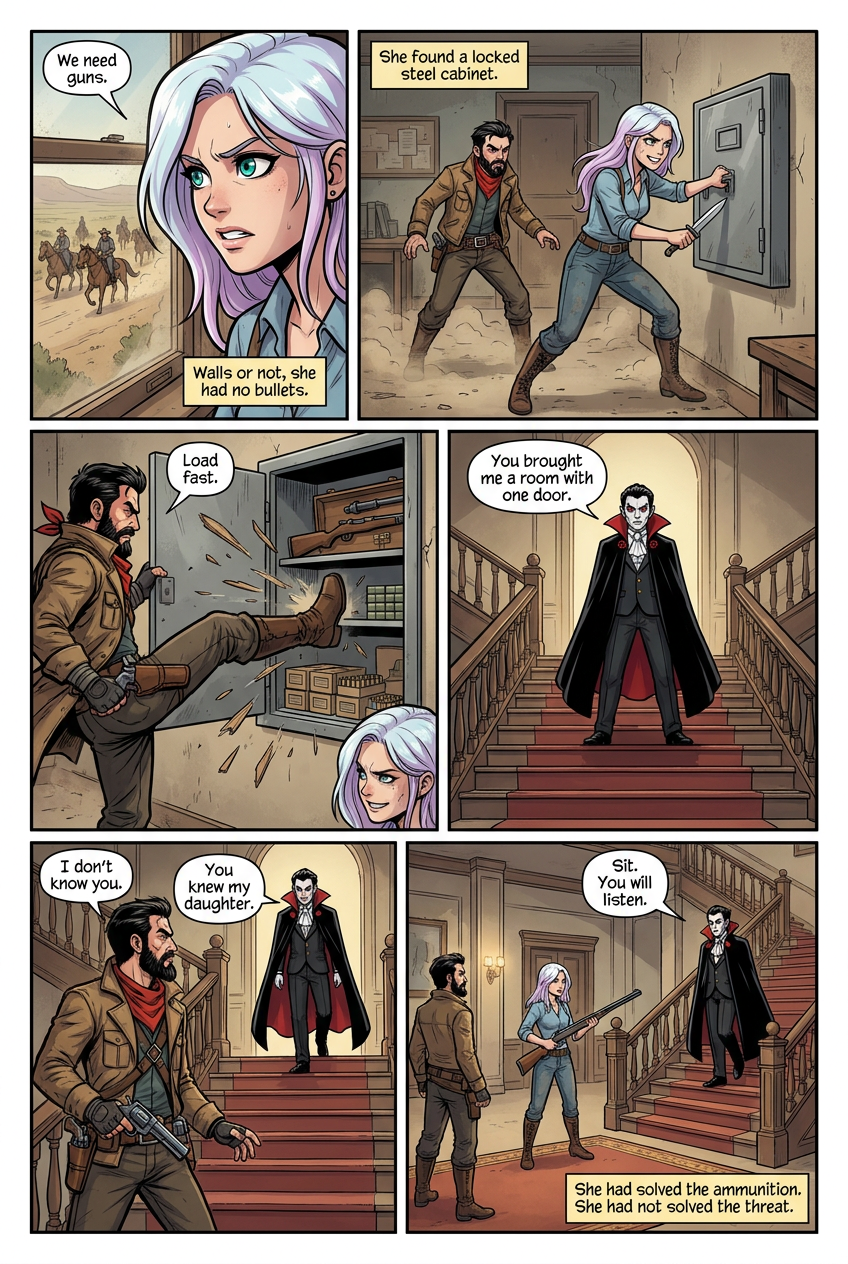
The bar held. Ellen pressed her ear to the door and listened to Brennan's riders wheel back from the road. Walls or not, she had no bullets. Cade's shotgun held two shells. His pistols held twelve rounds between them. Fourteen shots for six floors and one road. She turned from the door and faced the dark lobby. Somewhere in this old hotel, travelers had come and gone for years. Travelers left things behind. "We need guns," she told Cade. "Search the rooms. People leave gear when they run." Cade counted the exits first, the way he always did. Then he nodded and took the stairs. Ellen went with two of the women through the ground floor. They pried open closets and dragged out mattresses. Dust choked the air. In a back office she found a locked steel cabinet built into the wall. The knife would not turn the lock. She called for Cade. He came down, looked at the seam, and put a boot to it twice. The door sprang. Inside sat a long wooden case and three ammunition boxes stacked in the corner. Ellen lifted the lid of the case. Two rifles lay on cloth, oiled and clean. The boxes held rounds, hundreds of them, sorted by caliber. Some fit the rifles. Some fit Cade's Colts. A traveler had built a stash here and never returned for it. Ellen laughed, short and rough. "Now we can hold the door." "Load fast," Cade said. He was already thumbing shells into his shotgun. Then a voice came from the top of the stairs. Quiet. Cold. "You brought me a room with one door." A man stood on the landing in a black coat, pale as bone, red at the collar. He had come down from the upper floors, not in from the road. He was already inside. His eyes were not on Ellen. They fixed on Cade. "Eleven years," the man said. He did not raise his voice. "I have cornered you three times. You will not slip me here." Cade went still. His hand hovered near his hip. "I don't know you." "You knew my daughter." The man came down one step. "She was seven." Ellen looked between them. This stranger had been in the hotel before her group ever arrived. He wanted Cade, not the women. That much she read in his face. She raised a rifle from the case, but the man ignored it, as if lead meant nothing to him. "Sit," the man told Cade. "You will listen. Every word. Then I finish it." Outside, Brennan waited on the road. Inside, this man waited on the stairs. Ellen had walls now, and bullets, and a killer already past the door she thought would save her people. She had solved the ammunition. She had not solved the threat standing between her and the stairs.
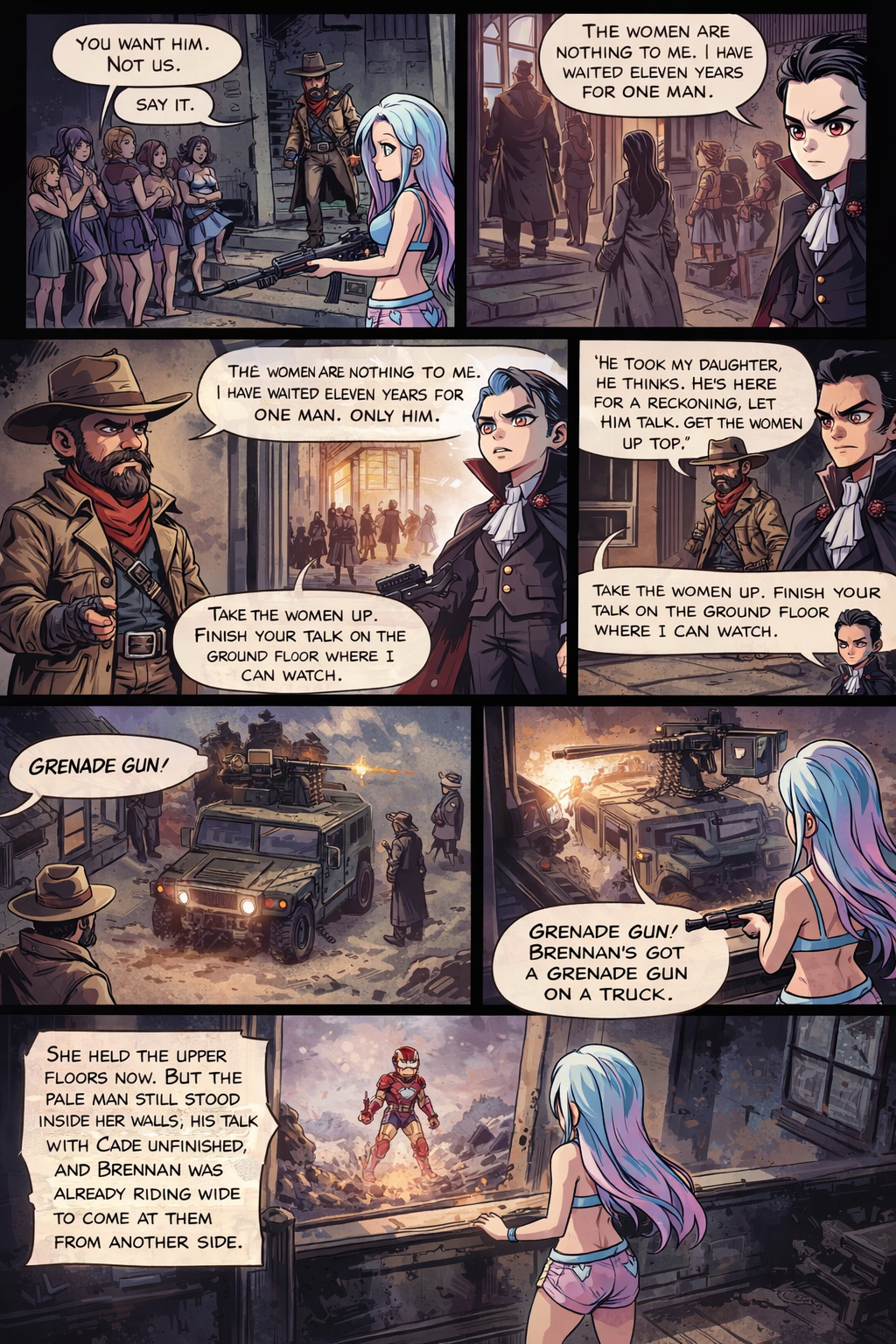
The pale man came down another step. Cade did not sit. Ellen stood between them with the rifle still raised, but the man never looked at the barrel. Six women huddled behind her in the dark lobby. She needed the upper floors to defend the road. She needed to know if this stranger meant to kill her people or only Cade. "You want him," Ellen said. "Not us. Say it." The man's red eyes moved to her for the first time. "The women are nothing to me. I have waited eleven years for one man. Only him." Cade spoke low. "He took my daughter, he thinks. He's here for a reckoning. Let him talk. Get the women up top." Ellen weighed it fast. If she trusted the pale man's word, she could clear the stairs and set her shooters at the high windows before Brennan charged again. If she was wrong, she handed the women to a killer. But the man had held the upper floors for days and touched none of them. He had waited for Cade alone. She believed him. "Take the women up," she told Cade's back. "You stay down here with him. Finish your talk on the ground floor where I can watch." The pale man tilted his head. Then he stepped aside from the stairs. "Send them up. I will not follow." Ellen moved the six women past him one by one. He stood flat against the wall and let them pass. Not one flinched at his reach. She led them to the third floor and broke the shutters open. Below, the road ran straight to the door. She set two women at each window with rifles and showed them how to work the bolts. Then boots sounded on the road. Brennan's riders massed at the far end, and behind them a low mechanical whine grew. A vehicle rolled up with a boxy gun bolted to its bed, a long belt of fat rounds feeding the breech. Ellen knew that shape. She had killed a scorpion with one like it. "Grenade gun," she called down to Cade. "Brennan's got a grenade gun on a truck." Cade appeared at the base of the stairs, the pale man behind him. For one breath the two hunters stood side by side, both looking out at the same enemy. Then a streak of red fire dropped from the sky and split the truck open. Stark landed in the road, armor scorched, one hand still smoking. "Grenade gun's done," Stark said. He did not look up. "Brennan pulled back. He'll circle. You've got maybe an hour." Ellen gripped the third-floor sill and breathed. She held the upper floors now. She had shooters at the windows and the road covered. But the pale man still stood inside her walls, his talk with Cade unfinished, and Brennan was already riding wide to come at them from another side.
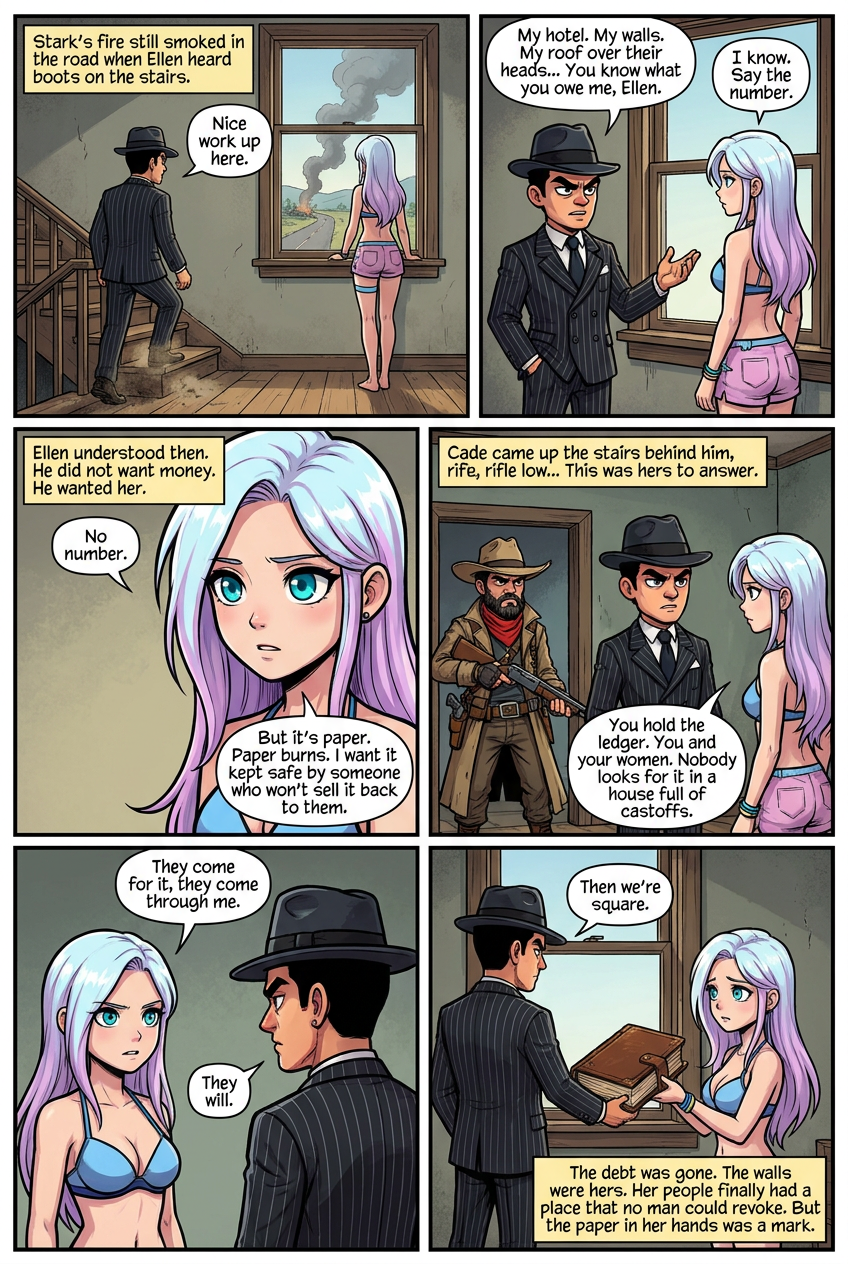
Stark's fire still smoked in the road when Ellen heard boots on the stairs. She turned from the third-floor window. Vincent Marconi climbed the last steps in his pinstriped suit, dust on his polished shoes, unhurried. He was the man who had given her water, hidden her shelter, and lent her every wall she now stood behind. Every one of those gifts was a debt. He had come to collect. "Nice work up here," Vincent said. He looked at the six women at the windows, the rifles, the covered road. "My hotel. My walls. My roof over their heads." He let it sit. "You know what you owe me, Ellen." "I know," Ellen said. "Say the number." "No number." Vincent stepped to the sill and looked down the road where Brennan had pulled back. "The ledger you brought me names every dirty cop I've hunted for years. It's worth more than this building." He turned. "But it's paper. Paper burns. I want it kept safe by someone who won't sell it back to them." Ellen understood then. He did not want money. He wanted her. "You hold the ledger," Vincent said. "You and your women. Nobody looks for it in a house full of castoffs. The debt clears. The hotel is yours to keep, so long as the book stays here." Cade came up the stairs behind him, rifle low, the pale man not with him. Cade counted the room, then looked at Ellen. He said nothing. This was hers to answer. Ellen weighed it fast. If she took the ledger, she took Vincent's enemy for her own. Dirty men would come looking. But she would own the walls outright. No more borrowed roof, no debt hanging over the women each dawn. A place they could hold. "They come for it," Ellen said, "they come through me." "They will," Vincent said. Flat, no softening. Ellen looked at the six women. One of them nodded. "We keep it," Ellen said. "The hotel's ours." Vincent drew the ledger from inside his coat and set it on the sill. He did not shake her hand. He straightened his hat. "Then we're square." He went down the stairs the way he came. Ellen picked up the book. It was heavier than it looked. The debt was gone. The walls were hers. Her people finally had a place that no man could revoke. But the paper in her hands was a mark. Somewhere out there, men who killed to keep it buried now had one address. And Brennan was still riding wide in the dark, circling the only house Ellen could not walk away from.
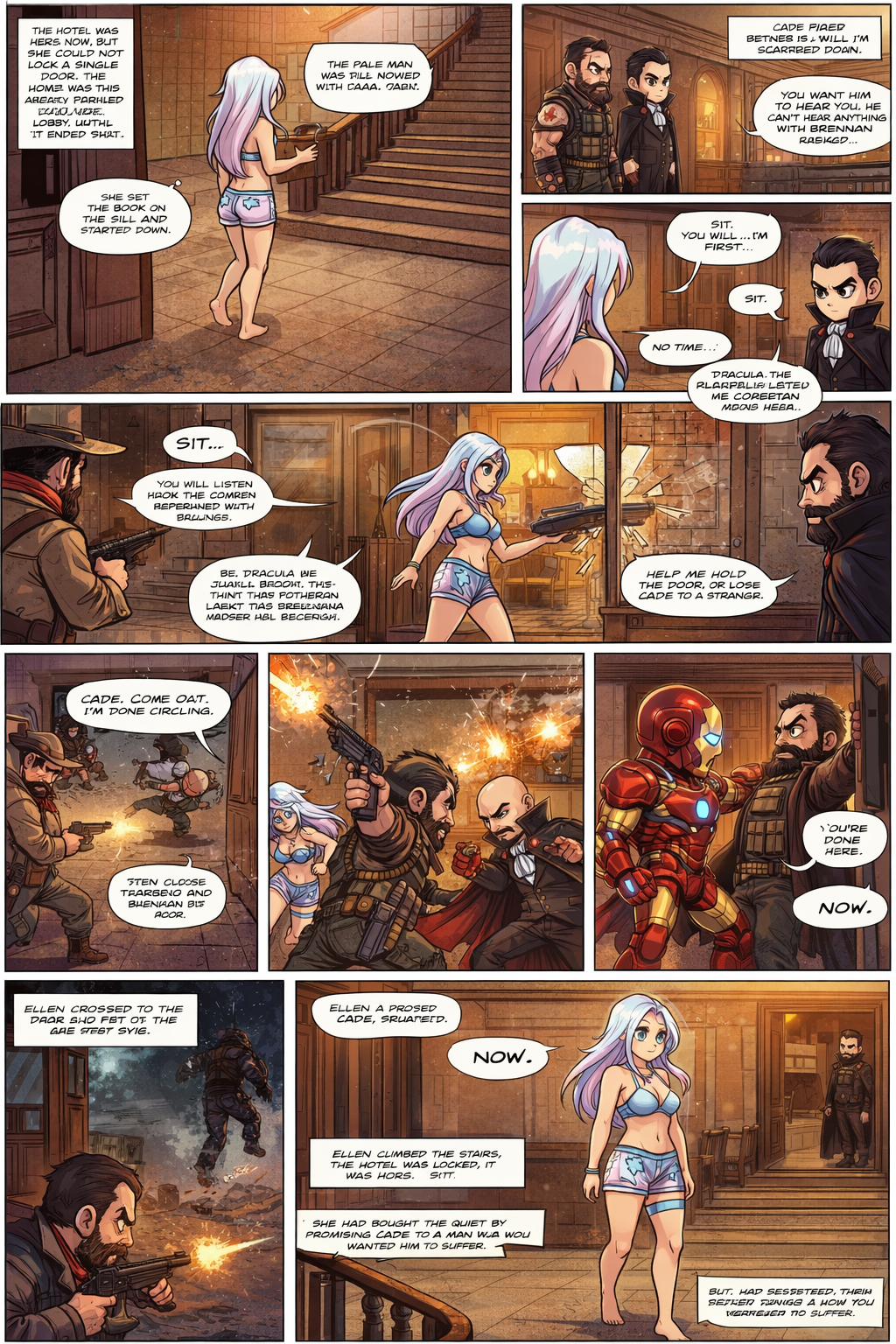
Ellen held the ledger and looked down the stairwell. The hotel was hers now, but she could not lock a single door. The pale man was still below with Cade. Their eleven-year quarrel filled the lobby, and until it ended, the building was open to anyone who came looking. She set the book on the sill and started down. She found them in the lobby. The pale man in the black coat stood near the cold hearth. Cade faced him, rifle low, both Colts still holstered. This was Dracula, the man who had chased Cade across the plains, certain Cade killed his seven-year-old daughter. He wanted Cade to hear every detail of what was taken before he finished it. "Sit," Dracula said. His voice was quiet and hard. "You will listen first." "No time," Cade said. He counted the windows without moving his head. Ellen stepped between them. "You want him to hear you," she said to Dracula. "He can't hear anything with Brennan riding the road." Dracula's red eyes moved to her. "That is not my concern." "It is now," Ellen said. "Brennan burned Cade's town. He wants him dead fast. You want him slow. You can't have slow if Brennan gets here first." Glass broke at the front. A rifle round split the doorframe. Marcus Brennan's voice came flat from the road. "Cade. Come out. I'm done circling." Ellen looked at Dracula. "He'll take your revenge from you. Right now, on my doorstep. Help me hold the door, or lose Cade to a stranger." Dracula stood still for a long moment. Then he drew a pistol from his coat and moved to the shattered window. "When Brennan is gone," he said to Cade, "you sit and you listen. That is the price." "Deal," Cade said. They fired together. Cade took the doorway with his rifle. Dracula covered the window. Ellen crouched behind the front desk and worked the second Colt Cade tossed her. Brennan had come alone, banking on a single-minded rush. It broke against three guns. A shape roared overhead. Stark dropped from the dark and hit the road in front of Brennan, armor lit blue. He caught Brennan's rifle and crushed it in one fist. "You're done here," Stark said. He hauled Brennan up and lifted off, boots throwing dust across the road. The plain went quiet. Ellen crossed to the door and shut it. The bar dropped into place. For the first time, every entrance was sealed and the road was empty. Dracula turned to Cade. He holstered his pistol. "Now," he said. Cade set his rifle against the wall and sat. Ellen climbed the stairs to her women. The hotel was locked. It was hers. But she had bought the quiet by promising Cade to a man who wanted him to suffer, and that debt would come due before the day ended.
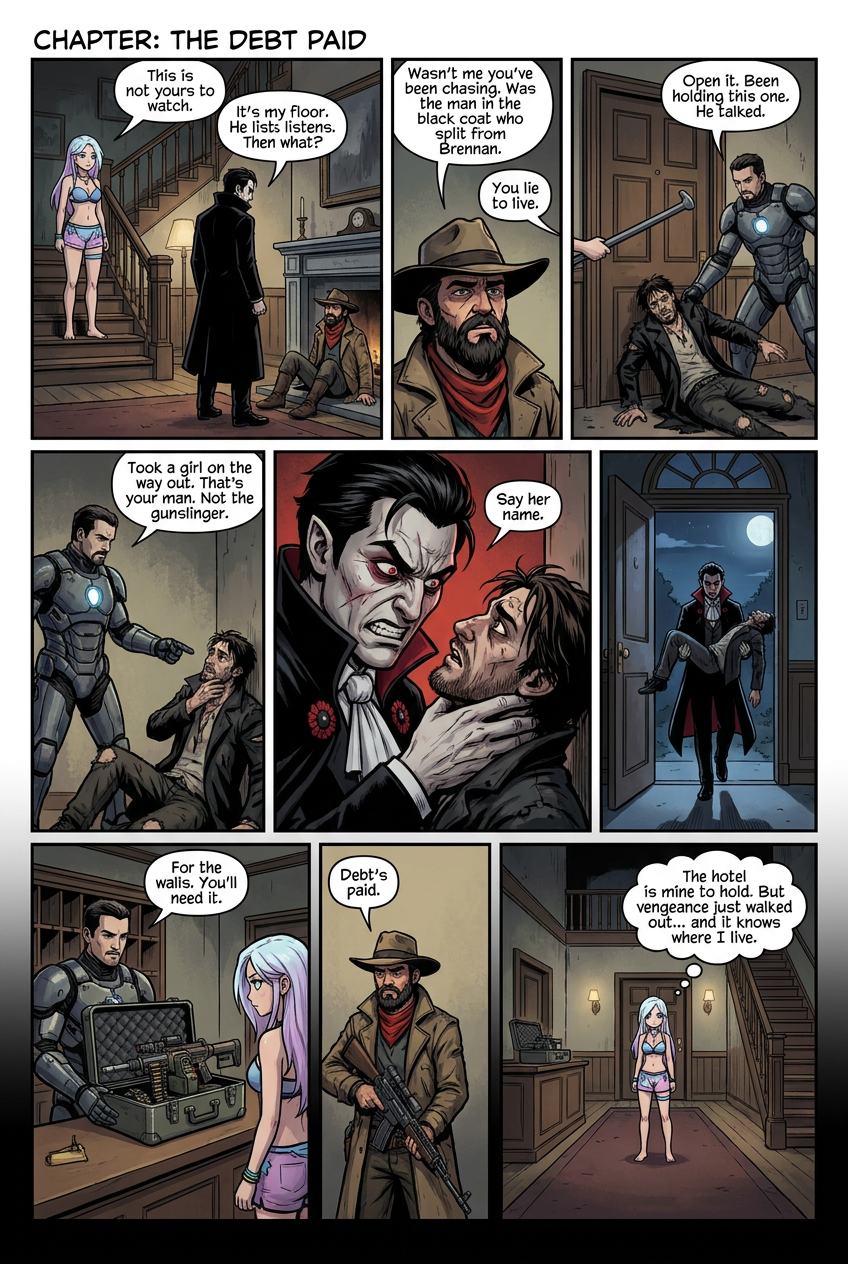
Ellen came down the stairs slow. Cade sat on the floor by the cold hearth. Dracula stood over him, coat black against the gray wall. Eleven years of hunting had brought this man here, into her hotel. He had helped her hold the door against Brennan. Now he wanted his payment. He wanted Cade broken and dead, and he expected Ellen to stand aside and let it happen inside her walls. Dracula's red eyes found her on the last step. "This is not yours to watch," he said. "It's my floor," Ellen said. "He listens. Then what?" "Then I finish it." Dracula did not raise his voice. "You agreed to the price." She had. She'd promised Cade to him to buy the door held. But Cade was the only real gun she had left. Six women slept upstairs behind walls she could not defend alone. Kill Cade, and she lost her strongest ally the same hour she gained her home. Cade spoke without looking up. "I never touched your girl." "Every man says that." "The man who split from Brennan early," Cade said. "Tracks went cold on the salt beds. He wore a black coat too." He lifted his head. "Wasn't me you've been chasing all these years. Was him." Dracula went still. The words landed hard and quiet, the way pain always hit him. "You lie to live." A shape dropped past the shattered window. Boots hit the road. The front bar rattled, then held. Stark's voice came flat through the wood. "Open it." Ellen lifted the bar. Stark stepped in, armor dark, one hand clamped on a man's collar. He shoved the prisoner to the floor. Brennan's last gunman, the one Stark had carried off weeks back. The man wore a black coat, torn at the shoulder. "Been holding this one," Stark said. "He talked. Burned a town eleven years ago. Took a girl on the way out." He looked at Dracula. "That's your man. Not the gunslinger." The gunman's face said the rest. He didn't deny it. He tried to crawl back, and found the wall. Dracula crossed the lobby in three steps. He lifted the man by the throat with one hand. "Say her name," he said, very soft. The gunman said it. Dracula's face broke, then closed. He carried the man out the door into the dark. The door swung shut behind them. Stark set a heavy metal case by the desk. Inside sat a mounted grenade gun, belt coiled beside it. "For the walls," he said. "You'll need it." He lifted off before Ellen could answer. Cade stood and picked up his rifle. "Debt's paid," he said. Ellen looked at the sealed door, the sleeping floors above, the gun Stark had left. Her ally still stood beside her. The hotel was hers, defended, and hers to hold. But she had just watched vengeance walk out onto her plain, and it knew exactly where she lived.
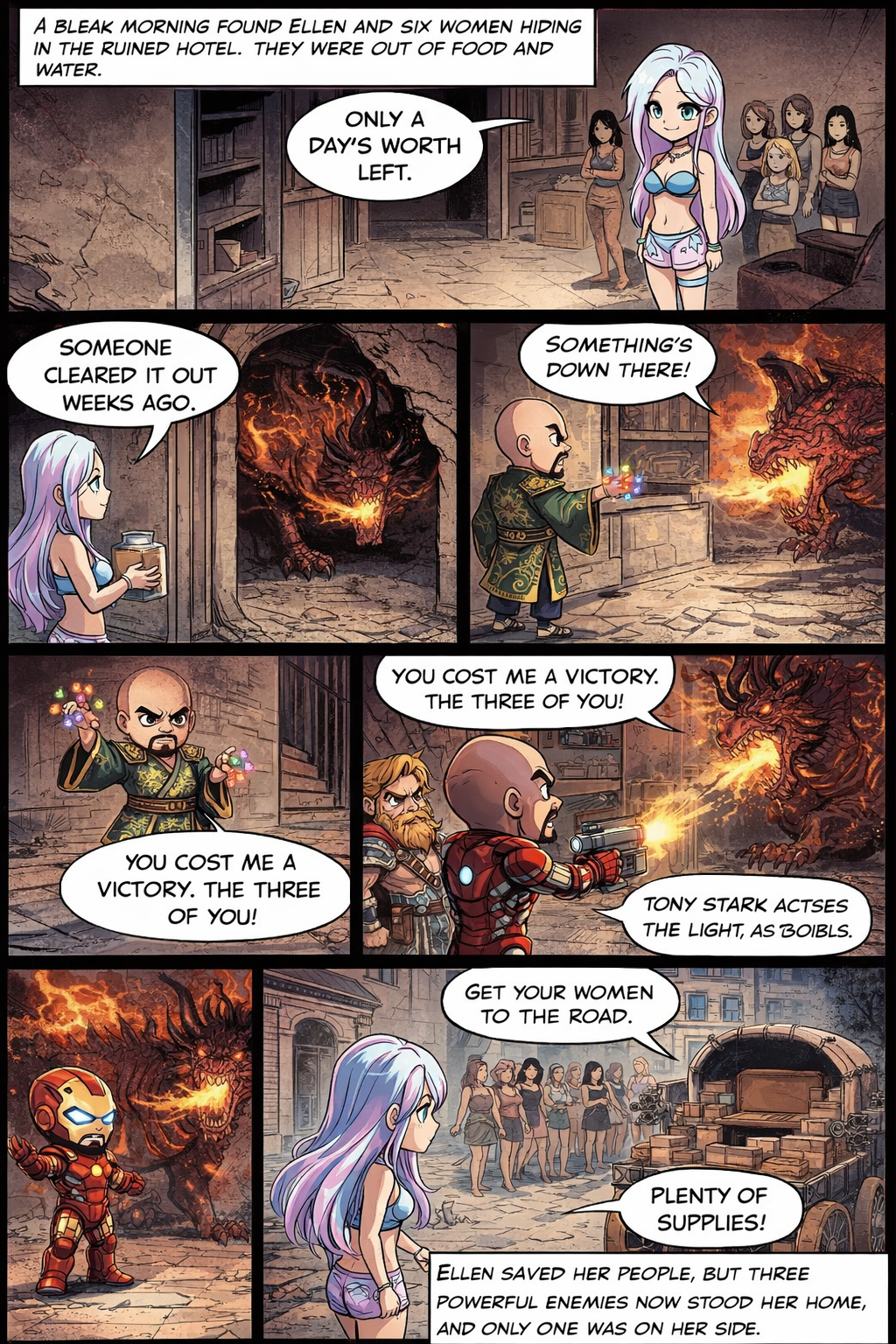
Morning came gray through the shattered lobby window. Ellen counted her people on the second floor. Six women, all awake, all thin. They had run for days before the hotel. Now the running was done, but the food was gone. Two water jugs sat by the wall, both light. She lifted one and heard it slosh once. A day, maybe. Then nothing. Walls could stop bullets. Walls could not feed anyone. She knew the cellar cache once held water and rations. She took Cade and went down. The shelves were bare. Someone had cleaned them out weeks ago. Cade ran a hand along the empty wood. "Nothing here," he said. He counted the doors out of habit and turned for the stairs. A sound stopped them. Not wind. A low roar, wet and heavy, from the dark end of the cellar. The reopened drain tunnel. Something big moved in it. Then heat rolled up the passage, and a snout pushed into the light. Scales dark as dried blood. Eyes that fixed on Ellen and held. A gout of fire lit the wall behind her. The beast hunted by heat. Six warm women slept above. Cade fired twice. The rounds sparked off the scales and did nothing. "Back up the stairs," he said. "Now." They ran. The beast filled the tunnel mouth, too wide to follow fast, and that bought them the stairwell. A man stood in the lobby. Small, bald, gold robe, rings on every finger. He had come through the front door while they were below. He watched the cellar stairs without fear. Ellen had wronged this man once. She had spotted the flaw in his plan against Stark, and Cade had pried it open, and Stark had walked away alive. The Mandarin had not forgotten. "You cost me a victory," the Mandarin said. "The three of you." He raised one hand. A ring glowed pale. "I sent the beast ahead. It smells your people upstairs." The front bar splintered inward. Stark walked through the ruined door, armor scarred. Behind him came a broad man with a hammer, yellow beard, cape torn. Thorn Odinson. He pointed the hammer at Cade. "You and Tony answer for what you did," Thorn said. "But not to that thing." He swung past them into the cellar mouth. Stark's palm lit. "Get your women to the road," he told Ellen. "Wagon's outside. Loaded. Water, food, enough for a month." He fired down the stairs. "Take it. This is done here." Ellen did not ask why. She ran the six women down and out. The wagon sat on the road, crates lashed under canvas. Water. Grain. Salt meat. Enough to hold the hotel a month or more. She threw the canvas back and saw it was true. Her people would eat. But three armed enemies now stood inside her home, and only one of them was on her side.
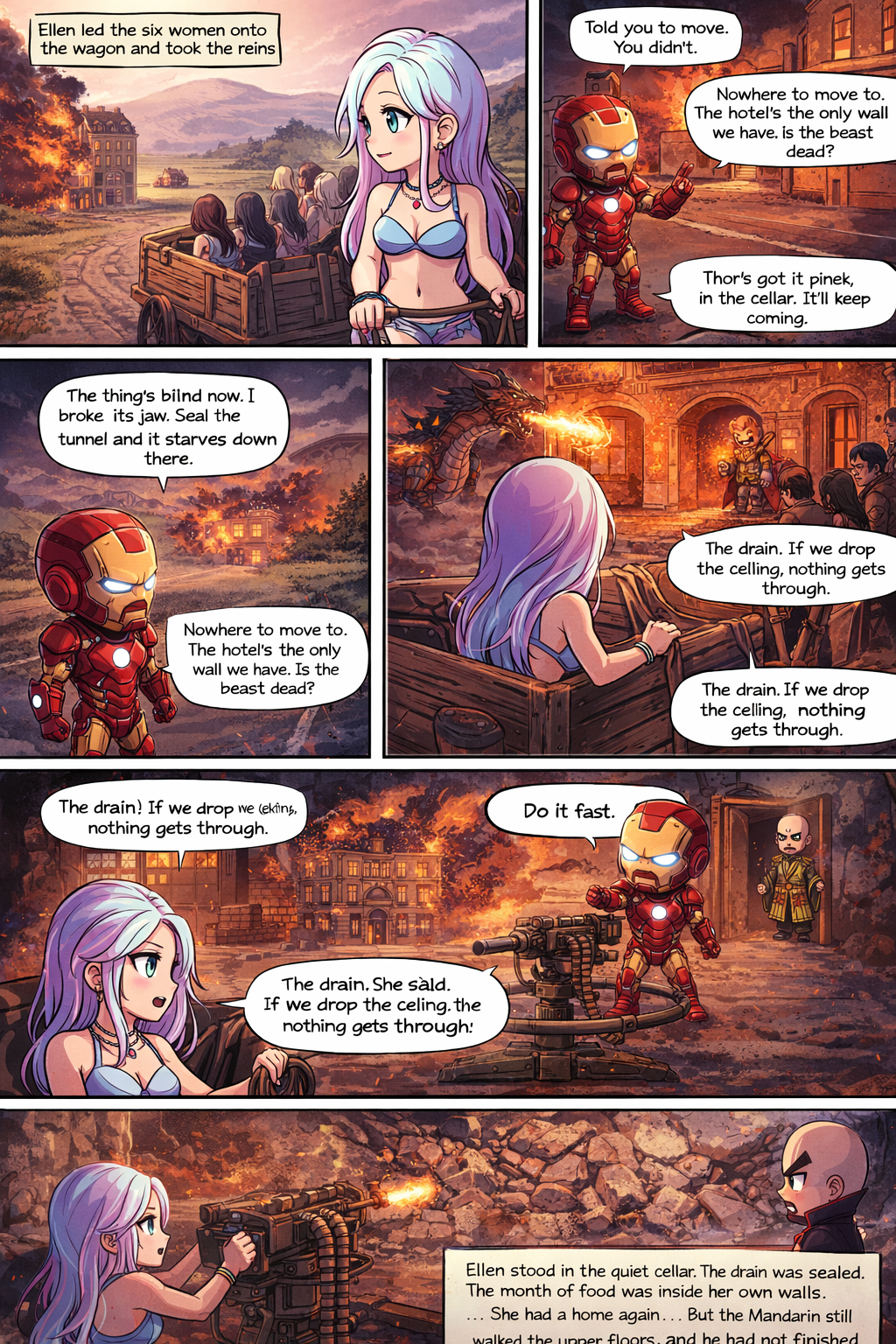
Ellen led the six women onto the wagon and took the reins. The road ran straight from the hotel across the flat ground. Behind the walls, three enemies fought her fire beast. A month of food sat lashed under the canvas. But she had nowhere to take it. The open plain hid nothing. The only shelter she owned was the hotel, and the hotel was full of fire and armed men. She stopped the wagon two hundred yards out and turned to watch. Smoke poured from the cellar vents. The women watched her, waiting. "We can't run on the flats," Ellen said. "They'll pick us off. That hotel is ours. We take it back or we die out here." A figure dropped from the sky and landed on the road ahead. Stark. His armor smoked at the joints. "Told you to move," he said. "You didn't." "Nowhere to move to," Ellen said. "The hotel's the only wall we have. Is the beast dead?" Stark's helmet turned toward the smoke. "Thor's got it pinned in the cellar. It won't leave the drain now." He paused. "The tunnel's the problem. It came up through there. It'll keep coming." The broad man with the hammer came out the front door. Thorn Odinson. His cape hung in strips. He had vouched for Cade and Stark once, and they had crossed a line, and other people paid for it. He hunted them for that. But not today. He wiped soot from his beard and looked at Ellen. "The thing's blind now," Thorn said. "I broke its jaw. It crawled back down the hole." He pointed the hammer at the cellar. "Seal the tunnel and it starves down there." Ellen thought of the mounted grenade gun sitting inside the lobby. The heavy weapon they had hauled from the army camp. "The drain," she said. "If we drop the ceiling, nothing gets through." "Do it fast," Stark said. He looked up. The bald man in the gold robe stood in the hotel doorway now, rings dull, one hand pressed to his side. The Mandarin. He had sent the beast. He stared at Ellen and said nothing. Then he turned and walked back into the dark. Ellen drove the wagon to the door. She and Cade carried the grenade gun down to the cellar mouth. Below, the beast rasped in the tunnel, jaw hanging wrong. Cade set the weapon on the stone lip and aimed at the tunnel roof. He fired six rounds. Rock cracked, sagged, and fell. Dust rolled up the stairs. When it cleared, the tunnel was gone. A wall of broken stone filled the passage. The beast's roar dropped to a muffled scrape, then stopped. Ellen stood in the quiet cellar. The drain was sealed. The month of food was inside her own walls. She had a home again, one door in, one road out. But the Mandarin still walked the upper floors, and he had not finished with her.
The cellar sat quiet. The beast was buried, the food was inside, and Ellen had her walls back. She climbed to the lobby and found Stark waiting by the door, his armor still smoking. Thorn stood beside him, hammer resting on his shoulder. They had fought her fire and won it. But Ellen knew a hard fact. These two men would leave, and Cade might leave with them. When they did, six women would have no one but her. "You're going," Ellen said. "All of you. And when the next raider comes, my women are alone." Stark's helmet turned toward her. "Not my job to babysit a hotel." "Then it stays a target," Ellen said. "You cleared the beast. You leave, and someone else walks in through that road. I need something that doesn't fly off when you get bored." Thorn set the hammer down. The floor thumped. "The road is your problem," he said. "One way in. Close it and no one comes." Ellen looked at the single door, the single road beyond it. She had six rifles in the cabinet and six women who could learn to hold them. What she lacked was a wall that didn't need a hero standing on it. "Then teach them," she said. She turned to Cade. "You count exits in every room. Teach my women to do the same. Show them the rifles, the angles, the road. If you all leave tomorrow, they hold this place themselves." Cade studied the door a long moment. "Takes days," he said. "We have food for a month," Ellen said. "We have days." Stark stepped toward the door. "I don't do drills." He stopped. "But the road's the weak point. Wire it. I've got charges in the wagon that armed Vincent left. Bury them at the choke. One switch inside. Anyone comes up that road, they don't come twice." He said it flat, then went silent, the topic closed. Ellen felt the shift. A wired road did not fly away. A woman with a rifle did not vanish at dawn. They worked through the day. Cade lined the six women along the third-floor windows and made each one name her firing lane. Stark buried charges at the narrow point of the road and ran a wire to a switch by the door. Thorn dragged stone across the lobby and built a second barrier behind the first. By dusk it was done. Ellen stood at the door and looked out at the one road. The charges waited under the dust. Six women knew their windows. The switch sat at her hand. "We leave at first light," Stark said. "Beast's dead. Nothing else here I want." "Go," Ellen said. "They can hold it now." She had built a defense that stayed when the men left. But high in the hotel, the Mandarin still walked the upper floors, and no wired road reached him.
The men slept in the lobby, ready to leave at dawn. Ellen did not sleep. She sat by the stairs with a rifle across her knees and listened. Somewhere above her, on floors she had never cleared, the Mandarin still walked. He was the old enemy who had sent the fire beast to burn her women out. Stark and Thorn had trapped the beast in the cellar. They had not touched the man who sent it. If she left him up there, her home would never be safe. She woke Cade first, then Stark. Thorn rose on his own, hammer already in hand. "He's still here," Ellen said. "We seal the road and he opens a door behind us. I want him gone before you leave." Stark's helmet lit. "Not my hunt." "He came for you too," Ellen said. "Finish it now or he finishes it later." Thorn started up the stairs without a word. Ellen followed. Cade came behind her, shotgun raised. They climbed past the third floor, past the women's windows, into dust and dark. On the sixth floor a door stood open. Yellow light spilled out. The Mandarin waited by the window. He wore rings on both hands. He did not turn when they entered. "You buried my beast," he said. "You think that settles it." "I think you're done," Ellen said. He raised one hand. A ring on it glowed. "This one rewrites what is real," he said. "I could unmake your walls. Unmake you." He said it plain, like a man reading a price. Stark stepped forward. "Then do it." The Mandarin turned the ring toward him. Nothing happened. He stared at his own hand. He tried again. The glow flickered and died. Stark's helmet tilted. "Stabilizer trick," Stark said. "I read your signal on the way up. It's noise. Always was." The Mandarin's face went still. He reached for another ring. Thorn crossed the room in two steps and closed his fist over the man's hand. Bones cracked. The Mandarin folded to his knees. "The beast hurt people I stood for," Thorn said. "You sent it." He did not raise his voice. He lifted the man by the collar and dragged him to the stairs. Ellen watched them go down, floor by floor, the Mandarin's feet scraping each step. At the lobby door Thorn threw him into the dust of the road. Stark walked out after. "We take him," Stark said. "Off your ground. He won't come back." A shape rose in the dark behind the wagon, pale in a black coat, watching. Dracula had not left the plain after all. Ellen stood in the doorway. The upper floors were empty now. No enemy waited above her women. She had cleared her own house at last. But a killer of children still lingered on her road, and he had come for reasons of his own.
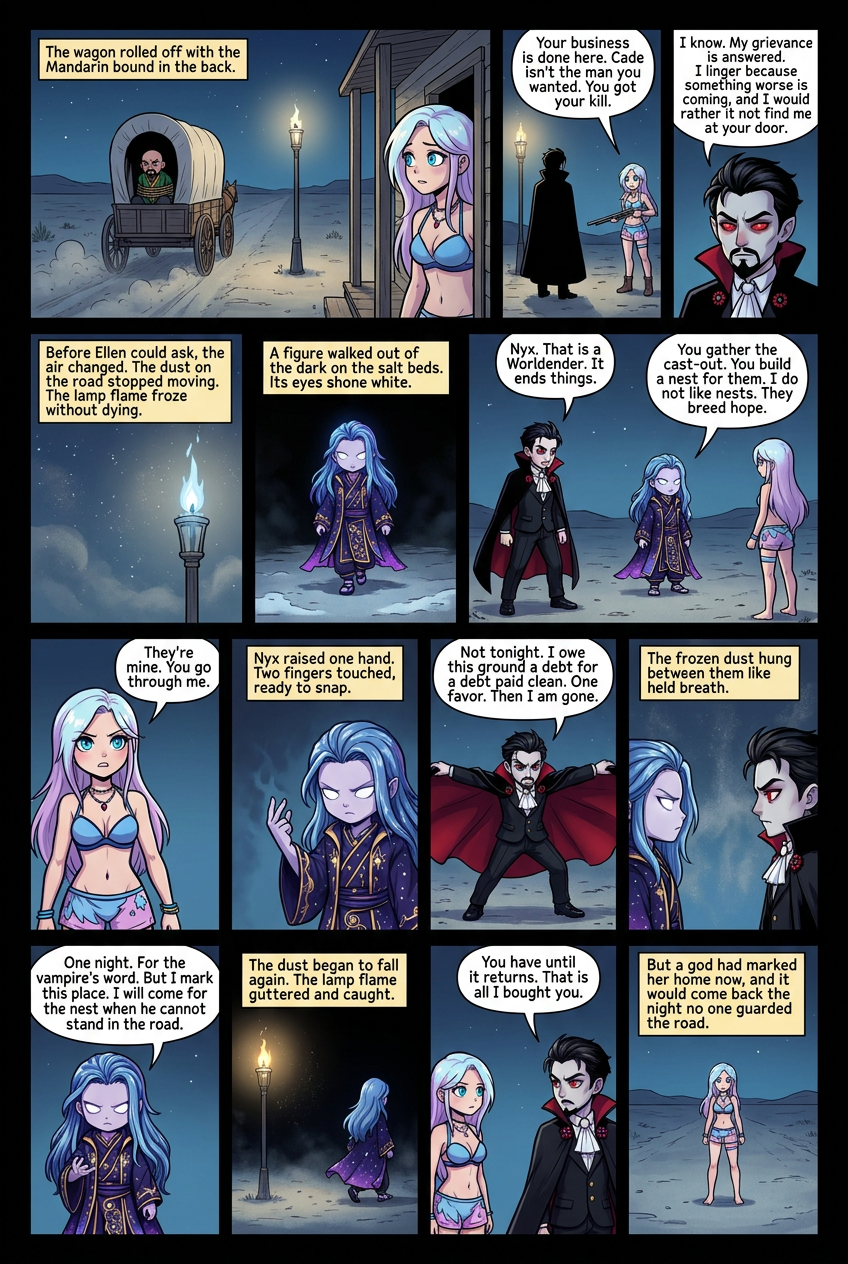
The wagon rolled off with the Mandarin bound in the back. Stark's engines faded east. Thorn climbed up beside him, hammer across his knees. Ellen stood in the doorway and watched the pale man in the black coat. Dracula had not left the road. He stood past the reach of the lamp, still as a fence post. She did not know why he stayed. She did not know if he meant her women harm. She stepped onto the road. Cade came behind her with the shotgun. "Your business is done here," Ellen said. "Cade isn't the man you wanted. You got your kill." Dracula tilted his head. "I know. My grievance is answered." His voice was flat and old. "I linger because something worse is coming, and I would rather it not find me at your door." Before Ellen could ask, the air changed. The dust on the road stopped moving. The lamp flame froze without dying. A figure walked out of the dark on the salt beds. Small, robed, blue hair long down its back. Its eyes shone white. It did not hurry. "Nyx," Dracula said. He backed a step. "That is a Worldender. It ends things." Ellen had never seen the god, but she had felt its hate before. Twice her women had woken from dreams of a snapping hand and a sky gone dark. She knew the name the way you know a wound. Nyx stopped in the middle of the road. "You gather the cast-out," it said. Its voice was a child's and not a child's. "You build a nest for them. I do not like nests. They breed hope." "They're mine," Ellen said. "You go through me." Nyx raised one hand. Two fingers touched, ready to snap. Ellen's stomach dropped. She had no plan for this. No wall, no rifle, no fire would stop a god. But Dracula moved. He did not shield Ellen. He stepped between Nyx and the road, coat spread. "Not tonight," he said. "I owe this ground a debt for a debt paid clean. One favor. Then I am gone." Nyx's white eyes shifted to him. The two of them stared. The frozen dust hung between them like held breath. "One night," Nyx said at last. The fingers lowered. "For the vampire's word. But I mark this place. I will come for the nest when he cannot stand in the road." It turned and walked back into the dark. The dust began to fall again. The lamp flame guttered and caught. Dracula looked at Ellen. "You have until it returns," he said. "That is all I bought you." He pulled his coat tight and walked the other way, gone before she found words. Ellen stood in the road with Cade. The Mandarin was gone. The pale man was gone. Her house was clear. But a god had marked her home now, and it would come back the night no one guarded the road.
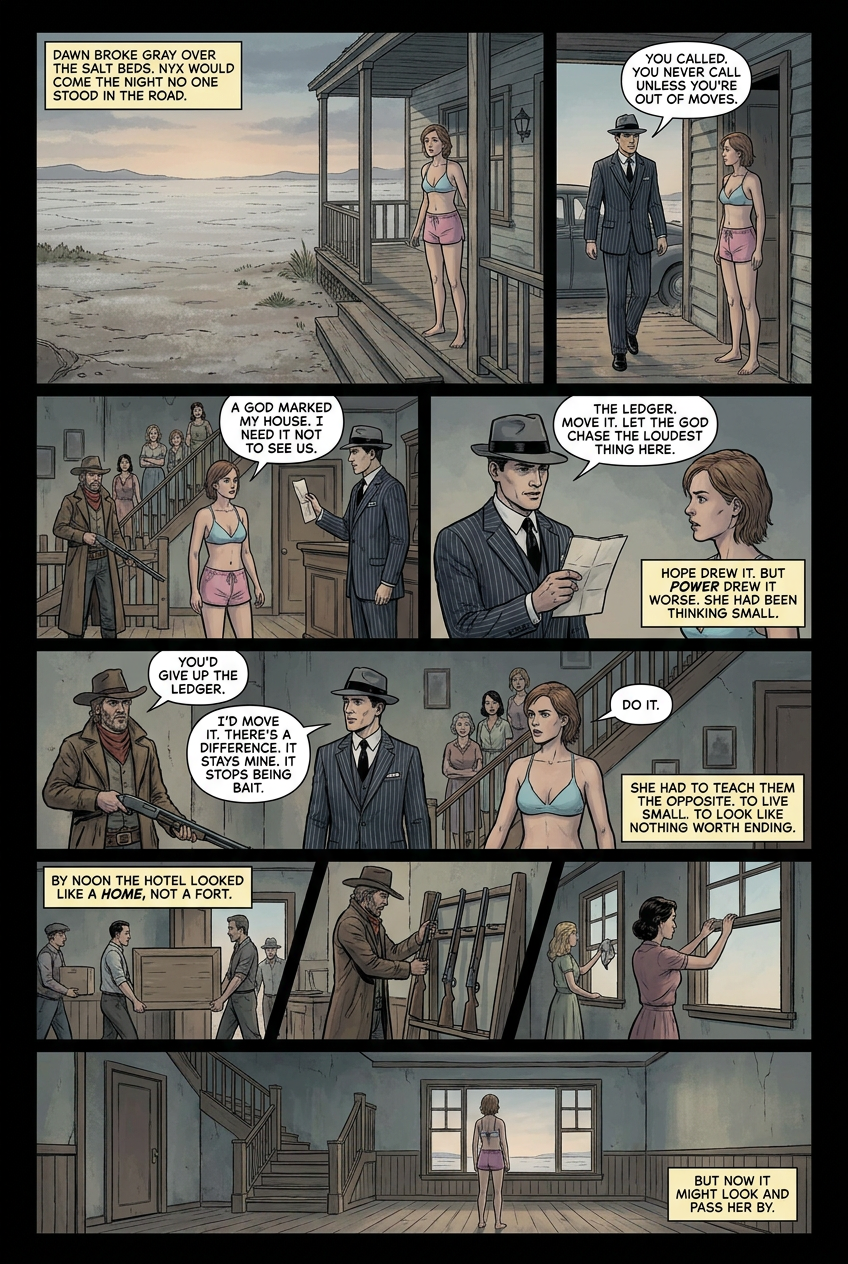
Dawn broke gray over the salt beds. Dracula's protection ended with the dark, and Ellen knew it. Nyx would come the night no one stood in the road. She had a house full of women and no wall that stopped a god. She had counted her guns twice already. Guns were useless. She needed something else, and she had one man left who traded in impossible things. Vincent Marconi came up the road at first light. He wore his pinstripes clean, as if the plain had never touched him. He stopped at the door and looked her over the way he looked at everything, taking her measure. "You called," he said. "You never call unless you're out of moves." "A god marked my house," Ellen said. "It's coming back to end everyone inside. I need it not to see us." Vincent did not laugh. That was the thing about him. He heard hard truths flat and gave them back the same way. He stepped past her into the lobby and looked at the six women watching from the stairs. Then he looked at Cade, who stood by the barricade with the shotgun across his chest. "You can't fight it," Vincent said. "So you don't fight it. You make it lose interest." He pulled a folded paper from his coat. "The ledger. Every dirty cop in the city. It's the one thing on this ground worth more than your women. Move it. Let the god chase the loudest thing here." Ellen understood. Nyx hated nests. Hope drew it. But power drew it worse. She had been thinking small. "You want me to plant the ledger somewhere far," she said. "Make my house quiet. Make it dull." "Empty nests breed nothing," Vincent said. "You hide the women in plain living. No walls that look like a fort. No guns on the roof. A god looks for a fight. Give it nothing to break." Cade lowered the shotgun. "You'd give up the ledger." "I'd move it," Vincent said. "There's a difference. It stays mine. It stops being bait." Ellen looked at her women on the stairs. They had stopped running from raiders here. They had learned to hold a firing lane. Now she had to teach them the opposite. To live small. To look like nothing worth ending. "Do it," she said. They worked through the morning. Vincent's men carried the ledger out in a plain crate, bound for the dry well past the salt beds, far from her door. Cade pulled the rifles off the third floor. The women took down the lookout marks. By noon the hotel looked like a home, not a fort. Ellen stood in the empty lobby. She had not stopped Nyx. She had made her haven invisible instead. The god still lived out on the salt, and it would still come back one night to look. But now it might look and pass her by.
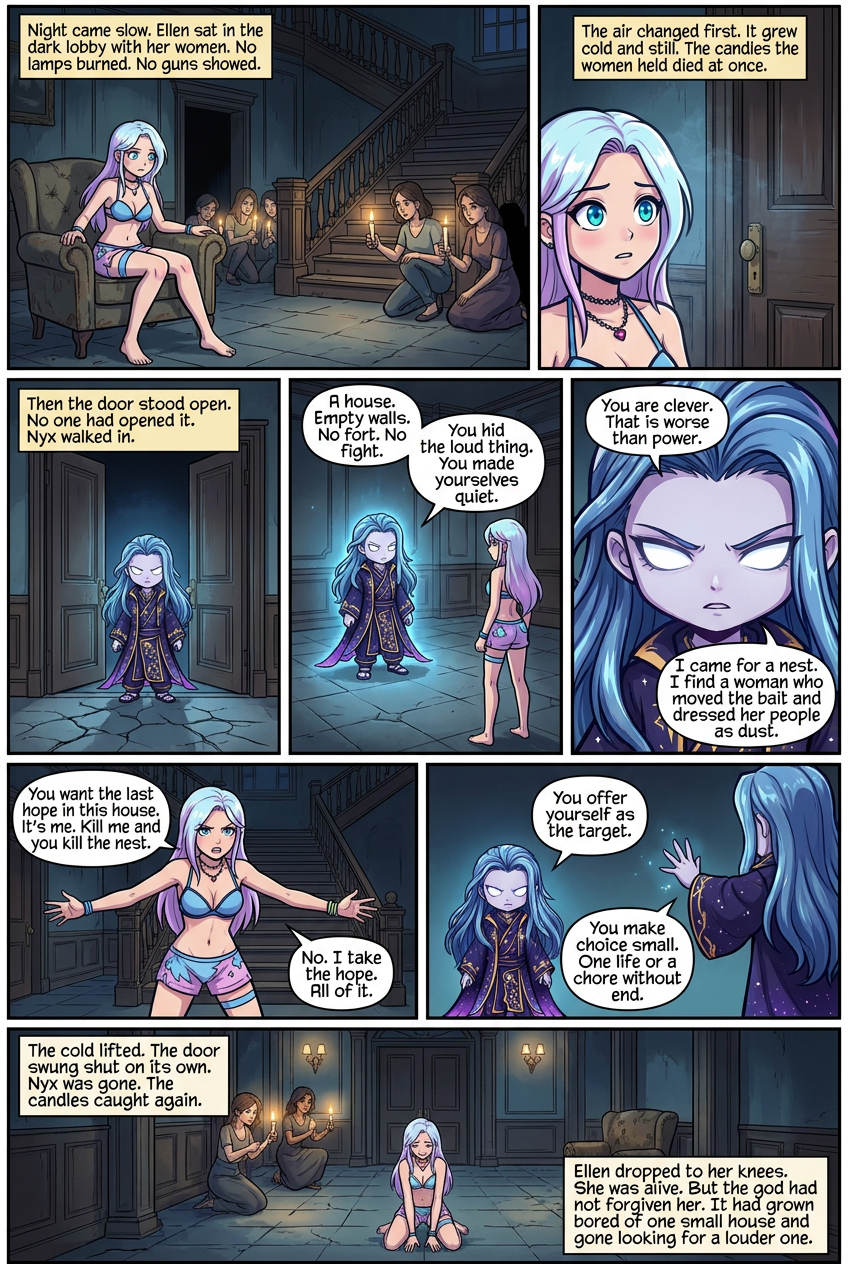
Night came slow. Ellen sat in the dark lobby with her women. No lamps burned. No guns showed. The ledger was gone to the dry well, far from her door. She had made her house look like nothing. Now she waited to learn if the god would believe it. The air changed first. It grew cold and still. The candles the women held died at once, though no wind touched them. Then the door stood open. No one had opened it. Nyx walked in. The god looked small. Pale skin, long blue hair, a robe stitched with stars. But the floor cracked under each step. The stone knew what walked on it, even if the eyes did not. Nyx stopped in the middle of the room and turned in a slow circle, reading the space. "A house," Nyx said. The voice was flat and young and wrong. "Empty walls. No fort. No fight." The white eyes swept the women crouched by the stairs. "You hid the loud thing. You made yourselves quiet." Ellen's chest went tight. The ruse was seen. She had traded her walls for silence, and the god had heard the silence for what it was. "You are clever," Nyx said. "That is worse than power. Power I break and forget. Cleverness I remember." The god raised one small hand. "I came for a nest. I find a woman who moved the bait and dressed her people as dust. You did not stop caring. You only hid it better." Ellen stood. Her legs shook but she stood. "Then take me. Not them." "No," Nyx said. "I take the hope. All of it." The hand began to close. Ellen did not reach for a gun. There was none that mattered. She stepped between the god and the stairs, arms wide, blocking the white eyes from her women. "You want the last hope in this house," she said. "It's me. I brought them here. I'll keep bringing them. Kill me and you kill the nest. Leave me and you have to come back forever." The hand stopped. Nyx studied her. The floor stopped cracking. For a long moment the god weighed her, the way Vincent weighed her, only colder. "You offer yourself as the target," Nyx said. "You make the choice small. One life or a chore without end." The white eyes narrowed. "I hate a chore." The cold lifted. The door swung shut on its own. Nyx was gone. The candles caught again in the women's hands. Ellen dropped to her knees. She was alive. They were all alive. But the god had not forgiven her. It had grown bored of one small house and gone looking for a louder one. She knew where the ledger sat now. Far off, at the dry well, loud as a bell. And she had sent it there herself.
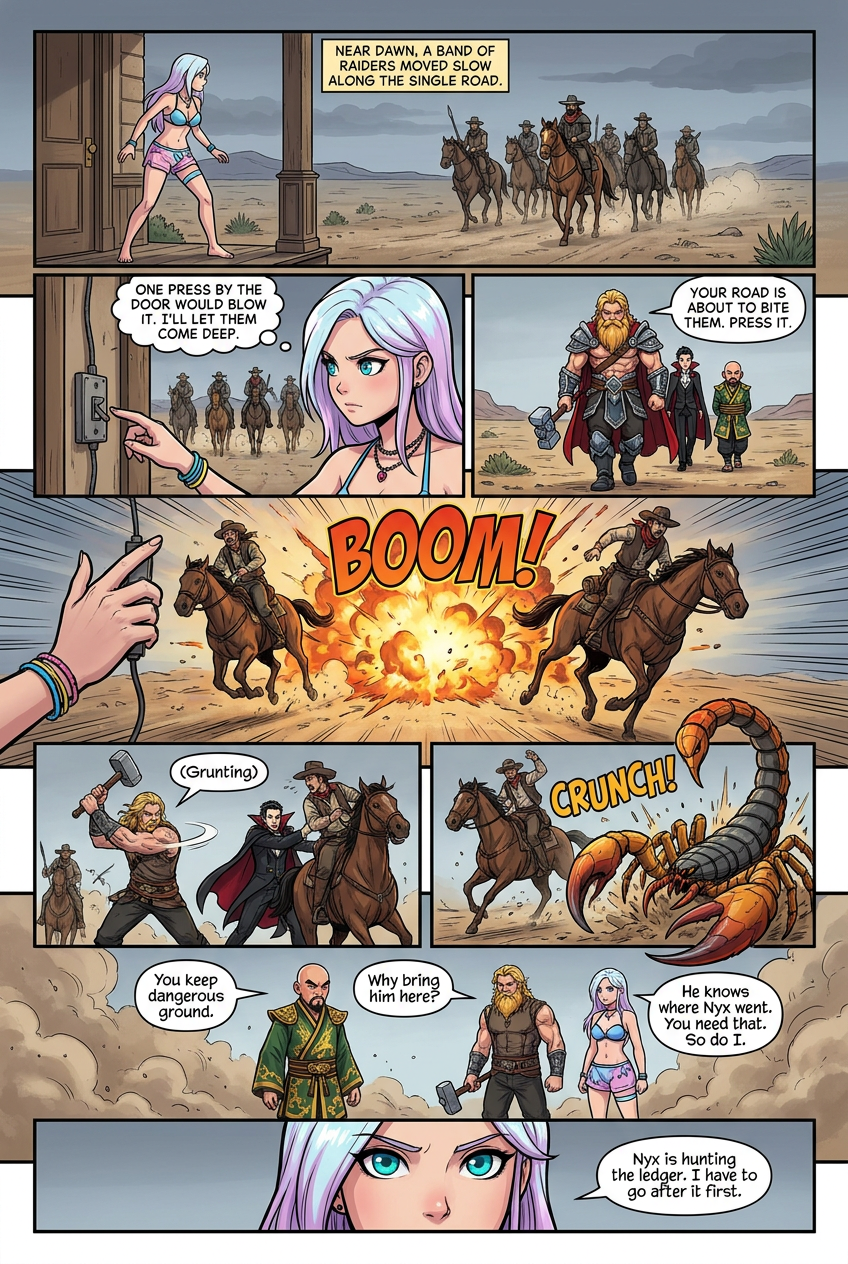
The god was gone, and the house was quiet. Ellen let her women sleep. She stood watch at the door alone. But near dawn, a girl on the third floor called down. Dust rose on the road. Riders. Not a god this time. Men. A band of raiders moved slow along the single road, testing the empty-looking hotel. Ellen understood at once. Word had spread of a house of free women. The dismantled fort had done its job on Nyx, but now it worked against her. No guns showed. No walls looked hard. The raiders saw easy prey. They meant to take the place and everyone in it. She counted six riders. She had rifles in the cabinet and six women who had trained on the third-floor windows. But the road switch still worked. Stark had wired the chokepoint. One press by the door would blow it. She waited by the switch and let the raiders come deep onto the road. Then a horn split the dark. Not from the raiders. From the flats behind them. Thorn Odinson walked out of the gray light, hammer swinging loose in one hand. He had helped her seal the fire beast weeks ago, then left at dawn. Ellen never thought she would see him again. Beside him strode Dracula, the pale man who had once hunted Cade and taken his vengeance elsewhere. And behind them, small and stiff, came the Mandarin, his broken hand still bound, herded forward like a prisoner. "Your road is about to bite them," Thorn said. He did not slow. "Press it." Ellen pressed the switch. The chokepoint erupted. Rock and fire threw two riders from their horses. The others wheeled, panicked, straight into Thorn. He swung once. A man flew. Dracula moved through the smoke without sound and pulled another from the saddle. The raiders broke and ran. One rider spurred hard for the flats, clear of the blast. He did not get far. The ground itself buckled. A colossal scorpion rose from the salt, claws wide, tail poised and dripping. It took the horse and rider in one strike and dragged both under. Ellen stared. She had killed one such beast at the army camp. She had not known another lived out here. When the smoke thinned, the road held four dead men and no live raiders. The Mandarin looked at the scorpion's settling dust. "You keep dangerous ground," he said flatly. "Why bring him here?" Ellen asked Thorn. "He knows where Nyx went," Thorn said. "You need that. So do I." He turned his hard eyes on the Mandarin. Ellen's stomach dropped. Nyx had chased the ledger to the dry well. Other people sheltered near there once. The raiders were dead. Her house stood. But the god she had turned away was hunting the thing she had hidden, and now she knew she had to go after it first.
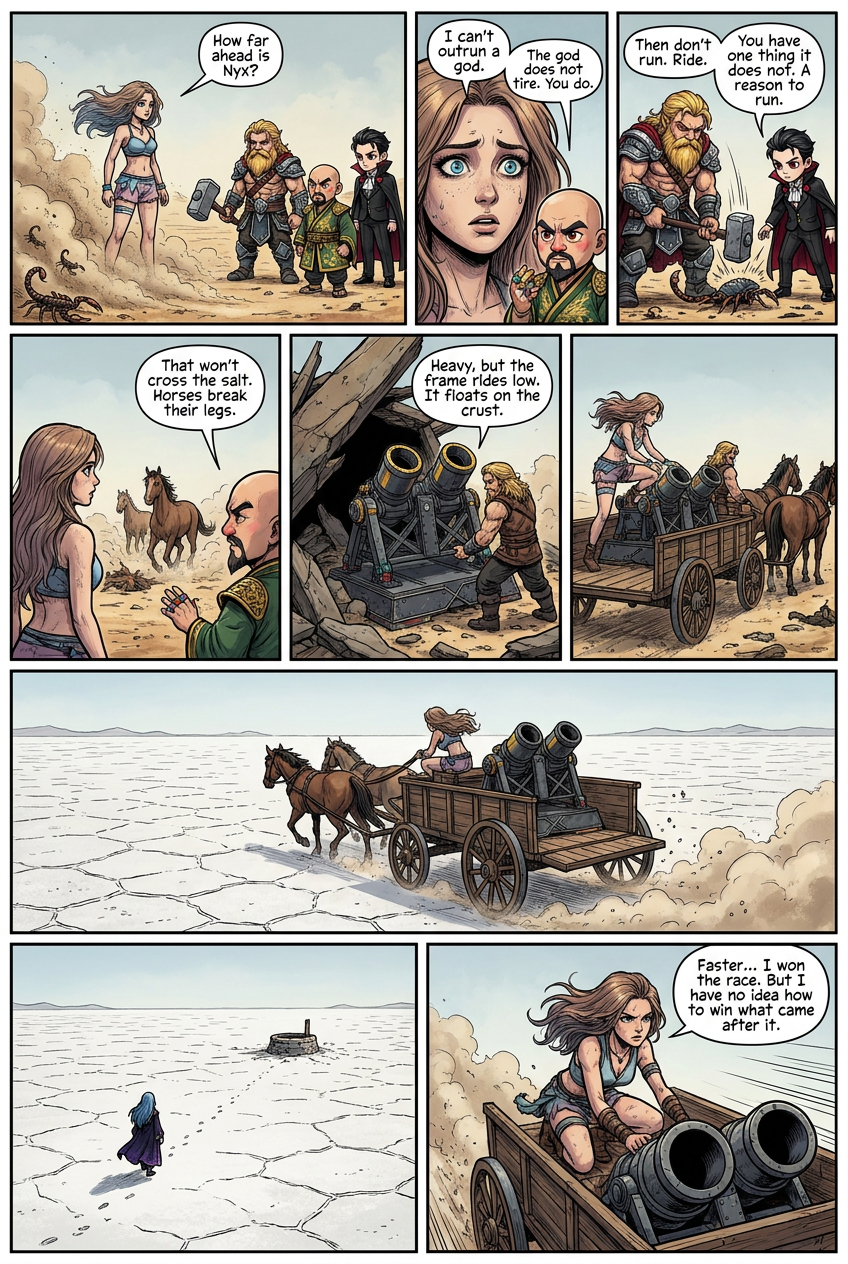
The scorpion's dust still hung in the air when Ellen turned to the men on her road. Nyx was hunting the ledger she had hidden at the dry well. The god moved fast. She had to reach the well first. But the salt beds lay wide and open between here and there, and she owned no horse fast enough to cross them. She had lost her window before she had even started. "How far ahead is Nyx?" she asked. The Mandarin stood stiff, his broken hand bound to his chest. He did not flinch under Thorn's stare. "The god walks," he said. "But the god does not tire. You do." He looked at the flats. "You will not beat it on foot." Ellen's chest tightened. She had beaten men and beasts and even turned Nyx away once. But she could not outrun a god across open ground with only her own legs. Thorn slammed his hammer head against the dead scorpion's shell. The sound rang flat. "Then don't run," he said. "Ride." Dracula stood apart, pale and still. He had guarded her road one night against Nyx. He owed the land a debt, and he had paid it slow. Now he spoke, quiet and hard. "The god crosses the flats. Slow. It fears no one, so it does not hurry." His red eyes fixed on Ellen. "You have one thing it does not. A reason to run." Ellen looked at the raiders' loose horses, milling near the blast site. Two had survived. She grabbed the nearest rein. "That won't cross the salt," the Mandarin said. "The beds swallow hooves. Horses break their legs in the crust." Thorn walked to the ruined chokepoint. Under the fallen rock sat a low wagon the raiders had dragged in. Bolted to its bed was a pair of squat mortar barrels, black and scarred, set on a battle-worn frame. The raiders had meant to shell her walls. Thorn heaved the wreck off it. "Heavy," he said. "But the frame rides low. It floats on the crust where hooves sink." Ellen understood. A wide flat bed spread the weight. It would skim the salt where a horse would fall. They hitched both horses to the mortar wagon. Ellen climbed onto the bed between the cold barrels. Thorn cracked the reins. The wagon lurched, then slid onto the salt beds, riding fast and level over ground that would have broken any rider. The flats blurred past. Ahead, small and distant, a figure in dark robes walked steady toward the dry well. Blue hair caught the gray light. Nyx did not look back. Ellen gripped the mortar frame and leaned forward. "Faster," she said. The wagon closed the gap. She would reach the well ahead of the god now. But the wagon carried no shells, and the thing waiting at the well was not a beast she could kill. She had won the race. She had no idea how to win what came after it.
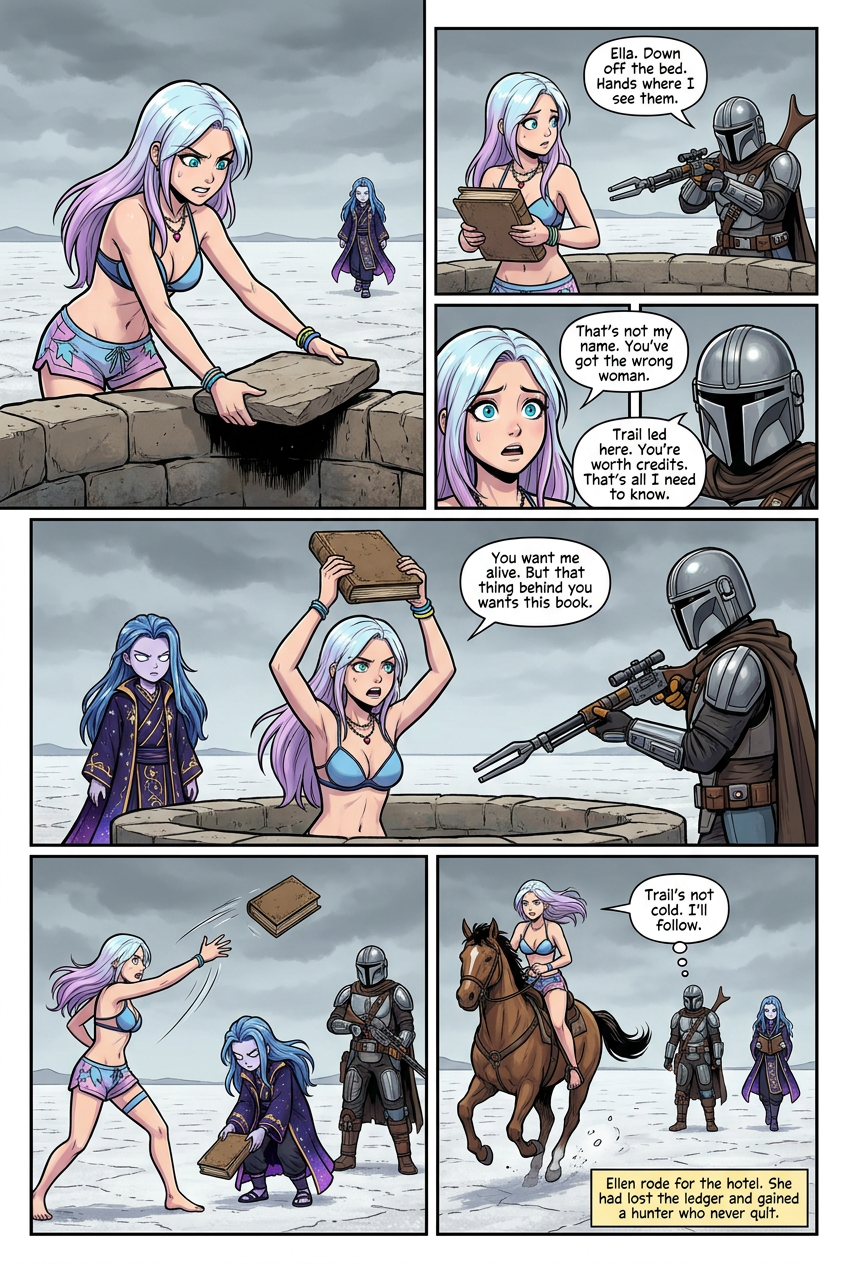
The wagon slid off the salt and stopped hard by the dry well. Ellen jumped down. She reached the ledger's hiding spot first, a flat stone she had wedged into the well's dead mouth. She pried it loose. The book was still there, dry and safe. But the god was close now. Blue hair moved against the gray sky, steady, patient, coming across the flats without haste. She held the ledger and had no plan to stop what walked toward her. Then a second shape rose from behind the well's low wall. A man in gray armor, a helmet with a flat black visor, a rifle already up and aimed at her chest. Ellen froze. She had never seen him, but she knew the look of a hunter who had found his mark. He had been waiting here. Waiting for her. "Ella," he said. Not a question. He tipped the rifle toward the wagon. "Down off the bed. Hands where I see them." "That's not my name." Her mouth was dry. "You've got the wrong woman." "Ella. Crew of six women." His voice stayed flat. "Trail led here. Food, water, shelter. People always need those." He had tracked her by the simple things. He did not care what she had done. "You're worth credits. That's all I need to know." Ellen looked past him. Nyx had stopped walking. The god stood twenty paces off, white eyes fixed not on her but on the book in her hands. Nyx wanted the ledger. The bounty hunter wanted her body. Two hunters, one prize each. She made her choice fast. She lifted the ledger high, so both could see it. "You want me alive," she told the armored man. "But that thing behind you wants this book. And it will not care if you're standing between them." Din Djarin's helmet turned. He saw Nyx. His rifle shifted, just an inch, toward the god. That inch was the whole moment. Ellen threw the ledger. It spun through the air and landed at Nyx's feet in the salt. The god bent and lifted it. Nyx opened the book, read the names of corrupt men written inside, and something like interest crossed that pale face. The god had what it came for. It turned and walked back across the flats, already losing interest in her, in the hunter, in the well. The rifle came back to Ellen. But she was already moving. She dropped behind the well's stone wall as the shot cracked over her head. She heard boots. She did not run for the wagon. She grabbed the loose horse rein and swung up bareback, kicking hard across the crust where the beast's legs should have broken. They held for six strides. Long enough. Behind her, Din Djarin did not fire again. He watched her go, marking the direction. The trail was not cold. He would follow. Ellen rode for the hotel. She had lost the ledger and gained a hunter who never quit.
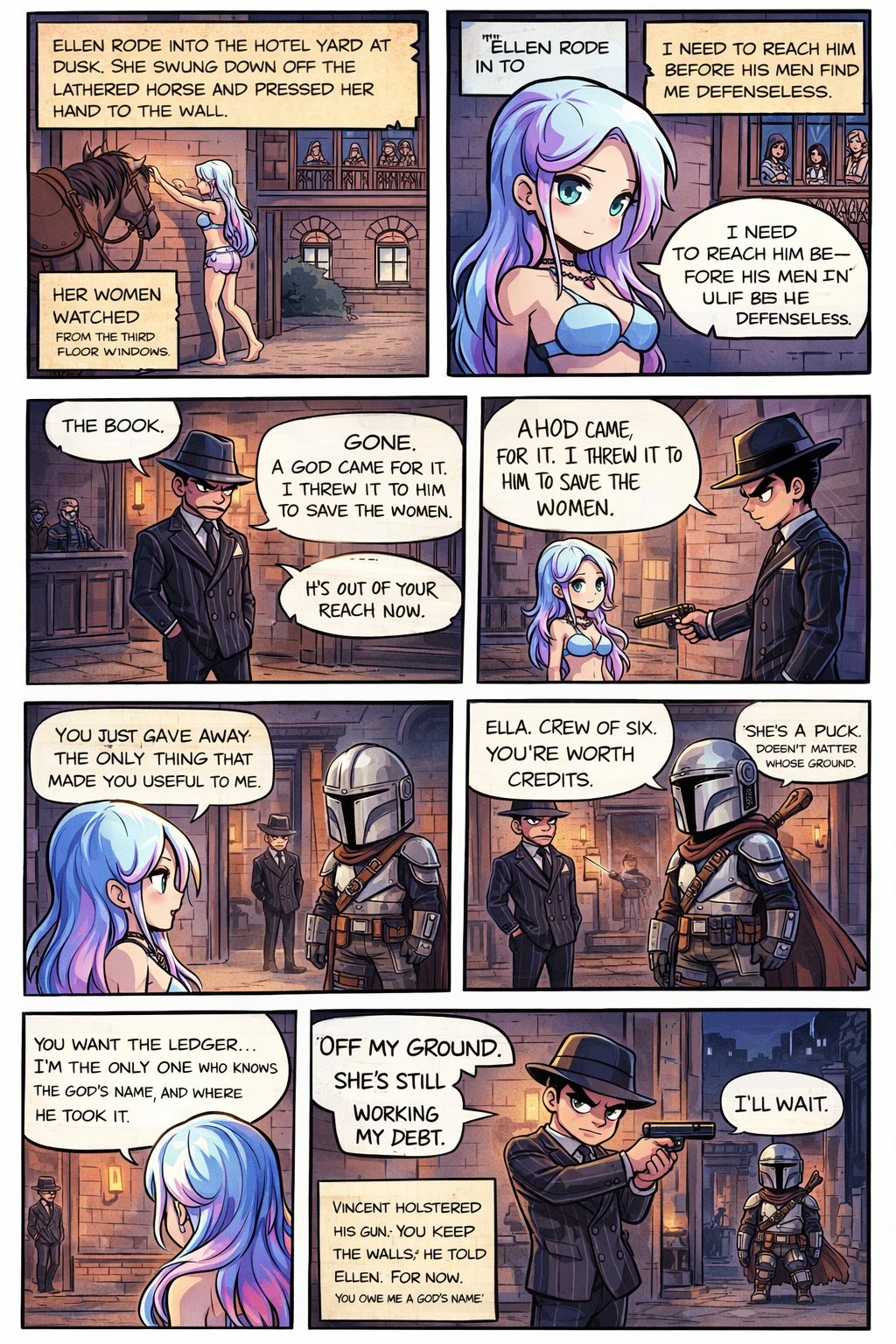
Ellen rode into the hotel yard at dusk. She swung down off the lathered horse and pressed her hand to the wall. Her women watched from the third-floor windows. She had kept them alive. But she had thrown away the ledger to do it, and the ledger was the price she paid Vincent Marconi for this home. Without it, she owned nothing. Vincent could take the hotel back whenever he chose. She needed to reach him first and tell him herself, before his men rode in and found her defenseless. He was already there. Vincent stood in the lobby, hat still on, waiting like he owned the floor. Because he did. His men had let him through the road while she rode the long way. He looked at her empty hands. "The book," Vincent said. "Where." "Gone." She would not lie to him. Not this time. "A god came for it. I threw it to him to save the women. It's out of your reach now, and mine." Vincent's jaw tightened. He said nothing for a long moment. "That book was the whole deal, Ella. You hold it, you keep the walls. No book, no walls." He turned his ring on his finger. "You just gave away the only thing that made you useful to me." "I gave it away so six women would live. Take the walls if you have to." She lifted her chin. "But you'll have to put us on the road yourself. Watch us walk out." Boots scraped in the doorway. A man in gray armor stepped in, rifle low, flat black visor turned toward her. Din Djarin. He had followed her trail from the well, just as he'd promised with that one long stare across the salt. "Ella," the bounty hunter said. "Crew of six. You're worth credits." He did not look at Vincent. "Step out." Vincent moved between them. "She's mine to deal with." "She's a puck." Din Djarin's voice went flat. "Doesn't matter whose ground." Ellen watched two men decide her fate over her head. Then she saw it. Vincent needed a reason to keep her, and the hunter had just given her one. "He wants me for money," she told Vincent. "You want the ledger. I'm the only one who knows the god's name and where he took it. Kill me or sell me, and that trail dies with me." Vincent studied her the way he read every stranger. Then he drew his pistol and put it on the bounty hunter. "Off my ground," he said. "She's still working my debt." Din Djarin measured the odds. One gun in the lobby, more on the road. He backed out slow. "I'll wait," he said, and was gone into the dark. Vincent holstered his gun. "You keep the walls," he told Ellen. "For now. You owe me a god's name." The hotel was still hers. But the hunter waited outside, and her debt had a new shape.
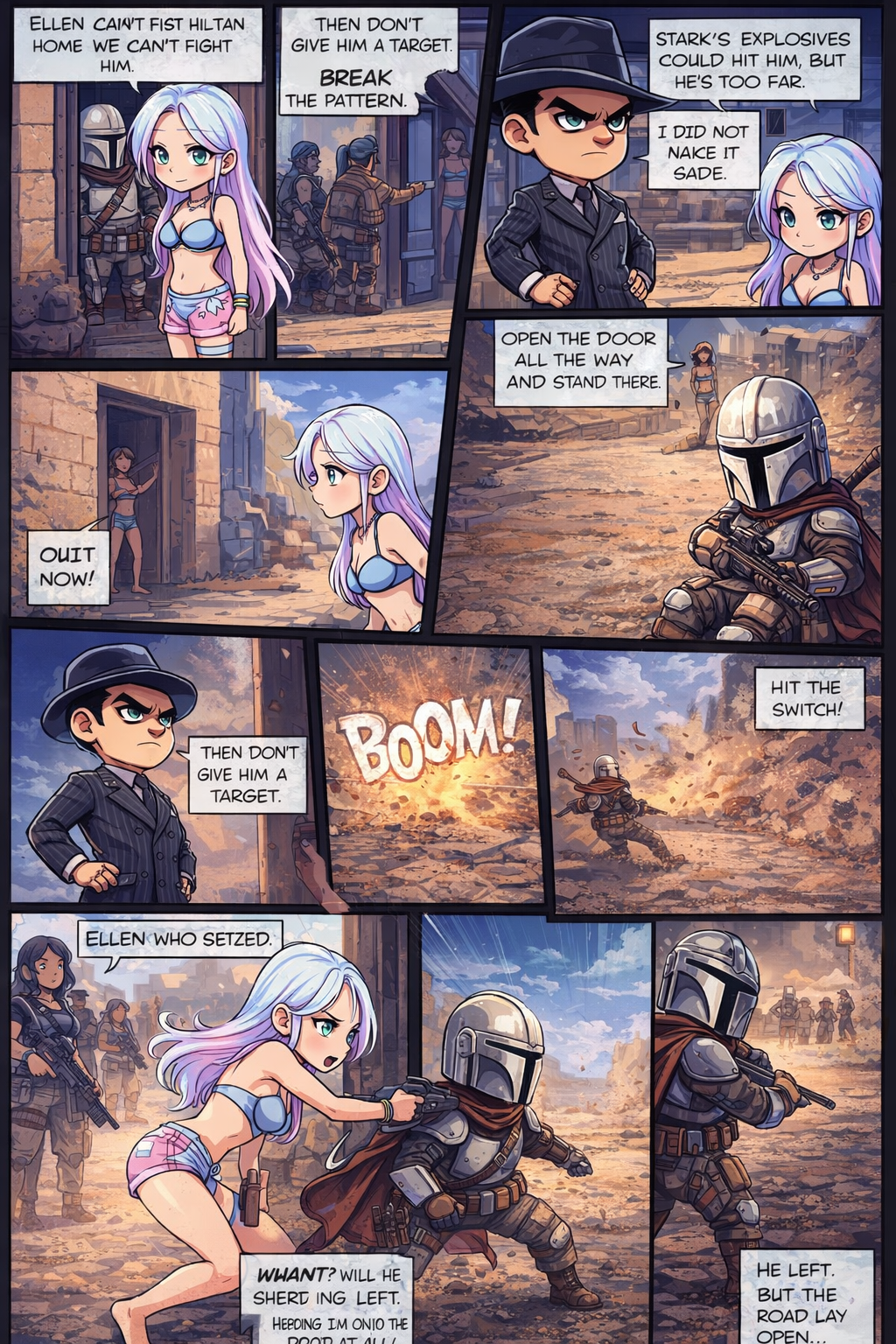
Vincent kept the walls in Ellen's hands, but Din Djarin had promised to wait, and a bounty hunter who waited did not leave. By morning Ellen saw him from the third floor. He sat on a rock past the road's chokepoint, rifle across his knees, watching every door of the hotel. Her six women could not step outside. One had tried at dawn for the water barrel by the wall. The hunter had risen the second she opened the door, and she had bolted back inside white-faced. Ellen understood then. He would not charge the walls. He would starve them out. Sooner or later a woman would break, and he would take his puck. Vincent found her at the window. "He's still there," he said. He did not make it a question. "He'll sit there till we run dry," Ellen said. "We can't fight him. He'll drop anyone who steps out." Vincent watched the armored man for a long moment. "Then don't give him a target." He turned the ring on his finger. "He hunts patterns. Food, water, shelter. Break the pattern." Ellen looked at the switch by the door. Stark had wired the road's chokepoint with explosives, right where the hunter sat his rock. But he was past the blast line. She could not reach him with it. She needed him closer, or she needed him to move. She made the plan while she watched. She sent two women to the far windows with rifles. She sent one to the door with the water barrel, ordered to open it wide and stand plain in the gap. Bait. Then Ellen took the third-floor firing lane herself, rifle steadied on the sill. The door swung open. The woman stood in it. Din Djarin rose off his rock and walked forward, rifle coming up, crossing onto the road toward the open door. Toward the chokepoint. "Now," Ellen said. The woman at the door dropped flat. The two at the far windows fired into the dirt at the hunter's feet, driving him left, herding him onto the wired ground. Ellen did not shoot the man. She shot the switch cover, then screamed down the stairs. A woman below hit the trigger. The road erupted. Rock and grit blew skyward. The blast threw Din Djarin off his feet and back across the chokepoint, hard into the dirt beyond. He did not get up fast. His rifle lay ten feet from his hand. Ellen was down the stairs and out the door before the dust settled. She reached him with her knife at his visor. "You wait somewhere else," she said. "Or you don't wait at all." The hunter measured her, the knife, the guns in the windows. He gathered his rifle and stood slow. "You broke your walls to do it," he said. The chokepoint was a crater now. No deterrent left. He backed off the ruined road and was gone. Her women could step outside again. But the road lay open, and everyone hunting the hotel had just lost its lock.
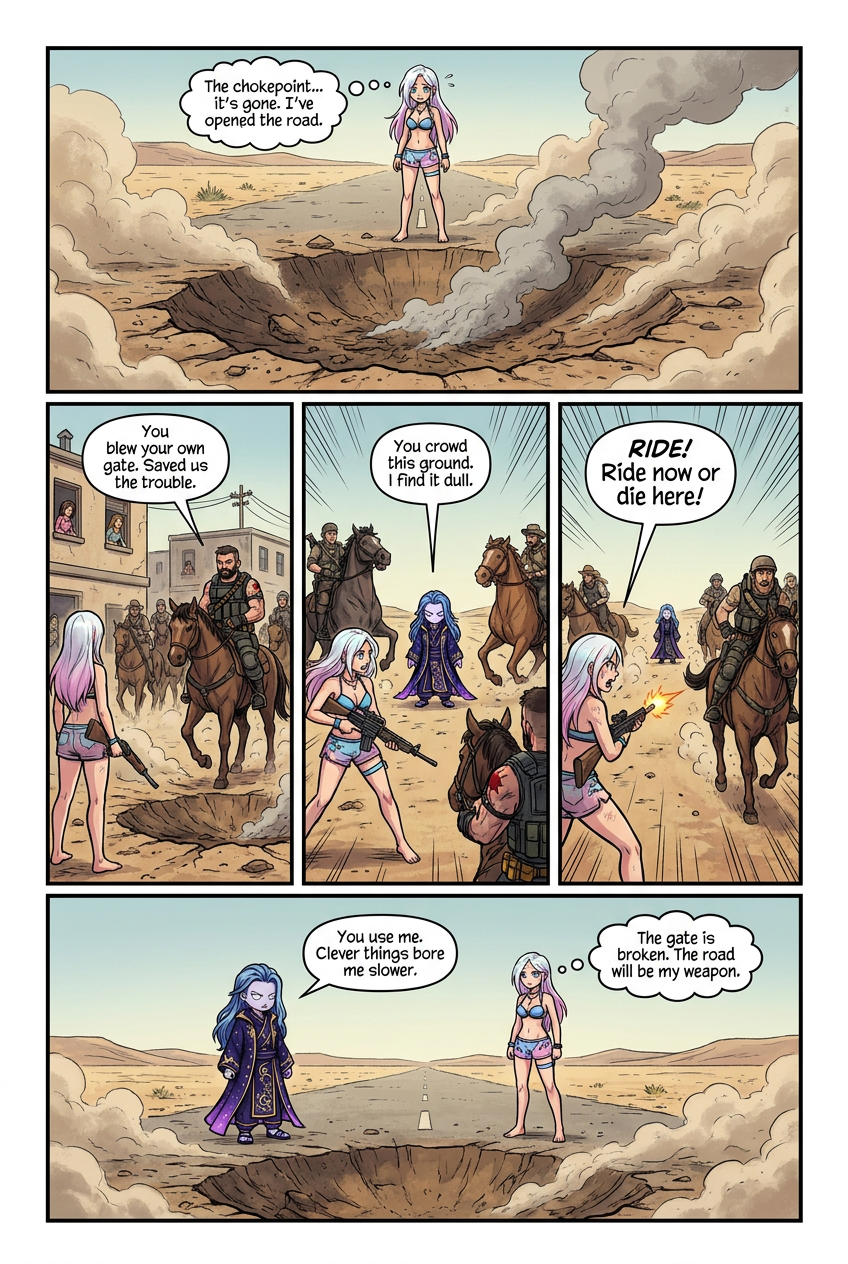
The crater in the road still smoked when Ellen understood her mistake. She had driven the hunter off, but the blast had torn out the chokepoint. The explosives were gone. The trap that once locked the road was a hole in the dirt. Now any rider could come straight to her door. By noon she saw the dust. Horses, moving fast, following the open road she had just cleared. Eight riders. Ellen knew the lead man before he stopped. Marcus Brennan. He had hunted Cade for months, and Cade sheltered inside her walls. Brennan reined up at the crater's edge and looked at the ruined ground. "You blew your own gate," he said. Flat. Certain. "Saved us the trouble." Ellen stood in the doorway with a rifle. Her six women watched from the third-floor windows, guns steady on the road. But eight men outgunned them, and the road lay open the whole way. She could not hold this. She needed the road closed again, and she had nothing left to close it. Then the air went cold. The dust stopped moving. Nyx stepped onto the road between Ellen and the riders, small and still, robe dark as a hole in the day. Ellen's chest tightened. This was the god who had marked her home, chased her ledger across the salt beds, and spared her only out of boredom. Nyx did not look at Ellen. Nyx looked at Brennan. "You crowd this ground," Nyx said. "I find it dull." Nyx raised one hand. Ellen did not wait. She grabbed the rifle and fired into the dirt at Brennan's horses, driving them back off the road. "Ride," she screamed. "Ride now or die here." She did not fight Nyx. She turned the god's arrival into a wall. Brennan's men saw the thing on the road and their nerve broke. Horses reared. The eight wheeled and fled the way they came, back down the open road, away from the god who could not be shot. Nyx lowered the hand. The riders were gone. The road held only dust. Nyx turned those white eyes on Ellen at last. "You use me," the god said. "Clever things bore me slower." Then Nyx stepped sideways into nothing and was gone. Ellen stood in the empty doorway, shaking. The road lay open still. But she had learned the thing she needed. The road being open cut both ways. Every hunter who rode it now rode into a plain with no cover, in full view of her third-floor guns. She could not close the gate. So she would make the open road her killing ground instead. That night she moved her women to the high windows and marked the range along the bare road with piled stones. The gate was broken. The road stayed her weapon.
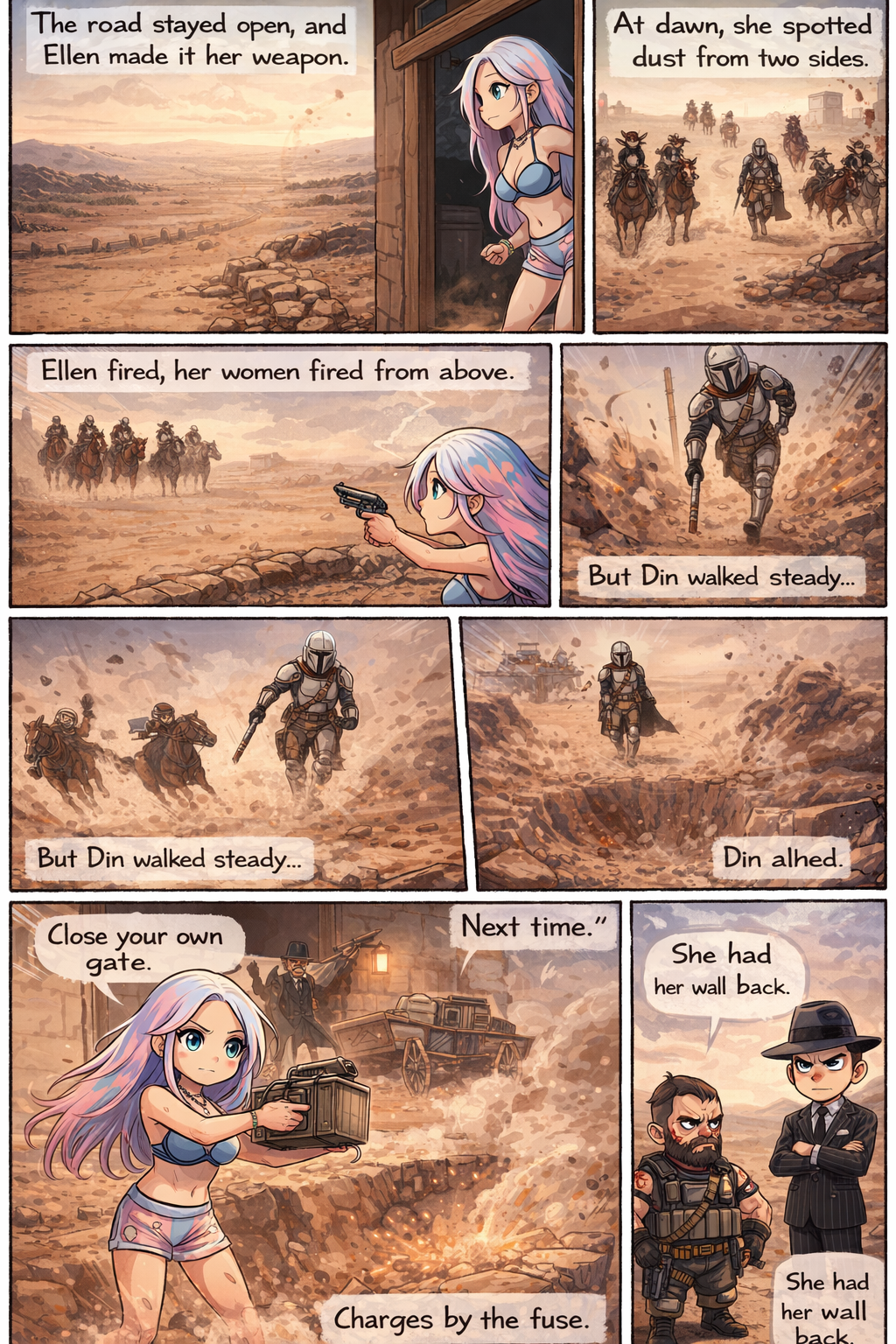
The road stayed open, and Ellen made it her weapon. She had piled stones along the bare dirt to mark the range. Her six women held the high windows. But she had no explosives left to close the chokepoint. A determined charge would cross the open ground and reach her door. She stood in the doorway at dawn and watched the horizon for dust. The dust came from two sides at once. Brennan's eight riders swung in from the flat, spread wide this time, no bunched target for her guns. And from the road itself walked a single man in gray armor. Din Djarin. The bounty hunter who wanted her for credits. He had trailed her here before. Now he came on foot, rifle low, using the very openness she thought protected her. Ellen fired at Brennan's line. Her women fired from above. One rider dropped, then another. But the wide spread worked. The men closed the distance, and Din walked steady through her fire as if the bullets meant nothing to his plating. She had no way to stop both. The road she called a killing ground was killing her plan instead. Then a wagon came fast down the open road behind Din. Vincent Marconi. He rode standing, coat flat in the wind, and Ellen had never been so glad to see the man who owned her debts. "You lost my ledger," Vincent called, flat as ever. "You still owe me a house full of women." He did not slow for niceties. He threw her something heavy from the wagon bed. A case. Ellen caught it and knew the weight. Charges. Timed sticks with a fuse cord, enough to crater the road again. "Wire it," Vincent said. "Close your own gate. I don't run a business on open doors." Ellen ran the case to the crater's edge under Din's advance. She jammed the sticks into the loose dirt and lit the cord. Din saw it and stopped. He was not a man to walk into a blast for one puck. He backed off the road. Brennan's riders saw the smoke and pulled up short, three men down already and no clear path to the door. The charge blew. Dirt and stone tore up in a wall across the road. The crater doubled. When the smoke cleared, the chokepoint was a pit no horse could cross at speed. Brennan reined his survivors back. Din stood beyond the pit, out of reach. Brennan looked at the closed road, then at Ellen. "Next time," he said. Just that. He turned his horses and rode off. Din watched a moment longer, then melted back the way he came. Ellen stood by the smoking pit, breathing hard. The gate was closed again. But Vincent climbed down from his wagon and folded his arms. "That case wasn't free," he said. She had her wall back. She owed him deeper than ever.
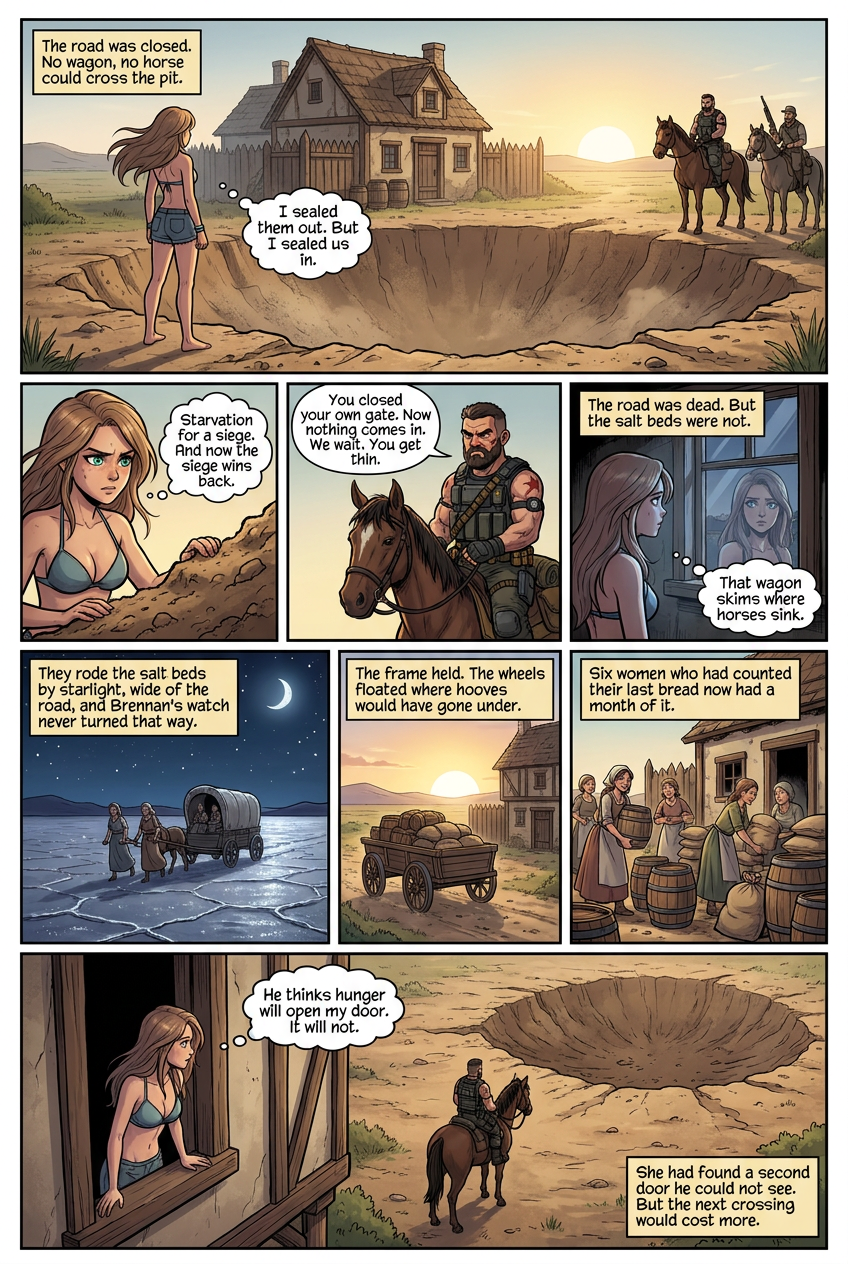
The road was closed, and that was the problem. Ellen stood at the crater's edge the next morning and understood what she had done. No wagon could cross the pit. No horse. Vincent had driven off before dawn, and the crater sealed him out along with the hunters. Inside the walls sat six women and empty shelves. The cellar cache was gone. The last water barrel stood a quarter full. She had built a wall no enemy could pass, and no food could pass either. She walked the pit's rim and measured it with her eyes. Eight feet across at the narrow point. Loose dirt, no footing. A person could climb down and up again, slow, but not a loaded wagon. She had traded starvation for a siege and won the siege. Now the siege won back. Brennan sat his horse beyond the pit, watching. He had lost three men and gained patience. "You closed your own gate," he called. "Now nothing comes in." He did not smile. "We wait. You get thin. Then we walk in over your bones." He turned his horses and rode back to the flat, in no hurry now. Ellen went back inside and thought. The road was dead. But the salt beds were not. She had crossed them once on the wide, low wagon that skimmed where horses sank. That wagon still stood in the yard. If a loaded wagon could cross the flats, it could reach her from the far side, away from Brennan and away from the crater entirely. She sent two of her steadiest women out at dusk with the low wagon and every coin the house held. They rode the salt beds by starlight, wide of the road, and Brennan's watch never turned that way. His eyes stayed on the pit. He guarded the door she had shut and forgot the ground behind him. The women reached a trading camp past the flats and traded coin for grain, dried meat, and four barrels of water. They loaded the wagon low and rode back across the salt before dawn. The frame held. The wheels floated where hooves would have gone under. By first light the wagon rolled into the yard. Ellen and the others hauled the barrels down and stacked the sacks against the wall. Six women who had counted their last bread now had a month of it. The crater still sealed the road. Brennan still watched the pit. He did not know the house behind it had just been fed. Ellen climbed to a high window and looked down at him. He thought hunger would open her door for him. It would not. She had found a second door he could not see, and she would use it again. But the coins were gone now. The next crossing would cost more than money, and she did not yet know what.
The coins were gone, but the salt beds still worked. Ellen loaded the wide, low wagon at dusk and rode it out herself. She had nothing left to trade, so she meant to beg credit at the camp past the flats. The frame skimmed the salt where hooves would sink. Brennan watched the crater and never turned his head. Halfway across, the horses stopped. A man stood on the salt ahead, blocking the only clear line. His helmet caught the starlight. Din Djarin had found her second door. "You keep crossing here," he said. "Food comes from the far side. So I waited here." He had tracked the pattern of her need, the way he tracked everyone. His rifle stayed low, but ready. "The puck says Ella and crew. I bring you in. That closes it." Ellen did not reach for a weapon. She had none that could beat him. "You want credits," she said. "I have no coins. But I know a man who trades in worse than money." She thought of the marker she had given long ago, the blood oath owed by a quiet man in a black suit. She had never meant to spend it here. "There's a marker on my life. A favor with no limit. I can call it in. He'll pay you more than any bounty to let me pass." Din Djarin was silent. Then a third figure walked out of the dark salt, blue-skinned, glowing at the eyes, unbothered by the cold. Ellen's stomach dropped. She knew this one only from a name Vincent had spoken once, a man who saw every road at once. "There is no marker to call," Dr. Manhattan said, flat and certain. "The man who holds it dies in nine days, on a different world, over a different woman. He will never reach you. I have already seen it." His white eyes fixed on Ellen. "I ran every path from your choices. Each one ends with your women dead. I came to end you first, to spare the longer harm." Ellen stood between two hunters and no coins and no favor left. She did the only thing she had left. She told the truth. "Then you've seen wrong," she said. "Because you're both here fighting over one starving woman. That's a road nobody planned." Din Djarin looked at the glowing god, then at Ellen. He lowered his rifle an inch. "He wants you dead. I want you alive, for credits. Can't be both." He stepped aside from the wagon path. "Not tonight. I don't hand a live puck to a killer." Ellen snapped the reins. The wagon lurched past both of them across the salt. Behind her, Dr. Manhattan did not move to stop her. He simply watched, as if noting a path he had missed. She reached the camp with no coins, but she reached it alive, and now she knew a god had marked her dead.
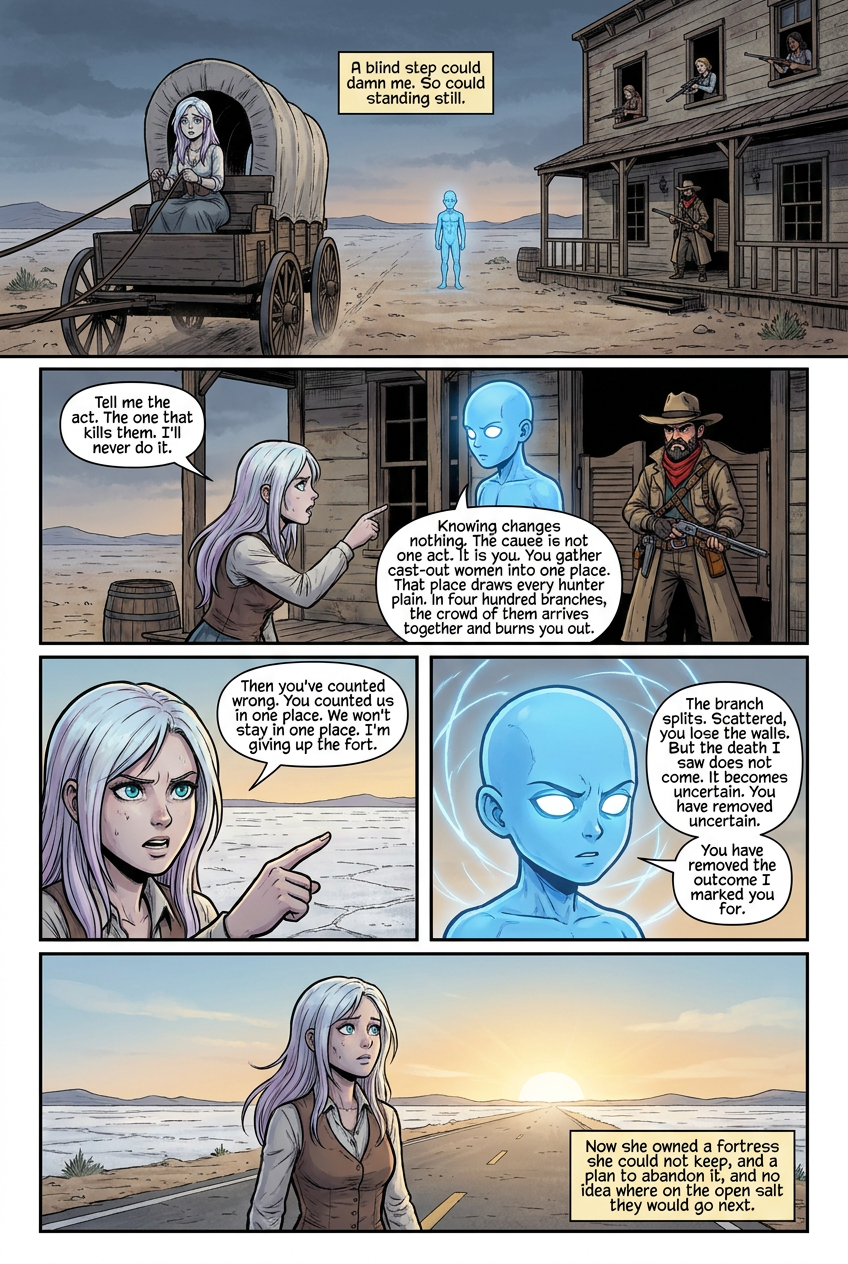
Ellen reached the camp alive, but a god had marked her dead. Dr. Manhattan had run every path from her choices and found her women slaughtered at the end of each one. He blamed one act she would commit. She did not know what it was. She rode the salt wagon home before dawn, sick with the not-knowing. A blind step could damn her. So could standing still. She had to face him and learn the shape of the thing. He was already at the hotel when she returned. Dr. Manhattan stood on the open road where the crater used to be, blue and calm, waiting like a fixed point. Her women watched from the high windows. Cade stood in the lobby door, rifle low, counting the exits out of habit. None of them mattered. You could not shoot a man who saw the bullet before you loaded it. "Tell me the act," Ellen said. "The one that kills them. I'll never do it." "Knowing changes nothing," Dr. Manhattan said. "You warn them. You hide the ledger. Each path ends the same. The cause is not one act. It is you. You gather cast-out women into one place. That place draws every hunter on this plain. In four hundred branches, the crowd of them arrives together and burns you out." Ellen understood then. He had not seen a mistake. He had seen her whole plan. The haven itself was the crime. "Then you've counted wrong," she said. "You counted us in one place. We won't stay in one place." Dr. Manhattan tilted his head. For the first time his white eyes narrowed. "Explain." "You said the hunters arrive together because we're a fixed target. A wall to break." She pointed at the salt beds past the wash. "We stop being a wall. We move across the flats. Small groups, no home for them to burn. You saw a fort. I'm giving up the fort." The god went still. Ellen watched him run it, path after path, faster than she could breathe. Cade did not move. A woman's rifle barrel dipped in the window. "The branch splits," Dr. Manhattan said at last. "Scattered, you lose the walls. But the death I saw does not come. It becomes uncertain. I cannot see the end." He said it like a man reporting weather. "You have removed the outcome I marked you for." "So the marker's off," Ellen said. "There is no longer a fixed death to prevent." He looked at the hotel, then at the salt. "I have no reason to end you. I have others to attend." He was gone between one blink and the next. The road lay empty. Ellen stood in the wind with her women safe above her. She had bought their lives by giving up the only wall she had. Now she owned a fortress she could not keep, and a plan to abandon it, and no idea where on the open salt they would go next.
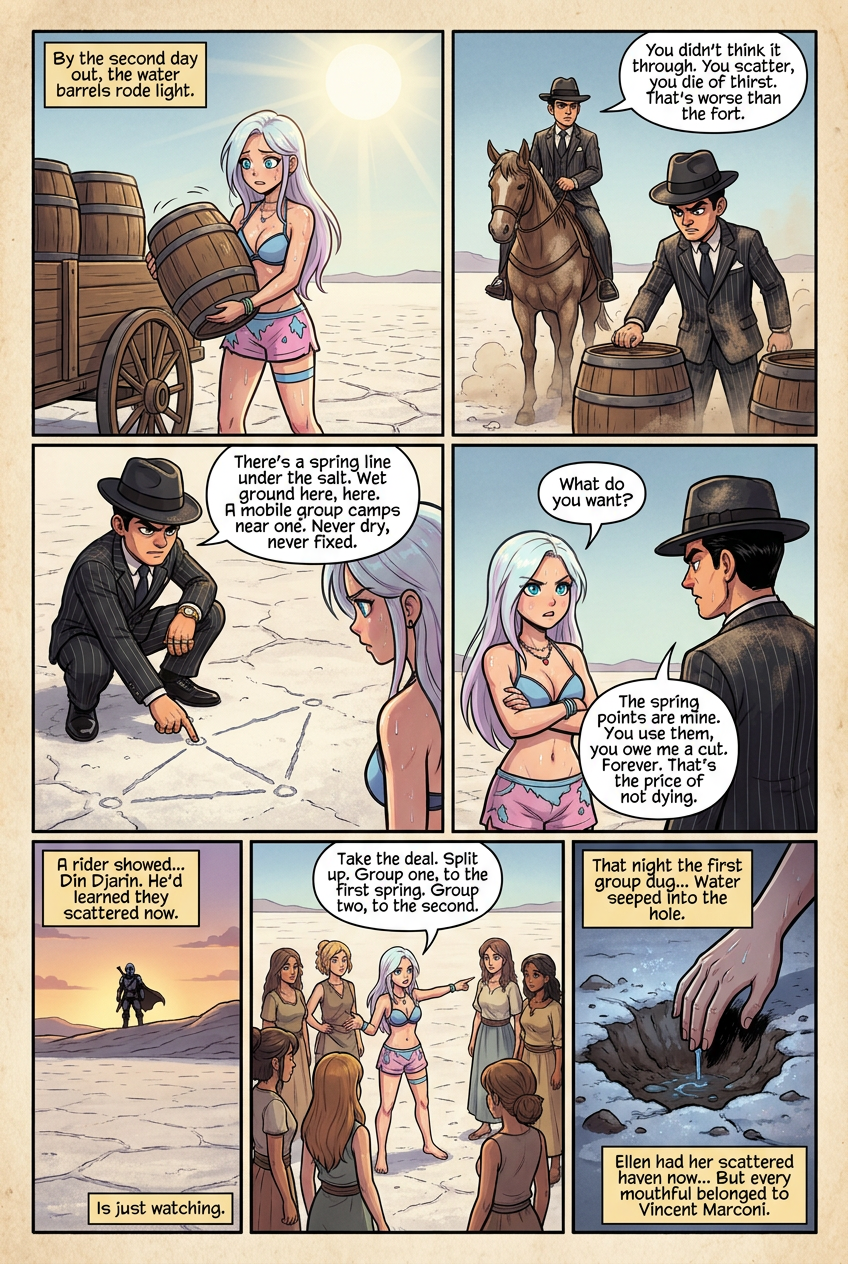
Ellen won the god's mercy by promising to scatter her women across the flats. But she made that promise without a plan. She had six women, one wagon, and open salt in every direction. No wells they controlled. No caches. By the second day out, the water barrels rode light. She lifted one and heard it slosh a third full. On foot in this heat, thirst would kill them in three days. She had traded a wall for a slow death. "You didn't think it through," Vincent Marconi said. He rode up on the salt at dusk, his black suit gray with dust. He climbed down and knocked a knuckle against the barrels, one by one, listening. "Empty. Empty. Nearly empty." He said it flat, the way he'd read a debt slip. "You scatter, you die of thirst before any hunter finds you. That's worse than the fort." "Then help me," Ellen said. "You know this ground. Where's water we can reach?" Vincent looked at her women, then at the wagon's wide low frame. "There's a spring line under the salt. Old traders knew it. You can't carry water across the flats. You carry the map to it." He crouched and drew in the crust with one finger. Three points, spread wide. "Wet ground here, here, here. A mobile group camps near one. Moves before it's found. Never dry, never fixed." It was the answer. Small groups, each near buried water, each able to move. No wall to burn. No thirst to kill them. Ellen felt the shape of it lock. "What do you want," she said. Not a question. She knew him. "The spring points are mine. You use them, you owe me a cut of whatever your women trade or find." He stood and brushed the salt from his knees. "Forever. That's the price of not dying." A rider showed on the far crust before she answered. Chrome helmet catching the last light. Din Djarin. He'd tracked their need again, the way he always did. But he reined up short, well out of rifle range, and only watched. He'd learned they scattered now. A moving crew of six left no trail worth the ride. "He can't work it," Vincent said, following her eyes. "No pattern to hunt. You did that." Ellen took the deal. She marked the three wet points in her memory and split her women into two groups of three, each with a route between springs. That night the first group dug where Vincent showed them. Two feet down, the salt turned dark and cool. Water seeped into the hole. Din Djarin was gone by morning. The wagon carried no more barrels to guard. Ellen had her scattered haven now, alive on hidden water, unreadable to hunters and gods alike. But every mouthful of it belonged to Vincent Marconi, and his cut would come due for as long as her women drank.
Ellen had the spring map now, three wet points burned into her memory. But a map wasn't a plan. Six women rode in two groups, spread wide across the salt. The first group camped a full day north, their barrels nearly dry. Ellen had promised them water she hadn't yet reached. If she guided them wrong, they thirsted out before she found the next dark ground. She sat on the wagon and counted the routes on her fingers. Every path crossed open flats a hunter could watch. A rider came from the west at first light. Chrome helmet, low profile, no wasted motion. Din Djarin. He'd hunted her crew for their needs before, always arriving where they had to go. He reined up close this time, out of the wagon's blind spot. "Your north group turned east," he said. "Away from your route. Two of them can barely stand." Ellen's chest went tight. He'd found them. "You watched them." "I watch patterns." He tilted his head at the map in her lap. "You spread them out. Smart. But you can't be in two places. One group dies while you dig for the other." A second rider appeared behind him. Gray-streaked hair, armor scarred, a pistol already in her hand. Kara Vex. Ellen knew the name from camp talk. The best hunter alive, and she carried a puck with Ellen's face on it. "I got ahead of you," Kara said. She didn't raise the pistol. "Guessed where scared women run. Reached your north group first." Ellen's hands found the reins. Two hunters, one wagon, her women a day off and failing. "Then shoot me. But they're not the mark." Kara studied her a long moment. "They're already at water." She jerked her chin north. "I made them dig. Second wet point, half a mile from where they broke down. They're drinking now." Ellen stared. "Why." "Dead women aren't worth credits. Neither are you." Kara holstered the pistol. "Your puck got pulled. Whoever wanted you can't pay anymore. Same as his." She nodded at Din. Din Djarin was already turning his horse. "No pattern left to hunt," he said. "You scattered. There's nothing here for either of us." Ellen didn't trust it. But Kara tossed the map a folded scrap. New marks in red ink. "Four springs, not three. Vincent doesn't know the fourth. Guide by that. Your groups leapfrog it. Neither one goes dry." She wheeled her horse. "Consider it paid." They rode off in opposite lines and left no dust worth chasing. Ellen opened the scrap. Four wet points, spaced so each group always sat within a day of water. She had her method now. Not a wall. A living web of hidden springs, one hunter's gift she'd never asked for. Her women would drink, and drink again, and no fixed camp would ever burn. But the fourth spring was Kara's secret, and a hunter who knew her routes could return for the mark whenever the price came back.
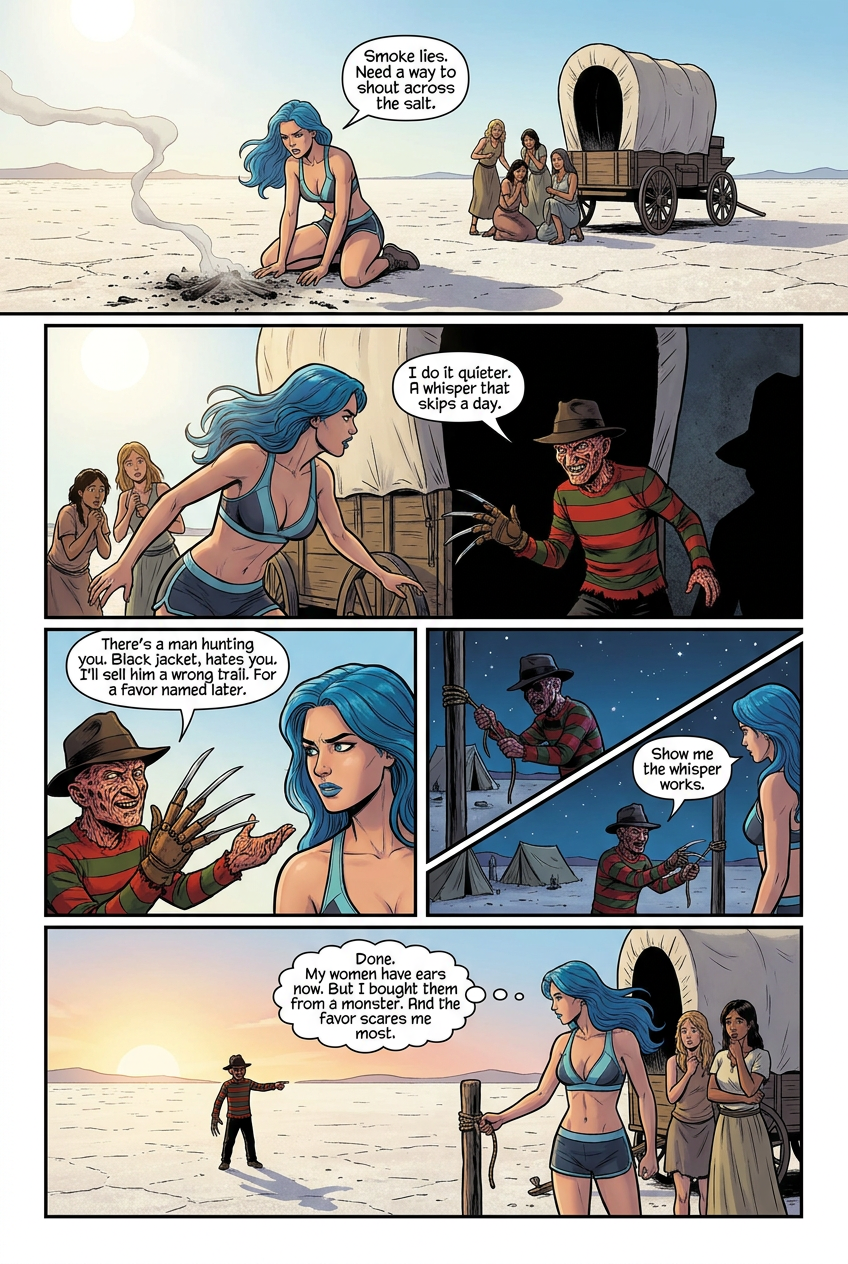
The four springs kept her women drinking. But water didn't warn them. Ellen rode the wagon between camps for three days and saw the flaw grow. Her groups sat a full day apart. If riders hit the north camp at dawn, the south camp wouldn't know until she rode in and found the bodies. She needed a way to shout across the salt. She had none. She tried smoke first. She built a signal fire at the north camp and told the women to light it if hunters came. It worked in the day. At night, the flame could be seen for miles by the wrong eyes. Worse, wind off the flats dragged the smoke sideways. The south camp read it as a false alarm twice and packed to flee for nothing. Smoke lied. She stamped the fire out and sat in the ash. A man watched her from the wagon's shadow. Small, hunched, red and green stripes under a filthy hat. Burn scars crossed his face. He turned a bladed glove in the light, and the women behind Ellen went still and quiet. Freddy Krueger. Ellen had heard the name in camp talk, a thing that found people when they slept. "You're screaming with fire," he said. His voice scraped. "Fire's for enemies to see. I do it quieter." "I don't want your kind of quiet." He grinned with wrecked teeth. "You want a whisper that skips a day of riding. I can carry a warning between your camps in the dark. One night's work. Cheap." Ellen's skin crawled. But he was right about the fire. "What's cheap?" "A name." He pointed the glove past her, north. "There's a man out there hunting you personal. Black jacket, half-gray hair, hates you like it's food. Sarah Morrell. He's paying me to find your camps." The blades caught light. "I'll sell him a wrong one. Send him to empty salt. In trade, you owe me a favor I name later." Ellen weighed it. A hunter she didn't know was already close. If she refused, Freddy sold him the truth. If she paid, she bought a false trail and a warning system in one night. "Show me the whisper works first." He did. He slipped between camps in the dark and left a knotted cord at each. Pull the cord's marker, and a rider three hours out learned trouble had come, no fire, no smoke. By morning both camps could warn each other faster than she could ride. Ellen tested it twice. It held. "Done," she said. Freddy pointed the black jacket the wrong way and vanished into the flats. Ellen's scattered women now had ears across the salt. But she'd bought them from a monster, and Sarah Morrell was still out there, still hunting hard, and one wrong trail would only slow him. The favor she owed had no shape yet. That scared her most.
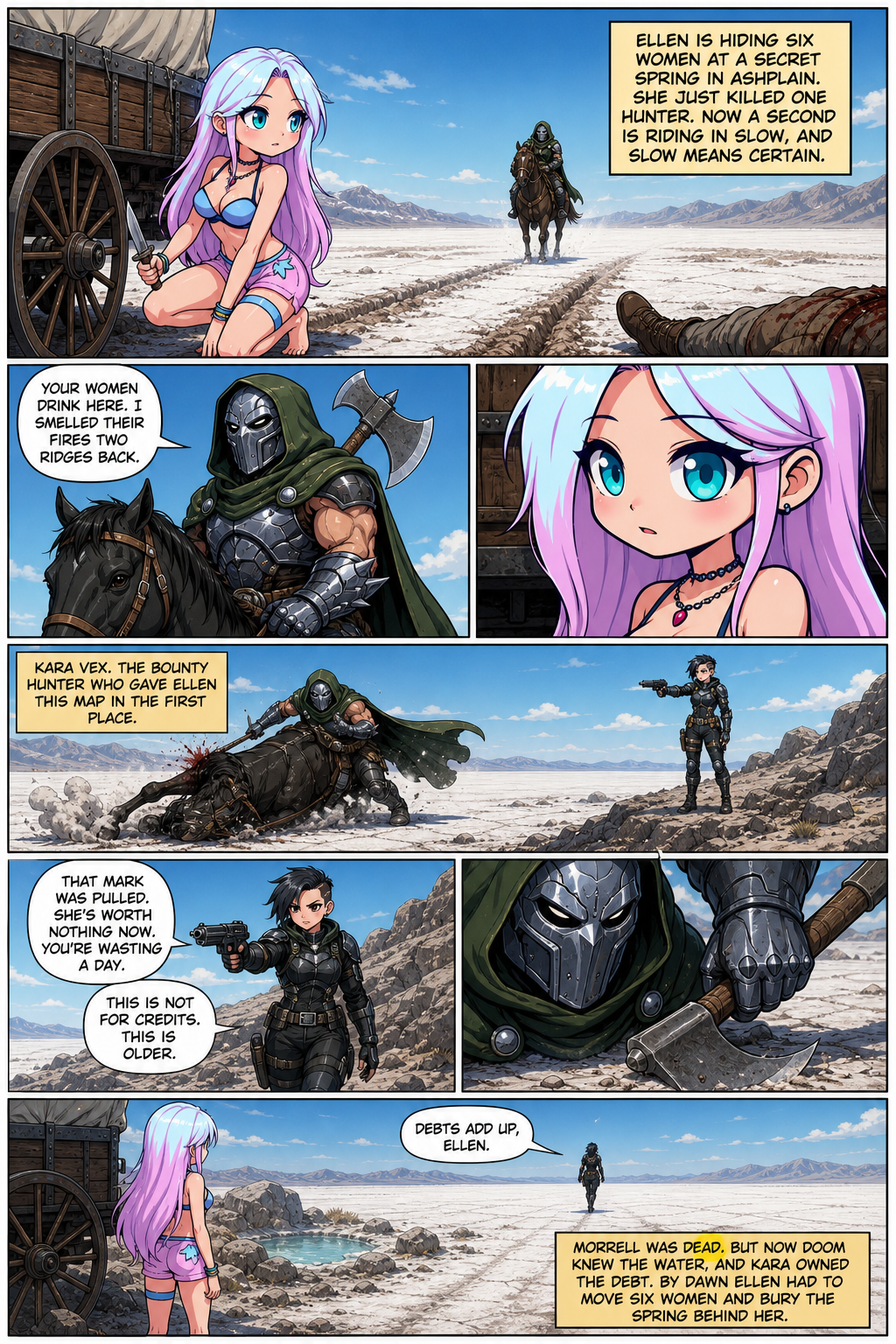
Ellen dragged Morrell's body from the spring and rolled it into the flats. She scrubbed the wet sand where his blood had pooled. Then she saw the fresh tracks. A single rider had crossed the salt near her wagon, following Freddy's trail in. Killing Morrell had not ended the hunt. It had drawn a new eye. And that eye was bent toward the fourth spring, where her women now sheltered. She pulled her cord to warn the north camp. Then she waited by the wagon, knife ready, and watched the horizon shimmer. The rider came slow. Not slow from caution. Slow from certainty. His armor caught the sun in dull gray plates, and a green hood hung over an iron mask. An axe rode across his back. She had made enemies of gods and hunters both, but this one she knew by the file Vincent once showed her. Victor Von Doom. A man who blamed her for a wrong she barely remembered, and who never forgot a debt. "You left a body," Doom said. He did not dismount. "Careless. Bodies draw men like me." "You came for the body?" "I came for you. The body only told me where to look." His mask tilted toward the spring. "Your women drink here. I smelled the smoke of their fires two ridges back." Ellen's stomach dropped. He was not bluffing. He had circled wide and found the true camp before he found her. A sharp crack split the air. Doom's horse screamed and buckled. He rolled clear as it fell, and rose with the axe already in his hands. On the far rise stood a small armored figure, one gun still raised. Kara Vex. The hunter who had given Ellen the map to this very spring. "That mark isn't yours," Kara said. She walked down the slope, gun level. "It was pulled. She's worth nothing now. You're wasting a day." "This is not for credits," Doom said. "This is older." "Then it's not my business." Kara stopped between him and Ellen. "But she's under my map. I don't like my work undone." Doom measured her. The gun did not waver. He was fast, but Ellen saw him count the distance and find it short. He lowered the axe an inch. "Another day, then," he said. He caught his fallen horse's line, hauled it up, and led it limping into the flats. He did not look back. Ellen breathed for the first time in a minute. "Why?" "You owe me now," Kara said. "Move your camp off this spring by dawn. He knows the water. He'll come back to the water." She holstered the gun and turned to go. "Debts add up, Ellen." Ellen watched her cross the salt. Morrell was dead, but she had traded one hunter for a worse one who knew her water. By morning she had to move six women and bury the spring behind her.
Play your story to life
Storycraft is a mobile game where you create AI characters, craft items and locations to build their world, then discover what direction your story takes. Download the iOS game for free today!
Download for free