

Brooke ‘Bookeeper’'s Arc
32 Chapters
Brooke ‘Bookeeper’'s dream is running a library so all the people in Rust can have some form of entertainment.

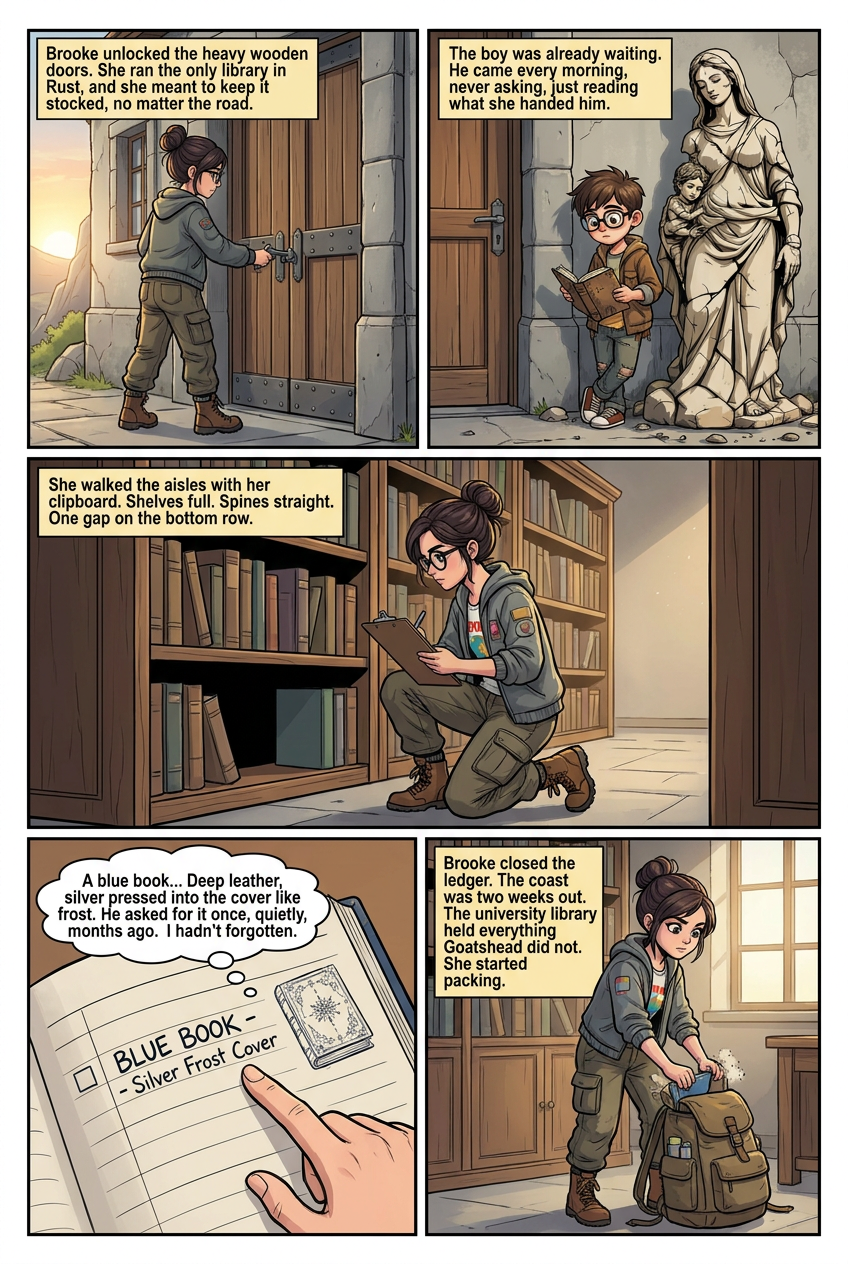
Brooke unlocked the heavy wooden doors and stepped inside her library. She ran the only one in Rust, and she meant to keep it stocked, no matter the road. The boy was already waiting outside, leaning against the broken statue of a woman holding a child that marked her front step. He came every morning. He never asked for anything. He just read what she handed him. She walked the aisles with her clipboard. Shelves full. Spines straight. One gap on the bottom row, third shelf from the door. She knelt and checked her ledger. A blue book. Deep leather, silver pressed into the cover like frost. She had seen the boy circling that empty slot for weeks, fingers brushing the wood where it should sit. He had asked for it once, quietly, months ago. She had written it down and not forgotten. Brooke closed the ledger. The coast was two weeks out. The university library held everything Goatshead did not. She stood up, dusted her knees, and started packing.
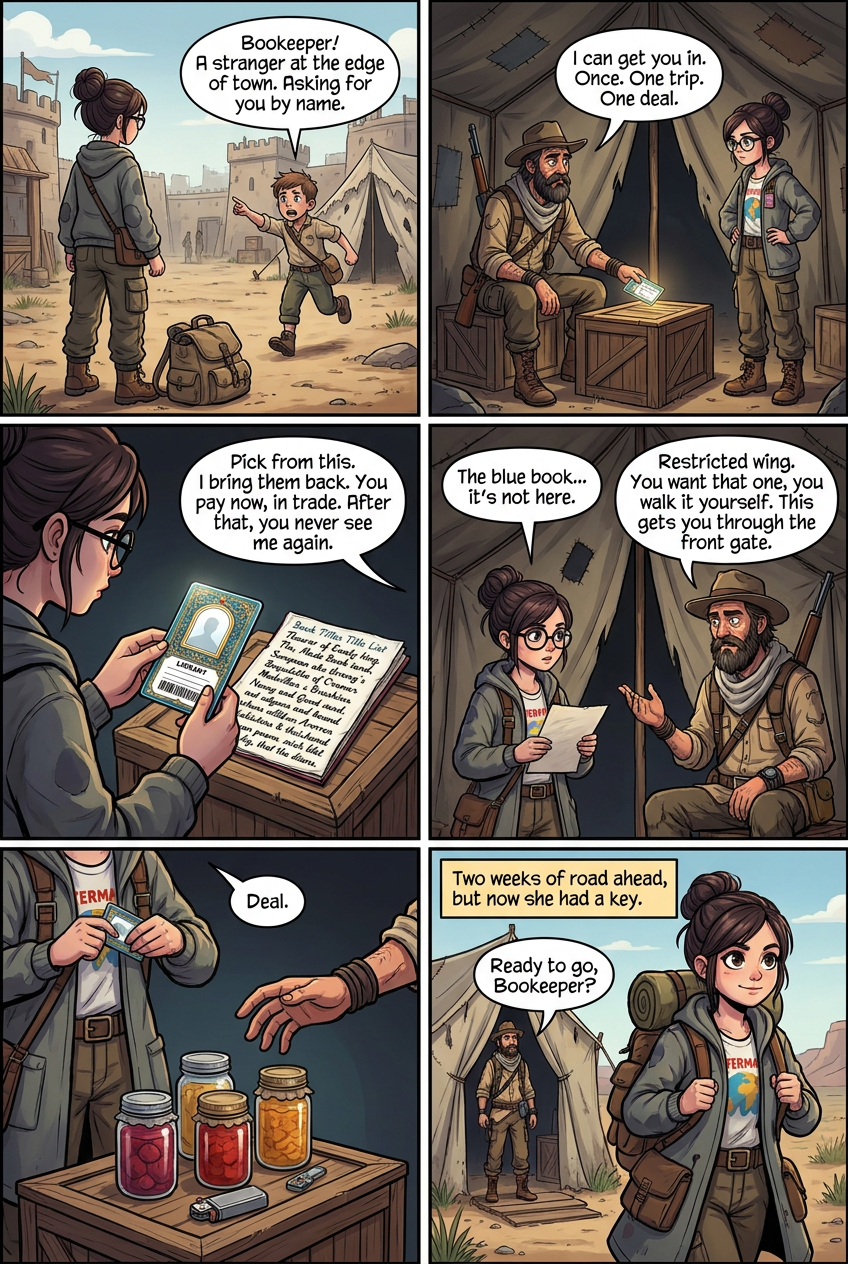
Brooke had her pack half-loaded when word came of a stranger at the edge of town. A dusty traveler with a rifle slung low and a beard full of road. He had set up a torn tent on the dirt and was asking for the Bookeeper by name. She found him sitting on a crate inside the patched canvas. He did not stand. He slid a glossy card across the crate between them. A library ID, pre-war, sealed and clean. The university seal pressed into one corner. "I can get you in," he said. "Once. One trip. One deal." Brooke picked up the card and turned it in the light. Real. She set it down. He pushed a folded paper toward her next, a list of titles in cramped ink. "Pick from this. I bring them back. You pay now, in trade. After that, you never see me again." She read the list twice. The blue book was not on it. She asked. He shook his head. "Not on the shelves I can reach. Restricted wing. You want that one, you walk it yourself." He tapped the card. "This gets you through the front gate. After that, you're on your own inside." Brooke paid him in three jars of preserves and a working lighter. She tucked the ID into her coat. The deal was done, and it would not come again. She still had two weeks of road ahead, but now she had a key. She walked back to the library to finish packing, and the boy was already waiting on the step.
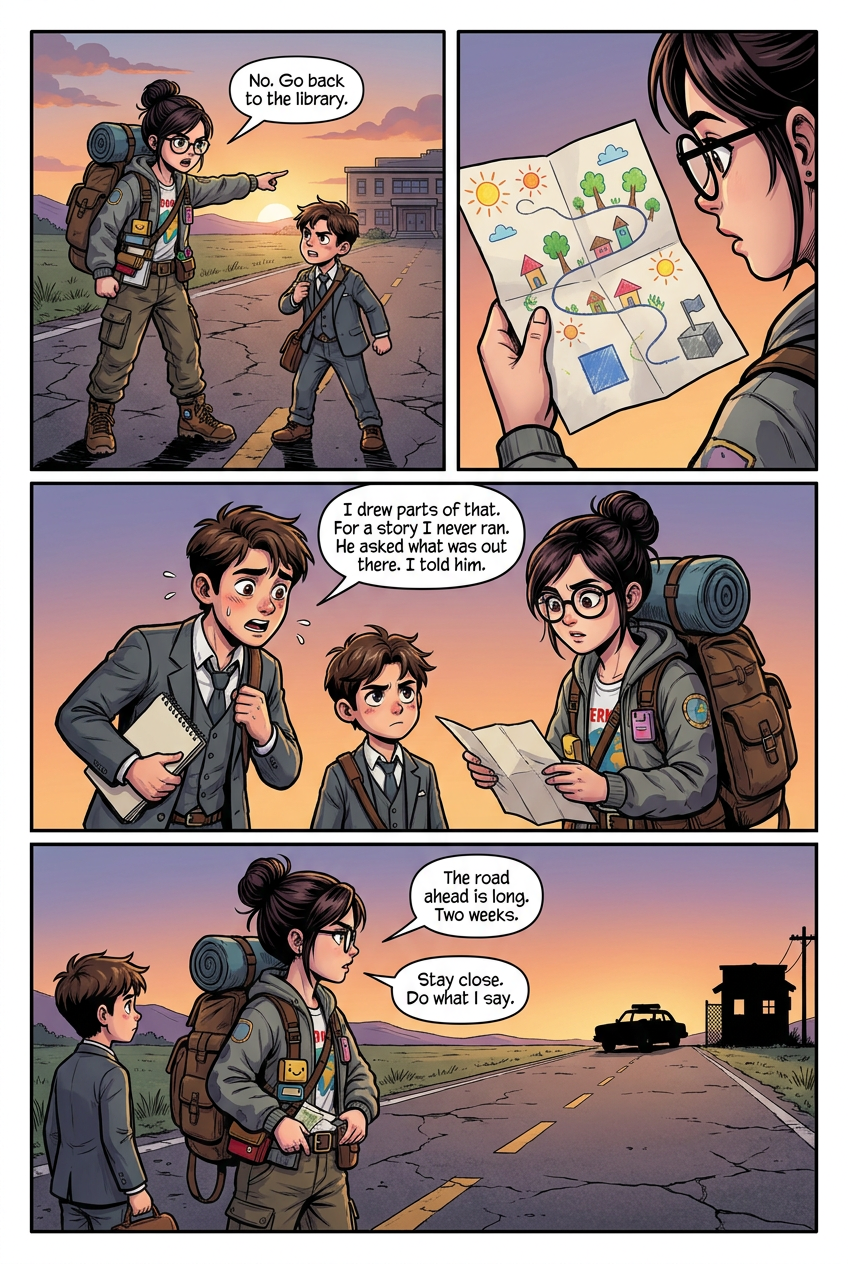
Brooke shouldered her pack at dawn and found the boy already on the road, boots laced, a small bag at his hip. She told him no. He did not move. She told him again, sharper, and pointed back toward the library. He reached into his coat and pulled out a folded square of paper. She took it because she had to. It was a child's drawing, bright crayon and pencil, a winding line marked with suns and trees and tiny houses. But the line was right. She knew the first three days of road by heart, and his shapes matched. A blue square sat where an old armored cruiser had rusted out by the ditch. A gray block with a flag marked a checkpoint shack she'd heard travelers curse. Someone had walked this route. Someone had told him. "Who gave you this," she said. He did not answer. He only looked at her, steady, the way he looked at books she set in front of him. Footsteps behind her. Webster Daily, notebook under his arm, breath short from catching up. He glanced at the paper and his face went still. "I drew parts of that," he said quietly. "For a story I never ran. He asked me what was out there. I told him. I didn't think he'd keep it." Brooke folded the map and put it in her pocket. She looked at the boy, then at the road, then at the two weeks waiting in it. "Stay close," she said. "Do what I say." He nodded once. She started walking, and they followed.
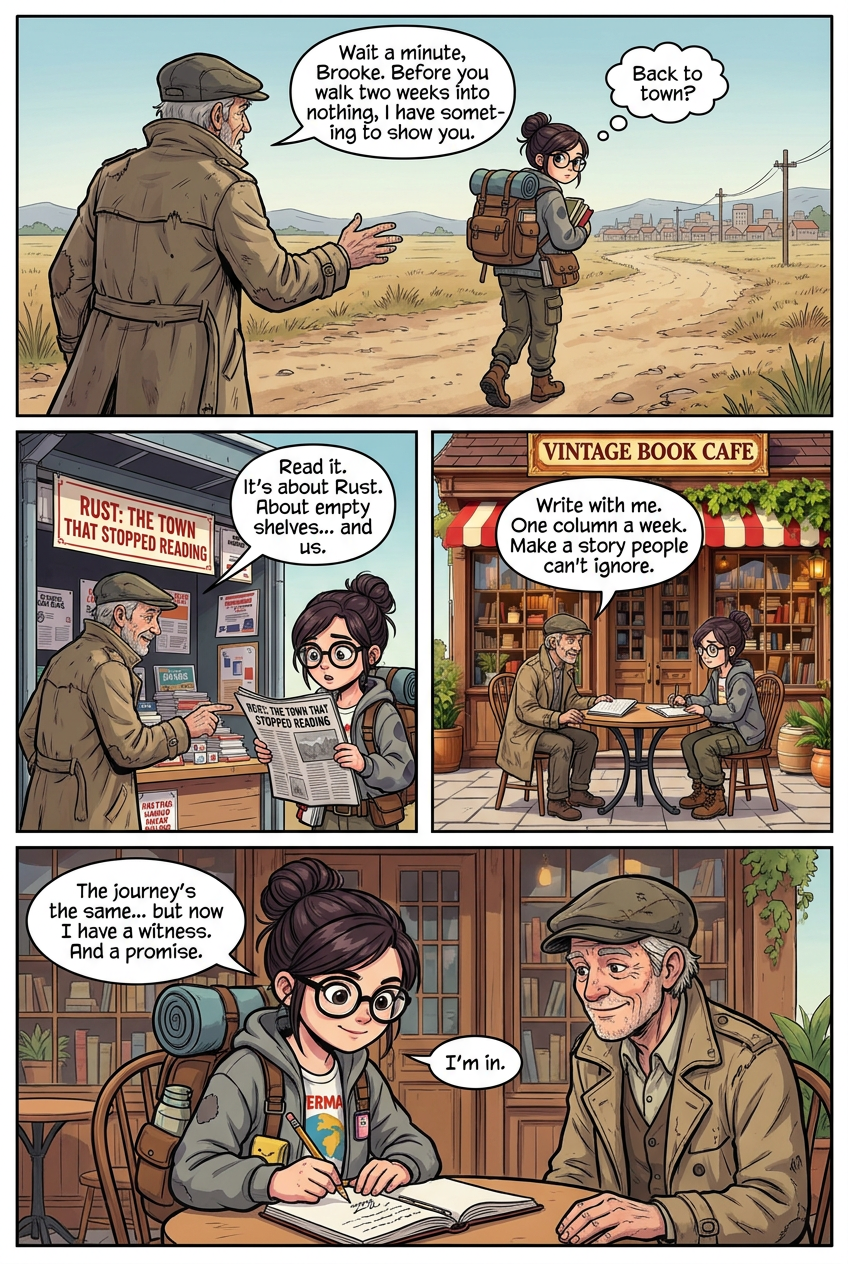
They had not gone a mile before Webster slowed and turned them back toward town. He had something to show her, he said, before she walked two weeks into nothing. The boy looked up at Brooke. She nodded, and they followed Webster down a side road to a small corner stand stacked with neat rows of newsprint. Outside the door, a tall board held his latest paper pinned under glass. Brooke read the headline twice. It was about Rust. About empty shelves and a town that had stopped reading. He had been writing about her without saying her name. He walked her two doors down to a little cafe with books in the windows. A small iron table sat under the awning, two chairs pulled close. He set his notebook between them. "Write with me," he said. "One column a week. About the road. About the book you're going to find. Make a story people can't ignore." Brooke sat. She thought of the boy, of the shelves, of two weeks of road still ahead. She picked up the pencil and signed her name across the top of his page. The journey was the same, but now it had a witness, and a promise of ink waiting on the other end.
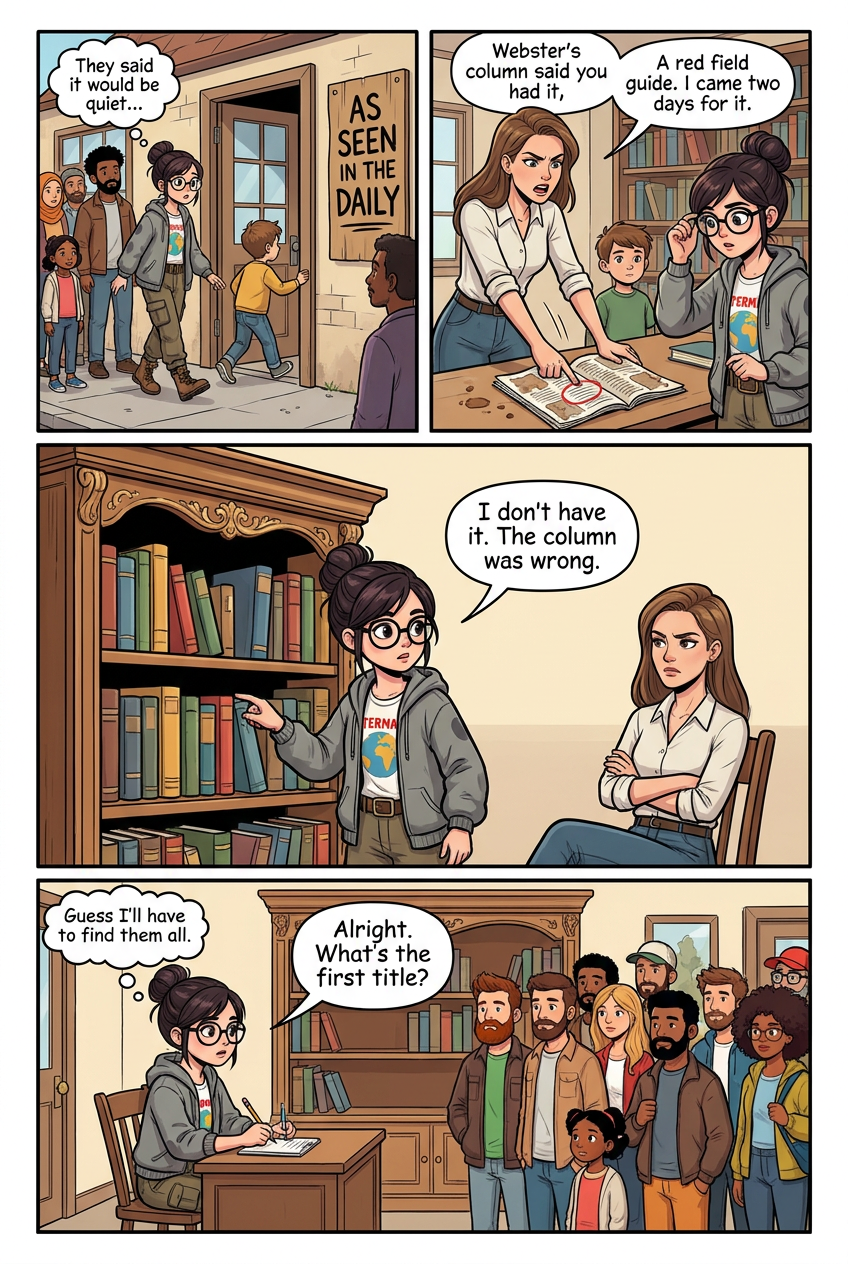
They walked back to Rust together, and Brooke saw the change before she reached her door. A small crowd stood outside her library, a hand-painted board nailed beside the entrance reading AS SEEN IN THE DAILY. The boy slipped inside ahead of her. Brooke followed, counting strangers she did not know by name. A tall woman pushed to the front and slapped a creased magazine page on the counter. Coffee stains ringed a circled paragraph. "Webster's column said you had it," the woman said. "A red field guide. I came two days for it." Brooke scanned the print. The column named her library. It did not name any red book. Brooke walked to the carved display shelf at the back, the one she kept stocked for show. She ran her finger along every spine. No red field guide. She turned and told the woman plainly, "I don't have it. The column was wrong." The woman's face went hard, but she didn't leave. She sat in the boy's chair and folded her arms. Brooke looked at the waiting faces, at the shelf with its gaps, at the boy watching her. The road to the coast had just grown heavier. She picked up her pencil and began a list of every title these strangers wanted, knowing she'd have to bring them all back, or lose the library she had built.
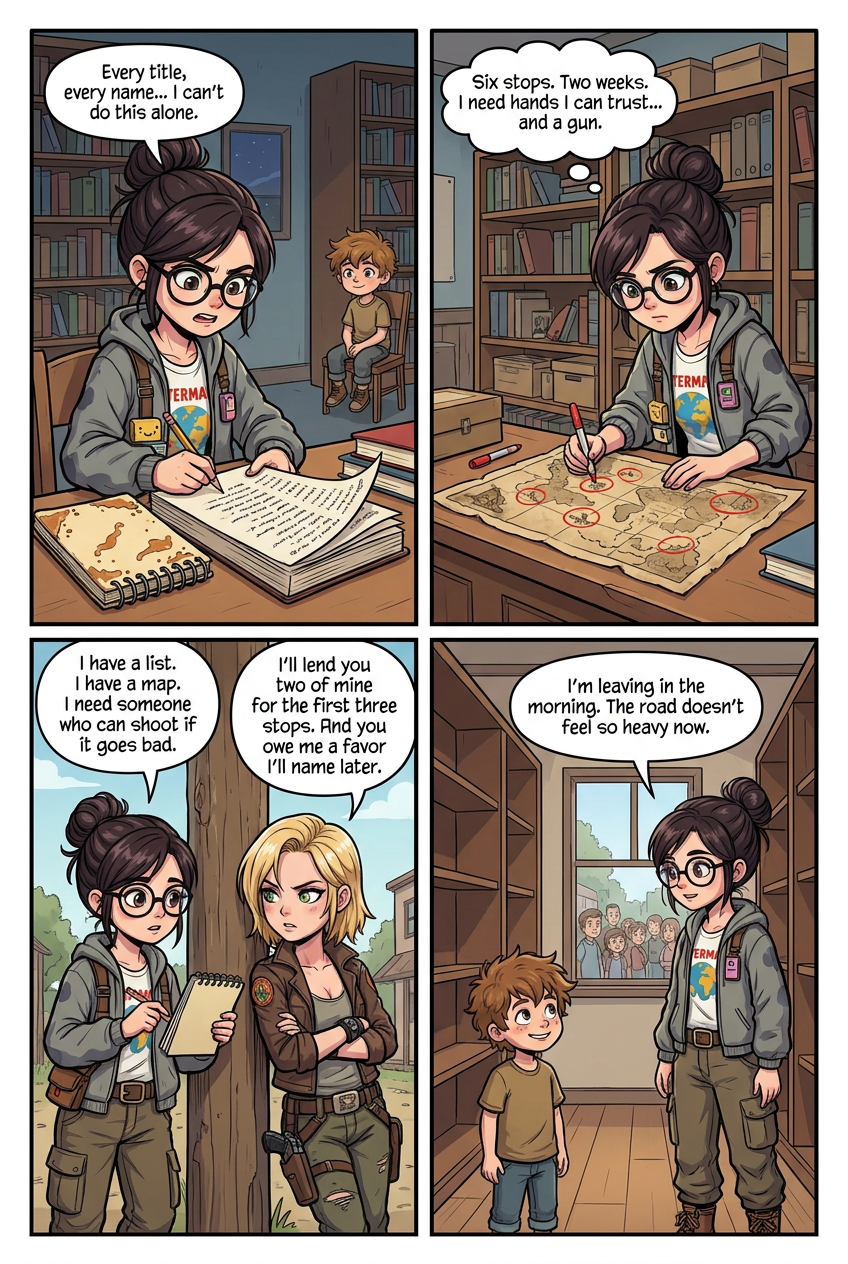
Brooke closed the library door behind the last stranger and pulled out her spiral notepad. The pages were already bent from her pocket. She wrote every title down, every name attached to it, until the list ran two pages deep. The boy watched from his chair. She tapped the pencil twice and knew she could not do this alone. She walked to the warehouse she used for staging, the one with steel shelves and a long wooden counter for sorting. She spread an old map across the counter and circled six places in red ink — abandoned libraries, a school, a clinic with a reading room. Six stops. Two weeks if she was lucky. She needed hands she could trust, and a gun she did not have. She found Sherrie at the edge of town, leaning against a post. Brooke laid the notepad on a crate between them and spoke plainly. "I have a list. I have a map. I need someone who can shoot if it goes bad." Sherrie picked up the notepad, thumbed the pages, and set it back down. "I don't run errands," Sherrie said. "But your column brought people to this town. People I can sell to." She tapped the map once. "I'll lend you two of mine for the first three stops. After that, you're on your own. And you owe me a favor I'll name later." Brooke held her eye, then nodded. She rolled the map, pocketed the notepad, and walked back to the library to tell the boy she was leaving in the morning. The crowd outside had thinned. The shelves were still empty. But for the first time, the road did not feel like one woman's weight.
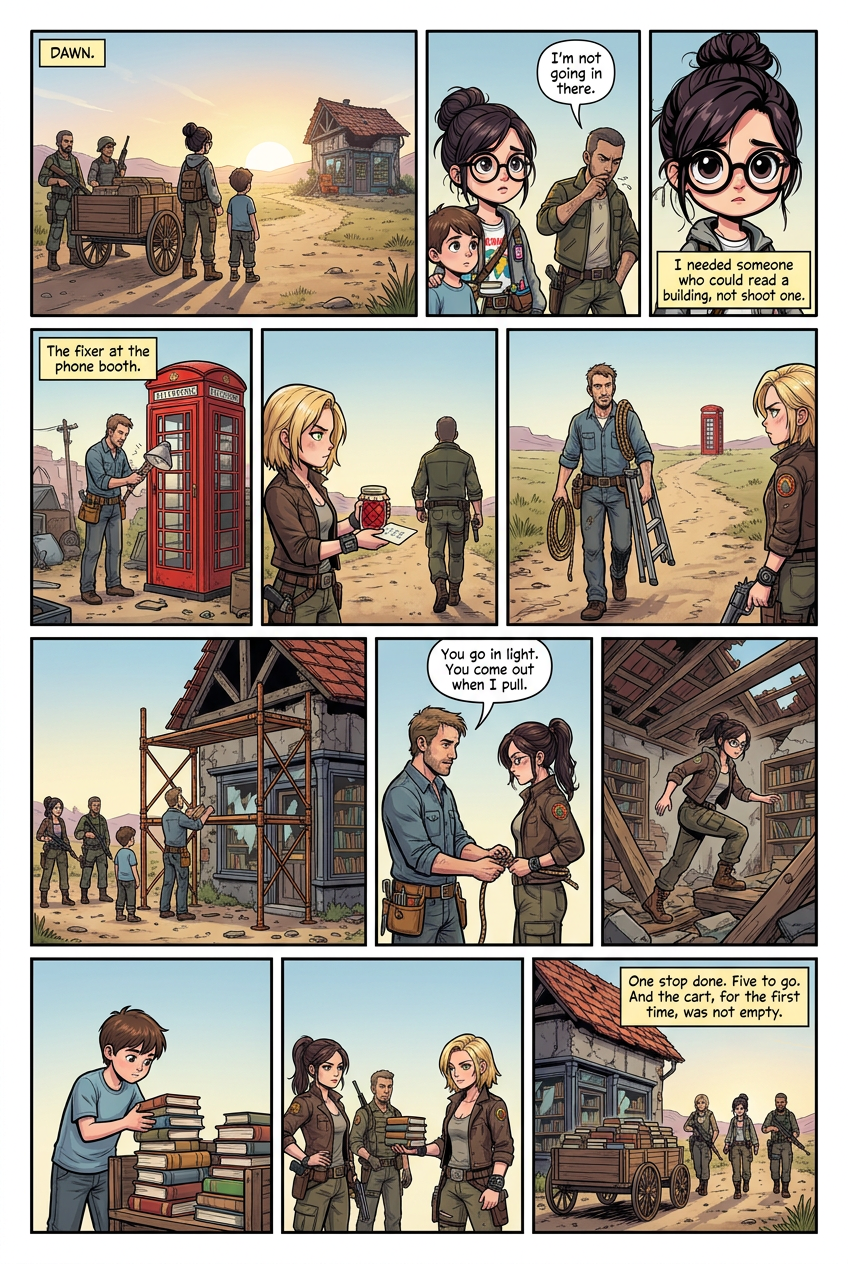
Brooke left at dawn with the boy, two of Sherrie's escorts, and a cart. The first stop sat three hours out — a small bookstore with half its roof caved in. Twisted beams hung over the door. Shelves leaned inside, still full. One wrong step and the whole place would fall. She stared at it from the road. The boy stared too. One of the escorts spit in the dirt and said he wasn't going in there. The other agreed. Brooke understood. She needed someone who could read a building, not shoot one. She remembered a man who worked out of an old red phone booth at the edge of a junk lot, fixing what others called broken. She sent an escort back with a note and a jar of preserves. By midday he came walking up the road with rope coiled on his shoulder and a folding ladder under his arm. He circled the bookstore twice. He pointed at the beams that held and the ones that didn't. Together they raised a frame of pipe and plank against the front wall — bracing the doorway, propping the worst sag. He tied a line around Brooke's waist. "You go in light," he said. "You come out when I pull." She went in. She came out three times, arms full, the boy stacking books on the cart in silent rows. Forty-one titles. Eleven from her list. The roof groaned but held. Sherrie's escorts watched the road. Brooke paid the man in books and a promise. One stop done. Five to go. And the cart, for the first time, was not empty.
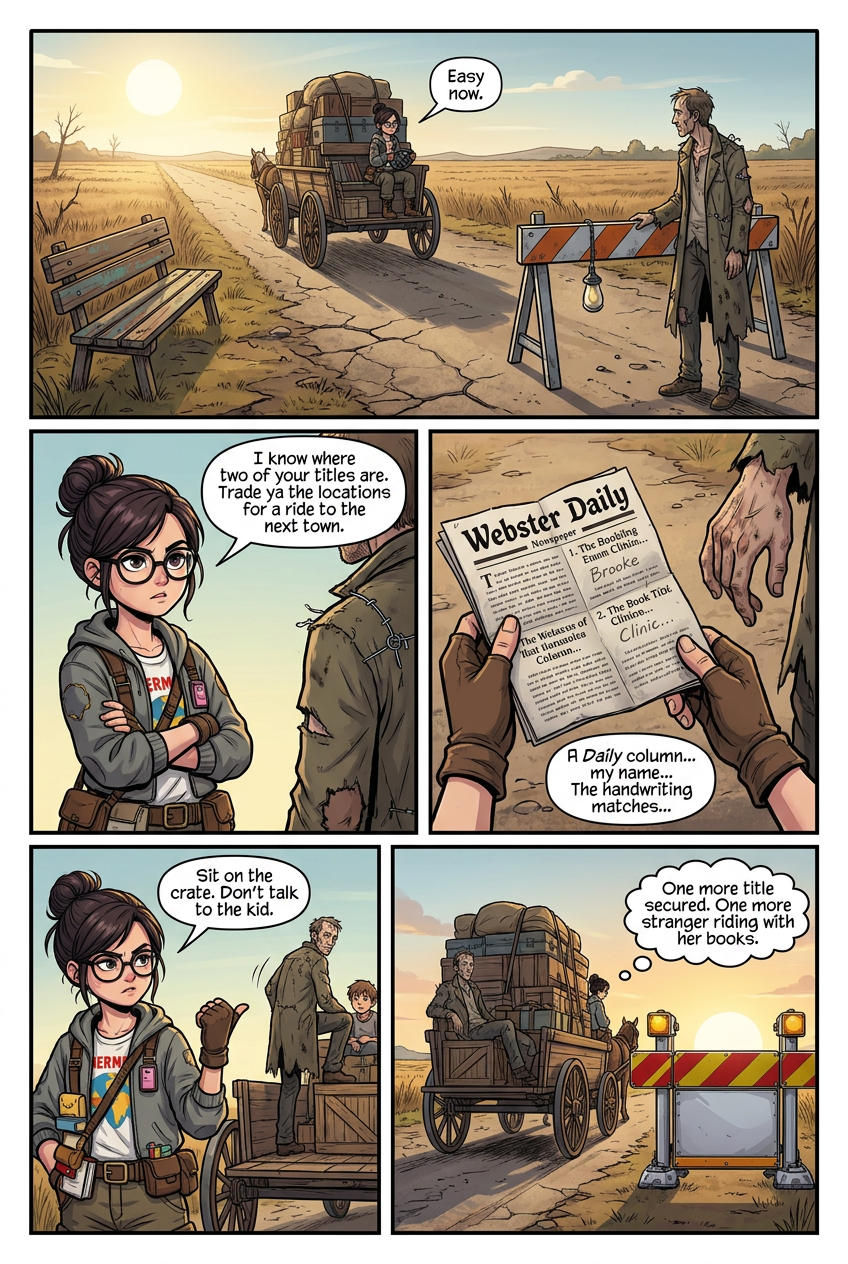
By afternoon the cart rolled slow under its new weight. The road thinned to cracked dirt between dead fields. A bench sat alone at the shoulder, its paint long faded. Past it, a striped barrier blocked half the lane, one lamp dangling loose. A man stood beside it in a coat held together with wire. Brooke raised a hand. The escorts pulled up. The boy sat still on the books. She climbed down and sized him up — thin, sunburned, eyes too sharp for the rest of him. He said he knew where two of her titles were. Said it like a fact. Said he'd trade the locations for a ride to the next town. She almost waved him off. Then he pulled a folded square from his coat — a Daily column, creased soft from handling. Her name was on it. Beside two titles, he'd written addresses in small careful pencil. She read them twice. The handwriting matched a clinic she already had marked, and one she didn't. Brooke looked at the cart, at the boy, at the escorts. Then she jerked her thumb at the back. "Sit on the crate. Don't talk to the kid." The man climbed up. The barrier stayed where it was as they rolled past. One more title secured. One more stranger riding with her books.
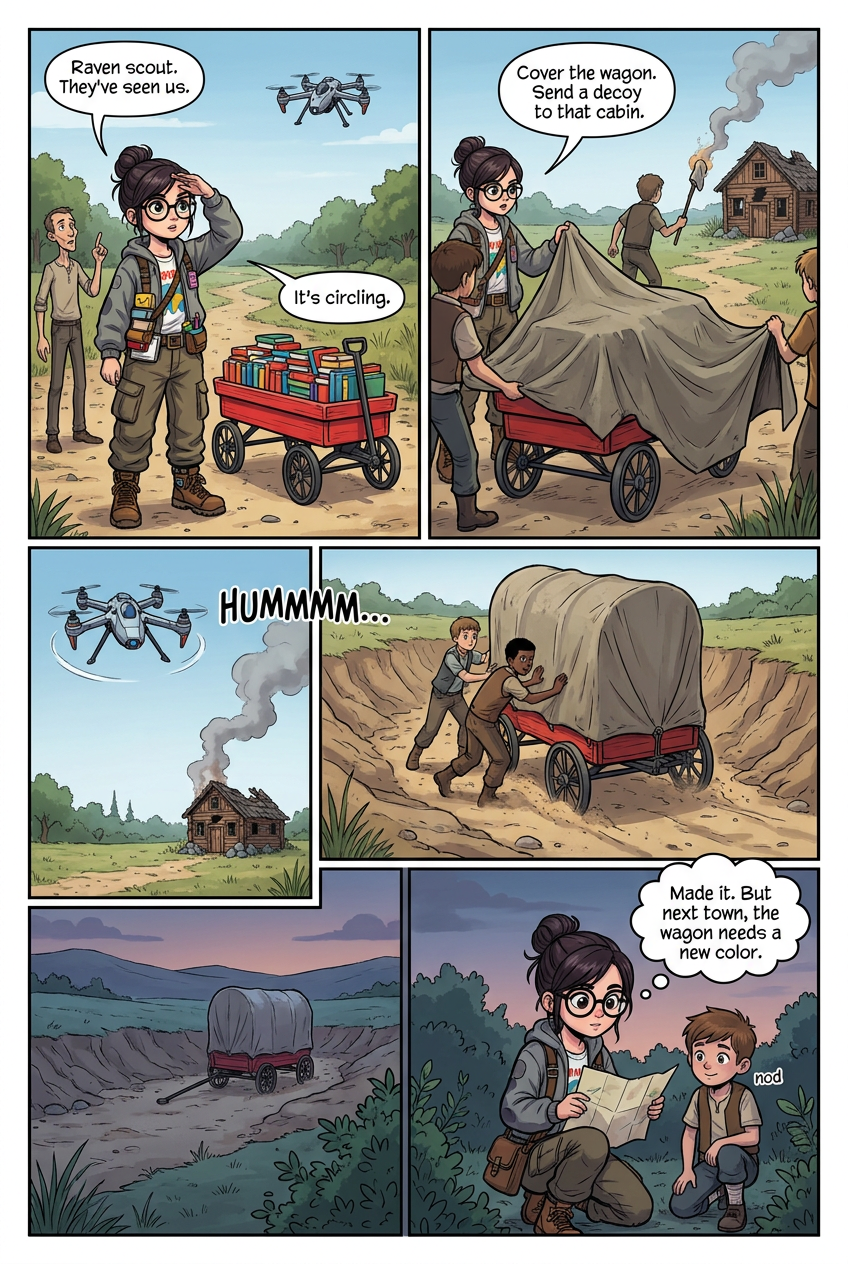
An hour past the barrier, the thin man pointed at the sky. A small shape hung above the ridgeline, four rotors humming soft as a wasp. Brooke shaded her eyes. The drone drifted, kept pace, then slid behind a tree line. Raven scout. She'd seen one once before a convoy got hit. Her cart sat bright and obvious below — red paint, books stacked high, spines in every color a thief could dream of. Brooke pulled the escorts close. The thin man said there was a broken cabin up the road where Ravens staged hits. He'd seen bikes parked behind it twice. She studied her map, then the sun, then the cart. Turning back meant losing three stops. Pushing through meant walking into the ambush they were already building. She chose a third road. Brooke had the escorts strip a tarp from the supply crate and throw it over the books, dulling the wagon's bright shell. Then she sent one escort ahead on foot toward the ruined cabin with a smoking rag tied to a stick — a decoy plume rising slow over the trees. While the drone circled the smoke, Brooke turned the cart off the main track and rolled it into a dry creek bed, wheels muffled in soft sand. They waited under brush until the humming faded west. By dusk they came out two miles past where the cabin sat. No bikes followed. The boy looked up from the books and gave her the smallest nod. Brooke marked the detour on her map in pencil. The drone was gone, but it had seen the wagon once. Next town, she'd need a new color.
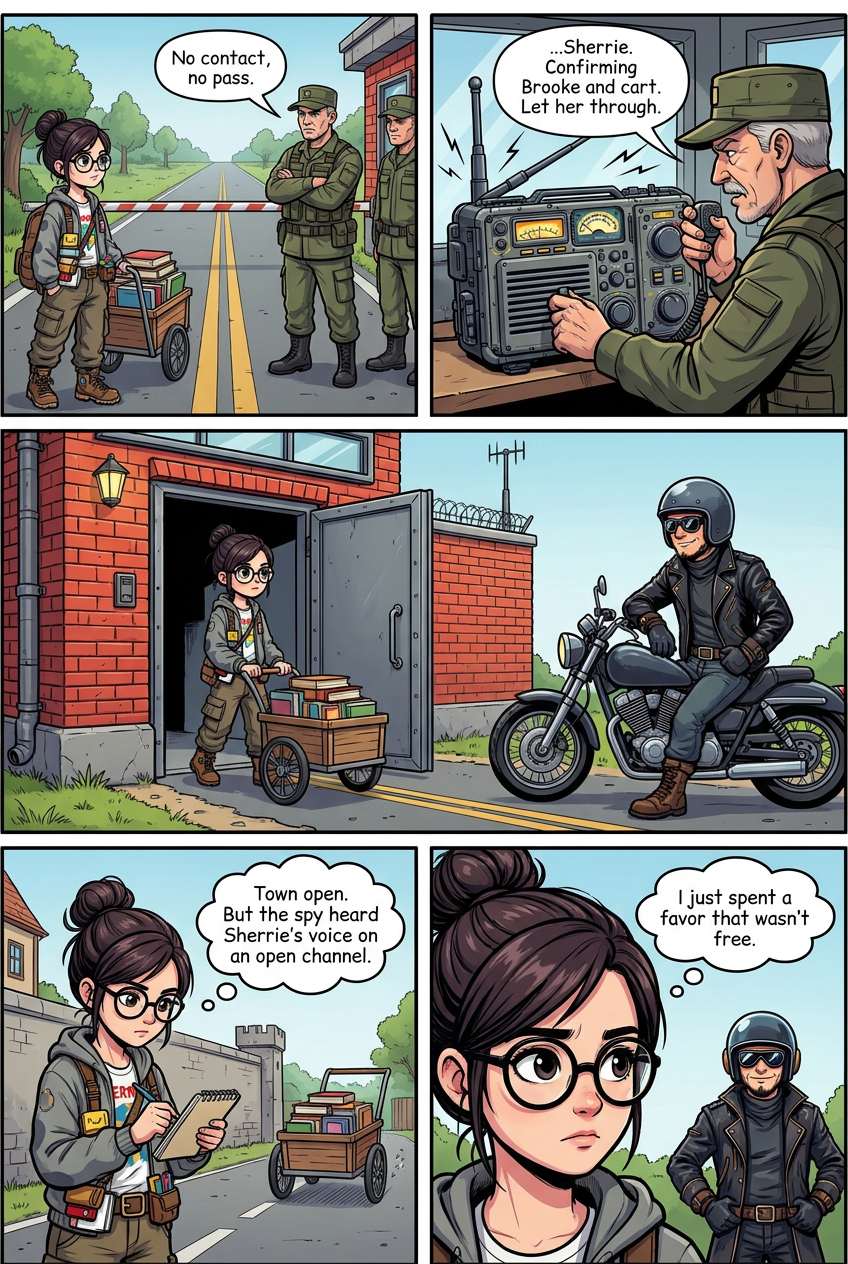
By morning the cart rolled up to a brick guard house at the edge of the next town. Two gatekeepers stepped out before Brooke could speak. They looked at her cart, her escorts, the boy. No name on their list matched hers. No local would vouch. The road behind was closed to her now, and the road ahead was a steel door. The older gatekeeper folded his arms. "No contact, no pass." Brooke kept her voice level. She gave them Sherrie's name. The man's mouth tightened, but he turned toward the guard house anyway. Inside sat a heavy military radio, dials worn smooth from use. The gatekeeper cranked it and spoke a call sign. Static. He tried again. Brooke watched the boy hold the blue-spined stack tighter. A third try. Then a low voice cut through the hiss — short words, no waste. Sherrie. She confirmed Brooke. She confirmed the cart. She said let her through. The gate swung open. As Brooke rolled past, she caught a glimpse of a man across the road in dark leather and a smoked helmet, leaning on a bike, watching the radio antenna. He did not move. He only smiled, small and patient, and thumbed something at his belt. Brooke marked the stop on her list and pushed the cart inside the walls. The town was open to her. But the spy had heard Sherrie's voice on an open channel, and Brooke knew, flat and certain, that she had just spent a favor that wasn't free.
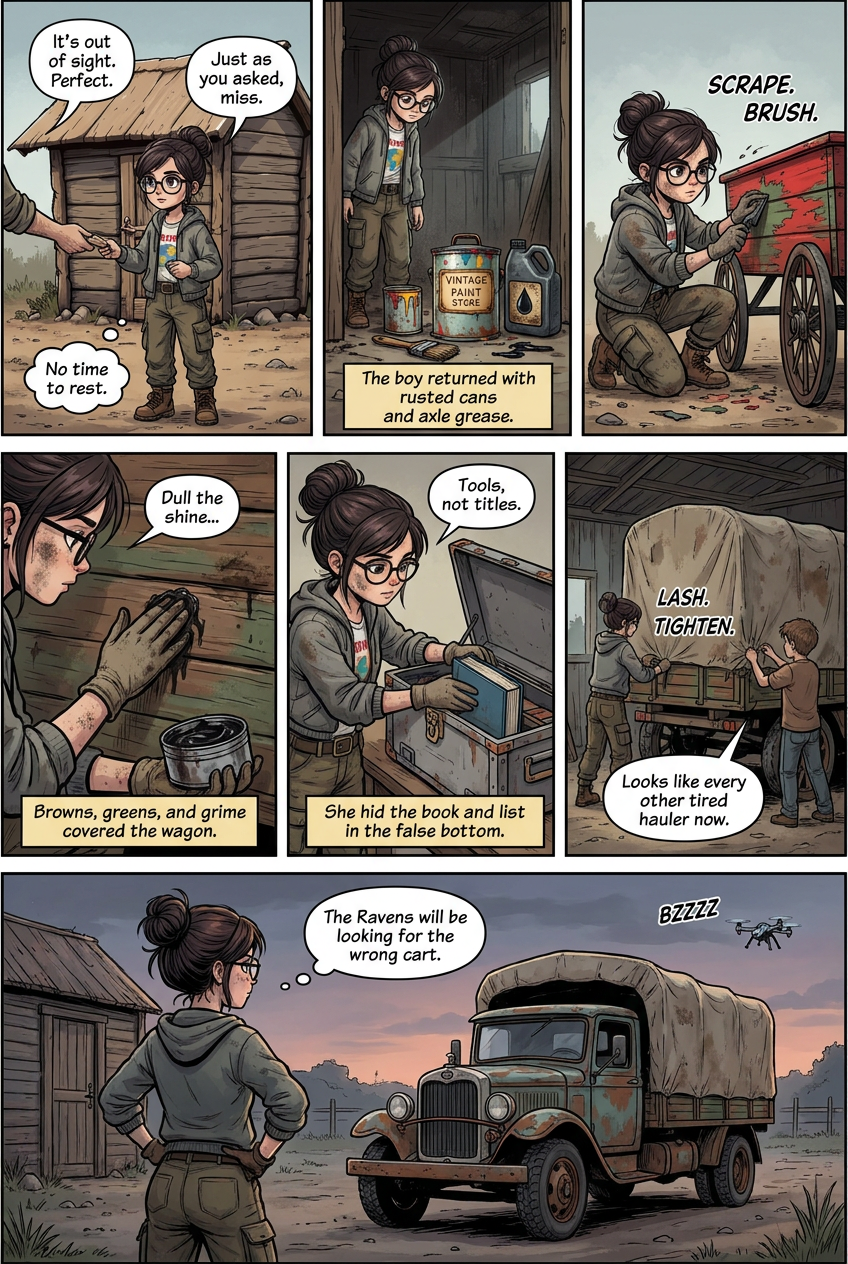
Inside the walls, Brooke did not stop to rest. She paid a stable hand for the use of a small wooden shed at the back of a quiet lot. Dust coated the boards. The door had a working latch. It was out of sight from the road, and that was all she needed. She sent the boy to a supply stall with a short list. He came back with three rusted cans from a paint store, a brush, and a jug of black axle grease. Brooke pulled the cart inside the shed and shut the door behind them. They worked through the afternoon. Brooke scraped the bright reds and yellows off the wagon and rolled flat browns and dull greens over the wood. She smeared grease along the seams to dull the shine. The escorts dragged the truck in next and pulled a weathered canvas cover over its frame, lashing it tight so it hung like every other tired hauler on the road. From her toolbox she lifted the false tray and slid the boy's blue-spined book and the marked list into the hidden bottom. If a checkpoint searched the cart now, they would find tools, not titles. She closed the lid and clicked the latch. At dusk she opened the shed door and looked at her work. The bright book wagon was gone. In its place sat a plain covered truck, rust at the fenders, canvas sagging, nothing worth a second glance from a drone. Brooke wiped her hands and nodded once. The road ahead was still long, but the Ravens would be looking for the wrong cart now.
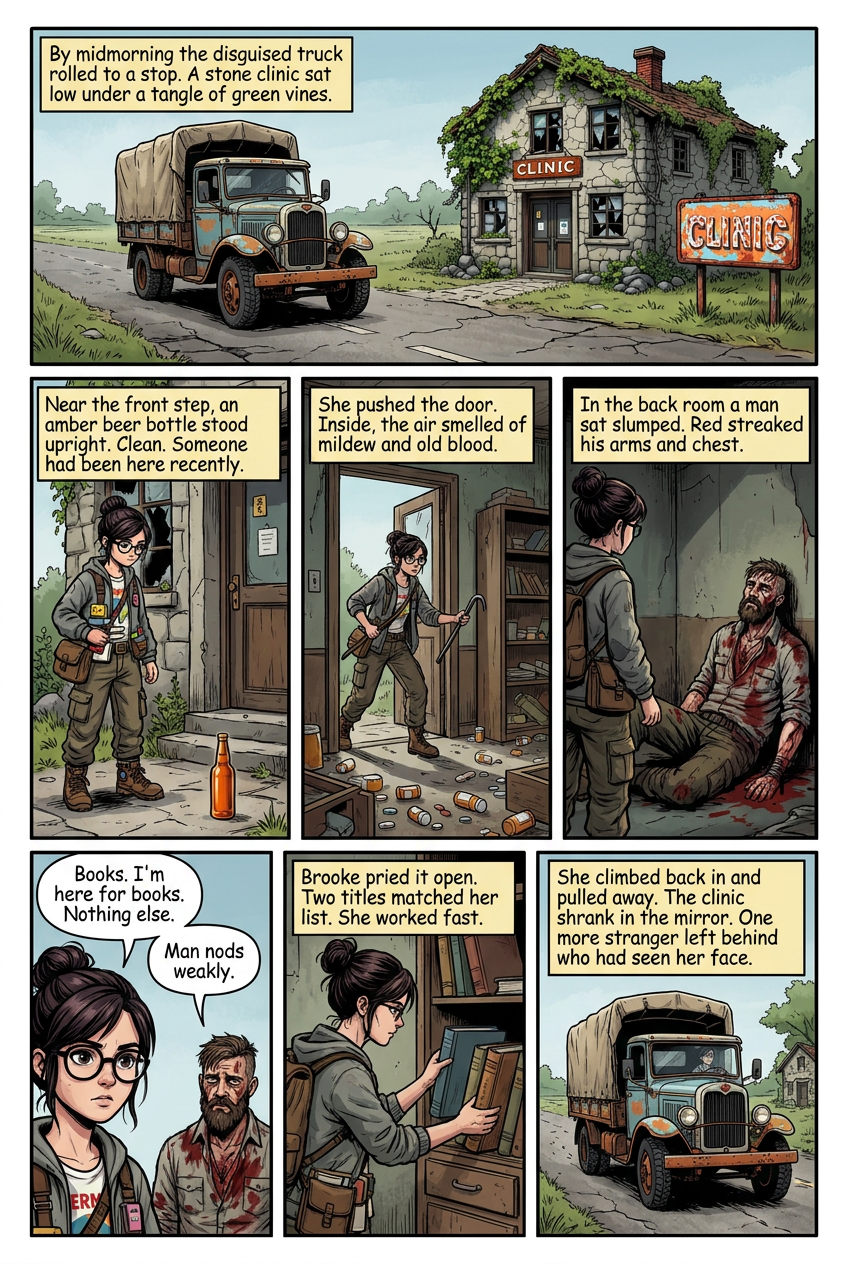
By midmorning the disguised truck rolled to a stop on a cracked patch of road. Brooke set the brake and studied the building ahead. A stone clinic sat low under a tangle of green vines. Half the windows were broken. A rusted sign on two posts leaned in the weeds, the word CLINIC still readable under flaking paint. She had never been here before. She did not know what waited inside. Brooke told the boy to stay in the cab. She climbed down with her crowbar in one hand. Near the front step, an amber beer bottle stood upright in the dirt. The glass was clean. No dust on the cap. Someone had been here recently, and they had not been gone long. She pushed the door with her boot. It swung open without a sound. Inside, the air smelled of mildew and old blood. Shelves had been tipped. Pill bottles crunched under her feet. In the back room a man sat slumped against the wall. His shirt was torn. Red streaked his arms and chest. He lifted his head and watched her, too tired to reach for a weapon. "Books," Brooke said, flat. "I'm here for books. Nothing else." The man nodded once. He pointed at a cabinet behind the front desk. Brooke pried it open. Inside sat a stack of bound medical texts and three paperbacks. Two titles matched her list. She loaded them into a canvas sack and worked fast. At the door she stopped. She set a clean rag and a half jug of water by the man's foot. He did not speak. She climbed back into the truck, handed the sack to the boy, and pulled away. The clinic shrank in the mirror. Two more titles found. One more stranger left behind who had seen her face.
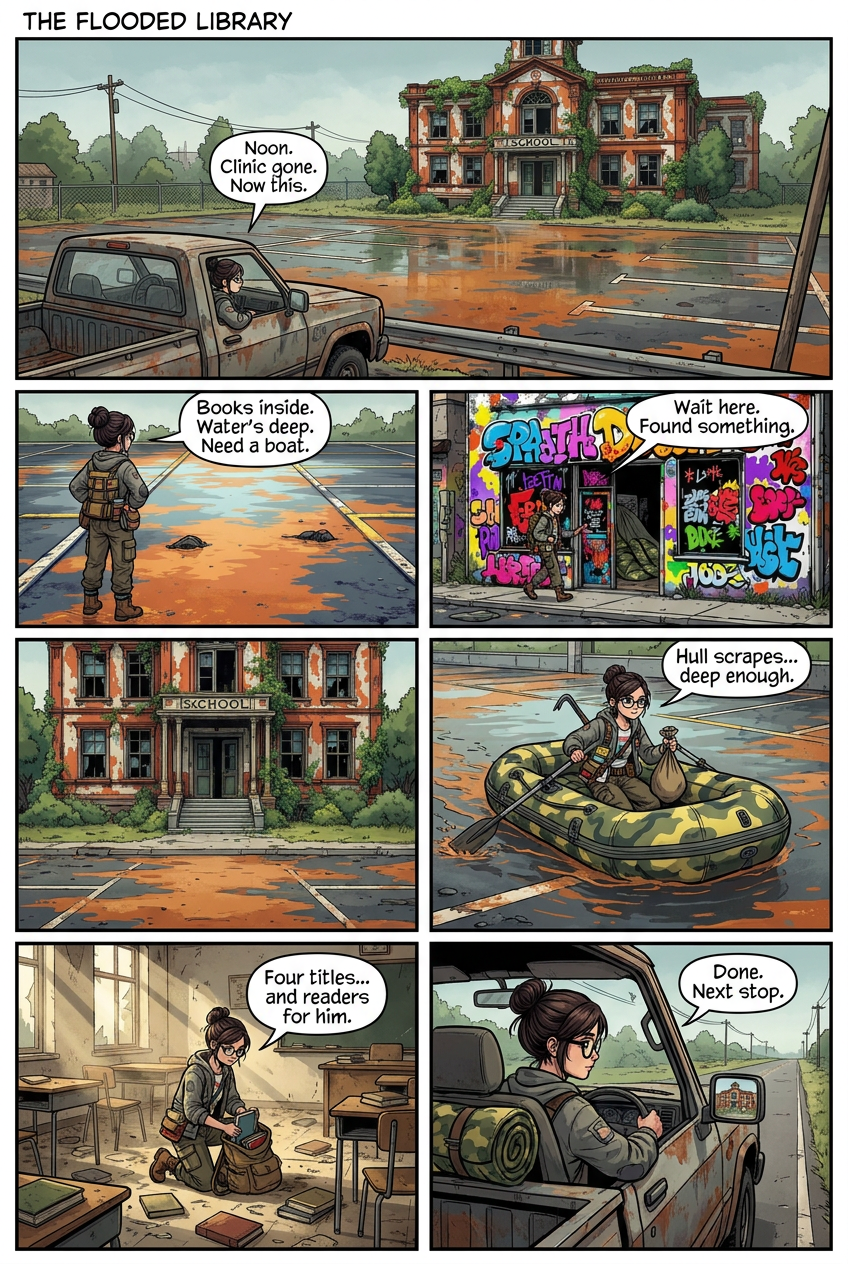
The clinic shrank behind them and the road bent west. By noon Brooke rolled the truck up to a flooded lot and stopped. Across the water sat a tall brick school, its windows broken, vines crawling up the orange walls. A faded sign over the door still read SCHOOL. Books waited inside. Water sat between her and them. Brooke stepped out and walked to the edge. The lot was a wide sheet of rust-orange water, streaked with oil. Yellow parking lines showed through in patches. She could not tell how deep it ran. Dark shapes drifted near the middle. The truck would stall before it reached the steps. She told the boy to wait and walked back along the road. A graffiti-covered shop slumped at the corner, its door hanging open. Inside, under a pile of tarps, she found a folded bundle of camo rubber. A military raft. She dragged it out, worked the hand pump from the truck, and watched it swell into shape on the cracked pavement. Brooke pushed the raft to the water and climbed in with her sack and crowbar. She paddled slow, testing the depth with the oar. The hull scraped something hard once, then slid free. She tied off at the school steps and went in. Dust, mold, and rows of fallen desks. In a back classroom she filled the sack with four titles from her list and a stack of readers for the boy. She paddled back with the sack between her knees. The boy helped her drag the raft up the bank. Brooke rolled it tight and stowed it behind the seat. Four more books found. The school sat empty in the mirror as she pulled away, and the road ahead opened toward the next stop.
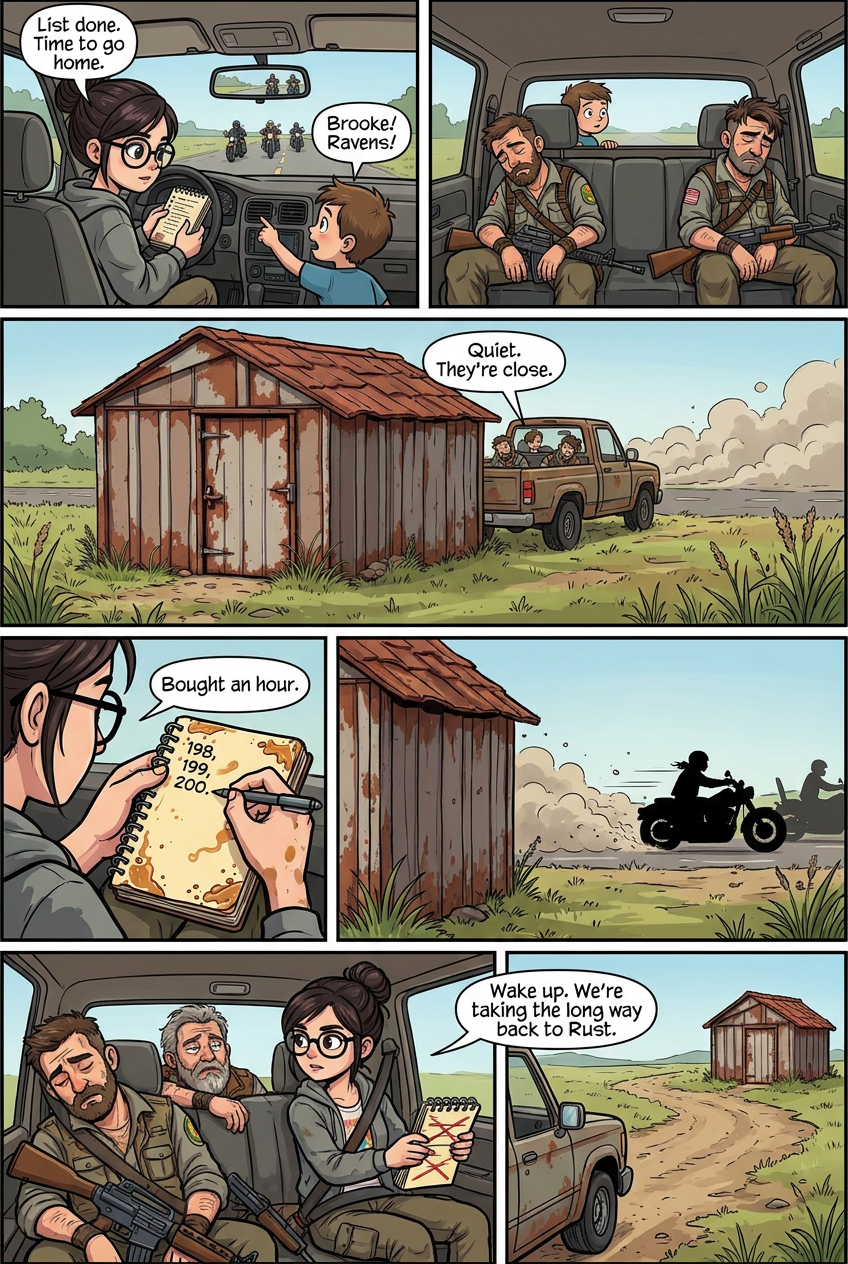
The school fell behind them and the road ran flat through dry grass. Brooke checked her list. Every title was crossed out. The cart sat heavy behind the truck, ropes tight over the canvas. It was time to go home. Then the boy tapped her shoulder and pointed at the mirror. Three headlights wobbled in the dust, far back but holding pace. Bikes. Raven scouts. Her two escorts slumped in the truck bed, rifles across their knees. One had a torn sleeve crusted brown. The other's eyes kept closing. They had fought twice already this week. Brooke saw it in their slack shoulders and the way their hands shook on the straps. They could not win another round. Brooke killed the lights and turned off the road through a gap in a wire fence. A small metal shed leaned in a weed lot ahead, roof red with rust, door hanging on one hinge. She rolled the truck and cart behind it, out of sight from the road. She cut the engine. They waited. She pulled out her stained spiral notepad and wrote down what she saw, hands steady even as the bikes whined closer. The motors grew, then passed. Dust drifted over the shed's roof. Brooke counted to two hundred. The road went quiet. She climbed down and walked to the corner of the shed. The headlights were gone west, chasing nothing. She had bought maybe an hour. She woke the escorts and turned the truck south, off her planned route, onto a slower track home. The cart was full. The list was done. But the Ravens knew her shape now, and the road back to Rust would not be the road she came in on.
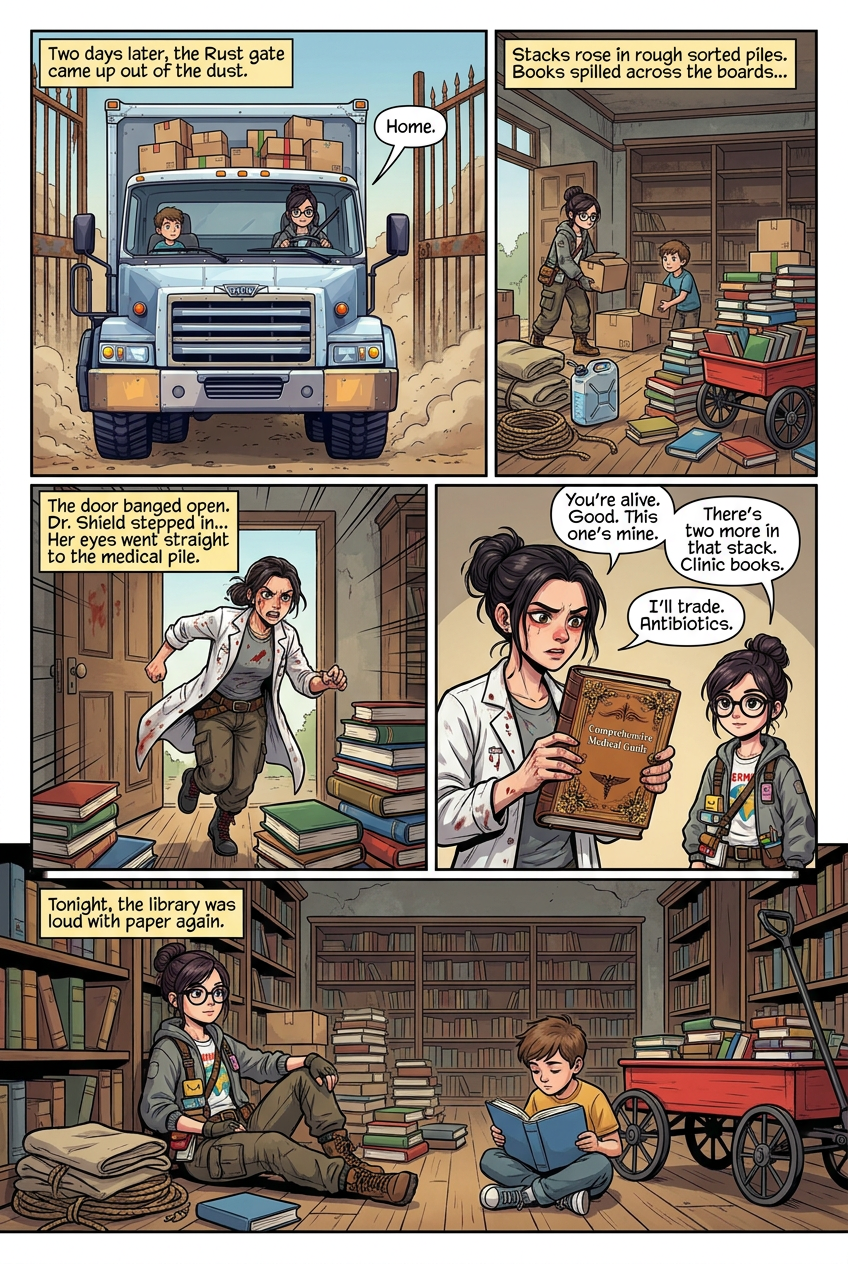
The southern track was slow but it was clean. Two days later the Rust gate came up out of the dust, and the boy sat up straight for the first time in a week. Brooke rolled the truck to the library door and killed the engine. Home. The cart was still full. She and the boy unloaded everything onto the library floor. Stacks rose in rough sorted piles. Canvas, rope, the false tray, a half-empty water can, the boy's small pack. Books spilled across the boards like cargo dumped from a hauler, hundreds of spines in no order yet, the red wagon tipped on its side by the door. The door banged open. Dr. Shield stepped in, coat stained, hair half pinned. She did not say hello. Her eyes went straight to the medical pile. "You're alive. Good." She crouched and pulled a thick brown volume free, gold lettering on the cover, a caduceus stamped under the title. She held it up like evidence. "This one's mine. I'm taking it tonight." Brooke watched her thumb the pages. Shield's hand shook a little. Not fear. Something held tight. "There's two more in that stack," Brooke said. "Clinic books. Surgical." Shield nodded once, hard. "I'll trade. Antibiotics. A standing seat at the hospital for the kid if he ever needs it." She tucked the guide under her arm and stood. "You did a thing, Bookeeper. Don't do it again for a while." She left as fast as she came. The boy looked up from the floor, a blue spine in his lap, already open. Brooke sat down beside the piles. The list was done. The shelves would fill by morning. Outside, somewhere past the gate, the Ravens still had her shape in their heads — but tonight, the library was loud with paper again.
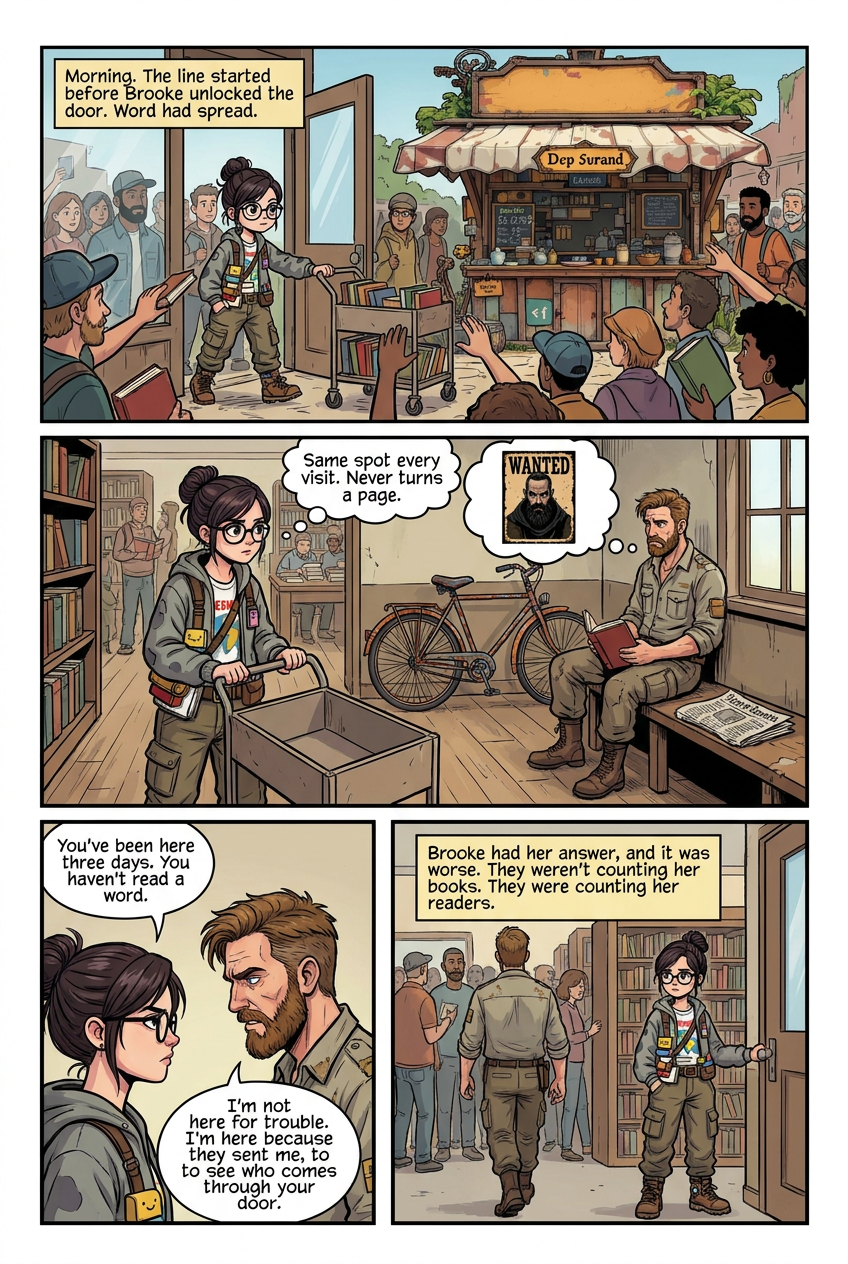
By morning, the line started before Brooke unlocked the door. Word had spread fast. A lean-to of scrap and tarp had gone up across from the library overnight, a vendor booth selling water and roasted grain to the people waiting. The crowd was every kind of face — old, young, road-dusted, hopeful. Brooke propped the door open and started hauling stacks toward the shelves. She never made it to the shelves. Hands reached for books straight out of her arms. A woman took a cookbook off the top of her pile. A man grabbed two novels before she could mark them. The cart by the door emptied in minutes. Brooke set her jaw and kept moving, but the system was breaking in real time. Then she saw him. Same spot every visit now — the corner by the window, where someone had dragged in an old rusted bike and leaned it against the wall like a marker. A bearded man in a faded uniform shirt sat beside it, a worn red book held tight to his chest. He never turned a page. His eyes tracked the door. The crowd. Her. Brooke watched him between trips. He held the book like a prop. On the bench behind him, folded open but unread, lay a torn old newspaper — pages so faded no one could read them, kept there for show. She thought of the wanted face Webster had once shown her in the column margins. Lean. Hard eyes. Close enough. She crossed the room and sat down across from him. "You've been here three days," she said. "You haven't read a word." His jaw tightened. He set the book down slow. "I'm not here for trouble," he said. "I'm here because they sent me to see who comes through your door." Raven. He said it plain. Then he stood, left the book on the bench, and walked out past the vendor stall into the crowd. Brooke watched him disappear down the road. The library was loud behind her, hands still pulling books from piles. She had her answer, and it was worse than not knowing. They weren't coming for the cart anymore. They were counting her readers.
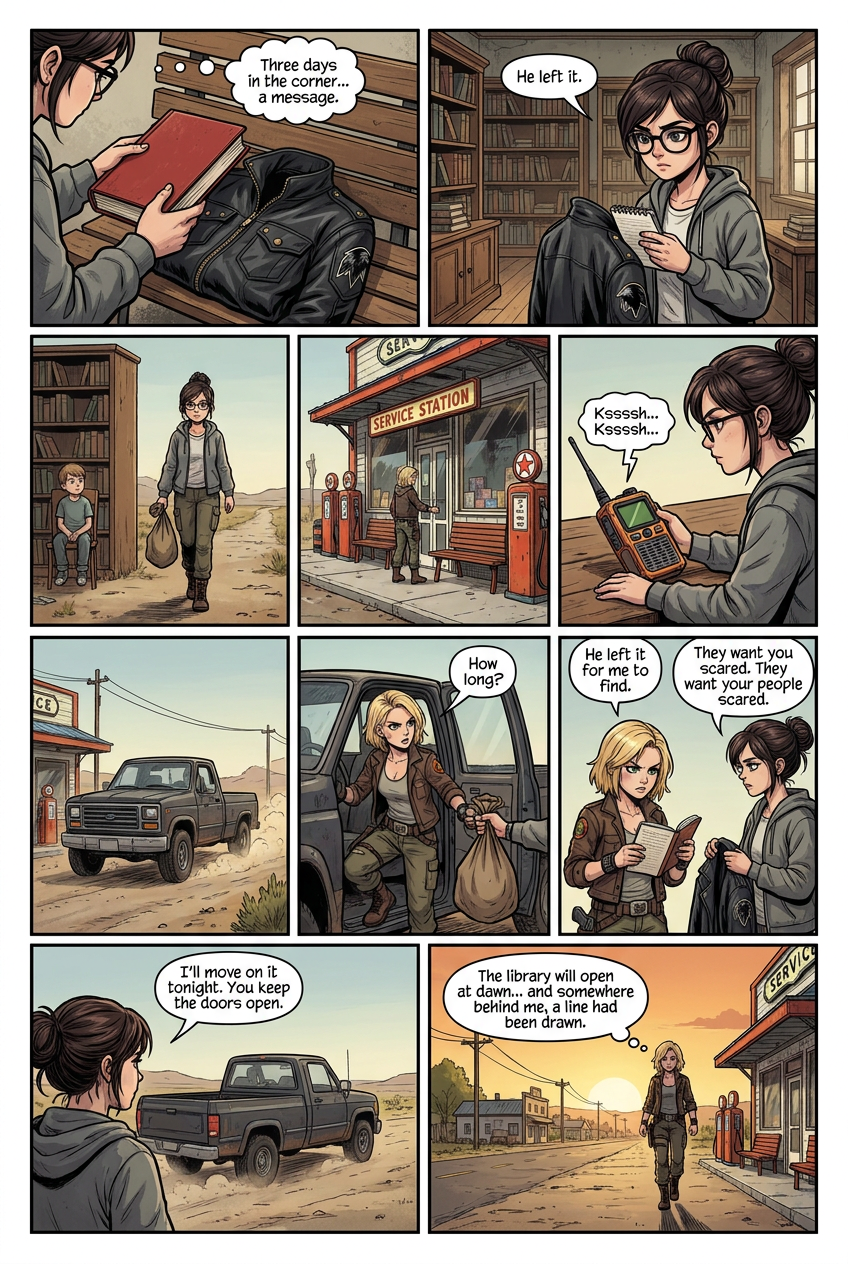
After the bearded man left, Brooke walked back to the bench where he'd been sitting. The red book was still there. Beneath it, half-tucked under the cushion, was a folded leather jacket. Dark. Heavy. A raven was stitched onto the sleeve. He'd kept it close for three days and left it on purpose. A message. She lifted it and felt papers in the inside pocket — a small notebook, tally marks beside short descriptions. Faces. Her readers, counted. She locked the library at noon for the first time in months. The boy watched her from his chair and didn't ask why. She set the jacket and notebook in a sack and walked out past the vendor stall, down the road toward the edge of town. There was an old service station Sherrie used — fuel pumps long dry, a weathered storefront, a bench out front where travelers rested. Anyone could stop there. Nothing tied it to her. That was the point. Brooke had a small handheld radio she kept for road runs. She set it on the bench, tuned to a channel Sherrie had given her once, and keyed a single phrase, twice. Then she left it powered on and walked across the lot to wait. She did not say her name. She did not need to. It took an hour. A truck rolled in with no markings. Sherrie stepped out alone, blonde hair tucked under a cap, one hand resting near her belt. Brooke handed her the sack. Sherrie looked at the jacket, then the notebook, then the tally marks beside the faces. Her jaw set. "How long," she said. "Three days in the corner," Brooke said. "He left it for me to find." Sherrie closed the notebook. "They want you scared. They want your people scared." She tucked the sack under her arm. "I'll move on it tonight. You keep the doors open tomorrow. Same hours. Don't change a thing." Brooke nodded. Sherrie climbed back into the truck and was gone before the dust settled. Brooke picked up the radio and walked back toward town. The library would open at dawn. The readers would come. And somewhere behind her now, a line had been drawn she hadn't drawn herself.
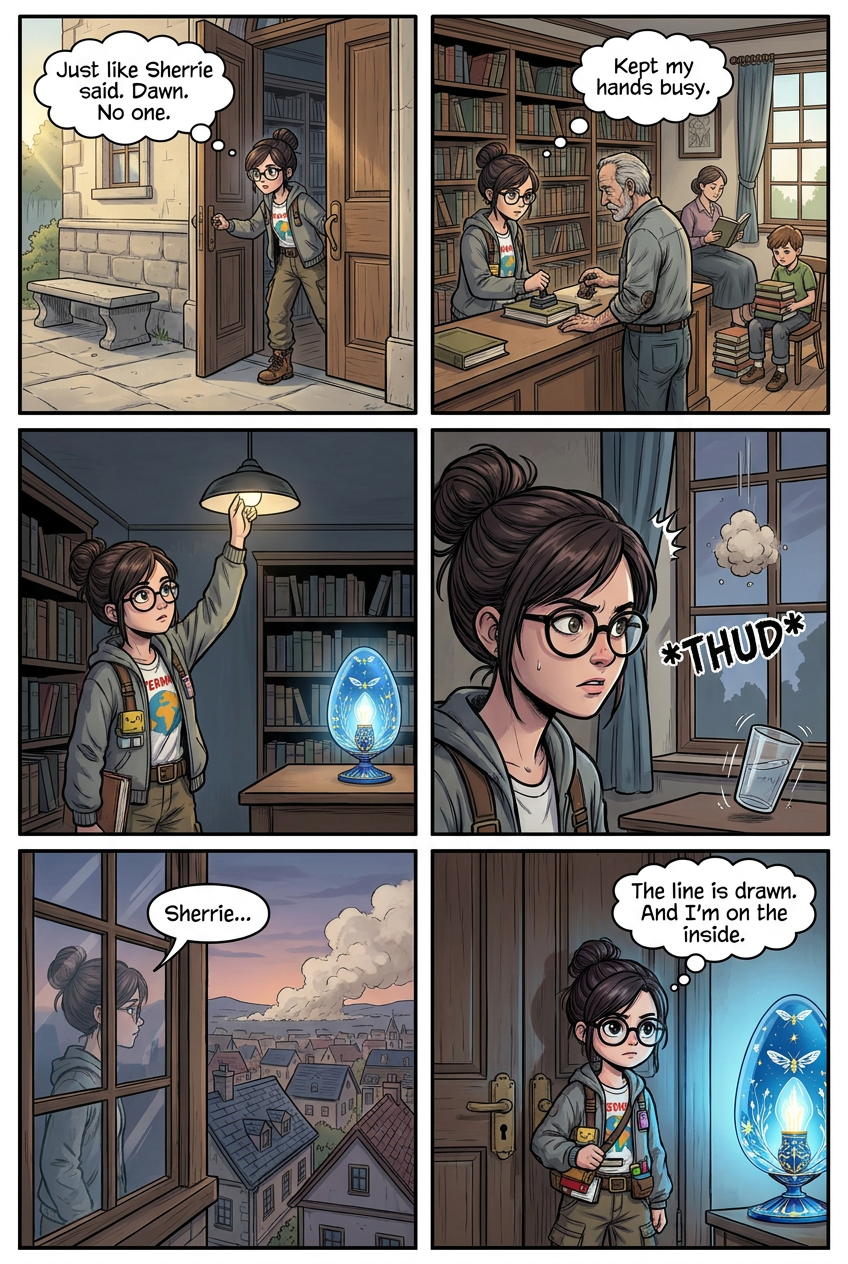
Brooke opened the doors at dawn, just like Sherrie said. The bench in the corner stayed empty. No bearded man. No strangers in dark coats. Only her regulars came — the old mechanic with grease on his cuffs, the quiet woman who read by the window, the boy in his chair with a stack she'd set out for him. She served them like any other day. She shelved returns. She marked her ledger. She kept her hands busy so they wouldn't shake. At dusk she walked the room and switched off the overhead bulbs, leaving only the small lamp by the door — the one with painted moths circling a soft glow. From the road, the library looked warm and ordinary, a single blue light against the dark. She turned the lock. Then the sound came. A low, deep thud rolled across town from the far edge — the kind that travels through your feet before your ears. A glass on her desk rattled and a thin curl of dust drifted down from the rafter above the boy's chair. He looked up. She looked at the window. Far off, past the rooftops, a pale cloud was rising, slow and wide, lit faintly by something burning underneath. Brooke knew the shape of it. Sherrie had moved tonight, the way she said she would. Somewhere near the boundary there would be broken concrete, chunks scattered like bad teeth, a message written in rubble. The Ravens' watchers would not be back tomorrow. She stood at the locked door a long time, the small lamp glowing beside her, and understood the line had been drawn — and she was on the inside of it now.
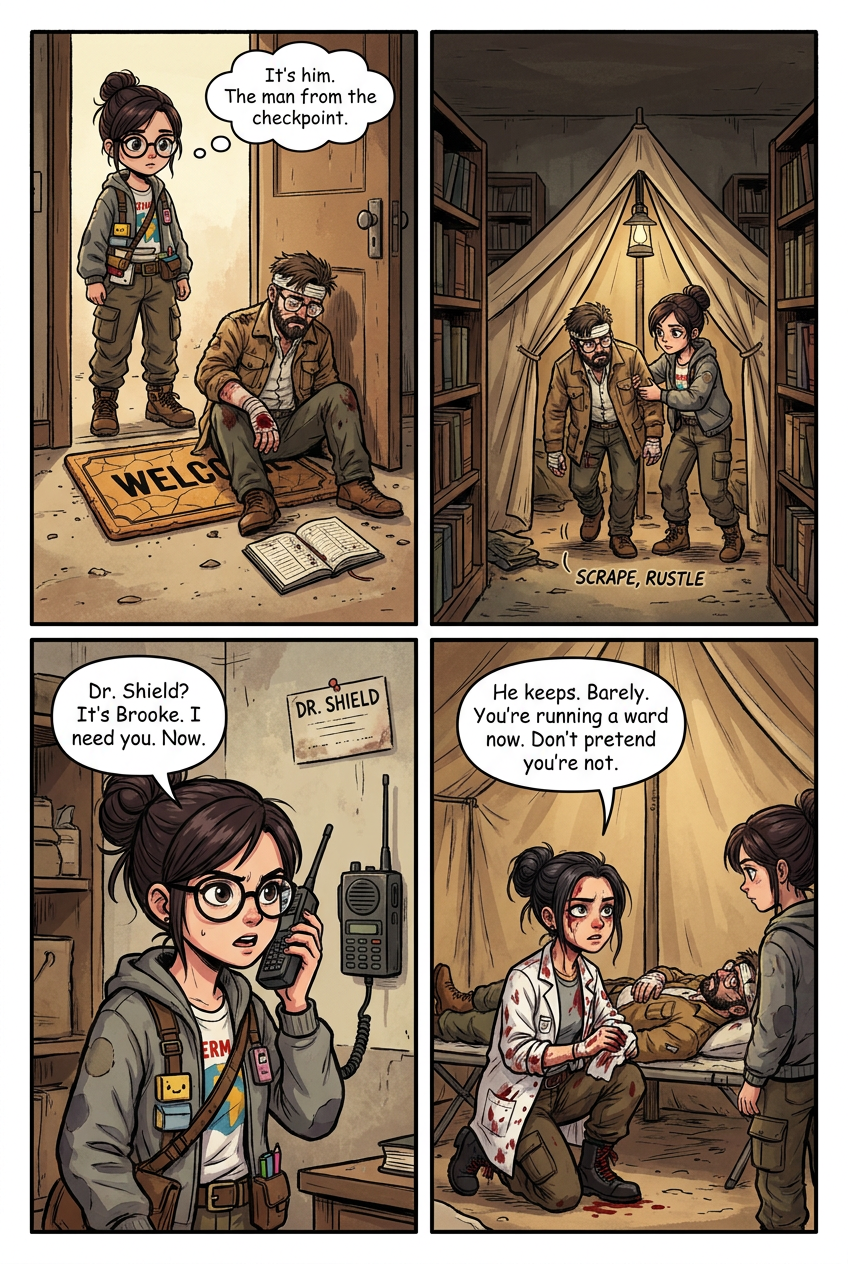
Brooke stood at the locked door long after the dust settled. Then a slow scrape came from the other side — a body sliding down the wood. She unlocked the door. A man had collapsed on the mat, glasses cracked, one hand wrapped in stained cloth, a small ledger spilled open beside him. She knew his face at once. He had stamped her papers at a checkpoint weeks ago and waved her through when he didn't have to. She dragged him inside and bolted the door behind them. Past the front shelves she had cleared a quiet space weeks ago — a canvas shelter pitched between two stacks, cot inside, lamp hung from the center pole. A room for someone who couldn't keep moving. She had never said out loud who it was for. Tonight she had an answer. She got him onto the cot and pressed clean rags to the worst of it. His breathing was wrong. She crossed to the back room and lifted the radio. There was a card pinned above it in faded ink — a standing slot held open at the hospital, no questions, no waiting. Dr. Shield had written it herself and told Brooke to use it once, when she meant it. Brooke keyed the radio and said his condition in three short sentences. Dr. Shield came on foot within the hour, bag over one shoulder, coat already bloody from someone else's night. She knelt by the cot and worked without speaking. When she finally sat back, she wiped her hands on her coat and looked at Brooke. "He keeps. Barely." She tipped her chin at the shelves. "You're running a ward now. Don't pretend you're not." She left a vial and a folded list of instructions on the crate beside the lamp. Brooke sat by the cot after Shield was gone. The man slept. His ledger lay open on the floor where it had fallen — pages of names, dates, small neat tallies. Faces he had let pass. She closed it and set it under the lamp. The library was a library and something else now. In the morning she would need an extra pair of hands at the desk, and she already knew whose.
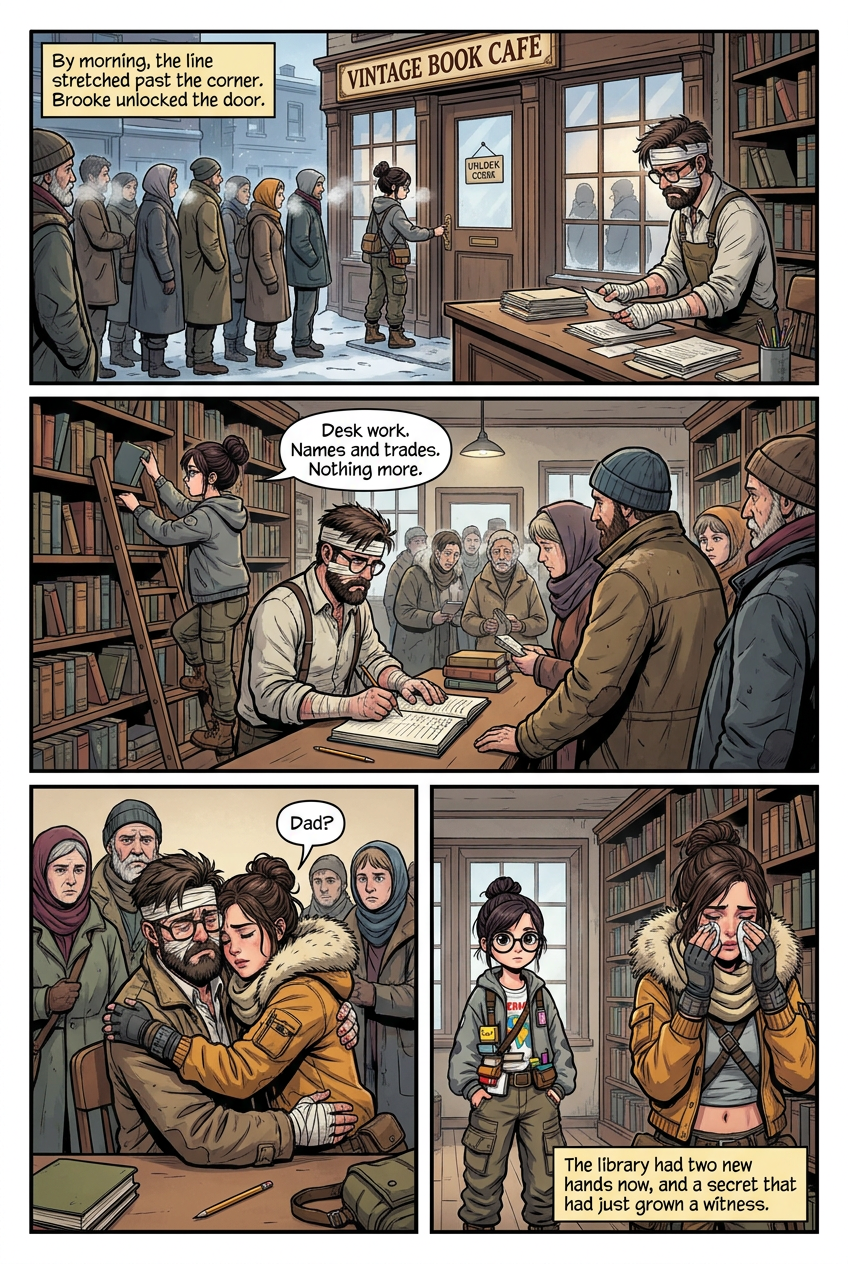
By morning, Brooke had her answer. She crossed the library to the back shelter, where the checkpoint man slept on the cot. She woke him gently and offered him the job. He sat up slow, bandaged hand trembling, glasses crooked on his nose. "Desk work," she said. "Names and trades. Nothing more." He nodded once. By the time she unlocked the front door, he was already sorting the spilled ledger pages into neat stacks. The line outside reached past the corner. Weary faces in scarves and patched coats, breath fogging the cold air. Word from Webster's column had pulled them in from the southern track and farther. Brooke propped the door wide. The new clerk took his stool behind the desk, pencil ready, and began writing down what each person came for. They moved through the morning together. He logged titles. She pulled books. The crowd thinned into a steady shuffle, and for the first time in weeks the library felt like it was doing what it was built for. Then a young woman in a fur scarf and a yellow jacket stepped to the desk. She had a leather pack slung tight across her chest, the kind her clerk wore the same stitching on at his cuff. She looked up. Her eyes locked on the man behind the desk. The pencil dropped. Her mouth opened, closed, opened again. "Dad?" The word cracked out of her. She came around the desk before Brooke could move, arms around him, scarf pressed to his bandaged face. He held her like a man who had stopped believing in mornings. The whole line went quiet. Brooke stepped back and let them have it. She had wanted a clerk. She had gotten something larger. When the woman finally pulled away, wiping her face, she looked at Brooke and said she had been walking three towns looking. Brooke nodded toward the back shelter. "He stays here," she said. "You can too, if you work." The young woman pulled off her gloves and reached for the next book on the list. The library had two new hands now, and a secret that had just grown a witness.
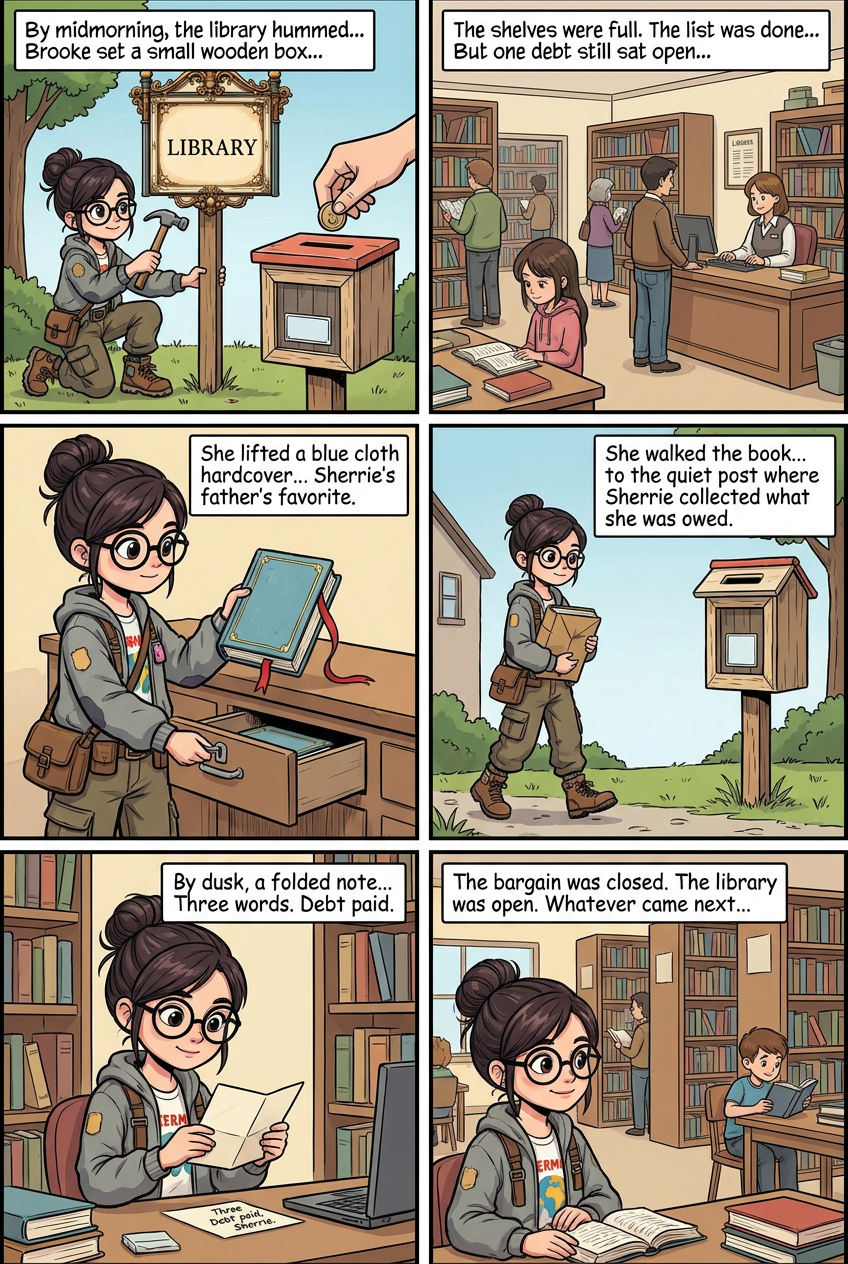
By midmorning, the library hummed with low voices and turning pages. Brooke stepped outside with a hammer and the new sign she had finished the night before. She drove the posts deep into the dirt by the door. Gold lettering caught the sun. LIBRARY. Beside it she set a small wooden box on a post, a coin slot cut into the top, a paper label tied to its front. Patrons stopped on the path to read both. A woman dropped a button in the slot. The library looked, for the first time, like a place that meant to stay. Brooke watched the line move and felt the weight shift in her chest. The shelves were full. The list was done. The clerk and his daughter worked the desk in steady rhythm. She had built the thing she came to build. But one debt still sat open, and she knew where it lived. She went back inside and crossed to the locked drawer beneath her counter. From it she lifted a blue cloth hardcover, soft at the corners, a red ribbon trailing from its pages. She had set it aside weeks ago, before the expedition, when she first heard the title spoken in a story about an old man and his daughter. Sherrie's father's favorite. Brooke wrapped it in brown paper and tied it with string. She walked the book across town to the quiet post where Sherrie collected what she was owed. A plain wooden donation box stood on a stake, its label hand-lettered, its slot just wide enough for folded paper or a thin parcel. Brooke slid the wrapped book through and let it drop. She did not linger. By dusk, a folded note waited at her library door in a careful hand. Three words. Debt paid. Sherrie. Brooke set the note on her desk and looked out at the lit windows, the full chairs, the boy in his usual seat turning a page. The bargain was closed. The library was open. Whatever came next would come for a place that already belonged to the town.
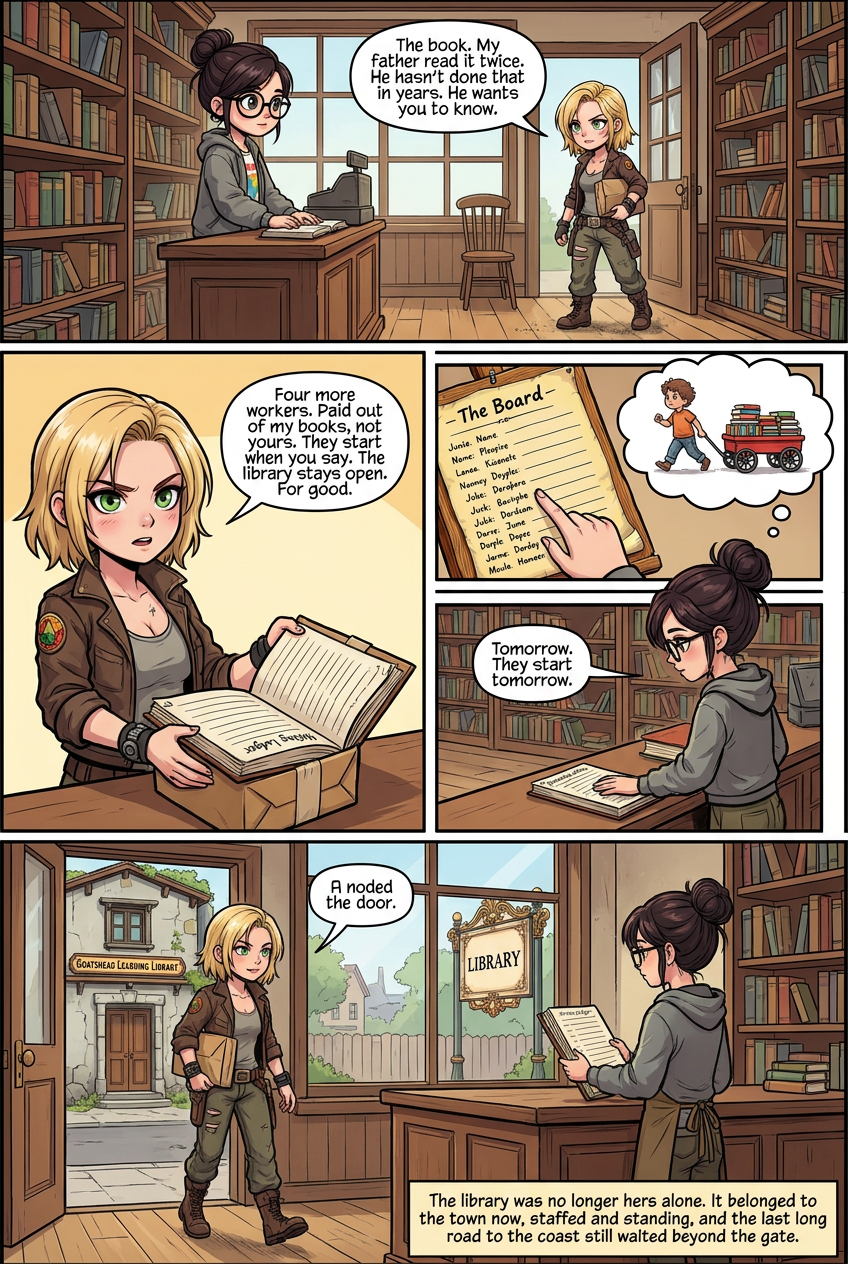
Morning light fell across the full shelves. Brooke was sorting returns when the door swung hard and Sherrie stepped inside, dust on her boots, a flat parcel under her arm. She did not greet the room. She crossed straight to the counter and set the parcel down. "The book," Sherrie said. "My father read it twice. He hasn't done that in years." Her voice stayed low and even, but her eyes held something softer than usual. "He wants you to know." Brooke nodded. She felt the clerk and his daughter go still at the desk. Outside, a child dragged a small red wagon stacked with paperbacks up the path, a return from someone who could not carry them alone. Sherrie pushed the parcel forward. Brooke untied the string. Inside lay a wooden board with paper pinned across it, rows of names already written in careful hand. A hiring list. "Four more workers," Sherrie said. "Paid out of my books, not yours. They start when you say. The library stays open. For good." Brooke ran her thumb down the column of names. She thought of the empty shelves she had hauled back from a half-roofed school, the boy in his usual chair, the line at the donation box. She set the board on the counter where every patron could see it. "Tomorrow," she said. "They start tomorrow." Sherrie gave one short nod and walked out. Brooke watched her go, then turned the board to face the room. The clerk read the names aloud, soft, like a promise. The library was no longer hers alone to keep. It belonged to the town now, staffed and standing, and the last long road to the coast still waited beyond the gate.
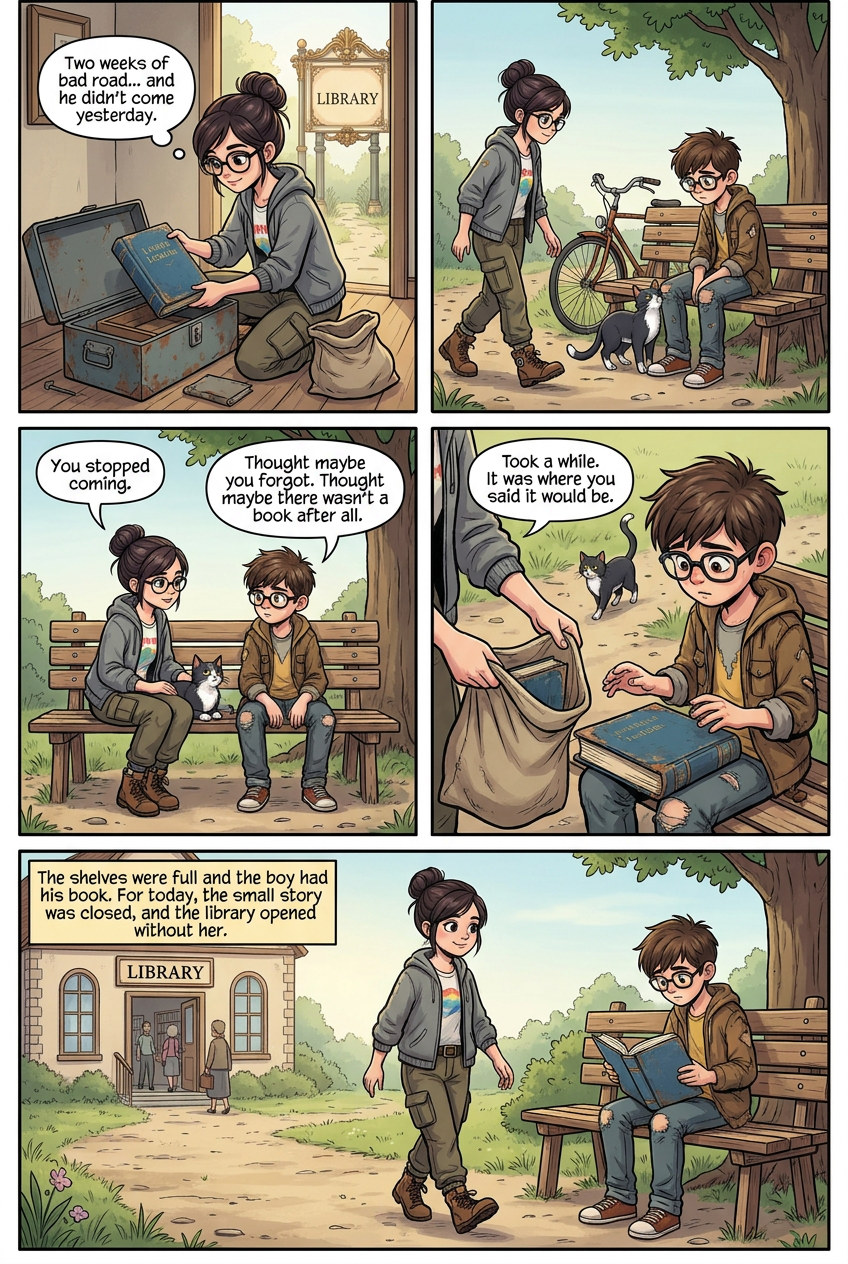
The next morning Brooke pulled the blue book from the false tray beneath her toolbox. She had carried it across two weeks of bad road and never once handed it over. The boy had not come in yesterday. She set the book in a canvas sack and stepped out past the new sign by the door. She found him down the lane, sat on a weathered bench beside a rusty old bicycle that wasn't his. A thin street cat pressed against his leg. The boy's glasses had slid down his nose. His torn jacket hung loose at the shoulders. He was staring at nothing. Brooke sat beside him. The cat blinked up at her, unbothered. "You stopped coming," she said. He shrugged. "Thought maybe you forgot." His voice was small. "Thought maybe there wasn't a book after all." She pulled the sack open and laid the blue book on his lap. Worn leather. Gold letters faded almost gone. He went very still. His hands hovered, then touched the cover like it might break. The cat nosed the spine and walked off down the lane. "Took a while," Brooke said. "It was where you said it would be." The boy opened the cover. His shoulders dropped an inch. He didn't smile, exactly, but the slumped look left his face. He turned a page, then another, reading right there on the bench, the way he always did in his chair. Brooke stood and left him to it. Back at the library, the new workers were unlocking the door. The clerk was already at the desk. The shelves were full and the boy had his book. One long thing was finished. The coast road still waited, but for today the small story was closed, and the library opened without her.
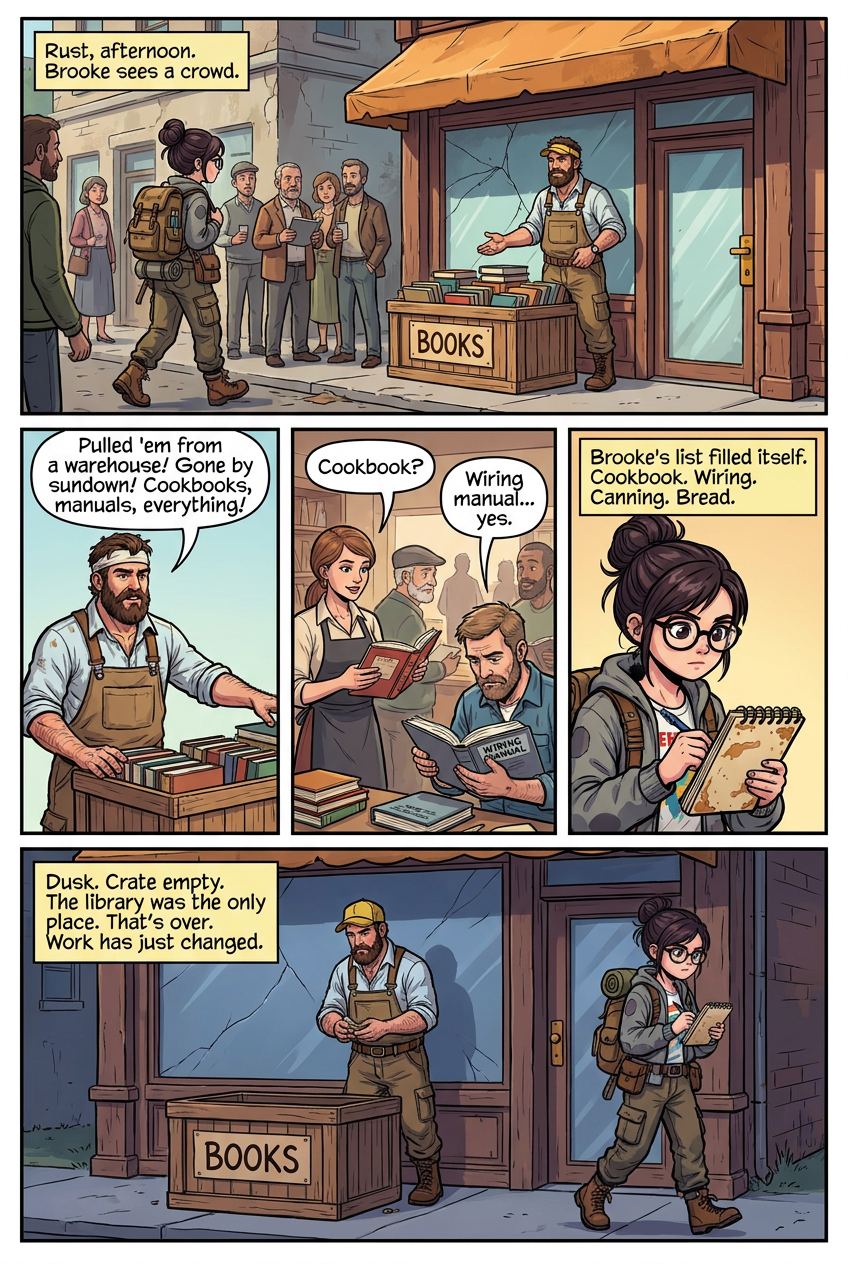
Brooke walked back toward the library and saw a small crowd gathered down the lane. A bearded man in sweat-stained overalls had set up shop in front of an old thrift store with a cracked window. He'd dragged a wooden crate onto the walk and stamped the word BOOKS across the side in black paint. She came closer. The merchant was pulling books out by the armload and laying them in rows along the cracked concrete. Cookbooks. Repair manuals. A guide to small engines. A thin book on canning. He told the crowd he'd pulled them from a warehouse two towns over and wanted them gone by sundown. A woman from the bar was already crouched over the spread, turning a cookbook in her hands like it was meat. The repairman from the junk lot stood frozen over a wiring manual, lips moving as he read. Brooke watched coin change hands. Watched a third local pick up a book on bread and tuck it under his arm. She pulled her spiral notepad from her coat pocket. The cover was stained brown from coffee, the pages bent soft. She wrote down each title as it sold. Cookbook. Wiring. Canning. Bread. Names she knew. Shops she could place. Her list was filling itself without her asking. By dusk the crate was empty and the merchant was counting his coin. Brooke closed the notepad. The library had been the only place in Rust for a book. That was over now. She walked back to her door, where the new sign hung, and understood the work ahead had just changed shape.
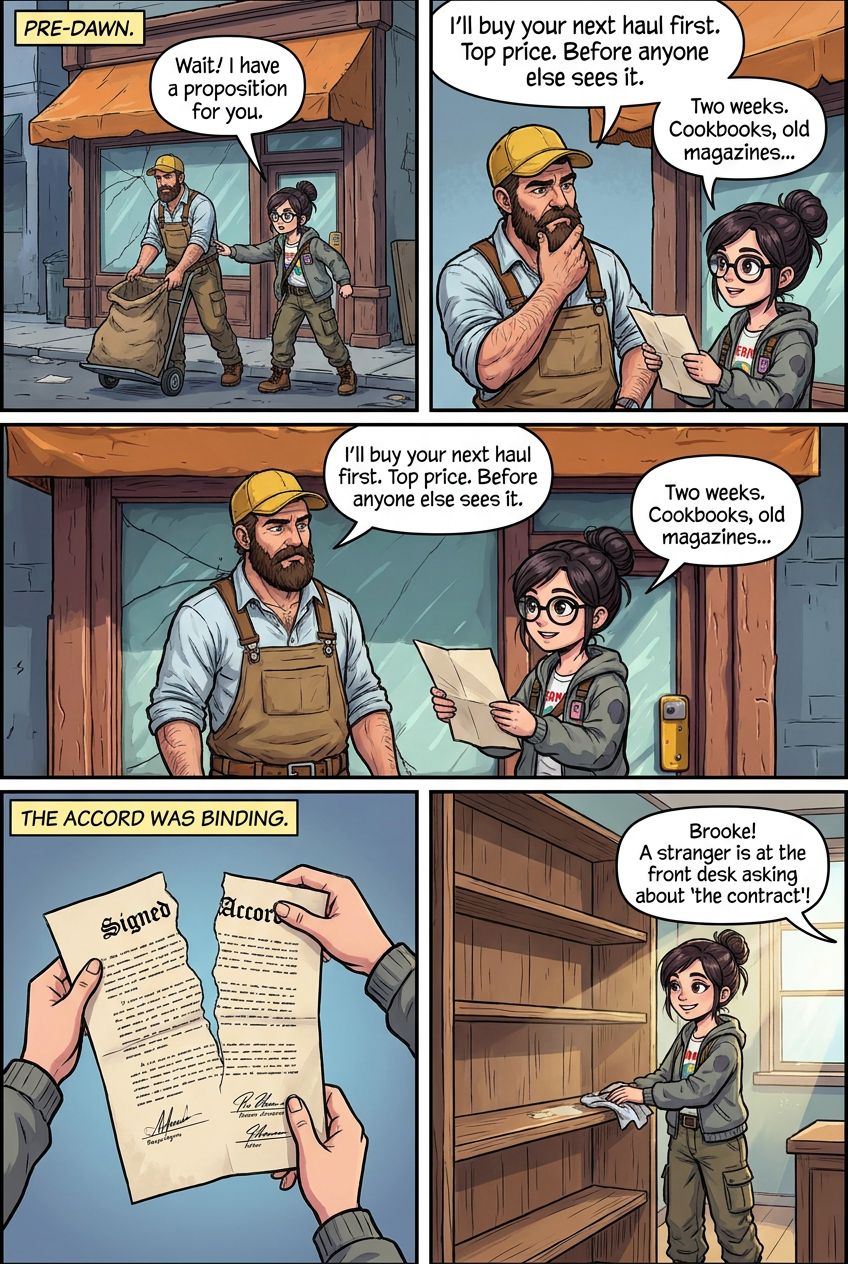
Brooke woke before dawn with the merchant's tally still in her head. She walked back to the thrift store front while the sky was gray. The crate was gone, but the bearded man was there, loading empty sacks into a hand cart. She caught him before he could leave. She offered him a deal. Whatever books or magazines he hauled into Rust next, she would buy first. Top price, paid in coin and trade goods, before he laid a single spine on the walk. He scratched his beard and squinted at her. He had another run coming in two weeks. Cookbooks, almanacs, a stack of old hobby magazines. Brooke pulled a folded sheet from her coat. She wrote the terms in plain lines, read them aloud, and signed her name. He signed under hers in slow block letters. She tore the page in half and gave him his share. The accord was small, but it was binding between them. By afternoon she had cleared a long wooden shelf along the library's back wall. She rubbed the grain clean with a rag and set it under the window where the light fell. It would hold magazines. A whole row of them, free to anyone who walked in. She stood back and looked at the empty shelf. The merchant would come again, and again after that, and each time his crate would empty into her hands before the street ever saw it. The library would not be undersold. Then her clerk called from the front desk — a stranger was at the door asking after the contract by name.
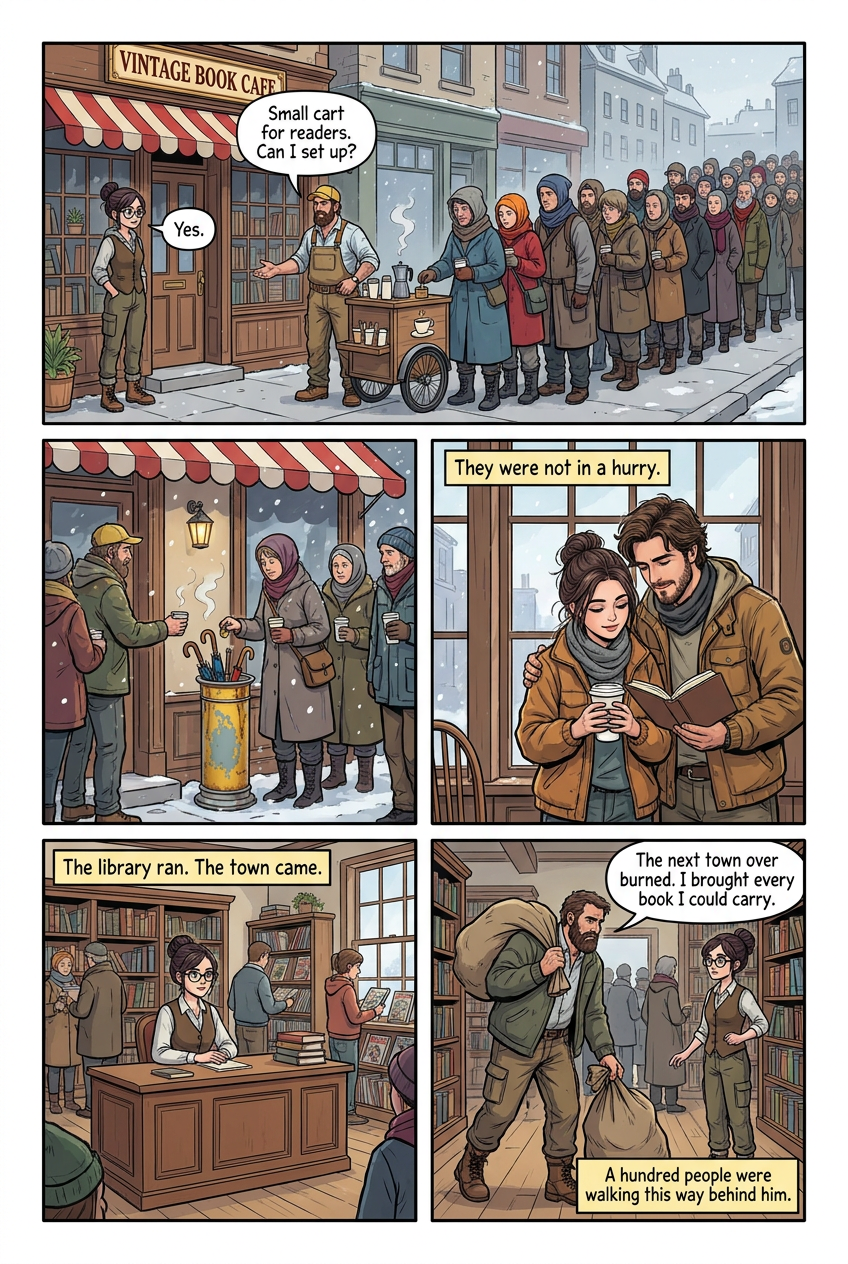
The stranger at the door turned out to be a coffee seller. He wanted to set a small cart by her steps and pour cups for the readers. Brooke looked past him at the line already forming on the walk and said yes before he finished his pitch. By noon the cart was steaming. A weathered metal stand held umbrellas and stray pencils near the door. People dropped coins in the donation box and lingered on the stones outside. A young couple in dusty jackets shared a cup near the window. She held the paper sleeve in both hands. He leaned close and read over her shoulder from a borrowed book. They were not in a hurry. No one was. Brooke stepped back inside. Her clerk was sorting requests. His daughter shelved magazines under the window light. The new hires moved between the rows without needing her. The line at the door stretched longer, quiet and patient, breath fogging in the cold. She sat on the stool behind the desk and let her hands rest flat on the wood. For the first time in months there was nothing she had to fix. The library ran. The town came. The boy was somewhere on a bench with his blue book. Then the bearded merchant pushed through the line with a sack on his shoulder. He was two weeks early. He dropped the sack at her feet and said the next town over had burned. He had brought every book he could carry, and a hundred people were walking this way behind him.
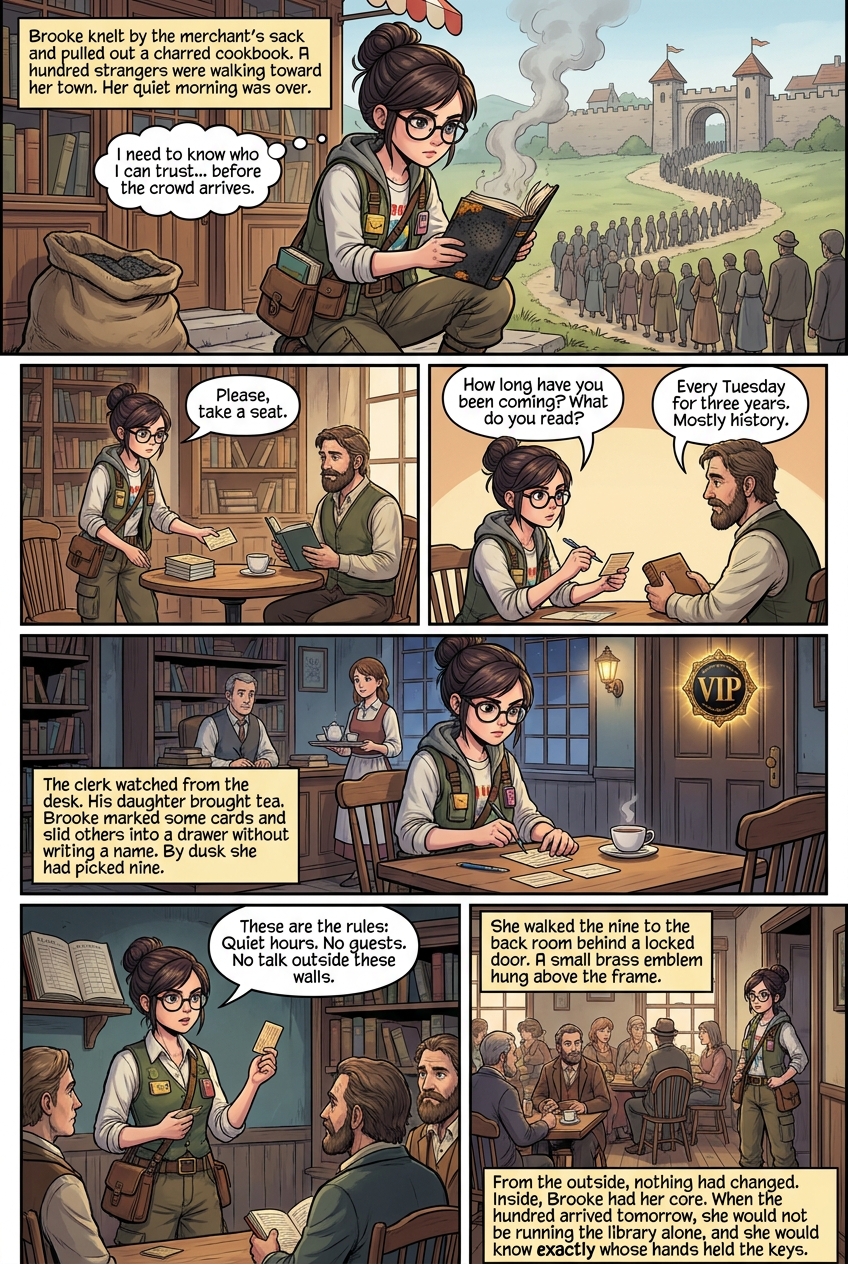
Brooke knelt by the merchant's sack and pulled out a charred cookbook. A hundred strangers were walking toward her town. Her quiet morning was over. She stood and looked at her regulars in line. Some she trusted. Some she did not. She needed to know which was which before the crowd arrived. She cleared the small side table near the donation box and set a stack of blank cards on it. Each card had a ruled border, lines for a name and a number, and a worn paper feel that looked older than it was. She pulled up a chair across from her own and called the first regular over. One by one she sat them down at the table. She asked plain questions. How long had they been coming. What did they read. Who did they live with. The clerk watched from the desk. His daughter brought tea. Brooke marked some cards and slid others into a drawer without writing a name. By dusk she had picked nine. She walked the nine to the back room behind a locked door. A small brass emblem hung above the frame. Inside were the rarer books, the ledger of checkpoint names, and the spare blue-spined readers. She handed each person a card and told them the rules. Quiet hours. No guests. No talk outside these walls. The nine filed out and took their seats among the others. From the outside, nothing had changed. Inside, Brooke had her core. When the hundred arrived tomorrow, she would not be running the library alone, and she would know exactly whose hands held the keys.
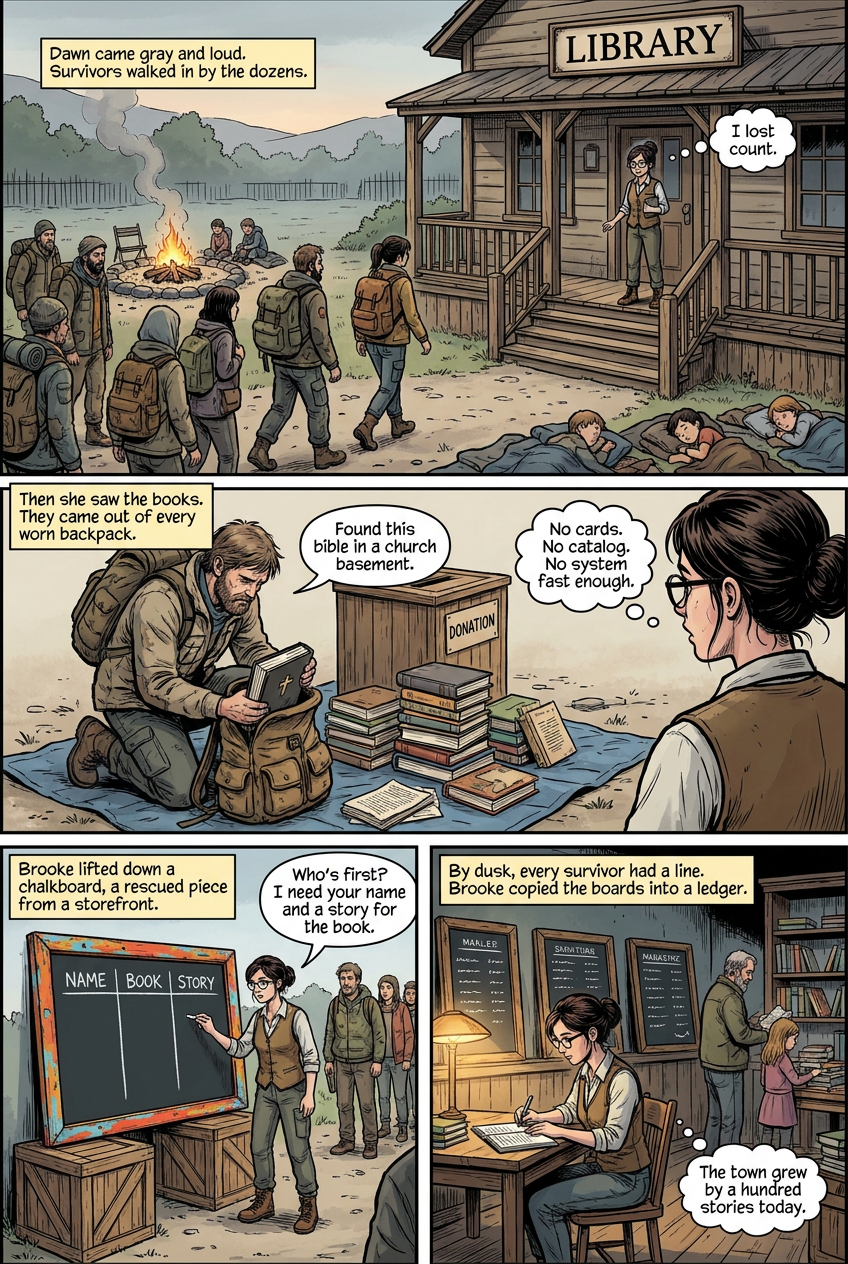
Dawn came gray and loud. The survivors walked in by the dozens and settled around the library in a rough circle, packs at their feet, a small fire ring built from loose stones in the dirt. Children slept on coats. Adults watched the door. Brooke stood on the step and counted heads until she lost the number. Then she saw the books. They came out of every worn backpack she could see. Paperbacks tied with string. Loose pages wrapped in cloth. A bible without a cover. A ledger of recipes. One man held a thin manuscript like it was a child. The pile grew on a tarp by the donation box, soft-spined and water-stained, more knowledge than her shelves had room for. She had no way to track any of it. No cards. No catalog. No system fast enough for a crowd this size. The clerk looked up from his desk and waited. His daughter waited. The nine waited. Brooke walked to the back wall and lifted down a chalkboard she had pulled from an old storefront weeks ago. The frame was chipped orange and blue. She carried it outside and propped it on two crates by the fire ring. She wrote three columns in white chalk. NAME. BOOK. STORY. She called the first survivor forward. A woman in a torn coat. Brooke wrote her name, the title she carried, and one line about where it came from. Then the next. Then the next. The clerk brought a second board. His daughter brought a third. By midmorning, four boards stood in the dirt, filling with chalk, and the line still stretched past the magazine shelf she had dragged out for shade. By dusk every survivor had a line on a board. Every book had a name beside it. Brooke copied the boards into a fresh ledger by lamp and locked it in the back room. The town had grown by a hundred people and a hundred stories, and for the first time all day, she knew what had walked through her door.
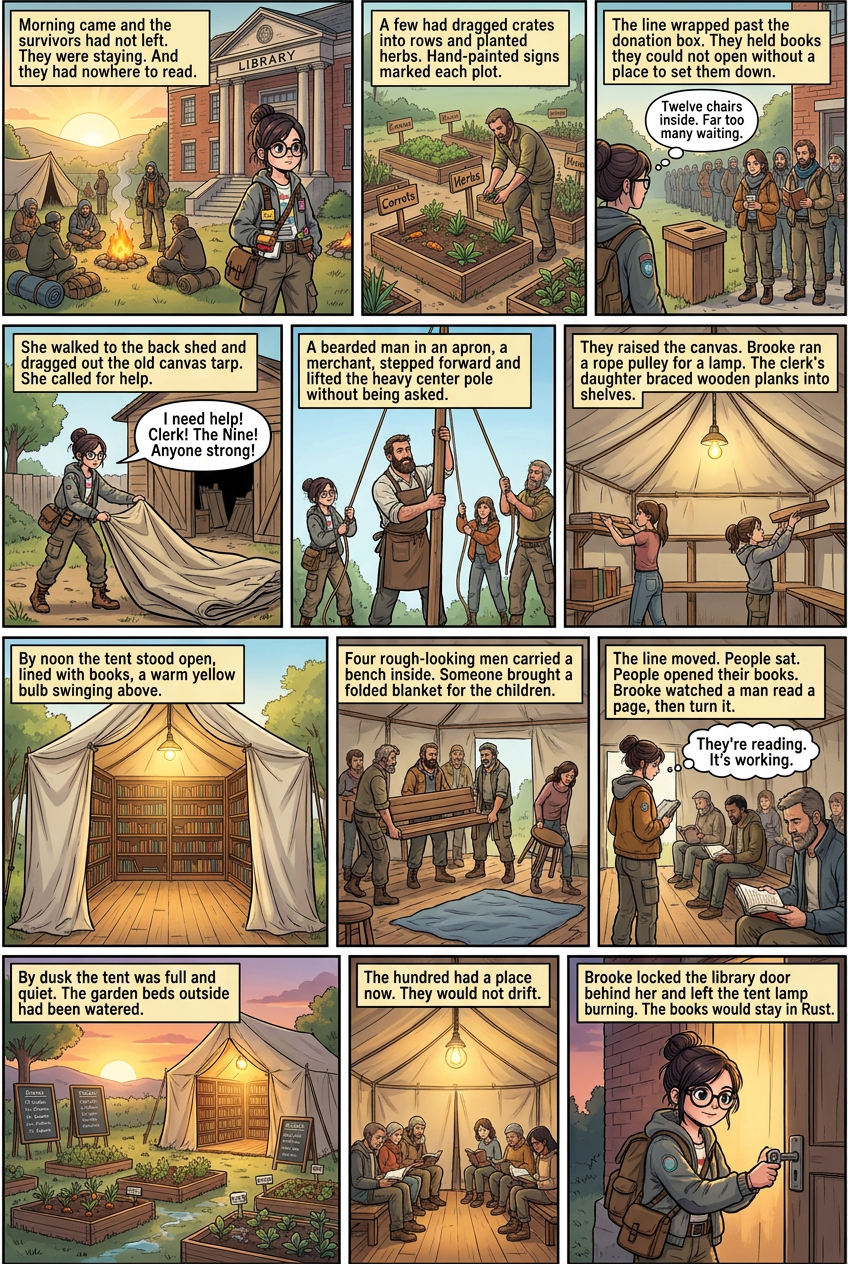
Morning came and the survivors had not left. They sat in clusters around the library steps, packs unrolled into small homes. A few had dragged crates into rows and planted herbs from their packs in the dirt beside them. Hand-painted signs marked each plot with a name. They were staying. And they had nowhere to read. Brooke counted the chairs inside. Twelve. She counted the people waiting to sit. Far more. The line wrapped past the donation box. A woman with a coffee cup stood beside a man in a dusty jacket, both holding books they could not open without a place to set them down. She walked to the back shed and dragged out the old canvas tarp she had saved for winter. She called the clerk. She called the nine. She called three of the new survivors who looked strong. A bearded man in an apron, the kind who hauled crates for the merchant, stepped forward and lifted the heavy center pole without being asked. They raised the canvas in the lot beside the library. Brooke ran a rope pulley from the ridge to a lamp she scavenged from the back room. The clerk's daughter carried out wooden planks and braced them into shelves along the inside walls. By noon the tent stood open on both ends, lined with books, a warm yellow bulb swinging above a swept plank floor. Four rough-looking men carried a bench inside. A woman dragged a stool. Someone brought a folded blanket and spread it flat for the children. The line moved. People sat. People opened their books. Brooke watched a man read a page, then turn it, then turn it again. By dusk the tent was full and quiet. The garden beds outside had been watered. The chalkboards still stood in the dirt with every name. Brooke locked the library door behind her and left the tent lamp burning. The hundred had a place now. They would not drift. The books would stay in Rust.
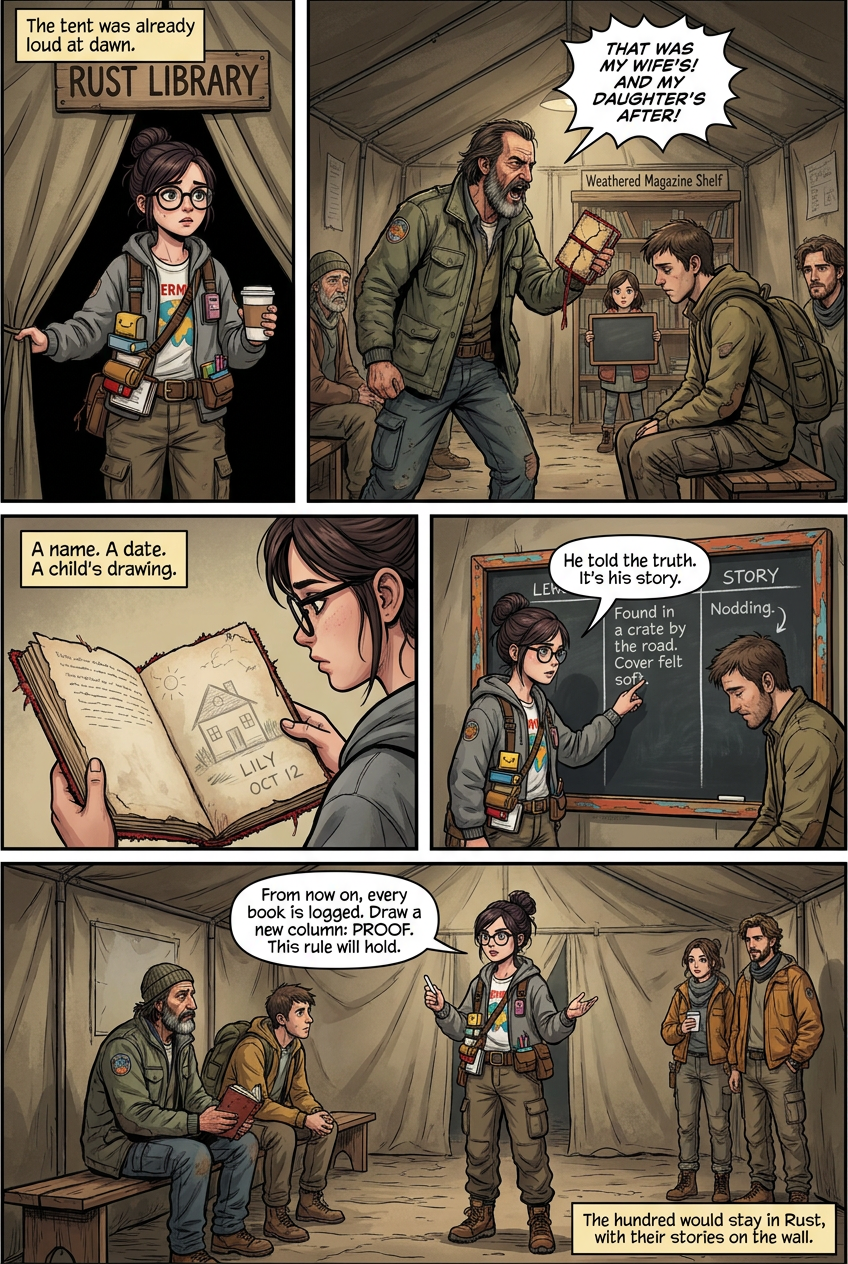
Brooke unlocked the library at dawn and found the tent already loud. A man's voice cut through the canvas walls. She crossed the lot fast, coffee still in her hand from the cart outside. Two of the new staff stood frozen by the shelf of magazines. The clerk's daughter held a chalkboard against her chest like a shield. A gray-bearded man in a worn green jacket stood over a younger man. He shook a battered diary in his fist, the cloth wrap loose, the red cord trailing. "That was my wife's," he said. "That was my daughter's after." The accused man sat on a bench with a pack at his feet, a canteen, a folded coat, a tin cup. He looked at the floor. A young woman in a yellow jacket stepped between them and put a hand on the bearded man's sleeve. The bearded man shook her off. Patrons had stopped reading. A woman with a coffee cup pulled her partner back toward the tent flap. Brooke set her cup on the plank floor. She asked the bearded man for the diary. He did not give it. She asked again and held out her hand. He passed it over like it burned him. She opened the cover. A name was written inside in faded pencil, and a date, and a child's drawing of a house. She turned to the accused man and asked him to say the name on the first page without looking. He could not. He said he had found the book in a crate by the road two towns back. He said he did not know whose it was. He said he had carried it three weeks because the cover felt soft. Brooke walked to the chalkboard wall and found his row. NAME. BOOK. STORY. She read his entry aloud. He had given the diary as his book on the night the hundred arrived. He had told a story about a crate by the road. The bearded man heard it and went quiet. Brooke closed the diary and held it out to the bearded man with both hands. To the accused man she said he could stay, but the book was not his to keep, and from now on every book brought into the tent would be logged against the chalkboard before anyone slept under the canvas. She told the clerk to draw a new column. PROOF. The bearded man took the diary and sat down on the bench beside the man who had carried it. He did not speak. The accused man wiped his face and nodded once. Brooke picked up her coffee. She walked the length of the tent and watched people open their books again. The line at the door began to move. The rule was new, and it would hold, and the hundred would stay in Rust with their stories on the wall.
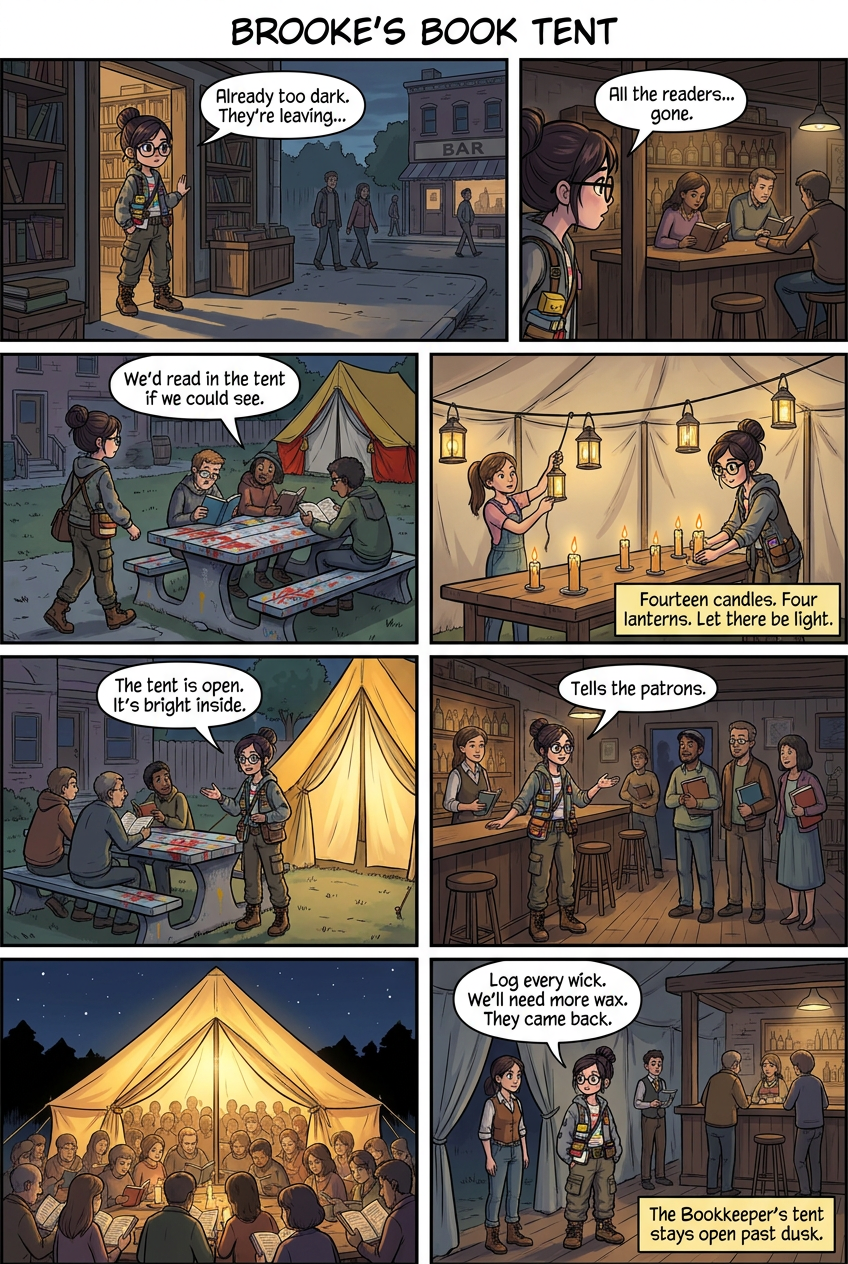
By late afternoon Brooke noticed the main building was already dim. The windows faced the wrong way for the setting sun, and the shelves near the back wall had gone gray by four. She watched a woman squint at a page, then close her book and tuck it under her arm. The woman walked out the door, past the tent, and toward the bar at the end of the road. Two men followed a few minutes later. Brooke counted six readers gone before the sky had even turned. She stood in the doorway and listened. From the bar she heard glasses and a radio. From the tent she heard nothing. She walked to the bar and looked through the open door. Half her afternoon patrons sat along the counter with their books closed beside their drinks. On the way back she stopped at a picnic table set in the dirt between the two buildings. Someone had dragged it there weeks ago. The metal top was scratched with tags in red and yellow paint. Three readers sat at it now, holding their books at an angle to catch the last bar light spilling from the door. One of them looked up at her. He said he would read in the tent if he could see the page. Brooke nodded and went back inside. She pulled the clerk and his daughter aside and told them what she wanted. They cleared the long table inside the canvas tent. Brooke walked to the bearded merchant's stall and traded two cookbooks for every candle he had. She came back with fourteen. She set them down the center of the table in tin cups and lids and a cut bottle. The clerk's daughter ran a wire from one tent pole to the other and hung four lanterns the survivors had carried in their packs. The young woman in the yellow jacket lit the wicks one by one. The canvas walls held the light and threw it soft across the shelves. Brooke walked to the picnic table and told the three readers the tent was open. She walked to the bar door and told the patrons inside the same. Eleven of them came back with her, books still under their arms. By full dark the tent was the brightest thing on the lot. Forty readers sat shoulder to shoulder along the benches and the floor. The candles burned down an inch an hour, and the clerk's daughter kept a basket of replacements under the table. Brooke stood at the flap and watched the line at the bar door thin. She told the clerk to add candles to the weekly trade list and to log every wick they burned. The light would cost her, and the wax would run out before winter, but the readers had come back, and the tent would stay open past dusk from now on.
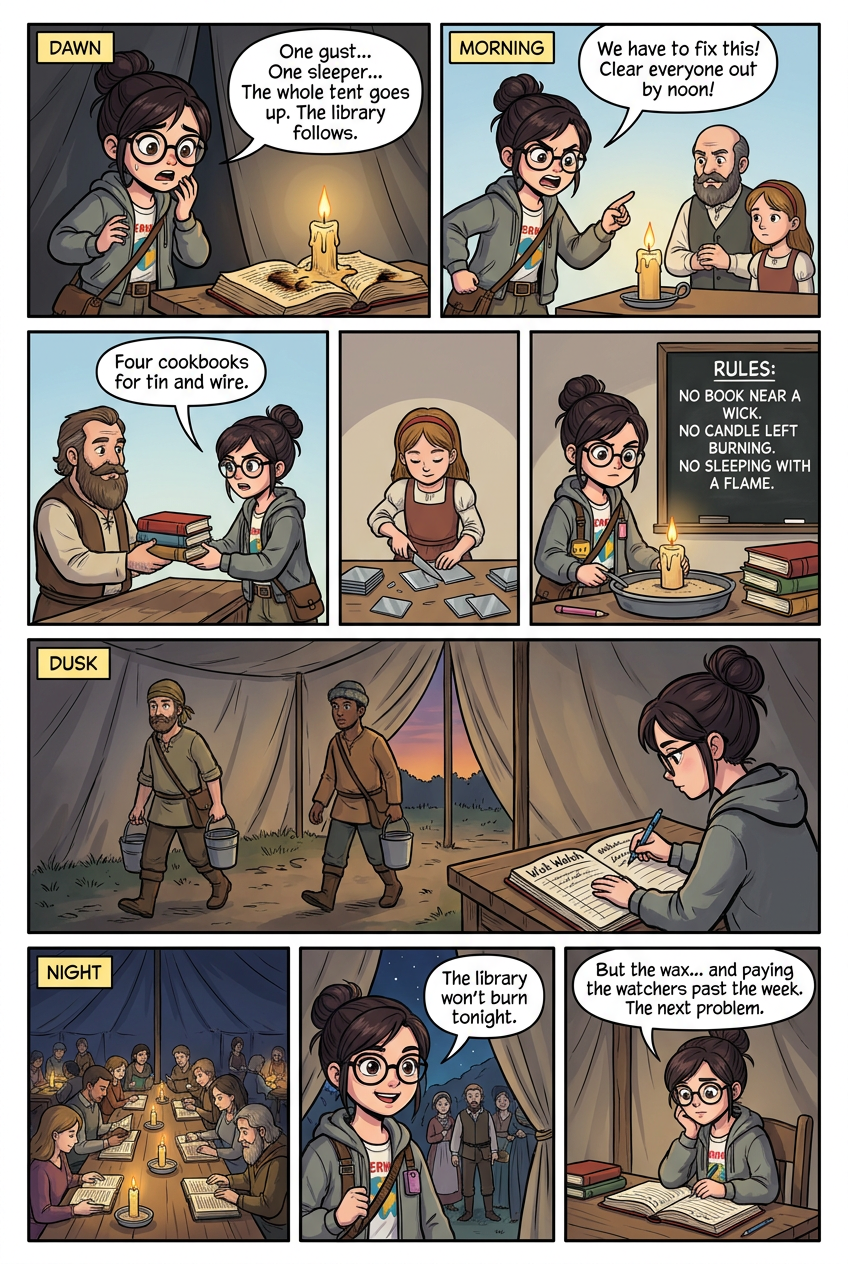
Brooke woke before dawn and walked out to check the tent. The candles had burned down past their tin cups. One wick lay sideways in a puddle of wax, still smoldering against the edge of an open book. She pinched it dead with her fingers. The page was scorched brown in a half circle. She stood there a long time looking at the canvas walls and the dry paper stacked along every bench. One gust through the flap, one sleeper turning over, and the whole tent would go up. The library beside it would follow. She pulled the clerk and his daughter out of bed at first light. She told them what she had found and what would happen if she did not fix it. They walked the tent together. Books sat fanned open beside tin cups. A stack near the back leaned against a lantern wire. Loose paper from the chalkboard ledger had drifted under the table where two candles still guttered. Brooke counted nine places a fire could start before breakfast. She told the clerk to wake every sleeper and clear them out by noon. By afternoon she had a new system on the long table. She traded the bearded merchant four more cookbooks for two sheets of tin and a coil of wire. The clerk's daughter cut the tin into squares and bent the edges up. Brooke set each candle in a square, then set each square inside a wider pan of sand scooped from the lot. She moved every book three hand-widths back from the flames and roped off the center of the table with twine. She wrote the rules on the chalkboard in block letters. No book within reach of a wick. No candle left burning when the reader stood up. No sleeping in the tent with a flame lit. She hired two of the survivors to walk the rows from dusk to dawn with a bucket of sand and a wet rag, paid in bread and a place on the bench. She called them the wick watch and wrote their names at the top of a new column in the ledger. By nightfall the tent looked different. The candles still burned, but each one sat in its pan of sand inside a tin square, and the books stayed back from the light. Forty readers came in and found the new rope and read the rules on the board. The two watchers walked the rows with their buckets. Brooke stood at the flap and counted them past her. The library would not burn tonight. But the wax was still running out faster than the trade list could replace it, and the watchers would want paying past the week. She went back inside to write the next problem down.
Play your story to life
Storycraft is a mobile game where you create AI characters, craft items and locations to build their world, then discover what direction your story takes. Download the iOS game for free today!
Download for free