

Johnathon's Arc
31 Chapters
Johnathon's dream is becoming the top chef of the country and loving art and music, drawing and coloring.

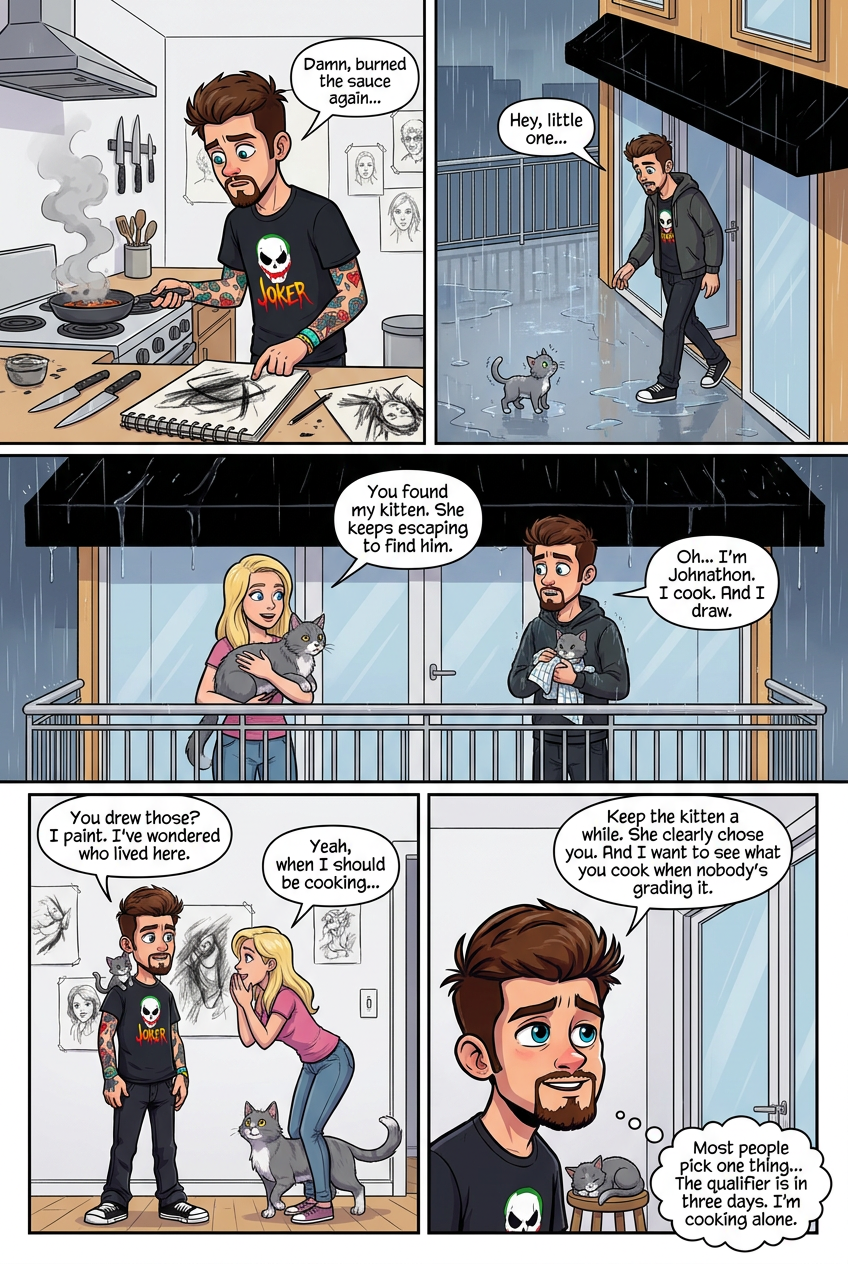
Johnathon burned the sauce again. Smoke curled off the pan while his real focus lay on the sketchpad beside the stove. He wanted to be the country's top chef, but half his mind always drifted to charcoal lines and color. His studio held both his lives at once: knives on the counter, drawings taped to the clean white walls, the light wood floor dusted with flour and pencil shavings. He killed the burner and stepped onto the balcony. The black covering kept the rain off. Below, someone had left a small grey cat on the wet ground. It shivered, one white patch bright on its chest, green eyes lifting toward him. He carried the cat upstairs and dried it with a dish towel. That was when he saw her at the shared railing next door, holding a much larger grey cat with golden eyes and white paws. "You found my kitten," she said. "She keeps escaping to find him." She nodded at the big cat in her arms. "That's her father." Her name was LexiBarbie. She lived one balcony over and had never once spoken to him. Johnathon forgot how to hold the towel. "I'm Johnathon," he said. "I cook. And I draw." She looked past him at the sketches on his wall. Her mouth opened. "You drew those?" She set the older cat down and leaned closer to the glass. "I paint. I've stared at your kitchen light for months and wondered who lived here." Johnathon felt his face heat. The kitten climbed his arm and settled on his shoulder. Its father wound around Lexi's ankles, tail flicking, refusing to leave the boy who smelled like burnt sauce and graphite. They talked until the rain thinned. She told him she mixed her own colors from scraps. He told her he plated food like a canvas, that judges never understood why a chef cared so much about a single line of sauce. Lexi understood. She said it plainly, without pity. "Most people pick one thing," she said. "You don't have to." No one had ever told him that. He had spent years hiding the sketchpad when other cooks walked in. When she finally scooped up the big grey cat to go, she paused at the rail. "Keep the kitten a while," she said. "She clearly chose you. And I want to see what you cook when nobody's grading it." Johnathon watched her door close. His heart hammered in a way no competition ever caused. He turned back to his ruined sauce, the sketchpad, the kitten now asleep on his stool. For the first time, his two lives did not feel like a problem to solve. They felt like something to share. Then he remembered: the national qualifier was in three days, and he had told the judges he would cook alone.
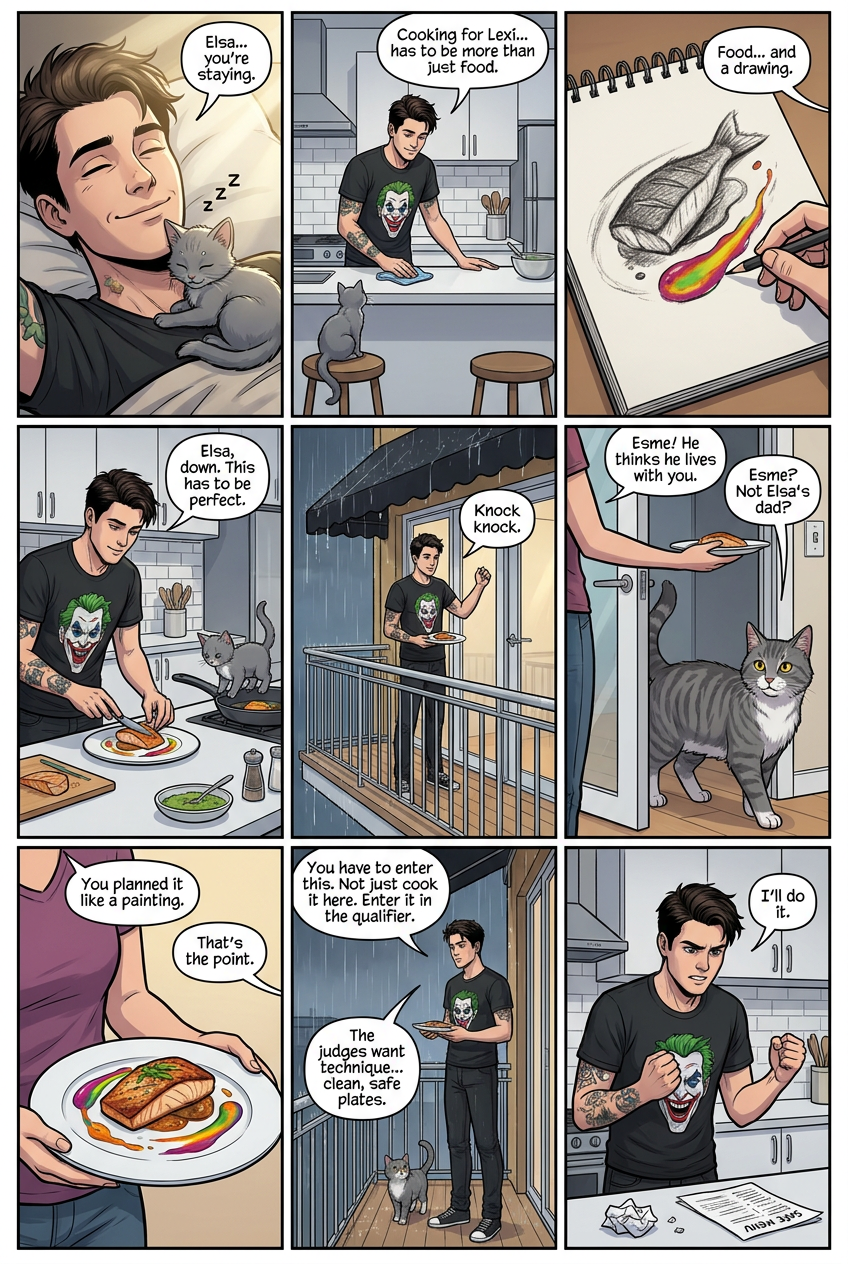
The morning after the rain, Johnathon woke to the kitten kneading his chest. She had slept curled against his neck all night. He named her Elsa. She blinked her green eyes at him and purred, and he knew she would stay. That settled one thing. The other thing still gnawed at him. He wanted to cook for Lexi before the qualifier stole his three days. Elsa followed him to the counter and watched from the stool. He wiped down his knives and cleared the flour from the light wood floor. Then he stopped. Cooking for Lexi meant more than a meal. She had told him he didn't have to choose. He wanted to prove she was right. He wanted to plate one dish that was both food and drawing. He sketched the plate first. Charcoal lines on the pad, a plan for color and shape. Then he cooked to match the drawing. He seared fish and laid it beside a bright streak of sauce, exactly where the sketch said. Elsa tried to climb the pan handle. He moved her twice. When the plate was done, he carried it to the shared balcony rail. Rain still dripped off the black covering above him. He knocked on the glass next door. Lexi slid her door open. The big grey cat pushed past her ankles, golden eyes fixed on Johnathon. She scooped him up before he could jump the rail. "That's Esme," she said, laughing. "He thinks he lives at your place now." Johnathon blinked. "Esme? I thought he was Elsa's father." "Different cats, different names," she said. "Mine's Esme. Yours is yours." He held out the plate across the rail. "I cooked this for you. Nobody's grading it." She took it and looked down. Her face changed. She saw the drawing in the food, the sauce line that copied his charcoal. "You planned it like a painting," she said quietly. "That's the point," he said. She tasted it. She closed her eyes. Then she opened them and looked straight at him. "You have to enter this," she said. "Not just cook it here. Enter it in the qualifier. Plate it exactly like this." His stomach dropped. "The judges want technique. Clean, safe plates. Not sketches." "Then show them a better idea," she said. "You made me feel something. That's what winning should be." Johnathon looked at the plate, then at Esme purring in her arms, then at Elsa watching from his stool. Two days left. He had planned a safe menu, the kind judges expected. Now he wanted to throw it out and cook this instead. "I'll do it," he said. The words scared him the moment they left his mouth. Lexi grinned. "Good. Now you have to actually pull it off." He went back inside. His safe menu sat on the counter, useless now. He had two days to turn a single balcony dish into a plate that could win a national seat.
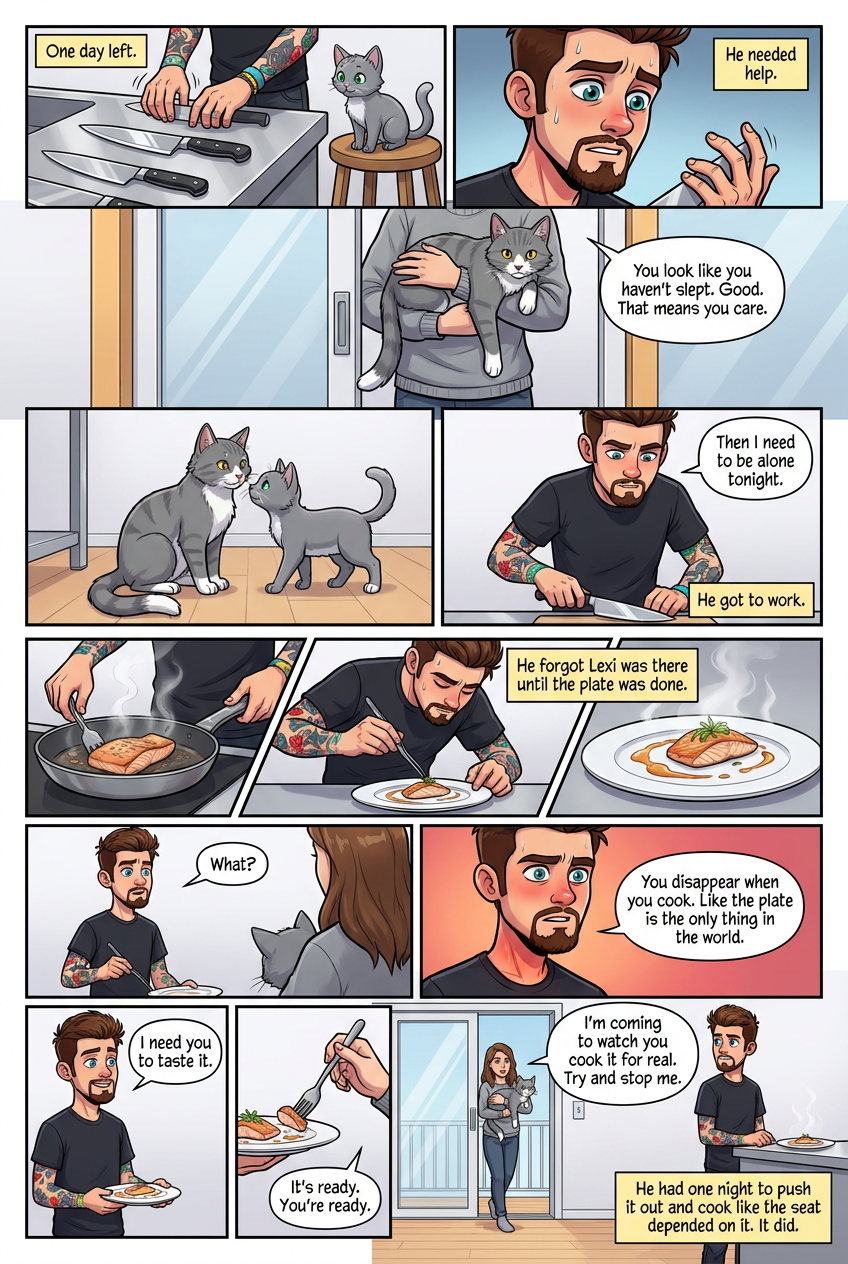
One day left. Johnathon spread his knives across the counter in his small studio. Elsa watched from the stool, her green eyes tracking every move. He had to plate the balcony dish clean enough to win a national seat. His hands shook. He needed help, and he knew who to ask. A knock hit the glass door. Lexi slid it open and stepped inside without waiting. She carried her grey cat against her chest, his white paws hanging over her arm. "You look like you haven't slept," she said. "Good. That means you care. Now show me what you're doing." He set the cat down. Elsa crept over and sniffed the bigger cat's nose. The grey tom sat and let her, tail curled around his white feet. Johnathon almost smiled. Then he picked up his knife and got to work. He seared the fish first. He laid the sauce in one clean streak, exactly like his charcoal sketch. He placed each piece by feel now, faster than before. He didn't look up. He forgot Lexi was there until the plate was done. When he set down the tweezers, he turned. Lexi stood very still. She wasn't checking the food. She was watching him. Her mouth was slightly open. Her eyes moved from his hands to his face and stayed there. "What?" he asked. "You disappear when you cook," she said. "Like the plate is the only thing in the world." She kept staring. It was the same look she gave the dish two days ago, the same awe. But now it was pointed at him, not the food. Heat climbed his neck. He set down the towel. The stare didn't stop. Something shifted in his chest, and it scared him more than the judges. He liked cooking for her. He liked her watching. That was a new problem, and the qualifier was tomorrow. "I need you to taste it," he said, breaking the moment. "Tell me if it's ready." Lexi blinked and stepped forward. She took a bite. She closed her eyes. Then she nodded slowly. "It's ready," she said. "You're ready." "Then I need to be alone tonight," he said. The words came out before he could soften them. "I have to run it three more times. Clean. No distractions." Her face fell a little. She understood, but she didn't like it. She scooped up her grey cat. "Fine," she said. "But I'm coming to watch you cook it for real. At the qualifier. Try and stop me." She slid the door shut behind her. Johnathon stared at the finished plate. His hands were steady now. The dish was ready. But his head was full of her stare, and he had one night to push it out and cook like the seat depended on it. It did.
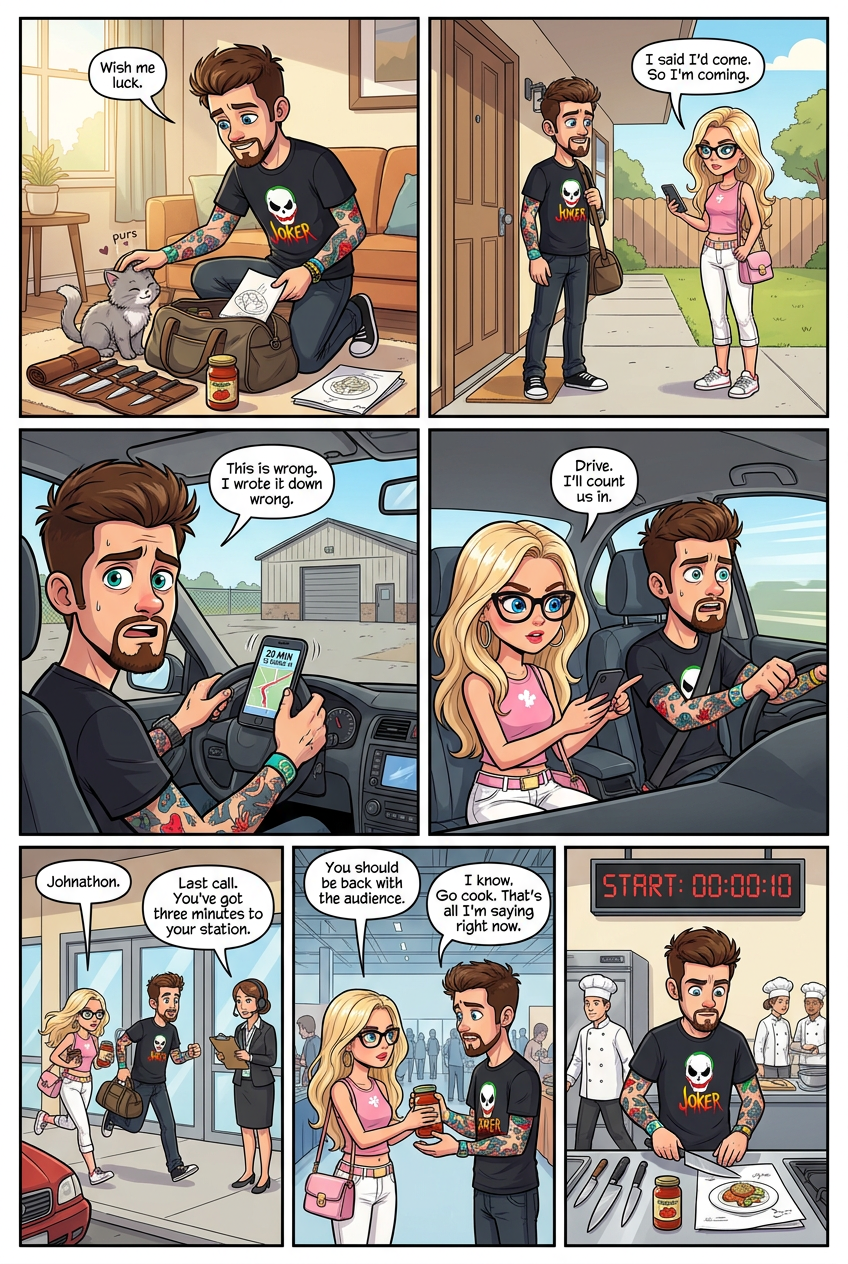
The morning came clear. Johnathon packed his knives, his sauce jar, and the folded charcoal sketch that showed the plate. He knelt and rubbed Elsa behind the ears. She purred against his hand. He stood, kissed the top of her head, and grabbed his bag. "Wish me luck," he said to the kitten. Then he opened the door and stepped out. Lexi waited on the walkway. She held her phone in one hand, the screen almost black. Her pink purse hung from her shoulder. Since ninth grade she had shown up for him without being asked. When his mother was in the hospital, she brought soup and a sandwich, the exact food he could stomach. Now she stood outside his door, ready to follow him to the biggest day of his life. He felt his chest tighten. He was glad she was there. That scared him too. "I said I'd come," Lexi said. "So I'm coming." They walked to his car. He drove. She read the address off a slip of paper he'd written the night before. He turned where she said. The road grew quiet. The buildings thinned. No competition hall. No cars. Just a locked warehouse and an empty lot. Johnathon checked his phone. His stomach dropped. "This is wrong," he said. "I wrote it down wrong." The real venue was across the city. His phone showed the time. Twenty minutes to check-in. He gripped the wheel. His hands shook the way they had over the knives. "Give me the phone," Lexi said. He handed it over. She pulled up the map, found the right hall, and set the route. "Drive. I'll count us in." He drove fast. She called the turns. Her phone died in her hand halfway there, but she had already memorized the last steps. "Two more lights. Then right. Then you park and run." Her voice stayed flat and steady. It calmed him more than any speech could. He parked crooked at the curb. He grabbed his bag. Lexi grabbed the sauce jar so he wouldn't drop it. They ran to the doors together. A woman with a clipboard looked up. "Name?" "Johnathon," he said, breathing hard. She scanned her list. "Last call. You've got three minutes to your station." She waved him through. He turned to Lexi. She held out the sauce jar. He took it. "You should be back with the audience," he said. "I know," she said. "Go cook. That's all I'm saying right now." He went. He set his station. He laid his knives in a row. He unfolded the sketch and smoothed it flat. The judges walked the floor. He had made it. He was in. But the near miss still buzzed in his hands, and the clock above the room already counted down his cook time. He picked up his knife and started.
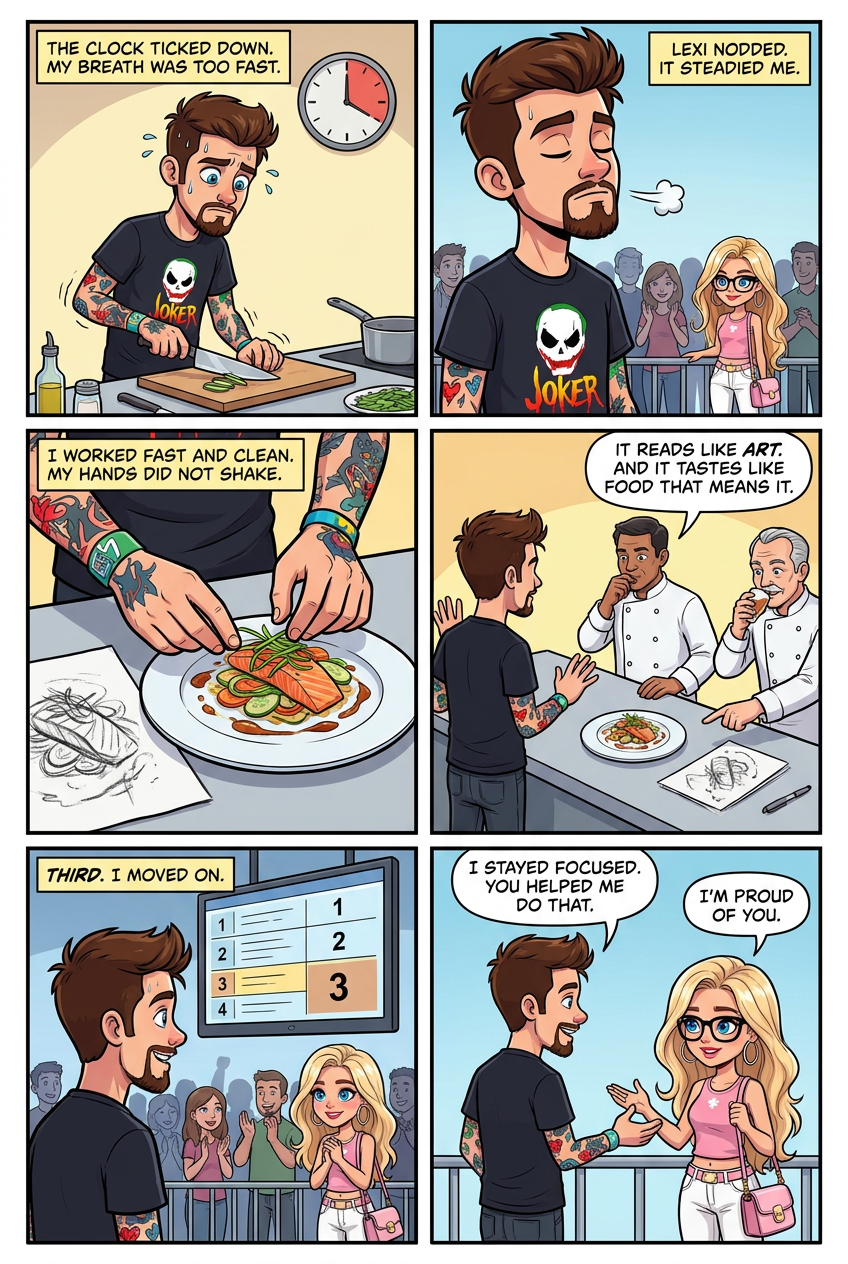
The knife trembled in Johnathon's hand. His breath came too fast. The clock above the room ticked down. He set the knife on the board and stopped. He closed his eyes and pulled one slow breath through his nose. Then another. His pulse slowed. He opened his eyes and found the crowd. Lexi stood at the front of the audience rail. She had made it back from the doors. She caught his look and gave him a small nod. Since ninth grade she had shown up for him. She brought soup when his mother was in the hospital. She learned the route across the city when her phone died. Now she stood there, calm, and let her nod do the talking. It steadied him more than any words. Johnathon picked the knife back up. He thought of the kitten he'd left curled in his apartment. He thought of Lexi at the rail. He thought of his own hands, the same hands that drew and cooked, and he let both feed the plate. He unfolded the charcoal sketch and smoothed it flat. Then he began. He worked fast and clean. He sliced the vegetables into thin curved strips. He built a fan across the plate, the way the sketch showed. He dragged the sauce from his jar in a slow arc, a brushstroke made of food. He set the seared fish at the center. He placed each herb like a mark on paper. His hands did not shake now. They moved. The clock hit zero. "Hands up," a judge called. Johnathon stepped back and raised his hands. The plate sat finished. It looked like his drawing come to life. Three judges circled his station. One leaned close and studied the sauce line. One tasted the fish and did not speak. The third looked from the plate to the sketch and back. "You drew this first," the judge said. It was not a question. "Yes," Johnathon said. The judge wrote something on the card. "It reads like art," the judge said. "And it tastes like food that means it." Then the three moved on to the next station. Johnathon breathed. Across the room the scores went up on a board. His number climbed near the top. Not first. Third. But third meant he moved on to the next round of the qualifier. He found Lexi at the rail. She was already looking at him. She did not cheer or wave. She just smiled, wide and plain, the way she smiled when she meant it. He crossed to her, still holding his empty sauce jar. "I stayed focused," he said. "You helped me do that." "I know," Lexi said. Her voice dropped soft. "I'm proud of you." She stopped there. "That's all I'm saying right now." A runner tapped his shoulder. "Round two draws in an hour," she said. "New ingredient. Blind box. Be ready." Johnathon's stomach tightened again. He had made it through. Now the real test was coming.
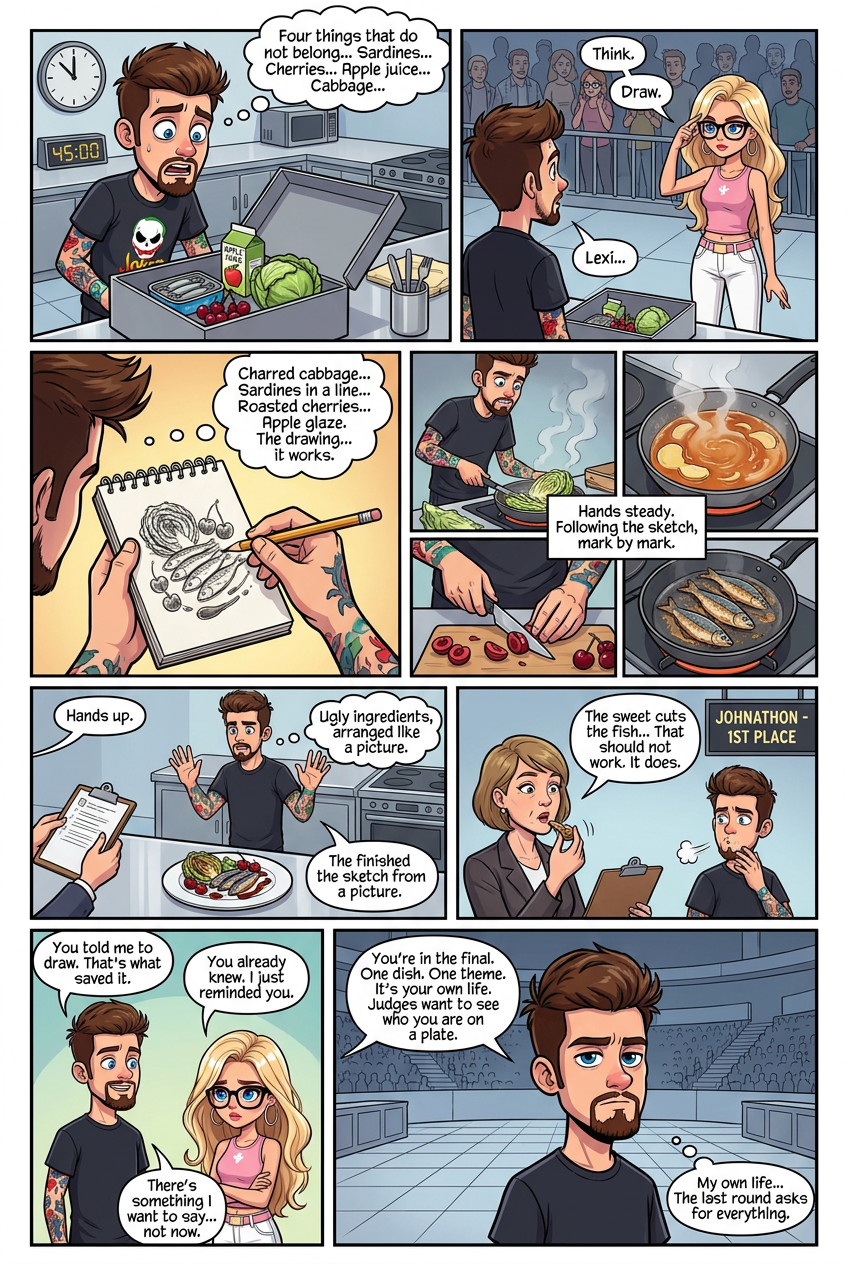
The hour passed too fast. A judge set the blind box on Johnathon's station and stepped back. Johnathon lifted the lid. Inside sat a tin of sardines, a handful of cherries, a small carton of apple juice, and a head of cabbage. He stared at them. Four things that did not belong on one plate. His mind raced through pairings and threw each one out. Sardines fought the cherries. The apple juice would drown everything. He had forty-five minutes to make it work. He looked up and found Lexi at the rail. She had stood there since ninth grade, when his mother was in the hospital and she brought him soup because she knew he would eat it. She had followed him across the city with a dying phone. Now she watched him with the same steady face. She saw his panic. She tapped her own temple with one finger, then pointed at the box. Think. Then she mouthed one word he read clearly: "Draw." Johnathon stopped. He grabbed the small sketch pad he kept in his kit. He did not cook first. He drew first. He sketched the plate the way he saw it in his head. Cabbage charred and folded like a dark leaf. Sardines laid in a clean line. Cherries split and roasted to cut their sweetness. Apple juice boiled down to a thick glaze, not a puddle. When the drawing looked right, he knew the dish would work. He moved. He seared the cabbage until the edges went black and crisp. He reduced the apple juice in a pan until it turned to syrup. He halved the cherries and let them soften in the heat. He crisped the sardines skin-side down, fast and hot. His hands stopped shaking. They followed the sketch, mark by mark. "Hands up," the judge called. Johnathon stepped back. The plate matched his drawing. Ugly ingredients, arranged like a picture. The judges came. One tasted the sardine with a bit of glaze. Her eyebrows lifted. "The sweet cuts the fish," she said. "That should not work. It does." She marked her card and moved on. Johnathon breathed and watched the board. His number climbed. First place this round. He had turned four wrong things into one right plate. He crossed to Lexi. "You told me to draw," he said. "That's what saved it." "You already knew," Lexi said. Her voice dropped soft. "I just reminded you." She stopped, then looked down at her purse. "There's something I want to say after this is over. Not now." She pressed her lips together. "That's all I'm saying right now." A runner stepped up before Johnathon could answer. "You're in the final," she said. "One dish. One theme. It's your own life. Judges want to see who you are on a plate." She walked off. Johnathon stood still. First place felt small now. The last round would ask for everything.
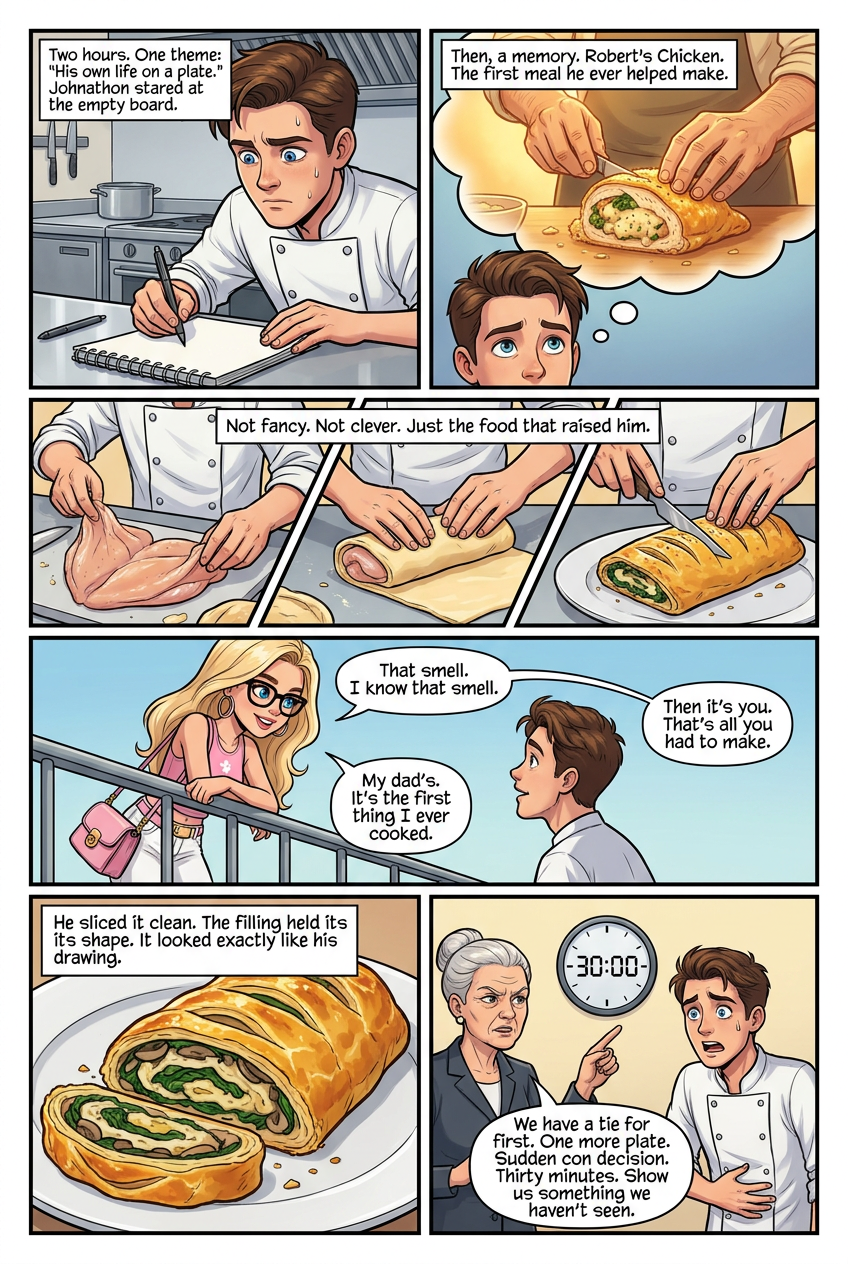
The final round gave Johnathon two hours and one theme: his own life on a plate. He stood at his station and stared at the empty board. First place felt far away now. He could cook anything, but nothing felt like him. He tapped his pen on the sketch pad and drew nothing. His mind stayed blank. Then he remembered his father. On slow nights his dad made one dish and called it Robert's Chicken. He sliced a chicken breast down the middle and stuffed it full. Spinach, cheese, mushrooms, a little garlic. Then he wrapped it in pastry and baked it until the crust turned gold. Johnathon had eaten it a hundred times. It was the first meal he ever helped make. He knew right then. This was the dish. Not fancy. Not clever. Just the food that raised him. He grabbed the pad and drew fast. He sketched the crust cut open, the layers inside like a picture built in stages. He would keep his father's recipe but plate it his way, part meal and part art. He moved. He butterflied the breast and pounded it flat. He piled the filling the way his dad taught him, high in the center. He folded the meat over and tucked the edges. He rolled the pastry thin, wrapped the chicken, and pressed the seams shut. Before it went in the oven, he scored the top with clean lines from his sketch. He worked without shaking. His hands knew this one by heart. Lexi stood at the rail, the same spot she took every round. Her pink purse hung at her side. She had followed him across the city with a dead phone and never once left. She watched him crimp the pastry and smiled. She did not tap her temple this time. She did not need to. "That smell," she said when he glanced up. "I know that smell." "My dad's," Johnathon said. "It's the first thing I ever cooked." Lexi nodded slow. "Then it's you. That's all you had to make." She stopped, pressed her lips together, and looked down at her purse like she almost said more. The timer rang. Johnathon pulled the pastry out golden and let it rest. He sliced it clean down the middle so the layers showed. The filling held its shape. It looked exactly like his drawing. The judges tasted it. One closed her eyes. "This isn't a trick," she said. "This is a memory. You can taste who taught you." She marked her card and moved on. Johnathon breathed out. He had put his life on the plate and it held. But the head judge stepped forward before the scores posted. "We have a tie for first," she said. "One more plate. You and one other. Sudden decision." She pointed at the clock. "Thirty minutes. Same theme. Show us something we haven't seen." Johnathon's stomach dropped. He had just given them everything.
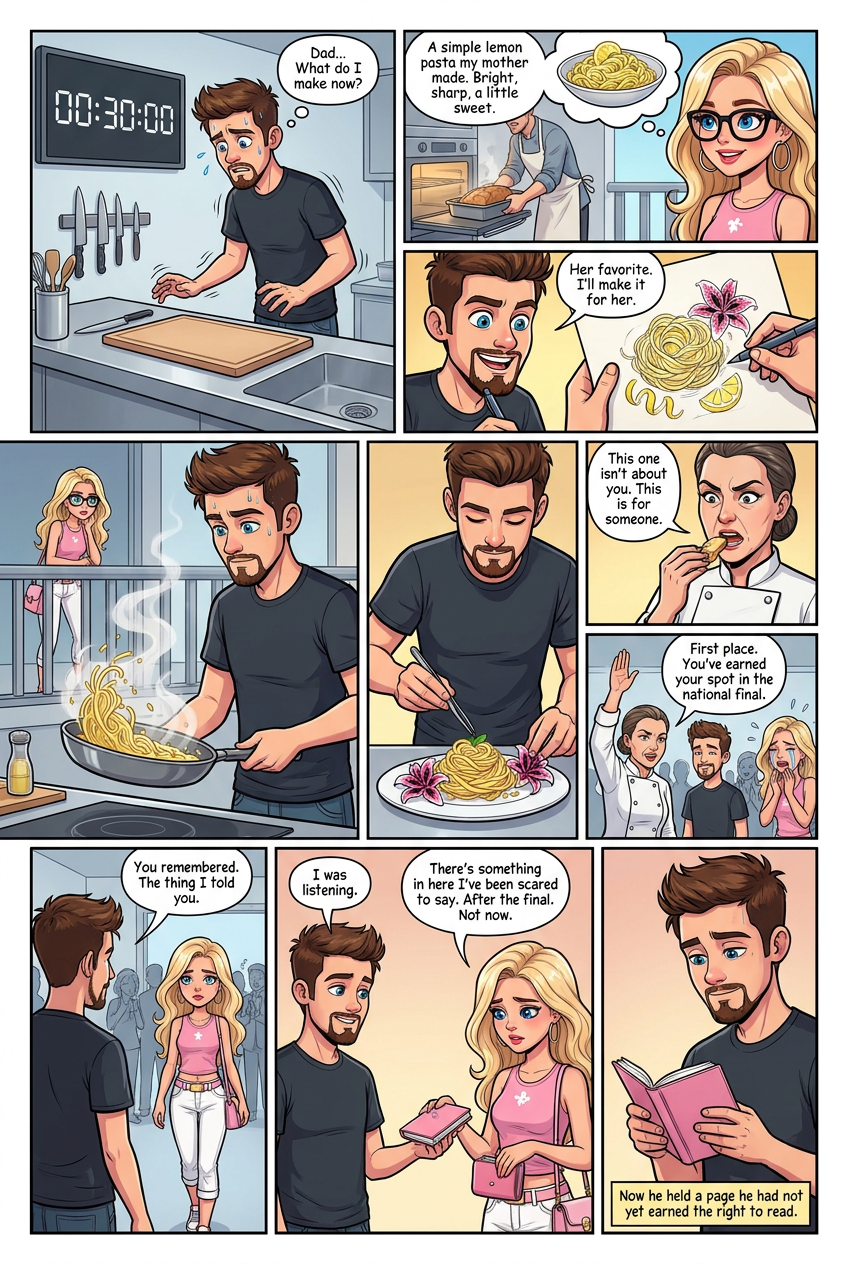
Thirty minutes. Johnathon stood at his station and could not move. He had already given the judges his whole life on a plate. Now they wanted more, and his mind held nothing. His hands shook over the empty board. He looked up at the ceiling lights and breathed. "Dad," he said, so quiet no one heard. "What do I make now?" He thought of his father sliding chicken from the oven. Then he thought of Lexi, and something clicked. Weeks ago, at the balcony rail, she had told him her favorite dish. A simple lemon pasta her mother made. Bright, sharp, a little sweet. She had said it plain, then looked away, like it mattered more than she wanted him to know. Johnathon grabbed his pen. He drew fast. A nest of pasta, thin ribbons of lemon peel curled on top, a scatter of pink and white petals for color. He would cook the dish she loved, but plate it like a painting made for her. At the rail stood Lexi. She had followed him across the city with a dead phone and never left his side. Since ninth grade, when his mother was in the hospital, she had trusted him more than anyone. Now she watched him move, her pink purse at her hip, her cat eye glasses catching the light. She saw the petals in his hand and went still. He worked. He boiled the pasta and pulled it early, firm. He melted butter and pressed lemon into it until the smell filled the station. He tossed the ribbons through the sauce, then twisted them high in the center of the plate. He laid three pink and white lily petals along the edge, spotted and bright, like a small garden set beside the food. It looked like her. The timer rang. Johnathon carried the plate to the judges. His heart pounded. The head judge lifted a forkful and tasted. She stopped. "This one isn't about you," she said. "This is for someone." She looked past him, to the rail. "You can taste that too." Johnathon nodded. "It's her favorite," he said. The judges bent over their cards. Then the head judge raised her hand. "First place," she said. "You've earned your spot in the national final." The hall clapped. Johnathon turned to Lexi. Her eyes were wet. She pushed off the rail and came to him, ignoring the crowd. "You remembered," she said. Her voice dropped low and plain. "The thing I told you. I didn't think you were listening." "I was," he said. She opened her purse and pulled out the notebook she let no one read. She held it against her chest, then held it out to him. "There's something in here I've been scared to say," she said. "After the final. Not now." She stopped. "That's all I'm saying right now." Johnathon took the notebook. It felt heavy in his hands. He had won his place in the final. Now he held a page he had not yet earned the right to read.
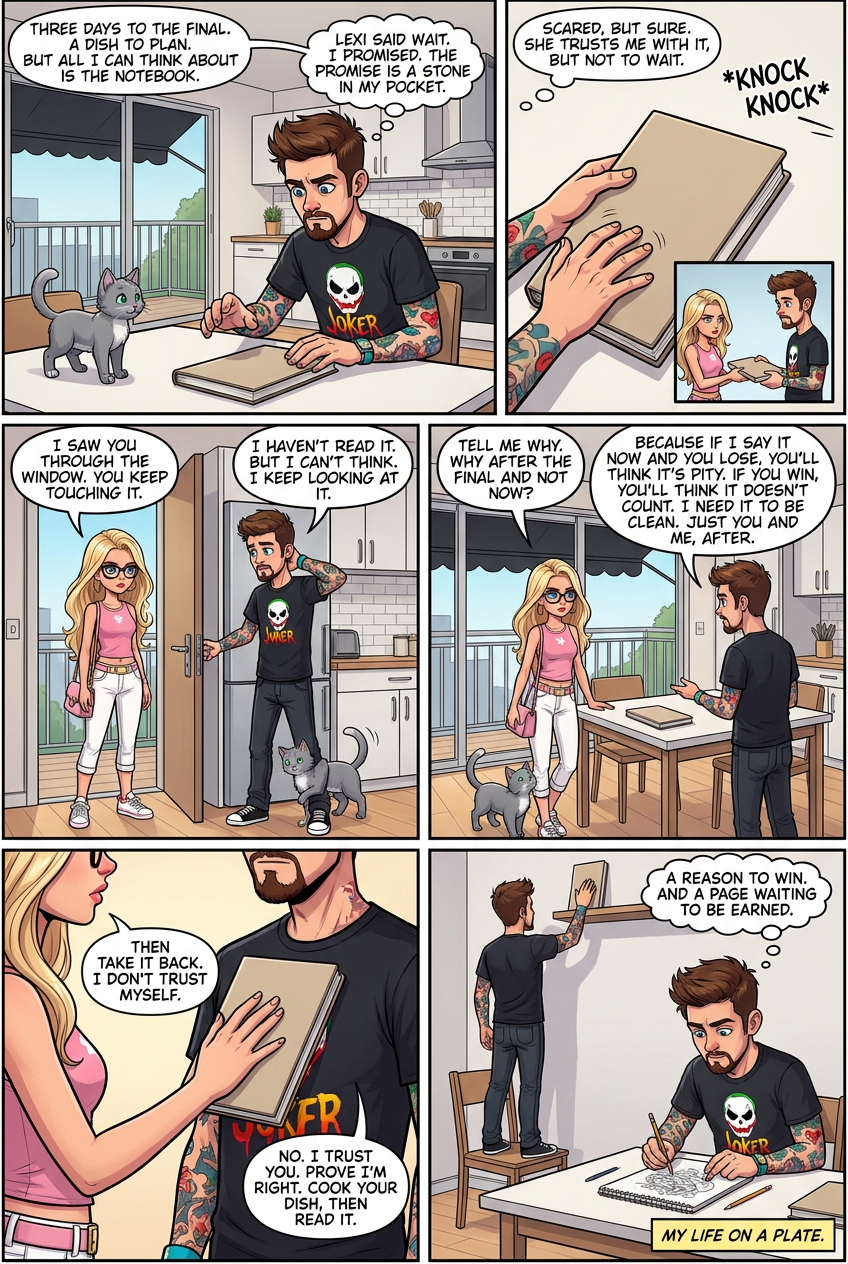
Three days stood between Johnathon and the national final. He had a dish to plan, one that had to show his whole life on a plate. But he could not focus. Lexi's notebook sat on his kitchen table. She had told him to wait until after the final to read it. He had promised. Now the promise felt like a stone in his pocket. He picked the notebook up, turned it over, and set it down again. His grey kitten watched from the counter, tail flicking. He made coffee he did not drink. He drew a rough plate on his sketch pad, then scratched it out. The notebook pulled at him from across the room. He kept thinking of Lexi's face when she handed it over. Scared, but sure. She wrote things in there she could not say out loud. He had known her since ninth grade, when she brought him soup while his mother was in the hospital. She trusted him with the notebook. She did not trust him to wait. A knock hit his door. He opened it and there she stood, pink purse on her hip, glasses catching the light. She did not smile. "I saw you through the window," she said. "You keep touching it." He stepped back to let her in. She looked at the notebook on the table, then at him. "I haven't read it," he said. "But I want to. I can't think. I keep looking at it." "I asked you to wait." "I know." He rubbed the back of his neck. "Then tell me why. Why after the final and not now." Lexi set her purse down. She was quiet a long moment. The kitten jumped off the counter and wound around her ankles. "Because if I say it now and you lose, you'll think I said it out of pity," she said. Her voice dropped, plain and low. "And if I say it and you win, you'll think it doesn't count because you were happy anyway. I need it to be clean. Just you and me, after." Johnathon looked at her. He understood. It was the same reason he cooked her pasta and told no one it was for her. "Okay," he said. He picked up the notebook and held it out to her. "Take it back. Keep it until then. I don't trust myself." She looked at his hand. Then she pushed the notebook gently back toward his chest. "No," she said. "You keep it. I trust you. Prove I'm right." She picked up her purse. "Cook your dish, Johnathon. Then read it. That's all I'm saying right now." She left. Johnathon set the notebook on a high shelf, out of reach. Then he sat with his sketch pad and, for the first time in three days, began to draw. His life on a plate. He had a reason to win now, and a page waiting to be earned.
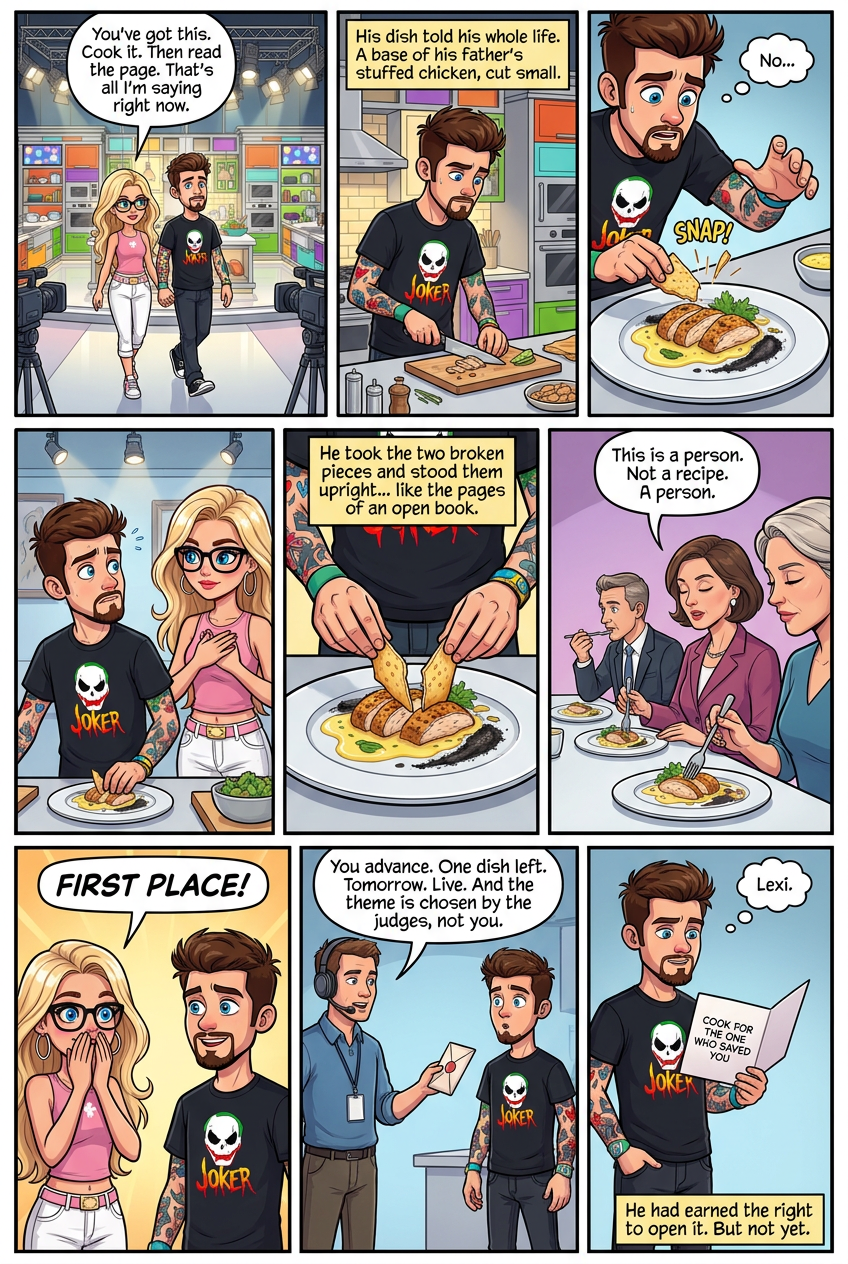
The day of the final arrived. Johnathon walked into the studio with Lexi beside him. The set was built for television. Bright lights hung on metal rails. The counters gleamed. Cameras faced the row of stations. He had drawn his dish a hundred times. He knew every step. His hands were steady for the first time in days. "You've got this," Lexi said. She squeezed his arm, then stepped back to the rail. "Cook it. Then read the page. That's all I'm saying right now." A staff member led him to his station. The clock started. Johnathon laid out his ingredients and breathed. His dish told his whole life. A base of his father's stuffed chicken, cut small. A ribbon of lemon sauce, for Lexi. A charcoal-black smear across the plate, like the sketches he loved. Food and drawing, together, the way she once told him he never had to choose. He worked fast and clean. The chicken browned. The sauce came together bright and sharp. He plated it like a canvas, each part placed by hand. Then he reached for the last element, a thin crisp he had practiced for hours. It broke. The crisp snapped in two on the plate. Twelve minutes left. His stomach dropped. He looked up. Lexi met his eyes at the rail. She did not speak. She just tapped her chest, twice, over her heart. The same thing she did when she wanted him to slow down. Johnathon set the broken crisp aside. He did not have time to make another. So he changed the plan. He took the two broken pieces and stood them upright in the sauce, like the pages of an open book. It looked like the notebook on his shelf. It looked like something waiting to be read. The clock hit zero. He carried the plate to the judges. They studied it in silence. One judge tasted the chicken and closed her eyes. Another dragged a fork through the black smear and the lemon. "This is a person," the first judge said. "Not a recipe. A person." They scored him. When the numbers came up, Johnathon did not fully understand them at first. Then Lexi's hands flew to her mouth. He had placed first in the round. He was through to the last stage of the national final. He wanted to run to her. But a producer caught his arm. "You advance," the man said. "One dish left. Tomorrow. Live. And the theme is chosen by the judges, not you." He held out a sealed card. Johnathon opened it. Two words were printed inside. Cook for the one who saved you. He looked at Lexi. His hand went to his pocket, where he had slipped her notebook that morning, still unread. He had earned the right to open it. But not yet. First he had one more dish to cook, and now the whole country would know exactly who it was for.
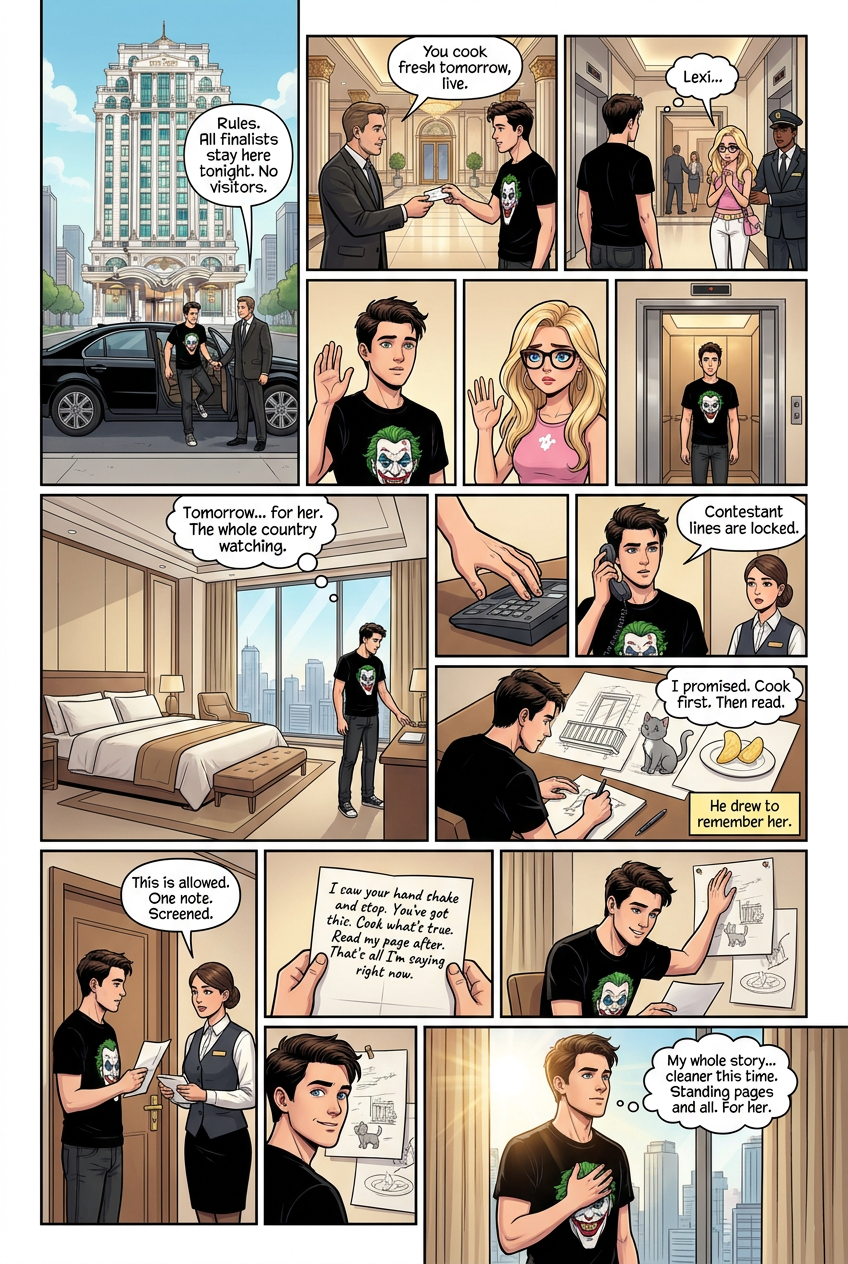
After the round, a producer led Johnathon out of the studio and into a black car. The car stopped at a tall white and silver hotel. The lobby shone with polished floors and glass. The producer handed him a room key. "Rules," the man said. "All finalists stay here tonight. No visitors. No calls to your support. You cook fresh tomorrow, live." Johnathon turned to find Lexi, but she was already blocked at the door. He raised his hand. She raised hers. Then the elevator took him up. His room was clean and huge and silent. A wide bed. A window that showed the whole city. He set the notebook on the desk and sat down. Tomorrow he would cook for the one who saved him. The whole country would watch. And she was ten floors below, or across the city, and he could not reach her. He tried the room phone. The front desk answered. "I'm sorry," a woman said. "Contestant lines are locked until the broadcast." He hung up. He walked to the window. He did not know what she wanted to see on the plate. He did not know if she was scared. He picked up the notebook and held it. He could open it now. It would answer everything. He did not open it. He had made her a promise. Cook first. Then read. Instead he found hotel paper in the desk drawer and a cheap pen. He started to draw. He drew the balcony where they first talked. He drew the kitten she gave him. He drew a plate with two crisps standing up like open pages. His hand moved fast and sure. This was the part of him no phone call could steady. He did not need her in the room. He needed to remember her. A knock came at the door near midnight. Johnathon opened it. A staff member stood there with a folded slip of paper. "This is allowed," the man said. "One note. Screened. No contact past this." He handed it over and left. Johnathon unfolded it. Lexi's writing. Short, the way she always wrote. "I saw your hand shake and stop. You've got this. Cook what's true. Read my page after. That's all I'm saying right now." He read it three times. His chest loosened. She had found a way to reach him anyway. She always did. He pinned the note above his sketches on the desk. He did not sleep much. But by morning he knew his dish. He would plate his whole story again, cleaner this time, standing pages and all, and cook it for her in front of the cameras. The waiting was over. The last dish was ready in his head. All that was left was to make it real and, at last, to open the page she had been holding for him.
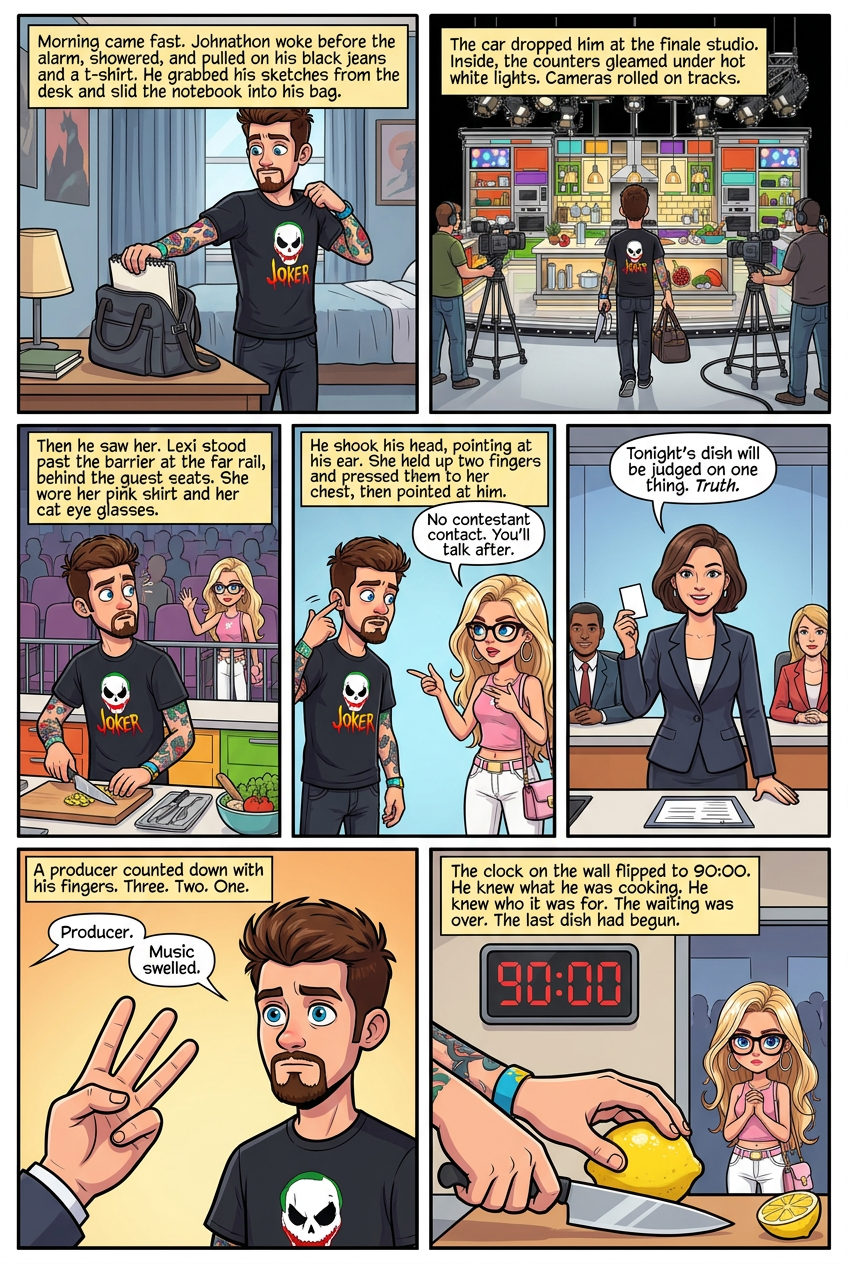
Morning came fast. Johnathon woke before the alarm, showered, and pulled on his black jeans and a t-shirt. He rolled his sleeves so his arm tattoos showed. He grabbed his sketches from the desk and slid the notebook into his bag. He did not open it. He had promised. Cook first, then read. A producer knocked and led him down to the black car. The car dropped him at the finale studio. Inside, the counters gleamed under hot white lights. Cameras rolled on tracks. Bowls of tomatoes, herbs, and lemons waited on the center island. Crew members moved fast, checking mics and angles. Johnathon found his station and set down his knife roll. His hands were steady. He knew the dish. He had drawn it a hundred times in his head. Then he saw her. Lexi stood past the barrier at the far rail, behind the guest seats. She wore her pink shirt and her cat eye glasses. Her blonde hair was pulled back. She had been the one who told him he didn't have to choose between cooking and drawing. She had helped him find this stage when he had the wrong address. Now she was here, and a line of crew and a low barrier stood between them. He raised his hand. She saw. She raised hers back. She mouthed something. He couldn't hear it. He shook his head, pointing at his ear. She held up two fingers and pressed them to her chest, then pointed at him. He understood the shape of it, but not the words. A guard stepped between them and waved her back toward her seat. "No contestant contact," the guard said. "You'll talk after." Johnathon nodded and turned to his station. His chest was tight. He wanted to walk over and ask what she'd said. But the lights swung toward the center. A producer counted down with his fingers. Three. Two. One. Music swelled. The three judges walked out and stood at the front counter. The lead judge, a woman in a dark blazer, lifted a card and smiled at the cameras. "Welcome to the national final," she said. "Tonight, our finalists cook for the one who saved them." She paused. "And tonight's dish will be judged on one thing. Truth." She read the card. "Chefs, your theme dish is set. You will each plate a single course that tells us who saved you and why. You have ninety minutes. Your time starts now." A bell rang. The clock on the wall flipped to 90:00 and began falling. Johnathon looked once more at Lexi. She was already leaning forward, watching him, her hands folded on the rail. He knew what he was cooking. He knew who it was for. He grabbed a lemon and reached for his knife. The waiting was over. The last dish had begun.
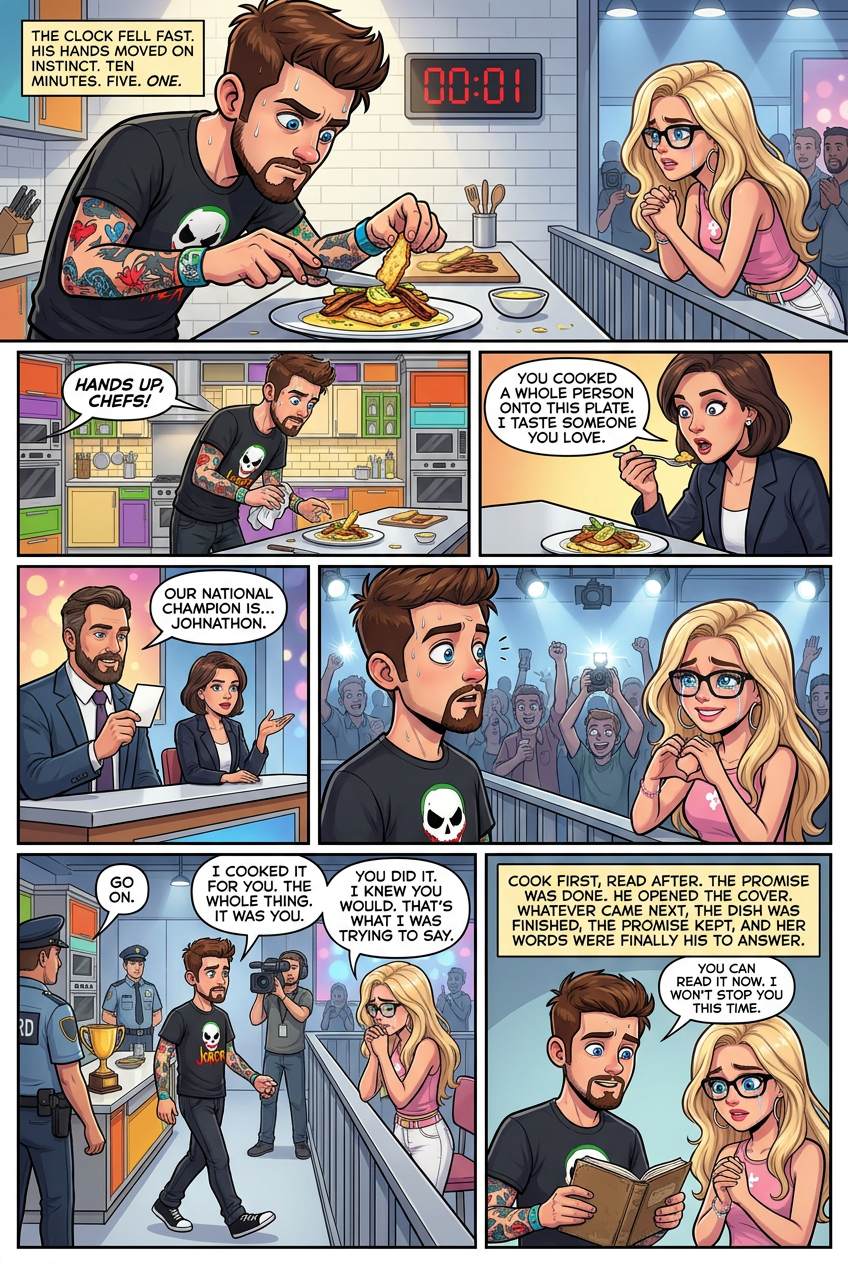
The clock fell fast. Johnathon worked over his plate under the hot studio lights. This dish was nothing like anything he had cooked before. He layered lemon sauce with charred strips and stood the crisp pieces upright like open pages. His hands moved on instinct. He glanced once at the rail, where Lexi leaned forward, her folded hands white at the knuckles. Then he went back to work. The numbers dropped. Ten minutes. Five. One. The bell rang. "Hands up, chefs," the lead judge called. Johnathon stepped back from his plate and wiped his palms on his jeans. His heart pounded. The three judges walked the row, tasting and murmuring. When they reached his station, the woman in the dark blazer lifted a bite of the charred strip through the lemon sauce. She chewed slowly. She looked at the standing crisp, then at him. "You cooked a whole person onto this plate," she said. "I taste someone you love." She set down her fork. The other two judges nodded. The judges gathered at the front counter. The music dropped low. Johnathon's mouth went dry. He found Lexi's eyes across the barrier and held them. "Our national champion," the lead judge said, lifting a card, "is Johnathon." The room erupted. Lights swung toward him. A crew member pushed a trophy into his hands. Johnathon barely felt it. He was the top chef of the country now. It was the thing he had chased through every round. But he was already looking past the trophy, past the cameras, to the rail. The guard who had blocked them earlier stepped aside. "Go on," he said. Johnathon set the trophy on his station and crossed the floor. Lexi met him at the edge of the barrier. Up close he saw her eyes were wet behind the cat eye glasses. "You did it," she said. Her voice was quiet and plain. "I knew you would." "I cooked it for you," he said. "The whole thing. It was you." She pressed two fingers to her chest, then pointed at him, the same gesture from before the clock started. This time no crew stood between them to hide the words. "That's what I was trying to say," she said. "That's all I'm saying right now." Johnathon remembered the notebook in his bag. Cook first, read after. He had cooked. He had won. The promise was done. He reached into his bag and pulled it out. His thumb rested on the cover. "You can read it now," Lexi said. Her hands were shaking. "I won't stop you this time." He opened the cover. The first line was in her small, careful writing. He read it once, then looked up at her. His chest felt tight in a new way. Whatever came next, the dish was finished, the promise kept, and her words were finally his to answer.
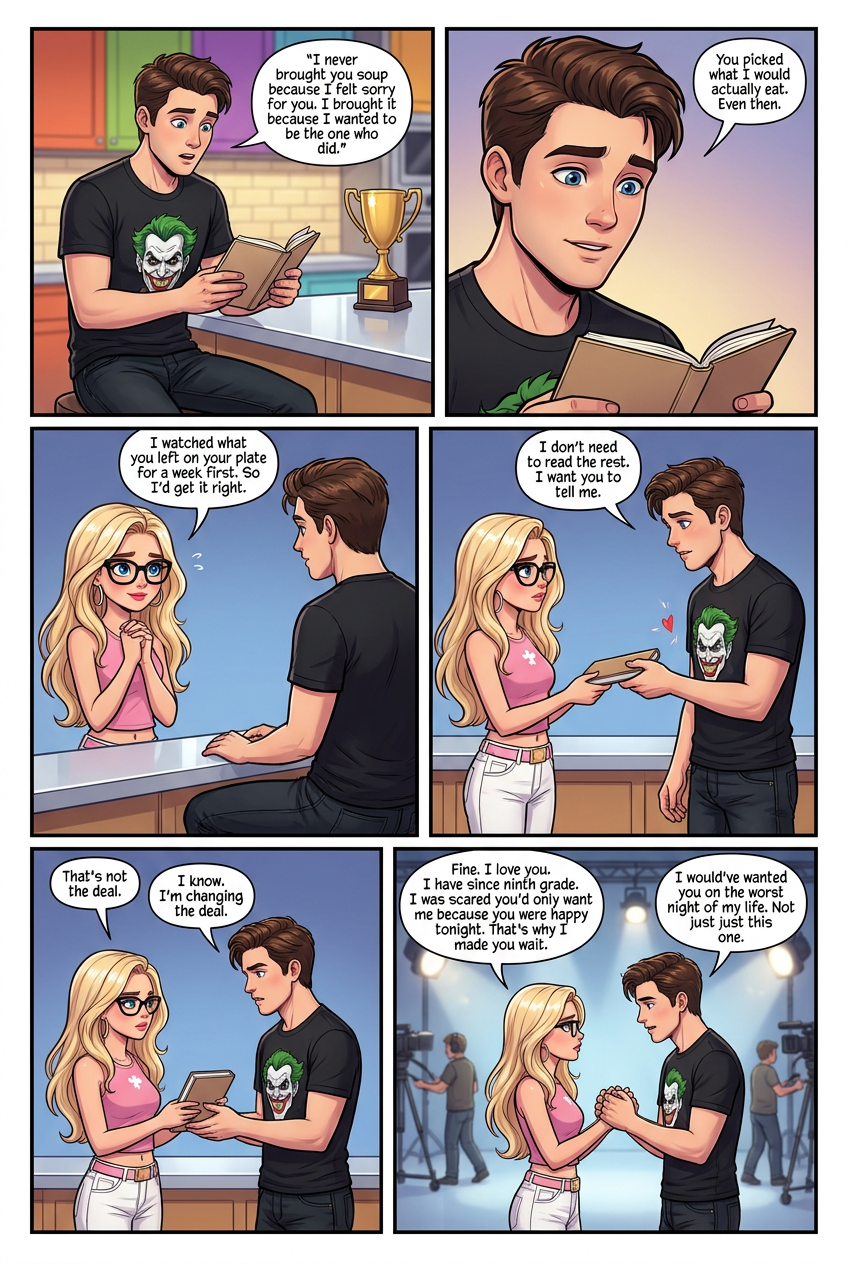
Johnathon looked back down and read it out loud. He paused. His trophy sat forgotten on the station behind him. The studio still buzzed with cameras and crew, but he heard none of it. He read the first line again, slower this time, so Lexi could hear every word. "'I never brought you soup because I felt sorry for you,'" he read. His voice caught. "'I brought it because I wanted to be the one who did.'" He stopped. His thumb held the page open. He remembered ninth grade, his mother in the hospital, the soup and sandwich that showed up at his door. He had thought it was kindness. He looked up. "You picked what I would actually eat," he said. "Even then." Lexi nodded. Her hands still shook. "I watched what you left on your plate for a week first," she said. "So I'd get it right." Johnathon turned the page. There was more, lines and lines in her small writing. But he closed the notebook and held it out to her across the barrier. His heart pounded harder than it had during the final bell. "I don't need to read the rest," he said. "I want you to tell me." Lexi stared at the closed notebook. This was the thing she had spent months writing instead of saying. She had made him keep it as a test. Now he was handing it back and asking for her voice instead. "That's not the deal," she said. Her words came out flat, the way they did when a thing got too close. "I know," Johnathon said. "I'm changing the deal." A long second passed. The bright lights hummed above the gleaming counters. Then Lexi took a breath. She pushed the notebook back into his hands and closed his fingers over it. "Fine," she said. Her voice dropped, quiet and plain. "I love you. I have since ninth grade. I was scared you'd only want me because you were happy tonight. That's why I made you wait." Johnathon didn't move for a moment. Then he set the notebook down on the barrier rail. He reached out and took both her hands. "I would've wanted you on the worst night of my life," he said. "Not just this one." Lexi's shoulders dropped, like something heavy had finally left them. She let out a small laugh that was half a sob. "Okay," she said. "That's all I'm saying right now." But she didn't let go of his hands. Around them the crew broke down the set, wheeling away lights and folding tables. Johnathon picked up the notebook and put it in his bag. The words inside were his now, but they didn't matter as much anymore. She had said them out loud. He was the top chef of the country, and somehow that felt like the smaller thing he had won tonight.
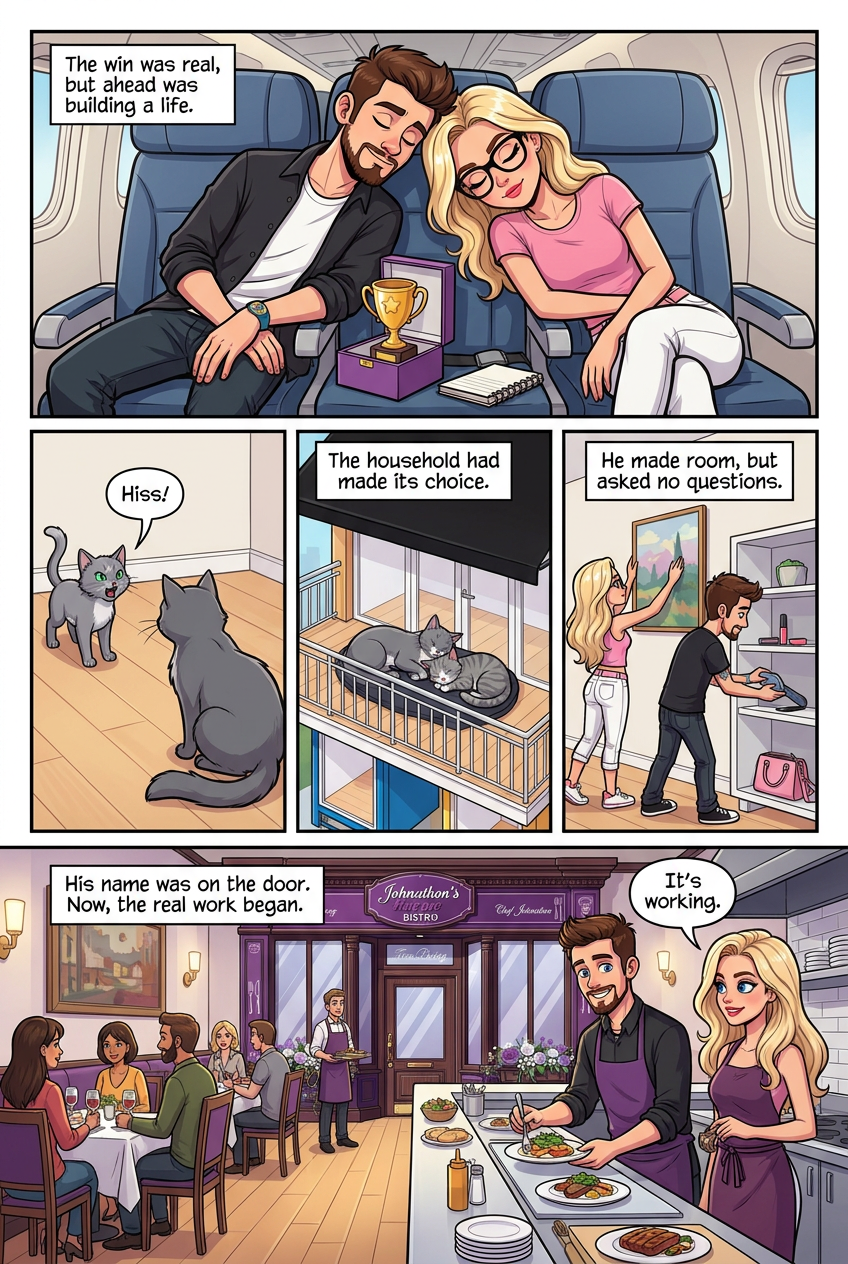
The trophy went into a box. So did the notebook. Johnathon flew home the next morning with Lexi beside him, both too tired to talk much. The win was real, but it lived behind him now. Ahead was the harder thing: building a life with the person who had said she loved him. They started small. Lexi carried her cat into his studio apartment first, a tiny grey female with green eyes. Johnathon's cat met her at the door and hissed. The two animals circled the light wood floor for three days. Then Johnathon found them asleep together on the balcony, under the black rain cover, and knew the household had made its choice. Lexi moved the rest of her things over one box at a time. She hung her paintings on the white walls. Johnathon cleared a shelf for her lip gloss and her charger and, quietly, made no room for the notebook she still kept in her purse. He didn't ask about it. She noticed that he didn't. "You should stop cooking for other people's kitchens," Lexi said one night. She was scrubbing a pan. "You won the whole country. Use it." "A restaurant costs money I don't have," Johnathon said. "You have a name now." She set the pan down. "That's the money. That's all I'm saying." She was right, and he knew it. Over the next months he signed papers he barely understood. He found an empty storefront and painted it deep purple, because purple was the color of the plate that had won him everything. He built the menu from the dishes that mattered: his father's stuffed chicken, the lemon pasta that was Lexi's favorite. He drew each plate before he cooked it, the way she had taught him. The morning of the opening, his hands shook. Lexi found him in the empty dining room, staring at the door with the fine lettering. "What if nobody comes," he said. Lexi looked at him. She didn't soften it. "Then you cook for me. Like you did the whole time." She straightened his collar. "But they'll come." They came. By six the tables were full. Strangers who had watched him win now sat under his purple walls, waiting to taste it. Johnathon stood at the pass and plated the first stuffed chicken, standing a broken crisp upright the way he had learned to. A server carried it out. He watched through the window into the dining room as a table went silent over the food. Lexi came back to the kitchen an hour in. She leaned against the steel counter, her glasses fogged from the heat. "It's working," she said, quiet and plain. Johnathon wiped his hands and looked at the tickets stacking up on the rail. The bistro was open. His name was on the door. But a full room on opening night was one night. Now he had to fill it again tomorrow, and the day after that, for as long as he wanted this to be his life.
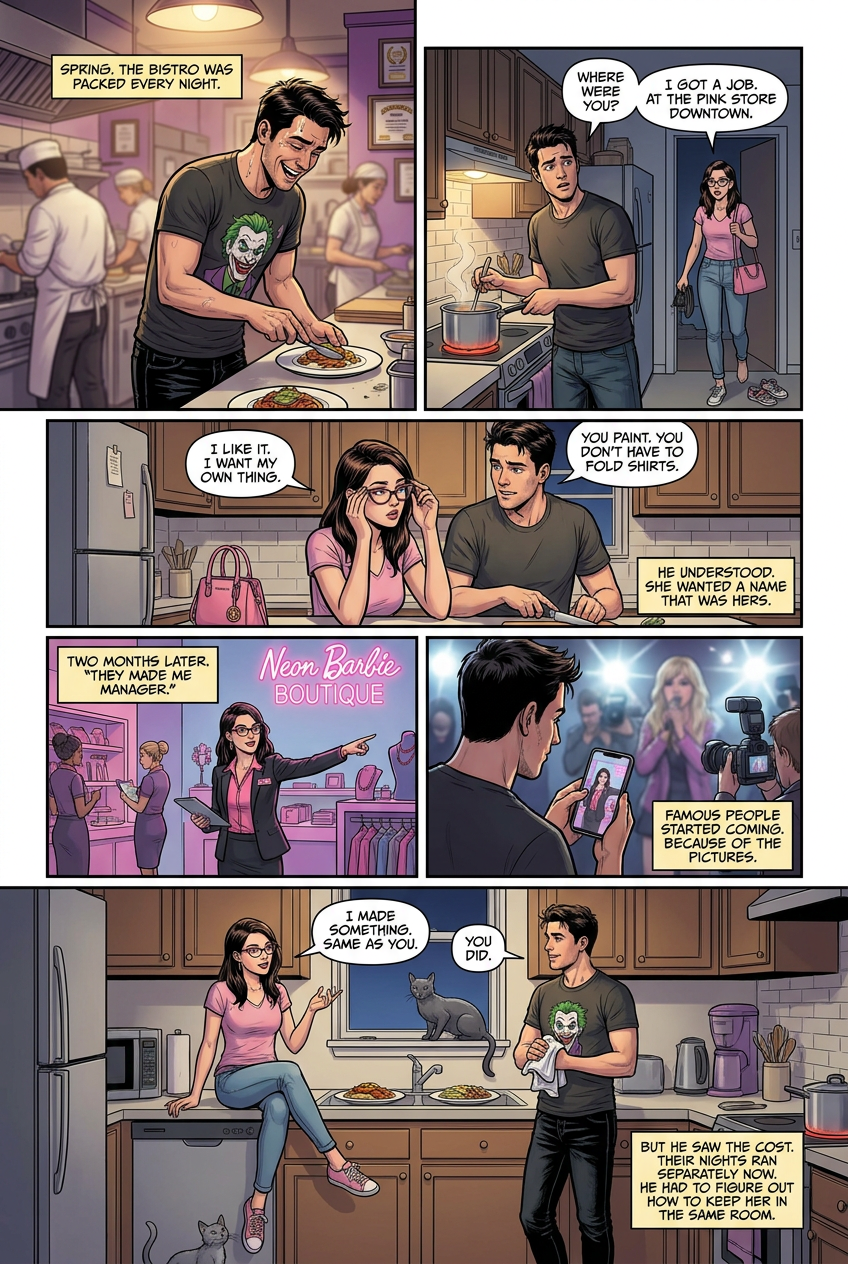
The bistro filled again the next night, and the next. By spring the wait for a table ran two weeks deep. Johnathon cooked until his hands ached, then drew new plates at the counter after close. He was happy. But he noticed Lexi had gone quiet. She came home late now, her sneakers scuffed, her purse heavier than usual. "Where were you?" he asked one night. He was plating a lemon pasta for himself, the burner still hot. "I got a job," she said. She set her purse down and pulled off her glasses to clean them. "At the pink store downtown. The doll one." Johnathon knew the place. A glossy storefront lit up in neon pink, black, and silver. He had walked past it a hundred times. "You paint," he said. "You don't have to fold shirts." "I like it." She put the glasses back on. "I want my own thing. That's all I'm saying." He understood then. She had helped him build a name. Now she wanted one that was hers. She worked the floor for two months. She learned the register, the stock room, the way people wanted to feel when they carried a bag out the door. She came home tired but lit up, telling him small things. A little girl who cried over a doll. A display she rebuilt three times until it looked right. One night she came home and dropped her purse on the counter with force. "They made me manager," she said. Johnathon put down his knife. "Lexi." "I run it now." Her voice went quiet and plain, the way it did when a thing mattered. "The whole store. Me." He crossed the kitchen and hugged her. Their grey cat wound between their feet, and the sleek grey male stretched on the balcony behind the glass, watching. The store did well under her. Word spread the same way it had for him. Then came the afternoon she called the bistro during service. "Turn on your phone," she said. "After close. There are photos." Johnathon looked that night. A pop singer had walked into her store that afternoon, then an actor two days later. Cameras had followed them. Lexi stood in the background of one shot, arms crossed, running her floor like she owned the air in it. "They keep coming," she told him at home. "Famous people. Because of the pictures." She sat on the counter and swung her feet. "I made something. Same as you." "You did," he said. And he meant it. But he saw the cost sitting between them. Her store ran on nights. His kitchen ran on nights. They both worked while the city slept and ate. He looked at the two plates cooling on the counter, one for each of them, and understood that lately they never ate together anymore. He wiped his hands. He had built a name, and so had she. Now he had to figure out how to keep her in the same room.
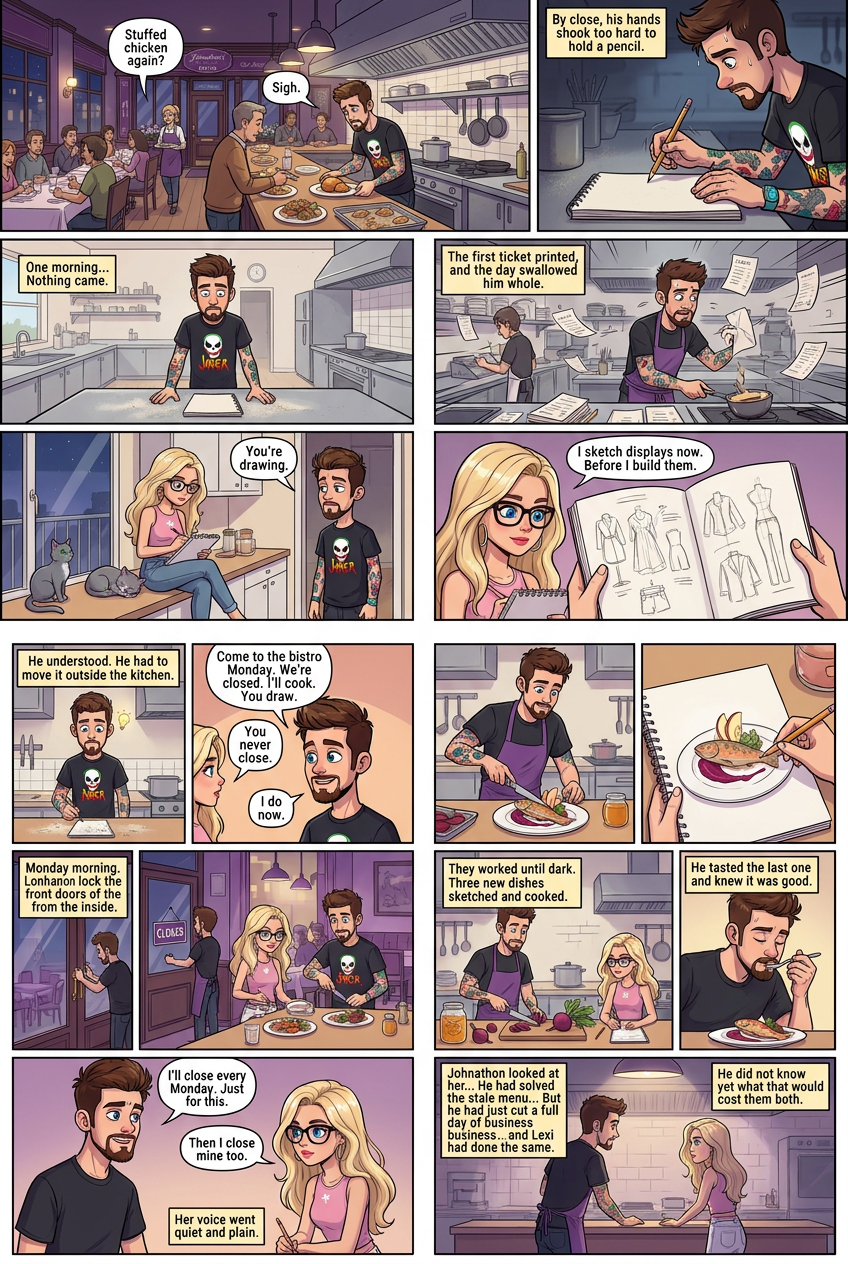
The bistro stayed full, but the menu had not changed in months. Johnathon plated the same lemon pasta, the same stuffed chicken, night after night. He wanted new signature dishes. He had no time to make them. Service ate every hour he had, and by close his hands shook too hard to hold a pencil. One morning he stood in the empty kitchen before the doors opened. His sketchpad lay closed on the counter, dust on the cover. He opened it to a blank page and picked up a pencil. Nothing came. The first ticket printed, and the day swallowed him whole. That night he came home and found Lexi awake. She sat on the counter in her pink shirt, her glasses pushed up, the notebook she let no one read open on her knee. Their small grey cat slept against her hip. The sleek grey male watched from the balcony glass. "You're drawing," he said. "I sketch displays now." She turned the notebook so he could see. Rough shapes. A dress on a stand. "Before I build them. Saves me hours." She closed it. "That's all I'm saying." Johnathon stared at the counter. Then he understood. He had been trying to create between services, when there was no room. He had to move it outside the kitchen entirely. "Come to the bistro Monday," he said. "We're closed. I'll cook. You draw." Lexi looked at him a long moment. "You never close." "I do now." Monday morning he locked the front doors and turned the sign. The dining room sat quiet and purple around them. He set out ingredients he never used on a normal night. Beets. Smoked trout. A jar of honey. Lexi sat at the pass with her notebook and drew the plate before he built it, the way she had taught him years ago. "Make it look like something," she said. "Not just food." He cooked slow. No tickets. No timer. He plated the trout against a smear of beet, then stood a honey crisp upright like a page. Lexi's pencil moved fast. When she turned the notebook, the drawing matched the plate exactly. They worked until dark. By the end he had three new dishes sketched and cooked. He tasted the last one and knew it was good. "I'll close every Monday," he said. "Just for this." Lexi set down her pencil. "Then I close mine too." Her voice went quiet and plain. "So we're in the same room." Johnathon looked at her across the pass. He had solved the stale menu. He had a way to keep creating. But he had just cut a full day of business from a restaurant with a two-week wait, and Lexi had done the same to her store. He did not know yet what that would cost them both.
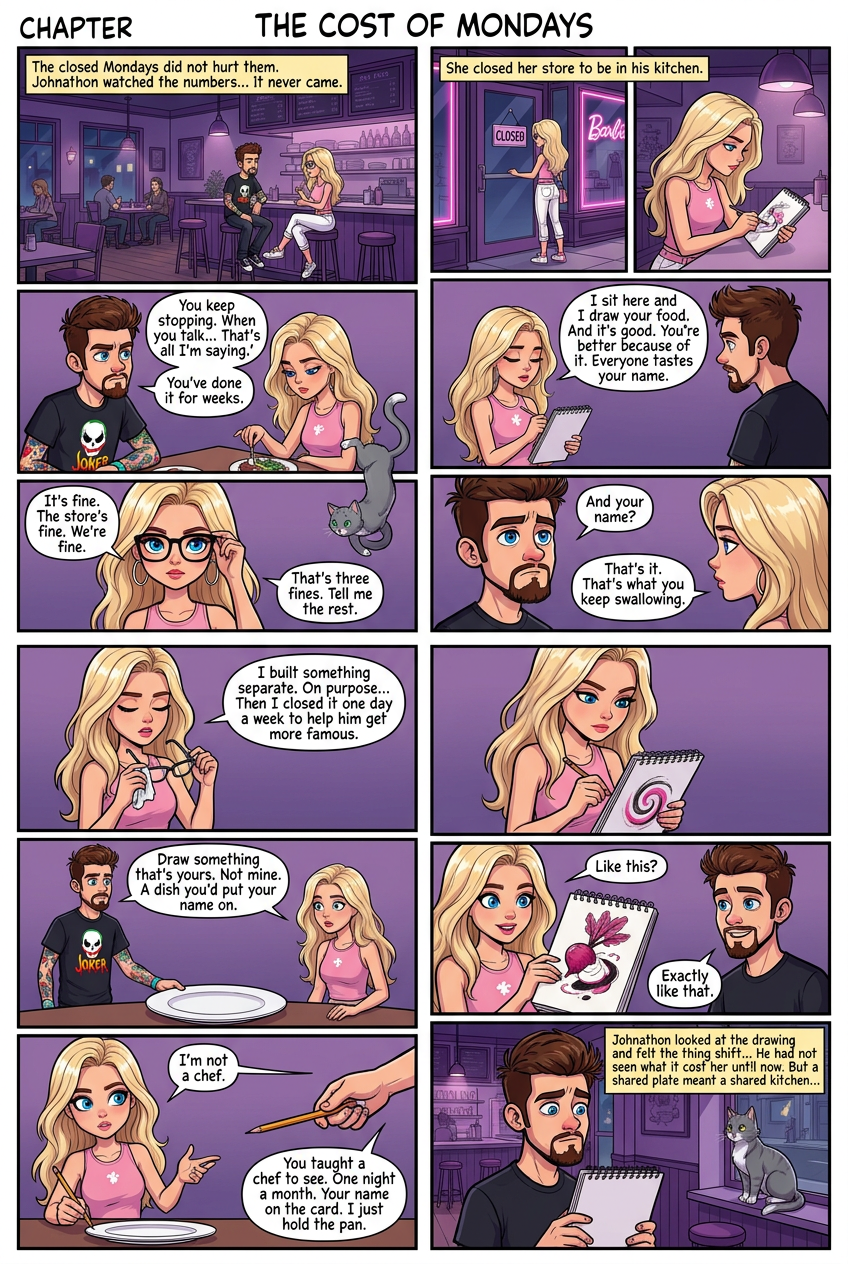
The closed Mondays did not hurt them. Johnathon watched the numbers for a month and waited for the drop. It never came. The bistro filled the other six nights just the same. Lexi's boutique kept its crowd too. The new dishes he made on Mondays sold out by nine. People booked weeks ahead to try them. The money still poured in. So why did she keep going quiet? One Monday night they ate late at the pass. He had cooked the beet trout again. Lexi picked at it, her fork slow. Their small grey cat wound around the stool legs. The sleek grey male sat at the window, watching the street. "You keep stopping," Johnathon said. "When you talk. You say a thing, then you say 'that's all I'm saying.' You've done it for weeks." Lexi set her fork down. She pushed her glasses up. "It's fine. The store's fine. We're fine." "That's three fines." He waited. "Tell me the rest." She looked at the plate a long moment. Her sentences got quiet and plain. "I closed my store to be in your kitchen. Every Monday. I sit here and I draw your food." She tapped her notebook. "And it's good. You're better because of it. Everyone tastes your name." "And your name?" She didn't answer. "That's it," he said. "That's what you keep swallowing." Lexi took off her glasses and cleaned them on her shirt, a thing she did when she needed her hands busy. "I built something separate. On purpose. So I wasn't just the girl next to the famous chef." She put the glasses back on. "Then I closed it one day a week to help him get more famous. That's all I'm saying." Johnathon sat with that. She was right. Every Monday sketch went onto his menu, under his name, in his purple dining room. She gave him her method and got nothing with her own name on it. He stood and pulled a clean plate from the shelf. He set it in front of her. "Draw something that's yours. Not mine. A dish you'd put your name on." Lexi blinked. "I'm not a chef." "You taught a chef to see." He slid her the pencil. "One night a month. The bistro cooks a plate you designed. Your name on the card. I just hold the pan." She stared at the blank plate. Then she opened the notebook to a fresh page. Her pencil moved slow, then fast. She drew a swirl of pink beet, a white curl of cream, a black char line through it. Her colors. Her shapes. She turned it to him. "Like this?" "Exactly like that." Johnathon looked at the drawing and felt the thing shift. He had fixed the stale menu weeks ago. He had not seen what it cost her until now. He had built his name on her hours. Tonight he started giving one back. But a shared plate meant a shared kitchen, and two names on one card would ask who the bistro really belonged to.
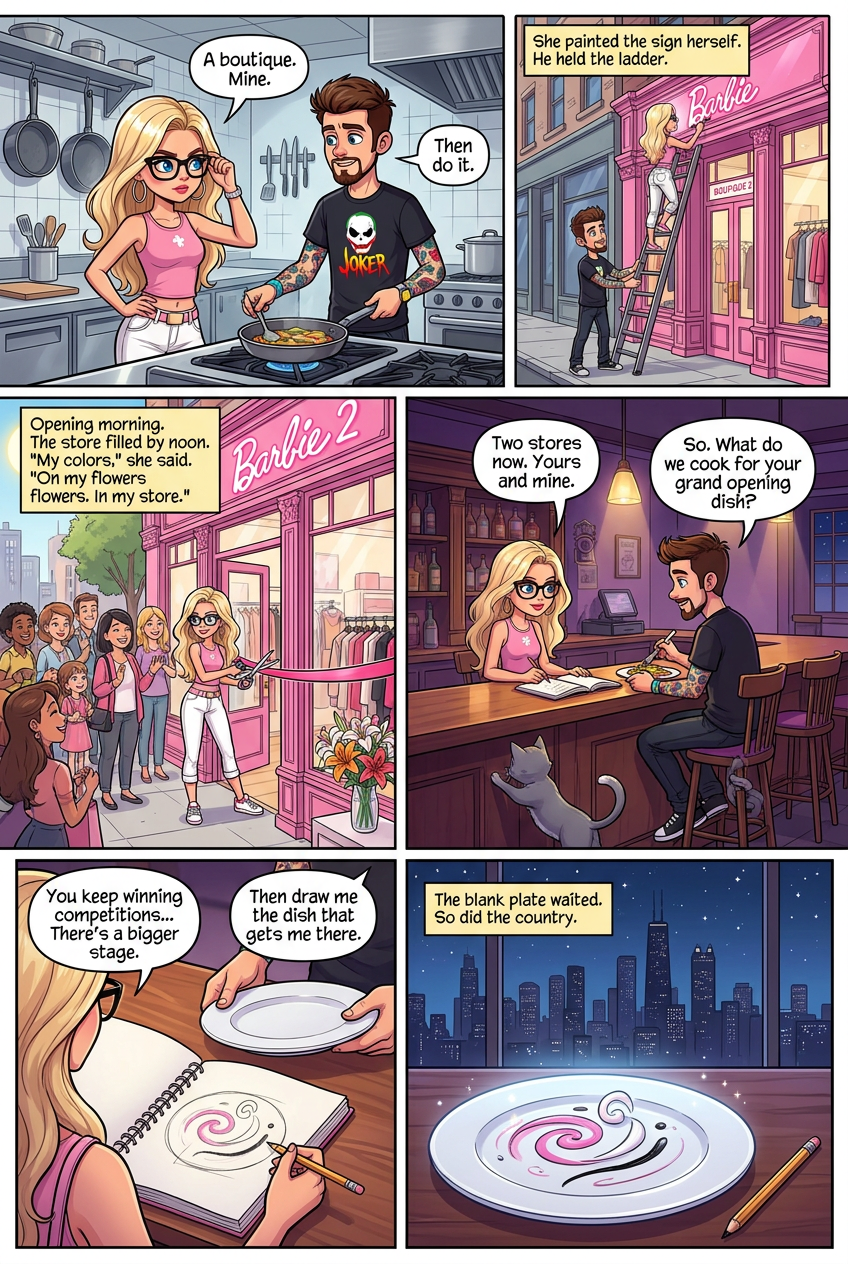
The first named-plate night sold out in an hour. Lexi's beet dish went on the card under her name, in black ink, right below his. Then it did not stop at one night. People asked for her plates the other six nights too. Reviews used both names. And Lexi came in on a Tuesday and said she wanted to open her own store. Johnathon set down the pan. "Your own store." "A boutique. Mine." She pushed her glasses up. "Not managing someone else's. Not one plate a month. A place with my name on the door." He waited for the drop in his chest. It did not come. "Then do it." She found the space that week. A narrow shop with a pink front and tall display windows. She painted the sign herself, glossy pink letters, and stood back on the sidewalk to check them straight. He held the ladder. That was all she asked him to do. Hold the ladder, not the brush. Opening morning she cut the ribbon. The store filled by noon. She had stocked it in her colors, pink and white and black, the same shapes she drew on his plates. On the counter sat a cluster of tiger lilies, pink and black and white petals, spotted centers. She had picked them because they matched. "My colors," she said. "On my flowers. In my store." That night they closed both places and ate at the bistro pass. The grey cat wound the stool legs. Lexi laid her notebook flat between them. "Two stores now," she said. "Yours and mine. And a plate here with my name." She tapped the card. "I stopped fading." "You did." She was quiet, then plain. "I like it better than ever. Us. This." She did not add a flat finisher. She just let it stay. Johnathon looked at the two of them. Her boutique across the city, his purple dining room here, both full, both hers and his in the right measure. He had spent months afraid that sharing his kitchen would cost him something. Instead it had grown into two names, two places, one Monday still theirs. He pulled a clean plate and set it in front of her. "So. What do we cook for your grand opening dish?" Lexi opened the notebook to a fresh page. Her pencil moved. Pink swirl, white curl, black char line. Then she stopped. "You keep winning competitions," she said. "The country still doesn't know your name the way it should." "It will." "There's a bigger stage." She looked up. "A national showcase. Top chef. Real one." She slid the plate back to him. "You want top chef of the whole country. Not just a purple room downtown." He had said that goal out loud years ago, over cold soup, at fifteen. He had almost forgotten it inside the good months. "Then draw me the dish that gets me there," he said. Lexi turned the page. The blank plate waited. So did the country.
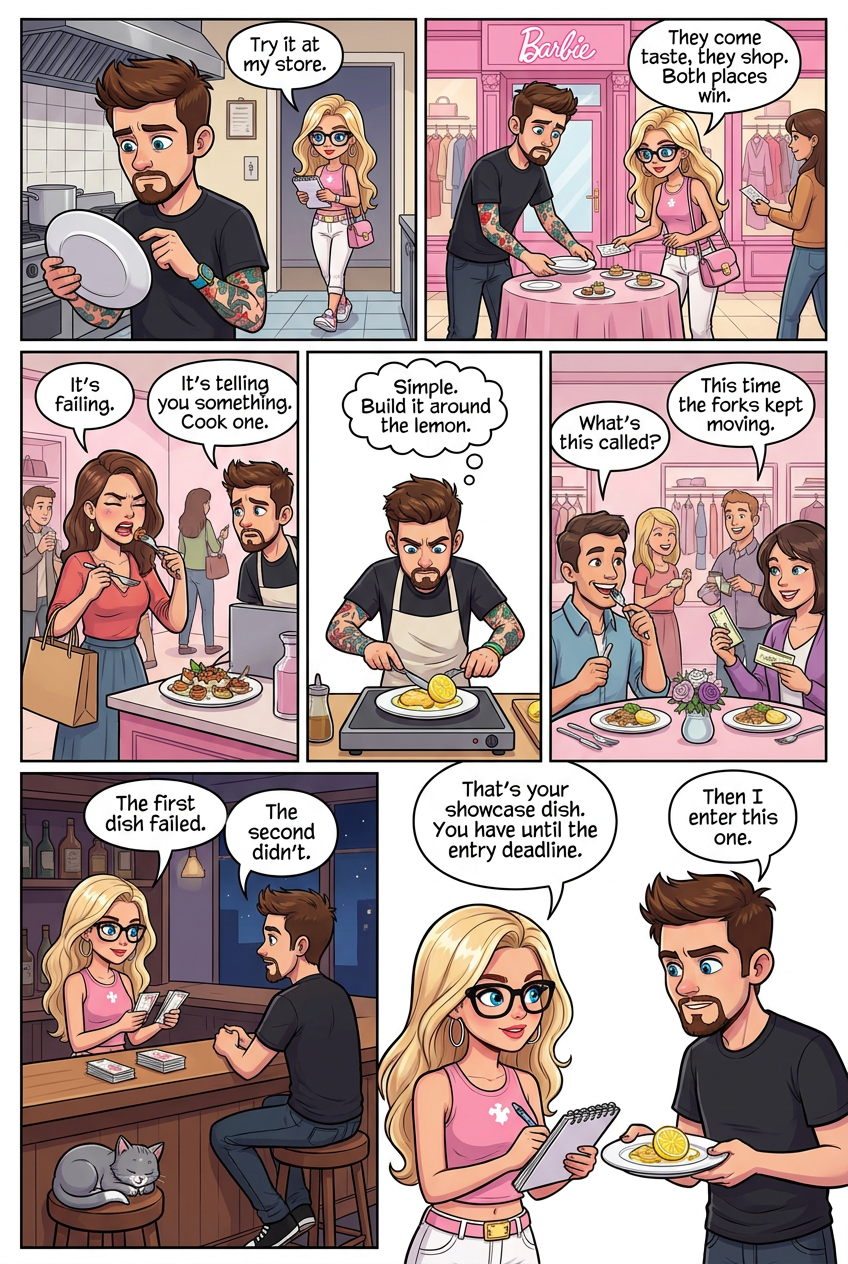
The blank plate sat between them for three days. Johnathon sketched a signature dish for the top chef showcase, but every draft felt safe. He needed to test it on real people first, not just in his quiet kitchen. Lexi came in Monday with the answer already in her mouth. "Try it at my store," she said. She set her pink purse on the pass and pulled out her notebook. "Not here. Somewhere new." "Your store sells clothes." "So we bring people in." She flipped to a fresh page and drew fast. A little coupon, split down the middle. "One side, a discount at your bistro. Other side, mine. They come taste the dish. They shop." She tapped the page. "Both places win." Johnathon looked at her plan. It was clean. It was hers. "You'd let food into a boutique?" "My store. My rules." She pushed her glasses up. "That's all I'm saying right now." They printed the coupons Sunday night. Monday morning they set up a small tasting table inside the glossy pink boutique, between the display windows and the racks of clothes. Johnathon plated forty small portions of his showcase dish. Lexi handed a coupon to everyone who walked in. By noon the boutique was full. People held pink shopping bags in one hand and forks in the other. Johnathon watched their faces. He watched the first bite. A woman near the window set her fork down after one taste. She did not finish. Then another. The dish was too much at once, too clever, three ideas fighting on one small plate. He heard someone say it was pretty but hard to eat. His chest dropped. "It's failing," he said low to Lexi. "It's telling you something." She did not sound worried. She grabbed a clean plate. "You drew three dishes. Cook one." He understood. He pulled the lemon element, the one true thing, and built the plate around it. Simple. He plated ten new portions right there on the table. Lexi carried them out herself. This time the forks kept moving. People finished. A man asked what it was called. A woman asked if the coupon worked today. By two o'clock, both coupon halves were gone, and the boutique had sold out its front rack. That night they counted at the bistro pass. The grey cat wound the stool legs. Lexi laid the used coupons in two piles, one for each store. "The first dish failed," Johnathon said. "The second didn't." She slid a plate to him. On it sat the simple lemon version, cold now. "That's your showcase dish. The country will get it in one bite." He looked at the plate. She was right. He had been hiding behind too many ideas. The test had stripped them away. "Then I enter this one," he said. Lexi opened her notebook. "Good. Now we make it perfect. You have until the entry deadline." She wrote the date at the top of the page and underlined it twice.
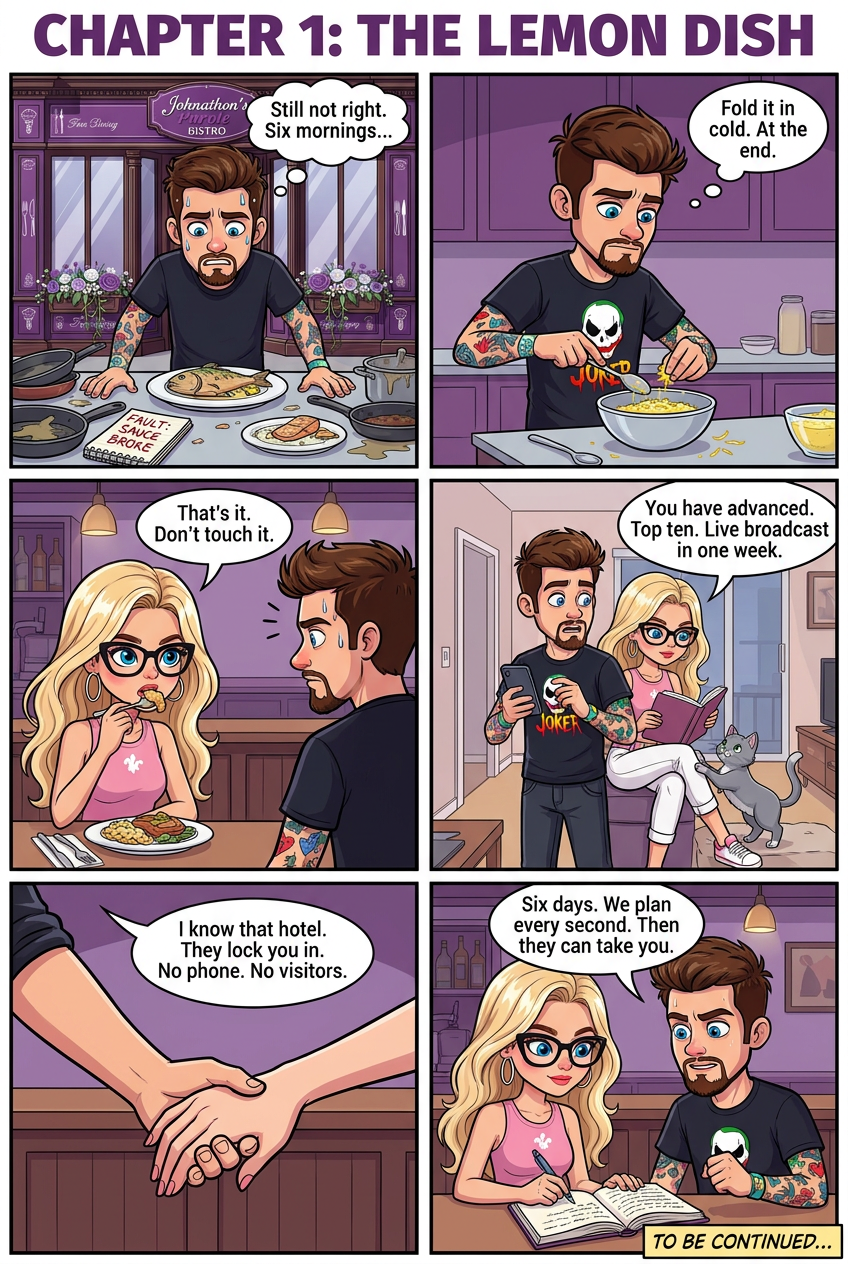
The lemon dish still wasn't perfect. Johnathon spent the next six mornings alone in the purple bistro, before the doors opened. He cooked the plate again and again. The sauce broke twice. The fish sat too long. Each time he wrote the fault down and started over. Lexi had circled the deadline in her notebook, and it was three days out. On the seventh morning he changed one thing. He cut the lemon zest finer and folded it in cold, at the end, not the start. The bitterness dropped away. The bright taste stayed. He plated it, stepped back, and ate the whole thing standing at the pass. Nothing fought. One clear flavor, start to finish. He called Lexi. She came straight from her boutique, still in pink, purse on her shoulder. She set the bag down and took a fork without asking. She ate one bite, then a second. She did not talk while she chewed. That was how he knew. "That's it," she said. She put the fork down. "Don't touch it again." "You're sure?" "I ate the broken ones all week." She pushed her glasses up. "This one isn't broken." He filmed the plate, wrote the recipe clean, and sent his entry that night. Then they waited. Lexi came by the bistro each evening after closing her store. She sat on the stool while the grey cat wound her legs, and she pretended she wasn't watching his phone too. The email came four days later. Johnathon read it twice before he trusted it. He set the phone on the pass and slid it to her. Lexi read it out loud, slow. "You have advanced. Top ten. Live broadcast in one week." She looked up. "You made the final ten." He should have felt only good. He didn't. He read the next line again himself. Finalists report to the studio hotel. No outside contact until the broadcast. "I know that hotel," he said. "They lock you in. No phone. No visitors." Lexi went quiet. She knew it too. She had stood outside those doors once already, on the other side of a guard. "One week," she said. Her voice dropped, plain now. "You cook the biggest plate of your life, and I can't be there for any of it." He reached across the pass and held her hand. "Then help me now. Before they take my phone." She nodded. She pulled the notebook from her purse and opened to a clean page. "Six days," she said, and wrote it at the top. "We plan every second of it. Then they can take you." Johnathon had his spot in the top ten. He had a week to build a dish for the whole country, and only six days with the one person who made his food mean anything. The clock had already started.
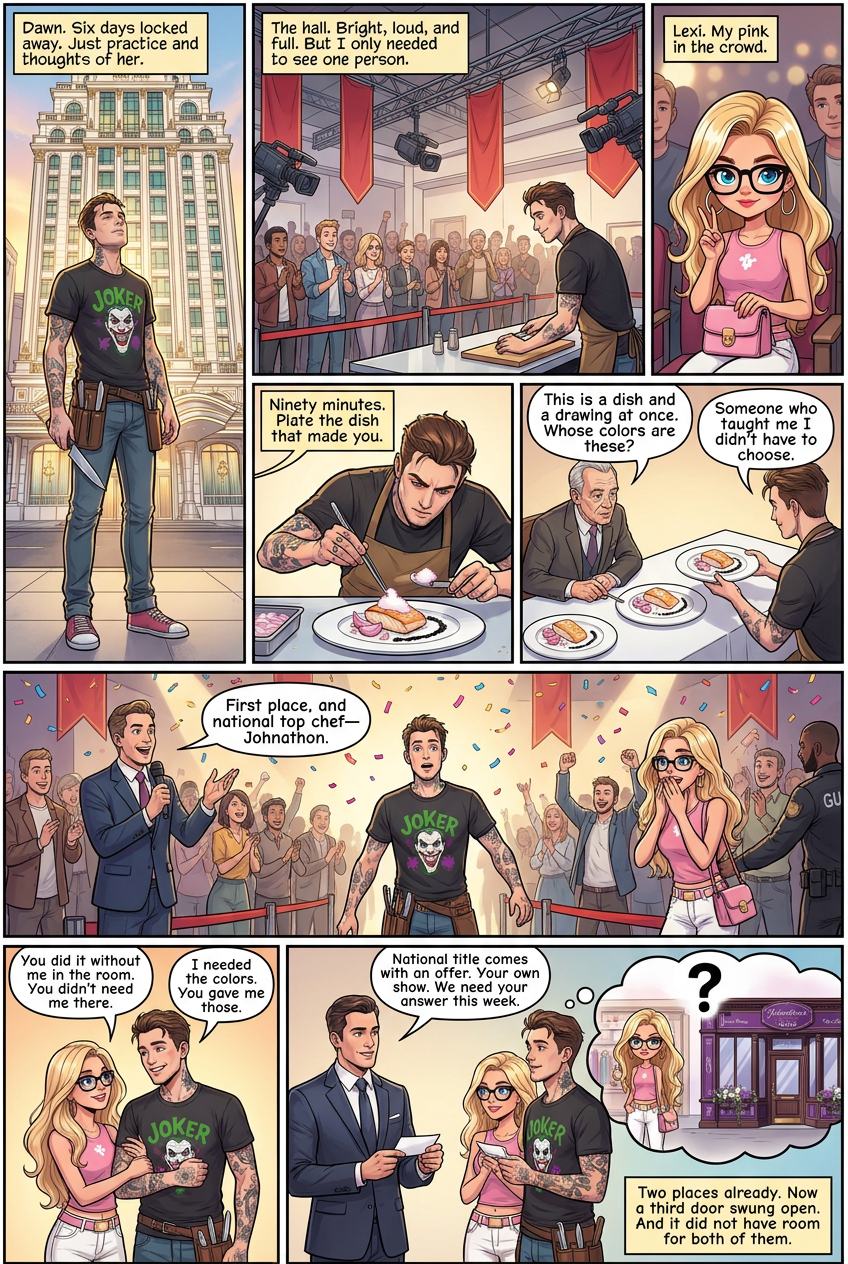
The hotel released the finalists at dawn. Johnathon carried his knife roll out of the white tower and blinked at the daylight. Six days locked inside, no phone, no Lexi. He had used the time. Each morning he cooked the lemon dish in the practice kitchen. Each afternoon he added something new. Pink pickled shallots. White foam. Black charred crumb across the plate. Colors he chose because they were hers. Now a van waited to drive him to the competition hall. The hall stood tall and bright, red banners across the front, its name glowing above the doors. Inside, cameras hung from tracks. Ten stations sat in a row under white lights. A crowd filled the seats behind a rail. Johnathon scanned them fast. He found pink. Lexi sat in the third row, glasses on, purse in her lap. She raised two fingers, the same small sign she always gave him. He breathed out and set down his knives. "Ninety minutes," a judge said. "Plate the dish that made you." Johnathon worked. He poached the fish gentle, folded the cold zest in last, the way he had fixed it weeks ago. Then he built the colors. Pink shallots in a ring. White foam spooned soft. Black crumb dragged in one clean line, like a stroke of charcoal. He stepped back once and checked the plate against the picture in his head. It matched. He carried three plates to the judges' table. They tasted in silence. One judge closed his eyes. Another turned the plate to study the black line. "This is a dish and a drawing at once," the first judge said. "The lemon is clean. The colors mean something." He looked up. "Whose colors are these?" Johnathon glanced at the rail. "Someone who taught me I didn't have to choose." They scored the ten. Johnathon stood at his station and gripped the steel edge. The host read the names from tenth up. Johnathon was not tenth. Not fifth. Not third. The room went quiet. "First place," the host said, "and national top chef—Johnathon." The crowd stood. Lexi was already at the rail, both hands over her mouth. A guard let her through. She reached him and grabbed his arm, not his plate. "You did it without me in the room," she said. Her voice dropped, plain. "You didn't need me there." "I needed the colors," he said. "You gave me those." A man in a pressed suit stepped up before she finished. He held a card, not a menu. "National title comes with an offer," he said. "Your own show. Filmed here. We need your answer this week." Johnathon took the card. He looked at Lexi, then at her boutique across the city in his mind, then at the purple bistro that opened at five. Two places already. Now a third door swung open, and it did not have room for both of them behind it.
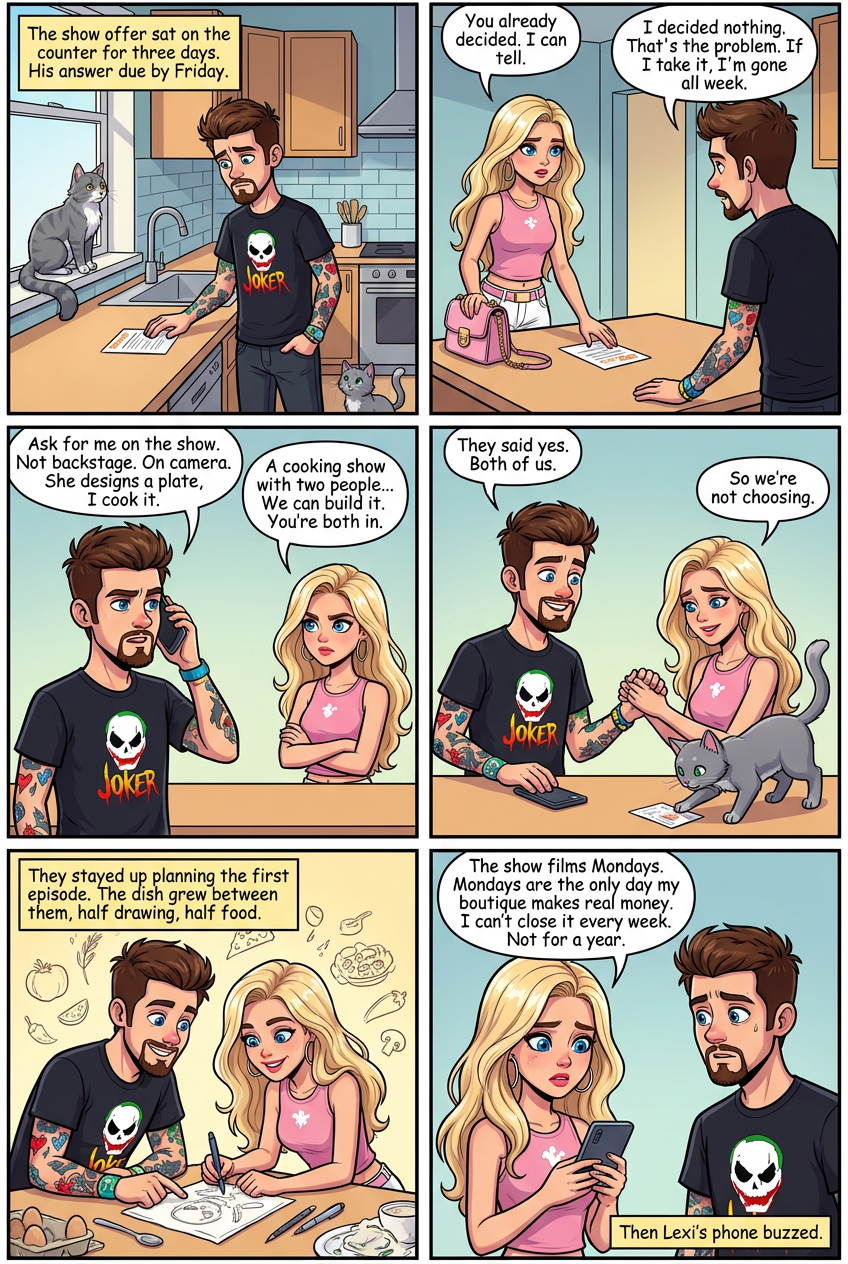
The show offer sat on the counter for three days. Johnathon read the card each morning while he fed the two cats. The grey female wound around his ankles. The long grey male watched from the windowsill. Filmed here, the card said. His answer due by Friday. He had the bistro at five and Lexi across the city. A show would eat every free hour they had left. He did not know how to say yes without losing her. Lexi came home late that night. She set her pink purse on the table and looked at the card. "You already decided," she said. "I can tell." "I decided nothing," Johnathon said. "That's the problem. If I take it, I'm gone all week. We planned this dish together. I don't want to do the next one without you." She pulled out her notebook, then set it down unopened. "Then don't," she said. "Call them. Tell them your terms." "Terms?" "You're the national top chef. They came to you." She sat across from him. "Ask for me on the show. Not backstage. On camera. I design a plate. You cook it. We do it together or you walk." She stopped. "That's all I'm saying right now." Johnathon stared at her. It was the same thing she had done at the bistro, her name on one menu card a month. It had worked. He picked up his phone. He called the man in the suit and repeated Lexi's terms. He asked for her to appear on the show, credited, designing dishes beside him. He waited while the man went quiet on the line. "A cooking show with two people," the man finally said. "A chef and the woman who taught him his colors. The judge already told that story on air." A pause. "People liked that story. We can build it. You're both in." Johnathon set the phone down slow. "They said yes," he told her. "Both of us." Lexi did not smile right away. She reached across and took his hand. "So we're not choosing," she said. Her voice went quiet and plain. "You never had to. I told you that the first day." The grey male jumped onto the table and sniffed the card. Johnathon moved it before a paw landed on it. He felt lighter than he had in weeks. The show would not split them. It would put them in the same kitchen, on camera, with both names in the credits. They stayed up planning the first episode. Lexi sketched a plate on a napkin. Johnathon named the ingredients. The dish grew between them, half drawing, half food, the way his best work always did. Then Lexi's phone buzzed. She read the screen and her face changed. "The show films Mondays," she said. "Mondays are the only day my boutique makes real money." She looked up. "I can't close it every week. Not for a year."
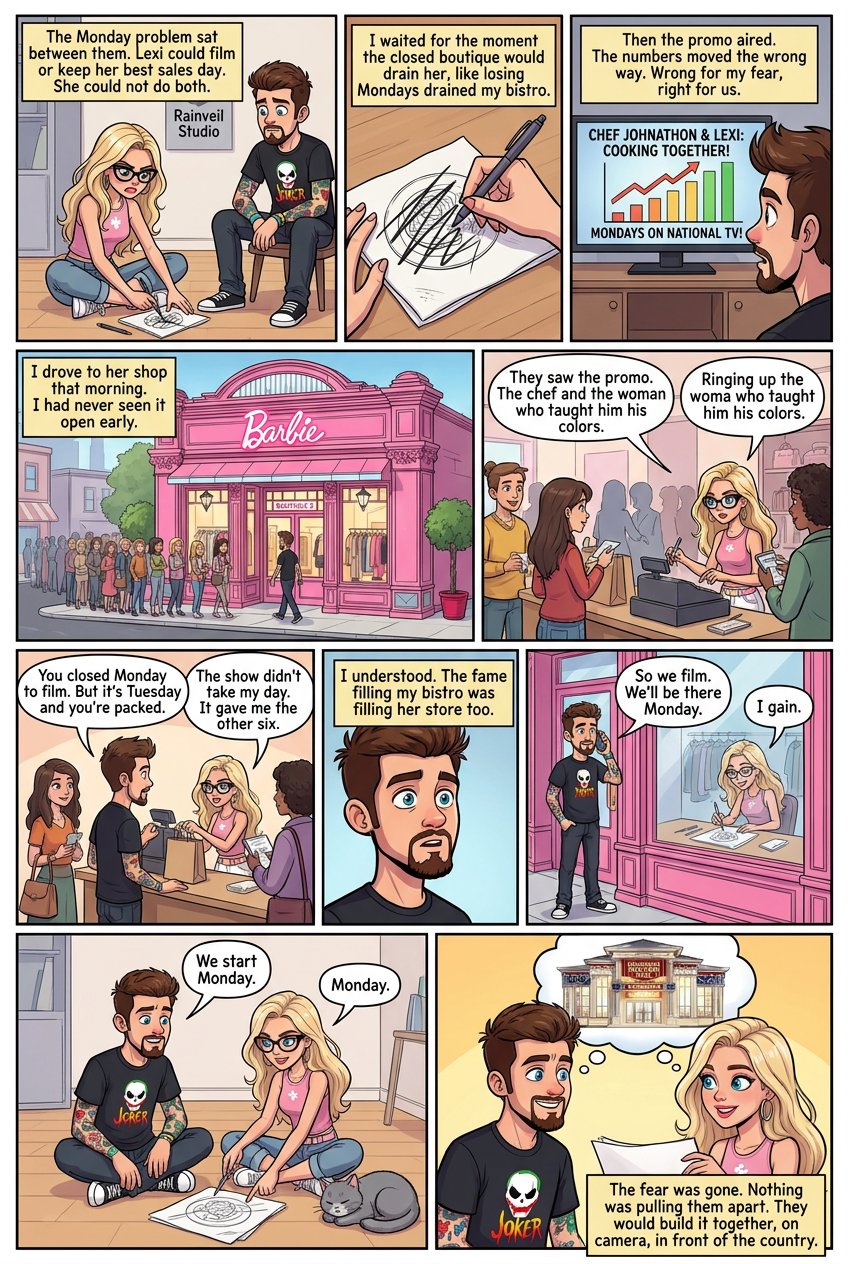
The Monday problem sat between them for two days. Lexi could film the show or keep her best sales day. She could not do both. Johnathon watched her sketch the same plate three times and cross it out. He waited for the moment the closed boutique would drain her, the way losing Mondays had once drained his bistro. Then the show aired its first promo, and the numbers moved the wrong way. Wrong for his fear, right for them. He drove to her shop that morning. The pink boutique glowed under its glossy sign, and a line already curved past the display windows. He had never seen it open early. Inside, Lexi rang up customers two at a time. Her cat-eye glasses had slid down her nose. She did not stop to push them up. "They saw the promo," she said between sales. "The chef and the woman who taught him his colors. That's what the man said on air." She swiped a card. "Now they want to buy her shirt." Johnathon stood at the counter. "You closed Monday to film. But it's Tuesday and you're packed." "Every day since the promo," she said. "They come after work. They come on their lunch." She handed a bag across the counter and finally pushed her glasses up. "The show didn't take my day. It gave me the other six." He understood then. The fame that filled his purple bistro was filling her store too. People wanted the pair from the television. They bought his food across the city and her clothes here. One closed Monday cost her nothing now. The rest of the week paid it back and more. "So we film," Johnathon said. "You don't lose anything." "I gain," she said. She counted the drawer without looking up. "That's all I'm saying right now." He called the man in the suit from the sidewalk outside the shop. He confirmed the schedule. Mondays at the competition hall, both of them on camera, both names in the credits. The man said the network had already booked the polished national hall for the taping. He said the story tested well. People liked watching two people cook. Johnathon hung up and looked back through the glass. Lexi was drawing again on a napkin between customers, a plate half food and half picture, the way his best work always started. The show would not cost her the shop. It would grow both. That night they sat in the studio apartment. The grey female curled on the napkin sketch. The grey male watched from the sill. Lexi laid out the first episode's dish, and Johnathon named each part. "We start Monday," she said. "Monday," he agreed. The fear he had carried for a week was gone. Nothing was pulling them apart. The next thing to solve was the plate itself, and they would build it together, on camera, in front of the country.
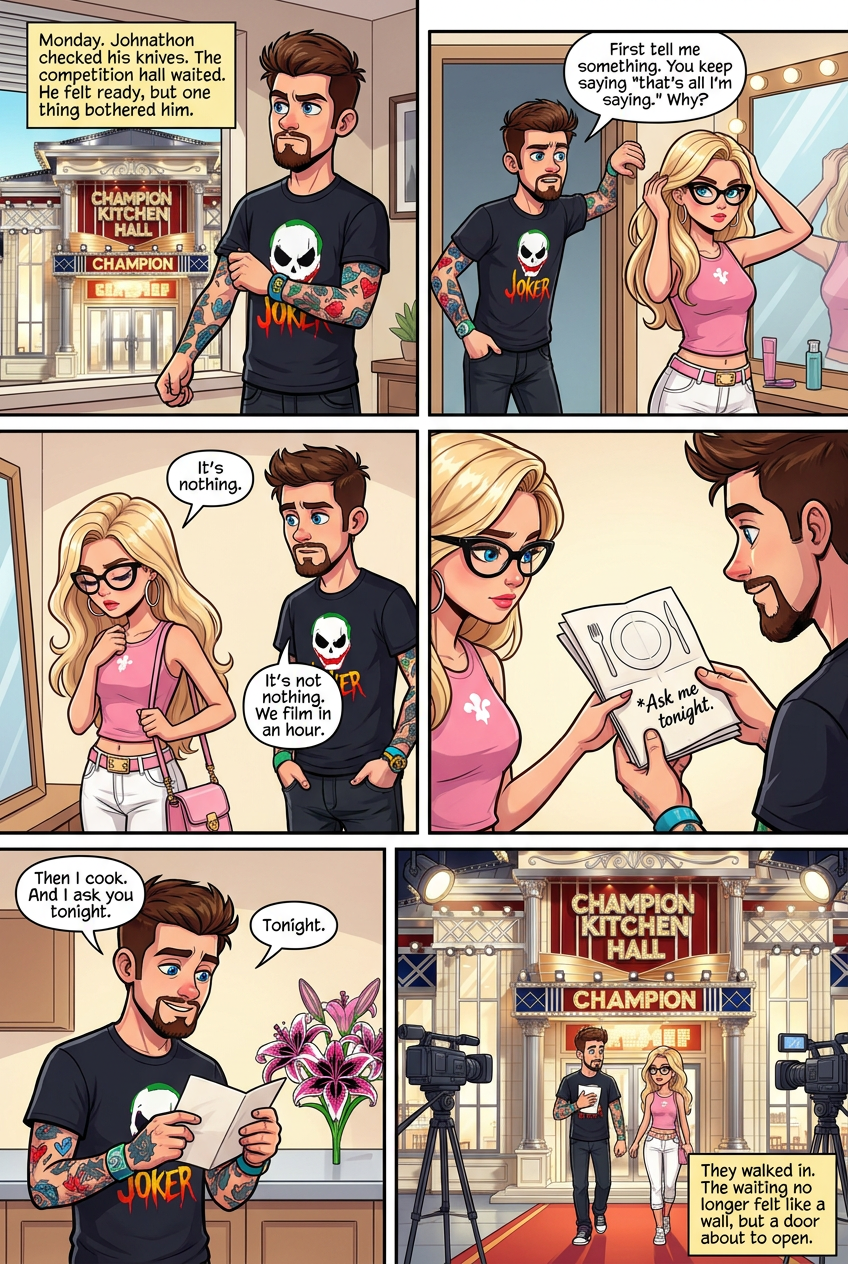
Monday came fast. Johnathon dressed in his black jeans and joker shirt, checked his knives, and rolled his sleeves past both tattoos. The competition hall waited across the city, its gold sign bright above the doors. He felt ready. But one thing still bothered him. For two days Lexi had ended every sentence the same way, and he could not let it go. He found her at the mirror by the door. She fixed her cat-eye glasses and pushed her blonde hair off her shoulder. Her pink purse sat packed on the chair. "We leave in ten," she said. "First tell me something." He leaned on the doorframe. "You keep saying 'that's all I'm saying.' Yesterday. This morning. You cut off every time. Why?" Lexi looked at him in the mirror, not straight on. "It's nothing." "It's not nothing. You do it when it matters." He crossed the room. "We film in front of the whole country in an hour. I don't want to walk out there guessing." She turned. Her hands went to her purse strap and stopped. For a moment she said nothing. Then her voice dropped, plain and small. "I say it so I don't say the rest," she said. "The rest scares me." "Say the rest." She opened her mouth. Closed it. Then she reached into the purse and pulled out a folded napkin. On it she had drawn a plate, half food and half picture, the way his best work always started. Below the drawing she had written three words. She held it out. He read it. *Ask me tonight.* "That's not a whole answer," he said. "I know." She took a breath. "I've been planning something for after the show. If I say it now, you'll cook thinking about it. You'll drop the plate. So I stop myself. That's what the words mean." Johnathon studied her face. She was not hiding a problem. She was holding a gift. "So it's good," he said. "Whatever it is." "It's good." Her mouth almost smiled. "That's all I'm saying right now." This time the phrase did not confuse him. He understood it. She was saving something for later, on purpose, so he could cook clean. "Then I cook," he said. "And I ask you tonight." "Tonight," she agreed. He folded the napkin and slid it into his pocket. On the counter sat a cluster of pink, black, and white lilies she had bought that morning, the same three colors from his winning dish. He touched one petal and left them there. They drove to the hall together. The doors opened. Cameras waited, and two stations stood side by side, both their names on cards. Johnathon walked in steady, the napkin against his chest. He would give the country their first episode. Then, at home, he would ask her the question. The waiting no longer felt like a wall between them. It felt like a door about to open.
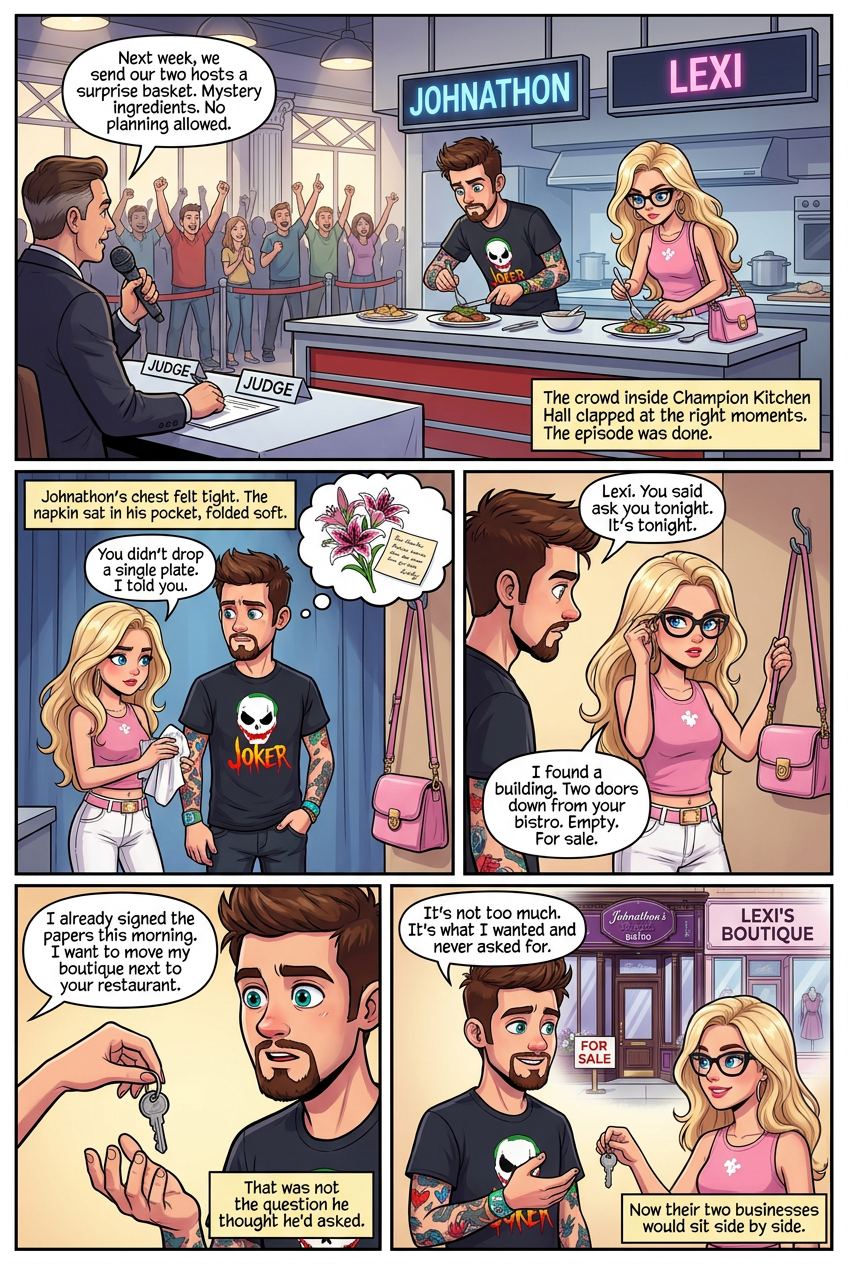
The first episode moved like clockwork. Johnathon cooked at his station while Lexi plated beside him, both their names glowing on the cards. Cameras rolled. The crowd inside Champion Kitchen Hall clapped at the right moments. When the timer buzzed, the judges tasted, smiled, and turned to the audience. One of them raised a hand for quiet. "That closes tonight's show," the judge said. "Next week, we send our two hosts a surprise basket. Mystery ingredients. No planning allowed." The crowd cheered. Johnathon barely heard it. The episode was done. That meant the night he promised was here. Backstage, Lexi wiped her hands and let out a long breath. "You didn't drop a single plate," she said. She bumped his shoulder with hers. "I told you." "We finished," Johnathon said. His chest felt tight, not from the cameras. The napkin sat in his pocket, folded soft from all his checking. He thought of the lilies on their counter, pink and black and white, the same colors that had won him everything. He thought of three words in her handwriting. "You did good out there," she said. She reached for her pink purse on the hook. "Lexi." His voice came out smaller than he wanted. "You said ask you tonight. It's tonight." She stopped. Her hand stayed on the purse strap. For a second she didn't turn around, and Johnathon's stomach dropped. He had waited two days for this. Now the waiting felt like the edge of a cliff. "Here?" she said. "You want to do this here?" "I don't want to guess in the car," he said. "You've been holding something back. You told me it was good. So tell me." Lexi faced him. She pushed her glasses up. Her sentences got quiet, plain, the way they did when she meant them most. "I found a building," she said. "Two doors down from your bistro. Empty. For sale." She swallowed. "I want to move my boutique next to your restaurant. So we work on the same street. Same block. No more crossing the city." Johnathon stared. That was not the question he thought he'd asked. "That's the surprise?" "That's part of it." She took his hand and pressed something into it. A small key, silver, worn smooth. "I already signed the papers this morning. I was scared you'd say it was too much. Us, working that close. Every day." He closed his fingers around the key. Two days of her cut-off sentences, all for this. "It's not too much," he said. "It's what I wanted and never asked for." She smiled, full this time. "Then it's done." Johnathon slid the key into his pocket beside the napkin. The first episode had aired to the whole country. Now their two businesses would sit side by side. But a signed lease meant a second store to build from nothing, and their first mystery basket waited one week away.
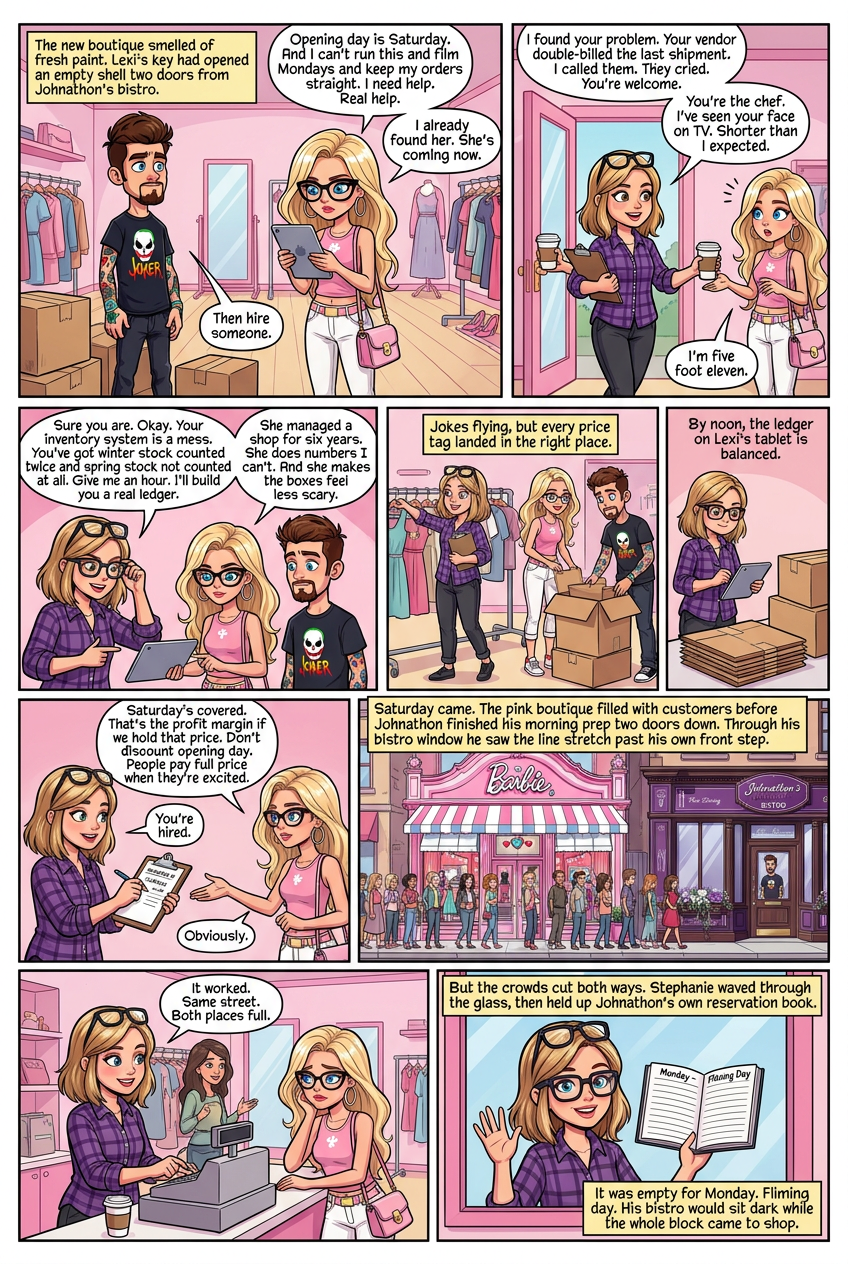
The new boutique smelled of fresh paint. Lexi's key had opened an empty shell two doors from Johnathon's bistro. Now, three weeks later, the floor held clothing racks and mirrors. Boxes still lined one wall. Lexi stood in the middle, tablet in hand, frowning at a column of numbers. "Opening day is Saturday," she told Johnathon. "And I can't run this and film Mondays and keep my orders straight. I need help. Real help." Johnathon set down a box. "Then hire someone." "I already found her," Lexi said. "She's coming now." The door swung open. A woman walked in carrying two coffees and a clipboard tucked under her arm. She had shoulder-length hair, blonde and brown, and thick black glasses shoved up on top of her head instead of on her face. Her purple plaid shirt was rolled at the sleeves. She handed one coffee to Lexi without asking. "I found your problem," she said. "Your vendor double-billed the last shipment. I called them. They cried. You're welcome." She looked at Johnathon. "You're the chef. I've seen your face on TV. Shorter than I expected." Johnathon laughed before he could stop himself. "I'm five foot eleven." "Sure you are," Stephanie said. She pulled the glasses down onto her nose and squinted at Lexi's tablet. "Okay. Your inventory system is a mess. You've got winter stock counted twice and spring stock not counted at all." Her fingers moved fast across the screen. "Give me an hour. I'll build you a real ledger." Lexi glanced at Johnathon. Her sentences went quiet. "She managed a shop for six years. She does numbers I can't. And she makes the boxes feel less scary." Stephanie didn't look up. "I heard that. It's true, though." Johnathon watched them work. Stephanie sorted a rack while she talked, jokes flying, but every price tag landed in the right place. She caught a shipping error Lexi had missed twice. She lined up the Saturday schedule in ten minutes. By noon the ledger balanced. The boxes by the wall were flat and stacked for recycling. "Saturday's covered," Stephanie said. She wrote a number on Lexi's clipboard. "That's the profit margin if we hold that price. Don't discount opening day. People pay full price when they're excited." Lexi stared at the clipboard. Then she stuck out her hand. "You're hired." "Obviously," Stephanie said, and shook it. Saturday came. The pink boutique filled with customers before Johnathon finished his morning prep two doors down. Through his bistro window he saw the line stretch past his own front step. Stephanie ran the register, cracking jokes, ringing sales, never dropping a beat. Lexi found Johnathon at the counter that night, tired and grinning. "It worked," she said. "Same street. Both places full." But the crowds cut both ways. Stephanie waved through the glass, then held up Johnathon's own reservation book. It was empty for Monday. Filming day. His bistro would sit dark while the whole block came to shop.
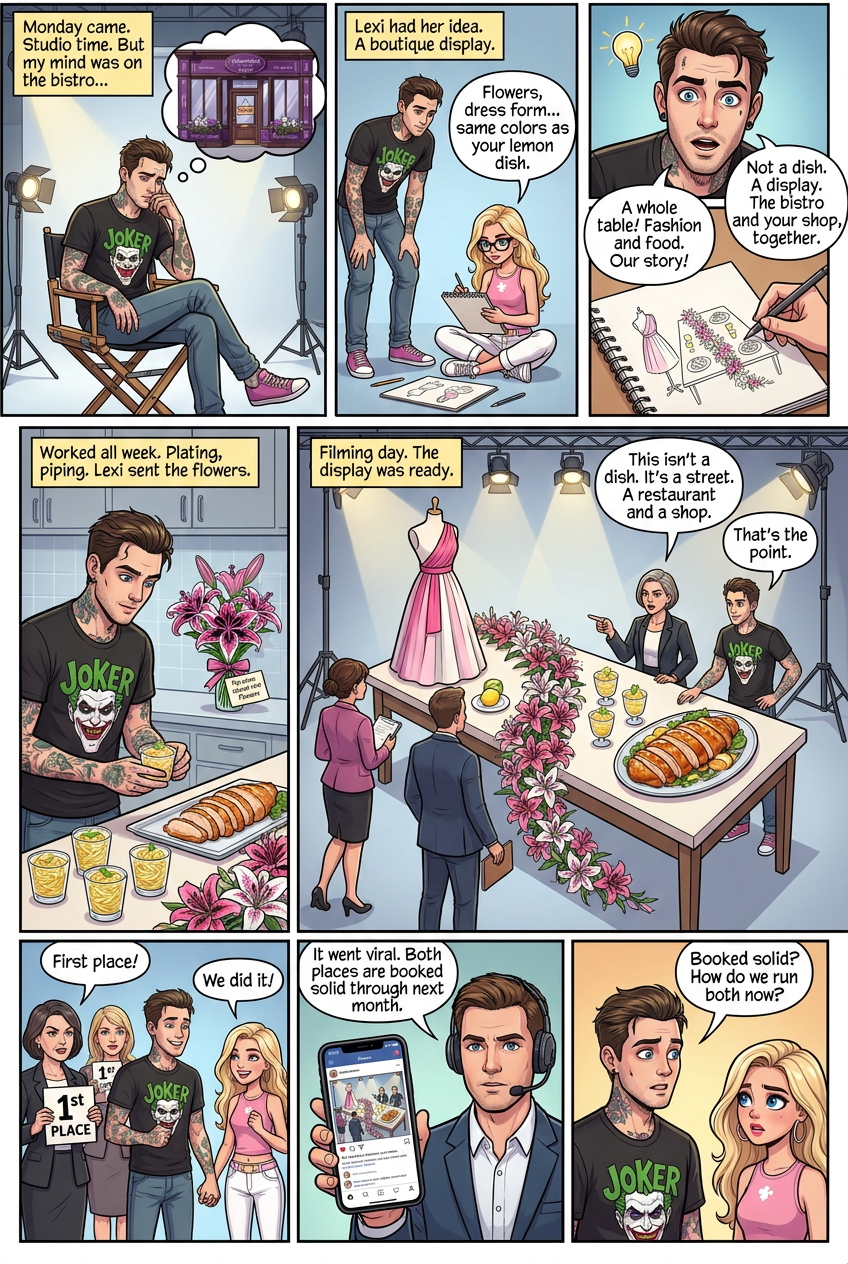
Monday came, and the bistro sat dark. The whole block still crowded Lexi's boutique two doors down. Johnathon met her at the competition hall for filming, but his mind stayed on the empty reservation book. Next week's episode had a theme: build a display that tells your story. Lexi already had hers sketched. She sat cross-legged on the studio floor, pencil moving fast. Johnathon leaned over her shoulder. She was drawing a dress form, then a rack, then flowers spilling from a vase beside it. Pink, black, and white tiger lilies with spotted centers. "That's the boutique," she said. "Same colors as your lemon dish. I'm putting it in the shop window." He stared at the flowers. Then something clicked. He didn't have to choose between the two places. He could hold both. "I'm building a food display," Johnathon said. "For the show. Not a plate. A whole table." Lexi looked up. "Explain." "The bistro and your shop. One display that honors both." He grabbed her pencil. On the corner of her page he drew a long table. "Your dress form here. My father's chicken plated here. The lemon pasta between them. And your flowers running down the middle, tying it together." His hand moved fast now. "Fashion and food on the same street. That's our story." Lexi went quiet, the soft kind. "You'd put my shop on your cooking show." "It's not just my show," he said. "It never was." He worked all week. He plated the chicken cold, then hot, testing which held under studio lights. He piped the lemon pasta into small glass cups so it read from a distance. Lexi lent him a dress form and pinned pink and white fabric to it. Stephanie sent over the exact flowers from the sketch, three clusters of the spotted lilies, wrapped and delivered before noon. "Lexi said you'd need them," the note read. "Don't kill them." Monday, filming day. Johnathon set the table under the lights. The dress form stood at one end. His father's chicken sat sliced and glossy. The lemon cups caught the glow. Down the center ran the tiger lilies, pink and black and white. The judges walked the length of it slowly. "This isn't a dish," one judge said. "It's a street. A restaurant and a shop, together." "That's the point," Johnathon said. The judges scored it first place for the episode. The cameras cut. Lexi crossed the floor and took his hand. But the producer wasn't smiling. He held up his phone. "That display just went viral," he said. "Both places. Everyone wants a table at the bistro and a dress from the shop. Same night." He looked at Johnathon. "You've got reservations booked solid through next month. Lexi's shop too. Can you two actually run both at once now?" Johnathon looked at Lexi. Neither of them had an answer yet.
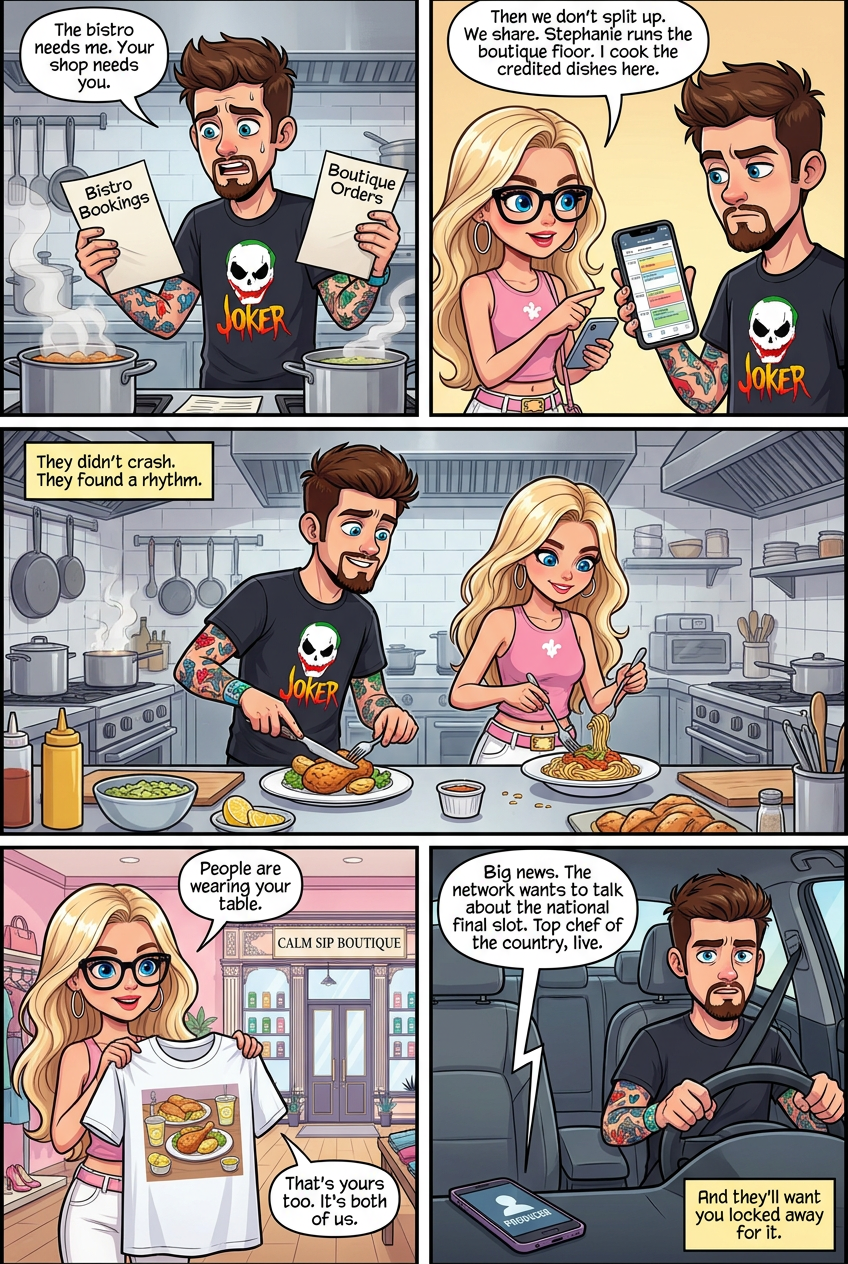
The reservation book at the bistro was full for a month. Lexi's boutique had orders stacked past that. Johnathon stood in his kitchen the next morning, staring at both booking sheets side by side. He didn't know how they'd cook every plate and sew every order without dropping one. Lexi came in with two coffees. She set one down and read his face. "You're already behind in your head," she said. "Stop." "We can't be in two places every night," Johnathon said. "The bistro needs me. Your shop needs you." Lexi pulled a stool close. "Then we don't split up. We share." She slid her phone across the counter. On it was a plan she'd typed at four in the morning. "Stephanie runs the boutique floor. She's better at it than me anyway. I cook the credited dishes here on the busy nights. You handle the line." He scrolled. She had it mapped by day, hour by hour. "You'd leave your own shop?" "I'd trust my manager," Lexi said. "That's all I'm saying right now." They tested it that night. Stephanie took the boutique. The line ran long, but she moved customers through fast, calm at the register. Down the street, Johnathon plated chicken while Lexi finished the lemon pasta beside him. They didn't crash into each other. They found a rhythm. By closing, both places had cleared their bookings for the night. Nothing burned. No order got missed. After that, they ran everything without a single miss. The demand held for weeks and they met it. Word spread, and so did the display. A shop nearby, a fancy place that sold calm CBD drinks, printed shirts with Johnathon's food table on the front. Lexi liked the shirts. She stocked them at her boutique, folded on a table by the window with her flowers. "People are wearing your table," Lexi said one night, holding one up. The chicken, the lemon cups, the tiger lilies, all printed across the cotton. Johnathon laughed. "That's yours too. Your dress form's on there." "I know," she said, quieter now. "It's both of us. That's the point." The shirts sold out by Friday. The boutique reordered twice. For once, the bistro and the shop weren't fighting for the same night. They fed each other. Monday came again. Johnathon drove to the competition hall for filming, steady for the first time in weeks. His phone buzzed on the seat. It was the show's producer. "Big news," the producer said. "Your numbers are the highest we've had. The network wants to talk about the national final slot. Top chef of the country, live. They want you for the seat." Johnathon gripped the wheel. He'd wanted that title since he was nine on a step stool. "When," he said. "Soon," the producer said. "But this one's bigger than anything you've done. And they'll want you locked away for it." Johnathon looked at the empty passenger seat where Lexi usually sat.
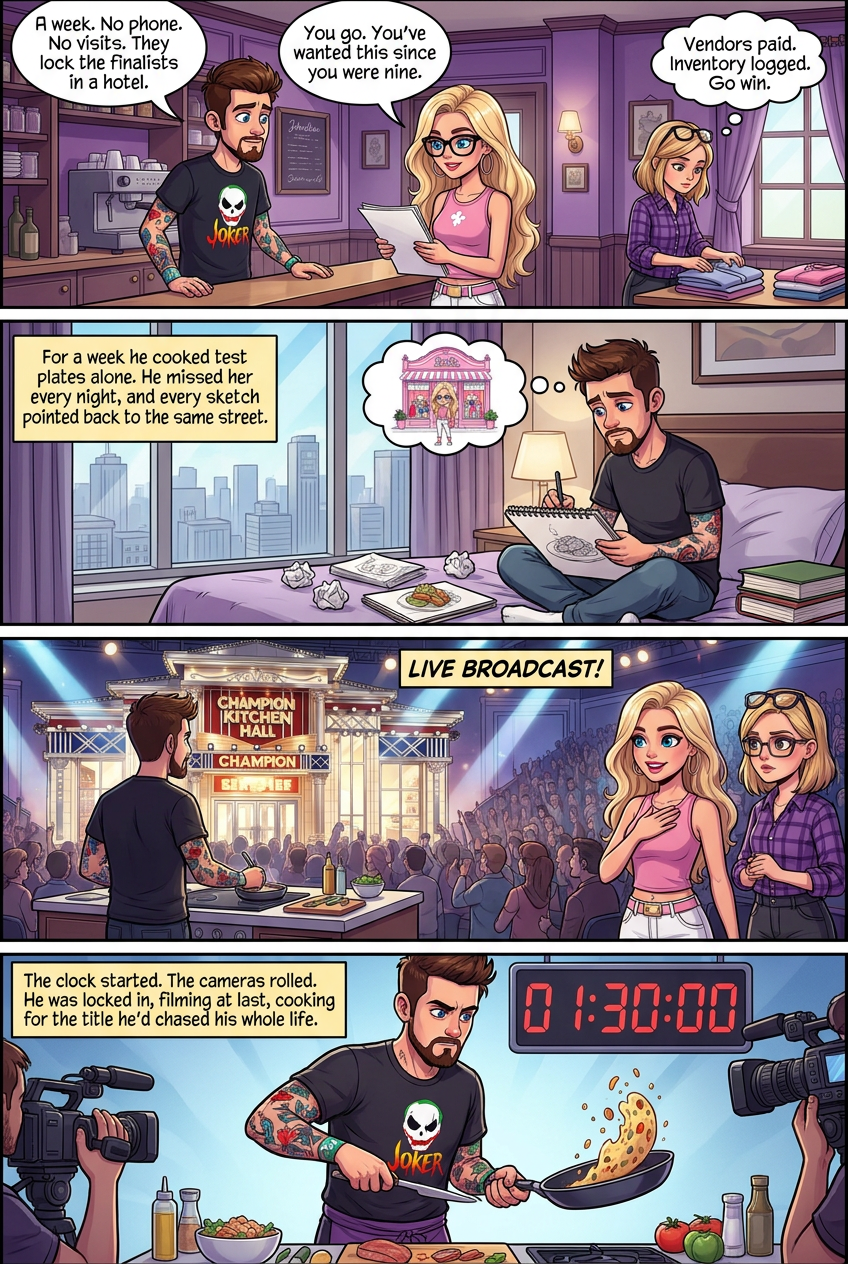
The producer's word stayed with Johnathon all week. Locked away. He had won titles before, but this one meant the top chef of the whole country. He wanted it. He also wanted the empty passenger seat filled. That night he told Lexi over the counter at the bistro. She read the papers he set down, then set them flat. "How long," she said. "A week. No phone. No visits." Johnathon watched her face. "They lock the finalists in a hotel. Then we film live at the championship hall." Lexi didn't cut herself off this time. "You go," she said. "You've wanted this since you were nine on a step stool." She slid the papers back to him. "The bistro runs while you're gone. I cook the credited nights. Stephanie takes the boutique floor." Stephanie stood by the window folding shirts, the ones printed with Johnathon's food table and Lexi's dress form. She had run the boutique clean for weeks now, glasses shoved up on her head where they helped no one. She didn't look up. "Vendors are paid through the month," she said. "Inventory's logged. Go win." No softness in it. Just facts. Johnathon trusted her because she never sold him comfort he didn't need. So he signed. The next morning a car took him to a tall white hotel with silver trim. Guards checked his bag and took his phone. His room looked over the city, but he couldn't call the street where his two shops sat. For a week he cooked test plates alone. He drew each dish first, the way Lexi taught him. Zest cut fine. Charred pages standing upright. Pink, white, black. He missed her every night. He wrote her nothing because they screened the notes. Instead he kept drawing, and every sketch pointed back to the same street with her boutique two doors down. On the seventh day the guards walked the ten finalists into the championship hall. The place blazed with light and cameras. A bold sign burned red above the doors. The crowd filled the seats. Johnathon scanned the rail and found her fast. Lexi, blonde hair loose, cat eye glasses on, holding a shirt with their table printed across it. Beside her stood Stephanie, glasses still on her head. A judge stepped to the front. "This is the national final," he said. "Cook the dish that made you. Ninety minutes. Live." Johnathon's chest went steady. He knew the dish already. Lemon folded in cold. His father's chicken. The charred crisp standing like open pages. He looked at Lexi. She pressed her hand flat to her chest, the same small gesture from every competition. He nodded once and turned to his station. The clock started. The cameras rolled. He was locked in, filming at last, cooking for the title he'd chased his whole life. The week of silence was over. Now the only thing between him and top chef of the country was ninety minutes and one plate.
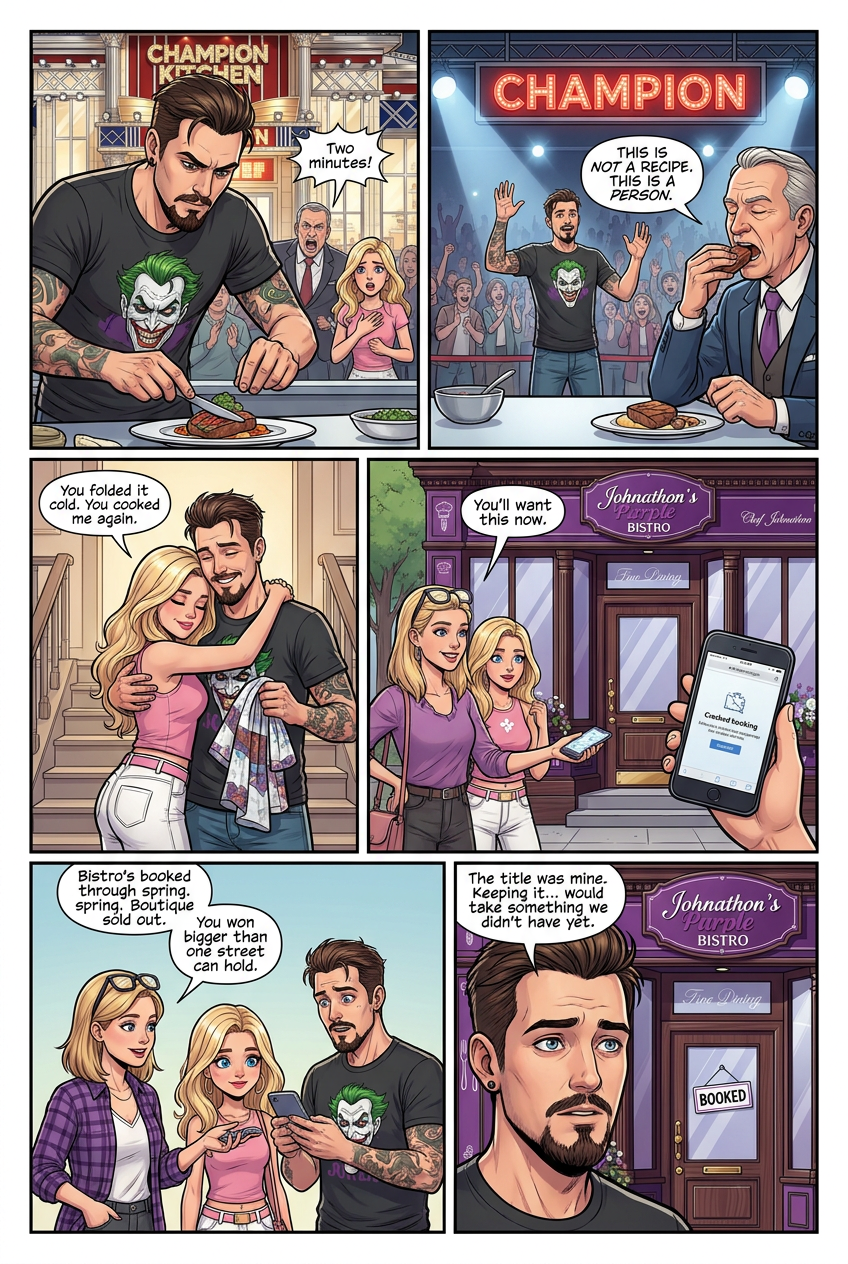
The clock ran down and Johnathon worked like the week of silence never happened. He plated the chicken. He folded the lemon in cold, at the end, the way he had failed six mornings to learn. He stood the charred crisp upright like open pages. Pink shallots. White foam. Black crumb. His hands never shook. On the rail, Lexi pressed her palm flat to her chest, and he cooked to that gesture. "Two minutes," a judge called. Johnathon wiped the plate rim clean. He set the last page of crisp in place. Then the timer went off, sharp and long, and he stepped back with his hands raised, done. The judges tasted in silence. The crowd held still. Johnathon watched the head judge close his eyes on the first bite. He watched him take a second. When the man finally spoke, he spoke to the whole hall. "This is not a recipe," he said. "This is a person. First place. National champion." The lights swung red across the bold sign above the doors. Champion. The crowd stood and roared. Johnathon had done it. Top chef of the country. He found Lexi first. She was already moving down the steps, the printed shirt clutched in one hand. She reached him and did not say the soft thing. She said, "You folded it cold. You finally got it right." Her voice dropped, plain and quiet. "You cooked me again. In front of the whole country. That's all I'm saying." Beside her Stephanie waited with her glasses shoved up on her head, useless where they sat. She had run the boutique clean the whole week he was locked away, and she never once sold him comfort he didn't need. She held out her phone. "You'll want this now," she said. No congratulations. Just facts. The screen showed the bistro's booking page. Then the boutique's. Both had crashed. Reservation requests stacked past what the pages could load. Orders for the shirts had jumped into the thousands overnight, all from people who watched him win live. "Servers can't keep up," Stephanie said. "Bistro's booked through spring by morning. Boutique the same. Merchandise sold out at midnight. There's more coming than we planned for." She lowered the phone. "You won bigger than one street can hold." Johnathon looked at the number and felt the old floor tilt. He had chased this title since he was nine on a step stool. Now he had it, and the win itself had outgrown the bistro, the boutique, the Monday show, everything they had built to fit. Lexi read his face. "We can't run this the way we run it now," she said. "Not just you and me and Stephanie." Johnathon folded the booking screen shut in his mind. The title was his. Keeping it, and their two shops, would take something they didn't have yet.
Play your story to life
Storycraft is a mobile game where you create AI characters, craft items and locations to build their world, then discover what direction your story takes. Download the iOS game for free today!
Download for free