

Mel's Arc
36 Chapters
Mel's dream is winning the heart of the rival ranch's heir at the Cub River summer dance..

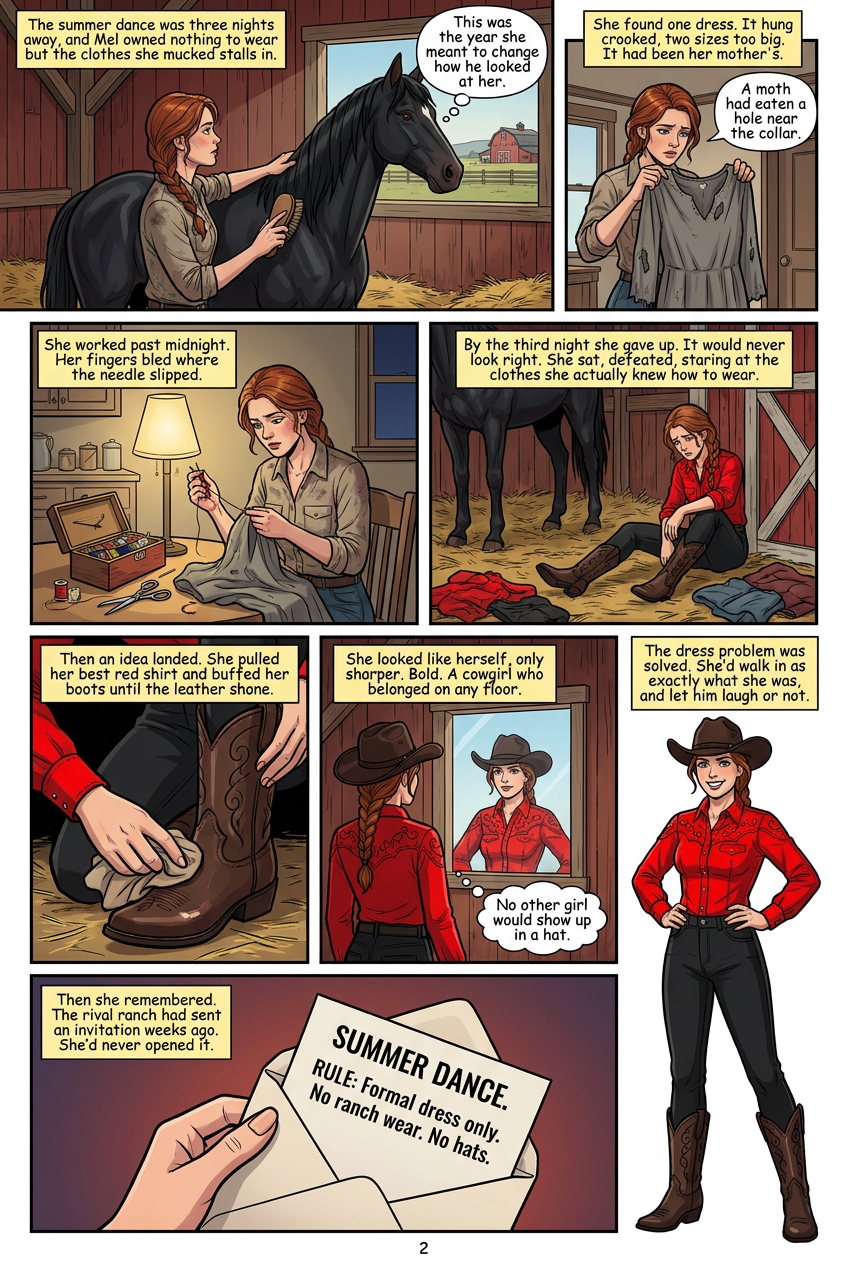
The summer dance was three nights away, and Mel owned nothing to wear but the clothes she mucked stalls in. She stood in the barn, boots deep in straw, brushing down the black horse she'd raised from a foal. Across the fence line lived the rival ranch's heir, the boy she'd watched from her saddle for two years. This was the year she meant to change how he looked at her. But a girl couldn't win a heart smelling of hay and horse sweat. She went inside the farmhouse and dug through her closet. She found one dress. It hung crooked on its hanger, gray and shapeless, two sizes too big. It had been her mother's, before her mother left. Mel held it against her body in the window's light. The hem stopped above her ankle. A moth had eaten a hole near the collar. She pictured herself walking onto the dance floor in it. She pictured the other girls, in real dresses, covering their mouths. Word would reach him before she crossed the room. She hung the dress back up. Mel had no money for a store dress. But she had two hands and a mother's old sewing box. She carried the box to the kitchen table and opened it. Inside sat thread, a pincushion, and a pair of steel shears. She had never sewn a stitch in her life. She worked past midnight. She cut the dress down, pinned the seams, and stitched them tight. Her fingers bled where the needle slipped. When she tried it on, the shoulders puckered and the waist sagged. She tore the seams out and started over. She did this four times. By the third night she gave up on the dress. It would never look right. She sat on the barn floor, defeated, staring at the clothes she actually knew how to wear. Her work shirt. Her denim. Her boots. The hat on the peg. Then an idea landed. She didn't have to hide the ranch. She could wear it proud. She pulled her best red shirt from the drawer, the one with the stitched shoulders. She pressed it flat. She scrubbed her black pants clean and buffed her boots until the leather shone. She set the cowgirl hat square on her head and looked at her reflection in the barn window. She looked like herself, only sharper. Bold. A cowgirl who belonged on any floor. No other girl would show up in a hat. Mel folded the outfit over her arm and grinned. The dress problem was solved. She'd walk in as exactly what she was, and let him laugh or not. Then she remembered. The rival ranch had sent an invitation weeks ago. She'd never opened it. She found the envelope on the shelf, tore it, and read. The summer dance had a rule this year, printed in bold at the bottom. Formal dress only. No ranch wear. No hats.
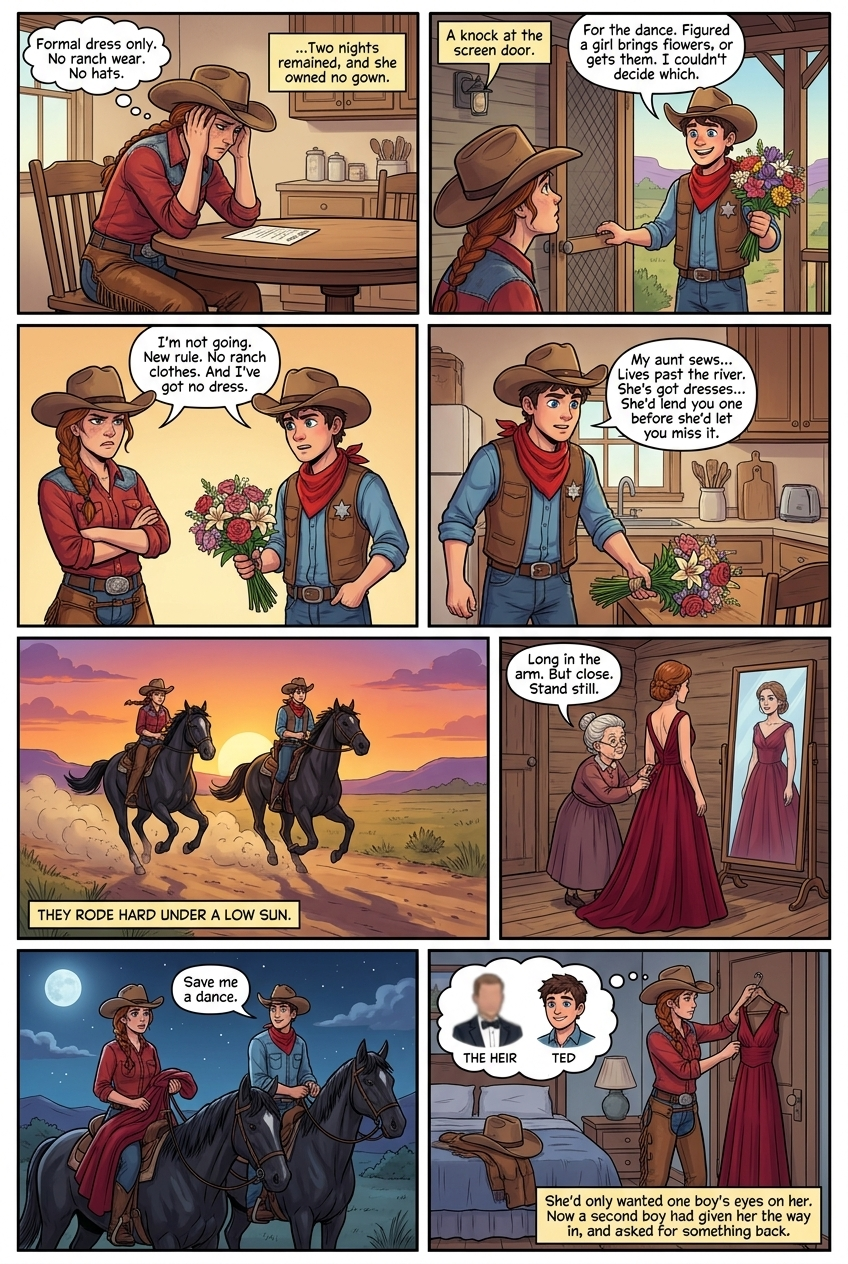
The invitation lay on Mel's kitchen table, its rule still burning in her head. Formal dress only. No ranch wear. No hats. Her sharp red shirt and polished boots meant nothing now. Two nights remained, and she owned no gown. If she showed up in her work clothes, they'd turn her away at the door. She'd never even see the heir. She pressed her hands flat on the table and made herself think. A knock rattled the screen door. Ted stood on the porch, hat pushed back, holding a fat cluster of flowers. Lilies and irises and white snowball blooms spilled over his fists. He and Mel had ridden the same fence lines since they were kids. He always turned up when she least wanted company. "For the dance," he said, grinning. "Figured a girl brings flowers, or gets them. I couldn't decide which." "I'm not going," Mel said. "New rule. No ranch clothes. And I've got no dress." Ted's grin faded. He looked at her clothes, then at the flowers, then back. He set the cluster on the rail and stepped inside without asking. "My aunt sews," he said. "Lives past the river. She's got dresses hanging she never wears. She'd lend you one before she'd let you miss it." Mel stared at him. "You'd take me there?" "Saddle up." They rode hard under a low sun. The black horse Mel had raised carried her easy, matching Ted's mare stride for stride. At the aunt's house, a small woman with pins in her collar looked Mel up and down like livestock. She pulled a deep red gown from a wardrobe and held it against Mel's shoulders. "Long in the arm," the woman muttered. "But close. Stand still." Mel stood while the woman pinned and tucked. The dress fit her waist, then her shoulders, then her whole shape. In the mirror, a stranger looked back. Not a cowgirl in a hat. A girl who could cross that dance floor and not be laughed at. "It's yours for the night," the aunt said. "Bring it back clean." Mel rode home with the gown folded across her lap. Ted rode beside her, quiet now, watching the road more than her. At her gate she stopped. "Thank you," she said. "I mean it." "Save me a dance," Ted said. He tipped his hat and turned his mare toward home. Mel carried the dress inside and hung it on the closet door. The door problem was solved. She'd walk in now, no question. She could reach the heir at last. Then she pictured the night. Ted, waiting for his dance. The heir, across the room. She'd only wanted one boy's eyes on her. Now a second boy had given her the way in, and asked for something back.
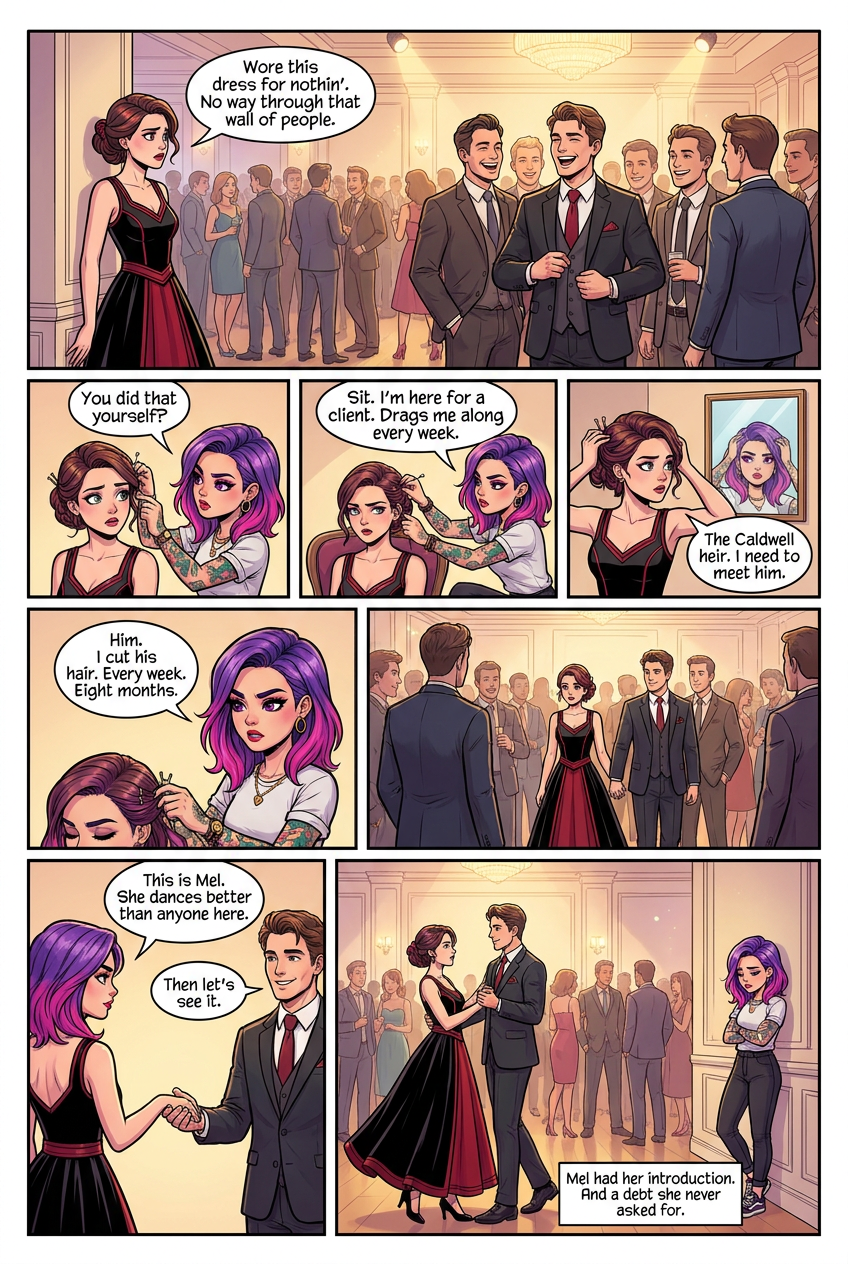
The dance filled the hall with light and noise. Mel stood at the edge in her borrowed red dress. Across the floor, the Caldwell heir laughed with a knot of ranch owners. They shook his hand and slapped his back. Mel had no way through that wall of people. Without someone to introduce her, she'd wave at him from the sidelines all night. She'd worn the dress for nothing. A woman brushed past her, then stopped. Purple hair, pink at the ends, tattoos down both arms. She wore no gown, just black jeans and a work shirt. Mel knew her from the salon downtown, though they'd only ever traded a few words. "You did that yourself?" Rose asked. She reached up and touched Mel's flat, pinned hair. "No time for better," Mel said. "Sit." Rose steered her to a chair by the wall. She pulled pins loose and worked fast with her fingers. "I'm here for a client. He books me every week. Comes to these things and drags me along." "Which one?" Mel asked. Rose's hands stopped. "Doesn't matter." She started pinning again, quicker now. "Turn your head." Mel turned. In the dark window glass, her hair fell soft around her face. She looked ready. But ready meant nothing without a way in. "There's a man over there," Mel said. "The Caldwell heir. I need to meet him. I don't know how to cross that floor." Rose followed her look. Her mouth went tight. "Him." "You know him?" "I cut his hair." Rose set the last pin. Her voice dropped flat. "Every week. Eight months." Mel felt the floor shift under her. Rose's client. The man she wouldn't name. Mel's mouth opened, then closed. Rose stood and stared at the heir across the room. She could walk Mel straight to him. One word and the wall would open. Mel watched her choose. "He likes people who don't wait to be asked," Rose said. She didn't look at Mel. "Come on." Rose cut through the crowd. Mel followed close. The ranch owners parted for the salon woman they all knew. Rose stopped in front of the heir. "This is Mel," she said. "She dances better than anyone here." Then she stepped back, out of the light. The heir looked at Mel. No smirk now. He held out his hand. "Then let's see it," he said. Mel took his hand and walked onto the floor. She glanced back once. Rose stood at the wall, arms crossed, watching the man she'd never named dance with someone else. She'd given Mel the door and kept her own mouth shut. Mel had her introduction. She also had a debt she never asked for, owed to a woman she'd just hurt without meaning to.
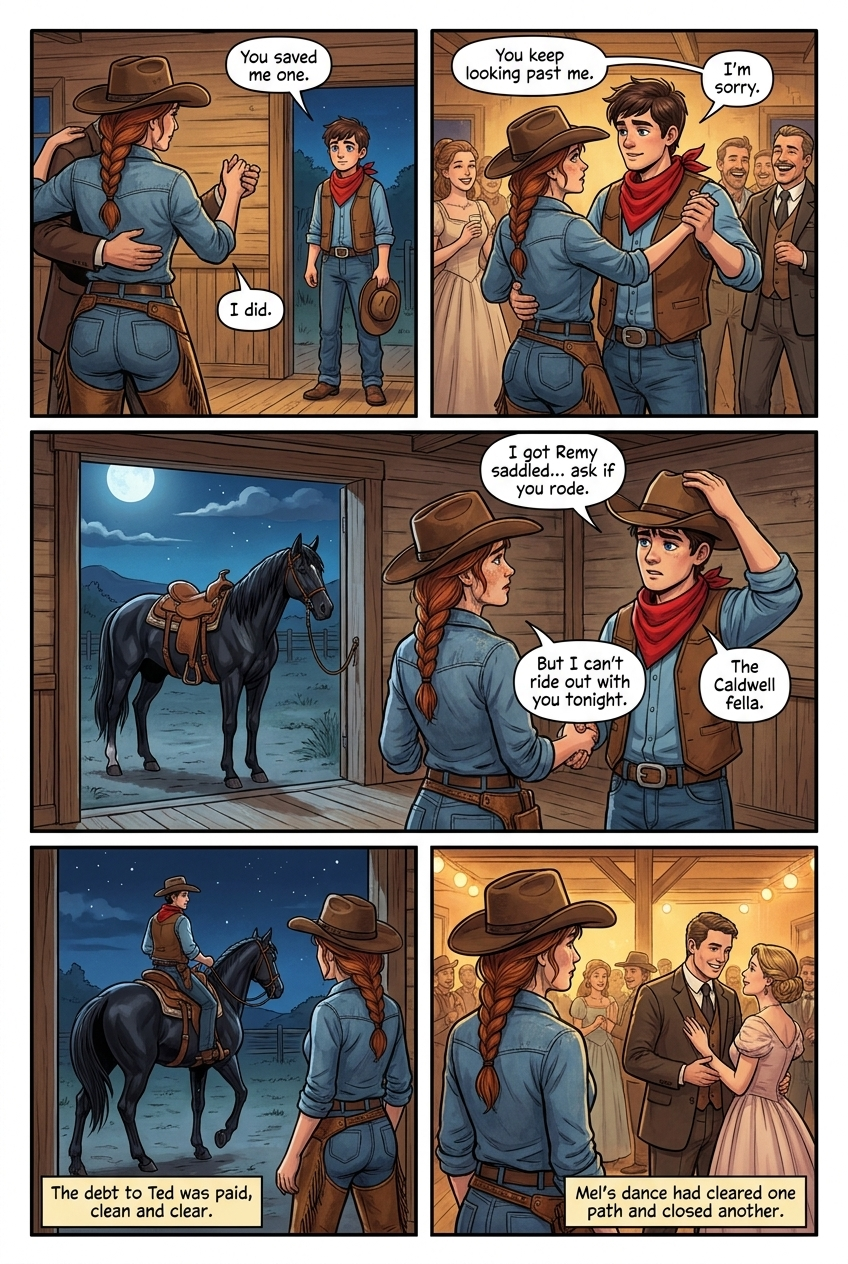
The song with the Caldwell heir ended too soon. He bowed and turned back to the ranch owners who wanted his ear. Mel stepped off the floor, still warm from the dance. Then she saw Ted near the door, holding his hat in both hands, waiting. She had promised him a dance the day he took her to his aunt's house for the borrowed dress. She had almost forgotten. He had not. Ted watched her cross the room. He didn't smile or wave. He just stood there, turning the brim of his hat in slow circles. "You saved me one," he said. "Or you didn't." "I did." Mel took his hand and led him onto the floor. The fiddle started up. Ted danced plain and steady, no flourish, eyes down. Mel matched his steps. Over his shoulder she watched the heir laugh with the men. She wanted the heir to see her out here, claimed, spoken for. Then she caught herself. That was the wrong reason to hold Ted's hand. "You keep looking past me," Ted said. He didn't stop dancing. Mel felt her face go hot. "I'm sorry." "Don't be. I know where your eyes go." He turned her under his arm, easy as breathing. "I got Remy saddled outside. Trail runs two hours to a creek. Thought I'd ask if you rode." Mel slowed. Through the open door she saw a black horse tied in the dark, a worn leather saddle on its back, metal fittings catching the light. It stood calm while the noise spilled out around it. She owed Ted honesty. He had given her the dress, the flowers, the way into this whole night. He deserved better than a girl using his dance to look taken. "Ted." She stopped moving. Couples flowed past them. "You're a good man. You've been good to me. But I can't ride out with you tonight." He met her eyes then. "The Caldwell fella." "Yes." Ted nodded once. He let go of her hand and stepped back. "Figured. A man buys a lot of salt licks he doesn't need before he learns to just ask." A small, tired grin. "At least I asked." "I paid the dance back," Mel said. "I wanted you to know that meant something." "It did." He set his hat on his head, done with the room. "I'll take the trail alone. Remy could use it." He walked out to the black horse and swung up into the saddle. Mel watched him ride into the dark. The debt to Ted was paid, clean and clear. But when she turned back to the hall, the Caldwell heir was gone from his spot by the men. She scanned the crowd and found him at the far wall. He stood close to another girl in a pale gown, his head bent to hear her. He smiled the way he had smiled at Mel an hour ago. Mel's dance had cleared one path and closed another.
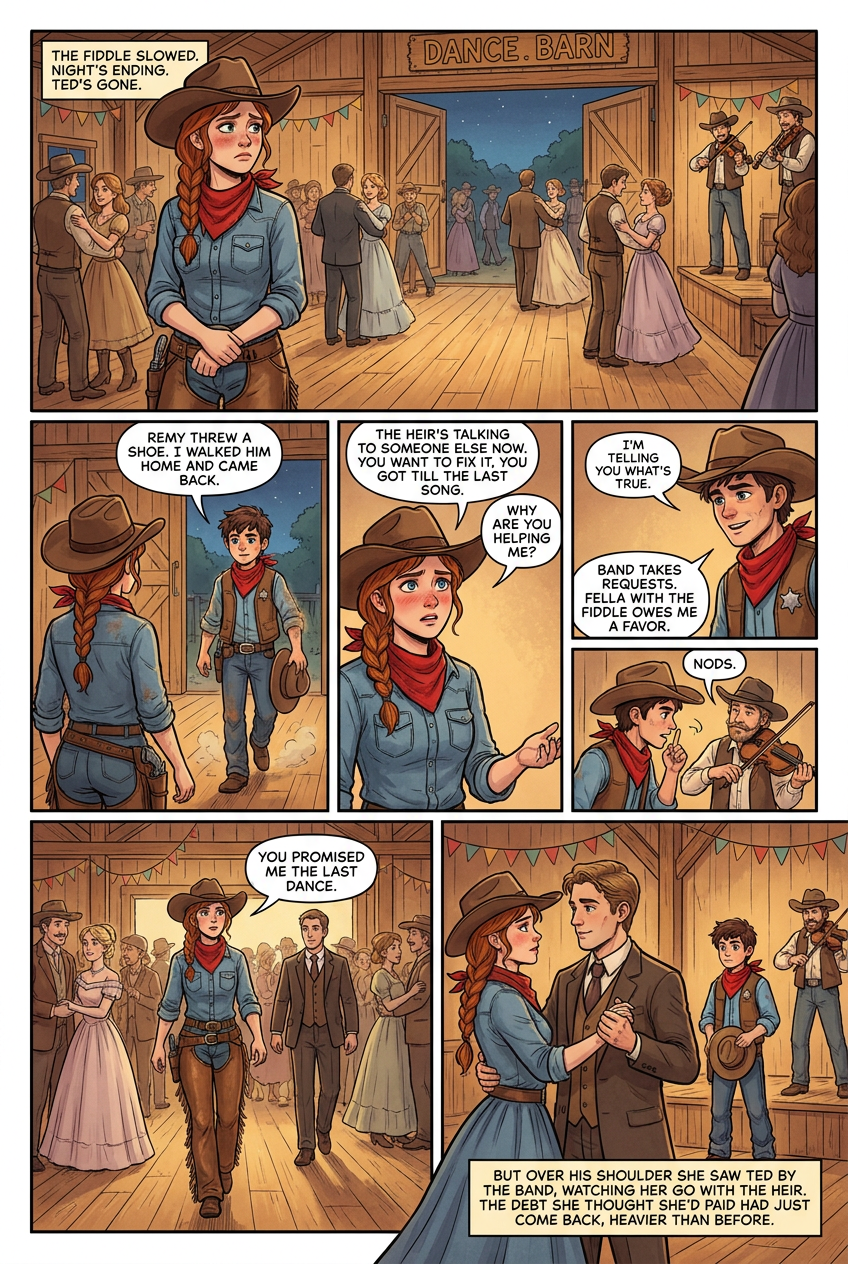
Mel stood at the edge of the floor and watched the heir bend toward the girl in the pale gown. The fiddle slowed. Couples drifted toward the wide doors. Outside, wagons creaked and horses stamped. The night was ending, and she had no reason left to cross the room. Ted had ridden off. Rose had done her part hours ago. If Mel let the last song play out, she would go home with nothing but a borrowed dress. Then she heard boots behind her. She turned. Ted stood in the doorway, hat in hand, dust on his sleeve. He had not ridden the trail after all, or he had turned back partway. "Remy threw a shoe," he said. "Half a mile out. I walked him home and came back." He looked at the thinning crowd, then at her. "You still standing here." "I am." Mel's face burned. She had told him no an hour ago, and here he was. "The heir's talking to someone else now." "I saw." Ted turned the brim in a slow circle. He did not gloat. "You want to fix it, you got till the last song. After that everybody's in their wagons." Mel looked at him. "Why are you helping me?" "I'm not helping." A dry grin. "I'm telling you what's true. There's a difference." He paused. "Band takes requests. Fella with the fiddle owes me a favor." Mel understood. One more song. One more reason for people to stay on the floor, and one more chance to reach the heir before the doors closed. "Do it," she said. Ted crossed to the band and spoke low to the fiddler. The man nodded. A moment later the fiddle rose again, loud and bright. The couples who had turned to go stopped and came back. The heir straightened. The girl in the pale gown laughed and pulled him toward the floor. Mel moved fast now. She cut through the crowd while the music covered her. She reached the heir just as he raised his hand to take the other girl's. "You promised me the last dance," Mel said. It was a lie, and the heir knew it, and she watched him decide whether to be kind about it. He smiled that easy smile. "Did I." "You did." She held her ground. The girl in the pale gown looked between them. Then she stepped back, the way Rose had stepped back once. The heir took Mel's hand and led her out. Mel had her dance. But over his shoulder she saw Ted by the band, watching her go with the heir, his hat still in his hands. He had turned the song for her, and she had spent it on another man. The debt she thought she'd paid had just come back, heavier than before.
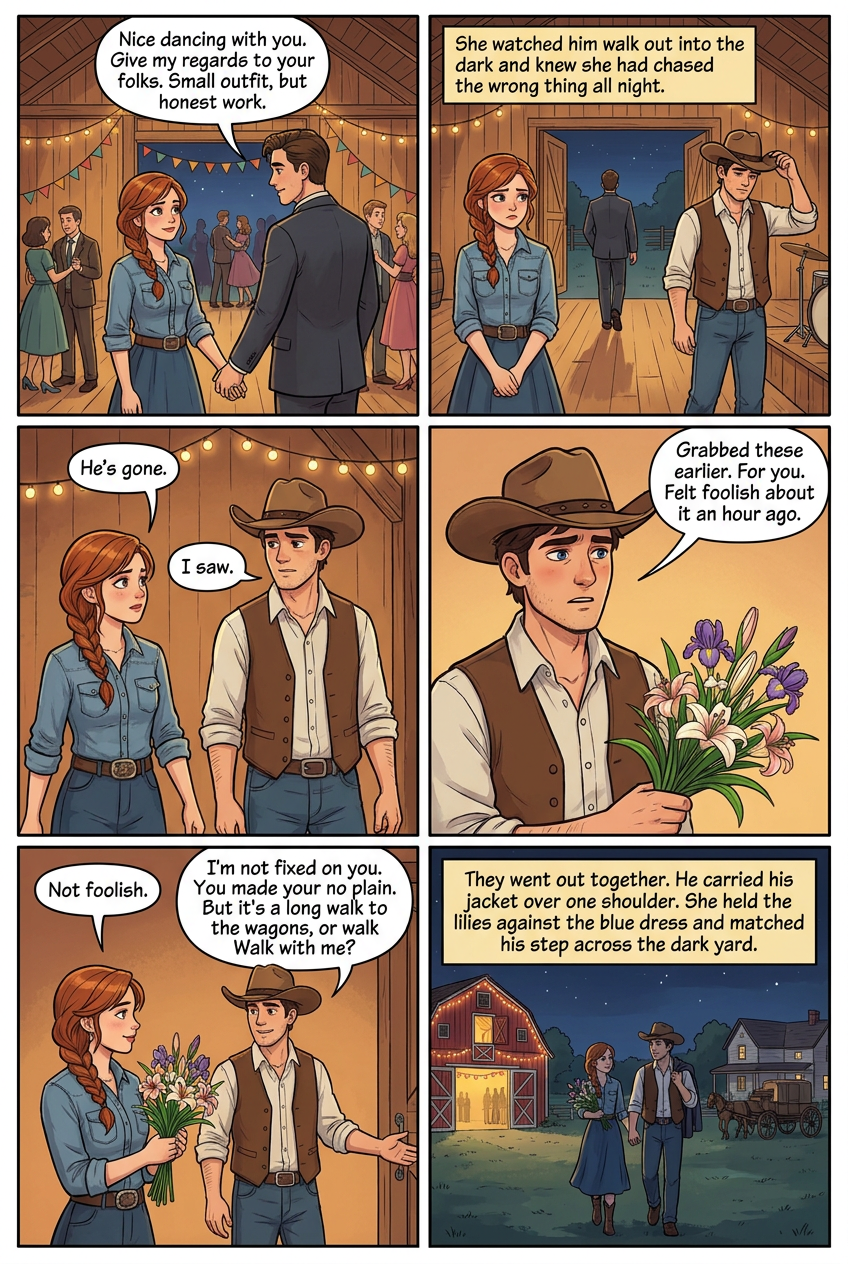
The fiddle wound down under Mel's feet. She felt the heir's hand go loose in hers. The last note faded. He stepped back and smiled that easy smile, the one that said the night was over and she had been a small part of it. Around them, couples broke apart and drifted toward the doors. Mel had no lie left to keep him. She had spent her one dance, and now he was leaving. "Nice dancing with you," he said. He tipped his head, already turning. "Give my regards to your folks. Small outfit, but honest work." There it was. The word she had waited two seasons to prove wrong. Small. He said it kindly, which was worse. He picked up his hat from the bench, and Mel understood she had nothing to make him stay. No favor. No song. No claim. She let him go. She watched him walk out into the dark and knew she had chased the wrong thing all night. She turned. Ted stood by the band, hat still in his hands. He had walked his lame horse home and come back. He had turned the fiddler's song for her. And she had spent it reaching past him for a man who called her family small. Mel crossed to him. "He's gone," she said. "I saw." Ted didn't gloat. He looked tired, and something in his face was closing up. "Ted." She made herself hold his eyes. "You came back with a lame horse. You turned that song. I used it on him. That was a poor way to pay you." "It was." He didn't soften it. "I know." She reached for something true. "He thinks my ranch is small. Maybe it is. But you never once looked at me like that. I was too busy to see it." Ted turned the brim in a slow circle. The barn had nearly emptied. Someone had left a bunch of lilies and iris on the bench, blooms wilting at the edges. He picked them up and held them out, awkward, like he wasn't sure he still meant to. "Grabbed these earlier," he said. "For you. Felt foolish about it an hour ago." Mel took the flowers. "Not foolish." "I'm not fixed on you," Ted said. "You made your no plain. But it's a long walk to the wagons." He set his hat on his head. "Walk with me?" She should have felt she'd lost the whole night. Instead she felt the ground shift. "Yes," she said. They went out together. He carried his jacket over one shoulder. She held the lilies against the blue dress and matched his step across the dark yard. The heir's wagon rolled off toward the Caldwell spread without her. Mel walked the other way, toward home, beside the man who'd stayed. The debt was still hers. But now she wanted to pay it.
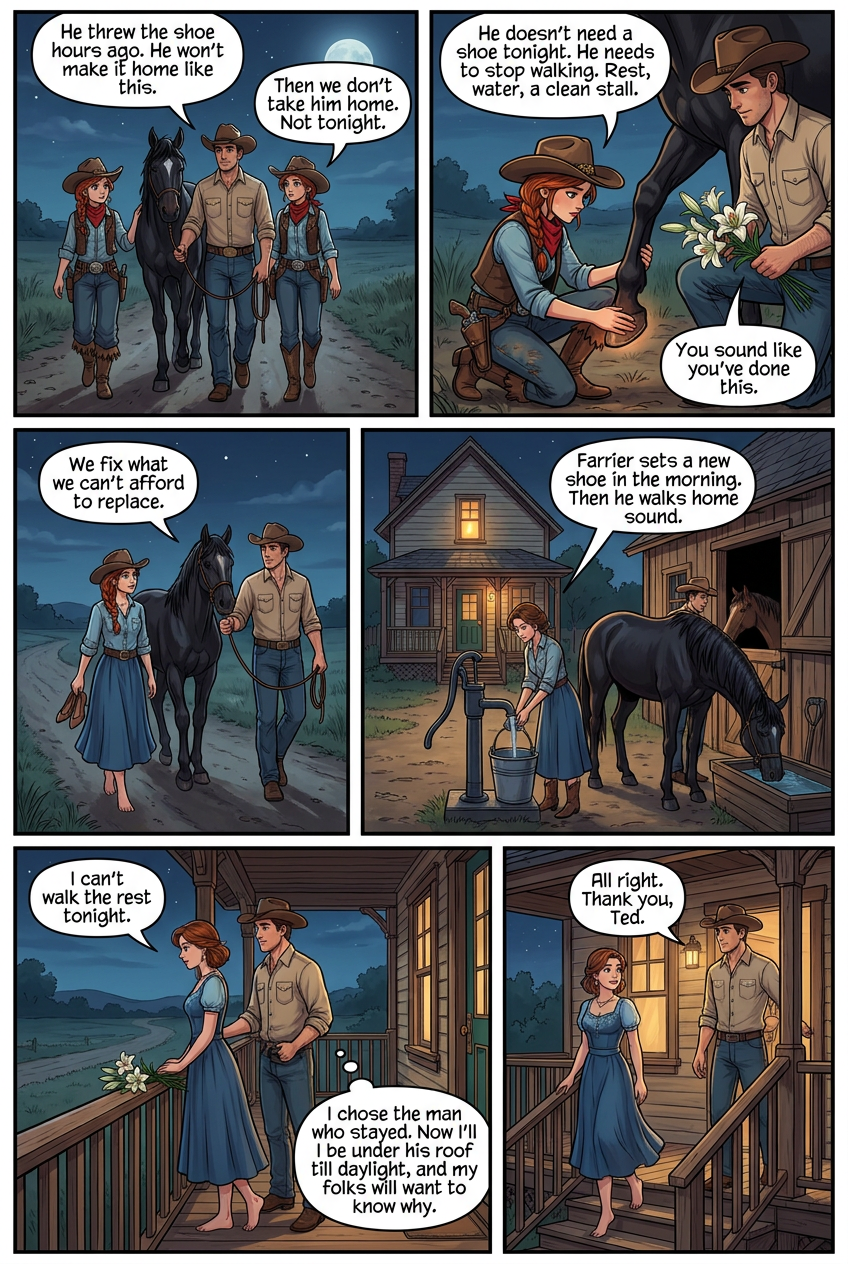
They cleared the barn yard and started down the dark road. Ted led his black horse by the reins. The animal limped on its front left foot. Every few steps it dipped its head and slowed. Mel watched the horse favor the leg and knew they had a problem. Home was miles off. A lame horse could not carry a rider, and Ted would not push him. "He threw the shoe hours ago," Ted said. "I've been walking him since. He won't make it home like this." Mel stopped. Her heels sank in the dirt. "Then we don't take him home. Not tonight." She looked back down the road. "How far to your place?" Ted tipped his head at a light through the trees. "Close. But my stall's got no fresh shoe and no farrier till morning." "He doesn't need a shoe tonight. He needs to stop walking." Mel handed Ted the lilies and stepped to the horse's shoulder. She ran her hand down the sore leg. The hoof was warm and worn at the edge. "Rest, water, a clean stall. That's the whole plan. We walk him slow and we put him up." Ted watched her work. "You sound like you've done this." "Every lame horse on a small outfit," she said. "We fix what we can't afford to replace." They went slow. Mel set the pace to the horse and not to their own tired feet. She kicked off her heels and carried them. The dirt was cool. Ted matched her step, jacket over one shoulder, flowers awkward in his other hand. Twice the horse balked and they stopped and let him breathe. Ted's house came up out of the dark, a wide porch and yellow board front. A lamp burned in one window. He led the horse around to the stall and Mel filled a bucket from the pump. She spread clean straw while Ted eased the horse in. The animal dropped his head to the water and drank. "He'll stand easy now," Mel said. "Farrier sets a new shoe in the morning. Then he walks home sound." Ted latched the stall. The horse was safe. They were not stranded anymore. But the road home was long, and it was near midnight, and Mel stood barefoot in a borrowed blue dress at a man's house she had told no. "I can't walk the rest tonight," Mel said. "Not in the dark. Not with him needing tending come morning." Ted set the lilies on the porch rail. "Spare room's made up. I'll take you both home when he's shod." Mel looked at the lamp in the window and the empty road behind her. She had chosen the man who stayed. Now she'd be under his roof till daylight, and her folks would want to know why. "All right," she said. "Thank you, Ted." She went up the porch steps and inside.
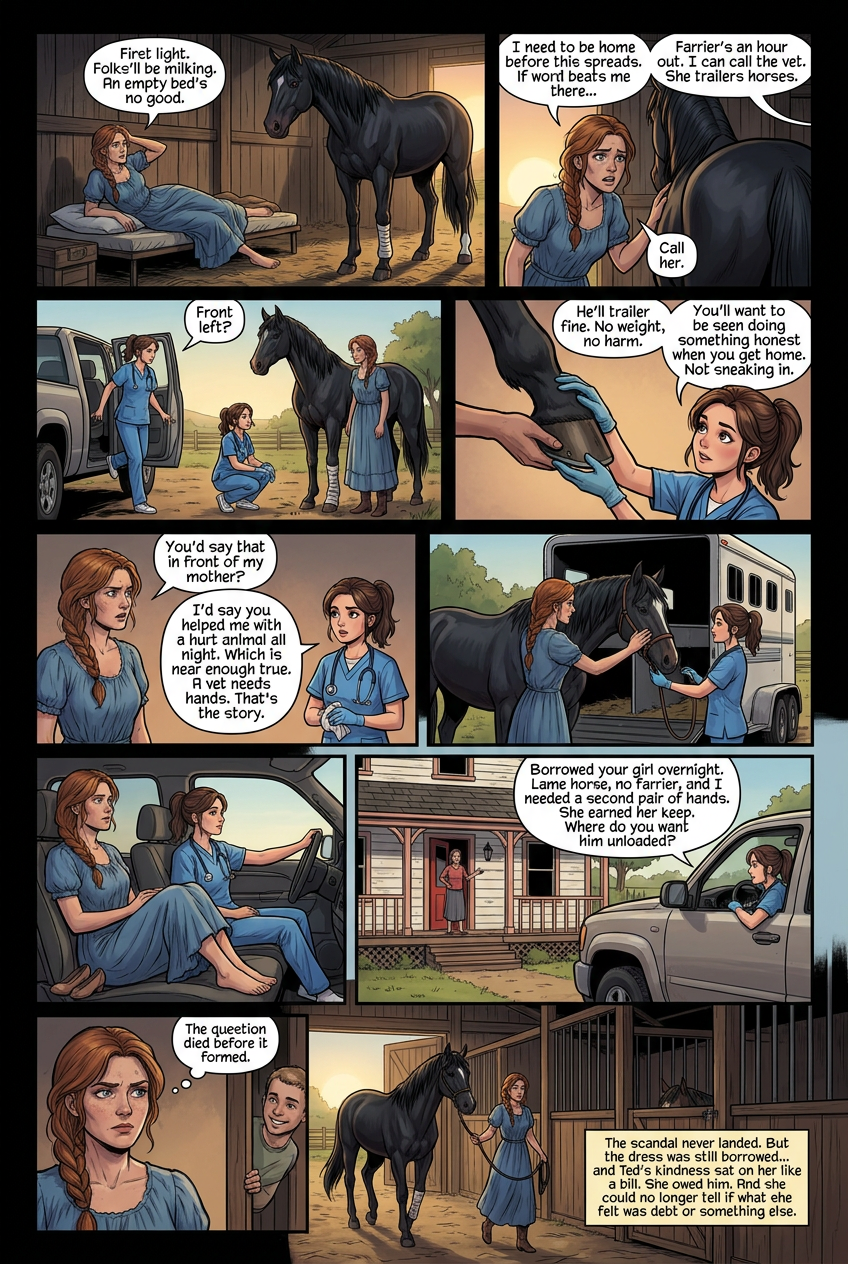
Mel woke at first light in the borrowed dress, wrinkled from sleep. She found Ted by the stall, checking the black horse's leg. The animal stood easy now, but the sore hoof still needed a farrier, and the sun was already up. Her folks would be milking, counting heads, noticing an empty bed. She had no story they would believe. A whole night at a man's house near the dance. The truth was plain and dull, but plain and dull did not stop talk. "I need to be home before this spreads," Mel said. "If word beats me there, it won't matter what really happened." Ted rubbed his neck. "Farrier's an hour out. But I can call the vet. She trailers horses. She could run you home and haul him for shoeing after." "Call her." The truck came within the hour. Dr. Venda climbed down in blue scrubs, a stethoscope looped at her collar. She had pulled a calf at Mel's ranch two winters back and stayed till dawn, never once complaining. She looked at Mel in the crumpled dress, then at the lame horse, and read the whole night in one glance. "Front left?" she asked, already crouching. She ran a thumb along the hoof. "He'll trailer fine. No weight, no harm." Then she stood and wiped her hands. "You'll want to be seen doing something honest when you get home. Not sneaking in." Mel stared at her. "You'd say that in front of my mother?" "I'd say you helped me with a hurt animal all night. Which is near enough true." Dr. Venda lowered the trailer ramp. "A vet needs hands. You gave me yours. That's the story, and it holds because it happened." They loaded the black horse slow. Mel steadied his head while Dr. Venda coaxed him up the ramp. Ted latched the gate. Mel climbed into the cab beside the vet, still barefoot, heels in her lap. The truck pulled into the ranch yard mid-morning. Her mother came off the porch, mouth already open. Dr. Venda leaned out the window first. "Borrowed your girl overnight," she called. "Lame horse, no farrier, and I needed a second pair of hands. She earned her keep. Where do you want him unloaded?" Mel watched her mother's face shift. The question died before it formed. Her brother appeared at the barn door, saw Mel in the dress, and grinned wide. She gave him one hard look and he swallowed it. The scandal never landed. Mel got down and helped walk the black horse into a stall. She was home, and no one doubted her. But the dress was still borrowed, wrinkled and blue, and Ted's kindness sat on her like a bill. She owed him for the night, the gown, the fiddle song. The heir was gone. Ted was not. And Mel could no longer tell if what she felt was debt or something she had picked over the heir on purpose.
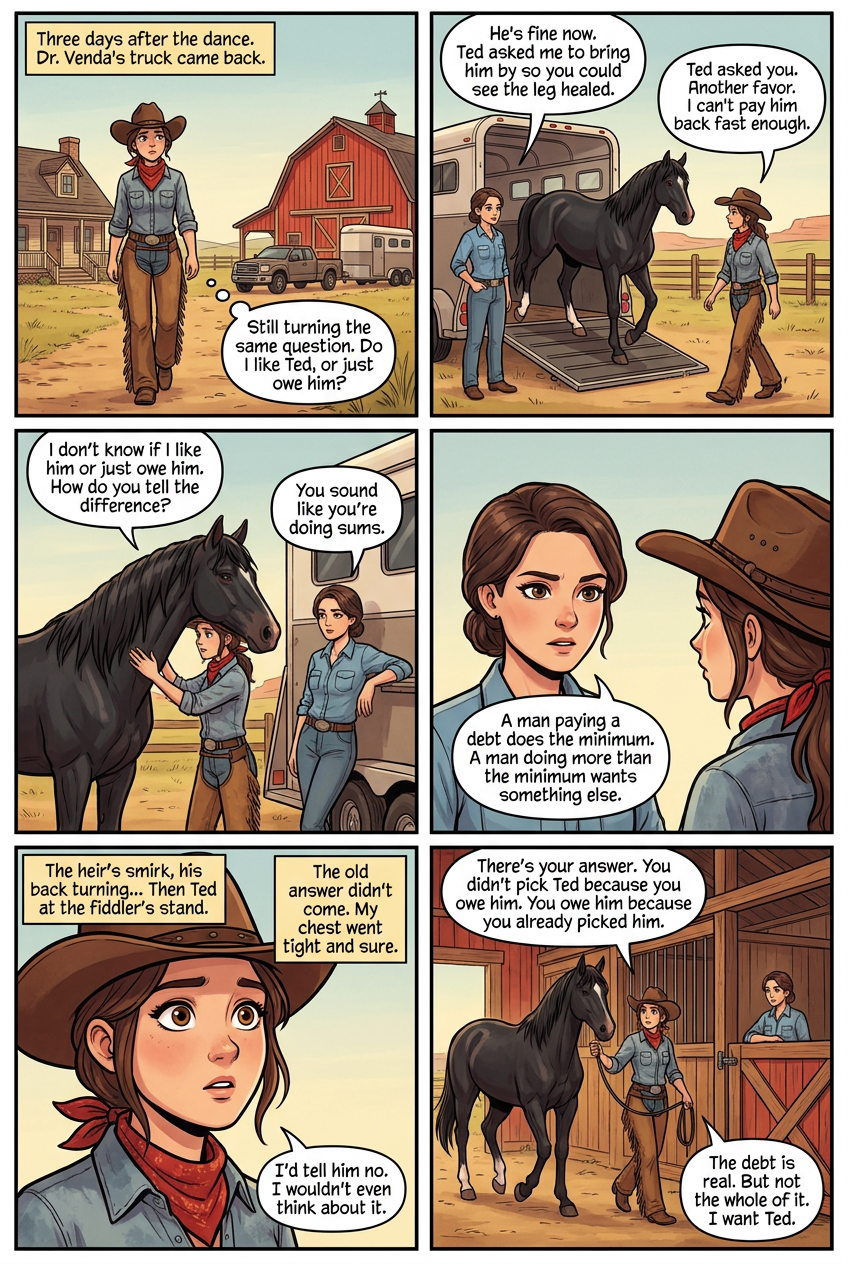
Three days after the dance, Dr. Venda's truck came back up the ranch lane. She had the black horse trailered behind her, shod and sound. Mel walked out to meet her, still turning the same question in her head. She owed Ted for the gown, the fiddle song, the night, the cover story. But she could not tell if that debt was pushing her toward him or if she had truly chosen him. Until she knew, every soft word she gave Ted was a lie waiting to happen. Dr. Venda backed the trailer near the red timber barn and dropped the ramp. "He's fine now," she said. "New shoes all around. Ted asked me to bring him by so you could see the leg healed." "Ted asked you." Mel led the black horse down the ramp. He stepped even and easy, no limp at all. "Another favor. He keeps stacking them up. I can't pay him back fast enough to catch up." Dr. Venda leaned against the trailer and watched her. "You sound like you're doing sums." "I am. I owe him for everything. I don't know if I like him or just owe him." Mel ran her hand down the horse's neck. "How do you tell the difference?" The vet was quiet a moment. "When I pull a calf at three in the morning, I don't do it for thanks. I do it because I can't leave the animal hurting." She nodded at the horse. "Ted trailered a lame horse an hour twice for you. Called in favors. Lied to no one but bent the truth to save you. A man paying a debt does the minimum. A man doing more than the minimum wants something else." Mel stopped. "That's him, not me. I asked how I feel." "Then answer this fast, no thinking." Dr. Venda straightened. "The heir walks in that barn right now and says he was wrong, your ranch is fine, come dance. What do you do?" Mel opened her mouth for the old answer. It did not come. She saw the heir's smirk at the feed store, his back turning at the dance. Then she saw Ted at the fiddler's stand, arranging one more song for her while she chased another man. Her chest went tight and sure. "I'd tell him no," Mel said. "I wouldn't even think about it." "There's your answer." Dr. Venda picked up the ramp. "You didn't pick Ted because you owe him. You owe him because you already picked him." Mel led the black horse into the barn and latched the stall. The debt was still real. But it was not the whole of it, and now she knew. She wanted Ted. That was the truth under everything. The problem was, she had told him she owed him. She had never once told him she wanted him. And a man kept paying debts for a woman who never said the other thing.
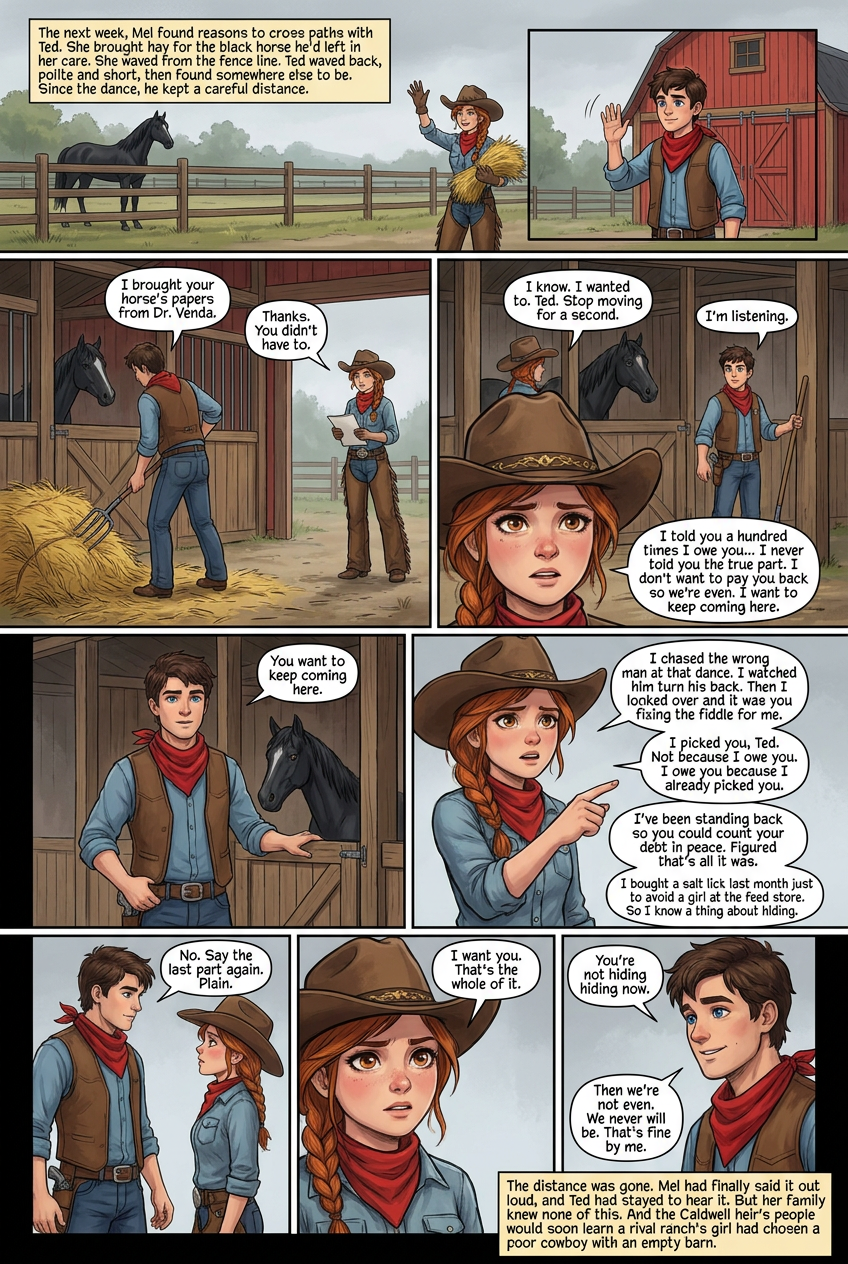
The next week, Mel found reasons to cross paths with Ted. She brought hay for the black horse he'd left in her care. She waved from the fence line. Ted waved back, polite and short, then found somewhere else to be. Since the dance, he kept a careful distance. He had watched her lie to the heir and take his hand while Ted stood at the fiddler's stand. Now he stayed friendly and far, and Mel could never get close enough to say the one thing that mattered. She drove to Ted's place on a gray morning. His red timber barn stood open. Ted was forking a bundle of golden hay into a stall, his back to her. "I brought your horse's papers from Dr. Venda," Mel said. Ted took them without turning fully. "Thanks. You didn't have to." "I know. I wanted to." She stepped closer. He stepped back, just enough. "Ted. Stop moving for a second." He set the fork against the wall. "I'm listening." "You've been kind and far off all week. Like a man closing a bill." Mel's throat went tight. "I need to say something, and I need you to not walk away." "Say it, then." His voice stayed flat. But he didn't leave. Mel had rehearsed this in the truck. The words scattered anyway. "I told you a hundred times I owe you. The dress. The song. The ride home. All of it." She breathed. "I never told you the true part. I don't want to pay you back so we're even. I want to keep coming here." Ted's hands stilled on the stall rail. "You want to keep coming here." "I chased the wrong man at that dance. I watched him turn his back. Then I looked over and it was you fixing the fiddle for me." Mel's eyes stung. "I picked you, Ted. Not because I owe you. I owe you because I already picked you." For a long moment he said nothing. A horse shifted in the stall. Then Ted looked straight at her, blue eyes clear. "I've been standing back so you could count your debt in peace," he said. "Figured that's all it was." A short breath, almost a laugh. "I bought a salt lick last month just to avoid a girl at the feed store. So I know a thing about hiding." "You're not hiding now." "No." He crossed the space he'd kept between them all week. He didn't touch her yet. "Say the last part again. Plain." "I want you," Mel said. "That's the whole of it." Ted nodded once, slow. "Then we're not even. We never will be." He almost smiled. "That's fine by me." The distance was gone. Mel had finally said it out loud, and Ted had stayed to hear it. But her family knew none of this. And the Caldwell heir's people would soon learn a rival ranch's girl had chosen a poor cowboy with an empty barn.
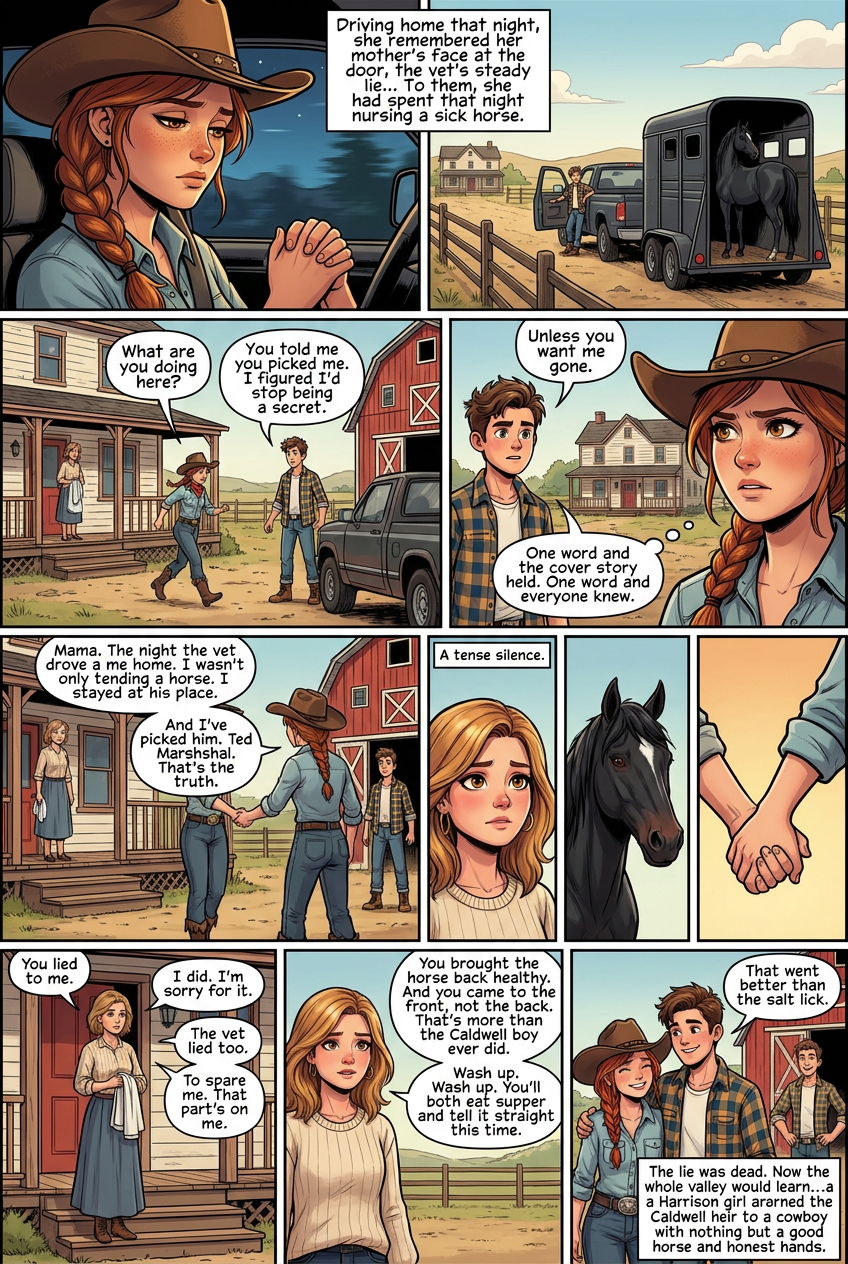
Ted's hand still held Mel's when the barn light shifted. She had won him at last. But driving home that night, she remembered her mother's face at the door, the vet's steady lie, the story her family still believed. To them, she had spent that night nursing a sick horse. Not choosing a poor cowboy with an empty barn. She could keep the lie. Or she could tell them the truth and let the whole ranch talk. She stewed on it for two days. Then Ted drove out to her family's place. He came in his old truck, the black horse trailered behind, its coat sleek and healed. He stopped at the fence and got out. He did not sneak. He did not hide. "What are you doing here?" Mel crossed the yard fast. Her mother watched from the porch. "You told me you picked me," Ted said. "I figured I'd stop being a secret." He looked past her at the house. "Unless you want me gone." Mel's heart pounded. This was the moment she'd dreaded. One word and the cover story held. One word and everyone knew. She turned to the porch. Her mother had come down the steps now, wiping her hands on a towel. Her brother hung back by the barn, the only one who'd ever known Mel's heart. "Mama," Mel said. Her voice shook, then steadied. "The night the vet drove me home. I wasn't only tending a horse." She reached back and took Ted's hand. "I stayed at his place. His horse went lame after the dance. Nothing happened but that." She breathed. "And I've picked him. Ted Marshal. That's the truth." The yard went quiet. Her mother looked at Ted, then at the healed black horse, then at their joined hands. Mel braced for the anger. For talk of the empty barn, the poor spread, the shame. Her mother folded the towel slow. "You lied to me," she said. "I did. I'm sorry for it." "The vet lied too." "To spare me. That part's on me." Her mother studied Ted a long moment. "You brought the horse back healthy. And you came to the front, not the back." She nodded once. "That's more than the Caldwell boy ever did." She turned for the house. "Wash up. You'll both eat supper and tell it straight this time." Mel's knees nearly buckled. Her brother grinned wide from the barn. Ted squeezed her hand. "That went better than the salt lick," he murmured. But Mel wasn't laughing yet. She'd told her family. The lie was dead. Now the whole valley would learn a Harrison girl had turned from the Caldwell heir to a cowboy with nothing but a good horse and honest hands. And the Caldwell spread would hear of it first.
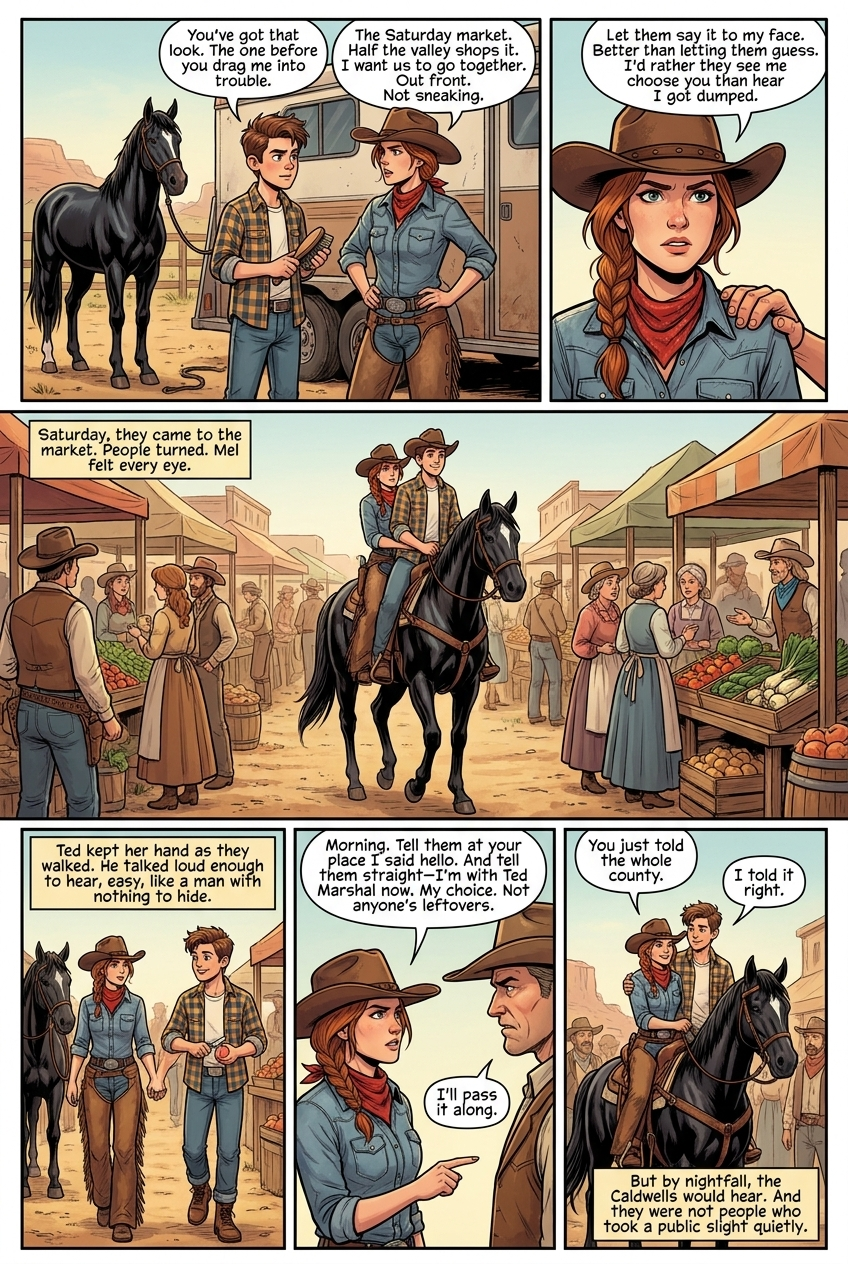
Supper ended clean. Mel had told her family the truth, and her mother had accepted Ted. But truth inside the house was one thing. Outside, the valley still didn't know. Rumors traveled fast at feed stores and fences. If the story reached the Caldwell spread wrong, people would say the heir had cast Mel off. She would be the small-time girl he refused. She needed the valley to see it her way first. She found Ted the next morning by his trailer, brushing the black horse. The animal stood calm, its coat shining, its lame leg sound again. Ted looked up. "You've got that look. The one before you drag me into trouble." "The Saturday market," Mel said. "Half the valley shops it. The Caldwells send a hand every week." She rubbed the horse's neck. "I want us to go together. Out front. Not sneaking." Ted set down the brush. "You know what they'll say. Harrison girl, broke cowboy." "Let them say it to my face. Better than letting them guess." She met his eyes. "I'd rather they see me choose you than hear I got dumped." He studied her a long moment. Then he grinned. "Then we ride in. Not the truck." Saturday, they came to the market on the black horse, Mel behind Ted, her arms at his waist. People turned. A cluster of ranch wives near the produce stalls went quiet. Mel felt every eye. Her stomach knotted, but she sat straight and didn't look away. Ted swung down first, then helped her step off. He kept her hand as they walked the stalls. He bought her a peach and split it with his pocketknife. He talked loud enough to hear, easy, like a man with nothing to hide. By the eggs, Mel spotted the Caldwell hand. He watched them with a flat face, the way a man watches to carry news home. Mel walked right up. "Morning," she said. "Tell them at your place I said hello. And tell them straight—I'm with Ted Marshal now. My choice. Not anyone's leftovers." The hand blinked. "I'll pass it along." "Good." She smiled and turned back to Ted. The market noise picked up again. A few of the wives nodded at Mel now, and one old rancher tipped his hat to Ted. The story would travel. But it would travel her way—the girl who chose the honest cowboy, not the girl thrown over. Riding out, Ted said, "You just told the whole county." "I told it right." Mel pressed her cheek to his back. The knot in her stomach was gone. But she knew where that Caldwell hand was headed. By nightfall, the heir's family would hear a Harrison girl had shamed their name in front of the market. And the Caldwells were not people who took a public slight quietly.
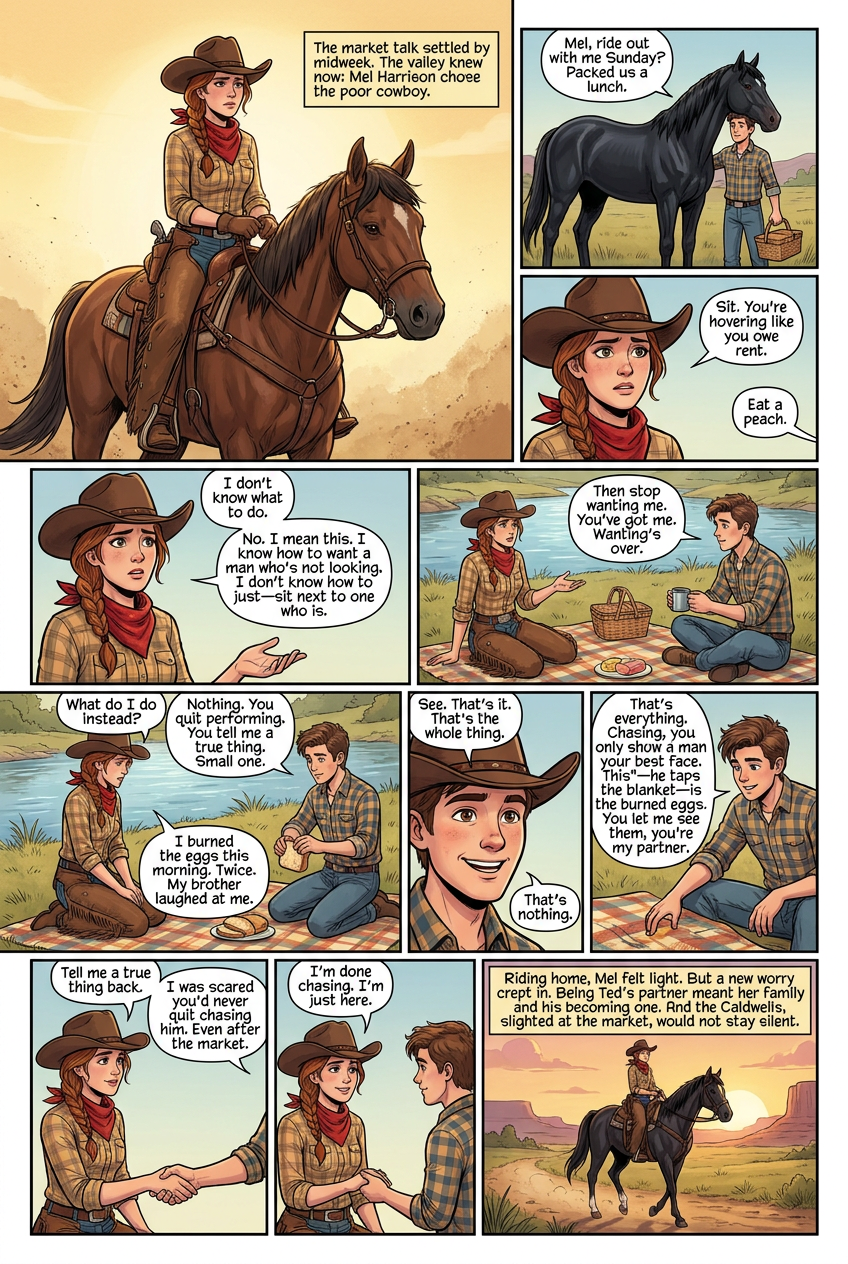
The market talk settled by midweek. The valley knew now: Mel Harrison chose the poor cowboy. But knowing wasn't the same as being with him. Mel had spent two seasons chasing a man across a distance. She had learned to want from far off, to plan and pine. She had never once stood beside someone as his. She didn't know how. Ted asked her to ride out Sunday. He packed a basket and a folded blanket behind his saddle. They took the black horse to a flat spot by the water. He spread the blanket, set out bread and cheese and a tin cup, and sat down easy. Mel stayed standing. Her hands felt useless. For two seasons her feelings had a job—reach him, win him, cross the gap. Now there was no gap. She kept waiting for something to chase. "Sit," Ted said. He patted the blanket. "You're hovering like you owe rent." She sat, stiff. "I don't know what to do." "Eat a peach." "No. I mean this." She waved at the blanket, the food, him. "I know how to want a man who's not looking. I don't know how to just—sit next to one who is." Ted set down the cup. He didn't laugh. "Then stop wanting me," he said. "You've got me. Wanting's over." The words hit strange. She'd built herself around the reaching. If she stopped, what was left? "What do I do instead?" she asked. "Nothing." He tore the bread and handed her half. "You quit performing. You tell me a true thing. Small one." Mel looked at the water. She tried to think of something to win with, then let it go. "I burned the eggs this morning. Twice. My brother laughed at me." Ted grinned. "See. That's it. That's the whole thing." "That's nothing." "That's everything. Chasing, you only show a man your best face. This"—he tapped the blanket—"is the burned eggs. You let me see them, you're my partner. You hide them, you're still running." Mel felt the truth of it settle. All this time she'd aimed to impress. She'd dressed her feelings up like a dance gown. Ted didn't want the gown. He wanted the girl who scorched her breakfast. She leaned back on her hands. Her shoulders dropped. For the first time in two seasons, she wasn't reaching for anything. "Tell me a true thing back," she said. "I was scared you'd never quit chasing him," Ted said. "Even after the market." "I'm done chasing." She meant it. "I'm just here." He took her hand across the blanket. They ate. She let the quiet stay quiet. She didn't fill it, didn't plan, didn't work to win him. She had won. Now she only had to stay. Riding home, Mel felt light. But a new worry crept in. Being Ted's partner meant her family and his becoming one. And the Caldwells, slighted at the market, would not stay silent when two small ranches joined hands.
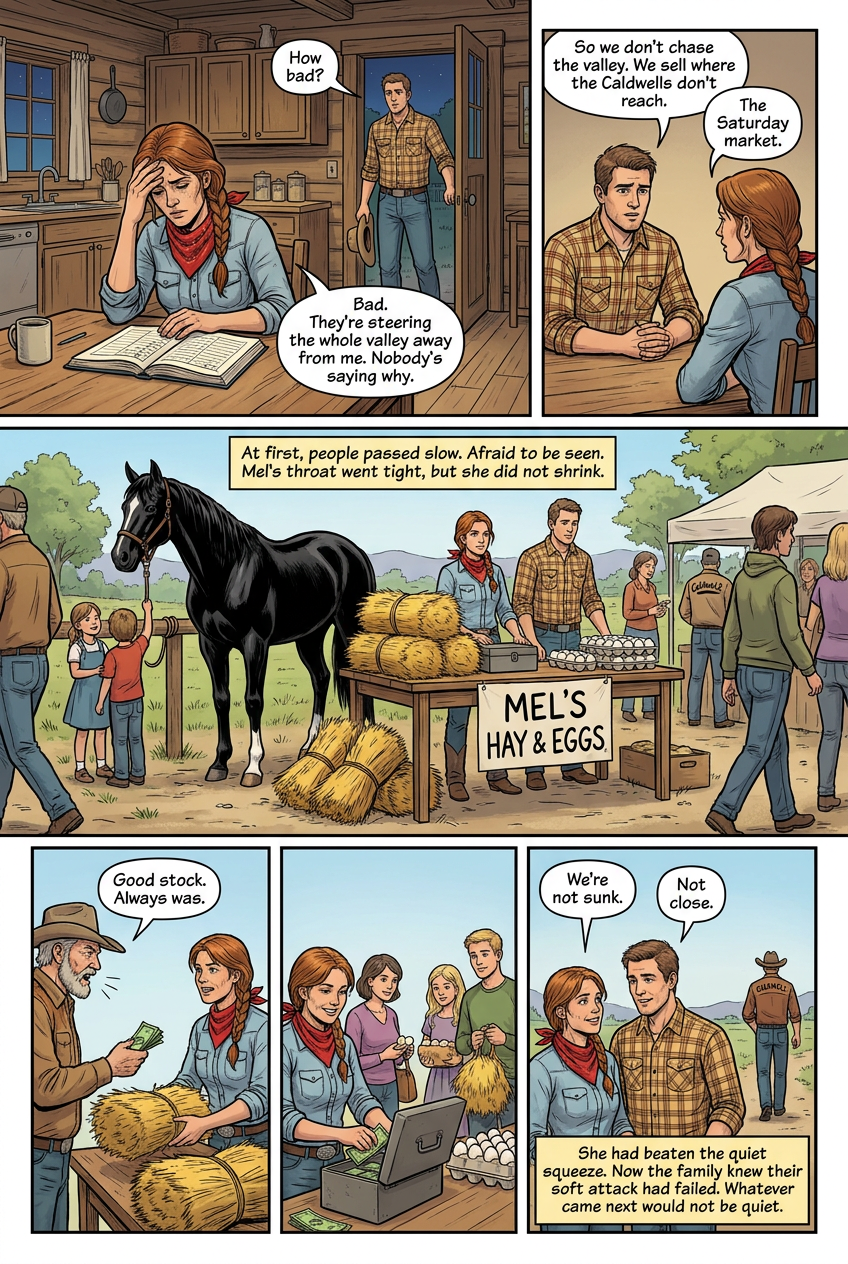
The retaliation came quiet, not loud. No threats, no words. Just business drying up. The mill stopped buying Mel's hay. The store cut its order in half. A neighbor who bought her calves every fall didn't call. Mel added the numbers at the kitchen table and felt her stomach drop. Without this season's income, there was no future to build with Ted. The Caldwells were choking her ranch without lifting a hand. Ted found her staring at the ledger. He set his hat on the black horse's saddle by the door and read her face. "How bad?" "Bad. They're steering the whole valley away from me." She pushed the book across the table. "Nobody's saying why. They don't have to." Ted sat down. He didn't offer comfort or a soft lie. "So we don't chase the valley," he said. "We sell where the Caldwells don't reach." Mel looked up. "The Saturday market." "Direct to folks. No middleman for them to lean on." It was a gamble. The market meant standing in the open, facing the same eyes that had watched her reject the heir. But the market was public, and the valley's talk ran through it. If people bought from her there, in front of everyone, the Caldwells couldn't quietly bury her. They loaded the truck that Friday night. Saturday, Mel set up her table with hay bundles, eggs, and a hand-lettered price sign. Ted stood beside her. The black horse waited at the rail, drawing a small crowd of children. At first, people passed slow. Some looked, then looked away, afraid to be seen buying from the girl the Caldwells had marked. Mel's throat went tight. She kept her chin level and did not shrink. Then an old rancher stopped. He'd known her father. He bought two bundles of hay and paid in cash, loud enough for others to hear. "Good stock," he said. "Always was." That broke it. Others followed. A woman bought eggs. A young couple bought hay for their first horse. By noon Mel's table was near empty. The cash box was heavy in her hands. A Caldwell hand watched from across the market, the same one she'd spoken to before. He didn't buy. He just counted her customers and walked off to report. Mel let him go. She turned to Ted. "We're not sunk." "Not close," he said. The season's income was saved, not by winning the valley back, but by going straight to it. Mel had beaten the quiet squeeze. But she'd done it in the open, in front of the Caldwell hand, and now the family knew their soft attack had failed. They had tried to break her without being seen. She had refused to break, and made sure everyone saw. Whatever came next from the Caldwells would not be quiet.
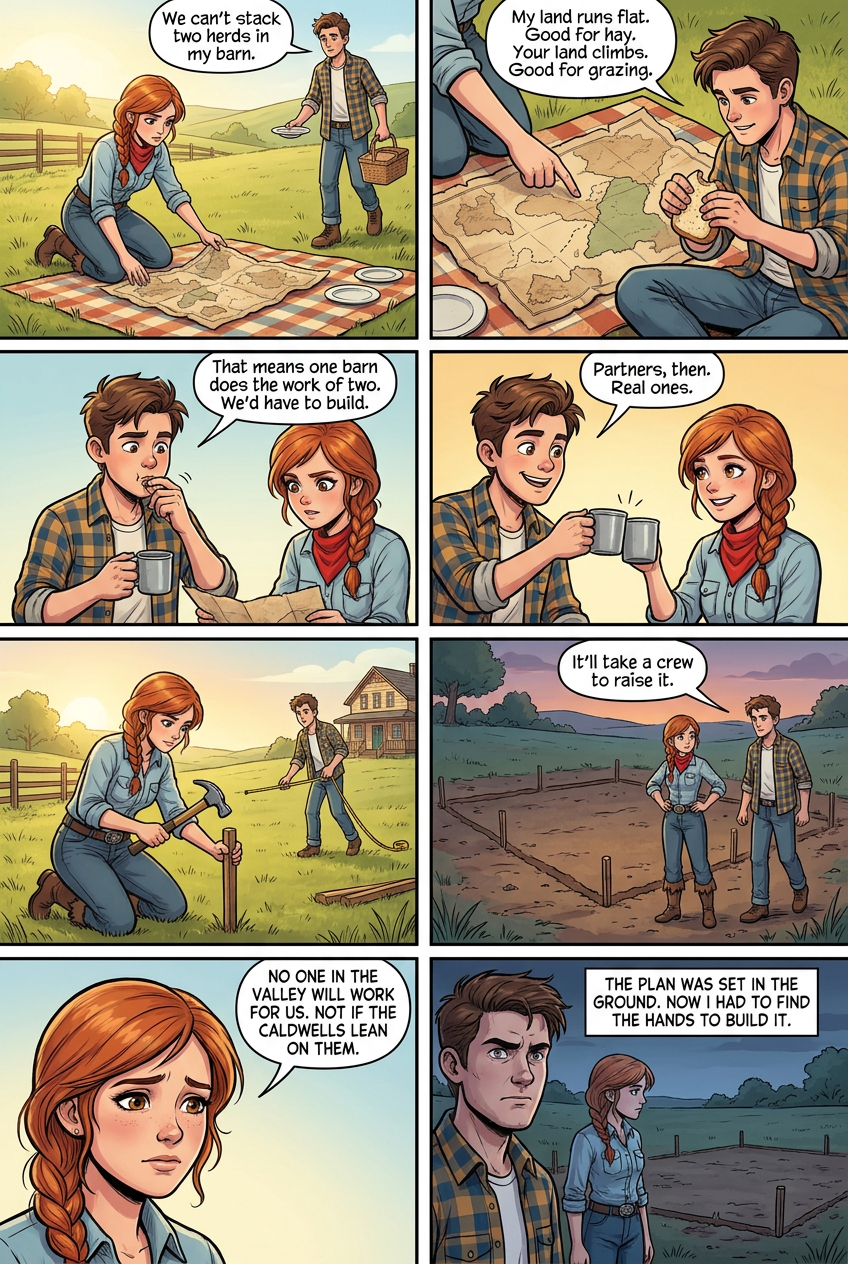
The market win kept the season alive, but it did not solve the real problem. Mel and Ted wanted to run their two ranches as one. Neither spread had the land or barn space to hold both herds. Mel spread her father's old maps on a blanket in the pasture. Ted brought a basket of bread and cheese and set two plates down beside her. "We can't stack two herds in my barn," Ted said. He tore off a piece of bread. "And your barn's smaller than mine." "I know the numbers." Mel tapped the map. "My land runs flat. Good for hay. Your land climbs. Good for grazing." She looked up. "We keep both. We just use each for what it's best at." Ted set down his cup. "That means one barn does the work of two. We'd have to build." "Or add on." Mel pointed to Ted's home on the map. "Your barn's bigger. We raise the roof, extend the far wall. Move my stock there. My fields stay open for hay." Ted studied the lines. He was quiet a long moment. Mel watched his face and waited. She used to reach for men who left. Ted stayed. He chewed the plan over the way he chewed his bread, slow and sure. "Lumber costs," he said at last. "But we cleared enough at the market for that." "Then we do it." Mel folded the map. "One barn. Your hill, my flat. We stop being two small ranches and start being one that works." Ted grinned. He knocked his cup against hers. "Partners, then. Real ones." They spent the afternoon marking posts in Ted's pasture. Mel drove the first stake herself. Ted paced out the new wall. By dusk they had the shape of it staked in the dirt, a barn wide enough for both their herds. Mel stood back and looked at the stakes. For the first time the merger was not a worry on a ledger. It was a plan in the ground. She had beaten the Caldwells' squeeze, and now she was building the thing they'd tried to stop. Ted came to stand beside her. "It'll take a crew to raise it." Mel's smile held. Then it cooled. A crew meant hiring hands. Hands meant men who bought their feed and sold their stock through the valley. Through the mill and the store the Caldwells still controlled. "No one in the valley will work for us," she said. "Not if the Caldwells lean on them." Ted's jaw tightened. He'd seen it too. They had the land, the plan, and the money. They just could not raise a barn alone, and every hand for miles answered to the family they had crossed. Mel stared at the stakes in the dark. The plan was set in the ground. Now she had to find the hands to build it.
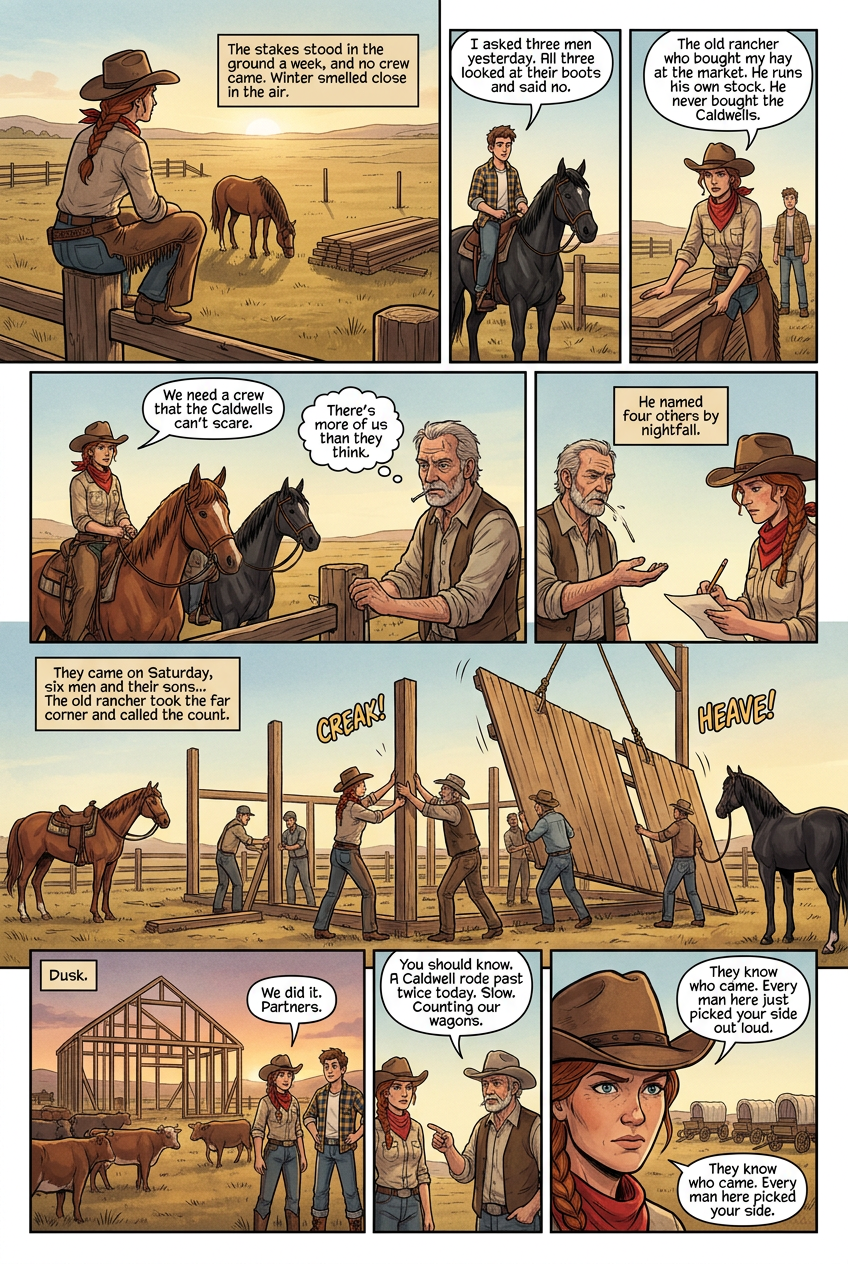
The stakes stood in the ground a week, and no crew came. Mel rode the fence line each morning, counting nothing. Winter smelled close in the air. Her herd stood in the open pasture where the barn should rise, and the first hard frost would find them there. She had the lumber. She had the plan. She had two pairs of hands and a wall that took eight. Ted met her at the foundation on his black horse. She rode the brown. He looked at the stacked boards and shook his head. "I asked three men yesterday. All three looked at their boots and said no." "The Caldwells reach that far." Mel swung down. "Then we stop asking men who owe them." Ted frowned. "Everyone in the valley owes them something." "Not everyone." Mel walked to the boards and laid her hand on the top plank. "The old rancher who bought my hay at the market. He bought first, when nobody else would. He doesn't sell through the mill. He runs his own stock and sells his own beef." Ted straightened. "You think he'd swing a hammer for us?" "I think he already crossed the Caldwells once to help me. And he knows every man like him. The ones the family never bought." They rode out that afternoon. The old rancher was mending his own fence when they found him. He listened to Mel with a nail held between his teeth. When she finished, he spat the nail into his palm. "They cut you off, so you sold around them," he said. "Now they scare off your crew, so you want the men they can't scare." He almost smiled. "There's more of us than they think. We just keep quiet." He named four others by nightfall. Mel wrote them down on the back of her father's map. They came on Saturday, six men and their sons, wagons loaded with their own tools. Mel and Ted had the boards squared and the posts set. The old rancher took the far corner and called the count. On three, they lifted the first wall together. It rose slow, groaning, then swung upright and dropped into its notches. The men drove the braces home. By dusk three walls stood. The frame threw a long shadow over Mel's herd, and for the first time the animals had something to stand against the wind. Mel stood back and looked at it. She had beaten the squeeze at the market. Now she'd raised a wall the Caldwells swore she couldn't. Ted came and stood beside her, sweat dark on his shirt. "We did it," he said. "Partners." Then the old rancher walked over, wiping his hands. His face had gone serious. "You should know," he said. "A Caldwell rode past twice today. Slow. Counting our wagons." He looked at Mel. "They know who came. Every man here just picked your side out loud." Mel looked at the six wagons in her yard. She had her crew. And now the family knew each of their names.
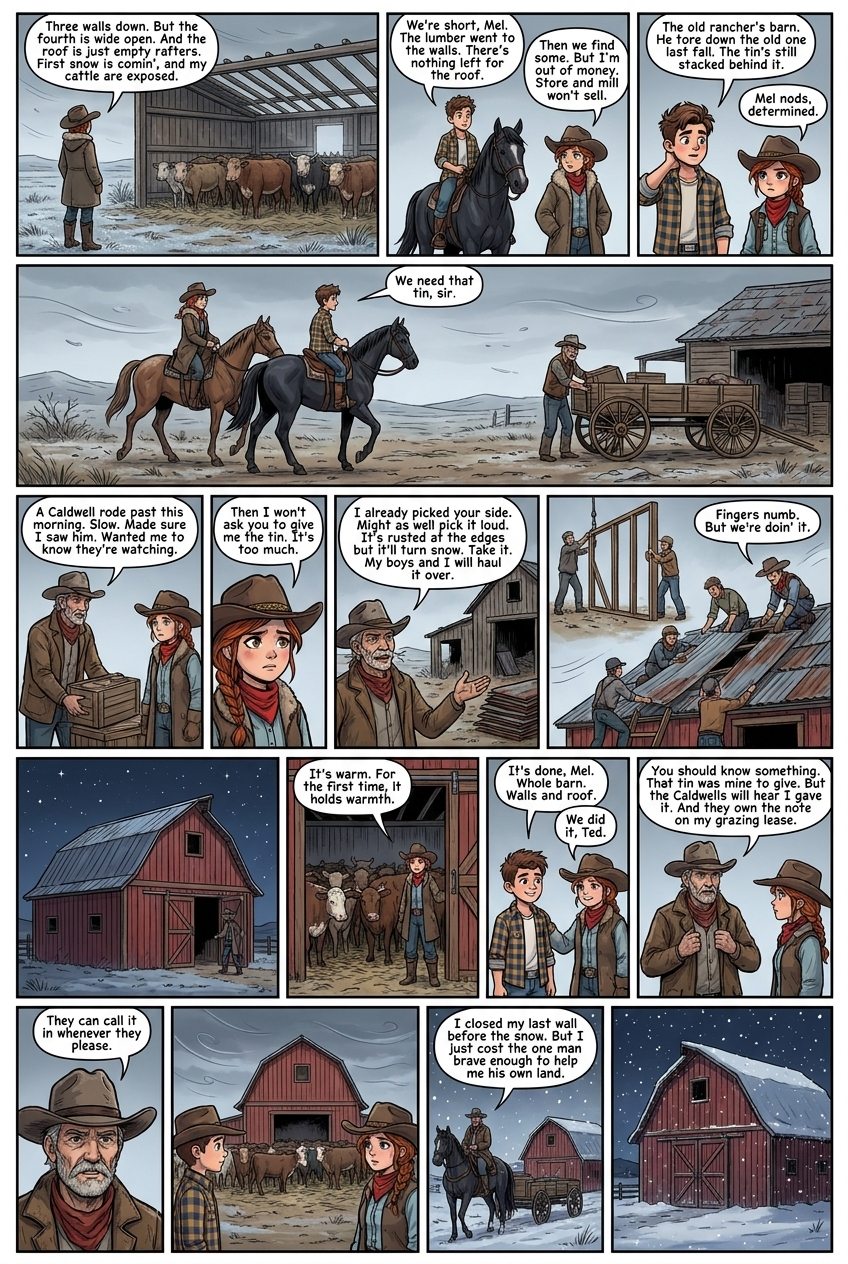
Three walls stood, but the fourth stayed open. Mel woke to gray sky and a wind that cut through her coat. Her herd stood in the frame's corner, packed tight against the cold. The last wall gaped wide, and no boards covered the roof. Frost stiffened the grass. She knew the first snow would find her cattle with nothing over their backs. She had the crew. She did not have the roofing. Ted rode up on his black horse and swung down beside her. He looked at the open frame and the empty rafters. "We're short," he said. "The lumber went to the walls. There's nothing left for the roof." "Then we find some." Mel counted the money in her head and came up empty. "The store won't sell to us. The mill won't either." Ted rubbed his jaw. "The old rancher's barn. He tore down the old one last fall. The tin's still stacked behind it." They rode out together through the wind. The old rancher stood in his yard, loading his wagon. When Mel told him what she needed, he set down the crate in his hands. "A Caldwell rode past my place this morning," he said. "Slow. Made sure I saw him." He looked at her a long moment. "Wanted me to know they're watching." Mel's stomach dropped. "Then I won't ask you to give me the tin. It's too much." The old rancher spat and almost grinned. "I already picked your side. Might as well pick it loud." He waved at the stack behind the barn. "It's rusted at the edges but it'll turn snow. Take it. My boys and I will haul it over." They worked until dark. The men lifted the last wall on the count of three, and it dropped into its notches. Ted drove the braces home. Then they climbed the rafters and nailed the tin down sheet by sheet. The metal banged in the wind. Mel handed nails up from below, her fingers numb. By full dark the roof was closed. Mel opened the wide door and drove her herd inside. The cattle crowded in out of the wind, and the banging tin went quiet above them. She stood in the doorway and felt the still air. For the first time, the barn held warmth. Ted came and stood beside her. "It's done," he said. "Whole barn. Walls and roof." The old rancher wiped his hands on his coat. His face had gone serious again. "You should know something," he said. "That tin was mine to give. But the Caldwells will hear I gave it. And they own the note on my grazing lease." He looked at Mel. "They can call it in whenever they please." Mel looked at the full barn and then at the old man who had saved it. She had closed her last wall before the snow. And she had just cost the one man brave enough to help her his own land.
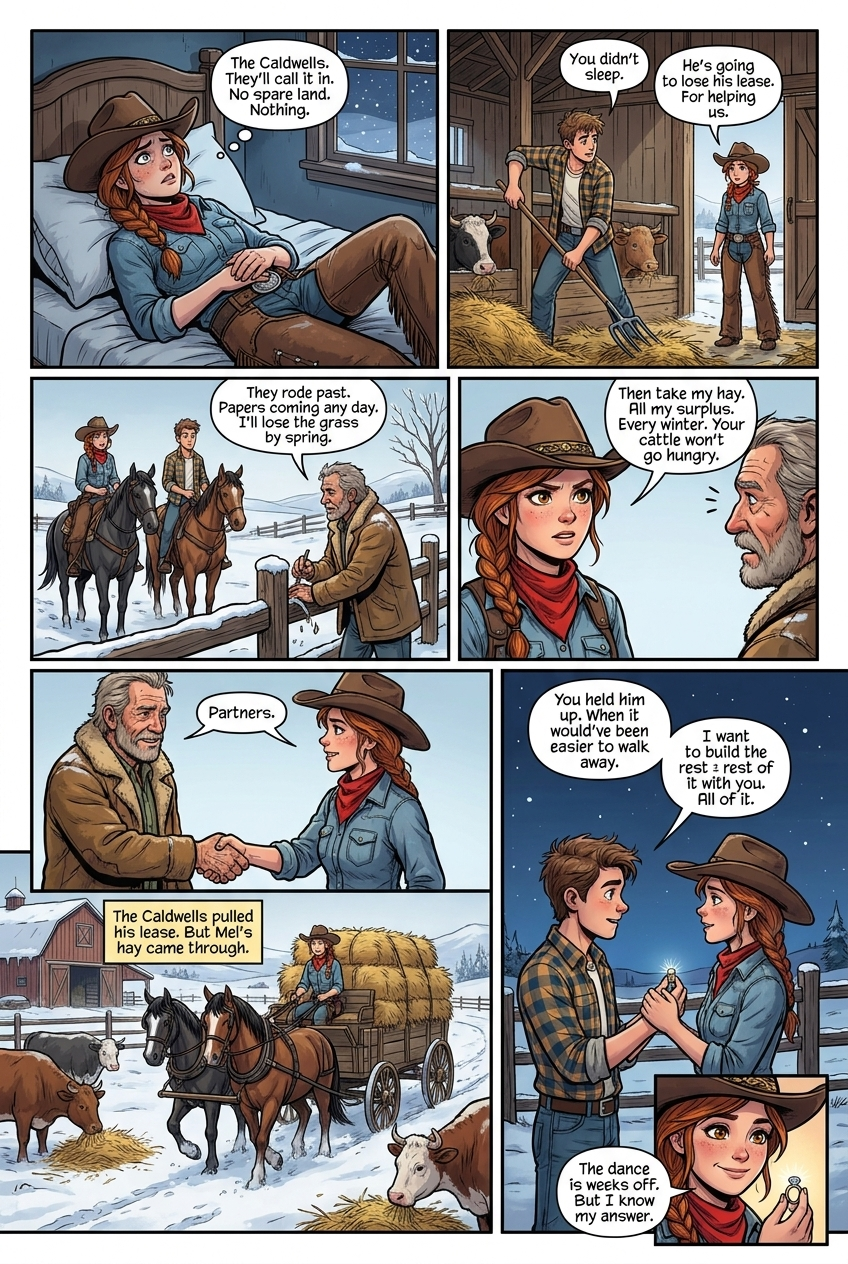
The barn was closed against the snow, but the old rancher's words stayed with Mel through the night. The Caldwells owned the note on his grazing lease. He had helped her, and now they could call it in. She lay awake and counted what she had to offer him. Nothing. No spare land. Her fields grew hay, not grass. She could not feed his cattle if the Caldwells took his grass away. At dawn she found Ted in the new barn, forking feed to the herd. He looked up when she came in. "You didn't sleep," he said. "He's going to lose his lease," Mel said. "For the tin. For helping us. And I've got no way to make it right." Ted set down the fork. He came and stood close. "Your fields cut more hay than your herd needs now. We proved that at the market." He watched her face. "We give him the surplus. Free feed through winter. If they pull his grass, he can still keep his cattle alive." Mel turned the idea over. Hay could travel where grass could not. It was the one thing she had too much of. "It won't stop the Caldwells," she said. "No," Ted said. "But it keeps him standing." They rode out together to the old rancher's place. He was mending fence when they came up. He straightened slow and looked at them without smiling. "They rode past again," he said. "Papers coming any day. I'll lose the grass by spring." Mel got down from her horse. "Then take my hay," she said. "All my surplus. Every winter, as long as I cut more than I need. Your cattle won't go hungry, grass or no grass." The old man stared at her. "That's a lot of hay to give away." "It's not a gift," Mel said. "You saved my herd. I'm saving yours. We're square, and then we're partners." He wiped his hands on his coat. For a long moment he said nothing. Then his mouth bent into something like a grin. "Partners," he said. He stuck out his hand and Mel shook it hard. The Caldwells pulled his lease three days later. The papers came just as he'd said. But Mel's wagon was already rolling, loaded high with hay, cutting a track through the snow to his barn. His cattle ate. He kept every head. That night Ted found Mel at the fence line, watching the last light go. He took her cold hand in both of his. "You held him up," he said. "When it would've been easier to walk away." He pressed something small into her palm. A ring, plain and bright. "I want to build the rest of it with you. All of it." Mel looked at the ring, then at him. The dance was still weeks off. But she already knew her answer.
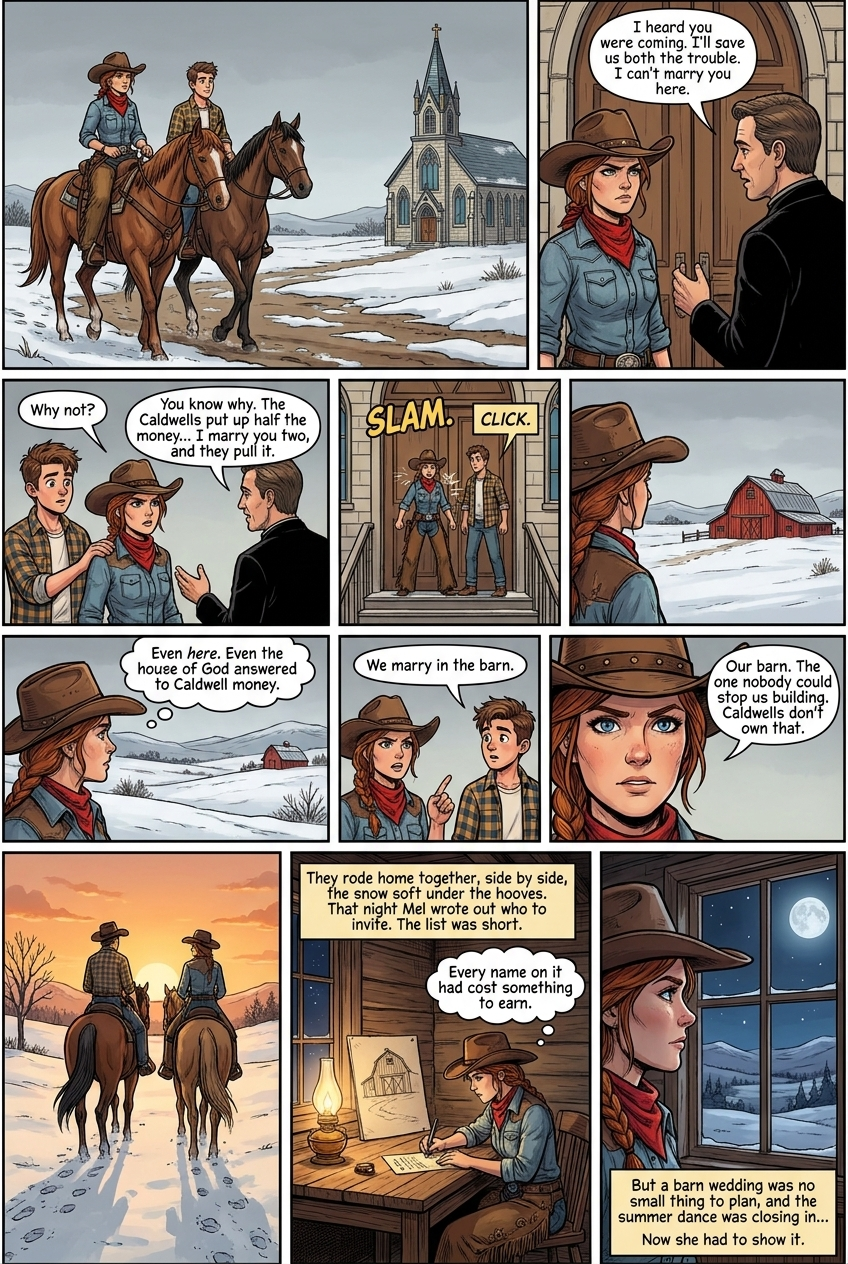
The ring sat on Mel's finger for a week before she let herself think past it. She and Ted were engaged. But engaged folks marry in a church, and the valley had only one. She rode out to see it with Ted at her side, both horses breaking a slow track through the melting snow. The church stood tall against the gray sky. Arched windows caught the light. A steep roof climbed to a spire with a cross on top. Mel had passed it a hundred times. Now she looked at it as a bride. The pastor met them at the door. He wore a black coat and would not meet Mel's eyes. "I heard you were coming," he said. "I'll save us both the trouble. I can't marry you here." Mel's chest went tight. "Why not?" "You know why." His voice dropped. "The Caldwells put up half the money that keeps these doors open. I marry you two, and they pull it. I've got a whole congregation to think of." He stepped back. "I'm sorry. I truly am." The door shut. Mel stood on the steps and heard the bolt slide. Even here. Even the house of God answered to Caldwell money. Ted put his hand on her shoulder. "There are other churches," he said. "A day's ride, maybe two." "No." Mel turned from the door. "I'm not begging a stranger to marry us because the Caldwells own our own pastor. I'm done asking for scraps." Ted studied her. "Then what?" Mel looked past him, across the fields, to the shape of their new barn on the rise. Fresh-cut walls. A roof of salvaged tin. Built by men who chose her side when the whole valley told them not to. "We marry in the barn," she said. Ted's mouth opened. "The barn." "Our barn. The one nobody could stop us building." Her voice steadied as she spoke. "The Caldwells own the church. They don't own that. They pulled every lever they had and it's still standing. So are we." She met his eyes. "I want to marry you where we won." Slow, Ted grinned. "The old rancher will stand up for us," he said. "He'd walk on coals to see it." "Then it's settled." Mel climbed back on her horse. She did not look at the church again. They rode home together, side by side, the snow soft under the hooves. That night Mel wrote out who to invite. The list was short. Every name on it had cost something to earn. But a barn wedding was no small thing to plan, and the summer dance was closing in. Half the valley would gather there under Caldwell eyes. Mel would have to stand up in that crowd and let them all know she was marrying Ted, in her own barn, on her own terms. She was done hiding it. Now she had to show it.
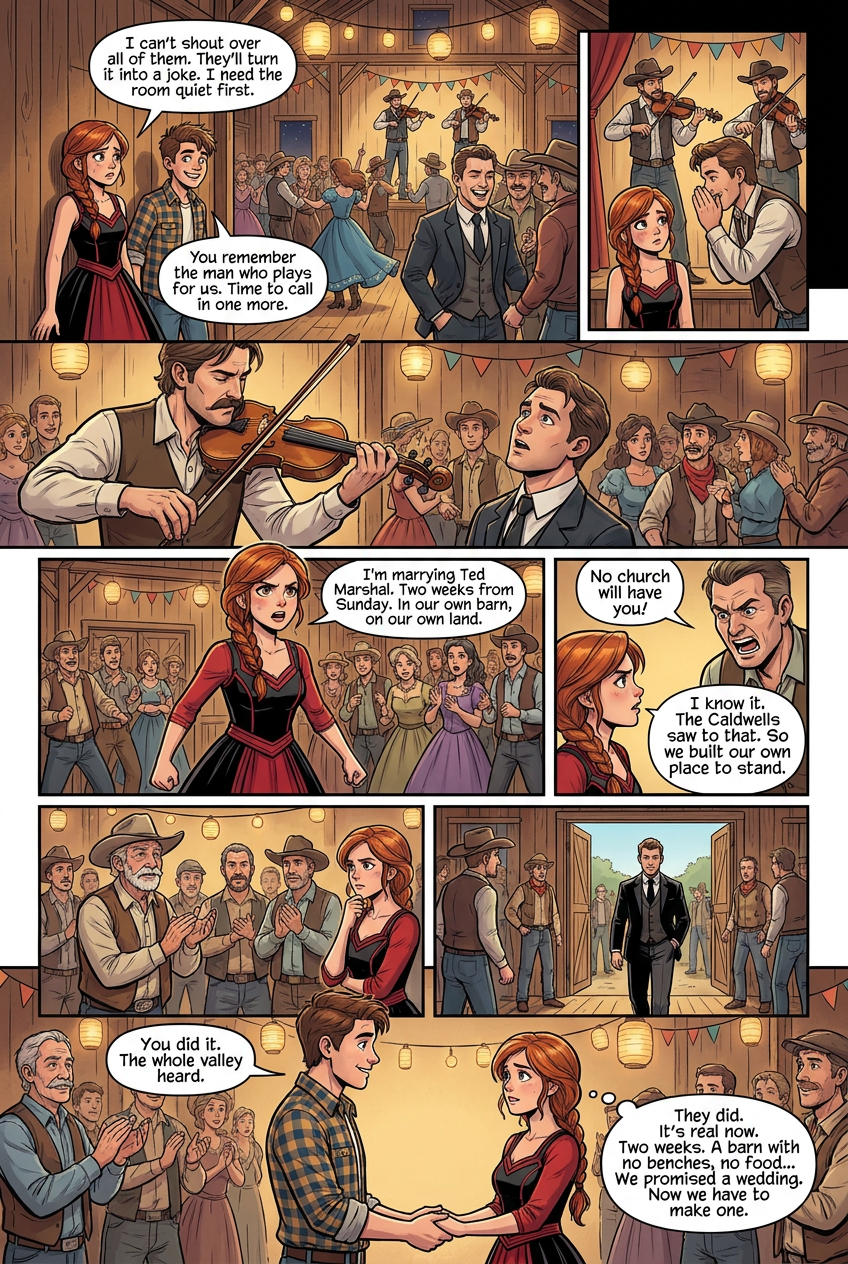
The dance filled the barn near the edge of the valley. Lanterns hung from the rafters. Fiddles sawed a fast tune, and boots stamped the plank floor. Mel stood at the wall in her borrowed red dress, Ted beside her. She had come to speak. But the Caldwell family owned half this room. She saw their heir near the front, ringed by ranch owners who leaned when he spoke. If she opened her mouth in the open, they would drown her out before she reached the crowd. "I can't shout over all of them," Mel said. "They'll turn it into a joke. I need the room quiet first." Ted watched the fiddler a moment. Then he grinned, the same grin he wore when a plan came to him. "You remember the man who plays for us," he said. "I called in a favor from him once, for you. Time to call in one more." He crossed the floor and spoke low in the fiddler's ear. Mel could not hear the words. She saw the man nod. The tune ended. The dancers slowed, breathing hard, waiting for the next song. It did not come. The fiddler set his bow down and pointed his chin at Mel. The silence spread. Heads turned. Even the Caldwell heir looked up from his circle, mouth half open on some word he never finished. Mel's throat went tight. Every eye in the barn found her. She could feel the Caldwells gathering breath to cut her off. So she spoke first, loud and plain. "I'm marrying Ted Marshal," she said. "Two weeks from Sunday. In our own barn, on our own land." A murmur ran the floor. One of the ranch owners near the heir laughed short and mean. "No church will have you," he called. "I know it," Mel said. "The Caldwells saw to that. So we built our own place to stand." She held her chin level. "Every one of you who came when I called is welcome. The rest can stay home." The old rancher who had roofed her barn stepped out from the crowd. He clapped once, then again, slow and hard. Two of the men who raised her walls joined him. The sound grew until it filled the space the fiddle had left. The Caldwell heir turned and walked out the far door. His circle broke apart behind him. Ted reached Mel and took her hand. "You did it," he said. "The whole valley heard." "They did." Mel's heart still pounded. She had said it out loud, in front of everyone, and no one had stopped her. The wedding was real now. It had a date and witnesses. Then the weight of it settled. Two weeks. A barn with no benches, no food set out, no plan past the walls and the roof. She had promised the whole valley a wedding. Now she had to make one.
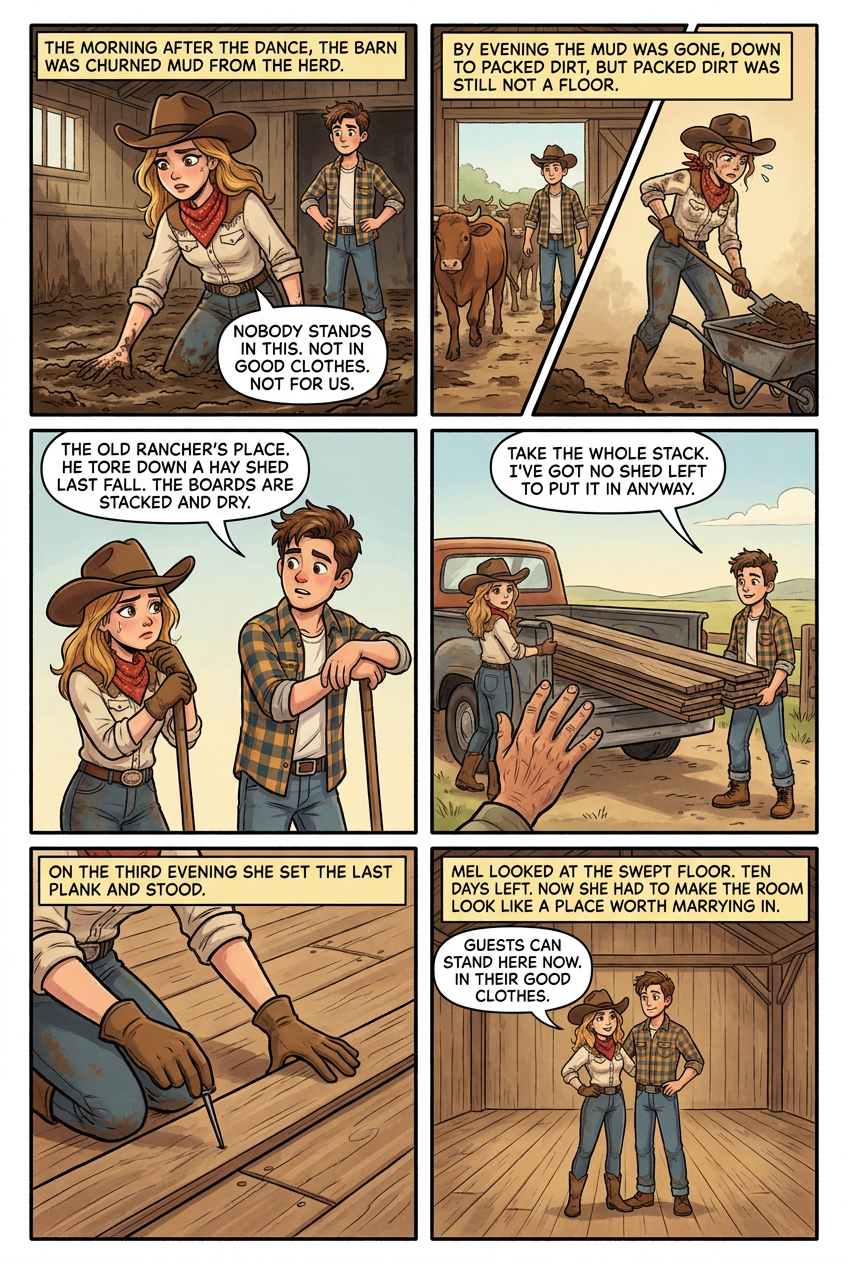
The morning after the dance, Mel walked into her barn and stopped. It smelled of cattle and wet straw. The floor was churned mud from the herd. She had promised the valley a wedding here in two weeks. Now she saw what the promise meant. There was no clean place for a single guest to stand. Ted came in behind her and looked at the same mess. "We move the cattle to my grazing land today," he said. "That's the easy part. The floor is the problem." Mel crouched and pressed her palm into the muck. Her hand sank to the wrist. "Nobody stands in this," she said. "Not in good clothes. Not for us." She wiped her hand on her jeans. "We drive the herd out. Then we dig it clean and lay a floor." They spent the morning pushing cattle down the lane to Ted's land. By noon the barn stood empty. Mel shoveled the soiled top layer into a barrow and hauled load after load out the door. Ted worked the far end. Sweat ran down her back. Her shoulders burned. By evening the mud was gone, down to packed dirt, but packed dirt was still not a floor. "We need planks," Mel said. "A lot of them. And no mill in the valley will sell to us." Ted leaned on his shovel. "The old rancher's place," he said. "He tore down a hay shed last fall. The boards are stacked and dry." Mel remembered the man's slow, hard clap at the dance, the first hands to back her. He had already lost his grazing lease helping her. She hated to ask for more. But she had no one else. They drove out at first light and found him mending fence. He straightened when he saw them, and his weathered face broke into a grin. "You come for lumber," he said, before Mel spoke a word. "I figured you would. A barn with no floor is a poor place to get married." He waved off her thanks. "Take the whole stack. I've got no shed left to put it in anyway." They hauled boards for two days. Ted cut them to length. Mel nailed them down, row after row, until the packed dirt disappeared under solid wood. On the third evening she set the last plank and stood. The floor stretched clean and level, wall to wall. She stamped her boot. It held firm and dry. Ted pulled her against his side. "Guests can stand here now," he said. "In their good clothes." Mel looked at the swept floor and the bare walls above it. Ten days left. The floor was done. But a bare board room was not a wedding. There were no benches to sit on, no tables, no food, nothing to mark the day as anything but an empty barn. She had solved the mud. Now she had to make the room look like a place worth marrying in.
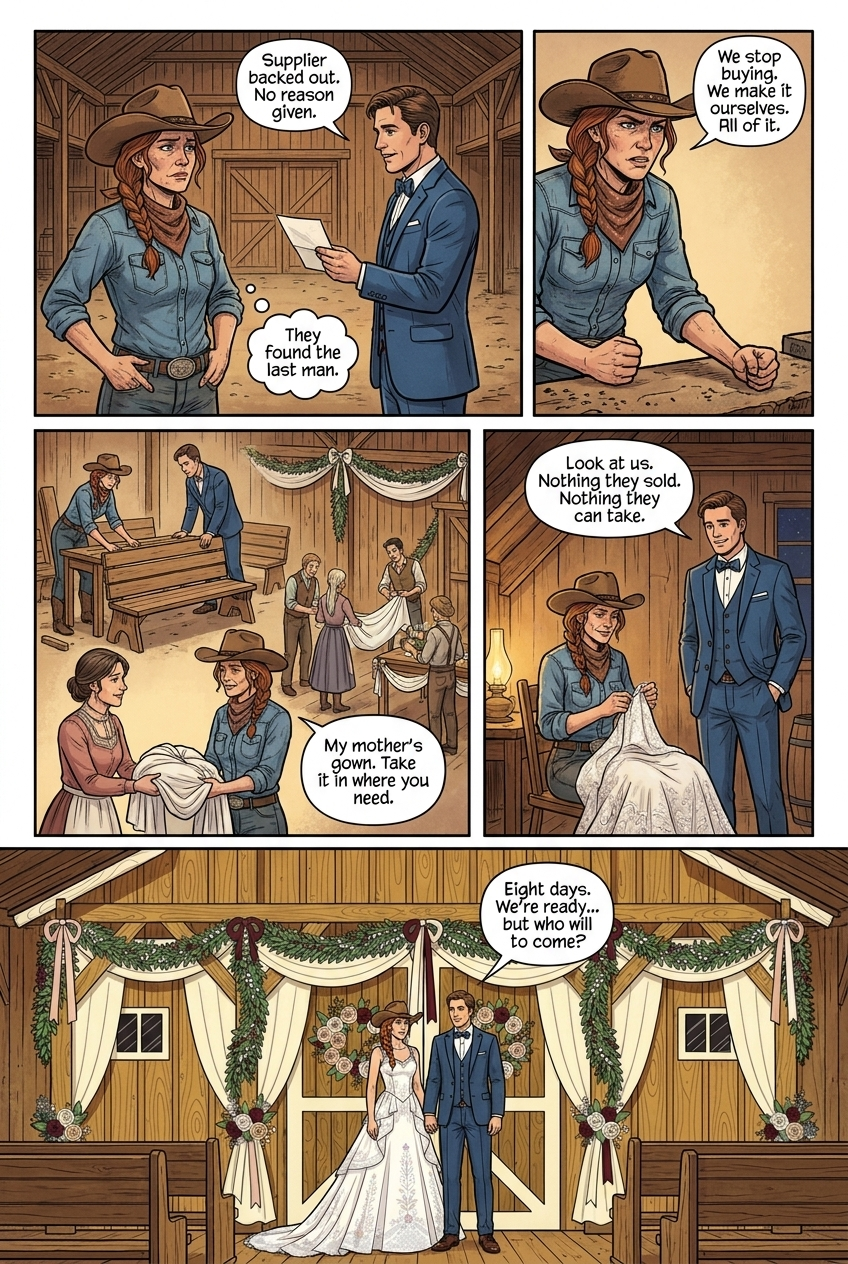
Nine days out, Mel had a floor and bare walls. She had also placed one order she counted on. A supplier two valleys over had promised her benches, cloth, and a wedding dress cut to her measurements. That order would fill the empty barn and put her in a proper gown. Then the letter came. Ted read it first and passed it to her without a word. The supplier backed out. No reason given, but Mel knew the reason. The Caldwells had heard the barn wedding was real. Their reach had stretched two valleys to shut one more door. "They found him," Mel said. "They found the last man who'd sell to us." Ted set his jaw. "We drive out and buy somewhere farther." "With what days?" Mel said. "There's no time to chase another supplier and wait for a dress to be cut." She pressed her fists to the workbench. Every road out led back to Caldwell money. She was done walking their roads. "We stop buying," she said. "We make it ourselves. All of it." They started that hour. Mel and Ted built benches from the old rancher's leftover boards, plank seats on sawhorse legs, rough but solid. Word spread among the folks who'd clapped for her at the dance. A woman brought bolts of cloth. Two families sent wreaths of greenery and roses. Mel hung garlands across the barn doors and draped the cloth in soft folds down the front. By the fourth evening the plain board room looked festive, warm, ready. But she still had no dress. A woman who had backed her carried in a bundle wrapped in a sheet. "My mother's," she said. "Been in a trunk thirty years. Take it in where you need." Mel unwrapped it and stopped breathing. A wedding gown, ivory, layered lace and delicate flowers stitched through the skirt. It needed taking in at the waist, nothing more. Mel worked the seams by lamplight two nights running. When she pinned the last dart and slipped it on, it fit her like it was made for her. She turned once in the swept barn, and the layers moved with her. Ted watched from the doorway, holding his own outfit over one arm. He had traded a week's fence work for it, a tailored blue jacket and vest, crisp shirt, shined shoes. "Look at us," he said. "Nothing they sold. Nothing they can take." Mel looked at the dressed barn, the benches, the gown on her body. The Caldwells had cut the last supplier, and it had cost her nothing but sweat. She had stopped buying her wedding and started building it. "Eight days," she said. "We're ready." Then she caught herself. Ready to marry, yes. But the whole valley was invited, and half of it still answered to the Caldwells. She had a wedding now. She did not yet know who would dare come.
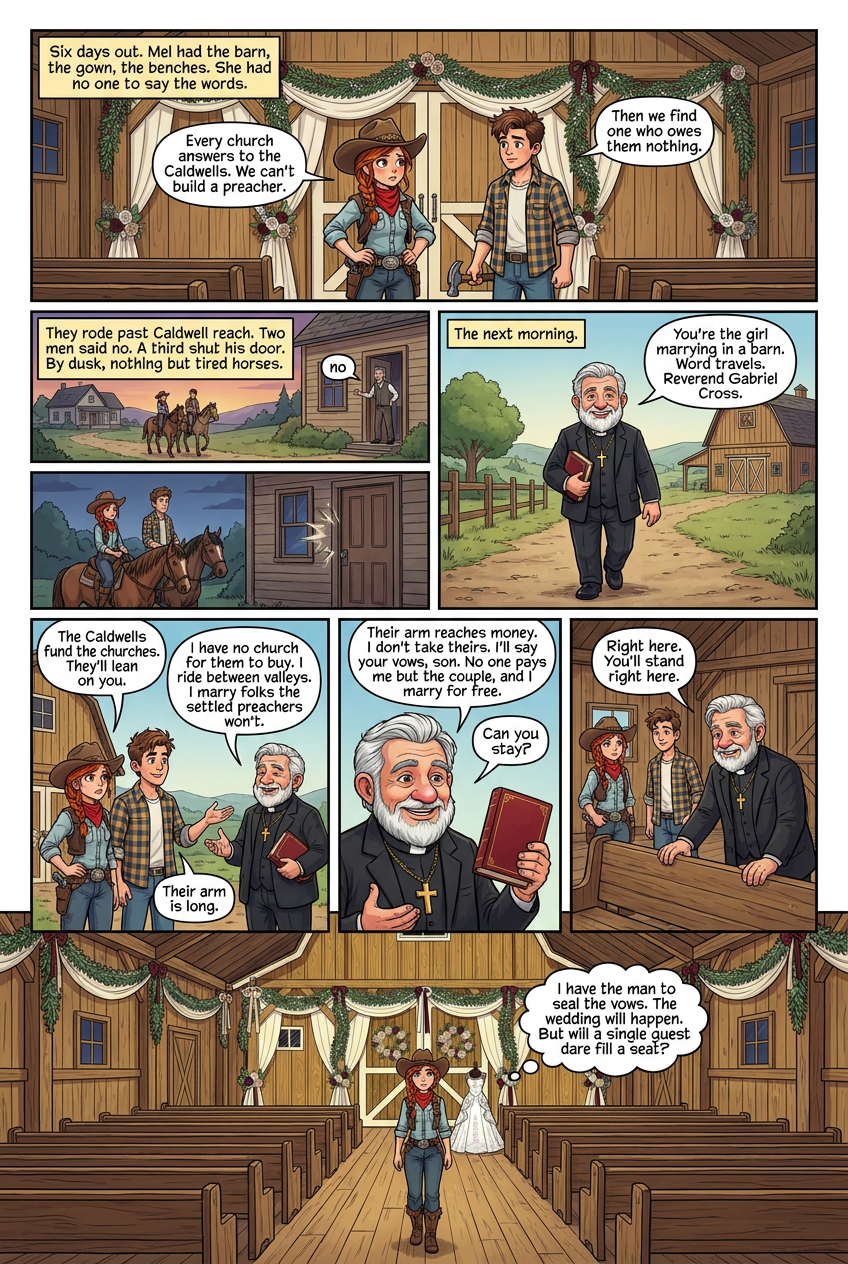
Six days out, Mel had a dressed barn, a gown, and benches. She had no one to say the words. The valley pastor had already refused her, because the Caldwells funded his church. Without someone to lead the vows, the wedding was just two people standing in a decorated room. Ted found her staring at the empty spot where the pastor should stand. "Every church in the valley answers to them," she said. "We built everything else. We can't build a preacher." Ted set down his hammer. "Then we find one who owes them nothing." They rode out that afternoon, past the edge of Caldwell reach, asking farmhouses and crossroads. Two men said no before Mel finished asking. A third shut his door. By dusk they had nothing but tired horses. The next morning a stranger came up the lane on foot. He was old, round, with a white beard and a worn suit. He carried a red Bible under one arm and smiled like he already knew her. "You're the girl marrying in a barn," he said. "Word travels. Reverend Gabriel Cross." Mel didn't trust the smile. "The Caldwells fund the churches here," she said. "They'll lean on you the way they leaned on the last man." Cross laughed, a real laugh from the belly. "I have no church for them to buy. I ride between valleys. I marry folks the settled preachers won't." He looked at the dressed barn doors, the garlands, the roses. "I married a couple in a hayfield once. This is a palace next to that." Ted stepped up beside her. "They cut our supplier two valleys over. Their arm is long." "Their arm reaches money," Cross said. "I don't take theirs. Never have." He held out the Bible like proof. "I'll say your vows, son. No one pays me but the couple, and I marry for free." Mel searched his face for the catch. She had learned to expect one. But the man just waited, patient, hat in hand. She thought of the pastor who'd turned his back, of every door slammed the day before. Here was one that stayed open. "Six days," she said. "Can you stay?" "I've slept in worse than a finished barn," Cross said. They walked him inside. He ran a hand along a scrap-wood bench, tested it with his weight, nodded. He stood where the couple would stand and looked down the rows of empty seats. "Right here," he said. "You'll stand right here." Mel let out a breath she'd held for weeks. She had the gown, the benches, the barn. Now she had the man to seal the vows. The wedding would happen. Nothing the Caldwells owned could stop the words from being said. Then she looked at the long rows of benches, every one of them empty. She had someone to marry them. She still didn't know if a single guest would dare fill a seat.
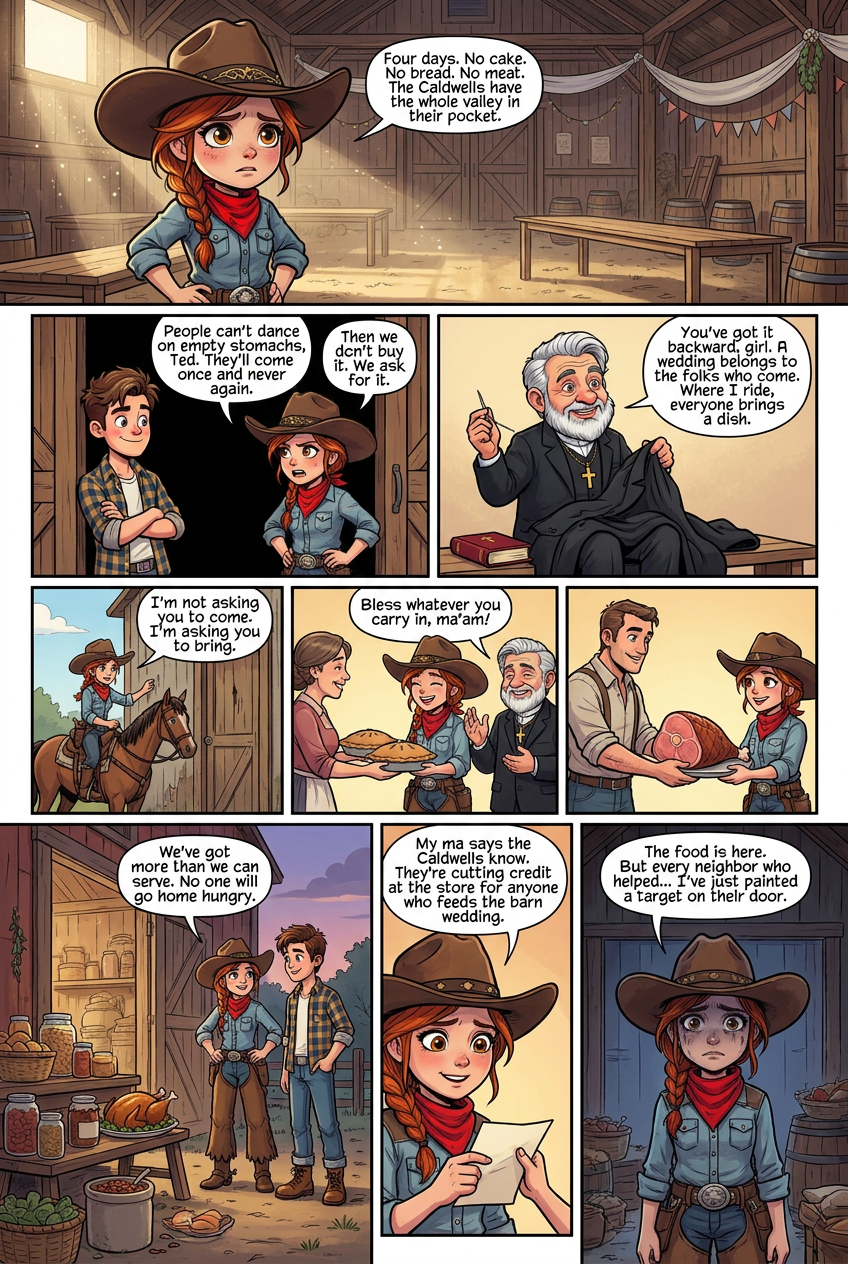
The preacher was set. The barn was dressed. But four days out, Mel counted her food and went cold. She had a wedding and nothing to feed it. No cake, no bread, no meat for the tables. The store wouldn't sell to her. The mill wouldn't grind for her. Every shop in the valley took Caldwell money. "People can't dance on empty stomachs," she told Ted. "They'll come once and never again." Ted leaned on the doorframe. "Then we don't buy it. We ask for it." Mel shook her head. "I've asked too much already. The old rancher lost his lease for me. I won't beg the rest." She had spent months proving she could stand alone. Now the wedding would starve. Reverend Cross had heard the whole thing from the bench where he sat mending his coat. He set down the needle. "You've got it backward, girl," he said. "A wedding isn't yours to feed. It belongs to the folks who come." He tapped his red Bible. "Where I ride, the bride never cooks. Everyone brings a dish. That's the whole point." Mel frowned. "A potluck." The word felt small against everything the Caldwells had thrown at her. But she thought of the market day, when one old man's coin had unlocked a crowd. Maybe food worked the same way. Maybe folks who wouldn't sit in fear would still cook a pot. She rode out that afternoon and knocked on doors instead of shops. She didn't ask them to come. She asked them to bring. A woman who'd loaned cloth promised two pies. A man who'd raised a barn wall offered a smoked ham. Cross rode beside her part of the way, laughing his belly laugh, telling each house he'd bless whatever they carried in. By the third day her yard filled with jars and baskets. Bread wrapped in towels. A crock of beans. Someone left a whole roasted bird on the bench without a note. The store had shut its door, but the valley opened its kitchens. The Caldwells could buy the shops. They couldn't buy every stove. Ted found her at dusk counting the food, this time smiling. "We've got more than we can serve," she said. The tables would groan. No one would go home hungry. Then a girl brought word from her mother, who worked the Caldwell kitchen. The family knew now. They were spreading it that folks who fed the barn wedding would find their own credit cut at the store. Mel stood over the crowded bench and felt the fear settle back in. The food was here. But every neighbor who'd cooked it had just painted a target on their door, and she'd be the reason the Caldwells came knocking next.
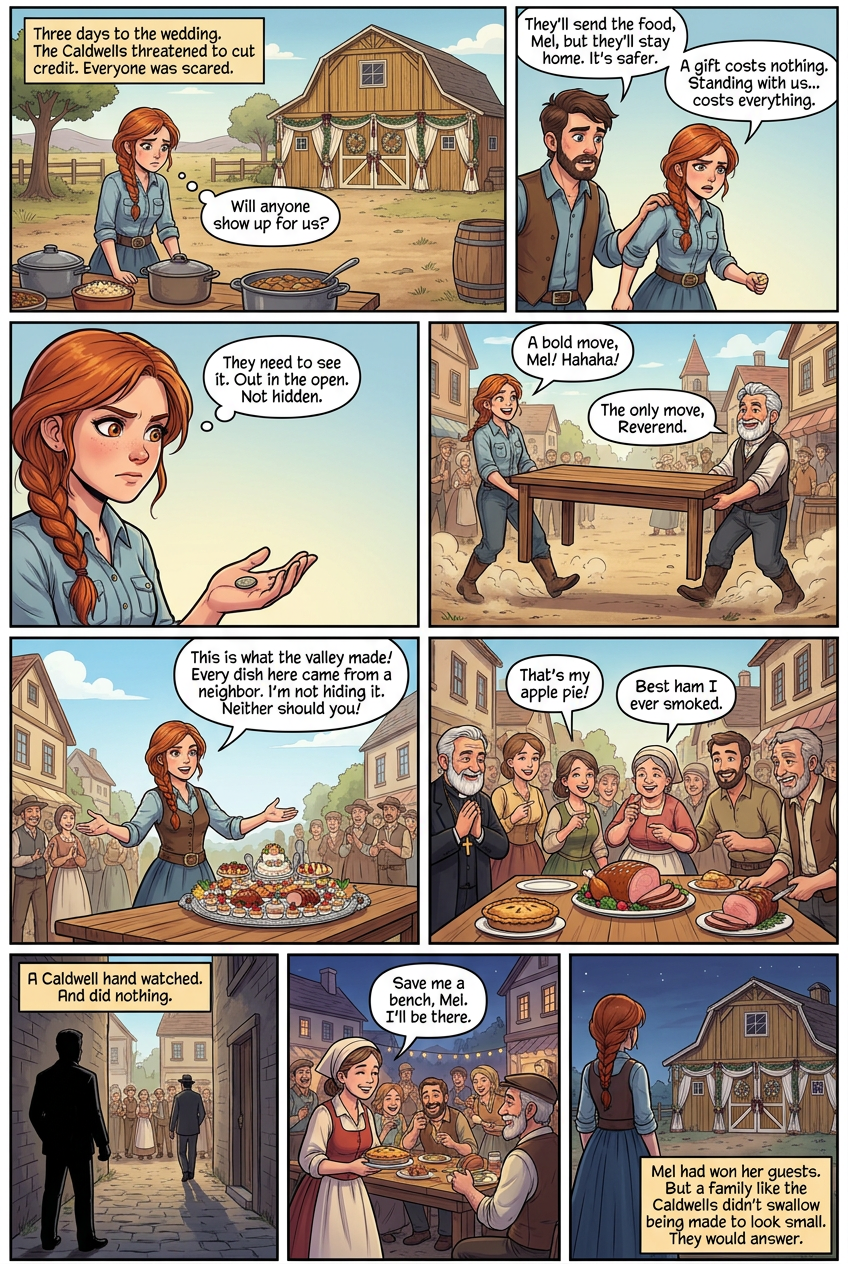
The food sat ready in Mel's yard, but the fear sat heavier. The Caldwells had promised to cut credit at their store for anyone who fed the barn wedding. Every neighbor who'd cooked a pot now had a reason to stay home. Mel counted her supporters and heard them wavering. Three days out, she pictured the worst: the ham and pies carried in, the aisle set, and no one on the benches. She'd stand up before an empty barn and marry Ted with no one to see it. Ted found her pacing. "They're scared," she said. "They'll send the food and skip the wedding. That's what I'd do." A gift left on a bench cost nothing. Sitting in a chair, in daylight, where a Caldwell man could count faces, cost everything. Mel needed to show her people that standing with her was safe. Not with words. With something they could see. She thought of the market again, how one old man's coin had broken the fear open. Folks followed folks who acted first. So she made the food public before the wedding. She hauled a long wooden table into the church square where the whole valley passed. Reverend Cross helped her carry it, laughing his belly laugh. On its broad top she laid out everything the neighbors had sent. Pies and bread. The smoked ham, sliced. The roasted bird set at the center like a crown. She built a spread that looked festive, refined, a wedding feast anyone would be proud to sit at. Then she stood beside it in plain daylight, where any Caldwell hand could see her face. "This is what the valley made," she called to the folks slowing to look. "Every dish here came from a neighbor. I'm not hiding it. Neither should you." A crowd gathered. Cross moved through it, blessing plates, naming the cooks out loud. The woman who'd brought the pies flushed and did not deny it. The man who'd sent the ham stepped up beside his work. Once one name was spoken with pride, the next came easier. The Caldwells had made helping Mel a secret shame. Mel had just made it a public honor. A Caldwell hand stood at the edge, counting faces the way she'd feared. But now the faces stood in the open, laughing, claiming their dishes. Cutting credit on this many, in front of this many, would look like cruelty, not power. The hand wrote nothing down. He turned and left. By dusk the wavering had stopped. Neighbors told her they'd come and sit. Not just send. Sit. "Save me a bench," the pie woman said. Mel had won her guests. The barn would be full. But she'd done it by daring the Caldwells in their own square, in front of everyone. She'd made them look weak, and the wedding was still two days off. A family like that did not swallow being made to look small. They would answer before she reached the altar.
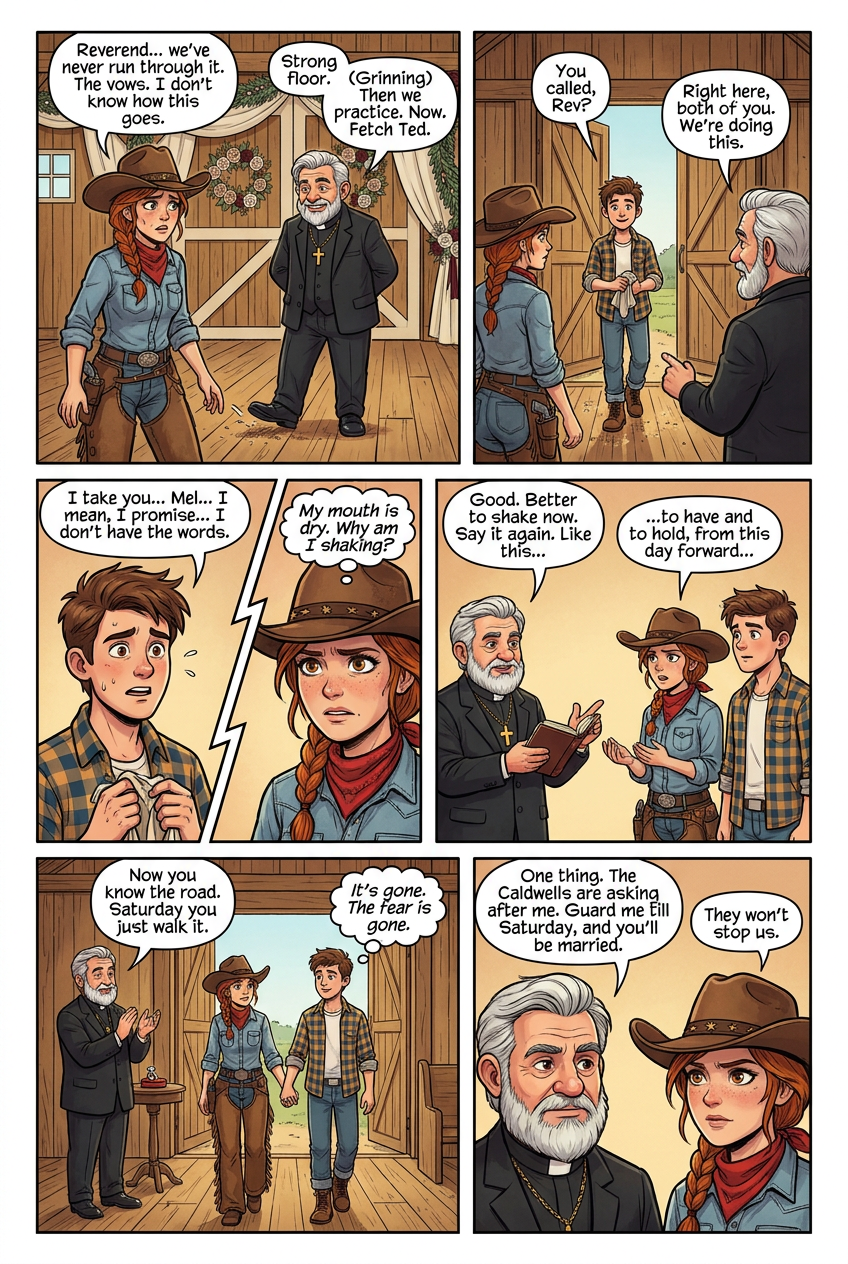
The guests were coming. The food was set. But two days before the wedding, Mel realized she and Ted had never once spoken their vows out loud. They had planned everything but the ceremony itself. She pictured the barn full and the two of them frozen at the front, not knowing when to speak or where to stand. All that work, and the wedding could still fall apart at the altar. Mel went to find Reverend Cross. He was in the barn, walking the wooden floor, testing each board with his boot. The stout old preacher looked up and grinned into his white beard. "Strong floor," he said. "It'll hold a lot of dancing." He had shown up on foot when every local pastor turned them away, and he asked for nothing. Mel trusted him more than any man the Caldwells paid. "We've never run through it," Mel said. "The vows. Any of it. I don't know how a wedding even goes." Cross set his worn red Bible on a bench. "Then we practice. Right now. Fetch Ted." Ted came in from the yard, wiping sawdust off his hands. Mel took her place beside him. Cross showed them where to stand, how far apart, when to face each other. He spoke his part slow so they could learn the shape of it. "Now you say yours," Cross told them. Ted went first. He looked at Mel and stumbled. "I take you... Mel... I mean, I promise..." He stopped. "I don't have the words down." "Neither do I," Mel said. Her mouth had gone dry. She had faced down a Caldwell hand in the square without shaking, but standing here, promising herself to Ted out loud, her voice would not hold steady. "Good," Cross said. "Better to shake now than Saturday." He made them do it again. And again. He fed them plain words to say and had them repeat each one until it came easy. Ted found his footing first. By the fourth try, Mel spoke her promise clean, without a break. They walked the whole ceremony end to end. The entrance, the vows, the ring, the last words that would make them married. Cross clapped once when they finished. "Now you know the road. Saturday you just walk it." Mel breathed out. The fear of the empty, fumbling altar was gone. They knew where to stand and what to say. The ceremony would hold. Cross gathered his Bible and grew quiet. "One thing," he said. "A traveling man hears news on the road. The Caldwells have been asking after me. Where I sleep. How long I mean to stay." He looked at Mel. "They can't stop the words. But they can try to move the man who says them. Guard me till Saturday, and you'll be married."
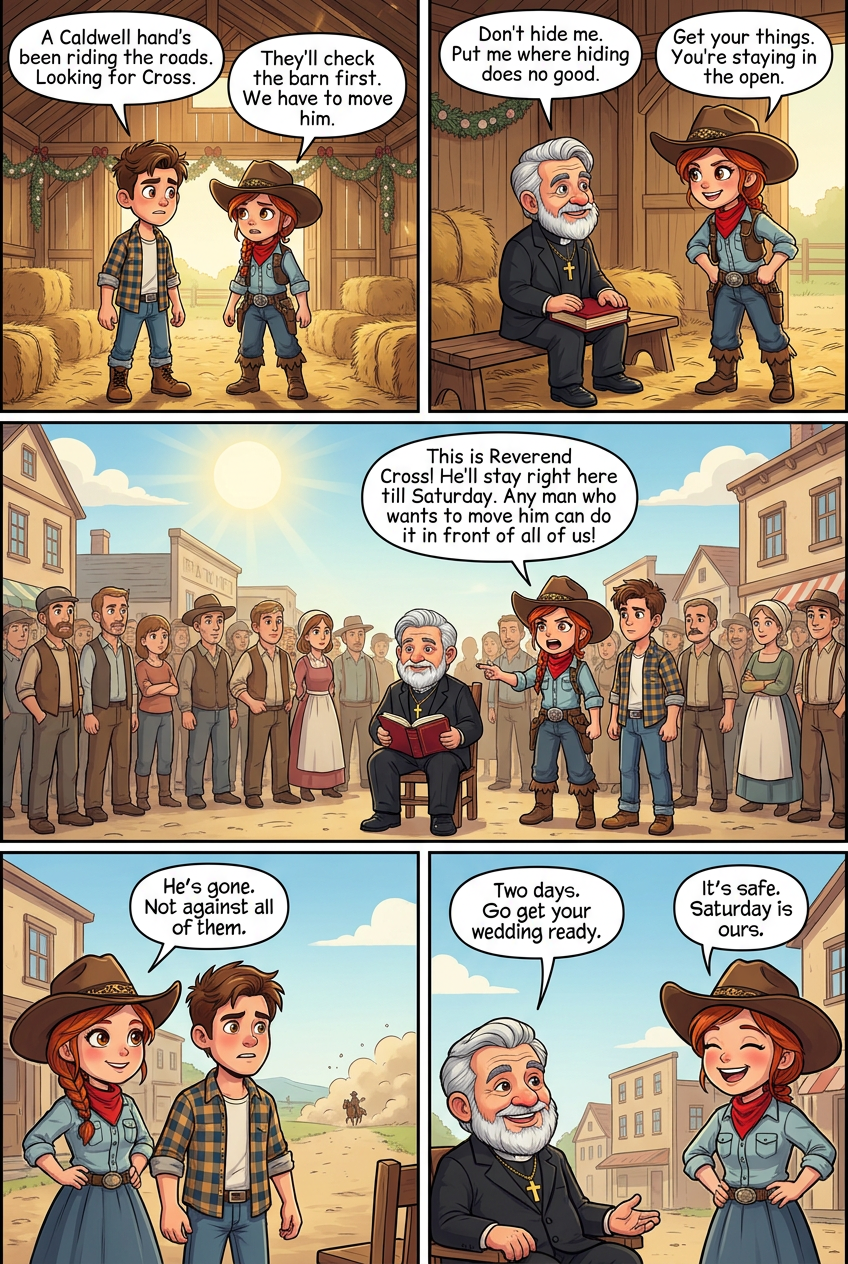
Cross's warning stayed with Mel all night. The wedding was two days off. A traveling preacher was the one thing the Caldwells could still take. If they moved him out before Saturday, there would be no ceremony. She woke before dawn and rode to the barn to check on him. Ted met her at the door, tight-jawed. "A Caldwell hand's been riding the roads," he said. "Slow. Looking at every place a man could sleep." Mel found Cross inside, seated on a bench, his red Bible open on his knee. He looked up and smiled into his white beard as if nothing was wrong. "You've got worry on your face," he said. "I've outrun worse men than a hired rider." "He'll find you here," Mel said. "This barn is the first place they'll look. It's got my name on it." She thought fast. Hiding him would only work until the rider knocked on the right door. She needed him somewhere the Caldwells could not touch without touching the whole valley. "Then don't hide me," Cross said, reading her. "Put me where hiding does no good." Mel understood. She had beaten the Caldwells once already by making support too public to punish. She would do it again. "Get your things," she said. "You're staying in the open." They rode to the church square, where neighbors already gathered for the morning. Mel helped Cross down and walked him to the center, where everyone could see. She raised her voice. "This is Reverend Cross," she called. "He came on foot to marry Ted and me. He'll stay right here till Saturday. Any man who wants to move him can do it in front of all of you." Heads turned. The neighbors who had brought food, who had stood by her before, gathered close around the old preacher. One woman set a chair for him. A man brought a jug of water. Cross took the chair and opened his Bible, calm as a Sunday. The Caldwell hand came within the hour. Mel saw him rein up at the edge of the square. He looked at Cross, then at the ring of neighbors standing shoulder to shoulder. He counted the faces the way a man counts a debt he cannot pay. He said nothing. He turned his horse and rode off. Ted let out his breath. "He won't be back," he said. "Not against all of them." Mel watched the rider shrink down the road. The preacher was safe. The last man the Caldwells could steal now sat guarded by half the valley. Saturday would come, and the words would be spoken. Cross closed his Bible and looked at her. "Two days," he said. "You've kept your preacher. Now go get your wedding ready. A barn full of people won't decorate itself." Mel laughed for the first time in days. The ceremony was safe. All that stood between her and Ted now was Saturday itself.
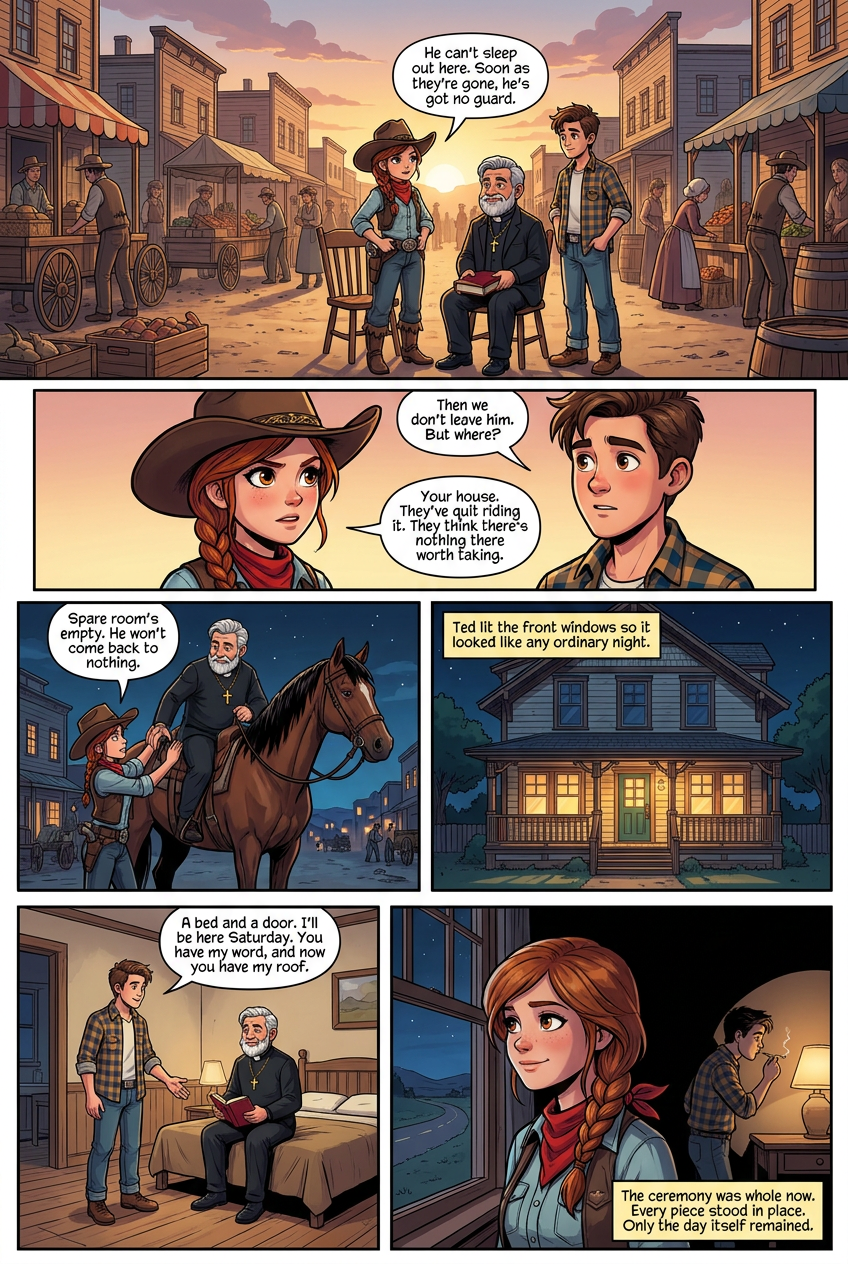
The preacher was safe in the square, but the light was fading. Mel stood beside the chair where Cross sat with his Bible, and she saw the problem the day had hidden. The neighbors were packing up their carts. A woman gathered her jars. A man hitched his mule. When the square emptied for the night, Cross would sit alone. One rider could take him in the dark, and no one would see it done. "He can't sleep out here," Mel said. Ted came up beside her, watching the same carts roll off. "Soon as they're gone, he's got no guard." "Then we don't leave him," Ted said. "But where? Every roof in this valley has a Caldwell string on it." Mel thought of the barn. It carried her name, and the Caldwells knew every board of it. The first place they'd ride. Then she thought of the one house they'd stopped watching. Ted's own place, past the dance ground, with its wide porch and lit windows. The Caldwells believed she and Ted lived there together now. They had no reason to search a home they thought held only the couple they'd already lost. "Your house," Mel said. "They've quit riding it. They think there's nothing there worth taking." Ted nodded slow. "Spare room's empty. He rode there once before, that hand. Found nothing. He won't come back to nothing." Cross had been listening. He closed the red Bible. "A bed and a door," he said. "I've slept in worse and preached the next morning." They waited until the last cart left. Then Mel walked Cross to Ted's horse and helped him up behind the saddle. They rode the back way, off the main road, keeping to the low ground where no rider watched. The house sat quiet, its porch rails throwing long shadows. Ted lit the front windows so it looked like any ordinary night. A courting couple, home. Nothing more. Inside, Ted showed Cross the spare room, the same one Mel had slept in months back. Cross set his Bible on the sill and sat on the bed. "I'll be here Saturday," he said. "You have my word, and now you have my roof." Mel stood in the doorway. For two days she had feared the Caldwells would steal the one man who could marry her. Now he slept behind a door they had stopped watching, in the one house in the valley their eyes had passed over. She had beaten them again, not with a crowd this time, but with a lie they told themselves. Ted banked the fire and blew out the lamp. "He's ours till Saturday," he said. "Nothing left for them to reach." Mel looked out at the dark road. Empty. She let herself breathe. The ceremony was whole now. Every piece stood in place. Only the day itself remained.
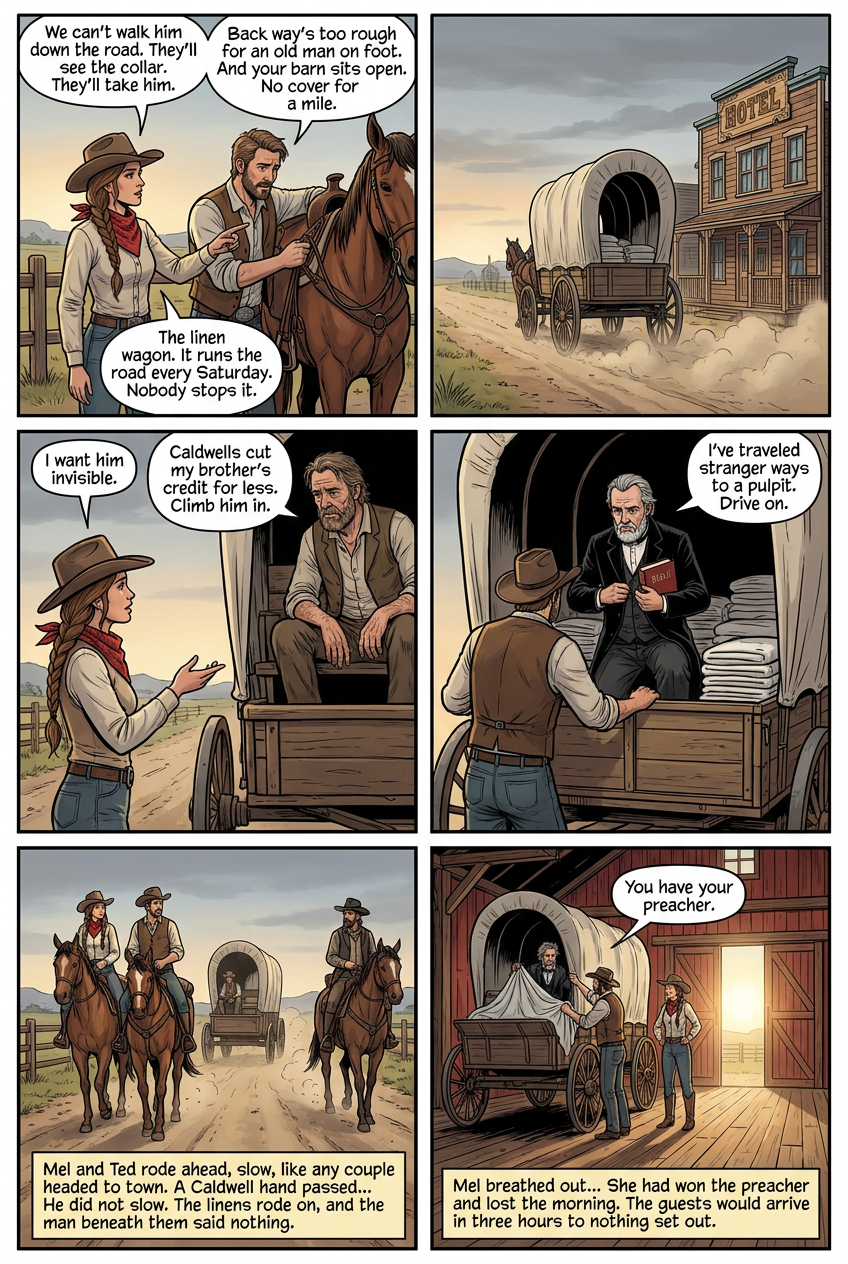
Cross was safe at Ted's house, but Saturday brought a new problem. The wedding was at the barn, past the dance ground on Mel's land. Cross had to get there. Between the house and the barn ran the main road, and the Caldwell hands rode it every morning. One glimpse of the traveling preacher, and they would know where to strike. Mel found Ted saddling the brown horse before dawn. "We can't walk him down the road," she said. "They'll see the collar. They'll take him." Ted tightened the cinch. "Back way's too rough for an old man on foot. And your barn sits open. No cover for a mile." Mel looked at the road, gray in the early light. A wagon rolled toward the valley, wheels creaking. She knew that wagon. It carried linens to the old hotel with the false front and the shaded windows, every Saturday, same hour. The driver had eaten at her wedding table in the church square. He had stood with her. "The linen wagon," Mel said. "It runs the road every Saturday. Nobody stops it. Nobody looks twice." Ted followed her eyes. "You want to hide a preacher under bedsheets." "I want him invisible." Mel was already moving. She caught the driver at the fence line. He reined up when he saw her. She asked him plain, the way Cross had taught her to ask for the potluck. Not begging. Just naming the need. The driver looked back at the piled sheets. "Caldwells cut my brother's credit for less," he said. Then he spat in the dust. "My brother's a coward. Climb him in." They brought Cross out the back door, still buttoning his coat, red Bible under his arm. Ted helped him up into the wagon bed. The driver heaped folded linens over him until only a small gap remained for air. Cross's voice came muffled from the pile. "I've traveled stranger ways to a pulpit," he said. "Drive on." Mel and Ted rode ahead on the brown horse, slow, like any couple headed to town. Behind them the wagon creaked along the main road. A Caldwell hand passed going the other way. He nodded at the driver. He did not slow. The linens rode on, and the man beneath them said nothing. At the barn, the driver turned off the road and pulled the wagon behind the tin wall. Ted lifted the sheets away. Cross sat up, hair mussed, and swung down onto his own feet. He stood on the wooden floor where Mel would say her vows in three hours. "You have your preacher," the driver said, and climbed back to his seat. Mel breathed out. Every piece of the wedding stood inside these walls now. The dress, the food, the guests, the man to marry them. The Caldwells had watched the wrong road. Then she looked at Cross's coat, gray with wagon dust, and at the bare barn behind him. The guests would arrive in three hours to nothing set out. No benches placed. No cloth hung. She had won the preacher and lost the morning.
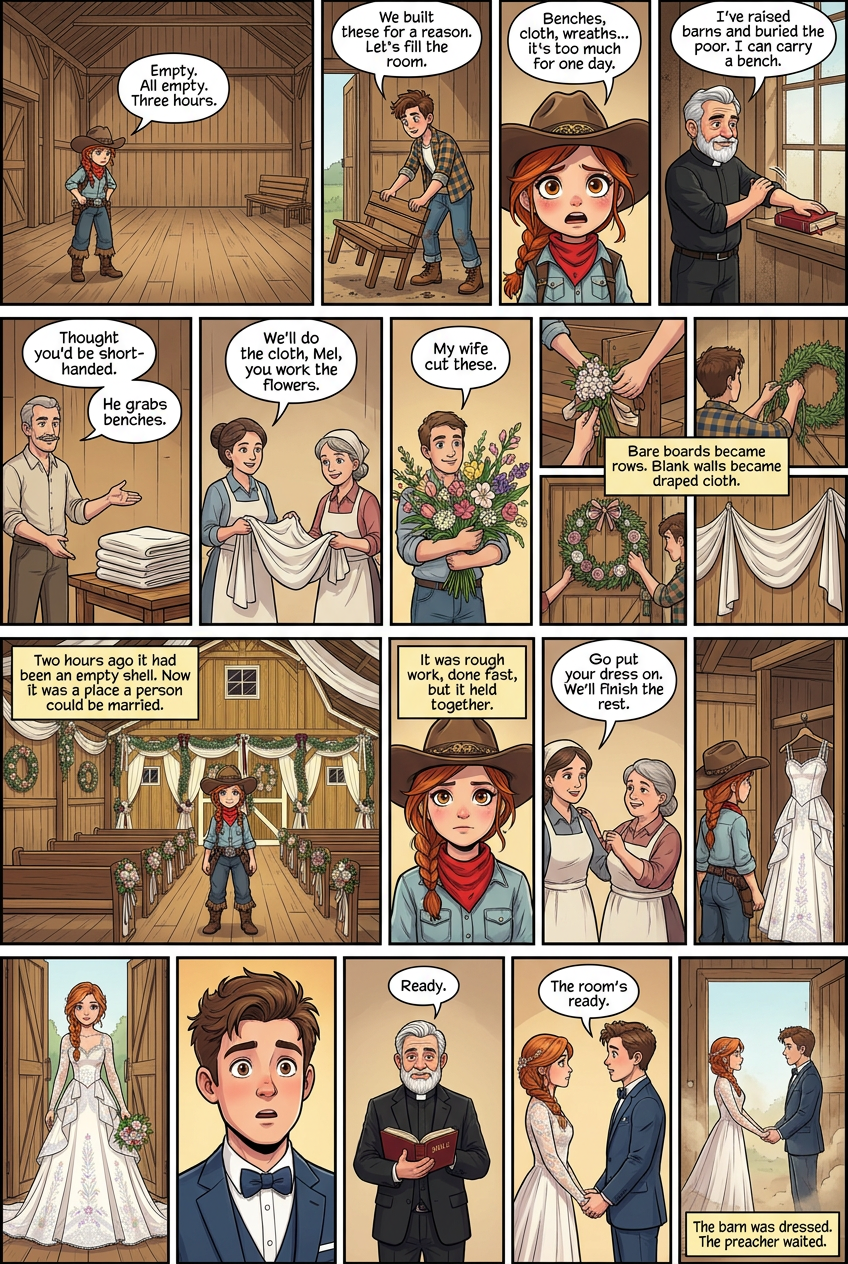
Cross stood safe on the wooden floor, but the barn behind him was empty. No benches. No cloth on the walls. Guests would arrive in three hours to bare boards. Mel had won her preacher and lost the whole morning of setup. Ted set the stacked benches by the door. "We built these for a reason," he said. "Let's fill the room." Mel counted the work in her head. Benches to place. Cloth to hang. Wreaths to tie on the doors. Alone, it would take a day. She had three hours. Then she looked at Cross, still brushing wagon dust from his coat. "I've raised barns and buried the poor," Cross said. He set his red Bible on a windowsill and rolled up his sleeves. "I can carry a bench." That broke the panic loose. Mel gave orders fast. Ted hauled benches two at a time and set them in rows facing the front. Mel climbed a ladder and hung the borrowed cloth along the three walls, tacking it so the folds fell clean. Cross tied greenery over the doors, his knots slow but tight. Half an hour in, the linen driver came back. He had unloaded at the hotel and turned his wagon around. "Thought you'd be short-handed," he said. He climbed down and started shifting benches without asking. Then two neighbor women arrived early, aprons on, and took over the cloth so Mel could work the flowers. More hands came. A man who had built the barn walls carried in an armful of spring blooms his wife had cut. They tied clusters to the bench ends. Someone hung a wreath of white and red roses on each door. The room changed. Bare boards became rows. Blank walls became draped cloth. The barn started to look like a place a person could be married. Mel stepped back near the door and looked. Two hours ago it had been an empty shell. Now the benches sat straight. The cloth hung soft. The doors wore their wreaths. It was rough work, done fast, but it held together. "Go put your dress on," one of the women said. "We'll finish the rest." Mel found the gown where she had hung it, all flowing layers and pale lace. She changed in the corner stall while the last benches slid into place. When she came out, Ted stood by the front in his blue jacket and vest, hair combed, boots clean. He looked at her and forgot to speak. Cross took his spot at the head of the room and picked up his Bible. Through the open doors, dust rose on the road. The first wagon of guests was coming. "The room's ready," Ted said. He took her hand. Mel breathed. The barn was dressed. The preacher waited. But the Caldwells knew this day too, and the guests rolling in now would watch to see if anyone dared stop it.
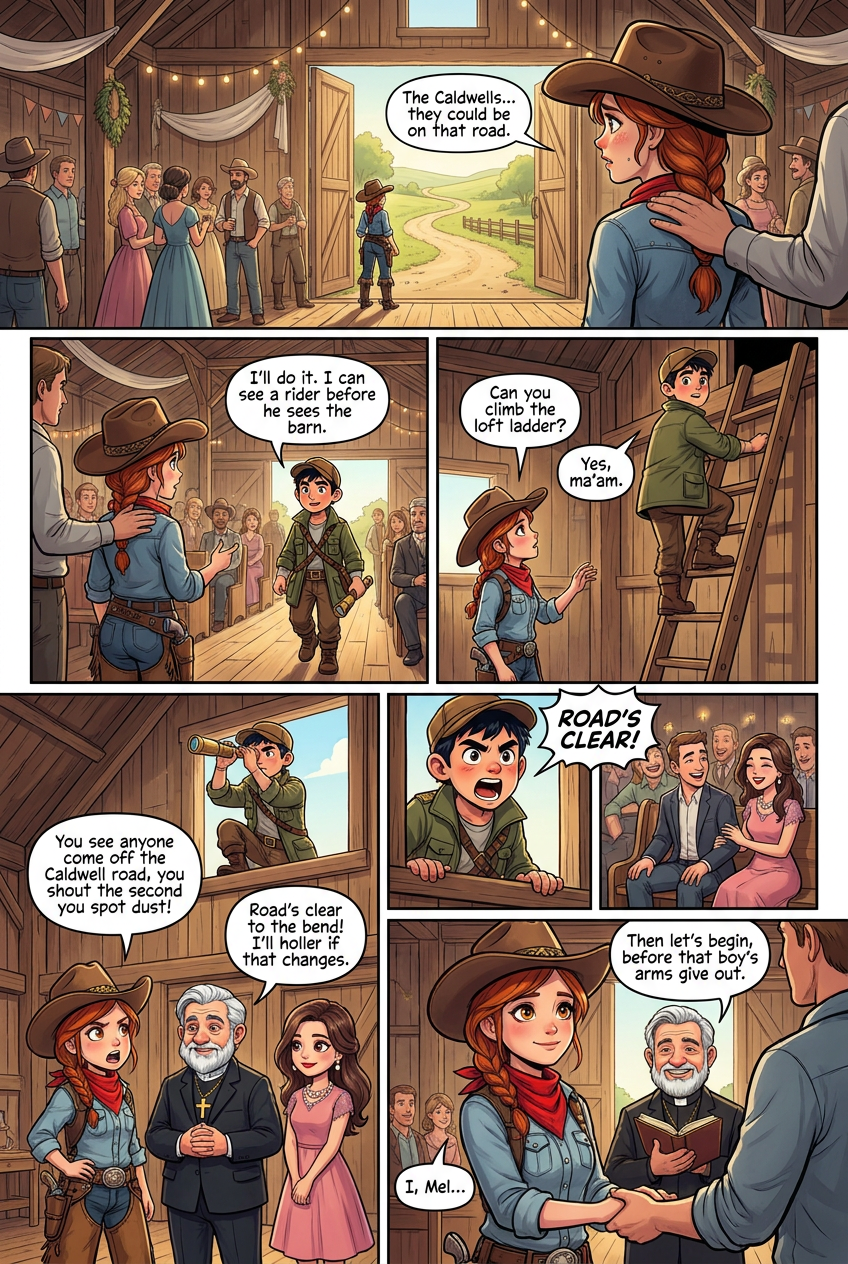
The barn was ready, but Mel's eyes kept drifting to the open doors. Wagons rolled up the road one by one. Any of them could carry a Caldwell rider. No one watched the road but the guests themselves, and by the time anyone saw trouble, it would already be inside. Mel stood in her gown and knew the ceremony had a hole in it wide enough to ride through. "We need eyes on the road," she told Ted. "Someone up high, before we start. If a Caldwell hand comes, I want to know while he's still far off." Ted frowned. "Every man here is a guest. We pull one to stand watch, we're short a witness." A boy near the door spoke up. Garrett Hawkins was maybe twelve, dressed in a worn field jacket, a brass spyglass shoved through his belt. He'd come with one of the neighbor families. "I'll do it," he said. He pulled the spyglass free and held it up like it settled the matter. "I watch the pass for my pa's cattle. I can see a rider before he sees the barn." Mel looked at Ted. A grown man could be missed at the vows. A boy would not. "Can you climb the loft ladder?" she asked. Garrett was already moving. He scrambled up the ladder to the loft window, braced his elbows on the sill, and put the glass to his eye. "Road's clear to the bend," he called down. "I'll holler if that changes." Cross watched from the front, red Bible in hand. "A good sentry," he said. "Nobody hurries a man who knows he's seen." Celeste Winters, one of the wedding guests in a pink dress and pearls, touched Mel's arm. She had ridden in early and knew the valley's gossip cold. "Smart," she said. "The Caldwells count on catching folks off guard. You just took that from them." Mel called up to the loft. "You see anyone come off the Caldwell road, you shout the second you spot dust. Don't wait to be sure." "Yes, ma'am," Garrett said. He didn't lower the glass. Mel breathed. The road was covered now. She turned to Ted, took his hand, and walked to the front where Cross waited. Guests filled the benches behind them. Celeste sat in the second row and folded her hands. Cross opened his Bible. "Friends," he began. From the loft, Garrett's voice came steady and clear. "Road's clear!" The guests laughed, easy now. Mel felt the room settle. No rider could reach them unseen. Whatever the Caldwells meant to do, they'd have to do it in the open, in front of every witness she'd fought to gather. Cross looked at Mel and Ted. "Then let's begin, before that boy's arms give out." Mel faced Ted and started to speak her vows.
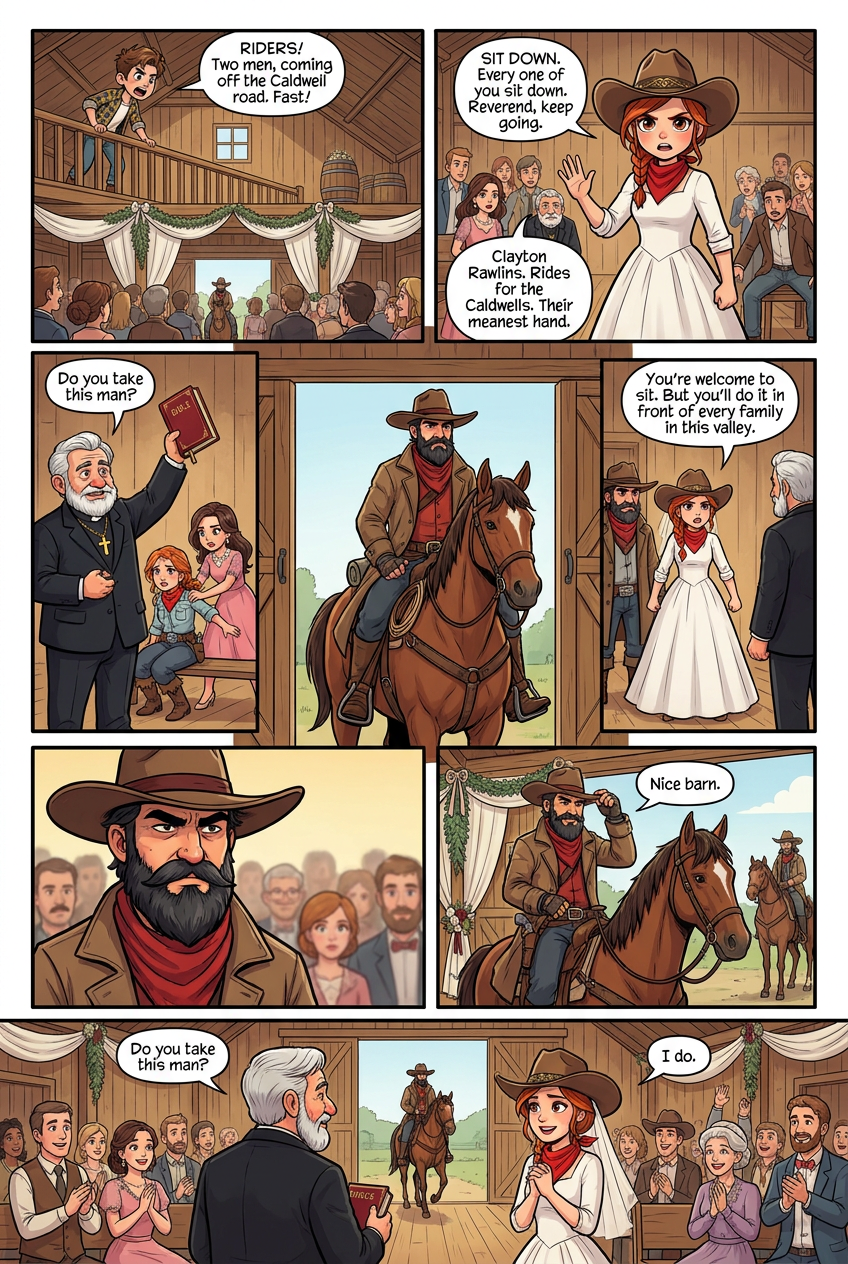
Mel had spoken three lines of her vow when Garrett's voice cut across the barn. "Riders!" he called from the loft. "Two men, coming off the Caldwell road. Fast." The benches stirred. A woman rose halfway. A man near the door reached for his hat. Mel felt the panic start to move through the room like water through a cracked dam. She knew that if the guests scattered now, the Caldwells won without lifting a hand. There would be no wedding to finish. Mel did not turn to the road. She kept her eyes on Ted and lifted her voice so the whole barn could hear. "Sit down," she said. "Every one of you sit down. Reverend, keep going." Cross understood. He raised his red Bible and spoke louder, steady as a plow horse. "Do you take this man?" The familiar words held the guests in their seats. Celeste Winters caught the frightened woman's hand and pulled her back down onto the bench. Then the first rider filled the open doorway. He sat a sturdy brown horse, and he did not look like a wedding guest. He wore a wide brown hat and a long coat, and a red scarf hung at his throat. His black beard was streaked with trail dust. He swung down slow, in no hurry, letting the whole room watch him do it. "Clayton Rawlins," Celeste whispered. "Rides for the Caldwells. Their meanest hand." Mel had never met him, but she knew the type. The Caldwells sent him to break things quietly. He stepped into the barn and looked over the crowded benches, the hung cloth, the greenery, the preacher with his book open. His hand rested near his belt. Mel walked toward him. She did not stop until she stood between Rawlins and Cross, in her borrowed gown, in front of forty seated witnesses. "You're welcome to sit," she said. "We're near the end. But you'll do it in front of every family in this valley." Rawlins looked past her at the faces. Mel watched him count them, the same way the last Caldwell hand had counted them in the church square. Farmers, wives, children, the old rancher near the front. All of them watching him. All of them witnesses. A second rider stopped his horse outside but did not dismount. Rawlins glanced back at him. Whatever the Caldwells had sent them to do, it was meant for an empty road, not a full barn. Rawlins touched his hat brim, a small mocking dip. "Nice barn," he said. Then he turned, climbed back onto the brown horse, and rode off with the second man. Cross did not miss a beat. "Do you take this man?" he asked again. "I do," Mel said, breathless, and the barn broke into a cheer that carried out the open door after the two departing riders. She was married. But she had seen Rawlins count the room and leave, and she knew he would report every name he'd memorized to the Caldwells.
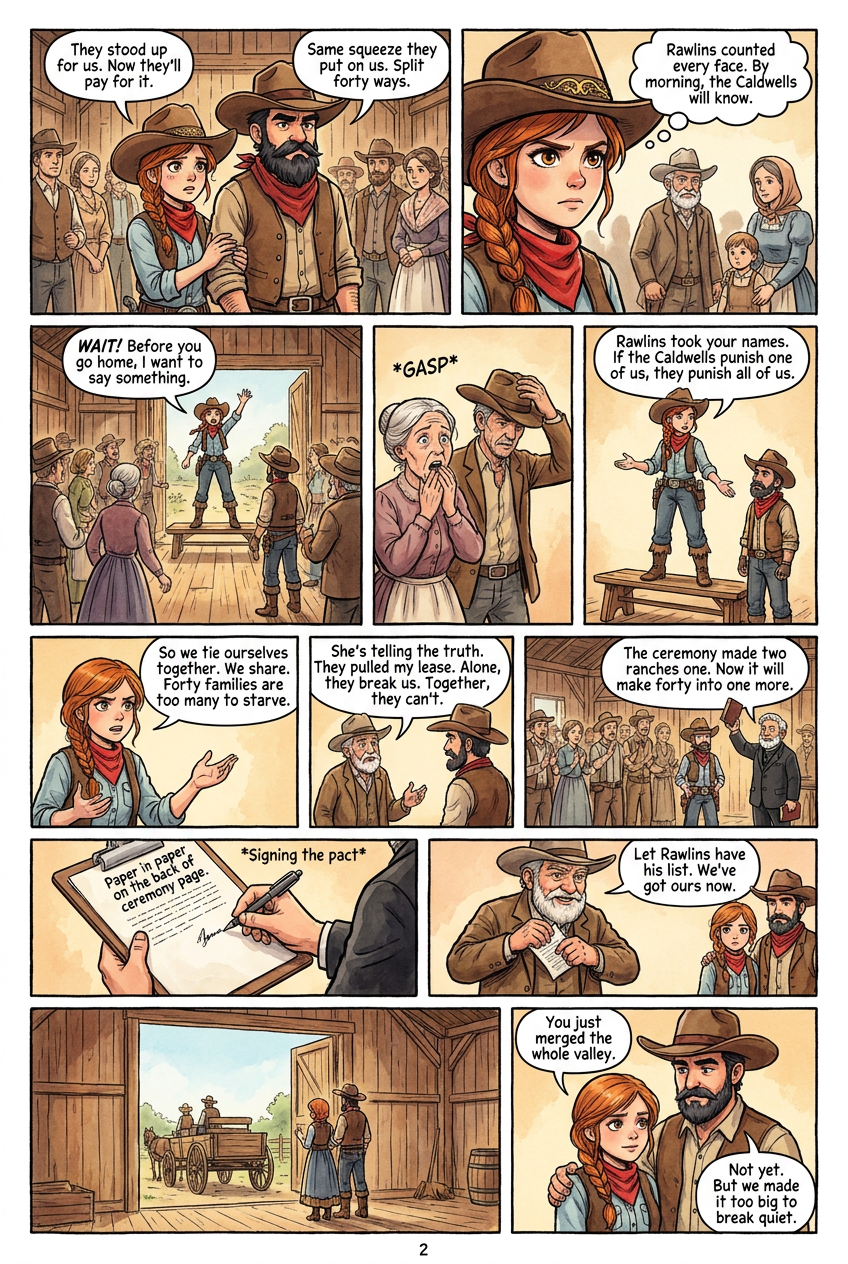
The cheer still rang in the barn when Mel let go of Ted's hands. She was married, but she had seen Rawlins count every face at her wedding. Forty neighbors had sat here and defied the Caldwells in the open. Now the Caldwells knew each name. By morning, Rawlins would report them, and the retaliation would begin one family at a time. "They stood up for us," Mel said to Ted. "Now they'll pay for it. Store credit, leases, buyers. All of it." Ted nodded. "Same squeeze they put on us. Split forty ways." Mel looked at the crowded benches. The old rancher near the front. The women who had brought food. Children beside their mothers. She had beaten the Caldwells once before by making support too public to punish. She could do it again, right here, before anyone left. She climbed onto a bench so the whole barn could see her. "Wait," she called. The talk died down. "Before you go home, I want to say something. Every one of you came today. Rawlins wrote down your names to carry back to the Caldwells." A woman gasped. A man reached for his hat again. "Don't run," Mel said. "Listen. If the Caldwells punish one of us, they punish all of us. So we tie ourselves together. Anyone they cut off from the store buys from a neighbor. Anyone who loses a lease grazes on our land or Ted's. We share hay, eggs, and a wagon to the market. Forty families are too many to starve." The old rancher stood. "They pulled my lease already," he said. "Mel's hay kept my herd alive all winter. She's telling you the truth. Alone, they break us. Together, they can't." One by one, more people rose. Ted's hand found Mel's. Cross lifted his red Bible and said the ceremony had made two ranches one, and now it would make forty into one more. Voices agreed across the benches. Someone started a list of who needed what and who could give it. Before the guests left, they had written the plan on the back of Cross's ceremony page. Each family signed it. The old rancher folded the paper and tucked it in his coat. "Let Rawlins have his list," he said. "We've got ours now." Mel watched the last wagon roll out under the open door. She had turned forty marked witnesses into a pact. The Caldwells could still strike. But they would strike a wall now, not scattered posts. Ted drew her close. "You just merged the whole valley," he said. "Not yet," Mel said. She thought of the paper in the old rancher's coat and the Caldwells reading Rawlins's report tomorrow. "But we made it too big to break quiet. Whatever they try next, everyone will see it."
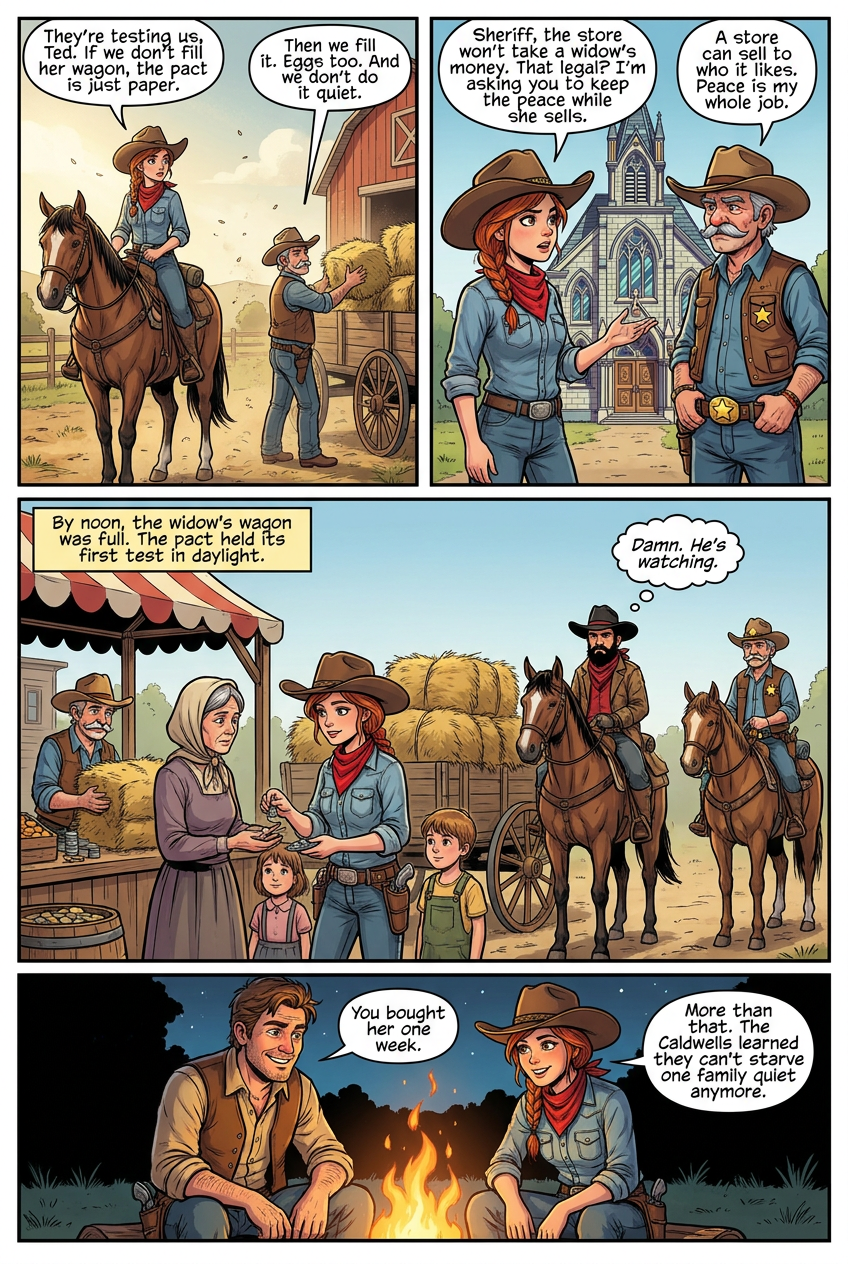
Two days after the wedding, word reached Mel that the Caldwells had struck. They picked the weakest family in the pact first. A widow with three children, a thin herd, and no savings. The store cut her credit. The mill turned her feed away at the door. The message was plain. Cover her loss, or watch the pact scatter one family at a time. Mel rode to Ted with the news. "They're testing us," she said. "If we don't fill her wagon, everyone learns the pact is just paper." Ted loaded hay before she finished talking. "Then we fill it," he said. "Eggs too. And we don't do it quiet." But hay and eggs wouldn't buy the widow's flour or salt. The store still refused her coin. Mel needed the sale to happen in the open, where the whole valley could see the Caldwells had failed. She thought of the Saturday market. She also thought of one man who could make it lawful. She found the sheriff at the church square, thumbs hooked in his star-pinned belt, watching the road like he owned patience itself. John Hartwell had never once crossed the Caldwells. He took their side by doing nothing. Mel had expected no help from him and had asked for none. "Sheriff," she said. "The store won't take a widow's money. That legal?" Hartwell stroked his gray mustache. "A store can sell to who it likes." "Then she'll sell to who she likes," Mel said. "At the market. I'm asking you to keep the peace while she does it. In front of everyone." The old sheriff studied her a long moment. "Peace," he said, "is my whole job." It was not yes. It was not no. But he mounted up and rode toward the market with her. By noon the widow stood at Mel's stall with her three children and a full wagon. Neighbors from the pact bought her eggs at a fair price. Ted stacked her hay for all to see. Mel counted coins into the widow's hand out loud, naming each buyer. Clayton Rawlins came at a walk, black beard set hard, red scarf bright over his coat. He'd counted faces at the wedding. Now he counted again. But Hartwell sat his horse ten feet off, star catching the sun, watching. Rawlins looked at the sheriff. He looked at the crowd. He turned his horse and rode out without a word. Mel let out her breath. The widow's wagon rolled home loaded. The pact had held its first test in daylight. That night Ted grinned. "You bought her one week." "More than that," Mel said. She thought of Rawlins riding off under the sheriff's eye. The Caldwells had learned they couldn't starve one family quiet anymore. So they would have to hit the pact all at once, out loud, where every family could see it coming. And that was a fight the Caldwells had never had to make.
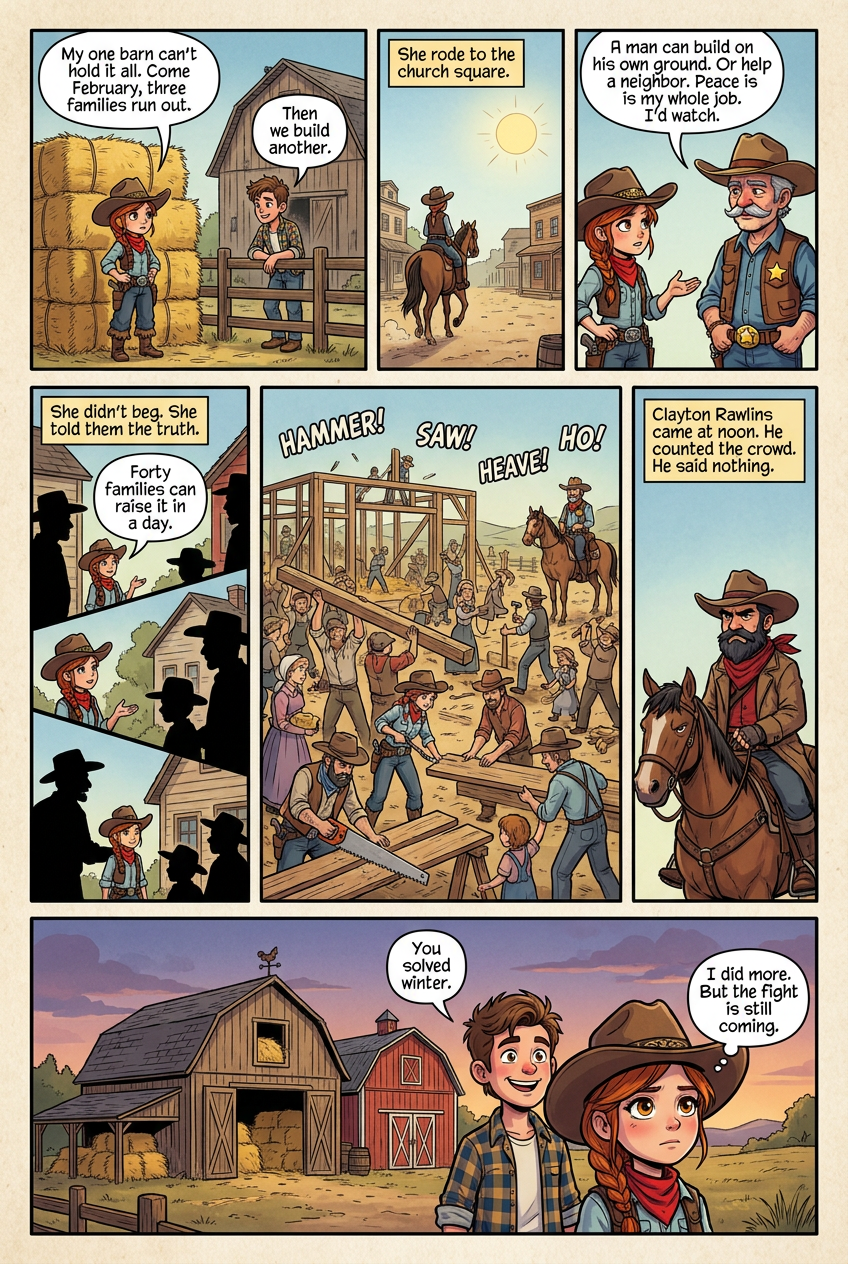
A week after the widow's wagon rolled home, the count came up short. Mel walked her hay rows and saw the trouble plain. Her fields had given more than any summer she remembered. She fed her own herd, the old rancher's cattle, the widow's thin string, and still bales stacked past the barn walls. But every extra family in the pact meant more mouths for winter. She did the sums twice. Her one barn couldn't hold enough hay to carry them all to spring. "We'll lose it to rot," she told Ted. "Rain and snow will spoil what won't fit inside. Come February, three families run out." Ted leaned on the fence. "Then we build another barn." "With what crew? The Caldwells scared off every hand in the valley." Mel shook her head. "And lumber. We used our market money on the last one." She rode to the church square to think. Sheriff Hartwell stood in his usual spot, thumbs hooked in his star-pinned belt, watching the road. He had kept the peace at the market and let the widow sell. He took no side, but his star had cooled Rawlins twice now. "Sheriff," Mel said. "If pact families raised a barn together on my land, in the open, would that be lawful?" Hartwell stroked his gray mustache. "A man can build on his own ground. Or help a neighbor." He looked at her sideways. "Peace is my whole job. I'd watch." It wasn't a promise. It was enough. Mel rode to every pact family that afternoon. She didn't beg. She told them the truth. "My fields grew too much. That surplus is yours through winter. But we need a place to keep it. One family can't raise a barn. Forty can raise it in a day." Saturday they came with wagons, planks, and hammers. The old rancher brought the last of his salvaged boards. Men who'd been too scared to work for her now worked beside her, forty families deep, too many for the Caldwells to punish one by one. Hartwell sat his horse at the edge, star bright in the sun. Clayton Rawlins came at noon. Black beard set hard, red scarf loud over his coat. He counted the raised frame and the crowd swinging hammers. He looked at the sheriff. He said nothing and turned his horse and rode out. By dusk two barns stood on Mel's land. The second held the surplus that would carry every pact family to spring. That night Ted grinned. "You solved winter." "I did more," Mel said. She had turned her private trouble into shared work. Forty families now had proof the pact fed them. But she thought of Rawlins riding off, and of the church square where the Caldwells still ruled the valley's heart. The pact fed people. It couldn't yet marry them, bury them, or grant them a name. That fight was still coming.
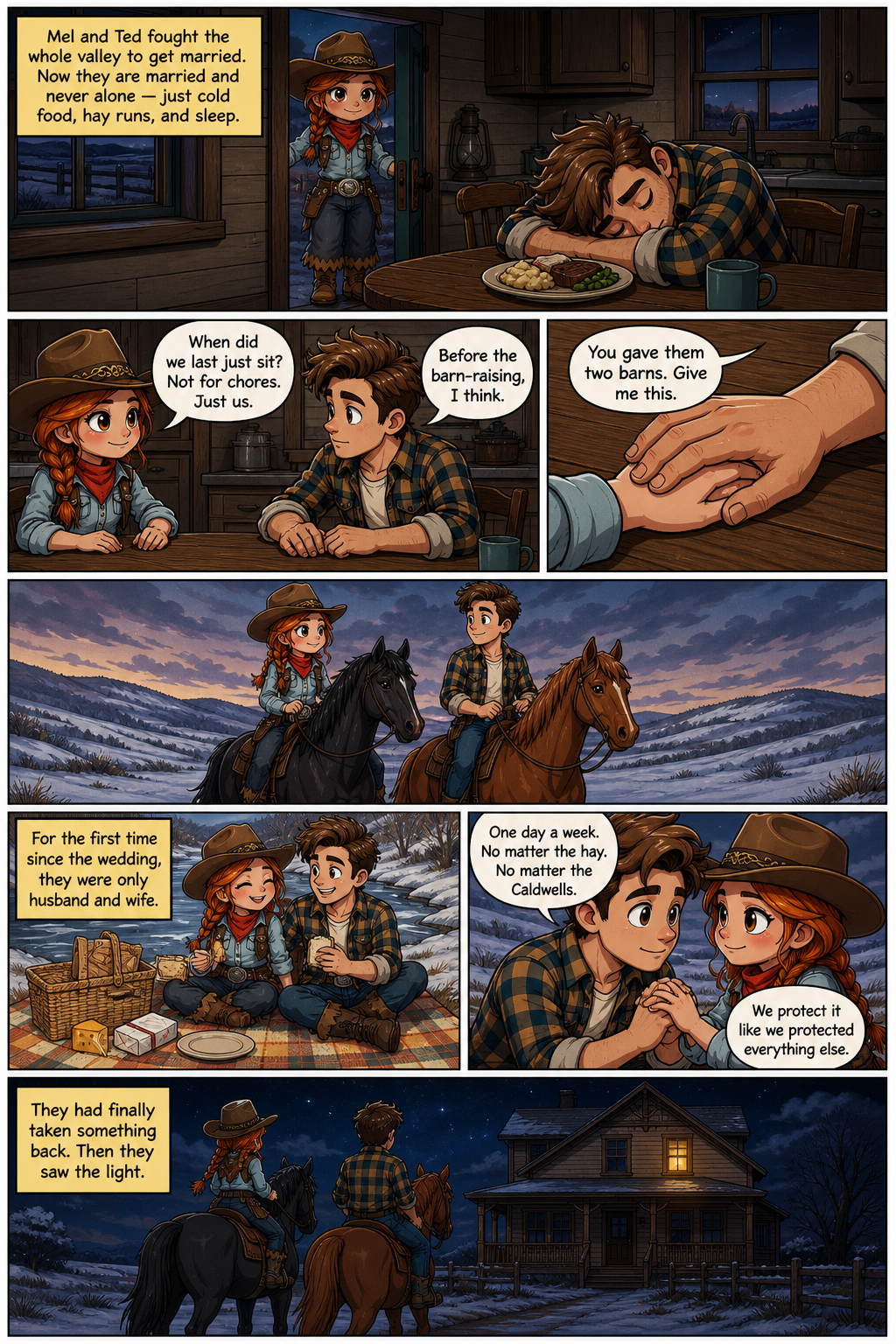
The two new barns held the winter safe. But the work never stopped. Since the frost came, Mel and Ted rose in the dark to haul hay to the old rancher, the widow, and every pact family running short. They ate cold food standing up. They fell asleep before they could talk. They had fought the whole valley to marry. Now they were married and never alone. One morning Mel came in from the fields and found Ted asleep at the table, head on his arms. His plate sat untouched. She looked at the man she had chosen and could not remember their last real talk. She shook his shoulder. "Ted. Wake up." He lifted his head. "Is a fence down?" "No." Mel sat across from him. "When did we last just sit? Not for chores. Just us." Ted rubbed his eyes. "Before the barn-raising, I think." He tried to smile. "We'll rest come spring." "Spring is months off." Mel's throat tightened. "I didn't marry you to trade one fight for another. I married you for this. For being here." He reached across the table and took her hand. His palm was rough and warm. "Then we take a day," he said. "The hay's delivered through the week. The herds are fed. One day won't break us." "The pact needs—" "The pact can spare us one morning." He squeezed her hand. "You gave them two barns. Give me this." Mel felt the tightness break. She nodded. They saddled the black horse and the brown, and rode out past the fields into the hills. No wagons. No hammers. No one watching the road. The cold air stung Mel's face, but she rode close beside Ted and did not think of counts or bales. They stopped where a creek cut the frozen ground. Ted spread a blanket. They ate bread and cheese and talked about nothing. He told her about his father teaching him to ride these hills as a boy. She told him about her mother's stubborn old plow horse. They laughed. For the first time since the wedding, Mel was only his wife, and he was only her husband. When the sun dropped low, Ted took her hand again. "We keep one day a week," he said. "No matter what the Caldwells do. No matter the hay. The pact can build barns without us for a morning." "One day a week," Mel agreed. "We protect it like we protected everything else." They rode home in the dark, tired but easy. The marriage they fought for was theirs now, not just on paper. Mel held that close. But riding down toward Ted's house, she saw a lamp burning in the window. No one should be inside. Someone had come while they were gone. Mel's easy feeling drained cold. The pact fed people. It still could not keep the Caldwells off their own porch.
Play your story to life
Storycraft is a mobile game where you create AI characters, craft items and locations to build their world, then discover what direction your story takes. Download the iOS game for free today!
Download for free