

Kensei Jon's Arc
49 Chapters
Kensei Jon's dream is loving Jeon-min freely, having his love returned, and building a life with him where they can be together without fear or secrets.

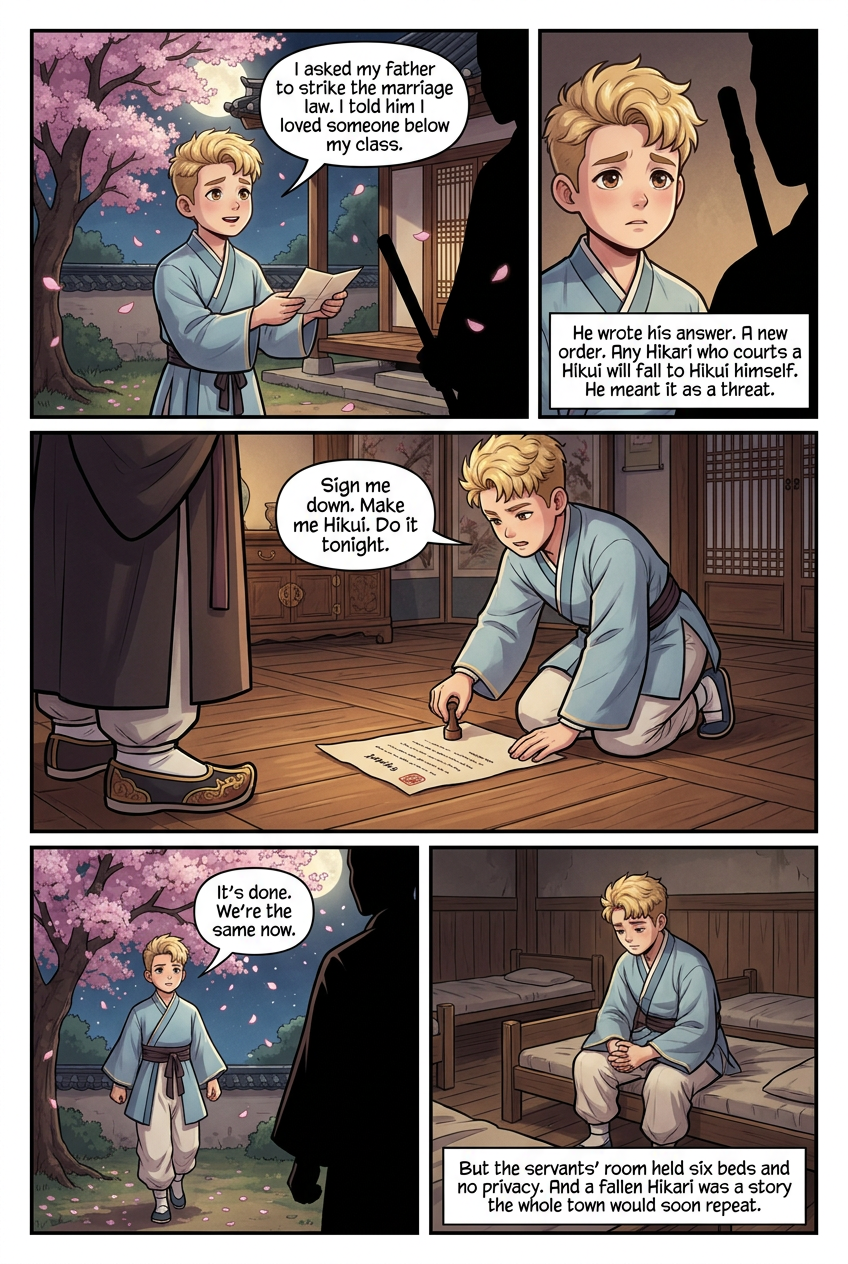
Kensei Jon loved a man he was forbidden to touch. His father's law made sure of it. Kyotori split its people into three classes: Hikari on top, Hoshi in the middle, Hikui at the bottom. Hikui served the Hikari. They could not marry above their birth. Kensei was Hikari, born to the man who wrote the rule. Jeon-min swept the floors of the guesthouse where Kensei lived. That made loving him a crime. Kensei met Jeon-min each night under the cherry tree behind the guesthouse. Pink blossoms fell on the wooden porch with its curved black eaves. There Jeon-min looked at him like an equal, not a servant. Tonight Kensei brought a folded paper. His hands shook as he held it out. "I asked my father to strike the marriage law," Kensei said. "I told him I loved someone below my class." Jeon-min's broom stilled against the stone. "You didn't say my name." "I said it." Kensei watched the blossoms drift. "He listened. Then he wrote his answer." Jeon-min took the paper. He read it under the moon. His face went flat. The law would not change. Kensei's father had signed a new order instead. Any Hikari who courted a Hikui would lose his class. He would fall to Hikui himself. The father meant it as a threat. He wanted Kensei to run from the shame. Jeon-min pushed the paper back. "Then you should stop coming here. You have too much to lose." "I read it a different way." Kensei took Jeon-min's rough hand and held it against the tree. "If I lose my class, the law can't keep us apart. Two Hikui can marry." Jeon-min stared. "You would give up everything. Your name. Your father. Your bed under a roof like this." "I keep you." Kensei's voice held steady now. "That's the trade." He walked back inside the guesthouse. His father sat waiting on the polished floor, the order still wet with ink. Kensei knelt. He set his family seal on the wood between them. "Sign me down," Kensei said. "Make me Hikui. Do it tonight." His father's mouth tightened. He had built the threat to control his son. Now his son took it as a gift. For a long moment he did not move. Then he lifted the brush. He wrote Kensei's name onto the bottom rung. He pressed the seal himself. "You are Hikui now," he said. "You will sleep in the servants' room. You will call me lord, not father." Kensei bowed low. He felt no roof over him anymore, only the open trade he had made. He walked out to the cherry tree where Jeon-min waited. "It's done," Kensei said. "We're the same now." But the servants' room held six beds and no privacy. And a fallen Hikari was a story the whole town would soon repeat.
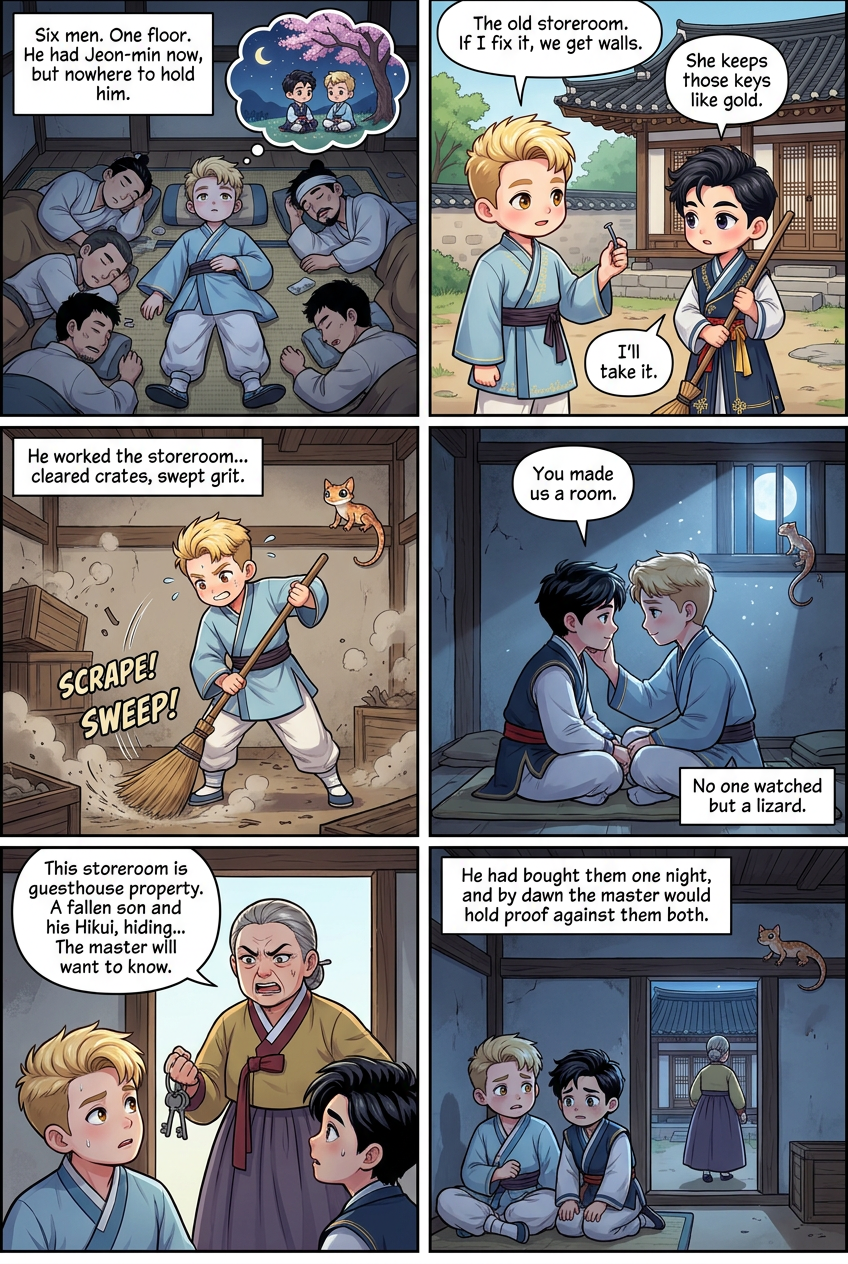
Kensei woke in the servants' room to five other men snoring. He had traded his soft bed for this floor. He had Jeon-min now, but nowhere to hold him. They still met under the cherry tree at night, and the tree hid nothing. Yesterday a maid had watched them from the porch. Today the cook had smirked. A fallen Hikari courting a Hikui gave the whole guesthouse something to whisper about. Kensei needed a door that closed. He found Jeon-min sweeping the back rooms. "There's a place no one uses," Kensei said. "The old storeroom past the kitchen. Broken door, dust to the beams. If I fix it, we get walls." Jeon-min leaned on his broom. He wrote poems in his head while he worked, Kensei knew, lines he never dared say aloud to anyone but him. "The head servant guards those keys like gold," Jeon-min said. "She'll ask why a fallen lord wants a locked room." "Then I won't ask her." Kensei held up a bent nail. "I'll take it." He worked the storeroom that afternoon. He cleared crates. He swept years of grit into the yard. The door hung on one hinge, so he shaved the wood until it swung true. He found a small gecko on the wall, cat ears perched on its head, watching him with a blue eye. He let it stay. By dusk the room held two clean mats and a door that latched from inside. He brought Jeon-min at nightfall. The latch clicked shut. For the first time, no eyes could reach them. Jeon-min touched the mended door, then Kensei's face. "You made us a room," he said. He spoke a line of his own then, soft, a poem he had never risked before. Kensei held him and listened. The gecko blinked from the beam. No one watched but a lizard. The door opened without a knock. The head servant stood in it, keys in her fist. She looked at the two mats, the swept floor, the two men close. Her face did not soften. "This storeroom is guesthouse property," she said. "You broke a lock that isn't yours." She stepped back into the passage. "The master keeps a ledger of every crime his servants commit. A fallen son and his Hikui, hiding behind a stolen door. He will want to know." She turned toward the main house, keys swinging. Kensei stood in the doorway he had fixed. He had won his private room and lost it in the same breath. Jeon-min gripped his sleeve. The head servant was already climbing toward the master's rooms to report them. Whatever privacy Kensei had built, it would not survive the morning. He had bought them one night, and by dawn the master would hold proof against them both.
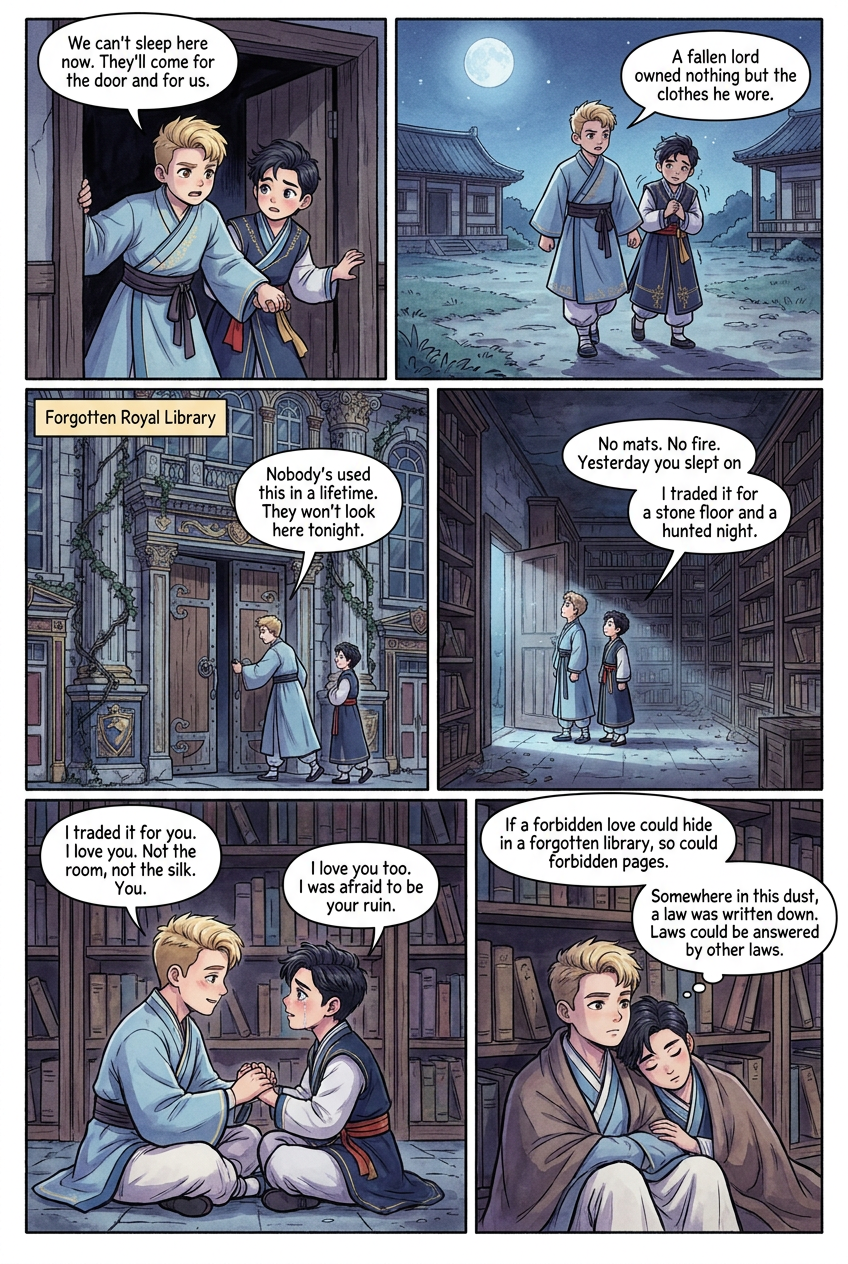
The head servant's keys faded up the path. Kensei did not wait for her to return with the master. He pulled Jeon-min from the storeroom into the cold dark. "We can't sleep here now," Kensei said. "They'll come for the door and for us." He had no bed of his own anymore, no coin, no blanket. A fallen lord owned nothing but the clothes he wore. He led Jeon-min across the grounds, away from the guesthouse windows. They stopped at the old library. Its stone front rose gray in the moonlight, vines crawling the walls, the tall doors shut for years. Kensei tried the handle. It gave. Dust and dead air met them inside. Towering shelves ran into the dark. No one came here. No enforcers, no gossiping cook. "Nobody's used this in a lifetime," Kensei said. "They won't look here tonight." They sat on the cold floor between two shelves. Jeon-min hugged his knees. His breath showed white. "No mats," he said. "No fire. Yesterday you slept on silk." He was a poet, and Kensei knew he was writing this misery into lines even now. "I traded it for a stone floor and a hunted night." "I traded it for you," Kensei said. Jeon-min looked up. Kensei took his cold hands. He had never said the whole of it out loud. He said it now. "I love you," Kensei said. "Not the room, not the silk. You. I gave my name away and my father and the warm bed, and I would give them again. I've never told you plain. So hear it plain. I love you." Jeon-min's eyes filled. He did not reach for a poem this time. "I love you too," he said. His voice cracked. "I was afraid to be your ruin." "You're not my ruin," Kensei said. "You're the reason I chose this." He pulled off his outer robe and wrapped it around them both. They pressed together against a shelf leg for warmth. Their stomachs ached with hunger. The cold seeped through the stone. But no eyes reached them here, and the words were said at last, and Jeon-min slept against his shoulder. Kensei stayed awake. He watched the doors. The library had hidden them for one night, but the master would learn by morning what the head servant carried in her ledger. Cold and hunger he could bear. The report he could not stop. He looked at the endless dark shelves around them and thought of the second thing this place held. If a forbidden love could hide in a forgotten library, so could forbidden pages. Somewhere in this dust, a law was written down. Laws could be answered by other laws. In the morning they would need food, and they would need a way to fight the ledger. Both waited for him here, on these shelves, if he could find them before the master's men found the door.
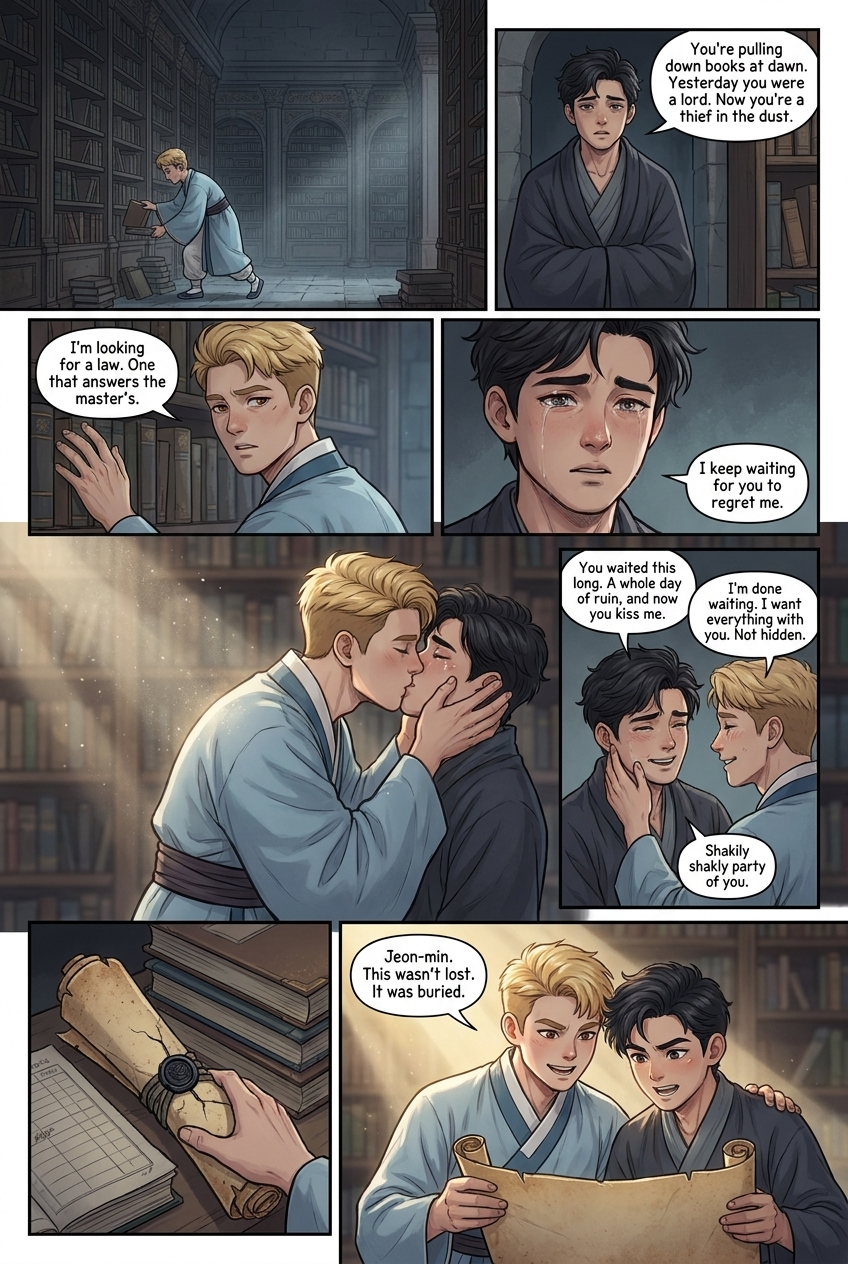
Morning gray crept through the tall windows. Kensei had not slept. He watched the doors while Jeon-min breathed against his shoulder. The library held them, but the head servant's ledger still moved toward the master. Kensei needed food, a law to fight the report, and a reason to keep his poet from despair. He rose and searched the shelves for hidden pages before the light grew. Jeon-min woke and found him gone from his side. He climbed to his feet, hugging himself in the cold. "You're pulling down books at dawn," he said. "Yesterday you were a lord. Now you're a thief in the dust." He was smiling, but his hands shook. Kensei knew that look. The poet made a joke when the fear got too big to say plainly. "I'm looking for a law," Kensei said. "One that answers the master's." Jeon-min stepped close. "And if there's no law here? If they come through those doors this hour?" Kensei set the book down. He had no answer for that. He had given away his name, his father, his warm bed. He could lose Jeon-min too, dragged off to the master's justice. The thought hollowed him out. He had never once shown his love with anything but words. Jeon-min's eyes filled. "I keep waiting for you to regret me," he whispered. Kensei crossed the last step between them. He took Jeon-min's cold face in both hands. Then he kissed him. He had wanted this since the first night in the storeroom and never dared. Now he dared. Jeon-min went still, then gripped Kensei's robe and kissed him back. The dust and the cold and the coming enforcers all fell away. For one breath there was only this. Kensei felt Jeon-min's tears wet against his own cheek. They broke apart. Jeon-min laughed, shaky and real. "You waited this long," he said. "A whole day of ruin, and now you kiss me." "I'm done waiting," Kensei said. "I want everything with you. Not hidden. Not in dust." The words changed something in him. He had run and hid and hoped. Now he wanted to fight. He turned back to the shelves with new purpose. Behind a fallen row of ledgers, his fingers found a scroll bound in cracked cord. The seal on it was the master's own crest, struck through with a black line. Suppressed. Someone had hidden this on purpose. Kensei carried it into the window light and broke the cord. The writing was old law. His breath caught. He could not read all of it yet, but one line stood clear near the top. "Jeon-min," he said. "This wasn't lost. It was buried." Jeon-min came to his shoulder and read. His face went pale, then fierce. The kiss had ended their hiding. This scroll would begin their fight.
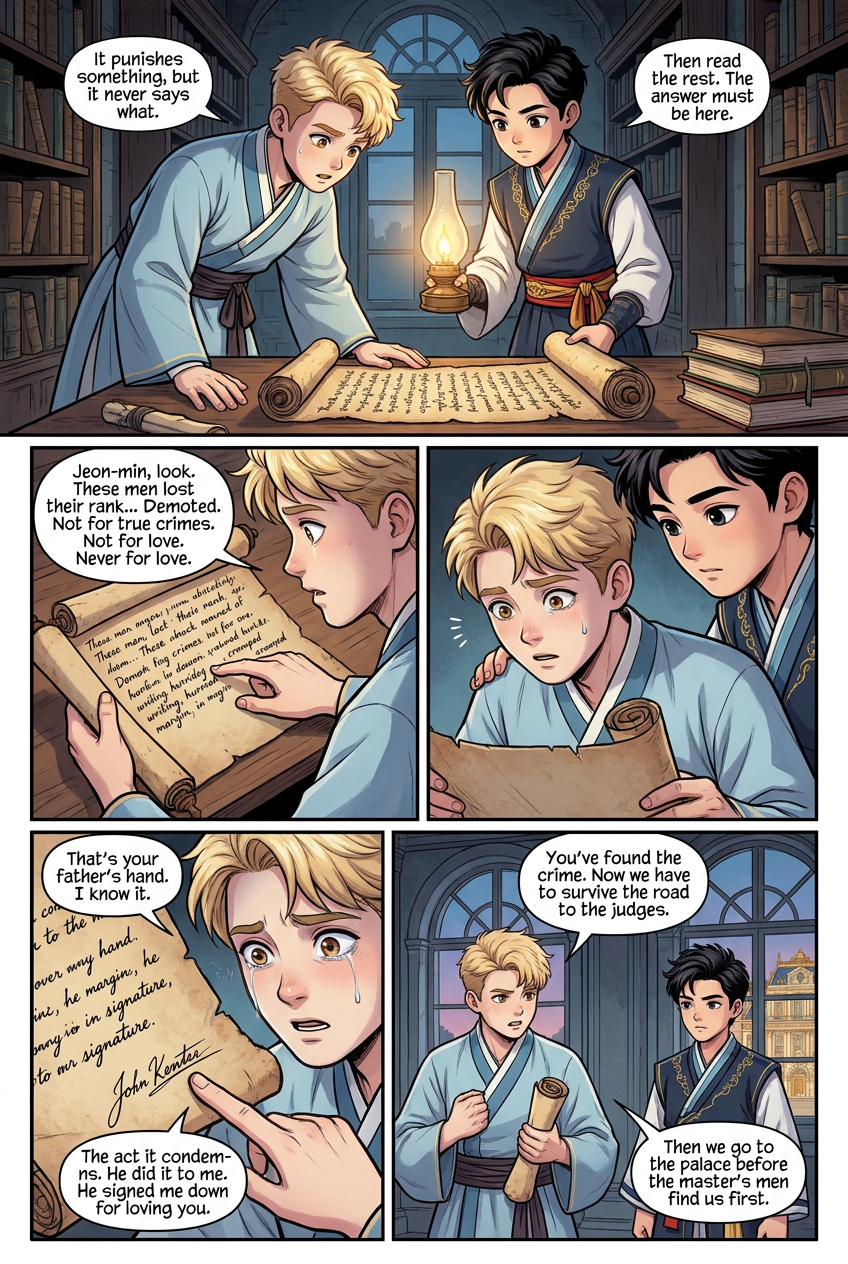
The scroll lay open in the window light. Kensei bent over the old words while Jeon-min held a lamp close. The law named a penalty. A master who broke it would lose his seat and answer to the palace. But the words did not say what act the master had done. Kensei read the line three times. A penalty with no crime was useless. He needed to know what the master had buried. "It punishes something," Kensei said. "But it never says what." Jeon-min set the lamp down. "Then read the rest. The answer must be here." Kensei unrolled the scroll further. The cord had hidden the lower half. There the writing grew cramped, packed into the margin by a shaking hand. He traced each character with his finger. A name of a place appeared. The Royal Palace. Then a date. Then a list. He stopped. The list was names. Hikari names, each struck through. Beside every name stood one word. Demoted. The old law said a master could strip a Hikari of rank only for true crimes. Theft. Murder. Betrayal of the crown. Not for love. Never for love. "Jeon-min," Kensei said. "Look. These men lost their rank the way I did." Jeon-min leaned in. His finger stopped at the last name. It was not struck through. It was fresh ink, darker than the rest. "That's your father's hand," he whispered. "I've carried his letters. I know it." Kensei's chest went tight. His father had written in this scroll. His father had added to a list of men punished without cause. The old law condemned exactly that act. A master who demoted a Hikari for love broke the law and forfeited his seat. "That's it," Kensei said. His voice shook. "The act it condemns. He did it to me. He signed me down for loving you. The scroll makes that a crime against the crown, not against us." Jeon-min gripped his sleeve. "Then the master isn't the law. He broke it." Kensei rolled the scroll tight and bound the cord. His hands were steady now. "The palace judges masters who abuse the old law. We take this there. We show them his own crest, his own ink." Then the weight of it landed. To reach the palace, they had to walk out of hiding. Past the head servant. Past the enforcers already searching. The scroll only mattered if they lived to deliver it. Jeon-min saw the change in his face. "You've found the crime," he said. "Now we have to survive the road to the judges." Kensei pressed the scroll to his chest and stood. "Then we leave the library. We go to the palace before the master's men find us first."
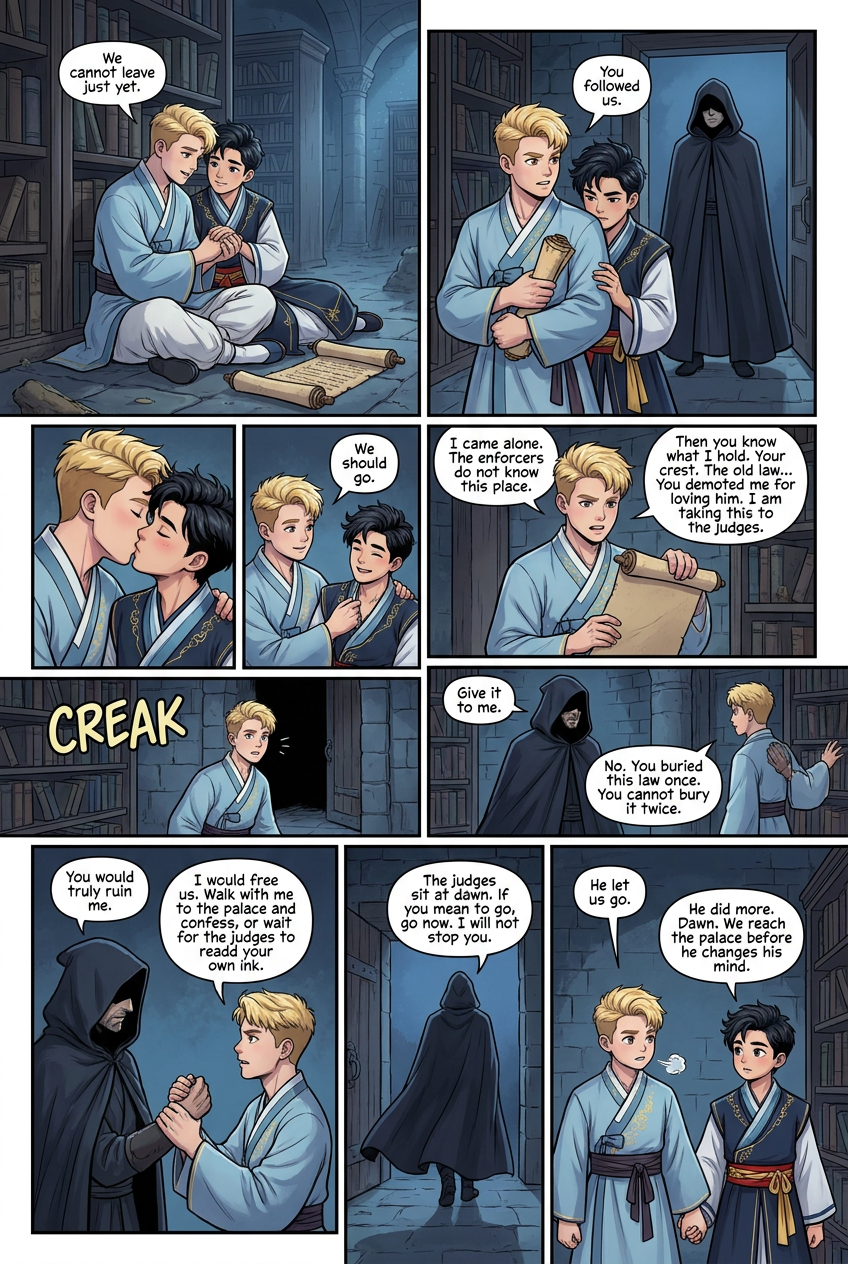
They did not leave right away. The road to the palace could wait one hour, Kensei told himself. Jeon-min had not slept. Neither had he. They sat against the tall shelves of the abandoned library, the scroll safe between them. Kensei took Jeon-min's hand. Then he leaned in and kissed him. One kiss became many. They forgot the enforcers, the master, the morning. For a long time the only sound was their breathing and the shift of cloth. Kensei pulled back to look at him. Jeon-min smiled, his black hair a mess, his hanbok loose at the collar. "We should go," Jeon-min whispered. But he pulled Kensei close again. Kensei let the road slip further away. A floorboard creaked near the door. Kensei froze. He turned his head. His father stood in the doorway. The king. He wore no guards, no crown, only a dark travel cloak. He watched them without a word. Kensei knew that stare. It was the same one that had signed him down to Hikui. Kensei stood fast. He pushed Jeon-min behind him and grabbed the scroll. His hands did not shake. "You followed us," he said. "I came alone," his father said. "The enforcers do not know this place." His eyes dropped to the scroll in Kensei's arms. He knew it. Kensei saw the knowing in his face. "Then you know what I hold," Kensei said. He unrolled the top. "Your crest. Your hand. The old law says a master who demotes a Hikari for love loses his seat. You demoted me for loving him. I am taking this to the judges." His father stepped closer. "Give it to me." "No." Kensei stood his ground. Jeon-min's hand pressed against his back, steady. "You buried this law once. You cannot bury it twice." For a moment his father said nothing. His mouth tightened. Kensei braced for a shout, for a call to hidden men. Instead his father looked at Jeon-min, then at his son's hand locked with the servant's. "You would truly ruin me," his father said. It was not a question. "I would free us," Kensei answered. "You can walk to the palace beside me and confess. Or you can wait for the judges to read your own ink." His father's face changed. The hard mask cracked. He looked older, smaller. He turned toward the door. "The judges sit at dawn," he said quietly. "If you mean to go, go now. I will not stop you." Then he was gone into the dark hall. Kensei let out a breath. Jeon-min gripped his arm. "He let us go," Jeon-min said. "He did more," Kensei said. He rolled the scroll tight. "He told us when the judges sit. He wants this ended too." He took Jeon-min's hand. "Dawn. We reach the palace before he changes his mind."
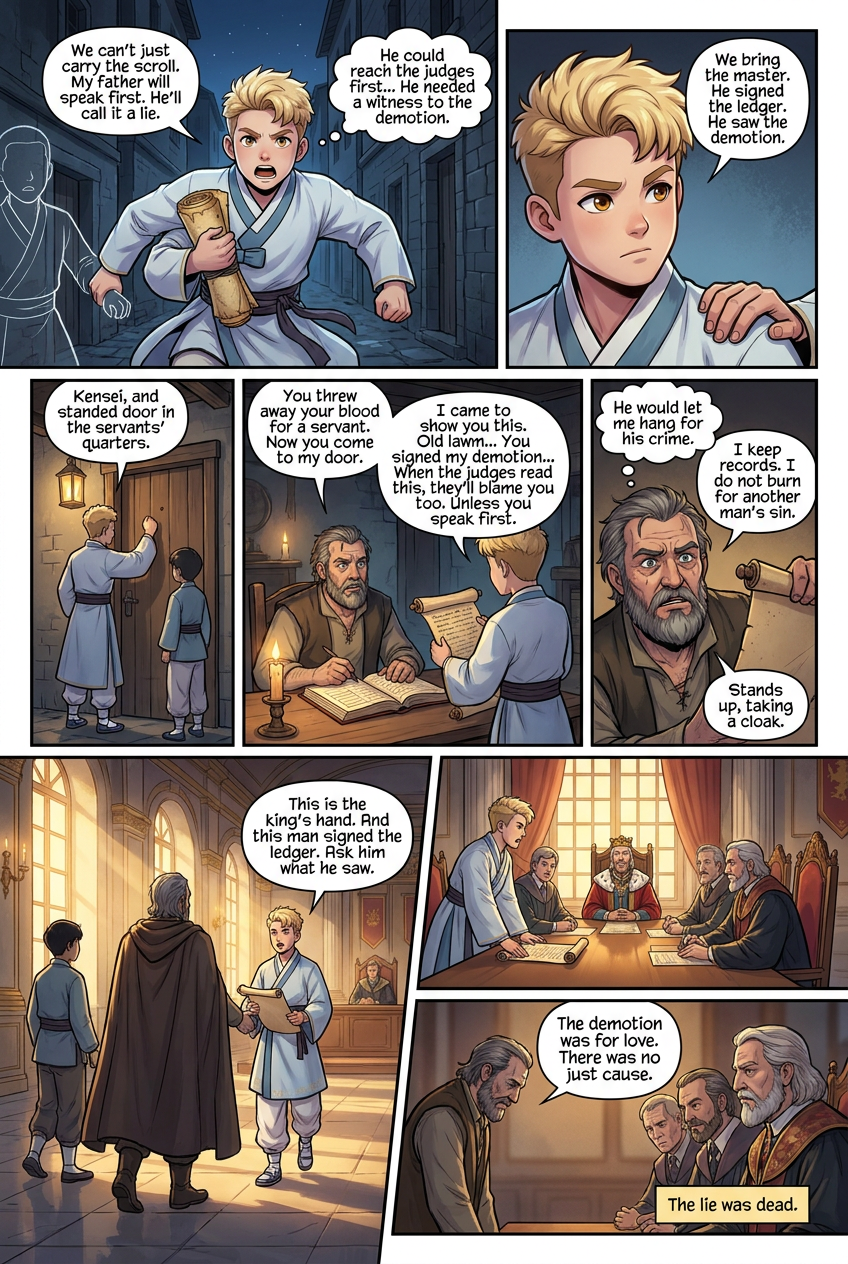
They ran through the dark streets while the sky went gray. Kensei held the scroll tight to his chest. Jeon-min kept pace at his side. But a cold thought slowed Kensei's steps. His father had a head start now. The king could reach the judges first. He could deny the ledger's charges, claim the demotion was just, and clear his own name before dawn. Then Kensei's testimony would collapse. He needed a witness to the demotion. The master who kept the ledger of servant crimes had signed the record. Only the master could prove the demotion happened at all. Kensei stopped in the street. "We can't just carry the scroll," he said. "My father will speak first. He'll call it a lie." Jeon-min gripped his arm. "Then what do we do?" "We bring the master," Kensei said. "He signed the ledger. He saw the demotion. If he stands before the judges, my father can't deny it." They turned back toward the servants' quarters. The master's rooms sat below the palace, near the storehouse. Kensei knew the way. He had walked it as a Hikari, and now he walked it as a Hikui, careful of every shadow. He found the master awake, bent over a wide book by candlelight. The master looked up. His eyes went to Kensei's plain servant clothes, then to the scroll. "You," the master said. He did not stand. "You threw away your blood for a servant. Now you come to my door." "I came to show you this," Kensei said. He unrolled the top of the scroll. "Old law. A master loses his seat if he lets a Hikari fall for love without cause. You signed my demotion. My father ordered it because I loved Jeon-min. When the judges read this, they'll blame you too. Unless you speak first." The master's hand went still on the book. He read the crest. He read the king's own hand below it. His face changed, the way Kensei's father's had in the library. Fear crept in. "He would let me hang for his crime," the master said quietly. "He would," Kensei said. "Come with me. Tell the judges what you saw. Save yourself." The master closed the book. He rose and took his cloak. "I keep records," he said. "I do not burn for another man's sin." They reached the palace as the first light struck its gold roof. Guards stood at the tall doors. Kensei walked between the master and Jeon-min. Inside, the judges sat at a long table. His father stood before them already, mouth open to speak. Kensei stepped forward and set the scroll on the table. "This is the king's hand," he said. "And this man signed the ledger. Ask him what he saw." The master bowed his head and spoke. "The demotion was for love. There was no just cause." The king went silent. The judges leaned in. The lie was dead.
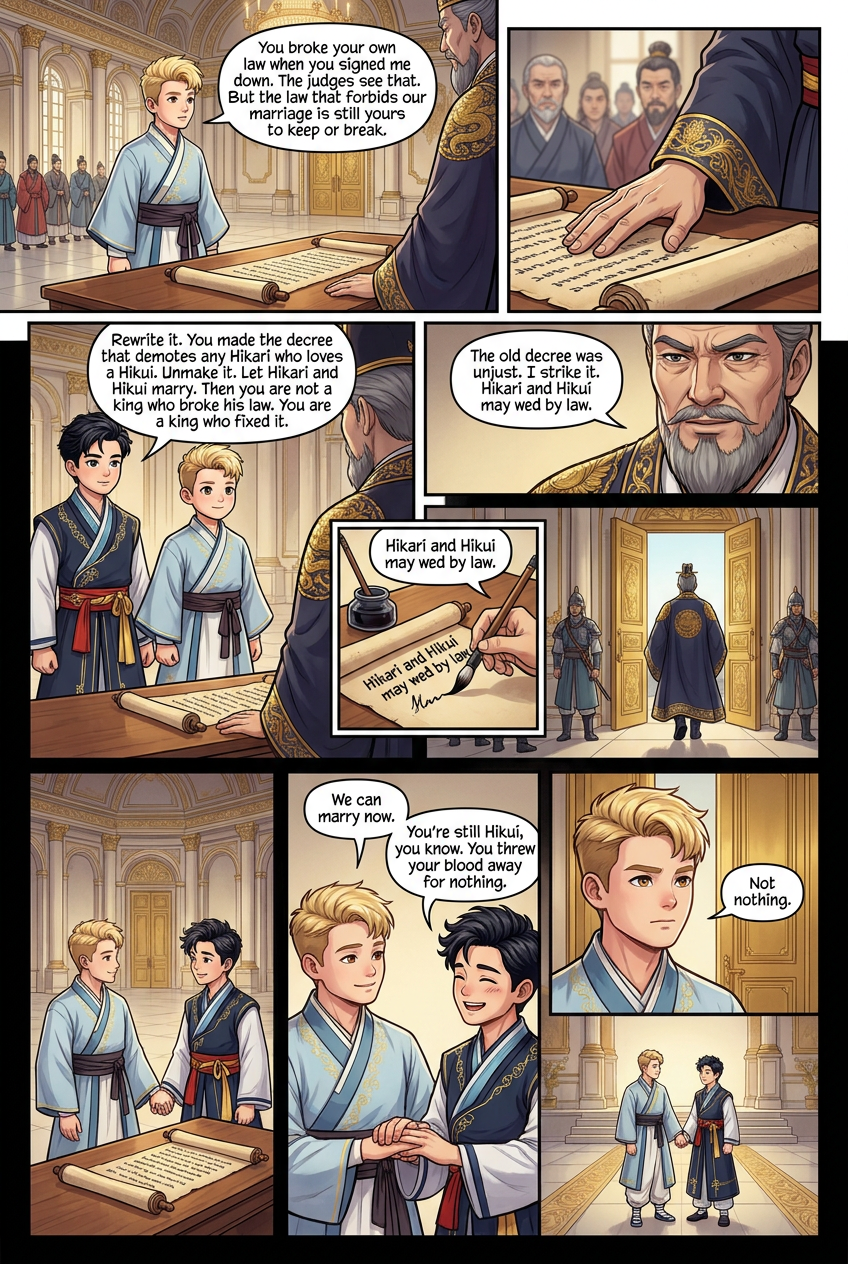
The judges sat still after the master spoke. The king said nothing. Kensei stood in the grand hall with the scroll on the long table between them. He had proven the demotion was a lie. But proving the lie did not change the law. Even now, he was Hikui. Even now, he could not marry Jeon-min. The old law only condemned the master. It did not undo the rule that kept them apart. Kensei looked at his father. The king had let him walk here. The king had told him when the judges sat. Now the king had a choice, and only the king could make it. "You broke your own law when you signed me down," Kensei said. "The judges see that. But the law that forbids our marriage is still yours to keep or break." Jeon-min stepped close. He wore the dark hanbok he loved, gold thread at the collar. He did not speak. He only put his hand on the table beside the scroll, near Kensei's hand. The judges watched the two hands. The king's face was gray. He knew what the scroll cost him. If he denied everything, the master would name him again, and the judges would strip his crest. If he confessed, he lost the pride of the throne. He had one way to keep both his seat and his name. "Rewrite it," Kensei said. "You made the decree that demotes any Hikari who loves a Hikui. Unmake it. Let Hikari and Hikui marry. Then you are not a king who broke his law. You are a king who fixed it." The hall was silent. The judges turned to the king. He was cornered by his own hand on the scroll. The king lifted his chin. He spoke to the judges, not to his son. "The old decree was unjust," he said. "I strike it. Hikari and Hikui may wed by law." The head judge dipped his brush and wrote the words into the record. The master exhaled. Jeon-min's hand closed over Kensei's on the table. The king turned and left the hall without looking at Kensei again. His guards followed. The gold doors shut behind them. Kensei stood there, holding Jeon-min's hand in the open, in front of the judges, in front of everyone. No one told them to stop. The law was gone. "We can marry now," Kensei said quietly. Jeon-min laughed, short and shaky. "You're still Hikui, you know. You threw your blood away for nothing." "Not nothing," Kensei said. But the king had struck the law and left. He had signed no pardon returning Kensei's rank. Kensei was free to marry. He was still a servant with no name and no family. To build a real life, he needed his own standing back, and his father had walked out the door.
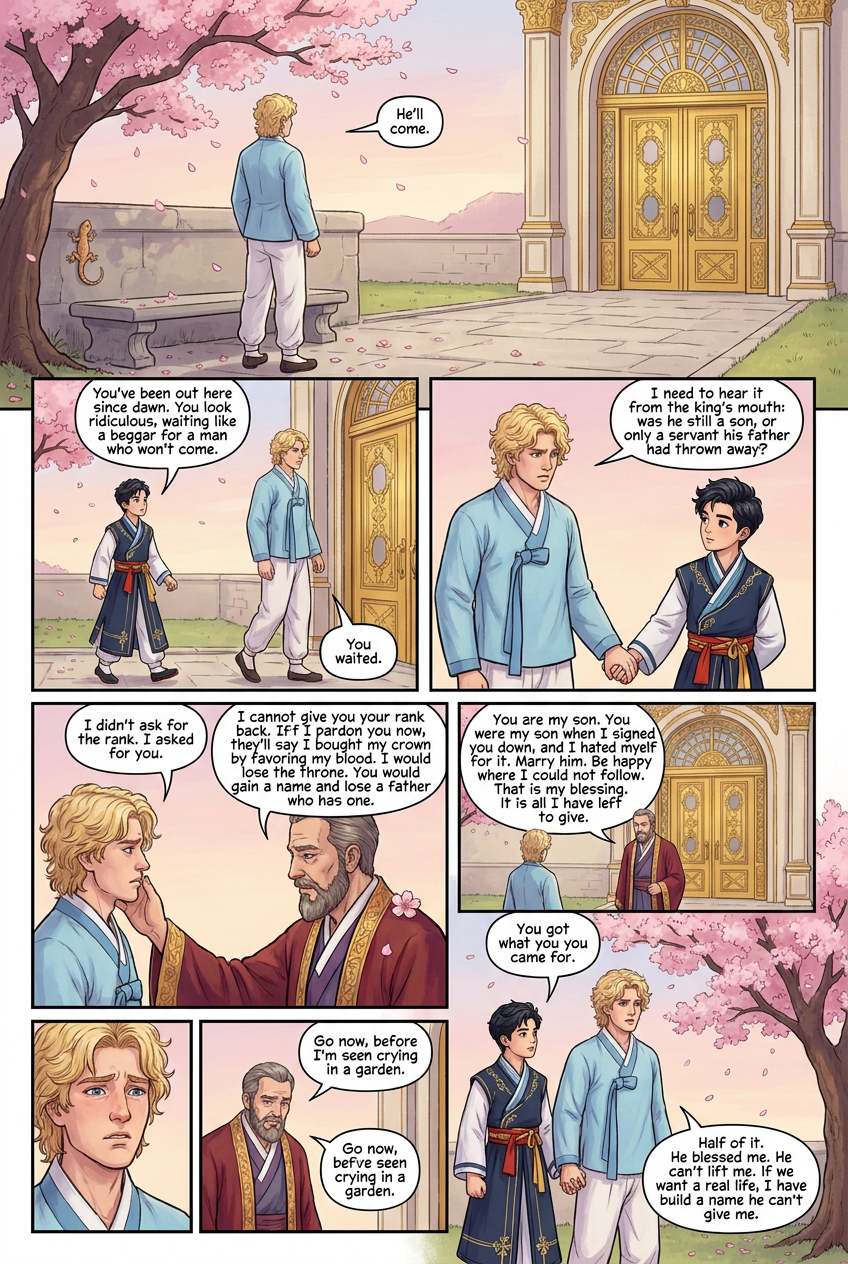
The gold doors had shut hours ago. Kensei stood outside the palace in the garden while the sky went pale. He was free to marry Jeon-min. But his father had not spoken to him, not once, not even to say goodbye. Kensei could not rest. He needed to hear it from the king's mouth: was he still a son, or only a servant his father had thrown away? Jeon-min found him under the cherry tree by the palace wall. Pink blossoms fell on the stone bench. "You've been out here since dawn," Jeon-min said. "You look ridiculous, waiting like a beggar for a man who won't come." "He'll come," Kensei said. He watched the palace door. A small gecko with ears like a cat's clung to the wall beside him. It did not move. Neither did Kensei. The door opened at last. The king walked out alone, no guards, no crown. He stopped when he saw his son under the tree. For a moment neither man spoke. "You waited," the king said. "I need to know," Kensei said. He stood. "You struck the law. You let me marry. But you left without a word. Am I still your son, or did you bury me when you signed the paper?" The king came closer. He looked at Jeon-min, then at the joined hands the two men did not hide. His jaw was tight. "I cannot give you your rank back," he said. "The judges watched me fall. If I pardon you now, they'll say I bought my crown by favoring my blood. I would lose the throne. You would gain a name and lose a father who has one." "I didn't ask for the rank," Kensei said. "I asked for you." The king was quiet. A blossom landed on his shoulder. He brushed it off slow, like his hand had grown heavy. Then he reached out and put that same hand on Kensei's cheek. "You are my son," he said. "You were my son when I signed you down, and I hated myself for it. Marry him. Be happy where I could not follow." His voice cracked on the last word. "That is my blessing. It is all I have left to give." Kensei's throat closed. He nodded. He could not speak. The king dropped his hand. "Go now, before I'm seen crying in a garden." He turned and walked back through the door. It shut behind him. Kensei stood under the falling blossoms. He had the blessing. He had the man. But his father had said it plain: no rank, no name, no place in the world above a servant's. Jeon-min squeezed his hand. "You got what you came for," Jeon-min said. "Half of it," Kensei said. "He blessed me. He can't lift me." He looked at the shut door. "If we want a real life, I have to build a name he can't give me."
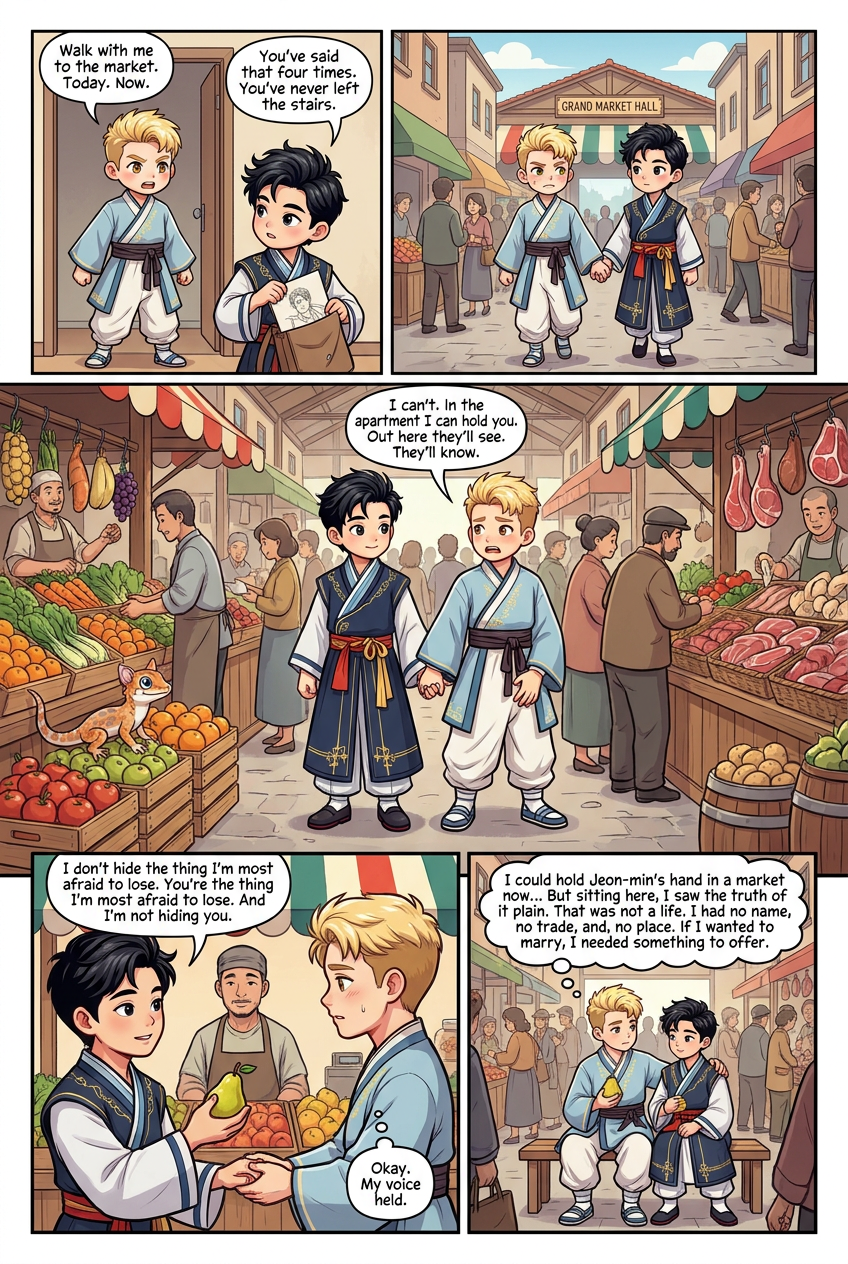
The blessing sat in Kensei's chest like a stone he couldn't set down. His father could not lift him. So Kensei would build a life the king never touched. It began with one small thing he had wanted for months. He turned to Jeon-min in the apartment doorway. "Walk with me to the market," he said. "Today. Now." Jeon-min looked up from his bag. He was folding the sketch of his family's knot pattern, the one his great-grandmother invented and never taught anyone. He put it away and studied Kensei's face. "You've said that four times," he said. "You've never left the stairs." He said it flat, no push, just the number. They walked. Kensei held Jeon-min's hand until the market hall came into view. Then his fingers went cold. The stall stood packed with hanging beef and crates of fruit. People moved everywhere, close, looking. A small gecko with cat ears sat on a fruit crate, still, watching him. Kensei let go of Jeon-min's hand. He pressed his own hand flat against his leg. "I can't," he whispered. "In the apartment I can hold you. Out here they'll see. They'll know." "Know what," Jeon-min said. He did not lower his voice. A woman buying peaches glanced over. "That I love you. Let them." He picked a pear from a crate and paid the vendor. "I've shown my grandmother's pattern in four cities to strangers. I don't hide the thing I'm most afraid to lose." He held the pear out. "You're the thing I'm most afraid to lose. And I'm not hiding you." Kensei looked at the crowd. No enforcers. No master. No decree. The law was struck. Nobody here could sign him down; he was already as low as he could go, and free. The fear was old, from a life that no longer ran his. He had spent that whole life learning to love behind a working door. He took the pear. Then he took Jeon-min's hand, in front of the vendor, in front of the woman with the peaches. His hand shook. He did not let go. "You're ridiculous," Jeon-min said. But he squeezed back. "Okay," Kensei said. His voice held. They walked into the hall together, past the beef and the crates, hands joined. A few people looked. Kensei met their eyes and kept walking. Nobody stopped them. Nobody could. They ate at a bench inside the hall, sharing the pear, out where the whole city could see. Kensei had done the one small thing. He was no longer afraid to love Jeon-min in the open. But sitting there, Kensei saw the truth of it plain. He could hold Jeon-min's hand in a market now. That was not a life. He had no name, no trade, no place among these people who bought and sold and built. Jeon-min had his family's pattern to save. Kensei had nothing to his own name at all. If he wanted to marry, he needed something to offer besides a demoted man's empty hands.
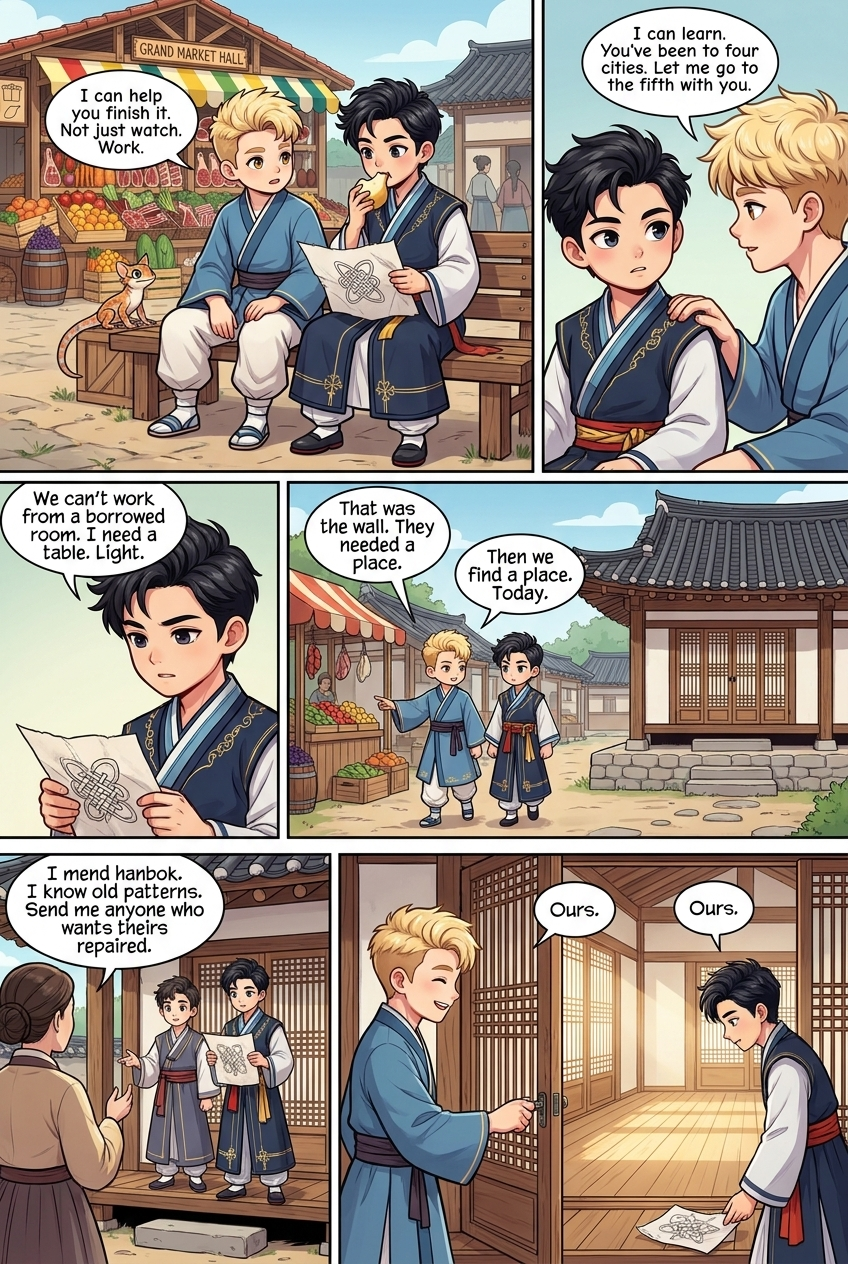
The market bench taught Kensei one hard fact. He could hold Jeon-min's hand in the open, but he owned nothing. No trade, no place, no name to build on. He watched Jeon-min unfold the sketch of his family's knot pattern and study it between bites of pear. Then Kensei knew what he had. He knew the pattern too. He had watched Jeon-min trace it a hundred nights. "I can help you finish it," he said. "Not just watch. Work." Jeon-min lowered the sketch. "You've never sewn a stitch." "I can learn. I can carry, measure, find the dye makers you write down." Kensei's voice steadied. "You've been to four cities alone. Let me be the one who goes to the fifth with you." Jeon-min said nothing for a long moment. A small gecko with cat ears crept along the edge of the fruit crate, watching them both. Jeon-min flicked his eyes to it, then back to Kensei. "We can't work from a borrowed room. We wake up in someone else's bed." He tapped the sketch. "I need a table. Light. A place I don't have to fold everything away by morning." That was the wall. The borrowed apartment gave them a roof and nothing more. No door of their own to close. No table to leave the work out on. Kensei set down the pear. "Then we find a place. Today." They walked the streets past the market until the crowd thinned. A guesthouse stood on a low stone base, its dark tiled roof curved up at the corners. Wooden lattice doors ran across the front. A woman swept the porch and called it half-empty since the season turned. She named a monthly price for the two back rooms. Kensei counted his coins. He counted Jeon-min's. Together it covered one month and part of a second. Not more. "We can't hold this," he said quietly. "Not without earning." "Then we earn from it," Jeon-min said. He turned to the woman. "I mend hanbok. I know old patterns most people lost. Send me anyone who wants theirs repaired." He held up the sketch. "This is my work. Show it to your guests." The woman looked at the drawing a long time. She said guests came through often with worn festival clothes and no one to fix them. She would send them. She took the first month's coin and handed Kensei a key. Kensei stood on the porch and turned the key in the lattice door. It swung open onto a plain wooden floor, empty, theirs. Light came through the paper screens. He saw the whole room at once, and he saw the table that would sit in it. "Ours," he said. "Ours," Jeon-min said. He set his bag down on the floor and did not fold anything away. He opened the sketch flat and left it there. "You're ridiculous," he added, but he was already looking at the light. "Okay," Kensei said. For the first time he had a place to wake up in, and a trade to learn in it.
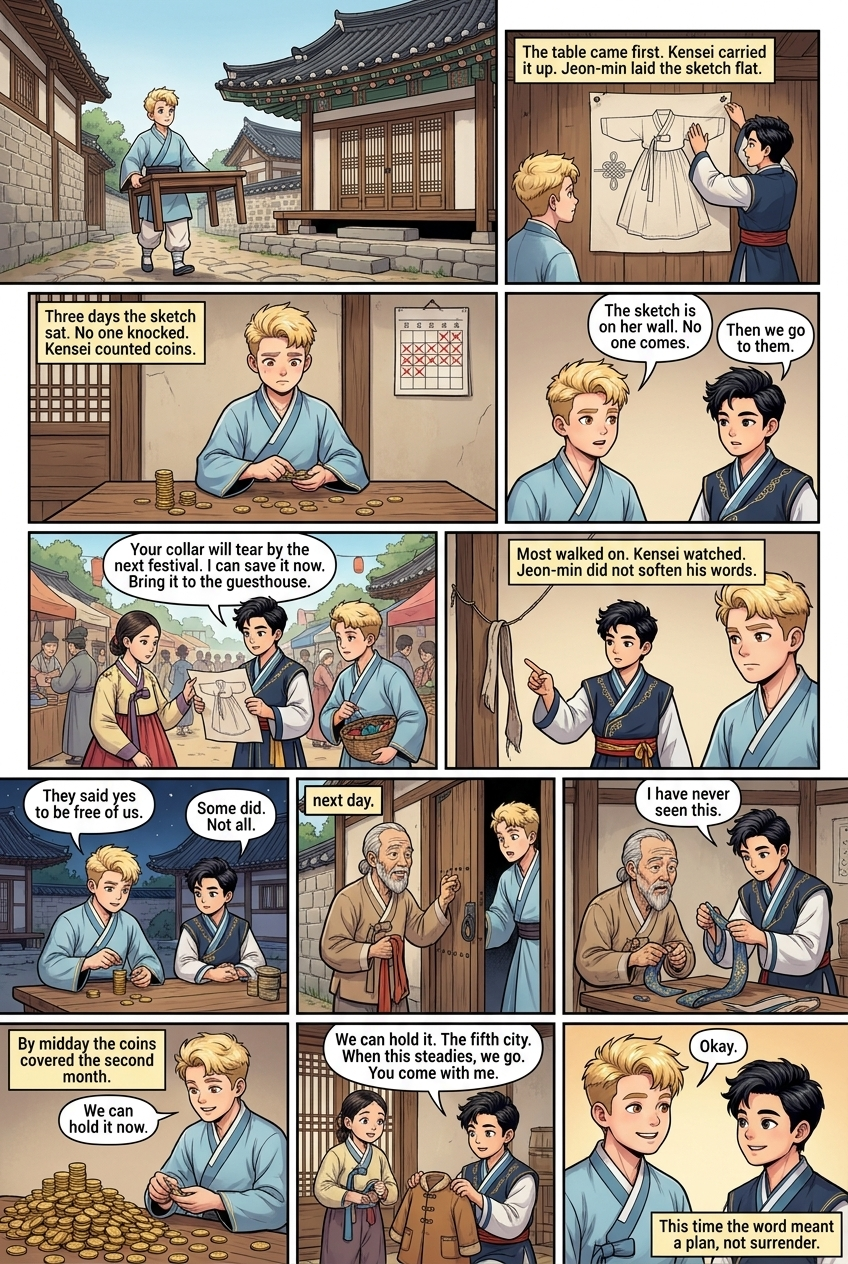
The table came first. Kensei carried it up from a seller two streets down and set it in the light. Jeon-min laid the sketch flat and pinned the corners. For three days the sketch sat by the proprietor's front door where guests could see it. No one knocked. Kensei counted the coins again each night. One month held. The second did not. "The sketch is on her wall," Kensei said. "No one comes." Jeon-min did not look up from his thread. "Then we go to them." "Go where?" "The festival wears people out. Torn hems. Loose ties. Split seams." He counted on his fingers. "They fix nothing until it falls apart. Then it's too late." He set down the needle. "We find them before it's too late." So they went out. Kensei carried the folded work cloth and a basket of thread. Jeon-min carried the sketch. He stopped every person in worn festival clothes. A woman with a frayed collar. An old man whose sash hung by one thread. Jeon-min pointed at each flaw before they knew it was there. "Your collar will tear by the next festival," he told the woman. "I can save it now." He held up the sketch. "This is my work. My family's pattern. Bring it to the guesthouse." Most people walked on. Kensei watched Jeon-min take each no without flinching and move to the next. Jeon-min did not soften his words. He named the flaw, named the price, and stopped. Kensei had seen him do this only with cloth. Now he did it with strangers, and it worked the same way. By dusk three had promised to come. Kensei did not believe promises. "They said yes to be free of us." "Some did," Jeon-min said. "Not all." The next morning a knock came at the lattice door. The old man stood there with his sash in both hands. Behind him waited the woman with the frayed collar, and a mother holding a child's torn festival coat. Jeon-min took the sash first. He spread it on the table in the light. He worked the knot pattern into the mend, the one his great-grandmother made. The old man watched his hands and did not speak. When it was done he turned the sash over twice. "I have never seen this," the old man said. He paid, and he told the mother to look. She paid too. By midday the coins covered the second month, and part of a third. Kensei stacked them on the table. For the first time the pile grew instead of shrank. He had a place. He had a trade that fed the place. He looked at Jeon-min bent over the child's coat, his needle moving. "We can hold it now," Kensei said. "We can hold it," Jeon-min said. Then he glanced up. "The fifth city. When this steadies, we go. You come with me." "Okay," Kensei said. This time the word meant a plan, not surrender.
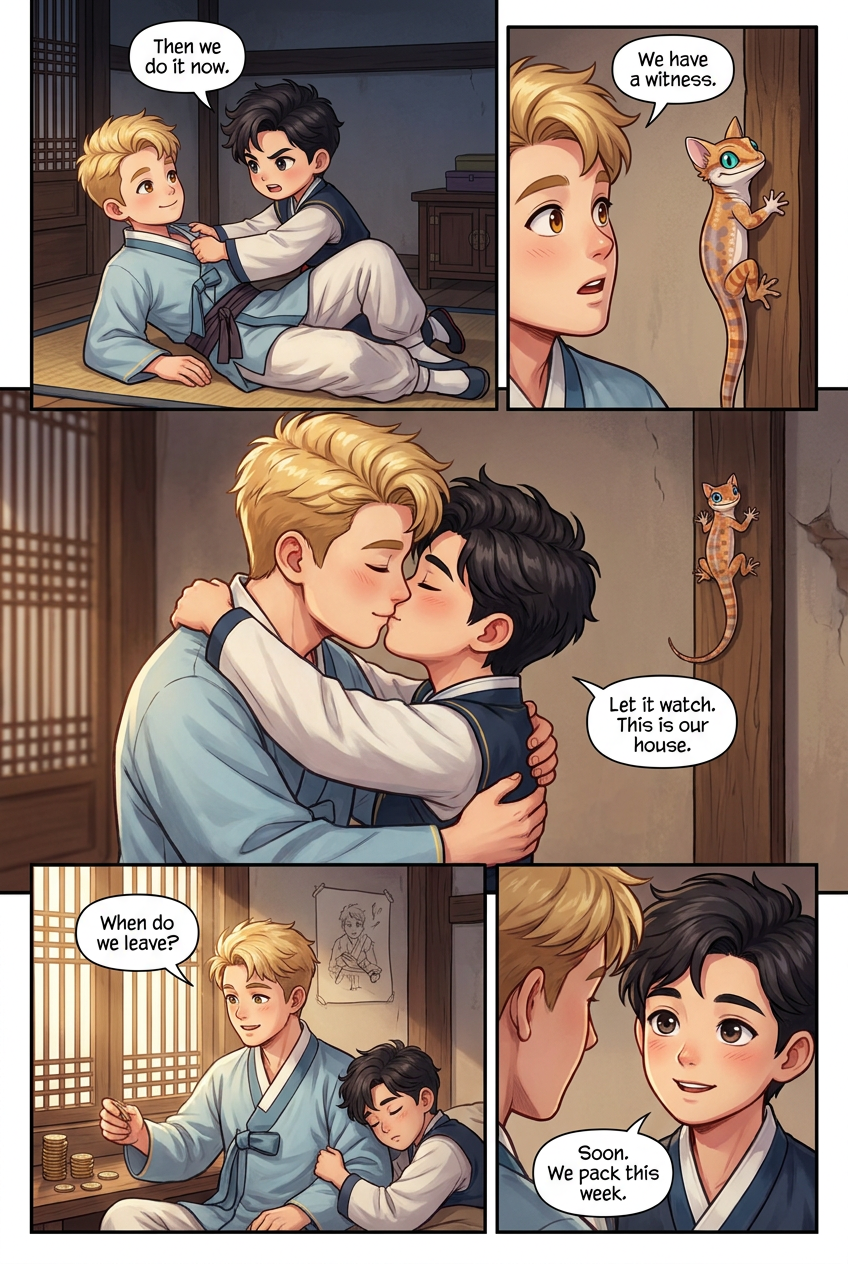
The coins held two months now. The work table sat in the light, the sketch pinned to the wall by the door. That night Jeon-min blew out the lamp and did not reach for his thread. He reached for Kensei instead. "We have never done this here," Kensei said. His voice was low. The room was theirs. No sister to walk in. No hallway with a neighbor watching. No borrowed floor to clear by morning. Jeon-min pulled him down onto the mat. "Then we do it now." He said it the way he named a price to a stranger. Flat. Sure. He touched the tie at Kensei's collar, the hanbok he had measured with his own hands. Kensei laughed and let him. For years he had counted the cost of every touch. He counted nothing now. He kissed Jeon-min, and Jeon-min kissed him back, and neither of them stopped to listen for a knock. Something moved on the wall. Kensei turned his head. A small gecko clung to the wood, ears like a cat's, watching them with one bright eye. He froze. The old fear rose in him. Someone sees. Then he laughed again. "We have a witness." Jeon-min glanced up, saw the gecko, and did not move away. "Let it watch." He said it once, then said it again. "Let it watch. This is our house." The words landed harder than the touch. Their house. Not a hiding place. Not a room they paid for and feared. A place where a small thing could watch them love each other, and nothing would come of it. No decree. No ledger. No enforcer at the door. Kensei held Jeon-min close and let the night stretch long. They kissed. They talked in the dark about the fifth city, about the pattern, about the old man who turned his sash over twice. Kensei fell asleep with his face against Jeon-min's neck. For once he did not lie awake. He did not want to leave. He did not have to. Morning came gray through the lattice. Kensei woke first. Jeon-min slept beside him, his breath even, his hand still on Kensei's arm. The gecko was gone from the wall. Kensei looked at the sketch by the door. He looked at the coins stacked on the table. He had a place. He had a trade. He had this man asleep against him, and no law left standing to take him away. He knew then what was missing. They could stay here and hold what they had. Or they could go to the fifth city, where no one knew Kensei had ever been Hikari, where they could arrive as two men with a trade and a pattern, and build a name from nothing. Kensei woke him gently. "When do we leave?" Jeon-min opened his eyes. He did not ask what Kensei meant. "Soon," he said. "We pack this week."
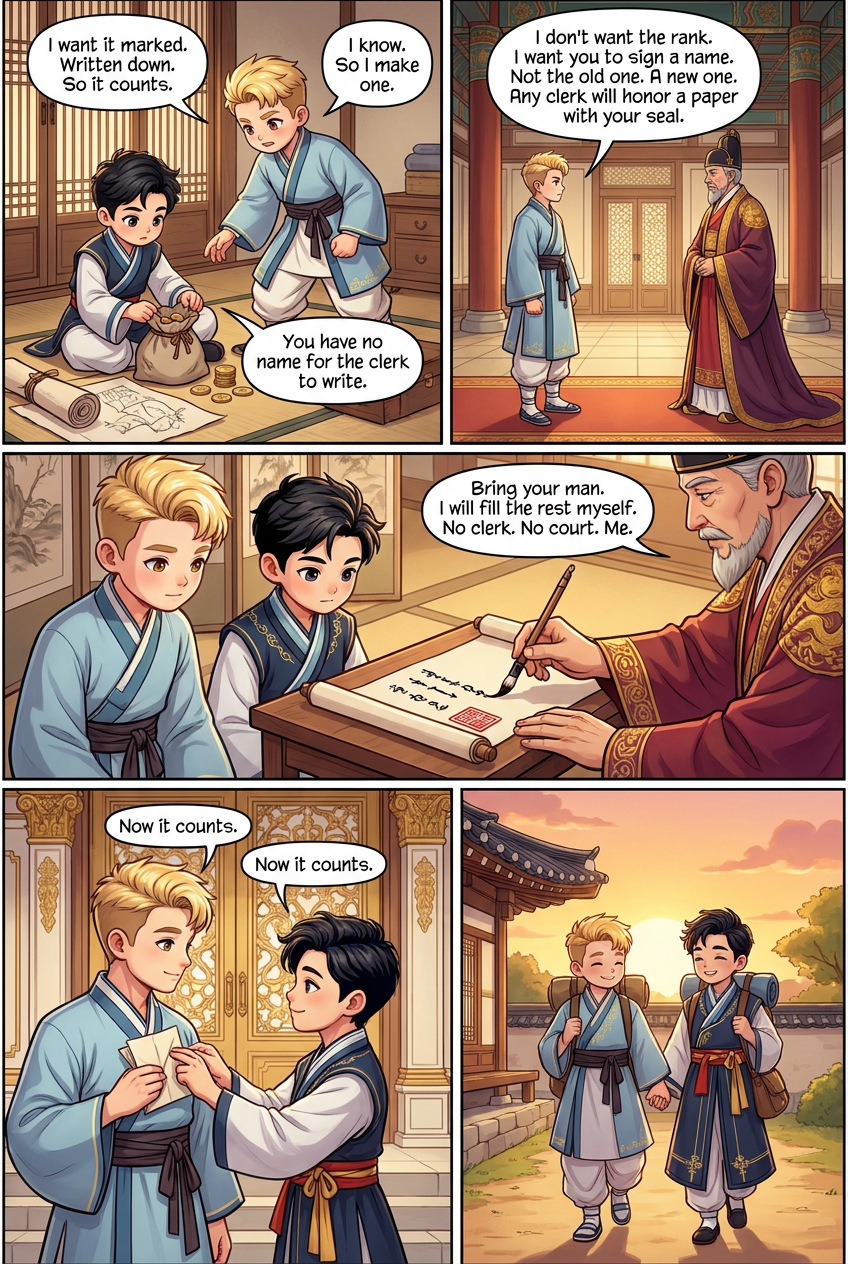
They packed the coins and the sketch that week. But one thing stopped Kensei cold. He wanted to marry Jeon-min before they left. He had no name and no standing. No official would sign for a man the palace had erased. Without a paper, the marriage would feel like the storeroom again. A thing done in the dark, real to no one but them. He told Jeon-min while they folded thread into the bag. "I want it marked. Written down. So it counts." Jeon-min looked up. "You have no name for the clerk to write." "I know." Kensei set down the thread. "So I make one." He left before Jeon-min could argue. He went to the palace one last time. The guards knew his face and let him wait. His father the king came out into the hall, older than Kensei remembered, and did not sit. "I cannot give you your rank," the king said. "I told you that. The throne breaks if I favor you." "I don't want the rank." Kensei stood straight. "I want you to sign a name. Not the old one. A new one. Any clerk will honor a paper with your seal." The king was quiet. "A common name. Nothing that ties you to me." "Nothing," Kensei said. "Just a name that lets me marry him." The king went to a side table and took up brush and paper. He wrote a plain name, one no noble carried. He pressed his seal below it. Then he wrote a second line under the first. A marriage record, blank where the second name belonged. "Bring your man," the king said. "I will fill the rest myself. No clerk. No court. Me." Kensei brought Jeon-min back through the tall doors. Jeon-min looked at the gold walls and said nothing, but his hand found Kensei's and held it. The king dipped the brush. He wrote Jeon-min's name beside the new one Kensei had chosen. He wrote the date. He pressed the seal a second time. "It is done," the king said. He handed the paper to Kensei. "You are married. This holds in any city. No one can strike it." Kensei read the two names, side by side, under the royal seal. Not a secret. Not a thing hidden by morning. A record any official would honor. The king looked at them both. "Go build your life. Do not come back here." His voice was steady, but he turned away fast. Outside the palace, Kensei folded the paper into his shirt. Jeon-min touched the fold through the cloth. "Now it counts," Jeon-min said. "Now it counts," Kensei said. They walked back toward the guesthouse with its curved eaves and packed bags. The name on the paper was new. It tied to no father, no rank, no old life. They would carry it to the fifth city and make it mean something there.
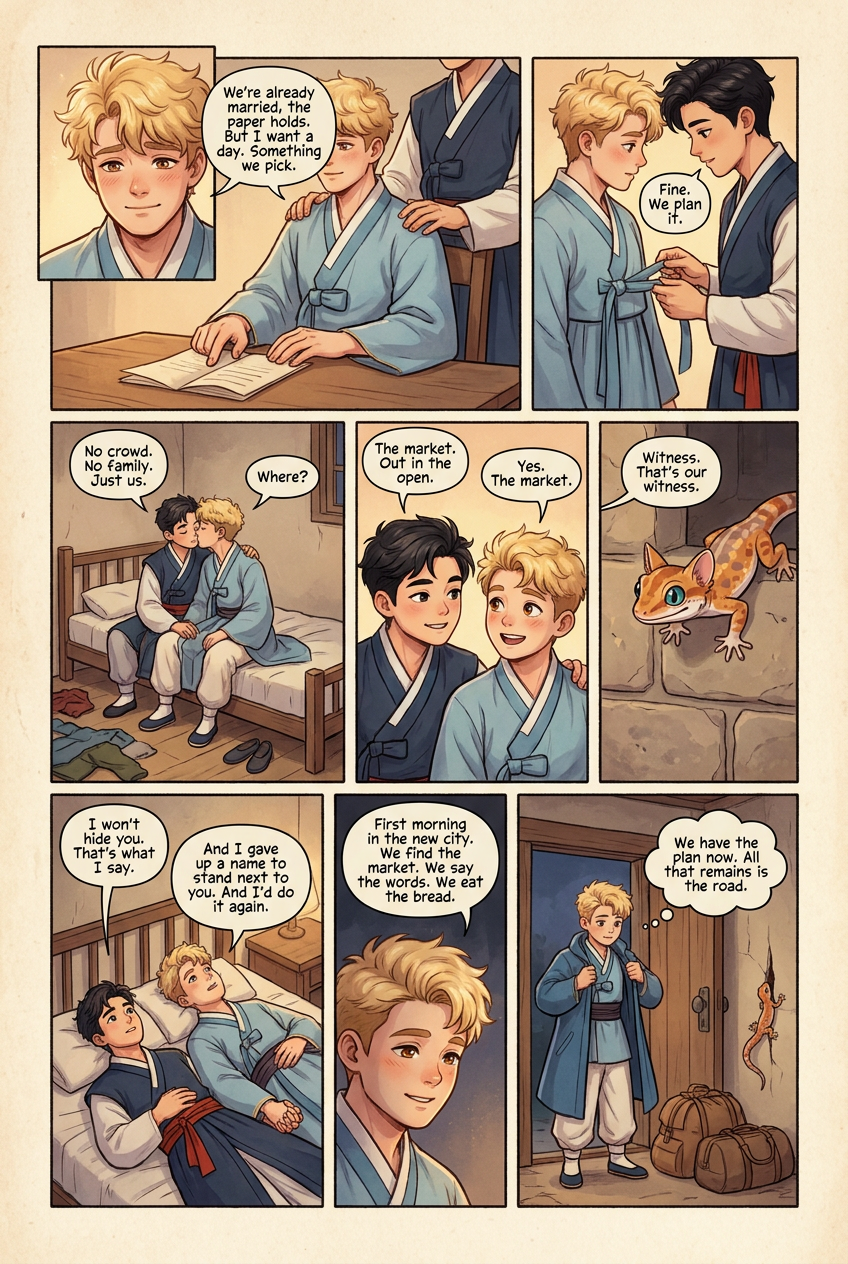
The marriage paper sat folded on the table. They were married on it already. But Kensei wanted more than the paper. He wanted a day. A ceremony they chose themselves, before they left for the fifth city. He said this to Jeon-min in the back room of the guesthouse, with the bags packed by the door. "We're already married," Jeon-min said. "The paper holds." "I know." Kensei touched the fold. "I still want a day. Something we pick." Jeon-min looked at him a long moment. Then he reached out and pulled the tie of Kensei's hanbok loose. "Fine. We plan it." The clothes came off between words. Kensei's outer coat slid to the floor. Jeon-min's belt followed. They kept talking anyway, close on the narrow bed, working it out in pieces. "No crowd," Jeon-min said against Kensei's shoulder. "No family. Mine won't come. Yours can't." "Just us, then." Kensei kissed his jaw. "Where?" "The market." Jeon-min pulled back to look at him. "You always wanted the market. We say the words there. Out in the open." Kensei stilled. It was the thing he'd wanted from the start. To stand with Jeon-min somewhere that wasn't a hidden room. "Yes," he said. "The market." A small brown gecko ran up the wall beside them. It had two soft points on its head, like little ears. It stopped and watched them with one bright eye. Jeon-min laughed, low. "Witness," he said, nodding at it. "That's our witness." "Then it stays for the whole thing." Kensei grinned. "What do we say?" Jeon-min thought. He was blunt even now, even bare on the sheets. "I won't hide you. That's what I say. Same as before." "And I say I gave up a name to stand next to you." Kensei traced the knot pattern stitched on Jeon-min's discarded coat. "And I'd do it again." "Say it shorter," Jeon-min said. "You talk too much." Kensei laughed and pulled him back down. They settled the rest in murmurs. No robes bought new. They'd wear what they had, mended by Jeon-min's own hand. One loaf of bread from a market stall to share, the first food eaten together in the open. The gecko clung to the wall through all of it, unbothered. When they were quiet, the clothes still on the floor, Kensei spoke into the dark. "We do it before we go. In the new city. First morning there." "First morning," Jeon-min agreed. "We find the market. We say the words. We eat the bread." Kensei felt it settle in him, plain and solid. Not a paper this time. A day they had chosen together. He reached down, found his coat, and folded it over the chair. The bags waited by the door. The gecko slipped into a crack in the wall and was gone. They had the plan now. All that remained was the road to the city where they'd carry it out.
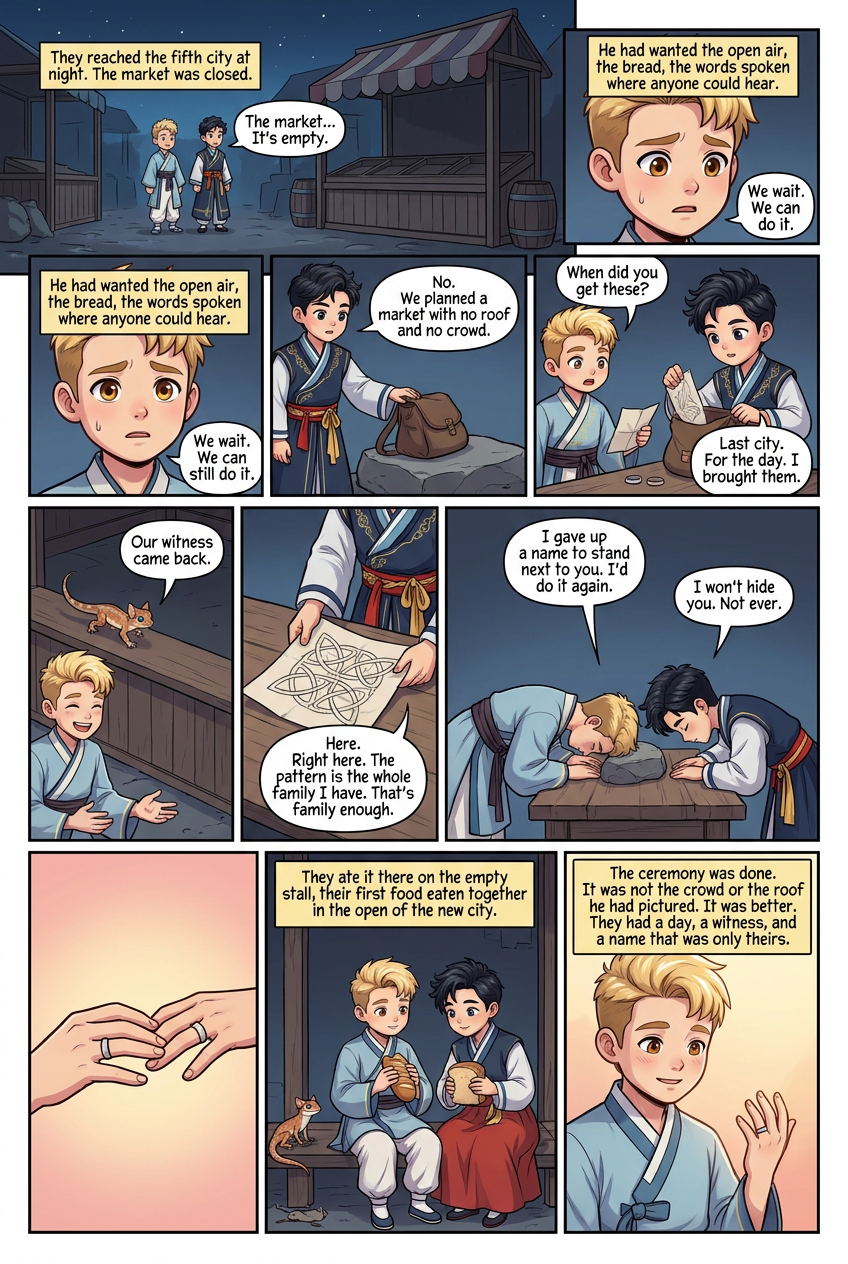
They reached the fifth city at night. The market was closed. Kensei found a room to sleep, but he lay awake counting the hours. He wanted their first morning to be the ceremony. They had planned it that way for weeks. He woke early and shook Jeon-min. "The market," he said. "Now." They walked while the streets were still gray. But the market stalls stood empty. A sweeper told them the market did not open until midday. Kensei's stomach dropped. Their first morning was slipping past with no place to say their words. "We wait," Kensei said. "We can still do it." "No," Jeon-min said. He set his bag down on the stone. "We planned a market with no roof and no crowd. Look. Half these people will be here by noon, staring. That isn't what we wanted." He was blunt as ever. He did not soften it. Kensei felt the whole plan crack. He had wanted the open air, the bread, the words spoken where anyone could hear. Now the morning was almost gone and they had nothing. Jeon-min crouched and opened his bag. He pulled out the sketch of his family's knot pattern, the one his great-grandmother drew. He unfolded it on the empty stall table. Then he took out two rings, small and plain. Kensei had not known he carried them. "When did you get these?" Kensei asked. "Last city," Jeon-min said. "For the day. I brought them." A small brown gecko ran along the stall edge. Two soft points sat on its head, like little ears. It stopped and watched them with one bright eye. Kensei laughed, sudden and loud. "Our witness came back," he said. Jeon-min looked at the gecko, then at Kensei. "Here," he decided. "Right here. Empty stall. No crowd yet. The pattern is the whole family I have. That's family enough." He spread the sketch flat, the knot pattern facing up. "You wanted your family and mine. This is mine." Kensei's throat tightened. He knelt across the table. They both still wore their hanbok, mended by Jeon-min's own hand. It was luxury enough. He bowed low, forehead near the stone. Jeon-min bowed back. "I gave up a name to stand next to you," Kensei said. "I'd do it again." "Shorter than last time," Jeon-min said. "Good." Then he said his own. "I won't hide you. Not ever." They slid the rings on. Jeon-min pulled bread from his bag, one loaf, and broke it. They ate it there on the empty stall, their first food eaten together in the open of the new city. The gecko held to the wood through all of it. When the loaf was gone, Kensei looked at his ring on his hand. The ceremony was done. It was not the crowd or the roof he had pictured. It was better. They had a day, a witness, and a name that was only theirs. Now they had to build the life to fill it.
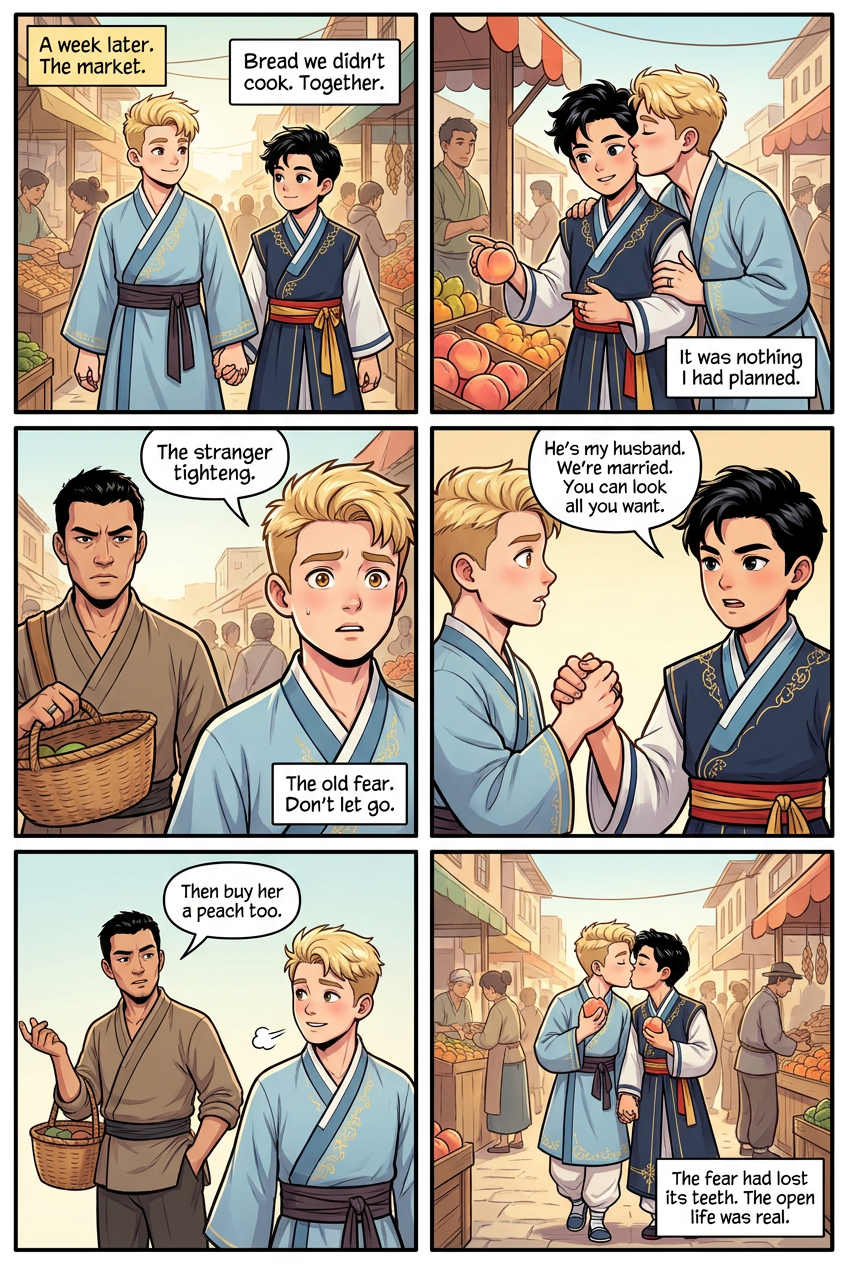
A week after the ceremony, they walked to the market together. Kensei had wanted this for so long. Bread they did not cook. A street that was not the apartment. Jeon-min held his hand without asking. The rings sat on both their fingers. Kensei kept his shoulders loose. He told himself no one here knew them, and no one here could take anything. They stopped at a fruit stall. Jeon-min bumped Kensei's arm and pointed at a bruised peach. "That one's soft. Half price if you argue." Kensei laughed. Without thinking, he leaned in and kissed him, quick, on the mouth. It was nothing he had planned. His body just did it. A man across the lane went still. He held a basket against his hip and watched. He did not look away. Kensei's stomach dropped. The old fear came back fast. He remembered the neighbor in the hallway, the night he watched Jeon-min sleep and left instead of staying. He felt his hand start to pull from Jeon-min's grip. The man kept staring. He shifted the basket. He opened his mouth. Kensei braced for the word he had heard his whole life, the one that came before the report, the demotion, the enforcers at the door. Jeon-min did not let go. He tightened his fingers around Kensei's and stared straight back at the man. "He's my husband," Jeon-min said. Flat. No shake in it. "We're married. You can look all you want." Kensei stopped breathing. He waited for the man to spit, to shout, to fetch someone. This was the fifth city. The law here was struck. There was no decree left to break. He knew that. His body had not learned it yet. The man looked at their hands. He looked at the rings. Then he shrugged and lifted his basket. "Then buy her a peach too," he said, nodding at the stall woman, and he walked off into the crowd. That was all. No shout. No report. Kensei stood in the lane and felt the fear drain out of him like water from a cracked cup. His hand was still in Jeon-min's. He had not pulled it free after all. He had wanted to. He had not done it. "You almost let go," Jeon-min said. Not angry. Just a fact. "I know," Kensei said. "I didn't." "No," Jeon-min agreed. "You didn't." Kensei bought the bruised peach. He did not argue the price. They ate it walking, passing it back and forth, juice on both their hands. He kissed Jeon-min again in the open, slower this time, because he wanted to and because no one could stop him. The fear had lost its teeth. The open life he promised was real now, in his mouth, in the sun, in a stranger's shrug. But a promise was easy. A whole life was longer. They had a market, a husband each, and a trade to build with hands that still shook a little. Now the work of filling the days began.
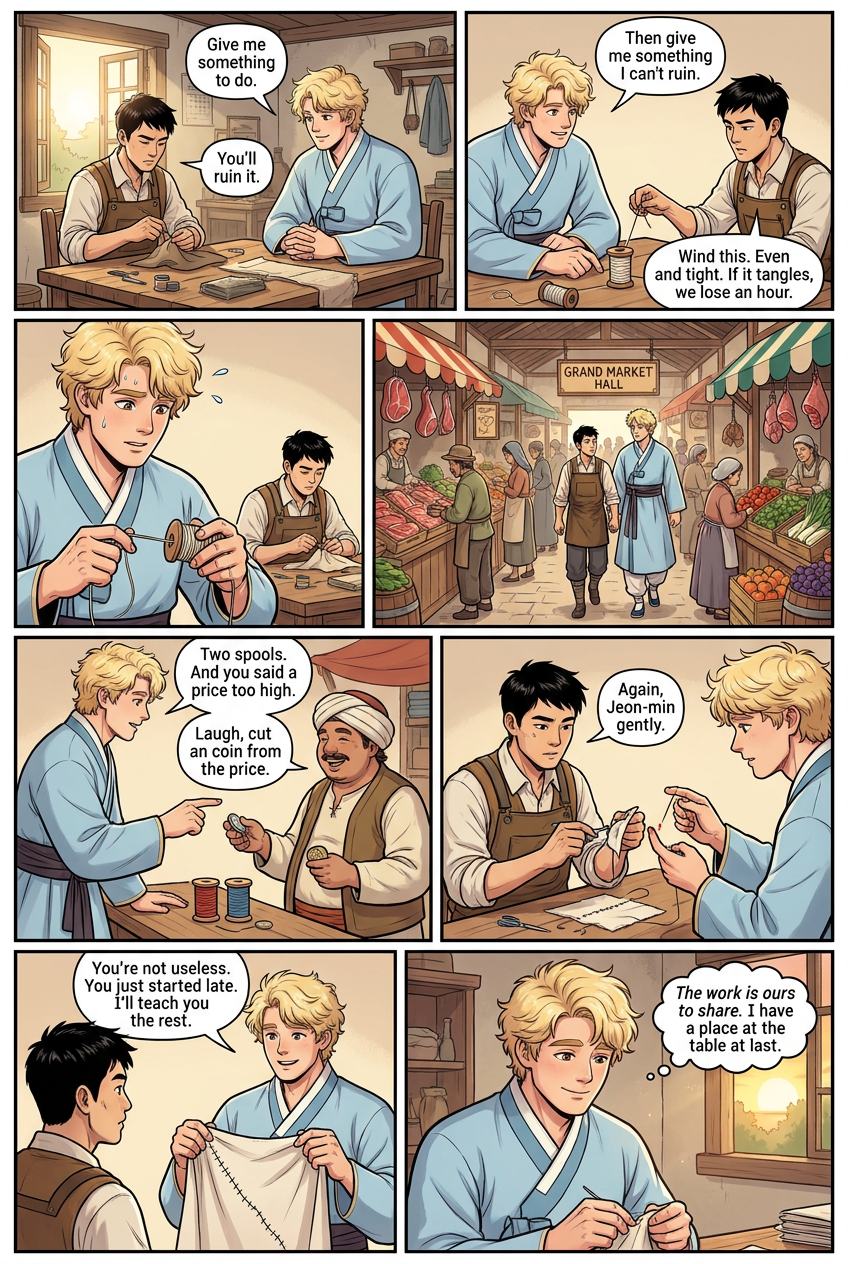
The next morning, Jeon-min laid out his tools on the table. Needles, thread, his family's knot cords. A torn jacket waited from a guesthouse client. Kensei sat across from him and watched Jeon-min's hands move. They always moved. His did not. Kensei had never learned a trade. In the palace, servants had done everything for him. Now Jeon-min carried all the work, and Kensei just watched. "Give me something to do," Kensei said. Jeon-min did not look up. "You'll ruin it." "Then give me something I can't ruin." Jeon-min stopped. He studied Kensei's face. Then he pushed a spool of thread across the table. "Wind this. Even and tight. If it tangles, we lose an hour." Kensei wound the thread. It slipped and bunched. He unwound it and started again. His fingers felt thick and slow. Jeon-min glanced over once, said nothing, and kept sewing. By the third try, the thread lay flat and even. Kensei set it down. It was a small thing. It was still a thing he had done. That afternoon they walked to the great market hall. Beef hung on hooks. Fruit filled crates. Vegetables spilled from baskets. Jeon-min needed stronger thread than the guesthouse sold. Kensei followed him through the noise. A cloth seller unrolled bolts of fabric. Jeon-min haggled hard, dropping the price twice, then reached for his coin pouch. Kensei touched his arm. "Let me." Jeon-min raised an eyebrow but stepped back. Kensei faced the seller. His mouth went dry. He had never bought anything in his life. He pointed at the thread. "Two spools. And you said a price too high." His voice shook, then held. The seller laughed and shaved a coin off. Kensei paid. He carried the thread out himself. "You argued," Jeon-min said in the lane. "I did." "Badly. But you did." Back at the table, Jeon-min pulled a stool beside his own. "Sit here. Watch this stitch." He looped the thread slow, showing each pass. Then he handed Kensei a scrap of cloth and a needle. "Not the client's. Yours. Ruin this all you want." Kensei's first stitch pulled crooked. The second sat straighter. He pricked his finger and bled a drop onto the cloth. Jeon-min took his hand, wiped it, and let go. "Again," he said. Kensei sewed a line that held. It was ugly. It did not tear when he tugged it. He looked up. Jeon-min was watching him, not the work. "You're not useless," Jeon-min said. "You just started late. I'll teach you the rest." Kensei looked at the crooked line of stitches. Tomorrow he would wind thread again. He would buy the fabric and haggle the price. He would learn the knots that were Jeon-min's whole family. The work was no longer only Jeon-min's. Now it was theirs to share, and Kensei had a place at the table at last.
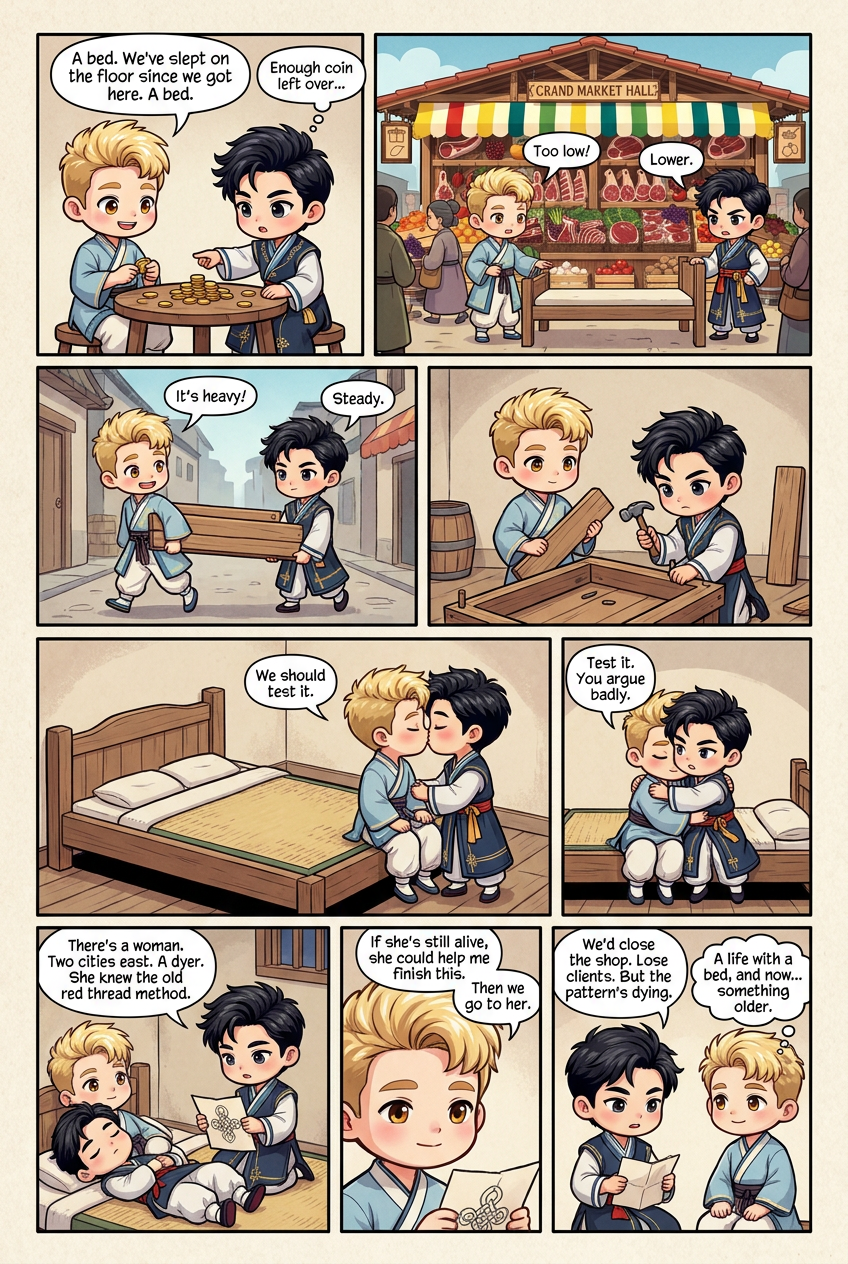
The mending work paid, and it paid enough. By the end of the month, Kensei counted the coins twice. Jeon-min counted them once and got the same number. There was rent covered, thread bought, and coin left over. Jeon-min set a small pile aside and pushed it across the table. "A bed," he said. "We've slept on the floor since we got here. A bed." They went to the great market hall together. Kensei found the frame seller and pointed at a plain wooden one. He named the price back too high, the way Jeon-min had taught him. The seller dropped it once. Jeon-min dropped it again, harder. They carried the frame home between them, Kensei walking backward through the door. They built it on the floor of the back room. Kensei held the boards while Jeon-min drove the pegs. His hands knew the work. Kensei's did not, but he held steady, and the frame stood. They spread a straw mat over it, then a folded quilt from Jeon-min's bag. It was theirs. Bought with coin they had earned. Kensei sat on the edge and it held his weight. Jeon-min sat beside him. For a moment neither spoke. Then Kensei kissed him, slow, and Jeon-min kissed back. The bed did not creak. It did not tip. It stayed. "We should test it," Kensei said. Jeon-min raised an eyebrow. "Test it." "It could break. Better to know now." "You argue badly." Jeon-min pulled him down anyway. The frame held them both. They christened it the way a home gets christened, with kisses first, then cuddles, then more. No fear of a door opening. No sister walking in. No neighbor in a hallway. Just the two of them and a bed they owned. After, Jeon-min lay with his head on Kensei's chest. The room was quiet. Kensei stared at the low ceiling and felt something settle in him. This was a life. Not a stolen night. A life with a bed in it. Then Jeon-min sat up. He reached for his bag and pulled out the sketch, the one marked with his great-grandmother's knot pattern. He unfolded it on the quilt. "There's a woman," he said. "Two cities east. A dyer. My map says she knew the old red thread method. The one my family used." He tapped the sketch. "If she's still alive, she could help me finish this." Kensei looked at the pattern. Half of it was guesswork, lines drawn faint where no one remembered. "Then we go to her." "It's two cities. Days of walking. We'd close the shop. Lose clients." Jeon-min folded the sketch back up. "But the pattern's dying. Every year I wait, someone who remembers it dies too." Kensei sat up beside him. They had a bed now, and a home, and a life. And Jeon-min wanted to leave it to save something older than both of them.
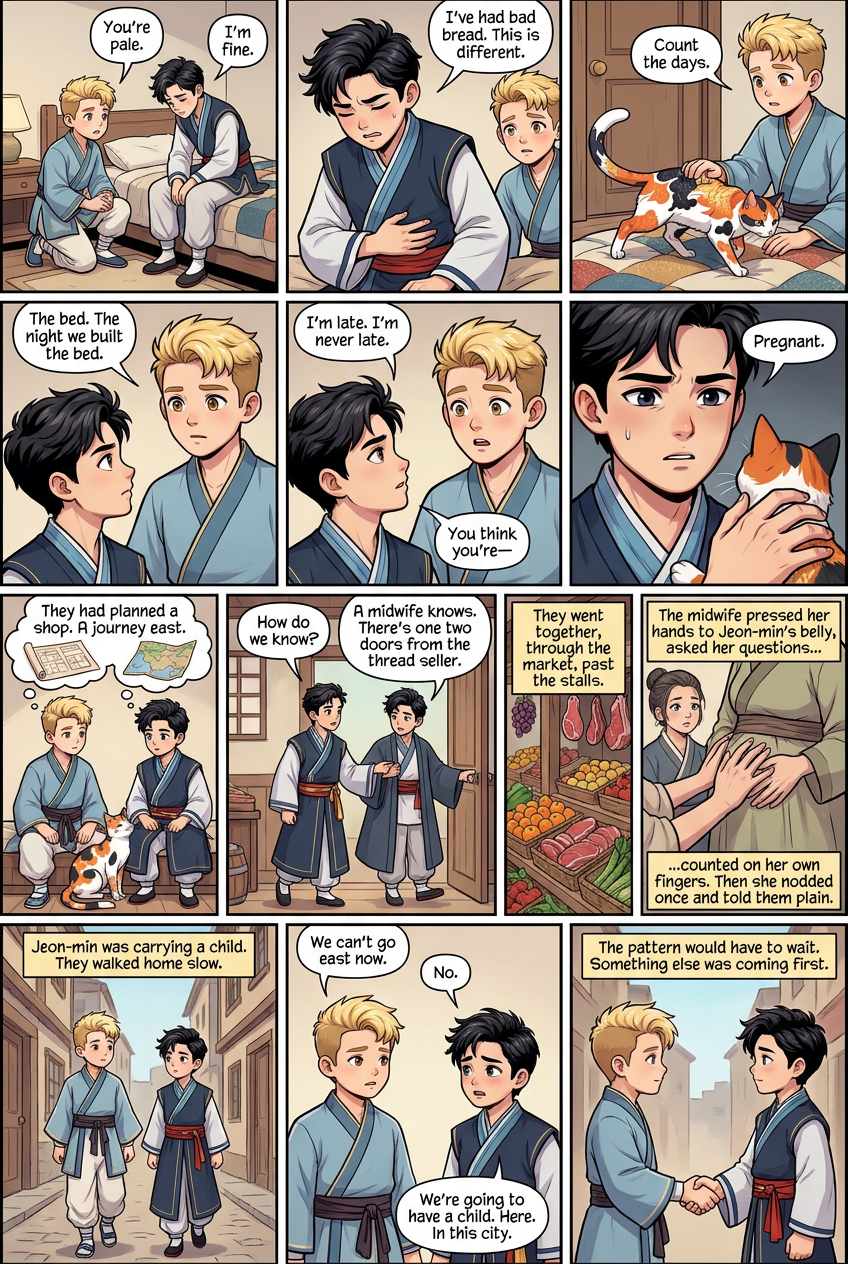
They did not leave for the dyer that week. Jeon-min woke sick two mornings in a row. The first day, he blamed old bread. The second day, he sat on the edge of the new bed with his head down and did not stand. Kensei knelt in front of him. "You're pale." "I'm fine." "You said that yesterday, then you ran outside." Jeon-min pressed a hand to his own stomach. He frowned, the way he frowned at a stitch that would not lie flat. "It's not the bread," he said. "I've had bad bread. This is different." A cat slipped in through the gap under the door. It was a strange one, orange and white and black, with markings like fish scales running down its side. It had come around since they moved in, fed by no one they knew. It jumped onto the quilt and settled against Jeon-min's leg. He did not push it off. His hand rested on its back while he thought. "Count the days," Jeon-min said. Not to Kensei. To himself. "What days?" Jeon-min looked up. His face had changed. "The bed," he said. "The night we built the bed." Kensei did not follow. "What about it?" "After that night. I'm late." Jeon-min said the number of days out loud. Then he said it again, slower, as if hearing it twice would make it wrong. "I'm never late." Kensei still did not understand. Then he did. His mouth went dry. "You think you're—" "Pregnant." Jeon-min said the word flat, the way he said a price. But his hand tightened in the cat's fur. "I think I might be pregnant." Neither of them moved. The cat purred against Jeon-min's leg, loud in the quiet room. Kensei's mind ran back over everything he knew, and none of it had a place for this. They had planned a shop. They had planned a journey east. They had not planned this. "That can't—" Kensei started, then stopped. He had learned in this city that things he was sure of could still be true. "How do we know?" "A midwife knows." Jeon-min stood. The sickness had passed enough to let him. "There's one two doors from the thread seller. I've seen her sign." They went together, through the market, past the stalls. Kensei held the door for him. The midwife pressed her hands to Jeon-min's belly, asked her questions, counted on her own fingers. Then she nodded once and told them plain. Jeon-min was carrying a child. They walked home slow. Kensei did not know what to say, so he said the true thing. "We can't go east now." "No." Jeon-min stopped in the street. He looked at Kensei, and for once he did not say the fact flat. His voice caught. "We're going to have a child. Here. In this city." Kensei took his hand in front of everyone and held it. The pattern would have to wait. Something else was coming first.
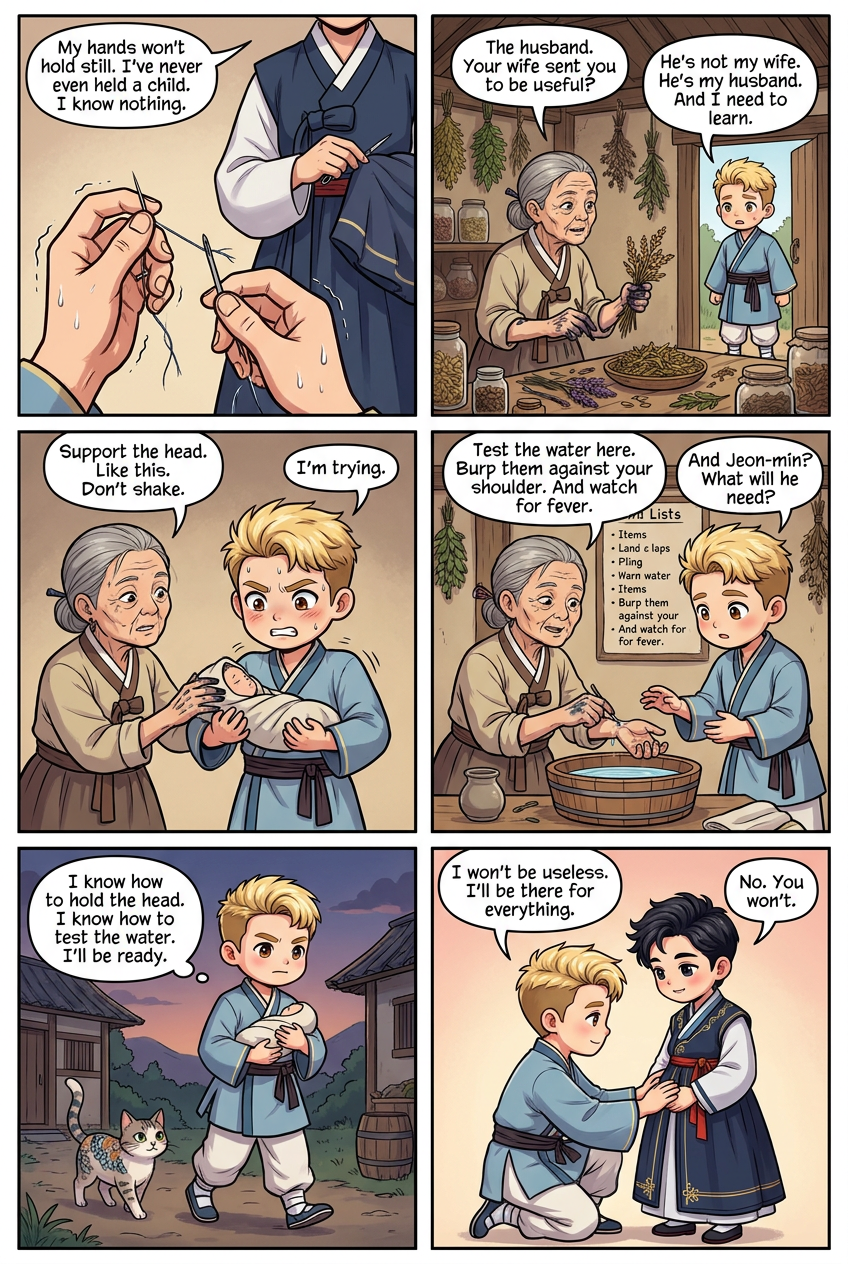
The morning after the midwife, Kensei sat at the work table and could not thread the needle. His hands would not hold still. Jeon-min was carrying a child, and Kensei knew nothing about children. He had never held one. He had grown up with servants who took infants away and brought them back clean. He did not even know how a baby was fed. "You're staring at the wall," Jeon-min said. He was mending a sleeve, calm, as if nothing had changed. "I don't know how to do any of this," Kensei said. "When the child comes, I won't know what to do. You'll be tired and hurting, and I'll be useless." Jeon-min set down the sleeve. "Then learn." "From who?" "The midwife." He said it like it was obvious. "She's two doors from the thread seller. Go." Kensei went. The midwife was an old woman with ink on her fingers, sorting dried herbs into small jars. She did not look up when he entered. "The husband," she said. "Your wife sent you to be useful?" "He's not my wife. He's my husband. He's carrying our child." Kensei felt the old fear rise, then pass. The woman only nodded and kept sorting. "Then you'll do the carrying of everything else," she said. "Sit." She made him work. She handed him a wrapped bundle of cloth the weight of a newborn and showed him how to hold the head. His arms shook. She corrected them. She showed him how to warm water, how to test it on his own wrist, how to burp a child against his shoulder. She told him what Jeon-min would need after the birth, the bleeding, the fever to watch for, the days he would not be able to stand. "Most fathers faint or run," she said. "You didn't faint yet." Kensei stayed until the light turned. He asked every question he had. When he ran out, he thought of more. The woman answered all of them and charged him three coins for the afternoon. He walked home with his arms remembering the weight. The strange cat sat in their doorway, the one with markings like fish scales. It followed him inside. Jeon-min looked up from the sleeve. "Well?" Kensei crouched in front of him. He put his hand flat on Jeon-min's stomach, the way the midwife had shown him. His hand did not shake now. "I know how to hold the head," Kensei said. "I know how to test the water. I know what you'll need after, and I'll be there for it. All of it." He looked up. "I won't be useless." Jeon-min was quiet. Then he put his hand over Kensei's. "No," he said. "You won't." The fear was gone. In its place was a job Kensei knew how to begin. He picked up the needle. This time his hands held still.
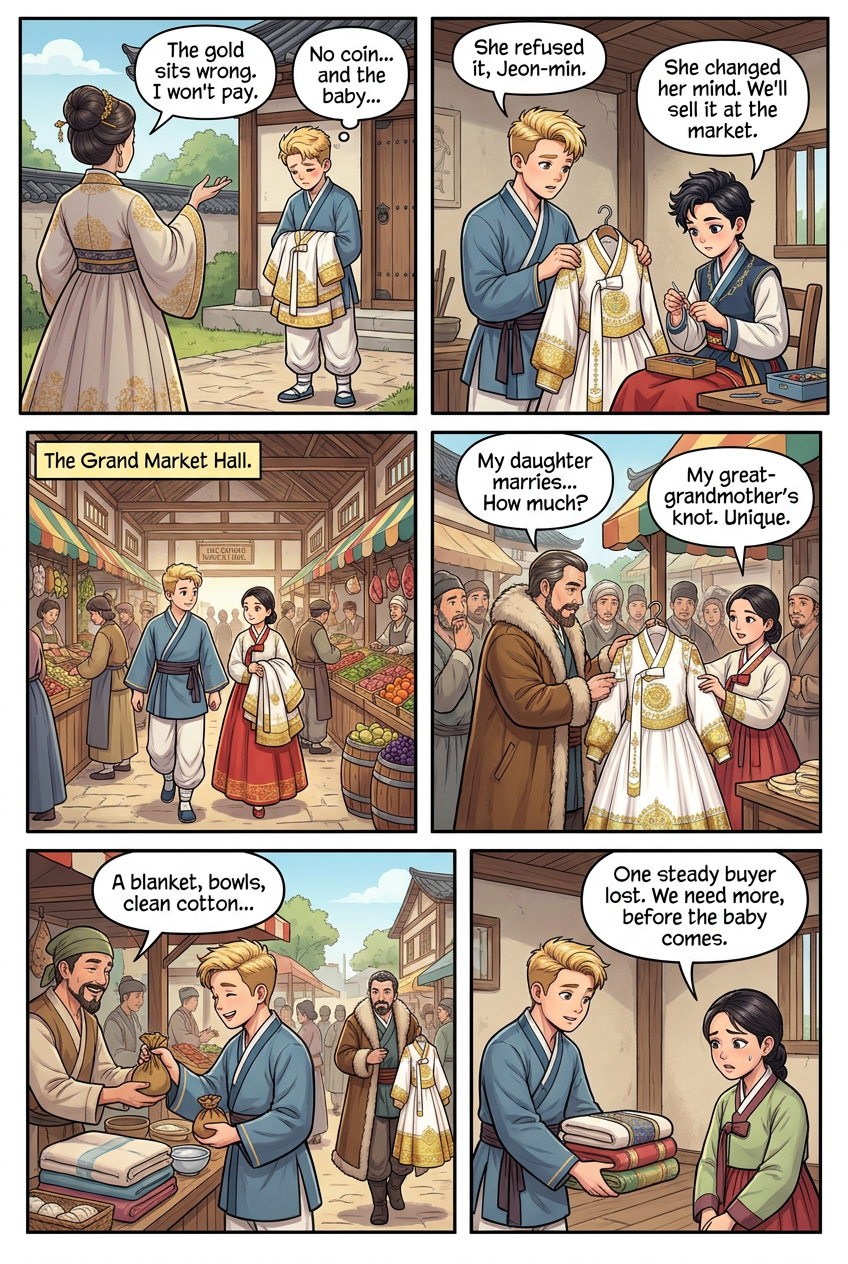
The finished hanbok hung by the window, white silk with gold at the hem. Kensei had watched Jeon-min work it for two weeks. It was the finest thing they had made. The regular client had asked for it, a wealthy woman who ordered often and paid well. Now Kensei stood at her door with the folded bundle in his arms, waiting to be paid. The woman took the hanbok and held it to the light. She turned it once. Then she set it on a bench and shook her head. "The gold sits wrong," she said. "I won't pay for work I can't wear." She closed the door. Kensei walked home with the hanbok and no coin. His hands remembered the weight of the newborn bundle from the midwife. Now they held silk they could not eat. The child needed cloth, a warm blanket, clean water bowls. All of it took coin they did not have. Jeon-min looked up from his sewing. Kensei set the hanbok down. "She refused it. She said the gold sits wrong." Jeon-min stood. He picked up the hanbok and studied the gold border, close, the way he checked every seam. "The gold is straight," he said. "She changed her mind. That is not our fault." He folded the hanbok over his arm. "We won't beg her. We'll sell it to someone who wants it." "Where?" "The market hall. People buy finished pieces there. This one is finer than anything they sell." They walked to the market hall together. It was packed with stalls, beef on hooks, crates of fruit, vendors calling over each other. Jeon-min moved through it without slowing. He stopped at a cloth seller's stand and laid the white hanbok across the counter, gold catching the light. A crowd formed. A merchant in a fine coat reached out and touched the hem. "My daughter marries next month," he said. "She needs something like this." Jeon-min named a price higher than the client had promised. The merchant frowned. Jeon-min pointed to the knot pattern stitched at the collar. "My great-grandmother made that pattern. No one else can sew it. You won't find this anywhere else." The merchant looked at it a long moment. Then he counted out the coins into Kensei's open palm. More coins than the client had ever paid. They walked back through the stalls. Kensei stopped at a vendor selling soft cloth and warm blankets. He bought a blanket, two water bowls, a length of clean cotton for the baby. His hands did not shake as he paid. At home Jeon-min set the blanket in the corner where the child would sleep. "The client is gone," he said. "That's one buyer lost. We had one steady buyer. Now we have none." He looked at the empty corner. "We need to find more, before the baby comes."
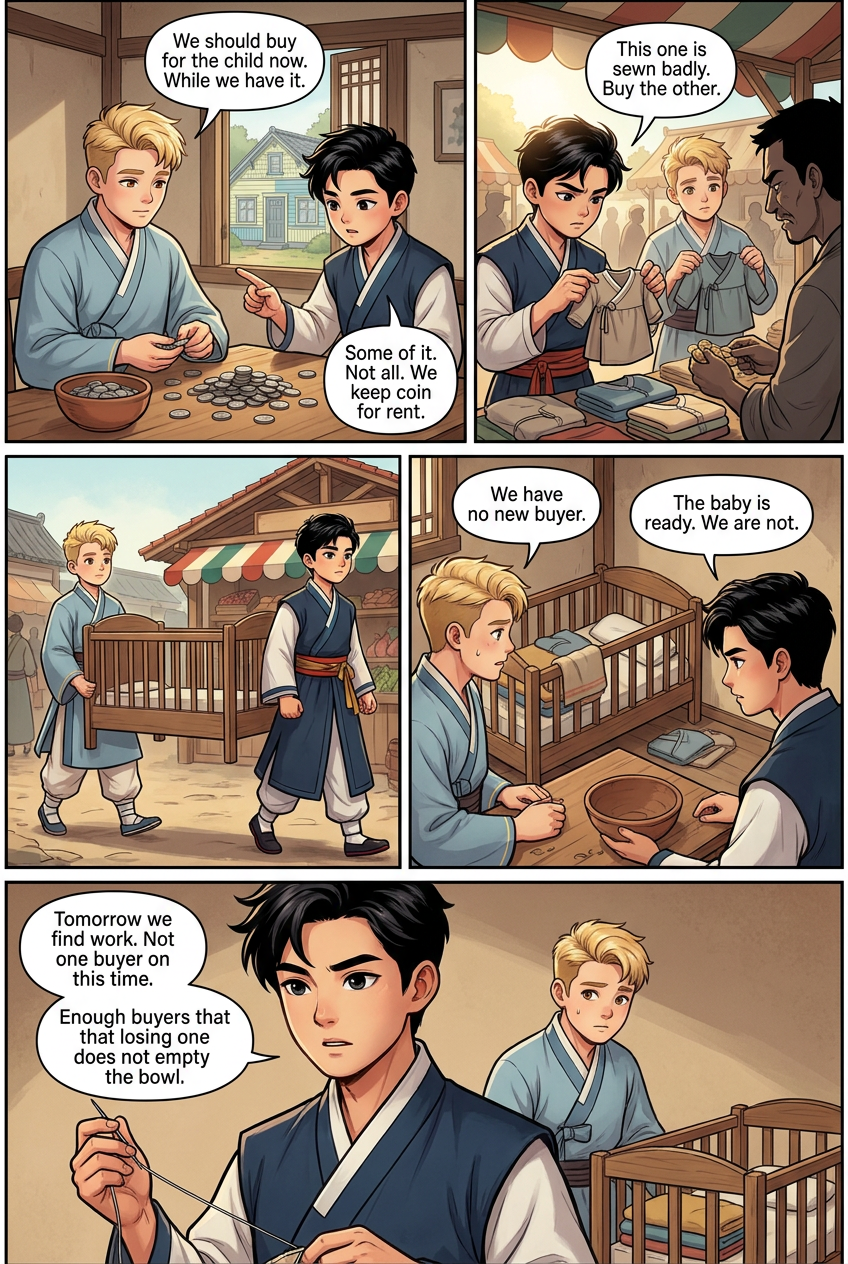
The coins from the wedding hanbok sat in a clay bowl on the table. Kensei counted them twice. It was more than they had held at once since coming to the fifth city. But their steady client was gone. This coin would not come again unless they earned it. Kensei looked at the empty corner where the baby would sleep. "We should buy for the child now," he said. "While we have it." Jeon-min set down his needle. "Some of it," he said. "Not all. We keep coin for cloth and thread. We keep coin for rent." He split the pile with one finger, quick and sure. "This much for the baby. This much stays." They walked to the market hall together. Beef hung on hooks. Crates of fruit spilled onto the ground. Vendors shouted over each other. Kensei stopped at the soft cloth stall where he had bought the blanket. He picked up a small tunic, then a second. Jeon-min held each one to the light and checked the seams the way he checked everything. "This one is sewn badly," Jeon-min said. He set it down. "The stitches will open in a week. Buy the other." He named the fair price before the vendor could speak. The vendor frowned, then nodded. Kensei paid. At a woodworker's stall Kensei found a crib. It was plain pine, small, with a rail on each side. He ran his hand along the wood. No splinters. He thought of the midwife showing him how to lay an infant down. "This one," he said. Jeon-min tested the rail with both hands. It held. Kensei counted the coins into the woodworker's palm. They carried the crib home between them, one end each. Kensei set it in the corner. He laid the new tunics inside, folded, beside the blanket from before. The corner was no longer empty. It looked like a place a child would live. Jeon-min stood over the clay bowl. He counted what was left. He counted it again. "We spent well," he said. "But look." He tipped the bowl so Kensei could see. Only a thin layer of coins covered the bottom. "This is one month of rent. No thread money. No cloth money for the next order." Kensei looked at the crib, then at the bowl. The child had a bed now. Clothes that would not fall apart. But they had turned coin into things they could not sell back. "We have no new buyer," he said. "No," Jeon-min said. He set the bowl down. "The baby is ready. We are not." He picked up his needle again. "Tomorrow we find work. Not one buyer this time. Enough buyers that losing one does not empty the bowl." He looked at the crib in the corner. "We have less time than coin now."
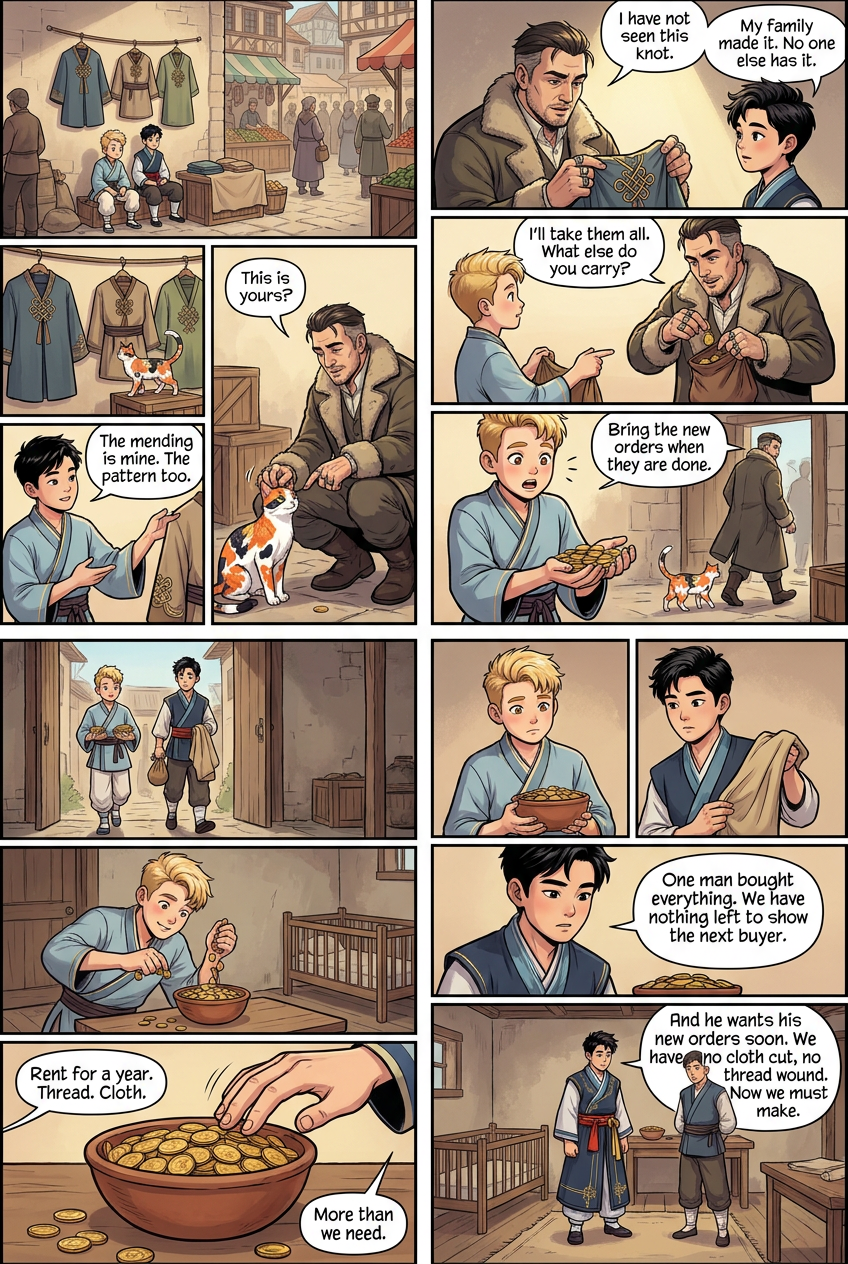
In the morning Kensei and Jeon-min carried their finished work to the market hall. Beef hung on hooks. Fruit spilled from crates. Vendors shouted. They laid three mended garments on a cloth by the wall and waited. Jeon-min had said it plain the night before: enough buyers that losing one does not empty the bowl. So far no one stopped. A cat wound between the crates. Its fur ran orange, white, black, and gold, patterned like fish scales along its back. It sat by their cloth and washed one paw. A man followed it. He wore a heavy coat and rings on both hands. He crouched and scratched the cat's ears like he owned it. "This is yours?" the man asked, pointing at the garments. "The mending is mine," Jeon-min said. "The pattern too." He turned a sleeve so the man could see the knot work at the cuff. The man lifted it to the light. He rubbed the stitches between two fingers. "I have not seen this knot," he said. "My family made it," Jeon-min said. "No one else has it." The man looked a long time. Then he set the garment down and began pulling coins from his coat. He bought all three. He pointed at Kensei's bag and asked what else they carried. Kensei showed him the scrap pieces, the practice cloth, a half-finished collar. The man bought those too. He named a coat he wanted mended and a set of robes for his house. "Bring them when they are done," he said. He counted coin into Kensei's hand. He counted more. He kept counting. Kensei's palm filled and he cupped his other hand under it. The pile grew past anything one client had ever paid. It was ten times what the bowl had held that morning. The man stood. The cat rose with him and followed him into the crowd. He did not look back. Kensei carried the coins home in both hands. Jeon-min carried the empty cloth. In the room Kensei poured the coins into the clay bowl. They rose to the rim. Some spilled onto the table. He had never seen the bowl full. "Rent for a year," Jeon-min said. He touched the coins with one finger, quick and sure, the way he always counted. "Thread. Cloth. More than we need." Kensei looked at the crib in the corner. The fear that had sat in his chest for weeks let go. They could feed the child now. They could buy without splitting every pile. Then Jeon-min stopped counting. He set his hand flat on the table. "One man," he said. "One man bought everything." He looked at Kensei. "We sold him all our work. Every piece. We have nothing left to show the next buyer." He looked at the full bowl, then at the empty cloth. "And he wants his coat and his robes soon. We have no cloth cut, no thread wound. We spent the morning selling. Now we must make."
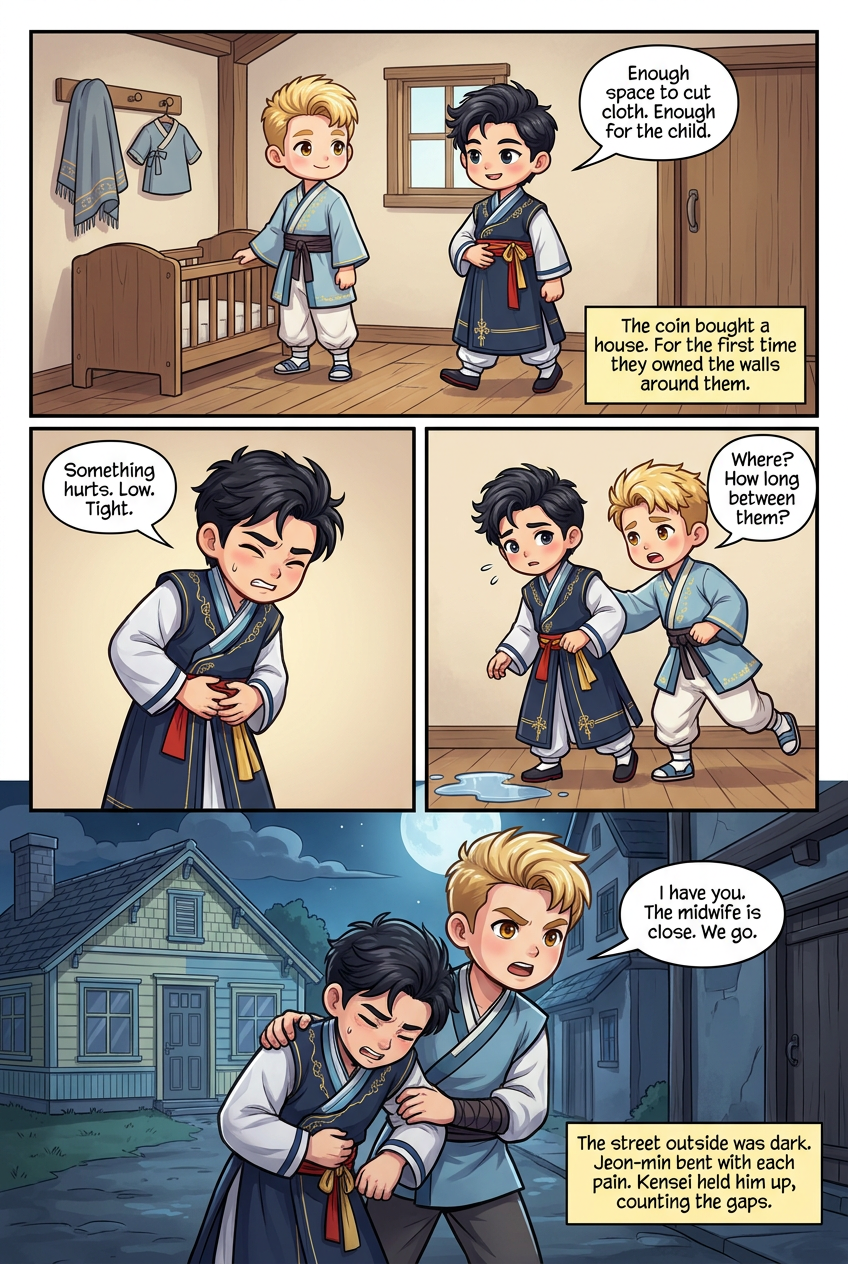
The coin bought more than cloth. It bought a house. Kensei and Jeon-min moved from the rented rooms into a small home painted green and blue. It had two windows and a solid door. Inside they set the crib in the corner, the blanket folded on the rail, the tiny tunic hung on a peg. Jeon-min walked each room once, counting. "Enough space to cut cloth," he said. "Enough for the child." For the first time they owned the walls around them. That night Jeon-min stopped in the middle of the floor. He pressed a hand to his belly. "Something hurts," he said. He did not soften it. He never did. Kensei crossed to him fast. "Where?" "Low. Tight." Jeon-min breathed out through his teeth. His face went hard, the way it went when he counted a bad price. "It comes and stops. Comes again." Kensei had learned this from the midwife. He knew the words for it. He set one hand on Jeon-min's back. "How long between them?" "Short." Jeon-min gripped Kensei's arm. Then water ran down his legs and pooled on the new floor. He looked at it. He looked at Kensei. "The baby," he said. "Now." Kensei's chest seized. Then the fear let go, the way it had when he learned the tasks. He knew what to do. "I have you," he said. He put Jeon-min's arm over his shoulder and walked him to the door. "The midwife is close. We go." The street outside was dark. Jeon-min bent with each pain and stopped walking. Kensei held him up and moved him forward between them. He counted the gaps out loud, the way Jeon-min counted coins. Jeon-min swore at him once and gripped harder. Kensei did not stop counting. They reached the midwife's door. Kensei struck it flat with his palm. The midwife opened it, took one look at Jeon-min, and pulled them inside. She laid Jeon-min on the mat. "You," she told Kensei. "Water. Cloth. You know this." He did. He had practiced it with her. He set the water and brought the cloth and knelt by Jeon-min's head. Jeon-min labored through the night. Kensei held his hand and let him crush it. He wiped the sweat from his face. He said the count. Near dawn the midwife told Jeon-min to push, and Jeon-min pushed, teeth bared, silent. The baby cried. The midwife lifted it, wet and small, and laid it on Jeon-min's chest. Jeon-min stared at the child. His hard face broke. "A daughter," the midwife said. Kensei touched the baby's tiny hand. It closed around his finger. He looked at Jeon-min. Jeon-min looked back, spent and shaking. "She's here," Jeon-min said. "She's real." They had a house, a name, and now a daughter with no cloth cut for her, no work made, and a client waiting on his coat. But she was breathing. That part was done.
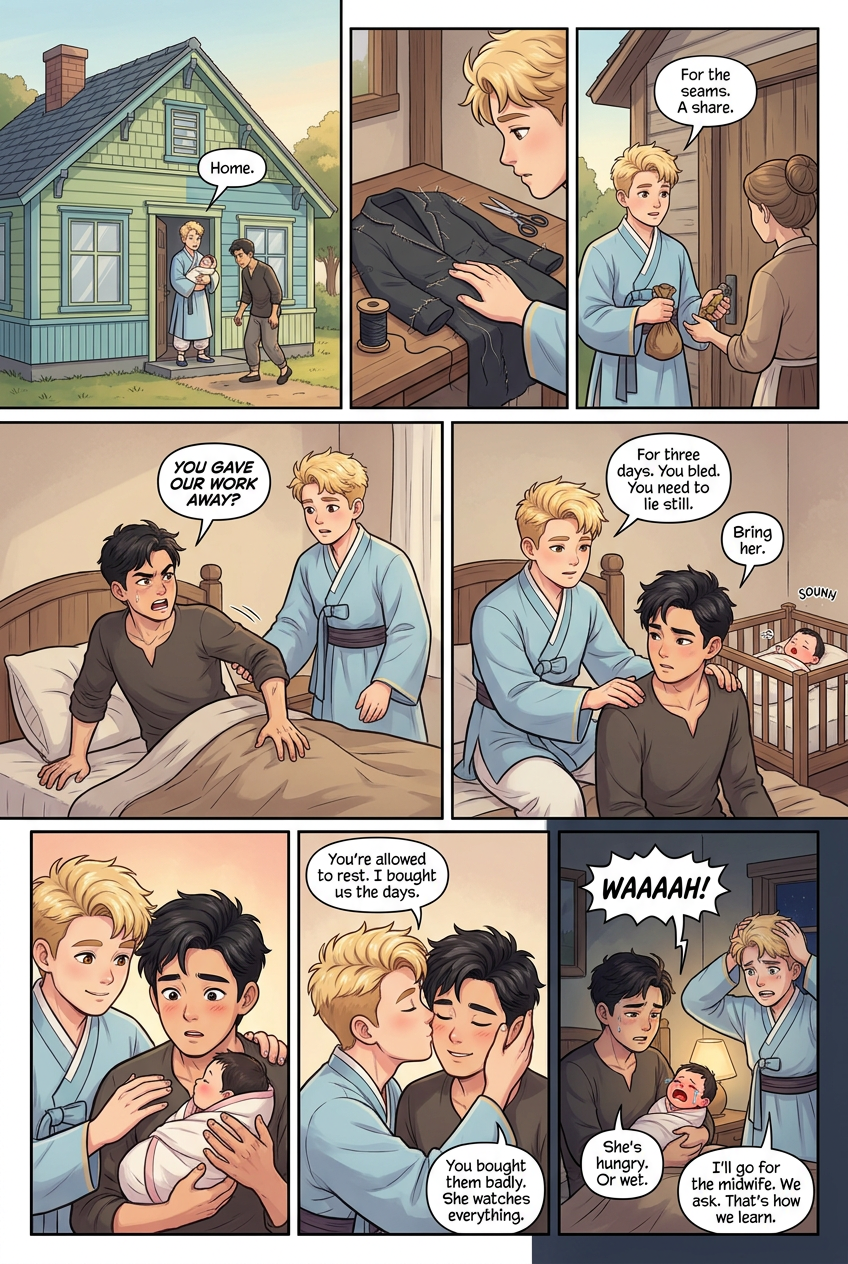
Three days after the birth, Kensei carried Jeon-min and Ha-ni home. The green and blue house held them all. The client's coat sat unfinished on the table. The thread lay wound and waiting. Kensei looked at it, then looked at Jeon-min on the bed, gray and slow. He made a choice. He walked to the neighbor's door and asked the woman who mended nets to finish the coat's seams for a share of the coin. She looked at his hanbok, then at his tired face, and said she would. The work would go out. It would not be their hands, but it would be done. "You gave our work away," Jeon-min said when Kensei told him. He tried to sit up. His arm shook. "For three days," Kensei said. He pressed a hand to Jeon-min's shoulder and eased him down. "You bled. You need to lie still. The coat will not fall apart because someone else pulls the thread." Jeon-min's jaw set the way it did over a bad price. Then Ha-ni made a small sound from the crib, and his face changed. He stopped counting the loss. "Bring her," he said. Kensei lifted the baby. She was awake, her dark eyes moving across his face like she was reading it. He laid her against Jeon-min's chest. Jeon-min's hard hands went soft around her. Kensei sat on the edge of the bed. He kissed Jeon-min's temple, then his cheek, then the corner of his mouth. Jeon-min let him. That was new. Jeon-min let things now that he once would have swatted away. "You're allowed to rest," Kensei said. "I found that out. I bought us the days." "You bought them badly," Jeon-min said. But his mouth curved. He shifted Ha-ni higher. "She watches everything." "She does." Kensei touched the baby's fist. It opened and closed. He thought of the market they had walked to together, the vows at the empty stall, the stranger who had shrugged and gone. No one here knew what they had been. No one came to take this away. He kissed Jeon-min again, slow, because he could, because the door was solid and the walls were theirs. Ha-ni began to cry, thin and rising. Jeon-min went still. "She's hungry," he said. "Or wet. I don't know which." Kensei did not know either. He had learned to hold her, to warm the water, to watch for fever. He had not learned this. He looked at the crying child, then at Jeon-min, worn to the bone and unable to rise. The rest was over. The coat was handled. But the small red mouth kept crying, and neither of them could name what she needed. Kensei stood. "I'll go for the midwife," he said. "We ask. That's how we learn the rest."
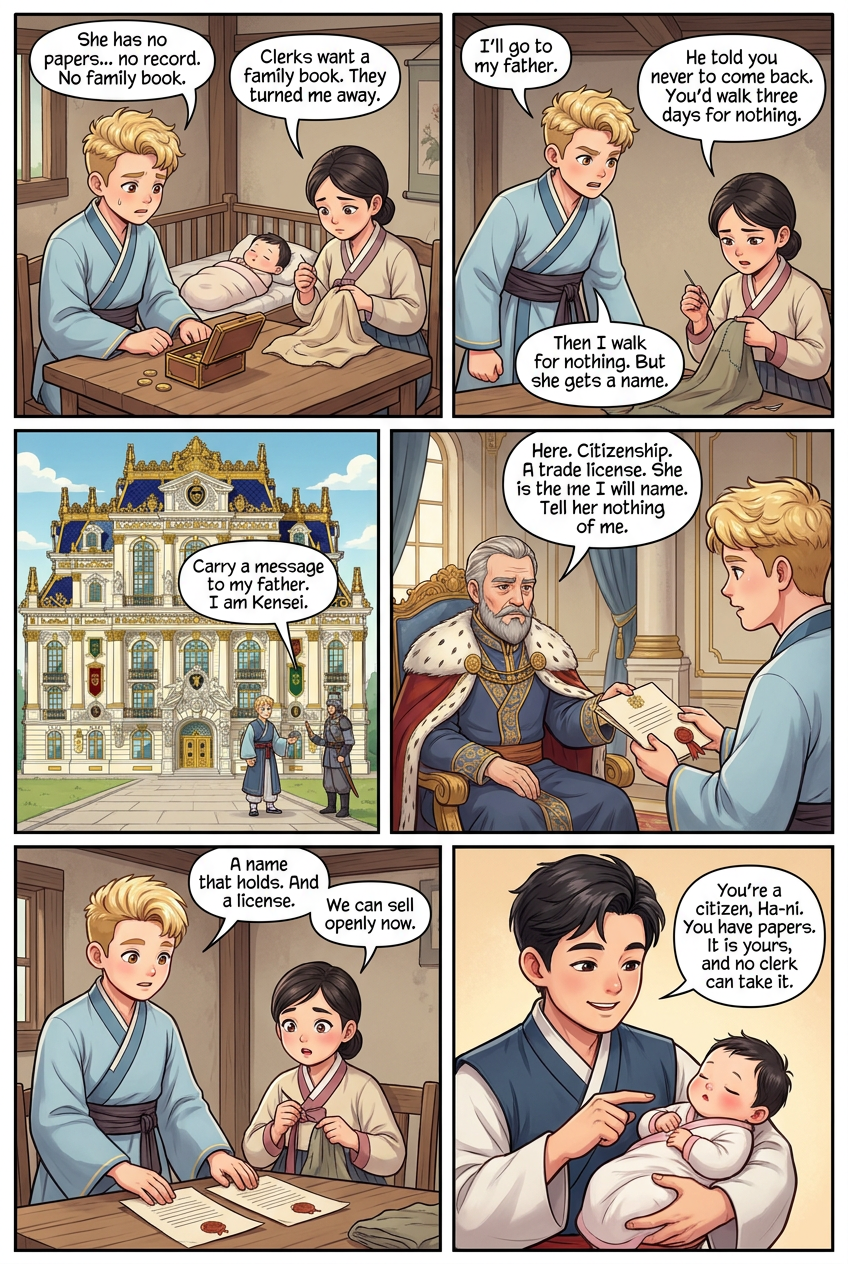
The midwife taught them how to feed and change Ha-ni. A week passed. Ha-ni slept better now. But one morning Kensei sat with the coin box open and saw a new problem. Ha-ni had no papers. No name written anywhere but on their tongues. If they took her to a market clerk, or a school someday, she was no one. A child born to two men, one with a made name, in a city that did not know them. "She needs a record," Kensei said. "Same as we did. A name that a clerk will honor." Jeon-min looked up from his needle. "We have no rank. No family book. Clerks want a family book." He set the thread down. "I asked, in the last city. They turned me away." Kensei knew where a record could be made. His father had made one before, with a seal that no clerk could refuse. But his father had ordered them to leave and never return to the palace. "I can go to him," Kensei said. "He told you never to come back." "He signed our marriage. He gave me a name." Kensei closed the box. "He can give her one too. A clerk here can't argue with the royal seal." Jeon-min did not soften it. "He could turn you away. He could call the guards. You'd walk three days for nothing." "Then I walk three days for nothing." Kensei stood. "But she gets a name. A citizenship. A paper that says she belongs somewhere." He went. The journey took the days it took. The palace rose gold and blue as it always had. Kensei did not enter as a prince. He stood at a side door in his hanbok and asked a servant to carry a message inside. His father came, older, quiet. He did not shout. He looked at Kensei a long time. "A daughter," Kensei said. "She has no record. I need a name for her. A citizenship. Something a clerk will honor." His father took him to a scribe. He wrote Ha-ni's name himself. He named her a citizen of the fifth city, daughter of Kensei Jon and Jeon-min. He pressed the royal seal into the wax. He added a second paper, a trade license, so their mending work could carry a stamp no merchant could refuse. "Now go," his father said. But he pressed the papers into Kensei's hands with both of his own. "She is the last one I will name. Tell her nothing of me." Kensei walked the three days home. He laid the sealed papers on the table beside the wound thread. Jeon-min read them twice. "A license," Jeon-min said. "We can sell openly now. Under our own stamp." "And she has a name that holds," Kensei said. Jeon-min lifted Ha-ni from the crib. "You're a citizen," he told her. "You have papers." Ha-ni watched his face, working out the sounds. She did not know yet what she had. But it was hers, and no clerk could take it.
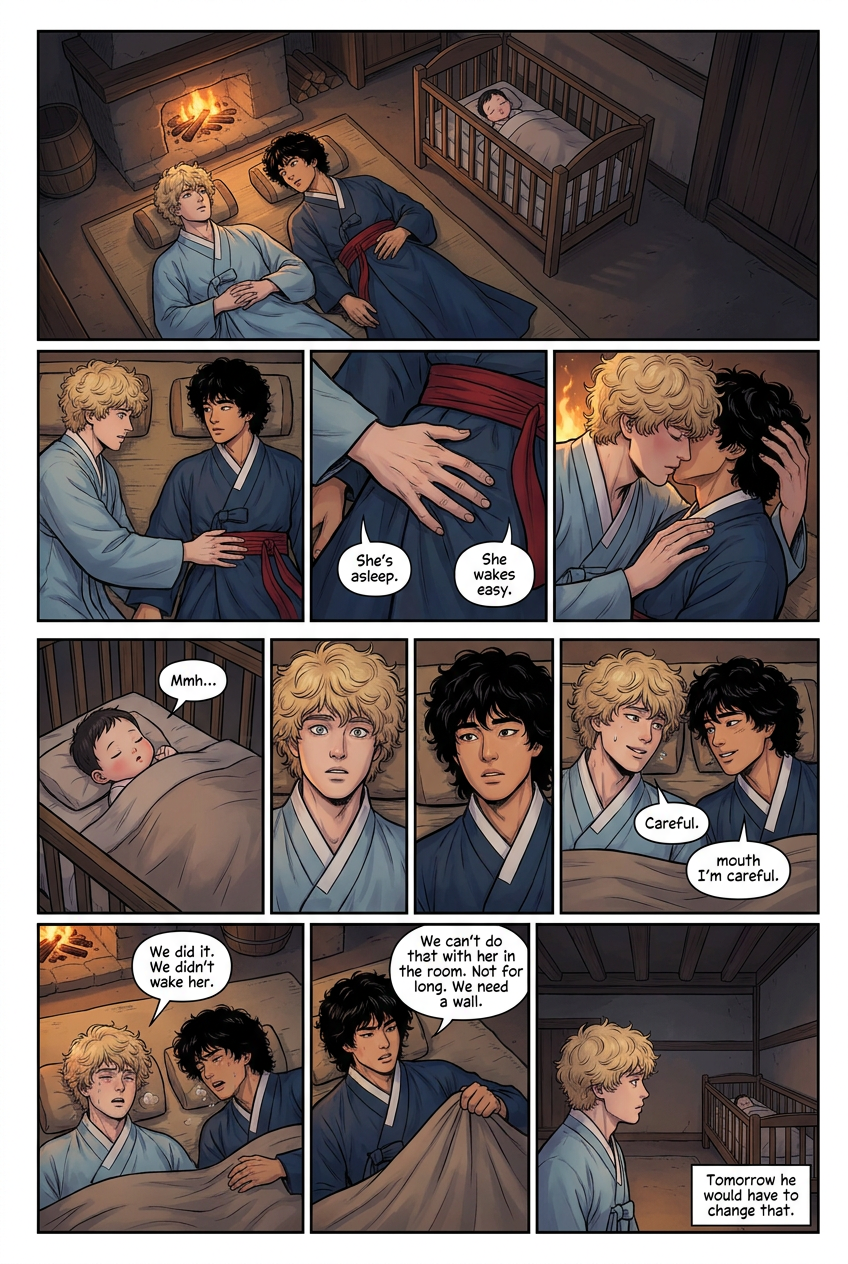
The papers sat on the table for a week. Ha-ni slept through the nights now. The house held quiet in a way it never had before. One evening Kensei banked the fire low and lay down beside Jeon-min on the mat. Ha-ni breathed in her crib an arm's length away. Kensei told himself he would sleep. He did not sleep. He watched Jeon-min in the low light. The tight curls of his perm. The line of his jaw. Kensei felt the pull start in his chest and move lower. He did not fight it. He reached across and set his hand on Jeon-min's hip. Jeon-min's eyes opened. He did not move away. His gaze went to the crib, then back to Kensei. "She's asleep," Kensei whispered. "She wakes easy." Jeon-min kept his voice under the fire's crackle. But his hand found Kensei's and held it there. He did not push it off. He drew it flat against his skin. They moved slow. Every sound was a risk. Kensei pressed his mouth to Jeon-min's neck to keep quiet. Jeon-min's breath caught, then steadied. He tugged the loose knot of Kensei's belt without a word. The tie slid free. Neither of them spoke. They watched the crib between each breath. Ha-ni stirred once. A small sound, half a cry. Both of them froze. Kensei's heart slammed. Jeon-min lifted his head and listened. The baby settled. Her breathing evened out. Jeon-min let out a slow breath and turned back to Kensei. He almost smiled. "Careful," he mouthed. "I'm careful," Kensei mouthed back. They were not careless. They were quiet as thread pulling through cloth. Jeon-min's fingers gripped Kensei's shoulder hard when it came, but he made no sound. Kensei held his own breath and pressed his face to the mat. When it was done they lay still, chests heaving in silence, sweat cooling. The fire had burned to coals. Ha-ni had not woken. Kensei laughed then, a shake of the shoulders with no sound. Jeon-min elbowed him to stop. But Jeon-min was shaking too. "We did it," Kensei whispered. "We didn't wake her." "This time." Jeon-min pulled the blanket over them both. He was quiet a moment. Then he said the thing plain. "We can't do that with her in the room. Not for long. She'll wake older. She'll understand." Kensei went still. He had not thought that far. A crib in the corner tonight. A child watching from a mat next year. The house had one room for sleeping. "We need a wall," Jeon-min said. "A door. A room that's hers and a room that's ours." He said it once more, flat. "A wall." Kensei looked at the crib, then at the low ceiling above them. The house was theirs. But it was one open room. Tomorrow he would have to change that.
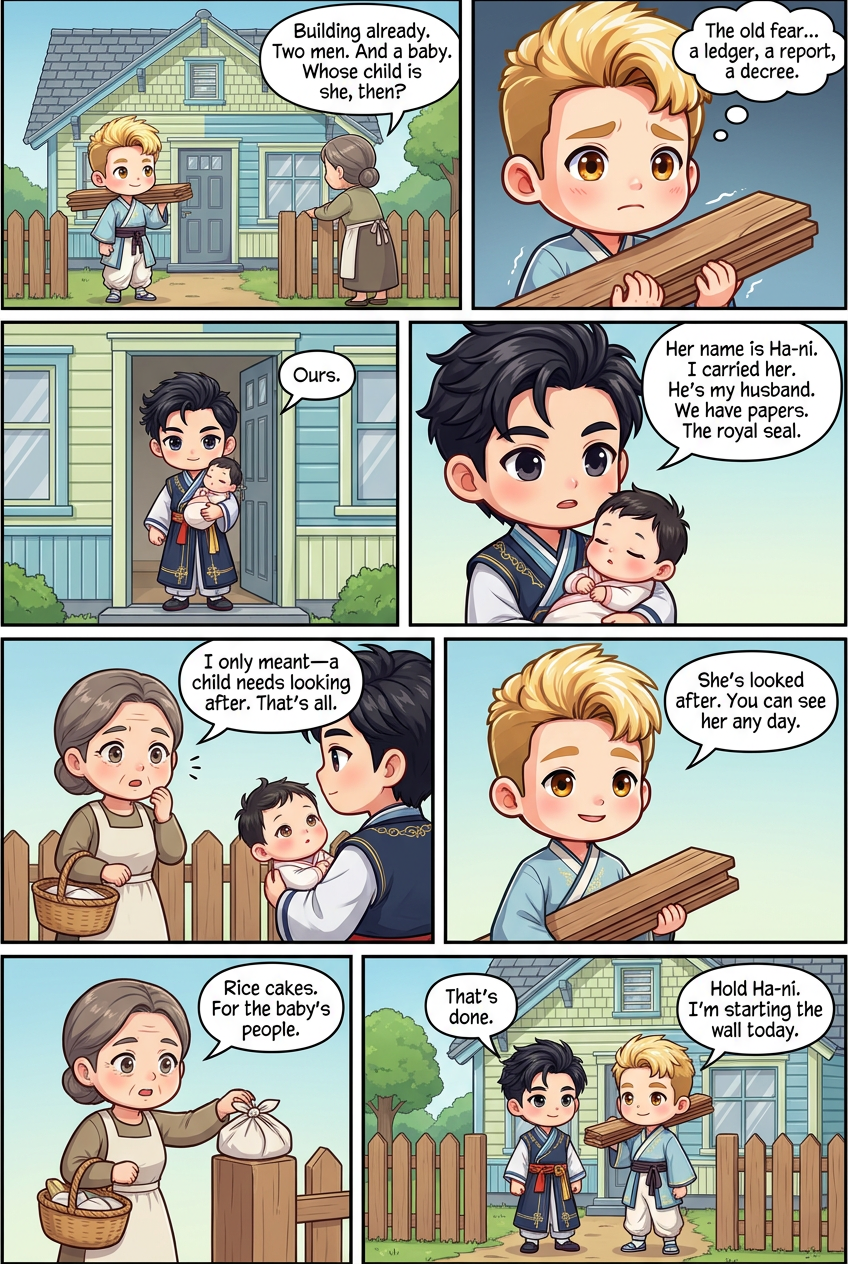
The wall came in pieces. Kensei carried boards from the market for three mornings. On the fourth he stood outside his own green and blue house, measuring the front wall by eye, when the woman from next door stopped at his fence. She wore a plain apron and carried a basket. She had watched him before. He had felt it. "Building already," she said. "Two men. And a baby." She looked at the boards on his shoulder. "Whose child is she, then?" The old fear woke in Kensei's chest. It was a fast, cold thing. For years a question like that meant a ledger, a report, a decree. He set the boards down slow. His hands wanted to shake. He held them still. "Ours," he said. The woman's mouth tightened. "Ours how? A man doesn't birth a child. And I don't see a wife going in or out." She leaned on the fence. "People ask. I'm asking plain." Kensei heard the front door open. Jeon-min came out with Ha-ni against his shoulder. He did not slow. He walked to the fence and stood beside Kensei, blunt as a nail. "Her name is Ha-ni," Jeon-min said. "I carried her. I birthed her. He's my husband." He shifted the baby so the woman could see her face. "We have papers. The royal seal. Her name and mine and his. You can go to the clerk and read them." The woman blinked. "The seal." "The seal," Jeon-min said again, flat. "And a trade license for our mending. Stamped. You want a hem fixed, bring it. You want to report us, there's nothing to report. It's all legal." Ha-ni stirred. She opened her eyes at the new voice and worked her small mouth, trying to sort the sound. Kensei watched the woman look at the baby and not the men. Something in her face gave. "I only meant—a child needs looking after," the woman said. Her voice had lost its edge. "That's all." "She's looked after," Kensei said. He found his own voice steadier now. The fear had crested and broken. No decree was coming. There was no decree left that could come. "You can see her any day. We're not hiding." The woman studied them both. Then she reached into her basket and set a wrapped bundle on the fence post. "Rice cakes," she said. "For the baby's people." She picked up her basket and went. Jeon-min watched her go. "That's done," he said. Kensei picked up the boards again. His shoulders were loose. The question that had chased him his whole life had knocked at his own fence, and he had answered it in daylight and kept his house. He looked at the flat front wall he was about to divide. "Hold Ha-ni," he said. "I'm starting the wall today."
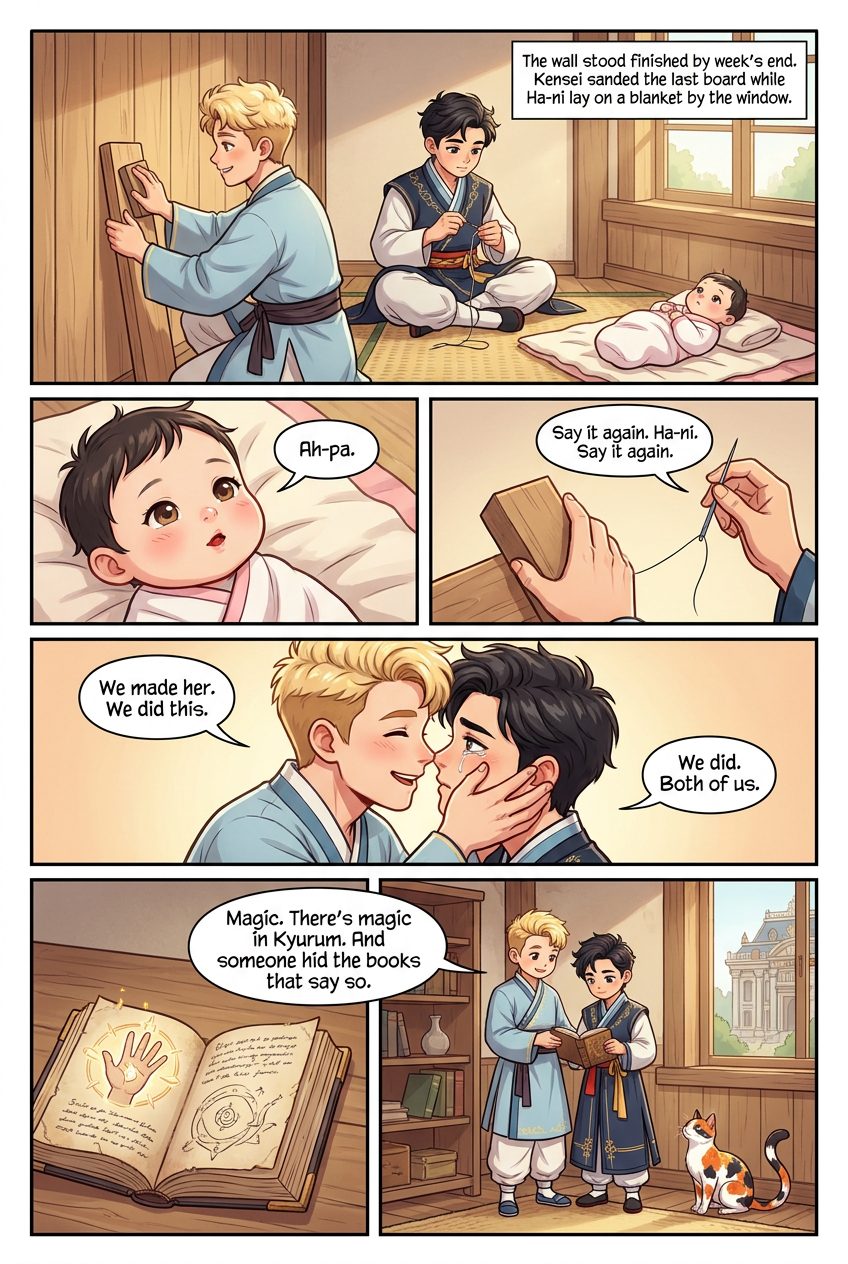
The wall stood finished by week's end. Kensei sanded the last board while Ha-ni lay on a blanket by the window. Jeon-min sat cross-legged beside her, threading a needle. The three of them had a room now, and Ha-ni had her own corner, and the fear that once ruled the house was gone from it. Ha-ni waved a fist at the blurry face above her. She had watched that face for weeks. It made sounds she was trying to sort out. Now she worked her mouth around one of them. "Ah-pa," she said. Kensei froze with the sandpaper in his hand. Jeon-min's needle stopped. "Say it again," Jeon-min said. He leaned close. "Ha-ni. Say it again." "Ah-pa," Ha-ni said. She looked pleased with the sound. "Ah-pa." Kensei dropped the sandpaper and knelt. His chest was tight, but not with the old fear. "She spoke. Jeon-min, she spoke." "Weeks old and already talking." Jeon-min's voice cracked on the last word. He touched her cheek. "Smart girl. Smartest girl." Kensei laughed. He could not help it. He looked at Jeon-min, and Jeon-min looked back, and neither of them needed to say the thing they both felt. Kensei took his husband's face in both hands and kissed him. "We made her," Kensei said against his mouth. "We did this." "We did." Jeon-min kissed him again, harder. "Both of us." Ha-ni watched the two faces come together above her. She said "ah-pa" once more, quieter, working it out. When they broke apart, Kensei went to the shelf where he kept the few books he had carried from the old library. He had never read them closely. There had been no time. He pulled one down now to show Jeon-min, to mark the day somehow. The cover was worn. He opened it and stopped. The pages were not law, and not history. They were drawings of ships, and beside the ships, strange marks he did not know. He turned a page. A diagram showed a man's hand and light coming off his fingers. Words ran under it in an old script. "Jeon-min," Kensei said slowly. "Look at this." Jeon-min came and read over his shoulder. His face went still. "That's not a picture of a lamp." "No." "It says the hand makes the light." Jeon-min tapped the script. "It's teaching how." A sleek cat had wandered in through the open door. Its fur ran with bands of orange, black, and gold, like scales. It sat by the shelf and watched them, tail curling. Neither man had seen it before. Kensei stared at the page, then at the cat, then at Ha-ni working her small mouth around her first word. He had thought the old library held only law and dead history. He had been wrong. "Magic," he said. The word felt foolish and true at once. "There's magic in Kyurum. And someone hid the books that say so." Jeon-min closed the cover gently. "Then we're not done finding things out."
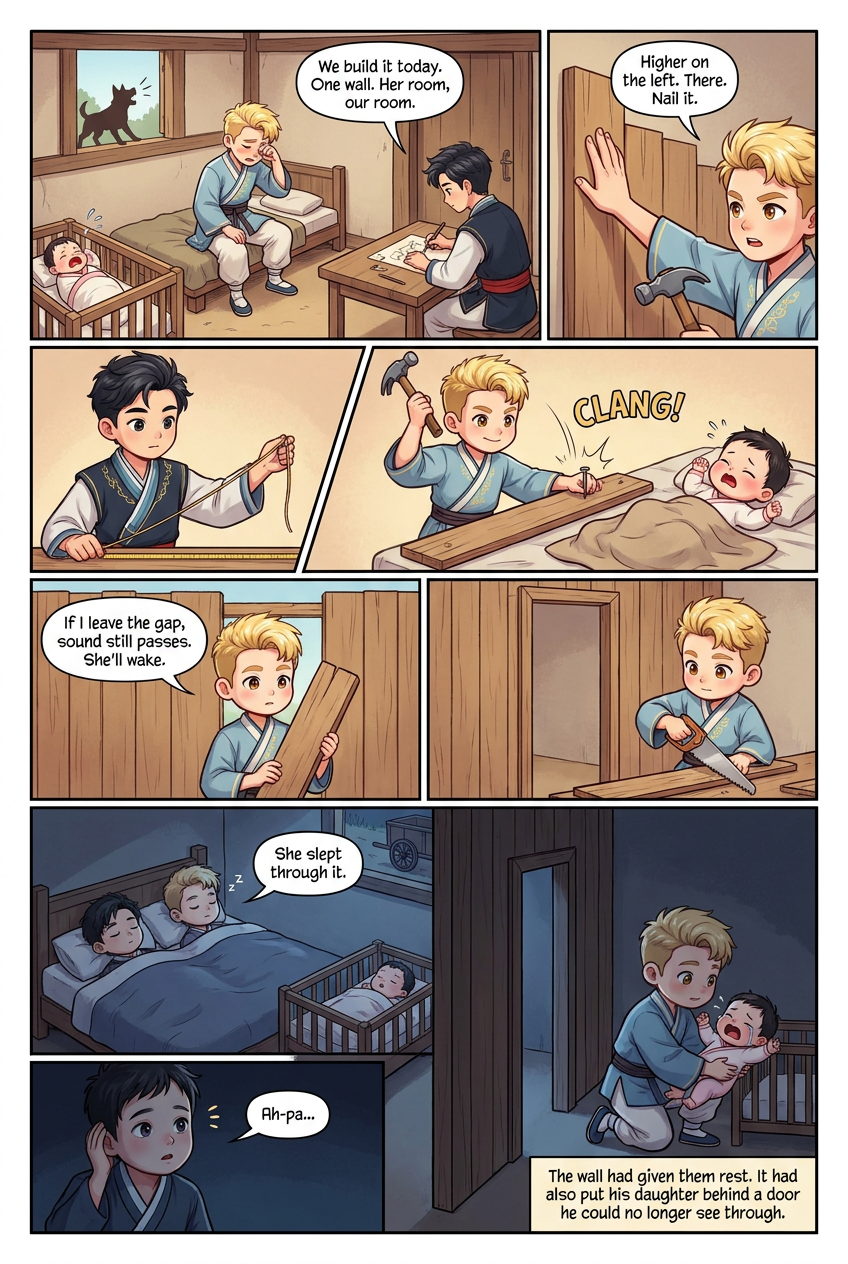
The magic book sat on the shelf, but the wall still did not stand. Kensei set it aside. The house had one room, and Ha-ni slept in the corner where every noise reached her. Last night a dog barked outside and she woke crying. So did the night before. None of them had slept a full night in a week. "We build it today," Jeon-min said. He did not look up from the sketch on his knee. "One wall. Her room, our room. Today." Kensei had the boards already, stacked by the door. He had cut them wrong twice. He knew how to sew now, not how to build. But he lifted the first board and held it upright against the wall. "Higher on the left," Jeon-min said. He set the baby down and came over. He pressed a hand flat to the wood. "There. Nail it." Kensei drove the first nail crooked. The second went straight. They worked through the morning, board by board, Jeon-min measuring with a length of string, Kensei hammering. Ha-ni watched from her blanket. When the hammer struck, she flinched, but she did not cry. By midday the wall stood halfway. A gap remained near the top where a board had split. Kensei stared at it. "If I leave the gap, sound still passes," he said. "She'll wake." "Then don't leave it." Jeon-min handed him a fresh board. "Cut this one right." Kensei measured twice. He cut it slow. It fit. He fixed it in place, and the wall closed from floor to ceiling. They stepped back together. The room was two rooms now. On one side, the bed. On the other, Ha-ni's corner with her crib and the window. The gap was gone. The house had a wall. Jeon-min carried Ha-ni to her side and laid her in the crib. Kensei stood on the other side of the wall and knocked once, soft. "Say something," he called. "She's asleep already," Jeon-min said, low. Kensei barely heard it. He grinned. That night Ha-ni slept. A cart rolled past outside near midnight. Kensei tensed, waiting for the cry. It did not come. He lay against Jeon-min in the dark, on their own side of the wall, and heard nothing but his husband breathing. "She slept through it," Kensei whispered. "She did." Jeon-min turned toward him. "First full night." Then a thin cry cut through the wall. Not fear. Hunger. Ha-ni was awake and needed feeding, and now there was a wall between them and her, and neither could see her from the bed. Kensei rose in the dark. He found the doorway they had left in the wall, felt his way around it, and knelt at the crib. "Ah-pa," Ha-ni said, quiet, working the sound. She was hungry, and she was alone in a room of her own now, and she wanted the face. Kensei lifted her. The wall had given them rest. It had also put his daughter behind a door he could no longer see through.
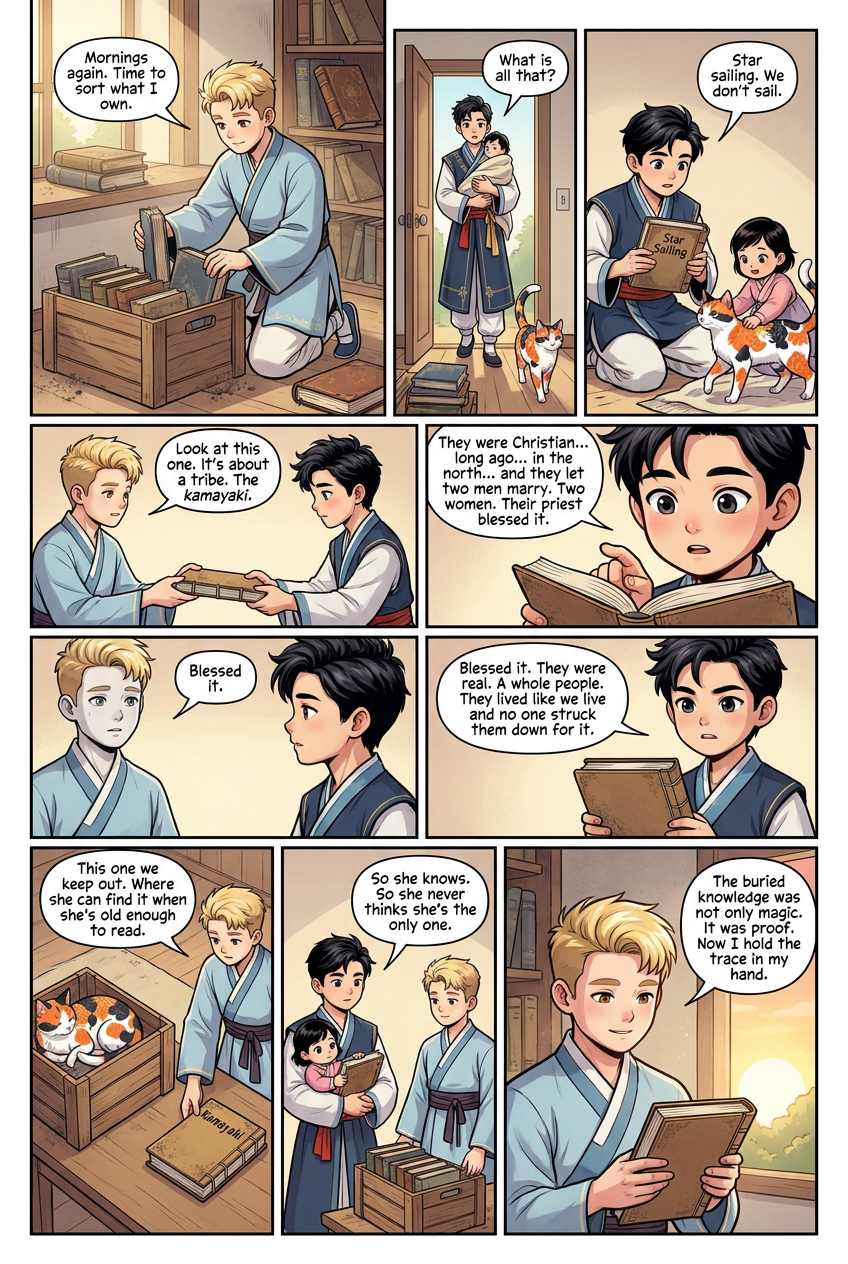
The magic book still sat on the shelf beside the others Kensei had carried from the old library. Ha-ni slept in her own room now. That gave him mornings again. He pulled the whole crate down and began to sort what he owned. He wanted to know what else he had missed. The books were not what he expected. One taught how to read the stars for sailing. One mapped how water moved through soil and stone. One named the signs that led to gold in a riverbed. One, its cover worn soft, taught seduction, with drawings he shut fast when he heard Jeon-min's step. "What is all that," Jeon-min said. He set Ha-ni down on her blanket. She reached for a striped cat that had wandered in through the door, its fur banded orange and black like a koi. The cat let her grab a fistful and did not run. "Books," Kensei said. "Not law. Not history. Skills. Someone hid these the way they hid the magic." Jeon-min knelt and lifted one. He read the first page. "Star sailing." He set it down. "We don't sail." "Look at this one." Kensei held out a thin volume near the bottom of the crate. Its pages were stitched, not bound. "It's about a tribe. The kamayaki." Jeon-min took it. He read slowly, moving his finger down the lines. Kensei watched his face. "They were Christian," Jeon-min said. "Long ago. In the north." He turned a page. "And they let two men marry. Two women. It says here. Their priest blessed it." Kensei went still. "Blessed it." "Blessed it," Jeon-min said. He did not soften the word. He read the rest and closed the book. "They were real. A whole people. They lived like we live and no one struck them down for it." Kensei took the book back. His hands were not steady. All his life he had thought his love was the first of its kind, a thing with no name and no place. He had fought the palace alone because he believed no one had stood where he stood. "I thought we were the only ones," he said. "You thought wrong." Jeon-min touched the worn cover. "Someone buried this. Someone wanted us to think we were the only ones." The cat climbed into the crate and settled on the star charts. Ha-ni laughed. Kensei set the kamayaki book apart from the rest, alone on the clean part of the table. "This one we keep out," he said. "Where she can find it when she's old enough to read." Jeon-min nodded. He picked up Ha-ni and held her against the book so she could pat its cover. "So she knows," he said. "So she never thinks she's the only one." Kensei looked at the crate of hidden skills. The buried knowledge was not only magic. It was proof. Someone had worked to erase every trace that his kind of love had ever lived free. Now he held the trace in his hand.
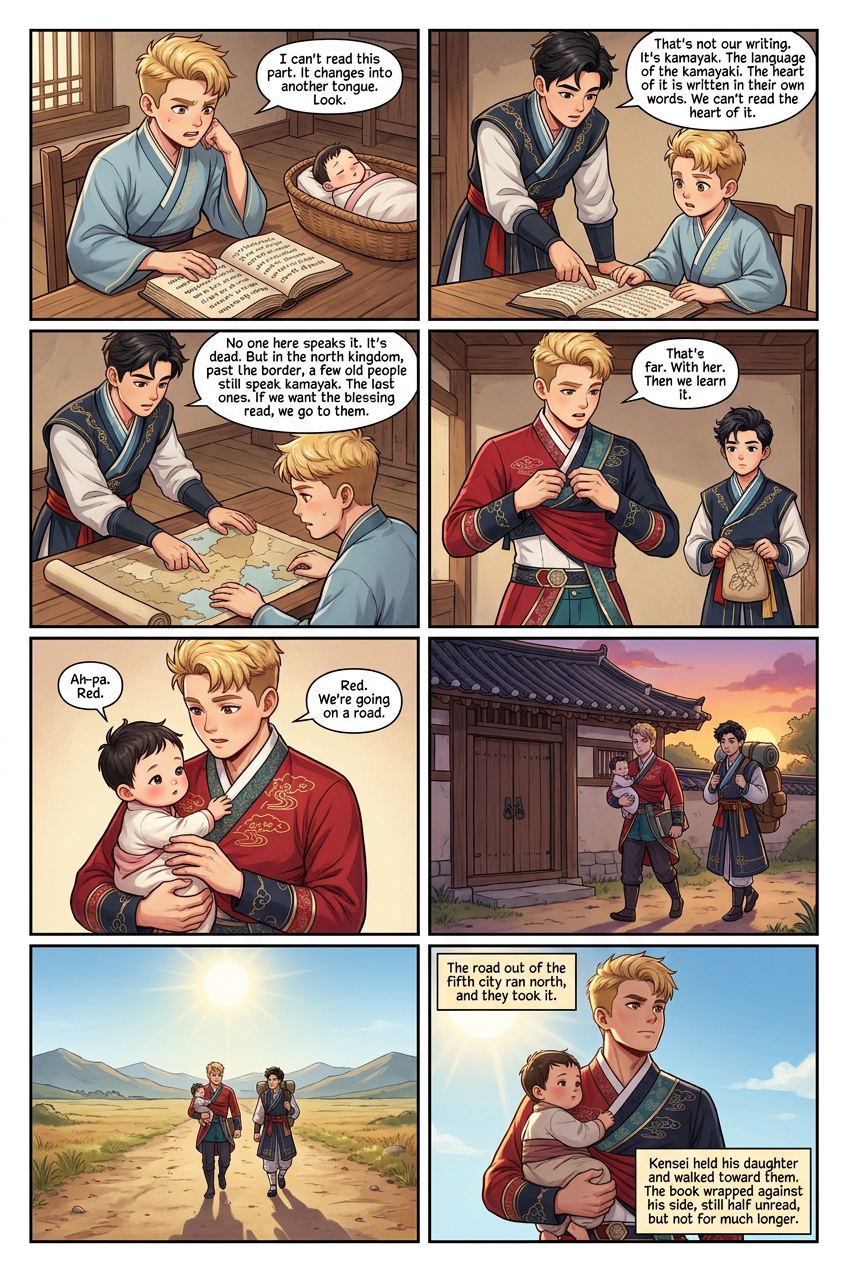
The kamayaki book sat open on the clean part of the table. Kensei turned its pages while Ha-ni slept. He wanted to read the priest's blessing for himself. But the words stopped him. Whole lines used letters he did not know. He read one aloud and it came out as noise. "I can't read this part," he said when Jeon-min came in. "It changes into another tongue. Look." Jeon-min bent over the page. He traced a line with his finger and shook his head. "That's not our writing. It's kamayak. The language of the kamayaki." He turned two more pages. All of them broke into the strange letters near the blessing. "The heart of it is written in their own words. We can't read the heart of it." Kensei sat back. The book held proof his love was old and blessed. And the blessing itself was locked. "Then we learn it." "No one here speaks it," Jeon-min said. "It's dead." He pulled the folded map from his bag, the one marked with craftspeople he had found in four cities. He smoothed it on the table. "But I asked the dyers. In the north kingdom, past the border, a few old people still speak kamayak. The last ones. If we want the blessing read, we go to them." Kensei looked at the map. Then at Ha-ni's door. "That's far. With her." "With her." Jeon-min did not soften it. "Or we never read it." They did not decide by talking. Kensei stood and pulled his travel clothes from the chest. The bold set Jeon-min had made him for the road, red and dark blue, the cloud pattern stitched in gold thread. He put it on. Jeon-min looked at him in it and said nothing, which was its own answer. They packed for three. Bread, coin, the trade papers with the royal stamp. The kamayaki book, wrapped in cloth. Kensei folded Ha-ni's blanket last. She woke as he lifted her and stared up at his face. "Ah-pa," she said. Then she frowned at the bright cloth on his chest. "Red." "Red," Kensei said. "We're going on a road." She patted the gold thread once. She did not understand. But she was quiet, and she watched. They locked the house at dawn. Jeon-min carried the pack. Kensei carried Ha-ni. The road out of the fifth city ran north, and they took it. No one stopped them. No decree waited at the edge of town. By midday the city was behind them. Ahead lay the border, and past it the north kingdom, and somewhere in the north kingdom the last mouths that could speak the blessing aloud. Kensei held his daughter and walked toward them. The book rode wrapped against his side, still half unread, but not for much longer.
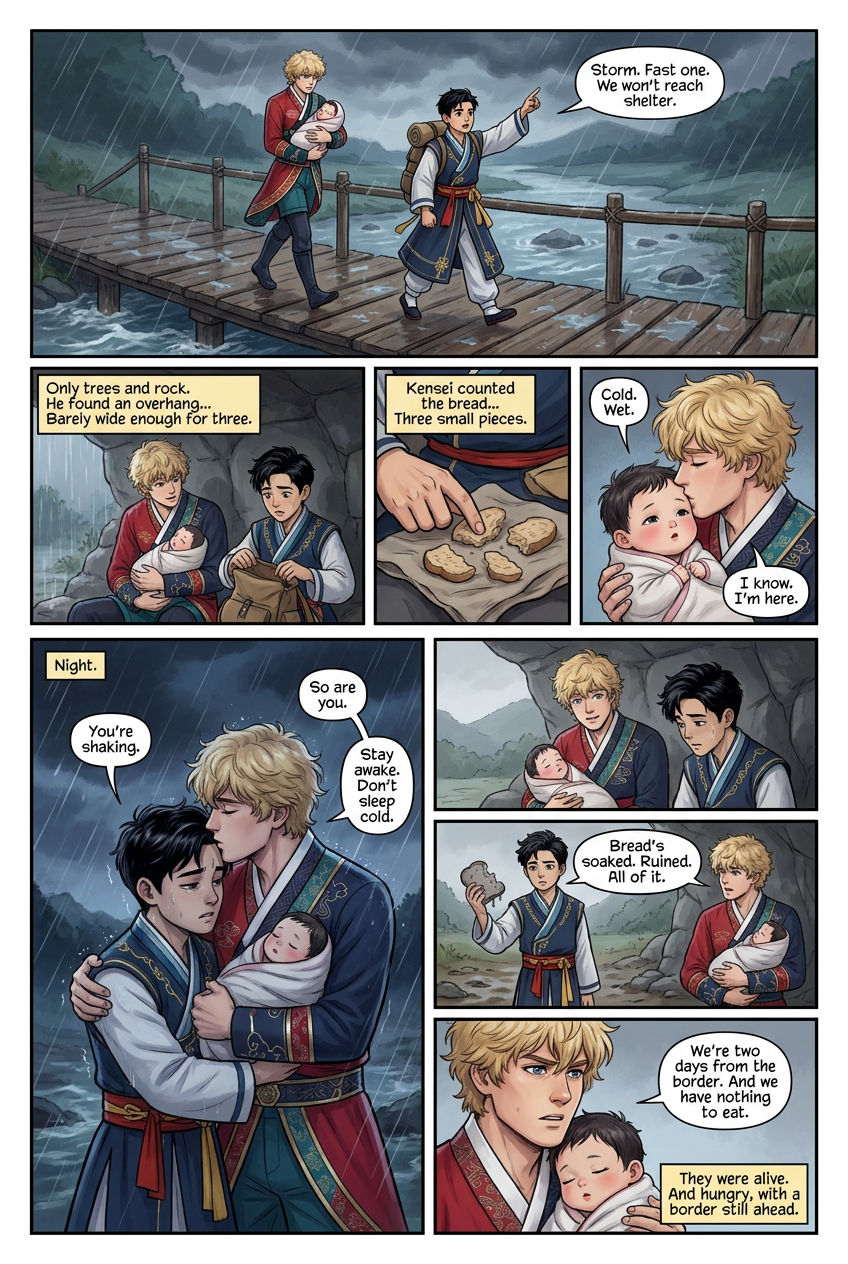
They crossed the river on the second day. The water ran fast and cold under a low wooden bridge. Kensei kept Ha-ni against his chest and watched his feet on the wet planks. Jeon-min went first with the pack. When they reached the far bank, the sky had turned the color of ash. "Storm," Jeon-min said. He did not soften it. He pointed at the black clouds building over the hills. "Fast one. We won't reach shelter." Kensei looked for a building and found none. Only trees and rock. The first rain came hard, cold as the river. He found an overhang where a slab of stone leaned out from the hillside. It was dry underneath. Barely wide enough for three. They crawled in. Jeon-min opened the pack. Two blankets. Kensei counted the bread with his eyes and did not like the number. Three small pieces. He said nothing about it yet. "Wrap her," Jeon-min said. He handed Kensei one blanket. Kensei folded Ha-ni into it until only her face showed. She stared up at him. The wind pulled at his red and blue road clothes, the gold cloud thread dark with rain. "Cold," Ha-ni said. She worked the word out slowly. "Wet." "I know," Kensei said. "I'm here." He kissed her forehead. She blinked at the sound of his voice and went quiet. Jeon-min pressed close against Kensei's side and pulled the second blanket over both their backs. The rain came down in sheets past the stone lip. Water ran in a line an arm's length from Kensei's foot. He put his body between Ha-ni and the open air. Jeon-min shivered against him. "You're shaking," Kensei said. "So are you." Jeon-min set his forehead against Kensei's jaw. Kensei turned and kissed his temple, then his cheek. He kept doing it, small and steady, warming the cold skin. Jeon-min let out a breath and stopped shaking so hard. "Stay awake," Jeon-min said. "Don't sleep cold." So they stayed awake. Kensei kissed Ha-ni's hair and kissed Jeon-min's cold face and kept the two of them warm between his arms and the stone. The storm ran hard for hours, then thinned to a drizzle, then stopped. Gray light came up over the wet hills. Ha-ni had slept. Jeon-min had not, but his lips were warm now. They had come through it. All three. Jeon-min crawled out and stood in the mud. He opened the pack and looked inside a long moment. "Bread's soaked," he said. He held up a piece. It fell apart in his fingers, gray paste. "Ruined. All of it." He looked north, then back at Kensei and Ha-ni. "We're two days from the border. And we have nothing to eat." Kensei looked at his daughter's face, dry and asleep against the red cloth. They were alive. And hungry, with a border still ahead.
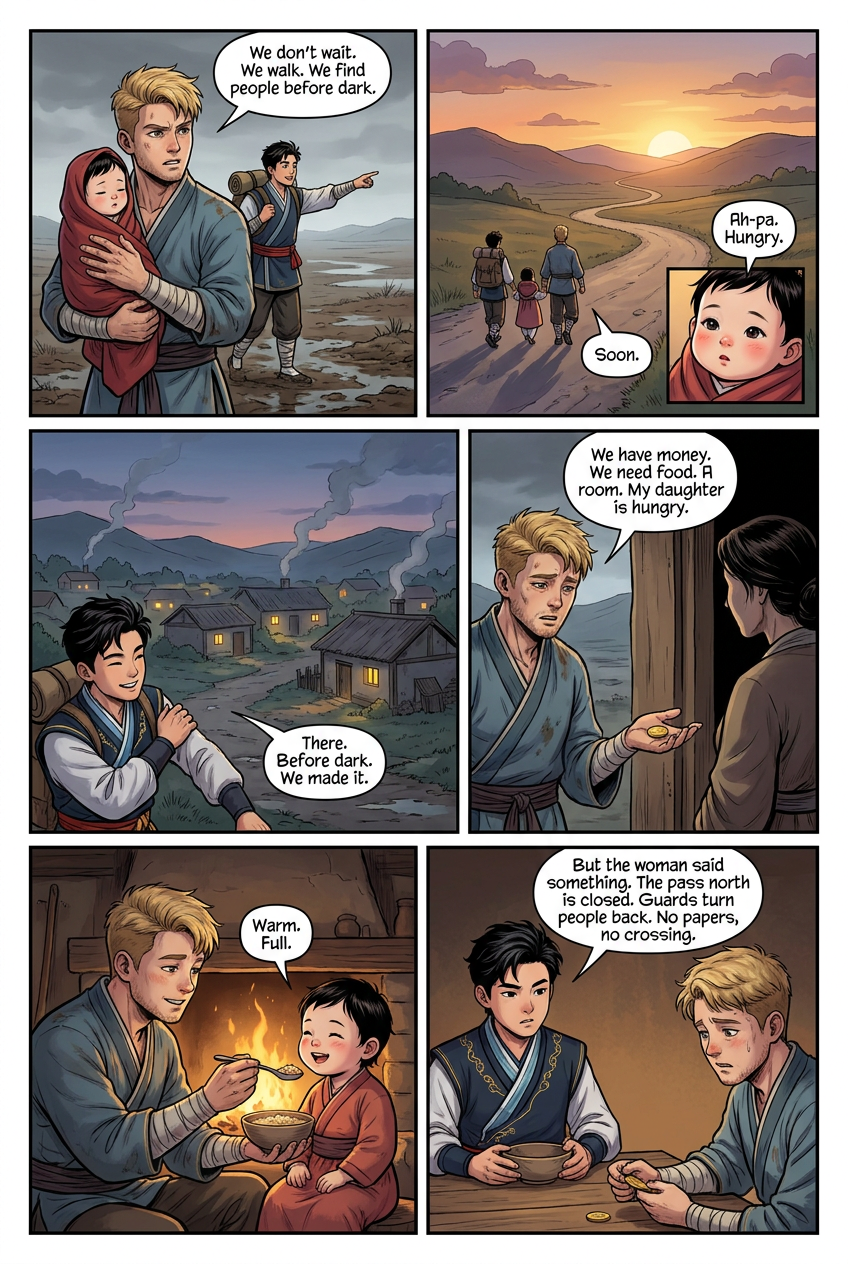
Kensei looked at the ruined bread and made a decision. "We don't wait," he said. "We walk. We find people before dark." He had coin in the pack, more than enough. But coin bought nothing out here. Only trees and mud and empty road. If they spent another night exposed and hungry, with the cold in Ha-ni's blanket, they might not come through it a second time. He tied Ha-ni against his chest. Jeon-min shouldered the pack and pointed north. They walked all day. The sun crossed and started down. Kensei watched the light drop behind the hills and counted the hours he had left. Ha-ni grew heavy and warm against him. Near dusk she woke and worked her mouth. "Ah-pa," she said. Then, slower, "Hungry." She said it plainly, the way she said everything, a thing she had just found out about her own body. "I know," Kensei said. His stomach hurt too. "Soon." He did not know if it was true. The road bent and he saw nothing but more road. "You're lying to her," Jeon-min said. He did not soften it. "Don't lie to her." "Then help me not lie," Kensei said. He walked faster. The hills opened. Smoke rose ahead, thin and gray against the fading sky. Then rooftops. A settlement, low houses along the road, lamps already lit in the windows. Kensei's legs nearly gave under him. "There," Jeon-min said. He gripped Kensei's arm. "Before dark. We made it." They came in as the last light went. A woman stood in a doorway, watching two strangers with a baby. Kensei's old fear rose, the fear of being seen. He pushed it down. He held up coin in his open hand. "We have money," he said. "We need food. A room. My daughter is hungry." The woman looked at the coin, then at Ha-ni's face against the red cloth. She stepped back and opened the door wider. "Come in out of the cold," she said. Inside there was a fire and a pot. Kensei paid her, and she filled bowls with hot barley. He fed Ha-ni first, small spoons, blowing on each one. She ate and stopped crying and grabbed his finger. "Warm," she said. "Full." She said it like a discovery. Jeon-min ate fast, then slowed and looked at Kensei across the bowl. "Tomorrow the border," he said. He set down his spoon. "One day. That's all that's left." Then he frowned at the coin still in Kensei's hand. "But the woman said something. The pass north is closed. Guards turn people back. No papers, no crossing." Kensei went cold. He carried papers for a life in the fifth city. He did not know if they meant anything at a border he had never crossed.
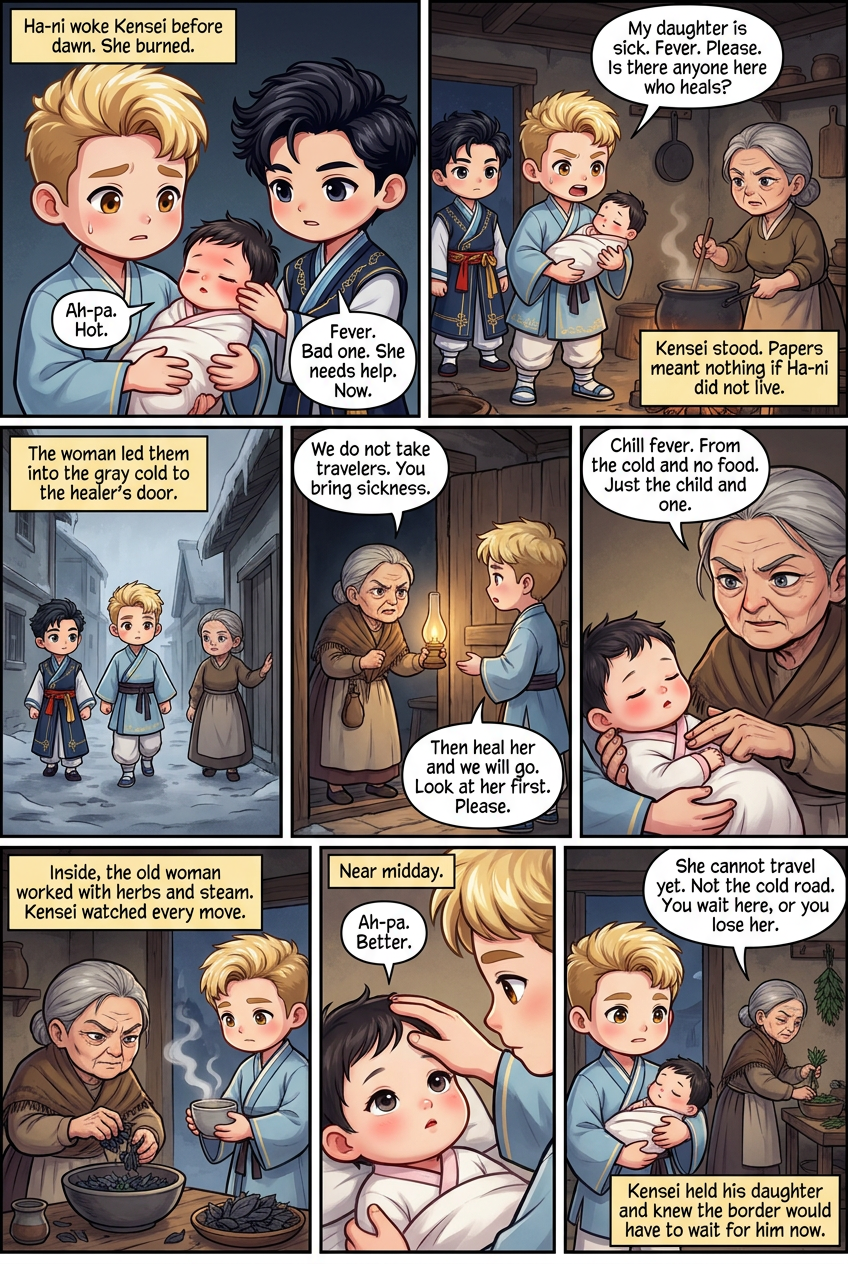
Ha-ni woke Kensei before dawn. Her breath came fast and shallow against his chest. He touched her forehead and pulled his hand back. She burned. The barley and the warm room had not been enough. The cold road had reached inside her. "Hot," Ha-ni said. Her voice was small. "Ah-pa. Hot." She was working it out, the way she worked out everything, but her eyes did not focus. Jeon-min sat up in the dark. He pressed his palm to her cheek and said one word. "Fever." Then, flat, "Bad one. She needs help. Now." Kensei stood. The border could wait. Papers meant nothing if Ha-ni did not live to cross. He carried her to the woman who had fed them, who was already awake and stirring the pot. "My daughter is sick," he said. "Fever. Please. Is there anyone here who heals?" The woman set down her spoon. She looked at Ha-ni's flushed face, the loose way her head hung. "There is a woman two houses down," she said. "She knows herbs. She is old and she does not open her door easily." She wiped her hands. "I will take you." They went out into the gray cold. The woman knocked hard at a low door and called through it. A long silence. Then the door opened on an old woman with a bent back and sharp eyes. She wore a shawl and held a lamp close to her face. She looked at the strangers with no welcome at all. "We do not take travelers," the old woman said. "You bring sickness in and leave." Kensei knelt so she could see Ha-ni. "Then heal her and we will go," he said. "I can pay. But look at her first. Please." The old woman leaned in. Her sharp eyes changed. She set her lamp down and pressed two fingers to Ha-ni's throat, then her chest. "Chill fever," she said. "From the cold and no food." She stepped back and held the door open. "Bring her to the fire. Not you two. Just the child and one." Kensei carried Ha-ni inside. The old woman crushed dark leaves into hot water and made him hold the cup while the steam rose to Ha-ni's face. She soaked a cloth and laid it on the small chest. She worked without speaking for a long time. Kensei watched every move and did not breathe right. Near midday Ha-ni's breath slowed and evened. Her forehead cooled under his hand. She opened her eyes and found his face above her. "Ah-pa," she said. "Better." She said it like a fact she had just learned. The old woman gathered her leaves. "She will keep the fever another day," she said. "She cannot travel yet. Not the cold road. Not the border." She looked at Kensei. "You wait here, or you lose her." Kensei held his daughter and knew the border would have to wait for him now.
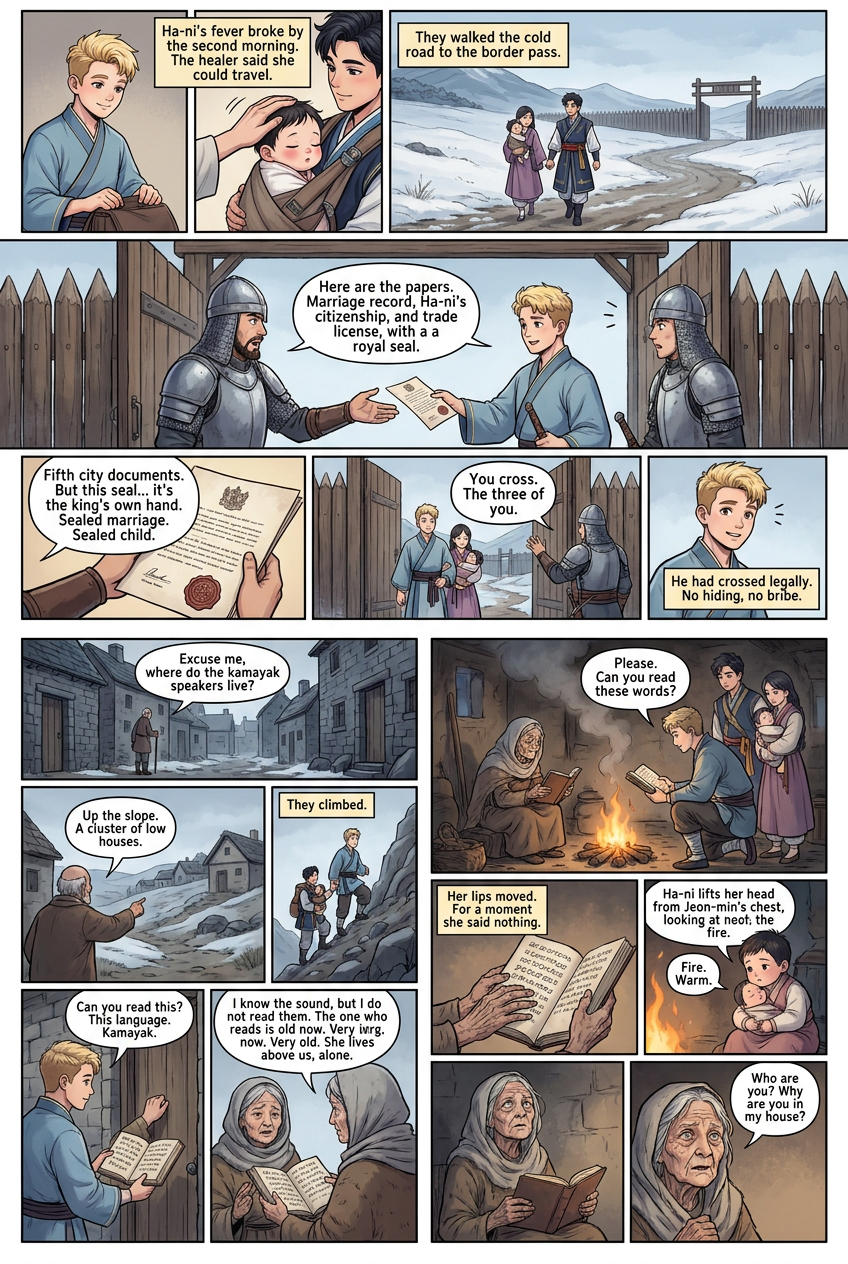
Ha-ni's fever broke by the second morning. The healer pressed her throat, nodded once, and told Kensei the child could travel now. He packed while Jeon-min tied Ha-ni to his chest. They walked the cold road to the border pass and reached the guards by midday. The guards stood at a wooden gate. Two of them. One held out his hand for papers without a word. Kensei gave him the marriage record, Ha-ni's citizenship, and the trade license. Each bore the royal seal. The guard studied the seal a long time. "Fifth city documents," he said. "We turn back most who carry these." He held the marriage record to the light. "But this seal is the king's own hand. Sealed marriage. Sealed child." He passed the papers to the second guard, who looked and gave them back. "You cross. The three of you." The gate opened. Kensei walked into the north kingdom holding Jeon-min's arm. He had crossed legally. No hiding, no bribe. The papers he built his whole life around had carried his family past the border. The north kingdom was colder and older. Stone houses leaned close. People spoke a rougher tongue. Kensei stopped an old man in a doorway and asked where the kamayak speakers lived. The man frowned and pointed up a slope to a cluster of low houses. They climbed. Kensei knocked on the first door. A woman opened it, gray-haired, wrapped in wool. He held out the kamayaki book, open to the blessing page. "Can you read this?" he asked. "This language. Kamayak." The woman took the book. Her eyes moved over the marks. She closed it and shook her head. "I know the sound of these words," she said. "My mother spoke them. I do not read them." She looked at Ha-ni asleep against Jeon-min. "The one who reads is old now. Very old. She lives above us, alone." She pointed higher up the slope. "But her mind wanders. Some days she knows nothing." Jeon-min spoke. "Then we go today. Now." They climbed to the last house. Smoke rose from it. Kensei knocked. A voice called something in the rough tongue. He pushed the door open. An ancient woman sat by a small fire. Her hands shook. She squinted at the strangers with cloudy eyes. Kensei knelt and opened the book to the blessing. "Please," he said. "Can you read these words?" The woman took the page in her shaking hands. She held it close to her clouded eyes. Her lips moved. For a moment she said nothing. Ha-ni woke and lifted her head. "Fire," she said. "Warm." The old woman looked up from the page. She did not look at the book. She looked at Ha-ni. Then her eyes drifted, empty, to the wall. Her hands went still. "Who are you?" she said. "Why are you in my house?"
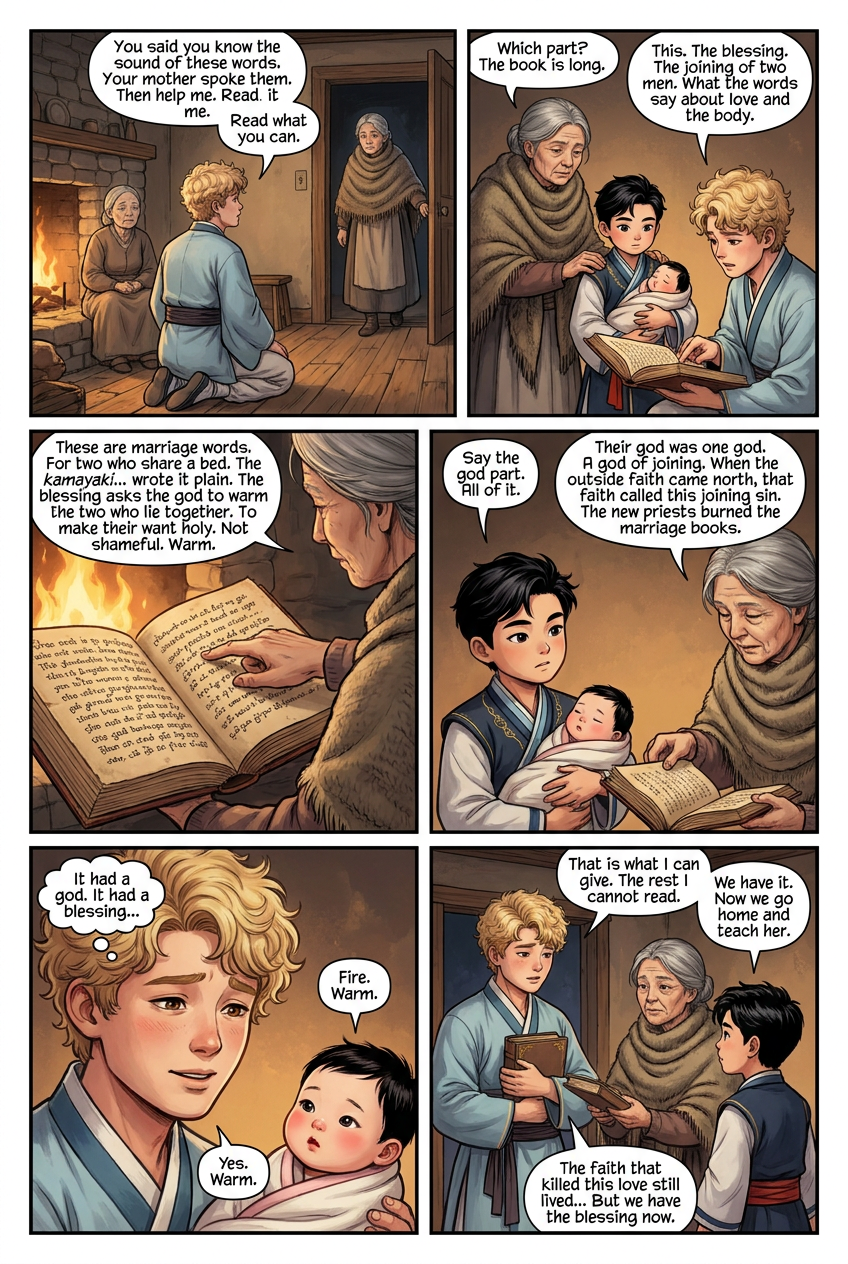
The old woman's eyes had gone empty. Kensei stayed on his knees. He would not push her again. Instead he turned to the door, where the gray-haired woman from the lower house had followed them up the slope. She stood watching, wrapped in wool. Kensei rose. "You said you know the sound of these words," he said. "Your mother spoke them. Then help me. Read what you can." The woman hesitated. She looked at the ancient one by the fire, then at Ha-ni against Jeon-min's chest. "Which part?" she asked. "The book is long." Kensei opened to the pages he cared about. "This," he said. "The blessing. The joining of two men. What the words say about love and the body." He turned a leaf. "And this. Their religion. The god they prayed to when they married. I want to know what they believed." The woman took the book. She sat on the low stool and held the page near the fire. Her finger moved under the marks. "These are marriage words," she said. "For two who share a bed. The kamayaki did not hide the body. They wrote it plain. The blessing asks the god to warm the two who lie together. To make their want holy. Not shameful. Warm." She looked up. "That is the sound my mother made when she said them." Jeon-min stepped closer. His voice was flat. "Say the god part. All of it." The woman turned back. "Their god was one god," she said. "A god of joining. When the outside faith came north, that faith called this joining sin. The new priests burned the marriage books. They told the kamayaki their god was false." She tapped the page. "This is why so few can read these words now. The faith that came after us said this love was wrong. So the language died with the people who spoke it." Kensei sat back on his heels. He had crossed a river, a closed border, a fever. He had wanted only to know if his love had a name before him. Now he knew. It had a god. It had a blessing that called the body warm and not shameful. And he knew what killed it. "Fire," Ha-ni said softly. "Warm." Kensei looked at his daughter. "Yes," he said. "Warm." The woman closed the book and held it out. "That is what I can give," she said. "The rest I cannot read." Kensei took it. He had the blessing now, in a tongue he understood. He would carry it home for Ha-ni. But the woman's last words stayed with him. The faith that killed this love still lived in the world below the slope. The blessing was real. The people who wrote it were gone, burned out by a church that ruled where his family now lived. Knowing the words was not the same as being safe to speak them. Jeon-min met his eyes. "We have it," he said. "Now we go home and teach her."
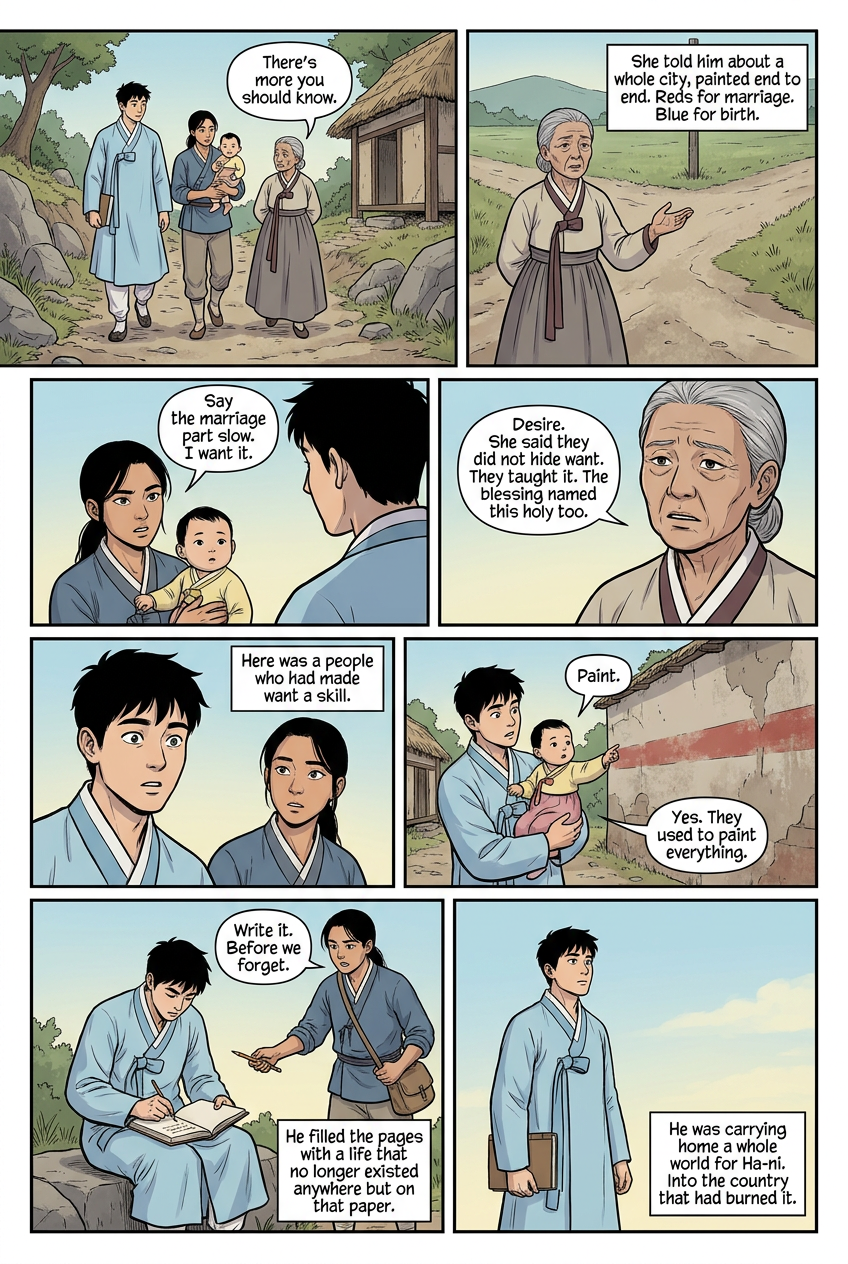
They came down from the slope the next morning. The gray-haired woman walked them past the last house of the northern settlement. Kensei carried the kamayaki book against his chest. Ha-ni rode against Jeon-min, awake, watching every new thing. The woman stopped where the path turned toward the border. She said there was more he should know before he left. She told him what the kamayaki had built. Not just the blessing. A whole city, once, painted end to end. She said their houses wore color the way people wore clothes. Reds for a marriage. Blue for a birth. She said they kept animals no one keeps now, small and tame, and taught them to come when called. She said they timed their weddings to the harvest, when the grain was cut and there was food enough for a feast that lasted days. "Say the marriage part slow," Jeon-min said. "I want it." The woman said the two who married did not stand apart and shy. They learned to draw each other. She used a plain word for it Kensei did not expect. Desire. She said the kamayaki did not hide want. They taught it, the way they taught dyeing or knots. A husband learned how to make his husband turn toward him. The blessing named this holy too, not only the bed after. Kensei looked at Jeon-min. This was the part he had crossed a border to hear and had not known to ask for. His whole life the world had told him his want was the sin. Here was a people who had made it a skill. Who painted their walls for it and cut the harvest for it and taught it to their sons. "Paint," Ha-ni said. She pointed at the settlement wall behind them. A faded stripe of old red still showed under the weather. "Yes," Kensei said. "They used to paint everything." The woman had no more. She gave him her mother's word for warmth, said it once, and turned back up the slope. Kensei stood with the book and the new things inside his head. He had wanted only the blessing. He was leaving with a whole way of living he could never go home and see. "Write it," Jeon-min said. He took his sketch bag from his shoulder and held out the pencil. "The colors. The harvest. All of it. Before we forget the sound of her voice." Kensei sat on a stone and wrote. The reds and the blues. The tame animals. The feast at cutting time. The word for want that was not shame. He filled the back pages of Jeon-min's map with a life that no longer existed anywhere but on that paper. He closed the book. He had gone north to read one page. He was carrying home a whole world for Ha-ni. Now the only work left was the hardest one: to bring it back down the slope, into the country that had burned it.
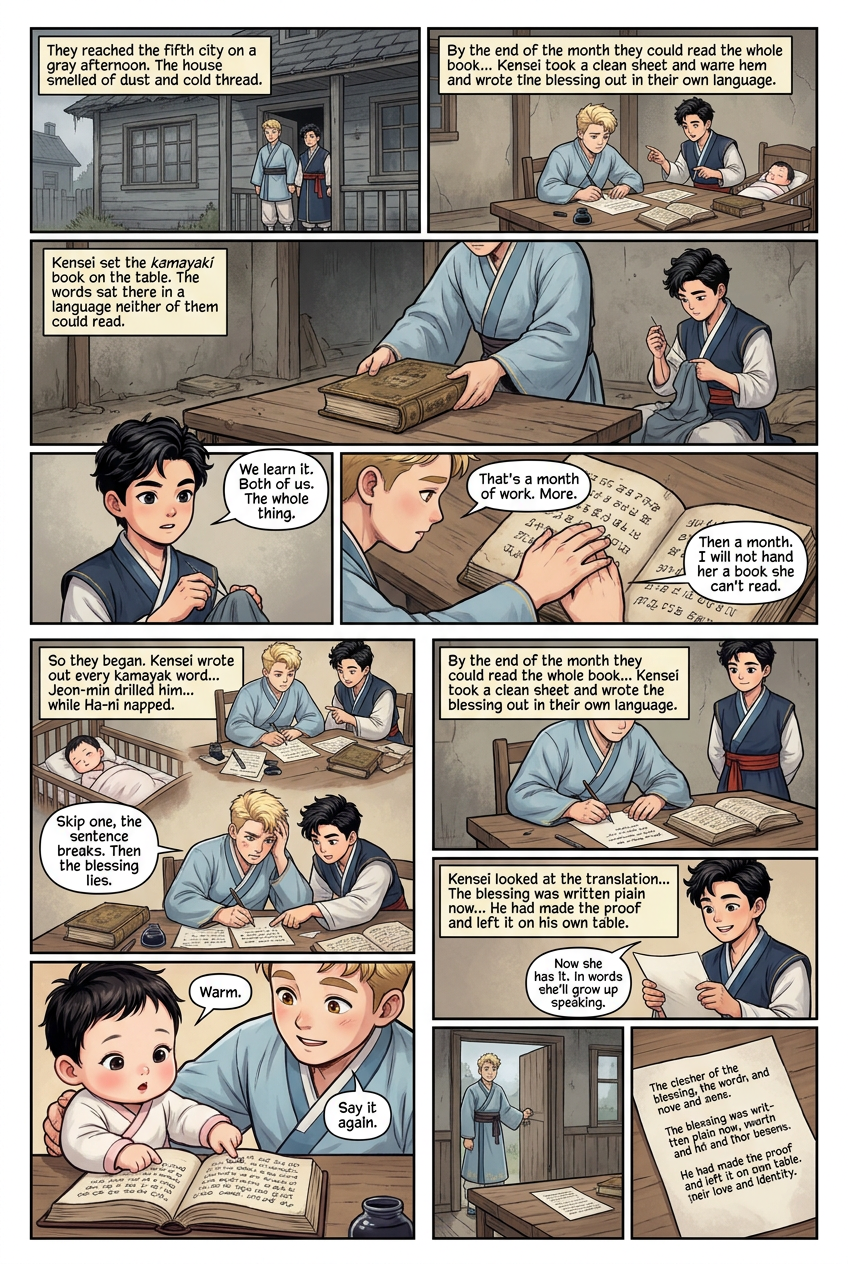
They reached the fifth city on a gray afternoon. The house smelled of dust and cold thread. Kensei set the kamayaki book on the table. He opened it to the blessing page, then to the pages he had filled on the slope. The words sat there in a language neither of them could read. The gray-haired woman had spoken it once. She was far behind them now, past the border, on her slope. If they wanted the blessing for Ha-ni, they had to carry the language home in their own heads. "We learn it," Jeon-min said. He did not look up from his needle. "Both of us. The whole thing." "That's a month of work. More." "Then a month." He set the needle down. "I will not hand her a book she can't read. I will not." So they began. Kensei wrote out every kamayak word he had recorded, matched to the woman's meaning beside it. Jeon-min drilled him at the table while Ha-ni napped. At night they traded the list back and forth. Jeon-min learned by pattern, the way he learned dye and knots. Kensei learned by saying each word aloud until his mouth stopped tripping. They marked the ones they missed and hit those twice. Some nights the work stalled. A whole page held words with no clear meaning, only the woman's guesses. Kensei wanted to skip them. Jeon-min made him sit. "Skip one, the sentence breaks," he said. "Then the blessing lies." They stayed with the hard page three nights until it cracked open. Ha-ni learned faster than either of them. She grabbed the list off the table. She pointed at a word and made the sound back. "Warm," she said, in the old tongue, the word the woman had given for warmth. She did not know what she said. She only knew the shape of it. Kensei stopped. He looked at his daughter holding the dead language in her small mouth. "Say it again," he said. She said it again. By the end of the month they could read the whole book. Not smoothly. But every word. Kensei took a clean sheet and wrote the blessing out in their own language, line by line, the two of them checking each phrase against the old text. The sanctified union of two men. The body named warm, not shame. The want taught as a holy skill. It was theirs now. No woman on a slope stood between Ha-ni and her own history. Jeon-min read the finished page once, then set it flat. "Now she has it," he said. "In words she'll grow up speaking." Kensei looked at the translation. Then he looked at the door. The blessing was written plain now, in the language of the country that had burned it. Anyone who read it would know exactly what his family was. He had made the proof and left it on his own table.
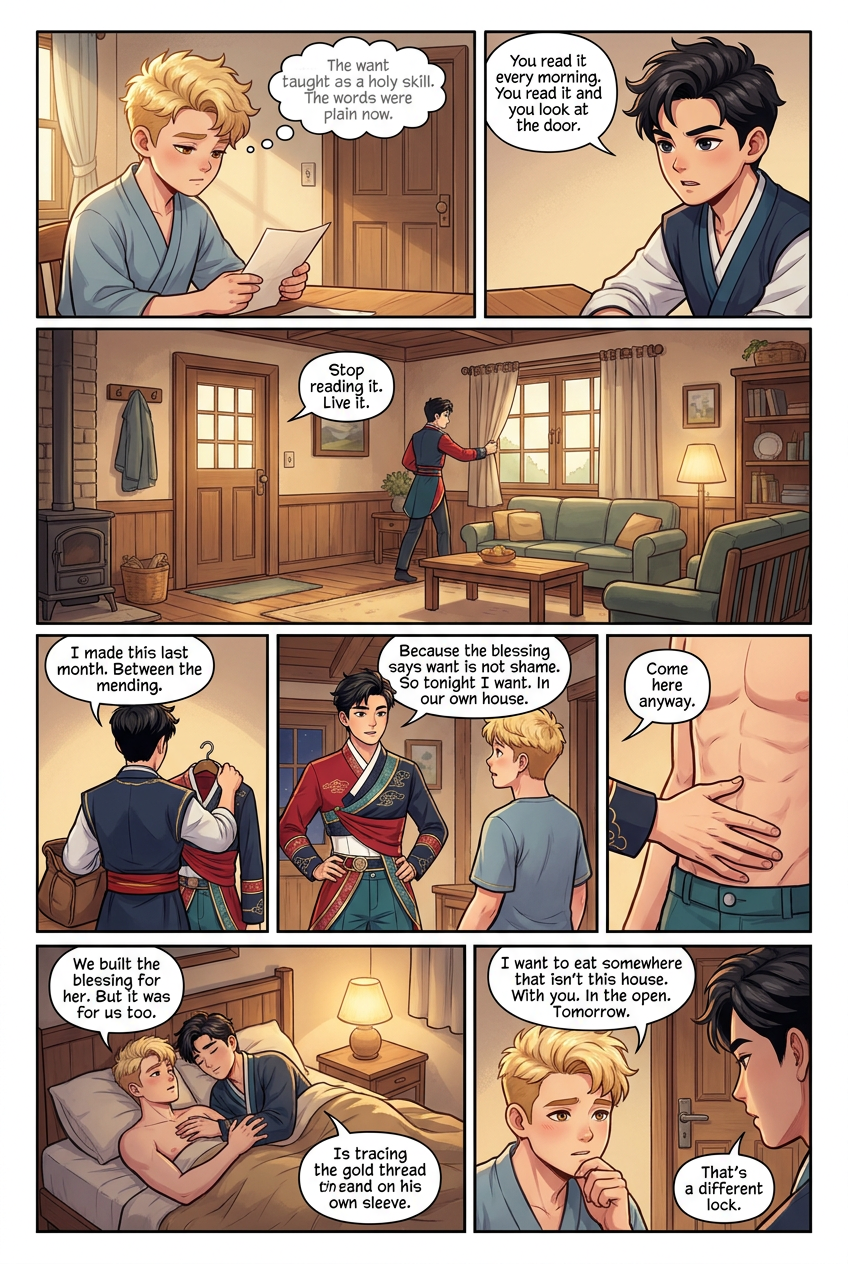
The translation lay on the table for three days. Kensei read it each morning. The want taught as a holy skill. The words were plain now, in a language anyone could read. He kept looking at Ha-ni's small hands, then at the door. That night, after Ha-ni slept, Jeon-min set down his needle and looked at Kensei across the table. "You read it every morning," Jeon-min said. "You read it and you look at the door. Stop reading it. Live it." Kensei did not answer. Jeon-min stood and crossed the room. He turned the bolt on the front door. He checked the window latch and drew the curtain. Then he went into their room and shut Ha-ni's wall behind him. Kensei followed. Jeon-min had opened his bag. He pulled out a folded garment Kensei had never seen. Red and dark blue, cut close, gold thread worked into the clouds along the collar. Jeon-min held it against himself. "I made this last month," Jeon-min said. "Between the mending. I did not tell you." "Why?" "Because the blessing says want is not shame." He set the garment down and began to change into it. "So tonight I want. In our own house. Doors locked. No one to see. Just us." Kensei watched him dress. The short jacket crossed his chest and left his waist bare. The gold thread caught the lamp. Jeon-min turned once, deliberate, letting Kensei look. He was not hiding. He had never learned to hide, not his knot pattern, not this. "You call me ridiculous when I wear the one you bought me," Kensei said. "You are ridiculous." Jeon-min stepped closer. "Come here anyway." Kensei reached for him. Jeon-min took his hand and pressed it flat against the bare warmth of his side. For years Kensei had only touched him in the dark, quiet, listening for a step in the hall. Now the door was bolted by choice, not fear. The blessing was on the table in the next room, written in their own words. Body named warm, not shame. He said the kamayak word for warm against Jeon-min's neck. Jeon-min laughed, low, and pulled him down. After, they lay still in the lamplight. Ha-ni did not stir behind her wall. Jeon-min traced the gold thread on his own sleeve. "We built the blessing for her," Jeon-min said. "But it was for us too. I did not know that until tonight." Kensei looked at the locked door. He had spent his whole life afraid of what want would cost him. Tonight it had cost nothing. It had been given, in a room they owned, in a house painted green and blue that no decree could touch. Then he thought of the market outside. The neighbors. The one thing they had never done. "I want to eat somewhere that isn't this house," he said. "With you. In the open. Tomorrow." Jeon-min went still. "That's a different lock," he said.
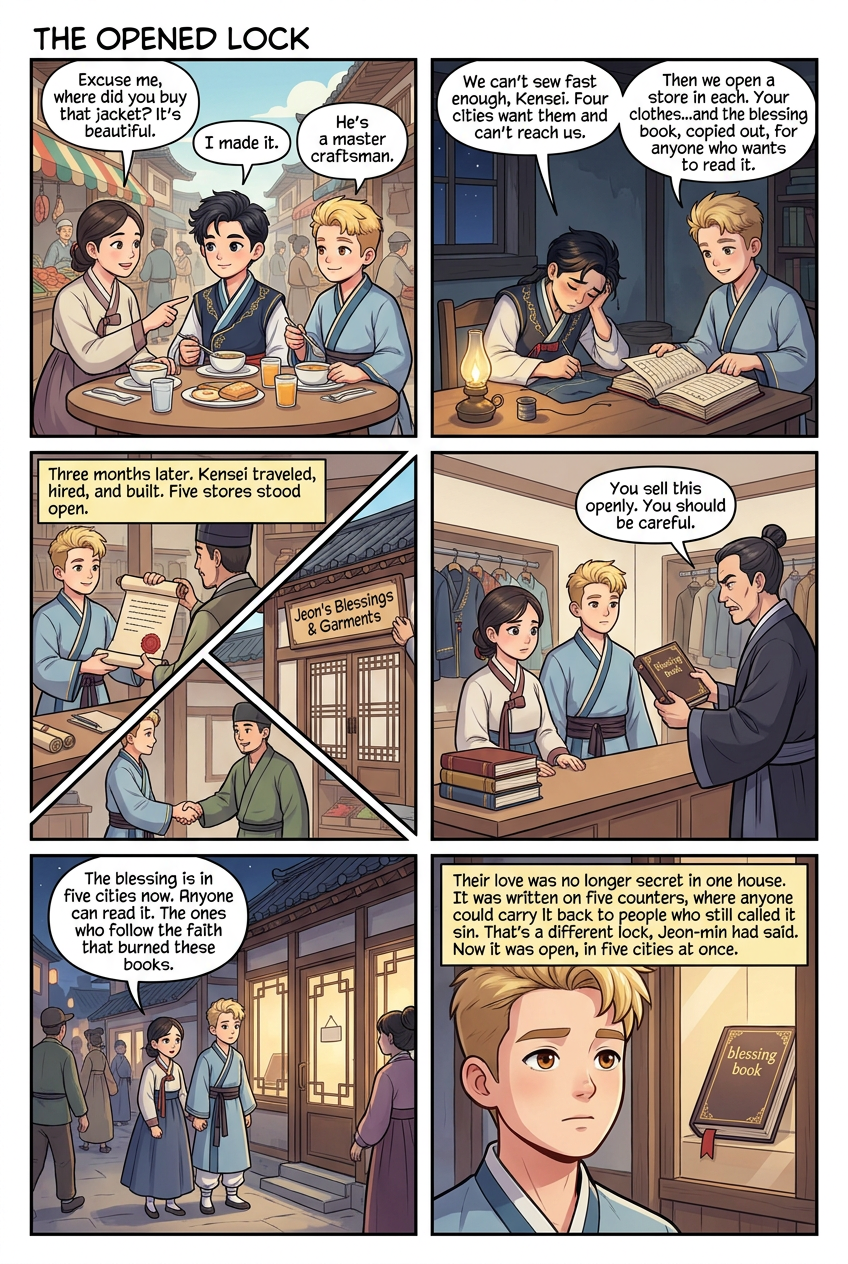
The morning after the locked door, Kensei ate breakfast with Jeon-min at the market hall. No one stared. They came back the next day, and the next. Word spread. A woman asked where Jeon-min bought his red and blue jacket. He told her he made it. She paid for one before it existed. Within a month, Jeon-min sewed by lamplight until his fingers cramped, and Kensei filled a ledger with names. "We can't sew fast enough," Jeon-min said one night. He set down his needle. "One city buys everything. Four cities want it and can't reach us." Kensei looked at the map of craftspeople Jeon-min kept in his bag. Jeon-min had marked shops in every city where they had passed. "Then we open a store in each," Kensei said. "Your clothes. And the blessing book, copied out, for anyone who wants to read it." Jeon-min stared at him. "The book says want is not shame. You want to sell that in five cities." "I want people to read it," Kensei said. "Ha-ni won't be the only one." They spent their savings on cloth and hired two seamstresses in the fifth city. Kensei traveled to the four other cities with the trade license stamped by the royal seal. In each city he found a shop to rent. He showed the clerk his papers. No clerk turned him away. He hired a person in each city to sell Jeon-min's jackets and the copied pages of the kamayaki blessing, written plain in their own language. It took three months. When Kensei returned home, five stores stood open. Jeon-min's knot pattern hung in five windows. The blessing sat on five counters, free for anyone to read. Coin came back faster than they could count it. Jeon-min held the ledger and did the sums twice. "We have more than we ever had," he said. "More than my great-grandmother made in her whole life." He set the ledger down. He did not smile. "What," Kensei said. "The blessing is in five cities now." Jeon-min looked at the door. "Anyone can read it. The clerks. The neighbors. The ones who follow the faith that burned these books." Kensei went still. He had thought only of Ha-ni finding it. He had not thought of who else might find it, and hate it. That evening a man came to the fifth city store. Kensei was there. The man picked up the blessing page and read it. His face closed. "You sell this openly," he said. "You should be careful." He set the page down and walked out. Kensei watched him go. The store was full. The jackets sold. The coin was real. But the man's words stayed. Their love was no longer secret in one house. It was written on five counters, where anyone could carry it back to people who still called it sin. "That's a different lock," Jeon-min had said. Now it was open, in five cities at once.
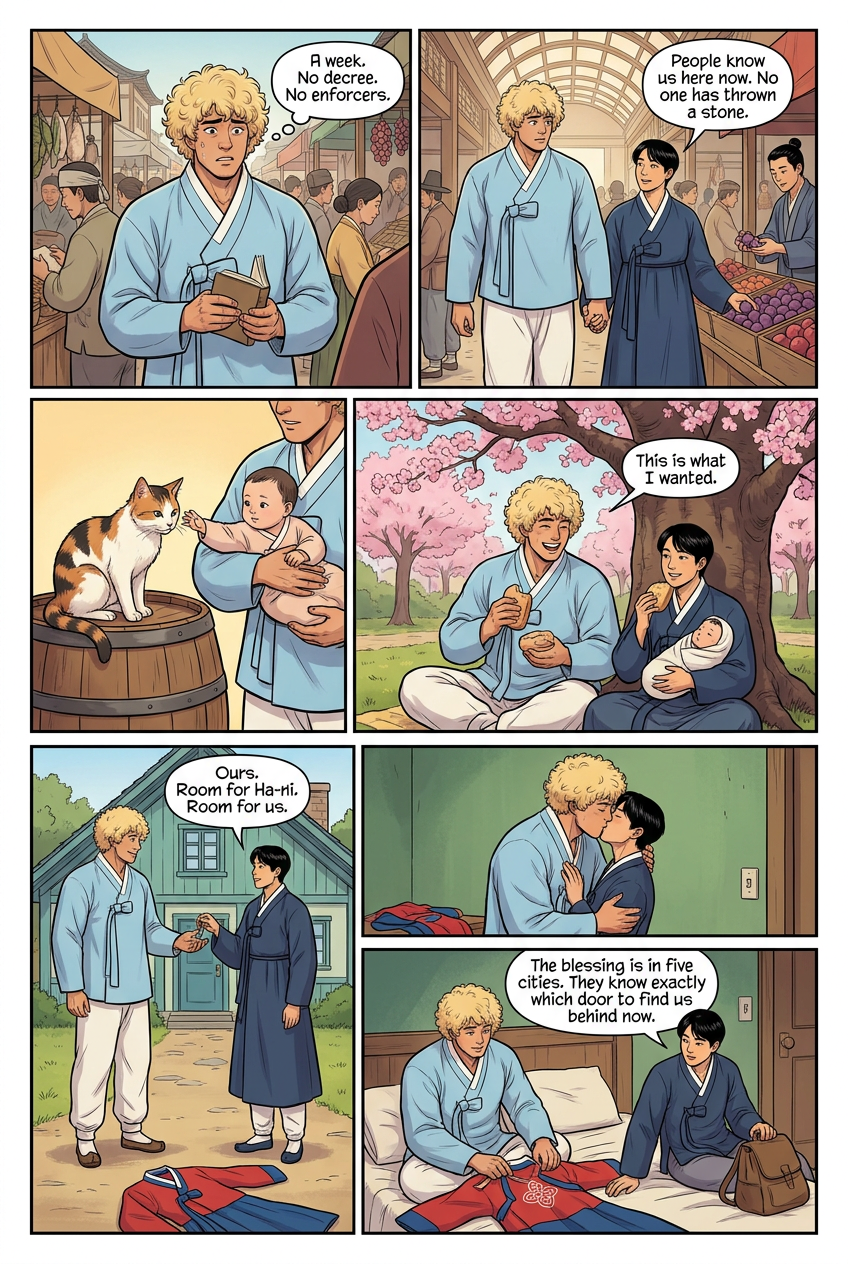
The man's warning stayed in Kensei's ears for a week. He waited for enforcers. He waited for a decree nailed to their door. None came. The stores stayed open. The jackets sold. The blessing pages left the counters faster than the clerks could copy them. On the eighth morning, Kensei stopped waiting for punishment and went to the market with Jeon-min. They walked to the great market hall together. Kensei held Jeon-min's hand. No one turned. A vendor sold beef and hung fruit from hooks. Jeon-min stopped at a stall and picked out plums, counting coin without hurry. A cat with orange and gold markings sat on a barrel and watched them. Ha-ni reached for it from Kensei's arms. The cat let her touch its fur. "People know us here now," Jeon-min said. "The jacket man. The book man." He put a plum in his bag. "No one has thrown a stone." Kensei bought bread. They ate it under a cherry tree past the hall, its blossoms pink and thick overhead. This was the thing he had wanted for years. To eat somewhere that was not four walls. To sit beside Jeon-min in the open sun with their daughter between them. He had it now. Nothing stopped him. They did not go back to their rented room that night. Jeon-min had found a house at the edge of the fifth city, painted green and blue, with two front windows and a low roof. He had paid for it with the store coin and told no one. He led Kensei to the door and set the key in his hand. "Ours," Jeon-min said. "Room for Ha-ni. Room for us. Room for the work." Inside, they put Ha-ni to sleep in the small room. Then they were alone. Kensei kissed Jeon-min against the wall of their own house, and Jeon-min kissed him back with the lamp still lit. Jeon-min's sash came loose. The red and blue garment he had sewn fell to the floor. Clothes lay where they dropped them. No one watched. No one would. After, they lay tangled on the bare bed frame. Jeon-min's mouth had left a red mark on Kensei's shoulder. Kensei traced the knot pattern stitched into the fallen garment. "We won," Kensei said. "The stores. The house. This. All of it open." Jeon-min sat up. He looked at his bag by the door, where the family sketch and the map of craftspeople stayed. "The blessing is in five cities," he said. "You made it free for anyone. That means the ones who hate it have it too. In writing. With our shop stamp on every page." He looked at Kensei. "They know exactly which door to find us behind now." Kensei looked at the green and blue walls he had just called home. The house was theirs. The stamp on the blessing pointed straight to it.
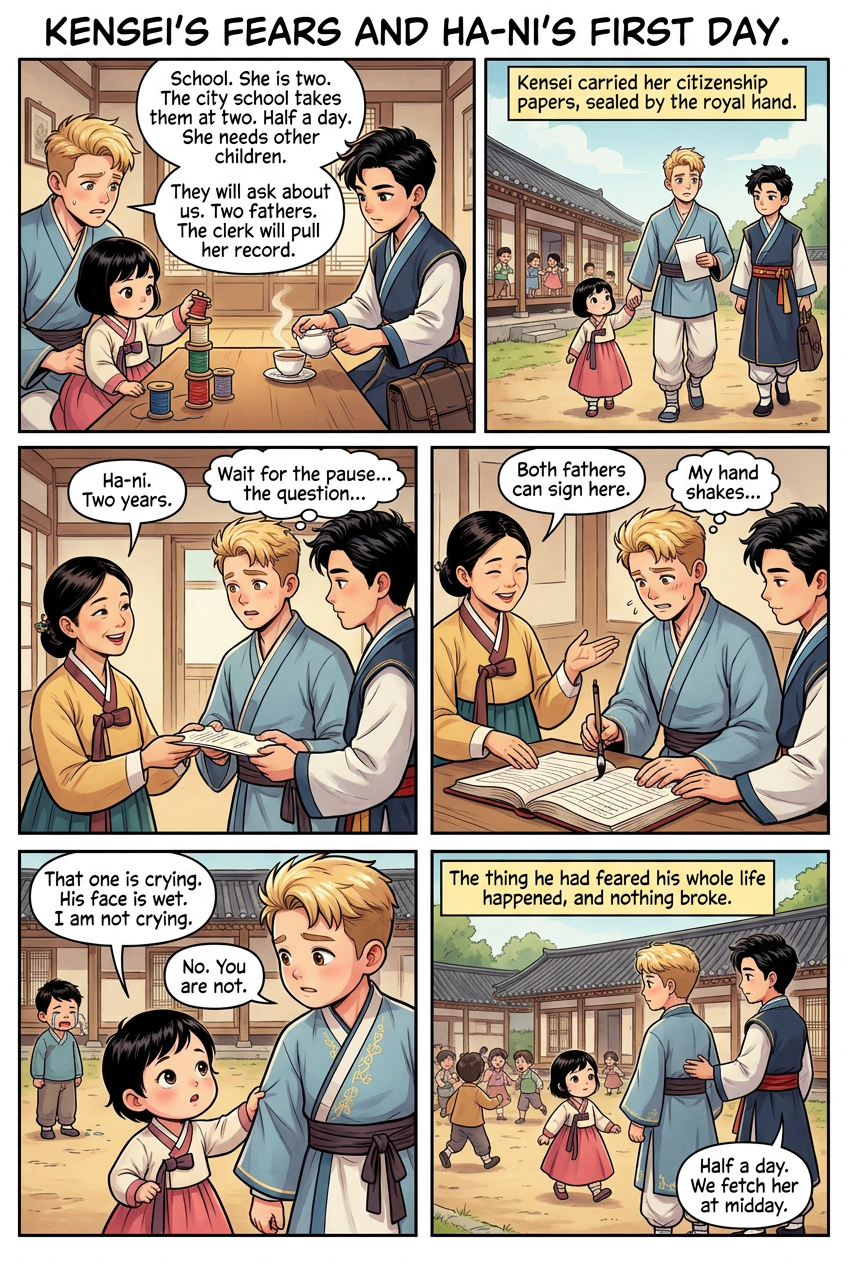
Ha-ni turned two in the green and blue house. She walked now. She talked in short bursts. The blessing book sold in five cities, and their shop stamp still marked every copy. Kensei woke each morning half-braced for a knock. But the house held. The stores held. So when Jeon-min set down his tea one morning and said the word, Kensei was not ready. "School," Jeon-min said. "She is two. The city school takes them at two. Half a day." He did not soften it. "She needs other children. She needs to learn." Kensei looked at Ha-ni on the floor. She was stacking spools of thread into a tower. "They will ask about us," he said. "Two fathers. The clerk will pull her record. The stamp is on the blessing. Anyone who reads it knows our door." "Then they know," Jeon-min said. He picked up his bag with the family sketch inside. "We hide nothing. That was the vow. Get her shoes." They walked Ha-ni to the school together. Kensei carried her citizenship papers, sealed by the royal hand. The building sat low and long, with children's voices spilling out the windows. A teacher stood at the door, counting arrivals on her fingers. Kensei's chest went tight the way it had in palace halls. The teacher looked up. She saw two men in hanbok, one holding a small girl's hand, one holding papers. She did not frown. She held out her hand for the record. Kensei gave it to her. He waited for the pause, the second look, the question. The teacher read the seal. "Ha-ni," she said, reading the name. "Two years." She wrote it in her book. "Both fathers can sign here." Kensei's hand shook when he took the brush. He signed. Jeon-min signed under him, blunt strokes, no hesitation. The teacher blew on the ink and closed the book. Ha-ni pulled at Kensei's sleeve. "That one is crying," she said. She pointed at a boy by the wall, red-faced, wet-cheeked. "His face is wet. I am not crying." "No," Kensei said. "You are not." The teacher took Ha-ni's hand. Ha-ni went. She did not look back. She walked into the room of children as if the door had always been open for her. Kensei stood in the empty yard. His daughter was inside a city school, signed in the open, both fathers named on the page. No decree came. No clerk turned them away. The thing he had feared his whole life happened, and nothing broke. Jeon-min touched his arm. "Half a day," he said. "We fetch her at midday." They walked home. But Kensei knew the school kept its own records now. Ha-ni's name, both fathers, filed with the city. A second copy of their door, in a hand that was not theirs, in a book they could not reach.
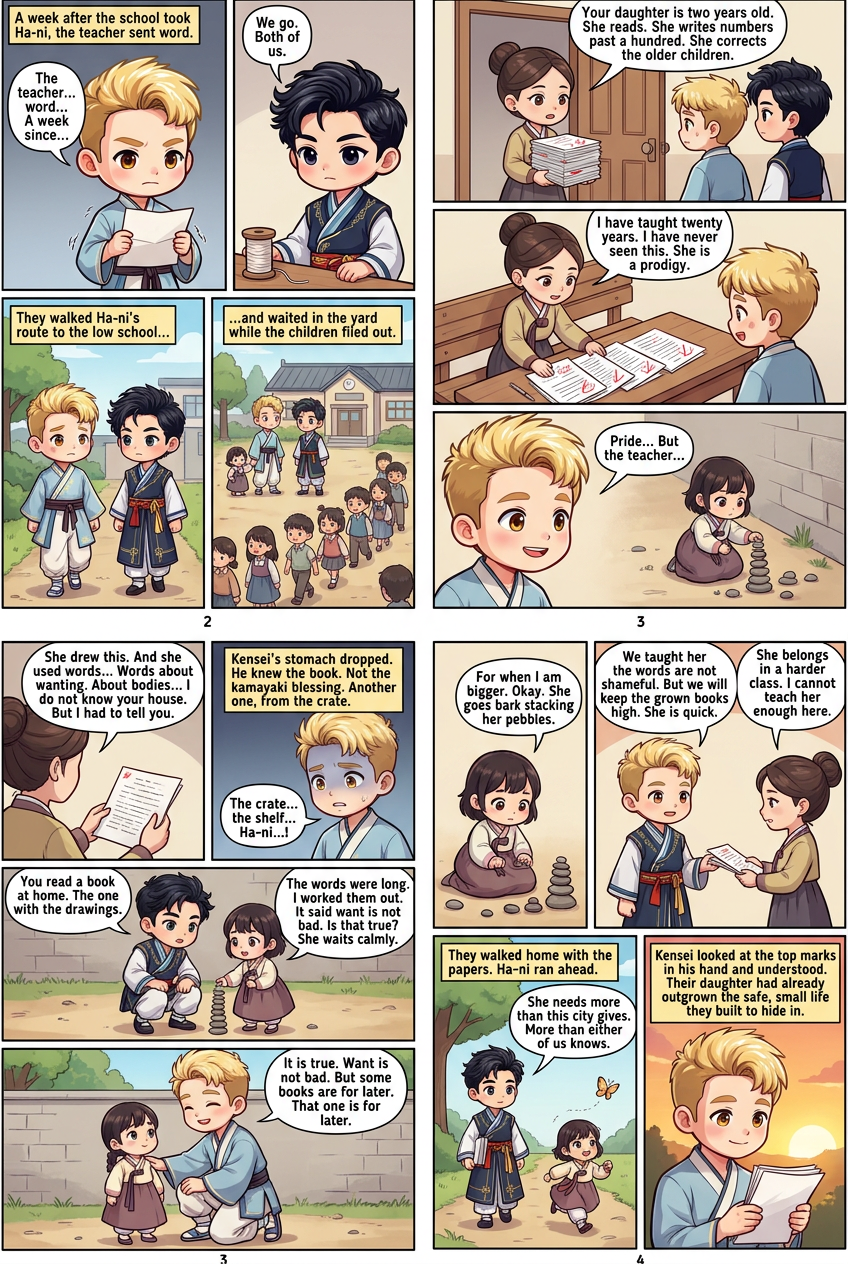
A week after the school took Ha-ni, the teacher sent word. She wanted both fathers to come at midday. Kensei read the note twice. His hands went cold the way they always did before a clerk pulled a record. Jeon-min set down his thread. "We go," he said. "Both of us." They walked Ha-ni's route to the low school and waited in the yard while the children filed out. The teacher met them at the door. She held a stack of papers marked in red. "Your daughter," she said, "is two years old. She reads. She writes numbers past a hundred. She corrects the older children." She spread the papers on a bench. Every mark was the top mark. "I have taught twenty years. I have never seen this. She is a prodigy." Kensei looked at the pages. Then he looked at Ha-ni, who stood by the wall stacking pebbles into a row. Pride rose in him. But the teacher was not finished. She pulled one paper from the bottom and turned it so only the two men could see. "She drew this," the teacher said. Her voice dropped. "And she used words. Words about wanting. About bodies. About want between people. She read them somewhere. A book meant for grown men, not this. I do not know your house. But I had to tell you." Kensei's stomach dropped. He knew the book. Not the kamayaki blessing. Another one, from the crate. He had left it on a low shelf, thinking Ha-ni too small to reach. He had been wrong. Jeon-min did not flinch. He crouched to Ha-ni's height. "You read a book at home," he said. It was not a question. "The one with the drawings." Ha-ni looked up. "The words were long," she said. "I worked them out. It said want is not bad. Is that true?" She waited, plain and steady, for the answer. Kensei knelt beside Jeon-min. He thought of the slope, the gray-haired woman, the blessing they had carried home. He thought of everything he had feared telling her too soon. "It is true," he said. "Want is not bad. But some books are for later. That one is for later." "For when I am bigger," Ha-ni said. "Okay." She went back to her pebbles. Kensei turned to the teacher. "We taught her the words are not shameful," he said. "But we will keep the grown books high. She is quick. Too quick for the shelf." The teacher studied him. Then she gathered the red-marked pages and pressed them into his hands. "She belongs in a harder class," she said. "I cannot teach her enough here." They walked home with the papers. Ha-ni ran ahead. "She needs more than this city gives," Jeon-min said. "More than either of us knows." Kensei looked at the top marks in his hand and understood. Their daughter had already outgrown the safe, small life they built to hide in.
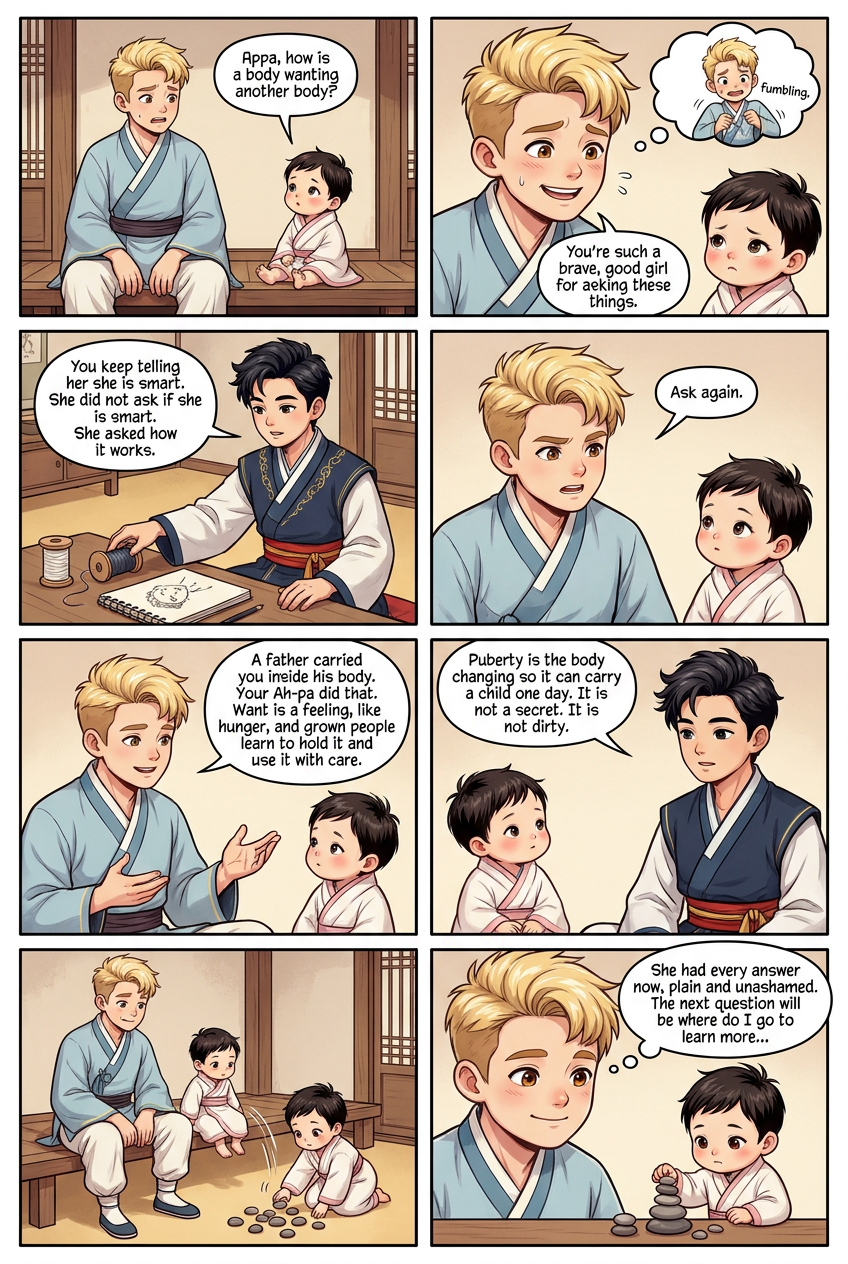
The red-marked papers sat on the table for three days. Ha-ni did not go back to the low school. She stayed home with the high books and worked through them. But the questions started that first morning. She climbed onto the bench beside Kensei and asked how a body wanted another body. She asked how children were made. She asked what changed when a person grew. Kensei froze each time. His first thought was to soothe her. To tell her she was clever, brave, good for asking. Praise was easy. Praise cost nothing. It also answered nothing. Jeon-min watched him fumble. On the fourth question he set down his thread. "You keep telling her she is smart," he said. "She did not ask if she is smart. She asked how it works." Kensei looked at Ha-ni. She waited, plain and steady, the way she waited for everything. He saw the choice clearly now. He could praise her and dodge, or he could ground her and answer. "Ask again," he said. "How are children made?" Ha-ni said. So he told her. He used the true words, small and slow. He said a father carried her inside his body. He said her Ah-pa did that. He named the parts without shame and without the long book's heat. When she asked about the body wanting, he said want was a feeling, like hunger, and that grown people learned to hold it and use it with care. "Like a skill," Ha-ni said. "The book said learned." "Like a skill," Kensei said. "You learn it when you are bigger." Jeon-min took the next question. He was blunt where Kensei was careful. "Puberty is the body changing so it can carry a child one day," he said. "It happens to everyone. It is not a secret. It is not dirty." He said it once more, flat. "Not dirty." Ha-ni nodded. She did not blush. She did not flinch. She took each answer the way she took a hard word on a page, worked it, filed it, and reached for the next. By the end of the morning she had run out of questions. She slid off the bench and went to her pebbles. Kensei sat back. His hands were steady. He had spent his whole life being told want was shame, that the true words could not be spoken. He had just spoken them to his daughter across a table, in the light, and nothing had fallen on them. "That was better," Jeon-min said. "You answered her. You stopped hiding behind good girl." Kensei looked at Ha-ni stacking her stones. She had every answer now, plain and unashamed. But she had them faster than the low school could ever hold her. The next question would not be about bodies. It would be where do I go to learn more, and this city had already run out of what to teach her.
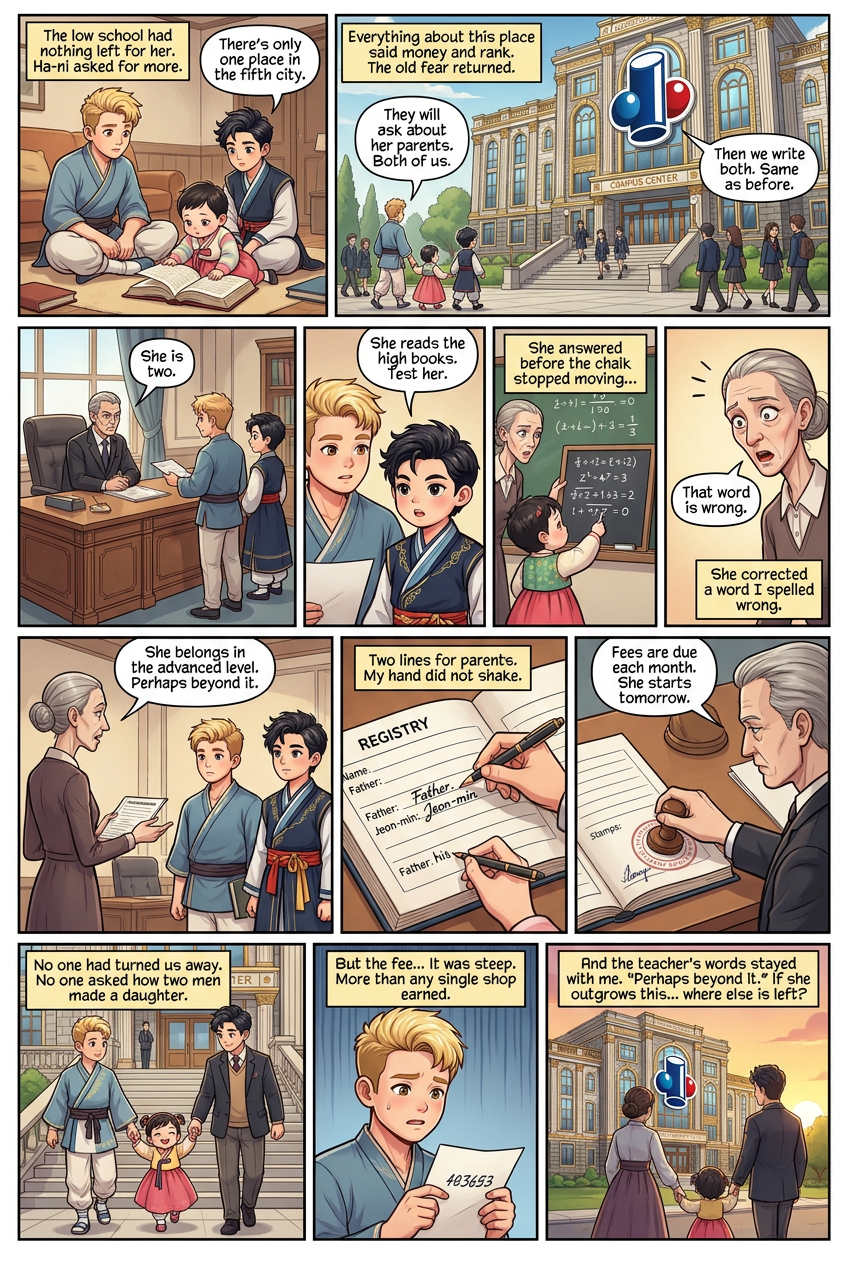
The question Kensei feared came a week later. Ha-ni looked up from a book too advanced for her age and asked where she could learn more. The low school had nothing left. Kensei knew the answer, and he did not like it. There was only one school in the fifth city that taught past what she had already mastered. He and Jeon-min walked her there the next morning. The building rose tall and polished, its stone front trimmed with gold. A sign above the door showed a cylinder flanked by two round shapes. Students in clean coats climbed the wide steps. Everything about the place said money and rank. Kensei felt the old fear return, the one that told him people like him did not belong. "They will ask about her parents," Kensei said. "Both of us. On the registry." "Then we write both," Jeon-min said. "Same as before." Inside, a clerk sat behind a desk with a ledger. Kensei set Ha-ni's citizenship papers down and asked to enroll her in the advanced level. The clerk looked at the papers, then at Ha-ni, then at the two men in hanbok standing side by side. "She is two," the clerk said. "She reads the high books," Jeon-min said. "Test her." The clerk called for a teacher. A thin woman came with a slate and wrote a hard sum on it. Ha-ni answered before the chalk stopped moving. The teacher wrote a longer one. Ha-ni answered that too. Then she corrected a word the teacher had spelled wrong on the slate. The teacher stared, then wiped the slate clean. "She belongs in the advanced level," the teacher said. "Perhaps beyond it." The clerk turned the registry toward them. Two lines for parents. Kensei's hand did not shake this time. He wrote his name. Jeon-min wrote his beneath it. The clerk read both names, read that they were both fathers, and dipped his pen without a word. He stamped the page and filed it. "Fees are due each month," the clerk said. "She starts tomorrow." Outside, Ha-ni held both their hands and swung between them on the steps. She was in the best school the city had. No one had turned them away. No one had asked how two men made a daughter. But Kensei had seen the fee written on the clerk's paper. It was steep. Their five shops made good coin, yet this school took more each month than any single shop earned. And the teacher's words stayed with him. Perhaps beyond it. This city had one advanced school, and it was already the last one. If Ha-ni outgrew this the way she outgrew the low school, there would be nowhere left in the fifth city to send her.
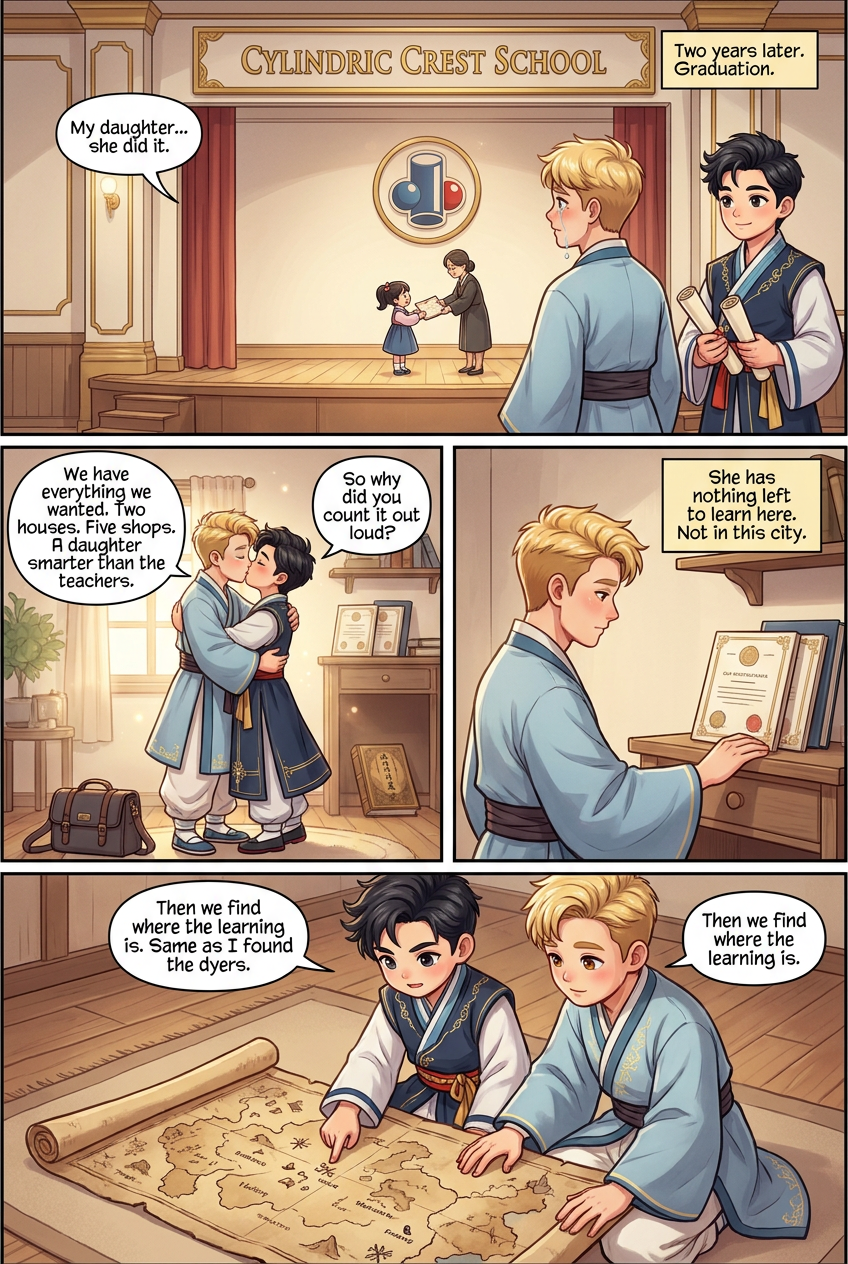
Two years after the enrollment, the school held a graduation. Kensei stood in the polished hall under the gold-trimmed sign, the cylinder crest carved above the door. Ha-ni walked to the front in a small coat. She was four. She had finished every level the advanced school could teach. The teacher handed her a certificate for art, marked with the highest degree the school gave. Kensei's throat tightened. His daughter had done what no one thought a child could do. Beside her stood Jeon-min. He had not come only to watch. Over the two years, while Ha-ni climbed the school's levels, Jeon-min had studied its language courses at night. He earned his own certificate that same morning, a degree in languages. He held the paper flat and read the numbers on it once. "Two degrees," Jeon-min said. "One for her art. One for my languages. Two." Kensei laughed. He could not help it. They had walked into this rich school afraid of being turned away. Now they walked out with paper that named them scholars. They went home together. Ha-ni fell asleep before dark, her certificate on the shelf beside the old kamayaki book. Kensei latched the door to their room. He kissed Jeon-min, then kissed him again. He pulled the hanbok jacket from Jeon-min's shoulders and pressed his mouth to the bare skin there. Jeon-min laughed low and kissed him back, again and again, until they lost count. "We have everything we wanted," Kensei said. "Two houses. Five shops. A daughter smarter than the teachers. Papers with our names." Jeon-min did not answer at first. He lay still, his hand on Kensei's chest. "We have everything," Jeon-min said. "So why did you count it out loud?" Kensei stopped. He had counted it because he needed to hear it was real. And hearing it, he felt the gap under it. Ha-ni had finished the last school in the fifth city. The teacher's old words returned to him. Perhaps beyond it. There was nowhere left to send her. She was four, and she had already outgrown every book the city held. "She has nothing left to learn here," Kensei said. "Not in this city. Not in any of the five." Jeon-min sat up. He reached for his bag and pulled out the map he kept, the one marked with craftspeople across the cities. "Then we find where the learning is," Jeon-min said. "Same as I found the dyers. Same as we found the woman who read the blessing." Kensei looked at the certificates on the shelf. They had built a whole life in the fifth city and made it safe. Now the life fit their daughter the way a child's coat fits a grown body. To keep her, they would have to leave the place they had fought to stay. Kensei took the map from Jeon-min's hand and began to read the names.
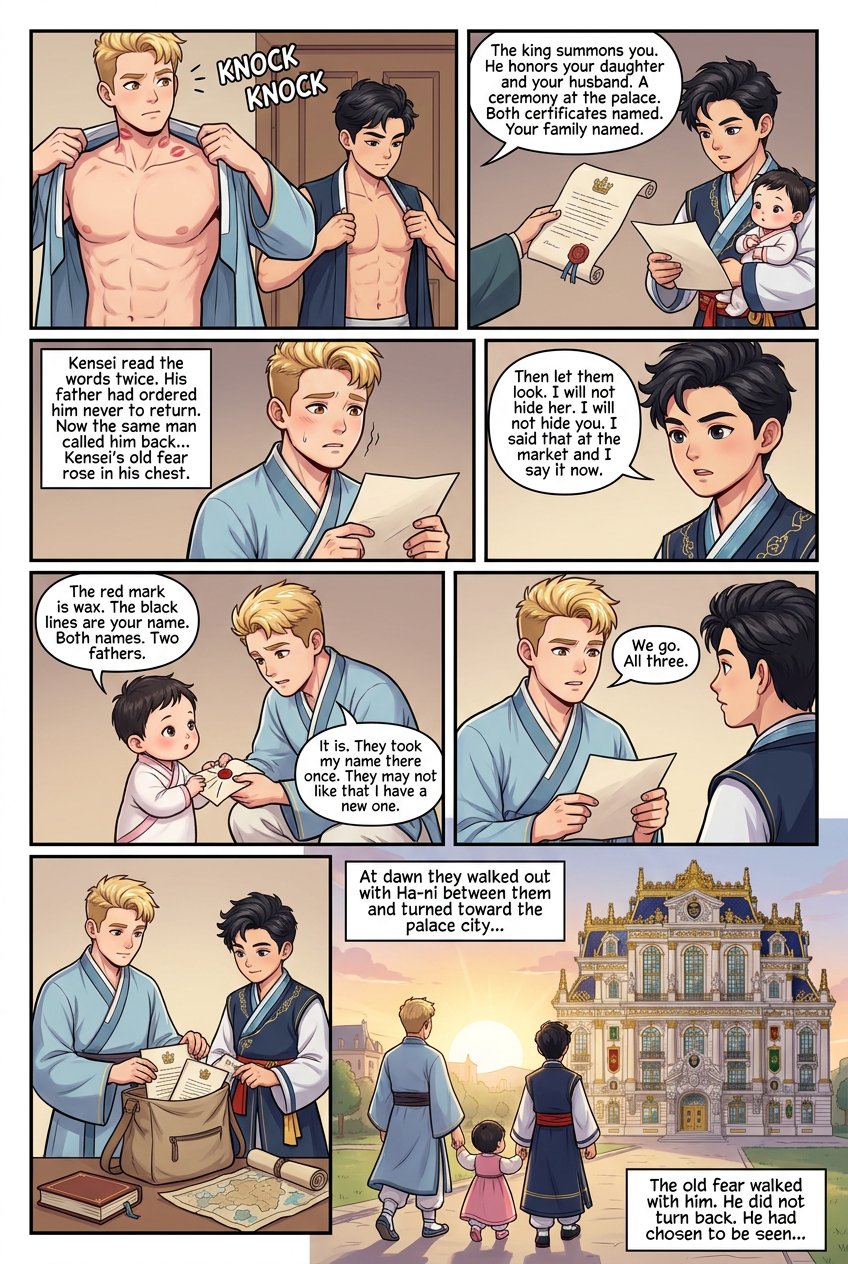
They were kissing shirtless, closely, leaving lipstick on their necks while kissing when a man knocked on the door so they quickly cover up and opened the door "The king summons you," the clerk said. "He honors your daughter and your husband. A ceremony at the palace. Both certificates named. Your family named." Kensei read the words twice. His father had ordered him never to return. Now the same man called him back to stand in the grand hall, under the gold and the crest, and be seen. Kensei's old fear rose in his chest. To attend meant standing in front of every noble who once knew him as Hikari, then watched him fall. Jeon-min came to the door with Ha-ni on his hip. He read the letter over Kensei's shoulder. He did not flinch. "A ceremony," Jeon-min said. "For her art. For my languages. He wants to give us papers we already earned." "He wants to show us," Kensei said. "To the whole court." "Then let them look," Jeon-min said. "I will not hide her. I will not hide you. I said that at the market and I say it now." Ha-ni tugged the letter with one small hand. She studied the seal, then the ink. "The red mark is wax," Ha-ni said. "The black lines are your name. Both names. Two fathers." She looked up. "Is the palace where you were born?" Kensei knelt to her level. "It is," he said. "They took my name there once. They may not like that I have a new one." "But my name is on the paper too," Ha-ni said. "So we all go." Kensei looked at his daughter, then at Jeon-min. He had built a whole life to keep them safe from that hall. But the summons was not the old threat. It was the king naming their family out loud, in front of the court that once erased it. To refuse was to hide again. To go was to be seen and stay standing. He folded the letter. "We go," Kensei said. "All three." The clerk bowed and left. Kensei packed the two certificates in Jeon-min's bag, beside the kamayaki book and the map. He latched the bag shut. "When she finishes there," Kensei said, "we still leave to find her more school. The summons does not change that." "No," Jeon-min said. "First the palace. Then the road." At dawn they walked out with Ha-ni between them and turned toward the palace city Kensei had sworn never to enter again. The old fear walked with him. He did not turn back. He had chosen to be seen, and the choice pulled his family into the court that once cast him out.
Play your story to life
Storycraft is a mobile game where you create AI characters, craft items and locations to build their world, then discover what direction your story takes. Download the iOS game for free today!
Download for free