

Elsa Crane's Arc
66 Chapters
Elsa Crane's dream is crowning a successor whose smile matches her own to keep Alpenglow's warmth unbroken after she is gone..

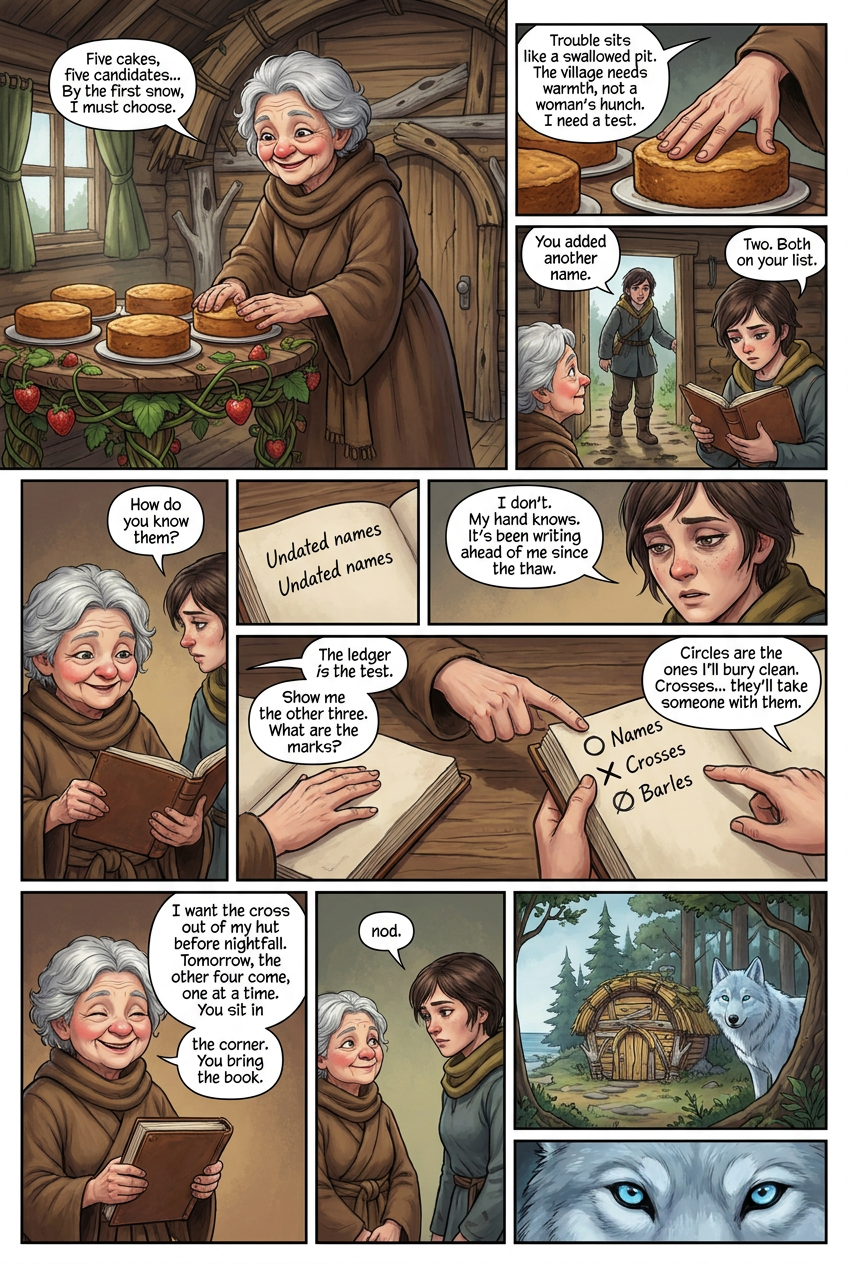
Elsa Crane pressed her thumb into the wax of a fifth honey-cake and set it beside the others on the vine-woven table. Five cakes, five candidates, and by the first snow she would crown one of them to keep Alpenglow smiling after she was buried. The trouble sat in her chest like a swallowed pit. She could feel a false smile the way other people felt a draft, but feeling was not proof, and the village would not hand its warmth to a woman's hunch. Her meeting hut smelled of driftwood and crushed mint. Strawberry vines curled up the table legs, and small bottles of tincture rattled when she leaned her weight on the wood. She needed a test. Something private. Something a liar could not talk his way out of. The gravedigger ducked through the low door without knocking. Mud flaked off her waders onto the swept floor. She had slept in the hut for three winters now, and Elsa had stopped pretending it was strange. The leather ledger was already open in her hands. "You added another name," Elsa said. "Two." The gravedigger, Nora Lund, did not look up. "Both on your list of five." Elsa set down the honey-cake she was holding. "Which two." Nora turned the ledger. Two fresh names sat above the ruled line, ink still wet. No dates. Elsa had told no one which five she was considering. She had written the list only in her own head. "How do you know them," Elsa said. "I don't." Nora finally looked up. Her eyes were steady and tired. "My hand knows. It's been writing ahead of me since the thaw. It hasn't been wrong yet." Elsa understood then that she had been looking for her test in the wrong drawer. The ledger was the test. Whatever moved Nora's hand did not care about a smile. It cared about what a person was underneath one. "Show me the other three," Elsa said. Nora flipped back a page. Three of Elsa's five candidates were already written there, weeks old. Beside each name, a small mark: a circle, a cross, a circle. "What are the marks." "Circles are the ones I'll bury clean," Nora said. "Crosses are the ones who'll take someone with them." Four circles. One cross. Elsa found she was smiling, the wide unblinking smile the village trusted. She closed the ledger under her palm. "I want the cross out of my hut before nightfall. I want the other four at this table tomorrow, one at a time. You sit in the corner. You bring the book. When each one speaks to me, you write." Nora nodded once. She did not ask what would happen if her hand wrote a new cross while a candidate sat across from Elsa drinking her tea. Elsa did not ask either. They both already knew. Outside, a pale wolf watched the hut from the tree line and did not blink.
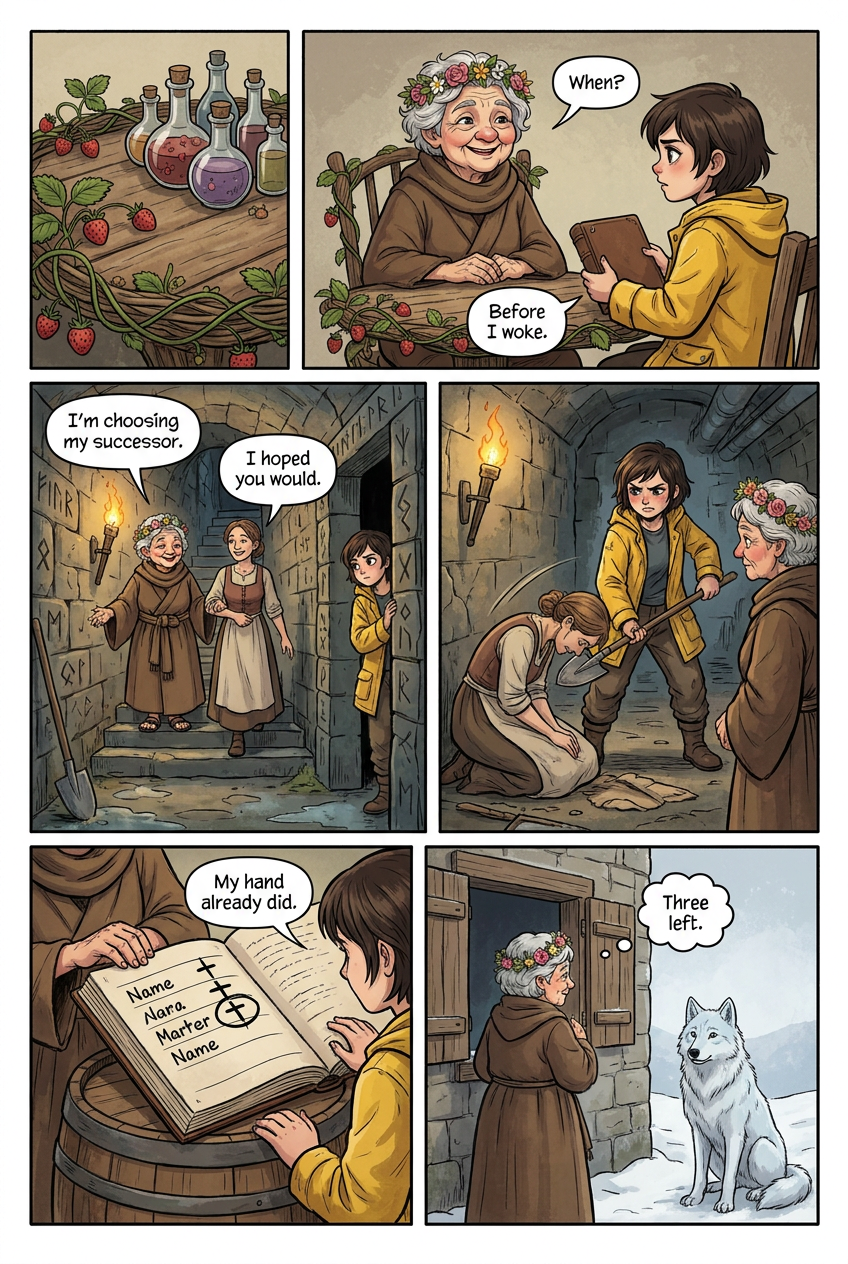
Morning came gray and slow. Elsa Crane laid out four honey-cakes on the vine-woven table and set the kettle on the hearth. Four cakes, four candidates, one long day of tea. Somewhere in the ledger under Nora Lund's arm, a fresh cross sat next to one of their names. Elsa did not yet know which. Nora came in from the yard with mud on her waders and the leather book pressed to her chest. She set the ledger on the table between the potion bottles. Her thumb marked the page. "When," Elsa said. "Before I woke. My hand wrote it in the dark." Nora opened the book. One of the four names had a small black cross beside it. The ink had smudged where her sleeve had dragged. Elsa read the name and did not let her face move. She had known the woman since the woman was a child. A weaver. Wide, warm smile. The kind of smile the village would follow into a snowbank. "You're certain the mark means what you said." "Every time so far." Elsa closed the ledger under her palm. "Then we don't wait for tea." She sent Nora out the back with instructions. Elsa herself walked to the weaver's door and invited her for a private word in the root cellar beneath the meeting hall. The weaver came smiling. Elsa smiled back the wide, unblinking smile the village trusted. The cellar stairs were narrow. Stone walls, old carved marks along the beams from a builder long dead. Elsa lit a lantern and set it on a barrel. She let the weaver walk ahead. "I'm choosing my successor," Elsa said. "I wanted you to hear it first." The weaver turned, delighted. Her hand was already in her apron pocket. When it came out, it held a short knife. "I hoped you would," the weaver said. Still smiling. "I've waited a long time to be told first." Elsa did not step back. She had placed Nora behind the cellar door for exactly this. The door swung. Nora struck once with the flat of a shovel. The weaver folded onto the stone. They stood over her together. The weaver was breathing. Nora set the shovel down and opened the ledger on the barrel beside the lantern. "Write it," Elsa said. "My hand already did." Nora turned the page. The cross beside the weaver's name had a circle drawn around it now, neat and closed. "That's new." Elsa looked at the ring around the cross and understood the ledger was answering her. It marked what she chose, not only what came. "Three left," she said. Outside, past the shuttered window, a pale wolf sat in the snow and watched the hut. Its blue eyes did not blink. Elsa met them through the glass and felt, for the first time, that the test was watching her back.
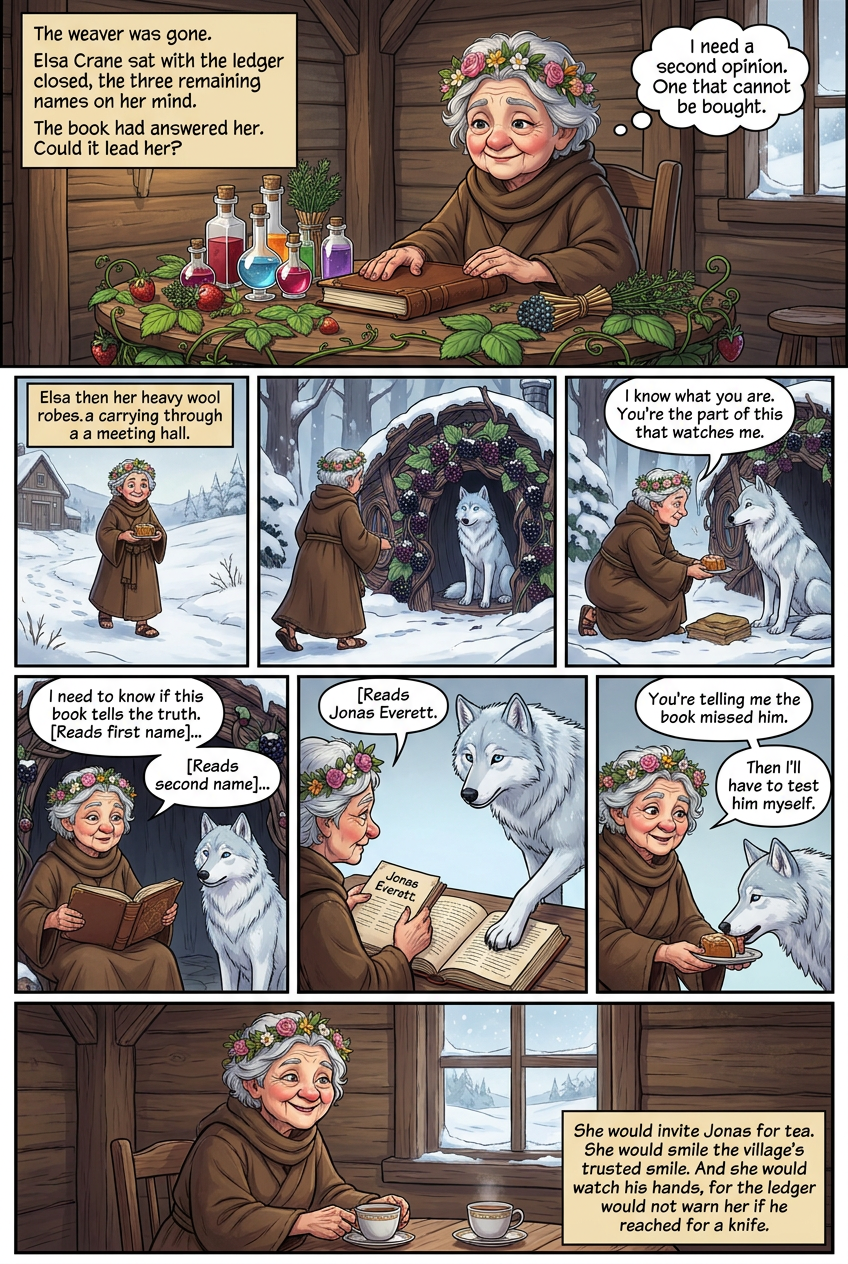
The weaver was gone by noon, carried out the cellar's back stairs on a tarp. Nora Lund went with her. Elsa Crane stayed at the vine-woven table with the ledger closed under her hand. Three names remained. The circle around the cross still sat on the page behind her palm, and she could not stop thinking about it. The book had answered her choice. That meant the book could lead her, too. She needed a second opinion that could not be bought or smiled at. She thought of the pale wolf at the window. Elsa took a honey-cake from the table, wrapped it in cloth, and walked out into the snow. She did not go far. Behind the meeting hall, past the woodpile, the blackberry bush had grown over an old fairy alcove — a low wooden arch heavy with dark fruit and snow. The wolf sat inside it, as if it had been waiting for her to notice the door. She crouched at the edge of the arch. Her knees ached. She set the cake on the packed snow between them. "I know what you are," she said. "You're the part of this that watches me." The wolf did not eat. Its blue eyes stayed on her face. Elsa opened the ledger on her lap. She turned to the page of the three remaining names. "I need to know if this book tells me the truth, or tells me what I want." She read the first name aloud. The wolf did not move. She read the second. The wolf's ears did not shift. She read the third — Jonas Everett, the baker who walked newcomers down to the cellar under the village — and the wolf stood. It took one step forward and put its paw on the open page, over his name. Then it looked at her and waited. Elsa's stomach turned. Jonas had no mark in the ledger. Not a cross. Not a circle. Nothing. "You're telling me the book missed him," she said. The wolf sat back down. She understood then. The ledger showed her the deaths she chose. It did not show her the ones already smiling in her kitchen. Nora's hand wrote what Elsa's hand would answer for. The rest walked free. Elsa closed the book. She pushed the honey-cake toward the wolf. This time it ate. "Then I'll have to test him myself," she said. She stood, brushed snow from her robes, and walked back to the hut. Inside, she set out a fourth cup. She would invite Jonas for tea before dark. She would smile the wide, warm smile the village trusted. And she would watch his hands the whole time, because the ledger would not warn her if he reached for a knife. Behind her, through the window, the wolf was already gone.
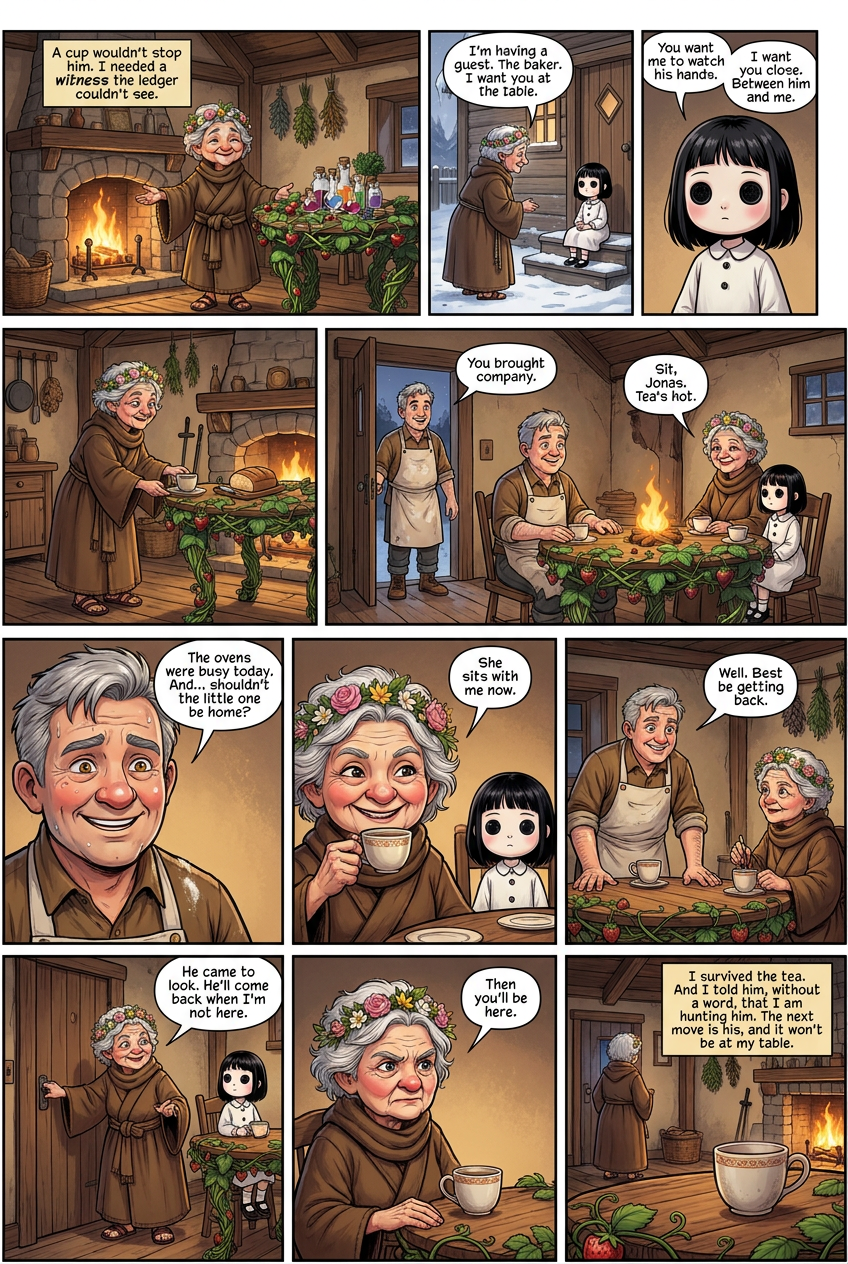
Elsa set the fourth cup down and stared at it. A cup would not stop a baker's hands. She needed something in the room that could — a witness the ledger could not see, and a warning she could trust before the knife came out. She thought of the child. Wren Kovar had come back to the village three times after they left her in the pines. The little girl with black button eyes where her eyes should be. Elsa had given her keys once. Wren had used them and set a cellar door on fire. That was enough to know the girl was not what she looked like, and that she owed Elsa a small debt. Elsa found Wren sitting on the back step of the meeting hall, feet neat in the snow, hands folded. She had not called her. The girl was simply there. "I'm having a guest," Elsa said. She kept her voice warm. "The baker. I want you at the table." Wren tilted her head. The button eyes caught no light. "He walks people down to the cellar under the village," Elsa said. "They come back quiet. I want to know if he means to walk me down too." "You want me to watch his hands," Wren said. "I want you to sit close. Close enough that if he moves wrong, you're between him and me." Wren considered this. "He won't touch a child at the table." "No," Elsa said. "He won't." She went inside and moved the vine-woven table nearer the hearth. She set out four cups now instead of two. Honey, bread, a small knife for the bread — she took the knife back to the drawer. She left the poker at the fire, where her hand could find it without looking. Jonas came at dusk. Flour still on his sleeves. He smiled at the door the way he smiled at everyone, and his smile faltered one blink when he saw Wren already in the chair beside Elsa's. "You brought company," he said. "She sits with me now," Elsa said. "Sit, Jonas. Tea's hot." He sat. He kept both hands on the table, palms flat, the whole hour. He talked about the ovens. He asked, twice, whether Wren shouldn't be home. Wren did not blink. Neither did Elsa. When he left, he had not touched his cup. Elsa closed the door and leaned against it. Her hands shook only after the latch caught. "He came to look," Wren said, still in the chair. "He'll come back when I'm not here." "Then you'll be here," Elsa said. Wren turned her button eyes to the fire. "I can't be here every hour. And now he knows you know." Elsa looked at the untouched cup on the table. She had survived the tea. She had also told Jonas, without a word, that she was hunting him. The next move would be his, and it would not be at her table.
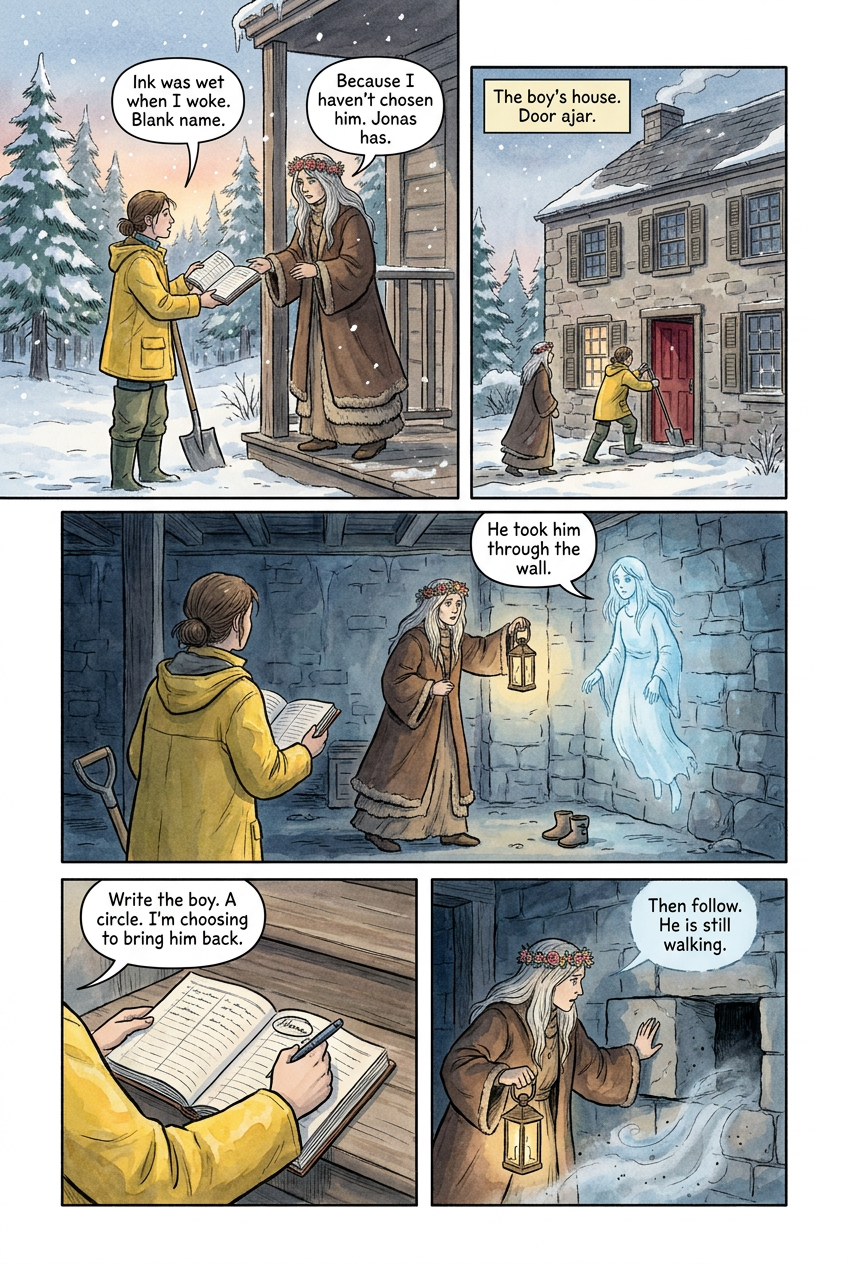
Elsa slept badly and woke to knocking. Not on her door. On her window. Nora Lund stood in the snow in her yellow slicker, waders caked black. She held her ledger open against the glass. A fresh name was written in her hand. Not a villager Elsa had chosen. A boy who swept the baker's shop. Elsa pulled on her wool robes and met Nora at the step. "When." "Ink was wet when I woke," Nora said. "No mark yet. No circle, no cross. Blank name." "Because I haven't chosen him," Elsa said. "Jonas has." Nora nodded once. "Then he's still alive." They went fast through the pines. The boy's family kept a shuttered stone house at the village edge, iron-banded shutters closed tight, the front door painted the color of a fresh cut. Smoke came from the chimney. The door stood open a finger's width. That was wrong. Elsa put her palm flat on the red wood and pushed. Nora went in first with the shovel. The front room was warm and empty. A kettle hissed on the hob. A child's boot lay on its side by the hearth, laces still knotted. Elsa touched the boot. Warm. Not long. "Cellar," Nora said. The cellar hatch was propped with a flour sack. Jonas's mark. Elsa lifted her lantern and started down. The cold under the house was wrong for a root cellar. It bit like open air. Halfway down the steps, her breath went white and a voice moved past her ear. Not words at first. Then words. "He took him through the wall." Elsa stopped. A pale blue shape gathered by the far stones, thin as smoke pulled through a keyhole. Two soft lights where eyes would be. She had seen this one drift the graveyard at dusk. Nora had once tipped a hat to it. Never a name. "Through the wall where," Elsa said. "Down. Toward the under-cellar. He was quick. The boy was quiet." The voice thinned into a draft, then came back. "You are late by minutes." Nora came down behind her. Elsa raised the lantern to the back wall. A seam in the stone. A handprint in flour on one block. She pressed it. The block gave. Cold air poured out, and under the cold, the smell of bread. She listened. Nothing. No footsteps. No child. Elsa closed the stone. Her hand shook, but only once. "Write the boy," she said to Nora. "A circle. I'm choosing him. I'm choosing to bring him back." Nora opened the ledger on the cellar step and wrote. The pen scratched. A circle bloomed around the boy's name in ink that had not been there. The ghost dimmed toward the ceiling. "Then follow," it whispered. "He is still walking." Elsa lifted the lantern and pushed the stone open again.
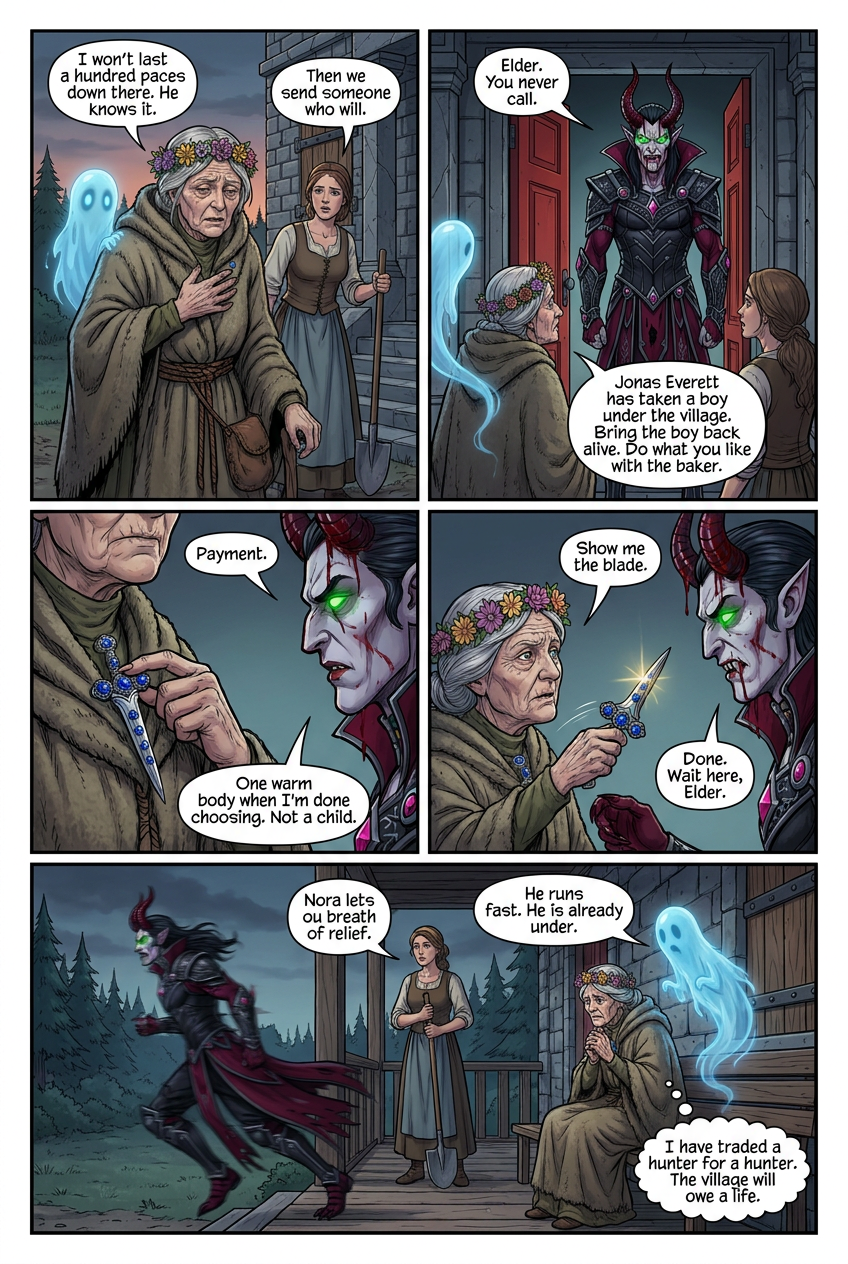
Elsa held the stone open. Cold poured up the steps like water. She looked at her own hand on the block. Round and soft, ringed with age. Her wool robes were made for hearth rooms, not for chasing a killer through a tunnel that breathed like a grave. "I won't last a hundred paces down there," she said. "He knows it." Nora waited on the step above with the shovel. "Then we send someone who will." Elsa closed her eyes. She had put this off for weeks. She opened them and said the thing she had sworn not to say. "The one under the fortress. The horned one." Nora's jaw set. "Elder." "He can walk cold. He can run it." Elsa touched the small shape sewn inside her collar, the blue-jeweled silver blade she had carried since the first frost. "And I have the stake. He steps wrong, he ends." They went. The ghost drifted with them, a thin blue smear at Elsa's shoulder, thinner in daylight. It had known Jonas's path. It might know this one too. "You'll come as far as the gate?" Elsa asked it. "To the door," the ghost breathed. "No further. He doesn't like me inside." The granite fortress squatted at the pine line, iron shutters bolted, the red door bright as a cut. Elsa climbed the porch. Her chest hurt from the walk. She knocked twice. The door opened on its own weight. He filled the frame before she saw him move. Tall, horned, blood dripped down the curl of one horn onto the stone. His eyes were two green lamps in a bone-white face. He looked at her collar first, at the shape beneath it, and smiled with teeth. "Elder," he said. "You never call." "Jonas Everett has taken a boy under the village," Elsa said. "I can't follow. You can. Bring the boy back alive. Do what you like with the baker." He tipped his head. "Payment." "One warm body when I'm done choosing. Not before. Not a child." He considered. His tongue touched a tooth. "Show me the blade." She drew it an inch. Sapphires caught the porch light and threw it back into his eyes. He flinched, small, honest. Good. He believed her. "Done," he said. "Wait here, Elder. I don't carry passengers." He was past her before she felt the wind of it. Down the steps, into the pines, gone toward the abandoned house and the passage under it. Nora let out a breath Elsa hadn't heard her hold. Elsa sat on the porch bench. Her hands shook now, both of them. She had traded a hunter for a hunter. The village would owe a life she had not yet named. The ghost hovered at the rail. "He runs fast," it whispered. "He is already under." "Then we wait," Elsa said, "and count what comes back."
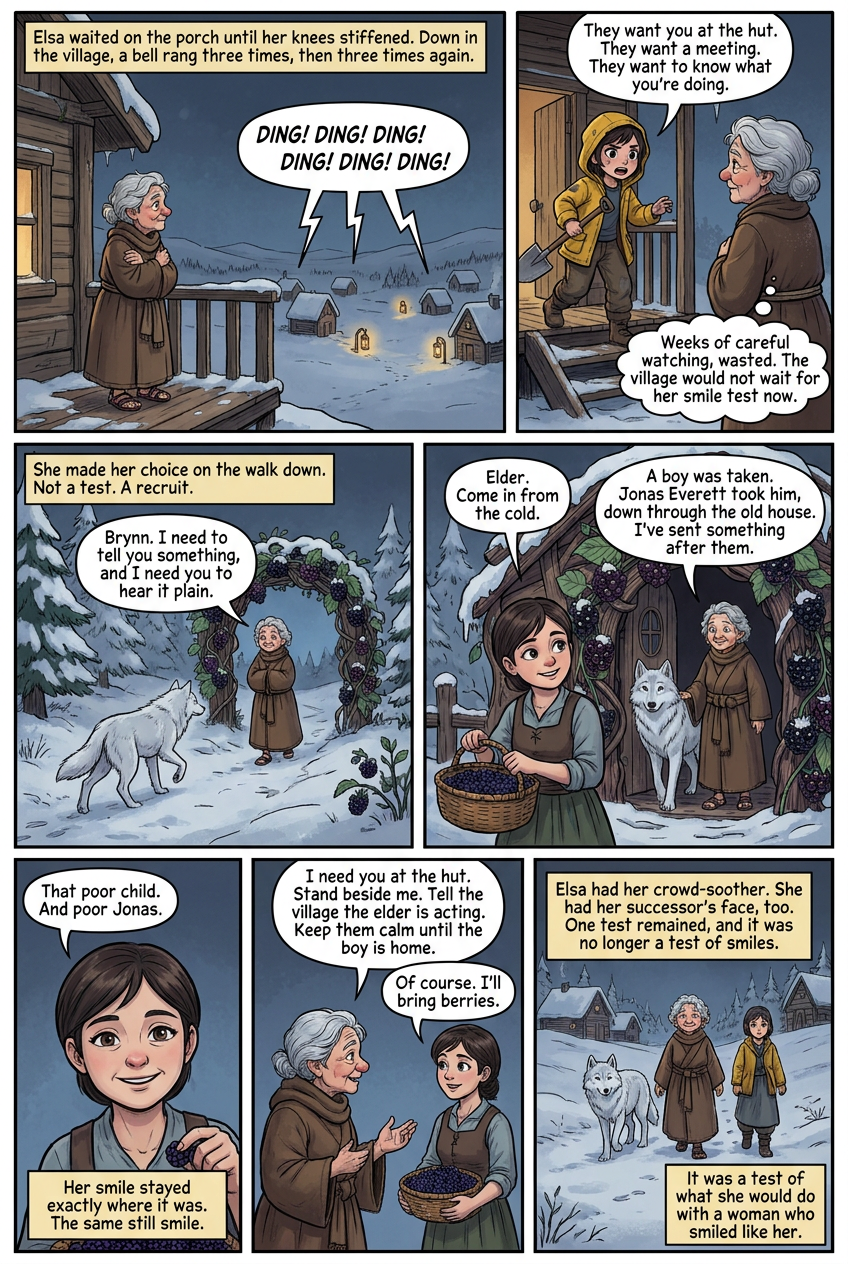
Elsa waited on the porch until her knees stiffened. The horned one did not come back. Down in the village, a bell rang three times, then three times again. The boy's mother had told everyone. Doors slammed. Lanterns moved between houses like wasps. Nora climbed the porch steps. "They want you at the hut. They want a meeting. They want to know what you're doing." "I have three candidates I haven't tested," Elsa said. "I can't sit them down for tea while a child is missing." She pressed her palms flat on her knees. Weeks of careful watching, wasted. The village would not wait for her smile test now. She made her choice on the walk down. Not a test. A recruit. The blackberry arch sat at the edge of the pines, snow banked on its woven roof, fruit still dark and heavy on the vines though the frost had come weeks ago. The librarian was inside, filling a basket. Silver hair, round glasses, a cardigan the color of old cream. Elsa had watched her for a year. She smiled at everyone. Certain neighbors had stopped answering their doors. The pale wolf came out of the pines and sat beside Elsa without being called. Its blue eyes fixed on the doorway. Nora stayed back on the path with the shovel. "Brynn," Elsa said. "I need to tell you something, and I need you to hear it plain." Brynn straightened, basket on her hip. "Elder. Come in from the cold." Elsa stepped under the arch. The wolf stepped with her. "A boy was taken. Jonas Everett took him, down through the old house. I've sent something after them. Something that will bring the boy back and not the baker." Brynn's hand kept moving among the berries. She did not drop the basket. She did not gasp. Her smile stayed exactly where it was. The wolf's ears went forward. It did not growl. It watched her the way it watched Jonas's name on the page. "That poor child," Brynn said. "And poor Jonas." She picked another berry. "What do you need from me, Elder?" Elsa felt the cold settle in her chest. There it was. The same still smile. The same hands that kept working. She had come here for a helper and found her fourth answer. "I need you at the hut," Elsa said. "Stand beside me. Tell the village the elder is acting. Feed them. Keep them calm until the boy is home." "Of course." Brynn lifted the basket. "I'll bring berries." They walked back together. The wolf stayed at Elsa's left, between her and the cardigan. Nora fell in behind, silent. Elsa had her crowd-soother. She had her successor's face, too, and it matched her own too well. One test remained, and it was no longer a test of smiles. It was a test of what she would do with a woman who smiled like her.
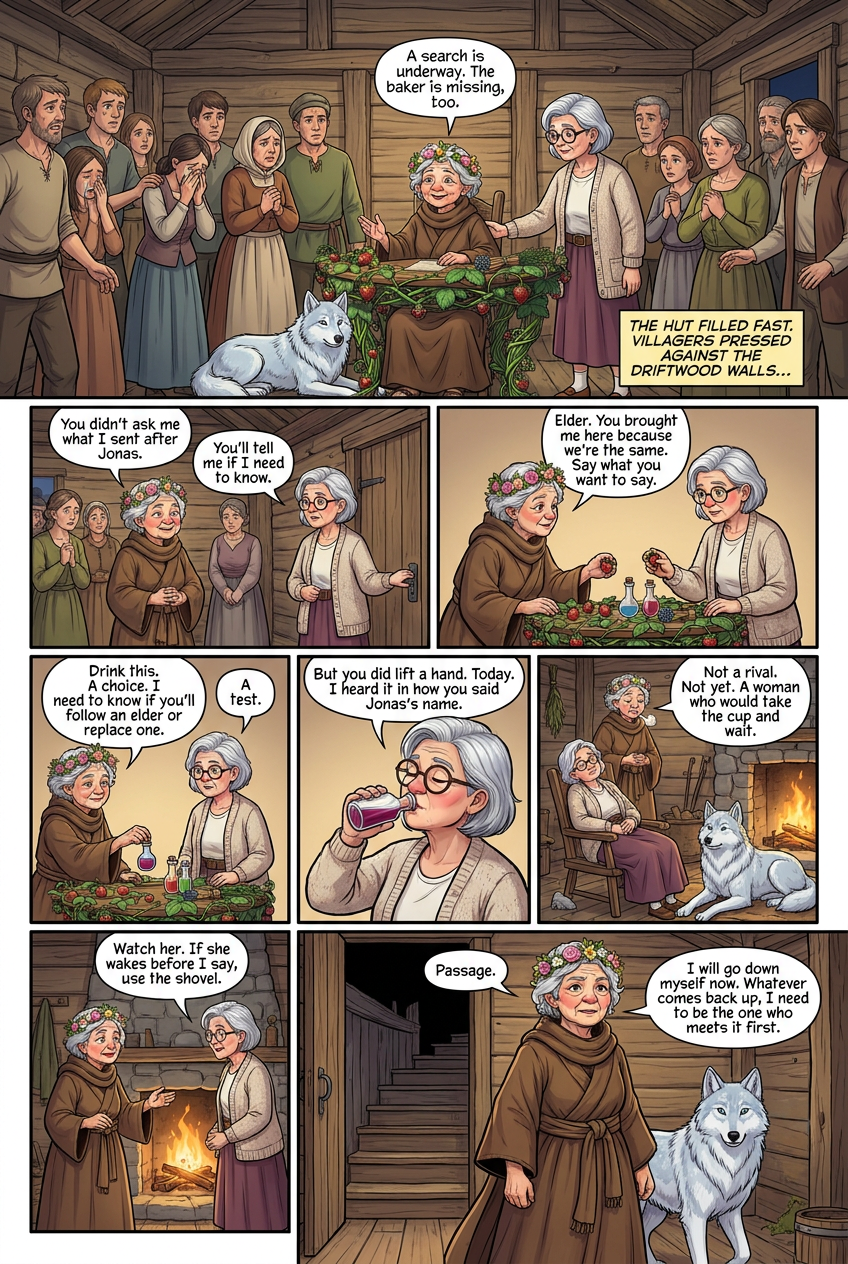
The hut filled fast. Villagers pressed against the driftwood walls, boots wet, faces raw with cold. Elsa took her seat at the woven table near the hearth. Ripe berries hung from its vines. Bottles of tincture and bundled herbs sat between her hands. Brynn set the basket down beside them and stood at Elsa's right shoulder, cardigan still buttoned to the throat, smile still in place. The wolf lay across Elsa's feet. Elsa spoke first. She told them a search was underway. She told them the baker had gone missing too and might be part of it. She did not tell them what she had sent into the tunnels. Brynn passed berries to the mother of the taken boy and held her hand while she cried. The room quieted. Elsa watched Brynn's fingers close over the woman's knuckles. The grip was steady. The smile did not move. When the crowd thinned, Elsa asked Brynn to stay. Nora shut the door and stood against it. "You didn't ask me what I sent after Jonas," Elsa said. "You'll tell me if I need to know." "You didn't ask about the boy either." "You're bringing him home." Brynn selected a berry from the vine table and set it on a saucer. "Elder. You brought me here because we're the same. Say what you want to say." Elsa pulled a small bottle from the herbs and set it between them. Sleeping draught. Nora had brewed it that morning. "Drink this, and sleep in the back room until the boy is found. Or refuse, and walk out with Nora behind you." Brynn's smile held. "A test." "A choice. I need to know if you'll follow an elder or replace one." Brynn looked at the wolf. The wolf looked back. She picked up the bottle. "The neighbors I disliked went quiet on their own, Elsa. I never lifted a hand. I only stopped bringing berries." She pulled the cork. "But you did lift a hand. Today. I heard it in how you said Jonas's name." She drank it down. Set the bottle on the table. Sat in the chair by the hearth and closed her eyes. In under a minute her breathing slowed. Elsa exhaled. Not a rival. Not yet. A woman who would take the cup and wait. "Watch her," she told Nora. "If she wakes before I say, use the shovel." Nora nodded and sat by the hearth. Elsa stood. Her knees ached. She had her successor asleep in a chair, chosen but not yet crowned. The village believed the elder was acting. The boy was still underground. The horned one had not returned. She looked at the wolf. "Passage," she said. The wolf rose. She would go down herself now. Whatever came back up the stairs of the old house, she needed to be the one who met it first.
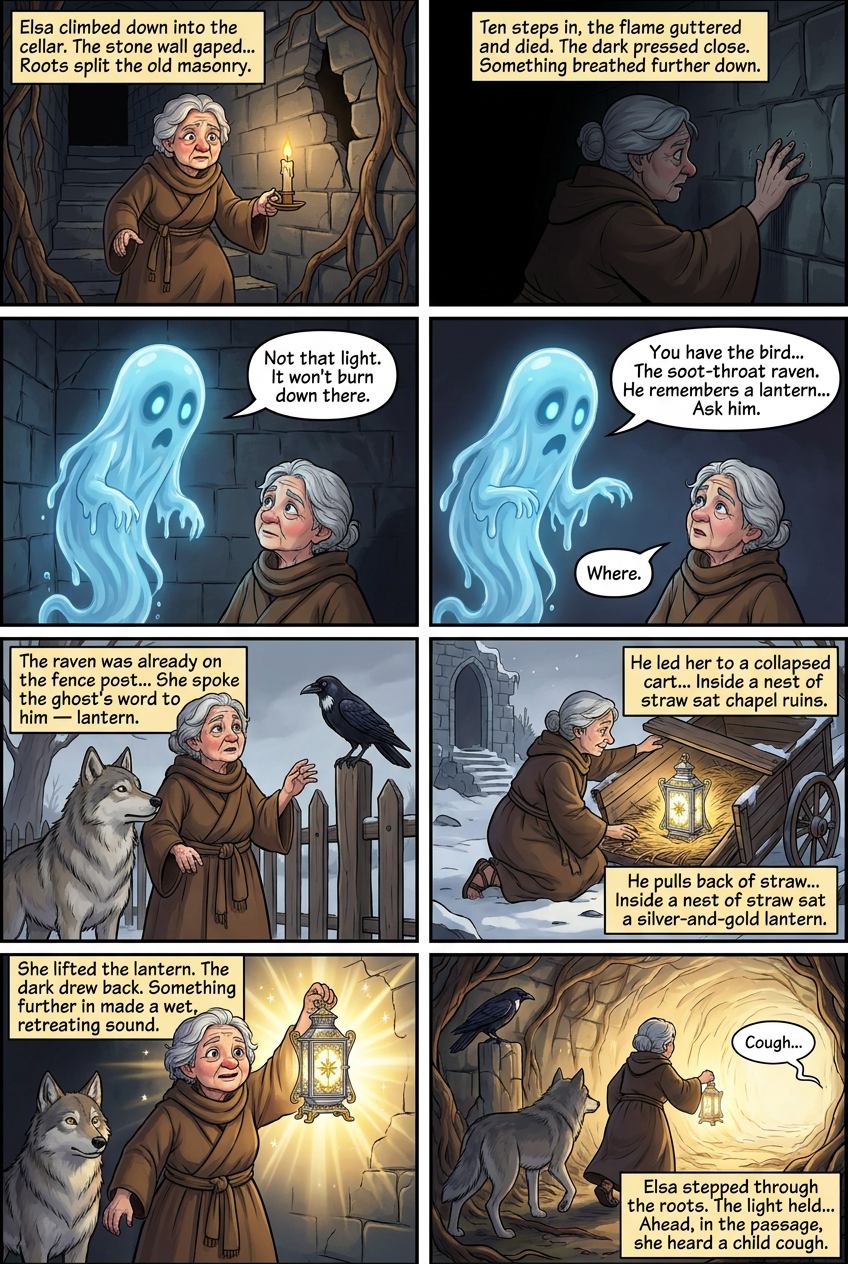
Elsa left Brynn sleeping by the hearth and walked with the wolf through the pines. The abandoned house stood open. She climbed down into the cellar. The stone wall gaped where Jonas had gone through. Beyond it, roots split the old masonry and a passage sank into the dark. She lit her tallow candle. Ten steps in, the flame guttered and died. The dark pressed close. Something breathed further down. Not the wolf. Not her. She backed to the cellar and set her hand on the wall. Her fingers shook. She had crowned no one. If she went down blind, she would not come back up, and Alpenglow would wake tomorrow to no elder and a girl asleep in a chair. The air by the stairs went cold. A blue shape gathered against the stones. The ghost — the same wispy figure who had told her about the passage days ago, when the boy first vanished — hung in the corner. Its voice came thin, like wind under a door. "Not that light," it said. "It won't burn down there. The thing under the roots eats tallow flames." "Then I have nothing," Elsa said. "You have the bird." The ghost drifted closer. Its hollow eyes fixed on her. "The soot-throat raven who sits above your meeting hall. He remembers a lantern the old priests carried through these tunnels. Silver and gold. It shines like a star. The thing below will not cross its light." "Where." "Ask him. He'll take you." Elsa climbed out. The raven was already on the fence post, white throat bright against his black feathers, as if he had been waiting. She held out her wrist. He hopped down. She spoke the ghost's word to him — lantern — and he lifted, circled once, and flew low toward the far end of the village. She followed with the wolf. The raven led her to a collapsed cart half-buried in old snow behind the chapel ruins. He landed on the splintered boards and pecked twice. Elsa knelt and pulled the boards aside. Inside a nest of straw sat a silver-and-gold lantern. Its glass held a small, steady light, like a star kept in a jar. Warmth came off it through her wool. She carried it back to the cellar. At the passage mouth she lifted the lantern. The dark drew back. Something further in made a wet, retreating sound along the stone. The wolf's ears flattened, then rose. Elsa stepped through the roots. The light held. Her boots found the first stair down. She could go now. She would come back up. Behind her, faint and dry, the raven called once from the cellar mouth. Ahead, in the passage, she heard a child cough.
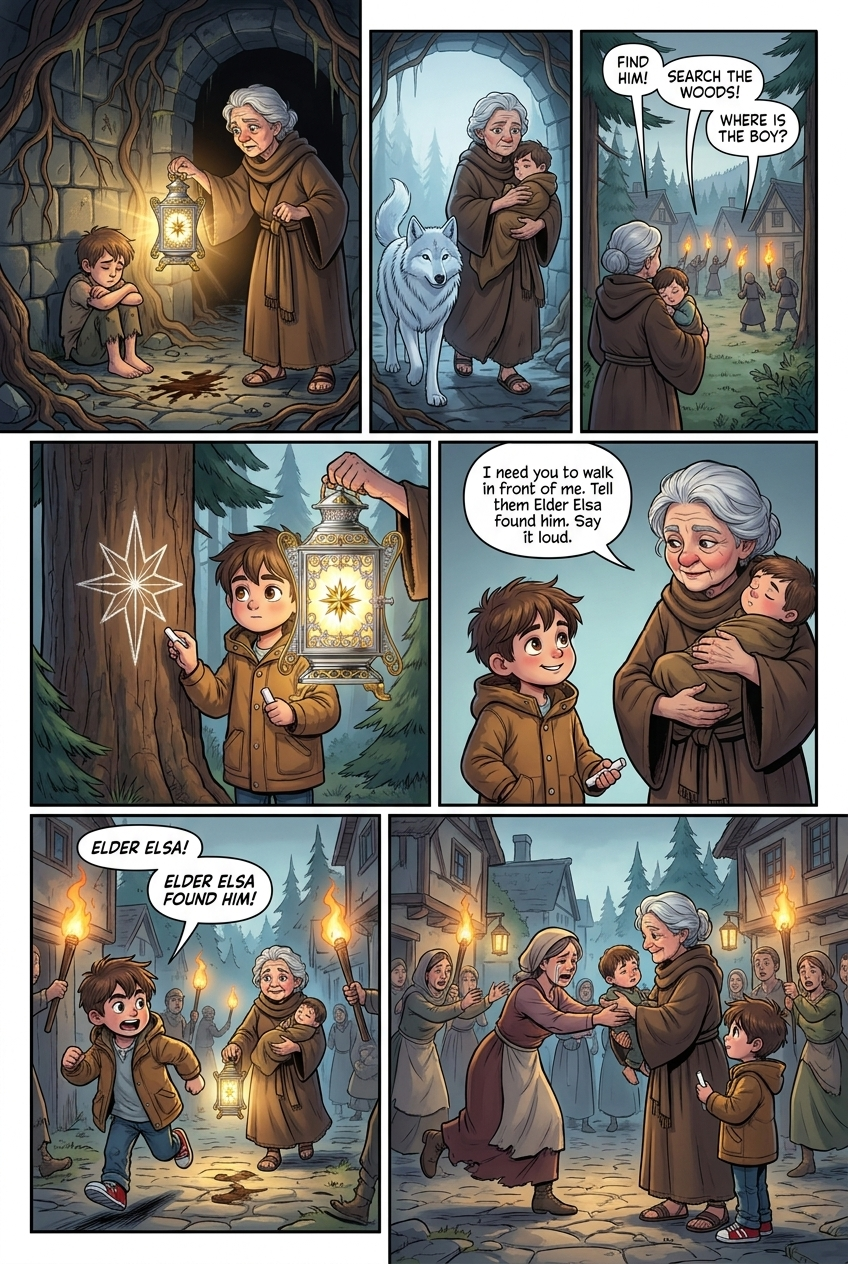
The child coughed again. Elsa lifted the lantern and moved down the stairs. The roots pulled back from the light. Ten steps. Twenty. The passage bent and opened into a low chamber. The boy sat against the wall, knees to chest, alive. No sign of the baker. No sign of the horned thing she had bargained with. Only a smear of dark on the stones and a dropped apron button. She knelt. The boy stared at the lantern, not at her. She wrapped her wool robe around his shoulders and lifted him. He weighed less than a sack of grain. The wolf led them back up the stairs and out through the cellar. Cold air hit her face. It was near dawn. Then she stopped at the tree line. Voices carried from the village. Torches moved between the houses. The search party was still out, and they were loud. If she walked in now, carrying a boy, from the direction of the abandoned house — a woman alone, robe stained, no explanation — they would not hear her. They would grab her first and ask later. She had crowned no one. Brynn was still asleep by her hearth. A small figure stood at the edge of the pines. Gap-toothed, swallowed by a parka too big for him. Chalk stub in one bare hand. Bodhi. The boy who drew symbols on every fence and doorstep in Alpenglow, whose mother sat on the search council, whose face every villager knew and softened for. He was staring at the lantern. He had drawn something on the bark of the pine beside him — the same eight-pointed star that shone in the glass. "You saw it before," Elsa said. Bodhi nodded. He did not look afraid. He looked pleased, the way a child looks when a guess turns out right. "I need you to walk in front of me," she said. "Tell them Elder Elsa found him. Tell them I carried him out. Say it loud, before they see me." He looked at the rescued boy in her arms. Then at the star on the lantern. "Will you show me where it goes?" he said. "The passage. After." Her smile did not move. "Yes." He ran ahead. His small voice cut through the dark between the houses. Elder Elsa. Elder Elsa found him. The torches turned. The shouting changed shape. By the time Elsa stepped into the lantern-light of the square, the mothers were already running toward her with open hands, weeping, reaching for the boy. No one reached for her throat. She gave the child to his mother. She kept the lantern. Bodhi stood at her hip, chalk still in his fist, watching her face for the answer she had promised. She had bought the village back in a single breath. She had also given a child her word that she would take him into the dark.
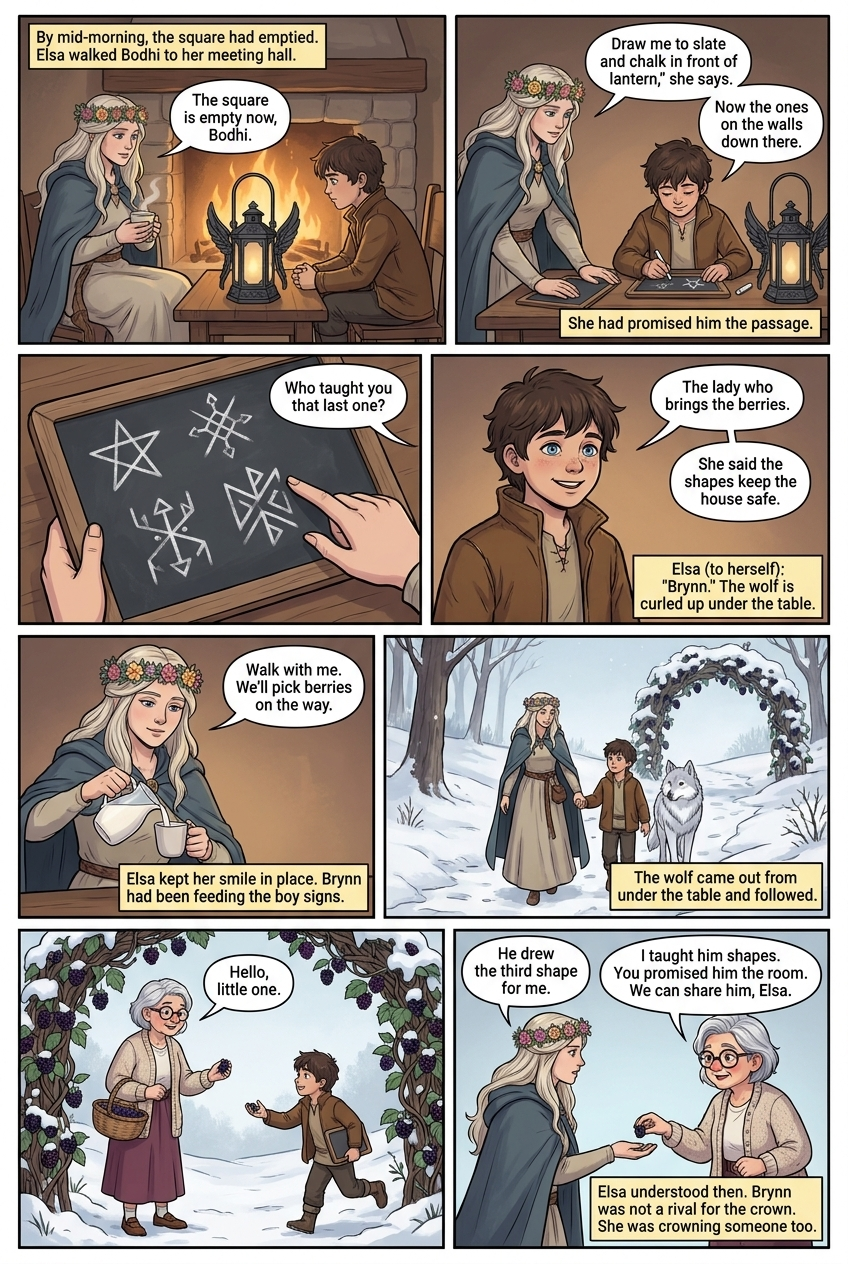
By mid-morning the square had emptied. The mothers had taken the boy home. The search party had gone to sleep. Elsa walked Bodhi to her meeting hall and sat him at the hearth with a cup of warm milk. The lantern rested on the table between them, dark now. Bodhi kept looking at it the way a hungry child looks at bread. She had promised him the passage. Before she paid that promise, she had to know who else had already paid him. She set out a piece of slate and a fresh stub of chalk. "Draw me the one on the lantern," she said. He drew the eight-pointed star without looking. "Now the ones on the walls down there." His hand moved again. Three more shapes. She had seen two of them scratched into the stone below the cellar. The third she had not seen at all. He drew it neatly, the way a child copies letters he has been shown. "Who taught you that last one?" she said. He shrugged. "The lady who brings the berries." Elsa kept her smile in place. "Brynn." "She leaves them on our step. She showed me on the flour on the counter. She said the shapes keep the house safe." He looked pleased with himself. "She said you'd like them." Elsa poured him more milk. Her hand was steady. So Brynn had been feeding the boy signs from a place Brynn should not know. Brynn, who had drunk the sleeping draught and smiled the same smile Elsa smiled. Brynn, who tended a blackberry arch at the edge of the village where neighbors she disliked stopped appearing. Elsa put on her robe and took Bodhi's hand. "Walk with me. We'll pick berries on the way." The wolf came out from under the table and followed. Snow muffled the path to the blackberry arch. Brynn was already there, cardigan buttoned, a basket at her hip, picking as if she had been waiting. She smiled when she saw them. Bodhi ran ahead and showed her his chalk. "He drew the third shape for me," Elsa said. "The one below the cellar. You've been down." Brynn did not stop picking. "Once. A long time before you sent me the draught." Her voice was soft as knitting. "I thought you'd want a partner who already knew the floor." "You taught a child my secrets before I could." "I taught him shapes. You promised him the room." Brynn placed a berry in Bodhi's palm. "We can share him, Elsa. He'll carry the warmth after us both." Elsa understood then. Brynn was not a rival for the crown. Brynn was crowning someone too. The tour Elsa had promised Bodhi would no longer be a gift. It would be a test — of which elder the boy already belonged to.
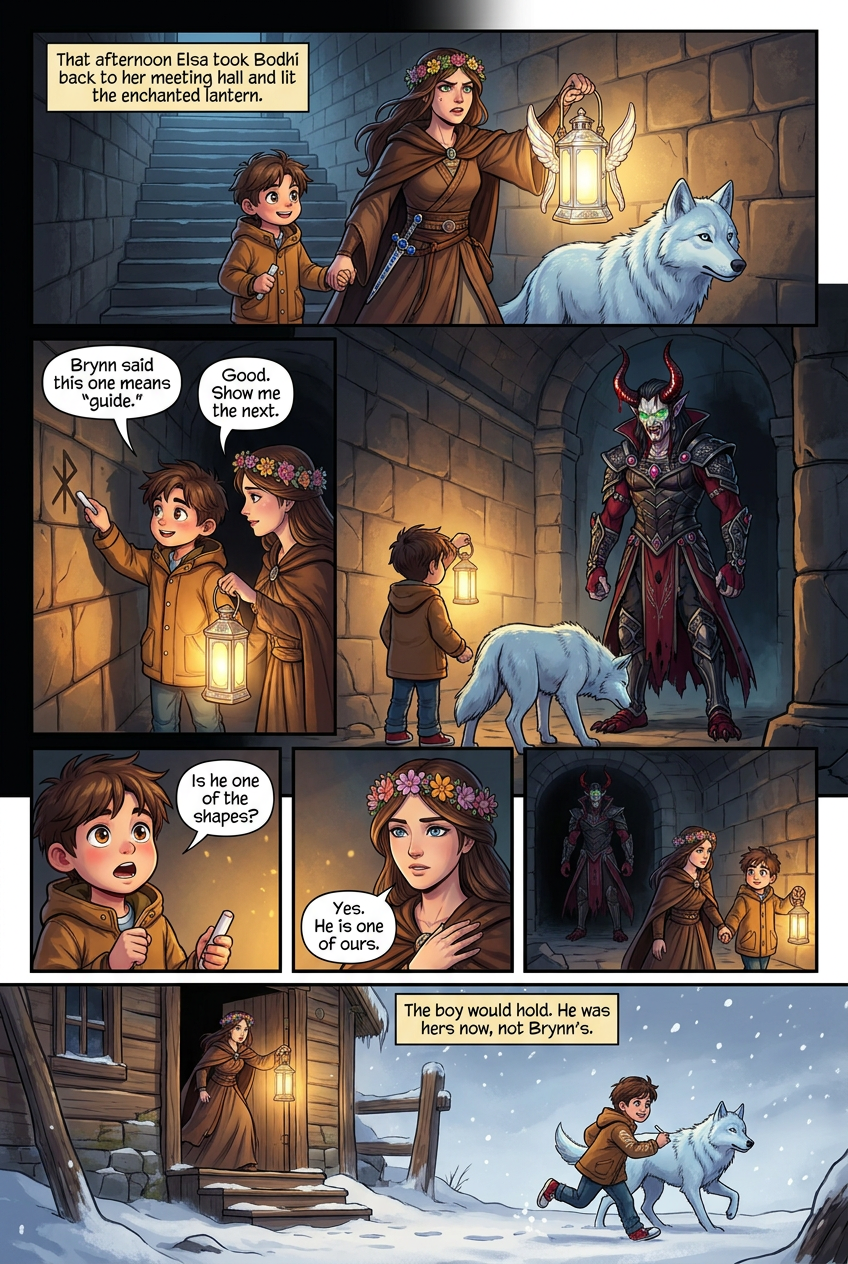
That afternoon Elsa took Bodhi back to her meeting hall and lit the enchanted lantern. The wolf padded ahead of them down the cellar steps. Bodhi held her hand tight, but he was smiling. She needed to see if that smile could hold when the dark showed him its teeth. She had not told him what waited below. She had not told him she hoped nothing did. The horned creature she had bargained with was still loose somewhere in the tunnels, and she had brought the blue-jeweled stake in her sleeve in case it came to collect more than she owed. They passed through the gap in the stone wall. The lantern threw silver-and-gold light on the passage. Bodhi pointed at the first symbol scratched into the rock and said its name under his breath, the way Brynn had taught him. Elsa kept her face soft. "Good," she said. "Show me the next." He walked her deeper than she had gone alone. He knew the turns. Brynn had taught him those too. At the third turn the wolf stopped and lowered its head. The lantern light bent around something in the chamber ahead. Elsa saw the horns first, dark red and wet at the tips. Then the green eyes, two small lamps in the black. The creature stood against the far wall in torn dark armor, taller than any man, waiting as if it had heard them coming for a long time. Elsa's hand went to the stake. She did not draw it. She looked down at Bodhi instead. He had stopped. His mouth was open. The chalk fell out of his fingers and clicked on the stone. She watched his face for the crack — the whimper, the turn, the run back toward the stairs that would tell her Brynn had chosen wrong and so had she. It did not come. Bodhi closed his mouth. He picked up the chalk. He looked up at the creature the way he had looked at the lantern that morning: hungry. "Is he one of the shapes?" he whispered. "Yes," Elsa said. Her voice was steady. "He is one of ours." The creature tilted its horned head at her. It had heard the word ours. It said nothing. It stepped back into the dark of the chamber and let them pass, and Elsa understood it was waiting for her to name its second payment another day. She led Bodhi out by the same turns. On the steps he squeezed her hand and asked when they could come back. She told him soon. She meant it. At the top she blew out the lantern. Bodhi ran ahead into the snow, chalk already moving on his sleeve. Elsa stood in the doorway. The boy would hold. He was hers now, not Brynn's. And Brynn, who had taught him the road down, would need to be answered before the next thaw.
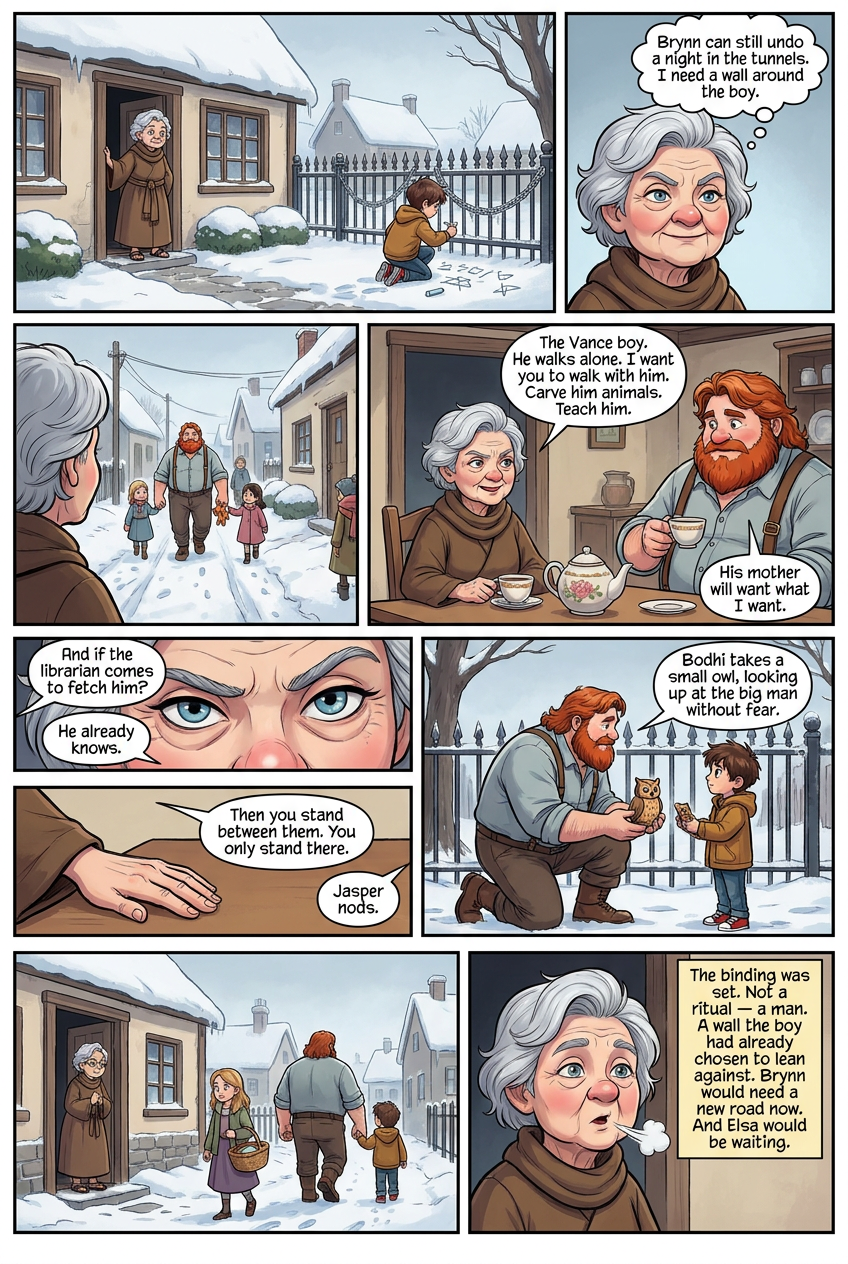
The next morning Elsa watched Bodhi from her doorway. He was drawing symbols on the frozen fence rail with his chalk. He was smiling. But she had seen how easy that smile came, and she knew Brynn could still put a hand on his shoulder at the blackberry arch and undo a night in the tunnels with a bowl of berries. She needed something Brynn could not match. She needed a wall around the boy. She watched the road until she saw him coming. Jasper Moone. The big auburn-bearded woodcarver with hands like shovels, the man children trailed behind like ducklings and grown women stepped off the path to avoid. He was setting a small carved fox on a doorstep across the lane. Two little girls were already tugging at his suspenders for the next one. He laughed and gave them each a rabbit. Elsa had never used him before. She had watched him for a year. Adults feared him without cause. Children loved him without reason. That was the shape she needed. "Jasper," she called. "A word." He came up the path with his hat in his hands. She led him inside and set tea between them. She did not smile the wide smile. She used the small one, the one she saved for people she meant to keep. "The Vance boy," she said. "Bodhi. He walks alone too much. I want you to walk with him. Carve him animals. Teach him whittling. Whatever fits." Jasper turned the cup in his hands. "His mother won't want me near her door." "His mother will want what I want. I'll speak to her." He looked at her a long moment. Then he nodded, slow. "And if the librarian comes to fetch him?" Elsa felt the cold click of it — he already knew who the danger was. He had watched too. She had chosen right. "Then you stand between them," she said. "You do not raise a hand. You do not need to. You only stand there." Jasper set his cup down. "I can do that." She walked him out. Bodhi was still at the fence. Jasper crossed to him and knelt in the snow and drew a small wooden owl from his coat pocket. Bodhi took it with both hands. He looked up at the big man and did not flinch. Then he took Jasper's finger and pulled him toward the fence to show him the symbols. Elsa watched from the step. Down the lane, Brynn had come out of the library with her basket. Brynn stopped when she saw them. Jasper's broad back was between her and the boy. Brynn stood a long moment in the snow. Then she turned and walked the other way. Elsa let out a breath she had been holding since the tunnels. The binding was set. Not a ritual — a man. A wall the boy had already chosen to lean against. Brynn would need a new road now. And Elsa would be waiting on it.
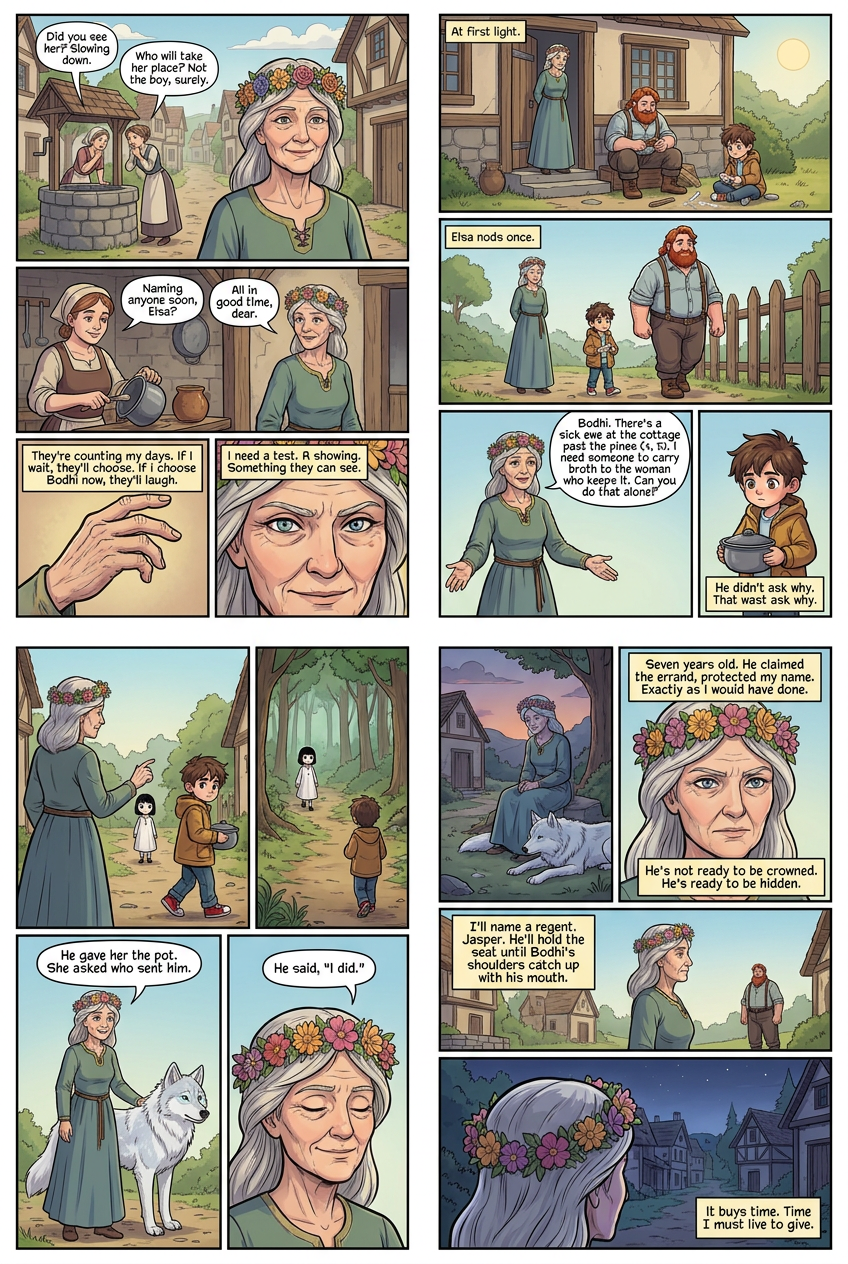
A week after Jasper set his shadow over the boy, Elsa began to hear the wrong kind of talk in the lane. Not about Brynn. About her. Two women at the well went quiet when she passed. The blacksmith's wife asked, too lightly, who Elsa meant to name. The village had started counting her days. If she waited too long, they would pick for her. If she named Bodhi now, they would laugh a child out of the hut. She needed a test the village could see. Not a crowning. A showing. Something that let Bodhi stand in front of them and be measured, and let her stand back. She walked to the Vance house at first light. Jasper was already on the step, carving. Bodhi sat between his boots with chalk on his knuckles. The big man looked up. Elsa nodded once, and Jasper stood and moved off to the fence without a word. He had learned her signals faster than any grown man she'd trained. "Bodhi," she said. "There's a sick ewe at the cottage past the pines. The one in the tree, with the green door. I need someone to carry broth to the woman who keeps it. Can you do that alone?" He nodded. He did not ask why she couldn't send a grown person. That was the answer she wanted. She gave him the covered pot and watched him go. Then she sent Wren after him at ten paces. The porcelain-faced girl in the stiff white dress fell in behind him without a sound, her black button eyes fixed on his back. Wren would tell Elsa what the boy did when no one he trusted was watching. Elsa waited by the meeting hall until dusk. The pale wolf lay across her feet, ears turning at every sound on the road. When Wren came back, she came alone, and she came smiling the small closed smile Elsa had taught herself to read. "He gave her the pot," Wren said. "She asked him who sent him. He said, I did." Elsa closed her eyes. He was seven. He had claimed the errand as his own in front of a grown woman he didn't know. He had lied cleanly, without flinching, to protect Elsa's name. It was exactly what she would have done. It was exactly what the village would smell on him within a year and hate him for. He was not ready to be crowned. He was ready to be hidden. She stood up. The wolf stood with her. She would not name a successor this winter. She would name a regent — Jasper, whom the adults feared enough to obey — and let him hold the seat until Bodhi's shoulders caught up with his mouth. It bought her time. It also meant she would have to live long enough to give it.
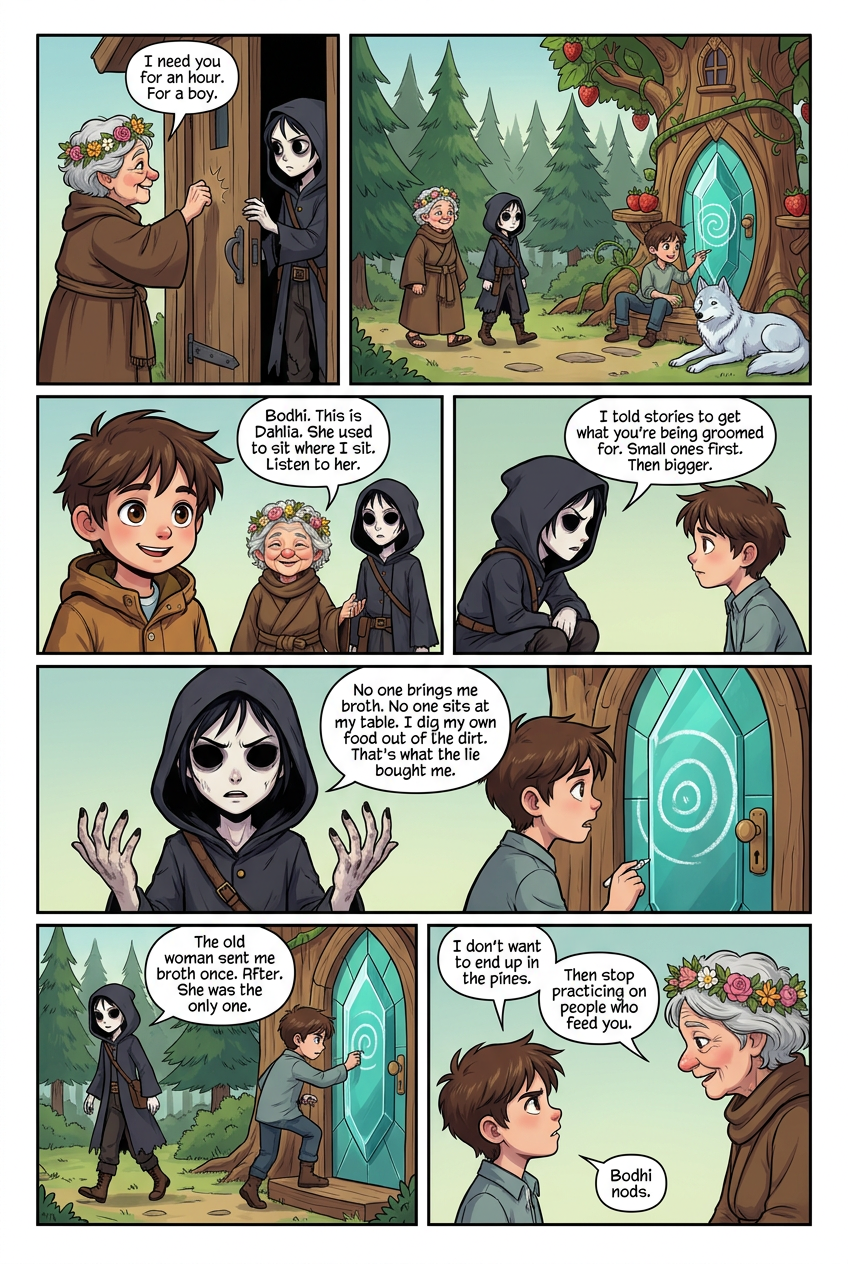
The morning after Elsa named Jasper regent, she did not feel relief. She felt the clock start ticking. Bodhi still lied like a grown liar, and a regent's shadow would not fix that. A crown eventually would land on his head, and if his mouth stayed sharp the village would strike it off. She needed him to learn what lying cost, from someone the lesson had already broken. She went to the edge of the pines and knocked on a low door until Dahlia Krenn opened it. Dahlia was the woman the village had cast out four winters back — pale, thin, dirt under every fingernail, coat drawn up to her jaw. She lived alone because she'd lied her way toward Elsa's seat once and been caught. Elsa had voted with the rest to send her out. Dahlia looked at her now without surprise. "I need you for an hour," Elsa said. "For a boy." Dahlia's jaw tightened. Somewhere behind the house, a root cracked inside stone. She heard it too. She breathed out and the sound stopped. "For a boy," she repeated. Then she pulled her hood up and followed. Elsa took them to the cottage grown into the trunk of an old tree, past the pines, with the teal crystal door and the strawberry vines. She had asked Bodhi to meet her there. He was already on the step, chalk in his fist, drawing a spiral on the wood. The pale wolf lay beside him with its blue eyes half shut. "Bodhi," Elsa said. "This is Dahlia. She used to sit where I sit. Listen to her." Bodhi looked up. He smiled the easy smile Elsa had taught herself to fear on his face. Dahlia crouched so her eyes were level with his. "I told stories to get what you're being groomed for," she said. "Small ones first. Then bigger. I told the miller his neighbor stole from him. I told the midwife the elder was sick. Every lie moved me one step closer. Then someone checked. One person. That was all it took." Bodhi's smile thinned. "What happened." "They put me out." She held up her hands, black under the nails. "No one brings me broth. No one sits at my table. I dig my own food out of the dirt. That's what the lie bought me." Bodhi looked at the door of the cottage, at the berries hanging red and heavy above them. His mouth opened, then closed. He said nothing clever. That was new. Dahlia stood. "The old woman sent me broth once. After. She was the only one." She looked at Elsa, and Elsa looked back, and a root under the step gave a small, tired crack. Dahlia walked away without saying goodbye. Bodhi watched her go. Then he wiped the spiral off the door with his sleeve. "I don't want to end up in the pines," he said. "Then stop practicing on people who feed you," Elsa said. He nodded. It was not a promise. It was the first honest thing he'd said to her in a month. She would take it.
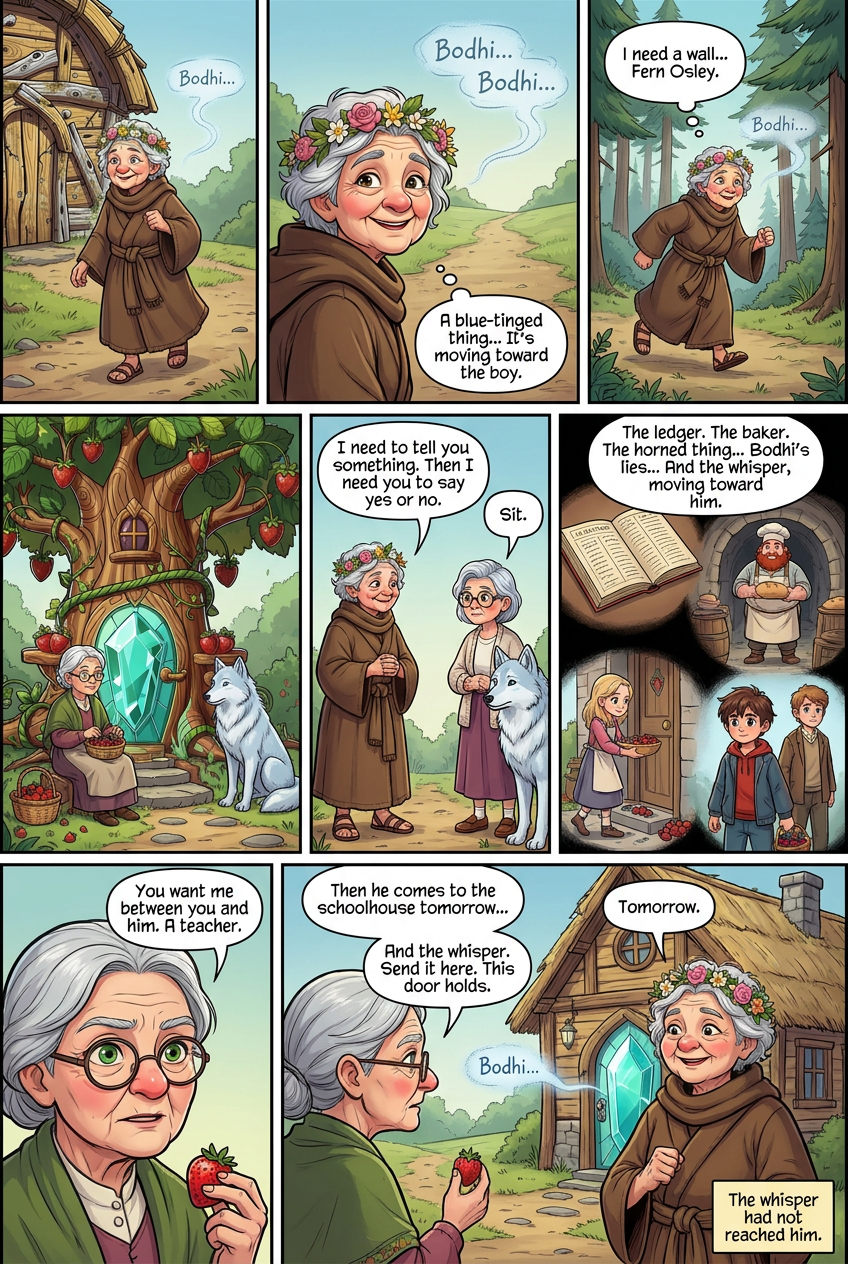
Elsa walked back toward her hut with Bodhi's honest words still warm in her ear. She heard something behind her that was not the wind. A whisper, low and close, running along the wall at her shoulder. She turned. The lane was empty. She kept walking, and the whisper kept up. It said Bodhi's name once, then again, softer, like it was testing the shape of him. She knew what it was. A blue-tinged thing had haunted the cellar once and pointed her toward the old lantern. It had helped her then. It was not helping now. It was moving toward the boy. If it reached him first and spoke into his ear the way it was speaking into hers, Jasper's wide shoulders would not matter. A whisper slips past a woodcarver. A whisper does not knock. She could not out-walk it. She needed a wall between it and Bodhi that the village already trusted. A person, not a man with big hands. She thought of the schoolhouse. She thought of the young woman every mother in the village left her child with without a second look. Fern Osley. The teacher. Stern enough to make the children sit. Kind enough that they wanted to. Elsa turned off the lane and cut through the pines to the cottage grown into the old tree, where strawberry vines hung heavy and the teal crystal door caught the afternoon light. Fern was on the step, sorting a basket of berries, the crystal key strung on a cord at her neck. The pale wolf padded out from behind the trunk and sat between them without being called. "I need to tell you something," Elsa said. "All of it. Then I need you to say yes or no." Fern set the basket down. "Sit." Elsa sat and told her. The ledger. The baker in the tunnels. The horned thing under the fortress and the price still owed. Brynn's berries on Bodhi's doorstep. Jasper standing between them. Bodhi's lies and the lesson in the pines. The whisper on the lane, moving toward the boy right now. Fern did not smile the easy village smile. Her mouth stayed flat. Her green eyes stayed on Elsa's face the whole time, the way she watched a child who was building up to a lie. When Elsa finished, Fern picked up a strawberry and turned it in her fingers. "You want me between you and him," Fern said. "Not a regent. A teacher. Someone the mothers will hand him to." "Yes." "Then he comes to the schoolhouse tomorrow. With the others. He learns to read before he learns to rule." She looked past Elsa, toward the lane. "And the whisper. Send it here. This door holds." Elsa felt the sound at her shoulder pause, then thin, then go. The wolf's ears flicked once and settled. "Tomorrow," Elsa said. The whisper had not reached him. She had put a lock on the door in time.
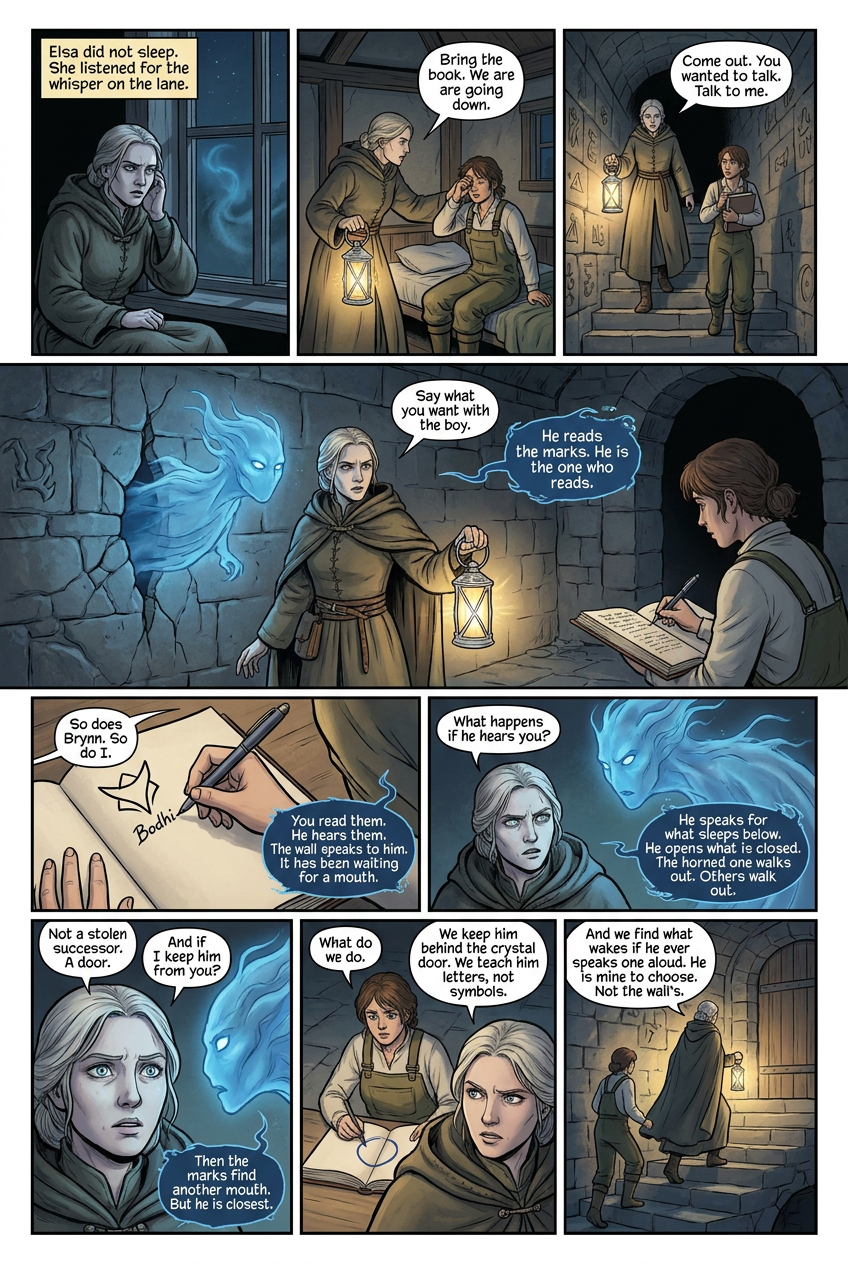
Bodhi slept in the schoolhouse that night behind the crystal door. Elsa did not sleep. She sat by her window and listened for the whisper on the lane. It did not come near the cottage. It was somewhere else, circling, waiting. She did not know what it wanted from the boy. She could not fight a thing she did not understand. At first light she crossed to the Tidebark Hut and woke Nora. Nora sat up in her waders and reached for the ledger before her eyes were open. Elsa said, "Bring the book. We are going down." They went to the meeting hall and lifted the trapdoor. Elsa lit the silver-and-gold lantern. Nora followed her down the stone stairs with the ledger held tight against her slicker. The cellar walls were cut with the old symbols, sconces guttering. Elsa stopped in the middle of the floor and set the lantern down. "Come out," she said to the air. "You wanted to talk. Talk to me." The cold thinned at her shoulder. A blue shape gathered near the far wall, drifting up out of the seam between two stones. Two soft lights where eyes should be. It had helped her once, pointed her to the lantern. Now it drifted toward her like it had been waiting for the invitation. "Say what you want with the boy," Elsa said. The voice came slow, thin as a draft. "He reads the marks. He is the one who reads." "So does Brynn. So do I." "You read them. He hears them. The wall speaks to him. It has been waiting for a mouth." Nora opened the ledger flat on her knee. Her pencil moved without her looking. Elsa watched a new mark form under Bodhi's name — not a cross, not a circle. A small open symbol like the ones on the cellar wall. "What happens if he hears you?" Elsa said. "He speaks for what sleeps below. He opens what is closed. The horned one walks out. Others walk out." Elsa's hands went cold inside her sleeves. Not a stolen successor. A door. The whisper did not want to turn Bodhi against her. It wanted to use his mouth to unlock the tunnels. "And if I keep him from you?" The blue shape did not move. "Then the marks find another mouth. But he is closest. He already draws them without being taught." Elsa picked up the lantern. The blue shape thinned and pulled back into the seam. On the stairs Nora said, "What do we do." "We keep him behind the crystal door. We teach him letters, not symbols. And we find what wakes if he ever speaks one aloud." She looked at the mark under his name. "Add a circle around it. He is mine to choose. Not the wall's." Nora drew the circle. The lantern steadied. Elsa climbed the last stair.
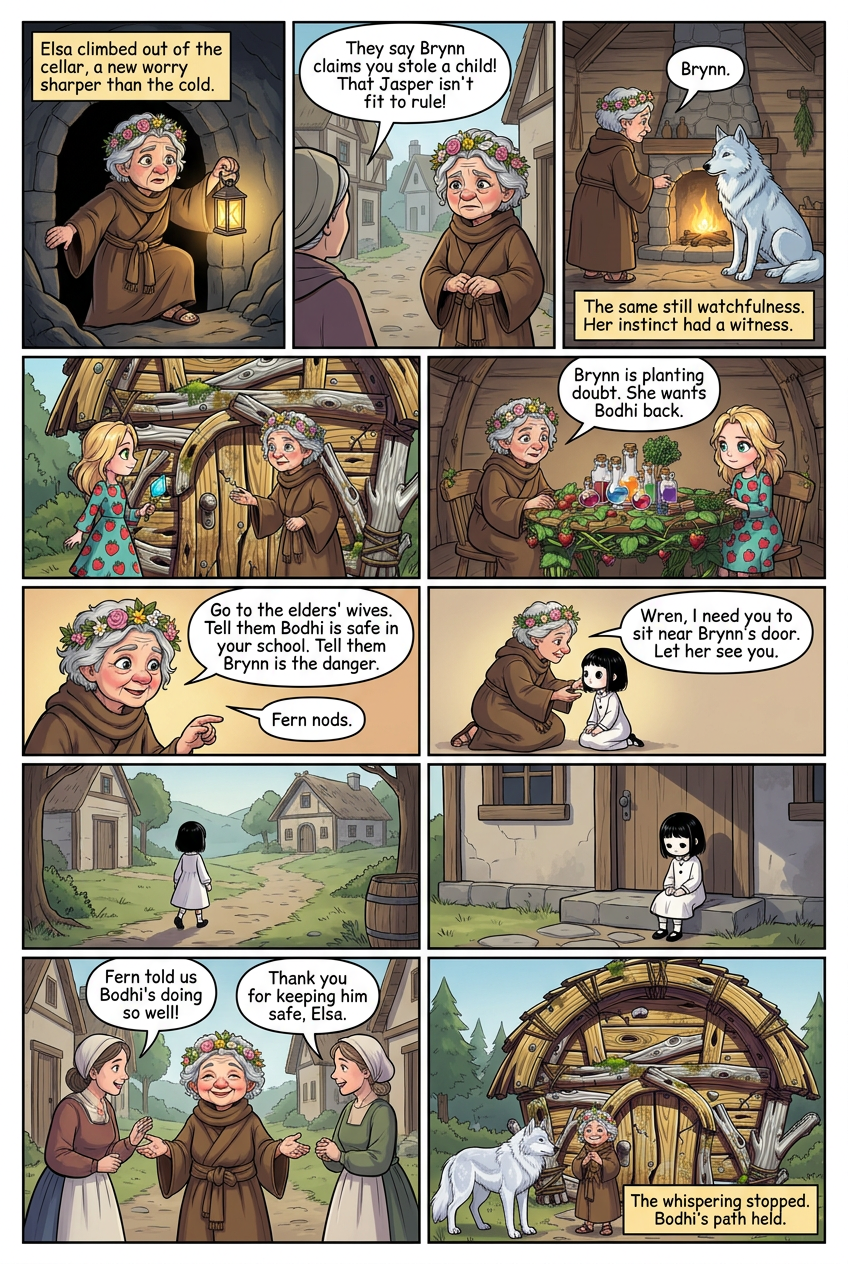
Elsa climbed out of the cellar with the lantern still warm in her hand and a new worry sharper than the wall. Brynn was walking the lanes again. Elsa had heard it at the well yesterday and again from Nora at first light. Brynn was telling neighbors that Elsa had taken a child into the dark, that Elsa had chosen a regent nobody trusted, that the elder's judgment had slipped with her age. If the elders believed her, Jasper's regency would fall, and Bodhi's path with it. Elsa needed the village to stop listening. She sent word through Nora for Fern to come to the meeting hut before the morning bell. Then she walked home and opened the door for the pale wolf. The animal padded in and sat by the hearth, blue eyes steady on her. Elsa spoke Brynn's name aloud and watched. The wolf's ears did not soften. Its tail did not move. The same still watchfulness it had shown for Jonas. That was enough. Her instinct had a witness now. Fern arrived at the Tidebark Hut with her crystal key still in her hand, strawberries bright on her dress. She had left Bodhi at his letters under a neighbor's eye. "You said it was urgent." Elsa closed the driftwood door behind her and gestured to the vine-woven table where the bottles and herbs sat. "Sit. I need the village on my side by nightfall, and I cannot do it alone." Elsa told her plainly. Brynn had groomed Bodhi first. Brynn had been in the cellar. Brynn was now walking door to door, smiling, planting doubt about Jasper and about Elsa herself. "She wants the boy back. If the elders pull the regency, she has him inside a week." Fern's jaw tightened. "What do you need from me?" "You are the teacher. Parents believe you before they believe me. Go to each elder's wife today. Tell them Bodhi is safe in your schoolhouse learning his letters. Tell them Brynn was seen leaving berries at the boy's door before I ever intervened." Fern nodded once. "I will." Then Elsa sent Nora for Wren. The porcelain-faced child came in her stiff white dress, button eyes fixed on nothing and everything. Elsa knelt to her level. "You sat at my table when I feared the baker. I need you to sit at another table today. Brynn's. Take the long way. Let her see you on her step." Wren said nothing. Wren never did. She turned and walked out into the lane. By dusk the story had shifted. Two elders' wives stopped Elsa on the path to thank Fern for the boy's lessons. A third asked, quietly, why Brynn kept a child with sewn eyes on her doorstep all afternoon. Brynn stayed inside her library that night. She did not knock on any more doors. The whispering stopped. Bodhi's path held.
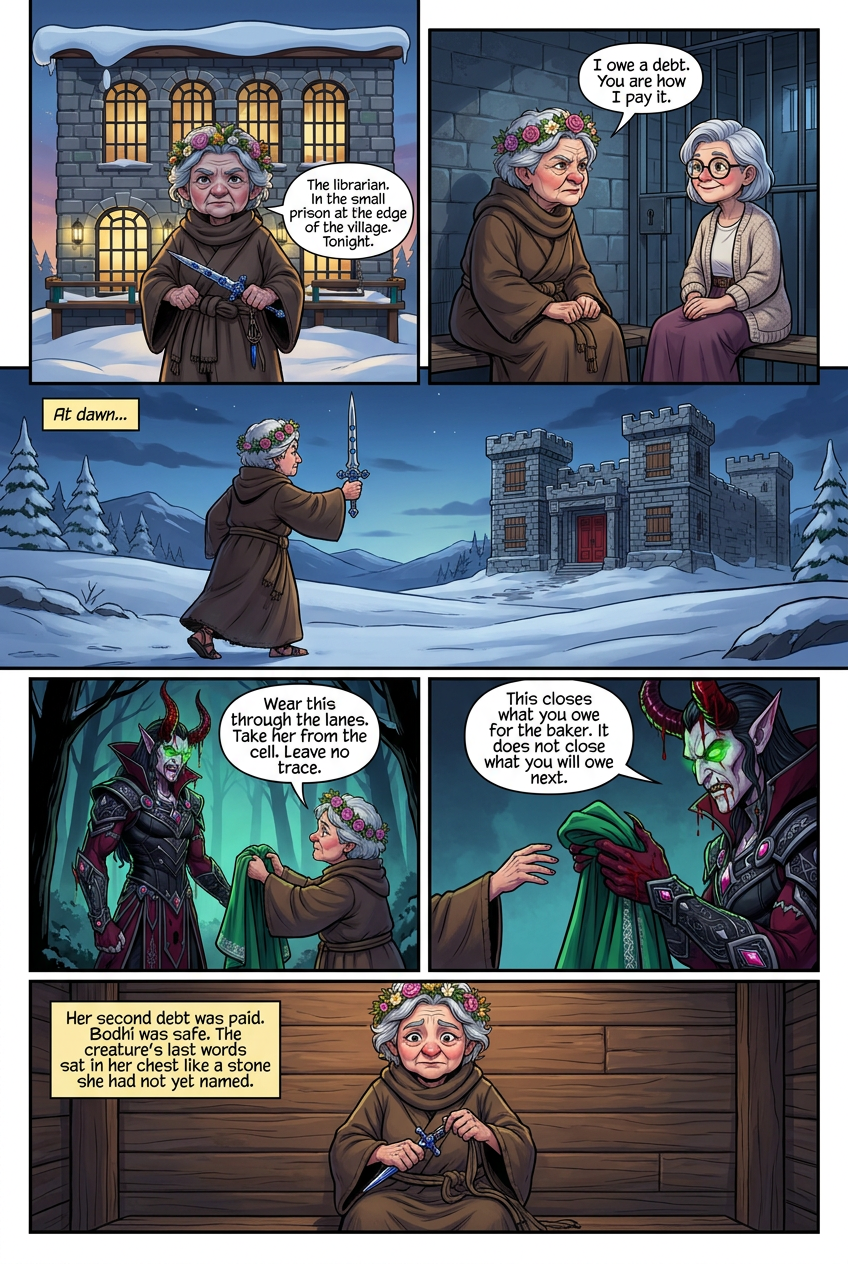
The whispering had stopped, but Elsa's second debt had not. She woke before dawn with the horned creature's price pressing on her chest. One adult life owed, and the creature would not wait forever. If she delayed, it would reach past her and take Bodhi. She dressed, tied the jeweled stake into her sash, and walked through the snow to the small stone prison at the edge of the village. The warden left her alone in the front room with its arched windows and porch swing creaking outside. Brynn sat in the holding cell in her cardigan, hands folded, silver hair neat. The elders had put her there two nights ago for stirring the village against Jasper. She smiled when she saw Elsa. Elsa did not smile back. She turned the key, locked the outer door, and sat down on the bench opposite the bars. "You will be moved to the county court in three days," Elsa said. "You will not be there when they come." Brynn's smile did not move. "You will do it yourself?" "No," Elsa said. "I owe a debt. You are how I pay it." She left before Brynn could answer and walked to the fortress ruins where she had summoned him before. She held up the sapphire-studded stake and spoke the name she had been given. He came out of the trees without sound, tall, horns wet at the tips, eyes the color of a poisoned lamp. His armor was black and dark red, torn at the hem. He waited. "The librarian. In the small prison at the edge of the village. Tonight." Elsa lifted a bundle from under her arm and held it out. A long green cloak, silver lace at the collar, hood deep enough to swallow a face. "Wear this through the lanes. No one will look twice at a tall figure in an elder's cloak. Take her from the cell. Leave the door locked behind you. Leave no blood on the floor, no marks on the walls, no scrap of cloth. She walked out on her own, as far as the village will know." He took the cloak in one clawed hand. "And the boy?" "Paid," Elsa said. "This closes it." He tilted his head. "This closes what you owe for the baker. It does not close what you will owe next." He turned and walked back into the trees with the green cloth over his arm. At dawn the warden found the cell empty, the outer door locked, the key still on its hook. No blood. No footprints inside. The elders questioned the warden, not Elsa. By noon the village had settled on the story that Brynn had slipped her own lock and run. Elsa sat in the meeting hut and untied the stake from her sash. Her second debt was paid. Bodhi was safe. The creature's last words sat in her chest like a stone she had not yet named.
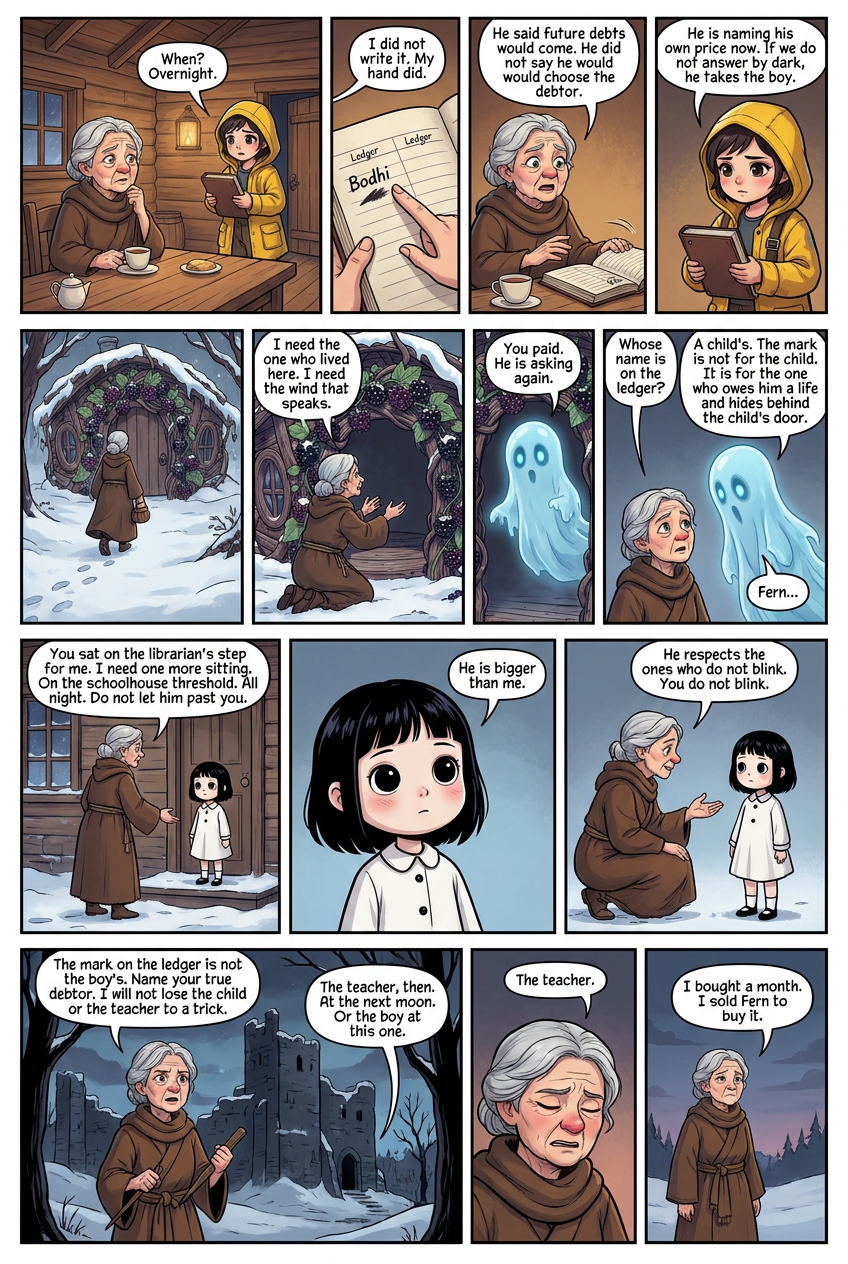
Elsa's second debt was paid, but the creature's warning still sat in her chest. She had barely finished her tea when Nora came through the door of the meeting hut without knocking. Nora set the ledger on the table and opened it to a fresh page. A mark had bloomed under a name Elsa knew well. Bodhi. A faint crossed shape, not clean, not hers. She stared at it. "When?" "Overnight," Nora said. "I did not write it. My hand did." Elsa's chest went cold. The mark was the creature's shape. The horned one had reached past her wards and set its claim on a child again. She pushed the ledger back. "He said future debts would come. He did not say he would choose the debtor." Nora closed the ledger and tucked it under her yellow slicker. "He is naming his own price now. If we do not answer by dark, he takes the boy." Elsa moved. She sent Nora to fetch Wren from the schoolhouse step, then walked to the blackberry arch alone. The little woven doorway sat under fresh snow, berries dark and heavy through the frost. Elsa knelt on the plank and spoke into the hollow the way the librarian once had. "I need the one who lived here. I need the wind that speaks." The berries shivered. A pale blue shape gathered under the arch, thin as breath, eyes like two lit thumbprints. "You paid," the ghost said, voice sliding between the vines. "He is asking again." "Whose name is on the ledger?" Elsa said. "A child's," the ghost said. "The mark is not for the child. It is for the one who owes him a life and hides behind the child's door." Elsa's breath caught. Fern. Fern had sheltered Bodhi. Fern had opened her crystal door to him. The creature had counted her as a party to the debt. Nora arrived with Wren at her side. The button-eyed girl stood very still on the snow, dress stiff, small hands folded. Elsa crouched to her level. "You sat on the librarian's step for me. I need one more sitting. On the schoolhouse threshold. All night. Do not let him past you." Wren tilted her head. "He is bigger than me." "He respects the ones who do not blink," Elsa said. "You do not blink." Wren nodded once. Elsa walked to the fortress ruins before dusk with the stake in her sash. She held it up until he came. "The mark on the ledger is not the boy's," she said. "Name your true debtor. I will not lose the child or the teacher to a trick." The horned one smiled with wet teeth. "The teacher, then. At the next moon. Or the boy at this one." "The teacher," Elsa said, and the word cut her tongue. He turned into the trees. She had bought a month. She had sold Fern to buy it.
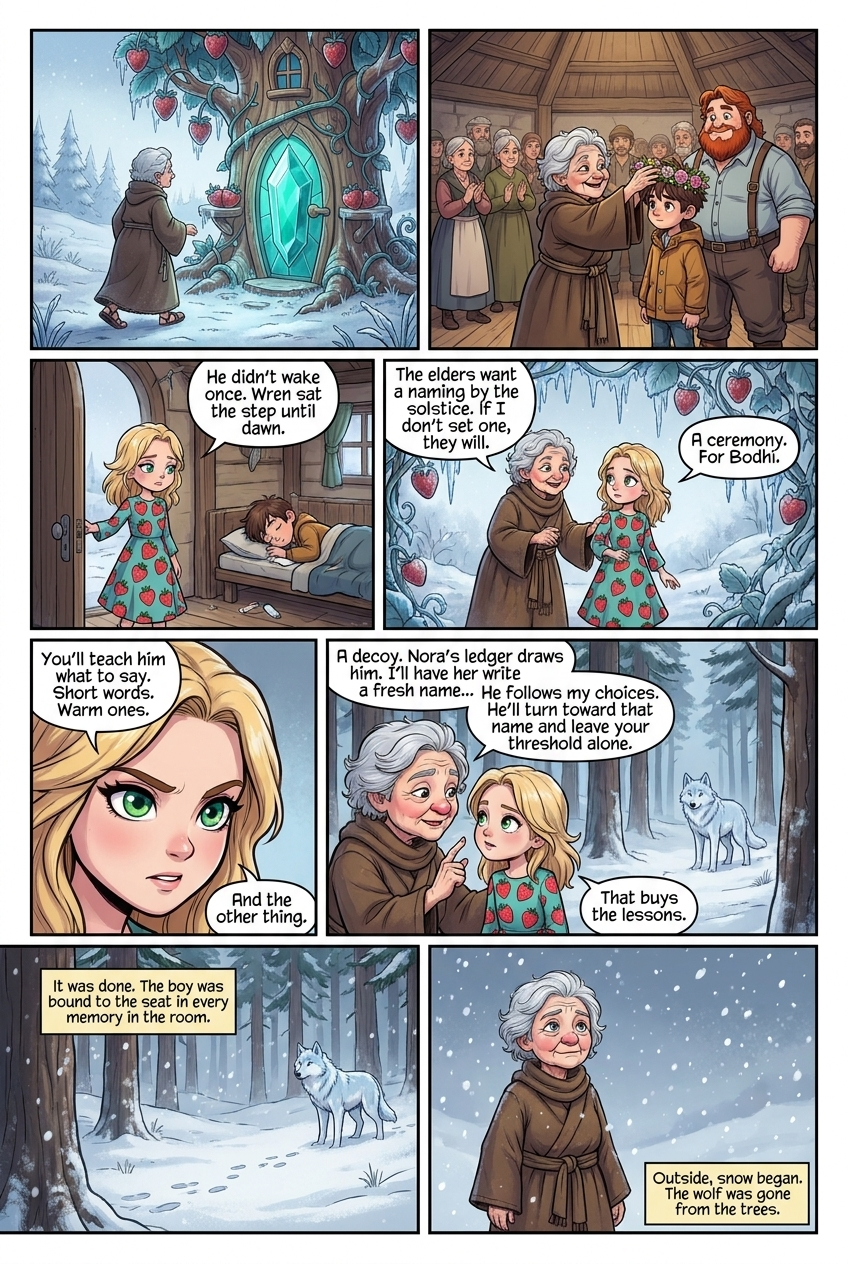
Elsa walked to the schoolhouse at first light. The crystal door glowed teal against the frost. She had bought Fern a month, and she had not yet told her the price. That would come. First she needed a public seat for Bodhi, before the elders picked one of their own sons and called it done. Fern opened the door with the key in her hand. Her strawberry dress was creased from sitting up all night. Bodhi slept on a cot by the stove, chalk still in his fist. Fern stepped outside and pulled the door closed behind her. "He didn't wake once," she said. "Wren sat on the step until dawn." "Good." Elsa took her arm and walked her under the vines, where the berries hung frozen. "The elders met last night without me. They want a naming by the solstice. If I don't set one, they will set their own." Fern's green eyes went sharp. "A ceremony. For Bodhi." "In the meeting hut. Jasper stands beside him as regent. I place my flower crown on the boy's head in front of every household. Once the village sees it, the elders can't undo it without breaking their own custom." "They'll come if you call them," Fern said. "They still love you." "They love the smile. I need them to love the boy by the time they leave the room." Elsa looked at her. "You'll teach him what to say. Short words. Warm ones. He can lie well enough to sound honest now." Fern almost smiled. Then she didn't. "And the other thing." Elsa had rehearsed it on the walk. It still cut. "The creature marked the debt to you. I moved the date to the next moon. That gives us weeks, not hours." She waited. Fern's hand tightened on the key. "I won't let him have you. But I need his eye off this door while you keep teaching the boy." "How." "A decoy. Nora's ledger draws him. I'll have her write a fresh name — someone already dying, someone the village won't miss for long — and circle it as mine. He follows my choices. He'll turn toward that name and leave your threshold alone." Fern breathed out. "That buys the lessons." "That buys the lessons." A pale shape moved at the edge of the pines. The arctic wolf stood between two trunks, blue eyes steady on them, frost in her fur. She had come the last three mornings. Elsa did not know yet whose side the wolf was on, only that she watched Bodhi's door. "Call the village for the day after tomorrow," Elsa said. "Bake something. Make it feel like a festival, not a funeral." Two days later the hut was full. Elsa lifted the flower crown from her own hair and set it on Bodhi's. The room went quiet, then clapped. The elders clapped last, but they clapped. It was done. The boy was bound to the seat in every memory in the room. Outside, snow began. The wolf was gone from the trees.
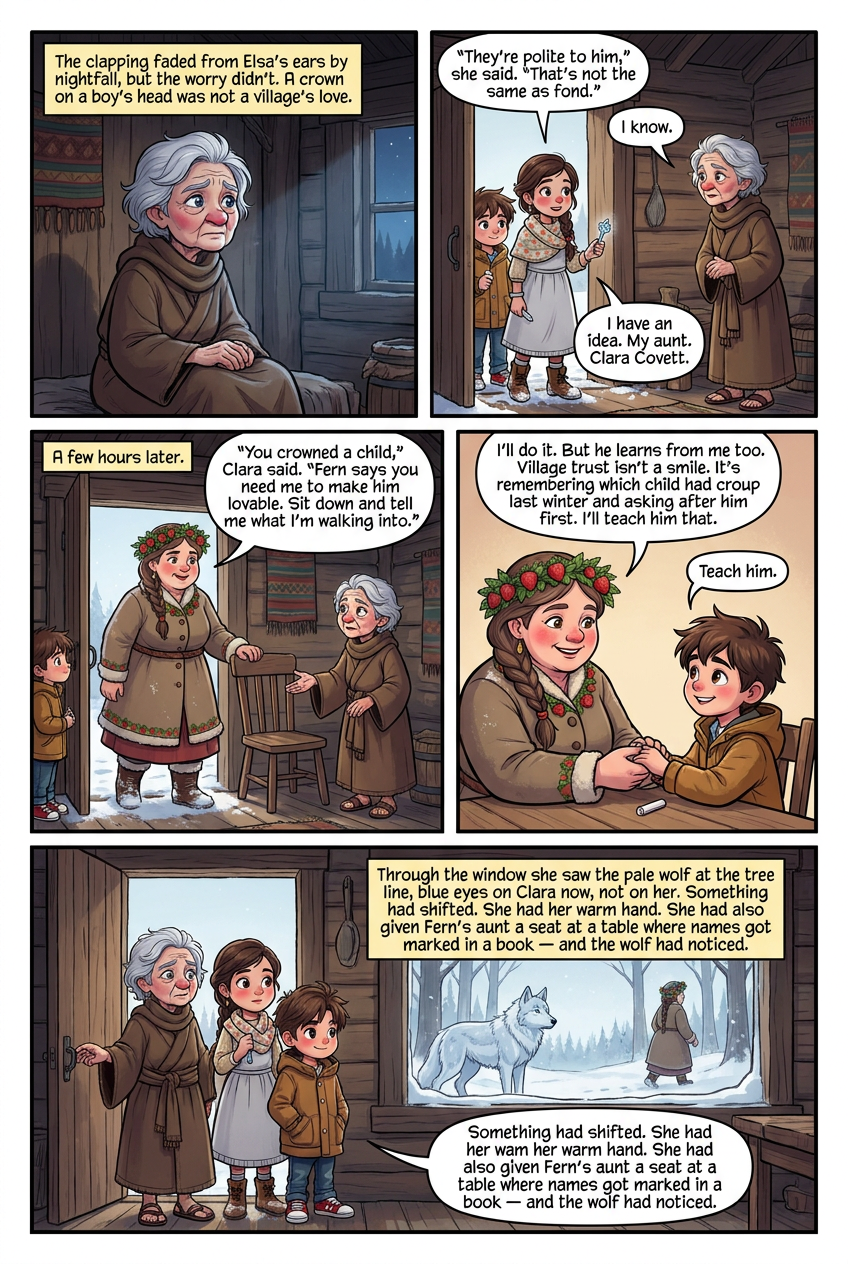
The clapping faded from Elsa's ears by nightfall, but the worry didn't. A crown on a boy's head was not a village's love. She had watched the elders' wives at the ceremony. They smiled at Bodhi, then looked at Jasper, then looked at each other. Warmth for the boy would not come from a woodcarver with big hands. It had to come from someone the women already trusted at their own kitchen tables. Fern came to the meeting hut in the morning with snow on her boots and the crystal key in her fist. Bodhi trailed behind her, chalk on his fingers. Fern shut the door and did not sit. "They're polite to him," she said. "That's not the same as fond." "I know." "I have an idea. My aunt." Fern watched Elsa's face. "Clara Covett. She catches half the babies in this village. Every mother in Alpenglow has trusted her with a screaming child at three in the morning. If Clara stands beside Bodhi at the next gathering and treats him like her own, the wives will follow." Elsa knew Clara. Rosy cheeks. A braid that never came loose. A strawberry wreath on her door that had hung there longer than Bodhi had been alive. "She'll ask why." "She'll ask everything," Fern said. "She raised me after my mother went. She won't take a soft version." "Then bring her." Clara came that afternoon, stamping snow off her boots inside the door, already smiling before she'd looked around. She kissed Fern's cheek. She looked at Elsa the way a midwife looks at a laboring woman — measuring, not warm. "You crowned a child," Clara said. "Fern says you need me to make him lovable. Sit down and tell me what I'm walking into." Elsa sat. She told her the parts a midwife could carry. Bodhi was young. Jasper was a wall, not a mother. The women needed a woman they already trusted to lean toward the boy in public. She left out the ledger. She left out the creature. Fern's hand on the table said, later. Clara listened without moving. When Elsa finished, Clara said, "I'll do it. But he learns from me too. Village trust isn't a smile. It's remembering which child had croup last winter and asking after him first. I'll teach him that." "Teach him," Elsa said. Clara took Bodhi's chalky hand across the table. The boy looked up at her. She smiled at him the way she smiled at newborns, and Bodhi, who lied for a living, smiled back like he meant it. Elsa walked them to the door. Through the window she saw the pale wolf at the tree line, blue eyes on Clara now, not on her. Something had shifted. She had her warm hand. She had also given Fern's aunt a seat at a table where names got marked in a book — and the wolf had noticed.
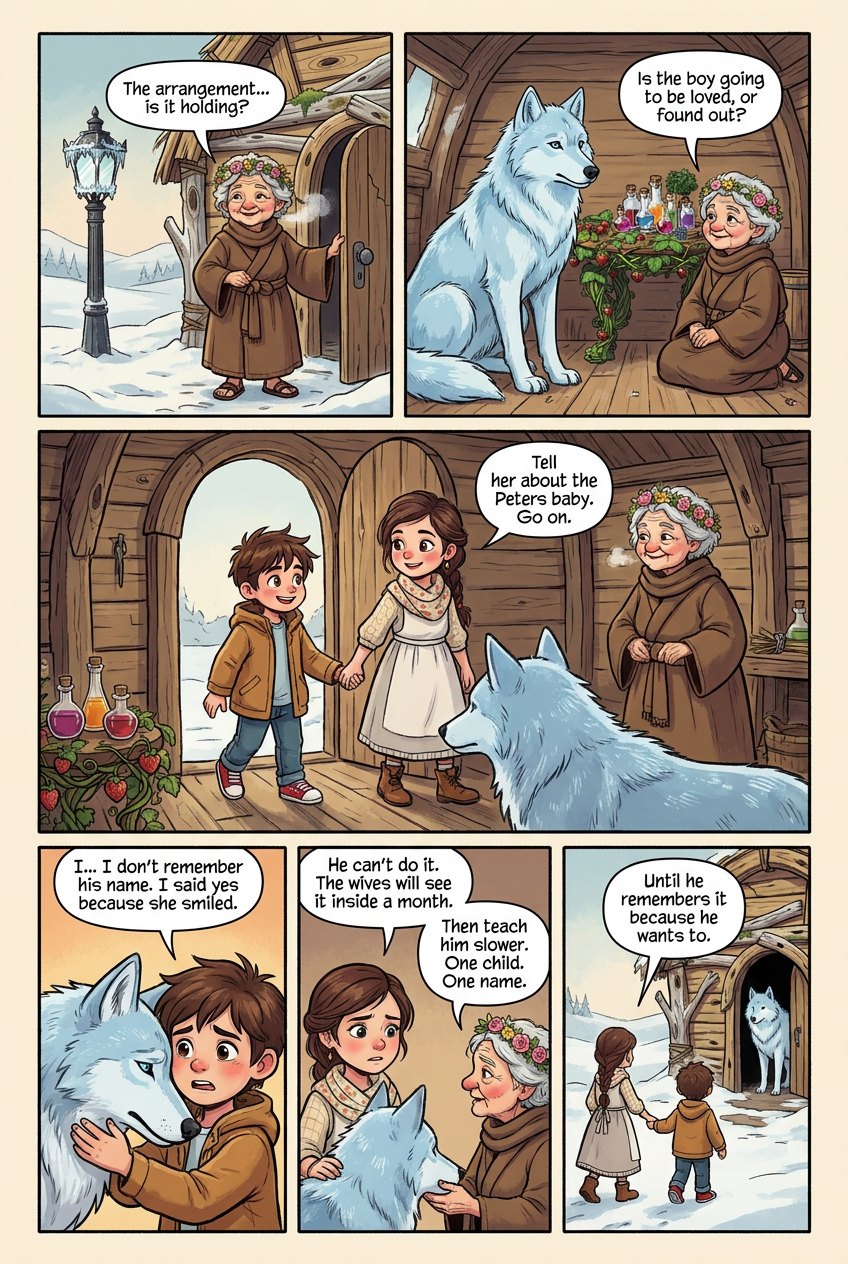
Two mornings after Clara took Bodhi's hand across her table, Elsa woke before dawn and knew she had moved too many pieces without checking the board. Clara had a seat now. Fern had a deadline. Jasper had a boy on his knee. Bodhi had a crown and a mouth full of clever lies. Elsa needed to know if the arrangement was holding, and she trusted only one thing left to tell her the truth. She dressed, walked to the driftwood hut, and opened the door wide to the snow. The pale wolf came out of the tree line without being called. It crossed the clearing past the frozen lantern post and stepped inside, shaking ice from its fur. Elsa shut the door. The wolf sat by the strawberry-vine table Fern had left behind after her last visit, potion bottles and dried herbs still crowded across its top. Blue eyes fixed on Elsa. She sat on the floor across from it, older knees complaining, and asked the only question that mattered. "Is the boy going to be loved, or found out?" The wolf rose. It walked to the door and scratched once. Elsa opened it. Bodhi was already coming up the path with Clara, mittened hand in mittened hand, Clara laughing at something the boy had said. Elsa stepped aside and let them in. "Tell her about the Peters baby," Clara said, brushing snow from Bodhi's shoulders. "Go on." Bodhi looked up at Elsa. His face arranged itself the way it always did — bright eyes, small smile, a story ready. "The Peters baby had croup last winter," he began, "and I asked his mother this morning if he was sleeping better, and she said —" The wolf stepped between them. It put its nose against Bodhi's chest and stood there. Bodhi stopped talking. The performance dropped off his face like a mask cut loose. Underneath was a scared boy who did not know what the animal wanted. "I don't remember his name," Bodhi said. His voice was thinner. "I asked her because Clara told me to. I don't know if he slept better. I said yes because she smiled when I said it." Clara's hand went still on the boy's collar. She looked at Elsa. Her face was not warm anymore. It was a midwife's face over a bad delivery. "He can't do it," Clara said. "Not yet. He's performing me the same way he performs you. The wives will see it inside a month." Elsa watched the wolf. It had not moved from the boy's chest. She had asked her question and been answered. Clara would not vouch for a liar. The wolf would not walk beside one either. "Then teach him slower," Elsa said. "One child. One name. Until he remembers it because he wants to." Clara nodded once, not smiling. She took Bodhi's hand and led him back out into the snow. The wolf followed them to the door and watched them go.
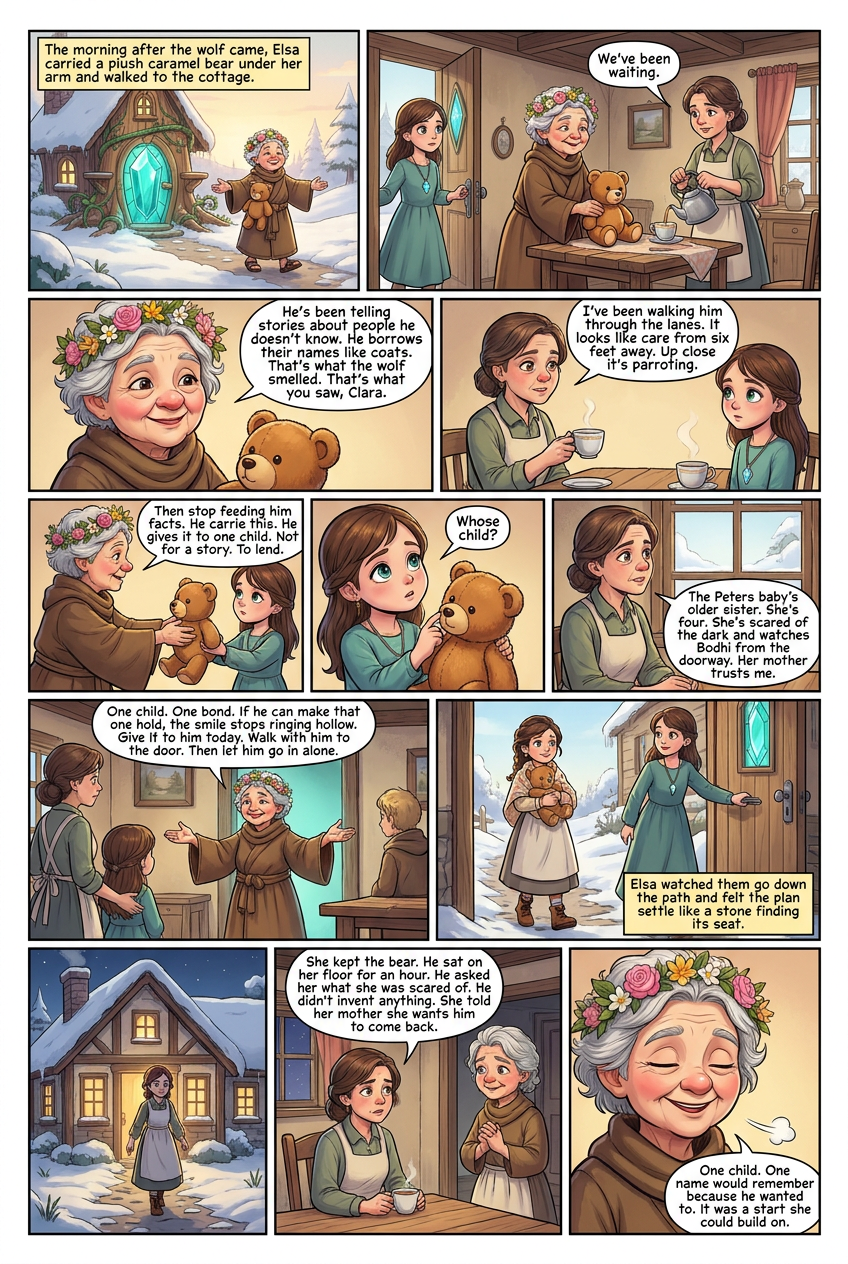
The morning after the wolf came, Elsa carried a plush caramel bear under her arm and walked to the cottage inside the strawberry tree. The teal crystal door threw a green shine on the snow. She knocked once. Fern opened it, blonde hair loose, her crystal key still on its cord at her neck. Clara was already inside at the table, apron on, kettle steaming. They had been waiting for her. Elsa set the bear on the table between them. The plush was soft and round, the color of warm bread. "He's been telling stories about people he doesn't know," Elsa said. "He borrows their names like coats. That's what the wolf smelled. That's what you saw, Clara. Stories won't fix it. He needs to sit with one villager long enough to actually remember them." Clara set down her cup. "I've been walking him through the lanes and feeding him facts. He memorizes them and gives them back. It looks like care from six feet away. Up close it's parroting." "Then stop feeding him facts," Elsa said. She pushed the bear toward Fern. "He carries this. He gives it to one child. Not for a story. To lend. The child brings it back after a week, and he asks about the week. Real questions. Real answers. He gets a real person out of it, not a rehearsal." Fern touched the bear's ear. "Whose child?" "The Peters baby's older sister," Clara said. "She's four. She's scared of the dark and she watches Bodhi from the doorway when he passes. Her mother trusts me. She'll say yes if I ask." "One child," Elsa said. "One bond. If he can make that one hold, the smile stops ringing hollow. The wives will feel it before they can name it." Fern lifted the bear into her lap. "And if he can't?" "Then we know inside a week, not a month," Clara said. "The mother will tell me. She tells me everything." Elsa nodded. "Give it to him today. Walk with him to the door. Then let him go in alone. No script from either of you. If he lies, the girl won't come back for the bear. That's our test." Clara wrapped the bear in a clean cloth. Fern turned the crystal key in the lock behind them as they stepped out into the cold. Elsa watched them go down the path, the wrapped bundle in Clara's arm, and felt the plan settle like a stone finding its seat. That evening Clara came back alone. Her face was tired but not grim. "She kept the bear," she said. "He sat on her floor for an hour. He asked her what she was scared of. He didn't invent anything. She told her mother she wants him to come back." Elsa let out a breath she had been holding for a week. One child. One name he would remember because he wanted to. It was a start she could build on.
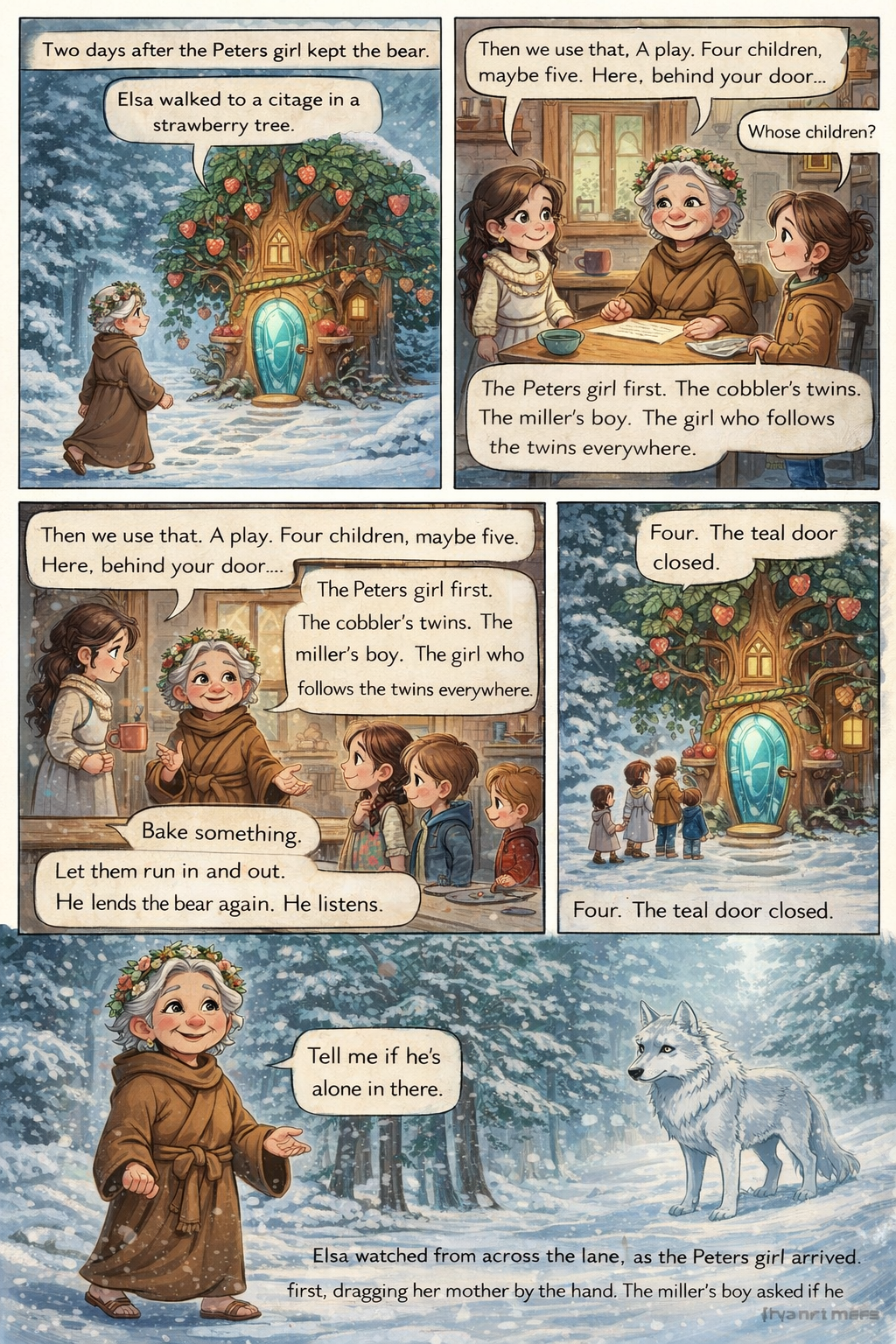
Two days after the Peters girl kept the bear, Elsa walked to the cottage in the strawberry tree. The teal crystal door glowed against the frost. Fern opened it before she knocked. Clara was at the table with a mug in her hands. "One child is a start," Elsa said. She sat and put her palms flat on the wood. "But one child won't warm a village. The wives still watch him like a visiting prince. He walks the lanes and the other children step back." Clara nodded. "The Peters girl told two of her friends about the bear. They asked their mothers if the boy was safe." "Then we use that," Elsa said. "A play. Four children, maybe five. Small enough that he can't hide behind numbers. Big enough that it isn't a lesson. He learns them one at a time, inside one afternoon." Fern set her key down. "Whose children?" "The Peters girl first," Clara said. "She'll pull the others. The cobbler's twins. The miller's boy. The girl who follows the twins everywhere." "Here?" Fern asked. "Here," Elsa said. "Behind your door. The mothers trust this cottage. Bake something. Let them run in and out. No speeches. No crown. He lends the bear again. He asks the twins what they built yesterday. He listens." Clara wrote the names on the back of a receipt. "I'll ask the mothers today. I'll tell them it's a thank-you for the Peters girl. That gives them a reason." "No coaching him," Elsa said to Fern. "If he performs, they'll smell it. Let him fumble." Fern folded the receipt into her pocket. "And if the twins won't come inside?" "Then we have three," Clara said. "Three is enough." The afternoon came bright and cold. Elsa watched from the window across the lane. The Peters girl arrived first, dragging her mother by the hand. The cobbler's twins came next, cautious, then the miller's boy behind them. Four. The teal door closed. Elsa did not go in. She walked to the edge of the pines where the snow lay clean and waited. The pale wolf came out from between two trunks and sat down in front of her. Frost clung to its ruff. Its blue eyes held on her face. "Tell me if he's alone in there," Elsa said. The wolf did not move for a long moment. Then it lowered its head and pressed its nose once to the snow at her boot. It turned and walked back into the trees. At dusk Clara found Elsa on the path. Her braid was loose. She was smiling without effort. "The twins invited him to their yard tomorrow," she said. "The miller's boy asked if he could keep the bear a night. The Peters girl held his hand at the door." Elsa let the breath out. Four children. Four names he would carry now. The prince was becoming a boy.
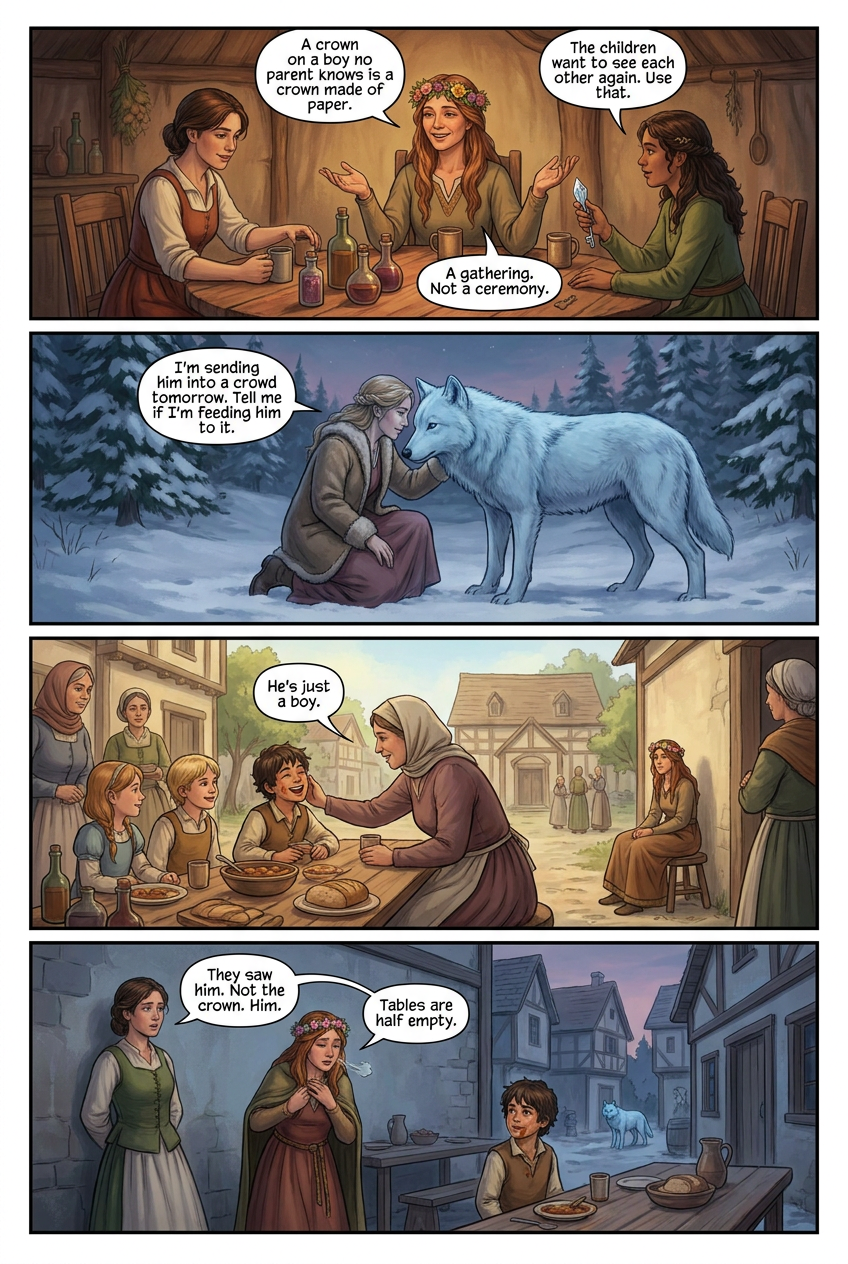
The morning after the miller's boy returned the bear, Elsa sat with Clara and Fern at the vine-woven table in the cottage. Bottles of tincture rattled when Clara set down her mug. "Four children love him," Elsa said. "Their mothers do not. A crown on a boy no parent knows is a crown made of paper." Fern turned the crystal key in her palm. "The children want to see each other again. Use that." "A gathering," Clara said. "Not a ceremony. Everyone brings a dish. The parents come because their children beg them. He walks among them without a speech." Elsa considered it. A crowning needed a memory the wives could tell each other later. Not a story about the elder's chosen boy. A story about their own child laughing at something he did. "In the lane behind the meeting hall," Elsa said. "Open air. No door for anyone to feel trapped behind. Clara, you invite the mothers. Fern, you bring the children first so the parents follow." She pulled on her wool coat and went out to the pines. The pale wolf was already waiting, its blue eyes steady on her. Elsa knelt in the snow. "I'm sending him into a crowd tomorrow," she said. "Tell me if I'm feeding him to it." The wolf stepped close and pressed its forehead to her shoulder. Then it turned and looked toward the village. Not warning. Watching. "Good," she said. The next afternoon they set trestle tables in the lane. Clara's stew. Fern's berry bread. A neighbor brought pickled beets before anyone asked. The Peters girl arrived first and grabbed the boy's sleeve and pulled him to the twins. The miller's boy showed him how his father shelled walnuts with a hammer. Bodhi laughed, then covered his mouth like laughing was still new. Mothers came in twos. They stood at the edges with their arms crossed. Elsa did not go near them. She sat on a stool by the hall wall and watched. The Peters girl's mother crossed the lane first. She knelt beside her daughter, who was showing Bodhi how to braid a bit of ribbon from her sleeve. The girl said something Elsa could not hear. The mother laughed. Then the mother touched Bodhi's cheek with the back of her hand like she'd done to her own child a thousand times. The cobbler's wife saw it. She came next, with a plate. Then the miller's wife. Then two more. A woman Elsa barely knew set a jar of honey by the boy's elbow and told him to take it home. By dusk the tables were half empty and the boy had a smear of stew on his chin no one had told him to wipe. Clara found Elsa at the wall. "They saw him," Clara said. "Not the crown. Him." Elsa let out a breath she'd been holding for weeks. The village had a memory of the boy now. One they made themselves. Then the pale wolf stepped out from between two houses at the end of the lane, in full view of every mother still standing there.
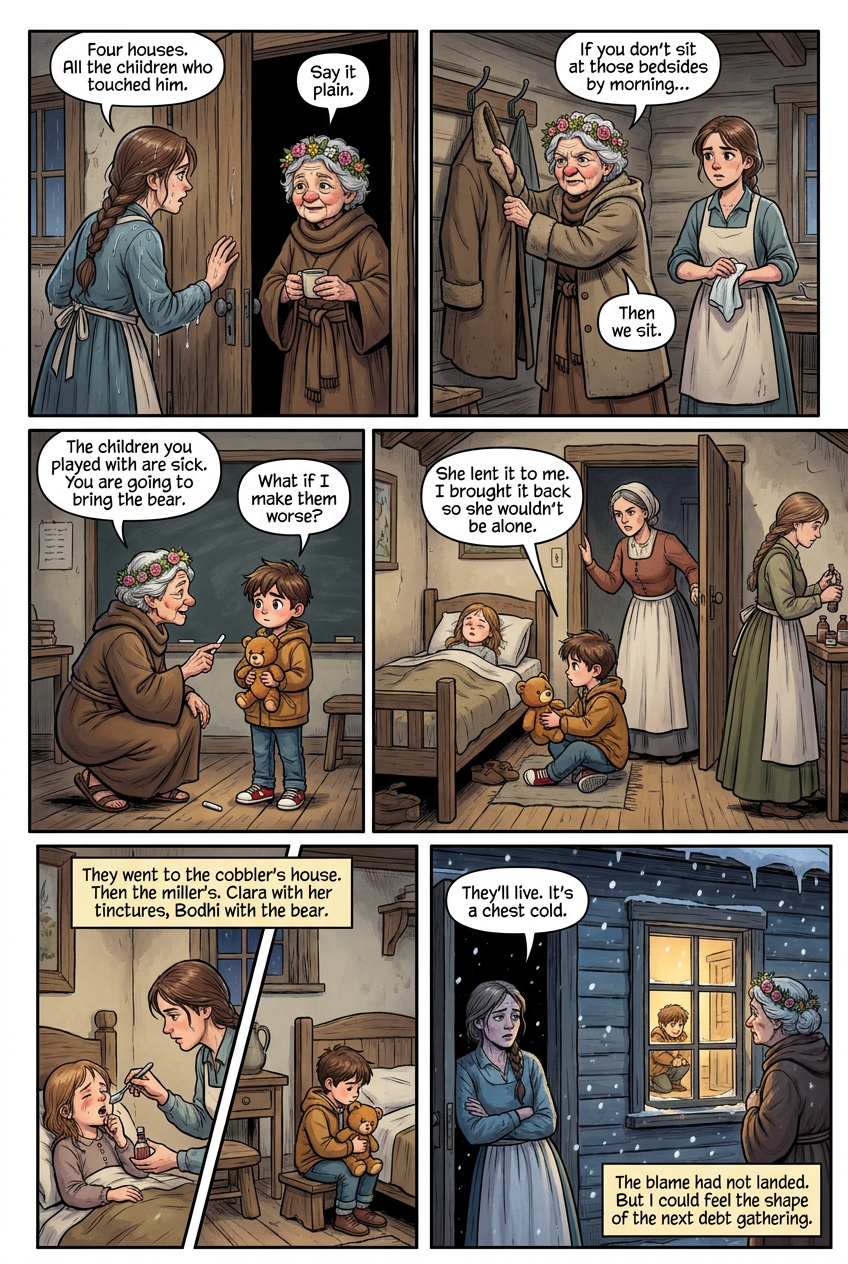
Two days after the gathering in the lane, the Peters girl woke with a fever. By noon the cobbler's twins were coughing into their sleeves. By evening the miller's boy could not keep water down. Clara came to Elsa's door with her braid unraveling and her sleeves wet to the elbow. "Four houses," Clara said. "All the children who touched him." Elsa set down her cup. "Say it plain." "The mothers are already saying it. He came, they touched him, now they're sick." Clara wiped her hands on her apron. "If you don't sit at those bedsides by morning, the crown comes off him before the week ends." Elsa pulled her wool coat from the hook. "Then we sit." She went first to the schoolhouse. Bodhi was at the low table with his chalk stub, drawing nothing, just tapping. Fern stood behind him with a hand on his shoulder. "The children you played with are sick," Elsa said. She crouched to his eye level. "You are going to visit each one. You are going to bring the bear." Bodhi's hand closed on the caramel-colored plush the miller's boy had loved. "What if I make them worse?" "You didn't make them sick. Winter did. But if you don't go, their mothers will believe you did." She held his gaze. "Ask what hurts. Don't invent. Sit until they sleep." He nodded once. They went to the Peters house first. Clara had already boiled willow bark. The mother opened the door with her mouth set hard. Bodhi held out the bear and said, "She lent it to me. I brought it back so she wouldn't be alone." The mother's shoulders dropped a finger's width. She let them in. Bodhi sat on the floor by the cot. He asked the girl if her throat felt like swallowing sand or like swallowing pins. The girl whispered pins. He tucked the bear under her arm and stayed while Clara measured drops into a spoon. He did not fill the quiet with a story. He only sat. They went to the cobbler's house. Then the miller's. At each door Clara went in first with her tinctures and her steady voice, and Bodhi followed with the bear passed forward like a small offering. At each bedside he asked one real question and waited for the answer. By the fourth house it was past midnight. The miller's wife pressed bread into Elsa's hands at the door and would not meet her eyes, but she said, "Tell the boy to come back tomorrow." Outside, snow had started. Clara leaned against the doorframe. "They'll live," Clara said. "It's a chest cold. Three days." "The mothers know that?" "They will by morning. I told each one before we left." Elsa looked back at the lit window. Bodhi was still inside, kneeling by the miller's boy, the bear between them. The blame had not landed. But she could feel the shape of the next debt gathering somewhere in the dark, waiting to be named.
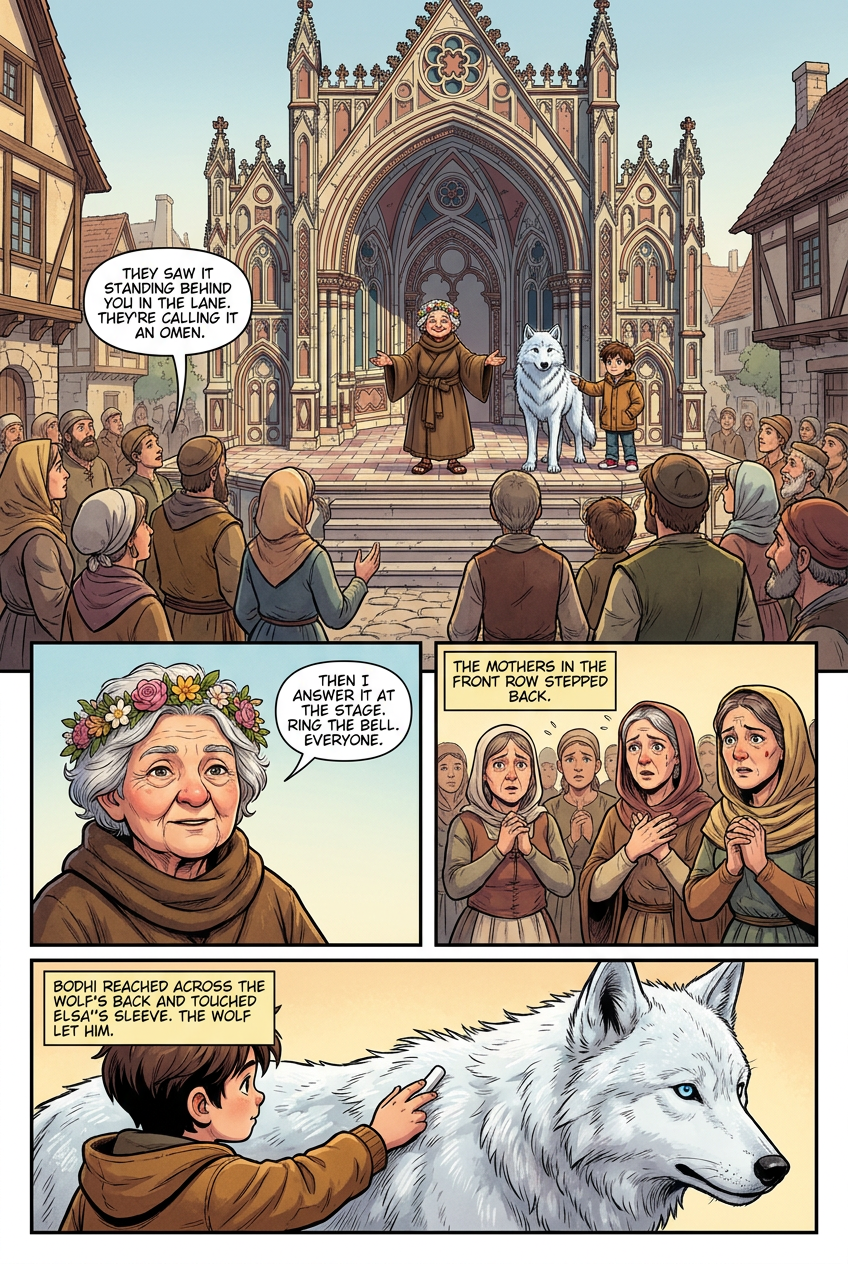
By dawn the fever had broken in three of the four houses. By noon the mothers were at the well, and the word passing between them was not chest cold. It was wolf. Clara came to Elsa's door with her scarf still on. "They saw it standing behind you in the lane. They're calling it an omen. If you don't answer it before dusk, the crown comes off him tomorrow." Elsa set down her bread. "Then I answer it at the stage. Ring the bell. Everyone." Fern arrived within the hour, the teal crystal at her hip. "You want him up there? In the open?" "Beside the wolf," Elsa said. "If they see the animal choose him, they stop whispering." Fern's jaw tightened. "And if it doesn't choose him in front of them?" "It already has." The bell rang at three. The village gathered before the tall arched stage in the square, the one built for weddings and namings, its painted columns pale in the winter light. Elsa climbed the steps alone at first. Then she turned and held out her hand. The wolf came from the alley behind the baker's shuttered shop. Frost clung to its coat. Its blue eyes moved over the crowd once and settled on her. The mothers in the front row stepped back. A woman crossed herself. Bodhi came next, small in his brown parka, the chalk stub gone from his hand for once. He stopped on the far side of the wolf, as Elsa had told him. The wolf did not turn its head. It stood between them like a post driven into the boards. Elsa spoke without raising her voice. She told them the wolf had come to her in autumn. She told them she had tested it — with meat it refused, with a knife it ignored, with the names of every candidate she had considered. She said its answer had been steady and it had been Bodhi. "It came the way the old stories come," she said. "Quiet. Certain. I would call it angelic if the word weren't so worn." She rested one hand on the wolf's shoulder. It did not flinch. "It stayed for the boy," she said. "Not for me. It will not harm any of you. It will harm anyone who reaches for him with harm in their hand, or for those who stand with him." She looked at Clara at the foot of the steps, at Fern beside her. "That is the whole of it." The Peters girl's mother was the first to lower her shoulders. Then the miller's wife. Then the rest, one by one, the way a rope goes slack. A man near the back called, "And if it turns?" "It won't," Elsa said. "But if it does, it will turn on me first." The crowd broke into quiet talk, not fear. Bodhi reached across the wolf's back and touched Elsa's sleeve. The wolf let him. The whispering stopped that afternoon. By evening, three mothers had sent bread to the schoolhouse door. Elsa stood at her window and watched the snow start again, and knew she had spent the wolf. She could not summon it twice for the same crowd. Whatever came next would have to be answered with something she had not yet named.
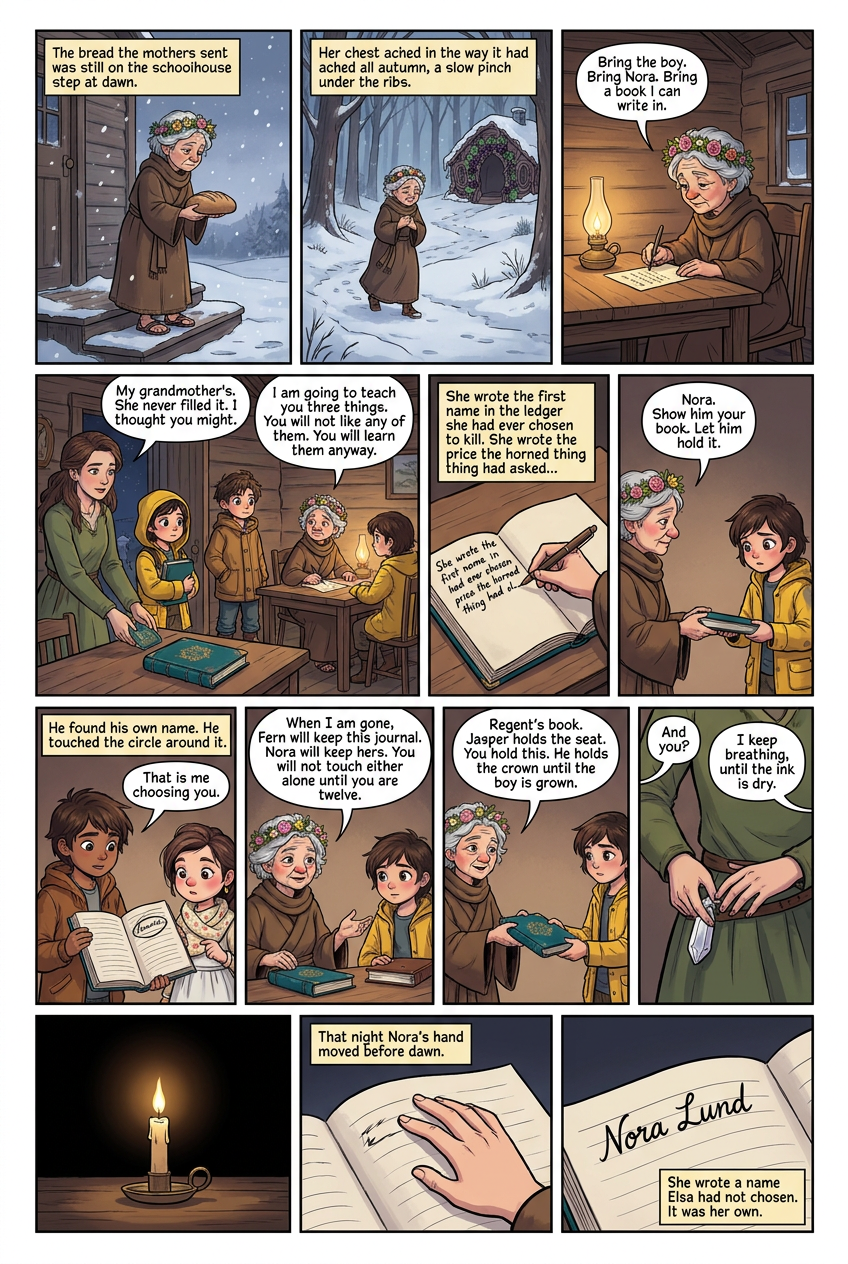
The bread the mothers sent was still on the schoolhouse step at dawn. Elsa left it there and walked home through fresh snow. Her chest ached in the way it had ached all autumn, a slow pinch under the ribs. She had bought the boy a crown and a wolf and a household. She had not bought him the one thing he still lacked. If she died in her sleep tonight, no one alive would know how to read Nora's ledger, how to speak to the thing under the fortress, how to keep the whisper on the far side of the crystal door. Bodhi would sit on a chair he could not defend. She sent Fern a note before breakfast. Bring the boy. Bring Nora. Bring a book I can write in. They came at noon. Fern set a teal leather journal on the table, gold crest worn soft at the corners. "My grandmother's," she said. "She never filled it. I thought you might." Nora stood in her yellow slicker by the stove, ledger clutched to her chest like a child. Bodhi climbed onto the bench and set his chalk stub beside the journal. "I am going to teach you three things," Elsa told him. "You will not like any of them. You will learn them anyway." She opened the journal. She wrote the first name in the ledger she had ever chosen to kill. She wrote the price the horned thing had asked, and the price it had taken. She wrote what a circle meant, and what a cross meant, and what it meant when Nora's hand moved before dawn. Bodhi watched her pen. He did not interrupt. "Nora," Elsa said. "Show him your book. Let him hold it." Nora hesitated. Then she set the ledger in the boy's lap. Bodhi opened it carefully, the way Clara had taught him to hold a baby. He found his own name. He touched the circle around it. "That is me choosing you," Elsa said. "When I am gone, Fern will keep this journal. Nora will keep hers. You will not touch either alone until you are twelve. If Nora writes a name, you send for Fern. If the wall speaks, you stay behind the crystal. If the horned one calls a debt, you pay it in coin first, in kind second, and never in a child. Say it back." He said it back. Twice. The second time without prompting. Elsa signed the last page of the teal journal and slid it to Fern. "Regent's book," she said. "Jasper holds the seat. You hold this. He holds the crown until the boy is grown." Fern's hand closed around the crystal at her hip. "And you?" "I keep breathing," Elsa said, "until the ink is dry." That night Nora's hand moved before dawn. She wrote a name Elsa had not chosen. It was her own.
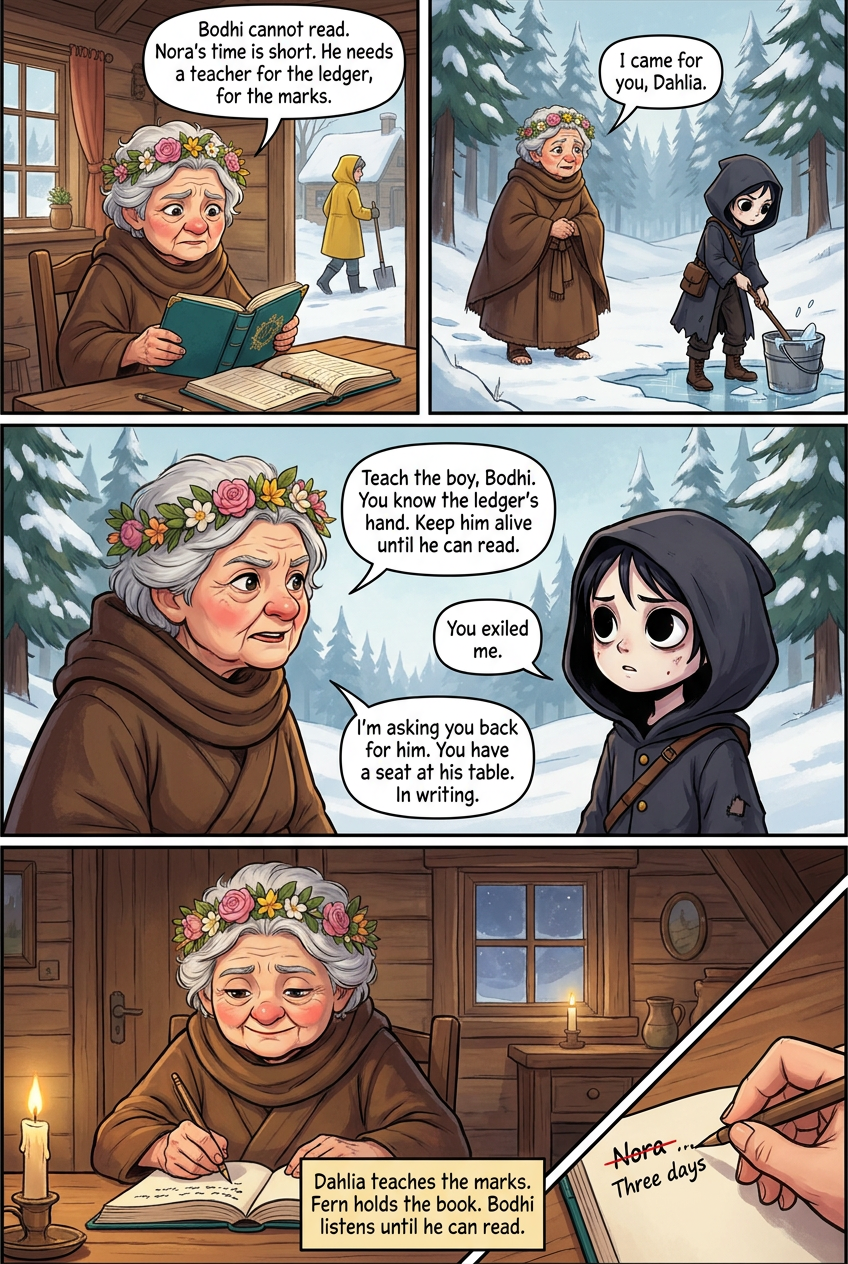
The name Nora had written before dawn was her own. Elsa saw it at breakfast and closed the ledger without a word. Nora would not explain. She only touched the yellow slicker at her collar and went out to dig. Elsa sat at the table with the teal journal open and understood the shape of the problem. The boy could not read yet. If Nora went into the ground this week, the pages Elsa had filled would sit in Fern's lap and the boy would still be a child holding a crown he could not defend. He needed a teacher who could speak the hard part aloud until his letters caught up. Elsa thought of the wolf. It had shifted to Clara, then shown itself on the stage, and its work as a sign was done. But it had taught her one thing: the village's cast-off could be closer to the truth than its darlings. She put on her heavy robes and walked to the edge of the pines. Dahlia Krenn was outside the hooded coat's shadow, breaking ice from a bucket with a stick. She did not look up. "You brought the boy here once to scare him," she said. "Come back for another lesson?" "I came for you," Elsa said. Dahlia's hand tightened on the stick. Somewhere under the frozen ground a root gave a dry crack. Elsa felt it in her boots. Dahlia was the woman the village had cast out for lying her way toward power. She was also the only person besides Elsa who had ever opened the ledger and understood the marks. Brynn had told Elsa that, years ago, and Elsa had filed it away. "I need a teacher for Bodhi," Elsa said. "Nora wrote her own name. Fern will hold the journal, but Fern does not know the ledger's hand the way you do. You do. You read it once. I remember." Dahlia set the stick down. "You exiled me." "I did. And I am asking you back for the boy, not for me. You show him what I showed him about you, in your own words. You teach him the marks. You keep him alive until he can read the pages himself." "And when he is grown?" "You have a seat at his table. In writing." Dahlia's dark eyes did not blink. The root beneath the snow stopped cracking. "Bring him tomorrow," she said. "With the ledger. And the book you wrote." Elsa walked home slower than she had come. Her chest pinched under the ribs. She wrote one line in the teal journal that night: Dahlia teaches the marks. Fern holds the book. Bodhi listens until he can read. Before dawn Nora's hand moved again. She crossed out her own name and wrote a date beside it. Three days.
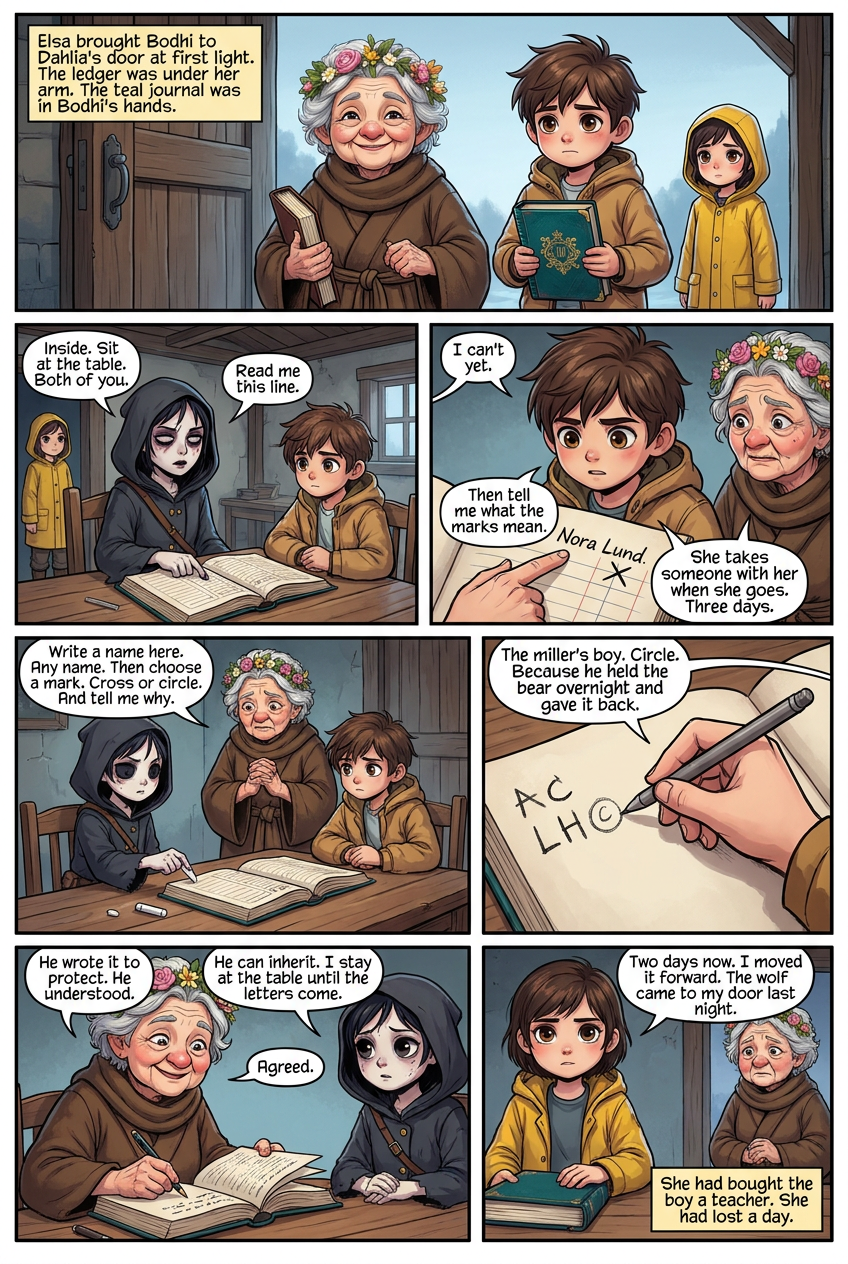
Elsa brought Bodhi to Dahlia's door at first light. The ledger was under her arm. The teal journal was in Bodhi's hands, because she wanted him to feel the weight of it. Nora walked behind them, quiet in her yellow slicker. Three days sat between Nora and the date she had written beside her own name. Elsa needed to know if the boy would be ready. She had no way to measure him. The ledger recorded deaths. It did not record whether a child could read them. Dahlia opened the door before Elsa knocked. Her hood was down. Her dark-ringed eyes went to the boy first, then to the books. "Inside," she said. "Sit at the table. Both of you." Bodhi sat. Nora stood by the wall. Dahlia opened the ledger to the page with Nora's name and turned it toward the boy. "Read me this line," she said. "I can't yet," Bodhi said. "Then tell me what the marks mean." He touched the cross beside Nora's name. "She takes someone with her when she goes." His finger moved to the date. "Three days." Dahlia looked at Elsa. "He knows the marks. He does not know the letters. That is two lessons, not one." "How long?" Elsa asked. "For letters, a season. For the marks, he already sees them. I can teach him to write a circle by tomorrow." "Tomorrow is not enough," Elsa said. "I need a test. Today. Something that tells me if he can hold the book after Nora is in the ground." Dahlia thought. Then she took a stub of chalk from Bodhi's pocket and set it on the table beside the ledger. "Write a name here," she said to the boy. She tapped a blank line under Nora's. "Any name from this village. Then choose a mark. Cross or circle. And tell me why." Bodhi's hand shook. He wrote three letters and stopped. He drew a small circle beside them. "The miller's boy," he said. "Circle. Because he held the bear overnight and gave it back." Elsa's breath caught. The boy had not written the name to kill. He had written it to protect. He understood the ledger's hand was a choice. Dahlia closed the book. "He can inherit," she said. "He cannot inherit alone. I stay at the table until the letters come." "Agreed," Elsa said. She wrote it in the teal journal while Nora watched. Dahlia teaches until Bodhi reads. Dahlia signs beside every mark he makes. Nora set her hand on the ledger. "Two days now," she said. She had not spoken all morning. "I moved it forward. The wolf came to my door last night." Elsa's stomach dropped. She had bought the boy a teacher. She had lost a day.
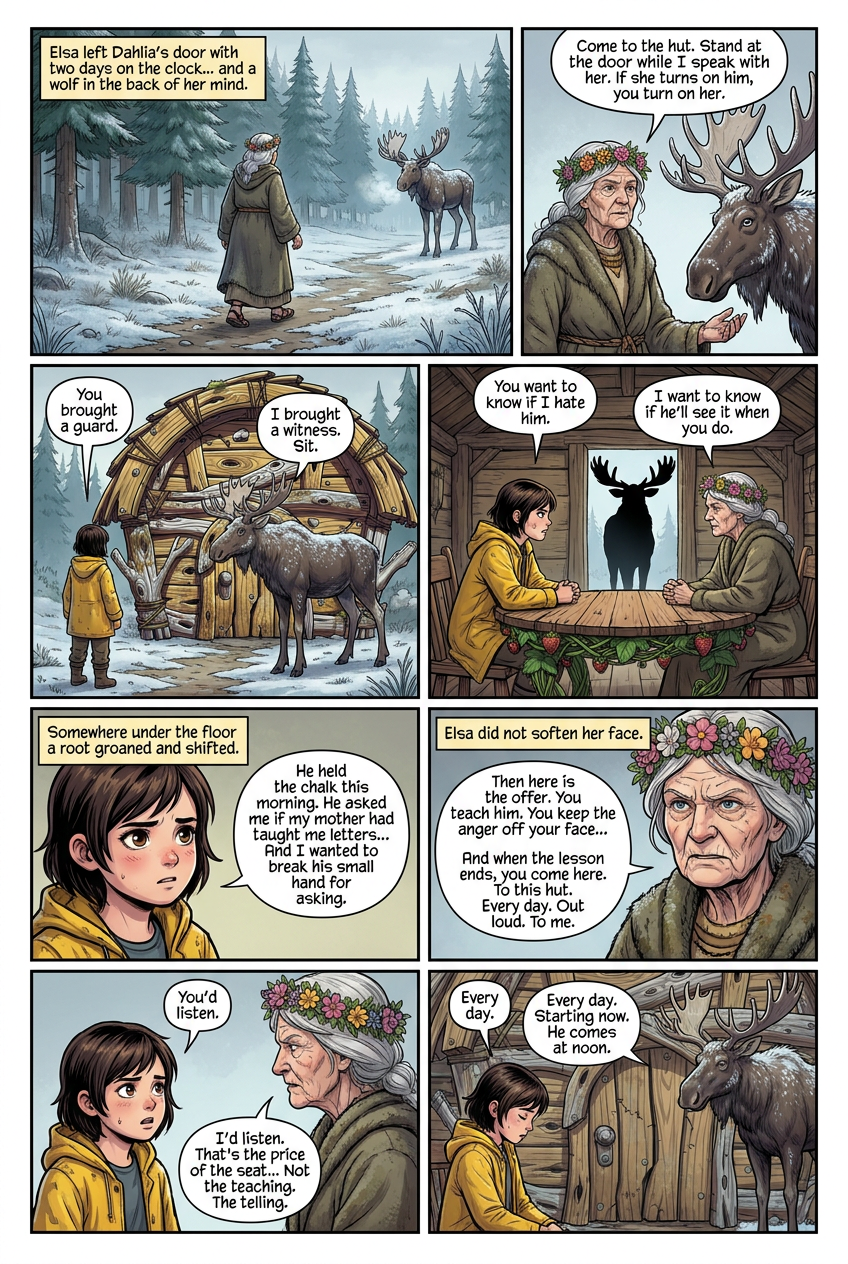
Elsa left Dahlia's door with two days on the clock and a wolf in the back of her mind. She walked the frost path toward her meeting hall and saw the moose again at the tree line. It had circled the village for a week now. Not stalking. Standing between the houses and the woods, its frost-crusted fur pale in the morning, its hollow stare fixed on whatever moved beyond the pines. Elsa had watched it turn a fox back from a child's yard. She thought of Dahlia's hood and Dahlia's dirty hands and Dahlia's eyes on Bodhi, and she understood she needed a witness in the room today. Not Nora. Not Fern. Something the boy would trust to mean protection. She crossed the yard and stopped ten paces from the animal. "Come to the hut," she said. "Stand at the door while I speak with her. If she turns on him, you turn on her." The moose lowered its head once. It followed her at a slow walk, hooves cracking the crust. Elsa sent for Dahlia. She sent for Bodhi to stay at the schoolhouse until she called. Then she waited in her driftwood hut with the arched roof and the door propped open, the moose filling the threshold like a wall. Dahlia came alone. She saw the animal and stopped. "You brought a guard." "I brought a witness," Elsa said. "Sit." Dahlia sat. Her fingernails scraped the wood. "You want to know if I hate him." "I want to know if he'll see it when you do." Dahlia's jaw worked. Somewhere under the floor a root groaned and shifted. Elsa heard it. The moose heard it and did not move. "He held the chalk this morning," Dahlia said. "He asked me if my mother had taught me letters. He asked kindly. And I wanted to break his small hand for asking." "Why." "Because no one taught me. Because you sat at this table for thirty years and let them cast me out. Because he gets the seat and I get to make him worthy of it." Another root cracked below. The moose's ear twitched. Elsa did not soften her face. "Then here is the offer. You teach him. You keep the anger off your face while you do it. And when the lesson ends, you come here. To this hut. You sit at this table and you tell me what he asked and what you wanted to do. Every day. Out loud. To me." Dahlia stared. "You'd listen." "I'd listen. That's the price of the seat at his table. Not the teaching. The telling." The roots stilled. Dahlia's shoulders dropped a finger's width. "Every day," she said. "Every day. Starting now. He comes at noon." Dahlia nodded once and left. The moose stayed in the doorway until she was gone from the yard.
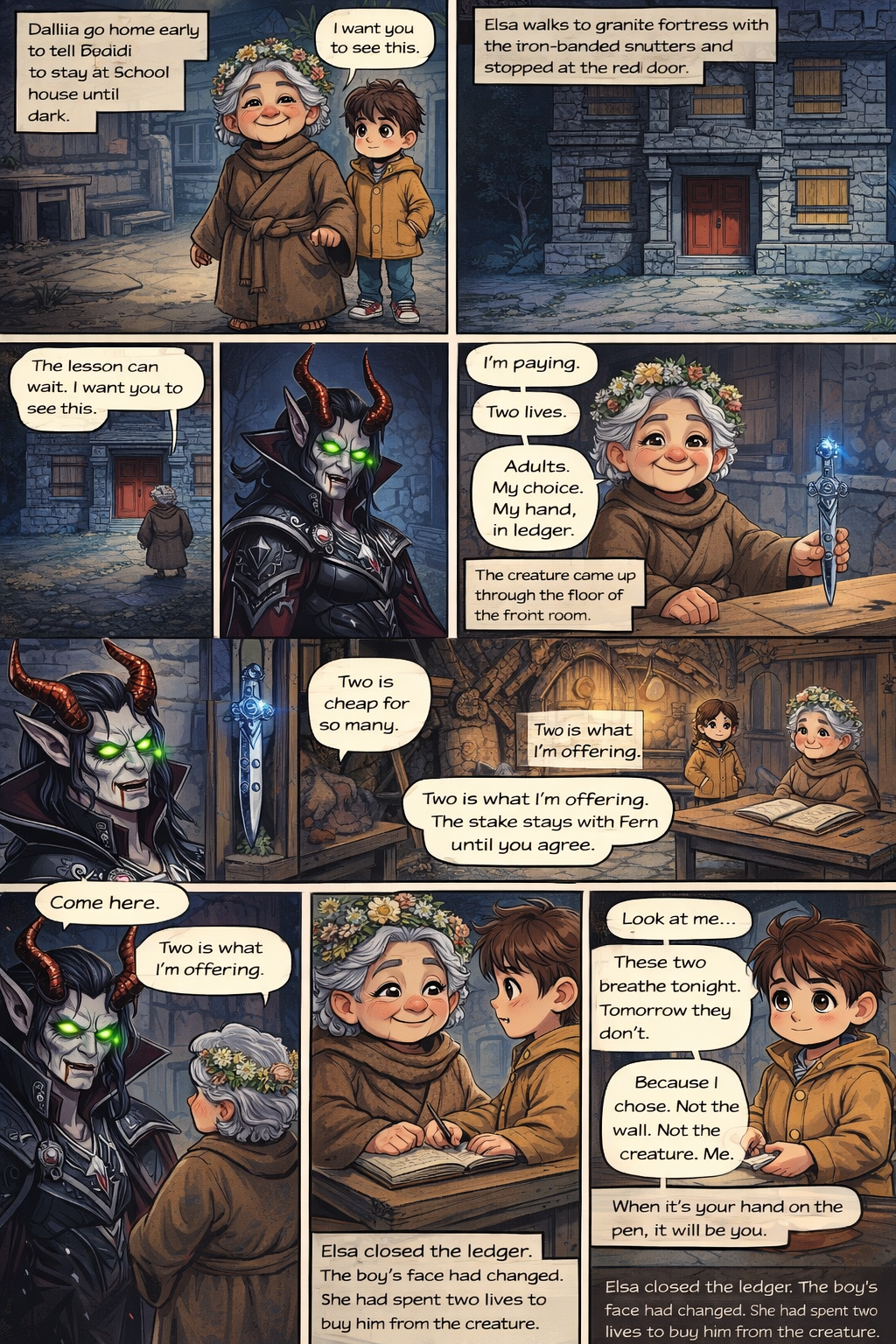
At noon Elsa sent Dahlia home early and told Bodhi to stay at the schoolhouse until dark. The lesson could wait one day. She had a debt to close, and she wanted the boy to see the closing done properly, so he would understand what a mark in the ledger cost. She walked to the granite fortress with the iron-banded shutters and stopped at the red door. She carried the sapphire stake under her coat. She spoke the words into the stone and waited. The creature came up through the floor of the front room. Tall. Horned. Green eyes bright as lamp glass in the dim. Blood dried on the tips of its horns. It smiled at her the way a wolf smiles at a lame sheep. "You owe me," it said. "I'm paying," Elsa said. She set the stake on the sill between them, blue jewels catching what light there was. "Two lives. Adults. My choice, my hand in the ledger. In exchange, you take Bodhi's name off your books and the boy is closed to you forever. His guardians too. Fern. Clara. Jasper. Nora. Dahlia. All of them. No marks. No leverage. No visits." The creature's smile thinned. "Two is cheap for so many." "Two is what I'm offering. The stake stays with Fern until you agree." It looked at the jewels a long time. Then it dipped its horns. "Two. Names by the next moon. After that, the boy and his people are outside my reach. But the debt on you remains, elder. You I keep." "I know," Elsa said. She walked back through the frost to the schoolhouse and brought Bodhi to the driftwood hut. Nora was already there with the ledger open on the table. "Come here," Elsa said. Bodhi came. She put her hand over his on the chalk stub. "Two names today. Adults. I choose them. You watch me choose. You watch Nora mark them." She said the first name. A man from the outer farms who beat his wife and had already put two children in the ground. She said the second. A trapper who had followed the Peters girl home twice last month. Nora wrote each name in her careful hand. Elsa took the pen and drew the cross herself, once, then again. The ink sat wet on the paper. Bodhi did not speak. His chalk hand had gone still. "Look at me," Elsa said. He looked. "These two breathe tonight. Tomorrow they don't. Because I chose. Not the wall. Not the creature. Me. When it's your hand on the pen, it will be you. Do you understand what that weighs." "Yes," he said. His voice was small and honest. "Say the weight back to me." "A person for a person," he said. "And I have to know why." Elsa closed the ledger. The boy's face had changed. She had spent two lives to buy him from the creature, and she had spent them in front of him so he would never spend one lightly.
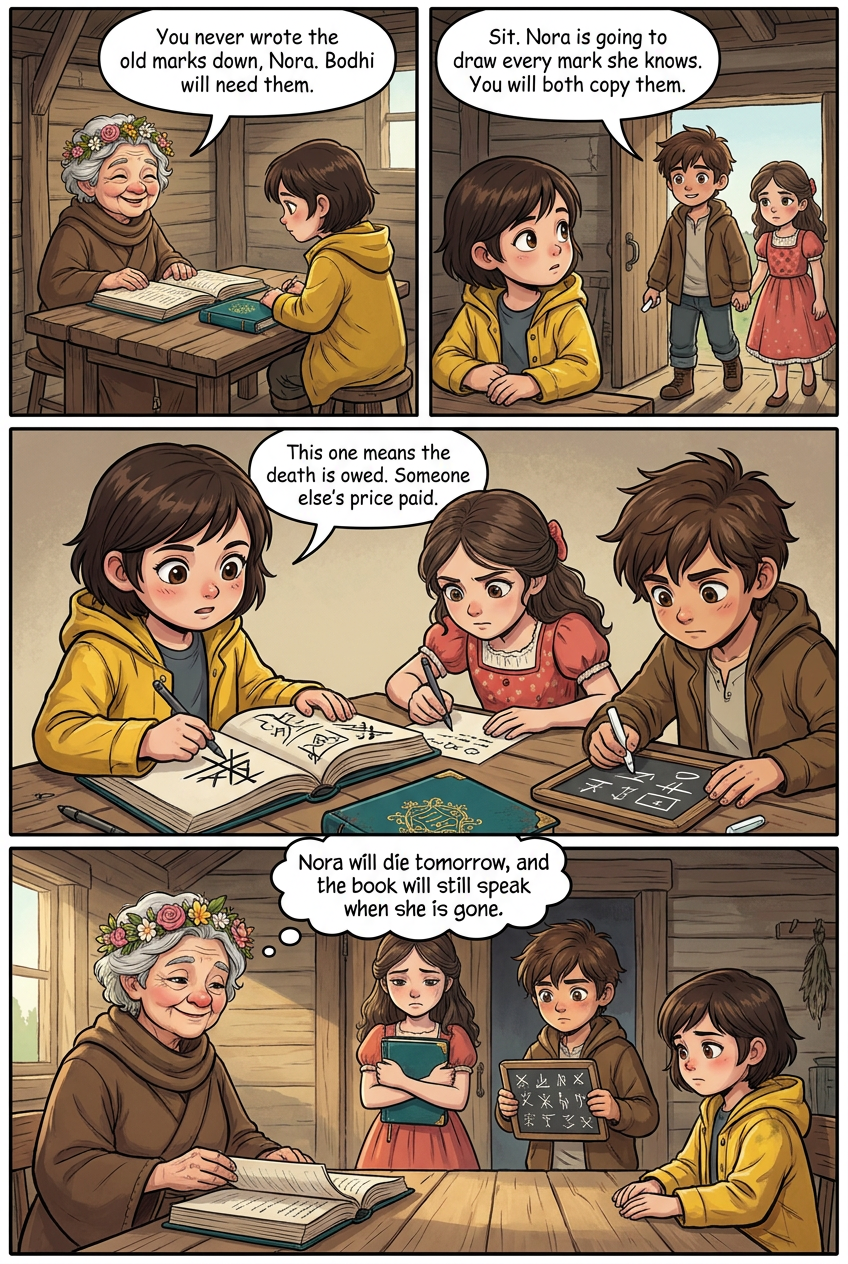
The morning after the two crosses, Elsa walked to the driftwood hut before dawn. Nora was awake, sitting at the table in her yellow slicker, the ledger open in front of her. Her death date was written on the page for tomorrow. Elsa sat across from her and set the teal journal down between them. "You never wrote the old marks down," Elsa said. "The ones your mother taught you. The hooks. The half-circles. The one that means a debt walks with the name." Nora put her hand flat on the page. "I know them by feel. I never needed the shape on paper." "Bodhi will need the shape on paper. I can read the crosses and the circles. Dahlia can read those too. Neither of us knows the older ones. When you're gone tomorrow, he inherits a book he can't finish reading." Nora looked at the ledger a long time. "There are nineteen marks I never taught anyone." "Then teach them today." Elsa sent for Bodhi and Dahlia. They came through the low door together, Dahlia in her hooded coat, the boy with his chalk stub already in his fist. Dahlia stopped when she saw the ledger open. She had never been allowed to touch it before. "Sit," Elsa said. "Both of you. Nora is going to draw every mark she knows. You are both going to copy each one until your hands remember. Dahlia will hold the key after. Bodhi will learn from her." Dahlia's jaw tightened. Elsa watched her hands. The knuckles went white on the edge of the table, then loosened. "A ledger key," Dahlia said. "In writing. Same as the seat." "In writing," Elsa said. She opened the teal journal to a blank page and slid it toward Dahlia. "You draw them here as she names them. This book stays with Fern. You keep the copy you make today." Nora took the pen. She drew the first mark, a hook curled back on itself. "This one means the death is owed. Someone else's price paid on this name." She drew the next. "This means the name was written twice. Only the second one counts." Bodhi copied each shape onto his slate with the chalk. Dahlia copied into the journal in a careful, cramped hand. Nora went slow. She named each mark, then its use, then the mistake most likely to be made with it. Elsa watched Bodhi's face. He did not look afraid. He looked like a boy learning a trade. They worked past noon. Nora's hand shook near the end. On the nineteenth mark she set the pen down and pushed the journal toward Dahlia. "That's all of them," she said. Elsa closed the ledger. Dahlia held the teal journal against her chest with both hands. Bodhi's slate was full of shapes he could name. Nora would die tomorrow, and the book would still speak when she was gone.
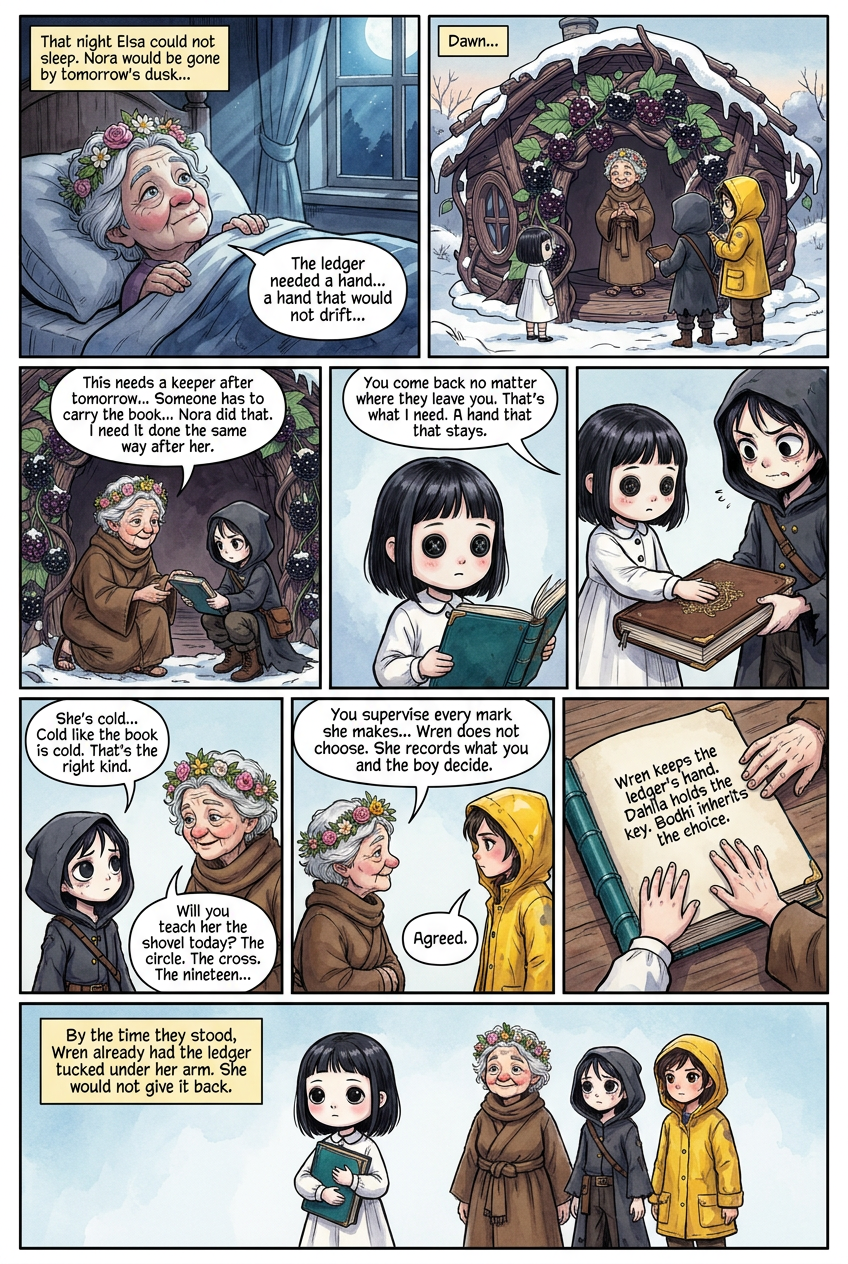
That night Elsa could not sleep. Nora would be gone by tomorrow's dusk. Dahlia held the ledger key now, and Bodhi held the chalk, but neither could dig graves or write the names down as the bodies came. The ledger needed a hand at the shovel, a hand Elsa trusted, a hand that would not drift when she was in the ground beside Nora. She thought of the porcelain-faced girl who kept returning no matter where they left her. The girl in the white dress with buttons for eyes. Wren. At dawn Elsa sent word to the blackberry arch. She asked Nora to walk, though the walking cost her. She asked Dahlia to come from the passage. She asked Wren to come from wherever the girl slept now, which no one could say for certain. She went first herself and stood under the snow-heavy vines, waiting. Dahlia came first, hood drawn. Nora came slow, her yellow slicker open, the ledger against her ribs like a second lung. Wren was already inside the arch when Elsa turned. The girl had not walked up the path. She was simply there, small and stiff, black button eyes fixed on Nora's book. "Sit," Elsa said. They crouched in the snow under the berries. Elsa put her hand on Nora's ledger. "This needs a keeper after tomorrow. Dahlia reads the marks. Bodhi will grow into it. But someone has to carry the book to the grave and write the name while the dirt is fresh. Nora did that. I need it done the same way after her." Dahlia's jaw set. "Not me. I teach the boy. I don't dig." "I know," Elsa said. She looked at Wren. "You come back no matter where they leave you. That's what I need. A hand that stays." Wren said nothing. She reached out one small hand and laid it flat on the ledger's cover. Nora watched the girl. Her mouth twitched once. "She's cold," Nora said. "Cold like the book is cold. That's the right kind." "Will you teach her the shovel today?" Elsa asked. "The circle. The cross. The nineteen. She only needs to know where the pen goes and where the dirt goes." Nora nodded. "One day is enough for a hand that stays." Elsa turned to Dahlia. "You supervise every mark she makes, same as Bodhi. Wren does not choose. She records what you and the boy decide." Dahlia looked at Wren a long time. The girl did not blink. Dahlia said, "Agreed." Elsa took the teal journal from her coat and wrote it in: Wren keeps the ledger's hand. Dahlia holds the key. Bodhi inherits the choice. She passed it around. Each of them touched the page. By the time they stood, Wren already had the ledger tucked under her arm. She would not give it back. Elsa did not ask her to.
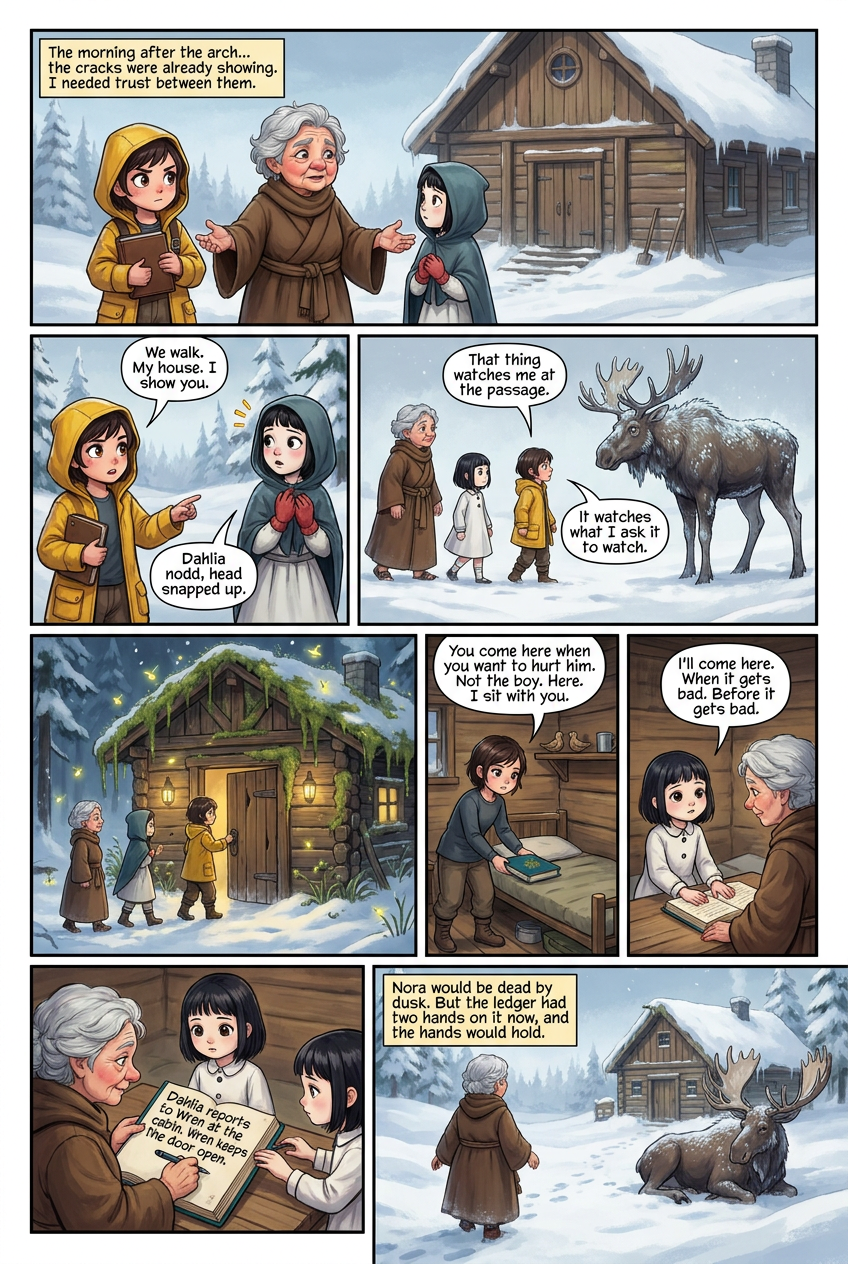
The morning after the arch, Elsa found Wren waiting outside the meeting hall with the ledger under her arm. Dahlia came up the path a moment later, hood low, hands red from the cold. The three of them had work ahead, and Elsa could feel the cracks already. Dahlia would not look at Wren. Wren would not look at anyone. Elsa needed trust between them before Nora went into the ground, or the ledger would split the day after. "We walk," a small voice said. It was Wren. She had not spoken in days. Dahlia's head snapped up. Wren pointed past the huts, toward the tree line where the pines thinned. "My house. I show you." Elsa understood then. The girl who kept coming back no matter where they left her was offering the place she came back from. Elsa nodded. Dahlia hesitated, then followed. Wren led them past the last fence and into the snow beyond the village edge. A moose stood among the pines, its fur stiff with frost, its stare fixed on them without blinking. Dahlia stopped. "That thing watches me at the passage," she said. Elsa had seen it too, the same moose that had witnessed her deal with Dahlia over Bodhi. "It's mine," Elsa said. "It watches what I ask it to watch." Wren kept walking. The moose turned its head to track them and did not move otherwise. The cabin sat in a hollow under the moose's line of sight. Moss covered the roof and dripped down the walls. Lightning bugs drifted at the eaves though the snow was deep. Wren pushed the door open. Inside, a single cot. A row of small carved birds on a shelf. A tin cup. Nothing else. Wren set the ledger on the cot. She turned to Dahlia. "You come here when you want to hurt him," she said. "Not the boy. Here. I sit with you." Dahlia's mouth opened. Elsa watched the woman's fists uncurl at her sides. Outside, no roots cracked. The pines held still. Dahlia said, "Why show me this." Wren answered, "So you know where I go. So you know I come back." Dahlia lowered herself onto the cot beside the ledger. She put her hand flat on the cover the way Wren had at the arch. She looked at Elsa. "I'll come here," she said. "When it gets bad. Before it gets bad." Elsa took the teal journal from her coat and wrote a new line beneath the others: Dahlia reports to Wren at the cabin. Wren keeps the door open. She handed the pen to each of them. Both touched the page. Outside, the moose lowered its head to the snow. Elsa closed the door behind them and started back for the village. Nora would be dead by dusk. The ledger had two hands on it now, and the hands would hold.
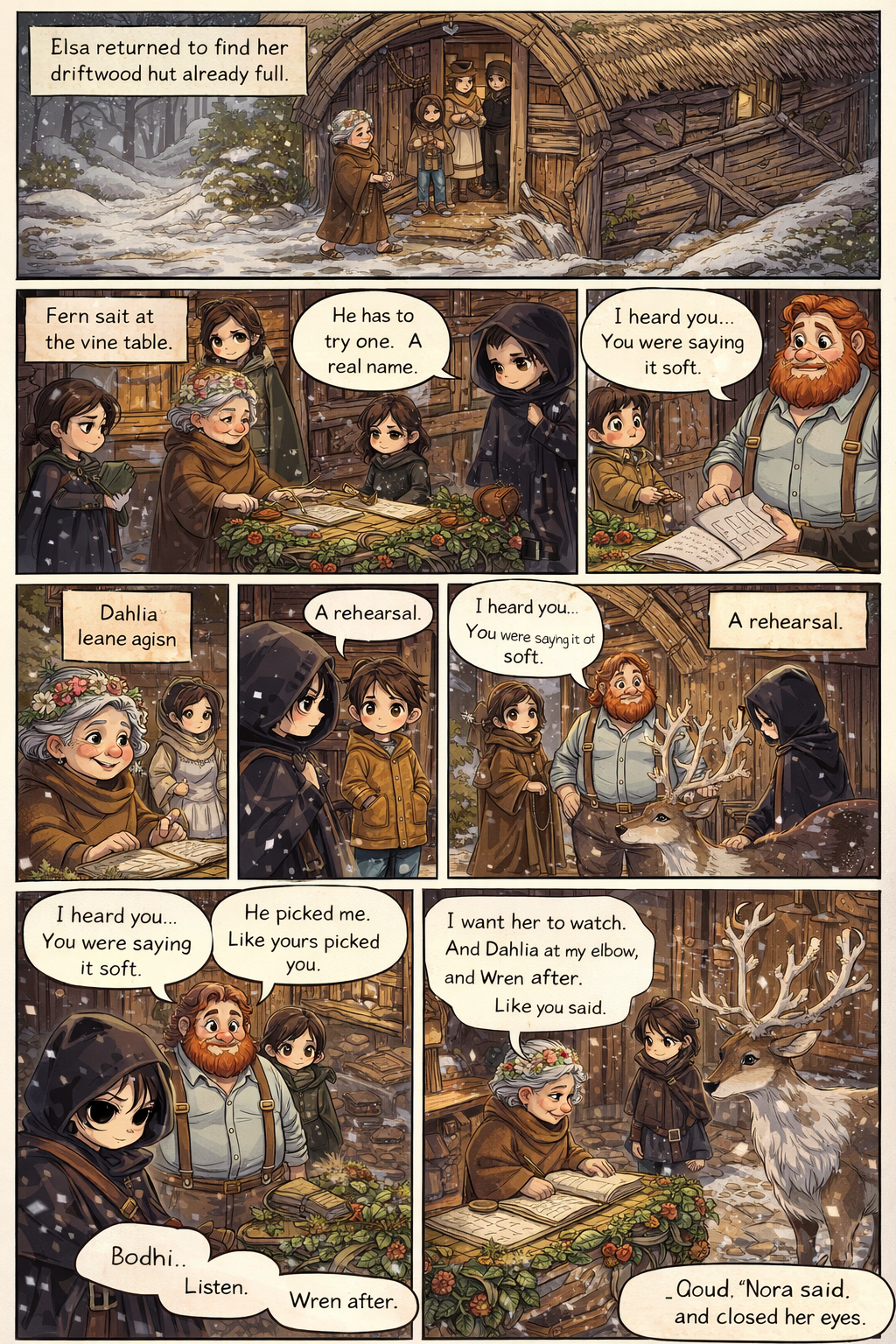
Elsa came back from Wren's cabin to find the driftwood hut already full. Fern sat at the vine table with the potion bottles pushed aside to make room for the ledger. Clara stood behind her. Dahlia leaned against the wall, hood down for once. Jasper filled the doorway. They had come without being called, which meant the village had already felt Nora's last hour. "He has to try one," Clara said. "A real name. Before Nora's gone. If the first choice he ever makes alone is on the day he inherits, he'll freeze and pick nothing, or pick wrong." Elsa set her gloves on the vine table. "Then we bring him a small one. A dog that bit a child last week. Old, sick, mean. A cross he won't doubt. Dahlia at his elbow. Wren's hand on the pen after." "A rehearsal," Fern said. "A rehearsal." The door opened before Jasper could step aside. Bodhi came in with snow on his parka and chalk on his fingers. Behind him, ducking its antlers under the driftwood arch, walked a reindeer. Frost caked its rack. Its coat steamed in the warm room. It stopped at Bodhi's shoulder and stood the way the moose stood for Elsa, patient, watching the humans without blinking. No one moved. Clara's hand went to her mouth. Dahlia straightened off the wall. "I heard you," Bodhi said. He was looking at Elsa. "Through the door. You were saying it soft." Elsa did not lie. "We were." He put his hand on the reindeer's neck. "You have the wolf. And the moose. He came to the schoolhouse fence this morning and put his head over. I put my hand on him. He stayed." He swallowed. "He picked me. Like yours picked you." The reindeer lowered its head an inch, no more. Bodhi's chalk-stub was tight in his other fist. "I want to do it while she's still here. Nora. I want her to watch. And Dahlia at my elbow, and Wren after. Like you said." Elsa looked at Fern. Fern looked at the reindeer at the boy's shoulder and gave a small nod. Clara said, "He's ready or he isn't. We don't get to wait for surer." Elsa opened the ledger on the vine table. She spoke the dog's name aloud, and the reason, and what a cross would mean, and what a circle would mean. Bodhi listened. Dahlia stood at his elbow. Jasper closed the door behind the reindeer's flank. Bodhi took the pen. His hand shook once, then steadied against the reindeer's warm side. He wrote the name. He drew the cross. He drew the circle around it, the way Elsa had taught him for a clean, chosen death. Dahlia checked the mark and nodded. Wren stepped in from the back room, took the pen from him, and set it down. "Good," Nora said from the cot in the corner, and closed her eyes.
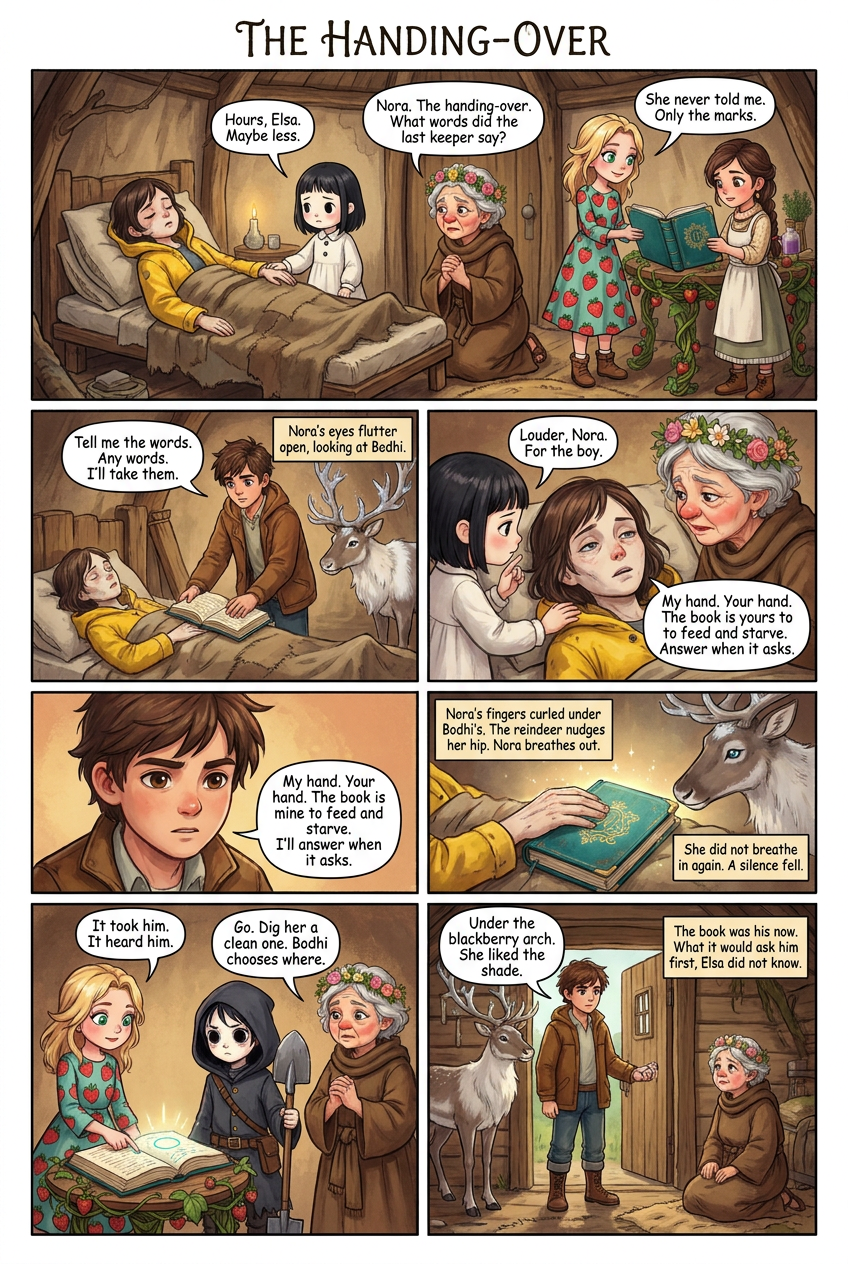
Nora's eyes stayed closed after she praised Bodhi's mark. Her breath went shallow. Clara moved to the cot and touched her wrist, then looked back at Elsa and shook her head once. Hours, not days. Maybe less. Elsa knelt by the cot. The ledger sat open on the vine table behind her, Bodhi's fresh cross-and-circle still wet. "Nora. The handing-over. What words did the last keeper say to you?" Nora's mouth moved. No sound came. She turned her head a fraction toward the ledger, then toward Bodhi. Her hand lifted an inch off the blanket and fell. "She never told me," Dahlia said from the wall. "She taught me the marks. Not that." Fern opened the teal journal and paged fast. "Nothing here. Elsa, you never wrote it." "I never knew it." Elsa's throat closed. She had built the whole succession and left the hinge out. If Nora died silent, the ledger would be paper. Bodhi could mark it. The marks might mean nothing. Bodhi came to the cot. The reindeer followed and stood at the foot of it, antlers brushing the driftwood beam. Bodhi took Nora's hand and put it flat on the ledger, then put his own hand over hers. "Tell me the words," he said. "Any words. I'll take them." Nora's eyes opened halfway. She looked at him, not at Elsa. Her lips shaped something. Elsa leaned close and heard only air. "Louder, Nora," Clara whispered. "For the boy." Nora drew one breath. She said, "My hand. Your hand. The book is yours to feed and starve." Her voice was thread-thin but clear. "Answer when it asks." Bodhi's face did not move. "My hand. Your hand. The book is mine to feed and starve. I'll answer when it asks." Nora's fingers curled under his once. The reindeer lowered its head and set its muzzle against the blanket at her hip. Nora breathed out. She did not breathe in again. No one spoke. Dahlia crossed to the ledger. She watched the page where Bodhi had marked the dog. A second mark appeared beside Nora's own name in the ledger, drawn by no hand Elsa could see. A small circle. Clean. Chosen. "It took him," Dahlia said. "It heard him." Wren stepped forward and picked up the shovel leaning by the door. She looked at Elsa and waited. "Go," Elsa said. "Dig her a clean one. Bodhi chooses where." Bodhi lifted his hand from Nora's. Chalk dust smeared the back of it. He looked at Elsa, and for the first time she saw the ledger's weight settle behind his eyes, not borrowed from her. "Under the blackberry arch," he said. "She liked the shade." He walked out with Wren and the reindeer. Elsa stayed by the cot. The book was his now. What it would ask him first, she did not know.
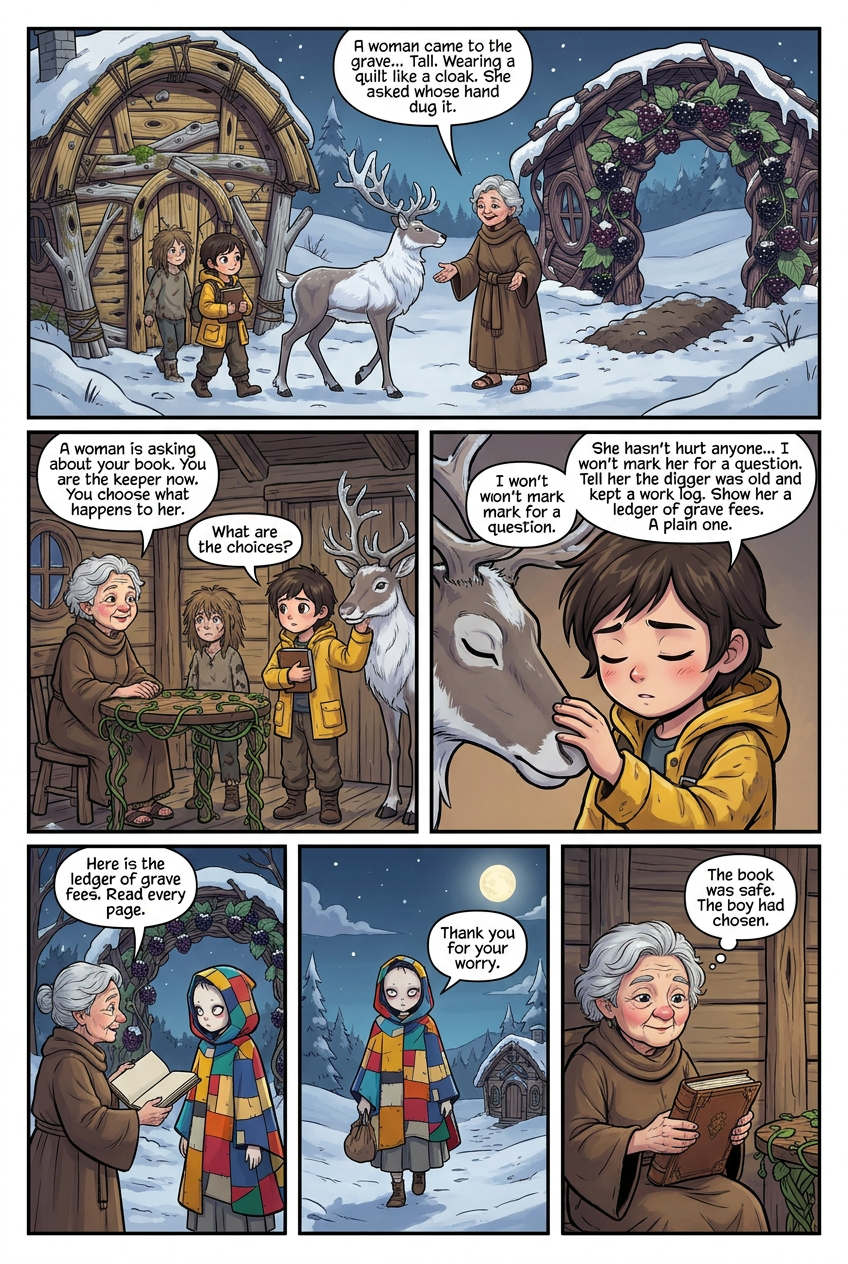
Wren and Bodhi came back at dusk with dirt on their sleeves. The reindeer walked between them. Nora lay under the blackberry arch now, a fresh mound of soil showing dark through the snow. Elsa met them at the door of the hut and saw Fern already climbing the path with news on her face. "A woman came to the grave," Fern said. "Tall. Wearing a quilt like a cloak. She asked whose hand dug it. She asked if the digger kept a book." Elsa's smile did not move. Inside her chest, something did. "Where is she now?" "Repairing a doll on the miller's step. She said her name is Dara Colm. She said she mends toys wherever she stops." Elsa knew the name from no one. That was the problem. A stranger at Nora's grave, asking after the ledger before the soil had settled. Elsa brought Bodhi inside and sat him at the vine table. Dahlia stood at the wall. Wren set the shovel down. The reindeer put its head through the door and stayed there. "A woman is asking about your book," Elsa said. "She cannot see it. She cannot hear its name from any mouth in this village. You are the keeper now. You choose what happens to her." Bodhi laid his chalk on the table. He looked at Dahlia. "What are the choices?" "Send her off with a lie," Dahlia said. "Mark her. Or watch her and wait." "Marking her is a life," Wren said. "You said each name is a real person." Bodhi's hand went to the reindeer's muzzle. The animal breathed against his palm. He closed his eyes. Elsa watched him weigh it the way she had taught him to weigh the wife-beater and the stalker, and the dog before that. He was not guessing. He was choosing. "She hasn't hurt anyone," he said. "Not that we know. I won't mark her for a question." "Then?" Elsa said. "Send her off. But not with a lie she can catch us in." He opened his eyes. "Tell her the digger was old and kept a work log. Show her a ledger of grave fees. A plain one. Let her read every page. Then thank her for her worry and give her bread for the road." Dahlia's mouth twitched. "A false book." "A true one for a false question," Bodhi said. "Wren can keep the fee book from now on. The other stays with me." Elsa felt the weight shift off her shoulders and settle onto his. It did not lift. It moved. "Do it," she said. By dark, Wren had a clean ledger of copper and bread on the table. Elsa met Dara Colm at the arch with warm hands and the fee book open. Dara read three pages, set it down, and thanked her. She walked out of Alpenglow before the moon rose. The book was safe. The boy had chosen. Elsa went home and did not sleep.
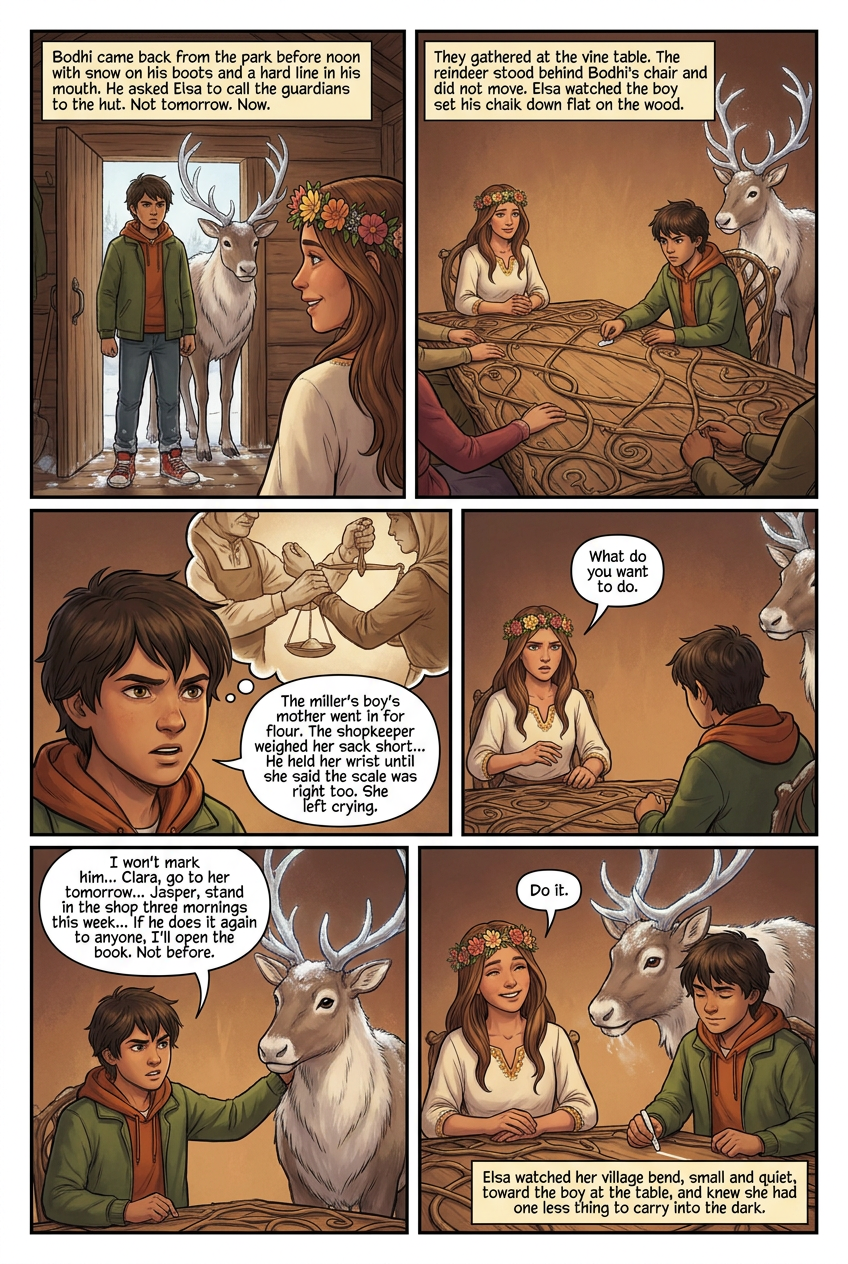
Bodhi came back from the park before noon with snow on his boots and a hard line in his mouth. The reindeer walked at his shoulder. He had been playing tag with the cobbler's twins an hour before. Now he asked Elsa to call the guardians to the hut. Not tomorrow. Now. Elsa sent Wren for Dahlia, Fern for Clara, and Jasper came on his own with wood shavings still on his sleeves. They gathered at the vine table. The reindeer stood behind Bodhi's chair and did not move. Elsa watched the boy set his chalk down flat on the wood, the way a man sets down a tool he means to use. "I saw something at the shop this morning," Bodhi said. "The miller's boy's mother went in for flour. The shopkeeper weighed her sack short. She saw it. He knew she saw it. Then he put his hand on her wrist and told her the scale was right. He held her wrist until she said the scale was right too. She left crying. He smiled at me over the counter." Nobody spoke. Dahlia's fingers curled on the table edge. Clara's face went still. Jasper looked at Elsa. Elsa kept her hands loose in her lap. This was the moment. A name alone, chosen by him, with no wife-beater or stalker set in front of him for practice. If he swung too wide, the village would feel it before spring. "What do you want to do," Elsa said. Not a question. A test. Bodhi put his hand on the reindeer's neck. He closed his eyes the way he had for Dara Colm. When he opened them he looked at Dahlia first. "I won't mark him," he said. "He hurt her, but he hasn't killed anyone. A cross is too big for a thumb on a wrist." He turned to Clara. "You go to her tomorrow with bread. Ask about the baby. Let her tell you the rest herself. If she does, I'll know it's true and not just what I saw." He turned to Jasper. "You stand in the shop three mornings this week. Buy nothing. Just watch him weigh. He'll feel you there." Then to Elsa. "If he does it again to anyone, I'll open the book. Not before." Dahlia let out a breath she had been holding. Clara nodded once. Jasper reached across and squeezed the boy's shoulder with his big hand. Elsa felt the room settle around him instead of around her. He had not marked. He had not looked away. He had made four people move without lifting the pen. "Do it," Elsa said. Bodhi picked up his chalk. The reindeer breathed against his hair. Elsa watched her village bend, small and quiet, toward the boy at the table, and knew she had one less thing to carry into the dark.
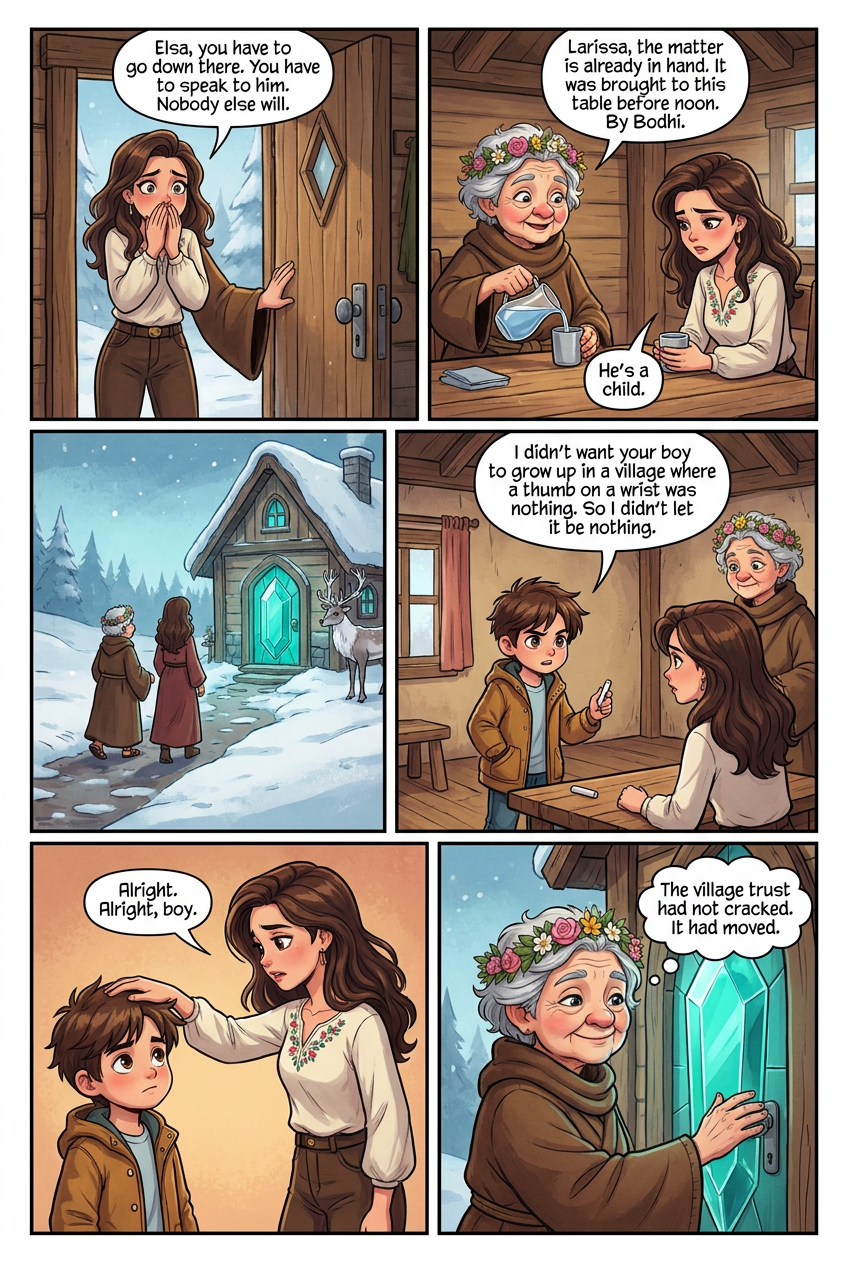
The knock came before Elsa had cleared the vine table. Bodhi was already gone to the cottage with the reindeer at his heel. Elsa opened the door and found the miller's wife on the step, her long curls damp from the walk, both hands pressed to her mouth. Larissa Miller did not cry easily. She was crying now. "He grabbed her wrist," Larissa said. "Marta's wrist. In the shop. My boy saw it and told me at supper." She stepped inside without waiting. "Elsa, you have to go down there. You have to speak to him. Nobody else will." Elsa took her elbow and sat her at the table. She poured water. She let the woman drink before she answered. Larissa did not know Bodhi had already ruled. That was the trouble. If Elsa said the boy has handled it, Larissa would hear the boy has done nothing. If Elsa went to the shop herself, she would undo everything Bodhi built that morning. Either way the trust in the village would crack. "Larissa," Elsa said. "The matter is already in hand. It was brought to this table before noon." Larissa's face closed. "By who." "By Bodhi." Larissa set the cup down hard. "He's a child." "He is what comes after me," Elsa said. "You gave your voice for him at the crowning. I am asking you to give it once more, in private, where it costs something." She stood and reached for her wool robe. "Come with me. Hear him say it himself. If you leave the cottage still unhappy, I will go to the shop tonight with my own hands." Larissa's mouth pinched, but she rose. They walked the path to the strawberry cottage in silence. The crystal door glowed teal in the winter light. Fern opened it. The reindeer stood by the hearth. Bodhi was at the low table with his chalk, drawing nothing, just turning it. "The miller's wife wants to hear you," Elsa said. Bodhi stood up. He did not look at Elsa for a cue. He looked at Larissa. "I saw him do it to Marta. I sent Jasper to stand in the shop three mornings. I sent Clara to Marta with bread. If he touches another woman that way, I open the book on him. I didn't want your boy to grow up in a village where a thumb on a wrist was nothing. So I didn't let it be nothing." Larissa's shoulders dropped. She looked at him a long moment. Then she crossed the room and put her hand flat on the top of his head, the way a mother does. "Alright," she said. "Alright, boy." Elsa stepped back into the doorway. Larissa had come for the elder and left believing the child. The village trust had not cracked. It had moved. Elsa closed the teal door behind them and felt the weight in her chest shift one notch lighter.
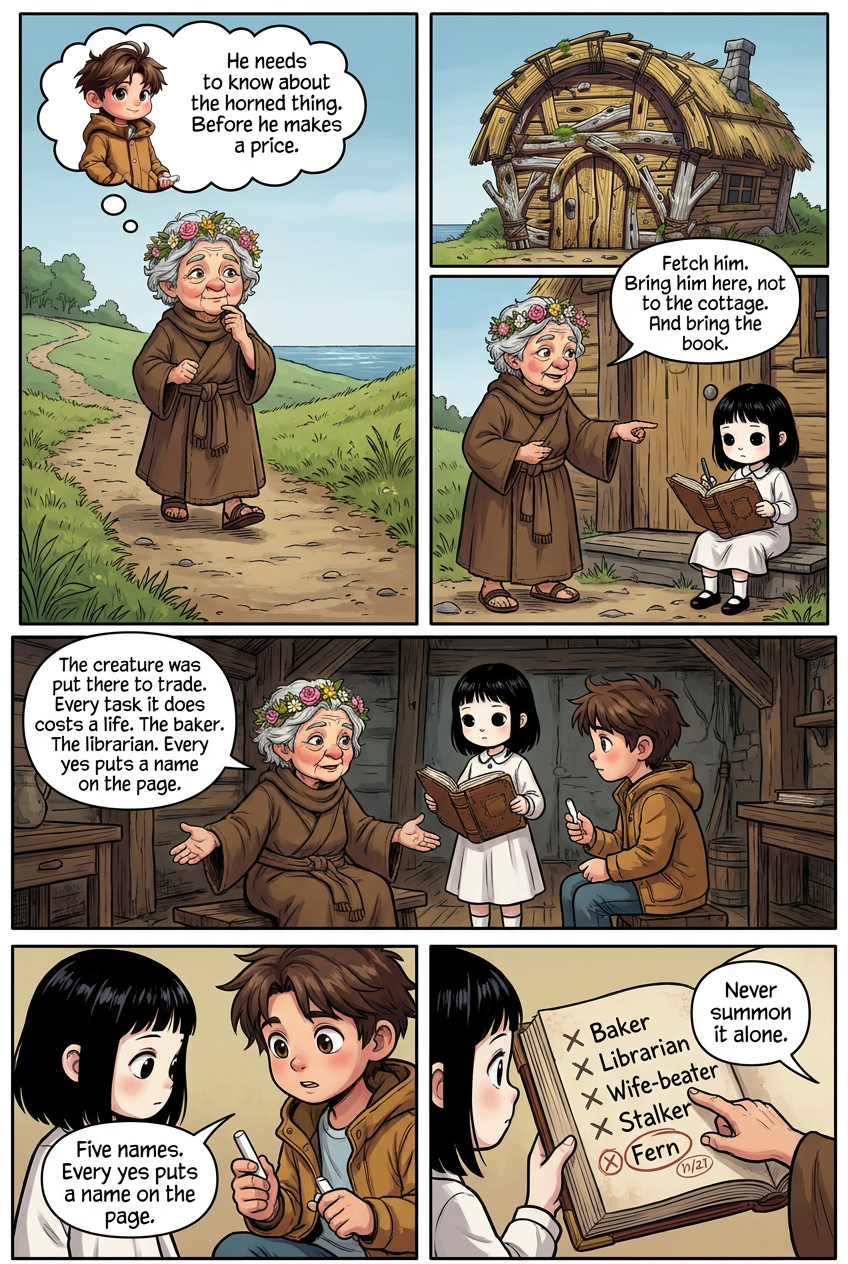
Elsa walked home from the cottage and knew she had put off the worst lesson too long. Bodhi could read the ledger. He could rule a shopkeeper. He could crown himself. But he had never been told where the horned thing under the fortress came from, or what it counted. If she died tonight, he would meet it again someday and think a life was a fair price for a small thing. She needed Wren. She found Wren on the step of the driftwood hut, knees together, black-button eyes fixed on the path as if she had known Elsa was coming. Wren was the quiet girl who kept returning no matter where the village left her, and now she carried the ledger's pen. She stood without being told and followed Elsa inside. "Fetch him," Elsa said. "Bring him here, not to the cottage. I need the hut for this. And bring the book." Wren went. She came back with Bodhi and the ledger under her arm. The reindeer waited outside. Bodhi sat at the low bench with his chalk. He looked at Elsa's face and put the chalk down. "I have to tell you a thing," Elsa said. "I should have told you the first time I took you down. Wren is here because she keeps the book now, and the book is the proof." She told him. She said the horned creature was not born under the fortress. Men put it there long ago, in chains, because it would trade. She said every task it did cost a life, and every life it took made the next task cheaper to ask for. She said she had summoned it twice. She named the baker. She named the librarian. She said Fern's month was still counting down because of a bargain Elsa made to keep his name off its page. Bodhi did not cry. He looked at Wren. "Show me." Wren opened the ledger. She turned to the pages Elsa had made her mark and set her small finger on each cross. Baker. Librarian. Wife-beater. Stalker. Fern's name, circled and dated to the next moon. "Five," Bodhi said. "Five," Elsa said. "Because I asked. It will offer you a good price someday. A quick answer to a hard problem. You will want to say yes. Every yes puts another name on that page. Say it back to me." "Every yes puts a name on the page," Bodhi said. "Never summon it alone," Elsa said. "Never summon it without Wren and the book in the room." He nodded. He picked up his chalk and drew a small horned mark on the bench, then rubbed it out with his thumb. Elsa sat back. The last secret was out of her chest and into his. The village had a leader who knew the cost.
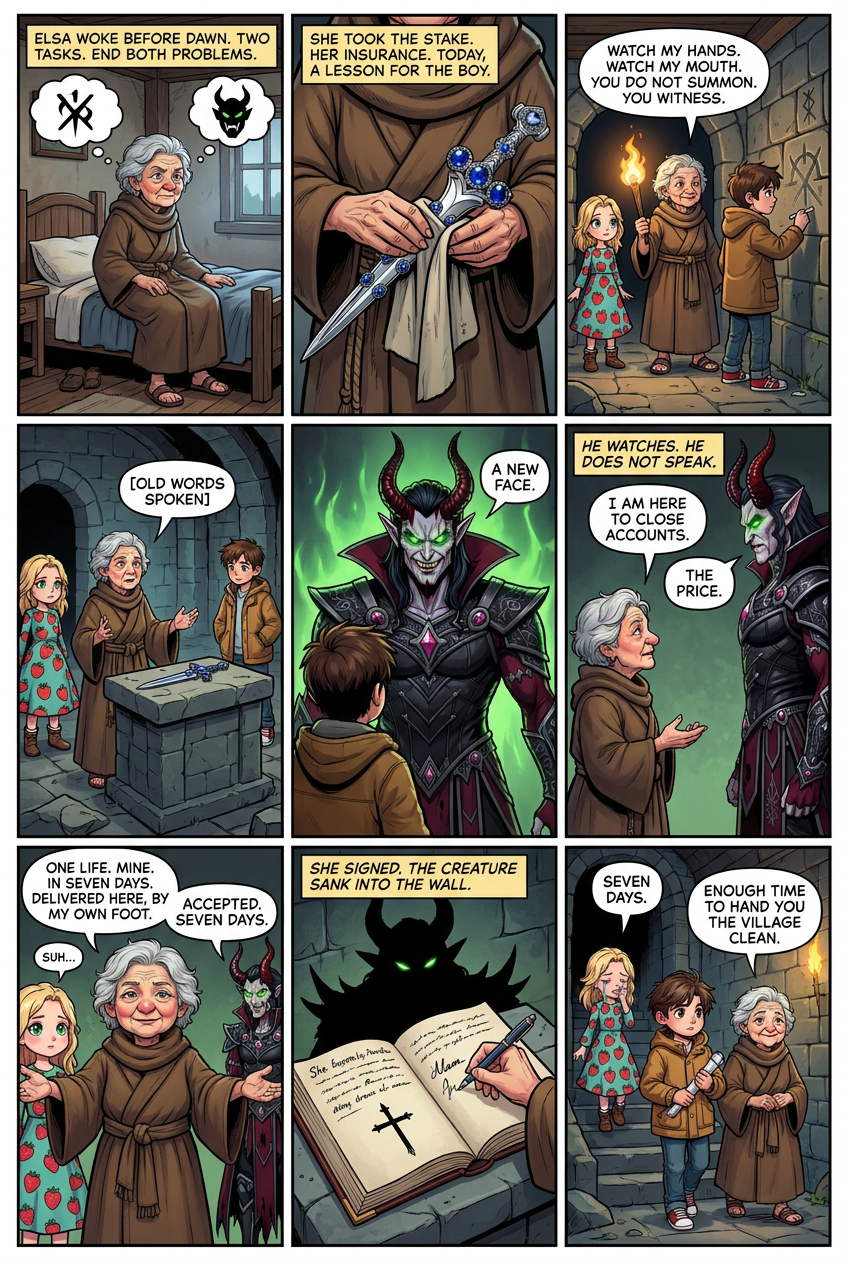
Elsa woke before dawn with the shape of the week already fixed in her mind. Two tasks left. Fern still carried the creature's mark, counting down to the next moon. Bodhi had heard about the horned thing but had never watched a summoning, and a first summoning done wrong would cost him his life. She would end both problems in one descent. She sent Wren for the boy and the ledger. She sent word to the cottage for Fern. She took the sapphire-studded stake down from its hook and wrapped it in cloth. The stake had been her insurance every time she stood before the creature. Today it would be the boy's lesson in what to hold and what to show. They met at the mouth of the mystic cellar. Fern came in her strawberry dress, her crystal key on its cord, eyes tight. Bodhi came in his big parka with chalk in his fist. Wren carried the book. Elsa took a torch from the wall and led them down between the carved symbols Bodhi had been drawing since he could hold chalk. He touched the wall as he passed. He did not speak. At the chamber floor Elsa set the stake on the stone where the boy could see it. "Watch my hands," she said. "Watch my mouth. You do not summon him. You witness. Wren keeps the book open. Fern stands behind me. If I fall, none of you bargain. You climb out." She spoke the old words. The air thickened. The horned one rose out of the dark of the far wall — tall, black-haired, horns streaked red, eyes burning green above a mouth of long teeth. He looked at the boy first. He smiled. "A new face," he said. "He watches," Elsa said. "He does not speak. I am here to close accounts." She named her terms plainly. Fern's mark lifted. Bodhi's name, and every name of every guardian at his table — Wren, Dahlia, Clara, Jasper, Fern — sealed off his page forever. No collateral. No return claim. "The price," the creature said. "One life. Mine. In seven days. Delivered here, by my own foot, no one carrying me." Fern made a sound. Elsa did not turn. The creature considered her a long moment. He looked at the boy again. Then he inclined his horns. "Accepted. Seven days." Wren opened the ledger. Elsa took the pen from her small hand and wrote her own name, and drew the cross herself, and dated it. She gave the pen back. The creature sank into the wall. On the stairs Fern was crying without sound. Bodhi walked beside Elsa with the stake in his arms. "Seven days," he said. "Enough time," Elsa said, "to hand you the village clean." He nodded once. He did not let go of the stake.
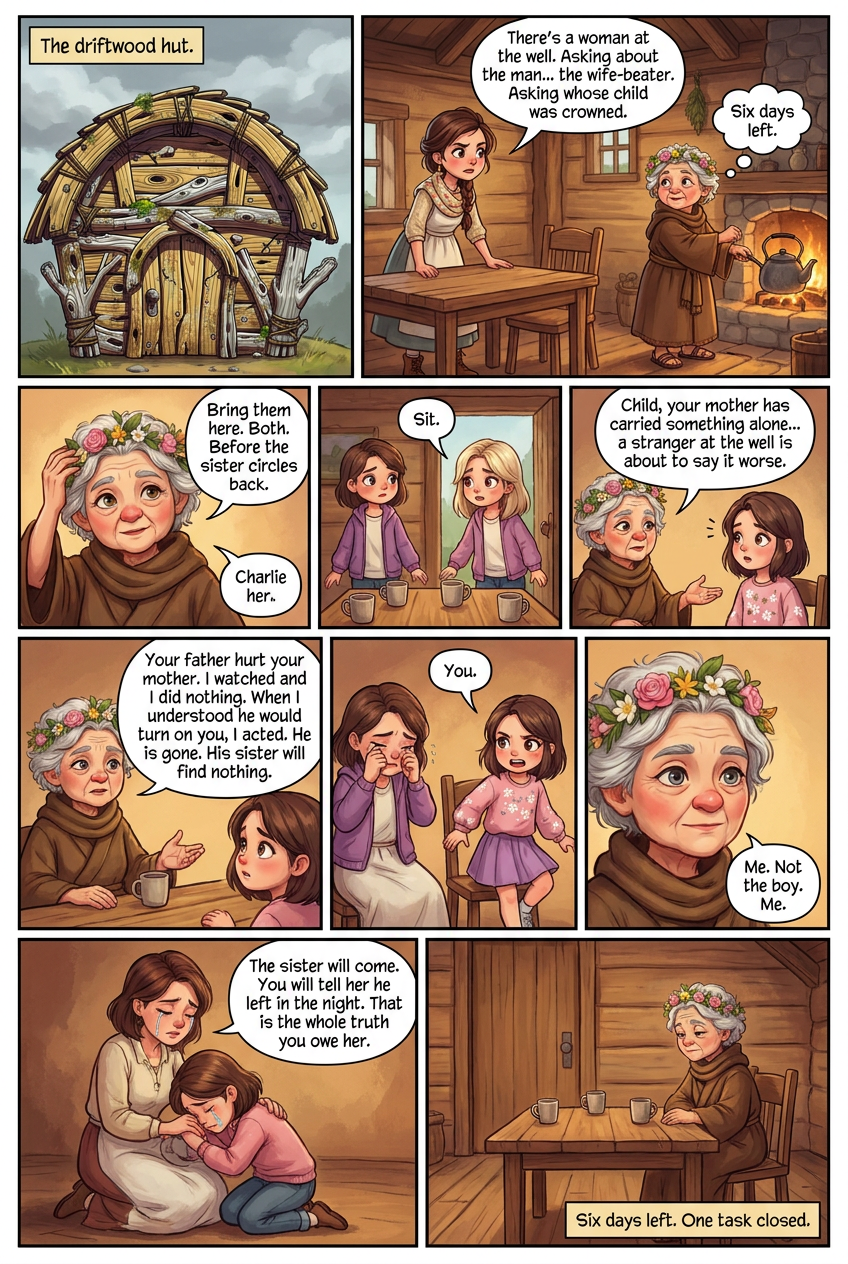
Clara came through the door of the driftwood hut before the kettle sang. She did not take off her shawl. She stood by the table and gripped the back of a chair until her knuckles paled. "There's a woman at the well," Clara said. "Sister to the man you marked. The wife-beater. She's asking who saw him last. She's asking whose child was crowned the week he vanished." Elsa set down the kettle. Six days left. If the sister reached Bodhi with those questions in her mouth, the crown on his head would rot before the village's eyes. "Who has she spoken to?" "Charlie Morrison. And Lynn. At the well this morning. Charlie went quiet. Lynn asked her mother what the woman meant." Clara's voice dropped. "Lynn doesn't know what her father did. Charlie never told her." Elsa touched the flower-crown at her temple and smoothed it. "Bring them here. Both. Before the sister circles back." Clara went. Elsa banked the fire and set out three cups. She thought of the scars along Charlie's forearms that no one in the village ever named aloud. They came within the hour. Charlie in her lavender jacket, hands tucked deep in the pockets. Lynn behind her in the pink floral shirt, brown eyes flicking from the low ceiling to the cups to Elsa's face. "Sit," Elsa said. She poured. She waited until Charlie's shoulders eased a fraction. Then she looked at Lynn. "Child, your mother has carried something alone for a long time. I am going to say it now, because a stranger at the well is about to say it worse." Lynn's cup stopped halfway to her mouth. "Your father hurt your mother. For years. The scars on her arms are his. I watched and I did nothing, and I am ashamed of that. When I understood he would turn on you next, I acted. He is gone. He is not coming back. His sister is here looking for him. She will find nothing." Charlie's face crumpled. Lynn set the cup down without a sound. She looked at her mother's sleeves, then at Elsa. "You," Lynn said. Not a question. "Me," Elsa said. "Not the boy. Not anyone at his table. Me." Charlie began to cry. Lynn slid off the chair and knelt beside her mother and pressed her forehead to Charlie's knee. Elsa waited. Then, gently: "The sister will come to your door. You will tell her he left in the night. You did not see where. You were glad. That is the whole truth you owe her." Charlie nodded into her daughter's hair. "Clara will walk you home," Elsa said. "She will stay through supper." When the door shut, Elsa sat alone with three cooling cups. She had bought Bodhi's crown six more days. The sister would leave with a widow's story and no name to carry. The stain would not reach the boy. Six days left. One task closed.
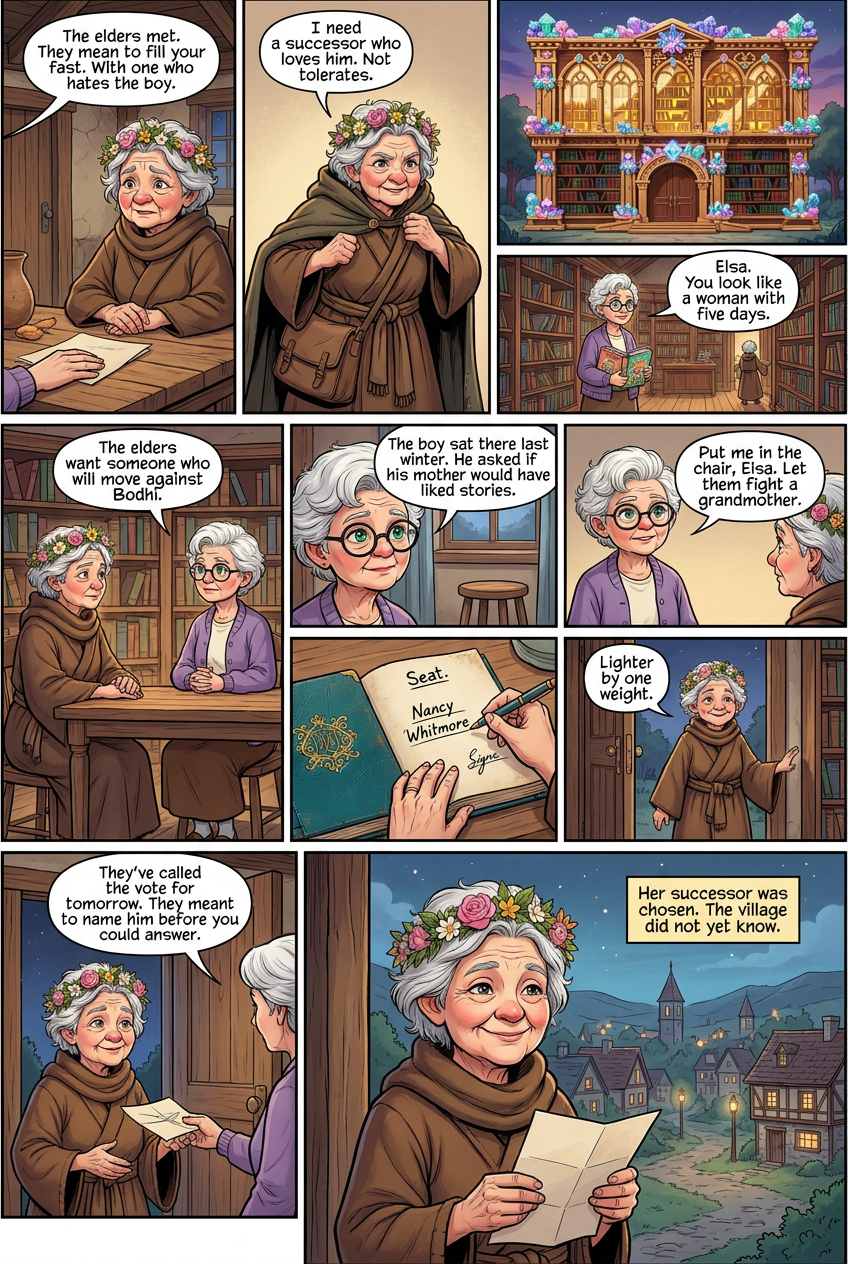
Clara returned at dusk and reported Charlie and Lynn were settled. Then she set both hands flat on Elsa's table. "The elders met without you. They're talking about your seat. When you're gone, they mean to fill it fast. The name they keep circling is one that hates the boy." Elsa did not ask which name. She knew. A cousin of the missing man's sister, loud at the well, already whispering that Bodhi's crown smelled of fresh dirt. Bodhi held the ledger. Bodhi held the wolf and the reindeer. But he did not hold her chair at the meeting hall, and a chair filled by an enemy would undo the rest inside a season. Five days left. She had built regents, teachers, keepers. She had not named who would sit in her own place and speak for the boy when he was still too young to speak for himself. She pulled on her wool robes and walked to the library. The crystal-hung door opened before she knocked. Nancy Whitmore stood in the warm glow of the shelves, a stack of children's readers against her hip. The old librarian had taken the post to keep her hands busy after her husband died. She greeted every child by name and every stranger like a grandchild. Elsa had watched her hand cookies to Bodhi across the counter for a year without ever asking anything of him. "Elsa." Nancy set the books down. Her emerald eyes went straight to Elsa's face and stayed there. "You look like a woman with five days." "You've heard." "I hear everything in this room. Sit." Elsa sat. "The elders want my chair. They want someone who will move against Bodhi the day I'm buried." "I know who they want." Nancy folded her hands. "He came in yesterday and asked what books the boy borrows." "I need someone in that seat who loves him. Not tolerates. Loves." Nancy was quiet a long moment. She looked at the shelves, then at the door where children scuffed their boots each afternoon. "I have no children of my own left," Nancy said. "The boy sat on that stool by the window every Thursday last winter. He asked me once if his mother would have liked stories. I told him yes." She met Elsa's eyes. "Put me in the chair, Elsa. I'll take it." "They'll fight it. They wanted a man." "Let them fight a grandmother who's read to half their children." Nancy almost smiled. "They'll lose." Elsa took the teal journal from her satchel and wrote Nancy's name beside the seat. Nancy signed beneath it in a steady hand. Elsa walked home lighter by one weight. Four days left. The chair was filled. At her door, Clara waited with a folded paper. "The elders sent this an hour ago. They've called the vote for tomorrow at noon. They didn't tell you because they meant to name him before you could answer." Elsa took the paper. Her successor was chosen. The village did not yet know.
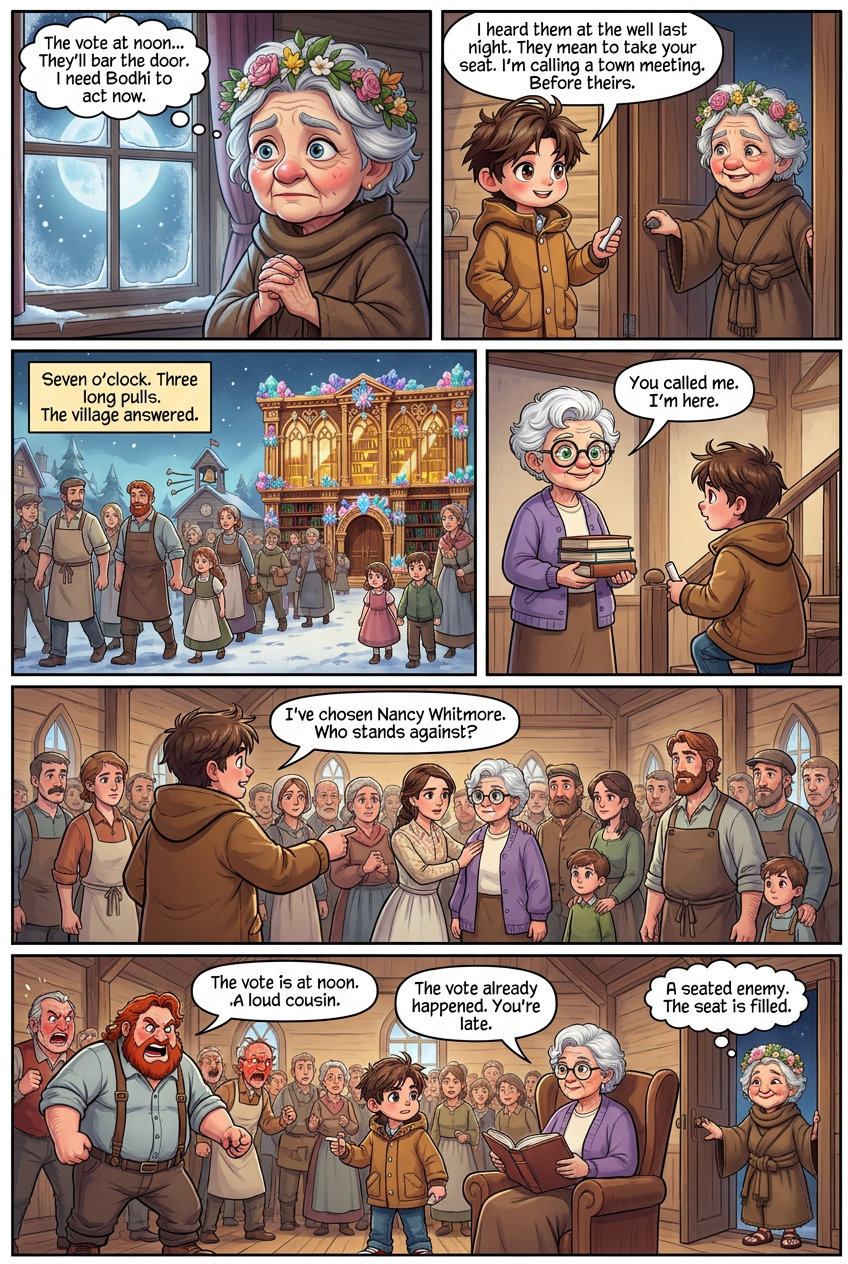
Elsa did not sleep. The elders had called the vote for noon. If Nancy walked to the meeting hall at that hour, the elders would bar the door and swear her in against an empty chair. She needed the village in the room before the elders arrived, and she needed Bodhi to be the one who put Nancy there. At first light, Bodhi crossed the frost to her door. He wore his brown parka and held a stub of chalk. His face was set in a way she had not seen before. "I heard them at the well last night," Bodhi said. "They mean to take your seat. I'm calling a town meeting. Before theirs. I want Nancy named where everyone can see." Elsa looked at him. He was small in the doorway. He was also the ledger keeper, and the wolf's boy, and the village's crowned child. She stepped aside and let him in. "Say it your own way," she told him. "I'll stand behind you." Bodhi went to Jasper first, then Clara, then Fern. Fern rang the schoolhouse bell at seven — three long pulls, the call the village used for births and fires. Mothers came out in their aprons. Fathers came from the sheds. By the time the elders heard the bell, half of Alpenglow was already walking toward the meeting hall. Elsa reached the hall behind the crowd. Nancy stood at the front step in her purple cardigan, a stack of readers still under her arm as if she had come straight from the shelves. Her white hair was uncombed. Her green eyes moved across the faces of the children and stopped on Bodhi. "You called me," Nancy said to him. Not to Elsa. "I'm here." Bodhi climbed the step. He did not use the chalk. He spoke plainly. "Elsa's chair needs filling. I've chosen Nancy Whitmore. Jasper stands with me. Clara stands with me. Fern stands with me. The wolf stands with me. Elsa stands with me." He looked out. "Who stands against?" Larissa Miller stepped forward and put her hand on Nancy's arm. The cobbler's wife did the same. Then a dozen more. No one spoke against. The elders arrived at a run. Three of them, red-faced, the loud cousin among them. They saw the crowd and stopped at the edge. "The vote is at noon," the cousin said. "The vote already happened," Bodhi said. "You're late." Nancy climbed to the chair inside the hall. She sat down in it without ceremony and opened one of her readers on her lap, as if the room were a library and the children were waiting. Elsa watched from the doorway. The seat was filled by a grandmother the village loved. The elders had nothing to swear anyone into. Four days remained. Outside, the cousin was already whispering to the man beside him. Elsa marked the sound. A seated enemy was worse than a standing one — and he had just become one.
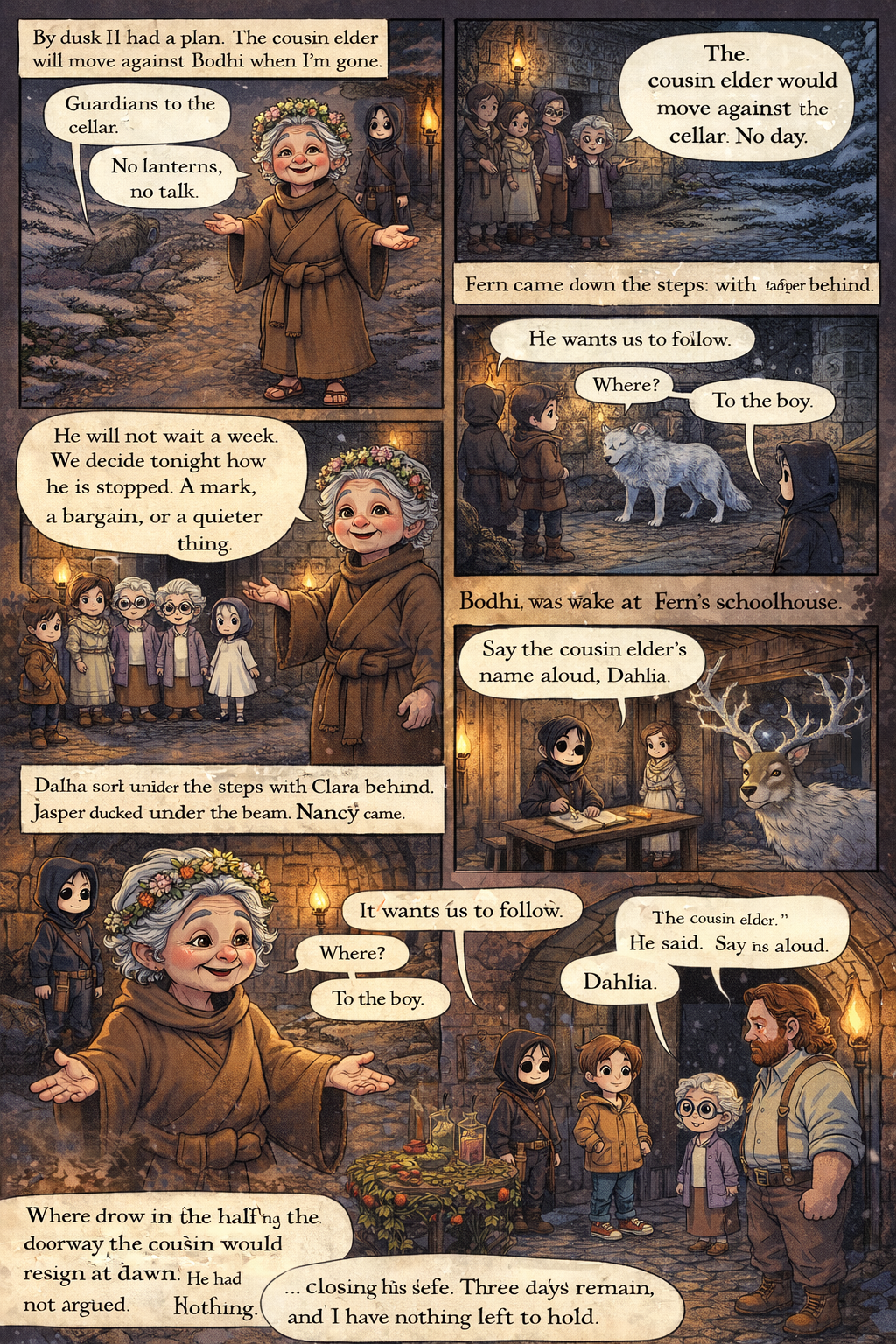
By dusk Elsa had a plan and three days left. The cousin elder would move against Bodhi the moment she was gone. She would not leave a seated enemy behind her. She sent word through Jasper: guardians to the cellar under the meeting hall at full dark. No lanterns in the lane. No talk at the well. She went down first. The stone room smelled of wet root and old smoke. The carved symbols on the walls caught the torchlight and threw it back in patches. She set the sapphire stake on the strawberry vine table and waited. Fern came down the steps with Clara behind her. Jasper ducked under the beam. Nancy came last, still in her purple cardigan, one hand on the rail. Dahlia was already there, hooded, at the far wall, running a dirt-caked finger along a mark only she and Bodhi could read. "The cousin," Elsa said. "He will not wait a week. We decide tonight how he is stopped. A mark, a bargain, or a quieter thing." Nancy opened her mouth. She did not get the word out. The wolf came down the steps. It did not look at Elsa. It walked past her, past Jasper, past the table, and stopped at the foot of the stairs on the far side. It turned its head and waited. Dahlia straightened. "It wants us to follow." "Where?" Clara said. The wolf climbed one step and looked back. Elsa understood before the others. "To the boy." They went up in single file. The wolf took them through the frost lane to Fern's schoolhouse. Bodhi was awake at the low table, the ledger open in front of him, the reindeer standing in the doorway with frost still on its antlers. He had known they were coming. He had drawn nothing on the page yet. The wolf sat at his right hand. The reindeer lowered its head at his left. Bodhi looked at Elsa and did not ask her what to do. "The cousin elder," he said. "Say his name aloud, Dahlia." Dahlia said it. Wren, who had come in behind them without a sound, opened the ledger to a clean line and set the pen beside Bodhi's hand. Bodhi did not take the pen. He looked at the wolf. The wolf held his eyes. He looked at the reindeer. The reindeer did not move. "Not a cross," Bodhi said. "He hasn't struck yet. A circle around his seat, not his life. He steps down from the elders' bench by morning, or the mark changes." He drew the circle himself. Dahlia nodded once. Wren closed the book. "Jasper," Bodhi said, "walk to his door tonight. Tell him what I've written and who watched me write it. Tell him the wolf came for the decision." Jasper went. He came back before the moon cleared the roofs. The cousin would resign at dawn. He had not argued. Elsa stood in the schoolhouse doorway. The seat behind her was safe. The boy had done it without her. Three days remained, and she had nothing left to hold.
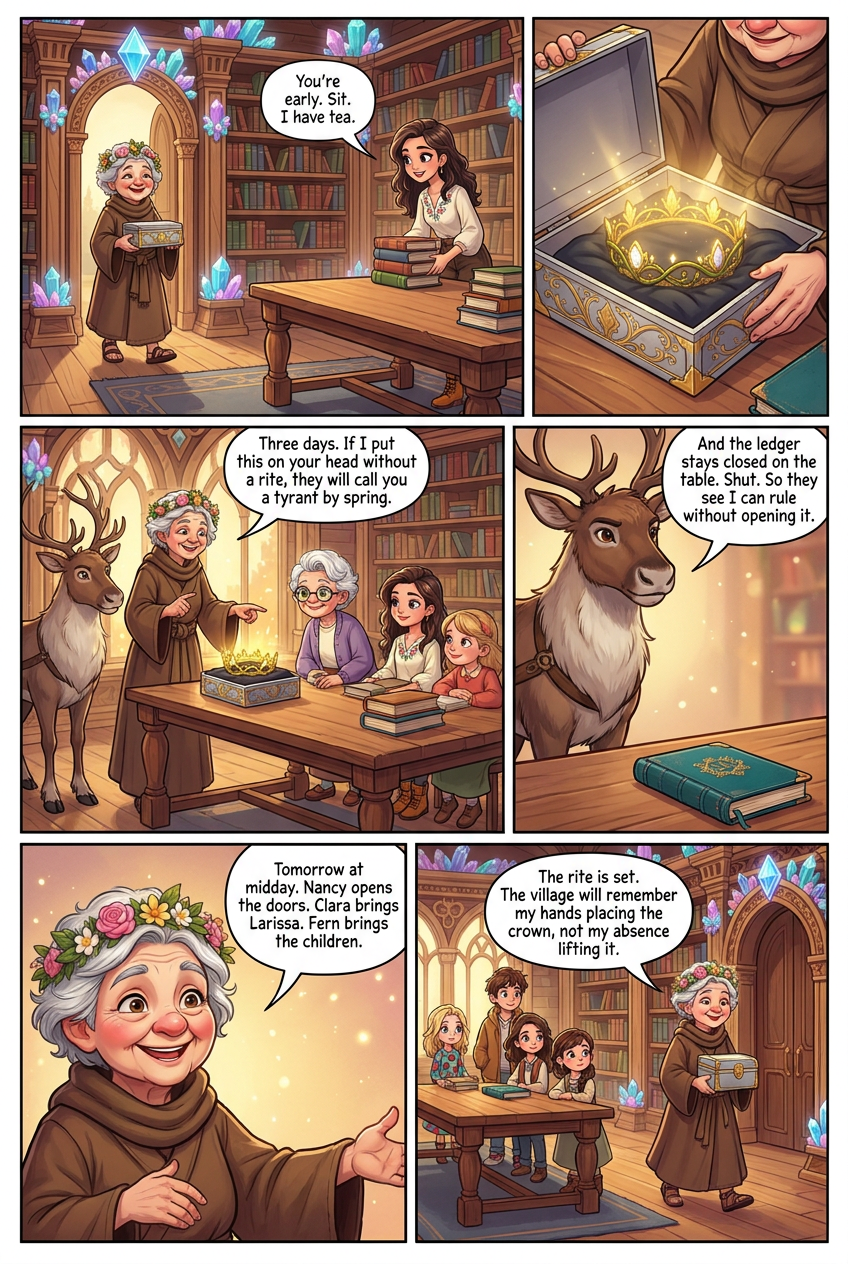
At dawn the cousin elder's resignation went up on the meeting hall door. Elsa read it twice, then folded it into her sleeve. Three days left, and she had no rite prepared to give Bodhi the seat in front of the village. A crown on a boy's head without a ceremony would make him look like a boy playing king. She needed the transfer done in daylight, with the mothers watching, or the elders would spend the winter unpicking him. She sent Jasper for the guardians and the boy. They met inside the library, where the crystals along the shelves threw pale light on the tables. Nancy Whitmore was already there in her purple cardigan, sleeves pushed up, stacking picture books for the morning children. She looked up over her round glasses and smiled the way she smiled at every child who came through the door. "You're early," Nancy said. "Sit. I have tea." Elsa did not sit. She set a silver and gold box on the reading table. She lifted the lid. Inside, on dark cloth, lay the woven crown, blackberries and strawberries alive on the vine, the whole thing glowing faintly gold. Bodhi came to the table with the reindeer at his shoulder. He did not reach for the crown. He looked at Elsa and waited. "Three days," Elsa said. "If I put this on your head without a rite, they will call you a tyrant by spring. We need a ceremony the village will remember as mine, not yours." Fern set the teal journal on the table. Clara moved to Bodhi's side. Dahlia stayed by the shelf, watching. Nancy took off her glasses and cleaned them on her cardigan. "Then let me have it," she said. "The library is the one room the mothers already trust. I'll open the doors at midday tomorrow. Bread on the tables. Children in front. You walk him in on your arm. You speak the warmth into him in front of them. Then you set the crown." "And after," Fern said, "he serves the tea. Not us. Him. To every mother in the room." Clara nodded. "Larissa first. If Larissa drinks, the rest will." Bodhi spoke for the first time. "And the ledger stays closed on the table. Shut. So they see I can rule without opening it." Elsa looked at him. He had built the second half of the rite before she'd finished the first. She closed the silver and gold box over the crown. "Tomorrow at midday," she said. "Nancy opens the doors. Clara brings Larissa. Fern brings the children. Jasper stands at the step. Dahlia stays out of sight until it is done." They agreed one by one. Elsa carried the box home herself. The rite was set. Two days after the ceremony, she would be gone, and the village would remember her hands placing the crown, not her absence lifting it.
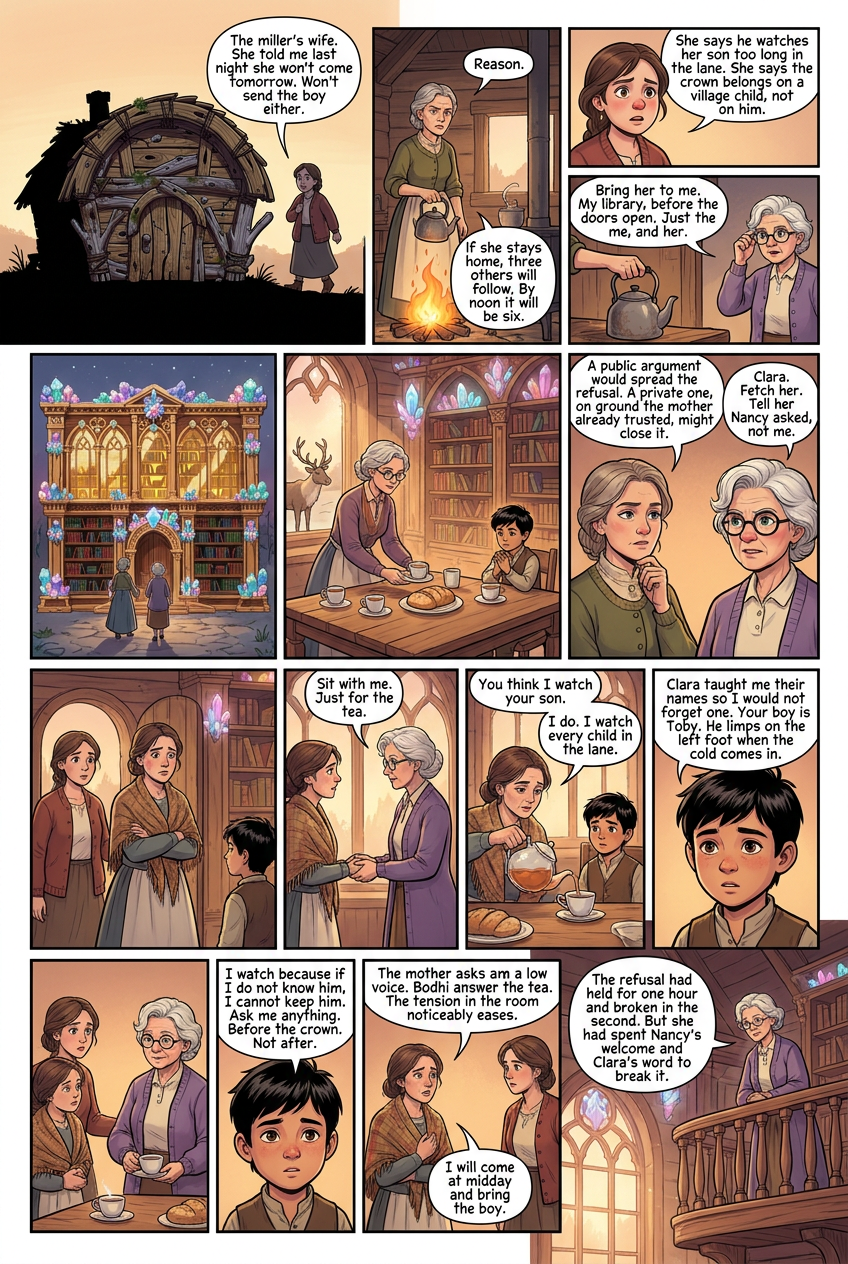
Clara came to the driftwood hut before the morning fire had caught. Nancy was with her, her purple cardigan buttoned wrong at the collar. Elsa knew before either spoke. A guardian did not bring the librarian to her door at dawn unless something in the rite had already cracked. "The miller's wife," Clara said. "She told me last night she won't come tomorrow. Won't send the boy either." Elsa set down the kettle. "Reason." "She says he watches her son too long in the lane. She says the crown belongs on a village child, not on him." Clara's braid was still damp from the wash basin. "If she stays home, three others will follow. By noon it will be six. A ceremony with empty benches will be remembered as a broken one, not a binding." Nancy pushed her glasses up her nose. "Bring her to me. My library, before the doors open. Just the boy, me, and her. No crown on the table. No ledger. Only tea and books." Elsa weighed it. A public argument would spread the refusal. A private one, on ground the mother already trusted, might close it. "Clara. Fetch her. Tell her Nancy asked, not me. Bodhi walks in on his own feet." Clara went. Elsa and Nancy walked to the library through the pale light. Nancy unlocked the wide door and lit the reading lamps under the crystals. She set out three cups and a plate of soft bread. Bodhi arrived with the reindeer at the step and left it in the yard. He sat where Nancy pointed, hands folded on the table. Clara returned with the miller's wife. The woman stopped inside the door with her arms crossed. She would not look at the boy. Nancy stood and took her hand as if she were a granddaughter come for a visit. "Sit with me. Just for the tea." The woman sat. Bodhi did not speak first. Nancy poured. Then Bodhi lifted his eyes to the mother. "You think I watch your son," he said. "I do. I watch every child in the lane. Clara taught me their names so I would not forget one. Your boy is Toby. He limps on the left foot when the cold comes in. I watch because if I do not know him, I cannot keep him." The mother's arms loosened. Nancy set the cup in front of her without a word. Clara moved to the mother's shoulder and stayed there. "Ask me anything," Bodhi said. "Before the crown. Not after." The mother asked three questions in a low voice. Bodhi answered each one plainly. She drank the tea. When she left, she told Clara she would come at midday and bring the boy. Elsa watched from the shelf. The refusal had held for one hour and broken in the second. But she had spent Nancy's welcome and Clara's word to break it. The next mother who wavered would need something she had not yet found.
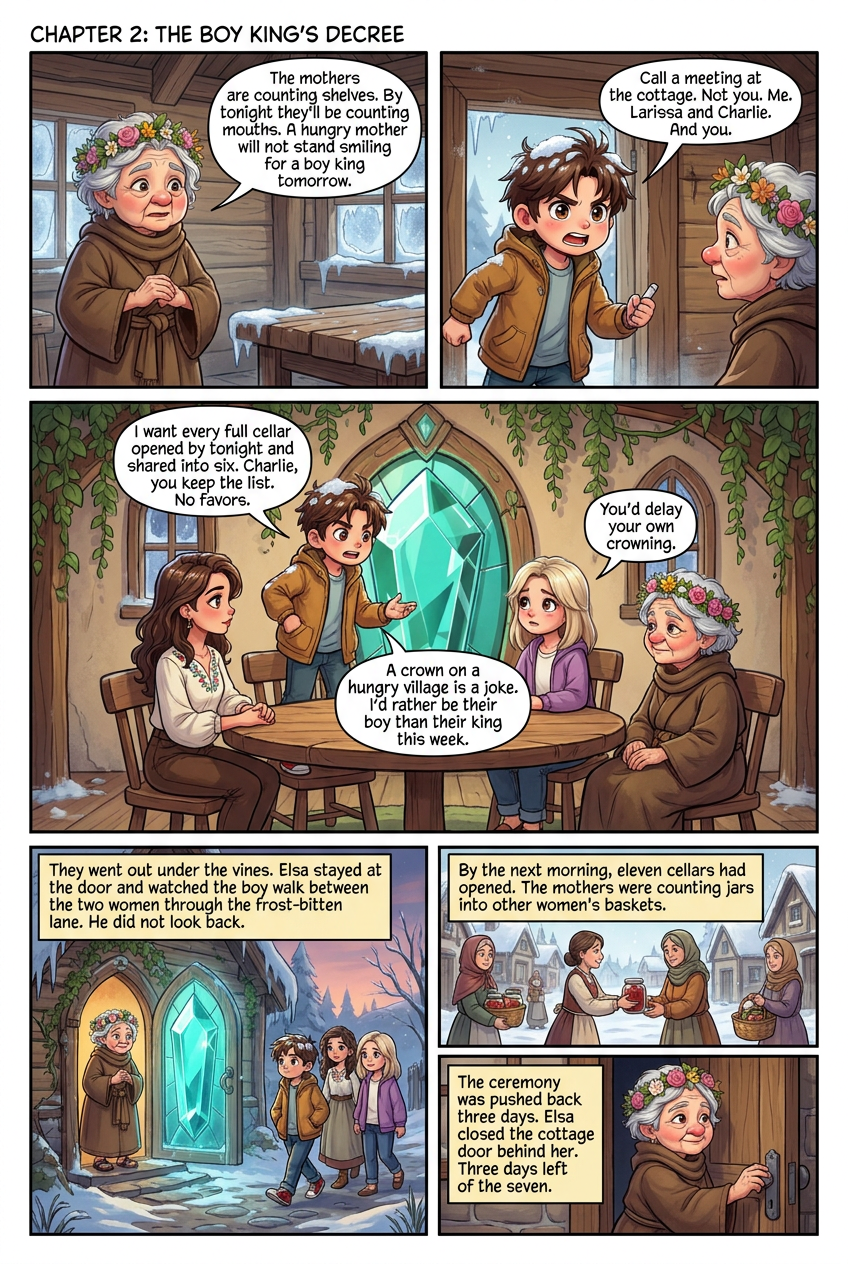
By first light, word of the frost had reached the driftwood hut. Clara came in with her boots still white at the toe. The turnip pit behind the miller's yard had crusted through. Two apple barrels behind the smokehouse were split. A third of the winter cheese wheels had sweated and gone soft in the cold snap. "The mothers are counting shelves," Clara said. "By tonight they'll be counting mouths. A hungry mother will not stand smiling for a boy king tomorrow." Elsa reached for her shawl. Before she could speak, a boot scraped the step. Bodhi came in with his chalk stub in one fist and snow melting in his hair. He had not waited to be sent for. "Call a meeting at the cottage," he said. "Not you. Me. Larissa and Charlie. And you." Elsa lowered the shawl. "Why those two." "Larissa spoke for the mothers when the shopkeeper grabbed Marta. They listened to her. Charlie has an empty cellar and no husband to feed. If Charlie says the village will eat, the frightened ones will believe her." He looked at Clara. "Bring them to the strawberry tree. Now." Clara went. They gathered inside the cottage under the teal crystal door. Larissa ducked her tall frame beneath the low vines and sat with her hands flat on the table. Charlie came last, her purple sleeves pushed up, brown eyes steady. She had not been called to a table like this before. She looked once at Elsa, then to the boy. Bodhi did not climb onto the chair. He stood. "The ceremony can wait," he said. "The pantries can't. I want every full cellar opened by tonight and shared into six. Charlie, you keep the list of who gave and who got. No one will shame my name for taking. Larissa, you walk the lane with me at dusk. If a mother sees you at my shoulder, she'll open her door." Larissa's mouth opened. "You'd delay your own crowning." "A crown on a hungry village is a joke," Bodhi said. "I'd rather be their boy than their king this week." Charlie set her palm on the table. "I'll keep the list. Straight down the middle. No favors." Larissa looked at Elsa. Elsa said nothing. This was not her table now. "At dusk," Larissa said. "I'll come for him myself." They went out under the vines. Elsa stayed at the door and watched the boy walk between the two women through the frost-bitten lane. He did not look back for her approval. By nightfall, four cellars had opened. By the next morning, eleven. The mothers who had counted mouths were now counting jars into other women's baskets. The ceremony was pushed back three days by Bodhi's own word, and no mother spoke against him for it. Elsa closed the cottage door behind her. Three days left of the seven.
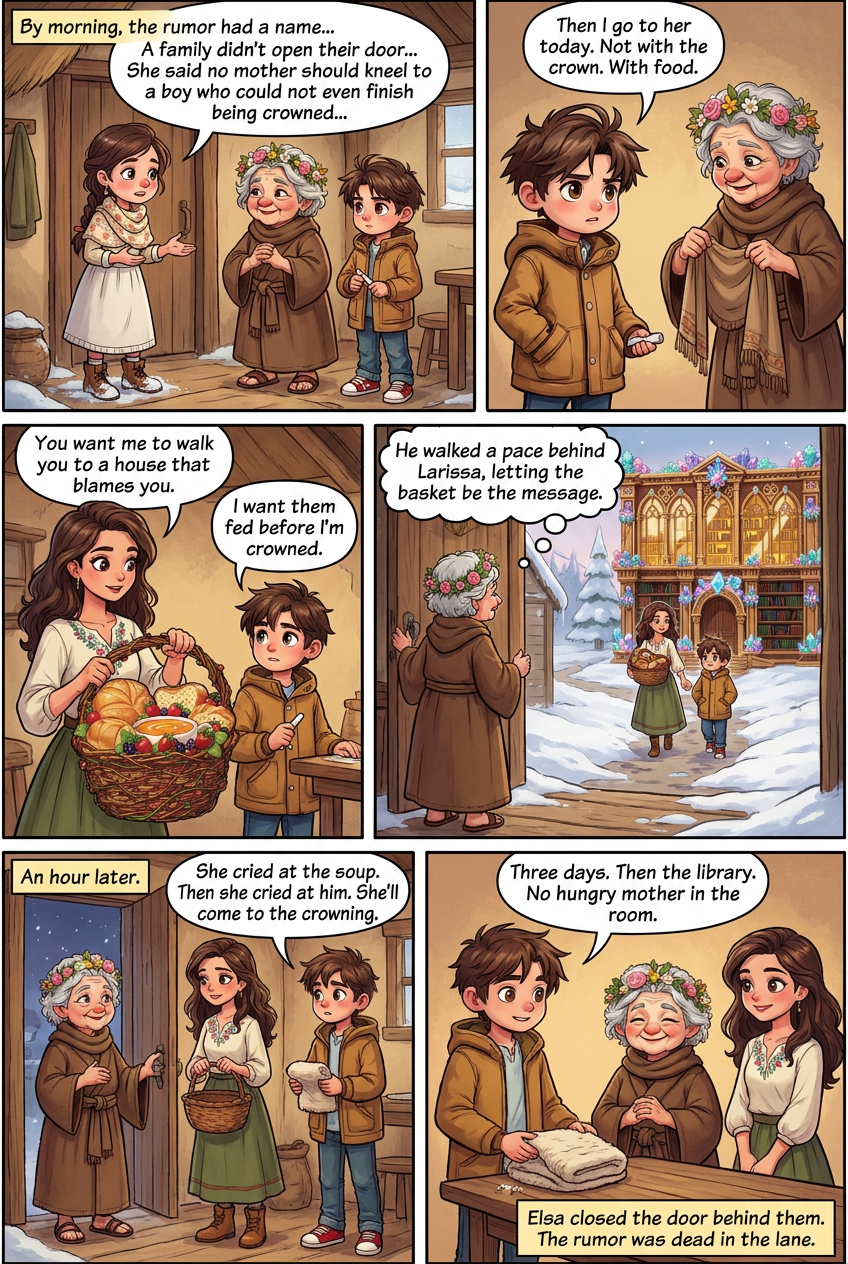
By morning, the rumor had a name attached to it. Clara brought it into the hut with a stamp of snow off her boots. A family at the far end of the lane, three children and a bedridden father, had not opened their door to the food carts. The mother stood in her yard yesterday and told anyone passing that the frost came down the night Bodhi's crown was set aside. She said the seat was half-made and the sky knew it. She said no mother should kneel to a boy who could not even finish being crowned before the cold came for their turnips. "If she says it at the well tomorrow, three more will nod," Clara said. "By the ceremony, six. That's enough to empty the library floor." Bodhi was already at the table with his chalk. He put it down. "Then I go to her today. Not with the crown. With food." Elsa reached for her shawl and stopped. He was not asking. "Larissa comes with me," Bodhi said. "They trust her. If she carries the basket, they'll open the door. If I carry it, they'll shout through the wood." Clara went for Larissa. She came within the hour, tall under the low beam, her curls pulled back for work. She looked at the boy first, not at Elsa. That was new. "You want me to walk you to a house that blames you," Larissa said. "I want them fed before I'm crowned," Bodhi said. "If they still hate me after, that's fair." Larissa's mouth tugged. She lifted the woven basket Charlie had left by the door. Fresh bread sat on top, still warm. A cup of soup was wedged in the middle, steam curling. Strawberries and blackberries were tucked along the rim. She checked the cloth underneath, then nodded. "I'll knock," she said. "You stand back until she sees me." Elsa followed as far as the crystal-lit steps of the library, where the mothers would gather in two days. She watched them go past it into the lane. The boy walked a pace behind Larissa, hands empty, letting the basket be the message. They were gone an hour. When they came back, Larissa carried the basket empty. Bodhi carried a folded scrap of wool the mother had pressed on him for the ride home. "She cried at the soup," Larissa said quietly to Elsa. "Then she cried at him. She said she'd been wrong to shout it in the yard. She'll come to the crowning. She'll bring the two who nodded with her." Bodhi set the wool on the table. "Three days," he said. "Then the library. No hungry mother in the room." Elsa closed the door behind them. The rumor was dead in the lane. Two days of the seven were left.
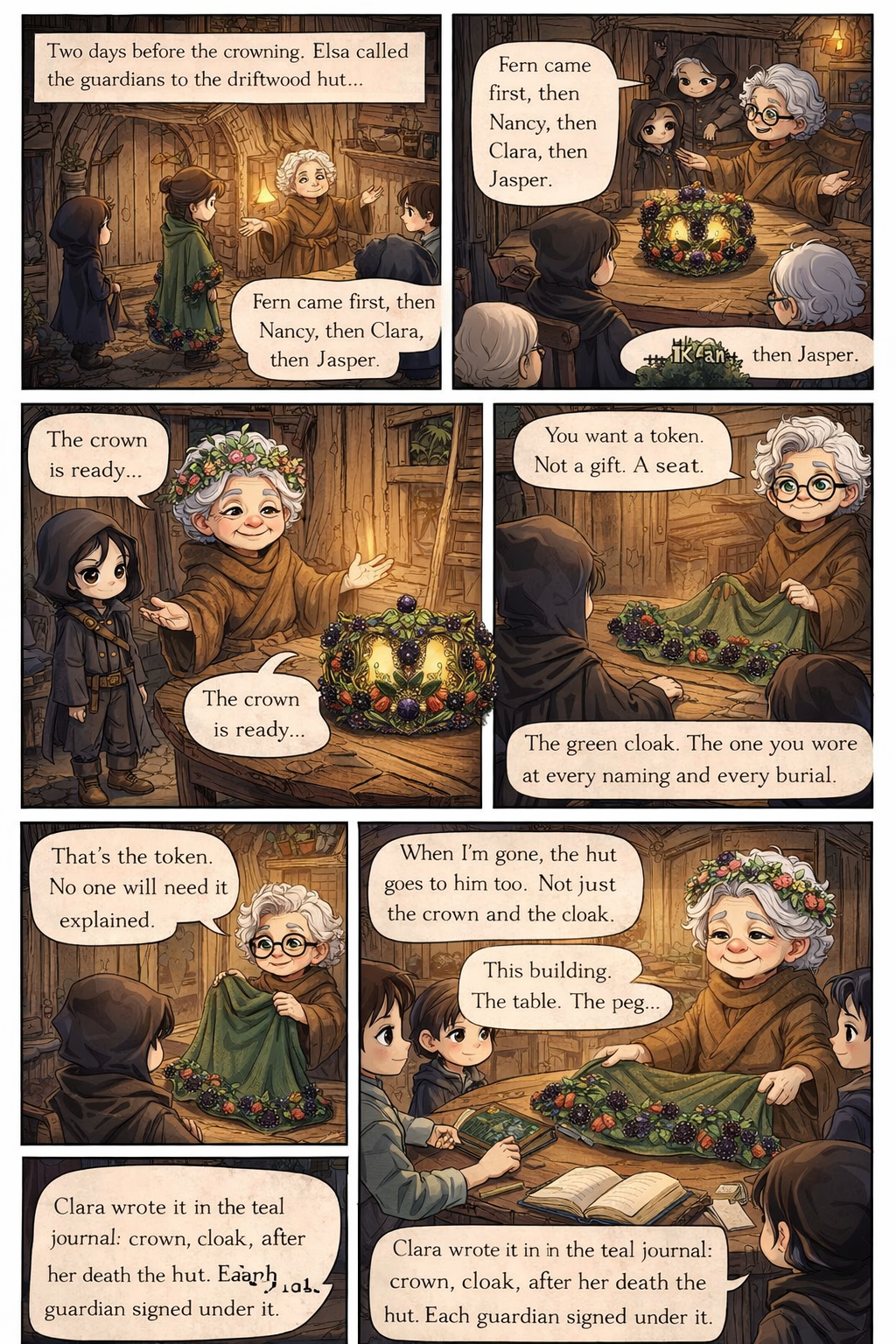
Two days before the crowning, Elsa called the guardians to the driftwood hut. Fern came first, then Nancy, then Clara, then Jasper. Wren slipped in last and took the corner stool. Bodhi was at the schoolhouse with Dahlia, learning a new letter. Elsa had wanted this hour without him. She set the woven crown on the table between them. The vines were still green. The berries had not shrunk. In the low light the gold in it looked lit from inside. "The crown is ready," Elsa said. "But a crown alone won't hold the room. The mothers will see a boy in a chair with fruit on his head. I need something they know is mine. Something I hand him in front of them so they feel the weight move." Nancy leaned her elbows on the table. "You want a token. Not a gift. A seat." "A seat," Elsa said. Fern was already looking at the peg by the door. The peg was empty now, but for years it had held one thing. "The green cloak," Fern said. "The one you wore at every naming and every burial. The mothers have watched you walk in that cloak since they were girls. If he stands under it, they'll see you standing behind him." Elsa went to the chest under the window and lifted the cloak out. Forest green wool, heavy in her hands. Strawberries and blackberries stitched along the hem and the cuffs, faded but sound. She laid it beside the crown. The two pieces looked like they had been made for the same boy. "That's the token," Clara said. "No one will need it explained." Jasper nodded once. Wren did the same. Elsa smoothed the shoulder of the cloak. Then she said the harder thing. "When I'm gone, the hut goes to him too. Not just the crown and the cloak. This building. The table. The peg. Add it to the rite. After I go, the guardians bring him here and set his hand on the door. That's how the village sees the seat is his and not just the chair in the library." The room went quiet. Nancy's eyes did not leave her. "Five days," Nancy said. "Five days," Elsa said. Fern reached across and covered Elsa's hand with her own. She didn't argue. None of them did. Clara wrote it in the teal journal in her small even hand: crown, cloak, and after her death, the hut. Each guardian signed under it. Wren signed last. Elsa folded the cloak once and set it on top of the crown. The rite was full now. The mothers would have something to watch pass from her hands to his. Two days left before the library. Five before the seventh.
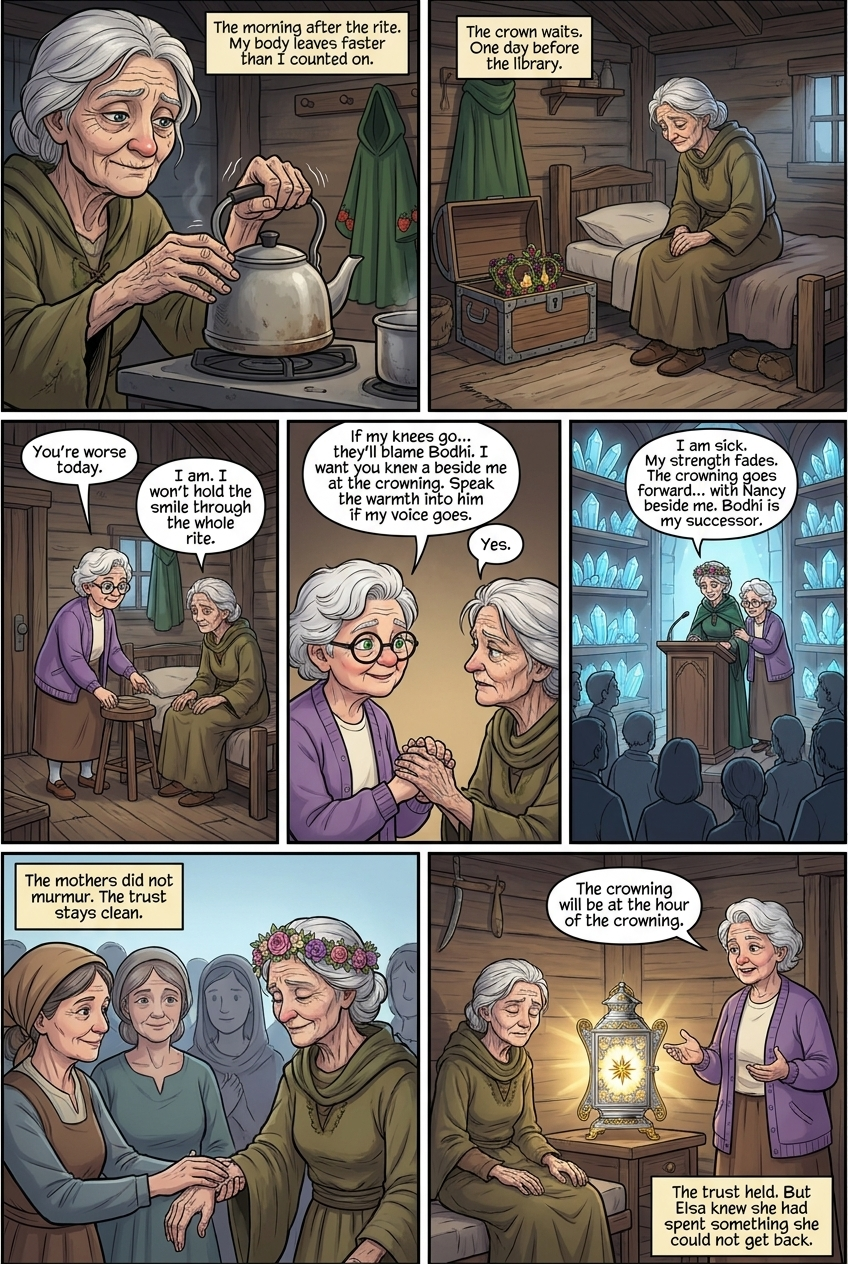
The morning after the guardians signed the rite, Elsa woke slow. Her hands shook when she lifted the kettle. She set it down again and sat on the edge of the cot. The cloak hung on its peg. The crown waited in the chest. She had one day before the library, and her body was leaving faster than she had counted on. She sent Wren to fetch Nancy Whitmore. No one else. She wanted the room quiet for what she had to say. Nancy came within the hour. White hair under a wool shawl, purple cardigan, the same warm look she gave every child at her shelves. She took one glance at Elsa on the cot and pulled a stool close without waiting to be asked. "You're worse today," Nancy said. "I am." Elsa did not soften it. "I won't hold the smile through the whole rite. If I stand up there and my knees go, or my mouth won't lift, the mothers will read it as the warmth breaking. They'll blame Bodhi before he wears the crown an hour." Nancy folded her hands. "Then don't stand alone." "That's why I sent for you." Elsa looked at her. "You already sit in my seat. The mothers trust you. The elders swallowed you. I want you beside me at the crowning, and I want you to speak the warmth into him if my voice goes." Nancy nodded once. "Yes." "There's more. We call a town meeting this afternoon. Before the ceremony. I stand up and tell them plainly I'm sick. That I'm fading. That the crowning goes forward with you beside me. If they hear it from my own mouth, they won't say later that Bodhi's rise hid a dying elder. The trust stays clean." Nancy studied her a long moment. "You're sure you can stand for the meeting?" "Once. For the meeting. I'll sit for the crowning tomorrow if I have to." "Then we do it," Nancy said. She rose and set water on for tea, moving through the hut like she already knew where every cup lived. By midafternoon the village filled the library. Warm wood, crystals humming pale blue along the shelves. Elsa walked in on Nancy's arm. She did not hide the lean. She stood at the front and told them she was ill, that her strength was going, that she had chosen Nancy to stand with her tomorrow and speak for her if needed. She named Bodhi again as her successor. She smiled the smile they knew, and she held it. The mothers did not murmur. Larissa Miller stepped forward first and laid a hand on Elsa's wrist. Charlie Morrison came next. Then three more. No one asked Elsa to step down early. No one questioned Bodhi. When Elsa sat, Nancy took the floor and told them the hour of the crowning. The room agreed with one voice. The trust held. The crowning would go forward. But Elsa felt her legs shake under the bench, and she knew she had spent something she could not get back.
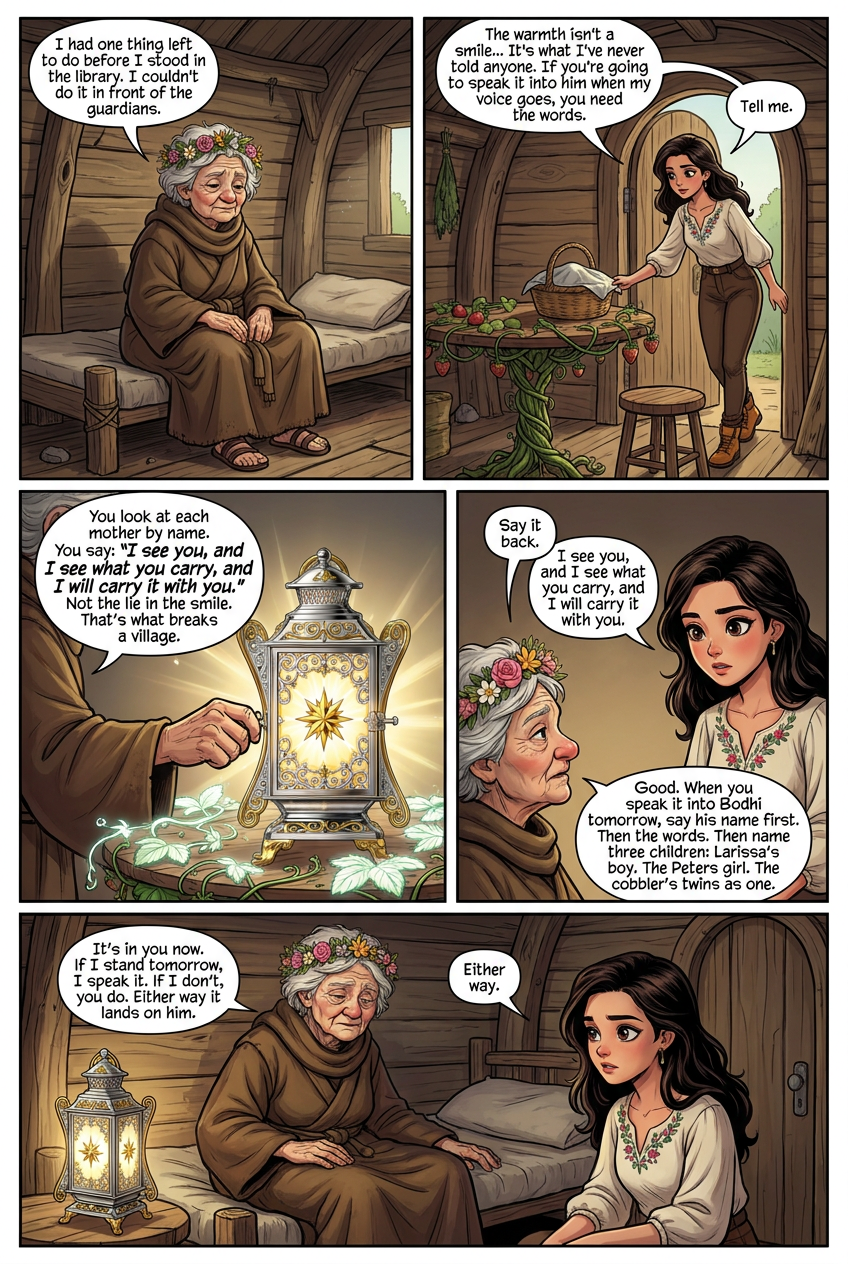
Elsa slept two hours after the town meeting and woke with the taste of iron in her mouth. The crowning was at midday. She had one thing left to do before she stood in the library, and she could not do it in front of the guardians. She sent Wren to fetch Nancy again, alone, to the driftwood hut. Nancy came fast. She stepped through the arched door and set a covered basket on the vine-woven table by the potion bottles. She did not ask why. She read Elsa's face and pulled the stool close. "The warmth isn't a smile," Elsa said. "That's what the mothers think. It's what I've never told anyone. If you're going to speak it into him when my voice goes, you need the words." Nancy folded her hands in her lap. "Tell me." Elsa reached for the silver-and-gold lantern on the shelf and set it on the table between them. She turned the small key. The star inside brightened until the vines on the table glowed pale. She kept her hand on the lantern's frame. "You look at each mother by name," Elsa said. "You hold her child in your mind while you look. You say: I see you, and I see what you carry, and I will carry it with you. You don't smile until you mean it. If you smile before you mean it, they feel the lie. That's what breaks a village. Not sickness. Not frost. The lie in the smile." Nancy's eyes did not move from her face. "Say it back," Elsa said. Nancy said it back. Word for word. Then again, slower, with her own weight on I will carry it with you. "Good," Elsa said. "When you speak it into Bodhi tomorrow, you say his name first. Then the words. Then you name three children in the room. Larissa's boy. The Peters girl. The cobbler's twins as one. That's the seal. The mothers hear their own children inside the warmth. That's what binds him." Nancy repeated the names. She repeated the order. She did not write anything down. "Once more," Elsa said. Nancy said the whole rite through, from I see you to the last child's name, without a pause. Elsa closed the lantern. The vines went dim. She let her hand fall from the frame and felt her arm shake against the table. "It's in you now," Elsa said. "If I stand tomorrow, I speak it. If I don't, you do. Either way it lands on him." "Either way," Nancy said. Elsa lay back on the cot. She had spent the last of the morning and she knew it. But the secret was out of her and into someone the village already trusted. The rite could finish without her voice. Whatever her body did at midday, Bodhi would be crowned warm.
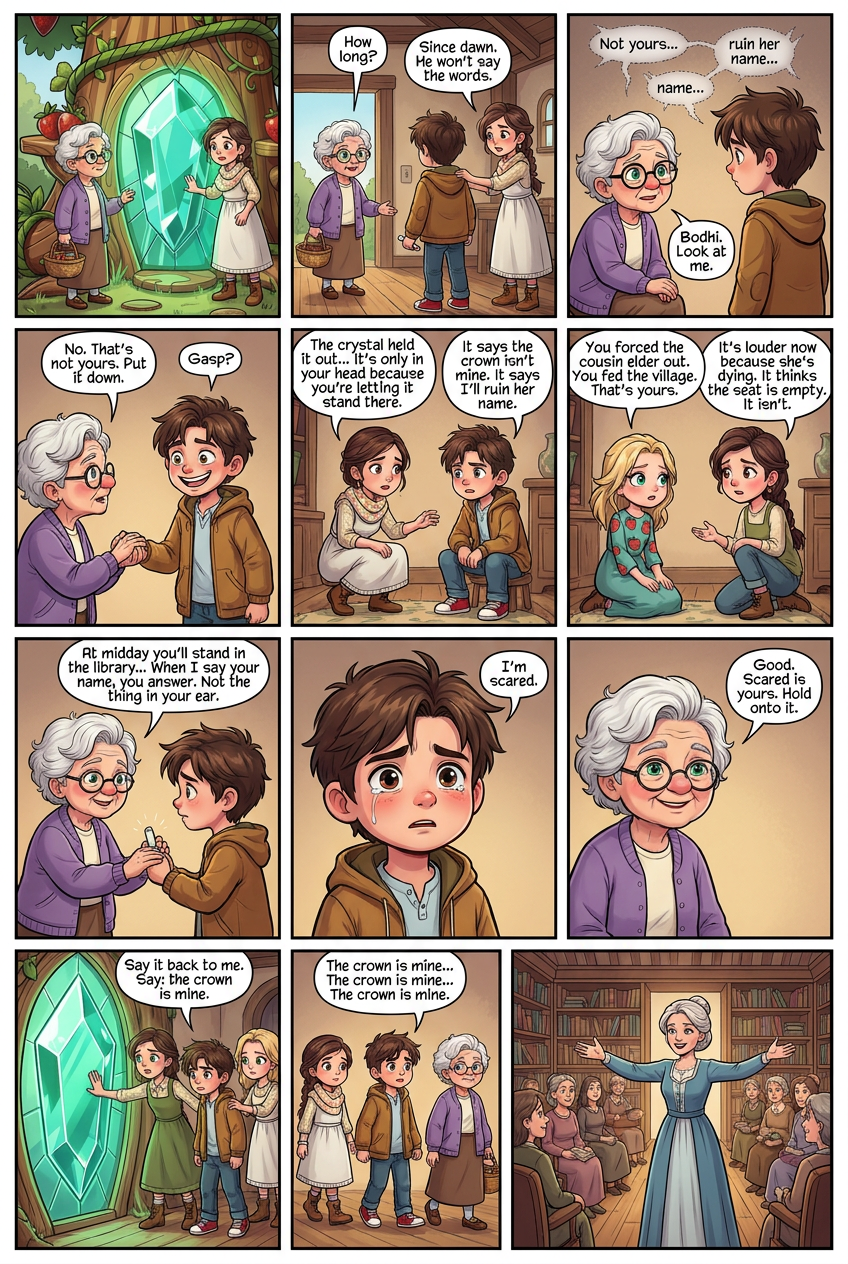
Nancy left the driftwood hut with the rite in her mouth and did not go home. She went to the strawberry cottage instead. The teal crystal in the door threw green light on the vines as she knocked. Clara opened it. Fern stood behind her with a hand on Bodhi's shoulder. The boy still had his chalk stub in his fist, but he wasn't drawing. He was listening to something no one else could hear. "How long?" Nancy asked. "Since dawn," Clara said. "He won't say the words. He keeps tilting his head." Nancy set her basket on the vine-woven table and knelt in front of the boy. His eyes tracked past her ear, toward the door, toward the wall. The whisper had gotten louder as Elsa got weaker. Everyone in this room knew it. Only Bodhi could hear the shape of it. "Bodhi," Nancy said. "Look at me." He looked. His mouth twitched. The smile that came was not his. It was too wide and too still. Clara made a small sound behind her. "No," Nancy said. She took his hand, chalk and all. "That's not yours. Put it down." Fern crouched beside him. "The crystal held it out of the schoolhouse for months. It can't come through the door here either. It's only in your head because you're letting it stand there." "It says the crown isn't mine," Bodhi said. His voice was flat. "It says I'll ruin her name." Clara knelt on his other side. "You made your first mark with Nora watching. You forced the cousin elder out. You fed the village when the frost came. That's yours. The whisper had nothing to do with any of it." "It's louder now because she's dying," Fern said. "It thinks the seat is empty. It isn't. You're in it." Nancy squeezed his hand until the chalk broke. "At midday you'll stand in the library. I'll speak the warmth into you if Elsa's voice fails. When I say your name, you answer. Not the thing in your ear. You. Do you understand?" Bodhi's eyes filled. The false smile fell off his face. His own mouth came back, crooked, gap-toothed, small. "I'm scared," he said. "Good," Nancy said. "Scared is yours. Hold onto it." Fern pressed her palm to the crystal door. The green light steadied. Clara put her arm around the boy's shoulders and did not let go. "Say it back to me," Nancy said. "Say: the crown is mine." He said it. Once soft, once clear. The third time his voice held. They walked him to the library between them, Fern on one side, Clara on the other, Nancy a step ahead. The whisper did not follow past the strawberry vines. Bodhi's face stayed his own the whole way. When he stepped through the library door, the mothers were already seated. Elsa was on her feet.
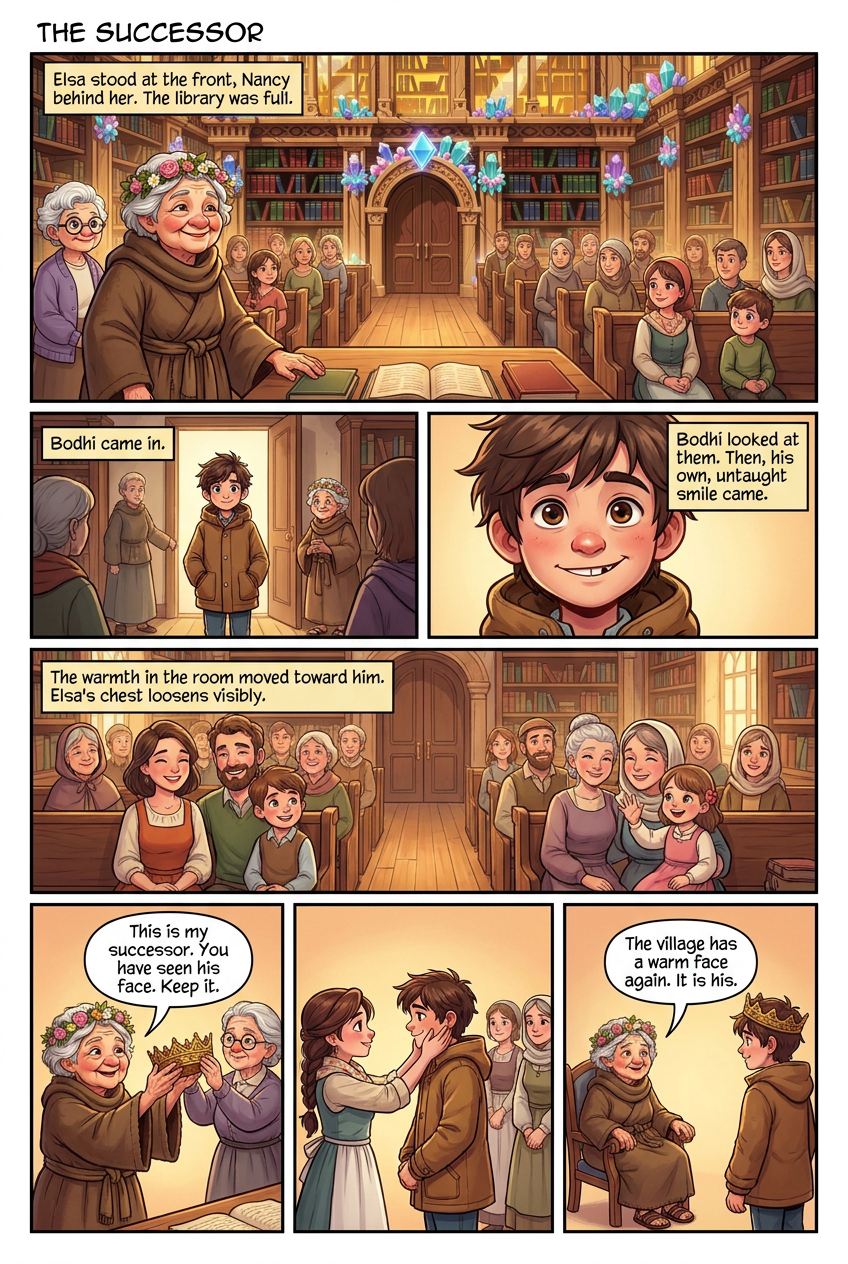
Elsa stood at the front of the library with one hand on the reading table for balance. The woven crown sat on a folded cloth beside her. Nancy waited a step behind her left shoulder, ready to speak the warmth if Elsa's voice gave out. The mothers filled the benches. Larissa sat in the first row with her hands folded. Charlie sat beside her. The miller's wife and the two who had believed the frost rumor sat together near the aisle. Every face was turned toward the door. The door opened. Bodhi came in between Fern and Clara. His parka was buttoned wrong. His chalk stub was gone. He stopped inside the threshold and looked at the room. Elsa had spent weeks worrying about his mouth. She had planned to whisper corrections. She had asked Nancy to smile beside her so the boy could copy the shape. She had never found a way to teach him what her own face did without thinking. The Peters girl slid off her mother's lap and waved. The cobbler's twins grinned from the second bench. The miller's boy lifted a hand. Larissa's face softened first. Then Charlie's. Then the miller's wife, who had almost kept her son home. The warmth in the room moved toward the boy before anyone said a word. Bodhi looked at them. He looked at Nancy. He looked at Elsa. His smile came. It was not taught. It was not the wide, still thing the whisper had put on him at dawn. It was crooked and gap-toothed and his own, and it opened the way Elsa's had opened for forty years in this village — because the person wearing it knew he was among his people. The children were his. The mothers were his. The room was his. He had a place, and his face knew it before his mind did. Elsa felt her chest loosen. She had been trying to hand him a tool. He had grown the thing itself. She lifted the crown. Her hands shook. Nancy stepped up beside her and steadied the rim without taking it. Elsa set it on Bodhi's head herself. Her voice held for the words she needed most. "This is my successor," she said. "You have seen his face. Keep it." Larissa stood. She crossed to Bodhi and put her hand on his cheek the way a mother does. The miller's wife stood next. Then Charlie. The mothers came forward one by one and touched him, and each one smiled back at the smile he was already wearing. Elsa sat down in the chair Nancy pulled out for her. The fragile acceptance she had feared losing was no longer fragile. Bodhi turned in the crown and looked for her across the room, still smiling, and she understood the smile would outlast her. The village had a warm face again. It was his.
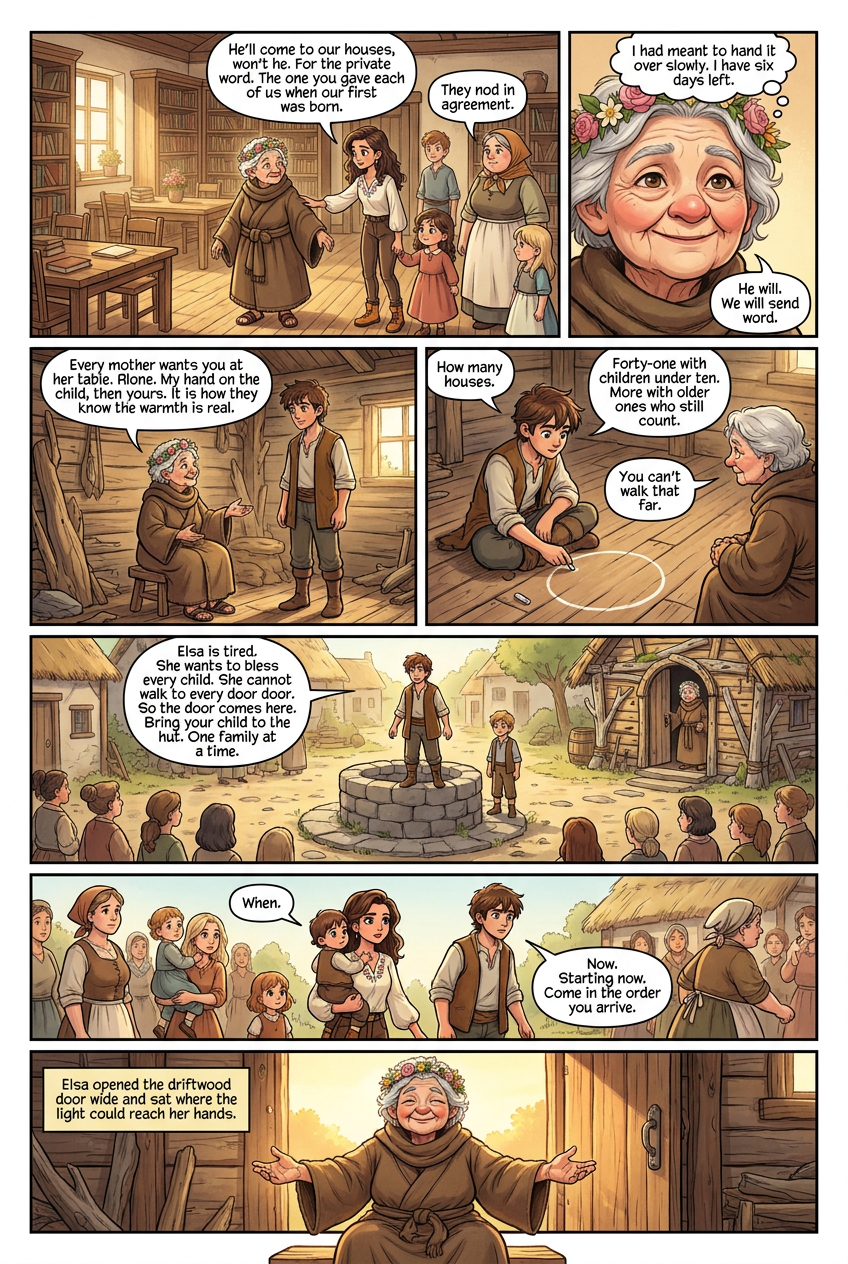
The mothers left the library slow and warm, but Larissa hung back at the door. She caught Elsa's sleeve before Nancy could steer her toward the chair. "He'll come to our houses, won't he," Larissa said. "For the private word. The one you gave each of us when our first was born." Behind her, the miller's wife nodded. Charlie nodded. Every mother in the room was waiting to hear it. Elsa's mouth opened and shut. The private blessing was hers. She had walked to every door in Alpenglow for forty years, sat at every kitchen table, laid her hand on every new head. She had meant to hand it over slowly. She had six days left. "He will," she said. "We will send word." She walked Bodhi back to the driftwood hut on Jasper's arm. Inside, she sat on the low stool and told him plain. "Every mother wants you at her table. Alone. My hand on the child, then yours. It is how they know the warmth is real." Bodhi counted on his fingers. He was slow at numbers but honest. "How many houses." "Forty-one with children under ten. More with older ones who still count." "You can't walk that far." "No." He sat on the floor by her feet and pulled his chalk stub from his pocket. He drew a small circle on the plank. Then he drew a larger circle around it. He looked up. "They come here," he said. "One at a time. To the hut. You sit. I stand. We do it at the door." "They expect me to come to them." "They expect the warmth," he said. "Not the walk." Elsa looked at the two circles on the plank. She had spent a week teaching him nothing about this and he had found the shape of it in a breath. She nodded once. Bodhi buttoned his parka right this time and went to the square himself. Jasper followed three steps back. Elsa watched from the hut door. The boy climbed onto the well stone so the mothers could see him. He did not smile the taught smile. He used his own. "Elsa is tired," he said. His voice was small but it carried. "She wants to bless every child. She cannot walk to every door. So the door comes here. Bring your child to the hut. One family at a time. Elsa's hand first. Then mine. The blessing is the same. I promise you the blessing is the same." Larissa was first to answer. "When." "Now," Bodhi said. "Starting now. Come in the order you arrive." Larissa lifted her youngest to her hip and started for the hut. Charlie fell in behind her. The miller's wife went to fetch her son. A line began to form along the path before Bodhi climbed down from the stone. Elsa opened the driftwood door wide and sat where the light could reach her hands.
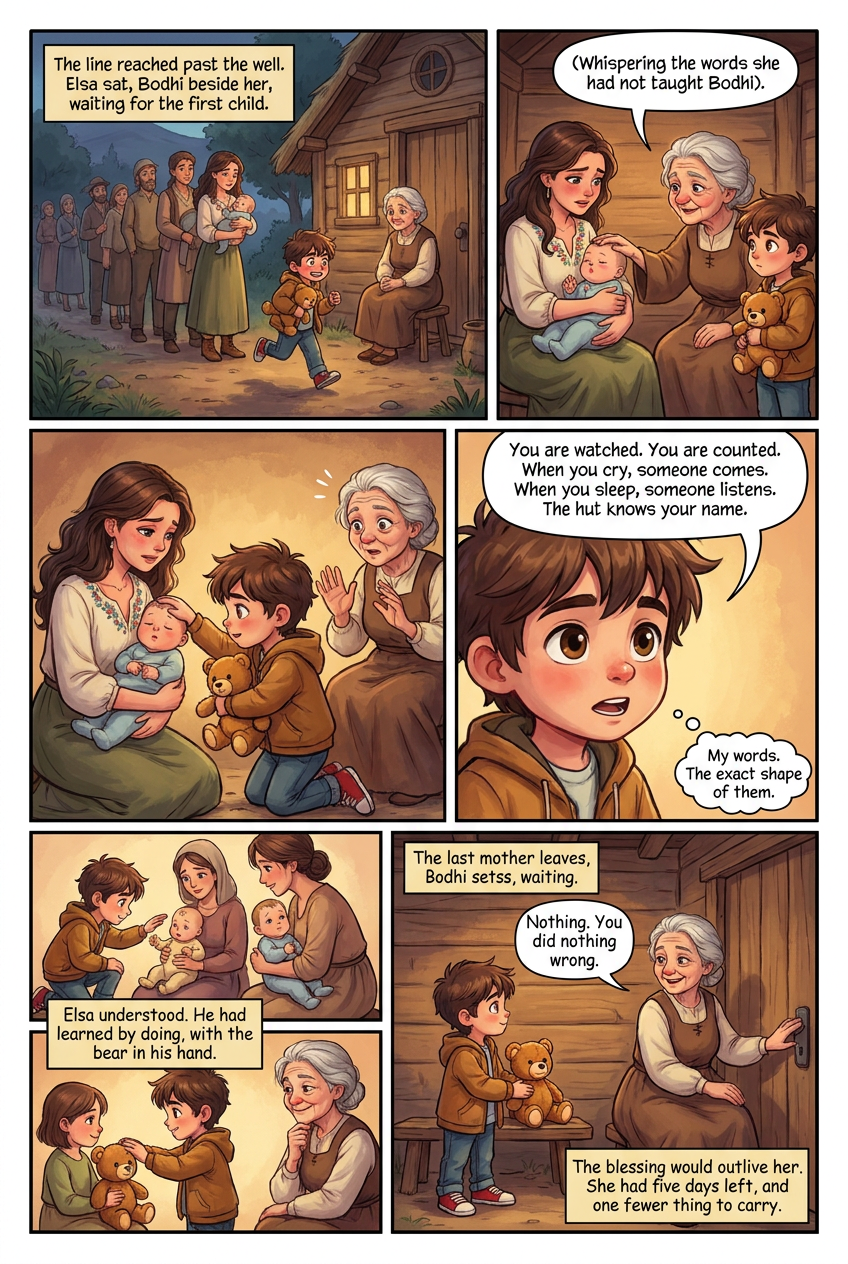
The line reached past the well. Larissa stood first with her youngest on her hip. Elsa sat in the doorway of the hut with the lantern low, her hands folded in her lap. Bodhi stood beside her stool, small and quiet, waiting for the first child. Then Elsa saw him bolt. He slipped past Jasper and ran down the path toward Clara's cottage, his parka flapping. She almost called after him. Larissa looked at her. Elsa smiled and said, "A moment. He forgot something." He came back at a run, cheeks red, the caramel bear tucked under one arm. He climbed the step, set the bear on the plank between them, and gave Elsa a small nod. Then he faced the door. Larissa came in. Elsa laid her hand on the baby's head and spoke the private words she had spoken over Larissa's first child seven years ago. The words the mothers waited for. The words she had not taught Bodhi. She had meant to whisper them into his ear tonight, if she still could. When she lifted her hand, Bodhi picked up the bear. He knelt so his face was level with the baby's. He set the bear's paw on the baby's forehead where Elsa's hand had been. "You are watched," he said. "You are counted. When you cry, someone comes. When you sleep, someone listens. The hut knows your name." Elsa's breath caught. Those were her words. The exact shape of them. She had spoken them at forty-one doors over forty years and never once written them down. Larissa's eyes filled. She kissed the baby's head and walked out holding the child close. Charlie came next. Then the miller's wife. Then a woman Elsa had blessed at midnight in a snowstorm eleven years ago. Each time Bodhi knelt with the bear. Each time the words changed to fit the child — a different promise for a colicky boy, a different one for a girl who would not speak. Each time they were her words. The ones she had chosen for that family, on that night, alone at that table. Halfway through the line, Elsa understood. She had not taught him. He had watched her at the coronation. He had watched her at Larissa's door with the broth. He had watched her every day for a season, and he had learned the way children learn — by doing, with the bear in his hand for practice. The last mother left near dusk. Bodhi set the bear down on the plank and looked at Elsa, waiting to be told what he had done wrong. "Nothing," she said. "You did nothing wrong." She closed the door. The blessing would outlive her. She had five days left, and one fewer thing to carry into them.
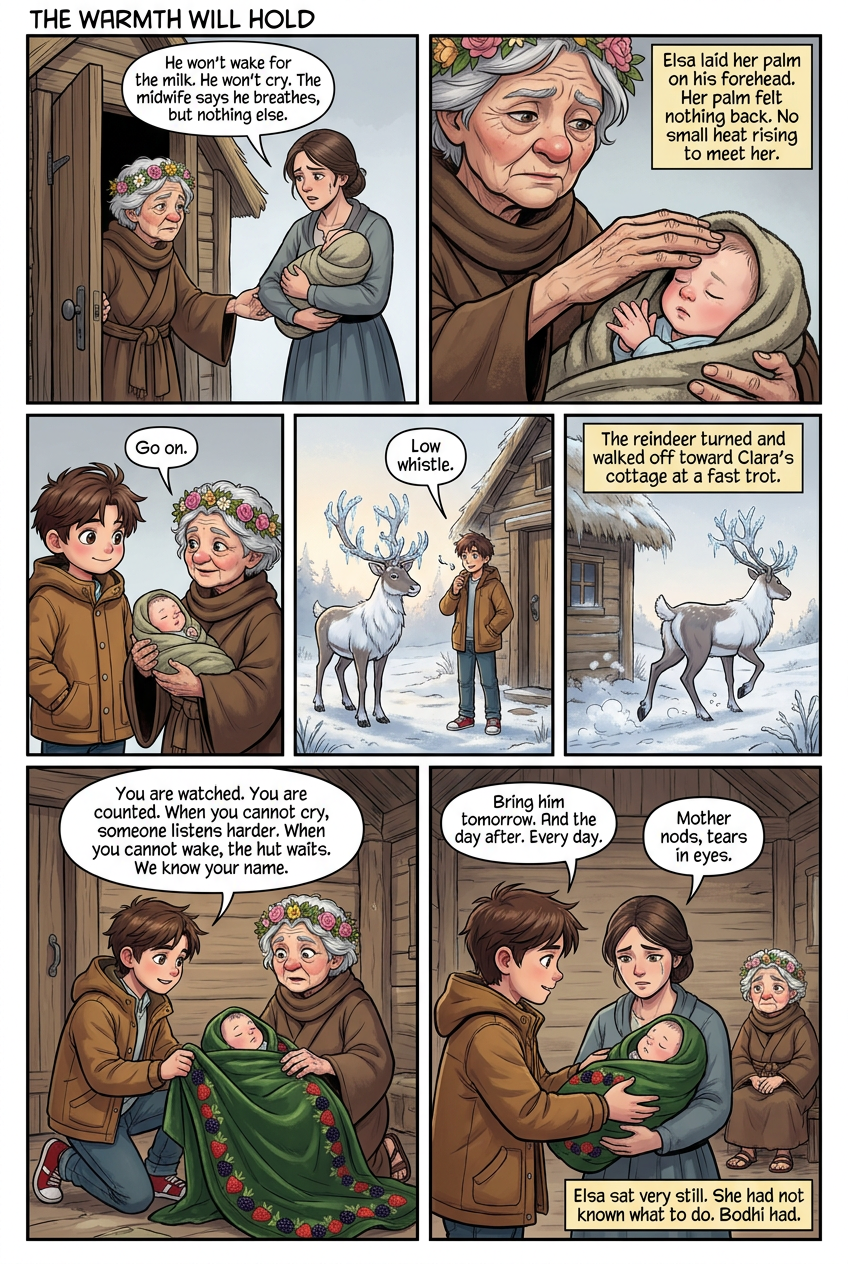
Morning came with a thin gray light. Elsa opened the hut door and found one more mother waiting on the step. The woman held a bundle wrapped tight against her chest. She had not been in yesterday's line. "He won't wake for the milk," the mother said. "He won't cry. He won't grip my finger. The midwife says he breathes, but nothing else." Elsa took the bundle onto her lap and folded back the wool. The baby was warm, but only from the mother. His eyes stayed shut. His small hand lay open on the blanket. Elsa laid her palm on his forehead the way she had done four thousand times. Her palm felt nothing back. No stirring. No small heat rising to meet her. She had blessed sick children before. She had blessed dying ones. She had never blessed one who gave her nothing in return. The words she used needed a child on the other end of them. Bodhi stood at her elbow. She looked at him. He looked at the baby. Then he gave her the smile she had spent a season teaching him — small, closed, steady. She gave the same smile back. "Go on," she said. He stepped outside. He did not call. He whistled once, low. The reindeer came around the corner of the hut, its frost-caked antlers catching the pale light. Bodhi stood in front of the animal and did not speak. The reindeer lowered its head. They held there a moment. Then the reindeer turned and walked off toward Clara's cottage at a fast trot. It came back before the mother could ask what was happening. In its teeth it carried a folded green blanket, thick velvet, the edges stitched with strawberries and blackberries. Elsa had seen it once in Clara's cupboard, kept for a child Clara had not yet met. Bodhi took the blanket. He knelt by Elsa's knee. He unfolded it slow and wrapped it around the baby, tucking the corners under the small shoulders. He did not use the caramel bear. He set his own hand on the baby's chest, where the berries lay stitched over the heart. "You are watched," he said. "You are counted. When you cannot cry, someone listens harder. When you cannot wake, the hut waits. We know your name." The baby did not move. But the mother made a sound in her throat and reached for him. Bodhi placed the wrapped child back in her arms and drew the blanket up under the small chin. "Bring him tomorrow," he said. "And the day after. Every day." The mother nodded and walked out cradling the green bundle. Elsa sat very still. She had not known what to do. Bodhi had. He had not learned it from her. He had made it himself, in front of her, with a reindeer and a blanket and words that were his. Four days left. The warmth would hold.
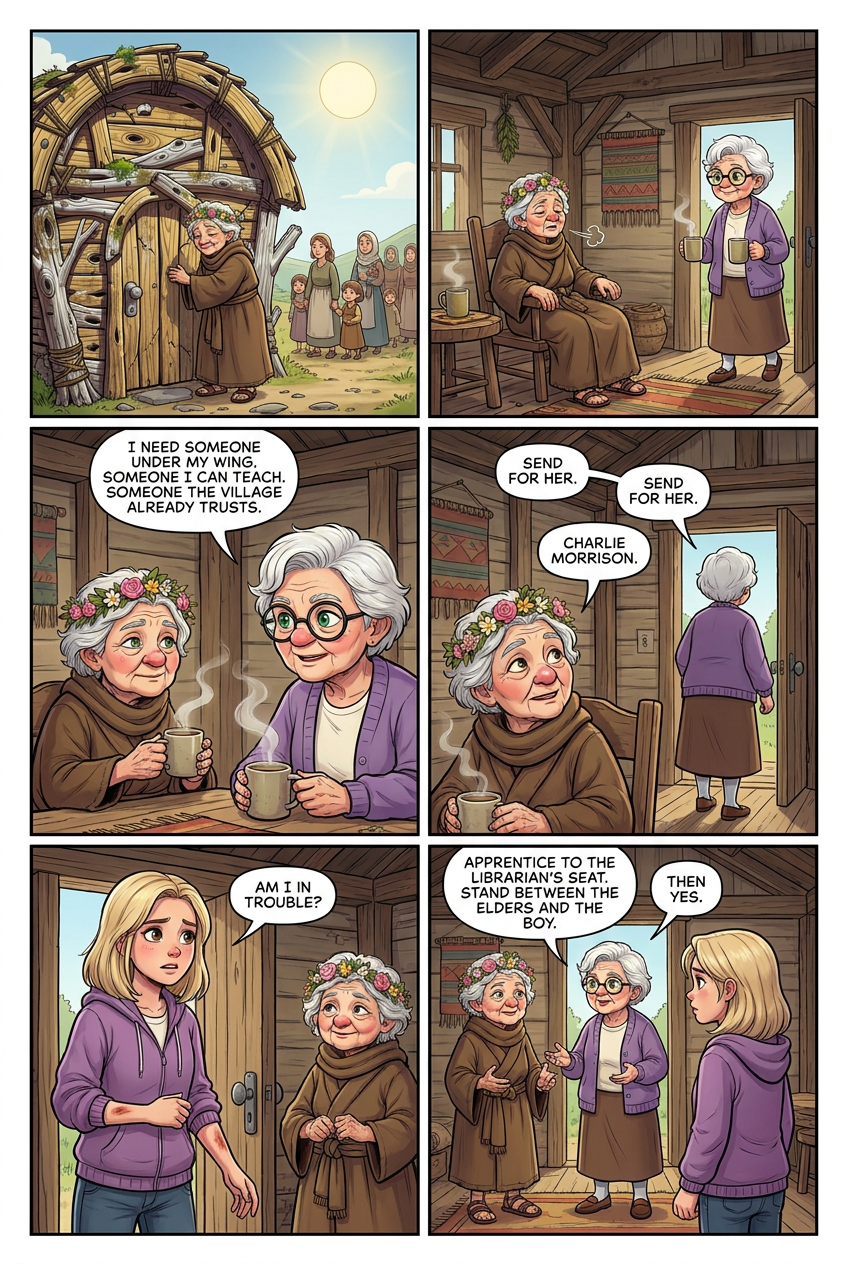
The line of mothers thinned by midday. Elsa closed the hut door and sat down heavy in her chair. Four days. Nancy came in without knocking, carrying two mugs of broth. She set one on the table by Elsa's hand and kept the other for herself. "You look like you walked here on knives," Nancy said. She sat across from Elsa and folded her hands around her mug. Her white hair caught the light from the small window. Behind her round glasses, her green eyes stayed on Elsa's face. "I came to say a thing you won't like." "Say it." "If I fall tomorrow, the elders swarm Bodhi by the day after. My seat is one chair. One chair is not a wall." Nancy sipped. "I need someone under my wing. Someone I can teach the library, the bench, the way you speak to a scared mother. Someone the village already trusts." Elsa set her mug down. She had been so busy planning her own end she had not planned Nancy's. "Who." "Charlie Morrison." Elsa looked up. "She has enemies. The sister still asks questions at the well." "The sister will tire. Charlie won't." Nancy leaned forward. "She raised Lynn alone through worse than any elder can throw. She listens before she speaks. The children already come to her. And she owes you her life, which means she'll guard yours in Bodhi." Elsa thought of Charlie's scarred wrists and the way she had stood in this hut and taken the truth about her husband without flinching. "Send for her." Nancy was already at the door. Charlie came within the hour. She stepped inside and stopped short when she saw them both waiting. Her blonde hair was pulled back. Her sleeves were pushed up past a burn mark on her forearm. She did not sit until Elsa pointed at the chair. "Am I in trouble," Charlie said. "No," Nancy said. "You're being asked." She laid it out plain. Apprentice to the librarian's seat. Learn the bench. Take it if Nancy falls. Stand between the elders and the boy. Charlie went still. She looked at Elsa. "I'm not a clever woman." "I don't need clever," Elsa said. "I need someone who won't leave the room when it gets ugly." Charlie's hand went to the burn on her arm without her seeming to notice. "Lynn." "Lynn stays with you," Nancy said. "She can sit in the library with me while we teach you." Charlie was quiet a long moment. Then she nodded once. "Then yes." Nancy exhaled. Elsa felt something loosen in her chest that had been tight since the elders' vote. "Start tomorrow," Nancy said. "Sunrise. Bring bread." Charlie stood. At the door she turned. "If they come for the boy while you two are gone, I won't run." She left. Elsa looked at Nancy. Two chairs now. Two walls. Four days.
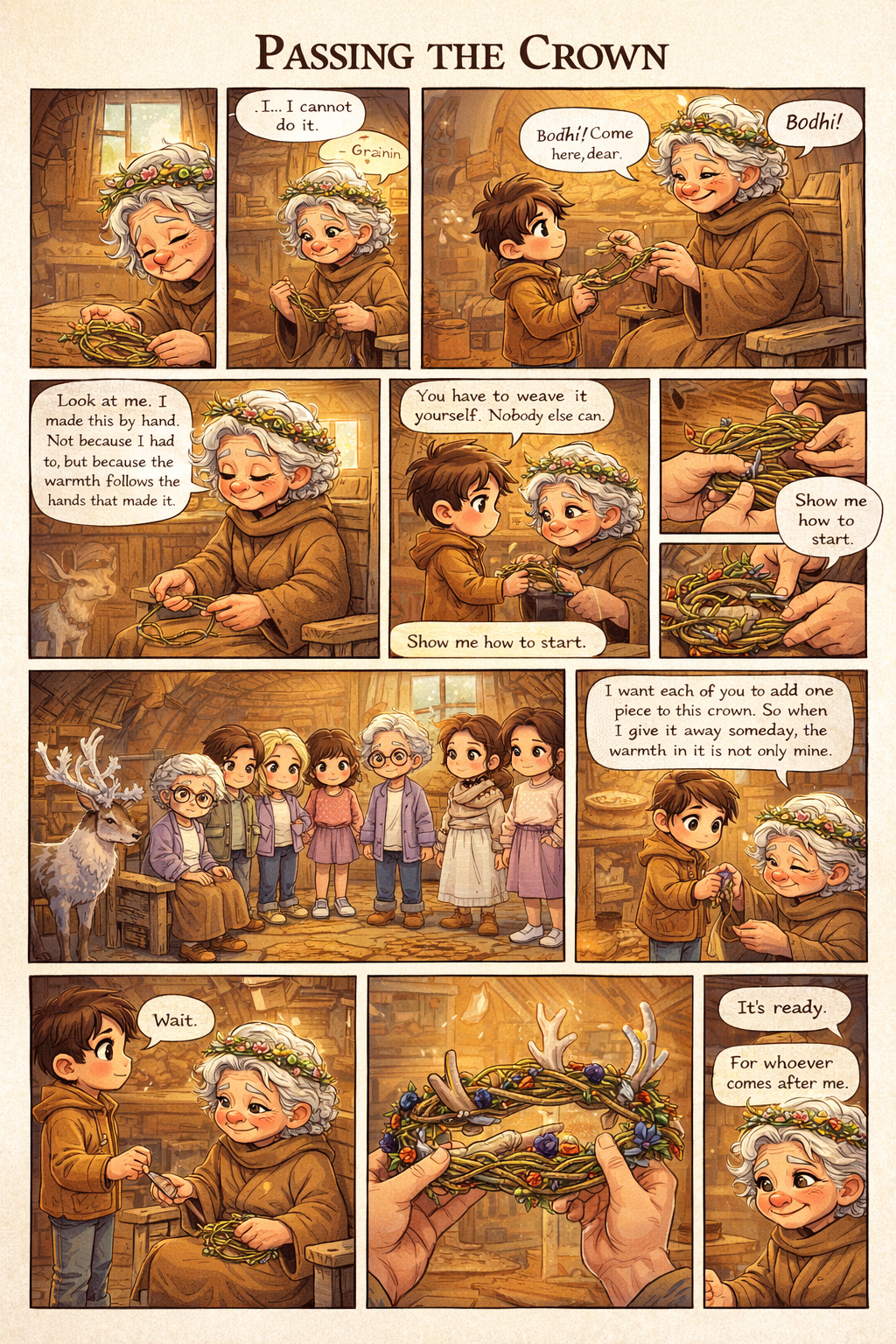
Morning came gray through the hut's small window. Elsa reached for the crown vines she kept in a basket by her chair and tried to twist a new start. Her fingers would not close. The vine slid free three times. She looked at her hands and saw them shake in a way she could not stop. Bodhi needed his own crown to give someday. Without one, the warmth had no vessel to pass into. She set the vines down and called for him. Bodhi came in with chalk dust on his knuckles. His reindeer waited outside the door, breath steaming. He sat at her knee. "Look at me," Elsa said. She lifted the crown from his head and turned it in the light. The vines held. Blackberries and strawberries still clung to the weave. "I made this by hand. Not because I had to. Because the warmth follows the hands that made it. When your time comes, you pass the crown to the one who follows you. But you have to weave it yourself. Nobody else can." Bodhi looked at the crown, then at her fingers on the arm of the chair. He saw them shake. He reached and took her hand and held it flat. "Show me how to start," he said. Elsa placed three vines across his palm. She showed him the first twist, then the second. Her hand guided his once, then fell away. He got it wrong. He tried again. On the fourth try the vines held their bend. He stood. "Wait." He went to the door and spoke to the reindeer, then called across the yard. Within the hour Jasper, Fern, Clara, Dahlia, Nancy, Wren, and Charlie stood inside the driftwood hut. The room smelled of wet wool and bread. "Each of you did something to me," Bodhi said. His voice was smaller than it had been at the crowning, but steady. "I want each of you to add one piece to this crown. So when I give it away someday, the warmth in it is not only mine." He held out the started weave. Jasper twisted in a strip of pale wood he shaved from his pocket knife. Fern added a length of blue thread from her cuff. Clara pressed in a sprig of dried strawberry vine. Dahlia hesitated, then wove in a strand of her own dark hair. Nancy added a green leaf from her cardigan pocket. Wren pushed in a small iron nail. Charlie tied a bit of lavender ribbon from Lynn's hem. Bodhi worked the pieces in as they came. When the ring was closed he went outside. He came back holding a shed antler tip his reindeer had dropped in the yard. He set it upright at the crown's front and bound it fast. He held the finished crown up for Elsa to see. Her hands were still. His were not. "It's ready," he said. "For whoever comes after me." Elsa nodded once and let out a breath she had held for weeks.
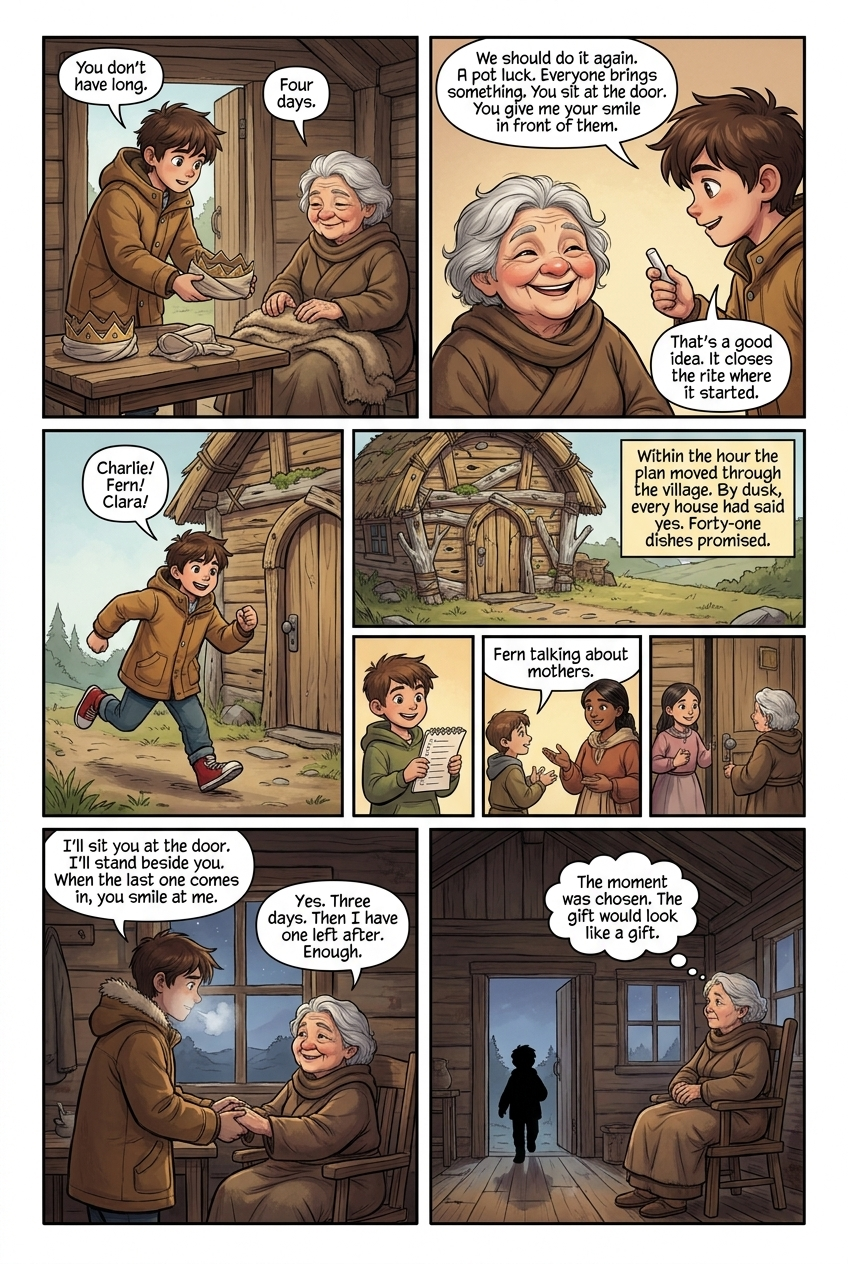
The next morning Bodhi came into the hut with the new crown wrapped in cloth. He set it on the table beside the finished one Elsa had made for herself. He did not sit. He looked at her hands, which stayed still now only when she rested them on wool. Then he looked at her face. "You don't have long," he said. It was not a question. Elsa did not lie to him. "Four days." Bodhi nodded once. He pulled the chalk stub from his pocket and turned it between his fingers. "When you started here," he said, "the village brought food. Every house brought a dish. You stood at the door and smiled at each one as they came in." "I remember." "We should do it again," he said. "A pot luck. Same as the first one. Everyone brings something. You sit at the door." He paused. "You give me your smile in front of them. Out loud. Where they all see." Elsa understood at once. She had been sitting with the same problem for three days. If she collapsed in the hut alone, the warmth would look like a thing she lost, not a thing she gave. Bodhi had solved it while she slept. She beamed at him. Wide, round-cheeked, the smile she had used on every stranger who ever walked into the driftwood hut. His shoulders eased under the too-big parka. "That's a good idea," she said. "That's the right idea. It closes the rite where it started." "Tomorrow?" he asked. "Tomorrow." He ran to the door and called Charlie's name across the yard. Then Fern's. Then Clara's. Within the hour the plan moved through the village on other feet. Charlie kept the list of who would bring what. Fern walked to the schoolhouse mothers. Clara went house to house with Larissa. Nancy sent word to the elders' wives so none could claim they had not been asked. By dusk the answer came back through Jasper at the door. Every house had said yes. Forty-one dishes promised. Bread, stew, root pie, salted fish, honey cake. Elsa sat in her chair by the window. Bodhi came in with the reindeer's breath fogging behind him and stood at her knee. "I'll sit you at the door," he said. "I'll stand beside you. When the last one comes in, you smile at me. Then they'll all remember it." "Yes," Elsa said. She reached for his hand. Her fingers closed this time. She held on. "Three days," she said. "Then I have one left after. Enough." Bodhi did not cry. He set the wrapped crown beside her chair and went to help Charlie count the loaves. Elsa watched him go. The moment was chosen. The moment had a room and a door and forty-one witnesses. The gift would look like a gift.
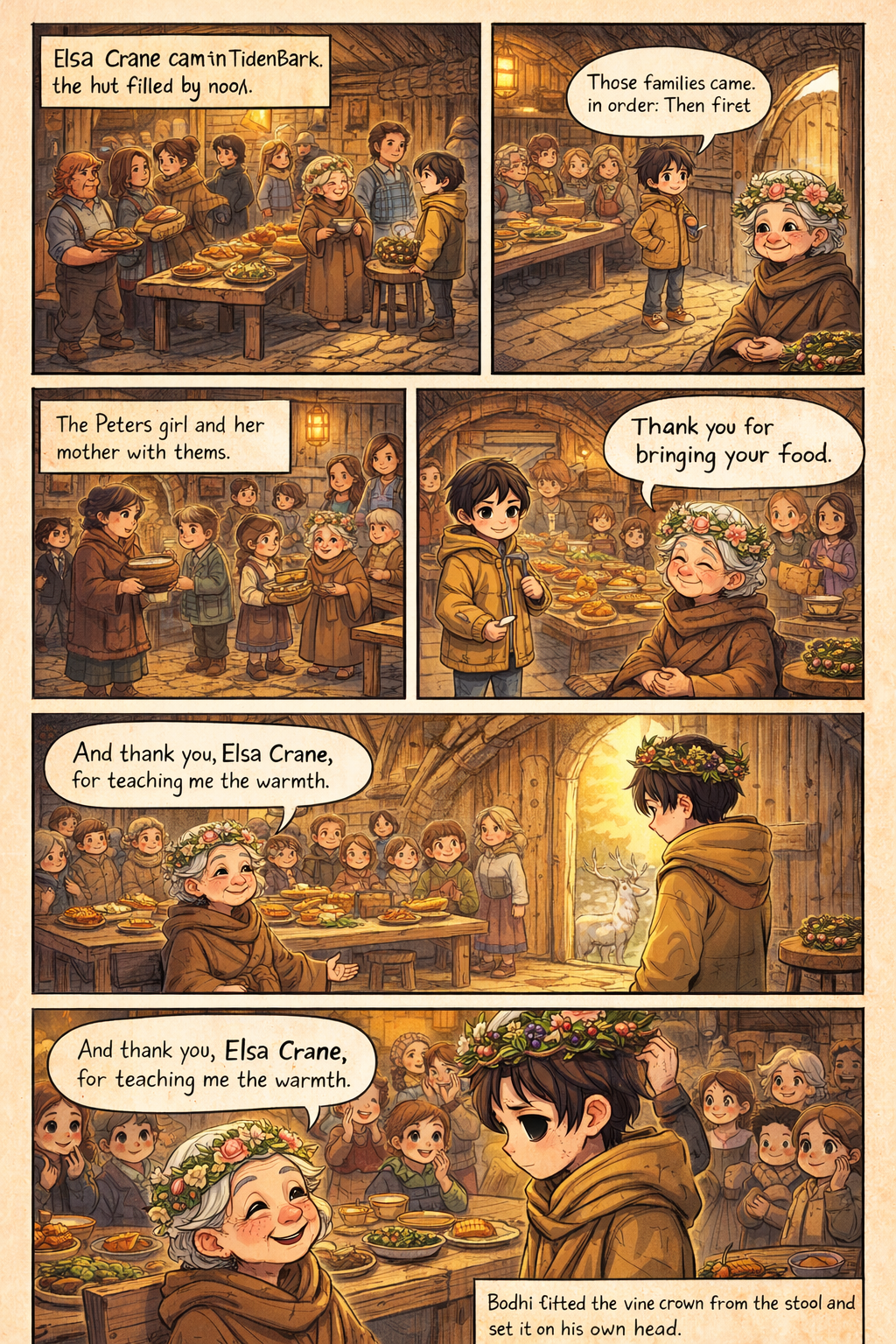
The next day the hut filled by noon. Charlie set the table along the back wall. Fern lined the benches. Clara took coats at the door. Elsa sat in her chair beside the threshold in her heavy wool robe, the flower crown pinned tight to her hair. Bodhi stood at her elbow in the too-big parka, chalk stub in one fist, the woven vine crown resting on the stool beside him. The families came in order. The Peters girl first with her mother, a covered bowl in her arms. Then the cobbler with twins holding a loaf between them. Then the miller's boy with a jar of honey. Elsa smiled at each one as they passed. She kept the smile small so she could hold it. She had four days of strength left and she meant to spend it here. Under the wool she pressed her thumb hard into her palm. That was the trouble. She and Bodhi had never fixed a sign. If she smiled too soon, before the last dish was down, the room would still be moving and no one would see. If she waited too long, her face would drop on its own and the village would call it a failing, not a giving. She watched the table fill. Thirty-eight dishes. Thirty-nine. Larissa came in with a pot of stew. Forty. Charlie carried the last basket to the table, a round of dark bread, and set it beside the honey. Forty-one. Charlie stepped back and folded her hands. The room quieted on its own. Bodhi felt it. He turned from the table and faced the crowd. He did not look at Elsa yet. "Thank you for bringing your food," he said. His voice carried clean across the driftwood walls. "Thank you for trusting me at your doors and with your children." He named Clara, Fern, Jasper, Dahlia, Nancy, Wren, Charlie. He named the reindeer waiting outside. He thanked each one for a piece of what he was. Then he turned to Elsa. "And thank you, Elsa Crane," he said, "for teaching me the warmth." That was the signal. She had not asked for it and he had not promised it, but she knew it the moment he said her name. She lifted her face to him and let the smile come the way it had always come at the door of the hut, wide and round-cheeked, both eyes crinkled, the smile she had used on every stranger for forty years. The room saw it. The mothers saw it. Larissa put a hand to her mouth. The Peters girl pointed without a sound. Bodhi held her eyes and did not look away until she let the smile settle. Elsa lowered her chin. Her hands stayed still in her lap. The gift was given, in the room where she had first received one, in front of every witness the village had. Bodhi lifted the vine crown from the stool and set it on his own head.
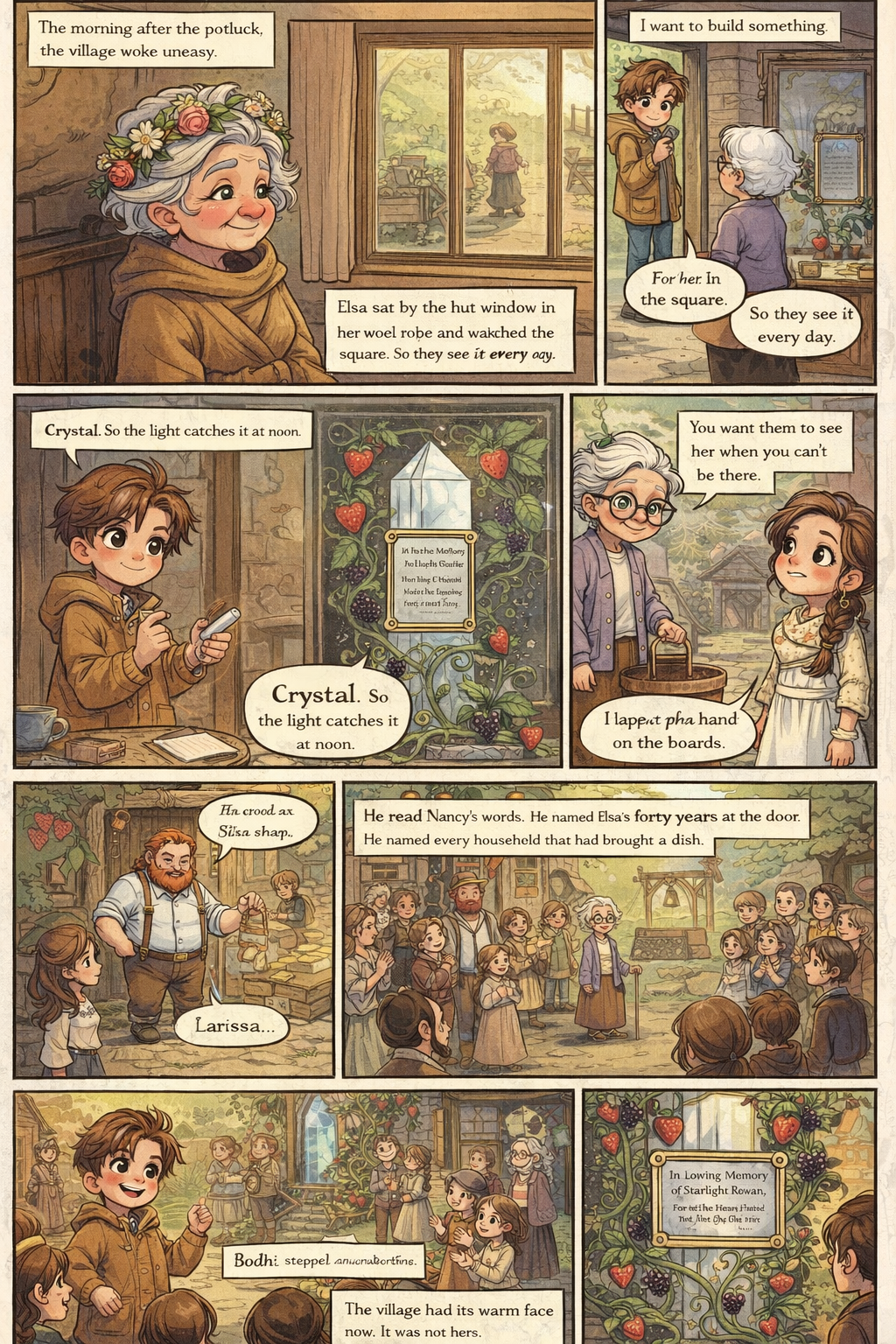
The morning after the potluck, the village woke uneasy. Elsa sat by the hut window in her wool robe and watched the square. Mothers passed with baskets and did not look at the door. A cobbler stopped mid-step, glanced at the driftwood walls, and moved on. She had given her smile in front of forty-one witnesses. But Bodhi had not yet worn it back to them, and the village was already starting to doubt what they had seen. Bodhi came in with chalk on his knuckles. He had been at the cottage since dawn. "I want to build something," he said. "For her. In the square. So they see it every day." Fern set the teal crystal key on the table beside Clara's tea. Clara wiped her hands on her apron and sat. Bodhi drew on the boards with the chalk stub: a tall spire, vines around it, a plaque at the center. "Crystal," he said. "So the light catches it at noon." Fern turned the key in her fingers. "My grandmother kept a shard the size of a forearm behind the cottage door. It will cut clean if we shape it before the frost sets again." Clara looked at the drawing. "It's a good thought. But four hands can't lift it to the square, and the plaque needs the right words." She pushed back from the table. "Get Nancy. She wrote every eulogy this village has kept." Nancy came within the hour, glasses fogged from the walk. She read the chalk drawing on the boards, then looked at Bodhi over the rims. "You want them to see her when you can't be there," she said. He nodded. Nancy set a hand on his shoulder. "This is your love for her showing itself. And it will show them you see how they loved her too. That is the whole gift." She sat and began drafting the plaque words on a scrap. By afternoon they had the shard shaped and vined, strawberry and blackberry threaded around a silver-and-gold plate. Jasper carried it on a plank to the square. Bodhi rang the bell at the well stone. Villagers came slow at first, then in waves. Larissa. The Peters mother. The cobbler with his twins. Elsa walked from the hut on Fern's arm and stood at the edge. Bodhi stepped up on the well stone. He read Nancy's words. He named Elsa's forty years at the door. He named every household that had brought a dish. Then he lifted his face to them. He smiled. It was crooked and gap-toothed and wide. It was his own. The mothers saw it and their shoulders dropped. Larissa laughed once, sharp with relief. The Peters girl clapped. The doubt went out of the square like heat off a stone. Elsa felt her legs give a little against Fern. The village had its warm face now. It was not hers.
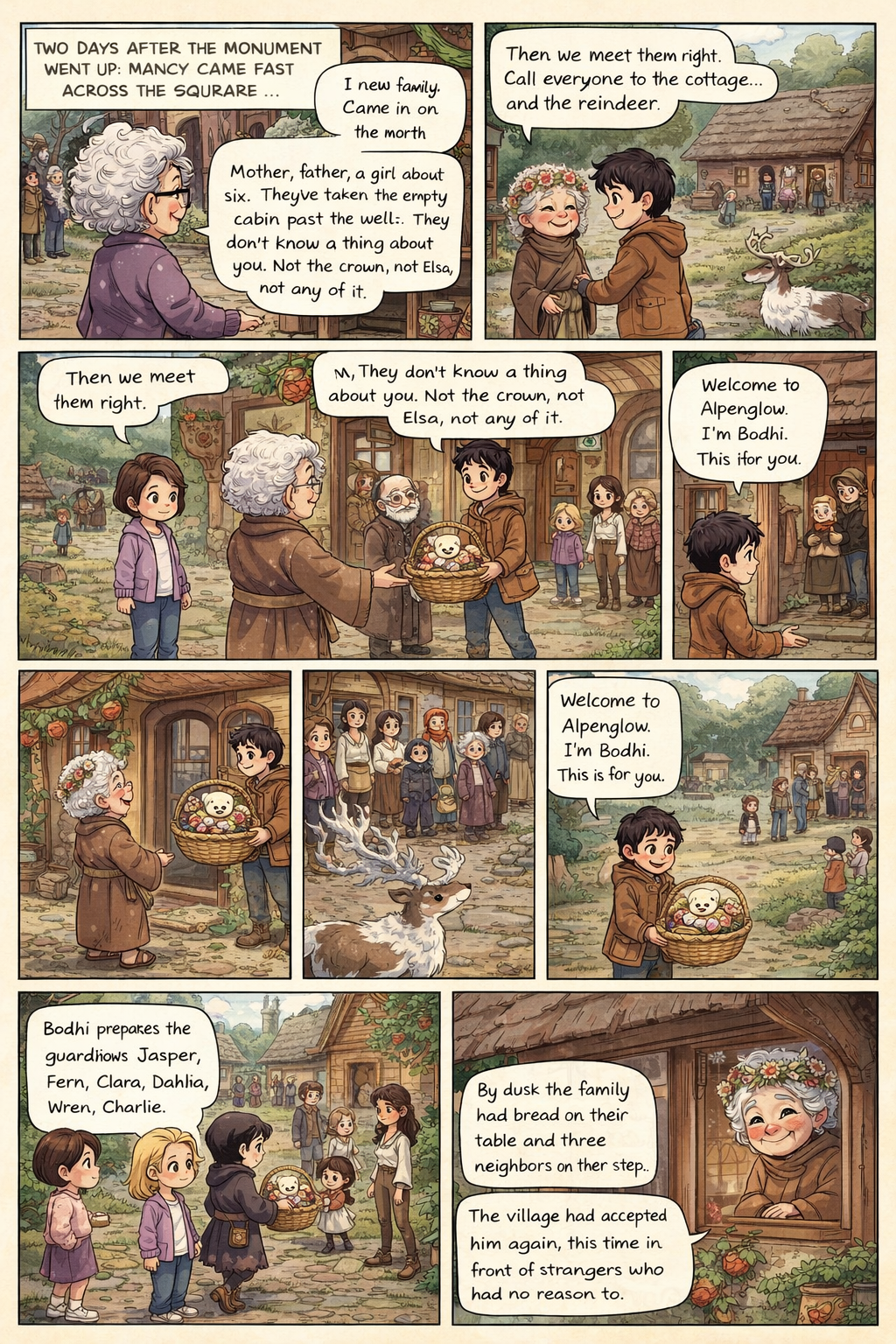
Two days after the monument went up, Nancy came fast across the square with her cardigan half-buttoned. She found Bodhi at the strawberry cottage, chalk in hand, drawing vine loops on the doorframe. Elsa sat inside on the bench by the window, wrapped in wool. Nancy caught her breath at the step. "A new family. Came in on the north track this morning. Mother, father, a girl about six. They've taken the empty cabin past the well." She looked at Bodhi. "They don't know a thing about you. Not the crown, not Elsa, not any of it." Bodhi's face lit. He set the chalk on the sill. "Then we meet them right. Call everyone to the cottage. Jasper, Fern, Clara, Dahlia, Wren, Charlie. And the reindeer." Nancy squeezed his shoulder and went. Elsa watched from the window. If the newcomers met him cold — a boy in a crown they'd never voted for — they could refuse him in front of the village and crack what she had spent a season welding. She stayed on the bench. This one had to be his. Bodhi worked at the table. He laid a woven basket with the reindeer-shaped handle on the boards. He tucked in two loaves from Clara, berries from Fern's bowl, and last a small white bear from the shelf. He arranged them the way he had watched Elsa arrange things for forty years. The guardians came in one by one. Jasper propped the door. Dahlia stood by the hearth. Charlie held Lynn's hand. Outside, the reindeer waited on the path, frost still caked to its antlers. They walked together to the cabin past the well. Bodhi went first with the basket. He knocked. The father opened, wary, a plane in his other hand. The mother stood behind him with the girl on her hip. Bodhi held up the basket. He smiled — crooked, gap-toothed, his own. "Welcome to Alpenglow. I'm Bodhi. This is for you." The girl reached for the bear before her mother could stop her. The mother's shoulders eased. Bodhi named each guardian at the step. Jasper the woodcarver. Fern the teacher. Clara the midwife. Dahlia who taught letters. Wren who kept the graves. Nancy the librarian. Charlie and Lynn. He pointed to the reindeer on the path. "He came with me. He'll come to your girl if she offers a hand flat." The father set the plane down. He asked no questions about crowns. He asked where to find the well and the mill. Bodhi walked them through the square himself. He named the cobbler at his bench, the Peters mother at her door, Larissa at the mill wheel. Each one nodded to Bodhi first, then to the newcomers. By dusk the family had bread on their table and three neighbors on their step. Elsa watched from the hut window. The village had accepted him again, this time in front of strangers who had no reason to. She counted four days left.
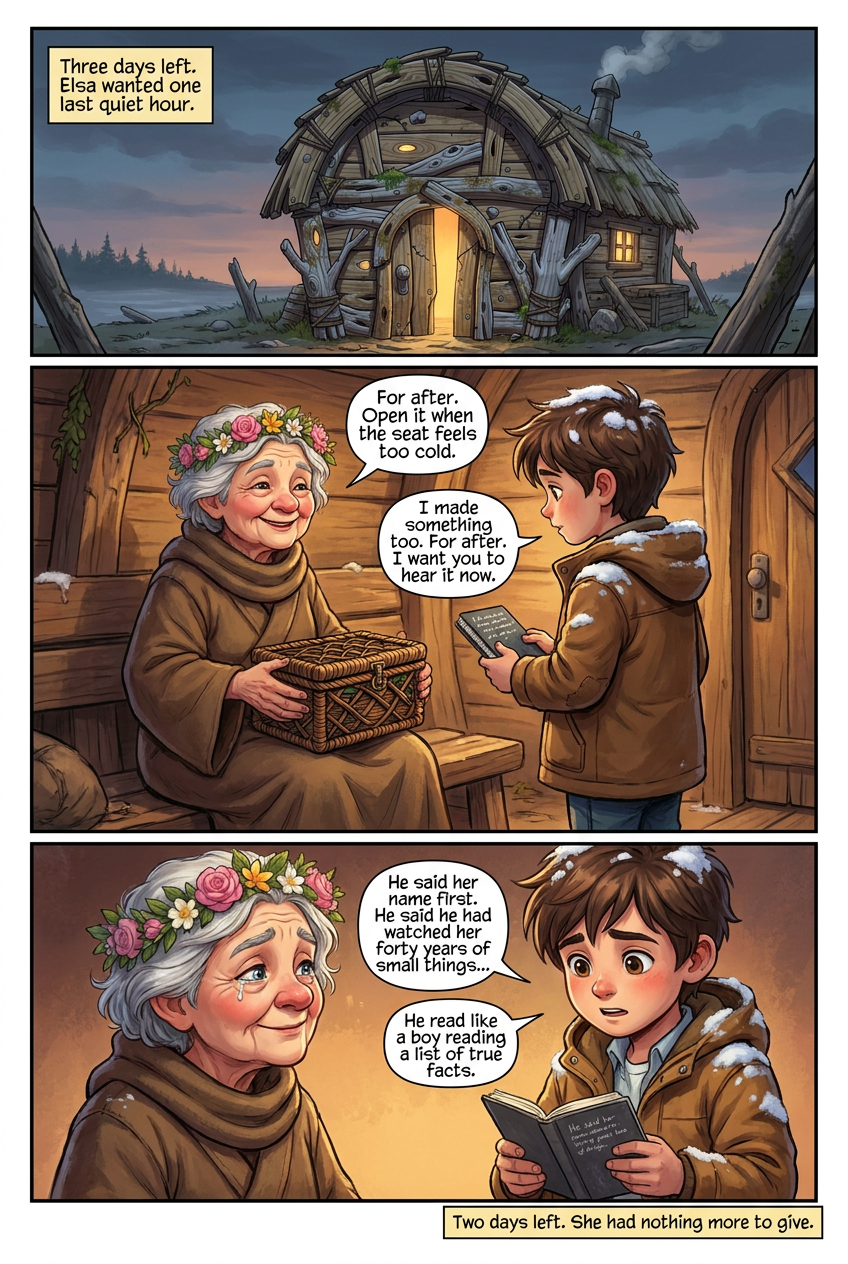
Three days left. Elsa sent Jasper to fetch Bodhi to the hut alone. She wanted no guardians at the door, no reindeer on the path, no mothers in line. Just the boy and her, one last quiet hour before the ground took her. She had crown, cloak, and hut set aside for the rite. But nothing small. Nothing he could carry in a pocket when the wind cut and the seat felt too big for him. Without that, his rule might feel hollow the first cold morning after she was buried. Bodhi came in with snow on his shoulders and his chalk stub in one hand. He shook off the parka and sat on the bench by her knee. Elsa reached under the wool blanket and drew out the woven box she had kept hidden there for a week. Blackberry and strawberry vines twisted around its sides. A silver and gold plaque on the lid carried her name. She set it in his lap. "For after," she said. "Open it when the seat feels too cold." He ran a thumb over the plaque. He did not open the box. Instead he pulled a small notebook from inside his shirt. The cover was smudged with chalk. "I made something too," he said. "For after. I want you to hear it now." He opened the notebook on his knee and cleared his throat like he had watched her do at meetings. He read. He said her name first. He said the day he walked into the library for his ceremony and felt her warmth land inside his chest before she had even spoken. He said he had watched her forty years of small things — how she set bread at a door, how she waited before answering a hard question, how she looked at a child before she looked at the mother. He said he would try to keep those things running in the village after she was gone. His voice held. He did not perform. He read like a boy reading a list of true facts. Elsa's eyes filled. She did not wipe them. She had spent a season worrying he would inherit an empty seat with nothing of her he could hold. He had made the keepsake himself. She opened the box in his lap and lifted out the necklace she had woven inside — a crystal pendant wrapped in vine, on a silver and gold chain. She placed it around his neck herself. Her hands did not shake this time. "Wear it when you speak that," she said. "So they see me on you." He closed the notebook. He tucked it back inside his shirt, next to the pendant. He did not cry. He held her hand until the fire burned low. When Jasper came at dusk, Bodhi walked out with both keepsakes on him. Two days left. She had nothing more to give.
Play your story to life
Storycraft is a mobile game where you create AI characters, craft items and locations to build their world, then discover what direction your story takes. Download the iOS game for free today!
Download for free