

Eduardo's Arc
115 Chapters
Eduardo's dream is reclaiming the family homestead he abandoned years ago when pride drove him away from those who loved him and becoming the man he was meant to finally letting go of fear of love.

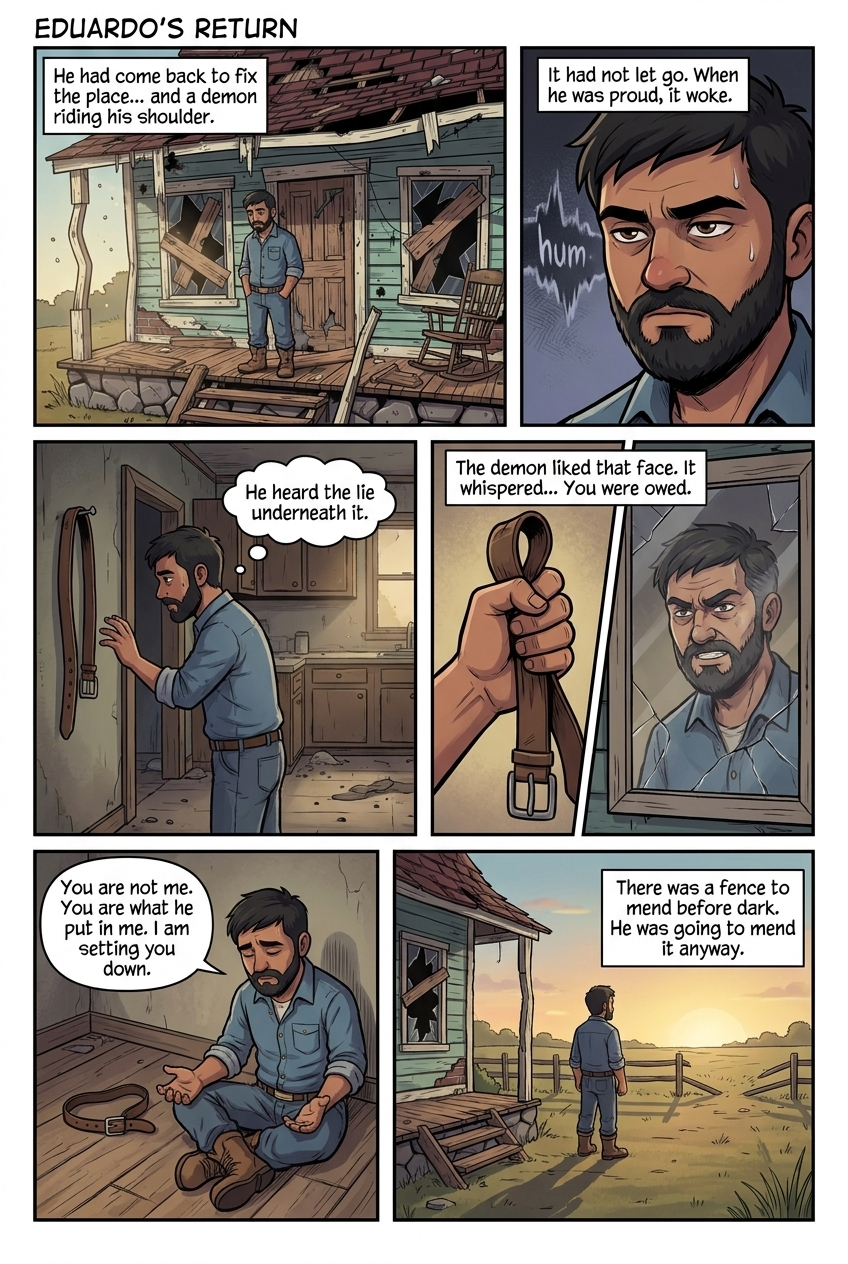
Eduardo stood on the porch of the house he had walked away from at nineteen. The roof sagged. Both front windows were broken and patched with crossed boards. His mother's rocking chair sat where she had left it, one runner cracked. He had come back to fix the place and claim it before the county sold it. He had eight years of pride to answer for, and a demon riding his shoulder that he did not yet know how to name. He felt it before he saw anything. A tightness behind his eyes. A hum in his teeth. It had followed him out of Kiersten's house the morning she cut him loose, and it had not let go. When he was calm, it slept. When he was proud, it woke. He pried a board off the door and stepped inside. Dust. Mouse droppings. His father's belt still hung on a nail by the kitchen. He stared at it too long. Heat rose in his chest. He heard his own voice, younger, telling his mother he was nothing like the man who hung that belt there. Then he heard the lie underneath it. The hum sharpened. His hand went to the belt on its own. He gripped the leather. His reflection swam in the cracked window glass, cap low, jaw set, eyes gone hard the way his father's had gone hard. The demon liked that face. It pressed closer, whispering the old comforts. You were robbed. You were owed. You are bigger than this room. He almost let it in. He almost tore the kitchen apart to prove he was still someone. Instead he sat down on the warped floor. He said it out loud, because the old man at the feed store had once told him a name spoken is a name lessened. "You are not me. You are what he put in me. I am setting you down." His hand opened. The belt hit the floor. The hum climbed, angry, then thinned. He felt it drag at his ribs, looking for a handhold. He gave it none. He named the pride under it. He named the shame under the pride. He named his mother, and his father, and the five years of buyers he had lost, and the man who took them. He named Kiersten last, and let her go. The pressure broke. The room felt colder. His shoulders shook once and stilled. He stood up in a house that was still broken. That part had not changed. He walked to the porch and looked at the fields his grandfather had cleared. There was a fence to mend before dark, and no one coming to help him do it. He was going to mend it anyway. He left the belt on the floor where it fell.
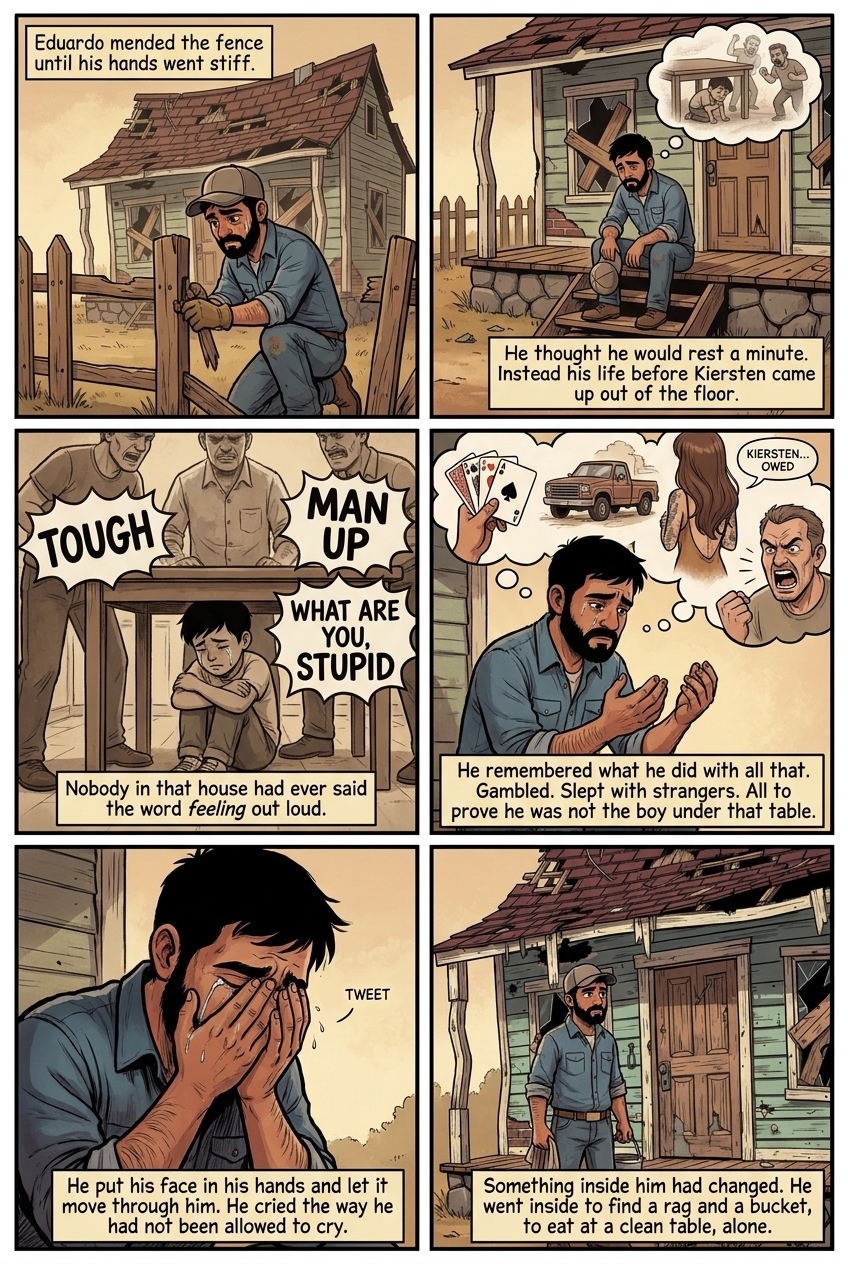
Eduardo mended the fence until his hands went stiff. Then he walked back to the porch and sat on the top step. The broken home leaned behind him. The sagging roof cast a crooked shadow across the boards. He had set the demon down inside, but now the house was quiet, and quiet was the thing he had run from his whole life. He pulled his cap off and set it on his knee. He thought he would rest a minute. Instead his life before Kiersten came up out of the floor and sat down next to him. He remembered the kitchen table when he was ten. His mother laughing too loud at a joke that was not a joke. His father calling him soft for crying when the dog died. His uncles trading insults and calling it love. Nobody in that house had ever said the word feeling out loud. They said tough. They said man up. They said what are you, stupid. He remembered what he did with all that. He gambled. He bought a truck he did not need. He wore new boots to places that did not care about boots. He took from friends and told himself they owed him. He met Kiersten and treated her like another thing he was owed. He had been angry at his mother for years and had never once said it to her face. He had only spent money and slept with strangers and won hands of cards to prove he was not the boy under that table. His chest hurt. He waited for the hum behind his eyes, for the old push to stand up and do something loud. It did not come. There was only the ache, and his own breath, and the sound of a bird in the field. He put his face in his hands and let it move through him. He did not name it this time. He just felt it. His shoulders shook. He let them. He cried the way he had not been allowed to cry at ten, and at fifteen, and at twenty-two on the night his reputation broke. He cried for the boy who learned to laugh at cruel jokes so he would not be the one laughed at. He cried for his mother, who had also not been taught. When he was done, his shirt was wet at the collar. His hands were still his hands. The porch was still the porch. Nothing outside him had changed. Something inside him had. He had sat with a feeling and it had not killed him. It had not owed him anything, and he had not owed it a performance. He stood up. The roof still sagged. The windows were still boarded. He went inside to find a rag and a bucket, because the kitchen floor was filthy, and tonight he wanted to eat at a clean table, alone, without pretending he was anyone but himself.
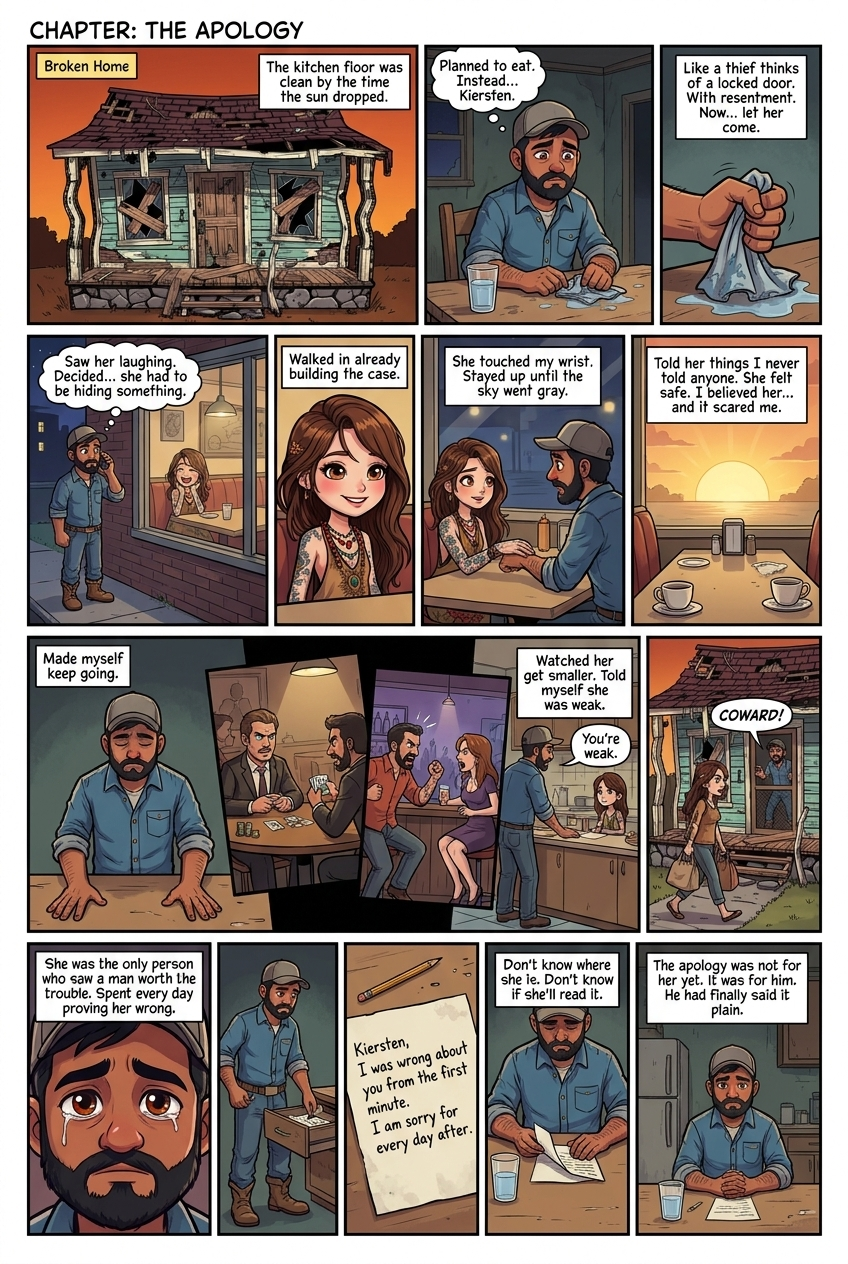
The kitchen floor was clean by the time the sun dropped behind the field. Eduardo sat at the table with a glass of water and no company but the sagging roof above him. He had planned to eat. Instead he stared at the wet rag in his hand and thought of Kiersten. He had not let himself think of her clearly in years. He had thought of her the way a thief thinks of a locked door, with resentment. Now he set the rag down and let her come. He remembered the first night. He had been on the phone with her, walking up to the diner where they were to meet. He saw her through the window before she saw him. She was laughing at something the waitress said. He had watched her a full minute and decided, before he ever sat down, that a woman that easy in her own skin had to be hiding something. He walked in already building the case against her. She had only been kind. She had asked about his day and listened to the answer. She had reached across the table and touched his wrist when he made a joke about his father. That night they stayed up until the sky went gray. He told her things he had never told anyone. She told him she felt safe. He believed her, and it scared him. He pressed his palms flat on the table. He made himself keep going. He remembered what he did with her belief. He gambled her rent money and lied about it. He picked fights so he could leave the house. He touched other women to prove she did not own him. He watched her get smaller at the kitchen counter and told himself she was weak. She had carried his grief and his debts and his bad nights for four years. One morning she set it all down on the porch and walked off. He had called her a coward through the screen door. His eyes burned. He did not fight it. She was the only person who had ever looked at him and seen a man worth the trouble. He had spent every day since proving her wrong so he would not have to believe her. She had been an angel at his table and he had treated her like a debt collector. He got up. He found a scrap of paper in a drawer and a pencil worn to a nub. He sat back down and wrote her name at the top. Then he wrote, I was wrong about you from the first minute. I am sorry for every day after. He did not know where she was. He did not know if she would ever read it. He folded the paper and set it under the water glass. The apology was not for her yet. It was for him. He had finally said it plain.
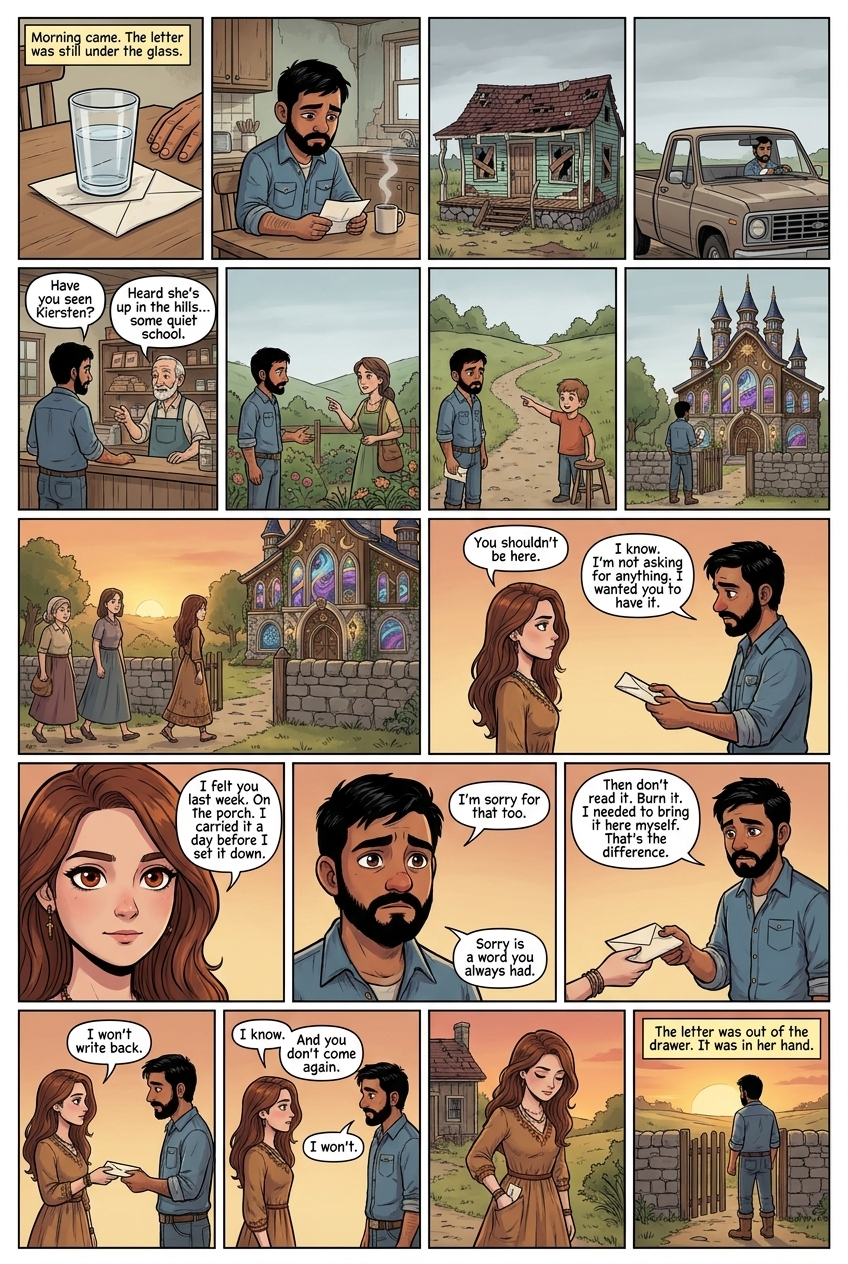
Morning came and the letter was still under the water glass. Eduardo stared at it while the coffee cooled. He had said the words. Now the words sat in his kitchen doing nothing. An apology in a drawer was the same as no apology at all. He pushed back from the table. The house creaked around him, roof sagging, one window still boarded from the night he had punched through it years ago. He walked outside and looked at the porch where she had set his life down and left. He tried to picture where she might be. He had no address. He had no phone number that still worked. He had burned every bridge that could have told him. He drove into town anyway. He asked at the feed store, because the old man there still spoke to him. The old man wiped his hands on his apron and said he had heard she was up in the hills, at some school for people learning quiet things. He did not know more. Eduardo thanked him and stood in the parking lot with the letter in his shirt pocket. He drove up the ridge road until it turned to gravel. He asked a woman weeding a garden. She pointed him further. He asked a boy with a stool under his arm. The boy pointed him further still. By afternoon he was at a low stone wall around a plain building, and he knew without being told that this was the place. He did not go in. He waited by the gate. He had rehearsed nothing. He held the letter in both hands. She came out near sundown with two other women. She saw him and stopped. The other women kept walking. Kiersten crossed the yard alone. She did not hug him. She stood an arm's length away. "You shouldn't be here," she said. "I know." He held out the paper. "I'm not asking for anything. I wrote it down. I wanted you to have it." She looked at his hand. She did not take it. "I felt you last week," she said. "On the porch. I carried it a day before I set it down." "I'm sorry for that too." "Sorry is a word you always had." He swallowed. "Then don't read it. Burn it. I needed to bring it here myself. That's the difference." She watched him a long moment. Her eyes were steady, not soft. She reached out and took the letter. She did not open it. "I won't write back," she said. "I know." "And you don't come again." "I won't." She folded the paper once more and slid it into the pocket of her dress. Then she turned and walked back toward the building. She did not look over her shoulder. Eduardo stood at the gate until the door closed behind her. The letter was out of the drawer. It was in her hand. It was the last thing of his she would ever carry, and he had put it there himself.
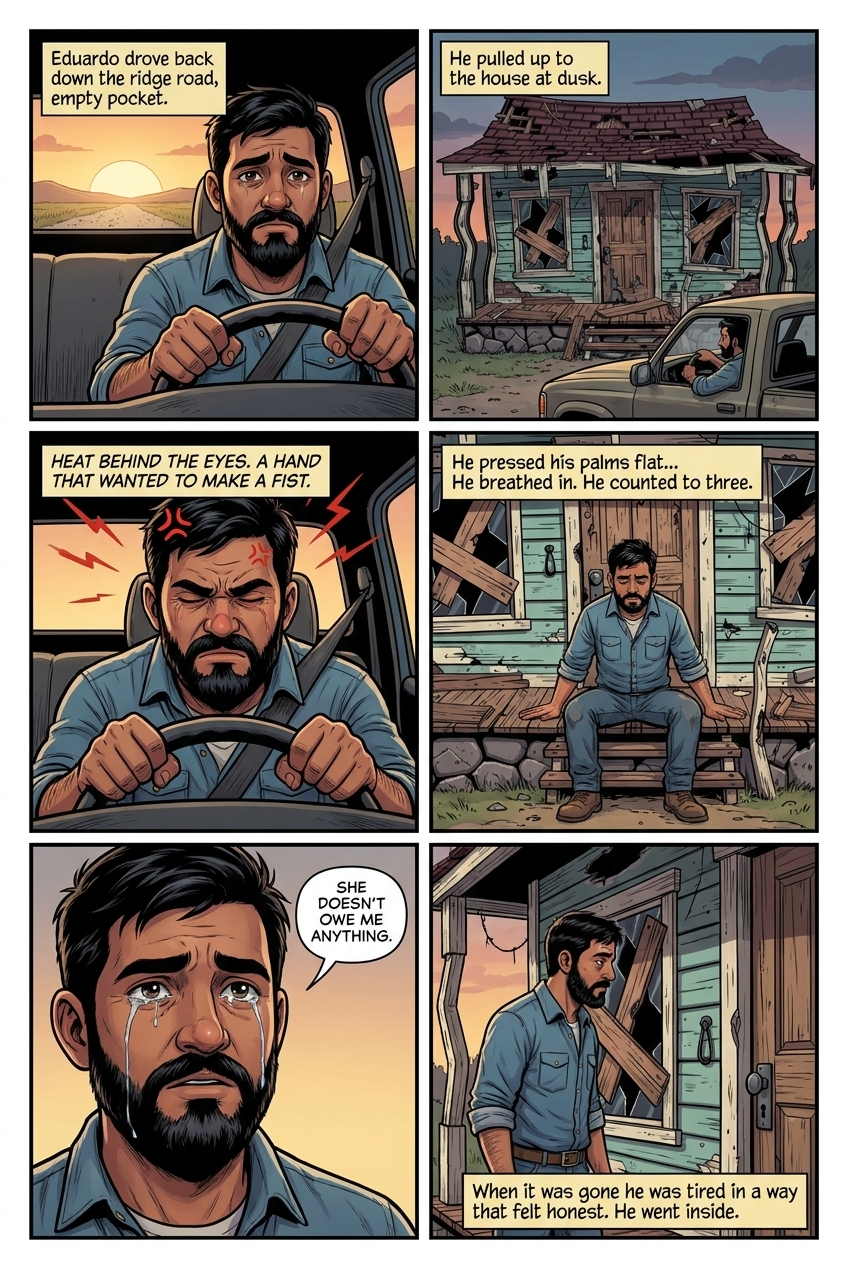
Eduardo drove back down the ridge road with the empty pocket where the letter had been. He kept both hands on the wheel. The gravel gave way to blacktop, and the blacktop carried him past the feed store and out toward his land. He did not stop for anyone. He did not want to be seen with his face like this. He pulled up to the house at dusk. The roof still sagged. The window he had never fixed still wore its cross of boards. He sat in the truck a long time. Then the old feeling came up under his ribs, the one he knew from before. Heat behind the eyes. A hand that wanted to make a fist. He had felt it a thousand times, and a thousand times he had spent it on someone else. He got out. He walked to the porch and sat on the step. He thought about her face at the gate. Not soft. Steady. He thought about the years before that face. How she had asked him, over and over, to sit with her. How he had gone to the card table instead. How he had come home and picked a fight so he would not have to answer for where he had been. How he had watched her get smaller and called her cold for it. The rage climbed. He wanted to put his fist through the second window and match the first. He wanted a bottle. He wanted a hand of cards and a stranger to take money from. He wanted anything that was not this. He pressed his palms flat against the porch board. He breathed in. He counted to three. He breathed out. He counted to six. He did it again. His father had never done this. His father would have found a face to hit. "She doesn't owe me anything," he said out loud. His voice cracked on the last word. He said it again. "She doesn't owe me anything." He sat there until the heat behind his eyes broke and came down his face. He did not wipe it. He let it run. He said her name once, and then he said he was sorry to the empty yard, because there was no one left to say it to who would take it. The rage did not leave in a clean piece. It went out slow, like water through a cracked pan. When it was gone he was tired in a way that felt honest. He stood up. He looked at the boarded window. Tomorrow he would pull the boards off and measure for glass. Tonight he would sleep in his own house without breaking anything in it. He went inside and shut the door behind him. The rage had come, and he had not fed it. That was the first time.
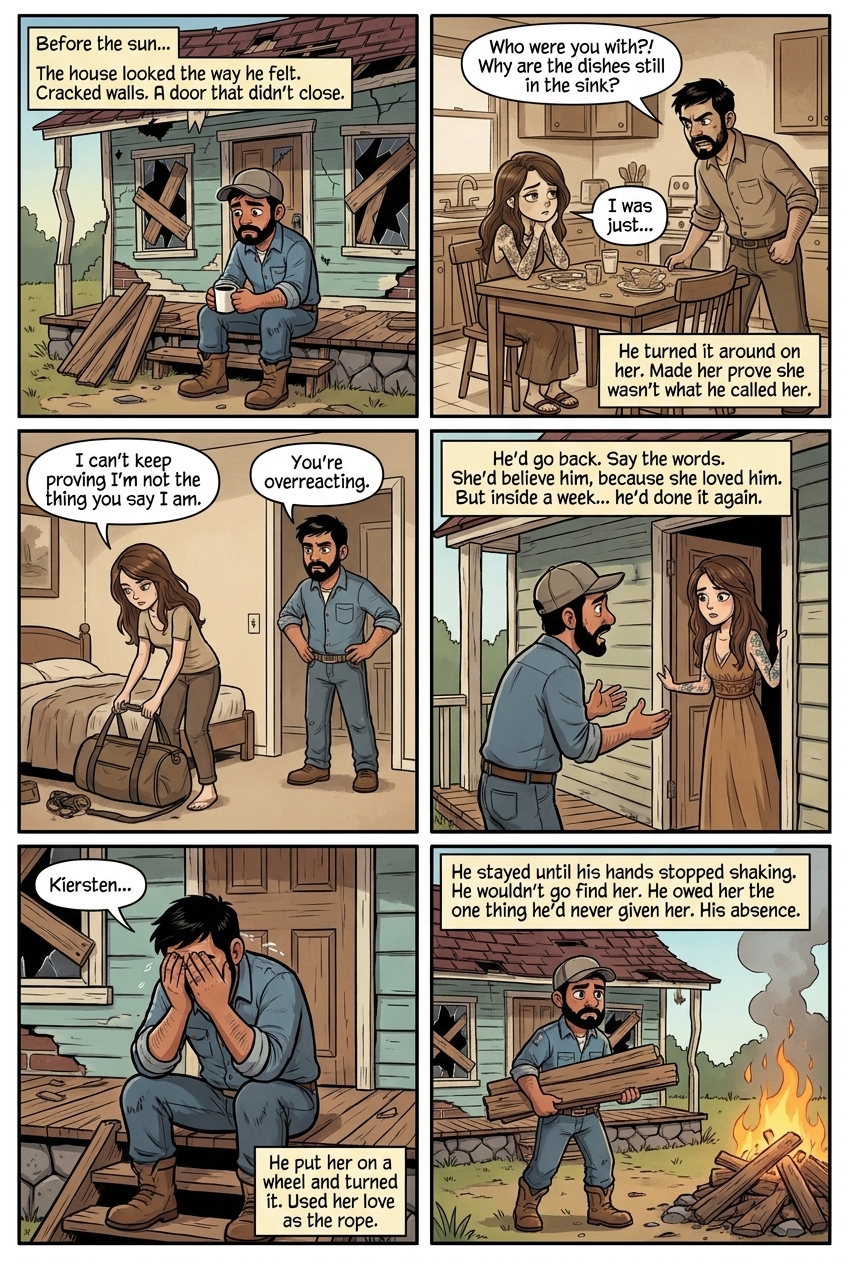
Eduardo woke before the sun. He pulled the boards off the second window and set them in the yard. Then he sat on the porch step with a cup of black coffee and watched the light come up over the sagging roof. The house looked the way he felt. Cracked walls. A door that did not quite close. He drank the coffee slow and let a memory come that he had kept away for a long time. He saw Kiersten at the kitchen table in their old place. She was small in the chair. Her hair was down. She was waiting for him to answer a question he did not want to answer. He had come in late again. He had lost again. He knew where the money went. She knew too. But she had asked him plain, and he had turned it around on her. He had asked her who she had been with. He had asked her why the dishes were still in the sink. He had watched her face go from tired to blank. He set the coffee down. He made himself see the next part. He saw the week after. He saw her packing a bag by the bed. He had stood in the doorway and told her she was overreacting. She had said, "I can't keep proving I'm not the thing you say I am." She had said it with no heat. Then she had left. He saw the month after that. He had gone to her sister's porch. He had said the words he thought would work. She had let him in. She had believed him again, because she loved him. And inside a week he had done it again. A new woman he swore was nothing. A pocket she found empty. A question he answered with another question. Each time she took him back he made her small again. Each time she asked, he made her prove she was not what he called her. He put his face in his hands. He said her name into his palms. He understood, now, what he had done. He had put her on a wheel and turned it. He had made her audition for her own life beside him. She had loved him, and he had used that love as the rope. He stayed on the step until his hands stopped shaking. Then he stood up. He walked to the yard and picked up the boards he had pulled off the window. He carried them to the burn pile behind the house. He did not need them anymore. He would measure for glass today, like he had promised the night before. He would not go find her. He would not write another letter. She had told him not to come back, and for the first time he understood exactly why. He owed her the one thing he had never given her. He owed her his absence.
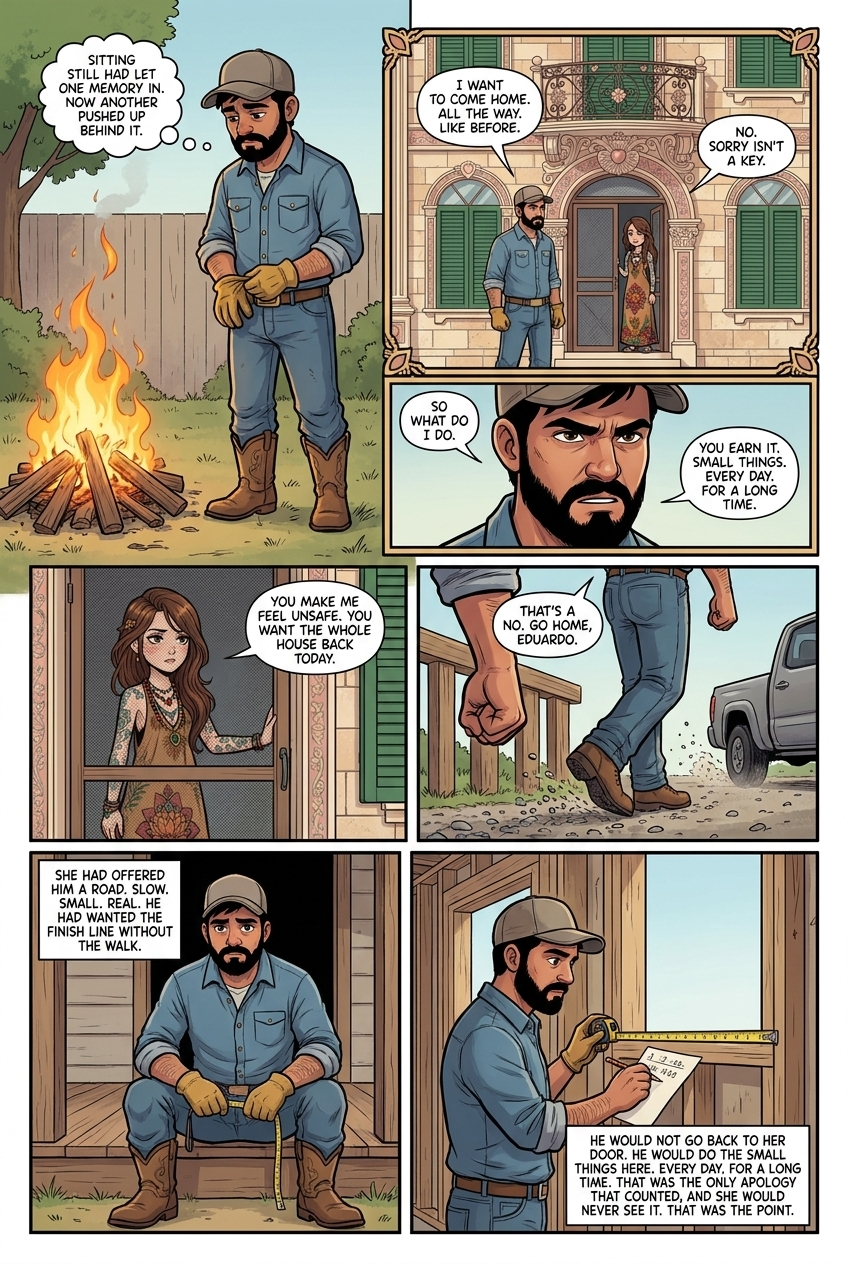
Eduardo carried the last board to the burn pile and stood there a while. The yard was quiet. He wiped his hands on his jeans and looked back at the porch. Sitting still had let one memory in. Now another pushed up behind it, and he did not fight it this time. He let himself see the day he had tried to come back. He had driven to the small stone house she was renting then. Green shutters. A balcony with iron rails and hearts worked into the metal. It had looked like a house for two people who had chosen each other on purpose. He had stood on the step in his cap and his boots and tried to make his face soft. She had opened the door but not the screen. Her hair was down. Her arms were covered in the tattoos he had never asked about. She looked at him through the mesh like she was already tired. "I want to come home," he had said. "All the way. Like before." "No," she had said. "I said I was sorry." "Sorry isn't a key." He had shifted his weight. He had felt his jaw set. "So what do I do." "You earn it," she had said. "Small things. Every day. For a long time." "How long." "As long as it takes." He had laughed then. A short, ugly laugh. He remembered the sound of it now and it made his stomach turn. He had told her he was her husband in all but paper. He had told her he did not need to audition in his own life. He had told her she was punishing him. She had not raised her voice. She never did. "You make me feel unsafe," she had said. "You want the whole house back today. I need time. You are picking your want over what I need. Same as before." "So that's a no." "That's a no," she had said. "Go home, Eduardo." He had wanted to break the rail. He had wanted to put his fist through the pretty door with the hearts in it. Instead he had walked to his truck and driven off fast enough to throw gravel. He had told himself she was cold. He had told himself for years. Eduardo sat down on his own step now. He saw it plain. She had offered him a road. Slow. Small. Real. He had wanted the finish line without the walk. He had called that love and it had never been love. He pulled the tape measure out of his pocket. He walked to the bare window frame and measured for glass. He wrote the numbers on the back of a receipt. He would not go back to her door. He would do the small things here. Every day. For a long time. That was the only apology that counted, and she would never see it. That was the point.
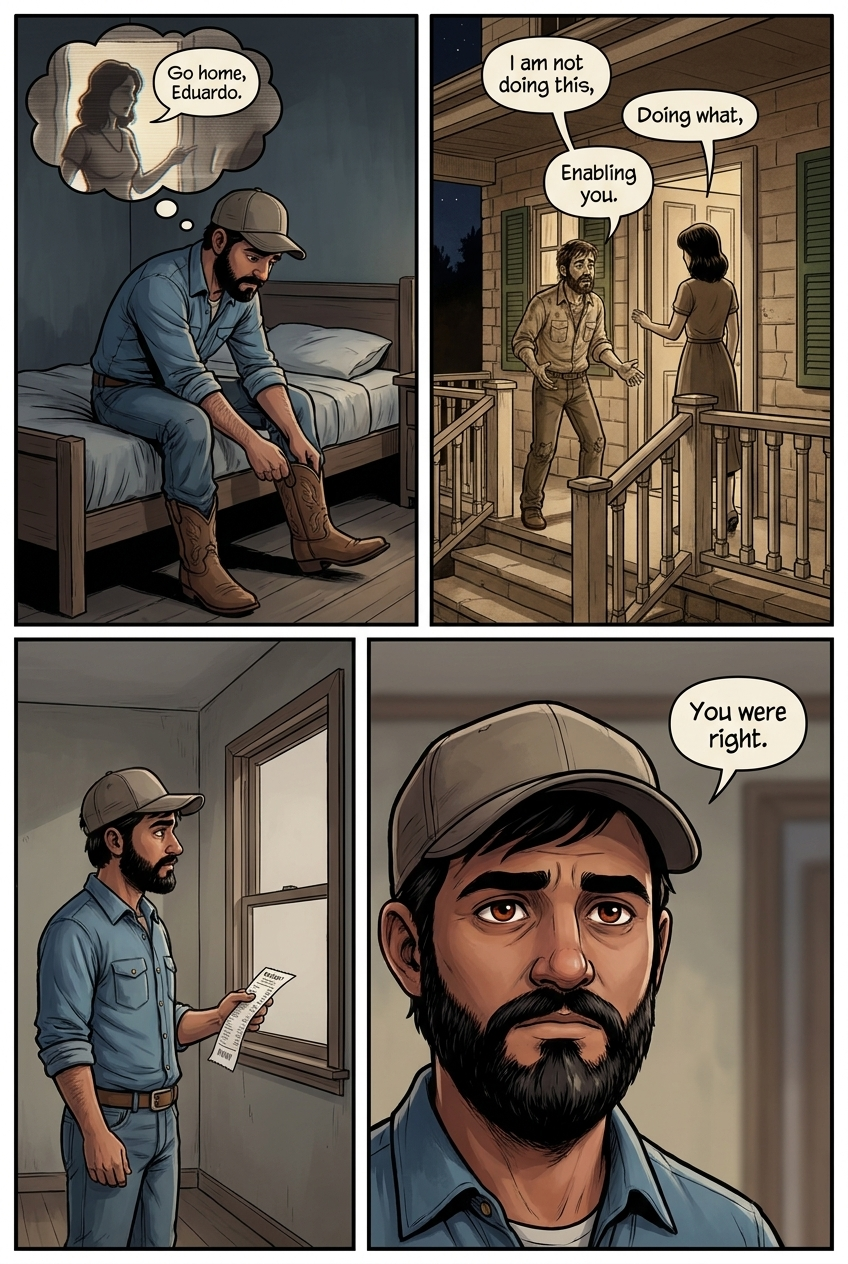
Eduardo woke before the sun and lay still, listening to his house settle. The measurements for the glass were folded in his shirt pocket where he had left them. He sat up and pulled his boots on. Then a sentence came at him whole, in her voice, the way her voice used to sound in the kitchen when she was done being patient. Go home, Eduardo. He sat on the edge of the bed with his hands on his knees. That last night. He had been drunk on the porch of the little stone house with the green shutters. He had come without warning again. He had wanted to be let in. She had come out in bare feet. She had closed the door behind her so the light stayed inside. "I am not doing this," she had said. "Doing what." "Enabling you." He had laughed at the word. He remembered the laugh. It had been the same ugly laugh he used on her at the balcony door months later. "God told me," she had said. "Plain. That I have to stop." "God told you." "Yes." "To leave me." "To stop covering for you. You will not see what you have done until you lose me. Until you sit in it." He had tried to touch her arm. She had stepped back. "I keep hurting myself to keep you," she had said. "I can't do it anymore." "So this is on God now." "This is on me. Go home, Eduardo." He had stood on her walk a long time. He had wanted to yell. He had wanted to beg. He had done neither. He had gotten in his truck and driven to a card room and lost eight hundred dollars by dawn to prove she was wrong about him. Eduardo sat in his own bedroom now with the memory finished. He waited for the old heat to come up his neck. It did not. What came instead was a quiet sickness in his stomach, and under that, something steadier. She had told him the exact truth on that porch. She had named it. He had called it cruelty for eight years. He stood up. He walked through the hall to the front room and looked at the bare window frame. The receipt with the numbers was still in his pocket. He took it out and smoothed it on the sill. He said it out loud, once, to the empty room. "You were right." His voice did not crack. He did not cry. He did not owe the sentence anything more than saying it. He pulled his cap on and picked up his keys. He would drive to the hardware for the glass. He would set it in the frame today. He would eat, and sleep, and get up tomorrow and do another small thing. He had sat in the consequences long enough to hear her. That was the part she had been waiting on. She would not know he had heard it. That was not the point anymore.
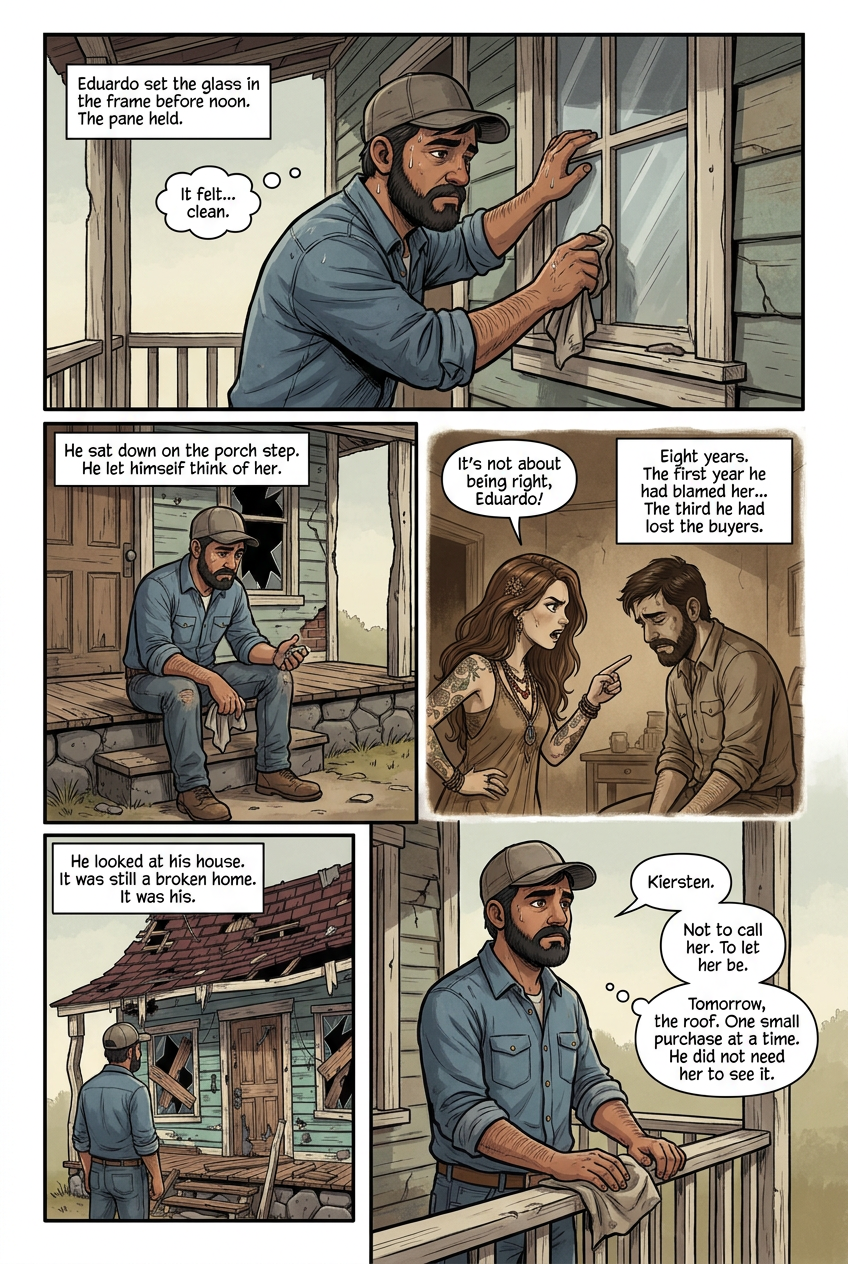
Eduardo set the glass in the frame before noon. He pressed the putty in with his thumb and wiped the smear off with a rag. The pane held. He stepped back and looked at it and did not feel proud. He felt tired in a clean way. He sat down on the porch step with the rag still in his hand. He let himself think of her without steering away from it. Eight years. He counted them on the boards of the porch. The first year he had blamed her. The second year he had spent money he did not have. The third he had lost the buyers he had built for five years, because he had handed his contacts to a man who smiled at him and used them to look bigger. The old man at the feed store was the only one who still took his word after that. Eduardo had not understood why until now. His word had been the same as his work, and he had let another man carry both. He thought of her bare feet on the stone step that last night. He thought of the laugh he had used on her. He thought of the eight hundred dollars he had lost at dawn to prove her wrong. He had proved her right instead. Every year after had proved her right. He thought of what he had learned since. That anger did not have to move his hands. That a window could be measured and set in one day. That crying did not kill him. That saying you were right out loud to an empty room did not cost him anything he needed to keep. He thought of what he had felt. Shame, first, for a long time. Then a heat that wanted somewhere to go. Then a flat gray stretch where he drank and did not sleep. Then this. Whatever this was. A quiet that did not ask him to fix it. He looked at his house. The roof still sagged over the back room. A crack ran down the front wall past the door. The porch boards were sound where he had replaced them and soft where he had not. It was still a broken home. It was his. He said her name once, under his breath, the way you say a name you are giving back. Kiersten. Not to call her. To let her be where she was. He stood up. He folded the rag and put it on the rail. Tomorrow he would start on the roof. He would buy the shingles with cash and he would ask the old man at the feed store what he was paying for nails these days. He would earn his word back one small purchase at a time. He did not need her to see it. That was the part he had finally understood.
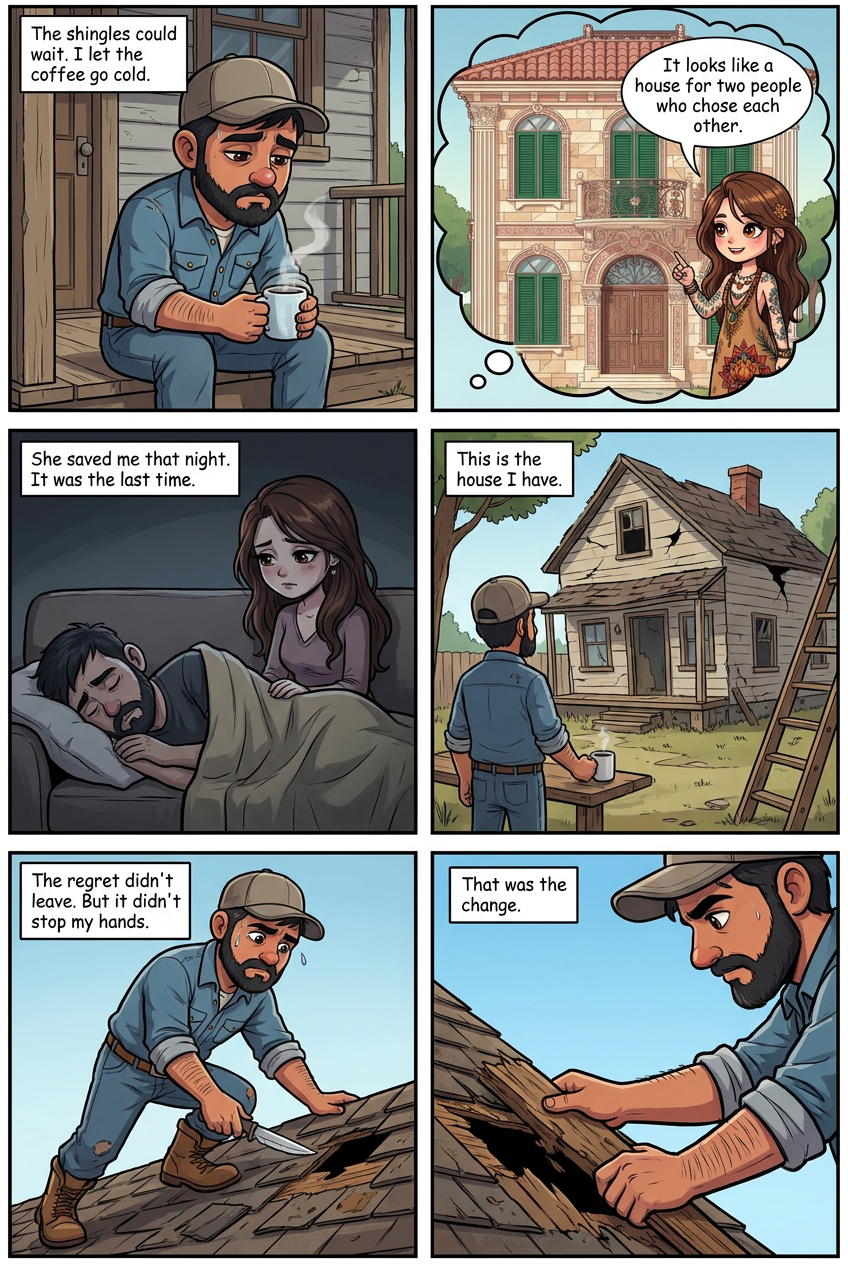
The next morning Eduardo did not climb to the roof. He sat on the porch step with his coffee and let the cup go cold in his hand. The shingles could wait one more day. He had said her name last night like he was giving it back. This morning it came back to him on its own. He thought of the things he should have done. He should have come home when she called from her sister's house that winter. He should have paid the light bill before he sat down at the table with the cards. He should have held her when she cried at the sink and not asked her what was wrong in the voice he used when he already knew. He thought of what he would tell her now if he could. That she had been right about the man he handed his contacts to. That she had been right about the drinking. That she had been right the last night on the stone step when she said he would not stop until he lost her. He would tell her he was sorry in a plain way, without asking her to answer. He thought of the small house they had almost rented once. Stone front. Green shutters. A little balcony over the door with iron scrollwork. She had stood on the sidewalk and said it looked like a house for two people who had chosen each other. He had laughed at her for it. He had laughed because he was afraid. He could see now that she had been showing him what she wanted, and he had answered by hurting her. He thought of the night she had let him sleep on her couch after he lost the money in the spring. She had put a blanket over him without a word. She had saved him that night. He had not known it was the last time. He wondered what would have happened if she had let him stay. He stopped the thought. That house was not his to build in his head. She had told him not to come back. That was the answer. He set the cup down. He walked out to the yard and looked at his own house. Sagging roof. Cracked wall. A door that stuck in the frame. It was not the house on the sidewalk with the green shutters. It never would be. It was the one he had. He went inside and got the ladder. He carried it around to the back and set it against the eave. He climbed up and put his hand flat on the shingles where they had lifted. The wood was soft under two of them. He would need to cut those out. He climbed back down for his knife. The regret was still in him. It did not leave. But it did not stop his hands. That was the change.
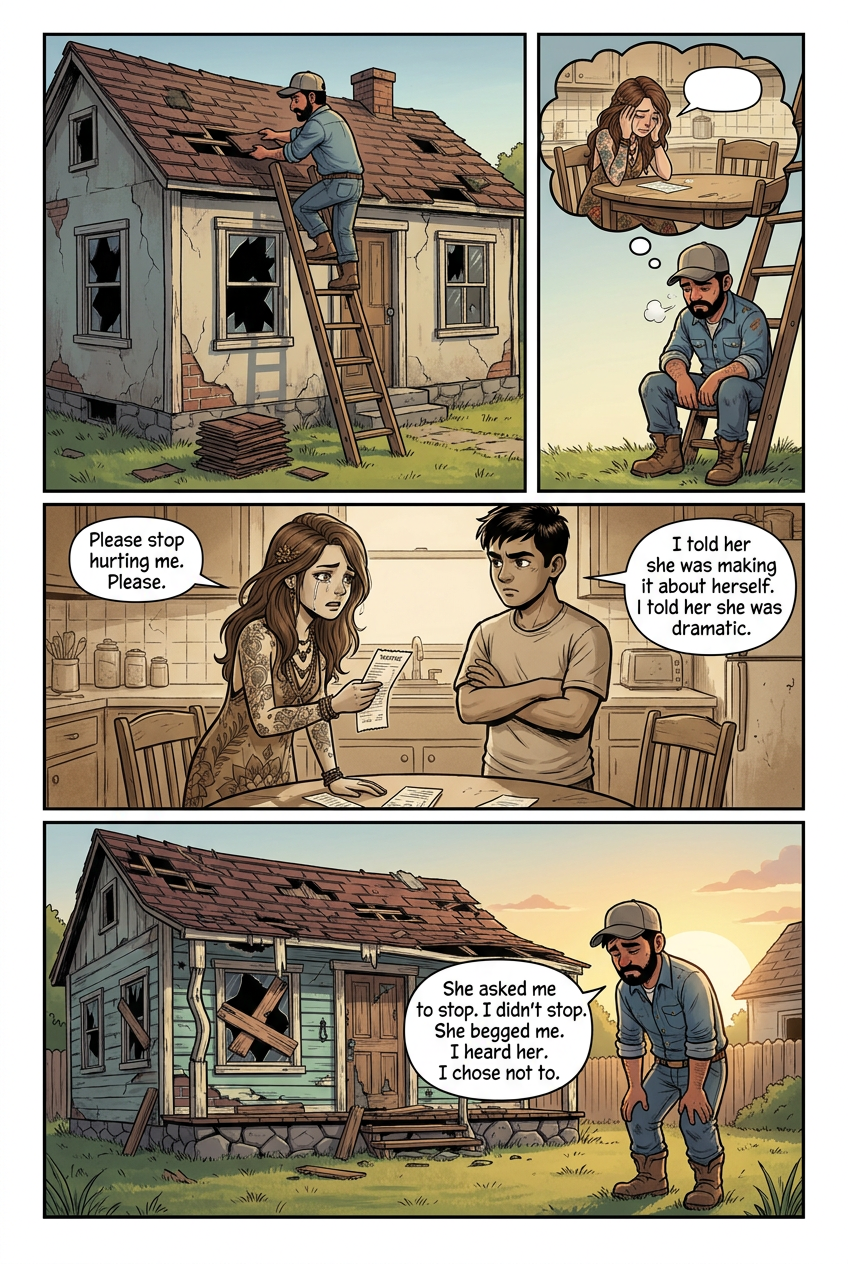
He cut the soft shingles out and set them on the grass. He climbed down for the new ones and sat on the bottom rung of the ladder to catch his breath. That was when the memory came. Kiersten at the kitchen table, crying, asking him why. He had not answered her then. He answered her now, alone in the yard, because there was no one left to lie to. He remembered the first time she cried in front of him. She had found a receipt in his coat. She asked him plain. He told her she was searching his pockets like a jailer. He remembered the shape of her face when he said it. She had stopped crying and gone quiet. He had counted the quiet as a win. He remembered the second time and the third. There were too many to count after that. She would sit at the table and put her hands flat on the wood and ask him to stop hurting her. She begged him. She used that word. Please stop. He would tell her she was making it about herself. He would tell her she was dramatic. He would tell her she was the reason he drank. Each time she asked him to fix it, he turned the knife and handed it back to her. He put his palms on his knees. He said it out loud in the yard. "She asked me to stop. I didn't stop." His voice sounded small against the side of the house. He said it again. "She begged me. I heard her. I chose not to." He had told himself for years that he had not understood. That she had not been clear. That he had been young. None of it was true. She had been clear every time. He had understood every time. He had chosen the fight because the fight let him keep his shape. If he had listened, he would have had to change. He had not wanted to change more than he had wanted her. He sat with it. He did not push it away and he did not soften it. He let it be what it was. He had hurt a woman who loved him, on purpose, again and again, because it was easier than looking at himself. That was the truth. He owned it in the yard, with no one to hear. He stood up. He picked up the new shingles and climbed the ladder. His hands were steady. The regret sat in his chest like a stone, but the stone was his to carry now. He fit the first shingle into the gap and drove the nail clean. He would not send her another letter. He would not go to the school again. He would carry what he had done and keep his hands working. That was the only apology left to him. He drove the second nail.
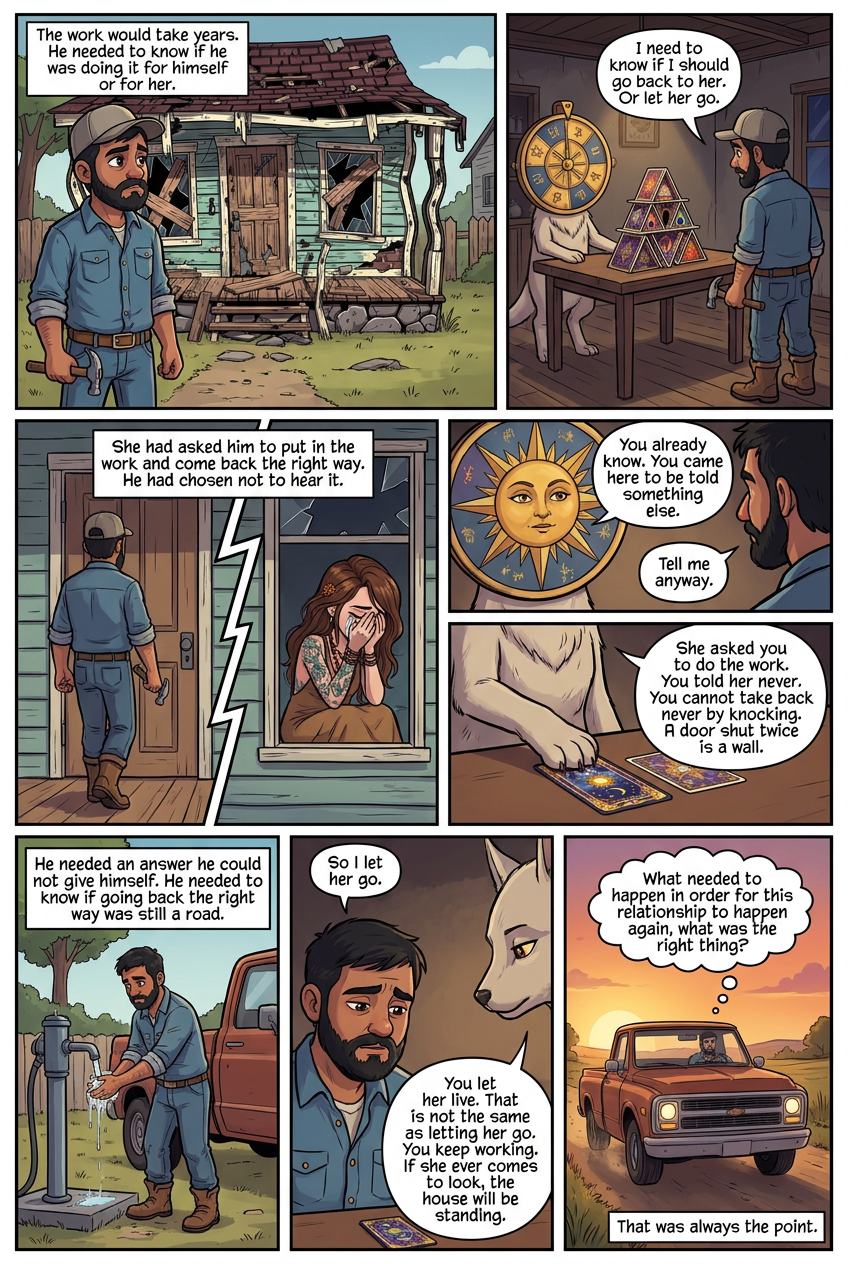
Eduardo drove the last nail into the shingle and climbed down. The roof was patched. The house still leaned. He sat on the top porch step and looked at the broken siding, the cracked window frames, the boards he had not yet cut. The work would take years. He needed to know if he was doing it for himself or for her. He remembered the last time he had stood at Kiersten's door. He had told her he would never come back. She had shut the door and he had heard her crying through the wood. She had not asked him to leave forever. She had asked him to put in the work and come back the right way. He had heard the difference then. He had chosen not to hear it. He washed his hands at the pump and drove into town. He had heard of a fortune teller who kept a small shop near the market. He needed an answer he could not give himself. He needed to know if going back the right way was still a road, or if the road had closed. The shop was one room. On the table sat a small structure built from tarot cards, stacked into a leaning triangle of painted suns and towers. Behind it stood the reader. Fortune was not a person. Fortune was an animal shaped like a tarot card, with four legs and a long tail. The wheel on its face turned slow when Eduardo sat down. "I need to know if I should go back to her," Eduardo said. "Or let her go." Fortune looked at him. The wheel stopped. "You already know," Fortune said. "You came here to be told something else." "Tell me anyway." Fortune tapped one card on the table. "She asked you to do the work. You told her never. You cannot take back never by knocking. A door shut twice is a wall." Eduardo's throat tightened. "So I let her go." "You let her live," Fortune said. "That is not the same as letting her go. You keep working. You do not send it to her. You do not carry it to her gate. If she ever comes to look, the house will be standing. That is all you get to give." Eduardo stared at the card house on the table. One breath would drop it. "And if she never comes." "Then the house is still standing," Fortune said. "For you. That was always the point." Eduardo paid and walked out. He drove home in the last light. He thought about what needed to happen in order for this relationship to happen again what was the right thing?
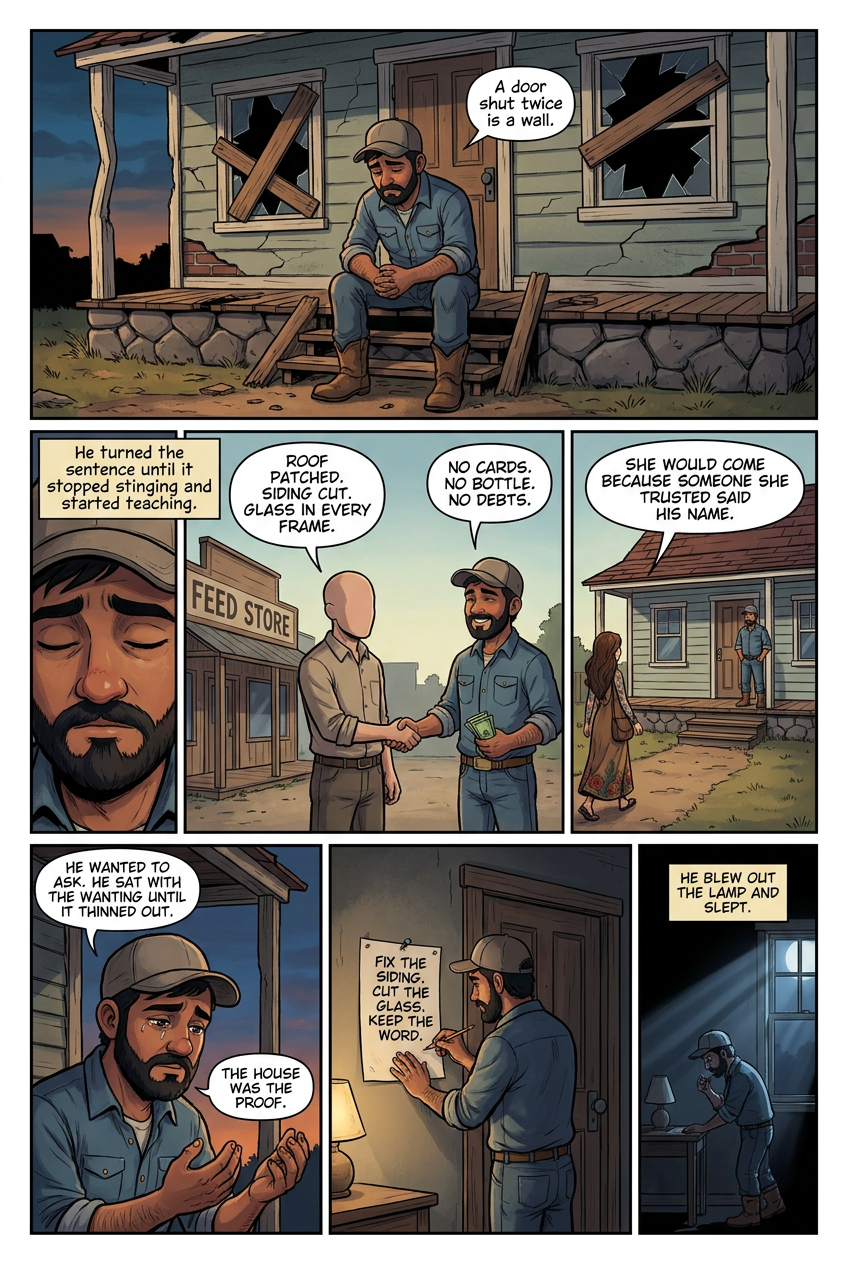
Eduardo drove home in the dusk and sat on the top step of his porch. The siding was still cracked. One window frame still held boards instead of glass. The reader's words sat in his chest like a stone he could not spit out. A door shut twice is a wall. He turned the sentence until it stopped stinging and started teaching. He tried to picture the fortune teller's meaning as a scene he could walk into. Not knocking. Not driving to her gate. Not sending a letter. What did the right road look like if she ever came to look? He set the picture in front of him like a map. He saw the house first. Roof patched. Siding cut and nailed. Glass in every frame. The porch level enough to hold a chair without rocking. That part was on him and only him. He wrote the list in his head. Siding. Windows. Steps. Rail. Paint last. He saw himself next. No cards. No bottle. No debts owed to men who smiled while they counted. His word good again at more than one feed store. Work he could name out loud without flinching. That part was on him too. Then he tried to picture her walking up the road. He kept the picture honest. She would not come because he called. She would come because someone she trusted said his name without a warning attached. That was the only door left, and he did not get to open it. Other people would open it, over years, if he earned it. He pictured what he would do if she came. He would not step off the porch. He would not reach. He would say hello and mean only hello. He would let her look at the house and leave if she wanted. He would not ask her to stay. He would not ask her anything. The visit would be hers, not his. His chest tightened at that. He wanted to ask. He always wanted to ask. He sat with the wanting until it thinned out. Fortune had told him the house was the point. He understood now what that meant. The house was the proof. The proof was for him first. If she ever saw it, that was extra. He stood up. The light was almost gone. He walked inside and found a pencil and the back of an envelope. He wrote three lines. Fix the siding. Cut the glass. Keep the word. He pinned the envelope to the wall beside the door. He did not write her name on it. He did not need to. The list was his now, and the picture behind it was clear. He would work the list. He would not send it. He would not carry it to her gate. If she ever came to look, the house would be standing. If she never came, it would still be standing. He blew out the lamp and slept.
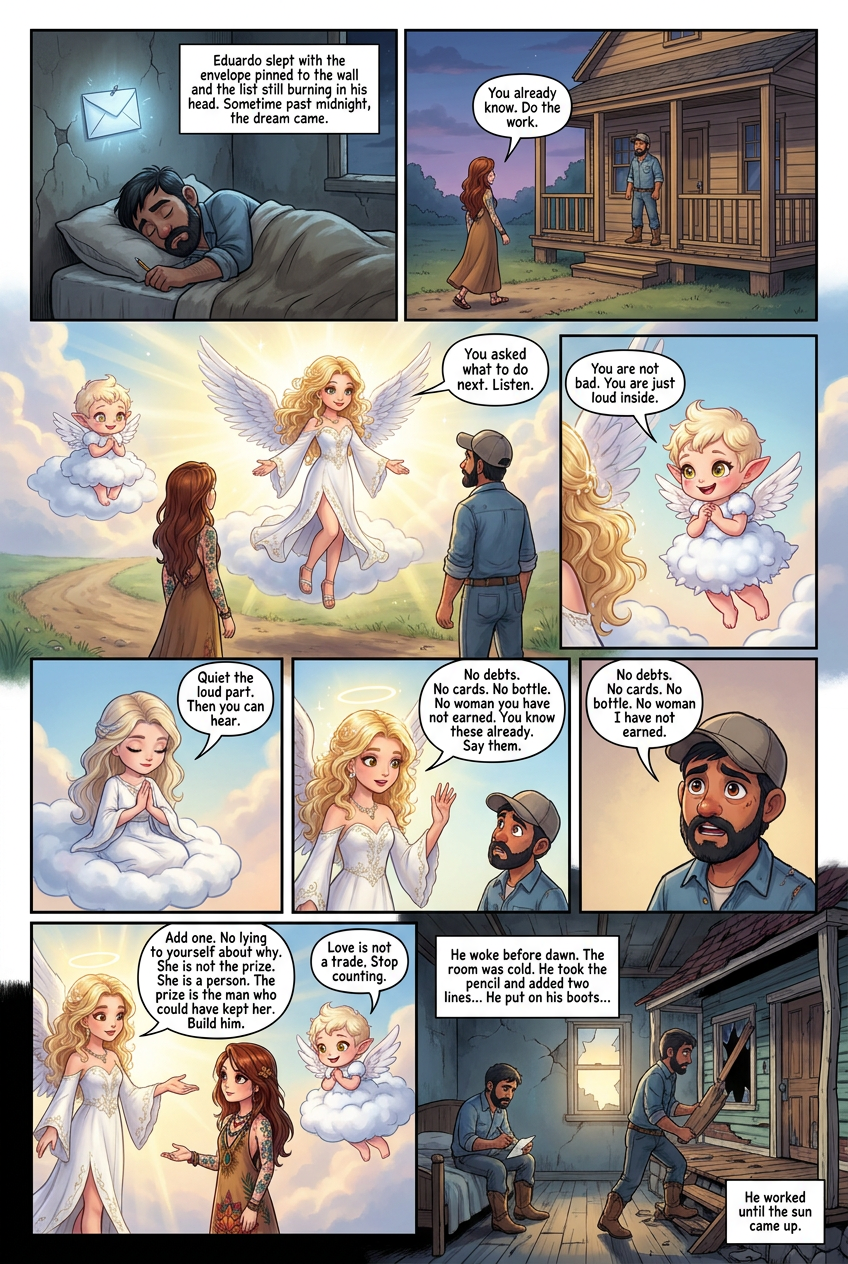
Eduardo slept with the envelope pinned to the wall and the list still burning in his head. Sometime past midnight, the dream came. He stood on his own porch, but the boards were sound and the paint was fresh. Kiersten walked up the road. She did not speak. She stopped at the bottom step and looked at him the way she used to when she was deciding whether to stay or go. Her tattoos moved on her arms like slow water. Her auburn eyes held no anger. They held nothing he could use. "You already know," she said. "Do the work." The road behind her opened into sky. A woman with blonde curls and wide white wings stepped down onto the dirt. Light came off her hair in small sparks. She did not touch him. She stood between him and Kiersten like a door held open. "You asked what to do next," the angel said. Her voice was even and kind. "Listen." A baby drifted down on a cloud with a dip in one side. Her cheeks were pink. Her eyes shone. Behind her floated another small child in a dress made of cloud, grinning. "You are not bad," the raspy one said. She laughed once. "You are just loud inside." The baby on the cloud pressed her hands together. "Quiet the loud part," she said. "Then you can hear." Eduardo tried to speak. The angel raised one hand. "No debts," she said. "No cards. No bottle. No woman you have not earned. You know these already. Say them." He said them. His voice shook. "No debts. No cards. No bottle. No woman I have not earned." "Add one," the angel said. "No lying to yourself about why." He said that too. Kiersten was still at the bottom step. She had not moved. "She is not the prize," the angel said. "She is a person. The prize is the man who could have kept her. Build him. If she comes, she comes to a whole house and a whole man. If she does not come, the house and the man are still whole." The baby's cloud drifted closer. "Love is not a trade," she said. "Stop counting." Eduardo felt the old ache lift a little in his chest. He had carried it so long he had stopped noticing its weight. "Do you hear us?" the angel asked. "Yes," he said. "Then wake up and start." He woke before dawn. The room was cold. The envelope on the wall was still pinned. He took the pencil and added two lines under the first three. No lying to myself. She is not the prize. He put on his boots. He drank water instead of coffee. He walked out to the siding pile while the sky was still gray and picked up the first cracked board. He pulled the nails one by one and set them in a can. He worked until the sun came up.
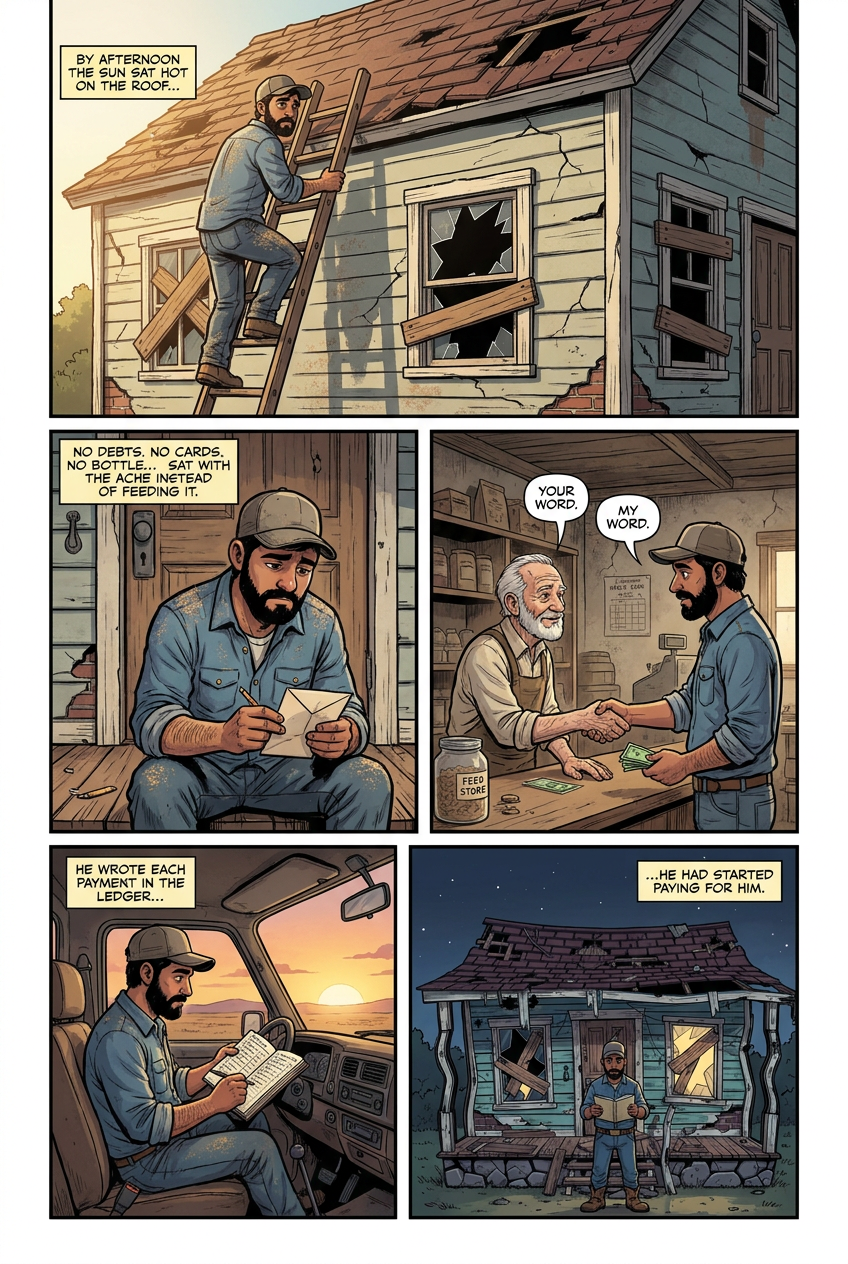
By afternoon the sun sat hot on the roof, and Eduardo climbed down from the ladder with sawdust in his beard. The house looked worse in daylight than at dawn. Sagging roof. Cracked siding. Two windows still boarded with scrap wood. He set his hammer on the step and looked at it the way a man looks at a road he has to walk. He pulled the pencil stub from his shirt pocket and sat on the porch. The envelope from the wall was folded in his hand. He opened it and read his own list. No debts. No cards. No bottle. No woman I have not earned. No lying to myself. She is not the prize. He wanted to add one more line. He wanted to write her name and promise the whole house to her. His hand hovered. The old ache pushed up under his ribs. He loved her so much it still bent him. He put the pencil down. "That is the loud part," he said out loud. He sat with the ache instead of feeding it. He counted his breath the way he had learned. Three in. Six hold. Nine out. The porch creaked under him. A cracked board bowed where his boot pressed. He heard his own heart slow. He picked the pencil back up and wrote a different line. Build the man first. Then he folded the envelope and pinned it under a rock on the rail. He walked to the truck and took out the ledger he kept in the glove box. He had been avoiding it for weeks. He opened it on the tailgate and wrote the numbers he owed. The feed store. The bank. Two men in town he had stiffed on cards. He added them until the page was full. The total was worse than he had let himself think. He drove into town with the ledger on the seat. He went to the feed store first, because the old man there still shook his hand. He paid what he could in cash and signed a paper for the rest, a small amount every week from honest work. The old man read the paper twice and nodded once. "Your word," the old man said. "My word," Eduardo said. He drove to the bank next. Then to the two men. One took the money and said nothing. The other spat on the ground before he took it. Eduardo did not argue. He wrote each payment in the ledger and drove home before dark. He stood in front of the broken house. The roof still sagged. The windows were still boarded. But the ledger on the seat was open, and his name was on every line in his own hand. He went inside and slept without dreaming. In the morning he would climb the roof again. He had stopped trying to manifest the best version of himself. He had started paying for him.
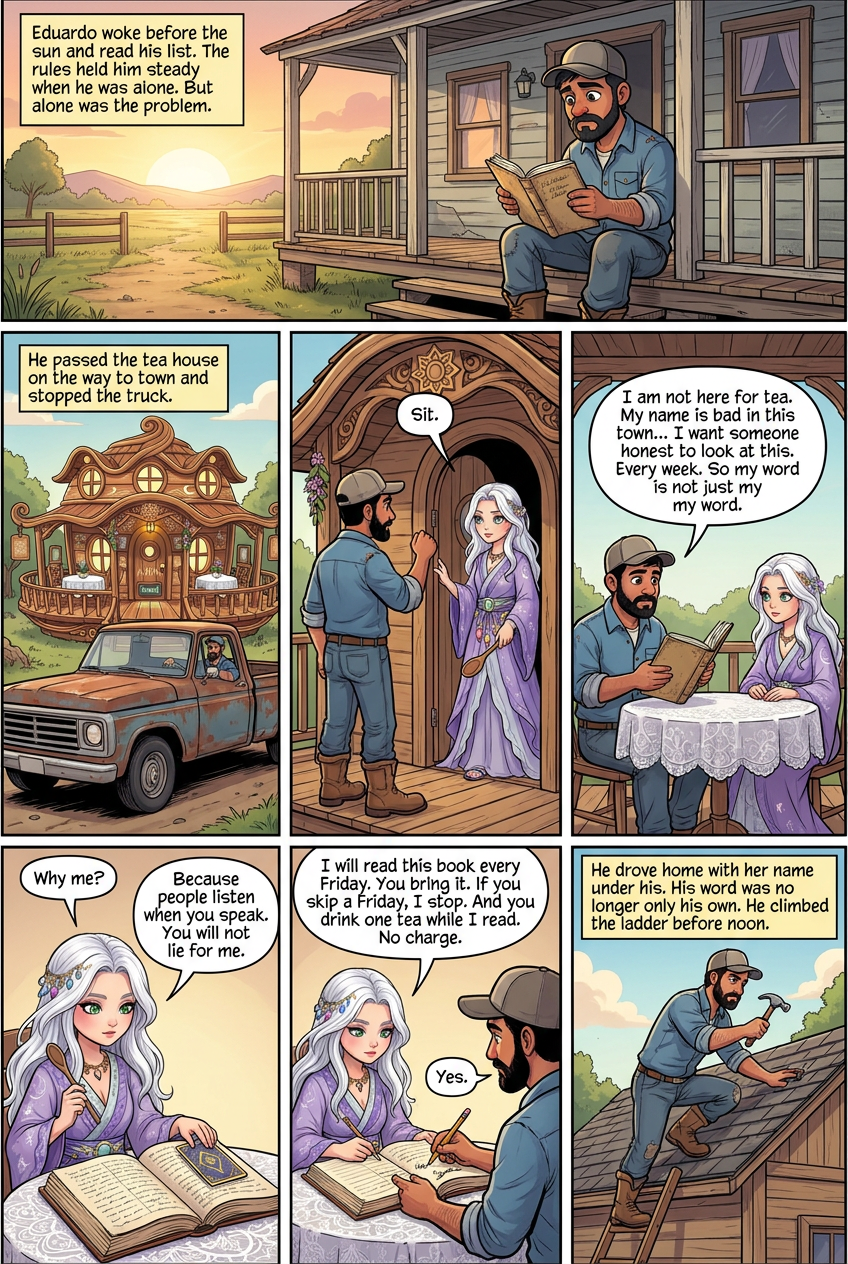
Eduardo woke before the sun and read his list on the porch rail. The rules held him steady when he was alone. But alone was the problem. A man could keep his word to himself for a year and still be a stranger in town. He needed someone outside his own house to see the work. The feed store owner shook his hand, but one old man was not enough. He put the ledger under his arm and drove into town. He passed the round tea house on the way to the hardware store and stopped the truck. He had heard men speak of the woman inside as someone who read people plainly. He climbed the porch steps between the lace-covered tables and knocked. The door opened. She was small, in a purple robe, with long white hair and green eyes that did not blink away from him. She held a wooden spoon in one hand. She was in the middle of stirring something on the stove. "Sit," she said, and pointed to a chair on the porch. He sat. He set the ledger on the lace table between them. "I am not here for tea," he said. "I am here because my name is bad in this town. I owed money. I paid most of it. I have a plan for the rest." He opened the ledger and turned it toward her. "I want someone honest to look at this. Every week. So my word is not just my word." She wiped her hands on her robe and read the page. She read slowly. She turned two pages back and read those too. "Why me," she said. It was not a question the way most people ask. "Because people listen when you speak," he said. "And because you do not know me. You will not lie for me." She looked at him a long moment. She pulled a card from a small deck in her pocket and set it face down on the ledger. She did not turn it over. "I will read this book every Friday," she said. "You bring it. I sign the last line. If you skip a Friday, I stop." "Yes," he said. "And you drink one tea while I read. My choice. No charge." "Yes." She took the pencil from his shirt pocket and signed the bottom of the page. Her handwriting was neat. She dated it. She pushed the ledger back across the table. "Now you have a witness," she said. "Do not waste her." He drove home with the ledger on the seat and her name on the page under his. The house still sagged. The roof still needed work. But his word was no longer only his own. Someone in town had put her hand to it, and she was the kind of person others believed. He climbed the ladder before noon and started on the shingles.
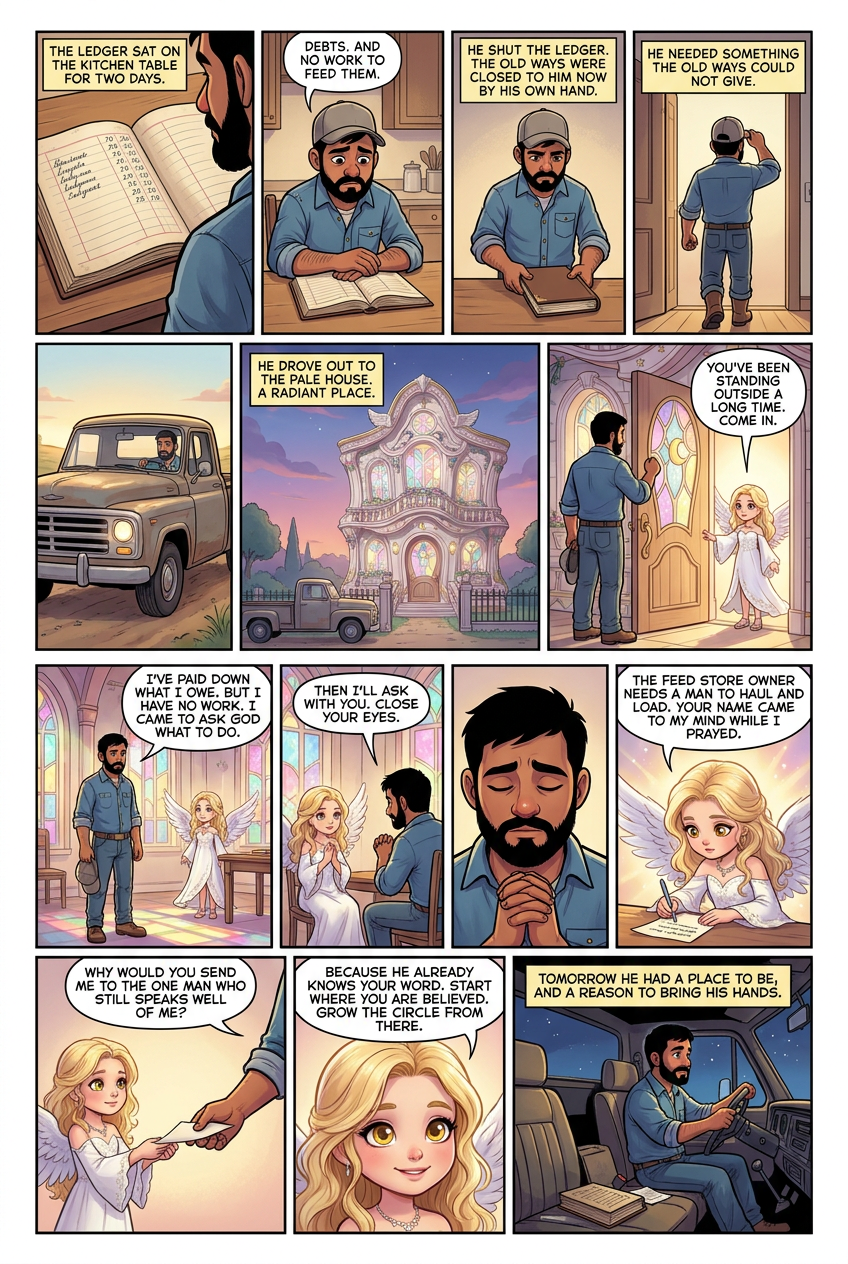
The ledger sat on the kitchen table for two days before Eduardo let himself open it again. He turned to the back where he had written what he still owed. The numbers were smaller than a month ago. They were still bigger than what he could pay. He had been living on what was left from selling his father's tools. That money was almost gone. He had debts, and no work to feed them. He knew what he used to do when the money ran low. Cards. A borrowed name at the auction yard. A favor that came with a hook in it. He shut the ledger and stood up. The old ways were closed to him now by his own hand. He needed something the old ways could not give. He drove out to the pale house past the edge of town. Men had spoken of it in low voices at the feed store. A radiant place with curved walls, stained glass in every window, a small cross on the roof between two carved wings. He parked at the gate and took off his cap. He climbed the stone steps and knocked. The angel woman opened the door. She was small and blonde, in a white dress, and her eyes were steady on him the way a candle is steady in a still room. She did not ask his name. "You've been standing outside a long time," she said. Her voice was soft and even. "Come in." He stepped into a room full of colored light. He held his cap in both hands. "I've paid down what I owe," he said. "But I have no work. No one will hire my name. I came to ask God what to do. I don't know how to ask." She pointed to a chair and sat across from him. She folded her hands. "Then I'll ask with you," she said. "Close your eyes." He closed them. She prayed out loud, plain and slow. She did not ask God to send him money. She asked that his hands be given honest work, and that he be shown the first door, not the whole road. When she was done, he opened his eyes. She was already writing on a scrap of paper. "The feed store owner needs a man to haul and load," she said. "He told me last week. He said he'd take someone he could trust with a key. Your name came to my mind while I prayed. Go tomorrow at first light. Do not be late." He took the paper. His hand shook a little. "Why would you send me to the one man who still speaks well of me," he said. "Because he already knows your word," she said. "Start where you are believed. Grow the circle from there." He drove home with the paper on the seat beside the ledger. Tomorrow he had a place to be, and a reason to bring his hands.
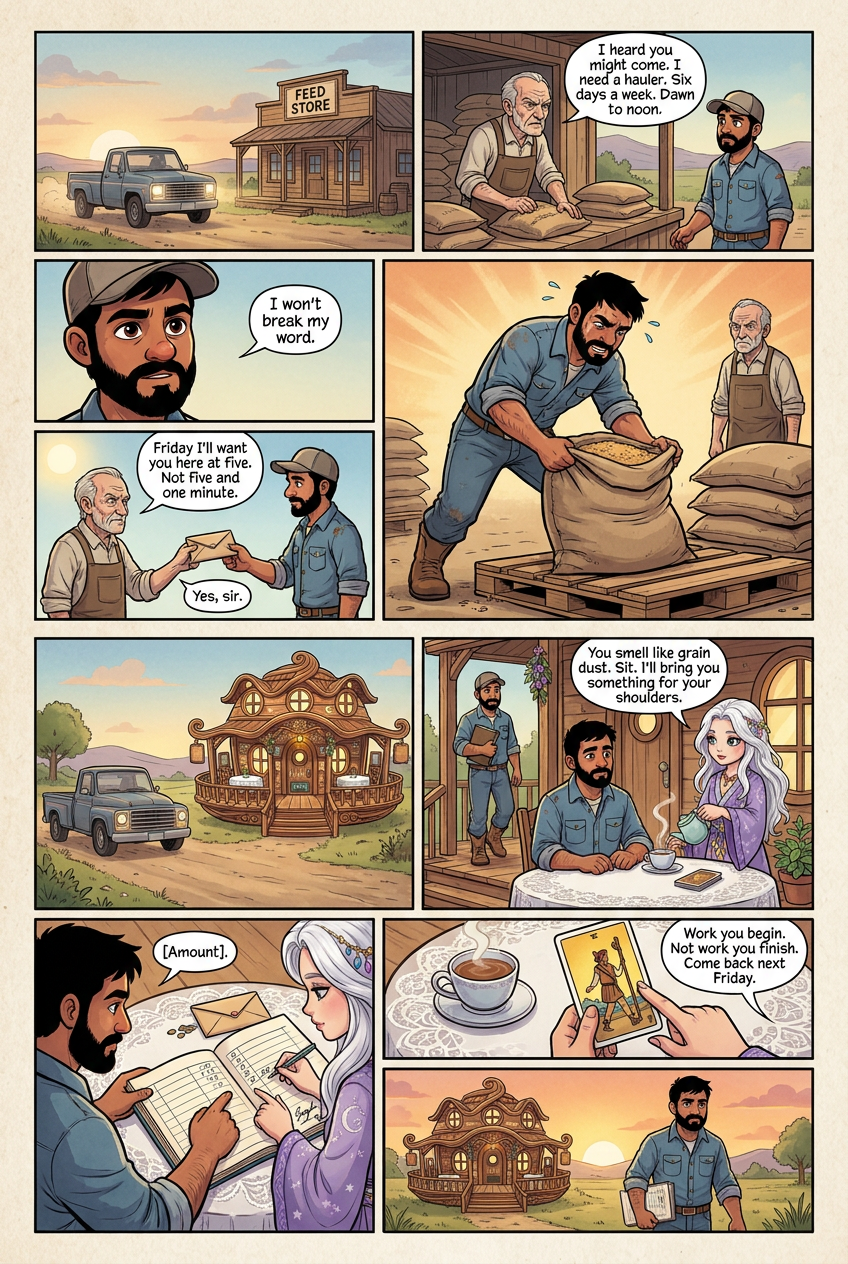
Eduardo woke before the sun and drove to the feed store with the angel woman's scrap of paper folded in his shirt pocket. The old man was already at the loading dock, sorting sacks by weight. He looked up when Eduardo climbed down from the truck and did not smile, but did not turn away either. "I heard you might come," the old man said. He wiped his hands on his apron. "I need a hauler. Six days a week. Dawn to noon. Pay is honest and small. You break your word, you don't come back." "I won't break it," Eduardo said. "Prove it by loading that pallet." Eduardo took off his cap and set it on the truck seat. He worked through the morning. He hauled grain sacks from the back room to the wagons of two farmers, then stacked feed by the door. His shoulders burned. His shirt stuck to his back. At noon the old man handed him an envelope with the week's pay written on the outside and the cash inside. "Friday I'll want you here at five," the old man said. "Not five and one minute." "Yes, sir." Eduardo drove into town with the envelope on the seat. He had enough for the week's food, a can of paint, and the nails he needed for the porch rail. He had enough to keep the repairs moving. The tools would not have to be sold down to nothing. He drove past his turn and kept going to the round tea house with the wraparound porch, because it was Friday and he had given his word to come. He climbed the steps with the ledger under his arm. The white-haired woman in the purple robe was watering a pot of mint on the rail. She looked up and studied him the way someone studies weather. "You smell like grain dust," she said. "Sit. I'll bring you something for your shoulders." He sat at one of the lace-covered tables. She came back with a cup that smelled of ginger and something greener he did not know, and a single tarot card face down beside it. "Ledger," she said. He opened it to the week's page. He laid the envelope from the feed store beside it and named the amount. She read down the column, checked his numbers against the receipts he had clipped, and signed the bottom in small, even letters. She turned the card over. A figure with a staff, walking. "Work you begin," she said. "Not work you finish. Come back next Friday." "I will." He drank the tea. It was bitter and warm. When he set the cup down his hand was steady. He walked out with a signed page, a paid week, and a job to return to at dawn.
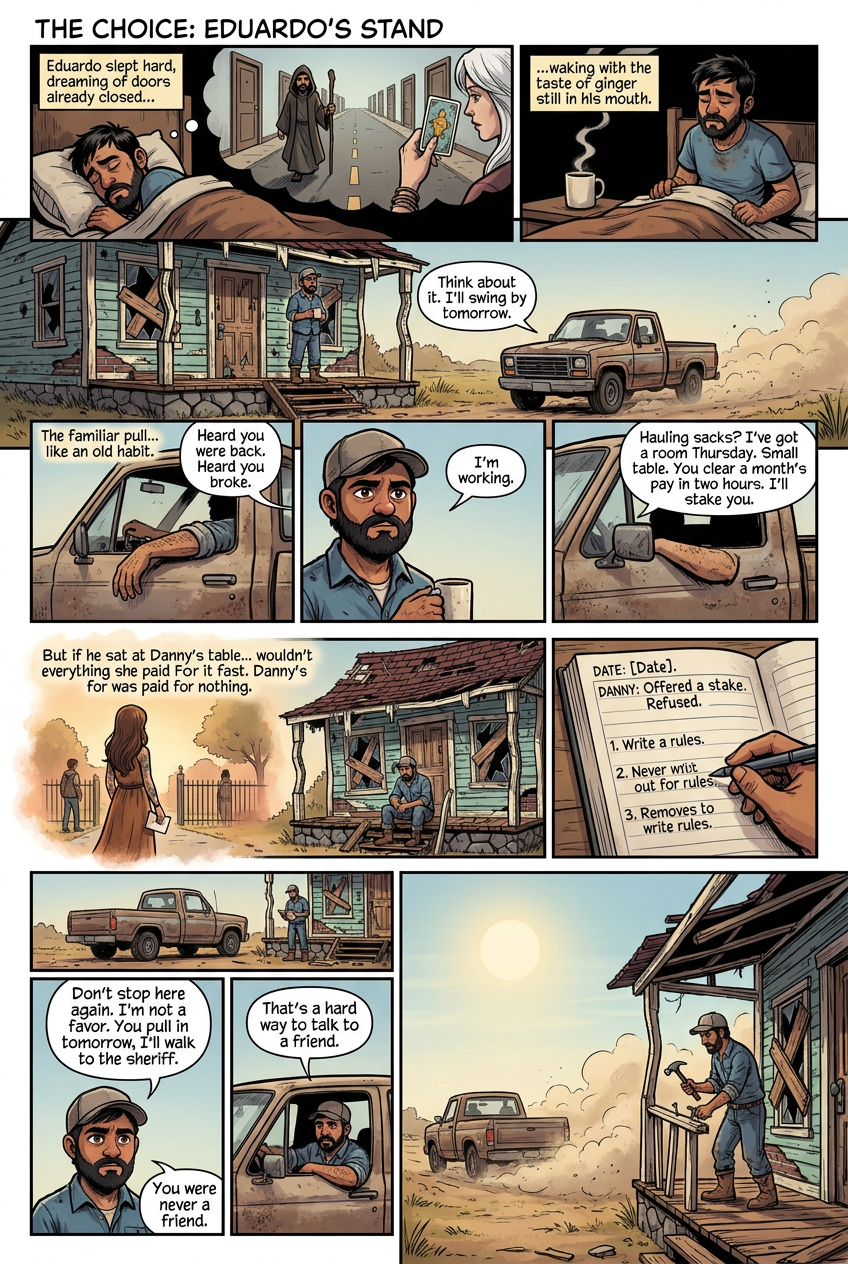
Eduardo slept hard after the tea house and dreamed of the card the white-haired woman had turned over. The figure with the staff kept walking. In the dream the figure had his own face, and the road behind him was full of doors he had already closed. He woke before the alarm with the taste of ginger still in his mouth. He made coffee and stood on the porch to drink it. A truck slowed at his gate. He knew the truck before he saw the driver. Danny from the old days. Danny who used to front him buy-ins and take a cut when the night went well. "Heard you were back," Danny said through the open window. He did not get out. "Heard you were broke." "I'm working," Eduardo said. "Hauling sacks for the old man." Danny laughed. "I've got a room Thursday. Small table. Clean players. You sit two hours, you clear a month of that feed-store money. I'll stake you." Eduardo held the mug with both hands. He felt the pull under his ribs, quick and familiar, like a hand he used to shake without thinking. "No," he said. "Think about it." "I said no." Danny tapped the door. "I'll swing by tomorrow. You'll think different by then." He drove off slow enough to make the offer feel patient. Eduardo sat on the top step and looked at his house. The roof still sagged over the front room. One window was boarded where the glass had not come in yet. The rail he was rebuilding leaned against the post, half-nailed. A month of feed-store money would not fix any of it fast. Danny's room would. He thought of Kiersten at the school gate. Her hand taking the letter. Her back when she walked away. She had carried his weight for years and set it down at a cost he would never see the bottom of. If he sat at Danny's table tomorrow, everything she paid for was paid for nothing. He went inside and got the ledger. He wrote the date and Danny's name. Under it he wrote: offered a stake. Refused. Then he wrote the four rules from the vision, in order, and signed his name under the fourth. The next morning Danny's truck came up the road. Eduardo was already on the porch with the ledger open on his knee. He stood before Danny could roll the window down. "Don't stop here again," Eduardo said. "I'm not a table for you. I'm not a favor. If you pull in tomorrow I'll walk to the sheriff and tell him what rooms you're running." Danny's face went flat. "That's a hard way to talk to a friend." "You were never a friend." Danny held his eyes a moment, then spat out the window and drove off. The dust settled. Eduardo went inside, picked up the hammer, and started on the rail.
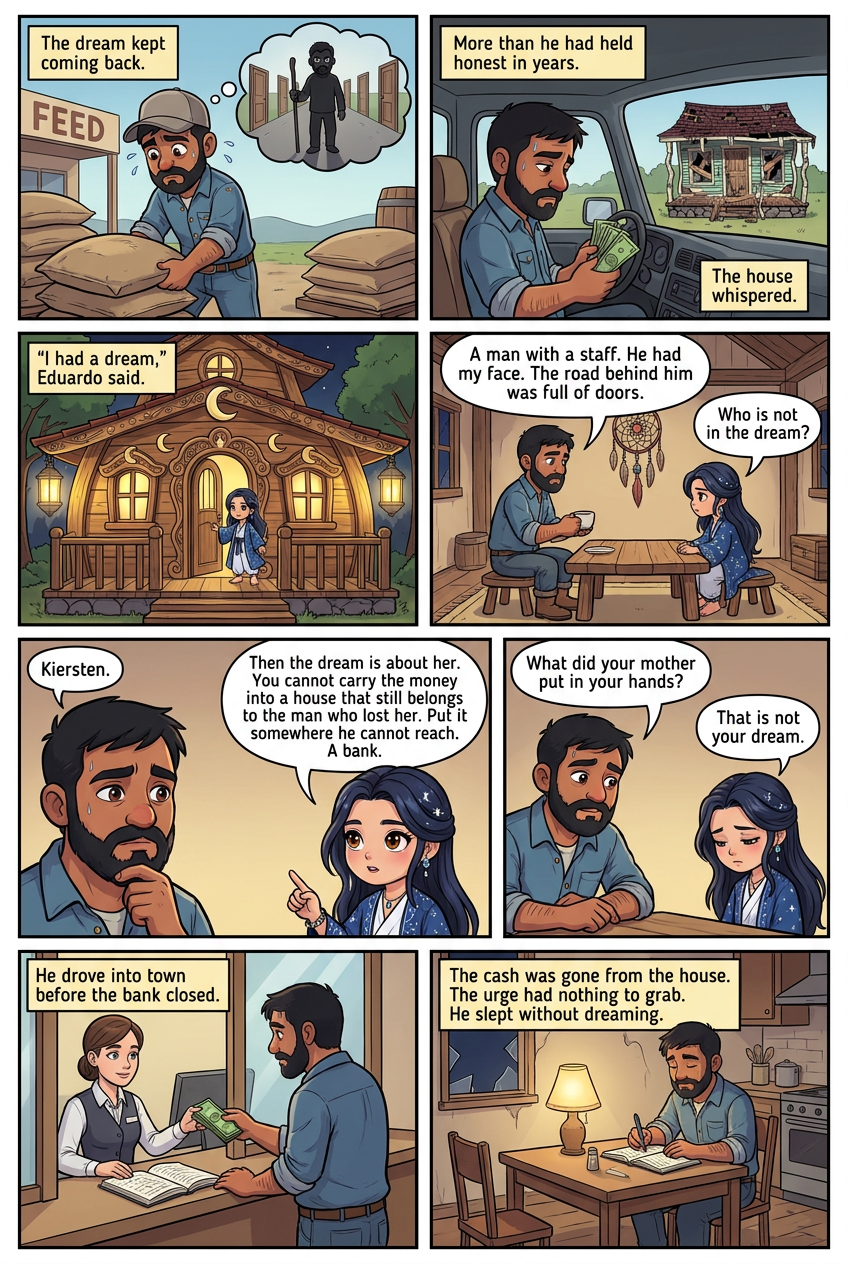
Eduardo drove to the feed store at first light. He loaded sacks and stacked pallets and kept his hands moving, but the dream from two nights back kept coming back to him. The figure with the staff. His own face on it. The card the white-haired woman had turned over at the tea house. He worked through the morning and the picture would not settle. At noon he counted his week's pay in the truck. Cash. More than he had held honest in years. He looked at it and felt the pull he had felt when Danny leaned out the window. Not gambling now. Worse. The urge to spend it fast, to buy something loud, to prove he had it. The house sat waiting for that money. He did not trust himself to carry it home and set it on the table where he could see it after dark. He drove past his own gate and kept going, up the road to the wooden house with lanterns and moons carved into the eaves. Dream catchers hung from the porch. He had passed it a hundred times. He had never stopped. Dreamer opened the door before he knocked. She was small, dark-haired, barefoot. She looked at him like she had been expecting a knock but not from him. "I had a dream," Eduardo said. "Two nights ago. A man with a staff. He had my face. The road behind him was full of doors." "Come in." She sat him at a low table and poured water. He told her the dream. He told her about Danny. He told her about the cash folded in his shirt pocket and how the house whispered at night. "Who is not in the dream?" she asked. "What?" "You told me the man. The doors. The road. Who is left out." He thought. "Kiersten." "Then the dream is about her," Dreamer said. "The doors behind you are hers. You cannot carry the money into a house that still belongs to the man who lost her. Put it somewhere he cannot reach." "Where." "Not your pocket. Not your drawer. A bank. Someone else's ledger. Somewhere you have to ask permission to touch it." He sat with that. It was plain and it was hard. "What did your mother put in your hands," he said, because her eyes had gone somewhere for a moment. She looked at him. Quieter. "That is not your dream." He nodded and did not ask again. He drove into town before the bank closed. He opened an account in his own name, deposited every bill, and asked for a book he could not carry loose. The clerk stamped the page. He wrote the amount in his ledger that night at the kitchen table. The cash was gone from the house. The urge had nothing to grab. He slept without dreaming.
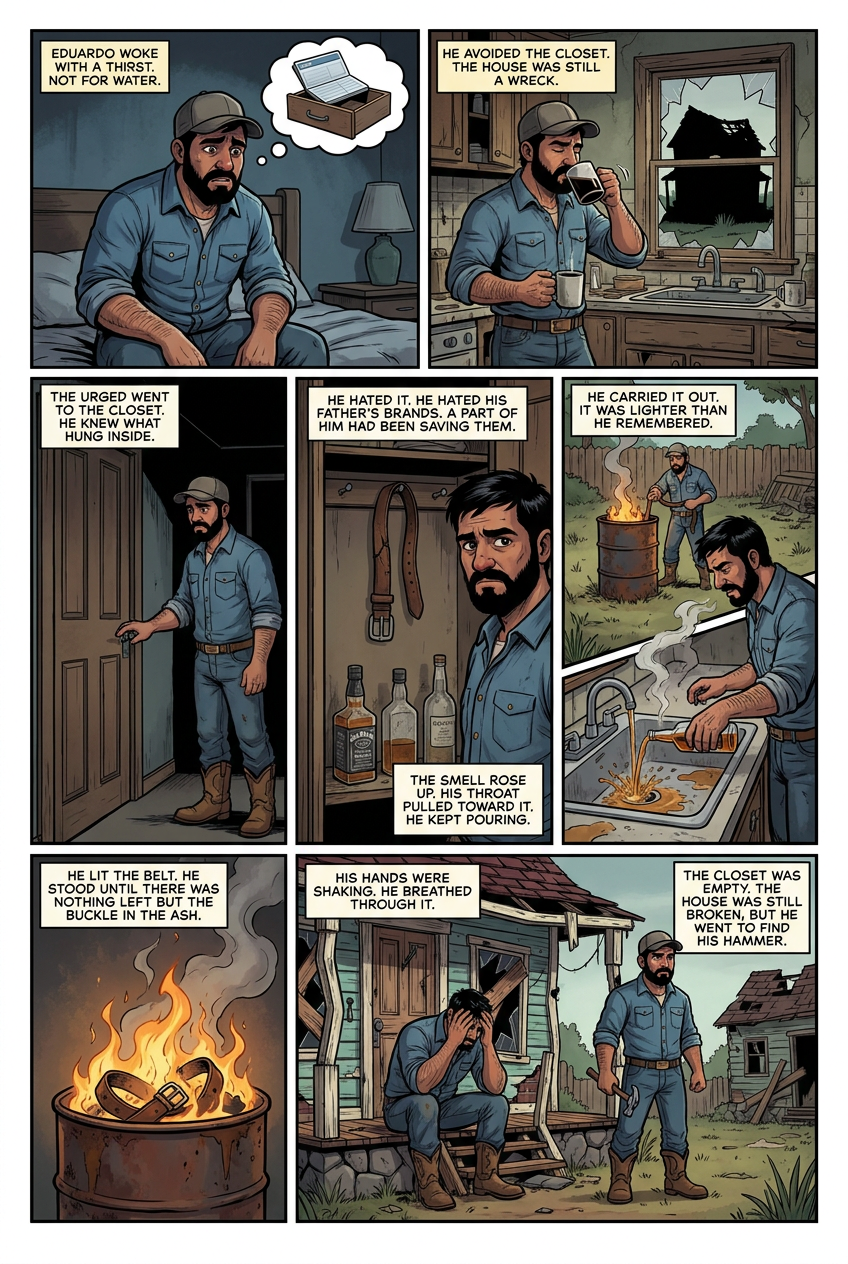
Eduardo slept without dreaming, but he woke with a thirst. Not for water. He knew the shape of it before his feet hit the floor. The bank book was in the drawer. The cash was gone from the house. The urge had nowhere to land, so it went to the closet at the end of the hall. He had not opened that closet since the day he came back. He knew what hung inside. He walked down the hall in his socks and stood at the door and put his hand on the knob and did not turn it. He made coffee first. He drank it black at the kitchen table and looked at the sagging roofline through the broken window frame he had not yet fixed. The house was still a wreck. Cracked siding. Splintered rail. A porch step he had braced but not replaced. He had been working outside in. He had been avoiding the closet. He set the cup down and went back. He opened the door. The belt hung from a nail on the inside. Brown leather, cracked at the fold, the buckle dull. Below it, on the floor, three bottles stood in a row. Two whiskey. One clear. His father's brands. Half full, all of them. He had left them there eight years ago because he could not throw them out and could not drink them either. He stared at the belt for a long time. He hated it. He hated what his father had done with it and he hated that he had kept it. He hated the bottles the same way. He hated that a part of him had been saving them for a bad night. He took the belt off the nail. It was lighter than he remembered. He carried it out to the yard and dropped it in the burn barrel. He went back for the bottles. He carried them one at a time to the kitchen sink and poured them out. The smell rose up and his throat pulled toward it. He kept pouring. He rinsed the sink. He carried the empty bottles to the trash at the end of the drive and set them in. He went back to the burn barrel with a match. He lit the belt. The leather curled and stank. He stood over it until there was nothing left but the buckle in the ash. He walked back to the porch and sat on the braced step. His hands were shaking. The thirst was still there, smaller now, without a shelf to sit on. He breathed through it the way he had learned. It passed. The house was still broken. The roof still sagged. But the closet at the end of the hall was empty, and the thing that had been pulling him backward was ash in a barrel. He stood up and went to find his hammer.
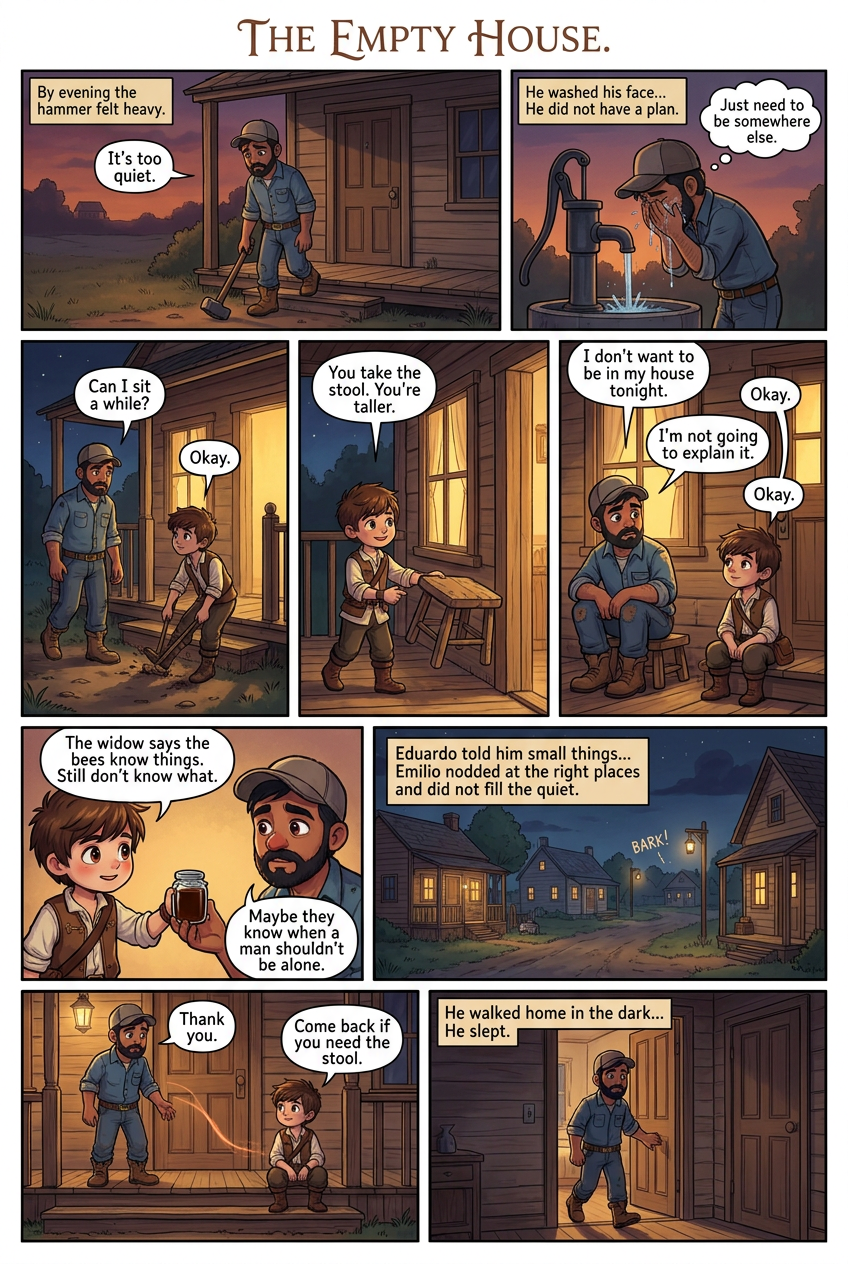
By evening the hammer felt heavy. Eduardo set it down on the porch step and looked at the front door. The closet was empty. The burn barrel was cold. The house was quiet in the wrong way. He knew the shape of the thirst by now. It came back at dusk when the work stopped and there was nothing between him and the walls. He could feel the pull toward town, toward a card table, toward any hand that would take his and lead him somewhere loud. He could not sit inside that house alone tonight. He washed his face at the pump and walked into town before the light went. He did not have a plan. He knew one person who would sit with him without asking questions. The boy carried a stool everywhere and set it down beside whoever needed company. Eduardo had seen him do it for the baker and the widow at the end of the road. He had never asked for it himself. He found Emilio outside the small wooden house the town had raised him in, the one with the flower boxes and the carved arch above the door. The boy was scraping mud off his boot on the bottom step. He looked up and did not seem surprised. "Can I sit a while?" Eduardo said. Emilio picked up the stool and carried it to the porch rail. He set it down and pointed at it. Then he sat on the step himself. "You take the stool," he said. "You're taller." Eduardo laughed once, short, and sat. The stool was low. His knees came up. He felt foolish and it helped. "I don't want to be in my house tonight," he said. "Okay." "I'm not going to explain it." "Okay." They sat. A dog barked somewhere behind the houses. Emilio pulled a jar from his vest pocket and held it out. Honey, dark in the glass. "The widow says the bees know things," Emilio said. "I still don't know what." "Maybe they know when a man shouldn't be alone." Emilio thought about that. "Maybe." Eduardo told him small things. The porch step he had braced. The window he still had to glaze. The old man at the feed store who paid him on Fridays. He did not talk about the belt or the bottles or the woman who had told him never to come back. Emilio nodded at the right places and did not fill the quiet. When the lamps came on down the road, Eduardo stood. His hands were steady. The pull was still there, but it had gone small, the way a fire goes small when no one feeds it. "Thank you," he said. "Come back if you need the stool," Emilio said. Eduardo walked home in the dark. He went inside. He shut the door behind him and did not open the closet, because there was nothing left in it to open. He slept.
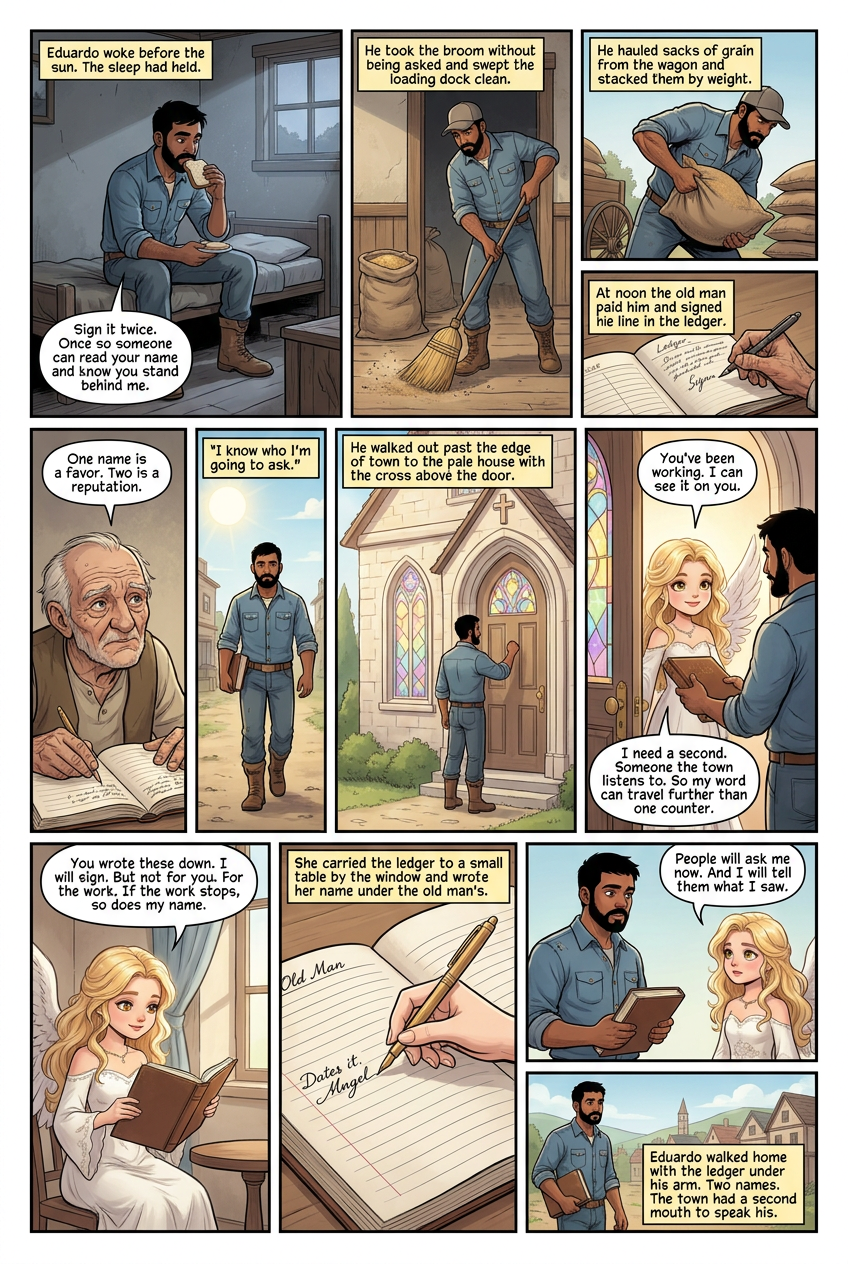
Eduardo woke before the sun. The sleep had held. He dressed, ate two slices of bread at the counter, and walked to the feed store in the gray light. The old man was already unlocking the side door. Eduardo took the broom without being asked and swept the loading dock clean. He hauled sacks of grain from the wagon and stacked them by weight. He counted the delivery against the slip and made the numbers match. At noon the old man paid him and signed the line in the ledger next to the day's work. "Sign it twice," Eduardo said. He set the ledger on the counter and turned it around. "Once for the pay. Once so someone can read your name and know you stand behind me." The old man looked at him a long moment. Then he wrote his name a second time under the column Eduardo had drawn for witnesses. One name. A single voice in a town that had stopped speaking his. "You need another," the old man said. "One name is a favor. Two is a reputation." "I know who I'm going to ask." He walked out past the edge of town to the pale house with the cross above the door. He had been there once before, when he had nothing and needed prayer. The house sat back from the road behind a low white fence, its curved roof and stained glass catching the noon light. Flower boxes lined the balcony. A small carved moon hung above the front step. He knocked. Mother Angel opened the door. Her blonde curls caught the light like they always did. She did not seem surprised to see him. "You've been working," she said. "I can see it on you." "I need to ask you something," Eduardo said. He held out the ledger. "I have one witness. The feed store owner. He signs my week every Friday. I need a second. Someone the town listens to. So my word can travel further than one counter." She took the ledger and turned the pages. She read the debts paid, the wages earned, the dates. She stopped at the four rules copied inside the front cover. "You wrote these down," she said. "I keep them." "And if you break one?" "You cross my name out. In front of me." She closed the ledger and held it against her chest. "I will sign," she said. "But not for you. For the work. If the work stops, so does my name." "That's the deal I want." She carried the ledger to a small table by the window and wrote her name under the old man's. Her hand was steady. She dated it. She handed the book back. "People will ask me now," she said. "And I will tell them what I saw." Eduardo walked home with the ledger under his arm. Two names. The town had a second mouth to speak his.
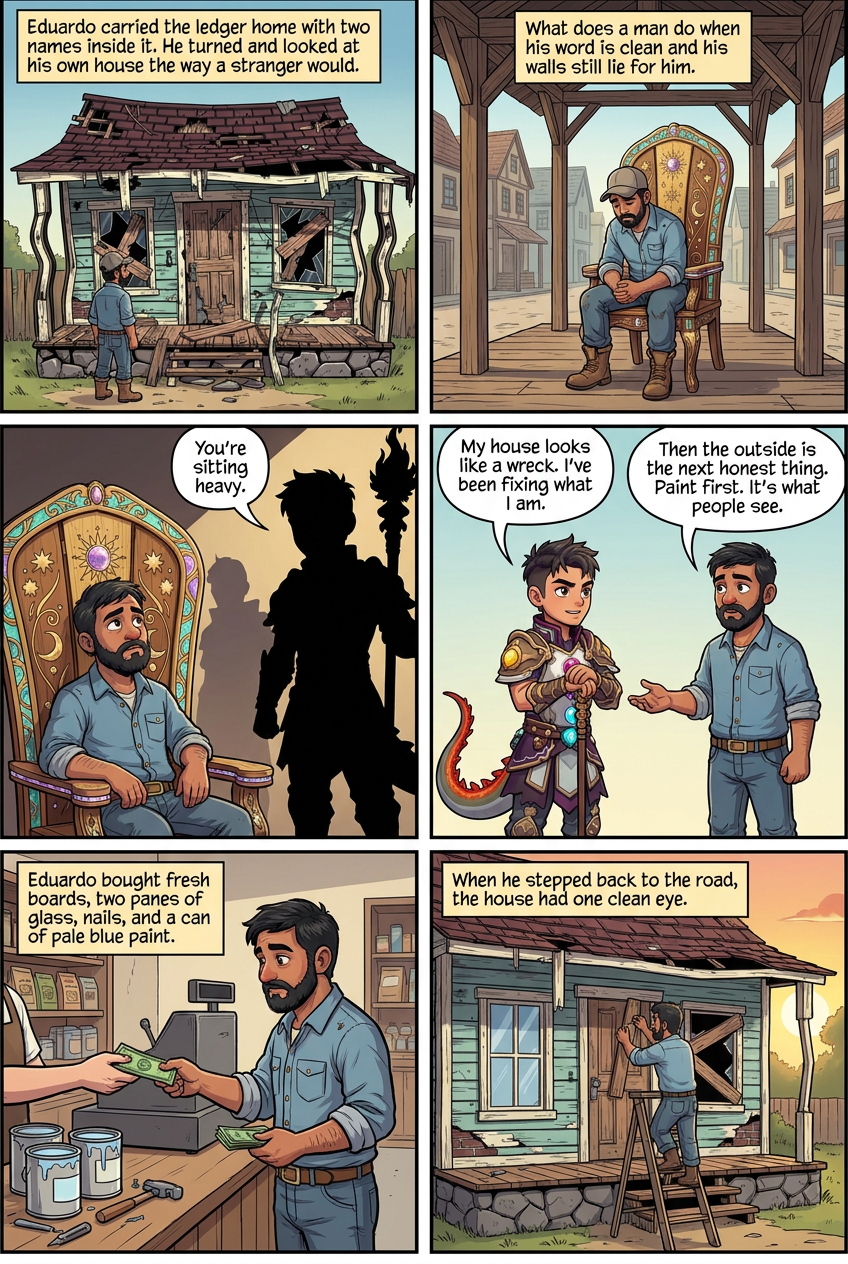
Eduardo carried the ledger home with two names inside it. He set it on the kitchen table and walked out to the road. He turned and looked at his own house the way a stranger would. The roof still sagged on one side. Two windows wore crossed boards where the glass had broken. Paint curled off the siding in long strips. A step near the porch tilted where the stone beneath it had shifted. He had put honest names in a book. The house said something else to every rider who passed. He drove into town and walked to the guidance chair. It sat under an open roof at the edge of the square, carved with moons and suns and a purple star at the back. People sat in it when they needed to think and could not think at home. Eduardo took off his cap. He lowered himself into the seat and rested his hands on the carved arms. He asked himself one plain question. What does a man do when his word is clean and his walls still lie for him. A shadow fell across his boots. Eduardo looked up. A tall man stood at the edge of the path with a wooden staff. A heart-shaped stone burned at its top like a slow flame. Colored stones ran down the front of his chest. A dragon tail rested behind him, still. Eduardo had heard travelers speak of the chakra man who walked the roads. He had never seen him this close. "You're sitting heavy," the man said. "My house looks like a wreck," Eduardo said. "I've been fixing what I am. Nobody riding past can see that." Aurelius watched him. His tail did not move. "Then the outside is the next honest thing." "I was going to paint last." "Paint first." "That's backwards." "It's what people see." Aurelius set the staff against the chair. "A clean face on a house buys you the year it takes to finish the rest. Do the boards. Do the glass. Do the color. Let the road read it before you ask the road to trust you." Eduardo turned the words over. He had been saving the front for reward. He had been treating the street like it owed him patience. "Thank you," he said. Aurelius lifted the staff. "Sit until you know the first cut," he said, and walked on. Eduardo stayed in the chair until his hands were steady. Then he drove to the feed store, drew against his next week's pay, and bought fresh boards, two panes of glass, nails, and a can of pale blue paint the color of his shirt. He worked until dark. He pried the crossed boards off both windows. He cut new siding for the worst gap. He set the first pane in its frame before the light failed. When he stepped back to the road, the house had one clean eye. Tomorrow he would give it another.
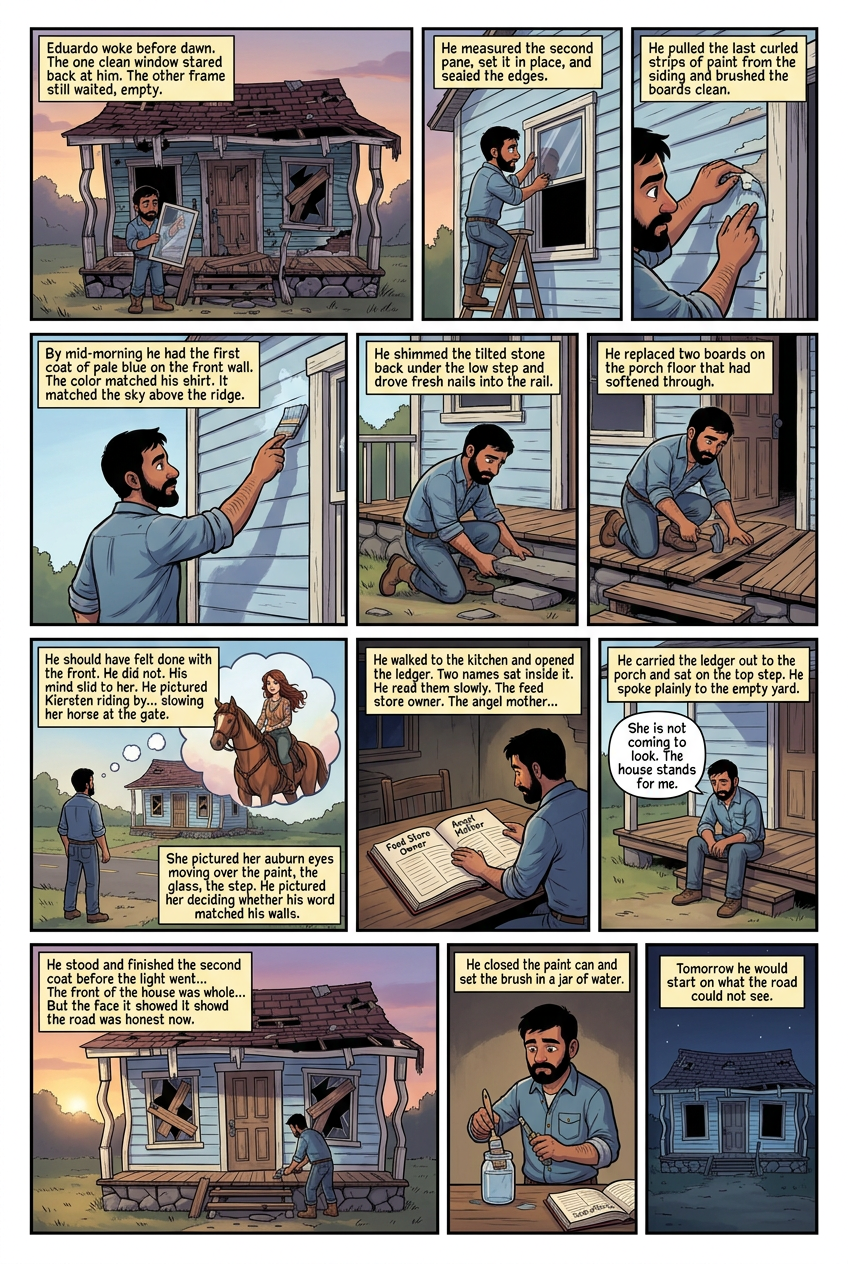
Eduardo woke before dawn and went straight to the front of the house. The one clean window stared back at him. The other frame still waited, empty. He measured the second pane, set it in place, and sealed the edges. He pulled the last curled strips of paint from the siding and brushed the boards clean. By mid-morning he had the first coat of pale blue on the front wall. The color matched his shirt. It matched the sky above the ridge. He worked without stopping until the porch steps. He shimmed the tilted stone back under the low step and drove fresh nails into the rail. He replaced two boards on the porch floor that had softened through. He wiped his hands on his jeans and stepped back to the road. The house had two clean eyes now. The front wall held one steady color. The step sat level. The rail did not wobble when a rider brushed it. A stranger passing would not cross the road to avoid it. He should have felt done with the front. He did not. His mind slid to her. He pictured Kiersten riding by on some errand she would never take, slowing her horse at the gate. He pictured her auburn eyes moving over the paint, the glass, the step. He pictured her deciding whether his word matched his walls. He set the brush down on the can lid. He knew what this was. He had promised the angel woman no unearned women and no lies about his motives. He was painting for a witness who had told him never to return. He walked to the kitchen and opened the ledger. Two names sat inside it. He read them slowly. The feed store owner. The angel mother at the pale house. Neither of them was Kiersten. Neither of them ever would be. He carried the ledger out to the porch and sat on the top step. He spoke plainly to the empty yard. "She is not coming to look," he said. "The house stands for me." He said it again until the picture of her at the gate went thin. It did not leave. It only stopped pulling at his hands. He stood and finished the second coat before the light went. When he stepped back the last time, the front of the house was whole. Roof still sagged in back. Side wall still needed work. But the face it showed the road was honest now. It told the truth his ledger told. He closed the paint can and set the brush in a jar of water. He took the ledger inside and laid it flat on the table where he could see it in the morning. He had built the front for a road that did not know him yet. Tomorrow he would start on what the road could not see.
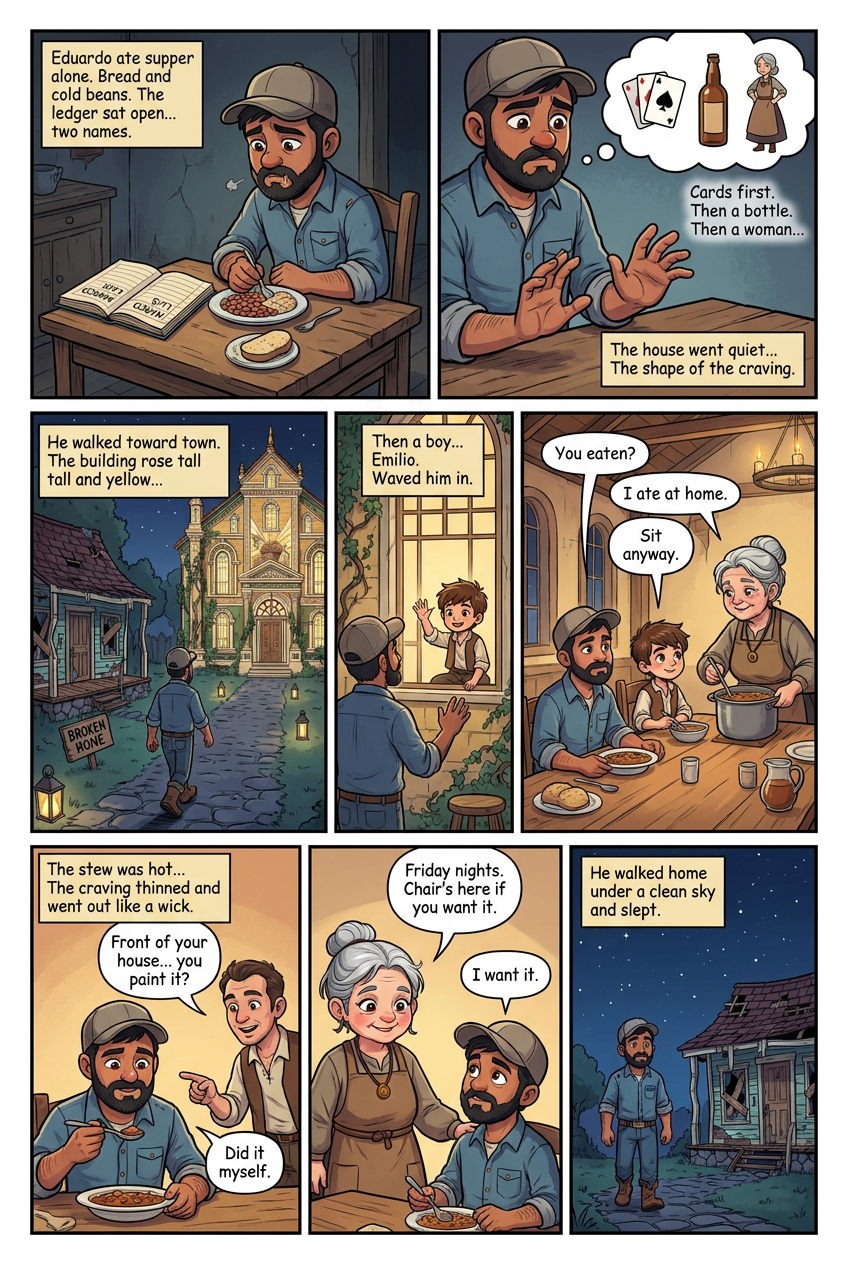
Eduardo ate supper alone at the table. Bread and cold beans. The ledger sat open beside his plate. He read the two names on it while he chewed. When the plate was empty, the house went quiet in the way that made his hands restless. He knew the shape of the craving now. Cards first. Then a bottle. Then a woman who did not ask his name. He set the fork down and pushed back from the table. The porch would not hold him tonight. Neither would the closet he had already emptied. He put on his cap and walked toward town. The road was long enough to work the shake out of his hands. He passed the feed store, already dark. He kept walking until the lanterns along the stone path came up warm around him. He had not meant to stop at the feast hall. His feet stopped him. The building rose tall and yellow, vines running up the stone. Light poured from the tall windows. He smelled bread and something with onions. He stood at the door and almost turned back. Then a boy inside spotted him through the glass. Emilio. The orphan boy who had sat with him through the last craving without asking a single question. Emilio waved him in like he had been waiting. Eduardo pushed the door open. A long table ran down the middle of the hall. Half a dozen townspeople sat along it. An old woman moved between them with a pot. Gray hair in a bun, brown apron, a small brass pendant at her throat. She looked up when he stepped in and set the pot down. "You eaten?" she said. "I ate at home." "Sit anyway." He took off his cap. Emilio was already dragging his stool from the corner to the empty spot beside a cup no one drank from. The boy patted the bench next to him. Eduardo sat. The woman set a bowl in front of him. Stew. A piece of bread on the side. She did not ask his name or where he came from. She filled the cup that had been empty and moved on. "Gwen keeps the cup out for her husband," Emilio said. "He passed. She still pours." Eduardo looked at the cup. Then at the woman working the length of the table. He picked up the spoon. The stew was hot. The bread was fresh. The man beside him asked about the front of his house. Someone had seen the paint. Eduardo said he had done it himself. The man nodded and went back to his food. That was all. Eduardo ate slowly. The craving thinned and went out like a wick in water. When he finished, Gwen came back with the pot. "Friday nights," she said. "Chair's here if you want it." "I want it," he said. She nodded once and moved on. He walked home under a clean sky and slept.
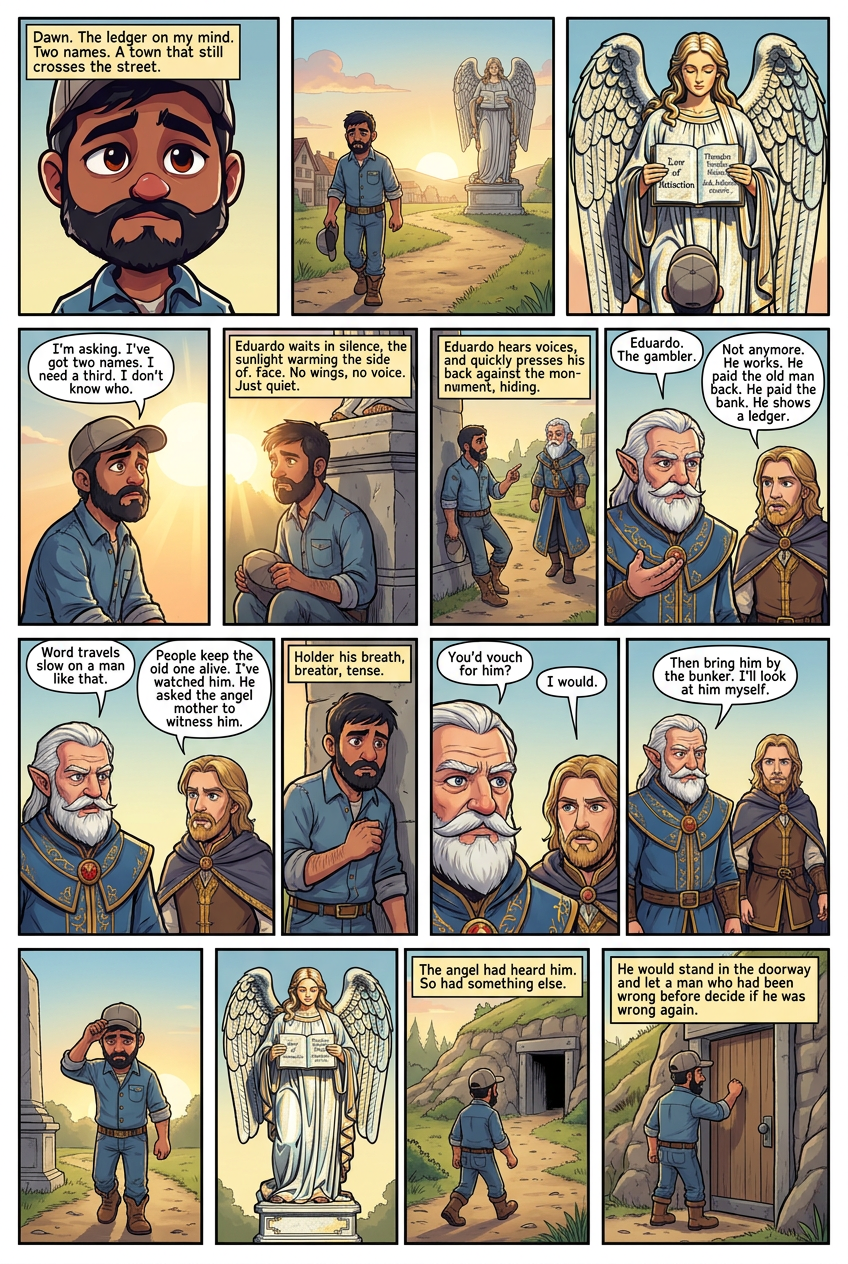
Eduardo woke before dawn with the ledger on his mind. Two names. A town that still crossed the street when they saw him coming. He needed more than his own work to move the wall. He needed to stand where something bigger than him could see him, and be seen. He walked out past the edge of town to the angel monument. The stone woman stood on her base with her wings spread and a book open in her hands. The words on the page said thoughts became things. Ask, believe, receive. He read them twice. He took off his cap and stood in front of her. "I'm asking," he said. "I've got two names. I need a third. I don't know who." The stone did not answer. He waited anyway. The sun came up over her shoulder and warmed the side of his face. He felt no wings, no voice. Only the quiet, and his own breath, and the weight of the cap in his hand. Then he heard talking on the path behind the monument. Two men. He knew one voice from the pale house with the cross where he had prayed. The wizard in the blue hat. Aldric. The other was older, rougher, unfamiliar. Eduardo stayed where he was, behind the base of the statue. "Eduardo," the older man said. "The gambler." "Not anymore," Aldric said. "He works dawn to noon at the feed store. He paid the old man back. He paid the bank. He carries a ledger and shows it every Friday." "Word travels slow on a man like that." "Word travels slow because people like you keep the old one alive. I've watched him. He drinks nothing. He gambles nothing. He asked the angel mother to witness him and she said yes." The older man was quiet a moment. Eduardo pressed his back against the stone base and did not breathe. "You'd vouch for him?" the older man said. "I would." "Then bring him by the bunker. I'll look at him myself." Their steps went past and faded. Eduardo stayed against the stone until his hands stopped shaking. He stepped out from behind the monument. The path was empty. He put his cap back on. He had asked for a third name. He had not asked for that one. Guardian Noble screened people by instinct, and he had been wrong before. A man had died. A hinge had come loose on his door without cause. Whatever the guardian was watching for, he would look at Eduardo the same way. Eduardo walked home with the ask sitting new in his chest. The angel had heard him. So had something else. He would go to the bunker. He would stand in the doorway and let a man who had been wrong before decide if he was wrong again.
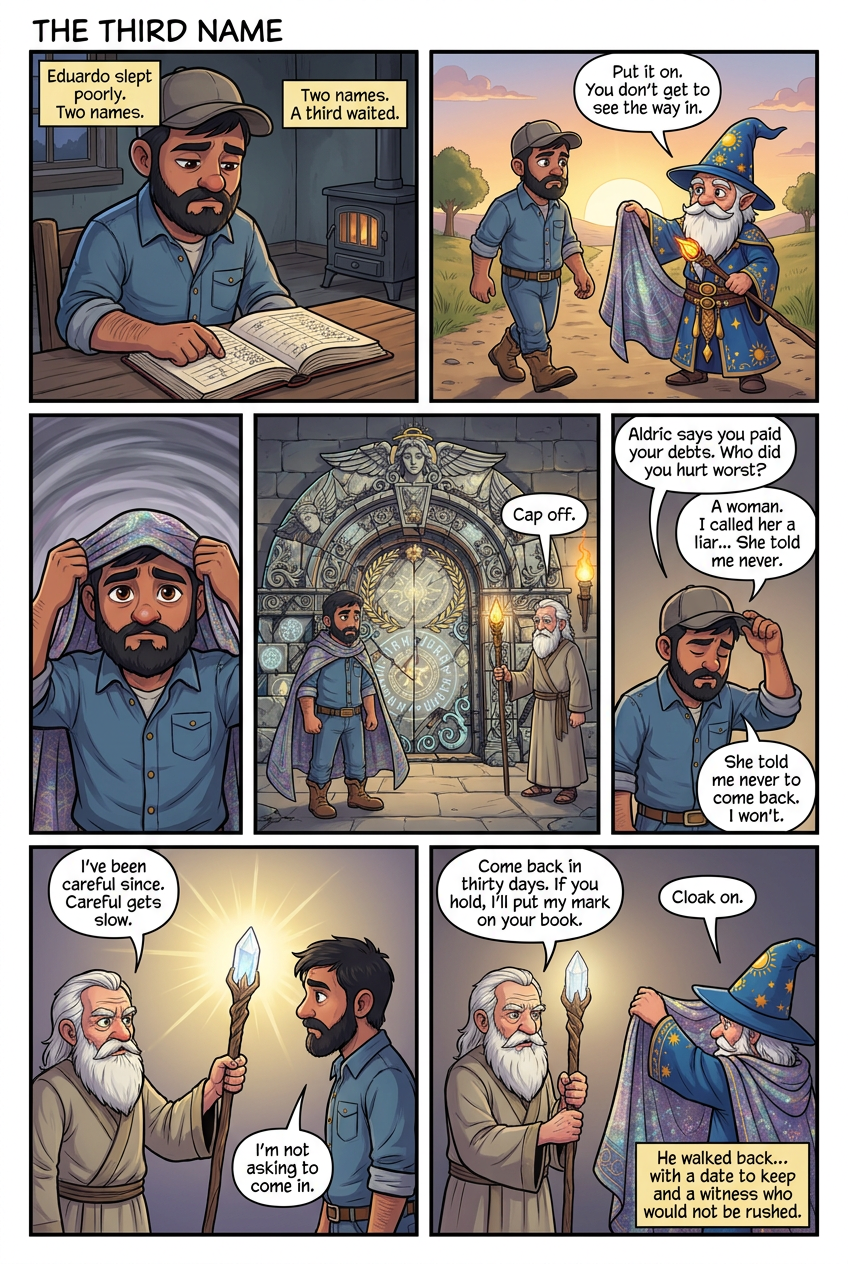
Eduardo slept poorly and woke before the sun. He fed the stove, drank water, and sat with the ledger open on the table. Two names. A third waited at a door he had not seen. He put on a clean shirt, his cap, his boots. He walked out to meet Aldric where the road bent past the pale house. Aldric was already there, blue hat tipped back, staff resting in the crook of his arm. He held out a folded cloth. It shimmered faint at the edges, marked with signs Eduardo did not know. "Put it on," Aldric said. "You don't get to see the way in. No one does." Eduardo pulled the cloak over his head. The world went soft and gray at the seams. Aldric took his elbow and walked him off the road. They went a long time. Eduardo counted turns and gave up. When Aldric stopped him, a door opened somewhere ahead. Warm air. Stone. The cloak came off. He stood in a low chamber under a carved arch. Angels watched from the keystone. A star burned in the center of the door behind him. An old man waited by a torch set in the wall. White hair, plain robes, a staff with a crystal head. "Cap off," Guardian Noble said. Eduardo took it off. "Aldric says you paid your debts." "I paid what I could count. Some I can't pay back. Those I named." "Who did you hurt worst?" Eduardo's throat closed. He wanted to name the trade, the buyers, the man who had taken his routes. He heard the angel's rule in his head. No lying about why. "A woman," he said. "I called her a liar so I wouldn't have to look at myself. She told me never to come back. I won't." Guardian Noble did not move. "Why come here." "I need a third name on my ledger. Aldric said you might look at me." "I don't sign ledgers." Eduardo's stomach dropped. He kept his eyes on the old man. "Then look at me anyway." Guardian Noble stepped closer. He held the torch up. The crystal light passed over Eduardo's face and stayed there. "I let a man in once who didn't make it," he said. "I've been careful since. Careful gets slow. Slow costs too." "I'm not asking to come in." "I know what you're asking." He lowered the torch. "Come back in thirty days. Keep the rules. Don't lie to Aldric, and don't lie to me. If you hold, I'll walk to the tea house myself and put my mark on your book." Eduardo breathed out. "Yes, sir." "Cloak on." Aldric raised the cloth. The chamber went gray again. Eduardo walked back the way he had come, blind, with a date to keep and a witness who would not be rushed.
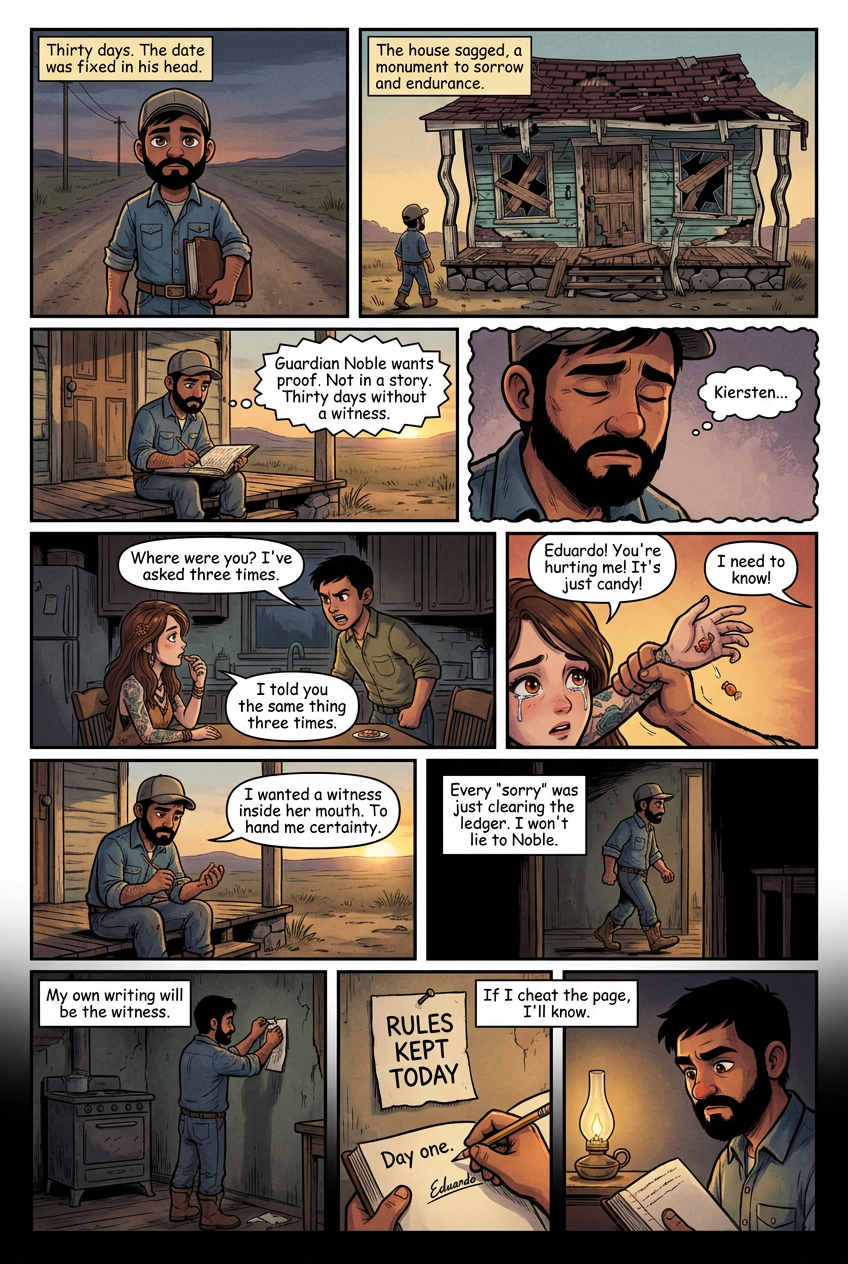
Eduardo walked home from the bunker with the date fixed in his head. Thirty days. He carried the ledger under his arm and did not stop until his porch was in sight. The house sagged the way it always had. Cracked walls. Broken windows boarded from the inside. A roof that gave up shingles when the wind pushed hard. He sat on the step and opened the ledger to a clean page. He wrote the date at the top and underlined it. He knew the problem before he finished the line. Guardian Noble wanted proof. Not a story. Proof that Eduardo had kept the rules for thirty days without a witness at his shoulder every hour. No one lived here. No one watched him at night. He could write anything on the page and no one could call it a lie except him. He thought of Kiersten then. He did not push the memory down. He let it come. He saw the kitchen in the old house. She sat at the table eating a piece of hard candy. He had asked her three times that week where she had been. She had answered three times the same way. He asked again. She said the same thing. He crossed the room and took her arm and squeezed until her hand opened. The candy hit the floor. She said his name. She said it was sour, that was all, it was a sour candy, please. He kept squeezing until she cried. He said sorry that night. He said sorry the next morning. The week after that he did it again. He sat on the broken step and understood why. He had wanted her to prove something she could not prove. He had wanted a witness inside her mouth. He had wanted her to hand him certainty so he would not have to trust her. Every sorry had been a way of clearing the ledger so he could spend against it again. He closed the book. He would not lie to Guardian Noble the way he had lied to her. He stood and walked inside and pulled a nail from the doorframe. He drove it into the wall beside the stove at chest height. Then he tore a strip from the back of the ledger and wrote on it in block letters. RULES KEPT TODAY. He hung the strip on the nail. Each night he would write the date beneath. If he broke a rule, he would write that too, in his own hand, and carry the paper to the tea house and to Aldric and to Guardian Noble himself. The witness would be his own writing against his own name. If he cheated the page, the page would still exist, and he would know. He lit the lamp. He wrote the first date. Day one. He signed it.
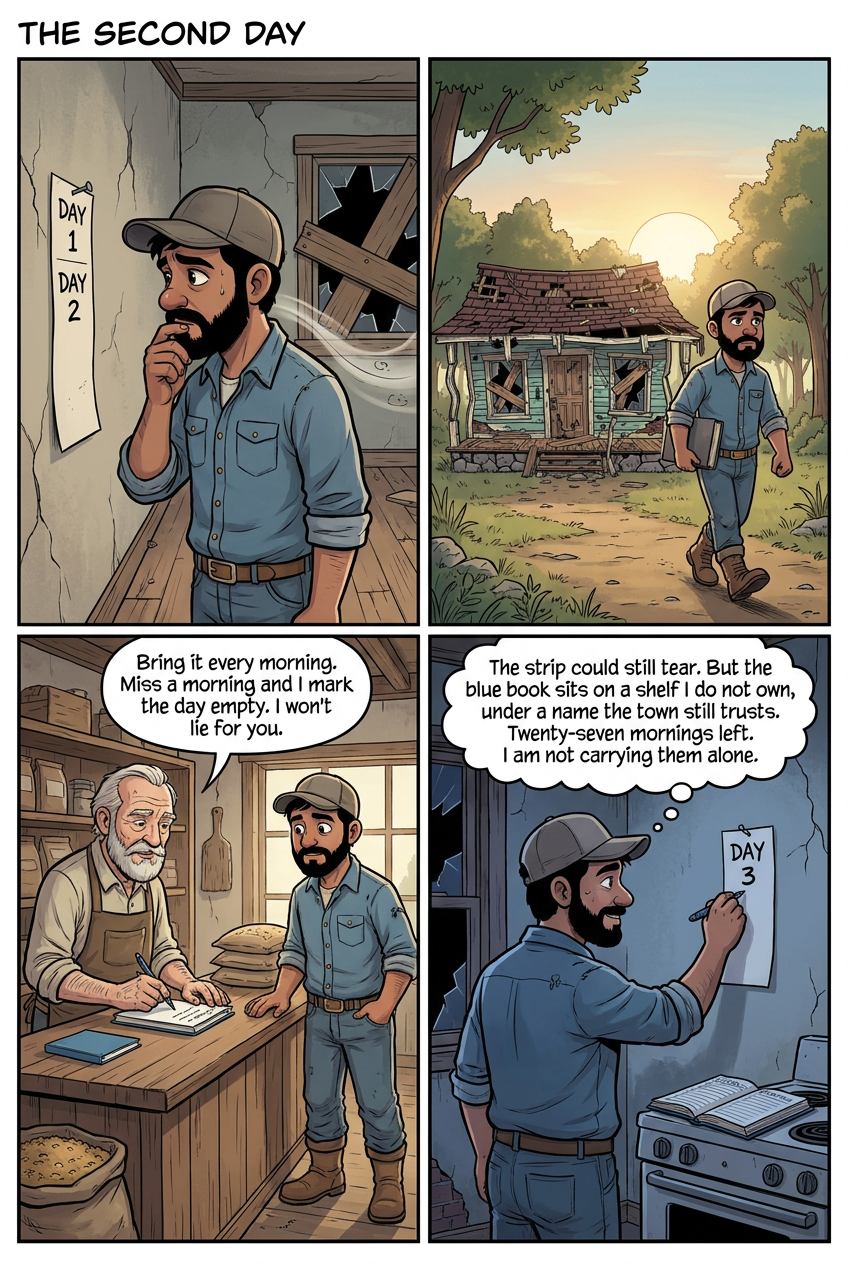
Eduardo woke on the second morning and looked at the paper strip nailed to the wall. Two dates. His own handwriting. He drank water and stood in front of it a long time. The paper was thin. A gust from the broken window could tear it loose. A mouse could chew it. He could bump the stove and knock it down and no one would know what had been written before. One missing day would void the thirty. Guardian Noble had said so plainly. He needed proof that could not be lost. He walked the house and looked at what he had. Cracked walls. A sagging roof. Boards nailed over the windows from the inside. Nothing here was safe from wind or hands. He sat on the step and thought about the day a stranger had called Kiersten's phone by accident. He remembered how she held the phone out to him, how she said it was nothing, a wrong number. He remembered taking the phone from her hand. He remembered his own face in the window glass after, and how his eyes had looked black to him. He had made her prove a thing that could not be proved. He had torn her page every time she wrote it clean. He would not do that to himself now. He would not build a page a stranger could tear. He took the ledger and walked to the feed store before the sun cleared the trees. The old man was setting out sacks. Eduardo asked him for a favor. He said he wanted to bring the day's paper strip in each morning before work and copy it into a second book kept on the store shelf, signed by the old man's hand beside his own. The old man looked at him a long moment. Then he pulled a thin blue notebook from under the counter and slid it across. "Bring it every morning," the old man said. "Miss a morning and I mark the day empty. I won't lie for you." "I know," Eduardo said. "That's why I came." He wrote day one and day two into the blue book. The old man signed beside each date. Eduardo walked home lighter than he had come. The strip on his wall could still tear. The strip did not matter now. The blue book sat on a shelf he did not own, in a hand that was not his, under a name the town still trusted. He stood in front of the paper on his wall that night and wrote day three beneath the others. He signed it. Then he closed the ledger and set it on the stove. Twenty-seven mornings left. He knew now he could not carry them alone, and he had stopped trying to.
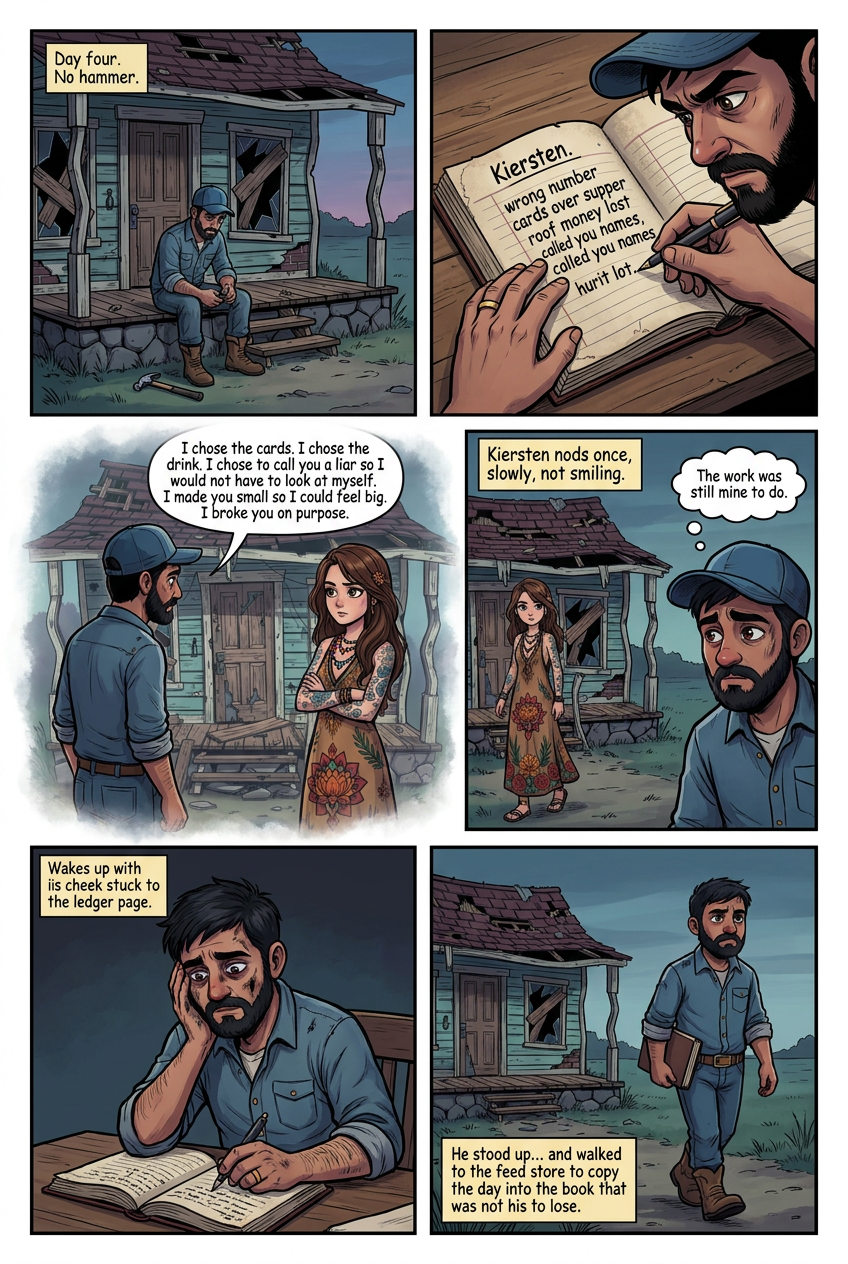
Eduardo came home from the feed store on day four and did not pick up a hammer. He sat on the step of the broken house and looked at the sagging roof and the cracked walls. The blue book was safe on a shelf in town. The paper strip was safe on his wall. What was not safe was inside him. He had counted days without counting the debt those days were meant to pay. He had listed rules without listing what he had done to earn them. He went inside, sat at the table, and opened the ledger to a blank page. He wrote her name at the top. Kiersten. Then he began to write, not apologies, but facts. He wrote the night of the phone call and how he had made her prove a wrong number. He wrote the cards he had chosen over her supper. He wrote the money he had lost that was meant for their roof. He wrote the names he had called her when she asked him plain questions. He wrote the times she had cried and he had walked out. He filled one page. He filled another. His hand cramped and he kept going until the room was dark and the words were only shapes. He put his head down on the ledger and slept where he sat. He dreamed he was standing outside the broken house and Kiersten stood in the yard. She did not speak. She only looked at him. In the dream he did not reach for her. He did not explain. He walked to her and stopped an arm's length away. He said each thing he had written in the book. He said them slowly and did not soften them. He said, I chose the cards. I chose the drink. I chose to call you a liar so I would not have to look at myself. I made you small so I could feel big. I broke you on purpose. I knew what I was doing every time. She listened. When he was finished she nodded once. Not forgiveness. Only that she had heard him. Then she turned and walked out of the yard and did not look back. He watched her go and did not follow. In the dream he understood that this was the shape of it. She would not return. The work was still his to do. He woke at first light with his cheek stuck to the page. The ink had smudged under his face. He read what he had written the night before and did not tear it out. He closed the ledger and set it beside the blue book's twin on the stove. Day four went onto the paper strip in a steady hand. Then he stood up, drank water, and walked to the feed store to copy the day into the book that was not his to lose.
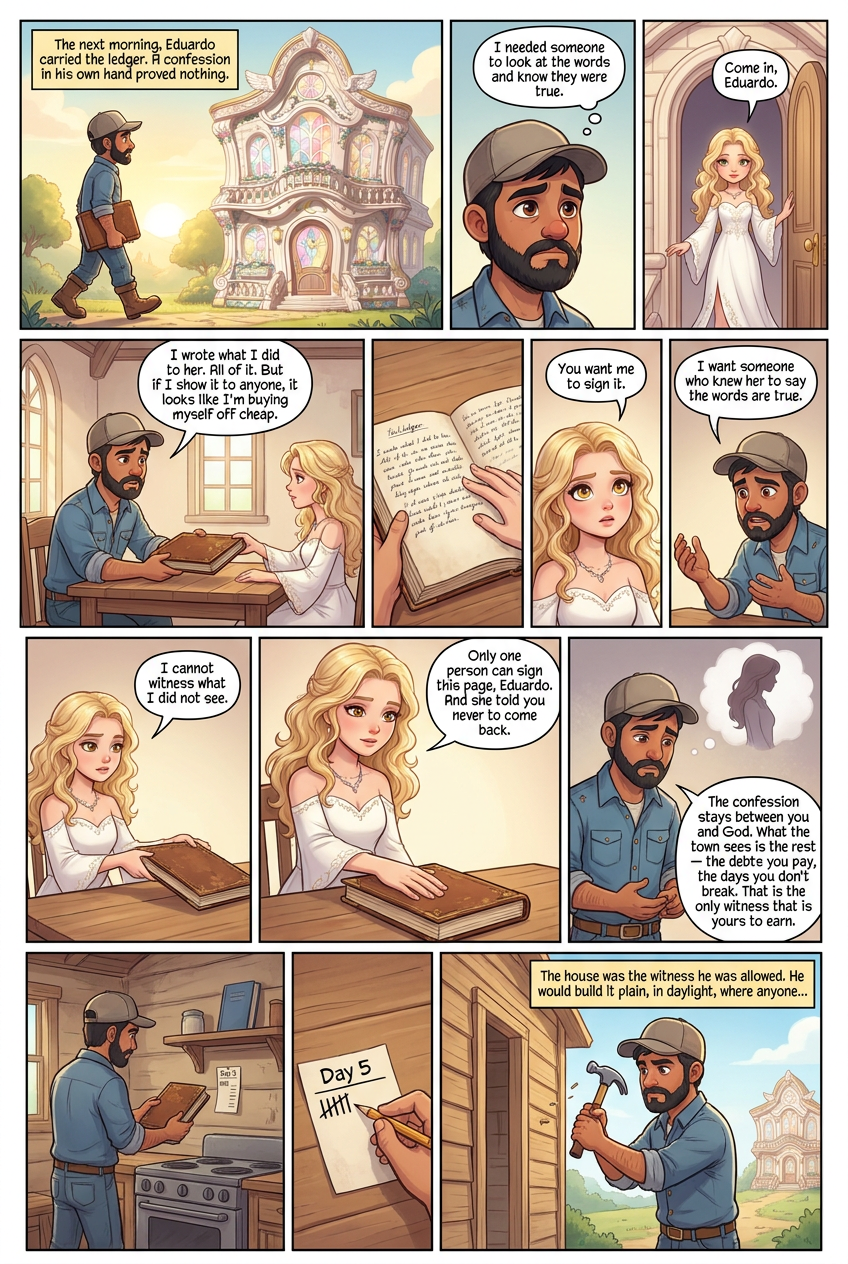
Eduardo carried the ledger under his arm the next morning. The pages of Kiersten's name were still soft with yesterday's ink. He had written the wrongs down, but he was the only one who had seen them. A confession in his own hand proved nothing. A man could write anything about himself. He needed someone to look at the words and know they were true. He walked to the pale house with the cross. The Ethereal Motherhouse rose from its garden with stained windows and stone wings folded above the roof. Mother Angel opened the door before he knocked. Her blonde curls caught the morning light. She did not ask why he had come. She only stepped aside. He sat at her table and pushed the ledger toward her. "I wrote what I did to her," he said. "All of it. But it's my hand. My side. If I show it to anyone, it looks like I'm buying myself off cheap." Mother Angel opened the book. She read one page. Then another. She did not soften her face. When she finished she closed the cover and folded her hands on top of it. "You want me to sign it," she said. "I want someone who knew her to say the words are true." "I did not know her that way." She slid the ledger back across the table. "I cannot witness what I did not see. Neither can Aldric. Neither can the old man at the feed store." He felt the floor drop under him. "Then it's worthless." "It is worthless as proof. It is not worthless as work." She reached across and put her hand flat on the cover. "Only one person can sign this page, Eduardo. And she told you never to come back." He looked at his hands. He already knew. "You cannot have her verify you," Mother Angel said. "That was the price of what you did. The confession stays between you and God. What the town sees is the rest — the ledger you keep, the debts you pay, the days you don't break. That is the only witness that is yours to earn." "Then the book," he said. "The one with her name in it." "Burn it or keep it. It is not for anyone else." He sat a long time. Then he picked up the ledger and stood. He walked home with it under his arm. He did not burn it. He set it on the shelf above the stove, alone, apart from the blue book and the paper strip. It was not evidence. It was the shape of what he had done, kept where he could see it. He marked day five on the strip. Then he picked up the hammer and went out to the siding. The house was the witness he was allowed. He would build it plain, in daylight, where anyone could see.
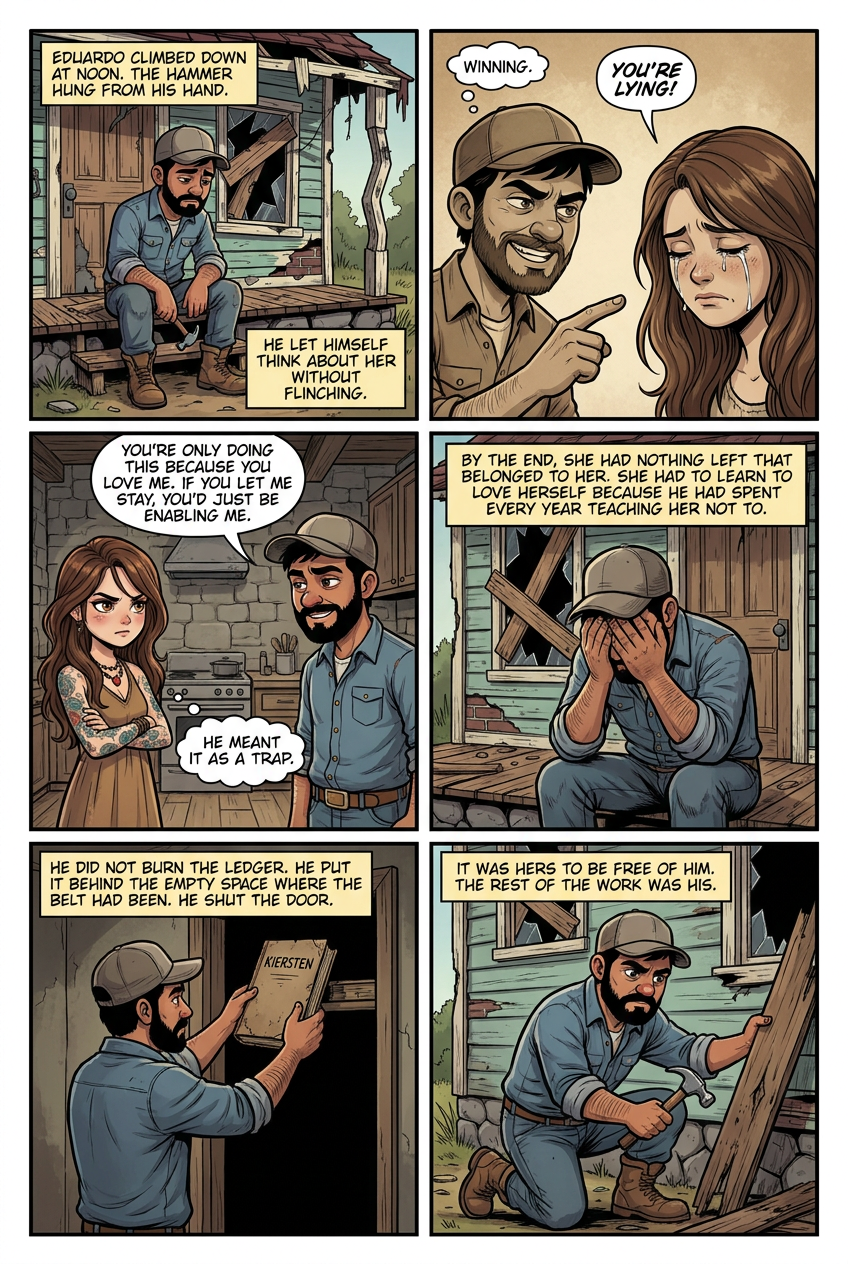
Eduardo climbed down from the siding at noon and sat on the porch step. The hammer hung from his hand. The house behind him still looked like the picture he had carried in his head for eight years — sagging roof, cracked boards, a door that hung wrong on its hinges. He had painted the front, but the sides still showed the rot. He set the hammer down and let himself think about her without flinching. He thought about the first time he called Kiersten a liar. He had known she was telling the truth. He said it anyway because it was easier than answering her question. He thought about the second time, and the tenth. Each time she cried, he had felt something small and mean move in him, and he had called it winning. He remembered the last night in her stone house. She had stood in the kitchen with her arms folded. He had told her she was doing this because she loved him. He had told her that if she let him stay, she would only be enabling him. He had said it like he was doing her a favor. He had meant it as a trap. He had wanted her to take him back one more time so he could prove her wrong about herself. She had not taken him back. She had opened the door and waited. He understood now what he had not understood then. He had taken her piece by piece for years. He took her trust first. Then her sleep. Then her friends, because she stopped calling them so she would not have to lie for him. Then her certainty about her own mind. By the end she had nothing left that belonged to her. She had to learn to love herself because he had spent every year teaching her not to. He put his face in his hands. He did not cry. He sat with it. He had wanted, for months, to be the man who fixed it. He had driven to her gate with a letter. He had asked a fortune teller and an angel and a guardian to sign him clean. He had wanted a witness who could tell her he was different now. He saw, sitting on the step, that the wanting was the same shape as the old cruelty. He was still trying to reach into her life and take something. He stood up. He walked inside and took the ledger with her name off the shelf. He did not burn it. He carried it to the closet and put it on the top shelf, behind the empty space where the belt had been. He shut the door. Then he went back outside and started on the rotted board at the corner of the house. It was hers to be free of him. The rest of the work was his.
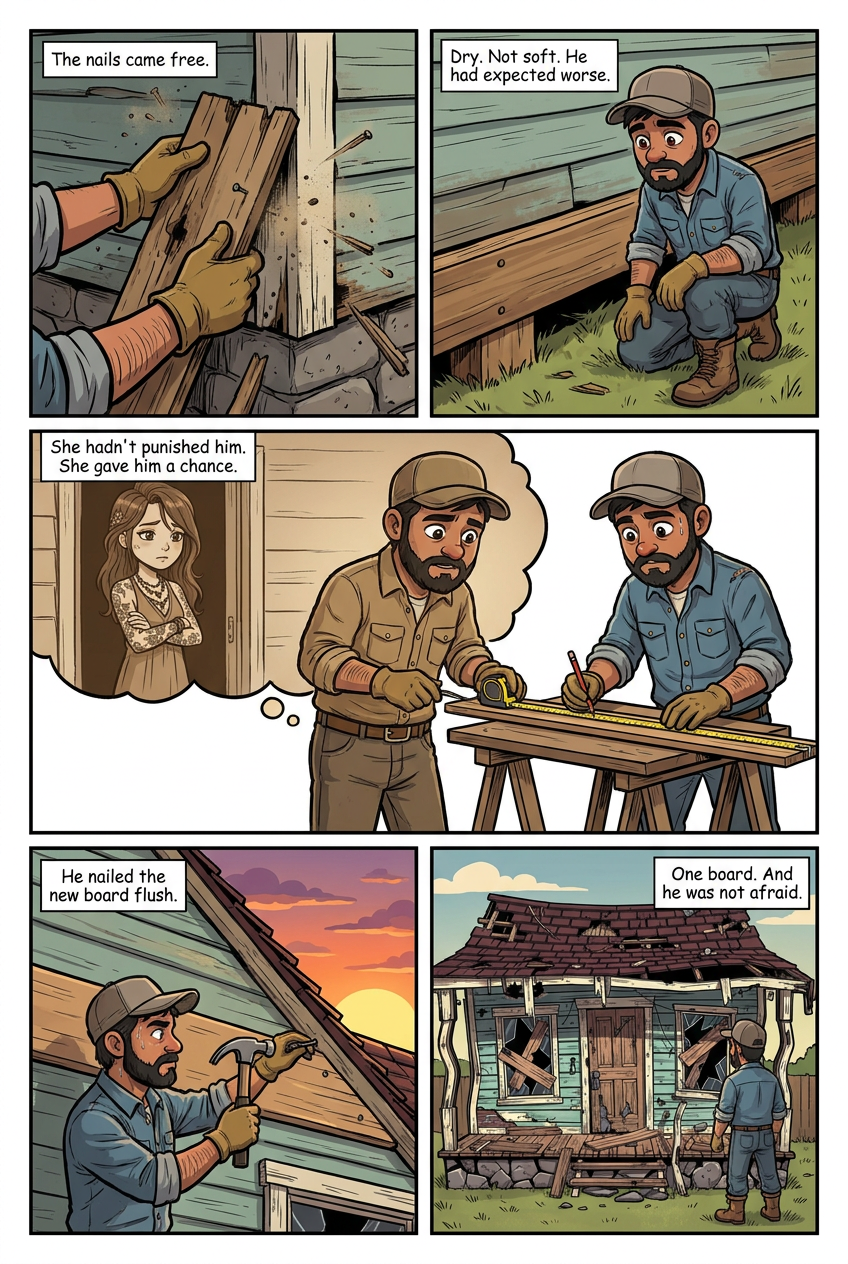
Eduardo worked the rotted board loose at the corner of the house until the nails came free in his hand. He set the board down on the grass and looked at the wall behind it. The wood underneath was dry. Not black. Not soft. He had expected worse. He sat back on his heels and stared at the clean beam. He had been afraid to open the wall. He had told himself for months that the whole frame was gone. He had built the fear up so he would have a reason to quit. The beam under his hand was fine. The house was not as broken as he had said it was. He thought about Kiersten then. Not the way he used to. Not as a door he had to knock on. He thought about what she had actually done the night she opened her door and waited. She had not thrown him out to punish him. She had refused to keep saving him. She had made him carry his own weight. He understood, kneeling in the dirt beside the exposed beam, that she had given him something. Not a punishment. A chance. If she had taken him back that night he would still be the man who took from her. He would still be lying to himself about the shape of his hands. He put his palm flat against the beam. He said her name once, quiet, and meant it as thanks. Not as a call. She was not on the other end of it. She was in a school in the hills with her own life. She had told him never to return, and she had been right to. He thought about the man he had been. The one who called her a liar to win a fight. The one who spent her sleep and her friends like they were his money. That man was gone from this porch. Not because Eduardo had prayed him out. Because she had refused, and he had finally been left alone with himself. He stood up. He picked up the rotted board and carried it to the burn pile. Then he went to the shed for a new one. He measured it against the gap and marked the cut with his pencil. His hand was steady. He worked until the sun dropped behind the ridge. He nailed the new board flush and ran his thumb along the seam. It held. He stepped back into the yard and looked at the side of the house. One board. Then he looked at the rest of the wall, all the boards he had not touched yet, and he was not afraid of them. He went inside and marked the day on the paper strip. He did not open the closet. He did not need to. He ate bread standing at the counter and slept without dreaming.
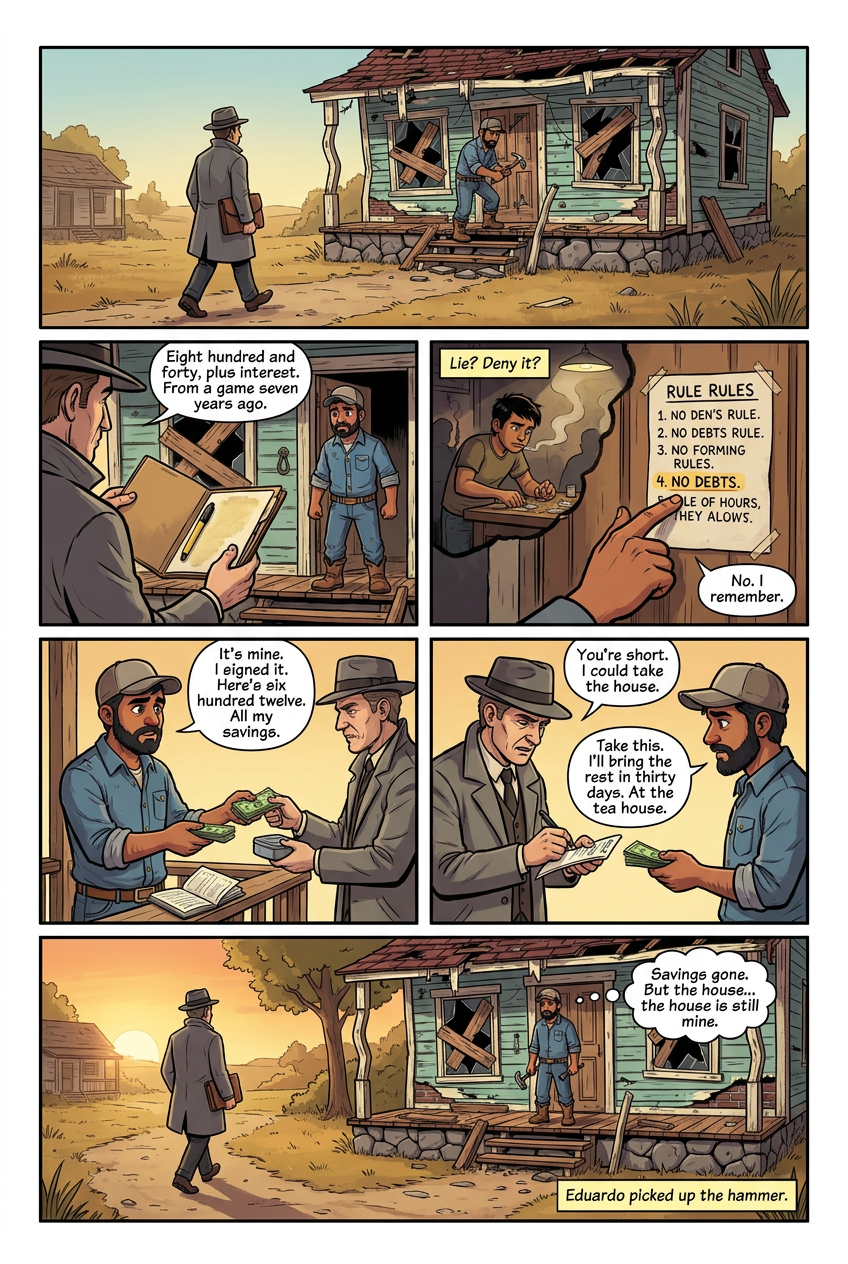
Eduardo was pulling nails from the second wall board when the man came up the drive. He wore a gray coat and carried a leather folder under his arm. Eduardo did not know his face, but he knew the walk. He had walked like that himself, years ago, to other men's doors. The man stopped at the bottom of the steps and looked at the sagging roof, the cracked siding, the boarded window. Then he looked at Eduardo. He said a name Eduardo used to gamble under. He said a number. Eight hundred and forty dollars, plus interest, from a game in a back room seven years ago. Eduardo set the hammer down on the porch rail. He remembered the game. He remembered the marker he had signed with a false name so his father would never find out. He had left town the next week and never paid. The man opened the folder. Inside was the marker with Eduardo's own handwriting on it. He said if Eduardo did not settle, he would file at the county and take the deed. He said the house was worth more than the debt, so the court would give it to him easy. Eduardo felt the old pull. Lie. Deny the signature. Say the name on the paper was not his. The man had no proof of the face behind the name. He could walk away clean. He looked at the marker. He looked at the paper strip inside the door where he had written every honest day. He thought about the four rules. No debts. He had missed one. He had forgotten this one because he had wanted to forget it. "It's mine," Eduardo said. "I signed it." The man's face did not change. He waited. Eduardo went inside. He came back with his bank book and the small tin from the shelf. Between them he had six hundred and twelve dollars. Everything he had saved from the feed store. Every wage he had not yet spent on boards and nails. He counted it onto the porch rail. He told the man he was short two hundred and change. He said he would bring the rest inside of thirty days. He would sign a new paper in his real name, at the tea house, in front of a witness. The man looked at the money. He looked at the house again. He said he could file tomorrow and get all of it. "You could," Eduardo said. "But you'd wait longer for your money and pay a lawyer to get it. Take what's here. I'll bring the rest." The man took the cash. He wrote a receipt in the folder and tore off a copy. He said thirty days. Then he walked back down the drive. Eduardo stood on the porch with the empty tin in his hand. The house was still his. The savings were gone. He picked up the hammer and went back to the wall.
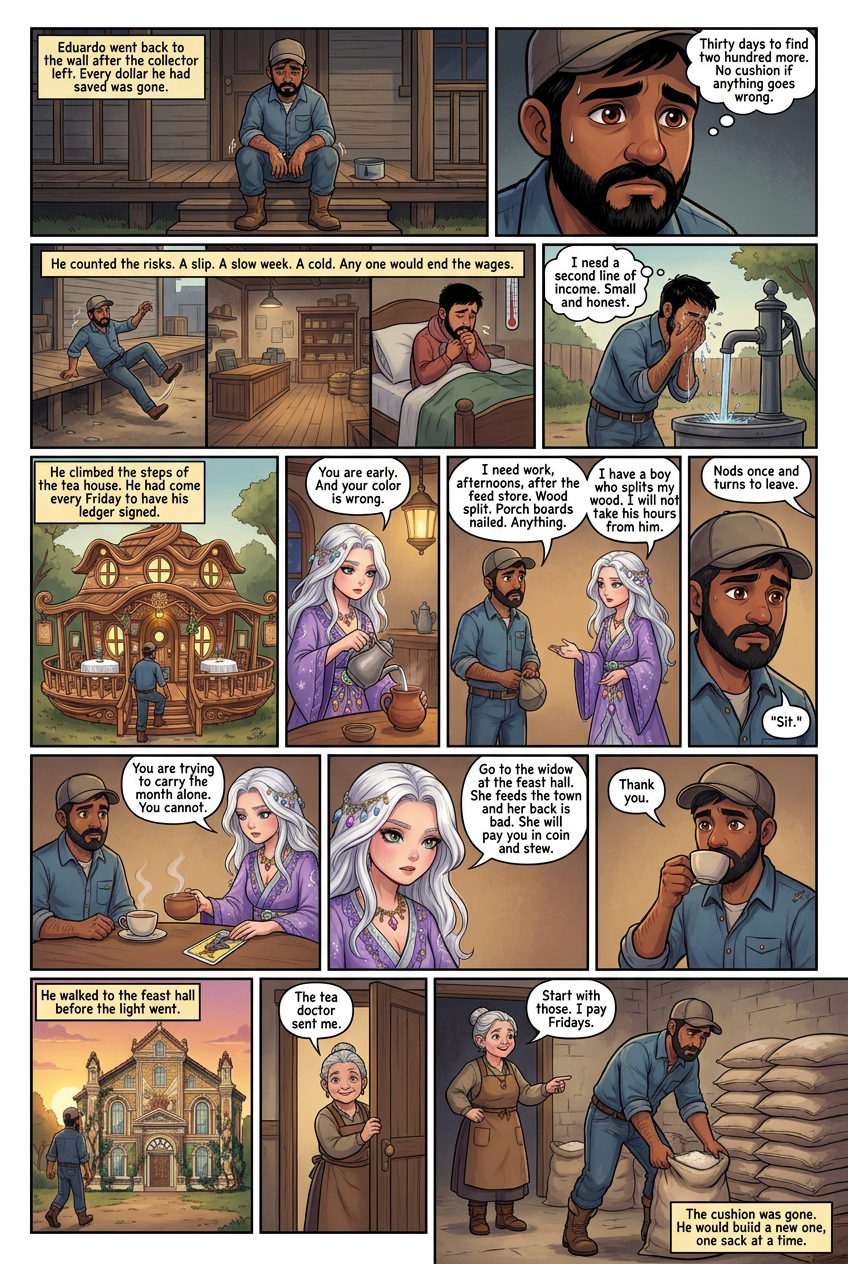
Eduardo went back to the wall after the collector left, but his hands would not stop shaking. The tin on the rail was empty. Every dollar he had saved was gone in one afternoon. He set the hammer down and sat on the top step. He had thirty days to find two hundred more, and no cushion under him if anything went wrong. He counted the risks in his head. A slip on the feed store loading dock. A slow week when the ranchers did not come in. A cold he could not shake. Any one of them would end the wages, and the wages were all he had. He needed a second line of income, small and honest, before the month closed on him. He washed his face at the pump and walked into town. He climbed the porch steps of the round tea house with its curling roof and lace-covered tables. He had come here every Friday to have his ledger signed. Today he came for something else. Inside, the tea doctor was pouring hot water into a clay cup. Her white hair fell past her waist, and the stones on her belt caught the lamplight. She was younger in the face than in the eyes. She had never asked him a question he could dodge. "You are early," she said. "And your color is wrong." Eduardo told her about the marker and the six hundred and twelve dollars. He told her he needed work he could do in the afternoons, after the feed store. He asked if she needed a hand around the tea house. Wood split. Porch boards nailed. Anything. She set the cup down and looked at him for a long moment. Then she shook her head. "I have a boy who splits my wood. I will not take his hours from him." Eduardo felt the floor drop. He had counted on her. He nodded once and turned for the door. "Sit," she said. He sat. She poured him a cup of something that smelled like bark and honey. She pulled a card from a small deck on the table and laid it face up between them. He did not know the picture, and he did not ask. "You are trying to carry the month alone," she said. "You cannot. Go to the widow at the feast hall. She feeds the town on Fridays and her back is bad. She will pay you in coin and stew to haul her flour and scrub her pots. Tell her I sent you." Eduardo drank the tea. It was bitter and then sweet. He put the cup down and said thank you. He walked to the feast hall before the light went. Gwen opened the door with flour on her sleeves. He told her what the tea doctor said. She looked him over once and pointed at a stack of sacks by the wall. "Start with those," she said. "I pay Fridays." Eduardo bent and lifted the first sack. The cushion was gone. He would build a new one, one sack at a time.
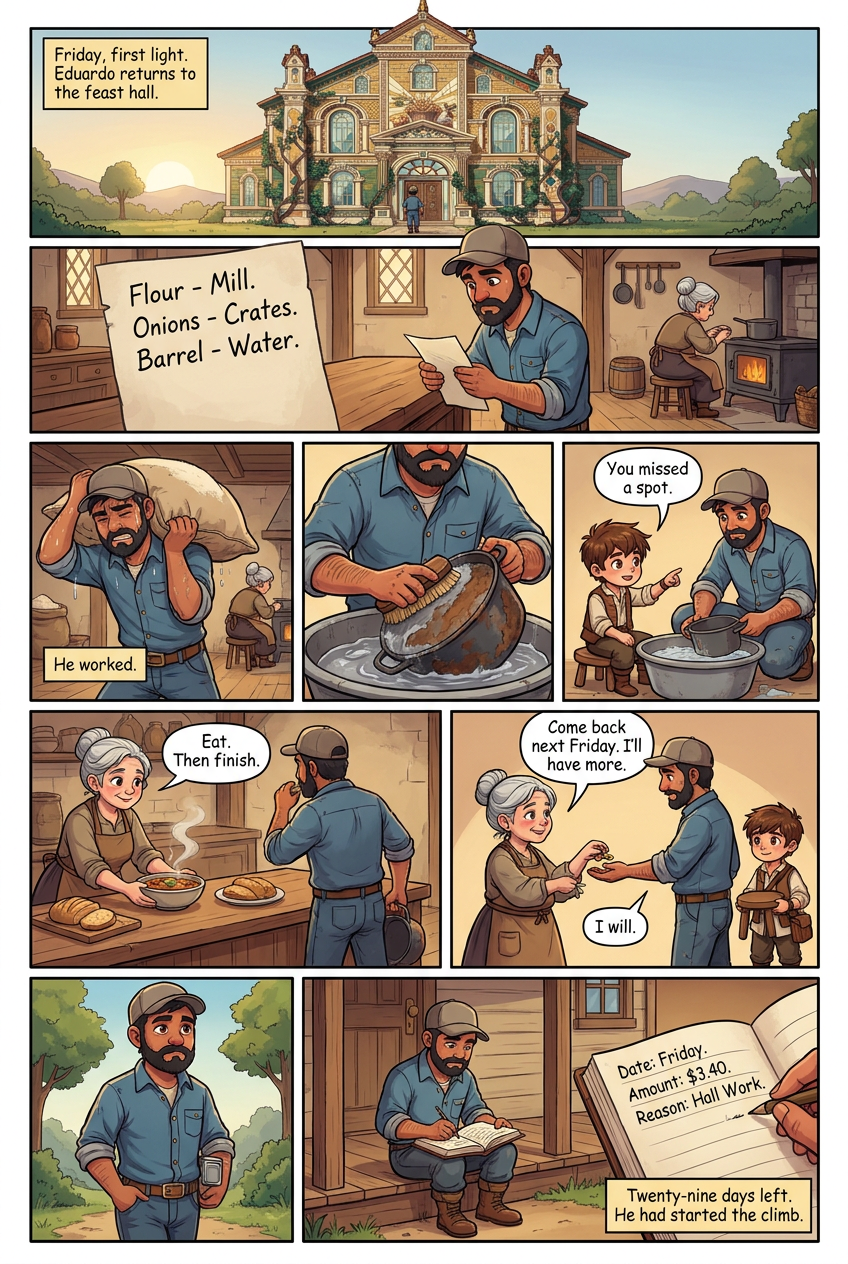
Eduardo came back to the feast hall Friday at first light. Gwen had a list on the counter and a bad back that would not bend. He read the list. Flour from the mill. Two crates of onions. A barrel of well water for the pots. He set the list down and got to work. He hauled six sacks of flour from the mill cart to the pantry. He carried the onion crates through the side door. He filled the barrel four buckets at a time until his shoulders burned. Gwen watched from the stool by the stove and said nothing. When he finished, she pointed at the wash basin and the stack of iron pots crusted with last night's stew. He scrubbed until the water went gray, then changed it and scrubbed again. He did not cut corners. He did not leave a pot half-clean and hope she would miss it. He remembered what that had cost him before. Emilio came in around noon with his stool under his arm. He set it down near the wash basin and sat. "You missed a spot," Emilio said. Eduardo looked. He had missed a spot. He scrubbed it out. "Better," Emilio said. Gwen laughed once from the stove. She brought over a bowl of stew and a heel of bread and set them on the counter beside the basin. "Eat," she said. "Then finish." Eduardo ate standing up. The stew was hot and heavy with potato. He finished the pots by mid-afternoon and stacked them dry on the rack. His hands were raw. His back ached in a clean way, the way honest work aches. Gwen came over and looked at the rack. She ran a finger along the inside of the top pot. It came away clean. She nodded and reached into her apron pocket. She counted out coins into his palm. Three dollars and forty cents. Not much against two hundred. But it was his, earned by his own hands, with no lie behind it. "Come back next Friday," she said. "I'll have more." "I will," Eduardo said. Emilio picked up his stool. "He works good," the boy said to Gwen. "I saw," she said. Eduardo walked home with the coins in his front pocket where he could feel them. He did not stop at the bank. He did not stop anywhere. At the house he pulled the tin off the shelf and dropped the coins in. They rang against the bottom. He sat on the porch step and pulled out the ledger. He wrote the date. He wrote the amount. He wrote where it came from and what he had done to earn it. Then he closed the book. Twenty-nine days left. He had started the climb.
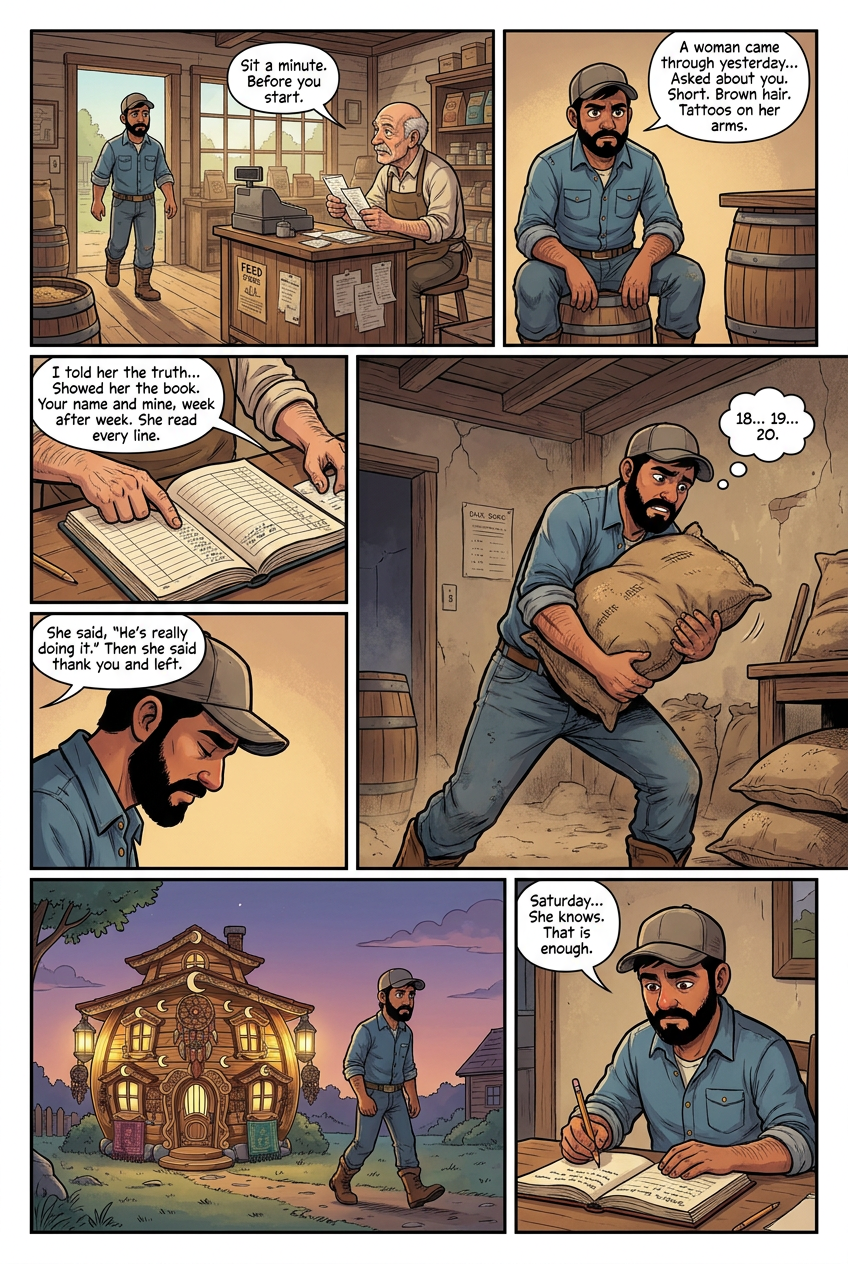
Saturday morning Eduardo walked to the feed store to start his shift. The old man was already at the counter, sorting receipts. He looked up when Eduardo came in and set the papers down. "Sit a minute," the old man said. "Before you start." Eduardo sat on the barrel by the register. His hands still ached from Gwen's pots. He waited. "A woman came through yesterday afternoon," the old man said. "Late. After you'd gone home. She asked about you." Eduardo's chest tightened. He kept his hands flat on his knees. "Short. Brown hair. Tattoos on her arms." The old man watched him. "She said she'd heard your name from a friend. Wanted to know if it was true. About the work." "What did you tell her?" "The truth. That you show up. That you pay what you owe. That you scrub a pot till it's clean and don't argue when I point at another one." The old man tapped the ledger on the counter. "I showed her the book. Your name and mine, week after week. She read every line." Eduardo swallowed. "Did she say anything?" "She said, 'He's really doing it.' Then she said thank you and left." Eduardo looked at the floor. He felt the pull start in his chest, the old want to get in the truck and drive to the school gate. He put his palms harder on his knees. "She didn't ask you to send word," he said. "No." "She didn't leave anything." "No." Eduardo nodded. He stood up. "What do you need hauled first?" The old man studied him a moment longer. Then he pointed at the back room. "Grain sacks. Twenty of them. Wall by the door." Eduardo worked through the morning. He counted the sacks as he stacked them. He did not think about her face. He thought about the weight in his hands and the count on his lips. When he finished he was wet through his shirt and the pull in his chest had gone quiet. He walked home the long way, past the house with the lanterns and the moons carved on the eaves where the dream reader kept her door. He did not stop. He had gone in there once, looking for a sign about Kiersten. He did not need a sign now. He had heard what he needed to hear, and it had not been meant for him. At the house he pulled the ledger down. He wrote the date. He wrote what the old man had told him. He wrote one line under it: She knows. That is enough. Then he closed the book and put it on the shelf. He picked up his hammer and went out to the side of the house where the siding still needed nails. There were twenty-eight days left. He had work to do.
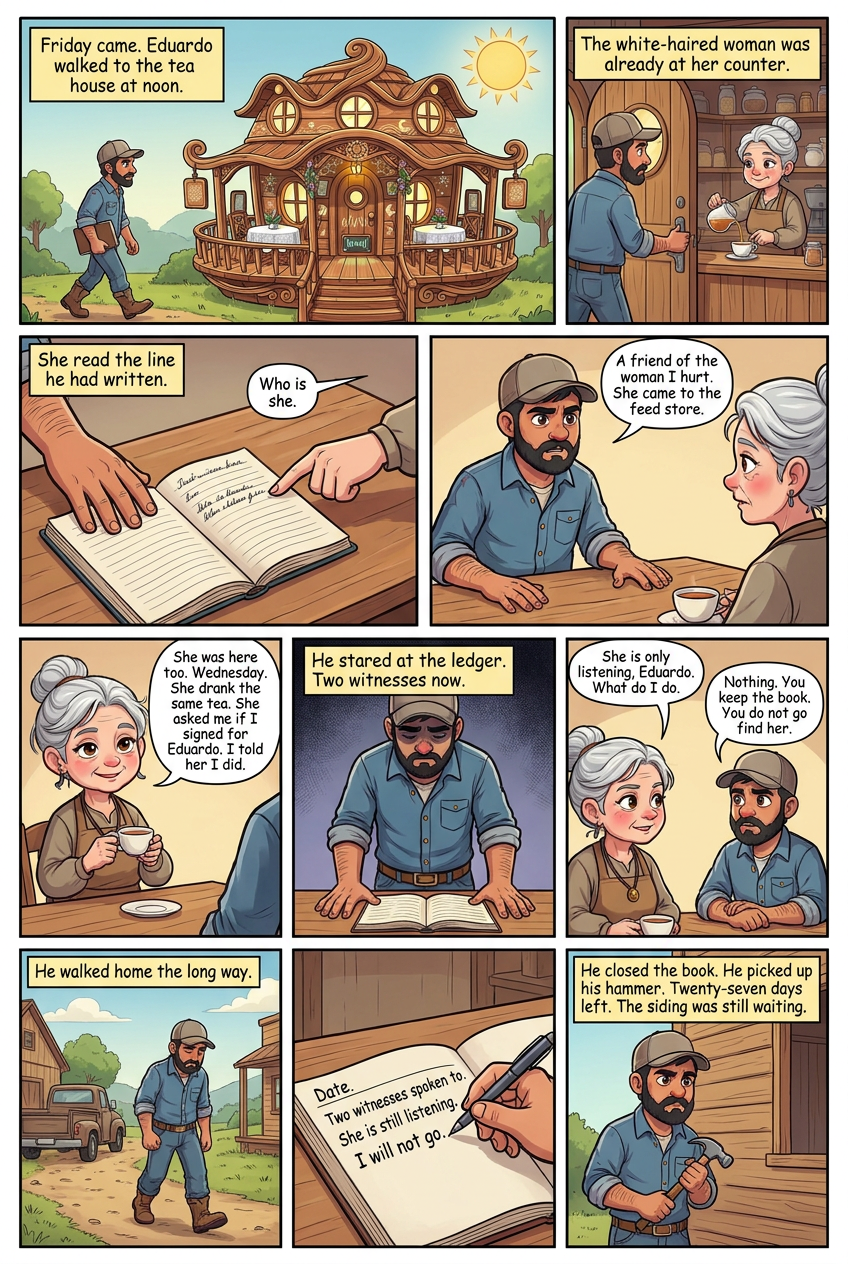
Friday came. Eduardo walked to the tea house at noon with his ledger under his arm. The old man had signed his week. Gwen had paid him for two mornings of pots. He wanted the white-haired woman to mark the book and then he wanted to go home. He did not want to hear Kiersten's name today. He had written what the old man told him and closed the book on it. That was supposed to be the end. The round tea house sat at the end of the lane, wooden and curled at the eaves. Lace cloths covered the porch tables. Eduardo climbed the steps and pushed the door open. The white-haired woman was already at her counter. She poured him a cup without asking. He set the ledger down. She read the entries. She read the line he had written under the old man's report. Her finger stopped there. She looked up. "Who is she," she said. "A friend of the woman I hurt." Eduardo kept his hands on the table. "She came to the feed store. She asked about the work. She left." "And you did not follow." "No." She signed the week. She closed the book. She poured herself a cup and sat down across from him. "She was here too," she said. "Wednesday. She sat where you're sitting. She drank the same tea. She asked me if I signed for a man named Eduardo. I told her I did. She asked why. I told her because he does not lie to me." Eduardo felt the pull start again. He pressed his palms flat on the wood. "She did not leave a message," the woman said. "She said thank you. She paid for her tea. She walked out." "Did she say where she was going." "No. And I did not ask." The woman set her cup down. "She is listening, Eduardo. She is asking the people who signed your book. She has not decided anything. She is only listening." He stared at the ledger. Two witnesses now. The old man at the counter. The woman at this table. Kiersten had gone to both. She had heard the same story twice and walked away twice. "What do I do," he said. "Nothing." Gwen's word, in another voice. "You keep the book. You do the work. You do not go find her. If she comes, she comes." "And if she doesn't." "Then the book is still true." He drank his tea. He paid what he owed for the cup. He walked home the long way, past the lane where the truck sat, and did not look at it. At the house he took down the ledger. He wrote the date. He wrote: Two witnesses spoken to. She is still listening. I will not go. He closed the book. He picked up his hammer. Twenty-seven days left. The siding was still waiting.
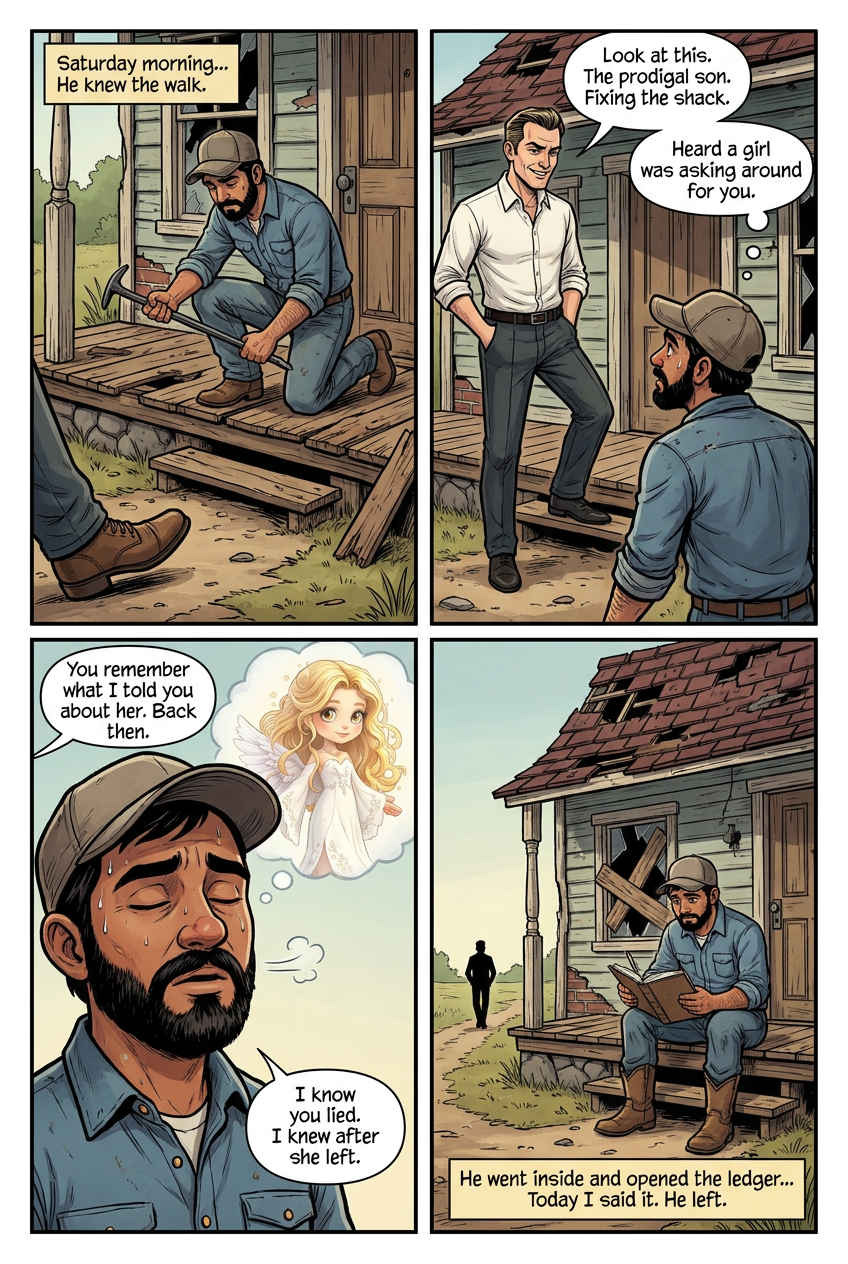
Saturday morning Eduardo was on his knees on the porch, prying up a rotten board, when he heard boots on the path. He knew the walk before he looked up. Slow. Easy. The walk of a man who had never worked a full day in his life. His cousin stopped at the bottom step and whistled through his teeth. He looked at the sagging roof, the cracked siding, the broken windows Eduardo had not gotten to yet. He wore a clean shirt and a grin Eduardo remembered from every bad night of his twenties. "Look at this," his cousin said. "The prodigal son. Fixing the shack." Eduardo set the pry bar down. He did not stand. "Heard a girl was asking around for you," his cousin said. "Brown hair. Tattoos. Same one from before?" "Yes." "She know you yet, or is she still deciding?" Eduardo felt the old heat rise. He put his palm flat on the board. He breathed the way the angel woman had shown him. Three in. Six out. His cousin climbed one step. "You remember what I told you about her. Back then. In the truck." "I remember." "I was drunk. You know that, right?" The grin widened. "I never touched her. She wouldn't look at me. I just wanted to see your face." Eduardo stared at him. Eight years. Eight years he had carried that lie like a stone in his mouth. Eight years he had thrown it at Kiersten across a kitchen table until she stopped defending herself. His cousin had said it once, and Eduardo had believed it because believing it let him be cruel. "I know," Eduardo said. His cousin blinked. "You know what." "I know you lied. I knew after she left. I kept it anyway because it was easier than knowing what I did." His cousin's grin thinned. He climbed another step. "You gonna let me in? I could use a drink. For old times." "No." "Come on, cousin." "No debts," Eduardo said. "No cards. No drinking. No lying. That's the house now. You don't fit through the door." "You think she'll take you back because you fixed a porch?" "She won't take me back. That isn't the work." His cousin looked at him a long moment. Something in his face shifted, went mean. He spat on the step and turned and walked back down the path. Eduardo watched him go until the road took him. Then he sat down on the top step and shook. Not from fear. From the weight of it lifting. The lie he had used to hate her was not his to carry anymore. He had named it out loud, to the man who told it, and the man had not been able to hold his eyes. He went inside and opened the ledger. He wrote the date. He wrote: My cousin came. He lied about her, years ago. I believed him because I wanted to. Today I said it. He left. He closed the book. He picked up the pry bar. The board was still rotten. He went back to work.
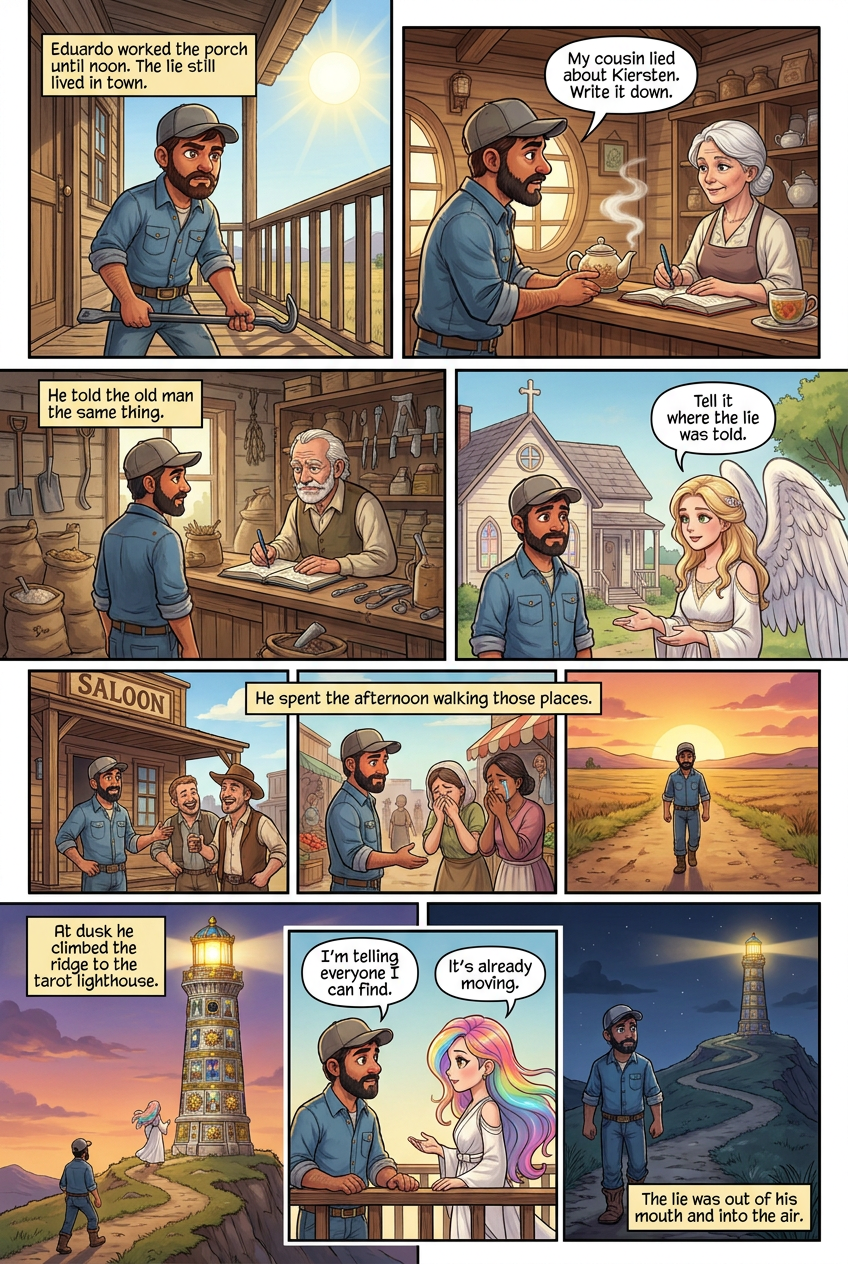
Eduardo worked the porch until noon, then set the pry bar down. Saying his cousin's lie out loud had lifted a stone from his own chest. But the lie still lived in town. Men at the feed store still watched him sideways. Women crossed the road when he passed. His cousin had told the story for eight years, and Eduardo had never once said it wasn't true. He washed his hands and put on a clean shirt. If he wanted the record fixed, he had to fix it himself. He walked to town and stopped first at the tea house. The white-haired woman was wiping the counter. He told her plain: his cousin had lied about Kiersten years back, and Eduardo had let the lie stand. He asked her to write it in her book, under his name, in her own hand. She looked at him a long moment. Then she took her pen and wrote what he said, and signed it. "I'll say it if anyone asks," she said. "I won't hunt an audience for you." He said that was fair. He went to the feed store next and told the old man the same thing. The old man nodded once and wrote it under Eduardo's ledger line. "Long time to carry that," he said. Eduardo said yes. Then he walked to the pale house with the cross and told the angel woman. She did not write it. She said, "Tell it where the lie was told." He knew the places. The saloon porch. The market. The road outside his cousin's house. He spent the afternoon walking those places. He spoke to the men his cousin drank with. He spoke to two women at the market who had once been Kiersten's friends. He did not soften it. He said his cousin had lied. He said he had used the lie to be cruel. He said Kiersten had done nothing wrong. Some men laughed. One spat in the dirt. One woman set down her basket and cried and would not look at him. He kept going until the sun went low. At dusk he climbed the ridge to the tarot lighthouse. He had heard the watcher up there did not lie and did not flatter. Light Sol stood on the platform, her long hair moving in the high wind. She did not turn when he came up. "Say it," she said. "My cousin told a lie about a woman named Kiersten. I let it stand eight years. I'm telling everyone I can find." "Who have you told." He named them. The tea house. The feed store. The angel woman. The market. The saloon porch. "That's the town," she said. "Word moves from here." Her hair shifted west. "It's already moving." He walked down in the dark. The lie was out of his mouth and into the air. What the town did with it was no longer his to hold.
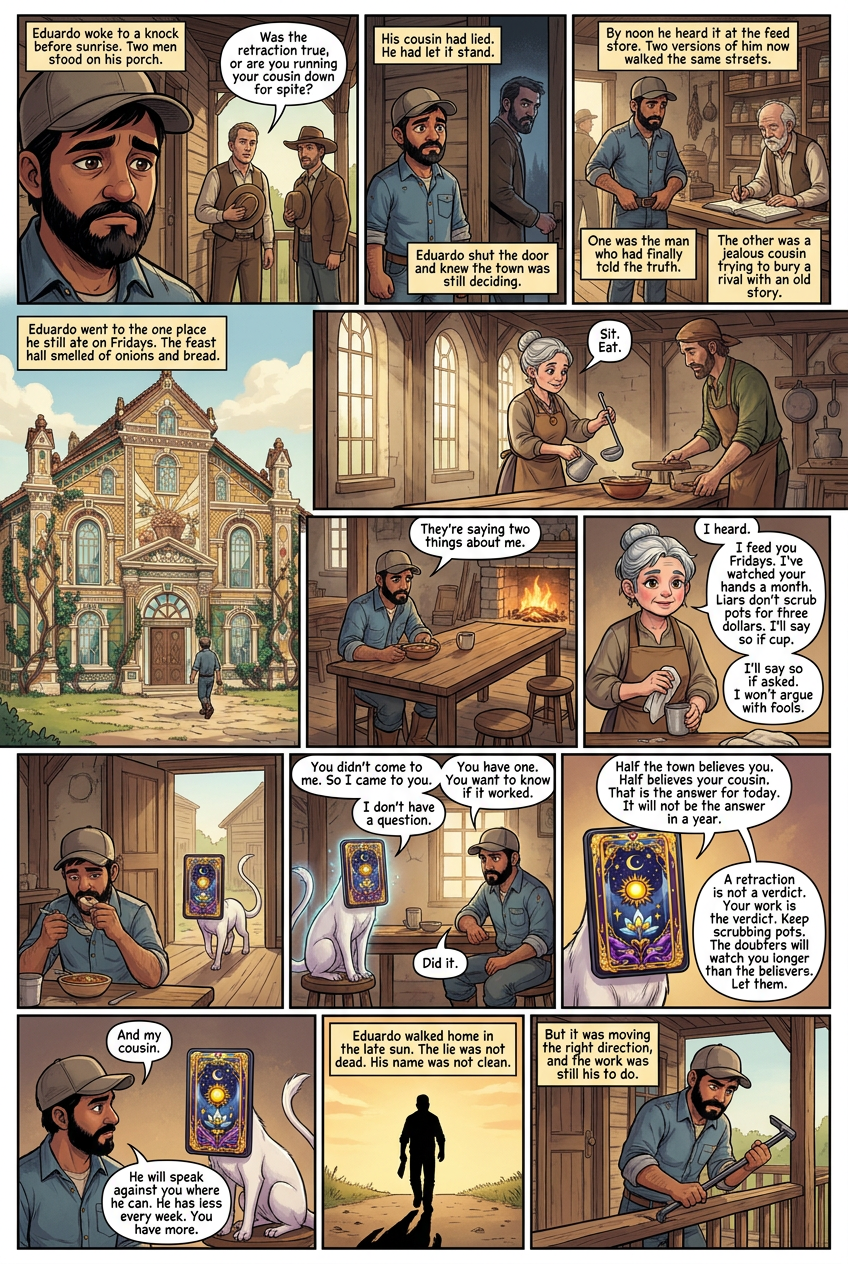
Eduardo woke to a knock before sunrise. Two men stood on his porch, hats in hand. One was a market vendor. The other drank with his cousin. They asked him plain: was the retraction true, or was he running his cousin down for spite? Eduardo told them again. His cousin had lied. He had let it stand. The vendor nodded and left. The other man stared a long moment, then walked off without a word. Eduardo shut the door and knew the town was still deciding. By noon he heard it at the feed store. Two versions of him now walked the same streets. One was the man who had finally told the truth. The other was a jealous cousin trying to bury a rival with an old story. The old man signed his ledger and said nothing. Eduardo wiped his hands on his jeans and went to the one place he still ate on Fridays. The feast hall smelled of onions and bread. Vines wrapped the stone outside, and light came through the tall windows in slats. Gwen stood at the long table pouring stew for a farmer and his boy. She did not smile at Eduardo. She pointed her ladle at a stool. "Sit," she said. "Eat." He sat. She set a bowl in front of him and a cup beside it. The farmer left. The room went quiet except for the fire. "They're saying two things about me," Eduardo said. "I heard." "Which do you believe." Gwen wiped her hands on her apron. "I feed you Fridays. I've watched your hands a month. Liars don't scrub pots for three dollars. They find easier work." She picked up his empty cup and filled it. "I'll say so if asked. I won't argue with fools." He ate. The door opened and a card-shaped animal walked in on four legs, tail dragging. Fortune came to the stool beside him and sat like a person. The wheel on its face turned once. "You didn't come to me," Fortune said. "So I came to you." "I don't have a question." "You have one. You want to know if it worked." Eduardo set down his spoon. "Did it." "Half the town believes you. Half believes your cousin. That is the answer for today. It will not be the answer in a year." Fortune's tail thumped once against the stool. "A retraction is not a verdict. Your work is the verdict. Keep scrubbing pots. Keep signing the book. The doubters will watch you longer than the believers. Let them." "And my cousin." "He will speak against you where he can. He has less every week. You have more." Fortune stood and walked out. Gwen took the bowl away. Eduardo walked home in the late sun. The lie was not dead. His name was not clean. But it was moving the right direction, and the work was still his to do. He picked up the pry bar and went back to the porch.
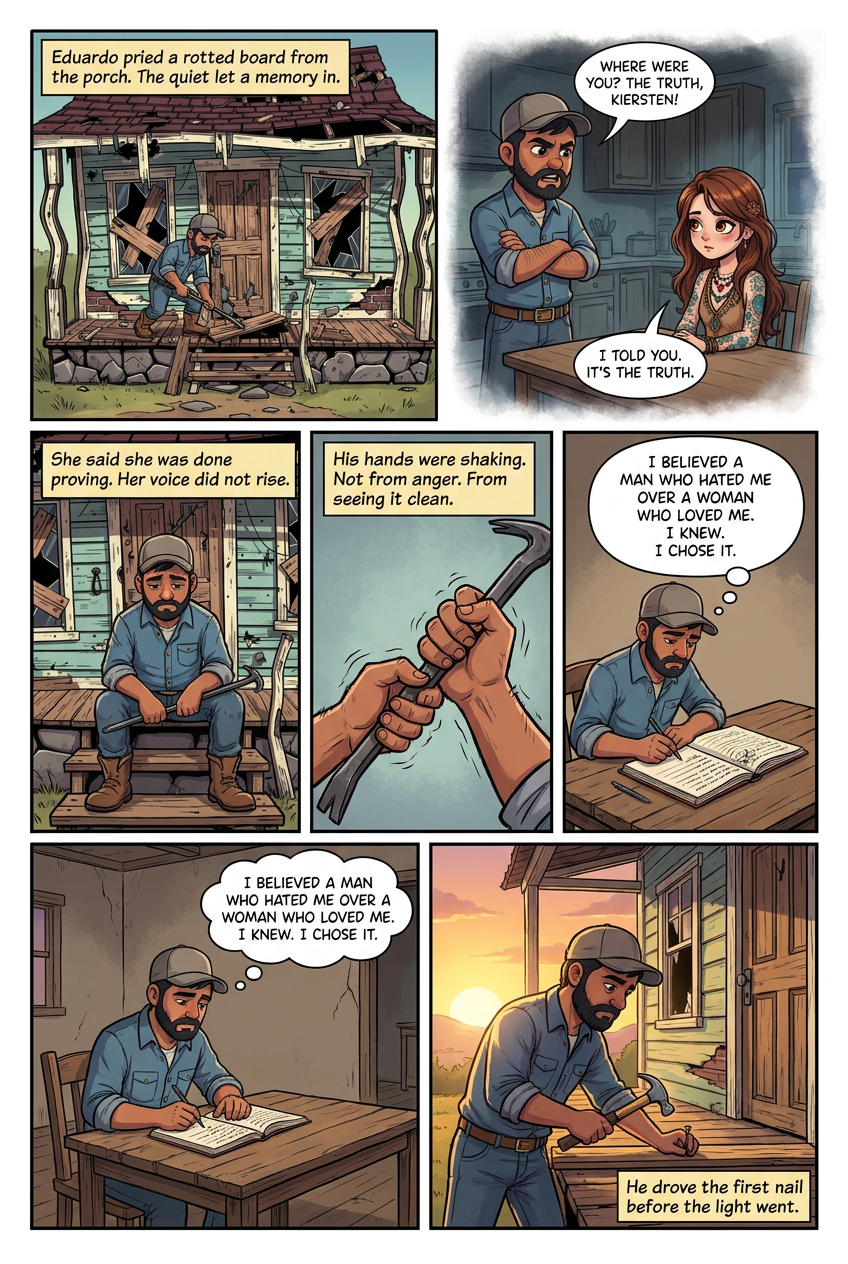
Eduardo pried a rotted board from the porch and set it aside. The house sat around him like a battered thing that had survived a long winter. Sagging roof. Cracked siding. Two windows patched with wood he had nailed up himself. He worked in the quiet the town had left him, and the quiet let a memory in he had spent all week pushing back. Kiersten in the kitchen of the old place. Her hands flat on the table. Him standing over her, arms crossed, asking again where she had been. She had told him the truth. He had told her she was an act. He sat down on the top step and let the pry bar rest across his knees. She had said it plain. She was not lying. She was not going to keep proving it. His cousin had said one word against her and Eduardo had built a case around that word for years. He had trusted the man who resented him over the woman who slept beside him. He had known. Part of him had always known. He remembered the last time she tried. She stood by the door with her shoes already on. She said one day he would meet with God, and God would tell him what she had been telling him. She said she was done proving. Her voice did not rise. That was the part that stayed. She had not begged. He had watched her go and told himself she was guilty because she left. Eduardo set the pry bar down on the boards. His hands were shaking. Not from anger. From seeing it clean, without the story he had wrapped around it for eight years. He had called her a liar to keep from calling himself one. He had made her small so he could feel tall in a house he was tearing down from the inside. He went inside and took the ledger of wrongs down from the shelf. He opened it to a blank page. He wrote one line. I believed a man who hated me over a woman who loved me. I knew. I chose it. He closed the book. He did not take it to Mother Angel. He did not drive to the school. He had learned that part already. The confession was not for her ears. It was for his own hand to write and his own eyes to read. He put the ledger back on the shelf and went out to the porch. The board he had pulled lay where he had left it. He measured a fresh one against the gap and started the cut. Something in him had been carrying her name like a debt he could pay. It was not a debt. It was a truth he owed himself. He had believed the wrong person on purpose. Naming it did not free her. It freed him to keep working without lying about why. He drove the first nail before the light went.
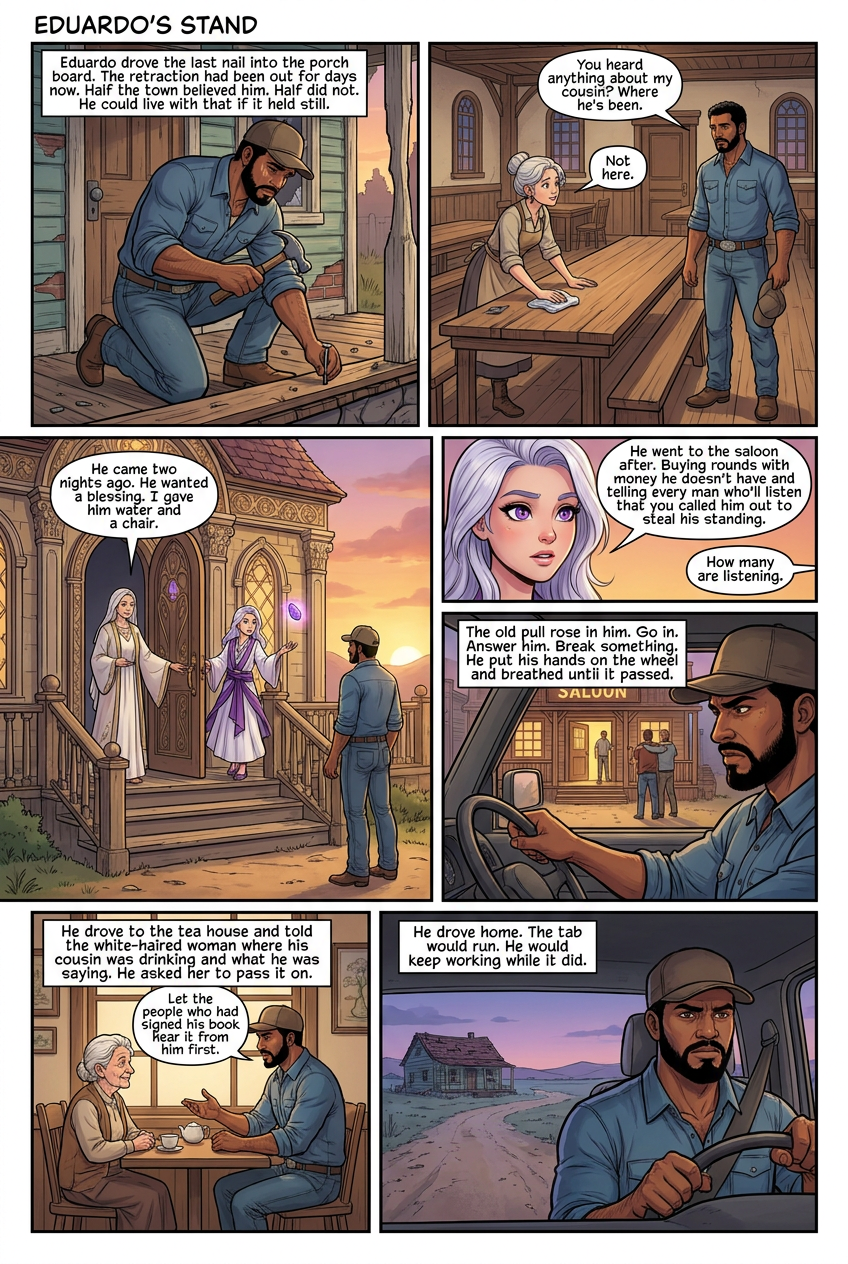
Eduardo drove the last nail into the porch board and stood up. The retraction had been out for days now. Half the town believed him. Half did not. He could live with that if it held still. But it would not hold still if his cousin kept talking somewhere he could not see. He drove to the feast hall to ask Gwen. She kept a door open to everyone. If his cousin had been sitting at a table stirring men against him, she would know. The hall smelled of onions and bread. Gwen stood at the long table wiping it down. She looked up when he came in and set the rag aside. "You heard anything about my cousin?" Eduardo asked. "Where he's been." Gwen picked the rag back up. "Not here." "You'd tell me." "I'd tell you." She wrung the rag out over a bowl. "Try the angel woman. Men who've been called out go looking for a priest before they go looking for a friend." He thanked her and left. The keep sat at the edge of the wood, its carved wood wrapped in vines, stained glass angels catching the late sun. Mother Angel opened the door before he knocked. Behind her, Ananda leaned in a doorway holding a purple stone in one hand. "He came," Mother Angel said. Her voice was soft and even. "Two nights ago. He wanted a blessing." "Did you give him one?" "I gave him water and a chair. He wanted me to say you were lying. I would not." Ananda tossed the stone and caught it. "He went to the saloon after. Been there since. Buying rounds with money he doesn't have and telling every man who'll listen that you called him out to steal his standing." Eduardo's jaw set. "How many are listening." "Fewer than yesterday," Mother Angel said. "But enough. He is running a tab against your name." "He'll swing at you if you go in," Ananda said. "Just so you know. Crystals told me. Also common sense." Eduardo drove to the saloon and stopped across the road. He could see his cousin through the open door, arm around a man's shoulder, mouth moving. The old pull rose in him. Go in. Answer him. Break something. He put his hands on the wheel and breathed until it passed. He would not go in. Going in was the fight his cousin wanted. He had the location now. That was the thing he had come for. He drove to the tea house and told the white-haired woman where his cousin was drinking and what he was saying. He asked her to pass it to the old man at the feed store and to Gwen. Let the people who had signed his book hear it from him first. He drove home. The tab would run. He would keep working while it did.
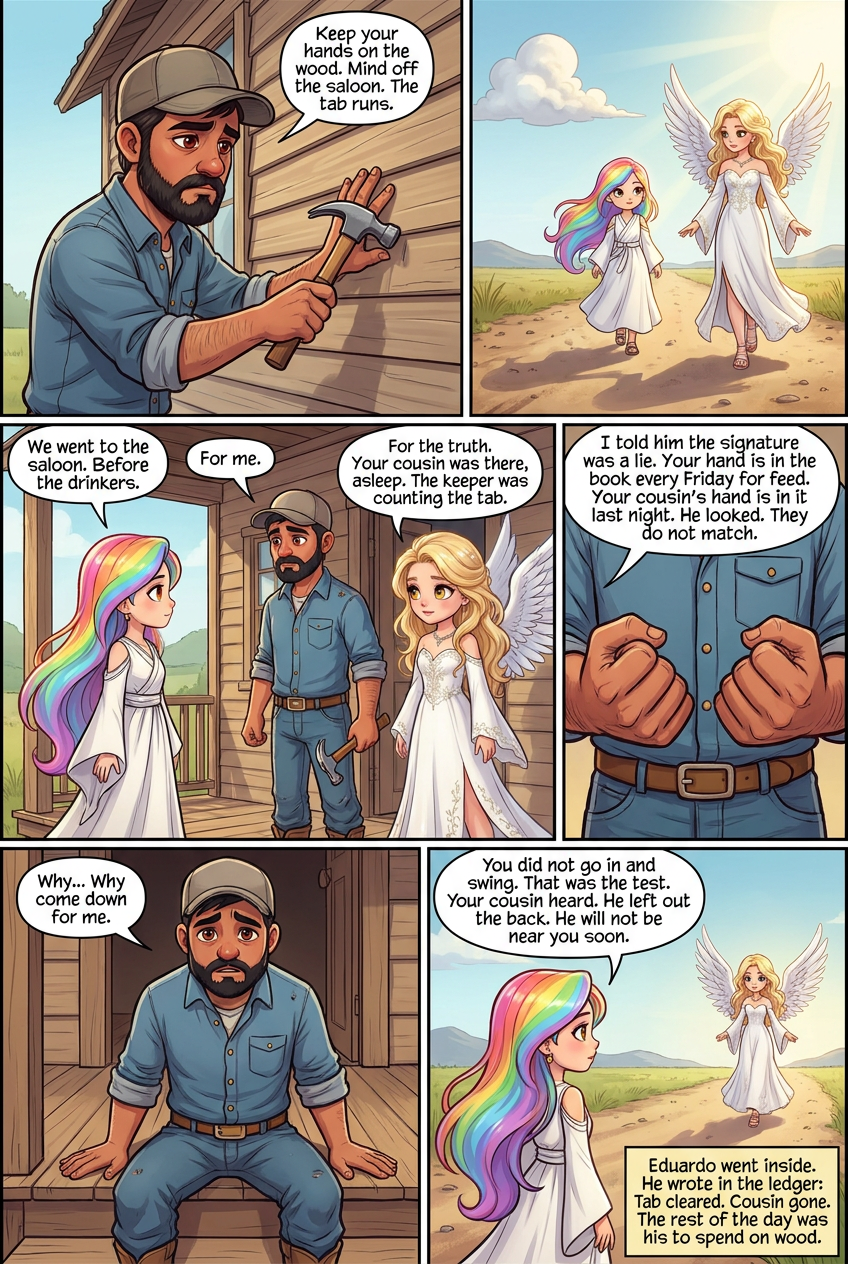
Eduardo worked the siding through the morning. He kept his hands on the wood and his mind off the saloon. The tab would run. He had said so to himself twice already, like a nail he had to keep driving back in. At noon a small dust cloud came up the road. Light Sol walked ahead, her colored hair moving in the wind. Mother Angel came behind her, sandals on the dry ruts, blonde hair catching the sun. Eduardo set the hammer down. Light Sol did not come down from her tower for small things. "We went to the saloon," Light Sol said. She did not stop walking until she reached the porch. "This morning. Before the drinkers." "You went for me." "For the truth," Mother Angel said. Her voice was even. "Your cousin was still there. Asleep at a table. The keeper was counting the tab." "How much." "Ninety-two dollars," Light Sol said. "Signed in your name. Three nights." Eduardo's hands closed. He opened them again. "I told the keeper the signature was a lie," Mother Angel said. "I told him you had retracted your cousin's story in front of the town and that your cousin came here to break you. I asked him to look at his own book. Your hand is in it every Friday for feed. Your cousin's hand is in it last night." "He looked," Light Sol said. "The hands do not match." "He kept the tab against your cousin," Mother Angel said. "Not against you." Eduardo sat down on the step. The relief hit him harder than the fear had. He pressed his palms flat against the wood. "Why," he said. "Why come down for me." Light Sol looked at him plainly. "You did not go in and swing. That was the test. You passed it two days ago. We finished it for you." "The keeper wants a word from you," Mother Angel said. "In person. Not to pay. To stand in his door once so his room sees you standing there sober. Tomorrow at noon." "I'll be there." Mother Angel touched his shoulder once and turned back to the road. Light Sol lingered. "Your cousin woke while we spoke," she said. "He heard. He left out the back." "Where did he go." "I do not know. My work is the sky." She looked up the road. "But a man who runs a tab and loses it runs from the town next. He will not be near you soon." She walked after Mother Angel. Eduardo watched until the dust settled. He went inside and opened the ledger. He wrote the date. He wrote: Tab cleared from my name. Two women stood for me before I asked. Cousin gone from the saloon. He closed the book and picked the hammer back up. The siding was not finished. The rest of the day was his to spend on wood.
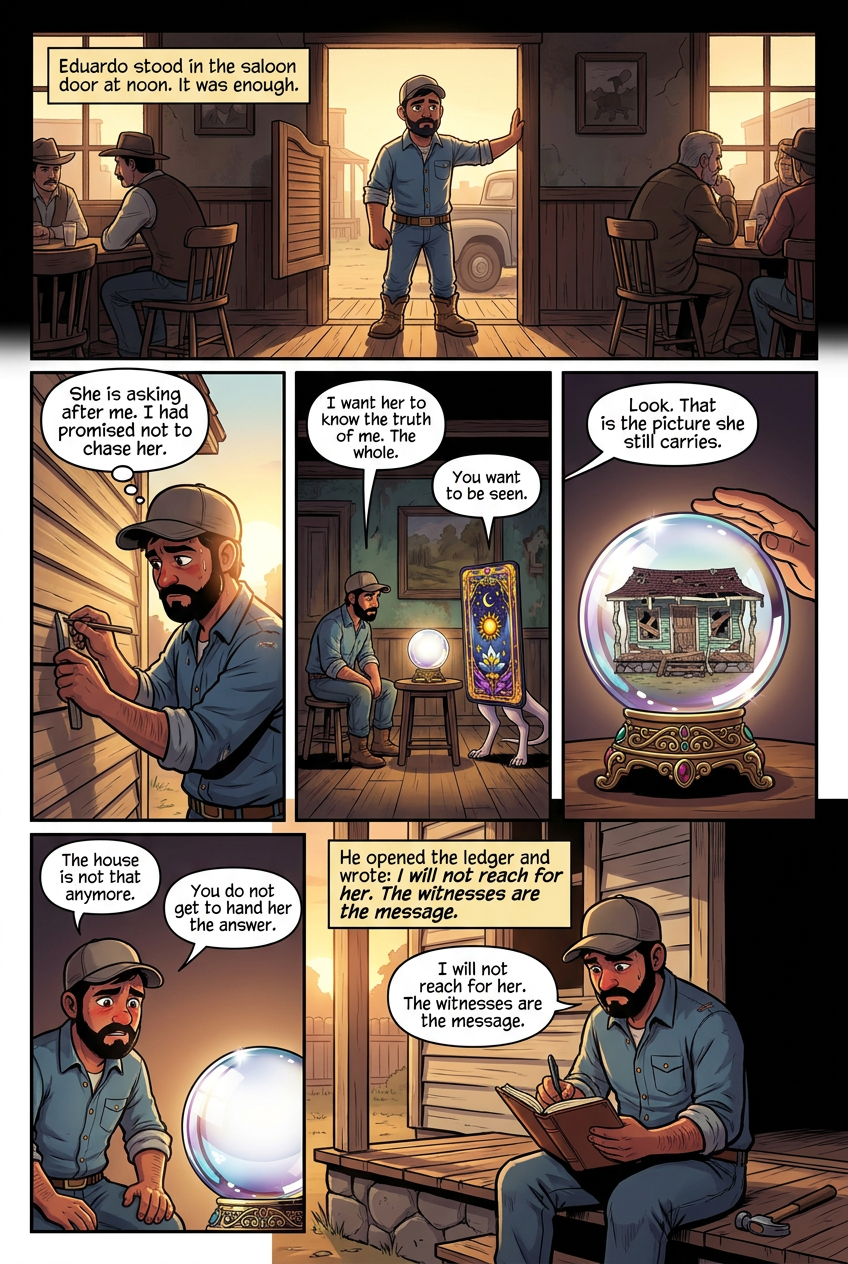
Eduardo stood in the saloon door at noon the next day. He said nothing to the room. The keeper nodded once. The drinkers looked up and looked away. It was enough. He walked out and drove home with the sun on the truck hood and the ledger on the seat beside him. He worked the siding until the light bent. Then he sat on the step and thought about Kiersten. She was asking after him. The white-haired woman had said so. The old man at the feed store had said so. He had promised himself he would not chase her. He kept that promise with his hands on the wood. But she was walking a road toward him without his knowing what she found on it. He wanted her to see the man he was becoming. He could not show her. He had been told never to come near. He went to see Fortune. The tarot animal was on the porch of the small painted house, tail flicking, wheel-face turning slow. A polished glass ball sat on a low table between them, held on a brass stand. Eduardo sat on the stool. "She is asking," he said. "I want her to know the truth of me. Not the pieces. The whole." Fortune looked at him. "You want to be seen." "Yes." "By her." "Yes." "Then you have not put her down." Eduardo's face went hot. He kept his hands on his knees. Fortune stepped closer to the glass. The inside caught light and moved it. "Look." Eduardo leaned in. He saw his own house in the ball. The broken one. Sagging roof. Boarded windows. Cracked wall. The house as it had been the day he came back. "That is what she would see if she came today," Fortune said. "Not because it is your house. Because it is the picture she still carries." "The house is not that anymore." "She does not know. She is asking others. That is her right. You do not get to hand her the answer." "Then what do I do." "Nothing toward her. Everything toward the house. The wall. The step. The word at the feed store. The tab that is not yours. Let the people she asks be the picture. Not you." Eduardo watched the glass. The image did not change. "If she comes," Fortune said, "she comes to what is standing. If she does not come, what is standing is still yours." "I wanted to show her." "That want is the old want in a clean shirt. Set it down." Eduardo sat with it. The heat in his face cooled. He nodded once. He drove home. He opened the ledger and wrote: I will not reach for her. The witnesses are the message. He closed the book and picked the hammer back up. The siding was not finished.
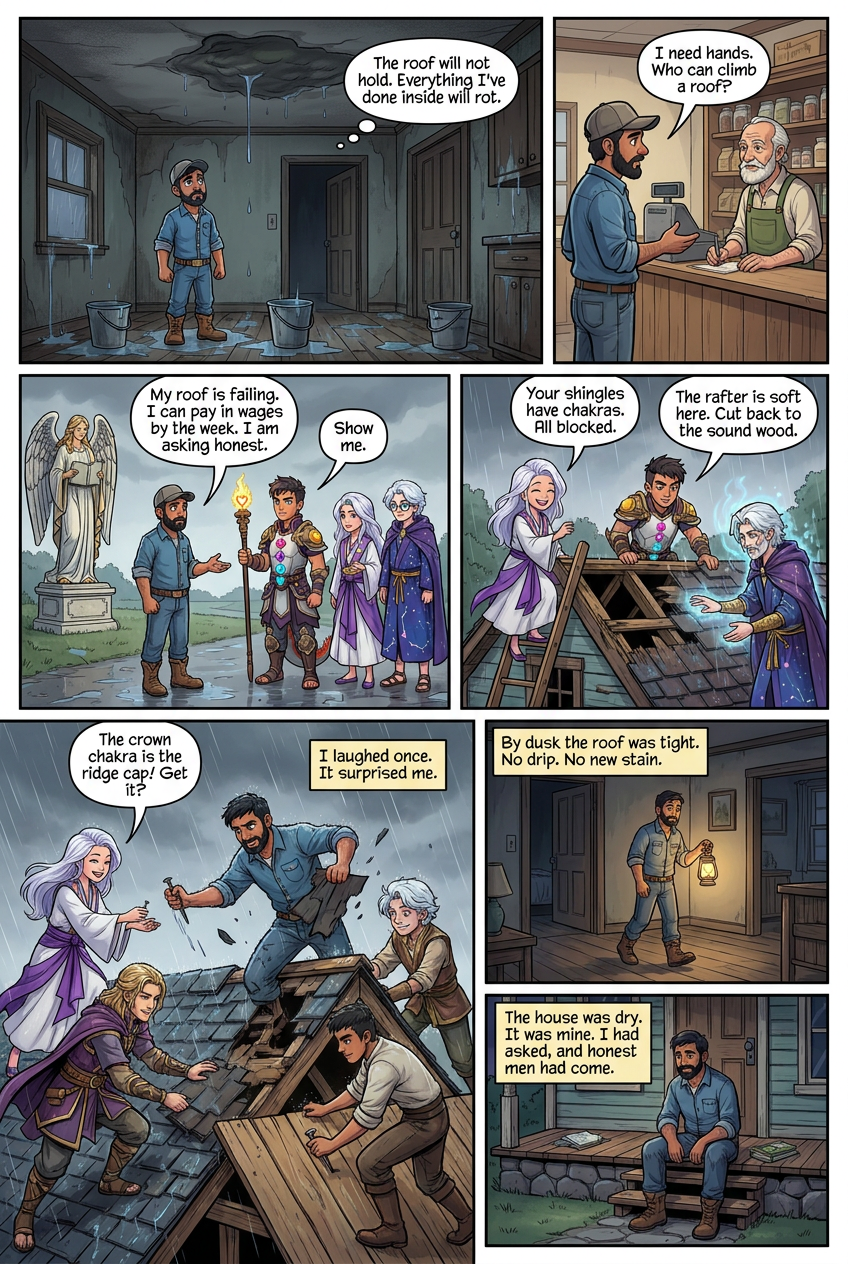
Rain woke Eduardo before dawn. He heard it hit the shingles, then heard it hit the floor. He got up. Three buckets in the front room. One in the hall. The patch he had laid last month over the back bedroom was dark and swollen. Water ran down the inside of the wall he had painted. The paint bubbled. He stood in the wet and knew the truth. The roof would not hold. Everything he had done inside would rot under it. He drove into town at first light. He needed hands. He needed a set of eyes better than his own. He went to the feed store and asked around like a man asking for work, only reversed. He asked who could climb a roof. He asked who would come out today. The old man behind the counter gave him three names and shook his head at two of them. The third name was not a roofer. It was Aurelius. Eduardo found the chakra man on the road near the angel monument, staff in hand, the heart stone dim in the wet light. Aldric was with him under a blue hat gone dark with rain. Behind them stood Quantum in his glasses, and Ananda in white and purple, arms crossed against the cold. "My roof is failing," Eduardo said. "The inside will go if I do not cover it today. I can pay in wages by the week. I am asking honest." Aurelius looked at him a long moment. "Show me." They came. Ananda climbed the ladder first and laughed. "Your shingles have chakras. All blocked." Quantum did not laugh. He walked the ridge line and pointed. "The rafter is soft here. And here. Cut back to the sound wood. Do not patch over rot." Aldric held a hand over the worst seam and the rain seemed to slow across a small square of roof, enough to work under. Aurelius set his staff against the eave and worked with his hands. Eduardo did not stand and watch. He tore. He hauled the wet shingles down in armfuls. He cut back to dry wood the way Quantum said. They laid new decking. They nailed new shingles from the low edge up. Aldric held the dry patch over them while they moved. Ananda passed nails and made a joke about the crown chakra being the ridge cap. Eduardo laughed once. It surprised him. By dusk the roof was tight. Eduardo walked the rooms below with a lamp. No drip. No new stain. The paint was ruined on one wall. He could redo the paint. He paid what he had and wrote the rest against next week's wages. Each of them signed the ledger. Four new names in one day. He sat on the step after they left. The house was dry. It was his. He had asked, and honest men had come.
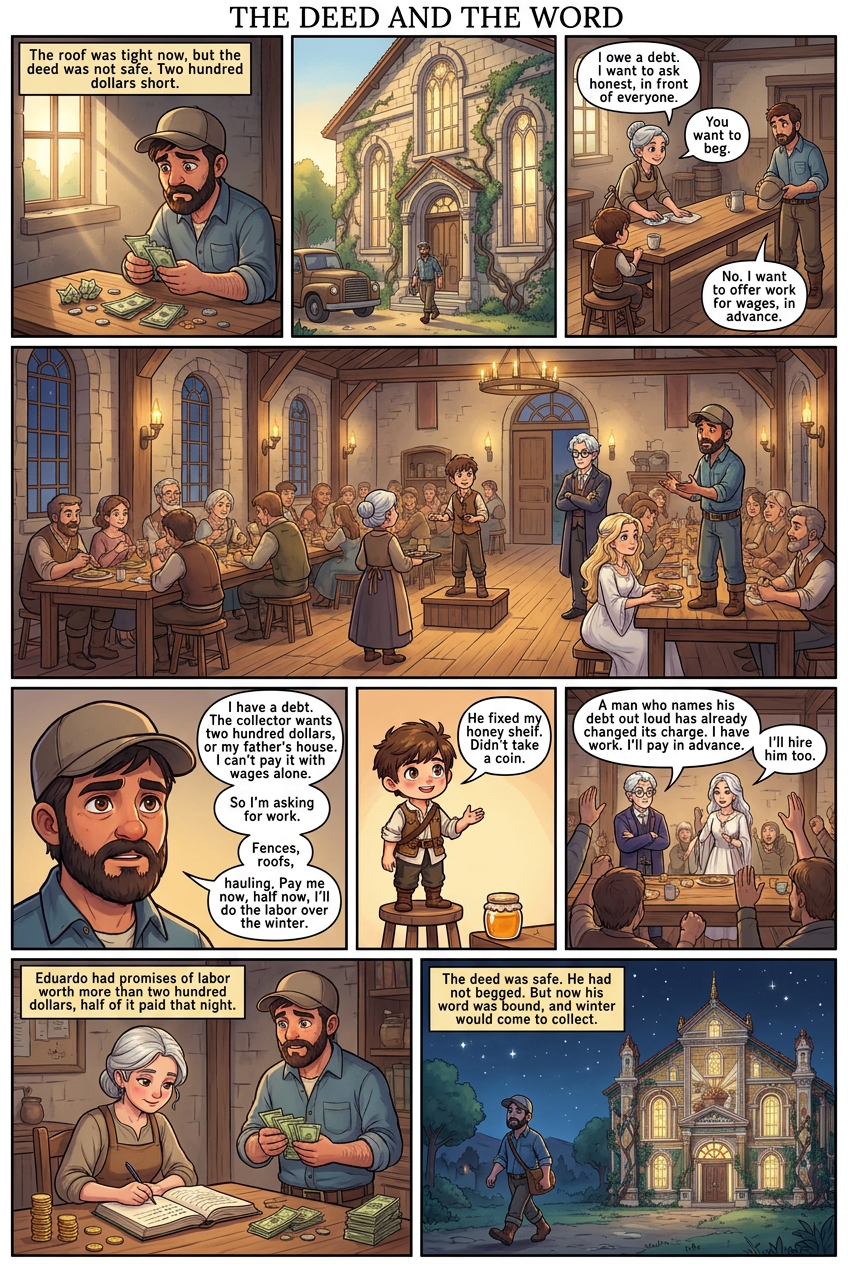
The roof was tight now, but the deed was not safe. Eduardo counted his money at dawn. He had scraped together most of what the collector wanted. He was still two hundred dollars short, and the collector's deadline was under two weeks away. His feed store wages and Gwen's Friday work would not close the gap in time. He needed one more thing to give, and he had already sold his tools once in his mind and set them back. The only thing left was his word. He drove to the feast hall, where vines climbed the stone walls and the tall windows caught the morning light. Gwen was wiping a long table. Emilio sat on his stool near the empty cup she still set out for her husband. Eduardo asked Gwen to let him speak to whoever came in that night. "I owe a debt," he said. "I want to ask honest, in front of everyone, not behind their backs." Gwen studied him. "You want to beg," she said. "No," Eduardo said. "I want to offer work for wages, in advance." Gwen nodded once. "Then talk. I'll feed them first." By evening the hall was full. Townspeople sat at the long tables with bread and stew. Quantum stood near the back, his glasses catching the lamplight, arms folded. Mother Angel came in her white dress and took a seat near the front. Tealy set down a tray of tea. Eduardo stood where they could all see him. He did not perform. He told them the plain truth. He had a debt from cards seven years ago. He had run from it. Now the collector wanted two hundred dollars, or the deed to his father's house. "I can't pay it in time with wages alone," Eduardo said. "So I'm asking for work. Fences, roofs, hauling, pots. Pay me now, half now, and I'll do the labor over the winter. My word is in the ledger at the feed store. Ask the old man if I keep it." The room was quiet. Emilio stood up on his stool. "He fixed my honey shelf," the boy said. "Didn't take a coin." He sat back down. Quantum spoke from the back, his voice low and sure. "A man who names his debt out loud has already changed its charge. I have work. I'll pay in advance." Mother Angel rose. "I prayed for honest work for this man once," she said. "Here it is. I'll hire him too." Hands went up around the tables. Gwen wrote the names and the amounts. When the counting was done, Eduardo had promises of labor worth more than two hundred dollars, half of it paid that night in his hand. He walked out with the money and a list of jobs he owed. The deed was safe. He had not begged, and he had not lied. He had asked, and the town had answered. But now his word was bound to every name on Gwen's paper, and winter would come to collect.
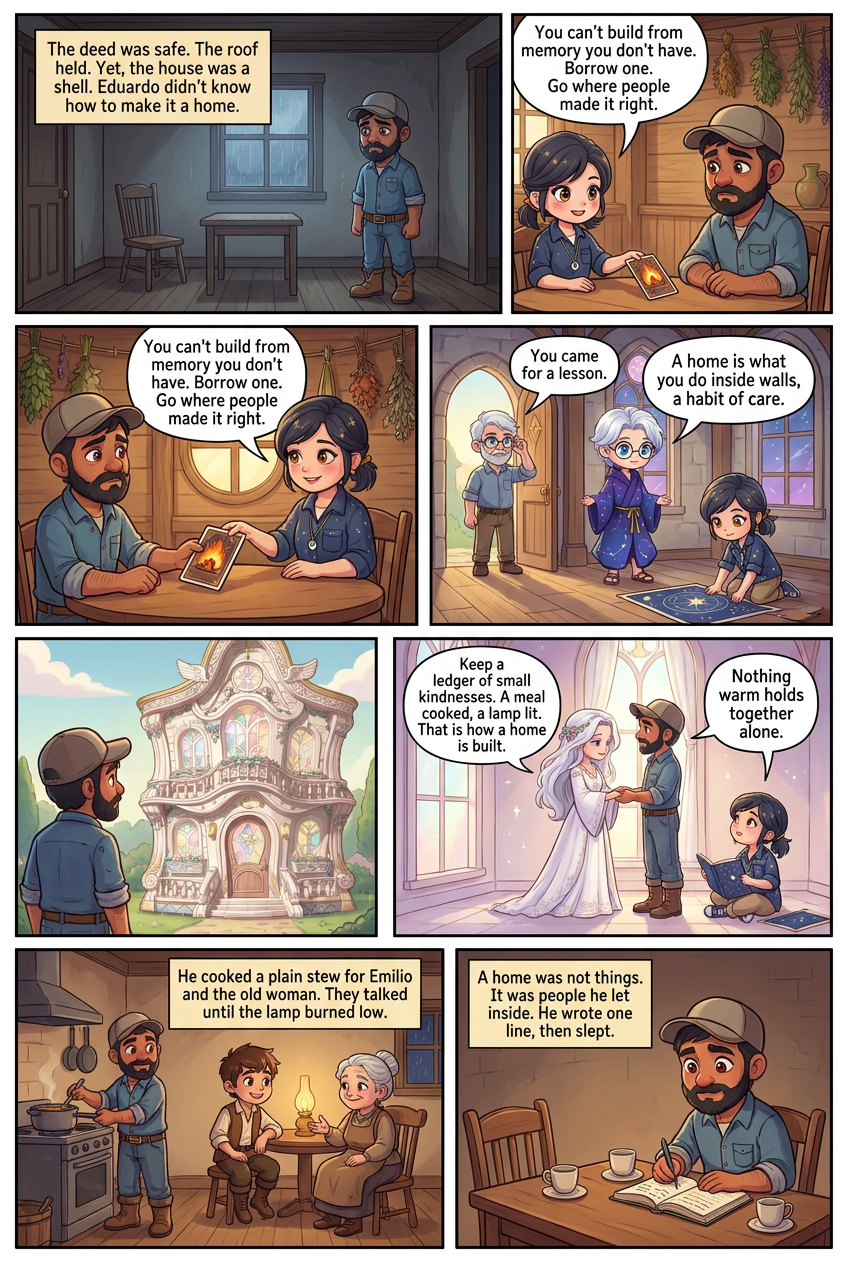
The deed was safe. Winter's work was promised. But that night Eduardo stood inside his house and saw how empty it was. The roof held. The walls were painted. Yet the front room had one chair, a table, and nothing else. He had made a shell that kept out rain. He did not know how to make it a home, because he had never lived in one. His parents had filled these rooms with shouting. He had no memory of warmth to copy. He drove to the tea house before dawn. Tealy was steeping leaves in a clay pot. She set a card face down beside his cup without asking. "You look like a man who fixed everything and still can't sleep," she said. Eduardo told her the truth. The house worked, but it felt like a stranger's. He did not know what a home should feel like. Tealy turned the card over. It showed a hearth. "You can't build from memory you don't have," she said. "So borrow one. Go where people made it right." She sent him to the school of luminous stone with the sun carved above its door. Quantum met him in the doorway, glasses catching the lamplight. "You came for a lesson," Quantum said. It was not a question. Eduardo said he did not know what he came for. Quantum led him inside, past students breathing in slow counts. "A house is walls," Quantum said, his voice low and certain. "A home is what you do inside them again and again until it holds a shape. You are not missing furniture. You are missing a habit of care." Mother Angel sat near a tall window painted with stars. Eduardo had asked her for help many times. She rose in her white dress and took his hands. "You keep a ledger of your wrongs," she said kindly. "Keep one of small kindnesses too. A meal cooked. A lamp lit for someone. That is how a home is built." Saturn moon looked up from a star chart on the floor. "Even a house sits in a pattern," she said. "Nothing warm holds together alone. It needs others near it." Eduardo understood then. He had built his house alone to prove he needed no one. That was why it stayed cold. He drove home with a plan he could hold. He bought a second chair from the market. He set two cups on the table, the way Gwen kept one for her husband. That Friday he asked Emilio and the old man from the feed store to come eat. He cooked a plain stew. The boy sat on his stool. The old man signed nothing that night. They talked until the lamp burned low. When they left, the room was still bare. But it had held two guests and their voices. Eduardo saw the difference. A home was not things. It was people he let inside. He wrote one line in a new ledger. Then he lay down and slept.
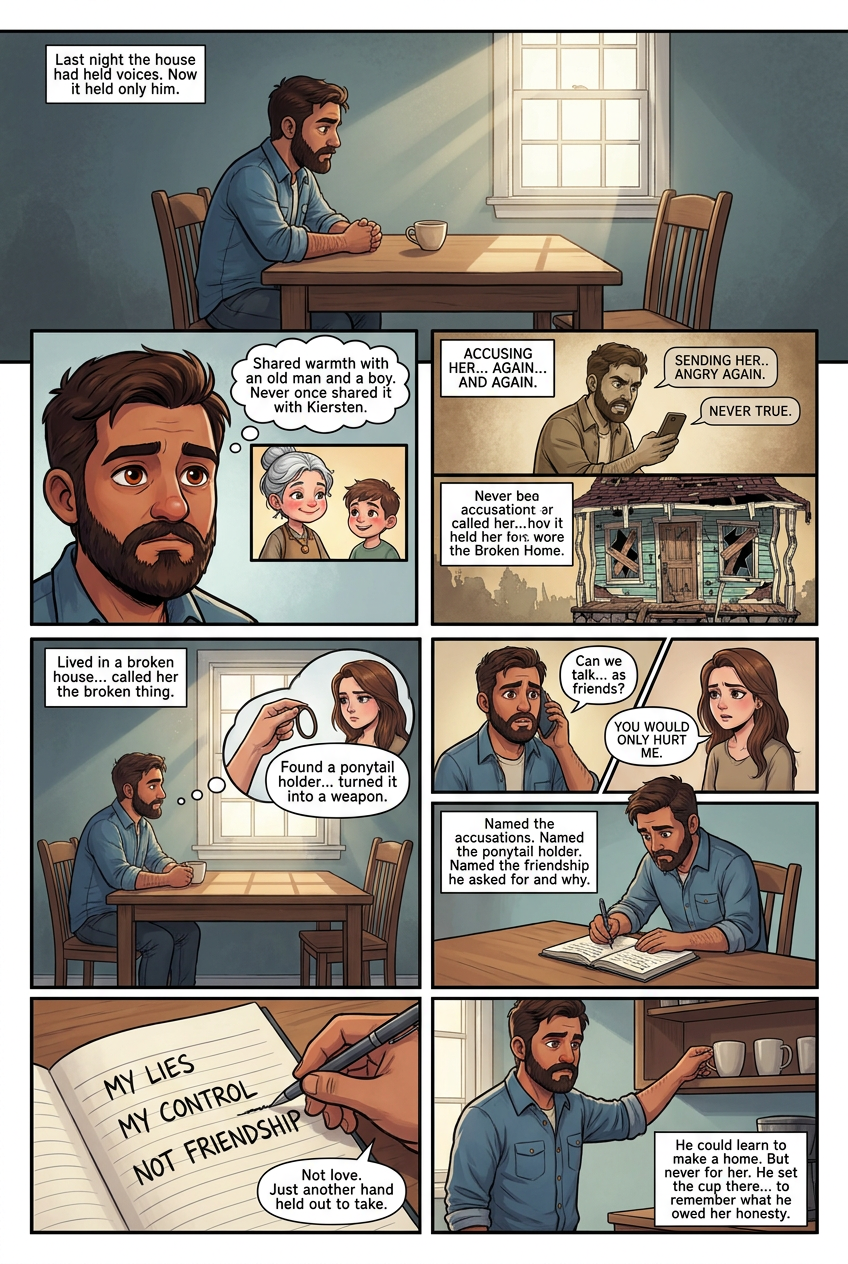
The morning after the meal, Eduardo sat alone in his front room. The two chairs still faced each other. He looked at the second cup on the table and felt the quiet settle in. Last night the house had held voices. Now it held only him. He thought about how he had finally let people inside these walls. Then a harder thought came. He had shared this warmth with an old man and a boy. He had never once shared it with Kiersten. She had lived beside him for years, and he had never made a single room feel like home. He remembered the texts he sent after she left. He had accused her of being with her cousin. He wrote it again and again. She never once admitted it, because it was never true. He remembered why. He had found a ponytail holder that wasn't hers and turned it into a weapon against her. When his own guilt rose, he handed it to her instead. He made her carry it. Eduardo stood and walked to the window. The glass was clean now. Once it had been broken, boards nailed across the frame. He had lived in a broken house and called her the broken thing. He thought of the last time he reached out. He had asked her to talk as friends. She had answered in her plain, short way. "You would only hurt me." Six words. No anger in them. Just a fact she already knew, the way she always knew endings before he did. He had told himself, in that moment, that he wanted friendship. Now he made himself look straight at the truth. He had not wanted her friendship. He had wanted a door left open. He had wanted her near enough to reach when he felt small. That was not love. That was another hand held out to take. Eduardo sat back down at the table. He pulled the new ledger toward him, the one for kindnesses. He did not write a kindness. He wrote what he had done to her, plainly, in his own hand. He named the accusations. He named the ponytail holder. He named the friendship he had asked for and why. When he finished, he did not tear the page out. He set the pen down. The old habit would have burned it, hidden it, cleared the ledger and started clean. He left it open on the table. He understood something now that the empty second chair had shown him. He could learn to make a home. But he could never make one for her. That time was gone, and she had been right to go. The home he was building would be his to fill with others. Eduardo carried the second cup to the shelf. He set it there the way Gwen kept a cup for her husband. Not to wait for Kiersten. To remember what he owed her honesty, and to stop pretending he could pay it back.
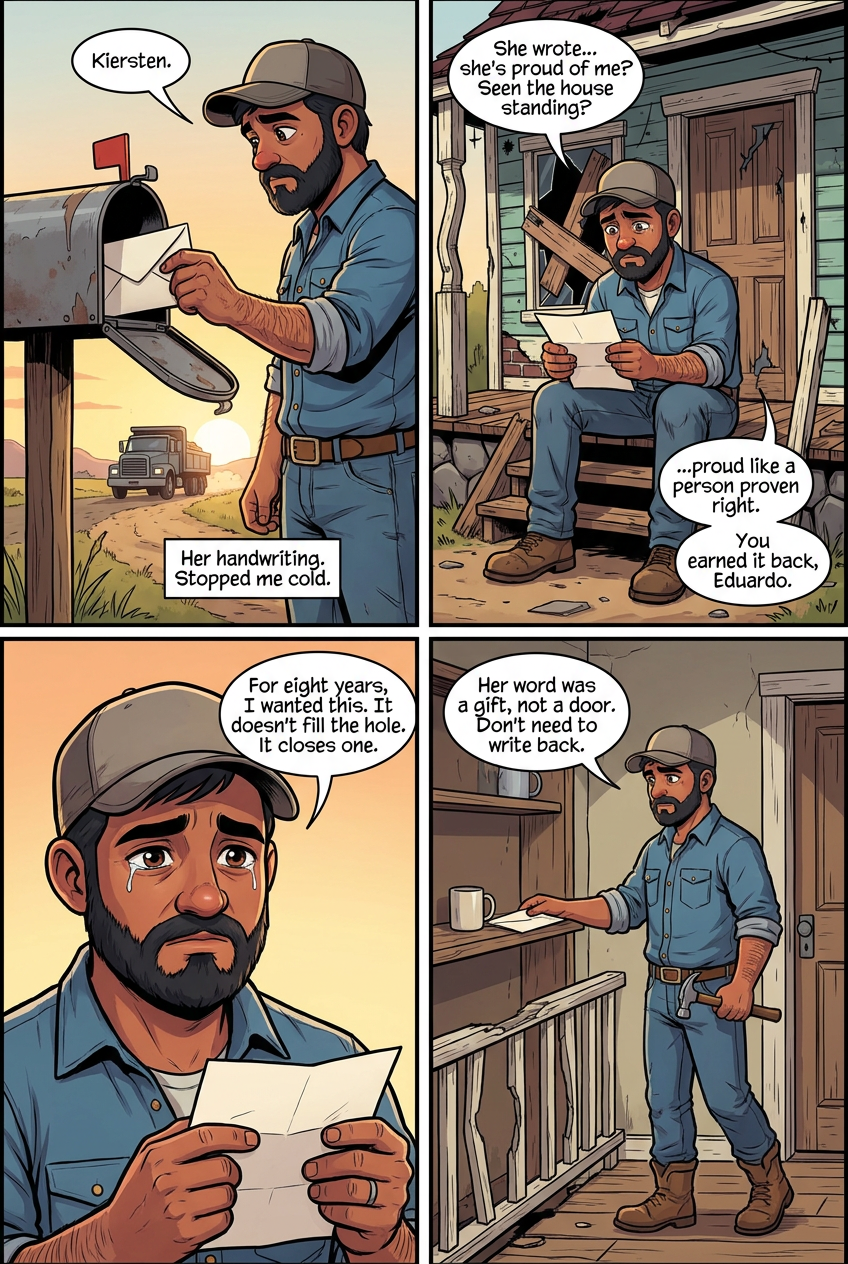
Eduardo woke to the sound of a truck passing on the road. He rose, pulled on his boots, and went out to the mailbox from habit. The second cup still sat on the shelf inside. He had made his peace with the empty chair. He did not expect anything to change. Then he opened the mailbox and found a letter. The handwriting stopped him where he stood. He knew it the way he knew his own name. Kiersten. He had told himself she would never write. She had told him never to reach for her, and he had kept that promise. Now her letter sat in his hand, and he did not know when she had written it, or what she had been thinking when she did. He carried it to the porch and sat on the step. His hands shook. He remembered the door she swore to leave shut. He remembered the six words she gave him last: you would only hurt me. He almost put the letter back. He did not want to pull her open again. But this was hers, sent by her own choice. He opened it. He read it out loud, alone, the way you say a thing to believe it. She had spent weeks asking about him. She had talked to the old man at the feed store. She had heard him vouch for Eduardo's work. She wrote that the men who signed his ledger did not lie for him. She wrote that she had watched from a distance and seen the house standing. Then she wrote the line that broke him open. She was proud of him. Not proud like a woman coming back. Proud like a person who had waited years to be proven right about someone. She had always believed he could be good. He had spent that belief like money. Now he had earned it back, and she wanted him to know she saw it. Eduardo read the last part twice. She was not asking to return. She said the door stayed shut, and she meant it. But she wanted him to hear the truth from her hand, not from a rumor in town. She had done the work of forgiving him without needing him near. She signed it plainly, the way she said everything. He held the letter to his chest. His breath came slow. For eight years he had wanted her approval to feel worth something. Now he had it, and it did not fill the hole. It closed one. He understood the difference at last. Her word was a gift, not a door. Eduardo stood and went inside. He set her letter beside the second cup on the shelf. He did not write her back. He did not need to. He picked up his tools and went to finish the porch rail, the last broken thing left on the house.
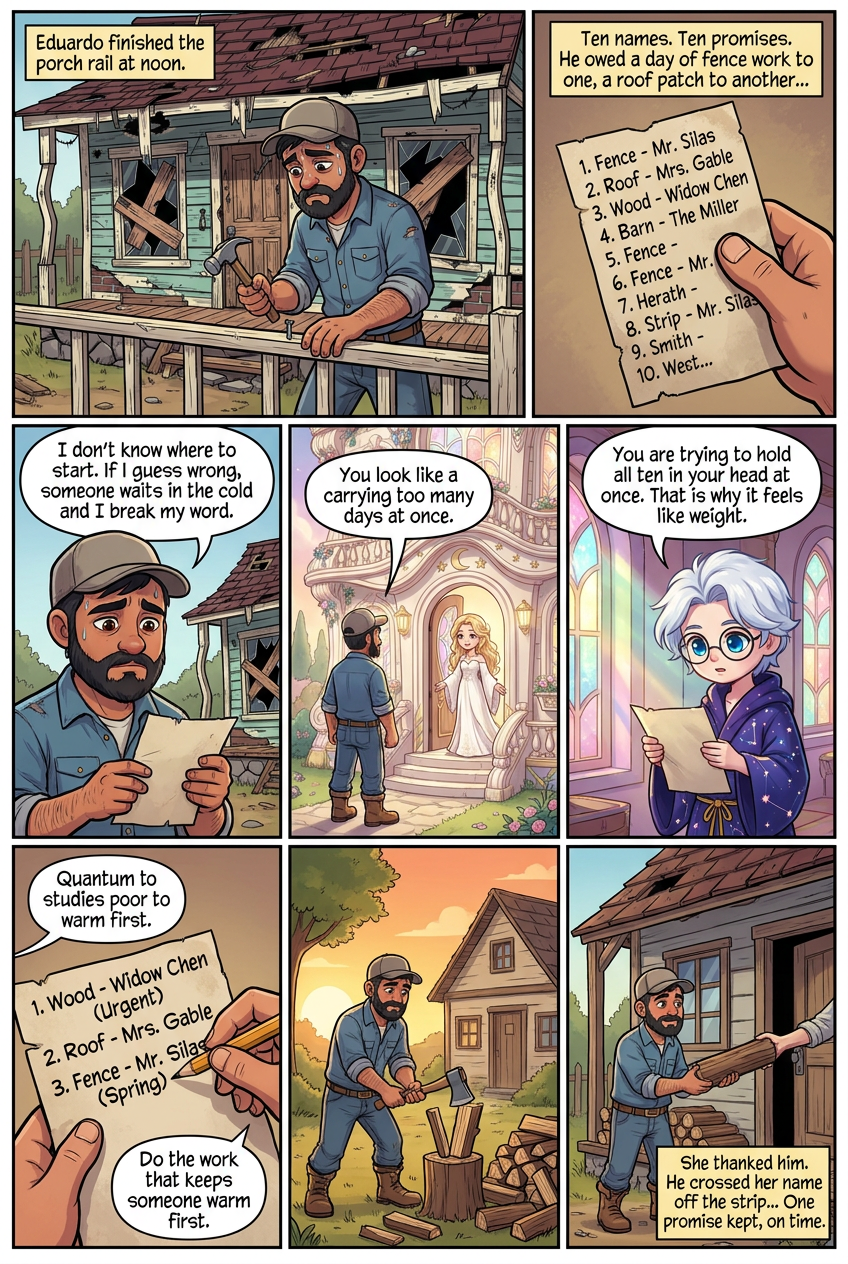
Eduardo finished the porch rail at noon. He set down his hammer and looked at the paper strip on his wall. It held a list he had made in a hurry, back when the town gave him advance pay for winter labor. Ten names. Ten promises. He owed a day of fence work to one, a roof patch to another, split wood to a third. He had taken the money. Now he had no plan for who came first. A broken promise would undo everything he had built. He stared at the list until the names blurred. His old self would have picked the easiest job, or the one that paid most. He wanted to do it right this time. So he walked to town, to the pale house with the cross, where he had first asked for honest work. Mother Angel met him at the door of the Ethereal Motherhouse. Her curly blonde hair caught the light. She smiled the way she always did, kind and unhurried. "You look like a man carrying too many days at once," she said. "I owe ten people this winter," Eduardo said. "I don't know where to start. If I guess wrong, someone waits in the cold and I break my word." She led him inside and sent for Quantum. The teacher arrived in his star-covered robe, glasses catching the colored light from the windows. Quantum studied the list Eduardo held out. "You are trying to hold all ten in your head at once," Quantum said, his voice low and slow. "That is why it feels like weight. Break it into order. Do the work that keeps someone warm first. A cold house cannot wait. A leaning fence can." Eduardo looked at the names again. He saw it now. Not the biggest debt, not the easiest. The one whose need came soonest. He borrowed a pencil from the table and numbered each job. Wood-splitting for the widow came first, before the frost. Roof patch second. Fence work last, since it could hold till spring. "Write the dates beside them," Mother Angel said. "Then it is a promise with a shape. Not a worry." Eduardo wrote a date beside each name. Ten days spread across the winter, each fixed in ink. He read the whole list back. It no longer looked like a threat. It looked like a plan. He went home and started that afternoon. He split wood for the widow until dark, slow at first, his hands stiff on the axe. By the second hour his swings came faster. The pile grew. He hauled it to her door and stacked it under her eaves. She thanked him. He crossed her name off the strip and wrote the date he finished. One promise kept, on time, in order. For the first time his word carried a schedule, and the winter ahead looked like something he could carry.
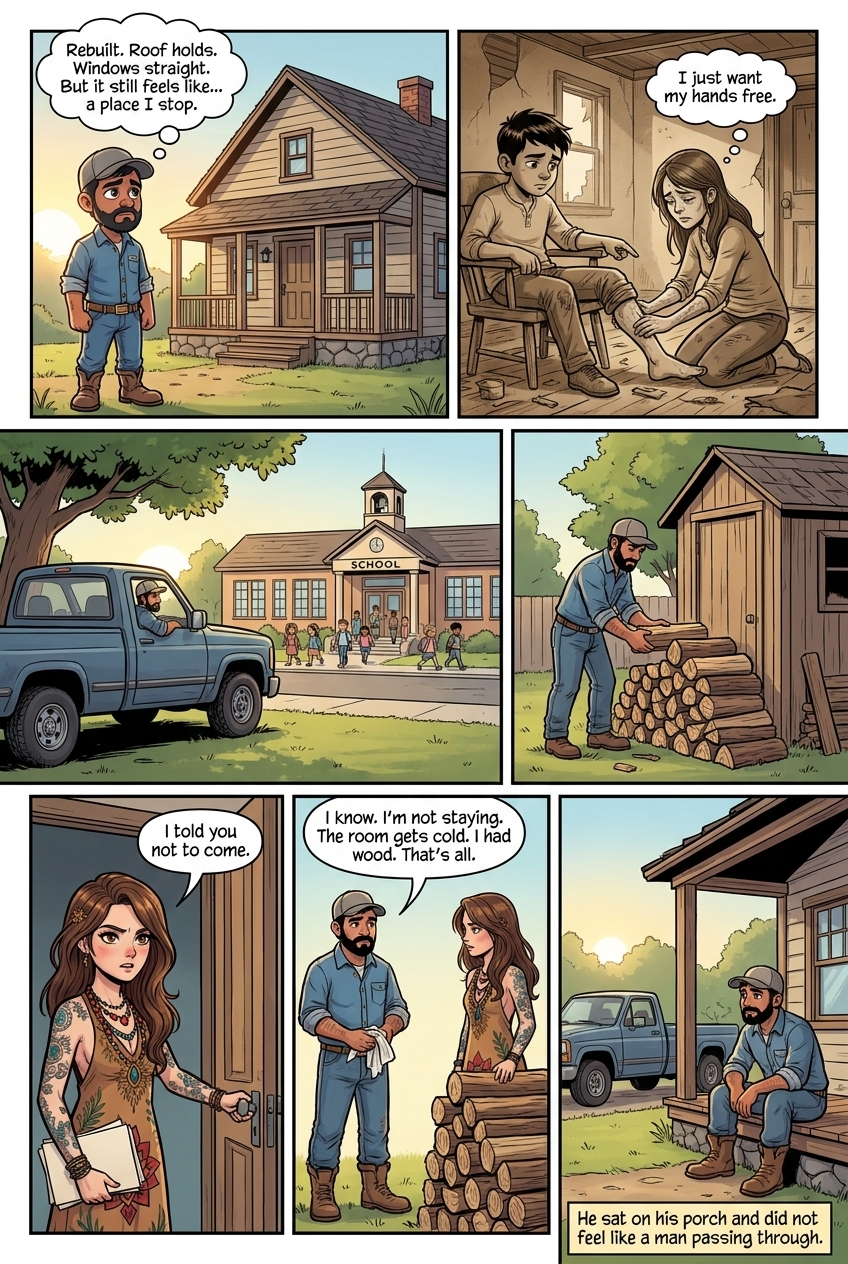
Eduardo woke the next morning and walked the house he had rebuilt. The roof held. The windows sat straight. But the rooms felt like a place he stopped in, not one that held him. He remembered when Kiersten lived with him, in the house before this one, when it was still broken. She came home from teaching all day and he asked her to cook. Then he sat and asked her to rub his legs. He never rubbed hers. She washed his clothes and laid them out at dawn. She once told him she only wanted her hands free. He had not listened. He understood now why the house stayed cold. He had never made a home. He had made a place that served him. A home was built by care given, not taken. He had spent his life taking. So he decided to do one thing he had never done. He would give without being asked and expect nothing back. He drove to the school in the hills where Kiersten worked. He did not go to the gate. He remembered her words. Never return. He parked far off, where she would not see him. He watched the children file out at noon. Then he did the thing he came to do. He unloaded the split wood from his truck bed. He stacked it beside the school's cold shed, quiet, quick, out of sight. He knew the school heated its one room with a stove. Winter was coming. He left no note. He wrote nothing in a ledger. No name to sign. No witness to see it. He was near done when the door opened. Kiersten stood there. She held a stack of papers to grade. Her tattooed arms caught the light. She looked at the wood, then at him. Her face did not soften. "I told you not to come," she said. "I know." He set down the last log. "I'm not staying. The room gets cold. I had wood. That's all." She studied him a long moment. "You want something." "No." He wiped his hands on his jeans. "I asked you for things for years. Your cooking. Your hands. I never gave back. I'm not here to take. I'm here to leave something and go." She was quiet. She looked at the stacked wood, neat under the eaves. "You would have left a note before. So I would know it was you." "There's no note." She nodded, slow. "Then it's yours to carry alone." "Yes." He got in his truck. He did not look back for her face. He drove home. The house waited, still bare, still quiet. But something had shifted inside him. He had given care and asked for nothing. For the first time the house felt like a place he was learning to belong to. He sat on his porch and did not feel like a man passing through.
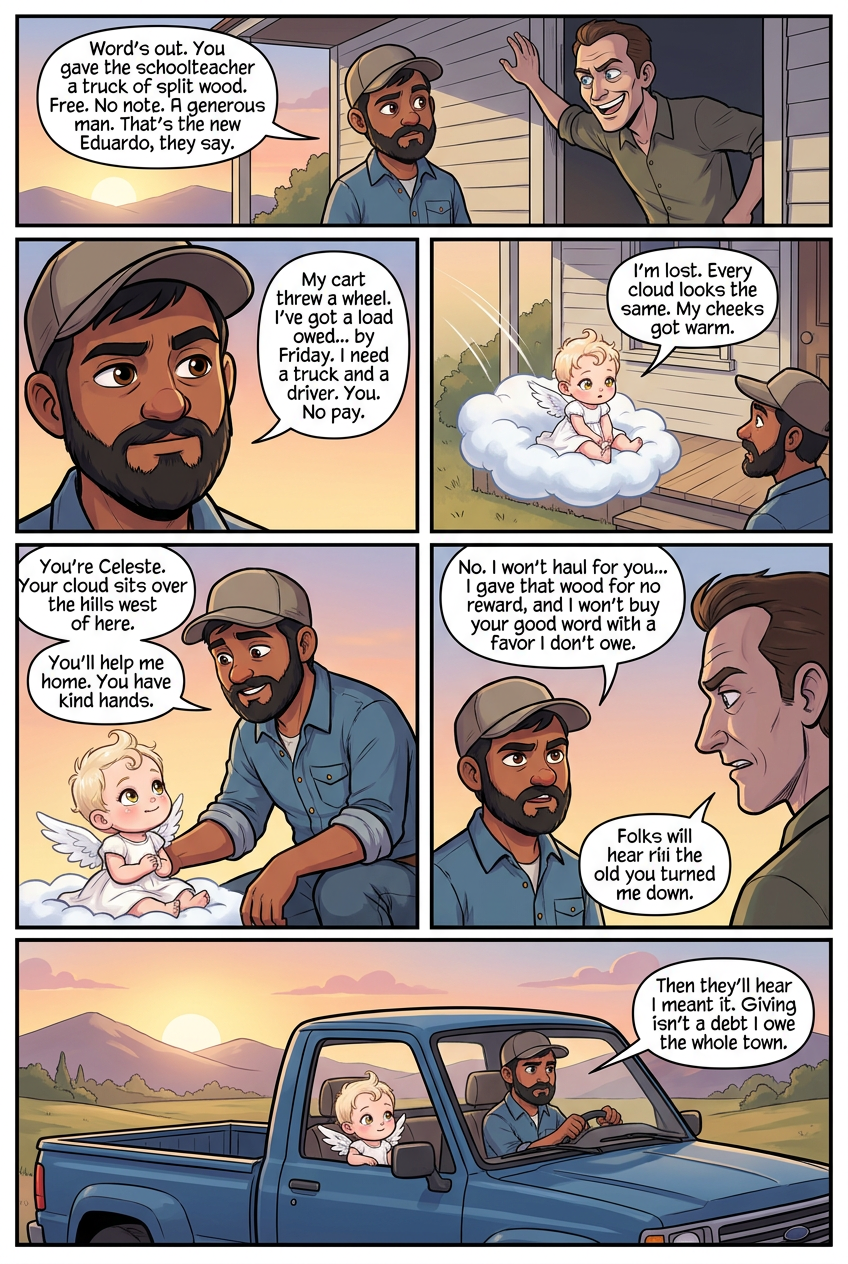
Two days after Eduardo left the wood at the school, a man knocked on his door at dawn. Eduardo did not know him well. He ran a hauling cart in town. The man had a wide smile and cold eyes. "Word's out," he said. "You gave the schoolteacher a truck of split wood. Free. No note." He leaned on the frame. "A generous man. That's the new Eduardo, they say." Eduardo waited. He knew this shape of talk. It came before a request. "My cart threw a wheel," the man said. "I've got a load owed to the sheriff's cousin by Friday. I need a truck and a driver. You. No pay. Just this once." He smiled wider. "A man who gives to a teacher won't turn down a neighbor. That'd look strange, wouldn't it? People would wonder if the giving was just show." There it was. The trap. If Eduardo said no, the man would tell town he was still the old Eduardo, kind only when watched. If he said yes, he owed a favor to a man tied to men he had fought to leave. His winter was already full. Ten promises, dated on paper. He had no day to spare, and no wish to haul for the sheriff's cousin. Before Eduardo could answer, something drifted down past the porch rail. A small cloud with a dip on one side, like a pillow sat on. A baby rode it. Rosy cheeks, bright eyes, tiny white dress. She landed soft on the top step. Her feet had gone heavy, and she knew to land. "I'm lost," the baby said. She looked up at both men. "Every cloud looks the same. My cheeks got warm." The hauling man stepped back. He stared at the baby, then at Eduardo, waiting. Eduardo knelt by the child. "You're Celeste," he said. He had heard of the baby who floated above the valley. "Your cloud sits over the hills west of here." "You'll help me home," Celeste said. It was not a question. "You have kind hands. I can tell." Eduardo looked from the baby to the man in the door. He saw the difference plain. One asked for help and needed it. One used a good deed as a hook to pull him back down. "No," Eduardo told the man. "I won't haul for you. My days are spoken for. Tell whoever you like. I gave that wood for no reward, and I won't buy your good word with a favor I don't owe." The man's smile dropped. "Folks will hear the old you turned me down." "Then they'll hear I meant it," Eduardo said. "Giving isn't a debt I owe the whole town." The man left angry. Eduardo lifted Celeste. Her cheeks had cooled already. He carried her to his truck and pointed the wheels west, toward the hills where her cloud waited.
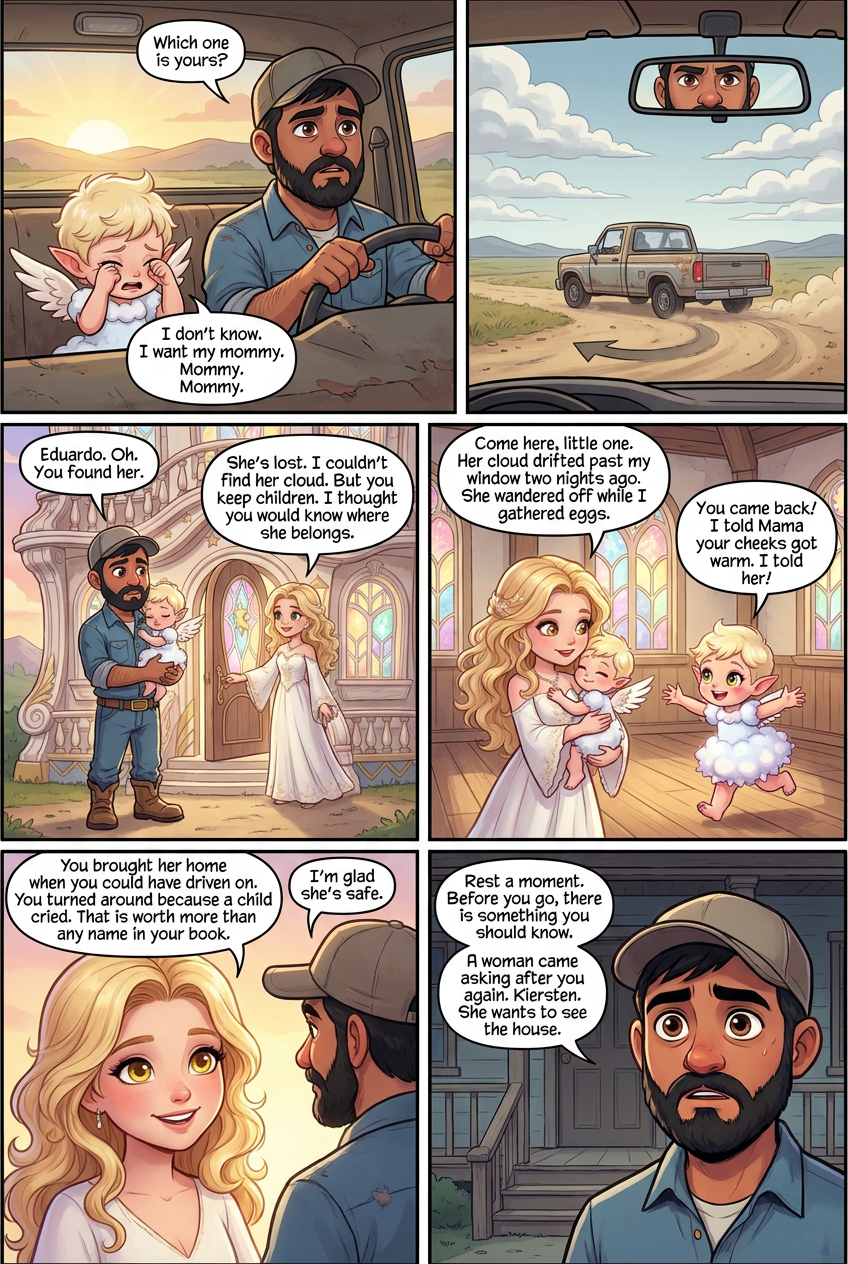
Eduardo drove west with the baby on the seat beside him. The hills rose ahead, pale under morning light. Celeste watched the sky through the window. Every cloud looked the same to her. Eduardo slowed the truck and studied them too. He could not tell one from the next. "Which one is yours?" he asked. Celeste's lip trembled. "I don't know. I want my mommy." She began to cry. Her small hands rubbed her eyes. "Mommy. Mommy." Eduardo stopped the truck. He had no map for clouds. He could drive all day and never find the right one. He thought about the child's words. Her mommy. Someone kept this baby. Someone would know where she belonged. Then it came to him. The angel woman had two children of her own. She prayed over the valley. She granted small miracles. A floating baby who fell from the sky belonged to someone like that. Eduardo turned the wheel and pointed the truck back toward town, toward the pale house with the cross. The radiant house stood soft against the trees, its windows glowing in colored panes, wings carved above the door. Mother Angel opened it before he knocked. Her blonde curls caught the light. She had signed his ledger once, only after he swore to keep his rules. She had refused him more times than she agreed. He never came to her without a reason she could weigh. "Eduardo," she said, her voice gentle. Then she saw the baby in his arms. Her face changed. "Oh. You found her." "She's lost," Eduardo said. "I couldn't find her cloud. But you keep children. I thought you would know where she belongs." Mother Angel reached out. Celeste stopped crying at once and leaned toward her. "Come here, little one," the angel said. She held the baby close. "Her cloud drifted past my window two nights ago. She wandered off while I gathered eggs." From inside the house a small voice called out, raspy and glad. A cherub child in a cloud dress ran to the door. Her wings fluttered. She was Cloud Puff, made to lift spirits, and she laughed at the sight of Celeste. "You came back!" Cloud Puff said. She tugged Celeste's tiny foot. "I told Mama your cheeks got warm. I told her!" Celeste giggled through her tears. The two babies pressed their foreheads together. Mother Angel smiled at Eduardo. "You brought her home when you could have driven on," she said. "You turned around because a child cried. That is worth more than any name in your book." Eduardo felt his chest ease. He had asked nothing for this. "I'm glad she's safe," he said. "Rest a moment," Mother Angel said. Her smile faded a little. "Before you go, there is something you should know. A woman came asking after you again. Kiersten. She wants to see the house." Eduardo went still on the step. The baby was home. The door he thought closed had moved.
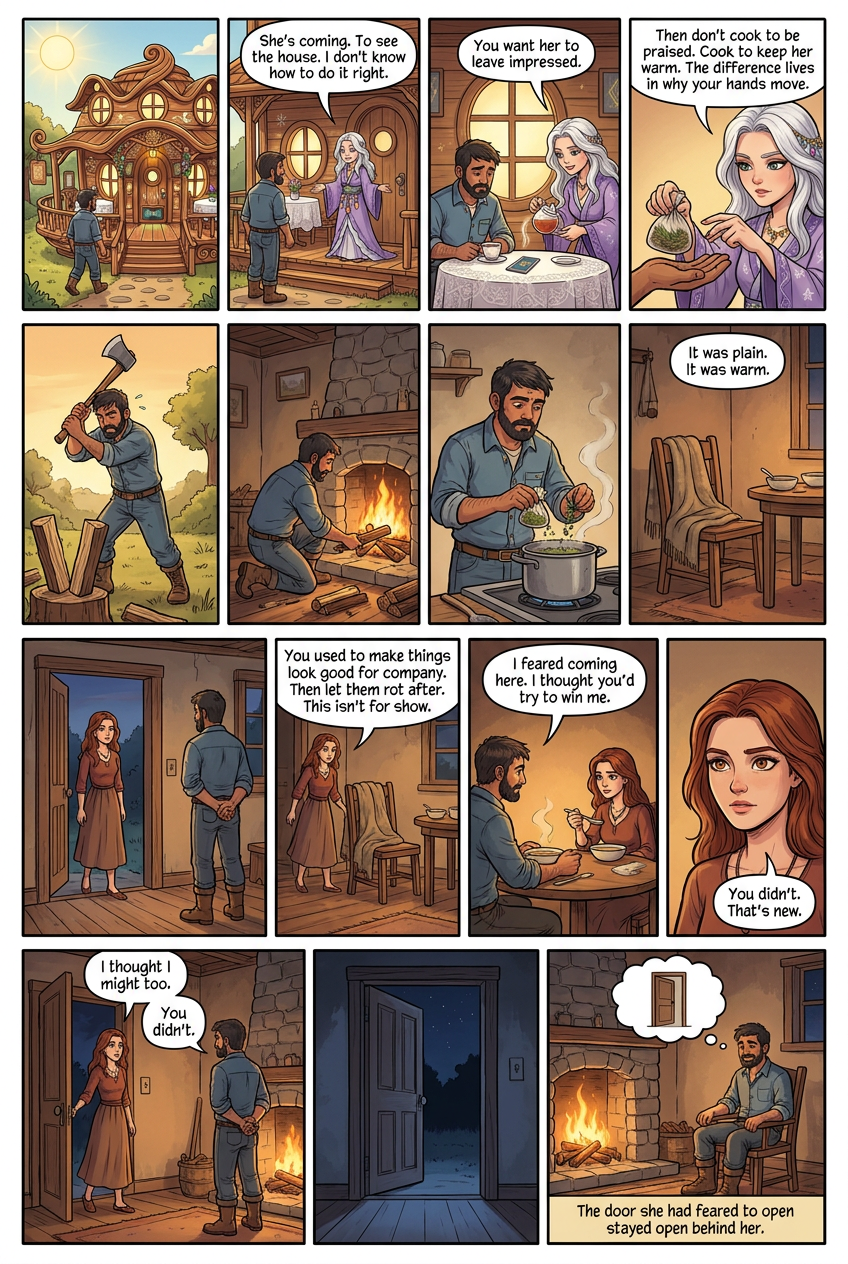
Mother Angel's words followed Eduardo home. Kiersten wanted to see the house. He had one day to make it ready. He knew how to make a place look good for a guest. He had done it a hundred times for people he wanted to fool. That was the danger. He could still perform. He could still turn a home into a stage. He drove to the round tea house with the curling roof. Lace covered the small tables on the porch. Tealy met him at the door in her purple robe, her white hair catching the light. She read people the way she read her cards. He had come to her before troubles grew. "She's coming," Eduardo said. "Kiersten. To see the house. I don't know how to do it right." Tealy poured him tea before he sat. She turned a single card over on the lace. She did not name it. "You want her to leave impressed," she said. It was not a question. "Yes," Eduardo said. Then he stopped. "No. That's the old want. I want her to leave with the truth." Tealy nodded slowly. "Then don't cook to be praised. Cook to keep her warm. The difference lives in why your hands move." She pressed a small pouch of herbs into his palm. "For the tea. Nothing more." Eduardo drove home and worked. He split wood until his shoulders ached. He built a fire and fed it until the room held heat. He laid blankets over the chair and the bench. Each time pride whispered to add something grand, he set the whisper down. He made soup from what he had. He steeped Tealy's herbs into tea. The house smelled of broth and woodsmoke. It was plain. It was warm. Kiersten came at dusk. She was short, her arms marked with old tattoos, her auburn eyes steady. She stepped inside and said nothing for a long moment. Eduardo felt the old urge rise. Fill the silence. Sell the room. He held his tongue. "You cut this wood today," she said. Not a question. "This morning." She touched the blanket on the chair. "You used to make things look good for company. Then let them rot after." Her voice was flat and plain. "This isn't for show." "No," Eduardo said. "It's just soup." She sat. He gave her the bowl and the tea. He did not hover. He did not ask what she thought. He let her eat in the quiet warmth. His hands did not perform. They only served. Kiersten finished the tea and set the cup down. "I feared coming here," she said. "I thought you'd try to win me." "I thought I might too," Eduardo said. "You didn't." She stood. She looked at him without softness, without doubt. "That's new." She left before full dark. Eduardo stayed by the fire. He had hosted her without becoming the man she once fled. The door she had feared to open stayed open behind her.
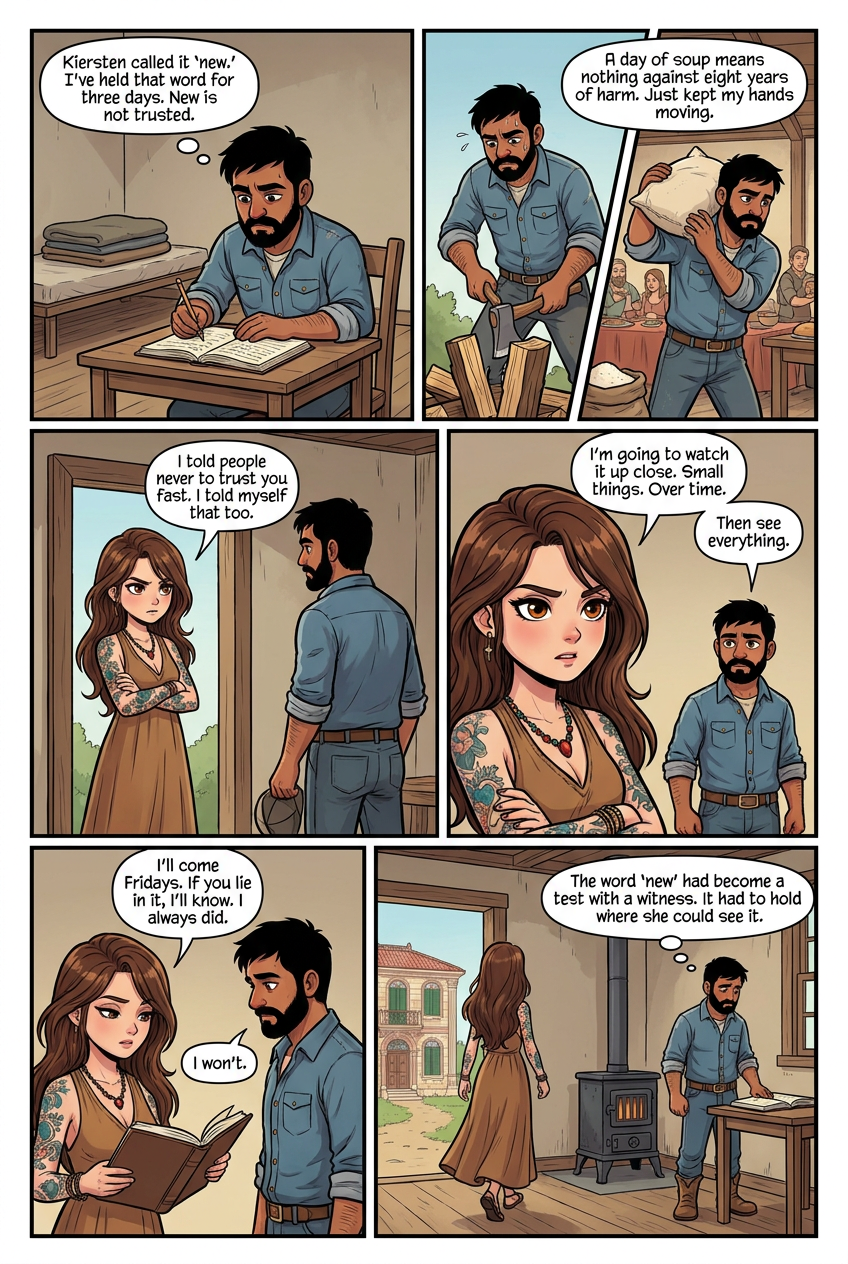
Kiersten had called his change "new" and left before dark. Eduardo held that word for three days. New was not trusted. New was a thing you watched to see if it lasted. He had no way to prove it would. A day of soup meant nothing against eight years of harm. He could not sign for himself. He could only keep his hands moving and wait. He worked. He split wood for the widow he had promised. He hauled flour at the feast hall. Each night he wrote the day in his ledger and marked no rule broken. He did not drive to Kiersten's school. He did not send word. The old want to reach for her stayed quiet, and he let it stay. On the fourth morning she came back. He heard her boots on the step before he saw her. She stood in the doorway, arms crossed, tattoos dark against her skin. She did not sit. "I told people never to trust you fast," she said. "I told myself that too." "You were right to," Eduardo said. She looked at the plain room. The blankets. The cold stove he had not lit for show. "I went home and thought a long time," she said. "About the wood you left. About the note you didn't leave." Eduardo waited. He did not fill the silence. "I can't know if it holds," she said. "Neither can you." "No," he said. "So I'm not going to wait to find out from far away." She uncrossed her arms. "I'm going to watch it up close. Small things. Over time. Like I asked you for once." Eduardo's throat tightened. Years ago she had asked for exactly this, and he had called it punishment and walked out. "You asked me that at the stone house," he said. "I said no." "You did." Her voice stayed level. "I'm asking one more time. Not to be together. To be near enough to see." "Then see everything," Eduardo said. "The ledger. The days I want to run. All of it." She nodded once. She crossed to the shelf and picked up his ledger. She read a page. She read another. She did not soften. She set it down open. "I'll come Fridays," she said. "I'll read the week. If you lie in it, I'll know. I always did." "I won't," he said. "We'll see." She went to the door. She stopped there. "This isn't forgiveness. It's a chance to earn it. Don't spend it like you used to spend everything." "I won't," Eduardo said again. She left. This time she looked back once from the yard. Then she walked toward the road. Eduardo stood by the cold stove. The word "new" had become a test with a witness. She would come every Friday. His change no longer had to hold in the dark alone. It had to hold where she could see it.
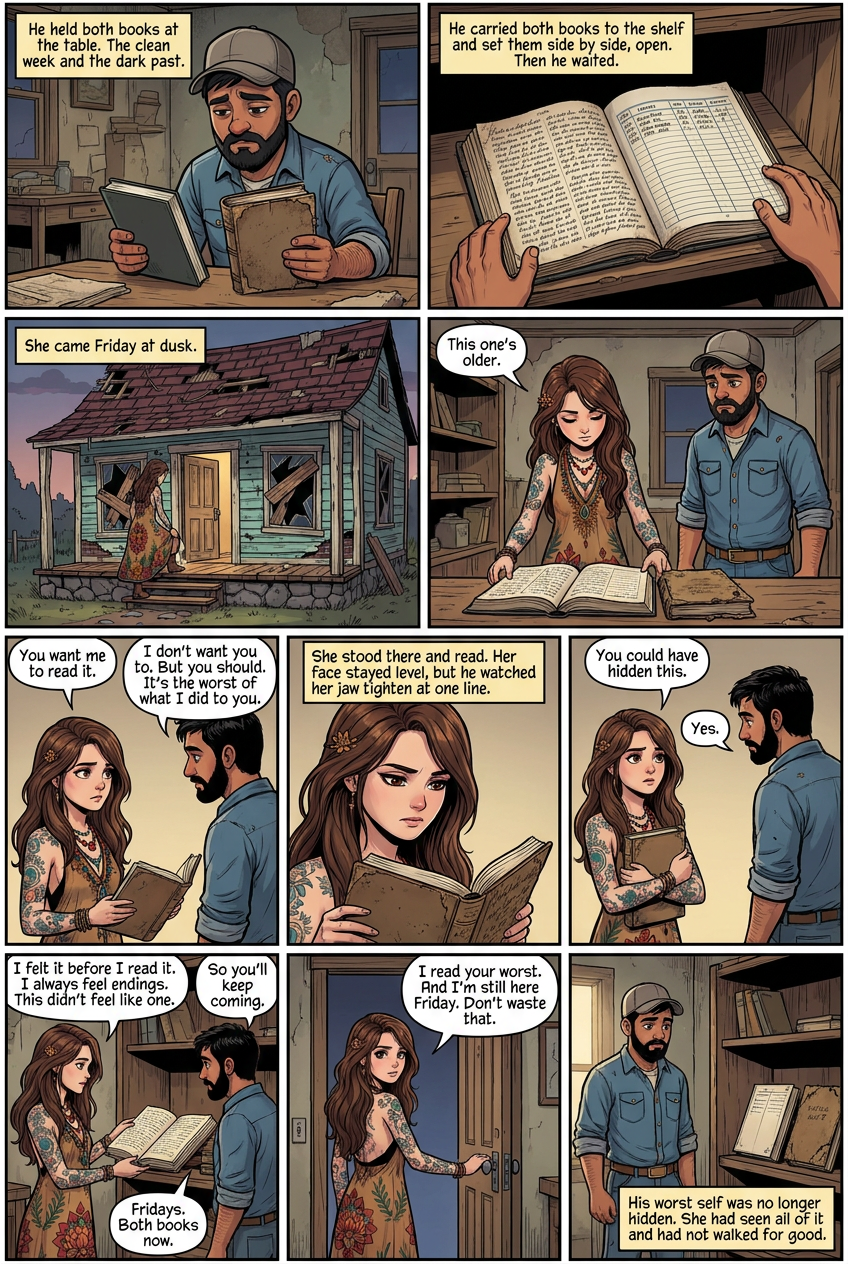
Friday was two days off. Kiersten would read the week's ledger and know if he had lied. Eduardo trusted his week. He had marked no rule broken and meant it. But that night he pulled the second ledger from the back of the shelf, the old one. In it he had written his rawest confessions of what he had done to her. Not the debts. The cruelty. He had never let anyone read those pages. They were the worst of him, plain and unsoftened. He held both books at the table. The clean week and the dark past. He could give her the week and leave the old ledger hidden. She would never ask for it. She did not know it existed. But hiding it would prove nothing changed. The old Eduardo hid his worst self behind a clean face. He handed people the good page and buried the rest. If he did that now, the week meant nothing. She would be reading a lie made of true entries. He carried both books to the shelf and set them side by side, open. Then he waited. She came Friday at dusk. She wiped her boots on the step and came in without a knock. She crossed to the shelf and lifted the week's ledger. She read a page. Then another. She did not soften. Then she saw the second book beside it, open. She looked at the top line. "This one's older," she said. "It is." "You want me to read it." "I don't want you to," Eduardo said. "But you should. It's the worst of what I did to you. I wrote it plain. I never showed it to anyone." She set the week's book down. She picked up the old one. She stood there and read. Her face stayed level, but he watched her jaw tighten at one line. She turned a page. She turned another. The room was quiet except for paper. Eduardo did not fill the silence. He had learned that. He let her read the whole of it. She reached the last page. She closed the book slow. She held it against her chest a moment. Then she looked at him. "You could have hidden this," she said. "Yes." "The old you would have." "I know." She set the book back on the shelf, open, where it had been. "I felt it before I read it," she said. "I always feel endings. This didn't feel like one." She crossed her arms. "That's new too." Eduardo's throat tightened. "So you'll keep coming." "Fridays," she said. "Both books now. The clean one and this one. You don't get to keep a dark shelf anymore." "I won't." She went to the door. She stopped. "I read your worst," she said. "And I'm still here Friday. Don't waste that." She left. Eduardo stood by the shelf. His worst self was no longer hidden. She had seen all of it and had not walked for good. The door she had closed years ago stood open a crack, and this time he had not pried it. He had earned it.
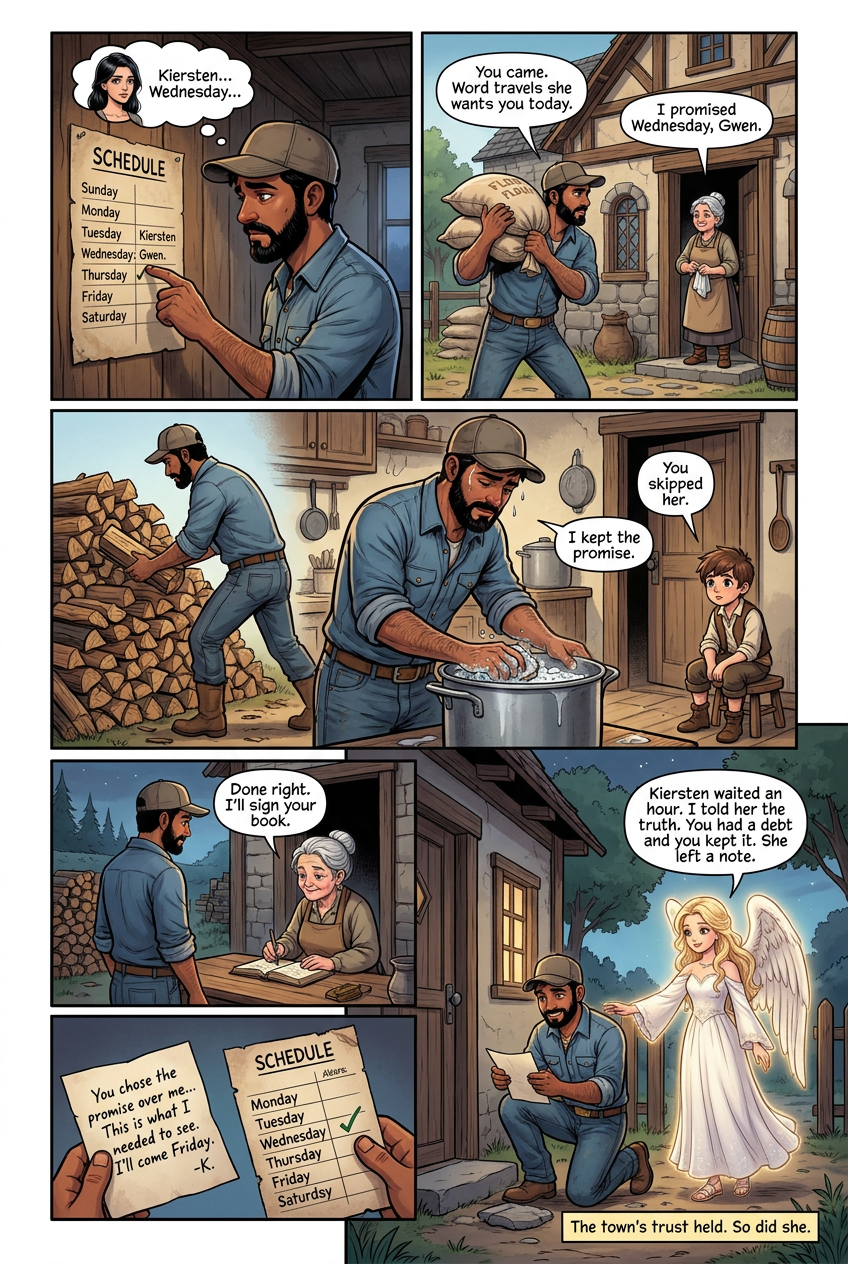
Kiersten had said she would come Fridays. Now Eduardo faced a harder thing. He had ten winter debts still owed to the townspeople. Each one was a promise paid for in advance last fall. His deed had depended on those promises. His word depended on them now. Kiersten wanted to see him Wednesday to walk his land. If he stopped a job to meet her, the promise would break. And a broken promise would undo everything the town had signed for. He pulled the schedule from the wall. Quantum had helped him order it by urgency. Wednesday he owed Gwen a full day. She needed her winter stores hauled and her woodpile stacked before the first hard frost. He stood there with the paper. The old Eduardo would have chosen the woman and lied to the rest. He drove to the feast hall before dawn. Gwen was already at her stove. She did not look up. "You came," she said. "I promised Wednesday." "Kiersten wants you today." Gwen wiped her hands flat on her apron. "Word travels." "She does." Eduardo set his cap on the bench. "I'm here anyway." Gwen studied him a moment. Then she pointed at the flour sacks by the door. Eduardo worked. He hauled the sacks and stacked the wood and scrubbed the pots until his hands ached. Emilio came in around midday, dragging his stool. He set it near the door and sat. "You skipped her," Emilio said. "I kept the promise." Emilio thought about that. "That's the same thing." He did not explain. He watched Eduardo work. By dusk the stores were in and the pile was stacked. Gwen looked it over and nodded once. "Done right," she said. "I'll sign your book." When Eduardo drove home, Mother Angel stood at his gate. Her hair caught the last light. She had never come to his house before. "Kiersten waited at your porch this afternoon," she said kindly. "You weren't here." Eduardo's stomach dropped. "I was at Gwen's. I owed her the day." "I know." Mother Angel smiled. "She waited an hour. Then she asked me why you didn't come. I told her the truth. You had a debt and you kept it." "And?" "She left a note on your step." Mother Angel touched his arm and walked on. The note was pinned under a stone. Eduardo read it by the door. You chose the promise over me. The old you would have chosen me and broken the town's word. This is what I needed to see. I'll come Friday. And I'll come the Wednesday after, when you're free. Eduardo held the paper. He had kept his word and not lost her. For the first time both things stood together. The town's trust held. So did she. He nailed the schedule back on the wall and marked the day complete.
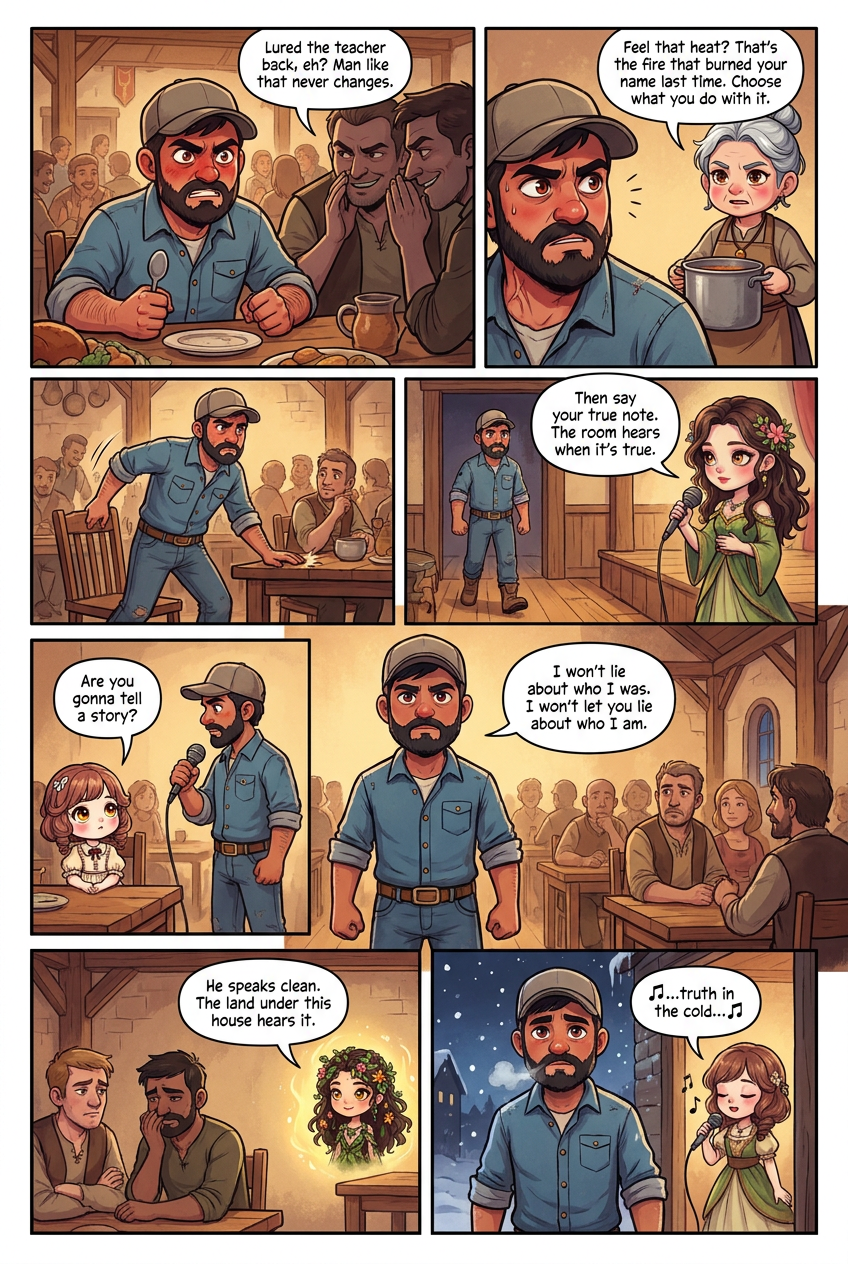
Kiersten had come Friday and read his ledgers. Now word of her visits ran through town. Eduardo heard it Wednesday night at the feast hall. Two men near the door spoke low over their bowls. One said Eduardo had lured the schoolteacher back to work her the old way. The other laughed and said a man like that never changed. Eduardo set down his spoon. His face went hot. The old anger rose. He almost stood to swing. "Feel that heat?" Foodie Gwen stood at his shoulder with a pot. She did not whisper. "That's the fire that burned your name last time. Choose what you do with it." Eduardo breathed. He counted. He remembered how rumors had once ruined him, and how one lie about Kiersten had cost him eight years. He would not let a new lie stand. But he would not swing. He pushed back his chair and walked to the head of the hall. A singer stood there tuning by the hearth. She wore bright colors and held a worn microphone. "I sing between courses," she said. "You want the room?" "I need it a minute," Eduardo said. Song Lumina studied him. "Then say your true note. The room hears when it's true." She stepped aside. Eduardo faced the tables. His hands shook. A small doll-girl near the front watched him with big amber eyes, seams faint along her arms. "Are you gonna tell a story?" Rosette Porcelain asked sweetly. "The truth," he said. He raised his voice so the two men would hear. "You knew me eight years ago. I gambled. I drank. I called my wife a liar to save myself. I hurt her. I lost my name, and I earned that loss." The room went still. "Kiersten comes to my house now. She reads my ledger every Friday. She reads my worst pages too. Not to be won. To watch that I stay honest. If any man says I lured her, say it to me plain. I won't lie about who I was. I won't let you lie about who I am." One of the men looked at his bowl. The other met Eduardo's eyes, then looked away. No one spoke against him. From the corner a green-clothed spirit with flowers in her hair hummed low, and the sound settled over the hall like warm water. Terra Vitalis. "He speaks clean," she said in her strange ringing voice. "The land under this house hears it." Gwen nodded once. Emilio dragged his stool closer. Song Lumina lifted her microphone and began a soft tune, filling the quiet Eduardo left behind. Eduardo walked home in the cold. The rumor had not broken him. He had faced it in the open, and the town had chosen his word. But now the whole hall knew Kiersten read his darkest pages. Come Friday, she would learn the town was watching them both.
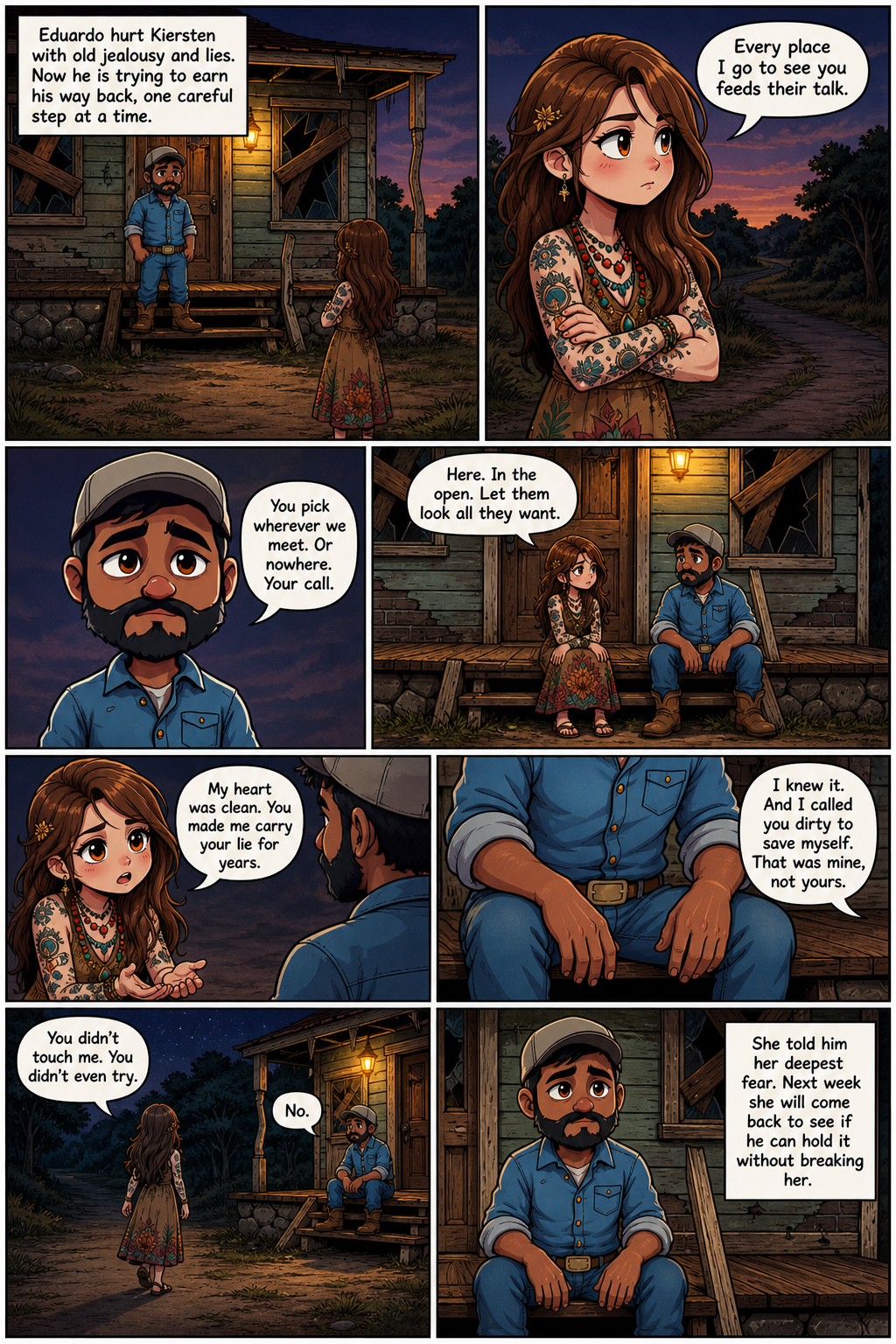
Friday came. Kiersten walked up to Eduardo's porch as the sun dropped low. She stopped at the steps and did not climb them. Eduardo saw it in her shoulders. She had heard about the feast hall. The whole town knew now. She looked at his house, then at the road behind her, where anyone could pass and watch. "They're all looking," she said. "Every place I go to see you feeds their talk." "I know," Eduardo said. "I made it worse. I stood up in the hall and said your name." She crossed her arms. Her tattoos ran dark along her wrists. "I didn't come here to be a story." Eduardo waited. He wanted to fix it fast, the way he used to, with a clever plan. He held that back. "You pick," he said. "Wherever we meet, I'll meet you there. Or nowhere. Your call." Kiersten looked at him a long moment. Then she stepped up onto the porch. She sat on the top step of the broken house he had rebuilt from ruin. The old boards did not sag now. He had fixed them himself. "Here," she said. "On the porch. In the open. Let them look all they want." Eduardo sat too, a full arm's length away. He did not move closer. She stared at the yard. Her voice stayed flat, but her hands shook. "I'm scared to let you back in. You want to know the truth. The truth is I'm scared to be touched again. By anybody." Eduardo said nothing. He let her have the room. "You made me feel like a thing you used," she said. "You said I looked at other men. I never did. I only ever wanted you to be there. You made that into a crime." She turned and met his eyes. "My heart was clean. You made me carry your lie for years." "You were clean," Eduardo said. "I knew it and I called you dirty to save myself. That was mine, not yours." Kiersten nodded slowly. She did not soften, but she did not leave. "Then we do it here. On the step. No hidden rooms. If the town wants to watch a man and woman sit apart and talk plain, let them." "Agreed," Eduardo said. They sat in the cold until the sun was gone. She read his ledger by the porch light, and he did not reach for her, not once. A neighbor's cart rolled past. Kiersten did not flinch this time. The watching had stopped being a weapon. When she stood to go, she paused at the bottom step. "You didn't touch me," she said. "You didn't even try." "No," Eduardo said. "Good," she said. "Do that again next week." She walked into the dark. Eduardo stayed on the porch. The gossip could not touch a thing done in the open. But now she had told him her deepest fear, and next week she would come to see if he could sit with it without breaking her.
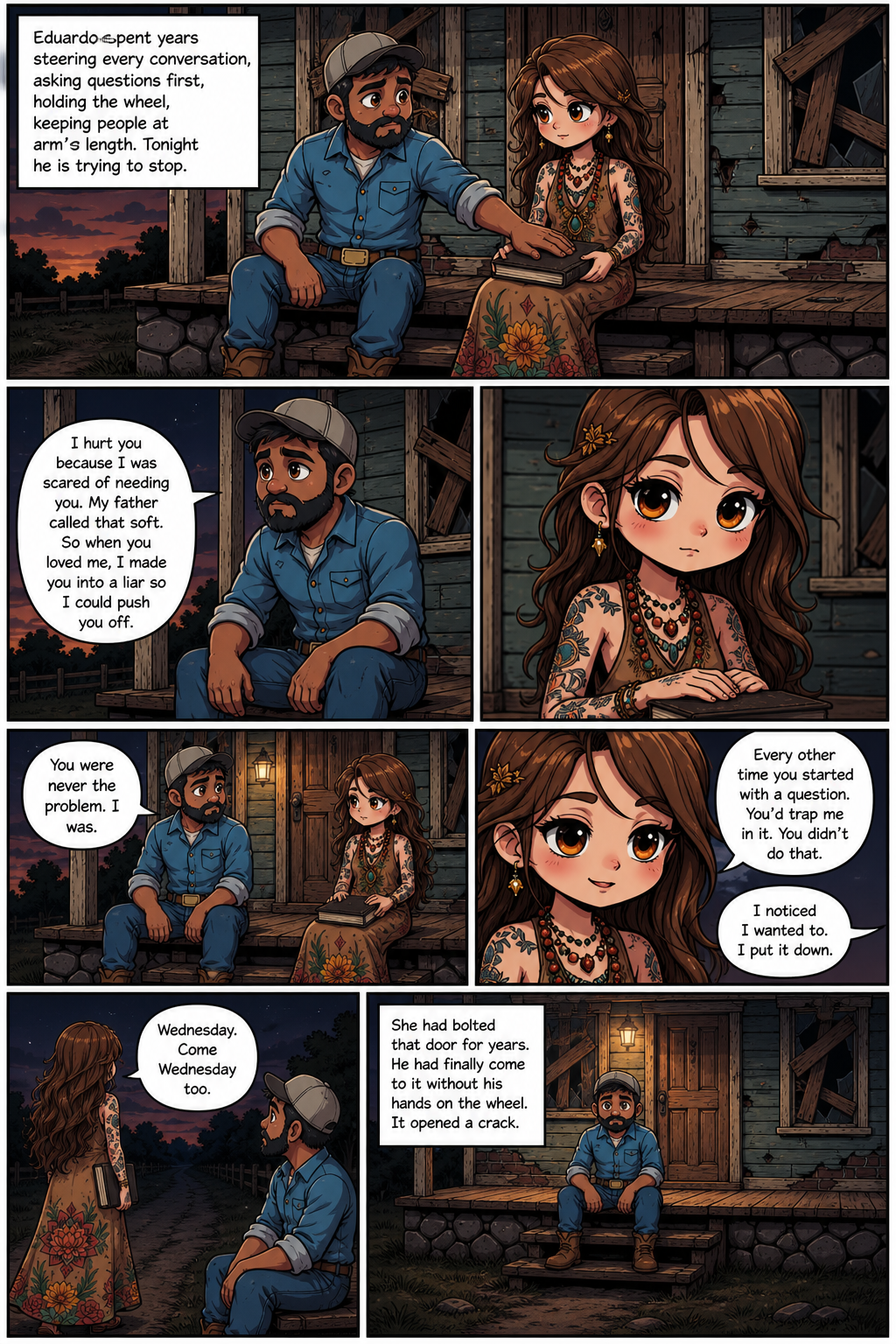
The next Friday, Kiersten came at dusk again. She sat on the same step, an arm's length from Eduardo. She opened his ledger and began to read. But Eduardo did not want to talk about the ledger. He had spent the week deciding to do the hardest thing. He wanted to say the true reason he had hurt her. Not the acts. The thing under the acts. He felt the old urge rise. Ask her a question first. Steer the talk. Make her respond to him, so he held the wheel. He had done it in every talk they ever had. He closed the ledger with one hand instead. "Can I say something," he asked. "Not to fix anything. Just to tell you." Kiersten set the book down. "Say it." Eduardo looked at his rebuilt porch. Once it had sagged and cracked, like the man he had been. "I hurt you because I was scared," he said. "Not scared of you. Scared of needing you. My father called that soft. I learned soft was dangerous." He stopped. The old habit told him to watch her face and adjust. He kept his eyes on the yard. "So when you loved me, it scared me," he said. "I made you into a liar so I could push you off. If you were dirty, I didn't have to trust you. I didn't have to feel small." Kiersten said nothing. He wanted to fill the silence, to steer her toward comfort. He let it sit. "That's the whole of it," Eduardo said. "I used you to hide from myself. You were never the problem. I was." A long quiet held between them. A cart passed on the road. Neither of them looked at it. "You just told me the truth," Kiersten said. "You didn't ask me a single thing first." Eduardo turned to her. "No." "Every other time, you started with a question," she said. "You'd trap me in it. Then you'd win." She studied him. "You didn't do that." "I noticed I wanted to," he said. "I put it down." Kiersten breathed out slow. Her shoulders dropped for the first time in weeks. "That's the man I couldn't reach before," she said. "He never came to the door." "He's here now," Eduardo said. "Late." "Late is still here." She picked up the ledger, but she did not open it. She held it in her lap. "I came scared you'd steer me again. You didn't." They sat until the porch light was the only light left. When she stood, she did not warn him away. "Wednesday," she said. "Come Wednesday too." Eduardo watched her walk into the dark. He had spoken plain, with no wheel in his hands. For the first time, she had asked him to come sooner, not later. The door she had bolted shut had opened a crack. Now he had to prove he could keep walking through it clean.
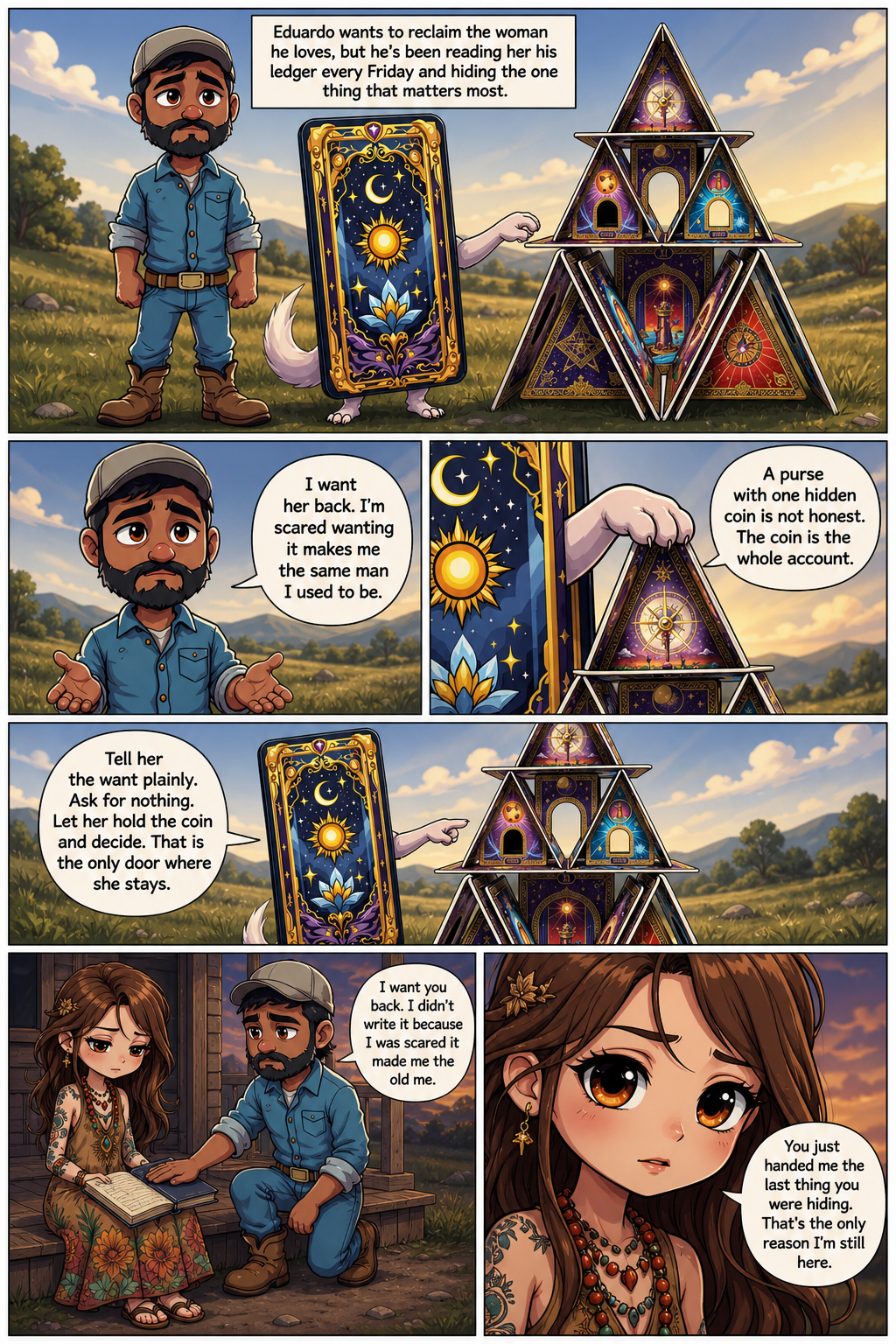
The Wednesday after Kiersten asked him to come sooner, Eduardo felt the old itch return. She read his ledger every Friday now. She sat close and turned his pages. But he had not written the one thing he still hid. He wanted her back. He wanted it so much it scared him. He feared that want made him the same man he used to be. So he drove out to see Fortune, the tarot animal who had steered him true before. Fortune met him beside a house built of cards. Each card stood on its edge, layered into a small tower that leaned but did not fall. Fortune's face showed a wheel caught mid-turn. Its legs shifted toward Eduardo, following him, not choosing for itself. "I read her my ledger," Eduardo said. "But I keep one thing off the page. I want her back. I'm scared wanting it makes me the old me." "A man hides one coin and calls the rest of his purse honest," Fortune said. "The purse is not honest. The coin is the whole account." Eduardo looked at the card house. "Then show me the roads. Every choice. Where each one lands." Fortune touched a card with one paw. "You have three doors," it said. "First door. You keep the want buried. You read her the ledger and say nothing. She smells the hidden coin. She stops trusting the book. Nothing has changed, so she leaves." Fortune touched a second card. "Second door. You chase her with the want. You push. You make the reading a courtship. That is the old wheel. She feels it turn and she runs." Fortune touched the top card, the one holding the whole tower steady. "Third door. You tell her the want plainly. You ask for nothing. You let her hold the coin and decide." "That's the hardest one," Eduardo said. "It is the only one where she stays and the book stays true," Fortune said. "A door shut twice becomes a wall. But a purse opened fully becomes trust." The card house held its lean, cards balanced on cards, none pushing another down. Eduardo watched it and understood. He had built his whole life on the second door. He drove home carrying the third. Friday came at dusk. Kiersten sat on the step and opened his ledger. Eduardo closed it with his hand, the way he had before. "There's one thing I never wrote," he said. He kept his eyes on the yard. "I want you back. I want it bad. I didn't write it because I was scared it made me the old me." Kiersten went still. He did not ask her anything. He let the coin sit in the open. "You just handed me the last thing you were hiding," she said. She picked up the ledger. "Nothing's buried now." She looked at him a long time. "That's the only reason I'm still here."
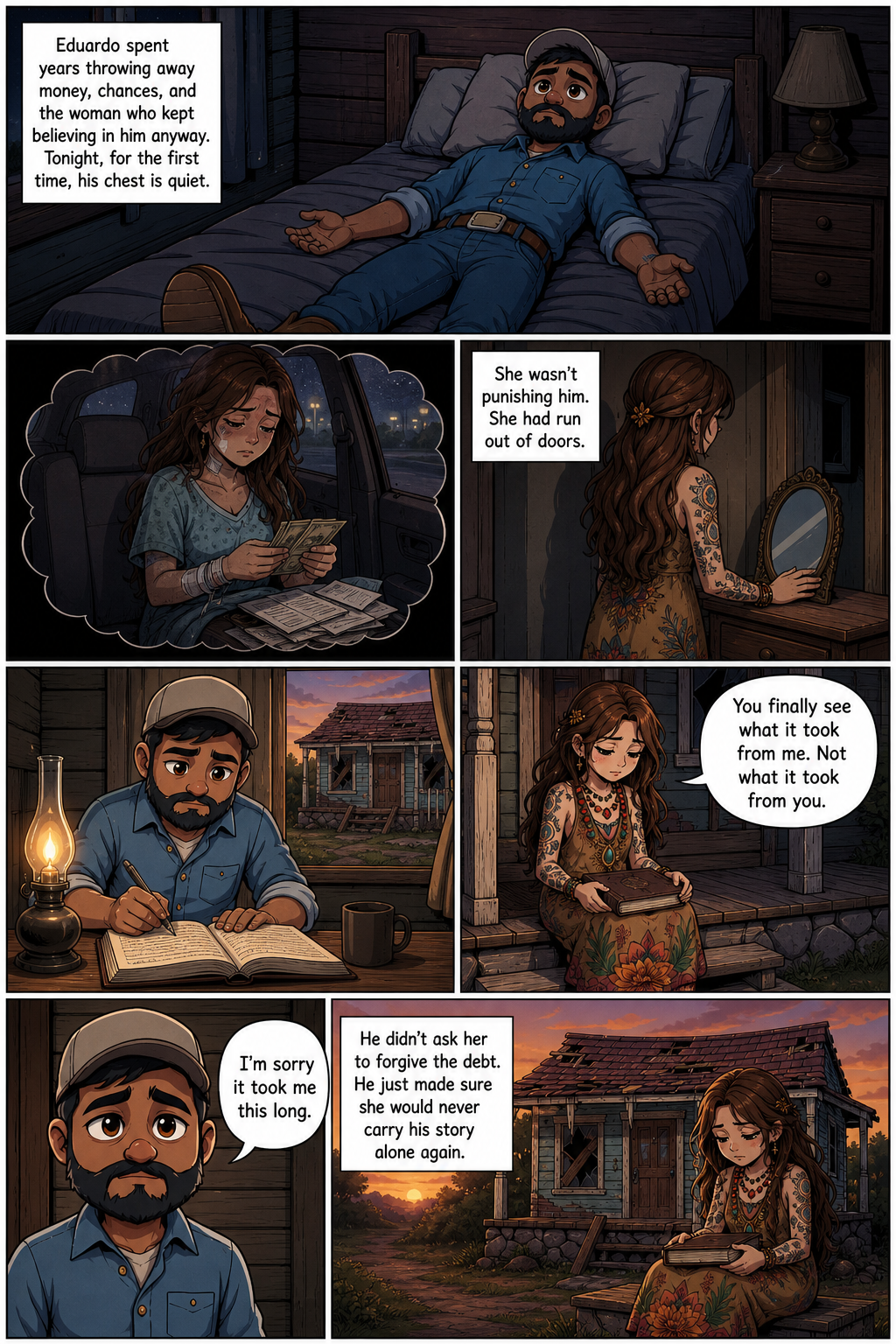
That Friday, after Kiersten took her ledger and left, Eduardo lay awake a long time. He had handed her the last hidden thing. Now his hands were empty and his chest was quiet. He had not felt quiet in years. He shut his eyes and, for the first time he could remember, he fell asleep without fighting for it. He dreamed. But the dream did not save him. It showed him the truth. He saw Kiersten as she had been at the end. She sat in a car that soon would not be hers. Her hands shook. She had just had surgery, and she was tired in a way sleep could not fix. Bills sat on her lap. His bills. The money he lost at cards. The money she had put into him, again and again, because she believed there was a man worth the gamble. In the dream she cried, and he watched himself do nothing. The dream moved on. He saw her cleaning up his mess, one more time, quiet and steady. He saw her hold a mirror to his face. She was not trying to shame him. She was trying to make him see what he could be. He had called it nagging. He had called her cruel. In the dream he finally understood. She had been trying to save him. Then he saw her choose. She set the mirror down. She turned away. Not to punish him. To save herself, because he had left her no other door. In the dream her back looked like an angel leaving a room too small to hold her. Eduardo woke before dawn with wet eyes. He did not run from the dream. He sat with it. The old Eduardo would have twisted it into pity for himself. This one did not. He saw plainly what he had cost her. The debt. The car. The stress on a body still healing. Every dollar he threw away that she had scraped together for his sake. He rose and lit the lamp in his mended house. Once it had been a broken home, roof sagging, windows shattered, walls cracked. He had made it stand again. But standing was not the same as clean. He opened the dark ledger, the one she read now too. He wrote what the dream had shown him, plainly. What her leaving had really cost her body and her purse. He did not write it to be forgiven. He wrote it so she would never again carry his story alone. When Friday came, Kiersten sat on the step and read the new page. Her steady face did not change for a long moment. "You finally see what it took from me," she said. "Not what it took from you." "I do," Eduardo said. "I'm sorry it took me this long." She closed the book slowly. "That's the first time you owed me the whole bill," she said. "And didn't ask me to pay any of it." She stayed on the step until the sun was gone.
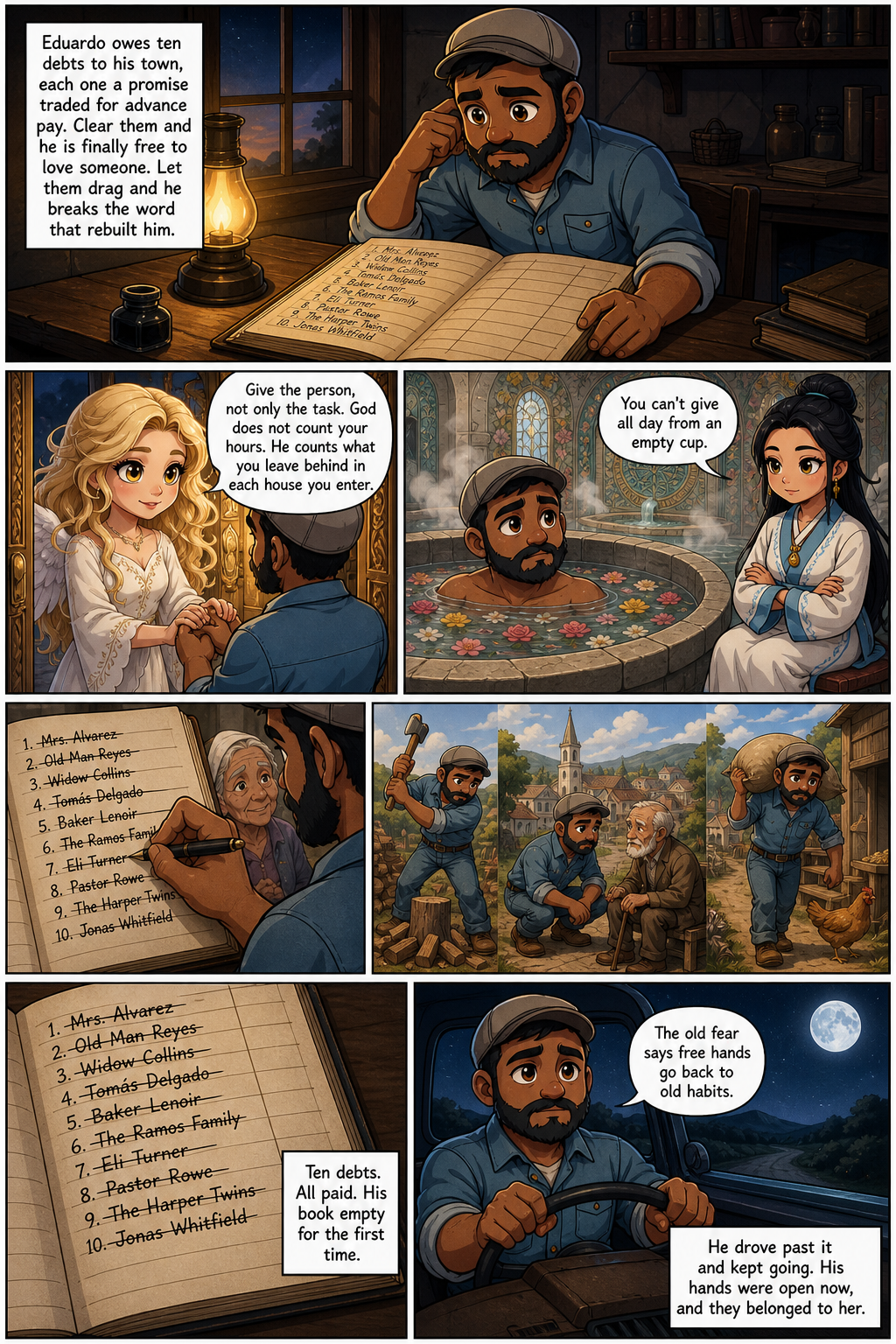
Since Kiersten first sat on his step, Eduardo had felt the pull to give her all his days. But ten winter debts still waited in his book. Each was a promise he had traded for advance pay, and each held his name up in front of the town. If reconciliation dragged him off his schedule, he broke the very word that rebuilt him. So he decided to clear the whole list in one hard day, and to give each person something real, not just labor. Before dawn he drove to the pale house with the cross. Mother Angel met him at the door, her curls bright in the lamplight. She had signed his ledger many times. She had told him once that only honest work would earn his name back. "I mean to finish all ten today," Eduardo said. "I need words from God before I start." She took his hands. "Then work with your whole heart," she said, her voice soft as water. "Give the person, not only the task. God does not count your hours. He counts what you leave behind in each house you enter." He carried those words to the bathhouse first. The keeper worked there alone. He had never met her. She drew warm water in a wide stone basin and dropped in dried flowers that smelled of the hills. "You're the man they talk about," she said. Short and flat. No warmth wasted. "Some good, some bad," Eduardo said. "You look like a man who never lets his shoulders down." She pointed at the water. "Get in. You can't give all day from an empty cup." He sank into the water. The heat pulled the tightness from his back. For the first time in weeks his hands stopped shaking with hurry. Mirelle sat nearby, saying nothing, watching the steam rise. "My grandmother drew me a bath like this once," she said. "I slept a whole night after a year of sickness. Water knows more than we do." When he rose he felt clean in a way soap had never given him. Then he worked. He split wood for the widow and stayed to hear how her husband died. He patched a roof and shared his own bread with the old man beneath it. He hauled feed, mended a gate, dug a trench, cleared a chimney. At each house he set down his tools long enough to look the person in the eye and thank them for trusting his word. By dark the last name was crossed off. Ten debts, all paid. His book was clean. He drove home under a full sky. His debts to the town were done. But his hands stayed open, and for the first time he was free to give them fully to Kiersten. The old fear whispered that free hands could return to their old habits. Eduardo drove past it and kept going.
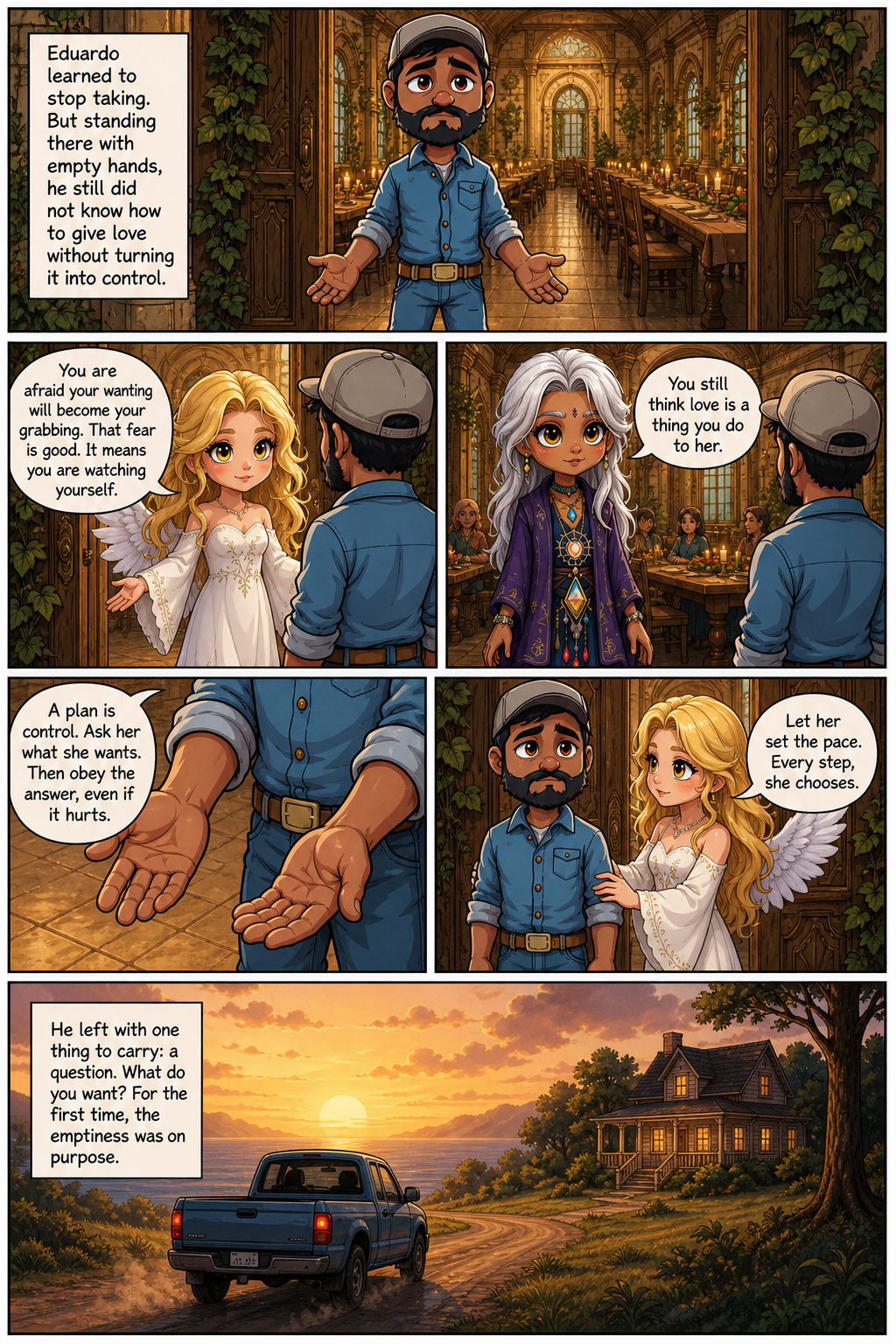
His book was clean and his hands were free. But when Eduardo woke, he found he did not know what to do with them. He wanted to court Kiersten. He wanted to build something honest with her. Yet every plan he made felt like his old plans—a way to steer her, to win. He had learned to stop taking. He had not learned how to give love without controlling it. So he drove to the feast hall, where the elders gathered, and asked the town for help. Inside, vines climbed the tall stone walls and light fell across long tables. Mother Angel stood near the door, her curls bright, her hands open the way they always were when someone needed her. She had signed his ledger for a year. She had watched him fail and rise. "I want to court her right," Eduardo said to the room. "But I only know the wrong way. Tell me how a man loves without owning." Mother Angel smiled. "You are afraid your wanting will become your grabbing," she said softly. "That fear is good. It means you are watching yourself." From a bench in the corner, an old woman rose. Her white hair fell past her shoulders. She was the Wise One, the elder who read the field of the town, who felt grief and change before words were spoken. The room went quiet as she stepped forward. She looked at Eduardo the way a person reads weather. "You still think love is a thing you do to her," the Wise One said. Eduardo held still. "Then what is it?" "A thing you offer. Then you let go." She pointed at his hands. "You want a plan. A plan is control. You cannot plan another person's heart." Eduardo's chest tightened. She had named the exact trap he stood in. "Then how do I begin?" "Ask her what she wants," the Wise One said. "Not what you can give. Give her the question. Then obey the answer, even if it hurts." Mother Angel laid a hand on his arm. "Court her by asking, not deciding," she said. "Let her set the pace. Every step, you ask. Every step, she chooses." Eduardo saw it then. His old love had been a fence he built around her. This was the opposite. He would build nothing. He would only ask, and wait, and let her lead. "I will ask her," he said. "I won't plan past her yes." The Wise One nodded once and sat back down. "Then you have started," she said, and went quiet. Eduardo left the hall with no plan and no ring and no speech. He had one question to carry to Kiersten's porch: what do you want? For the first time, his hands were free and empty on purpose. He drove toward her, ready to ask and ready to let her answer, whatever the answer was.
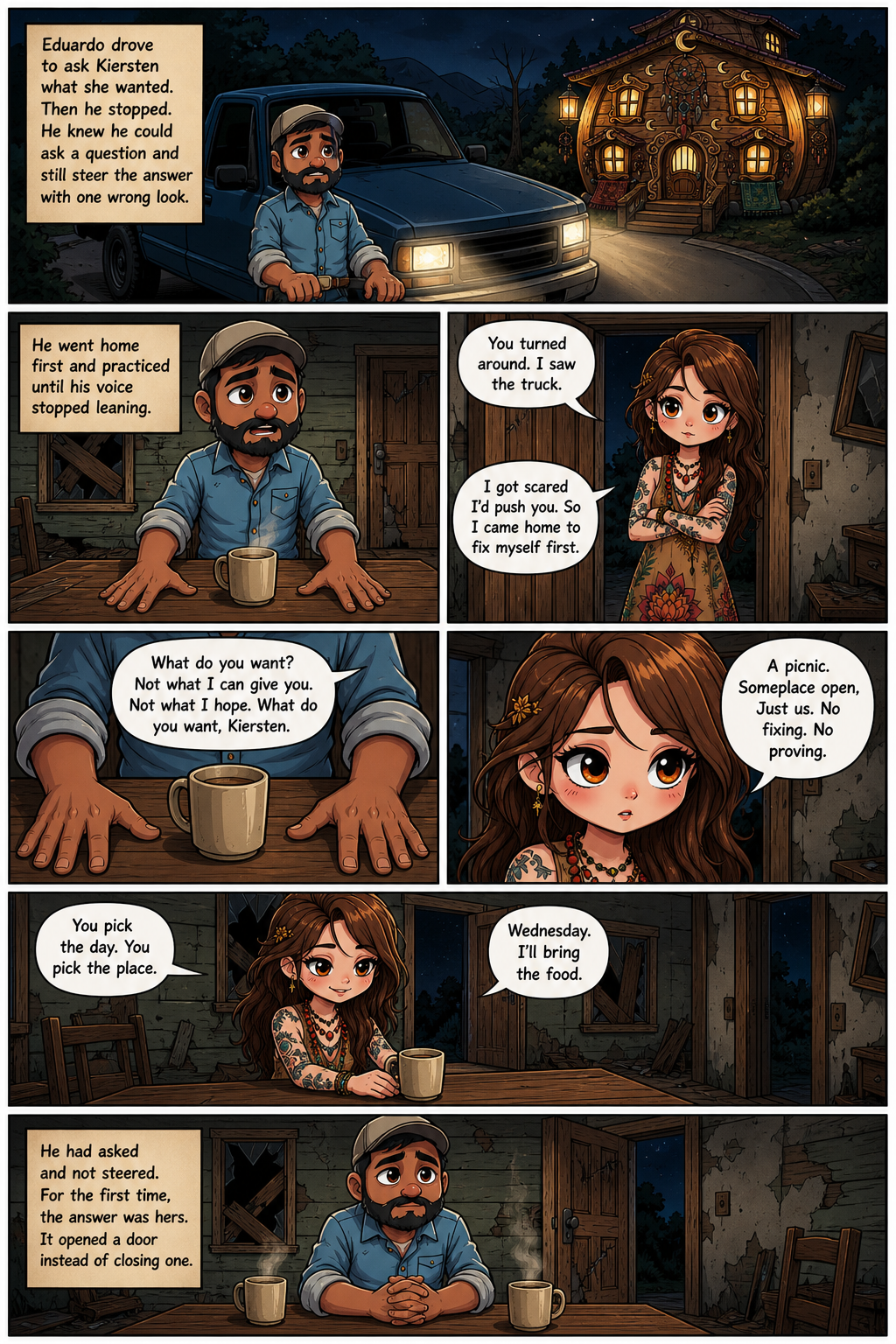
Eduardo drove toward Kiersten's porch with one question and no plan. But halfway there, his hands started to sweat on the wheel. He knew himself. A question could still be a trap. He could ask what she wanted and then steer her answer with his face, his silence, one wrong word. So he turned the truck around. Before he faced her, he needed to steady himself. He needed to ask the question first without any weight behind it. He stopped at his own house instead. The porch still sagged in places he had not reached. He set a kettle on the stove and dug out the tin of tea Tealy had given him, a blend for nerves. He let it steep dark. He drank it slow at the table and practiced the question in the empty room. Not "can I," not "would you like." Just: what do you want. He said it until his voice stopped leaning. A knock came at the door before he could leave. Kiersten stood on the broken steps, arms crossed against the cold. She read endings before people spoke them. She had left him once because she felt the end coming and he had proven her right. Now she watched his face the way she watched weather. "You turned around," she said. "I saw the truck." Eduardo did not lie. "I got scared I'd push you. So I came home to fix myself first." Her eyes moved over him, checking. "You have tea," she said. He poured her a cup without asking if she wanted one, then caught himself. "You don't have to drink it." She drank it. She sat on the edge of a chair. The steam rose between them. Eduardo set his own cup down. He kept his hands flat on the table so they could not reach for anything. "I want to ask you one thing," he said. "And I want to mean it plain. No plan behind it." "Then ask." "What do you want?" he said. "Not what I can give you. Not what I hope. What do you want, Kiersten." He stopped. He did not fill the silence. He did not tilt his head or soften his mouth to pull an answer his way. He let the room stay quiet and waited. Kiersten looked at him a long moment. She was waiting for the old Eduardo to lean in, to shape her, to make her small. He did not. "A picnic," she said finally. "Someplace open. Just us. No fixing. No proving. I want to see if I like you when nothing is at stake." "Then that's what we'll do," Eduardo said. "You pick the day. You pick the place." She set down the cup. Something in her shoulders loosened. "Wednesday," she said. "I'll bring the food." She left without another word. Eduardo sat with the cooling tea. He had asked and not steered. For the first time, the answer was hers, and it opened a door instead of closing one.
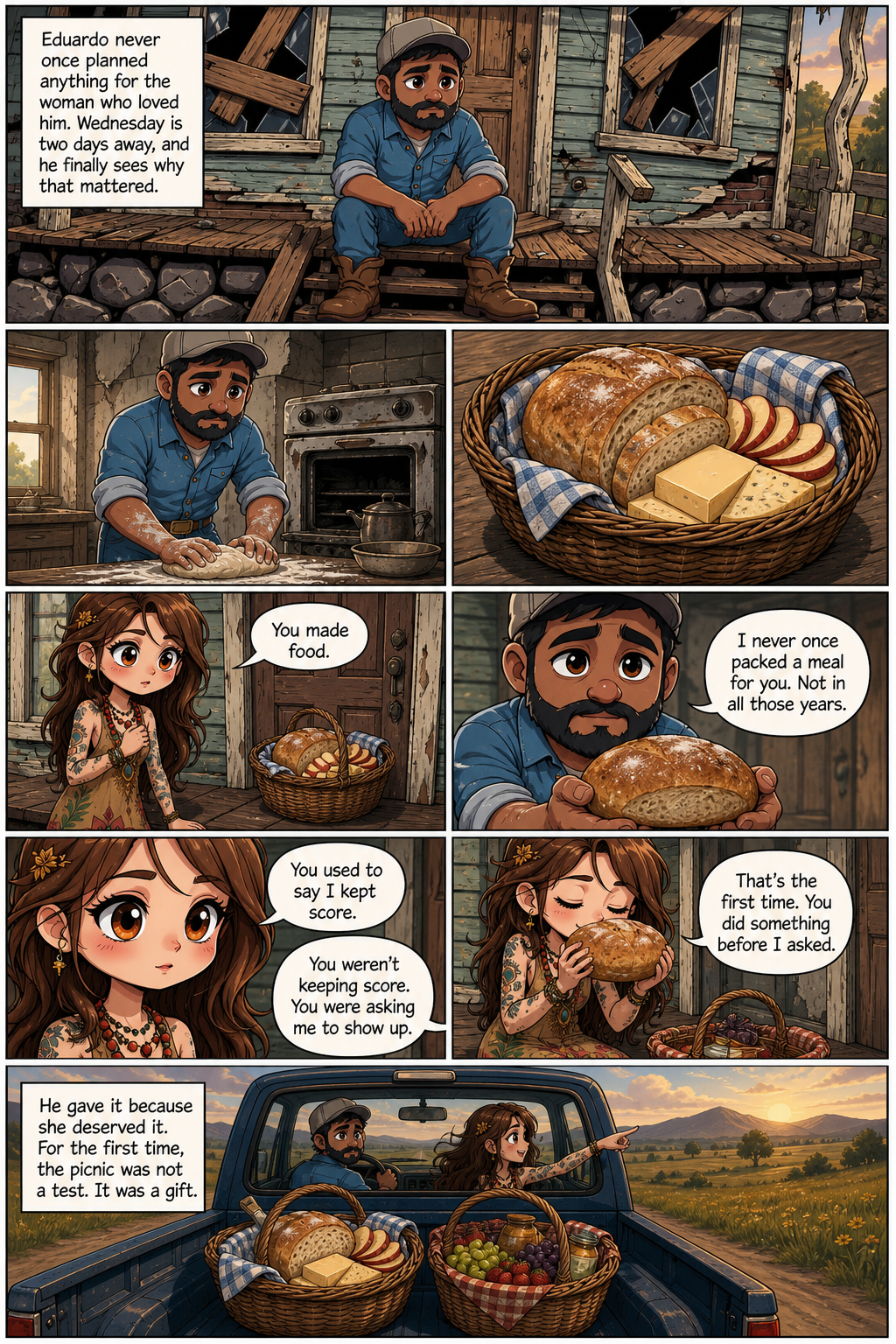
Wednesday sat two days off. Eduardo had the picnic to plan and no idea how. He walked out to his sagging porch and sat on the top step. He tried to think of what she liked. Nothing came. In all their years, he had never planned a single thing for her. He had never packed a lunch, never picked a spot, never made her feel like the center of anything. That truth landed hard. He remembered her voice from long ago. "Look at what I've done for you," she used to say. He had heard it as a threat, a debt held over his head. He had scoffed and told her to stop keeping score. He had made her feel like too much for wanting him back. He saw it plain now, sitting on the broken steps. She had never wanted his money. She had wanted his effort. She had wanted him to choose her without being asked. She had wanted something from his heart, and he had never once given it. Eduardo stood. He would not fix this with a grand plan. That was the old trap. But he could do one small true thing. He could make the picnic himself, with his own hands, the way she had always made things for him. He worked all afternoon. He baked bread in his father's oven. He cut apples. He wrapped cheese in cloth. He did not buy anything he could make. Each step, he thought of her instead of himself. Wednesday, Kiersten came to his house with a full basket, ready to bring the food like she'd said. She stopped when she saw his own basket by the door. "You made food," she said. "I did." Eduardo held up the loaf. "You said you'd bring it. I know. But I never once packed a meal for you. Not in all those years." She looked at the bread. Then at him. She read his face the way she read weather. "You used to say I kept score," she said. "You weren't keeping score. You were asking me to show up." His voice stayed level. "I made you feel like too much for wanting that. I was wrong." Kiersten set her basket down slow. Her shoulders dropped. For a long moment she said nothing. "That's the first time," she said. "You did something before I asked." "I should have done it a hundred times." "You didn't." She picked up his loaf and smelled it. "But you did today." They carried both baskets to the truck. She let him load hers beside his. On the drive, she named the open field she wanted, and he did not argue or steer. Something between them had shifted. He had given from his heart, not to win her, but because she deserved it. Kiersten had felt it. The picnic was no longer a test of whether she could like him. It was the first thing he had ever made for her.
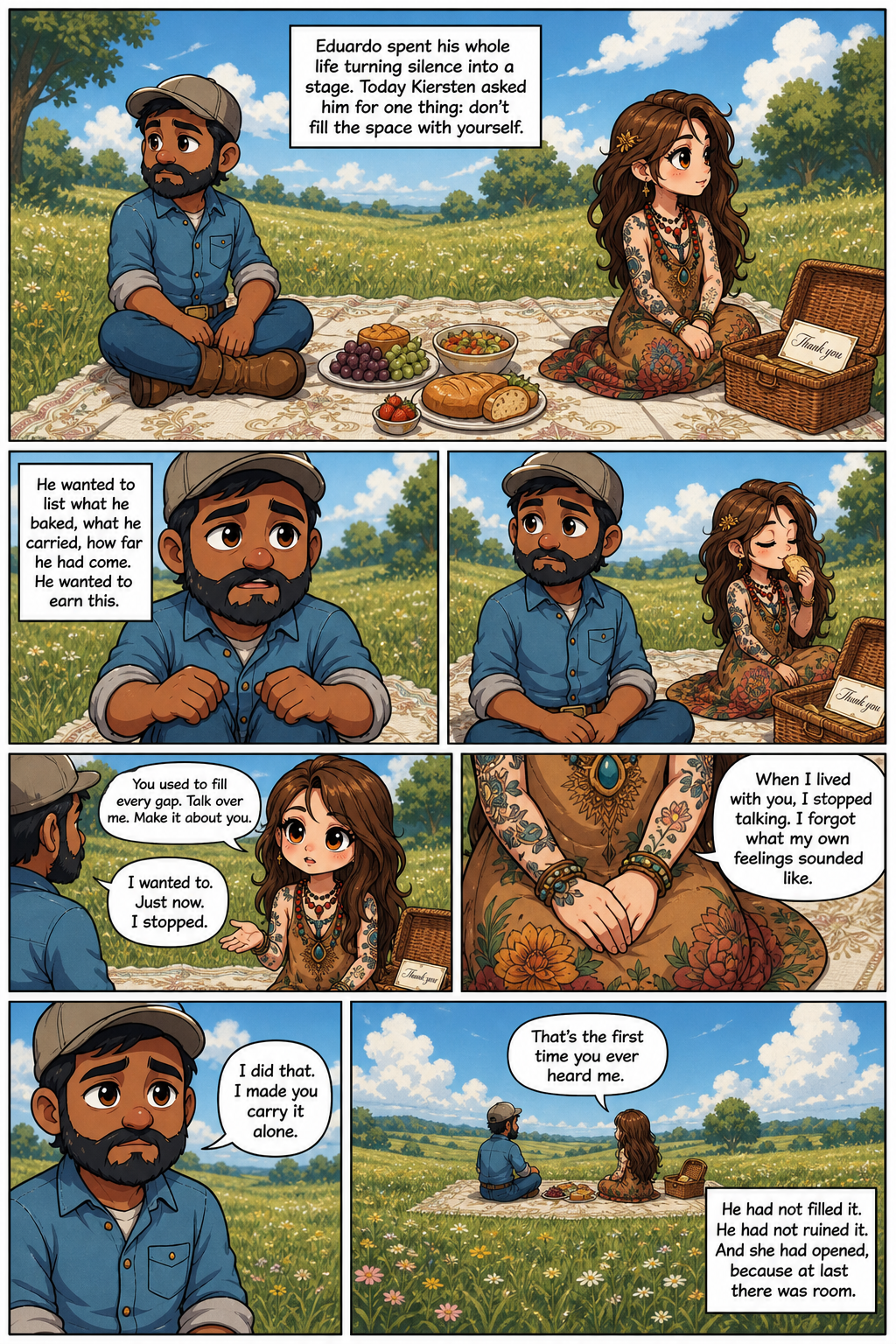
They reached the open field near noon. Eduardo spread the blanket she had brought, an old cloth stitched with faded flowers. A thank-you card sat tucked in the corner of her basket. He set both baskets down and sat. Then he did not know what to do with his hands. Kiersten laid out the bread and the cheese. She poured water into two cups. She sat across from him and looked at the grass, the sky, the far line of trees. She was resting. He could see it. Eduardo felt the old itch rise. The silence pressed on him. He wanted to fill it. He wanted to point out the bread he baked, the apples he cut, how far he had come. He wanted to earn this moment. His whole life he had turned quiet into a stage. He opened his mouth to speak. Then he remembered what she asked for. No fixing. No proving. Just the two of them. If he filled this with himself, he would take the one thing she wanted. He closed his mouth. He looked at the field instead. It was hard. His heart beat fast, like he was doing something wrong by doing nothing. Kiersten broke a piece of bread. She chewed slow. Minutes passed. He said nothing. She said nothing. The wind moved the grass. "You're quiet," she said. "I am." "You used to fill every gap." She kept her eyes on the trees. "Talk over me. Make it about you." "I know." He kept his voice low. "I wanted to. Just now. I stopped." She turned and looked at him. She read his face the way she always had. Then she set the bread down. "Can I tell you something?" she said. "Yes." She was quiet a long time. He did not push. He waited. "When I lived with you, I stopped talking," she said. "Every time I said how I felt, you made it a fight. So I learned to hold it in. For years." Her voice stayed steady. "I forgot what my own feelings sounded like." The old Eduardo would have argued. He would have said he never meant it, that she made it worse. He felt those words rise. He let them fall. "I did that," he said. "I made you carry it alone." "Yes." She looked down at her hands, at the tattoos winding up her wrists. "I'm telling you now because I want to. Not because I have to." "I'm listening." And he did. She spoke about the small silences, the nights she cried where he could not see. He did not fix. He did not defend. He held each thing she gave him and set nothing back on her. When she finished, she let out a long breath. Her shoulders dropped. "That's the first time you ever heard me," she said. Eduardo nodded. He had not filled the moment. He had not ruined it. He had simply stayed. And she had opened, because at last there was room.
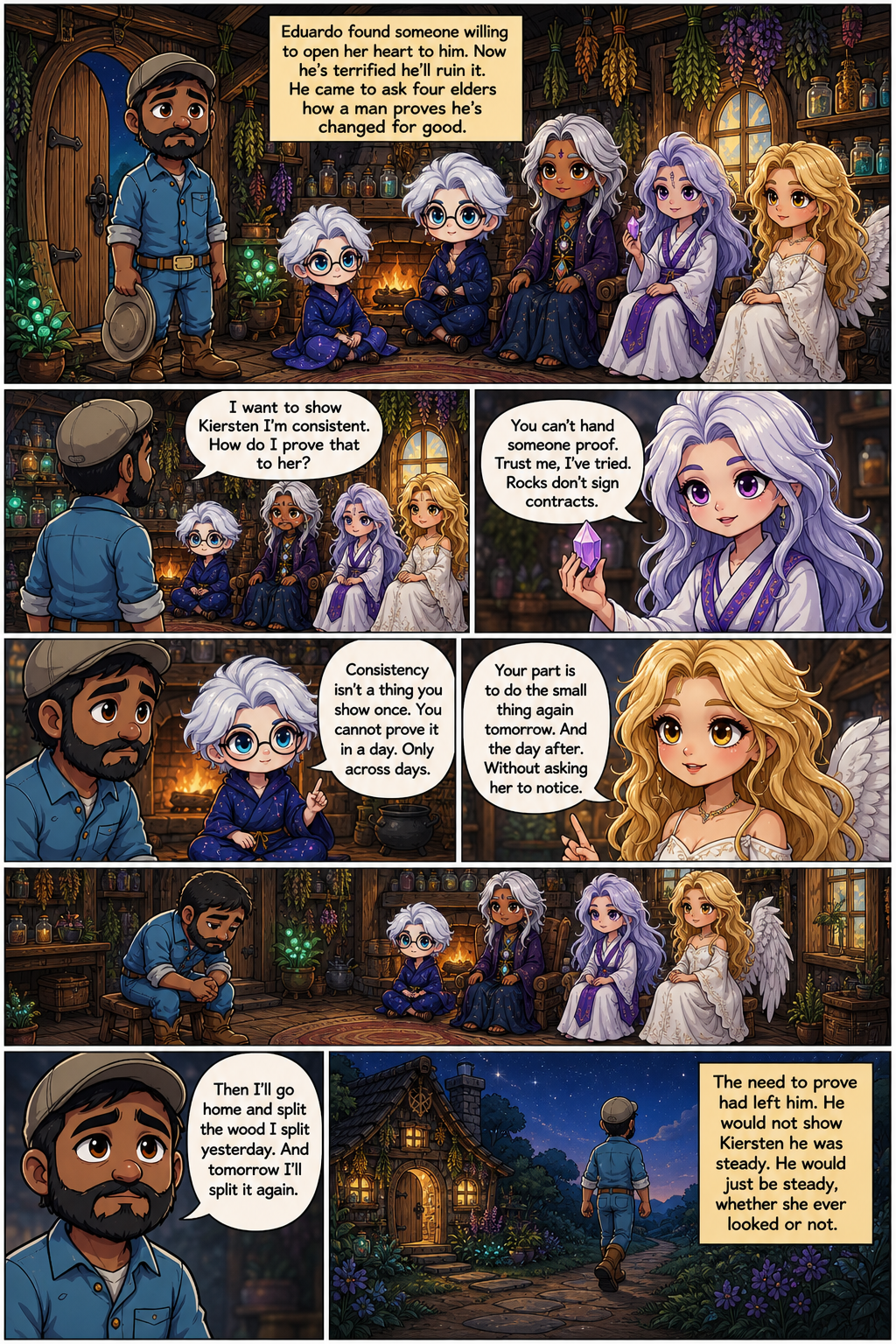
The picnic ended two days ago. Kiersten had opened to him at last. But driving home, a fear rose in Eduardo. She had heard him once. One good day proved nothing. His whole life was a string of good days followed by broken ones. He needed to show her he could hold this, not just for a picnic, but every day. He did not know how a man proved that. So he went looking for people who might. He found the elders at the town witch's home. Herbs hung drying from the beams. Jars lined the shelves, each one strange and glowing faint. Quantum sat cross-legged near the hearth, glasses catching the firelight. Mother Angel stood by the window, her wings folded soft. Ananda turned a small crystal in their fingers. The Wise One waited in the corner, still as the wall behind her. These were the ones who had watched Eduardo climb out of himself over a year of hard work. "I want to show Kiersten I'm consistent," Eduardo said. "That I won't slip back. How do I prove that to her?" Ananda held up the crystal. "You can't hand someone proof. Trust me, I've tried. Rocks don't sign contracts." Quantum spoke slow and deep. "Consistency is not a thing you show once. It is the same act, repeated, when no one watches and nothing is gained. You cannot prove it in a day. Only across days." Eduardo's chest tightened. "Then there's no way to show her now." "No," the Wise One said. "That's the point." Mother Angel crossed to him. Her voice was gentle. "You keep trying to give her a reason to believe. But belief is hers to build, not yours to hand over. Your part is to do the small thing again tomorrow. And the day after. Without asking her to notice." Eduardo sat with that. It was the answer he did not want. Every plan in him wanted a gesture, a moment, a way to settle it fast. He knew that hunger now. It was the old ego, dressed as love. "So I stop trying to show her," he said. "You stop performing it," Quantum said. "You just live it. Consistency isn't a message you send. It's who you are when the sending stops." Ananda grinned. "Boring, right? Real change is boring. That's how you know it's real." Eduardo let out a breath. The pressure in him loosened. He had come wanting a way to prove himself and found there was none. There was only the quiet work, done and done again, for its own sake. He stood. "Then I'll go home and split the wood I split yesterday. And tomorrow I'll split it again." The Wise One nodded once. "Now you understand." Eduardo walked out into the evening. The need to prove had left him. What remained was simpler, and harder. He would not show Kiersten he was steady. He would just be steady, whether she ever looked or not.
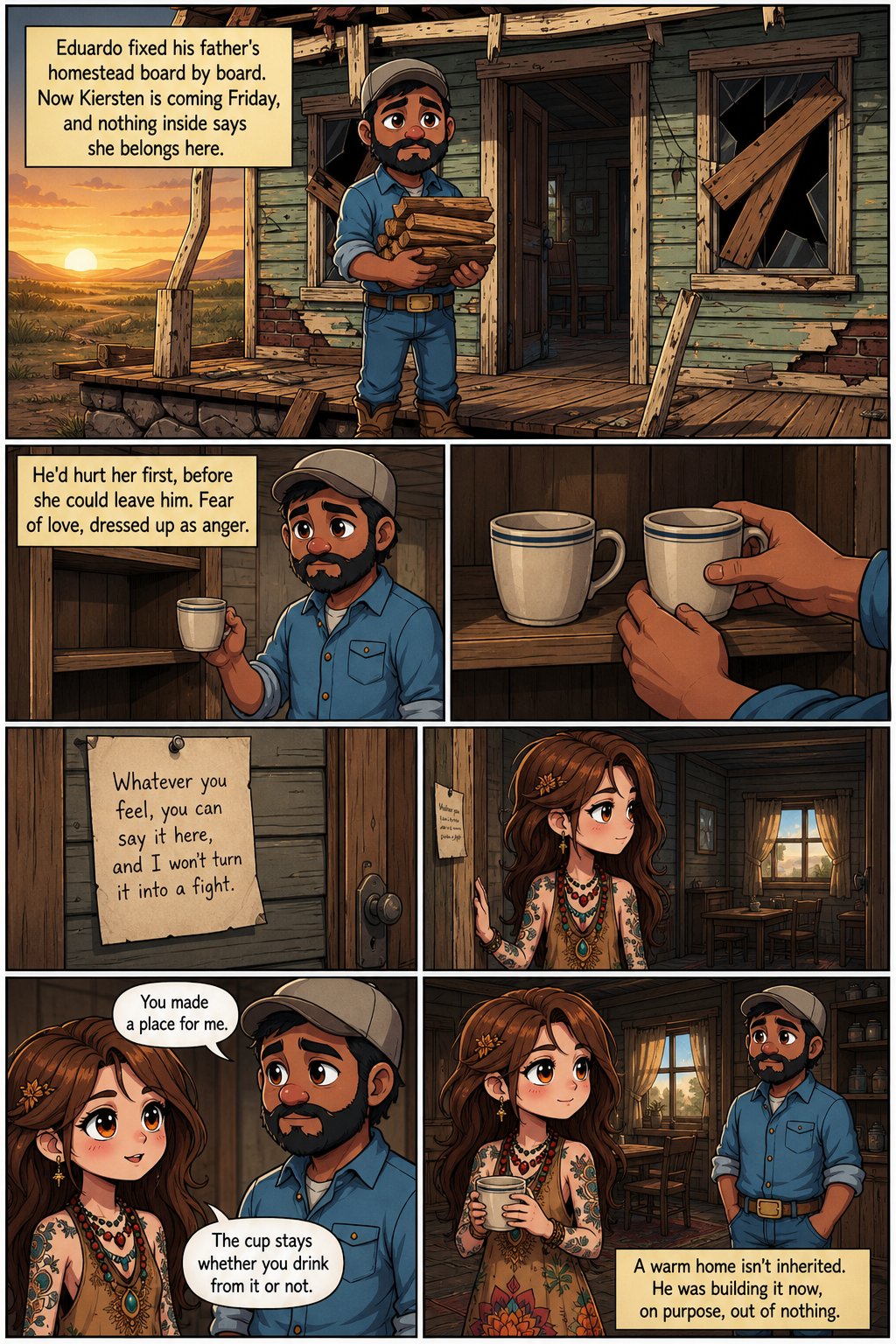
Eduardo split the wood again at dawn, just as he'd promised. But when he carried an armload inside, the house felt wrong. Kiersten was coming Friday. He looked around and saw only his own life. His father's rules were in the walls. His own confessions sat on the shelf. Every board he'd nailed held a memory that was his alone. Nothing here said Kiersten belonged. He didn't know how to make a place feel like hers. He sat on the porch and remembered the house before he'd fixed it. The battered thing with the sagging roof and broken windows. He'd cleared out old photographs the day he returned. Now he wished he'd kept something warm to pass on. But his childhood had no warm ritual. No shared meal that meant welcome. His parents never made a place feel safe. So he had nothing to copy. Then the real question came, the one he'd been circling for a year. Why had he done it? Why had he called Kiersten a liar and rolled over when she cried? He sat with it honestly this time. He'd been afraid. Afraid that if he needed her, she could leave him like his mother left rooms without a word. So he hurt her first. He made her small so she couldn't make him small. That was the underlying wound. Fear of love, dressed up as anger. He understood now why it took so long. He'd needed to lose everything before he'd stop performing. A warm home wasn't a thing you inherited. It was a thing you built with someone, on purpose, out of nothing. So Eduardo decided to make a ritual, not copy one. Something small and repeatable. Something that said, you have a place here. He went inside and cleared one shelf. He set two cups on it, side by side. Not one for himself. Two. Then he found paper and wrote a single line: "Whatever you feel, you can say it here, and I won't turn it into a fight." He nailed the paper to the wall by the door, where anyone entering would see it. It was a promise, not a decoration. He made no grand plan for Friday. He'd pour tea into both cups. He'd let her speak first. He'd do it again the next Friday, and the one after, whether she stayed or not. When Friday came, Kiersten stepped inside and stopped. She read the paper by the door. She looked at the two cups on the shelf. She said nothing for a long moment. "You made a place for me," she said. It wasn't a question. "I made a promise," Eduardo said. "The cup stays whether you drink from it or not." Kiersten crossed the room and picked up the second cup. She held it in both hands. For the first time, she looked at his house not as his, but as somewhere she might stay.
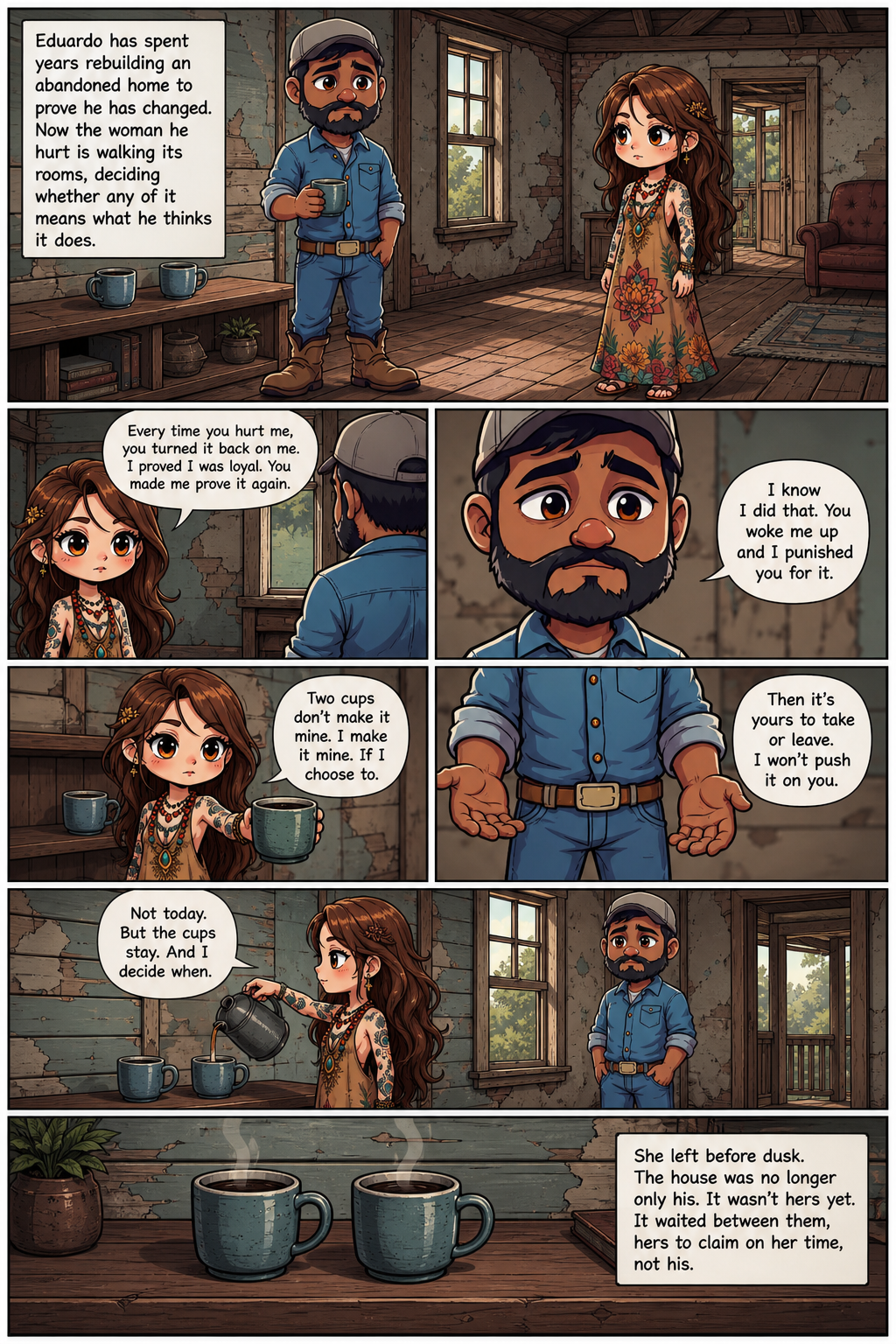
Kiersten held the second cup for a while. Then she set it down and looked at Eduardo. He waited for her to say the house felt like hers now. She didn't. She walked the rooms slowly. She touched the wall by the door. She looked at the shelf, the ledgers, the boards he'd nailed. When she came back, her face had changed. "Why did I have to explain myself over and over?" she asked. "Every time you hurt me, you turned it back on me. I proved I was loyal. You made me prove it again." Eduardo felt the old pull. The urge to say she was twisting it. He breathed and let the urge pass. "I know I did that," he said. "You always knew," Kiersten said. Her voice stayed flat. "I told you about the cycle. You were stuck in it. I tried to show you who you were becoming. You wouldn't hear it. You called it a knife when it was a mirror." He wanted to defend the house. To say, look, I made a place for you. But that was the same move. Making it about what he'd built. Making her prove she saw it. The old wound sat plain in front of him. He had learned to fix walls. He had never learned what a shared home looked like, so this stayed his, not theirs. "You're right," he said. "I did all of it. You woke me up and I punished you for it." Kiersten waited. She was testing whether he'd circle back to himself. He didn't. He said nothing more. He let her words stand without adding his own. She crossed to the shelf. She picked up the second cup again. "Two cups don't make it mine," she said. "A promise on the wall doesn't make it mine." She held the cup out to him. "I make it mine. If I choose to." Eduardo understood. He had been trying to hand her a home like a gift. A home wasn't given. It was taken up, or it wasn't. He couldn't build it for her. He could only leave the door open and stop steering. "Then it's yours to take or leave," he said. "I won't push it on you. I won't make you earn it." Kiersten studied him. For the first time, he saw her set something down. The habit of bracing for the turn. She filled the cup from the pot. She filled his too. She set both on the shelf side by side. "Not today," she said. "But the cups stay. And I decide when." She left before dusk. The two cups sat full on the shelf. Eduardo didn't touch them. The house was no longer only his. It wasn't hers yet either. It waited between them now, hers to claim, on her time, not his.
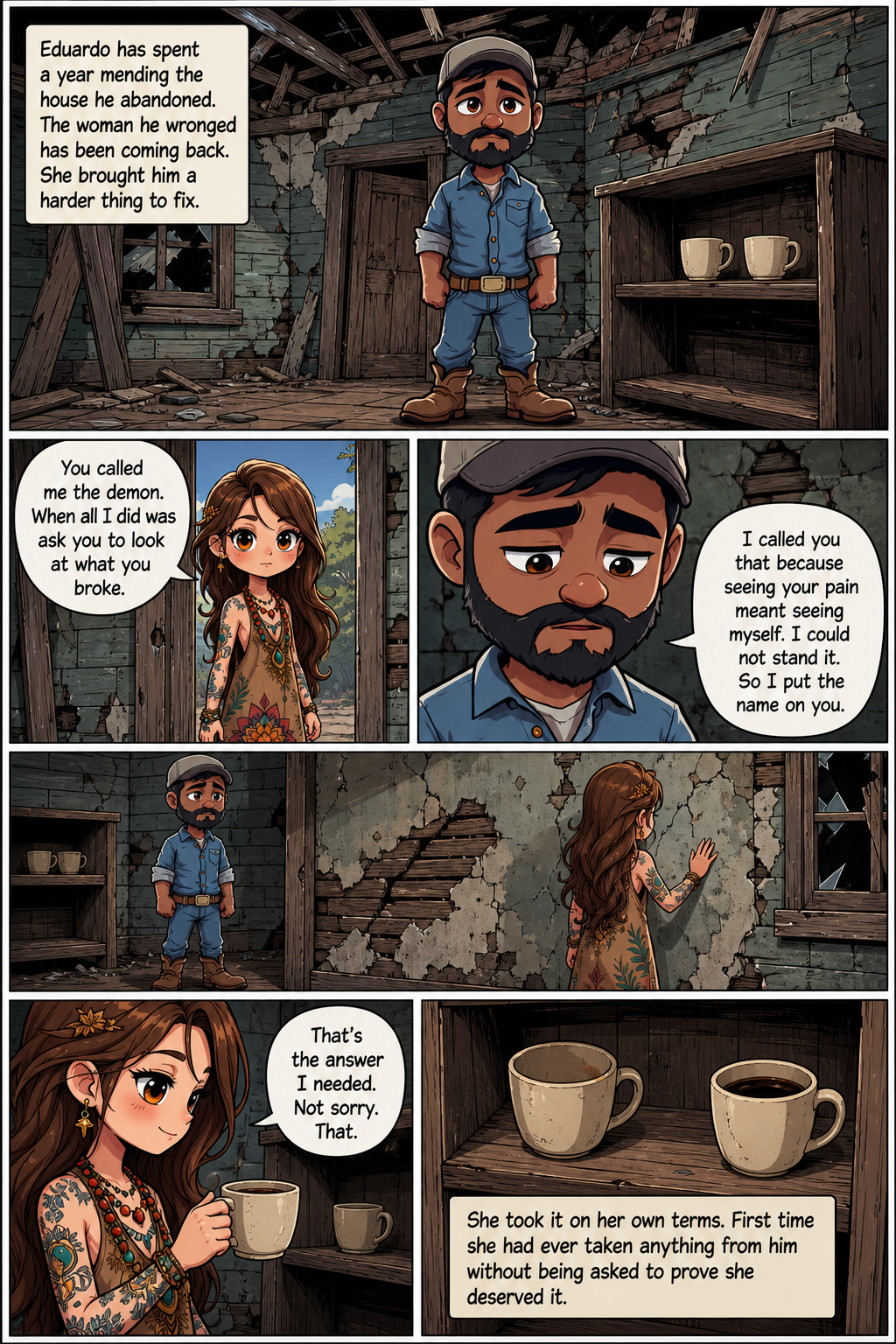
The two cups sat full on the shelf for a week. Eduardo did not touch them. He worked the house each day and left the cups alone. Then Kiersten came back the next morning, before he expected her. She stood in the doorway and looked at him. Her face was not soft. She had come for answers, not tea. "I need to understand something," she said. "Back then, I showed you my pain. I said, look what you did to me. And you called me the demon. You told me I was the one who needed to repent." Eduardo felt the old heat rise. The urge to say she was twisting the memory. To make himself the one who suffered. He breathed and let it go. "I remember," he said. "You asked me to see your hurt. I turned it into your sin instead of mine." "You said sorry a hundred times," Kiersten said. "Sorry never meant anything. You said it and then you hurt me again the same day." "I know," Eduardo said. He did not reach for an excuse. "I used the word to close the subject. Not to change. I made you the problem so I never had to look at me." Kiersten crossed the room. She touched the cracked wall by the door, the same wall she had touched before. She looked at the sagging boards, the patched window, the whole battered house he had spent a year mending. "You called me the demon," she said again, quieter now. "When all I did was ask you to look at what you broke." Eduardo stood still. He did not defend himself. He did not point at the repairs. "I called you that because seeing your pain meant seeing myself," he said. "I could not stand it. So I put the name on you." Kiersten was quiet a long time. She had come braced for the turn, for him to flip it back on her. It did not come. She let out a slow breath. She picked up one of the full cups from the shelf. "That's the answer I needed," she said. "Not sorry. That." She drank from the cup. Then she set it down, empty. She looked around the rooms once more, slow, the way a person looks at a place they are deciding about. "I'm not saying yes to the house," she said. "Not today. But I stopped waiting for you to blame me. That's done." Eduardo nodded. "On your time," he said. "Not mine." Kiersten went to the door. She stopped there. "I'll come Friday," she said. "To read the ledgers. Same as always." She stepped out into the light. Eduardo looked at the shelf. One cup empty, one still full. The house was no longer only his. It was not hers yet. But she had drunk from it once, on her own terms. That was the first thing she had ever taken from him without being asked to prove she deserved it.
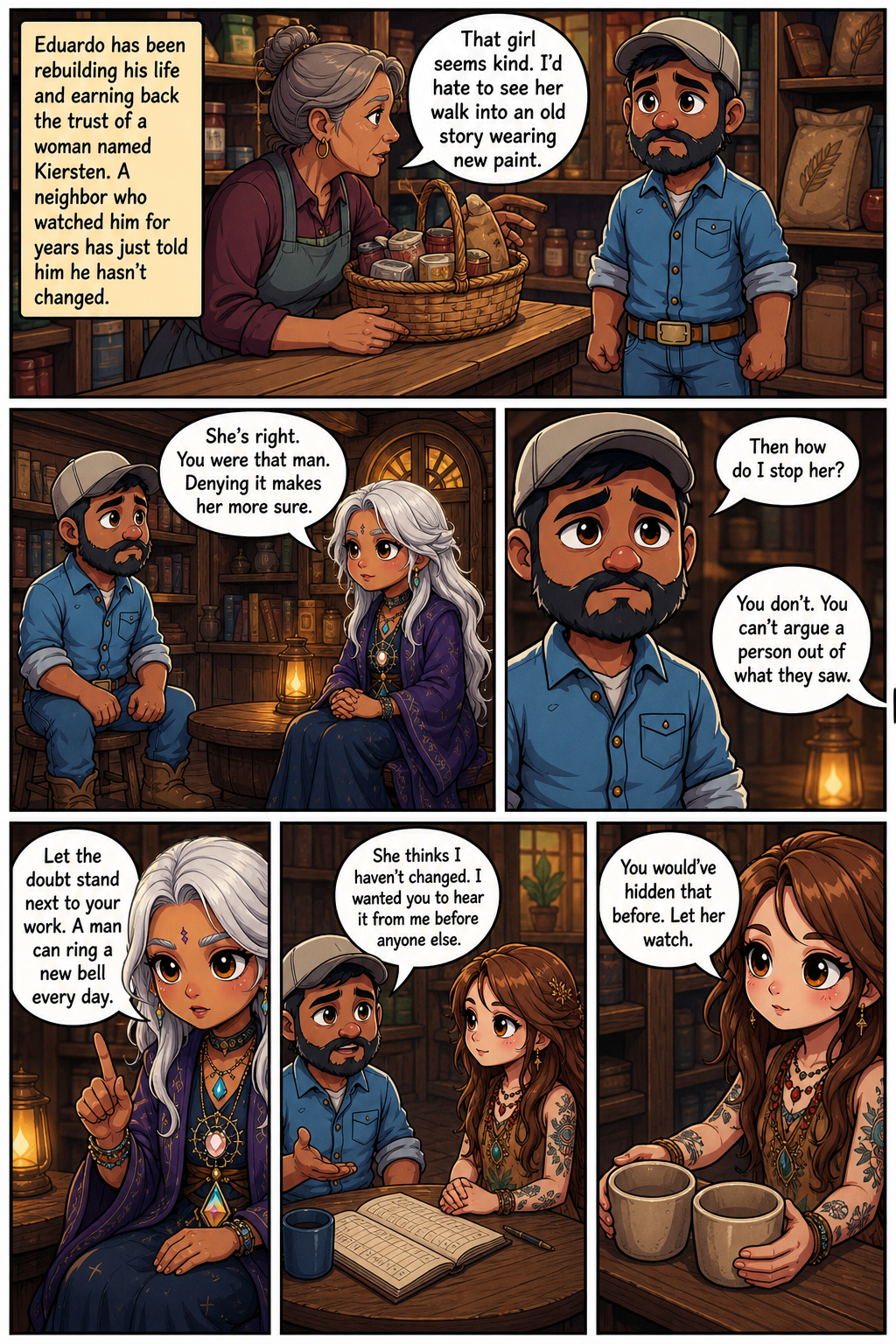
Two days after Kiersten drank from the cup, a woman stopped Eduardo at the feed store. She was gray at the temples and carried a full basket. He knew her face from the road near his house. She had watched his porch meetings from her own yard. "I've seen you two out there," she said. "I knew you before the house got painted. A man doesn't change that fast." She looked at him hard. "That girl seems kind. I'd hate to see her walk into an old story wearing new paint." Eduardo felt the heat rise in his chest. The old urge came, to argue, to prove her wrong, to make her the fool. He set it down. But her words stayed in him all afternoon. If she doubted him, she might say it to Kiersten. One quiet warning could pull Kiersten back through the door she was slowly opening. Eduardo did not know how to answer a doubt he had earned. He drove to the timeworn cottage on the edge of town. Stars and moons were carved into its wood. Inside lived the Wise One, the elder people came to when they could not think straight. She read what she called the field. She had never lied to soften a thing. Eduardo had sat before her once and left with the truth he was avoiding. She opened the door before he knocked. "You brought a hollow with you," she said. She waved him to a stool. "Sit. Say it plain." "A woman thinks I'm still the man I was," Eduardo said. "She might tell Kiersten. I could lose everything I built." The Wise One folded her hands. "She's right," she said. Eduardo flinched. "You were that man. Denying it makes her more sure." "Then how do I stop her?" "You don't." She let the words sit. "You can't argue a person out of what they saw. You can only give them something new to see." She leaned closer. "Don't defend yourself to Kiersten. Don't chase the woman. Let the doubt stand next to your work. Time decides which one people trust." Eduardo nodded slowly. "So I do nothing." "You do the same thing you've been doing," she said. "In front of her eyes. A bell that stopped ringing stays quiet. But a man can ring a new one every day." Eduardo drove home lighter. That Friday, Kiersten came to read the ledgers. He told her about the woman himself, plain, before anyone else could. "She thinks I haven't changed," he said. "She might be watching. I'm not going to argue with her. I just wanted you to hear it from me first." Kiersten studied him a long moment. Then she picked up the second cup, the full one, and drank. She set it down empty. "You would've hidden that before," she said. "Let her watch." She opened the ledger. Both cups stood empty now on the shelf.
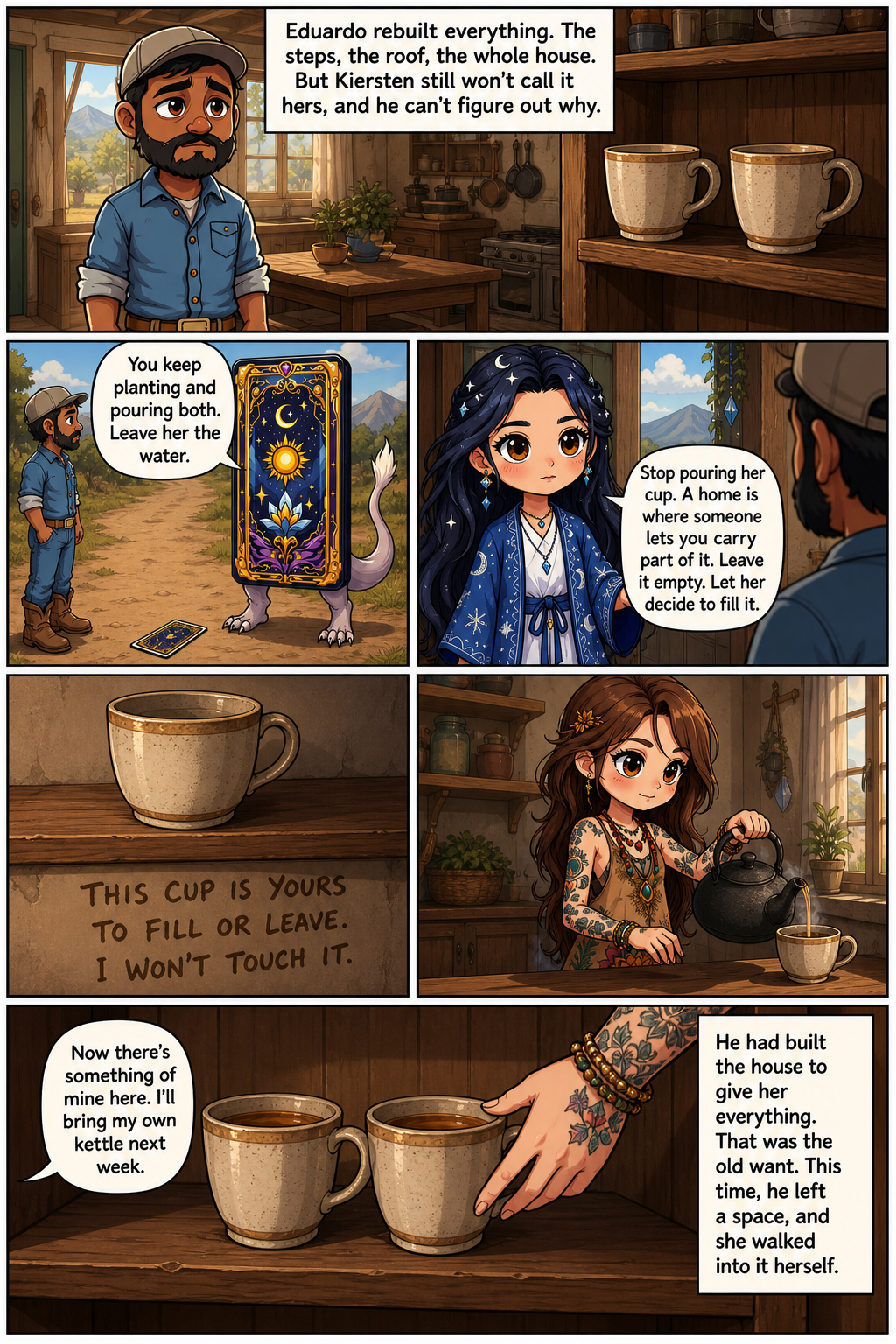
Kiersten had drunk from the cup, but she still would not call the house hers. Eduardo noticed it on Friday. She sat, read the ledgers, then left without touching the shelf where the two empty cups stood. He had run out of things to build. The steps were fixed. The roof held. He did not know what daily proof would finally make the house feel like her home. So he went looking for an answer inside himself instead. He drove first to the tarot reader. Fortune waited outside, the wheel on its face turned mid-spin. Its legs pointed toward Eduardo without choosing. "You want to know what to hand her," Fortune said. "I want her to feel it's hers," Eduardo said. "Not a gift. Hers." Fortune drew one card and laid it in the dirt. "A man plants a tree for a woman. She waters it herself. Then it is hers." The wheel clicked forward. "You keep planting and pouring both. Leave her the water." Eduardo sat with that. He had done everything alone. He had never left a space for her to fill. He drove next to the dream analyst's cottage. Moons were carved above the door. Dreamer opened it before he spoke. Her dark hair held small stars. She listened for who a story left out. "I keep dreaming the same house," Eduardo said. "Two cups on a shelf. I fill both every morning. She drinks one. The other I pour out at night, still full." Dreamer studied him. "Who fills the second cup in the dream?" "I do." "That's the whole thing." Her voice went quieter. "You fill her cup so she owes you nothing. A home isn't a place where nothing is asked of you. It's a place where someone lets you carry part of it." She did not soften it. "Stop pouring her cup. Leave it empty. Let her decide to fill it." Eduardo drove home in the dark. The words from both stayed together in his chest. He had built the house to give her everything. That was the old want wearing new paint. He had never once let her give back. The next morning he filled his own cup only. He set the second one empty on the shelf, right side up, waiting. He wrote on the wall below it: This cup is yours to fill or leave. I won't touch it. Friday came. Kiersten read the ledgers. Then she saw the empty cup and the new line. She went still. She looked at it a long time. She rose, went to the kettle, and poured. She set the full cup on the shelf beside his. "Now there's something of mine here," she said. She looked around the room like she was seeing it new. "I'll bring my own kettle next week." Eduardo did not fill it for her. He let it stand. For the first time the house held one thing that was hers, placed by her hand.
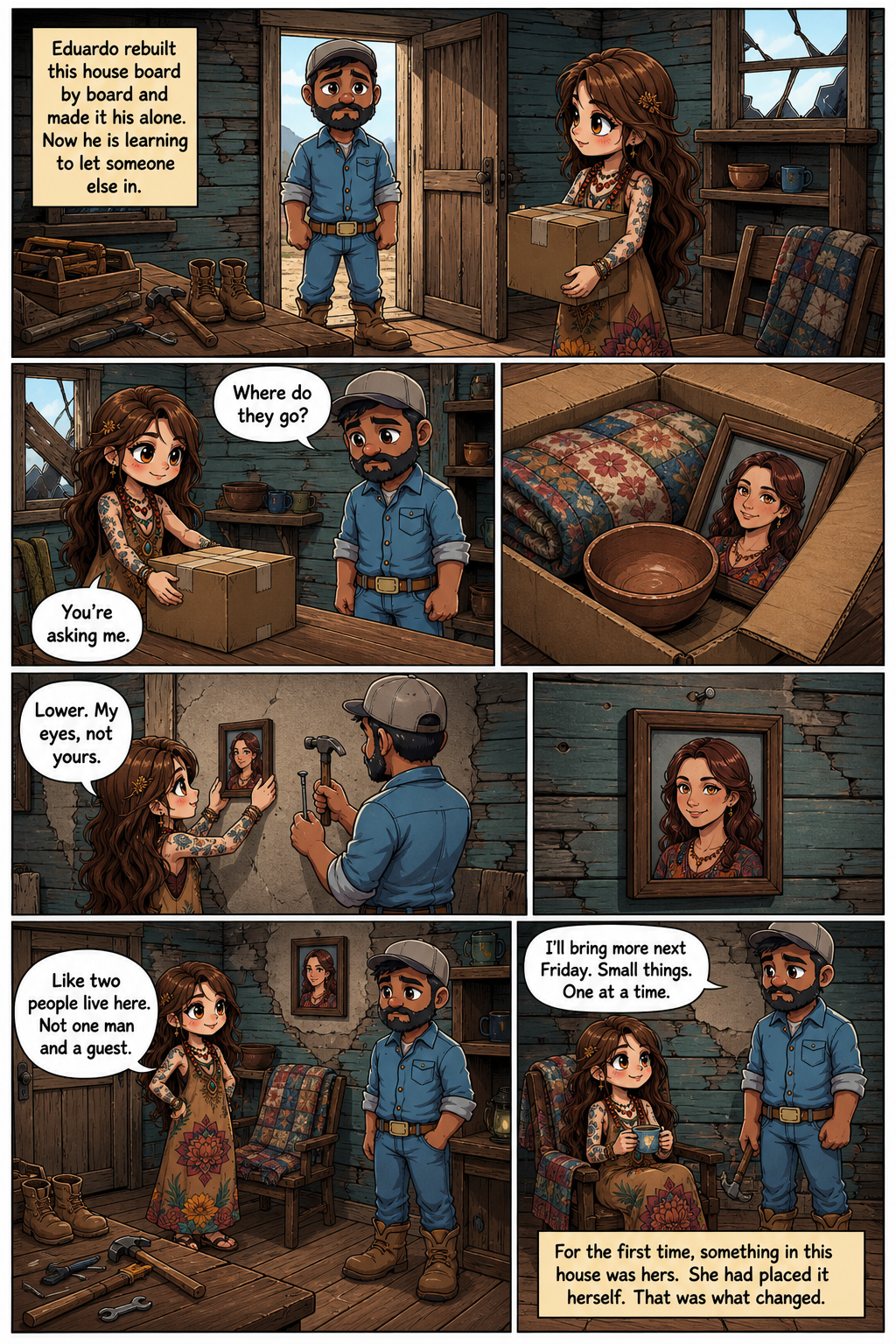
Kiersten's cup stood on the shelf all week. Eduardo left it where she set it. But one full cup was not a life shared. The rest of the house still held only his things. His boots by the door. His tools on the table. His father's belt gone, but nothing of hers to take its place. She could pour tea and leave. Nothing here asked her to stay. He thought of the house as it once was. Sagging roof. Cracked walls. Boards nailed over broken windows. He had rebuilt every part of it with his own hands. That was the problem. Every board was his. He had made a house no one else could touch. When Friday came, Eduardo did not fill the shelf or the wall with something new. He waited for Kiersten at the door. She arrived with a small box under her arm. "I brought things," she said. She set the box on the table. She did not open it. Eduardo looked at the box, then at her. His hands wanted to reach for it and place everything himself. He knew that pull. He kept his hands at his sides. "Where do they go?" he asked. Kiersten studied him. "You're asking me." "It's your box." She opened it. Inside were a folded quilt, a clay bowl, a framed photo of a woman with her same auburn eyes. Her mother, he guessed. He had never seen it. Kiersten took the quilt and draped it over the back of his chair. She set the bowl on the shelf beside the two cups. She carried the photo to the wall and held it against the bare wood. "Here," she said. "Nail this here." Eduardo brought a nail and hammer. He raised it to the wall. "Wait." She put her hand flat against the spot. "Lower. My eyes, not yours." He moved the nail down. He drove it in. She hung the photo. Her mother looked out over the room now, level with Kiersten's face. Kiersten stepped back. She looked at the quilt on the chair, the bowl on the shelf, the photo on the wall. Then she looked at the boots, the tools, all his things, sitting among hers now. "It reads different," she said. "Different how?" "Like two people live here." She said it plain, not soft. "Not one man and a guest." Eduardo set the hammer down. He did not answer. He let the room hold what she had made. Kiersten poured her tea. She sat in the chair with her quilt behind her. "I'll bring more next Friday," she said. "Small things. One at a time." For the first time the house held more than one thing that was hers. Her hands had placed each one. The space no longer read as only his.
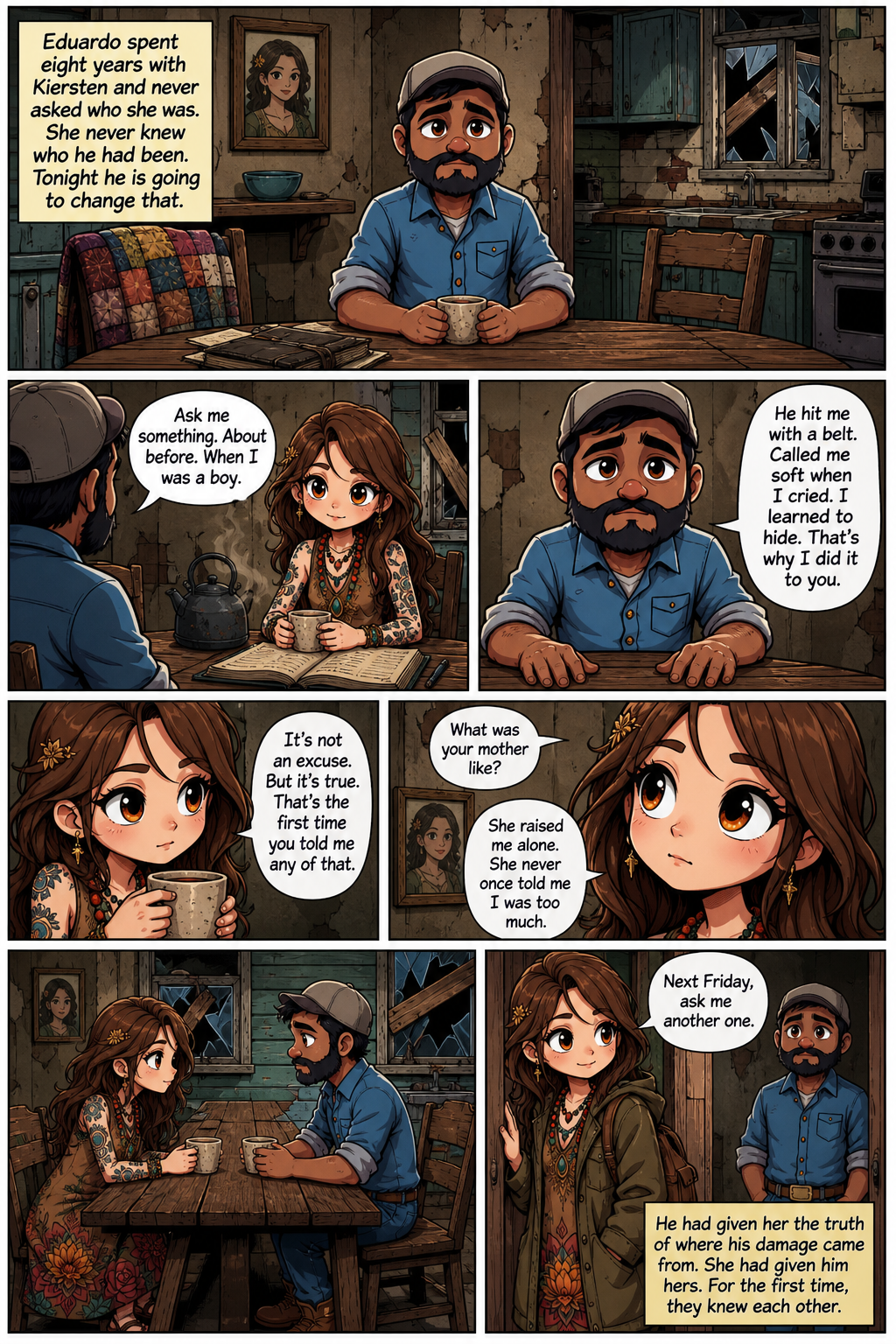
The photo of Kiersten's mother hung on the wall now. Her quilt lay over the chair. Her bowl sat on the shelf. The house held her things, but it did not hold her story. Eduardo knew where she set each object. He did not know the woman in the photo. He did not know the girl Kiersten had been. In all their years, he had never asked. He had never told her about himself either. Friday came. Kiersten arrived with the ledgers and her own kettle. She read the pages while her tea steeped. Eduardo watched her and understood what was missing. He had shown her every wrong he had done. He had never shown her where those wrongs came from. "Ask me something," he said. Kiersten looked up. "Ask you what." "About before. When I was a boy." His hands stayed still on the table. "You lived eight years with me. You don't know any of it." She set the ledger down. "You never told me." "I know." She studied him. Then she asked. "What was your father like." Eduardo did not build the answer to look good. "He hit me with a belt. He called me soft when I cried." He stopped. He let the plain words sit. "My parents fought every night. Nobody in that house said what they felt. I learned to hide." Kiersten did not soften. She did not fill the quiet. She let him finish. "That's why I did it to you," he said. "Needing you scared me. So I hurt you first. I know that's not an excuse." "It's not," she said. "But it's true." She drank from her cup. "That's the first time you told me any of that." Eduardo took a breath. He asked the thing he had never asked in eight years. "What about you? What was your mother like?" Kiersten's eyes went to the photo on the wall. For a moment she said nothing. Then she spoke, longer than her usual few words. "She raised me alone. She worked two jobs. She never once told me I was too much." She looked back at him. "When I met you, I thought you'd be like her. Safe." The words landed hard. Eduardo did not defend himself. "I wasn't." "No." She turned the cup in her hands. "But you're asking now." They sat together. She told him about the small house she grew up in. He told her about the fence, the closet, the belt he had burned. Two people trading stories, not accusations. When she stood to leave, she stopped at the door. "Next Friday," she said, "ask me another one." Eduardo nodded. She had not just brought her things into his house. She had brought her past into his. And he had given his in return. For the first time, they knew each other.
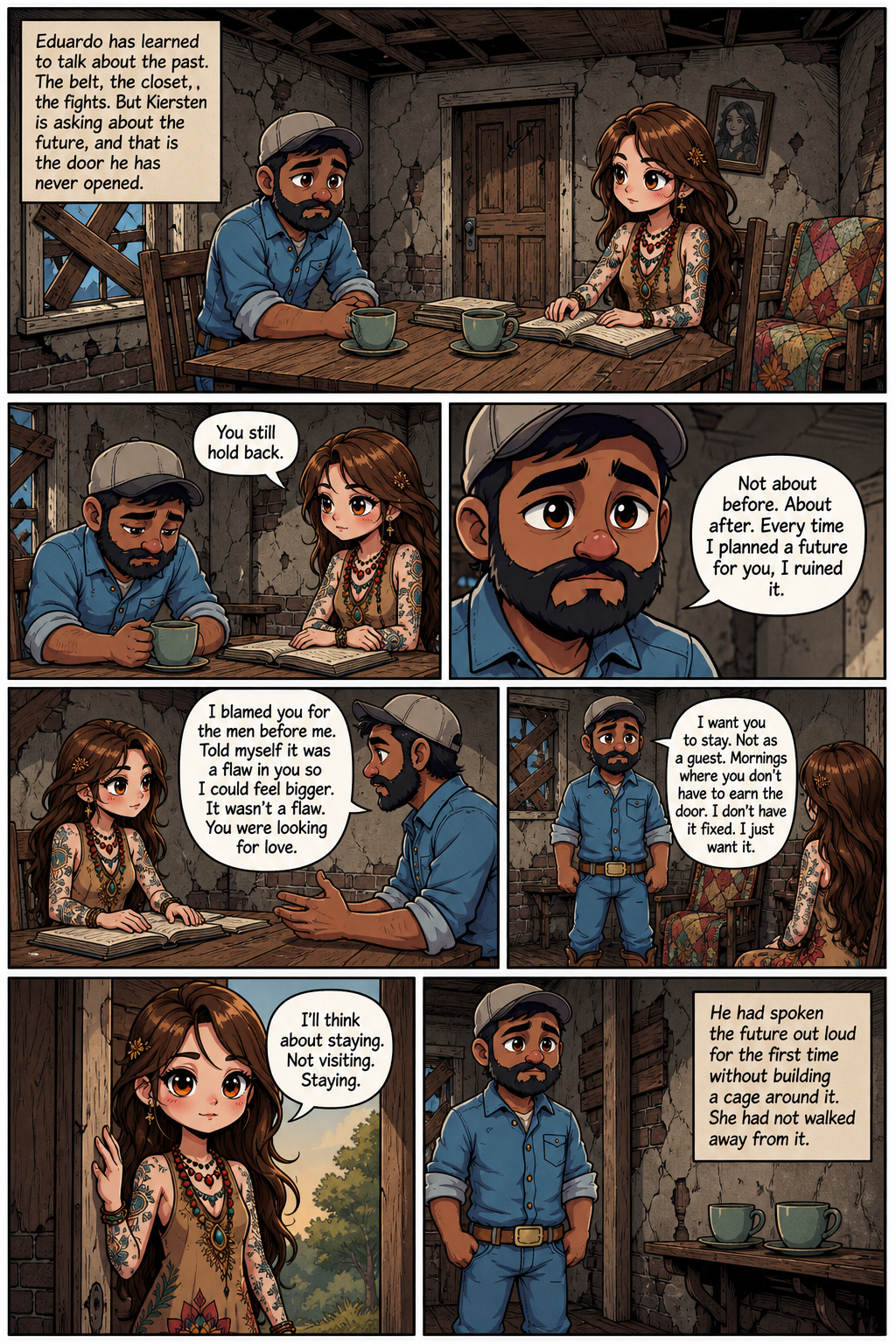
Eduardo had learned to speak about the past. He had told Kiersten about the belt, the closet, the fights. But Friday came again, and a harder question sat in him. He knew how to name what he had been. He did not know how to name what he wanted them to become. Every time he reached for the future, his mouth went dry. Kiersten arrived with her kettle and the ledgers. She read while her tea steeped. When she finished, she looked at him. "You said ask another one." Eduardo nodded. But the old fear rose. If he spoke about tomorrow, he might wreck it. So he said nothing. He turned his cup in his hands and looked at the floor. Kiersten watched the silence stretch. Her mouth tightened. "You still hold back." "I don't," he said. Then he stopped himself. That was a lie. "I do. Not about before. About after." "After what." "This." He raised his eyes. "You here. Me here. I don't know how to say what I want it to look like. Every time I planned a future for you, I ruined it." She set the cup down. "So you say nothing. And I sit here wondering if you're done or just quiet." That landed. She had felt an ending coming, the way she always did, because he had gone still. His silence read as a wall. He had built enough of those to know. "There's a thing I never told you," he said. "When we were together, I blamed you for the men before me. I said you gave yourself to people who didn't deserve it. Like it was a flaw in you." Kiersten went very still. "You did." "It wasn't a flaw." His voice held steady. "You were kind. You were looking for love. You couldn't say no to people who took it. That's not the same as being loose. I told myself it was, so I could feel bigger than you." She did not soften. But her shoulders dropped an inch. "That's what it always was. I wanted to be loved. Not used." "I know that now." She turned the cup once. "Then say the future. Plain. No plan you make for me." Eduardo breathed. He looked at the walls, at her mother's photo, at her quilt on the chair. "I want you to stay. Not as a guest. As someone who lives here. I want mornings where you don't have to earn the door." His hands shook. He let them. "That's all I've got. I don't have it fixed. I just want it." The quiet came back. This time it did not feel like a wall. "That's the first future you've handed me without a leash on it," she said. She stood. At the door she stopped. "I'll think about staying. Not visiting. Staying." She left. Eduardo sat with the two cups on the shelf. He had finally spoken the future out loud, and she had not walked away from it.
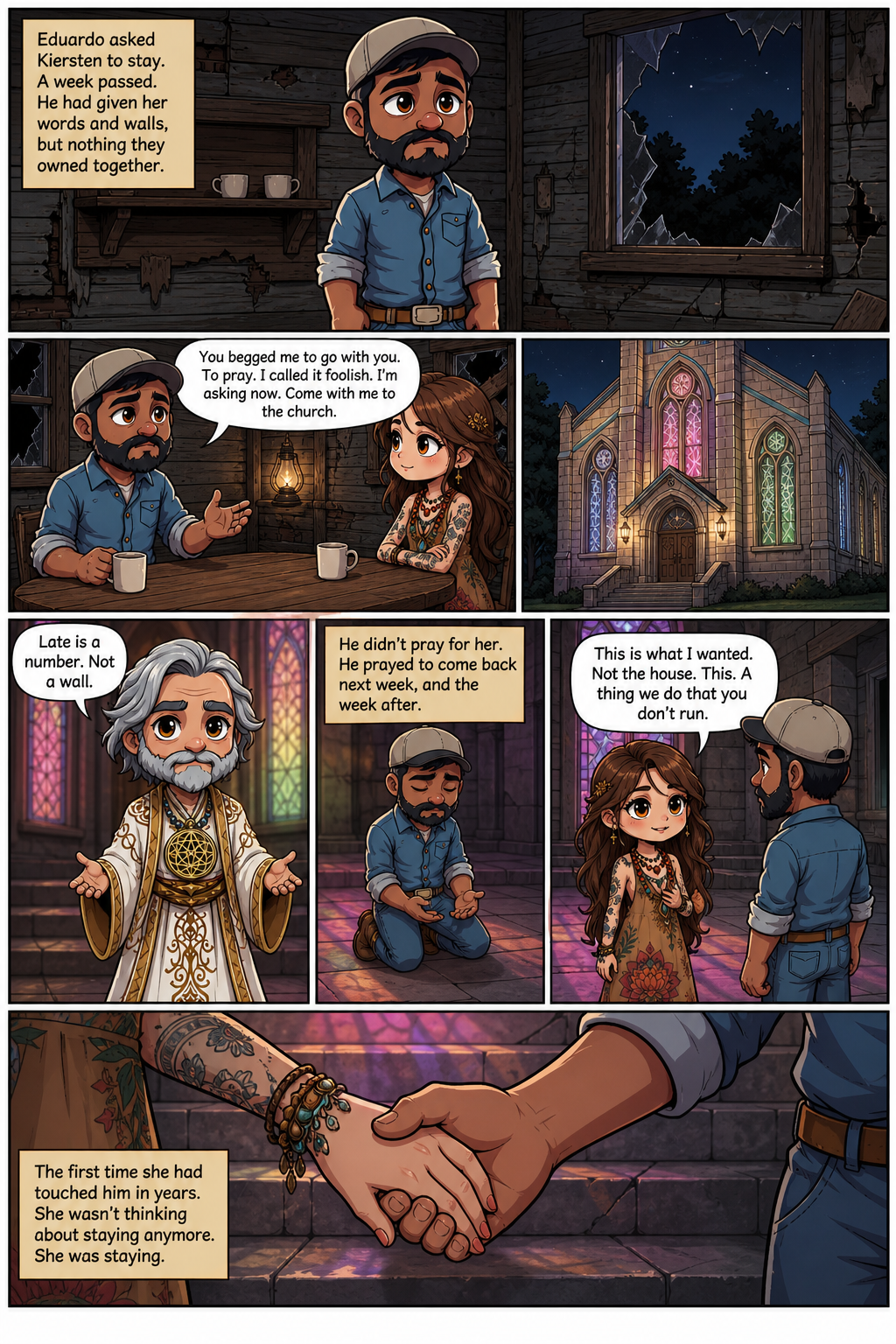
Kiersten said she would think about staying. A week passed. Eduardo kept the two cups on the shelf and worked his hours. But at night the doubt gnawed him. He had given her words. He had given her a house. He had nothing they did each day together, no fixed thing that belonged to them both. Words could be taken back. He needed something she could count on. Friday she came with her kettle. She read the ledgers, then looked at him. "You're quiet again." "I'm not hiding," he said. "I'm scared. I asked you to stay. But staying needs more than my promise. You used to ask me for one thing, over and over. I never gave it." Her face did not change. "God." "You begged me to go with you. To pray. I called it foolish. I wanted to feel bigger than you." He set his cup down. "I'm asking now. Come with me to the church. Not to fix us. To do one thing together that isn't mine to control." She watched him a long moment. "You never wanted to understand why I needed it." "Then tell me on the way." She stood. "All right." They walked to the stone church with the tall windows. Colored light lay across the floor in circles and stars. A gray-haired priest met them at the front. He wore white robes and a golden pendant carved with lines like a web. This was Father, the man the town went to when they needed to face what they could not name. His eyes were tired and kind at once. "You came together," Father said. He did not ask a question. "She asked me for years," Eduardo said. "I'm here late." "Late is a number." Father looked at him. "Not a wall." He turned to Kiersten. "You feel endings before they come. You feel one here?" "No," she said. "That's why I'm scared." Father nodded. He led them to the front and had them kneel. "Pray for nothing you can hold," he told Eduardo. "Pray to keep coming back." Eduardo closed his eyes. He did not ask God for Kiersten. He asked to sit in this quiet again next week, and the week after. When he opened his eyes, Kiersten was watching him. "You didn't perform," she said. "No." Outside, on the church steps, she stopped him. "This is what I wanted. Not the house. This. A thing we do that you don't run." "Will you come back next Sunday?" "Yes." She held his eyes. "And I'm staying, Eduardo. Not thinking about it. Staying." His chest went loose. She had chosen. Not for the words, not for the walls, but for the one small thing they would now do together, again and again. "Then Sunday," he said. She took his hand on the steps. It was the first time she had touched him in years.
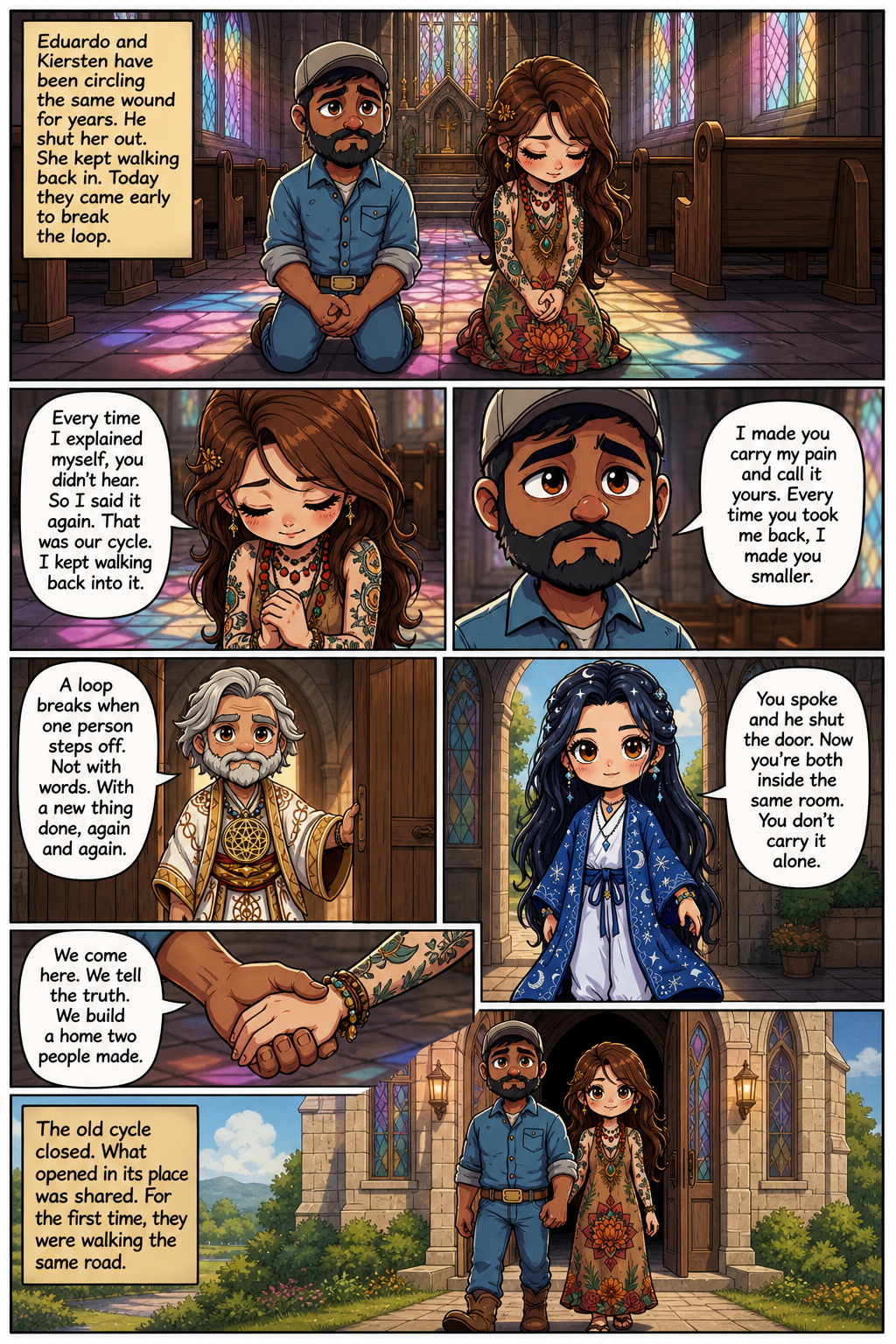
Sunday came again, then the one after. Eduardo and Kiersten kept walking to the stone church together. But now something else followed them home. Small things lined up. He would think of her mother, and Kiersten would say the woman's name in the same breath. A hawk crossed the road twice on the same walk. Eduardo did not know what to make of it. He asked Kiersten to come to the church early, before Father's service, so they could sit and try to understand. They knelt in the colored light. Kiersten spoke first, plain as always. "We keep landing in the same place. You hurt me. I explained myself. I hoped that if I said it right, you'd finally hear. You never did. So I said it again." She looked at the stars on the floor. "That was our cycle. I kept walking back into it." Eduardo felt the old shame rise. He did not run from it. "I know the loop. I made you carry my pain and call it yours. Every time you took me back, I made you smaller." His voice caught. "I don't want that loop. I don't know how to leave it." Father came in from the side door. He wore his white robes, the golden pendant carved with web lines against his chest. He did not ask what troubled them. "You feel the pattern," he said. "Both of you. You circle the same wound." He sat near them. "A loop breaks when one person steps off. Not with words. With a new thing done, again and again." Kiersten turned to Eduardo. "That's what scares me. I feel endings. I always have. I don't feel one now. I feel something I never felt with you. A new track." Dreamer stood in the doorway. She had come for the service. She was the town's dream reader, quiet, and she saw who a story left out. She spoke without stepping closer. "The old loop kept one of you out. You spoke and he shut the door. Now you're both inside the same room." She looked at Kiersten. "That's the new dream. You don't carry it alone." Eduardo took Kiersten's hand, the way she had taken his on the steps. "I hear you now. Not to end it. To share it." Father nodded once. "Then name the new cycle. Say what you do together." "We come here," Kiersten said. "We pray. We tell the truth on Fridays. We build a home two people made." "Every week," Eduardo added. "Not to fix. To return." Something settled in the room. The old cycle, the one where she begged and he refused, closed like a spent thing. A new one opened in its place, shared between them. They stood together and walked out into the morning. The synchronicities no longer felt like a warning. They felt like proof they were finally walking the same road.
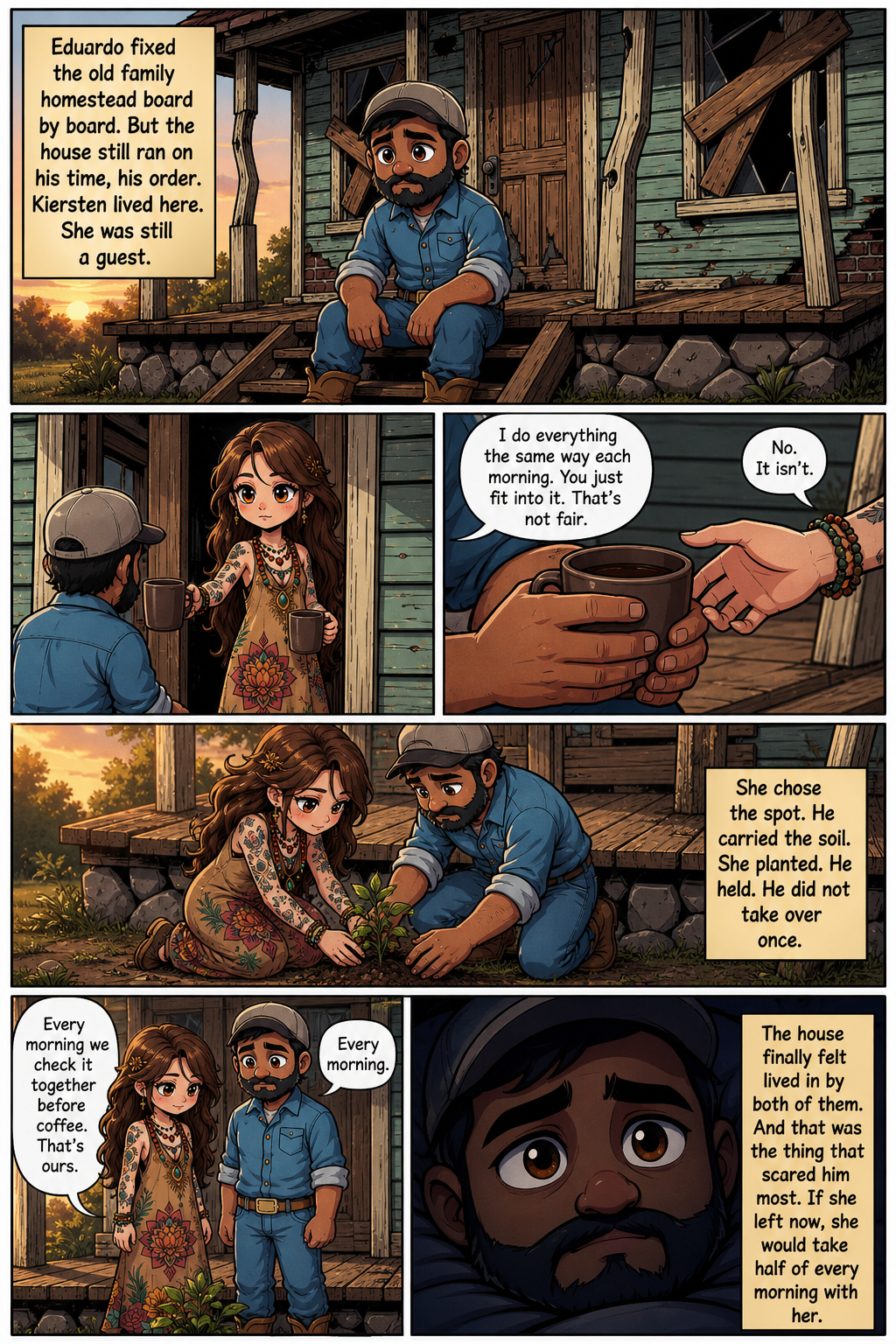
The new cycle held for a week. Then Eduardo woke before dawn and felt the house go quiet in a wrong way. Kiersten slept in the next room. Her box of things sat on the shelf. Her mother's photo hung at her eye level. Everything of hers had a place. But the house still ran on his time, his coffee, his order. She lived here now, yet the days belonged to him. She was a guest inside his rhythm. He sat on the porch steps and looked at the boards he had rebuilt. He remembered how the place looked eight years ago, before he left it. Sagging roof. Cracked walls. Windows boarded with scrap. A broken home. He had fixed the wood. He had not made it a shared thing. Two histories lived under one roof, but no daily habit tied them together. Kiersten came out with two cups. She handed him one without a word. He took it. "I do everything the same way each morning," he said. "You just fit into it. That's not fair." She drank. "No. It isn't." "I don't know how to build a day two people make." She set her cup down on the step. "Then we make one small thing that's both of ours. Today." He waited for her to name it. He did not steer her. That was the new track. "The porch," she said. "You built it back alone. I want to plant something at the edge. Where we both see it every morning." He almost said he would dig the hole for her. He stopped. "Tell me what to do," he said instead. "You lead it." They worked together through the morning. She chose the spot. He carried the soil where she pointed. She loosened the roots. He held the plant while she pressed the dirt firm. He did not fix her placement. He did not take the task over. When she asked for water, he brought it, and she poured it, not him. They stood back and looked. A small green thing grew where the broken porch had once sagged and rotted. It was hers and his both. Neither had made it alone. "Every morning," Kiersten said. "We check it together before coffee. Water it. That's ours." "Every morning," he agreed. Something shifted in him. The house had held only their two pasts. Now it held one act they would repeat. A rhythm they built with four hands, not two. The home stopped feeling borrowed. It felt lived in, by both of them. That night, lying in the dark, Eduardo felt the new weight of it. A shared day meant a shared future. He had spent his life fearing that a woman he needed could leave and unmake him. Now their days were braided. If she left, she would take half of every morning. The fear he thought he had buried stirred again, sharper than before.
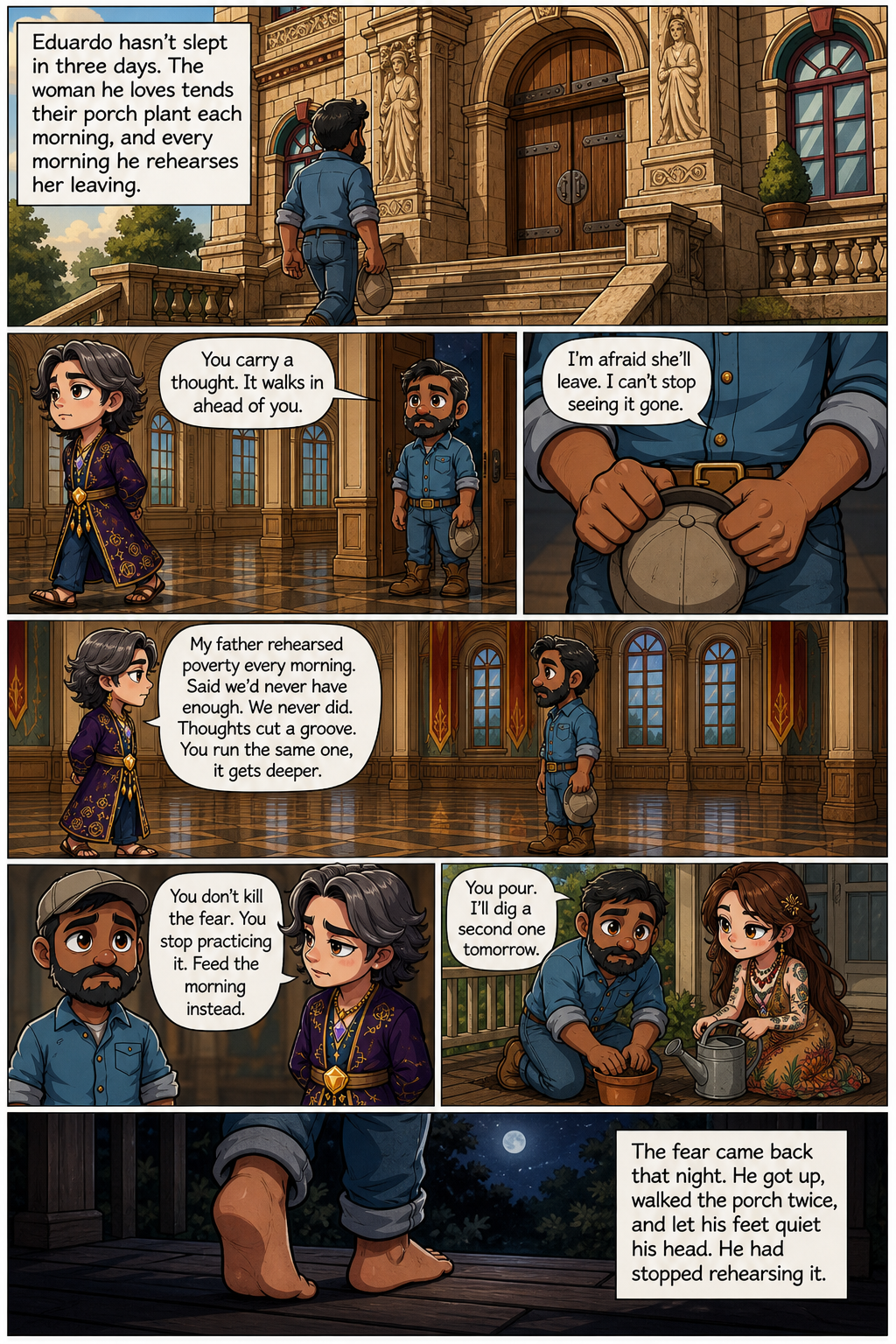
The fear rode with Eduardo for three days. Kiersten watered the porch plant each morning, and each morning he felt the ground tilt. If she left, she would take half of his day. He had run from that thought his whole life. Now he could not run. So he drove to a place he had never entered. People called the man there Festive. They said he knew the mind the way the old man knew feed. Eduardo had avoided him for a year. Today he stopped avoiding. The stone hall stood plain and solemn. Carved figures marched above the door. Eduardo climbed the steps and found Festive inside, walking slow circles across the floor, hands behind his back. A small man in a dark robe. He did not stop walking when Eduardo entered. "You carry a thought," Festive said. "It walks in ahead of you." Eduardo took off his cap. "I'm afraid she'll leave. We built one thing together. Now I can't stop seeing it gone." Festive kept circling. "You rehearse it. Every morning. You practice her leaving." "I don't mean to." "Doesn't matter." Festive stopped. His voice dropped, quieter and flat. "My father rehearsed poverty every morning. Said we'd never have enough. We never did. That was my teacher. Thoughts cut a groove. You run the same one, it gets deeper." Eduardo sat on a bench. "So I stop the thought." "You can't stop it by fighting it." Festive resumed walking. "You noise it out. You put attention somewhere else. Where attention goes, the groove grows. Feed the fear, it grows. Feed the morning, that grows." "The plant," Eduardo said. "The thing we planted." Festive nodded once. "You keep watching for her leaving. Watch what you're building instead. Same hands. Different groove." Eduardo looked at the carved figures over the door. Ordinary people at ordinary work. "When my mind still gets loud," Festive said, "I walk it off. Outside. Feet on ground." He said it like a fact, not advice. Eduardo stood. "That's it? Walk?" "That's it. You don't kill the fear. You stop practicing it." Festive turned away, done. His shoulders looked tired. Eduardo saw a man who had lost his own belief once and rebuilt it board by board, the way Eduardo had rebuilt his house. Eduardo drove home. Kiersten sat on the porch by the plant. He did not tell her about the fear this time. He knelt and checked the soil. Dry. He filled the can and handed it to her. "You pour," he said. "I'll dig the next one tomorrow. We'll add a second." Kiersten watched him. "You're steady today." "I'm choosing where I look," he said. That night the old fear stirred again. Eduardo felt it come. He did not lie there feeding it. He got up, walked the porch twice in the dark, and let his feet quiet his head. Then he slept. The fear had not left him. He had stopped rehearsing it.
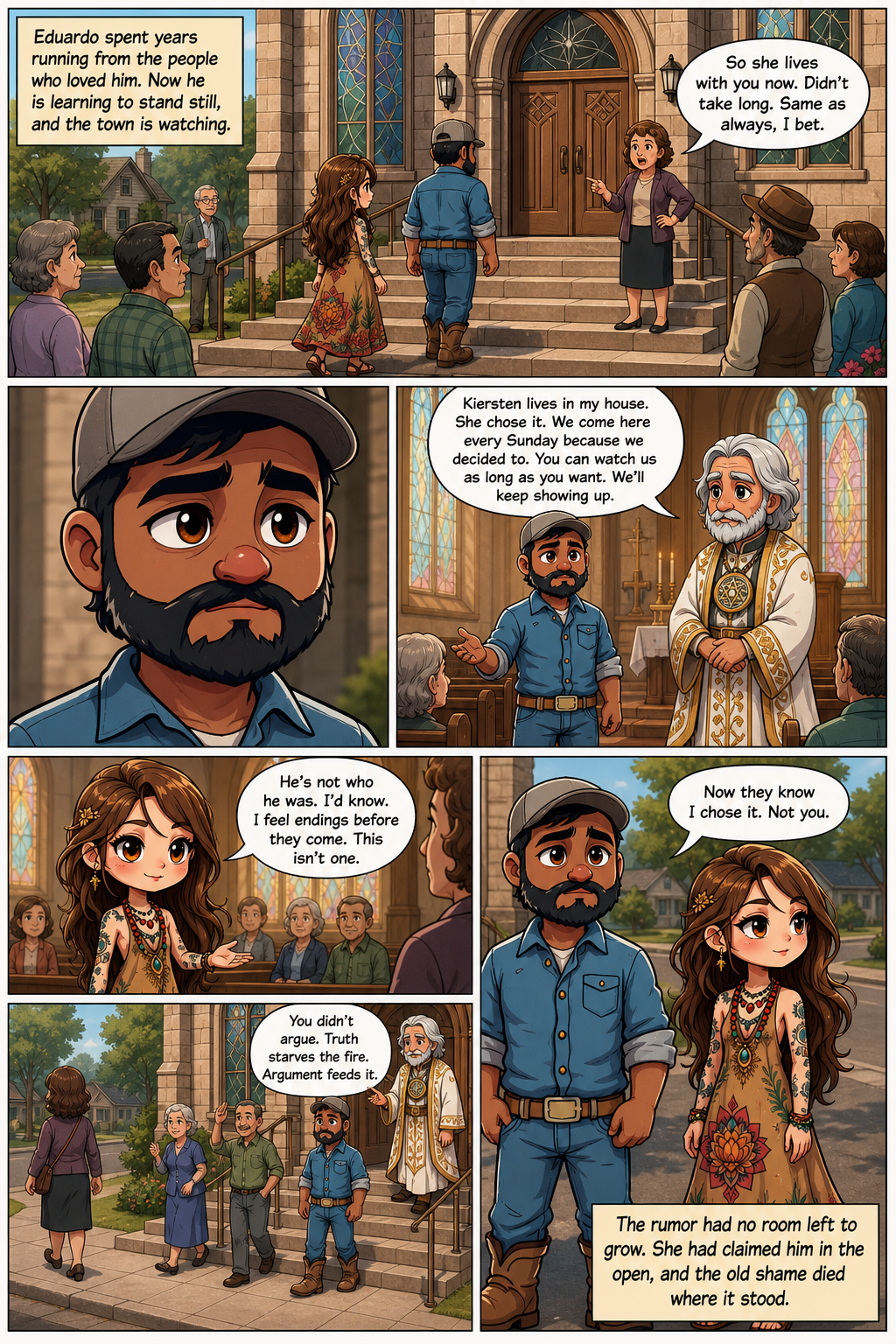
Eduardo had learned to walk off the fear. But a new weight landed on a Sunday. He and Kiersten climbed the steps of the town church together, same as every week. A neighbor stood near the doors, a man Eduardo barely knew. The man spoke loud enough for half the yard to hear. "So she lives with you now," he said. "Didn't take long. Same as always, I bet." A few heads turned. Eduardo felt the old heat rise in his chest. The old Eduardo would have swung or lied. He breathed. He looked at Kiersten. Her face stayed flat, but he saw her jaw tighten. The rumor was already moving. He could feel it spread through the quiet yard like water on dry wood. Inside, the colored windows threw patterns across the stone floor. Father waited near the front. Eduardo did not sit. He walked straight to the priest and told him what the neighbor had said. Father listened. He did not soften it. "You want to defend yourself," he said. "Don't. A man who explains looks like he has something to hide." "Then what?" Eduardo asked. "Tell the truth plainly. Once. Then let it stand." Eduardo turned to the room. People had filed into the pews. He did not climb anything or raise his hands. He just spoke where he stood. "Kiersten lives in my house," he said. "She chose it. We come here every Sunday because we decided to. That's all it is." He looked at the neighbor. "You can watch us as long as you want. We'll keep showing up." The neighbor shifted in his seat and said nothing. Kiersten walked up beside Eduardo. She did not take his hand. She looked at the man who had spoken. "He's not who he was," she said. "I'd know. I feel endings before they come. This isn't one." Two plain sentences. She stopped. The room went still. After the service, people filed out slow. A few nodded at Eduardo as they passed. The neighbor left without looking at either of them. Eduardo stood on the steps and felt something settle. The rumor had not grown. It had met the truth and died there in the open. Father came out last. "You didn't argue," he said. "Good. Argument feeds the fire. Truth starves it." Eduardo put his cap back on. "It cost me nothing," he said. "I just said what was." Kiersten waited at the bottom of the steps. For the first time, she had spoken for him in front of the town, not behind a closed door. On the drive home she was quiet. Then she said, "They'll keep watching." "Let them," Eduardo said. She nodded. "Good." She looked out the window. "Now they know I chose it. Not you." That was new. The town had seen her claim him by choice. The old shame had no room left to grow.
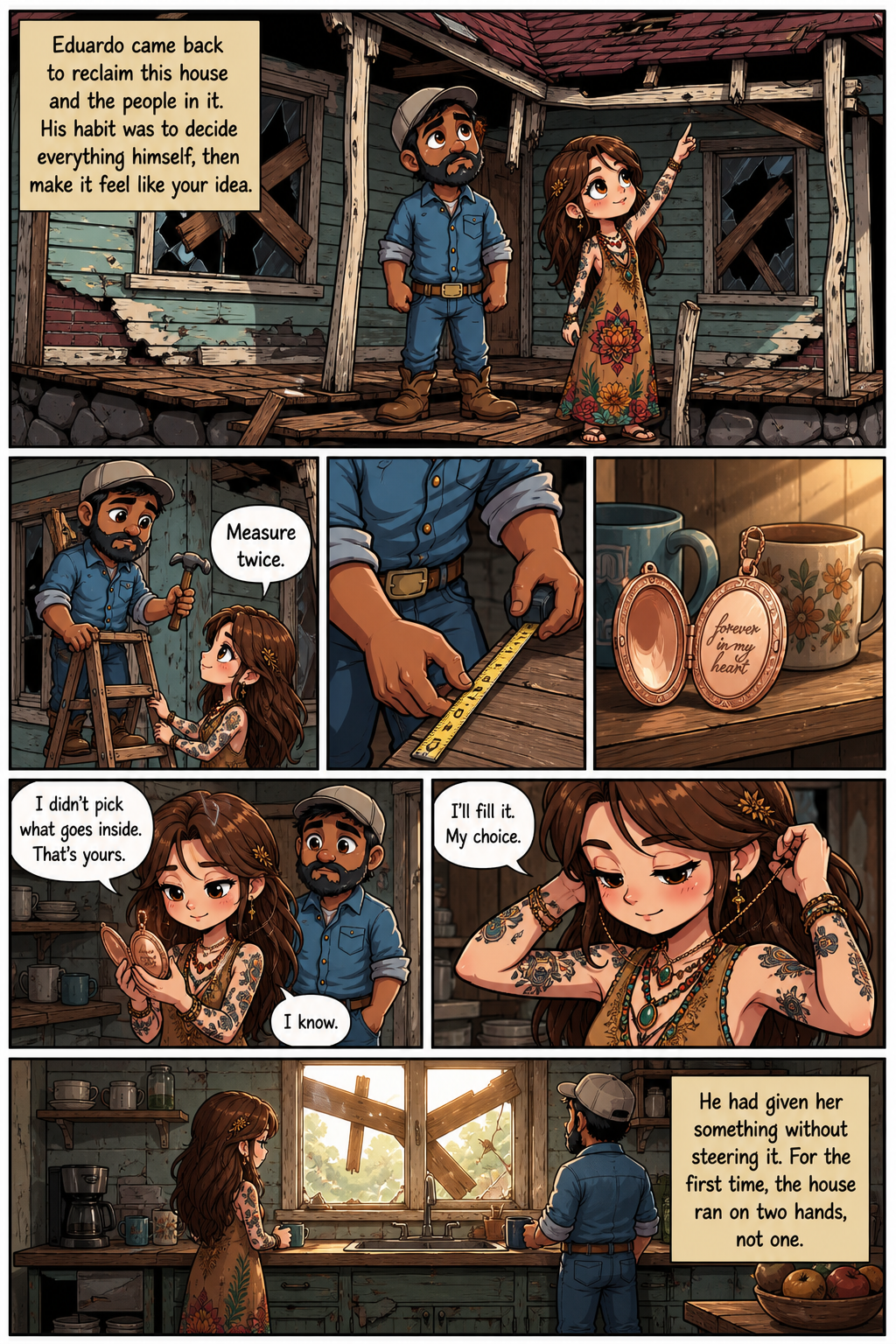
After church, Kiersten brought up the roof. They sat on the porch of the old house, and she pointed at the sagging shingles over the kitchen. "That corner leaks again," she said. "We should patch it this week." Eduardo already had a plan. He'd replace the whole section, strip it to the beams, do it right. He opened his mouth to say so. Then he stopped. He heard himself about to decide for both of them, the way he always had. "What do you want to do?" he asked. She looked at him like she was testing the words. "Patch it. We don't have money for the whole roof. Not yet." The old Eduardo would have pushed. He would have made his plan sound like her plan. He felt the pull. He breathed and let it go. "Okay," he said. "We patch it. Show me where." They worked the rest of the afternoon. She held the ladder. He cut the tar paper. When he reached for the hammer, she said, "Measure twice." He did. He didn't argue that he knew how. He just measured twice. It felt strange. Smaller. He was not the man with the plan. He was half of two people fixing a roof. The leak got patched. The corner held. That night, after she slept, Eduardo pulled a small box from his jacket. Inside sat a rose gold locket. The front read "forever in my heart" in curved script. He had bought it weeks ago and hidden it. He remembered the first years. Kiersten had wanted a necklace once. Something small, something that was just from him. He had told her it was a waste. He had made her feel foolish for asking. She stopped asking after that. He could have handed it to her today, after the roof. Made it a reward. Made it his gesture, his moment. He knew that trick now. That was the old way, turning a gift into a stage. So he waited. In the morning, Kiersten found the locket on the shelf, next to the two cups. No bow. No note explaining himself. Just the locket, open, empty, waiting for her to fill it. She picked it up. She read the words. Her thumb moved over the engraving. "When did you get this?" she asked. "A while ago," Eduardo said. "I was waiting." "For what?" "For it to mean something. Not to win anything." She was quiet. She turned the locket in her hand. Then she said, "It's empty." "I know. I didn't pick what goes inside. That's yours." Kiersten closed her fingers around it. For a long moment she didn't speak. Then she fastened the chain behind her neck herself. "I'll fill it," she said. "My choice." Eduardo nodded. He had given her something without steering it. The gift was hers to shape. For the first time, the house felt like it ran on two hands, not one.
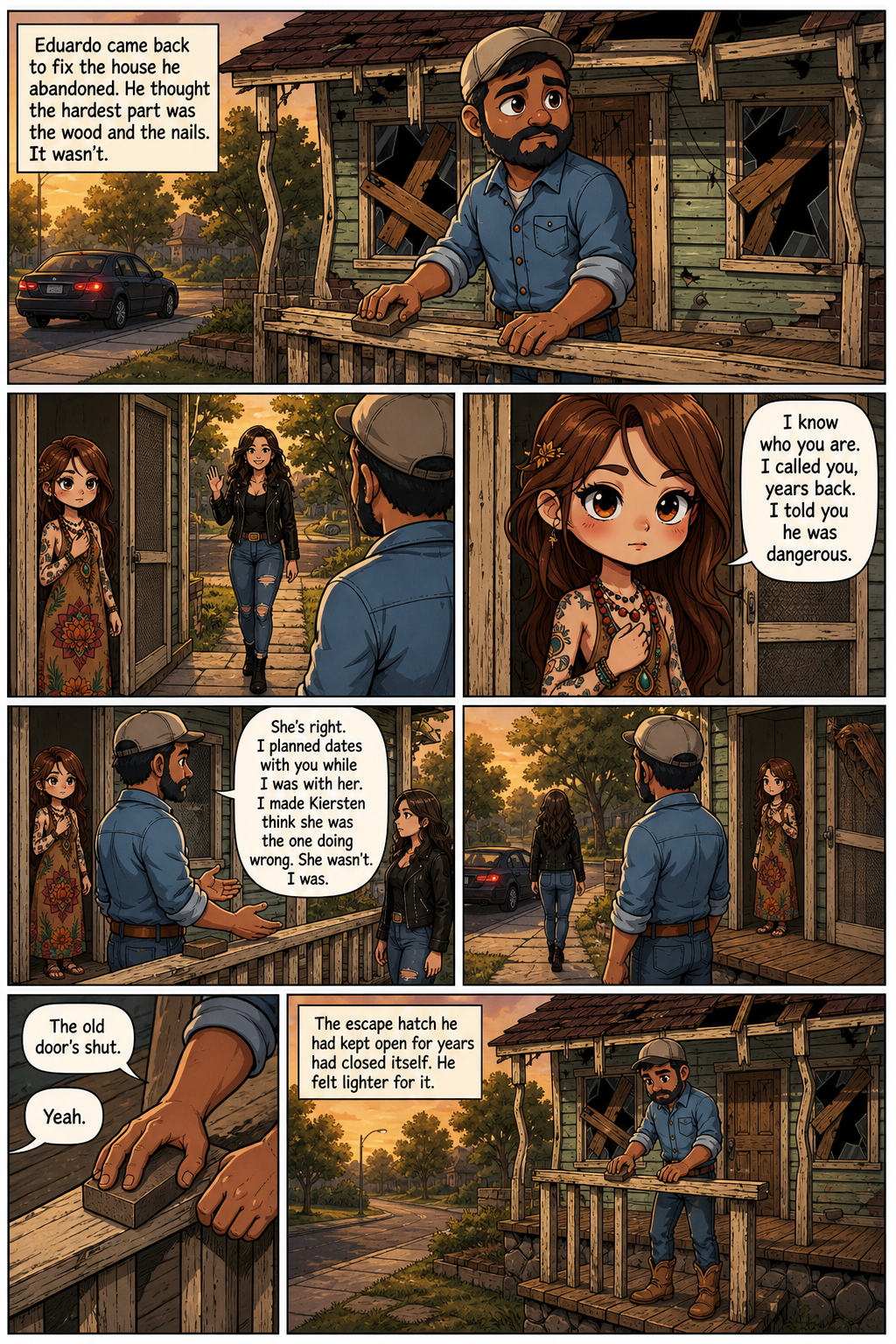
A week after Kiersten fastened the locket, a car slowed on the road by the old house. Eduardo was on the porch, sanding the rail. He knew the engine. He knew the woman who stepped out before she waved. Aurora. He hadn't seen her in years. His stomach dropped the way it used to when a bluff got called. Aurora came up the walk smiling, like no time had passed. "I missed you," she said. "I heard you fixed the place up. I thought I'd come see for myself." The old Eduardo would have let that smile in. He had planned dates with Aurora once, back when he was still with Kiersten. He had used Aurora's name as a threat, telling Kiersten he could leave for her anytime. He had accused Kiersten of cheating while he was the one lining up a door to walk through. That lie had broken Kiersten more than any fight. The screen door opened. Kiersten stepped out, one hand on the locket at her neck. She looked at Aurora, then at Eduardo. She didn't flinch. "I know who you are," she said to Aurora. "I called you. Years back. I told you he was dangerous." Eduardo felt the pull to smooth it over, to charm them both. He breathed it down. He set the sanding block on the rail. "She's right," he said. "I used you, Aurora. I planned dates with you while I was with her. I wasn't honest with either of you. I made Kiersten think she was the one doing wrong. She wasn't. I was." Aurora's smile fell. "You never told me you were with someone." "No," Eduardo said. "I didn't. That was mine, not yours." He waited for the old hurt to rise, the need to win, the itch to make one of them pick him. It didn't come the way it used to. He just stood there, plain, the truth said once and left standing. Aurora looked at Kiersten. "He really told you all that." "Every Friday," Kiersten said. "He writes it down. I read it." Aurora was quiet. Then she nodded, slow. "Okay." She turned and walked back to her car. She didn't slam the door. She just drove away. Eduardo stood on the porch and found his hands steady. The woman who had once been his escape hatch was gone, and he hadn't reached for her. Kiersten came and stood beside him. She looked down the empty road. "You didn't lie," she said. "No." "And you didn't make her stay to feel wanted." "No." She was quiet a moment. Then she said, "The old door's shut." She put her hand on his arm, just for a second, then went back inside to the kettle. Eduardo picked up the sanding block and kept working the rail. The escape hatch he had kept open for years had closed itself, and he felt lighter for it.
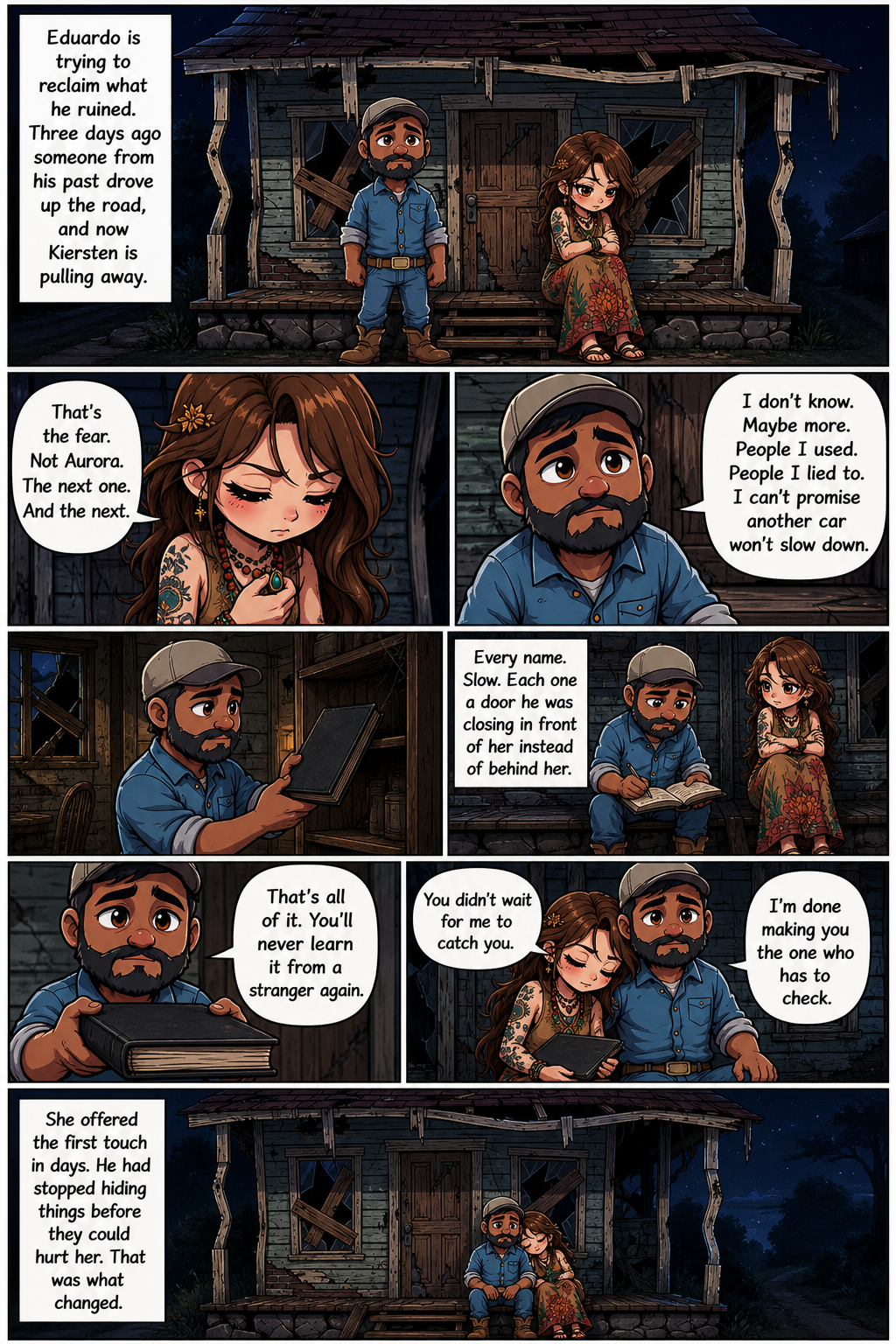
Three days after Aurora drove off, Kiersten grew quiet. She still made the tea. She still read the Friday ledger. But something in her had pulled back, like a hand lifted off a rail. Eduardo noticed it over supper. She answered his questions with one word and looked at the door more than at him. That night she sat on the porch steps. The old house loomed behind her, its sagging roof and cracked walls patched but still weary. Eduardo came and stood near her, not too close. "You've gone somewhere," he said. "Aurora was one," Kiersten said. She didn't look up. "How many more are there?" The old Eduardo would have said none and smiled. He felt the lie rise and let it pass. "I don't know," he said. "Maybe more. People I used. People I lied to. I can't promise another car won't slow down." Kiersten's jaw tightened. "That's the fear. Not Aurora. The next one. And the next." She wrapped her hand around the locket. "I cried a whole night once. In the bathtub. Missing you. I knew the cycle. I knew I couldn't keep letting you cut me." Eduardo sat down on the step below her. "Tell me the rest." "I prayed that night," she said. "Not to you. To the man under you. The one you keep buried. I asked him to hear me." She finally looked at him. "I don't know if he did." Eduardo's throat went thick. He had spent years making her carry his lies. He would not make her carry the not-knowing too. "He heard you," he said. "I can't prove that with words. So I'll do this." He went inside and came back with the dark ledger, the one holding his worst confessions. He opened it on his knee. "Every name I can remember, I'll write here. Not when one shows up. Now. Before they come. So nothing arrives and surprises you." Kiersten watched his pen move. He wrote slow. Each name was a door he was closing in front of her instead of behind her. He did not soften them. He did not explain them away. When he finished, he handed her the book. "That's all of it. If I remember more, it goes in the same day. You'll never learn it from a stranger again." She read the page twice. Her shoulders came down. "You didn't wait for me to catch you." "No," Eduardo said. "I'm done making you the one who has to check." Kiersten closed the ledger and set it on her lap. The pulled-back thing in her settled. "Then I'm not scared of the road," she said. "I'm scared of silence. You just broke it." She leaned her shoulder against his, the first touch she'd offered in days. The weary house stood over them, patched and holding. Eduardo breathed. The fear that she would erode had an answer now, and the answer was telling her first.
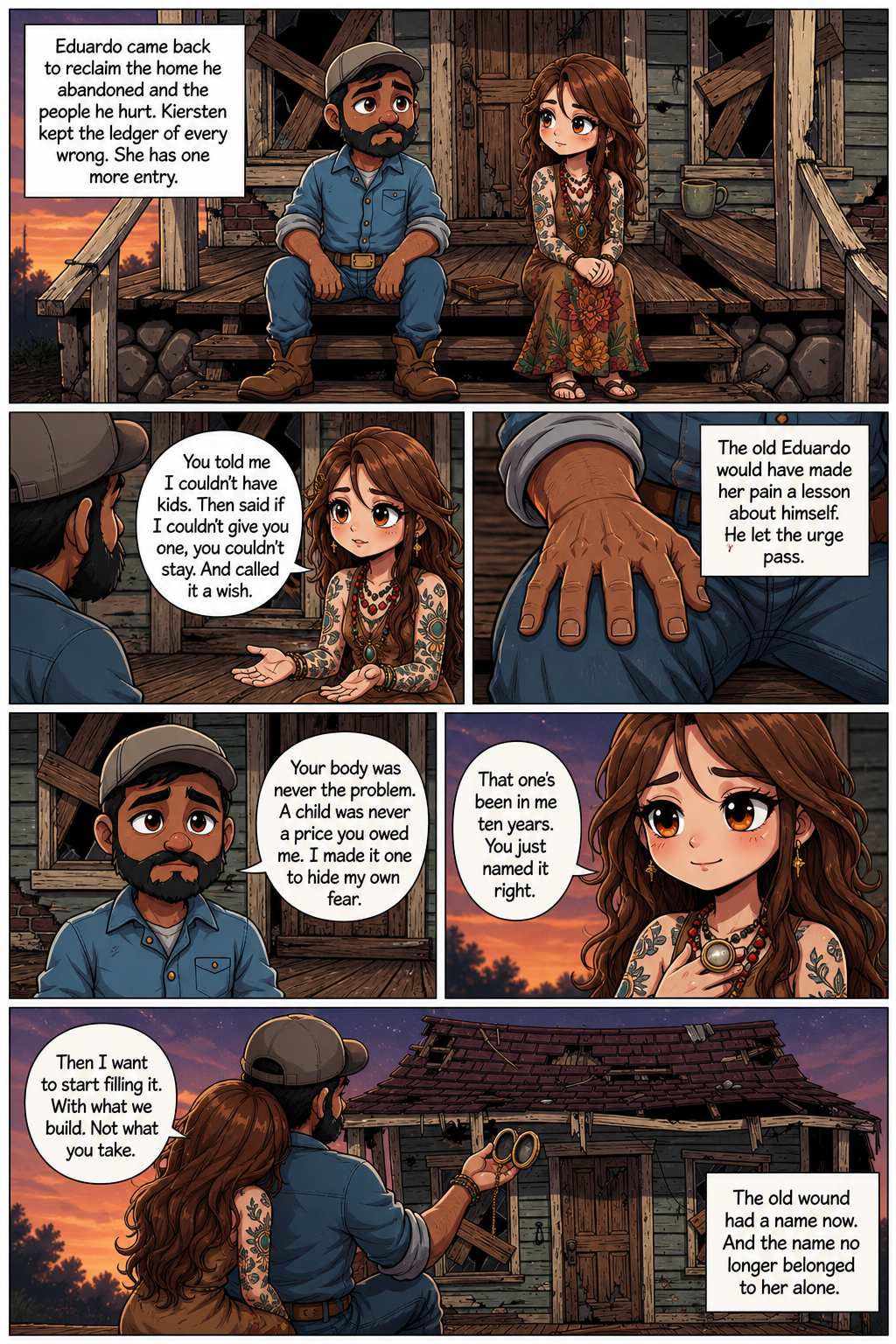
The next Friday, Kiersten read the ledger as always. But when she set it down, she did not reach for her tea. She sat still on the porch step of the weary house, hands folded in her lap. Eduardo saw the quiet in her was a different quiet. Not the pulled-back fear from before. This was something older, buried deeper. "There's one you never wrote down," she said. "Because you did it to me and called it a wish." Eduardo set his cup on the sagging rail. "Tell me." "The night you came back," she said. "I told you I couldn't trust you with my safety. So how could I trust you with a child's?" Her voice stayed level. "You said I couldn't have kids anyway. Then you said you wanted one. And if I couldn't give you that, you couldn't be with me." The old shame rose in Eduardo like a tide. He remembered the words. He remembered watching them land. "I wanted a child too," Kiersten said. "More than you knew. You took the one thing that already hurt me and used it to measure my worth. You shamed my body and called it love." Eduardo wanted to explain. To say he had been afraid. The old Eduardo would have turned her pain into a lesson about himself. He pressed his hand flat against his knee and let the urge pass. "You're right," he said. "I knew it cut you. That's why I said it. I made your body into something you failed at, so I'd have power over you." Kiersten's jaw tightened. "I told you then. If you loved me, we'd work through it together. You heard that like a door closing." "I did," Eduardo said. "Because needing you with me, broken parts and all, scared me more than losing you. So I made it your fault instead." For a long moment she said nothing. A cracked window behind them caught the last of the light. Eduardo did not fill the silence. He had learned that much. Kiersten looked at him. "Say the true thing. Out loud. Once." Eduardo met her auburn eyes. "Your body was never the problem. You were never less because of it. A child was never a price you owed me. I made it one to hide my own fear." Her shoulders dropped. The buried thing came loose. She did not cry. She wrapped her hand around the locket at her throat. "That one's been in me ten years," she said. "You just named it right." "If a child comes, it comes to both of us," Eduardo said. "If it doesn't, you're still whole. I'll never weigh you by it again." Kiersten opened the locket. It was still empty. She looked at the small space inside, then at the patched house that now held them both. "Then I want to start filling it," she said. "With what we build. Not what you take." She leaned her shoulder against his. The old wound had a name now, and the name no longer belonged to her alone.
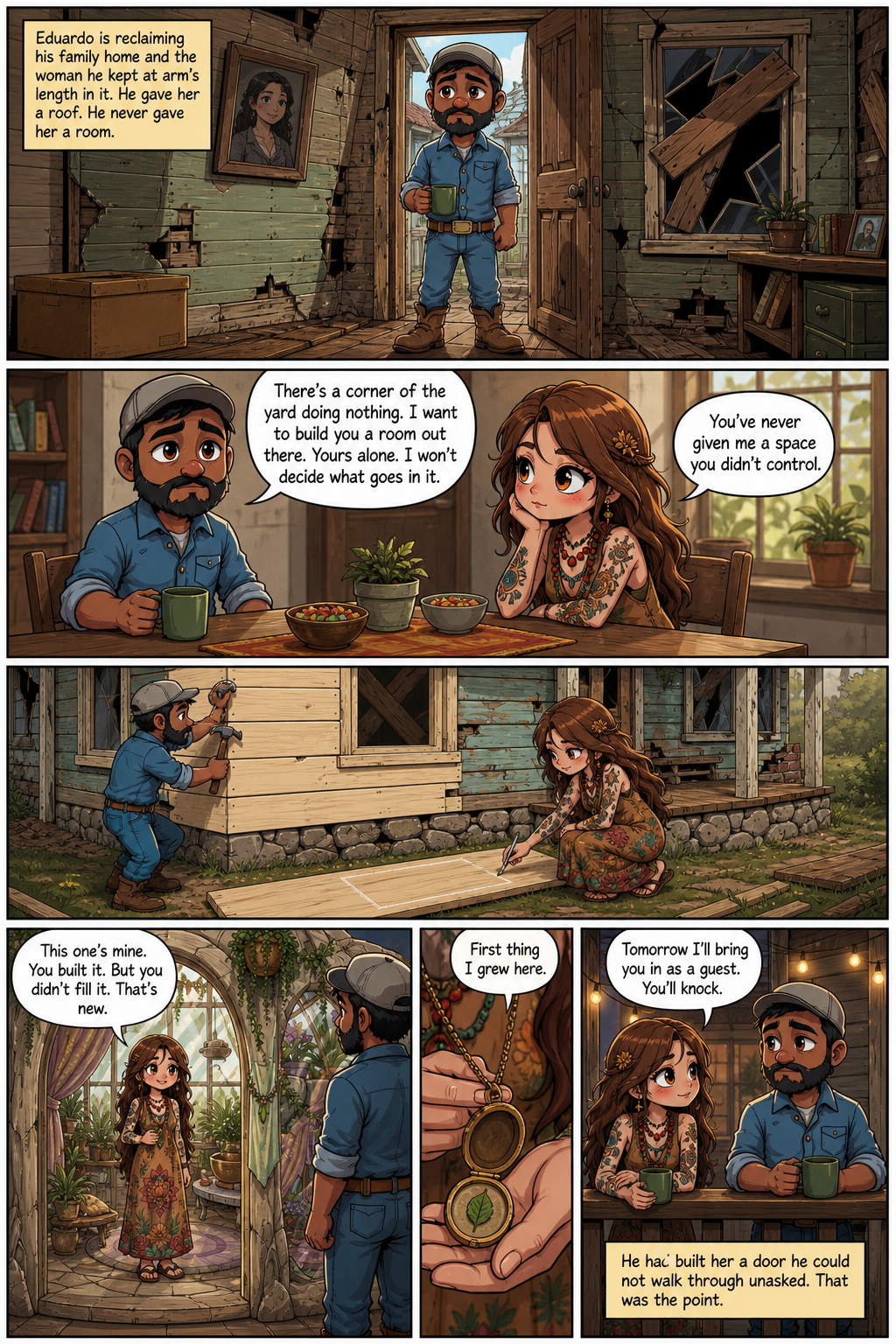
The next morning, Eduardo walked through the house and saw the truth. Her mother's photo hung on the wall. Her box sat in the corner. But every room was still shaped by him. Kiersten had filled her locket with what they would build. He had given her no place to build it. The house held them both, yet none of it was truly hers. At breakfast he set down his cup. "There's a corner of the yard doing nothing," he said. "I want to build you a room out there. Yours alone. Not ours. I won't decide what goes in it." Kiersten studied him. "You've never given me a space you didn't control." "I know," Eduardo said. "That's why I won't touch the inside. You fill it." She was quiet a moment. Then she said, "Build the walls. I'll tell you where the door goes." He worked for three days. He asked her where each wall should stand. He let her mark the window with chalk. When his old urge rose to make it grand, he split the board plainly and nailed it true. The small building took shape beside the weary house, its fresh wood bright against the sagging roof. On the fourth day Kiersten walked inside and stood in the empty room. Light came through the window she had placed. "I know what this is," she said. "A cave greenhouse. A place to sit and breathe. Where I paint and nothing's at stake." "Then make it that," Eduardo said. She brought in plants over the following week. She hung soft cloth. She set a cushion on the stone floor and left a brush and a bowl by the wall. She carried in a low pot and filled it with soil. Eduardo did not arrange a single thing. He only carried what she pointed to and set it where she said. When she finished, she stood in the doorway and looked back at him. "This one's mine," she said. "You built it. But you didn't fill it. That's new." "It was always meant to be yours," Eduardo said. Kiersten opened her locket. She tore a small green leaf from one of her new plants and pressed it flat inside. "First thing I grew here," she said. She closed the locket against her throat. Eduardo looked at the bright room beside his battered house. For the first time, the home held a place that was hers and not his. The vow in her locket had a room to grow in now. Kiersten stepped back out to the porch. She set two cups on the rail, one from his shelf, one from her new room. "Tomorrow I'll bring you in," she said. "As a guest. You'll knock." Eduardo nodded. He had built her a door he could not walk through unasked. That was the point.
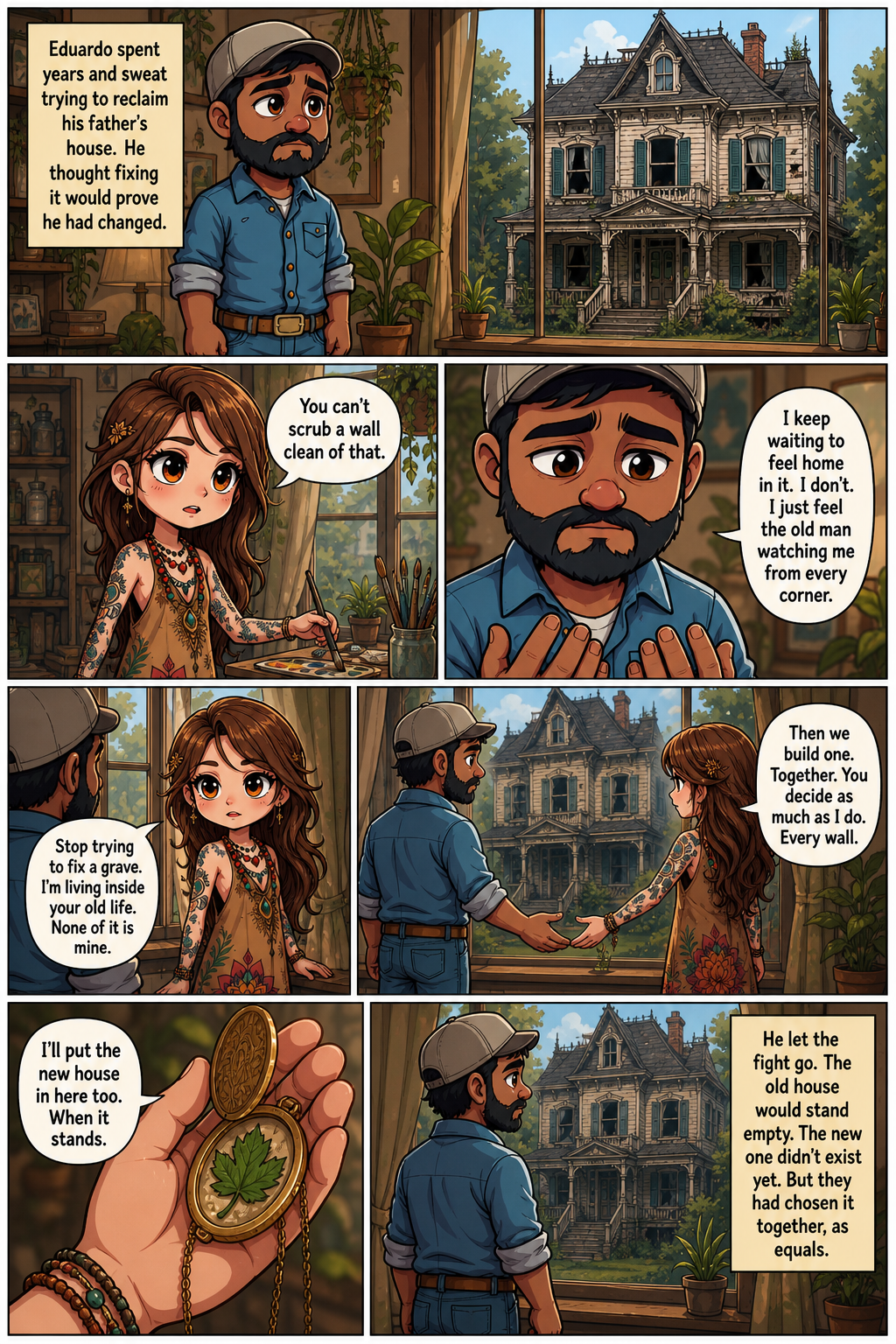
The next morning Eduardo knocked at the door of her room. She let him in as a guest. He sat on the stone floor and looked at the plants she had placed. Through the window he saw the old house beside it. The sagging roof. The porch where he had once sat alone with his rage. The bright new room only made the old house look worse. "This place still carries it," he said. "Every board. My father's belt was in that closet. The nights I drank. The things I said to you here." Kiersten set her brush down. "You can't scrub a wall clean of that." "No." He looked at his hands. "I keep waiting to feel home in it. I don't. I feel the old man watching me from every corner." She was quiet. Then she stood and walked to the window. "Then stop trying to fix a grave." "What do you mean?" "This house is yours. Your father's. Your running. Your shame." She turned to face him. "None of it is mine. I'm living inside your old life." Eduardo felt the familiar urge to defend the place. He had bled for it. Eight years away, then a year of nails and paint. He set the urge down. "You're right," he said. "I built the whole thing around what I was fixing. Not around us." "I don't want to patch your past," Kiersten said. "I want to build something that's ours from the ground." He stood slowly. The thought scared him more than any confession. Leaving the house meant leaving the proof of his change. "A new house," he said, testing the words. "Both of ours. Nothing of his in it." "A home we choose," she said. "Not one you're repairing to prove something." Eduardo walked to the window and stood beside her. He pictured a house with no closet of bottles. No porch soaked in old anger. A place where neither of them had to step around a memory. "I'd have to let this one go," he said. "The deed. The land I fought the county for." "You'd have to let the fight go," Kiersten said. "That's harder for you than the land." He knew she was right. He breathed. He chose. "Then we build one. Together. You decide as much as I do. Every wall." Kiersten opened her locket. The green leaf lay flat inside. "I'll put the new house in here too," she said. "When it stands." Eduardo looked at the old house one last time through her window. For years he had tried to make it a home. He saw now it could only be a monument. "I'll ask the town for help," he said. "And I'll ask you first what you want. Before I lift a single board." Kiersten took his hand. It was the first thing they had decided as equals. The old house would stand empty. The new one did not exist yet. But they had chosen it together.
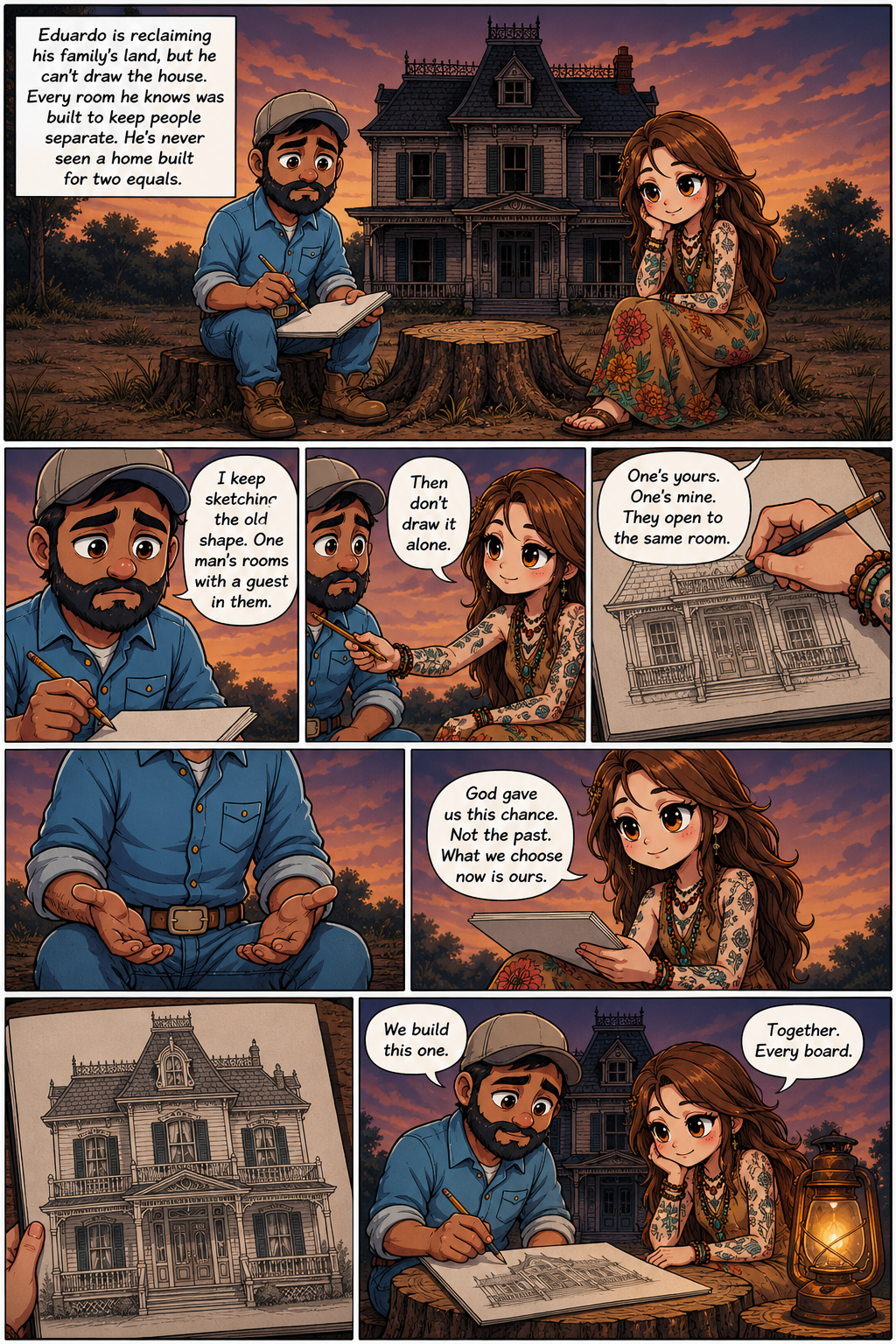
They cleared a flat spot of land the next week. Eduardo brought paper and a pencil. He had drawn houses before, but always alone, always his own. Now he stared at the blank sheet and felt his hand freeze. Every house he knew was his father's house. Rooms built to keep people apart. He had no picture of a home where two people stood level. "I don't know how to draw this," he said. "I keep sketching the old shape. One man's rooms with a guest in them." Kiersten sat beside him on a stump. "Then don't draw it alone." "I'll build the same thing I always build," he said. His voice went tight. "I don't know what a house for two equals looks like. I never saw one." She took the pencil from his hand. She did not argue. She drew a wide porch across the front. Two doors, side by side. "One's yours," she said. "One's mine. They open to the same room." Eduardo watched her draw. He felt the old pull to take the pencil back, to fix her lines, to decide. He set the pull down. He let her keep the pencil. "We're scared of the same thing," Kiersten said. She kept drawing. "You think you'll ruin it. I think it'll end before it starts." "Yes." "My mother had nothing. People took from her all her life. She still said grace over a near-empty plate." Kiersten looked up. "She was grateful before the good came. Not after." Eduardo was quiet. He thought of the belt he had burned. The bottles he had poured out. The years he spent proving he was no one's fool. "God gave us this chance," she said. "Not the past. Not what was done to us. This. What we choose now is ours." She drew tall windows with shutters. A second floor. A peaked roof with trim like lace. It was not a plain box to hide in. It was a house someone would build on purpose, out of love. "A Victorian," Eduardo said. He almost smiled. "That's a lot of house." "It's a vow," Kiersten said. "You said no part of your father in it. So we build something he never would." Eduardo took the pencil when she offered it. This time he did not seize it. He added a railing to the porch. He asked her first where it should turn. She told him. He drew it her way. They worked past dark. The drawing filled the page. A warm, tall house with two front doors and room for two voices. Not his pattern. Not a monument. A home they both could point to and say they made it. "We build this one," Eduardo said. "Together," Kiersten said. "Every board." He rolled the paper carefully. The old house still stood empty behind them. In front of them lay flat ground and a plan that belonged to them both. For the first time he knew what to build.
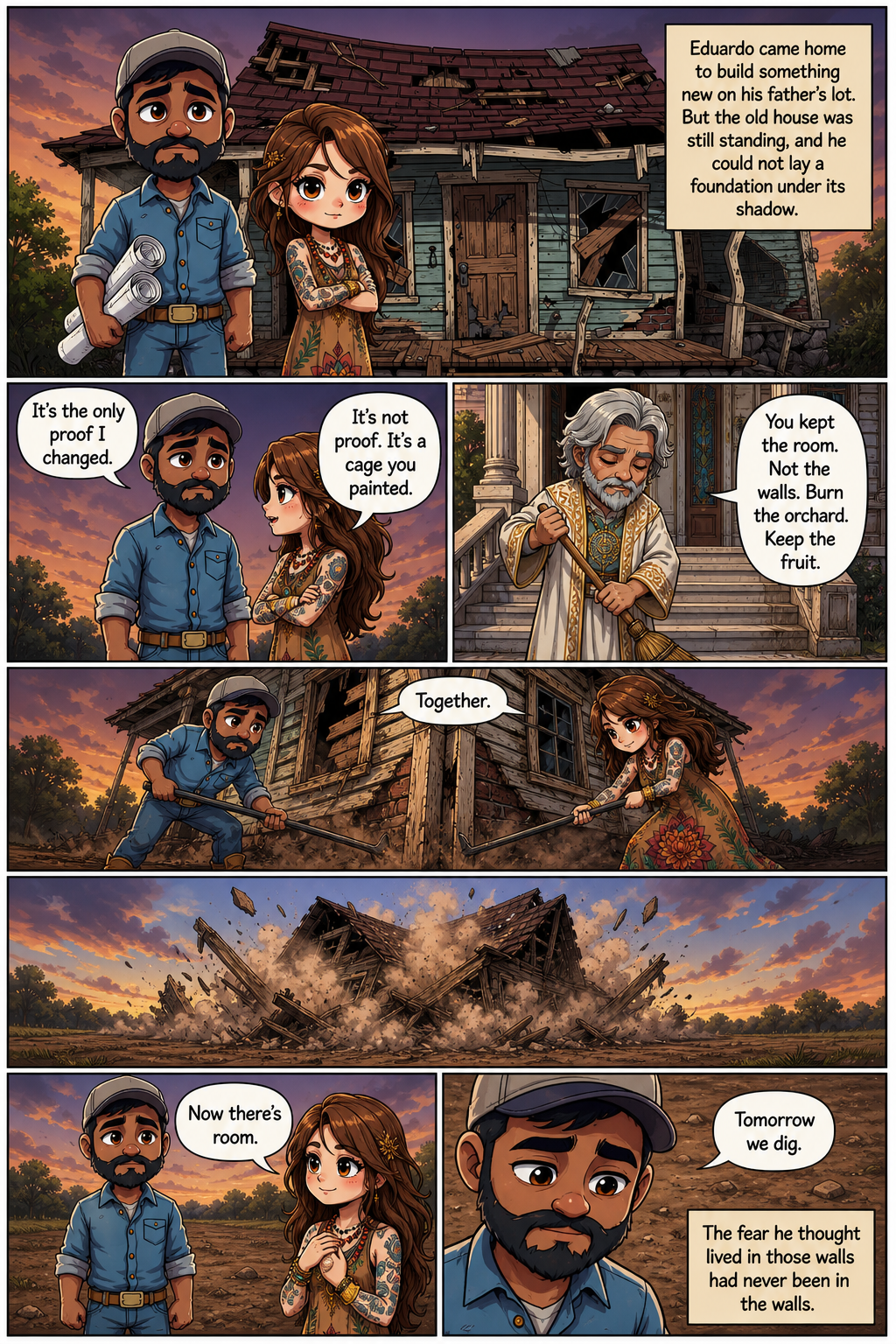
The next morning Eduardo walked the flat ground with the rolled plan under his arm. Then he stopped. The new house would stand on the same lot as his father's house. The old place still slumped behind him. Its roof sagged. Its windows held broken glass and crossed boards. He could not build a vow on this ground while that stood there, watching. "We can't start," he told Kiersten. "Not with it still up. It'll be in every window. In every board we nail." Kiersten looked at the broken house for a long time. "Then it has to come down." Eduardo felt his hands go cold. He had burned the belt inside it. He had poured out the bottles. He had learned to cry on its porch. Tearing it down felt like tearing out his own ribs. "I don't know if I can," he said. "It's the only proof I changed." "It's not proof," Kiersten said. "It's a cage you painted." He drove to the church to ask Father. The priest stood sweeping the step. He did not slow his broom. Eduardo told him he could not knock down the house that made him. Father stopped sweeping. "You kept the room," he said. "Not the walls. The walls were never the room." He went back to his step. "Burn the orchard. Keep the fruit." Eduardo drove home with those words. Kiersten waited by the old porch with a crowbar in each hand. She held one out. He took it. They started at the porch rail. Eduardo pulled the first board. It came away with a crack. He braced for the grief. It did not fall on him. The board was just wood. Gray, soft, done. They worked all day. Kiersten pried the broken windows loose. Eduardo pulled the door off its hinges, the same door his father had slammed a thousand times. He carried it to the burn pile without looking at it twice. By dusk the walls leaned. He set his shoulder to a corner post. Kiersten set hers beside him. "Together," she said. They pushed. The old house groaned, then folded in on itself in a cloud of dust. The roof came down last. When the dust cleared, the lot was open sky and flat dirt. Eduardo stood in the quiet. His father's house was gone. The fear he thought lived in those walls had not come out. It had never been in the walls. Kiersten touched the locket at her throat. "Now there's room," she said. Eduardo nodded. He looked at the bare ground where two front doors would stand. The old shape was gone for good. In the morning they would dig the footings for the new one. "Tomorrow we dig," he said. "Together," Kiersten said. "Every board."
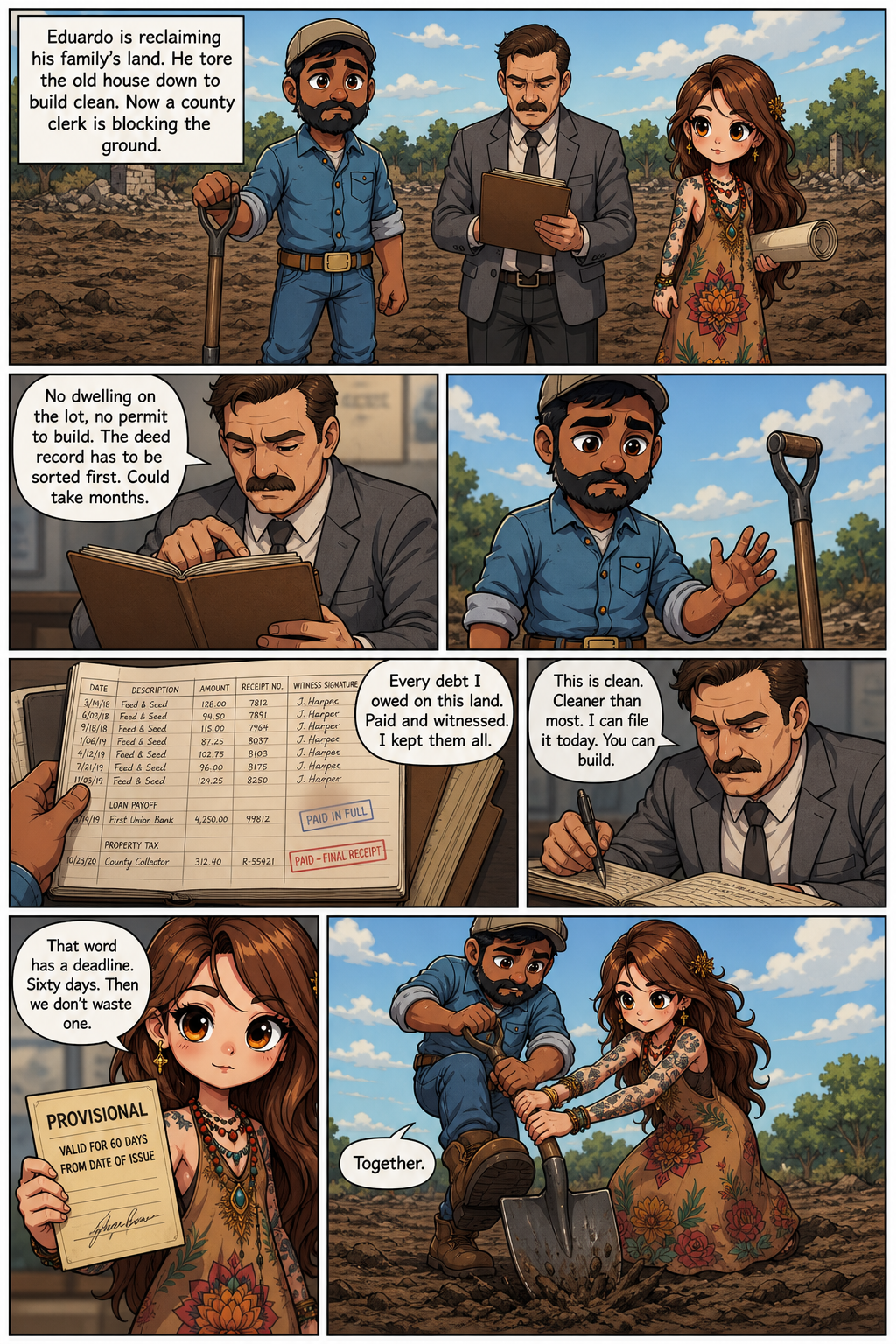
In the morning they went to dig the footings. Eduardo carried a shovel. Kiersten carried the rolled plan. But a man in a gray suit stood on the bare lot, holding a folder. He was the county clerk. He had come about the deed. "You tore the house down," the clerk said. He did not look up from his papers. "The deed lists a dwelling on this lot. No dwelling now. You can't build a new one until the record is sorted. Could take months." He tapped the folder. "Until then, this is just empty land." Eduardo felt the old heat rise. The urge to argue. To talk the man in circles, like he used to. He set the shovel down instead. He made himself breathe. "What do you need from me?" he asked. The clerk blinked, surprised. "Proof the old house was yours to remove. Proof the land carries no outside claim. Most people can't show either." Eduardo thought of the debt collector who had come for the deed years ago. He had paid that man every dollar. He had the receipt. He had the ledger the feed store owner signed, week after week, witness to each payment. "I have records," Eduardo said. "Every debt I owed on this land, paid and witnessed. I kept them all." Kiersten stepped forward. "He writes everything down now," she said. "Nothing hidden." Eduardo drove home and brought back the ledgers. He laid them on the folder in the clerk's hands. The clerk read the dated lines. The feed store owner's signature. The bank's stamp. The collector's receipt for the final payment. "This is clean," the clerk said slowly. "Cleaner than most. The old man's signed as witness on every page." He looked at the empty lot, then at Eduardo. "I can file this today. The record moves to vacant land in your name. You can build." Eduardo did not feel pride. He felt something quieter. The honesty he had kept for its own sake had just cleared the ground. The clerk wrote a note and signed it. He handed Eduardo a slip. "Permit's provisional until the office stamps it. But you're free to break ground." He gathered his folder and left. Kiersten took the slip and read it. "Provisional," she said. "That word has a deadline." Eduardo looked closer. The slip gave them sixty days. If no walls stood by then, the permit lapsed, and the whole fight started again. "Sixty days," he said. "Then we don't waste one," Kiersten said. She picked up the shovel and pressed it into his hands. Eduardo set the blade against the dirt where the first door would stand. He pushed it down with his boot. The soil broke open. The footing had begun. "Together," he said. "Every board," she answered.
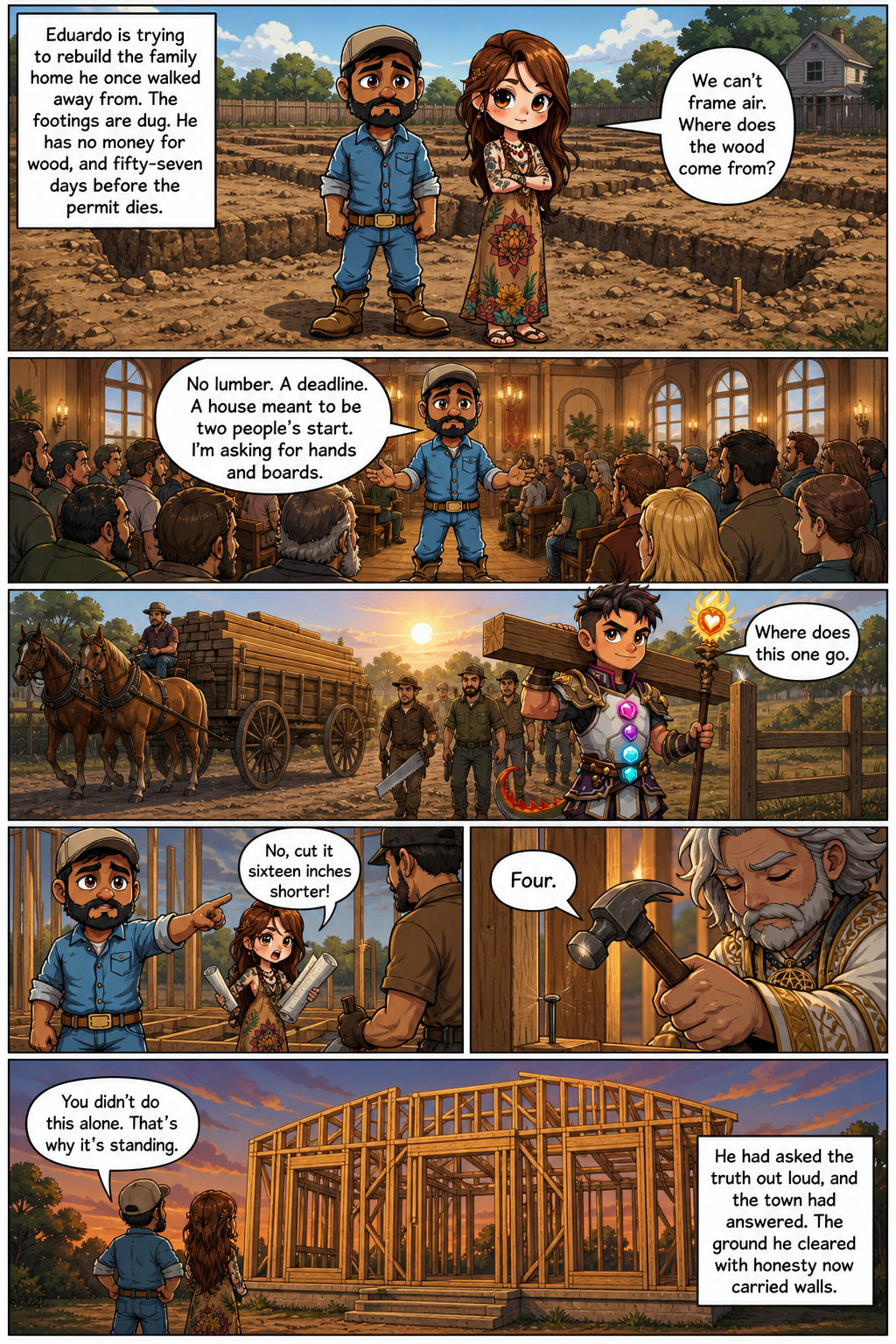
The footings were dug by the third day. But the trenches sat empty of what mattered. Eduardo walked the lot and counted. No lumber. Not a single board stacked for walls. He had drained his wages clearing the title. The mills wanted cash he did not have, and he had fifty-seven days left before the permit lapsed. He stood in the dirt and felt the old panic climb his throat. "We can't frame air," Kiersten said. She did not soften it. "Where does the wood come from?" "I don't know yet," Eduardo said. He made himself say it plain. No lie, no scheme to buy time. "I don't have the money for it." He went to Festive first. The man had taught him to stop feeding fear. Festive listened on his porch, then spoke flat. "You keep staring at the hole. Look at the thing you're building instead." He paused. "You helped half this town through winter. That was real work. Go let them see the hole too." So Eduardo did the hardest thing. He walked to the feast hall and asked. Not for money. For hands and boards. He told the room the truth: no lumber, a deadline, and a house meant to be two people's start. He did not perform. He stated it once and let it stand. The next morning, a wagon stopped at the lot. Then another. Men came down the road carrying saws and their own planks. Aurelius arrived with his staff, the heart stone dark in daylight. He did not speak much. He set the staff against a post, rolled his sleeves, and lifted the first beam onto his shoulder. "Where does this one go," Aurelius asked. One blunt line. Eduardo pointed to the mark for the first door. His throat closed. These were men whose winter wood he had split, whose fences he had mended, asking only where to put the next board. Father came too, no robe, just his sleeves up. He drove a nail, then another, counting under his breath. "Four," he said, and almost smiled. They worked three days straight. Eduardo measured twice the way Kiersten taught him and never once seized control. He asked each man where the cut should fall. He let them answer. Kiersten walked the frame with the rolled plan, calling corrections, and the men listened to her same as him. On the third evening the last wall stud went up. The frame stood against the sky, two doors marked side by side, open to the same room. Eduardo stepped back and looked at it. Walls, standing, well inside the deadline. The permit would hold. He did not feel it was his. He had asked, and the town had answered. That was new. Kiersten stood beside him. She looked at the raised frame a long moment. "You didn't do this alone," she said. "That's why it's standing." Eduardo nodded. The ground he had cleared with honesty now carried walls raised by people who believed his word.
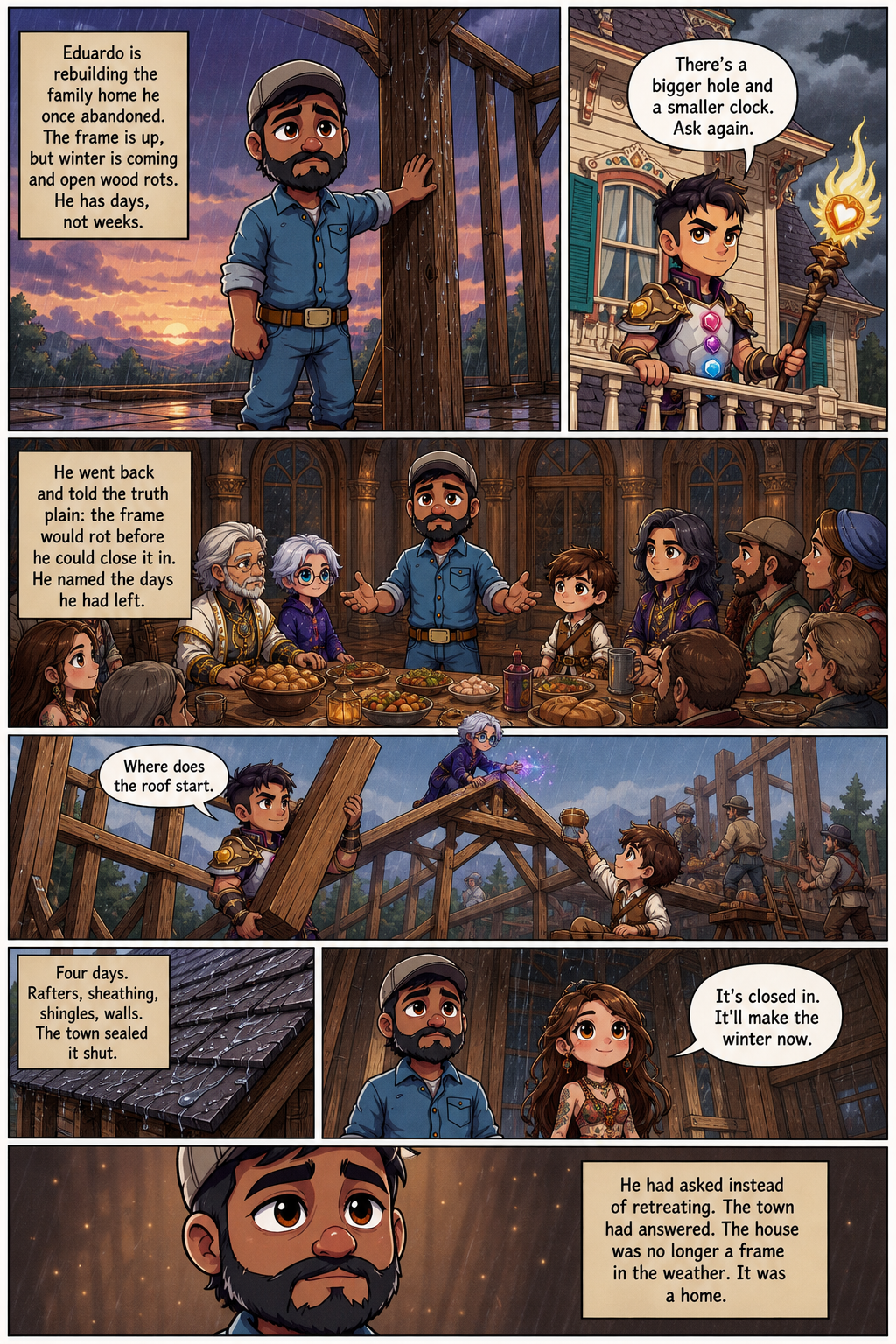
The frame stood, but it was only bones. Eduardo woke to rain tapping the raw wood. He walked the lot before dawn and pressed his palm to a stud. Damp. No roof, no walls, just open timber drinking the weather. The permit called the frame enough, but a frame could not hold a winter. Storms would rot the beams before he closed them in. He had the structure. He did not have the house. He went to Festive first, the way he had learned to. The teacher stood on his porch, watching clouds stack in the east. "You asked once," Festive said. "The hole got filled." He did not soften it. "Now there's a bigger hole and a smaller clock. Ask again." So Eduardo returned to the feast hall. He stated it plain: the frame stood, but rain would ruin it before he could roof it or wall it. He named the days he had left. He did not perform. He let the truth sit on the table. The next morning wagons came again. This time more. Word had spread of two doors opening to one room, of the work two people had put into one house. Townspeople came to see the love being built, and they came to help it stand. Aurelius arrived with his father and lumber stacked high. He set his staff against the frame and lifted a plank without a word. "Where does the roof start," he asked. One blunt line. Quantum came in his star-dark robe and climbed to the ridge beam, steady where others swayed. He spoke low to each worker, naming the rhythm of the nails, three and six and nine, until the hammering fell into one sound. Emilio set his little stool near the sawhorses and listened. When a man wiped his brow, the boy handed him water. "You missed a nail," Emilio told Father, pointing. Father looked, found it, drove it home. "Four," he said, and this time he smiled. They worked four days. Rafters went up, then sheathing, then shingles laid tight against the sky. Walls rose where open timber had been. Kiersten walked the rooms with the plan, calling each board's place, and the crowd followed her hand the same as Eduardo's. He asked before he cut. He let others answer. The fear that had chased him did not come. On the last evening, the rain returned. Eduardo stood inside and heard it strike the roof and run off clean. No drop reached the floor. The walls held. The two doors hung side by side, closed against the storm, warm within. The timber was safe. The house was shut in. Kiersten stood beside him, dry under their own roof for the first time. "It's closed in," she said. "It'll make the winter now." Eduardo nodded. The frame had been his word standing in the open. Now it was a home, sealed by the hands of a town that believed him.
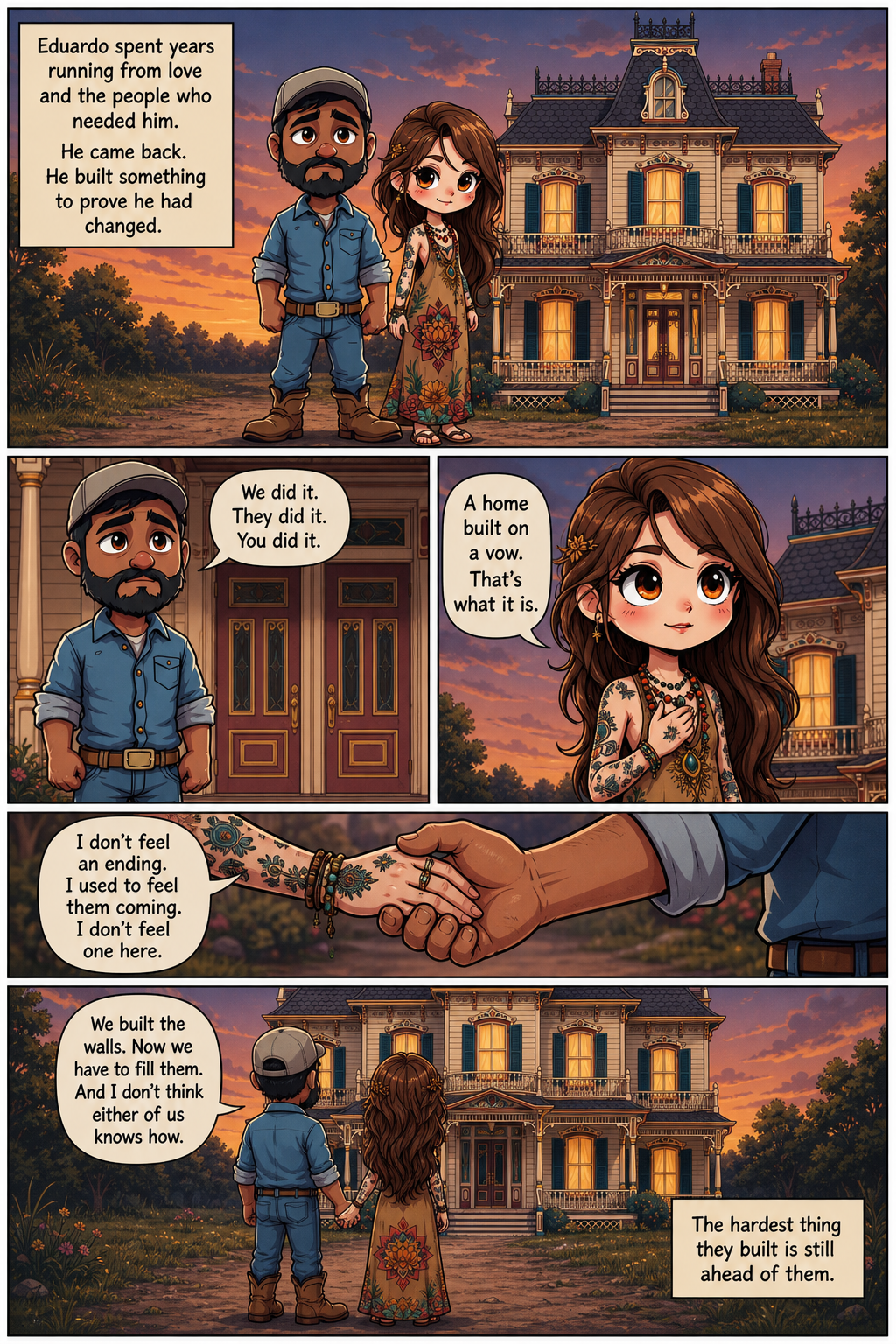
The last of the workers rolled their wagons home at dusk. The rain had passed. Eduardo and Kiersten walked out to the road and turned to face the house they had built. It stood whole now, dry and shut against the weather. Yesterday it had been bones. Today it was a home. Eduardo looked at the two front doors hung side by side. He looked at the porch rail and the painted shutters and the chimney standing straight. Every board had a name attached to it. Aurelius's lumber. Quantum's nails. Emilio's water passed to tired hands. Kiersten's eyes on every measure. His own were there too, but they were not alone anymore. "We did it," Eduardo said. The old urge rose in him, to claim it, to say he had made it stand. He let the urge go. "They did it. You did it." Kiersten did not answer at first. She studied the house the way she studied his ledgers, slow and whole, missing nothing. Her auburn eyes moved along the roofline. Then they dropped, and her hand went to the locket at her throat. "It's beautiful," she said. Three words. She stopped there. Eduardo waited. He had learned to wait. He did not fill her silence with his own voice. "A house like this needs a name," she said. "Not a deed name. A real one." "What would you call it?" She was quiet. Her thumb opened the locket. It was still empty. She had filled it with nothing demanded, nothing proven. She had said she would fill it with what they made together. "A home built on a vow," she said. "That's what it is." Eduardo felt his chest tighten, not with fear this time. He had spent years afraid that needing her made him weak. Standing on the road, he needed her, and he was not afraid. The feeling held steady, like the roof over the rooms behind them. "Then that's its name," he said. Kiersten turned to him. For the first time he could remember, she reached first. She took his hand. Her tattooed fingers closed over his rough ones. She did not pull away and she did not hold too long. She held exactly as long as she chose. "I don't feel an ending," she said. "I used to feel them coming. I don't feel one here." That was the most she had ever given him. Eduardo knew what it cost her to say it plain. Then her hand went still in his. Her eyes narrowed at the house, past the doors, to the empty rooms inside. "It's shut in," she said. "But there's nothing in it. No table. No bed. No chairs. A roof over empty floors." She looked at him. "We built the walls. Now we have to fill them. And I don't think either of us knows how to make a home from the inside." Eduardo looked at the house they loved and had no idea how to live in.
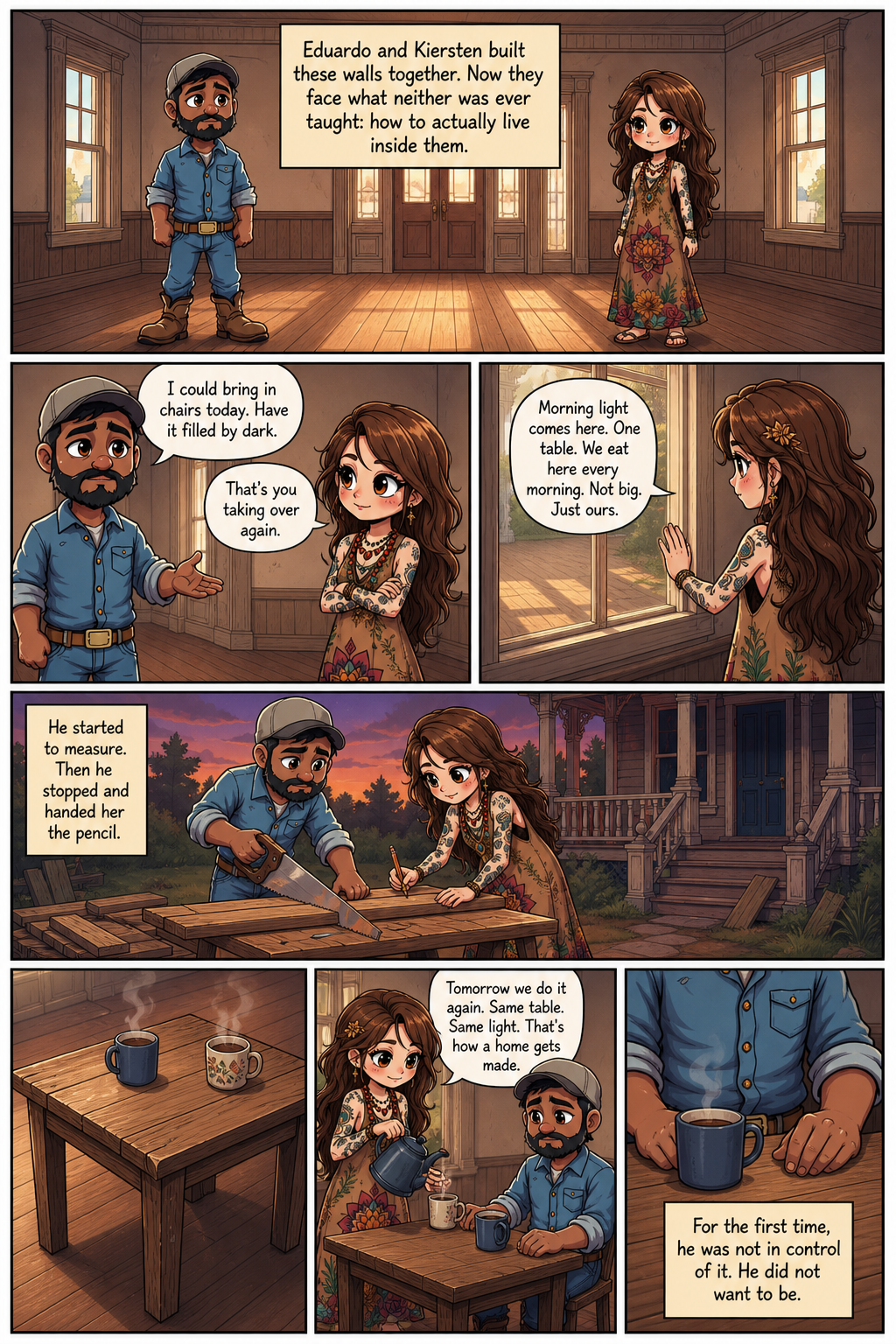
The empty house held the quiet of a church. Eduardo stood in the front room with Kiersten, their footsteps loud on bare floor. They had built the walls. Now they faced the problem she had named on the road: neither of them knew how to live inside them. Eduardo caught his old urge rising. He wanted to buy a table, pick a spot, make it done. He held still instead. "I could bring in chairs today," he said. "Have it filled by dark." Kiersten looked at him the way she read his ledgers. "That's you taking over again." He knew she was right. The old Eduardo filled rooms the way he filled silences, fast and alone. "Then tell me what to do." "I don't know either," she said. "My mother made a home with almost nothing. I never learned how. I just felt it." They stood there, two people who had never been shown how to build daily life. Eduardo thought of the picnic, the planting on the old porch. Each had worked because they did one small thing together, not one large thing he controlled. "What if we don't fill it all at once," he said. "What if we pick one thing. Together. And we do it every day until it's ours." Kiersten's eyes narrowed, testing the idea. "One thing." "You choose it," Eduardo said. He meant it. He did not steer. She walked to the wide window and looked at the bare floor beneath it. "Morning light comes here," she said. "We put one table here. We eat here every morning. Not big. Just ours." Eduardo almost said he would build it that afternoon. He caught the words. "We build it," he said. "Both hands." They went out to the scrap lumber the town had left behind. Eduardo picked up a board. He started to measure. Then he stopped and handed Kiersten the pencil. "Where do you want the cut?" She marked it. He sawed to her line. They worked until dusk, slow, arguing twice about the leg height, agreeing both times. When the table stood, it was small and plain and crooked at one corner. Eduardo looked at the crooked corner. He did not fix it alone. Kiersten set two cups on the table. She poured from her own kettle, the one she had carried in weeks ago. She filled his cup, then hers. "Tomorrow we do it again," she said. "Same table. Same light. That's how a home gets made. One morning at a time." Eduardo sat. For the first time, he was not building the house for her or proving anything to her. He was building a life beside her, one he did not control and did not want to. The fear of taking over had not won. They had their ritual. The rooms were still empty. But the mornings now had a place to begin.
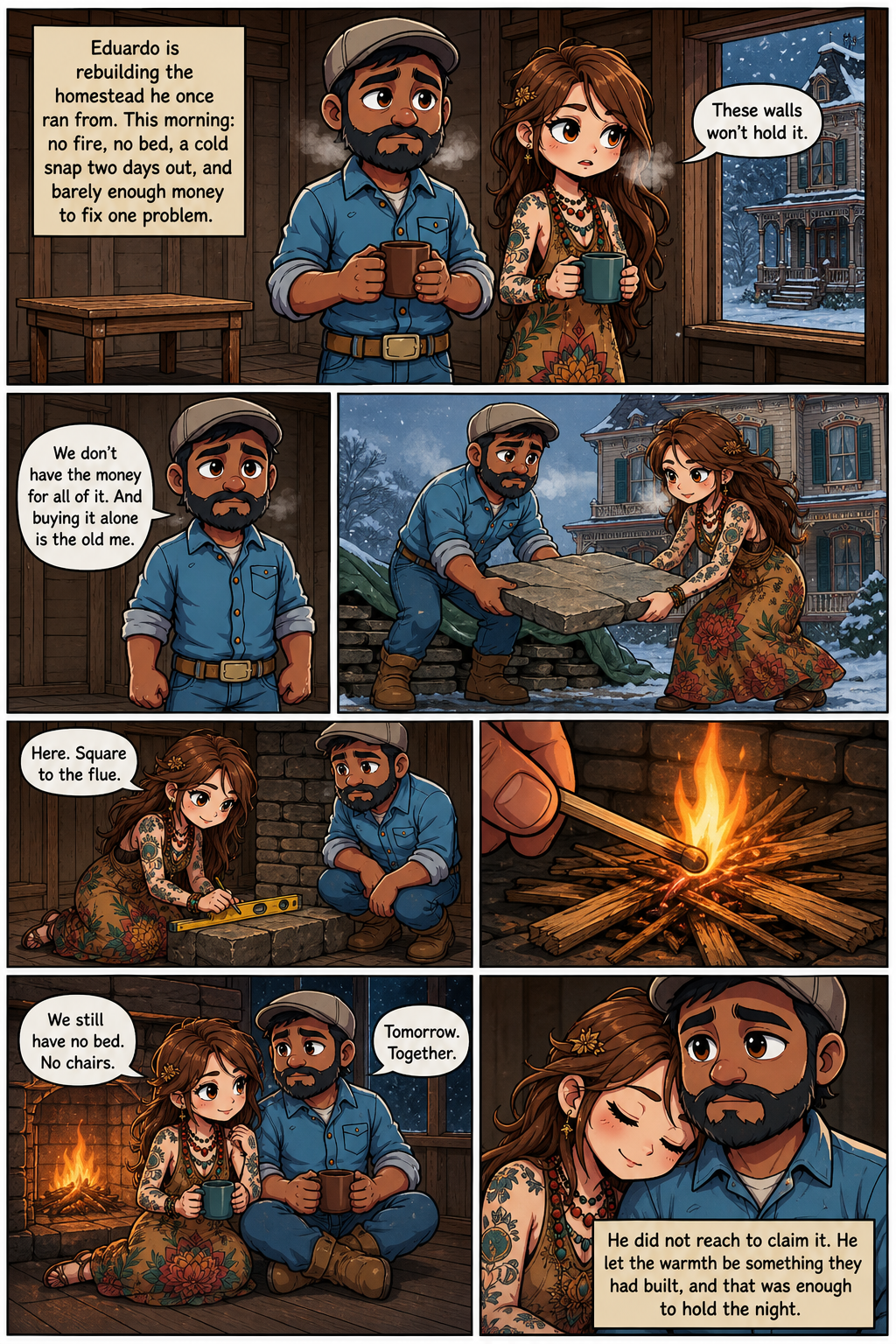
The morning after they built the table, Eduardo woke to cold air in the house. Their breath showed when they drank tea at the window. One table stood in a house of bare floors. No bed. No chairs. No fire. Kiersten pulled her shawl tight. Outside, the wind had a hard edge it hadn't carried the day before. "A cold snap is coming," Kiersten said. She felt endings the way other people felt rain. "Two days. Maybe less. These walls won't hold it." Eduardo knew the old move. He wanted to drive to town, buy a stove, buy chairs, buy a bed, and have it done by dark. His hands itched for it. He held still. "We don't have the money for all of it," he said plainly. "And buying it alone is the old me." "Then we pick what keeps us warm," Kiersten said. "The rest can wait." They agreed on the hearth first. A body could sleep on a floor near a fire. A body could not sleep in a house with no heat. Eduardo had cleared old stone from the demolished house weeks ago. It still sat stacked under a tarp. They hauled the flat stones in together, one at a time, resting between loads. Eduardo started to set the first stone. Then he handed Kiersten the level. "Where does the base go?" She marked the spot near the inside wall, under the chimney the town crew had framed. "Here. Square to the flue." They laid stone through the morning. He mixed the mortar. She set the line. They argued once about the height of the firebox, and she was right. He let her be right without a fight. By afternoon the clouds dropped low and the first cold gust rattled the windows. Eduardo's chest tightened with the old fear. He remembered Festive's words. He put his attention back on the work in his hands, not the loss he imagined. He fit the last stone. Kiersten packed the gaps. They gathered scrap wood and kindling from the yard. Eduardo struck the match. Kiersten fed the small flames. The fire caught and climbed. Heat spread across the bare floor and reached their faces. The house held its first warmth. They sat on the floor before the hearth, backs against the wall, shoulders close. The cold snap came that night. Wind beat the walls. Snow ticked at the glass. But the fire burned, and the room stayed warm. "We still have no bed," Kiersten said. "No chairs." "Tomorrow," Eduardo said. "Together." She leaned her head against his shoulder. He did not pull her closer to claim her. He just let her stay. For the first time, the house was warm because they had built the warmth by hand. The empty rooms could wait. The fire would hold the night.
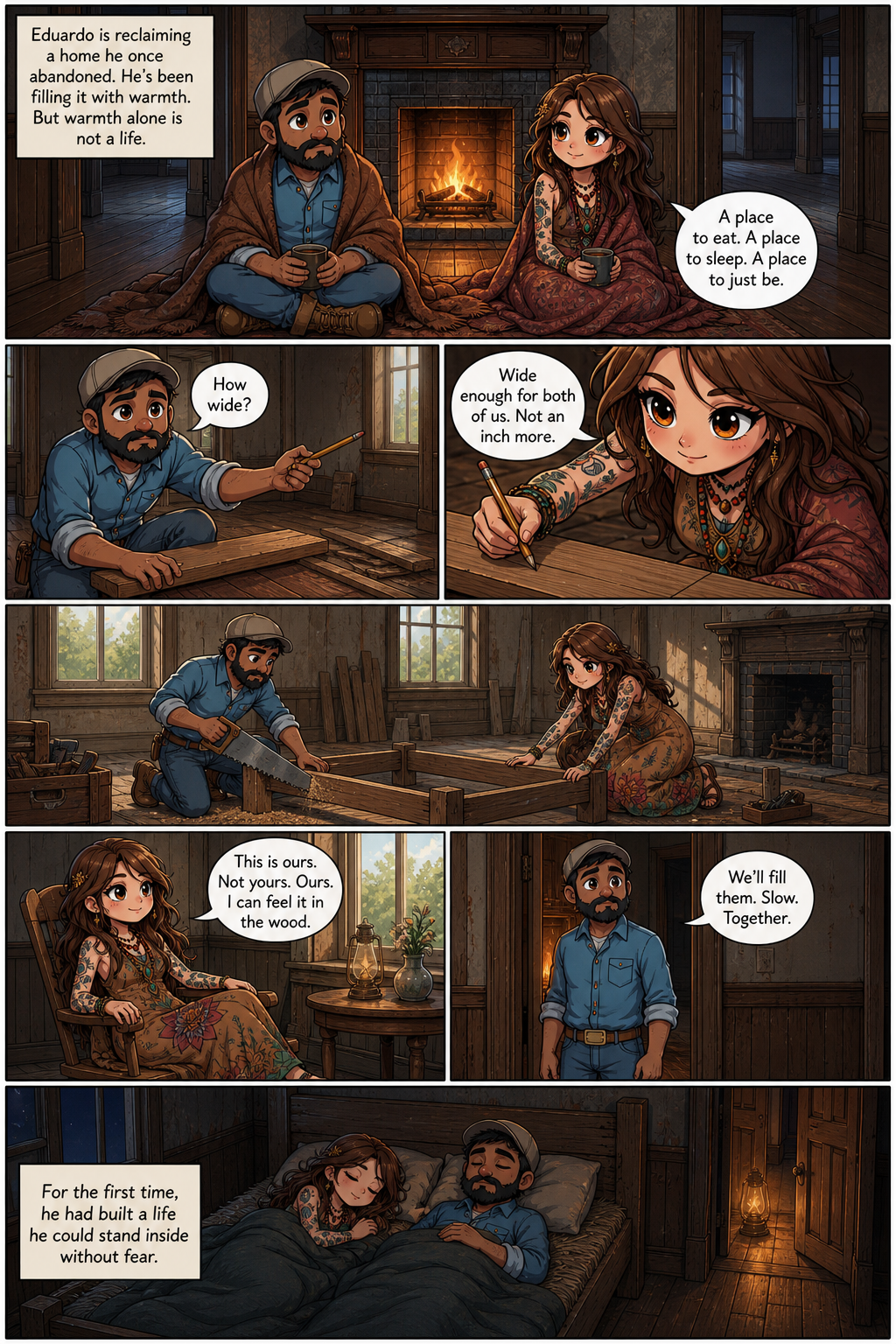
The fire held through the cold snap. But the next morning, Eduardo and Kiersten woke stiff on the floor. One warm room. The rest of the house stood bare. No beds, no chairs, nowhere to sit but near the hearth. They could not live their days crowded into a single corner. "We need more than warmth now," Kiersten said. She pulled her shawl tight and looked down the empty hall. "A place to eat. A place to sleep. A place to just be." Eduardo felt the old pull. Drive to town. Buy a full set of furniture. Fill every room by dark and call it done. He held still. "We can't buy it all," he said. "And buying it alone is me taking over again." "Then we make it," Kiersten said. "One room at a time." They started with the bed. Eduardo had cut spare boards from the roofing lumber. He laid them out on the floor. Then he handed Kiersten the pencil. "How wide?" She marked the frame herself. "Here. Wide enough for both of us, not an inch more." They cut the posts together. He held the joints. She drove the pegs. He wanted to argue about the headboard height. He did not. She was right before, and he let her be right now. They built through the morning. The bed frame first. Then two plain chairs for the window table. Kiersten chose the order. Eduardo followed. When his hands itched to rush ahead, he slowed to her pace. The work was quieter that way. By afternoon they carried the bed frame into the back room. They stuffed a tick with clean straw from the yard. They set the chairs by the table where they drank their tea. The house had three rooms now that held a life, not just a fire. Kiersten walked the hall slowly. She touched the bedpost. She sat in one chair, then the other. "This is ours," she said. "Not yours. Ours. I can feel it in the wood." Eduardo stood in the doorway. He did not reach to pull her close. He did not claim the work as his own. "We're not done," he said. "There's still bare floor. Empty rooms." "We'll fill them," Kiersten said. "Slow. Together." She leaned back in the chair she had chosen. "But today we have somewhere to live. Not just somewhere to hide from the cold." That night they slept in a bed they had built with their own hands. The fire burned low in the hearth. The house was no longer one warm room with bare rooms around it. It was a home with places to live. The empty corners could wait. For the first time, Eduardo had built a life he could stand inside without fear.
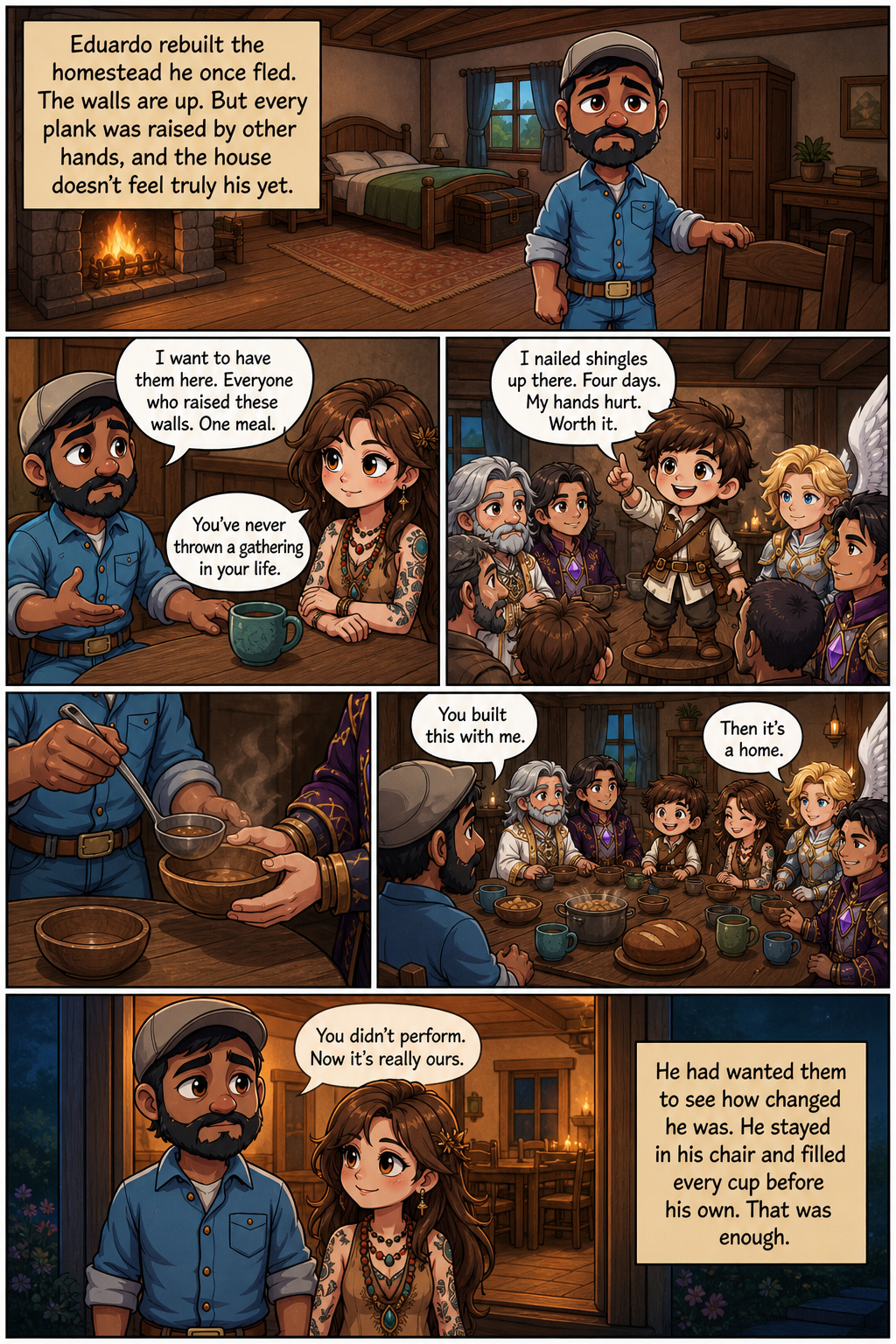
The house held a life now. Bed, chairs, a table by the window, a fire in the hearth. But every board in it came from other hands. Eduardo woke one morning and knew the house was not truly shared until the people who built it had sat inside it. He turned to Kiersten. "I want to have them here," he said. "Everyone who raised these walls. One meal." Kiersten studied him. "You've never thrown a gathering in your life." "No." That was the fear. He knew how to perform for a crowd. Charm them, sell them, win them. He did not know how to just feed people without turning it into a show about himself. He went to Festive first. The man had taught him the groove principle, how anxious thoughts cut deeper the more he rehearsed them. Eduardo found him walking the edge of a field. "I'm afraid I'll make it about me," Eduardo said. Festive did not stop walking. "Then don't plan a speech. Plan where people sit." He went quiet. "A host disappears. The food stays." Eduardo sought Father next. The priest looked at him a long moment. "You want them to clap for you," Father said. "Serve them instead. Fill the cup before yours." The day came cold and clear. Eduardo did not clean the house to impress. He set the table Kiersten had helped build and left it plain. He cooked a pot of stew with his own hands. He did not practice words. They came through both front doors. Aurelius ducked under the frame, his staff left outside, the stones on his chest dim and quiet for once. Kiersten moved among them, pouring. And Emilio came last, dragging his little stool, the one he carried everywhere to sit beside people and listen. Emilio set the stool down in the middle of the room. He climbed onto it and looked around at the walls. "I nailed shingles up there," he said, pointing. "Four days. My hands hurt." He said it flat, then grinned. "Worth it." The room laughed. Eduardo felt the old pull rise in him. Stand up. Make a speech. Thank them in grand words so they would see how changed he was. He felt the groove of it, deep and smooth. He stayed in his chair. He filled Aurelius's bowl. He filled Emilio's. He went around the table and filled every cup before he touched his own. "You built this with me," he said. Four words. He did not add more. He sat. Aurelius set down his bowl. "Then it's a home," he said. Nothing else. The meal went long. No one watched Eduardo. They watched each other. He had wanted that and not known it until now. When the last wagon rolled off, Kiersten stood in the doorway beside him. "You didn't perform," she said. "No." "Now it's really ours." She looked back at the empty chairs. "But a full table means people will keep coming. Some you won't want to see."
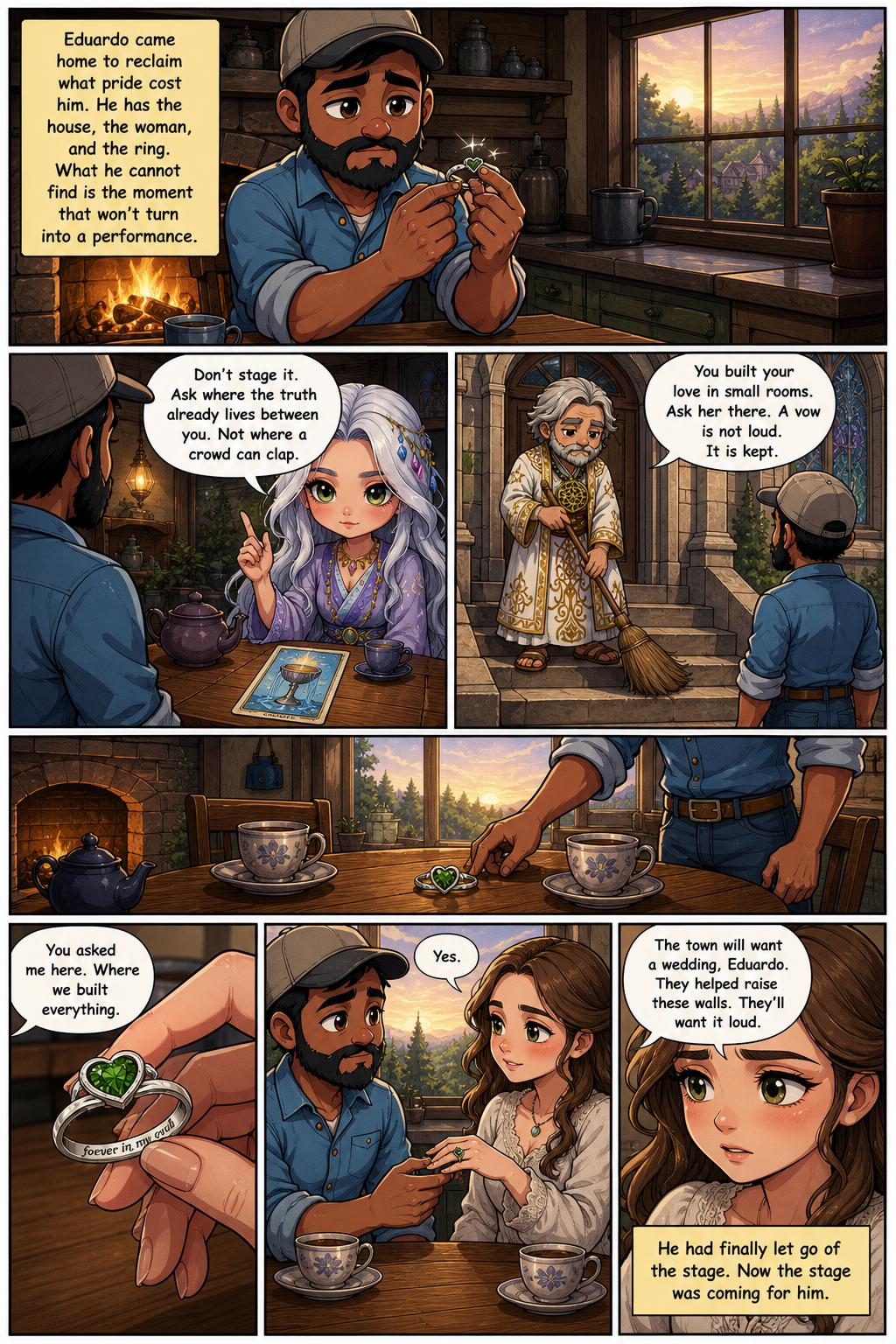
The empty chairs stayed in Eduardo's mind long after the wagons left. Kiersten had claimed the house. She shared the mornings, the fire, the bed they built. But nothing bound them in the eyes of God or the town. Eduardo wanted to ask her to marry him. The trouble was how. Every version he pictured turned into a show. A crowd. Applause. The old pull to perform. He could not propose that way. Not to her. He carried the ring in his pocket for three days. It was small, a green stone set in a silver heart. Inside the band someone had cut the words forever in my soul. He had chosen it because it was plain and true. But a ring meant a question, and a question meant a moment, and every moment he imagined had an audience. He went to the tea house. Tealy read tea the way other people read faces. She set a cup in front of him and watched the leaves settle before he spoke. "You're holding something," she said. "It wants to come out quiet. You keep dressing it loud." "I want to ask her to marry me," Eduardo said. "I don't know how to do it without turning it into a performance." Tealy turned a card over. A cup, overflowing. "Then don't stage it," she said. "Ask where the truth already lives between you. Not where a crowd can clap." Eduardo thought of their Friday ritual. The church. The ledgers. The habit of returning. He drove to the Unity Chapel and found Father sweeping the steps. "I want to marry Kiersten," Eduardo said. "I'm afraid I'll make it a spectacle." Father did not stop sweeping. "You built your love in small rooms," he said. "Ask her there. A vow is not loud. It is kept." Eduardo understood. He had been reaching for a stage. The real place was the table by the window, where they drank tea each morning. No crowd. Only the two of them and the fire. The next morning he made the tea himself. He set her cup down as always. Then he set the ring beside it, without a speech. Kiersten looked at the ring. She read the words inside the band. For a long moment she said nothing. "You didn't make it a show," she said. "No." "You asked me here. Where we built everything." She slid the ring onto her finger. "Yes." They sat in the quiet with the fire low. No town watched. No one clapped. Eduardo felt the old groove go silent for good. Then Kiersten's smile faded. "The town will want a wedding," she said. "They helped raise these walls. They'll expect to stand inside the chapel and watch. The thing you just did quiet, Eduardo, they'll want it loud."
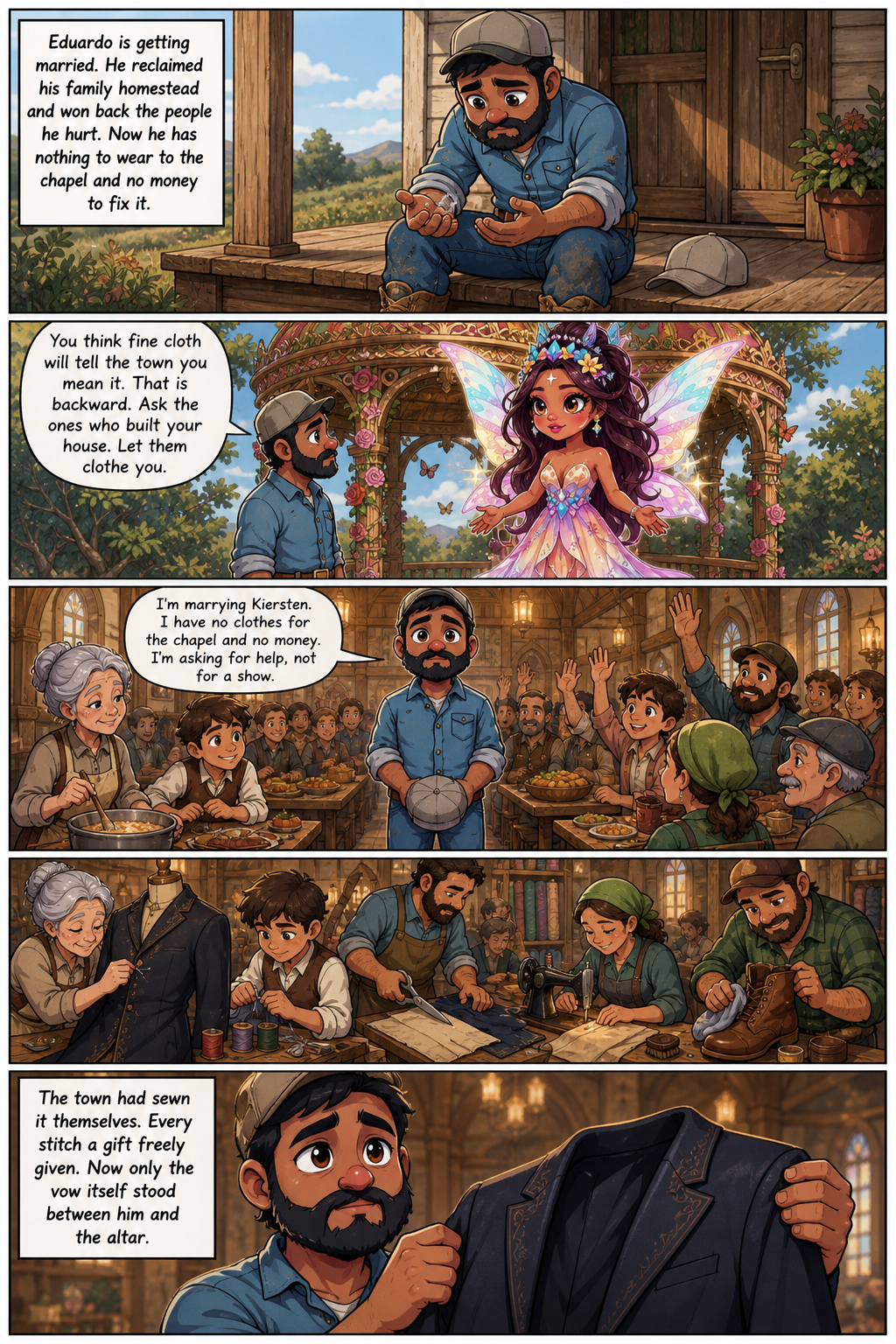
The wedding was set. The town would fill the chapel and watch. Kiersten had been right. But Eduardo faced a smaller problem first. He had nothing to wear. He owned work jeans, a cap, and boots stiff with field dust. He could stand at the altar in those, but the town would read it as a man who did not take the vow seriously. After all his years of proving his word, he would not let his clothes speak a lie. He had no money for a tailor. The house had taken everything. He sat on the porch and turned the problem over. Buying a fine suit felt like his old self, spending to impress. But showing up in dusty denim would shame Kiersten before the whole town. He needed another way. He drove past a gazebo wrapped in roses and butterflies. A woman stood inside it, small as a child, with wings that threw light like cut glass. She was the fairy who lived there, the one the town said fell from the stars. Eduardo had never spoken to her. He stopped the truck. "You carry a knot," she said. Her voice chimed, bright and quick. "Let me see it." "I'm getting married," Eduardo said. "I have no clothes fit for the chapel. And no money to buy any." The fairy circled him once, her wings scattering light across the rose vines. "You think fine cloth will tell the town you mean it," she said. "That is backward. The cloth means nothing. The hands that make it mean everything." Eduardo frowned. "I don't understand." "Ask the ones who built your house," she said. "They gave you walls. They will give you a coat. A gift sewn by many hands says more than a suit bought with coin." She touched a butterfly on the gazebo rail, and it lifted on new wings. "Let them clothe you. That is the vow the town wants to see." Eduardo sat with it. The old pull said buy, impress, control. The new way said ask, and let others give. He drove to the feast hall. He stood before the tables and spoke plainly. "I'm marrying Kiersten," he said. "I have no clothes for the chapel and no money. I'm asking for help, not for a show." Gwen set down her ladle. A woman who had sewn for years raised her hand. Another offered her husband's good coat. Emilio promised to polish boots. By the end of the hour, four people had pledged cloth, thread, and hands. They measured Eduardo in the hall. The seamstress cut a dark coat from her own stock. Others hemmed and pressed. In three days the coat hung finished, plain and well made, every stitch given freely. Eduardo held it up. It fit. The town had clothed him. Now nothing stood between him and the chapel but the vow itself.
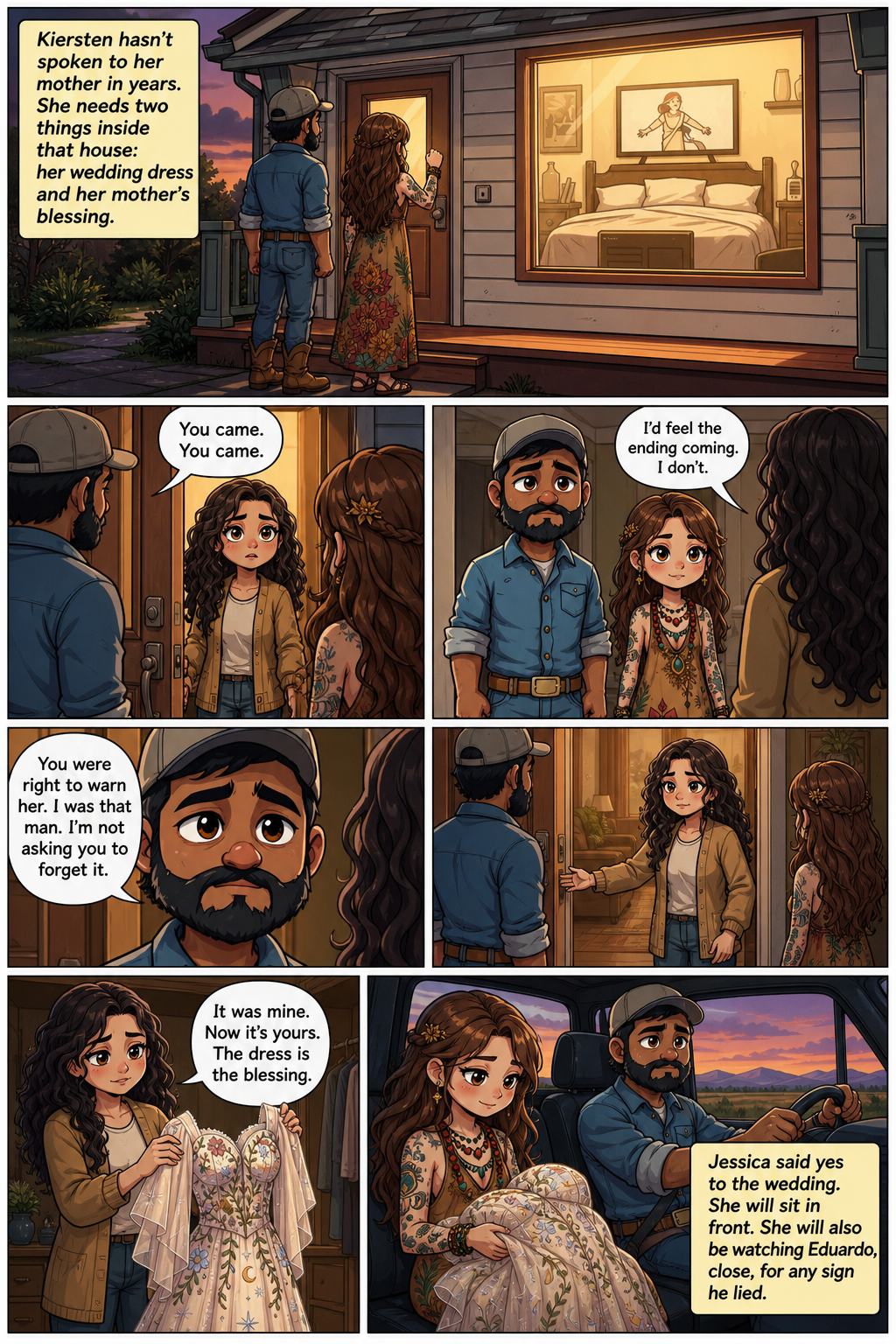
The coat hung finished on its hook. Eduardo had clothes now, but Kiersten had none. She needed a dress. One morning she set down her tea and said the word plainly. "My mother has my dress." She did not look at him when she said it. "And I need her blessing." Eduardo knew the shape of that wound. Kiersten had told him once. Her mother, Jessica, had warned her against him years ago, called him a man who would hollow her out. When Kiersten chose Eduardo anyway, she sent her mother one word and went silent. They had not spoken since. Now the dress sat in that silent house, and so did the blessing. "I'll drive you," Eduardo said. He did not offer to speak for her. He had learned that much. The house was small and low, built for quiet, a wide window glowing beside the door. Kiersten knocked. Jessica opened it. Her curly hair had gone grayer. Her tired eyes went straight to Eduardo, then back to her daughter. "You came," Jessica said. Her voice stayed low. "You came." "I'm getting married," Kiersten said. "I want my dress." Jessica did not move from the doorway. She studied Eduardo for a long moment. He stood still and let her look. He did not charm her or explain himself. He had spent a year learning to stop performing. "They told me he changed," Jessica said. "The feed store man. Others." She looked at Kiersten. "I didn't believe it. I scrubbed my counters raw not believing it." "He changed," Kiersten said. "I'd feel the ending coming. I don't." Jessica held the door. Eduardo saw the fear in her, the same fear he had carried, the fear of watching love turn to control. He spoke once. "You were right to warn her," he said. "I was that man. I'm not asking you to forget it." Jessica blinked. She had braced for a fight and gotten none. The fight went out of her shoulders. She stepped back and let them in. She brought the dress from a back room. It flowed over her arms, pale and soft, stitched with green vines and small moons and scattered stars. Kiersten took it and held it against herself. Her hands were steady. "It was mine," Jessica said. "Now it's yours." She touched her daughter's face. "That's the blessing. The dress is the blessing." Kiersten did not cry. She folded the dress with care. At the door she stopped. "Come to the chapel," she said. "Sit in front." Jessica pressed her lips thin. She nodded once. In the truck the dress lay across Kiersten's lap. The silence between her and Eduardo was easy now. But Eduardo watched her fold and unfold the hem. Her mother would come to the wedding. And a mother who came to watch would also watch him, close, for any sign he had lied.
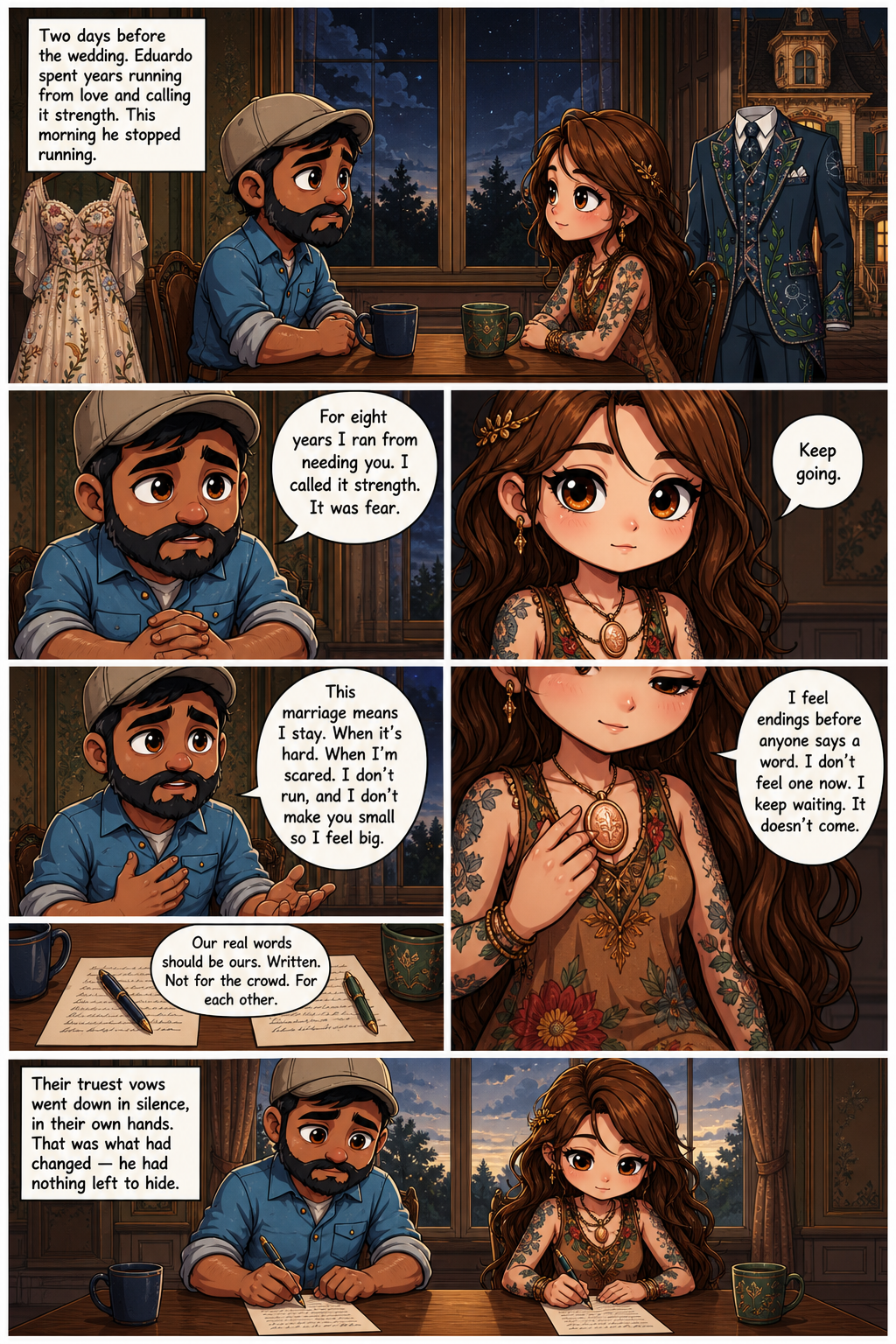
The dress hung on one wall now. The coat hung on the other. The wedding was two days off. But this morning Eduardo woke before the light and found Kiersten already up, boiling the kettle. The table by the window held two cups. She poured for them both. He sat across from her the way he did every morning. Only today felt different. There were no debts left to clear, no boards to nail. There was only the two of them and the quiet. "I want to tell you something," Eduardo said. His voice shook. He let it. The old Eduardo would have cleared his throat and made it smooth. "Not a speech. Just the truth." Kiersten set down her cup. "Then say it." "For eight years I ran from needing you. I called it strength. It was fear." He looked at his own hands, then at her face. "This house isn't proof I changed. You are. Every morning you sit here and I don't have to perform. I didn't know a person could feel that." Kiersten watched him. She did not soften her eyes. "Keep going." "This marriage isn't me winning you back. I'm done trying to win you." He breathed. "It means I stay. When it's hard. When I'm scared. I don't run and I don't make you small so I feel big. That's what I'm promising." She was quiet a long time. The kettle ticked as it cooled. Then she reached across and touched the locket at her throat, the rose gold one he had given her empty. "I feel endings," Kiersten said. "My whole life. I feel them before anyone says a word." She met his eyes. "I don't feel one now. I keep waiting for it. It doesn't come." Eduardo did not reach for her. He had learned that too. "Then let me ask you something." "Ask." "At the chapel, in front of the town, we'll say what they expect us to say." He paused. "But I want our real words to be ours. Written. In our own hands. Not for the crowd. For each other." Kiersten looked at the two cups between them. She looked at the dress on the wall. "Letters," she said. "We each write one. We read them. No one else hears." "Those are our vows," Eduardo said. "The chapel words are for the town. The letters are for us." She did not smile wide. She never did. But something in her shoulders let go. "Yes." She found paper. She set a sheet in front of him and kept one for herself. They sat at the table and began to write, not looking at each other's pages. The pen felt strange in Eduardo's hand. For once he was not hiding a word. The wedding was in two days. But their truest promises were already being written, in silence, by the window where their life had begun.
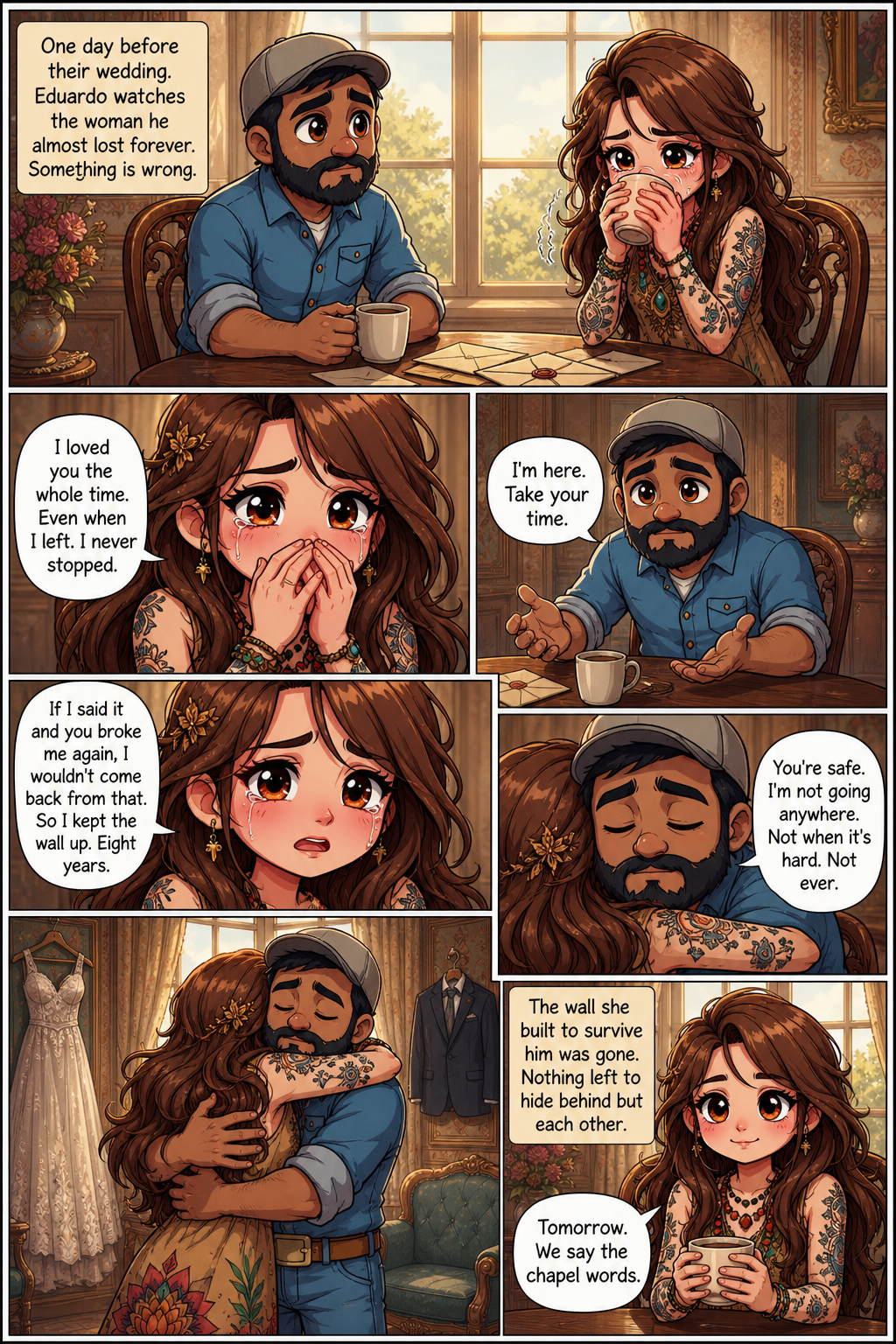
The letters sat finished on the table the next morning. Eduardo had read his to no one. Kiersten kept hers folded by her cup. The wedding was one day off now. He watched her across the window table and saw something he had not seen before. Her hands were shaking. "Kiersten," he said. "What is it?" She did not answer with her usual short line. She stared at the locket at her throat. Then her face broke. She covered it with both hands and began to cry. Not quiet tears. Deep ones, the kind held back for years. Eduardo did not move to fix it. He had learned that. He waited. "I'm here," he said. "Take your time." When she spoke, her voice came out cracked. "I loved you the whole time. Even when I left. I never stopped." She wiped her face and kept going. "Every day I hoped. I watched from far off. I told myself not to. I did it anyway." "You never said." "I couldn't." She looked at him, eyes red. "If I said it and you broke me again, I wouldn't come back from that. So I kept the wall up. I kept it up eight years." Eduardo set down his cup. His own throat went tight. "And now?" "Now it's gone." She laughed through the tears, a short wet sound. "I feel safe. I didn't know what that felt like. I kept waiting for the bottom to drop. It didn't." Then she stood. She crossed the small space between them and grabbed him. She held him so tight he felt her whole body shake against his. He wrapped his arms around her and held on. "I couldn't lose you a second time," she said into his shirt. "I couldn't. I built this whole wall just so I'd never have to feel that again." "You won't lose me." Eduardo pressed his hand flat against her back. "You're safe. I'm not going anywhere. Not when it's hard. Not ever." She cried harder then, and he let her. He did not shush her or rush her. He stood in the warm room they had built board by board and held the woman who had waited for him longer than he deserved. The kettle ticked. The dress and coat hung on their walls. When she finally pulled back, her eyes were clear. The wall was down. He could see it in her face, open in a way it had never been. "Tomorrow," she said, her voice steady again. "We say the chapel words. Then we read our letters." "Tomorrow," Eduardo said. She picked up her cup. Her hand did not shake now. Something between them had finished and something new had opened. The last wall was gone, and nothing was left to hide behind but each other.
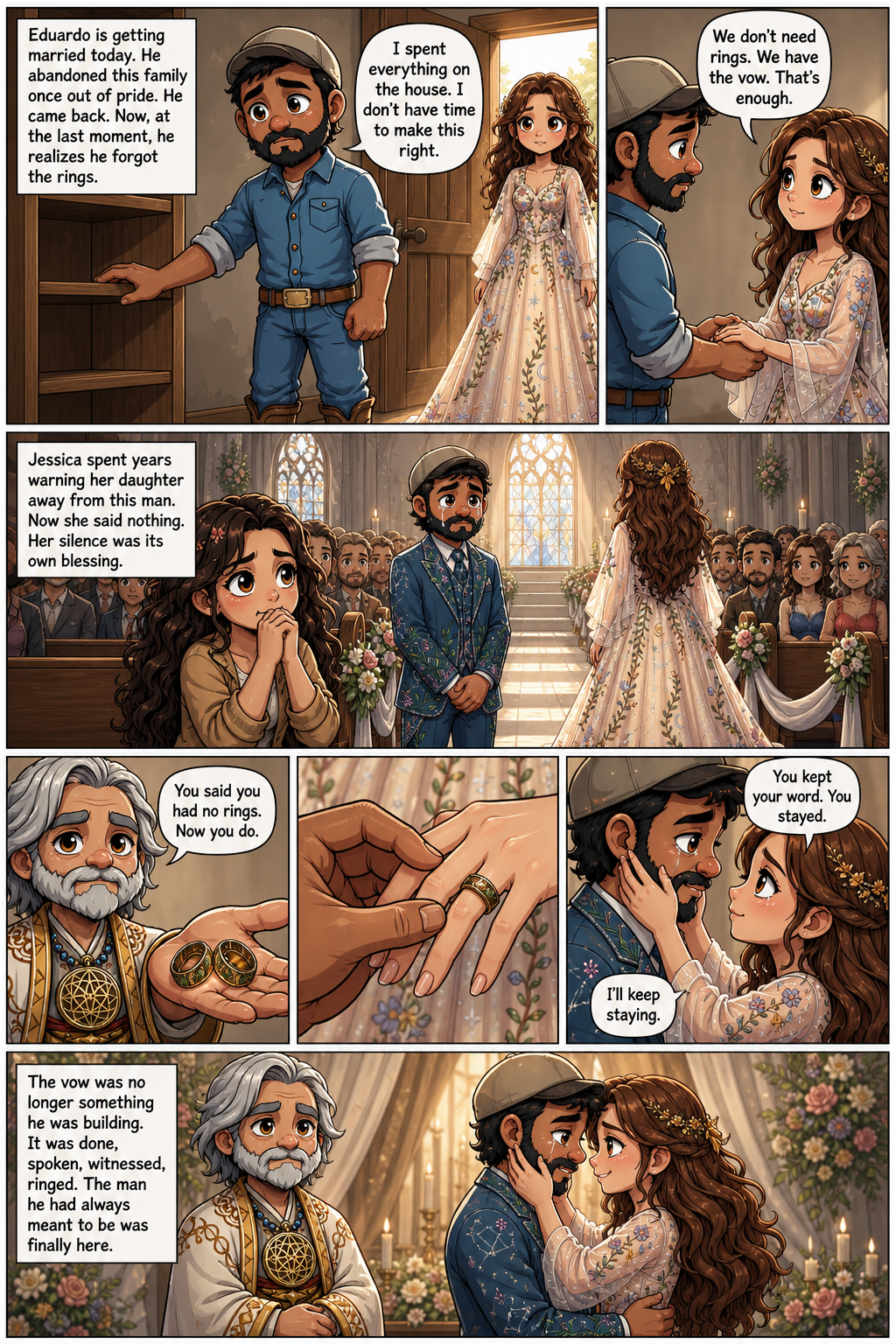
The night before the wedding, Eduardo held Kiersten until she slept. He did not let go. He watched her breathe in the dark and kept one promise over and over in his head. She was safe. In the morning they rose and dressed. Kiersten slipped into the flowing gown stitched with vines and moons. Eduardo buttoned the groom coat sewn by the town's hands. Then he stopped. He looked at the bare shelf by the door. "We don't have rings," he said. Kiersten tied the last button at his collar. "I know." "I meant to get them. I spent everything on the house." He felt the old panic rise. He wanted to fix it fast, buy something, borrow. He breathed instead. "I don't have time to make this right." Kiersten took both his hands. "We don't need rings. We have the vow. That's enough." He searched her face for doubt. There was none. So he believed her. They walked to the chapel. The whole town had come. Jessica sat in the front row, her tired auburn eyes fixed on her daughter. Years she had warned Kiersten away from this man. Now she pressed a knuckle to her lips and said nothing. Her silence was its own blessing. Eduardo stood at the front. When Kiersten walked the aisle, the gown catching the light, his throat closed. He had never cried in front of a crowd. He did now, plainly, and did not wipe it away. Father stood before them in his white robe. He did not pad the moment with speeches. "Say your words," he said. Eduardo spoke his vow. Kiersten spoke hers. They promised to stay through the hard years. When the last word was said, Father reached into his robe. "One more thing," he said. He opened his hand. Two bands sat in his palm, dark wood and gold, each set with a warm tiger's eye stone. "A gift. From me. For the two of you." Kiersten gasped. Eduardo stared. "You said you had no rings," Father said. "Now you do." Eduardo had not known. Neither had Kiersten. Father had carried them in secret. Eduardo took the smaller band and slid it onto Kiersten's finger. His hand shook. She took the other and slid it onto his. Then they were both crying. Kiersten reached up and held his face. Eduardo wrapped his arms around her. They looked into each other's eyes and did not look away. The town stood and clapped. Jessica wiped her cheeks in the front row. "You kept your word," Kiersten said against his chest. "You stayed." "I'll keep staying," Eduardo said. Father watched them and gave a small nod. "Four hands," he said quietly. "Steady now." They were married. The vow was no longer a thing they were building. It was done, spoken, witnessed, ringed. Eduardo held his wife and knew the man he had always meant to be was finally here.
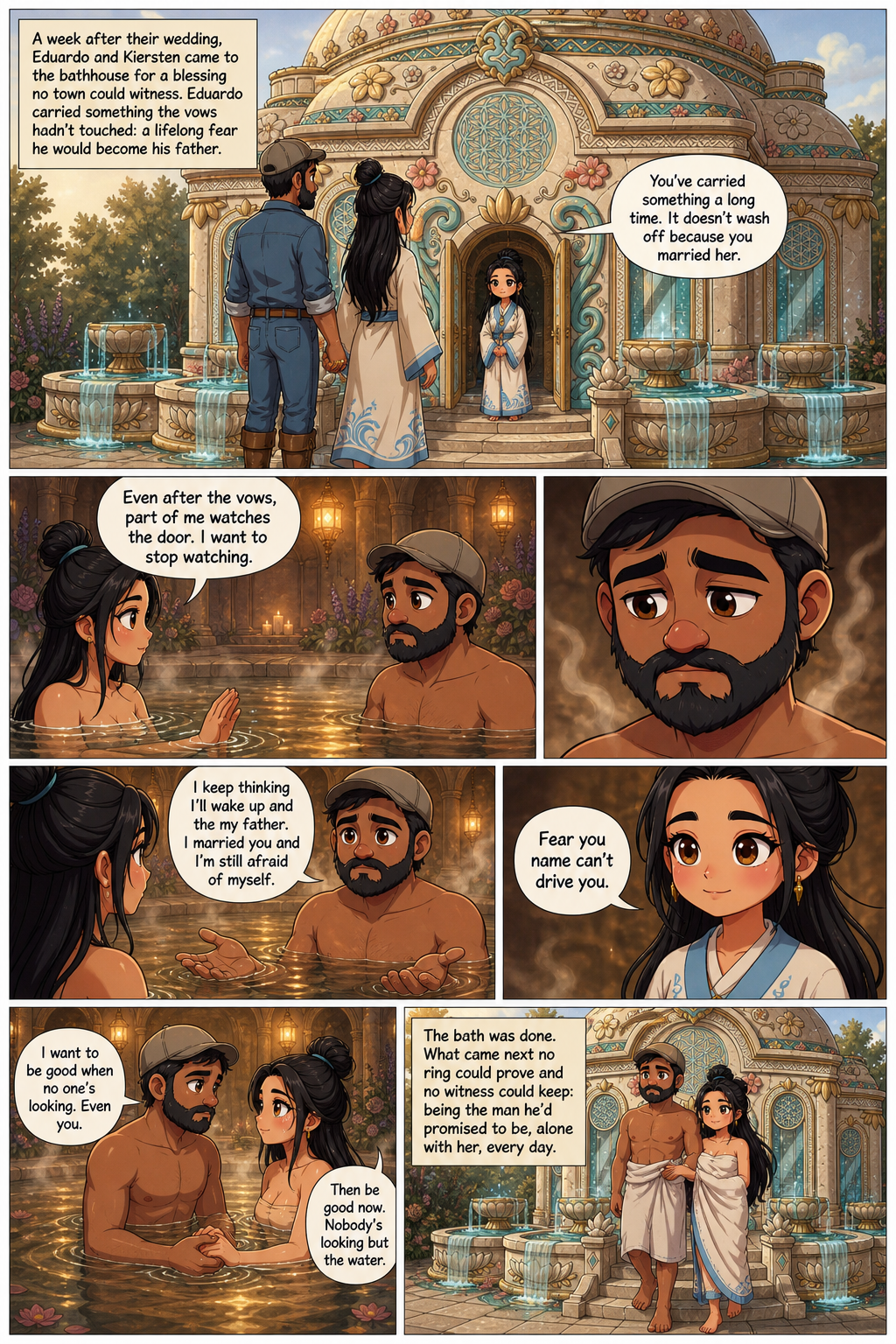
A week after the wedding, Kiersten set down her tea and touched the ring on her hand. "We stood before the town," she said. "Now I want something that's only ours. A blessing no one watches." Eduardo nodded. She led him to the spiritual bathhouse by the water, its domed roof carved with floral rings, pale fountains spilling at its steps. They would bathe together and bless their marriage. Mirelle Clearwater met them at the door. She kept the bathhouse, and the town knew her hands healed what medicine could not. She looked at their matching bands, then at Eduardo's face. "You've carried something a long time," she said. "It doesn't wash off because you married her." Eduardo's jaw tightened. "I'm not here to be read." "Then you'll sit in the water and nothing will change," Mirelle said. She turned and drew the bath. She steeped lavender and rose in the steaming pool. The water went gold under the lamps. Kiersten stepped in first and reached for Eduardo's hand. He followed her down into the warmth. "Say what you brought," Mirelle told him. "Both of you. The water holds it, then lets it go. Lie, and you leave as heavy as you came." Kiersten spoke first. "I spent eight years waiting for an ending. Even after the vows, part of me watches the door." She pressed her hand flat to the water. "I want to stop watching." Eduardo stared at the steam. The old urge rose to say something smooth, something that sounded whole. He breathed instead. "I keep thinking I'll ruin this," he said. "That I'll wake up tomorrow and be my father. I married her and I'm still afraid of myself." The words sat on the water. Mirelle did not soften them. "Good," she said. "Now you've named it. Fear you name can't drive you." Eduardo turned to Kiersten. He had confessed his sins many times. He had never confessed his fear while holding her in warm water, with no ledger, no witness, no town. "I don't want to be watched to stay good," he said. "I want to be good when no one's looking. Even you." Kiersten's eyes filled. "Then be good now," she said. "Nobody's looking but the water." They sat in the gold light until the steam thinned. When they rose, Eduardo felt lighter, the way he had the first time he cried alone on his porch. Mirelle wrapped them in cloth. "The water took what you gave it," she said. "But a bath blesses a marriage once. Keeping it is daily work. You'll have to bless it yourselves, every morning, with no one drawing the water for you." Eduardo understood. The ceremony was done. The vow was spoken. Now came the part no town could witness and no ring could prove: being the man he had promised to be, alone with her, for the rest of his life.
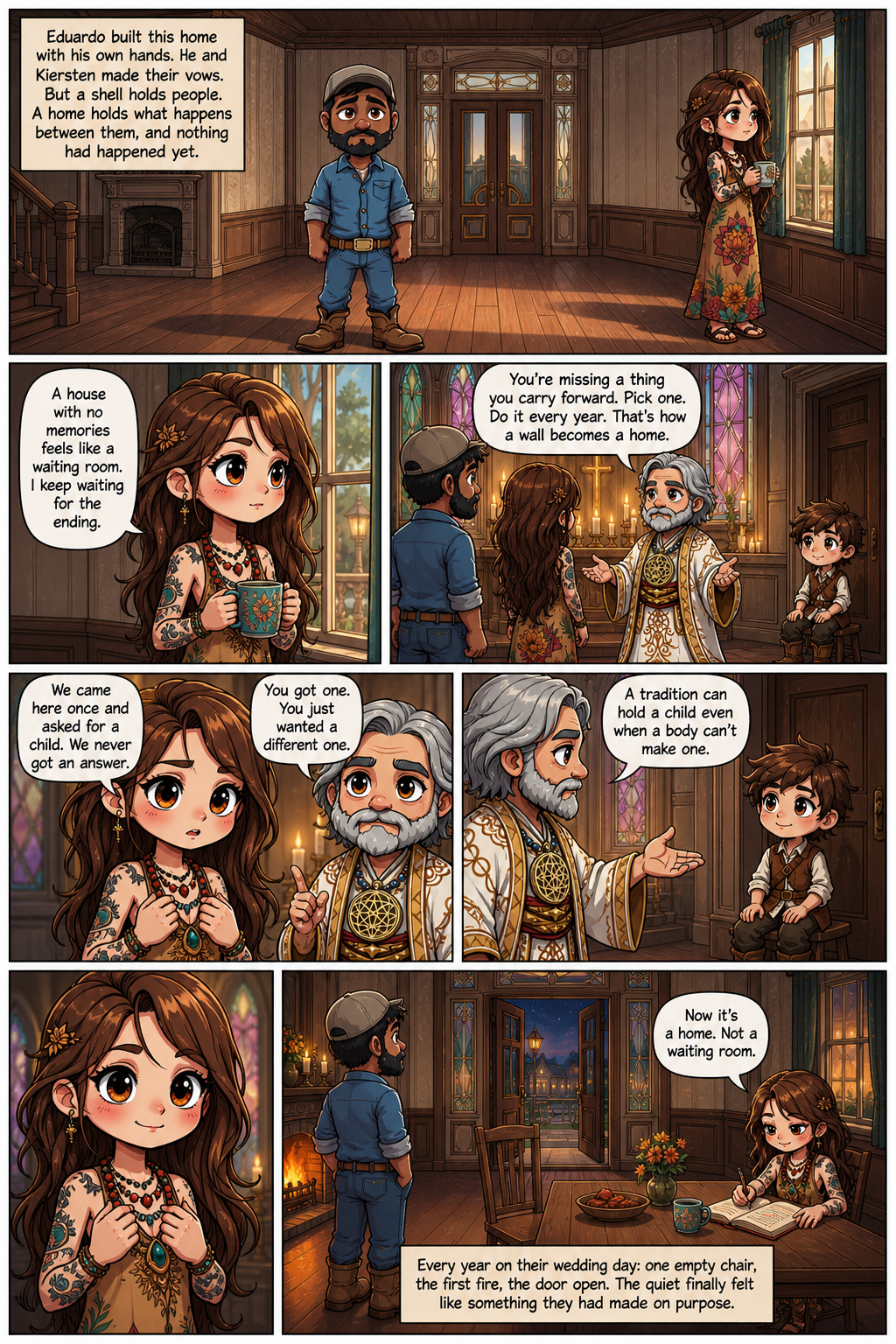
The bath blessed the marriage. But the house stayed quiet. A week later Eduardo stood in the front room and felt it. The walls held no laughter yet. No worn chair, no habit, no story to tell a child who might ask where he grew up. He had built the house with his hands and the town's hands. He had not built a single memory inside it. Kiersten stirred her tea at the window and said nothing, but he saw her watching the door again. "You're doing it," he said. "Watching the door." "A house with no memories feels like a waiting room," she said. "I keep waiting for the ending." He understood. A shell holds people. A home holds what happens between them. They had vows and walls. They had no shared thing they returned to inside these rooms, nothing that was only theirs. They drove to the chapel. Its stone front caught the morning light, and the stained glass threw color across the steps. Eduardo found Father near the altar, lighting a candle. Years ago, before the shame between them, he and Kiersten had come here together and asked what they should do about the child they could not have. "The house is finished," Eduardo said. "It still feels empty." Father did not look up. "A house fills with what you repeat." "We have the morning tea," Kiersten said. "The fire. The garden on the porch." "Then you have more than most." Father turned. "But you're missing a thing you carry forward. Pick one. Do it every year. That's how a wall becomes a home." Kiersten's hand went to the empty locket at her throat. For years she had wanted a child and could not have one. The want had become a wound Eduardo once used against her. Now she spoke plainly. "We came here once and asked for a child," she said. "We never got an answer." "You got one," Father said. "You just wanted a different one." He nodded at Emilio, the orphan boy the town had raised, who sat on his stool near the door. "That one had no blood family. The town made him theirs. A tradition can hold a child even when a body can't make one." Eduardo watched Kiersten's face change. The waiting left it. That evening they started the thing they would carry. Each year on their wedding day they would open the house. One empty chair at the table for anyone with no place to sit. The first fire lit, the first bread baked, the door left open to the town. Kiersten wrote the first entry in a plain book. A record of who came. "Now it's a home," she said. "Not a waiting room." Eduardo looked at the open door. For the first time the quiet did not feel like an ending. It felt like a beginning they had made on purpose, one they would keep making every year of their lives.
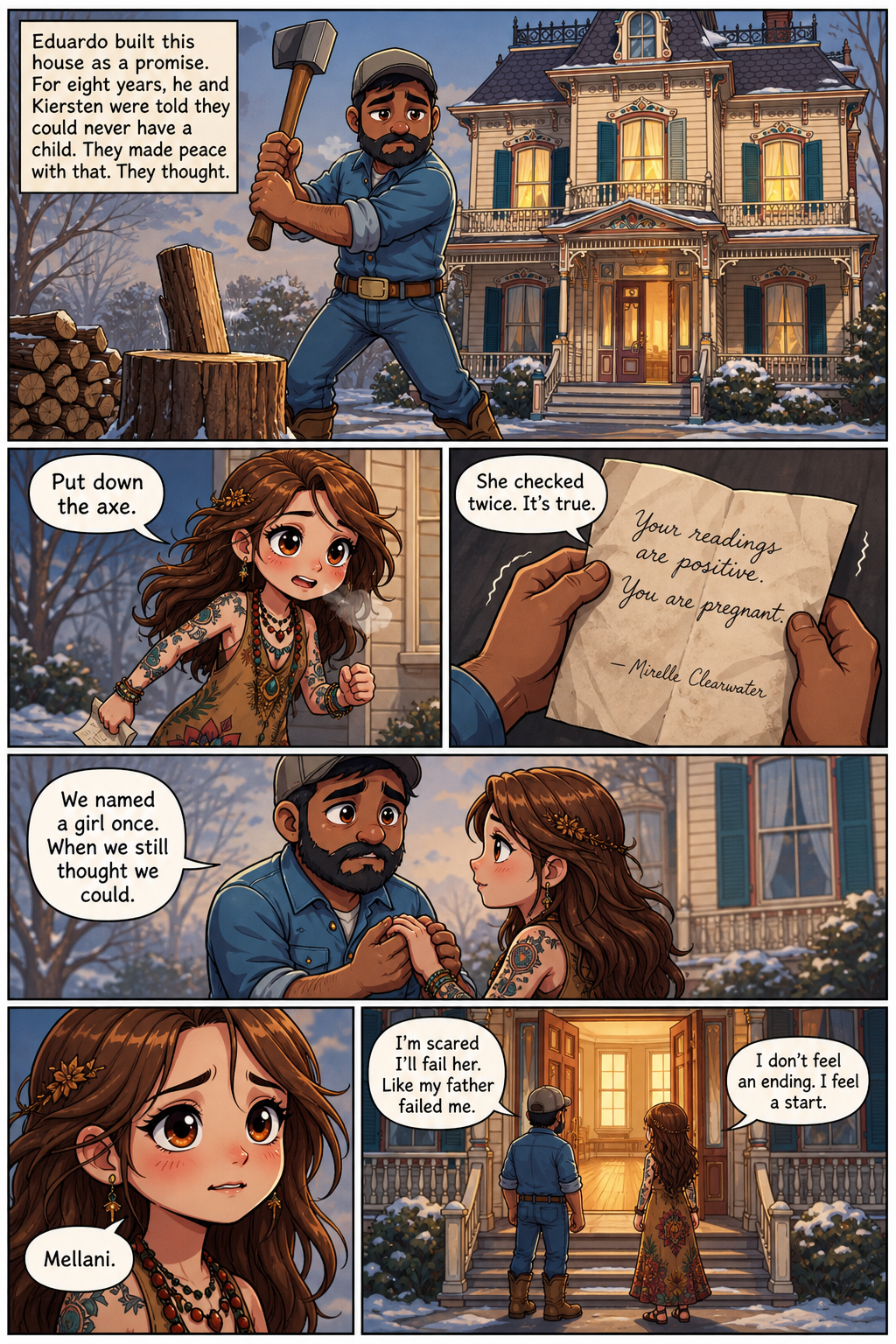
The empty chair at the table had become their tradition. Now, two months after the first one, Eduardo split wood by the porch of the Victorian house they had built together. The morning was cold. He heard the back door slam, then fast steps on the boards. Kiersten came around the corner, and she was running. She stopped in front of him. Her breath came quick. She held a small paper folded in her hand. Kiersten did not run. She walked slow and sure, measuring each step like she measured a board. Now her eyes were wide and her cheeks were red, and she could not stand still. "Put down the axe," she said. Eduardo set it against the log. For eight years she had carried an empty locket and a wound he once used against her. The doctors had told them both the same thing. No child would come. He had weaponized that once. He waited now, afraid of what news could make her run. "I went to Mirelle," Kiersten said. "At the bathhouse. I felt something new for weeks. I wanted her to tell me I was wrong." She opened her hand. The paper was a note in another woman's script. "She wasn't wrong. I'm carrying a child." Eduardo did not move. The words would not fit in his head. They had asked for this years ago and been told no. They had built a whole life around the no. They had made a tradition to hold a child a body could not make. "That can't be true," he said. It came out before he could stop it. "That's what I said." Kiersten pressed the note into his hand. "She checked twice. It's true." He looked at the paper. The letters swam. His hands, which had hauled flour and split wood and built every wall of this house, began to shake. "We named a girl once," he said. "When we still thought we could." "Mellani," Kiersten said. She had not said the name in years. Her voice stayed steady, but her chin moved. "I remember." Eduardo set the note on the log. He took both her hands. The old Eduardo would have made this moment his, turned it into a speech, a prize he won. He said nothing grand. He only held on. "I'm scared," he said. "I swore I wouldn't be my father. Now there's someone I could fail." "I know." Kiersten did not soften it. "I'm scared too." She looked up at the house they had built from nothing, two front doors opening to one room. "But I don't feel an ending. I feel a start." Eduardo looked at the open door. He had wanted to reclaim a homestead and become a man worth loving. He had not known the house was waiting for this. A room they had not filled yet. A child with a name they chose years before they believed in her.
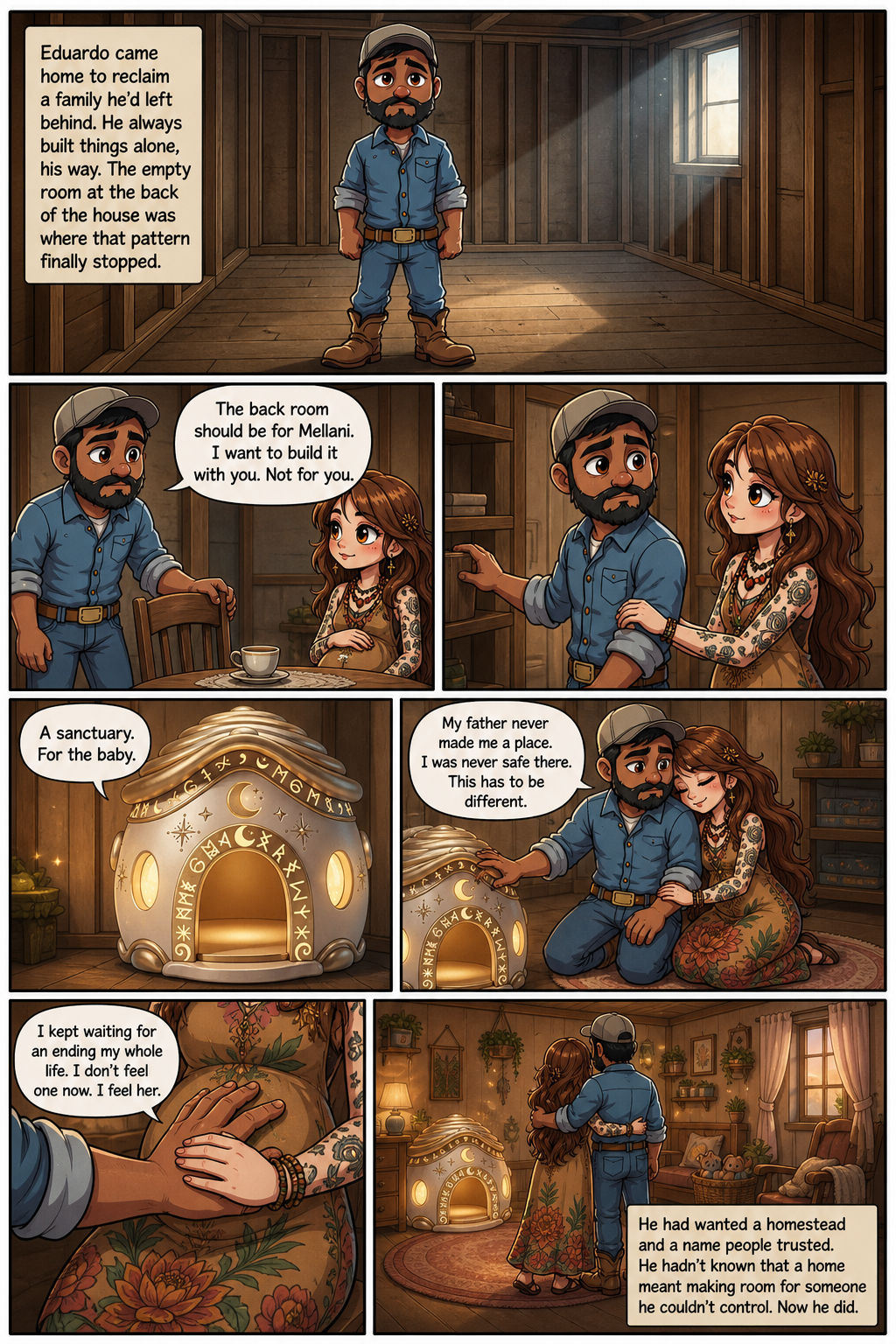
A week after the note, Eduardo stood in the empty room at the back of the house. Two front doors opened to the main room, but this space had stayed bare. He had planned to fill it himself, the way he filled everything once. He stopped. The old pattern ended here. He went to find Kiersten. She was at the tea table, hand flat on her belly. He pulled a chair across from her and sat. "The back room," he said. "It should be for Mellani. I want to build it with you, not for you." Kiersten studied him. She did not smile. "You mean that." "I do. You decide what goes where." "Good." She stood. "Come." They worked for three days. Kiersten chose the corner for the crib, away from the window where cold came through. Eduardo cut the boards. She told him where to nail and he nailed. He did not argue the measurements. When he reached to move a shelf without asking, she touched his wrist. He stopped and asked first. She nodded. On the third morning, they set the small cradle in the corner. It was a round thing, pale as bone, with a curved roof. Light glowed soft from its windows. Kiersten had traded for it in town. Carved moons and stars ran along its edge. Old marks circled the arched door like a blessing. "A sanctuary," Kiersten said. "For the baby." Eduardo knelt beside it. His hands had shaken a week ago. They were steady now. He ran a thumb over the carved moon. "My father never made me a place," he said. "I slept where he told me. I was never safe there." "I know." Kiersten sat on the floor beside him. "This is different." "It has to be." She leaned against him. He did not pull her closer or steer the moment. He only sat and let the quiet hold them. "I kept waiting for an ending," Kiersten said. "My whole life I felt them coming. I don't feel one now." She placed his hand on her belly. "I feel her." Eduardo looked at the room. A week ago it was bare boards and cold air. Now there was a crib in the warm corner, a place made by two pairs of hands. He had wanted a homestead once, and a name people would speak with trust. He had not understood that a home meant making room for someone he could not control. "I need to work more now," he said. "More hours at the feed store. There's a mouth coming that we have to feed." "We'll manage it." Kiersten rose and brushed off her dress. "Together. Same as the walls." The room was finished. The space for Mellani stood ready before she arrived. Eduardo stood in it and felt no fear, only the weight of what came next. He had to become the father he never had, and there was no time left to wait.
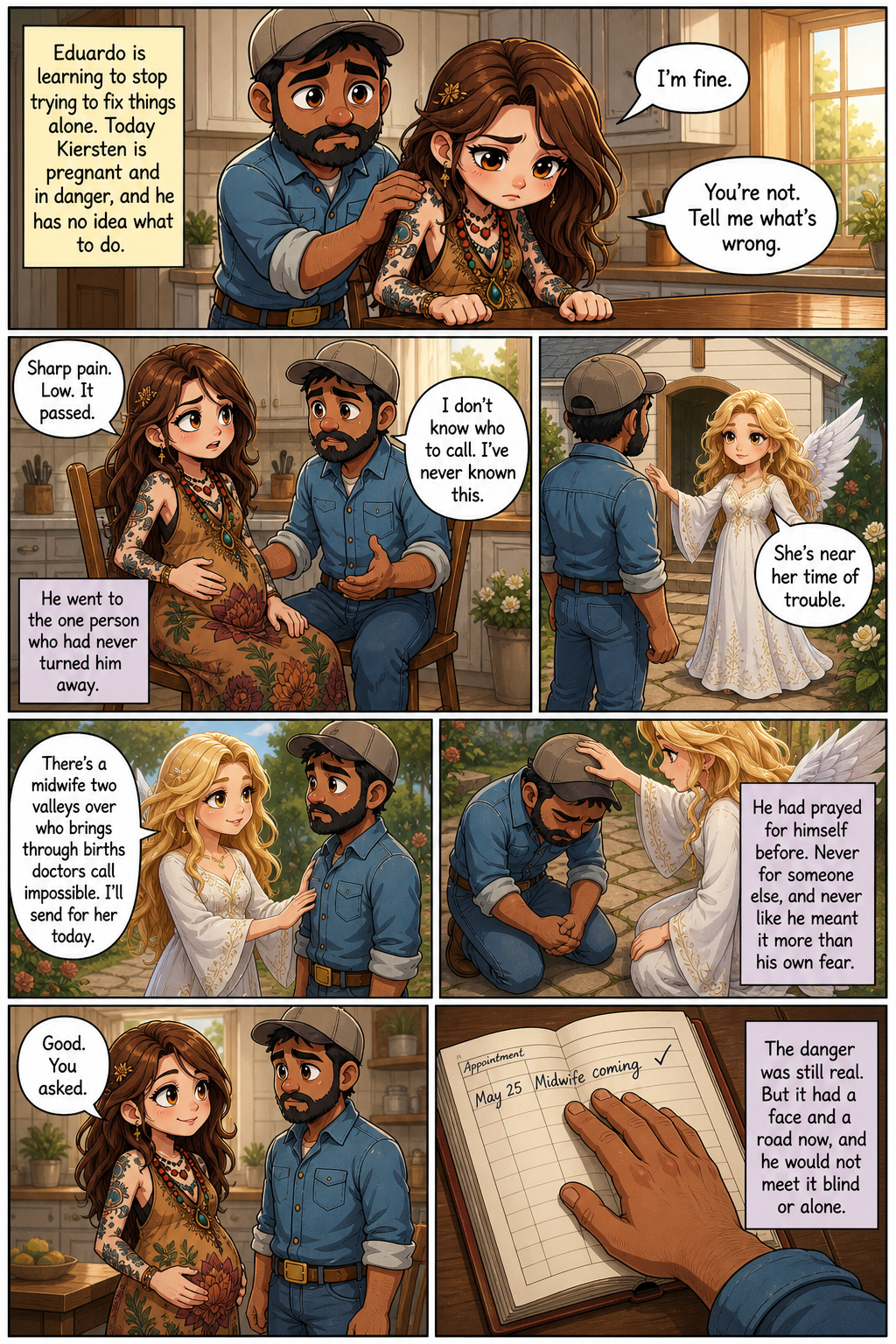
The nursery was ready, but the pregnancy was not safe. Eduardo knew it the morning Kiersten gripped the tea table and went pale. Doctors had told her for years she could not carry a child. Now she carried one, and the same doctors had warned of risk. Her body was not built for this. Eduardo did not know where to find the kind of care she might need. He only knew he could not fix it with his hands. "I'm fine," Kiersten said, straightening. But her knuckles stayed white on the wood. "You're not." He crossed to her. "Tell me what's wrong." "Sharp pain. Low." She breathed slow. "It passed." "It'll come back." He pulled a chair out and eased her into it. His old self would have promised to handle it alone. He did not. "I don't know who to call. I've never known this." Kiersten looked at him. "Then ask." He went for the one person who had never turned him away. He drove to the pale house with the cross and found Mother Angel at her door, blonde curls catching the light, hands already open as if she had been expecting him. "Eduardo." Her voice was soft as water. "She's near her time of trouble." His throat tightened. "How did you know?" "I feel these things in my bones." She stepped onto the path. "A birth like hers needs more than hope. It needs a midwife who has seen the hard ones, and prayer for what hands can't reach." "I don't know any midwife." "I do." She touched his arm. "There's a woman two valleys over who brings through births the doctors call impossible. I'll send for her today. She'll come and stay until Mellani is here." Relief buckled his knees. "I can't pay what that costs." "You won't pay it alone." Mother Angel smiled. "The town built your house. They'll carry this too. But you must do one thing yourself." "Anything." "Pray with me. Not for the outcome. For Kiersten to be held, whatever comes." Eduardo knelt on the stone path. He had prayed for his own forgiveness before. He had never prayed for someone else's safety and meant it more than his fear. He bowed his head. Mother Angel laid her hand on his hair and spoke over him, and something in his chest went quiet. When he rose, he knew the midwife would come. The care Kiersten needed had a face and a road now. The danger was still real. But it was no longer a thing he faced blind and alone. He drove home and told Kiersten. She listened, hand on her belly, and nodded once. "Good," she said. "You asked." That night the midwife sent word she would arrive within the week. Eduardo marked it in the record book by the door. Then he sat beside Kiersten and watched the lamp, ready now to wait for a danger he could finally meet.
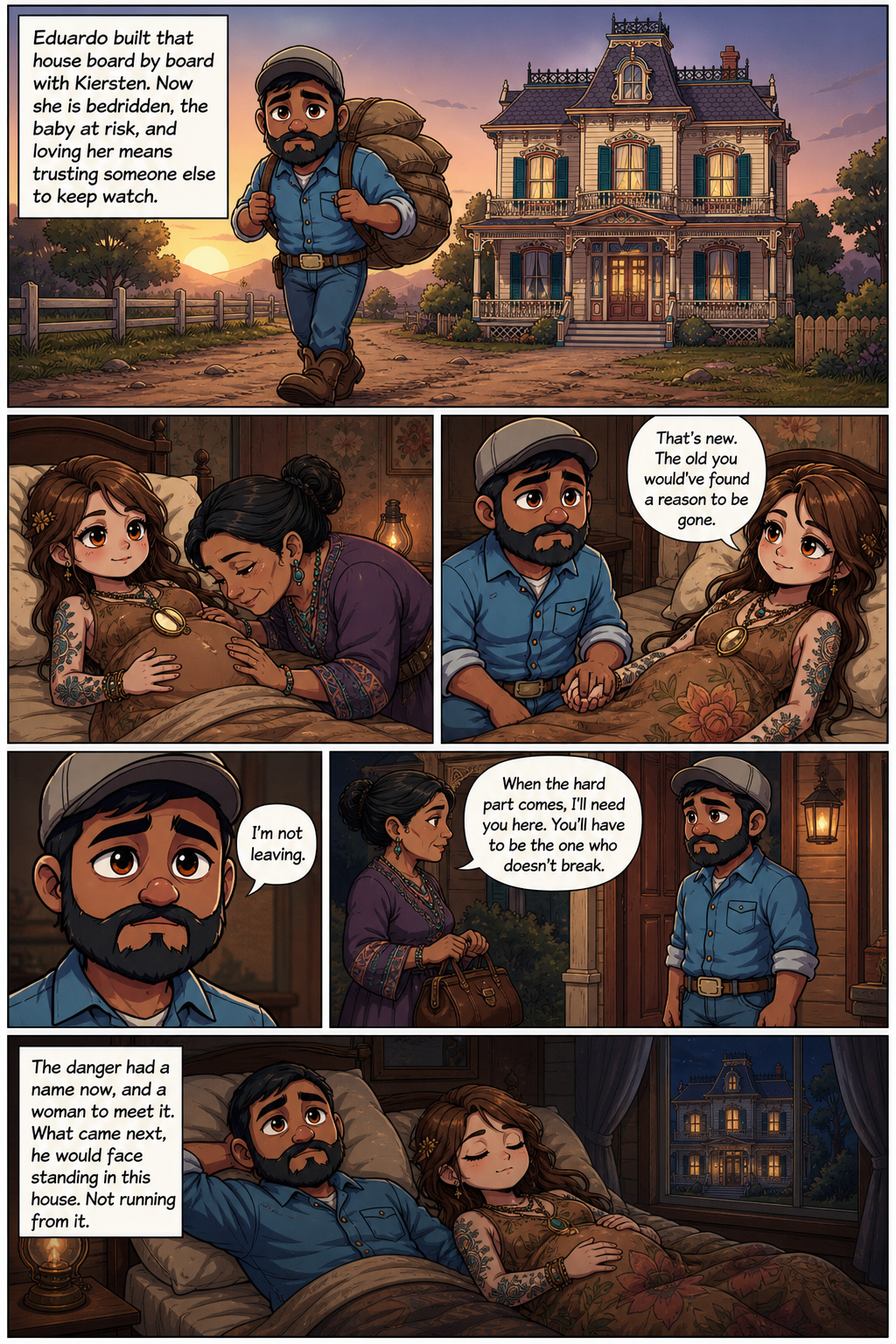
The midwife arrived within the week, as she had promised. She was a broad woman with gray hair and steady hands, come from two valleys over. She set her bag by the hearth and took one look at Kiersten and nodded. "Bed rest," she said. "Starting now." Eduardo moved to help Kiersten up the stairs, but the midwife blocked him with a flat palm. "You go to work. I'll sit with her." So the days split in two. Eduardo rose before dawn and hauled flour and feed for wages. The midwife stayed in the house, boiling herbs, watching Kiersten's color, counting the baby's movements with her ear to Kiersten's belly. When Eduardo came home at noon, he found the kitchen warm and the midwife at the table, unhurried. She told him what was true each day, no more. But the worry gnawed at him between loads. His old self would have stayed, hovering, taking over, calling it love. He did not. He trusted the woman with the steady hands. Still, each noon he walked through the door afraid of what he'd find. One afternoon he found Kiersten awake, propped against pillows, the locket open on her chest. She watched him climb the stairs. "You look tired," she said. "I'm fine." "That's my line." A small smile. "You hauled grain all morning. Sit." He sat on the edge of the bed. The midwife had gone down to the hearth, giving them the room. For a moment there was only the lamp and the two of them. "The pain's quiet today," Kiersten said. "She says the baby's strong." She paused. "She also says it won't be easy." "I know." He took her hand. "I'm not leaving." "I know." She looked at him, direct as always. "That's new. The old you would've found a reason to be gone." The words should have stung. They didn't. He had earned them by staying. That night the midwife pulled Eduardo aside at the door. "She's holding," she said. "But the hard part comes near her time. When it does, I'll need you here, not at the store. You'll have to be the one who doesn't break." Eduardo thought of his father, who broke everything he touched. He thought of the house he and Kiersten had built board by board. "I'll be here," he said. The midwife studied him, then nodded once, the way the feed store owner used to nod. "Good. Most men run. You married one who won't." She picked up her bag. "Rest. The real work's coming." She went up to sit the night watch. Eduardo climbed the stairs and lay beside Kiersten, listening to her breathe. The danger had a name now, and a woman to meet it, and a husband who would not leave the room. The care was handled. What came next, he would face standing in this house, not running from it.
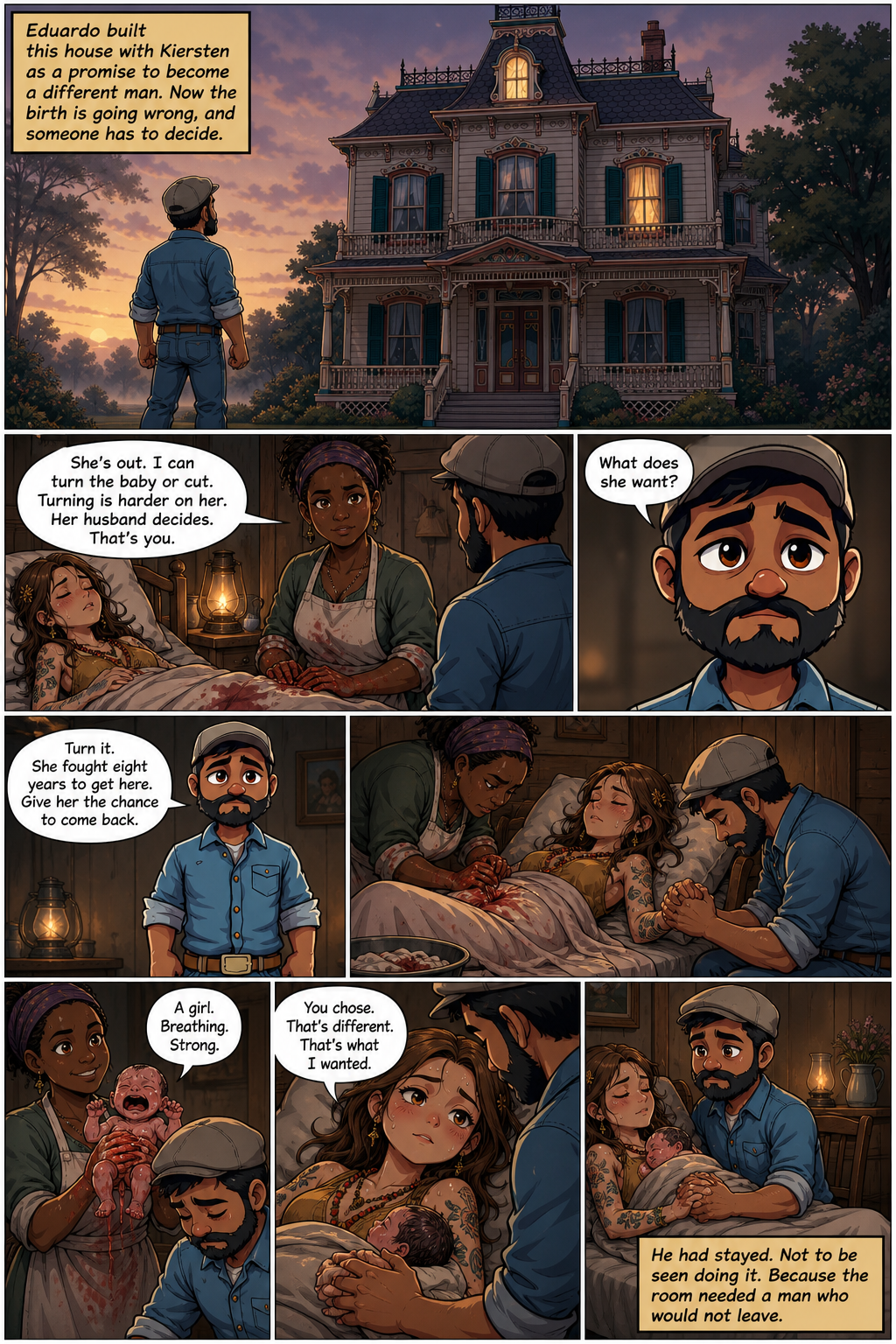
The pains came at dawn, close and hard. The midwife met Eduardo at the bottom of the stairs with a cloth in her hand. "It's starting," she said. "And it's wrong. Go up." Kiersten lay in their handmade bed, her face gray, her breath short. She gripped the frame they had built together. The midwife worked fast, her steady hands no longer steady. "She's bleeding," she said. "I can save one or both, but I need choices made, and she can't make them." Kiersten's eyes rolled back. Her grip went loose. The locket slid against her neck. "Kiersten." Eduardo took her face. No answer. The midwife looked up at him. "She's out. The baby's turned wrong. I can turn it, but it's rough on her. Or I cut. That's faster and safer for the child, harder on the mother." She waited. "Her husband decides. That's you." The old Eduardo would have frozen. He would have run for someone else to carry it. He stayed. He looked at Kiersten's face, slack against the pillow. For years she had decided everything. She had led because leading felt safer than trusting him. She had wanted him to take the weight. She had only feared the weight would fall on her alone. "What does she want?" he asked himself, out loud. Then he answered it. She wanted the baby they had named years ago. She wanted to live to hold it. She would not trade one for the other. "Turn it," he said. "Don't cut her. She fought eight years to get here. Give her the chance to come back." The midwife held his eyes a moment. "That's the harder road." "I know. Do it." She went to work. Eduardo knelt by the bed and held Kiersten's limp hand. He did not look away from the blood or the pain. He gave the midwife cloths when she asked. He wiped Kiersten's forehead. He did not break. Time stretched thin. Then a cry cut the room. The midwife lifted a small, red, screaming child. "A girl," she said. "Breathing. Strong." Kiersten stirred. Her eyes opened, dim, then found him. "Mellani," she whispered. Not a question. "She's here," Eduardo said. "You both are." The midwife laid the baby on Kiersten's chest. Kiersten was too weak to lift her arms, so Eduardo held the child in place with his hand over hers. "You chose," Kiersten said. Her voice was thread-thin. "I chose what you'd choose." "No." She looked at him, steady even now. "You chose. That's different. That's what I wanted." Her eyes closed, but her breath stayed even. The midwife checked the bleeding and nodded once. "She'll mend. Slow. She'll need tending for weeks." Eduardo did not move from the bed. He had led, at last, not to be seen, but because the room needed a man who would stay. Now the staying began.
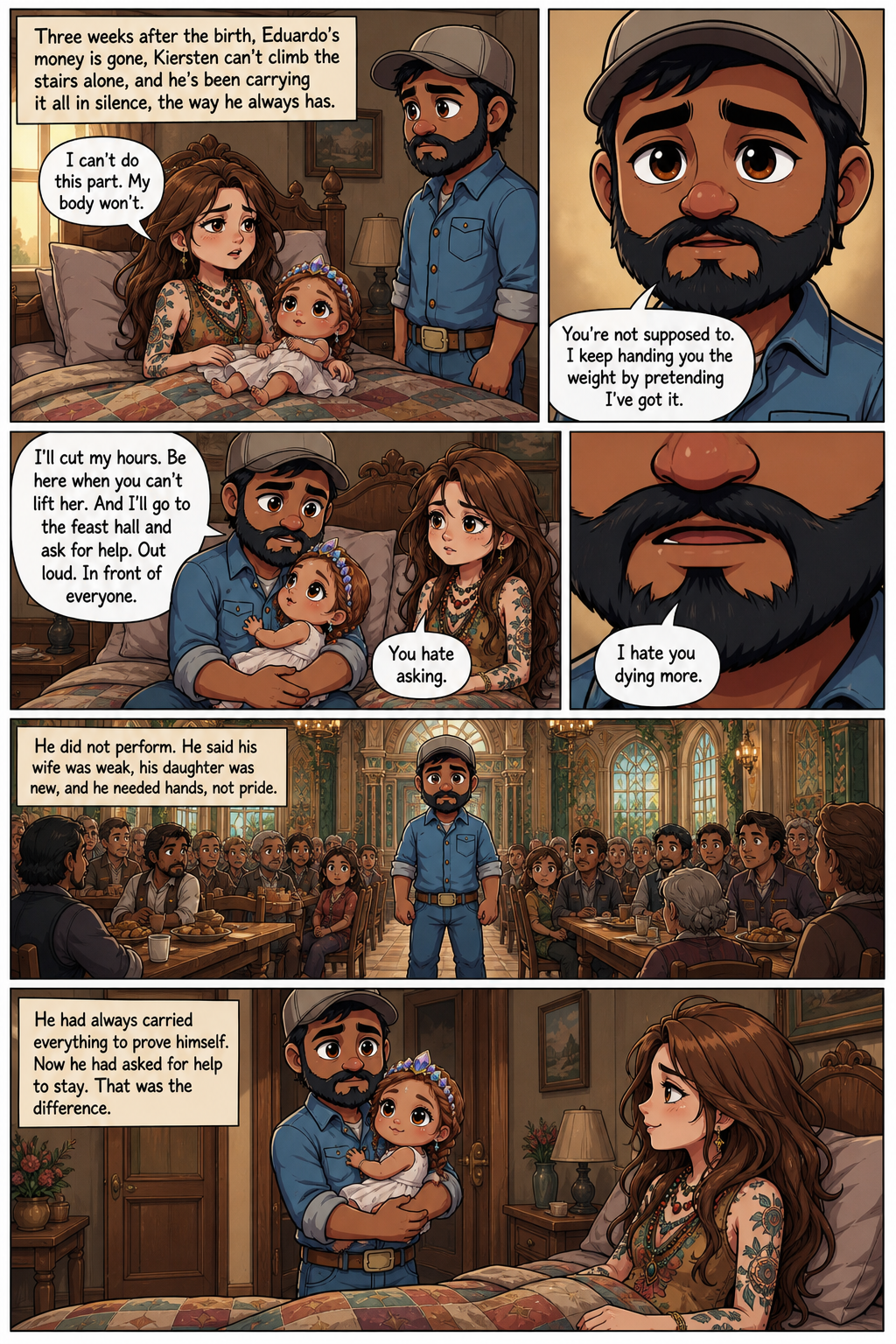
Three weeks after the birth, Kiersten still could not climb the stairs alone. The midwife came less often. The money Eduardo had set aside was gone. He worked the feed store at dawn, then came home to a wife too weak to lift their daughter for long. He had chosen to turn the baby and keep Kiersten alive. Now the staying he had promised was pressing him flat. One morning Mellani cried through the whole dawn feeding. Kiersten held her, but her arms shook. She set the baby down between them and looked at the ceiling. "I can't do this part," she said. "The house. The money. Her. I'm trying. My body won't." Eduardo almost said he would handle it all. The old answer. Carry everything, prove himself, let no one see him strain. Then he looked at Kiersten's gray face and understood that his carrying had always meant her carrying too. She had held his grief for years. She had led because he made her. This was not hers to hold. "You're not supposed to," he said. "I keep handing you the weight by pretending I've got it. I don't. Not alone." He sat on the edge of the bed. Mellani quieted against his chest. Her auburn eyes found his. She did not smile. She watched him the way her mother did, steady and plain. "I have to choose something real," Eduardo said. "Not a speech. A thing I'll do every day." Kiersten waited. She did not help him. That was the gift. He thought of the winter debts he had cleared one by one. He thought of the men who came with wagons when he asked plainly. He had learned the whole town would answer an honest voice. He had been too proud to use it for this. "I'll cut my feed store hours," he said. "Half days, mornings only. I'll be here when you can't lift her. And I'll go to the feast hall and ask for help with the house and the bills until you mend. Out loud. In front of everyone." Kiersten turned her head. "You hate asking." "I hate you dying more." She was quiet a long moment. "Do it," she said. Mellani stirred. Her small mouth moved. "Stay," she said. One word, flat, like she was correcting him before he could fail. Eduardo looked at his daughter. A newborn did not speak. He knew that. But the word landed in him anyway, and he did not argue with it. "I'm staying," he told her. That afternoon he drove to the feast hall. He stood up in front of the tables and said his wife was weak, his daughter was new, and he needed hands and time, not money he could repay with pride. He asked plainly. He did not perform. The room shifted toward him. The choice was made, and it was not Kiersten's to make. It was his.
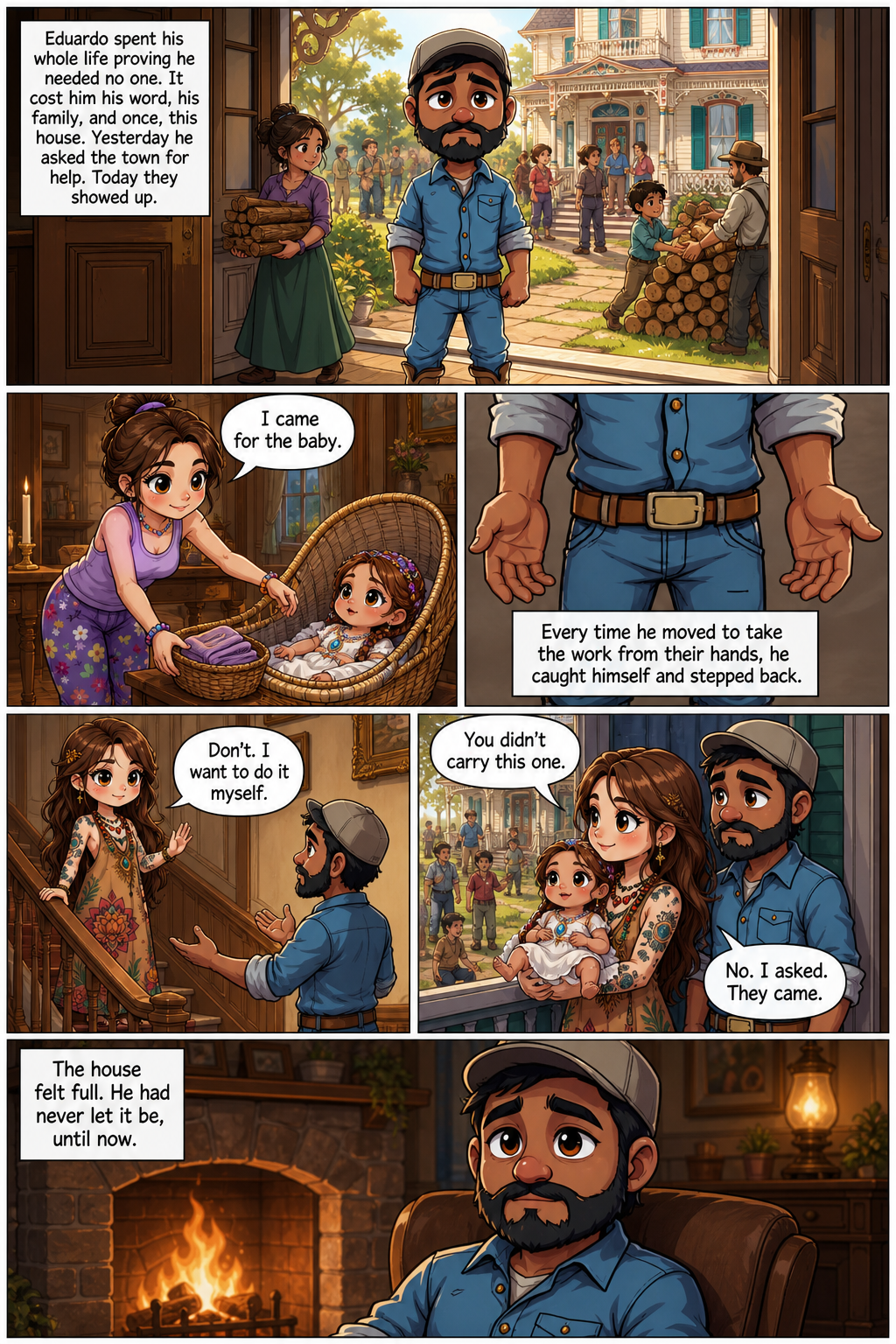
The day after Eduardo asked the town for help, the first knock came before noon. He opened the door to a yoga teacher he knew by sight, a woman who taught the town's children and smiled with her whole face. Maya Sunshine held a basket of bread and a folded quilt. "I came for the baby," she said, like it was the simplest thing in the world. She stepped past him and went straight to the cradle. Mellani stopped fussing the moment Maya leaned over her. After that they came every day. The Wise One arrived one gray morning and pressed her hand flat against Kiersten's bedroom wall before she said a word. "The weight is sitting in her hips," she told Eduardo. "She's been holding her body still too long. Walk her to the window and back. Twice a day." He did it. Kiersten leaned on his arm, took six steps, and rested. The next day she took ten. Mother Angel came on Sundays. She prayed over Kiersten with her hands on the blanket, then washed the dishes stacked by the basin without being asked. She left broth on the stove. "You asked plainly," she told Eduardo once, drying her hands. "That is why the door keeps opening." Men split wood in the yard. Women folded laundry at the kitchen table. Someone paid the feed bill before Eduardo could. He kept trying to take the work from their hands, and each time he caught himself and stepped back. He let them help. That was the hardest part, and he did it anyway. One morning Kiersten climbed the stairs alone. Eduardo heard her feet on each step and froze at the bottom, hands ready to catch her. She reached the top and turned around. "Don't," she said. "I want to do it myself." Her face was no longer gray. He stood there and let her. That afternoon she carried Mellani to the window by herself and held her there a long time. Her arms did not shake. "I'm mending," she said. It was not a question. She looked at the yard full of neighbors stacking wood. "You didn't carry this one." "No," Eduardo said. "I asked. They came." Mellani watched them both from Kiersten's arms. Her small mouth moved. "Good," she said, flat, like she was marking something down. Eduardo did not argue with it this time either. That night the house was quiet. Kiersten slept without waking for the first time in weeks. Eduardo sat by the hearth and understood the thing had changed. He had spent his whole life proving he needed no one, and it had cost him his word, his business, and once, this woman. Now his wife was healing because he had opened the door and let the town walk through it. The house felt full. He did not know yet what he would build next inside a home that finally held more than his own pride.
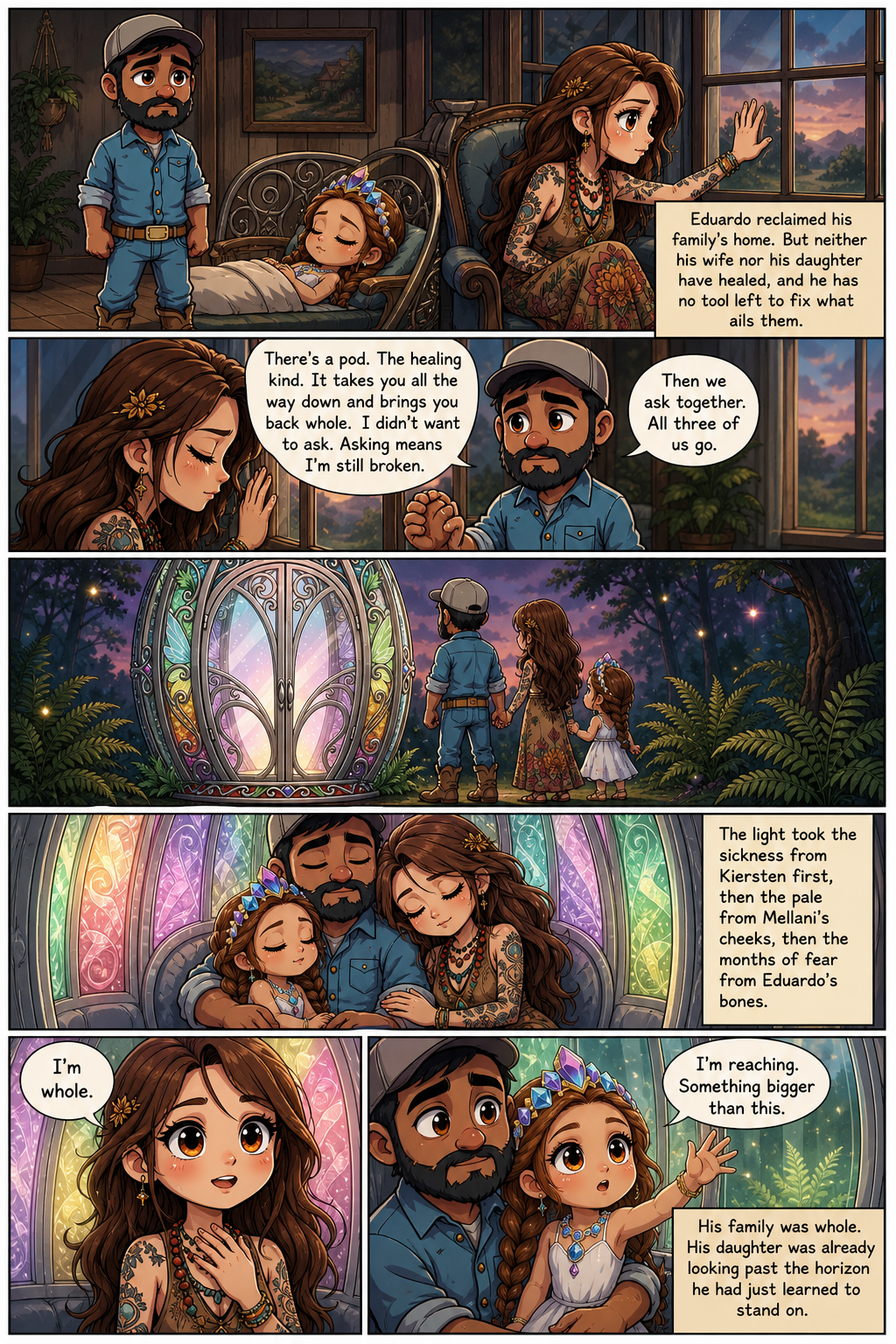
Kiersten mended, but she tired fast. She climbed the stairs now, yet by midday her hands shook again. Eduardo watched her sit down hard at the window one morning, out of breath. Mellani fussed in the cradle, pale beneath her braids. The town had carried them this far. But some weakness in both his wife and his daughter had not lifted. Eduardo knew he could not fix it with wood or wages. That afternoon he knelt by the cradle. "You're not well yet," he said. "Neither of you." "No," Mellani said. She did not soften it. Kiersten rested her head against the glass. "There's a pod," she said. "The healing kind. Mirelle told me once. It takes you all the way down and brings you back whole." She looked at him. "I didn't want to ask. Asking means I'm still broken." Eduardo took her hand. "Then we ask together. All three of us go." They walked there before dusk. The pod stood among ferns, taller than a man, shaped like an egg. Silver curves wrapped the glass. Colored panels glowed along its sides, soft as lit stained windows. A faint light breathed from inside. Eduardo had passed it before and never understood it. Now he understood it was meant for this. Kiersten hesitated at the door. "If I go under and don't come up right," she said, "you don't carry it alone. You ask for help. You've learned that." "I've learned that," Eduardo said. He opened the glass door. Warm light poured over them. Kiersten stepped in and sat. Eduardo settled beside her with Mellani against his chest. The door sealed. The glow deepened, wrapping all three of them, humming low through his bones. He felt the tiredness leave Kiersten first. Her shoulder stopped trembling against his arm. Color returned to her face, slow, like morning filling a room. Mellani's small body loosened. Her breathing steadied. The pale left her cheeks. Eduardo closed his eyes and let the light take his own weariness too, the months of fear and sleepless nights draining out of him. When the glow faded, Kiersten sat up straight. No shaking. "I'm whole," she said, surprised, like testing a floor that held. Mellani opened her eyes. They were bright now, steady. She looked past them both, toward something only she saw. "I'm reaching," she said. Kiersten frowned. "Reaching for what?" "Something bigger than this." Mellani did not explain. She had used the word before and refused to take it back. Eduardo held his daughter and felt her strong at last. But her eyes stayed fixed far off, past the glass, past the ferns. The healing had closed one wound and opened a new question he could not answer. His family was whole. His daughter was already looking somewhere he could not follow.
Play your story to life
Storycraft is a mobile game where you create AI characters, craft items and locations to build their world, then discover what direction your story takes. Download the iOS game for free today!
Download for free